PROJECT BRIEF
1. IDENTIFIERS:
PROJECT NUMBER
Project number not assigned
PROJECT NAME
Addressing land-based activities in the Western Indian
Ocean (WIO-LaB)
DURATION
Four years
Commencing: October 2003
Completion: October 2007
IMPLEMENTING AGENCY
United Nations Environment Programme (UNEP)
EXECUTING AGENCY
UNOPS / Nairobi Convention Secretariat
REQUESTING COUNTRY
Comoros, Kenya, Madagascar, Mauritius, Mozambique,
Seychelles, South Africa, and Tanzania
ELIGIBILITY
Under paragraph 9(b) of the Instrument
GEF FOCAL AREA
International waters
GEF PROGRAMMING FRAMEWORK
OP 10 Contaminant based, with relevance to the coastal,
marine, and freshwater ecosystems Operational Programs.
2. Summary
This project proposal, Addressing land-based activities in the Western Indian Ocean (including TDA and SAP
updates -- WIO-LaB), has a primary concentration on some of the major environmental problems and issues of the
region: degradation of the marine and coastal environment due to land-based activities. The project focus on the
Global Program for Action and OP 10 will result in the adoption and domestic resourcing of National Programmes
of Action for abating land-based sources, as well as a regional GPA protocol for the existing Regional
Environmental Convention (Nairobi Convention) with Annexes. This project is a direct follow-on to the African
Process and the World Summit for Sustainable Development (WSSD), and addresses IW strategic priorities
elucidated in the Draft IW support for WSSD decisions. The project focus on addressing major land-based activities
in the region represents a strong partnership between the countries, the Norwegian government, UNEP, and the
GEF. The project is designed to serve as a GPA demonstration project, as identified in OP 10 guidelines, to achieve
three objectives. Three objectives have been developed for this GEF project: 1) Reduce stress to the ecosystem by
improving water and sediment quality; 2) Strengthen regional legal basis for preventing land-based sources of
pollution through GPA; and 3) Develop regional capacity and strengthen institutions for sustainable, less polluting
development. A preliminary Transboundary Diagnostic Analysis and a preliminary Strategic Action Programme
have been prepared, and these serve as the basis for preparation of this project proposal. The full GEF project will
complete a geographically-specific TDA, a focused SAP with policy/ legal/ institutional reforms and needed
investments for the transboundary problems and areas of important biomes in a state of decline, and specific NAPS
with specific laws and investments included. This project builds on the African Process through adoption of their
methodology for identifying hot spots, addressing hot spots identified in the African Process, and addressing
sensitive areas identified in this process. For countries not participating in the MSP for the African Process, the
African Process methodology will be followed to identify hot spots and sensitive areas for demonstration projects.
The project focus on broad stakeholder participation will help assure the sustainability of the GPA Plans of Action.
This project also builds on the four other GEF IW activities in the pipeline that are in the region, representing a
holistic approach. The private sector will be a focus for cooperation, as they also hold the key for long-term
sustainability of actions.
3. Costs and Financing (Million US $)
GEF:
Project *
:
$4,186,140
PDF - B
:
$0,325,000
Subtotal GEF
:
$4,511,140
Co-Financing:
UNEP :
$0,375,000
Governments (in cash and kind)
:
$3,131,675
Norway :
$3,395,650
Subtotal
Co-financing
:
$6,902,325
Total Project Cost
:
$11,413,465
-i-
*
Commitment sought by Council at its (month, year) session (including project support costs)
**
Based on pledges at the time of project brief submission
4. Associated Financing (Million US $):
Governments (baseline)
: $97.662,796
5. Operational Focal Point Endorsement(s):
Comoros:
Mohamed Youssouf Oumouri, Director General of Environment, Ministry of Rural
Development of Fisheries & Environment
Date: 11 March 2003
Kenya:
Amb. Michael K. Koech, Director, National Environment Secretariat
Date: 7 march 2003
Madagascar:
Refeno Germain, GEF Operational Focal Point , Secrétaire Général du Ministère de
l'Environment
Date: 7 March 2003
Mauritius:
Guy Wong So, Director, Ministry of Economic Planning & Development.
Date: 8 March 2002
Mozambique:
Evaristo Baquete, Permanent Secretary Ministry for the Co-ordination of Environmental
Affairs.
Date: 3 March 2003
Seychelles:
Alain Butler-Payette, Ministry of Foreign Affaires.
Date: 11 March 2003
South Africa:
Dr. Crispian Olver, Director General, Department of Environmental Affairs and Tourism
Date: 5 March 2003
Tanzania: R.O.S
Mollel, GEF Operational Focal Point, Vice President's Office.
Date: 1 March 2003
6. Implementing Agency Contact:
Mr. Ahmed Djoghlaf, Director, UNEP/DGEF Division for GEF Co-ordination, UNEP, Nairobi, Tel: 254 2 624166;
Fax: 254 2 520825; Email: ahmed.djoghlaf@unep.org
- ii -
GLOSSARY
CBD
Convention on Biological Diversity
CD
Compact
Disc
CCRF
Code of Conduct of Responsible Fisheries
CITES
Conventional on International Trade in Endangered Species
COI
Indian
Ocean
Commission
COP
Conference
of
Parties
CORDIO
Coral Reef Degradation in the Indian Ocean
CRC
University of Rhode Island Coastal Resources Center
CZMC
Coastal Zone Management Center (Rijkwaterstaat, NL)
DANIDA
Danish International Development Agency
DIM
Data and Information Management
EAME
East African Marine Ecoregion
EIA
Environmental Impact Assessment
EMPS
Environmental Management Plan of the Seychelles
FAO
Food
and
Agricultural
Organization
FINNIDA
Finnish International Development Agency
GCRMN
Global Coral Reef Monitoring Network
GEF
Global Environment Facility
GEMPA-EA
Group of Experts in Marine Protected Areas for Eastern Africa
GESAMP
Group of Expert on the Scientific Aspects of Marine Environmental Protection
GIS
Geographic Information System
GIWA
Global International Waters Assessment
GOOS
Global Ocean Observing System
GPA
Global Programme of Action for the Protection of the Marine Environment from Land-based
Activities
HAB
Harmful Algal Bloom
ICRAN
International Coral Reef Action Network
ICRI
International Coral Reef Initiative
ICZM
Integrated coastal zone management
IMO
International
Maritime
Organization
IMS
Institute for Marine Sciences, Dar es Salaam, TZ
IOC
Intergovernmental Oceanographic Commission
IUCN
The World Conservation Union
IW
International
Waters
LEARN
Learning Exchange and Resource Network
LME
Large Marine Ecosystem
NBSAP
National Biodiversity Strategy and Action Plan
MPA
Marine
Protected
Area
MPRU
Marine Parks and Reserves Unit
NEAP
National Environmental Action Plan
NEMC
National Environment Management Council (Tanzania)
NEPAD
New Partnership for Africa's Development
NFP
National Focal Point
NGFPA
National Government Focal Point Agencies
NGO
Non-Governmental
Organization
NORAD
Norwegian Agency for Development Cooperation
OAU
Organization for African Unity
PC
Project
Coordinator
PDF
Project
Development
Fund
PIP
Priority Investment Portfolio
PIR
Project
Implementation
Review
PPER
Project Performance and Evaluation Review
QA
Quality
Assurance
QC
Quality
Control
RCU
Regional Coordinating Unit (supports Nairobi Contention Secretariat in Seychelles)
- iii -
SADC
South African Development Community
SAP
Strategic
Action
Programme
SC
Steering
Committee
SEACAM
Secretariat for Eastern Africa Coastal Area Management
SGP
Small
Grants
Program
SIDA
Swedish International Development Agency
SIDS
Small Island Developing States
SIOFP
South Western Indian Ocean fisheries
SMC
Strategic Management Advisory Committee
TAFIRI
Tanzania Fisheries Research Institute
TDA
Transboundary Diagnostic Analysis
TOR
Terms
of
References
TPR
Tri-partite
Review
UNCLOS
United Nations Convention on Law of the Sea
UNDP
United Nations Development Programme
UNEP
United Nations Environment Programme
UNOPS
United Nations Office for Project Services
USAID
United States Agency for International Development
WB
World
Bank
WCS
Wildlife Conservation Society
WINDOW
West Indian Ocean Waters
WIO
West Indian Ocean
WIO-LaB
GEF Project: Addressing land-based activities in the Western Indian Ocean
WIOMSA
West Indian Ocean Marine Sciences Association
WMU
WIO-LaB Managing Unit
WSSD
World Summit on Sustainable Development
WWF
World Wide Fund for Nature
WWW
World
Wide
Web
- iv -
TABLE OF CONTENTS
BACKGROUND AND CONTEXT BASELINE COURSE OF ACTION .......................................................... 1
INTRODUCTION.......................................................................................................................................................... 1
GEF PROGRAMMING CONTEXT................................................................................................................................. 4
REGIONAL PROGRAMMING CONTEXT........................................................................................................................ 4
NATIONAL PROGRAMMING CONTEXT .......................................................................................................................6
SYSTEM BOUNDARIES ...............................................................................................................................................6
IMMEDIATE AND INTERMEDIATE PROBLEMS .............................................................................................................7
RATIONALE AND OBJECTIVES (ALTERNATIVE) ........................................................................................ 10
PROJECT ACTIVITIES/COMPONENTS AND EXPECTED RESULTS .........................................................11
REPLICABILITY .....................................................................................................................................................16
RISKS AND SUSTAINABILITY ............................................................................................................................18
STAKEHOLDER PARTICIPATION AND IMPLEMENTATION ARRANGEMENTS .................................18
PROJECT FINANCING AND INCREMENTAL COSTS....................................................................................19
PROJECT FINANCING ..........................................................................................................................................19
MONITORING, EVALUATION AND DISSEMINATION ................................................................................. 21
LIST OF ANNEXES ................................................................................................................................................. 23
LIST OF FIGURES
Figure 1. West Indian Ocean ........................................................................................................................................2
LIST OF TABLES
Table 1: Major Objectives and Project Outputs ......................................................................................................... 12
Table 2: Major Objectives and Project Components.................................................................................................. 13
Table 3. Workplan and Timetable Overall Duration of the Project......................................................................... 17
Table 4. Summary of Project Financing ....................................................................................................................20
Table 5. Baseline and Incremental Costs and Domestic Environmental Benefits......................................................20
Table 6. M&E Activities, Timeframes, And Responsibilities ....................................................................................21
- v -
BACKGROUND AND CONTEXT BASELINE COURSE OF ACTION
INTRODUCTION
1.
Marine and coastal environments, and the goods and services they provide, are under threat in many regions
of the world. The 2001 report, prepared by the joint Group of Expert on the Scientific Aspects of Marine
Environmental Protection (GESAMP), highlighted that on a global scale the productive capacity and ecological
integrity of the marine environment, including estuaries and near-shore coastal waters, continued to be degraded and
in many places the degradation even intensified. The sustainability of the services coasts and oceans provide is
increasingly compromised by unsustainable consumption and production patterns and management practices.
2.
Globally, the impact of sewage, physical alteration of coastal and marine ecosystems, and high nutrient
levels merits priority for action over the period 2002-2006. Addressing these priorities cannot be achieved
unilaterally or in isolation of the broader objectives of sustainable development. The causative relationship between
poverty, human health, unsustainable consumption and production patterns, poorly managed social and economic
development, and the degradation of coastal and marine environments must be addressed through regionally
integrated and cooperative action.
3.
In this context, Paragraph 29 of the Plan of Implementation adopted by governments at the World Summit on
Sustainable Development in Johannesburg, South Africa, 26 August 4 September 2002, states "Oceans, seas, islands
and coastal areas form an integrated and essential component of the Earth's ecosystem and are critical for global
food security and for sustaining economic prosperity and the well-being of many national economies, particularly in
developing countries. Ensuring the sustainable development of the oceans requires effective coordination and
cooperation, including at the global and regional levels...."
4 .
More specifically, the Johannesburg Plan of Implementation continues in Paragraph 32 to call upon the
international community to "Advance implementation of the Global Programme of Action for the Protection of the
Marine Environment from Land-based Activities and the Montreal Declaration on the Protection of the Marine
Environment from Land-based Activities, with particular emphasis in the period 2002-2006 on municipal
wastewater, the physical alteration and destruction of habitats, and nutrients, by actions at all levels to:
(a)
Facilitate partnerships, scientific research and diffusion of technical knowledge; mobilize domestic,
regional and international resources; and promote human and institutional capacity-building, paying particular
attention to the needs of developing countries;
(b)
Strengthen the capacity of developing countries in the development of their national and regional
programmes and mechanisms to mainstream the objectives of the Global Programme of Action and to manage the
risks and impacts of ocean pollution;
(c)
Elaborate regional programmes of action and improve the links with strategic plans for the sustainable
development of coastal and marine resources, noting in particular areas which are subject to accelerated
environmental changes and development pressures;
(d)
Make every effort to achieve substantial progress by the next Global Programme of Action conference
in 2006 to protect the marine environment from land-based activities."
5.
The proposed project described below will contribute to the realization of these commitments in the Western
Indian Ocean (WIO) Region. The WIO region is comprised of five coastal States (Somalia, Kenya, Tanzania,
Mozambique, and South Africa) and five island States (Mauritius, Comoros, Seychelles, Reunion-France, and
Madagascar). Figure 1 shows the overall west Indian Ocean Region. These ten Western Indian Ocean nations are at
different stages of both political and economic development. These differences are reflected in the range of individual
economic indicators from those with a per capita gross national product of over $ 3,500 per annum, to those with less
than $ 500 per capita. Similarly National institutions reflect variations in strength and infrastructure, as seen in the
recent collapse of institutions and governance structure in Somalia and the evolution of a working government in
Mozambique after several decades of strife.
-1 -
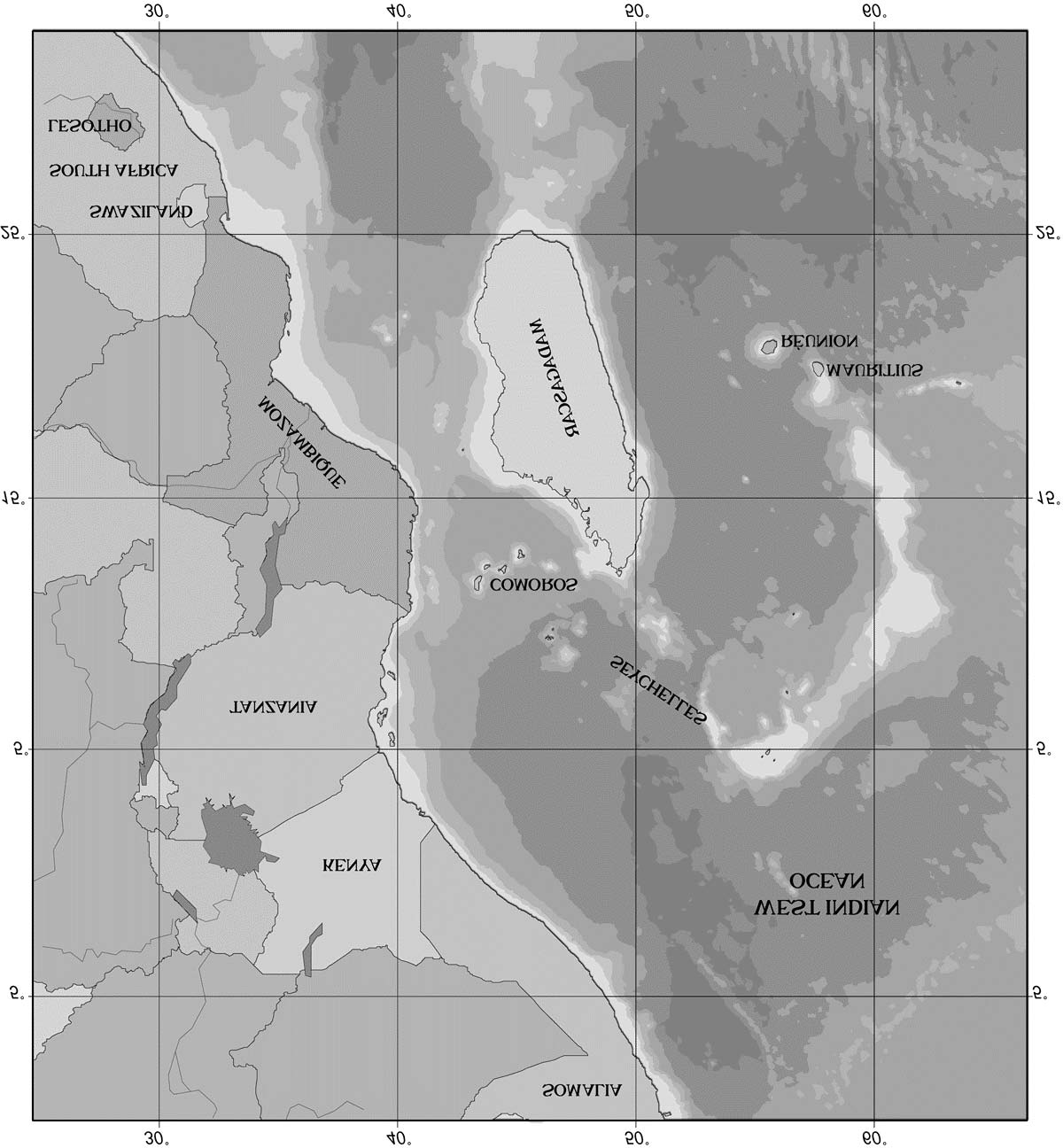
Figure 1. West Indian Ocean
-2 -
6.
The region encompasses two geographical sub-groupings: the Mainland and Island states, that reveal both
similarities and differences, with similarities being closer within than between them. The island states (except
Madagascar) are almost entirely coastal due to their geographical size and are much more exposed, as a whole, to the
marine environment, relative to the mainland states. Urbanization pressures, poverty, structural adjustments problems
and the strength of informal sector activities, are far more dominant in the mainland states, compared to the island
states of Comoros, Mauritius, and Seychelles. The coastal region of the mainland states between Somalia and
Mozambique is home to 25 million people. This represents 20 percent of the combined population of the mainland
states on 12 percent of the land. Population trends indicate a doubling of population in about 25 years in the major
coastal cities of Mombassa, Dar es Salaam, and Maputo, which are experiencing growth of 5.0%, 6.7% and 7.2% per
annum, respectively.
7.
The WIO is renowned for the attractiveness of its coastal zones, high marine biodiversity, and rich marine and
coastal resources. In the 52 tropical inshore fish families endemism is high, 22% in the WIO region compared to 13%
in the Red Sea and only 6% in the Eastern Indian Ocean. Furthermore five of the world's seven species of marine turtle
nest on beaches in the region. Signs of environmental degradation, as well as a decline in natural resources and
biodiversity, are beginning to become more obvious. This fact is attributed to the growing coastal population, as well
as increasing land-based activities and sources of pollution such as industrial, urban, and agricultural activities.
8.
The Western Indian Ocean States recognize the urgent need for better and more effective management of the
coastal and marine resources for the purpose of improving the quality of life of the people, sustaining economies of the
countries of the Region, and maintaining the productivity and diversity of the ecosystems. It was with this in mind that
the First Meeting of the Contracting Parties to the Nairobi Convention in March 1997 approved the preparation of the
Strategic Action Programme (SAP) for the Region. Preparation of the present project, together with the preliminary
TDA and SAP, was facilitated through a Global Environment Project Development Facility Block-B (GEF PDF-B)
grant.
9.
During the past two decades, the WIO Region has received significant international support for the
development of environmental management capacity, particularly in coastal areas. As a result, a number of initiatives
have taken place at local, national, and regional levels which need better coordination. In 1985, the Eastern African
States adopted the Convention for the Protection, Management and Development of the Marine and Coastal
Environment (the Nairobi Convention). The Convention has two protocols: one for the protection of wild fauna and
flora, and a second for combating marine pollution. The Convention also has an Action Plan (the Eastern African
Regional Seas Action Plan). In 1993, the Ministers of Environment and Natural Resources of the Eastern African
countries met in Arusha, Tanzania and signed a resolution recognizing the importance and value of the coastal zone and
emphasizing the need for sustainable development and integrated management of coastal areas for the benefit of coastal
communities. As a follow up to the Arusha Declaration, a Policy Conference on Integrated Coastal Zone Management
in Eastern African and Island States, was convened in Seychelles in 1996. Policy makers from the region assessed the
successes and failures in ICZM since the Arusha Declaration, and discussed and agreed on actions needed to improve
the situation.
10.
The primary objective of this project and its Preliminary SAP is to provide a firm basis to strengthen existing
regional frameworks, secure policy/legal/institutional reform, attract essential investments for Transboundary issues,
and catalyze regional coordination of existing and new activities within the framework of the Nairobi Convention, and
to address issues such as the lack of capacity, poor coordination, overlapping responsibilities, sectoral approaches to
coastal and marine resource development, and inadequate enforcement within participating states. The SAP is
consistent with the objectives of the Nairobi Convention, the protocols established thereunder, and with the objectives
laid out in Agenda 21, Chapter 17, of the Rio Declaration. The present project and the SAP will further complement the
objectives of the Southern African Development Community (SADC) and the Indian Ocean Commission (COI)
initiatives.
11.
The Preliminary SAP is based on the national environmental policies, plans, and on priorities identified at a
national level. Risk assessment criteria were applied to identify priority regional threats, responses, and targets. A
preliminary transboundary diagnostic analysis (TDA) was carried out to identify the supra-national/transboundary
threats and responses. The TDA was based on national reports and analyses, and on extensive regional technical
consultations and studies which took place in the past four years. The officially approved national reports have been
prepared by Inter-Ministerial committees with broad-based consultation at the national level to identify the priorities of
each country. A preliminary SAP was developed, that describes a regional process for coordinating existing and new
-3 -
regional marine and coastal environment initiatives. It identifies priority actions and identifies activities and
programmes in relation to specific environmental quality objectives, targets, and associated actions designed to achieve
a long-term balance between our growing populations and the carrying capacity of the coastal environment.
GEF PROGRAMMING CONTEXT
12.
The design of the Preliminary SAP and the present project conform to the GEF objectives and priorities in OP
10: Contaminant based, with relevance to the coastal, marine, and freshwater ecosystems Operational Programs
(including OP 9). Based on GEF guidance, the focus of this project is on the more continental countries (Kenya,
Tanzania, Mozambique, South Africa, and Madagascar), although assistance is focused also on assisting the island
nations (particularly Comoros) develop their respective land-based National Programmes of Action. The draft SAP
attempts to address some of those problems which are particular to the WIO Region, as indicated in the TDA, namely:
1. Shortage and contamination of fresh water
2. Decline in harvests of marine living resources
3. Degradation of coastal habitats (mangroves, seagrass beds, and coral reefs), loss of biodiversity.
4. Overall water quality decline: Contamination of coastal waters, beaches and living resources.
The third and fourth problems identified above form the basis for the present GEF project, through OP 10.
13.
This project conforms to the GEF objectives and priorities in the Contaminant-Based Operational Program
(OP 10). In particular, this project demonstrates ways of overcoming barriers to the adoption of best practices, and
contributes to the first short-term objective of OP 10: "demonstrate strategies for addressing land-based activities
that degrade marine waters..." This project effectively integrates portions of OP 9 with OP 10, by achieving
prevention of damage to the threatened West Indian Ocean waters, through linkage to specific strategies to achieve
that prevention.
14.
Through implementation of this project, and ultimately the SAP, regional and by extension global
environmental benefits will result, through protection of international waters and their resources, and sustainable use of
resources in consistency with GEF Operational Programs. The proposed project components are essentially regional
and transboundary in nature and will enable the states of the Region to improve existing regional cooperative
frameworks, adhere to international conventions, national laws, regulations, and management regimes, plus and where
necessary design new and additional collaborative regional mechanisms to improve the sustainability of resource use
and reduce existing and potential degradation.
15.
The principal human beneficiaries of the project are the users of the freshwater, marine, and coastal water
resources, and those whose livelihood depends on the rivers, coastal wetlands, the mangroves, beaches, reefs,
seagrasses, and seas. National Environmental Agencies will play a key role in the implementation of project
activities thus enhancing capacity within the institutions as well as complementing and strengthening existing
national efforts to address environmental issues. At a global level, the project and its SAP put together regional and
national activities into a coherent component of the global environmental protection effort. Implementation of the
final SAP will thus assist in the conservation of marine and coastal biodiversity and assist the countries in
complying with their national and regional obligations under various international legal agreements.
REGIONAL PROGRAMMING CONTEXT
16.
The Project Brief is also entirely consistent with the Global Program of Action for the Protection of the Marine
Environment from Land Based Activities (GPA/LBA) for the Indian Ocean Region as the Project recognizes the fact
that the main sources of marine pollution come from land-based activities including urbanization and coastal
development, industries, and agriculture practices. Furthermore, the Project builds on the recognized priorities for
action proposed in the regional approach to implementing the GPA/LBA in the West Indian Ocean Region, which
include the strengthening of regional cooperative arrangements; strategies and programs for the identification of
problems and causes; the establishment of targets and priorities of action; definition of specific management objectives;
and the need to identify the elements required to support the proposed actions. In addition the project will assist
participating states in meeting the objectives of the Nairobi Convention; the regional and global priorities identified
under Agenda 21 (Chapter 17); the Convention on Biological Diversity; the Programme of Action for the Sustainable
-4 -
Development of Small Island Developing States (Barbados, 1994); the Pan-African Conference on Sustainable
Integrated Coastal Management (Mozambique, 1998); the Arusha Resolution on Integrated Coastal Zone Management
(ICZM) in Eastern Africa including the Island States (April, 1993); the Seychelles Conference Statement on ICZM
(October, 1996); and the Marine Turtle Conservation and Action Plan for the WIO region. The project also
complements the commitments and priorities identified within the Environmental Component of the New Partnership
for Africa's Development (NEPAD), thus further strengthening the institutional capacities of existing national and
regional institutional structures.
17.
There are other ongoing, or planned, GEF interventions in the region. The "African Process" medium-sized
project addressed a subset of the present countries ( focuses on sub-Saharan countries) and on ICZM activities. The
African Process identified a series of hot spots and sensitive areas in their review of the sub-Saharan countries,
including the countries of Kenya, Mauritius, Mozambique, Seychelles, South Africa, and Tanzania. The extensive
work arising from the African Process will serve as a basis for the present project selection of hot spots and sensitive
areas for demonstration projects. The present project will also adopt the African Process as a means to identify hot
spots and sensitive areas for those WIO-LaB countries not participating in the MSP project.
18.
Also under GEF, the World Bank is developing a PDF-B for an open sea fisheries project (Southwest Indian
Ocean Fisheries SIOFP), while the UNDP is in PDF-A phase for two projects. The first is a WIO-LME project; the
second is a coastal biodiversity project. These projects are complementary with minimal overlap. In particular,
coordination will take place (see Activity IIg) to share exchange of best practices, and avoid overlap in demonstration
activities. The present project will enhance capabilities and strengthen institutions, which the later projects therefore
can benefit from. The formal names of the projects are:
An Ecosystem Approach to the Sustainable Use of the Resources of the Agulhas and Somali Current Large Marine
Ecosystems (A&S LME Program), consisting of three separate projects:
a) A regional, offshore, South Western Indian Ocean fisheries, project with components in institutional,
management, and strategy development (World Bank).
b) An LME oceanographic/science data collection project (assessment of the physical, biological and
chemical elements of near-shore and off-shore resources of both LMEs) that would feed information into
the other two projects (UNDP). This approach is consistent with the World Bank description of the
programmatic approach described in its recently approved Concept Note for the SIOFP. While the more
exact nature and description of activities to be undertaken in this project will be a subject of the proposed
workshop, its intent is to begin development of country capacity for the countries of the WIO leading to
similar regional capacity to that being developed by the countries that share the Benguela Current. The
Benguela Current countries (Angola, Namibia and South Africa) have joined to form a regional entity
called BENEFIT. The mission of BENEFIT is to provide on-going transboundary scientific advice to the
three countries with regard to the Bengulea Current Large Marine Ecosystem, or BCLME. The East Coast
of Africa represents a wide range of oceanographic environments and the western Indian Ocean is the site
of some of the most intense upwelling systems in the world. It is therefore essential to fully describe the
impacts of these currents on the physical/chemical/biological environment of the proposed project area,
which is the same area of that of the Fish Stock Assessment Project, as well as linkages to inshore coastal
resources. This Oceanographic Component would be implemented by UNDP.
c) A series of community-based, site-specific, and results oriented demonstration projects in transboundary
integrated marine and related land resources of the near-shore and coastal living resources of, initially, the
Agulhas LME (UNDP).
19.
As discussed in paragraphs 3 and 4 above, the present project directly addresses the conclusions of the
World Summit for Sustainable Development (WSSD), by partially fulfilling the requirements outlined in Paragraph
32 of the Implementation Plan for the WSSD.
20.
The present project also is consistent with the recent Draft GEF International Waters Focal Area- Strategic
Priorities in Support of WSSD Outcomes for FY 2003-2006. This document lists various priorities, including:
Priority 1. Expand global coverage of foundational capacity building addressing the two key program gaps with a
focus on cross-cutting aspects of African transboundary waters and support for targeted learning and
-5 -
Priority 2. Undertake innovative demonstrations for reducing contaminants and addressing water scarcity issues
with a focus on engaging the private sector and testing public-private partnerships.
The present project will assist in achieving the targets for these priorities for addressing African Transboundary
waters and demonstration of the local feasibility of technology innovations in support of reducing land-based
pollution sources and protection of biodiversity.
21.
This project represents a strong partnership between the WIO countries, UNEP, the Government of
Norway, and the GEF. The Government of Norway is providing a significant co-financing to the project, to
strengthen the GPA demonstration approach. The co-financing is identified in the incremental cost annex,
NATIONAL PROGRAMMING CONTEXT
22.
The implementation of this project will complement existing national efforts to address environmental issues
in the coastal and marine areas of the WIO. These efforts are reflected in, for example, National Environmental Action
Plans, regulatory regimes for fisheries and mangrove management, plus coastal zone settlement planning, and
integrated coastal zone management plans. Many of these national activities and management frameworks are not
designed to assess, let alone manage transboundary impacts. Therefore the project with its SAP, inter alia, contain
priority actions to enhance the ability of members of the Nairobi Convention to implement existing legal frameworks
for the management of coastal and marine resources as well as regionally integrated national programmes of action for
the protection of the marine environment from land-based activities, thus increasing the ability of WIO states to reduce
regional and transboundary environmental problems. The SAP focus is on policy/legal/institutional reform in the
countries, combined with needed investments for priority Transboundary problems including affected biota and
habitats. Countries will produce National Action Plans that will provide for specific laws and investments.
SYSTEM BOUNDARIES
23.
The area of intervention is defined as follows:
a) The continental and island countries of the West Indian Ocean, including Kenya, Tanzania, Mozambique,
South Africa, Madagascar, Comoros, Mauritius, and Seychelles.
b) The approximate marine boundaries are a line connecting the Eastern Cape Provincial Boundary in South
Africa (23.643°E, 33.834°S) to the southern tip of Madagascar; the equator from the Kenya coast east to
E63°30' degrees longitude; south to the Tropic of Capricorn; and west to the southern tip of Madagascar.
c) The coastal/upland boundary is defined as the limits of the drainage basins of the Transboundary rivers.
24.
The Western Indian Ocean is a tropical area where the air temperature at sea level rarely falls below 20o C and
sea water temperature is usually between 20-30o C. Ocean currents are important features that strongly influence the
distribution of marine organisms and the availability of nutrients. The monsoons are the dominant influence on wind
direction and strength, temperature, and rainfall. They also affect the major coastal currents. There are two monsoon
seasons. The northeast monsoon (November - February) is characterized by high air temperature and weak winds as
compared to the southwest monsoon (April - September) that is characterized by low air temperatures and strong
winds. The names of the monsoons may vary according to location within the region. Persistent oceanic currents
include: the East Madagascar Current, the Mozambique Current, and the Agulhas Current. The South Equatorial
Current and the East African Coastal Current are the strongest during the southwest monsoon: the East Madagascar and
the Mozambique current systems are the strongest during the northeast monsoon. The Somali Current shows reversals
in direction reflecting the alternating monsoons.
25.
Based on the current systems prevailing in the Region, two Large Marine Ecosystems (LME) have been
identified, namely: the Somali Coastal Current, and the Agulhas Current. These LMEs cover ecosystems and resources
shared by several countries as they extend beyond the boundaries of the EEZs of some countries in the region. The
area also includes part of FAO Area 51: Indian Ocean, Western.
-6 -
IMMEDIATE AND INTERMEDIATE PROBLEMS
26.
The Preliminary TDA identified the following list of major perceived problems and issues. It includes four
existing problems/issues:
i)
Shortage and contamination of fresh water
ii)
Decline in harvests of marine living resources
iii)
Degradation of coastal habitats (mangroves, seagrass beds, and coral reefs), loss of biodiversity
iv)
Overall water quality decline: Contamination of coastal waters, beaches, and living resources
27.
The present project focuses primarily on MPPI iii) and iv), and the approach to addressing these problems
is from the perspective of the GPA using Demonstration Projects. The Preliminary TDA (see optional Annex E)
provides details on each of these major perceived problems and issues. Some pertinent details are summarized
below. The preliminary TDA is quite consistent with outcomes of the African Process, which identify similar
immediate problems as found in the preliminary TDA. Major problems identified in the African Process for the
WIO-LaB region include:
Modification of ecosystems
Loss of ecosystems
Coral
bleaching
Over-exploitation of resources
Modification of stream flows
Loss and modification of habitats
Suspended
solids
Microbial
pollution
Degradation of Coastal Habitats and Loss of Marine Biodiversity
28.
The third major perceived problem is degradation of coastal habitats and loss of marine biodiversity. The
coastal ecosystems of the region are generally both rich in natural resources and highly productive. Important
habitats include mangrove forests, coral reefs, and seagrass beds. These ecosystems sustain a great diversity of
marine life and are an important food source for most coastal communities. Coral reefs and mangroves are the most
biologically diverse ecosystems and greatly at risk. Coral reefs grow in clear water and reef growth is extremely
sensitive to pollution, whether due to chemical contaminants or suspended sediments. The rapid expansion of coastal
populations and consequentially increased loads of domestic sewage, agricultural runoff and industrial effluent to
the marine environment represents a significant threat to the coral reef habitat and human health. The African
Process provided detailed discussions on some of these issues.
29.
The destruction of coral reefs is associated with:
· Overexploitation. Local population harvests the coral and the ornamental shell associated for exportation.
· Use of destructive harvesting techniques, observed all over the region. Tourists use snorkeling,
spearfishing. There is suspicion that people are using dynamite in the region. Other damaging fishing
techniques used by artesanal fishermen include: beach seining, gill nets, line fishing, traditional traps,
poisoning.
· Environmental factors such as storms cause severe destruction in the coral reefs. Erosion and consequent
sediment transport cause siltation. Considerable source of sediments comes from erosion of coastal sand
dunes, accelerated in part by the deforestation of the vegetation on the dunes.
30.
Mangroves are under threat from both the environment and human activity. Heavy rainfall and extreme
drought can lead to super-dilution and hypersalinisation of the mangrove swamps, causing disturbance in the regular
development of the mangroves. Human threat, apart from the small-scale subsistence fishing, has been
characterized by destruction of mangroves for buildings, farming, salt mining, port and airport construction and
industrial sites. Often the mangroves are viewed as useless land, and hence, vulnerable to alternate use or used to
dump wastes (John and Lawson, 1990). Mangroves may be the only fuel source in some areas.
31.
Seagrass beds are destroyed by a number of factors, including bottom trawling, loss of water clarity due to
increased sediment loads to rivers, and in some localized cases, eutrophication. Some other major threats to the
seagrass ecosystem are:
-7 -
· Over-exploitation
Because the seaweeds are consumed, used in industry and hence of commercial value, their exploitation in
some areas (northern part of Tanzania) exceed by far the levels of sustainability.
· Destruction by artesanal fishermen and local population
The collection of invertebrates in the intertidal area, carried by women and children during the low tide,
often involves digging and revolving huge amounts of sand and steeping in the seagrasses. The revolving of
sediments may be beneficial because it enhances the recycling of nutrients, but if done in higher intensity,
as it seems to be in the shores near high population centers (Maputo Bay), it can result in higher erosion
with consequent siltation and/or destruction of seagrass beds.
· Deforestation of coastal sand dune vegetation
Bare land is vulnerable to erosion. Sand and dust are transported to the coastal waters by rain and/or winds.
This results in siltation and loss of water clarity.
32.
The transboundary elements of the degradation of coastal habitats and loss of biodiversity can be described
as follows:
· Marine living resources are often migratory (even corals, when they spawn, release eggs that may travel
transboundary);
· The coastal habitats provide feeding and nursery grounds to migratory species;
· Degradation of coastal habitats contribute to the overall decline of regional and global biodiversity;
· Regional-wide destructive practices degrade coral reefs, mangroves, and seagrass habitats;
· The sustainability of marine and coastal biodiversity depends on the integrity of the interlinked ecosystems
that supports all trophic levels in the food chain;
· Incidental and illegal catches of endangered species;
· Impact to migratory species and their habitats;
· Sediment plumes from rivers may cross both land and marine boundaries.
33.
Major environmental impacts that characterize degraded habitat and loss of biodiversity include:
· loss of natural productivity
· reduction of fish stocks
· loss of migratory species
· changes in coastal ecosystems
· depletion of mangroves
· degradation of coral reefs
· effects on number and distribution of global population of certain migratory species
· reduction in ecological value of marine resources
· degradation of coastal landscapes
· changes of the hydrological regimes
34.
Socio-economic impacts arise from degraded habitats and loss of biodiversity. The degradation of coastal
habitats by an expending coastal population leads to the degradation of the interdependent habitats and thus to
reduced fish catches. For example, a reduction in seagrass or mangrove cover can reduce fish spawning, leading to
reduced catches, which has both social and economic implications, particularly for artesanal fisheries, the income
from which represents a significant proportion of GNP. Some of the most important impacts include:
· reduction of income from fisheries
· changes in employment
· loss of aesthetic value
· loss of income from tourism industry
· loss of cultural heritage
35.
The root causes of the degradation of marine habitats and environment in the West Indian Ocean include:
· lack of regional agreement on conservation of habitats and biodiversity
· lack or inadequacy of national policy and legislation on marine habitats and biodiversity
-8 -
· inadequate national policy/legislation on pollution and land-based activities (e.g., GPA)
· inadequacy of monitoring and enforcement of existing laws
· lack of understanding by local fishermen about the value of marine habitats
· lack of government will to preserve the coastal ecosystem
· poverty amongst coastal inhabitants
· inadequate coastal zone planning and management
· poor intersectoral coordination in the government (e.g., dredging, agricultural practices)
· lack of alternative fuel sources
Overall Water Quality Decline, Contamination of Coastal Waters, Beaches and Living Resources
36.
The final major perceived problem/issue was overall water quality decline, contamination of coastal waters,
beaches and living resources. Land-based sources play a major role in both inland and coastal pollution. The
majority of coastal degradation in the region is derived from land-based activities associated with urban,
agricultural, and industrial centers and from cultural practices. Pollution derived from the marine sector, particularly
from tanker spills and discharges, is important as well. Major sources of pollution in urban and industrial areas
include sewage, industrial processing wastes, agricultural run-off, and urban run-off.
37.
Transboundary elements of water quality decline include:
· Pollution from transboundary rivers can contaminate beaches, coastal waters and seafood and thereby
affect human health;
· Loss of recreational areas;
· High cost of mitigation puts stress on government budgets.
38.
Environmental impacts associated with water quality decline include:
· deterioration of water quality
· increase of waterborne diseases
· increase of mortality in marine organisms
· eutrophication
· changes in ecosystem community structure (e.g., algae)
· loss of biodiversity through degradation of genetic diversity
· depletion of fish stocks and species diversity
· damage to coral reefs and seagrass beds
· changes in coastal ecosystems
39.
Socio-economic impacts result from water quality decline as well. The perception of a pristine
environment and unpolluted water along the beaches is crucial in maintaining ecosystem health and ensuring the
continued success of beach hotels in attracting tourists, and the associated income. The importance of coastal
tourism throughout the WIO region is highlighted by Kenya where 60-70% of national tourism is coastal, and the
island states of Comoros, Mauritius, and Seychelles where it accounts for all tourism.
40.
Specific socio-economic impacts include:
· increased risk to human health
· increased costs for medical treatment
· loss of seafood market
· reduce income from fisheries
· changes in employment
· loss of recreational value
· low availability of potable water
· loss of cultural heritage
· population migration
41.
The root causes of the water quality decline include:
· lack of regional agreements on water quality objectives and water quality standards
-9 -
· inadequate national policy and legislative basis (no plans of action for land-based activities)
· lack of monitoring and enforcement of existing legal/regulatory basis
· institutional weakness
· poor economic conditions preclude costly investments in the environment
· lack of coastal area planning and management
· poor intersectoral coordination of the government ministries
· poor agricultural practices due to lack of technology or alternative agro-chemicals
42.
The preliminary Transboundary Diagnostic Analysis provides more detailed information on the root causes
and sources of the problems identified. The Preliminary Strategic Action Programme outlines, in a preliminary way,
various actions and interventions to be taken, under the headings of three overarching Environmental Objectives
supported by concrete targets, to address these major perceived problems and issues, through amelioration and/or
elimination of the root causes.
43.
The draft SAP identifies major Environmental Quality Objectives, and for each of these, specific targets.
The correlation between the present project Objectives and the preliminary SAP is strong. The EQOs provide an
overall policy framework for regional agreement on the preferred status of the environment, and on environmental
priorities. These EQOs will be revisited during the full project. The draft EQO and their targets for the preliminary
SAP are:
Balanced Marine and Riverine Ecosystems
· Reduce land-based pollution by 10% by the year 2010
(Indicator: river pollution surveys show improvement of water quality by 10% by year 2010)
· Decline in the quality of selected coral reef sites halted by 2010
(Indicator: coral reef surveys show coral reef areas are stable from year-to-year, other than natural
variability)
· Four medium-quality and three high-quality coral sites have improved by at least 1 status level by 2010
(Indicator: seven selected coral reef sites show improvement)
· At least 100,000 ha of healthy, viable, and representative mangrove forests spanning the ecoregion by 2010
(Indicator: aerial surveys combined with ground-truthing indicates at least 100,000 ha of healthy
mangroves)
· Decline in quantity and quality in sea grass sites will have been halted by 2010
(Indicator: Pentadal sea grass surveys show stability in area of grasses, and absence of increased disease or
altered health of seagrasses)
Sustainable Productivity from Coastal Living Resources
· The economic use of threatened or endangered living resources stabilized by 2010
(Indicator: National reports on threatened and endangered species verify lack of illegal trading activity in
each country)
· Reduce the use of illegal fishing methods by 50% by 2010
(Indicator: National reports on illegal fishing verify the decline in this activity)
Stabilized High Quality Fresh Water Supplies (surface and groundwater)
· By 2012, reduce degradation from LB activities by 50%
(Indicator: water quality monitoring at the mouths of rivers and in the coastal zone show halving nutrient
levels, lower turbidity, and decreased contaminants of concern by 2012)
· Sustainable allocation of water use by 2010
(Indicators: Regional water agreements in place for all major rivers in the area)
· By 2012, areas of groundwater contamination declining by 10%
(Indicator: groundwater surveys show 10% lower levels of nitrogen, bacteria and viruses, and
contaminants of concern by year 2012)
RATIONALE AND OBJECTIVES (ALTERNATIVE)
44.
The broad development goal of this project is to contribute to the environmentally-sustainable
management and development of the West Indian Ocean region, by reducing land-based activities that harm rivers,
estuaries, and coastal waters, as well as their biological resources.
-10 -
45.
Consistent with this development goal and the primary project objective outlined in Paragraph 10, the
project is sub-divided into three major objectives, namely:
Objective 1:
Reduce stress to the ecosystem by improving water and sediment quality
Objective 2:
Strengthen regional legal basis for preventing land-based sources of pollution, including
through the implementation of the Global Programme of Action for the Protection of the
Marine Environment from land-based Activities
Objective 3:
Develop regional capacity and strengthen institutions for sustainable, less polluting
development, including the implementation of the Nairobi Convention and its action plan
as approved by participating Governments
46.
The need for these three objectives is supported by the preliminary Transboundary Diagnostic Analysis
(Optional Annex E) as well as by the preliminary Strategic Action Programme. The TDA identified the major
perceived problems and issues, and then analyzed the root causes (see above). In order to provide effective
interventions, the three major objectives were set.
47.
Practically, these objectives, when met, will produce:
A geographically-focused, quantitative final TDA outlining priority environmental
hotspots, and sensitive environments, supported by data
A specific SAP that is focused on policy/legal/institutional reform, with concrete
investments addressing priority Transboundary concerns and problems
Country-specific National Action Plans that focus on specific legal reform, together with
specific investments to tackle national priority problems
A negotiated GPA protocol for the Nairobi Convention, with Annexes
48.
These objectives will be met through a series of interventions, focusing on:
Demonstrations at a number of hotspots and sensitive areas, including some of those
identified during the African Process
Assistance with identifying specific laws and institutional strengthening in each country
Broad stakeholder involvement in all phases of the project
Private sector involvement to help secure sustainability
PROJECT ACTIVITIES/COMPONENTS AND EXPECTED RESULTS
49.
The three major Objectives were developed for the Project based on the areas of threats identified by the
preliminary TDA and SAP. These major objectives have associated outputs, components, and activities. The full
list of activities is detailed in Annex D. Outputs are listed as Table 1, below. These outputs will be developed not
only under GEF funding, but also under the co-financing provided by the countries and the Norwegian government.
-11 -
Table 1: Major Objectives and Project Outputs
Objective
Primary Outputs
Objective I: Reduce stress to
Improved knowledge of priority pollutants and carrying capacity
the ecosystem by improving
· Six demonstration projects successfully implemented
water and sediment quality
Objective II: Strengthen
· Gaps identified in legal/regulatory regimes
regional legal basis for
· Ratification of regional GPA protocol for the Nairobi Convention,
preventing land-based sources,
with Annexes
including through the
· Regional EIA process
implementation of the Global
· A set of regionally integrated National Programmes of Action
Programme of Action for the
· Increased application of Integrated Coastal Area and River-basin
Protection of the Marine
Management (ICARM) principles
Environment from land-based
· Regional agreement on land-based sources and activities
Activities
Programme of Action for the
· Increased application of Integrated Coastal Area and River-basin
Protection of the Marine
Management (ICARM) principles
Environment from land-based
· Regional agreement on land-based sources and activities
Activities
· Regional IW coordination mechanism with UNDP and WB projects
to share best practices in Sub-Saharan Africa established
Objective III: Develop regional
· Sustainable framework for managing land-based sources and
capacity and strengthen
activities, including geographically-specific TDA and concrete SAP
institutions for sustainable, less
complemented by National Action Plans
polluting development,
· Enhanced capacity developed for sustainable environmental
including the implementation of
management in region
the Nairobi Convention and its
· Concrete investments identified for future activities
action plan as approved by
· Cross sectoral policy documents and mutually supportive financial
participating Governments
budgets explicitly targeting the reduction of GPA pollution source
categories
· Fully involved stakeholders and improved civil society
· Bi-annual multi-stakeholder meetings including representatives
from the freshwater community and the private sector discussing
pilot projects and designing strategies for replication and up-scaling
of best practices
· An East African regional node of the GPA Clearing House
Mechanism
50.
The activities of this project will ensure synergies and build on ongoing programmes and initiatives in the
East African region and be complementary to existing bilateral programmes of donor countries contributing to the
project. For instance, the African Process, assisted by a MSP implemented by UNEP, has some synergistic
objectives with the present project. Therefore, the present project will contribute to the overall African Process, by
providing support for some of the proposals (e.g., demonstration projects). The present project will also build on the
four GEF IW pipeline projects (see ¶18).
51.
The major approach of this project will be that all activities are carried out by national or local authorities,
with active support by the EAF/RCU. While the RCU is already playing a leading role in the region, the project will
further strengthen its capacity with respect to the integration of all relevant coast and ocean-related activities at
national and regional level. Thus strengthened, the RCU will be able to facilitate and actively lead to the
implementation of crosscutting issues identified by the GPA, SSA Process and the Nairobi Convention and ensure
synergy in the region between each of these programme components. Simultaneously, it will coordinate project
activities with all relevant stakeholders in the region, including the private sector, international and multilateral
institutions, national and local governments, civil society and representatives of the freshwater community.
52.
The project components are listed in Table 2 below. These components will be carried out in the
framework of the WIO-LaB project, which consists not only of the GEF-funded activities, but also of the other
project and national sources of support designed to achieve the overall objectives. The Norwegian government is a
-12 -
prime co-financer of these activities. Annexes A and B specify the division of support between GEF, Norway, and
the countries; this division of support is indicated in a general way in Table 2 below.
Table 2: Major Objectives and Project Components
I) Reduce stress to the
II) Strengthen regional legal
III) Develop regional capacity
ecosystem by improving water
basis for preventing land-based
and strengthen institutions for
and sediment quality
sources of pollution, including
sustainable, less polluting
through the implementation of
development, including the
Objectives
the Global Programme of Action implementation of the Nairobi
for the Protection of the Marine
Convention and its action plan as
Environment from land-based
approved by participating
Activities
Governments
Ia) Establish common methods
IIa) Review gaps in national
IIIa) Establish small GEF
for assessing water and sediment legislation/ regulatory/
project unit within Nairobi
quality, including bioassays of
institutional frameworks
Convention Secretariat in
coastal biota
Nairobi for managing the GEF
project
Ib) Fill gaps in knowledge of
IIb) Review status of ratification IIIb) Strengthen the EAF/RCU
priority pollutants (contaminant
of appropriate international
as the recognized and effective
levels) in water and sediments,
conventions by countries, and
Regional Seas coordinating Unit
and major sources of pollutants
assist countries in developing
for all regional policies and
(contaminant inputs)
plans for ratifying those not yet
activities related to coastal and
ratified
marine resources*
Ic) Estimate the carrying
IIc) Implement effective
IIIc) Determine and satisfy
capacity of the coastal waters,
regional EIA processes
training needs in region for LB
using an ecosystem-based
activities and sources
approach
Id) Determine coastal hot spots
IId) Assist countries in
IIId) Develop educational
of pollution, building on the
developing realistic and
programs at all levels on LB
t
s
outcome of the African Process
regionally integrated National
activities and sources
e
n
n
Programmes of Action for land-
o
based sources and activities*
mp
Ie) Establish regional
IIe) Develop and obtain
IIIe) Develop Regional/
Co
Environmental Quality
approval for Protocol to the
Governmental/ Private Sector/
Objectives and Environmental
Nairobi Convention with
Public Sector partnerships on LB
Quality Standards (EQO/EQS)
Annexes, on Land Based
activities and sources
for water and sediment quality
Activities and Sources of
Pollution
If) Develop compliance and
IIf) Promote and enhance the
IIIf) Identify, strengthen, and
long-term trend monitoring
integrated management of river
involve Stakeholders in LBS
protocols and reporting (requires basin and coastal zone through
issues in the Region, including
data base management and
application of the ICARM
Monitoring and Evaluation,
decision-support systems)
principles*
development of performance
indicators
Ig) Implement demonstration
IIg) Establish a regional IW
IIIg) Implement small-grants
projects for major land-based
coordination mechanism with
programme for broader
activities and pollutant sources,
UNDP and WB projects to share
stakeholder participation
building on the African Process
best practices in Sub-Saharan
results which identified specific
Africa.
hot spots requiring intervention
Ih) Develop guidelines on best
IIIh) Update TDA and SAP
practices and procedures to
address wastewater and
implement demonstration
projects*
-13 -
I) Reduce stress to the
II) Strengthen regional legal
III) Develop regional capacity
ecosystem by improving water
basis for preventing land-based
and strengthen institutions for
and sediment quality
sources of pollution, including
sustainable, less polluting
through the implementation of
development, including the
Objectives
the Global Programme of Action implementation of the Nairobi
for the Protection of the Marine
Convention and its action plan as
Environment from land-based
approved by participating
Activities
Governments
Ii) Implement action in specific
IIIi) Develop an East African
locations to reduce and prevent
regional node of the GPA
the degradation of the coastal
Clearinghouse Mechanism*
and marine environment caused
by physical alteration and
destruction of habitats, using the
African Process results as a
starting point*
* To be supported by Norway
53. Objective
1 focuses on establishing processes by which accurate regional assessments of land-based
activities can be made. At present, the differing national approaches to monitoring, to reporting, to analysis, etc.
make it impossible to draw an accurate regional assessment. Major components within Objective 1 include regional
capacity building through training, institutional strengthening, scientific/ monitoring activities, regional assessment,
establishment of water-quality based standards (EQS), and demonstration projects. Achievement of Objective 1 will
pave the way to developing a quantitative, geographically-specific TDA, which at present is quite general due to
lack of concrete scientific information.
54.
The demonstration projects, a major component of this Objective, are designed to show the region how to
reduce stresses and threats from land-based activities, in a replicable fashion, including from wastewater and the
physical alteration and destruction of habitats. Close coordination with UNDP coastal Project will occur to assure
complimentarity of the demonstration projects in the "holistic" program for East Africa. Activities Ig, Ih, and Ii
address the demonstration project focus. These demonstration projects will build on the outputs of the African
Process, both in terms of the hotspots and sensitive areas identified in the Process, as well as through adoption of the
African Process for identifying hotspots and sensitive areas in those countries participating in WIO-LaB, but not
originally part of the MSP. Hotspots and sensitive areas identified by the African Process include the following:
Country
Hot spots
Nature of the degradation
Mauritius
Grand Bay
Pollution from household waste water, hotel irrigation waters, boat emissions; over
exploited area, excessive land development
Seychelles
La Digue
Rapid removal of forest cover; loss and modification of wetlands; no legally
binding land use plan; over development of tourism.
South Africa
Richards Bay
1970 construction of deep harbor -> rapidly growing heavy industry area. Harbor
development interrupted natural sediment drift, causing sand accumulation and
destroyed dune field
Tanzania
Dar es Salaam
The harbor is a protected harbor, thus the flushing rate is very low so pollutants are
City
confined within the harbor area. Being a low-lying area, the beach is very
susceptible to erosion. Degradation include: freshwater pollution, destructive
fishing practices, overfishing, fishing of juveniles, mangrove harvesting and
clearing, sedimentation due to boat movement, construction along the coast, and
agricultural activities, coral mining, solar saltpans, sand mining
Country
Sensitive
Threats
area
Kenya
Wasini
Loss of livelihood for the community, loss of productivity and
channel
biodiversity, overfishing, declining fish catches, coral destruction due to
tourist activities. Extent: within and beyond channel
Mozambique
Quirimbas
Destruction of fishing habitats, use of dynamite fishing, population
archipelago
pressure, depletion of mangroves
-14 -
Country
Sensitive
Threats
area
Seychelles
Port Launay Unknown future uses for buildings and land; large proposed hotel
& Baie
development at Port Launay; overuse by marine tourism activities; sea
ternay
surface To and sea level rise are threats
marine parks
South Africa
Saldanha/
Construction of breakwater and jetty between mainland and Marcus island
langebaan
divided Bay into 2, ongoing military activities, introduction of rabbits to
inshore islands, spread of alien Acacia and Mytilus, shipping activities,
contamination of Bay with heavy metals, pollution from mariculture,
coastal erosion, fish factory effluent
55.
Six demonstration projects will be selected from the lists of hotspots and sensitive areas, together with new
hotspots and sensitive areas identified during this project. Demonstration projects and pilot projects will be funded
by the governments as co-financing, by GEF, and by the Government of Norway. The process for selecting
demonstration projects and sites are covered by Activities Ig through Ii. The Demo projects will be executed by the
participating countries will full support of two co-executing agencies. These demonstration projects will be designed
to be replicable throughout the WIO region and beyond. A replication strategy will be developed within the context
of the Nairobi Conventio, as well as focussing on the replication in western African country parties of the Abidjan
Convention.
56.
Components Ig), Ih) and Ii) comprise the bulk of the activities for the demonstration projects. In particular,
component Ig) will provide demonstration projects for major land-leased activities. Total increment for this activity
is $907,180 (of which GEF funds $493,680, the remainder coming from the countries). The RCU will organize this
activity, and will provide contracts to individuals, organizations, and/or private sector companies to carry out the
demonstration projects. The RCU will monitor the progress of these activities carefully. Component Ih) will be
administered by the RCU and supported by Norway; this component has no baseline and on increment ($1,237,350)
funded by Norway. Component Ih) is a pre-cursor to both Ig) and Ii). Component Ii) is another source of funding
for demonstration pro9jects, also funded by Norway in its entirety ($632,800).
57. Objective
2
focuses on improving the policy and legislative basis for effective controls on land-based
activities. It focuses on improving national policy and legislation, assisting countries in developing their National
Plans of Action for Land-Based Activities, implementing the Global Programme of Action, developing a regional
protocol with annexes for the Nairobi Convention, on Land-Based Activities, and promoting ICARM principles.
58.
Objective 2 will also result in a regional coordination mechanism to encourage the establishment of lings to
other regional GEF International Waters projects and network between the projects to share best practices in Sub-
Saharan Africa. The projects already identified include the UNDP facilitated WIO-LME project, the UNDP-
facilitated coastal biodiversity project, and two World Bank-facilitated projects SIOFP and the Western Indian
Ocean Oil Spill Contingency Planning.
59. Objective
3 represents the Stakeholder and institutional strengthening components, focusing on training,
education, public-private sector partnerships, and small-grants program. Additionally, the objectives provides for
the establishment of a Regional Coordination Unit in Nairobi, connected with the Nairobi Convention Secretariat,
and strengthens the existing EAF/RCU, partly as an institutional strengthening operation. It also provides for the
preparation of a geographically-specific, quantitative TDA, a concrete SAP with identified policy/legal/ institutional
reform and specific investments, and the development of a regional GPA clearinghouse mechanism.
60.
Objective 3 will also prepare an updated TDA and SAP. These activities will be coordinated with the three
other GEF International Waters UNDP and WB projects (see ¶ 18). If all projects are on a similar schedule, all can
contribute to the TDA and SAP at the same time. If these projects are phased, then the TDA and SAP can be viewed
as "living documents" subject to periodic updating.
61.
The Workplan for these Objectives and Components are listed in schematic form below (Table 3). A full
implementation plan will be developed by the RCU staff immediately upon beginning its operation, and submitted
to the Steering Committee for comment.
-15 -
REPLICABILITY
62.
A replication strategy will be developed both for East Africa through the Nariobi Convention as well as for
West Africa through the Abidjan Convention. Replicability is a major focus, inteer alia, of the Norway co-
financing.
-16 -
Table 3. Workplan and Timetable Overall Duration of the Project
GEF Project Implementation
Objective / Component
Year 1
Year 2
Year 3
Year 4
I) Reduce stress to the ecosystem by improving water and sediment quality
Ia. Water and Sediment Assessment
Ib. Pollutants
Ic. Carrying Capacity
Id. Hot Spots
Ie. Regional EQOs
If. Monitoring and Reporting Protocols
Ig. Demonstration Projects
Ih. Wastewater Guidelines and Demonstrations
Ii. Physical Alteration and Destruction of Habitats
II) Strengthen regional legal basis for preventing land-based sources of pollution
IIa. Legislation/Regulatory Framework
IIb. International Conventions
IIc. EIA Processes
IId. National Programmes of Action
IIe. Protocol to the Nairobi Convention
IIf. ICARM Principles
IIg. Regional IW coordination mechanism with UNDP and WB projects
III) Develop regional capacity and strengthen institutions for sustainable, less polluting development
IIIa. Strengthen Nairobi Convention Secretariat
--
--
--
--
--
--
--
--
--
--
--
--
-- -- -- --
IIIb. Strengthen EAF/RC
IIIc. Training for LBS
IIId. Education for LBS
IIIe. Partnerships for LBS
IIIf. Stakeholders for LBS
IIIg. Small Grants Programme
IIIh. Update TDA and SAP
IIIi. GPA Clearinghouse Mechanism
-17 -
RISKS AND SUSTAINABILITY
63.
The WIO states have demonstrated their commitment to regional co-operation for conservation of coastal and
marine resources through their approval of the Nairobi Convention, participation in the Arusha to Seychelles ICM
process, and participation in the development of the SAP. The First Meeting of the Contracting Parties to the Nairobi
Convention held in March 1997 approved the project on preparation of the TDA and SAP for the marine and coastal
environment of the WIO region. The regional governments have demonstrated their political commitment and
contribution to the project through the preparation of the national reports which were the basis for the preliminary TDA
and the draft SAP. Furthermore, the governments have endorsed their respective national reports and draft SAP. An
earlier version of the SAP was adopted by a Meeting Of Ministers in 1998, showing their commitment to the GEF
Project.
64.
In most of the countries in the region, there exists basic expertise in the government and non-governmental
organizations, that provide an assurance that these organizations will be able to participate and meet their obligations as
far as the implementation of the prioritized activities are concerned. However, some few countries have serious
problems of lack of expertise, and for these the project needs to have built-in mechanisms early on to assist them.
Nevertheless, the risk of non-delivery by regional experts is small.
65.
The sustainability of actions proposed is high, due to political commitment shown by the governments.
This gives an indication that the implementation of prioritized activities will be built on on-going national
programmes and activities where these exist and put them into a regional context. Despite the political commitment,
the budgetary allocations and investments to the coastal management projects have not been significant, due to
economic problems facing most of these countries. Most of the projects have largely been donor-funded. Thus, a
significant risk is the adverse socio-economic conditions existing in some of the countries.
66.
Risks are further discussed in the Logical Framework Matrix, Annex B. Here, risks for each individual
Objective and Component are addressed. Annex B also lists indicators for evaluating the success of implementation
of each objective and component, as well as the source of verification (e.g., reports, RCU files, etc.).
STAKEHOLDER PARTICIPATION AND IMPLEMENTATION ARRANGEMENTS
67.
The administration and implementation of the project will take place through a network of national agencies
responsible for various activities, operating according to a common workplan. A small Regional Coordination Unit
will be established within the Nairobi Convention Secretariat in Nairobi, consisting of a Program Manager, a Scientific
Officer, and a Secretary. This unit will be responsible for managing the program. The RCU will be independent of the
Nairobi Secretariat, but will work closely with them to help develop capacity even further. The RCU will report to the
Executing Agency, which is to be UNOPS working with the Nairobi Convention Secretariat. The Program Manager
will serve as the Secretariat to the Steering Committee. The Steering Committee will be composed of high-level
individuals who are the National Focal Points for this GEF Project, or their designees, as well as representatives from
the international partners. The Steering Committee will meet once or twice each year to review the workplan, review
the progress of the project, and otherwise serve as governance for the project. The National Focal Points will help
assure intersectoral coordination with their country, as a step towards sustainability. A regional or local NGO and the
private sector will be invited to have observers sit at the Steering Committee Meetings. The Steering Committee will
be chaired by an elected (one year term) NFP from the countries. Each country will have its Ministerial Coordinating
Committee, facilitated by the National Focal Point, to help assure effective coordination and communication amongst
all ministries, at all project stages. Since this project is of such short duration, no major infrastructure will be
established to execute it.
68.
The work will be carried out by a series of national consultants and national organizations, including
educational, research, governmental, NGO, and so on. This network will work closely through the National Focal
Point to assure the government will endorse their work products, but the Project will retain some independence in
naming these individuals to assure a broad representation across the stakeholders. A few international consultants will
be involved for capacity building reasons. Annex I represents a schematic of the overall implementation arrangements
for the project.
69.
The development of the draft SAP has been a participatory process demonstrating the broad commitment of
the WIO States. National reports were prepared for WIO States with the direct involvement of diverse local experts
from a range of disciplines. During the implementation, governments will be directly involved in the regionally co-
-18-
ordinated activities through the participation of national institutions and experts in activities planned under this project.
Regional and international NGOs such as IUCN and WWF will also be involved as appropriate.
70.
A Stakeholder participation plan is attached to the optional Annexes as Annex F. It indicates how the
various stakeholders will be involved, and at what stages. In order to attain sustainability, the activities are designed
to address interests of large groups of stakeholders, and thus nearly ¼ of the budget is designed for this task.
71.
In particular, the private sector will be actively involved in this process. Without the buy-in of the private
sector, effectiveness and sustainability will be at risk. Therefore, the RCU will spend effort working with the
countries to include the private sector in their activities.
PROJECT FINANCING AND INCREMENTAL COSTS
PROJECT FINANCING
72.
The Project designed to build-on and reinforce current activities in the region strengthens the regional
institutional framework (Nairobi Convention) within which future activities, through the TDA and SAP are
implemented. Additional financing for these future activities will be sought at the completion of these action
programmes; hence, the GEF Project serves as a leverage and catalyst for further investments in the region. A
detailed project budget, corresponding to the component activities will be prepared, with the stakeholders during the
Appraisal phase.
73.
The Project will finance activities in the eight countries as described in Table 4 below. The Project builds
on national activities in these countries, and serves as a transboundary increment to those national actions.
74.
Funding for this Project is within the context of the agreed GEF Project envelope, ensures the commitment
of all Governments and bi-lateral and multilateral donors who have expressed an interest in supporting the Nairobi
Convention. The Project's co-financing funds, both of in-kind counterpart contributions and donor supported
parallel funds as they contribute to the project components, are indicative of the on-going project activities to
contribute to the GEF Project.
75.
The total cost of the project is US$ 11,413,465, with a GEF grant of US$ 4,511,140 ($325,000 during the
PDF-B Phase, $4,186,140 sought from Council). The remaining amount of US$ 6.902.325 will come from various
parallel funded co-financing sources such as: national government in-kind contributions, Government of Norway,
and UNEP. The Project budget and financing will be confirmed during the Appraisal phase.
-19 -
Table 4. Summary of Project Financing (US$ million)
Project Components
Co-financing
GEF
TOTAL
US$ millions
Objective 1: Reduce stress to the ecosystem by improving
3.757.639 1.249.230
5.006.869
water and sediment quality
Objective 2: Strengthen regional legal basis for preventing
1.313.024 638.580
1.951.604
land-based sources of pollution, including through the
implementation of the Global Programme of Action for the
Protection of the Marine Environment from land-based
Activities
Objective 3: Develop regional capacity and strengthen
1.831.662 2.024.471
3.856.133
institutions for sustainable, less polluting development,
including the implementation of the Nairobi Convention
and its action plan as approved by participating
Governments
TOTALS
6.902.325
3.912.281
10.814.606
PDF (B)
0
325.000
325.000
Project Execution Costs
273,859
273,859
Total Project Financing
6.902.325
4.511.140
11,413,465
Incremental Costs
76.
The incremental costs analysis is presented in Table 5, below, and is based on the component costs and the
discussion contained in Annex A. Annex A discusses the baseline activities, the alternative scenario, the domestic and
global benefits of each, and provides the level of funding. In addition to the GEF, UNEP and government financing,
the incremental cost analysis includes funding from the Government of Norway that will be used as part of this project
to carry out some GPA activities. Funds from the Government of Norway will be used to support much of the
institutional strengthening (in particular the East African Regional Coordinating Unit--EAF/RCU), developing
National Programmes of Action for GPA, achieving effective ICARM, creating a strategic action plan on wastewater,
addressing physical alteration and destruction of habitats (PADH), and outreach and clearing-house mechanism.
Table 5. Baseline and Incremental Costs and Domestic Environmental Benefits
Baseline
Increment(A-B)
Objective
Alternative (A)
(B)
GOV-S Other GEF
1
$21,643,131
$26,650,000
$1,887,489
$1,870,150
$1,249,230
2
$13,651,417
$15,603,021
$465,524
$847,500
$638,,580
3
$62,368,249
$66,224,382
$778,662
$1,053,000
$2,024,471
PDF-B: US$325,000
Project Execution Costs: US $273,859
Total Project Costs: US$4,511,140
-20 -
MONITORING, EVALUATION AND DISSEMINATION
77.
Monitoring and evaluation includes a series of linked activities, including a complete Project Document,
Tripartite Reviews, Annual Project Reports (and thence to the UNEP Project Implementation Review Process), and
mid-term and final project Evaluations. Monitoring and evaluation begins with preparation of the Project
Document, complete with logical framework matrix (Logframe) developed according to strict M&E procedures,
including clear indicators of implementation progress and means of verification. This Project Document includes
the required Logframe matrix with progress indicators and verifiers.
78.
The annual programme/project report (APR) is designed to obtain the independent views of the main
stakeholders of a project on its relevance, performance and the likelihood of its success. The APR form has two
parts. Part I asks for a numerical rating of project relevance and performance as well as an overall rating of the
project. Part II asks for a textual assessment of the project, focusing on major achievements, early evidence of
success, issues and problems, recommendations and lessons learned. The APR will be prepared by the Project
Coordinator, after consultation with the relevant Stakeholders, and will be submitted to UNEP-Nairobi. The
Stakeholder review will focus on the logical framework matrix and the performance indicators. Stakeholders could
include a letter to the UNEP-Nairobi that they have been consulted and their views taken into account.
79.
The WIO-LaB project will be subject to tripartite review (TPR) once during the project (at the end of the
second year). The tripartite review (TPR) is a policy-level meeting of the parties directly involved in the
implementation of a project. The participants include the Government, UNEP, project management, the direct
beneficiaries, and other stakeholders. On these occasions, the Project Coordinator will submit an updated workplan
(if required) and the latest Annual Project Report (APR), and formulate recommendations for eventual adjustments
of strategies and activities. A draft APR shall be prepared at least two months in advance of the TPR to allow
review by UNEP prior to the meeting. The Executing Agency (UNOPS with the Nairobi Convention Secretariat)
assures that the recommendations of the TPR are carried out. Full Procedures for conducting the TRP are presented
in the M&E Info Kit. Annual TPRs are not required because the Steering Committee Meetings will address many of
the issues normally addressed in a TPR.
80.
The project will also participate in the GEF Project Implementation Review (PIR) process, in addition to
the APR and TPR. The PIR is mandatory for all GEF projects that have been under implementation for at least a
year at the time that the exercise is conducted. The PIR, which is carried out between June and September, contains
sections on basic project data, financial status, procurement data, impact achievement and progress in
implementation. The basic outline tends to follow the structure of the Logframe or PPM, with indicators assigned to
development objectives, immediate objectives, means of verification, and assumptions. The PIR questionnaire is
sent to the Project Coordinator, usually around the beginning of June. Project Coordinators have on average 1.5 - 2
months to collect the necessary information, and submit it to UNEP/Nairobi.
81.
A mid-term project evaluation will be conducted. At the end of 18 months, the mid-term evaluation will be
made. It focuses on relevance; performance (effectiveness, efficiency and timeliness); issues requiring decisions
and actions; and initial lessons learned about project design, implementation and management. A final evaluation,
which occurs at the end of project implementation, focuses on the same issues as the mid-term evaluation but also
looks at early signs of potential impact and sustainability of results, including the contribution to capacity
development and the achievement of global environmental goals. It should also provide recommendations for
follow-up activities.
82.
In summary tabular form, the M&E process for the WIO-LaB will be as follows:
Table 6. M&E Activities, Timeframes, And Responsibilities
Activity Responsibilities
Timeframes
1. Drafting
Project
Project proponent together with RCU
Planning Documents:
Staff and consultants and other
During project design stage
Prodoc, Logframe
stakeholders
(including indicators),
-21-
Activity Responsibilities
Timeframes
M&E Plan
2. Annual
Project Coordinator in consultation with
Programme/Project
Project stakeholders
Annually
Report (APR)
3. Tripartite Review (TPR)
The Government, Project Coordinator,
project team, beneficiaries and other
At 24 months
stakeholders
4. Project
Implementation Project Coordinator, UNEP/GEF
Annually, between June and
Review (PIR)
headquarters, project team, GEF's M&E
September
team
5. Mid-term and Final
At the mid-point and end of
Project team, UNEP/GEF headquarters
evaluations
project implementation,
83.
In addition to the standard UNEP and GEF procedures outlined above, the project will benefit from (at
minimum) annual Steering Committee Meetings. As outlined in the TOR for the Steering Committee, they are the
primary policy-making body for the WIO-LaB. The Project Coordinator will schedule and report on Steering
Committee Meetings.
84.
Meetings can also be organized ad hoc at the request of the coordinator of the RCU and/or on request by
one of the participating countries. The Steering Committee will approve the final results of such meetings.
85.
Working in concert with appropriate scientific and technical institutions and government agencies in the
region and in line with emerging GEF policies, the project will develop a set of "environmental indicators" to track
the short and long-term impacts of this project. Key environmental indicators will include process (e.g., policy,
legal, institutional, etc. reforms), stress reduction (e.g., reduced pollutant loads, fishing pressure, etc.), and
environmental status (e.g., cleaner waters/sediments, restored habitats, sustainably managed fisheries, etc.). The
development of these indicators is part of the SAP process.
86.
Periodic Status Reports would be prepared at the request of the Steering Committee for presentation at key
meetings associated with the Project; however, to the extent possible, the APRs should be used for this purpose.
87.
The project will also participate in the UNDP-GEF International Waters (IW) Learning, Exchange and
Resource Network Program (IW:LEARN). IW:LEARN is a distance education program whose purpose is to
improve global management of transboundary water systems. It will allow participants in GEF IW projects to share
learning related to oceans, coastal zone management and river basins throughout the world. For environmental
professionals working on GEF related projects IW:LEARN will greatly expand opportunities for peer to peer,
collaborative research with physically distant colleagues, opportunities to exchange best practices and training
modules among projects, and the delivery of short courses. Many of the ideas presented in this Project Document
have benefited from lessons learned from past GEF projects. These ideas cover the project implementation
modality, the M&E process, the identification of objectives and tasks, and the public participation component.
88.
Under Activity IIIf, Performance Indicators will be developed for the Project. These Performance
Indicators may take any of three forms:
Process
indicators
Stress
Reduction
indicators
Environmental status indicators
-22 -
LIST OF ANNEXES
Required Annexes:
Annex A.
Incremental Cost Annex
Annex B.
Logframe Matrix
Annex C.
STAP Roster Technical Review
Annex C1.
Implementing Agency Response to STAP Comments
Optional Annexes:
Annex D
Detailed List of Activities
Complete listing of specific activities within each Objective and Component, based on regional
prioritization of environmental issues.
Annex E
Preliminary Transboundary Diagnostic Analysis (upon request)
Preliminary analysis of the transboundary environment issues facing the WIO, based largely on
the National Reports from the countries, and the preliminary TDA.
Annex F
Public Involvement Plan Summary
Summary of how various Stakeholders will be involved in the WIO, including governance,
management, and implementation, along with reference to the major Objectives/Components
where their participation is identified.
Annex G
Baseline Activities and Co-financing
Based on input from the countries, as well as UNEP, the baseline and co-financing were identified
to assist in the Incremental Cost Analysis.
Annex H
List of Publications Prepared During the PDF-B
Published materials available from UNEP describing the process and steps taken to develop the
Preliminary TDA, the Project Brief, and the Project Document.
Annex I
Institutional Arrangements
Schematic of the Implementation structure for the WIO, including governance, management,
regional activities, and national activities
Annex J
Copies of GEF Operational Focal Point Endorsement Letters
-23 -