VOLUME 2, ISSUE 2
W I O - L A B
A D D R E S S I N G L A N D B A S E D A C T I V I T I E S I N T H E W E S T E R N I N D I A N O C E A N
J U L Y 2 0 0 6
INSIGHT
E D I T O R I A L :
from the Project Manager
T he second meeting of the Project Steering heavy metals sampling and analysis techniques
Committee, held in Diani, Kenya on 7th March have been delivered in the region with an objective
I N S I D E T H I S I S S U E :
2006, acknowledged the good achievements of the of building the capacity and to harmonize tech-
WIO-LaB project in 2005, and has given its go-ahead niques. Draft National Pollution Status Reports
for implementation of activities in the year 2006. have been submitted by most countries. Actual
W H A T ' S N E W
2
Among others, the Committee prioritized seven dem- sampling and analysis work is scheduled to com-
onstration projects for further development, in addi- mence during the third quarter of 2006.
tion to the two earlier agreed fast-track projects.
L O O K O U T
3
Several new activities have also been launched
Preparatory activities for each of these projects are during the past half year. These include a regional
presently underway. Meanwhile, the first full-stage assessment on marine litter problems and manage-
demonstration project, on the application of vetiver
M E E T I N G
ment, a regional assessment of municipal wastewa-
4
E X C E R P T S
grass for erosion prevention and leachate control in ter management practices and infrastructure, and
the Msimbazi river basin in Dar es Salaam has been
the development of the Eastern African Coastal and
launched.
Marine Environment Clearinghouse Mechanism.
D E M O N S T R A T I O N 8
P R O J E C T S
The first half of 2006 saw the birth of the Protocol on This issue of the WIO-LaB insight reports on these
Land-based Sources and Activities to the Nairobi and other activities.
Convention. The draft Protocol was extensively
T R A I N I N G
1 0
discussed during the second meeting of the Legal
and Technical Review Task Force held at Diani on
8th March 2006. The Protocol was subsequently
S P E C I A L F E A -
1 1
updated and is expected to undergo national-level
T U R E
review during the third quarter of this year. A spe-
cial article on the protocol features in this newslet-
ter. Meanwhile, also the development of the Re-
gional Water, Sediment and Biota Quality Monitor-
ing Programme is advancing, following a meeting
of the Regional Working Group held in Mauritius in
February this year. Three regional training pro-
grammes on nutrients, organic contaminants and
Points of interest
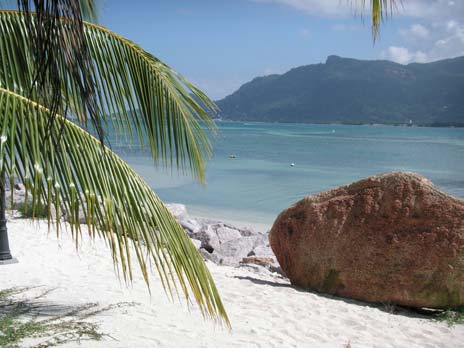
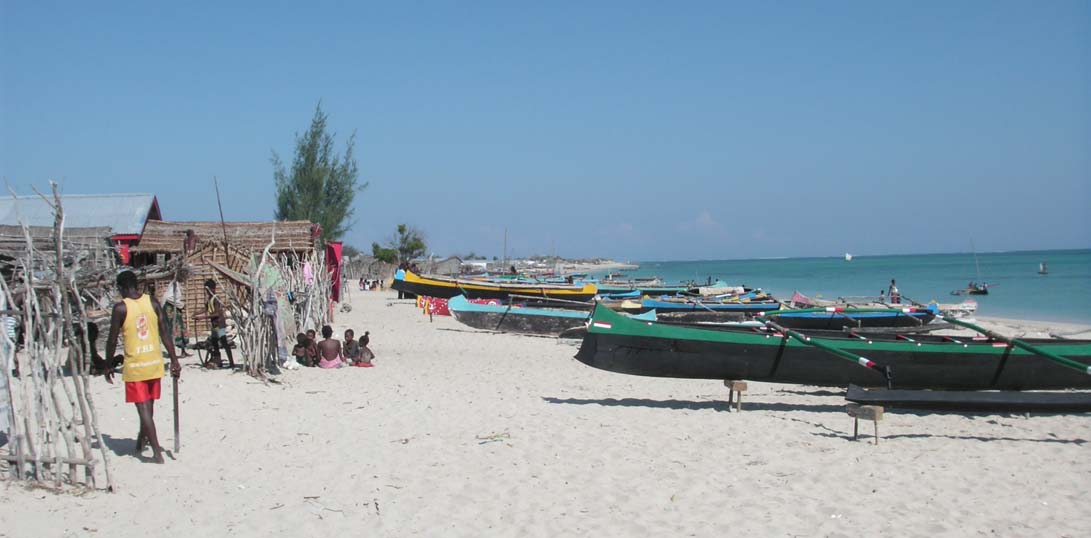
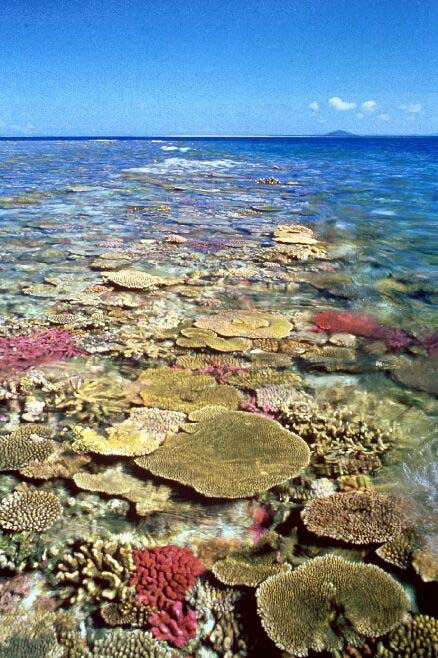
The beautiful sceneries of the WIO, such as here in Seychelles,
make our efforts to protect the environment all worthwhile
Work in progress: the new Nairobi Convention Protocol on
Les beaux paysages de l'OIO, tels qu'ici aux Seychelles,
Land Based Sources and Activities (page 11)
justifient nos efforts à protéger l'environnement
The WIO-LaB Project Steering Committee confirms its
satisfaction and continuous commitment to the project
(page 6)
The WIO-LaB Project launches its first full-scale demon-
stration project (page 8)
WIO-LaB INSIGHT
Page 2
E D I T O R I A L :
du Chef de projet
Tenue le 7 mars 2006 à Diani au Kenya, la Deuxième
La première moitié de l'année 2006 a vu naître le
réunion du Comité directeur du projet a attesté des
Protocole sur les Activités et sources de pollution
bons résultats obtenus par le Projet WIO-LaB en 2005
terrestres (LBS/A) à la Convention de Nairobi. L'avant-
POINTS INTERESSANTS
et elle a donné son feu vert pour le programme chargé
projet de protocole a fait l'objet d'importants débats
de l'année 2006. Le Comité a entre autres donné
pendant la Deuxième réunion du Groupe de révision
·Travail en cours: le nou-
priorité à la poursuite du développement de sept
juridique et technique. Par conséquent, le Protocole a
veau Protocole sur les
projets de démonstration en plus des deux projets
été actualisé et sera soumis pour examen au niveau
Activités et sources de
accélérés dont il avait été convenu antérieurement.
national au cours du troisième trimestre de cette
pollution terrestres (LBS/
année. Le présent bulletin contient
A) à la Convention de Nai-
robi (voir page 11)
un article spécialement réservé au
protocole. Entre-temps, le
·Le Comité directeur du
développement du Programme de
Projet WIO-LaB confirme
suivi de la qualité de l'eau, des
sa satisfaction et la pour-
suite de ses engagements
sédiments et du biote se poursuit
par rapport au projet (voir
également suite à une réunion du
page 6)
Groupe de travail régional à Maurice
en février dernier. Trois programmes
·Le Projet WIO-LaB dé-
marre son premier projet
régionaux de formation sur les
de démonstration à part
techniques de prélèvement et
entière (voir page 8)
d'analyse ont été élaborés afin
d'acquérir les capacités adéquates
et d'harmoniser les techniques. La
plupart des pays ont soumis leurs avant-projets de Rapport
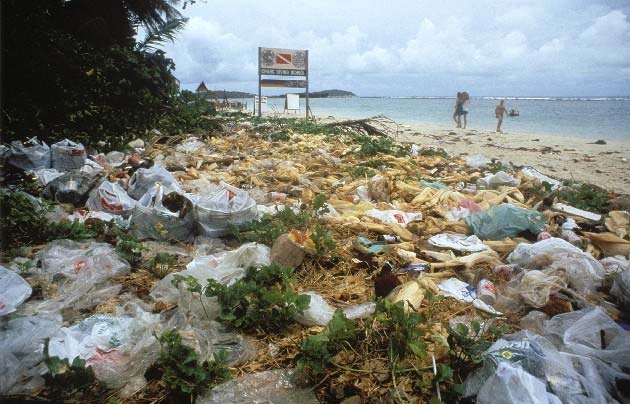
Marine Litter, a persistent problem in the WIO region
sur la situation nationale en matière de pollution. Il est prévu que les activités
Les déchets marins un problème persistant dans la région de prélèvement et d'analyse commencent pendant le troisième trimestre de
de l'OIO
l'année 2006.
Les activités préparatoires pour chacun de ces projets
Plusieurs nouvelles activités ont également été lancées au cours du dernier
sont actuellement en cours. Entre-temps a démarré le
semestre, y compris une évaluation régionale des problèmes et de la gestion en
premier projet de démonstration à part entière portant
matière de déchets marins, une évaluation régionale des pratiques et de
sur l'application d'herbe de vétiver pour lutter contre
l'infrastructure pour la gestion des eaux usées municipales, ainsi que la création
l'érosion et contrôler le lixiviat dans le bassin versant
d'un Centre d'échange d'informations sur l'environnement marin et côtier de
du fleuve Msimbazi à Dar es-Salaam.
l'Afrique orientale. Cette édition de WIO-LaB Insight en parle et évoque aussi
d'autres activités.
W H A T ' S N E W
Q U O I D E N E U F ?
R E G I O N A L M A R I N E L I T T E R A S S E S S - E V A L U A T I O N R É G I O N A L E D E S D É C H E T S
M E N T
M A R I N S
The magnitude of the marine litter problem is not well known La gravité du problème des déchets marins est peu connue dans la
in the Western Indian Ocean (WIO) Region. In order to address région de l'océan indien occidental. Afin de combler ce manque d'infor-
this information gap, the WIO-LaB Project in collaboration with mations, le Projet WIO-LaB a commencé, en collaboration avec le Se-
the Nairobi Convention Secretariat, Western Indian Ocean crétariat de la Convention de Nairobi et le Programme sur les mers ré-
Marine Science Association (WIOMSA) and the UNEP Regional gionales du PNUE, une évaluation sur l'ensemble de la région de
Seas Programme has embarked on a regionwide assessment l'océan indien occidental. Il est prévu que cette dernière servira de base
in the WIO region. It is envisaged that this assessment would à la formulation de stratégies de gestion durable des déchets marins
form the foundation for the formulation of strategies for sus- dans la région de l'océan indien occidental. Cette évaluation est effec-
tainable management of marine litter in the WIO Region. The tuée par des experts nationaux et régionaux en déchets marins.
assessment is being executed by national and regional marine
litter experts.
WIO-LaB INSIGHT
Page 3
L O O K - O U T
P E R S P E C T I V E S D ' A V E N I R
Meeting of the Regional Task Force on Environmental
25-26 July (juillet)
Réunion du Groupe de travail régional sur l'évalua-
Impact Assessment (EIA), Maputo, Mozambique
2006
tion de l'impact environnemental à Maputo au
Mozambique
Leadership Training Programme
October (octobre)
Programme de formation en leadership
2006
Third Meeting of the Legal & Technical Review Task
October (octobre)
Troisième réunion du Groupe de révision juridique
Force
2006
et technique
Joint Meeting of the Regional MWW and PADH Task
November (novembre)
Réunion commune du Groupe de travail régional
Forces
2006
sur les EUM et les Groupes de travail sur l'APDH
Second Meeting of the Regional Task Force on Envi-
December (decembre)
Deuxieme Réunion du Groupe de travail régional
ronmental Impact Assessment
2006
sur l'évaluation de l'impact environnemental
W H A T ' S N E W
Q U O I D E N E U F ?
W I O - L A B P R O J E C T L A U N C H E S D E -
L E P R O J E T W I O - L A B E N T A M E L E
V E L O P M E N T O F C L E A R I N G H O U S E
D É V E L O P P E M E N T D ' U N C E N T R E
M E C H A N I S M ( C H M )
D ' É C H A N G E D ' I N F O R M A T I O N S
On the basis of the request made by the UNEP/Nairobi En réaction a une demande de la part de la Conférence des parties
Convention Conference of Contracting Parties, the WIO-LaB contractantes de la Convention de Nairobi, le Projet WIO-LaB appuie le
project is supporting the Nairobi Convention Secretariat in the Secrétariat de la Convention quant au développement d'un système de
development of an information management system that is gestion des informations fondé sur l'Atlas et la Base de données sur
building upon the Eastern African Coastal and Marine
Resources Database and Atlas Project established under the les ressources marines et côtières de l'Afrique orientale existants qui
Nairobi Convention (www.unep.org/easternafrica). The ont été établis dans le cadre de la Convention de Nairobi
system will take the form of a website which will host relevant (www.unep.org/easternafrica). Ce système se présentera sous la forme
data and meta-data related to the WIO Coastal and Marine d'un site Web qui contiendra les données et métadonnées relatives à
environment, and will at the same time function as a Regional l'environnement marin et côtier de la région de l'océan indien occiden-
Clearing House Mechanism (CHM) of the Global Programme tal et qui servira en même temps de Centre d'échange d'informations
of Action for Protection of the Marine Environment from Land-
régional comme défini par le Programme d'action mondial pour la pro-
based Activities (GPA). The CHM will be established in tection de l'environnement marin contre les activités terrestres. Le
collaboration with relevant national institutions and regional Centre d'échange d'informations sera établi en collaboration avec les
and international project partners. An inception meeting to institutions nationales compétentes ainsi qu'avec les partenaires ré-
discuss the modalities for the development of CHM was held gionaux et internationaux du Projet. Un rapport sur la réunion introduc-
in Nairobi on 9th-11th May 2006. A report of the inception tive pour ces activités est présenté à la page 7.
meeting of this activity is presented on page 7.
E V A L U A T I O N D E L ' E T A T D E G E S T I O N D E S
A S S E S S E M E N T O F T H E ` S T A T E - O F -
E U M D A N S L A R É G I O N D E L ' O I O
T H E - A R T ' O F M W W I N T H E W I O
R E G I O N
L'Unité de gestion du Projet WIO-LaB a récemment fait appel à des
experts nationaux et régionaux en gestion des eaux usées municipals
The WIO-LaB PMU recently launched a call for national and (EUM). Il est prévu que ces derniers procèdent à une évaluation à l'é-
regional experts in the field of municipal wastewater (MWW) chelle régionale des pratiques et infrastructures de gestion des eaux
management to undertake a region-wide assessment of usées municipales dans la région de l'océan indien occidental et cela
MWW management practices and infrastructure in the WIO-
region, including lessons learnt from national and comprend les enseignements tirés des expériences nationales et inter-
international experiences in MWW management. The experts nationales en matière de gestion des EUM, en vue d'établir un Rapport
will be expected to develop a `State-of-the-Art' report on MWW sur l'etat de gestion des EUM dans la région. Cela en constituera-t-il
management in the WIO region and at the same time support l'unique produit ? Dans un même temps, les experts appuieront l'adap-
the domestication of the global GPA Guidelines on MWW tation des lignes directrices du Programme d'action mondial pour la
management by facilitating discussion of these guidelines at gestion des EUM en facilitant les débats au sujet de ces lignes direc-
the national level. The experts would also assist with the trices au niveau national ainsi qu'en établissant une annexe régionale
development of a regional annex to the GPA MWW guidelines. à ces lignes directrices mondiales.





WIO-LaB INSIGHT
Page 4
S E C O N D R E G I O N A L M E E T I N G O N W A T E R , S E D I M E N T & B I O T A Q U A L I T Y
A S S E S S M E N T A N D M O N I T O R I N G
The WIO-LaB Project Water, Sedi-
Development Unit and Mrs. D. Lan Ng,
ment and Biota Quality Assessment
the Acting Director of the same Minis-
and Monitoring Working Group Sec-
try.
ond meeting was held in Mauritius
Under the Chairmanship of Mauritius,
from 7th to 10th February 2006.
the Working Group deliberated on the
The meeting was attended by 25
different agenda items and estab-
water quality experts from the pro-
lished the basis for the Regional Moni-
ject countries. The main objectives
toring Programme to be implemented
of the meeting were (i) to review
under the auspices of the WIO-LaB
progress made in the establishment
project. The participating representa-
of national working groups and the
tives of national institutions subse-
preparation of the national pollution
quently returned to their respective
status reports; (ii) to discuss the Participants from Tanzania including the representative of IOC-
countries with the task of developing
workplan for 2006; (iii) to develop UNESCO, and the Regional Activity Center in South Africa deliber-
ating during the second meeting of the Water and Sediment Quality specific national monitoring frame-
the framework of a Regional Moni- Working Group
works. A number of specific capacity
toring Programme; and (iv) to iden-
building activities were also defined, includ-
tify capacity building needs and strategies and National Development Unit in Mauri- ing three regional training programmes on
for the implementation of the Monitoring tius. The opening ceremony was graced by the monitoring and analysis of heavy met-
Programme.
senior government officials, among them als, organic pollutants and nutrients to be
Mr. S. Seebaluck, the Permanent Secretary
The meeting was officially opened by Hon.
implemented over the course of May-June
in the Ministry of Environment and National
A.K Bachoo, the Minister of Environment
2006. Implementation of the actual moni-
D E U X I E M E R E U N I O N R E G I O N A L E S U R L E S U I V I - E V A L U A T I O N D E L A Q U A L I T E
D E L ' E A U , D E S S E D I M E N T S E T D U B I O T E
qualité de l'eau émanant des et du Développement national et Madame D.
pays du Projet. Les objectifs Lan Ng, Directeur intérimaire du même
majeurs de la réunion étaient (i) Ministère.
d'examiner les progrès réalisés au Sous la présidence de l'Ile Maurice, le
niveau de l'établissement de Groupe de travail a délibéré des différents
groupes de travail nationaux et de points au programme et a établi la base du
la préparation des rapports Programme de suivi régional qui doit être mis
nationaux sur la situation de la en oeuvre dans le cadre du Projet WIO-LaB.
pollution ; (ii) de débattre du plan Les représentants des institutions nationales
de travail pour 2006 ; (iii) de sont ensuite retournés vers leurs pays
développer la structure d'un respectifs en ayant pour tâche de développer
Programme de suivi régional ; et des systèmes de suivi nationaux spécifiques
(iv) d'identifier les besoins en dans le cadre du programme régional. En
renforcement des capacités et les outre, un certain nombre d'activités
stratégies pour la mise en oeuvre spécifiques de renforcement des capacités a
du Programme de suivi.
été défini, y compris trois programmes
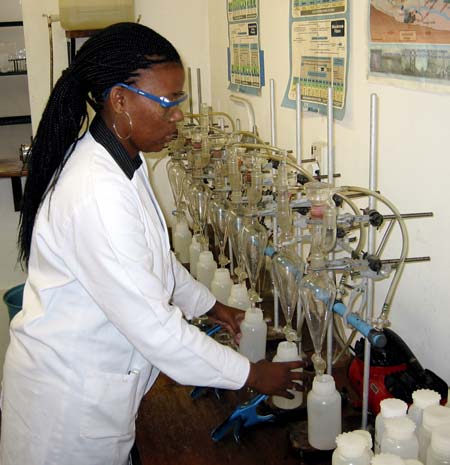
A technologist working in one of the participating labara- La réunion a été officiellement régionaux de formation sur les le
tories in the implementation of the WIO-LaB Project
ouverte par Monsieur A. K. prélèvement et l'analyse des métaux lourds,
Un technologue travaillant dans un des laboratoires par- B a c h o o , M i n i s t r e d e les polluants organiques ainsi que les
ticipant à la Mise en Oeuvre du projet de WIO-LaB
l ' E n v i r o n n e m e n t e t d u nutriments. Ces activités devront être mise
Développement national de l'Ile Maurice. La en oeuvre au cours des mois de mai et juin
La Deuxième réunion du Groupe de travail cérémonie d'ouverture a également été 2006 et la mise en oeuvre du Programme de
sur le suivi-évaluation de la qualité de l'eau, honorée par la présence d'autres suivi devrait donc suivre au troisième
des sédiments et du biote du Projet WIO-LaB responsables gouvernementaux, entre trimestre de l'année 2006.
s'est tenue à Maurice du 7 au 10 février autres Monsieur S. Seebaluck, Secrétaire
2006. Elle comptait vingt-cinq experts en permanent du Ministère de l'Environnement
WIO-LaB INSIGHT
Page 5
2 N D R E G I O N A L M E E T I N G O F L E G A L A N D T E C H N I C A L R E V I E W T A S K
The second meeting of the Legal and Tech- Task Force was to review the status of im- Reports are finalized, they should be re-
nical Review Task Force was held at Diani, plementation of the legal component of the viewed and approved by the National Legal
Kenya from 8th to 10th March 2006. The Project, as well as to undertake detailed and Technical Review Task Forces (or other
meeting was attended by legal and techni- discussion on a number of project deliver- related mechanisms). The meeting also
cal experts from countries participating in ables, notably (i) national reports and re- took note of the Regional Synthesis Report
the WIO-LaB Project, as well as the National gional synthesis report on the review of the prepared by the Regional Legal Consultant.
Focal Points and representatives from national policy, legal and regulatory frame- In regard to the draft LBA/S Protocol to the
UNEP/GPA and the Nairobi Convention Se- works; (ii) national reports and regional Nairobi Convention, the Task Force re-
cretariat. During the meeting, a short train- synthesis report on the review of the status viewed the document in detail. It was rec-
ing session was provided to the partici- of ratification and implementation of envi- ommended that the draft be updated on the
pants, consisting of (i) an overview of issues ronmental conventions relevant to land- basis of comments made by the task force
pertaining to the management of land based sources and activities; and (iii) the and be subsequently circulated to the Na-
based sources and activities (LBS/A) in the draft LBA/S Protocol to the Nairobi Conven- tional Focal Points Institutions for review by
WIO Region, by Dr. Johnson Kitheka and (ii) tion.
the National Legal and Technical Review
the International and Regional Legal frame- In regard to the progress made by National Task Forces. Based on the comments that
work of the 1982 United Nations Frame- Experts in the preparation of national review would be received from the National Legal
work Convention on the Law of the Sea reports, the meeting noted that the pro- Task Forces, the document would subse-
(UNCLOS) and 1985 Nairobi Convention, by gress, despite initial delays, was satisfac- quently be updated and finalized during the
the Regional Legal Expert for the project, tory. It was noted that most of the countries next meeting of the Regional Legal and
Mr. Akunga Momanyi.
have already submitted their National Re- Technical Review Task Force that is sched-
The main objective of the Second Regional ports with the exception of Tanzania. It was uled to be held in October of this year.
meeting of the Legal and Technical Review recommended that before the National
D E U X I E M E R E U N I O N D U G R O U P E D E R E V I S I O N J U R I D I Q U E E T T E C H N I Q U E
R E G I O N A L
La Deuxième réunion du Groupe de révision d'avancement de la mise en oeuvre de la par les groupes de révision juridique et
juridique et technique du Projet WIO-LaB composante juridique du Projet, ainsi que technique nationaux (ou par les entités
s'est tenue du 8 au 10 mars 2006 à Diani de débattre en profondeur d'un certain compétentes en la matière). La réunion a
au Kenya. Y ont assisté des experts nombre de documents devant être également pris bonne note et émis des
juridiques et techniques issus des pays produits ; à savoir, (i) les rapports nationaux commentaires par rapport au Rapport de
participant au Projet WIO-LaB, ainsi que les et le Rapport de synthèse régional sur les synthèse régional (basé sur les rapports
points focaux nationaux et les
cadres juridiques, politiques et
nationaux) qui a été préparé par le
représentants du PNUE/PAM et du réglementaires nationaux; (ii) les rapports Consultant juridique régional engagé par le
Secrétariat de la Convention de Nairobi. nationaux et le Rapport de synthèse Projet.
Après la cérémonie d'ouverture, les régional sur la situation en matière de En ce qui concerne l'avant-projet du
participants ont suivi une courte séance de ratification et de mise en oeuvre des Protocole LBS/A à la Convention de Nairobi
formation qui consistait en (i) une vue conventions environnementales relatives préparé par le Consultant régional, le
d'ensemble sur les questions relatives à la aux activités et sources de pollution Groupe de travail l'a examiné en détail et il
gestion des activités et sources de pollution terrestres; et (iii) l'avant-projet du Protocole a été recommandé qu'il soit actualisé sur
terrestres dans la région de l'océan indien LBS/A à la Convention de Nairobi.
base des commentaires reçus et qu'il soit
occidental donnée par le Dr. Johnson Pour ce qui est des progrès réalisés par les ensuite distribué aux institutions point focal
Kitheka et (ii) le cadre juridique
experts nationaux quant à la préparation national pour examen par les groupes de
international et régional de l'UNCLOS de des rapports nationaux, il a été noté que, révision juridique et technique nationaux.
1982 et de la Convention de Nairobi de malgré des retards initiaux, l'évolution était Sur base des commentaires obtenus de la
1985 présenté par l'expert juridique satisfaisante. On a également remarqué part de ces derniers, le document sera alors
régional pour le Projet, Monsieur Akunga que la plupart des pays ont déjà soumis mis à jour et finalisé lors de la réunion
Momanyi.
leurs rapports nationaux à l'exception de la régionale suivante du Groupe de révision
L'objectif majeur de la Deuxième réunion Tanzanie. Il a été recommandé que, avant juridique et technique qui est prévue en
du Groupe régional de révision juridique et que les rapports nationaux soient finalisés, octobre 2006.
technique était d'examiner l'état
ils devraient être examinés et approuvés
WIO-LaB INSIGHT
Page 6
S E C O N D M E E T I N G O F T H E W I O - L A B P R O J E C T S T E E R I N G C O M M I T T E E
The Second meeting of the WIO-
lected during the 2nd Joint meeting
LaB Project Steering Committee
of the MWW and PADH Regional Task
was held at Diani, Kenya on 7th
Forces held in Comoros in October
March 2006. The meeting was
2005. In this regard, the Steering
officially opened by Dr. Kennedy
Committee directed the WIO-LaB
Ondimu, the Director for Research
PMU to proceed with the finalization
and Planning Division of the Na-
of seven priority demonstration pro-
tional Environment Management
jects. The Steering Committee was
Authority (NEMA) of Kenya, on
also briefed on the progress made in
behalf of the Director-General of
the implementation of the two ongo-
NEMA. The meeting was attended
ing fast track demonstration projects
by National Focal Points, the
in Tanzania.
Chairs of the MWW and PADH
The Steering Committee was also
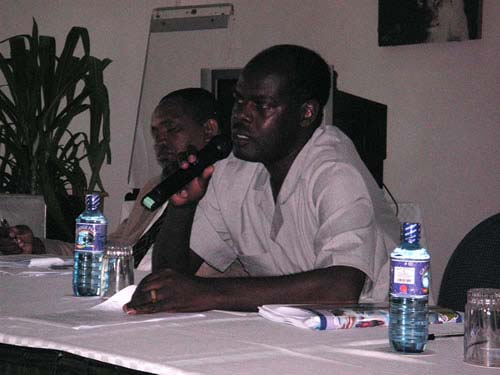
Regional Task Forces, representa- Opening address by Dr. Kennedy Ondimu, Director of Re-
updated on the ongoing Training and
tives of UNEP/GEF, UNEP/GPA and search and Planning Division of NEMA, Kenya. To his left,
Educational Needs Assessment that
the Nairobi Convention Secre- Mr. Dixon Waruinge, Programme Officer in charge of the
Nairobi Convention.
is being conducted by WIOMSA on
tariat, as well as representatives of
behalf of the WIO-LaB Project. This
Non-Governmental Organizations such as the WIO-LaB Project Steering Committee assessment would result in a targeted train-
WWF, IUCN and WIOMSA. The private sector was to review the progress made in regard ing and educational programme that would
was represented by the Kenya Association to the implementation of the project. The be implemented in the region. The Steering
of Hotel Keepers and Caterers. Other repre- Steering Committee was satisfied with the Committee finally deliberated on the imple-
sentatives came from the World Bank/GEF progress of project implementation. The mentation of the Small-Grants Programme,
Southwest Indian Ocean Fisheries Project Committee approved the work plan for the as well as the proposed provision of support
(SWIOFP). For the first time also, a repre- year 2006 including the budget presented to the National Focal Point Institutions to
sentative from the Somali Liaison Office by the WIO-LaB PMU.
coordinate WIO-LaB Project activities in
attended the meeting as an observer.
The Steering Committee also deliberated on their countries..
The main objective of the 2nd meeting of the demonstration projects that were se-
D E U X I E M E R E U N I O N D U C O M I T E D I R E C T E U R D U P R O J E T
La Deuxième réunion du Comité directeur Banque mondiale/FEM. Pour la première procéder à la finalisation des sept projets
du Projet WIO-LaB s'est déroulée le 7 mars fois, un représentant du Bureau de liaison de démonstration prioritaires. L'UGP a aussi
2006 à Diani au Kenya. La réunion a été de la Somalie a assisté à la réunion en tant informé le Comité Directeur des progrès
officiellement ouverte par le Dr. Kennedy qu'observateur.
réalisés au niveau de la mise en oeuvre des
Ondimu, Directeur de la Division de L'objectif principal de la Deuxième réunion deux projets de démonstration accélérés
Recherche et Planification de l'Autorité du Comité directeur du Projet WIO-LaB était qui sont en cours en Tanzanie.
nationale de gestion environnementale d'évaluer l'état d'avancement de la mise en Le Comité directeur a aussi été informé au
(NEMA) du Kenya, au nom du Directeur oeuvre du plan de travail du Projet. Le sujet de l'Evaluation des besoins éducatifs
général intérimaire de la NEMA. Y ont Comité directeur s'est montré satisfait sur et de formation qui est effectuée par
assisté des points focaux nationaux ; les ce premier point et a approuvé le plan de l'Association des sciences marines de la
présidents des groupes de travail sur les travail du Projet pour l'année 2006 ainsi région de l'océan indien occidental
EUM et les APDH ; des représentants du que le budget présenté par l'Unité de (WIOMSA) au nom du Projet WIO-LaB. Ces
PNUE/FEM, du PNUE/PAM et du Secrétariat gestion du projet (UGP/WIO-LaB).
résultats de l'évaluation conduiront à
de la Convention de Nairobi
; des
l'élaboration d'un programme éducatif et de
représentants d'organisations non
Le Comité directeur a également délibéré formation ciblé dans le cadre du Projet. De
gouvernementales telles que le WWF, des projets de démonstration qui avaient plus, le Comité directeur a délibéré de la
l'IUCN et la WIOMSA ; le secteur privé été présélectionnés durant la Deuxième conception et de la mise en oeuvre du
représenté par l'Association kenyane des réunion commune des groupes de travail programme de microfinancement ainsi que
hôteliers et des restaurateurs ; ainsi qu'un régionaux sur les EUM et l'APDH tenue aux du programme proposé pour le soutien des
représentant du Projet des pêcheries du Comores en octobre 2005. A cet égard, le institutions point focal national.
sud-ouest de l'océan indien (SWIOFP) de la Comité directeur a demandé à l'UGP de





WIO-LaB INSIGHT
Page 7
R E G I O N A L W O R K S H O P O N T H E D E V E L O P M E N T O F A W I O C O A S T A L A N D
M A R I N E E N V I R O N M E N T C L E A R I N G H O U S E M E C H A N I S M
UNESCO), Ocean Data and Information Network of Africa
(ODINAFRICA), South Africa Data Centre for Oceanography
(SADCO), World Wildlife Fund - Eastern Africa Marine Eco-Region
(WWF-EAME), Agulhas and Somali Current Large Marine Ecosystem
Project (ASCLME), South Western Indian Ocean Fisheries Project
(SWIOFP) and African Coelacanth Ecosystem Programme (ACEP).
The goal of the workshop was to seek opportunities for collabora-
tion and agree on strategies for development of a consolidated,
regionally coordinated and integrated CHM for the exchange of
data and information on the coastal and marine environment, for
the Nairobi Convention, through establishment of synergies with
other regional initiatives.
The representatives of participating countries appreciated the ini-
tiative to develop the regional CHM as a facility for exchange and
Mr. Tim Kasten, Chief Natural Resources Branch of the Division of
sharing of information in the Western Indian Ocean Region and
Environmental Policy Implementation (DEPI) of UNEP, addressing
agreed to fully support this initiative. It was agreed that the CHM
the CHM meeting during its opening ceremony
would be built upon the existing national institutional frameworks
and mechanisms and efficiency should be sought through close
A Regional Workshop on the Development of an Eastern Africa collaboration with the IOC-UNESCO ODINAFRICA framework. The
Coastal and Marine Environment Clearing House Mechanism participants also deliberated on the data sharing policy for the
(CHM) took place from 9th to 11th May 2006 at UNEP Headquar- CHM and the Terms of Reference for the Lead National Institutions
ters in Nairobi, Kenya. The meeting was attended by 25 represen- that will coordinate activities at national level. The meeting also
tatives from key national institutions as well as representatives of and came up with a number of objective criteria for their selection.
international and regional partner organizations and programmes Finally, the meeting recommended the establishment of a Techni-
such as Western Indian Ocean Marine Sciences Association cal Working Group composed of ODINAFRICA, ACEP, DEWA repre-
(WIOMSA), New Partnership for Africa's Development (NEPAD), sentatives and other interested parties, to review and recommend
Intergovernmental Oceanographic Commission of UNESCO (IOC- the most appropriate metadata format to be adopted by the CHM.
A T E L I E R D E T R A V A I L R E G I O N A L S U R L A C R E A T I O N D ' U N C E N T R E D ' E C H A N G E
D ' I N F O R M A T I O N S S U R L ' E N V I R O N N E M E N T M A R I N E T C O T I E R D E L A R E G I O N
D E L ' O C E A N I N D I E N O C C I D E N T A L
Un atelier de travail régional sur la création d'un Centre d'échange et ils ont convenu d'y participer pleinement et de la soutenir. Ils se
d'informations sur l'environnement marin et côtier de l'Afrique sont accordés sur le fait que le Centre d'échange d'informations
orientale a eu lieu du 9 au 11 mai 2006 au siège du PNUE à Nairobi devait être basé sur les cadres et mécanismes institutionnels
au Kenya. Y ont assisté vingt-cinq représentants d'institutions nationaux existants et, que par souci d'efficacité, il fallait collaborer
nationales majeures ainsi que des représentants d'organisations et avec la structure CIO-UNESCO/ODINAFRICA. En outre, les
de programmes partenaires régionaux comprenant la WIOMSA, le participants ont délibéré de la politique d'échange des données
NEPAD, la CIO-UNESCO, l'ODINAFRICA, le SADCO, le WWF-EAME, dans le cadre du Centre d'échange d'informations et des termes de
l'ASCLME, le SWIOPF et l'ACEP. L'objectif de l'atelier de travail était référence pour les institutions nationales chefs de file qui
de chercher des opportunités et de s'accorder sur des stratégies de coordonneront les activités au niveau national. Ils ont également
développement d'un Centre d'échange d'informations renforcé, recommandé un certain nombre de critères objectifs pour leur
intégré et coordonné à l'échelle régionale pour l'échange de sélection. Enfin, le réunion a recommandé l'établissement d'un
données et d'informations sur l'environnement marin et côtier, dans Groupe de travail technique composé de représentants
le cadre de la Convention de Nairobi, à travers la création de d'ODINAFRICA, d'ACEP et de la DEWA ainsi que d'autres parties
synergies avec d'autres initiatives régionales.
intéressées afin d'examiner et de recommander le format des
métadonnées le plus approprié devant être adopté par le Centre
Les représentants ont apprécié l'initiative de création d'un Centre d'échange d'informations.
d'échange d'informations dans la région de l'océan indien occidental
WIO-LaB INSIGHT
Page 8
U P D A T E O N T H E S T A T U S O F D E M O N S T R A T I O N P R O J E C T S
Community-based management of a marine park at Toliara, Madagascar Gestion Communautaire d'un parc marin à Toliara, Madagascar
Following the short-listing of ten priority demonstration projects by
Development Authority, Kenya
the Regional MWW and PADH Task Forces during the 2nd joint 6. Solid Waste Management in Port Louis Harbour, Mauritius:
regional meeting held in Comoros on 28 October 2006, each of the
Submitted by Mauritius Ports Authority, Mauritius
proposed demonstration projects was further updated on the basis
of comments provided by the two Regional Task Forces. Ten pro- 7. Demonstration of Integrated Algal Ponding System (IAPS) tech-
posals were subsequently presented to the Project Steering Com-
nology for the polishing and beneficiation of effluent from
mittee for final selection. Based mainly on the considerations of
municipal sewage treatment facilities, South Africa: Submitted
thematic and regional balance, seven demonstration projects were
by Department of Environmental Science, Rhodes University,
prioritized by the Steering Committee. These are:
South Africa
1. Enhancing the ecological function of mangroves in Mozam- Preparatory activities, including the development of detailed pro-
bique: Submitted by Grupo de Trabalho Ambiental (GTA), Mo- ject documents, for each of these seven projects are currently un-
zambique
derway. Following completion of the project documents by the end
of August 2006, the projects will be re-submitted to the members
2. Development of eco-tourism in the Marine Park of Toliara in of the Project Steering Committee for final approval that will set the
Madagascar: Submitted by Association Nationale pour la Ges- stage for full scale implementation.
tion des Aires Protégées, Direction Inter-Régionale (ANGAP),
Madagascar
Development and implementation of the two Tanzania fast-track
demonstration projects is meanwhile progressing well. The final
3. Integrated management and protection of the coastal zone at project document for the Tanzania fast track demonstration project
Itsamia, Mohéli, Comoros: Submitted by Association pour le entitled "Application of vetiver grass for erosion and leachate con-
Développement Socioéconomique d'Itsiama (ADSEI), Comoros trol at a landfill site in Dar es Salaam, Tanzania" has been com-
4. A pilot project to determine the potential of native species to pleted and implementation of the full-scale project will be
control soil erosion within the Black River Gorges National launched by the end of July 2006. Design of the second fast-track
Park, Mauritius: Submitted by National Parks and Conserva- project, on wastewater management on Pemba Island, is however,
tion Service, Ministry of Agro Industry and Fisheries, Mauritius progressing at a slower pace, but the design and detailed project
document are expected to be completed by the end of August
5. A wetland-lagoon system for wastewater management at 2006.
Shimo La Tewa Prison, Mombasa, Kenya: Submitted by Coast
WIO-LaB INSIGHT
Page 9
M I S E À J O U R S U R L ' É T A T D ' A V A N C E M E N T D E S P R O J E T S D E D É M O N S T R A T I O N
Suite à la sélection de dix projets par les groupes de travail 5. Un système de marécages-lagon pour la gestion des eaux
régionaux sur les EUM et l'APDH le 28 octobre 2006 aux Comores,
usées à Shimo La Tewa Prison à Mombasa au Kenya soumis
chacun des projets de démonstration proposés a été actualisé sur
par Coast Development Authority
base des commentaires fournis par les groupes de travail. Les dix 6. Gestion des déchets solides au port de Port Louis à Maurice
propositions ont ensuite été présentées au Comité directeur du
soumis par
projet en vue d'une sélection finale. En se basant principalement
sur les considérations en matière d'équilibre thématique et 7. Démonstration de la technologie du Système de lagunage
régional, le Comité directeur a donné priorité à sept projets :
algal intégré (SLAI) pour l'épuration et la valorisation des
effluents à partir des installations de traitement des eaux
1. Améliorer la fonction écologique des mangroves au
usées municipales en Afrique du Sud soumis par
Mozambique soumis par l'Université Eduardo Mondlane
Departement de Science Environmenental, Universite Rhodes
2. Développement de l'écotourisme dans le parc marin du Grad Les activités préparatoires, y compris l'établissement de
Récit de Toliara à Madagascar soumis par Association documents de projet détaillés, pour chacun des sept projets sont
Nationale pour la Gestion des Aires Protégées, Direction Inter- actuellement en cours. Après la finalisation des documents de
Régionale ANGAP
projet prévue pour fin juillet 2006, les différentes projets les
3. Projet d'amenagement, de protection, et de gestion intégrée soumettront à nouveau aux membres du Comité directeur du
et protection des plages a Itsamia, Mohéli, Union des projet pour approbation finale.
Comores soumis par Association pour le Développement Dans un même temps, le développement des deux projets
Socioéconomique d'Itsiama (ADSEI)
accélérés suit son cours. Le document final du projet portant sur
4. Un projet pilote pour déterminer le potentiel des espèces l'application d'herbe de vétiver pour contrôler l'érosion et le lixiviat
natives afin de contrôler l'érosion des sols dans le Parc aux dépotoirs de Dar es-Salaam est prêt et la mise en oeuvre du
National "Black River Gorges" à Maurice soumis par Service projet à part entière a récemment été lancée. La conception du
de Parcs Nationales et Conservation Service, le Ministre de second projet accéléré sur la gestion des eaux usées à l'île de
l'Agro Industrie et de la Pêche
Pemba progresse à moindre allure mais cette dernière et le
document du projet devraient être finalisés très bientôt.
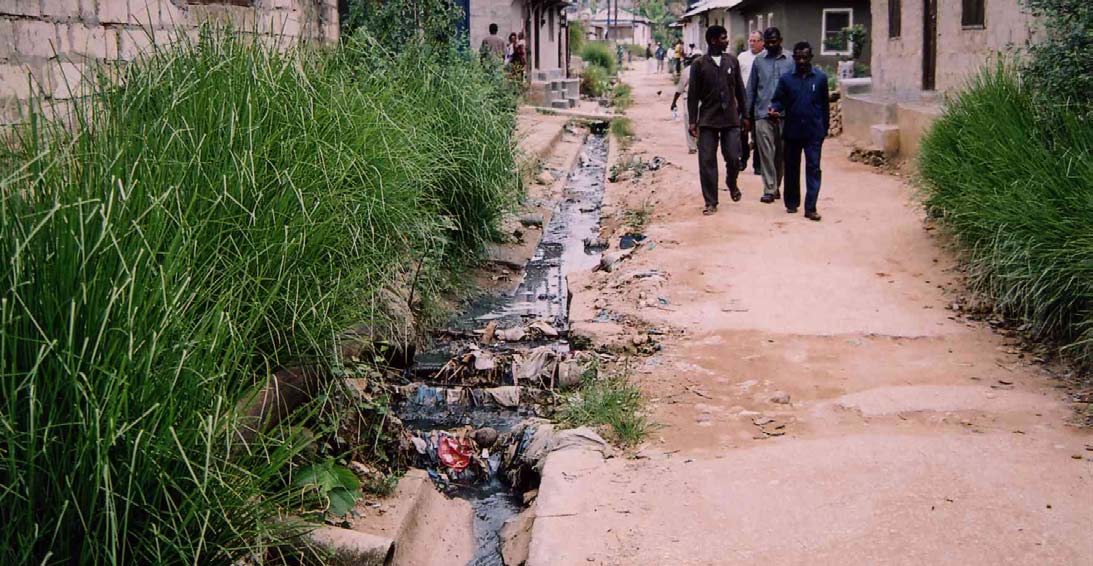
Addressing urban wastewater management: Clogging of open drains in the municipality of Chake Chake on Pemba Island, Zanzibar
Gestion urbaine des eaux usées: Obstruction des canaux de drainage à ciel ouvert à la municipalité de Chake Chake sur l'île de Pemba









WIO-LaB INSIGHT
Page 10
T R A I N I N G P R O G R A M M E S O N H E A V Y M E T A L S , O R G A N I C C O N T A M I N A N T S A N D
N U T R I E N T M O N I T O R I N G A N D A N A L Y S I S
nated Regional Activity Centre (RAC) for the Water, Sediment and
Biota Quality Assessment and Monitoring Component of the WIO-LaB
Project, hosted two short-term training courses in Durban, South
Africa in the period between May and June 2006. The courses focus-
sed respectively on techniques for monitoring and analysis of heavy
metals (May 6 - 12, 2006) and organic contaminants (May 22
June 2, 2006). The two training workshops were presented by re-
source persons from the International Atomic Energy Agency Marine
Environmental Studies Laboratory (IAEA-MESL) based in Monaco. A
third course, on seawater nutrient analysis organized by the Institute
of Marine Sciences (IMS) in Zanzibar, Tanzania, was held in the pe-
riod between 5th and 9th June, 2006.
The three training workshops were specifically designed for practis-
ing analytical chemists and technologists who wil actively be en-
Demonstration of field sampling techniques during the regional train- gaged in the execution of the Regional Monitoring Programme, and
ing programme on the analysis and monitoring of organochlorines
who in particular, would be expected to undertake practical field
and petroleum hydrocarbons.
sampling and laboratory analysis work in participating countries. The
selection of candidates for each of the three training courses was
Under the auspices of the WIO-LaB Project, the Council for Scientific conducted by the RAC following the nomination by the Heads of the
and Industrial Research (CSIR) of South Africa which is the desig- participating Lead National Institutions.
P R O G R A M M E S D E F O R M A T I O N S U R L E S M E T A U X L O U R D S , L E S C O N T A M I N A N T S
O R G A N I Q U E S A I N S I Q U E S U R L E P R E L E V E M E N T E T L ' A N A L Y S E D E S N U T R I -
M E N T S
désigné pour la composante du Projet portant sur le suivi-
évaluation de la qualité de l'eau, des sédiments et du biote,
a organisé deux cours de formation de type court à Durban
en Afrique du Sud entre mai et juin 2006. Les cours portaient
respectivement sur les techniques de prélèvement et d'ana-
lyse des métaux lourds (du 6 au 12 mai 2006) et sur les
contaminants organiques (du 22 mai au 2 juin 2006). Les
deux cours ont été présentés par des personnes ressources
issues du Laboratoire de l'environnement marin de l'Agence
internationale de l'énergie atomique (AIEA-LEM) situé à
Monaco. Un troisième cours sur l'analyse des nutriments
dans l'eau de mer a été organisé du 5 au 9 juin 2006 par
l'Institut des sciences marines (IMS) à Zanzibar en Tanzanie.
Les trois ateliers de formation ont été spécialement conçus
pour les chimistes/technologues analytiques en exercice qui
seront activement engagés dans l'exécution du Programme
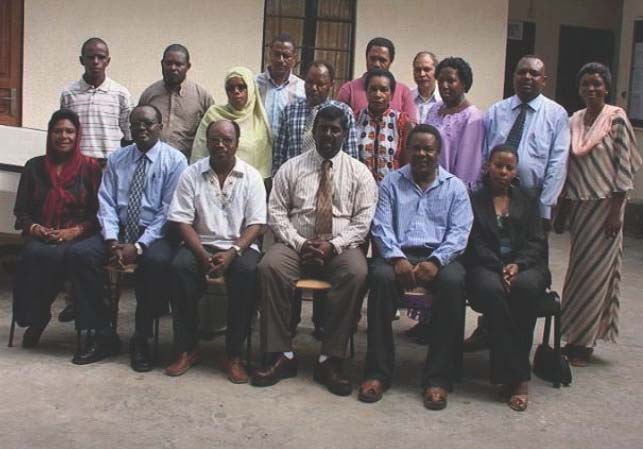
Participants of the regional training programme on nutrients monitoring
de suivi régional du Projet WIO-LaB et leur tâche est d'effec-
and analysis, held at IMS, Zanzibar, Tanzania
Les participants au programme de formation régional sur l'échantillonnage tuer les prélèvements sur le terrain et les analyses en labora-
et l'analyse des éléments nutritifs à Zanzibar
toire qui auront lieu dans les différents pays. La sélection des
candidats pour chacun des trois cours a été menée par le
Sous les auspices du Projet WIO-LaB, le Conseil de recherche sci-
CAR, à la nomination des responsables des institutions nationales
entifique et industrielle (CSIR), le Centre d'activités régional (CAR)
chefs de file.





WIO-LaB INSIGHT
Page 11
A R T I C L E S P É C I A L : P R O T O C O L E S U R L E S A C T I V I T É S E T S O U R C E S D E
P O L L U T I O N T E R R E S T R E S À L A C O N V E N T I O N D E N A I R O B I
Le Deuxième avant- biais de la facilitation par les points focaux de l'Afrique orientale aussi connue sous le
projet de protocole nationaux appuyés par les groupes de nom de région de l'océan indien occidental
additionnel à la révision juridique et technique nationaux. (OIO). Les deux autres concernent
Convention de
Ces derniers sont déjà établis dans la spécifiquement les zones protégées et la
Nairobi portant sur plupart des pays et sont financièrement faune (le Protocole SPAW) ainsi que les
les activités et
soutenus dans le cadre du Projet WIO-LaB. urgences en cas de pollution pétrolière (le
sources de
Les commentaires émanant des différents Protocole d'urgence). Entre parenthèses, la
pollution terrestres (LBS/A) dans la région pays seront collectés et collationnés par Convention de Nairobi elle-même et les
de l'Afrique orientale est prêt à être l'UGP/WIO-LaB et formeront la base du deux protocoles sont à l'examen pour une
distribué aux différents pays pour
troisième avant-projet de protocole qui mise à jour en raison des développements
consultation au niveau national. Ce devrait être présenté à la Troisième réunion qui se sont déroulés depuis leur adoption
processus a été convenu à la Deuxième du Groupe de révision juridique et en 1985.
réunion du Groupe de révision juridique et technique régional en octobre 2006. A son L'avant-projet actuel comprend des
technique régional en mars 2006 à Diani tour, cette dernière ouvrira la voie à une dispositions novatrices telles qu'un
au Kenya. La réunion de Diani a reçu, Conférence des plénipotentiaires qui aura préambule détaillé et la définition de
débattu de et émis des commentaires à lieu en 2007 pour négocier et adopter termes clés; la définition de l'étendue et de
propos du premier avant-projet de
officiellement le Protocole LBS/A à la l'application géographiques ; la pollution et
protocole.
Convention de Nairobi.
la dégradation des activités et des sources
Chaque pays est supposé faciliter des Si ce dernier est adopté, il constituera le ponctuelles et diffuses ; et les dispositions
consultations inclusives de grande
Troisième protocole additionnel à la visant à assurer une mise en oeuvre, une
envergure parmi les acteurs concernés sur Convention de Nairobi pour la protection de conformité et une application efficaces. Il
son territoire et ce principalement par le l'environnement marin et côtier de la région prévoit également des arrangements
institutionnels et financiers.
La Réunion de Diani s'est
également accordée sur
quatre annexes techniques
au Protocole qui devront être
établies et soumises à la
Troisième réunion du groupe
de révision juridique et
technique en octobre
prochain.
Il est heureux que le
processus du Protocole LBS/
A à la Convention de Nairobi
soit en mesure de bénéficier
des expériences de récents
processus semblables tels
que ceux en mer Noire et en
mer Caspienne qui procèdent
respectivement à l'examen et
aux négociations relatifs à un
nouvel instrument.
Participants discuss the 2nd Draft LBS/A Protocol of the Nairobi Convention during the Second Regional
meeting of the Legal and Technical Review Task Force held at Diani, Kenya
Les participants à la deuxième réunion du groupe de travail sur la Revue Juridique et Technique à Diani,
Kenya, en discussion sur le 2ème projet du Protocole additionnel à la Convention de Nairobi





S P E C I A L F E A T U R E : N A I R O B I C O N V E N T I O N
P R O T O C O L O N L A N D - B A S E D S O U R C E S A N D
A C T I V I T I E S
The 2nd Draft Protocol of the Nairobi Con- Ocean). The other two protocols concern the
vention concerning land-based sources and special protected areas and wildlife (SPAW
activities (LBS/A) in the Eastern African Re- Protocol) and emergencies in cases of oil
gion is ready for circulation to the participat- pollution (Emergency Protocol). Incidentally,
ing countries for national level consulta- the Nairobi Convention itself and the two
tions. This process was agreed during the protocols, all adopted in 1985, are under
Second Meeting of the Regional Legal and review. The aim is to bring them up to date
Technical Review Task Force that was held with the developments that have taken
at Diani, Kenya, in March 2006. The Diani place since they were adopted.
meeting of the Task Force had received, The current draft LBS/A Protocol includes
discussed and provided comments on the innovative provisions, such as a detailed
1st draft of the Protocol.
preamble and definitions of key terms; defi-
Each participating country is expected to nition of the geographical scope and appli-
facilitate nationwide consultations, mainly cation; pollution and degradation from point
with the assistance of the National Focal and diffuse sources and activities; and pro-
Points and the National Legal and Technical visions to ensure effective implementation,
Review Task Forces. The latter are already compliance and enforcement. It also makes
established in most of the countries with provision for institutional and financial ar-
support from the WIO-LaB Project. The re- rangements.
view comments from the various countries The Diani Meeting also agreed on four tech-
will be collected and collated by the Re- nical annexes to the Protocol, to be devel-
gional Consultant, and will form the basis for oped and submitted to the Third Meeting of
the preparation of the 3rd draft of the Proto- the Legal and Technical Review Task Force
col. The 3rd draft of the Protocol is ex- in October 2006.
pected to be presented to the Third Meeting
of the Regional Legal and Technical Task Fortunately, the Nairobi Convention LBS/A
Force in October 2006. The latter meeting Protocol process is able to benefit from ex-
will in turn pave way for a conference of periences in similar processes, such as
plenipotentiaries to be held in 2007 to for- those that have taken place in the Black
mally negotiate and adopt the Nairobi Con- Sea and the Caspian Sea. These two re-
vention LBS/A Protocol.
gional seas are undertaking revision and
negotiation of similar legal instrument.
If adopted, this will be the third Protocol to
the Nairobi Convention for the protection of
the marine and coastal environment in the
Eastern African Region (Western Indian
WIO-LaB
WIO-LaB Project Management Unit
c/o Nairobi Convention Secretariat
Room 130, Block A
P.O. Box 47074, Gigiri
Nairobi, Kenya
Phone: + 254 20 762 1206/1270/1248
Fax: +254 20 762 3203/4618/4300
Email: wiolab@unep.org
Website: www.wiolab.org