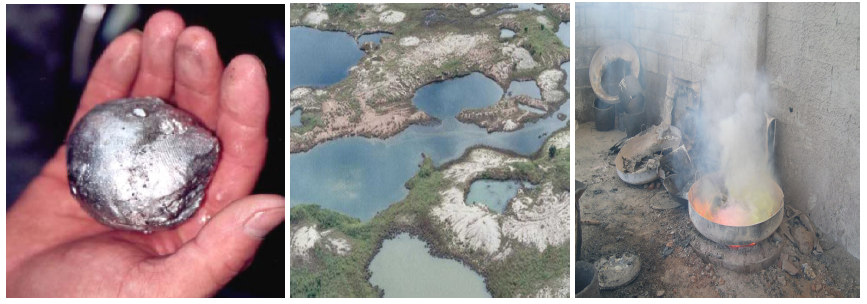
















Global Mercury Proj
o ec
e t
Re
R port
r to
o the
h UNE
N P
P Go
G ve
v rn
r in
i g
n
g Co
C unc
n il
i
l Meetin
i g
n
Nairo
r bi,
i Fe
F b
e ru
r a
u ry
r
y 2007
0
GLOB
O A
B L
L IMPAC
A T
C S
T OF
F MERC
R U
C RY
R
Y SUPPL
P Y
L
Y AND
N
DEM
E AN
A D
D IN
N SMALL
L -SCAL
A E
L
E GOLD
L
D MINING
Pr
P epa
ep r
a ed
ed b
y
y U
N
U IDO
D
Unit
i ed
t
N
a
N t
a ion
i
s Indu
d str
t ia
i l
a D
ev
D
elop
el
men
m
t
t Or
O ga
g niz
i at
a ion
i
requ
q ested
ed by UNE
N P
P Governin
i g Council
i
l de
d cis
i io
i n 23
2 /9
9 IV
October, 2006
















Global Mercury Proj
o ec
e t
Project EG/GLO/01/G34
Removal of Barriers to the Introduction of Cleaner Artisanal and Small-Scale Gold
Mining and Extraction Technologies
Re
R port
r to
o the
h UNE
N P
P Go
G ve
v rn
r in
i g
n
g Co
C unc
n il
i
l Meetin
i g
n
Nairo
r bi,
i Fe
F b
e ru
r a
u ry
r
y 2007
0
GLOB
O A
B L
L IMPAC
A T
C S
T OF
F MERC
R U
C RY
R
Y SUPPL
P Y
L
Y AND
N
DEM
E AN
A D
D IN
N SMALL
L -SCAL
A E
L
E GOLD
L
D MINING
requ
q ested
t
ed b
y
y U
NE
N P
P G
over
ov nin
i g
g Council
i
l d
e
d cis
i io
i n 2
3
2 /9
/
9 I
V
Global Mercury Project Coordination Unit
Pablo Huidobro, Project Manager, UNIDO
Marcello M. Veiga, Chief Technical Advisor, UNIDO
Svitlana Adler, Administrative Assistant, UNIDO
Primary Authors
Samuel J. Spiegel, Policy Advisor, UNIDO
Marcello M. Veiga, Chief Technical Advisor, UNIDO
*This report was prepared in collaboration with the staff of the Global Mercury Project.
Particular acknowledgment goes to the Assistant Country Focal Points in the GMP pilot
countries for their coordination of activities and consultative support.
Cover Photos: by AJ Gunson (China) and Marcello Veiga (Ecuador & Brazil)
Disclaimer: The designations employed and the presentation of the material in this
document do not imply the expression of any opinion whatsoever of the Secretariat of the
United Nations Industrial Development Organization (UNIDO) concerning the legal status
of any country, territory, city, city or area of its authorities, or concerning the delimitation of
its frontiers or boundaries.


Global Mercury Project - Global Impacts of Mercury
Supply and Demand in Small-Scale Gold Mining
Exec
x ut
u ive
v Sum
u mar
a y
I.
I
IN
I TR
T O
R DU
D CT
C I
T O
I N
Th
T e
h Globa
ob l
a Mercur
u y
y Pr
P ojec
j t resp
es ectf
t ul
u ly sub
u m
b its thi
h s report
or in respons
on e
s to the
h
e
UNEP
E Gover
ov ni
n ng
n
g Cou
C
n
ou c
n il's requ
eq es
u t
es (decis
i ion
on 23
2 /
3 9
9 IV
I ) for inf
n ormat
a i
t on
i
on
on mercur
u y
y
sup
u ply,
y trad
a e an
a d
n dema
em n
a d
n in ar
a tisan
a a
n l
a an
a d
n sm
s al
a l-scal
a e gol
g d mini
n ng
n
g (AS
A M). This
report highlights some of the Global Mercury Project's findings 2002-2007 and
outlines some major policy implications for nations worldwide -- particularly
nations exporting, importing and/or using mercury, as well as all countries affected
by global pollution and/or involved in providing capacity assistance to populations
involved in ASM.
Th
T e
h Globa
ob l
a Merc
er ur
u y
y Pr
P ojec
j t (GM
G P)
P is an
a
n ini
n tiat
a ive
v
of the
h
U.N
. . In
I d
n us
u trial
a
l
Devel
ev opm
op ent
en Orga
g n
a i
n za
z t
a ion,
on lau
a n
u c
n hed
h
in 20
2 0
0 2
0 with
h fina
n n
a c
n ial
a sup
u por
o t from the
h U.N.
N
.
Devel
ev opm
op ent
en Pr
P ogr
og am
a an
a d
n the
h Globa
ob l
a En
E v
n i
v ronm
on ent
en Fa
F c
a ility,
y co-fina
n n
a c
n ed
c
by
b par
a tner
n
coun
ou t
n ries
e an
a d
n civi
v l societ
i y.
y Th
T e
h GMP work
or s with gov
g er
ov nm
n ent
en s
t , NG
N Os
O ,
s
, in
i d
n u
d s
u tr
t y
r an
a d
n
commun
u i
n t
i y stak
a ehol
eh der
e s
r , bu
b i
u lding
n cap
a ac
a ity
y to moni
on tor fac
a tor
o s relat
a ed to merc
er ur
u y
y us
u e
e
an
a d
n pollut
u ion
on in
n AS
A M an
a d
n devel
ev oping
n
g policy
y an
a d
n ins
n tit
i ut
u iona
on l
a cap
a ac
a iti
t es to remove
ov
e
ba
b r
a riers to the
h ad
a opti
t on
i
of cleaner
n techn
h ol
n og
o i
g es of miner
n al
a ext
ex rac
a t
c ion
i
.
on Several
countries are participating in this pilot program, with primary field activities during
the first phase taking place in Brazil, Indonesia, Lao People's Democratic Republic,
Sudan, Tanzania and Zimbabwe.
II.
I GLO
L BA
B L
A
L M
ER
E C
R U
C RY
R USE
E & PO
P LL
L U
L TI
T O
I N
IN
I SMAL
A L
L -SCA
C L
A E
L
E GO
G L
O D
L MIN
I IN
I G
N
At
A leas
ea t 10
1 0
0
0 million
on peop
e
le in over
ov 55
5 coun
ou t
n ries
e depend
en on
on AS
A M
S for thei
h r livel
v ihood
h
,
,
mai
a nl
n y in Af
A rica,
a As
A ia
a an
a d
n Sout
ou h
h Am
A eric
i a.
a AS
A M produc
u es 20
2 -30
3 %
0 of the
h world'
d s gol
g d
produc
u t
c ion,
on or ap
a proxi
ox m
i at
a ely
y 500
0 -80
8 0
0 tonn
on es
n
es per an
a n
n u
n m
u . It
I inv
n ol
v ves
v an
a estimat
a ed
ed
10
1 -15
1 million
on miner
n s,
s inc
n lud
u ing
n 4.
4 5 million
on wom
o en an
a d
n 1 mi
m l
i lion
on chi
h ldren.
en This type
of mining relies on rudimentary methods and technologies and is often performed by
miners with little or no economic capital who operate in the informal economic
sector, often illegally and with little organization. As
A mercur
u y
y am
a al
a ga
g m
a at
a ion
on is an
a
n
inex
n p
ex ens
en ive,
v qu
q i
u ck an
a d
n simple
l way
a
y to ext
ex rac
a t
c gol
g d par
a tic
i les,
es it is cur
u rent
en ly
y the
h
method
h
od mos
o t
t comm
om onl
on y
y us
u ed
ed in
n AS
A M
S .
1


Global Mercury Project - Global Impacts of Mercury
Supply and Demand in Small-Scale Gold Mining
As a consequence of poor practices, mercur
u y
y am
a al
a ga
g m
a at
a ion
on in AS
A M res
r ul
u ts in the
h
discha
h r
a ge
g of at
a leas
ea t 65
6 0
5 to 10
1 0
0 0
0 tonn
on es
n of mercur
u y
y per an
a n
n u
n m
u , equ
eq i
u va
v l
a ent
en to 1/
1 3
3
(one
on -thi
h r
i d) of al
a l gl
g oba
ob l
a an
a t
n hr
h opogen
og
i
en c (hu
h m
u an
a -cau
a s
u ed
e ) mercur
u y relea
e s
a es int
n o the
h
env
en i
v ronm
on ent
en . Th
T i
h s mak
a es
k AS
A M the
h sing
n l
g e lar
a ges
g t int
n ent
en iona
on l
a -us
u e sourc
r e of mercur
u y
y
pollut
u ion
on in the
h world.
d
. In addition to the severe occupational hazards associated
with mercury use, ASM has generated thousands of polluted sites with impacts
extending far beyond localized ecological degradation, often presenting serious, long-
term environmental health hazards to populations living near and downstream of
mining regions. It
I is est
es imat
a ed tha
h t
a as
a muc
u h
h as
a 30
3 0
0 tonn
on es
n of mercur
u y per an
a n
n u
n m
u
ar
a e vol
v at
a ilized
z
direct
ec ly to the
h at
a mosp
os her
h e, whi
h l
i e 70
7 0
0 tonn
on es ar
a e discha
h r
a ged
g
in
n mine
n
e
tai
a ling
n s
g i
nt
n o s
oil,
l r
iver
v s a
n
a d
n l
ak
a es
e . I
n
I a
d
a dition
on t
o d
omes
e tic p
ollut
u ion
on i
mp
m ac
a ts,
s b
ot
b h a
i
a r
r
emiss
s ions
on
s an
a d
n
d tai
a ling
n s
g
s d
ischa
h r
a ge
g cont
on am
a ina
n t
a e
e b
ot
b h
h int
n er
e na
n t
a iona
on l
a w
at
a er
e s an
a d
n ai
a r.
r
III
I .
I EC
E O
C NO
N MIC
I
C AN
A D
N S
OCI
C A
I L
A
L DET
E E
T R
E M
R IN
I AN
A TS
T
OF
F MER
E C
R U
C RY
R
Y CO
C NSU
S M
U PT
P I
T O
I N
Th
T ou
h
g
ou h
g lar
a ge
g -scal
a e gol
g d mine
n operat
a ions
on ha
h ve
v
e pha
h s
a ed out
ou mercur
u y
y us
u e by ad
a opti
t ng
n
g
al
a terna
n t
a ive
v techn
h ol
n ogi
og es
e , mercur
u y
y deman
a d
n in AS
A M cont
on inu
n e
u s
e to inc
n rea
e s
a e. With gold
rising from US$260/oz in March 2001 to US$725 in May 2006, a gold rush involving
poverty-driven miners is being observed in many countries. This increase in mining
activity is compounded by escalating poverty due to factors such the failure of
subsistence economies, conflict causing displacement of populations, and diseases
such as HIV/AIDS. Due
u to the
h inc
n reas
ea e in AS
A M, an
a d
n ba
b s
a ed on evi
v den
e c
n e of mercu
c r
u y
r
y
us
u e i
n c
oun
ou t
n ry-by
b -coun
ou t
n r
t y a
n
a d
n r
egi
eg ona
on l
a r
eporting
n ,
g m
ercur
u y
y c
ons
on um
u pt
p ion
o a
n
a d
n d
em
d
an
a d
n
d
in
n AS
A M m
ay
a
y be
b
e gr
g owing
n
g to a
a hi
h st
s orical
a l
l y
y un
u p
n rec
e ed
c
ent
en ed
ed level
ev
el on
on the
h
e gl
g ob
o a
b l
a scal
a e.
e
Th
T e
h hi
h gh
g es
h t cons
on um
u pt
p ion
i
level
ev s ar
a e from
o Ch
C i
h n
i a
n (with
h 20
2 0
0
0 to 25
2 0
5 tonn
on es
n relea
el
s
ea ed)
ed ,
,
followed
ow
by
b In
I d
n ones
on ia
a (1
( 0
1 0
0 to 15
1 0
5 tonn
on es
n )
es an
a d
n bet
b ween
een 10
1
0 an
a d
n 30
3
0 tonn
on es
n in eac
ea h
h of
Br
B az
a i
z l, Bol
B ivi
v a,
a Col
C ombi
b a,
a Ec
E ua
u d
a or,
or Gha
h n
a a
n ,
a Per
P u,
u Ph
P i
h lippine
n s
e , Ven
V
ez
en u
ez el
u a,
a Ta
T n
a z
n a
z n
a i
n a
a
an
a d
n Zi
Z mba
b b
a w
b e. Mercur
u y
r may be
b us
u ed in as
a man
a y
n as
a 40
4 other
h coun
ou t
n ries
i , to va
v r
a yi
y ng
n
g
degr
eg ees.
ees Because some mercury used is recycled, the amount of additional mercury
demanded is equivalent to the amount of mercury consumed (assuming constant
ASM production levels and constant technologies over time). On average, it is
conservatively estimated that at
a lea
l
s
ea t 1 to
o 3
3 gr
g am
a s
m of mercur
u y
y is lost to the
h
e
env
en i
v ronm
on ent
en for ever
ev y gr
g am
a of gol
g d produc
u ed
e by
b AS
A M. Mercur
u y
y rel
r eas
ea es prim
i ar
a ily
y
depend
en on the
h na
n t
a ur
u e of mini
n ng
n techn
h ol
n ogy
og employed
oy
,
ed whi
h ch
h is in
i f
n luen
u
c
en ed by
b bot
b h
h
social
a
l and
n ec
e onom
on
ic
i f
ac
a tor
t s.
2


Global Mercury Project - Global Impacts of Mercury
Supply and Demand in Small-Scale Gold Mining
While there are numerous social and economic factors that affect technology use, the
focus of this report is on how mercury supply and demand relate with respect to
available technologies. Va
V r
a ious
ou locat
a ion-sp
s ec
e ific GMP
P trai
a ni
n ng
n pr
p ogr
og ams an
a d
n
as
a ses
e sm
s ent
en s dem
e ons
on t
s ra
r t
a e tha
h t
a when
h
en merc
er u
c r
u y is less av
a a
v i
a lab
a l
b e
e an
a d
n /or mor
o e
exp
ex ens
en ive,
v less mercur
u y
y is cons
on um
u ed
e due
u to tran
a s
n fers
er to more
or effic
i ient
en
t prac
a tices
e , or
or
in s
ome c
e as
a es, t
o p
rac
a tic
i es t
ha
h t
a el
imina
n t
a e m
e ercu
c r
u y u
s
u e. GMP assessments emphasize
these four critical determinants of mercury reduction:
1)
1 Wh
W ol
h e ore am
a al
a ga
g m
a at
a ion is the
h lar
a ges
g t point
n
t sour
ou ce of mercur
u y pollu
l t
u ion in AS
A M
(cont
on ribu
b t
u ing
n more tha
h n
a 50
5 %
0 of mercur
u y lost
t in AS
A M). Substantial differences in
mercury consumption are observed between whole ore amalgamation (i.e. mercury is
added to all ore being processed during crushing, grinding or sluicing) and
amalgamation of only heavy mineral concentrates. Although amalgamation of the
whole ore is an inexpensive way to quickly extract gold, several cost-efficient
alternative mercury-free pre-concentration technologies exist as viable options.
However, the practice of whole ore amalgamation often persists in many regions due
to factors such as: availability of inexpensive mercury, lack of technical
knowledge/expertise, lack of organizational support, and lack of environmental
health awareness. GMP
M as
a ses
e sm
s ent
en s
t in va
v r
a ious
ou locat
a ions
on ind
n i
d c
i a
c t
a e
t
th
t a
h t
a
t a ri
r s
i ing
n
g
mercur
u y
y price is a sign
g i
n fican
a t
n ad
a ded inc
n ent
en iv
i e
v to elimin
i a
n t
a e thi
h s ha
h z
a a
z r
a dous
ou an
a d
n
econom
on
ical
a l
l y
y inef
n f
ef icient
en p
rac
a tice.
c
2)
2 Bu
B r
u ni
n ng
n am
a al
a ga
g m
a in
n open ai
a r is the
h second
on lar
a ges
g t sour
ou ce of mercur
u y loss to the
h
env
en i
v ronm
on ent
en (
cont
on ribu
b t
u i
t n
i g
n 20
2 -30
3 %
0 of
m
ercur
u y l
os
l ses
e i
n AS
A M);
) h
ow
h
ever
ev
er it i
s t
he
h m
e ai
a n
hea
h
l
ea th probl
ob em
e for min
i er
n s an
a d
n nea
n
r
ea by
b commu
m n
u i
n ties. Th
T e
h price
c an
a d
n av
a a
v i
a lab
a i
b lity of
mercur
u y
y al
a so inf
n luen
u
c
en es
c
es whet
h her
h miner
n s
er us
u e retor
et ts to cont
on ai
a n
n mer
m c
er ur
u y
y va
v p
a or dur
u ing
n
g
the
h bu
b r
u ni
n ng
n stag
a e
g of am
a al
a ga
g m
a at
a ion.
on GMP field assessments found that effective
retorts could be made cheaply (e.g. as little as US$3.20 in some cases), and that
these retorts could contain mercury vapor in such a way that allows over 95% of the
mercury to be recycled and re-used. Numerous community training programs and
assessments have concluded that the mercury price and economic benefits of re-
using mercury have a significant impact on whether miners will adopt the retorts, in
addition to health and environmental considerations.
3)
3 Los
L s of mercur
u y
y in
n am
a al
a ga
g m
a at
a ion
on of conc
on ent
en rat
a es ha
h s
a al
a so been
b
een iden
d
t
en ified by
b
y the
h
GMP
P as
a a sour
ou ce of mer
e cur
u y pollut
u ion
on (10
1 -15
1 %
5
% of mercur
u y losses
e ).
) Amalgamation of
only gravity concentrates is an improvement when compared to whole ore
amalgamation. However, even amalgamating the gravity concentration, some
3


Global Mercury Project - Global Impacts of Mercury
Supply and Demand in Small-Scale Gold Mining
mercury is lost. Higher prices of mercury could encourage miners to adopt better
techniques to prevent these losses.
4) Com
C
plete
et pha
h s
a e-out
ou of merc
er ur
u y us
u e in mini
n n
i g
n may
a be
b a vi
v ab
a l
b e opti
t on for man
a y
n
y
miner
n s,
s thou
h
g
ou h
g suc
u h
h al
a terna
n t
a ive
v techn
h ol
n ogi
og es
es gen
g
er
en al
a ly requ
eq i
u re a hi
h gh
g er
h order of
of
econom
on
ic inv
n es
v tm
t ent
en ,
t orga
g n
a i
n za
z t
a ion,
on an
a d
n techn
h i
n cal
a exp
x erti
t se.
e Assessments indicate
that a high price of mercury, coupled with capacity-building, may contribute to the
transfer to such technologies. The most promising technology to replace completely
the use of mercury in any type of gold ore is cyanidation, but this is not quite
affordable and technically available to all artisanal miners. Cyanidation methods
must be carefully assessed so that cyanide and mercury are not used in any way
together, which can exacerbate pollution. Other gravity separation methods have
great potential to reduce and in some specific situations eliminate the use of
mercury but many of these cannot be adopted worldwide because ores vary
significantly. In
I ap
a proxi
ox mat
a ely
y 10
1 %
0 of cur
u rent
en AS
A M cas
a es,
es gol
g d
ol sour
ou ces
e ar
a e al
a luv
u i
v al
a
l
ore (free
e gol
g d) an
a d
n completely mercury
r -fr
f ee-al
a t
l er
t na
n t
a ives
v coul
ou d be
b local
a ly av
a a
v i
a lab
a l
b e at
a
t
a
a ver
v y
y low
o cos
o t.
t
IV.
V G
LO
L BA
B L
A
L SO
S URC
R E
C S
E OF
F MER
E C
R U
C RY
R
As
A mercur
u y
y is read
ea ily av
a a
v i
a lab
a l
b e in most coun
ou t
n ries,
es it tend
en s to be
b inex
n p
ex ens
en ive
v an
a d
n
d
eas
ea ily a
c
a ces
e sibl
b e t
e o g
ol
g d
d miner
n s.
s M
ercur
u y
y u
s
u ua
u l
a ly en
t
en ers d
ev
d el
ev oping
n c
oun
ou t
n ries l
ega
eg l
a ly,
y
i.e. for us
u e in
n dent
en al
a am
a al
a ga
g m
a s or the
h chl
h or-al
a kal
a i ind
n us
u try.
y How
H
ev
ow er
ev , evi
ev denc
en e
c
e
ind
n icat
a es
e tha
h t
a in man
a y
n devel
ev oping
n
g coun
ou t
n ries
e
s an
a d
n coun
ou t
n ries
e with
h econom
on
ies
e in
n
tran
a s
n ition
i
,
on by far
a the
h maj
a or
j ity of mercur
u y
y imported
t
end
en s up
u bei
b ng
n
g us
u ed in AS
A M.
Estimates have been undertaken concerning the amount of mercury diverted for use
in ASM using import statistics and anticipated consumption for legitimate uses,
focussing in the 6 GMP pilot countries and neighbouring countries.
GMP assessments reveal that in 2005, Kenya imported almost 14 tonnes of mercury
from German, followed by Georgia (9.5 tonnes) and Japan (4.1 tonnes). Ev
E i
v denc
en e
e
sug
u g
g es
g ts tha
h t
a mos
o t of
of Keny
en a
y '
a s imported
t
mer
e cur
u y
y is then
h
en exp
x orted
e , lega
eg l
a ly an
a d
n
d
illega
eg l
a ly,
y to Ta
T n
a z
n a
z n
a i
n a,
a Uga
g n
a d
n a an
a d
n the
h Dem
e oc
o rat
a ic Rep
R
ub
u lic of Con
C
go,
g wher
h e
er it is
s
primar
a il
i y
y us
u ed in AS
A M. In
I Ta
T n
a z
n a
z n
a i
n a,
a in 20
2 0
0 5
0 ,
5 the
h Uni
n t
i ed Stat
a es exp
ex orted
ed
ap
a proxi
ox mat
a el
t y
y 30
3 %
0 of Ta
T n
a z
n a
z n
a i
n a'
a s official
a im
i ports
t of 3 tonn
on es
n ,
es fol
f lowed by
b
y the
h
Nether
h lan
a d
n s
d with
h an
a ot
n h
ot er
h 30
3 %
0 . It is unclear how much of this mercury is used in
ASM since the price of imported mercury varies from US$0.18/kg to US$31.2/kg.
4


Global Mercury Project - Global Impacts of Mercury
Supply and Demand in Small-Scale Gold Mining
Officials noted that differences could be attributed to mercury quality variance as
well as reporting-related problems.
OECD countries are the main source of mercury to Sub-Saharan Africa, where
mercury imports increased from 34 metric tons in 2000 to 57 tons in 2002. In 2000,
the Netherlands shipped 245 tonnes of mercury to at least 18 countries, most in the
Latin American-Caribbean region. Indonesia imported in 2000 24 tonnes from
Spain, 17 tonnes from the Netherlands, 3 tonnes from Australia and 3 tonnes from
Japan.
In 2005, official import data from Zimbabwe indicated 21.8 tonnes of mercury
imported in which South Africa contributes with 13.8 tonnes, the Netherlands with
2.7 tonnes, Switzerland with 4.6 tonnes, and Germany with 0.7 tonnes. However,
results from interviewing in 2003 indicated that one single mercury dealer in
Zimbabwe unofficially declared importing 20 tonnes of mercury. In the same year,
the Zimbabwe official data indicated that the Netherlands accounted for 15.7 tonnes.
Given these facts, it is un
u l
n ikely
y tha
h t
a impor
o t sta
t t
a istic
i s
c ad
a equ
eq a
u t
a ely
el
y cap
a tu
t r
u e the
h cross
os -
bor
b der
er traf
a f
f ick
c ing
n
g of
o m
er
e cur
u y
y an
a d
n
d the
h
e ext
ex ent
en of
of d
iver
v sion
on from
o leg
l a
eg l
a sec
e t
c ors.
s
In
I 2
0
2 0
0 5
0 ,
5 Br
B az
a i
z l of
ficial
a ly
l i
mport
or ed 4
3
4 .
3 3
3 t
onn
on es
n of
m
ercur
u y,
y i
n
i
n w
hi
h c
i h
h 2
6
2 .
6 9
9 t
onn
on es
n c
am
a e
m
e
from Spai
a n,
n 6.
6 9 from
o UK, 3.
3 4
4 from Hong
on Kon
o g
n ,
g an
a d
n 3.
3 3
3 from Kaz
a a
z k
a hs
h tan
a ,
n am
a ong
on
g
other
h s.
s M
ost
os of
o the
h
e mer
e c
r ur
u y
y us
u ed
e in
n AS
A M i
n
n Br
B a
r z
a i
z l is
s la
l b
a el
b led
ed for
o us
u e in
i
n dent
en is
i try.
y
The unregulated trading of mercury from industrialized countries to developing
countries makes mercury easily available at the mine sites. In
I mos
o t coun
ou t
n ries
e with
h
AS
A M, mercur
u y
y is read
ea ily
l av
a a
v i
a lab
a l
b e to miner
n s at
a
t AS
A M sites.
es In
I some cas
a es it is gi
g ven
v
en
for free,
ee cont
on ing
n en
g
t
en on
on gold bei
b ng sold to the
h mercur
u y provi
ov der
e . Stockp
k iling
n of
of
mercur
u y
y by
b gol
g d deal
ea ers
er ha
h s
a been
b
ident
en ified as
a a conc
on ern.
n GMP
P as
a ses
e smen
m
t
en s find
n
d
tha
h t
a moni
on toring
n
g an
a d
n regu
eg l
u at
a ing
n impor
o ts an
a d
n
d domestic
i trad
a e in
n man
a y
n devel
ev oping
n
g
coun
ou t
n ries
e an
a d
n coun
ou t
n ries
es with
h econom
on
ies
e in tran
a s
n ition
on is gen
g
er
en al
a ly
y sign
g i
n fican
a t
n ly
y more
e
diffic
i ul
u t tha
h n
a
n regu
eg l
u at
a ing
n mercur
u y
y sup
u ply
y at
a the
h exp
ex ort stag
a e,
g par
a t
r ic
i u
c l
u a
l r
a ly
l exp
ex orts
t
s
from
om devel
ev op
o ed c
oun
ou t
n ries
e .
V.
V HEA
E L
A T
L H
T
H AN
A D
D EN
E VI
V RO
R NM
N EN
E TA
T L
A
L IM
I PA
P C
A T
C S
T
Th
T e
h misus
u e of merc
er ur
u y
y in
n AS
A M produc
u es seve
ev r
e e
r hea
h
l
ea th an
a d
n env
en i
v r
i onm
on en
m
t
en al
a ha
h z
a a
z r
a ds.
.
The mobilization of mer
e cur
u y
y from mine
n sites
e int
n o aq
a u
q at
a ic sys
y tem
t
s
em present
en s
t a maj
a or
j
or
5


Global Mercury Project - Global Impacts of Mercury
Supply and Demand in Small-Scale Gold Mining
risk.
k Th
T e
h maj
a or
j effects
t of mercur
u y
y in
n aq
a u
q a
u t
a ic life, soils
l an
a d
n sediment
en s,
s were foun
ou d
n in
n
Br
B az
a i
z l, Zi
Z mba
b b
a w
b e
w an
a d
n In
I d
n ones
on ia.
a Th
T i
h s was
a at
a t
t ribu
b t
u ed to exc
ex ess
es ive
v us
u e of mercur
u y
y
(whol
h e ore am
a al
a ga
g m
a ation
i
)
on as
a well as
a combi
b ned
n
us
u e of mercur
u y
y wit
i h
t cy
c a
y n
a i
n d
i a
d t
a i
t on
i
.
on
.
Th
T i
h s combi
b ned
n
us
u e exa
x c
a erba
b t
a es the
h methy
h l
y at
a ion of mercur
u y.
y Onc
n e
e methy
h l
y at
a ed,
ed
,
mercur
u y
y can
a
n rap
a idly
y m
ov
o e
v thr
h oug
ou h
g
h the
h
e food
o
c
ha
h i
a n,
n lead
ea i
d ng
n
g to
o impac
a ts
s dow
d
ns
n t
s ream
ea .
m
In
I h
n a
h l
a at
a ion of mercur
u y
r dur
u ing
n ha
h n
a d
n ling
n ,
g as
a a resul
u t of spil
i l
l s
l
s an
a d
n dur
u in
i g
n
g
am
a al
a ga
g m
a at
a ion,
on whi
h ch
h is
s often
en un
u d
n ertak
a en
en by
b
y women
en an
a d
n chi
h ldren,
en al
a so
o represent
en s
t a
a
maj
a or
j hea
h
l
ea th conc
on ern.
n Typically, this is conducted with no
n protect
ec ion
on an
a d
n often
en tak
a es
es
plac
a e i
n t
he
h h
om
h
e. Results of the health surveys have been alarmingly similar across
GMP sites. Symptoms of mercury intoxication are widespread, with some people
experiencing level
ev s of int
n oxi
ox cat
a ion
on tha
h t
a exc
ex eed
eed 50
5
0 times the
h WH
W O
H max
a i
x m
i um
u pub
u l
b i
l c
i
c
exp
ex osur
u e limit. Neurological disturbances such as ataxia, tremors and coordination
problems are common. At one project site, almost 50 percent of miners showed an
unintentional tremor, which is a typical symptom for mercury-induced damage of
the central nervous system. With extremely high mercury concentrations in breast-
milk of nursing mothers in GMP communities, infants are especially at risk.
VI.
I IM
I PL
P I
L C
I A
C T
A I
T O
I NS FO
F R
R PO
P LI
L C
I Y
C AN
A D
N
D GO
G VE
V R
E N
R AN
A CE
C
Th
T e
h Globa
ob l
a Mercur
u y Pr
P ojec
j t ha
h s
a been
b
workin
i g
n mai
a nl
n y in six coun
ou t
n ries,
es an
a d
n ha
h s
a
s
ac
a qu
q i
u red key
ey lessons
on in its Pol
P icy an
a d
n Gover
ov na
n n
a c
n e In
I i
n tiat
a ive
v . This initiative
recognizes that effectively addressing mercury problems in ASM requires an
integrated approach that targets capacities of local institutions in the removal of
technical, social, economic and political barriers to the improvement in ASM
practices. The GMP emphasizes that local participation and locally-driven processes
of policy development are of critical value. Sinc
n e 20
2 0
0 5
0 ,
5 the
h GMP
P ha
h s
a been
b
een workin
i g
n
g
with
h gov
g er
ov nm
n ent
en s an
a d
n commun
u i
n t
i ies on devel
ev op
o ing
n an
a d
n implem
e ent
en ing
n
g va
v r
a ious
ou new
n
ew
policies
e suc
u h
h as
a : mercu
c r
u y trad
a e an
a d
n man
a a
n g
a em
g
ent
en law
a s in In
I d
n ones
on ia,
a na
n t
a iona
on l
a
l
mercur
u y
y an
a d
n mini
n ng
n
g lab
a ou
b
r
ou law
a s
w in Zi
Z mba
b b
a w
b e, policies
e to lega
eg l
a ize
z an
a d
n as
a s
s ist
t
ind
n igen
g
ou
en
s
ou m
iner
n s
er in
n Su
S d
u an
a ,
n an
a d
n
d mic
i rof
o ina
n n
a c
n e
e policy
y in
n Ta
T n
a z
n a
z n
a i
n a.
a
In
I selected sites
e , the
h GM
G P ha
h s
a been
b
focus
u sing
n
g on cap
a ac
a ity-bu
b i
u ld
l ing
n pilot
l progr
og am
a s
m to
remove
ov ba
b r
a riers to the
h ad
a option
on of clean
ea er
n techn
h ol
n ogi
og es.
es These programs involve
mobi
ob le trai
a ni
n ng
n
g un
u i
n ts tha
h t
a can
a reac
ea h
h miner
n s
er in
n rur
u al
a ar
a ea
r
s
ea to eng
en a
g g
a e
g local
a priorities
e .
Th
T i
h s c
omm
om un
u i
n ty
y a
s
a sist
s an
a c
n e m
odel
e i
s r
eceivi
v ng
n
g w
ides
e pread
ea s
up
u port, a
n
a d
n t
he
h G
e MP
P h
a
h s
a
al
a read
ea y certif
i ied team
ea s
s of local
a trai
a ner
n s
er . Yet, the regions benefiting from the GMP
6


Global Mercury Project - Global Impacts of Mercury
Supply and Demand in Small-Scale Gold Mining
constitute only a fraction of the global population impacted by ASM. Fu
F r
u ther
h
er
commit
i ment
en
t is
i nee
n d
ee ed i
n
i
n thes
h e
e an
a d
n
d other
h
er regi
eg on
o s
n , i
nc
n lud
u ing
n
g ad
a dition
i
a
on l
a
l resou
es
r
ou ces
e .
Global commitments are critically needed, from community-level issues such as
technologies and gender inequities, to broader policies such as international mercury
export controls and policies to improve regulation and assistance in the ASM sector.
The
h GMP
P as
a serts
t tha
h t
a it coul
ou d be
b possi
s bl
b e to ac
a hi
h eve
ev at leas
ea t a 50
5 %
0 reduc
u tion
on of
of
mercur
u y
y cons
on um
u pt
p ion (d
( eman
a d
n )
d in AS
A M by
b 20
2 1
0 7
1 . As
A cal
a led for by
b the
h GMP,
P thi
h s goa
g
l
oa
mus
u t be
b ac
a hi
h eved
ev
by
b fostering
n
g commit
i ment
en s
t of
of diver
v se stak
a ehol
eh der
e s to development
strategies that will empower populations to:
1. elimina
n t
a e
e am
a al
a ga
g m
a at
a i
t on
o
n of w
hol
h e
e oree by replacing by introducing mercury-
free concentration process prior to amalgamation
2. reduc
u e
e merc
er ur
u y
y us
u e in
n th
t e
h am
a al
a ga
g m
a at
a ion
i
on of
o conc
on ent
en rat
a es
e through closed
circuit process (mercury is always recycled)
3. elimina
n t
a e
e the
h bu
b r
u ni
n ng
n
g of
o mer
e cur
u y
y w
ithou
h
t
ou t
he
h us
u e of
o a
a reto
et r
o t to contain
emissions and thereby allow recycling
4. int
n roduc
u e
e com
o pletel
et y
y mer
m cur
u y
y f
ree t
ee echn
h i
n qu
q e
u s
e w
her
h e
e feas
ea ibl
b e, particularly for
ores which preclude the use of mercury.
Th
T e
h 10
1 -yea
y
r
ea go
g al
a of redu
ed c
u ing
n mercur
u y
y cons
on um
u p
m t
p ion
on in AS
A M by
b over
ov 50
5 %
0 is
i am
a bi
b tious
ou
s
bu
b t
u ac
a hi
h eva
ev b
a l
b e. Given
v
en the
h ur
u gen
g
c
en y of the
h mercu
c r
u y probl
ob em
e in
n AS
A M,
M su
s c
u h
c
h an
a effort
or
t
can
a n
n ot
n be
b cons
on ider
d ed a
a choi
h ce rat
a her
h it mus
u t
s be
b seen as
a a gl
g oba
ob l
a obl
ob iga
g t
a ion.
on Th
T e
h
e
GMP
P cal
a ls on na
n t
a ions
on
s ar
a oun
ou d the
h world
l to achi
h eve
ev the
h above
ov goa
g
l
oa by
b reduc
u in
i g
n
g
mercur
u y
y sup
u ply
y thr
h oug
ou h
g exp
ex ort cont
on rols
ol an
a d
n ot
o her
h mecha
h n
a i
n sm
s s tha
h t
a wil
i l
l
l enc
en our
ou ag
a e
g
the
h tran
a s
n ition
on to al
a tern
er a
n t
a ive
v techn
h ol
n ogi
og es
e , as
a
s well as
a by
b pledgi
g ng
n
g commitm
t ent
en s
t to
progr
og am
a s
m to hel
h p bu
b i
u ld commun
u i
n t
i y cap
a ac
a it
i ies.
es Fu
F r
u ther
h inf
n ormat
a ion
i
on on
on the
h ac
a tivi
v ties
es
of the
h
Globa
ob l
a Mercu
c r
u y Pr
P ojec
j t can
a
n be
b
obt
ob ai
a ned
n
at
a the
h projec
j t webs
eb ite:
t
e:
www
w .gl
g oba
ob l
a m
l ercur
u yp
y rojec
j t.or
o g
7