


Global Mercury Project
Project EG/GLO/01/G34:
Removal of Barriers to Introduction of Cleaner Artisanal Gold Mining and Extraction Technologies
INFORMATION ABOUT INGESSANA HILLS ARTISANAL GOLD
MINING SITES CHOSEN FOR THE ENVIRONMENTAL &
HEALTH ASSESSMENT
by
Mohamed S. Ibrahim
Assistant to Country Focal Point, Sudan
November 2003
Table of Content
1.0 Description of the Ingessana Hills Artisanal Gold Mining Sites ...................................1
Geographic information ..............................................................................................................1
Historical background of artisanal gold miming in the Ingessana Hills ..................................1
History of gold production in the Ingessana Hills .....................................................................3
Environmental impacts left ........................................................................................................3
2.0. Community Characteristics ................................................................................................4
General .........................................................................................................................................4
Number of people ........................................................................................................................5
Community structure...................................................................................................................5
Type of Government....................................................................................................................6
Education......................................................................................................................................6
Living conditions .........................................................................................................................7
Categories of the Miners .............................................................................................................8
Panning.........................................................................................................................................9
Women .........................................................................................................................................9
3.0 Gold Production Methods and Characteristics............................................................. 10
Gold Extraction Cycle ...............................................................................................................10
Tailings disposal ........................................................................................................................11
Mercury handling in artisanal gold extraction .........................................................................11
4.0 Environmental and Health Impacts............................................................................... 13
Visible environmental impacts and mercury hotspots ............................................................13
Visible health impacts ...............................................................................................................13
5.0 Barriers to the Introduction of Cleaner Techniques.................................................... 14
Recommendations......................................................................................................................15
1
1.0 Description of the Ingessana Hills Artisanal Gold Mining Sites
Geographic information
The chosen artisanal gold mining site lies in the middle of Ingessana Hills semi-circular massif;
some 80 km to the southwest of El Damazin town, the capital of the Blue Nile State. The area
bounded by latitudes 10° 00'-12° 00'N and longitude 33° 45' eastwards to the Sudan-Ethiopia
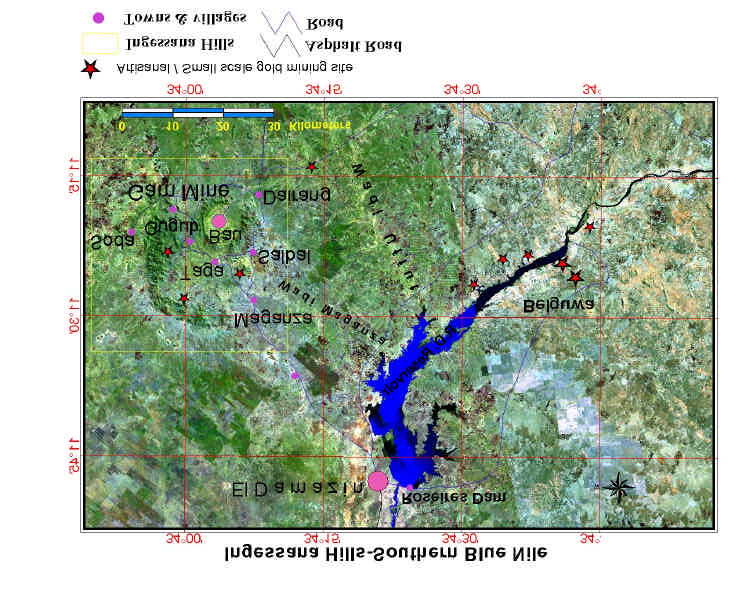
boarder is geographically referred to as southern Blue Nile region (figure 1). The sites are scattered
around Gugub village, which lies ~10 km northwest of Bau town; the administrative center of the
Inagassna Hills district (figure 2).
The district lies within the Savannah Zone with annual precipitation ranges between 600 and
800mm. Dense bush and tall grass cover the hillside and the stream banks as well. Climatic seasons
are defined by the hot dry summer (March-June ), hot wet autumn (July- October ), mild dry winter
(November-February ), and a very short spring (early March). Mean daily temperature ranges from
43ēC in mid summer (April-May) and 20 ēC (December-January). Ingessana Hills rise 800 to 1000
feet above sea level.
Southern Blue Nile is accessible by 520 km long Khartoum-El Damazin asphalt road. El Damazin
is connected to Bau, the district center, and other villages of the Ingassana Hills by dirt roads. In dry
season, it takes 2 hours drive from El Damazin to reach Gugub artisanal gold mining site or Bau.
Blue Nile River is the major drainage landmark in southern Blue Nile region within Sudan, the
Nile is fed by a network of big seasonal streams that drain the highlands east and west of the river
into the main course. The prominent seasonal tributaries (Wadi/ Khor) that emerge from the
Ingassana massif in radial pattern are Wadis Timsah, Maganza, Ferri, and El Dom. Among these,
Wadi Maganza virtually drains all northeastern parts of the Ingessana Hills where most artisanal
gold mining sites are located (figure 2). Its seasonal waters end up into the western banks of
Roseries Dam reservoir at a point lies some 20 km south of El Damazin town. Another first order
seasonal stream, Wadi Uffut, partially drains the southeastern hill slopes into Roseries Dam
reservoir; some 12km to the southeast of Wadi Maganza confluence with the Blue Nile.
Historical background of artisanal gold miming in the Ingessana Hills
Southern Blue Nile region is famous for artisanal gold mining since the 19th century. Qeissan and
Kurmuk, 150 and 170 km south of El Damazin, respectively, are traditional areas of alluvial gold
production. In the last 20 years, artisanal gold miners turned partially to primary gold mining.
In the Ingessana Hills, artisanal gold mining was not known until the mid 1990s. Both adverse
circumstances and civil strife along the Sudan-Ethiopia boarder areas, drove thousands of
immigrants and displaced peasants into Ingessana Hills and elsewhere. Among these, Dawala ethnic
group of Kurmuk district are the most skilled artisanal gold miners. To make a living, Dawala
started prospecting for gold around their new home in the Ingessana Hills District. In 1996, they
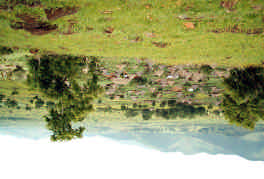
discovered gold in quartz veins around Gugub village (photo 1). Soon they started artisanal gold
mining along the stream terraces as well as on quartz vein slopes. Deep pits were dug down to 20m.
Eventually the Ingassana individuals picked up the skills of artisanal gold mining from the Dawala
who shared them residence. The income earned from artisanal gold production is substantial:
average monthly earning per miner in Gugub is ~S.D.20000 (US$ 80).
Through interaction with the new-comers, the Ingessana tribesmen acquired the new artisanal gold
mining skills and for the first time ever, the semi-pristine community has experienced direct and
extended contacts with outsiders. The social change as it appears, is tremendous on the community.
2
Figure 1:
Photo1: Gugub village
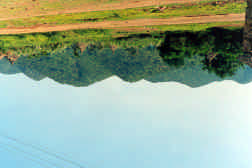
Photo 2:Ingessana huts on hillside
3
The local census of Gugub mining community alone is ~800 miners. Adjacent villages (Taga and
Khor Gam; figure 2) account for another ~300 artisanal gold miners.
History of gold production in the Ingessana Hills
As mentioned, no reliable reports on the history gold production in Ingessana hills prior to late
1996. Although artisanal gold mining activities in the Ingessana Hills is relatively recent, the impact
on the economy of the district is substantial. Dawala of Kurmuk who were displaced from homes to
Gugub virtually with nothing in their hands are now well off. Some individuals now own trucks or
cattle bought by money earned from artisanal gold produced within the Ingessana Hills.
All Dawala and Ingessana men interviewed claim that they frequently produce gold worth an
equivalent of ~US$5/day/miner. In last July 2003, Gugub artisanal gold miners hit a gold-rich
elluvium deposit near Khor Gidad site ~7km north of Gugub village where they used to produce
between 8 and 10 grams of gold /day/individual. These days a gram of gold sells in Gugub for
US$9-9.5.
Despite their reluctance to disclose information about their earnings from artisanal gold
production, Ingessana miners general appearance can tell. Compared to their living conditions in
1970s and 80s, now Ingessana families both look better fed and dressed. They possess some modern
amenities like tape recorders, bicycles, watches, etc.
Based on the above, the estimated gold produced by the 800 artisanal gold miners in the Ingessana
Hills for the period 1997-2003 (@ 0.5gm/day/ individual) is around 3 tons. This quantity is quite
conservative, if the daily gold production per individual is considered to be higher. Perhaps, in
some days a miner can produce >1.0 gm of gold per 8 hour work shift.
Back in 1999, a private investor obtained an exclusive prospecting license for gold exploration and
mining in a 10 km2 area around Gugub from the Ministry of Energy and Mining but for the adverse
reasons surrendered the area.
Now the area is open for licensing without any restrictions on the artisanal gold mining activities.
The only restriction imposed by Government is the introduction of rock mills into the area.
Environmental impacts left
Despite artisanal gold mining activities are relatively recent in the Ingessana Hills district, impacts
on the environment is evident. Wildcat digging and excavation, heaps of waste/tailings, and tree
cutting are among the visible negative impacts.
Deep holes along stream terrace as well as on quartz hillside have created a considerable changes
on the landscape of the artisanal gold mining sites. Rain washes these excavated waste and tailings
definitely lead to river siltation and land/forest degradation. Abandoned holes are hazardous to the
safely of both people and livestock.
Mercury utilization in gold amalgamation in the way practiced today in Gugub area has likely
negative impacts on both the environment and the community health. Handling mercury by bare
hands, and burning of amalgam on an open pan or plate at the artisanal gold miners homes emits
considerable mercury vapor without precautions taken. It is estimated that for every 1 gm of gold
produced about 1.5 grams of mercury is lost to the environment. A part of the emitted mercury
vapor definitely goes into humans through inhalation or food/water contamination.
Up to 2001, about 800 artisanal miners of Gugub and the surroundings practice primary gold
mining and extraction using mercury excessively as a medium for gold extraction. Based on the
average daily gold extraction per miner (@0.5 gram) and 800 active artisanal gold miners, the
estimated annual (300 work days) gold production is 450 kg. The concomitant annual mercury loss
during gold extraction is ~0.7 ton.
4
Figure 2:
For a year or so, the majority of Gugub artisanal gold miners (>80%) shifted their operations to
alluvial gold mining for several reasons:
-Shortage of water during summer time in pit sites.
- Gold mining pits in hillside become deep (>20m) and hazardous
- Amalgamated gold (mainly primary) sells for lower price (US$6- 6.5gm) as compared with gold
produced from alluvium by panning only (US$ 9-9.5).
The reason given for price disparity is that amalgamated gold (primary gold) is less pure. Our
interpretation that It may contain high alloyed silver and copper.
2.0. Community Characteristics
General
The Ingessana ethnic community leads a semi-nomadic lifestyle. Up to the 1970s, the mixed
Muslim and pagan community was apparently closed to the outsiders. Chromite mining activity in
various locations in the Ingessana massif is the first notable activity started in 1960s in the
5
Ingessana Hills. During development, tens of Ingessana men were incorporated as mine workers.
The rest of the tribe depended on animal husbandry. Cattle, sheep, and pigs constitute the bulk of
their livestock. Despite rain-fed mechanized farming run by investors from Khartoum and El
Damazin in the surrounding clay plains is a big business since the 1970s, agriculture is still a
secondary and unattractive occupation for the Ingessana tribesmen.
Ingessana household subsistence depends almost on limited cultivation around their huts. The
main staple crops are sorghum and maize. A few practise rain-fed micro-cultivation of sorghum and
sesame cash crops outside the Ingessana Hills circle.
The Muslim Dawalla is sedentary agrarian community whose artisanal gold mining is their major
occupation. Some of them venture other jobs like trade and sorghum cultivation.
Arabic is the common language spoken by all groups although each has its own vernacular.
About 95% of the sample respondents are married. Average family has 5 children. Polygamy is
common while promiscuity and drug/alcohol abuse is apparently nil among the miners community.
Number of people
The latest national census (1993) indicates that population of the Blue Nile state is ~500000.
Recently, Bau deputy commissioner reports that the district's population is ~100000. The majority
of the population is concentrated in bigger settlements like Bau, Dairang, Gam mine camp, Salbal,
Maganza, as well as in smaller villages like Gugub, Taga, Gabanit and Soda (figure 2).
Artisanal gold miners in the Ingessana Hills concentrate in Gugub, Taga, and Salbal villages.
Gugub village of ~1000 inhabitants is the major center of activities. Artisanal gold miners are
scattered in 3 sites at present. The biggest cluster of activities known as khor Gidad is located ~7
km (driving distance) north of Gugub village. There are ~800 individuals currently practise artisanal
alluvial gold mining mainly along stream terraces. Among the artisanal mining community of
Gugub, Dawala ethnic group make ~80% of the population (about 185 household). The rest of the
community is represented by the Ingessana ethnic group. In contrast, about 70% of the 300 artisanal
gold miners in Taga village located 5 km east of Gugub are from the Ingessana ethnic group.
Another 300 individuals of Ragarig ethnic group practice artisanal gold mining at Turda site located
on the fringes of the hills near Salbal ~10 km east of Taga village. Ragarig are also displaced from
the area between Qeissan and Kurmuk as a result of the SudanEthiopia boarder conflicts started
since1996 between the Sudanese People Liberation Army (SPLA) and Government.
Community structure
As mentioned the population of Bau district is ~100000 according to the latest local census (2002).
Data also shows a gender ratio of 1.Our own sample survey indicates age range distribution as
depicted in figure (3). The majority of active miners are in the 15-50 years age bracket.
Ingessana ethnic group makes 80-85% the district's population. Visible sedentary ethnic
minorities in the district are Dawala (~10%), and Ragarig (~2%) displaced groups. Arab (1-2%) and
Folani (1%) nomadic groups are transient communities roaming southern Blue Nile with their cattle
the year round. They settle in the Ingessana Hills temporarily during rainy season (June-October).
Within the circle of Gugub artisanal gold mining community, Dawala account for ~80% of the
~185 households (~1000 heads). The rest are Ingessana group living at the fringes of the village.
The bigger concentration of sedentary Ingessana artisanal gold miners are found in Taga village ~5
km east of Gugub (~200) and Khor GamRumailik ~7 km northwest of Gugub (~100) .
Data indicate 38% of men and 46% women miners consider artisanal gold mining is their only
occupation. 62% of men and 38% of women admit that beside gold mining and extraction they
practice some cultivation, wood-cutting and related activities.
6
About 6 school teachers in Gugub and another 4 in Taga village are the only civil servants within
the artisanal gold mining sites in the Ingessana Hills.
29
29
30
N=67
22
20
20
%
10
0
10 -19 20 -39
40 - 49
> 50 Years
Figure 3: Age of artisanal gold miners in
Ingessana Hills
Type of Government
Sudan Federal Government structure is made up of 26 states. Blue Nile State government is
headed by Walli (Governor), and the state is made up of four administrative districts (Localities).
The district of Bau is governed by a Locality committee headed by a commissioner. Within the
locality, there are few rural offices each headed by an administrative officer. Down the hierarchy,
each village is headed by Sheikh (chief). All Sheikhs in the district are headed by Omda (Tribal
chief) who has some judicial as well as administrative jurisdiction on the tribal affairs. Both Sheikh
and Omda report to the Locality officials, collect taxes, complement police duties, and keep order.
In Gugub, beside the Sheikh, there is what is called the Peoples Committee. The 10-member
committee acts as both a political and an administrative organ. It provides assistance during
elections and seeks the interests of the local community in the areas of education, health, and other
services.
El Damazin Regional office of the Geological Research Authority, Ministry of Energy & Mining
is headed by a geologist who serves to enforce the provisions of the Mining & Quarries Act (1972)
and M&Q Regulations (1973) in the Blue Nile State. His duties also include mining inspection, and
collection of royalties. No taxes are levied on the artisanal gold production at present.
Education
Bau Locality has two high schools (3years grade ) and over 10 elementary (8years grade) schools.
High school education within the Ingessana Hills circle is found only in Bau. Surplus Bau Locality
students eligible to admittance to high schools, often go to El Damazin some 7080 km away from
homes. Even those student attending Bau high school have to either stay with relatives, live in a
boarding house (girls only) or walk several kilometers from their villages to and fro daily.
Gugub and Taga mixed elementary schools are the only facilities where the kids (7-13 years old)
of artisanal gold miners attend school. Gugub mixed school, opened in 1997, has ~150 pupils
(1though 6 grades) and 6 teachers. Male:Female pupil ratio is 3. Similar ratio is found in Taga
elementary school ~5 km east of Gugub. Among pupils, Dawala:Ingessana ethnic ratio is ~9 in
Gugub school.
Out of the over 60 individuals interviewed in Gugub artisanal gold mining sites, only 10%
attended school. Among those attended schools, Dawala make ~95%. In this percentage, men
constitute ~98%. The rate of literacy among the Ingessana artisanal gold miners is low (~5%).
Almost all Ingessana women artisanal gold miners are illiterate. The ~5 % Ingessana male who
7
attended school are kids in the 7-15 years old range. Almost all of kids from both ethnic groups
participate in the activities of artisanal gold mining and extraction. It is reported that, for several
reasons, school dropout is high. A source says that school dropout is ~30% in Bau.
Living conditions
Ingessana community leads a mixture of traditional nomadic and sedentary lifestyle. They depend
mainly on animal husbandry and a limited cereal cultivation. Besides, women cultivate tobacco a
long stream terraces during summer. Tobacco is both for local consumption and cash crop. They
live in straw and thatch huts either at the fringes of the mentioned villages or as isolated households
on Hillsides (photo 2). Dawalla, on the other hand, live in groups. Excluding the shops, all
dwellings and facilities in Gugub are made of straw and wood even though some Dawalla men are
affluent enough to build stone or brick bungalows.
Interaction of Ingessana with the immigrant Dawala and other smaller ethnic groups has changed,
to the better, the lifestyle of many Ingessana men and women by adding new culture and the skills
of artisanal gold mining and extraction as well. More cash is earned from gold production, which
entails more available money to spend on the household needs and even make savings for
investment. Today the average artisanal gold miner in Gugub site earns ~S.D.20000 (US$
80/month) as compared to the average monthly income of traditional wood cutter/charcoal maker
~US$30/month) or monthly salary of local elementary school teacher (US$40-50). Some Dawala
artisanal gold miners earn more than S.D.40000 (>US$160) a month (figure 8).
Average family in Gugub area eats two meals a day. Sorghum and maize porridge is the main
staple. Meat, eggs, milk consumption is frequent, while vegetables, fruit, and fish are consumed
occasionally (figures 4 to 7). Health care in the area is less than adequate. No clinic in Gugub or
Taga, and the nearest hospital is located at Bau ~10 km a way.
40
80
Fig.5: Meat consumption per week
Fig.4: Milk consumption per week
33.5
70
66
N=67
N=67
30
29
60
24
50
%
%
20
40
30
22
10
20
6.5
4.5
10
6
3
2.5
3
0
0
none
once
twice
3 times 4 times 5 times
none
once
twice
3 times
daily
100
100
95.5
N=67
90
N=67
80
80
Fig. 6: weekly
Fig. 7: Vegetables per week
fish consumption
60
60
%
40
% 40
20
20
6.25
2 2
2.5
3.75
0
0
none
occasional
once
occasional
once
3 times
8
In terms of social stability in Gugub artisanal gold mining community, no notable conflicts have
been reported or observed. All Dawala men interviewed confess that since arrival to Ingessana Hills
in 1996, they didn't advocate any case of hatred or discrimination against them. In fact, the
Ingessana chiefs and individuals welcomed Dawala in their homeland, and allocated the Gugub area
for them to build their dwellings. Because land ownership in the hills is open to the whole
community, no one has claimed a property possession on any piece of land for any type of use.
Broadly, no competition on land property exists in the area.
40
35.5
FIG. 8: Ranges of monthly
earnings form artisanal gold
sales in Gugub (US$).
30
26.5
N=67
22.5
%
20
10
6.5
4.5
4.5
Percent
0
38-55
77-95.5
116-135
US$
56-76
96-115
>135
As far as artisanal gold mining is concerned, nobody in the circle of the Ingessana Hills owns a
mining license. Thus, all the artisanal gold mining activities are considered illegal.
Categories of the Miners
Artisanal gold mining in Gugub sites is practiced by both Dawala and Ingessana tribesmen without
legal titles. The miners do not comply with the provisions provided in the Mines and Quarries Act
(1972). Given the adverse situation created by the civil strife around Kurmuk and Queissan boarder
areas in 1996, and in an effort to develop the sub-sector in a sustainable way, the Government tried
to legalize the gold mining in southern Blue Nile and elsewhere by granting special licenses.
Although the known gold occurrences in the Ingessana are relatively small and scattered, in 1998
the government granted a 10 km2 concession covering the Gugub sites a national company without
jeopardizing the rights of artisanal gold miners to continue mine alluvial gold in the area. This kind
of deal was concluded earlier with the artisanal gold miners in Belguwa ~60 km northeast of El
Damazin on the eastern banks of the Blue Nile state (map 2). A condition imposed by Government
in such deals is the strict compliance of the artisanal gold miners with mining alluvial gold only.
Few mill owners introduced hummer mills into the area in 1997-1998 but authorities soon drove
them out. Within Gugub sites, the miners categories are as follows:
- Miners: Almost all of men and women (~800) at both alluvial and primary gold occurrences of
Gugub participate as families in the labor intensive gold mining. Women in the 13-35 years age
range and children participate in alluvial pitting, rubble panning and bring water for domestic use.
Old men and women artisanal gold miners confine their activities on digging the stream bed and
shallow terraces and pan for gold. Artisanal gold miners also practice manual rock crushing,
grinding, panning, and amalgamation. Rock grinding is performed by grindstone or steel mortar
(photos 7,8).
- Water providers: in sites like khor Gidad north of Gugub, water for panning alluvium is scarce in
mid summer. Ingessana women in particular bring water for sale from ~2 km away shallow holes.
9
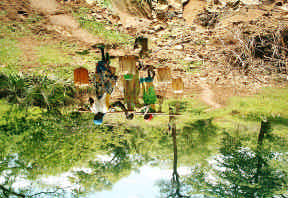
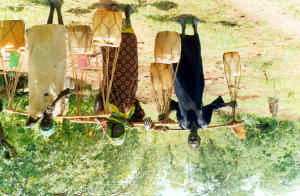
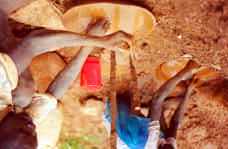
They carry a pair of 4-gallon plastic containers on their shoulder with the aid of a stick for making
balance (photos 3,4). The eight gallons of water cost S.D.50 (US$ 0.2).
- Traders: these are both Dawalla of Gugub and gold dealers/brokers form El Damazin. They buy
gold in cash, and sell the miners their needs of food stuff and goods. Traders also sell mercury for
amalgamation. Sometimes Gugub merchants provide mercury for free in return of the miners sell
their produced gold to them.
Photo 4: women fetching water for
Photo 3: Ingessana women carry water
artisanal gold panning in Gugub
Panning
Panning of alluvium as well as rock grinding in Gugub sites is mainly women's job (photos 5,8).
while men concentrate on the laborious pit excavation, women and children (9-13 years old) handle
the run of pit and assist in other related job. In Khor Gadid site, out of the ~500 participating
artisanal gold miners during August 2003, women+ children make ~50% of the total. The estimated
average amount gold ore extracted from pit per a male miner per day is about 0.5 ton for alluvium,
and 20-30 kilograms of rock (quartz). Artisanal primary gold mining entails visual selection of
mineralized rock pieces (photo 7), crushing, grinding, panning and finally amalgamation. Except
for grinding and panning (photos 5,8), almost all of the above mentioned activities are man's job.
Men usually control the earnings from gold sale proceeds and have the final say in family affairs .
Efficiency of panning using the traditional wooden pan is ~50%. Apparently, all fine gold drains
down with the light fraction tailings.
Photo 5: gold extraction through
panning only, Gugub sites
Women
Out of the ~350 women and children artisanal gold miners at Khor Gidad during August 2003,
about 2% are single women/widows. They handle all the artisanal alluvial gold mining activities on
their own. The majority participates within the family framework. Based on general appearances,
some Dawala women look rich. Although nobody confesses that, at least, women have certain
power of decision-taking within the family. Some women are well-off based on the amount of gold
bracelets and bangles they wear. Ingessana women gold miners on the other hand, do not show
signs of affluence. They practice artisanal gold mining within the family or work as labor for
10
Dawala artisanal gold miners. Their major job is water fetching. from boreholes located ~2 km
away from the mining/panning sites. Besides, Ingessana women are particularly involved with
cultivation of tobacco along some stream terraces during summer.
3.0 Gold Production Methods and Characteristics
Gugub and the surroundings comprise about 6 major artisanal gold mining sites. At present, Khor
Gidad ~7 km (driving distance) north of Gugub and Khor Neiwi ~5 km northeast of Gugub are the
main sites where >800 artisanal gold miners produce gold from both alluvium and elluvium. Minor
primary gold is found in 3 sites. The one near Khor Gidad witnessed spectacular gold discovery of
small gold-rich quartz vein last September 03. GRAS geologist in El Damazin, Ibrahim M. Toum
reported that ~500 miners rushed chaotically into the area from Gugub and elsewhere extracted ~56
kilograms of gold in a week time.
Until today the methods of gold extraction as well as the mining tools have not changed despite
the availability of modern technology. Lack of access to such gold mining technology, lack of
finance, and lack of awareness are among the problems artisanal gold miners in the southern Blue
Nile and elsewhere are facing today.
The extracted gold ore (alluvium/primary) is mainly processed by the tradition pans. The ~5 kg
capacity wooden pan is the major panning tool used. Digging tools include the rudimentary axe,
pick, and shovel. Sledge hummer and chisel are used mainly in hard rock excavation. Grindstone
and steel mortar are widely used in primary gold ore size reduction. (photo 8).
Gold Extraction Cycle
Gold mining and extraction in the Gugub site of the Ingessana Hills is a labor intensive job at all
stages. Once a rich gold occurrence is located, hundreds of artisanal gold miner families start
wildcat pitting the hillside or stream terraces until the Au-rich horizons are reached; usually
between 5 and 20 m deep. At the ore zone level, they excavate horizontal drives and extract gold
ore. When the holes go deep (>5m) they hoist the ore to the surface in plastic containers (20-25 kg
capacity) by pulling robes. Selective mining is widely practiced in the area.
Alluvial-type gold produced in the area goes directly to the market without further purification.
Nowadays a gram of gold produced from alluvium through panning only has a higher price in the
local market (US$9-9.5) as compared with a gram of gold extracted from hard rocks through
amalgamation (US$ 6- 6.5).
Gold trade both in Gugub village and in the mining sites is handled by about 5 local merchants and
a number of traders/middlemen from El Damazin (figure 9). There is some sort of clientele between
the artisanal gold miners and the merchants: miners weigh and sell gold in the shops in return of
getting household consumer goods and mercury at preferential prices. It is likely that the dealers
provide loans to the artisanal gold miners in hard days. Weighing of gold is by locally-made
balances, which are not always well-calibrated. Only one dealer at Khor Gidad has a small digital
balance. Although nobody has complained to us, cheating in gold weighing can not be ruled out.
Final purification and melting of gold is traditionally performed by goldsmiths; the end dealers in
the production cycle. The goldsmiths are also the major mercury suppliers because they have access
to big gold markets in Khartoum and Omdurman. Gugub merchants buy mercury from dealers at
~US$29/kg. It is also known that part of the produced artisanal gold go to the neighboring Ethiopia.
There is a longstanding legal and illegal boarder trade of coffee, livestock, and gold; particularly in
Kurmuk and Qeissan boarder districts.
11
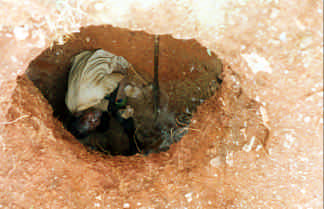
Photo 6: shallow pitting for gold,
Photo 8: Grinding primary gold ore using rudimentary
Ingessana Hills
grindstones in Gugub village and elsewhere.
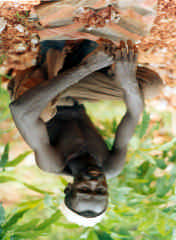
Photo 7: A pioneer Ingessana
primary gold miner, Gugub
Tailings disposal
In Gugub sites and elsewhere within southern Blue Nile region, tailings produced by gold
extraction activities are usually disposed of near the mining/panning extraction site. Conspicuous
tailings heaps are a common picture wherever there are alluvial or primary artisanal gold mining
activities.
Around Gugub, it is estimated that about 400 000-500 000 cubic meters of tailings/waste is now
accumulating at the banks of Khor Gidad, Khor Neiwi, and other smaller spots. Seasonal run-off
washes some of the tailings/waste into stream beds annually leading to siltation of stream and rivers
as far as the Blue Nile along the western banks of Roseries dam.
Late difficulties like water shortage and deepness of ore associated with primary gold mining, led
most of the miners to shift activities to alluvial gold mining along stream terraces and beds. The few
tens who continued mining primary gold have resorted to selective mining (photo 7). In the process,
a miner descends the hole with a 5 pounds sledge hammer and a chisel to break the rock pieces with
visual signs of gold mineralization only. Size reduction and milling is performed by mortars and /or
grinding stones (photo 8). mechanical mills are prohibited since inception of activities in 1997 by
the local authorities. The semi-final quartz+gold powder (200-500 microns) is panned meticulously
by women at homes. The tailings are disposed of in the house yard. Amalgamation and amalgam
burning processes are also performed in the house; sometimes inside the huts.
Mercury handling in artisanal gold extraction
Mercury utilization in the extraction of gold from concentrate is a fairly new practice in artisanal
gold extraction in southern Blue Nile. The first gold amalgamation activities in Sudan were
12
undertaken by British smallscale mining companies in the gold mines of the Red Sea Hills and
Northern Sudan operative intermittently during the period 190450s.
In Gugub artisanal gold mining site, mercury is used frequently in extraction of fine gold practices
from the panned concentrate. The way of handling mercury in gold amalgamation is
unsophisticated. Hg is poured onto the concentrate and mixed with bare fingers to make the
amalgam. After thorough mixing, the amalgam is squeezed in a piece of cloth to expel excess Hg.
After that, the separated amalgam is transferred to an open plate or frying pan then burned.
Based on latest estimates, the amount of mercury used to extract 1 gram of gold amounts to about
3 grams (figure 10). Though not all Hg poured into the goldbearing concentrate goes into
amalgam. About half (~1.5 grams) get squeezed off as an excess Hg and collected into a container
to be used again. Thus the ratio of Au produced:Hg lost is 1:1.5 i.e. for every gram of gold won, 1.5
grams of mercury is emitted into the environment. An ounce of mercury costs an equivalent of
(US$0.8). Accordingly the costs of 1.5 gm Hg lost per 1 gm Au produced is US$0.045. Based on
the annual artisanal gold production estimates in Gugub sites for the period 19972002 (@ 0.45
ton/a), the mercury lost to the environment annually translates to 0.675 ton. That means Hg lost for
the environment in 6 years period is ~4 tons. Given figures need verification during the E&HA
survey.
80
70
71
60
66
N=67
N=67
60
50
Fig. 10: Daily Hg usage
Fig. 9: Suppliers of Hg for
in gold amalgamation-
40
amalgamation of artisanal gold
%
Gugub AGM sites
40
produced in Gugub sites
%
30
28
27
20
20
10
4.5
4.5
2
3.5
3.5
Percent
0
Percent
0
none
Other
1
2
3
Merchants
Village
4
5
/traders
merchants
sources
Hg use- grams/day/miner
The socio-economic sample survey conducted shows that over 60% have no idea about the hazards
of mishandled mercury in the artisanal gold extraction processes. About 38% agree that they heard
about the hazards but haven't seen or felt the negative effects of using mercury in amalgamation of
gold (figure 11).
Almost all of the interviewees have either a bare or no idea about retorts. Back in 2001, during the
diagnostic mission to the Ingessana Hills, Mr.L. Beraudat and the author witnessed an
amalgamation process in one of the households and how mercury was evaporated by heating the
amalgam in an open frying pan. By applying such methods, we indicated to the artisanal gold
miners in Gugub village the negative effects of mercury on health as well as on the environment.
We told them about retorts and how it can both effectively minimize such hazards and save mercury
to be used again in amalgamating gold .
Since the majority of Gugub artisanal gold mining community has no idea about the hazards of
mishandling mercury the way they used to, no precautions have been taken to safely dispose of
amalgamation tailings. The ensuing tailings are carelessly dumped in the yards to be blown off by
the winds and/or washed off into nearby streams during wet seasons. As such, the fate of mercury
lost in the processes of gold extraction is bound to reach the beds of the descending streams and
13
soil. Ultimately, through drainage network of Wadi Maganza, the lost Hg finds its path to the Blue
Nile river bed.
4.0 Environmental and Health Impacts
Visible environmental impacts and mercury hotspots
Artisanal gold mining activities in the Gugub village and the surroundings have created
considerable disturbance of the environment. Haphazard excavations and diggings along the stream
terraces and at hill slopes are the most obvious among the negative environmental impacts created.
An estimated 400,000-500,000 tons of waste and tailings are piled around those sites. In the
process of making the pits, considerable trees/shrubs were cleared. This would lead to excessive
soil erosion and stream siltation. Also the dug gold pits frequently tap water table, and thus expose
underground water resources to contamination.
As indicated above, the process of gold extraction through amalgamation is mainly performed in
the village. Usually gold-bearing concentrate is amalgamated and evaporated either at the miners
homes or in the gold merchant shops (Hg suppliers). At both sites estimated mercury emission is
high because no retorts or any other means of Hg vapor closed-circuit condensation apparatus are
utilized. The ~200 homes of artisanal gold miner families in Gugub and (5-6)local gold merchant
shops constitute broad mercury hotspots. The distribution of Gugub miners' premises are random
without town plan. As such, it is difficult to specify definite mercury hotspots other than verandahs
of dealers shops. Most of the shops are located along the village's main road (~300 m long). In
addition, the shops area also represents the village's geographic center surrounded by the miners
huts. The paths of mercury emitted from artisanal gold amalgamation in Gugub village seem to be
controlled by the surface run-off. The village is located on a high relief and rugged hillside with
steep dendritic drainage system. As a result, high energy soil erosion characterizes the area during
rainy season (600-800 mm). Although the general drainage pattern of the Ingessana Hills is radial,
steep ravines draining Gugub and the Surrounding artisanal gold mining sites coalesce on the
northeast direction to join Wadi Maganza stream, which drains the northeastern parts of the
Ingessana Hills into the Blue Nile some ~45 km to the northeast (see map 2). Wadi Maganza waters
contain the artisanal gold mining waste/tailings washed off from Gugub as well as from the mining
sites. Among these products, mercury is expected to move ahead with Wadi-fill (clay, silt, sand,
gravel) along Wadi Maganza path up to the Roseries dam reservoir at a point ~20 km south of El
Damazin (map 2). Consequently, the mercury reached the bed of the reservoir is likely bound to be
methylated and thus becomes bioavailable.
It is worth noting that mercury released to the Blue Nile waters may also come from other active
artisanal gold mining sites~12 km east of the Blue Nile bank at Belguwa-Sakatna sites ~80 km
southeast of El Damazin. Also mercury input is expected to come from other artisanal gold mining
sites within the river catchment as far as Qeissan ~150 km to the south.
The Roseries dam reservoir is a major fish source. Commercial fishing is an established business
in El Damazin and Roseries districts. The annual catch from the reservoir (~30 000 tons) supplies
the fish markets of the Blue Nile, Gazira, and Khartoum states. Nile pirch (Lates niloticus) and
Tilabia (T.nilotica) are the major species consumed.
Visible health impacts
Health impacts resulting from artisanal gold mining activities on the Gugub community
manifested in clear symptoms of health deterioration. The most obvious health problems the mining
community complains from are:
- Urinary system complications
- Chest and respiratory problems
- Eye problems
14
- Fatigue and strains
- Stomach diseases
- Recurrent malaria
The impact of inhaled mercury vapor on health of the artisanal gold miners is as yet un-assessed.
No clear-cutting Hg poisoning symptoms or cases have been identified in any of the community
members despite the on-going mercury use in gold amalgamation for over 6 years. As mentioned,
only 17% of the artisanal gold miners interviewed have heard about the mercury negative impacts
on human health (figure 12). Being located ~50 km away from the Blue Nile western banks, the
community of Gugub and the surroundings have no access to fresh fish supply. In the survey, only
2% of the sample report eating fish occasionally (figure 6). By tradition, neither Ingessana nor
Dawala of Gugub are fish consumers. Dry fish, however, is available in the market but not the
popular diet.
Fig.11:awareness about health impacts resulting
Fig.12: Types of health problems that may have been
form mercury usage in artisanal gold extraction
caused by misused mercury
60
40
38
50
33
50
N=67
N=67
30
40
38
25
%
% 30
20
20
10
9
10
4
3
Percent
0
Percent
0
Don't know yes
no
undecided
Don't know blood
eyes
internal
5.0 Barriers to the Introduction of Cleaner Techniques
The joint GRASUNIDO initiative for introduction of cleaner artisanal gold mining technologies
in the artisanal/small-scale gold mining in Sudan submitted in 1998 has culminated into the present
country Global Mercury Project. The backing up of the project by the Sudanese authorities up to
now indicates that there is enough political will to make it succeed with minimum risks.
Given the adverse circumstances that affected southern Blue Nile region since the 1980s such as
civil strife and the ensuing poverty necessitate the look for way-out alternatives. One of these
alternatives seen to alleviate rural poverty is to develop the traditional artisanal gold mining and
extraction sub-sector. This initiative is in line with the State's current policy of economic and social
balanced development. Regardless, the implementation of the said policy is bound to face the
hurdles of lack of the both technical know-how and sufficient funds to finance those goals. To this
end, the project implementation is seen step in time to achieve the desired development. The
expected results will also have bearings on the development of the sub-sector in the whole southern
Blue Nile region and beyond.
All the targeted artisanal gold miners in the Ingessana Hills, Government, and the local authorities
look to the project positively. In fact all the officials and the artisanal gold miners in Gugub and
surroundings are looking forward for the project to make a difference. Many individuals expressed
their trust that UNIDO would make the Global Mercury Project succeed. In effect, all concur that
they will cooperate fully with the project implementation (figures 13,14).
15
Fig.13: If new equipment is supplied would
Fig.14: Do you mind to be trained in using the
you accept to continue artisanal gold mining
new gold mining and extraction equipment?
using them?
100
120
81
100
95
80
80
N=67
N=67
60
%
%
60
40
40
20
15
20
Pe
Pe
rce
rc
4
2.5
2.5
en
nt
0
0
t
Don't know
Yes
No
Don't know
Agree
Refuse
NEW EQUIPMENT
Recommendations
-Although local authorities as well as artisanal gold miners have been notified previously about the
environmental and health survey, another notification is strongly needed. That is because some
miners lately showed skepticism about the seriousness of the project in doing something tangible
for them.
-For political reasons, consents of both the commissioner of Bau district and the Ingessana Tribal
chief (Omda) must be obtained before approaching artisanal mining community in Gugub and the
surroundings.
- Members of the semi-governmental Ingessana Development Higher Committee approached us
lately asking about ways of cooperation. The Commissioner of Bau chairs the body.
- Popular committee and school teachers in Gugub are the key persons of the community. E&HA
survey efforts can be coordinated through them.
- The values given for mercury emission during amalgamation and amalgam burning are
approximate. Gugub merchants and dealers can provide valuable information regarding Hg sales
and use.
- The origin of mercury used in processing of gold in Ingessana Hills is said to be Khartoum. El
Damazin goldsmiths may provide more information on Hg market.
- Grid sampling of soils in Gugub circle may delineate exactly mercury hotspots. The same can be
repeated in the abandoned primary gold pits located ~4 km east of Gugub.
-During health survey, beside sampling human fluids/hair, it is recommended that medical checks
of miners be made, provide on-the-spot medical consultancy, and prescribe drugs if need be. This
would aim at building trust between the project and the community for sustainable cooperation.
- Epidemic diseases to contend with around Gugub area are malaria and bacterial infections.
Drinking water composes of salt as well as bacteria (e.g. Entamoeba coli).
- Beside the 67 volunteers of the health survey, almost all the 185 families approached earlier are
willing to participate and donate the requested samples.
- A visit to the banks of the Roseiris reservoir is important for exploring the biota, fish species/
sizes, and get insights on the possible mercury paths from the artisanal gold mining sites
downstream to the Nile bed.
- Two vehicles are needed in the field for conducting the simultaneous E&HA surveys efficiently.