
























Removal of barriers to the
introduction of cleaner artisanal gold
mining and extraction technologies in
the Ingessana Hills,
Blue Nile State, Sudan.
Part A : Environmental assessment
Draft Report
BRGM/RC-53589-FR
March, 2005
Removal of barriers to the
introduction of cleaner artisanal gold
mining and extraction technologies
in the Ingessana Hills,
Blue Nile State, Sudan.
Part A : Environmental assessment
Draft Report
BRGM/RC-53589-FR
March, 2005
Study carried out as part of
UNIDO Contract No. 03/087. Project No. EG/GLO/01/G34.
Activity code: 420C51
G. Récoché, JP. Ghestem, I. M. Suleiman,
R. Maury-Brachet, V. Roques-Duflo and A. Boudou
Checked by:
Approved by:
Name: V. LAPERCHE
Name: Ph. Freyssinet
Date:
Date:
Signature:
Signature:
BRGM's quality management system is certified ISO 9001:2000 by AFAQ
IM 003 ANG - March 05
Keywords: Mercury, Gold, Artisanal Mining, Amalgamation, Environmental Assessment, Soil,
Sediment, Fish, Muscle, Safety levels, Air Monitoring, Cleaner Technology, Ingessana Hil s, Blue
Nile State.
In bibliography, this report should be cited as fol ows:
Récoché G., Ghestem JP., Suleiman I. M., Maury-Brachet R., Roques-Duflo and Boudou A.
(2005) - Removal of barriers to the introduction of cleaner artisanal gold mining and extraction
technologies in the Ingessana Hil s, Blue Nile State, Sudan. Part A: Environmental Assessment
- Final Report. BRGM/RC-53589-FR, 91p., 51 il ustrations, 7 Appendixes, CD with pictures.
© BRGM, 2005. No part of this document may be reproduced without the prior permission of BRGM.
Global Mercury Project: Ingessana Hil s Sudan
Executive summary
Introduction
This survey is part of a larger UNIDO program (EG/GLO/01/G34) funded by the Global
Environment Facility (GEF) and titled "Removal of Barriers to the Introduction of
Cleaner Artisanal Gold Mining and Extraction Technologies". The long-term objective of
the UNIDO / GEF program is to assist a pilot suite of developing countries, located in
several key trans-boundary river/lake basins, in assessing the extent of pol ution from
current artisanal mining activities. It is also to introduce cleaner gold mining and
extraction technology which minimises or eliminates mercury releases, and develop
capacity and regulatory mechanisms that wil enable the sector to minimise negative
environmental impacts.
In response to a request from the Government of Sudan and as part of the overal
UNIDO project, a contract was signed in July 2003 between the United Nations
Industrial Development Organization (UNIDO) and the BRGM, in order to carry out
environmental and health surveys and assessments in selected Gold Mining Areas in
Sudan. The operation was carried out between French teams (BRGM, University of
Montpel ier and University of Bordeaux) and Sudanese teams (Geological Research
Authority of Sudan and University of Nileen). BRGM in cooperation with the Geological
Research Authorities of the Sudan (GRAS) were in charge of the coordination of the
environmental assessment and the University of Montpel ier headed the health
assessment survey. The sampling campaign and health survey took place from March
29th to April 18th, 2004 during the hot dry summer before rainy season and the main
mining season.
The aim of this study was to col ect environmental and health data in the Gugub and
Khor Gidad vil ages of the Bau district in the Ingessana Hil s (Blue Nile State of Sudan)
previously selected by UNIDO (EG/GLO/1/G34 BTOMR of C. Beinhoff and L.
Bernaudat, UNIDO) to undertake the environmental and health survey of the
communities living in the surroundings. The ultimate goal of this project is to formulate
recommendations on the gold mining practice in order to avoid significant local and
regional pol ution. A previous report (Récoché et al., 2004) details the information
col ected in the field and the sampling methodology.
Mining practice and use of mercury
Use of mercury in the area is quite recent and depends on the type of mining activities.
Artisanal Smal Scale Mining (ASM) in the Ingessana Hil s varies somewhat between
vil ages, with some identifying an active participation in the activity and others a decline
depending on season and gold-bearing quartz vein discoveries.
Artisanal gold mining activities in the Ingessana Hil s started in 1996. Intensive use of
mercury in the area is quite recent (around 3 years and may be less) and mainly
BRGM/RC-53589-FR "Draft report"
a
-
i
Global Mercury Project: Ingessana Hil s Sudan
developed in Gugub area where gold was first discovered and in Khor Gidad after a
gold rush in September 2003. During our mission those two sites were the only ones in
activity. At the present time, the vil age of Khor Gidad is a gold-bearing quartz vein
extraction and processing sites and the vil age of Gugub is a processing site only. The
other sites mentioned in the sociological reports carried out in the district by Pr. Khalil
A. Al Medani (2003) (i.e. Turda, Khor Neiwi) are al uvial types, without mercury use and
presently abandoned.
Miners pan al uvial and el uvial gold when the local stream is flowing during rainy
season between July and December. In those sites miners do not use mercury and
recover only visible gold during the rainy season. Results of Hg analyses carried out in
this study confirm this al egation: soils, tailing and sediments sampled around al uvial
panning area are not contaminated by Hg.
During the dry season, due to shortage of water in pit sites, only primary gold
associated with quartz vein are mined. The procedures used by local people are
representative of very poor people using simple and traditional practices. Mercury is
used only to recover gold from this primary ore.
Artisanal gold mining in Gugub is practised by both Dawala and Ingessana tribesmen
without legal titles. Most people mine and process in smal groups which is basical y a
family affair. Most of these activities were performed by women (13-35 years old),
including the hard tasks of digging and excavation. Men are only involved in mining at
deeper depths and in roasting phases. There is no major flowing river close to the
mining and processing areas, only seasonal drainage and in summer smal pools along
main wadis. There is no use of Hg on the mining site. The selected ore is transported
to the vil age for crushing, manual y mil ing and panning in the yard of enclosed family
unit.
Mining of gold-bearing quartz vein was the only type we observed during the field
mission. The extraction of ore is performed mainly by women in a rather muddled way
without mechanical tools. Men are only involved in mining at deeper depths. Miners do
not use explosives. The material is manual y hoisted and sorted out at sight in a
empirical way in order to try to concentrate the most probable gold-bearing material.
Artisanal primary gold mining entails visual selection of mineralized rock pieces. At this
stage, the selected ore is than transported to the vil age. Crushing, manual y mil ing
and panning are done by women in the yard of «family unit» col ecting several hut of
the same family. Panning is conducted manual y in excavated pools using traditional
wooden pans. The tailings are disposed around the huts out of the «family unit».
Efficiency of panning using the traditional wooden pan is ~50 %. Apparently, al fine
gold grains fal s down with the fine fraction of the tailings. Panning test on waste heap
performed during the mission indicated frequent gold specks. After crushing and/or
mil ing, the pan concentrate is shipped off at home or to the gold merchant shops for
amalgamation and roasting. Mercury is used to extract the fine gold particles from the
last panned concentrate. The way of handling mercury in gold amalgamation is
unsophisticated. After a last panning performed in the yard, Hg is poured onto the
concentrate with water and is mixed with bare fingers to make the amalgam. After
thorough mixing, the amalgam is squeezed through a piece of cloth and the excess Hg
b
BRGM/RC-53589-FR "Draft report"
Global Mercury Project: Ingessana Hil s Sudan
is recovered for reuse. The miners col ect the amalgam by hand, without any
precautions. After that, the remaining amalgam is transferred to an open plate or frying
pan for roasting. In the private yard there is no specific place for amalgamation and
roasting. The gold amalgam is roasted in mobile bonfires outside or inside the huts. It is
especial y the men who practise the roasting. Daily, they roast the amalgam freely
without taking any precautions. The roasting operation can occur in the vil age close to
the dealer shop where they buy mercury; in the yard of the «family unit» or in the huts
(usual y the ones dedicated for cooking). The diameter of amalgam burned during the
demonstration carried out during our visit range from 3 to 8 mm. We expect that the
duration of the burns (~ 10 minutes) is too short and temperatures produced by the
bonfire are too low to burn al the mercury. Roasting tends to be incomplete and at
least 15 - 25 % of the "doré" sel ed to the dealers contains residual mercury.
Gold production estimates based on two independent sources (workers production and
dealers) gave similar results: the quantity of gold produced from quartz vein in the 2
studied vil ages is 75-300 g Au/day and 22.5-90 kg Au/year. Workers and dealer
probably underestimated their own production and that actual values may be higher.
We demonstrate that to produce such quantities (100-300 g Au/day) from the Gugub
sites workers involved must be 800 to 1000 and gold grade 30 to 72 g/t respectively.
According to the data available and observations made (average gold grades
measured by GRAS of less than 5 g/t and 300 families living on the sites) works in
Gugub can not produce the quantity of gold mentionned before from the quartz vein
mining alone. A large part of the gold sel during the dry season (probably 50 %)
probably comes from al uvial production and also from gold reserves made by workers
during rainy season. According to our field observations and the estimations
performed, the use of mercury in the Gugub district is between 250 and 500 g Hg per
household of artisanal miners. Taking into account these information, the Hg lost/Au
produced ratio is probably higher than 3 in the Gugub area.
Analysis of the system and sampling strategy
The sampling strategy was orientated fol owing a risk assessment approach,
considering the various sources of mercury, its transfer and pathways and the potential
targets.
The artisanal gold miner families (~300) and the (10-15) local gold merchant shops in
Gugub and in Khor Gidad constitute the same broad mercury hotspots. Potential risks
to the ecosystem were considered to be minor in that process. The main targets
identified are local people practising gold concentration processes at home. The shops
and surroundings represent also a particular hotspot. We identified 4 sources of loss of
mercury in the environment:
- Wrong manipulation of mercury at the shop or at home;
- Loss of Hg on the ground or in the tailings during the amalgamation phase;
- Evaporation during roasting phase
- Occasional panning of tailing in the pools
BRGM/RC-53589-FR "Draft report"
c
Global Mercury Project: Ingessana Hil s Sudan
Items Considered
Level of occurence
SOURCES
· Shops Hg storage
· Accidental Hg spil during
amalgamation (huts & shops)
· Amalgam roasting in the hut
· Wastes dispersed
· Contamination of sediments during
panning on residues in Gugub
TRANSFER &
· Household dust contamination
PATHWAYS
· Hg vapor dissemination
contaminating the house and its
environment
· Soil contamination in the vicinity of
contaminated huts
· Sediment transportation
· Transfer to the biological chain
(fishes)
HUMANS
· Hg inhalation during roasting
TARGETS
· Household dust and soil ingestion
(mostly children in huts or yards)
· Contaminated dry Corn and
sorghum consumption
· Fish consumption (rare)
· Contaminated poultry consumption
not considered in that study
In the Gugub and Khor Gidad vil ages, sampling was focussed on medias potential y
submitted to ingestion by local people, (mostly children and poultry): household dust:
as amalgam roasting occurs sometimes in the hut, soils around the huts of artisanal
gold miners, in the yard of "family unit" which col ect several huts and in the main
square of the vil age; tailing and residues of process withdraw around "enclosures
dwel ing" and in garden where vegetables are being grown. Hg contents in atmosphere
(air monitoring) was also performed outdoor and indoor (huts) under different
conditions.
Based on information from the sociological survey, reference houses were identified in
each vil age: school and mosque yard in Gugub and recent "enclosures dwel ing" out of
d
BRGM/RC-53589-FR "Draft report"
Global Mercury Project: Ingessana Hil s Sudan
mining area in Khor Gidad. The selection criteria was based on the lack of artisanal
mining activity for the concerned household
The objective of the sediment sampling was oriented to control Hg mobility in the
drainage pattern around the two vil ages Gugub and Khor Gidad and in the main
col ector Wadi Maganza. The strategy was adapted to the field conditions; sediments
were taken along narrow streams where possible; we col ected both sands (stream)
and silty black sediments (banks). We had particularly unfavorable sampling condition
in the Gugub and Khor Gidad sites; the Wad Maganza and its tributaries had dried up
completely making it impossible to catch any fish in this area. The sociological study
also indicated that fish are consumed only occasional y and mainly dried. Fishing is an
occasional occupation mainly practised by the younger generation. According to the
local people and the Sudanese participants, the Roseires reservoir was the only site
where we could find fish of different species and size, as requested by the protocol.
Due to the lack of fish elsewhere in the selected area, fish sampling was mainly carried
out in the Roseires reservoir about 50 km to the east of Gugub (to test contamination of
the Nile at this location, but not to interpret Hg mobilisation from the Gugub area) and
in a wadi between Gugub and Khor Gidad sites which contained a smal water hole but
was not directly connected with the gold washing zone and the vil age of Gugub.
Solid samples were analysed by the LUMEX RA915 at BRGM in France. Air monitoring
was also performed on site using the LUMEX. Fish samples were analysed by CV-AAS
and the University of Bordeaux (LEESA) and vegetables by atomic fluorescence
(BRGM laboratory).
Contamination due to amalgamation practices
According to the analysis of the process, the most probable contamination of soil is
supposed to be related to solid deposition of mercury during the amalgamation process
or to atmospheric deposition of mercury during the roasting and of the dissemination of
household dust in the vicinity of artisanal miner huts.
The soils in the yards are contaminated by Hg. The average geochemical Hg content in
the vil age of Gugub and Khor Gidad are around ten times higher (medians ranging
from 640 to 1,213 ng g-1) than the local background (100 to 150 ng g-1). The
contamination is punctual with probable nugget effects. Higher value in the 2 vil ages
(up to 106 ng g-1 in KHOR Gidad and up to 27,626 ng g-1 in Gugub) are related to zone
of amalgamation where Hg droplet were sometimes visible after panning. The indicated
zones of last panning and amalgamation showing values several times higher than
others places where values are close to local background are principal hotspots.
School yard in Gugub show background Hg contents (106 ng g-1).
Contamination due to roasting of amalgams
It was rather difficult to identify what was the main place of roasting. In Khor Gidad,
roasting outdoor seems to be the main way of roasting. It is seem that the proportion is
BRGM/RC-53589-FR "Draft report"
e
Global Mercury Project: Ingessana Hil s Sudan
approximately 50 % outdoor and 50 % indoor in Gugub vil age. It is especial y the men
who practise the roasting.
Average contents show also significant contamination of domestic dust in some huts
and yards of artisanal miners (500 - 2,760 ng g-1 in Gugub and 123 - 840,000 ng g-1 in
KHOR Gidad). It is clearly demonstrated that indoor amalgam roasting may
significantly contaminate the dust of the huts but there are no big differences between
the Hg contents in soils compared to Hg contents in dusts on al vil age and no
significant difference according to the dust location (hut with or without roasting). It was
impossible, at this stage of investigation, to appreciate the ratio between contamination
of soil by amalgamation process and by roasting. The information supplied by the
inhabitants can be indistinct but these results show at least that the contamination is
rather general and homogeneous at the scale of household and of the vil age.
The monitoring of air quality carried out inside and outside huts showed that Hg
concentrations may reach relatively elevated concentrations (around or above 25,000
ng m-3). However, in the worse case, the exposure of the artisanal miners (around 10 to
15 mn per day) was relatively short compared to the exposure limits for professional
workers (25,000 ng m-3 for 8 h exposure). However as roasting is sometimes
performed in huts, we should also consider the possible exposure of children.
The roasting of amalgams generates usual y two peaks of Hg above 24,000 ng m-3.
The first peak appears when Hg is evaporating from the amalgam, the second one,
occurring few minutes later, is probably due to a late recondensation of mercury
aerosols emitted during roasting. This condensation phase indicates that a large part of
mercury emitted in the hut remains inside and therefore could accumulate in dusts on
the floor, on wal s, on vegetables hanging at the top of the hut. The second point is that
this condensation phase could concern the entire hut unlike the period of roasting (local
evaporation near the fire). Al the people present in the hut at this moment could
therefore breathe this mercury vapor. The condensation effect is lower in huts al owing
rather good evacuation of smoke due to openings at the junction of wal s and roof.
During roasting outdoor the duration of the period of elevated mercury concentration is
shorter than in a hut (around 100 s compared to 500 s in a hut) and the second peak of
probable condensation of mercury vapor is absent.
Remobilization of Hg in the stream sediment
The remobilisation of Hg from processing zone to local streams seems very low. The
Hg contents of wadi and khor flowing from the vil ages of Gugub and KHOR Gidad are
similar (median under 200 ng g-1) with higher contents near the zones of amalgamation
(vil ages) and than a rapid decrease of Hg contents some hundreds meters
downstream the vil ages of miners. The Hg concentrations in sediments of the main
col ector wadi Maganza are also relatively low (ranging from 42 to 148 ng g-1 on a dry
weight basis) and do not show important levels of contamination with regard to the
usual guideline values for sediment management in Europe or in the North America. It
is not possible to compare the results obtained on dry samples from the vil ages of
Gugub and Khor Gidad with samples taken somewhere else in flowing rivers. The
conditions of sampling (focussed on dry samples with organic matter) explain certainly
partial y the high values encountered. The Hg contamination of sediments exist in this
f
BRGM/RC-53589-FR "Draft report"
Global Mercury Project: Ingessana Hil s Sudan
vil ages where amalgamation and roasting took places but it seems restricted to a
narrow zone of few hundreds of meters around, and, at the present time, without
apparent contamination downstream through the Wadi Maganza.
Contamination of tailings and impact on stream
The phases of grinding, amalgamation and roasting generate heaps of mixed tailings,
residues, ash or waste, sometimes several cubic meters in size, often thrown on the
ground near the zones of operation, in or around enclosures dwel ing or even gardens.
Hg analyses carried out on this tailings show a heterogeneous contamination
depending on their composition which can be sometimes important (62,300 and 72,500
ng g-1 in KHOR Gidad). Their number and location in gardens or within the "enclosed
family unit" is a problem to be taken into account in the future operations of
environmental management of the area.
Workers indicated that during rainy season part of this tailings and residues are
sometime panned in pools located in the Khor Alyas, at south of Gugub. The highest
Hg contents in sediment (ranging from 1,066 to 1,649 ng g-1) are located along this
Khor Alyas where aquatic life is unknown but where a water wel supplying vil age with
drinking water is known downstream. Control analyses of the water wel should be
carried out in priority.
Consumption of fishes and vegetables
The other risk of exposure, on a minor level, is related to the consumption of fishes and
vegetables (sorghum and corn).
There is a poor representativity of mercury contamination levels in fish species in
relation to artisanal gold mining owing to the poor sampling conditions. The levels of
contamination in fish muscle samples (15 species - 108 individuals) is very low and
there is no fish above the WHO safety limit of 2.5 µgHg/g, on the dry weight basis the
general mean Hg concentration was 0.246 ± 0.048 µg/g and 0.49 ± 0.10 µg/g for the
carnivorous species. Compared with Zimbabwe, for fish of a similar size, the mean Hg
concentrations were about ten times lower. Analysis of the results relating to the level
of mercury contamination in the fish must necessarily bear in mind the constraints
imposed by the sampling conditions and lack of any direct relationship with the gold
mining site and the vil age of Gugub. The occasional consumption of fishes in that area
, (only 2 % of the people report eating fish occasional y) do not seem to constitute a
major risk of exposure. The data from rivers directly affected by gold mining sites using
amalgamation procedures must be considered insufficient to produce conclusions
relating to fish advisory, or health related matters for this area of Sudan
Sorghum and corn are the main consumed vegetable, at least during the dry season.
The average contents in soil of garden (cultivation of sorghum and corn) around the
«family unit» ranging from 130 to 280 ng g-1 in Khor Gidad and Gugub respectively are
close to the background level and below UK and Canadian standard of permissible
concentration of Hg in agricultural soil ranging from 1,000 to 8,000 ng g-1. This
indicates low mercury remobilization probably due to Fe-rich laterite acting as natural
BRGM/RC-53589-FR "Draft report"
g
Global Mercury Project: Ingessana Hil s Sudan
barriers and attenuating the dispersion of Hg. The Hg content of the analysed sorghum
and corn is very low and do not present any specific risk, but significant quantities of
mercury are present in the dust deposited on the vegetables hanging on the roofs of
huts were roasting is performed. This mercury is eliminated with a simple cleaning with
water. These results on sorghum and corn should be control ed in a further step as
apparently they may contribute to the evaluation of the daily intake of mercury for the
local population.
Recommendations
This study was conducted on a short period and do not al ow precise conclusions in
term of impact assessment, particularly some aspects would require further control.
- In the wadis and khor, the sampling of fishes and sediments should be extended
during rainy season and al along wadi Maganza to evaluate the real level of
contamination in the river system. The first results indicate that the risk of high
contamination of fishes is low.
- The environmental assessment concerned only the environment of artisanal miners.
Contamination of gold shops and surroundings was proved in the 2 vil ages studied.
We also expect that roasting tends to be incomplete and at least 15 - 25 % of the
"doré" contains residual mercury. To complete this assessment particular attention
should be pay on the more exposed population that constitute dealers, merchants
and their families.
- Results on sorghum and corn should be control ed in a further step as apparently
they may contribute to the evaluation of the daily intake of mercury by the local
population. The washing of hands and vegetables should be a priority even if
sometimes water is restricted in use.
As the practice of local artisanal miners is quite recent, very traditional and with a
limited use of mercury, there is no strong need to propose an important program to
develop alternative technologies, on a short term basis. However we strongly
recommend that some habits in the artisanal mining practices to be changed. Change
in local mining practices would require a raising awareness campaign with education of
population and special y women, mainly involved, on the risks they face themselves
and theirs children. The action should focus on the amalgamation and the roasting
procedure in order to promote a safer procedure.
- The main objective being a change of the location to roast the amalgams. Outside
roasting must be strongly recommended and exposure to mercury vapours could be
avoidable with the application of simple technological improvements such as retorts.
Roasting the amalgam does not seem to be a private and confidential activity. It is
frequently carried out in the street or at the shops. This fact can help to work in
col aboration with the local artisanal miners to found appropriate spots, distant from
the vil age and dedicated to the roasting. This place should be designed to avoid
dispersion of Hg in the environment. Presence of children and pregnant women
should be avoided during roasting.
- Authorities needs to insure that al amalgamation is carried out in cemented places
and that al tailing from the amalgamation are stored in appropriate cemented
h BRGM/RC-53589-FR "Draft report"
Global Mercury Project: Ingessana Hil s Sudan
storage area that prevent dispersal of Hg contamination onto adjacent land and into
water drainage.
- Careful clean up of contaminated huts should be recommended in order to
decrease the hg content of domestic dust.
- Amalgamation zone located in the "enclosed family unit" must be marked and
fenced in order to prevent children or animal ingestion.
As use of mercury is recent, the most urgent requirement is to prevent any new Hg
input to the river sediment by stopping or at least strictly control ing panning of
contaminated tailings in the pools during rainy season.
BRGM/RC-53589-FR "Draft report"
i
Global Mercury Project: Ingessana Hil s Sudan
Acknowledgements
The completion of the field programme in Sudan would not have been possible without
the assistance of a large number of individuals and authors greatly appreciated the
contribution and the motivation of the Sudanese team from Khartoum and Ad Damazin
who al owed to the success of the field work.
This work was greatly facilitated by the support and contribution of the Geological
Research Authorities of the Sudan. BRGM is also grateful to the Ministry of Agriculture
and the Ministry of Health that were very helpful in the organisation of the samples
transfer.
In Khartoum, Mr. Jebamalai VINANCHIARACHI, the UNIDO Representative for the
Sudan and Dr Abdelrazig Obeid Mohamed Ahmed, General Director of the Geological
Research Authority of the Sudan (GRAS) and Country Focal Point (CFP) secured
technical and administrative support. Their assistance and that of the UNIDO
Coordinating Unit Staff in Vienna, Dr. Christian Beinhoff and Dr. Marcel o Veiga, are
grateful y acknowledged.
Authors are indebted to the help of Ariab Mining Company management who helped us
during the preparation of the field camp in Khartoum.
The GRAS delegated Mohamed Ibrahim Suleiman (Head of the chemistry laboratory,
ACFP), Adel Osman El Rashid and Said Abdal ah Salih (geologists), Shams El Din El
Dao and Mohamed El Hassan (Drivers) to participate in al field work. Authors are
grateful for their efficient support to col ect data, their local knowledge and their advice
concerning local practices.
Dr. Khalil. A. El medani, Head of Department of Sociology at the El-Nileen University
(Khartoum) joined the team at the middle of field work. The authors are very grateful for
his support on knowledge on local communities notably acquired during its sociological
study in the area.
Special thanks to Ibrahim Mohamed Toum, GRAS representative in Ad Damazin, who
greatly facilitated the contact with local authorities and assisted us during the
preparation of the field mission.
BRGM is grateful to the commissioner of Bau district and the Ingessana Tribal chief
(Omda) for their consents before approaching artisanal mining community in Gugub
and the surroundings.
In Gugub, people committee representative and Pr. Zu Lkifle Yahia, school teacher,
were the key persons of the community. Environmental & Health Assessment survey
efforts would not have been possible without their consents and daily assistance.
BRGM/RC-53589-FR "Draft report"
3
Global Mercury Project: Ingessana Hil s Sudan
Special thanks to Suleiman Yaya Mohamed and Mohamed Djakalo, the two local
workers from Gugub, hired on the site to help in the sediment and soil sampling.
Authors are grateful to Dr Christian LEVEQUE (CNRS, Meudon, France) who
determined the species names and the food regimes of the fish col ected during the
mission to Sudan and to Ph. Freyssinet and V. Laperche (BRGM) who agreed to
review and comment this draft report.
4
BRGM/RC-53589-FR "Draft report"
Global Mercury Project: Ingessana Hil s Sudan
Contents
1. Introduction.................................................................................................13
2. Aims and objectives...................................................................................14
3. Organization and planning ........................................................................15
3.1. PROJECT TEAM OF THE ENVIRONMENTAL SURVEY ................................ 15
3.1.1.Members of the project team .................................................................. 15
3.1.2.Local assistance..................................................................................... 15
3.2. PLANNING ...................................................................................................... 16
4. Description of field conditions ..................................................................17
4.1. GENERAL CONTEXT ..................................................................................... 17
4.1.1.Location.................................................................................................. 17
4.1.2.Topography and climate ......................................................................... 17
4.1.3.Geological information............................................................................ 20
4.1.4.Sociological aspects............................................................................... 21
4.1.5.Sites selected......................................................................................... 22
4.2. LOCAL MINING PRACTICES AND USE OF MERCURY ................................ 23
4.2.1.Types and location of mining activities.................................................... 23
4.2.2.Mining practices ..................................................................................... 24
4.2.3.Gold production and use of mercury....................................................... 31
5. Methodology ...............................................................................................35
6
BRGM/RC-53589-FR "Draft report"
Global Mercury Project: Ingessana Hil s Sudan
5.1. SAMPLING STRATEGY.................................................................................. 35
5.2. SAMPLING PROCEDURES............................................................................ 44
5.3. ANALYSIS OF SAMPLES ............................................................................... 45
5.3.1.Analysis of solid samples ....................................................................... 45
5.3.2.Air monitoring......................................................................................... 46
5.3.3.Analysis of fishes ................................................................................... 47
5.3.4.Analysis of vegetables............................................................................ 48
6. Results and interpretations .......................................................................49
6.1. SOILS ............................................................................................................. 49
6.2. DUST SAMPLES............................................................................................. 53
6.3. OTHER SOLID SAMPLES .............................................................................. 57
6.3.1.Tailings and residues ............................................................................. 57
6.3.2.Termites mounts .................................................................................... 58
6.4. AIR MONITORING .......................................................................................... 59
6.4.1.Methodology........................................................................................... 59
6.4.2.Description of results.............................................................................. 60
6.5. SEDIMENTS ................................................................................................... 63
6.5.1.Sampling strategy .................................................................................. 63
6.5.2.Description of results.............................................................................. 64
6.6. VEGETABLES ................................................................................................ 68
6.7. FISHES ........................................................................................................... 70
6.7.1.Global biometric characteristics and fish mercury contamination levels.. 70
BRGM/RC-53589-FR "Draft report"
7
Global Mercury Project: Ingessana Hil s Sudan
6.7.2.Mercury contamination levels according to the fish trophic level and to the
sampling sites......................................................................................... 72
6.7.3.Conclusions............................................................................................ 76
7. Evaluation of exposure to Hg ....................................................................77
7.1. VILLAGES....................................................................................................... 77
7.2. WADIS AND KHORS ...................................................................................... 80
8. Conclusions & recommendations.............................................................83
8.1. MAIN OUTCOMES OF THE ENVIRONMENTAL SURVEY ............................. 83
8.2. RECOMMANDATIONS ................................................................................... 87
9. References ..................................................................................................89
8
BRGM/RC-53589-FR "Draft report"
Global Mercury Project: Ingessana Hil s Sudan
List of il ustrations
Il ustration 1 - Members of the project team involved on the field mission .......................................15
Il ustration 2 - Location of the Ingessana Hil s area. .........................................................................18
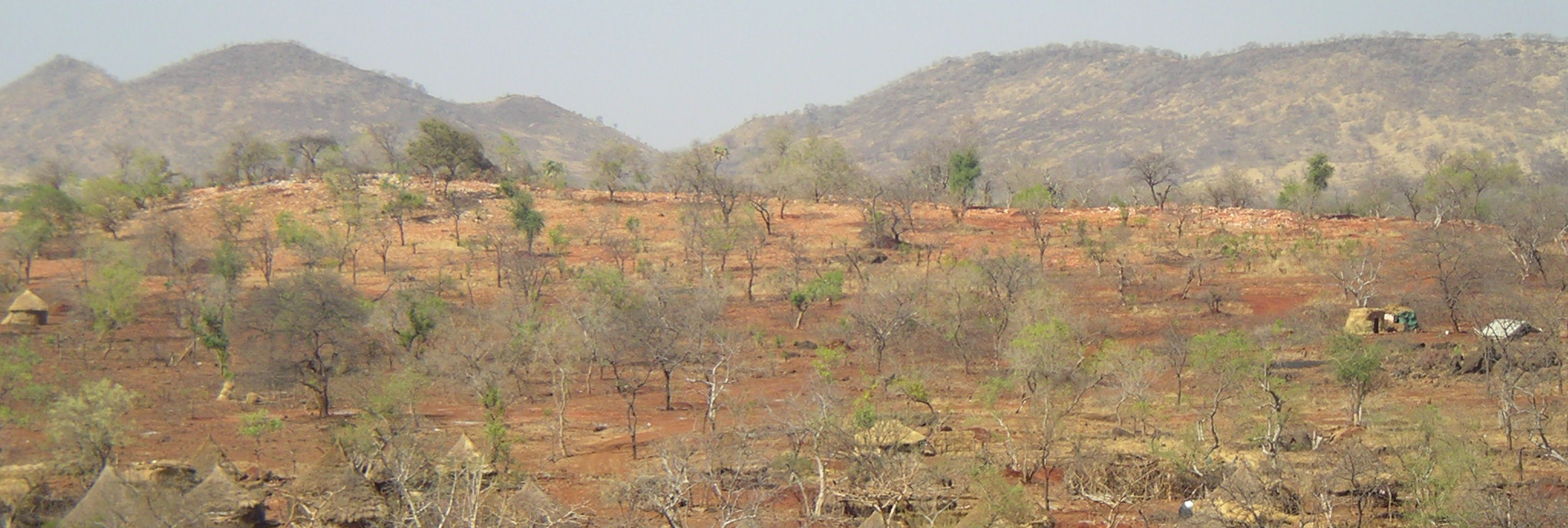
Il ustration 3 - View from the NW of the central part of Gugub vil age ..............................................19
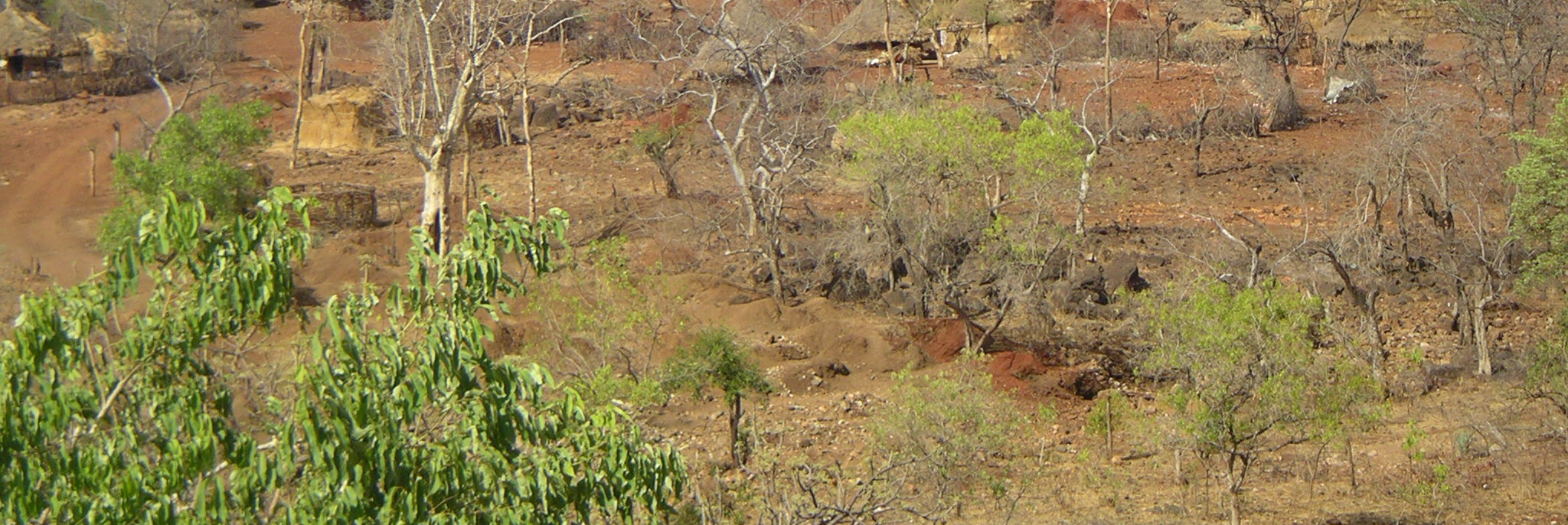
Il ustration 4 - View from the SW of the central part of Khor Gidad mining area ..............................20
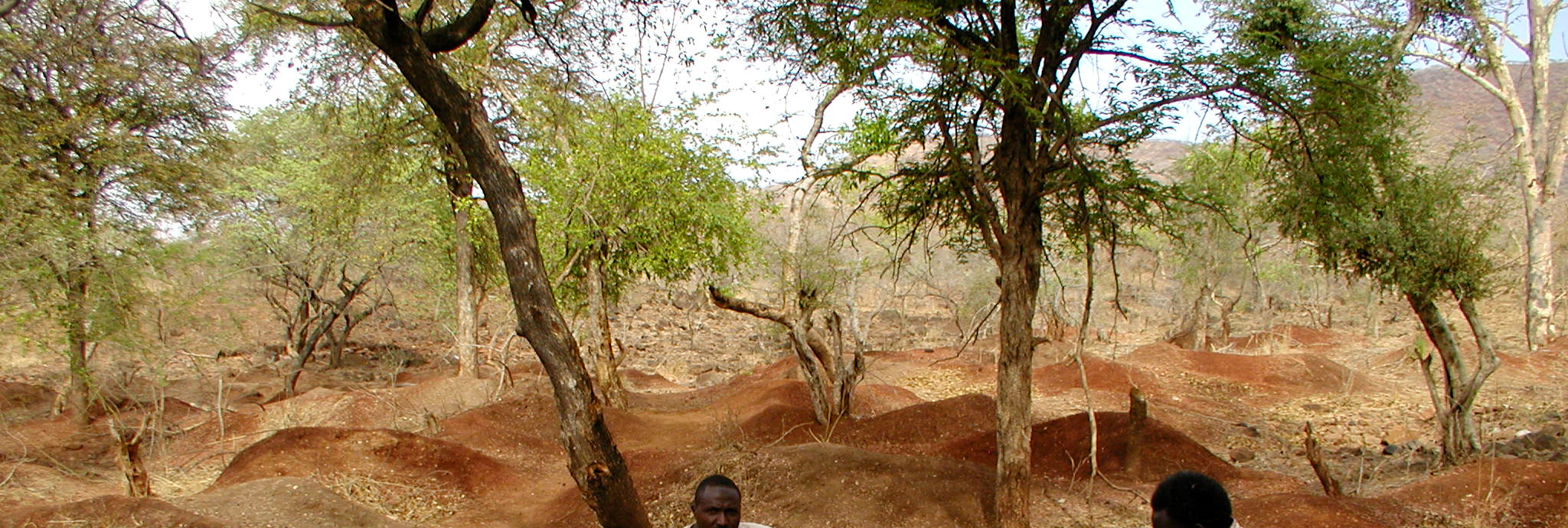
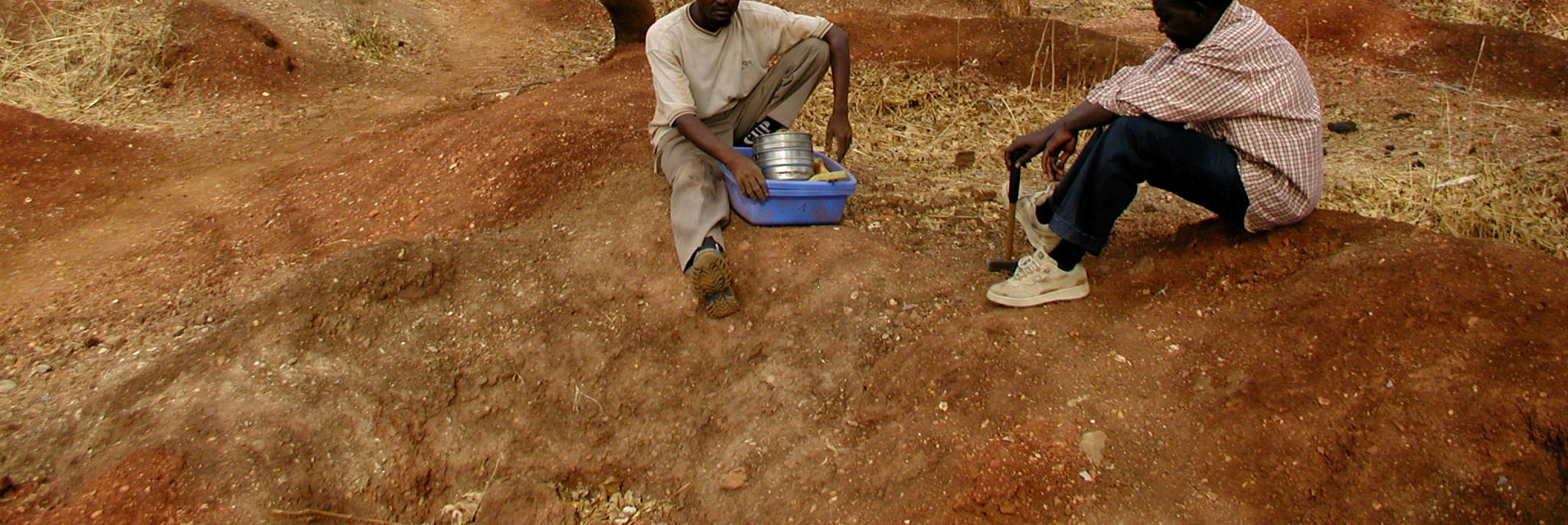
Il ustration 5 - (a) Al uvial Panning area on Khor Shareban (Gugub) and (b) col uvions
working area (Gidad).........................................................................................................................21
Il ustration 6 - Women mining activities at Khor Gidad quartz veins area ........................................26
Il ustration 7 - Grinding with steel mortar (a) and grindstone (b).......................................................26
Il ustration 8 - Panning area in Khor Gidad producing an important quantity of tailings
around the huts and the "family units"...............................................................................................27
Il ustration 9 - Gold recovery process phases (a) panning (b) amalgamation by hand (c)
squeezing with piece of cloth (d) roasting on frying pan...................................................................28
Il ustration 10 - Amalgamation performed without precautions in the «family unit»..........................29
Il ustration 11 - Exemple of amalgam before roasting (left) and "doré" (right) after
roasting..............................................................................................................................................30
Il ustration 12 - Water supply from wel s assumed by women and children .....................................31
Il ustration 13 - Gold "reserve" shown by a dealer ............................................................................33
Il ustration 14 - Estimates of number of workers and Au-grades necessary to produce
100 to 300 g of gold in a day from gold-bearing quartz vein in Gugub area.....................................33
Il ustration 15 - Main components of the risk analysis ......................................................................36
Il ustration 16 - Distribution of samples (soil, dust, termite hil , tailing) by spots and type
of location in the 3 vil ages................................................................................................................37
Il ustration 17 - Sketch map of the sampling strategy applied in the vil ages. ..................................38
Il ustration 18 - Sketch map of Khor Gidad area with location of samples and results of
Hg analyses (Nota : "hant" = "termite hil ")........................................................................................40
Il ustration 19 - Sketch map of Gugub area with location of samples and results of Hg
analyses (Nota : "hant" = "termite hil ")..............................................................................................41
Il ustration 20 - Location of the three fish sampling spots on the Roseires reservoir. ......................43
Il ustration 21 - Location of the fish sampling spot N° 4 in a hole in a smal dried river, in
the North of Gugub............................................................................................................................43
Il ustration 22 Summary of the fish col ected in the reservoir and the river. ..................................44
Il ustration 23 - Distribution of samples by media. ............................................................................45
Il ustration 24 - The LUMEX RA-915+ analyzer equipped with the RP 91C attachment...................46
BRGM/RC-53589-FR "Draft report"
9
Global Mercury Project: Ingessana Hil s Sudan
Il ustration 25 - Comparison of measured and certified values of total mercury
concentrations using three standard biological reference materials ................................................ 48
Il ustration 26 - Soil sampling phases (a) digging along line or point (b) sieving (c)
division (d) col ection in bottles......................................................................................................... 50
Il ustration 27 - Average Hg content in soil (in ng g-1) (N: number of samples; Min.:
minimum value; Max.: maximum value; Med.: median; SD: Standard Deviation) ........................... 51
Il ustration 28 - Average Hg content (in ng g-1) in soils in Gugub, Khor Gidad and Taga
vil ages .............................................................................................................................................. 52
Il ustration 29 - Dust sampling in a hut. ............................................................................................ 54
Il ustration 30 - Average Hg content in dust per location type (in ng g-1)......................................... 54
Il ustration 31 - Average Hg contents (in ng g-1) in domestic dust per vil age in (HUT)
Hut; (HRO) Hut with roasting; (YRO) Yard with roasting; (MOS) Mosque; (SCH) School;
(SHO) Shop; (REF) Reference spot; (DHU) Hut of Dealer. ............................................................. 56
Il ustration 32 - Sampling of tailings (left) and termite hil s (right) around mining areas
and vil ages....................................................................................................................................... 57
Il ustration 33 - Hg contents in tailings in the vil ages of Gugub and Khor Gidad (in ng g-
1) ....................................................................................................................................................... 58
Il ustration 34 - Monitoring during roasting (a) inside a hut in Gubub and (b) outside at
Khor Gidad........................................................................................................................................ 59
Il ustration 35 - Air monitoring in a typical hut in Gugub (type A) before, during and after
the roasting of an amalgam. ............................................................................................................. 60
Il ustration 36 - Air monitoring in a typical hut in Gugub (type B) before, during and after
the roasting of an amalgam .............................................................................................................. 62
Il ustration 37 - Air monitoring in an open place during squeezing, and during the
roasting of an amalgam. ................................................................................................................... 63
Il ustration 38 - Main informations on sediment sampling. ............................................................... 64
Il ustration 39 - Summary of the Concentrations observed in Gugub, Khor Gidad, W.
Maganza and Roseires dam sediments (in ng g-1, dry weight). ....................................................... 65
Il ustration 40 - Distribution of mercury concentrations in Gugub, Khor Gidad, Wadi
Maganza and Roseires dam sediments. .......................................................................................... 65
Il ustration 41 - Location of Hg analyses results for sediment samples in Gugub and
Khor Gidad area. .............................................................................................................................. 66
Il ustration 42 - Location of stream sediment samples along wadi Maganza and at
Roseires Dam. .................................................................................................................................. 67
Il ustration 43 - Analysis of the sorgo and maize samples. .............................................................. 69
Il ustration 44 - Example of sorghum and corn fixed on the roof of a hut......................................... 70
Il ustration 45 - Fish species common between the four sampling spots. ........................................ 71
Il ustration 46 - Mean biometric data for the fish species col ected in the four sampling ................. 72
Il ustration 47 - Mercury concentrations in the muscle of the seven fish species
col ected from the sampling spot 1, on the Roseires reservoir relationships between
fish body weight and mercury concentration in the skeletal muscle. ............................................... 74
10
BRGM/RC-53589-FR "Draft report"
Global Mercury Project: Ingessana Hil s Sudan
Il ustration 48 - Mercury concentrations in the muscle of the seven fish species
col ected from the sampling spot 3, on the Roseires reservoir relationships between
fish body weight and mercury concentration in the skeletal muscle.................................................75
Il ustration 49 - Relationships between fish body weight and standard length and
between fish body weight and mercury concentration muscle of the herbivorous species
Oreochromis niloticus (15 individuals) col ected from the sampling spot 4. .....................................76
Il ustration 50 - Probability of occurrence to Hg exposure (1 not considered in that
study).................................................................................................................................................78
Il ustration 51 - Synthesis of the results and published guideline values. (PEL : Probable
Effect Level; LEL : Low Effect Level; SEL : Strong Effect Level; MRL : Minimum Risk
Level; NOAEL : No Effect Level; PNEC : Probable Non Effect Concentration)................................81
List of appendices
Appendix 1 List of the dust samples ................................................................................................93
Appendix 2 List of the soil samples..................................................................................................97
Appendix 3 List of the termite, tailing and vegetable samples.......................................................105
Appendix 4 List of the sediment samples ......................................................................................109
Appendix 5 Description of the fish samples ...................................................................................115
Appendix 6 Results of Hg analysis ................................................................................................123
Appendix 7 Quality control of Hg analysis in solid samples...........................................................131
BRGM/RC-53589-FR "Draft report"
11
Global Mercury Project: Ingessana Hil s Sudan
1. Introduction
This survey is part of a larger UNIDO program (EG/GLO/01/G34) funded by the Global
Environment Facility (GEF) and titled "Removal of Barriers to the Introduction of
Cleaner Artisanal Gold Mining and Extraction Technologies". The long-term objective of
the UNIDO / GEF program is to assist a pilot suite of developing countries, located in
several key trans-boundary river/lake basins, in assessing the extent of pol ution from
current artisanal mining activities. It is also to introduce cleaner gold mining and
extraction technology which minimises or eliminates mercury releases, and develop
capacity and regulatory mechanisms that wil enable the sector to minimise negative
environmental impacts.
In response to a request from the Government of Sudan and as part of the overal
UNIDO project, a contract was signed in July 2003 between the United Nations
Industrial Development Organization (UNIDO) and the BRGM, in order to carry out
environmental and health surveys and assessments in selected Gold Mining Areas in
Sudan.
The vil age of Gugub located in the Ingessana Hil s (Blue Nile State) was selected by
UNIDO (EG/GLO/1/G34 BTOMR of C. Beinhoff and L. Bernaudat, UNIDO) to
undertake the environmental and health survey of the communities living in the
surroundings. Since 1997 gold was discovered in the central part of Ingessana Hil s
and the recent discovery of gold around Gugub vil age has attracted massive
population especial y those displaced by civil war in the southern parts of the region.
Now the Ingessana district is characterised by the presence of about 800 multi-ethnic
individuals practising al uvial and primary types' artisanal gold mining and working with
mercury under very poor conditions to recover gold. At the moment, the area is
characterised by the presence of two main vil ages, Gugub and Khor Gidad, of
artisanal gold miners processing al uvial and primary quartz vein type's ores. The
ultimate goal of this project is to formulate recommendations on the gold mining
practice in order to avoid significant local and regional pol ution.
In accordance with UNIDO and GRAS representatives, the BRGM planned to survey in
March, 2004 before the rainy season. The sampling campaign and health survey took
place from March 29th to April 18th, 2004.
A previous report (Récoché et al., 2004) details the information col ected in the field
and the sampling methodology.
This final report summarises the methodological aspects as a wel as the field
information and presents the analytical results of the environmental survey. The report
concludes with an evaluation of Hg contamination in various media.
BRGM/RC-53589-FR "Draft report"
13
Global Mercury Project: Ingessana Hil s Sudan
2. Aims and objectives
The aim of this study was to col ect environmental and health data in the Gugub and
Khor Gidad vil ages of the Bau district to assess the level of mercury exposure in the
local communities and potential impact in the environment. This district is located in the
Ingessana Hil s, in the Blue Nile State of Sudan where the practice of artisanal gold
mining has been identified. Another smal vil age, Taga was added as a reference
vil age (i.e. a vil age without a mining history).
The data wil also be used to identify appropriate technologies or good practices to
reduce the risk of mercury exposure to the humans and mercury contamination in the
environment.
Specific study objectives of the environmental assessment are outlined below:
· To identify and evaluate the possible means of exposure of vil agers to mercury
released by smal -scale artisanal gold mining fol owing a risk assessment
methodology.
· To sample various environmental media. Different media were sampled according
to the protocols recommended by UNIDO (Veiga and Baker, 2003).
· To characterise the source of the pol ution and its potential dissemination in the
environment.
The environmental assessment was closely coordinated with the health survey in order
to support the interpretation of the health data and to evaluate the level of exposure of
local population to mercury.
14
BRGM/RC-53589-FR "Draft report"
Global Mercury Project: Ingessana Hil s Sudan
3. Organization and planning
Most of the technical and planning are detailed in the field report (Récoché et al.,
2004). The fol owing section summarises some key steps of the project.
3.1.
PROJECT TEAM OF THE ENVIRONMENTAL SURVEY
3.1.1. Members of the project team
The members of the project team for the duration of this field mission were as resumed
in Il ustration 1.
NAMES
OCCUPATION
COUNTRY ORGANISATION
E-mail
Environmental Team
RECOCHE
Geologist
Gil es
Team Leader and Head
FRANCE
Brgm
g.recoche@brgm.fr
of Environmental Team
IBRAHIM
Geologist
Mohamed Suleiman
Assistant CFP
SUDAN
GRAS
Gras@sudanmail.net
GHESTEM
Jean-Philippe
Geochemist
FRANCE
Brgm
jp.ghestem@brgm.fr
ROQUES-DUFLO
LEESA
v.roques-duflo@epoc.u-
Véronique
Biologist
FRANCE
University of Bordeaux
1
bordeaux1.fr
Health Team
CASELLAS
Epidemiologist
Claude
Head of Health Team
FRANCE
University of
Montpel ier 1
casel as@univ-montp2.fr
EL BASHIER
Abdul Hadi Mohamed
Surgeon
SUDAN
Singer Hospital
Sinnar State
LALOT
Marie-Odile
Medicine Doctor
FRANCE
mo.lalot@brgm.fr
EL MEDANI
Khalidabdal a@hotmail.co
Khalil Abdal a
Sociologist
SUDAN
University. of Nileen
m
FENET
Hélène
Epidemiologist
FRANCE
University of
Montpel ier 1
hfenet@iup.pharma.univ-
montp1.fr
Il ustration 1 - Members of the project team involved on the field mission
3.1.2. Local assistance
The GRAS delegated Mohamed Ibrahim Suleiman (Head of the chemistry laboratory,
ACFP), Adel Osman El Rashid and Said Abdal ah Salih (geologists), Shams El Din El
Dao and Mohamed El Hassan (Drivers) to participate in al field work.
BRGM/RC-53589-FR "Draft report"
15
Global Mercury Project: Ingessana Hil s Sudan
Two local workers from Gugub were hired on the site to help in the sediment and soil
sampling and in the panning operation.
Dr. Khalil A. El medani, Head of Department of Sociology at the El-Nileen University
(Khartoum), hired by UNIDO, joined the team when field work was ongoing to support
Health assessment.
The Commissioner of Bau vil age arranged the participation of two nurses of the Bau
hospital in the Health assessment field work.
The employment of a cook and an electrician was also necessary at the base camp
located at Bau.
3.2.
PLANNING
The main steps of the projects are summarised as fol ows:
· Signature of the contract: July 7th, 2004.
· Field campaign in Sudan: March 29th to April 18th, 2004. The details of the tasks
performed in the field are described in the Field Report (Récoché et al., 2004).
· Analysis and data processing: from June to September, 2004.
· Final Report: March, 2005.
16
BRGM/RC-53589-FR "Draft report"
Global Mercury Project: Ingessana Hil s Sudan
4. Description of field conditions
4.1.
GENERAL CONTEXT
4.1.1. Location
The Gugub artisanal gold mining site selected by UNIDO lies in the middle of
Ingessana Hil s, some 80 km to the south-west of Ad Damazin town, the capital of the
Blue Nile State. The area bounded by latitudes 10° 00'-12° 00'N and longitude 33° 45'
eastwards to the Sudan-Ethiopia boarder is geographical y referred to as southern Blue
Nile region (Il ustration 2).
Blue Nile State is administratively divided in four districts: El Damazin, Roseires,
Kurmuk, and Bau. Bau and Roseires districts are the main areas where artisanal gold
mining is now practiced. Ingessana Hil s district comprises major artisanal gold mining
sites in Bau Locality. The artisanal sites are scattered around Gugub vil age, which lies
~10 km north-west of Bau town; the administrative center of the Ingessana Hil s district.
According to 1993 latest national census, the total population of the region was
413,694. Bau locality, where al the targeted artisanal gold mining communities live,
has a population of ~100,000 (Khalil A. Al Medani, 2003).
The region is ful of economic and natural resources. Rain-fed macro and micro-scale
farming, wood cutting, charcoal producing, artisanal gold mining, and commercial
fishing are the major economic activities in the southern Blue Nile region. The region
has more than one mil ion Fedans of arable land and grazing area (1 Fedan = 4,200
m2). Food crops grown include sorghum, maize, sesame, sunflower, vegetables, and
fruits (Khalil A. Al Medani, 2003).
This area is not covered by toposheet except for one that was provided by GRAS
edited in 1975 at scale 1/250,000. However, this toposheet is not usable
4.1.2. Topography and climate
Southern Blue Nile region is characterized by both flat clay plains and a hil y
topography in the south and the south-west, with gentle slopes towards the north and
south-east. There are pediments that are gently sloping and with drainage flow
connected to the Blue Nile River system. Ingessana district is characterized by a range
of hil s rising from 800 to 1000 feet above sea level and expanding in a semi-circular
form with a diameter of around 40 kilometers
Blue Nile River is the major drainage landmark in southern Blue Nile region. The
prominent seasonal tributaries (Wadi/ Khor) that emerge from the Ingessana massif in
BRGM/RC-53589-FR "Draft report"
17
Global Mercury Project: Ingessana Hills Sudan
Il ustration 2 - Location of the Ingessana Hil s area.
18
BRGM/RC-53589-FR "Draft report"
Global Mercury Project: Ingessana Hil s Sudan
radial pattern are Wadis Timsah, Maganza, Ferri, and El Dom. Among these, Wadi
Maganza virtual y drains al north-eastern parts of the Ingessana Hil s where most
artisanal gold mining sites are located. Its seasonal waters end up into the western
banks of Roseires Dam reservoir at a point lies some 20 km south of Ad Damazin town
(Il ustration 2). No water flowing was observed during this mission, although there were
smal pools along main wadis (Il ustration 21).
The region lies within the Savannah Zone with annual precipitation ranging between
600 and 800 mm. Dense bush and tal grass cover the hil side and the stream banks as
wel . Climatic seasons are defined by the hot dry summer (March-June), hot wet
autumn (July-October), mild dry winter (November-February), and a very short spring
(early March). Mean daily temperature ranges from 43 ºC in mid summer (April-May) to
20 ºC in mid winter (December-January).
The mission took place during the hot dry summer before rainy season. From June to
November the area is known as very difficult to reach.
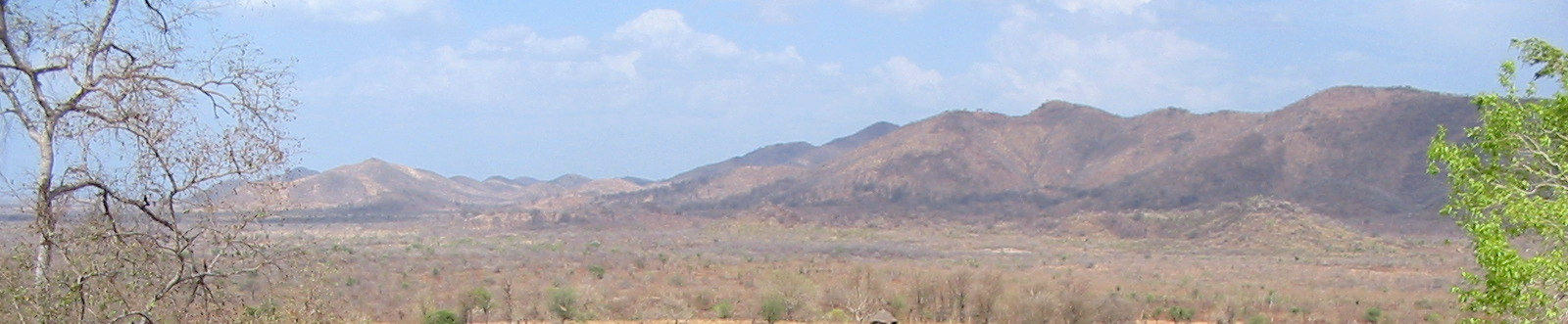
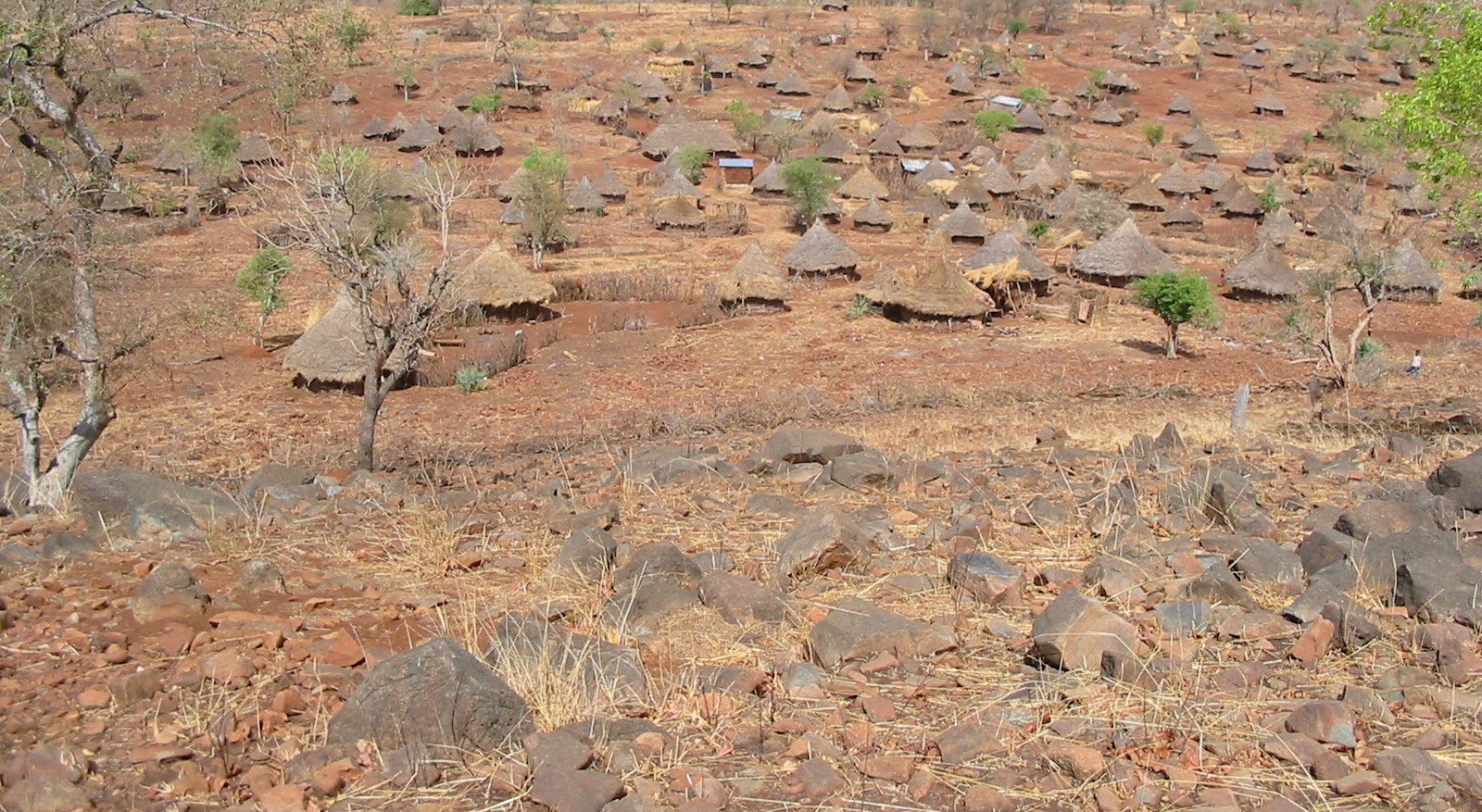
The Gugub and Khor Gidad vil ages are located within smal val ey and huts are built
on slopes on both sides (Il ustration 3 & 4). There is no major flowing river close to the
mining and processing areas, only seasonal drainage. Al the streams, khors and wadis
were dry during our mission and there was no panners (Il ustration 5).
In dry season dominant wind direction is North-South; this reversed during rainy
season.
Il ustration 3 - View from the NW of the central part of Gugub vil age.
BRGM/RC-53589-FR "Draft report"
19

Global Mercury Project: Ingessana Hills Sudan
Il ustration 4 - View from the SW of the central part of Khor Gidad mining area
(gold-bearing quartz vein located on the top of the smal hil behind).
4.1.3. Geological information
In Gugub and Khor Gidad, primary ore exploited by artisanal miners is vein-related gold
mineralization type. These auriferous bodies are hosted by micro gabbro and
associated altered rocks. The gold mineralization is associated with NE-directed shear
zones (name Khor Feri Shear zone) sub-paral el to the western contact between Bau
granite and adjacent ophiolitic ultrabasic rocks (Elnour K. Mohamed et al., 2002). The
quartz veins occurs as bodies of varying lengths of 150-250 meters and width varying
from few centimeters to two meters, dipping 30 to 45°NE, in an echelon arrays
boudinage and as lenticular pods. Fresh galena and arsenopyrite are the main
mineralization observed on quartz samples. Visible gold appears associated with iron
oxide within sulphide boxworks.
A chip-sampling campaign carried out by GRAS in 2002 on eight auriferous quartz
veins sites of the Gugub area indicated Au low-grades1 at the surface (Elnour K.
Mohamed et al., 2002).
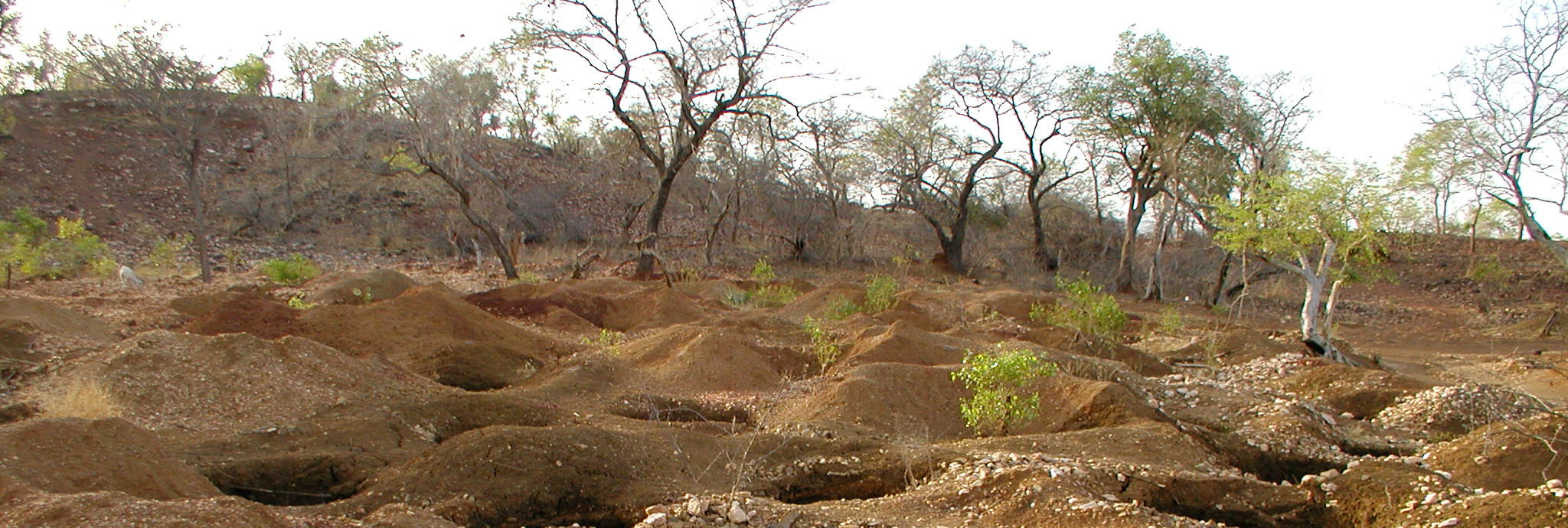
During rainy season gold is panned from al uvial and col uvial deposits that formed
terrace along main khors and wadis (Il ustration 5).
1 Values are given in chapter 4.2.3 (p.31)
20
BRGM/RC-53589-FR "Draft report"


Global Mercury Project: Ingessana Hil s Sudan
a
b
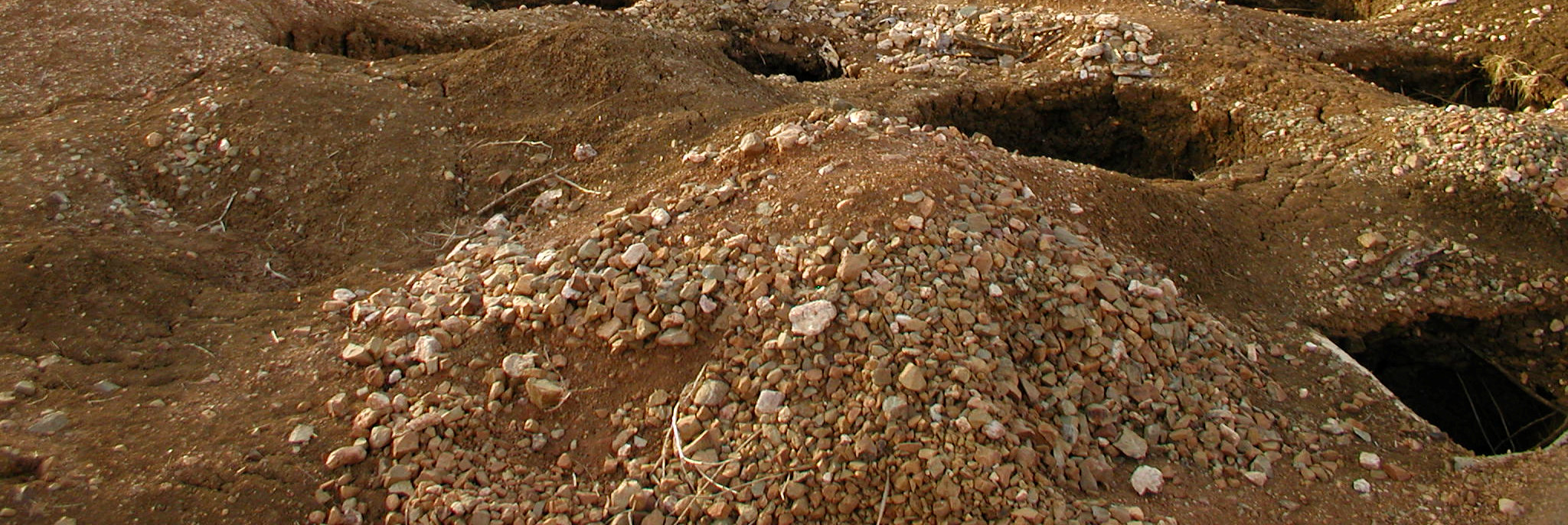
Il ustration 5 - (a) Al uvial Panning area on Khor Shareban (Gugub) and (b) col uvions working
area (Gidad).
4.1.4. Sociological aspects
The information given in the fol owing paragraph are mainly extracted from the
sociological survey carried out in the district by Pr. Khalil A. Al Medani (2003) with
complements col ected during the field mission.
Ingessana are the indigenous Nilotic ethnic group who possibly inhabit the Ingessana
hil s since the 16th century. The second ethnic group is the Dawala who are war
displaced. Historical y Ingessana depended on livestock and on minor shifting
cultivation in the low lands beyond their mountains. Since 1997, Ingessana district
attracted massive people looking for gold. The first to come and live with the Ingessana
are Dawala people from Kurmuk ~100 km to the south. About 185 families built their
huts in the Gugub vil age. Artisanal gold miners in the Ingessana Hil s concentrate in
Gugub, Taga, and Salbal vil ages. Gugub vil age of ~1,000 inhabitants is the major
center of activities. Artisanal gold miners are scattered in 3 sites at present. The
biggest cluster of activities known as khor Gidad is located ~7 km (driving distance)
North of Gugub vil age. There are ~800 individuals who currently practise artisanal
al uvial gold pitting mainly along stream terraces. Within the circle of Gugub artisanal
gold mining community, Dawala account for ~80 % of the ~185 households (~1,000
heads). The rest are Ingessana groups living at the fringes of the vil age or as isolated
households at hil slopes. The bigger concentrations of sedentary Ingessana artisanal
gold miners are found in Taga vil age ~5 km east of Gugub (~200) and Khor Gam
Rumailik ~7 km northwest of Gugub (~100).
The age of members of the Gugub artisanal gold mining community ranges from 15 to
50 years. The majority of male miner's ages are in the 15-50 years range while most
women miners and water providers at Khor Gidad site are in the 15-35 years old. A few
old men and women (> 60 years) practise al uvial gold mining in shal ow pits. Children
at gold pitting sites are quite visible (10- 15 %). Girls in the 10 to 13 years age range
constitute the majority of participating children.
BRGM/RC-53589-FR "Draft report"
21
Global Mercury Project: Ingessana Hills Sudan
Both Ingessana and Dawala families live in straw and thatch conical huts. Ingessana
people build their huts either at the fringes of the mentioned vil ages or as isolated
households on hil sides. Dawal a families, on the other hand, live in groups. Excluding
some of the shops, al dwel ings, school class rooms, and mosque in Gugub are built of
straw and wood even though some Dawal a men are affluent enough to build stone or
brick bungalows. In the premises, there is no hut or place reserved for gold processing.
The same hut is used for sleeping, cooking food, rock ore grinding, and amalgam
burning. The huts of the same family are grouped together and surrounded by a
wooden fence. This group of huts is cal ed "family unit" or "enclosed family unit" in this
report (Il ustration 17). In last August 2003, 53% of artisanal gold miners at Khor Gidad
site live half a kilometer from the mining pits, 10 % live three kilometers away, and 37
% live in Gugub ~4 km (walking distance) to the pits (Il ustration 3, Il ustration 4).
Being located ~50 km away from the Blue Nile western banks; the community of Gugub
and the surroundings have no frequent access to fresh fish supply. In the survey, only
2 % of the people report eating fish occasional y. However, dry fish is available in
Gugub market.
4.1.5. Sites selected
Most of the data on the artisanal gold mining and processing in the Ingessana Hil s
area may be found in the UNIDO reports entitled "Information about Ingessana Hil s
artisanal gold mining sites chosen for the Environmental & Health assessment" by
Mohamed S. Ibrahim (November, 2003) and "Socio-economic sample study of the
Ingessana hil s artisanal gold mining community, Blue Nile State, Sudan" by Prof. Khalil
A. Al Medani, University of Nileen, Khartoum, (December, 2003).
During our short orientation survey, and according to the mission objectives, the visits
focused primarily on the sites where mercury is used and on the area where the
sociological study was made, in order to be able to correlate the environmental and the
health assessments subsequently.
Sociological reports, advise from their authors and a short orientation survey carried
out during the first days of the field mission, al owed us to select 3 main targets to be
studied2: the two main artisanal gold mining sites of Gugub and Khor Gidad and the
Taga vil age as a control site (main activity of this populated vil age of Ingessana was
farming and mercury has never been used).
2 Details are given in the fol owing chapter 4.2
22
BRGM/RC-53589-FR "Draft report"
Global Mercury Project: Ingessana Hil s Sudan
4.2.
LOCAL MINING PRACTICES AND USE OF MERCURY
4.2.1. Types and location of mining activities
Artisanal gold mining activities in the Ingessana Hil s started in 1996 when a displaced
Dawala ethnic group of Kurmuk district, also skil ed artisanal gold miners, discovered
gold in quartz veins around Gugub vil age. They first started artisanal gold mining along
the stream terraces and later on quartz vein slopes.
In the Gugub district, there are two seasonal types of mining activities:
· Miners pan al uvial and el uvial gold when the local stream is flowing during rainy
season between July and December. Ancient or inactive panning sites are visible
al around Gugub and Khor Gidad vil ages along one to several meter wide wadi
and Khor (Khor Alyas, Khor Abu Djal, Khor Shareban, Khor Gidad) (Il ustration 5).
In those sites miners do not use mercury and recover only visible gold during rainy
season. No activity of this type was observed during our field mission which took
place during the dry season.
· During dry season, due to shortage of water in pit sites, only primary gold
associated with quartz vein and col uvions are mined. Miners indicated that mercury
is used only to recover gold from primary ore and that primary ore exploitation is
more recent than al uvial one.
Sociological study mentioned that, nowadays a gram of gold produced from al uvium
through panning only has a higher price in the local market (US$9-9.5) as compared
with a gram of gold extracted from hard rocks through amalgamation (US$ 6- 6.5).
Artisanal Smal Scale Mining (ASM) in the Ingessana Hil s varies somewhat between
vil ages, with some identifying an active participation in the activity and others a decline
depending on season and gold-bearing quartz vein discoveries.
Near around Gugub vil age, activities on primary ore were suspended after spectacular
gold discovery of smal gold-rich quartz vein last September 2003 in Khor Gidad
located 7 km to the north. GRAS geologists report that ~500 miners (officials said
6,000) rushed chaotical y into the area from Gugub and elsewhere extracted ~56
kilograms of gold in a week time.
According to our interviews and observations it appears that intensive use of mercury
in the area is quite recent (around 3 years and may be less) and mainly developed in
Gugub where gold was first discover and in Khor Gidad after the gold rush. The other
sites mentioned in the sociological reports (i.e. Turda, Khor Neiwi) are al uvial types,
without mercury use and presently abandoned.
During our mission those two sites were the only ones in activity. Khor Gidad has an
extraction and processing sites and Gugub has only a processing site. However a few
isolated women continue to work occasional y on ancient quartz overburden and tailing
around Gugub (Abu Djal quartz veins).
BRGM/RC-53589-FR "Draft report"
23
Global Mercury Project: Ingessana Hills Sudan
The vil age of Gugub is the most important one with around 170 households
(Il ustration 3). Primary ore is usual y transported to Gugub where families of miners
are living and where merchant propose mercury in their shops. The Khor Gidad mining
site is located too far from Gugub (around 7 km by track) to al ow daily ore
transportation by hand and families from Gugub have started to build up new huts in
Khor Gidad (around 70 household) (Il ustration 4). Seven shops sel ing mercury were
identified in each site.
4.2.2. Mining practices
Mining practices are described in the sociological survey (Khalil. A. El Medani, 2003
and Ibrahim, 2003).
Artisanal gold mining in Gugub is practiced by both Dawala and Ingessana tribesmen
without legal titles. Most people mine and process in smal groups which is basical y a
family affair. The procedures used by local people are representative of very poor
people using simple and traditional practices. During our stay, most of the activities
were performed by women (13-35 years old), including the hard tasks of digging and
excavation. The women represent more than 50 % of the labor force; in the rainy
season this can reach as much as 90 %, as men go planting (Ibrahim, or. com.).
The miners do not comply with the provisions provided in the Mines and Quarries Act
(1972). Given the adverse situation created by the civil strife around Kurmuk and
Queissan boarder areas in 1996, and in an effort to develop the sub-sector in a
sustainable way, the Government tried to legalize the gold mining in southern Blue Nile
and elsewhere by granting special licenses. A few mil owners introduced hammer mil s
into the area in 1997-1998 but authorities soon drove them out. Although the known
gold occurrences in the Ingessana are relatively smal and scattered, back in 1999, a
private investor obtained an exclusive prospecting license for gold exploration and
mining in a 10 km2 area around Gugub from the Ministry of Energy and Mining but for
the adverse reasons surrendered the area. A condition imposed by Government in
such deals is the strict compliance of the artisanal gold miners with mining al uvial gold
only.
Now the area is open for licensing without any restrictions on the artisanal gold mining
activities. The only restriction imposed by Government is the introduction of rock mil s
into the area (Ibrahim, 2003).
In the area two different types of gold mining are present: mining of al uvium and
col uvium and mining of gold-bearing quartz veins.
Mining of alluvium and colluvium
The description of the exploitation of al uvial ores wil not be detailed in this report as
far as:
- it is made without use of mercury;
- it is already described in the sociological report;
24
BRGM/RC-53589-FR "Draft report"
Global Mercury Project: Ingessana Hil s Sudan
- no exploitation of this type was observed during our mission.
Mining is done during rainy season only. Ore excavation in al uvium terrace of different
Khor and wadi takes place in the vicinity of the vil ages and implies only smal groups of
10-20 peoples. The estimated average daily amount of al uvium extracted from pit by a
male miner is about 0.5 ton.
The process involves the fol owing steps:
- Site preparation and removal of the overburden;
- Digging of the excavation pit for mobilisation of the al uvium;
- Panning of the ore;
- Hand recovery of gold specks and nuggets from heavy mineral concentrate.
Al uvial-type gold produced in the area goes directly to the market without further
purification (Ibrahim, 2003).
Mining of gold-bearing quartz vein
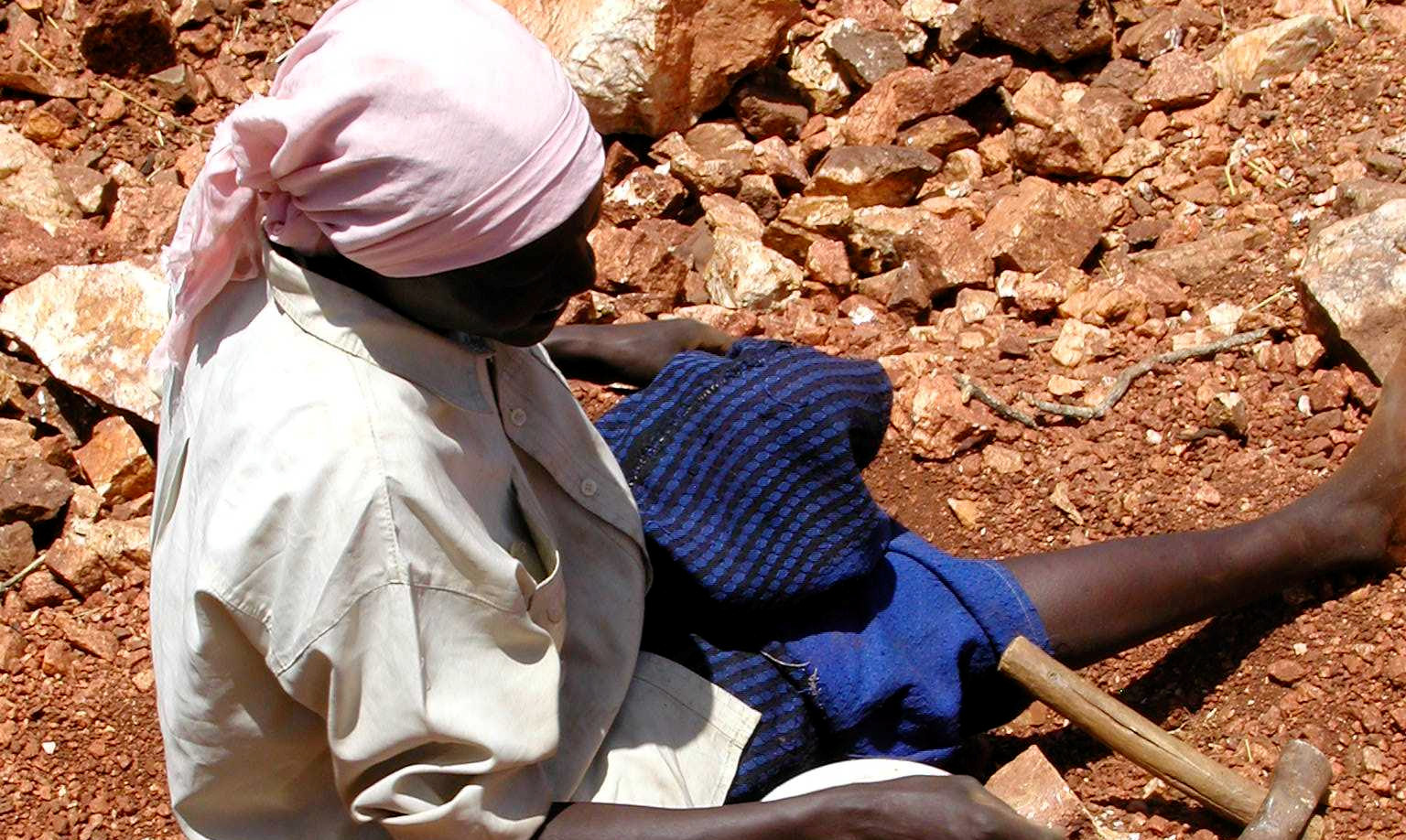
Mining of gold-bearing quartz vein was the only type we observed during the field
mission.
(1) Ore extraction, digging and ore selection on the site
Miners noticed that ore is richer at the footwal of the gold-bearing quartz lenses and
consequently the quartz is frequently total y extracted. Miners also work with el uvial
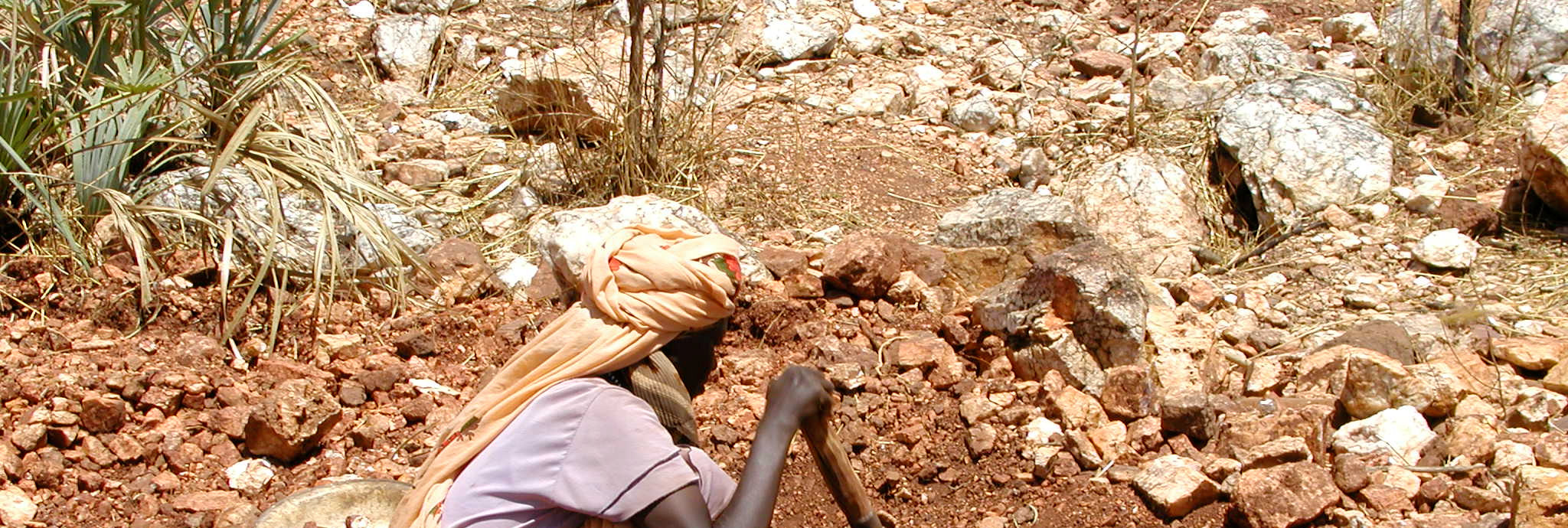
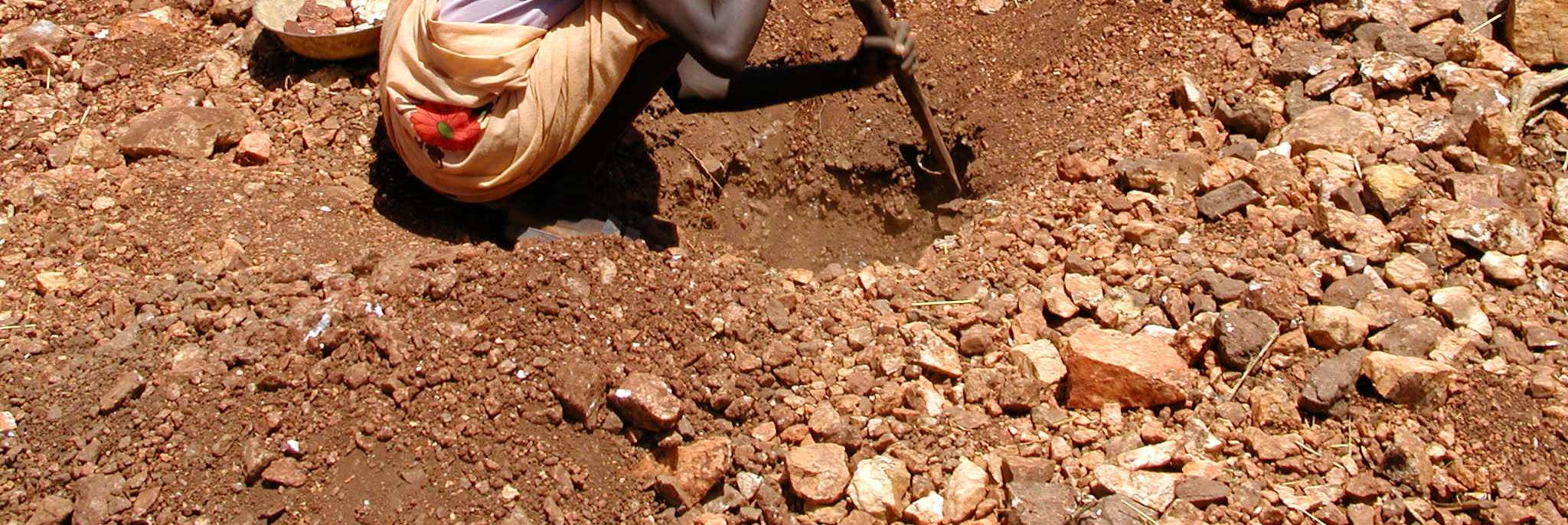
material and altered wal rock. In the first meters, the extraction is done mainly by
women in a rather muddled way without mechanical tools (Il ustration 6). Men are only
involved in mining at deeper depths. Wildcat digging and excavation are common.
Digging tools include the rudimentary axe, pick, and shovel. Sledge hammer and chisel
are used mainly in hard rock excavation (Il ustration 6). Miners do not use explosives.
The shafts are up to 15-20 meters deep, dug every 3-4 metres, interconnected and
barely timbered.
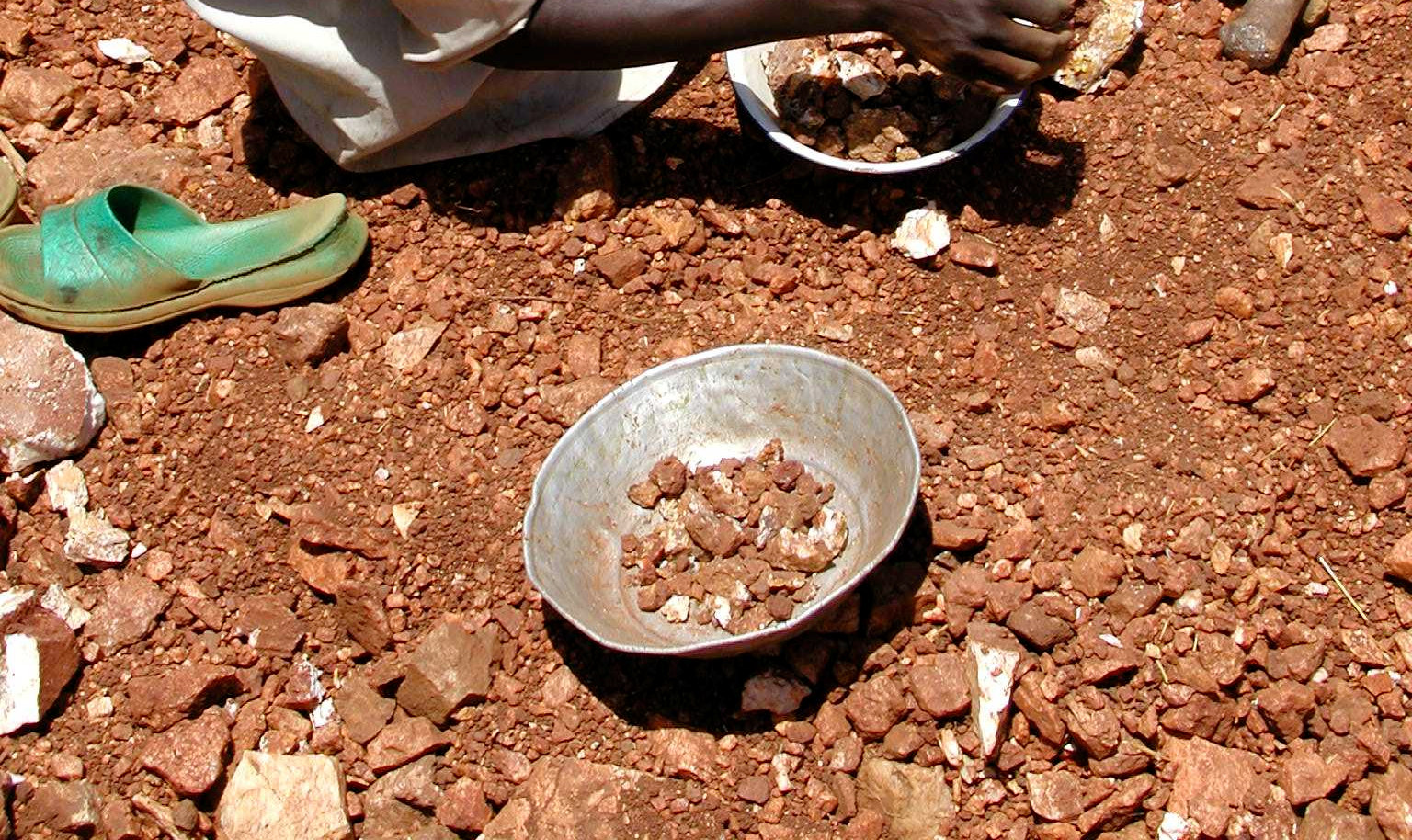
The material is manual y hoisted and sorted out at sight in an empirical way in order to
try to concentrate the most probable gold-bearing material. Artisanal primary gold
mining entails visual selection of mineralized rock pieces (Il ustration 6). The big pieces
of quartz are burnt overnight to facilitate the hand-crushing and manual mil ing.
The estimated average daily amount of gold-bearing quartz rock extracted from pit by a
male miner is about 20-30 kilograms.
At this stage, the selected ore (Il ustration 6) is than transported to the «family unit» at
Khor Gidad or more frequently at Gugub.
BRGM/RC-53589-FR "Draft report"
25
a



Global Mercury Project: Ingessana Hills Sudan
a
b
c
Il ustration 6 - Women mining activities at Khor Gidad quartz veins area.
(2) Crushing, milling and panning at home
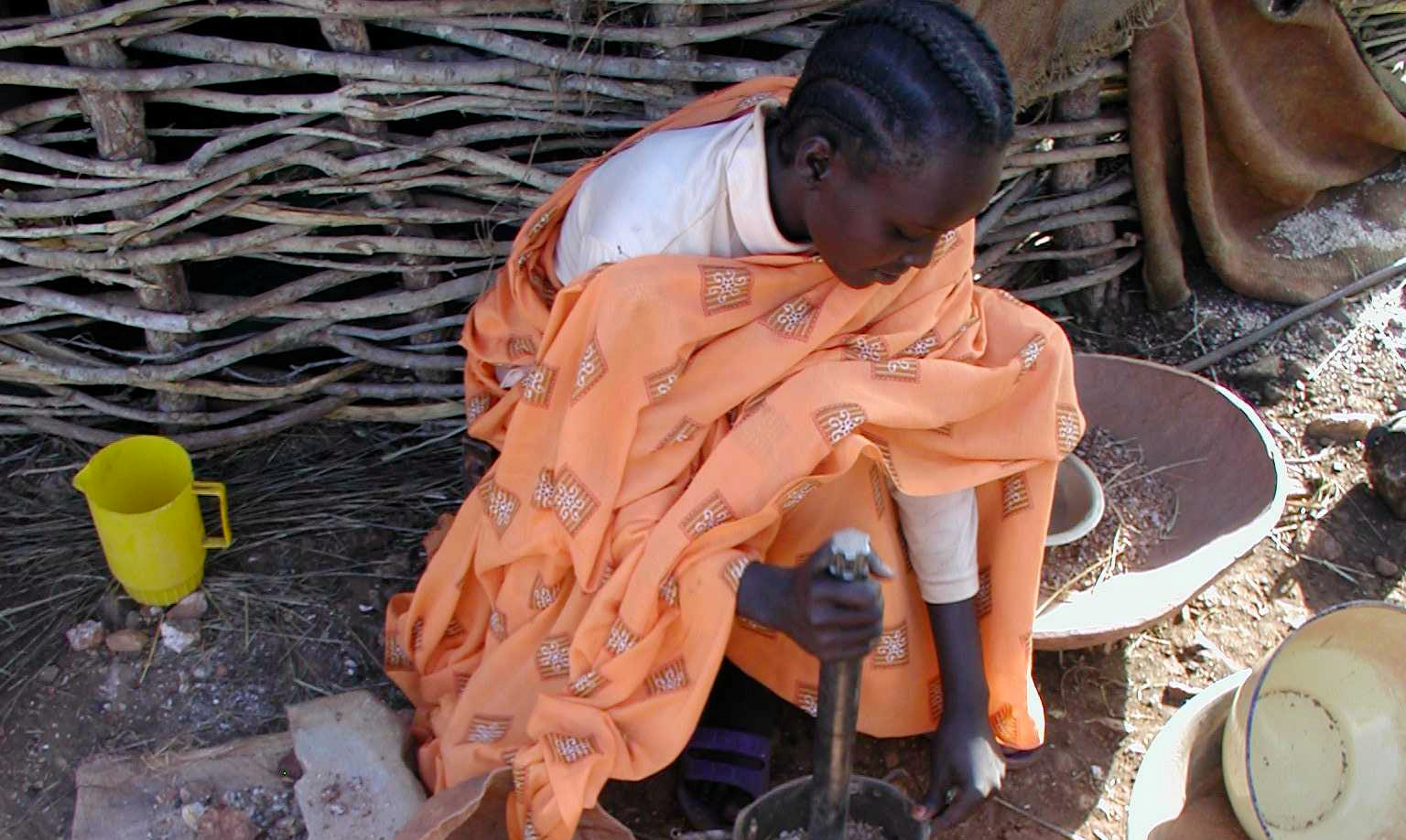
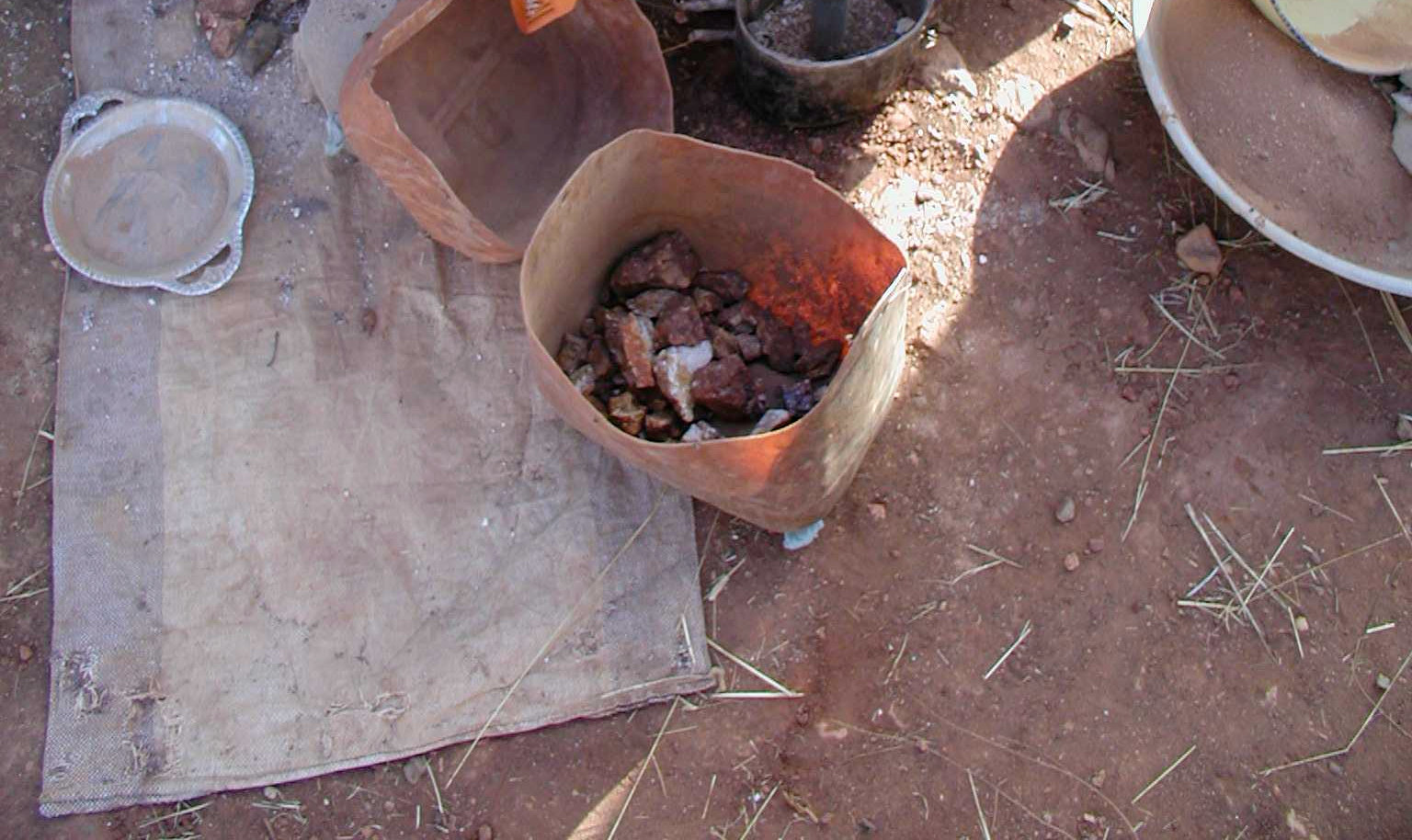
Crushing, manual y mil ing and panning are done by women in the yard of family unit at
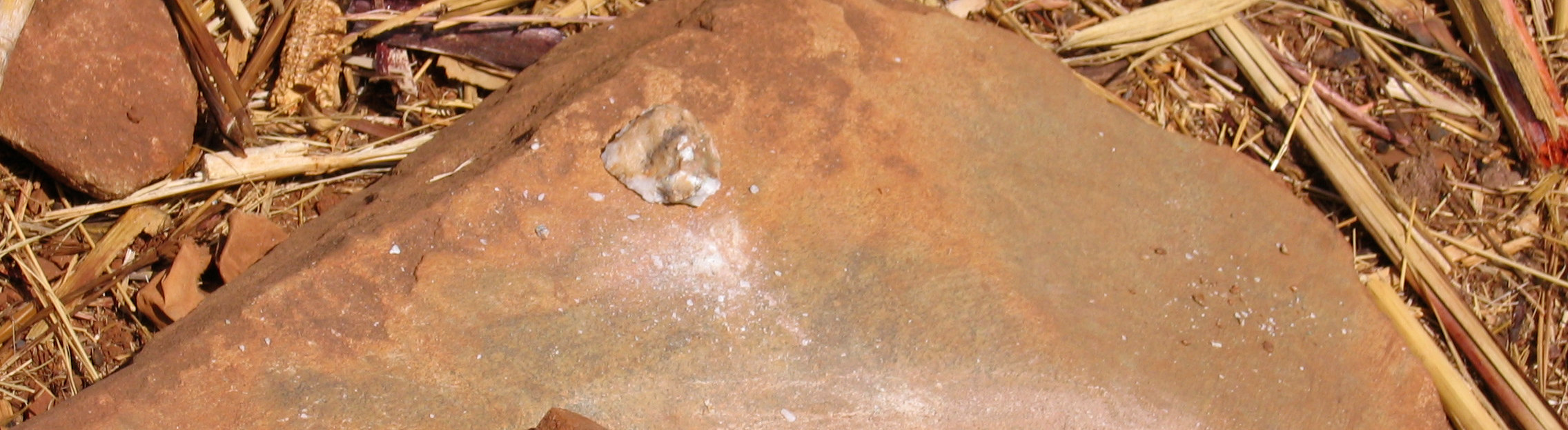
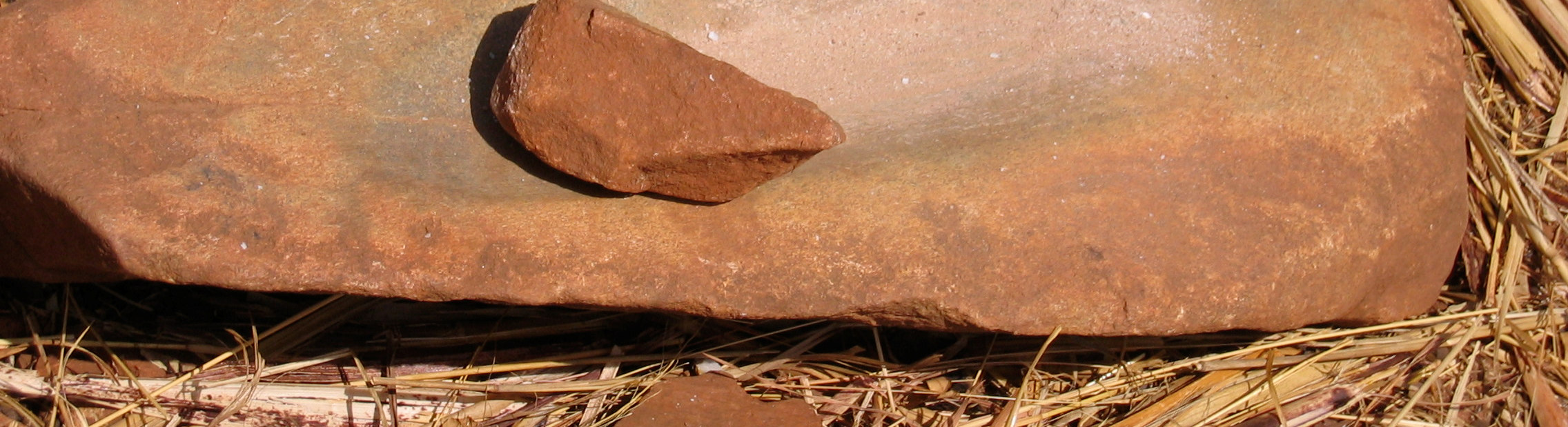
the shadow of huts or awning. Rock grinding is performed by grindstone or steel mortar
(Il ustration 7). The semi-final quartz + gold powder (200-500 microns) are panned by
women.
The grinding capacity (to < 0.074mm) is less than 5 kg/day/individual. Miners can crush
and grind more el uvial material and host altered rock than quartz.
a
b
Il ustration 7 - Grinding with steel mortar (a) and grindstone (b).
26
BRGM/RC-53589-FR "Draft report"

Global Mercury Project: Ingessana Hil s Sudan
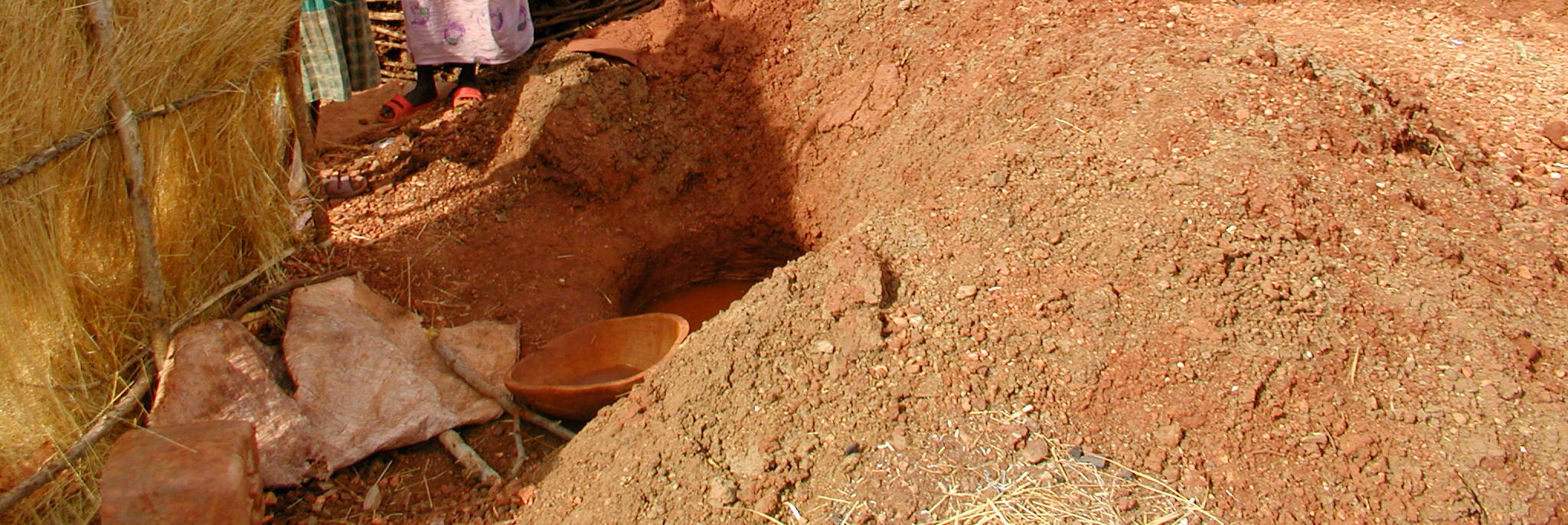
Panning is conducted manual y in excavated pools using traditional wooden pans. The
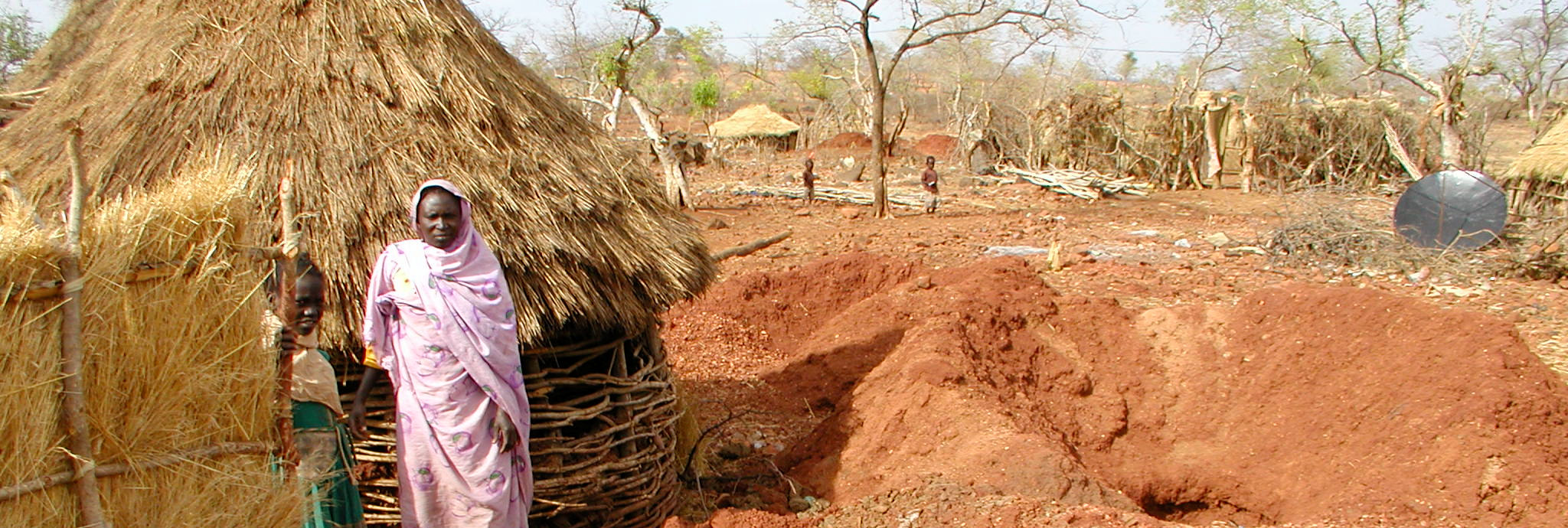
tailings are disposed around the huts out of the «family unit» (Il ustration 8). Efficiency
of panning using the traditional wooden pan is ~50 %. Apparently, al fine gold grains
fal s down with the light fraction of the tailings. Panning test on waste heap performed
during the mission indicated frequent gold specks.
No one mentioned practices of quartz powder storage. Panning and then
amalgamation are performed in one daily sequence.
Il ustration 8 - Panning area in Khor Gidad producing an important quantity of tailings around the
huts and the "family units".
(3) Amalgamation at home or at the shops
After crushing and/or mil ing, the pan concentrate is shipped off at home or to the
shops for amalgamation. In Gugub artisanal gold mining sites, mercury is used in
extraction of fine gold particles from the panned concentrate.
The way of handling mercury in gold amalgamation is unsophisticated (Il ustration 9 &
Il ustration 10). After a last panning performed in the enclosure (Il ustration 9a), Hg is
poured onto the concentrate with water and mixed with bare fingers to make the
amalgam (Il ustration 9b).
BRGM/RC-53589-FR "Draft report"
27
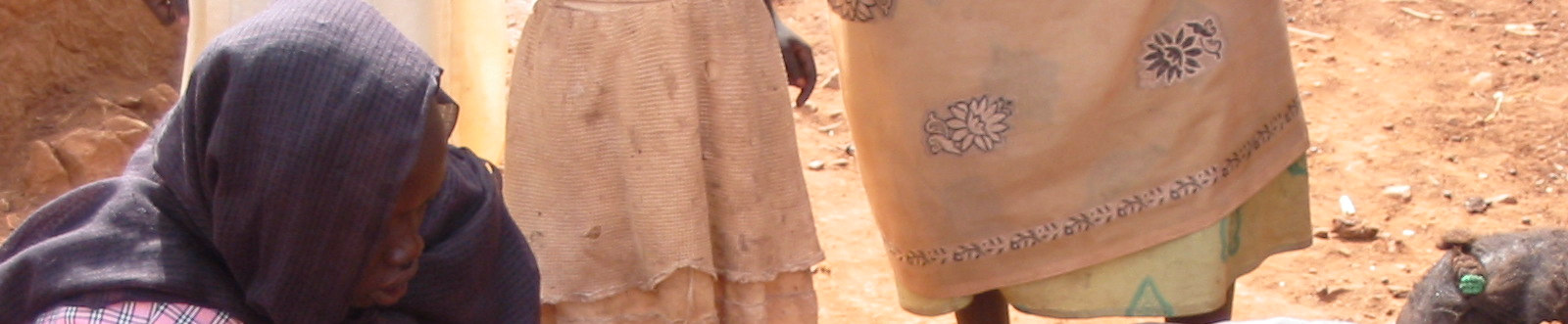
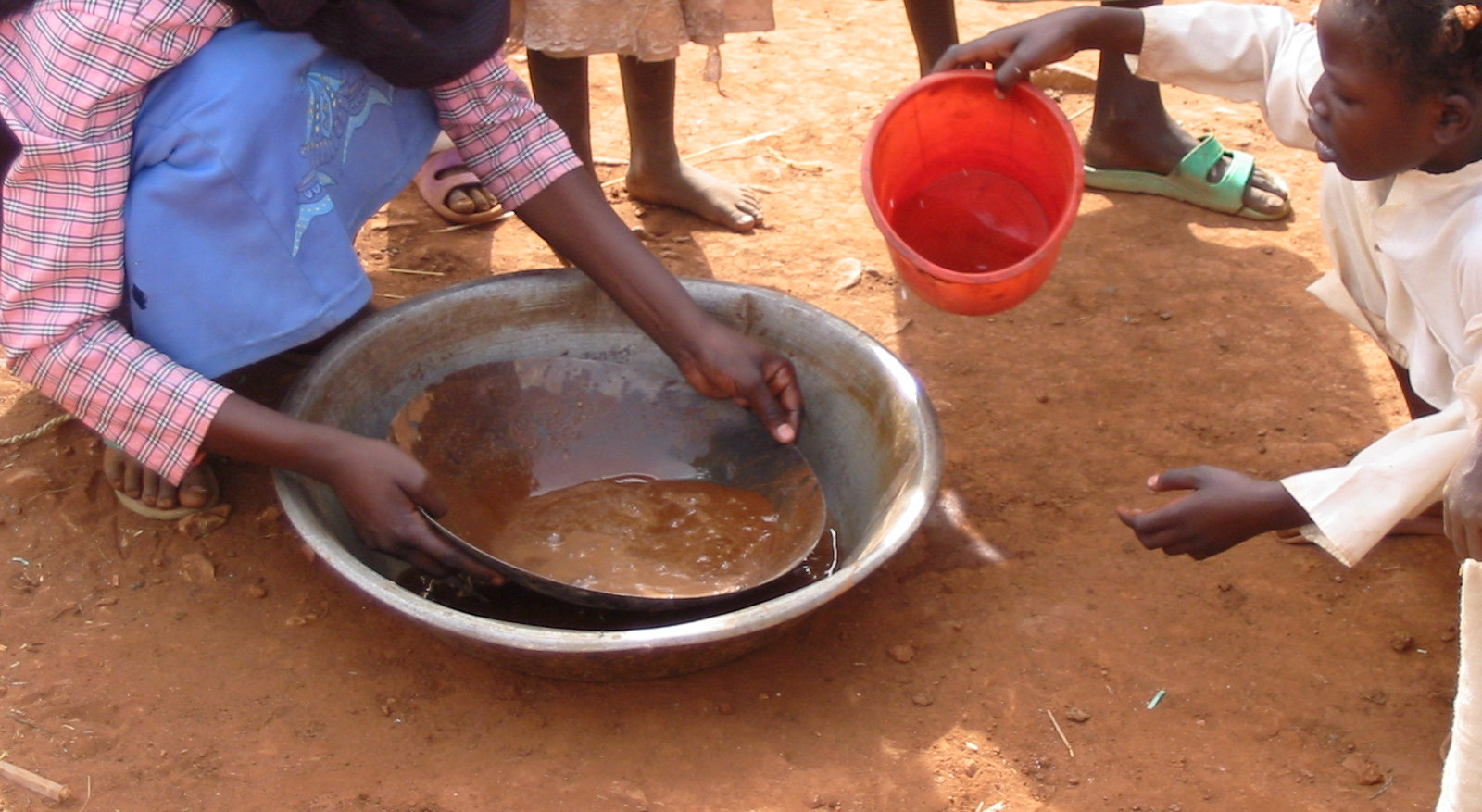

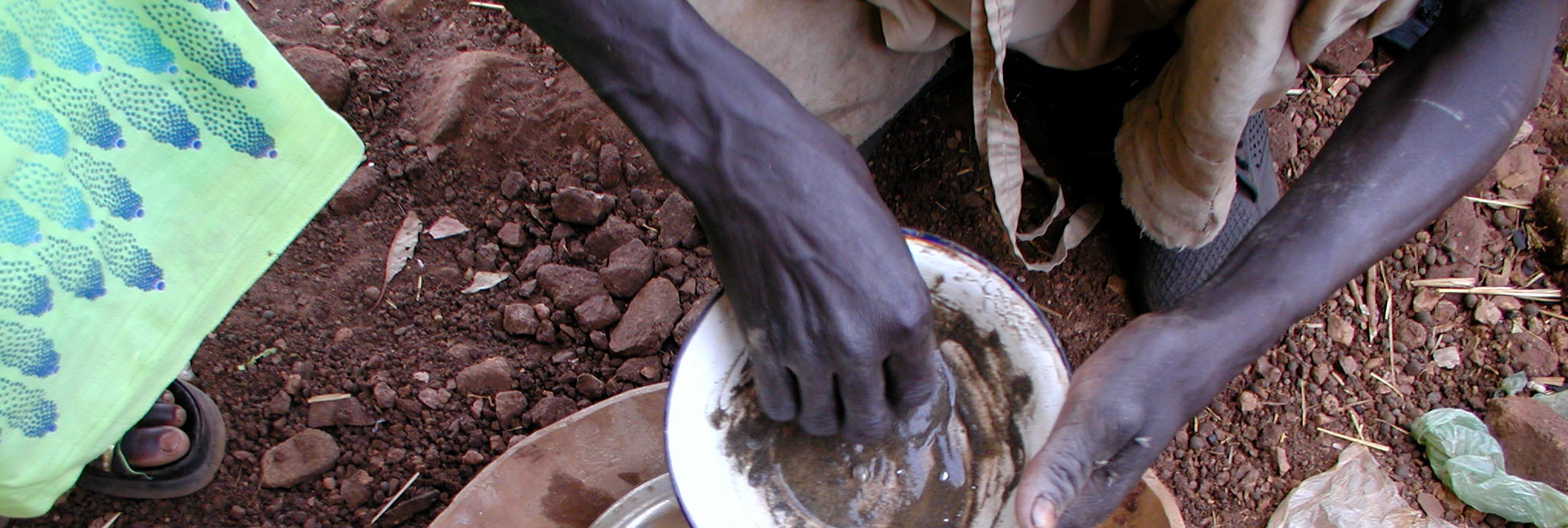
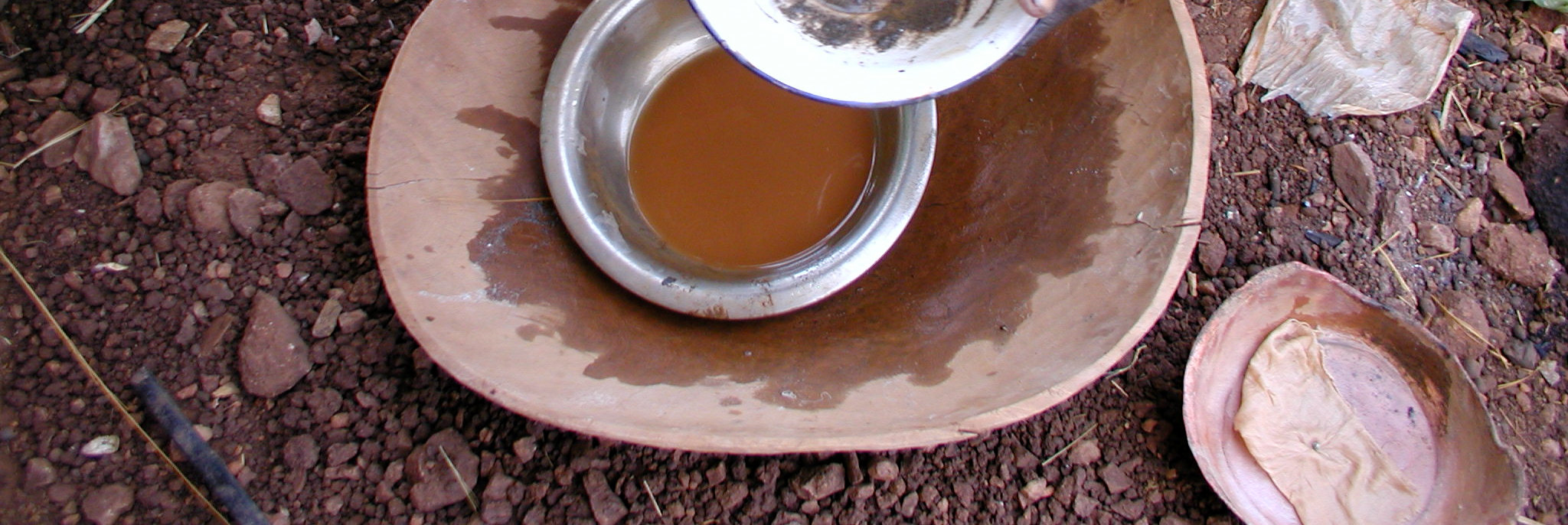

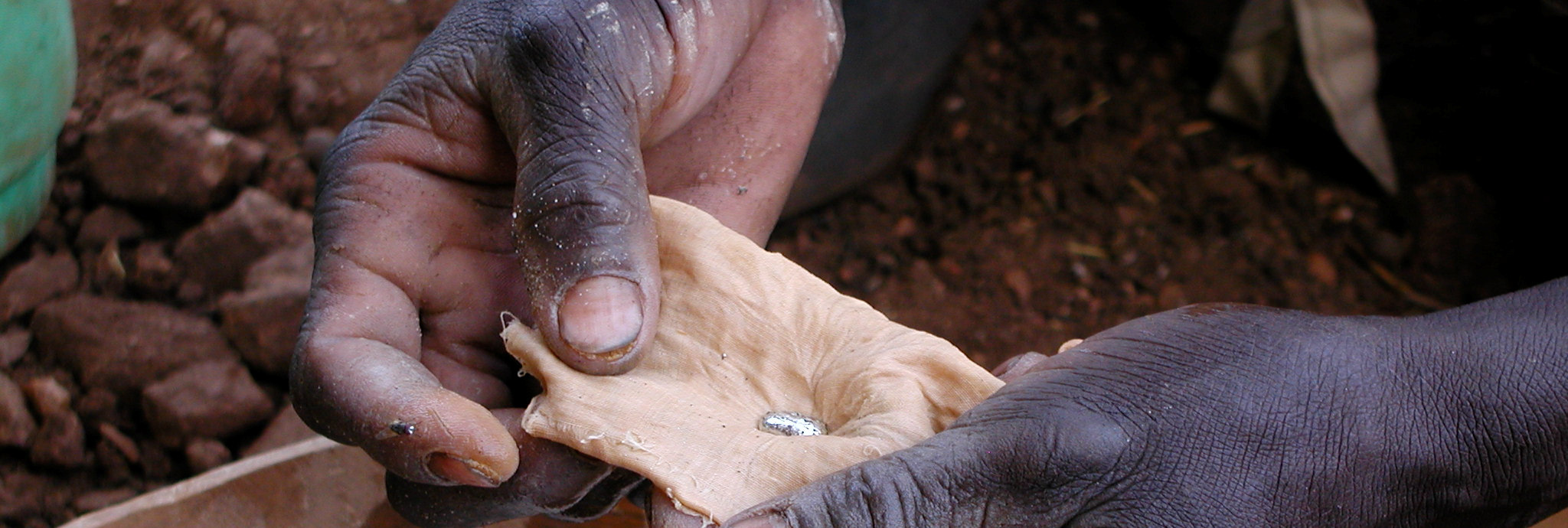
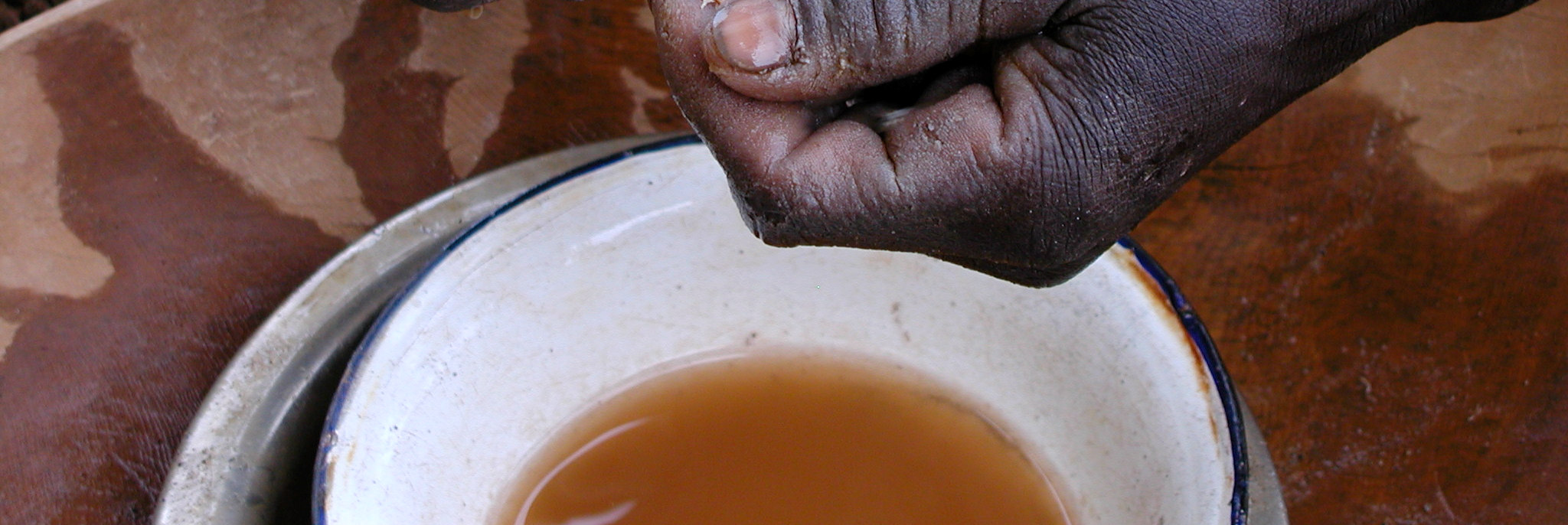

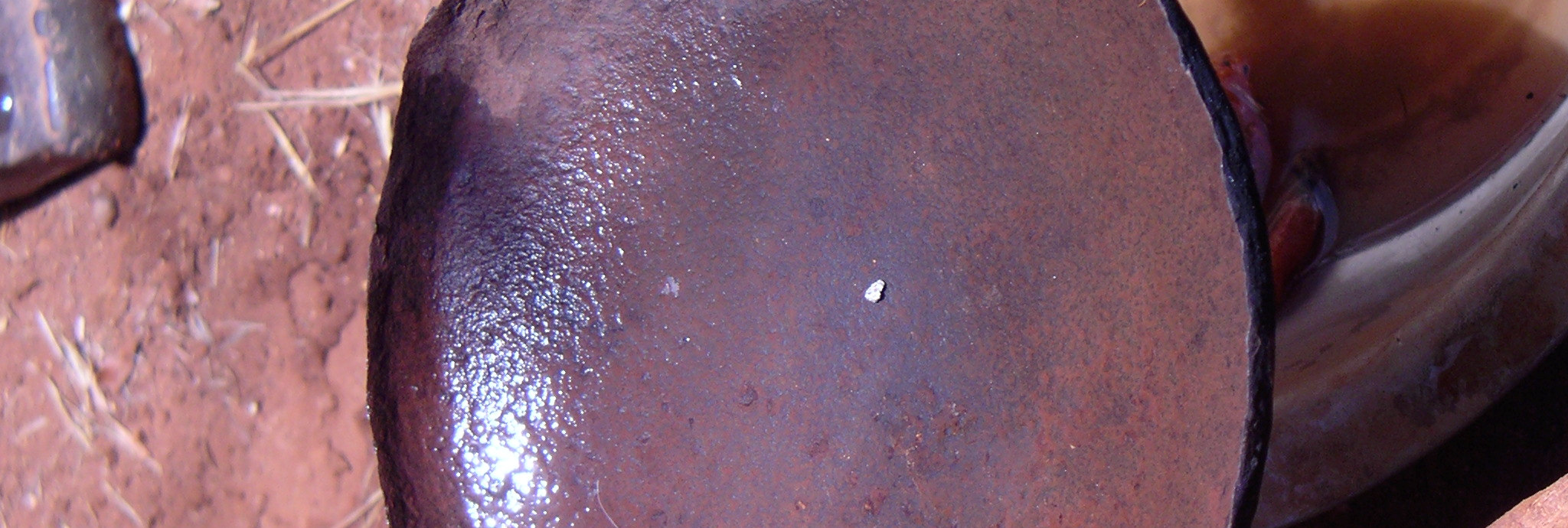
Global Mercury Project: Ingessana Hills Sudan
a
b
c
d
Il ustration 9 - Gold recovery process phases (a) panning (b) amalgamation by hand (c)
squeezing with piece of cloth (d) roasting on frying pan.
After thorough mixing, the amalgam is squeezed through a piece of cloth and the
excess Hg is recovered for reuse (Il ustration 9c). The miners col ect the amalgam by
hand, taking no precautions at al . After that, the remaining amalgam is transferred to
an open plate or frying pan for roasting (Il ustration 9d). In the private yard there is no
specific place for amalgamation. Frequently, owners indicated to us 2 or 3 differents
places located along fences or at the shadows of awnings (Il ustration 10).
28
BRGM/RC-53589-FR "Draft report"
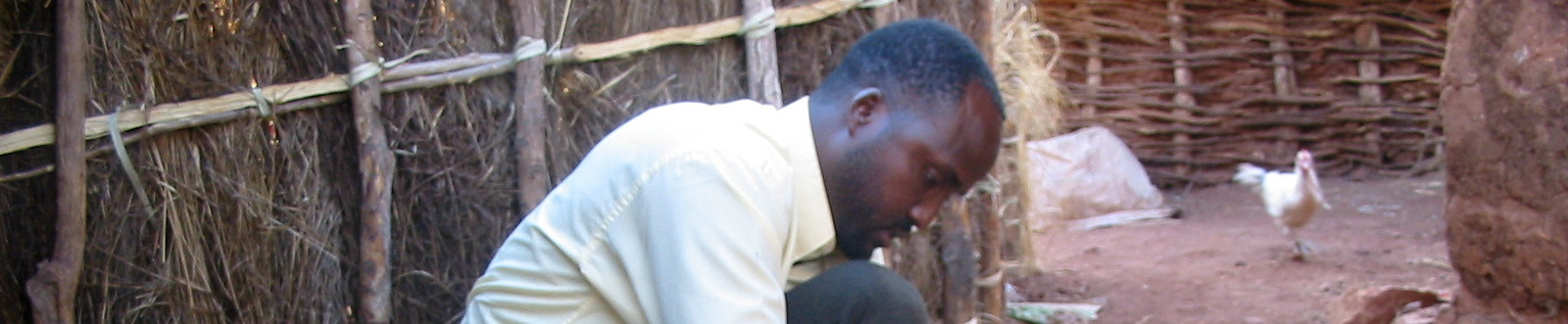
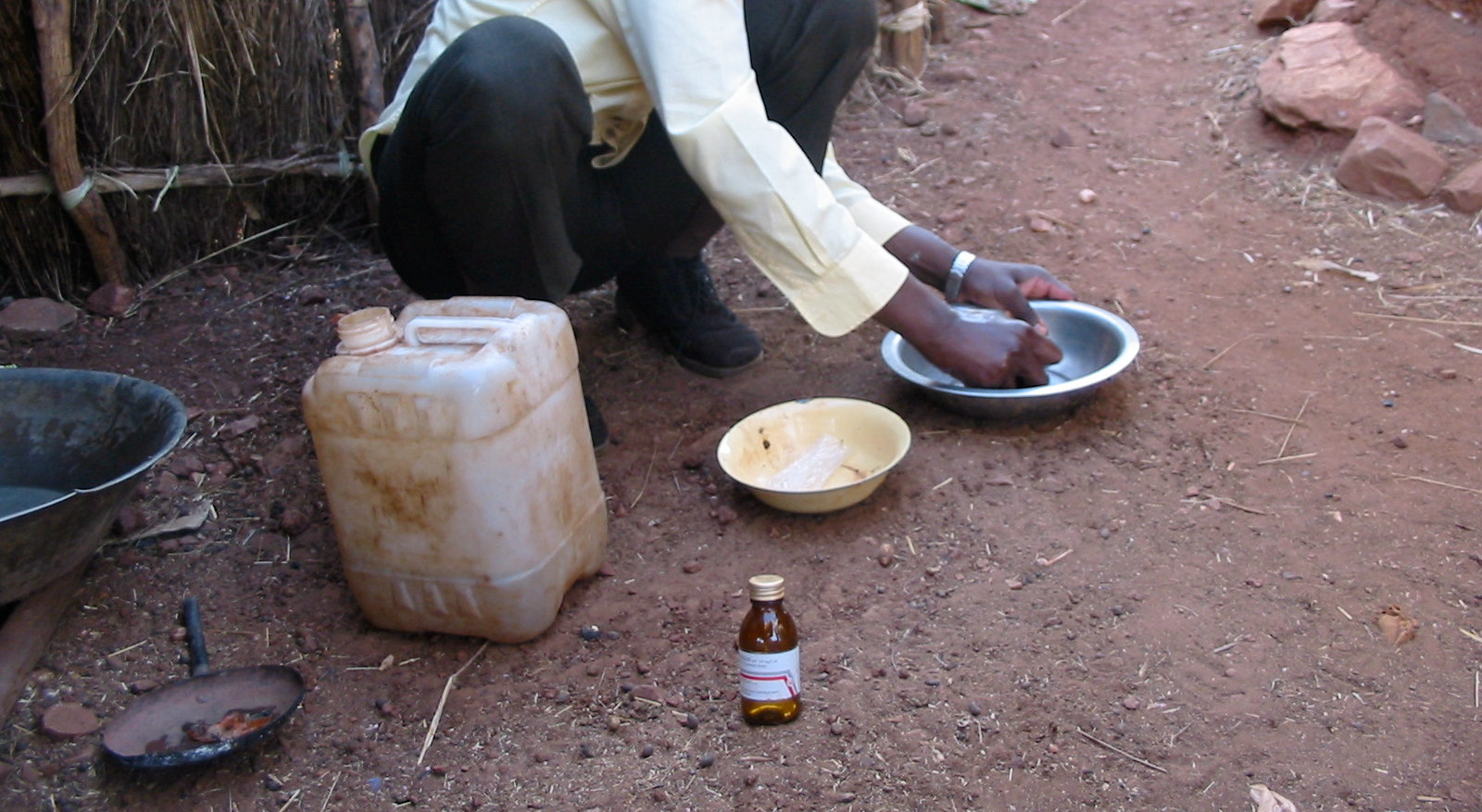
Global Mercury Project: Ingessana Hil s Sudan
Il ustration 10 - Amalgamation performed without precautions in the «family unit».
(4) Roasting at home or at the shop
The gold amalgam is roasted in mobile bonfires which facilitate the movements outside
or inside huts. It is especial y the men who practise the roasting.
Daily, they roast the amalgam freely without taking any precautions. The roasting
operation can occur (Il ustration 17):
- in the vil age close to the dealer shop where they buy mercury;
- in the yard of the «family unit»;
- in the huts (usual y the ones dedicated for cooking).
The miners place the gold amalgam on a steel plate and burn it in a bonfire until they
consider by visual experience that the "doré" is ready (Il ustration 11 & Il ustration 34).
The diameter of amalgam burned during the demonstration carried out during our visit
range from 3 to 8 mm. We expect that the duration of the burns (~ 10 minutes) is too
short and temperature produce by the bonfire are too low to burn al the mercury.
Roasting tends to be incomplete and at least 15 - 25 % of the "doré" contains residual
mercury (Il ustration 11). The "doré" also contain other metals accompanying gold in
the ore (lead, iron, copper).
BRGM/RC-53589-FR "Draft report"
29

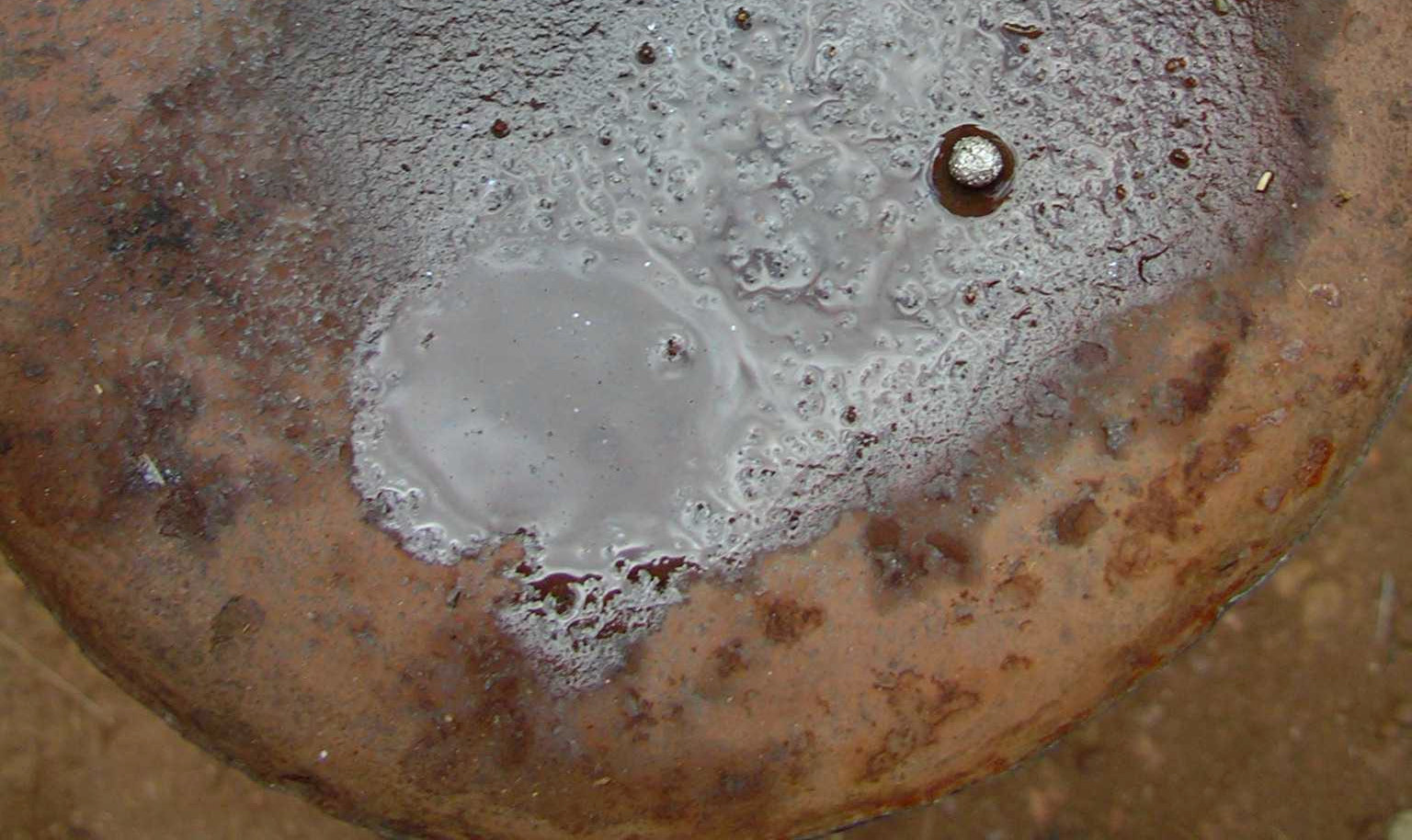

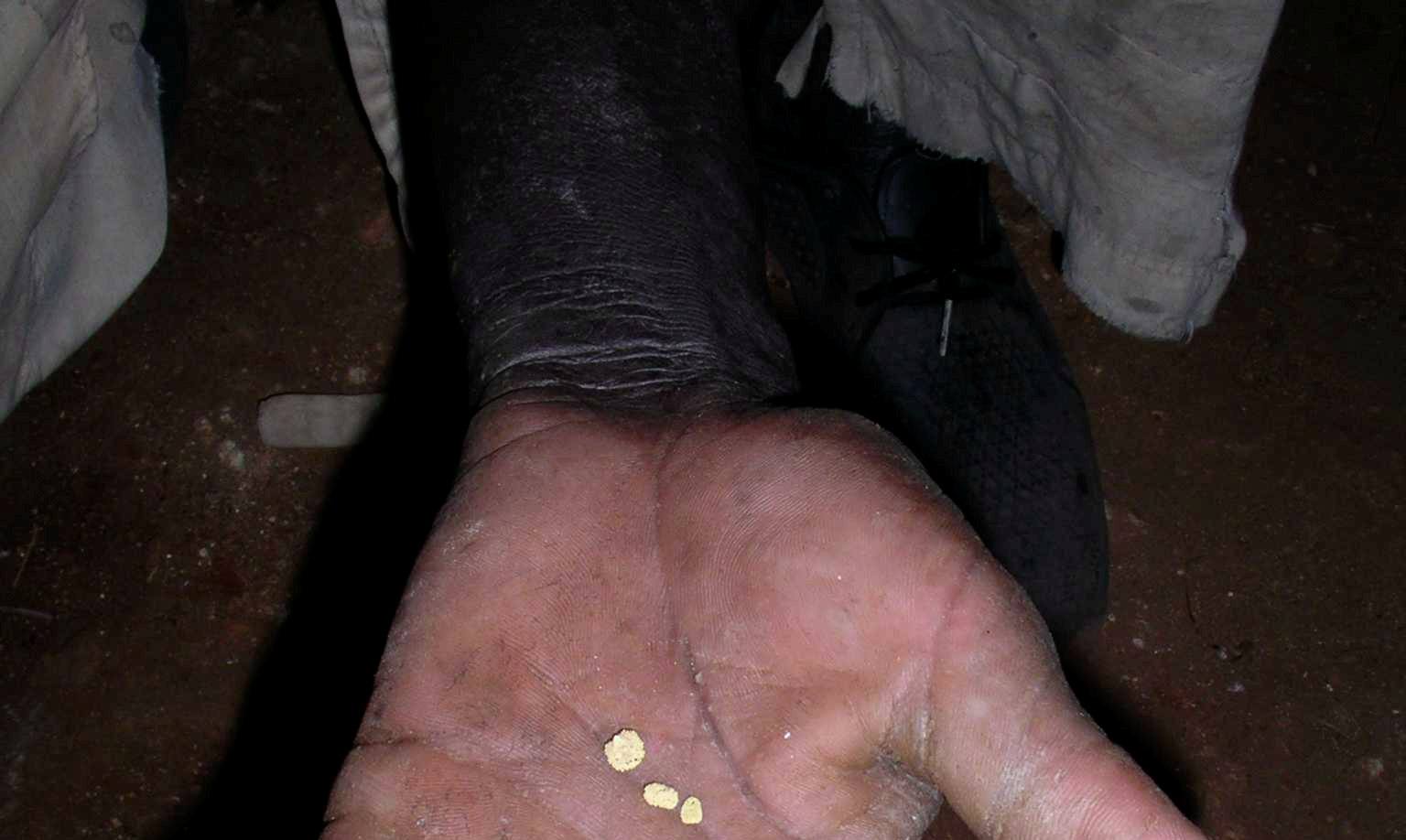
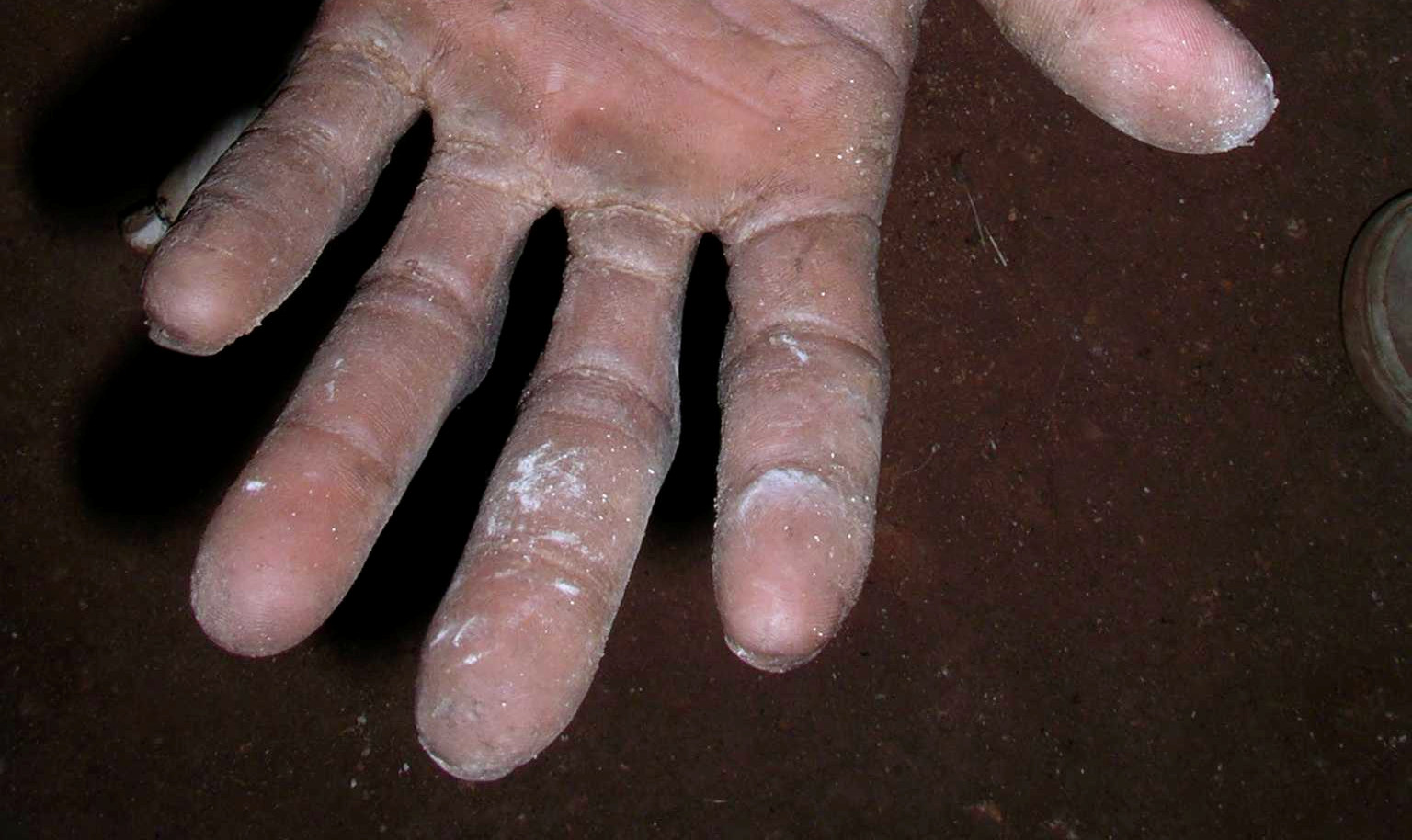
Global Mercury Project: Ingessana Hills Sudan
Il ustration 11 - Exemple of amalgam before roasting (left) and "doré" (right) after roasting.
(5) Recycling of waste and tailing in pools
The phases of grinding, amalgamation and roasting generate tailings, residues or
waste often thrown on the ground near the zones of operation. We find frequently in or
around enclosures or even gardens, heaps of waste sometime several cubic meters in
size. Panning made on this type of material or in grounds near working zones showed
the presence as wel of gold specks as sometimes drops of mercury especial y in
Gugub.
Workers indicated that during rainy season part of these tailings and residues are
sometime panned in pools located in the Khor Alyas close to the southern entrance of
Gugub vil age. Heavy mineral concentrate are then amalgamated and roasted again at
home. Tailing recycling could be done many times in order to recover residual gold.
(6) Water supply
One of the main local problems is the lack of water in mid summer. Water is provided
and bought by Ingessana women and children that bring the water from about 2 km
away (Ibrahim, 2003). They carry a pair of 4-gal on plastic containers on their shoulder
with the aid of a stick for making balance or on their heads (Il ustration 12). The eight
gal ons of water cost S.D.50 (US$ 0.2).
30
BRGM/RC-53589-FR "Draft report"

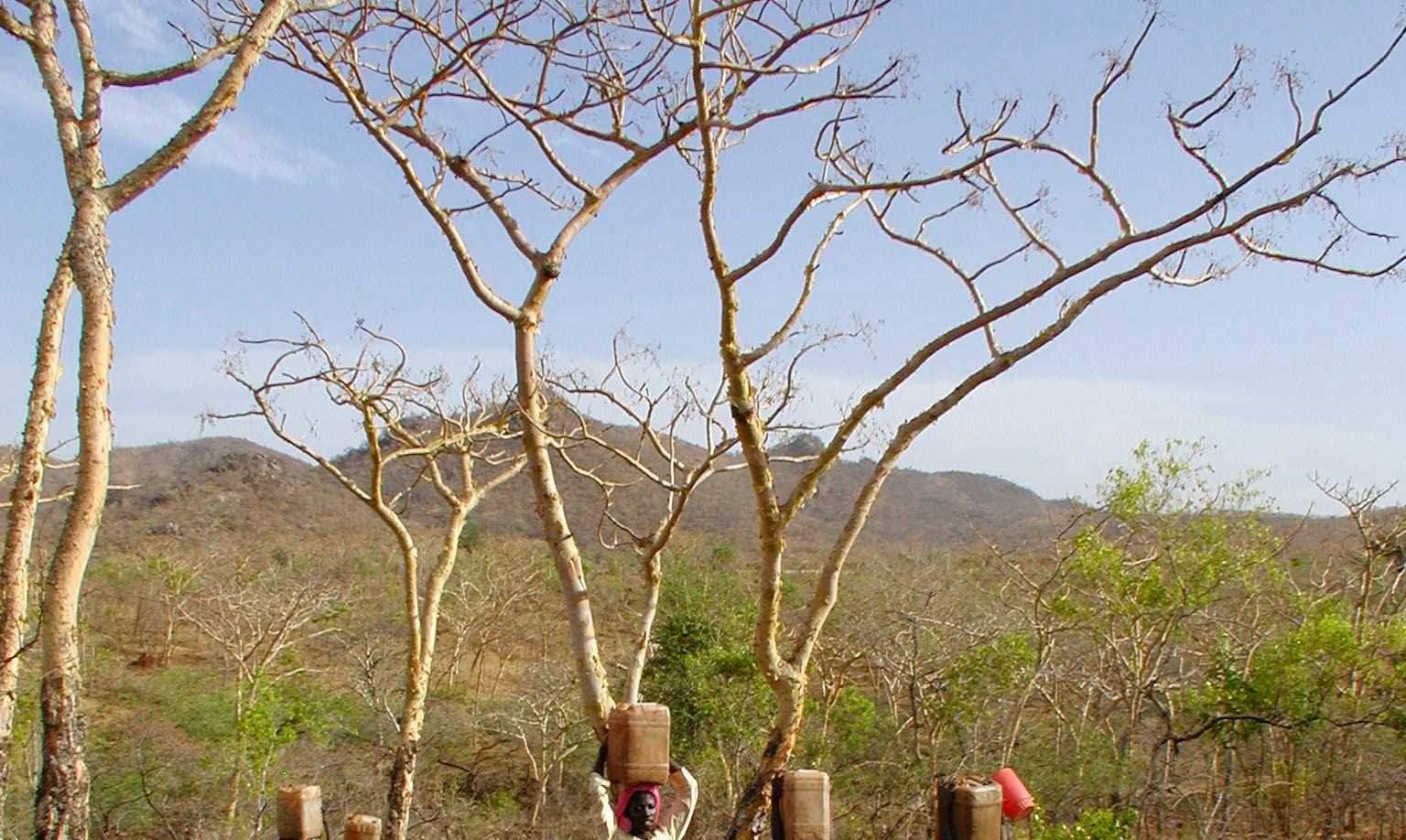
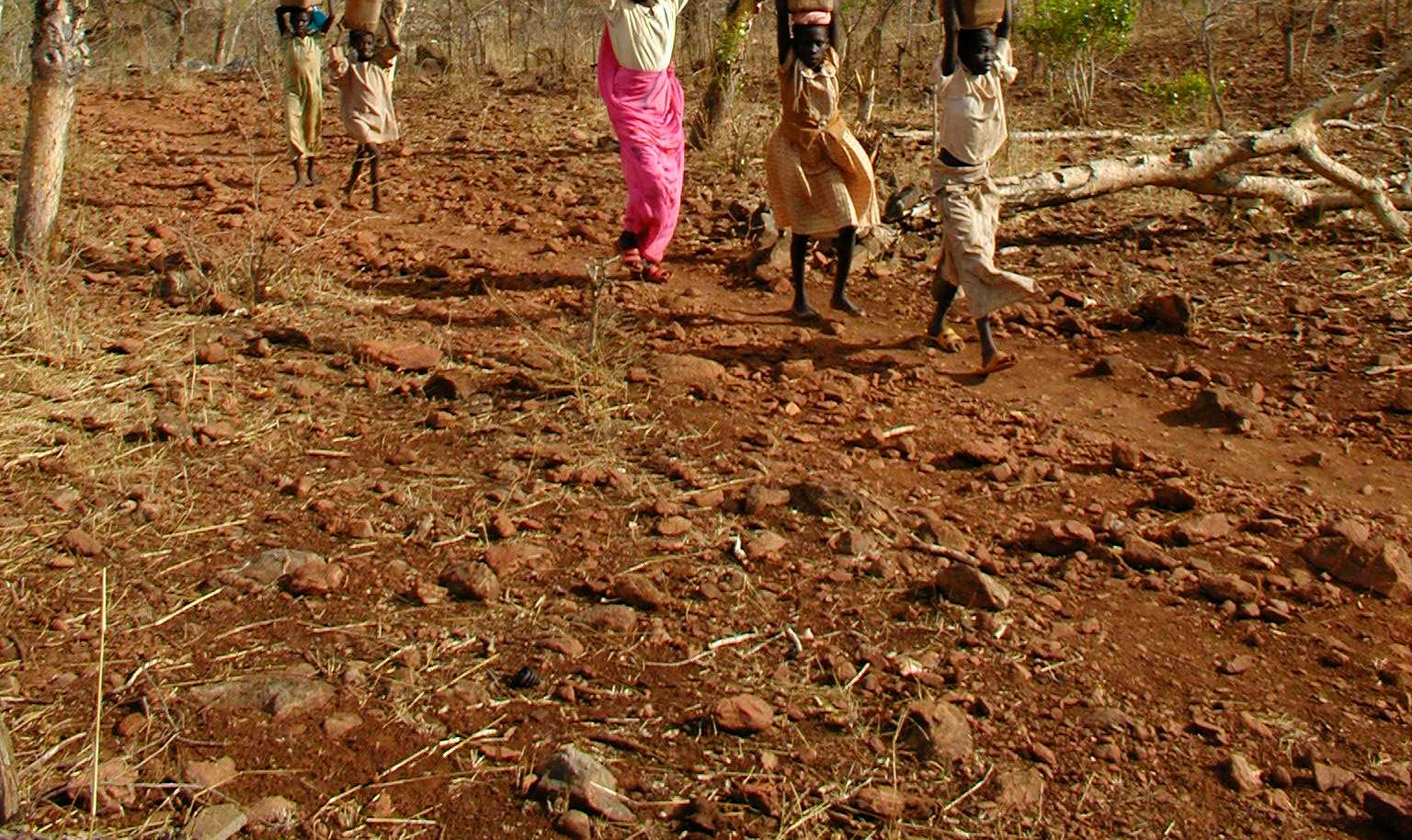
Global Mercury Project: Ingessana Hil s Sudan
Il ustration 12 - Water supply from wel s assumed by women and children.
4.2.3. Gold production and use of mercury
Gold production from quartz vein mining
It was very difficult to evaluate the quantity of gold produced from al uvium without use
of mercury and from quartz vein with mercury amalgamation.
We only estimated the production of gold from the exploitation of the gold-bearing
quartz veins which only led to the use of mercury.
Quartz extraction is a dangerous and difficult work compare to al uvium extraction. In a
shear zone gold repartition could be erratic and frequently need detailed geological and
mineralogical studies to be wel understood. Part of the miners discover this new
artisanal mining and appeared sometime disappointed. They do not have important
skil and experience to exploit quartz lenses and the mining field is a succession of old
and new wildcat holes with quartz overburden al around.
Different parameters indicated that it is possible that only 30 to 50 % of the gold
contained in the ore is recovered during the complete process and therefore by the
miner:
- Large amount of quartz abandoned on site;
- Visual selection of the best sample on site without lenses;
- Uncompleted manual grinding;
BRGM/RC-53589-FR "Draft report"
31
Global Mercury Project: Ingessana Hills Sudan
- Loss of gold during panning;
- Amalgamation process.
Sociological study and interviews carried out during our mission give some indicative
data to try to evaluate the quantity of gold produced and mercury used during artisanal
gold mining processes in the Gugub sites:
- The workers said that one worker produces 0.5 to 1 g Au/day. The production is
organised by family and the production of one worker must be considered as the
production of one family. Sociological studies indicated that adults in age to work are
around 350 in the 2 vil ages. We considered that there were 200 to 300 families
working for about 300 days per year. Taking into account this information, the
quantity of gold produced ranged from 100-300 g Au/day and 30-90 kg Au/year.
- The dealers said that they buy 5-10 g Au/day. The number of dealers identified in
the area ranges from 15 to 20. Taking into account this information, the quantity of
gold produced is 75-200 g Au/day and 22.5-60 kg Au/year.
These estimates were based on two independent sources that gave similar results.
Workers and dealer probably underestimated their production and that actual values
may be higher.
- Extraction capacity does not exceeds 20-25 kg/day/workers and the manual grinding
capacity is probably less than 5 kg/day/workers. Al the adults in age to work cannot
produce at the same time 25 kg of ore from their mining activity and grind 5 kg of it.
Persons for separated tasks are needed. In this case, Il ustration 14 indicated that to
produce 100 g Au/day from the Gugub sites workers involved must be 800 and gold
grade 30 g/t and to produce 300 g Au/day workers involved must be 1,000 and gold
grade 72 g/t. Gold analyses carried out by GRAS on Gugub quartz vein (Elnour K.
Mohamed and al., 2002) indicated that such average grade are unrealistic. The gold
analyses carried out on 53 quartz chip samples ranges between 0 and 14.8 g/t with
only 7 values exceeding 1 g/t (1.10; 1.45; 1.72; 1.90; 2.3; 4.04; 14.8).
Annual artisanal gold production estimates in Gugub sites for the period 19972002 is
450 kg Au/year (Ibrahim, 2003). But we demonstrated that the 350 individuals that
works in Gugub can not produce the quantity of gold indicated:
- Hypothesis 1: a large part of the gold sel during dry season (probably 50 %)
comes from al uvial production;
- Hypothesis 2: a large part of the gold sel during dry season (probably 50 %)
comes from gold reserves made by workers during rainy season.
- Hypothesis 3: the amount of miners working in the area is underestimated;
- Hypothesis 4: gold production estimation given is more historical then actual.
The Il ustration 13 shot during our mission (dry season) militate for hypothesis 1 or 2 :
the hand of the gold dealer is ful of al uvial gold nuggets instead of "doré" pel ets
coming from roasting.
32
BRGM/RC-53589-FR "Draft report"

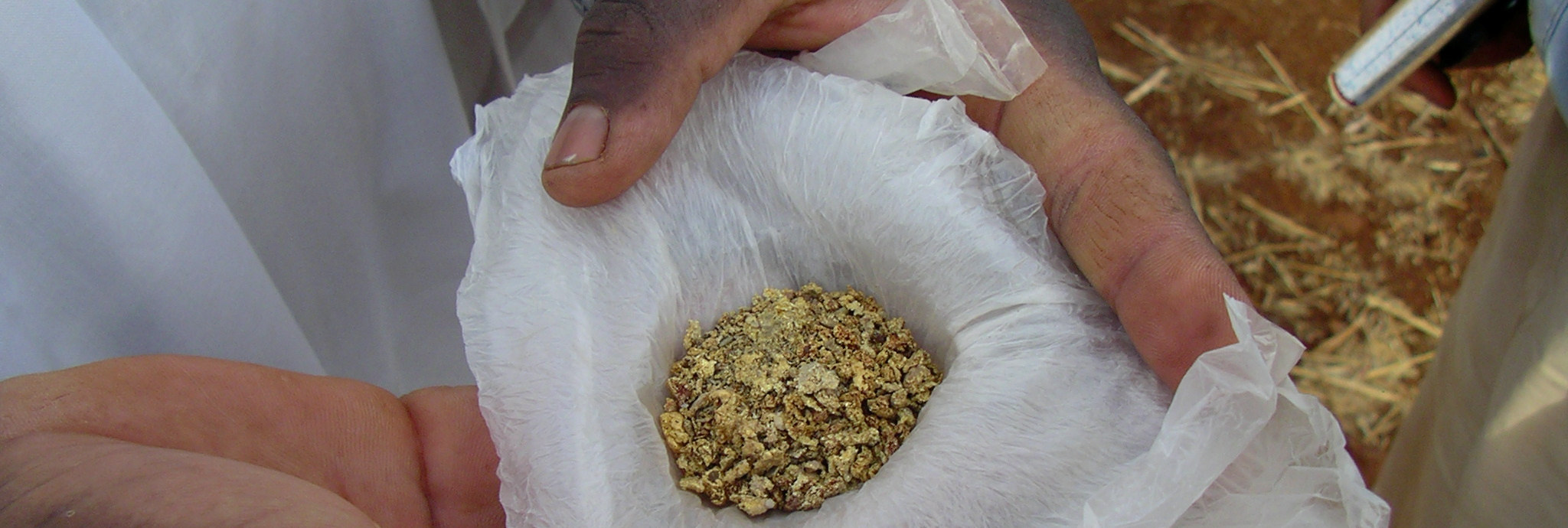
Global Mercury Project: Ingessana Hil s Sudan
Il ustration 13 - Gold "reserve" shown by a dealer.
A
B
C
D
E
F
Number of
Daily quantity of
Number of
Workers involved
Daily
Total number of
Gold
ore
Miners needed
in Crushing
Production of
workers needed
Grades
extracted needed (production = 25
needed
gold
(Au g/t)
(kg)
kg/day/workers)
(production = 5
(Au g/day)
kg/day/worker)
(A/B) * 1000
C/25
C/5
D+E
1
100000
4000
20000
24000
5
20000
800
4000
4800
10
10000
400
2000
2400
15
6667
267
1333
1600
100
20
5000
200
1000
1200
25
4000
160
800
960
30
3333
133
667
800
50
2000
80
400
480
70
1429
57
286
343
1
300000
12000
60000
72000
5
60000
2400
12000
14400
10
30000
1200
6000
7200
15
20000
800
4000
4800
300
20
15000
600
3000
3600
25
12000
480
2400
2880
30
10000
400
2000
2400
50
6000
240
1200
1440
72
4167
167
833
1000
Il ustration 14 - Estimates of number of workers and Au-grades necessary to produce 100 to
300 g of gold in a day from gold-bearing quartz vein in Gugub area.
BRGM/RC-53589-FR "Draft report"
33
Global Mercury Project: Ingessana Hills Sudan
Mercury consumption
Sociological study and interviews carried out during our mission give some indicative
data to try to evaluate the amount of mercury consumption during artisanal gold mining
processes in the Gugub sites:
- Mercury is only used to recover gold from primary ore. We demonstrate that
gold produced from primary ore is probably 100-150 g/day and 30-45 kg/year.
The ratio of Hg lost per Au produced is usual y estimated to be 1.5. Fol owing
this ratio, the quantity of Hg lost per year is 45 to 67 kg. In this figure the use of
mercury is around 250 g Hg per household of artisanal miners per year.
- The dealers said that they sel 2-4 g Hg/day/workers. On the basis of 200-300
families involved, the quantity of Hg sel per year is 200-360 kg released in the
environment. In this figure, the use of mercury is around 1000 g Hg per
household of artisanal miners
- Taking into account this information, the Hg lost/Au produced ratio is probably
higher than 3 in Gugub area. Fol owing this ratios and an annual gold
production from quartz-bearing quartz vein of 30 to 45 kg Au, the quantity of Hg
used per year is 90 to 135 kg. In this figure, the use of mercury is around 450 g
Hg per household of artisanal miners
According to Ibrahim (2003) the mercury lost to the environment annual y was 675 kg
but his estimate was based on the wrong consideration that al the annual gold
production (overestimated 500 kg per year) is coming from quartz vein mining. We
demonstrated previously that this is apparently not the case in Gugub district.
We identified 3 possible sources of loss of mercury:
- Wrong manipulation of mercury at the shop or at home;
- Lost of Hg on the ground or in the tailings during the amalgamation phase;
- Evaporation during the roasting phase
According to our field observations and the estimations performed, the annual use of
mercury in the Gugub district ranges between 250 and 500 g Hg per household of
artisanal miners.
34
BRGM/RC-53589-FR "Draft report"
Global Mercury Project: Ingessana Hil s Sudan
5. Methodology
5.1.
SAMPLING STRATEGY
After the orientation survey, covering the area selected, the fol owing points were
analysed:
- Where are the main sources of mercury pol ution in the artisanal gold mining of the
area, taking into account that the sites visited are representative of this activity in
this area?
- What are the main pol ution vectors that are likely to transfer the mercury towards a
target?
- What are the main target(s) exposed to the direct or indirect effects of mercury ?
This analysis enabled us to classify the sites we visited according to their specific
features and their ability to represent the main local and regional risks arising from
artisanal activity in this area.
The artisanal gold miner families and the (10-15) local gold merchant shops in Gugub
and in Khor Gidad constitute the same broad mercury hotspots. There is no plan of the
vil ages of Gugub and Khor Gidad. The location of the "family unit" of the miners is not
exactly known.
As in Zimbabwe (Bil aud and Laperche, 2003) and Lao PDR (Freyssinet et al., 2004)
the sampling strategy was orientated fol owing a risk assessment approach,
considering the various sources of pol utants, their transfer and pathways and the
potential targets. The fol owing table summarises the field observations (Il ustration 15).
BRGM/RC-53589-FR "Draft report"
35
Global Mercury Project: Ingessana Hills Sudan
Items Considered
Level of occurrence
SOURCES
· Shops Hg storage
· Accidental Hg spil during
amalgamation (huts & shops)
· Amalgam roasting in the hut
· Wastes dispersed
· Contamination of sediments during
panning on residues in Gugub
TRANSFER &
· Household dust contamination
PATHWAYS
· Hg vapor dissemination
contaminating the house and its
environment
· Soil contamination in the vicinity of
contaminated huts
· Sediment transportation
· Transfer to the biological chain
(fishes)
HUMANS
· Hg inhalation during roasting
TARGETS
· Household dust and soil ingestion
(mostly children in huts or yards)
· Contaminated dry Corn and
sorghum consumption
· Fish consumption (rare)
· Contaminated poultry consumption
not considered in that study
Il ustration 15 - Main components of the risk analysis.
The analysis of the system lead to reinforce the sampling in the vil ages and particularly
in and around the huts of artisanal gold miners and more general y in and around the "
enclosed family units " which grouped several huts of the same family. The main target
identified are local people. Potential risks to the ecosystem were considered to be
minor in that process.
36
BRGM/RC-53589-FR "Draft report"
Global Mercury Project: Ingessana Hil s Sudan
It was then decided to focus the sampling on the fol owing medias (Il ustration 17):
In the Gugub and Khor Gidad villages
- Top soils: potential y submitted to ingestion by local people, mostly children and
poultry. Sampling was focussed around the huts of artisanal gold miners, in the
yard of "family units" which col ect several huts and in the main square of the vil age
(school, mosque).
- Composite grab samples were taken from tailing hil s around "enclosures dwel ing"
and in garden where vegetables are being grown.
- Some Termites hil s located in amalgamation zone, in garden or inside huts were
tested in order to check if termites can concentrate Hg during hil building.
GUGUB
K. GIDAD
TAGA
Location
Type
Number Total Yard Hut Shop Total Yard Hut Shop Total Yard Hut Garden
Family
Spot
10
9
8
7
7
4
unit
(miners)
Samples
35
21
14
25
20
5
Shops and
Spot
2
2
2
2
5
5
3
2
family unit
associated Samples
13
7
4
2
21
16
3
2
Spot
6
3
Garden
Samples
11
3
Spot
2
5
Mining
Area
Samples
3
6
Spot
2
3
1
1
1
1
Reference Samples 4
3
4
2
1
1
Spot
15
11
10
2
17
12
7
2
1
1
1
1
TOTAL
Samples
66
28
18
2
58
36
8
2
4
2
1
1
Il ustration 16 - Distribution of samples (soil, dust, termite hil , tailing) by spots and type of
location in the 3 vil ages.
- Household dust: as amalgam roasting occurs sometimes in the hut, dust was
sampled in some selected huts.
- Air monitoring: Hg contents in atmosphere was performed outdoor for background
evaluation and indoor (huts) under different conditions (see below).
BRGM/RC-53589-FR "Draft report"
37
Global Mercury Project: Ingessana Hills Sudan
- Wadi and Khor stream sediments: the first objective of the sediment sampling was
oriented to control Hg mobility in the drainage pattern around the vil ages and
further in the main col ector wadi Maganza. The strategy was adapted to the field
conditions; sediments were taken mainly along the narrow streams as possible; we
col ected both sands (stream) and silty black sediments (banks).
Fifteen soil and seventeen dust sampling spots were respectively selected in Gugub
and Khor Gidad vil ages. Details are given in the Il ustration 16.
The spots sampled for the environmental study are identified on the sketch maps of
each vil age (Il ustration 18 and Il ustration 19).
Based on information from the sociological survey, reference houses were identified in
each vil age: school and mosque yard in Gugub and recent "enclosures dwel ing" out of
mining area in Khor Gidad. The selection criteria were based on the lack of artisanal
mining activity for the concerned household.
FENCE
S
T
GARDEN
D
D
T
S
S
S
YARD
S
S
D
S
S
Te
SHOP
Se
D
D
STREAM
D
STREET
S
Samples : (D) Dust (S) Soil (Se) Sediment (Te) Termite (T) Tailing
FIRE
TAILINGS
AMALGAMATION
HUT
TERMITE HILL
Il ustration 17 - Sketch map of the sampling strategy applied in the vil ages.
38
BRGM/RC-53589-FR "Draft report"
Global Mercury Project: Ingessana Hil s Sudan
· River system
· Stream sediment
As mentioned by Suleiman (2003), the extend of mercury pol ution from artisanal gold
amalgamation in Gugub and Khor Gidad vil ages could be control ed by the surface
run-off. The vil ages are located on a high relief and rugged hil side with steep dendritic
drainage system. As a result, high energy soil erosion characterizes the area during
rainy season (600-800 mm). Although the general drainage pattern of the Ingessana
Hil s is radial, steep ravines draining Gugub and the surrounding artisanal gold mining
sites coalesce on the north-east direction to join Wadi Maganza stream, which drains
the north-eastern parts of the Ingessana Hil s into the Blue Nile some ~45 km to the
north-east (Il ustration 20 & Il ustration 22).
Wadi Maganza waters contain the artisanal gold mining waste/tailings washed off from
Gugub as wel as from the mining sites. Among these products, mercury is expected to
move ahead with Wadi-fil (clay, silt, sand, gravel) along Wadi Maganza path up to the
Roseries dam reservoir at a point ~20 km south of Ad Damazin (Il ustration 2).
The objective of the sediment sampling was oriented to control Hg mobility in the
drainage pattern around the two vil ages Gugub and Khor Gidad and in the main
col ector Wadi Maganza. (Il ustration 18, Il ustration 19, Il ustration 23)
The strategy was adapted to the field conditions; sediments were taken along narrow
streams where possible; we col ected both sands (stream) and silty black sediments
(banks).
BRGM/RC-53589-FR "Draft report"
39
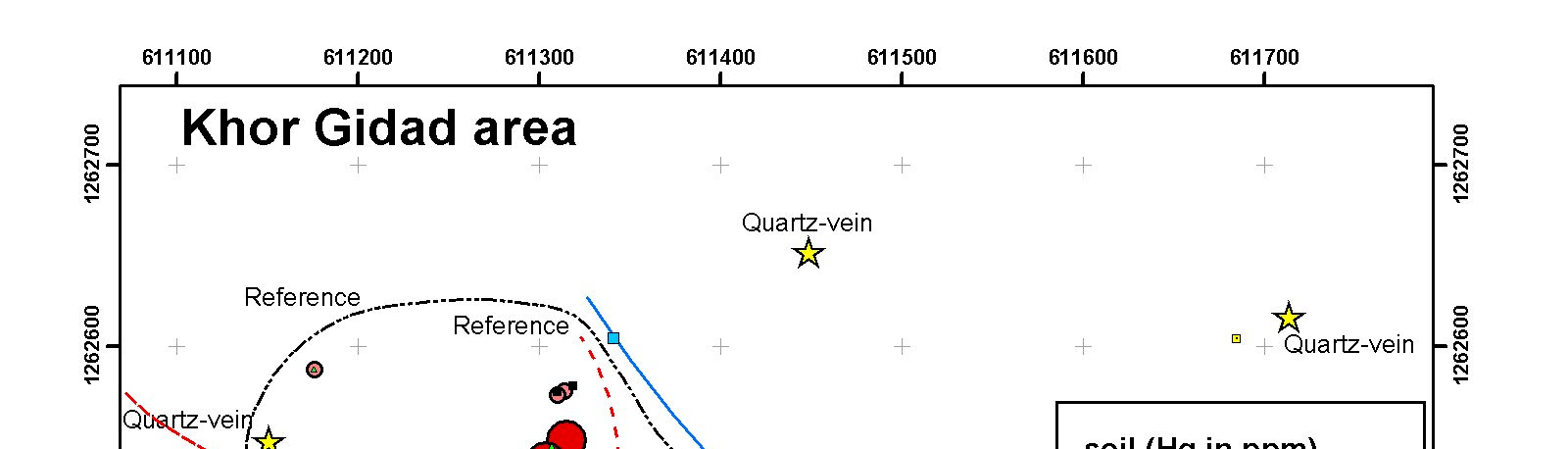
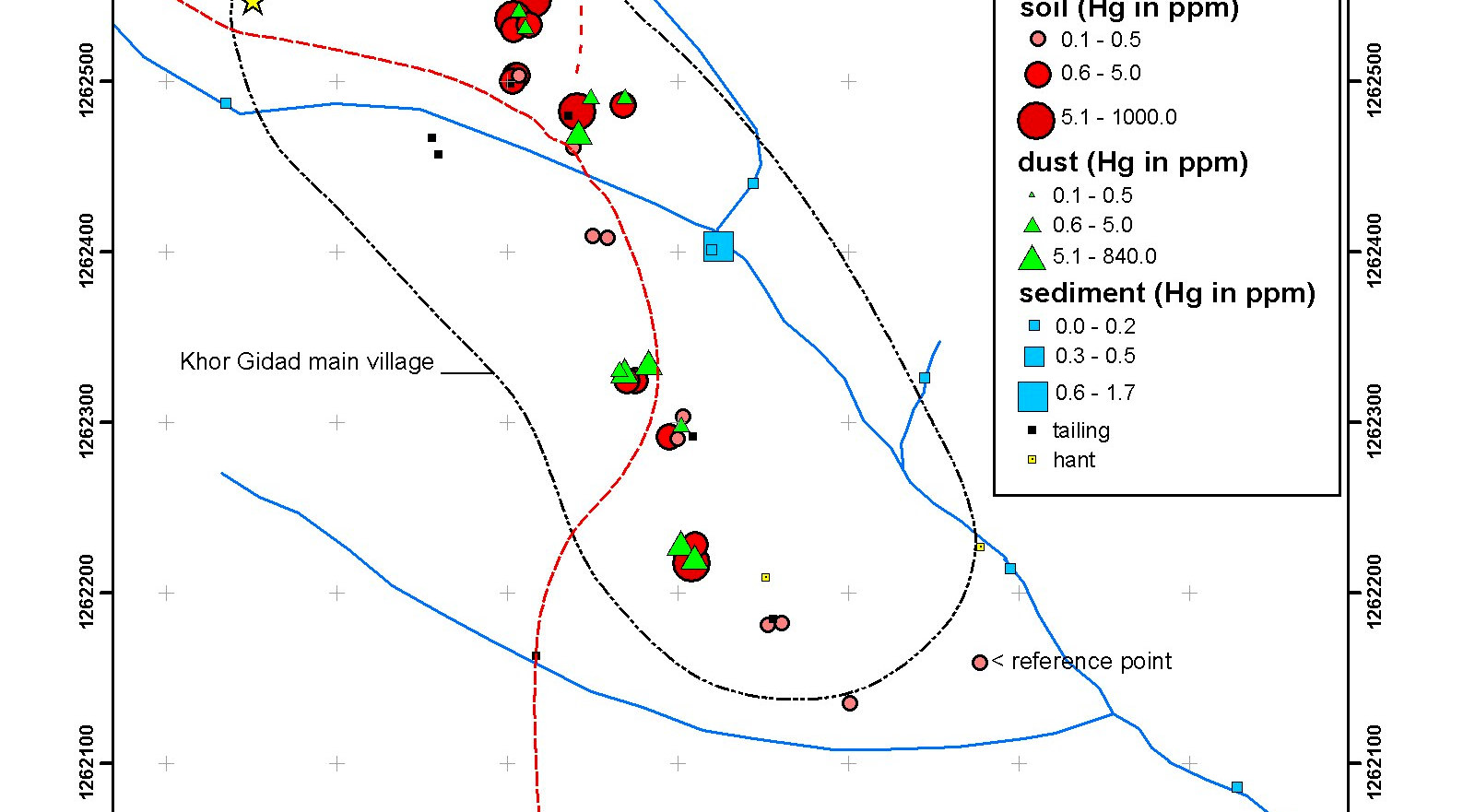
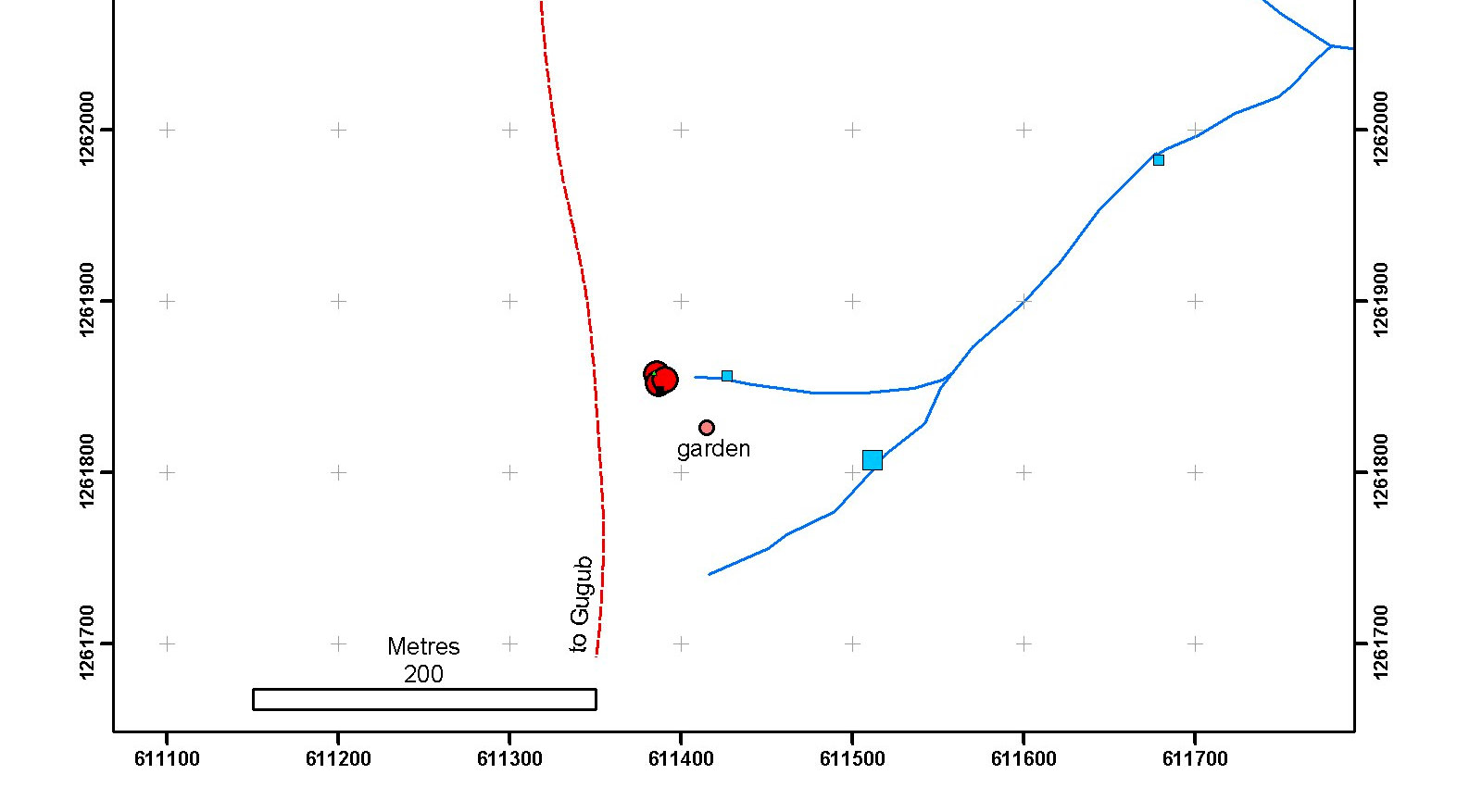
Global Mercury Project: Ingessana Hills Sudan
Il ustration 18 - Sketch map of Khor Gidad area with location of samples and results of Hg
analyses (Nota : "hant" = "termite hil ").
40
BRGM/RC-53589-FR "Draft report"
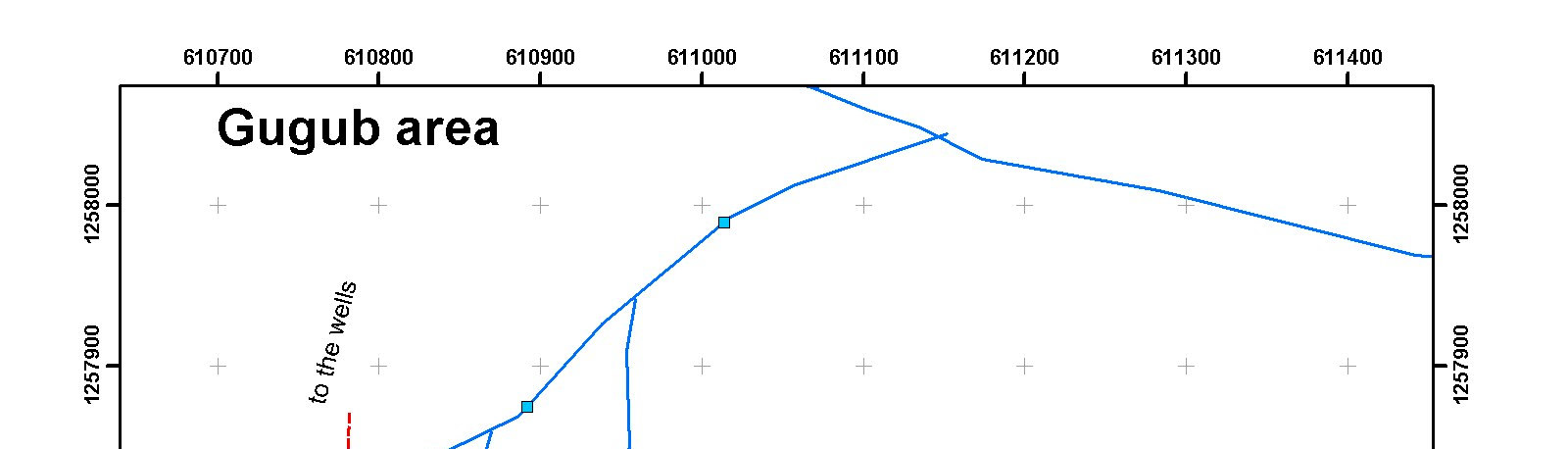
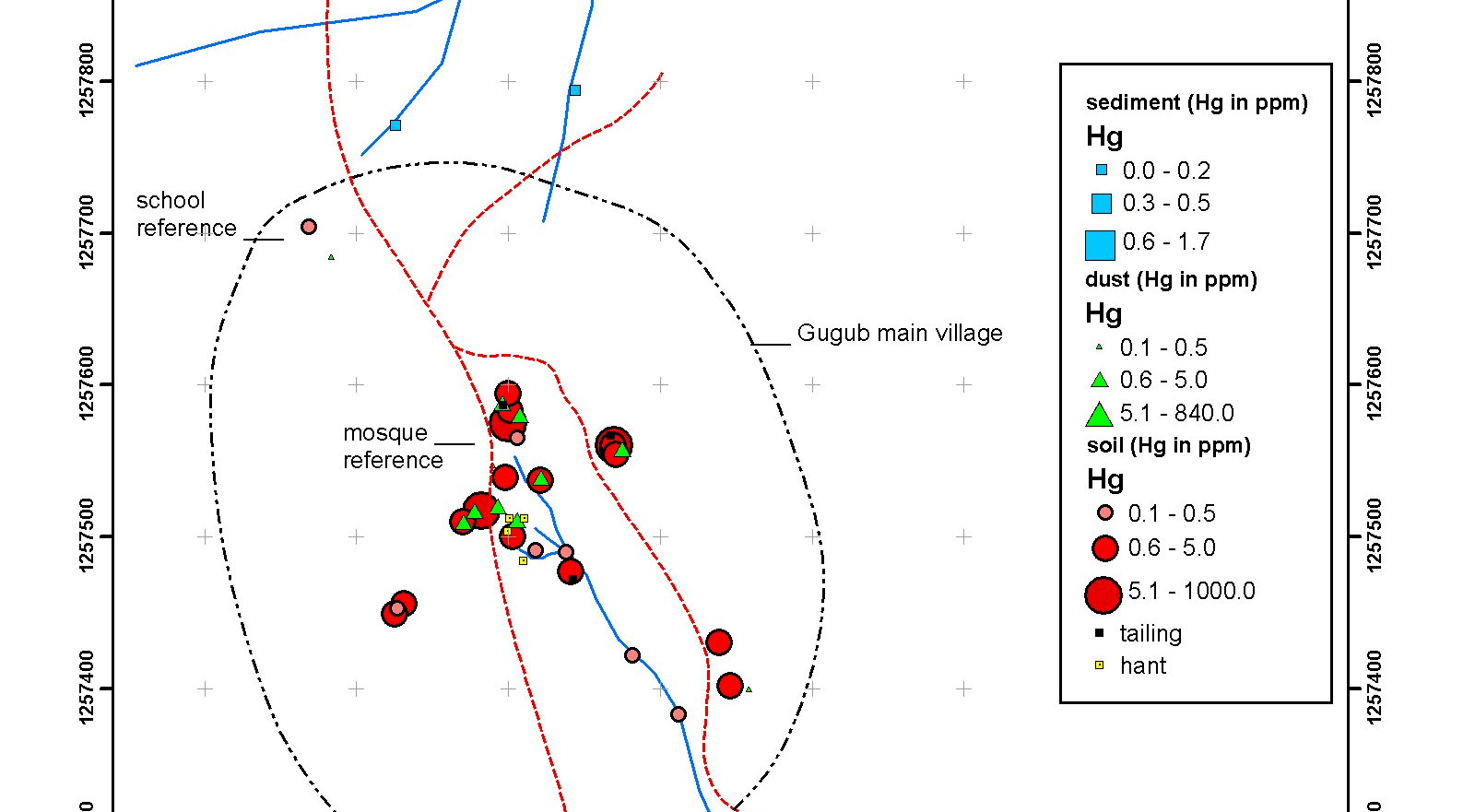
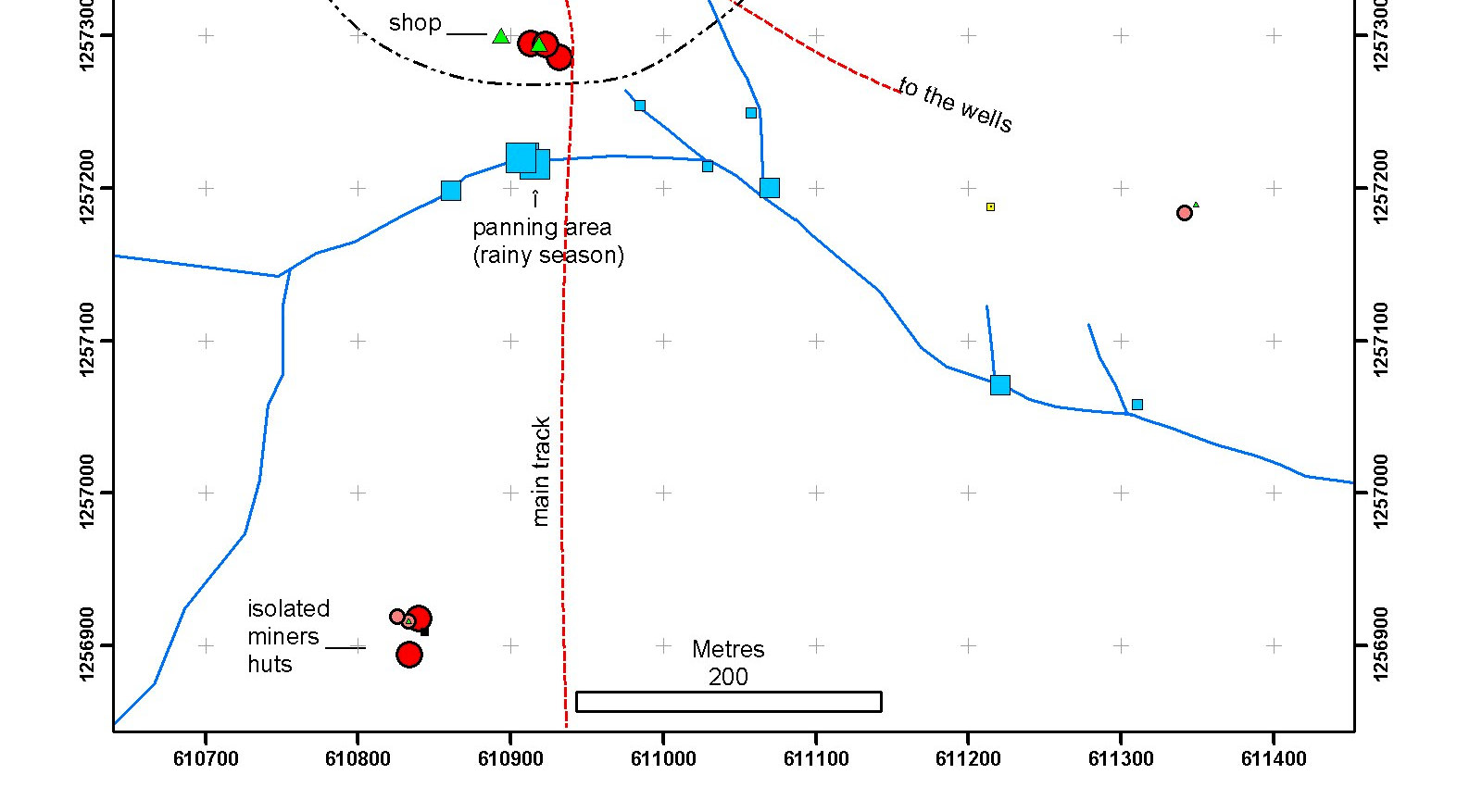
Global Mercury Project: Ingessana Hil s Sudan
Il ustration 19 - Sketch map of Gugub area with location of samples and results of Hg analyses
(Nota : "hant" = "termite hil ").
BRGM/RC-53589-FR "Draft report"
41
Global Mercury Project: Ingessana Hills Sudan
· Fish
According to the Protocols for Environmental & Health Assessment of Mercury
Released by Artisanal and Smal -Scale Gold Miners (ASM) (UNIDO, 2003), the fish
sampling strategy was carried out as fol ows:
- Identify the target species based on interviews with local people, fishermen, fish
markets and, if possible, in consultation with local or regional experts.
- Identify areas for fish sampling, including both upstream and downstream of mining
activities and, if possible, reference areas.
- Identify sampling areas that coincide with geographic areas identified as
"environmental hot spots".
We had particularly unfavorable sampling condition in the Gugub and Khor Gidad sites;
the Wad Maganza and its tributaries had dried up completely making it impossible to
catch any fish in this area.
The sociological study also indicated that fish are consumed only occasional y and
mainly dried. Fishing is an occasional occupation mainly practised by the younger
generation. According to the local people and the Sudanese participants, the Roseires
reservoir was the only site where we could find fish of different species and size, as
requested by the protocol.
Fish sampling was carried out in the Roseires reservoir due to the lack of fish
elsewhere in the selected area. The aim was to test contamination of the Nile at this
location, but not to interpret Hg release issued from the Gugub area.
Despite this situation, we managed to take some samples from two sites:
- (i) in the Roseires reservoir (fishing spots 1, 2 and 3), about 50 km to the east of
Gugub: the reservoir is fed by water from several watersheds, some of which were
affected by gold mining activities which predated those at the site original y selected
and which were probably on a larger scale, such as ~12 km east of the Blue Nile
bank at Belguwa-Sakatna, sites ~80 km southeast of Ad Damazin. Mercury input
may also come from other artisanal gold mining sites within the river catchment as
far as Qeissan some 150 km to the south.This reservoir was built in 1965 and
covers a total area of about 400 km2. A large number of fishermen catch fish here,
mainly using nets, especial y in the part furthest from the dam. Most of the fishes are
sold outside the fishing zone (supplying the city of Khartoum). The dried fish
consumed in the Gugub area is mainly brought from Ad Damazin and the Roseires
reservoir.
42
BRGM/RC-53589-FR "Draft report"





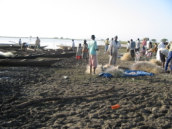
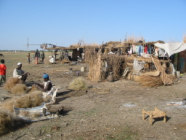
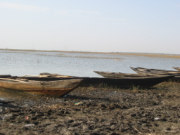
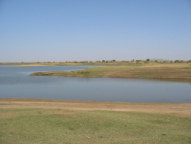
Global Mercury Project: Ingessana Hil s Sudan
1
2
3
Il ustration 20 - Location of the three fish sampling spots on the Roseires reservoir.
Il ustration 21 - Location of the fish sampling spot N° 4 in a hole in a smal dried river, in the
North of Gugub.
BRGM/RC-53589-FR "Draft report"
43
Global Mercury Project: Ingessana Hills Sudan
- (i ) in a part of the river which contained a smal water hole (fishing spot 4
Il ustration 21) we carried out a fishing campaign and were able to catch several
species of fish. Once again, this site was not directly connected to the gold washing
zone and the vil age of Gugub.
Analysis of the results relating to the level of mercury contamination in the fish must
necessarily bear in mind the constraints imposed by the sampling conditions and the
absence of any direct relationship with the gold mining site and the vil age of Gugub.
Nevertheless, they wil show the current state of mercury contamination in the fish in
this region of Sudan, especial y around the dam, which is located downstream of
several gold mining sites.
At the four fish sampling spots, catches were made by local fishermen, using nets.
Fifteen different species were col ected, with a total of 108 individuals (Il ustration 22).
The 15 fish species col ected are shown in Appendix 5.
reservoir
river
TOTAL
sampling spot
1
2
3
4
species number
8
3
7
4
15
fish number
37
15
23
33
108
Il ustration 22 Summary of the fish col ected in the reservoir and the river.
5.2.
SAMPLING PROCEDURES
Sampling procedures are described in detail in the field report (see Récoché et al.,
2004). The fol owing table il ustrates the distribution of samples per vil age and
locations (Il ustration 23).
44
BRGM/RC-53589-FR "Draft report"
Global Mercury Project: Ingessana Hil s Sudan
Location
Gugub
K. Gidad
Taga
Maganza Roseires
Total
Soil
32
31
3
66
Termite
5
3
8
Tailings
6
11
17
Dust
16
13
1
30
Air Monitoring
4
1
5
Sediment
26
13
6
4
49
Fishes
33
75
108
Vegetables
6
2
8
Il ustration 23 - Distribution of samples by media.
5.3.
ANALYSIS OF SAMPLES
5.3.1. Analysis of solid samples
The LUMEX RA-915+ analyzer equipped with the RP 91C attachment (Il ustration 24) is
intended for measuring the mercury in solid samples. The RA-915+ analyzer operation
is based on differential Zeeman atomic absorption spectrometry using high frequency
modulation of light polarization.
A radiation source (mercury lamp) is put in a permanent magnetic field. The mercury
resonance line = 254 nm is split into three polarized Zeeman components (, - and
+). When radiation propagates along the direction of the magnetic field, a
photodetector detects only the radiation of the - component, one of those fal ing within
the absorption line profile another one lying outside. When mercury vapor is absent in
the analytical cel , the radiation intensities of both components are equal. When
absorbing atoms appear in the cel , the difference between the intensities of the
components increase as the mercury vapor concentration grows.
The principle of the RP-91C attachment is based on the thermal destruction (at
approximately 800 °C) of a sample matrix and the reduction of the bound mercury in
the sample fol owed by a volatilisation and a determination of the amount of elemental
mercury formed by the RA-915+ analyzer.
BRGM/RC-53589-FR "Draft report"
45








































Global Mercury Project: Ingessana Hills Sudan
RA-915+
Module RP-91C
Il ustration 24 - The LUMEX RA-915+ analyzer equipped with the RP 91C attachment.
The quantification limit is 0.01 mg kg-1. For concentrations above 20-30 mg kg-1 a
specific single-path cel is used in place of the multiple-path cel . After stabilization of
the lamp of the RA-915+ and of the pyrolysis attachment (about 40 minutes), the
equipment was calibrated with two reference material (NIST 2711 and CANMET
STSD1). A sample (20 mg to 300 mg) is placed into a quartz spoon and inserted in the
oven. The signal acquisition is automatical y col ected through a monitoring software on
a laptop linked to the LUMEX RA-915+. The RA-915+ analyzer does not differentiate
between mercury forms; it yields a total mercury concentration. Accuracy of the method
was checked every ten samples by analysing a reference material (NIST 2709). 10% of
samples were analysed twice with the LUMEX. 10% of results were confirmed by
analysis with a reference method.
Before analysis, samples were dried (40 °C) and then ground at 80 µm. Results are
given in mg kg-1 dry weight.
Quality control procedures are summarized in appendix 7.
5.3.2. Air monitoring
The LUMEX RA-915+ analyzer without the pyrolysis attachment (Il ustration 24) is
intended for measuring the mercury vapor concentration of ambient air, both in a
stationary and continuous mode.
After switch-on, it takes about 20 minutes to stabilize the light source. When the
measurement mode is started, a zero adjustment is first carried out automatical y. Then
the analyzer measures and continuously indicates the measured mercury
concentration of the gas as both a numerical value and a graphic chart.
The detection limit and the flow rate are respectively given by the manufacturer at 2 ng
m-3 and 20 L mn-1. The multi-path cel should not be operated for too long in rooms with
high mercury vapour concentrations (higher than 10,000 ng m-3).
46
BRGM/RC-53589-FR "Draft report"
Global Mercury Project: Ingessana Hil s Sudan
Currently, there is no easily available methodology for measuring levels of mercury in
ambient air. The RA-915+ analyzer (Lumex) should need external calibration for precise
validation of air mercury analysis. This calibration has not been possible before this
mission. Absolute value given by the Lumex for mercury air concentration should
therefore be considered cautiously.
5.3.3. Analysis of fishes
Before sampling the fish flesh, standard length3 and body weight were measured on
each individual and each was photographed. A smal piece of dorsal skeletal muscle
(1.5 x 1.5 cm) was cut out and kept in a formalin solution (10 % in deionised water) in
50 mL plastic bottles. Caps were tightly screwed and covered with Parafilm.
Preliminary experiments in our Laboratory have shown no significant differences
between total Hg concentrations, expressed on the dry weight basis, in muscle
samples obtained by this procedure and in frozen samples4.
Al analyses were performed in the "Laboratoire d'Ecophysiologie et Ecotoxicologie des
Systèmes Aquatiques" (LEESA), CNRS and University of Bordeaux, France.
Total Hg concentrations in the fish muscle samples were determined by flameless
atomic absorption spectrometry. Analyses were carried out automatical y after drying
by thermal decomposition at 750 °C, under an oxygen flow (AMA 254, Leco-France).
The validity of the analytical method was checked during each series of measurements
against three standard biological reference materials (TORT-2, lobster hepato-
pancreas; DORM-2, dogfish muscle; and DOLT-2, dogfish liver, from NRCC-CNRC,
Ottawa, Canada). Hg values were consistently within the certified ranges (Il ustration
25).
Detection limit (DL) for total Hg was based on three standard deviations from blank
measurement: DL on a dry weight basis was 1.4 ng g-1. Method precision (relative
standard deviation, % RSD) of total Hg determinations, estimated from 5 replicates of
fish muscle samples, was 5 %.
Al fish muscle concentrations were reported on a dry weight basis (40°C over 2 days).
3 Standard length: from the nose to the caudal fin basis.
4 This preservation procedure was set up during the first stage of the "Mercury in French Guiana" research program,
since in most of the sites studied there was no electricity supply and biological samples could not be frozen on site. A
comparative study was done over a 4-month period, using fish muscle samples collected from one individual (N=60)
and stored at 20°C or in diluted formalin, at room temperature and at + 35°C. Replicates were collected after 1, 2, 4,
8 and 16 weeks. No significant differences were observed between Hg total concentrations (P<0.05), expressed on the
dry weight basis, for the different storage conditions.
BRGM/RC-53589-FR "Draft report"
47
Global Mercury Project: Ingessana Hills Sudan
TORT-2
DORM-2
DOLT-2
Total Hg
certified value
0.27 ± 0.06
4.64 ± 0.26
2.14 ± 0.28
(µg g-1)
measured value
0.27 ± 0.04
4.78 ± 0.33
2.08 ± 0.12
Il ustration 25 - Comparison of measured and certified values of total mercury concentrations
using three standard biological reference materials.
5.3.4. Analysis of vegetables
Vegetables samples have been cleaned several times with ultrapure water to remove
solid particles. Samples were dried at 40°C during 3 days and then ground to less than
2 mm. Between 0.1 and 0.2 g of dried samples were digested at 90 °C during 24 h in
closed teflon bottles with 6ml aqua regia. The samples were then diluted to 50ml with
ultrapure water.
Total mercury was analysed by atomic fluorescence after reduction with tin chloride.
The system used is the analyser Merlin from PSA which is composed of a continuous
flow system, a gaz liquid separator purged with argon and an atomic fluorescence
detector. Measurements were control ed by the PSA software.The reductant solution
was 5% m/v SnCl2 in 15% HCl. The standards were prepared from 1000 ppm mercury
solution (MERCK). Working standards were prepared by diluting stock standards. The
matrix of working standards is adapted to the matrix of digested samples. Typical
calibration was in the range 0-500 ng L-1.
Accuracy of calibration is checked with a different stock solution (PANREAC). Spiking
of samples before digestion control ed the whole analysis. Samples have been diluted
10 times before analysis.
In order to evaluate mercury deposition on vegetables hanging in huts where roasting
take place, the first few mil iliter of water used to clean vegetables was kept for
analyse. The volume of solution used was approximately 40-50 mL. The solutions were
digested and then analysed fol owing European standard EN13506 (water analysis by
atomic fluorescence).
48
BRGM/RC-53589-FR "Draft report"
Global Mercury Project: Ingessana Hil s Sudan
6. Results and interpretations
6.1.
SOILS
According to the analysis of the process, the most probable contamination of soil is
supposed to be related to:
- atmospheric deposition of mercury during the roasting and of the dissemination of
household dust in the vicinity of artisanal miner huts. We sampled the top soil from 0
to 2 cm depth, about 2 m away from the hut's wal s. Samples were taken along a 3-
4 m lines (Il ustration 26). Thus, soils around the hut were sampled on different side
of the hut in order to evaluate the level of contamination in the vicinity of artisanal
miner hut.
- solid deposition of mercury during the amalgamation process. We col ected
composite surface soil samples (0 to 2 cm depth) in the yards of "family unit",
around usual amalgamation sites or roasting bonfires sites. The procedure
(Il ustration 26 & Il ustration 17) consists of taking three to six samples, thoroughly
mixing them to form one composite sample and to perform the laboratory analyses
on a subsample of the composite as for the exterior hut samples.
- Composite top soil samples were col ected in the school yard, in the mosque yard of
Gugub vil age and in recent "family unit" out of mining area in Khor Gidad
considered as reference point to evaluate the geochemical content at longer
distance of the source of emissions.
- Composite surface soil samples (0 to 2 cm depth) were also col ected for evaluation
of Hg contamination in different garden close to amalgamation zone. Samples were
taken along a 3-4 m lines cross-cutting superficial drainage (Il ustration 17).
BRGM/RC-53589-FR "Draft report"
49

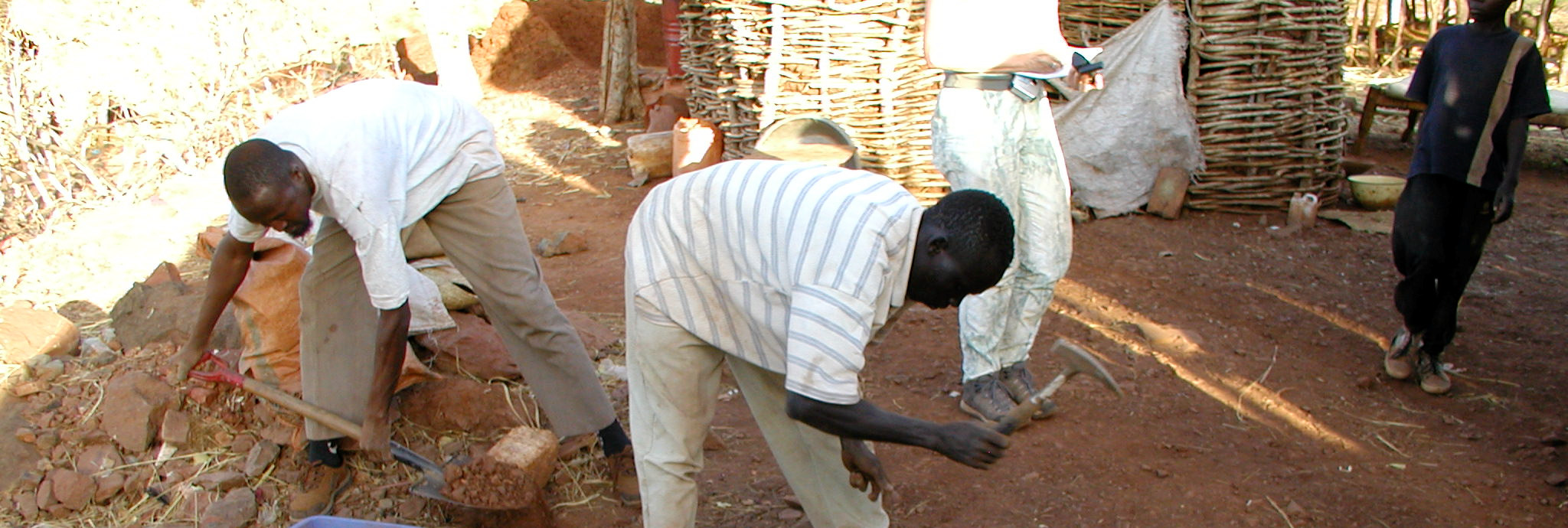

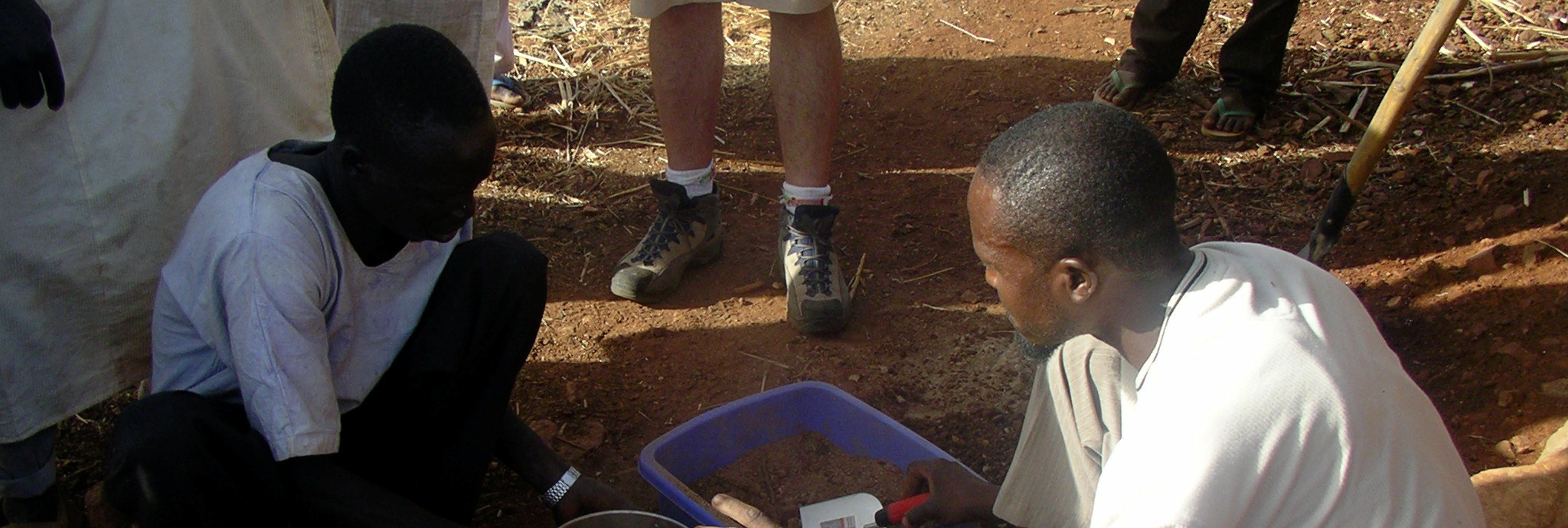
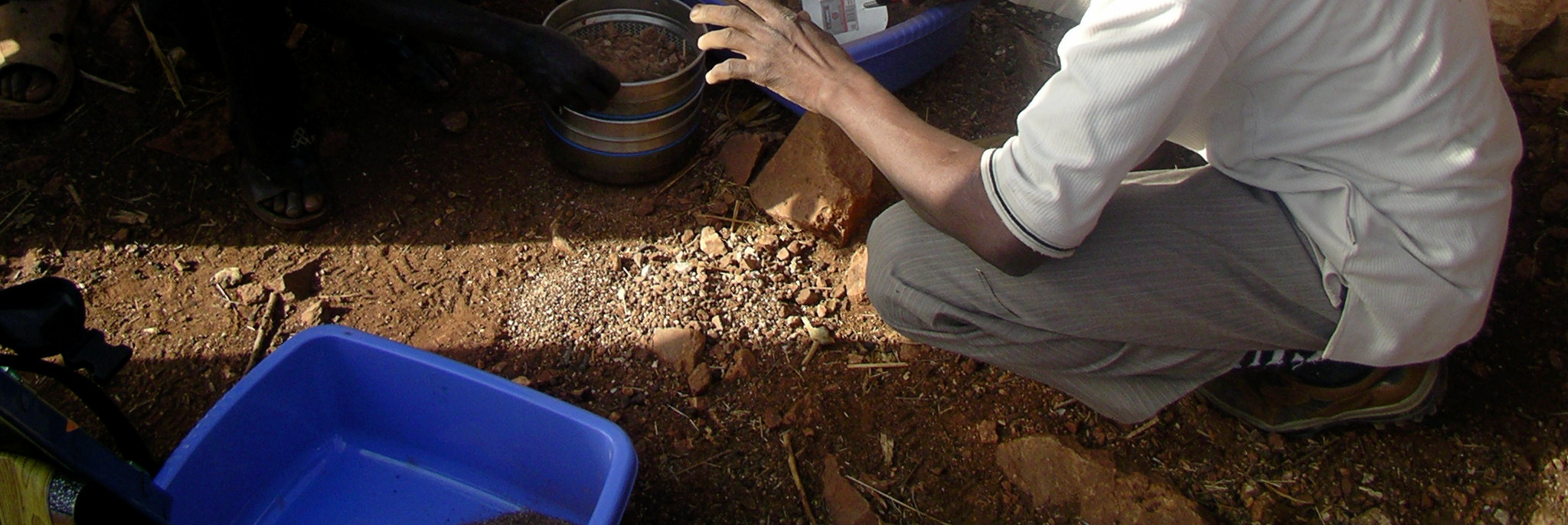
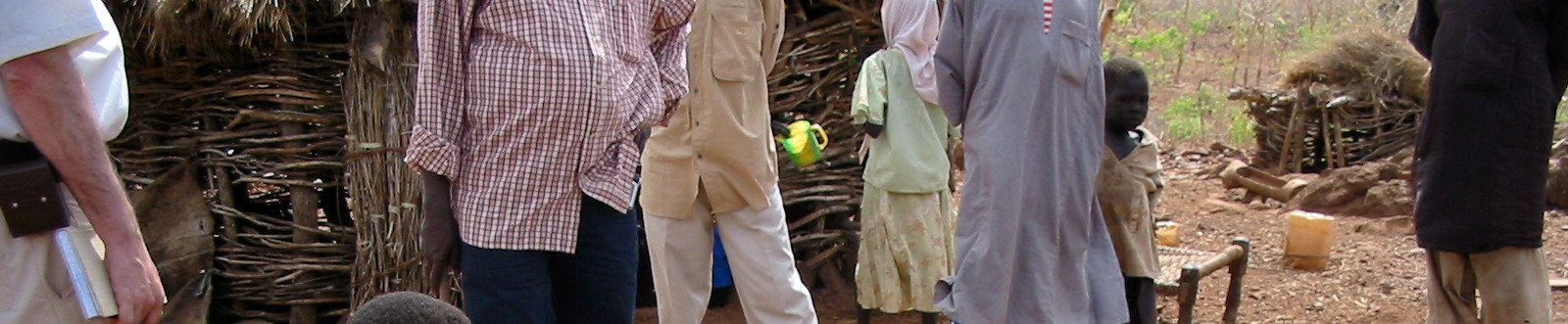
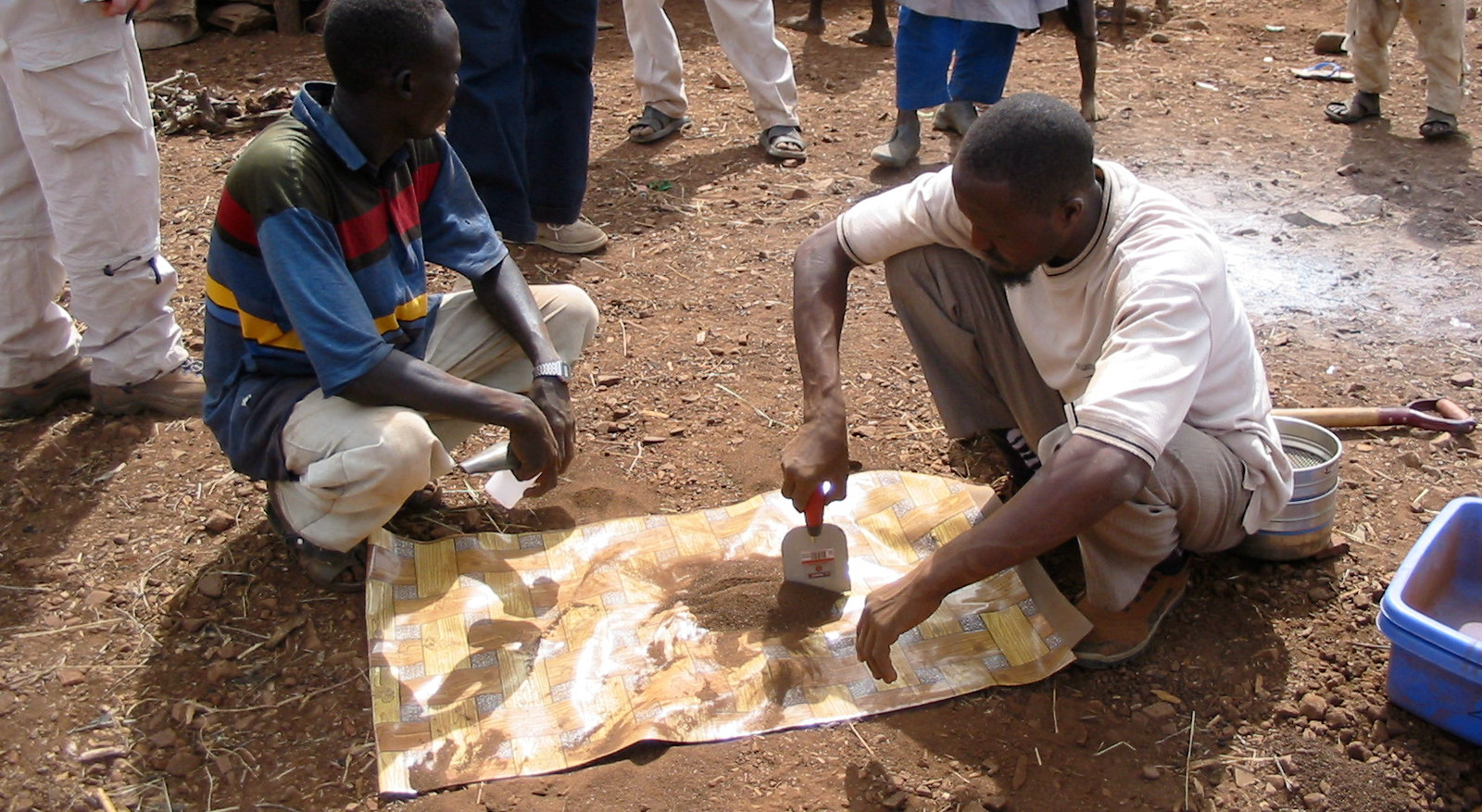

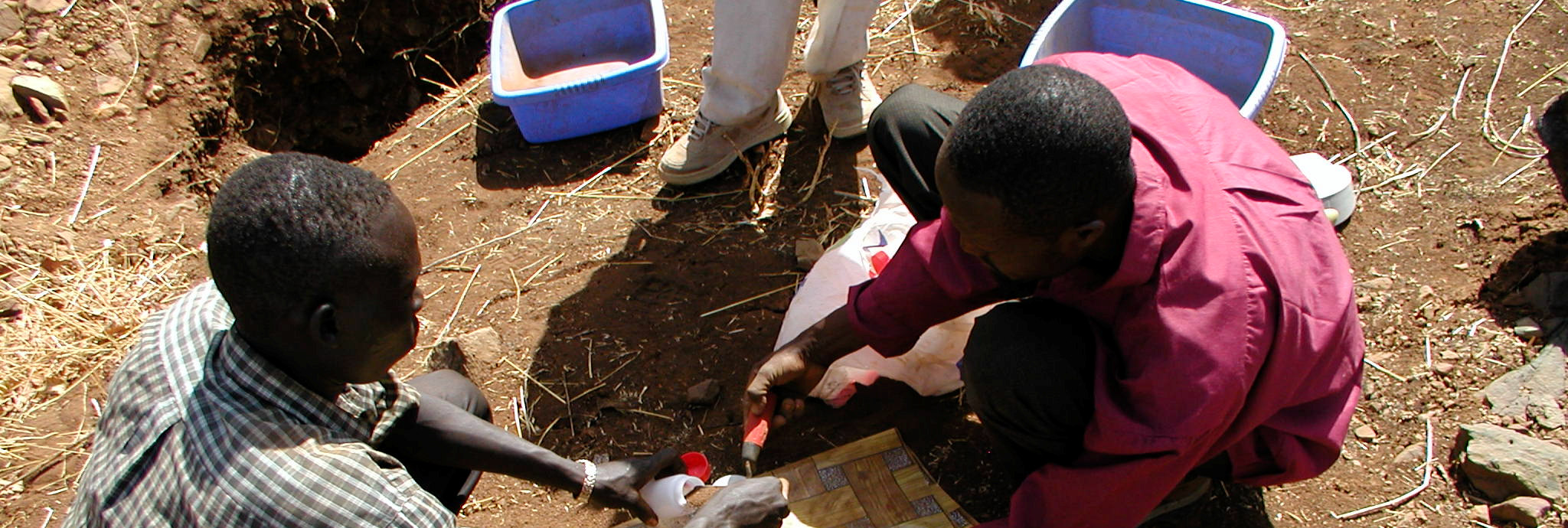
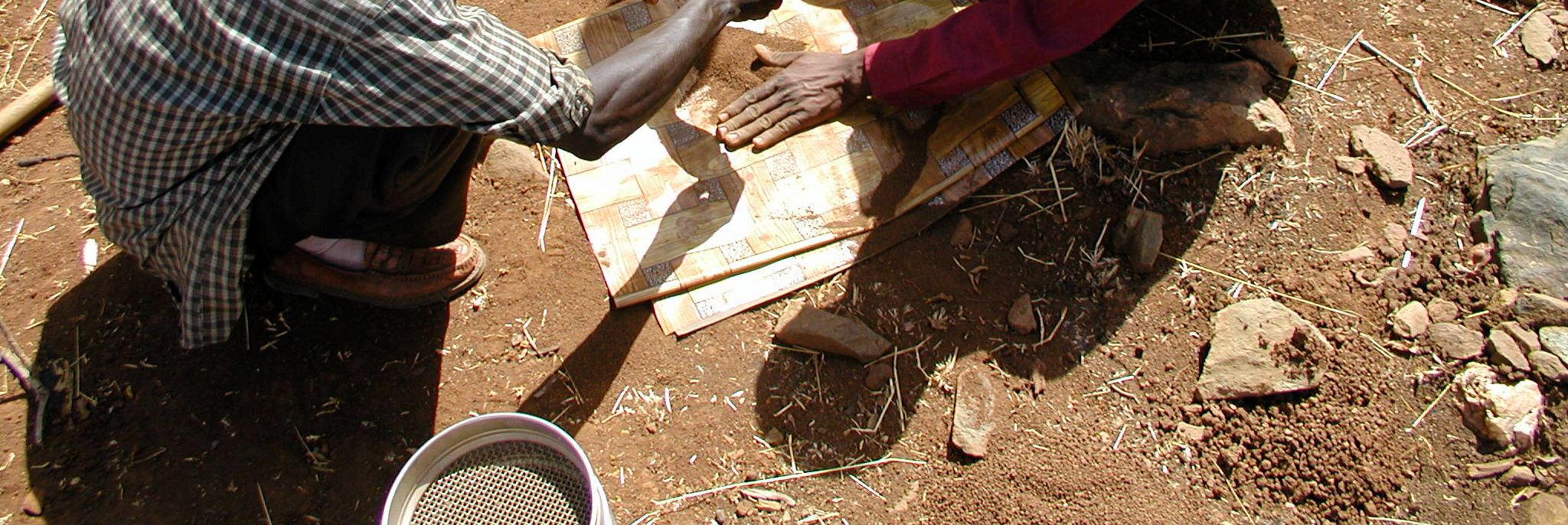
Global Mercury Project: Ingessana Hills Sudan
a
b
c
d
Il ustration 26 - Soil sampling phases (a) digging along line or point (b) sieving (c) division (d)
col ection in bottles.
Results of Hg analyses are reported in Appendix 6.
The Il ustration 27 & Il ustration 28 below show the distribution of Hg contents in soil in
term of the vil ages and il ustrates the average level of Hg content in the different
location in each vil age:
- The "natural" geochemical background given by analyses in Taga vil age and in
other reference location spots in Gugub ranged from 100 to 150 ng g-1.
- The average geochemical content in the vil age of Gugub and Khor Gidad are
around ten times higher than the local background. Medians range from 1213 in
Gugub to 640 ng g-1 in Khor Gidad.
- Higher values in the 2 vil ages (up to 106 ng g-1 in Khor Gidad and up to 27,626 ng g-
1 in Gugub) are related to zone of amalgamation where Hg droplet were visible after
panning (Récoché et al., 2004). The zones of amalgamation show values several
times higher than in others places where values are close to the local background.
- The average contents in the garden range between 130 to 280 ng g-1 in Khor Gidad
and Gugub respectively and are close to the background level. However, value in
50
BRGM/RC-53589-FR "Draft report"
Global Mercury Project: Ingessana Hil s Sudan
Gugub are higher than in Khor Gidad which could be considered as a quite new
mining area.
- The point values are higher in Khor Gidad than in Gugub but the average
background is higher in Gugub.
- School yard show background Hg contents (106 ng g-1) higher than soils sampled
around houses of artisanal miners (Il ustration 28).
- In Khor Gidad the higher contents are related to the soil around the shops where
amalgamation could be frequent and quickly performed without precautions and
around the huts of dealers. In Gugub practices look different with high content in
shops but also and mainly in the yard around huts of miners.
Location
Vil age
N
Min.
Max.
Med.
Mean
SD
GUGUB
13
275
27,626 2,585
4,273
6,894
Amalgamation
place
K. GIDAD
14
283 1,000,000 1,740
85,442
257,295
GUGUB
6
133
675
217
283
185
Garden
K. GIDAD
2
114
151
133
133
19
GUGUB
3
83
648
106
279
261
Reference
K. GIDAD
3
100
1,345
602
682
511
TAGA
3
90
148
110
106
12
GUGUB
9
430
4,966
1,716
2,116
1,437
Yard
K. GIDAD
11
100
3,328
240
763
1,000
GUGUB
31
83
27,626 1,213
2,488
4,830
Total
K. GIDAD
30
100 1,000,000 640
40,230
180,784
Il ustration 27 - Average Hg content in soil (in ng g-1) (N: number of samples; Min.: minimum
value; Max.: maximum value; Med.: median; SD: Standard Deviation).
Near the mining site (Khor Gidad), the miners make the last panning and the
amalgamation close to the mercury dealer shop. We measured high Hg values near
these places. In the vil age of Gugub, the final panning and the amalgamation are
performed more frequently in the "enclosed family unit" and mostly in the yard between
the hut where we note high values in soils.
BRGM/RC-53589-FR "Draft report"
51
Global Mercury Project: Ingessana Hills Sudan
SOIL GUGUB
8516
5260
27626
5000
4500
4000
3500
3000
2500
g
c
o
n
t
e
n
t
i
n
n
g
°
g
-
1
H 2000
1500
1000
School
500
0
W
W
W
W
W
W
W
F
W
W
W
R
W
W
W
W
W
W
W
R
R
R
R
R
F
O
O
O
O
O
O
D
D
D
D
D
D
D
E
D
D
D
A
D
D
D
D
D
D
D
A
A
A
A
A
E
H
H
H
H
H
H
E
E
E
E
E
E
E
R
E
E
E
G
E
E
E
E
E
E
E
G
G
G
G
G
o
s
q
u
e
R
S
S
S
S
S
S
M
SOIL KHOR GIDAD and TAGA (ref)
13650
7805170 000
4977
1 000 000
5000
4500
amalgamation
zones
4000
3500
3000
2500
2000
g
c
o
n
t
e
n
t
i
n
n
g
°
g
-
1
H
1500
1000
TAGA
500
0
W
W
W
W
W
W
R
R
F
W
W
W
W
W
W
W
W
W
W
O
O
O
O
O
O
O
O
O
O
O
O
F
F
F
D
D
D
D
D
D
A
A
E
D
D
D
D
D
D
D
D
D
D
H
H
H
H
H
H
H
H
H
H
H
H
E
E
E
D
D
D
D
D
D
G
G
R
E
E
E
E
E
E
E
E
E
E
S
S
S
S
S
S
S
S
S
S
S
S
R
R
R
Il ustration 28 - Average Hg content (in ng g-1) in soils in Gugub, Khor Gidad and Taga vil ages
[yard of reference (REF), "family unit" of dealer (DDW), "family units" of miners (EDW), shops
and family unit associated (SHO), and garden (GAR)].
52
BRGM/RC-53589-FR "Draft report"
Global Mercury Project: Ingessana Hil s Sudan
Several spots that were initial y considered as reference in the Gugub and Khor Gidad
vil ages, present higher Hg values than the background recorded at the reference
vil age, Taga. These values show means that are too high for reference sites in the
table of il ustration 27. At Khor Gidad it is a soil sampled in a miner's hut (SSO052) and
in a shop's backyard (SSO029). These site were said not to have been the object of
amalgamation or roasting phases. Hg contents of the two samples are respectively 600
and 1,345 ng g-1. These results show indirect ground contaminations from the
surrounding processing places.
At Gugub, Hg content of the soil sampled in the school yard (106 ng g-1) is equivalent to
the background. The soil sampled at the mosque's entry where there have been
normal y no amalgamation or processing operation show, on the contrary, a Hg
contamination (648 ng g-1 ) (il . 28). The school is located at the north extremity of the
vil age, whereas the mosque lies at the vil age centre, in the middle of huts and in front
of a shop, which could also explain and underline an indirect ground contamination
around the gold recovery centres.
6.2.
DUST SAMPLES
Depending on the information given by owner, dust sampling was carried out in
different places:
- Inside the hut where roasting was performed frequently;
- Inside huts that never been used for roasting in the same "family unit";
- Inside huts in Taga for control;
- Inside shops where frequent mercury exchanges and amalgamation are performed;
- Outside huts in the yard where families and special y children stay around roasting
or close to amalgamation spots.
By asking questions it was rather difficult to identify what was the main place of
roasting. In Khor Gidad, roasting outdoor seems to be the main way of roasting. It is
seem that the proportion is approximately 50 % outdoor and 50 % indoor in Gugub.
The grounds of each hut were brushed to col ect dust (Il ustration 29). As a control, we
col ected sometimes 2 bulk dust samples per enclosure in different huts. After division
the grab sample were col ected in a 150 mL double-capped plastic bottle. Domestic
dust samples were sieved at the laboratory at 500 µm (to eliminate pieces of charcoal,
wood, hairs...) and analyzed with the LUMEX RA915+.
BRGM/RC-53589-FR "Draft report"
53

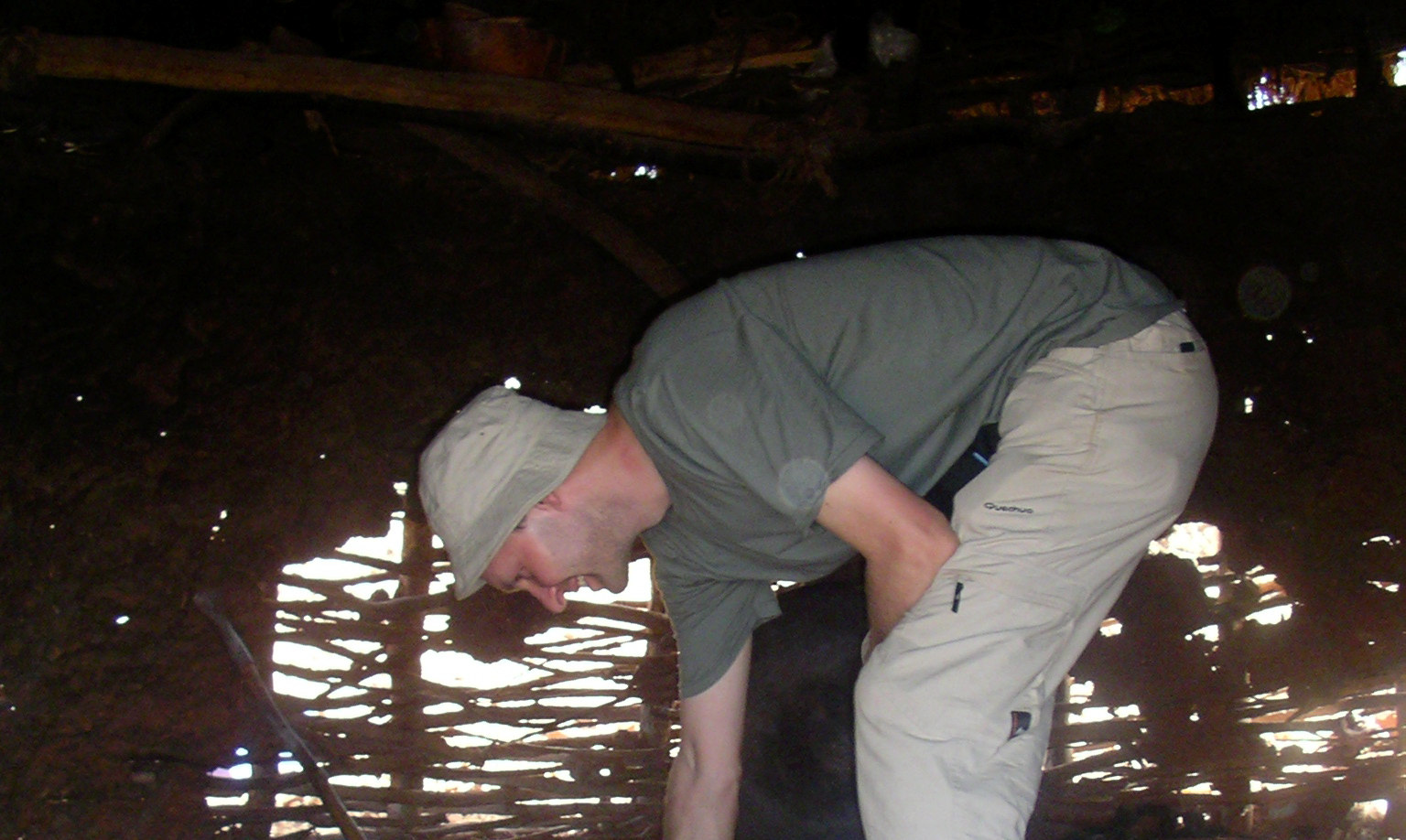
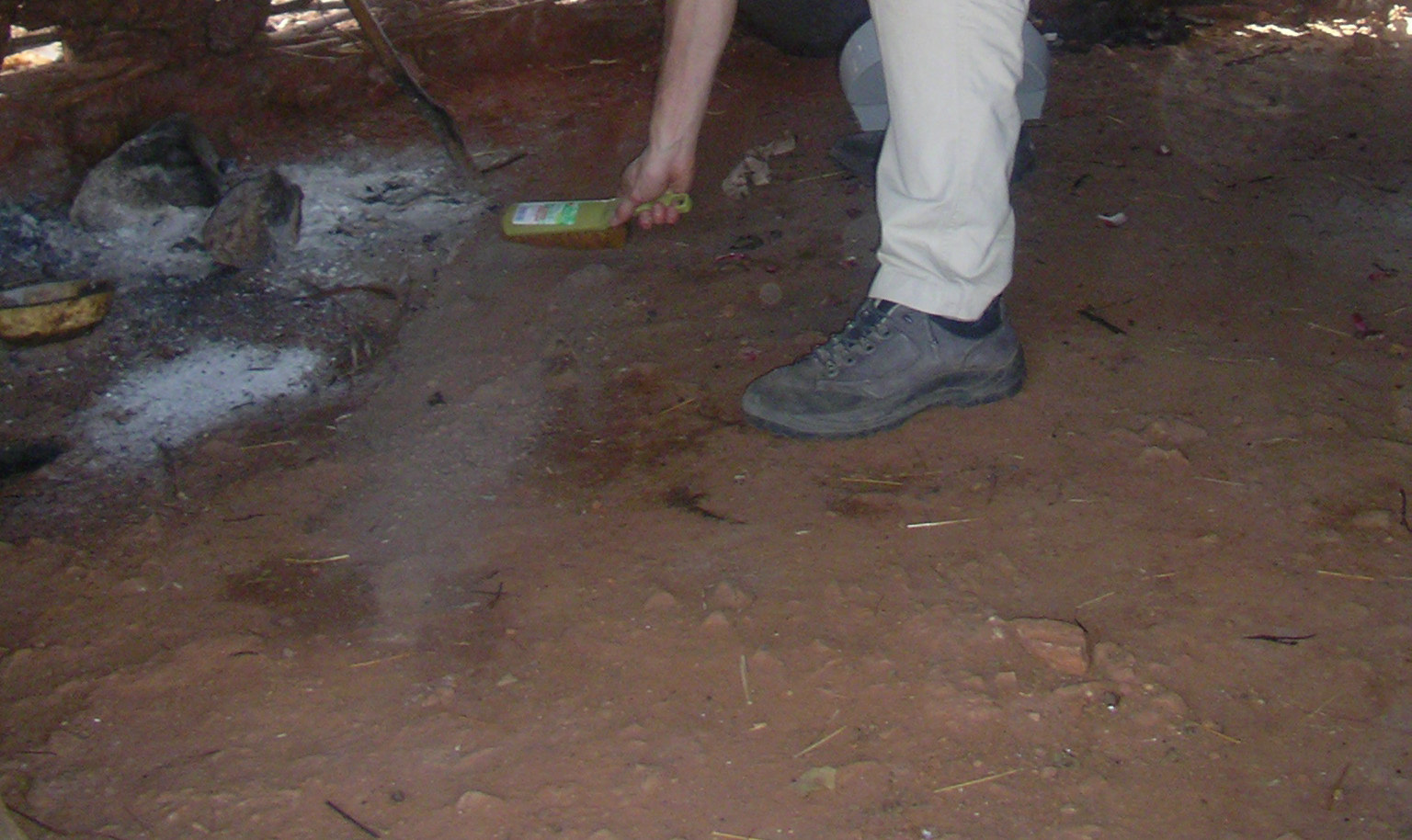
Global Mercury Project: Ingessana Hills Sudan
Il ustration 29 - Dust sampling in a hut.
Results are summarised in the fol owing Il ustration 30 & 33 and in Appendix 6.
Total
GUGUB
KHOR GIDAD
TAGA
Number
29
15
13
1
Minimum
52
52
123
183
Maximum
840,000
2,751
840,000
183
Median
1,433
1,219
3,177
183
Mean
46,860
1,236
103,094
183
Il ustration 30 - Average Hg content in dust per location type (in ng g-1).
In the reference spots (REF) the Hg contents are low and range between 52 (school of
Gugub) and 183 ng g-1 (hut in Taga). The contents are the same than those of the soils
taken there (110 ng g-1 in Taga). This homogeneity shows that domestic dust is not
particularly enriched in regard to natural soil.
In the vil age of Gugub the Hg contents in dusts taken in various places are rather
homogeneous. It ranges between 500 and 2,760 ng g-1, these values are several times
higher than the background of reference spots. The values do not depend particularly
on the samples location (inside of a hut with or without roasting, yard between several
huts, and ground of dealer's shop). The Hg contents in dusts of hut where roasting
takes place are close to those of huts having never been the object of roasting.
The Hg contents in dusts of Khor Gidad range between 123 and 840,000 ng g-1 and are
higher than those of Gugub (lower than 2,760 ng g-1). The strongest Hg contents come
54
BRGM/RC-53589-FR "Draft report"
Global Mercury Project: Ingessana Hil s Sudan
from dusts taken on the ground of trade shops (465,000 and 840,000 ng g-1). Effects of
nuggets are possible.
As in Gugub, except in the shops, there is no preferential distribution of the high values
according to the samples location. The information supplied by the inhabitants can be
indistinct but these results show that the contamination is rather general and
homogeneous at the scale of the vil ages. Average contents show significant
contamination of domestic dust in some hut and yard of artisanal miners. It is clearly
demonstrated that indoor amalgam roasting may significantly contaminate the dust of
the huts but there are no big differences between the Hg contents in soils compared to
Hg contents in dusts on al vil age.
It is not surprising to find higher values in Khor Gidad where during, our mission the
mining activity was more important and essential y concentrated on the mining of the
quartz vein, contrary to Gugub where the activity is, at present, less intense and mainly
without use of mercury. This contamination may be a long lasting effect as in Gugub,
where artisanal mining is less performed by local peoples and where dust
contamination is stil present.
BRGM/RC-53589-FR "Draft report"
55
Global Mercury Project: Ingessana Hills Sudan
DUST GUGUB
5000
4500
Shop area
Reference
4000
3500
3000
2500
2000
1500
g
c
o
n
t
e
n
t
i
n
n
g
°
g
-
1
H 1000
500
0
O
O
O
T
T
O
F
O
T
S
H
O
R
O
O
T
R
R
R
U
U
R
E
R
U
O
C
H
A
R
H
U
H
H
H
H
H
H
R
H
H
M
S
S
Y
H
S
H
840000
465000
DUST KHOR GIDAD
7206
5546
9523
5000
4500
4000
3500
3000
2500
2000
1500
g
c
o
n
t
e
n
t
i
n
n
g
°
g
-
1
H 1000
500
0
DHU
HRO
HUT
HUT
HUT
YRO
YRO
HUT
YRO
SHO
SHO
YRO
HUT
REF
Il ustration 31 - Average Hg contents (in ng g-1) in domestic dust per vil age in (HUT) Hut; (HRO)
Hut with roasting; (YRO) Yard with roasting; (MOS) Mosque; (SCH) School; (SHO) Shop; (REF)
Reference spot; (DHU) Hut of Dealer.
56
BRGM/RC-53589-FR "Draft report"

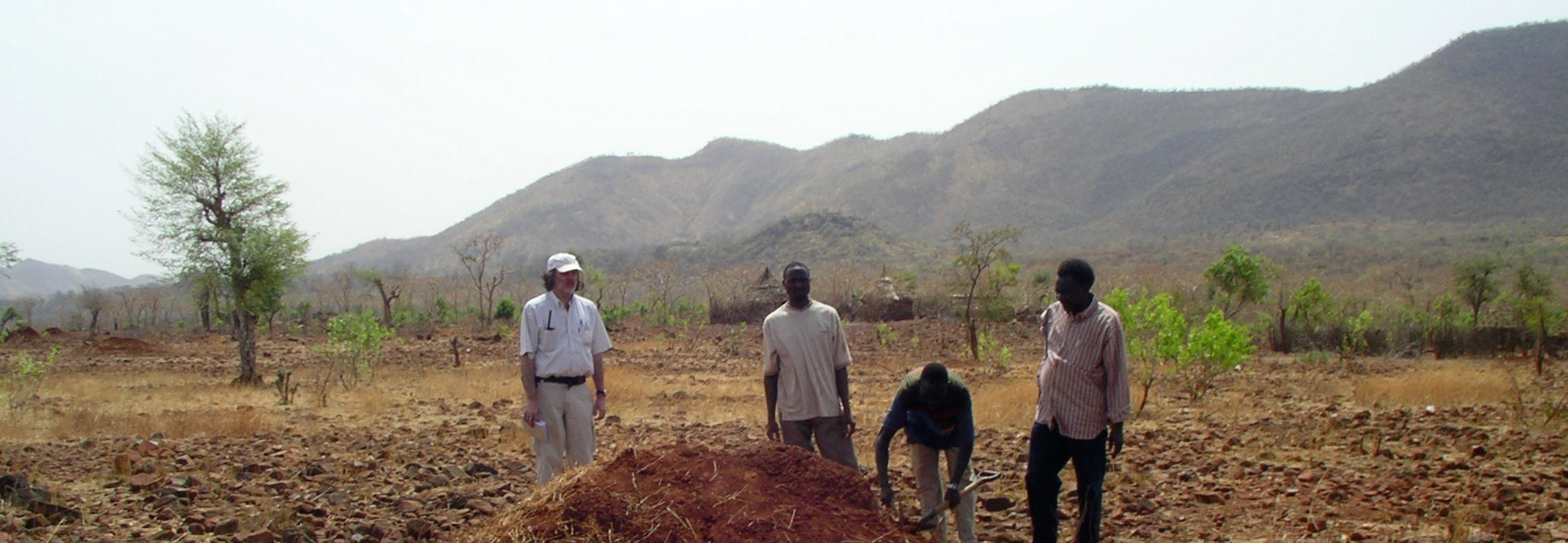
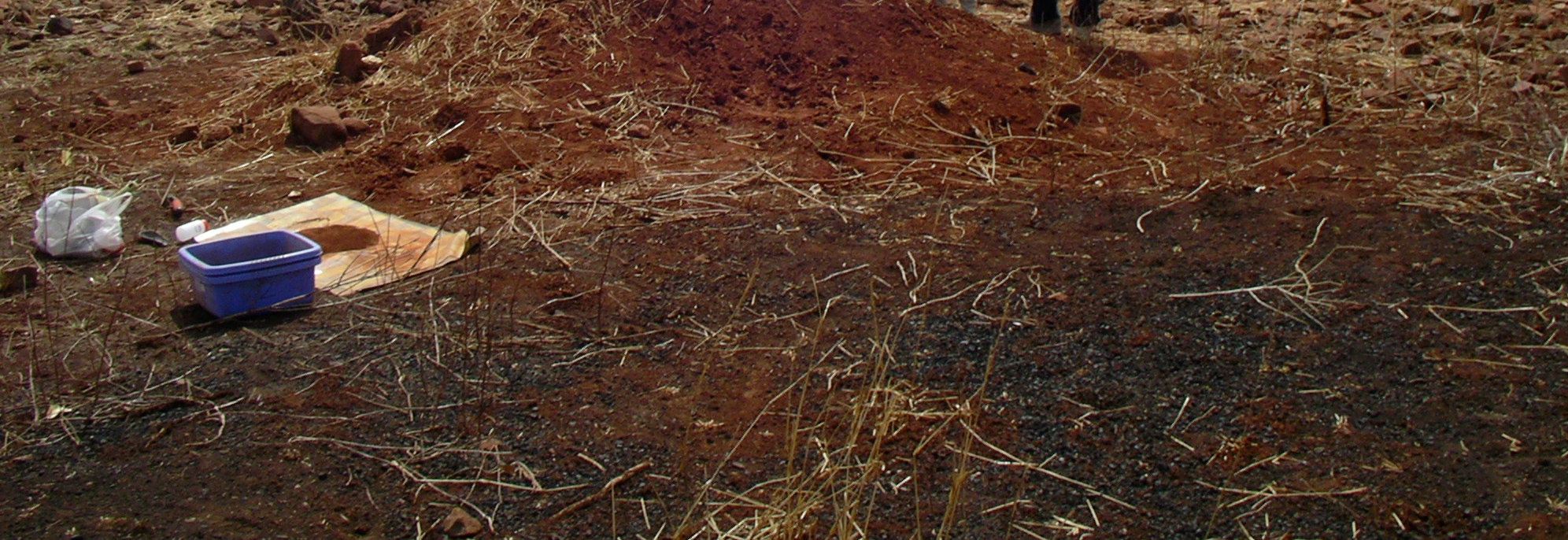
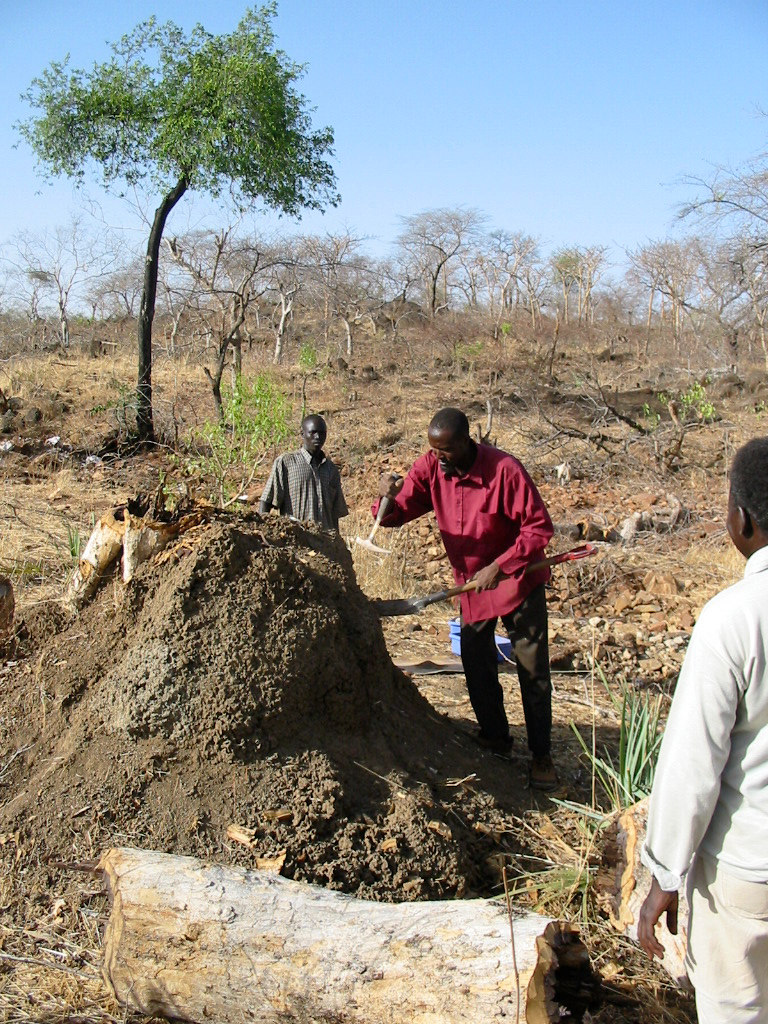
Global Mercury Project: Ingessana Hil s Sudan
6.3.
OTHER SOLID SAMPLES
6.3.1. Tailings and residues
Composite grab samples were taken from tailing hil s around enclosures. Sampling
protocol was the same as for soils: sieving to pass 2 mm, division, col ected in a 150
mL double-capped plastic bottle.
Il ustration 32 - Sampling of tailings (left) and termite hil s (right) around mining areas and
vil ages.
In both vil ages of Gugub and Khor Gidad the Hg contents in the tailing are divided in 2
populations (Il ustration 33):
- a main population with value close to the local background and
- a population presenting Hg contamination higher (from 1,550 to 2,630 ng g-1 in
Gugub) and sometime very high (62,300 and 72,500 ng g-1 in Khor Gidad).
In the 2 areas, the tailings sampled on mining sites closed to pits and trenches
(STA004, STA005, and ST014 to STA016) presented the lowest values and confirmed
that there was no mercury used on the mining sites. In the vil age of Gugub, the highest
values corresponded to tailings located in gardens (STA003 and STA017). In Khor
Gidad the sample STA007 (62,300 ng g-1) is a tailing constituted by ash and residues
of amalgamation at the border of the main road and the sample STA013 (72,500 ng g-
1) is a tailing also constituted by ash and residues of amalgamation located in the yard
of a group of hut ("family unit").
The difference between these two populations could be related to the proportion of
residues of amalgams or ash content in the tailing. The high values measured in Khor
Gidad tailings could correspond to recent tailings where no phenomenon of superficial
washing took place. The ancient tailings of Gugub were able to undergo this washing
what would explain their lower Hg content and their homogeneity.
BRGM/RC-53589-FR "Draft report"
57
Global Mercury Project: Ingessana Hills Sudan
These results show a contamination of these tailings which can be sometimes
important. Their number and location in gardens or within the "enclosed family units" is
a problem to be taken into account in the future operations of environmental
management in the area.
TAILINGS
62300
72500
5000
4500
4000
3500
3000
2630
2500
2000
g
c
o
n
t
e
n
t
s
i
n
n
g
g
-
1
GUGUB
K. GIDAD
H
1500
1000
500
0
STA005
STA004
STA002
STA001
STA017
STA003
STA015
STA014
STA010
STA012
STA009
STA011
STA008
STA016
STA006
STA007
STA013
Samples
Il ustration 33 - Hg contents in tailings in the vil ages of Gugub and Khor Gidad (in ng g-1).
6.3.2. Termites mounts
Big Termites hil s are scattered in the area. Some are located in amalgamation zone, in
garden or inside huts. We selected 8 of them as test in order to compare results from
soils sample in the same area and check if termites can concentrate Hg during mount
building. Sampling protocol was the same as for soils grab sampling (Il ustration 32).
The Hg contents are homogeneous and ranged from 28 to 315 ng g-1 (Appendix 3 &
Appendix 6). The values are closed to the background value and indicate that there is
no concentration effect associated in termite mounts. Termite mounts sampled in the
vicinity of soils contaminated by mercury show relatively low Hg contents than in the
soils.
58
BRGM/RC-53589-FR "Draft report"

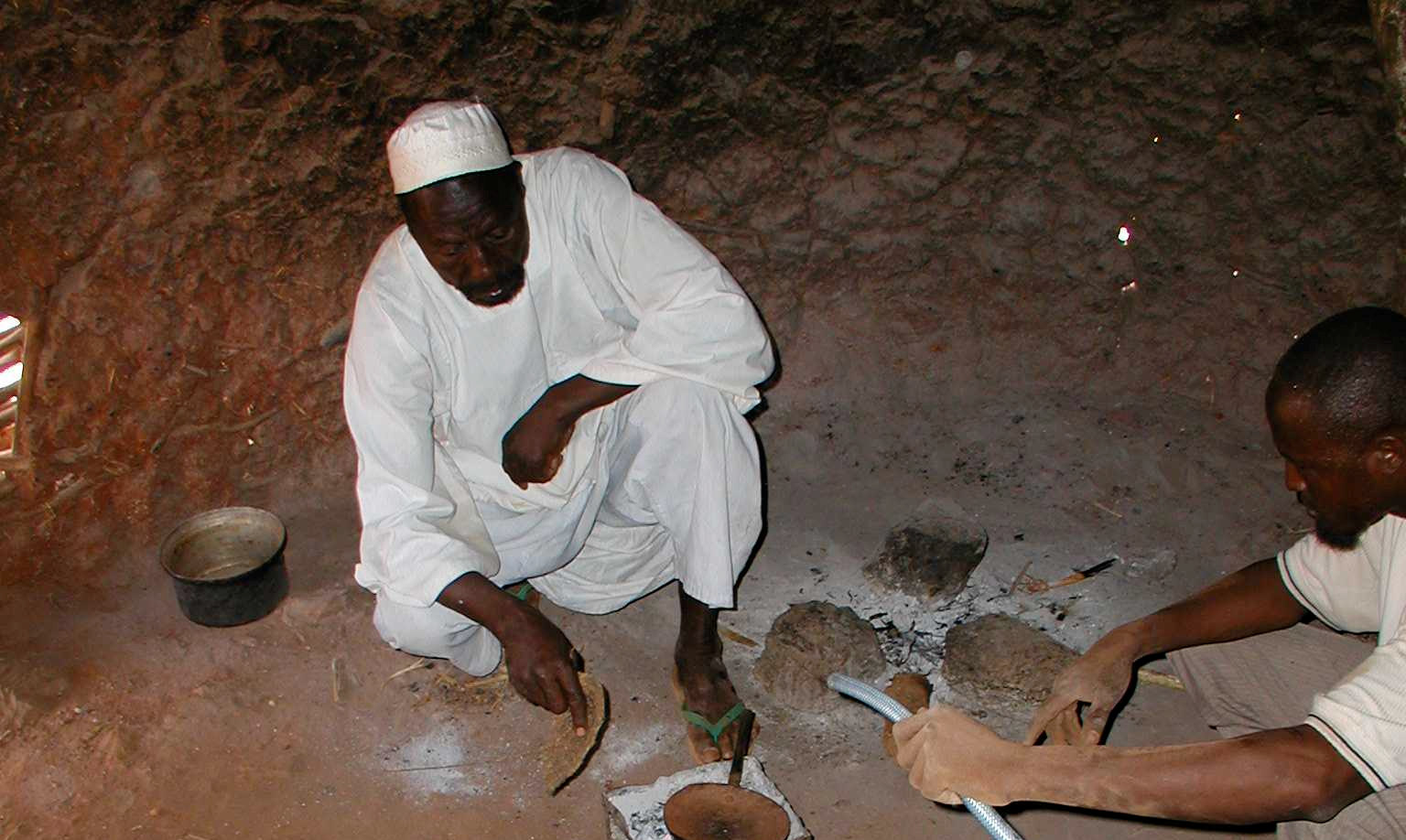
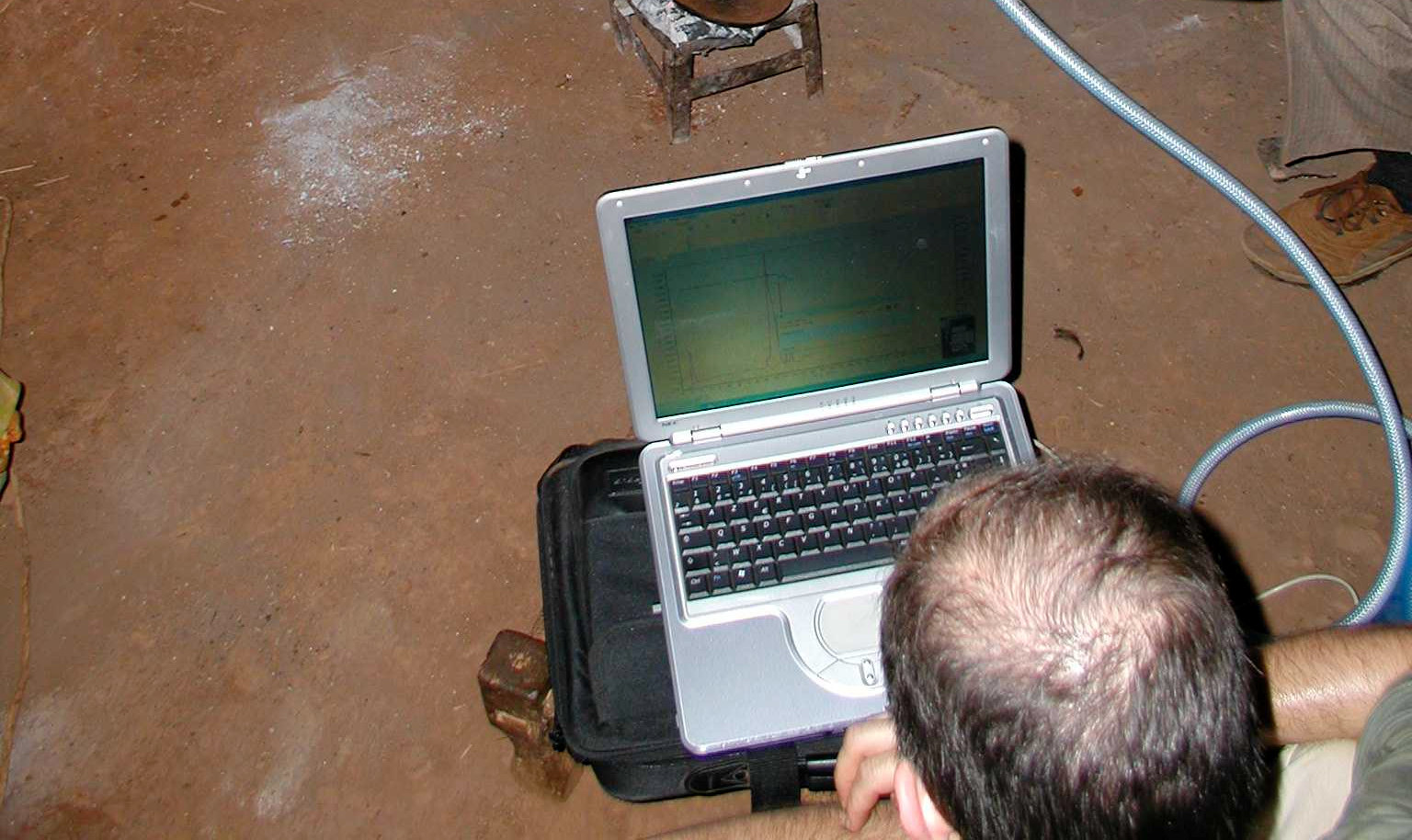

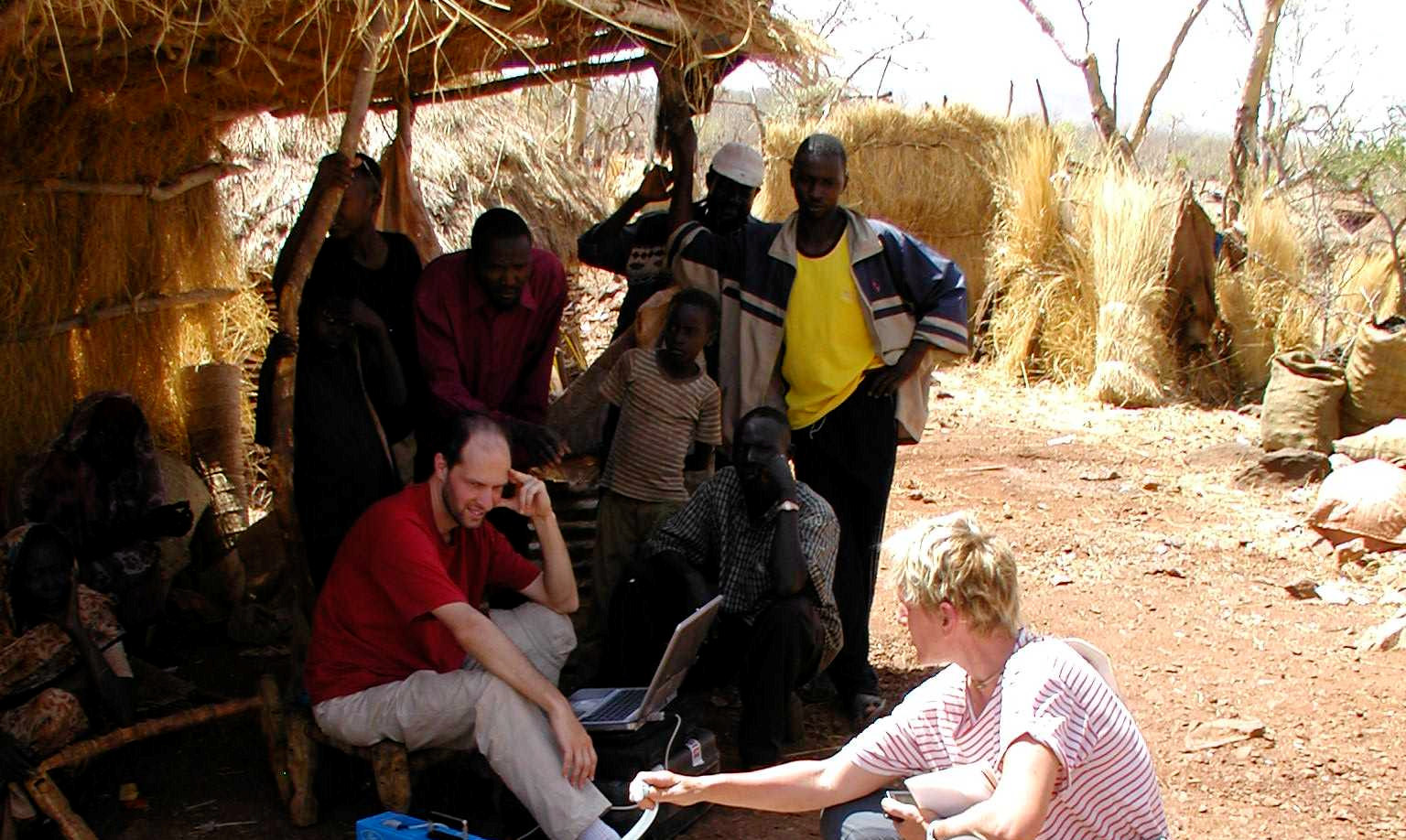
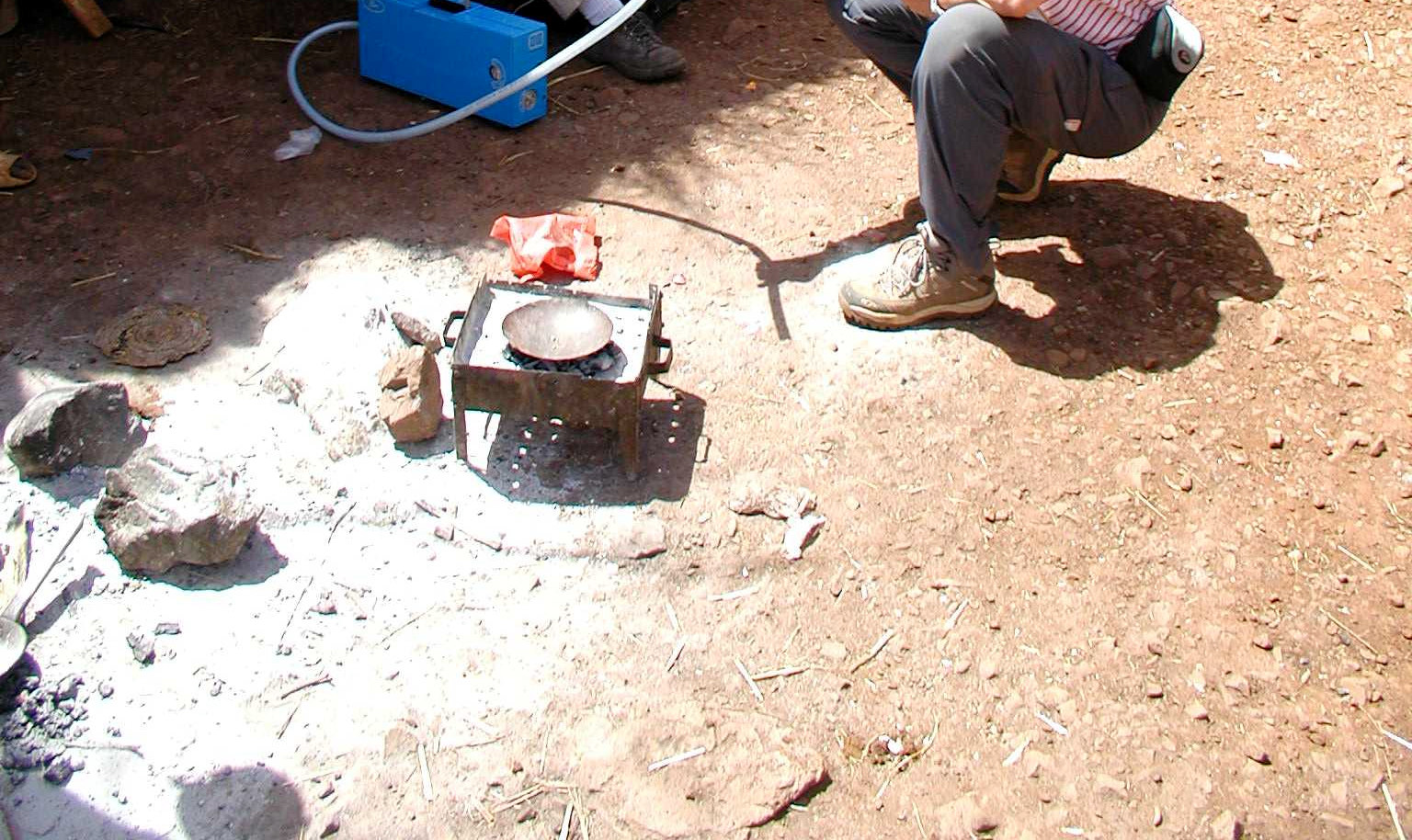
Global Mercury Project: Ingessana Hil s Sudan
6.4.
AIR MONITORING
6.4.1. Methodology
The two sites studied during this mission have been Gugub which is the main vil age of
the area and Khor Gidad rather considered as a working place. The way of using
mercury is the same in the two vil ages: people are doing amalgamation near the huts
and then, roasting takes place outside or inside the hut depending on the families.
When roasting is done inside, the same fire is used for cooking.
Due to the great possibility of mercury contamination for people during this phase, the
roasting phase has been chosen as the most interesting phase for air monitoring.
Moreover, Gugub was chosen for most of the monitorings because it was easier to ask
for specific demonstration of roasting to the habitants. During the mission, we never
saw any roasting phase without asking for a demonstration. Most of these
demonstrations were done by men.
We present monitorings recorded during roasting demonstration in two typical huts in
Gugub and one monitoring during roasting demonstration outside (Il ustration 34). In
the two huts, dusts, soils and sometimes vegetables have been also sampled.
a
b
Il ustration 34 - Monitoring during roasting (a) inside a hut in Gubub and
(b) outside at Khor Gidad.
BRGM/RC-53589-FR "Draft report"
59
Global Mercury Project: Ingessana Hills Sudan
The hut named A is a typical one : circular room of 3-4 meters of diameter, very little
aeration and a fire place for roasting and cooking near the wal . The other one named
B is a more organised hut with a very wel delimited place for the roasting fire. The
structure of the hut al owed a better evacuation of the smoke due to openings at the
junction between the wal s and the roof. This second type of hut is very rare compared
to the first one.
In the typical hut (Type A) the Hg content in dust sampled on the ground is 2,751 ng g-1
and in the more organised hut (type B) it is less : 434 ng g-1.
The monitoring sequences were performed to estimate the air quality breathed by the
population. For this, the intake hose of the RA-915+ analyzer was instal ed
approximately at nose height of the persons involved. During the amalgam roasting
phase, the intake hose was placed at the same distance of the fire than the person
performing the roasting.
6.4.2. Description of results
Roasting in a typical Hut (Type A)
There are four steps during the air monitoring of the amalgam roasting shown in
Il ustration 35: the background situation before roasting, the roasting phase, a step of
high mercury concentration after the roasting and the return to the initial situation.
120000
Signal overrange
100000
80000
Beginning of
3
roasting
g
/
m
60000
n
g
H
End of
roasting
40000
20000
0
0
100
200
300
400
500
600
700
800
900
Time (second)
Il ustration 35 - Air monitoring in a typical hut in Gugub (type A) before, during and after the
roasting of an amalgam.
60
BRGM/RC-53589-FR "Draft report"
Global Mercury Project: Ingessana Hil s Sudan
During the first step (0-70 s) the fire was already lighted for the cooking. The mercury
concentration was rather stable (less than around 200-300 ng m-3). When the roasting
starts, the mercury concentration increases very rapidly with a few maximum peak
values up to 70-90,000 ng m-3 (qualitative value because the Lumex indicated
overrange signal). This step lasted 3 minutes (as the roasting operation in this case)
with a period for maximum peaks of less than 30 s. After three minutes the mercury
concentration was back to the initial level. The third step occurred after the roasting
was stopped. This step is characterized by a rapid increase of mercury level in air with
maximum values up to 80-100,000 ng m-3. This second period of high levels is longer
than the first one (6 mn) and the average mercury concentration is higher than during
roasting. The final step is a stable background level.
Two important observations about the monitoring of roasting in huts:
- The exposure limit for workers exposed to mercury is 25 µg m-3 (average air
concentration for an 8 hour shift, WHO, 1994). The period during which high
mercury concentrations (around or above 25,000 ng m-3) have been
detected is 10 mn which is far below the recommendations of WHO.
- The second peak of mercury concentration is unexpected and is more
intense than the peak observed during the roasting phase. The first peak is
attributed to the volatilisation of the mercury from the amalgam and the
second peak is probably due to a late recondensation of mercury aerosols
emitted during roasting. The same phenomenon has been observed in air
monitoring in Lao PDR (see Freyssinet et al, 2004). This condensation
phase indicates that a large part of mercury emitted in the hut remains
inside and therefore could accumulate in dusts on the floor, on wal s, on
vegetables hanged in the hut ... The second point is that this condensation
phase concerned al the hut unlike the period of roasting (local evaporation
near the fire). Al the people present in the hut at this moment could
therefore breathe this mercury vapor (not only the person near the fire).
Roasting in hut type B
The four same steps during the roasting in this type of hut (Il ustration 36) can be
observed as in Il ustration 35. The main differences are:
- A more agitated period (more mercury peaks) during evaporation of the
amalgam because of an active agitation of fire by the man who is burning
the amalgam. This period is longer than in Il ustration 35 (around 5 mn from
60 to 360 s). The peak values have the same magnitude (70-90,000 ng m-3)
and are very rapid. Nevertheless, the precedent conclusion concerning the
average mercury concentrations regarding the recommandations of WHO
remains unchanged.
- The second peak that we have identified as a possible condensation of
mercury aerosols (between 360 and 550 s) is less intense (shorter and
lower maximum values) than in hut A. This seems a direct consequence of
BRGM/RC-53589-FR "Draft report"
61
Global Mercury Project: Ingessana Hills Sudan
the good evacuation of smoke in this hut. The problem of contamination of
dust, floor, wal s ... inside this type of hut could then be less important.
120000
100000
80000
Beginning of
End of roasting
roasting
-
3
g
m 60000
n
g
H
40000
20000
0
0
100
200
300
400
500
600
700
800
900
Time (second)
Il ustration 36 - Air monitoring in a typical hut in Gugub (type B) before, during and after the
roasting of an amalgam.
Roasting in an open place
A few roasting operations which are difficult to evaluate by asking people, took place
outside the huts. According to us, around half of the roasting operation is performed
outside. A typical monitoring is presented in Il ustration 37. The fol owing five
observations can be done:
- The period of squeezing (30-130 s) showed little elevated mercury
concentration compared with period of roasting (less than about 500 ng m-3).
- As in the hut, during the roasting step the mercury concentration showed a
rapid increase up to 80-90000 ng m-3 (indicative value). The maximum value
is approximately the same as in the hut but the average concentration is
lower.
- The duration with high mercury concentration is shorter than in the hut
(around 100 s compared to 500 s in a hut).
- The second peak of probable condensation of mercury vapor observed in
the hut is absent in this monitoring.
62
BRGM/RC-53589-FR "Draft report"
Global Mercury Project: Ingessana Hil s Sudan
A re-activation of fire at the end of the roasting showed a residual evaporation of
mercury.
100000
80000
60000
3
Beginning of
g
/
m
roasting
Activation of
n
g
H
fire
40000
20000
Squeezing
0
0
100
200
300
400
500
600
Time (second)
Il ustration 37 - Air monitoring in an open place during squeezing, and during the roasting of an
amalgam.
6.5.
SEDIMENTS
6.5.1. Sampling strategy
Sampling in Gugub, Khor Gidad and Wadi Maganza
Dry stream sediments were col ected in the seasonal tributaries (Wadi/ Khor) around
Gugub and Khor Gidad (Il ustration 20). We tried to col ect samples from nearest
mercury hot spots (upstream) to main col ectors (downstream). The samples were
col ected in the stream with shovels, smoothly mixed, sieved to pass 2 mm, divided an
kept in 150 mL double-capped plastic bottles. The position was determined with a GPS
system and the nature of the sample (from gravel to silt) was noticed.
BRGM/RC-53589-FR "Draft report"
63
Global Mercury Project: Ingessana Hills Sudan
Humid organic matter-rich grab samples were col ected, without sieving and division, in
the pools of fishing in Gugub and in a pol located in wadi Maganza close to the
connection with the Roseires Reservoir.
Sampling in Roseires reservoir
Wet samples were col ected on 2 fishing sites of Roseires Reservoir (Il ustration 20).
Black organic matter-rich silty sediment were col ected with shovel on the banks and
kept in 150 mL double capped plastic bottles.
49 sediment samples were col ected: 26 in Gugub tributaries, 13 in Khor Gidad, 6 in
Wadi Maganza and 4 on Roseires reservoirs banks.
The main informations on sediment samples are given in Il ustration 38. The complete
list is given in Appendix 4
SEDIMENTS
GUGUB
GIDAD
ROSEIRES MAGANZA TOTAL
Number of Sample
26
13
4
6
49
Number of Spot
20
11
2
3
36
Sample
Stream
24
10
0
3
37
location
Bank
2
3
4
3
12
Panning area
8
5
0
0
13
Area
Fishing area
2
0
4
0
6
Types
Mining area
2
0
0
0
2
Il ustration 38 - Main informations on sediment sampling.
6.5.2. Description of results
In the mining area, mercury contents ranged from 42 to 1,649 ng g-1 on a dry weight
(dw) basis in Gugub stream sediments, and between 48 to 886 ng g-1 (dw) in the Khor
Gidad stream. In wadi Maganza and Roseires Dam, where water flows, values are
lowers: mercury contents ranged from 42 to 148 ng g-1 on a dry weight (dw) basis in
Wadi Maganza and between 157 to 386 ng g-1 in the Roseires dam. Most of the
samples displayed concentrations below 400 ng g-1 in Gugub and Khor Gidad as
summarised in Il ustration 39.
The respective distributions are presented in Il ustration 40.
64
BRGM/RC-53589-FR "Draft report"
Global Mercury Project: Ingessana Hil s Sudan
Sediments
Gugub
K. Gidad
Wadi
Roseires
Streams
Streams
Maganza
Dam
Number
25
13
6
4
mean
308
196
75
250
median
160
118
66
228
standard deviation
416
220
35
88
Maximum value
1649
886
148
386
Minimum value
42
48
42
157
Il ustration 39 - Summary of the Concentrations observed in Gugub, Khor Gidad, W. Maganza
and Roseires dam sediments (in ng g-1, dry weight).
Sediments
1800
1600
Pools where panning of
"residues" is performed
1400
1200
1000
800
g
c
o
n
t
e
n
t
n
g
°
g
-
1
GUGUB
K. GIDAD
ROSEIRES
H
600
W. MAGANZA
400
200
0
0
0
1
0
0
3
0
0
5
0
0
7
0
0
9
0
1
1
0
1
3
0
1
5
0
1
7
0
1
9
0
3
3
0
3
5
0
4
8
0
2
1
0
3
6
0
3
8
0
4
0
0
4
2
0
4
4
0
4
6
0
2
4
0
2
6
0
2
8
0
3
0
0
3
2
E
E
E
E
E
E
E
E
E
E
E
E
E
E
E
E
E
E
E
E
E
E
E
E
E
S
S
S
S
S
S
S
S
S
S
S
S
S
S
S
S
S
S
S
S
S
S
S
S
S
S
S
S
S
S
S
S
S
S
S
S
S
S
S
S
S
S
S
S
S
S
S
S
S
S
samples
Il ustration 40 - Distribution of mercury concentrations in Gugub, Khor Gidad, Wadi Maganza
and Roseires dam sediments.
BRGM/RC-53589-FR "Draft report"
65
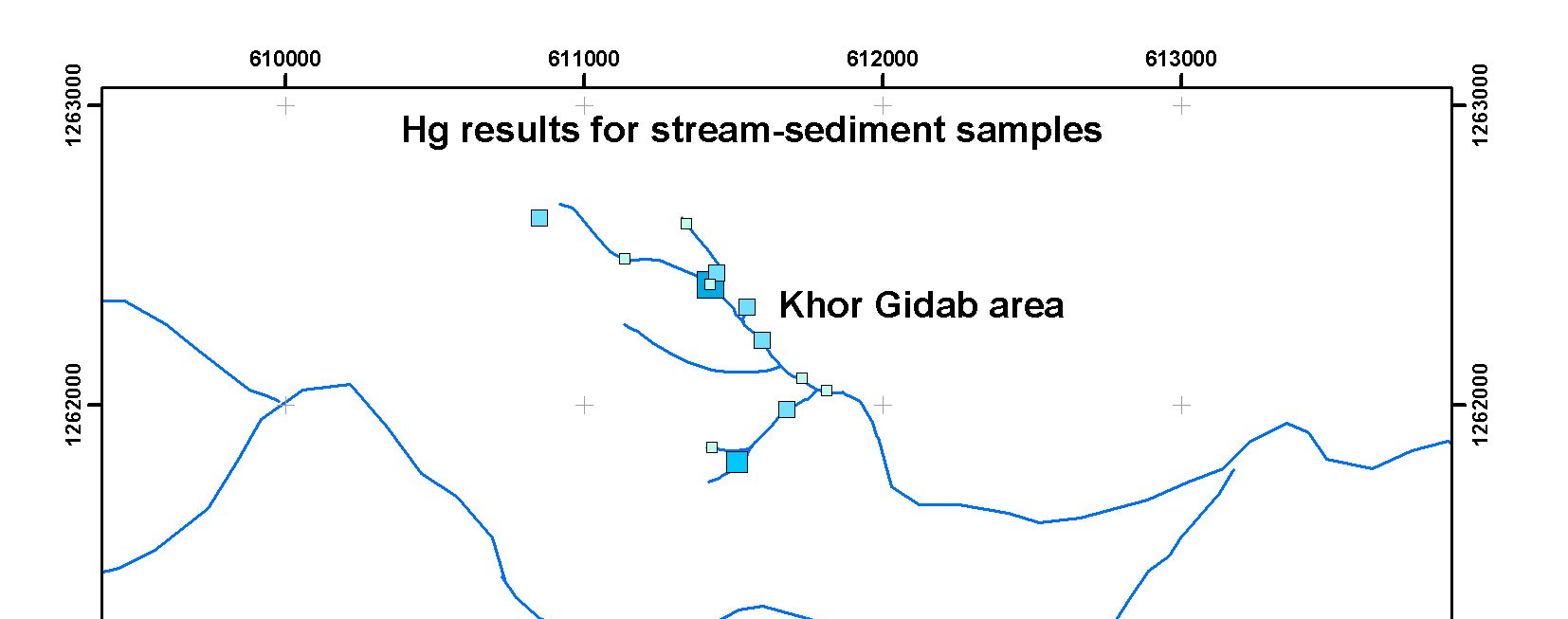
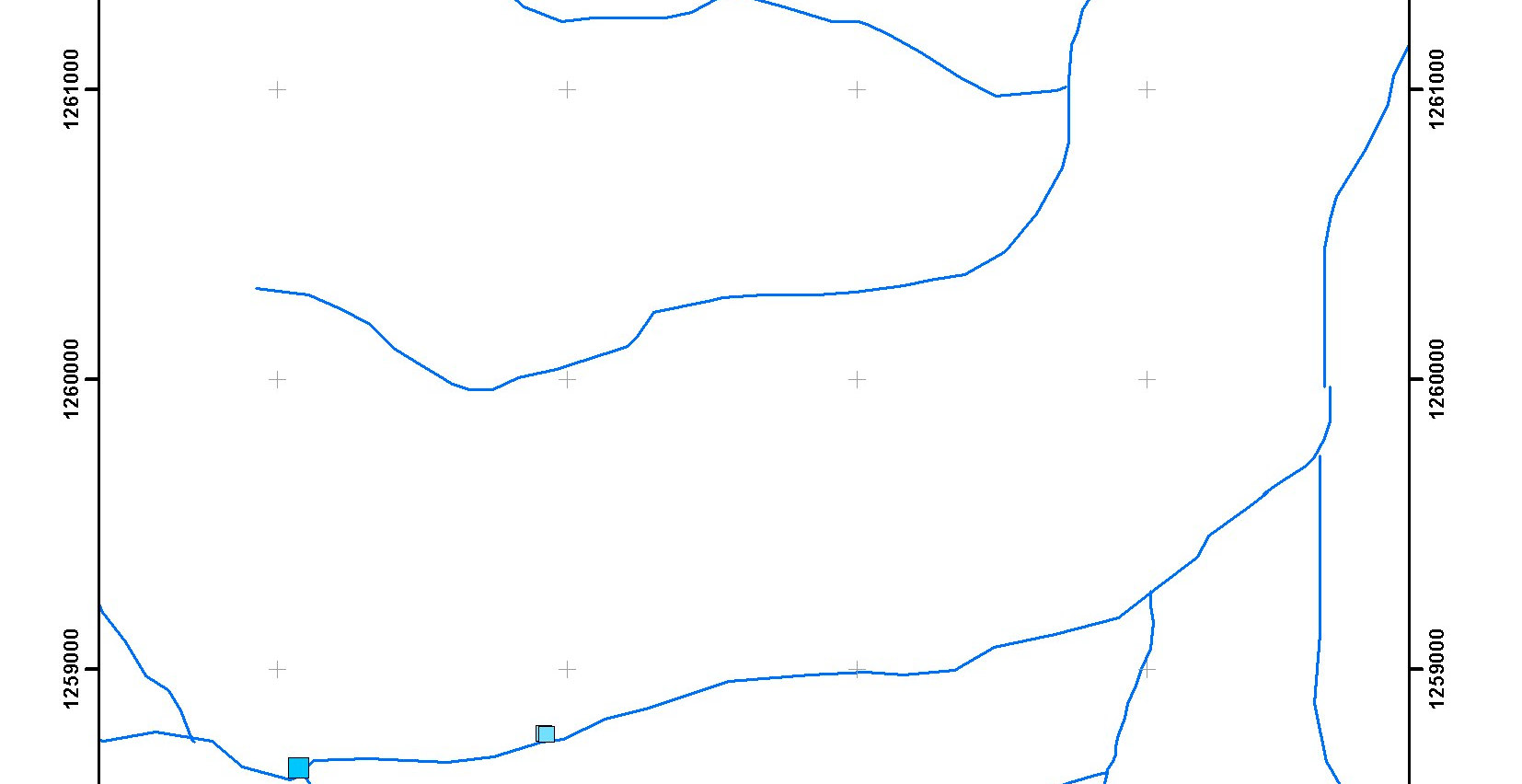
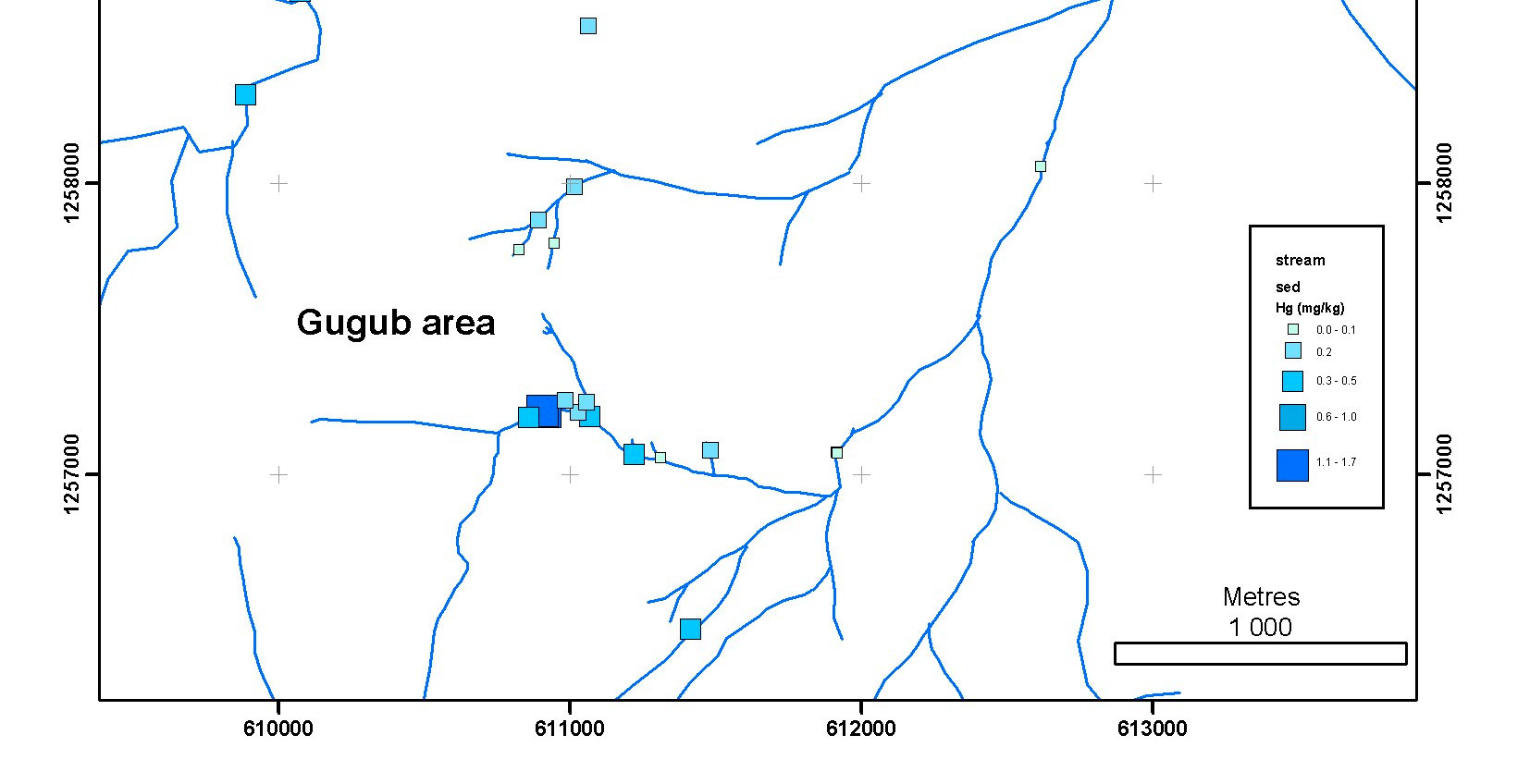
Global Mercury Project: Ingessana Hills Sudan
Il ustration 41 - Location of Hg analyses results for sediment samples in Gugub and Khor Gidad
area.
66
BRGM/RC-53589-FR "Draft report"

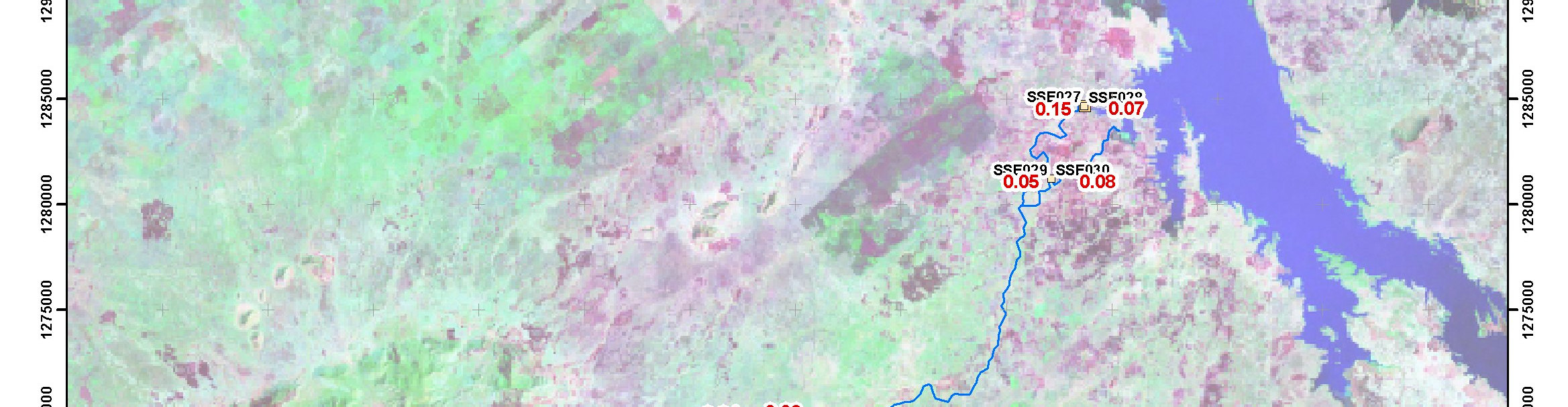
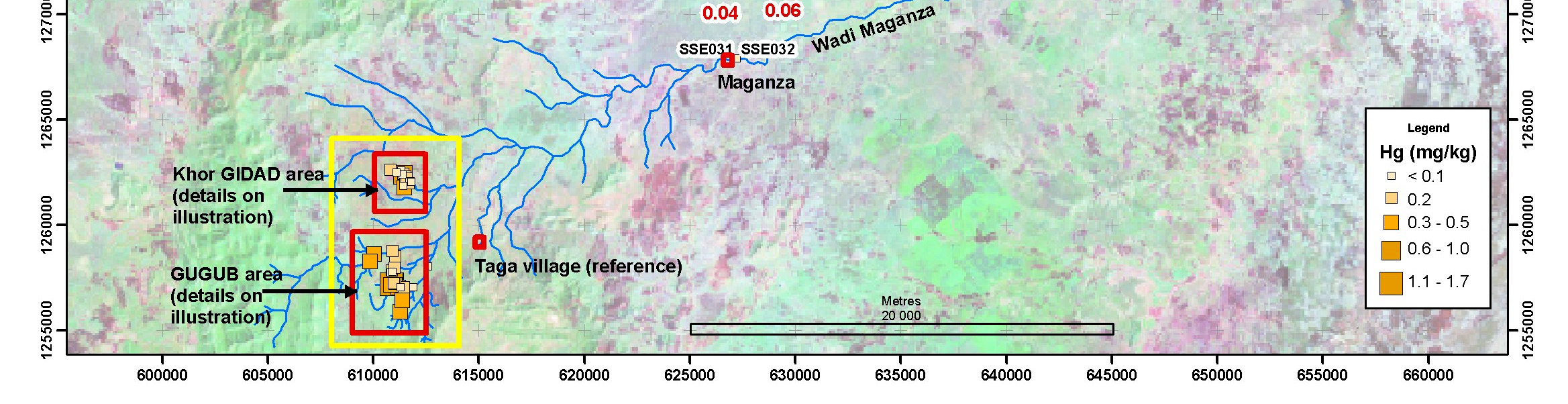
Global Mercury Project: Ingessana Hil s Sudan
Il ustration 42 - Location of stream sediment samples along wadi Maganza and at Roseires
Dam.
- The Hg contents in sediments of wadi and khor flowing from the vil ages of Gugub
and Khor Gidad are similar with higher contents near the zones of amalgamation
(vil ages) and than a rapid decrease of Hg contents some hundreds meters
downstream the vil ages of miners (Il ustration 18, Il ustration 19, Il ustration 40).
- The Hg contents in sediments of wadi Maganza are relatively low and do not show
important levels of contamination in regard to the usual guideline values for
sediment management in Europe or America (Il ustration 51).
- In the vil age of Gugub, the high values correspond to sediments taken in the South
network draining the major part of the superficial water of the vil age where the
amalgamation took place. The highest values (ranging from 1,066 to 1,649 ng g-1))
are located along the Khor Alyas where during rainy season part of the tailings and
residues are sometime panned in pools (see 4.2.2, Il ustration 19 & 40).
Downstream there is a water wel supplying vil age with drinking water. In the North
of the vil age, the network drains only the area of the school and sediments do not
show significant Hg contamination.
BRGM/RC-53589-FR "Draft report"
67
Global Mercury Project: Ingessana Hills Sudan
- In the vil age of Khor Gidad, Hg contents are mainly below 200 ng g-1 (Il ustration 40)
with 2 values above (424 and 886 ng g-1) without apparent contamination
downstream (Il ustration 18).
- The black organic matter-rich silty sediment col ected on the banks of the Roseires
dam, presents Hg contents (157 to 386 ng g-1) close5 to those of contaminated
stream from mining vil ages located several tens of kilometer upstream. The dam is
a sedimentation area, where either the contaminated particles can settle down, or
the dissolved mercury can precipitate. The Roseires reservoir located on the Blue
Nile col ects drainage waters from several artisanal gold mining activities (Il ustration
2) including Wadi Maganza draining the Gugub site. The mercury in the Blue Nile
may be released from other artisanal gold mining sites in activity, such as ~12 km
east of the Blue Nile bank at Belguwa-Sakatna, sites ~80 km southeast of Ad
Damazin. Mercury input may also come from other artisanal gold mining sites within
the river catchment as far as Qeissan some 150 km to the south.
It is not possible to compare the results obtained on dry samples from the vil ages of
Gugub and Khor Gidad with samples taken somewhere else in flowing rivers. The
conditions of sampling (focussed on dry samples with organic matter) explain certainly
partial y the high values encountered. The Hg contamination of sediments exist in this
vil ages where amalgamation and roasting took places but it seems restricted to a
narrow zone of a few hundreds of meters around, and, at the present time, without
apparent contamination downstream through Wadi Maganza.
6.6.
VEGETABLES
Some vegetables have been sampled in a few huts to evaluate the contribution of
these vegetables in the mercury daily intake of the local population.
The lifestyle of the communities is influenced both by traditional nomadic customs and
sedentary habits. They depend mainly on livestock and farming. In the Gugub and Khor
Gidad vil ages, women cultivate corn and sorghum along stream terraces or in smal
private gardens close to the huts and Hg-processing spots. The common diet in the
Gugub area is based on two meals per day. Sorghum and corn porridge constitute the
main meal. During the summer, sorghum and corn are dried in the huts by suspending
them from the roof just above the home fires (Il ustration 44) until they eventual y
become black. There is no doubt that these vegetables are exposed to smoke from the
fire, with Hg vapors from the roasting phases.
In summer, no fresh vegetables from the mining area are available, so we decided to
focus our sampling on the dry corn and sorghum fixed on the roofs of the huts. As we
plan to carry out a few vegetable analyses, al the samples were col ected inside the
huts at Gugub (6) and Taga (2) for control purposes. Four huts were sampled and two
samples taken in each (1 corn and 1 sorghum). Two huts are considered as control:
one at Gugub and the other at Taga.
5 Except high value from Khor Alyas.
68
BRGM/RC-53589-FR "Draft report"
Global Mercury Project: Ingessana Hil s Sudan
SVG1 to SVG4 are dusty smoked pieces of maize or sorgo hanging on the roof of the
hut (since October 2003). In these huts, roasting operations are regularly performed.
SVG5 to SVG8 are pieces of maize and sorgo col ected in reference huts in Gugub or
Taga (reference vil age). These latest pieces of vegetables were rather clean samples
compared to SVG1 to SVG4. The results are given in the Il ustration 43 below.
Remark: the quantities of mercury in the first cleaning water are given in ng of mercury
(estimation for a 50 mL solution). In order to compare these results, it should be
noticed that the pieces of vegetables were of equivalent size.
Sample
Location
Type
Remark
Hg content on
Hg (ng) in the
clean vegetable
first cleaning
(mg/kg dry
water
weight)
SVG1
GUGUB
Sorgo
Hut with roasting
<0.05
290
SVG2
GUGUB
Maize
Hut with roasting
0.11
340
SVG3
GUGUB
Sorgo
Hut with roasting
<0.05
120
SVG4
GUGUB
Maize
Hut with roasting
<0.05
<10
SVG5
GUGUB
Sorgo
Reference hut without
0.12
<10
roasting
SVG6
GUGUB
Maize
Reference hut without
<0.05
<10
roasting
SVG7
TAGA
Sorgo
Reference hut without
<0.05
<10
roasting
SVG8
TAGA
Maize
Reference hut without
<0.05
<10
roasting
Il ustration 43 - Analysis of the sorgo and maize samples.
Two conclusions can be drawn from these results:
- The Hg content of the analysed vegetables is very low both in the reference
hut and hut with roasting.
- Significant quantities of mercury are present in the dusts deposited on the
vegetables hanging on the roofs of huts were roasting is performed (except
SVG4). This mercury is eliminated with a simple cleaning with water. This
reveals another potential impact of the operation of roasting (in addition of
the contamination of air during the operation).
These results on sorgo and maize should be control ed in a further step as apparently
they may contribute to the evaluation of the daily intake of mercury for the local
population.
BRGM/RC-53589-FR "Draft report"
69

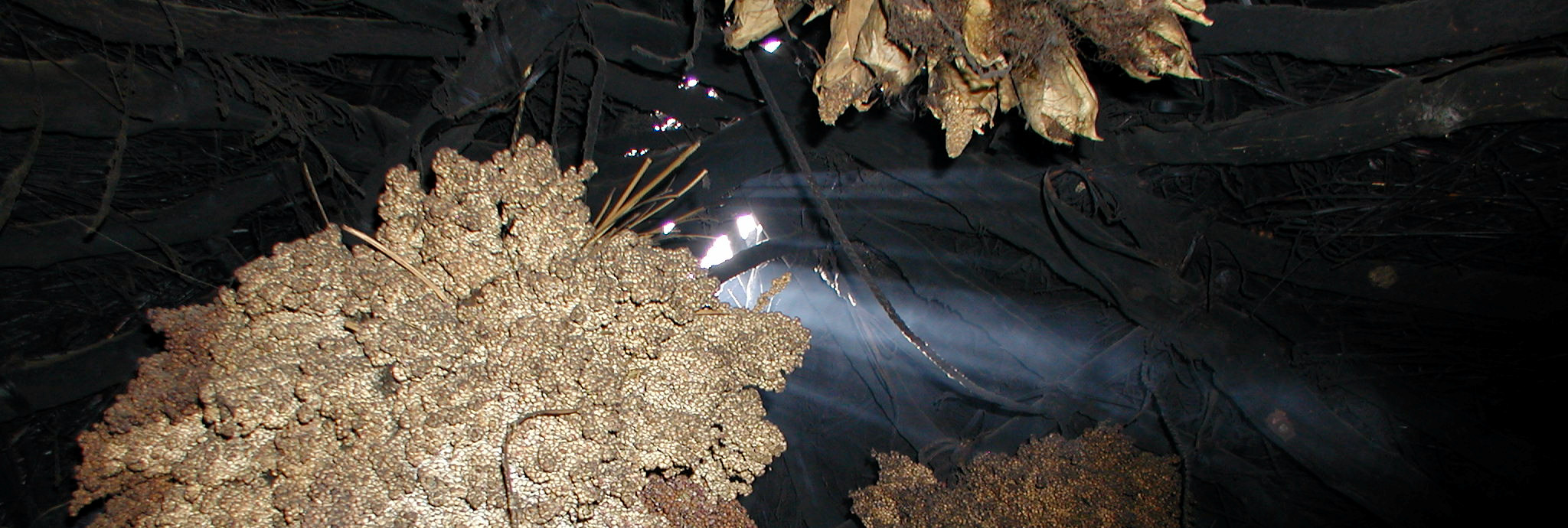
Global Mercury Project: Ingessana Hills Sudan
Il ustration 44 - Example of sorghum and corn fixed on the roof of a hut.
6.7.
FISHES
At the four fish sampling spots, catches were made by local fishermen, using nets.
Fifteen different species were col ected, with a total of 108 individuals (Il ustration 22).
The 15 fish species col ected are shown on Appendix 5. Smal dorsal muscle samples
were taken and kept in formalin to be analysed at the University of Bordeaux-CNRS
LEESA Laboratory in France.
The main biogeochemical processes linked to mercury input from artisanal gold mining
sites within freshwater systems are summarized in Appendix 5.
Analysis of the results relating to the level of mercury contamination in the fish must
necessarily bear in mind the constraints imposed by the sampling conditions and the
absence of any direct relationship with the gold mining site and the vil age of Gugub.
Nevertheless, they wil show the current state of mercury contamination in the
biological component of the hydrosystems in this region of Sudan, especial y around
the dam, which is downstream from several gold mining sites.
In many countries, fish constitutes a substantial proportion of the protein ration for the
populations living along the hydrosystems (rivers, lakes, estuaries), and can
consequently represent a major source of exposure to MMHg, as wel as the direct
professional exposure of goldminers and their families.
6.7.1. Global biometric characteristics and fish mercury contamination
levels
Mean biometric data total body weight (g, wet weight) and standard length (cm) and
mercury concentrations measured in the dorsal skeletal muscle are shown in
Il ustration 46, for the 4 sampling spots (1 to 4) and the different species.
70
BRGM/RC-53589-FR "Draft report"
Global Mercury Project: Ingessana Hil s Sudan
Only 5 species were common to 2 or 3 sampling spots (Il ustration 45), notably
between the reservoir (sampling spots: 1, 2, 3) and the water hole in the North of
Gugub (sampling spot 4):
Sampling
Genus
Species
Fish number
spot
1
5
Clarias
gariepinus
2
4
4
1
3
5
Oreochromis
niloticus
4
15
1
6
Sarotherodon
galilaeus
2
5
1
5
Schilbe
intermedius
3
4
2
6
Synondontis
schal
3
6
Il ustration 45 - Fish species common between the four sampling spots.
In biometric terms, the fish were smal in size, with the mean standard length of each
species being usual y under 20 cm. Considerable differences emerged between
batches of fish of the same species but taken from different sampling spots, probably
due to differences in age and/or to nutritional intake, depending on the sites. For
example, for the species Clarias gariepinus, marked differences appeared between the
body weights from the Roseires Reservoir: 17.8 ± 10.6 g (ww) at sampling spot 1;
555.5 ± 46.5 g (ww) at sampling spot 2.
Global y, mercury contamination levels in fish are low, or even very low. The general
mean, from the 108 fish col ected, is 0.246 ± 0.048 µg g-1, on the dry weight basis. It
must be remembered that concentrations expressed on the wet weight basis, the
criterion traditional y used to define safety levels, are about five times lower (wet weight
/dry weight = 5). Thus the safety standard defined by the WHO is 0.5 Hg µg g-1 on the
wet weight basis or 2.5 Hg µg g-1 on the dry weight basis (WHO, 1990). The extreme
mean values range from 0.056 ± 0.006 µg g-1 (dw) for the species Labeo niloticus (n =
5) to 0.708 ± 0.052 µg g-1 (dw) for the species Lates niloticus (n = 6), from sampling
spot 1 (Roseires reservoir).
BRGM/RC-53589-FR "Draft report"
71
Global Mercury Project: Ingessana Hills Sudan
Samp
Hg
Standard
Body weight
Family
Genus
Species
Food regime
ling
concentration
N
length (cm)
(g, fw)
spot
(µg.g-1 dw)
Clarii dae
Clarias
gariepinus
Benthivorous
1
19.7 ± 0.7
76.8 ± 10.6
0.085 ± 0.011
5
Cyprinidae
Labeo
niloticus
Benthivous
1
15.6 ± 0.4
61.6 ± 4.3
0.056 ± 0.006
5
Schilbeidae
Schilbe
intermedius
Carnivorous
1
15.6 ± 1.1
47.2 ± 10.1
0.405 ± 0.069
5
Alesti dae
Hydrocinus
forskalii
Carnivorous
1
21.3 ± 1.5
116.4 ± 21.4 0.694 ± 0.076
5
Centropomidae
Lates
niloticus
Carnivorous
1
14.1 ± 0.7
55.7 ± 8.7
0.708 ± 0.052
6
Cichlidae
Sarotherodon
galilaeus
Herbivorous
1
9.0 ± 0.1
24.0 ± 0.9
0.113 ± 0.012
6
Alesti dae
Brycinus
nurse
Omnivorous
1
13.3 ± 0.2
51.2 ± 1.6
0.107 ± 0.013
5
Clarii dae
Clarias
gariepinus
Benthivorous
2
39.1 ± 1.7
555.5 ± 46.5 0.098 ± 0.029
4
Cichlidae
Sarotherodon
galilaeus
Herbivorous
2
16.9 ± 0.6
163.6 ± 12.5 0.105 ± 0.020
5
Mochokidae
Synondontis
schal
Omnivorous
2
9.6 ± 0.6
20.0 ± 3.7
0.285 ± 0.086
6
Schilbeidae
Schilbe
intermedius
Carnivorous
3
23.4 ± 0.7
133.5 ± 3.6
0.539 ± 0.085
4
Mormyridae
Mormyrus
niloticus
Carnivorous
3
24.0 ± 1.0
122.0 ± 16.0 0.098 ± 0.002
2
Cichlidae
Oreochromis
niloticus
Herbivorous
3
20.3 ± 0.5
266.4 ± 20.4 0.080 ± 0.010
5
Mormyridae
Marcusenius
senegalensis
Carnivorous
3
21.0 ± 1.0
105.0 ± 7.0
0.103 ± 0.023
2
Mormyridae
Hyperopisus
bebe
Omnivorous
3
27.5 ± 0.5
189.0 ± 5.0
0.092 ± 0.015
2
Mochokidae
Synondontis
schal
Omnivorous
3
14.3 ± 0.6
66.0 ± 6.7
0.614 ± 0.149
6
Clarii dae
Clarias
gariepinus
Benthivorous
4
22.0
68.5
0.243
1
Cyprinidae
Labeo
horie
Benthivorous
4
9.7 ± 0.7
19.3 ± 3.8
0.194 ± 0.043
14
Cichlidae
Oreochromis
niloticus
Herbivorous
4
7.3 ± 0.6
16.4 ± 3.4
0.057 ± 0.003
15
Bagridae
Auchenoglanis
occidentalis
omnivorous
4
22.0 ± 0.1
133.3 ± 64.8 0.150 ± 0.093
2
x
x
x
x
4
11.8 ± 1.5
26.5 ± 7.2
0.336 ± 0.115
4
Il ustration 46 - Mean biometric data for the fish species col ected in the four sampling
(Standard length and body weight, mercury concentrations in the dorsal skeletal muscle and
food regime spots (data are means ± standard error N: number of fish).
6.7.2. Mercury contamination levels according to the fish trophic level and
to the sampling sites
In agreement with the large amount of data available in the literature (for example,
Durrieu et al., 2004; Roulet and Maury-Brachet, 2001; Veiga et al., 1999; Wiener et al.,
2002), mercury concentrations measured in the fish muscle vary according to the food
regime of the species and its position along the trophic networks.
72
BRGM/RC-53589-FR "Draft report"
Global Mercury Project: Ingessana Hil s Sudan
Data from sampling spot 1 on the Roseires Reservoir (Il ustration 47) reveal marked
differences between fish species and food regimes. The average concentration for the
three carnivorous species (Schilbe intermedius, Hydrocinus forskali , Labeo niloticus) is
0.60 µg g-1 (dw). This is about 8 and 5 times higher than those determined for the
benthivorous and herbivorous species, respectively. However, these values are clearly
below the safety level (2.5 µg g-1, dw).
The relationships between fish body weights and Hg concentrations in the muscle6
show marked differences between the species col ected: for five species,
bioaccumulation levels are independent of the fish weight; for the two carnivorous
species - Lates niloticus and Schilbe intermedius - two opposing correlations were
observed, negative and positive, respectively.
Numerous field studies in European countries and North-America/Canada have shown
a significant positive correlation between Hg concentrations in fish muscle and
biometric criteria (body weight or standard length), indicating an increase in
bioaccumulation as a function of the age of the fish. Recent studies in Amazonia
(South America: Brazil and French Guiana) have shown several types of relationships
(no correlation, positive or negative correlations), as a function of fish species, food
regimes and also developmental stages (alevins/adults) (Roulet et al., 1999; Frery et
al., 2001; Durrieu et al., 2004).
Data from spot 3, on the Roseires reservoir, where six fish species were col ected
(Il ustration 48), show marked differences between the three carnivorous species and
also between the two omnivorous species. Several hypotheses can be put forward to
explain these results: differences between their ecological niches (for example, for the
two omnivorous species, H. bebe is described as a demersal species, living in the deep
layers of the water column; S. schal is a benthopelagic species, confined to the
sediment/water interface); changes in food regimes, fol owing the impacts on the
foodwebs when the reservoir flooded.
No carnivorous species were col ected at sampling spots 2 and 4. Smal concentrations
were measured in the benthivorous, omnivorous and herbivorous species (Il ustration
46). For example, the mean Hg concentration in Oreochromis niloticus (N = 15), an
herbivorous species, was 0.057 ± 0.003 µg g-1 (dw). No significant correlation was
observed between body weight and mercury levels in the muscle (Il ustration 49).
6 These relationships were established from a small number of samples. For this reason, their representativity is
limited.
BRGM/RC-53589-FR "Draft report"
73
Global Mercury Project: Ingessana Hills Sudan
Spot 1
1.0
0.9
) 0.8
0.7
0.6
0.5
0.4
0.3
g
c
o
n
c
e
n
t
r
a
t
i
o
n
(
µ
g
/
g
,
d
w
0.2
H 0.1
0.0
C.
L. nil oticus
S.
H. forskalii
L. niloti cus
S. galilaeus
B. nurs e
gariepinus
i ntermedius
benthivorous
carnivorous
herbivorous omnivorous
Claria gariepinus
Schil be i ntermedius
Hydrocinus forskal i
Lates nilotic us
Labeo ni lotic us
Brycinus nurse
Sarotherodon galilaeus
) 1.0
w
/
g
,
d
0.8
g
(
µ
0.6
t
r
a
t
i
o
n
0.4
c
e
n
n 0.2
c
o
g
H 0.0
0
50
100
150
200
body weight (g, fw)
Il ustration 47 - Mercury concentrations in the muscle of the seven fish species col ected from
the sampling spot 1, on the Roseires reservoir relationships between fish body weight and
mercury concentration in the skeletal muscle.
74
BRGM/RC-53589-FR "Draft report"
Global Mercury Project: Ingessana Hil s Sudan
Spot 3
1.0
0.9
0.8
0.7
0.6
0.5
0.4
0.3
g
c
o
n
c
e
n
t
r
a
t
i
o
n
(
µ
g
/
g
,
d
w
)
0.2
H 0.1
0.0
S. intermedius
M. niloticus
M.
O. niloticus
H. bebe
S. schall
senegalensis
carnivorous
herbivorous
omnivorous
Oreoc hromis niloti cus
Schilbe intermedius
Mormy rus niloticus
Hyperopisus bebe
Synodontis schal
Marcusenius senegalens is
w
) 1.2
,
d
/
g 1.0
g
(
µ 0.8
n
0.6
t
r
a
t
i
o
0.4
c
e
n
n 0.2
c
o
g
H 0.0
0
50
100
150
200
250
300
350
400
body weight (g, fw)
Il ustration 48 - Mercury concentrations in the muscle of the seven fish species col ected from
the sampling spot 3, on the Roseires reservoir relationships between fish body weight and
mercury concentration in the skeletal muscle.
BRGM/RC-53589-FR "Draft report"
75
Global Mercury Project: Ingessana Hills Sudan
50
bo 45
y = 0.5543e 0.4216x
dy 40
R2 = 0.97
we 35
ig 30
ht 25
(g, 20
fw) 15
10
5
0
3
4
5
6
7
8
9
10
11
body length (cm)
Hg
Body length (cm)
co 0.08
nc
en
tra 0.06
tio
n 0.04
(µ
g/
g, 0.02
dw
) 0.00
0
5
10
15
20
25
30
35
40
45
body weight (g, fw)
Il ustration 49 - Relationships between fish body weight and standard length and between fish
body weight and mercury concentration muscle of the herbivorous species Oreochromis
niloticus (15 individuals) col ected from the sampling spot 4.
6.7.3. Conclusions
There is a poor representativity of mercury contamination levels in fish species in
relation to artisanal gold mining in Sudan owing to the poor sampling conditions
The levels of contamination in fish muscle samples (15 species - 108 individuals) is
very low and there is no fish above the WHO safety limit of 2.5 Hg µg g-1, on the dry
weight basis the global mean Hg concentration was 0.246 ± 0.048 µg g-1 and 0.49 ±
0.10 µg g-1 for the carnivorous species.
The data from rivers directly affected by gold mining sites using amalgamation
procedures must be considered insufficient to produce conclusions relating to fish
advisory, or health related matters for this area of Sudan.
76
BRGM/RC-53589-FR "Draft report"
Global Mercury Project: Ingessana Hil s Sudan
7. Evaluation of exposure to Hg
The artisanal gold miner families (~300) and the (10-15) local gold merchant shops in
Gugub and in Khor Gidad constitute the same broad mercury hotspots. The main
targets identified are local people. Potential risks to the ecosystem were considered to
be minor in that system.
7.1.
VILLAGES
Information on mining practices and field study proved that the main risk of exposure to
environmental mercury occurs in the vil ages as mercury is mostly manipulated at
home or around the gold merchant shops by artisanal miners without specific
precaution. This risk is increasing because the exposed population is mostly composed
by women and their young children working hardly on mining sites. The risk is also
present in the huts or in the yard of "family unit".
The probability of occurrence of exposure to mercury is summarised in the Il ustration
50.
Inhalation
In that case inhalation concerns only volatilised Hg°. The monitoring of air quality
showed that Hg concentrations may reach relatively elevated concentrations. However,
the exposure of the artisanal miners was relatively short compared to the exposure
limits for professional workers exposed to mercury (25 µg m-3 average air
concentrations for an 8 hour shift, WHO, 1994). We measured that people are only
exposed to elevated mercury concentrations for about 10 to 15 mn during the amalgam
roasting. Roasting takes place outside or inside the hut depending on the families.
When roasting is done indoor, the same fireplace is used for cooking. During the
mission, we never observed any roasting phase without asking for a demonstration.
Most of these demonstrations were done by men but in presence of family members
including women and children. We should also consider the possible exposure of
women and children and use air quality standards for non professional exposure.
BRGM/RC-53589-FR "Draft report"
77
Global Mercury Project: Ingessana Hil s Sudan
Probability
Description
of
Comments
occurrence
- Accidental Hg spil during
deals or amalgamation
***
SOURCES
- Amalgam roasting
***
- Disposal of contaminated
tailings
**
- Hut dust contamination
***
- Hg vapor dissemination
contaminating the hut and
***
its close environment
TRANSFER &
PATHWAYS
- Soil contamination in the
vicinity of contaminated
?
- Contamination of the soil
huts
of the mosque and other
"reference" spots
- Sediment contamination by
panning of tailings in pools
*
- occasional
- Hg inhalation during
- Main situation of Hg
roasting
**
inhalation
- Domestic dust and soil
ingestion (mostly
children)
***
HUMAN
- Fish consumption
*
- Needs further control
TARGETS
- Vegetable consumption
*
- Needs further control
- Contaminated poultry
?
- Possible contamination of
consumption1
poultry?
- Drinking water1
?
- Needs further control
Il ustration 50 - Probability of occurrence to Hg exposure (1 not considered in that study).
Ingestion
In the described system, oral exposure may occur in different situations like soil and
dust ingestion or food consumption.
We demonstrated that huts of artisanal miners are contaminated due the procedure of
amalgam roasting in the hut. Thus wal s, suspending sorghum and corn and domestic
dust are contaminated in the hut of artisanal miners. Metal ic mercury may
progressively accumulate in the houses during the mining season. We showed that
78
BRGM/RC-53310- FR Final report
Global Mercury Project: Ingessana Hil s Sudan
domestic dust may reach elevated concentrations (up to 840,000 ng g-1). We estimate
that it constitutes one of the main risks of exposure for the population, and particularly
for children.
The soil of school playground of the Gugub vil age is not contaminated. Soils in and
around the shops or soils of amalgamation areas around huts of artisanal miners show
same high levels of contamination than the dust inside the huts (mean 2,480- 40,230
ng g-1). Such concentrations are relatively high compared to threshold values for soils
in residential areas (7,000 to 10,000 ng g-1 in Europe) (Il ustration 51). However the
higher values are related to specific restricted areas (shops, amalgamation area of
several meters square in size). Except these hotspots, Hg contents of the soils of the
yards are, in both vil ages, in average lower (mean 763 2,116 ng g-1) and clearly
under threshold values mentioned before.
The amount of soil and dust that is ingested has been discussed extensively in the
literature (Simon, 1998; Calabrese, 1989, Calabrese and al., 1991) but there is no
existing guideline value for mercury for soil and dust ingestion. Geophagic activity has
not been described by the sociological study. Data col ected during this works were not
sufficient to appreciate real quantity of inadvertent ingestion of dusts and soils by
peoples. Dust ingestion (soil + domestic dust) could be relatively important for children
(especial y in the living conditions of local people), and this may cause a potential risk
of contamination for the artisanal miners and their families.
A possible contamination of poultry may exist in relation with contaminated soils and
domestic dust. This point was not checked because the field survey took place during
the avian flue crisis of 2003-04, it was then forbidden to sample and import poultry
meat in Europe by that time.
The other risk of exposure is related to the consumption of fishes and vegetables
(sorghum and corn). There is a poor representativity of mercury contamination levels in
fish species in relation to artisanal gold mining owing to the poor sampling conditions.
The levels of contamination in fish muscle samples (15 species - 108 individuals) is
very low and there is no fish above the WHO safety limit of 2.5 Hg µg g-1, on the dry
weight basis the global mean Hg concentration was 0.246 ± 0.048 µg g-1 and 0.49 ±
0.10 µg g-1 for the carnivorous species. Being located ~50 km away from the Blue Nile
western banks, the community of Gugub and the surroundings have no frequent
access to fresh fish supply. However, dry fish is available in the Gugub market. The
occasional consumption of fishes in that area, (only 2 % of the people report eating fish
occasional y) does not seem to constitute a major risk. However, the data from rivers
directly affected by gold mining sites using amalgamation procedures must be
considered insufficient to produce conclusions relating to fish advisory, or health
related matters for this area of Sudan.
Sorghum and corn porridge constitute the main meal of the communities. In the Gugub
and Khor Gidad vil ages, women cultivate corn and sorghum along stream terraces or
in smal private gardens close to the huts and Hg-processing spots. The average
contents in garden ranging between 130 and 280 ng g-1 are close to the background
level and below UK and Canadian standard of permissible concentration of Hg in
BRGM/RC-53589-FR "Draft report"
79
Global Mercury Project: Ingessana Hil s Sudan
agricultural soil ranging from 1,000 to 8,000 ng g-1. The Hg content of the analysed
sorghum and corn is very low and do not present risk but significant quantities of
mercury are present in the dusts deposited on the vegetables hanging on the roofs of
huts were roasting is performed. This mercury is eliminated with a simple cleaning with
water. These results on sorghum and corn should be control ed in a further step as
apparently they may contribute to the evaluation of the daily intake of mercury for the
local population.
7.2.
WADIS AND KHORS
There is no major flowing river close to the mining and processing areas, only seasonal
drainage. Miners pan al uvial gold on banks and terraces when the local stream is
flowing during rainy season between July and December but in those sites miners do
not use mercury and recover only visible gold during rainy season. It appears that in
Gugub and Khor Gidad vil ages, the mercury pol ution of stream sediments could be
mainly control ed by the surface run-off from gold amalgamation and roasting
processing sites located in the vil ages. We supposed that Fe-rich laterite and seasonal
run-off act probably as natural barriers against this type of Hg dispersion in the
sediments.
In Gugub and Khor Gidad, most of the sediment samples show concentrations below
400 ng g-1. In the vil age of Khor Gidad, Hg contents are mainly below 200 ng g-1
without apparent contamination downstream. In the vil age of Gugub, the highest
values (ranging from 1,066 to 1,649 ng g-1) are located along the Khor Alyas where
during rainy season part of the tailings and residues are sometime panned in pools.
This practice appears as the only one presenting risk for the local stream.
Downstream, the Hg concentrations in sediments of the main col ector, Wadi Maganza,
are relatively low (ranged from 42 to 148 ng g-1) and do not show important levels of
contamination in regard to the usual guideline values for sediment management in
Europe or the North America.
It is not possible to compare the results obtained on dry samples from the vil ages of
Gugub and Khor Gidad where sampling could make exactly on one layer or a particular
place in the narrow stream with samples taken somewhere else in flowing rivers.
Analysis of the results relating to the level of mercury contamination in the sediment
must necessarily bear in mind the constraints imposed by the sampling conditions, the
absence of any water flowing observed during the mission, the limited number of
samples taken in the wadi Maganza and that intensive use of mercury in the area is
quite recent.
The conditions of sampling, focussed on dry samples rich in organic matter, may, for
example, partial y explain the some high values encountered close to the vil ages. The
anthropogenic Hg contamination of sediments exist in this vil ages where
amalgamation and roasting took places but it seems restricted to a narrow zone of few
hundreds of meters around, and, at the present time, without apparent contamination
downstream through Wadi Maganza. These elements show that the stream appears as
preserved natural ecosystem.
80
BRGM/RC-53310- FR Final report
u
d
a
n
t
r
o
n
g
i
l
s
S
L
:
S
E
,
2
0
0
0
,
2
0
0
0
O
O
H
H
,
2
0
0
3
)
,
2
0
0
0
)
I
S
i
t
s
O
R
L
,
W
f
f
e
c
t
L
e
v
e
l
;
S
r
o
j
e
c
t
:
I
n
g
e
s
s
a
n
a
H
H
p
r
o
f
.
e
x
p
o
s
u
r
e
)
E
R
E oncentration).
O
H
)
L
,
W
(
I
N
S
a
n
a
d
a
)
a
n
a
d
a
)
E
C
L
:
L
o
w
f
f
e
c
t
C
e
r
c
u
r
y
P
E
s
a
f
e
t
y
l
i
m
L
C
A
N
O
L
C
E
L
i
n
h
a
l
a
t
i
o
n
,
W
O
H
L
(
U
o
n
E
E
R
l
o
b
a
l
M
G
u
i
d
e
l
i
n
e
v
a
l
u
e
s
8
1
G
2
.
5
W
7
0
0
P
2
0
0
(
L
E
2
0
0
0
(
S
b
a
c
k
g
r
o
u
n
d
<
0
.
1
2
0
0
M
1
,
0
0
0
(
N
2
5
,
0
0
0
/
8
h
(
W
2
7
n
g
/
g
P
n
o
n
e
7
,
0
0
0
n
g
/
k
g
/
d
a
y
M
l
)
f
f
e
c
t
L
e
v
e
l
;
L
E
r
o
b
a
b
l
e
N
)
)
:
P
C
(
d
w
(
d
w
E
-
1
-
1
-
3
-
1
-
1
N
r
o
b
a
b
l
e
E
(
u
n
i
t
)
µ
g
g
n
g
/
g
µ
g
g
n
g
(
f
o
r
5
0
m
n
g
m
n
g
g
n
g
g
L
:
P
a
x
.
0
.
7 2.5 0.3
E
M
1
6
4
9 386 148
0
.
1
2
3
4
0
1
5
0
8
4
0
,
0
0
0
f
f
e
c
t
L
e
v
e
l
;
P
1
,
0
0
0
,
0
0
0
o
E
7
5
L
:
N
0
.
2
5 0.6 0.15
2
5
0
2
5
0
5
0
0
1
0
0
1
8
0
E
A
<
0
.
0
5
O
1
9
6
-
3
0
8
2
0
0
-
3
0
0
e
a
n
v
a
l
u
e
s
M
2
,
4
8
0
-
4
0
,
2
3
0
9
0
,
0
0
0
-
1
0
0
,
0
0
0
1
,
2
3
6
-
1
0
3
,
0
0
0
i
s
k
L
e
v
e
l
;
N
R
a
m arn.
a
m
c
o
r
n
a
t
e
r
u
m
&
r
o
a
s
t
.
a
g
a
n
z
a
i
n
i
m
a
l
g
a
m
r
t
"
o
s
e
i
r
e
s
D
o
s
e
i
r
e
s
-
C
t
h
e
r
s
i
l
a
g
e
s
o
s
e
i
r
e
s
D
a
d
i
M
o
r
g
h
u
m
l
e
a
n
i
n
g
w
q
e
e
z
i
n
g
i
n
e
r
s
v
i
l
a
g
e
L
:
M
R R
O
V R
W
S
C
S am
f
i
r
e
l
i
g
h
t
i
n
g
v
i
l
a
g
e
s
r
e
f
.
b
a
c
k
g
r
o
u
n
d
r
e
f
.
v
i
l
a
g
e
m
R
r
a
f
t
r
epo
"
D
y
n
t
h
e
s
i
s
o
f
t
h
e
r
e
s
u
l
t
s
a
n
d
p
u
b
l
i
s
h
e
d
g
u
i
d
e
l
i
n
e
v
a
l
u
e
s
.
(
P
e
n
t
s
-
F
R
t
a
i
l
i
n
g
s
e
s
t
i
c
d
u
s
t
f
f
e
c
t
L
e
v
e
l
;
M
E
e
d
i
m
e
g
e
t
a
b
l
e
s
i
r
o
i
l
&
o
m
F
i
s
h
e
s
S
V
A
S
D
-
53589
/
RC
M
G
R
I
l
u
s
t
r
a
t
i
o
n
5
1
-
S
B
Global Mercury Project: Ingessana Hil s Sudan
8. Conclusions & recommendations
The operation was carried out between French teams (BRGM, Universities of
Montpel ier and Bordeaux) and Sudanese teams (Geological Research Authority of
Sudan and University of Nileen). The sampling campaign and health survey took place
from March 29th to April 18th, 2004 during the hot dry summer before rainy season and
the main al uvial mining season. The aim of this study was to col ect environmental and
health data in the Gugub and Khor Gidad vil ages of the Bau district in the Ingessana
Hil s ( Blue Nile State of Sudan) to assess the level of mercury exposure in the local
communities and the potential impact in the environment. Another smal vil age, Taga
was added as a reference vil age (i.e. a vil age without a mining history). There was no
major flowing river close to the mining and processing areas, only seasonal drainage.
No water flowing was observed during the mission; although there were smal pools
along main wadis, there was no panners.
Mining of gold-bearing quartz vein was the only type we observed during the field
mission.
8.1.
MAIN OUTCOMES OF THE ENVIRONMENTAL SURVEY
Use of mercury
Use of mercury in the area is quite recent and depends on the type of mining activities.
Artisanal gold mining activities in the Ingessana Hil s started in 1996. Intensive use of
mercury in the area is quite recent (around 3 years and may be less) and mainly
developed in Gugub where gold was first discover and in Khor Gidad after the gold
rush of September 2003. During our mission those two sites were the only one's in
activity. At the present time, the vil age of Khor Gidad is an extraction and processing
site and the vil age of Gugub is a processing site only. The other sites mentioned in the
sociological reports (i.e. Turda, Khor Neiwi) are al uvial types, without mercury use and
presently abandoned.
Miners pan al uvial and el uvial gold when the local stream is flowing during rainy
season between July and December. In those sites miners do not use mercury and
recover only visible gold during rainy season. Results of Hg Analyses carried out in this
study confirm this al egation: soils, tailing and sediments sampled around al uvial
panning area are not contaminated by Hg.
During dry season, due to shortage of water in pit sites, only primary gold associated
with quartz vein are mined. The procedures used by local people are representative of
very poor people using simple and traditional practices. Mercury is used only to recover
gold from this primary ore. Most of these activities were performed by women (13-35
BRGM/RC-53589-FR "Draft report"
83
Global Mercury Project: Ingessana Hil s Sudan
years old), including the hard tasks of digging and excavation. Men are only involved in
mining at deeper depths and in roasting phases. There is no use of Hg on the mining
site; the selected ore is transported to the vil age for crushing, manual y mil ing and
panning in the yard of «family unit».
Gold production and mercury consumption
Gold production estimates based on two independent sources (workers production and
dealers) gave similar results: the quantity of gold produced from quartz vein in the 2
studied vil ages is 75-300 g Au/day and 22.5-90 kg Au/year. Workers and dealer
probably underestimated their production and that actual values may be higher.
We demonstrate that to produce such quantities (100-300 g Au/day) from the Gugub
sites workers involved must be 800 to 1000 and gold grade 30 to 72 g t-1 respectively.
According to the data available and observations made (average gold grades
measured by GRAS of less than 5 g t-1 and 300 families living on the sites) works in
Gugub can not produce the quantity of gold mentionned before from the quartz vein
mining alone. A large part of the gold sel during dry season (probably 50 %) probably
comes from al uvial production and also from gold reserves made by workers during
rainy season. According to our field observations and the estimations performed, the
use of mercury in the Gugub district is between 250 and 500 g Hg per household of
artisanal miners.
Taking into account these information, the Hg lost/Au produced ratio is probably higher
than 3 in the Gugub area.
Contamination due to amalgamation practices
According to the analysis of the process, the most probable contamination of soil is
supposed to be related to solid deposition of mercury during the amalgamation
process, to atmospheric deposition of mercury during the roasting and to the
dissemination of household dust in the vicinity of artisanal miner huts.
Last panning and then amalgamation are performed in one daily sequence at home or
close to the shops dealing mercury. In both case there is no specific place for
amalgamation. The miners col ect the amalgam by hand, taking no precautions at al .
The soils in the yards are contaminated by Hg. The average geochemical Hg content in
the vil age of Gugub and Khor Gidad are ten times higher than the local background
(100 to 150 ng g-1). The contamination is punctual with probable nugget effects. Higher
value in the 2 vil ages (up to 106 ng g-1 in Khor Gidad and up to 27,626 ng g-1 in Gugub)
are related to zone of amalgamation where Hg droplets were sometimes visible after
panning. These zones showing values several times higher than others places where
values are close to local background are principal hotspots.
School yard in Gugub show background Hg contents (106 ng g-1).
84
BRGM/RC-53310- FR Final report
Global Mercury Project: Ingessana Hil s Sudan
Contamination due to roasting of amalgams
The gold amalgam is roasted in the vil age in mobile bonfires, outside close to the
dealer shop where they buy mercury; in the yard of the «family unit» or inside the huts.
It was rather difficult to identify what was the main place of roasting. In Khor Gidad,
roasting outside seem to be the main way of roasting. It is seem that the proportion is
approximately 50-50 in Gugub. It is especial y the men who practise the roasting. Daily,
they roast the amalgam without taking any precautions.
Average contents show also significant contamination of domestic dust in some hut
and yard of artisanal miners (500 - 2,760 ng g-1 in Gugub and 123 - 840,000 ng g-1 in
Khor Gidad). It is clearly demonstrated that indoor amalgam roasting may significantly
contaminate the dust of the huts but there are no big differences between the Hg
contents in soils compare to Hg contents in dusts in al vil ages. Also, there is no
significant difference depending on the dust location (hut with or without roasting). It
was impossible, at this stage of investigation, to appreciate the ratio between
contamination of soil by amalgamation process and by roasting. The information
supplied by the inhabitants can be indistinct but these results show at least that the
contamination is rather general and homogeneous on the scale of household and on
the scale of the vil age.
The monitoring of air quality carried out inside and outside huts showed that Hg
concentrations may reach relatively elevated concentrations (around or above 25,000
ng m-3). However, in the worse case, the exposure of the artisanal miners (around 10
mn per day) was relatively short compared to the exposure limits for professional
workers (25,000 ng m-3 for 8 h exposure). Amalgam roasting seems to be an
occasional procedure occurring on a daily or weekly basis.
However as roasting is sometimes performed in huts, we should also consider the
possible exposure of children. The roasting of amalgams generates usual y two peaks
of Hg above 80,000 ng m-3. The first peak appears when Hg is evaporating from the
amalgam, the second one, occurring few minutes later, is probably due to a late
recondensation of mercury aerosols emitted during roasting. This condensation phase
indicates that a large part of mercury emitted in the hut remains inside and therefore
could accumulate in dusts on the floor, on wal s, on vegetables hanging at the top of
the hut. The second point is that this condensation phase could concern the entire hut
unlike the period of roasting (local evaporation near the fire). Al the people present in
the hut at this moment could therefore breathe this mercury vapor. The condensation
effect is lower in huts al owing rather good evacuation of smoke due to openings at the
junction of wal s and roof.
For the roasting outside, the duration with light mercury concentration is shorter than in
the hut (around 100 s compared to 500 s in a hut) and the second peak of probable
condensation of mercury vapor observed in the hut is absent.
Remobilization of Hg in the stream sediment
The remobilisation of Hg from processing zone to local streams seems very low. The
Hg contents in sediments of wadi and khor flowing from the vil ages of Gugub and Khor
BRGM/RC-53589-FR "Draft report"
85
Global Mercury Project: Ingessana Hil s Sudan
Gidad are similar (median under 200 ng g-1) with higher contents near the zones of
amalgamation (vil ages). The Hg contents decreased downstream the vil ages of
miners some hundreds meters. The Hg concentrations in sediments of the main
col ector wadi Maganza are also relatively low and do not show important levels of
contamination in regard to the usual guideline values for sediment management in
Europe or in North America. It is not possible to compare the results obtained on dry
samples from the vil ages of Gugub and Khor Gidad with samples taken somewhere
else in flowing rivers. The conditions of sampling (focussed on dry samples with
organic matter) explain certainly partial y the high values encountered. The Hg
contamination of sediments exist in this vil ages where amalgamation and roasting took
places but it seems restricted to a narrow zone of few hundreds of meters around, and,
at the present time, without apparent contamination downstream through Wadi
Maganza.
Contamination of tailings and effect on stream
The phases of grinding, amalgamation and roasting generate heaps of mixed tailings,
residues, ash or waste, sometimes several cubic meters in size, often thrown on the
ground near the zones of operation, in or around enclosures dwel ing or even gardens.
Hg analyses carried out on these tailings show a heterogeneous contamination
depending on their composition which can be sometimes high or very high (62,300 and
72,500 ng g-1 in Khor Gidad). Their number and location in gardens or within the "family
unit" is a problem to be taken into account in the future operations of environmental
management of the area.
Workers indicated that during rainy season part of this tailings and residues are
sometime panned in pools located in the Khor Alyas, at south of Gugub. The highest
Hg contents in sediment (ranging from 1,066 to 1,649 ng g-1) are located along this
Khor Alyas where aquatic life is unknown but where a water wel supplying vil age with
drinking wate. Control analyses on water wel must be carried out in priority.
Principal hotspots
The artisanal gold miner families (~300) and the (10-15) local gold merchant shops in
Gugub and in Khor Gidad constitute the same broad mercury hotspots. Potential risks
to the ecosystem were considered to be minor in that process. The main targets
identified are local people practising gold concentration processes at home. The shops
and surroundings represent also a particular hotspot : the strongest Hg contents come
from soils and dusts taken on the ground of trade shops (several values ranging from
20,000 to 1,000,000 ng g-1).
We identified 4 sources of lost of mercury in the environment:
- Wrong manipulation of mercury at the shop or at home;
- Lost of Hg on the ground or in the tailings during amalgamation phase;
- Evaporation during roasting phase;
- Occasional panning of tailing in the pools.
86
BRGM/RC-53310- FR Final report
Global Mercury Project: Ingessana Hil s Sudan
Consumption of fishes and vegetables
The other risk of exposure, on a minor level, is related to the consumption of fishes and
vegetables (sorghum and corn). There is a poor representativity of mercury
contamination levels in fish species in relation to artisanal gold mining owing to the
poor sampling conditions. The levels of contamination in fish muscle samples (15
species - 108 individuals) is very low and there is no fish above the WHO safety limit of
2.5 Hg µg g-1, on the dry weight basis the global mean Hg concentration was 0.246 ±
0.048 µg g-1 and 0.49 ± 0.10 µg g-1 for the carnivorous species. Compared with
Zimbabwe, for fish of a similar size, the mean Hg concentrations were about ten times
lower. Analysis of the results relating to the level of mercury contamination in the fish
must necessarily bear in mind the constraints imposed by the sampling conditions and
the absence of any direct relationship with the gold mining site and the vil age of
Gugub. The occasional consumption of fishes in that area, (only 2 % of the people
report eating fish occasional y) does not seem to constitute a major risk. The data from
rivers directly affected by gold mining sites using amalgamation procedures must be
considered insufficient to produce conclusions relating to fish advisory, or health
related matters for this area of Sudan
Sorghum and corn are the main consumed vegetable, at least during the dry season.
The average Hg contents in soil garden (cultivation of sorghum and corn) around the
«family unit» ranging between 130 and 280 ng g-1 in Khor Gidad and Gugub,
respectively; These values are close to the background level, and below UK and
Canadian standard of permissible concentration of Hg in agricultural soil ranging from
1,000 to 8,000 ng g-1. This indicates low mercury remobilization probably due to Fe-rich
laterite acting as natural barriers and attenuating the widespread dispersion of Hg.
The Hg content of the analysed sorghum and corn is very low and do not present risk
but significant quantities of mercury are present in the dusts deposited on the
vegetables hanging on the roofs of huts were roasting is performed. This mercury is
eliminated with a simple cleaning with water. These results on sorghum and corn
should be control ed in a further step as apparently they may contribute to the
evaluation of the daily intake of mercury for the local population.
8.2.
RECOMMENDATIONS
This study was conducted on a short period and do not al ow final conclusions in term
of impact assessment, particularly some aspects would require further control.
- In the wadis and khor, the sampling of fishes and sediments should be extended
during rainy season and al along wadi Maganza to evaluate the real level of
contamination in the river system. The first results indicate that the risk of high
contamination of fishes is low.
BRGM/RC-53589-FR "Draft report"
87
Global Mercury Project: Ingessana Hil s Sudan
- The environmental assessment concerned only the environment of artisanal miners.
Contamination of gold shops and surroundings was proved in the 2 vil ages studied.
We also expect that roasting tends to be incomplete and at least 15 - 25 % of the
"doré" contains residual mercury. To complete this assessment particular attention
should be pay on the more exposed population that constitute dealers, merchants
and their families.
- Results on sorghum and corn should be control ed in a further step as apparently
they may contribute to the evaluation of the daily intake of mercury by the local
population. The washing of hands and vegetables should be a priority even if
sometimes water is restricted in use.
As the practice of local artisanal miners is quite recent, very traditional and with a
limited use of mercury, there is no strong need to propose an important program to
develop alternative technologies, on a short term basis. However we strongly
recommend that some habits in the artisanal mining practices to be changed. Change
in local mining practices would require a raising awareness campaign with education of
population and special y women, mainly involved, on the risks they face themselves
and theirs children. The action should focus on the amalgamation and the roasting
procedure in order to promote a safer procedure.
- The main objective being a change of the location to roast the amalgams. Outside
roasting must be strongly recommended and exposure to mercury vapours could be
avoidable with the application of simple technological improvements such as retorts.
Roasting the amalgam does not seem to be a private and confidential activity. It is
frequently carried out in the street or at the shops. This fact can help to work in
col aboration with the local artisanal miners to found appropriate spots, distant from
the vil age and dedicated to the roasting. This place should be designed to avoid
dispersion of Hg in the environment. Presence of children and pregnant women
should be avoided during roasting.
- Authorities needs to insure that al amalgamation is carried out in cemented places
and that al tailing from the amalgamation are stored in appropriate cemented
storage area that prevent dispersal of Hg contamination onto adjacent land and into
water drainage.
- Careful clean up of contaminated huts should be recommended in order to
decrease the hg content of domestic dust.
- Amalgamation zone located in the "enclosed family unit" must be marked and
fenced in order to prevent children or animal ingestion.
- As use of mercury is recent, the most urgent requirement is to prevent any new Hg
input to the river sediment by stopping or at least strictly control ing panning of
contaminated tailings in the pools during rainy season.
88
BRGM/RC-53310- FR Final report
Global Mercury Project: Ingessana Hil s Sudan
9. References
Bil aud P., Laperche V. (2003) - Removal of barriers to the introduction of cleaner
artisanal gold mining and extraction technologies in the Kadoma - Chakari area.
Zimbabwe. Field Work Report 1. BRGM/RC-52796-FR, 72 p., 42 il ustrations, 1
Appendix.
Bloom, N.S. (1992). On the chemical form of mercury in edible fish and marine
invertebrate tissue. Can. J. Fish. Aquat. Sci. 49, 1010-1017.
Boudou, A. (2004). Artisanal goldmining: environmental issues. 7th International
Conference on Mercury as a Global Pol utant, Round-Table 4, Ljubjana, Slovenia, July
2004.
Boudou, A. & Ribeyre, F. (1997). Mercury in the foodweb: accumulation and transfer
mechanisms. In: Sigel, A., Sigel, H. (Eds.), Mercury and its effects on environment and
biology, Marcel Dekker, New York, USA, pp. 289-320.
Calabrese E.J. (1989). How much soil do young children ingest: an epidemiological
study. Regulatory Toxicology and Pharmacology 10, 113-123.
Calabrese E.J., Staneck E.J. and Gilbert C.E., (1991). Evidence of soil pica behaviour
and quantification of soil ingested. Human and Experimental Toxicology 10, 245-249.
Durrieu, G., Maury-brachet, R. & Boudou, A., (2004). Goldmining and mercury
contamination of the piscivorous fish Hoplias aimara in French Guiana (Amazon basin).
Ecotoxicol. Environ. Saf. (in press).
Elnour K. Mohamed, Elfatih A. Mohamed, Abdal a D. Abdal a (2002). Geochemical
investigations of gold mineralisation in the central Ingessana Hil s, Blue Nile State, SE
Sudan. Ministry of Energy and Mining, Geological research Authority of Sudan,
Khartoum, Sudan.
Frery, N., Maury-Brachet, R., Mail ot, E., Deheeger, M., de Merona, B. & Boudou, A.,
(2001). Goldmining activities and mercury contamination of native Amerindian
communities in French Guiana: key role of fish in dietary uptake. Environ. Health.
Perspect. 109, 449-456.
INERIS (2003) Fiche de données toxilcologiques et environnementales des
substances chimiques. INERIS-DRC-00-N°25590-APi/SD N°99DF389a.doc, 76p.
Khalil A. Al Medani (2003). Socio-economic sample study of the Ingessana Hil s
artisanal gold mining community, Blue Nile State, Sudan. University of Nileen,
Khartoum, Sudan.
BRGM/RC-53589-FR "Draft report"
89
Global Mercury Project: Ingessana Hil s Sudan
Laperche V., Freyssinet Ph., Babut M. (2004) - Removal of barriers to the introduction
of cleaner artisanal gold mining and extraction technologies in Pak Ou and Chomphet
districts. Lao PDR. Environment and Health Assessment Field Report. BRGM/RP-
53225-FR, 35 p., 29 il ustrations, 5 Appendix
Mason, R., Reinfelder, J.R., Morel, F.M.M., (1995). Bioaccumulation of mercury and
methylmercury. Wat. Air Soil Pol ut. 80, 915-921.
Mohamed S. Ibrahim (2003). Information about Ingessana Hil s artisanal gold mining
sites chosen for the Environmental & health assessment. Unido, Sudan.
Morel, F.M.M., Kraepiel, A.M.L. & Amyot, M., (1998). The chemical cycle and
bioaccumulation of mercury. Ann. Rev. Ecol. Syst. 29, 543-566.
Récoché G., Casel as C., Fenet H., Ghestem JP., Lalot MO. and Roques-Duflo V.
(2004) - Removal of barriers to the introduction of cleaner artisanal gold mining and
extraction technologies in the Ingessana Hil s, Blue Nile State, Sudan. Environment
and Health Assessment Field Report. BRGM/RC-53272-FR, 79 p., 30 il ustrations, 5
Appendices.
Roulet, M. & Maury-Brachet, R., (2001). Le mercure dans les organismes aquatiques
amazoniens. In: Carmouze, J.P., Lucotte M., Boudou A. (Eds.), Le mercure en
Amazonie, IRD, Paris, France, pp. 203-271.
Roulet, M., Lucotte, M., Farel a, N., Serique, G., Coelho, H., Sousa Passos, C.J., Jesus
da Silva, E., Scavone de Andrade, P., Mergler, D., Guimaraes, J.R.D., Amorim, M.,
(1999). Effects of recent human colonization on the presence of mercury in Amazonian
ecosystems. Water Air Soil. Pol ut. 112, 297-313.
Rudd, J.W.M., (1995). Sources of methylmercury to freshwater ecosystems: a review.
Wat. Air Soil Pol ut. 80, 697-713.
Simon S.L., (1998). Soil ingestion by humans: a review of history , data, and aetiology
with application to risk assessment of radioactively contaminated soil. Health Physics
74 (6), 647-672.
Snodgrass J.W., Jagoe C.H., Bryan Jr. A.L., Brant H.A. and Burger J. (2000) - Effects
of trophic status and wetland morphology, hydroperiod, and water chemistry on
mercury concentrations in fish. Canadian J. Fisheries Aquatic Sciences, 57, p. 171-
180.
Veiga, M. M., Hinton, J. & Lil y, C. (1999). Mercury in the Amazon: a comprehensive
review with special emphasis on bioaccumulation and bioindicators. Proc. NIMD
Forum'99, pp. 19-39.
Veiga M, Baker R. (2003). Protocols for Environmental and Health Assessment of
Mercury Released by Artisanal and Smal -Scale Gold Miners. UNIDO, Vienna.
90
BRGM/RC-53310- FR Final report
Global Mercury Project: Ingessana Hil s Sudan
WHO (1989) - Evaluation of certain food additives and contaminants - 33rd report of
the Joint FAO/WHO Expert Committee on food additives. WHO technical report series
776. World Health Organisation, Geneva. 80 p.
WHO, (1990). Environmental health criteria, 101: methylmercury. WHO/IPCS, Geneva,
Switzerland.
Wiener, J.G., Krabbenhoft, D.P., Heinz, G.H., Scheuhammer, A.M., (2002).
Ecotoxicology of mercury. In: Hoffman, D.J., Rattner, B.A., Burton, G.A., Cairns, J.
(Eds.), Handbook of Ecotoxicology, CRC Press, Boca Raton, USA, pp. 409-463.
BRGM/RC-53589-FR "Draft report"
91
Global Mercury Project: Ingessana Hil s Sudan
Appendix 1
List of the dust samples
BRGM/RC-53589-FR "Draft report"
93
u
d
a
n
i
l
s
S
'
'
'
.
/
.
/
'
'
.
/
'
.
/
'
'
'
'
'
.
/
"
"
"
"
"
"
"
"
"
"
"
"
"
"
'
'
"
"
&
#
&
#
&
#
,
/
,
/
&
#
&
#
,
/
&
#
,
/
&
#
&
#
&
#
&
#
"
"
&
#
,
/
0
/
0
/
0
/
0
/
0
/
%
%
%
/
/
%
%
/
%
/
%
%
%
%
/
/
%
/
#
*
#
#
#
#
#
#
#
#
*
#
#
#
#
#
#
*
*
#
#
#
#
r
o
j
e
c
t
:
I
n
g
e
s
s
a
n
a
H
!
%
,
-
,
-
,
-
%
,
-
,
-
,
-
%
%
,
-
)
!
!
!
!
!
!
!
!
)
!
!
!
!
!
!
)
)
!
!
!
!
$
+
$
$
+
+
$
$
$
$
$
$
$
$
$
+
$
$
+
$
+
+
$
$
$
$
'
'
e
r
c
u
r
y
P
"
"
'
'
"
"
#
#
#
#
#
#
#
#
#
/
/
#
"
"
"
"
"
"
"
"
"
5
5
/
/
5
5
"
!
!
/
!
!
!
!
!
!
!
!
l
o
b
a
l
M
%
!
,
,
/
/
,
,
G
*
*
*
*
*
*
*
*
*
*
*
*
*
*
%
%
%
%
&
2
%
%
%
%
%
%
%
%
%
%
%
/
/
)
)
)
.
)
%
)
)
)
)
/
/
)
)
)
)
)
)
)
"
"
1
1
1
9
5
(
(
(
(
(
(
(
(
(
(
(
(
6
6
1
4
4
4
4
4
4
4
4
4
4
4
4
4
$
$
$
$
$
$
$
$
$
$
$
$
$
3
3
3
3
3
3
3
3
3
3
3
3
3
(
(
(
(
(
(
(
(
(
(
(
(
(
(
(
(
(
(
(
(
(
(
(
(
(
(
(
(
(
(
(
(
(
(
(
(
(
(
(
(
(
(
1
0
:
2
4
:
2
3
1
4
:
0
2
:
3
3
1
7
:
2
8
:
5
3
1
0
:
3
0
:
0
6
(
1
0
:
5
0
:
0
6
r
a
f
t
r
e
p
o
r
t
"
"
D
(
(
-
5
3
5
8
9
-
F
R
C
/
R
M
G
R
B
/
'
8
/
#
)
"
-
&
/
!
'
/
#
$
'
!
%
#
)
8
/
#
5
#
)
"
"
%
-
*
&
/
.
/
!
"
'
,
/
0
/
#
$
F
i
n
a
l
r
e
p
o
r
t
-
!
%
,
/
/
R
#
/
#
)
&
#
)
-
F
#
"
'
#
5
0
/
"
"
-
1
#
8
,
%
,
/
3
/
#
%
*
/
3
)
,
-
%
"
%
%
.
/
&
-
5
'
%
(
&
#
,
/
"
"
/
C
9
9
*
9
1
,
/
$
%
&
.
%
#
/
#
)
#
/
#
/
0
/
/
/
R
#
"
"
&
&
&
,
/
;
M
!
'
0
'
'
/
-
"
"
"
!
G
8
#
%
"
8
8
&
#
)
R
.
%
/
B
0
7
0
7
0
7
%
0
,
%
-
!
"
%
%
,
/
&
2
"
,
%
,
%
,
%
/
%
'
'
%
-
(
-
-
-
"
"
#
"
'
"
"
&
"
"
:
1
&
#
&
#
/
'
-
,
-
-
!
"
#
9
"
#
%
"
"
.
%
9
!
'
!
"
!
!
/
&
2
&
#
#
,
%
#
,
%
)
,
%
%
,
%
,
%
;
%
!
!
%
%
'
'
'
'
-
/
"
:
1
!
/
#
,
%
#
)
#
)
;
%
*
"
,
&
#
*
%
9
.
%
/
!
#
5
#
5
'
9
#
%
9
<
"
0
,
%
0
,
%
0
,
%
0
#
)
%
2
!
!
"
'
/
'
'
&
)
,
%
"
9
"
"
u
d
a
n
'
'
'
%
"
%
"
/
"
"
#
%
)
)
&
#
'
.
)
"
0
,
/
'
'
,
/
&
#
#
)
,
/
,
/
&
#
&
#
"
"
&
&
7
"
"
"
0
#
)
:
0
,
%
#
)
*
*
/
-
-
,
%
'
&
#
%
'
'
/
/
'
"
"
%
"
,
%
"
"
,
%
,
%
#
.
%
%
#
.
%
#
.
%
-
-
/
/
"
!
!
%
&
)
%
%
i
l
s
S
!
-
"
"
#
5
"
!
!
!
!
!
,
%
,
%
7
"
&
#
&
#
&
#
)
!
,
-
)
)
#
7
-
#
7
"
#
7
,
%
&
<
#
7
"
#
7
"
#
'
'
'
,
%
,
%
)
<
&
<
&
!
'
'
/
/
"
!
!
!
!
!
"
,
%
"
"
'
'
-
-
-
!
,
%
9
,
%
-
,
%
'
/
/
"
"
"
"
)
)
)
'
-
"
-
)
$
)
&
#
/
'
!
!
!
'
#
)
#
)
,
%
'
'
&
%
"
!
"
'
'
"
&
#
&
#
"
5
#
)
#
)
,
%
,
%
,
%
"
"
"
'
&
!
"
"
-
/
!
,
%
!
"
/
"
#
)
8
&
#
8
/
!
8
8
"
&
#
,
%
,
%
8
8
,
%
,
%
,
%
!
'
'
'
-
'
"
/
"
/
/
/
-
/
/
/
/
&
#
%
&
#
%
!
!
#
)
"
/
/
,
9
/
9
/
#
/
/
!
'
,
%
#
)
&
#
%
#
)
#
)
#
)
#
)
#
)
#
)
#
)
-
-
#
)
#
)
%
&
)
#
)
&
)
#
)
!
#
)
"
!
"
"
"
&
#
0
,
%
&
#
0
,
%
,
/
"
"
"
,
%
/
"
!
!
'
"
&
)
&
)
"
"
"
"
"
&
#
#
-
&
#
&
#
&
#
-
-
&
#
%
&
#
%
&
#
%
&
#
&
#
&
#
0
,
%
&
#
&
#
&
#
0
&
#
7
"
&
#
7
&
#
%
&
#
&
#
7
&
#
&
#
<
2
&
#
&
#
&
#
!
/
!
!
!
#
%
&
)
&
)
!
!
!
!
!
,
/
,
/
!
!
!
!
&
)
!
!
!
!
!
!
!
!
!
!
r
o
j
e
c
t
:
I
n
g
e
s
s
a
n
a
H
"
-
5
-
-
-
-
-
-
-
-
'
'
-
-
-
-
-
-
-
-
-
-
-
-
-
-
/
/
/
/
/
-
-
5
/
/
/
/
/
/
/
/
/
/
/
-
/
/
/
/
/
/
/
/
/
/
"
"
"
"
"
-
-
,
%
"
"
"
"
"
"
"
"
"
"
"
-
"
"
"
"
"
"
"
"
"
"
0
0
0
0
0
,
/
,
/
;
0
0
0
0
0
0
0
0
0
0
0
,
/
0
0
0
0
0
0
0
0
0
0
e
r
c
u
r
y
P
l
o
b
a
l
M
G
9
6
Global Mercury Project: Ingessana Hil s Sudan
Appendix 2
List of the soil samples
BRGM/RC-53589-FR "Draft report"
97
u
d
a
n
"
"
"
"
"
"
"
"
"
"
"
"
"
"
%
%
%
%
%
%
%
%
%
%
%
%
%
%
#
#
#
#
#
#
#
#
#
#
#
#
#
#
i
l
s
S
.
/
.
/
.
/
.
/
"
"
"
'
"
"
'
'
'
,
/
,
/
'
'
'
,
/
'
'
'
'
'
'
'
'
&
#
,
/
0
/
0
/
0
/
0
/
/
/
/
%
/
"
"
"
"
"
"
/
/
/
/
/
/
,
-
,
-
,
-
,
-
,
-
,
-
,
-
,
-
,
-
,
-
,
-
,
-
,
-
,
-
,
-
.
=
,
-
,
-
,
-
,
-
,
-
,
-
,
-
,
-
,
-
,
-
,
-
,
-
,
-
,
-
,
-
,
+
+
+
+
+
+
+
+
+
+
+
+
+
+
+
+
+
+
+
+
+
+
+
+
r
o
j
e
c
t
:
I
n
g
e
s
s
a
n
a
H
'
'
"
"
e
r
c
u
r
y
P
#
#
#
#
#
#
#
#
#
#
#
#
/
/
"
"
"
"
"
"
"
"
"
"
"
"
5
5
!
!
!
"
!
"
/
"
!
!
"
"
!
!
!
!
!
!
/
/
%
!
/
/
/
,
,
l
o
b
a
l
M
*
*
%
/
/
&
2
*
*
*
*
*
*
,
-
,
-
,
-
.
=
*
G
,
-
%
%
,
-
%
%
%
%
%
%
%
)
)
.
)
%
,
)
)
)
)
)
)
)
/
/
1
99
4
4
4
4
4
4
4
4
4
4
4
4
4
4
4
4
4
4
4
4
4
4
4
4
4
4
4
4
4
4
4
(
(
(
(
(
(
(
(
(
(
(
4
4
4
4
4
4
$
$
$
$
$
$
3
3
3
3
3
3
(
(
(
(
(
(
(
(
(
(
(
(
(
(
(
(
(
(
(
(
(
(
(
(
(
(
(
(
(
(
(
(
(
(
(
(
(
(
(
(
r
a
f
t
r
e
p
o
r
t
"
(
(
(
(
(
(
(
(
"
D
-
5
3
5
8
9
-
F
R
C
/
R
M
G
R
B
rt
"
"
"
"
"
"
"
"
"
"
"
"
"
"
"
%
%
%
%
%
%
%
%
%
%
%
%
%
%
%
#
#
#
#
#
#
#
#
#
#
#
#
#
#
#
.
/
.
/
"
"
'
'
'
'
'
'
'
'
'
'
'
,
/
,
/
'
'
'
'
0
/
0
/
F
i
n
a
l
r
e
po
/
/
R
-
F
"
"
"
/
/
/
,
-
,
-
,
-
,
-
,
-
,
-
,
-
,
-
,
-
,
-
,
-
#
,
-
,
-
,
-
,
-
,
-
,
-
,
-
!
,
-
,
-
,
-
,
-
,
-
,
-
,
-
,
-
,
-
,
-
,
-
,
-
+
+
+
+
+
+
+
+
+
+
+
$
+
+
+
+
+
+
+
+
+
+
+
+
+
+
+
+
-
53310
C
/
R
M
'
'
'
'
"
"
"
"
'
'
'
'
'
'
'
'
'
'
G
"
"
"
"
"
"
"
"
"
"
R
/
/
/
/
#
#
#
#
#
#
5
5
5
5
/
/
/
/
/
/
/
/
/
/
B
5
5
5
5
5
5
5
5
5
5
"
"
"
"
"
"
,
,
,
,
"
"
"
!
!
!
!
!
!
/
,
,
,
/
/
,
,
*
*
*
*
*
*
*
*
/
/
/
/
,
,
,
,
,
/
/
/
/
/
/
/
/
/
%
%
%
%
%
%
%
%
/
"
"
"
"
,
-
"
"
"
,
-
,
-
"
"
)
)
)
)
)
)
)
)
/
/
/
/
"
1
1
1
1
1
1
1
1
1
1
4
4
4
4
4
4
4
4
4
4
4
4
4
4
4
4
4
4
4
4
4
4
4
4
4
4
4
4
4
4
4
(
(
(
(
6
6
6
6
6
6
6
6
6
6
1
1
1
1
1
4
4
4
4
4
4
4
4
4
4
4
4
4
4
4
4
4
4
4
4
4
4
4
4
4
$
$
$
$
$
$
$
$
$
$
$
$
$
$
$
$
$
$
$
$
$
$
$
$
$
3
3
3
3
3
3
3
3
3
3
3
3
3
3
3
3
3
3
3
3
3
3
3
3
3
(
(
(
(
(
(
(
(
(
(
(
(
(
(
(
(
(
(
(
(
(
(
(
(
(
(
(
(
(
(
(
(
(
(
(
(
(
(
(
(
(
(
(
(
(
u
d
a
n
i
l
s
S
(
(
(
(
(
(
(
(
(
(
(
(
(
(
(
(
(
(
(
(
(
(
(
(
(
(
(
(
r
o
j
e
c
t
:
I
n
g
e
s
s
a
n
a
H
e
r
c
u
r
y
P
(
(
(
(
(
(
(
(
(
(
(
(
(
l
o
b
a
l
M
0
G
10
u
d
a
n
i
l
s
S
.
/
.
/
.
/
"
"
"
,
/
,
/
,
/
0
/
0
/
0
/
/
/
/
"
/
,
-
,
-
,
-
,
-
+
+
+
r
o
j
e
c
t
:
I
n
g
e
s
s
a
n
a
H
e
r
c
u
r
y
P
#
#
#
#
"
"
"
"
!
!
!
!
l
o
b
a
l
M
G
1
0
1
4
4
4
4
(
(
(
r
a
f
t
r
e
p
o
r
t
"
(
"
D
-
5
3
5
8
9
-
F
R
C
/
R
M
G
R
B
-
%
rt
'
%
#
"
!
;
#
/
#
,
"
F
i
n
a
l
r
e
po
.
/
R
"
.
%
-
F
'
"
"
"
/
*
"
-
53310
;
&
C
/
8
'
#
&
%
/
/
R
#
/
,
*
M
8
/
,
%
G
*
%
-
'
R
"
#
)
"
B
$
,
&
/
-
/
;
-
&
/
&
"
!
'
*
<
8
,
/
"
,
!
#
7
@
9
/
#
$
7
?
@
9
!
"
8
&
!
"
%
0
%
%
%
*
*
&
.
#
.
&
<
'
#
)
"
"
"
'
,
!
,
!
/
'
/
/
"
#
5
(
$
/
&
*
"
"
-
&
*
'
"
0
0
%
#
/
-
-
&
!
"
0
#
)
#
&
!
*
,
.
#
/
#
/
"
%
"
)
,
*
%
/
/
"
.
/
#
/
.
.
/
'
/
"
"
%
%
"
<
&
#
,
%
'
%
(
0
#
/
#
/
/
"
-
,
-
,
/
.
/
0
*
&
#
/
#
/
%
$
%
&
&
0
/
/
"
#
)
,
&
/
#
'
'
%
&
&
&
-
/
"
.
=
/
/
,
/
#
"
"
5
/
"
!
/
%
%
-
.
0
&
*
#
)
8
#
#
#
/
#
)
-
"
"
&
#
)
/
,
0
A
%
/
'
.
/
'
<
%
*
&
0
#
)
'
'
/
*
'
;
-
'
<
$
-
&
,
/
&
&
%
&
!
#
/
/
"
#
%
/
8
/
"
'
-
%
"
,
8
#
#
)
#
,
.
=
&
)
#
&
"
&
"
"
"
!
'
"
&
'
/
"
*
,
.
!
)
"
'
,
%
"
*
*
.
/
/
'
%
"
-
"
/
&
.
%
/
,
%
<
#
/
#
%
"
;
.
/
#
/
/
/
-
/
/
*
;
#
)
-
&
#
-
.
%
'
#
#
'
-
"
#
%
#
%
%
#
)
#
)
#
)
#
/
"
"
*
$
!
&
#
)
/
,
%
"
/
&
/
&
&
/
/
&
8
.
/
0
,
%
*
%
/
%
"
.
%
,
/
%
.
%
-
'
;
"
0
,
/
;
0
,
%
0
,
%
,
%
&
#
)
%
,
/
"
'
'
#
)
"
*
<
.
-
/
<
.
"
%
/
"
"
-
-
-
'
%
"
/
'
"
*
'
"
!
%
"
'
-
"
!
#
;
"
%
"
:
,
%
.
)
&
$
$
8
&
#
,
%
&
#
&
#
"
.
%
0
/
,
%
#
#
&
%
&
&
/
,
/
0
:
/
.
%
.
%
;
/
%
-
'
"
.
%
/
/
#
/
#
%
&
#
.
=
.
!
*
*
.
=
#
)
'
'
0
,
%
"
!
/
"
!
*
,
%
!
,
%
"
'
0
,
%
%
!
.
%
,
%
.
/
)
9
"
"
#
%
-
,
%
-
-
,
%
#
%
#
(
&
2
,
'
9
<
8
-
#
%
"
!
/
!
-
'
%
-
,
,
"
"
'
"
'
/
,
,
/
.
"
9
)
;
0
)
#
/
/
.
/
.
=
-
-
%
'
;
$
u
d
a
n
"
/
*
#
/
#
)
.
/
7
-
#
%
-
-
'
.
#
)
:
1
,
%
.
/
.
/
.
#
5
%
#
%
"
"
,
-
-
"
"
"
%
/
,
0
-
"
%
/
"
/
!
&
/
!
!
!
"
&
/
"
,
/
8
!
%
(
/
,
0
,
0
0
-
7
&
%
;
,
%
-
,
%
,
%
&
)
0
/
>
/
0
,
%
&
2
%
;
&
&
&
/
,
%
:
%
.
=
.
<
&
/
i
l
s
S
/
.
&
&
&
!
'
#
/
"
*
#
%
!
,
%
&
%
&
<
&
<
&
<
7
,
/
&
<
&
/
.
&
%
&
&
&
!
&
&
&
!
/
.
,
%
.
,
%
-
&
/
&
%
"
,
%
/
&
)
;
&
%
&
%
&
%
&
%
/
&
%
&
%
&
%
&
%
&
%
&
%
/
%
,
/
%
"
.
,
%
.
,
%
%
'
;
/
-
&
%
&
%
&
%
&
%
&
%
&
%
#
)
&
)
"
&
)
&
)
"
#
#
0
#
)
"
&
)
&
%
"
-
-
-
-
-
-
-
-
0
,
&
/
,
&
/
,
&
/
,
&
/
0
>
/
-
-
%
0
-
%
/
<
.
"
"
"
-
0
/
/
/
/
/
/
5
-
-
-
%
-
5
,
/
"
"
"
"
"
"
"
#
%
,
-
/
/
"
#
%
&
%
-
,
/
#
%
,
/
,
/
&
%
&
%
&
%
/
&
%
-
,
-
,
-
&
)
,
/
,
%
#
%
"
"
/
.
%
.
%
.
%
,
,
,
,
.
%
,
,
&
%
,
-
#
'
-
;
5
5
"
#
%
#
%
#
%
'
'
'
'
#
%
'
'
/
,
&
/
,
&
/
,
,
&
/
,
&
/
/
,
&
/
0
,
%
/
,
&
/
,
&
/
.
=
'
'
-
,
&
/
/
/
/
/
/
/
/
/
/
/
"
'
,
0
-
'
/
#
)
,
&
/
,
%
,
%
'
"
"
"
"
"
"
"
"
"
"
0
"
,
%
"
"
,
/
;
;
.
%
.
%
%
.
%
.
%
.
%
8
&
%
-
.
%
-
.
%
-
-
.
%
0
0
0
0
0
0
0
0
0
0
&
)
&
)
"
"
&
)
&
)
/
&
)
.
%
/
/
&
)
!
&
)
&
)
&
)
&
)
&
)
&
)
&
)
&
)
&
)
&
)
#
%
/
#
%
#
%
.
)
.
)
.
)
#
%
r
o
j
e
c
t
:
I
n
g
e
s
s
a
n
a
H
-
-
5
0
,
%
-
-
#
#
-
,
&
/
#
#
#
#
-
-
-
-
-
-
-
-
-
-
-
-
-
/
,
-
/
/
"
"
"
/
"
-
"
"
,
%
-
-
%
-
"
.
=
%
%
-
/
-
-
-
-
-
-
-
-
-
-
,
/
0
,
/
'
0
0
;
&
%
,
/
,
/
#
,
/
,
/
#
,
/
#
,
/
.
%
0
,
%
,
/
,
/
,
/
,
/
,
/
,
/
,
/
,
/
,
/
,
/
,
/
e
r
c
u
r
y
P
l
o
b
a
l
M
G
1
0
2
u
d
a
n
i
l
s
S
r
o
j
e
c
t
:
I
n
g
e
s
s
a
n
a
H
e
r
c
u
r
y
P
l
o
b
a
l
M
G
#
/
1
0
3
#
,
"
.
/
"
.
%
)
'
"
'
%
(
"
"
$
%
&
#
*
"
'
"
!
"
"
"
#
&
%
/
'
#
*
'
!
!
%
"
#
)
-
%
5
"
'
%
/
/
/
/
&
%
#
;
*
*
*
/
&
%
%
%
"
"
"
9
9
#
)
%
%
%
<
8
-
-
<
&
<
&
<
&
"
'
#
#
#
.
=
/
/
.
=
.
=
.
=
.
=
.
=
.
=
.
=
#
&
,
%
0
0
,
%
,
%
,
%
/
%
%
,
%
,
%
,
%
,
%
-
-
-
-
9
/
/
/
*
'
'
'
/
,
'
,
'
-
-
-
-
%
/
%
/
/
/
/
;
;
;
,
%
#
%
;
"
-
"
;
;
;
;
-
7
>
%
7
#
%
#
%
#
%
'
#
/
%
%
%
%
"
#
%
#
%
#
%
#
%
&
/
&
/
&
/
$
.
%
&
/
&
/
&
/
&
/
%
%
%
/
-
<
"
<
"
<
"
#
&
&
%
&
&
%
&
&
%
%
%
%
%
;
/
#
!
'
'
'
!
!
!
&
<
.
&
<
.
&
<
.
&
-
#
#
#
"
"
"
%
%
%
#
<
.
#
<
.
#
<
.
#
<
.
!
!
!
)
/
/
'
&
#
&
#
&
#
/
'
!
!
!
!
.
/
.
/
.
/
<
8
,
/
"
"
"
&
!
)
)
)
"
,
'
.
=
,
'
,
'
)
)
)
)
%
-
-
-
-
-
-
-
"
"
"
8
,
%
,
%
,
%
,
%
"
"
"
"
0
/
0
/
0
/
&
%
.
!
!
!
%
%
%
-
!
!
!
!
'
'
'
-
"
/
-
/
,
&
/
0
,
&
/
"
"
"
/
,
%
,
%
,
%
"
,
%
,
%
,
%
,
%
%
%
%
"
#
)
#
7
"
#
7
"
#
7
"
;
!
!
!
"
#
%
&
<
&
<
"
!
,
&
<
&
<
&
<
/
&
<
&
<
&
<
&
<
.
%
.
%
$
$
$
,
#
>
%
'
&
#
5
5
5
!
#
%
7
%
#
%
&
%
&
%
&
%
&
%
&
%
&
%
&
%
&
%
&
%
/
&
%
&
%
&
%
&
%
&
%
&
%
&
%
!
/
/
/
/
/
-
-
"
-
-
-
-
-
-
-
2
&
%
"
"
&
)
&
)
&
)
&
)
&
)
&
)
&
)
/
/
/
/
/
/
/
/
/
-
"
"
"
/
/
&
%
&
%
&
%
-
-
-
-
-
-
-
&
%
"
"
0
"
"
"
"
"
"
"
-
"
#
/
#
/
#
/
"
"
0
0
#
#
#
-
-
-
-
-
-
-
#
/
,
,
&
)
,
,
,
,
,
,
,
!
!
!
0
0
&
)
/
/
/
&
)
&
%
&
%
&
%
'
'
'
-
-
'
'
'
-
"
"
"
,
/
,
/
,
/
,
/
,
/
,
/
,
/
-
'
'
'
'
'
'
'
<
2
<
2
<
2
.
=
.
=
-
/
/
/
-
/
5
5
5
r
a
f
t
r
e
p
o
r
t
"
/
/
/
/
/
/
/
/
/
,
&
/
,
&
/
,
&
/
,
&
/
,
&
/
,
&
/
,
&
/
8
"
"
8
8
8
,
/
"
"
"
"
"
"
"
0
&
%
;
;
,
/
"
"
"
,
/
,
%
,
%
,
%
"
0
0
%
&
%
&
%
&
%
5
#
%
0
0
0
0
0
0
0
/
/
/
#
%
#
%
#
%
5
5
5
#
%
;
;
;
.
%
.
%
.
%
.
%
.
%
.
%
.
%
,
%
"
D
&
)
&
)
"
&
)
&
)
&
)
&
)
&
)
&
)
&
)
,
/
"
"
"
"
"
"
,
%
,
%
,
%
"
#
#
#
-
-
5
-
-
-
-
-
-
-
#
!
0
0
0
5
5
5
;
;
;
5
/
/
/
#
%
#
%
#
%
#
%
#
%
#
%
#
%
;
-
-
B
/
/
/
/
/
/
/
/
,
%
-
-
-
-
-
-
-
-
-
-
,
%
,
%
,
%
,
,
,
,
%
'
'
'
/
/
/
"
"
"
"
"
"
"
"
,
/
,
/
;
,
/
,
/
,
/
,
/
,
/
,
/
,
/
,
/
,
/
,
/
;
;
;
-
-
-
;
8
8
8
0
0
0
0
0
0
0
0
-
5
3
5
8
9
-
F
R
C
/
R
M
G
R
B
rt
F
i
n
a
l
r
e
po
R
-
F
-
53310
C
/
R
M
G
R
B
)
'
%
(
$
%
&
#
"
!
u
d
a
n
i
l
s
S
&
%
&
%
#
#
/
/
'
'
/
/
8
8
"
"
5
5
,
%
,
%
;
;
r
o
j
e
c
t
:
I
n
g
e
s
s
a
n
a
H
/
/
"
"
0
0
e
r
c
u
r
y
P
l
o
b
a
l
M
G
1
0
4
Global Mercury Project: Ingessana Hil s Sudan
Appendix 3
List of the termite, tailing and vegetable samples
BRGM/RC-53589-FR "Draft report"
105
u
d
a
n
"
i
l
s
S
%
#
'
.
/
.
/
.
/
.
/
.
/
'
'
'
"
'
'
'
'
'
"
"
"
"
'
'
'
'
'
'
'
'
"
'
"
"
"
"
"
"
"
"
"
"
"
"
'
"
"
"
"
,
/
,
/
,
/
,
/
,
/
&
)
"
"
"
"
"
&
#
&
#
&
#
&
#
"
"
"
"
0
/
"
0
/
0
/
0
/
0
/
,
!
"
/
%
%
%
%
/
/
/
/
1
1
C
"
"
"
"
"
"
/
/
=
=
/
/
/
/
=
,
-
,
-
,
-
.
=
#
#
#
#
#
#
#
#
#
#
&
#
&
,
-
,
-
,
-
,
-
,
-
,
-
,
-
,
-
"
"
,
-
,
-
,
-
,
-
,
-
"
,
#
!
#
!
!
!
!
!
!
!
!
+
+
+
+
+
+
+
+
+
$
+
$
$
$
$
$
$
$
$
r
o
j
e
c
t
:
I
n
g
e
s
s
a
n
a
H
'
'
"
"
'
'
'
'
"
"
"
"
e
r
c
u
r
y
P
#
#
#
#
/
/
/
/
/
/
#
#
#
#
#
#
#
#
#
"
"
"
"
5
5
5
5
5
5
"
"
"
/
"
"
"
"
"
"
!
!
!
!
!
!
!
'
!
!
!
!
!
!
'
'
,
,
'
'
'
"
"
'
'
"
"
/
/
/
*
*
/
,
,
,
,
/
/
/
/
"
"
"
"
"
"
*
*
l
o
b
a
l
M
"
"
,
-
,
-
%
%
/
%
%
"
"
)
)
/
"
"
"
"
"
"
"
,
)
)
G
1
1
1
1
1
1
1
1
1
1
1
1
0
7
6
6
6
6
6
6
6
6
6
6
6
6
6
6
6
6
6
$
$
$
$
$
$
$
$
6
6
6
6
6
6
6
6
$
$
$
$
$
$
$
$
(
(
(
(
(
6
6
6
6
6
6
6
6
6
6
6
6
6
6
6
4
6
6
6
$
1
1
1
1
1
1
3
1
1
1
4
4
4
4
4
4
4
4
4
4
4
4
4
4
$
$
$
$
$
$
$
$
$
$
$
$
$
$
3
3
3
3
3
3
3
3
3
3
3
3
3
3
(
(
(
(
(
(
(
(
(
(
(
(
(
(
(
(
(
(
(
(
(
(
(
(
(
(
(
(
(
(
(
(
(
(
(
(
(
(
(
(
(
(
(
(
(
(
(
(
(
(
r
a
f
t
r
e
p
o
r
t
"
(
(
(
(
(
(
(
(
(
(
(
(
(
"
D
(
(
(
(
(
(
-
5
3
5
8
9
-
F
R
C
/
R
M
G
R
B
rt
,
/
"
F
i
n
a
l
r
e
po
&
&
#
)
R
/
#
<
-
F
"
.
/
&
,
/
-
53310
&
/
!
;
C
%
!
)
'
/
R
/
!
M
:
#
)
"
G
;
"
R
!
'
%
B
!
#
"
'
&
&
%
"
%
.
/
!
#
"
%
/
0
9
9
9
9
0
/
'
,
'
%
"
'
'
)
%
"
&
)
"
,
(
,
(
/
,
(
/
,
(
'
%
(
<
-
"
;
/
;
/
#
/
-
0
'
'
;
;
$
%
&
%
/
"
.
#
%
.
#
%
#
,
/
'
.
#
%
.
#
%
"
#
,
-
,
#
>
,
#
>
"
0
;
&
#
4
4
!
"
"
9
9
4
4
.
/
*
!
!
"
%
"
%
,
/
,
/
"
2
2
#
/
,
%
,
#
>
-
-
#
!
#
!
'
-
0
,
%
0
,
%
.
%
&
)
/
/
,
#
>
B
B
/
&
"
0
,
%
0
,
%
'
!
/
-
-
.
/
.
/
"
!
0
;
.
.
/
.
/
2
"
"
,
"
0
0
"
-
0
#
)
,
,
2
%
%
*
*
%
%
&
"
/
'
'
-
/
,
#
>
,
#
>
#
/
&
#
%
"
"
#
"
*
"
*
'
-
#
%
-
/
/
"
"
,
%
,
%
"
"
!
!
&
/
/
0
*
,
"
;
;
"
)
,
-
,
-
,
/
0
7
0
7
0
7
0
7
%
&
/
&
/
&
2
&
2
.
'
%
%
%
%
#
)
%
%
%
%
#
)
"
#
0
'
0
,
%
%
%
'
!
!
,
'
'
"
&
)
'
"
#
)
*
*
%
%
/
/
,
/
%
#
)
"
'
%
"
/
%
/
/
/
-
0
"
;
,
/
&
&
)
.
/
.
/
&
)
&
#
%
-
0
#
)
0
#
)
'
/
/
5
/
&
/
)
&
9
%
#
"
#
)
#
)
#
)
#
)
-
-
-
%
#
#
!
!
-
B
-
.
%
.
%
%
,
'
,
'
/
&
%
&
%
!
%
"
"
"
"
"
"
"
u
d
a
n
/
#
"
"
*
#
)
#
)
/
/
B
&
/
;
&
%
%
#
)
/
/
#
)
"
%
%
%
%
9
9
%
-
>
/
#
#
5
5
"
-
'
'
'
'
'
'
&
*
&
*
*
&
)
&
)
-
-
&
<
,
/
-
-
*
"
"
"
"
&
&
/
"
"
.
%
/
-
-
/
%
7
/
/
5
'
'
'
'
/
%
%
-
#
%
'
B
-
-
B
/
/
#
%
"
"
"
"
&
#
7
&
#
&
!
i
l
s
S
*
!
#
"
&
#
7
&
#
&
!
&
)
.
%
'
'
&
/
-
"
!
!
!
!
7
,
/
7
,
/
#
)
#
)
#
)
#
)
%
&
/
/
"
&
&
"
"
"
"
*
%
-
-
-
-
/
'
'
/
&
)
*
&
)
&
)
&
)
,
/
"
.
%
'
"
'
'
!
"
"
!
#
#
%
%
.
.
/
.
/
.
/
.
/
.
=
.
=
.
=
.
=
0
0
0
0
*
-
"
"
&
%
-
"
"
&
!
/
/
/
/
'
"
,
%
&
"
"
-
&
"
;
'
#
/
;
&
%
&
%
&
%
.
/
.
/
#
)
#
)
#
)
*
*
*
*
#
;
#
;
#
;
#
;
/
/
'
/
,
/
"
,
/
/
/
"
"
,
/
"
&
%
%
%
!
!
!
!
&
#
"
'
>
/
0
-
>
/
>
/
'
-
!
!
"
!
"
0
*
0
*
"
%
%
%
%
%
"
-
-
"
,
&
%
/
,
'
,
'
"
-
%
%
<
-
%
%
#
)
#
)
#
)
#
)
#
&
#
#
.
,
%
'
&
&
&
)
"
&
#
&
%
&
%
'
#
/
%
1
1
0
,
%
"
&
%
"
/
/
-
!
,
/
,
/
,
/
!
!
#
#
-
-
-
-
%
5
&
5
&
5
-
-
-
-
-
&
%
&
%
&
%
&
%
&
%
&
%
%
/
/
/
/
&
5
&
5
*
0
.
,
!
0
*
,
&
/
-
-
-
-
-
-
=
=
=
=
,
%
,
#
>
-
/
-
0
&
%
/
/
/
&
&
,
.
/
.
/
"
.
/
.
/
0
"
"
"
'
'
%
%
%
%
/
/
/
/
r
o
j
e
c
t
:
I
n
g
e
s
s
a
n
a
H
/
;
!
%
&
%
&
%
,
/
,
/
,
/
,
/
,
/
,
/
,
/
,
/
.
%
-
-
-
-
-
-
,
-
)
,
/
,
,
/
/
,
*
*
*
*
#
%
2
&
&
&
&
/
&
%
!
!
"
/
/
/
/
/
/
-
&
)
%
%
'
,
#
>
,
#
>
*
#
!
'
'
-
-
'
>
/
>
/
B
/
/
/
/
8
8
5
/
#
#
#
#
#
#
#
#
#
#
#
#
-
&
#
&
#
&
#
&
#
,
/
/
!
!
/
"
"
&
&
"
"
!
!
,
%
"
%
%
%
%
%
%
,
/
-
!
!
!
!
,
'
,
'
&
'
2
2
$
0
0
,
/
,
/
0
0
;
0
'
,
/
-
-
-
-
&
%
&
%
e
r
c
u
r
y
P
l
o
b
a
l
M
G
1
08
Global Mercury Project: Ingessana Hil s Sudan
Appendix 4
List of the sediment samples
BRGM/RC-53589-FR "Draft report"
109
u
d
a
n
i
l
s
S
'
'
'
'
'
'
'
"
"
"
"
"
"
"
'
'
'
'
'
'
"
"
"
"
"
"
"
"
"
"
"
"
"
"
"
"
"
"
"
"
"
"
&
)
&
)
&
)
&
)
1
1
r
o
j
e
c
t
:
I
n
g
e
s
s
a
n
a
H
=
=
=
=
=
=
=
=
"
"
"
"
"
"
"
"
#
,
/
#
,
/
#
,
/
#
,
/
#
,
/
#
,
/
#
,
/
#
,
/
#
,
/
#
,
/
#
,
/
#
,
/
#
,
/
#
,
/
#
,
/
#
,
/
#
,
/
#
,
/
#
,
/
#
,
/
#
,
/
#
,
/
#
,
/
#
"
e
r
c
u
r
y
P
'
"
,
,
/
%
/
/
/
/
/
/
/
/
/
/
/
/
/
/
/
/
/
/
/
/
5
/
/
/
/
'
'
'
'
'
'
'
'
'
'
'
'
'
'
'
'
'
'
'
'
'
'
'
l
o
b
a
l
M
'
"
"
"
"
"
"
"
"
"
"
"
"
"
"
"
"
"
"
"
"
,
/
"
"
"
"
G
%
%
,
,
,
,
,
,
,
,
,
,
,
,
,
,
,
,
,
,
,
"
"
,
%
%
,
,
,
1
1
111
6
6
6
6
6
6
6
6
6
6
6
6
6
6
6
6
6
6
6
6
6
6
6
6
6
6
6
6
6
6
6
1
1
1
1
1
1
1
1
1
1
1
1
1
1
1
1
1
1
1
1
1
1
1
1
1
1
1
1
1
1
1
(
(
(
(
(
(
(
(
(
(
(
(
(
6
6
6
E
E
E
E
E
6
6
6
6
6
+
+
+
+
+
+
+
+
+
$
$
$
6
6
6
6
6
6
6
6
1
1
1
1
1
1
1
1
1
3
3
3
3
3
3
3
3
3
3
3
3
1
1
1
1
D
D
D
D
D
4
4
$
$
4
4
4
4
4
4
4
4
4
3
3
(
(
(
(
(
(
(
(
(
(
(
(
(
(
(
(
(
(
(
(
(
(
(
(
(
(
(
(
(
(
(
(
r
t
"
(
r
a
f
t
r
epo
(
(
(
(
(
(
(
(
(
(
(
(
(
(
(
"
D
(
(
-
F
R
-
53589
(
(
/
RC
M
G
R
B
.
/
"
'
'
'
'
'
'
'
'
,
/
"
"
"
"
"
"
"
"
"
"
"
"
0
/
"
"
/
"
"
"
"
"
"
&
)
&
)
rt
=
=
=
"
"
"
#
,
/
#
,
/
#
,
/
#
,
/
#
,
/
#
,
/
#
,
/
#
,
/
#
#
,
/
#
,
/
#
,
/
#
,
/
#
,
/
#
,
/
#
#
#
#
"
"
"
"
,
,
/
,
,
/
,
,
/
,
,
/
%
%
%
%
F
i
n
a
l
r
e
po
R
/
/
/
/
/
/
/
/
/
/
/
/
/
/
/
'
'
'
'
'
'
'
'
'
'
'
'
'
'
'
'
-
F
"
"
"
"
"
"
"
"
"
"
"
"
"
"
"
"
,
,
,
,
,
,
,
,
,
"
,
,
,
,
,
,
%
%
%
%
1
6
6
6
6
6
6
6
6
6
6
6
6
6
6
6
6
6
6
-
53310
C
1
1
1
1
1
1
1
1
1
1
1
1
1
1
1
1
1
1
/
R
M
G
R
(
B
E
6
F
@
@
@
1
1
6
6
6
6
6
1
4
4
4
4
4
4
6
6
6
6
6
4
$
$
$
$
$
$
$
D
3
3
3
3
3
3
1
1
1
1
1
3
D
4
4
4
4
4
4
4
4
4
4
4
4
$
$
$
$
$
$
$
$
$
$
$
3
3
3
3
3
3
3
3
3
3
3
(
(
(
(
(
(
(
(
(
(
(
(
(
(
(
(
(
(
(
u
d
a
n
i
l
s
S
(
(
(
(
(
(
(
(
(
(
(
(
(
(
(
(
(
(
r
o
j
e
c
t
:
I
n
g
e
s
s
a
n
a
H
e
r
c
u
r
y
P
l
o
b
a
l
M
G
1
1
2
u
d
a
n
i
l
s
S
r
o
j
e
c
t
:
I
n
g
e
s
s
a
n
a
H
e
r
c
u
r
y
P
l
o
b
a
l
M
G
&
9
1
1
3
,
%
)
7
3
/
'
&
/
8
/
*
0
#
)
%
&
&
!
#
)
%
!
8
&
%
,
/
*
,
&
9
,
&
9
,
&
9
,
&
9
,
&
9
,
&
9
/
/
/
/
/
/
#
%
)
&
#
,
/
&
/
"
%
'
%
(
5
.
=
.
=
.
=
.
=
.
=
.
=
9
.
%
1
$
%
&
#
/
;
;
;
;
;
;
"
'
,
&
-
>
/
>
/
>
/
>
/
>
/
>
/
&
7
4
!
/
&
&
&
&
&
&
-
9
/
8
;
&
<
&
#
,
/
/
,
.
=
.
/
#
#
/
/
<
0
#
)
,
7
,
7
,
7
,
7
,
7
,
7
-
%
;
#
#
/
#
#
/
#
#
/
#
#
/
#
#
/
#
#
/
&
*
#
)
.
#
)
#
5
!
"
/
#
9
#
9
/
&
9
#
#
#
5
#
'
&
&
&
&
%
.
.
.
.
.
,
'
,
'
.
/
%
%
.
=
"
"
"
"
,
"
"
"
"
"
"
/
/
/
/
;
*
*
%
/
8
/
.
=
/
/
#
)
.
=
.
=
.
=
!
.
=
#
#
7
.
=
-
-
&
*
,
'
,
'
,
'
,
'
,
'
,
'
-
-
-
-
-
!
!
!
!
-
"
"
/
-
/
&
#
,
/
%
%
%
%
%
%
#
5
#
,
%
%
"
;
"
%
/
"
"
"
"
"
"
%
9
&
&
/
&
&
/
&
&
/
&
&
/
"
/
,
,
,
%
,
5
!
!
!
!
/
'
%
%
%
-
%
-
-
%
#
)
.
)
.
)
.
)
,
.
)
.
)
.
)
%
%
%
%
/
-
-
-
!
-
7
0
7
0
/
/
/
/
8
!
!
!
!
-
&
/
-
&
/
#
-
#
5
#
#
7
'
#
,
#
#
,
#
#
,
#
#
#
7
-
#
,
#
,
#
,
"
"
"
"
-
!
!
"
"
"
"
"
"
"
"
"
"
"
"
"
"
"
/
/
/
/
#
)
/
-
-
/
/
/
/
/
/
/
/
/
/
/
/
/
/
/
'
'
'
'
&
/
"
"
"
%
%
%
%
/
/
/
/
/
/
#
/
"
#
5
"
"
"
0
"
"
&
"
&
-
-
-
-
-
-
-
-
-
-
-
-
-
-
-
"
"
%
%
%
%
/
0
/
0
0
0
.
)
0
0
-
0
-
.
)
.
)
.
)
,
.
)
/
/
&
/
&
/
&
/
&
/
&
/
&
/
&
/
&
/
&
/
&
/
&
/
)
)
)
)
.
)
"
.
)
"
&
&
/
&
/
&
/
&
/
/
/
/
/
&
)
-
,
,
,
,
-
-
-
,
,
r
a
f
t
r
e
p
o
r
t
"
,
,
,
,
,
,
,
,
,
,
,
/
,
,
,
"
"
"
"
4
4
4
"
4
,
,
-
-
-
-
-
-
-
-
-
-
-
8
-
-
-
0
0
0
0
&
/
-
&
/
4
'
4
'
"
"
"
"
"
"
"
"
"
"
"
,
"
"
"
"
,
/
/
1
1
1
&
1
1
1
5
5
5
5
5
5
5
5
5
5
5
5
5
5
#
%
#
%
#
%
#
%
5
"
.
=
.
=
.
=
.
=
.
=
,
&
/
,
&
/
"
D
'
.
=
.
=
,
%
,
%
,
%
,
%
,
%
,
%
,
%
,
%
,
%
,
%
,
%
,
%
,
%
,
%
#
%
0
!
!
!
!
,
%
"
"
;
;
;
;
;
;
;
;
;
;
;
;
;
;
;
/
/
/
/
/
/
/
/
/
/
/
/
/
/
-
-
-
-
/
5
5
#
;
#
;
#
;
#
;
#
;
;
.
%
;
.
%
"
"
"
"
"
"
"
"
"
"
"
"
"
"
/
/
/
/
"
,
%
,
%
/
/
/
/
/
,
,
,
,
0
0
0
0
0
0
0
0
0
0
0
&
#
,
/
0
0
0
0
;
;
5
5
5
5
5
-
-
-
-
-
5
3
5
8
9
-
F
R
C
/
R
M
G
R
B
rt
F
i
n
a
l
r
e
po
R
-
F
-
53310
C
/
R
M
G
R
B
)
'
%
(
$
%
&
#
"
!
#
9
#
#
"
"
#
9
&
/
/
&
#
%
%
&
*
*
/
*
/
-
-
/
.
!
.
=
.
=
!
!
u
d
a
n
-
-
0
-
&
/
&
/
-
,
#
#
#
#
#
#
#
#
#
%
%
"
"
"
"
"
"
"
"
%
.
=
.
=
%
,
,
*
/
/
/
,
#
%
/
/
/
/
/
/
%
%
7
0
;
;
7
0
"
&
G
-
-
i
l
s
S
-
-
-
-
-
,
*
-
-
-
-
-
!
!
!
-
-
,
'
/
/
!
0
/
/
"
"
"
&
/
&
/
&
/
*
&
/
;
&
/
&
/
&
/
&
/
,
*
"
/
/
/
,
,
/
%
!
"
"
"
,
#
>
,
#
>
,
#
>
,
#
>
&
/
,
#
>
,
#
>
,
#
>
5
'
'
"
#
&
%
/
"
0
0
0
0
"
,
%
/
!
!
!
#
)
!
G
!
!
!
;
.
)
.
)
.
)
!
!
.
)
2
2
2
"
2
"
2
2
2
/
,
,
,
#
&
*
-
-
,
-
-
-
-
-
-
-
-
"
/
/
/
%
/
%
/
/
/
"
-
-
4
/
/
4
/
"
"
"
"
"
"
"
0
"
"
&
/
-
1
1
"
-
,
,
,
,
,
,
,
&
&
'
'
'
.
'
.
'
'
'
#
/
.
=
#
%
#
%
5
.
=
.
=
/
/
.
=
.
=
.
=
-
,
%
&
/
-
-
-
-
-
-
-
r
o
j
e
c
t
:
I
n
g
e
s
s
a
n
a
H
"
"
"
;
0
0
;
;
5
,
&
/
,
&
/
,
&
/
;
,
&
/
;
,
&
/
,
&
/
,
&
/
&
%
#
;
#
;
,
/
/
/
,
,
,
"
,
%
"
"
"
/
/
-
-
0
;
.
%
.
%
.
%
0
.
%
0
.
%
.
%
.
%
.
%
D
D
e
r
c
u
r
y
P
l
o
b
a
l
M
G
1
1
4
Global Mercury Project: Ingessana Hil s Sudan
Appendix 5
Description of the fish samples
BRGM/RC-53589-FR "Draft report"
115
b
e
r
1
0
1
9
1
1
9
5
5
6
1
9
2
2
2
1
2
2
4
T
o
t
a
l
u
m
1
0
8
N
4
u
g
u
b
4
1
1
4
1
4
3
3
rt
G
b
e
r
3
5
4
2
2
2
6
2
2
3
F
i
n
a
l
r
e
po
2
4
5
6
R
1
5
F
i
s
h
n
u
m
-
F
o
s
e
i
r
e
s
R
1
5
6
5
5
5
6
5
3
7
-
53310
C
/
R
M
G
R
B
o
l
u
s
c
s
p
s
p
s
,
i
n
s
e
c
t
s
,
v
e
g
e
t
a
t
i
o
n
T
o
t
a
l
o
l
u
s
c
s
,
a
q
u
a
t
i
c
i
n
s
e
c
t
s
o
l
u
s
c
s
,
s
e
e
d
s
a
n
d
d
e
t
r
i
t
u
s
f
i
s
h
e
s
,
i
n
s
e
c
t
s
f
i
s
h
e
s
,
s
h
r
i
m
F
e
e
d
i
n
g
d
e
t
a
i
l
s
i
n
s
e
c
t
s
,
i
n
v
e
r
t
e
b
r
a
t
e
s
p
h
y
t
o
p
l
a
n
k
t
o
n
,
b
e
n
t
h
i
c
a
l
g
a
e
a
l
g
a
e
a
n
d
f
i
n
e
o
r
g
a
n
i
c
d
e
b
r
i
s
f
e
e
d
e
r
,
v
e
g
e
t
a
r
i
a
n
,
e
p
i
l
i
t
h
i
c
a
l
g
a
e
i
n
v
e
r
t
e
b
r
a
t
e
s
,
f
i
s
h
,
m
f
e
e
d
e
r
:
i
n
s
e
c
t
s
i
n
v
e
r
t
e
b
r
a
t
e
s
,
f
i
s
h
,
r
o
t
t
i
n
g
f
l
e
s
h
a
n
d
p
l
a
n
t
s
p
l
a
n
k
t
o
n
,
m
z
o
o
p
l
a
n
k
t
o
n
,
s
h
r
i
m
b
o
t
t
o
m
I
n
v
e
r
t
e
b
r
a
t
e
s
i
n
c
l
u
d
i
n
g
t
e
r
r
e
s
t
r
i
a
l
i
n
s
e
c
t
s
,
f
i
s
h
b
o
t
t
o
m
p
l
a
n
k
t
o
n
,
i
n
s
e
c
t
s
,
m
n
i
v
o
r
e
n
i
v
o
r
e
n
i
v
o
r
e
n
i
v
o
r
e
f
e
e
d
i
n
g
b
e
n
t
h
i
v
o
r
e
h
e
r
b
i
v
o
r
e
h
e
r
b
i
v
o
r
e
c
a
r
n
i
v
o
r
e
c
a
r
n
i
v
o
r
e
o
m
c
a
r
n
i
v
o
r
e
b
e
n
t
h
i
v
o
r
e
c
a
r
n
i
v
o
r
e
o
m
i
n
s
e
c
t
i
v
o
r
e
o
m
o
m
e
r
s
a
l
e
r
s
a
l
e
r
s
a
l
e
r
s
a
l
e
r
s
a
l
e
r
s
a
l
e
r
s
a
l
u
d
a
n
h
a
b
i
t
a
t
d
e
m
d
e
m
p
e
l
a
g
i
q
u
e
p
e
l
a
g
i
q
u
e
p
e
l
a
g
i
q
u
e
d
e
m
d
e
m
p
e
l
a
g
i
q
u
e
d
e
m
d
e
m
d
e
m
b
e
n
t
h
o
p
e
l
a
g
i
q
u
e
b
e
n
t
h
o
p
e
l
a
g
i
q
u
e
i
l
s
S
e
d
i
u
s
n
u
r
s
e
b
e
b
e
s
c
h
a
l
s
p
e
c
i
e
s
g
a
r
i
e
p
i
n
u
s
n
i
l
o
t
i
c
u
s
g
a
l
i
l
a
e
u
s
f
o
r
s
k
a
l
i
n
i
l
o
t
i
c
u
s
n
i
l
o
t
i
c
u
s
n
i
l
o
t
i
c
u
s
i
n
t
e
r
m
s
e
n
e
g
a
l
e
n
s
i
s
o
c
c
i
d
e
n
t
a
l
i
s
i
s
r
o
j
e
c
t
:
I
n
g
e
s
s
a
n
a
H
y
r
u
s
l
a
r
i
a
s
c
h
i
l
b
e
L
a
t
e
s
g
e
n
d
e
r
C
r
y
c
i
n
u
s
L
a
b
e
o
o
r
m
r
e
o
c
h
r
o
m
S
y
d
r
o
c
i
n
u
s
B
M
y
p
e
r
o
p
i
s
u
s
a
r
c
u
s
e
n
i
u
s
y
n
o
n
d
o
n
t
i
s
O
a
r
o
t
h
e
r
o
d
o
n
S
H
H
M
S
u
c
h
e
n
o
g
l
a
n
i
s
A
e
r
c
u
r
y
P
l
o
b
a
l
M
i
d
a
e
G
i
l
y
1
1
6
y
r
i
d
a
e
y
r
i
d
a
e
y
r
i
d
a
e
n
i
d
e
n
t
i
f
i
e
d
s
p
e
c
i
e
s
U
f
a
m
l
a
r
i
i
d
a
e
i
c
h
l
i
d
a
e
i
c
h
l
i
d
a
e
a
g
r
i
d
a
e
C
C
C
c
h
i
l
b
e
i
d
a
e
l
e
s
t
i
d
a
e
l
e
s
t
i
d
a
e
y
p
r
i
n
i
d
a
e
o
r
m
o
r
m
o
r
m
o
c
h
o
k
i
d
a
e
S
A
A
B
e
n
t
r
o
p
o
m
C
M
M
M
M
C
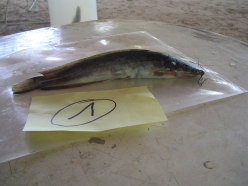
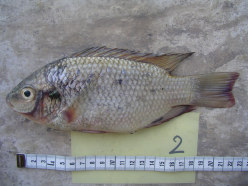
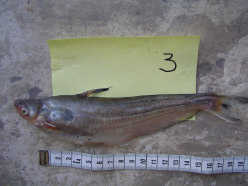
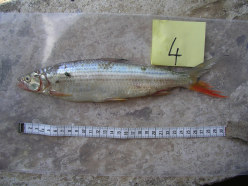
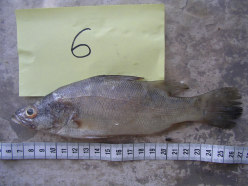
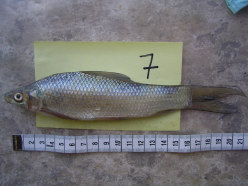
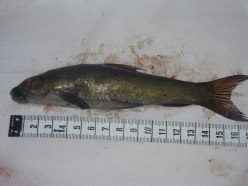
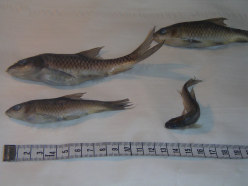
Global Mercury Project: Ingessana Hil s Sudan
PHOTOGRAPHS OF FISH SPECIES COLLECTED
FROM THE DIFFERENT FISHING SPOTS
(x: undetermined fish species)
Clarias gariepinus
Sarotherodon galilaeus
Hydrocinus forskalii
Schilbe intermedius
Lates niloticus
Labeo niloticus
Labeo horie
x
BRGM/RC-53589-FR "Draft report"
117
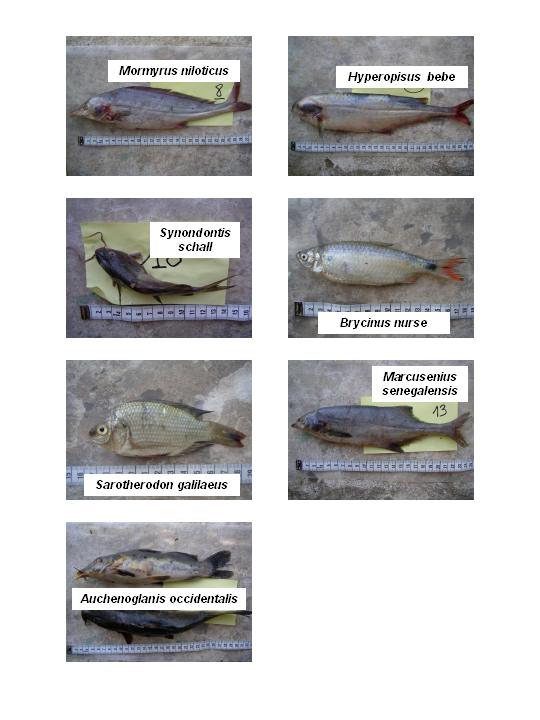
Global Mercury Project: Ingessana Hills Sudan
118 BRGM/RC-53589-FR "Draft report"
Global Mercury Project: Ingessana Hil s Sudan
BIOMETRIC DATA AND MERCURY CONCENTRATIONS MEASURED
AT THE INDIVIDUAL FISH LEVEL (N = 108)
Standard length Body weight (g, Hg conc (µg/g,
Family
Genus
Species
Food regime
Sampling spot
(cm)
fw)
dw)
Clari idae
Clarias
gariepinus
benthivorous
19.5
60
0.062
1
Clari idae
Clarias
gariepinus
benthivorous
18.0
54
0.099
1
Clari idae
Clarias
gariepinus
benthivorous
22.0
108
0.122
1
Clari idae
Clarias
gariepinus
benthivorous
18.5
66
0.070
1
Clari idae
Clarias
gariepinus
benthivorous
20.5
96
0.073
1
Schilbeidae
Schilbe
intermedius
carnivorous
17.0
54
0.569
1
Schilbeidae
Schilbe
intermedius
carnivorous
18.0
76
0.514
1
Schilbeidae
Schilbe
intermedius
carnivorous
17.0
56
0.460
1
Schilbeidae
Schilbe
intermedius
carnivorous
14.0
32
0.266
1
Schilbeidae
Schilbe
intermedius
carnivorous
12.0
18
0.217
1
Alesti dae
Hydrocinus
forskali
carnivorous
19.3
88
0.894
1
Alesti dae
Hydrocinus
forskali
carnivorous
26.5
190
0.698
1
Alesti dae
Hydrocinus
forskali
carnivorous
22.5
128
0.701
1
Alesti dae
Hydrocinus
forskali
carnivorous
17.5
64
0.426
1
Alesti dae
Hydrocinus
forskali
carnivorous
20.5
112
0.751
1
Centropomidae
Lates
niloticus
carnivorous
15.0
64
0.713
1
Centropomidae
Lates
niloticus
carnivorous
17.0
94
0.539
1
Centropomidae
Lates
niloticus
carnivorous
13.0
42
0.783
1
Centropomidae
Lates
niloticus
carnivorous
13.7
54
0.677
1
Centropomidae
Lates
niloticus
carnivorous
13.3
46
0.629
1
Centropomidae
Lates
niloticus
carnivorous
12.5
34
0.907
1
Cyprinidae
Labeo
niloticus
benthivorous
16.0
66
0.048
1
Cyprinidae
Labeo
niloticus
benthivorous
15.0
52
0.078
1
Cyprinidae
Labeo
niloticus
benthivorous
17.0
74
0.051
1
Cyprinidae
Labeo
niloticus
benthivorous
14.5
52
0.049
1
Cyprinidae
Labeo
niloticus
benthivorous
15.5
64
0.054
1
Alesti dae
Brycinus
nurse
omnivorous
13.0
46
0.081
1
Alesti dae
Brycinus
nurse
omnivorous
13.5
52
0.121
1
Alesti dae
Brycinus
nurse
omnivorous
14.0
56
0.122
1
Alesti dae
Brycinus
nurse
omnivorous
13.0
52
0.141
1
Alesti dae
Brycinus
nurse
omnivorous
13.0
50
0.072
1
Cichlidae
Sarotherodon
galilaeus
herbivorous
9
22
0.154
1
Cichlidae
Sarotherodon
galilaeus
herbivorous
9
24
0.104
1
Cichlidae
Sarotherodon
galilaeus
herbivorous
9
24
0.092
1
Cichlidae
Sarotherodon
galilaeus
herbivorous
9
22
0.124
1
Cichlidae
Sarotherodon
galilaeus
herbivorous
9.2
28
0.131
1
Cichlidae
Sarotherodon
galilaeus
herbivorous
8.7
24
0.072
1
Clari idae
Clarias
gariepinus
benthivorous
35.0
430
0.167
2
Clari idae
Clarias
gariepinus
benthivorous
38.0
622
0.039
2
Clari idae
Clarias
gariepinus
benthivorous
43.0
630
0.061
2
Clari idae
Clarias
gariepinus
benthivorous
40.5
540
0.127
2
Cichlidae
Sarotherodon
galilaeus
herbivorous
18.0
180
0.110
2
Cichlidae
Sarotherodon
galilaeus
herbivorous
16.0
142
0.169
2
Cichlidae
Sarotherodon
galilaeus
herbivorous
18.5
204
0.051
2
Cichlidae
Sarotherodon
galilaeus
herbivorous
16.0
138
0.112
2
Cichlidae
Sarotherodon
galilaeus
herbivorous
16.0
154
0.082
2
Mochokidae
Synondontis
schal
omnivorous
10.5
26
0.518
2
Mochokidae
Synondontis
schal
omnivorous
11.5
34
0.582
2
Mochokidae
Synondontis
schal
omnivorous
10.0
22
0.224
2
Mochokidae
Synondontis
schal
omnivorous
9.0
14
0.119
2
Mochokidae
Synondontis
schal
omnivorous
9.0
14
0.157
2
Mochokidae
Synondontis
schal
omnivorous
7.5
10
0.112
2
BRGM/RC-53589-FR "Draft report"
119
Global Mercury Project: Ingessana Hills Sudan
Standard length Body weight (g, Hg conc (µg.g-1
Family
Genus
Species
Food regime
Sampling spot
(cm)
fw)
dw)
Cichlidae
Oreochromis
niloticus
herbivorous
22.0
346
0.105
3
Cichlidae
Oreochromis
niloticus
herbivorous
20.0
244
0.069
3
Cichlidae
Oreochromis
niloticus
herbivorous
20.5
256
0.049
3
Cichlidae
Oreochromis
niloticus
herbivorous
20.0
232
0.083
3
Cichlidae
Oreochromis
niloticus
herbivorous
19.0
254
0.093
3
Schilbeidae
Schilbe
intermedius
carnivorous
24.0
132
0.308
3
Schilbeidae
Schilbe
intermedius
carnivorous
25.0
140
0.517
3
Schilbeidae
Schilbe
intermedius
carnivorous
22.0
124
0.677
3
Schilbeidae
Schilbe
intermedius
carnivorous
22.5
138
0.655
3
Mormyridae
Mormyrus
niloticus
carnivorous
23.0
106
0.100
3
Mormyridae
Mormyrus
niloticus
carnivorous
25.0
138
0.096
3
Mormyridae
Hyperopisus
bebe
omnivorous
27.0
184
0.107
3
Mormyridae
Hyperopisus
bebe
omnivorous
28.0
194
0.077
3
Mochokidae
Synondontis
schal
omnivorous
17.0
96
0.062
3
Mochokidae
Synondontis
schal
omnivorous
13.0
48
1.039
3
Mochokidae
Synondontis
schal
omnivorous
14.0
70
0.519
3
Mochokidae
Synondontis
schal
omnivorous
13.0
56
0.417
3
Mochokidae
Synondontis
schal
omnivorous
13.5
64
0.670
3
Mochokidae
Synondontis
schal
omnivorous
15.0
62
0.977
3
Mormyridae
Marcusenius
senegalensis
carnivorous
22.0
112
0.080
3
Mormyridae
Marcusenius
senegalensis
carnivorous
20.0
98
0.126
3
Bagridae
Auchenoglanis
occidentalis
omnivorous
24.0
256
0.046
3
Bagridae
Auchenoglanis
occidentalis
omnivorous
22.0
198
0.057
3
Clari idae
Clarias
gariepinus
benthivorous
22.0
69
0.243
4
Cichlidae
Oreochromis
niloticus
herbivorous
5.0
4
0.041
4
Cichlidae
Oreochromis
niloticus
herbivorous
5.0
4
0.047
4
Cichlidae
Oreochromis
niloticus
herbivorous
4.0
2
0.056
4
Cichlidae
Oreochromis
niloticus
herbivorous
7.9
13
0.056
4
Cichlidae
Oreochromis
niloticus
herbivorous
5.6
6
0.069
4
Cichlidae
Oreochromis
niloticus
herbivorous
5.0
6
0.056
4
Cichlidae
Oreochromis
niloticus
herbivorous
7.0
12
0.075
4
Cichlidae
Oreochromis
niloticus
herbivorous
6.3
9
0.032
4
Cichlidae
Oreochromis
niloticus
herbivorous
7.5
15
0.072
4
Cichlidae
Oreochromis
niloticus
herbivorous
8.0
19
0.059
4
Cichlidae
Oreochromis
niloticus
herbivorous
8.0
21
0.064
4
Cichlidae
Oreochromis
niloticus
herbivorous
9.0
23
0.055
4
Cichlidae
Oreochromis
niloticus
herbivorous
9.5
33
0.065
4
Cichlidae
Oreochromis
niloticus
herbivorous
10.5
39
0.049
4
Cichlidae
Oreochromis
niloticus
herbivorous
10.5
40
0.054
4
Cyprinidae
labeo
horie
benthivorous
6.5
4
0.099
4
Cyprinidae
labeo
horie
benthivorous
6.0
5
0.103
4
Cyprinidae
labeo
horie
benthivorous
11.0
22
0.325
4
Cyprinidae
labeo
horie
benthivorous
9.0
13
0.225
4
Cyprinidae
labeo
horie
benthivorous
10.0
14
0.109
4
Cyprinidae
labeo
horie
benthivorous
11.5
25
0.666
4
Cyprinidae
labeo
horie
benthivorous
12.0
40
0.075
4
Cyprinidae
labeo
horie
benthivorous
11.5
26
0.082
4
Cyprinidae
labeo
horie
benthivorous
9.5
16
0.102
4
Cyprinidae
labeo
horie
benthivorous
11.5
30
0.198
4
Cyprinidae
labeo
horie
benthivorous
14.0
47
0.109
4
Cyprinidae
labeo
horie
benthivorous
11.0
20
0.174
4
Cyprinidae
labeo
horie
benthivorous
5.0
2
0.246
4
Cyprinidae
labeo
horie
benthivorous
7.0
6
0.204
4
I
x
x
x
x
9.0
13
0.227
4
x
x
x
x
10.0
18
0.208
4
x
x
x
x
12.0
30
0.682
4
x
x
x
x
16.0
45
0.227
4
120 BRGM/RC-53589-FR "Draft report"
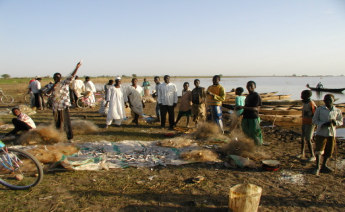
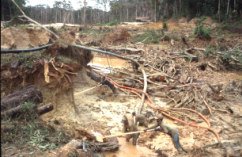
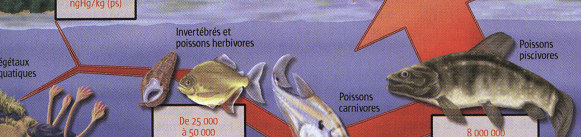

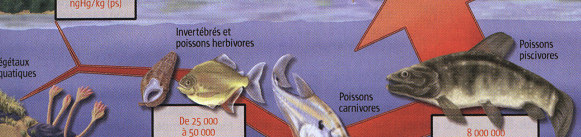

Global Mercury Project: Ingessana Hil s Sudan
MAIN BIOGEOCHEMICAL STEPS BETWEEN GOLDMINING ACTIVITIES USING
AMALGAMATION PROCEDURE AND HUMAN POPULATION EXPOSURE, VIA THE
INGESTION OF CARNIVOROUS FISH SPECIES, AT THE TOP OF THE AQUATIC
FOODWEBS (FROM BOUDOU A., 2004).
hu
h m
u a
m n
a
po
p p
o u
p l
uat
a iton
o s
n
ca
c r
a n
r i
n v
i o
v r
o o
r u
o s
u
fifs
i h
s
h c
o
c n
o s
n u
s m
u p
m t
p iton
o
5,
50,0
0 00
ng
n H
g g
H /
gg/g
50
5 ,
00,0
0 00
ng
n H
g g
H /g
g/g
12
1 ,0
2, 00
0 ,0
0, 0
0 00
ng
n H
g g
H /g
g/g
90
9 0,0
0, 0
0 0
00
ng
n H
g g
H /
gg/g
!"
!
#
$
%
Fish are exposed to mercury present in the aquatic systems, either through passive
(respiratory) exposure or through the diet (Snodgrass, Jagoe et al., 2000), where
contamination levels in the water column are general y very low, close to the ppt level
(ngHg/L), and consist mainly of the inorganic form (HgII). Thus, the trophic route of
exposure, via ingestion of the metal accumulated in prey and absorption through the
intestinal wal , represents the major contamination source for the different fish species,
with biomagnification playing a key role along the aquatic food chains (Boudou &
Ribeyre, 1997; Mason et al., 1995; Wiener et al, 2002). Biomagnification is essential y
based on cumulative trophic transfers of the methylated form of mercury (MMHg:
monomethylmercury CH3HgX) between prey and predators, leading to extremely high
concentrations in the different organs of carnivorous species, notably in the skeletal
muscle tissue (Bloom, 1992; Boudou & Ribeyre, 1997). So, within the complex
biogeochemical cycle of mercury, the elemental form Hg° used for amalgamation has
to be oxidized in the atmosphere and/or in the water (HgII) and then methylated by
bacteria (SRB: sulfur-reducing bacteria), mainly under hypoxic/anoxic conditions (Morel
et al., 1998; Rudd, 1995).
BRGM/RC-53589-FR "Draft report"
121
Global Mercury Project: Ingessana Hil s Sudan
Appendix 6
Results of Hg analysis
BRGM/RC-53589-FR "Draft report"
123
Global Mercury Project: Ingessana Hil s Sudan
SEDIMENTS
Hg Results
ID
PM 40° C
double
%
mg kg-1
mg kg-1
1
SSE001
0.88
0.133
2
SSE002
0.96
0.225
3
SSE003
0.62
1.649
4
SSE004
0.53
1.46
5
SSE005
1.00
1.066
6
SSE006
1.42
0.221
8
SSE007
1.15
0.14
9
SSE008
0.95
0.132
10 SSE009
0.87
0.276
0.283
11 SSE010
0.89
0.072
12 SSE011
0.86
0.153
13 SSE012
1.26
0.042
14 SSE013
1.47
0.059
15 SSE014
1.72
0.077
16 SSE015
1.52
0.092
17 SSE016
1.06
0.116
18 SSE017
0.93
0.121
19 SSE018
0.98
0.078
0.08
20 SSE019
1.65
0.324
21 SSE020
3.02
0.211
22 SSE021
1.59
0.081
23 SSE022
1.09
0.199
24 SSE023
53.7
0.265
25 SSE024
67.1
0.386
26 SSE025
24.0
0.19
27 SSE026
23.0
0.157
28 SSE027
49.3
0.148
29 SSE028
12.9
0.072
30 SSE029
2.63
0.053
0.056
31 SSE030
2.15
0.078
32 SSE031
0.90
0.042
33 SSE032
1.47
0.059
34 SSE033
1.62
0.203
35 SSE034
1.04
0.16
36 SSE035
1.41
0.176
37 SSE036
1.32
0.065
38 SSE037
1.39
0.424
0.422
39 SSE038
1.50
0.12
40 SSE039
1.29
0.101
41 SSE040
1.04
0.087
42 SSE041
0.88
0.176
43 SSE042
0.79
0.048
BRGM/RC-53589-FR "Draft report"
125
Global Mercury Project: Ingessana Hills Sudan
SEDIMENTS (Cont'd)
ID
PM 40° C
%
Hg Results
44 SSE043
1.29
0.077
45 SSE044
0.98
0.886
46 SSE045
1.06
0.163
47 SSE046
1.31
0.118
0.118
48 SSE047
1.35
0.081
49 SSE048
30.8
0.251
50 SSE049
31.3
0.316
.
126 BRGM/RC-53589-FR "Draft report"
Global Mercury Project: Ingessana Hil s Sudan
DUST
Hg Results
ID
PM 40° C
double
%
mg kg-1
mg kg-1
51 SDU001
1.69
0.914
52 SDU002
1.81
2.751
53 SDU003
0.88
2.662
54 SDU004
1.19
1.42
55 SDU005
1.51
1.433
56 SDU006
0.91
0.052
57 SDU007
0.87
0.157
58 SDU008
2.67
1.219
59 SDU009
0.85
1.999
60 SDU010
1.03
0.973
0.997
61 SDU011
1.28
0.505
62 SDU012
1.31
0.116
63 SDU013
1.25
0.434
64 SDU014
1.38
1.024
65 SDU015
0.83
1.835
66 SDU016
1.59
1.469
67 SDU017
1.01
3.414
68 SDU018
1.36
7.206
69 SDU019
3.71
3.177
70 SDU020
1.30
0.992
0.941
71 SDU021
1.16
5.546
72 SDU022
0.87
2.77
73 SDU023
1.60
840
74 SDU024
1.32
465
75 SDU025
1.04
9.523
76 SDU026
1.03
0.664
77 SDU027
0.75
0.123
78 SDU028
1.30
0.338
79 SDU029
0.92
1.96
80 SDU030
1.48
0.183
0.173
BRGM/RC-53589-FR "Draft report"
127
Global Mercury Project: Ingessana Hills Sudan
SOILS
Hg Results
ID
PM 40° C
double
%
mg kg-1
mg kg-1
88 SSO001
0.54
8.516
89 SSO002
0.75
1.716
1.74
90 SSO003
0.81
4.966
91 SSO004
0.90
0.312
92 SSO005
0.96
27.626
93 SSO006
0.78
2.53
94 SSO007
0.90
4.209
95 SSO008
-0.09
0.221
96 SSO009
0.94
0.106
0.099
97 SSO010
1.04
0.648
98 SSO011
0.87
0.213
99 SSO012
1.58
0.868
100 SSO013
0.91
2.585
101 SSO014
0.92
0.133
102 SSO015
0.83
0.142
103 SSO016
0.75
1.012
104 SSO017
0.79
2.574
105 SSO018
0.95
0.083
0.091
106 SSO019
0.54
0.275
107 SSO020
0.68
0.544
108 SSO021
0.57
0.492
109 SSO022
0.60
0.675
110 SSO023
0.64
1.307
111 SSO024
0.30
3.571
112 SSO025
0.59
1.213
113 SSO026
0.49
4.01
114 SSO027
0.50
7.805
115 SSO028
1.31
170
116 SSO029
0.39
1.345
117 SSO030
2.09
13.65
118 SSO031
0.34
0.391
119 SSO032
0.72
1.885
120 SSO033
0.74
4.977
6.847/5.334
121 SSO034
1.02
1.779
122 SSO035
0.77
1000
123 SSO036
0.76
1.665
124 SSO037
1.23
0.965
125 SSO038
0.95
0.466
128 BRGM/RC-53589-FR "Draft report"
Global Mercury Project: Ingessana Hil s Sudan
SOILS (Cont'd)
Hg Results
ID
PM 40° C
double
%
mg kg-1
mg kg-1
126 SSO039
1.31
0.209
127 SSO040
1.17
0.283
128 SSO041
1.31
2.037
129 SSO042
1.10
0.677
130 SSO043
1.63
3.328
3.213
131 SSO044
0.81
0.119
132 SSO045
1.08
0.179
133 SSO046
1.35
0.128
134 SSO047
0.68
0.437
135 SSO048
1.25
0.251
136 SSO049
0.90
0.151
137 SSO050
1.00
1.595
138 SSO051
0.93
1.047
139 SSO052
0.89
0.602
140 SSO053
0.69
0.114
0.116
141 SSO054
1.77
0.1
142 SSO055
1.02
0.1
143 SSO056
0.97
0.24
144 SSO057
0.74
2.31
145 SSO058
0.82
3.19
146 SSO059
0.74
2.79
147 SSO060
0.67
5.26
148 SSO061
0.77
0.43
149 SSO062
0.79
1.29
150 SSO063
0.80
3.83
3.83
151 SSO064
1.03
0.09
152 SSO065
0.99
0.12
153 SSO066
1.22
0.11
BRGM/RC-53589-FR "Draft report"
129
Global Mercury Project: Ingessana Hills Sudan
TAILINGS
Hg Results
ID
PM 40° C
double
%
mg kg-1
mg kg-1
154 STA001
1.25
1.55
155 STA002
1.17
0.35
156 STA003
0.89
2.63
2.7
157 STA004
1.92
0.28
158 STA005
2.00
0.12
159 STA006
1.69
1.02
160 STA007
1.66
62.3
61.5
161 STA008
1.65
0.15
0.13
162 STA009
1.85
0.13
163 STA010
2.05
0.1
164 STA011
1.83
0.13
165 STA012
0.72
0.1
166 STA013
0.47
72.5
71.4
167 STA014
1.94
0.08
168 STA015
1.97
0.07
169 STA016
2.36
0.19
170 STA017
1.55
1.64
1.6
TERMITES
Hg Results
ID
PM 40° C
double
%
mg kg-1
mg kg-1
81 STE001
3.07
0.315
82 STE002
1.48
0.083
83 STE003
1.06
0.115
84 STE004
1.59
0.044
7
STE006
1.43
0.072
85 STE005
1.72
0.041
86 STE007
1.50
0.028
87 STE008
1.29
0.094
.
130 BRGM/RC-53589-FR "Draft report"
Global Mercury Project: Ingessana Hil s Sudan
Appendix 7
Quality control of Hg analysis in solid samples
BRGM/RC-53589-FR "Draft report"
131
Global Mercury Project: Ingessana Hil s Sudan
QUALITY CONTROL OF LUMEX ANALYSES VS STANDARD REFERENCE
MATERIALS (SRM):
Internal quality control
As described in the report, the analyzer LUMEX has been calibrated for each analytical
sequence with two reference materials (one material for low mercury quantities
introduced in the device and the other one for high quantities).
NIST 2711 agricultural soil : reference value 6.25 mg kg-1
STSD1 (CANMET) : river sediment : reference value 0.11 mg kg-1.
The validity of calibration was daily checked with a third reference material : NIST 2709
in the middle of the calibration range (results for seven independant analyses of this
material are given in the table below).
NIST 2709
Reference Value 1.40 ± 0.08 mg kg-1
Measured Value 1.36 ± 0.18 mg kg-1 (n=7)
1. 10% of samples have been analyzed twice.
2. In a previous study, 7 reference material (soils, sediments and dusts) have been
analysed and have given good results in comparison with reference value (see
table below)
Reference
Référence value
Measured value
Material
(mg kg-1)
(mean n = 5)
2711
6.25 ± 0.19
6.60 ± 0.37
LKSD3
0.29 (1)
0.29 ± 0.04
STSD4
0.93 (1)
0.99 ± 0.14
JLK1
0.142 (1)
0.15 ± 0.01
jsd3
0.254 (1)
0.25 ± 0.02
2782
1.10 ± 0.19
1.17 ± 0.09
lgc6156
10.1 ± 1.6
9.9 ± 0.3
(1) Indicative value
BRGM/RC-53589-FR "Draft report"
133
Global Mercury Project: Ingessana Hills Sudan
External quality control
Al the samples col ected and brought back to France were analyzed with the LUMEX
in the BRGM laboratory. 10 % of the samples (18 samples) were selected and send to
an independant laboratory (Chemex ALS, Canada) to verify the results obtained in the
BRGM laboratory with the Lumex. The analyses of Chemex ALS laboratory were
performed by CV-AAS.
ALS CHEMEX
BRGM
Sample
CVAAS mg kg-1
LUMEX mg kg-1
SSE004
1,20
1,46
SSE011
0,18
0,15
SSE024
0,47
0,39
SSE036
0,08
0,07
SSE044
0,98
0,89
STA017
1,80
1,64
STE003
0,13
0,12
SDU003
2,64
2,66
SDU018
6,66
7,20
SDU025
5,82
3.17
SSO005
22,70
27,60
SSO011
0,26
0,21
SSO016
1,06
1,01
SSO026
3,76
4,01
SSO036
1,67
1,67
SSO048
0,25
0,25
SSO058
3,41
3,19
SSO066
0,15
0,11
BRGM laboratory mercury concentrations vs Chemex ALS mercury concentrations.
134
BRGM/RC-53589-FR "Draft report"
Global Mercury Project: Ingessana Hil s Sudan
Comparison between Lumex and Chemex-ALS analyses for a selection of solid
samples (two different scales).
Hg mg/kg
Hg mg/kg
30
10
9
25
8
7
20
6
M
M
G
G
15
5
R
R
B
B
4
10
3
2
5
1
0
0
0
10
20
30
0
2
4
6
8
10
ALS CHEMEX
ALS CHEMEX
The correlation between the Chemex ALS results and Lumex (BRGM) results is quite
good for most of samples. Only the sample SDU025 (dust sample) showed a lower
value by lumex than by the reference method. It seems that this sample is rather
inhomogeneous as indicated by some repetitions done with Lumex. This could explain
the difference beetween the two results.
BRGM/RC-53589-FR "Draft report"
135
Scientific and Technical Centre
Mineral Resources Division
3, avenue Claude-Guil emin - BP 6009
45060 Orléans Cedex 2 France Tel.: +33 (0)2 38 64 34 34