From the Editor
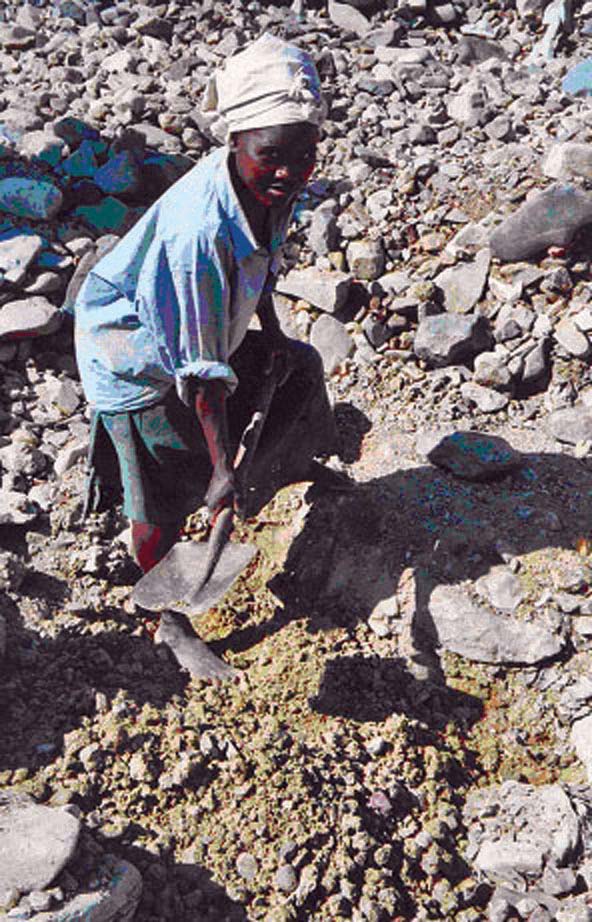
An impaired woman panning for gold in the
Kadoma-Chakari region, Zimbabwe
In this issue we highlight the news that CETEM has
completed the field work for the Environmental and Health
Assessment (E&HA) of mercury impacts in Brazil and
Indonesia. In Tanzania, BGS also finished its fieldwork
in the Rwamagasa area (drainage to the Tanganyika Lake)
where biological, geological and human samples where
collected to be analyzed. In Zimbabwe, the French Insti-
tute, BRGM has been conducting the Environmental As-
sessment in the Kadoma-Chakari region.
Zimbabwe: Miners, Millers, Panners
In Zimbabwe, it is estimated that there are between
300,000 and 400,000 artisanal gold miners sustaining
the livelihood of at least 2 million people. About 20,000
to 30,000 people are directly involved in gold extraction
in the GMP site, Kadoma-Chakari region. There are 3
categories of workers in the area: miners (about 3,000
to 5,000 people) who excavate the ore and take this to
be processed in custom milling centers; millers (1,000
to 2,000 people in 70 milling sites) who process the ore
to extract gold in the milling centers and panners
(15,000 to 25,000 people) who extract gold by panning
the gravels in creeks and rivers. The custom milling
Millers extract the gold left in the primary and amal-
centers are a desirable solution as this organizes the
gamation tailings by vat-cyanidation. Miners receive no
activity and avoids the use of mercury in different places.
compensation for this. Most Centers have 5 to 10
However, the millers allow miners (customers) to use
cyanidation tanks. When the Hg-contaminated tailings
their own mercury at any step of the process. It is
are leached with cyanide, part of the mercury goes into
common to see miners adding three teaspoons (150 g)
solution and part of it stays with the final tailings. The fate
of mercury in the centrifuges used for gravity
of Hg-cyanide in the tailings is unknown but cyanidation
concentration of gold. This "flours" part of the mercury
process can also exacerbate the Hg methylation poten-
that is lost with the tailings. The use of copper-amalgam
tial in tailings.
plates is very popular in the region and must be forbidden
Panners in Kadoma-Chakari are isolated individuals
to amalgamate the whole ore. Mercury (and gold)
usually from remote areas, some of them from neighbor-
accumulates on a point of the plate surface, and with
ing countries. They are frequently harassed by local po-
the attrition of the ore, it is lost. A miner stated: "If I
lice while working in illegal areas. In the dry season, they
sleep and I do not spread the mercury on the plate, I
divert the river and excavate the gravels to concentrate
lose mercury and my gold, and the miller will have it
gold in improvised sluice boxes (known as James Table).
later on when he uses cyanide".
They process from 1.5 to 2 tonnes of material per day
A businessman stated that he is importing annually
recovering 0.2 to 0.4 g Au and losing equal quantity of
20 tonnes of mercury from Netherlands to Zimbabwe.
mercury.
Based on field observations it is estimated that Hg losses
in the region must be between 3 to 5 tonnes/a.
The Global Mercury Project (GMP) began in August 2002. The GMP will demonstrate ways of overcoming barriers to the adoption of best
practices and pol ution prevention measures that limit the mercury (Hg) contamination of international waters from artisanal and smal -scale
gold mining (ASM). Six countries are participating in the GMP: Brazil, Lao PDR, Indonesia, Sudan, Tanzania and Zimbabwe. In addition, the
GMP aims to introduce cleaner technologies, train miners, develop regulatory mechanisms and capacities within Government, conduct
environmental and health assessments (E&HA) and build capacity in local laboratories to continue monitoring Hg pol ution after the project.
Environmental & Health
Assessment in Brazil
The Project sites chosen to investigate the environ-
mental and health effects of Hg from artisanal and small-
scale mining (ASM) in Brazil are located in the Tapajós
region. The main characteristics are:
·
it is the main Brazilian ASM location with almost
100,000 km² impacted by mining. This is larger
than Portugal area (92,000 km²);
·
ASM started back in 1958 with historical official
gold production of 180.6 tonnes (US$1,915 mil-
lion); the estimated actual production is around
650 tonnes of gold (US$ 6,877 million);
·
gold is extracted from secondary and primary,
deposits in more than 2,200 mining sites;
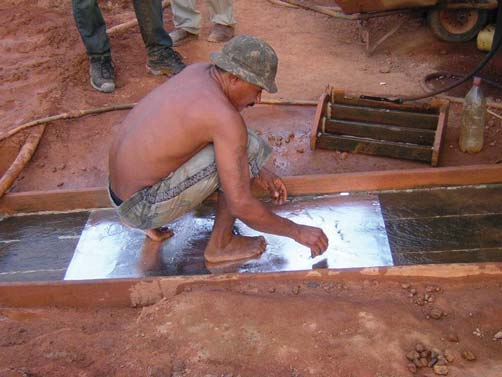
Recover of amalgam from a copper plate,
·
about 500 occurrences of primary gold, of which
Itaituba, Brazil.
100 of them are in being mined;
·
it was the first area to organize a formal associa-
tion of the mine owners "Associação dos
Mineradores de Ouro do Tapajos" - AMOT.
The selected areas of Creporizinho and São Chico
are located in the Tapajós River basin , situated in the
SW of the State of Para, Brazil, distant 1,300 km from
Belém , State Capital. Creporizinho was founded in 1962
and has three churches, a large variety of grocery stores,
a police station and some 238 houses for an estimated
population of 1000 inhabitants. Electricity is generated
from diesel engines. About 200 children go to the local
elementary school, from 1st to 6th grade. Its top gold
production occurred between 1983 and 1990, when 350
to 400 kg of gold per month was produced. At that time
the town received 10,000 inhabitants. Currently the gold
production of 50 kg/m is basically from primary ore. São
Chico has a similar history. Discovered in 1963, the town
witnessed a gold rush from 1999 to 2001 when produc-
tion of circa 2 tons of gold was reported and the popula-
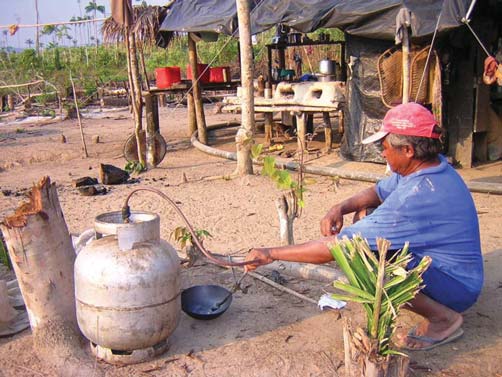
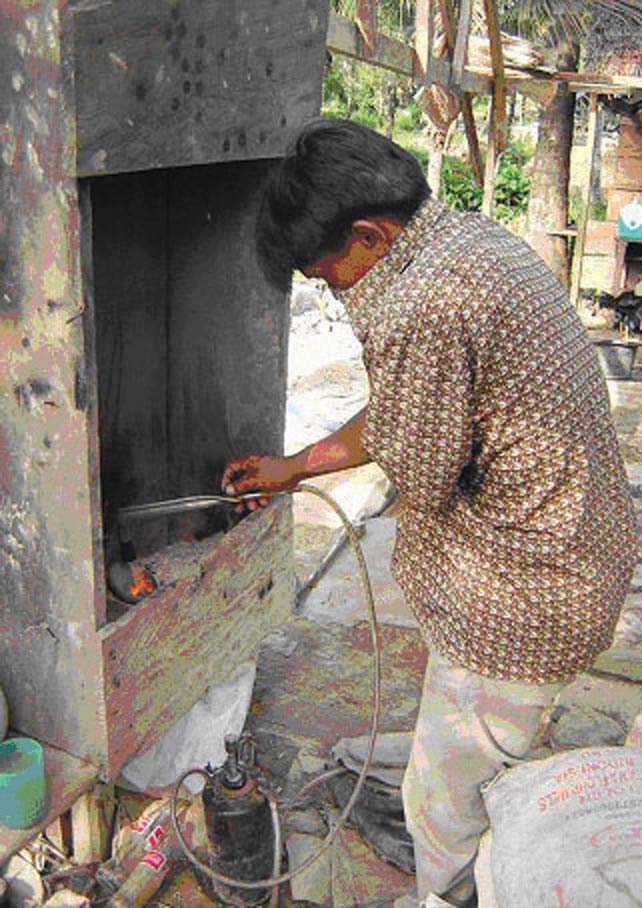
Burning of amalgam in open air close to cooking facilities,
tion peaked 5000 people. Currently there are about 130
Itaituba, Brazil.
miners producing a bit more than 1 kg of gold per month.
In order to assess the environmental and health im-
pacts caused by ASM, CETEM Centre of Mineral Tech-
nology, Rio de Janeiro, Brazil together with the medical
doctors from the Instituto Evandro Chagas of the Brazil-
The Demise of the Country Focal
ian Ministry of Health, Belém, Pará State collected 646
environmental samples, including soil, stream sediments,
Point in Brazil
and aquatic biota as well as 700 human samples (urine,
The PCU is sad to communicate the passing of Dr. Eng. Gildo
hair and blood) from miners and other community mem-
Sá occurred on 24 September 2003. Gildo, GMP Country Focal
bers of Creporizinho and São Chico. In the process the
Point and Director of CETEM died at age of 64. As a well-
doctors interviewed the volunteers to know more about
known professional engineer throughout Latin America, he
their general health and performed a series of neurologi-
was associated to CETEM and the Brazilian Geological Sur-
cal tests to establish the level of mercury intoxication.
vey for more than 25 years. During his professional career he
The team also left with local health and sanitary authori-
held such responsible positions such as Director of
ties a simple colorimetric method to provide a fast way to
FOSFERTIL, Vice President of ABRAFOS, the Brazilian Fertil-
evaluate the level of mercury contamination in edible fish.
izers Association, Vice President of OLAMI, the Latin America
All samples are being analyzed in Rio de Janeiro and in
Mining Organization, President of FAEMI , the Brazilian Fed-
Belém to produce a definitive picture of the level of mer-
eration of Mining Engineers and had worked as Consultant in
cury pollution at the project sites.
several important mining projects in Brazil and Argentina. He
Beyond mercury pollution, the siltation (due to ero-
leaves his wife, Darcy, and two daughters Ceça and Luciana
sion of the margins) of the rivers has caused huge envi-
to whom we extend our condolences.
ronmental impacts that can be noticed up to 300-500 km
downstream of the Tapajós River.
neurological testing and specimens of blood, urine and hair.
Environmental & Health
The samples were shipped to Germany for analysis. Ac-
Assessment in Indonesia
cording to first results, there is a very high rate of mercury
intoxication in male miners of the Galagan and Tatelu area.
The E&HA has been undertaken in August/ Septem-
Although the final results are not yet ready, it is estimated
ber 2003 by a team composed of scientists from Centre
that 50 percent of the miners must be regarded as intoxi-
of Mineral Technology, CETEM, Rio de Janeiro, Brazil,
cated. All these rankings are based on UNIDO health as-
and Institute of Forensic Medicine of the Ludwig-
sessment protocols, where intoxication is determined by
Maximilians University Munich, Germany. The areas un-
a medical score plus a given level of mercury in bio-moni-
der survey were close to Manado, North Sulawesi, and
tors. The protocol is available at GMP website. In total,
Palankaraya - Kereng Pangi, Central Kalimantan Island.
764 samples were taken by the environmental team. The
Both teams were assisted by the local UNIDO represen-
sample material consists of 416 biological samples from
tatives, the Indonesian Focal Point, Mr. Thamrin Sihite,
fishes, plants and shells, and 348 inorganic samples from
and the Assistant to the Country Focal Point, Ms.
sediments, soils and water. It is expected that the final
Selinawati Darmutji, who was present throughout all
report will be available at the end of the year 2003.
phases of the field campaign. Meetings took place with
the Chief Technical Advisor for deliberating on next steps
in disseminating results, awareness raising and training.
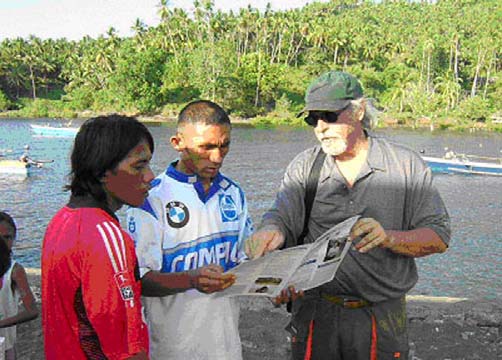
R. Villas Boas, from CETEM showing the GMP News to
The mining site in Kalimantan is reached via
Miners in Kalimantan
Palankaraya airport. From there, it takes almost 1 hour
to the mining town of Kereng Pangi, where in the nearby
mining area of Galagan both the health and environmen-
tal teams performed their surveys. The mining area drains
to the Katingan River flowing from North to South into the
Java Sea. In Galangan, about 12,000 miners extract allu-
vial material in an area of 200 km². The material is con-
centrated on sluice boxes and amalgamation is conducted
in pools excavated nearby their houses. Amalgam is
burned in open crucibles inside family houses (kitchens)
or in commercial stores (e.g. restaurants, warehouses).
Gold, with residual 2 to 5% Hg, is sold in Kereng Pangi.
In the rainy season 15 kg of gold/day is sold to 20 gold
shops and melted in the village in rudimentary fume-hoods
with no condensers or filters for Hg abatement.
The investigations in Sulawesi were conducted close
to Manado, a prosperous city of 600,000 inhabitants lo-
A miner from Sulawesi believes that his "mask" is
cated at the Manado Bay of the Sulawesi Sea. The min-
protecting him from Hg vapor
ing area Tatelu is some 30 km away from Manado. Min-
eral processing activities are pursued along a small road
crossing the village. Miners take 0.5 to 1 tonnes of ore
per day to the milling centers. The material is crushed by
stamp mills and then ground in a series of 12 home-made
tumbling mills. Each steel mill, with diameter of 48 cm
and length of 60 cm, has capacity of milling 40 kg of ore
per batch (usually 5 hours). The mill grinds the ore for 4
hours using 40 river cobbles/mill. Then the grinding step
is interrupted and about 1 kg of mercury per mill is added
and the mill rotates for an additional hour. After separa-
tion of the amalgam and the pulp, tailings are undergoing
a second amalgamation and/or cyanidation process. Three
small rivers drain into the Manado Bay, all originating from
the Talawaan watershed. Both teams took samples in
this area and alongside the watersheds.
In each of the surveys in Sulawesi and Kalimantan, 200
members of the small-scale mining communities partici-
pated voluntarily in the health assessment. Another 100
participants living in non-mercury exposed areas were
checked as a reference group. Basic data on the commu-
nities were recovered through a questionnaire in Bahasa
language. All participants were physically examined through


Plans for January - June 2004
Activities July December 2003
·
Purchase of portable Hg analyzers for all 6 partici-
pating countries.
Recruitment of new Assistant to the Focal Point in
· Legal study on small-scale gold mining in the State
Zimbabwe.
of Amazonas/Brazil.
Meeting with stakeholders in Zimbabwe and Tanza-
· Continuation of preparation of training modules.
nia. Presentation of lectures on environmental and
health effects caused by mercury.
· Preparation of Country Task Force Meeting in Brazil
Technical assessment of the miners' need in Zimba-
with presentation of the results of the Environmental
bwe and Tanzania.
and Health Survey.
Elaboration of a strategy to implement technological
· Preparation of Country Task Force Meeting in Indo-
solutions at project sites in Zimbabwe and Tanzania.
nesia with presentation of the results of the Environ-
mental and Health Survey.
Completion of sociological studies in the hot spots of
· Start of a public awareness campaign in Brazil and
the 6 countries and transmission of conclusions to
selected subcontractors for the health and environ-
Indonesia.
mental surveys.
· Health survey in Zimbabwe.
Fieldwork for the E&HA completed in Brazil, Indone-
· Environmental and Health Survey in Sudan.
sia and Tanzania.
· Environmental and Health Survey in Lao PDR.
Fieldwork for Environmental Assessment in Zimba-
· Training of laboratory technicians in Hg analysis and
bwe.
Hg monitoring.
Assessment of analytical laboratories in Zimbabwe
· Upgrading laboratories for Hg monitoring in Brazil,
and Tanzania.
Lao PDR, Indonesia, Sudan, Tanzania, Zimbabwe
International bidding on portable Hg-analyzers for all
· Assessment of technical needs in Sudan.
6 project participating countries.
· Identification of potential equipment suppliers in Latin
Participation in the Annual Meeting of CASM (Com-
America, Africa and Asia.
munity and Artisanal and Small-scale Mining), World
· Development of technical specifications for equipment
Bank, in Elmina, Ghana.
at demonstration sites.
Training of National Experts in undertaking epidemio-
· Initiating of bidding on mineral processing equipment.
logical surveys in mercury-affected areas (Brazil, In-
donesia, Tanzania).
Training of Health Experts in semi-quantitative Hg
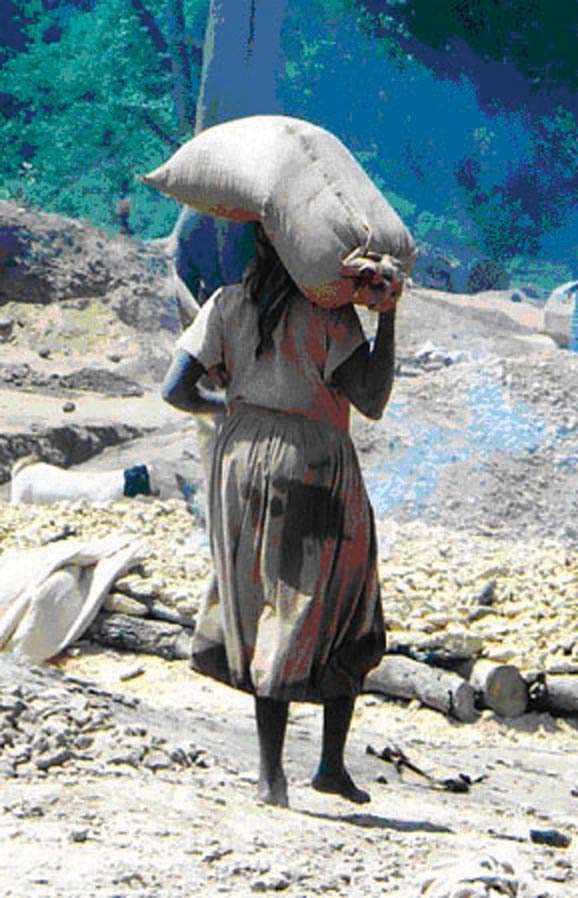
Woman carrying 50-kg bag of ore to be processed in a
analysis of fish (Indonesia).
custom milling center em Rwamagasa, Tanzania
Legal survey of US EPA on mining-related legislation
in the six participating countries.
Peer Review of US EPA on Environmental and Health
Protocols developed by PCU.
Start of preparation of adaptable training courses
(TRAIN-X) for field training.
Creation of a website www.globalmercury.org and in-
clusion of project-related reports.
Review of sociological and technical information ob-
tained in the six countries for website.
Global Task Force Meeting Luang Prabang/Lao PDR,
17-19 December.
For further information contact the Project
Coordination Unit:
Dr.- Ing. Christian Beinhoff
Chief Technical Advisor
GMP - Global Mercury Project
UNIDO - United Nations Industrial Development
Organization
Vienna International Center, D1275
PO Box 300, A-1400 Vienna, Austria
Tel +43-1-26026-3738 / 3807
Fax + 43-1-26026-6819
E-mail: C.Beinhoff@unido.org
www.globalmercury.org