









GMP News, n. 04, March 2004
Global Mercury Project
Project EG/GLO/01/G34: Removal of Barriers to Introduction of Cleaner Artisanal Gold Mining and Extraction Technologies
From the Editor
This issue highlights the strategy for
implementation of the demonstration units as well as
the situation of the artisanal miners in Lao PDR. The
Project Coordination Unit (PCU) and the
Governmental counterparts recognize that education
is the key for effective measures in reducing mercury
emissions in developing countries. Hands-on training
will be provided to miners and other stakeholders. The
training units proposed by GMP go after miners and
not vice-versa. The rampant use of mercury as a
result of the high gold price must be combated at the
source. Therefore, free flow of mercury to developing
countries must not be stimulated. The Hg-exporting
countries should actively participate in all initiatives to
bring means for poor miners to reduce their level of
exposure to the toxic metal.
Implementation of Transportable
Demonstration Units
Mercury emissions from artisanal and small-scale
Young gold panner in the Mekong River, Lao PDR
gold mining (ASGM) have been increasing
substantially with the rising price of gold since 2003.
By using demonstration units, a variety of technical
Miners are coming back to re-work abandoned ore
options for grinding, gold concentration, amalgamation
deposits or mining low-grade ores hitherto considered
and retorting can be demonstrated to miners and
uneconomical. According to an estimate of PCU, 10 to
millers; it is up to them to select what is affordable,
15 million people in about 40 countries might be
appropriate and durable according to availability of
presently involved in artisanal and small-scale gold
their funds and convenience The units have high
mining. Amalgamation is an easy and inexpensive
flexibility in terms of the subjects to be presented to
procedure to trap fine gold particles, but when
the miners as well as the option to include "peripheral"
misused it can lead to large mercury emissions. This
education, e.g., health & sanitation, book-keeping,
poverty-driven activity may be responsible for as
legal issues, etc. The TDUs will make use of tents or
much as 800 tonnes/a of metallic mercury being
existing houses as classrooms and the training will be
released into the environment worldwide, representing
conducted either at the mine sites or at populated
more than 20% of the total anthropogenic mercury
centers. The TDUs will also be placed to improve the
emissions. The most sustainable solution for this
public awareness about the impacts of mercury on the
problem is education. Miners should know how to
mining communities. The units bring flexibility to the
reduce exposure to Hg vapors and reduce Hg
training as they are easy to move from one place to
releases to the environment. As ASGM activities are
another and introduce new pieces of equipment for
of migratory nature and scattered over large areas, it
demonstration without the need for concrete
is a challenge to offer training to these workers. The
foundations, etc. The concept of TDUs has been
GMP team has been proposing Transportable
discussed at stakeholder meetings in Zimbabwe and
Demonstration Units (TDUs) to reach miners in those
Tanzania with participation of Government, project
regions where the aspect of migratory work is
counterparts, representatives of miners and
prominent. This reduces problems of land tenure and
equipment manufacturers. The concept has been very
mineral rights that would be associated with a
well accepted. The cost of these units ranges from
centrally-located, static demonstration plant.
US$ 50-70,000.
The Global Mercury Project (GMP) began in August 2002. The GMP will demonstrate ways of overcoming barriers to the adoption of best
practices and pollution prevention measures that limit the mercury (Hg) contamination of international waters from artisanal and small-scale
gold mining (ASM). Six countries are participating in the GMP: Brazil, Lao PDR, Indonesia, Sudan, Tanzania and Zimbabwe. In addition, the
GMP aims to introduce cleaner technologies, train miners, develop regulatory mechanisms and capacities within Government, conduct
environmental and health assessments (E&HA) and build capacity in local laboratories to continue monitoring Hg pollution after the project.
GMP News 2
First Global Task Force Meeting in
Mercury Conference in Slovenia
Lao PDR, Dec. 17-19, 2003
The 7th International Conference on Mercury as a
The First Global Task Force Meeting was held in
Global Pollutant will take place in Ljubljana, Slovenia
from June 27 to July 2, 2004. The Conference will
Luang Prabang, Lao PDR from 17-19 December 2003
feature 650 presentations and is expected to bring
with the participation of 31 experts from 11 countries.
together almost 1000 experts from over 50 countries.
The meeting gathered members of the PCU, Country
The International Conference Series on Mercury as a
Focal Points and their Assistants (ACFP) from the 6
Global Pollutant (ICMGP) was initiated in 1990 in
GMP participating countries as well as representatives
Sweden. The Conference will be held in a country that
from GEF/UNDP, USEPA, UNEP, and National
had the second largest Hg mine in the world. The Hg
Institute for Minamata Disease, Japan. The
mine which was located at Idrija was operational for
presentations from Brazil, Indonesia, Lao PDR, Sudan
over 500 years up until 20 years ago. The increasing
and Zimbabwe provided an overview on socio-
problem of Hg pollution from artisanal gold mining in
demographic conditions, characteristics of the mining
developing countries encouraged the Conference
communities, description of the mining sites and
organizers to establish many oral and poster
mineral processing and amalgamation methods used
presentations and a round table on the theme. The
by the artisanal gold miners. The talks revealed that
GMP will be represented by the PCU, ACFP from
as much as 30 tonnes of mercury have been annually
Tanzania and Zimbabwe and GMP-invited
released into the environment in the regions chosen
participants. PCU will present 15 papers reporting on
by the Project to implement solutions to reduce Hg
the initial results of the Environmental and Health
emissions. The Chief Technical Advisor (CTA), Mr. C.
Assessments in the GMP countries.
Beinhoff called the attention of the audience
Training Modules Being Prepared
mentioning that upon inception of the Global Mercury
Project, UNIDO had received numerous inquiries for
Presently, PCU is cooperating with the small-scale
initiating similar programmes and activities in other
mining expert, Mr. Edmund Bugnosen, in developing
developing countries, such as Venezuela, Cameroon,
training modules to be used for operating the TDUs.
Ghana, Mali, Mozambique, Philippines, etc. He
The training material will be divided in modules where
reminded that further support to the project through
subjects related to gold processing will be produced
donor governments and aid agencies will not only
for different levels, depending on the education of the
depend on their good will, but also on the quality of
reader. It is expected to train miners, millers,
project implementation, the reliability of data, and the
inspectors, Government representatives and
replicability of the entire strategy. Reducing mercury
members of the mining community. The training
emissions and eliminating the undesirable health and
modules will serve as a basis for hands-on teaching
environmental effects will require a delicate balance of
on the benefits of each piece of equipment. The
technical assistance and of progressing enforcement
modules will cover the following topics:
of regulations. In this context, the PCU is counting on
· Knowing Hg and the problem (e.g. Hg sources,
characteristics, cycles, pathways, symptoms of Hg
a strong and continued commitment of the six
poisoning, impacts, etc.)
Governments over the remaining time of
· Understanding the source of Hg pollution (e.g. bad
implementation and beyond that period. Regarding
and good amalgamation practices, Hg evaporation,
the use of mercury, participating countries should try
amalgamation tailings, improper handling, etc.)
to make the market and trades more transparent.
· Solutions: reducing or eliminating Hg (e.g. legal
means, social approach, technological approach,
Analytical Equipment for Hg
cleaner techniques, recycling, etc.)
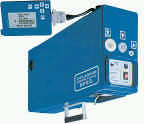
The PCU has selected
LUMEX RA 915+, a
CVAA spectrometer, to
complement existing
analytical equipment of
selected laboratories in
the 6 GMP countries. This
instrument was devised
for air analysis, but it is
LUMEX allows accurate
also suitable for analyzing
Hg analyses in the field
Hg up to 0.5ppt (ng/L) in
solution. Another kit, a
pyrolisis chamber, promotes thermal decomposition of
samples allowing analysis of liquids and solids (fish,
hair, sediments). In a recent mission to Venezuela,
Bare-handed miner in Zimbabwe exposing himself to
UNIDO team analyzed 300 urine samples in less than
cyanide and mercury
12 hours. The equipment can use the alternator of a
car as a source of power. GMP will conduct a training
The training modules will be supported with videos,
course for technicians from all participating countries.
slides, posters, brochures, etc.


GMP News 3
E&HA Started in Lao PDR
In February, the renowned French Institution,
BRGM started the Environmental and Health
Assessment (E&HA) in the Mekong River Basin in Lao
PDR. The project area is approximately 25 km away
from the town of Luang Prabang where Mekong and
Nam Ou are the major and vital rivers used by the
community of 8 villages (3850 people). Most people
are rice farmers and seasonal gold miners, i.e.
panning for gold in the dry season. The access to the
area is either by gravel road or boat. Artisanal gold
mining started in the mid 1970s and typically involves
manual excavation, which is usually conducted by
men, and panning of the riverbed material and
amalgamation of the heavy concentrate, which is
usually a work for women and kids. With no
Female miner in Lao PDR using mercury to amalgamate
sophisticated equipment, this is a family affair that
concentrate from panning
usually produces 10 to 40 grams of gold per annum
per household (627 households in the project area). In
Lao PDR, one kg of Hg costs US$ 75 to 87.6 which is
Cooperation with International
very expensive compared with the international price
Institutions
of US$ 5/kg. The high cost of Hg is supposedly an
incentive for its recovery and re-use, but it is
PCU has thankfully accepted the invitation of the
estimated that only half of those households burning
National Institute for Minamata Disease in Japan
amalgam make an attempt of recovering the
(NIMD) for discussing cooperation with the GMP on
vaporized mercury. In fact, amalgam is burned in
field level. NIMD envisions conducting a medical
bonfires in houses or outside in the presence of kids.
follow-up of Hg-intoxicated miners. The Institute has
The total mercury release from the Project area
offered inter alia to analyze methylmercury in
represents 5 to 6 kg/a. In order to recycle mercury
hundreds of hair samples. The US EPA is also
from the amalgam, a few villagers use a unique
collaborating with the GMP in the preparation of a
technique. They put the amalgam in a metallic glazed
workshop for laboratory technicians from the 6 GMP
plate with a bamboo tube in the vertical position
countries. The course will encompass training in using
around the amalgam. When the bowl with amalgam is
LUMEX and other techniques to analyze Hg in
burned with wood, mercury evaporates and
different samples.
condenses on walls in the interior of the bamboo tube.
The gold remains in the bowl. The condensed
Website with a Discussion Forum
mercury is removed with a chicken feather to be re-
used. Very soon the BRGM team will reveal the main
The GMP website is on-line: www.globalmercury.org.
findings of their study.
A Forum for discussions on Hg related subjects was
created at: www.globalmercuryforum.org. The Forum
Meeting of African GMP Countries
has lots of interesting features, like associated mailing
list (allowing to upload attached documents), news
From February 1 to 5, the PCU met with the
group or chat, links with other Hg websites,
Sudanese, Tanzanian and Zimbabwean project
documents, etc. The user may register by filling in the
representatives in Zimbabwe to discuss the
form in the member section. Then he/she will be able
implementation strategy in Africa. The visit of the
to enter the Forum using their own username and
Sudanese and Tanzanian representatives to the
password and have their own identity when posting
artisanal mining processing centers in Kadoma,
messages. The Forum has 2 conference rooms: one
Zimbabwe, was very fruitful to highlight points for
related to the GMP and another with a more general
discussions on the advantages and drawbacks of the
discussion forum about issues related to mercury
different types of equipment being used by the
pollution.
Zimbabwean miners for gold processing. Other
Government representatives were in Kadoma when
Workshops on EU Level in Brussels
the PCU made a presentation of the concept of the
Transportable Demonstration Units. After reviewing
In preparation of international agreements on Hg,
the document detailing all aspects of the initiative, the
the Nordic Council of Ministers and the European
stakeholder gave their approval to the PCU to start
Commission had organized two workshops in
the implementation process in Zimbabwe. The other
Brussels held from March 29-31,2004. PCU reported
two members of the African countries also welcomed
on the progress of GMP and revealed the striking
the idea. A visit to a local equipment manufacturer has
information on mercury use in small-scale gold
demonstrated the viability of implementing such idea
mining. PCU demanded the end of export of almost
in short term.
800 tonnes/a of mercury from the European Union.


GMP News 4
Activities Dec. 2003 Mar. 2004
ü First Global Task Force Meeting in Lao PDR, Dec.
Plans for Apr. Sept. 2004
17-19, 2003
· Health Assessment in Zimbabwe and Sudan
ü Elaboration of the Equipment Specification
documents for Zimbabwe and Tanzania
· Environmental Assessment in Sudan
ü Meeting with GMP representatives from Sudan,
· Evaluation of miners' needs and potential
Tanzania and Zimbabwe to discuss
equipment manufacturers or agents in Sudan,
implementation strategies, equipment
Brazil, Lao PDR and Indonesia
specifications and operation of the Transportable
· Preparation of equipment specifications for Brazil,
Demonstration Unit (TDUs)
Sudan, Indonesia and Lao PDR
ü Meeting with equipment manufacturers in
· Meeting with Government representatives and
Zimbabwe and Tanzania to discuss terms of
other stakeholders in Tanzania to discuss the
reference of equipment.
results of E&HA
ü Meeting with potential operators of the TDUs in
· Stakeholder meeting in Brazil to disclose and
Zimbabwe and Tanzania
discuss the results of the E&HA
ü Initiation of equipment acquisition for TDUs.
· Continuation of elaboration of the Training
ü Final editing (for printing) of the Protocol with
modules
methodologies for environmental and health
assessment of Hg in artisanal and small-scale
· Start of elaboration of activities for the public
mining areas
awareness campaign in all participating countries
ü Selection and acquisition of LUMEX atomic
· Participation in the 7th ICMGP, Ljubljana Jun 27-
absorption spectrometer to be delivered to all 6
Jul 2, 04
GMP participating countries.
· Discussion with National Institute for Minamata
ü Cooperation with mining expert in elaboration of
Disease on collaboration strategies and follow-up
training modules
on intoxicated people identified in E&HA
ü Conducting Environmental and Health
· Input and follow-up of the Nordic Council of
Assessment in Tanzania and Lao PDR
Ministers and European Commission Workshops
ü Supervising E&HA in Lao PDR
on Mercury
ü Presenting the GMP at the EU level Workshops
· Training of technicians from all 6 GMP countries
on Mercury, Trends and Needs for International
on LUMEX CVAA spectrometry
Agreements, in Brussels March 29-31, 2004
· Cooperation with the Institute for Atmospheric
ü Participation in the Steering Committee meetings
Pollution of the Italian National Research Council
in preparation of the 7th Int. Conf. of Mercury as a
on Source-Receptor Impacts of Hg on Human
Global Pollutant, Slovenia, Feb 2004
Health
ü Elaboration of 16 papers related to GMP to be
· Presentation of the GMP and preliminary project
presented at the 7th ICMGP
results at UNEP Stakeholder Meeting on Mercury
ü Preparation of Country Force Task Meeting in
in Thailand
Brazil, April 2004
· Advisory services on improvement of legal
ü Consultations of Indonesia ACFP with Indonesian
framework
equipment suppliers
· Recruitment of expert on micro-financing systems
ü Preliminary discussion on production of brochures
for ASM in Tanzania
and other public information to be part of the
project awareness campaign
For further information contact the Project Coordination Unit:
Dr.- Ing. Christian Beinhoff
Chief Technical Advisor
GMP - Global Mercury Project
UNIDO United Nations Industrial Development
Organization
Vienna International Center, D1275
PO Box 300, A-1400 Vienna, Austria
Tel +43-1-26026-3738/3807
Fax +43-1-26026-6819
E-mail: C.Beinhoff@unido.org
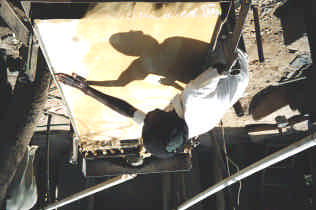
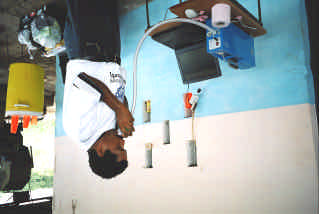
Gold miner checking the content of Hg in exhaled air.