

GMP News, n. 02, June 2003
Global Mercury Project
Project EG/GLO/01/G34: Removal of Barriers to Introduction of Cleaner Artisanal Gold Mining and Extraction Technologies
From the Editor
In this issue we highlight the decision of the US
Environmental Protection Agency (USEPA) to give
GMP the benefit of their advisory services and
technical field support. In addition to USEPA, WHO
Jakarta declared their interest in supporting health
related programs for mercury-affected mining
communities in Indonesia. Another good news is the
completion of the Protocols and Questionnaires for
the Environmental and Health Assessment (E&HA) of
mercury impacts in hotspot areas. The required
investigations in the six participating countries Brazil,
Indonesia, Lao PDR, Sudan, Tanzania and Zimbabwe
have been recently sub-contracted to BGS/UK,
BRGM/France and CETEM/Brazil. The work is
starting in July.
Indonesia Gold Rush: Mercury
Pollution Is Escalating
With the gold price rising from US$ 270/oz (May
2001) to US$ 350/oz (May 2003), an increasing
number of people are rushing into artisanal gold
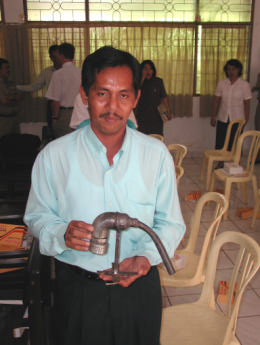
Retort made in Manado, North Sulawesi
mining in the hope of escaping poverty.
according to UNIDO instructions
In Indonesia, the number of people directly
involved in artisanal gold mining is estimated to have
Tanzania: Artisanal Gold Miners in
tripled in the last years and might have reached
Lakes Victoria and Tanganyika
500,000. Evidence of this increase can be seen at the
two sites selected for the project's Environmental and
Artisanal and small-scale gold mining (ASM)
Health Assessment (E&HA): Gelangan in Central
activities in Tanzania provide work for 50,000-100,000
Kalimantan and Talawaan in North Sulawesi.
miners in the district of Geita close to Lake Victoria
In Gelangan, where gold mining activities have
and Lake Tanganyika.
been pursued since the 70s, currently 10,000 - 12,000
The selected project site is located in Rwamagaza,
gold miners are releasing 1 to 2 tonnes of mercury
one of the four major mining centers in Geita. In order
annually to the environment. In Talawaan, the
to assist miners in grinding hard rocks, a joint venture
number of miners was estimated at some 10,000
between the Government and private investors from
operating 200 to 250 processing units in 1998. A
South Africa was established. The company provides
preliminary assessment indicates that each unit
grinding services to the miners transporting crushers
purchases (and loses) 10 to 30 kg of mercury per
and ball mills to the site. The ground ore is manually
month. Based on the 1998 figures, the Hg loss in the
panned and amalgamated by the miners. Mercury
region can be as much as 90 tonnes/a. These
amalgam is burned in open pans. Miners frequently
numbers will be validated in the E&HA.
conduct amalgamation at the banks of rivers draining
In meetings with stakeholders in Kalimantan and
to the two great lakes. Women often prepare food in
Sulawesi, the GMP team demonstrated how mercury
the contaminated area. Many of them are directly
vapor exposure can be reduced by using retorts made
involved in the handling of amalgam and are,
with water plumbing and costing around US$ 5 (photo).
therefore, permanently exposed to the toxic metal.
The Global Mercury Project (GMP) began in August 2002. The GMP will demonstrate ways of overcoming barriers to the adoption of best
practices and pollution prevention measures that limit the mercury (Hg) contamination of international waters from artisanal and small-scale
gold mining (ASM). Six countries are participating in the GMP: Brazil, Lao PDR, Indonesia, Sudan, Tanzania and Zimbabwe. In addition, the
GMP aims to introduce cleaner technologies, train miners, develop regulatory mechanisms and capacities within Government, conduct
environmental and health assessments (E&HA) and build capacity in local laboratories to continue monitoring Hg pollution after the project.
GMP News 2
Cooperation with US Environmental
Workshop in Belém, Brazil
Protection Agency
The Workshop on Mercury E&HA Techniques held
The US Environmental Protection Agency has
in Belém on April 29-30th brought together 64
accepted an invitation from UNIDO to bring its vast
representatives of Federal Government and States of
experience to the GMP in general and its E&HA in
Amazonas and Pará, academia, small-scale mining
particular. The invitation was to cooperate under the
associations, miners and other stakeholders. In view
GMP in Global Task Force Meetings and to join
of the forthcoming sociological and E&HA in hot spot
UNIDO field missions. After the mutual interest in a
areas in Brazil, the Workshop focused on evaluation
cooperation had been established, a meeting took
of monitoring techniques, their usefulness and
place at the USEPA Office of International Affairs in
reliability. The Workshop was combined with a
Washington DC on 5 May 2003, in which the details of
Country Task Force Meeting, in which the present
USEPA's assistance through advisory services as well
achievements and the future actions until the end of
as technical field support were worked out.
2003 were discussed. Representatives of the new
Federal Government stressed their strong interest in
For a long period USEPA has been supporting
improving legal framework for the sub-sector and
mercury research on global scale and has helped
assist small-scale gold mining operations. They
other countries reduce mercury emissions and
recognized the important role of the GMP in
demand for mercury. With the experience of the
addressing the Hg problem and providing replicable
impact of historical gold mining activities in USA,
solutions to reduce mercury pollution.
much research has been conducted by USEPA to
better understand sources and mechanisms of
Workshop in Jakarta, Indonesia
mercury mobility. Nowadays, California and Nevada
are dealing with the legacy of 19th century gold mines,
The one-day seminar (March 20, 2003) was
which released large amounts of mercury to vast
organized by UNIDO, WHO and Indonesian Dept. of
watersheds including those that drains into San
Foreign Affairs. Attended by about 40 people from
Francisco Bay.
Indonesian Government agencies and representatives
Areas of particular interest to USEPA in the GMP
from foreign embassies, the seminar attracted the
are: human health risk assessment, estimation of the
attention of possible donors to a new project (WHO-
regional or global impacts of the overall contribution of
UNIDO) focusing on health and environmental
artisanal gold mining practices to the global
aspects of artisanal hard-rock-gold mining activities in
atmospheric pool, removal of mercury from soils,
Indonesia. Mr. Dian Triansyah Djani, Ministry of
sediments and water and mining engineering advice
Foreign Affairs, the Representative of UNIDO in
to prevent pollution. More specifically, USEPA offered
Jakarta, Mr. Matsushita, and the Representative of
immediate help through the provision of the following
WHO in Jakarta, Mr. George Petersen, all stressed
contribution/services :
the rampant nature of the problem of small-scale gold
· Peer review of the Scientific Protocols on E&HA
mining in Indonesia and the need for inter-agency
prepared by the GMP Coordination Unit;
cooperation. The GMP team presented an overview of
the use of mercury in different mining sites worldwide,
· Participation of USEPA in advisory boards as well
indicating the possible solutions for reducing
as field missions;
emissions. The GMP CTA presented the main topics
· Provision of health experts;
to be investigated in the proposed WHO-UNIDO
project. The presentation included a UNIDO video
· Provision of experts in Legal Issues/Mining Law
from Kalimantan with scenes of amalgam being
Enforcement;
burned in the kitchen in front of women and children.
· Provision of students from US universities to
accompany the GMP field work;
· Establishing contacts to Hg-analytical and mineral
processing equipment suppliers,
· Development of a strategy to generate additional
income for small-scale miners.
This cooperation reflects the growing concern on Hg
pollution worldwide and the need for networking. The
assistance of USEPA underscores the importance of
the GMP on removing the barriers for the introduction
of cleaner technology in small-scale gold mining and
represents recognition of UNIDO's work in the
artisanal gold mining sector. The CTA welcomed
USEPA's in-kind assistance and expressed his thanks
on behalf of GEF/UNDP/UNIDO for the very generous
contribution of United States of America to the Project.
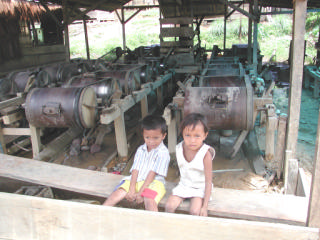
In Indonesia, kids playing around amalgamation mills
GMP News 3
African Mining Network
In order to present results of small-scale mining
projects related to mercury pollution, UNIDO
participated in the UNCTAD-ECA Workshop held in
Addis Ababa on 25-27 February 2003. The purpose of
the workshop was to review the rationale for an
African Mining Network (AMN) and discuss modalities
for the Network's establishment and operation. The
AMN will support ongoing and emerging initiatives in
Africa including the African Mining Partnership, a
recent initiative of African mining ministers linked to
the New Partnership for Africa's Development
(NEPAD). Participants in the workshop included
experts from Government, the mining industry,
academia and NGOs, from Africa and overseas.
The Demise of the Assistant to the
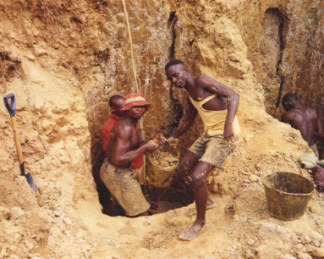
Manual mining in Ghana
Focal Point in Zimbabwe
Selection of the Subcontractors for
It is with great sorrow that the GMP team learnt of
the E&HA
the death of Mr. Richard Svotwa, former Assistant to
the Focal Point in Zimbabwe. Mr. Svotwa's assistance
The Bureau de Recherches Géologiques et
was crucial for the project site selection and the
Minières of France, Center of Mineral Technology of
organization of stakeholders' information workshop.
Brazil (CETEM), Geological Surveys of Japan, UK
He was known for his great experience in the small-
(BGS) and the US had been invited to compete in an
scale mining sector and, among others, was one of
international bidding for Environmental and Health
the key actors in the development of the Shamva
Assessments (E&HA) in each of the six GMP
mining center. Before being recruited as Assistant to
participating countries. After a thorough evaluation of
the Focal Point, he was the Chairman of the Mining
their quotations, the following subcontracts have been
Engineering Dept. of University of Zimbabwe. He
awarded:
successfully assisted in the organization of the first
· Brazil to CETEM
GMP Country Task Force meeting in Sept. 2002. He
· Indonesia to CETEM
also represented UNIDO at the Yaounde seminar on
· Laos to BRGM
"Artisanal and Small-scale Mining in Africa". The GMP
·
team conveys sincere condolences to his family.
Sudan to BRGM
· Tanzania to BGS
Protocols for E&HA
· Zimbabwe to BGS
Environmental and Health Assessment (E&HA) is
WWF 3 in Kyoto/Japan
a crucial initial step of the GMP to: "identify hotspots in
project demonstration sites, conduct geochemical and
GMP team participated in World Water Forum 3 in
toxicological studies and assess the extent of mercury
the session "Industrial Development and Water/
pollution in surrounding water bodies". The GMP team
Comprehensive role of UNIDO", held on 17/3/03 at
organized a workshop in Paris, Jan 31-Feb 1, 2003,
the Kyoto International Conference Hall. Pablo
with experts from Brazil, France, UK, Germany and
Huidobro, GMP Project Manager, presented an
Canada to discuss E&HA methodologies that will
"Overview of Water and Industry" including specific
ensure replicable and comparable results when the
examples of UNIDO technical cooperation focusing on
E&HA is carried out by local environmental agencies,
water management. A 30-minute presentation of the
researchers and miners. As a result, GMP team has
GMP was given by the Chief Technical Advisor of the
developed two documents containing standardized,
Project, Mr. Christian Beinhoff. The session finished
reproducible and simple procedures for assessing
with questions and answers on actions and
mercury losses, biota selection, sampling, sample
accomplishments of the Project.
preparation & preservation, analysis, etc. The drafts of
Website Under Construction
these documents Protocols for Environmental &
Health Assessment of Mercury Released by
Using the expertise of FACOME Amazonian
Artisanal and Small-Scale Gold Miners and a
Forum on Mercury Contamination of Ecosystems
Users' Guide with the frequent asked questions
(sponsored by International Development Research
related to the toxic effects and behavior of mercury in
Centre, Canada) as an example, the GMP website
the environment, are available at the GMP website.
was built not just to inform about the project activities,
Comments and suggestions are very welcome and
but also to provide data, reports, tips to miners and to
should be sent as soon as possible to the Project
create a global discussion forum about Hg in artisanal
Coordination Unit.
mining activities. Public participation is encouraged.



GMP News 4
Activities January June 2003
Plans for July December 2003
ü Meeting with stakeholders in Indonesia (Jakarta,
· Completion of sociological studies in the hot spots
Palangkaraya and Manado) and presentation of
of the 6 countries and transmission of conclusions
lectures on environmental and health effects
to selected subcontractors for the health and
caused by mercury.
environmental surveys.
ü First Country Task Force Meeting in Indonesia.
· Field work to conduct E&HA in participating
ü Final agreement with national counterparts on
countries under guidance of GMP Coordination
project site in Central Kalimantan, Indonesia,
Unit.
meeting with national counterparts involved in the
· Publication of selected E&HA results.
Environmental and Health Assessment (E&HA)
and future work at the demonstration sites.
· Publication of the E&HA Protocols.
ü Workshop in Paris with mercury experts from
· Completion of the project website.
Brazil, France, Germany, Canada and the United
· Selection of new Assistant to the Focal Point in
Kingdom to establish E&HA methodologies.
Zimbabwe.
ü Invitation to competitive bidding for E&HA in hot
· Assessment of appropriateness of analytical and
spot areas (BGS, BRGM, CETEM, JGS, USGS).
mineral processing equipment for GMP.
ü Selection of subcontractors for the E&HA in Brazil,
·
Indonesia, Laos, Sudan, Tanzania and
Preparation of Terms of Reference for equipment.
Zimbabwe.
· Initiation of international bidding on equipment.
ü Elaboration of a comprehensive protocol to
· Preparation of further projects applying the GMP
standardize E&HA methodologies to be used in all
approach in Mozambique, Venezuela, Philippines,
participating countries.
Ghana, Côte d'Ivoire and Republic of South Africa
ü Participation as observer in the UNEP Governing
· Preparation of 1st Global Task Force Meeting.
Council in Nairobi in order to contribute to the
UNEP Global Mercury Assessment.
· Identification of national small-scale mining
ü
experts in each of the participating countries.
Expert recruited to establish project website.
ü
·
Presentation of GMP at mining related workshops
Purchase of project vehicle in Zimbabwe.
organized by UNCTAD-ECA (Addis Ababa),
· Production of digital promotional material and
World Bank (Bali), and at the World Water Forum
educational brochures.
(Kyoto).
· Donor Seminar for bilateral organizations and
ü Sociological Experts recruited in the 6
diplomatic community in Manila to raise funds for
participating countries.
the continuation of the project in
ü Purchase of project vehicle in Sudan and Laos.
Mindanao/Philippines.
ü Contacts established with USEPA for possible
cooperation.
ü Workshop on Mercury E&HA Techniques
combined with a Country Task Force Meeting, in
Belém, Brazil.
ü Agreement with Government of the State of
Amazonas for cooperating under the GMP.
ü Contacts established to Chinese and Brazilian
suppliers of equipment for small-scale miners.
For further information contact the Project Coordination Unit:
Dr.- Ing. Christian Beinhoff
Chief Technical Advisor
GMP - Global Mercury Project
UNIDO United Nations Industrial Development
Organization
Vienna International Center, D1275
PO Box 300, A-1400 Vienna, Austria
Tel +43-1-26026-3738/3807
Fax +43-1-26026-6819
E-mail: C.Beinhoff@unido.org
Gold miner in Indonesia using mercury in his habitat