



GMP News, n. 01, Jan. 2003
Global Mercury Project
Project EG/GLO/01/G34: Removal of Barriers to Introduction of Cleaner Artisanal Gold Mining and Extraction Technologies
An Island of Prosperity in
A Sea of Poverty
Small-scale or Artisanal gold mining is an
essential activity in many developing countries as
it provides an important source of livelihood,
particularly in rural regions where economic
alternatives are critically limited.
Artisanal mining encompasses small, medium,
informal, legal and illegal miners who use
rudimentary processes to extract more than 30
different mineral substances worldwide.
The International Labour Organization (ILO)
Serra Pelada. About 80,000 miners extracted 90 tonnes of
estimates that the number of artisanal miners is
gold from a single pit in the Brazilian Amazon
currently around 13 million in 55 countries and
(Photo: A. Bernadelli)
rising, which suggests that 80 to 100 million
people worldwide depend on this activity for their
livelihood. As it is easy to transport across
borders and easily sold, gold is by far the main
metal being extracted.
Continent
Number of miners
(million)
Asia/Pacific
6.7 - 7.2
Africa
3.0 - 3.7
Latin America
1.4 - 1.6
Developed countries
0.4 - 0.7
Total
11.5 - 13.2
Employment in artisanal mining (ILO, 1999)
Worldwide it is estimated that as much as 2.5
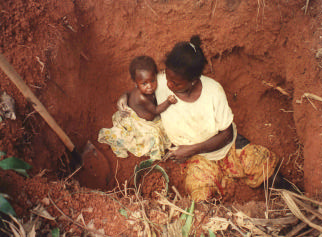
Artisanal Miner in Ghana with her baby
(Photo: UNIDO)
million women and 250,000 children are directly
employed in artisanal mining. Most children work
Although mercury use is illegal in most countries,
to support their families. Although parents are
amalgamation is the preferred method employed
often aware of the hazards for children involved
by artisanal gold miners. Mercury emissions from
in mining, in the absence of economic
these activities are derived from poor practices,
alternatives, child labour will inevitably persist.
lack of knowledge about mercury toxicity and
insufficient access to appropriate techniques.
__________________________
Environmental and health impacts resulting from
GMP News is a quarterly newsletter of the Global Mercury Project.
the misuse of mercury and their effects on
GMP is a collaborative initiative of GEF, UNDP, UNIDO and
international waterbodies require coordinated
participating countries to assist to reduce mercury emissions from
actions and global responses.
artisanal gold miners. The project is executed by UNIDO.
GMP News 2
Environmental & Health Problems
Artisanal mining activities are frequently
accompanied by extensive environmental
degradation and deplorable socio-economic
conditions, both during operations and well after
mining activities have ceased. Typical
environmental impacts caused by disorganized
artisanal mining activities include diversion of
rivers, water siltation, landscape degradation,
deforestation, destruction of aquatic life habitat,
and widespread mercury pollution.
Since amalgamation is simple, cheap and does
not require skilled labour it is the gold
concentration method most used by small-scale
miners. Amalgamation employs metallic mercury
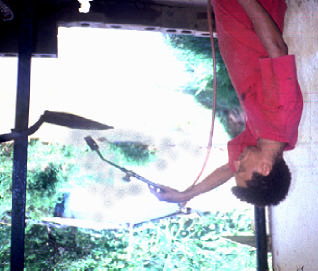
Venezuelan Miner burning amalgam to separate gold from
to trap fine gold. The extent of mercury losses
mercury (Photo: UNIDO)
from a specific site is primarily determined by
gold-mercury separation procedures. Mercury is
Due to the importance of amalgamation,
often discharged with contaminated tailings
convincing miners to use less mercury because
and/or volatilized into the atmosphere. Despite
of health hazards is difficult. Lack of sanitation,
the existence of safe procedures to decompose
widespread disease (malaria, cholera, STDs,
amalgams, the usual practice is to burn the
etc.) and limited access to health care providers
amalgam in a pan or shovel with a blowtorch.
have resulted in generally poor health conditions
When this happens, mercury is accumulated in
in artisanal mining communities. Consequently,
the lungs and kidneys of miners or citizens living
any program directed at reducing the
near mines or gold shops (places were gold is
comparatively invisible health impacts from
melted and sold).
mercury will be received with minimal success if
the program does not comprehensively address
Metallic mercury discharged into the environment
these community issues also.
(air, water, tailings) can be transformed by
biochemical processes into methylmercury,
As women have little knowledge of the hazards
which is readily bioavailable and may be found at
associated with mercury, they are often selected
elevated concentrations in higher levels of the
to work in the processing aspect of gold mining
food chain, particularly in aquatic systems (i.e. it
(including amalgamation). Women are also
is biomagnified). Individuals reliant on fish
predominantly responsible for food preparation,
(especially carnivorous) as a primary food source
and as women of childbearing age and children
may be particularly susceptible to accumulation
are particularly susceptible to methylmercury
of dangerous levels of methylmercury. In cases
exposure from fish, educational programs should
of acute intoxication, muscular atrophy, seizures
be specifically directed towards them.
and mental disturbance are prominent.
Methylmercury is easily transferred from women
to the fetus, with effects ranging from sterility,
spontaneous abortion, and from mild to severe
neurological symptoms.
Methylmercury (CH3Hg) poisoning was first
identified in the early 50s by an infamous incident
at Minamata Bay, Japan in which a plastic factory
was discharging CH3Hg into the river and bay.
Up to 1997, almost 3000 victims have been
compensated and 1246 deaths were recognized.
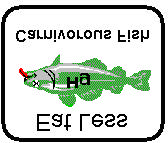
Local people living
near hot spot areas
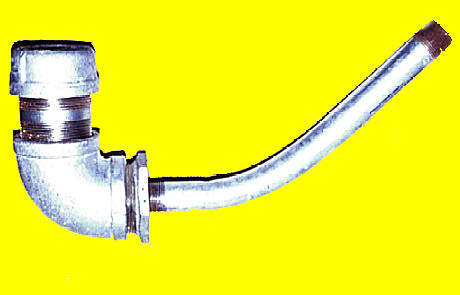
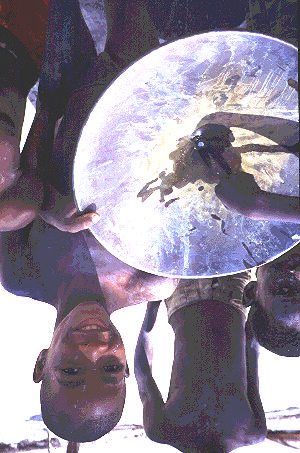
Retorts can reduce drastically mercury emissions
must be advised
Home-made retorts are not expensive. They can be made
about the risks of
with water pipes and connections
consuming mercury
(devised by R. Hypolito)
polluted fish
GMP News 3
Project Objectives
Since 1995, UNIDO has been providing technical
assistance to the small-scale mining sector in
developing countries. Through numerous
projects dealing with the introduction of cleaner
technologies and mercury pollution abatement,
the Organization has assessed the
environmental and health impacts of mercury
pollution caused by artisanal gold miners, inter
alia in Venezuela, Ghana and Philippines. In the
meantime, UNIDO has received new requests
from countries in Latin America, Africa and Asia.
Whilst the environmental and health problems
related to small-scale gold mining have been
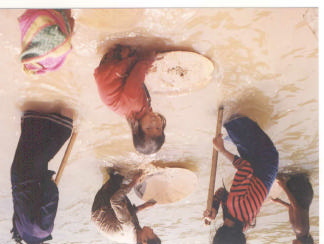
Women and children panning for gold in Laos
largely ignored to date, it is now widely accepted
(Photo UNIDO)
that problems associated with artisanal gold
UNIDO has conducted preliminary investigations
mining in different developing countries are
in the six participating countries (Brazil,
similar in nature. As such, solutions need a
Indonesia, Lao PDR, Sudan, Tanzania and
globally consistent and effectively coordinated
Zimbabwe) in order to establish the intensity of
approach in order to deal with these complex
artisanal mining activities and their impacts on
problems on a local level.
the international water bodies.
Within these six countries, available figures show
that nearly 2.0 million people are directly involved
in artisanal mining activities. The number of
those whose livelihoods depend on these
activities is over 10 million.
The proposed activities aim at removing barriers
that inhibit artisanal miners from applying cleaner
and efficient technology. Efforts will be
undertaken to demonstrate the application of
these techniques and conduct training for the
miners to reduce pollution and minimize waste
resulting from the currently poor procedures.
The main goals of the Project are:
Ø reduce mercury pollution caused by artisanal
miners on international waters;
Ø introduce cleaner technologies for gold
extraction and train miners;
Kids using mercury to extract gold in Suriname
Ø develop capacity and regulatory mechanisms
(Photo: UNIDO)
within Government that will enable the sector
to minimize mercury pollution;
In August 2002, the GMP (Global Mercury
Project) was initiated to help demonstrate ways
Ø introduce environmental and health
of overcoming barriers to the adoption of best
monitoring programs;
practices, waste minimization strategies and
Ø build capacity in local laboratories to assess
pollution prevention measures that limit
the extent and impact of mercury pollution
contamination of the international waters. The
beyond the 3-year project life.
Project funded by GEF and co-funded by UNDP
and UNIDO is complemented by a suite of
As part of a large awareness program,
ongoing activities which are financed through
educational campaigns and pilot units will be
either the participating countries' resources
established to demonstrate the efficiency and
and/or bilateral programs.
advantages of cleaner technologies.



GMP News 4
Activities August December 2002
Plans for January July 2003
ü Signature of Project Endorsement by
· Invitation to competitive biding on
authorities of the 6 participating countries
environmental and health assessments in hot
(Brazil, Indonesia, Lao PDR, Sudan,
spots areas (invited parties are Geological
Tanzania and Zimbabwe).
Surveys of Japan, United Kingdom and USA,
ü Project coordinator (CTA) and staff recruited.
Centro de Tecnologia Mineral of Brazil and
Bureau de Recherches Géologiques et
ü Recruitment of small-scale mining expert.
Minieres of France).
ü Nomination of Country Focal Point in the six
· Workshop in January with mercury experts
participating countries.
from Brazil, France, Germany, UK, Japan
ü Identification of local and international project
and Canada to establish monitoring
consultants.
methodologies.
ü Visits to possible collaboration institutions:
· Elaboration of a comprehensive document to
Geological Survey of Japan, National Institute
standardize environmental and health
of Minamata Disease, Kumamoto University,
assessment methodologies to be used in all
British Geological Survey , BRGM/France,
six participating countries.
CETEM/Brazil, Medical Research Council
· Presentation of the Global Mercury Project at
and MINTEK/South Africa and various
mining related workshops organized by
institutions in Zimbabwe.
UNCTAD in Addis Ababa (Feb.), World Bank
ü Project objectives presented to stakeholders
in Bali (Mar), and at the World Water Forum,
in the 6 countries.
Kyoto, Japan (Mar.).
ü Most demonstration sites selected.
· Purchase of project vehicle in Sudan and
Zimbabwe.
ü Participation in International Workshops and
Conferences dealing with international
· Recruitment of social science experts in all
waters/small-scale mining/mercury pollution
six countries to assist the environmental and
in China, Peru, Cameroon, Tanzania,
health assessment group.
Switzerland and Brazil.
· Final selection of project demonstration sites.
ü Country Task Force Meeting in Jakarta.
· Publication of scientific papers in international
journals and a book with the monitoring
protocols for mercury in artisanal gold mining
areas.
· Production of digital promotional material to
promote clean technologies for artisanal gold
miners based on UNIDO experience.
· Elaboration of GMP website
· Start the environmental and health
assessment fieldwork
For further information please contact the
Project Coordination Unit
Dr.- Ing. Christian Beinhoff
Chief Technical Advisor
Global Mercury Project
UNIDO United Nations Industrial Development
Organization
Vienna International Center, D1275
PO Box 300, A-1400 Vienna, Austria
Tel +43-1-26026-3738
Fax +43-1-26026-6819
E-mail: C.Beinhoff@unido.org