



Global Mercury Project
Project EG/GLO/01/G34: Removal of Barriers to Introduction of Cleaner Artisanal Gold Mining and Extraction Technologies
Information about the Project Sites in
Indonesia
by Marcello Veiga, PhD
Small-scale Mining Expert
May 12, 2003
Global Mercury Project Information about Hg in ASM in Indonesia, May 2003, M.M.Veiga
1
Introduction
This document is extracted from the back-to-office-mission reports and brings information for
the sub-contractor that will conduct the Environmental and Health Assessment (E&HA) in
Indonesia. The following sites were visited on March and April 2003:
· Gelangan Mine Site in Central Kalimatan (chosen for the E&HA)
· Kahayan River in Central Kalimatan
· Talawaan in North Sulawesi (chosen for the E&HA)
· Lanut in North Sulawesi
The description of other visited mining sites were also included in this report as the methods
of mining and mineral processing are similar to those used in the places chosen for the
Environmental and Health Assessment within the Global Mercury Project.
Central Kalimatan
Government Structure
In Indonesia, provinces are divided into administrative districts with their own structures. The
Province of Central Kalimatan has an office of Mining and Energy (the office is known as
"dinas") in Palangkaraya, capital of the province and a town with 150,000 people. Mr.
Nugroho Basuki (who speaks English) is the head ("kepala") of this office and the vice-head
is the geologist Alfried Nandjan (very basic knowledge of English). Mr. A. Dj. Nihin is the
Secretary to the Central Kalimantan Province who is the "operating right-hand" of the
Province Governor. The site chosen for the E&HA is Gelangan, also known as Ampalit, is
located in the Katingan District. The Head (known as "bupati") of the Katingan District is Mr.
Duwel Rawing who stays in a small town (Kasongan) near the Katingan River. This office
was established 9 months ago.
The local Government is usually not well-equipped and with low knowledge about mercury
pollution and mining. Very little people speak English. The "dinas" has 2 or 3 mini-vans
(Toyota) in very good shape. Arrangements must be previously done to use these vehicles and
certainly this will demand that the sub-contractor covers the expenses. Everybody is
extremely cooperative but communication is very difficult and one should not expect any
collaboration in terms of data, maps and accurate information. Mr. Mansur Geiger and Mr.
Bardolf Paul, from a Canadian junior exploration company working in the area for more than
20 years (Kalimantan Gold Ltd), are very knowledgeable and have lots of information. Their
office is in Palangkaraya.
Gelangan Mine Site
In Katingan District, there are about 10,000 - 12,000 illegal gold miners active since the 70s,
according to Mr. Rawing. The main mining site is Gelangan and it is not known if there are
miners dredging the Katingan River. Gelangan, with an area of 200 km², also known as
Ampalit (name of a mining company that operated in the area from 1986 to 1999), is 107 km
distant from Palangkaraya (Palangkaraya Kasongan: 84 km; Kasongan Kereng Pangi: 16
km; Kereng Pangi Gelangan: 7 km). The road from Palangkaraya to Kereng Pangi is paved
(not in very good conditions). Kereng Pangi, which is part of the Katingan District, is a jump-
off town, that provides infrastructure for miners in Gelangan. Nobody could tell us how many
Global Mercury Project Information about Hg in ASM in Indonesia, May 2003, M.M.Veiga
2
people live in Kereng Pangi but it seems that it must be something between 5,000 to 7,000
people, including 2,000 to 3,000 miners in Gelangan. According to the miners we have
interviewed, the number of gold processing units in Gelangan is around 500, each one with 4
to 6 workers, however we were told that 100 plant owners control the entire gold production
in the area. Each processing plant, known as unit, operates with hydraulic monitors, with a 4"
pump sending very diluted slurry (<5% solids) to a two-stage-carpeted sluices box. Miners
work from 7 am to 5 pm (10 h/day). Each unit of 2-deck sluice box produces between 3 to 6
g/Au/day. The mined material consists of a Quaternary-Tertiary (Pleistocene) alluvial-quartz
ore with depth ranging from 10 to 30 m. The ore grade is around 0.3 to 0.5 g/tonne (according
to Mr. Mansur Geiger, geologist from Kalimantan Surya Kencana). The concentrate of 10
hours of operation is amalgamated in pools excavated beside the miner's residences. Miners
use 100 to 200 mL of mercury (which is around 1 to 2 kg) to amalgamate 5 to 10 kg of
concentrate. No information was obtained about the gold grade in the gravity concentrates.
The manual amalgamation in a bucket is very quick and extremely inefficient, likely leaving
behind large amounts of gold in the tailings. This exaggerated amount of Hg results in huge
mercury losses. We have noticed through interviews that the Hglost: Auproduced ratio is as high
as 2.4. Miners we have interviewed estimated that from 150 to 300g of mercury is lost per
month/unit. This means 1 to 2 tonnes of mercury is released annually in the area. These
numbers must be checked in the E&HA. Mercury is purchased from gold dealers in Kereng
Pangi at a price of US$ 10/kg (2.5 times higher than the international market). We could not
find out the origin of this mercury.
Some times it is important to obtain figures about the economic performance of an ASM
operation as a way to convince them to adopt safer procedures. A rough calculation of the
miner's operating cost was done through interviews. Mercury represents less than 0.6% of
their cost and diesel for the electric Chinese 4" pumps represents more than 90%.
As amalgamation is conducted in small pools behind the unit owners home, all Hg-
contaminated tailings are left in those pools. We have investigated one of these pools with
about 200 m² and depth of 1 to 5. Mercury droplets were visible when the tailings were
panned and when the Rio-Sul special amalgamating plate we brought to the field was used.
The water of this amalgamation pool has been used for bathing and washing clothes. All
families use the water. It was told that catfish ("lele") as big as 1 kg exist in those pools. The
environment is quite favorable to oxidize metallic mercury (agitated water) and to complex it
(full of organic matter, including sewage). Methylation is quite possible in those sites that
must be sampled (possibly becoming environmental hotspots). In Gelangan area, with almost
200 km² impacted by ASM, it is estimated that there are as many as 1000 amalgamation pools
(mining hotspots) active and abandoned.
The local drainage flows to the Katingan River, being one of the largest rivers in Central
Kalimatan that flows to the Java Sea. A 1 km (or less) wide forest is separating the mining
operations from the Katingan river. If this remaining forest is destroyed, all mercury likely
being methylated in the mining hotspots or even on this forest soil, will be discharged into the
Katingan River. So, I believe that we still have time to positively intervene and create
awareness in the region about the danger.
Global Mercury Project Information about Hg in ASM in Indonesia, May 2003, M.M.Veiga
3
Amalgam is burned in open crucibles inside family houses (kitchens) or in commercial stores
(e.g. restaurants, warehouses). We examined one of these sites and the walls were covered
with metallic mercury. Miners and their families are clearly impacted by this high level of
mercury vapor. However, they do not believe in mercury pollution as they do not feel any
symptom. Examining a miner burning mercury for 7 years, it was clear that he was extremely
intoxicated. The gums were very discolored. He also uses his wife to do the work.
Gold, with residual 2 to 5% Hg, is sold in Kereng Pangi. A gold dealer has estimated that 15
kg of gold/day is sold to all 20 gold shops in town and melted in very rudimentary fume-
hoods with no condensers or filters for
Hg abatement. This may release at least
200 kg/a of Hg into the urban
environment, most of this in front of an
elementary school, as it was already
observed by Dr. Beinhoff in his mission
to the site in 2002. In Ampalit there are
2 major gold dealers who also sell Hg
to miners.
In terms of infrastructure, Ampalit is
100 km from Palangkaraya and 70 km
from a reasonable hotel. Kereng Pangi
also have guest houses.
An encouraging point is that the miners
in Gelangan seem very friendly and
receptive to new ideas. Introduction of
technological improvements in their
process seems feasible as the miners are
settled (they do not move so frequently)
with their families in this place.
Building Retorts in Palangkaraya
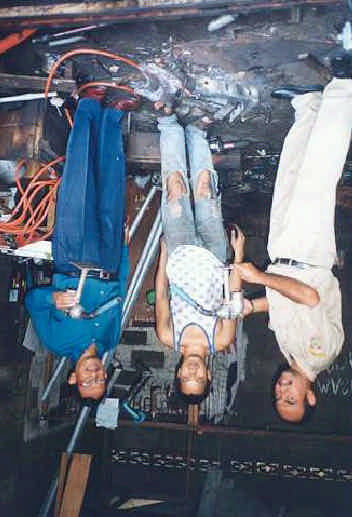
We also had the chance to demonstrate
to locals that it is possible to build a
retort to recover Hg using iron water
Photo 1 UNIDO and Dinas representatives holding
pipes and connections. We taught some
retorts made in Palagkaraya
metal shop workers in Palangkaraya
(photo 1) how to make those retorts and they made 5 of them: one with crucible of 3/4",
another with 1 ½" and 3 retorts with 2" crucible. The cost of each one was around US$ 5,
which is substantially lower than US$ 300, price that the Ministry of Energy and Mines in
Palangkaraya paid for one retort made in Java. This was a very sophisticated retort with water
coolers.
Global Mercury Project Information about Hg in ASM in Indonesia, May 2003, M.M.Veiga
4
Visit to Kahayan River
Kahayan River was originally chosen for the E&HA as the river has been extremely impacted
by ASM operations and it flows to Palangkaraya. The E&HA was changed to Gelangan
because the logistic needed to assess the Kahayan River is much costly and the miners are
very scattered along the river. In terms of impact on international waters, the Katingan River,
adjacent to the Gelangan site, is larger than the Kahayan River and also flows to the Java Sea.
In Kahayan River, miners sell gold and amalgam to thousands of people, including jewelers in
Palangkaraya. A boat to go to half way to Bawaan site (3.5 to 4 hours of trip) in the Kahayan
River cost us US$200 (one day). It would be interesting to collect some fish samples from the
Kahayan River to provide a first information about mercury bioavailability in this
environment. This is a darkwater river and due to the intense mining activities has high
amount of suspended mater resulting a "chocolate" water color. Those are dangerous
conditions to promote complexation and consequent methylation of mercury. The river is
about 300 m wide and up to 20 m deep. After three hours traveling upstream in a speed boat,
we reached Guha, where a floating restaurant is operating. According to Mr. Mansur Geiger,
there are about 3000 rafts operating on 200 km of river and producing about 1 tonne of Au per
month. In the dry season the amount
of rafts dredging the river may double.
Each raft (also called unit) consists of
a 4" pump coupled with plastic hoses
attached to a 20 m wooden stick that
manually sweeps the river bottom. Just
the loosen sediments are dredged. The
dredged material is concentrated on 2-
stage-carpeted sluice boxes. Each unit
of 4 6 individuals produces 3 to 5 g
Au/day. After 8 to 10 hours of
operation, the carpet is cleaned on
board. As the concentrate is full of
ilmenite (or magnetite), miners focus
on reducing the volume of the
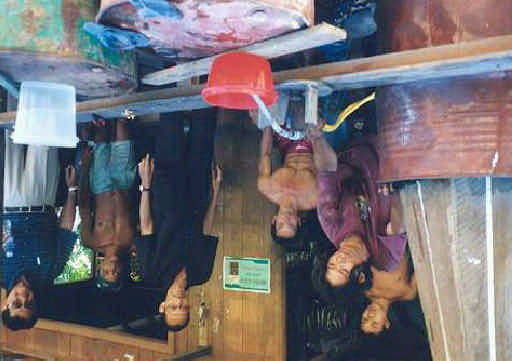
Photo 2 Miners in Guha using the home-made retort
concentrate washing it on board. It is
clear that fine gold is lost in this cleaning and delicate operation. The concentrate is
amalgamated on-board and the Hg-contaminated tailings are dumped into the river. As they
are constantly moving from one site to another, it is clear that mercury is getting dispersed on
the river bottom. Miners burn the amalgam either in their residences or in Palangkaraya (gold
shops). We had the chance to visit one owner of 10 rafts in Guha, which is a small village
with 200 families. This individual uses to burn amalgam in a very rudimentary wooden fume
hood. We showed him a home-made retort we have fabricated and we demonstrated how to
use it burning about 10 grams of gold amalgam. After explaining the effects of Hg vapor on
his family and showing him the tree leaves surrounding his place full of condensed mercury,
he agrees to use the retort (Photo 2).
Conclusions Related to Kalimatan
Global Mercury Project Information about Hg in ASM in Indonesia, May 2003, M.M.Veiga
5
1. The use of Hg in the two areas visited in Central Kalimatan is very high but the ratio
Hglost:Auproduced seems to be higher than 2 but this must be checked through interviews
to a good number of miners.
2. Information about the number of miners in the area must also be obtained but it is
clear that the gold production and number of miners fluctuate with the year season.
3. Government and other stakeholders (e.g. people from the local University) should be
contacted during the E&HA. It is important to transfer simple knowledge about Hg
monitoring to the locals.
4. While interviewing miners or dealing with local stakeholders, it is important to bring
to their attention the hazards of mercury vapor and simple solutions, such as home-
made retort and less use of Hg to amalgamate concentrates, can be suggested.
5. Due to the high amount of Hg (usually 1 kg) used to amalgamate concentrates, mining
hotspots are very well recognized. The pools behind every home have been used to
amalgamate concentrates. The easiest way to identify these hotspots is asking the
miners where they conduct amalgamation and/or panning (Hg droplets are visible).
6. The possibility of the mining hotspots (thousands of pools excavated on the ground)
are becoming environmental hotspots must be investigated by using resident biota
(e.g. "lele", a kind of catfish living in these pools) or bioassays (e.g. earthworms).
7. The possibility of water with suspended solids from those mining hotspots flowing
into the Katingan River must be investigated.
8. Interesting to investigate if methylation is occurring on the soils of the "forest"
separating the Gelangan mine site from the Katingan River.
9. Fish from Katingan River should be analyzed as well. Use of standardized fish size is
strongly advised. Mercury bioaccumulation in Katingan can be due to other sources
than mining. It is important to obtain the reference Hg levels of standardized fish in an
area selected to evaluate background concentrations.
10. The subcontractors can also check the Hg levels in fish in Kahayan River.
11. In the Health Assessment, checking Hg intoxication of children and women living in
the area, but not directly involved with the mining activity, should be the priority.
12. Urine from children in the elementary school located in front of the main gold dealer
in Kereng Pangi should also be checked.
North Sulawesi
Government Structure and Mining Concessions
Mr. R.L.E. Mamesah is the head ("kepala") (does not speak English but has good
understanding) of the Mines and Energy Provincial Office. His office is in the capital of the
North Sulawesi Province, Manado, a city with very good infrastructure. He believes that
about 10,0001 artisanal gold miners are currently working in North Sulawesi and they expect a
sudden increase of this contingent during this dry season (July) as the price of gold is rising.
1 Mr. Harvey Martens, in a report sponsored by CIDA in 2000, makes reference to 22,000 ASM in North
Sulawesi producing 10 tonnes of gold annually (data from 1998).
Global Mercury Project Information about Hg in ASM in Indonesia, May 2003, M.M.Veiga
6
He explained that 7 exploration/exploitation contracts (totaling 265,882 ha) were signed with
international companies and just one is in production (Newmont Minahasa). In addition, 6
contracts (total of 20,813 ha) were signed with local cooperatives and all are in production.
Another modality of concession is given to individuals. There are 5 contracts (total of 2466
ha) under this category. He expressed concerns about the situation in the Talawaan region,
near the city of Manado airport, where 2,000 miners invaded a concession given to an
Australian-Indonesia joint venture. The gold was discovered by Aurora Gold and after the
invasion the current concession owner is another Australian exploration company,
Archipelago which has been using "mercury pollution" to call attention of international
organization for the illegal situation in Talawaan.
Meeting with National Resources Management Program Team (USAID)
On April 21, the UNIDO team met with the members of the NRM (sponsored by US Agency
for International Development):
Dr. Mark Erdmann (N. Sulawesi Regional Advisor)
Mr. Zulhan Harahap (Deputy Team Leader)
Mr. Misrza Indra (Environmental Health Partnership Specialist)
Mr. Herling Tangkuman (lecturer of Chemistry at the Univ. Sam Ratulangi, Manado)
NRM representatives presented their activities to reduce mercury pollution in the Talawaan
area. Together with Dr. Daniel Limbong, professor from the Univ. Sam Ratulangi, NRM has
elaborated a monitoring report where sediment, fish, mollusks, coral and human samples were
analyzed indicating that Hg released by ASM are being bioavailable.
NRM started a large mercury awareness campaign in the region, introduced some mercury
retorts and built concrete settling ponds to retain mercury transported by fine particles to the
main water streams. They also brought an expert from US Dept. of Interior and Mining
Authority for the Colorado State to provide technical advice for ASM using mercury as well
as to promote use of cyanide as an alternative for mercury. In a promotional movie, NRM
shows the environmental improvements introduced by Mr. Herling Tangkuman in the region.
NRM has expressed interest in cooperating with UNIDO in the Global Mercury Project.
Visit to Talawaan area
The Talawaan watershed area (34,400 ha), also known as Tatelu region, has a population of
150,000 mostly devoted to coconut, clove and nutmeg plantations as well as fish farming.
These were the main economic activity until 1998 when the Australian company, Aurora,
found gold and the miners invaded their exploration concession. About 10,000 illegal miners
have been working in the Talawaan watershed region. Four monitoring reports on the
Talawaan region are available: 1) report by Aurora/Archipelago gold, 2) report by Harvey
Martens2 sponsored by CIDA Canadian International Development Agency, 3) report
sponsored by NRM-USAID, 4) a paper published by Dr. Daniel Limbong3 in collaboration
2 Martens, H. (2000). Collaborative Environmental Project in Indonesia CEPI. Canora Inc., Montreal. CIDA
Project 472/18270.64p. + Appendices.
3 Limbong et al (2003). The Science of the Total Environment, v. 302, p. 227-236.
Global Mercury Project Information about Hg in ASM in Indonesia, May 2003, M.M.Veiga
7
with Otsuchi Marine Research Center, Japan. We did not have access to the first report but
Mr. Peter Brown from Archipelago promised to send us a copy.
In Dimembe village there are about 2,000 miners. Martens (2000) reported that most miners
in the Talawaan region are from outside of the region. This is the area chosen by Dr. Beinhoff
to conduct the Environmental and Health Assessment of the Global Mercury Project. We have
visited an operation where Mr. Herling Tangkuman, lecturer of the University of Sam
Ratulangi, with support from NRM is providing technical assistance to the miners. They are
operating for 3 years. Miners extract from 0.5 to 1 tonne/day of partially weathered ore from
shafts 17 m deep. The material is crushed to 1/2" by stamp mills to be delivered to the
milling units. We did not survey in detail the commercial relationships between miners and
miller but we learned that the mill owner charges the miners to process the ore. He owns 3
processing units, each one with 12 home-made ball mills. Each steel mill (also called
trammels), with diameter of 48 cm and length of 60 cm, costs Rp 1,000,000 (US$113) and has
capacity of milling 40 kg of ore per batch (usually 5 hours). The mill grinds the ore for 4
hours using 40 river cobbles/mill. Then the grinding step is interrupted and about 1 kg of
mercury per mill is added and the mill rotates for an additional hour. The ground product
seems to be finer than 200 mesh (0.074 mm). Mercury and amalgam are separated by panning
in a plastic tub followed by manual filtering in a piece of canvas. The resulting amalgam is
retorted (retort with water cooling system). A unit with 12 mills recovers 4 to 6 grams of gold
per cycle (0.3 to 0.5 g Au/mill). Eventually there are two cycles per day. The mills operate 8
hours/day, 6 days a week. It was not possible to know the amount of Hg lost based on our
interview. The miller told us that price of mercury sold by the material building shops is US$
9/kg. Martens (2000) estimated that in July 2000, 200 to 250 milling units were operating in
the Talawaan (Tatelu) region. The author visited 133 milling operations in the Talawaan
watershed (Tatelu region) and found out that mill operators have purchased from 10 to 30
kg/month/milling unit (average of 15 kg/month/milling unit) of mercury. Then the Hg loss in
the region is estimated to be between 24 and 90 tonnes/a. Limbong et al (2003) estimated
that there were 400 gold processing plants in June 2001.
Most miners in the region are currently storing amalgamation tailings in plastic bags to be
sold to the cyanidation plants (apparently there are two in the region). We have visited one
cyanidation unit set up by Mr. Herling Tangkuman. The owner of the leaching unit pays Rp
3500 (US$ 0.40) per bag of 40 kg of amalgamation tailings. The tank leaches 20 tonnes of
material per batch using 100 to 200 mg/L NaCN at pH 11 adjusted with lime and controlled
once a day. There is a tank that pre-agitates the pulp (around 40% solids) and settles the
residual mercury (300 to 500 g Hg recovered per batch of 20 tonnes). Operators claim that the
totality of residual mercury is recovered in this process, but they do not have analyses of the
material before and after the sedimentation tank. A simple air compressor carries out the
aeration of the pulp, which is not effective. For this reason, the leaching process lasts 2 days.
Between 100 and 150 kg of activated charcoal is added to the leaching tanks and after 3
batches, or about 60 tonnes of material processed, the charcoal is recovered by screening and
the tailings are deposited in a large non-lined tailing pond. They indicated that occasionally
sodium hypochlorite is added to destroy residual cyanide, but they count with natural
(sunshine) cyanide degradation to do the work. The Au-loaded charcoal is burned in open
drums to recover about 400 g of gold. Operators do not have knowledge about the elution
Global Mercury Project Information about Hg in ASM in Indonesia, May 2003, M.M.Veiga
8
processes to extract gold from the loaded activated charcoal. The leaching plant owner is
paying Rp 12,000/kg of charcoal (US$ 1.4/kg).
It is clear that the sedimentation tank collects large part of the residual mercury from the
amalgamation tailings but part of mercury is leached in the cyanidation process and part stays
with the cyanidation tailings as mercury cyanide. The workers are not aware about the
mercury vapor exposure when they burn Au-Hg-loaded activated charcoal. These individuals
should be sampled as they are definitely subjected to high Hg vapor exposure. The chemistry
of mercury cyanidation is capricious and it is likely that part of mercury oxidized during the
cyanidation process has not been captured by the activated charcoal and thus released to the
environment together with the cyanidation tailings. This must be carefully monitored as
soluble mercury (as mercuric cyanide) can be easily methylated and methylmercury-cyanide
can be formed contaminating the underground water.
Part of the fines from the amalgamation process have been collected in concrete settling
ponds. Water, still with particulate matter, is directed to a "phytoremediation" area using
simply Eichhornia crassipes. Not all plants have the capacity of hyper-accumulating mercury.
This process is usually induced by chemicals. The visited plot is just an oxic wetland with
aquatic plants. The promoters of this methodology do not have idea about what they will do
with the plants when they accumulate (if they do) mercury. It seems that the process is just
increasing mercury bioavailability. This is a propitious environment to oxydize mercury
adsorbed on the suspended particles and consequently to produce methylmercury. Many
references in the literature point wetlands as the most adequate environment to increase
mercury bioavailability. It is strongly recommended to sample this environment and evaluate
the possibility of being forming an "environmental hotspot" exacerbating the mercury
bioavailability in the region.
All these problems were discussed with miners and millers. Simple testing procedures were
suggested to the miners to evaluate how much gold has been extracted by amalgamation and
how to reduce the use of mercury. It was explained the dangers associated with mixing
amalgamation with cyanidation. This cyanidation practice is spreading in the region as we
were told that other units were set up by Filipinos.
In terms of environmental assessment, it was observed in the visit and based on existing
reports that it is easy to find mollusks and snails around the area to be used as bioindicators of
mercury accumulation. The rivers in Dimembe are small and fish size is usually around 5 to
12 cm. In the NRM report (2001), carnivorous species have shown Hg levels above 0.5 ppm
and the highest level (3.14 ppm) was found in a 5.3 cm sample of Lalimata (Caranx sp.).
Other species such as Gete-gete (Ambasis sp.) and Caca-aer (Periophthalmus sp.) are also
carnivorous, easy to catch and can also be used as bioindicators using "standardized size"
technique. It is clear that without this standardized procedure, is very difficult to compare Hg
in fish from one region to another as well as to observe any evolution of Hg bioavailability in
the region.
Global Mercury Project Information about Hg in ASM in Indonesia, May 2003, M.M.Veiga
9
Visit to Bolaan Mungondow District
The trip to the Bolaan Mungodow District had the objective of recognizing and selecting the
area to establish a demonstration unit for the GMP. After a short meeting in Kotamobago
(capital of the district) with the head (Mr. Abdul Rahim Mokognita) of the recent established
Mines and Energy District Office and his staff, they recommended us to visit the mining site
of Lanut instead of Perintis as this latter has been of hard access.
Lanut is a mining village established
under the regime of cooperatives. It
was told by locals that the
cooperative director is rarely there.
There are about 1500 people living in
350 houses; all with their families. A
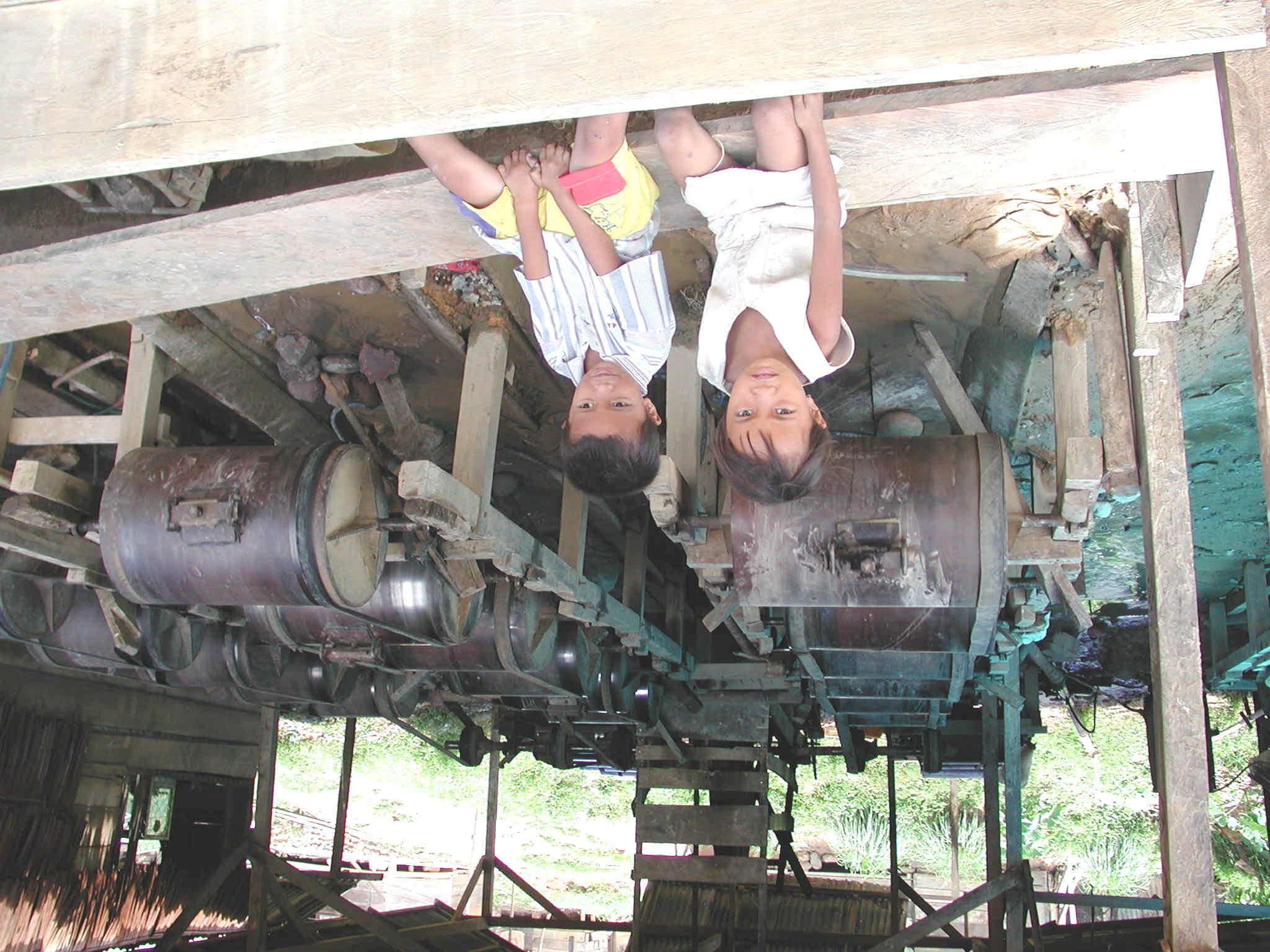
large number of children freely
circulate through all mining and
processing areas (Photo 1). There are
about 20 mineral processing units in
the area, each one with 30 mills. The
mills are identical to those found in
Talawaan (60 x 48cm). The ore is
mined manually through 20 m deep
and narrow shafts. Miners have to
Photo 1 Kids in Lanut playing in the Amalgamation Plant
pay rent to the land owners and a tax
for the cooperative. It was mentioned that nobody is paying tax as the cooperative provides
nothing for the community. The ore is scrubbed in a cement tank using the feet to eliminate
the clayey material (overflow). They do not know how much fine gold is lost in this
operation. The coarse material is crushed with manual hammers to reach a grain size below
1/2". Women and children participate in this activity that generates large amount of dust. The
crushed material is taken to the mills and the mill owner charges Rp 6000 (US$ 0.7) per mill
to process the ore and give the gold bullion back to the miners (customers). Each mill with 40
kg of material runs for 6 hours (3 hours grinding and 3 hours amalgamating). The grinding
media are river stones (50 stones per mill). After 3 hours of grinding, the miller adds 1 kg of
Hg per mill. After separating the amalgam and excess mercury by panning, the amalgam is
burned in a crucible inside a hut under "inspection" of many people. Children are often
around. Gold is melted before selling to 8 "collectors" or to 32 jewelers in Kotamobago. At
least the residual Hg in retorted bold has not been released in the urban environment of
Kotamobago. Interviewing one gold jeweler in Kotamobago, he mentioned that most shops
are buying about 1 kg Au/mo. Gold usually contains 20 to 30% silver. At least 40 kg/month
of gold has been produced in the region and sold in the town. The jewelers have been sending
the gold to be chemically refined in Manado and buys refined gold back. Jewelry seems to be
an important economic activity in Kotamobago.
Interviewing a mill owner in Lanut, it was possible to estimate that he produces with 30 mills,
10 to 15 g of Au per day (around 0.3 to 0.5 g Au/mill/day). He loses 50 g Hg/mill/day or 1.5
kg per unit (of 30 mills)/day. This is compatible with the information about the amount of Hg
he buys per month (around 35 kg). This makes the ratio Hglost: Auproduced = 100, which is
Global Mercury Project Information about Hg in ASM in Indonesia, May 2003, M.M.Veiga
10
likely one of the highest in the world. Amalgamation tailings with high content of Hg are
simply dumped near the river. Assuming that the other 20 milling units in the Lanut region are
losing the same amount of mercury, we can estimate that about 10 tonnes of mercury is
being released annually into the environment just in the Lanut region. Using the numbers
provided by the jeweler in Kotamobago in which 40 kg Au have been bought per month and
using the ratio of Hglost: Auproduced = 100, then it is possible to estimate that about 48 tonnes of
Hg is been emitted annually in the Bolaan Mungodow District from legal concessions.
The excessive use of mercury can also represent a financial burden for the miners. For
example, a mill owner charges Rp 6000 (US$ 0.70) for mill to process 40 kg of ore/day.
Having 30 mills, he makes US$ 21/day or US$ 504/month (24 days). He pays US$ 136/mo
for two helpers, US$102/mo for gasoline, US$ 315/mo for mercury (35 kg at US$ 9/kg).
From the information provided, it is clear that the
costs (US$ 553) are higher than the income. Either
the miller is not aware of his losses or he has some
participation on the gold result or the numbers
provided are not right. Regardless of the reasons,
mercury represents more than 55% of his operating
cost and the miller express all interest in reducing
his losses.
Building Retorts in Manado
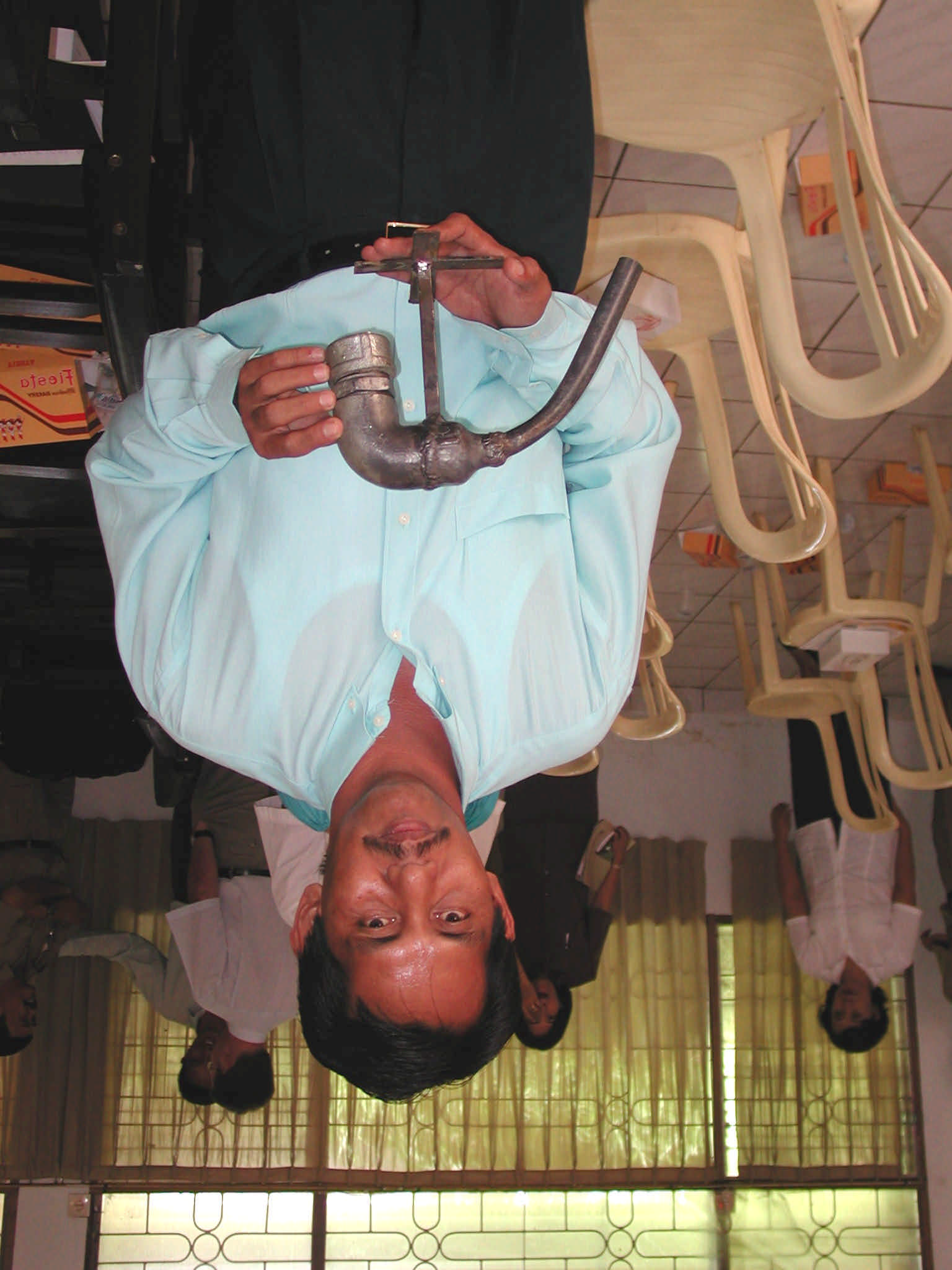
We also had the chance to demonstrate to the
stakeholders how to build a retort to recover Hg
using iron water pipes and connections. We
purchased by US$ 3 in a local shop of building
materials tubes and connection and took them to a
metal shop to make one retort with crucible with
diameter of 1 ¼" (very convenient size). The cost
of this retort, US$10, was higher than in
Palangkaraya (US$5) as the metal shop welded
most of the connections, instead of screwing them.
Photo 2 - Retort made in Manado
The retort was given to an engineer (Photo 2) of the
Kotamobago Office of Mines and Energy.
Conclusion Related to North Sulawesi
1. The use of Hg in the two ASM (artisanal and small-scale gold mining) areas visited in
North Sulawesi has been extremely high (Hglost:Auproduced ~100). Based on our
preliminary estimate obtained during these visits, one can conclude that total mercury
emissions in North Sulawesi can be higher than 100 tonnes per annum (at least 5% of
the total man-made Hg emissions of the planet). This must be checked in the
Environmental and Health Assessment (E&HA). As there are a much higher number
of ASM in other islands in Indonesia, the Hg emissions in Indonesia can easily be 2 or
3 times higher than our estimate. With the price of gold rising, Hg emissions tend to
increase in this coming dry season.
Global Mercury Project Information about Hg in ASM in Indonesia, May 2003, M.M.Veiga
11
2. No efforts have been demonstrated by the local government to enforce the law and
reduce the easy access of miners to mercury.
3. It is recommended to the sub-contractors in charge of the E&HA in Talawaan to read
carefully the existing reports.
4. Samples of urine from people living in the villages (e.g. Dimembe) around the mining
area were collected by previous studies. In the NRM study, 8 residents were
investigated but no information about how far they were from the mines or their
involvement with the process was provided. The Hg levels in urine were high ranging
from 6.6 to 33.8 µg Hg/g creatinine. It is recommended to increase the number of
Dimembe residents in the Health Assessment.
5. It is recommended to assess the bioavailability effect of cyanidation of Hg-
contaminated tailings and possibilities of methylmercury formation (bioassays for
example can be useful for this). As happened in other parts of the world, especially in
China, residual Hg in the contaminated tailings can become more soluble and easily
accessible to methylating bacteria.
6. The processors working in the cyanidation plant in Talawaan (especially in the plant
visited in Dimembe) are burning Hg-loaded activated charcoal. They do not believe
that the charcoal has mercury. Mercury levels in urine of workers can provide
indication of undue Hg vapor exposure.
7. It should be brought to the miners' attention that cyanidation of amalgamation tailings
can create additional environmental problems. If they want to use cyanidation they
should avoid use of mercury. If they keep leaching the amalgamation tailings with
cyanide, they have to find means (e.g. Rio-Sul special plates) to remove the mercury
prior to cyanide leaching.
8. NRM USAID has been doing an important job in developing awareness around
mercury pollution and implementing simple procedures to avoid water siltation. NRM
expressed interest in helping UNIDO in the implementation of the Global Mercury
Project in North Sulawesi.