
What are the Pathways by which Manure Contaminates Water?
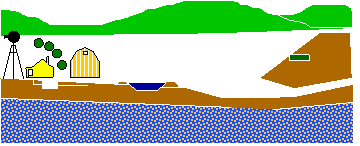
1. Surface runoff
Unsaturated
Zone
Water Table
Sand & Gravel
Aquifer
Bedrock
2.Leaching to groundwater
3.Well casings
Septic Tank
Private
Well
Manure
Storage
Precipitation
1

2
2
2
3

4
4.Ammonia deposition
5
5.Macropore flow
1-3
PRESENTER NOTES
Discussion Question:
1.What are the five pathways by which manure contaminants can reach water?
Key Discussion Topics
1.Runoff.  Runoff from open lots, land application sites, and manure and feed storage represents a common pathway for contaminant transport.  All contaminants in manure will travel with surface water runoff and soil erosion.  Problems associated with phosphorus, pathogens, ammonia, and organic matter are most commonly associated with runoff or erosion.
2.   Leaching.  Dissolved contaminants such as nitrate nitrogen will leach through the soil when the soil moisture exceeds its water holding capacity.  Most contaminants in manure and other byproducts (e.g., organic matter, pathogens, and typically phosphorus) are filtered by soil and will NOT leach to groundwater.  Soil structure, chemical reactions with soil minerals, and negatively charged soil particles typically restricts the movement of many contaminants.  However, soluble contaminants such as nitrate-nitrogen, may move beyond a crop’s root zone and contaminate ground water.
3.   Movement down a well casing:  Wells located in close proximity to a manure storage or outdoor lot can be at risk to nutrient and pathogen contamination.
4.    Ammonia Volatilization and Deposition.  Ammonia-nitrogen volatizes from manure storages, lagoons, and open lots.  Once volatilized, most ammonia is re-deposited with rainfall or through dry deposition.  It can be transported over long distances.  Many areas of the world profit from this nutrient deposition.  However, some areas of the world are experiencing high enough deposition that threatens vitality and growth in local ecosystems.  In the United States, coastal areas are often adversely affected by ammonia deposition.  Nitrogen availability rather than phosphorus typically limit eutrophication in coastal waters.
5. Macropore Flow.  Most contaminants in manure can travel through soil to shallow groundwater tables or tile drains. Macropore pathways (root holes, wormholes, cracks due to soil drying) can provide pathways for contaminant movement that bypasses the filtering capability of soils.
Discussion Question:
References
LPES Lesson 1:  pages 16-17