MINISTRY OF WATERS AND ENVIRONMENTAL PROTECTION
CODE OF GOOD AGRICULTURAL PRACTICES
VOL. I - WATER PROTECTION AGAINST POLLUTION WITH
FERTILIZERS FROM AGRICULTURE AND PREVENTION OF SOIL
DEGRADATION PHENOMENA CAUSED BY AGRICULTURAL
PRACTICES
Bucharest
2002
NOTE
The present Code of Good Agriculture Practices was prepared according
the Framework Content in Annex 3 of Governmental Decree no. 904 / November
13, 2000 to approve the Action plan for water protection against pollution with
nitrates coming from agricultural sources.
The present version is a first draft following to be added and improved by
taking into account the comments and suggestions received from those involved
in its use.
Comments and suggestions can be addressed to:
Research Institute for Soil Science and Agrochemistry
Bd. Marasti 61, 71331 Bucharest
Fax: 021-2225979, e-mail: icpa@icpa.ro
The electronic version can be obtained addressing to:
http://www.icpa.ro
http://www.mappm.ro
http://www.maap.ro
CONTENT
Page
I INTRODUCTION
.....................................................................
1.1
Water and soil as renewable natural resources ....................................
1.2
Prevention of environmental pollution as a way to protect and conserve the
renewable natural resources ........................................................
1.3
Agriculture as a polluting factor of environment, especially of soil and water
II DEFINITIONS
.........................................................................
III
AGRICULTURAL SYSTEMS ......................................................
3.1
Definitions; types of agricultural systems and their selection ....................
3.2
Systems of sustainable agriculture ...................................................
3.3
Systems of conventional agriculture .................................................
3.4
System of biological agriculture ......................................................
IV
BIODIVERSITY, ECOLOGICAL SYSTEMS AND LANDSCAPE......
4.1
Definitions: biodiversity, biocenosis, ecosystems, habitat ...................
4.2
Biodiversity assurance and ecosystem protection .................................
4.3
Principles and recommendations of Code ..........................................
4.3.1
Yard and orchard of the individual household......................................
4.3.2 Fields
................................................................................
4.3.3
Grasslands, meadows and pastures ..................................................
4.3.4 Forest
....................................................................................
4.3.5
Zones of roads, ditches and canals ..................................................
4.3.6
Aquatic ecosystems ...................................................................
4.3.7
Landscape protection and melioration...............................................
V
WATER RESOURCES, WATER RUN-OFF AND SOIL EROSION;
COMPACTION AND SOIL STRUCTURE DESTROYED
5.1
Surface and ground waters; management of soil water resources .........
5.2
Run-off and soil erosion ..............................................................
5.3
Compaction and soil structure degradation .........................................
5.4
Principles and recommendations of Code ..........................................
VI
FERTILIZERS - POTENTIAL SOURCES OF WATER AND SOIL
POLLUTION............................................................................
6.1
Mineral chemical fertilizers............................................................
6.2
Organic fertilizers .....................................................................
6.3
General principles of rational fertilization ..........................................
VII FERTILIZERS
CONTAINING
NITROGEN.......................................
7.1
Behaviour in soil ................................................................
7.2
Fertilizers with nitrogen in nitric form ..............................................
7.3
Fertilizers with nitrogen in ammoniacal form ......................................
7.4
Fertilizer with nitrogen in nitric and ammoniacal forms ..........................
7.5
Fertilizers with nitrogen in ureic form ...............................................
7.6
Fertilizers with nitrogen in organic form ............................................
7.7
Fertilizers with organic and mineral nitrogen .......................................
7.8
Types and effects of organic fertilizers on soil .....................................
VIII
FERTILIZERS CONTAINING PHOSPHORUS ..................................
8.1
Their behaviour in soil and effects on water bodies ...............................
8.2
Fertilizers with phosphorus............................................................
IX
STORAGE AND HANDLING OF CHEMICAL FERTILIZERS;
GENERAL
NORMS.................................................................................
X
STORAGE AND MANAGEMENT OF EFFLUENTS AND MANURE TO
ANIMAL FARMS .....................................................................
10.1
General considerations on animal farms and technical installations ............
10.2
Liquid dejecta ....................................................................
10.3 Manure
..................................................................................
10.4
Silage effluents .........................................................................
10.5
Effluents due to precipitation .........................................................
XI
APPLICATION OF NITROGEN FERTILIZERS .................................
11.1
Applied quantities considering soil reserves .......................................
11.2
Application time and techniques; unsuitable periods for application of
nitrogen fertilizers .....................................................................
11.2.1
Application time of nitrogen fertilizers .............................................
11.2.1.1 Crops sown in autumn ...............................................................
11.2.1.2 Crops sown in spring-summer period ...............................................
11.2.1.3 Perennial crops ..........................................................................
11.2.2
Techniques of fertilizer application ..................................................
11.2.2.1 Chemical fertilizers ..................................................................
11.2.2.2 Organic fertilizers ......................................................................
11.3
Specific cases ...........................................................................
11.3.1
Application of fertilizers on slope lands ............................................
11.3.2
Application of fertilizers on lands adjacent to watercourses and drinking
water sources............................................................................
11.3.3
Application of fertilizers on lands saturated with water, flooded, frozen or
covered with snow .....................................................................
XII APPLICATION OF PHOSPHORUS FERTILIZERS
..............................
XIII
MANAGEMENT ASPECTS OF AGRICULTURAL LANDS WITH
REGARD TO NITROGEN DYNAMICS
...........................................
13.1
General principles .....................................................................
13.2
Crop rotation and successive crop ...................................................
13.3 Permanent
crops....................................................................
XIV
PREVENTION OF SURFACE AND GROUND WATER POLLUTION
DUE TO FERTILIZERS IN CASE OF IRRIGATION
............................
XV
FERTILIZATION PLANS AND REGISTER OF FERTILIZERS USED ON
FARMS .................................................................................
XVI
MEASURES AND WORKS TO CONSERVE AND IMPROVE THE SOIL
QUALITY ................................................................
ii
16.1 Erosion.................................................................................
16.2
Soil Compaction ..................................................................
16.3
Deep cultivation and mixing of soil ................................................
16.4
16.4 Loss of lowland peat
ANNEXES ....................................................................................
iii
1. INTRODUCTION
1. The present code has the purpose to recommend the most useful practices, measures and
methods that may be applied by each farmer, in order to protect soils against pollution with
nutrients (especially nitrates), and to prevent soil degradation as well as the causes and
consequences on environment if these are not respected.
The application of some new agricultural practices, based on the most advanced scientific
knowledge in the field of technologies, especially those ecologically viable, is a major need for
promoting the sustainable agriculture. Therefore, it was necessary to elaborate and also to
implement in practice some codes of good agricultural practice. They represent a set of scientific
and technical knowledge offered to the agricultural producers and farmers to be practically
implemented. Properly and correctly implemented by each farmer, the respective agricultural
practices may contribute both to obtain some profitable and qualitatively higher yields and to
conserve the environment, limiting, on short and long term, the ecologically unsuitable
consequences at national, regional and local level. Such codes have been prepared and now are
practically applied in different countries of the European Union.
2. The present "Code of Good Agricultural Practices" is not a final document; it is going to be
frequently completed and improved, as the interactions between the socio-economic conditions,
environmental state and scientific knowledge change. In the present form, this code is
harmonised with the requirements of the European Union Directives on water protection
against the nitrates from agriculture, (EEC/91/676) in December 12, 1991, and, at the same
time, also includes other recommendations specific to Romania. There are also stipulations
existent or which are going to be included in the legal rules regarding agriculture and
environmental protection.
3. The appropriation and practical application of measures, practices, methods, etc. included in
this code, are going to be voluntarily, willingly fulfilled by farmers who should be aware that
their economic interests to obtain profitable yields must be harmonised with the exigencies
regarding the environmental protection and conservation in order to live in a clean, beautiful
and prosperous country now and in the future.
1.1 Water and soil as renewable natural resources
4. The natural resources constitute an important part of national wealth, including the total
sources existing in nature and which are useful to man under certain technological, economic
and social conditions. The natural resources extracted from their environment may be
transformed in goods whose utilisation presumes their direct consumption.
The natural resources are classified into two distinctive categories: renewable and unrenewable.
The renewable natural resources include water, air, soil, flora, fauna, solar, wind and tide energy,
and the unrenewable ones include all the mineral substances and fossil fuels. Among the resources
representing the first category, these are strong natural interactions, so that any anthropic
intervention on one or other of them induces inevitable consequences on the others, too. Frequently,
the use of these resources is practised under a complex way, being co-ordinated in order to
simultaneously reach more purposes. But the application of destructive methods may cause certain
1
irreversible changes of natural resources, modifying even their "renewable" character.
The main factor transforming, almost totally and irreversibly, the renewable natural resources in
unrenewable ones is pollution. When one of the renewable natural resources is severely affected by
pollution, it may be considered that the environmental degradation occurred, with long-term
consequences, hard or impossible to be evaluated and corrected.
5. Water, air and soil are the most vulnerable components of the environment, and at the same
time they are most frequently affected by the polluting factors with direct and severe
consequences, not only on the environmental quality but also on the health of humans and other
living organisms. The most frequent factors of environmental pollution came usually from
industry, but lately they have resulted more and more frequently from agriculture.
6. The natural unit of the formation of the water resources is the hydrographic basin, defined as
the territory over which one river collects its waters. To the extent that the "basin" concept is
applied to a wide range of spatial scales (from elementary catchments to the basins of the large
rivers) and also to more types of environments (urban or rural, agricultural or sylvical basins,
the basins of lakes, of the phreatic layer, karsts basins,...), it will be defined as an integrator.
7. In studying the circuit of water in nature (the hydrological cycle) and of the coupled fluxes
(energy, solutions, sediments, biomass, etc.) the hydrographic basin as a physico geographic
unit encompassing the hydrographic unit down to the water shed acts like a functional unit,
fundamental and therefore basic to the management, fitting and protection of the water
resources (figure 1.1).
Figure 1.1 - Hydrological cycle with some aspects of the human induced stresses.
8. In the presence of the vegetation a part of the precipitation is retained through interception
by the vegetal layer and the rest reaches the soil by penetrating the leafy layer or through
flowing along the trees' trunk (figure 1.2).
2
9. The water available at the soil surface having the pressure of the atmosphere penetrates in
the soil by infiltration, under the effect of gravity and if the soil is unsaturated, or it leaks on the
soil.
Figure 1.2 - Water in the soil plant atmosphere system surface.
10. The natural in-soil uptake is widened in the areas with intensive agricultural activities
through irrigation practices, through which the water taken from the surface or ground basin
resources are recycled.
11. Since the water resources are regenerable, they depend on the natural climatic variability,
on the climatic changes and on the anthropic influences on the environment. Natural climate
variability gives rise to hydrological extremes, in particular floods and droughts (figure 1.3).
The impact of a decrease in water resources will be a high risk of drought and water scarcity, which
is exacerbated by the constant increase in population density in semi arid areas.
3
Figure 1.3 - Natural climate variability and hydrological cycle.
1.2. Prevention of environmental pollution as a way to protect and conserve the
renewable natural resources
12. In each production process and activity undertaken by man, the lowering of negative
impact on the environment may be firstly achieved by the pollution prevention means, by the
rational use and conservation of natural resources.
The pollution prevention, as a major factor of protection and conservation of the
renewable natural resources and implicitly of environment, can be achieved by the pollution
prevention means using the most adequate materials, techniques and practices leading to avoiding
or at least decreasing the accumulation. Also, the pollution prevention is possible by limiting the
transfer of polluting factors from one environment to another and by a correct management of
wastes, so that the afferent polluting agents should not reach the environment. The pollution
prevention is also particularly important for other environmental components such as flora and
fauna.
4
1.3. Agriculture as a polluting factor of environment, especially of soil and water
Agriculture, beside industry, may become one of the important sources of polluting agents with
negative impact on environmental quality by degradation or even destruction of some ecosystems.
Today, practically, it is unanimously accepted that intensive agriculture may lead to soil and water
pollution by excessive use of fertilizers, pesticides and quantitatively and qualitatively unsuitable
irrigation water, especially on arable lands excessively loose by different operations.
13. The polluting agents, the toxic and/or noxious substances, respectively, can be accumulated
in quantities exceeding the maximum allowable limits both in soil and surface and ground
waters. Among these polluting agents there are: animal husbandry wastes, urban sludge
(domestic and from slurry), slugs resulted from processing the sugar beet, flax, hemp, cellulose,
etc. which may have contents higher than the maximum allowable limits of heavy metals,
organochlorine substances in HCH and DDT classes, triazine, nitrogen and phosphorus
compounds (nitrates and phosphates), etc. nut also different pathogenic agents.
14. Among the noxious consequences of these substances, it should be particularly mentioned:
carcinogenic and mutagenic effects, accumulation in some parts of food chain, high toxicity
etc., all these contributing to severe disturbance of natural equilibrium.
15. Nitrates generate nitrites, which in high quantities have noxious effects on the human
health. Likewise, if phosphates and nitrates enter the stagnant waters in different ways, they
contribute to the occurrence and intensification of the eutrophication process that finally
determines their degradation and partial or even total fauna destruction by oxygen elimination
and generation of some noxious chemical compounds.
16. The incorrect irrigation and drainage, associated with other inadequate practices
(monoculture or short-term rotation, excessive soil loosing especially by numerous surficial
operations, non-observance of optimum periods of soil workability and traficability, etc., up
and down soil tillage on slope lands, etc.), to which inadequate management and use of
agricultural lands, and an irrational use of forest lands are added, determine the occurrence and
intensification of soil physical degradation by processes such as: structure destruction,
compaction, crusting, wind and water erosion, thus contributing more to the sensitivity,
favouring and intensification pollution of the main environmental components in different
ways.
Under the intensification of agriculture, of vegetal production increase, but of the rural development
too, as strong components of the socio-economic progress, the following legitimate question arises:
may the vegetal production increase and be maintained without generating major damages to
environment and health of humans and other living organisms in the food chain?
This prioritary but extremely difficult task is approached by the conception of sustainable
agriculture, as it was defined by the World Commission for Environment and Development: "The
sustainable development represents mankind's capacity to continuously ensure the needs of
the present generation, but without compromising those of the future ones". In agriculture, as
in any other branch of economy, no system may be considered sustainable if it is not beneficial for
farmer and his society, that is if it is not efficient from economic viewpoint. In fact, this represents
the only long-term alternative to the environmental crisis generated by human society.
5
2. DEFINITIONS
2.1. Acidity - the quality, state or degree of being acid; the intensity of soil (solution) acidity is
expressed in pH - the logarithm of the reciprocal of H-ion concentration in soil solution; with this
expression pH 7 is neutral; values lower than 7 indicate acidity, and values higher indicate
alkalinity.
2.2. Accumulation - increase of the concentration of a substance in soil due to the fact that the
substance input is larger than the substance output.
2.3. Adsorption - adhesion of substances to the surfaces of solids; in soil, it has to do with
attraction of ions and of water molecules to colloidal particles; the ions are not too slightly held,
being replaceable by or exchangeable with ions like charge. In contrast, absorption refers to surface
penetration such as takes place when nutrients and water enter plant roots; thus Ca ions, for
instance, are absorbed as they are taken in by plants roots but adsorbed by soil colloids.
2.4. Weathering - refers to the chemical, physical and biochemical disintegration and
decomposition of rocks under the actions of atmosphere agents, plants and microorganisms which
take place because the minerals contained in rocks are not at equilibrium under the temperature,
pressure, and moisture conditions of the atmosphere-lithosphere interface.
2.5. Soil amelioration - represents the set of technical, hydroameliorative, and agroameliorative
procedures to radically and sustainably improve an unproductive or slightly productive soil by
eliminating of the factors which limit its fertility.
2.6. Amendment - substance that is incorporated in soil to correct some of its unfavourable
physical and chemical properties in order to improve the life medium of crops.
2.7. Ammonification - biochemical process by which ammoniacal nitrogen is released from
nitrogen organic compounds.
2.8. Raw water - water obtained from surface or ground sources that has the quality of source when
it is collected and which needs a treatment process according to the qualitative requirements for use.
2.9. Ground water - water from the phreatic aquifer layer.
2.10. Leaching water - water that is infiltrated in soil and is led to its depth.
2.11. Polluted water - water with a nitrate content higher than 50 mg/l.
2.12. Soil water - water in soil which occupies its pores or a part of them.
2.13. Interior waters - all the water bodies located inside of base line from where the territorial
water stretches.
2.14. Surface waters - interior and marine, respectively, and stagnant and flowing waters whose
surfaces are in contact with atmosphere.
2.15. Ground Waters - waters located under the land surface in the saturation zone and in direct
contact with the soil or subsoil.
2.16. Watershed - a region or area bounded peripherally by a water parting and draining ultimately
to a particular watercourse or body of water; the catchment area or drainage basin from which the
waters of a stream or system are drawn.
2.17. Biodegradation - decomposition by organisms.
6
2.18. Soil quality - all the current positive or negative properties with regard to soil utilization and
soil functions.
2.19. Partition coefficient - ratio between the concentrations of a substance in two environmental
components.
2.20. Soil-water partition coefficient - ratio of the concentration of a substance in the soil solid
phase to that in the soil-water phase.
2.21. Critical concentration - quantitative estimate of a concentration of one or more pollutants,
below which significant harmful effects on specified sensitive elements of the (soil) environment do
not occur according to existing knowledge.
2.22. Compaction - strong soil settlement, process to accentuately increase the bulk density and to
reduce the soil porosity.
2.23. Conditioning - the content, eventually with a hydrosoluble package provided with a
protective package used to supply the pesticides to the final user by the marketing network.
2.24. Compost - organic fertilizer resulted by composting various vegetal and animal residues after
a previous mixture and watering, and adding supplement of mineral fertilizers.
2.25. Composting - technique to obtain a compost from mixtures of various organic and animal
materials.
2.26. Decontamination - the complex operation to destroy the pathogenic and pathogenically
conditioned microorganisms in a given product or on a surface in a room.
2.27. Deratization - set of measures to clean of rats in an area.
2.28. Disinfection - see Decontamination
2.29. Disinsection - set of actions (means and methods) to kill the insects and accarians that can
be carriers and transmitters of pathogenic microorganisms to man and animals.
2.30. Soil degradation (deterioration) - alteration of soil properties that cause negative effects on
one or more soil factors, human health or environment.
2.31. Denitrifcation - process to biochemically reduce the nitrates or nitrites to gaseous nitrogen,
either nitrogen oxides or molecular nitrogen.
2.32. Decomposition - breaking down a complex organic substance in simpler molecules or ions by
physical, chemical and biological processes.
2.33. Silage effluents - liquids leaking from the conserved forage by silage processes in special
installations called silos.
2.34. Eutrophication - process of excessive enrichment in soluble nutrient elements, especially
nitrates and phosphorus, the ground waters and stagnant waters, often as a result of intensive use of
fertilizers.
2.35. Erosion - process by which the particles of social or unconsolidated rocks are detached and
removed away by the action of water run-off or wind.
2.36. Soil evolution - all the changes that action in soil in time under the influence of pedogenetic
factors, man included.
2.37. Limitative factor - any condition limiting functions of soil or its use.
2.38. Soil fertility -current status of a soil with regard to the sustained plant growth.
7
2.39. Fertilization -action to apply the fertilizers in order to increase the fertility of soil or a
substrate and to increase the vegetal production.
2.40. National Bank of National Water Management - represents all the databases with regard to
meteorological, hydrological and hydrogeological conditions and quantitative and qualitative water
management so organized that can assure an efficient dialogue with the water users.
2.41. Formulation - the form in which a pesticide is marketed and represents a combination of
various compounds (solvents, surfactants, cosurfactants, soaks, adhesives, suspension agents,
ameliorants of cuticular penetration, etc.) whose final goal is to more efficiently use the product.
2.42. Water management - activities which, by a set of technical means and legislative, economic
and administrative measures, lead to the knowing, utilization, rational use, maintenance and
improvement of quality of water resources to satisfy the social and economic requirements, to
protect the resources against the water depletion and pollution, as well as to prevent and combat the
destructive actions of waters.
2.43. Humification - decomposition of organisms or parts of them, followed by synthesis of humic
substances.
2.44. Immobilization - conversion of substances or soil particles into a (temporarily) immobile
form.
2.45. Critical loading - quantitative estimate of the input of one or more pollutants, below which
significant harmful effects on specified sensitive elements of the (soil) environment do not occur
according to the existing knowledge.
2.46. Anthropogenic influence - changes in soil properties caused by human activities.
2.47. Fertilizer - single or compound substance of mineral or organic nature that directly or
indirectly contributes to maintenance and improvement of the plant nutrition.
2.48. Mineral or chemical fertilizer - fertilizer of mineral origin or industrially obtained by
physical or chemical processes.
2.49. Organic fertilizer -fertilizer obtained from different natural products of organic nature by a
simple processing or composting.
2.50. Organomineral fertilizer - fertilizer obtained by mechanical mixture or chemical processing
of some mineral fertilizers and organic fertilizers.
2.51. Nitrogen fertilizer - nitrogen fertilizer that is under nitric, ammoniacal or ureic form or ureic-
ammoniacal or nitric-amoniacal-ureic combination.
2.52. Phosphate fertilizers - fertilizers where the phosphorous is under form of single, double and
triple calcium phosphate.
2.53. Complex fertilizers - fertilizers containing nitrogen and phosphorus or nitrogen, phosphorus
and potassium.
2.54. Lake - stagnant water body that occupies a concave area of Earth's crust.
2.55. Leaching - movement of dissolved substances caused by the movement of water or other
liquids in soil.
2.56. Mobilization - conversion of substances or soil particles into a mobile form.
2.57. Nitrification - process of biological oxidation of ammonium up to nitrates by nitrification
bacteria in soil.
8
2.58. Plan of Water Management of Watershed - an instrument of planification and application
of measures to assure the protection and sustainable use of water within the framework of a
watershed.
2.59. Soil productivity - ability of a soil tot produce yields under current conditions.
2.60. Pesticides - chemical means of plant protection, obtained by formulation and conditioning
some biologically active ingredients.
2.61. Potential soil productivity - ability of a soil to produce yields under optimum conditions
(e.g. fertilizers, pesticides, irrigation, and soil conservation).
2.62. Watercourse - water body that mostly flows at the surface along a riverbed.
2.63. Water resources - surface water bodies including the water sources with their deltas, lakes,
pond, interior marine waters, territorial sea, as well as all the ground waters.
2.64. Petroleum product - fuels and lubricants obtained from petroleum.
2.65. Salinity - set of problems determined by the presence of a content of water-soluble salts or
changeable sodium higher than in normal soils.
2.66. Salinization - accumulation of water-soluble salts in soil.
2.67. Schedule framework of water development and management - documentation for water
management that presents the model of water management system, including the hydrographic
network, water management works and inputs-outputs regarding the water users, in different
scenarios and stages of the socio-economic development of the respective hydrographic area, as
well as the way of the water quality maintenance and improvement.
2.68. Service to assure the raw water in its source - all the water management activities
developed to create new water sources and to regulate the water discharges in the existent sources
in order to satisfy the needed requirements, correlated with the provisions op the regulation
documents issued for the use of the water resources.
2.69. Service to assure sand and gravel - all the water management activities for assuring a
normal flowing of surface waters in order to regulate the solid discharges and to create sand and
gravel deposits under the conditions to maintain the stability of the riverbeds and banks of
watercourses.
2.70. Service of medium waterfalls assured by dams - all the water management activities
operated for regulation of the watercourse discharges in a certain section to assure an energetic use.
2.71. Specific water management service for water amelioration and quantitative and
qualitative monitoring of pollutants in evacuated wastewaters and for their quality protection
- all the activities operated to know the quantitative and qualitative state and evolution of waters.
2.72. System of agriculture - way to practicing the agricultural production, characterized
especially by the intensive or extensive character of agriculture, the way to use the lands and to fit
the production branches, by the applied methods to maintain and increase the soil fertility, the way
to use the manpower and by the production relations.
2.73. National Water Management System - the set of all the activities and works that assure the
administration of the public water domain of nation interest and the sustainable, quantitative and
qualitative management of water resources.
2.74. Soil - upper layer of the Earth's crust compost of mineral particles, organic matter, water, air
and organisms.
9
2.75. Good water condition - represents that condition reached by the surface water bodies when
the ecological and economic water parameters have values corresponding to the natural flowing
regime with insignificant anthropogenic impact.
2.76. Soil structure - property of soil material to have primary particles and microaggregates
reunited in aggregates (structural elements) of different forms and sizes, separated between them by
contact surfaces with weaker links or pores.
2.77. Substances hazardous to soil - substances, which because of their properties, quantities or
concentrations, have an adverse effect on soil formation and soil utilization.
2.78. Dirty water - natural organic fertilizer, generally less 3 per cent dry matter, made up of water
contaminated by manure, urine, crop seepage, milk, other dairy products or cleaning materials.
10
III. AGRICULTURAL SYSTEMS
The agricultural system represents a set of sectors, technologies, machines and technological
aggregates where the soil is used as a main production resource for agricultural crops and fruit,
vine, vegetable, flower growing as well as animal husbandry. The structure of these sectors can be
different from one farm to another. In Europe, in the agricultural field, according to the used
technologies, their intensification level, specialization, quantity and quality of biomass, relations
with the environment, etc., different systems of sustainable, conventional, biological, organic,
precise and extensive agriculture are practised.
3.1. Definitions; types of agricultural systems and their selection
17. Sustainable agriculture: intensive production of competitive products, having harmonious
and friendly relations with the environment. The frequently used expression "integrated
systems" means the scientific harmonious utilization of all the technological components
regarding the soil tillage, crop rotation, fertilization, irrigation, pest and disease control by
biological methods, animal husbandry, stocking, processing and utilization of wastes resulted
from agricultural activities, etc. to achieve some high and stable yields on the multisectorial
farms (vegetal and animal husbandry).
18. Conventional agriculture: intensively mechanized with competitive products, but which
is particularly based on production concentration and specialization. Thus, the soil loosing is
regularly carried out only by breaking and turning over the soil with the plow followed by
numerous secondary soil works for seedbed preparation and crop management. It is
characterized by high and very high rates of mineral fertilizers, monoculture or, at the most,
short crop rotations for two or three years, intensive chemical treatments to control the weeds,
diseases and pests. This type of agriculture was largely practised in Romania till 1989. Today, it
is unanimously accepted that this type of agriculture may affect the environment, especially if
the different components of the agricultural technological system are applied without taking
into account the local conditions: climate, soil, relief, social and economic conditions that
determine different processes of environmental physical, chemical and biological degradation.
19. Biological agriculture: moderately intensive and thus less aggressive as compared to the
environmental factors, with agricultural results (products) less competitive from the short-term
economic viewpoint, but being higher from the qualitative viewpoint. As concerns the
environment, this system is better harmonized, the treatments for the disease and pest control
are preferably biological; however, the reduced rates of mineral fertilizers and pesticides are
also accepted. As concerns the quality control of products, the certification of used technologies
is necessary. The products of this agricultural system are sold on a special market.
20. Organic agriculture: as compared to the biological agriculture, it is characterized by
exclusive use of organic fertilizers at relatively high rates, applied according to the local
conditions, preferably aiming at the crop fertilization and the long-term recovering of soil
structure that was degraded due to the intensive anthropic activities and/or some natural
processes.
11
21. Extensive agriculture with low inputs: subsistence agriculture with a low competitive
production. It may affect to a certain extent the environment, biomass quality included,
especially by the nutrition disorders. The mineral fertilizers and other agrochemical (herbicides,
insecto-fungicides, mineral amendments, etc.) measures are most practically used or only at
very low rates (excepting the vegetable sector). Also, the high productive hybrids and cultivars
are not used on a large scale. This system is practised also in Romania by individual farmers.
22. Precise agriculture: the most advanced farm of agriculture practised even in the most
developed countries in the European Union and USA on smaller areas, being based on the most
modern methods to control the quality of different environmental resources, optimum
application of all the technological components and having thus a rigorous control on the
possible factors determining the environmental degradation.
23. The agricultural systems are closely dependent on economic, social and environmental
conditions. Their control is the most important condition to introduce and promote the
sustainable agriculture.
24. The selection of the agricultural system depends on the technical level, professional
knowledge level, but also on the mentality, general education and respect for the environment
of all the people involved in this field.
To characterize the different systems of agriculture the following criteria are used:
· quantity and quality of production;
· reasonable production costs for the competitive products;
· production stability from year to year within sectors, farms and agricultural lands;
· harmonized relations with the main natural resources (soil, water, fauna, flora, relief),
their improvement, amelioration and conservation for the future generations;
· specialization and structure of agricultural production should be flexible, that is able to
have the capacity to react to changes concerning the demand and supply;
· long term balanced ratio between the economic, ecological and social requirements.
The sustainable agriculture should contribute also to solve some social problems in the rural zones:
· new employment possibilities;
· infrastructure development, conservation and promotion of traditional culture;
· development of the road and communication network.
3.2. Systems of sustainable agriculture
25. The systems of sustainable (integrated) agriculture are characterized by a multisectorial
productive activity, the vegetal production being always in a direct relationship with the animal
one. The following measures are necessary in the systems of sustainable agriculture to develop
an intensive productive activity with competitive production results:
12
· high diversity of vegetal crops, but using at the same time cultivars and hybrids with a
high genetic potential, adapted to local conditions; perennial crops are used, both for the
requirements of animal husbandry sector and for the improvement and conservation of
soil structural conditions; crops of perennial (but also annual) legumes are preferred to
improve the balanced sheet of soil nitrogen, undersown crops are introduced after
harvesting the main crop, to protect the soil surface against the natural and aggressive
anthropic factors (torrential rains, wind, uncontrolled traffic on soil);
· utilization of residual organic materials usually coming from the animal husbandry
sector (solid composted ones are preferred) combined with mineral fertilizers. They are
used to ensure the crop nutrients and also conserve the soil fertility. The fertilizer rates,
that are to be applied, are established by calculating the balanced sheet of soil nutrients
to avoid overfertilization, especially of nitrogen, both to reduce the production costs and
environmental pollution;
· use of prophylactic and biological protection means on a large scale, limiting the use of
chemical substances as much as possible; the capacity of cultivated plants to reduce the
weeds proliferation as well as the quality of mechanical works made in this view are
highly important to control the weeds;
· rational exploitation and protection of natural meadows and pastures, and of zones
subject to erosion, by a controlled grazing; animals should be fed according to breed
productivity, while the handling and stocking of animal wastes should respect certain
rules in order to minimize the pollution. The animal number should be correlated with
the agricultural land area of farm;
· operating the soil tillage as well as the harvest and transportation in the optimum
workability and trafficability period (according to soil water content on working depth);
certain conditions concerning soil suitability to a particular operation, number of
operations, axle loading, tyre pressure, and number of wheels to protect the soil against
physical degradation should be observed;
· the farm management should consider the economic and social aspects besides the
aspects concerning the protection and conservation of ecosystems and biodiversity.
The sustainable agriculture should become a main component of the state agrarian policy.
26. In the rural zones the sustainable agriculture represents the best expectation capable to
offer an integrated solution of the economic, social and environmental problems.
27. The option for a sustainable agriculture system presumes, in fact, the observance and
introduction in the agricultural activity of the measures stated in the Code of Good Agricultural
Practices.
3.3. Systems of conventional agriculture
13
28. These systems are characterized by the strong specialization and intensification of
agricultural activity and the minimization of production costs. Mineral fertilizers and pesticides
are used on a large scale with field crops and also in horticulture, vine growing and vegetable
growing. Often, the animal husbandry sector is not a component of agricultural farm activity
and that is why the perennial grasses are not included in the crop rotation system, although they
are highly important to improve and conserve the soil fertility.
29. The residual organic materials produced by animals (manure, sludge from pigs, etc.) and
those of vegetal origin are not usually applied on agricultural lands, even if they represent a rich
source of crop nutrients and soil protection against degradation.
30. Only certain plants predominate in crop rotation, especially the cereals and technical
plants, the most spread being the monoculture (kernel maize) and the rotation of two years
(maize and winter wheat), applying high rates of mineral fertilizers and other chemical
substances to control the diseases and pests.
31. The tillage is intensive, machines of high capacity being frequently used that, especially
under irrigation conditions, intensifies the risk of environmental degradation and pollution. The
major interest of such farms is to obtain a maximum profit, the protection of the environmental
resources being minimized. There are big farms, concentrations of lands production processes,
capital and manpower, while the social life conditions in the rural environment are neglected to
a large extent. Under these conditions, agriculture represents only an economic business in the
rural environment without paying the necessary attention to man and environmental protection.
Under this type of agricultural system, the research and technological development have not a
strong influence on the protection and conservation of the resources and therefore they do not
correspond to a sustainable development.
3.4 System of biological agriculture
32. The biological agriculture (ecological, organic, bio-organic, bio-dynamic) is considered a
viable solution which resolves the negative impact of agriculture on the environment and the
quality of products. In this system, other natural organic and inorganic substances are used
instead of mineral nutrients, pesticides, drugs and growth stimulators.
33. The obtained production is lower, but an acceptable economic profit may be got by selling
the products (of better quality) at higher prices on a specially organized market.
The biological agriculture has three major objectives, such as:
· to obtain qualitative agricultural products in a sufficient quantity and at reasonable
prices;
· to improve and conserve the quality of all the environmental resources and to reduce at a
minimum the pollution sources;
· to create the general framework for food producers able to ensure the quantities
necessary for the society development, to guarantee the security of the working
environment, to allow the income increase, to offer the satisfaction of the work and to
14
harmonize the life with nature.
34. The biological agriculture creates the conditions necessary for building the natural
ecosystems ensuring the sustainable development of society especially in the rural environment.
35. To successfully promote a biological agriculture, it is necessary that the farmers respect
some conditions referring especially to crop rotation, fertilization and control of weeds,
diseases and pests.
The crop rotation is a technological component of an essential importance in the systems of the
biological agriculture. Soil fertilization methods should be applied in crop rotation to ensure the
fertility improvement and maintenance. In this view, the organic natural (preferably composted)
fertilizers are used. It is aimed to obtain a maximum benefic effect due to nitrogen-fixing micro-
organisms both those symbiotically living on roots of legumes and those free living in soil which fix
the atmospheric nitrogen under more forms available to plants. Also, they are aiming to enrich the
soil nutrient reserve in more available forms for plants by stimulating the activity of the macro and
microorganisms and by a large root mass. The development of soil life, biotic medium, has some of
the most benefic consequences on soil fertility and creation of optimum conditions for the
development and health of the vegetal cover. Between the vegetal production and the animal one,
there is always balanced and harmonized relation with the farm possibilities.
36. The possible nitrogen losses from the soil are reduced at the minimum by using organic
natural fertilizers applied at the optimum rates according to the local specific characteristics and
the crop needs, by using nitrogen-fixing legumes and stimulating the micro-organisms activity
in soil. This purpose can be assured by less intensive cropping techniques, correctly established
periods for agricultural works, undersown crops included.
37. The biological production should be planned in such a way to assure on a long term a
suitable balance sheet of nutrients in soil by a periodic monitoring based on specific soil and
plant analysis. The use of allowed fertilizers could compensate the nutrients removed from the
soil by yields.
The control of the weeds, diseases and pests should be carried out applying some prophylactic,
biological and mechanical means. The natural capacity of crops to inhibit the weed proliferation
should be used as much as possible.
This system of agriculture is considered closer to that naturally takes place for biomass production
and for this reason the negative consequences an environment are also much more reduced.
38. The organization of a farm or agricultural unit should firstly have in view the protection of
the local ecosystems, species biodiversity, waters, soils and other environmental elements
beside the social and economic aspects of the rural zones.
The animal husbandry takes into account the animal needs in harmony with the local specific
conditions (grazing area, quality of pastures and fodder, free movement, etc.). The costs for
fertilizers and fodder do not exceed 10 per cent of the total costs. The animal loading per hectare
15
does not exceed 2 milk cows or 11 mature pigs per hectare.
39. The competitive systems of biological agriculture are based on the most recent results of
research in order to obtain some agrofood products of high quality. However, the production level
is lower than in the systems of the conventional and sustainable agriculture. In order to promote and
develop the biological agriculture, maintaining the total volume of production, it is necessary to
extend the agricultural land area. The processing and marketing of biological products are very
important for the farmers due to the limited production level.
40. A variant of biological agriculture is the biodynamic agriculture where other factors are taken
into account, such as movement of planets. The evaluation regarding the compatibility of the
production technologies with the standards of the biological agriculture is imperative within the
biological farms.
The models of the biological agriculture are considered as systems of sustainable agriculture. For
this reason, any farm in the biological system will accomplish the requirements of the sustainable
agriculture as concerns the quality of products, production technologies and environmental impact.
16
IV. BIODIVERSITY, ECOLOGICAL SYSTEMS AND LANDSCAPE
4.1. Definitions: biodiversity, biocenosis, ecosystems, habitat
Biodiversity is defined by the multitude of living plants and organisms that are growing on the land
surface, in soil and water. It includes the diversity both within the species and between species.
Biocenosis represents all the population (species) living in a certain territory or physical habitat
well delimited and which depend on some conditions of the abiotic environment.
Ecosystem represents a fundamental functional unit of the biosphere with a determined type of
interactions between the inorganic and organic components and its own energetic configuration that
assures the development of biogeochemical cycles and transformations of energy in the given
fragment of the terrestrial crust. It is organized in ecosystems like lakes, forests, grasslands, crops,
etc., with their flora and fauna. The structure of a natural ecosystem is constituted of four
components. The first is the abiotic component represented by the energetic and trophic resources
of environment, the second is the component generating organic matter and namely vegetal
biomass, the third is the component consuming organic matter, represented by the herbivorous and
carnivorous organisms, and the fourth is the component of the decomposing organisms represented
by micro-organisms that decomposed and mineralize the organic residues.
Habitat (or biotype) represents the life environment that shelters a biocenosis generally having
unitary conditions.
41. There is a mutual interdependence between species of plants and animals and different
ecosystems, and for this reason, a loss of one specie can cause irreversible changes in the whole
ecosystem.
The biological diversity increases the stability and total production of any ecosystem and therefore
it is an important and necessary precondition for the development of the sustainable agriculture.
The natural ecosystem should be protected to conserve the diversity in this way. Unfortunately, in
Romania as all over the world, the economic activity intensification represents a continuous threat
to the natural ecosystems that can cause the following effects:
·environmental contamination;
· degradation and destroy of the wild species, habitat;
· degradation or destroy of animal migration routes;
· destroy or deterioration of historical and cultural vestiges;
· destroy or degradation of environmental aesthetic.
42. In the agrarian policy, as the directives of the European Union stipulate, it is very important
and necessary that the land use and activities on each farm should be performed according to
the requirements concerning the protection and conservation of natural ecosystems and
17
implicitly of biosphere. For this reason, the elaboration of strategies to promote the sustainable
agriculture should start from the level of the agricultural producer and the individual rural
household.
4.2. Biodiversity assurance and ecosystem protection
43. To assure the biodiversity and protect the ecosystems some conditions should be respected
such as:
· Diversified use of agricultural land
The ecological principle, according to which "soil has the right to vegetation", should be
permanently in view. That means that, under natural climatic conditions, the soil should be
permanently covered with vegetation which assures its regeneration and restoration, and
protects it against the destructive action of some aggressive natural factors such as water
erosion, especially on the slope lands. This principle is not respected in some agricultural
systems, the soil being periodically without vegetation and subject to the aggressive action of
natural factors that determine degradation of soil especially, topsoil. Thus, the intensification of
soil degradation may be explained by the structure deterioration (structural macro- and
microaggregates lose their hydric stability) and the occurrence of processes of crusting, surface
compaction, wind erosion with severe effects on germination and emergence of agricultural
crops and their development in the first growing stages. These negative effects may be reduced
by including green manure, vegetal mulch, hidden crops, and an adequate rotation of crops
correlated with the specific local conditions.
· Habitat or life environment of wild species should be protected and conserved
In the agricultural zones, the species of wild animals and plants should be assured with
sufficient spaces of natural habitat, which must not be cultivated. Road borders, drainage and
irrigation canals, green boundaries, wet zones, grasslands, meadows, pastures, yards around
houses, banks and embankments of watercourses and lakes, dales and groves, all these may
contribute to maintain the natural habitat of various forms of life and for this reason they should
be protected and conserved.
· Protection of all species should be assured
The protection of wild species as well as of domestic ones or cultivated plants represents the
fundamental condition to assure the biodiversity. The measures to protect the species and
environment are valid and are applied beginning with individual households up to big farms.
· Protection and conservation of natural, cultural and historical assets
As any country, Romania has a long history concerning the socio-demographic and economic
evolution. The permanent changes, sometimes dramatical ones, had a strong impact on natural
ecosystems and environment. Thus, forests were and are irrationally exploited without being
adequately regenerated; natural grasslands, meadows, and pastures are not included in
monitoring and conservation programs. Measures to avoid such deficiencies should be taken
into account. Also measures should be taken to adequately conserve the ecosystems which
maintain the objectives of historical and cultural patrimony as living documents and testimonies
of the Romanian people's millenary history.
18
4.3. Principles and recommendations of Code
In agriculture, it is necessary to know or respect those means and practices that assure the
biodiversity conservation, regardless the land area for undertaking the activities. As a rule, these are
available for all the farmers.
4.3.1. Yard and orchard of the individual household
44. The individual household, yard and orchard constitute a unitary system that, in its turn, is a
part of a natural, more extensive and more complex system. Adequate conditions may be
fulfilled for the life of the little mammals, reptiles, birds and insects, in the presence of the
human activity, with the help of some very simple measures and means:
· avoiding asphalt cover of alleys and paths or use of other impermeable materials. Their
covering with gravel for offering a pleasant and, at the same time, a dry and adequate
environment from the ecological viewpoint is recommended;
· covering the exterior walls of house or other buildings with climbing plants and creating
of hedges with adequate species;
· development of shelters for birds, and protection of old and hollow trees;
· development of platforms to compost the organic residues in household, the compost
representing a valuable fertilizer and, at the same time, an excellent life medium for a
great number of useful small animals and insects;
· cultivation of fruit trees, different vegetables and decorative plants traditional for the
respective zones, avoiding some foreign species and cultivars which are not
recommended or even forbidden (i.e. genetically modified hybrids);
· maintenance as much as possible of the rich, natural, spontaneous flora of grasslands,
avoiding their frequent mowing.
4.3.2. Fields
45. The agricultural cultivated lands constitute a specific medium where the species of
dominant plants are regularly replaced. The number of cultivated species is limited. For this
reason, from the biological diversity viewpoint the so called anthropic activities or
environmentally "friendly" agricultural practices are considered to have a great importance for
the environment:
· avoiding early ploughings (winter-spring) on a too wet soil that leads to soil
compaction, affecting life conditions of organisms in soil;
· use of aggressive agricultural machines (cultivars, harrows, cultivars), as little as
possible, for soil loosing and crumbling as they can affect and kill the soil organisms;
· soil supply with organic materials, thus stimulating the benefic activity of earthworms;
· soil tillage as early as possible to allow the wild animals to come back to their natural
habitat;
19
· execution of mowing and harvesting from the middle to the borders of the field and as
late as possible to avoid the killing of cubs and young animals, while the harvesting
machines should be provided with warming equipment for moving the animals away;
· maintenance of non-cultivated lands in between the cultivated ones.
4.3.3. Grasslands, meadows and pastures
46. Grasslands, meadows and pastures are considered natural ecosystems and are dominant
elements of the rural environment with a larger biological diversity than the cultivated areas,
especially if they are under a natural regime. In Romania, these ecosystems have a high weight,
having in view that only in the mountainous zone there are 3.3 millions ha agricultural lands
out of which about 25 million ha natural grass lands. It is necessary to recognize the fact that,
especially in the mountainous and hilly zones, these ecosystems are very sensitive and fragile.
The soils are characterized by a natural acidity which considerably influences the compositions
of the forage natural flora. A good agricultural practice, with economic and environmental
reasons, is represented by the animal grazing development in the mountainous regions during
the summer, and maintaining them, during the winter in proper farms when they are fed with
hay obtained from the multifloral meadows. The sheep, as well as the goats, assure the manure
production and its uniform spreading, avoiding the manure transport at a certain distance. The
capsular form of manure produced by these species assures an aerobic fermentation with the
decay and change in a short time through the alkaline reaction, diminishing thus the soil natural
acidity, at the same time with supplying, in balanced rates, the organic substances. Thus, on
influence on the interspecific competition between plants takes place by creating conditions to
naturally develop the multifloral, valuable fodder plants. In order to protect these natural
ecosystems and their biodiversity, the following measures are necessary:
· to avoid fertilization and other maintenance works in grasslands and natural meadows
during their blooming stage;
· to avoid the execution of works when the soil is too wet in order to protect it against
excessive compaction with numerous negative consequences on soil organisms, too;
· to save and protect the great solitary trees and existent shrubs, because they assure food
and shelter for wild animals;
· to protect the natural pastures which will be mowed only if it is necessary and not
ploughed at all; the degraded pastures will be sown in non-ploughed soil using in this
view specially equipped machines;
· to let, by rotation, non-mowed grasslands and meadows;
· manually mow, if the land is too wet, and in the flooding bottom lands, where
agricultural machines cannot be practically used;
· to avoid the grazing of old, degraded pastures or those recently sown for regeneration;
grazing should not be practised in forests, on sloping land with bushes or other specific
vegetation, in protected areas around the lakes and water courses, even if it is not
economic;
· to reduce the grazing on the hilly sloping lands, on sloping lands around the lakes and
watercourses, in sandy zones or with calcareous soils, where the grazing will be
practised with a reduced number of animals, especially sheep;
20
· to interdict the overgrazing; it is necessary to assure an optimum ratio between the
number of animals, land area and pasture quality;
· during summer, within the pen, the places for sheep milking and sleeping should be
changed every 3 - 4 days to avoid the land overmanuring and to assure an uniform
fertilization;
· on the meadows, the well decayed manure will be spread in spring time, immediately
after the snow melting, in a layer as uniform as possible; at the same time, it is possible
the oversowing with seed of valuable legumes and graminaceae, especially Trifolium
repens, incorporated in the mass of the natural fertilizer;
· the fertilization of the pastures and meadows will be carried out every year only with
natural organic fertilizers; in order to avoid soil acidification and wildness phenomenon
of flora (this phenomenon happens only in the mountainous zone), the summer-
wintering cycle should not be interrupted and it will be practised with a balanced loading
of animals per hectare;
· the use as fertilizer of the manure containing sawdust used as animal bedding will be
avoid due to the acidity generated;
· to avoid to wound animals and birds; in the case of mechanized mowing; often animals
and birds hide in the non-mowed areas and, for this reason, mowing should be started
from the middle of the field through the borders, and the machines should be also
provided with warning equipment.
47. Taking into account the forest vegetation deficit, especially in the plain and highland
pastoral and arable areas, it will be follows:
· Re-establishment of the forest trees and shrubs using the forest-pastoral plannings, for
the purpose of environment, grazing and animal rest condition improvement.
· Regulation of the pastures loading with animals according to their productivity, to avoid
the grazing transfers in the forest.
· Joining of the ago-forestry interests, by the creation of some forest crops as food reserve
for the animals (leafages) in extreme critical conditions (catastrophic droughts).
· Using the lawns alternatively (1-2 years as pastures and 1-2 years as hayfields), and in
the period of the hayfields use the forest species planting will be done.
· No grazing in the rain.
4.3.4 Forest
48. Forest biodiversity preservation starts from the following premises:
· Romania has a small surface covered with forests (approximately 27%) distributed
without uniformity compared to the main relief forms (mountain, highland, plain).
· The number of plant and animal species is situated at a medium level compared to the
total number of plant and animal species from our country (only approximately 200
woody species and 1000 herbaceous species from a total of 3500 superior plant species).
· The wild woody plants are almost exclusively in the forest ecosystems; the herbaceous
plants are in a dominant proportion (more than 60%) only in the forest stands too.
21
· Some woody and herbaceous plants are threatened with extinction, such as: yew, wild
lilac etc.
· In the plain area, a danger of genetic isolation of some species occurred due to the
fragmentation of the forest massifs.
49. The protection of the forest ecosystems requests the take of a series of premises:
· Restriction to the promotion of some hybrids of black poplar in the flooded areas of the
Danube Meadow and internal river meadows and native species of poplar and willow
who do not request fertilization and irrigation.
· Comply with the functional division into zones, in agreement with the concept of
sustainability, unaffected by the nature of the forest ownership.
· Establishment of some forestry measures for diminishing and even ending of the forest
decline phenomenon (trees drying).
· State control for the utilization of synthetic chemical products in forestry (biotic pest
control).
· Protected forest area extension.
50. The Code of good forestry practices aim at the forest private owners above all, for whom it
is necessary to be realized:
· Forestry in force legislation knowledge
· Establishment of some continuous perfecting centres with a popularization character of
the knowledge regarding the forest and its role in the economy, environment protection
and social life.
· Small forest owners association in an adequate manner for ensuring the forest
sustainable management.
· Establishment by the mayoralty (when the association of the forest owners does not
exists) of the own communal nursery, managed by the rural inhabitants, beneficiary of
the woody plants.
4.3.5. Zones of roads, ditches and canals
51. Within these zones it is necessary to:
· assure hedges, trees, bushes, alleys to provide habitat and food for the wild fauna;
· provide at least a row of natural trees, bushes or high succulent vegetation where
planting is not possible;
· avoid the mowing of ditches and canals in these areas before the growth of cubs and
young animals, for instance until end of July;
· forbid burning of dry grasses in spring.
4.3.6. Aquatic ecosystems
22
52. The aquatic ecosystems are formed of flowing or stagnant waters such as: pools, ponds,
lakes, canals and running ditches, watercourses, etc. They contribute to the environmental
beautification and assure the habitat for many species of terrestrial and aquatic flora and fauna.
In order to protect and conserve the biodiversity of these ecosystems, it is necessary to:
· create small artificial lakes planting trees, bushes and grasses on their banks;
· save, protect and improve natural vegetation on the banks of water bodies;
· carry out the regularization of watercourses only under an authorized regime.
53. It is recommended to protect as much as possible the natural course of rivers and other
flowing rivers as they evoluated in time, in a perfect balance with the environment.
54. It is necessary to restore the destroyed natural channels and to rehabilitate the biodiversity
of these ecosystems.
4.3.7. Landscape protection and melioration
55. For improving and maintaining the landscape ecological equilibrium, using of the forest
vegetation in the arable land of mountains, highlands and tablelands will be take into account.
56. In the mountain area: Landscape functionality improving measures are of two kinds:
preventive and curative ones:
Preventive measures aim above all at the installation of the forest vegetation on the arable use
lands, in the micro-zones with high erosion potential (streams, slopes more than 35o, superficial
soils, with skeleton etc.), on the road network etc.
The woody vegetation will be installed as:
- shrubs or trees lines,
- complex lines of shrubs and trees,
- forest belts,
- trees lines.
The curative methods are applied on lands affected by different degradation phenomena, as
soil erosion, landslide, waterlogging, reactivation of some detritus, accidentally deforested
(tree throwing down due to the wind, fires, deforestation, etc.) A special attention should be
paid to the deforested lands in the jumper zone where very severe phenomena of the natural
condition deterioration can occur.
57. In the hilly region: The use of forest vegetation in the hilly and platform zones will be
performed as in the mountainous zone, in two ways:
· preventive, in order to avoid the degradation processes, and
· curative, in order to ecological reconstruction of the deteriorated landscapes
The preventive action to use the forest vegetation should take into account the existent private
ownership on lands and the high potential risk of some lands to the destructive action of the
58. The cadastral network should remains the basic framework, according to which, the wood
vegetal formations will be developed as:
- shrub lines;
23
- tree lines;
- forest belts
59. The microrelief should be utilized with the same intensity as the cadastral network; first of all, it
is a matter of land areas with a very high slope (over 30 - 350), ditches, gullies, etc.
60. In the plain area: The basic principles that must to be taken into account in this problem are:
- the shrubs must have the same importance as the trees;
- in no cadastral lines the woody vegetation will be missing;
- monitoring of the woody vegetation status and evolution in the plain area will be made
every 2-3 years using the aerial photogramms:
- promoting of the woody vegetation has in the background the idea of restoring and
preservation of the biodiversity, of the environmental conditions.
As a general rule, in the plain area, the bocage type of landscape (hay), wide spread in the western
countries as trees and shrubs lines will have priority. Forest belts will be planted in the available
areas.
24
V. WATER RESOURCES, WATER RUN-OFF AND SOIL EROSION;
COMPACTION AND SOIL STRUCTURE DESTROYED
5.1. Surface and ground waters; management of soil water resources
Fresh water is vital to human survival and to the integrity of natural ecosystems, so therefore it is
critical that water resources be managed wisely.
The management of water resources is a complex decision making process.
If supplies were available at all times and in all places in adequate quantity and quality, the decision
making would be a simple matter. This is far from the case and to must establish dearly defined
policies based on knowledge of the resource itself and the demands upon it. These demands are for
food production, domestic needs and industrial activity, hydropower generation and the
maintenance of the ecosystems. The demands are ever increasing to meet the needs of expanding
populations and rising standards of living. In the figure 1 is presented the global water withdrawals
by sector, 1900 2000.
Figure 1. Global water withdrawals by sector (1900 2000).
Romania's fresh water resources are generated by the water in rivers, unsalted natural lakes and by
the gourd waters, the largest share being held by the river waters.
The hydrological potential of the water flows is about 40 bil.m3, i.e. a mean resource of about 1700
m3/year inhabitant.
The Danube is 2857 km long, 1075 km of which (37.7 %) on the territory of our country, has a
hydrological potential at the inlet into country of 170 bil.m3.
25
61. The overall objective of the water management is to ensure high living standards from the
standpoint of the water for all the citizens. This is accomplished through:
· Ensuring permanent water supply to the uses and especially to the population;
· Improving the water resources quality;
· Ecological rehabilitation of rivers;
· Mitigating the risk of flooding occurrence;
- building storage lakes, polders and damming works; regularizing water flows, in
correlation with conserving the humid areas;
- fitting-out streams, afforesting and planting protective curtains;
- performing CES and dissecation activities;
- augmenting civic responsibility regarding the ecologization of the water flows;
· Harmonising legislation in the domain of waters with the previsions of the European
direction 16 European Directions + the Frame Direction, through updating the Law of
the Water 107/1996.
Fitting out the rivers requires the achievement of ecological networks, which ensure:
· The flood defence of localities and agricultural lands through damming over short river
sections;
· Conservation of the biologic biodiversity through preserving certain humid areas.
62. A series of quantitative and qualitative modifications have occurred in the natural regime of
the ground waters, as a result of performing hydro-rectification works, including capturings, as
well as due to pollution, mostly in the case of the phreatic waters. Function of the factors
producing ground waters pollution, the following pollution categories were noticed: by
products resulted from the industrial processes, by chemical products used in agriculture, by
domestic products and by products resulted from animal breeding.
The pollution by oil products and phenol compounds of the phreatic aquifer is followed by order of
gravity by the pollution by products used for fertilizing and for combating pests in agriculture
(nitric compounds NH4, NO2 and NO3, phosphates, pesticides, etc.), either in the area of the big
producers of such substances or on the field, through administering these substances usually
incorrectly.
Especially the aquifer phreatic resources display high risk to being polluted, both in the long and
the short range. For this reason they can no longer be water supply sources to the population,
agriculture, etc., unless new water treatment technologies are found and applied, along with
observing the norms imposed the Frame Direction of the EU (art. 3 Direction 2000/60/EC.23 October
2000).
5.2. Run-off and soil erosion
26
63. Some factors, especially that active in water pollution, are related to the alarming increase
of soil degradation, especially soil erosion. The soil erosion is a geological complex process by
which soil particles are dislocated and removed by water and wind mostly reaching the surface
water resources. Besides these causes there are also the human activities related to practising an
intensive agriculture and an inadequate management of agricultural lands.
It is very important to point out that as the agricultural land degradation increases the soil fertility
decreases to the same extent, negatively influencing the yield level.
The intensity of the sheet erosion (removing the soil particles by diffuse run-off) depends on the
run-off speed, which, in its turn, depends on the slope length and inclination. The water soil erosion
on the agricultural lands is accelerated by soil working along the slope.
5.3. Compaction and soil structure degradation
Soil compaction is a process by which the bulk density increases over the normal values at the
same time with the decreasing of the total porosity below the normal values.
64. Soil compaction induces multiple negative effects, among which there are:
· aerohydric regime deterioration;
· increase of penetration resistance and inhibition of root system development;
· increase of resistance to ploughing;
· soil structure deterioration;
· unsuitable quality of ploughing and seedbed preparation;
As a result of these effects, the soil productivity capacity severely decreases (up to 50 per cent
of the non-compacted soil capacity).
Soil structure is a distinctive, specific characteristic, extremely complex on which soil fertility
depends.
Pedologically, it is defined by the way of the elemental particular association in structural
aggregates and their form, size and grade development.
Agronomically, it is defined by the set of physical properties characterizing the water retention-
release capacity in the soil people, state of settlement and hydric and mechanical stability, and the
afferent physical regimes (hydric, aeration, thermic).
The soil structure genesis includes a set of physical, chemical and biological processes of a
particular complexity, organic matter, iron and aluminium hydroxides, clay and calcium carbonate
having an active role in soil structure formation.
65. Two groups of main causes contribute to the soil structure degradation:
27
· soil chemistry change by decreasing the humus content and, in some situations, by soil
alkalization and salinization as a result of unbalanced fertilization or irrigation with
unsuitable water.
· the direct degradation actions of structural elements such as the soil powdering as a
result of excessive soil tillage or under unsuitable moisture conditions, the compaction
due to excessive traffic, especially under wet soil conditions, the crust formation under
the action of rain drops and sprinkle irrigation, etc.
5.4. Principles and recommendations of Code
66. Technical standards, methodologies and guidelines should all be considered as useful
tools when implementing water use and demand management strategies at all levels
· More detailed analyses, including methods for temporal supply and demand in sub-
catchments.
· Investigation into long-term interactions between stream flow, irrigation strategies,
water demand and available storage.
· Promotion of professionalism by affiliation to professional institutions.
· Recognition of international standards when developing national standards.
· Devices to regulate and measure the withdrawal and consumption of water.
· More efficient structure with higher water use efficiencies.
· Promotion of water efficient irrigation techniques.
· Refined methodologies for crop water requirement estimation.
· Production of design operation and maintenance manuals, irrigation works and
construction manuals.
Information management is one of the most important technical issues for water use and demand,
and especially for integrated water resources planning, since water wastage and inefficiency are
highlighted by good information management. A good information management system is an
invaluable tool, succinctly upheld by the maxim: "to measure is to know", and can be used to
support WDM (Water Demand Management).
67. The best efforts at managing water demand are known to take plane in crisis situations, such
as during periods of drought, when consumers can see for themselves the importance of
managing water resources effectively.
68. The main information management tools available that include databases, bespoke
computer models and general strategies are:
· Knowledge of volumes of available water resources especially an understanding of
groundwater recharge level of usage of resource is commonly unknown.
· Databases to support WDM policies.
28
· Understanding of the demographic effects, the rate of rural exodus and ability to pay
for increased water supplies.
· Estimates of present and future sectoral water use then use of estimates to reallocate
water wherever there is a predicted shortfall.
· Assessment of quality (e. g. salinity) of irrigation water in different season and its
effects on crop productivity.
· Data on actual amounts of water abstracted by farmers from rivers or their storage
work.
· Documentation of case studies of demand.
· Demand forecasting.
· Information systems on water and sewage schemes.
69. Soil erosion control can be achieved by agricultural crops and specific agricultural
technologies.
·
The knowledge of cultivated crops, according to the protection level offered by soil;
they are classified in the following categories:
a) very good protective: graminaceae (Lolium and Dactylis species) and perennial
leguminosae (alfalfa, clover, Lotus carniculatus, etc.);
b) good protective: small grains (winter wheat, barley, oats, millet, Sudan grass,
etc.);
c) moderately protective: annual leguminosae (pea, Vicia sp., soybean, Lupinus sp.,
bean, etc.);
d) slightly protective: row crops (maize, sunflower, potatoes, sugar beet, vegetal
marrow, vine, etc.);
·
On lands with slopes over 10 per cent, the agricultural system includes buffer strips
whose width depend on the slope:
a) slope of 5 - 10 per cent: 60 - 150 m;
b) slope of 10 - 15 per cent: 30 - 60 m:
c) slope of 15 - 30 per cent: 20 - 30 m;
d) slope of more than 30 per cent: 20 m.
·
In dry zones with long and uniform slopes over 15 per cent and medium (loamy)
soils, terraces are provided at different distance, and on slopes over 20 per cent large
terraces (agroterraces) are provided.
·
To improve soil quality and rehabilitate humus larger, organic fertilizers, vegetal
residues and green manure are applied. Even in this case, hidden crops are very useful.
·
Use of disk harrows and soil cutting machines should be avoided on soils subject and
vulnerable to erosion after stubble ploughing.
·
When permanent grass installation is not possible on slope land, strip cultivation with
alternative good and very good protective plants with grass strips on the contour can be
practised. The land will be protected by terraces, large terraces (agroterraces), smooth
bench terraces and wattles.
29
·
Agricultural lands subject to wind erosion will be protected by forest wind breaks and
hedges to limit the transport of soil particles and their deposition as sediments in water
sources.
·
Deforestation and ploughing of permanent pastures and meadows are extremely
dangerous practice. Inevitably, these lands will lose soil nitrogen and will degrade rapidly.
70. In order to prevent soil compaction, it is necessary to adapt the agricultural system, land
management and mechanization technologies so that the negative effects shown at chapter 5.3
may be reduced to a minimum. In this view, the following measures are recommended:
- long term crop rotation with ameliorative crops;
- rational fertilization and measures to achieve a positive humus balance sheet;
- tillage at an optimum soil moisture;
- avoiding the traffic under improper soil moisture conditions;
- use of machine systems to limit soil pressure by using low-pressure tyres, caterpillars
and others.
71. To prevent soil structure degradation, the following measures are recommended:
- tillage and traffic limited to the strict necessity of work number and equipment mass,
and only at a proper soil moisture;
- use the specialized ploughs: ploughs with the variable working width, balance ploughs,
ploughs with stepping furrows;
- use the specialized seeders for sowing and fertilizer application directly in the stubble
field;
- separate the access roads from the cultivated field;
- mechanically combat the weeds as much as possible;
- carry out the tillage at low speeds;
- maintenance of soil reaction and exchangeable cation composition to optimum limits;
- use of a good quality water for irrigation;
- various structure of crops with long term rotations, including also ameliorative crops;
- favouring the mesofauna activity (earthworms);
- avoiding the sprinkle irrigation, with high intensity big sprinklers;
- increase the contact area of wheels with the soil using low ground-pressures large tyres,
dual or wide wheels.
72. The chemical soil structure degradation, caused by using a wrong practice to compensate
the low soil fertility with more and more quantities of fertilizers can be combated if the
following good practices are adopted:
- shifting the respective land uses to the grassed land for a determined period;
30
- shifting the affected lands to permanent grassed lands (pastures, meadows, etc.)
especially those located on lands having steep and very steep slopes and a concave
configuration;
- introducing the autumn-winter crops;
- introducing the rotation of crops;
- introducing the protected crops.
72. bis An important contribution to prevent the soil degradation has the correct execution of
the soil ploughing. Thus when the ploughing is carried out, some rules should be respected:
- the ploughed land should be uniform on all its depth, without observing the
transition from one to other furrow and it is realized when the soil is sufficiently
moist, so, regardless the soil texture, the plough leaves behind shattered furrows;
- the ploughing direction will be change every year;
- the normal ploughing are carried out in summer and autumn for the autumn or spring
seedings;
- the deep ploughing are carried out in autumn for the heavy soils;
- the subsoiling is a very specific work of the acid soils or where the soil is thin and it
is necessary its deepening without turning the furrow. In addition, it is used to
destroy the plough pan that is formed when the ploughings are not carried out at
various depths to avoid its occurrence;
- deep ploughings are carried out before planting the vine or tree nurseries
73. When the ploughing is carried out, the following good agricultural practices will be
adopted:
- the ploughing is not carried out after harvesting if there are heavy rains and storms.
Even if this operation is delayed, the soil should be covered either with straw or
vegetal residues, or by maintaining the protected crops where it was used;
- to reduce the mineralization of nitrates in soil, it is recommended to adopt the
technology of the direct seeding in the stubble field. Also, it is recommended to
avoid as much as possible the deep ploughing, the high soil working speeds and the
soil aerating by chiselling;
- on the sloping lands, the ploughings should be fulfilled on the contour, and when it
is not possible, only on a gently sloping and on short distances;
- the ploughings will follow the land configuration and they will be parallel to the
existent ditches and canals, maintaining a non-ploughed strip near the ditches and
canals;
- while the summer ploughings have an important role in yield increase, in the areas
with abundant (over 650 mm per year) and well distributed precipitation, as well as
in the irrigated areas, the recently ploughed land is recommended to be planted with
a covering crop or a crop with the role of a green manure that in autumn will be
either harvested or incorporated in soil; this crop will uptake the nitrates from the
soil transforming them in an easily mineralisable vegetal biomass where the present
nitrogen will be protected against leaching, and, in spring, when the soil temperature
31
will reach 100C, it will be, by gradual demineralization, easily assimilated by crop
plants.
74. To prevent and control soil erosion on sloping agricultural lands, the following works and
practices are recommended:
- contour tillage and contour planting of row crops;
- use of well fermented manure and green manure;
- contour strip cropping with strip width depending on the slope;
- contour strip cropping with the crop strips intercalated with the permanent grassed
strips on contour or with a deviation of 3 - 5 %;
- special crop rotations with plants protecting soils against erosion;
- develop on lands with slope of 20 - 25 per cent of the soil erosion control plantations
as tree strips 10 - 15 m wide oriented on contour,
- adequate land reclamation works
75. To prevent and control soil erosion in vineyards, the following measures are
recommended:
- orientation of the vine rows as well as the soil management works on contour;
- execution of earth ridges to retain the water on the slightly and uniformly sloping
lands;
- execution of sloping earth ridges to disperse and convey the water;
- execution of the contour grassed strips on the uniformly sloping lands;
- execution of contour sloping canals provided with natural or artificial outlets
depending on the soil slope and type;
- execution of the contour fruit hedgerow strips in the upstream side of the roads
oriented on the contour;
- execution, on the lands with slope over 25 per cent, by deep plowing, of the
horizontal terraces with taluses consolidated by grass;
- execution of horizontal or sloping terraces consolidated with taluses consolidated by
rock walls.
76. To prevent and control soil erosion in orchard, the following measures are recommended:
- orientation of the tree rows as well as the soil management works on contour;
- the young orchards, in the wet zones and where are more fertile soils, will be
provided with crops of good and very good plants to protect the soil against erosion,
intercalated between the fruit tree rows;
- execution of the contour grassed strips on the uniformly sloping lands, at different
distances, depending on the slope degree;
- grassing the whole land, excepting the soil management only around the fruit trees;
- execution of water conveying canals on the lands in the humid regions, having the
slope over 10 per cent;
32
- manual or mechanized execution of continuous horizontal terraces;
- on the complex slopes with heavy soils and general slope over 15 per cent, as well as
on the sloping lands with light and medium soils, the individual horizontal terraces
will be built,
33
VI. FERTILIZERS - POTENTIAL SOURCES OF WATER AND SOIL
POLLUTION
The fertilizers are mixtures of simple and/or compounded substances of organic and inorganic
nature which are applied under a liquid, semifluid or solid form in soil, at its surface or foliar to
increase soil fertility and vegetal production.
As concerns their origin, the fertilizers are chemical (with nitrogen, phosphorus, potassium,
micronutrients, etc.) inorganic (mineral), industrial products, respectively, and organic (i.e. urea and
its derivates), natural organic (coming from animal husbandry sector), organic vegetal (coming
from the green plants. Lupinus sp., Vicia sp., Lathyrus sp., Melilotus sp. etc., and dry plants),
bacterial (nitragin, azobacterin, phosphobacterin, etc.).
77. If are not adequately used, tacking into account the properties of soil, its level of nutrient
supply, nutrient needs of plants and the expected yields, the fertilizers cam become important
sources of environmental pollution and especially of aquatic environment.
78. As concern the water pollution with nitrates, it is necessary, right from the start, to
establish four main pollution sources:
nitrates coming from the mineralization of the domestic residues and slurry;
nitrates coming from the uncontrolled or wrong controlled fermentation of the residues
and waste waters produced in animal husbandry farms;
nitrates coming from the chemical fertilizers;
nitrates coming from the humus mineralization
The succession presenting these categories of pollutants reflects their polluting weight.
6.1 Mineral chemical fertilizers
79. The mineral fertilizers have a high concentration of nutrients and multiple possibilities of
combination. They can be produced under different forms, are easily handled and their
administration is mechanized with high precision. It is recommended only the use of the
fertilizers homologated in Romania (annex 9)
80. The mineral fertilizers, especially the nitrogen ones, being soluble, have the quality to
almost totally supply the nutrients necessary to the plants and in a form, which allows their
direct uptake by plants. These advantages favour their preferable use in the detriment of organic
fertilizers whose handling and administration are more difficult and expensive. Other important
advantage of the mineral fertilizers is that they allow their association with organic fertilizers or
green manure.
81. The dissipation of nutrients applied in soil to other environmental components (especially
aquatic environment) depends on the solubility of each used fertilizer type. Thus, the most of
the chemical nitrogen fertilizers are almost completely soluble in soil water, creating the
possibility of the nitrate loss in some circumstances and of nitrate accumulation in time in the
ground and surface waters.
34
82. Phosphates present much more reduced solubility, accumulating in the soil colloidal
fraction, where they are reversibly adsorbed. The quantity of phosphates solubilized by the soil
water is largely absorbed by the plant roots, and the quantity removed by water in the deeper
soil layers is very low.
83. Knowing these characteristics, the following considerations can be stated:
· phosphorus pollution risk for the ground waters is very limited, excepting the situation
when the fertilizers of such type are inadequately applied on sandy very permeable soils
allowing the fertilizer transfer without adsorption;
· phosphorus pollution risk of surface waters is high, being able to be associated with
water erosion processes which cause the transport and accumulation of the phosphorus-
laden soil particles in the surface waters,
· pollution risk of nitrates is high due to their solubility in soil water and their ease
transportation by percolation towards the ground water.
84. Using a simplified balance sheet, it may achieve the adaptation of fertilizer administration
in field both to the requirements of the agricultural crops in different vegetation stages
(which need different quantities and types of nutrients that should be present in soil in due
time) and to the meteorological conditions that have a decisive influence on ammonium
nitrification and on solubility of nitrates.
85. The splitting administration of fertilizers allows a better combination between the mineral
and organic substances, and a compensation of application cost increase by using the
minimum necessary amounts.
A requirement of the good agricultural practices is that each farmer producer should apply the
recommendations regarding the way to use the different types of chemical or organic fertilizers and
should know very well the conditions of their application. This knowledge, beside the correct
evaluation of the nitrate quantity in soil, allows the farmer to optimize the ratio between the costs of
fertilizers and value of obtained production, under conditions of the environmental protection.
6.2 Organic fertilizers
The animal production develops in individual small agricultural households and on large farms
practising a concentrated production in the traditional animal raising zones. An important
consequence consists in the accumulation of large quantities of residual organic materials of solid,
liquid and semiliquid consistence. Normally, these residues, having a value of organic fertilizers are
used to fertilize the neighboured agricultural lands.
86. When the number of animals is much higher than the optimum capacity for the agricultural
land area of the respective farm, the quantity of dejecta exceeds the quantity of organic
fertilizers which can be rationally used on farm, so that the rest becomes waste that should be
35
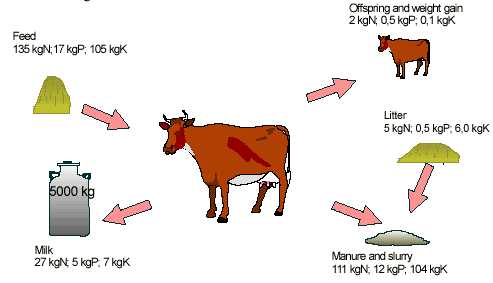
stocked and then eliminated. In this view, it is necessary to take into account some
complementary technological measures, directly to the source, depending on the relation
between agricultural and animal production.
87. The loading of water resources with nitrates from the dejecta effluents evacuated from the
animal farms is a dangerous consequence due to both the neglect and the inadequate use of
technological equipment and stocking tanks and the non-observing the present legislation on
water and environmental protection.
Figure 6.1 - Annual metabolism of nutrients in a cow that produces 5000 kg of milk
per year (after Code of Good agriculture Practices for Lithuania)
88. Applied of semiliquid and liquid dejecta on lands with an accentuated slope, slightly
drained, frozen lands and on the lands near the water courses or by application of some
excessive quantities and by a bad selection of the administration time should be avoid.
89. It is important the high fertilization value of manure and dejecta on volume unit. If these are
rich in nutrients, then their stocking and use instead of the mineral fertilizers, which are less
accessible due to their high prices, become profitable for the farmers. It is evident that this
organic fertilizer is cheap and available for each farmer and, in addition, it may be
supplemented with chemical fertilizers to assure the optimum need of nutrient for the
agricultural crops.
90. Dejecta of pig and especially of poultry can be processed and transformed in a concentrated
substance that can be sold as a valuable fertilizer, thus solving also the problem of the excessive
wastes.
91. Development and concentration of the animal husbandry in some zones led to the water
quality deterioration due to the multiple causes, as:
36
· high density of animals in relation to the agricultural area used for animal husbandry
purposes;
· inadequate location and concentration of animal farms near the watercourses or on the
lands with shallow ground water table or on sloping lands;
· irrational way of effluent stocking and flowing;
· soil and water contamination with nitrates and heavy metals;
· application of some wrong practices by the animal growers excessively using the
dejecta accumulated on the animal farms.
92. It is necessary to know that any organic nitrogen fertilizer is mineralized, finally, leading
to mineral forms of nitric and ammoniacal nitrogen. The main factor leading to mineral
forms is the C:N ratio, the ratio between the quantities of carbon and nitrogen in fertilizers.
It may be more or less high and determines the mineralization speed. The transformation
from the organic form to mineral, ammoniacal or nitric one depends on the C:N ratio
value.
93. The organic fertilizers with a low C:N ratio (< 15), as the dejecta without straw bedding,
rapidly evolves (i.e. nitrification of pig manure takes place in 3 - 5 weeks) while the
fertilizers with a high C:N ratio (> 30), as the dejecta with straw bedding, are slowly
mineralized, depending on the type of carbohydrate substances that can be more or less
degradable, and on the dejecta nature.
6.3 General principles of rational fertilization
94. According to the necessities and exigencies imposed for water protection, the fertilization
should be carried out under a controlled regime to enable the crops to optimally use, as much as
possible, the nutrients already present in soil and those supplied by the applied mineral and
organic fertilizers.
95. It is considered as a good agricultural practice the adaptation of the fertilization and its time
application according to the agricultural crop type and soil properties. The evaluation of the
need of nutrients is made according to the nutrients in soil, local climatic conditions and the
quantity and quality of expected yield (Annex 7).
97. The rational fertilization with the mineral and organic fertilizers should be applied
according to the following principles:
- To have a crop able to produce at a quantitative and qualitative level corresponding to
its potential, under suitable environmental conditions, the crop should have, on the
whole growing season, a series of nutrients (nitrogen phosphorus, potassium, calcium,
magnesium, sulphur, iron, manganese, copper, zinc, boron, molybdenum and chlorine)
in adequate quantities and proportions;
- Quantitative needs of mineral nutrients depend on the crop nature, cultivar and
expected yield;
- Soil is the main source of water and nutrients for plants;
37
- Soil capacity to supply the nutrients necessary to crops depends on the soil type, its
fertility level, respectively;
- The fertility level of a soil can be degraded if the cropping technologies are not correct
or, on the contrary, it may increase if the soil is cultivated in a way that improves its
chemical, physical and biological properties;
- A soil with natural fertility and productivity may be deteriorate by depletion of one or
more nutrients or by degradation of some properties or may be totally destroyed by
erosion phenomena; a soil with a natural low fertility may become productive by
correcting the limitative factors which hinder the normal growth and development of
plants (acidity, nutrient excess or deficit, etc) ,
- Only a technically developed agriculture that conserve and ameliorate the fertility of
soil and its productivity potential is able to assure the sustainability of cropping systems
and to protect the environmental quality;
- Soil fertility conservation and amelioration, and creation of some adequate mineral
nutrition conditions, are better achieved by a rational fertilization in a crop rotation
system;
97. A rational fertilization, therefore, should assure an acceptable compromise between the need
to obtain better economic outputs of the agricultural production and the requirements to protect
the environment, that is the surface and ground water protection against pollution
(eutrophication) due to the mineral nutrients in the applied fertilizers;
98. A rational fertilization practice presumes the existence of some technical and scientifical
information allowing a pertinent answer to the following questions:
· What kind of nutrients should be applied in soil/or to a given crop?
· What type of fertilizers is indicated to be used taking into account the soil, climatic
conditions and crop peculiarities?
· What is the most suitable application time?
· What are the application techniques to obtain a high efficiency in assuring the crop with
needed nutrients?
99. Most of farmers are lacking this information and therefore they are adviced to take counsel
from technical organisms of speciality (county soil survey and soil testing offices - Annex 8)
which prepare the fertilization recommendations having in view some analyses on
representative soil and vegetal samples in correlation with the habitat and the nutrient needs of
crops, taking also into account the physical and chemical properties of fertilizers, their
behaviour in soil, climatic conditions and other factors.
100. Each farm larger than 10 ha level should have an fertilization plan, which should firstly
take into account the use of all organic products and by-products in farm with fertilizing value,
such as: manure, dirty water, pig sludge, vegetal by-products, etc. to supplement them with
nutrients obtained from outside, chemical, organic or organo-mineral fertilizers, respectively.
101. The nitrogen, above all, is the nutrient specific to crops and, therefore, it is in different
quantities in the natural organic fertilizers, especially in the protein of the animal dejecta. Due
38
to its particular geochemical behaviour, its management both in the monoculture and crop
rotations is difficult. On the other hand, it is difficult to determine with sufficient precision the
quantity of nitrogen needed for certain crop during all its active growing season, to calculate the
nitrogen fertilizer rate that should be applied, respectively.
102. A series of transformations suffered by the organic fertilizers in a normal soil lead to
formation of completely soluble nitrates which are not retained by the adsorptive complex of
soil and which, therefore, are easily moved by run-off or infiltration water, thus not being used
by vegetal production and, in addition, contributing to surface and ground water pollution. The
same behaviour is manifested in soil by the nitrates resulted from the soluble mineral fertilizers.
103. Due to the particular behaviour of nitrogen in soil, the fertilization with this nutrient and
also the cropping techniques that influence its dynamics in soil should be managed in a way
able to assure maximum limitation of loss by water, thus diminishing the nitrogen
contamination risk of the surface and ground waters.
104. The pollution with fertilizers caused by a wrong soil management that, in Romania, is
characterized by:
· increase of arable land area to the detriment of lands with perennial vegetation
(grasslands, meadows, pastures, etc.);
· insufficient use of perennial ameliorative crops (Lolium multiflorum, clover, alfalfa) in
the agricultural crop rotations;
· replacement and elimination of some valuable, but less profitable, crops, favouring
other crops of high productivity, characterized by a long term high nitrogen
consumption;
· use some heavy agricultural machines of high power, especially under unsuitable
conditions of workability and trafficability, that cause soil structure deterioration and
the intensification of physical degradation processes by compaction, crusting, sheet
erosion;
· neglecting of the ameliorative and hydroameliorative works, and accentuating and
intensifying some severe negative processes as the waterlogging and erosion.
39
VII. FERTILIZERS CONTAINING NITROGEN
7.1 Behaviour in soil
105. The transformation of nitrogen fertilizers in soil, at the same time with transformation of
the nitrogen from one chemical form to another, can mostly lead to chemical available nitrogen
loss and changes of soil reaction so that to reducing the efficiency of these fertilizers. These
transformations and changes can be caused by the following physical and chemical processes:
· processes changing the nitrogen chemical form (ammonium ion nitrification);
· processes changing both the chemical form and the nitrogen aggregation state in
fertilizer (enzymatic hydrolysis of urea, reduction of nitrates up to lower oxides and
molecular nitrogen);
· processes by which the nitrogen available mineral forms are removed from the arable
layer of soil without being used by plants (ammonia volatilization, leaching of nitrates
in soil).
106. Due to the reduced stabilization of nitrogen soluble compounds in soil, a significant part of
nitrogen excessively applied as compared to the plant needs cannot be assimilated by plants and
it is risking to be lost from soil by different processes in the environment, polluting it. The
pollution risk is mainly related to the nitrogen oxidation compounds. When the nitrogen
fertilizers are not applied as salts of nitric acid, the nitrates and nitrites are resulting by
biological oxidation of the relatively mobile NH +
-
4 cationic form in a more mobile NO3 anionic
form, transformation of nitrogen compounds from reduced nitrogen forms into oxidized forms,
respectively, a process known as nitrification process. This process is mediated by the
specialized chemotrophic microorganisms of Nitrosomonas and Nitrobacter genus.
107. The nitrates and nitrites having negative charge cannot be adsorbed in the soil colloidal
complex and remain in soil solution from where a part is absorbed or metabolized in higher
plants or in the microorganism mass, and another part is moved by water in soil by the
leaching process.
108. Significant nitrogen losses can take place also by the volatilization process of the
ammonia in the fertilizers with ammoniacal nitrogen applied at the surface or in sandy soils or
by enzymatic hydrolysis of fertilizers containing nitrogen in ureic form, as well as by losses as
lower nitrogen oxides (NO and N2O) and even molecular nitrogen in the process of the nitrate
reduction known as the denitrification process.
40
N
N
2
2
N removed
N2O
with yield
NH3
DENITRIFICATION
RAINFALL
Human
and
FERTILIZERS
animal
nutrition
Products by
VOLATILIZTION
excreting
CO(NH2)2; NH4NO3
(NH
BIOLOGICAL
4)2SO4; æ.a.
FIXATION
Org. N in soil
CO(NH
NH +
2)2
Enzymatic
4
NO -
2
NO -
3
-NH-; -CO-NH
hydrolyses
2;
-CH=N-; -CH=N-S-
NITRIFICATION
Vegetal residue
incorporation
DECAY
ADSORBTION
IMOBILIZATION
on soil colloids
NH +
4
very difficult
rapide
LEACHING
difficult
AMMONIFICATIO
Figure 7.1 - Nitrogen cycle in agricultural ecosystems
41
109. These processes, and especially the leaching process, take place in all the soils in Romania
and under all the crops and they are more accentuate with sandy soils, especially those irrigated
(Figure 7.1).
7.2. Fertilizers with nitrogen in nitric form
110. The fertilizers which contain nitrogen in nitric form are: calcium nitrate with 15.5 per
cent N and 36 per cent Ca, sodium nitrate with 16.4 per cent N and 27 per cent Na and
potassium nitrate with 13.7 per cent N and 46.5 K2O. They are very water-soluble fertilizers,
and the critical relative humidity determined at 300C is of 46.7 per cent (calcium nitrate), 72.4
per cent (sodium nitrate) and 87.5 per cent (potassium nitrate). The calcium nitrate is the most
hygroscopic and the potassium nitrate is the least hygroscopic.
111. When they are applied, the nitric nitrogen remains in soil solution from where a part is
consumed by plants, partially entering different reactions with other salts, and other part is
leached. The leached quantity depends on the infiltrated water volume (increasing as the
infiltration intensifies), assimilation speed of plants (decreasing as the plant consumption
increases) and soil porosity (increasing as the porosity increases).
7.3. Fertilizers with nitrogen in ammoniacal form
The fertilizers containing nitrogen as an ammoniacal nitrogen are ammonia and ammonium
sulphate.
112. The ammonia contains 82 per cent N. It is used as fertilizer, either directly (as anhydride
or as ammoniacal waters), or as raw material to obtain different types of single and complex
nitrogen fertilizers. Since on the occasion of the direct application in soil or administration by
irrigation, important losses occur by volatilization up to 50-60 per cent, it is recommended to be
applied with acid stabilizators.
113. The ammonium sulphate contains 21 per cent N and 23 per cent S. It is water-soluble. It
has a high critical relative humidity of 80 per cent at 300C. It is not hygroscopic. Due to its
sulphur content, the fertilization with sulphur is also assured, especially in irrigated crops.
When it is applied in soil, the ammonium ion is partially uptaken by plants, partially adsorbed
in colloidal compounds, and another part is oxidized to nitrate ion, releasing hydrogen protons,
that induces a physiological acid reaction to the fertilizer, the SO -2
4 radical contributing also to
acidity. The nitrate ion is partially consumed by plants or it is leached.
7.4. Fertilizer with nitrogen in nitric and ammoniacal forms
This category of fertilizers containing both forms of nitrogen, nitric and ammoniacal, includes the
ammonium nitrate and calcium ammonium nitrate.
114. The ammonium nitrate contains 34.5 per cent N of which half is nitric nitrogen and half
ammoniacal nitrogen. It is water-soluble, 187 g /100 g water at 200C. Due to the nitrate ion and
the partial oxidation (more than 50 per cent of ammonium ions), the ammonium nitrate has a
final acid reaction. The critical relative humidity is 52 per cent at 300C. It is a hygroscopic
42
fertilizer and presents the risk of fire or even explosion at the high temperature, requiring some
precautions for transport, stocking and handling. By mixing with calcium carbonate or
dolomite, the calcium ammonium nitrate is obtained. When it is applied in soil, the plants
benefit from the beginning of both nitrogen forms, and the chemical processes that take place
are those described in chapters 7.2 and 7.3. It is recommended to be applied on neutral and
alkaline soils, and on the acid and slightly acid soils at low and moderate rates or at the same
time with the calcium ammonium nitrate.
115. The calcium ammonium nitrate contains 37 per cent N. It is not hygroscopic. It does not
present risk of fir. It has a physiologically basic reaction. It is indicated for all the plants,
especially for basic fertilization of acid soils.
7.5. Fertilizers with nitrogen in ureic form
116. Urea is the most concentrated fertilizer with nitrogen in ureic form. It contains 46 per cent
N. It is very water-soluble, 108 g/100 g water at 300C. It is not hygroscopic. The critical
relative humidity at 300C is 75.2 per cent. Its application needs to know some good agricultural
practices to avoid losses by ammonium evaporation in air. When it is applied in soil, under the
presence of the urease activity, an enzyme that is in sufficient amounts in soil, the ureic
nitrogen is transformed (hydrolyzed) in ammonia and carbon dioxide. Even at the relatively low
temperatures, the transformation of the ureic nitrogen in ammoniacal nitrogen is completed in
few days and in few hours at the high temperatures, over 200C. When urea is not ploughed in
soil, but broadcast, substantial losses of ammonium take place, especially on the alkaline soils
(soils with high pH values). When it is ploughed in soil, a part of ammonia is adsorbed as
ammonium ion on the soil colloidal complex and thus it is protected against the loss by
evaporation; other part is consumed by plants, and that part remaining in soil, without being
adsorbed in complex or consumed by plants, is suffering the nitrification process. The activity
of nitrifying bacteria is influenced by soil conditions, temperature and reaction. This activity is
inhibited when the pH values are less than 5.5 and higher than 8.7 and at temperature values
less than 100C and higher than 400C. The nitrate ion obtained by biological oxidation of
ammonium ion can be consumed by plants or leached.
7.6. Fertilizers with nitrogen in organic form
117. The fertilizers known as organomineral fertilizers of L-200 and L-300 types are fertilizers
containing organic nitrogen and they are obtained from lignite (organic nitrogen) and urea
(ureic nitrogen). They are characterized by high contents of humic substances (13 - 24 per cent)
and nitrogen (20 - 30 per cent) that amelioratively influence the humus content of soils poor in
organic matter.
Because the urea enters the lignite pores, the processes of hydrolysis, ammonification and
nitrification of ammonium ion are slowed lessened and prolonged during the season growing, a
period considerably longer than in the cases when the respective nitrogen compounds are used
as such for fertilization. The longer persistence in soil facilitates the nitrogen uptaking in a
higher proportion than in the case of ammonium nitrate or urea, and its leaching is lower.
7.7. Fertilizers with organic and mineral nitrogen
43
118. This category includes the addition compounds of urea, which, besides the ureic nitrogen
contain either ammoniacal nitrogen (ammonium sulphate urea with 33.7 per cent N) or nitric
nitrogen (urea nitrate with 34.2 per cent N and calcium nitrate urea with 34.5 per cent N).
The liquid fertilizer A-320 with 32 per cent N contains all the three nitrogen forms
(ammoniacal, nitric and ureic). It is applied during the growing season by sprinkling at the
same time with the irrigation water. This application procedure has the advantage that the
application rate can be splitted in 2-3 dressings.
7.8. Types and effects of organic fertilizers on soil
119. The organic natural fertilizers are produced by the individual agricultural households,
farms and complexes for animal and poultry raising, waste water treatment plants or from the
vegetal material and can have solid up to liquid consistence. They can be fresh and in different
stages of fermentation. The most widespread natural organic fertilizers are produced by the
animal husbandry activity. Among the most important natural organic fertilizers are manure
(that can be used in fresh, partially or completely fermented condition), manure leachate, urine,
liquid dejecta (called also dirty water), semiliquid and fluid dejecta, compost and green manure
in mixture with the vegetal materials used for bedding.
120. Another important aspect is determined by the high fertilization value of manure and
dejecta on the volume unit. If these are rich in nutrients, then their storage and utilization are
more profitable for the farmers as compared to the mineral fertilizers, which, due to their high
prices, are less available to the farmers. It is evident that the organic fertilizer is cheap and
available for each farmer and, in addition, it may be supplemented with chemical fertilizers to
achieve the optimum nutrient requirements of the agricultural crops. Also, the pig and
especially poultry dejecta can be processed and transformed in concentrated substance that can
be efficiently sold as fertilizer, thus solving also the problem of the excessive wastes in the
farm.
Table 7.1.
Chemical composition of manure of different sources
Chemical composition (per cent)
Type of manure
Water Organic N P2O5
K2O CaO
matter
Mixed fresh manure
75 21 0.50 0.25 0.60 0.35
Horse manure
71 25 0.58 0.28 0.63 0.21
Cattle manure
77 20 0.45 0.23 0.50 0.40
Sheep manure
64 31 0.83 0.23 0.67 0.33
Pig manure
72 25 0.45 0.19 0.60 0.18
Manure fermented for 3-4
77 17 0.55 0.25 0.70 0.70
months
Completely fermented manure
79 14 0.98 0.58 0.90 0.88
("mranitza")
121. The manure or farmyard manure is a complete organic fertilizer containing all the
nutritive elements necessary for plants. The chemical composition of the manure of different
sources is presented in the Table 7.1.
44
122. Some of the most known characteristics of manure with positive effects are as follows:
· it contains the whole complex of nutrients necessary for cultivated plants;
· it is considered as an universal fertilizer, corresponding to all the cultivated plants and
soil types; it is predominantly used on soils poor in humus, those unstructured or with
degraded structure, those with a heavy texture loosing them, those with a sandy texture
improving their water retaining properties;
· the organic mater mineralization processes are not rapid due to the contribution of the
vegetal material used for bedding, so that the nitrates are slowly released;
· also, if it is ploughed in, it contributes to the improvement of the soil structural state,
caloric capacity increase, available water reserves;
· it has a benefic action on the activity of the macro and micro-organisms in soil,
stimulating their capacity.
123. The urine is considered a good natural organic fertilizer, being rich, especially, in nitrogen
and potassium. It is used directly from the animal shelters, being non-retained by the used
bedding, and being collected and preserved with or without fermentation in the covered basins
in order to avoid nitrogen loss (Table 7.2).
Table 7.2.
Chemical urine composition (average values)
Urine quantity that
can be collected
Species
Chemical composition (per cent)
from an animal
(l/year)
N
P2O5
K2O
Horses
0.5 - 1.6
trace
0.6 - 1.8
800 - 1200
Cattle
0.2 - 1.0
trace
0.2 - 1.0
2000 - 3000
Pigs
0.4 - 0.5
0.05 - 0.07
0.8 - 1.0
500 - 900
Table 7.3
Chemical composition of manure leachate
Quantity produced by a ton
Chemical composition (per cent)
of fermented manure
(l)
0.2 - 0.4
0.03 - 0.06
0.3 - 0.6
52 - 54
124. The manure leachate is collected from the platforms specially built for manure storage
and fermentation, and it is accumulated in closed tanks for collection. Table 7.3 presents the
chemical composition of this fertilizer.
45
125. The liquid dejecta, called also dirty water are obtained by collecting the material
resulted from washing the stables using low water quantities (1/2 - 1/3 ratio of dejecta to
water). The chemical composition of the liquid dejecta depends on the animal species, type and
quantity of bedding material, dilution degree, etc. The general chemical composition of the
liquid dejecta is presented in Table 7.4.
Table 7.4
Chemical composition of liquid dejecta
Dry matter
Chemical composition
(per cent)
(per cent)
N P2O5
K2O
4 - 15
0.4 - 1.9
0.01 - 0.07
0.5 - 2.2
126. In order to be used, the solid part is avoided and the rest is homogenized (periodically and
at the application time). The separated liquid part may be applied too.
127. The semifluid (as a paste) and fluid dejecta are collected from the poultry batteries and
fosses. They have maximum 15 per cent of dry matter and are rich in phosphorus. To be used,
they should be without the solid corps and homogenized at the application time. When they are
applied in the growing season, they have a rapid action, being immediately available for the
plant needs with very favourable effects on growth.
128. The completed fermented manure ("mranitza" - rotted manure) results by almost
completely decomposition of manure. It is a very efficient fertilizer mostly used in the
vegetable growing hotbeds, glasshouses and field crops. The average chemical composition is
characterized by: 14 per cent organic matter, 0.98 per cent N, 0.58 per cent P2O5, 0.90 per cent
K2O, 0.88 per cent Ca. The amount applied per hectare is between 20 and 60 tons.
129. The compost is obtained by the fermentation of different organic residues (straw, stalk,
chaff, residues of weeds and legumes, degraded fodder, bones, feathers, food residues, etc.),
adding sometimes mineral substances (lime, ash, etc.). Gathered in piles, they are watered from
time to time to favour the fermentation process. The composts can be used to all the agricultural
crops, applying 15 - 25 tons per hectare. Unlike the manure, the compost has a rapid action, but
its effect is observed only for one or two years.
130. The green fertilizers included certain plants that are grown in order to be ploughed in soil
at the same time with the basic soil works. The plants used, as green manure should produce as
rich vegetal mass as possible in an as short time as possible and they should not be pretentious
as concerns the soil quality. The most plants used in this view are legumes (Lupines sp., pea,
Vice sp., Mellitus sp. etc.), but also other plants can be used as rye, sunflower, rape, mustard,
etc. These plants can be grown individually or in a mixture with several species to obtain a
more complex fertilizer. An efficient way to obtain and use such fertilizers is to practice the
undersign crops. The effect of this fertilizer type is very closed to that of mineral manure,
having a favorable action on soil flora and fauna activity for 2 - 3 years and, in addition,
improving the soil physical and chemical properties.
46
131. According to the their production way, the green manners can be: green manners in pure
crop when it constitutes the basic crop and covers the land all the growing season; green
manners as an intermediate crop (undersown crop, crop directly sown in the stubble field and
winter crop); green manure to produce a mowed mass (as vegetal mulch). The first crop types
are the most important. The green manure can be applied on any type of soil, but they have
more efficiency on soils poor in organic matter (podzolic and sandy soils).
47
VIII FERTILIZERS CONTAINING PHOSPHORUS
8.1. Their behaviour in soil and effects on water bodies
132. The phosphorus fertilizers are chemical substances containing phosphorus under the form
of anions: mono-, di- or triphosphate. According to the international rules, their expression is in
per cent of phosphorus pentoxide (P2O5). The ionic forms available to plants are mono and
diphosphate. While the evaluation of nitrogen is based on the total nitrogen content, in the case
of phosphorus fertilizer, this is based on the content of the phosphate soluble in water or
various conventional solvents (citric or formic acid, neutral or alkaline ammonium citrate)
which represents the active part, that is the part which is available to plants. The total forms are
determined in the mineral acids. The unavailable part for plants (insoluble, inactive,
respectively) is the difference between the total content and the content in non-conventional
solvents that can be mainly influenced by the soil reaction.
133. Their application on acid soils (pH < 4.5) or alkaline soils (pH > 8) leads to the
transformation of the soluble phosphates in insoluble phosphates, a process known as a
phosphorus immobilization (or retrogradation). In acid soils, aluminium or iron phosphates are
formed, and in alkaline soils - superior calcium phosphates. These compounds are insoluble
and, therefore, very low available to plants.
134. Generally, the fertilizers with phosphorus insoluble in soil (phosphorites) with the easily
mobilisable forms (Thomas phosphate, activated phosphorites) are applied on acid and slightly
acid soils, and the fertilizers with phosphorus soluble in water and conventional solvents are
applied on neutral and alkaline soils (single superphosphate, triple superphosphate, ammonium
phosphate). The complex nitrophosphate fertilizers are applied on all the soil types.
135. The phosphate quantity solubilized by soil water is mostly uptaken by plant roots, and the
quantity moved by water in the deeper soil horizons is very low.
8.2. Fertilizers with phosphorus
136. The single superphosphate is the first fertilizer chemically produced and it contains 17 -
19 per cent total P2O5 and 14 - 17 per cent water-soluble P2O5. Also, it contains calcium
sulphate whose supplied sulphur is often essential for crops. It is suitable for all the crops and it
can be applied on acid, neutral and alkaline soils.
137. Concentrated superphosphate or triple superphosphate contains 46 - 47 per cent total
P2O5 soluble in conventional solvents and 44 per cent water-soluble P2O5. It is properly a
monocalcic phosphate and does not contain calcium sulphate. It is applied to all the crops and
with less quantities than the single superphosphate; if a direct effect on crops is in view it is
applied at the sowing or before sowing time.
138. The Thomas phosphate (basic slag) is a by-product from the steel production. It contains
10 - 18 total P2O5 as complex phosphates, which are not soluble in water, but in acid soils it is
decomposed and releases phosphorus. To have a good efficiency, at least 80 per cent of the
48
total phosphorus should be soluble in citric acid. Also it can be used as a material for the acid
soil amendment.
139. Ammonium phosphates are products containing the phosphorus as mono- and
diammonium phosphate, very soluble in water and conventional solvents. Two types are
produced: monoammonium phosphate (MAP) containing 12 per cent N and 50 - 52 per cent
P2O5 and diammonium phosphate (DAP) containing 16 - 18 per cent N and 46 - 48 per cent
P2O5. They can be applied to all the crops and an all the soil types before sowing or even during
the growing season.
140. The nitrophosphates are complex fertilizers, which are obtained by the attack of the
phosphate rock with the nitric acid. By this procedure, several types of NP and NPK can be
obtained. The most used are: K-22-22-0, K-23-23-0, K-27-13.5-0, K-22-11-11 and K-16-16-16.
They contain up to 70 per cent P2O5 soluble in water reported to the total content. It is generally
used for the basic fertilization.
141. The organomineral fertilizers are products whose nutrients are included in a matrix
based on humic substances in the brown coal (lignite). At present, in Romania, there are
produced several types of organomineral fertilizers with nitrogen and phosphorus: L-120, L-
210, SH-120 and SH-210. They contain 9 - 13 per cent humic acids, 10 - 20 per cent N, and 10
- 20 per cent P2O5. They are recommended to be used on soils poor in organic matter (sandy,
luvic and eroded soils), improving soil properties and nutrition of plants. Due to the inclusion
of the nutrients in the organomineral matrix, the processes of hydrolysis, ammonification,
nitrification and leaching are lessened, as well as the conversion of soluble phosphates in
insoluble phosphates, thus the rate of the nutrient utilization is higher than that with the mineral
fertilizers.
49
IX STORAGE AND HANDLING OF CHEMICAL FERTILIZERS;
GENERAL NORMS
The environmental pollution with certain compounds resulted from the application of fertilizers or
their inadequate storage is mostly due to human negligence.
142. The farmers have the possibility to buy the fertilizers needed for crop fertilization in any
time of year, according to their necessities. Therefore, they do not need to be stored in farm.
But, in the economy market, the prices are in a continuous increase and differentiated according
to the application time. For this reason, the farmers and fertilizer dealers gain when the buy
cheaper, in advance. In this case, the fertilizers should be stored and preserved for a longer time
in specially fitted deposits:
· The preservation of chemical fertilizers is made in dry, well aerated, at the low
temperatures, on an impermeable floor (surfaced with asphalt).
· The preservation deposits should be built using sustainable materials without risk of
fire, preferably bricks, covered with tile, located at 30 - 40 m far from the other
buildings and any water source.
· The fertilizer layer will be no more than 2 m deep. The bags will be deposited in a long
position to avoid their breaking. In any case, they will not be deposited, even
temporary, under shelters or in the open-air, being surely the risk of water and soil
pollution.
· The mineral fertilizers should be preserved in original wraps, manufactured of
waterproof and durable materials, provided with inscriptions or labels clearly
indicating the fertilizer type, chemical compositions, fabrication date, guaranty term,
other specific recommendations regarding the transport, storage and handling.
· The ammonium nitrate, which presents the risk of fire to high temperatures, especially
in hot periods, should be preserved separately of the other fertilizers.
· Having in view that, in the cold and humid periods, the air critical relative humidity is
over 90 per cent, the most of the fertilizers can adsorb water from atmosphere,
modifying their physical state and sometimes even their composition.
· The most important preserving need is the protection of fertilizers against the moisture
and leakage in the environment.
· The chemical fertilizers that are going to be applied should not be compacted or
agglomerated and their humidity should not exceeds maximum allowable limit. If
during the preservation, the fertilizers became compacted or agglomerated, they will be
breaken up and then sieved.
· In the case of liquid fertilizers, the tanks for collecting the eventual leakages should be
near the deposit and cemented to avoid the pollution of the ground water or drinking
water in wells. When the tanks are filled, the solution should be taken from that place
and spread on the lands that need fertilization.
· It is forbidden to wash the fertilizer spreading machines in watercourse or near
drinking water.
50
· The intermediate storage of the fertilizers in open field should be avoided, without
protection, being the risk of severe pollution processes.
· It is necessary to adopt maximum safety measures when the liquid chemical fertilizers
are storaged, handled and applied. Thus, the storage reservoirs should be made from
materials resistant to corrosion and should have adequate capacity; and when the field
administration is operated, special equipment will be used, able to hinder the dispersion
by wind when the operation is near some watercourses.
51
X STORAGE AND MANAGEMENT OF EFFLUENTS AND MANURE TO
ANIMAL FARMS
10.1. General considerations on animal farms and technical installations
143. As it was presented in chapter VII, the organic fertilizers generated by animal farms have a
very various composition and physical condition. Between their production and time of
application in soil, more or less nutrient losses, especially nitrogen, can occur. These lead, on
the one hand, to their agronomic value diminution and, on the other hand, to environmental
pollution, especially waters and air. Therefore, it is necessary that the management of these by-
products should be made in such a way to reduce the losses as much as possible, preserving
their fertilization value at the initial parameters.
144. Even since the design and construction of deposits, basin sand enclosures for storing the
organic fertilizers, the highest attention should be paid to prevent and protect the waters and
environment against pollution by the following measures:
· location outside sensitive zones and far from water sources;
· sufficient storage capacity;
· adequate building able to include all the safety and protection systems;
· optimal, efficient and safety conditions of utilization
· adequate access routes;
· fire protection;
· protection against the eventual leackages from hydrants.
Figure 10.1 - Littered barn with feed storage, manure pit and urine reservoir: 1 -
barn; 2 - feed storage; 3 - manure pad; 4 - urine reservoir, 5 - gutters for urine outflow (after
Code of Good agriculture Practices for Lithuania)
52
145. Among these measures, the storage capacity is one of the most important, being dependent
on:
· type and size of animal herd, taking into account the particular farm organization
system and the quality of applied management;
· duration of storage period;
· depositing type;
· method of dejecta handling and stocking;
· dejecta dilution degree due to precipitation and other water types.
146. When a management plan is elaborated according to local specific conditions (soil type,
distance to water sources, land slope, precipitation level), farming system and duration of
growing periods, the correct management of dejecta is possible without any risk to cause the
pollution of water sources.
147. Also the construction of stores should have in view the elimination of any water source
pollution risk. Excepting some special cases presented below, the stores should have a capacity
able to assure the storage for four months (17 - 18 weeks).
Figure 10.2 - Non littered barn with feed storage and manure storage: 1 - barn; 2 -
feed storage; 3 - slurry reservoir; 4 - pit for pumping over of slurry; 5 - ventilation pipe (after
Code of Good agriculture Practices for Lithuania)
148. A storage period of five months (23 - 24 weeks) is recommended, when a pollution risk is
evaluated in the period of dejecta spread in the field due to the increase of surface discharge or
of infiltration produced by internal rapid drainage. Under these circumstances, due to long term
storage, the soil may be given the possibility to get dry and therefore to get a higher capacity to
absorb the nutrients from organic fertilizers. A longer dejecta storage period is benefic to the
areas with or without drainage systems, slope lands, wet areas with richer precipitation as well
as to the areas near the watercourses.
149. In the areas with high risk, the storage should be assured up to six months (27 - 28 weeks).
These areas include colder regions with more abundant precipitation. Likewise, this category
53
can include the agricultural areas near the lakes with shallow, slightly drained alluvial soils as
well as other areas where water pollution risk due to the dejecta spreading is major.
150. The store of slurry in pits (tanks) created directly within the ground are unacceptable for
several reasons, first of all ecological ones. The most severe phenomenon is the purging effect
in time on the soil in the areas around the pit. The soil becomes totally impermeable and
degraded, the water is retained at the surface, swamps and marshes occur on large areas, the
ground water is polluted.
151. A store for slurry should have the floor and walls impermeable by applying plastic films
especially for this purpose.
10.2. Liquid dejecta
152. A very important problem is the storage of sludge and liquid dejecta from the water
treatment plants. The inadequate storage of these residues is often met in Romania, too, both on
individual farms (mostly developed in the house yard or near it) and on commercial animal
farms. For this reason, the pollution of ground water can become a major cause of
environmental degradation.
153. The storage capacity necessary for dejecta produced by the animal farms, under different
circumstances taken into account, will be established even in the design stage of a new farm or
when an old farms is modernized, having in view the number of animals and the way the
dejecta are transported to the tanks, basins and storage platforms.
154. Dejecta dilution should be avoided, when it is possible, because this determines an
unforeseeable fertilizing value and the need of some higher storage capacities. However, when
the pluvial effluents loaded with dejecta should be also stocked (as in the case of effluents
gathered from the gutters and ditches around the outside platforms used for animal repose and
feeding and for manure storage) a larger storage capacity is necessary.
155. It is recommended to store the effluents from the silage platforms together with the liquid
dejecta; in this case, the volume of silage effluents will be also into account in designing the
storage capacity.
156. Liquid dejecta should be stored in impervious tanks, made of adequate materials,
impermeable and resistant to corrosion, otherwise pollution phenomena can occur.
157. Installations and storage rooms should respect the following conditions:
· location and area where they are built will be selected according to the surrounding
hydrographic network and presence of forests;
· storage rooms should be located near the agricultural lands;
· storage capacity should be designed according to the existent number of animals;
· a perfect water-tightness should be assured for storage rooms and the installations; also
a network for pumping and transport means should be assured;
54
· materials used for constructions should be adequate, and installations should be
resistant and of good quality.
158. Great attention should be paid to sludge from wastewater treatment plants on animal and
poultry farms that, under some conditions, can be sources of nutrients but, at the same time,
they can contain heavy metals or other toxic components over the maximum allowable limits.
159. Dejecta storage rooms should not be located near watercourses or on lands with shallow
ground water.
160. The location near forest will be avoided because the ammonia released in atmosphere is
particularly toxic for trees, especially for resinous species. The risk of forest degradation and
even destruction is accentuated by acidic depositions due to rains which are usually occurring
just in the areas where there is a high concentration of activities for raise animals and poultry in
an intensive system.
161. Acidic depositions by precipitation negatively affect also the surface waters with severe
effects an aquatic flora acid fauna. In addition, in the case of ground waters, the increase of
their acidity causes the mobilization of aluminium and some heavy metals that negatively affect
the potability characteristics of the respective waters.
10.3. Manure
When using manure in agriculture, storage is one of the most important phases to improve and
preserve the positive characteristics.
162. The storage platforms for solid manure should have a concrete floor, solid walls and
collectors for effluents especially for those occurring during the rains.
163. Manure storage and preservation should be made in special platforms. In this view, the
floor of platforms should be waterproof, built of concrete and provided with walls 2 m high,
also waterproof; they should be provided with thresholds for retaining the effluent and canals to
let the effluent run into a retaining basin.
164. These platforms should have a sufficient storage capacity (table 10.1) and access roads and
they should not be located on lands near watercourses or with shallow ground water. Also, they
should be located at the distance of at least 50 m far from the houses and drinking water
sources.
165. On these platforms the manure should be preserved compacted and covered with a soil
layer 15 - 20 cm deep.
166. In order to be decomposed manure should have moisture of 70 - 75 per cent, otherwise it
dries and gets musty. Before covering with soil, it is wetted with manure effluent, urine or just
waters to assure the needed humidity.
167. In order to improve its composition and to reduce the nitrogen losses, an amount of 1 - 2
per cent superphosphate of the manure quantity is recommended to be spread on the manure as
it is laid on the platform.
55
168. Manure storage or piling in the field even for a relatively short period is considered a bad
agricultural practice. This implies both soil and water pollution due to the effluents of manure
washed by rain and losing the contained nitrogen.
Table 10.1.
Manure storage requirements (per animal)
Animal Manure
Quantity kept
Necessary
Necessary platform surface
produced
on platform in storage surface for different storage periods
in a week
a week
in a week
(m3) (m3) (m2) 18
24
28
weeks
weeks
weeks
Milk cows 0.315 0.283
0.236 4.25
5.67
6.61
(560 kg)
Cow with
0.280 0.252
0.210 3.78
5.04
5.88
suckling
calves (550
kg)
Oxen (450 kg)
0.250
0.225
0.187
3.37
4.48
5.24
Young cows
0.140 0.126
0.105 1.89
2.52
2.94
(250kg)
Calves
0.080 0.072
0.060 1.08
1.44
1.68
(140 kg)
169. If the manure is deposited on platforms, all the effluents resulted should be collected in
view of their storage. Storage requirements for manure platforms are presented in table 10.1.
170. The manure quantity should be calculated for each condition. The requirement referring to
platform surface is established according to storage period. The manure storage height on
platform should not exceed 1.2 m and its width should not be larger than 8 m, and the length
depends on the manure quantity. Walls should be 1.5 m high to create free area of 30 mm
between dejecta level and the upper part of wall. Considering a height of 1.2 m of dejecta layer
the minimum necessary area for cattle is presented in Table 10.1. The platform floor should
have a slope of about 2 - 3 per cent towards one edge of platform where a basin is provided to
collect the manure leachate resulted during the fermentation. The collecting basin should be in
such a position so that when it is filled with liquid the upper part of liquid should be at least 0,7
- 1m under the lowest point of platform floor.
171. The basin storage capacity is established according to the platform capacity and the rate of
the manure leachate draining off (one or several times a year). Generally, it can be
approximated to 4 - 5 m2 foe each 100 t of fresh manure. If the evacuation is made several times
a year, the designed capacity is accordingly reduced. To avoid the straw or other vegetal
residues enter the storage basin as the same time with the manure leachate, it is recommended
to have before the storage basin a cleaning pit with a capacity of 0.5 m3 from where the solid
wastes are frequently evacuated. Both the basin and the pit should have waterproof bottom and
walls
56
172. In case of some design requirements for new storage rooms or their modernization, it is
necessary to take into account all of the relevant need provided in the construction and
pollution prevention standards stipulated in the rules and regulations in force.
Figure 10.3 - Slurry removal system: 1 - slurry channel, 2 - pit for pumping over; 3 -
pump; 4 - rising pipe of slurry, 5 - slurry reservoir, 6 - ventilator (after Code of Good
agriculture Practices for Lithuania)
10.4. Silage effluents
173. The effluents resulted from green forage silos are very rich in easily biodegradable
organic substances that contain significant quantities of nutrients especially nitrogen
compounds with a high pollution potential. If such effluents reach the surface waters they can
cause severe unbalanced conditions in aquatic ecosystems by eutrophication. Silage effluent is
one of the most concentrated and poisonous pollutants in the farm. Even the small amount of it
causes big negative effect on water body and, especially, death of the fish.
174. The maximum quantity of silage effluent is produced in the first two days after ensilage.
The resulted effluent quantities depend on the moisture degree of silage material, the possible
rain water entering the silo, type and thickness of silo material, internal drainage and additive
used substances. Pollution accidents can occur if the silos or the storage fosses are badly built
and without a good waterproof. These effluents, adequately collected, can be used for crop
fertilization and animal feeding.
175. Having in view that, by silage preparation, the value of silage forage decreases, including
the above mentioned pollution risk, some measures are necessary, such as:
· forage silage operation at a humidity lower than 25 per cent and covering the silo floor
with a straw layer to absorb the resulted effluents;
57
· silos should be designed and built so that they may assure the protection against
effluents leakage; they have to be covered to avoid the penetration of precipitation
water and to be provided with waterproof floor slightly sloping (2 per cent slope), the
effluents being led and stored in a subterranean tank (deposit) of an adequate capacity,
resistant to acid corrosivity;
· silo and tank should be located at least 10 m far from the watercourses to avoid an
accidentally pollution;
· before beginning a new silage operation, maintenance works should be carried out to
assure the silo waterproof.
10.5 Effluents due to precipitation
176. The effluents due to precipitation and atmospheric dust can contain various amounts of
nitrates produced in atmosphere by electric discharges or emitted by industrial installations of
inorganic and organic synthesis or other sources. Under Romania's conditions, it can be
estimated an annual contribution of precipitation and atmospheric dusts of 6 - 12 kg N/ha, 0.1 -
1.5 kg P2O5/ha and 0.5 - 15 kg N/ha depending on the distance from the emitting source and
meteorological conditions.
177. In some areas, the acid rains can affect the surface waters with drastical effects on aquatic
fauna and flora. In addition, in case of ground waters, their acidity increase causes the
mobilization of aluminium and of some heavy metals that affect the potability characteristics of
the respective waters.
178. The large complexes for animals and poultry are a source favouring the acid rains by
releasing ammonia in atmosphere. Therefore, in such cases, it is necessary to take the technical
measures needed to mitigate the direct release in atmosphere of the volatile substances, as the
ammonia.
179. These measures are also necessary in the case of the reception pits of large capacity for
collecting the liquid slurry.
180. Around the animal feeding and resting bases outside the stables, as well as around the
platforms for manure storage, it is compulsory to provide concrete ditches and channels to
convey the pluvial waters in the tanks for storing the effluents.
181. The tanks for storing the effluents should have sufficient capacities to assure also the
storage of the pluvial waters in the case of heavy rainfall, exceeding the mean annual
precipitation.
182. It is a wrong practice to store the chemical and organic fertilizers directly in the field or at
the land parcel edge, even for short period, because some heavy rains can occur causing their
washing and, therefore, soil and water pollution. For this reason, the manure storage in the
field, at the land parcel head, as many farmers usually do, should be avoided.
183. The manure storage in the field, for a long time, up to its spreading is not justified because
an important loss of nutrients takes places due to their washing by the precipitation, and, in
58
addition, an unjustified loading with nitrates takes place in the land where the manure is stored.
For this reason, the specially developed platforms for manure storage are imperative.
184. Those who breed animals in their own households will store the manure on specially
developed platforms and the liquid slurry will be stored in tanks with adequate capacities.
59
XI APPLICATION OF NITROGEN FERTILIZERS
11.1 Applied quantities considering soil reserves
Establishing the adequate nitrogen quantities as fertilizers for different crops is an enough difficult
operation due to numerous factors that should be considered, the most important being the nitrogen
requirements of crops and available nitrogen quantities released by soil during the growing season.
185. The nitrogen requirements vary significantly according to different crops, and for each
according to the yield level expected under certain pedoclimatic and technological conditions.
The production capacity of a crop, genetically determined, can be reached only under ideal
conditions when, due to the above-mentioned factors, the optimum plant growth and
development conditions are reached. For economic reasons, the farmers' interest is directed to
getting vegetal production as close as possible to the production capacity of plants they
cultivate, that presumes intensive cropping techniques, fertilization included. According to the
decreasing output law, the maximum production does not usually coincide with the optimum
production from economic viewpoint. This aspect should be taken into account especially in
case of nitrogen fertilization, because most crops tend to enter a luxury consumption regime,
that is to go on absorbing important nitrogen amounts over their needs, that are not reflected by
production increases. For this reason, nitrogen rates should be correlated with the most
beneficial production level.
186. Considering the above mentioned economic aspects and the restrictions imposed by
environmental protection, the applied nitrogen amounts should be estimated so that they may
assure the completion of mineral nitrogen reserve existent in soil up to the level needed to
obtain profitable production, under the conditions of protecting the surface and groundwaters
against nitrate contamination.
187. Both exigencies can be fulfilled by correct management of soil nitrogen, which should
take into account the dynamics of this nutrient in the agricultural ecosystem the soil and the
respective crop belong to. Therefore, the rates established on the basis of nitrogen requirements
to get an expected crop should be correlated with the mineral nitrogen quantity that the soil can
release during the growing season and with other contribution (precipitation, irrigation water,
vegetal residues ploughed in soil, biological fixation), as well as with nitrogen losses (leaching,
volatilisation, biological immobilization, etc.).
188. These corrections can be applied by means of the following relation:
DN = Nc - (Ns + Na + Nb + Nr) + (Ni + Ng + Nl),
where:
DN - nitrogen rate of fertilizer (organic + mineral) for the expected yield, kg/ha
Nc - nitrogen requirement for the expected yield, kg/ha
Ns - nitrogen released by soil during growing season, kg/ha
Na - nitrogen provided by irrigation water and atmosphere (dust, precipitation), kg/ha
Nb - nitrogen provided by biological fixation, kg/ha
60
Nr - nitrogen provided by mineralization of vegetal residues left by the previous crops,
kg/ha
Ni - nitrogen lost by immobilization due to soil microorganism, kg/ha
Ng - nitrogen lost by volatilization, denitrification included, kg/ha
Nl - nitrogen lost by moving with the run-off and by leaching, kg/ha
Corrections made on the basis of this relation have an estimative character due to the complex
phenomena that control the respective parameters as follows.
Crop needs of nitrogen (Nc)
The crop needs of nitrogen can be estimated taking into account the nitrogen uptake by the
expected yield. Annex 1 presents the average specific nitrogen consumption for the main crops
in Romania (kg N/t of main yield and corresponding quantity of by-products). The figures have
an approximate value, in the framework of the same species being differences between
cultivars.
It should be pointed out the necessity to really establish the expected yield, taking into account
the productive capacity of land and cultivar, climatic potential of zone, possibility to execute in
time good quality soil tillage and crop management, water availability in the case of irrigation,
etc.
Nitrogen provided by soil (Ns)
The soil nitrogen is almost totally included in the organic matter, and only a small fraction is
found in a form immediately available for plants. The organic nitrogen can be used by crops
only after it passes into an inorganic form by gradual mineralization or decomposition of soil
organic matter, firstly in ammoniacal nitrogen and then in nitric nitrogen.
Usually, the soil organic matter is constituted of fractions that differ according to the C/N
(carbon/nitrogen) ratio value. The fraction with the C/N ratio value of 8 - 11, called humus, is a
stable fraction that reached an equilibrium and therefore it decomposes more slowly; other
fractions with higher values than this ratio are more rapidly decomposed than the humus by the
soil microorganisms whose activity is more or less intensive, depending on temperature and
moisture conditions.
The potentially available or mineralizable nitrogen comes from these less stable fractions.
Under Romania's soil conditions, it represents among 1 and 2 per cent of the total nitrogen,
both with long-term cultivated soils and natural soils. As concerns the quantity, it varies
between 20 and 50 kg N/ha/year, depending on the soil type and climatic conditions in the
respective year.
The mineral nitrogen (Nmin) content in soil, at a given time, can be determined by a very
rigorous method in the laboratory. The obtained information, converted in kg N/ha, can be used
to establish the nitrogen fertilizer rates to be applied in spring on crops sown in autumn.
Not all the nitrogen mineralized in soil for a year can be available for crops; the mineralized
part during the intensive growing season is susceptible to be used by crops. Therefore, to
establish the fertilizer rate, the period in which the crop occupies the land effectively should be
taken into account. Thus, according to the period of land occupation by crops, spring - summer
crops are considered to efficiently use 2/3 of the potentially available nitrogen and the autumn-
winter crops - 3/4 or 1/2. The values change if the possible abundant precipitation occurs
61
leaching more or less the nitrates accumulated in the soil profile; in the case of crops covering
permanently the soil, these values can be totally considered.
Nitrogen coming from irrigation water and atmosphere (dust, precipitation) (Na)
The nitrogen quantities entering the soil with atmospheric dusts and precipitation (rain, snow)
vary considerably according to the activity type. Generally, quantities of 5 - 10 kg N/year can
be estimated, these are being higher under intensive industrial activity conditions in the
respective zone. The irrigation water contaminated with nitrogen compounds can transport
significant amounts of this nutrient that should be considered in the fertilization plan.
Biologically fixed nitrogen (Nb)
The nitrogen quantity biologically fixed in soil due mainly to the symbiosis of the Rhisobium -
legumes depends very much on the cultivated species, yield and biomass ploughed in soil,
being able to reach 100 kg N/ha.
Nitrogen provided previous crops (Nr)
The available nitrogen quantity provided by residues of previous crop(s) depends on their
quantity and composition with regard to the nitrogen content and the higher or lower
lignification degree. Also, it depends on how well they were ploughed in soil, their
incorporation time and the period passed since the incorporation.
The annual crops can leave higher or lower quantities of their aerial part.
It is difficult to estimate, with a minimum rigour, the quantities of nitrogen or other nutrients
coming from the previous crops which can be considered when calculating the fertilizer rates.
Informatively, the nitrogen quantities in vegetal residues, ploughed in soil, can be estimated
according to Annex 1.
Nitrogen immobilized by soil microorganisms (Ni)
The ploughing in soil of vegetal residues poor in nitrogen is the cause of diminution of the soil
mineral nitrogen content, as the nutrient quantities released during of residue decomposition are
insufficient to satisfy the needs of microorganisms responsible for this decomposition.
An example can be the ploughing in of cereal straw with high (over 100) C/N ratios. To avoid
such a diminution, it is recommended to plough in, at the same time with straw, a quantity of
mineral nitrogen of 8 - 10 kg N for each ton of straw ploughed in. If such a procedure is not
applied, it is the risk that the respective year crop may suffer a more or less severe nitrogen
deficiency. With regard to the water protection against nitrate pollution, the nitrogen
immobilization by the microorganisms can be considered benefic.
Nitrogen losses as gas in atmosphere (Ng)
These losses can be produced by different mechanisms, especially by denitrification and
ammonium volatilization, at the surface of alkaline soils. It is estimated that, in a normal soil,
the denitrification can reach 10 - 15 per cent of the nitric nitrogen annually produced by
mineralisation of soil organic matter and of that incorporated in soil as chemical fertilizers.
These losses can be higher in soils with deficient drainage, where the frequency and severity of
this phenomenon are higher.
These volatilization losses can reach 50 per cent in the case of fertilizers with ammoniacal or
ureic nitrogen, when they are surficially applied on alkaline soils, under the windy and hot
weather conditions.
Losses by run-off and leaching (Nl)
62
Losses of nitrogen as nitrates by run-off and leaching are the main non-point pollution agent of
aquatic environment, having its origin in the agricultural activities. Such losses can reach
several kg N per hectare and year, depending on numerous factors controlling the nitrate level
in soil and the severity of run-off and leaching phenomena. This level varies according to
fertilizer type and quantity, application time and technique of nitrogen fertilizer application,
nitric nitrogen quantity resulted after mineralization of soil organic matter and other organic
residues incorporated in soil, as well as the nitrogen quantity introduced in soil by other ways.
The organic matter mineralization and the nitrogen loss by run-off phenomena are strongly
influenced by the land use way and cropping technologies.
Both from the economic and the environmental quality protection viewpoint, it is imperative to
reduce these losses as much as possible that may be achieved by adopting some correct
agricultural practices.
189. The necessary nitrogen rate to assure the expected crop, estimated in such a way, should
be firstly provided by the organic fertilizers existent on the farm and from those supplemented
with industrial fertilizers.
190. The organic fertilizer quantities that can be annually applied by hector depend on crop,
decomposition degree, soil texture and other zonal factors. Data of this problem referring to the
manure are presented in Annex 2.
191. The specific rate should not exceed 170 - 210 kg N/ha/year. The maximum quantity will
be applied when:
· slightly fermented manure in used;
· fertilizer is applied on heavy (clay) soils or that have a high denitrification capacity;
· fertilizer is applied to the crops with long growing season or need high nitrogen
amounts;
· fertilizer is applied in areas with high precipitation.
192. Urine may be used for basic fertilization with rates between 10 and 80 t/ha/year depending
on the nitrogen content, the minimum limit for horse urine being 1.6 per cent nitrogen and the
maximum limit for cattle urine being 0.2 per cent nitrogen. At the same time, it is also
necessary to respect the specific rate of 170 - 210 kg N/ha, taking into account also the soil
reserve. Urine may be also used as supplementary fertilizers, with rates between 3 and 20 t/ha,
mixed with 2-3 parts of water. Significantly good results are obtained by mixing the urine with
superphosphate (250 - 600 kg/ha), according to urine nitrogen content.
193. The manure leachate can be used for basic fertilization applying 40-80 t/ha/year or as
supplementary fertilizers (10-20 t/ha mixed with 2-3 parts of water). Also, it can be used with
very good results, in mixture with superphosphate (300 - 600 kg/ha), according to the nitrogen
content in the manure leachate. The same rates are recommended also for the dirty water. When
the dirty water is used, it should be free of the improper solid inclusion, homogenized
periodically as well as when it is applied. The liquid part separated from the solid part can be
applied also.
194. In order to be applied, the semifluid and fluid dejecta should be free of the solid inclusion
and also they should be homogenized during the application. It is compulsory to incorporate
63
then in soil directly or maximum 3 hours, when they are applied by broadcasting at the soil
surface. The direct incorporation in soil may be carried out during the growing season or out of
this season, at a depth of 10-20 cm. The rates are established according to the requirements of
crops tacking into account the crop technologies and soil testing recommendations; they are
between 5 and 80 t/ha.
195. The completed fermented manure ("mranitza" - rotted manure), being a very efficient
fertilizer, is especially used for vegetables, both field crops and sheltered crops. The amount
applied per hectare is between 20 and 60 tons. The composts can be used for all the agricultural
crops applying between 15 and 25 tons per hectare. In contrast with the manure, they have a
rapid action, but the effect is for only one or two years.
196. Due to the multitude and complexity of factors implicated in the determination of the
nitrogen technically correct rates to be applied, the farmers are advised to contact the official
specialised services of the Ministry of Agriculture, Food and Forests (county soil survey and
soil testing offices) that, on the basis of the soil testing study, according to the expected yield,
by a computer-assisted procedure by, prepare more adequate fertilization recommendations,
nitrogen rates, application times and techniques included.
11.2. Application time and techniques; unsuitable periods for application of
nitrogen fertilizers
11.2.1. Application time of nitrogen fertilizers
The most adequate time to apply nitrogen fertilizers is when crop have the highest nitrogen
consumption requirements, assuring in this way a maximum efficiency of this nutrient, but also
other benefic results such as reducing the nitrogen quantities dissipated in the environment, the
water pollution risk by leaching or run-off, respectively.
This application time depends on crop requirements, but also on the climatic conditions prevalent in
the respective area, as well as on the chemical form of the nitrogen in the applied fertilizer.
197. If the fertilization is made by application of chemical fertilizers with nitrogen in the nitric,
ammoniacal or ureic form that can be immediately or easily uptake by plants, then they should
be applied in those periods when crops have high needs.
198. When fertilizers with predominantly organic nitrogen as manure, compost and other
organic fertilizer are applied, it should have in view that nitrogen, before being uptaken by
plants, has to change into a mineral form by a series of transformations suffered in soil.
Therefore, these fertilizers are applied a sufficient time before the period of maximum uptake
by plants. In the case of annual crops and for practical reasons, such fertilizers are applied at the
sowing or planting time or immediately before these operations.
Further on, recommendations on the application time and techniques of nitrogen fertilization
corresponding to some relatively large group of crops are presented.
11.2.1.1 Crops sown in autumn
64
199. Due to the high mineral nitrogen quantities existent in soil in autumn, generated by the
mineralization of the organic matter, and to the more abundant precipitation in autumn and
winter, there is an increased risk of water contamination with nitric nitrogen by leaching and
run-off. Therefore, these soil reserves should be taken into account in connection with the
fertilization of autumn crops, the applied rates representing 1/4 of nitrogen annual rate
established on the above mentioned principles.
200. Nitrogen is to be applied only as an ammoniacal or ureic form. Thus, in the first vegetation
stages, the crop will consume the residual nitrogen in soil, contributing in this way to reduce the
nitrate quantities moved to the surface and ground waters.
The rest of the nitrogen fertilizer quantities are applied in spring (eventually corrected with Nmin
value). In the case of soils with a coarse texture, the splitting of this quantity is recommended.
11.2.1.2. Crops sown in spring-summer period
201. The basic fertilization is recommended to contain 1/4 up to 1/3 of the rate to avoid the
losses by leaching, especially when the forecasted precipitation is more abundant. The rest of
quantity is going to be applied in maximum consumption period of plants, at the same time with
the crop management.
11.2.1.3. Perennial crops
202. In the case of perennial grape vine and fruit tree crops, nitrogen fertilization is not
recommended in the dormant period as there is the risk of some more or less losses with the
leaching water or by run-off, most vine and fruit tree plantations being located on more or less
slope lands. The fertilization is practised during the active growing season, in the period of
maximum nitrogen consumption.
11.2.2. Techniques of fertilizer application
11.2.2.1. Chemical fertilizers
205. The most correct administration of chemical fertilizers is the direct incorporation in soil. It
is recommended to avoid the fertilization on soils recently deeply worked (deep chiselling,
subsoiling) to hinder the nitrate penetration to the ground waters.
206. The solid chemical fertilizers of power or granule form can be applied in the field by
broadcasting at the soil surface using the machines for fertilizer application. The machines with
bunkers of large capacity allow having high working capacities without too frequently loading
of the fertilizers. But the bunker with large capacity leads to a heavy machine with a high soil
compaction effect. The machine provided with a distributor of the centrifugal disk type are
relatively simple, they can cover large area per time unit, but their working quality is relatively
lower as compared to the work of the machines with mechanical distribution.
207. The main demand of the fertilizer administration is to rate them as much constant as
possible and to distribute them as much uniform as possible. If their discharge is correctly
regulated, the fertilizer quantity established per hectare will be achieved. The uniform
distribution has a high importance, because a nonuniform distribution determines lower
65
quantities of fertilizers in some areas without assuring the expected effect of fertilization, and,
in other areas, too high concentrations of nutrients, causing, as a result, local pollution of soil.
In order to assure an uniform distribution along the way, the fertilizer distribution equipment is
in a direct connection with the machine's wheels, thus assuring the independence of the moving
speed of the machine aggregate and of the fertilizer quantity distributed on the surface land
unit.
208. When the chemical fertilizers are applied to the whole area, it is not sufficient to have only
the fertilizer distribution equipment of machine able to provide a uniform distribution, but also
a correct movement of the tractor-machine aggregate in the field. At the rides of the strips of
the spread fertilizers, the quantity of the fertilizers applied per hectare is lower. Therefore, it is
necessary to assure a certain overlapping of the adjacent strip sites. Without these overlapping
some less fertilized strips occur, and exaggerated overlapping may lead to strips with too high
concentration of nutrients.
209. Similar phenomena occur when the movement of machine does not respect the straight
line. To avoid the nonuniform distribution of fertilizers in the field, it is recommended,
especially in the case of machines with a large working width, to place landmarks in the field.
The quantity of fertilizers distributed per time unit and distribution uniformity can also depend on
the performance parameters of machine used for fertilization application, but they are also
influenced by other factors. Among the most important there are those determined by the state and
moisture of fertilizers. In fact there is no machine, no matter how it is technically improved, to
perfectly work when the physical properties of fertilizers are inadequate. The chemical fertilizers
prepared in a powder form are very hygroscopic. They absorb the moisture both in the time of
storage under bad conditions and during the loading the machines, and even during the distribution.
As a result of the moistening, the fertilizer particles adhere between them, build the clods of
different sizes, and thus decrease the rate precision and increase the degree of non-uniform
distribution. At a certain moisture degree, the fertilizers can adhere to the contacted organs of the
fertilizer application machines leading to a worse degree of distribution.
210. One of the most important rules regarding the use of machine for chemical fertilizer
application is to avoid to work with a cloddy material or with a material having a larger
granulation, and to avoid to operate when the air humidity is high or during drizzle or mist.
211. In order to apply the chemical fertilizers in strips at the same time with sowing,
fertilization equipment carried on machines for drilling row crops are used. The fertilizer
quantity should be the same in all of the sections of the drilling machines.
As concern the soil pollution prevention, it is important also the way of fertilizer manipulation.
212. Any intervention by which higher quantities of fertilizers reach the soil, for instance, the
loading the bunker near the land parcel, leads to soil degradation in respective zone. The
machines for application of chemical fertilizers should allow being comfortably and safely
unloaded of the fertilizers remained in container after the operation was performed.
66
213. The chemical fertilizer application can be made as a basic fertilization by ploughing in
soil, together with the manure or separately, before sowing or most preferably at the same time
with sowing.
214. The chemical fertilization during the plant growing season should be replaced, as much as
possible, with the direct incorporation in soil of natural organic, liquid or semiliquid fertilizers.
215. In all the cases a less water-soluble fertilizer (superphosphate, potash) is used as a basic
fertilizer. Nitrogen fertilizers are applied as basic fertilizer in the areas with mild winters and
without abundant precipitation, and in the other areas they will be applied when sowing.
216. The selection of chemical fertilizers, their application way and quantities to be applied
should have in view the crop needs, soil reserves of nutrients, soil characteristics (soil type,
retaining capacity of fertilizers, pH, etc.), and climatic and meteorological conditions. In
addition, it should be considered the field history, namely the crops of the previous years, the
applied fertilizers and whether irrigation systems were used or not.
217. When applying chemical fertilizers, it should be taken into account the specific exigencies
of crops. For instance, the fertilizers containing chlorine as accompanying ion are not
recommended to be applied to Solanaceae (tobacco, tomato, potato) because it negatively
influences the production, especially from the qualitative viewpoint; on the contrary, they can
be successfully applied to sugar beet and root crops.
218. Complex fertilizers are recommended to be applied according to the ratio between the
nutrients. For instance: those where P2O5 predominates is more adequate for small grains before
sowing, and those with the ratio favouring the nitrogen are adequate for technical crops, etc.
219. The soil properties influence the use of fertilizers such as: higher quantities of fertilizers
can be applied on heavy soils than on light soils; fertilizers with physiologically alkaline
reaction will be applied on acid soils, and fertilizers with physiologically acid reaction will be
applied on alkaline soils.
220. The use of modern irrigation techniques (drip irrigation) determines a significant
reduction of losses by leaching, reducing at the minimum the pollution of surface and ground
waters.
221. It is recommended cautiously extended of foliar fertilizer use that largely entered
Romania's market in the last years. The use of these fertilizers reduces the water pollution risk
with nitrates due to the small quantities used, by applying on plant leaves, as well as by
stimulating the consumption of nutrients exceedingly present in soil. But these fertilizers will
be used only to complete the requirements of production and they should not be exclusively
used because the lack or neglect of the soil fertilization causes depletion or degradation of soil
in a relatively short time.
222. When the chemical fertilizers are applied, the following cautions are necessary:
· to avoid autumn nitrogen fertilization;
· the spring nitrogen fertilization should be compulsorily preceded by analyses regarding
the nitrate reserve in soil in order to apply the strict quantity to complete the nitrogen
level specific to the practised crop type;
67
· adaptation of a maximum prudence when the agricultural land presents runoff
phenomenon, because such a case, the risk is maximum when the land is saturated with
water or frozen;
· adaptation of some maximum safety measures when the liquid chemical fertilizers are
stored, handled and spread. Thus, the storage reservoirs should be of materials resistant
to corrosion and with adequate capacities; as concerns their administration in the field,
special pulverizers will be used, able to avoid the wind dispersion (drift) when the
application is carried out near the water bodies;
· their application is avoided on the deeply worked soils (chiselled, deeply ploughed) to
prevent the penetration of nutrients through the ground waters;
· on the sloping lands with orchards or vineyards, where there are frequent cases of soil
erosion and risks to lose the nutrients by runoff, it is necessary to assure all the adequate
conditions for correct fertilizer administration;
· in the case of glasshouse crops it is compulsory to avoid the outside evacuation of
waters coming from irrigation that, among other substances, contain also nutrients. This
requirements can be achieved by recirculating the whole quantity of the water resulted
by collecting the drained and condensed waters as well as the excessive irrigation
waters;
· dry solid fertilizers with an optimum granulation are recommended to be used;
· the administration of fertilizers will be avoided when the air humidity is high: during
mist, drizzle and rain.
11.2.2.2. Organic fertilizers
Application time of manure as fertilizer on agricultural lands is particularly important.
223. The periods when organic fertilizers are applied should be established according to the
different conditions:
· as early as possible, during the crop growing season, to maximize the nutrient uptake by
crops and to minimize the pollution risk. Every year, at least half of the manure quantity
resulted in winter should be broadcasted until July 1, and the rest - until September 30;
· to avoid their application in the extra growing seasons (outside the active vegetation
phases), that varies in Romania, depending on the local climatic conditions, between
October and February, the maximum period being specific for the wet and cold zones,
where the growing season begins later. Exceptions are allowed from this general rule
when the management plan establishes that the application of organic fertilizers can be
achieved during the extra-season period without water pollution risk or when there are
exceptional meteorological conditions;
· in certain areas, especially on shallow calcareous soils, there is an imminent danger of
ground water pollution; according to the local specific conditions, this risk should be
always considered, when the organic fertilizers are applied in such areas with high risk;
· meteorological conditions, status of soils and water resources that create inefficient or
risky application of organic fertilizers on land, when the necessary measures should be
68
taken to avoid water pollution; these measures are included the Code of Good
Agricultural Practices.
224. Usually the manure is applied in autumn on the occasion of the basic soil ploughing, under
suitable meteorological conditions, especially on cloudy and slightly windy weather. As the
manure is broadcasted, the land is ploughed, the manure being thus mixed and well
incorporated. The incorporation is deeper down to 30 cm on the slight (sandy) soils and in the
dry zones, and at a smaller depth down to 18 - 25 cm on heavy, cold soils and in the cold
regions. In the more humid zones, the organic fertilizers can be also applied in spring. The
application will be avoided during rainy, snowy and strongly sunny weather and on
waterlogging lands or those covered with snow.
225. The green manure can be applied on any kind of soils, but they have an increased
efficiency on podzolic and sandy soils. Their incorporation depth is between 18 and 25 cm,
depending on soil features, soil moisture, quantity of vegetal mass, etc.
Another element of a particularly practical importance is represented by application
conditions
226. The soil tillage quality on the occasion of the manure application is good when the land is
uniformly covered; the applied materials do not remain in aggregates larger than 4-6 cm. The
broadcasting uniformity, regardless this operation is manually or mechanically carried out,
should exceed 75 per cent.
227. The organic fertilizer distribution on soil surface may be more uniform if the material has
a moderate moisture and can be torn and broken up. When the manure has a higher moisture,
especially if it is without strawbed or the strawbed is not uniformly mixed with slurry, the
fertilizer is spread in large pieces, causing concentrations on some land portions. Wetter
material adhere on the organs of the spreading machine worsening the working quality
For the mechanized application of the solid organic fertilizers - manure, from the fermentation
platforms or solid fraction separated from the fluid dejecta, the manure application machines are
used. Most types of such machines included a technological trailer provided with a horizontal
transporter - supplier mounted on the bunker flow and equipment to chop and distribute the
fertilizers. Some machines have also equipment to uniform the material. The loading of the
fertilizers in the bunker can be operated in a mechanized way.
228. In the case of the mechanized application of the manure, the material should be well
homogenized during the loading, free of impurities and foreign materials (pebbles, clods,
metallic residues, wires, etc.), and the manure layer in the bunker of the distribution machine
should have the same depth.
229. The fluid organic fertilizers - diluted or not organic fluid dejecta, the liquid fraction from
the separation of mixed semi-fluid dejecta, waste water from dejecta cleaning - can be used,
under certain circumstances, for fertilization. The machines for applying the fluid organic
fertilizers include a cistern, a system for loading and application equipment. For loading,
stationary pumps can be used that take the fluid material from the collecting fosses or storage
69
basins, or the machine is equipped with its pumping system (either vacuum pumps with which
the cisterns are tightly filled up, or pumps with an excentric helicoidal rotor). The equipment
for application can be:
· with an equipment for watering from the relatively low height with a deflector of the fan
type. To have a good operation, it should be provided with cretins pressure in cistern;
· with sprinkler; the needed pressure for sprinkler is assured by a centrifugal pump;
· with a rotative doser and hoses. The hoses distribute the fluid fertilizers perpendicularly
on the advancing direction. The hoses can allow the fertilizers to drop on the soil from a
height as low as possible. The best and environmentally friendly method is the method
where the hoses are connected with the coulters, and thus the fertilizers are directly
incorporated in soil.
The first two procedures present several disadvantages: the nitrogen losses are high, the process is
very polluting because it causes the environmental spreading of the disgustingly smelling
substances. These procedures should be avoided.
The manure efficiency is higher if the manure is applied together with the mineral fertilizers,
especially with the phosphatic ones. This treatment allows reducing the application rates with 20 -
50 per cent, without diminishing the yield increase.
230. Not all the mineral fertilizers can be applied together with the manure. For instance, the
ammonium, calcium and sodium nitrates, ammonium chloride, urea, Thomas slug are not
recommended to be applied together with the manure. The natural or synthetic potassium salts,
phosphorites, superphosphate and ammonium sulphate can be applied together with the manure.
231. Some crops, as small grains, early potatoes, red beet, onion, pea, dill and others use best
the manure in the second year after application. When the manure application is mechanized,
the material should be well homogenized during the loading, free of impurities and dangerous
things (gravel, clods, metallic residues, wire, etc.), and the manure layer in the bunker of the
spreading machine should have a uniform depth.
232. During the administration, the material should not enter the water sources. In this view, it
is necessary to avoid the manure application on land strips 5 - 6 m wide located close the
canals, watercourses or other water bodies, to take into account the meteorological conditions
and soil moisture condition.
The unloading and storage of manure near watercourses, emptying or washing of the bunkers and
manure application tools in surface waters, leading to environmental pollution, are forbidden and
are punished according the to legal provisions.
233 During the administration of the liquid and semiliquid natural organic manure the good
practices will be adopted in order to avoid their entering the water bodies such as:
· to take into account meteorological and soil conditions thus avoiding the spreading
during windy, rainy and strongly sunny weather and in winter when it snows and the
soil is frozen or covered with snow;
70
· to avoid any accidental or intended unloading of these liquids from the reservoir or
cistern of the application machine near any kind of water sources or directly in these. In
this view, it is necessary to have the reservoir or cistern protected or built of non-
corrosive materials, checked and guaranteed for a period of minimum 3 years for both
the transport and the administration of these fertilizers; the technological losses or those
due to the bad imperviousness should be totally avoided.
234. The equipment used to apply the organic fertilizers should assure the precise rules of
norms in the 5 - 100 m3/ha interval with the precision to regulate a norm of 5 m3/ha in the
interval of norm of 5 - 20 m3/ha and 10 m3/ha in the interval of norm of 20 - 200 m3/ha.
235. The administration uniformity on the soil surface, with a working width, should be of 75
per cent. The deviation from the norm for an operation of a complete unloading of a full
reservoir should be less than 15 per cent.
236. Fertilizers should be continuously mixed in reservoir to have a homogenization of material
during both the transportation and before and during the administration.
237. Uncovered zones between the adjoining passings and in the turning zones are forbidden;
overlapping zones that can be loaded with nitrates are forbidden, too.
238. In any case, the reparations or other operations, excepting the technological ones, are not
carried out if the equipment is partially or totally loaded.
239. By construction, this equipment should allow the cleaning of the cistern and equipment in
a simple and rapid way, without causing environmental pollution.
240. In order to avoid the soil compaction, the respective equipment should be provided with
large tyres that will assure a pressure on soil less than 2.2 kgf/cm2 when the equipment is
loaded at the maximum capacity.
241. Green manure can be applied on any soil type, but with higher efficiency on podzolic and
sandy soils. The incorporation depth is between 18 and 25 cm depending on the soil, humidity,
volume of vegetal mass, etc.
242. In order to have an easier incorporation, the crop rolling is recommended, and when the
vegetal mass is very rich and the stems are long, it is recommended to cut it by disking.
243. On clay soils, as well as on sandy soils in the drought zones, the incorporation is
recommended to be made with at least 30 - 45 days before sowing. On the contrary, in the areas
with sufficient precipitation, the incorporation should be made only 2 - 3 weeks before the
autumn sowing.
244. As concern the spring sowing, this fertilizer type is particularly indicated, provided that its
incorporation is carried out as late as possible in autumn.
245. When the incorporation time is established, it should be also taken into account the
recommendations regarding the optimum vegetation stage of crop used as green manure. For
instance, for Lupinus sp. and pea, the optimum time to incorporate in soil coincides with the
stage when the pods are formed. In the case of Vicia sp., Melilotus sp., mustard, rape,
71
buckwheat, Medicago lupulina, this optimum time of incorporation in soil coincides with the
blooming time, for rye - full of ears, and for sunflower - at its head formation.
11.3. Specific cases
246. The pollution risk with nitrates of surface and ground waters increases very much in
certain situations of fertilizer application - on slope lands, flooded lands, frozen land or land
covered by snow. On these lands, the nitrogen fertilization should be applied with certain
precautions.
247. To reduce the ground water pollution with organic fertilizers from animals and other
organic residues, these should not be applied within 50 m of springs, wells or boreholes
supplying drinking water or water used on animal farms. In certain conditions, this distance
should be longer, especially when the spring is on a sloping land or the ground water table in
the well is shallow. All the water sources around the fertilized land should be taken into
account. These recommendations are compulsory also in the case of temporary storage of
organic fertilizers in the field that anyway should be for a very short time.
248. The lands that are going to receive organic fertilizers should be carefully picked out in
order to avoid the ponding or runoff on the surface. The risk of runoff occurring on a land that
received the organic fertilizers depends on the fertilizer type, being higher, under the similar
conditions, in the case of the liquid fertilizers. The solid fertilizers may cause pollution only
when the abundant rains occur immediately after the fertilizer application. If the liquid organic
fertilizers are not correctly applied, they may directly cause pollution. Any rain coming soon
after fertilizer application will increase the pollution risk.
249. The application of manure as well as of any type of fertilizers should be avoided during
rain, snow and bright sun as well as on the lands excessively waterlogged or covered by
snow. In addition, it is not recommended to be applied if:
· soil is frozen; or
· soil is deeply cracked or prepared for laying tile drains or depositing some filling
materials; or
· the field was provided with drains or with some subsoiling works in the last 12
months.
11.3.1. Application of fertilizers on slope lands
250. On such lands there is an increased risk of nitrogen losses by run-off depending on a series
of factors such as: slope of land, soil characteristics (especially water permeability), cultivation
system, soil erosion control works and especially the precipitation quantity. The risk is
maximum when the fertilizers are surficially applied and a period of abundant precipitation
follows.
251.On such lands the fertilization should be carried out only by incorporating the fertilizers in
soil and taking into account the meteorological forecasts (fertilizers, especially dejecta, are not
applied when intensive precipitation is forecasted).
72
252. A special attention should be paid to orchards and vineyards, usually located on such
lands, where the soil erosion processes and, implicitly, the risks to lose the nutrients by rill
erosion, are more frequent and intensive.
11.3.2. Application of fertilizers on lands adjacent to watercourses and drinking
water sources.
Special measures are needed when fertilizers are applied on lands adjacent to watercourses, lakes,
drinking water sources that are vulnerable to the pollution risk with nitrates (and sometimes with
phosphates), transported by drainage waters and run-off.
253. It is necessary to preserve the protection strips close to these water bodies 5 - 6 m wide in
the case of watercourses, excepting the liquid dejecta when the strip should be at least 30 m
wide for watercourses and 100 m for the drinking water sources. Fertilizers are not transported
and applied in the protection zones.
254. The silage effluent is not spread to the areas for protecting watercourses. Before spreading
to the land, it should be diluted with a quantity of water equal with the quantity of effluent. Not
more than 50 m3 of diluted effluent are applied per hectare.
11.3.3. Application of fertilizers on lands saturated with water, flooded, frozen
or covered with snow
255. On soils frequently saturated with water or flooded, the time of fertilizer application
should be established when the soil has an adequate moisture, thus avoiding the nitric nitrogen
losses by water leaching or run-off, as well as the losses by denitrification under the form of
256. For rice crops (that at present occupy a small area in Romania, but in future the rice area
will be increased), the nitrogen fertilization should be made with ammoniacal or ureic nitrogen
that should be applied 2 - 3 days before land flooding, to allow the enzymatical transformation
of ureic nitrogen in ammoniacal nitrogen, a form that soil retains by ionic change.
257. The application of the nitrogen fertilizers should be avoided, as much as possible, on the
sloping lands, frozen or covered with snow, because there is the risk of nitrates run-off when
the weather gets warm.
73
XII. APPLICATION OF PHOSPHORUS FERTILIZERS
As stated in chapter 8.1, the phosphorus in the fertilizers introduced in soil has a reduced mobility
being mostly retained in the reversibly adsorbed forms on soil colloids. For this reason, the
application of phosphorus fertilizers has fewer restrictions required by the environmental
protection. Problems can occur on sandy, intensively phosphatized soils (by leaching to
groundwater) and on slope lands susceptible to erosion where losses may occur by the soil particles
due to their removing by run-off, if the phosphorus fertilizers were applied by ploughing in the first
10 cm of soil.
258. On the most cultivated soils, it is recommended to apply the phosphorus fertilizers by
uniform spreading on soil, followed by a mechanical incorporation (ploughing or seedbed
preparation).
259. The following operations are also very efficient: applications as well as starting
applications, on the row or side bands, at the same time with crop sowing or planting,
incorporating the fertilizer at 5 - 6 cm deep in the side bands and 5 - 6 cm deep below the seed.
About 20 - 35 per cent of the phosphorus rate can be applied in this way.
260. A special mention should be made in connection with the use of inactivated and activated
phosphorites. These are efficient phosphorus sources only on soils unsaturated with bases, poor
in mobile phosphates.
74
XIII. MANAGEMENT ASPECTS OF AGRICULTURAL LANDS WITH
REGARD TO NITROGEN DYNAMICS
13.1 General principles
High yields specific to intensive agriculture require high quantities of nutrients that are not totally
supplied by Romanian soils, even the most fertile, being necessary to be supplemented by
fertilization. A larger or smaller part of the applied fertilizers is not consumed by crops. It can be
lost (especially the nitrogen fertilizers) under certain soil, topographic and climatic conditions, by
run-off or leaching, existing the risk of aquatic environmental pollution.
The intensity and volume of losses depend on numerous factors as: quantity and type of fertilizers,
their application time and techniques, precipitation intensity and distribution, soil tillage, crop type
and practised rotation, management way of vegetal residues, etc.
261. To reduce the nitrogen losses and water pollution risks some soil management measures
are recommended:
· selection of some adequate crop rotations able to assure soil covering with vegetation
for a period as long as possible, especially in the wet seasons (autumn, winter), with
more abundant precipitation;
· correct management of vegetal residues, especially those with high C/N ratio;
· soil tillage limitation to strict necessity.
13.2. Crop rotation and successive crops
As mentioned above, the nitrate losses from soil are more intensive in the seasons with more
abundant precipitation, when, usually, the soil is without vegetation. Under the conditions specific
to Romania, larger or smaller amounts of mineral nitrogen remain in soil from the previous
fertilization (about 50 per cent of applied nitrogen remains unconsumed by crops) and from
mineralization of soil organic water.
262. The mineralization is more intensive in autumn, when the suitable temperature and
moisture conditions occur and when there is also an increased risk of water pollution with
nitrates. The crop rotation has an essential role to combat this phenomenon. It is recommended
to intercalate in rotation, as a main crop, a crop with a rapid increase, able to efficiently use the
residual nitrogen and which, in spring, it can be used as green manure for the spring crop.
263. Other supplementary means to reduce the residual nitrogen are as follows:
· to limit soil tillage to strict necessity knowing that this intensifies the organic matter
mineralization processes;
· to reduce to a minimum the period when the soil is not cultivated (covered with
vegetation);
75
· to develop rotations in which winter crop should be included;
· to introduce intercalated crops, native species, resistant to cold and frost with a strong
radicular system, able to occupy rapidly the land and to create a vegetal cover
sufficiently compact and homogenous to protect the soil against the effect of
precipitation in autumn - winter season.
· in the rotations with legumes, it should be introduced a crop able to use very well the
biologically fixed nitrogen remained in soil after the leguminous crop.
13.3 Permanent crops
264. On lands with permanent crops, nitrate losses are lower, the nitrates being permanently
uptaken when large quantities of liquid and semiliquid organic fertilizers are applied, especially
when they are non-uniformly applied. In such situation, the soil capacity to store the nutrients
and the plant capacity to consume them can be exceeded, increasing the risk of their transfer in
surface and ground waters.
76
XIV. PREVENTION OF SURFACE AND GROUND WATER POLLUTION
DUE TO FERTILIZERS IN CASE OF IRRIGATION
The crop irrigation in the areas with soil characterized by exudative hydric regime is a soil
management measure of prime importance to ensure some high vegetal yields from the quantitative
and qualitative viewpoints. But, sometimes, on irrigated lands, the risk of water pollution with
nitrates by their leaching can increase, on the one hand, due to the higher rates of fertilizers applied
to irrigated crops and, on the other hand, due to the creation in soil of some optimum moisture
conditions for a long period, conditions that favour the organic matter mineralization and nitrate
formation.
The severity of water pollution risk with nitrates depends on a series of factors, as the abundance of
nitrates in soil, applied water quantity, practised irrigation method, soil characteristics (especially
permeability and water retention capacity), as well as nitrate quantities uptaken by crop.
As the soil is more permeable and has a lower water retention capacity, the nitrate pollution risk is
higher. In Romania, such conditions are only on soils with coarse texture (sandy soils), with
shallow (about 2 m deep) ground water table, strongly fertilized with nitrogen.
In the case of irrigated soils with a fine and medium texture, where the ground water table is deeper
than 2 m, the risk of nitrate dissipation in the environment is very reduced.
265. Few measures recommended for preventing the nitrate pollution on irrigated lands are as
follows:
· to select the irrigation technique and applied water quantities according to the soil
characteristics;
· to apply the irrigation as much uniformly as possible to avoid the formation of
waterlogging zones, where run-off can occur;
· to establish the irrigation time so that the crop should suffer of a slight hydric stress
because, under such a condition, the applied water is very intensively consumed;
· to take measure for stimulating the formation of a very well developed root system able
to explore a larger soil volume and to use more intensively the water and nutrients;
· to adapt a more suitable irrigation method according to soil and land topography,
quantity and quality of available water, crop exigency and climatic conditions in zone;
· to avoid the gravitational irrigation on soils with high permeability; on such soils, the
localized irrigation (drip irrigation or minisprinklers) is recommended;
· to apply different irrigation methods on soils with medium and fine texture
characterized by a low infiltration rate and a high water retention capacity.
77
XV. FERTILIZATION PLANS AND REGISTER OF FERTILIZERS USED
ON FARMS
266. Each farmer should understand the necessity of a correct evaluation and a periodical
check-up of plant nutrient needs on the basis of some realistic forecasts, according to local
technological conditions, soil, climate and expected output of production. In this way, the
excesses can be avoided and the nutrient deficiency can be corrected.
267. A particular attention should be paid to the nitrogen fertilization due to the complex
behaviour of this nutrient in soil and its easy loss as nitrates moved by leaching or run-off.
268. Therefore, from the economic but also environmental reasons, it is imperative to practise a
correct management of fertilizers at level of vegetal or animal farm. For achieving this
objective, it is necessary to elaborate a fertilization plan with nitrogen and other nutrients, for
each crop, plot or parcel occupied by a certain crop, respectively.
269. The fertilization plan should specify the used fertilizer type, application quantity, times
and techniques. The plan should be elaborated taking into account the soil testing
documentation carried out by the special institutions of Ministry of Agriculture, Food and
Forests.
270. The fertilization plan should pay a special attention to the use of liquid and semiliquid
organic dejecta on farm or outside the farm, because these can contain some toxic elements or
substances, such as heavy metals able to accumulate in soil and to cause toxicity phenomena in
the food chain.
271. When elaborating the fertilization plan, it is necessary to start from a balance sheet of the
main nutrients.
272. Due to the high variability of crops and soils, the nutrient balance sheet should be
prepared for each land parcel or group of relatively uniform parcels.
273. After establishing the rates of needed nutrients in order to achieve a rationally planned
yield, an inventory of the fertilizing materials existent or produced on farm is made and then
other supplementary fertilizers can be taken into account and bought.
The quantity of mineral and organic fertilizers applied should not exceed 170 - 210 kg N/ha/year.
This quantity includes also the nitrogen in liquid dejecta directly dropped on soil from animals
during grazing. On farms vulnerable to water pollution with nitrates, it is forbidden to exceed the
above mentioned fertilization rates.
Annex 4 presents the number of animals of different species that annually produce a quantity of
dejecta corresponding to 170 - 210 kg N.
275. Besides the fertilization plan, each farm should have a register regarding the fertilization
history for each land parcel or lot where the cultivated plants, type and rates of applied
fertilizers, their nutrient content, application times and obtained yields should be recorded every
78
year. Such information is particularly useful for the permanent improvement of fertilization
plan as well as for the economically efficient management of farm.
79
XVI MEASURES AND WORKS TO CONSERVE AND IMPROVE THE SOIL
QUALITY
Irreversible or only slowly reversible physical damage to soil is defined as physical degradation.
This section of the Code describes how it can be reduced or avoided by appropriate techniques. By
taking action to control short-term problems, you can control the more serious long-term
degradation. This Code does not provide detailed guidance on land drainage and ditch maintenance.
However on many soils it is important to ensure that these are working efficiently to help control
the water content of the soils.
16.1 Erosion
Soil erosion is the loss of soil particles by the action of wind and water. The risk of erosion should
be minimised by the appropriate management. Risk of soil erosion is increased where soil organic
matter content is low.
Repeated erosion results in a gradual loss of topsoil and reduces the fertility of the soil by
selectively removing the fine soil particles, which are rich in nutrients. Rooting depth and the
quantity of soil water available for crops is reduced. The significance of losing soil from land which
lies on top of hard rock at shallow depth is much greater than where the underlying material is
already weathered.
276. Plants generally protect the soil against erosion but significant problems can occur on soils
used for arable crops or grazing livestock, or after large areas of trees have been cut down.
277. Apart from soil loss, damage can be caused to agricultural crops by washing soil from the roots
or blasting them with soil particles during wind erosion. Crops may have to be resown, which
results in extra costs and possibly a loss in yield from late establishment. Extra cultivations may be
needed to level out the soil. Removing sediment from ditches and drains can be costly.
278. Surface waters may be contaminated by sediment and by the nutrients and pesticides in the
eroded soil. the surface layer of soil and its organic matter and plant nutrients.
279. Fish spawning grounds can be seriously damaged by sediment deposited in the beds of gravel
streams. Significant problems can also occur in upland areas where over-grazing and/or recreational
activities have affected the vegetation cover.
Erosion may cause inconvenience and damage to your neighbours and to the general public, e.g. by
flooding or by sediment being deposited on roads or on adjoining property.
280. Each land owner should take all appropriate measures to prevent soil erosion, as detailed
below, but if it occurs take immediate action to clean up any soil.
281. It is not just erosion that causes gullies that is important. Even run-off that looks clear can
pollute water by nutrients and pesticides in solution or attached to very small particles. Muddy run-
off from land poached by livestock can have similar effects.
80
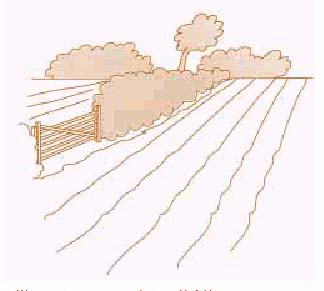
Erosion by water
Water erosion causes soil to be lost to some extent from all sloping arable land and all sloping land
that is alternated between grass and arable crops. It may occur when the rate of rainfall is greater
than the rate at which water soaks into the surface of the soil, resulting in run-off. Rainfall events
that cause run-off are not as rare as many people think. There is a significant risk of rill and gully
erosion occurring on susceptible sites when more than 15 millimetres of rain falls in a day or when
more than four millimetres falls in an hour.
Moderate erosion can occur on sands and light loams where heavy rainfall, slope and reduced
infiltration combine to cause surface water to run-off.
282. Erosion may be confined to run-off which contains fine soil particles, or it may be more
serious and cut channels called rills or gullies.
In our country the soil erosion intensified mainly in the last years as a consequence of the irrational
management of forests and land and due to an improper agriculture management in small and
medium sized private farms.
Water erosion has increased due to the increased area of row crops, the tracks on the soil after top-
bottom working, an improper seedbed preparation and the removal of hedges and other linear
features. Consider the possibility of soil erosion before you carry out any of these operations,
particularly ploughing or reseeding pasture that is on sloping land or the floodplain of a river.
283. In such areas even low-intensive grazing increases the soil erosion. It is not recommended
grazing on the protection dikes along the rivers. The destruction of these dikes increases the
sediment load in surface waters.
Figure 16.1.1. Water erosion can occur on sloping arable fields (after UK Code of Good
Agricultural Practice for the Protection of Soil)
284. Careful planning to prevent erosion should include the whole farm, pinpointing situations
where there is a high risk of run-off and taking measures to reduce the risk in these areas.
Headlands and steep or long slopes are particularly vulnerable as are valley bottoms and gateways
81
where run-off can accumulate. Fields with complex slope patterns can channel run-off into these
areas.
285. Control drainage water from fields by maintaining land drains, pipe outlets and ditches. Pay
particular attention to removing sediment that has been deposited in ditches and drains and
whenever possible return it to where it was eroded.
Appropriate management can greatly reduce the risk of erosion.
286. Avoid unnecessarily deep or numerous cultivations and working on the land when it is too wet.
Compaction reduces the ability of soil to absorb water and this leads to ponding and run-off. You
should correct this before you sow the next crop.
287. Avoid fine seedbeds that will run together and seal the soil surface. You may need to increase
the organic matter content of the soil to prevent this happening
288. Plant cover is an important way of protecting the surface of land. Early planting of winter
crops and grass re-seeds is very important where the risk of erosion is high. Aim to achieve at least
25% ground cover by early winter. In such situations row crops need to be avoided.
289. Set up paths for spraying after the crops have emerged. If this is not practical, due to your
method of crop management, a shallow tine behind the wheel can break up any compacted soil and,
on some soils, can reduce run-off.
290. Cultivating and planting crops in fields on the contour is recommended for controlling
erosion. For mechanised agriculture, it is only likely to be effective for crops grown in gently
sloping fields with simple slope patterns.
291. For steeper sloping fields with complex slope patterns, it is not practical to follow the contours
accurately. In these fields, attempts at cultivations across the slope often lead to channelling of run-
off water, particularly in tramlines or wheelings, which can cause severe erosion. On steeper slopes,
the risk of accidents from using machinery across fields is high.
292. Row crops, particularly root crops and vegetables, may be unsuitable for sites that are
particularly vulnerable to water erosion.
293. When using a reversible plough across the slope, always throw the soil up the hill to reduce the
effect of erosion and soil creep.
294. You can protect bare ground after harvest by making sure that some chopped straw or other
residues are left at the surface during cultivations.
295. Never have a bare soil without crop residues. You can do this by using tines, discs or shallow
one-pass systems (sometimes known as conservation tillage) in place of ploughing. Such practices
have the added advantage of increasing organic matter in the surface layer of the soil.
296. Rough seedbeds are more stable than fine tilths.
82
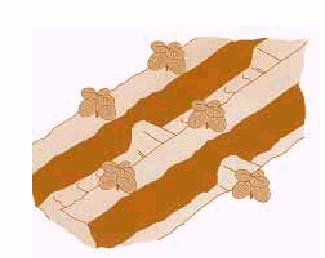
297. Avoid rolling after autumn drilling on vulnerable sites (particularly when soils are wet) to help
maintain the rate at which water is absorbed by the soil.
298. Undersown cover crops or crops such as rye, mustard or lupin, sown in late summer or early
autumn and ploughed in or killed off before drilling in spring, give good control of both water and
wind erosion on sensitive soils. They may also reduce nitrate leaching. of the surface.
299. Leaving stubbles uncultivated is often preferable to leaving ploughed ground bare over winter.
However maize stubble may not provide sufficient protection.
300. Land which is ridged to grow potatoes, and bed systems for vegetables in general, are
particularly at risk of increasing water erosion.
301. Using for vegetable crops ridges orthogonal to slope direction and small pits (dikes) along
furrow bottoms help to improve the soil's ability to absorb water, reduce run-off and so prevent
erosion. These techniques are particularly valuable for irrigated crops.
302. Always apply irrigation water when necessary in a way that avoids run-off and erosion. Assess
the needs of the crops and do not apply too much water at too high a rate or with too great a droplet
size.
303. Large droplets are more likely to cause sealing of the surface.
304. Stop irrigating if run-off occurs.
305. Avoid pipework leaking and carefully drain water from disconnected equipment.
Figure 16.1.2. Tied ridges reduce run-off between potato rows (after UK Code of Good
Agricultural Practice for the Protection of Soil)
306. If water erosion is a frequent or serious problem you may need to
- create permanent grass strips as buffer areas within fields at strategic places on slopes or in valley
bottoms;
- change the crops that you grow or introduce grass into your crop rotation;
83
- develop stable topsoils by applying bulky animal manures or other suitable organic materials
where these are available or by using synthetic conditioners (PAM, VAMA, POLINILI)
- plant hedges or build new ditches to restrict run-off;
- direct run-off water away from areas prone to erosion.
307. Buffer strips are uncropped areas of grass or natural vegetation adjacent to watercourses. In
some circumstances they have the potential to prevent surface run-off and sediment entering
watercourses. However, they are unlikely to be a long-term solution to reduce nutrient or sediment
pollution of water. Where there is severe soil erosion or excessive run-off, they may become
overwhelmed and by-passed by channelled flow.
308. Buffer strips are most likely to be effective where they are targeted within fields to intercept
and slow down run-off and prevent excessive channelling of water. However, targeting may not be
feasible for a number of reasons, e.g. where land is in rotational set-aside. Better results may be
obtained by planting hedgerows.
309. Buffer strips are effective at removing nitrate when water movement is within the soil at
shallow depth. This is rarely the case but the anaerobic conditions in wetland (water-logged) buffer
areas can remove nitrate by denitrification. Where buffer strips are likely to be effective, their
optimum width will depend on function, soil type, climate and topography, and this could vary
between two and fifty metres
310. The buffer strips width is dependent on local conditions. In most cases they require a minimum
width of twenty metres. The European Commission recommended the decreasing of this width to
two to six meters.
311. In appropriate circumstances, consider introducing grass into arable rotations, or even having
areas of permanent grassland or woodland.
312. In many cases specific national methodologies for areas with high risk of soil degradation
deep soil compaction, erosion, nitrate pollution, pollution with other toxic substances need to be
developed for continuous monitoring. These areas need to be transformed as much as possible in
areas with a new habitat promoting the change from arable to other land uses
313. Land organisation need to promote the protection of highly vulnerable areas by including
many-year grassland.
314. If a tax-paying land-owner has a land subject to soil erosion, or other major soil degradation
process, he need to change the land use. The specialist advice is necessary.
315. When you are establishing or harvesting any woodland or forestry areas, take precautions to
avoid soil erosion.
316. Keep a cover of plants or trash where possible and avoid causing compaction by planting
equipment, particularly on slopes, shallow soils and in upland peaty areas. Take care when
installing ditches, roadways and stream crossings.
317. Livestock can also increase the risk of water erosion. You should avoid practices which result
in the soil being poached so that run-off and erosion increase. Problems can occur from:
- high stocking rates in wet weather;
84
- strip grazing and around winter feeding areas;
- tracks for livestock or machinery particularly if they cross streams or natural wet areas;
- overgrazing near the banks of a stream or river;
- uncontrolled access to the watercourse causing bank erosion.
318. Fencing may be necessary to control the access of livestock to watercourses. Environment
Protection Agencies must control these areas and give technical assistance for environment
protection.
319. Keeping large numbers of pigs outdoors can cause run-off and erosion and lead to increased
nitrate leaching. Select and lay out sites for outdoor pigs that minimise the risk of erosion. Take
account of location, slope, soil type and rainfall.
320. Manage the site to maintain grass cover preventing land degradation, soil compaction and run-
off or move to another site when this is necessary to prevent run-off.
321. Plan vehicle access so as not to cause wheelings that will lead to run-off.
322. Erosion in upland areas can increase sediment in streams and damage spawning gravels for
fishes.
323. When over-grazing has caused, or is likely to cause a problem, you should:
- reduce your stocking rates in the vulnerable areas;
- locate supplementary feeding areas well away from watercourses;
- wherever practical regularly move these feeding areas to avoid poaching;
- take care to limit the other activities mentioned in vulnerable areas that are under your control;
- protect eroding areas by encouraging the regeneration of plants to cover the soil. This may need
some means of protecting the soil, possibly by fencing, until the plants are established.
Erosion by wind
Wind erosion normally only affects bare sandy, peaty and silty soils in exposed areas, especially
when the soil is not covered by vegetation. Arable soils between sowing and emergence in
conventional tillage systems are not protected. They are exposed to various risk factors.
If your farming system and soil type together result in wind erosion, you should use control
measures. It may be appropriate to avoid some crops (row crops) on the most exposed fields. You
can control wind erosion by reducing wind speed at ground level, making the soil surface stable and
trapping any soil particles which are already moving. Individual methods for control are described
in the following paragraphs.
324. You can grow rows of trees or hedgerows to trap airborne particles and to provide protection
for soil and for crops grown on the sheltered side. Shelters should allow 30-50% of the wind to pass
through. Protection from the shelter reduces with distance and does not extend more than 20 times
the height of the shelter.
325. The benefit depends on the actual direction of any damaging winds. You can get information
on the likely frequency and direction of damaging winds from meteorological records and you can
use this information to help you decide where to put shelter belts.
85
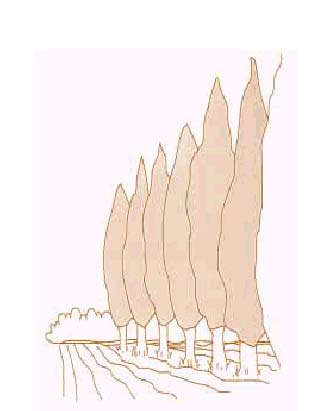
326. Shelters can also have important value for wildlife and should be planted accordingly.
Figure 16.1.3 - Forest belts reduce wind erosion (after UK Code of Good Agricultural Practice
for the Protection of Soil)
327. Crops such as winter rye, winter barley or mustard can be grown as cover or nurse crops to
provide protection for both soil during the winter time.
328. Nurse crops mixed with spring row crops protect the soil and spring crops
329. You can kill off cover crops before the spring crop is drilled, by cultivation or spraying, and
nurse crops may be sprayed out during the early life of the crop. These methods are effective for
silty soils poor in organic matter with high risk to processes degrading soil structure: decrease of
the stability of structure aggregates mainly for intensive tilled soils for seedbed preparation.
340. The erosion by wind silt storms has negative effects on soils, environment with direct
consequences on vegetation, surface waters, humans and animals due to silt particle deposition
341. On peaty soils, mechanised straw planting in rows may provide shelter for vegetable crops that
you sow very early.
342. The traditional practice of marling to increase the clay content of peats and sands may provide
a long-term solution to wind erosion. This technique is unlikely to be practical or economic unless
suitable material is available close-by. You need to apply 300-1000 tonnes/ha of suitable marling
material to stabilise the surface of the soil.
86
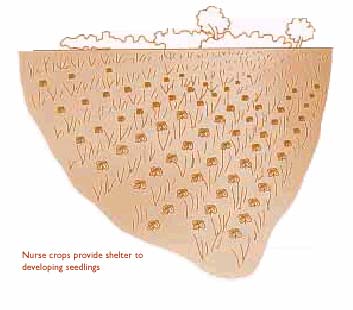
Figure 16.1.4 - Nurse crops provide shelter to developing seedlings (after UK Code of Good
Agricultural Practice for the Protection of Soil)
343. To be successful, the clay content of sandy topsoils should be increased to 8-10%. The marl
should be left on the soil surface long enough for the lumps to break down by frost action before
you cultivate it into the soil. After marling, you can lose the benefit if you plough the soil too
deeply.
344. Applying mulches to the surface of seed-beds on sandy soils at 5-15 t/ha after drilling is an
effective control measure. Organic manures, sugar beet factory lime and sewage sludge are suitable
materials for mulches. Waste cellulose from paper production may be available locally and may be
suitable for stabilising the surface.
345. When you use sewage sludge you must comply with the national and international Regulations
and any local restrictions to protect groundwater.
346. If you disturb the mulch by cultivating the land, the benefit is lost.
347. Synthetic stabilisers such as VAMA, PAM etc. sprayed onto the soil surface of sands after
drilling can provide temporary protection for high value crops. Appropriate professional advice
should be obtained before you use these methods to control erosion.
348. Choosing cultivation practices carefully can provide effective erosion control for sandy soils.
You can form an erosion-resistant surface by ploughing if there is enough silt and clay in the
topsoil.
349. Plough and press the soil at the same time before you sow the crop and drill it at right angles to
the direction of pressing without cultivating the seedbed any further. Adequate moisture is needed if
pressing is to provide a stable surface.
350. Uncultivated crop stubble also provides protection against wind erosion and a spring-sown
crop can sometimes be drilled directly into the soil surface. The techniques developed in USA in
87
60th for water conservation in slope lands was extended to improving and conservation of the soil
quality. Experimental results in Romania confirmed the effects of this technology.
351. You must take care as a compacted surface may increase run-off and cause water erosion.
352. To ensure satisfactory crop growth, remove any compaction by loosening where necessary.
16.2 Soil Compaction
To restore the normal properties of a compacted soil need to break-up the compacted layers and to
create lacunar space around soil aggregates allowing water movement, exchange of gases between
soil and atmosphere and the development of the root system. Therefore the soil porosity is restored.
This action is obtained by soil loosening using various equipment and techniques depending on soil
compaction degree, depth of compaction, soil type.
353. When choosing the crops to grow, you should take into account the ability to cultivate the land
when necessary and undertake all other field operations without causing unacceptable compaction.
It is still considered that soil erosion is the most harmfully soil degradation process. The scientific
community and farmers recognize now that this is due to the ,,visible" character of soil erosion
instead of soil compaction that is not visible. Soil compaction is a process in the depth of soil
profile and for this reason is more harmfully.
354. Always take care on silty and clayey soils. Cultivations for autumn crops are likely to cause
less damage than cultivations for crops that are sown in the spring.
355. You should also consider if you might damage the soil during harvesting, in particular for root
and vegetable crops. Advice on available work days for different soils is needed.
356. Compaction of topsoils, or more especially subsoils, may seriously damage soils and can only
be reversed very slowly and at significant cost. Compaction restricts root growth and reduces
infiltration of water into soil. It can increase run-off, which may lead to greater flooding, increased
erosion and the transfer of potential pollutants (including nutrients and pesticides), to surface
waters.
357. As the air getting into the soil is also restricted, the biological activity and root growth is
affected. This reduces the fertility of the soil and, more specifically, the availability of plant
nutrients. So it is important to minimise all forms of soil compaction.
358. Free-draining soils which are not regularly cultivated develop a soil structure which allows
root growth, infiltration and drainage of water.
359. Using agricultural or other machinery when the soil is too wet can seriously compact soil and
restrict root growth. Allowing livestock to graze when the land is too wet can also damage the soil
structure and cause similar problems.
360. Water movement is reduced and so plant growth is restricted. You should always take into
account the condition of the soil when deciding what machinery to use, and when to use it. Power-
driven cultivation equipment can leave fine seedbeds that develop a surface cap mainly on silty
88
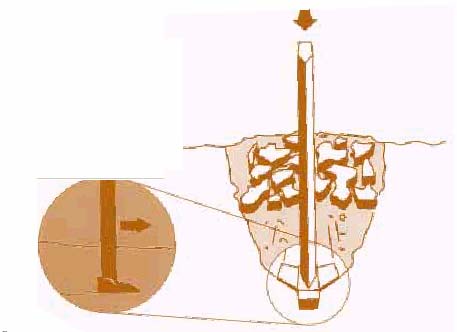
soils, degraded soils and soils with low organic matter content. This effect increases if heavy rains
are following immediately after tillage works. This may stop seedlings emerging or lead to surface
run-off and erosion.
361. Large agricultural machinery is not necessarily a greater risk for normal work on undisturbed
soils. This is because faster work rates allow the work to be completed under better soil moisture
conditions. Using low ground-pressure tyres, dual wheels or
tracked vehicles can be a great benefit.
362. Axle load is an important factor and you should get professional advice to provide safe
working guidelines for specific soil conditions, particularly on fine loamy, silty and clayey soils.
However, when conditions are unsuitable, large machinery can cause deep compaction (below 25-
30 cm soil depth, down to 40-60 cm) which is difficult and expensive to correct.
363. In areas where fine loamy or silty topsoils lie over clayey subsoils, plough pans and smearing
can often be caused in wet conditions. When you have correctly identified these problems, they can
usually be corrected by ploughing or by subsoiling.
Figure 16.2.1 - Subsoiling lifts and shatters compacted layers in the soil (after UK Code of
Good Agricultural Practice for the Protection of Soil)
364. Pay particular attention to compaction caused by repeated driving on headlands, in tramlines or
during harvesting. Take care to distinguish soils which are naturally slow to drain (in our country
argillic iluvial soils) and which may need underdrainage and secondary treatment of moiling or
subsoiling.
365. Regularly inspect vulnerable soils before cultivating to decide on any corrective measures that
are necessary. However, if the structural damage is severe and is linked with low organic matter
content, deep cultivation followed by several years in grass may be necessary to regenerate the soil.
89
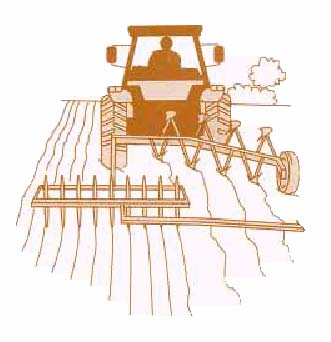
366. If damage is caused during soil restoration, the subsoil may become severely compacted. This
can be very difficult, if not impossible, to correct. Whenever you are considering deep cultivation,
take account of soil conditions and any work you will be carrying out later.
367. Loosening the soil can make it more vulnerable to compaction by work that you do in the
future.
16.3 Deep cultivation and mixing of soil
368. In certain situations, mixing the topsoil and subsoil may improve the physical characteristics of
the soil by introducing clay into sandy soils or mineral matter into shallow and degraded peats.
Usually, however, you should avoid diluting topsoil with subsoil brought to the surface as it will
reduce fertility and cause physical degradation.
369. Do not plough deeper than 30 centimetres in silty and fine sandy topsoils with a low organic
matter content, especially if the subsoil has an even lower organic matter content. If subsoils are
ploughed, the stability of the topsoil will be reduced even more. Crop establishment may be
affected or wind and water erosion may be increased.
370. Deep ploughing will dilute plant nutrients, result in coarser seedbeds and slow down soil
warming in spring.
371. Increase the rooting depth by subsoiling rather than by ploughing.
372. In particular, avoid deep-ploughing shallow soils which lie over loose or weathered materials
such as chalk. By contrast, shallow cultivations, including conservation tillage may help to improve
structure and will conserve nutrients in the surface layer of soils.
373. Many heavy textured, poorly drained grassland soils only have a well-developed structure of
small aggregates in the top few centimetres.
90
374. These grasslands should only be reseeded in exceptional circumstances. Ploughing these soils
can dilute organic matter, destroy natural soil drainage and so increase the risk of damage by
machinery and animals. The management of these soils will then be difficult for many years.
375. If you need to reseed such swards, use surface seeding or shallow cultivation techniques.
376. Keep soil disturbance to a minimum when you remove trees from land by grubbing orchards,
harvesting standard nursery stock trees or clearing farm woodlands.
377. Carry out all mechanised work when there is no risk of compacting the soil, i.e. when the soil
water content is low, in the limits of traficability. Therefore, on heavy soils the deep ploughing need
to be in autumn.
378. Soil removed on the roots should be kept to a minimum.
379. Under certain conditions, rapid breakdown of stumps and coppice stools can be encouraged by
heavy discing and leaving them in the soil to rot down
380. You should seek professional advice as to the most appropriate technique for your situation.
A large part of our archaeological heritage is in the countryside, protected beneath the soil. These
remains are easily disturbed and can be damaged or lost by ploughing, under drainage subsoiling or
other soil disturbance, including planting or uprooting of trees, shrubs or hedges. Such sites may be
legally protected. Not all ancient monuments are legally protected but they may still be of historic
importance. All important archaeological remains should be preserved, if possible. If you have such
sites on your land or you uncover remains or objects, you should contact the authorities and
research institutes.
16.4 Loss of lowland peat
In some areas of the country there are peat deposits. Areas of undrained, lowland peat-bogs with
natural vegetation have become increasingly rare. Such wetlands also preserve important scientific
interests including evidence of past environmental conditions. Grants from national and
international organisations are necessary for the protection and conservation of such areas.
381. You should leave all undrained or virtually unaltered sites as natural or semi-natural areas, or
as traditionally-managed pasture for promoting a healthy environment attractive for humans and
other life beeings.
In the past, large areas of original peatland have been drained to form agricultural land. When
drained and fertilised, these areas have formed very productive soil which is capable of producing
high yields of root crops and vegetables.
382. For effective drainage, the water table needs to be lowered. Lowering the groundwater is a
dangerous process and the advise is necessary from expert consultants.
91
383. Lowering the water table causes shrinkage of the land through the peat drying out and,
together with repeated cultivation, it stimulates breakdown (oxidation) which leads to a reduction in
the depth of peat. These soils are a resource which have a limited life.
384. To reduce the rate of loss, keep the water table as close to the surface for as long as possible
consistent with the need to manage this land for food production.
385. In some areas, care will be needed not to expose acid sulphate soils which lie below the peat.
The processes of peat wastage can be prevented only by reinstating natural peat mire conditions.
This action would drastically reduce the value of the soils for growing crops.
386. Land degradation rate could be reduced if the land is not cultivated at least one year from time
to time and if the groundwater depth in the neighboring areas is mentained as shallow as possible.
92
ANNEXES
93
Annex 1 - Average consumptions (exports) of soil nutrients to produce yields (kg of nutritive
elements/ton of main yield and the quantity corresponding to the secondary yield)
Crops
Ratio between the main and
Nutrients
secondary yield
(conventional active ingredients)
N P2O5
K2O
Winter wheat
grains : straw (1 : 1.3)
26.5 13.7 16.4
Barley and two-row barley
grains : straw (1 : 1)
23.0 10.8 22.3
Rye
grains : straw (1 : 1.5)
27.5 9.4 26.8
Oats
grains : straw (1 : 1.5)
28.5 11.0 31.2
Kernel maize
kernels : stems (1 : 1.6)
27.5 12.5 16.5
Silage maize
entire plants with corncobs
6.5 3.0 5.5
Sugar beet
roots : leaves + herbages (1 : 1)
4.9 2.0 6.0
Forage beet
roots : leaves (1 : 0.5)
3.8 1.7 7.9
Potatoes
tubers : herbages (1 : 0.5)
5.2 2.7 7.5
Sunflower
seeds : stems (1 : 3)
36.5 17.5 50.0
Oil rape
seeds : stems (1 : 3)
51.5 36.0 44.0
Seed flax
seeds : stems (1 : 3)
59.0 17.3 72.0
Bean
grains . herbages (1 : 1.5)
59.5* 13.4 25.0
Pea
Grains : herbages (1 : 1.5)
61.0* 16.6 28.0
Soybean
grains : herbages (1 : 1.5)
70.0* 22.5 34.0
Flax for fibre
stems
11.0 7.0 13.0
Hamp
stems
10.0 8.5 17.5
Alfalfa
green matter at flowering beginning
8.0* 1.6 6.5
Red clover
green matter at flowering beginning
6.5* 1.5 5.5
Grass of natural grassland
6.5 1.4 4.5
Orchard grass
green matter
6.0 1.7 8.3
Oats + vetch
green matter
6.5* 2.4 5.5
Maize green
matter 3.0 1,7 4.5
Alfalfa hay
flowering beginning
32.0* 6.4 22.0
Red clover hay
flowering beginning
26.0* 6.0 21.0
Natural grassland hay
24.0 5.6 18.0
Hay of perennial cultivated
23.0 6.5 28.0
grasses
Hay of oats + vetch
25.0* 8.0 20.0
Hay of alfalfa mixed with Lolium
26.0* 6.0 20.0
perenne
Apples
fruits
1.6 0.5 2.0
Wine grapes (+ secondary
6.5 1.6 5.5
production)
Tomatoes
fruits
2.9 1.0 4.5
Autumn cabbage
heads
3.5 1.2 4.0
* the most part coming from the symbiosis with nitrogen fixed microorganisms
94
Annex 2 - Manure quantity for annual application in soil (t/ha)
Crop Fermenta-
Steppe zone
Silvo-steppe zone
Forest zone
tion
Soil texture
degree
light medium heavy light medium heavy light medium heavy
Small
slightly
15-20 20-25 25-30 20-25 25-30 30-35 20-25 30-35 30-35
grains
fermented
well
10 10-15
15-20
10-15
15-20 20-25
10-15
15-20
20-25
fermented
Maize
slightly
20-25 25-30 30-35 25-30 30-35 35-40 25-30 30-35 35-40
fermented
well
10-15 15-20 20-25 15-20 20-25 25-30 15-20 20-25 25-30
fermented
Technical
slightly
25-30 30-35 35-40 30-35 40 30-35 35-40 35-40 35-40
plants
fermented
well
20-25 25-30 25-30 20-25 30 25-30 25-30 25-30 25-30
fermented
Vegeta-
well
30-40 35-40 40 30-35 30-40 35-40 30-35 30-35 35-40
ble crops
fermented
Fruit
well
30 35-40 40 30-35
30-40 35-40
30-35
30-35 40
trees
fermented
Non-
well
20 20-30
30-35
20-25
25-30 30-35
30-35
30-35
35-40
vigorous
fermented
vine
Vigorous
well
30 30-35
30-35
30-35
35-40 40 30-35
35-40 40
vine
fermented
Coefficients (%) for utilization of nitrogen, phosphorus and potassium
in manure with bedding material
Year
N P2O5
K2O
1 year
0,35 0,45 0,65
2 year
0,25 0,15 0,15
3 year
0,10 0,05 0,00
Total effect
0,70 0,65 0,80
95
Annex 3 - FERTILIZATION PLAN (model)
Field Area
Pre-
Annual Expect-
Soil analysis
Need of nutrients for
Manure
Mineral fertilizer
no.
ha
vious
crop
ed yield
crop, kg/ha
......t/ha
kg/ha
crop
pH P2O5
K2O
N P2O5
K2O N P2O5
K2O N* P2O5* K2O*
mg/kg mg/kg
1 2 3 4
5 6 7 8 9 10 11 12 13 14 15 16 17
Columns 1 - 5 are completed with data referring to the cultivated field indicating the expected yield.
Columns 6 - 8 are completed using the agrochemical data of soil going to be cultivated on the basis of laboratory analyses.
Columns 9 - 11 are completed with quantities of nutrients removed by the expected yield.
The mineral fertilizer need (columns 15 - 17) is calculated as follow:
For the crop fertilized with manure it is necessary to deduct the quantity of nutrients added by manure (columns 12 - 14) from the nutrient needs for the
respective crop.
*The need of raw fertilizer substance is calculated tacking into account the active ingredient content of the available fertilizers, for instance:
- the ammonium nitrate need is calculated tacking into account the active ingredient concentration of 34.5 % N;
- the single superphosphate need is calculated tacking into account the active ingredient concentration of 16-18% P2O5 or in triple superphosphate of 46%
P2O5;
- the potash need is calculated tacking into account the active ingredients content of 40% K2O.
96
Annex 4 - Animal loading per hectare that corresponds to annual nitrogen rates of 210 kg/ha
and 170 kg/ha, respectively
In the case of applying
In the case of applying
Species
Weight
210 kg/ha
170 kg/ha
Intensive
Proprietor' s
Intensive
Proprietor' s
system
system
system
system
Sucking calves
0-50
10.5 13.6 8.5 11.0
Calves (0.3-1 year)
50-250
2.6 3.4 2.1 2.7
Cattle (1 -2 years)
250-600
3.8 4.9 3.1 4.0
Milk cows
>400
6 7.8 4.9 6.4
Pigs
98
16.1 20.9 13 16.9
Pigs being fattened
68
19 24.7 15.4 20.0
Pigs being fattened
90
14 18.2 11.3 14.7
Pregnant sows
125
21 27.3 17 22.1
Sows with litter
170
5.5 7.1 4.5 5.8
Boars
160
16.1 20.9 13 16.9
Sheep
45
30 39 24.2 31.4
Breeding poultry
1.8
583 758 472 613
Fattened poultry
0.9
583 758 472 613
Horses
450
4.7 6.1 3.8 4.9
Annex 5 - Land area (ha) needed for an animal raised in an intensive system or proprietor's
system
In the case of applying
In the case of applying
Species
Weight
210 kg/ha
170 kg/ha
Intensive
Proprietor' s
Intensive
Proprietor' s
system
system
system
system
Sucking calves
0-50
0.0952 0.0735 0.1176 0.0904
Calves (0.3-1 year)
50-250
0.3846 0.2958 0.4761 0.3662
Cattle (1 -2 years)
250-600
0.2631 0.2024 0.3225 0.2480
Milk cows
>400
0.1667 0.1282 0.2040 0.1569
Pigs
98
0.0621 0.0478 0.0769 0.0591
Pigs being fattened
68
0.0526 0.0404 0.0649 0.0499
Pigs being fattened
90
0.0714 0.0549 0.0885 0.0680
Pregnant sows
125
0.0476 0.0366 0.0588 0.0452
Sows with litter
170
0.1818 0.1398 0.2222 0.1709
Boars
160
0.0621 0.0478 0.0769 0.0591
Sheep
45
0.0333 0.0256 0.0413 0.0317
Breeding poultry
1.8
0.0017 0.0013 0.0021 0.0016
Fattened poultry
0.9
0.0017 0.0013 0.0021 0.0016
Horses
450
0.2127 0.1636 0.2631 0.2023
98
Annex 6 - Daily and annual production of nutritive elements in dejecta of animal raised in an
intensive system
Species W
Daily content of nutrients
eight
Annual content of nutrients
N P K N P K
kg/day kg/year
Sucking
calves
0-50 0.054
0.010
0.038
20 4 14
Calves (0.3-1 year)
50-250
0.222
0.040
0.148
81
15
54
Cattle (1 -2 years)
250-600
0.165
0.054
0.118
55
20
43
Milk
cows
>400
0.096
0.014
0.071
35 5 26
Pigs
98
0.036
0.012
0.022
13
4
8
Pigs being fattened
68
0.031
0.010
0.020
11
4
7
Pigs being fattened
90
0.041
0.014
0.027
15
5
10
Pregnant sows
125
0.028
0.010
0.018
10
4
7
Sows with litter
170
0.104
0.035
0.068
38
13
25
Boars
160
0.035
0.012
0.023
13
4
8
Sheep
45 0.020
0.003
0.015
7 1 5
Breeding
poultry
1.8 0.001
0.0005
0.0005 0.36 0.18 0.18
Fattened
poultry
0.9 0.001
0.0002
0.0003 0.36 0.07 0.10
Horses
450 0.123
0.021
0.077
45 8 28
99
Annex 7 - Interpretation of agrochemical data regarding soil supply with mobile forms of
nitrogen, phosphorus and potassium
Supply
Humus
IN* PAL
KAL
class
( %)
(ppm P)
(ppm K)
Coarse
Medium For all of
For all of
Coarse
Medium Fine soils
soils
and fine the soil
the soil
soils
soils
soils
types
types
Very low
0.5
1.0
< 8
< 50
< 66
< 80
Low
0.5 -1.0
1.1 - 2.0
2.0
8 -18
50 - 100
66 - 132
80 - 160
Moderate
1.1 - 2.0
2.1 - 4.0
2.1 - 4.0
18 - 36
100 - 150 132 - 200 160 - 240
High
2.1 - 4.0
4.1 - 8.0
4.1 - 6.0
36 - 72
150 - 200 200 - 265 240 - 230
Very high
> 4.0
> 8.0
> 6.0
> 72
> 200
> 265
> 320
*IN (Nitrogen index) = Humus x V/100 . It is used in the Romanian agrochemical system to
evaluate the potential supply with nitrogen of soils, and to differentiate the nitrogen fertilizer rates
and the manure application. Its application is justified by the fact that the nitrogen supply from the
soil as well as the relative effect of nitrogen fertilizers for the main crops positively correlate with
the humus content and base saturation in the arable layer of soils.
100
Annex 8 - County soil survey and soil testing offices
No. Name
Residence Address Postal
Telephone
town
code
number
0 1
2
3
4 5
1
OJSPA ALBA
Alba Iulia
St. Moilor 108-
2500
0258/826633
2
OJSPA ARAD
Arad
Str. Cloca 6A
2900
0257/228485
Fax
3 OJSPA
ARGE Piteti Str.
Libertii 32
0300
0248/634591
Fax
0248/633692
4 OJSPA
BACU
Bacu
Str. G. Bacovia 20
5500
0234/514730
0234/447025
5
OJSPA BIHOR
Oradea
Str. Aradului 5
3700
0259/447025
Fax
6 OJSPA
Botoani
Str. Trandafirului 2
6800
0231/584090
BOTOANI
Fax
7 OJSPA
BRAOV Braov Feldioarei
2200
0268/441332
8 OJSPA
BRILA Brila
os. Rāmnicul Srat
6100 0239/612080
129
9 OJSPA
BUZU Buzu
Str. Lt. Gh. Iacob 2
5100
0238/412211
0238/412211
10 OJSPA
CLRAI Clarai Bucureti 26
8500
0242/321436
0242/321023
11
OJSPA CLUJ
Cluj Napoca
Str. Fagului 1
3400
0264/144237
12 OJSPA
Constana Str.
Revoluiei 22 dec.
8700 0241/617043
CONSTANA
1989 17-18
0241/618962
13 OJSPA
Tārgovite
Str. T. Vladimirescu
0200 0245/634062
DĀMBOVIA
175
0245/217143
Fax
14
OJSPA DOLJ
Craiova
N. Romanescu 35 A
2200
0251/428313
0251/427846
15 OJSPA
GALAI
Galai Str.
tiinei 97
6200
0236/416465
Fax
16 OJSPA
GIURGIU
Bucureti
os. Afumai 11 SAI
2403540 Fax
17
OJSPA GORJ
Tg. Jiu
Calea Bucureti 75
1400
0253/214858
Fax
18 OJSPA
Miercurea
Str. Progresului 16
HARGHITA
Ciuc
19 OJSPA
Deva
Str. Aurel Vlaicu 25
2700
0254/217062
HUNEDOARA
Fax
20 OJSPA
IALOMIA
Slobozia
Str. Lacului 12
8400
0243/232793
21 OJSPA
IAI Iai
Str. Dumbrava Roie 6600 0232/140008
22 OJSPA
Baia Mare
Str. Cosmonauilor 3
4800
0262/430864
MARAMURE
23 OJSPA
MURE Sāngeorgiu
Str.
Principal 1225
4828
0265/120196
24 OJSPA
Drobeta
Str. Crian 87
1500
0252/311986
MEHEDINI
Turnu-
Severin
0 1
2
3
4 5
101
25 OJSPA
NEAM Piatra
Neam
Al. Tiparului 10 bis
5600
0233/227571
Fax
26 OJSPA
OLT
Scorniceti
Str. Pompierilor 10
0538
0249/460301
27 OJSPA
PRAHOVA
Ploieti
Str. Aurel Vlaicu 3
2000
0244/126218
28 OJSPA
SATU
Satu Mare
Str. Lcrmioarei 37
3900
0261/717976
MARE
29 OJSPA
SLAJ Zalu
Str. Tipografilor 7
4700
0260/620113
30 OJSPA
SIBIU
Cisndie Str.
Someului 49
0269/212243
31
OJSPA SUCEAVA
Suceava
Bd. 1 decembrie
5800 0230/215792
1981, 15
32 OJSPA
TIMI Timioara
Str. G-ral Dragalina 9
1900
0256/204450
0256/192117
0256/191626
Fax
33 OJSPA
Alexandria Str.
Dunrii Nr. 2
0700
0247/209388
TELEORMAN
0247/318141
34
TULCEA
Tulcea
Str. Mircea Vod 63
8800
0240/525840
0240/517638
35 VASLUI
Vaslui
Str.
Clugreni 124
6500
0235/312140
36
VĀLCEA
Rm Vālcea
Str. Oituz 7
1000
0250/749652
37 VRANCEA
Focani Republicii
7
5300
0237/626465
102
Annex 9 - List of chemical fertilizers authorized in Romania
1. NITROGEN FERTILIZERS
1.1.Ammonium nitrate (34.5 % N).
1.2. Calcium ammonium nitrate (27.5 % N)
1.3. Urea (46 % N)
1.4. Ammonium sulphate (21.2 % N)
1.5. Urea nitrate (34.2 % N)
1.6. Ammoniu sulphate urea ( 33 % N)
1.7. Calcium nitrate (15.22 % N, 21.74 % Ca).
1.8. Magneziu nitrate (Magnisal) ( 10.80 % N, 9.70 % Mg
2. PHOSPHATE FERTILIZERS
2.1. Single superphosphate (16-22 % P2O5 )
2.2. Triple superphosphate (42-51 % P2O5 )
2.3. Activated granulated phosphorite (20 % P2O5)
2.4. Activated powdered phosphorite (20-24 % P2O5)
3. POTASSIUM FERTILIZERS
3.1. Potassium sulphate (48 - 54 % K2O)
3.2. Potassium nitrate (13 % N, 46 % K2O)
3.3. Potash ( 40-45 % K2O)
4. COMPLEX FERTILIZERS
4.1. K - 27 - 13.5 - 0
4.2. K - 22 - 22 - 0
4.3. K- 23 23 0
4.4. K- 13 32 0
4.5. K- 22 11 0
4.6. K-15 15 - 15
4.7. K - 16 - 16 - 16
4.8. K - 9 - 24 - 24
4.9. Diammonium phosphate DAP - 16 - 48 0
4.10. Urea phosphate 17- 44 0
4.11. K 13 36 0 cu CaSO4
4.12. Monoammonium phosphate MAP 12 61 0
103
4.13. Monopotassium phosphate MKP 0 51 34
4.14. K- 8 8 8
4.15. K- 5 15 15
4.16. K- 10 5 10 (+ Fe-1%+ MgO1%)
4.17. Cropcare 1 (10-16-16)+TE
4.18. Cropcare 2 (6-11-24)+TE
4.19. Cropcare 3 (10-10-20)+TE
4.20. Cropcare 4 (13-4-15)+TE
5. COMPLEX ORGANO-MINERAL FERTILIZERS ON LIGNITE SUPPORT
5.1. L-120 (10 - 20 - 0 + humic substances 30%)
5.2. L-210 (20 - 10 - 0 + humic substances 25%)
5.3. L-110 (10 - 10 - 0 + humic substances 35%)
5.4. L-200 (20 0 0 + humic acids 24 % )
5.5. L-300 (30 0 0) + humic acids 13.6 %)
5.6. Super H-210 (20 10 0 + humic acids 11.7 %)
5.7. Super H-120 (10 20 0 + humic acids 13.8 %)
6. FERTILIZERS WITH MICRONUTRIENTS
6.1. Urea with boron 2 %
6.2. Urea with zinc 2 i 5 %
6.3. Single superphosphate with boron 0.2 %
6.4. Single superphosphate with zinc 1.5%
7. LIQUID NITROGEN FERTILIZERS
7.1. A - 290 (29 % N)
7.2. A - 320 (32 % N)
7.3. A - 370 (37 % N)
7.4. A - 400 (40 % N)
7.5. A - 410 (41 % N)
7.6. A - 300 (30 % N) with corrosion inhibitors
7.7. A - 320 (32 % N) with corrosion inhibitors
7.8. Ammoniacal water (18-20 % N)
8. LIQUID COMPLEX FERTILIZERS (CRYSTALINE)
8.1. C - 411 (40-10-10)
8.2. C - 141 (10-40-10)
104
8.3. C - 011 (0- 10-10
8.4. C - 313 (30-10-30 +5 % Mg)
8.5. C 8 24 - 0 (8 24 - 0)
9. COMPLEX FOLIAR FERTILIZERS
9.1. F-411 (180-35-40)+ TE
9.2. F-141 (35-200-40)+ TE
9.3. F-231 (80-130-40)+TE
9.4. F-011 (0-130-130)+TE
9.5. Folifag (72-35-38)+TE
9.6. Polimet (120-62-80) +TE
9.7. Folplant-411 (180-35-40)+TE
9.8. Folplant-231 (80-130-40)+TE
9.9. Folplant-141 (35-200-40)+TE
9.10 Folplant-011 (0-130-130)+TE
9.11 Folamin-411 (195-49-48)+TE
9.12. Folamin-133 (54-168-169)+TE
9.13. Folamin-123 (57-141-176)+TE
9.14. Plant Power 2003 (Mn, Cu, Zn in plant extract)
9.15. Nutri Leaf (20-20-20)+TE
9.16. Nutrient Expres (18-18-18)+TE
9.17. Calmax (15-22-0) +CaO(3%) +ME
9.18. Polyfeed (14-14-28)+MgO (2 %)
9.19. Polyfeed (12-28-27)+MgO (2 %)
9.20. Cropmax (0.2-0.4-0.02)+TE
9.21. Kristalon white label (15-5-30)+TE
9.22. Kristalon blue label (19-6-20)+TE
9.23. Bionat (1.3-1.3-0.2)+TE
9.24. Plantmax (0.2-0.06-0.01)+TE
9.25. Soil plus (1.35-0.2-1.9)+TE
9.26. Nutrivit (20-20-20) +TE
9.27. Ferticare I (14-11-25)+TE
9.28. Ferticare II (24-8-16)+TE
9.29. Ferticare III (10-5-26)+TE
9.30. Ferticare S (15-30-15)+TE
9.31. Basfoliar 36 extra (286-0-0)+MgO (14 %)+TE
9.32. Basfoliar combi stipp (131-0-0) + MgO (9.75%)+TE
105
9.33. Nutribor with MgO (5 %) +TE
10. BIOLOGICAL FERTILIZERS
10.1 Azotophos
10.2 Biofertil,
10.3 NEB-26
10.4 Biofert
NOTE :
1. List of fertilizers is annualy updated.
2. Marketing abilities are made with Minister of Agriculture, Food and Forests - Interministerial
Commission to Authorize and Homologate the Fertilizers
3. Other information can be obtained from the Research Institute for Soil Science and Agrochemistry,
Bucharest, telephone : + 40 21 2241790
106
Annex 10. Environmental Legislation
1. Land Act, no. 18. Monitorul Oficial no. 37, 2.20.1991.
2. Decree of the Romanian Government no. 786 approving the rules for establishing the land
groups included in the amelioration perimeters as well as the composition, function and tasks of
the specialists commissions organized for determining the amelioration perimeters. Monitorul
Oficial no. 91, 2.24.1991.
3. Land Renting Act, no. 16. Monitorul Oficial no. 91, 4.7.1994.
4. Act no. 98 on establishing and punishing the offenses regarding the public hygiene and health.
Monitorul Oficial no. 317, 11.16.1994.
5. Decree of the Romanian Government no. 4 on production, marketing and utilization of plant
protection products to control the diseases, pests and weeds in agriculture and forests. Monitorul
Oficial no. 18, 1.30.1995.
6. Act no 14 to ratify the Convention to cooperate for sustainable protection and use of the Danube
River (Convention for the Danube River protection) signed in Sofia on 6.29.1994. Monitorul
Oficial no. 41, 2.27.1995.
7. Act no. 85 to approve the Ordinance of the Romanian Government no. 4/1995 on production,
marketing and utilization of plant protection products to control the diseases, pests and weeds in
agriculture and forest. Monitorul Oficial no. 213, 9.19.1995.
8. Environmental Protection Act no. 137. Monitorul Oficial 304, 12.30.1995.
9. Cadastre and Estate Publicity Act no. 7. Monitorul Oficial no. 61, 3.26.1996.
10. Order of Minister of Waters, Forests and Environmental Protection no. 125 to approve the
Procedure regulating the economic and social activities with impact on environment. Monitorul
Oficial no. 73, 4.11.1996.
11. Land Reclamation Act no. 84. Monitorul Oficial no. 159, 7.241.1996.
12. Waters Act no. 107. Monitorul Oficial no. 244, 10.8.1996.
13. Order of Minister of Health no. 536 to approve the Hygienic rules and recommendations people
living conditions. Monitorul Oficial no. 140, 7.3.1997.
14. Decree of the Romanian Government no. 101 to approve the Special rules on the character and
size of sanitary protection areas. Monitorul Oficial no. 62, 4.10.1997.
15. Order of Minister of Waters, Forests and Environmental Protection no. 756 to approve the Rules
on environmental pollution assessment. Monitorul Oficial no. 303, 11.6.1997.
16. Order of Minister of Waters, Forests and Environmental Protection no. 184 to approve the
Procedure for fulfilling the environmental balance sheet. Monitorul Oficial no. 303 bis,
11.6.1997.
17. Decree of the Romanian Government no. 720 to approve the Rules on establishing the limits of
loading with pollutants of waste waters evacuated in water courses "NTPA-001". Monitorul
Oficial no. 337 bis, 11.25.1997.
18. Order of Minister of Waters, Forests and Environmental Protection no. 62N-19.0/288-1955 on
Delimitation of the areas in danger of natural risks. Monitorul Oficial no. 354, 9.16.1998.
19. Act no. 81/1998 to approve the Decree of the Romanian Government on some measures to
ameliorate the degraded lands by reforestation. Monitorul Oficial no. 304, 6.29.1999.
107
20. Urgency Ordinance of the Romanian Government no. 147 on the associations of irrigation water
users. Monitorul Oficial no. 493, 10.13.1999.
21. Act no. 1 for recovering the ownership right on the agricultural and forest lands ( demanded
according the provisions of the Act of land no. 18/1991 and Act no. 169/1997). Monitorul
Oficial no. 8, 1.12.2000.
22. Republication - Environmental Protection Act no. 137/1995. Monitorul Oficial no. 70,
2.17.2000.
23. Urgency Ordinance of the Romanian Government no. 471 on reorganization of the Autonomous
Agency for Land Reclamation as the National Society for Land Reclamation - S. A. (Nationala
"Imbunatatiri Funciare"- S. A.). Monitorul Oficial no. 136, 3.30.2000.
24. Act no. 62 to approve the Urgency Ordinance of the Romanian Government no. 42/1999 to
complete the Act of veterinary sanitary no. 60/1974. Monitorul Oficial no. 185, 4.28.2000.
25. Decree of the Romanian Government to complete the Annex no. 1 of the Decree of the
Romanian Government no. 340/1992 on the regime to import wastes and residues of any nature
as well as other goods dangerous for the people health and environment. Monitorul Oficial no.
220, 5.18.2000.
26. Order of the Minister of Agriculture, Food and Forests no. 567 to approve the Rules to protect
the agricultural crops, forests and livestock against the damages that can be caused by hunting.
Monitorul Oficial no. 220, 6.7.2000.
27. Urgency Ordinance of the Romanian Government no. 472 on some measures to protect the
quality of water resources. Monitorul Oficial no. 272, 6.15.2000.
28. Urgency Ordinance of the Romanian Government no. 78 on the regime of the wastes. Monitorul
Oficial n. 283, 6.22.2000.
29. Order of the Minister of Agriculture, Food and Forests no. 132 on the Official catalogue of the
cultivars (hybrids) in Romania for 2000. Monitorul Oficial no. 364 bis, 8.4.2000.
30. Decree of the Romanian Government no. 969 to approve the Action plan for protection of
waters against pollution with nitrates coming from the agricultural sources. Monitorul Oficial no.
526, 10.25.2000.
31. Decree of the Romanian Government no. 1041 on the financial allocations for maintaining,
conservation and perpetuation of the animal genetic patrimony, on species, breeds, lines and
hybrids, as well as the establishment of the number of animals that are receiving financing
support in 2000. Monitorul Oficial no. 570, 11.16.2000.
32. Kyoto Protocol regarding the United Nations Framework Convention on Climatic Changes
(UNFCCC). Monitorul Oficial no. 81, 2.16.2001.
33. Act no. 56 to ratify the Convention regarding the evaluation of environmental impact in
transfrontalier context, adopted at Espoo (2.25,1991). Monitorul Oficial no. 105, 3.1.2001.
34. Order of the Minister of Agriculture, Food and Forests no. 64 to approve the Methodology to
authorize the specialized units to elaborate the forestry developments, summary development
studies and studies to transform the forested pastures. Monitorul Oficial no. 238, 5.10.2001.
35. Decree of the Romanian Government no. 455 to approve the Action Plan of the Government
Program on 2001-2002 period. Monitorul Oficial no. 267, 5.23.2001.
108
36. Order of the Minister of Waters and Environmental Protection no. to approve the Regulation to
organize and function the assisting Group to apply the Action plan to protect the waters against
pollution with nitrates from agricultural sources. Monitorul Oficial no. 296, 6.6.2001.
37. Act no. 378 to approve the Ordinance of the Romanian Government no. 43/2000 on the
protection of the archaeological patrimony and setting up of some archaeological sites as areas of
national interest. Monitorul Oficial no. 394, 7.18.2001.
38. Act no. 426 to approve the Urgency Ordinance of the Romanian Government no. 78/2000
regarding the regime of wastes. Monitorul Oficial no. 411, 7.25.2001.
39.Order of the Minister of Waters and Environmental Protection no. 647 to approve The procedure
to authorize the activities for harvesting, capturing and/or acquisition and marketing inside or
outside the country of the plants or animals in the wild flora and fauna as well as their import.
Monitorul Oficial no. 416, 7.26.2001.
40. Act no. 465 to approve the Urgency Ordinance of the Romanian Government no. 16/2001 on
the reusable industrial wastes. Monitorul Oficial no. 422, 7.30.2001.
41.Act no. 462 to approve the Urgency Ordinance of the Romanian Government no. 236/2000 on
the protected natural areas, conservation of the natural habitats, wild flora and fauna. Monitorul
Oficial no. 433, 8.2.2001.
42. Order of the Minister of Agriculture, Food and Forests no. 313 to approve the environmental
protection and rigorous application of the technological rules for soil and water conservation.
Monitorul Oficial no. 458, 8.10.2001.
43. Decree of the Romanian Government no. 716 establishing the conditions of marketing the
domestic and imported chemical fertilizers. Monitorul Oficial no. 465, 8.14.2001.
44. Order of the Minister of Waters and Environmental Protection no. 706 to approve The rules on
the organization of the activities to certify the units specialized to elaborate studies, projects and
their execution, assistance in the water field and technical documentation to obtain the advises
and authorizations for water management. Monitorul Oficial no. 565, 9.11.2001.
45. Order no. ? to approve the Rules to organize and function the Interministerial Commission on
authorization and validation of the fertilizers used in Romania. Monitorul Oficial no. 591,
9.20.2001.
46. Order of the Minister of Public Administration no. 538 to approve the Rules to authorize the
natural persons and legal entities allowed to execute and check the works specialized in the
cadastral, geodezical and mapping fields in the Romania's territory. Monitorul Oficial no. 686,
10.30.2001.
47. Act no. 814 to approve the Urgency Ordinance of the Romanian Government no. 147/1999 on
associations of irrigation water users. Monitorul Oficial no. 695, 11.1.2001.
48. Order of the Minister of Agriculture, Food and Forests no. 373 to approve the Veterinary-
sanitary rules regarding the management of toxic and risky wastes in the sanitary-veterinary
laboratories. Monitorul Oficial no. 703, 11.6.2001.
49. Decree of the Romanian Government no. 1030 to approve the Methodological rules for
applying the Urgency Ordinance of the Romanian Government no. 136/2000 regarding the
protection measures against the introduction and spreading quarantine organisms damaging the
plants and vegetal products in Romania. Monitorul Oficial no. 721, 11.13.2001.
109
50. Order of the Minister of Agriculture, Food and Forests no. 357 to approve the Veterinary-
sanitary rules regarding the measures to monitor and control some substances and their residues
with the living animals and their products. Monitorul Oficial no. 750, 11.23.2001.
51. Act no. 655 to approve the Urgency Ordinance of the Romanian Government no. 243/2000 on
atmosphere protection. Monitorul Oficial no. 773, 12.4.2001.
52. Decree of the Romanian Government no. 1167 to set up the Environmental guard. Monitorul
Oficial no. 789, 12.12.2001.
53. Order of the Minister of Agriculture, Food and Forests no. 2001 to approve the Sanitary-
veterinary rules regarding the maximum allowable limits for residues of pesticides, veterinary
drugs as well as the other contaminants in products of animal nature. Monitorul Oficial no. 512,
12.18.2001.
54. Act no. 80 on the animal husbandry. Monitorul Oficial no. 72, 1.31.2002.
55. Order of the Minister of Agriculture, Food and Forests no. 504 to approve the Sanitary-
veterinary rules establishing the sanitary-veterinary conditions for disposing of and processing
the animal wastes, their marketing and preventing the pathogenic agents in feeds containing
products of animal and fish origin. Monitorul Oficial no. 78, 2.1.2002.
56. Ordinance of the Romanian Government no. 37 to approve the Rules for protecting the animal
used for scientific purposes or other experimentation goals. Monitorul Oficial no. 95, 2.2.2002.
57. Order of the Minister of Agriculture, Food and Forests no. 31 to approve the Rules to
organization the control from the qualitative and sanitary viewpoint of the imported and exported
seeds and propagation material. Monitorul Oficial no. 96, 2.4.2002.
58. Act no. 73 regarding the organization and functioning of the food and agricultural products
markets in Romania. Monitorul Oficial no. 110, 2.8.2002.
59. Order of the Minister of Agriculture, Food and Forests no. 475/2001 to approve the Sanitary-
veterinary rules regarding the use of the method to microscopically identify and to estimate the
constituents of animal origin in the official control of feeds. Monitorul Oficial no. 112,
2.11.2002.
60. Order of the Minister of Agriculture, Food and Forests no. 476 to approve the Sanitary-
veterinary rules regarding the conditions to prepare, marketing and use the sanitary-veterinary
feeds in the Romania's territory. Monitorul Oficial no. 119, 2.14.2002.
61. Order of the Minister of Agriculture, Food and Forests no. 498 to approve the Sanitary-
veterinary rules on some protecting measures regarding the marketing with some types of
mammal wastes. Monitorul Oficial no. 123, 2.15.2002.
62. Decree of the Romanian Government no. 118 to approve the Action program to reduce the
pollution of the surface and ground waters due to the disposal of some dangerous substances.
Monitorul Oficial no. 132, 2.20.2002.
63. Decree of the Romanian Government no. 128 on the incineration of wastes. Monitorul Oficial
no. 160, 3.6.2002.
64.Decree of the Romanian Government no. 162 on the incineration of wastes. Monitorul Oficial
no. 164, 3.7.2002.
65. Order of the Minister of Agriculture, Food and Forests no. ? on the conditions of security and
quality for the fresh vegetables and fruits supplied for human consumption. Monitorul Oficial
no. 173, 3.13.2002.
110
66. Decree of the Romanian Government no. 188 to approve some rules regarding the conditions to
dispose of the wastewaters in the water bodies. Monitorul Oficial no. 187, 3.30.2002.
67. Urgency Ordinance of the Romanian Government no. 444 regarding the preparation and
financing the soil surveys and soil testing, and financing the National Soil-Land Monitoring
System for agriculture and forest soil-vegetation for forestry. Monitorul Oficial no. 223,
4.3.2002.
68. Urgency Ordinance of the Romanian Government no. 34 regarding the integrated pollution
prevention, mitigation and control. Monitorul Oficial no. 223, 4.3.2002.
69. Order to approve the Rules regarding the contaminants in food. Monitorul Oficial no. 255,
4.16.2002.
70. Act no. 166 to approve the Urgency Ordinance of the Romanian Government no. 108/2001
regarding the agricultural farms. Monitorul Oficial no. 256, 4.16.2002.
71. Decree of the Romanian Government no. 349 regarding the management of the packages and
package wastes. Monitorul Oficial no. 269, 4.23.2002.
72. Act no. 214 to approve the Ordinance of the Romanian Government no. 49/2000 regarding the
regime to obtain, test, use and marketing the genetically modified organisms by modern
biotechnology as well as the products obtained by this procedure. Monitorul Oficial no. 316,
5.14.2002.
73. Act no. 289 regarding the windbreaks. Monitorul Oficial no. 338, 5.21.2002.
74. Decree of the Romanian Government no. 459 to approve the Rules regarding the quality of
water in the natural areas developed for bathing. Monitorul Oficial no. 350, 5.27.2002.
75. Decree of the Romanian Government no. 490 to approve the Methodological rules on the
application of the Urgency Ordinance of the Romanian Government no. 200/2001 regarding the
classification, labeling and packaging of the dangerous substances and chemicals. Monitorul
Oficial no. 356, 6.28.2002.
76.Urgency Ordinance of the Romanian Government no. 91 to modify and complete the Act no.
137/1995 on environmental protection. Monitorul Oficial no. 465, 6.28.2002.
77. Act no. 400 to approve the Urgency Ordinance of the Romanian Government no. 102/2001
regarding the modification and completion of the Act no. 1/2000 to reconstitute the ownership
right on the agricultural and forest lands, required according to the Land act no. 18/1991 and Act
no. 169/1997, as well as the modification and completion of the Act no. 18/1991, republished.
Monitorul Oficial no. 492, 7.9.2002.
78. Act no. 458 on the quality of the drinking water. Monitorul Oficial no. 552, 7.29.2002.
79. Order of the Minister of Agriculture, Food and Forests and Minster of Public Administration no.
212/145 to approve the Technical rules to replace the land organization projects in the territories
of the farms. Monitorul Oficial no. 705, 9.27.2002.
80. Order of the Minister of Waters and Environmental Protection establishing the limit values,
threshold limits, and the criteria and methods to evaluate the sulphur dioxide, nitrogen dioxide
and oxide, dust in suspension (PM10 and PM2,5), lead, benzene, carbon monoxide and ozone in
the atmosphere. Monitorul Oficial no. 747, 10.4.2002.
81. Order no. 273 of the Minister of the Industries and Resources to approve the Manual of closing
the mines. Monitorul Oficial no. 649 bis, 10.17.2002.
111
82. Order of the Minister of Agriculture, Food and Forests no. 220 to approve the Operational
manual for the competitive scheme of grants for the applied research and extension within the
framework of the project assisting the agricultural services. Monitorul Oficial no. 801,
11.5.2002.
83. Order of the Minister of Agriculture, Food and Forests no. ? banning the use in Romania of the
phyto-sanitary chemicals containing certain active ingredients. Monitorul Oficial no. 829,
11.18.2002.
84. Order of the Minister of Agriculture, Food and Forests no. 244 to approve the Methodology for
monitoring soil- forestry vegetation in forests. Monitorul Oficial no. 831, 11.19.2002.
112
Document Outline