Document of
The World Bank
Public Disclosure Authorized
Report No: ICR00001004
IMPLEMENTATION COMPLETION AND RESULTS REPORT
(TF-50706 BUL)
ON A
GLOBAL ENVIRONMENT FACILITY GRANT
Public Disclosure Authorized
IN THE AMOUNT OF US$ 7.5 MILLION
TO THE
REPUBLIC OF BULGARIA
FOR A
WETLANDS RESTORATION AND POLLUTION REDUCTION PROJECT
Public Disclosure Authorized
June 23, 2009
Sustainable Development Department
Central Europe and the Baltic Countries Unit
Europe and Central Asia Region
Public Disclosure Authorized
CURRENCY EQUIVALENTS
(Exchange Rate Effective May 11, 2009)
Currency Unit = Bulgarian Leva (BGN)
BGN 1.00 = US$ 1.45
US$ 1.00 = BGN 0.69
FISCAL YEAR
January 1 December 31
ABBREVIATIONS AND ACRONYMS
BAP
Best Agricultural Practices
BTO
Back to Office Report
CAS
Country Assistance Strategy
CPS
Country Partnership Strategy
EC
European Commission
EIA
Environmental Impact Assessment
EMP
Environmental Management Plan
EU
European Union
FTSF
Farmer Transition Support Fund
FY
Fiscal
Year
GEF
Global Environment Facility
GEO
Global Environment Objective
GOB
Government of Bulgaria
IBRD
International
Bank
for
Reconstruction and Development
ICA
Incremental
cost
analysis
ICPDR
International Commission for the Protection of the Danube River
ICR
Implementation Completion and Results Report
IP Implementation
Progress
ISR
Implementation Status and Results Report
KBPS
Kalimok - Brushlen Protected Site
LCC
Local Consultative Council
MoAF
Ministry of Agriculture and Forestry
MoEW
Ministry of Environment and Water
MP
Management
Plan
M&E
Monitoring and evaluation
NGO
Non Governmental Organization
PA
Protected
Area
PAD
Project Appraisal Document
PDO
Project Development Objective
PCU
Project Coordination Unit
PHARE
Poland and Hungary Aid for Restructuring of the Economies
PNP
Persina Nature Park
PSC
Project Steering Committee
PSR
Project Status Report
QAG
Quality Assurance Group
RIEW
Regional Inspectorate of Environment and Water
SA
Special Account
SDR
Special Drawing Rights
SFA
State Forestry Agency
SGP
Small
Grants
Program
TDA
Transboundary Diagnostic Analysis
TTL
Task Team Leader
UNDP
United Nations Development Program
WRPRP
Wetlands Restoration and Pollution Reduction Project
WWF
World Wildlife Fund
Vice President: Shigeo Katsu
Acting Country Director: Theodore O. Ahlers
Sector Manager: John Kellenberg
Project Team Leader: Anna Georgieva
ICR Team Leader: Anna Georgieva
REPUBLIC OF BULGARIA
Wetlands Restoration and Pollution Reduction Project
CONTENTS
Data Sheet
A. Basic Information
B. Key Dates
C. Ratings Summary
D. Sector and Theme Codes
E. Bank Staff
F. Results Framework Analysis
G. Ratings of Project Performance in ISRs
H.
Restructuring
I. Disbursement Graph
1. Project Context, Global Environment Objectives and Design 1
2. Key Factors Affecting Implementation and Outcomes 4
3. Assessment of Outcomes 10
4. Assessment of Risk to Development Outcome 13
5. Assessment of Bank and Recipient Performance 14
6. Lessons Learned 15
7. Comments on Issues Raised by Recipient/Implementing Agencies/Partners 17
Annex 1. Project Costs and Financing 18
Annex 2. Outputs by Component 19
Annex 3. Economic and Financial Analysis 28
Annex 4. Bank Lending and Implementation Support/Supervision Processes 29
Annex 5. Beneficiary Survey Results 31
Annex 6. Stakeholder Workshop Report and Results 32
Annex 7. Summary of Recipient's ICR and/or Comments on Draft ICR 34
Annex 8. Comments of Co-financiers and Other Partners/Stakeholders 42
Annex 9. List of Supporting Documents 43
MAP 44
A. Basic Information
Wetlands Restoration &
Country: Bulgaria Project
Name:
Pollution Reduction
GEF Project
Project ID:
P068858
L/C/TF Number(s):
TF-50706
ICR Date:
06/24/2009
ICR Type:
Core ICR
GOVERNMENT OF
Lending Instrument:
SIL
Borrower:
BULGARIA
Original Total
USD 7.5M
Disbursed Amount:
USD 7.5M
Commitment:
Revised Amount:
USD 0.0M
Environmental Category: B
Global Focal Area: I
Implementing Agencies:
Ministry of Environment and Waters
Cofinanciers and Other External Partners:
EC-PHARE
Government of Austria
B. Key Dates
Revised / Actual
Process
Date
Process
Original Date
Date(s)
Concept Review:
02/18/2000
Effectiveness:
12/18/2002
10/31/2002
Appraisal:
02/22/2002
Restructuring(s):
Approval:
06/13/2002
Mid-term Review:
06/01/2006
07/13/2006
Closing:
09/15/2007
12/15/2008
C. Ratings Summary
C.1 Performance Rating by ICR
Outcomes:
Satisfactory
Risk to Global Environment Outcome
Low or Negligible
Bank Performance:
Satisfactory
Borrower Performance:
Satisfactory
C.2 Detailed Ratings of Bank and Borrower Performance
Bank
Ratings
Borrower
Ratings
Quality at Entry:
Satisfactory
Government:
Not Applicable
Implementing
Quality of Supervision:
Satisfactory
Not Applicable
Agency/Agencies:
Overall Bank
Overall Borrower
Satisfactory
Satisfactory
Performance:
Performance:
i
C.3 Quality at Entry and Implementation Performance Indicators
Implementation
QAG Assessments
Indicators
Rating
Performance
(if any)
Potential Problem Project
Quality at Entry
No
None
at any time (Yes/No):
(QEA):
Problem Project at any
Quality of
Yes
None
time (Yes/No):
Supervision (QSA):
GEO rating before
Satisfactory
Closing/Inactive status
D. Sector and Theme Codes
Original
Actual
Sector Code (as % of total Bank financing)
Central government administration
9
9
General agriculture, fishing and forestry sector
91
91
Theme Code (as % of total Bank financing)
Biodiversity
25
25
Environmental policies and institutions
13
13
Other rural development
13
13
Pollution management and environmental health
25
25
Water resource management
24
24
E. Bank Staff
Positions
At ICR
At Approval
Vice President:
Shigeo Katsu
Johannes F. Linn
Country Director:
Theodore O. Ahlers
Andrew N. Vorkink
Sector Manager:
John V. Kellenberg
Marjory-Anne Bromhead
Project Team Leader:
Anna Georgieva
Rita E. Cestti
ICR Team Leader:
Anna Georgieva
ICR Primary Author:
Serguei Aleksandrovich Milenin
Peter David Whalley
ii
F. Results Framework Analysis
Global Environment Objectives (GEO) and Key Indicators(as approved)
The Global Objective of the project is to demonstrate and provide for replication of
reduction of transboundary nutrient loads and other agricultural pollution flowing into the
Danube River and the Black Sea basins while at the same time conserving key target
threatened species in the project areas through: (i) wetlands restoration and protected
areas management programs, and (ii) support for stakeholders to adopt environmentally-
friendly economic activities in the two project areas.
The Project Development Objective (DO) is that local communities and local
authorities in the Persina Nature Park and Kalimok/Brushlen Protected Site areas adopt
sustainable natural resources management practices.
Revised Global Environment Objectives (as approved by original approving authority)
and Key Indicators and reasons/justifications
Objectives and indicators were not formally revised however a special effort was made
to refine project monitoring indicators. During implementation some indicators were
realigned to strengthen focus on critical Project deliverables and to make them more
focused on intermediate outcomes. Some indicators were combined to avoid duplication
and shortened. For example, two indicators were merged into one GEO indicator:
"Improved agricultural practices in Belene and Kalimok and increased local awareness
and support for biodiversity conservation" to strenghthen the link between improved
agricultural practices due to increased awareness. Two intermediate outcome indicators
were added to monitor implementation the of SGP (Small Grants Program) and FTSF
(Farmer Transition Support Fund), and namely "Implementation of small grants program
for biodiversity conservation" and "Implementation of farmer transition support fund
program". A detailed table comparing the indicators in the PAD and ISRs/ICR is shown
in Annex 2 with explanations provided.
(a) GEO Indicator(s)
Original Target
Formally
Actual Value
Values (from
Revised
Achieved at
Indicator
Baseline Value
approval
Target
Completion or
documents)
Values
Target Years
Indicator 1 : Gradual improvement in ecosystem health of restored wetlands.
Both targeted
Unique landscapes
wetlands
and habitats for
successfully
important bird
restored. First test
Marshes in Belene Island
Value
species protected.
in Belene Island
and Kalimok will further
(quantitative or
Nutrients in
N/A
was of a
deteriorate and revert to
Qualitative)
outflow waters
preliminary test
reed beds.
reduced. Critical
nature. Though it
fish reproduction
indicated reduction
habitats restored.
in nutrients further
monitoring is
iii
needed to give
indications of
reduction figures
and trends.
Date achieved 03/25/2002
12/15/2008
12/15/2008
12/15/2008
Bird numbers of 22 species were found to increase and fish species increased
Comments
from 2 to 10 in the first test flooding of Belene Island within 2 months. Kalimok
(incl. %
marshes also successfully flooded in December 2008. Further gradual
achievement) improvements expected.
Improved agricultural practices in Belene and Kalimok and increased local
Indicator 2 : awareness and support for biodiversity conservation.
Biodiversity
conservation
awareness raised
(through
participatory
Conventional agriculture Sustainable natural
wetland restoration
practices are common in resources
design, PA
the protected sites. The
management
management
Value
level of awareness about adopted by local
planning, and
(quantitative or
N/A
nature/biodiversity
communities and
implementation of
Qualitative)
conservation and
local authorities in
the SGP). Best
landscape protection is
Belene and
agricultural
low.
Kalimok.
practices
demonstrated and
mainstreamed
in local farming
(through the FTSF).
Date achieved 03/25/2005
12/15/2008
12/15/2008
12/15/2008
Comments
Achieved 100%. The project also succeeded in changing the local population's
(incl. %
perception of wetlands as a source of crucial environmental and economic
achievement) benefits.
(b) Intermediate Outcome Indicator(s)
Original Target
Actual Value
Formally
Values (from
Achieved at
Indicator
Baseline Value
Revised
approval
Completion or
Target Values
documents)
Target Years
Wetlands restoration investments made in Belene Island, Kalimok marshes and
Indicator 1 : other priority sites restored to promote nutrient trapping.
Very preliminary
A total of 4,035 ha
concepts for the
of wetlands
Value
At least 2,300 ha
restoration of the two
restored: 2280 ha
(quantitative or
of wetlands
N/A
sites were available.
restored at Persina
Qualitative)
restored.
Local stakeholders are not
Nature Park and
supportive of any
1755 ha restored at
iv
wetlands restoration
Kalimok Brushlen
effort.
Protected Site.
Date achieved 03/25/2002
12/15/2008
12/15/2008
12/15/2008
Comments
(incl. %
Achieved >100%. Exceeded the original target value by almost two times
achievement)
Development of protected areas management plans in both sites in a participatory
Indicator 2 : manner.
MPs for both PAs
prepared in a
participatory
manner. MP for
Management plans
Value
KBPS approved by
prepared and
(quantitative or None
N/A
MoEW.
approved by
Qualitative)
MP for PNP
MOEW.
awaiting approval
by Council of
Ministers.
Date achieved 03/25/2002
12/15/2008
12/15/2008
12/15/2008
Comments
(incl. %
Achieved 100%.
achievement)
Establishment of protected areas administrations with agreed operational rules
Indicator 3 : and procedures.
Self-assessment for
PNP - 75% and
KBPS - 70%.
Both PNP and
Protected areas
Protected areas
KBPS have
Value
management
management capacity in
permanent
(quantitative or
capacity in PNP N/A
PNP 17% and KBPS
professional staff
Qualitative)
90% and KBPS
17%.
and are fully
90%.
equipped with
boats, vehicles,
monitoring
equipment, etc.
Date achieved 03/25/2002
12/15/2008
12/15/2008
12/15/2008
Progress was monitored using WWF M&E tracking tool developed for Protected
Comments
Areas (see ICR Annex 2). Though subjective, this highly participatory self-
(incl. %
assessment methodology where PA staff evaluated progress against 28
achievement) parameters helped build capacity.
Indicator 4 : Implementation of small grant program (SGP) for biodiversity conservation.
All projects
55 small grant
Value
implemented and
projects
(quantitative or Zero
N/A
budget used as
successfully
Qualitative)
planned.
completed. 23
v
NGOs, 65
professionals,
5,500 students and
250 children took
part in SGP.
Date achieved 03/25/2002
12/15/2008
12/15/2008
12/15/2008
Comments
(incl. %
Achieved 100%.
achievement)
Indicator 5 : Implementation of farmer transition support fund (FTSF) program.
7 FTSF projects
successfully
completed on
FTSF projects
environmentally
implemented to
friendly agricultural
Value
demonstrate
practices including
(quantitative or Zero
environmentally N/A
organic farming,
Qualitative)
friendly
pasture
agricultural
management, and
practices.
renewable energy in
line with EU Best
Agricultural
Practices.
Date achieved 03/25/2002
12/15/2008
12/15/2008
12/15/2008
Comments
(incl. %
Achieved 100%.
achievement)
Strengthened planning and institutional capacity for protected areas management
Indicator 6 : in both sites.
Functional
administration in
Belene. Innovative
multi-stakeholder
No management plans.
Adoption of
participatory
Administration
protected areas
approach to PA
Value
established in Belene but management plans
management in
(quantitative or with weak capacity not
and establishment N/A
Kalimok. The
Qualitative)
matching the
of effective
management plans
requirements of a
administrations in
were prepared
NATURA 2000 site.
both sites.
through
consultations with
residents and
stakeholders.
Date achieved 03/25/2002
12/15/2008
12/15/2008
12/15/2008
100%.Both sites designated as NATURA 2000 sites.Have facilities to monitor
Comments
environmental impact of restorations. PAs capacity strengthened,
(incl. %
administrations equipped, environmental monitoring programs developed and
achievement) under implementation, staff trained.
vi
G. Ratings of Project Performance in ISRs
Actual
Date ISR
No.
GEO
IP
Disbursements
Archived
(USD millions)
1
09/17/2002
Satisfactory
Satisfactory
0.00
2
11/27/2002
Satisfactory
Satisfactory
0.30
3
06/18/2003
Satisfactory
Satisfactory
0.33
4
12/09/2003
Satisfactory
Satisfactory
0.42
5
05/24/2004
Satisfactory
Satisfactory
0.78
6
10/14/2004
Satisfactory
Satisfactory
1.04
Moderately
Moderately
7
06/24/2005
1.65
Unsatisfactory
Unsatisfactory
Moderately
Moderately
8
01/24/2006
1.65
Unsatisfactory
Unsatisfactory
9
08/01/2006
Satisfactory
Satisfactory
2.06
10
06/12/2007
Satisfactory
Satisfactory
3.18
11
03/25/2008
Satisfactory
Satisfactory
4.67
12
07/11/2008
Satisfactory
Satisfactory
5.39
13
12/11/2008
Satisfactory
Satisfactory
7.50
H. Restructuring (if any)
Not Applicable
I. Disbursement Profile
vii
1. Project Context, Global Environment Objectives and Design
1.1 Context at Appraisal
Sector issues. The Black Sea was undergoing severe environmental degradation from
unsustainable natural resource management and loss of natural habitats within its watershed. The
most serious long-term problem that faced the Black Sea ecosystem was an increase in nutrient
flux in major rivers such as the Danube, according to in-depth analyses. The Danube River has
over 300 tributaries and contributes approximately 60 percent of the nutrient load to the Black
Sea. The Danube River basin is the most international basin in the world; it covers 801,463 sq.
km across 19 countries and is home to over 81 million people. The northwestern shelf of the
Black Sea at the Danube River delta has suffered particular deterioration of water quality, natural
habitats, and fish populations due to the effects of eutrophication from high nutrient loads.
Regional response. Growing concerns about pollution among the Danube River riparian
countries led them to draw up the Convention on the Cooperation for the Protection and
Sustainable use of the Danube River (1994). Similarly, the six countries bordering the Black Sea
decided that a joint action was urgently needed, and signed the Bucharest Convention for the
Protection of the Black Sea (1992). Both programs cite reducing nutrient loads as their priority.
Country context. The Transboundary Diagnostic Analysis (TDA) carried out under the Black Sea
Environmental Program indicated that Bulgaria contributed a significant share of nitrogen (N)
and phosphorous (P) to the Black Sea. Along the Bulgarian bank of the Danube, more than half
the area is floodplain--about 1,280 sq. km. Over the years, the wetlands and floodplain have been
drained or dyked to create arable land and to reduce malarial mosquito habitats. Now the
wetlands area is about 10 percent of its original size at the turn of the century, reducing the
capacity of its ecological function--water purification. Meanwhile, Bulgaria is one of the most
biodiversity-rich countries on the Danube and ranks third among European countries for diversity
of animals and plants. Bulgarian wetlands along the Danube provide essential spawning grounds
for numerous species of fish and provide critical winter and feeding habitats for water birds
migrating through the northwest shelf along Eurasia to Africa flyways.
The Government of Bulgaria recognizes that environmentally sustainable economic growth and
effective natural resource management are a development priority. The country faces several
challenges in its attempt to meet international commitments to reduce nutrients and conserve
biodiversity. Primary among these is that water is a scarce resource in Bulgaria; per capita
endowment is less than half the European country average; one-third of the country faces
seasonal or permanent water shortages. In some rural settlements, the nitrogen content of drinking
water exceeds safety standards. Water scarcity is aggravated by pollution, adverse hydrological
changes, and the decline of quality and quantity of aquatic ecosystems. According to the TDA,
Bulgaria is responsible for 7,500 tons of N and 720 tons of P that run into the Danube each year.
Properly functioning wetlands can retain and recycle nutrients found in surface water flows and
offer cost-effective solutions to abate nitrogen and phosphorus loads and meet water quality
standards. Therefore, Bulgaria's national plans had identified priority areas for wetlands
conservation and restoration, including areas of international importance such as nesting sites for
the globally endangered waterfowl and migratory birds that were later formally declared Natura
2000 sites when Bulgaria joined the EU. Multiple benefits of wetlands restoration would include:
(i) decreased transboundary water pollution; (ii) conservation and restoration of the globally
1
significant wetland biodiversity habitats; and (iii) additional revenues from fishing and tourism
for local communities living in economically disadvantaged regions of Bulgaria.
Rationale for Bank assistance. The Country Assistance Strategy (May 2002) defined Bank
objectives in Bulgaria as: (i) reducing poverty and raising living standards, and (ii) supporting
efforts for EU accession. The CAS operational priorities included sustainable environmental
management, rural development, and building compliance with EU environmental directives.
Restoring wetlands and introducing environmentally friendly farming practices were specifically
referred to as priorities for Global Environment Facility (GEF) support.
Contribution to higher-level objectives
National Strategies. The Project directly supported implementation of the National
Biodiversity Conservation Strategy (1994) and National Action Plan for the Conservation of the
Most Important Wetlands (1995), under which Belene Island and the Kalimok/Brushlen Marshes
were high priority for restoration. Belene Island is an internationally recognized breeding habitat
for the endangered white-tailed eagle, and nesting herons, cormorants, glossy ibises, and
spoonbills.
International Commitments.
The Project helped Bulgaria foster compliance with its core
obligations under Convention on Biological Diversity, the RAMSAR Convention, Convention on
Cooperation for the Protection and Sustainable Use of the Danube River, Protection of the Black
Sea Against Pollution, and the Odessa Ministerial Declaration on the Protection of the Black Sea
Environment, among others. The Project was consistent with the Strategic Action Plan for the
Protection and Rehabilitation of the Black Sea and was integral to the broader program under the
GEF-co-financed Danube-Black Sea Strategic Partnership.
1.2 Original Global Environmental Objectives (GEO) and Key Indicators. The global
environmental objective is to demonstrate and provide for replication of reduction of
transboundary nutrient loads and other agricultural pollution flowing into the Danube River and
the Black Sea basins while at the same time conserving key target threatened species in Project
areas through: (i) wetlands restoration and protected areas management programs; and (ii) support
for stakeholders to adopt environmentally-friendly economic activities in the two Project areas. In
support of these objectives, the Project was envisaged to assist in: (i) the restoration of critical
priority wetlands in the Danube River basin and piloting the use of riparian wetlands as nutrient
traps; (ii) the establishment of comprehensive monitoring systems for water quality and
ecosystem health; (iii) support for protected areas management planning in Persina Nature Park
and Kalimok/ Brushlen Protected Site; (iv) strengthening capacity to protect and manage
biodiversity and natural resources; (v) building public awareness of sustainable natural resources
management and biodiversity conservation; and (vi) promoting and supporting entrepreneurial
and agricultural activities within the Project region, which ensure the sustainability of natural
resources and are compatible with biodiversity conservation objectives. These project objectives
were achieved and sustainability of activities was provided for through EU and national funded
programs.
Key performance indicators included: (i) gradual improvement in ecosystem health of restored
wetlands; (ii) establishment of effective control structures and monitoring systems; (iii) adoption
of Management Plans (MPs) for PNP and KBPS, based on broad stakeholder consensus and
support; (iv) establishment of effective protected area (PA) administrations to implement MPs;
(v) establishment of effective, replicable models of participatory and integrated management of
wetlands; (vi) improved agricultural practices in PNP and KBPS; (vii) increased local awareness
2
and support for biodiversity conservation; (viii) increased dialogue on transboundary water
quality and regional natural resources management issues.
1.3 Revised GEO and Key Indicators, and reasons/justification. Objectives and indicators
were not formally revised, however, a special effort was made to refine project monitoring
indicators. During implementation some indicators were realigned to strengthen focus on critical
Project deliverables and to make them more focused on intermediate outcomes. Some indicators
were combined to avoid duplication and shortened. For example, two indicators were merged into
one GEO indicator: "Improved agricultural practices in Belene and Kalimok and increased local
awareness and support for biodiversity conservation" to strengthen the link between improved
agricultural practices due to increased awareness. Two intermediate outcome indicators were
added to monitor implementation of the SGP (Small Grants Program) and FTSF (Farmer
Transition Support Fund), and namely "Implementation of small grants program for biodiversity
conservation" and "Implementation of farmer transition support fund program". A detailed table
comparing the indicators in the PAD and ISRs/ICR is shown in Annex 2 with explanations
provided.
1.4 Main Beneficiaries. The primary targeted Project beneficiaries were PNP and KBPS private
farmers and rural households. The wider array of Project beneficiaries included: (i) global-level:
populations of other riparian and littoral states of the Black Sea benefiting from cleaner water and
reduced transboundary pollution of the Danube River and the Black Sea, as would Bulgarians
living downstream from restored wetlands; (ii) nationallevel: many citizens would broadly
benefit from the improved ecosystem productivity within PNP and KBPS and the demonstration
of improved agricultural productivity resulting from better agriculture practices; and (iii) local-
level: local communities would benefit from increased fishing and cleaner water; farmers would
benefit from more efficient agricultural practices, such as organic waste management, improved
grazing practices, crop rotation, and organic product sales to raise local incomes; and institutions
such as protected areas administrations/regional environmental inspectorates, would be
strengthened.
1.5 Original Components. The Project comprised three components as outlined below.
Component 1: Wetlands Restoration. This was the most innovative aspect of the Project with high
replication value throughout Bulgaria and the region. The component aimed to restore 2,340 ha of
former marshes in two sites--Belene Island within PNP, and Kalimok/Brushlen Marshes within
KBPS, to demonstrate using wetlands as nutrient sinks. The GEF funds would finance
consultancy services to elaborate detailed engineering designs; conduct baseline surveys; and
supervise construction and civil works, which would include building and rehabilitating small
infrastructure to regulate wetlands water flows and allow controlled flooding to optimize nutrient
trapping, biodiversity restoration, and fish production, and minimize risks to agricultural areas.
Component 2: Protected Areas Management. This component supported the next step towards
sustainable resource management and protection within the PNP (21,700 ha) and KBPS (6,000
ha), including: (i) developing management plans for PNP and KBPS; (ii) implementing priority
actions from these plans to manage the restored wetlands, including operation and maintenance of
flood control infrastructure; (iii) establishing a contingency relief fund and a fund to help farmers
transition to conservation-compatible economic activities; (iv) strengthening water quality and
biodiversity monitoring; (v) conducting public awareness and environmental education programs,
including small grants to promote biodiversity conservation; and (vi) strengthening land/water
management institutions to ensure sustainability of restored sites and the surrounding landscape.
3
Component 3: Project Coordination, Management and Monitoring. This component supported
the operation of a Project Coordination Unit (PCU) within the Ministry of Environment and
Water (MoEW) to manage and monitor Project activities.
1.6 Revised Components. Project components were not revised. However during the Mid-Term
Review (MTR), Government and the Bank agreed that the Project priority was restoring wetlands,
and funds were reallocated from the Small Grants Program for Biodiversity Conservation and the
Farmer Transition Support Program, since their objectives had been largely achieved, while the
funding for restoration was not sufficient. The contingency relief fund was dropped because no
private land had been included in wetlands restoration, hence no compensation funds were
required.
1.7 Other significant changes. During implementation, the following adjustments were made to
the Project:
After the Mid-Term Review in July 2006, Government requested and the Bank agreed to a
reallocation of available grant resources to finalize wetlands restoration, which was the main
project activity. Some US$ 2.04 million was reallocated from the Small Grants Program for
Biodiversity Conservation and the Farmer Transition Support Program to compensate for a
funding shortfall created by US dollar depreciation over the course of project implementation,
and a 30 percent increase in construction prices during the same period.
Additional Government funding. Despite the reallocation of project funds, there was still a budget
shortfall of US$1.2 million equivalent, or 66 percent of the original value of the GEF grant which
was lost due to currency devaluation. This significant shortage of funds could have derailed
critical Project deliverables, such as wetlands restoration. However, the Bulgarian MoEW made
up the shortfall of US$1.2 million equivalent through the State Enterprise for Financing
Environment Project. This unprecedented gesture of Government commitment supported
completion of wetlands restoration--the main Project activity.
Extended implementation period . The Project closing date was extended by nine months, from
March 15, 2008 till December 15, 2008. The delay compensated for the slow project progress
during early implementation, due to cumbersome administrative procedures, and ensured
successful completion of construction works in the Kalimok area (see Section 2.2). These
restoration works were seasonal in nature and construction was halted frequently when
groundwater levels rose, during rainy weather, cold temperatures, and bird nesting periods;
during 2008, these works could be carried out only in summer when meteorological and
hydrological conditions were favorable.
The above changes did not require Board approval.
2. Key Factors Affecting Implementation and Outcomes
2.1 Project Preparation, Design and Quality at Entry
Project environmental and development objectives were relevant. The GEO and PDO were clear
and important for Bulgaria because they reflected priorities for environmentally sustainable rural
development and biodiversity conservation and were consistent with Bulgaria's EU accession
objectives at the time. The long-term Project effects include sustainable wetlands capacity to
perform critical environmental functions, improved water quality, and increased rural incomes.
Project objectives were to be achieved directly through Project-financed investments and
4
indirectly through demonstration impacts. The objectives were responsive to Recipient
circumstances, which included: (i) sufficient locally available technical knowledge; (ii) successful
outcomes of donor-financed conservation programs; and (iii) Project objectives were consistent
with national programs and Bulgaria's international commitments. The Project addressed CAS
priorities (see Section 1.1 above), followed GEF Operational Program No. 8 (Water body-based)
of the International Waters Focal Area, and was consistent with OP No. 2 (Coastal, marine, and
freshwater ecosystems) of the Biodiversity Conservation Focal Area. The objective of the main
project activity wetlands restoration - was to contribute to nutrient reduction (except to increase
in biodiversity). However, sufficient data on nutrient reduction have not been available during the
project implementation period as the construction works for wetlands restoration were completed
only in the end of the project. Regular nutrient reduction monitoring for a number of years will
be necessary to show stable trends and unequivocal results.
The analytical foundation was solid. The Project built on international studies on regional
transboundary water pollution including: (i) Trans-boundary Diagnostic Analysis of the Black
Sea Environmental Program (1993-99); and (ii) Evaluation of Wetlands and Floodplain Areas in
the Danube River Basin under the Danube Pollution Reduction Program (UNDP/GEF, 1999),
which recommended 17 wetland/floodplain sites along the Danube for rehabilitation, based on
their ecological importance, nutrient removal capacity, and role in flood protection, and two sites
were selected for restoration under the Project. The Project also relied on studies co-financed by a
GEF Project preparation grant. All these analyses informed Government design choices for the
Project.
The Project design incorporated lessons learned from earlier operations in the sector, including
the following: (i) participatory preparation processes to ensure key stakeholders were involved
early on in formulating the Project concept, including representatives from the water, agriculture,
and environment sectors, and local communities; (ii) extensive public awareness programs to
disseminate Project information to stakeholders to inform their involvement and enable
successful replication; (iii) decentralized Project management responsibility to build local
capacity, ownership, and commitment; (iv) incorporating pressing local socioeconomic issues to
successfully mainstream sustainable resource management into regional planning; and (v) early
focus on replication of outcomes and their sustainability beyond the life of the Project.
The Project technical design was sufficiently linked to the GEO and PDO. Analysis of
alternatives at appraisal was adequate. The selection of interventions and their scope and regional
focus were appropriate and sufficiently substantiated. The design of implementation
arrangements for the Project was adequate and ensured single-point responsibility for
deliverables and budget control to the extent possible. In the early years of project
implementation the corresponding administrative procedures in MOEW required to effect
payments were cumbersome leading to some delays, however this also improved over time. A
national Project Steering Committee (PSC) facilitated stakeholder coordination. Local
Consultative Councils (LCCs) were established in both Project regions to support participatory
implementation on the ground. The Project financed the PCU based in Sofia.
Appraisal expectations for Project outcomes were overly optimistic as they did not foresee the
initial project implementation delays (due to cumbersome administrative procedures, land
ownership issue and controversies over restoration design in the second site), and did not account
for the longer period of time for the effects of wetlands restoration to be fully manifested. As the
construction works for wetlands restoration were completed only in the end of the project (due to
initial project delays), sufficient data on nutrient reduction during the project implementation
period were not available. Overall, Project activities were reasonably aligned with Recipient
5
implementation capacity, although the Project was technically and institutionally demanding due
to: (i) innovative activities related to wetlands restoration and mainstreaming sustainable farming
and land management in agricultural practices; and (ii) the complex institutional setting,
involving multi-stakeholder participatory arrangements for local implementation.
Government commitment was demonstrated by provision of additional financing for completing
wetlands restoration, pro-active Project preparation, and timely delivery of documentation for
appraisal. Project identification and preparation were highly participatory. Government worked
diligently to facilitate coordination with national agencies, municipalities, NGOs, and local
communities to ensure adequate arrangements for stakeholder involvement were established prior
to implementation. During Project preparation, the Government supported broader efforts to
address Project objectives, including the 1999 inter-ministerial declaration on wetlands in the
Bulgarian Danube Basin, the 2000 Lower Danube Green Corridor Declaration, and the 2001
Declaration on Environment and Sustainable Development in the Carpathian and Danube Region,
among others.
Assessment of risks. Critical Project risks at appraisal were rated as moderate. Identified risks and
proposed mitigation measures (ref. PAD Section F.2) were adequate. Risks related to stakeholder
support and involvement, identified at appraisal, were mitigated through the Process Framework
and the participatory approach to wetlands restoration design. However, the operational
complexities of participatory processes and stakeholder consultations (referred to in 2.2) that
contributed to implementation delays were underestimated. The adopted PA Management Plans
for the PNP and the KBPS were subject to extensive public consultations. Wetland restoration
design physically excluded flooding and adverse impacts on private lands. Currency devaluation
was not anticipated because the SDR and USD were considered stable currencies, and in any case,
there was no currency choice. Risks mentioned in the PAD did not occur. It is not yet known
whether the identified risk, "Nutrient stripping potential of wetlands not as great as originally
expected," was accurately assessed, as the full effects of restoration require longer term
monitoring and will be evident only 10 years after the first flooding.
The Project was not subject to a Quality-at-Entry review by QAG.
2.2 Implementation
The Project was implemented successfully. During implementation, the Project was not formally
restructured, nor were there any significant changes to the Project design. However, due to initial
delays in implementing the Wetlands Restoration Component due to cumbersome administrative
procedures, the Project was considered "at risk" from June 2005 to August 2006, during which
time "Implementation Progress," and "Progress Toward Achievement of the Development
Objective" were rated Moderately Unsatisfactory. During the Mid-Term Review in July 2006, the
Bank and Recipient agreed to change the emphasis on some activities (see Section 1.6 above),
which restored satisfactory implementation progress.
During implementation, reaching agreement among Project stakeholders was difficult on the
wetland restoration design, especially for the second site in Kalimok. This activity was central to
the Project, had significant potential impact on local livelihoods, and was crucial for building
beneficiary Project ownership. Hence there was a clear need and commitment to develop
technically and operationally sound restoration plans that were fully endorsed by authorities,
municipalities, local communities, and NGOs. The operational complexity of participatory
processes and stakeholder consultations, procurement delays, and wide dissemination of
documentation required among government agencies, created an 18-month delay in developing an
acceptable restoration design. To resolve design controversies, the Bank invited an independent
6
international expert to facilitate stakeholder consensus. The outcome confirmed the choice of a
`controlled restoration' option, which was the original design and satisfied the need for human
safety and habitat restoration.
A misunderstanding about land ownership in Kalimok contributed to implementation delays in
the early years and required Bank guidance to resolve. In 2003, by mistake, MoAF allocated land
to landless local inhabitants in areas that were designated for restoration. However, as it turned
out, the MoAF did not own the land and in any case, the land proved unsuitable for cultivation.
The Bank followed up with discussions at the MoAF to clarify the issue and ensure ministerial
support. During the MTR, the Bank social scientist played an important role in resolving this
issue by visiting the site and seeking clarification with the regional structures of MoAF, which
terminated the contracts with these landless farmers and substituted arable land in another area.
Overall, the following positive factors have contributed to successful Project implementation:
(i)
Participatory approach. Extensive stakeholder involvement took place during design and
implementation at the national, regional, and local levels, which created strong ownership and
sustainable Project outcomes.
(ii)
Counterpart co-financing was timely and adequate. As indicated in Section 1.7 above, the
overall co-financing provided by Government substantially exceeded amounts agreed at appraisal.
In particular, Government compensated for the US$1.2 million equivalent losses incurred by the
devaluation of the GEF grant currency (see below).
(iii) Effective Mid-term Review and proactive Bank supervision. Bank and Government
cooperation on the MTR was instrumental in timely attention to critical implementation issues.
MTR outcomes included: (a) reaching consensus on the restoration design in Kalimok; (b)
reaching agreement to focus on the main Project activity--wetlands restoration--and reallocate
all available funding to this activity; and (c) streamlining administrative procedures for Project-
related approvals and Ministerial clearances. Bank supervision was proactive and continuous and
the Country Office-based Project task team provided essential guidance following the MTR,
which helped ensure timely and effective Recipient responses to operational circumstances, and
brought the project back to `Satisfactory' implementation progress.
The following negative factors affected implementation, as well:
(i) Devaluation of the GEF grant currency. On January 13, 2005, the Grant amount, which had
previously been recorded in Special Drawing Rights (SDR), was changed to US dollars due to a
GEF operational policy shift. Devaluation of the grant currency (both SDR and US$) since
Project inception reduced the real value by approximately US$1.2 million equivalent; the MoEW
contributed sufficient resources to make up for this shortfall which allowed planned project
activities to be completed.
(ii) Cumbersome administrative procedures. MoEW-established requirements for processing
Project-related documentation were overly complex and created lengthy delays in the initial
Project phases, due to required ministerial clearances for procurement and consultant payments.
However, these issues were largely resolved following discussions between the Bank and the
Government during the MTR. The Bank emphasized the limited timeframe for Project
completion and intervened when delays occurred.
The Project was not reviewed by QAG for the quality of supervision.
7
2.3 Monitoring and Evaluation (M&E) Design, Implementation and Utilization
M&E design. The Project M&E design was appropriate but stronger on process orientation or
institutional capacity development than shorter-term project outcome measurements. Indicators
were based on the "logframe" model, without baselines or target values. During project
implementation indicators were neither formally revised, nor changed in substance. However
during implementation a special effort was made to refine indicators to avoid duplication
(detailed explanation and table of indicators in the PAD and ISRs/ICR) is given in Annex 2).
According to the Monitoring Program prepared under the project, nutrient reduction monitoring
would be carried out twice every year: in April-May and in September-October. Eighteen main
indicators for monitoring are defined (e.g. phosphorous, nitrates) and the locations in the wetlands
where the samples would be taken are identified. The monitoring would be carried out, using
equipment provided by the PHARE program, by the Executive Environment Agency with the
MOEW through its regional laboratories (in Pleven and Russe). The results would be analyzed by
the Danube Basin Directorate and compared to baseline data collected in 2005. The biodiversity
monitoring would be carried out by the PNP and by the Kalimok-Brushlen Association.
M&E implementation. The PCU was in charge of overall M&E and data collection appropriate to
the indicators; each of the PNP and KBPS administration units, Regional Inspectorates of
Environment and Water in Pleven, Veliko Tarnovo, and Rouse, local stakeholders, and project
beneficiaries were responsible for reporting progress on project components.
Initially, during implementation there were delays in gathering baseline environmental data and
establishing monitoring databases, but after the MTR in July 2006, the M&E framework was
utilized regularly to inform Project decision making and resource allocations. In addition, the
Bank phased out Project Status Report (PSR) and phased in Implementation Status and Results
Reports (ISRs), which required regular updates of M&E information. This was a useful tool for
the supervision team to provide the PCU with feedback and guidance on focusing its efforts.
The Project successfully established capacity to monitor the long-term environmental impacts of
wetland restoration by providing protected areas (PAs) and RIEWs with critical monitoring
equipment and staff training. Implementation of the nutrient reduction monitoring was tested
directly after the construction completion and first test flooding in Belene. This monitoring was
carried out as a first preliminary testing of the monitoring program on July 29-30, 2008. In the
second site of Kalimok-Brushlen construction works were finalized in December 2008, a few
days before the project closed, when a test flooding was done to test the hydraulic equipment.
Therefore there are no sufficient nutrient reduction monitoring data available during the project
implementation period. The reasons for this are the following: 1) Construction works for wetlands
restoration were finalized in the end of the project so it was not possible to monitor the effects of
the restoration before it was completed and 2) To identify stable trends and have unequivocal data
on nutrient reduction several years of regular monitoring are needed because a) to establish
trends regular continuous monitoring is needed and b) because for wetlands to be restored and for
the full effects of wetlands restoration to be measured 10-15 years are needed. The monitoring
challenge was not unique to this project. Subsequently the GEF agreed that individual projects
would have a hard time demonstrating this at the Danube/Black Sea level; and later generation
projects under the same Black Sea/ Danube Framework focus on measurement of local impacts,
with a proxy method developed for extrapolating results to the wider basin. Nutrient monitoring
in both sites in 2009 will be carried out and analized in July as May-April 2009 Danube water
levels were deemed to be too high by the Executive Environment Agency. The biodiversity
monitoring was easier to implement as nesting pairs of birds and increase of fish numbers were
8
easier to observe and document by the PNP. The regular hydro-chemical, hydro-biological, and
biodiversity monitoring, initiated under the Project and supervised by the MoEW, is likely to be
instrumental to inform decision making for future wetland restoration programs in the Danube
River basin.
2.4 Safeguard and Fiduciary Compliance
The operation complied with applicable safeguard and fiduciary requirements. There were no
deviations or waivers from Bank policies and procedures.
Safeguards. The Project triggered OP 4.01, Environmental Assessment, OP 4.12, Involuntary
Resettlement, and OP 4.09, Pest Management. Throughout implementation, compliance with
policies on Involuntary Resettlement and Pest Management was rated Satisfactory. Compliance
with the Environmental Assessment policy was considered Unsatisfactory from September 2004
to June 2005; during this time, clarity was lacking regarding managing environmental impacts
from the anticipated renewed construction of the Belene Nuclear Power Plant adjacent to some
restored wetlands. Concerns were raised about potential discharge of hot water from the power
plant, which would pose significant risks to wetlands environmental sustainability. Government
provided an EIA for the power plant, which was satisfactory to the Bank. Otherwise, compliance
with EA policy was rated Satisfactory.
No resettlement occurred. There were initial concerns that mosquito populations would increase
after wetlands restoration, but the growing population of the sunbleak fish, which consumes
mosquito larvae, contributed to the decrease of mosquitoes. The experience in Persina also
showed that mosquito numbers decreased after restoration because the water in the wetlands is
circulating and not stagnant. The PNP established that the main sources of increased mosquitoes
are mainland farmers' storage of wastewater.
Fiduciary. Financial management throughout implementation was rated Satisfactory.
Procurement implementation was satisfactory overall, but the Project Status Report (PSR) rating
for "compliance with agreed procurement schedules" was downgraded to Unsatisfactory during
late 2003-early 2004 due to delays in procuring restoration works. The Project was audited each
year and subject to regular Bank procurement and disbursement reviews, which confirmed the
adequacy of internal controls. The Project had no misprocurement, or qualified audits in any
financial auditing reports.
2.5 Post-completion Operation/Next Phase
Project activities were fully integrated into beneficiaries' regular operations, including PAs, local
communities, and MoEW territorial branches. Investments on the ground supported Project
beneficiaries' core long-term functions and enjoyed strong local ownership, which means
successful operation of the restored wetlands is likely to continue now that technical and staff
capacity is established, an infrastructure and management regime is in place, and Government
commitment, including budgetary allocations, is strong.
The MoEW will continue to monitor ecosystem health improvements of the restored wetlands
(key Project GEO indicator) to collect data on actual environmental benefits and impacts of
restoration. Arrangements for the environmental monitoring are established and functioning, and
the required technical and staff capacity and procedures are in place.
9
Follow-up activities are highly desirable to replicate successful approaches to wetland restoration,
support critical sector improvements, and utilize technical knowledge, institutional momentum,
and stakeholder commitment raised by the Project. National and regional stakeholders have
expressed interest in several follow-up activities, which could be financed from the national and
EU sources (see Annex 6). Funding has been approved for the first follow-up Project, `Kaikusha,'
under EU life+ program.
This Project has helped promote new projects in two ways. First, through projects under the two
small grant programs, plus training stakeholders and beneficiaries, who acquired experience in
project preparation; and second, through study tours and workshops that helped develop
international contacts. Most grant program beneficiaries have applied for funding under EU and
national programs. One example is an enterprise that produces ecobriquettes, which was
established under the FTSF and expanded under a subsequent EU-funded project. Following
stakeholders visits to the Donau Park in Austria, and Po Delta Park, useful contacts were
established. As a result, links were established between the Project Network of PAs under the EU
INTERREG Program and PAs in the Danube, and Bird Migration under EU LIFE+ involving the
Po Delta and WWF Romania. (see Annex 6). The first follow-up project-`Kaikusha'- under EU
LIFE+ program has been approved for funding. WWF Romania, in partnership with Persina
Nature Park Directorate, applied to the EU LIFE+ program with a project to restore Kaikusha
wetlands to conserve small cormorant and ferruginous duck habitats; implementation began in
2009, and two other replication projects are under consideration (Garvansko Blato, Pozharevsko
Blato).
3. Assessment of Outcomes
3.1 Relevance of Objectives, Design, and Implementation
Project objectives remain highly relevant in the present national, regional and global context. The
PDO and GEO are in line with the FY07-FY09 Country Partnership Strategy for Bulgaria and
address Bank sectoral operational priorities in natural resource management and protection,
biodiversity conservation, and rural development. Development priorities critical for Bulgaria's
growth and successful integration in the EU include conserving globally significant biodiversity,
reducing polluting nutrient loads in the Danube River and their impacts on the Black Sea,
improving and strengthening the healthy functioning of freshwater and wetland ecosystems,
replicating good agricultural practices throughout the Danube River Basin, and fostering
sustainable natural resource management. The original Project design and implementation
arrangements remained relevant throughout implementation with no significant changes since
appraisal in Recipient circumstances and operational environment. Implementation arrangements
were functioning as planned and aligned with available capacity.
3.2 Achievement of Global Environmental Objectives
The Project GEO and PDO were achieved. Project deliverables against specific GEO indicators
identified in the PAD are summarized below.
GEO Indicator 1: Gradual improvement in ecosystem health of restored wetlands (definition of
this indicator is shortened compared to the text in the PAD and explained in Annex 2) .
The Project piloted wetland restoration on 4,035 ha of former marshes (2,340 ha were originally
planned) and brought under improved management and protection at least 27,700 ha of protected
areas (PNP and KBPS) with globally significant biodiversity habitats. In April 2008, wetland
restoration works and test flooding were completed on Belene Island; test nutrient reduction
10
monitoring was conducted to test the nutrient reduction monitoring system. Two months after the
flooding the PNP reported an increase of key indicator species, and an increased diversity and
quantity of bird and fish species. According to PNP reports, after the flooding by June 2008, 10
new fish species entered the restored area. Nesting pairs of the ferruginous duck increased from 5
to 50, and mallard ducks from 16 to 400. Some rare bird species have returned, including the
purple heron and glossy ibis. In June 2008, the restored Belene wetland site was officially opened.
At end-2008, wetland restoration at the Kalimok-Brushlen site was completed and the first test
flooding took place in December 2008. Belene Island and Kalimok-Brushlen Protected Site have
been designated `NATURA 2000' sites and included in Bulgaria's submission to the European
Commission. Management Plans have been developed to ensure the sustainable long-term
operation of the wetlands, and to meet EU requirements for management plans at Natura 2000
sites.
A full assessment of environmental improvements exceeds the Project implementation period
because several years of data are needed, especially on nutrient retention. Therefore, it is
important for the Recipient to monitor environmental benefits and impacts continuously to collect
data that will be useful to future projects. The Project succeeded in establishing monitoring
capacity to track long-term environmental impacts of wetland restoration by providing PAs and
RIEWs with critical monitoring equipment, monitoring programs, and staff training.
GEO Indicator 2: Improved agricultural practices in Belene and Kalimok and increased local
awareness and support for biodiversity conservation (definition of this indicator is different from
the PAD and consists of merged indicators as indicated in the table in Annex 2).
The Project helped farmers transition to environmentally friendly agricultural practices. In the
two restoration sites, the FTSF program successfully implemented seven `Best Agricultural
Practices' demonstration projects. Grants of US$5.3 to US$47.1 thousand supported activities in
organic farming (4 projects), production of the packaged fuel (1 project), pasture restoration (1
project), and manure management (1 project). Grants enabled farmers to adopt organic fruit
production and three farmers became certified organic producers. One project established an
enterprise utilizing waste material from the wetlands (harvested reeds, discarded wood, etc.) to
produce charcoal briquettes and other packaged solid fuels, which will help remove nutrients
from the wetlands and provide a renewable energy source for local people. All of these projects
will help reduce regional nutrient and pesticide pollution and improved farmers' incomes by
opening new organic markets. The FTSF program provided a catalyst for farmers' ability to apply
for funding from national and EU sources, including the Structural Funds Program for
Development of Agriculture and Rural Areas.
Through the Small Grants Program (SGP), the Project supported 55 small projects in a wide
range of local initiatives promoting biodiversity conservation at both restoration sites with more
than US$150,000. Grants ranging from US$200 to US$9,600 supported individuals and local
organizations for activities in environmental education, eco-tourism and public conservation
events, which increased public awareness and support for biodiversity conservation and
sustainable natural resources management among local stakeholders, and strengthened
community partnerships for conservation. The SGP involved 23 NGOs, 65 leading local experts,
nearly 5,500 students, and 250 children. Some local participants who completed projects are
applying for further funding through EU programs, using experience and skills developed under
the SGP.
A key Project success has been engaging local stakeholders throughout the restoration program.
The highly participatory approach helped overcome local people's initial skepticism about the
Project. This skepticism was evident during the meetings with local people and authorities during
11
project implementation. The idea to restore wetlands that were considered an "evil", a useless
wasteland that was drained in previous times (before 1989) , is quite innovative. By the end of the
Project, local communities, including mayors and ministries, were highly supportive of Project
activities and many local participants were seeking additional funds to expand wetland restoration.
This was evident during the meetings in the end of project implementation. The greatest evidence
is the fact that the wetlands were restored this would not have been possible without the support
of authorities and the local population. The fact that local stakeholders are now engaged in other
wetland restoration projects also speaks for itself. The participatory development of Management
Plans for the PNP and KBPS contributed greatly to these results, as well as the many international
exchanges, participations in workshops and study tours. Through such activities stakeholders
could see how wetlands are used in other countries their environmental and economic benefits..
Project outcomes, deliverables against outcome indicators and outputs by components are
detailed in Annex 2.
3.3 Efficiency
This Project included a GEF grant, counterpart funding from the Recipient Government and
municipalities, and donor co-financing from Poland and Hungary Aid for Restructuring of the
Economies (PHARE) and the Government of Austria. Because this Project emphasized wetlands
restoration and biodiversity conservation, rather than revenue generation, no economic and
financial analyses were carried out during Project appraisal, but the PAD included analyses of
incremental costs and cost-effectiveness for removing nutrients. Project investments were
efficient. Underlying considerations for the assessment are in Annex 3.
3.4 Justification of Overall Outcome Rating
Satisfactory. The Project was highly relevant in Bulgarian and global development contexts,
implemented efficiently, and fully achieved its objectives. The Project, one of very few in the
Bank's Bulgarian portfolio that targets wildlife habitat restoration, created important
environmental benefits, including the return of rare species such as the white-tailed eagle, the
ferruginous duck, and Dalmation pelican; fish populations also returned and increased, including
wild carp, sunbleak, and weather fish. Before the Project, the public viewed wetlands as an
environmental eyesore but the Project succeeded in changing that perception to a realization that
wetlands provide crucial environmental and economic benefits.
3.5 Overarching Themes, Other Outcomes and Impacts
(a) Poverty Impacts, Gender Aspects, and Social Development. The PAD provided an
accurate social analysis recommending the right interventions for the Project (see section on
mosquitoes in 2.4). Project activities have already generated significant social and economic
benefits, which are expected to continue to develop. A direct benefit of wetland restoration will
be increased fish spawning, which will raise the level of fish stocks in the Danube River,
improving fishing and opportunities for environmental tourism in the region. Establishing
environmentally sound farming techniques and organic certified crops have potential to increase
agricultural product value and revenue for farmers. A notable Project success was establishing an
enterprise that recycles waste materials such as straw, hemp, and reeds from the wetlands to
produce fuel briquettes, and its operations were expanded using EU funding. The PAs have
increased capacity to expand ecotourism potential such as bird watching due to the substantial
increase of rare bird species. However, the Project's most important achievement has been the
turnaround in perception of wetlands among local and central authorities. Wetlands used to be
seen as mosquito-ridden wastelands that needed to be drained. The Project made local people
aware that wetlands are not only a beautiful wildlife habitat, but also contribute to sustainable
12
development and economic growth. The environmental and economic benefits of wetlands
include their role as a buffer against floods, especially important due to climate change. The
attitude of local authorities and inhabitants to wetlands restoration changed from skepticism to
support which was clearly expressed during the meetings with the Bank team. This support made
the restoration possible. Changed perception, study visits, and grant programs helped community
organizations and other Project stakeholders to strengthen capacity enough to pursue new funding
opportunities with potential to continue and expand their work.
(b) Institutional Change/Strengthening. The Project supported the following long-term
institutional improvements: (i) significantly strengthened PNP and KBPS, increasing their
operational effectiveness through training, provision of facilities, monitoring equipment, and
boats; (ii) increased capacity among government entities (MoEW, SFA, RIEWs, etc.) for
participatory decision making and implementation, and effective stakeholder coordination; and
(iii) provided stakeholders with capacity building and training to replicate activities for wetland
restoration and biodiversity conservation along the Danube River Basin. Lessons learned and
experiences were shared among participants through study tours and exchange visits to Italy,
Romania, Austria, Greece, and several international conferences. Staff of MoEW and MoAF were
trained under the Project, including in wetlands management. During the project closing
workshop, the International Commission for the Protection of the Danube River commended the
Project for institution building results. Two staff from the PCU remained to work in the area,
including in the PNP.
(c) Other Unintended Outcomes and Impacts. The Project was a mechanism for stakeholders
to seek new funding opportunities arising from wetlands restoration, biodiversity conservation,
heightened awareness, and pollution reduction. New projects are seeking to expand restoration
activities in Bulgaria and participate in broader international conservation initiatives.
3.6 Summary of Findings of Beneficiary Survey and/or Stakeholder Workshops
On November 17, 2008, the World Bank and MoEW hosted a final stakeholder Project workshop
in Sofia with participants from MoEW, Council of Ministers, SFA, PNP and KBPS, mayors,
NGOs, and local stakeholders. Participants discussed Project achievements, lessons learned, and
proposed follow-up activities. Key workshop findings are in Annex 6.
4. Assessment of Risk to Development Outcome.
Low. Most Project environmental and development outcomes are related to the successful
operation of the restored wetlands in the Belene Island and Kalimok-Brushlen areas. Overall,
Project outcomes are expected to be sustainable in the long term as the primary Project technical
and institutional deliverables are: (i) aligned with and supportive of Government sectoral policies;
and (ii) fully mainstreamed into regular governmental operations and responsibilities. At Project
completion, arrangements and institutional responsibilities for continued operation of the restored
wetlands were clearly delineated. Ensuring Project sustainability is also likely a Government
priority due to Bulgarian obligations as an EU Member State to maintain the ecological network.
Sustainability is also confirmed by ongoing efforts to replicate Project results and follow-up.
Specific considerations for applying individual risk criteria are summarized in Annex 2.
5. Assessment of Bank and Recipient Performance
5.1 Bank
13
(a) Bank Performance in Ensuring Quality at Entry. Satisfactory. Overall, Bank performance
in identifying, preparing and appraising the Project was satisfactory and the resulting Project was
highly relevant to Bank and country priorities. The Bank conducted appropriate analyses of
current biodiversity issues and recommended participatory processes among key stakeholders,
which was key to reaching agreements on sensitive issues regarding biodiversity conservation and
wetland restoration. The Bank correctly focused efforts on strengthening physical and human
resources for working with critical wetlands and ensured satisfactory quality-at-entry, as teams
collaborated proactively on all issues that arose during preparation.
The innovative nature of Project activities made Project preparation challenging for the Bank and
the Recipient so Project start-up was relatively slow and required extensive support from a large
multi-disciplinary Bank team. The Recipient had to learn and adapt to Bank policies and
requirements and develop operational procedures for Project implementation arrangements,
including technical oversight, procurement planning, and financial management, among others.
(b) Quality of Supervision
Satisfactory. Since Project inception, Bank supervision maintained a strong focus on
development impact and achieving Project environmental and development objectives.
Implementation problems were identified and addressed adequately and proactively in a timely
manner. Guidance for the Recipient and follow-up on agreed actions were adequate. The Bank
helped solve problems such as the final decision on the restoration design in the second site by
involving an independent internationally recognized expert during the MTR. The expert and the
Bank team consulted with all stakeholders to achieve consensus on an optimum design.
Government confirmed their decision to proceed with controlled restoration, which respects both
restoration of habitats and human safety. The rejected option was completely breaking down the
external Danube dyke, which was unacceptable to the authorities and local people.
Supervision inputs and processes were appropriate. The Bank was responsive to Recipient
circumstances. Shortly before the MTR, task team leadership was transferred to the country office
and enabled more frequent supervision support, effective communication, and continuous
dialogue, which improved implementation progress, resolved outstanding issues on restoration
design, and clarified land ownership uncertainties in the restored area. When the Recipient found
Project implementation challenging, dialogue with the Bank, plus Bank technical assistance
supported the Recipient with an appropriate skill mix from the Bank multidisciplinary team. Bank
staff time in the field, supervision mission timing and frequency, and critically timed technical
guidance were adequate. When financial management and procurement oversight were
decentralized to the Bulgaria Country Office ensuring closer supervision and more effective
communication, Bank guidance was also more efficiently provided.
Fiduciary and safeguards aspects of the Project were supervised properly. Project performance
reporting was satisfactory. As Project completion neared, the Bank and the Recipient reviewed
specific requirements for adequate transition arrangements to support continued Project
operations and sustainability of Project results.
(c) Justification of Rating for Overall Bank Performance
Satisfactory. Throughout implementation, the Bank provided technical and administrative
guidance. The Project fully complied with all applicable policies and procedures.
14
5.2 Recipient
(a) Government Performance
Satisfactory. Overall, Government demonstrated strong Project ownership and commitment to
achieving Project environmental and development objectives, and actively supported sector
policies consistent with the Project objectives. Government-level stakeholder involvement was
adequate and required inter-ministerial and donor coordination and was reasonably effective. All
Project-related fiduciary responsibilities were met. Project budgetary co-financing was sufficient
and timely; Government also provided substantial additional financing of US$1.2 million
equivalent for a Project budget shortfall due to devaluation of the GEF grant currency. These
additional resources were critical to ensure successful Project completion.
(b) Implementing Agency Performance
Satisfactory. The PCU within the MoEW comprised qualified technical professionals and
administrative staff who demonstrated a high degree of dedication during Project preparation and
implementation. The MoEW provided active and continuous Project leadership and focused on
achieving Project environmental and development objectives. Strong MoEW commitment was
essential for Government to mobilize substantial additional co-financing. The Project was
prepared and implemented in a highly participatory manner, which was crucial for successful
completion. The Project `at entry' was ready for implementation; its technical and institutional
designs were relevant; and anticipated counterpart co-financing and stakeholder participation
were secured. Implementation arrangements were sound and aligned with objectives, design, and
available capacity. Project administration of fiduciary issues was satisfactory.
Most implementation issues were addressed punctually; except during early implementation when
delays occurred in MoEW Project-related document processing, reaching consensus on
restoration designs, and addressing land ownership issues. However, during the MTR, these
matters were resolved. Project design was innovative for Bulgaria, which required a steep
learning curve for the Recipient during Project preparation and early implementation because
public support had to be secured for the restoration. Administrative procedures and processing
arrangements for implementation of several activities had to be streamlined, which resulted in a
relatively slow start up for the Wetland Restoration Component.
(c) Justification of Rating for Overall Recipient Performance
Satisfactory. Overall, Recipient performance is considered satisfactory given the high level of
Government commitment, substantial funding for execution, satisfactory performance of line
agencies, high level of results, and high sustainability of impacts generated.
6. Lessons Learned
Key lessons learned from the Bulgaria Wetlands Restoration and Pollution Reduction Project are
summarized below.
1. Participatory implementation. Participatory approaches to wetland restoration design were
critical for Project success, which hinged on changing people's perceptions of wetlands, and
gaining the full support for restoration among authorities and stakeholders. PA Local
Consultative Councils and public awareness campaigns effectively supported stakeholder
involvement. The established panel of experts was instrumental in providing independent
assessments that balanced the best interests of local stakeholders and Government. Skepticism
about wetland restoration among stakeholders transformed into strong support through their early
involvement in planning and decision making processes. The KBPS adopted innovative
management arrangements--a group of diverse stakeholders was formalized into a management
15
team, resulting in strong local commitment to the Project. For community-level investments that
affect multiple local interests, the participatory approach establishes strong Project ownership and
effective cooperation among local stakeholders. However, participation lengthens implementation
time--sometimes one to two years-- and the participatory approach requires more focused public
awareness activities. In hindsight, the project should have included a comprehensive and
professional Public Awareness Campaign.
2. Small grant programs. Linking Small Grants and Farmer Transition Support Programs to the
broader objective of wetlands restoration was highly beneficial to local communities to ensure: (i)
commitment to common goals; engagement with the main restoration activity and (ii) raising
public awareness of environmental and conservation issues. If well targeted and managed, the
community-level grant programs financing local initiatives on the ground can be effective to
engage diverse local stakeholders (communities, farmers, etc.) with the main Project activity and
to foster stronger public commitment to the Project objectives.
3. Wetland restoration and Project benefits. The Project region had lost over 80 percent of its
floodplains and wetlands and restoring these is a significant environmental achievement. This
Project focused on wetlands potential to reduce nutrient loads; however, the wider environmental
benefits, especially for conservation of biodiversity and reproduction of bio-resources such as fish
and birds, have produced additional benefits. The Project achieved more than wetlands restoration,
it also improved PA management beyond the restored sites and implemented programs to help
farmers reduce adverse environmental impacts from agricultural activities. Farmers adopted
measures consistent with Best Agricultural Practices, which could further reduce nutrient releases,
and other beneficiaries applied for similar projects funded by the EU and national programs.
4. Monitoring and Evaluation. A full assessment of environmental improvements, following
restoration of habitats such as wetlands, often requires more time than the Project implementation
period. As wetlands restoration was completed only towards the end of the Project, sufficient
detailed monitoring to provide indisputable evidence of nutrient reduction was not available
during project implementation. Preliminary PNP data revealed substantially increased fish and
bird breeding two months after the first flooding, but several years of data would be necessary to
confirm results for nutrient retention/reduction. Therefore, it is important that the Recipient
commits to continue monitoring Project impacts for 10-15 years so future projects can benefit
from useful data on wetland restoration effects. One of the main lessons learned is that for future
similar projects an achievable realistic framework is provided to allow for the longer-term effects
of restoration.
5. Bank supervision impact. The Project MTR was critical to help the Recipient resolve
implementation issues on finalizing restoration design and initiating construction works.
Bulgarian country office staff provided proactive and close supervision through daily interaction
with counterparts and this was essential to the turnaround in Project performance, overcoming
initial delays, and implementing key Project activities in full. The Bank team skills mix helped
establish effective Project dialogue and close working relationships with beneficiaries, which
enabled the Recipient to maintain focus on development objectives, mobilize additional resources,
and successfully complete the Project.
7. Comments on Issues Raised by Recipient/Implementing Agencies/Partners
(a) Recipient /implementing agencies. No issues are raised in the Recipient's completion report
(summarized in Annex 7). The Recipient's comments on the ICR in Annex 7 express appreciation
for the project and the cooperation with the Bank.
16
(b) Co-financiers
No comments received on the draft ICR from EC-PHARE and the
Government of Austria.
(c) Other partners and stakeholders The International Commission for the Protection of the
Danube River has confirmed the significant value and regional importance of the completed
Project and their comments are presented in Annex 8.
17
Annex 1. Project Costs and Financing
(a) Project Cost by Component (in US$ million equivalent)
Actual/Latest
Appraisal Estimate
Percentage of
Components
Estimate
(US$ millions)
Appraisal
(US$ millions)
Wetland Restoration
5.02
7.68 153
Protected Areas Management
7.37
5.05 69
Project Coordination,
0.89
0.87 98
Management and Monitoring
Total Project Costs
13.28
13.60 102
(b) Financing
Appraisal
Actual/Latest
Percentage of
Source of Funds
Estimate
Estimate
Appraisal
(US$ millions)
(US$ millions)
GEF
7.50
7.50
100
Government of Bulgaria
2.91
3.541
122
Municipalities
0.15
0.10
67
EC: PHARE
1.59
2.21
139
Government of Austria
0.38
0.25
66
Other
0.75
--
--
Total 13.28
13.60
102
1 This includes USD 1million, which is part of additional GOB financing to compensate losses due to GEF Grant
currency devaluation; GOB will pay the remaining BGN 1 mln (or USD 0.6 mln) for wetlands restoration one year
after completion of works (according to Bulgarian legislation).
18
Annex 2. Outputs by Component
I. Key Project outcomes are summarized below.
Environmental:
Reduced water pollution. Reduction of nutrients (nitrogen and phosphorus) in the Danube
River through retention by the established wetlands. This will benefit the Danube River
and contribute to overall reduction of nutrients discharged to the Black Sea with
concomitant beneficial environmental impacts. The Project was an important initiative
within the GEF Danube/ Black Sea Strategic Partnership and the Investment Fund for
Nutrient Reduction. This was the first of two wetland investments receiving support from
the Fund. For this outcome to be manifested 10-15 years are needed to establish the
effects of wetlands restoration. In fact the first flooding in Kalimok-Brushlen was carried
out a few days before project completion.
Biodiversity and habitat conservation. Restored wetlands and other areas within the
strengthened PNP and KBPS provide globally significant biodiversity habitats, primarily
avian, and crucial reproductive habitats for natural bio-resources (aquatic and terrestrial).
Biodiversity monitoring carried out after wetland restoration has already revealed
increases in diversity and populations of aquatic and bird species.
Flood buffering. Restored wetlands will now provide buffering for any flood waters and
reduce adverse impacts from flooding in the lower Danube River Basin.
Groundwater recharge. Restored wetlands improve groundwater conditions through
recharging aquifers, which will mitigate droughts and benefit agriculture in the region.
Environmental awareness. Public awareness of environmental issues was increased
through targeted education and training, which is likely to curtail future environmentally
detrimental or unsustainable practices and activities.
Environmentally sustainable agriculture. Organic and environmentally friendly farming
practices that the Project introduced will reduce nutrient and agrochemicals discharges
into the Danube River.
Socio-economic:
Increased eco-tourism potential of the region will generate revenue.
Improved Danube River fishery stocks will enhance fishing opportunities and revenues.
Public awareness of environmental values and benefits will increase the likelihood that
future anthropogenic pressure and damage (including pollution) will be reduced.
Business opportunities based on sustainable use of resources from the wetlands. The
Project supported initiatives such manufacturing charcoal briquettes from reeds harvested
from the restored wetlands.
Improved farming techniques and the development of organic certified crops created
potential for increased value of agricultural products and revenue for farmers.
19
Institutional:
Persina Nature Park and KBPS are central to Bulgarian biodiversity conservation in the
Project regions and their operational effectiveness was significantly strengthened. They
were expanded to incorporate the restored Belene wetland and KPBS. Detailed
Management Plans, covering the two protected areas, were prepared and adopted through
multi-stakeholder participatory processes. PNP and KBPS were provided with equipment
and staff training that will ensure increased protection of critical habitats, improved
environmental and biodiversity monitoring, and effective public outreach and cooperation
among local communities. Restored wetlands were integrated into the national PA system
with clearly defined functions and operational requirements.
The Project strengthened capacity of governmental authorities such as MoEW, SFA,
RIEWs to effectively establish and maintain public dialogue among stakeholders, and
prepare and implement participatory and transparent programs for environmental
protection and conservation. Participatory development and implementation of the
wetland restoration design and PA Management Plans were instrumental for this.
Completed Project activities are of significant value and offer potential for replication in
other regions of the Danube River Basin. The Project was a catalyst for several follow-up
initiatives addressing wetlands restoration and biodiversity conservation. Support for PA
networking programs fostering cooperation among wetland PAs within the Basin will
create opportunities and strengthen the interest and capacity for further restoration
projects in the region. Stakeholders including municipalities, NGOs, communities, and
farmers, have increased their capacity to seek other funding, including from the EU, to
continue to replicate sustainable wetland management and agricultural practices.
II.
Project deliverables against the specific outcome indicators identified in the PAD are
detailed below.
Project monitoring indicators were not formally revised, nor were changed in substance.
However, during project implementation a special effort was made to reassess and refine
indicators. To avoid duplication some indicators were combined and shortened. Two new
intermediary outcome indicators were added to monitor the SGP and FTSF.
PAD
ISR and ICR
Comment
1. Gradual improvement in ecosystem health of GEO Indicator 1: Gradual
The definition was
restored wetlands, as measured through
improvement in ecosystem
shortened but the
essential ecological indicators, i.e., nutrient
health of restored wetlands
Project continued
removal (measured through the percentage
measuring what
reduction in nutrient loads in water in-flow and
was originally
out-flows); critical biodiversity habitat
intended. The
(evidenced by increased species diversity and
reported data for
population numbers of key indicator species);
this indicator refers
critical fish reproduction habitat (measured
to restoration
through the increased fish diversity and
works, completion
population numbers, especially those of high
and increase in
economic value).
number of aquatic
species. As stable
trends in nutrient
reduction would
20
only be observed
10-15 years after
restoration, the pilot
nutrient reduction
measurements were
not considered
indicative of
impact.
6. Improved agricultural practices in Persina
GEO Indicator 2: Improved
Two indicators
Nature Park and Kalimok/Brushlen Protected
agricultural practices in
Nos. 6 and 7 in the
Site, resulting in measurable nutrient reduction. Belene and Kalimok and
present table from
increased local awareness
the PAD column
7. Increased local awareness and support for
and support for biodiversity
were merged to
biodiversity conservation, marked by the
conservation.
strengthen the link
increased participation of local communities in
between improved
protected areas management and conservation
agricultural
activities and increased public knowledge of the
practices due to
importance of the restored wetlands and
increased
protected areas ecosystems.
awareness.
3. Adoption of Protected Areas Management
Intermediate Outcome
The wording of this
Plans for Persina Nature Park (21,700 ha) and
Indicator 2: Development of
indicator was
Kalimok/Brushlen Protected Site (6,000 ha),
protected areas management
shortened without
based on broad stakeholder consensus and
plans in both sites in a
any change of the
support and combining socio-economic
participatory manner.
meaning.
development and conservation objectives.
4. Establishment of effective protected area
Intermediate Outcome
This indicator was
administrations, capable of implementing the
Indicator 3: Establishment
shortened without
Protected Areas Management Plans in close
of protected areas
any change of the
collaboration with other local institutions and
administrations with agreed
meaning.
communities.
operational rules and
procedures.
Intermediate
Outcome
This indicator was
Indicator 1: Wetlands
added to improve
restoration investments
monitoring on the
made in Belene Island and
main project
Kalimok marshes restored to activity wetlands
promote nutrient trapping.
restoration.
Outcome
Indicator
4:
This indicator was
Implementation of SGP.
added to monitor
activities under
SGP.
Intermediate
Outcome
This indicator was
Indicator 5: Implementation
added to monitor
of FTSF
activities under
FTSF.
Intermediate
Outcome
This indicator
Indicator 6: Strengthened
combines PAD
planning and institutional
indicators 2 and 4.
capacity for protected areas
management in both sites
2. Establishment of effective control structures
This
indicator
from
and monitoring systems; staff knowledgeable in
PAD is covered by
21
their operations and maintenance
indicator 6 in
ISR/ICR.
5. Establishment of effective, replicable models This
indicator
was
of participatory and integrated management of
dropped as it
wetlands in areas with mixed land use and
seemed somewhat
ownership patterns.
redundant given
that the project
investments
themselves were the
replicable models
being established.
In any case the
project did achieve
this objective and
went beyond this as
replication
examples have
occurred stemming
from these models
as indicated in the
ICR.
8. Increased dialogue on trans-boundary water
This
indicator
was
quality and regional natural resources
tracked but is not
management issues through partnerships with
quantifiable for
Bulgarian and regional scientific communities.
reporting purposes.
The international
contact and
dialogue are
ongoing with
numerous exchange
visits with
neighboring
countries such as
Romania, study
tours to several EU
countries,
participation in
international
workshops and the
closing workshop
with international
participation.
Intermediate Outcome Indicator 1: Wetlands restoration investments made in Belene Island and
Kalimok marshes restored to promote nutrient trapping.
The PAD had envisaged that the Project would restore 1,200 ha of wetlands at Belene Island, an
area which has now become part of Persina Nature Park; following an investment of US$2.8
million and the work of 70 local workers, some 2,280 ha were restored. Trial flooding of Belene
Island was completed in April 2008, and preliminary results show that nutrients have been
reduced, and avian and aquatic biodiversity has increased significantly. Especially as regards
nutrient reduction monitoring, these first results were of a very preliminary "test" nature. Only
22
10-15 years after the completion of the restoration works it will be possible to make consistent
assessment of the nutrient reduction potential.
At KPBS, 1,755 ha have been restored, exceeding the PAD estimate of 1,100 ha, using more than
80 local workers and investment of US$5.3 million. The first flooding of this site took place in
December 2008.
A total of 4,035 ha of wetlands have been restored, exceeding the PAD estimate of 2,300 ha. The
Project supported a local industry that recycles reeds from the restored site into charcoal
briquettes and pellets for fuel. This process will decrease nutrient loads by removing reeds from
the Danube River that would otherwise decay and release nutrients back into the environment.
Intermediate Outcome Indicator 2: Development of protected areas management plans in both
sites in a participatory manner.
A key Project outcome has been local stakeholder engagement throughout the restoration
program. The highly participatory approach transformed local inhabitants' initial skepticism
about the Project to enthusiasm and cooperation. By the end of the Project, local communities,
supported by mayors and ministries, were highly supportive of the activities and many were
actively seeking additional funds from national and EU sources to replicate wetlands restoration.
Management Plans for both the Persina Nature Park and the Kalimok-Brushlen Protected Site
were developed using a participatory process with a wide range of local and national stakeholders.
The Management Plan for the KBPS was approved by the MoEW and is now under
implementation. The Management Plan for the PNP was cleared at the ministerial level and its
selected activities are under implementation. As of May 25, 2009 the PNP Management Plan was
awaiting the required formal approval by the Council of Ministers of the Government of Bulgaria.
Intermediate Outcome Indicator 3: Establishment of protected areas administrations with agreed
operational rules and procedures.
Progress was monitored with a special M&E tracking tool developed for Protected Areas,2 which
was a participatory assessment methodology that evaluated progress against 28 parameters
covering PA functional capacities, effectiveness, and operating environment characteristics that
included budgeting, staffing, conservation measures, community involvement, and M&E.
Progress was assessed collectively by Project staff and management of the two restoration sites.
Although this capacity assessment is subjective, it demonstrates progress and integration of
participatory M&E tools and processes into the Project and PA management. This self assessment
also contributed to building Project ownership among PA managers and staff.
The self assessment was carried out twice per year throughout implementation and the summary
score was expressed in percentages. At Project effectiveness, management capacity of Persina
Nature Park and Kalimok-Brushlen Protected Site was estimated to be 17 percent. Site restoration,
management plans development, equipment procurement, visitor center construction in Belene,
and training increased PNP management capacity estimates to 65 percent, and KBPS to 61
2 "Reporting Progress at Protected Areas Sites: A Simple Site-Level Tracking Tool Developed for the World Bank and
WWF," WWF and The World Bank, Sue Stolton, et al., March 2003. This tracking tool was adapted for the Wetlands
Restoration and Pollution Reduction Project.
23
percent. Both PA management teams recognized that additional Ministry resources are still
required to achieve their goal of 90 percent. Apart from this self-assessment, the actual Project
outcome in strengthening PA administrations in physical and institutional Project deliverables,
fully meets appraisal targets (see Section 1.2 above), therefore, Project progress is considered
satisfactory.
The PNP was expanded to include the restored Belene wetland and operates under overall
management of the State Forestry Agency. Wetland restoration at KBPS was managed by a
stakeholders association that included MoEW, SFA, municipalities, and NGOs, to strengthen
participatory approaches and local ownership. When restoration was completed, responsibility for
operating the site was assigned to the Regional Inspectorate for Environment and Water in Russe,
under MoEW. Sustainability arrangements for long-term operation of the restored wetland sites
are summarized in Section 4 below.
Intermediate Outcome Indicator 4: Implementation of Small Grant Program for biodiversity
conservation.
The Small Grant Program (SGP) to support local initiatives promoting biodiversity conservation
was implemented successfully. The program financed 55 small Projects at both restoration sites
with a total budget exceeding US$150,000 thousand. Grants from US$200 to 9,600 were
provided to individuals and local organizations for activities in environmental education, eco-
tourism and public conservation events, which were critical to increase public awareness and
support for biodiversity conservation and sustainable natural resources management among local
stakeholders, and strengthen community-level partnerships for conservation. The SGP involved
23 NGOs, 65 leading local experts, 5,500 students, and 250 children. Some local participants who
completed projects are seeking further funding through EU programs, utilizing the experience and
skills developed under the SGP.
Intermediate Outcome Indicator 5: Implementation of Farmer Transition Support Fund program.
The Farmer Transition Support Fund (FTSF) was established to assist local farmers to adopt
environmentally sustainable agricultural practices. The program successfully implemented seven
demonstration projects under the Best Agricultural Practices (BAP) concept in both restoration
sites. Grants from US$5,000 to US$47,000 supported activities in organic farming (4 projects),
production of packaged fuel (1 project), pasture restoration (1 project), and manure management
(1 project). Grants enabled farmers to transition to organic production of fruits and three farmers
became organic-certified producers. One project established an enterprise to recycle wetlands
waste materials such as harvested reeds and waste wood to produce briquettes and other packaged
solid fuels, which will reduce nutrients from the wetlands and provide a renewable energy source
for local people. All these projects reduced nutrient and pesticide pollution in the region and have
strengthened farmers' economic potential by opening organic markets. The FTSF program was
also a catalyst for farmers' abilities to apply for future funding from national and EU sources,
including the National Program for Development of Agriculture and the Rural Regions.
Intermediate Outcome Indicator 6: Strengthened planning and institutional capacity for protected
areas management in both sites.
The Project has strengthened PNP and KBPS operational capacity by providing staff training and
critical equipment such as water quality monitoring instruments, boats, vehicles, and furniture.
Both restored sites now have an established conservation system, functioning administrations,
24
and PA Management Plans. The PA administrations have the capacity to implement conservation
activities and undertake required environmental monitoring.
Both sites established institutional arrangements for participatory PA planning and management.
Multi-stakeholder consultative and collaborative processes used to develop wetland restoration
design and Management Plans resulted in public support for proposed conservation measures.
Key stakeholders including MoEW, SFA, municipal officials, community members, and NGO
representatives, participated in study tours and training that increased their involvement in PA
management, and capacity for international cooperation, on issues of sustainable wetland
management. Municipalities at both sites provided strong support to the PAs.
The PNP is fully staffed with qualified experts, two of whom have been transferred from the
Project Coordination Unit. The PNP administration together with the visitor center is located in a
new building built and equipped under the Project with the support of the municipality. The PNP
operates under the SFA. In KBPS the wetland restoration was managed by a multi-stakeholder
"association" (see above), which was supplied with the necessary equipment and provided by the
municipality of Tutrakan with the office building. The KBPS is administered by the Regional
Inspectorate for Environment and Water under MoEW.
III.
The Wetlands Restoration and Pollution Reduction Project was implemented through
three main components.
Component 1
Wetland Restoration
This component addressed physical restoration of the two wetland areas at Belene Island now
within the Persina Nature Park and the KPBS. These significant restorations offer elements for
replication within Bulgaria and throughout the Danube River Basin.
Restoration comprised detailed engineering designs, baseline surveys, and civil works for the two
sites. Civil works included construction and rehabilitation of infrastructure such as sluices, canals,
protected dykes, culverts for regulation of water flows through the wetlands at the Belene Island
and Kalimok-Brushlen marshes, allowing for controlled flooding to optimize nutrient trapping,
biodiversity restoration, and fish production and minimize risk of impacts to agricultural areas.
During Project appraisal, restoration was anticipated for 2,300 ha of wetlands (1,100 ha at Belene
Island; 1,200 ha at Kalimok-Brushlen). The Project almost doubled planned restoration area,
successfully restoring 4,035 ha (2,280 ha at Belene Island and 1,755 ha within the KPBS).
Project activities focused on restoring wetlands to achieve environmental benefits, including
nutrient retention and enhancing biodiversity in the region. The Project also provided potential
economic benefits from eco-tourism and increasing the fish stocks. In addition to planned benefits,
the restored sites also offer potential to buffer flood waters and help recharge of groundwater.
After the first flooding of Belene Island encouraging signs appeared--an initial decrease in
nutrients, and increased numbers of birds and fish were recorded. Further work is needed in the
next flooding of both sites to validate these initial findings.
Project outcomes are very likely to result in the development of additional restoration programs in
the region. For example WWF Romania in partnership with Persina Nature Park Directorate
applied to the EU LIFE+ program with a project for the restoration of Kaikusha wetland for
conservation of small cormorant and ferruginous duck habitats; implementation began in 2009.
25
Component 2
Protected Areas Management
This component supported strengthening management of the Persina Nature Park and the KPBS.
Key activities included:
Capacity building for the two protected areas administrations included supplying
equipment needed to operate and maintain the restored wetlands and the two park
administrations; refurbishment of offices, construction of new administrative buildings
and visitor centre at Belene;
Training courses on wetlands restoration and management, protected areas management,
for local authorities, local communities, and NGOs. The Project organised study tours
and field visits to exchange experiences in protected areas, wetlands management, and
sustainable development;
Developed a baseline monitoring program and implementation assistance;
Established a Farmer Transition Support Fund (FTSF) to help farmers adopt economic
activities compatible with conservation objectives and sustainable use of natural
resources. This resulted in seven successful projects;
Public awareness program involved over 5700 students and children.
Implemented a Small Grant Program for activities that promote biodiversity conservation
and environmental education that resulted in 55 successful projects.
Developed a communications strategy.
Linking the small grants and FTSF to larger restoration activities provided a focus on the
wetlands restoration for local communities.
Extensive training provided by the Project yielded a significant number of future projects and
proposals that were initiated in the region. Future activities under development originated from all
main stakeholder groups. This Project has been a catalyst for increasing interest in the
environment and attracting future resources to the region for environmental and social-economic
development activities.
Component 3
Project Coordination, Management and Monitoring
This component supported a Project Coordination Unit within the Ministry of Environment and
Water (MoEW) to manage Project activities. The PCU office was within the MoEW in Sofia, and
a Project officer was located at the Persina Nature Park and the KPBS. The PCU provided Project
administration services, including procurement, financial management, and disbursement.
IV.
Project outcomes are expected to be sustainable over the long-term. Specific
considerations for the applicable sustainability risks criteria are summarized below.
Technical. Wetlands restored and facilities constructed under the Project have been tested and are
functioning well. Responsibilities for operation and maintenance are clearly defined and assigned
to relevant government authorities (PNP under MoAF for the Belene Island, and Regional
Inspectorate of Environment and Water under MoEW for the KPBS). The required technical and
staff capacity is in place.
Social. The Project benefited from strong stakeholder support and involvement (Government,
community organizations, NGOs, and farmers), which created a favorable social environment for
its post-completion operation. The related risks identified at appraisal were mitigated through
implementation of the Process Framework and a participatory approach to restoration design. The
adopted protected area Management Plans for the PNP and the KBPS were subject to extensive
26
public consultations. Wetland restoration design physically excluded flooding and adverse
impacts on private lands. No unresolved issues remain related to the land and property ownership
or access to resources.
Environmental. Monitoring has indicated that the Project is generating expected environmental
benefits. Monitoring arrangements are likely to be sustainable over the long term and the results
on specific environmental impacts will allow authorities to undertake relevant adjustments in the
wetlands operational regime.
Government ownership and commitment. Strong Government commitment at preparation and
implementation was demonstrated by: (i) continuous leadership of MoEW (and MoAF) on
Project technical issues, and (ii) substantial additional Government financing to the Project,
which suggests that ownership risk is low. The Project supports implementation of long-term
Government policies in environment and rural development, which are critical to the high-priority
agenda of successful EU integration. Budgetary financing for the operation of the restored
wetlands is channeled through the MoEW (for the KBPS) and MoAF (for the PNP) under the
standard procedures.
Other stakeholder ownership. Sustainable Project operation is likely to generate high-value
environmental and economic benefits for civil society and private-sector stakeholders.
Environmental benefits include reduced water pollution, increased biodiversity and abundance of
bio-resources, reduced impact of flooding on agriculture, and improved groundwater conditions.
The Project successfully initiated environmentally sustainable economic activities and
demonstrated to stakeholders the potential for revenue-generating opportunities that functioning
wetlands would provide (eco-tourism, commercial fishing, organic farming). Active stakeholder
involvement in Project implementation and the demonstrated interest in its long-term benefits
suggest that the ownership and commitment to Project objectives will be maintained.
Governance and institutional support. The restored wetlands are now part of the legally
established protected areas, which are fully integrated into the national system of protected areas
with clearly defined legal grounds, functions, and operational requirements. Thus, the Belene
wetland became part of the PNP under MoAF (responsible for all nature parks in the country),
and the Kalimok-Brushlen wetland is part of the KBPS under MoEW (managing all Bulgaria's
protected sites). Specific operational procedures for the PNP and the KBPS are detailed in their
statutory documents and in the PA Management Plans adopted under the Project.
27
Annex 3. Economic and Financial Analysis
This Project was financed by GEF grant, national counterpart funding (Government of Bulgaria
and municipalities), and donor co-financing (PHARE and the Government of Austria). During
Project appraisal, no economic and financial analysis was carried out for the Project because the
Project emphasized wetlands restoration and biodiversity conservation, as opposed to revenue
generation. The PAD included an incremental cost analysis and an analysis of cost-effectiveness
for the removal of nutrients (ref. PAD Sections E 1, E 2, and PAD Annex 4).
Project investments were efficient. Key considerations underlying the assessment are below.
1. Leveraged financing. The Project was effective in leveraging significant co-financing from
Government, local communities, and donors. The Project Global Environmental Objective (GEO)
was achieved within the originally estimated incremental cost.
2. Cost of nutrients removal. The PAD indicated that the Project would be cost-effective in reducing
nutrient loads in the Danube River and the Black Sea. At appraisal, the expected total cost-
effectiveness ratios were estimated at US$1.3 to US$5.0 per kilogram of nitrogen and US$28.9 to
US$46.2 per kilogram of phosphorous removed annually. The actual nutrient removal could not
be assessed at Project completion, because restored wetlands have only been in operation since
2008, and available monitoring data were insufficient to substantiate such analysis. This
assessment, to be conducted at a later stage of operation, would be based on outcomes of the
follow-up monitoring program and would be critical to guide further restoration activities.
However, given that within the original Project budget 4,035 ha of wetlands were actually
restored, instead of the expected 2,340 ha, it is highly likely that Project investments were
efficient for the purposes of nutrients removal.
3. The following factors contributed to Project efficiency. The Project served as a catalyst for
increased government financing for wetland restoration as the MoEW provided additional
financing to complete restoration. The PNP and KBPS were strengthened and empowered to
deliver improved conservation services per unit of their operating cost. The Project also
supported the development of revenue earning opportunities for these PAs, including ecotourism
and the provision of related services to visitors. The FTSF program (organic farming, production
of packaged fuel, etc.), which are likely to be sustainable in the long term. The Project also was a
catalyst for further investments in wetland restoration and biodiversity conservation. Project
management costs were reasonable and did not exceed the appraisal estimate (see Annex 1).
28
Annex 4. Bank Lending and Implementation Support/Supervision Processes
(a) Task Team members
Responsibility/
Names
Title
Unit
Specialty
Lending/Supervision/ICR
Jocelyn Albert
Sr. Environment Specialist
LCSSD
TTL
Rita E. Cestti
Sr. Rural Development Specialist LCSEN
TTL
Anna Georgieva
Sr. Operations Officer
ECSSD
TTL
Bogdan Constantinescu
Sr. Fin. Management Specialist
ECSPS Fin. Management
Vladislav Krasikov
Sr. Procurement Specialist
ECSPS
Procurement
Radhika Srinivasan
Sr. Social Scientist
ECSSD
Social
Blaga Djourdjin
Procurement Analyst
ECSPS
Procurement
Senior
Environmental
Marea Hatziolos
Senior Environmental Specialist
ECSSD
Specialist
Senior
Senior Environmental/Social
Robert Robelus
ECSSD
Environmental/
Specialist
Social Specialist
Social
Julian Lampietti
Lead Program Coordinator
MNSSD
Development
Specialist
Naushad Khan
Senior Procurement Specialist
ECSPS
Procurement
Daria Goldstein
Counsel
LEGEC
Counsel
Nicholay Chistiakov
Senior Financial Officer
LOAG1
Disbursement
Sohaila Wali
Program Assistant
ECSSD Program Assistant
Adelina Dotzinska
Program Assistant
ECCU5/7 Program Assistant
Egli Ilic
Finance Analyst
LOADM
Disbursement
Stefan Schwager
Environmental Specialist
ECSSD
Safeguards
Stan Peabody
Lead Social Specialist
ECSSD
Safeguards
Isabel Braga
Senior Environmental Specialist
LCSDE
Peer Reviewer
Stephen Lintner
Senior Adviser
QUACU
Peer Reviewer
Kerstin Canby
Consultant
ECSSD
Environment
Financial
Mirela Mart
Consultant
ECSPS
Management
Emanuela Montanari Stephens
Consultant ECSSD
Environment
Ulrich Zeidler
Consultant
ECSSD
Environment
Peter Whalley
Consultant ECSSD
Water
Management
Serguei Milenin
Consultant
ECSSD
Environment
Johan Boelts
Consultant ECSSD
Economist
29
(b) Staff Time and Cost
Staff Time and Cost (Bank Budget Only)
Stage of Project Cycle
USD Thousands (including
No. of staff weeks
travel and consultant costs)
Lending
FY00
8.37
35.01
FY01
16.16
86.07
FY02
27.48
162.66
Total:
52.01 283.74
Supervision/ICR
FY03
13.34
73.72
FY04
14.29
35.46
FY05
12.55
67.75
FY06
20.87
42.25
FY07
17.56
52.63
FY08
16.52
46.80
FY09
7.03
52.60
Total:
102.16 338.20
30
Annex 5. Beneficiary Survey Results
Two surveys were conducted (in 2005 and 2008) on project impacts through interviews with
stakeholders. The last project mission in November 2008 included meetings and interviews with
project beneficiaries who shared their experience with implementing project under the SGP and
FTSF, described in the November 2008 aide memoire. Diverse projects were implemented under
both programs that helped project beneficiaries apply for new projects funded from other sources,
and had demonstration results by introducing new practices e.g. organic farming, renewable
energy production. Project beneficiaries expressed their satisfaction from the participation in the
SGP and FTSF.
31
Annex 6. Stakeholder Workshop Report and Results
The World Bank and the Ministry of Environment and Water hosted a final workshop on the
Wetlands Restoration and Pollution Reduction Project in Sofia on November 17, 2008, with the
following objectives.
To share the design, development, implementation, operation and impact of the
restoration of the wetlands;
To draw on experiences and lessons learned to improve future Bulgarian and
international projects;
To demonstrate the Project's positive development impact on the environment and local
people.
Participants at the workshop included participants from the Ministry of Environment and Water,
Council of Ministers, State Forestry Agency, mayors, Persina Nature Park, and Kalimok/Brushlen
Protected Site representatives, NGOs, and local communities.
The workshop recognized that completing this Project was a significant achievement, as are the
resulting environmental benefits from the nutrient retention that accrue to the Danube River Basin,
and the Black Sea. The environmental achievements include the following:
Nutrient reduction and retention potential of the restored wetlands. These benefits were
further enhanced with a Project-supported local enterprise that harvest reeds to convert
into eco-briquettes for heating fuel;
Increased biodiversity. Even after the first test flooding of the Belene Island site in April
2008, 10 more fish species were found to have entered the wetland from the Danube, and
manifold increases numbers and species of birds were observed;
Potential for flood mitigation created by reconnecting former wetlands in the Danube
River Basin;
The Small Grants Program and the FTSF support to farming activities will have long-
term benefits. These programs significantly improved environmental awareness among
local communities, especially children, and introduced organic and environmentally
sustainable farming practices.
Workshop participants presented detailed reports on Project benefits to a wide range of
governmental and non-governmental stakeholders, and identified important lessons for future
activities, including the following:
Importance of strong team work between the Bank and Government beneficiaries;
Benefits of early local stakeholder involvement in planning and decision making
transformed initial mistrust of restoration benefits into strong support;
Establishing a panel of experts to provide independent assessment that considered the
best interests of local stakeholders and Government;
Implementation should begin rapidly so on-the-ground changes are quickly seen by local
and national stakeholders after the scheme is approved.
Key successes of the Project were seen as:
Global importance of completing the largest wetland restoration project in the Danube
River Basin;
Strong and continuing commitment demonstrated by the Government of Bulgaria;
Excellent Bank/ Government collaboration;
32
Increased local stakeholder awareness and capacity to implement environmental projects
that enabling local people to continue beneficial activities with support from national and
EU funds;
National interest in replicating Project activities elsewhere in Bulgaria;
Inclusion of restored sites in a `Network of Protected Areas' throughout the Danube
River Basin, where experiences can be shared and replicated.
Follow-up activities. Project activities at PNP and KBPS were fully completed and all assets and
deliverables were transferred to the responsible beneficiaries for the regular operation, which is
likely to be sustainable. However, follow-up donor-financed projects are highly desirable to
replicate successful approaches to wetland restoration in other regions along the Danube. Such
operations would support critical sector improvements, and utilize the technical knowledge,
institutional momentum, and stakeholder commitment raised by the Project. Therefore, national
and regional stakeholders (MoEW, SFA, municipalities, NGOs, and farmers) have expressed
interest in follow-up activities, which could be financed from national and EU sources, and could
help foster transboundary cooperation on sectoral issues among Danube River basin neighboring
countries.
The first follow-up Project, `Kaikusha,'under EU LIFE+ program has been approved and will
help develop feasibility studies to restore the Kaikusha Marshes in the Danube River basin. This
wetland area would support protection and restoration of endangered bird species habitats,
including the cormorant and the ferruginous duck. The proposal was prepared jointly by the
WWF Danube Carpathian Program and the PNP Directorate.
The following proposals are under preparation and likely to replicate and advance successful
approaches developed by the completed Project:
(i)
Network of Protected Areas under EU LIFE+ linking the restored sites with other
protected areas in the Danube River basin (transboundary);
(ii)
Bird Migration under EU LIFE+ involving the Po Delta and WWF Romania (trans-
boundary);
(iii)
Restoration of three wetland sites in Bulgaria (Garvansko Blato, Pozharevsho Blato
and Malak Preslavets) with EU structural funds.
33
Annex 7. Summary of Recipient's ICR and/or Comments on Draft ICR
Below is the summary of the Government of Bulgaria Project completion report.
Introduction
In 1992 the Bucharest Convention for the protection of the Black Sea against pollution was
signed (and ratified in early 1994) as a joint and urgent action of the six countries bordering the
Black Sea. An additional impetus to the Bucharest Convention was given in 1993 by the Odessa
Ministerial Declaration on the protection of the Black Sea environment, also endorsed by
Bulgaria. The Government of Bulgaria also signed the Convention on the cooperation for the
protection and sustainable use of the Danube River in 1994. Nutrient reduction is the highest
priority issue for both programs.
Bulgaria is one of the most biodiversity-rich countries on the Danube. It is the third richest
European country from the point of view of animal and plant diversity. The National Biodiversity
Strategy (1994) as well as the National Action Plan for the conservation of the most important
wetlands (1995) had identified priority areas for conservation and restoration of wetlands,
including areas of international importance such as nesting sites of the Ferruginous Duck and the
endangered Dalmatian Pelican. In its efforts to develop a wetlands strategy consistent with EU
directives on habitats and the protection of wild birds, the Government had faced opposition from
some local community members who did not always appreciate the importance of wetlands for
conserving globally significant biodiversity, for maintaining water quality, flood control and a
variety of other environmental services. In general, public opinion had favored the draining of
wetlands for other land uses - Government's policy from the 1950s to the 1980s.
Activities related to nature protection are regulated by the Environmental Protection Law,
Forestry Law, the Protected Areas Law (PAL), and the Hunting Law. While the PAL stipulates
procedures to prepare protected areas management plans, development of these plans will require
integration of biodiversity conservation with economic development with a participatory planning
process. Similarly, in order to gain acceptance from poor local communities to reduce pressure on
nature resources, there is a clear need to identify and implement alternative income generating
activities, to undertake awareness raising programs, and to have park administrations proactively
foster sustainable economic activities within the Project region.
The Government of Bulgaria has demonstrated a commitment for improving nature protection
and water quality. The Bulgarian Parliament adopted a new Water Act that reflects to a large
extent the requirements of the EU Water Framework Directive.
The Government recognized the multiple benefits of wetland restoration: first, as a way to
decrease trans-boundary pollution; second, as a mean of preserving globally significant
biodiversity; and third, as a possible source of revenue for local communities living in the poorer
regions of Bulgaria. By restoring the spawning grounds for fish, the expectation is that the local
fishing industry will make a comeback.
The WRPRP had extended and deepened the ongoing Government actions by addressing the
following issues:
Undertaking an innovative and high-impact wetland restoration program which combines
conservation of biodiversity values, nutrient reduction, and sustainable management and
use of aquatic resources.
34
Developing opportunities for promoting protected areas management and sustainable use
of natural resources that is politically and financially justified and socially sustainable.
Developing capacity of farmers to use environmental-friendly agriculture practices and
resources management.
Building national, regional and local capacity in assisting the GOB in meeting its
international obligations on trans-boundary pollution and biodiversity conservation.
Fully integrating interventions that address trans-boundary pollution and global benefits
with efforts towards complying with EU environmental acquis, in particular those
requirements related to EU Water Framework Directive and Directives on Habitat and
Protection of Wild Birds.
Moving towards compliance with EU environmental acquis.
Project Activities and Outcomes
Sub-component Result
Component A. Wetlands Restoration
1. Restoration of
This sub-component supported the elaboration of detailed design and
Belene Island and supervision of civil works. It also provided for the construction and
Kalimok,
rehabilitation of an infrastructure needed for the restoration of wetlands on
Brushlen Marshes Belene Island and Kalimok/Brushlen, including sluices, channels, protective
dykes, access roads, and improvement of irrigation/drainage conditions. The
construction works were fully completed and the first flooding was
successfully implemented.
2. Restoration of
Several additional wetlands within the Danube floodplain were identified as
Additional Sites
important wildlife habitats and restoration priorities during the preparatory
phase of the Project. The Ministry of Environment and Water is expected to
mobilize additional funding necessary to initiate studies for a similar
restoration in these wetlands under the Operational Program "Environment".
Component B. Protected Areas Management
1. Protected Areas Protected areas management plans were prepared under the EU PHARE
Management
Program through the parallel Project for Institutional Strengthening,
Planning
Administrative Capacity Raising and Integrated Management Planning in
Persina Nature Park and the Kalimok/Brushlen Protected Site. The
management plans for the two protected areas (Kalimok/Brushlen, and
Persina Nature Park) were prepared with the involvement of the local
communities and authorities.
2. Supporting Protected Areas Management Activities
a) Management
Consistent with the Project Appraisal Document, these activities relate to the
and Maintenance
management and maintenance of restored wetlands to allow for optimisation
of Restored
of nutrient trapping and biodiversity conservation. The delay in the
Wetlands and
implementation of restoration works necessitated the change in the deadlines
Associated
for implementation of these activities splitting them for each of the two
Protected Areas
Project areas. The Project supported the monitoring and operational activities
in the restored wetlands on Belene Island.
b) Establishing a
The restoration works are implemented, and include an inner protection dike
Contingency
and a parallel drainage channel to protect the arable land, so the contingency
Relief Fund
compensations fund is no longer required.
c) Establishing a
The Farmer Transition Support Fund (FTSF) program was aimed to assist
Farmer Transition local farmers in transitioning to environmentally-friendly agricultural
Support Fund
practices and in changing the cropping patterns where necessary. The FTSF
35
Sub-component Result
was administrated by the PCU Local Grant Officers. The FTSF was launched
first on the territory of Kalimok/Brushlen Protected Site in April 2005.
The implementation of the Farmer Transition Support Fund Program covered
the total of seven demonstration Project s most of which within the KBPS
territory. 4 successful Project s in the field of organic farming were
implemented including Project s on: the development of a small scale
enterprise for processing of reed and straw for the production of eco-
briquettes, the restoration of 20 ha pasture, and the construction of a manure
management platform for composting of manure in a dairy farm.
The local farmers in the two areas had demonstrated their willingness to
participate in the program. The only problem was the lack of skills in writing
quality Project applications and the limited capacity for Project management
leading to a need of additional training and using of consultants services.
Most of the beneficiaries have applied under EC SAPARD program in order
to ensure the sustainability of their Projects.
d) Providing
This activity was aimed to support local entrepreneurs in developing "green
Support for Eco-
business". The Rouse Business Support Centre managed the implementation
Business
of this sub-component. The most attractive for the local population was the
Development
small loans program. Limited numbers of small loans were provided to
agricultural producers at the total amount of BGN 41,500 on the territory of
Kalimok/Brushlen PS. The loans were used for the renovation of two
greenhouses in Goliamo Vranovo village, the purchasing of a cereals
processing machine in Staro Selo village and the renovation of a quail farm
in Brushlen village.
3. Monitoring Program
a) Design and
A comprehensive environmental monitoring program was developed with the
Supervision of
financial support of the PHARE program. A simplified modification of the
Monitoring
environmental monitoring program as part of the Persina NP and
System
Kalimok/Brushlen PS management plans was also developed (Program I of
the Management Plan).
b) Procurement
Specialized monitoring equipment for the two park administrations, as well
and Installation of as for the regional laboratories, the Danube River Basin Directorate, and the
Monitoring
Regional Inspectorates of Environment and Water in Pleven, Veliko Tarnovo
Systems
and Rouse was procured.
c) Baseline
The baseline monitoring started in 2004 based on the prepared
Environmental
comprehensive environmental monitoring program. The baseline surveys on
Monitoring
habitats and small mammals on the two Project sites were conducted by PCU
consultants. Average winter counting of birds had been regularly conducted
on annual base. Hydro-chemical and hydro-biological monitoring of the
water quality of the Danube River and the marshes within the two sites as
well as the ground water in the existing wells had also been carried out.
After the first flooding of Belene Island an increase in the diversity of fish
species had been registered. In the course of the baseline monitoring carried
out in 2006 and 2007 only four species were found, resulting in only two
species by the end of 2007. Besides in the Danube river, around the Belene
Island 31 species had been observed which could potentially enter the island
after the opening of sluices. In July 2008 following the first flooding of the
restored wetland 15 species of Danube fish had entered it and successfully
spawned there.
36
Sub-component Result
With regards to birds a sufficient increase in their number had been
registered after the restoration was completed. The water status also
improved.
4. Public Awareness and Environmental Education
a) Small Grant
The Biodiversity Conservation Small Grants Program was established to
Scheme for
support activities that promote biodiversity conservation and the first call for
Biodiversity
Project proposals was announced in April 2004.
Conservation
The PCU ensured the effectiveness of SGP's operations through:
engaging a wide variety of stakeholders, including individuals, civil
and commercial entities, local associations, municipalities, mayor
offices, museums, schools and kindergartens.
encouraging innovative partnerships about 85% of Project s were
implemented by partner organizations.
conducting monitoring and supervision.
The Project s funded by SGP succeeded in their goal of promoting public
awareness and understanding of biodiversity conservation and sustainable
natural resources management across a broad spectrum of stakeholders
within the two Project territories by activities such as:
newspaper articles and other media as well as publications and
exhibitions.
videos and other visual materials had been prepared and aired in
various venues.
posters, brochures, manuals, analysis of lessons learned and other
publications had been distributed.
Outcomes
Communities had increased their interest in sustainable natural
resource management.
Issues of wetlands biodiversity had been addressed.
Conservation of traditional knowledge was effectively combined
with new natural resource management methodologies.
Multiplier effects had been generated by involving new communities
and stakeholders.
Communities had become involved in broader environmental
education actions with public and private institutions in order to
provide continuity for SGP initiatives.
Fifty-five small grant Project s had been successfully implemented on the
two Project sites under the Small Grant Program for Biodiversity
Conservation. The main part of those Projects was targeted at raising public
awareness for biodiversity conservation. The execution of the program
involved 23 NGOs, about 65 leading experts, nearly 5 500 students and about
250 kids from the kindergartens.
b) Environmental
The actions undertaken had been aimed at the preparation of public
Education and
awareness raising program for the local stakeholders and communities.
Training Program The dissemination of information about the completed Project activities and
the benefits from them was carried out mainly via the Project web site. Other
Project promotion opportunities were the publications in Bulgarian
magazines and newspapers, participation in TV programs, preparation of
press releases, etc.
5. Nutrient
The Bulgarian Government developed a new Strategy for Integrated Water
37
Sub-component Result
Reduction
Resources Management, which is in compliance with the EU Water
Strategy
Framework Directive (WFD). This strategy addresses the role of the
Guidelines
wetlands.
6. Strengthening Capacity of Institutions Involved in the Management of Natural Resources within
Protected Areas
a) Support to Institutional Development
Technical
The support for all types of training was carried out with GEF funding, and
Assistance and on the training programs were prepared with the aid of PCU consultants. The
Job Training
capacity of both protected areas administrations has increased as a result of
Project's trainings. The participants had the opportunity to learn a lot and to
make international contacts.
Equipment,
The Project has supplied the protected area administrations with the basic
Vehicles and
office equipment and land and river vehicles, as follows:
Supplies for Park
In Persina Nature Park 4 working places have been equipped with
Administrations
software, 2 printers, 1 copier, 1 fax/phone, 1 mobile phone, 2
binoculars, 2 watching tubes, 1 digital camera, 2 digital photo
cameras, 2 GPS devices, 1 off road pick up truck, and 1 outboard
engine boat.
In Kalimok/Brushlen PS 3 working places have been equipped
with computers and software, 1 printer/copier, 1 fax/phone, 1 mobile
phone, 1 binocular, 1 watching tube, 1 digital movie camera, 1 digital
camera, 1 GPS device, 1 off road pick up truck, 1 outboard engine
boat, complete office furnishing and equipment, including heating
and air conditioning devices.
Construction/Ren
During the May 2003 Bank supervision mission it was agreed that this
ovation of Park
additional activity should be undertaken. The detailed designs for renovation
Administration
of the park administration offices at Tutrakan and Belene were elaborated
Buildings
and approved. The civil works were completed according to the schedule.
With the financial support of the Project the construction works in the new
building were completed by June, 2006.
b) Provide
The Project supported the operation of KBPS Administration based on the
Incremental
Memorandum of Understanding signed by MoEW and KBPS Association.
Operating
The Project repaired and refurbished the Association's premises and supplied
Expenses
them with office and monitoring equipment to facilitate their functioning.
The Project also financed the operational expenses of the Association on a
decreasing basis.
Managing Control The Project supported the management of the restored wetlands on Belene
Structures in
Island by providing financing and expertise for the implementation of the
Restored
monitoring activities.
Wetlands
Monitoring
The monitoring of water quality for the restored sites is conducted on a
System
regular basis and according to adopted monitoring programs by the Regional
Laboratories under the Executive Agency on Environment and Water. The
monitoring of species and habitats for Persina Nature Park is implemented by
experts hired by PNP according to the monitoring programs in the Protected
Area Management Plan.
Component C: Project Coordination, Management and Monitoring
1. Support for
A Project Coordinating Unit (PCU) was established under the supervision of
Overall Project
the MoEW. The PCU comprises a central office in Sofia and two local
38
Sub-component Result
Coordination and
offices, one in each protected area. The local offices are located in the town
Management
of Belene for the Persina NP, and in the town of Tutrakan for the
Kalimok/Brushlen Protected Site.
2. Monitoring and A system for the monitoring and evaluation of the Project implementation
Evaluation
was prepared and adopted in 2004.
3. Financial
The financial management of the Project was satisfactory. The financial
Auditing
management system maintained adequate level of security and comprised the
instrument for the preparation of the quarterly Project management reports
(PMRs) for the Bank. The PCU financial activity had been annually audited
by an independent auditor, acceptable to the Bank and unqualified audit
opinions with no material internal control issues had been issued at every
report. The Project activities had also been subject to regular audit by the
MoEW Internal Control Directorate and Bulgarian National Audit Office. No
material issues had been observed.
Summary of Achievements
The restoration of the wetland on Belene Island is completed and the first flooding was
done in April 2008. The initial results are positive;
The restoration of the Kalimok marshes was also completed with the additional financing
provided by the MoEW;
The capacity of PNP Directorate and KBPS Association substantially increased;
The regional laboratories, the Regional Environment and Water Inspectorates and
Administrations of PNP and KBPS were equipped with the necessary up-to-date
equipment;
The new Visitor Center for PNP was constructed in Belene;
The small grants program for raising awareness in biodiversity conservation has been
implemented successfully financing a total of 55 Project s for the amount of USD 150
258;
The farmer transitions support fund has also provided successful financing to 7 Project s
with a demonstration effect amounting to USD 151 137;
The strategy for development of eco-tourism in the Danube River Region was developed,
and the first activities were implemented in Tutrakan;
The Protected Areas Management Plans for the two sites have been developed with
financing under EU Phare Program based on a broad participatory approach. The
management plan for KBPS is approved and under implementation;
Excellent cooperation has been established with all Project stakeholders, partners and
donors;
Capacity of local governments, institutions, NGOs and farmers to apply for funding
under the EU programs LEADER+, LIFE+, and Operational Program "Environment" was
built up;
A long-term cooperation with the partners from Po Delta Park in Italy and from Danube
National Park in Vienna, Austria were established as a result of the organized study tours;
39
The Persina Nature Park and Kalimok/Brushlen Protected Site became members of the
Network of the Protected Areas along the Danube River. This granted them the
opportunity to be involved in joint Project s funded with the EU funds;
Commitment of the Government of Bulgaria to provide financial support for maintenance
and operation of the control structures in the restored wetlands was declared.
Lessons Learned
1. Initially in the course of the Project implementation difficulties were encountered which were
gradually overcome due to the mutual efforts and co-operation. Project implementation has
greatly improved in the last years and has progressed well thanks also to the guidance and
leadership of the Bank team.
2. In compliance with the GEF Public Involvement Policy the key stakeholders including
villagers and their representatives in local government, the MoEW and MoAF staff as well as
private sector representatives were involved in the Project implementation. The process of
convincing the local stakeholders of the benefits from the implementation of such a large scale
Project requires a specific approach and a longer period of time and hard work. We consider that
even at the expense of the registered delay in the restoration works with the time dedicated to
ensuring stakeholders cooperation, the Project has achieved significant progress.
The participatory approach applied by us in the planning process, in the development of
Communication Strategy and Danube Region Eco-Tourism Development Strategy and in the
preparation of the Protected Areas Management Plans achieved the expected results. The two
Grant Schemes also have achieved positive effect. Therefore we consider that finally the Project
is fully supported by the local communities which are now well aware of the benefits from its
implementation.
3. The knowledge and skills gained in the course of the Project implementation could serve as a
base for applying under the EU programs. Definitely the efforts for raising the local stakeholders'
capacity should continue.
4. One of the basic lessons learned in the course of the Project implementation is that when
designing future Project s which involve a large number of stakeholders with serious impact on
their activities and life it would be appropriate to provide for a longer period of local communities
groundwork and convincing with the benefits of Project completion.
5. Another lesson learned is that the controlled restoration is a step in the right direction and is
allowing large- scale experimentation and studying of nutrient trapping processes.
Comments of MOEW on Draft ICR
1. Comments from the Ministry of Environment and Water (from Mr. Shteryo Nozharov
Director of the Investment Policy, Public Procurement and Climate Change Department)
40
"I would like to express my best wishes to your organization for continuance of supporting
environmental projects like the successful one "Wetlands Restoration and Pollution Reduction
Project".
The project strengthened the capacity of the most important governmental authorities- MoEW,
RIEW, SFA to establish and maintain public dialog for development of number of initiatives
connecting with wetlands restoration and biodiversity conservation. The public awareness of the
values and benefits of the natural environment will reduce the
occurrence of the environmentally detrimental or unsustainable practices and activities.
Bank supervision maintained a strong focus on development impact and achieving project
environmental and development objectives. The Bank's team provided the appropriate skill and
knowledge for the support of the project. Staff time in the field, the timing and frequency of
supervision missions, and the technical guidance provided
by the Bank at critical times was completely adequate and professional.
I hope I can contribute to further enhance the advancement of international understanding for all
environmental projects supported by your institution."
41
Annex 8. Comments of Co-financiers and Other Partners/Stakeholders
1. Comments from the International Commission for the Protection of the Danube River
(from Mr. Philip Weller ICPDR Executive Secretary)
"The completion of the restorations at Belene Island and Kalimok Brushlen is a historic
occasion for the whole Danube River Basin. The Danube has lost over 80 percent of its natural
floodplains and wetlands in the past, and this Project is an example of the possibilities that exist
to undo the damages done to the environment and the opportunities to restore important natural
functions and values of wetlands.
Under the EU Water Framework Directive all the countries of the Danube River Basin are
developing a Danube River Management Plan that recognizes the importance and need for such
restoration work. The reconnection of former wetland habitats will assist with achieving the WFD
goal of good ecological status.
The success of this Project undertaken by the Ministry of Environment and Water, with the
support of the World Bank and GEF, sets a clear example of what can be achieved through
national and international co-operation and funding, and hopefully will act as a catalyst for other
restorations in Bulgaria and throughout the Danube River Basin."
42
Annex 9. List of Supporting Documents
1.
Project Document (PAD) - Report No. 24147-BUL of May 17, 2002
2.
GEF Trust Fund Grant Agreement TF 050706-BUL of June 20, 2002
3.
Project Environmental Impact Assessment Report and Summary (Sofia, 2002)
4.
Supervision reporting: BTOs, Aide-Memoires, Letters to the Recipient, PSRs/ISRs
5.
Recipient's Implementation Completion Report (original)
43
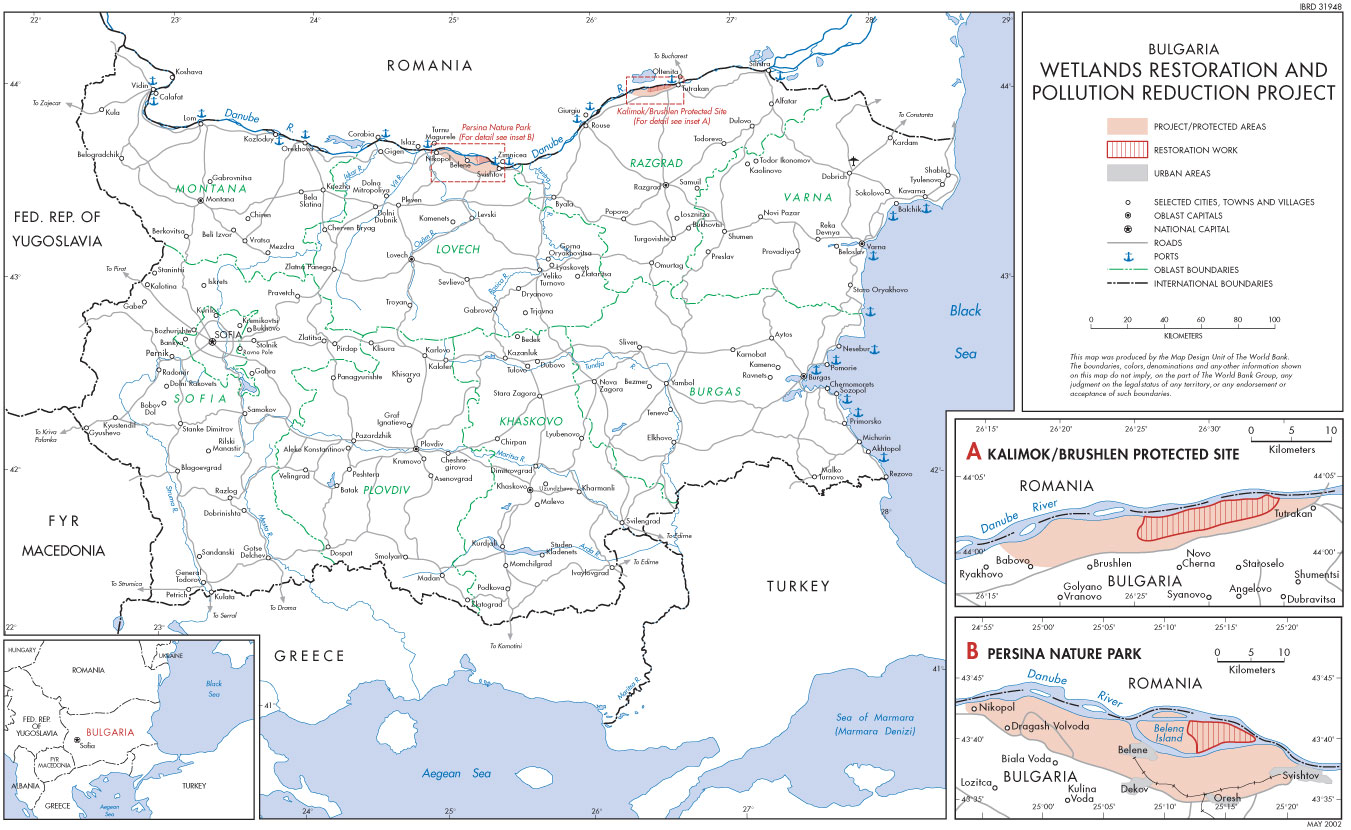
MAP
44