PROJECT BRIEF
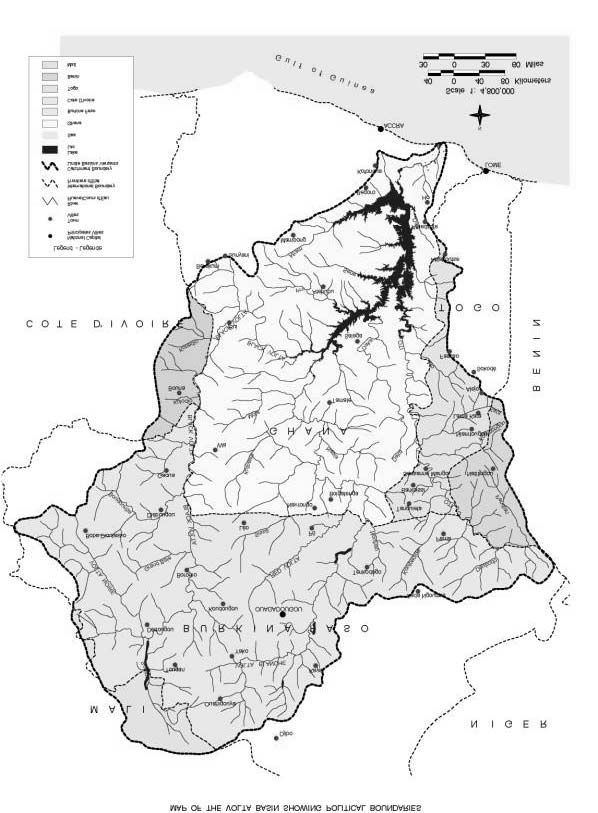
1. IDENTIFIERS:
PROJECT NUMBER
Not assigned yet
PROJECT NAME
Addressing Transboundary Concerns in the Volta River
Basin and its Downstream Coastal Area
DURATION
FOUR Years (2003 2007)
IMPLEMENTING AGENCY
United Nations Environment Programme (UNEP)
EXECUTING AGENCY
UNOPS/UCC-Water
REQUESTING COUNTRIES
Benin, Burkina Faso, Côte d'Ivoire, Ghana, Mali and Togo.
ELIGIBILITY
The countries are eligible under paragraph 9(b) of the Global
Environment Facility (GEF) Instrument. The Strategic
Action Programme is consistent with the relevant provisions
of regional and global Conventions relating to International
Waters to which the countries are signatories and/or
contracting parties.
GEF FOCAL AREA
International waters
GEF PROGRAMMING FRAMEWORK
OP 9 Integrated land and water multiple focal area, with
relevance to the water body, contaminant-based, and coastal
and freshwater ecosystems Operational Programs as well as
to Ecosystem Management.
2. Summary
This project proposal for integrated management of the Volta River basin, "Addressing
Transboundary Concerns in the Volta River Basin and its Downstream Coastal Area" has a primary
focus on some of the major environmental problems and issues of the basin leading to the degradation
of the environment by human activities. The long-term goal is to enhance the ability of the countries
to plan and manage the Volta catchment areas within their territories and aquatic resources and
ecosystems on a sustainable basis. The Project has three main components with associated objectives
identified by the root cause analysis carried out during the project preparation process: (i): Build
capacity and create a regional institutional framework for the effective management of the Volta
Basin; (ii): Develop regional policy, legal and regulatory frameworks for addressing transboundary
concerns in the Volta Basin and its downstream coastal areas; and (iii): Initiate national and regional
measures to combat transboundary environmental degradation in the Volta Basin. The activities to
be undertaken will provide a strong foundation for the long term sustainable environmental
management of the Volta Basin. A preliminary Transboundary Diagnostic Analysis (TDA) and a
preliminary Strategic Action Programme have been prepared, and these serve as the basis for
preparation of this project proposal. The full Global Environment Facility (GEF) project will update
and expand the TDA, and will develop a regionally agreed SAP, following clarification of some
aspects of the environmental status of the region as well as building grounds for SAP implementation.
The project recognizes the complex and interlinked nature of Volta River basin and aims to develop a
more sectorally-coordinated management approach, based on IWRM, both at the national and the
regional level, with a strong emphasis on an expanded role for all stakeholders within a participatory
management framework, especially the private sector. The Project will demonstrate in a replicable
manner, integrated land and water management strategies. The demonstrations will stress the
development of cross-sectoral management approaches which will address the requirements for
institutional realignment and appropriate infrastructure; adoption of new modalities for sectoral
participation; enhancement of regional capacity to manage the basin in a sustainable manner; linkages
to the social and economic root causes of environmental degradation; and the overall need for
sustainability.
-i-
3. Costs and Financing (US $)
US$
GEF: Full
Project
: 5,347,380
PDF B
: 347,500
PDF A
: 25,000
Subtotal GEF
: 5,719,880
Co-Financing:
PDF B
Governments (in cash and kind) : 90,000
UNEP (in kind)
: 25,000
Full Project
Governments (in cash and kind) : 7,639,040
UNEP (in kind)
: 60,000
European Union - indicative
: 1,500,000
Government of Canada - CIDA : 1,000,000
indicative
Government of Hungary : 10,000
indicative
Government of the Czech Rep. : 50,000
indicative
Subtotal Co-financing
: 10,374,040
Total Project Cost
: 16,093,920
4. Associated Financing (US $):
Governments
(baseline)
: 111,321,200
TOTAL :
127,415,120
- ii -
5. GEF Operational Focal Point Endorsements
Bénin
Mr. Pascal YAHA, L'Environnement de l'Habitat et de l'Urbanisme
Cotonou, Bénin. Tel: +229-315596/311480; Fax: +229-315081/311480
E-mail: pyaha@mehubenin.net
Endorsement received: March 3, 2003
Burkina Faso
Mr. Jean-Baptise KAMBOU, Ministère de l'Environnement et de l'Eau, /ou Le Conseiller Technique
du Ministre de l'Environnement et de l'Eau Ouagadougou, Burkina Faso.
E-mail: dgh@liptinfor.bf
Endorsement received: February 18, 2003
Côte d'Ivoire
Mme Alimata KONE, Deputy Director, Caisse Autonome d'Amortissement, Abidjan, Côte d'Ivoire.
Tel: 225-20-209829: Fax: 225-20-213578
E-mail: Alimat53@yahoo.fr
Endorsement received: March 3, 2003
Ghana
Mr. E. O. NSENKYIRE, Chief Director, Ministry of Environment and Science
P. O. Box M. 232, Accra, Ghana. Tel: 233-21-673336; Fax: 233-21-666828
Endorsement received: February 20, 2003
Mali
Mr. Salif Kanoute, Ministère de l'Environnement, Secretariat General, Bamako, Mali
E-mail: stp@cefib.com
Endorsement received: March 10, 2003
Togo
Mr. Yao Djiwonou FOLLY, Ministère de l'Environnement et des Ressources Forestieres
B.P. 355 Lomé, Togo Tel: 228-2214604
Endorsement received: February 26, 2003
6. Implementing Agency Contact:
Mr. Ahmed Djoghlaf, Director, UNEP/Division of GEF Co-ordination, UNEP, Nairobi, Tel: 254- 20-
624166; Fax: 254- 20- 520825/624041; Email: Ahmed.Djoghlaf@unep.org
- iii -
ACRONYMS
AFD
Agence Francaise de Developpement
AfDB
African Development Bank
AMCEN
African Ministerial Conference on the Environment
AMCOW
African Ministerial Conference on Water
AN/BO
African Network of Basin Organizations
APR
Annual Project Review
CAW
Centre for African Wetlands
CBD
Convention on Biological Diversity
CBO
Community Based Organization
CIDA
Canadian International Development Agency
CITES
Conventional on International Trade in Endangered Species
CZ Czech
Republic
DGEF Division
of
GEF Coordination
EA Executing
Agency
ECOWAS
Economic Community of West African States
EIA
Environmental Impact Assessment
EOU
Evaluation and Oversight Unit
EQO
Environmental Quality Objective
EQS
Environmental Quality Standard
EU European
Union
FAO
Food and Agricultural Organization
FP Full
Project
GCLME
Guinea Current Large Marine Ecosystem
GDP
Gross Domestic Product
GEF
Global Environment Facility
GIRE
Gestion Integrée des Ressources en Eau
GIS
Geographic Information System
GIWA
Global International Waters Assessment
GLOWA
Global Change of the Water Cycle
GNP
Gross National Product
GOV Government/s
GPA/LBA
Global Programme of Action for the Protection of the Marine and Coastal
Environment from Land Based Activities
GWP
Global Water Partnership
IA Implementing
Agency
ICAM
Integrated Coastal Area Management
ICARM
Integrated Coastal Area and River Basin Management
ICZM
Integrated Coastal Zone Management
IGBP
International Geosphere-Biosphere Program
INBO International
Network of Basin Organizations
ITCZ
Inter-Tropical Convergence Zone
IW International
Waters
IW:LEARN
International Waters: Learning Exchange and Resource Network
IWRM
Integrated Water Resource Management
LEARN Learning
Exchange and Resource Network
LME
Large Marine Ecosystem
LOICZ
Land Ocean Interactions in the Coastal Zone
LWD
Land Water Degradation
M&E
Monitoring and Evaluation
MSP
Medium Sized Project
NAP
National Action Plan
NBA
Niger Basin Authority
- iv -
NEAP
National Environmental Action Plan
NEPAD
New Partnership for Africa's Development
NFP
National Focal Point
NGO Non-Governmental
Organization
NIC
National Implementation Committee
OP Operational
Programme
PC Project
Coordinator
PDF
Project Preparation and Development Facility
PIR
Project Implementation Review
PPM
Project Planning Matrix
RCU
Regional Coordinating Unit
SAP
Strategic Action Programme
SC Steering
Committee
STAP
Scientific Technical Advisory Panel
TDA
Transboundary Diagnostic Analysis
TOR
Terms of References
TPR Tri-partite
Review
UCC - Water
UNEP Collaborative Centre on Water and Environment
UN United
Nations
UNDP
United Nations Development Programme
UNEP
United Nations Environment Programme
UNESCO
United Nations Educational; Scientific and Cultural Organization
UNIDO
United Nations Industrial Development Organization
UNOPS
United Nations Office for Project Services
USAID
United States Agency for International Development
WACAF
West and Central Africa
WARAP
West African Regional Action Plan
WATAC
West African Technical Advisory Committee
WAWP
West African Water Partnership
WB World
Bank
WHYCOS
World Hydrology Cycle Observing System
WSSD
World Summit on Sustainable Development
WWF
World Wide Fund for Nature
WWW
World Wide Web
- v -
TABLE OF CONTENTS
BACKGROUND AND CONTEXT BASELINE COURSE OF ACTION .................................................... 1
INTRODUCTION ................................................................................................................................................ 1
GEF PROGRAMMING CONTEXT ........................................................................................................... 4
REGIONAL PROGRAMMING CONTEXT ............................................................................................. 7
NATIONAL PROGRAMMING CONTEXT........................................................................................................... 9
SYSTEM BOUNDARIES .................................................................................................................................... 9
MAJOR PERCEIVED THREATS, PROBLEMS AND ISSUES ............................................................................. 10
RATIONALE AND OBJECTIVES (ALTERNATIVE).................................................................................. 12
PROJECT ACTIVITIES/COMPONENTS AND EXPECTED RESULTS .................................................. 13
RISKS AND SUSTAINABILITY...................................................................................................................... 17
STAKEHOLDER PARTICIPATION AND IMPLEMENTATION ARRANGEMENTS........................... 17
PROJECT FINANCING AND INCREMENTAL COSTS ............................................................................. 19
MONITORING, EVALUATION AND DISSEMINATION........................................................................... 22
LIST OF ANNEXES........................................................................................................................................... 24
LIST OF FIGURES
Figure 1. The Volta Basin.................................................................................................................................. 2
LIST OF TABLES
Table 1: Complementary and/or thematically linked projects ............................................................................... 6
Table 2: Workplan and Timetable Overall Duration of the Project ................................................................... 16
Table 3: Summary of Project Financing (US$ million) ........................................................................................ 20
Table 4: Summary of Baseline and Incremental Costs and Domestic Environmental Benefits ........................... 21
Table 5: M&E Activities, Timeframes, And Responsibilities .............................................................................. 23
- vi -
Addressing Transboundary Concerns in the Volta River Basin and its Downstream Coastal Area
BACKGROUND AND CONTEXT BASELINE COURSE OF ACTION
INTRODUCTION
1.
The Volta River basin is the 9th largest in sub-Saharan Africa with an estimated area of
400,000 km2. The Volta basin stretches from approximately latitude 5 0 45' N in Ghana to 14 0N in
Mali. The widest stretch is from approximately longitude 50W to 20E along latitude 110 N, but the
basin becomes more narrow towards the coast of the Gulf of Guinea. The Volta basin is spread over
six West African countries, namely Benin, Burkina Faso, La Côte d' Ivoire, Ghana, Mali and Togo
(Fig. 1, Map of the Volta basin). The relative importance of the basin in terms of areal coverage
ranges from 1% of the country in the case of Mali to almost 70% of the country in the case of Ghana.
The 6.5% of the total basin found in Togo represents over 40% of its land area. Additionally, the area
of the country within the basin might hold an abundance of natural resources with respect to the entire
country, such as in the case of Mali. Thus this project is of comparable importance for each of the six
riparian countries.
Figure 1. The Volta Basin
-1 -
Addressing Transboundary Concerns in the Volta River Basin and its Downstream Coastal Area
-2 -
Addressing Transboundary Concerns in the Volta River Basin and its Downstream Coastal Area
2.
Countries within the Volta basin have largely weak economies. The region is one of the
poorest in Africa, with average annual income estimated at US$ 800. All six countries suffer from
abject poverty, rapid urbanization, balance of payments difficulties, over-reliance on primary products
for export earnings and over-dependence on bi-lateral and multi-lateral loans. The countries are at
different stages of both political and economic development, however. Individual economic
indicators show some variation, ranging from those with a per capita gross national product (GNP) of
over $ 700 per annum to those with less than $ 200 per capita, and a debt burden ranging from 32-
122% of GNP. Similarly, national institutions reflect variations in strength and infrastructure, while
there is considerable diversity in the functioning of political systems. The worsening poverty situation
of developing countries in general, in the face of deteriorating commodity prices on the world market
and unstable world prices for third world exports, gives cause for concern, particularly in the Volta
basin where over-exploitation of natural resources due to poverty seriously threatens the ecological
integrity of the fragile environment
3.
The economic problems of the basin are further exacerbated by the high population growth
rate and relatively scarce resources of the region. Currently the Volta basin supports a population of
about 18,600,000, predominantly living in fishing and farming communities. At the present average
population growth rate of about two percent per annum, this figure is projected to rise to about
34,000,000 by the year 2025. As this population embarks on development for economic survival a lot
of pressure is put on land and forest resources. The preliminary TDA stresses the close dependence
that this ever increasing population has on the land and water resources of the basin. Changes in the
region's climate in recent decades have resulted in decreased precipitation. Overuse and misuse of land
resources have resulted in decreased run-off and degraded water quality. The region's scarce water
resources, which serve as the transboundary link between countries, are increasingly being
overcommitted for agriculture, animal husbandry and hydroelectric power generation, even as these
resources are dwindling. This is leading to conflict situations.
4.
The quantities of water needed for domestic and industrial activities, irrigation, and livestock
production are collectively referred to as the water demand. Projections for water demand are based
on growth of population and the activities envisaged to be carried out under the country's
development plans. The water demand for domestic and industrial activities is projected to increase
about 300% due to the rapid population increase and expected industrial expansion, both of which will
require an increased use of water. The water demand data for irrigation in the basin in Ghana and
Benin are projected to increase 538% and 706%, respectively. The high projections of water demand
for irrigation in the basin stem from the fact that rain-fed agriculture is becoming more precarious and
less reliable under climate change and the ensuing variable precipitation. Further, the need to produce
adequate food to feed the rising populations is a major concern of the countries in the sub-region.
5.
Throughout the Volta River basin, dams and reservoirs have been created in order to mobilize
water for agricultural, industrial, and electricity-generating purposes. The amount of these large and
small dams continues to expand as population pressure grows. Increasing use of these waters and
decreasing precipitation in the region, however, threaten continued sustainable management of the
waters in the basin. The largest dam was constructed in the early 1960s with the primary purpose of
generating electricity at Akosombo, creating one of the largest reservoirs in the world (8,500 km2).
Together with the other major Voltaian dam, the Kpong Headpond, over 1,000 MW of power is
produced in Ghana. Benin has a hydroelectric power station on the Oti River with a storage capacity
of 350 million m3 and the capacity to produce 15 MW. Additionally, a hydroelectric power station is
planned at Pouya (Natitingou) on the Yéripao. In Burkina Faso, there are now approximately 600
dams and lakes with a total storage capacity of 4.7 billion m3. Most of the impoundments in Côte
d'Ivoire, Mali and Togo are used for animal husbandry and domestic water supply.
6.
The overuse and misuse of land and water resources in the Volta basin is affecting the
region's rich biodiversity and degrading downstream coastal ecosystems. The Volta basin, apart from
having the largest man made lake in the world, is noted for the attractiveness of its habitats, its relatively
high biodiversity, and its rich aquatic resources. In Burkina Faso alone 3,801 plant and 2,394 animal
-3 -
Addressing Transboundary Concerns in the Volta River Basin and its Downstream Coastal Area
species were counted in the White and Black Volta basins. In Ghana about 33 animal species of
global significance are found within the Volta basin. At the coast, the two coastal lagoons associated
with the Volta designated as Ramsar sites contain Ghana's most species-diverse mangrove forest and
regularly host tens of thousands of migratory birds. The indicators of environmental degradation
including significant coastal erosion, as well as a decline in natural resources and biodiversity, are
beginning to become more apparent. This fact is attributed to the growing population, as well as
increasing pressure from agriculture and over-exploitation of natural resources.
7.
In 1998, recognizing the need to address priority transboundary concerns in the basin, Ghana
and its respective authorities proposed an initiative on integrated ecosystem management of the Volta
River basin, which resulted in the GEF PDF-A grant awarded in 1999. At the Accra Workshop,
which was held in 1999 as a part of the PDF-A grant activities, a working group comprising the six
riparian countries (Benin, Burkina Faso, Côte d'Ivoire, Ghana, Mali and Togo) focused on the
identification of the perceived water-related environmental problems. This regional inter-ministerial
meeting resulted in the Accra Declaration, which was a statement formally agreeing to collaborate on the
integrated management of the Volta basin and strongly recommended the preparation of a project
document seeking funds from GEF for this purpose. Preparation of the present project brief, together
with the preliminary TDA and SAP, was facilitated through a Global Environment Project Development
Facility Block-B (GEF PDF-B) grant.
8.
A combination of the climatic, ecological, economic and demographic problems makes the
region very susceptible to environmental damage when inappropriately managed. The project aims at
the creation of a regionally agreed Strategic Action Programme (SAP) for the integrated management
of the Volta River basin and at building the grounds for its implementation. The goal is to enhance
the ability of the countries to plan and manage the Volta catchment areas within their territories and
aquatic resources and ecosystems on a sustainable basis. The project will address issues such as the
lack of capacity, poor coordination, overlapping responsibilities, sectoral approaches to natural resource
development, and inadequate enforcement of laws within participating states. The SAP is consistent
with the objectives and content of the Accra Declaration, and with the objectives laid out in Agenda 21,
Chapter 18, of the Rio Declaration.
9.
The preliminary transboundary diagnostic analysis (TDA) carried out identified the supra-
national threats and responses. The TDA was based on national reports and analyses, and on regional
technical consultations and studies which took place in the past two years. The officially approved
reports have been prepared by national committees with broad-based consultation that identified the
priorities of each country following the procedure given in the PDF-B document. A preliminary SAP
was developed that describes a regional process for coordinating existing and new regional initiatives. It
identifies priority actions, activities and programmes in relation to specific environmental quality
objectives, targets, and associated actions designed to achieve a long-term balance between our growing
populations and the carrying capacity of the Volta basin. The preliminary SAP was based on the national
environmental policies, plans, and on priorities identified at a national level. Risk assessment criteria
were applied to identify priority regional threats, responses, and targets.
GEF PROGRAMMING CONTEXT
10.
The programming context and the design of the Preliminary SAP and the present project is
directed to the GEF Operational Programme #9 which states: "these projects focus on integrated
approaches to the use of better land and water resource management practices on an area-wide basis.
The goal is to help groups of countries utilize the full range of technical, economic, financial,
regulatory, and institutional measures needed to operationalize sustainable development strategies for
international waters and their drainage basins (para 9.2)." The present project proposal meets these
requirements and will assist the countries of the Volta basin in meeting their obligations under various
global conventions relating to biological diversity and climate change. The draft SAP attempts to
-4 -
Addressing Transboundary Concerns in the Volta River Basin and its Downstream Coastal Area
address some of those problems which are particular to the Volta basin, as indicated in the preliminary
TDA.
11.
The project is essentially regional and transboundary in nature and will enable the states of the
basin to build new and improve on existing regional cooperative frameworks, ensure adherence to
international conventions, as well as strengthen national laws, regulations, and management regimes to
improve the likelihood of sustainability of resource use and reduce existing and potential degradation.
The implementation of this project, and ultimately the SAP, will result in regional, and by extension
global, environmental benefits through protection of international waters, their resources, and sustainable
use of resources in conformity with the objectives of GEF Operational Program 9 i.e., "to achieve global
environmental benefits though the implementation of sound land and water management strategies as a
result of changes in sectoral policies and activities that promote sustainable development.
12.
Under the Integrated Land and Water Multi Focal Area Operational Programme 9, several
outputs from IW projects are envisaged. These include:
a. a comprehensive transboundary environmental analysis identifying top priority multi-
country environmental concerns;
b. a strategic action programme consisting of expected baseline and additional actions
needed to implement an integrated approach to land and water resources management;
c. documentation of stakeholder participation to determine expected baseline and additional
actions to be implemented as well as community involvement in the project; and
d. implementation of measures related to integrated management of land and water resources
that have incremental costs and that can generate global environmental benefits in several
focal areas.
The project proposed will address all of the above points. The main stakeholders of the proposed
project are the users of the natural resources, and those whose livelihood depends on the natural
resources of the Volta basin. Ministries of environment, ministries with control of land and water
resources, as well as new institutions created by the project will play a key role in the implementation
of project activities, thus enhancing capacity within the institutions as well as complementing and
strengthening existing national efforts to address environmental issues. Implementation of the final
SAP will thus assist in the conservation of natural resources and assist the countries in complying with
their national and regional obligations under various international conventions. At a global level, the
project and its SAP put together regional and national activities into a coherent component of the
global environmental protection effort.
13. The present project also is consistent with the recent Draft GEF International Waters Focal Area-
Strategic Priorities in Support of WSSD Outcomes for FY 2003-2006. This document lists various
priorities, including:
Priority 1. Expand global coverage of foundational capacity building addressing the two key program
gaps with a focus on cross-cutting aspects of African transboundary waters and support for targeted
learning and
Priority 2. Undertake innovative demonstrations for reducing contaminants and addressing water
scarcity issues with a focus on engaging the private sector and testing public-private partnerships.
The present project will directly assist in addressing one of the key International Waters gaps:
addressing water scarcity/competing uses of the resource, including those resulting from climatic
fluctuation. The project will also assist in achieving the targets for these priorities for addressing
African Transboundary waters.
14.
In this project attention will be given to strengthening the GEF Strategic Partnership for
Interagency Collaboration on Land and Freshwater Degradation in Africa, "GEF Land and Water
Initiative for Africa". This project proposal is part of a wider GEF regional effort. Below are listed
-5 -
Addressing Transboundary Concerns in the Volta River Basin and its Downstream Coastal Area
(Table 1) the GEF projects in the region (under implementation or in GEF pipeline) that are
complementary and/or thematically linked to the project for the Volta River basin.
15.
This project proposal will contribute strongly to the establishment of a coordination and
information exchange mechanism among the GEF project in the region, particularly river basin
management projects, as described in relevant sections of this Project Brief.
16.
Other thematically linked GEF projects under OP 9/OP1/OP2/OP12/OP10, as well as those
that are overarching or global (e.g., UNEP: "Finalization of the Action Plan on the Environmental
Component of the New Partnership for Africa's Development"; UNEP: "Global International Waters
Assessment"; WB: "Towards a Lake Basin Management Initiative and a Contribution to the Third
World Water Forum: Sharing Experiences and Early Lessons in GEF and non-GEF Lake Basin
Management"; UNDP/UNEP: "Strengthening Capacity for Global Knowledge - Sharing in
International Waters (IWLEARN)"), call for a targeted collaboration. This project will directly
contribute to collaboration among these projects.
Table 1: Complementary and/or thematically linked projects:
· UNDP/WB (OP 9): Reversing Land and Water Degradation Trends in the Niger River Basin (Benin, Burkina Faso,
Cameroon, Chad, Guinea, Ivory Coast, Mali, Niger, Nigeria)
· UNDP/WB (OP 9): Reversal of Land and Water Degradation Trends in the Lake Chad Basin Ecosystem (Cameroon,
Central African Republic, Chad, Niger, Nigeria)
· WB/UNDP (OP 9): Senegal River Basin Water and Environmental Management Program (Guinea, Mali, Mauritania,
Senegal)
· WB/UNDP (OP 9): Nile Transboundary Environmental Action Project, Phase I (Burundi, Congo DR, Egypt, Eritrea,
Ethiopia, Kenya, Rwanda, Sudan, Tanzania)
· UNDP/UNEP (OP 9): Combating Coastal Area Degradation and Living Resources Depletion in the Guinea Current
LME through Regional Actions (Angola, Benin, Cameroon, Congo DR, Cote d'Ivoire, Gabon, Ghana, Equatorial
Guinea, Guinea-Bissau, Liberia, Nigeria, Sao Tome and Principe, Sierra Leone, Togo)
· WB (OP 1): West Africa Pilot Community-Based Natural Resource and Wildlife Management Country Regional
(Burkina Faso, Cote d'Ivoire)"
· UNEP (OP 1): Building Scientific and Technical Capacity for Effective Management and Sustainable Use of Dryland
Biodiversity in West African Biosphere Reserves (Benin, Burkina Faso, Cote d'Ivoire, Mali, Niger)
· UNDP (OP 1): Community-based Conservation of Biodiversity in the Transborder Buffer Zones of the W, Arly and
Pendjari National Parks (Benin, Burkina Faso, Niger)
· UNEP (OP 2): Development of Best Practices and Dissemination of Lessons Learned for Dealing with the Global
Problem of Alien Species that Threaten Biological Diversity Global (Cote d'Ivoire, Czech Republic, Kenya, Malawi,
Mauritius, New Zealand, Poland, South Africa)
· WB (OP 2): Coastal Zone Integrated Management Program (Benin )
· WB (OP 2): Coastal Wetlands Management (Ghana)
· UNDP (OP 2): Control of Exotic Aquatic Weeds in Rivers and Coastal Lagoons to Enhance and Restore Biodiversity
(Cote d'Ivoire).
· UNEP (OP 2): Enhancing Conservation of the Critical Network of Wetlands Required by Migratory Water Birds on the
African Eurasian Flyways (Estonia, Hungary, Lithuania, Mauritania, Niger, Nigeria, Senegal, Gambia, South Africa,
Tanzania, Turkey)
· UNEP (OP 12): Integrated Management of the Fouta Djallon Highlands
· UNDP/UNEP (OP 12): Integrated Ecosystem Management of Natural Resources in the Transboundary Areas of Niger
Republic and Nigeria (Niger, Nigeria)
· WB (OP 12): Climate, Water and Agriculture: Impacts on and Adaptation of Agro-Ecological Systems in Africa
(Burkina Faso, Cameroon, Egypt, Ethiopia, Ghana, Kenya, Niger, Nigeria, Senegal, South Africa, Zambia, Zimbabwe)
· UNDP (OP 12): Coping with Drought and Climate Change: Best Use of Climate Information for Reducing Land
Degradation and Conserving Biodiversity (Burkina Faso, Ethiopia, Kenya, Mali, Mozambique, Niger, Senegal,
Zimbabwe)
· UNEP (OP 10/POPs): Reducing Reliance on Agricultural Pesticide Use and Establishing a Community-based Pollution
Prevention System in the Senegal and Niger River Basins (Benin, Guinea, Mali, Mauritania, Niger, Senegal)
-6 -
Addressing Transboundary Concerns in the Volta River Basin and its Downstream Coastal Area
REGIONAL PROGRAMMING CONTEXT
17.
The issues raised by the preliminary TDA and SAP make it clear that the region as a whole
lacks the capacity and the information base for the integrated management of the Volta basin, linked
also to lack of capacity for Integrated Coastal Zone Management (ICZM) / Integrated Coastal Area
Management (ICAM) and for the Integrated Coastal Area and River Basin Management (ICARM)
approach. This is the background from which the project has been formulated. The preliminary SAP
indicates that there would be minimal overlap between this project and the other activities which are
taking place in the basin.
18.
The project builds on the recently completed UNEP/GEF-Medium Sized Project
"Development and Protection of the Coastal and Marine Environment in Sub-Saharan Africa",
catalyzing the establishment of a pioneering initiative called the African Process. This GEF-MSP
project consisted of two phases which identified the most feasible and tractable options for addressing
priority environmental issues affecting the coastal interface, on the basis of comprehensive national
studies, carried out by African experts and based on existing information and data. Five themes were
defined jointly by the African experts as priority areas for project development: coastal erosion,
management of key ecosystems and habitats, pollution, sustainable use of living resources and
tourism. The African Process identified a series of hot spots and sensitive areas in their review of the
sub-Saharan countries. The extensive work arising from the African Process will serve as a basis for the
present project selection of hot spots and sensitive areas for demonstration projects.
19.
This project also contributes to the implementation of the Action Plan for the Conservation
and sustainable use of coastal, marine and related freshwater resources of the Environmental
Component of the New Partnership for Africa's Development (NEPAD). The overall objective of the
programme area "Coastal, Marine and Freshwater Resources" is to support the implementation of the
objectives of the Abidjan and Nairobi Conventions; to contribute to the implementation of the
decisions of the Super PreCom of the African Process regarding the management of Africa's coastal
and marine resources in an integrated manner which were reaffirmed by the Partnership Conference
held during WSSD in Johannesburg; and to support the elaboration and implementation of the
African Regional Programme of Action on freshwater which shall be adopted at the first session of the
African Ministerial Conference on Water (AMCOW) in 2003.
20. The proposal is fully complementary to the UNDP/UNEP GEF project in PDF B phase focused
on the Guinea Current Large Marine Ecosystem to assist sixteen countries in West Africa bordering
the Guinea Current, from Guinea Bissau in the North to Angola in the South, in order to achieve
environmental and resource sustainability. The new project is a continuation of the pilot phase, which
was implemented in six countries of the Gulf of Guinea Large Marine Ecosystem under funds
allocated by the Global Environment Facility (GEF). The goal of the new project is to build the
capacity of Guinea Current Countries to work jointly and in concert with other nations, regions and
GEF projects in West Africa to define and address priority transboundary environmental issues within
the framework of their existing responsibilities under the Abidjan Convention and its Regional Seas
Programme. In this context should be also noted that assessments under the ongoing UNEP/GEF
project "Global International Waters Assessment" have already been carried out in the Volta basin
countries and formed part of the information base for the national reports.
21.
The Project Brief is also entirely consistent with the Global Programme of Action for the
Protection of the Marine and Coastal Environment from Land Based Activities for the WACAF
region. The GPA/LBA for the WACAF region identifies three priority areas; (i) the decline of water
quality, due to land based human activities, such as the introduction of sewage and wastewater from
industrial, domestic, and agricultural runoff as well as coastal urbanization; (ii) physical degradation
and habitat modification; and fishery resources depletion and loss of marine biodiversity.
-7 -
Addressing Transboundary Concerns in the Volta River Basin and its Downstream Coastal Area
22.
Within the region there are several policies and initiatives that can provide support and
information for the Volta Project. This Project Brief is in agreement with the water policies of the
African Development Bank (AfDB) whose Water Supply and Sanitation Sector Policy adopted in
1989 and the draft Integrated Water Resources Management Policy both assign high priority to social
issues such as women, and environmental issues such as water resources management, wastewater
disposal, solid waste disposal and toxic waste management. The AfDB might also be expected to play
a role in the provision of additional finances. The project is also in agreement with the World Bank
Freshwater Initiative for Africa, the Bank's Water Resources Management Policy Paper, the Bank's
Africa Region Water Resources Management Strategy and the Bank's Africa Water Resources
Management Initiative. All the World Bank initiatives stress the need for integrated water resource
management and the need to build local capacity, which is exactly what the Project Brief proposes.
The World Bank supported the Sub-Saharan Africa Hydrological Assessment that provided the basis
for WHYCOS in West Africa; this project will provide valuable regional level information as required
to the update of the TDA. The West African Technical Advisory Committee of the Global Water
Partnership GWP/WATAC) will add value to the Volta project as the evaluation of its interventions will
serve as a valuable source of information on the appropriate mechanisms that the Project will seek to put
in place. The GLOWA Volta project between partners in Ghana, Burkina Faso and Germany and a
sub - regional programme on wetlands, the Centre for African Wetlands (CAW) are both potential
institutions that can play a role in capacity building and research that the Project Brief fosters. New
projects under development such as the AfriCat initiative of IGBP-LOICZ which was based on a
regional assessment called AfriBasins, are being designed using the Project Brief as a backdrop to
avoid duplication and with the aim of adding value to the existing situation as regards the information
base on the Volta. The project is also linked to the Sub-Regional Action Programme of the United
Nations Convention to Combat Desertification and its thematic area on sustainable management of
shared water resources. UNEP's initiative River Basin Information System, aimed to establish the
framework for the integrating data from the sub-regional to global level, focuses i.a on the
implementation of the GIWA project in Africa with emphasis on selected areas (transboundary river
basins). The Volta basin is intended to be a case study for this initiative.
23.
It should be noted that much discussion has taken place on the Volta and on the West African
sub-region at various fora, such as the Bonn International Freshwater Conference, the Accra Water
Partnership meeting, the GEF International Water Conferences (e.g., Dalian), the World Summit on
Sustainable Development, as well as at various ministerial level meetings such as the African Ministerial
Conference on the Environment (AMCEN) and the African Ministerial Conference on Water
(AMCOW). These meetings have all emphasized the need for the type of interventions that have been
proposed in the preliminary SAP, which this Project Brief seeks to develop further.
24.
During the PDF-B phase of the Volta River Basin Project, efforts were made to establish
linkages with basin organizations in the region with the view to learning from their experiences. The
basins include the Senegal, Niger, Nile and Lake Chad. A close relationship was established with the
Niger Basin Authority (NBA) which is currently involved in the UNDP/WB project proposal
"Reversing Land and Water Degradation Trends in the Niger River Basin". The Volta project will
build on these partnerships and seek to learn from the experiences of these projects through a series of
executing and implementing agency meetings. The GEF Volta River Basin Project will also link with
the African Network of Basin Organizations (ANBO). This network was established during the
Consultative General Assembly in Dakar between 10 and 11 July 2002, by a group of basin
organizations of West Africa supported by Water Partnership of West Africa (GWP/WAWP) and
International Network of Basin Organizations (INBO). The objective of the African Network is to
promote integrated water resource management at the level of river basins. The present project will
enhance capabilities and strengthen institutions in the region, which other projects will benefit from.
They include several projects either operational or in the GEF pipeline as recorded in the above
section on GEF Programming Context.
-8 -
Addressing Transboundary Concerns in the Volta River Basin and its Downstream Coastal Area
25.
The Africa Water Forum is also working for improvements in the policies concerning water
issues in Africa. The organization is mainly based on communication and networks. The ultimate
aim is to manage water resources better, as well as to utilize, develop and protect them for the benefit
of the people of Africa. The European Commission is also promoting the development of the EU
Water Initiative with the overall target of halving the proportion of people lacking access to safe
drinking water by 2015, together with a complementary target on sanitation. The EU/Africa strategic
partnership on water affairs and sanitation was signed during WSSD at Head of State level. Support to
transboundary river and lake basin management is a focus of this partnership. Moreover, the Water
Initiative aims to ensure the health of aquatic ecosystems and balance the water needs of the
environment with the water needs for economic development and agricultural purposes. The
objectives of the initiative are to be implemented through integrated water resource management
based on a river basin approach, with strong involvement of the public in an open and transparent way
and will be based on a strategic partnership with civil society stakeholders and the private sector.
These aims again fall within the actions that would be developed through this project in the updated
and revised SAP. Recently Canada has given a major focus on African development including water
management focal area. Canadian International Development Agency (CIDA) has expressed an
interest in supporting policy/strategy development and building capacity for the implementation of
policies and plans for sustainable water resources management in Africa in particular, management
of international river basins among which the Volta basin is one. As a consequence, Global Water
Partnership (GWP) is currently preparing an "Action Partnerships Programme for Sustainable African
Water Development" for the Canadian Government as a support of the present GEF project.
NATIONAL PROGRAMMING CONTEXT
26.
In the preliminary TDA, information is presented on the several and various types of
interventions that countries are currently undertaking. Some of these IWRM country initiatives being
run in Volta basin countries include; GIRE (IWRM) in Burkina Faso, Water resources management in
Benin, water resources monitoring and the establishment of the Water Resources Commission in
Ghana. These interventions are being undertaken under the aegis of the West African Regional
Action Plan for Integrated Water Resources Management (WARAP IWRM) as a regional
cooperation arrangement within the Economic Community of West Africa States (ECOWAS) and
they are entirely consistent with the Project Brief.
27.
The implementation of this project will supplement existing bi-lateral and national efforts to
address environmental issues in the Volta Basin. The interventions proposed include the preparation of
National Action Plans, the development of regulatory regimes for water conservation and management,
and the preparation of catchment management plans. These activities and management frameworks are
designed to assess or manage transboundary impacts from the priority environmental problems. This
project with its SAP based on the preliminary TDA, contains several priority actions that will enhance
the ability of countries of the Volta basin to implement existing legal frameworks for the management of
natural resources and increase the ability of the riparian states to reduce regional and transboundary
environmental problems, i.e., to move the scale of operation from the national level in the National
Action Plans, to the regional level.
SYSTEM BOUNDARIES
28.
The area for project activities is defined as follows:
a) The countries of the Volta basin: Benin, Burkina Faso, Côte d'Ivoire, Ghana, Mali and Togo.
b) The approximate inland boundaries are defined as the limits of the drainage basins of the tributaries
of the Volta. These fall in the area of 4° 45' W to 2° E and 5° 45' N to 14° N.
-9 -
Addressing Transboundary Concerns in the Volta River Basin and its Downstream Coastal Area
c) The coastal area of influence to be considered by the project is defined as the coastline of Benin,
Ghana, and Togo from Longitude 0° 38' to 2° 42` E.
It is important to note that the Volta project will link freshwater basin management with coastal and
marine ecosystem. This coastal area forms part of the Gulf of Guinea Large Marine Ecosystem and as a
result the project activities will have an effect on the coasts of countries to the east of Benin.
29.
Based on the current systems prevailing in the region, one Large Marine Ecosystem (LME) has
been identified, namely: the Gulf of Guinea LME. This forms the southern system boundary to the
project area. The Guinea Current system is a warm current, which lies between two cold current
systems, the Canary Current to the north and the Benguela Current to the south. This LME covers
several key coastal ecosystems such as mangroves and coastal lagoons and its resources are shared by
several countries in the Volta Basin. The Guinea Current LME is directly impacted by the activities,
both land and water based, that take place in the Volta basin.
MAJOR PERCEIVED THREATS, PROBLEMS AND ISSUES
30.
As a part of activities in the project preparation phase supported by a GEF PDF-B grant,
national reports were produced which provided information on the problems relating to the priority
transboundary environmental concerns in the Volta Basin. The information contained in the national
reports and the outputs of meetings of regional coordinators were put together and a Causal Chain
Analysis, a preliminary TDA and a preliminary SAP were prepared. The preliminary TDA identified
the following list of major perceived problems and issues. The main existing concerns identified in
the basin are:
1. Land degradation
2. Water
scarcity
3. Loss of biodiversity
4. Flooding
5. Water-borne
diseases
6. Growth of aquatic weeds
7. Coastal erosion
8. Water quality degradation
In addition there are two emerging problems/issues
· Urbanization
· Increase in Industrial and Mining Activities
Although a number of environmental problems were identified in the preliminary TDA, this project
focuses on water scarcity as the priority transboundary concern in the Volta Basin.
Water Scarcity
31.
One of the critical issues identified in the preliminary TDA was water scarcity. The water
resources in the basin do not currently meet the needs of the population. As the basin population may
increase by as much as 80% over the next 25 years, water resources are going to become even more
scarce. This scarcity is likely to be even further exacerbated by decreased availability of water
resources due to climatic and anthropogenic factors.
32.
The major transboundary elements of the problem include the drying up of streams in the
upper sub-catchment of the basin, which can induce drying up or reduction of flows in the
downstream rivers in other countries. Streams upstream can dry up as a result of human induced
actions such as deforestation of the headwaters and the gallery forest along the river channels.
-10 -
Addressing Transboundary Concerns in the Volta River Basin and its Downstream Coastal Area
Rampant expansion in the number of barrages and reservoirs is another example. Thus, altering land
surfaces and stream flows in such a way that results in the drying up of streams is a transboundary
issue. Another transboundary element is based on the fact that changes of land cover and poor
precipitation reduce recharge of groundwater aquifer systems. In the basin, some of the scarce
aquifers are shared among the riparian countries and human activities in the recharge zone can be a
transboundary problem. Also, over-exploitation of groundwater resources through poor water
resource development and planning can also create transboundary causes of water scarcity. This
factor is particularly pertinent since the aquifers are limited in capacity, on average, throughout the
basin. The impoundments and reservoirs in the basin lose water through evaporation; the larger the
surface area of the reservoir, the greater the evaporation. Reservoir systems constructed with large
surface areas and shallow depths because of lack of suitable topography can potentially lose large
amounts of water and create a water deficit downstream (such as Volta Lake in Ghana). The effects of
water scarcity can also be of a transboundary nature. When there is inadequate water for hydroelectric
power generation, electricity cannot be exported to those countries in need in the basin, resulting in
economic loss. Inadequate water supplies for people and livestock have induced significant migration
(transhumance) across boundaries in search of water resources.
33.
The major environmental impacts of water scarcity include the loss of biodiversity and the
modification or destruction of habitats which negatively affects the fisheries resources of the basin.
The reduction in groundwater and loss of soil productivity are additional environmental impacts.
34.
The key socio-economic impacts of water scarcity in the Volta basin are the shortage of
drinking water, the decline in drinking water quality and the increased cost of alternative water
supplies. The lack of water also means a reduction in agricultural production and forest resources. As
much of the energy in the basin is generated by hydropower, lack of water results in reduction in
hydroelectric power generation and increased costs of electricity.
35.
The root causes of water scarcity include:
· Inadequate technology
· Drought
· Low government priority on environment
· Abuse of power
· Poverty
· Insufficient demonstration projects
· Inadequate legal/regulatory basis
· Insufficient economic incentives
· Inadequate intersectoral coordination
· Insufficient regional agreements
· Insufficient knowledge/understanding
· Inadequate institutions
36.
The preliminary Transboundary Diagnostic Analysis provides more comprehensive
information on the root causes and sources of the identified problems, including water scarcity. The
preliminary Strategic Action Programme gives an initial iteration of the various actions and
interventions to be taken under the headings of three overarching Environmental Quality Objectives
supported by concrete targets, which are given below, to address these major perceived problems and
issues through mitigation and/or elimination of the root causes. The evidence from the TDA/SAP
indicates that there are a multiplicity of organizations and institutions that deal with various aspects of
basin management in isolation, which often develop policies and programmes which then result in
conflicting interventions. There are also a large number of laws each, dealing with different aspects of
basin management, which negates a holistic approach. Management in the basin clearly lacks
participation of civil society in sustainable development initiatives and there is a general lack of
understanding and awareness at all levels of the link between the environment, the economy and
society.
-11 -
Addressing Transboundary Concerns in the Volta River Basin and its Downstream Coastal Area
RATIONALE AND OBJECTIVES (ALTERNATIVE)
37.
The broad development goal of this project is to address the transboundary major perceived
problems and issues of the Volta Basin leading to the degradation of the environment as a result of
human activities, by reducing those activities that lead to water scarcity land and water degradation
(LWD).
38.
To satisfy the broad development goal, the project has three major components, namely:
Component 1: Build capacity and create a regional institutional framework for the effective
management of the Volta Basin;
Component 2: Develop regional policy, legal and regulatory frameworks for addressing
transboundary concerns in the Volta Basin and its downstream coastal areas;
Component 3: Initiate national and regional measures to combat transboundary
environmental degradation in the Volta Basin.
39.
The TDA identified the major perceived problems and issues in the basin and then analyzed
the root causes, based on this analysis. The project proposes the three components in paragraph 29 to
address the highest priority problem in the basin: water scarcity. These components were developed
in part to address clear deficiencies and needs identified in the preliminary Strategic Action
Programme (Optional Annex E). The preliminary SAP lists three overarching Environmental Quality
Objectives as a basis for long-term action to improve the Volta River Basin environment. Certain
themes are repeated in these EQOs, including the need for capacity building, institutional
strengthening, priority setting (National Action Plan and Strategic Action Plan process), and the need
to initiate demonstration of technologies and approaches to effective river basin management. The
present GEF project addresses these four concrete aspects that are identified in the EQO process in the
preliminary SAP.
Balanced aquatic ecosystem
· Achieve adequate surface water quality by 2012 (Indicator: water quality monitoring shows
stable water quality by 2012)
· Restore natural surface water flow by 2012 (Indicator: regional water agreements in place for
all major rivers in the area by 2012)
· Achieve sustainable fisheries development by 2012 (Indicator: national report on fisheries
indicate stabilized fisheries resources by 2012)
· Arrest wetland loss by 2012 (Indicator: wetlands surveys show stability in amount of wetlands
by 2012)
· Begin implementation of riverine biodiversity conservation strategy by 2008 (Indicator:
biodiversity conservation strategy has been developed and national reports indicate that
implementation has begun by 2008)
Stabilized high-quality freshwater supplies
· Achieve adequate freshwater quantity by 2012 (Indicator: regional water agreements in place
for all major rivers in the area by 2012)
· Achieve adequate groundwater quality and quantity by 2012 (Indicator: groundwater surveys
show stable levels of contaminants of concern and stable water tables by 2012)
Sustainable land use
· Reduce rate of land degradation by 20% by 2012 (Indicator: aerial surveys combined with
ground-truthing indicates that the rate of land lost to erosion, desertification and deforestation
is reduced by 20% by 2012)
· Reduce coastal erosion rates by 25% by 2012 (Indicator: aerial surveys combined with
ground-truthing indicates that the human-induced component of the rate of coastal erosion is
reduced by 25% by 2012)
-12 -
Addressing Transboundary Concerns in the Volta River Basin and its Downstream Coastal Area
PROJECT ACTIVITIES AND EXPECTED RESULTS
40.
The three principal components offer the greatest potential project benefits in terms of
environmental protection from both national and transboundary perspectives over the interval of the
next four years. The three principal components and their associated objectives were developed for
the project based on the areas of threats identified by the preliminary TDA and SAP. These major
components have associated objectives, activities, results and indicators, which are listed below in
summary form. The full list of activities is detailed in Annex D.
Component 1: Build capacity and create a regional institutional framework for the effective
management of the Volta Basin.
Objective: Establish a sustainable institutional framework for Volta Basin management involving
stakeholders.
Activities:
1.1 Establish the Project Management and Coordination mechanism through a Regional
Coordination Unit to be hosted within the Ghana Environmental Protection Agency in Accra,
and consisting of a Project Coordinator, a Scientific Officer and a bilingual Administrative
Assistant/Secretary; Establish and empower the Project Steering Committee, including
nomination/ installation of the National Focal Points and establishment of an Inter-Ministerial
Coordination Committee in each country
1.2 Determine and satisfy training needs for addressing priority transboundary concerns in the
Volta Basin and downstream coastal areas, focusing on water scarcity
1.3 Identify, strengthen and involve stakeholders
1.4 Establish a river basin management framework by drafting the framework document for the
Volta Basin Commission/Authority and obtaining national endorsements for the
Commission/Authority and generate national (baseline) budgets for the
Commission/Authority
1.5 Develop databases, GIS, and environmental monitoring system protocols with common
guidelines to evaluate effectiveness of Project toward reaching EQOs
1.6 Establish a regional clearing house mechanism for the exchange of environmental data and
information and lessons learned from all relevant projects in the region at national, sub-
regional and regional levels through web-based informational packages, the IWLEARN
database, newsletters, etc.
41.
These activities concentrate on creation of the enabling environment and the institutions that
are required for the effective management of the Volta basin. As no regional mechanism is in place, an
establishment of a sustainable institutional frameworks for Volta basin management is one of key
objectives to satisfy the long-term goal of enhancing ability of the countries to plan and manage the
Volta catchments areas within their territories and aquatic resources and ecosystems on a sustainable
basis. Therefore this component (in particular, project management structure) requests large
increment. The component represents stakeholder activities, focusing on training, education, and
public-private sector partnerships, all of which are essential for the project to succeed (see Para. 49)
for stakeholder list). The component will also include project management and coordination, and
project steering and monitoring at the regional level. A key to the long-term sustainability of project
activities is the creation of a new basin framework/organization a basin authority or commission.
The component will also ensure the preparation of the updated TDA and a fully developed SAP.
Results:
· Established Regional Coordination Unit
· Established Project Steering Committee, including National Focal Points, and Inter-
Ministerial Coordination Committees
· Developed and implemented public involvement plan, including education
-13 -
Addressing Transboundary Concerns in the Volta River Basin and its Downstream Coastal Area
· Sustainable framework for long-term management of the Volta Basin developed
· Training programs developed for three priority transboundary concerns; training sessions
conducted in each of the basin countries
· Increased knowledge and awareness by local stakeholders of land and water degradation
issues
· Framework document agreed upon and completed
· Database and environmental monitoring system protocols developed
· Established basin-wide clearinghouse for data and information exchange
· Improved national and regional capacities for effective environmental management of land
and water degradation
Component 2: Develop regional policy, legal and regulatory frameworks for addressing
transboundary concerns in the Volta Basin and its downstream coastal areas.
Objective: Establish policy, legal and institutional frameworks for addressing transboundary
concerns in the basin, including a regional convention for basin management, NAPs and an updated
and endorsed SAP.
Activities:
2.1 Finalize and agree on the final, geographically specific, quantitative TDA
2.2 Assist all six countries to develop NAP's that address issues of priority transboundary
concerns
2.3 Create management plans for addressing priority transboundary concerns in identified
hotspots, including hotspots identified through the African Process, and finalize and endorse
SAP with concrete investments identified to address priority transboundary problems with a
focus on water scarcity
2.4 Develop basin-wide agreements for sharing water resources and for control of river flow
regimes
2.5 Legal and Institutional review of and harmonization of national water conservation and
management and land tenure laws
2.6 Develop and ratify a convention/protocol for the rational management of the Volta Basin by
the proposed Volta Basin Commission/Authority
2.7 Enhance and develop legal basis and policy framework to sustainably manage the basin
42.
Activities focus on improving the policy and legal framework for successful management of
the Volta basin by starting with improving national policy and legislation, assisting countries in
developing National Plans of Action, management plans and strategies, as well as enhancing their
ability to implement international conventions, the proposed activities under these components would
go on to regional approaches.
Results:
· Finalized TDA including geographically-specific data on priority transboundary concerns
· Convention/protocol developed and signed by all countries
· Concrete national policy/legal/institutional gaps identified and process established for
correcting these gaps
· NAP's prepared and endorsed by all countries, including both legal and regulatory reform, as
well as concrete investments
· Management plans for addressing priority transboundary concerns developed
· SAP endorsed by countries with National and donor commitment to funding SAP and
Workplan elements
Component 3: Initiate national and regional measures to combat transboundary environmental
degradation in the Volta Basin.
-14 -
Addressing Transboundary Concerns in the Volta River Basin and its Downstream Coastal Area
Objective: Initiate national and regional measures to address transboundary environmental concerns
through demonstration projects and creation of partnerships with the private sector and other projects.
Activities:
3.1 Develop guidelines for the management of land and water based on an effective regional EIA
3.2 Implement three demonstration projects in identified hotspots addressing the following: water
conservation, sewage treatment, coastal erosion and sediment bypassing, or wetlands
protection. Hotspots and sensitive areas identified through the African Process will be
considered for demonstration project sites. Integrate the private sector into activities of this
project, as appropriate, as sub-contractor, consultant, or co-sponsor of specific activities.
3.3 Agree on performance indicators for the Volta Basin management project through a broad
stakeholder process and a process to monitor those indicators
3.4 Coordinate and collaborate with other IAs and EAs to develop a coordination mechanism with
other Sahel basin projects, with the GCLME, and with other complementary projects in the
region, and to organize and host one regional meeting in an agreement and cooperation with
the other two GEF IAs.
43.
These activities initiate measures to combat environmental problems in the region and
evaluate the success of the project. The activities include the establishment of regionally agreed upon
performance indicators and the process to monitor these. The development of a basin-wide
monitoring programme within this component will provide the information required to monitor and
evaluate project progress. This project will deliver real benefits to the local people by the
implementation of demonstration projects. The project proposes 3 replicable demonstration projects
on themes formulated on the basis of national reports and needs assessed in the preliminary TDA.
Specific criteria and guidelines for the selection of demonstration projects will be developed early
during the project execution phase. The projects will address priority sectors: water
efficiency/conservation, improved flow releases from dams, sewage treatment where pollution feeds
aquatic weeds and securing wetlands for biodiversity values. These demonstration projects will build
on the outputs of the African Process, both in terms of the hotspots and sensitive areas identified in the
Process, as well as through adoption of the African Process for identifying hotspots and sensitive areas
in those countries participating in Volta River Project, but not originally part of the MSP.
Demonstration projects will be designed to be replicable throughout the Volta basin and other Sahel
basin projects. A useful element that will add considerable value to the project will be a regular
coordination with the IAs and EAs of the five basin projects in Africa including at least one regional
meeting with the other projects.
Results:
· Three replicable demonstration projects completed
· Utilisation of improved methods of land and water management at demonstration sites
· Sources of funding and partnerships with private sector identified for replication of
demonstration projects
· Regionally accepted performance indicators and process to monitor those indicators
· Improved availability of data at the national and basin level for environmental management
planning
· Coordination mechanism taking place with other Sahel basin projects. the GCLME and other
complementary projects in the region.
· At least one regional meeting with IAs of other Sahel basin projects held
· Project participates in IWLEARN
44.
The Workplan for these Components and Activities is presented below in Table 2. A full
implementation plan will be developed by the staff of the Project Coordination Unit immediately upon
beginning its operation and will be submitted to the project Steering Committee for adoption.
-15 -
Addressing Transboundary Concerns in the Volta River Basin and its Downstream Coastal Area
Table 2. Workplan and Timetable Overall Duration of the Project
TIME FRAME
Component/Activities
Year 1
Year 2
Year 3
Year 4
1. Build capacity and create a regional institutional framework for the effective
management of the Volta Basin
1.1 Establish the Project Management and Coordination mechanism
1.2 Determine and satisfy training needs in the region
1.3 Identify, strengthen and involve stakeholders
1.4 Establish a river basin management framework
1.5 Develop databases and environmental monitoring systems
1.6 Establish regional networks and information exchange mechanisms
2. Develop regional policy, legal and regulatory frameworks for addressing
transboundary concerns in the Volta Basin and its downstream coastal areas
2.1 Finalize and agree on geographically specific, quantitative TDA
2.2 Assist countries in developing National Action Plans (NAP) for Volta River
2.3 Develop management plans/strategies for addressing priority transboundary concerns
2.4. Develop basin wide agreement for the sharing of water and control of river flow regimes
2.5. Conduct legal and institutional review of water and land tenure laws
2.6 Develop and ratify a convention/protocol for basin management
2.7. Enhance/develop regional regulations and policies to sustainably manage the basin
3. Initiate national and regional measures to combat transboundary environmental
degradation in the Volta Basin
3.1 Develop guidelines for the management of land/water based on effective regional EIA
3.2 Develop and implement 3 replicable demonstration projects
3.3 Agree on performance indicators and a monitoring process
3.4 Coordinate and collaborate with other Sahel basin projects, with the GCLME and other
complementary projects
-16 -
RISKS AND SUSTAINABILITY
45.
Good working examples of integrated planning and management among and between the six Volta
states are few and far between. Considerable time and effort has already been spent to foster a new paradigm
of co-operation in the project preparation phase among the relevant decision makers. The riparian countries
have shown, through their efforts and commitment, their determination to solve joint problems right from
the beginning of the process by their agreement on the Accra Declaration and their support for the outcomes
of the Accra Workshop (September 1999). During the several regional workshops and meetings held during
the PDF-B process, the same if not an even greater sense of commitment has been shown by the countries.
This commitment would need to be continued with the wider set of decision makers as well as the field
personnel during project implementation. The incorporation of a project component into the overall design
that establishes a more strategic regional coordination framework has been prompted by the existing
weaknesses at various levels in the area of environmental management and sustainable development. An
effective regional coordination framework will reduce much of the risks associated with the project. . A key
function of the regional coordination unit would be to reduce duplication of projects funded by various bi-
lateral initiatives between the Voltaian countries and donors.
46.
In all of the countries of the basin, levels of basic technical expertise are present in government,
academic institutions and non-governmental organizations that indicate that these institutions are well
placed to take an active part in implementing the activities that have been prioritized. There are some areas
where expertise in specific and highly specialized disciplines are not available in all the countries. It is
anticipated that the project will institute procedures to address these inadequacies very early during project
implementation.
47.
The proposed interventions were partly selected on the basis of how easy it will be for
governments to sustain them. The high political commitment shown by the governments so far in the
project development process is a fair indication of their continued interest and support. The long-term
success of the project will rest fundamentally with the political will of participating governments to
cooperate and sustain project interventions and outputs at project termination. This will be dependent on the
success of the planned public awareness interventions and the degree to which the public sees ownership of
the project. This sustainability of the project will be enhanced by the deliberate inclusion of the major
stakeholders in all aspects of project implementation. The most likely risk to sustainability of the project is
financial strain initiated by the vulnerability of the national economies to global events. Financial stress
reduces the ability of the states to sustain needed levels of counterpart funding and also reduces the
likelihood of countries to assume the increased financial burden upon completion of GEF funding. The
Volta basin, like several other parts of Africa, has its fair share of conflicts, civil strife, political unrest
and localized disputes caused by transhumance. Further risks have been mentioned in the Log Frame
Matrix.
48.
One key intervention contributing to project sustainability and the transferable sustainability of
the GEF contribution will be the demonstration projects and their replicability throughout the basin. As
such one of the key criteria for demonstration project funding is a clear definition within the proposal of
the potential for replicability of the lessons learned and the best practices developed from the
demonstration project. These demonstration projects are consistent with the SAP development process.
Significant additional inputs will be required to ensure that the lessons learned are transferred from one
area to another in the basin and this will require considerable government commitment of manpower and
financial resources.
STAKEHOLDER PARTICIPATION AND IMPLEMENTATION ARRANGEMENTS
49. Stakeholder involvement is recognized as an integral requirement for each project component. In
endorsing the project document, the countries of the region recognize and embrace the need for this direct
involvement by all stakeholders in the project process. The primary stakeholders in this project include:
· Public Sector: ministries responsible for land and water resources, environment, tourism,
planning, agriculture (forestry, fisheries), industry, community development, and education;
· Local government authorities;
-17-
Addressing Transboundary Concerns in the Volta River Basin and its Downstream Coastal Area
· Private Sector:, manufacturers/industrialists, hotel owners/managers, tour operators;
· Non-Governmental Organizations (NGOs): national trusts, conservation associations, women's
organizations, national and regional organizations representing farmers, fisher-folk community
based organizations (CBOs);
· Professionals: researchers, sociologists, medical practitioners, environmental managers, engineers
(water, civil, environmental), biologists, teachers, curriculum specialists, media practitioners; and,
· The Public: traditional rulers, farmers, fisher-folk, women, nomadic herdsmen, hunters etc.
A stakeholder participation plan is attached to the optional Annexes as Annex F. It indicates how the
various stakeholders will be involved, and at what stages. In order to attain sustainability, the activities
are designed to address interests of large groups of stakeholders, and a significant portion of the budget is
designated for this task.
50.
The Steering Committee (SC) will be composed of high-level individuals who are the National
Focal Points (NFP) for this GEF Project, or their designees, representatives of GEF Implementing
Agencies and significant project co-financiers/partners as well as invited technical experts. The Project
Coordinator will serve as the Secretariat to the Steering Committee. The Committee will be chaired by a
national representative (on a rotational basis). The National Focal Points will help assure intersectoral
coordination with their country, as a step towards sustainability. Through the establishment of inter-
ministerial dialogue, it is anticipated that wide involvement of many ministries and government
departments as stakeholders will be assured. This will result in high-level government acceptance of the
outcomes of the preparatory activities and hence approval of the Strategic Action Programme. Regional
or local NGOs and the private sector will be invited to have observers sit at the Steering Committee
Meetings. The Steering Committee will meet annually to monitor past progress in project execution, and
to review and approve annual work plans and budgets. The Steering Committee may also appoint a
Technical Advisor to assist its work.
51.
The RCU will be established with the help of the Executing Agency and will provide a management
structure for the development and implementation of the project in accordance with the rules and procedures
of GEF/UNEP and consistent with directions provided by the Steering Committee. The RCU will be hosted
within the Ghana Environmental Protection Agency in Accra, and will consist of a Project Coordinator, a
Scientific Officer and a bilingual Administrative Assistant/Secretary. The RCU will be independent of the
Environmental Protection Agency and other national bodies, but will work closely with them to help
develop capacity even further. The RCU will be responsible for conducting stakeholder outreach,
overseeing and assisting the National Implementation Committees (NIC) and managing international
consultants and contractors.
52.
The National Focal Points will be the chairs of duly appointed representatives of National Inter-
ministerial Implementation Committees of the project. The committee will oversee a network of
national/regional educational, research, governmental and non-governmental agencies and organizations,
which will be responsible for administering and implementing project activities according to a common
workplan. The committee and network will work closely through the National Focal Points to assure that
the governments will endorse their work products, but the project will retain some independence in naming
individuals to the committees to assure broad representation of stakeholders. During the implementation,
governments will be directly involved in the regionally coordinated activities through the participation of
national institutions and experts in activities planned under this project.
53.
The United Nations Office for Project Services (UNOPS) will serve as the Executing Agency for
the project to ensure administrative and financial matters. UNEP Collaborating Centre on Water and
Environment (UCC-Water) will assist in key technical and scientific issues. Wherever possible, the
project will take advantage of the opportunities for synergy and complementarities. The opportunities for
involving the World Bank (WB) and /or the African Development Bank in potential investment
-18 -
Addressing Transboundary Concerns in the Volta River Basin and its Downstream Coastal Area
opportunities will be explored during project implementation to have a partner for follow up investments
for on-the-ground activities.
54.
The Project will complement and work directly with other GEF IW Projects to the extent
possible, including with other Basin-wide GEF-IW Projects and the Guinea Current Large Marine
Ecosystem (LME) Project.
PROJECT FINANCING AND INCREMENTAL COSTS
Project Financing
55.
The Project is designed to build new and improve on existing regional cooperative frameworks,
ensure adherence to international conventions, as well as strengthen national laws, regulations, and
management regimes to improve the likelihood of sustainability of resource use and reduce existing and
potential degradation. The Project establishes a sustainable regional framework for the Volta River basin
management within which future activities are based on the preliminary TDA and implemented through
the SAP. Additional financing for these future activities will be sought at the completion of this action
programme; hence, the GEF Project will serve to leverage and catalyze further investments in the region.
A detailed project budget, corresponding to the component activities will be prepared with the
stakeholders during the Appraisal phase.
56.
The Project will finance activities in the six countries as described in Table 3 below. The Project
builds on national activities in these countries and serves as a transboundary increment to those national
actions.
57.
Funding for this Project is within the context of the agreed GEF Project envelope ensures the
commitment of all Governments and the support of bi-lateral and multilateral donors who have expressed
an interest in supporting the integrated management of the Volta River basin. The Project is under
consideration for support by the European Union within the objectives of the EC Water Initiative. The
EU/Africa strategic partnership on water affairs and sanitation was signed during WSSD at Head of State
level. Support to transboundary river and lake basin management is a focus of this partnership. The
European Commission has indicated to the African Ministerial Council on Water (AMCOW) its
willingness to support the preparation of river basin management programmes on the African continent. A
positive indication has been also received from the Canadian Government through Global Water
Partnership to consider selected activities of this project for support from CIDA as GWP is currently
preparing an "Action Partnerships Programme for Sustainable African Water Development" for the
Canadian Government which i.a. includes support to cooperation on transboundary waters. During the
process GWP has suggested several options for support to management of international river basins
among which co-financing support to the GEF/Volta project is one. Negotiations with both multilateral
donors are ongoing to process it further, and indicate concrete activities and budget enabling to provide
Letters of Commitments. This significant support from EU and CIDA is estimated in the scale of US$
1,500,000 (EU) and US$ 1,000,000 (CIDA). The Government of Hungary and the Government of the
Czech Republic have expressed a serious interest to be donors/partners. Their indicative amount is US$
10,000 (Hungary) and US$ 50,000 (the Czech Republic).Incremental costs were indicatively counted for
the most optional activities. However, providing of exact figures and identify precisely activities agreed
by and being supported from donors/partners will be an important subject during Appraisal phase before
CEO endorsement. The Project's co-financing funds, both of in-kind counterpart contributions and donor
supported parallel funds, as they contribute to the project components are indicative of the on-going
project activities to contribute to the GEF Project.
58.
Other donors were addressed to support the project. Generally, they answered positively
however, at this stage they cannot commit themselves for a specific amount, thus they are not included as
co-financers: i.e. - Green Cross International Burkina Faso has offered to contribute fundraising
activities for the implementation of demonstration projects, to use their offices and international network
-19 -
Addressing Transboundary Concerns in the Volta River Basin and its Downstream Coastal Area
and the results of the Water for Peace project to help GEF initiative; African Development Bank (Cote
d'Ivoire) is another potential partner but cannot provide at this stage any assistance. As soon as the Bank
fully resumes its operational activities in Tunisia (in May or June), it will be possible to review again the
brief and reply accordingly; AFD (Agence Francaise de Developpement) responses also positively but
without any confirmation as it would depend on the Priority of the Agency in the region.
59.
Total project costs for the full project is estimated to be US$ 16,093,920, with a GEF grant of
US$ 5,719,880 (US$ 372,500 of PDF A and B funding and US$ 5,347,380 sought from the Council) The
remaining amount of US$ 10,374,040 will come from parallel funded co-financing sources such as
national governments' in-kind and cash contributions, European Union through its EU Water Initiative is
considering to provide support in an indicative amount of US$ 1,500,000, primarily to be used for
national activities and demonstration projects and CIDA in an indicative amount of US$ 1,000,000 to
support policy/strategy development and capacity building, and to assist in stakeholders' involvement
process. (See also para 57 of Project Brief.), the Government of Hungary, the Government of the Czech
Republic and UNEP. The Project budget and financing will be confirmed during the Appraisal phase.
Table 3. Summary of Project Financing (US$ )
Project Components
Co-financing Co-financing GEF
TOTAL
Govts'
other source
US$
1: Build capacity and create a regional 2,925,435
UNEP: 60,000
2,779,190 6,564,625
institutional framework for the effective
CIDA:800,000
management of the Volta Basin.
2: Develop regional policy, legal and regulatory
3,132,227
EU: 700,000
0,949,440 4,881,667
frameworks for addressing transboundary
CIDA:100,000
concerns in the Volta Basin and its downstream
coastal areas.
3: Initiate national and regional measures to
1,581,378
HUNG.:10,000
1,268,920 3,810,298
combat transboundary environmental degradation
CZ: 50,000
in the Volta Basin.
EU: 800,000
CIDA:100,000
TOTALS
7,639,040
2,620,000
4,997,550
15,256,590
PDF (A)
25,000
25,000
PDF (B)
90,000
25,000
347,500
462,500
Project Execution Costs
349,830
349,830
Total Project Financing
7,729,040
2,645,000
5,719,880
16,093,920
Incremental Costs
60.
The incremental costs analysis is presented in summary in Table 4, below, and is based on the
component costs and the discussion contained in Annex A. Annex A discusses the baseline activities, the
alternative scenario, the domestic and global benefits of each, and provides the level of funding.
-20 -
Addressing Transboundary Concerns in the Volta River Basin and its Downstream Coastal Area
TABLE 4. SUMMARY OF BASELINE AND INCREMENTAL COSTS AND DOMESTIC ENVIRONMENTAL BENEFITS
Baseline
Increment(A-B)
Component
Alternative (A)
(B)
GOV Other GEF
1
$ 15,174,585
$ 21,739,210
$ 2,925,435
$ 860,000
$ 2,779,190
2
$ 91,410,537
$ 96,292,204
$ 3,132,227
$ 800,000
$ 949,440
3
$ 4,736,084
$ 8,546,382
$ 1,581,378
$ 960,000
$ 1,268,920
PDF-A: US$ 25,000
PDF-B:US$ 347,500
Project Execution Costs: US $349,830
Total Project GEF Costs: US$ 5,719,880
-21 -
MONITORING, EVALUATION AND DISSEMINATION
61.
Monitoring and evaluation includes a series of linked activities, including a complete Project
Document, Tripartite Reviews, Annual Project Reports (and thence to the UNEP Project
Implementation Review Process), and mid-term and final project evaluations. Monitoring and
evaluation begins with preparation of the Project Document, complete with logical framework matrix
(Log Frame) developed according to strict M&E procedures, including clear indicators of
implementation progress and means of verification. This Project Brief includes the required Log
Frame matrix with progress indicators and verifiers. The monitoring of the progress in executing the
components and activities will be a central function of the Intergovernmental Project Steering
Committee who are the oversight body. This should be done in accordance with UNEP's internal
guidelines for project monitoring and evaluation. As part of its Terms of Reference, the Project
Steering Committee will review and evaluate the objectives and outputs of the project during
execution as well as identify and respond to emerging issues as they arise. The project will be subject
to the annual GEF Project Performance Implementation Review based on the annual
programme/project report as described below.
62.
The annual programme/project report (APR) is designed to obtain the independent views of
the main stakeholders of a project on its relevance, performance and the likelihood of its success. The
APR form has two parts. Part I asks for a numerical rating of project relevance and performance as
well as an overall rating of the project. Part II asks for a textual assessment of the project, focusing on
major achievements, early evidence of success, issues and problems, recommendations and lessons
learned. The APR will be prepared by the Project Coordinator, after consultation with the relevant
stakeholders, and will be submitted to UNEP-Nairobi. The stakeholder review will focus on the
logical framework matrix and the performance indicators. Stakeholders could include a letter to the
UNEP-Nairobi that they have been consulted and their views taken into account.
63.
The Volta basin project will be subject to Tri-Partite Review (TPR) once during the project (at
the end of the third year). The Tri-Partite Review (TPR) is a policy-level meeting of the parties
directly involved in the implementation of a project. The participants include the government, UNEP,
project management, the direct beneficiaries, and other stakeholders. On these occasions, the Project
Coordinator will submit an updated workplan (if required) and the latest Annual Project Report
(APR), and formulate recommendations for eventual adjustments of strategies and activities. A draft
APR shall be prepared at least two months in advance of the TPR to allow review by UNEP prior to
the meeting. The Executing Agency assures that the recommendations of the TPR are carried out.
Annual TPRs are not required as the Steering Committee meetings are expected to address many of
the issues that would normally be addressed in a TPR.
64.
The project will also participate in the GEF Project Implementation Review (PIR) process, in
addition to the APR and TPR. The PIR is mandatory for all GEF projects that have been under
implementation for at least a year at the time that the exercise is conducted. The PIR, which is carried
out between June and September, contains sections on basic project data, financial status, procurement
data, impact achievement and progress in implementation. The basic outline tends to follow the
structure of the Log Frame or PPM (Project Planning Matrix), with indicators assigned to
development objectives, immediate objectives, means of verification, and assumptions. The PIR
questionnaire is sent to the Project Coordinator, usually around the beginning of June. Project
Coordinators have on average 1.5 - 2 months to collect the necessary information, and submit it to
UNEP/Nairobi.
65.
A mid-term project evaluation will be conducted. At the end of 24 months a mid-term
evaluation, focusing on relevance; performance (effectiveness, efficiency and timeliness); issues
requiring decisions and actions; and initial lessons learned about project design, implementation and
management, will be made. A final evaluation, which occurs at the end of project implementation,
focuses on the same issues as the mid-term evaluation but also looks at early signs of potential impact
and sustainability of results, including the contribution to capacity development and the achievement
of global environmental goals. It should also provide recommendations for follow-up activities.
66.
In summary tabular form, the M&E process for the Volta Basin project will be as follows:
-22-
Addressing Transboundary Concerns in the Volta River Basin and its Downstream Coastal Area
Table 5. M&E Activities, Timeframes, And Responsibilities
Activity Responsibilities
Timeframes
1. Drafting Project Planning Project proponent together with
Documents: Prodoc,
RCU Staff and consultants and other During project design stage
Logframe (including
stakeholders
indicators), M&E Plan
2. Annual Programme/Project Project Coordinator in consultation Annually
Report (APR)
with Project stakeholders
3. Tripartite Review (TPR)
The
Governments,
Project
Coordinator, project team,
At 36 months
UNEP/DGEF,
4. Project
Implementation Project Coordinator, UNEP/DGEF Annually, between June and
Review (PIR)
headquarters, project team,
September
5. Mid-term
and
Final Project team, UNEP/DGEF At the mid-point and end of
evaluations
headquarters, UNEP/EOU
project implementation,
67.
In addition to the standard UNEP and GEF procedures outlined above, the project will benefit
from (at minimum) annual Steering Committee Meetings. The Steering Committee is the primary
policy-making body for the Volta basin project. The Project Coordinator will schedule and report on
Steering Committee Meetings.
68.
Meetings can also be organized ad hoc at the request of the coordinator and/or on request by
one of the participating countries. The Steering Committee will approve the final results of such
meetings.
69.
Working in concert with appropriate scientific and technical institutions and government
agencies in the region and in line with emerging GEF policies, the project will develop a set of
"environmental quality indicators" to track the short and long-term impacts of this project. Key
environmental indicators will include process indicators (e.g., policy, legal, institutional, etc. reforms),
stress reduction indicators (e.g., reduced pollutant loads, fishing pressure, etc.), and environmental
status indicators (e.g., cleaner waters/sediments, restored habitats, sustainably managed fisheries, etc.).
The development of these indicators is part of the SAP process.
70.
Periodic Status Reports would be prepared at the request of the Steering Committee for
presentation at key meetings associated with the project; however, to the extent possible, the APRs
should be used for this purpose.
71.
The project will also participate in the UNDP/UNEP/WB-GEF International Waters (IW)
Learning, Exchange and Resource Network Program (IW:LEARN) which will now enter in the
second phase. The Pilot Phase of IW.LEARN initiated procedures for incorporating lessons learned
into formulation and implementation of GEF IW projects by fostering a knowledge-sharing
community of GEF IW projects and partners through face-to-face interactions and distance learning.
Pilot activities demonstrated various distance learning, knowledge sharing and knowledge
management products and services, and tested their capacity-building value to this community. Many
of the ideas presented in this Project Brief have benefited from lessons learned from past GEF
projects. These ideas cover the project implementation modality, the M&E process, the identification
of objectives and tasks, and the public participation component. The GEF's IAs are now proposing to
use IW:LEARN's successfully tested techniques in an Operational Phase Full-Sized Project (FSP) to
build the capacity of GEF IW projects through ongoing exchanges of experience and active learning.
IW:LEARN is poised to address projects' priorities at the global scale and to collaborate with other
projects to replicate its services within their transboundary basins and subsets of the GEF IW
portfolio.
72.
Performance Indicators will also be developed for the Project. These Performance Indicators
may take any of three forms: Process indicators; Stress Reduction indicators; Environmental Status
indicators.
-23 -
Addressing Transboundary Concerns in the Volta River Basin and its Downstream Coastal Area
LIST OF ANNEXES
Required Annexes:
Annex A.
Incremental Cost Annex
Annex B.
Logframe Matrix
Annex C.
STAP Roster Technical Review
Annex C1.
Implementing Agency Response to STAP Comments
Optional Annexes:
Annex D
Detailed List of Activities
Complete listing of specific activities within each Objective and Component, based on
regional prioritisation of environmental issues.
Annex E
Preliminary Transboundary Diagnostic Analysis and Preliminary Strategic
Action Programme
Preliminary analysis of the transboundary environment issues facing the Volta Basin,
based largely on the National Reports from the countries, the preliminary TDA and
preliminary SAP
Annex F
Public Involvement Plan Summary
Summary of how various Stakeholders will be involved in the Volta Basin, including
governance, management, and implementation, along with reference to the major
Objectives/Components where their participation is identified.
Annex G
List of Publications Prepared During the PDF-B
Published materials available from UNEP describing the process and steps taken to
develop the Preliminary TDA, the Project Brief, and the Project Document.
Annex H
Institutional Arrangements
Schematic of the Implementation structure for the Volta Basin, including governance,
management, regional activities, and national activities
Annex I
Copies of GEF Operational Focal Point Endorsement Letters
-24 -