




Compiled
by
Edited
by
Robert Nabanyumia (NPC Uganda)
Maushe Kidundo
and
EE&A. Lead Specialist
Ameda Ida-Marie (Rapporteur)
TABLE OF CONTENTS
ACRONYMS................................................................................................................1
TABLE OF CONTENTS ................................................................................................2
SECTION 1:
1.1 BACKGROUND ..............................................................................................4
1.2 OBJECTIVES OF THE 1ST
WORKSHOP..............................................................ERROR! BOOKMARK NOT
DEFINED.
1.3 THE NILE BASIN INITIATIVE BY TOM WAAKO................................................4
1.4 INTRODUCING NTEAP BY MAUSCHE KIDUNDO.............................................13
1.5 OPENING SPEECH BY THE EXECUTIVE DIRECTOR, NEMA..............................17
1.6 CLOSING SPEECH BY REPRESENTATIVE FROM NCDC....................................20
SECTION II
2.1 PAPER PRESENTATIONS..............................................................................22
2.2 DISCUSSIONS ON PRESENTATIONS............................................................22
SECTION III
3.1 EE WITHIN INSTITUTIONS OF LEARNING....................................................24
3.2 ACTION PLAN.............................................................................................26
3.3 NETWORKING THE WORKING GROUP.........................................................27
APPENDICES:
APPENDIX 1: WORKSHOP PARTICIPANTS........................................................31
APPENDIX II: WORKSHOP PROGRAMME..........................................................33
APPENDIX III: DRAFT TORS.............................................................................35
APPENDIX IV: STATUS OF ENVIRONMENTAL EDUCATION IN UGANDA
BY BEATRICEADIMOLA...................................................................................36
APPENDIX V: THE SCHOOL ENVIRONMENTAL EDUCATION PROGRAMME BY
IMMACUALTE KIJAGULWE ..............................................................................40
APPENDIX VI: EE COURSES IN TERTIARY INSTITUTIONS OF LEARNING
BY MR. DANIEL BABIKWA, MAKERERE UNIVERSITY.........................................46
APPEDIX VII: NEMA'S PUBLIC AWARENESS PROGRAMME
BY Ms. BETTY GOWA, NEMA.............................................................................55
APPENDIX VIII: WORKING WITH SCHOOLS: CASE STUDY OF GUCI
BY MS. AKWI-OKWI.......................................................................................59
APPENDIX IX: THE ROLE OF THE MEDIA IN PUBLIC AWARENESS
BY PETER WAMBOGA-MUGIRYA.....................................................................62
Networking EE&A Practitioners and Formation of National Working Group
Page 2 of 60
INTRODUCTION
Environmental education and awareness is not new. Environmental education (EE) was passed
informal from generation to generation since time in memorial. Children were brought up by
their parents to know what plants and animals could be eaten and how to collect them. That is
environmental education getting to know your environment. Environmental education and
awareness become an issue in the international arena in 1972 after the UN conference on
Human Development in Stolkhom, the formation of UNEP in 1972 and the subsequent
establishment of the international EE programme in 1975. EE was then formalised. A series of
international conferences like the intergovernmental conference on EE in Tbilisi in 1977 and
Tbilisi +10 in Moscow have continued to shape the planning and implementation of EE
activities.
The link between a strong environmental education component and the success of any
environmental project can not be over debated. The Nile transboundary Environmental action
project one of the seven projects under the Nile basin shared vision has an environmental
education and awareness component. The aim of the component is to stimulate positive
behavioural change towards good environmental practices among the communities along the
basin.
The Nile the worlds longest river flowing 6,600 km and drains 3.1 m km2 is home to about
160m people. The overwhelming majority of people of the Nile basin live in rural areas and
depend directly on land and water resources for shelter, income and energy. This has put
enormous pressure on the natural resources and ecological systems on which the economic
development is based. This has resulted in a variety of environmental problems soil erosion,
degradation of agricultural lands, desertification, loss of forests and wetlands, overgrazing of
pastures, declining water quality, overexploitation of fisheries, eutrophication of lakes, invasive
water weeds, inadequate urban waste management, water borne diseases, declining
biodiversity, and the threat to climate change.
Coupled by the threats and the fact that the linkages between environmental conditions and
human welfare are extraordinarily complex and the appreciation and understanding how human
behaviour can contribute to the solving environmental problems remains general y low in the
basin, sets a big challenge for deepening public awareness and the understanding of the
linkages.
In order to contribute significantly on this challenge, the EE&A component embarked on setting
up partnership and networks with practitioners and other stakeholders within the basin. Based
on the background that there are many players undertaking various EE&A activities, there is
lack of a forum for exchange of ideas and collectively plan and monitor EE&A activities.
Understanding the importance and potential for such a forum, the EE&A component within the
Nile Transboundary Environmental Action Project (NTEAP) supported and facilitated the
formation of a National Environmental Education and Awareness Working group through a two-
day workshop. In addition workshop participants developed National EE&A priority activities
and learned on the status of EE&A within the country from paper presented.
This report summaries the proceedings of the workshop. The document is divided into five
sections. Section one hinges on the objectives and expected outputs of the workshop. A
summary of the papers presented comprises section two, while section three list priority EE&A
activities. Section four presents the closing ceremony. Section five forms the appendices.
As the world enters a decade for Education and Sustainable Development (2005 2015), it is
my hope that this document will act as a baseline for EE&A as we evaluate ourselves at the end
of the decade.
Maushe Kidundo
Environmental Education and Awareness Specialist
November 2004
Networking EE&A Practitioners and Formation of National Working Group
Page 3 of 60
THE WORKSHOP PROGRAM
Thursday 7th October 2004
Session 1
Official Opening
Time Activity
Facilitators
08h30 Registration
Ms.
Ameda
Ida
09h00 Prayer and Anthem
Mr. Robert Nabanyumya, NPC
Welcome and brief on NBI
09h15 Opening Remarks
Guest of Honour:
Dr. Aryamanya-Mugisha Henry, (ED) NEMA
09h45 The Nile Basin Initiative
Mr. Tom Waako, NBI Secretariat
10h15 EE&A within NTEAP and Workshop Objectives
Mr. Maushe Kidundo,
EE&A Lead Specialist
10h: 45 Tea
Session 2
Country papers on Environmental Education and Awareness
Time
Activity
Facilitators
11h15
The Status of EE&A in the Uganda
Ms. Beatrice Adimola, (EEC) NEMA
11h45
EE in schools
Mrs Immaculate Kijjagulwe
12h15
EE curriculum in universities
Dr. Daniel Babikwa, (IACE) MUK
13h00
Discussion on the three papers
NPC/Facilitator
13h.30 Lunch
Time Activity
Facilitators
14h30
Video show: Nile Basin initiative
NPC
15h00
Public awareness and campaigns
Ms. Betty Gowa,NEMA
15h30
Case study of EE in Buliigo P.S. & the community
Ms. Akwi-Okwi
16h00
The role of the media in awareness creation
Mr. Wamboga Mugirya
16h45
Discussion on the three papers
NPC/Facilitator
17h: 00 TEA
Networking EE&A Practitioners and Formation of National Working Group
Page 4 of 60
Friday 8th October 2004
Session 3
EE and A activities opportunities: National and Transboundary
Time
Activity
Facilitators
08h30
Recap
NPC
08h50
Group 1: Development, production and use of EE material
Mrs. I. Kijjagulwe
Group 2: Implementation strategies at national and Transboundary
areas
Ms. B. Adimola
Group3: Networking (information exchange and media) working
groups
Ms. B. Gowa
09h50
Discussions and clarifications
Robert Nabanyumya &
Mr. Maushe Kidundo
11h: 00 TEA
Time
Activity
Facilitators
12h30
Group presentations and discussions
EE & A lead specialist
13h: 00 Lunch
Session 4 Way forward and Conclusion
Time
Activity
Facilitators
14h00
Workshop (country ) recommendations
NPC
15h00
Networking-Working group (,membership,
Participant
sustainability, etc)
15h30
Indicative National EE & A FYO5 workplan
NPC
16h00
Closing remarks
Ms. Proscovia Mulyowa NCDC
16h: 30 Tea
Departure
Networking EE&A Practitioners and Formation of National Working Group
Page 5 of 60
Acronyms
CBOs Community Based Organisations
DEOs District Environment Officers
EE Environmental Education
EE & A Environmental Education and Awareness
EJAU Environmental Journalists Association of Uganda
HODs Heads of Departments
NBI Nile Basin Initiative
NEMA National Environment Management Authority
NCDC National Curriculum Development Centre
NGOs Non Governmental Organisations
NTEAP Nile Transboundary Environmental Action Programme
NPC National Project Coordinator
SVP Shared Vision Programme
TORs Terms of References
UMA Uganda Manufacturers' Association
TV Television
KAP
Networking EE&A Practitioners and Formation of National Working Group
Page 6 of 60









OPENNING SESSION
A word from UNDP Uganda
Ms Alexandra Karekaho, Assistant
Resident Representative, UNDP Uganda
assured participants of her personal and
that of her organisation support in the
implementation of NTAEP activities. "I
am very happy to be part of this
congregation today and I assure you that
we at UNDP will support the
implementation of NTEAP activities". I
now call upon Dr. Arymanya Henry-
Mugisha,
Executive Director, NEMA and also the
NTEAP Project Steering committee
Member to officially open the workshop."
Official Opening
Dr. Arymanya Henry-Mugisha,
Executive Director, NEMA
NTEAP Project Steering committee Member
Representatives of Development Partners,
Invited Guests,
Ladies and Gentlemen:
On behalf of the National Environment Management
Authority and on my own behalf, I would like to take
this opportunity to most warmly welcome you to the
first workshop of the Nile Transboundary Environment
Action Project.
As a member of the Project Steering Committee, I
take pride in seeing that what we have been planning
for quite sometime now is finally getting actualised
and implemented. I recall that while we were
approving the Annual Work plan for this project, we
reiterated that we want practical, on the ground
activities at country level. I am therefore happy to see
that this is starting to happen.
Sound and productive environmental resources as you all know today is one of the pillars of
sustainable socio-economic development the world over. Indeed the environmental factors
determine our health and wealth. This is demonstrated by the facts that in Uganda, over 90%
of the people derive their livelihood directly from environmental resources. Over 80% of the
population depends on agriculture, which is rain fed and based on natural resources. Over 95%
of the energy is wood-biomass-based. A majority of rural communities depend on natural
sources of water supply such as rivers, lakes, swamps, springs and wel s.
These statistics to mention but a few, therefore underscore the importance of environment and
natural resources in the livelihoods of the people of Uganda. It points to the fact that
environmental concerns such as deforestation, water pol ution, waste management, biodiversity
Networking EE&A Practitioners and Formation of National Working Group
Page 7 of 60
loss, wetland degradation, and land degradation among others must, as a matter of priority be
addressed in Uganda's effort to modernize agriculture and eradicate poverty.
The prevalence of these concerns in Uganda today point to the need for immediate, large scale
and effective remedial action across disciplines and development sectors.
One of the effective measures and indeed cornerstones in sustainably addressing concerns of
environmental degradation in the country is environment Education and Awareness. Public
information and education is the foundation of any actions to address environmental problems
as information is critical in empowering individuals to participate effectively in the process of
social change.
Please note that as you discuss environment awareness issues in the country, you are not
starting from scratch.
I am glad to inform you participants, that NEMA has made some progress in building a basis for
environment education and Awareness.
NEMA has developed, through participatory processes, three public education and
information strategies. These are strategies on:
(i)
National Formal Environment Education;
(ii)
National Non-formal Environment Education and Community Training; and
(iii)
Public Awareness.
The implementation of the National formal Environment Education Strategy is in advanced
stages. I am happy to announce that environment education has now been integrated in the
pre-primary and primary school curricula. We are now beginning to see tangible school
environment education programmes including proper waste management, improved sanitation,
energy conservation and general improvement of school cleanliness. The next level; the
secondary school curriculum, is now being reviewed to incorporate environment education as
part of the teaching process. Incorporation of Environment Education in tertiary institutions,
particularly in the Universities has also commenced focussing on both first degrees and also
post graduate degrees for both government and private students.
With respect to the Non-formal Education Strategy, a comprehensive training source book has
been produced and training initiated in selected districts.
In the area of Public awareness, Television and Radio programmes have been implemented.
Distinguished participants,
Ladies and Gentlemen
In spite of these efforts and efforts of other partners, a lot remains to be done. This workshop
therefore comes at an opportune moment to enable us achieve greater heights.
It is my sincere conviction therefore, that this workshop will help us make two achievements
among others:
(i)
It should help us develop coordination mechanisms and enhance synergy in the
development and delivery of Environment Education and awareness programmes in
the country as well as in the entire Nile Basin, and
(ii)
Build upon the initiatives of NEMA and other partners here present, based on the
lessons learnt to ensure that widespread and effective environment education
programmes are developed and implemented.
In your deliberations therefore, I wish to call upon you to pay particular attention to the
following aspects:
Networking EE&A Practitioners and Formation of National Working Group
Page 8 of 60
ONE:
Environment Education as a concept should be accompanied with action. It is
therefore time to move away from environment education that talks of
environmental attributes, environmental degradation, to environment education
that yields tangible action on the ground. We need to enlighten and
commitment translated into proper environmental management.
TWO: One could say that environment degradation is a result of use by different resource
users. There are those people who degrade the environment innocently due to
lack of understanding. Secondly, there are those who degrade the
environment due to lack of alternatives. And lastly, those who degrade the
environment deliberately.
In addition to address these problems, there are implementers, planners and
decision makers.
In order to address environmental degradation problems, therefore a diversity
of education methods are called for. But more importantly, Environment
Education and Awareness programmes must have specific target groups. As
part of the targeting process, you should consider involving the various target
groups in the planning and design of Environment Education and Awareness
Programmes. This workshop is part of that process.
THREE:
In your deliberations, I would like to request that you further review the roles
of each of us, with regard to Environment education and identify comparative
advantages for each of us. This will enable us become effective and avoid
waste of resources through duplication of effort and misguided information and
education programmes. This requires you to also identify reliable and effective
collaboration mechanisms.
FOUR:
Related to three above, you should consider and critically review the capacity of
partners, especially those directly involved in implementing information and
education programmes. In particular I wish to point out the media houses, the
District Information Officers and Environment Officers who are key in public
education but whose capacities may not be adequate. These capacity building
is critical particularly later after implementation of this project. We need to
focus on sustainability.
It is my conviction that if this workshop critically looked at the issues above, among others, we
shall have effective and sustainable Environment education and Awareness programmes.
On behalf of NEMA and on my own behalf, I wish to express gratitude to the GEF, World Bank
and UNDP for funding this workshop. I Wish also to thank the Nile Basin Initiative for
coordinating the development and implementation of the NTEAP project. There is no doubt
that environment education will continue to be an important element to ensure effective
environment management. The country now needs to enhance cross-district and cross-national
border collaboration in awareness.
I want to thank al of you participants for accepting to come and deliberate on this important
subject.
In conclusion, I wish to assure you all that NEMA will promote and ensure implementation of
your proposals that are well articulated and action oriented programmes.
It is now my pleasant duty to declare this workshop on Public Information and Education,
officially open.
I wish you fruitful deliberations and I thank you all.
FOR GOD AND MY COUNTRY
Networking EE&A Practitioners and Formation of National Working Group
Page 9 of 60






The Nile basin Initiative
A Strategic Action Plan for the Sustainable Development of
the Nile Basin for the benefit of all
Tom Waako
NBI Secretariat
P.O. Box 192,
Entebbe
twaako@nilebasin.org
The Nile Basin countries include: Burundi, D.R. Congo, Egypt,
Eritrea, Ethiopia, Kenya, Rwanda, Sudan, Tanzania and Uganda
Basin Challenges
Rapid population growth rate
Low socio-economic development
Degradation Sustainability
Environmental degradation
Environmental
Poverty
Water stress
Fragmented approach
Public awareness and participation issues
Opportunities
Balancing
Food productivity
Trade-offs
Energy
Political
Economic
Environmental conservation
Dispute Cooperation
Fragmentation Integration
Integration of economies
Poverty Prosperity
The Shared Vision "To achieve sustainable socio-economic development
through equitable utilization of, and benefit from, the
common Nile Basin water resources."
Networking EE&A Practitioners and Formation of National Working Group
Page 10 of 60


The Strategic Action Plan
Shared Vision
Shared Vision
Program
Subsidiary
action
programme
Action on the ground
1. Nile Transboundary Environmental Action
The Need
Transboundary assets & threats
Relationship environment & development
Sustainable development opportunities
Stakeholders forum
Major Components
Community-level land and water
conservation
Environmental education and awareness
Wetlands and biodiversity conservation
Basin-wide water quality monitoring
2. Nile Basin Regional Power Trade
The Need
Adequate power critical for development
Less than 10% access to electricity
Untapped hydro and energy resources
Power trade opportunities
Least cost & environmental y sustainable development
Major Components
Establishment of Nile Basin Power Forum
-Facilitate dialogue and cooperation
-Commission special studies (instit, regulatory, technical)
-Assist in developing strategic frameworks and agreements for advancing power trade
-Prepare a consistent framework for forecasting power demand
-Facilitate training programs
Basin-Wide Analysis
-Demand, supply & trade opportunities
-Multi-purpose river basin management
-Input into SAPs
Networking EE&A Practitioners and Formation of National Working Group
Page 11 of 60

3. Water Resources Planning & Management
The Need
Strong foundation for regional planning & management
Sound water policies
IWRM best practices
Common basis for communication, information exchange
& WRM analysis
Objective
Enhance analytical capacity for basin-wide perspective to
support development, management, and protection of Nile
Basin water resources.
Water Resources
Major Components
Water Policy Good Practice Guides & Support
Component coordination and implementation
Basic guidelines for policy formulation and implementation
Policy fund support facility for water policy formulation and implementation
Project Planning & Management
Component coordination and implementation
Good practice guidelines and skills development in project preparation, planning and design
Good practice guidelines and skills development in project management and administration
support
Technical guidelines for joint projects developed, reviewed, and disseminated, upon country
request
Project planning and management fund support facility
4. Confidence Building & Stakeholder Involvement
The Need
Cuts across all SVP projects
Public awareness & stakeholder involvement
Understanding & confidence
Ownership
Objective
To develop confidence in regional cooperation under
the NBI, at basin-wide and local levels, and to ensure
ful stakeholder involvement in the NBI.
Major Components
Public information (getting message out)
Public relations & outreach
Material production
Advisory & training services
Stakeholder Involvement (strengthening partnerships)
Inter-ministry dialogue
Stakeholder forum
Advisory & training services
Confidence Building (regional & sub-
regional)
Regional conferences & sub-regional forums
Cultural exchanges
5. Applied Training
The Need
Enhanced IWRM capacity
Better distribution
More interaction among water professionals
Next generation
Objective
Strengthen institutional capacity in selected subject areas of WRM
Networking EE&A Practitioners and Formation of National Working Group
Page 12 of 60
Create or strengthen centres with capacity to develop & deliver programs
Major Components
Building capacity (HRD: short-term)
-Appreciation seminars for policy makers
-Workshops for practioners
Building capacity (HRD: long-term)
-Masters & PhDs
-Establishing and operating fellowship funds
-Curriculum design and development
-Regional review of Master's program and modules
-Development of IWRM teaching materials
-Standardization and certification of IWRM
Promoting basin interchange
-Establishing and operating the Nile Net
-Nile Forum
-Staff Research Development Fund
-Distance learning
6. Socio-Economic Development and Benefit-Sharing
The Need
Water management as catalyst for broader
cooperation & integration
Enhanced regional trade, investment & productivity
Vision, initiative, capacity -- and interaction
Objective
Strengthen Nile River basin-wide socio-economic
cooperation and integration
Project Components
Nile Transboundary Development Network
-Promote exchange and collaboration among researchers and research institutions
-Focuses on issues and opportunities related to cooperative regional development, integration &
-Benefit sharing
-Will include one PI from each NBI country
-Establish linkages with both the SAPs and other SVP projects
-Activities shall include analytic support to NBI activities, targeted analysis, case studies,
networking activities, dissemination, workshops, exchange of scholar
-Project SC will use a set of criteria to agree and consider on the work plan submitted by Pls
Nile Transboundary Development Fund
-Broaden the range of voices heard and deepen analysis of opportunities for cooperative
regional development
-A fund will be established to support a range of related activities
-Funds will be flexible and responsive to opportunities that may arise
-Accessed through annual competitive calls, approved by SC and RPM
-Type of Activities - targeted analysis, case studies, "Incubator" workshops, capacity building,
dissemination activities
-A set of criteria to agree and consider on the proposals
Project Management
-Project management, monitoring, reporting and coordination
-Annual meetings involving PSC and PIs - serve as business meetings for the project and also as
annual forum for presentation of research, exchange of ideas, and networking
-Dissemination and outreach
-Support to the SVP by active participation with the SVP Coordination Project focusing on
cross-sectoral perspective
Networking EE&A Practitioners and Formation of National Working Group
Page 13 of 60
7. Efficient Use of Water for Agricultural -Production
The Need
80% water use for agriculture
Major element of economies
Low productivity
Similar challenges
No regional forum for exchange of
experience
Major Components
Focus: Watershed Management, Community
Managed Irrigation & Public/Private Irrigation
Water harvesting
Community managed irrigation
Public/Private managed irrigation
Rolling Out the SVP: Status
Targeted Start-Up
PROJECT
Appraisal
Negotiations
Full
Core Staff
Effectiveness
SVP Exec & Coordination
Hired
Environment
Hired
Confidence Building
Advert.
May-04
Applied Training
Advert.
May-04
Power Trade
Apr-04
Advert.
May-04
Water Resources
May-04
Advert.
Jun-04
Agricultural Water Use
Mar-04
Jun-04
Apr Advt.
Jul-04
Benefit Sharing
Mar-04
Jun-04
Apr Advt.
Jul-04
Networking EE&A Practitioners and Formation of National Working Group
Page 14 of 60
The shared vision program: project linkages
Basin-wide
enabling
environment
Socio-Econ Development
Water Resources
& Benefits
·Communication,
·Development Scenarios
information & analysis
·Private sector engagement
Environment
platform
·IWRM Policy & Planning
·
Strategic framework &
Transboundary action
·Demonstrations/Pilots
·Regional Cons & Training
Agriculture
Socio-Economic
Development
Power Trade
·Power forum
·Power development
Confidence Bldg
Applied Training
Public information
Stakeholder involvement
Training institutes &
curriculum
12 NELSAP Projects identified for preparation
On the ground investments
Natural Resources Management projects
Water Resources Management & development projects
Environment & Natural Resources Management
3 River Basin Management Projects (Mara, Kagera, Sio-Malaba-Malakisi)
Regional Agriculture project
Fisheries & Catchment Management Project for Lake Albert and Lake Edward
Water Hyacinth Abatement in the Kagera River
Hydropower Development & Power Trade in the NEL region (Bur, DRC, Ken, Rwa,
Tan, Uga)
Rusumo Falls HEP (BUR, RWA, TAN)
Ranking and Feasibility Study of HEPs in NEL-region
Four Transmission interconnection projects:
Kenya -Uganda; Democratic Republic of Congo-Burundi -Rwanda; Burundi-Rwanda;
Uganda-Rwanda
IDEN Projects
Integrated Development of Eastern Nile (IDEN) Includes:
Eastern Nile Planning Model
Networking EE&A Practitioners and Formation of National Working Group
Page 15 of 60
Baro-Akobo Multi-purpose water resources development
Flood Preparedness and Early Warning
Ethiopia Sudan Transmission Interconnection
EN Power Trade Investment Program
Irrigation and Drainage
Watershed Management.
Process: Lessons learnt
Visioning process
Consensus on policy guidelines and the principle of subsidiarity
From conflict to benefit sharing
Trust & ownership
Long term commitment to process & product
Partnerships
Management structures & implementation arrangements.
Networking EE&A Practitioners and Formation of National Working Group
Page 16 of 60
CHAPTER ONE
OBJECTIVES OF THE WORKSHOP
Workshop objectives
The main objective of the workshop was to learn through sharing of experiences from the
existing EE&A project component, identify gaps and plan for NTEAP EE&A collaborative
activities.
Specifically the workshop is planned to come up with:
An established network of EE&A practitioners within the country by forming WG with agreed
TOR and office bearers;
Learn from good case studies and if possible plant to scale them up as a way of
implementation and delivering EE&A;
Establish Transboundary EE&A opportunities and priorities for the country and specifically
for the Nile Basin and ;
Identified potential partners in the implementation of NTEAP EE&A project within the Basin.
To lead participants on ways of a achieving the objectives, the workshop facilitator (Maushe
Kidundo) gave a presentation on environmental education and awareness within the Nile
transboundary Action project. The presentation gave highlights on;
Environmental Education and Awareness component within NTEAP
To enhance awareness on the nature of environment and its inter-relatedness in the basin and
how its effects on communities, through (i) enhanced public awareness & understanding of Nile
Transboundary Environmental issues (ii) networking of secondary schools for project-based
learning and (iii) piloting enhanced networking among Universities and research institutions.
Enhanced PA - activities
· Support the development and delivery of TB EE&A campaigns
· Regional training for EE&A practitioners
· Regional briefs for media editors & Environment Journalists on TB issues
· Exchange of environment Journalists & other media professionals between the riparian
countries
Enhanced PA - approach
· Formation of working groups in each country
· Launch through a variety of delivery mechanisms
o Media (TV, Radio, Newspaper, Websites, etc)
o Institutions (religious, learning, social)
o Organised groups (scouts, youth, women)
· Link with other SVP, components, projects
Secondary schools - activities
· Establish an electronic network of schools for TB EE.
· Build teachers capacities
o Training, exchange tours, etc
· Support TB environmental projects within schools
· Organise Nile TB EE award scheme
Secondary schools - approach
· Issue a single contract to an experienced project based learning NGO.
o Teachers training
· Schools selection by National EE&A working group
· Environmental school projects support through proposals
· Award scheme at National then regional level taking place annually.
Networking EE&A Practitioners and Formation of National Working Group
Page 17 of 60
Universities - activities.
· Exchange of EE professors, researchers and students between the Nile riparian
countries
· Support the development of a university-level course on one or more Nile TB
environmental issues
Universities - approach.
· Identify host universities within the basin
· Facilitate a regional meeting
o Develop exchange formulae (undergraduate Vs Masters, Projects Vs Lectures,
etc)
o Develop a selection criteria
o Commitment on lecturers' time and support
o Develop work plan for the development of university course on Nile TB issues
EE&A Linkages
· SVP
o Applied training - Egypt
o Confidence building and stakeholders involvement Uganda
· NTEAP
o Knowledge management, Micro grants, Water Quality & M&E
· Country level
o Relevant Government Ministries
o Working group (all EE&A practitioners)
Why EE&A Working Group?
· Establish a Network of EE&A practitioners
· Forum for learning and exchange of information
· Assist in coming up with National EE&A priorities
· Lobby for positive EE&A change
· Take periodic stock of EE&A activities
· Catalyse dissemination and implementation of activities
The Working Group and NTEAP
· Assist in development of National priority activities and single out TB
· Identification of key implementation partners at national
· Assist in advocacy and networking
· A network (channel) for dissemination
· Share experiences and avoid re-inventing the wheel
Networking EE&A Practitioners and Formation of National Working Group
Page 18 of 60
CHAPTER TWO:
THE STATUS OF ENVIRONMNETAL EDUCATION IN UGANDA
This section presents a summary of all the country papers presented during the workshop. The
topics of the papers were selected to give an overview of the countries status on environmental
education and awareness. The papers looked mainly into the (i) legislation, policy,
implementation and coordination strategy (ii) environmental education in institutions of learning
and (iii) existing cases studies on EE&A campaigns, award schemes, and the role of media in
promoting positive attitude change on environmental issues.
The detailed presentations are grouped IN Chapter five as Annex 1. Below find a synopsis of
the status of environmental education in Uganda.
Synopsis of Papers presented
(i)
The status of Environmental Education in Uganda (Beatrice Adimola)
(ii)
The School Environmental Programme (Immaculate Kijagulwe)
(iii)
EE courses in tertiary Institutions of learning (Dr. Daniel Babikwa)
(iv)
NEMA's Public Awareness Programme (Betty Gowa)
(V)
Working with Schools: case study of GICI (Ms Akwi-Okwi)
(vi)
The role of Media in public awareness (Peter Wamboga-Mugirya)
Networking EE&A Practitioners and Formation of National Working Group
Page 19 of 60
CHAPTER THREE:
SETTING NATIONAL EE&A PRIORITIES
I. Tasks
The facilitator informed the participants on the importance of coming up with EE&A national
priorities. Through a presentation he guides the participants on how to effectively come up
with activities which can be implemented. The group discussions will focus on three thematic
areas:
Group 1.
Enhance public Awareness
The group to look at
· Campaigns
· Information (EE & A materials)
· Training of trainers
Group 2.
EE & A within institutions of learning
The group to look at
· Secondary schools
o Curriculum
o Environmental activities and awards
· Tertiary institutions
o Exchange concept
o Course development
Group 3.
Networking
The group to look at
· Working group
o Role TORs draft (add or delete)
o Composition
o Frequency of meeting
o Sustainability
· Media
o List of activities
II. Formation of groups
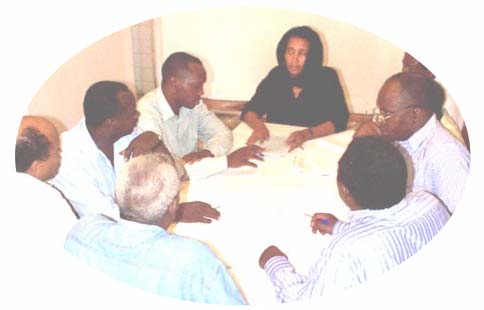
The groups were formed in a participatory process. First participants volunteered where they
could contribute effectively. To balance the numbers in each group a few people were move to
more appropriate thematic areas.
III. Presentations and Discussions
A minimum of four hours was given for discussions and preparation of group presentation. For
easy of compiling and getting relevant information, guidelines were issued on the presentation
format as fol ows;
Problem Target
Activity Implementation Key
M & exist strategy
group
strategy
implementers E
(sustainability)
(audience)
(partners),
How
and
who
Group Presentations
Group 1
Enhanced Public Awareness
Networking EE&A Practitioners and Formation of National Working Group
Page 20 of 60
Networking EE&A Practitioners and Formation of National Working Group
Page 21 of 60
Problems
Target Group
Activities
Methodology
Key implementers
M&E
Exit strategy
indicators
1. Exam orientation
School
Mapping out the schools
Video
10 Pilot secondary schools
No of
Extending the project
and
administrators
Competitions e.g. Thematic essay writing, EE competitions
CPD (continuous
(bringing in different aspects of
people
to other schools before
compartmentalizatio
TTCs/NTCs
Training and capacity building at all levels (orienting educators for
professional
the Nile
trained
project ends
n of departments in
Universities
educating for sustainable development)-
development)
10 core PTCS
No and type
School network on Nile
schools
(learners
Research and investigations
Value clarification
5 NTCs
of
basin
2. Ltd capacity of
Parents
Development appropriate teaching/learning materials (modules,
Campaigns (Keep your
2 Universities
competition
Institutionalised Policy
teachers to handle
Local leaders
fact sheets, pamphlets, games, booklets, posters)
country clean)- should
NEMA
s held
Empowerment of the
EE&A in a practical
Teachers
Community outreach programmes
cut across ministries,
UWEC
No of
learners through
and integrated way
Religious
Forming networks
look different activities
Ministry of Education
Project
training
3. Negative attitude
institutions
Micro and macro Projects in schools, institutions, community
and integrate EE e.g.
NGOs/CBOs (Jinja District
Incomes
Strengthening school
among teachers
NGOs/CBOs
EE awards
target education week,
Wildlife Association,
No Rive
community links
(still consider an
Field trips
science fair etc
Environmental Alert)
banks
Strengthening capacity
extra work)
Music, Dance, Drama
Environmental policies
WID
restored
of school to look for
4. Lack of awareness
Listening programme (radio)
at all levels
Local Governments (District,
Level of
money and building pa
on part of teachers
Documentaries of best practices for wider sharing e.g. Gayaza
(institutions,
Sub-county
awareness
Partnerships
to link routine
waste management
departments, offices,
Local authorities
Surveys
Influence budgeting of
activities with EE
Nile news letter, news paper pull outs
homes) on various
Neighbouring communities
conducted
schools through Board
(general lack of
Website link on EE
issues e.g. savings
Media (EJAU
Conflicts
of Governors
conceptualisation of
Awards/contests based on the Nile, school community links
energy, waste
reduced
Institutional income
EE)
Professional forum to exchange ideas and develop strategies for
management, water,
generating activities
5. Teacher training
improving EE
Review teaching and
colleges do not
Help institutions to develop their own environmental policies
learning materials and
orient teachers in
Research on thinking and learning styles IACE, School of
methods- oriented to
EE
education, institute of education.
critical thinking e.g. use
6. Lack of culture for
Computers connected to internet
of generative theme
people to be
Develop interactive training materials (distance learning method-
approach.
responsible for their
CD, written module and face to face)
Thematic Essay
actions and not to
Nile watch for primary schools
Contests
wait to be followed
Exchange concept
Lobby local partners to
up/monitored.
Research (sponsor MA students to undertake research,
fund EE activities
participatory action research for scholars and environmental
practitioners
Modules on different environmental aspects
Teleconferences between countries (debates on issues,
Exchange visits and study tours (lecturers, students)
Interactive websites and exchange of information through e-
mails
Exchange of materials (based on themes
Professional forum to exchange ideas and develop strategies
for improving EE
Photography competition
Influencing university leadership (guild, tribal associations,
departmental associations, scouts, wild life clubs, religious
associations)
Course development
Multidisciplinary teams in designing and implementing EE
Learning programme to re-orient educators (training
programme)- Value clarification to be integrated at all levels
(love, respect and concern for the environment, critical
thinking, creativity, dignity of labour
Review of curriculum at departmental level, school of
education, institute of adult and continuing education.
Networking EE&A Practitioners and Formation of National Working Group
Page 22 of 60
Group 2
EE&A within Institutions of learning
Problem
Specific activity
Target group
Implementation strategy
Key implementer
M&E
Exiting strategy
Integration of environment
Sensitise and educate
· Local leaders
· Information needs assessment of
NEMA in collaboration with:
·
into policy making and
policy making and
· MPs
all partners
· EJAU
implementing organs
implementing organs on
· Lead agencies at
· Design programs e.g. study tours,
· UMA
key environment
national
breakfast meetings, seminars
· DEOs
management strategies
· Technical HODs at local
· Maintain up-to-date mailing list for
government level
targeted dissemination
Inadequate capacity of
Enhance capacity of
· NGO
· Exchange visits
NEMA in collaboration with:
·
Integrate into the programs
partners to implement public
partners to carry out
· EJAU/media
· Training
· NEMA
of partners
awareness activities
awareness activities
· UMA
· Internships
· EJAU
responsive to NTEAP
· Schools
· Strategic action planning
· UMA
activities
· Lead agencies
· Targeted reviews
· DEOs
· Environment Officers
· Support to specific partners, NGOs
e.g. equipment
· Lack of awareness in the
Use multi-media approach
· NGO
· Categorize population (KAP and
Environment Alert in
· Develop M&E instrument
Build capacity to do public
community
to carry out public
· EJAU
media use survey)
collaboration with:
for the work plan
awareness
· Diverse media with limited
awareness
· UMA
· Determine messages according to
· NEMA
· Monitor and evaluate the
reach
· Schools
KAP survey
· EJAU
work plan using the
· Low level of education of
· Lead agencies
· Produce materials eg Nile talk, fact
· UMA
evaluation instrument
the community
· Environment Officers
sheets, information videos; press
· DEOs
· Diversity of local languages
· Radios
briefings;
·
·
TV
Develop work plan
· Design multi-media programs
utilizing local languages
· Implement work plan
Inadequate networking and
Improve networking and
· Media
· Email discussion list
NEMA in collaboration with:
· Develop M&E instrument
Ensure pubic awareness is
coordination of public
coordination of awareness
· NGOs
· Regular meeting forum of
· NEMA
for the program
part of the EEA WG
awareness activities
activities
· DEOs
practitioners involved in awareness
· EJAU
· Monitor and evaluate the
· Lead agencies
· Continuous professional training for · UMA
campaign using the
practitioners
· DEOs
evaluation instrument
· Materials e.g. Nile Talk
· Practitioners
· Evaluate the performance
· Design and implement joint
of the network in line with
activities e.g. public lectures
the strategy
Inadequate monitoring and
Improving the monitoring
·
· Joint monitoring & evaluation every Environment Alert in
· Monitor and evaluate the
Development of indicators
evaluation of public
and evaluation of
2 years
collaboration with:
program implementation
awareness
awareness
· Media monitoring through
· EJAU
· Share lessons with
independent monitors
· UMA
implementing partners
· Develop monitoring indicators
· DEOs
· Periodic reviews and impact
assessment
Networking EE&A Practitioners and Formation of National Working Group
Page 23 of 60
Group 3
Networking
A. Media
Activities
PROBLEM TARGET
GROUP
ACTIVITY IMPLEMENTATION
STRATEGY
KEY
IMPLEMENTORS
M&E SUSTAINABILITY
1. Limited capacity to
- Media house
- Sensitisation of the
- Organize seminars & workshops
- EJAU, NEMA, Media
- Amount of time
address EE&A issues
owners and
media house owners
for media house owners and
houses, CBOs, NGOs,
given to EE&A on
environmental
and environmental
environmental journalists
private sector, development radio and tv
journalists
journalists
separately
partners, NTEAP,
- Number of topic
- Organize separate public
Government ministries, NBI
related cal -ins
dialogues for both categories
Secretariat
- Training for EJAU
- Short courses both within and
- Training Institutions,
Content of the
members
out of the country for EJAU
NEMA,UNEP, NCDC, NBI
stories on
members
secretariat
awareness and
advocacy
-
Exchange
and
- Local and Transboundary
NTEAP, EJAU, NEMA, NBI
Number of
exposure visits within
excursions
secretariat
sources quoted in
and out of the
the stories
country for both
media house owners
and environmental
journalists
-
Recognize
and
- Hold a Sir Ndyakira Amooti paper - EJAU, NEMA, NBI
award environmental
presentation event and include an
secretariat, NTEAP, Media
journalists for
award giving ceremony
Council, National Institute
outstanding
for Journalists in
performance
Uganda(NIJU)
- Identify and
- Surveys
- Media houses, EJAU
establish linkage to
strengthen the
capacity of non EJAU
environmental
journalists
- Equip EJAU for
- Buy media equipment
- Media houses, EJAU
information collection
and dissemination
2. Weak linkages
- Both media and
- Organize regular
- Local language radios operating
- NBI secretariat, NTEAP,
- Number of
between the
other institutions,
harmonization
around catchments areas and
NEMA
meetings and
media house
District
meetings.
River Nile tributaries
public dialogues
owners and other
Environment
- Comparison in
players resulting
Journalists at
the rate of
to inadequate
ground level.
conflicts before
access to
and after the
information
activities
- The community
- Establish a media
- Involvement of the communities
- EJAU, NTEAP
- Feedback from
EE&A newsletter
in media and Information
the community
Networking EE&A Practitioners and Formation of National Working Group
Page 24 of 60
PROBLEM TARGET
GROUP
ACTIVITY IMPLEMENTATION
STRATEGY
KEY
IMPLEMENTORS
M&E SUSTAINABILITY
Education Communication
after accessing
message development
the information
- Generate feedback from the
communities
- Have quarterly
public dialogues with:
political organs,
technical organs,
resource users
3. Most media
- Communities on
- Mobilize resources in form of
NEMA, EJAU, NTEAP, NGOs, - Reviews
- Constant flow of funds
houses do not
the resource
technical and financial support, Tv
Government departments
- Regular interactions
prioritize
fringes
documentaries, films, radio
- Regular reviews
environment
(catchments
features, photos, video and radio
related messages.
areas, river
spot messages, video clips
There is therefore
banks, farming
- News reports
little or no funding
communities)
for these
messages which
makes it
impossible for the
journalist to
implement the
work.
4. Many people have
- Rural
- Organize rural video systems
- EJAU, NEMA, NTEAP,
-Follow up and
- Provision of mobile
little or no access
communities
- Rural listening groups
Government departments
reviews
equipment
to television, radio
-Formal school viewership/
- Flow of funds
and print media
listenership
5. Little time for
Members of
-Video
recordings
NEMA, NTEAP, EJAU
- Follow up and
- Constant update of
Members of
Parliament
- Video and radio clips
reviews
messages
Parliament to
access media
messages on the
media channels
There is a need for the establishment of resource centres particularly for EJAU in its implementation of the Working Groups objectives.
Networking EE&A Practitioners and Formation of National Working Group
Page 25 of 60
B.
The National EE&A Working Group
I.
The Terms of Reference for the National Working group
The aim of the National Environment Education and Awareness Working Group (NEE&A WG) is to
plan, coordinate and facilitate the EE&A activities and to exchange knowledge and lessons learned
from National and Nile Basin experiences. Specifically the NEE&A WG will;
1.
Catalyse EE&A activities within the Nile Basin.
2.
On an annual basis develop and ensure implementation of national action plans with
emphasis on Transboundary activities for the basin.
3.
Lobby Governments, development partners and civil societies to support new and innovative
issues on environmental education and awareness.
4.
Update the country status on environmental education and awareness.
5.
Hold annual multi-stakeholder EE&A workshops to review progress and plan for activities for
the coming year and exchange of ideas and documentation of lessons learnt.
6.
Facilitate and disseminate lessons learnt through participation in different forums and
effective use of print and electronic media.
7.
Ensure that accurate and correct information reaches the intended target groups through
effective relay pathways.
8.
Highlight National Transboundary EE&A issues and interventions that could bring about
behavioral change.
9.
Ensure active participation on National occasions to mark international environment related
days including, the World Environment Day, World Water and Meteorology Day, World
Wetlands Day, World Food Day etc.
10.
Lobby for the incorporation of EE into curriculum at all levels of formal education.
11.
Carry out periodic assessment on the status of EE&A within the country.
12.
Co-opt and/or establish task forces as need may arise.
II
Working group Composition
The Working Group will be composed of individuals from the following institutions;
Environmental Journalists' Association in Uganda, National Environment Management Authority,
Wetlands Inspection Division, National Curriculum Development Centre, Ministry of Education,
Environment Alert, Uganda Manufacturers Association, Directorate of Water Development,
Universities, Nile Basin Initiative, a District Environment Officer, LAKIMO, Uganda Women's Network,
National Agricultural Advisory Services)
The Working Group will write to the head of the above institutions accompanied with the Terms of
Reference and the name of the suitable identified individual.
III
Frequency of meetings
The Working Group will meet quarterly for the first year and this wil later be reviewed.
IV
Working group Sustainability
The Working Group Secretariat will be institutional based.
The secretariat will be based at NEMA because it hosts the NTEAP and NBI can fund it.
NEMA will identify the secretariat from within the established structure.
The Working Group representative from NEMA will be the coordinator.
The secretariat will be independent of the hosting institution's gagging/hijacking.
In addressing the issue of the media's role in EE&A, the group looked at the problems affecting
EJAU and how best these can be solved so as to let them perform effectively.
26





CHAPTER FOUR
CLOSING CEREMOMNY
I Closing
Remarks
By Ms. Prosy Mulyowa: NCDC.
The Director, District Support Coordination and Public
Education NEMA,
The Lead Specialist, Environmental Education and
Awareness NTEAP,
The NPC - NTEAP,
Workshop organisers,
Dear Participants:
I have the pleasure to address you on the closing of the
first workshop of the Nile Transboundary Environment
Action Project.
I have participated in the workshop and note that a lot of interactive discussions have been held.
It has been a productive workshop.
During these two-day deliberations, participants were able to discuss Environmental Education
strategies and approaches.
I note that we discussed:
(i)
Formal Environmental Education -and noted that EE has been integrated at the pre-primary
and primary level. The integration at secondary has been embarked upon and hopefully it
will be completed in the near future.
(ii)
Non-formal environmental education that which focuses on mobilisation of communities
through action. Here we noted NGOs play a major role in mobilising communities in
areas where they are based, and
(iii) General public awareness - the use of the mass media - a deliberate effort to ensure that
environment information flows to the public regularly.
In Uganda, Environment awareness is being undertaken in a cross sectoral manner and by different
institutions. The NGOs, the civil society and the different institutions of government such as the
Uganda Wild life Authority (UWA), National Forestry Authority (NFA) as well as the National
Environment Management Authority (NEMA) are all in partnership to deliver effective environment
education and awareness.
The Local Environment Committees (LECS) that are statutory institutions set up countrywide are also
a forum that is used to help in environmental awareness. LECs exist at the sub county level, parish
level, village level and at urban centres.
We hope that the recommendations and actions developed out of this workshop will utilise these
institutions.
While a lot of work is being undertaken with regard to EE and Awareness, further input is still
necessary.
There is need for further capacity building. Some district environment officers, for example, are stil
new and they need additional communication, advocacy and networking skills to increase the
effectiveness of the Environment Education and awareness efforts.
The country needs to enhance cross-district and cross-national border collaboration in awareness.
The starting of NTEAP to address some of the needs is therefore timely and most welcome.
27
A word of caution still lingers in my mind. And I want you dear participants to think about it as you go
back to your workstations. There has been awareness raising in a number of fora, including,
seminars, workshops, school programmes as well as competitions. But action on the ground has been
slow, why???? A lot of Posters have been developed as well as training workshops. Still progress is
slow. May be there is something we still need to address to achieve effective on the ground action.
As a Ministry we do appreciate the environment as the basis of our health and wealth. We shall
therefore ensure that educational policy of integrating EE at all levels of education is implemented.
This will facilitate training at the pre-service level and we shall increase in service training to ensure
that the teachers are well grounded in methodology to deliver the integrated content in order to bring
about a change in behaviour; which is beneficial for this and the next generation.
The Education Standards Agency will monitor the schools to ensure that the teaching is both
theoretical and practical to bring about practical ground activities.
I note that an awareness-working group is formed. This working group needs to start thinking about
this concern so that what is developed in NTEAP goes practical. I therefore wish to reiterated the
NEMA Executive Directors plea, that practical on the ground activity should be the target, as it is on
the ground action which is necessary and can create visible impact.
I wish to urge you, dear participants that Networking among you should be kept up. This is the
beginning of a closer Environmental awareness. In fact, the first out put of this workshop should be
the linkages created these two days and these linkages should therefore be kept alive. I understand
addresses have been registered; these should be exchanged among you people.
Finally, as I conclude, I wish to thank funding agencies for this workshop as well as all the partners
here and to ask that, let the collaboration continue.
I thank you for listening to me and I take this opportunity to officially close the workshop.
II Workshop
Evaluation
III Workshop
Recommendations
28





CHAPTER FIVE
APPENDICES
I. Papers
Presented
Status of Environmental Education in Uganda 2004
Beatrice Adimola
EEC, NEMA
badimola@nemaug.org
BACKGROUND
Environmental education is dynamic and has evolved in different
ways depending on the interpretation and prevailing
circumstances. Education is still narrowly perceived and the
interpretation needs to be broadened. General y, basing on the
evaluations that have been carried out there has had some impact
on many people raising people's level of awareness with varied
levels of response.
LEGISLATION AND POLICY PROVISION
They are legislation supporting EE public awareness. Policy provisions that give direction. They are
found in the fol owing documents.
The constitution of the Republic of Uganda (1995)
The National Environment Statute (1994)
The Government White paper on Education (1992)
The National Environment Act (2000)
The National Forestry and Tree Planting Act (2003)
STRATEGIES
The strategies provide the general framework needed for the development of a
comprehensive national environmental education and public awareness programmes.
The strategies in place target different groups of people with some of the activities overlapping.
These are:
The National Environmental Education Strategy for the Formal Education Sector.
This strategy targets institutions from pre-primary to the University. There are seven programme
areas in the strategy namely curriculum
The Non Formal Environmental Education and Community Training Strategy
Promotes training the communities
The National Public Awareness Strategy and the Local Government Awareness Strategy
Cuts across all sectors of society and levels of government
IMPLEMENTATION APPROACHES
Some of the implementation approaches developed for the different target audiences are:
PARTNERSHIPS
Public private partnership with schools, communities government and the private sector. EG Shel
Uganda, Living Earth Uganda and Communities
Trainer of trainers (TOTs)
Visitor and Interpretation Centres
Training
Traditional Media and ceremonies
Drama, role playing music
Demonstrations
Competitions
Projects
Public lectures
29
Formal Education
Sector
Public awareness
Non formal &
strategy
community training
INFORMAL ENVIRONMENTAL EDUCATION
Targets the communities eg farmers, extension workers, urban poor, youths, District leadership,
regulated communities
eg. communities bordering parks and forests, fisherfolk
Problem focussed
Location specific
Stresses awareness and provision of information
CAMPAIGNS
Tree planting
World Environment Day themes
WASH- water, sanitation and hygiene in urban areas
Rural water and sanitation
Cholera, malaria, river blindness
Waste management
Wetlands management
Wildlife conservation
FORMAL EDUCATION STRATEGY
The strategy comprises seven programme areas:
Curriculum integration at all levels
Competence building
Materials Development
Research
Coordination
Monitoring and Evaluation
Participatory actions
MATERIALS DEVELOPMENT
Print- posters etc by NEMA and NGOs
Supplements in the Daily Papers
Brochures
Training Manuals
Leaflets
Newspaper pul outs
Activity sheets
ENVIRONMENTAL EDUCATION ACTIVITIES
Drama
Energy conservation
Waste Management
Tree planting
30
Public Lecturers
Demonstrations
Exhibitions
World environment celebrations
Conservation festivals
ACHIEVEMENTS
Increased level of awareness from trees to diverse issues e.g. wetland, waste management, soils
Primary School Curriculum & SEEP
Increased coverage
Community Training
Political Support and leadership
Competitions
EE PRACTITIONERS
Government departments
National Forest Authority
Visitor Centres eg Mabira Ecotourism Centre, Mpanga Forest, kalinzu, Pabidi
Directorate of Water Development
Ministry of Tourism Trade and Industry
Uganda Wildlife and Education Centre
Uganda Wildlife Authority- Conservation Education
National Parks
IUCN CEC
Mt Elgon Exploration Centre
Bwindi Mgahinga Trust
UNHCR
Refugee settlements in West Nile
NGOS e.g. Environmental Alert, Living Earth Uganda, Nature Uganda, ICR, Straight Talk Foundation
Cross Border Environment Projects e.g. ARCOS, Lake Victoria Environment Management
CBOs e.g. UCODEA, UVEAP among many others
Voluntary organisations e.g. SPW, VSO, Peace Corp,
Jane Goo
odall Institute - Roots and Shoots chapters
Wildlife Clubs of Uganda
Nature Uganda
Various Trainers of Trainerrs environmental activists
SUCCESS
S STORIES FOR REPLICATION
There are a number of successful case studies incldunig:-
SEEP
IUCN- Mt Elgon Exploration Centre
ICR
Wildlife Clubs
OPPORTUNITIES
Networking through Computer technologies on selected themes
Exchange of information
Twining schools
Partnership
CONSTRAINTS
The major challenges facing
Conceptualisation takes time
Limited funding
Inadequate information sharing and exchange
Human resources capacity
Limited opportunities for regular consultative meetings
31
Limited access to and management information technology
Behaviour change takes time
CONCLUSION & RECOMMENDATIONS
1. Greater collaboration and inter linkages horizontally and vertically
Universities
NGOS/ CBOS
Colleges
Civil Societies
Secondary
Media
Primary
Communities
2. Broaden EE to Education for Sustainable Development which addresses a variety of issues like
poverty, human rights violations, gender discrimination, warfare, and many others
3. Develop distinct trans-boundary EE programmes and activities addressing water and other issues
4. Research on how people learn and change behaviour
5. Build capacity to develop local ESD programmes
6. Exchange studies and visits
7. Restoration projects
32





School Environmental Education for schools in Uganda
`Environmental Education is a powerful tool for sustainable development'
Immaculate Kijjagulwe
Urban Environment Uganda
P. O. Box 6202,
Kampala, Uganda
ikijags@yahoo.co.uk
INTRODUCTION
One of the National goals of education and objectives of
education is to eradicate illiteracy and equip individual with basic
skills and knowledge to exploit the environment for self-
development as well as national development for better healthy nutrition and family life and the
capability for continued learning.
The Ministry of Education promotes scientific, technical and cultural knowledge, skills and attitudes
needed to enhance development including democratic and participatory planning, administering and
management by all stakeholders; the ability to use data and information for decision making,
awareness and concern for conservation of the environment.
Education as we are all aware is a powerful tool for transformation of a society in all areas of life -
cultural, economic, security, behavioural, good governance, resource utilization, etc. The role of
Education therefore in liberating people from the vicious circle of poverty, dependence, ignorance,
disease and indignity cannot be underestimated.
The government started exercising control over education by establishing a directorate of education.
In the eighties there was massive expansion in the number of schools and higher enrolment in
primary and secondary level, but the planning was neither properly done nor coordinated.
In 1992, the Government White Paper entitled education for National integration and development by
the education Policy review commission gave a new face to education. It advocates for quality of
teachers and education. Other enabling laws and policies have also been developed and implemented
(enacted).
BACKGROUND TO SEEP
The objective of Environmental Education (EE) is to create awareness, equip individuals with
knowledge and skills, motivate them to participate and take action in Environmental management and
in the long run change their attitudes and behaviour towards the environment.
The major aim of EE is to produce holistic people with improved awareness and understanding of the
environmental issues with the view to promote the conservation and wise use of nature and the
natural resources for sustainable development.
EE has evolved from Nature study; a subject that was offered to a few, to clubs, later into
uncoordinated extra curricular activities organized by individuals who had interest then to policy,
strategy and into a coordinated programme.
School Environment Education Programme started in 1996 after a study on `A whole school approach
to implementing EE in Secondary schools in Uganda'. Six (6) pilot Secondary schools were included. It
has now spread to over 5000 primary and 200 secondary schools in about 30 districts in the country.
IMPLEMENTATION / COORDINATION MECHANISM
The National Environment Management Authority (NEMA) drives the process. It coordinates
the initiatives, gives guidelines and direction, planning, encourages and facilitates contributions of the
other players (NGOs...), develops and implements training programmes and provides support EE
materials.
33
The Ministry of Education and Sports (MOE&S) supports the programme through its agents and
permits the activities to go on. The Ministry also has the responsibility of ensuring good and sound
standards of education at all levels. The District education Office works hand in hand with the others
to monitor and evaluate the quality of education and school environment. They organize
competitions, supervise schools and promote synergy with other departments. They are coordinating
the school environmental education programme in the different local authorities. The District
Environment Officers give technical support to the schools and also help in clarifying
environmental issues in the districts.
The National Curriculum Development Centre (NCDC) redesigns curricular to meet the goals
and objectives of education and also carries out research and evaluation in curriculum development
for schools.
The new curriculum for pre-school to primary level has been in use since 2000 with EE integrated
into all subjects using the cross curriculum approach.
Secondary schools
There have been a number of carrier subjects where environment topics have been taught e.g.
Biology, Geography, Agriculture, Chemistry, Home Economics, etc but a more integrated curriculum is
under way.
The Uganda National Examinations Board (UNEB) plays an important role in planning,
conducting and managing the various public examinations, primary, `O' level, `A' level TTCs and
technical schools.
Over the years UNEB has set questions on EE especially in the carrier subjects for `O' and `A' levels,
English Language and General Paper. At primary level, environmental concerns are tested in any
subject.
Implementation of the Uganda Primary Education reform programme by out reach factors,
core PTC staff members (CCTS) under (TDMS) Teachers Development Management system. The
system provides distance education for both untrained and under trained teachers, enables the
teachers to do their normal work in the school while they study.
Some CCTs have, been trained in EE and do coordinate primary school EE activities in their cluster.
Others have trained teachers in EE and helped them to further integrate environment topics in their
plans (scheme of work). CCTs also monitor schools, projects and activities and also provide materials
in the resource centre. Some core, PTCS are helping in coordinating the District EE activities for the
schools.
The National Trainers of Trainers (TOTs)
This is a team of about 100 environmental education practitioners. They provide leadership at the
grassroots level, train teachers, facilitate the activities, generate innovative approaches, promote
networking, and participate in materials development adding to the data base for EE.
Local Councils, Politician and others provide financial and moral support plus including linking
schools with the neighbouring communities. Some of these are members of the school management
committees.
Other Stakeholders, NGOs, Volunteers, Clubs contribute to SEEP by training, organizing
environment competitions and material development.
Environmental Education Materials
NEMA prepares most of the EE materials and teachers guides but also works with other providers
e.g. NGOs, institutions, ICR, SPW and Living Earth Uganda to develop EE materials. The materials
are designed flexibly to permit suitable adaptation for use across the country and at different
levels.
In the training workshops for the teachers, a day is set aside for developing a variety of EE
materials for training, awareness and learning.
34
Materials like posters, games MD, radio/TV articles, charters, brochures etc are prepared in English
and local languages.
The schools are encouraged to develop innovative programmes and EE materials to address their
environmental concerns using local y available materials.
HOW DOES School Environment Education Programme WORK?
Seven (7) step procedure for schools to adapt:
(i)
Appoint a coordinator.
(ii)
Select a committee.
(iii)
Develop an implementation mechanism
(iv)
Set goals and objectives.
(v)
Develop an action plan (Audit the school).
(vi)
Implement and monitor the programme.
(vii)
Evaluate the programme and document successes for networking and replication.
It takes about one year for the school to formalize the process.
SCHOOL NETWORKS
Dynamic networking among schools has been initiated and sustained by some schools and districts.
Others have successfully participated in regional and international environmental programmes for
example
UNEP Painting competitions
Twining with Kenya & Tanzania schools
Victoria watch led by Entebbe S.S.S.
THE GLOBE; Global learning and observation to benefit the environment. A worldwide science and
education programme coordinating the work of learners, teachers and scientists to study and
understand the Global environment.
WORLD LINKS
Children Conferences
Eco-Schools; encourages school children to carry out sample activities in their communities.
SCHOOL PROJECTS AND CO-CURRICULAR ACTIVITIES
SEEP promotes the initiation of school EE projects for awareness, creation, conservation and proper
environment management, restoration of a degraded environment, physical improvement of the
school, income generation, educational purposes, skills acquisition by the learners and teachers,
community school links and research or investigative studies.
The learners and all the other stakeholders have to be involved at
every stage of the programme (project cycle). Examples of EE
projects:
Gayaza High School - herbal gardens
Kings' Col ege Budo Research on indigenous knowledge in the
neighboring communities
Gulu - Eco-schools
Kiswa Primary school wetland watch
Kasese schools with communities to carry out restoration
activities
Gulu Eco-kids club
Schools have initiated and are running EE projects. Some schools have established environment clubs
while others use the existing clubs e.g. Wildlife, Scouts, Girl-guides, Debate, Interact, Drama,
Geography and Biology to carry out environment activities. Many schools use Music Dance & Drama
(MDD) or Science fairs to create public awareness on environmental issues. Sometimes parents and
members of the management committees join hands with the schools to work on the projects such
as: planting of grass or flowers in the school compound, labelling of trees with their respective
scientific names, installing energy saving stoves in the school kitchens, etc.
35
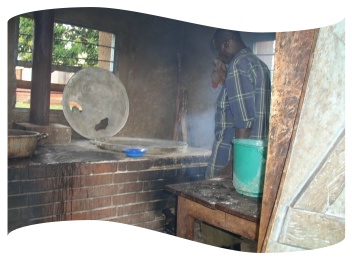
COMPETITIONS AND AWARD SCHEMES
Competitions are organised at district level and a rotating trophy is awarded to the best school.
The top six (6) schools receive prizes.
The best school in each region gets an award during the National World Environmental day
celebrations on June 5th.
The best EE providers and practitioners also get an award on 5th June too.
Some schools organize internal EE competitions (inter house / inter class where presents like goat
roasting or outings and others are given.
International competitions; children are encouraged
to participate in these competitions.
Mabira and Mpanga forest competitions.
Provision of seedlings to schools for their tree
planting projects by forest department in several
districts.
ACHIEVEMENTS
SEEP has been evaluated by NEMA (lessons
learnt and recommendations for future planning).
The District School Environment competitions
managed by the Districts are running in some districts for the last four consecutive years. It is
spreading to many others (over 20 districts).
Promotion of collaborations and participatory planning
at the district and school levels.
Tremendous change in the physical appearance of
some of the schools involved in SEEP. (schools in Gulu,
Lira, Kampala, Iganga, Kasese, Ntungamo)
Schools carrying out several research on various
environmental issues affecting their schools community
and the Nation in general for example wetland watch,
stream water, water quality, forest watch, lake, range
lands, river shores, waste management, biodiversity,
etc.
This enhances their academic work (knowledge) in other subjects.
Developed leadership skills of TOTS and EE coordinators.
Several have been promoted to headship/ Deputy Headship (Professional development for the
teachers involved).
Acquisition of environmental management skills by the teachers, learners and communities
neighbouring the schools.
Complements other government programmes for example sanitation, health education, nutrition
and minimum standards' requirements for
schools.
Involvement and participation in regional and
international environmental programmes.
Documentation of EE activities and case
studies by the concerned schools is on the
increase.
Some EE coordinators and CCTs are
developing EE materials such as posters,
pamphlets, books and brochures etc which are
taken to the district resource centers for
networking.
Schools are running income generation
activities under school environment competitions for example:
-Waste recycling / composting
-Water harvesting
-Food supplements / nutrition- school gardens
36
-Energy saving stoves
-Nursery beds establishments / wood lots
-Zero grazing (animal raring) etc.
MAIN CONSTRAINTS ON EE PROGRAMS WITHIN SCHOOLS
With the liberalization of education, many private schools have mushroomed all over the country
especially in urban areas. Many of these are in areas where they cannot effectively participate in
SEEP activities (wetlands, on road reserves, dumping grounds, etc) nor have no space for practical
activities.
Schools are congested and teacher: pupil ratio in primary schools has gone up. The teachers are
overworked and not willing to participate in practical activities. They teach environment
theoretically.
Budget allocations especially for UPE schools are rigid and limited so many schools have no funds
to support SEEP activities.
Overcrowded time tables for both primary and secondary schools plus the public demand of 4
points in PLE 8 points for `O' level and 4As for `A' level. So teaching is geared towards passing
exams without any provision for assessment of other objectives of Education (education for self-
reliance); schools think that SEEP is a waste of time since it is not `examinable".
Some districts are not well coordinated due to sometimes internal problems and this affect school
activities including SEEP.
Not al teachers are trained in environment education so some schools have no one to drive the
process. The change in curricular is not always matched with training of teachers hence the gap in
knowledge and integration of environment concerns in teaching topics.
Neighbouring communities that are aggressive to SEE Projects and activities for example
vandalizing plants, latrines, bore holes, classrooms, playgrounds, trespassing, dumping in the
school compound. Others are not willing to carry out joint clean up campaigns and activities with
the schools (clearing campaign for water sources, trading centres and attending school open days).
The number of active secondary schools is stil very low and sometimes teachers demand for
additional pay to carry out SEEP activities.
EE materials are limited because the cost of production is very high.
Teachers at times leave all the work to SEEP coordinators or teacher on duty which at times makes
the programme collapse if that teacher is transferred to another school.
Changing behaviour and attitudes takes long so some EE coordinators administrators and teachers
get discouraged when they do not register quick results. Some give up the programme immaturely.
RECOMMENDATIONS AND OPPORTUNITIES
The district school environment competition should become a national competition coordinated by
the ministry, just like music and science fares.
More girls in schools is a great opportunity for more environment managers to acquire conservation
skills for sustainable development (women and the environment). High enrolment (7 million
children in primary schools) is an opportunity to widen the coverage of SEEP.
The in-service training of teachers in EE can be integrated in the other trainings and CCTs could be
facilitated more to train and develop EE materials with the teachers within their cluster schools
throughout the country.
Decentralization promotes decentralized planning and management within the respective local
authorities. This has helped primary schools' management a lot. The system could be studied and
extended more to include secondary schools.
The MOE&S can use her good office and working relationship to lobby the private sector to support
SEEP especially in the development of EE materials and training of teaches just as they do with
sports.
The School and Health inspectors can be trained / facilitated to integrate monitoring of SEEP
activities and projects in their routine work plans.
A number of schools have acquired computers and can benefit a lot if connected to the Internet.
The costs are still too high for individual schools.
37
Conclusion
Children and Youths will inherit the resources of the earth hence the need to educate them with
the right perspective, knowledge and skills to revert the present trend of environmental
degradation.
Children also bring in a lot of enthusiasm and energy that can be harnessed to become a force for
sustainable development.
References:
(i)
Tutors' Handbook, Ministry of Education
(ii)
Evaluation Report for Formal Education, NEMA
(iii)
National Environment Action Plan
(iv)
The Government White Paper on Education
38





Environmental Education courses in tertiary institutions of learning
Daniel J Babikwa (PhD.)
Makerere University,
I. A. C. E.
P.O. Box 7062,
Kampala, Uganda
danbab@iace.mak.ac.ug
Introduction and background
The major purpose of this paper is to throw some light on the
status of Environmental Education in Ugandan tertiary educational
institutions. It specifically touches the issues of policy and legal
foundations of EE in tertiary institutions and engages in pertinent
discussions of some theoretical and conceptual issues which help us to analyse the character of EE
programmes in tertiary institutions. The paper in particular comments on the character of the
existing environment related courses although it avoids giving an inventory of courses and instead
critical y analyses of the courses to draw lessons that can inform future EE programmes in such
institutions. Based on the same logic, I decided to focus on the two larger universities namely
Makerere and Kyambogo. The two institutions have a broader coverage of environmental
programmes and are more likely to provide a broader spectrum of lessons to inform the future design
and delivery of EE, rather than establishing the numerical status of EE programmes in the institutions.
The paper winds up by highlighting the main constraints in offering EE as a course in a tertiary
institution, existing opportunities and key recommendations.
Legislation and policy
Environmental Education is a relatively new area of study in Ugandan tertiary institutions although a
number of environmental related courses and disciplines have been in existence throughout the
existence of such institutions. The recent overt emphasis on and upsurge in the number of
environment related training programmes in the different tertiary education institutions can be traced
to the 1992 United Nations Conference on Environment and Development (UNCED) in Rio de Janeiro.
Chapter 36 of Agenda 21, the official document of the conference which also informs Uganda's
Environmental policy emphasises the role of Education and Awareness in achieving sustainable
development.
Uganda's National Environmental policy (1994) stresses the central role of Environmental Education
and Awareness as a strategy for achieving sustainable development and environmental protection.
People's involvement in environmental planning and management is seen as largely dependent on the
role of EE & A.
The policy points out three major roles for tertiary institutions (MNR 1994) namely to:
Increase awareness and understanding of the need for sustainable environment management
among different stake holders
Develop skills necessary for the implementation of national programmes;
Conduct demand driven research to inform the proper management of the country's
environmental resources
The policy stipulates that the teaching of Environmental Education be mandatory in al formal
education institutions including Universities and other post secondary institutions. It also calls for the
strengthening of existing higher level institutions to offer programmes tailored to produce
environmental economists, planners, trainers, lecturers, lawyers and enforcement officers and to
conduct research that will inform environmental management processes in the country.
The NEAP specifical y mentioned MUEINR, MISR, Institute of Adult and continuing Education, Institute
of Statistics and applied Economics, Faculties of Law, Agriculture and forestry, as the ones to
spearhead the implementation of EE & Awareness in Makerere University. The faculties of Arts, Social
Sciences, Technology, Education, Human and Veterinary medicine were surprisingly not included in
39
the list of central actors, which in a way reflects a limitation in the dominant perception of the
environment and environmental issues by its formulators.
Since the formulation of the policy and the publishing of the NEAP, the number of tertiary institutions
in the country has tremendously grown, together with the courses meant to address different
environmental concerns. What is important however is to acknowledge from the outset that education
is a complex matter that is often taken for granted and many times misused leading to contradictory
outcomes. In the light of this, I have decided to start by a brief discussion to clarify the key
theoretical and conceptual assumptions underlying education practice in general and EE in particular.
Some theoretical and conceptual issues of environmental education
My analysis of EE in Ugandan tertiary institutions is premised on the view that knowledge is never
neutral and neither are scholars who produce it. Like knowledge, education too is not a neutral
process or activity. Different people will therefore conceptualise EE and the related processes
differently. The different conceptualisations certainly influence the practical actions taken by
educators to address environmental matters, whether the educators are aware of it or not. Thus the
curricula, methods, learning activities and outcomes always reflect the dominant thinking of the
educators and the socio-political and professional institutions they belong to. Analysing EE therefore
cal s for clear understanding of the different philosophical orientations to education and their
implications on education practice, which helps to explain why educational Programmes yield
particular learning outcomes.
Educational, environmental and development philosophies as foundations for EE
EE is particularly a complex concept and its implementation a composite venture informed by diverse
philosophical currents; including philosophies of development, education and environmentalism.
Fig. 1 Philosophical positioning of EE
Educational philosophies
Neoclassical, liberal
progressive & critical
emancipato ry
PP
Environmental
philosophies
-
Techno-centrism
- Eco-centrism
R/use
Development
EE
Philosophies
W
/
c PP
Modernisation
Dependency
People centred devt .etc
Pp = power/politics/political influence
R/Use = Resource Use
W/c = Wealth creation
Educators writing from a critical perspective have identified three broad educational orientations
(Kemmis et al 1983) namely: the neoclassical/vocational, liberal/progressive and socially critical/
40
transformative orientations. The orientations are classified according to the underlying knowledge-
constitutive interests1. While this classification might have its own limitations, it also has considerable
value, particularly, in characterising and explaining different educational processes and their related
outcomes. The framework of educational orientations in table one (1) represents the various angles
from which different educators operate, and view the world of education and educating. These
professional positions are ideological, and they always consciously or unconsciously filter into the
educational practices by different people, influencing the direction of educational programmes and
their ultimate outcomes.
In the case of EE, in addition to the educational orientations of practitioners, the way different
environmentalists interpret and respond to environmental challenges; and the dominant development
discourses (fig.1) influences its direction and emphasis. This is because by its very nature, EE is not
education for education's sake, but responsive to socio-economic, human and ecological concerns of
society. This is largely why the character and dimension of environmental education, represents a
manifestation of the different environmentalisms (Pepper 1986).
As educators try to respond to the broad range of sustainability concerns, their minds are actually
preoccupied with not only the desire to educate, but also do so in such a manner that satisfies their
interpretation of the environment, environmental concerns and their world view of good
environmental management. This probably explains the different dimensions of EE. Educators
informed by techno-centric environmentalism for example design technocratic educational
programmes that not only exhibit their confidence in the potential of science, technology, `experts'
and regulations to address sustainability concerns, but also fail to recognise the central role of key
stakeholders (e.g. local communities), in interpreting their local situations and generating home-
grown responses.
Likewise, educators with an eco-centric environmentalist bias design educational programmes that
aim not only to empower people to manage the environment but also create more harmonious
relations between society, nature and individuals within society. They also aim to re-orient society's
modes and relations of production. The central role of those directly affected by particular sustainable
development challenges is emphasised, not as passive recipients of `expert' advice and directives but
active analysts of their situations and co-creators of home-grown solutions to the challenges. In other
words, EE is viewed as a social rather that a technical process.
At another level, society's development goals and the philosophies that inform them form an integral
part of EE. This is because of the organic relationship between development practices and the
environmental crisis/sustainability challenges which EE aims to address. For example, the twentieth
century perception of development as economic growth, and modernisation as the right strategy for
pursuing it, has led to unsustainable patterns of development and it is largely responsible for many of
the environmental and development problems experienced in the world to day. Environmental
Education should overtly challenge and address these concerns.
In order for EE to play its transformative role of re-orienting society and its systems, it is not only
enough to critique modernism and its basic assumptions, but also to recognise all philosophies
underlying actions geared towards the attainment of sustainable development as this will empower all
stakeholders to pursue options that are sensitive to the socio-economic and ecological impacts of
development processes well understanding each others' limitations.
1 Habermas (1972), argues that there are three fundamental human interests; namely the technical, the practical
and the critical or emancipatory, knowledge-constitutive interests that influence the different types of
knowledge and educational processes.
41
Table 1: Educational orientations, characteristics and implications
Characteristics
Neo-classical/ Education
Liberal/ progressive
Critical/ emancipatory/transformative education
/assumption
Education
on:
Education
-
Viewed as a technical activity,
-
a social process
-
a social process empowering people to critique
and an instrument/tool for
preparing people
and transform oppressive socio-cultural, political
achieving pre-determined
for life rather
and economic structures;
behavioural goals;
than work (which
-
political and ideological
-
Preparing people to perform
is narrow)
-
used to perpetuate dominant socio-economic and
specific tasks;
-
should be learner
political relations
-
Teacher-centred,
centred
-
levels power gradients in society,
-
Neutral activity fully in the hands
-
inextricably linked to the social, economic, cultural
of the educator/technical expert
and political structure of society
to manipulate in order to change
learners behaviour;
Educators
-
Viewed as experts in changing
-
viewed as
-
co-learners and co-constructors of knowledge in a
learners behaviours,
facilitators of the
situation of mutual respect in order to respond to
-
Designers of learning
learning process
challenges collectively and individually;
environments that elicit desired
-
organisers of
-
col aborative agent
behaviour,
learning
-
Knowledgeable authority
opportunities
transmitting knowledge
-
enabling learners
to take advantage
of those
opportunities
Learning
-
behavioural and predetermined
-
co-constructed
-
co-constructed based on material conditions of
objectives
by the expert educator
and outcomes
the people
collectively
determined/deriv
ed from
community
Learners
-
lack the right knowledge skills
-
central to the
-
experienced co-constructors of knowledge and
and attitudes (must be taught by
educational
central actors in the learning process;
the expert like an empty vessel
process,
-
critical, constructive co-participants
to be filled)
-
learners
-
-fire to kindle
experiences are
seen as the basis
for learning,
-
Seed to nurture
Learning and
-
a linear process involving
-
social process in
-
social transformative process;
change
knowledge acquisition, attitude
which all those
-
revolutionary aimed at levelling power gradients
and behavioural change, (all
concerned
depend on being equipped with
actively and
knowledge)
willingly
42
participate;
-
depend on
understanding
social phenomena
and being able to
interact with it;
-
expected to occur
through reform
based on people's
understanding of
the situation and
informed decision
making rather
than technical
Knowledge
-
`True knowledge' helps to solve
-
knowledge is
-
socially constructed and dependent on one's
technical problems, and its
social y
personal location
creation is a responsibility of the
constructed in
-
should enable people to be critically aware and
expert educator/researcher
participatory
challenge the dominant oppressive power
-
through objective science
manner,
relations and structures in society
-
pre-packaged learning
-
experiences
Teaching/learni
-
Transmittal/teacher centred
-
bottom-up
-
bottom-up, creating critical awareness;
ng Methods
-
Social engineering
participatory
-
conscientisation through dialogue;
-
democratic and
-
critical enquiry
experiential
-
collaborative
Educational
-
associated with learners
-
associated with
-
autocratic socio-political structures which lead to
failure
weakness
the exclusion of
transmittal educational processes;
the majority of
-
disempowering methods and content
people from the
planning and
development of
educational plans
and strategies;
-
lack of ownership
of educational
programmes
(Adapted from Kemmis et al 1983 and Janse van Rensburg 1995 and modified)
43
Some conceptual issues related to EE
EE as a concept has proved a little more complex than one often imagines. As mentioned in the
foregoing discussion there are different orientations to education which are manifested in the
different ways people have define EE. These differences also reflect the perspectives of different
institutions on education and environment. What should be noted however is that a once-and-for-all
definition of EE is difficult to describe and may perhaps not be that useful at all.
To many people, EE is a new idea. They ask, "What is EE?" Usual y they want a universal definition.
People often think that if something can be defined, then it is easy to understand and easy to
implement. This view can be very simplistic as it is not always appropriate to reduce EE to a `fixed
thing' to be implemented. The broad nature of `environment' and the inter-connected nature of
environmental issues, environmental educators often find it difficult to draw a line between what
counts as EE and what does not count as EE. This difficulty will always be with us, because of the
complex nature of the crisis to which we are responding.
The IUCN, in 1971, defined environmental education as:
The process of recognising values and clarifying concepts in order to interrelatedness among
man [sic], his culture and his biophysical surroundings. Environmental education also entails
practice in decision making and self-formulation of a code of behaviour about issues
concerning environmental quality.
The IUCN is a global scientific institution, which aims to offer international y relevant, all
encapsulating and clearly delineated solutions to the environmental crisis. The language used in this
definition and other IUCN documents at the time; reflect rational, linear, developmental ways of
thinking about environmental education reflecting the neo-classical education orientation. At the time
this definition was described, environments and environmental problems were mainly associated with
biophysical problems hence the conservation-oriented character of EE implied.
If one looks carefully at the language of the definition by IUCN it can be noticed they viewed the
problem as a lack of knowledge, poor decision making skills and an inappropriate `code' of behaviour
among individuals. The proposed solution was to recognise the `right' values, to practice decision-
making and to change behaviour through (informal) rules i.e. follows the right code. Thus in
attempting to choose one definition, applicable to all environmental education practices, the IUCN
definition became abstracted and was not necessarily useful to a wide range of diverse environmental
education processes, arising in many different situations of risk. Unfortunately, many educators
uncritically continue using the same definition with all its limitations.
Nevertheless a number of environmental educators have also tried to interpret EE in a manner that is
closer to reality. Lotz and Ward 1998 for example see the limitations of IUCN's definition as a result of
particular orientation of those who formulated it, in particular their origins as natural and physical
scientists who viewed environment from their perspective, leaving out socio-economic, political and
ideological dimensions of the environment. Huckle (1991), Fien (1993), and Stevenson (1987) also
agree with Lotz and Ward's contention when they argue that EE is more of a social process than a
technical process. And as such, in addressing environmental problems, the solutions should be both
the social and technical.
Looking at the EE courses offered Uganda's tertiary institutions; one clearly observes how the
educators' professional and educational orientation influences their interpretation of environmental
challenges and the solutions. The following section outlines the key aspects of EE courses offered in
Makerere and Kyambogo University and attempts a critical analysis of programmes.
Courses offered by the two Universities
In the writing of this paper, I reviewed a number of courses offered by the different departments and
faculties in Makerere University and one degree programme offered by Kyambogo University. In the
case of Makerere University a number of courses are offered at different at the Bachelors, Masters
and PhD levels. I specifically looked at the following courses in the different faculties:
Bachelor of Arts Environmental Management in faculty of Arts - Geography Department;
Networking EE&A Practitioners and Formation of National Working group
Page 44 of 60
Bachelor of Science in Forestry, Bachelor of community forestry and Bachelor of wood science and
technology in the faculty of Forestry and Nature conservation;
Master of science in forestry, master of science in Agro-forestry;
Master of science in environment and natural resources offered by the Institute of environment
and natural resources
Master of Education Science Education by the Department of science and technical education;
Bachelor of Adult and community education by the Institute of Adult and Community Education;
In the case of Kyambogo University, I took particular interest in the Bachelor of Environmental
science, technology and management based in the faculty of science. The University has also recently
launched another Bachelors' degree in Environmental Engineering.
The large number of courses deliberately developed to address environmental challenges
demonstrates the tertiary institutions' commitment to and level of awareness of the environmental
challenges and the need to address them. In both institutions a number of courses have tried to
integrate environmental concerns in the curricula. Kyambogo University in particular the former
polytechnic has gone a long way in integrating environmental issues in different disciplines. In
Makerere University, courses like environmental law as taught as part of the LLB programme. In the
Institute of adult and continuing education, EE is one of the core courses in the Bachelor of adult and
Community education for third year students. In the faculties of forestry and agriculture almost all
courses have a large component of EE although many times not labelled as such. In the department
of Geography and MUIENR seminars have been conducted to specifical y introduce the concept of EE.
This notwithstanding, there are a number of challenges and constraints related to these programmes
as I will shortly demonstrate.
Some challenges and constraints
The orientations of many EE programmes in the University are still deeply rooted in the natural and
physical sciences. While this should not be problem in its self, the fact that socio-economic political
and ideological dimensions of the environment are not given sufficient attention undermines the
holistic view of the environment and environmental concerns which is very important if such concerns
are to be effectively addressed.
I also observed that while the central goal of EE is to change behaviour, values and actions teaching
approach is often the traditional transmittal mode in form of lectures and written assignments. Even
where practical activities are provided for they are conduct in the traditional neo-classical model in
which theory is separated form practice.
In terms of content, I observed that in almost all the programme the main concern of the lecturers is
to provide information but not to challenge learners to think and act critically as empowered scholars
able to take action and control of their destiny. The tendency to tech for examination overwhelms to
need to create empowered scholars. The same applies to the learners themselves. Their main focus is
on achieving good grades and the measure for that is the written exam.
Whilst what is required in a context like ours in the creation of a critical mass of scholars and
environmental practitioners to challenge the dominant socio-economic and political paradigms
informing the current environmentally destructive practices, the programmes are largely silent on
these, choosing only to give information without the tools to critique the status quo.
The above challenge raises an important question as to whether educators in tertiary institutions have
been sufficiently oriented in the appropriate learning methods and approaches to undertake roles as
educators.
The extent to which staff within and between tertiary institutions share professional information and
support each other is also put to question. I encountered situations where access to information on
courses was made extremely difficult al in the name of protecting courses from being pirated. This is
indeed disappointing given the fact that all are working towards the same goals of sustainable
development.
Networking EE&A Practitioners and Formation of National Working group
Page 45 of 60
Some recommendations
Given the nature of constraints mentioned above, I would like to make three major recommendations
at the level of course design, methodology and re-orientation of University staff.
a) While it is true that a lot of effort has been invested in the development of the current courses,
the fact that some glaring gaps still exist, I would like to recommend that in future inter-
disciplinary teams are involved in the design of such courses. In the same vein it would be useful
to establish forums for the different EE professionals to meet share experiences and establish
mechanisms for supporting each other.
b) Because EE is fundamentally meant to transform people's ways not only of thinking but also of
doing things, participatory learning and teaching methods that empower learners and educators
at the same time are adopted;
c) For the above to be achieved there is an urgent need to organise programmes to re-orient
educators in tertiary institutions towards transformative teaching and learning for sustainability.
Bibliography
Bertrand Y. (1995). Contemporary theories and practice in education. Magna Publications: Madson Wisconsin
Carr W. (1990). Educational theory and its relation to education practice. In N. Entwistle (Ed.) Handbook of Educational ideas
and practices. Routledge: London
Carr W. & Kemmis S. (1986), Becoming critical: Education, Knowledge and Research. Falmer Press: Deakin University
Ellsworth E. (1989) Why Doesn't This Feel Empowering? Working Through Repressive Myths of Critical Pedagogy. Havard
Educational Review 59 (5) 297-325
Fagan G. (1996) Community-based Learning, in J. Huckle and S. Sterling (Eds.) Education for sustainability. Earthscan
Publications: London
Fien J. (1993) Education for the Environment: Critical Curriculum theorising and Environmental Education. Deakin University
Press: Victoria
Freire P. (1970) Pedagogy of the oppressed. The Seabury Press: New York
Giroux H. (1983) Theory and Resistance in Education: A pedagogy of Opposition. Bergin and Garvey Publishers Inc: New York
Habermas J. (1972). Knowledge and human interests. (translated by Jeremy Shapiro) Heinemann Educational: London
Higgs P. (Ed) (1998) Metatheories in Education theory and Practice. Heinemann: Sandton Johannesburg
Hillbur P. (1998) The Knowledge Arena: Approaching agro-forestry and competing knowledge systems- a challenge for
agricultural extension. Lund University Press: Lund
Janse Van Rensburg E. and Lotz H. S (2000). Monograph: Learning for Sustainability. An environmental education professional
development case study informing education policy and practice. Learning for Sustainability project: South Africa
Lotz H. B. and Ward M. (2000). Environmental Education Processes and changing theories within education: trends and
patterns. Rhodes University/SADC course in Environmental Education, Core text. Rhodes University: Grahamstown
Mayo P. (1999) Gramsci, Freire and Adult Education: Possibilities of Transformative Action, Zed Books: New York
Mezirow J (1990) Fostering Critical Reflection in Adulthood: A guide to Transformative and Emancipatory Learning, Jossey-
Bass: San Francisco
Nitta, 2004 (Miyagi prefecture Agricultural officer- Sendai city) Personal communications
Oshima, J 1998 Contribution to Eduaction for sustainabilityby environmental educational NGOs in Japan M ED Griffith
University, Australia
Popkewitz, T. S. (1984). Paradigm and ideology in educational Research: The social functions of the intellectual. Falmer Press:
London
Popkewitz T.S and Brennan M (1998). Foucault's Challenge: Knowledge and power in education. Teachers' College Columbia
University: New York
Pretty, J. (1995) Regenerating Agriculture: policies and practices for Sustainability and Self-Reliance, Earth Scan Publications:
London
Networking EE&A Practitioners and Formation of National Working group
Page 46 of 60
Schuurman E (1997) Philosophical and Ethical problems of technicism and genetic engineering. Philosophy and Technology
3(1) Fall 1997
Usher R. Bryant I and Johnston R (1997) Adult Education and the Post Modern Challenge: Learning Beyond Limits. Routledge:
London
Networking EE&A Practitioners and Formation of National Working group
Page 47 of 60
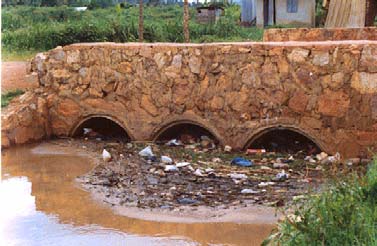
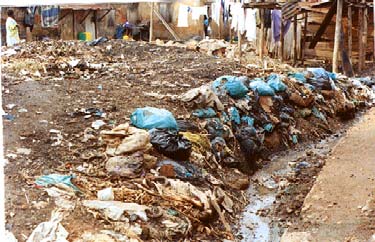
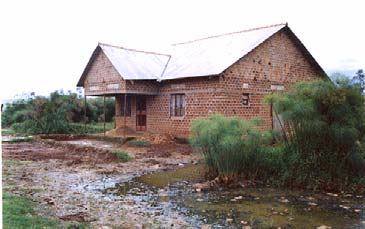
NEMA'S Public Awareness Program
Elizabeth Gowa,
IEC Officer, NEMA
bgowa@nemaug.org
Today's situation
Environmental degradation how did we get there?
Legal framework
Article 245 of the Constitution of the Republic of Uganda authorizes parliament to provide for
measures intended to promote environmental awareness.
National Environment Act Cap 153 Article 87 (e) mandates NEMA to carry out public awareness
activities.
Guiding principles
Vision: A sustainable environment for quality life in Uganda
Mission: To promote public awareness and action for sustainable use and management of the
environment
Goals:
-
Promote the development of adequate environmental knowledge, skills and awareness in
Uganda
-
Developing and supporting the implementation of multi-media environment awareness
strategies and activities at national, local governments and community levels
-
Assisting local governments to develop and implement environment awareness programs and
activities
-
Assisting local governments to establish awareness and communication systems including
resource centres, for effective information dissemination
Strategies
National strategy
Local governments strategy
Objectives at national level
Influence policy-making and implementing organs to enhance public awareness.
Strengthen the capacity of public awareness partners to enable them fulfill their role.
Target the widest section of the population in the campaign.
Strengthen networking and coordination in NEMA.
Networking EE&A Practitioners and Formation of National Working group
Page 48 of 60
Objectives at Local Government level
Build capacity and strengthen collaboration and coordination of environment management
awareness activities of the district and sub-county technical planning committees.
Influence policy-making organs in the districts, sub-counties and parishes to enhance environment
management public awareness activities in the districts.
Work with mass media organizations/journalists to reach a wide section of the public on
environment management awareness/education issues in the districts, sub-counties and parishes.
Strengthen capacity of NGOs/CBOs involved in environment management awareness/education
campaigns in the districts.
Strengthen the capacity of sub-county, parish and village councilors both in initiating policies and
conducting activities to promote environmental management awareness in the districts.
Support schools and other institutions of learning in the district in their environment management
education work as well as to create and maintain living examples of good practice on their
compounds.
Strengthen environment management awareness and the translation of the same into action in the
district through demonstrations, exhibitions, training, shows and community meetings to various
target groups.
Create a culture of monitoring and evaluating environment management awareness activities in the
districts and using the information for reporting and improving environment management
awareness activities in the districts.
Implementation approach
Campaign based on a multi-media approach
- Print
- Electronic
Resource centres
Inter-personal interventions
Messaging/content by audience
Target consumer demographics
Channels of implementation
Print media
Materials production
Radio
Television
Internet
Training videos
Public relations
Resource centre
Audience targeted
Policy makers
Resource users
Urban population
Rural population
Industry
Children
Print media & materials
Readership ~35,000-40,000 each, for Monitor and New Vision
The East African for regional coverage
Limited coverage in country
Activities:
-
Quarterly newspaper supplements on different subject areas
-
Fact sheets, brochures, posters, newsletter
Radio
Networking EE&A Practitioners and Formation of National Working group
Page 49 of 60
Caters for language diversity
Expensive
Need to use many to achieve national coverage
Activities
- Spot
messages
- Radio
dramas/skits
- Discussion
programs
Internet
World wide access
Access in Uganda limited but growing
Activities: Web site: www.nemaug.org
Television
80% coverage country-wide (UTV)
English is the main language of communication.
It is expensive and also not everybody can afford television, so it doesn't reach everyone
Draws on resource people from partner agencies
Activities
-
Bi-monthly TV "actuality" discussion programs
-
Bi-monthly 30-min documentary program
Training videos
Varied subject areas
Language and context specific
Adaptable to different audiences
Shows the physical realities on the ground
Resource centres
Reference only
Books, videos, CD-ROMs, Internet access, pictures, on varied subjects
National and international publishers
Limited reading space
Audio-visual facilities
Budget distribution
Newspaper
Website
s
Resource 5%
2%
centres
9%
Support to
LGs
Materials
4%
production
35%
Radio, tv,
video
Public
39%
lectures
6%
Networking EE&A Practitioners and Formation of National Working group
Page 50 of 60
Partners
NEMA staff
District officials
Lead agencies
The media
NGOs
Schools & institutions of learning
Challenges and lessons
Poverty/low appreciation of environment
Lesson: influence decision makers, integration into existing programs to attract $ from different
sectors
Political interference
Lesson: Need to exert sufficient focus on leadership
Literacy levels
Lesson: Need for a multimedia approach
Complexity of the subject
Lesson: Step by step educative approach, flexible enough to pick up on `news' issues so as to
remain relevant & interesting to audience
Financial resources
Lesson: combine awareness with action-oriented programs
Capacity at local government level
Lesson: capacity building, partnerships, using NEMA programs
Expense
Lesson: partnership, integration, documentation of best practices
Monitoring and evaluation
Lesson: Need for a strategy to show general direction, media monitors, performance indicators
The way forward
Everyone has a role to play
Continue to carry out awareness
Integrate environment awareness into al sector programs
Partnership
Regular networking to share experiences
Never give up; environmental education is a lifelong process.
Networking EE&A Practitioners and Formation of National Working group
Page 51 of 60





Working with Schools; a Case Study of GUCI, Iganga
Akwi Okwi, Kigandaalo
Kigandaalo Primary School
Akwi_okwi@hotmail.com
BACK GROUND:
Education is considered critical in achieving sustainable
development. E.E helps people develop positive attitudes and
sense of personal responsibility for the environment.
GUCI (Greening Buliigo Community Initiative) is one of the
avenues for community action in attempts to improve the
condition of the environment.
GUCI was specifically formed to address the transfer of
information and practices from school to the households in
the neighbour hood.
PURPOSE:
To build a capacity of wel established youth with diverse experiences and expertise in addressing an
environmentally friendly healthier and productive neighbourhood.
OBJECTIVES:
· Promote awareness and commitment to make a healthy community.
· Mobilise school and community based training to improve the state of environment.
· Educate the community on the Rs of solid waste management encouraging the practice of
reducing, Re-using, Refusing and Recycling.
· Involve school departments in presenting debates Music & Drama to increase awareness.
MAIN ACTIVITIES:
NEMA 1996 put in place a national strategy for Environmental Education for Formal Education Sector.
This made Environmental Education mandatory in all formal Education Institutions.
FEE (Formal Environmental Education) focuses of seven programme areas:
1. Development of a curriculum that integrates environmental education into the school curriculum.
2. Development of Environmental Education Management Materials:
3. School community links:
4. Research:
5. Environmental Education projects:
6. In service teacher training:
7. Net working and co-ordination:
In this context GUCI advocates for the "WHOLE SCHOOL APPROACH where by pupils, teachers,
non-teaching staff and members of Local Community are all involved in activities that will affect the
environment in a positive way- it encourages rewards, and a credits those schools, and individuals
that take positive environmental actions and learning.
GUCI is developing a "CLUSTER APPROACH" to Environmental Education, where GUCI and
schools around work together at the community level. It's helping schools to in incorporate EE in the
practical teaching programmes. This is more effective in the areas of developing experimental
gardens, at school where the community comes for study during their visits to school.
Music, Dance and Drama has proved the most effective and efficient means of involving every one in
positive environmental actions and learning.
GUCI is trying to emulate Eco- schools programme, an international programme of FEE with member
organisations in 28 countries in Europe and several other countries in the Caribbean.
ECO- schools is a programme aimed at making sustainable development a part of the life of a school.
GUCI has designed its programmes to fit into the curriculum. It aims at raising pupils and community
awareness of environmental and related sustainable development issues.
Networking EE&A Practitioners and Formation of National Working group
Page 52 of 60
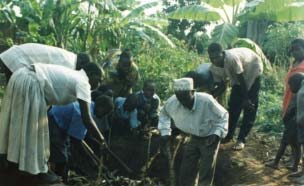
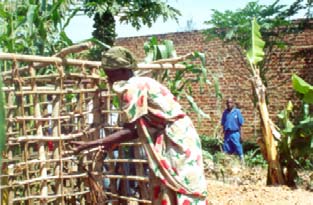
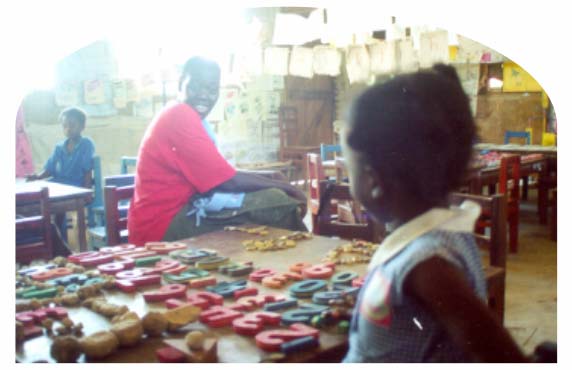
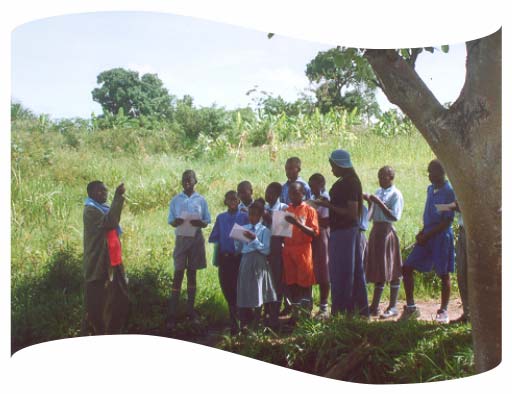
HOW IT WORKS:
COMMUNITY SCHOOL LINKS:
Through the CLUSTER APPROACH, GUCI has developed a link
with the parents of children in the parish, particularly those children
whose parents live in the neighbourhood.
And idea to visit homes, identify environmental problems and solve
them was proposed. The parents who are positive confirm their
participation with the patrons of the children's environmental clubs.
GUCI in a `Keep Iganga clean' campaign and
in a home visit (Next).
These linkages were established in April 2003 when the home to home visits began. Children are
divided into groups headed by teachers together with a representative from the Environmental
Education Committee visit a home every Wednesday from 4-5p.m. They identify an environmental
problem, then take action for example col ect rubbish, dig channels to divert water or fill pot holes.
ENVIRONMENTAL EDUCATION PROJECTS
GUCI is the voice of the community for the members are from the community and are supported by
it. The cluster schools have taken on Music, Drama poetry projects to increase pupil and community
awareness.
The schools have composed music & drama on the themes of water is life. These songs are
presented during the local council meetings and open or parent days in the cluster schools far the
cluster schools include:
· Royal Secondary Schools -
Buliigo North Village.
· Buliigo Boarding & Day P/S-
Buliigo North Village
· St. Agnes Primary School -
Kasokoso South Village.
SOLID WASTE MANAGEMENT PROJECT:
The cluster schools have tried to make learning
in lower primary (P.1-P.2) more exciting. They
specialised in the recycling of polythene bags
(Buvera) and paper which they get from the
school and from the neighbouring homes. Paper
is mashed and used to make learning materials,
while the polythene is used to make ropes and
bal s. Jute sacks and old rubber slippers are cut
into numbers and letters of the alphabet.
RESEARCH PROJECTS IN A PARTNERSHIP:
GUCI recognises that children should be
empowered in decision making and public participation.
In collaboration with the water department, public Health
and sanitation Department the children conducted an
investigation of the Walugogo wet land in the
neighbourhood.
This builds their competence in monitoring the pollutant
types, qualities and their impact on human health and the
wetland bio-diversity.
Networking EE&A Practitioners and Formation of National Working group
Page 53 of 60
In partnership with Iganga Town Council, GUCI together with other schools have been able to
establish a children's park. This was done as a restoration project. It has strengthened GUCI's
school community link: for the cluster approach is extending to other schools beyond the village.
Model school, model village and model home approach has motivated the neighbouring village and
schools to begin taking informed actions about their environments.
These have enabled children to be more knowledgeable about issues in their local neighbourhoods
and confident that they can make a difference by working together and in partnership with the Local
Communities.
CHALLENGES
· Maintaining children's interests in EE conservation programmes.
· Development of EE management materials requires skill and is expensive.
· Motivating the community to participate and support clean up campaigns is changeling.
· Motivating the school and local community leaders to plan and budget for the environmental
education programmes in schools.
· Maintaining cluster team spirit.
· Co-ordination between activities of different NGO's. Most operate in more or less in isolation
leading to inefficiencies and over lay in their work.
· Continuity of activities.
LESSONS
· Through net-working and school community co-operation sharing of relevant technical skills can
be maximised.
· Economic status of communities' can be improved through the initiated soil and water
conservation, and waste management projects.
· More ideas on use of school grounds as a teaching learning resource enhances environmental
action learning in school.
· Community learning especially in conversion of waste into local economic benefit for example
diversion of water to Banana gardens.
· School environment is learning site.
· Sharing of knowledge as children's visited homes and worked as clubs.
· Active engagement of pupils, women and youth encouraged critical thinking.
· Culture of the school and the neighbourhood changed positively.
· School acted as a catalyst for community development.
· Pupils can be empowered to identify environmental problems, site solutions and work with the
households to solve them.
· Through pupils actions they learn barriers, which are related to solving an environmental
problem.
· Schools can open up to their communities and become active in finding solutions to create a
sustainable future.
· Educators can learn to use existing development and tendencies to forward a cause.
Networking EE&A Practitioners and Formation of National Working group
Page 54 of 60
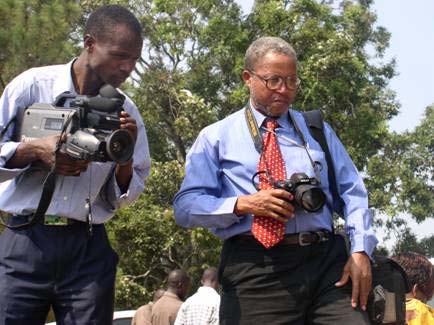
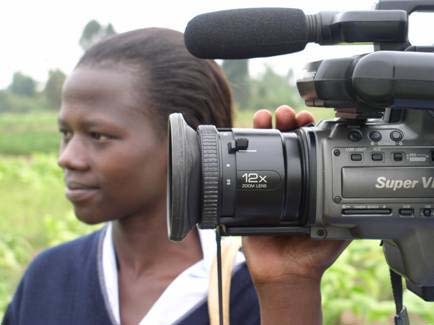
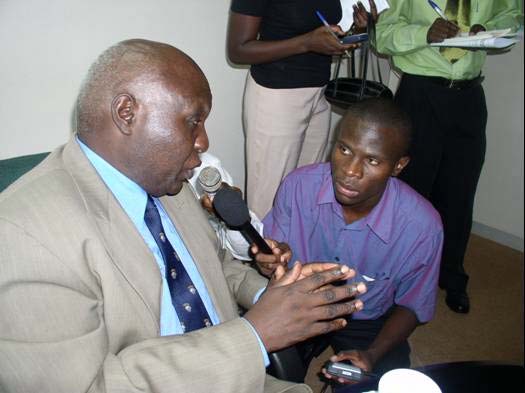





The Role of the Media in Awareness Creation
Peter Wamboga Mugirya
Farmer's Voice/ EJAU
P .O. Box 12141
Kampala, Uganda
Tel: 256-71-319245
pwamboga@yahoo.co.uk
Media History on Environment
The pre-independence and post-independence media did
not have issues of environment strongly on their agenda
The oldest newspaper, Munno was established in 1911, the first state-owned media, Radio Uganda
set-up in 1954 and later UTV were owned by the colonial administration before in 1962, and dwelt
on Politics and Economy.
UTV/ Radio Uganda Educational Broadcasting Division regularly, as policy, aired programs
educating the masses on agriculture and forestry and came closest to dealing with the
environment.
Because global Environmental agenda only emerged mainly in late 80s and early 90s. And Uganda
was no exception. It's only in 1986 that the then new NRM Government initiated environmental
matters on its agenda.
Creation of the Ministry for Environmental Protection, and the birth of National Environment Action
Plan (NEAP) process propelled the Media into Environment coverage
The New Media Environment Coverage
Emergence of the dreaded water hyacinth.
Abuse of nature
Environmental Awards
More Journalists and the Birth of EJAU
Birth of Makerere University Institute of Environment, the Mass Communication Department and
EJAU accelerated training Environment Journalists.
Public Dialogues by EJAU and PANOS Institute
Regional Network on Lake Victoria by IUCN, EJAU, HEMNET, and JET
Emergence of NEMA sponsorship of Environment coverage; Monitor fm and UTV. CBS by
Environmental Alert. And MAMA fm Etc.
Role of the media
1. Creation of awareness.
The media provides information on the state of environment.
Reporting on the good and bad practices: Environmental
journalists acting as watchdogs for the environment.
Highlighting the availability of funding opportunities.
Reporting about activities
of government agencies,
NGOs and CBOs.
2. Advocacy
The media relies on the agenda setting concept. It does not
have the power to tell the people what to think, but tells them
what to think about. Consequently, the public demand for
accountability and transparency.
Networking EE&A Practitioners and Formation of National Working group
Page 55 of 60
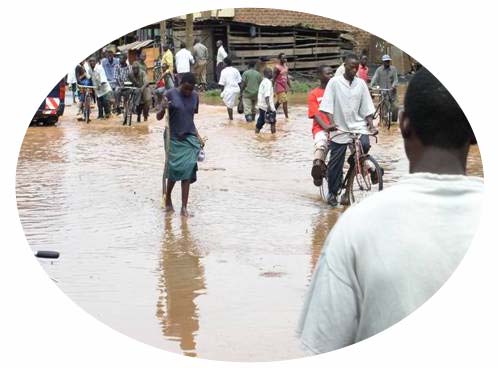
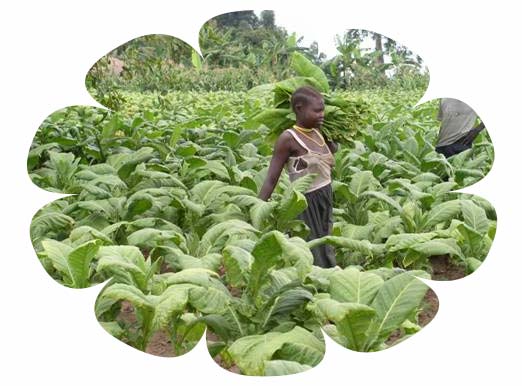
Why do we have few stories about Environment in the media?
The lasswell's communication model
Who says what? Opinion leaders are likely to get more attention-President and others.
What does he say? If what is said affects many people this makes news.
In what channel? Different channels reach different audiences. (What is your audience)
The News value paradigm
The Conflict-dramatic events such as clashes on Butamira forest reserve.
Contradiction. The government officials who are supposed to implement government policy going
against the policy.
Controversy
Colorful language- This is helps to package information.
New Partnership with the Media in Environmental
Information
Private sector participation. UTL, Celtel, and MTN
Civil society-Media collaboration
Improvement in Information Technology
International support to the Ugandan media on
Environment. WB, IUCN, UNDP, SIDA and UNEP Etc.
Challenges
The Media is commercialised and because of this
advertisement takes space for news.
Corruption in cases where media managers and
reporters are influenced to kill stories.
Environmental stories are expensive. But reporters are not facilitated.
The environmental reporters are not trained. Environmental emergencies may be deemed as
newsworthy
Opportunities
Training opportunities at Makerere University-Mass
Communication department-PGD Environmental
Communication and 2 weeks cert. courses.
Existing networks including EJAU, Commission on
Education and Communication of IUCN, African Network
for Environmental Journalists under UNEP, Network for
Environmental Journalists on Lake Victoria..
Environmental Communication experts are being
recognised, For instance, the late Ndyakira Amoti, CNN
Awards, Environmental Alert etc.
Farmer's Voice reports on environmental issues
affecting farmers
Creation of environmental institutions such as NEMA, reforms in forestry and legislation on
environment.
Uganda has 120 registered fm Stations, Over 60 operating, 4 TV Stations, and about 10
Newspapers and Magazines. E.g. Farmers Voice has 2 Environmental pages. Etc.
What can EJAU do?
Mobilise journalists to report on the different activities of the lake and river Nile. It can organise
excursions.
Public debates on the various aspects of environment.
Organise training for media houses and exchange visits with various riparian countries.
Influencing through lobbying media houses to cover issues on trans-boundary resources. Organise
TV and Radio talk shows.
Networking EE&A Practitioners and Formation of National Working group
Page 56 of 60
Participate in designing a media communication strategy on the Nile.
EJAU & NTEAP should set up a mobile film unit for rural Environmental awareness on the Nile.
Mobilise Communities living along the Nile in carrying out Environmental conservation programmes.
Develop a Radio Station whose sole purpose is to Educate and entertain the users of the Nile
resources.
EJAU in partnership with NTEAP will establish a regional Network of Journalists in the 10 NBI
States.
EJAU is due to start Public Dialogues on the state of the Nile.
Networking EE&A Practitioners and Formation of National Working group
Page 57 of 60
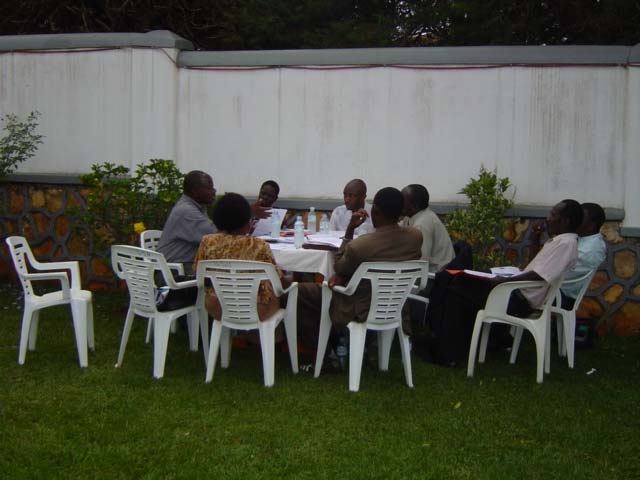
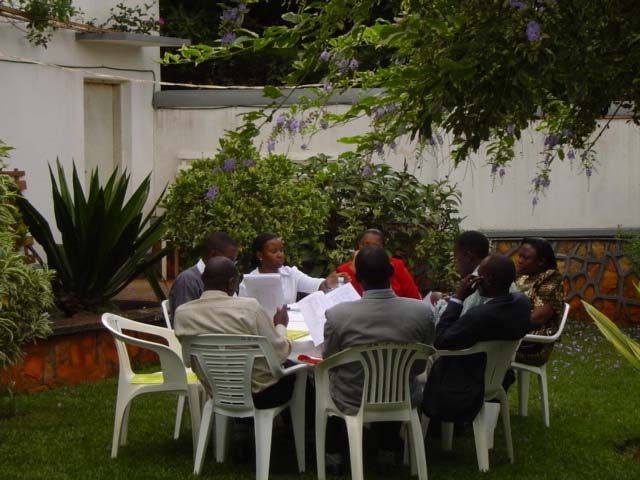










Annex 11
Workshop pictorial
Networking EE&A Practitioners and Formation of National Working group
Page 58 of 60
Annex III
List of Participants
Name
Address
Name
Address
Dr. Aryamanya Mugisha
The Executive Director
Mr. Allele George
Department of Information,
NEMA
UTV,
P. O. Box 22255,
P.O. Box 40188,
Kampala, Uganda
Kampala
haryamanya@nemaug.org
Ms. Alexandra Karekaho
ARR, UNDP
Mr. Simon Peter Amunau
Nat. Res. Coordinator,
P.O. Box 7184,
Straight Talk Foundation
Kampala, Uganda
P.O. Box 22366
Alexandra.karekaho@undp.org
P. O. Box 7002,
Kampala
spamunau@yahoo.com, strtalk@imul.com
Mr. Maushe Kidundo
EE &A lead Specialist NBI-NTEAP
Ms. Proscovia Mulyowa
NCDC
P.O.Box 2891, Khartoum
P. O. Box 7002,
mauschek@unopsmail.org
Kampala
mulallen@hotmail.com
Mr. Robert Nabanyumya
National Project Coordinator, NTEAP
Mr. Francis Wilkins Aduka
Environment Alert
P.O.Box 22255,
fwily2k@yahoo.com,
Kampala
youngprofessionals@envalert.org
robertn@nileteap.org
Teddy Tindamanyire
Ministry of Water, Lands& Environment
Mr. Thomas Otim
Uganda Wildlife Education Center
Wetlands Inspection Division,
P.O. Box 369,
P.O. Box 9269,
Entebbe
Kampala, Uganda
uwecd@uwec200.org
tindamanyiremtt@yahoo.co.uk
Mr. Akol Charles Michael
D/DSCPE, NEMA
Mr. Sam Mabikke
Conservation Trust
cakol@nemaug.org
P.O. Box 1665,
Kampala
Tel: 256-77-510027 Fax: 256-41-252843
mabikkes@yahoo.com
Ms. Beatrice Adimola
EEC, NEMA
Mr. David Mugabi
Executive Secretary, LAKIMO
badimola@nemaug.org
P. O. Box 373,
Soroti
Tel: 256-45-61373 Fax: 045 61372
lakimo@infocom.com , david_mugabi@yahoo.com
Dr. Dan Babikwa
Makerere University,
Ms. Firmina Acuba
Directorate of Water Development
I. A. C. E.
P. O. Box 20026,
P.O. Box 7062,
Kampala
Kampala, Uganda
Social-scientist@dwd.co.ug
danbab@iace.mak.ac.ug
Mr. Ocaya D. Michael
P. O. Box 25,
Ms. Vastina Beyendera
Inspector of Schools,
Packwach, Uganda
P.O. Box 5, Kabale
Ms. Immaculate Kijagulwe
Urban Environment Uganda
Ms. Elizabeth Gowa
IEC Officer, NEMA
P. O. Box 6202,
bgowa@nemaug.org
Kampala, Uganda
ikijags@yahoo.co.uk
Mr. Wilfred Baanabakintu
PRO, NEMA
Mr. Albert Mukundane
Trade development & commercial officer
wbaanabakintu@nemaug.org
Kampala City Council,
Makindye Division
mukundanebalbert@yahoo.com
Mr. J.B Mutalya
Chairman, Jinja District Wildlife Association,
Mr. Tom Waako
NBI Secretariat
P.O.Box 1265,
P.O. Box 192,
Jinja .
Entebbe
Tel: 256-77-627066
twaako@nilebasin.org
mutalyajb@yahoo.com
Mr. Gerald Tenywa
The New Vision
Ms. Lillian Idrakua
WRMD, DWD,
P.O. Box 9815,
P.O. Box 19,
Kampala
Entebbe
gtenywa@newvision.co.ug
Idrakua.wrmd@dwd.co.ug
gmagumba@yahoo.com
Mr. Peter Waboga Mugirya
Farmer's Voice/ EJAU
Mr. Hamidu Kizito
Rural Development Media communication (RUDMEC)
P .O. Box 12141
P. O. Box 1727,
Kampala, Uganda
Kampala, Uganda
Tel: 256-71-319245
Kizito_h@yahoo.com
pwamboga@yahoo.co.uk
Ms. Yawe Agnes
Environmental Alert
Mr. Ernest Nabihamba
Municipal Environment Officer
P. O. Box 11259,
P.O. Box 720,
Kampala, Uganda
Jinja
ayawe@envalert.org
Enabi65@yahoo.co.uk
Mr. Pathias Karekona
Tel: 077 411245
Ms. Akwi Okwi
Kigandaalo Primary School
pathiask@yahoo.com
Akwi_okwi@hotmail.com
Ms. Elizabeth Mutayanjulwa
EE Materials Production, NEMA
Ms. Ida Ameda
P.O. Box 4944,
emutayanjulwa@nemaug.org ,
Kampala, Uganda
e_mutayanjulwa@yahoo.com
iameda@yahoo.co.uk
Networking EE&A Practitioners and Formation of National Working group
Page 60 of 60