Updated Project Information Document (PID)
Report No: AB270
Project Name
TURKEY-ANATOLIA WATERSHED REHABILITATION PROJECT
Region
Europe and Central Asia Region
Public Disclosure Authorized
Sector
General agriculture, fishing and forestry sector (100%)
Theme
Other environment and natural resources management (P); Other rural
development (P); Pollution management and environmental health (S); Water
resource management (S)
Project
P070950
Supplemental Project
P075094
Borrower(s)
REPUBLIC OF TURKEY
Implementing Agency(ies)
Undersecretariat of Treasury
Address: Inonu Bulvari, Emek, 06530 Ankara
Contact Person: Ms. Aysen Kulakoglu, Head, World Bank Projects
Tel: 90-312-213 02 97 Fax: 90-312-212 87 37 Email:
Hazine@hazine.gov.tr
Public Disclosure Authorized
General Directorate of Afforestation and Erosion Control (AGM), Ministry of
Environment and Forestry
Address: Gazi Tesisleri No. 11, Sogutozu, Ankara
Contact Person:
Tel: 90-312-212 55 96 Fax: 90-312-212 55 32 Email:
General Directorate of Production and Development, Ministry of Agriculture and
Rural Affairs
Address: Akay Caddessi No. 3, Bakanliklar, Ankara
Contact Person:
Tel: 90-312-418 59 82 Fax: 90-312-417 00 26 Email:
Public Disclosure Authorized
General Directorate of Control and Protection (TUGEM), Ministry of Agriculture
and Rural Affairs
Address: Milli Mudafaa Caddesi No 20., Kizilay, Ankara
Tel: 90-312-418 20 23 Fax: 90-312-418 20 23 Email:
General Directorate of Rural Services (KHGM), Ministry of Agriculture and Rural
Affairs
Address: Eskisehir Yolu 9 km., Lodumlu, Ankara
Tel: 90-312-287 80 92 Fax: 90-312-287 80 9
Environment Category
B (Partial Assessment)
Date PID Prepared
August 26, 2003
Auth Appr/Negs Date
June 17, 2003
Bank Approval Date
November 18, 2003
Public Disclosure Authorized
1. Country and Sector Background
Overview
The country has an area of 78 million ha of which about 20 million ha is gazetted forest land (about half of
it severely degraded), 21 million ha is rangeland (including unproductive, rocky, mountainous land) and 28
million ha is classified as arable land (largely privately owned). The country consists primarily of an
2
PID
undulating plateau, rising eastward from 800 m to 2,000 m, bordered by high mountains along the northern
and southern coasts, and inland valleys. The climate varies from Mediterranean to continental and, with the
exception of the northern and western coastal areas, is characterized by cold winters and hot, dry summers.
Although rainfall exceeds 1000 mm in some coastal areas, in over 70% of the country it is less than 500
mm. The extreme geo-climatic diversity leads to significant regional variations in cropping patterns
allowing a wide range of crops to be grown under both rainfed and irrigated conditions (such as irrigated
citrus, greenhouse vegetable production, cotton, e, tea and hazelnuts, olives, cereals and sugar beet, pulses).
There are large differences in livestock production systems in different regions; subsistence production is
found in the eastern and mountainous/forest villages, while more intensive, commercial systems are
predominant in the western areas. Smallholder, family-run farming predominates in the sector. However,
farms vary widely in sophistication, from farms in the west using energy intensive technologies and serving
niche export markets, to subsistence cereal/livestock based farms of the central and eastern regions. Most
rural poor, even with small patches of land, still depend on livestock for cash, fuel, and parts of their diet.
There is seasonal and/or permanent out-migration to the larger metropolitan areas. Remaining families or
family members pursue farming, or seasonal agricultural wage labor. Land fragmentation continues to be
an issue.
Turkey's agricultural sector has tremendous potential, but this has gone largely unrealized because of
distortional and outmoded support policies. The sector accounts for some 14% of GNP and a much larger
45% of employment, although this has fallen considerably from around 65% in 1970. A key problem has
been the structure of agricultural support which has traditionally been channeled through a complex maze
of input and credit subsidies, output prices support, high border protection, export controls, deficiency
payments, price controls, market interventions to protect consumers, and others. This fiscally expensive
and economically inefficient system has been driven very much by short-term political concerns rather than
long-term strategy. In 1999, the government launched an ambitious economic reform program to create the
basis for stable and sustained economic growth and set the stage for the country's entry into the EU. The
program focuses on critical actions to promote agricultural growth and rural income generation. The
overall program of agricultural policy reforms will increase Turkey's competitiveness while protecting
natural resources and the poor. Currently, the rural population constitutes about 24.5 million people
(37.7% of the population). Around 62% of the population are in urban areas. However, only half of this
live in predominantly urban areas, the rest is in rural/urban districts. There are big differences in poverty
incidence between regions. Average household income per capita in the richest region is three times the
income in the poorest region. Income differentials across regions and social groups are wide and persistent.
Poverty is also associated with altitude; even in richer regions, the population living in the higher elevation
areas are significantly poorer than the ones living in lowlands.
Main sector issues are: i) degradation of natural resource base; ii) intensive input use for agricultural
production in areas where intensive agriculture is prevailing; iii) nutrient flow from major watersheds to the
Black Sea; and iv) inadequate policy and regulatory capacity towards meeting EU standards.
Degradation of natural resource base: The production based policies of the past have led to overuse of land,
range and forest, leading to a rapid degradation of natural resource base. Only around 3% of the land in
Turkey does not suffer erosion, while 36% is severely, and, 22% very severely eroded. Deforestation to
meet increasing timber, fuel and fodder demands, together with overgrazing of rangeland, farming of steep
slopes (mostly wheat and barley production), and the lack of effective soil conservation practices on
agricultural land has resulted in widespread degradation of land and water resources. Land degradation has
reduced the soil fertility in agricultural land and made the river flows torrential and unstable. Flooding and
sedimentation which, in turn, has promoted the development of wide, braided stream beds, overflow plains,
alluvial fans, and deltas at reservoir inlets.
3
PID
Intensive input use for agricultural production in areas where intensive agriculture is prevailing: Farmers
are encouraged to use pesticides and inorganic fertilizers through suppliers as well as the extension
workers particularly in low lands and fertile plains, because of the: i) perceived simplicity of application,
and ii) industry's effort to link the use of chemicals with "modern agriculture". There is some indications
that excessive application of agricultural chemicals has led to considerable contamination of soil and
ground water i.e. contaminated wells which provide drinking water to rural communities, thus threatening
public health. Excessive input has also led to high levels of nutrient loads in ground water and rivers
draining into the Black Sea, causing eutrophication. Although MARA is making effort to promote IPM
and organic (ecological, or biofarming) farming, adoption by farmers is still very limited.
Nutrient flow from major watersheds to the Black Sea: Eight of the 26 main river basins of Turkey are in
the Black Sea Region. The largest ones which are originating from the Central Anatolia are: i) Kizilirmak,
ii) Yesilirmak, and iii) Sakarya. The Transboundary Diagnostic Analysis (1996) identified Turkey's rivers
that empty into the Black Sea as Turkey's largest sources of phosphorus and nitrogen. It was estimated the
total: i) nitrogen discharge as 4,730 tons/year from Kizilirmak, 7,768 tons/year from Yesilirmak, and 9,546
tons/year from Sakarya, and ii) phosphorus discharge as 278 tons/year from Kizilirmak, 414 tons/year
from Yesilirmak and 1,021 tons/year from Sakarya (1998). Sakarya Watershed embraces several major
industrial towns such as Adapazari, Bilecik, Bozuyuk, Eskisehir as well as agricultural areas. However,
Yesilirmak and Kizilirmak Watersheds mainly include agricultural provinces. The main causes of river
pollution from agricultural non-point sources were identified as: i) poor agricultural practices, including
inappropriate and over-application of fertilizers and pesticides, ii) inappropriate management, storage and
disposal of aquaculture and animal manure and waste, iii) soil erosion resulting from unsustainable land
use and iv) poor drainage.
Inadequate policy and regulatory capacity towards meeting EU standards: Becoming a member of the EU
will induce important changes in the environmental policy and regulatory capacity of Turkey. In the short
term Turkey has to: i) adopt a detailed directive-specific transposition program of the EU environmental
acquis, ii) transpose the Environmental Impact Assessment Directive, and iii) develop a plan for financing
directive investments. In the medium term, the country has to: i) implement and enforce the environmental
acquis; ii) implement the acquis with particular attention to framework legislation, the horizontal
legislation, and the legislation on nature protection, water quality and waste management, iii) implement a
waste management strategy, iv) establish monitoring networks and permitting procedures; v) integrate
sustainable development principles into the definition and implementation of all other sectoral policies, and
vi) implement and enforce the Environmental Impact Assessment Directive. Nitrates Directive and
Dangerous Substances Directive are among the "investment heavy" directives which are not only directives
requiring investment, but they are those which pose the greatest problems in terms of the number of
projects needed and the scale of investments.
Based on the positive experience of the Eatern Anatolia Watershed Rehabilitation Project (EAWP), the
Government of Turkey decided to go with a second watershed rehabilitation project in selected watersheds,
including some in the Black Sea catchment area.
4
PID
2. Objectives
The objective of the project is to support sustainable natural resource management and poverty reduction in
degraded watersheds in Anatolia and the Black Sea Coast. This would be achieved through: a) improving
productivity of range, forest and farmland, b) promoting increased income from more intensive farm
activities ti replace the traditional over-exploitation of natural resources, c) encouraging responsibility of
local communities in planning and management of shared resources, d) increasing the use of
environmentally friendly agricultural practices and thereby reducing nutrient discharge particularly from
agricultural sources to the Black Sea, e) strengthening national policy and local regulatory capacity to meet
European Union (EU) standards for agricultural nutrient pollution control, f) building capacity and
promoting a broad public awareness program and replication strategy.
2. Project global environmental objectives : The global environmental objectives of the Project focus on i)
climate change, and ii) improved international waters quality through nutrient reduction. Climate change:
Project activities of tree planting and ecologically sustainable land use in selected microcatchments will
help in increased carbon sequestration. Improved farming and livestock practices will assist in decreasing
emissions of methane from farmyard manure. Nutrient reduction: The Project will reduce, over the
long-term, the discharge of nutrients (nitrogen and phosphorus) and other agricultural pollutants into the
surface and ground waters of Turkey and the Black Sea through integrated land and water management and
ecologically sustainable use of natural resources. This component is being prepared under the umbrella of
the Black Sea/Danube Strategic Partnership-Nutrient Reduction Investment Fund under which riparian
countries would be eligible for Global Environment Facility (GEF) funding for projects that would control
or mitigate nutrient inflow to the Black Sea. The Project activities are directly linked to "Strategic Action
Plan for the Protection and Rehabilitation of the Black Sea" (BSSAP), formulated with the assistance of the
GEF.
3. Rationale for Bank's Involvement
This Project will be a logical extension of the EAWP implemented in 11 provinces of the country. The
Bank support helped target the project to poor communities in the microcatchment (MC) areas and
degraded natural resources of critical importance that had been under-served. The strategic focus of this
project on poverty reduction made for a strong partnership with the Borrower particularly in the context of
reducing the income disparities, and furthering the decentralized rural development process. In comparison
with other donors, the size of assistance available from the Bank was more in keeping the scale of finance
needed to have a significant impact on poverty and reduction of natural resource degradation in the selected
watersheds. The Bank implemented an innovative and creative project, bringing in good external technical
expertise and combining it with good local knowledge. Exceptional continuity and overlap of Bank staff
also contributed a lot to the project which was appreciated by the national project staff. The Project
attracted international and teams from of a number of countries making effort to address natural resource
degradation and rural poverty were sent to Turkey to visit the MCs. The proposed project will build on the
proven value added by the Bank in the EAWP. Through the proposed project Bank will assist the Turkish
government in further capacity building, and refining the already developed approach for natural resource
rehabilitation.
The principle value added of GEF support for the Project comes from providing additional funds to reduce
barriers to farmers adopting environmentally-friendly agricultural practices and allow Government to
scaling-up the program. Without GEF support the Project would lack sufficient resources to develop
national and local capacity to promote and accelerate the program, to demonstrate the holistic approach to
controlling nutrient loads and undertake a public outreach program. The GEF has already added value by
supporting similar programs in other ECA countries. Given their international scope, the GEF and the
Bank can provide funds to cover the incremental costs of replicating such activities within Turkey and in
5
PID
other countries in the Region. Some level of financial support from the public sector and the international
community will continue to be necessary, particularly in lower income countries, because these activities
address externalities, affect transboundary pollution and involve an element of public good.
4. Description
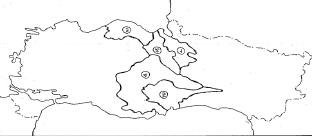
Project area: The project will be executed in MCs of the following watersheds and provinces of Anatolia:
i) Seyhan: Adana, Kayseri, and Nigde, ii) Ceyhan: Kahramanmaras, Adana, Osmaniye, iii) Goksu: Mersin,
Konya, Karaman, and in the watersheds discharging significant amounts of nutrients into the Black Sea: i)
Kizilirmak: Kayseri, Sivas and Tokat, and ii) Yesilirmak: Sivas, Tokat, Amasya and Corum. It is
estimated that in these watersheds about 55 MCs could be rehabilitated with the available funds. In the
selection of the MCs generally the criteria developed by the EAWP will be used (such as degree of
degradation and rural poverty, reversibility, participation potential, physical and economic potential for
income raising activities). However, for the MCs where agricultural pollution will be addressed by using
GEF funds additional criteria will be developed, mainly related to reduction of nutrient pollution.
Map 1. Project watersheds : 1: Seyhan, 2: Ceyhan, 3: Goksu, 4: Kizilirmak and 5: Yesilirmak
Total population of these provinces is about 10 million where half is rural. The majority of the candidate
districts are classified as predominantly rural with low and medium human development index. In these
districts, per capita income varies from US $550 to US $2,300. Non-farm income provides a substantial
portion of rural livelihood in the provinces in different modes: i) dual residence-summers in the village and
winters in the city being engaged in regular paid work or business enterprise, ii) releasing young males to
work in big cities while other members of the household pursue farming, and iii) seasonal agricultural wage
labor in other provinces. Despite migration in various forms, there is a strong cultural attachment to land
and hometown which makes the communities interested in the improvement of the natural resources in their
environment.
Ceyhan and Seyhan Watersheds (excluding Nigde and Kayseri), intensive agriculture is carried out in the
lower MCs where farming systems include cotton, citrus, maize, wheat and vegetable production. In the
upper MCs, agricultural activity is highly differentiated, ranging from self-sufficient grain production to
market oriented vegetable, nut and fruit production. Livestock carries special importance for these areas, as
most rural poor around the forests depend on goat production as it is readily convertible to cash. Forests
are degraded in the higher elevations as usual. In the Goksu Watershed, Mersin shows significant diversity
in terms of climate and topography which dictates different farming systems. In the inner parts, towards
north, cereal based dryland agriculture, in the MCs on the Taurus Mountains, horticultural production
predominate. Kayseri, and Nigde of the Seyhan, and, Konya and Karaman of the Goksu Watersheds show
similar characteristics; forests and rangelands are severely degraded leaving the land exposed to erosion. In
agriculture, fallow-wheat or fallow-barley under rainfed conditions, cold-tolerant fruit production, sugar
beet, and vegetables and alfalfa on small patches of land under irrigated conditions are common. Some
villages practice large-scale migratory sheep herding. Kayseri is particularly important for livestock
production, large scale poultry, cattle fattening and dairy production are developing rapidly. Yesilirmak and
6
PID
Kizilirmak are large watersheds showing wide variations in farming systems; from market oriented grain to
intensive horticultural production. Frequency and rate of pesticide use is high partly due to the relatively
high rainfall which increase pest incidence. In fertilizer use similar trend is prevailing. While most
households keep a few sheep and cattle for home consumption, some villages are engaged in large scale
production. Commercial scale poultry production is an important economic activity for Corum.
The loan amount for the project has been proposed as US $32 million. Around US $6 million is proposed
from the GEF. The majority of these funds about 90 percent is expected to be directly invested in the new
MCs. Based on the experience gained with the EAWP, the actual investment in each MC will depend on the
area, and thereby the cost, to be rehabilitated. It will be ensured that there is a proper balance between
rehabilitation and income raising activities in each MC, or in other words that investments in short term
income support is balanced with long-term rehabilitation of the watersheds. The participatory process
would identify existing informal groups or establish local community associations for implementation and
future maintenance of investments. The Project would partly finance the investments, and the MC
communities contribute towards the cost of income generation interventions in cash, materials or their own
labor. The scale of cost sharing will be determined through affordability studies.
The project will have five components. The major components 1 and 2 have been used and tested in the
EAWP.
Component 1: Rehabilitation of Degraded Natural Resources (US $37.2 million) This component
consists of a menu with various activities to be implemented by General Directorate of Afforestation and
Erosion Control (AGM) of Ministry of Forestry (MOF) , General Directorate of Rural Services (KHGM),
general Directorate of Production and Development (TUGEM) and General Directorate of Control and
Protection (GDPC) of Ministry of Agriculture and Rural Services (MARA), all with the primary objective
to protect degraded areas from further degradation, erosion and pollution. The majority of the activities
will be implemented by AGM and consists of the following groups of activities: i) soil conservation by
afforestation, ii) rangeland rehabilitation, iii) rehabilitation of degraded forests, iv) gully rehabilitation, v)
gallery plantations, vi) participatory afforestation, and vii) nursery management. The following activities
will be implemented mainly by MARA with the exception of river bank protection which will be carried out
by KHGM: i) fallow reduction, ii) appropriate use of marginal agricultural land, iii) gully horticulture, iv)
contour tillage, v) river bank protection, and vi) environmentally friendly agricultural practices.
Component II: Income Raising Activities (US $10.5 million ) This component consists of a menu which
will be implemented by TUGEM and KHGM, all with the primary objective to raise the rural income by
complementing Component 1 which bring a mix of short-term and long-term benefits. During the
participatory process, depending on the agro-ecological and socio-economic conditions and farmers'
resources, a "menu" will be offered which comprise various treatments some of which will be conditional
on, and must be adopted in, association with another. Flexibility needed to respond to the needs of the
villagers will be maintained during project implementation. The component will consist of the following
groups of activities : i) small scale irrigation, ii) farm ponds, iii) agricultural production on terraces, iv)
production of niche crops, v) grafting of wild fruit species, vi) forage crop production, vii) trees along field
boundaries, viii) beekeeping, and ix) small grant program for farmers.
Component III: Strengthening Policy and Regulatory Capacity Toward Meeting EU Standards (US
$500,000) This component will be implemented by Ministry of Environment (MOE) and will include: a)
support to MOE and other relevant agencies in the harmonization of national legislation with EU, namely
Nitrates (91/676/CEE) and Dangerous Substance Directive (76/464/EEC). This component will include
the preparation of a Code of Good Agricultural Practices in the light of experiences gained from project
7
PID
activities, and b) strengthening of the legislative framework for the promotion of organic agriculture.
Component IV: Awareness Raising, Capacity Building and Replication Strategy (US $800,000):
This component will have the following sub-components i) awareness raising: this will raise awareness
amongst target beneficiaries and other stakeholders about the program approach and terms of participation.
The goal will be to increase transparency in program implementation and empower beneficiaries to demand
program services. For the agricultural pollution to the Black Sea, the component would provide capacity
building and public awareness activities at the local, national and regional level, for the training of
beneficiaries and participating institutions as well as for the future replication of similar activities in
Turkey and other Black Sea riparian countries, ii) capacity building: this will help to develop the
communities' capacity in understanding of the issues of natural resource degradation and agricultural
pollution, iii) farming as a business: farmers will be trained on farm budgets, accounting, marketing and
simple agro-processing techniques to assist them to increase efficiency and productivity in agricultural
production and iv) rural telecenter: a basic telecenter with computer terminals will provide access to
internet to enable the community to access more information particularly on sales/purchase options.
Component V: Project Management and Support Services (US $3 million): This component will have
the following sub-components: i) project administration : This sub-component will support the technical
assistance, financial services, logistical and operational requirements necessary to ensure the appropriate
and efficient administration of project activities and resources by central and provincial project
management units, ii) support services: This sub-component will fund extension, technical training and
study tours for project managers and technical project staff, monitoring and evaluation, survey and
technical designs such as simple agro-processing and storage and establishment of village associations, and
iii) Competitive Research Grant: This sub-component will finance short-term, small-scale applied research
on soil, water, crop, natural resource management, agricultural pollution, livestock and forestry directly
related to on-going activities.
5. Financing
Source (Total ( US$m))
BORROWER/RECIPIENT ($14.99)
IBRD ($37.00)
LOCAL COMMUNITIES ($8.51)
GLOBAL ENVIRONMENT FACILITY ($7.00)
Total Project Cost: $67.50
6. Implementation
The project will be implemented over a period of seven (7) years and it will not create new institutions for
implementation. Project management units/teams established for EAWP have proven to be functioning
smoothly. These will be maintained for the proposed project and by taken into consideration the new
components, relevant agencies will be included in the units/teams.
Central level: The Project Support and Coordination Unit (PCSU), which proven to be operating smoothly
also as a national steering committee for EAWP, will continue to function for the proposed project at
Ankara level. However, two new members will be added to the Unit due to the inclusion of the GEF
financed components, namely the General Directorate of Pollution Control and Ministry of Environment.
The Unit will be comprised of the representatives of the following agencies: i) TUGEM/MARA, ii)
GDPC/MARA, iii) KHGM, and iv) Department of External Affairs/MOE. AGM/MOF will chair the
8
PID
PCSU and also serve as secretariat. GDPC will have the overall implementation responsibility of the GEF
financed components. In each line agency, a Project Coordination Team (PCT) will have the overall
responsibility for the related component(s) at the central level.
Field level: In each province, there will be a "Provincial Implementation Team" (PIT) which will be
comprised of representatives from: i) Provincial Directorate of Agriculture (PDA), ii) Regional Office of
AGM, iii) Provincial Directorate of KHGM and iv) Provincial Directorate of Environment. The Unit will
be headed by AGM. PDA will be represented by: i) Farmer Training and Extension Section (FTES), ii)
Plant Protection Section (PPS), and iii) Control Section (CS). Monitoring and evaluation of soil and water
quality at the MC level (by MOE).
Beneficiary level: Establishment on a pilot basis of a "MC Resource Management Association (MRMA) "
in one of the MC village could be instrumental in making the community responsible for post-project
operation and maintenance to ensure sustainability. A "Village Revolving Fund (VRF) " can be useful in
achieving these tasks. These will be further studied during the preparation of the project.
7. Sustainability
The Treasury, State Planning Organization (SPO), central and provincial government agencies are in full
support of the project. The project preparation will be carried out mainly by AGM, MARA, KHGM and
MOE with the help of few local and international consultants hired for certain areas where the agencies
lack expertise, e.g. social assessment, environmental assessment, and economic and financial analysis.
Involvement of the agencies from the preparation stage will secure ownership and commitment. AGM
which has strong institutional capacity and proven track record as a project coordinating agency will lead
responsibility for project implementation both at the central and field level. MOF initiated an effort to
amend the existing Forestry Law (No: 6831, Article 58), making the collaboration with KHGM and
TUGEM and local communities mandatory in watershed rehabilitation activities carried out by AGM.
This proposal which will make the EAWP approach sustainable has already been agreed by KHGM,
MARA, Ministry of Finance and SPO and will be sent to the Parliament.
The Project will require a mode of operation where village perceptions of problems and priorities constitute
the starting point. This early involvement of key stakeholders (i.e. village communities, farmers, livestock
owners, NGOs) in decision making and later implementation will increase chances of sustainability.
Sustainability will be further enhanced by establishing MC Resource Management Association and Village
Revolving Fund.
The Project will create conditions for sustainable land use. This will be achieved through addressing four
dimensions of sustainability at the watershed and household level: productivity, stability, resilience and
equity. Project interventions will increase per hectare productivity and overall production in the watershed
and at the household level. The Project will provide greater stability by reducing variability in production
(through terraces and small scale irrigation) and income (through diversified production activities).
Resilience to extreme shock (i.e. drought), will increase (i.e. tree planting on slopes, shift to stall fed
livestock production) which in turn increase the vegetative cover and make it more resistant to drought and
reduce erosion. The project will also promote equity as most households will gain access to government
investment.
The project also seeks to strengthen the policy and regulatory framework and build capacity of national and
local institutions in reduction of agricultural pollution. Under the EU Nitrate Directive, Turkey has to
identify vulnerable areas and to develop and implement a Code of Good Agricultural Practices and Action
Plans for each vulnerable area. The activities which will be replicated at both local and national level will
9
PID
be promoted by a series of on-farm trials, demonstrations, and training and public awareness programs.
Farmers will be contributing towards the operating expenses of the demonstrations and be involved in the
planning and execution from the start. A sense of ownership with cost sharing plus attention to positive
impact on profitability will ensure that farmers adoption of these practices will become self sustaining. The
Government has demonstrated financial commitment to implementing the EAWP despite severe budget
constraints due to macro-economic difficulties and major natural disasters, earthquake. Government
indicated its continuing support by taking over the responsibility for financing of the incomplete work in
EAWP MCs after the Closing Date. The proposed project is an extension of the EAWP, therefore it will
also enjoy the Government's continuing support. In fact, there will be minimal need for government
budgetary support beyond the implementation and investment phase.
8. Lessons learned from past operations in the country/sector
Key lessons learned from rural, environmental and agricultural operations in the regions and reflected in the
proposed Project include: i) problems should be solved jointly with clients not for them; ii) the rationale,
benefits and objectives of the project should be made known to all stakeholders, if not through active
participation, then through public awareness programs; iii) early involvement of key stakeholders in project
concept design is essential in order to ensure ownership, building lasting commitment and achieve on
successful project implementation; iv) Environmentally friendly agricultural activities should establish a
link between the objectives of environmental protection and tangible benefits for key stakeholders,
specifically including local communities; and v) dissemination of information about the benefits of
improved environmental management is critical to the widespread adoption of new technologies and
practices.
Since the proposed project is a follow-up to the EAWP, the Lessons Learned refer exclusively to the
experience under the first project. In the last year of implementation, several meetings and workshops have
been conducted where "Lessons Learned" were identified by the field and central project staff: i) strict
guidelines should be established to keep the project's focus on catchment rehabilitation. The project is not
a "Rural Development Project" but it is a project where people's participation is sought in the conservation
of specific natural resources that are essential to their well being; ii) the actual investment in each MC will
depend on the area, and thereby the cost, to be rehabilitated mainly by AGM. Therefore, 55 percent of the
loan funds should be used by AGM, 35 percent by KHGM and 10 percent by TUGEM. An average of
about US $900,000 per MC is a very reasonable amount to carry out priority work in each of the MCs and
realize the project objectives; iii) minimum cost sharing should be 10 percent for all KHGM and TUGEM
activities. This should be told farmers up front to allow them to make decision about their involvement in
the project; iv) the project should undertake the preparation of 2 new MCs/province/year instead of the 3
MCs/year under the EAWR to make the work manageable at the peak year; v) one full year should be
allocated for MC planning to ensure participation of the local communities. Sufficient time should be given
to agencies to diagnose the reasons of natural resource degradation and associated target groups, and
communities to digest the new ideas individually and as a community, to get responses to their
questions/concerns, and to provide feedback; vi) seven years should be the minimum project duration. The
closing date should be December 31 to benefit from fall construction and planting period; vii) each line
agency should be responsible for their own procurement; viii) strict guidelines should be told up front that
they will be responsible for the operation and maintenance of small irrigation schemes and rehabilitated
rangelands. These arrangements needs to be formalized e.g. establishing associations or formal groups; ix)
KHGM needs to be selective in making investments for small scale irrigation. To make a rational and
defensible selection KHGM should establish a selection matrix in which each scheme receives credit points
based on such things as whether the beneficiaries deserve to be compensated for sacrifices made to help the
rehabilitation work and x) funds should be made available to hire consultants to supervise the construction
10
PID
of small scale irrigation.
9. Environment Aspects (including any public consultation)
Issues : The project's outcomes of sustainable use of natural resources and reduction of nutrient
loads from agricultural sources to the Black Sea are environmentally positive. The Project is classified as
Environmental Category B and a Regional Environmental Assessment (REA) and Environmental
Management Plan (EMP) would be prepared since the environmental benefits derived from watershed
improvements as a whole are greater than the sum of the individual parts. The EMP would relate to
sustainable natural resource management in the project area and involve a broad definition of the natural
environment, relevant interlinkages and involve a more in-depth spatial and disciplinary analysis of issues
and solutions. The project would address the issues such as reversing land, soil and forest degradation,
manure management in livestock production, optimization of agricultural input use in an environmentally
friendly manner.
The project will continue the participatory planning and management processes for natural resources as
developed under the firts project (EAWP).
10. List of factual technical documents:
11. Contact Point:
Task Manager
S. Nedret Durutan
The World Bank
1818 H Street, NW
Washington D.C. 20433
Telephone:
Fax:
12. For information on other project related documents contact:
The InfoShop
The World Bank
1818 H Street, NW
Washington, D.C. 20433
Telephone: (202) 458-5454
Fax: (202) 522-1500
Web: http:// www.worldbank.org/infoshop
Note: This is information on an evolving project. Certain components may not be necessarily included
in the final project.