
UNDP Project Document
Governments of: Antigua and Barbuda, Bahamas, Barbados, Belize, Brazil, Colombia,
Costa Rica, Dominica, Dominican Republic, Guatemala, Grenada, Guyana, Haiti, Honduras,
Jamaica, Mexico, Nicaragua, Panama, St. Kitts and Nevis, St. Lucia,
St. Vincent and the Grenadines, Suriname, and Trinidad and Tobago
United Nations Development Programme
United Nations Office for Project Services
and
Intergovernmental Oceanographic Commission (UNESCO)
PIMS 2193 - Sustainable Management of the Shared Living Marine Resources of the Caribbean Large
Marine Ecosystem (CLME) and Adjacent Regions
PIMS 2193 Project ID 00059903
The focus of the GEF intervention will be on assisting the Caribbean countries to improve the
management
of their shared living marine resources, most of which are considered to be fully or over
exploited, through an ecosystem level approach. A preliminary Transboundary Diagnostic Analysis
(TDA)
identified three priority transboundary problems that affect the Caribbean Large Marine
Ecosystem (CLME): unsustainable exploitation of fish and other living resources, habitat degradation
and community modification, and pollution. The final TDA will serve as the science basis for
development of an agreed program of
interventions including fishery reforms, conservation measures
and pollution control. A Strategic Action Programme (SAP) with a shared vision for the CLME will
be developed, and required priority interventions, reforms and investments agreed to. The proposed
project will facilitate the strengthening of fishery governance in the Caribbean at the regional, sub-
regional and national levels by working with existing structures, strengthening horizontal and vertical
linkages both politically and technically. To a
ssist this process, the project with create an integrated
information management system bringing together congruent fisheries, biological, pollution and socio-
economic data and information as powerful management tool. Similarly, a monitoring and evaluation
framework and a Regional Monitoring Environmental Programme will be developed. Pilot projects on
specific transboundary fisheries (spiny lobster and reef fisheries) will trial governance models at the
local, national and sub-regional levels and provide additional knowledge on means of applying
ecosystem based approaches to fisheries management and determining the fisheries' socio-economic
importance and sensitivities.
1
Table of Contents
Acronyms ........................................................................................................................................ 3
CARIBBEAN SEA AND ADJACENT REGIONS ................................................................ 5
Map 1 .................................................................................................................................... 5
Map 2 .................................................................................................................................... 6
SECTION I: Elaboration of the Narrative .................................................................................. 7
PART I: Situation Analysis ........................................................................................................... 7
CONTEXT AND GLOBAL CONTEXT ......................................................................................... 7
PRIORITY TRANSBOUNDARY ISSUES .................................................................................... 17
STAKEHOLDER ANALYSIS .................................................................................................... 25
INSTITUTIONAL, SECTORAL AND POLICY CONTEXT .............................................................. 26
BASELINE ANALYSIS ............................................................................................................ 30
PART II: Strategy ........................................................................................................................ 32
INSTITUTIONAL, SECTORAL AND POLICY CONTEXT .............................................................. 33
PROJECT RATIONALE AND POLICY CONFORMITY................................................................ 37
PROJECT OBJECTIVES .......................................................................................................... 39
PROJECT OUTPUTS/ACTIVITIES ........................................................................................... 40
PROJECT INDICATORS , RISKS AND ASSUMPTIONS ................................................................ 55
EXPECTED GLOBAL, NATIONAL AND LOCAL BENEFITS ......................................................... 56
COUNTRY OWNERSHIP: COUNTRY ELIGIBILITY AND COUNTRY DRIVENNESS ...................... 57
SUSTAINABILITY .................................................................................................................. 57
REPLICABILITY ................................................................................................................... 58
FINANCIAL PLAN ............................................................................................................ 58
PART III: MANAGEMENT ARRANGEMENTS ................................................................... 59
PART IV: MONITORING AND EVALUATION PLAN AND BUDGET ............................ 61
PART V: Legal Context............................................................................................................... 68
SECTION II: STRATEGIC RESULTS FRAMEWORK AND GEF INCREMENT ........... 69
SECTION III: TOTAL BUDGET AND WORK PLAN ........................................................ 78
SECTION IV : ADDITIONAL INFORMATION .................................................................... 86
PART I: DEMONSTRATION PROJECTS DOCUMENTS: PLEASE SEE SEPARATE FILE (ANNEX A). 86
PART II: CO-FINANCING LETTERS: PLEASE SEE SEPARATE FILE (ANNEXES B THROUGH G) .. 86
PART III: ORGANIGRAM OF PROJECT ........................................................................................ 87
PART IV: TERMS OF REFERENCES FOR KEY PROJECT STAFF AND MAIN SUB-CONTRACTS .... 88
PART V: IMPACTS, CONSEQUENCES AND CAUSES OF PRIORITY TRANSBOUNDARY AREAS OF
CONCERN IN THE SUB-REGIONS OF THE CLME PROJECT AREA ................................................ 93
PART VI: STAKEHOLDER INVOLVEMENT PLAN: PLEASE SEE SEPARATE FILE (ANNEX H) .... 102
PART VII: PRELIMINARY REGIONAL AND SUB-REGIONAL TRANSBOUNDARY DIAGNOSTIC
ANALYSES: PLEASE SEE SEPARATE FILE (ANNEXES I AND J) ..................................................... 102
SIGNATURE PAGE .................................................................................................................. 103
2
Acronyms
ACS
Association of Caribbean States
APR
Annual Project report
AWP Annual Work Plan
CARICOM
The Caribbean Community
CBD Convention on Biodiversity
CBO Community-based Organizations
CCA
Causal Chain Analysis
CEP
Caribbean Environment Program
CERMES
Centre for Resource Management and Environmental Studies University of West Indies
CITES Convention on International Trade in Endangered Species
CLD
Causal Loop Diagram
CO
Country Office
CoML Census of Marine Life
CRFM
Caribbean Regional fisheries Mechanism
CTA
Chief Technical Advisor
EEZ Economic Exclusion Zone
ESI Environmental Status Indicator
EU
European Union
FAO
Fisheries and Agriculture Organization
PoP
Friends of the Project
GDP
Gross Domestic Product
GEF
Global Environmental Facility
GESAMP Group of Experts on the Scientific Aspects of Marine Environmental Protection
GIWA
Global International Waters Assessment
IA
Implementing Agency
ICCAT
International Commission for the Conservation of Atlantic Tuna
ICZM Integrated Coastal Zone Management
IMS Information Management System
IOC
Intergovernmental Oceanographic Commission of UNESCO
IOCARIBE
IOC (UNESCO) Sub-Commission for the Caribbean and Adjacent Regions
IPCC Inter-government Panel on Climate Change
IUCN
International Union for the Conservation of Nature and Natural Resources
IUU Illegal, unreported and unregulated fishing
IW
International Waters
LMR Living Marine Resources
LRP
Limit Catch Reference Point
M&E
Monitoring and Evaluation
MCS Monitoring, Control and Surveillance
MPA Marine Protected Area
NAPs
National Action Plans
NFP National Focal Point
NGO
Non Governmental Organization
NOAA National Oceanic and Atmospheric Administration
OECS
Organization of Eastern Caribbean States
OLDEPESCA Latin American Organization for Fishery Development
OSPESCA
Organization for the Fishing and Aquaculture Sector of the Central American Isthmus
PCU
Project Coordination Unit
PDF-B Project Development Funds - B
3
PIR
Project Implementation Review
POPs Persistent Organic Pollutants
RC
Regional Coordinator
RCU
Regional coordinating Unit
RT Results Template
REMP Regional Environmental Monitoring Programme
RFMO Regional Fisheries Management Organization
SAP
Strategic Action Programme
SHA
Stakeholder Analysis
SIDS
Small Island Developing States
STAG
Stakeholder Advisory Group
TDA
Transboundary Diagnostic Analysis
TNC The Nature Conservancy
TRP
Target atch Reference Point
TTT
Technical Task Team
UNDP
United Nations Development Programme
UNEP
United Nations Environment Programme
UNESCO United Nations Educational Scientific and Cultural Organisation
WECAF
West Central Atlantic Fishery Commission
WSSD World Summit on Sustainable Development
WWF
Global Conservation Organization/World Wildlife Fund for Nature
4

CARIBBEAN SEA AND ADJACENT REGIONS
Map 1
Courtesy of the University of Texas Libraries, The University of Texas at Austin
5
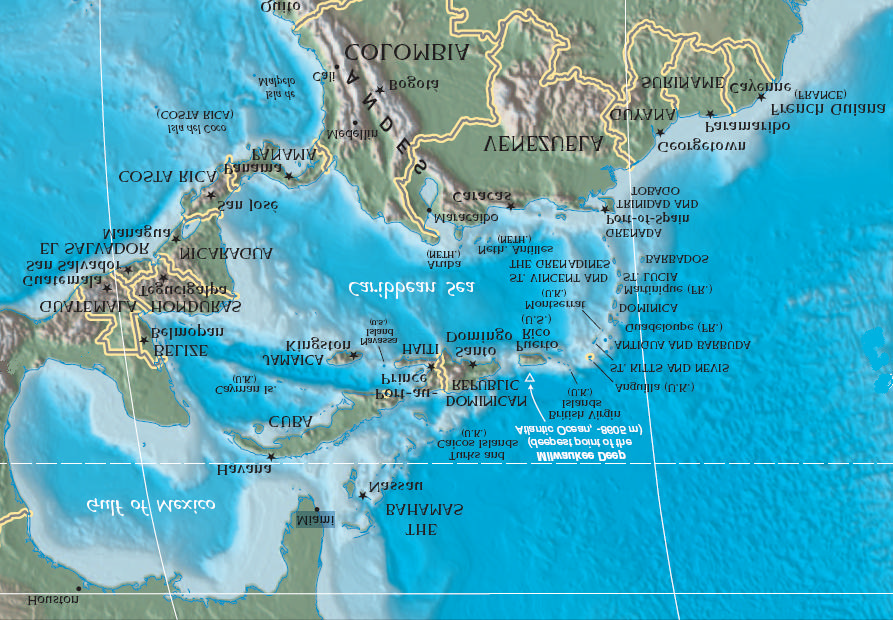
Map 2
BRAZIL
Courtesy of the University of Texas Libraries, The University of Texas at Austin
6
SECTION I: Elaboration of the Narrative
SECTION I: Elaboration of the Narrative
PART I: Situation Analysis
CONTEXT AND GLOBAL CONTEXT
1
Many living marine resources in the Caribbean Region are in crisis. Most of the fishery
resources are coastal and intensively exploited by large numbers of small-scale fishers. The
majority of the human population in the Caribbean region lives in coastal communities and
there is high dependence on living marine resources for employment and food. There is also
high demand for seafood in the tourism industry, a mainstay of the economy in many of the
region's countries. Some species, such as lobster and conch, are in high demand for export.
These pressures have led to widespread depletion of these resources, a situation that must
be reversed in accordance with the targets identified at the World Summit on Sustainable
Development (WSSD) in 2002.
2
This depletion has led to increased dependence and fishing pressure on offshore resources,
which are already considered to be fully or overexploited. Living resources such as coral
reefs that are not exploited, but extremely important for tourism economies and coastal
defense against sea level rise are also severely degraded by human activity and require
urgent attention for restoration. Furthermore, the living marine resources of the Caribbean
LME and its adjacent region, the Guianas-Brazil Shelf, are often shared between countries
of the region. This suggests that ecosystem management and the recovery of depleted fish
stocks will require cooperation at various geopolitical scales, but there are at present
inadequate institutional, legal and policy frameworks or mechanisms for managing shared
living marine resources across the region.
3
There is a lack of capacity at the national level and additionally, information is poor and
fragmented, particularly with relation to the transboundary distribution, dispersals and
migrations of these organisms and the impact of changes in productivity and climate. In
cases where information is available, it is oftentimes not easily or readily accessible for
region-wide decision-making. This lack of knowledge represents a major barrier to the
sustainable ecosystem management of these shared marine resources where long-term
programs to collect and integrate biogeophysical, social and economic data is critical in
order to understand better the workings of the marine ecosystems and the effectiveness of
management decisions. When coupled with the lack of an effective mechanism for shared
living marine resource governanc e, the region faces major challenges that must be
addressed if the goal of ecosystem management of transboundary resources and
achievement of the WSSD targets is to be realized.
4
National governments within the Caribbean Region have acknowledged that the current
state of the Caribbean Sea require immediate attention and action. To address these
concerns, the countries of the region have undertaken a number of initiatives and have
collectively been successful in obtaining financial assistance from the Global Environment
Facility (GEF) under its International Waters focal area for the Caribbean Large Marine
Ecosystem (CLME) Project.
7
5
The focus of the GEF intervention will be on assisting the Caribbean countries to improve
the management of their shared living marine resources and to address the problems
through the concept of ecosystem based management, assessing the problems and threats
through the LME modular approach and the GEF IW transboundary diagnostic analysis. On
the basis of these, a Strategic Action Programme (SAP) will be developed, to articulate a
shared vision for the Caribbean Sea of all twenty-four countries, and agree the required
priority interventions, reforms and investments.
Description of the Basin
6
The Wider Caribbean Region extends from the mouth of the Amazon River, Brazil, in the
south, through the insular Caribbean, Central America, the Gulf of Mexico and north along
the east coast of North America to Cape Hatteras. This area also corresponds to the region
covered by the Western Central Atlantic Fishery Commission (WECAFC). Within this area
there are three large marine ecosystems (LMEs): The Gulf of Mexico LME, the Caribbean
Sea LME, and the North Brazil Current LME. These ecosystems are closely linked,
particularly the latter two, as the oceanography of the Caribbean Sea is strongly influenced
by the highly productive upstream North Brazil Shelf LME. The Gulf of Mexico LME is
most influenced by inputs from the Mississippi and other North American rivers.
7
The boundaries of the CLME Project encompass the Caribbean Sea LME and the North
Brazil Shelf LME and include 26 countries and 19 dependent territories of France, the
Netherlands, United Kingdom and United States. These countries range from among the
largest (e.g. Brazil, USA) to among the smallest (e.g. Barbados, St. Kitts and Nevis), and
from the most developed to the least developed. Consequently, there is an extremely wide
range in their capacities for living marine resource management. Throughout the region, the
majority of the population inhabits the coastal zone, and there is a very high dependence on
marine resources for livelihoods from fishing and tourism, particularly among the small
island developing states (SIDS), of which there are 16. In addition 18 of the 19 dependent
territories are SIDS. The region is characterized by a diversity of national and regional
governance and institution arrangements, stemming primarily from the governance
structures established by the countries that colonized the region.
Physical and geographical characteristics
8
The Caribbean Sea is a semi-enclosed ocean basin bounded by the Lesser Antilles to the
east and southeast, the Greater Antilles (Cuba, Hispaniola, and Puerto Rico) to the north,
and by Central America to the west and southwest. It is located within the tropics and
covers 1 943 000 km2. The Wider Caribbean, which includes the Gulf of Mexico, the
Caribbean Sea and the adjacent parts of the Atlantic Ocean encompasses an area of 2 515
900 km2 and is the second largest sea in the world. (Bjorn 1997, Sheppard 2000, IUCN
2003). It is noted for its many islands, including the Leeward and Windward Islands
situated on its eastern boundary, Cuba, Hispaniola, Puerto Rico, Jamaica and the Cayman
Islands. There is little seasonal variation in surface water temperatures. Temperatures range
from 25.5 degrees Celsius in the winter to 28 degrees Celsius in the summer.
8
9
The adjacent region of the North Brazil Shelf Large Marine Ecosystem is characterized by
its tropical climate. It extends in the Atlantic Ocean from the boundary with the Caribbean
Sea to the Paraiba River estuary in Brazil. The LME owes its unity to the North Brazil
Current, which flows parallel to Brazil's coast and is an extension of the South Equatorial
Current coming from the East. The LME is characterized by a wide shelf, and features
macrotides and upwellings along the shelf edge. It has moderately diverse food webs and
high production due in part to the high levels of nutrients coming from the Amazon and
Tocantins rivers, as well as from the smaller rivers of the Amapa and western Para coastal
plains.
10 The region was formed during the Jurassic period. With the division of the mega-continent
Pangaea 180 million years ago, came the separation of the lands that would become North
and South America. As well as the subduction of the Cocos and Nazca plates, the
continuous collision of continental plates produced continental and submarine mountain
ranges including the rise of Central America, which formed a biogeographical bridge,
allowing the migration of floral and faunal species between North and South America an
important factor in the high biodiversity in the region (Windevoxhel 2003).
11 The Caribbean Sea averages depths of 2 200 m, with the deepest part, known as the
Cayman trench, plunging to 7 100 m. The drainage basin of the Wider Caribbean covers 7.5
million km2 and encompasses eight major river systems, from the Mississippi to the
Orinoco (Hinrichsen 1998).
12 The Caribbean Current transports water northwestwards through the Caribbean Sea and into
the Gulf of Mexico, via the Yucatan Channel. The source of the Caribbean Current is the
equatorial Atlantic Ocean via the North Equatorial, North Brazil, and Guyana currents.
Water flows into the Caribbean Sea mostly through the Grenada, Saint Vincent, and Saint
Lucia passages in the southeast continuing westward as the Caribbean Current the main
surface circulation in the Caribbean Sea. The strongest flow in the Caribbean Sea is found
in the southern third of the Sea and belongs to the Caribbean Current (Gyory et al. 2004). In
this area, surface velocities can reach 0.7 m/s along the coasts of Venezuela and the
Netherlands Antilles. There are also strong (0.6 m/s) currents along the Panama and
Colombian coasts, but there is little flow over the Central American Rise, since most of the
northwestward flow is channeled to the southwest of Jamaica. The flow turns sharply
westward as it crosses the Cayman Basin and enters the Gulf of Mexico as a narrow
boundary current, called the Yucatan Current, which hugs the Yucatan Peninsula (Gyory et
al. 2004). This current flows into the Gulf of Mexico through the Yucatan Channel.
13 The winds in the Caribbean Sea region generate a circulation cell where deep waters upwell
along the north coast of South America and surface waters (enriched by upwelling and by
discharges from the Orinoco River) are advected northwards into the region, especially
during the rainy season. In agreement with Sheppard (2000), satellite images in the visible
spectrum clearly show the meridianal spreading of green water in the eastern Caribbean.
Tidal currents are the dominant component of the off shore currents superimposed on the
mean circulation. Tides throughout the northeast Caribbean Sea exhibit complex behaviour.
Caribbean waters are well stratified, with water at different depths moving in different
directions. The structure and composition of the Caribbean's surface water follows a well-
defined seasonal pattern (Sheppard 2000).
9
14 In the Caribbean Sea region, mangrove, sea-grasses and coral reefs are closely associated;
they exist in a dynamic equilibrium influenced by coastal activities. Three main rock types
dominate the coastline; limestone, igneous rock and eolianite or beach rock. In addition
there are unconsolidated deposits such as beaches, alluvial fans, alluvial plains and dunes
(Sheppard 2000).
15 The region is highly susceptible to natural disasters. Most of the islands and the Central
American countries lie within the hurricane belt and are vulnerable to frequent damage
from strong winds and storm surges. Recent major natural disasters include hurricanes
Gilbert (1988) and Hugo (1989), the eruptions of the Soufriere Hills Volcano in Montserrat
(1997) and the Piparo Mud Volcano in Trinidad (1997), as well as drought conditions in
Cuba and Jamaica during 1997-98, attributed to the El Niño phenomenon. More recently
Hurricane Georges devastated large areas, as did Hurricanes Mitch and Ivan (2004). In the
case of Ivan, damages were extensive to both natural and infrastructural assets, with
estimates reported by Grenada of US$815 million, the Cayman Islands US$1.85 billion,
Jamaica US$360 million and Cuba US$1.2 billion1. Although the intense category 5
hurricanes Katrina and Rita did not make landfall in the Caribbean, in 2005, Hurricane
Wilma devastated the Yucatan peninsula and has the distinction of being the most intense
hurricane on record in the Atlantic.
Ecological status
16 The marine and coastal systems of the region support a complex interaction of distinct
ecosystems, with an enormous biodiversity, and are among the most productive in the
world. As mentioned above, several of the world's largest and most productive estuaries
(Amazon and Orinoco) are found in the region. The coast of Belize has the second largest
barrier reef in the world extending some 250 kilometers and covering approximately 22,800
km2. The region's coastal zone is significant, encompassing entire countries for many of the
island nations.
Productivity
17 There is considerable spatial and seasonal heterogeneity in productivity throughout the
region. Areas of high productivity include the plumes of continental rivers, localized
upwelling areas and near shore habitats (e.g. reefs, mangrove stands and seagrass beds).
18 The North Brazil Shelf LME is considered a Class I, highly productive (>300 gC/m2-yr),
ecosystem based on SeaWiFS global primary productivity estimates. The LME is the most
productive region of the Brazilian shelf. It has a high number of species of amphibians,
birds and reptile species. Brazil's coral fa una is notable for having low species diversity yet
a high degree of endemism. The Amazon River and its extensive plume are the main source
of nutrients for the LME. Studies of the primary productivity of this region have so far been
scant. There are no integrated estimates of productivity in the water column.
19 In contrast to the North Brazil Shelf, the Caribbean Sea LME is considered a Class III, low
(<150 gC/m2-yr) productivity ecosystem, according to SeaWiFS global primary
productivity estimates, although upwelling along the northern coast of Venezuela
1 http://en.wikipedia.org/wiki/Hurricane_Ivan
10
contributes to relatively high productivity in that area. Other factors contributing to the
greater productivity of South America's northern coast are the nutrient input from rivers
and estuaries. The remaining area of the LME is mostly comprised of clear, nutrient-poor
waters.
20 The trophic connection between the productive areas in the Project area and other, less
productive systems (e.g., offshore planktonic or pelagic systems), is poorly understood for
this region. Likewise, food chain linkages between resources with differing scales of
distribution and migration, such as flyingfish and large pelagics, both of which are
exploited, are not considered in management. However, these linkages may be critical to
preventing the stock depletion that has occurred in many other systems, where the
requirements and or impacts of predators have not been considered in the exploitation of
prey species.
Fish and Fisheries
21 A wide range of fisheries activities (industrial, artisanal and recreational) coexist in the
CLME Project area. Overall landings from the main fisheries rose from around 177 000
tonnes in 1975 to a peak of 1,000,000 tonnes in 1995 before declining to around 800,000
tonnes in 2005. The total landings from all fisheries (see figure 1) shows the decline over
the last decade.
1200000 CARIBBEAN SEA
Other inverts
LANDINGS - FAO
Coastal pelagic
1000000
Large pelagics
800000
Reef
Snapper/grouper
600000
Lobster
400000
METRIC TONS
Conch
200000
Groundfish
Shrimp
0
Other finfish
1950 1955 1960 1965 1970 1975 1980 1985 1990 1995 2000
Unidentified
YEAR
Figure 1: Total Caribbean landings 1951 2003, FAO
22 In the reef fish fisheries, declines in overall landings are rarely observed; instead, there are
shifts in species composition. For instance a decline in the percentage of snapper and
grouper in the catch, the larger, long-lived predators, is an indication of over exploitation;
although not in the Caribbean Large Marine Ecosystem, this pattern was evident in
Bermuda between 1969 and 1975 where the percentage of snappers and groupers declined
from 67% to 38% and also on the north coast of Jamaica between 1981 and 1990 where the
11
decline was from 26% to 12%. According to an FAO assessment, some 35 per cent of the
region's stocks are overexploited.
23 The Guianas-Brazil sub-region has the highest percentage discard, mostly as by-catch of
shrimp trawling. Overall, mariculture is less important in all subregions of the Caribbean
than in some other tropical regions.
24 The fisheries of the Caribbean Region are based upon a diverse array of resources. The
fisheries of greatest importance are for offshore pelagics, reef fishes, lobster, conch,
shrimps, continental shelf demersal fishes, deep slope and bank fishes and coastal pelagics.
There is a variety of less important fisheries such as for marine mammals, sea turtles, sea
urchins, and seaweeds. The management and governance of these fisheries varies greatly
and is fragmented with incomplete or absent frameworks at the sub-regional and regional
levels and weak vertical and horizontal linkages. The fishery types vary widely in
exploitation; vessel and gear used, and approach to their development and management.
However, most coastal resources are considered to be overexploited and there is increasing
evidence that pelagic predator biomass has been severely depleted (FAO 1998, Mahon
2002, Myers and Worm 2003).
25 The fisheries use a wide variety of gear, and are primarily artisanal, or small-scale, using
open, outboard powered vessels 5-12 m in length. The most notable exception are the
shrimp and groundfish fisheries of the Brazil-Guianas shelf where trawlers in the 20-30 m
size range are used, and the tuna fishery of Venezuela which uses large (>20 m) longliners
and purse seiners. In many countries there has been a recent trend towards more modern
mid-size vessels in the 12-15 m range, particularly for large pelagics, deep-slope fishes and
lobster and conch on offshore banks.
26 The large pelagic species that are assessed and managed by the International Commission
for the Conservation of Atlantic Tuna (ICCAT) are the most `high-profile' species with
ocean-wide distribution sustaining the largest catches, often by distant water fleets. Few
countries of the region presently participate in ICCAT's activities. The CARICOM Fishery
Resources Assessment and Management Programme (CFRAMP, now CRFM) has been
working towards the participation of CARICOM countries in ICCAT. A main problem is
that many countries of the Caribbean, often SIDS, presently take only a small proportion of
the catch of species managed by ICCAT. These countries may, by virtue of the size and
productivity of their EEZs, be entitled to a larger share, but lack the technical capacity or
the financial resources to participate in ICCAT where their case would be made.
27 Numerous other large migratory pelagic species that are not managed by ICCAT are
important to the fisheries of Caribbean countries, e.g. dolphinfish, blackfin tuna, cero and
king mackerels, wahoo and bullet tunas. The information base for effective governance and
management of these species is virtually non-existent.
28 Recreational fishing, an important but undocumented contributor to tourism economies, is
an important link between shared resource management and tourism, as the preferred
species are mainly predatory migratory pelagics (e.g. billfishes, wahoo, and dolphinfish).
This aspect of shared resource management has received minimal attention in most
Caribbean countries (Mahon and McConney 2004).
12
29 Whereas there is the tendency to think primarily of migratory large pelagic fishes as shared
resources, it is important to note that lobster, reef organisms, and small coastal pelagics are
also shared resources by virtue of planktonic larval dispersal. In many species, larval
dispersal lasts for many weeks or many months (e.g., lobster) and will result in transport
across EEZ boundaries. Therefore, even these coastal resources have an important
transboundary component to their management. They are the resources that have been most
heavily exploited by Caribbean countries and are severely depleted in most areas. Their
status has been discussed and documented by WECAFC for several decades (FAO 1999).
These early stages are impacted by habitat destruction and pollution as well as overfishing
of the spawning stock and both improved knowledge and institutional arrangements are
required to implement management.
Pollution and Ecosystem Health
30 Anthropogenic activities are bringing rapid and often irreversible transformation to coastal
and marine areas of the CLME. Pollution, mainly from land-based sources, and degradation
of nearshore habitats are among the major threats to the region's living marine resources.
The CLME is showing signs of environmental stress, particularly in the shallow waters of
coral reef systems and in semi-enclosed bays. Coastal water quality has been declining
throughout the region, due to a number of factors including rapid population growth in
coastal areas, poor land-use practices and increasing discharges of untreated municipal and
industrial waste and agricultural pesticides and fertilizers.
31 Throughout the region, pollution by a range of substances and sources including sewage,
nutrients, sediments, petroleum hydrocarbons and heavy metals is of increasing concern.
The GIWA studies identified a number of pollution hotspots in the region, mainly around
the coastal cities. Pollution has significant transboundary implications, as a result of the
high potential for transport across EEZs in wind and ocean currents. Not only could this
cause degradation of living marine resources in places far from the source, but it could also
pose a threat to human and animal health by the introduction of pathogens. Pollution has
been implicated in the increasing episodes of fish kills in the region, although this is not
conclusive.
32 Coral growth can be limited by high turbidity, exposure to fresh water or air, extreme
temperatures, pollution, and excess nutrients and sedimentation. Thus, coral reefs are good
indicators of ecosystem health and of the severe damage that is being inflicted on the
region's marine environment.
33 Recent studies have revealed a trend of serious and continuing long-term decline in the
health of Caribbean coral reefs (Wilkinson 2002, Gardner et al. 2003). About 30 per cent of
Caribbean reefs are now considered to be either destroyed or at extreme risk from
anthropogenic pressures (Wilkinson 2000). Another 20 per cent or more are expected to be
lost over the next 10 - 30 years if significant action is not taken to manage and protect them
over and beyond existing measures. There have been unexplained episodes of massive coral
bleaching and coral deaths. Coral growth can be limited by high turbidity, exposure to
fresh water or air, extreme temperatures, pollution, and excess nutrients. Corals are essential
to reef growth and help prevent erosion. Large sections of reefs are smothered by
macroalgae. Bleaching may be due to an increase in water temperatures. Bleaching occurs
when the coral expels its resident symbiotic algae. Two other diseases affecting coral are
13
white band disease, which killed 90% of Acropora palmata off Buck Island, St. Croix, U.S.
Virgin Islands, and black-ring disease. Coral reef degradation is caused by increased
sedimentation, anchor damage, excess nutrients, ship groundings, storms, hurricanes, and
diver contact. Massive reef fish mortalities occurred in August 1980, following Hurricane
Allen. The cause of death was not determined. The mass mortality of the sea urchin
Diadema spp. in 1983 also remains unexplained.
34 In the adjacent North Brazil Shelf LME, the Amazon's biodiversity and habitats are under
threat as a result of illegal logging (deforestation) and mining in the Amazon basin.
Artisanal and small-scale gold mining in the Amazon basin uses a mercury-based
amalgamation process with negative results for the environment and human health. The
mercury released into the air in the form of vapor or lost in the rivers and soil is a pollutant
causing concern because of the long-term impact on habitats and human health. The
technology used by the artisanal miners remains unchanged although efforts are underway
(e.g. GEF-UNDP-UNIDO Global Mercury Project) to introduce low and no-mercury
mining technologies.
35 There is increasing boat traffic on the Amazon and coastal pollution. The northern coastline
of Brazil and the Guianas has mangrove estuaries that are threatened by human
interventions and agricultural production in this area and others makes use of fertilizers and
pesticides, which eventually end up in the coastal environment. Land conversion is causing
degradation of coastal habitats, including mangroves, estuaries and coral reefs. Mangroves,
for example, have been disappearing fast over the past 20 years, and as much as 65 per cent
of Mexico's mangroves have already been lost (Suman 1994). Coastal water quality has
been declining throughout the region, due to increasing discharges of untreated municipal
waste. On the Colombian Caribbean coast for example, 425 thousand M3 of untreated
sewage is discharged per day from 26 cities with a combined population of approximately 3
million people. In addition, industry discharges 6t of organic material and 4t of nutrients per
day plus other industrial wastes into Cartagena Bay.
Socio-economic situation
36 The physical expanse of the region's coastal zone is significant, encompassing the entire
land mass for many of the islands. Additionally, for countries such as the island nations of
the Caribbean, Panama and Costa Rica, marine territory represents more tha n 50 per cent of
the total area under national sovereignty. In general, the region's coastal zone is where the
majority of it human population live and where most economic activities also take place. In
2001, the population of the Caribbean Sea region (not including the United States) was
around 102 million, of which it is estimated that 59 per cent is in Colombia and Venezuela,
27 per cent is in Cuba and Hispaniola, 10 per cent is in Central America and Mexico, and 3
per cent is in the Small Islands. The population in these sub-systems shows different trends
in population growth. While in Colombia, Venezuela and Central America the average
annual growth rate is close to 2 per cent (1996-2002), in the SIDS it is less than 1 per cent2.
Resident populations in the Wider Caribbean region swell every year with the influx of
2 GIWA Caribbean Sea Assessments; Data for Aruba, Cayman Islands, Gu adeloupe, Martinique, Montserrat,
Netherlands Antilles and Turks and Caicos are not included
14
some 100 million tourists who primarily target coastal areas.3 The population distribution
also varies considerably throughout the region. In the Insular Caribbean, 28 million of the
estimated 35 million people inhabit the two large islands of Cuba and Hispaniola (Breton et
al. 2006). A similar contrast in population distribution is noted in the Central American
states as compared to the large coastal cities found in Mexico, both on the Caribbean and
Gulf coasts.
37 Taking into account the population growth rate for each country in the Caribbean Sea
region, it is expected that the number of inhabitants would be close to 123 million in 2020.4
When the population for Guyana, Suriname, French Guiana, and the regions of Brazil and
Florida that comprise the CLME Project are included, this number is expected to increase to
approximately 130 million.
38 Almost all the countries in the region are among the world's premier tourism destinations,
providing an important source of income for their economies. The population in the
Caribbean Sea region swells during the tourist season by the influx of millions of tourists,
mostly in beach destinations. In 2004, for example, the Mexican state of Quintana Roo
received 10.8 million tourists with over 35 per cent of those arriving by cruise ships5.
39 In the insular Caribbean sub-region tourism is one of the principal industries and the fastest
growing economic sector in the sub-region (CARICOM Secretariat 2003). According to the
Caribbean Tourism Association, 2004 saw close to 10 million tourist arrivals and a similar
number of cruise ship passenger visits in 12 of the Caribbean SIDS. This represents an
increase of up to 13.4% (Cuba) and 106% (Dominica), respectively, over the previous year.
There is a high dependence of the economies of some of the countries on tourism, which
contributes an average of 35% of GDP and accounts for 20% to 86% of earnings as a
proportion of total exports (Commonwealth Secretariat 2000). In countries such as Antigua
and Barbuda, US Virgin Islands, the Bahamas, tourism contributes over 50% to GDP,
reaching as high as 72% and 85% in Antigua and Barbuda, and the US Virgin islands,
respectively. Estimates from 2003 indicate that approximately 1,857,000 persons were
employed throughout the region in the service sector (CARSEA 2003). Tourism and its
related activities provide employment for approximately 50% of the Bahamas workforce.
Many rural coastal areas are experiencing a gradual shift from dependence on local fisheries
and agriculture towards the provision of tourism services and related activities.
40 At the same time, tourism investments also lead to important land use changes in coastal
areas. The accelerated tourism development of recent years impacts negatively on habitat
conservation, primarily due to weak regulations and inappropriate land use planning. Given
that tourism is concentrated on marine and coastal areas, the concentration of tourism
infrastructure and activities cause major environmental impacts. (UNEP/CEP, 2001)
Degradation and loss of natural coastal habitats such as wetlands, marshes, mangroves, sea
grass beds and sand dunes have great impact on potential future use of the coast by local
inhabitants and also on transboundary migratory organisms that depend on these habitats at
various times during their life cycle. Estimates of economic losses from coral reef
3 Hinrichsen, Don. The Coastal Population Explosion in The Next 25 Years: Global Issues. Trends and Future
Challenges for U.S. National Ocean and Coastal Policy
4 GIWA Caribbean Sea Assessments;Data for Aruba, Cayman Islands, Guadeloupe, Martinique, Montserrat,
Netherlands Antilles and Turks and Caicos are not included
5 http://na.nefsc.noaa.gov/lme, accessed April 9, 2007.
15
degradation in the Caribbean range from 350 million - 870 million USD/yr by 2015,
compared to current benefits valued collectively at 3 billion - 4 billion USD/yr (Burke and
Maidens 2004). The continued loss and degradation of the sub-region's coastal habitats will
therefore impose serious economic consequences for not only the tourism industry, but the
economy of the entire region.
41 Dependence on preferential trading arrangements, tourism and overseas development
assistance has made most States vulnerable to external developments. The region has
benefited from preferential trade schemes adopted by the United States, Canada and the
European Union. In the case of the European Union, the Lomé Convention has provided
free access to the European market for some products, as well as financial and technical
assistance. Some Caribbean countries have had easier access to European Union markets
than lower-cost competitors elsewhere in the region, although challenges to this preferential
status are frequent. However, many preferential trade schemes have been phased out,
including for the sugar industry, with significant economic impacts in many SIDs; St Kitts
actually decided to phase out the sugar industry entirely in 2005.
42 Transportation of goods and tourists by marine transportation and the resulting high traffic
of vessels using the region's shipping lanes is also a key economic activity. The 80 km long
Panama Canal remains the principal global focus of maritime trade in the region, handling
some 14 thousand vessels each year. This represents approximately five per cent of total
world trade6. Expanding ports and maritime trade are often accompanied by intensified
transportation corridors in coastal ocean areas, as is happening off Brazil. The
transshipment of goods through the Caribbean to global destinations is of concern to the
countries due to the environmental risks in the event of accidents involving the spillage of
nuclear wastes, hydrocarbons or other toxic material. This would have significant
ecological and socio-economic consequences to the countries in the region.
43 As previously mentioned, there is a high dependence on living marine resources for food,
employment and income from fishing and tourism, particularly among the SIDS. Although
its contribution to GDP is relatively low, marine fisheries production is a significant source
of food, employment, and foreign exchange earnings in the Insular Caribbean countries
(FAO 2007). The number of people actively involved in fisheries was estimated by
CARSEA (2003) to be approximately 505,000 in the 1990s, a doubling of the numbers
involved during the 1980s.
44 Agriculture is a significant export earner and means of livelihood in several countries,
particularly for the Greater Antilles and the continental countries. Sugar and bananas are the
most important agricultural products. In most of the continental countries and in the case of
Trinidad and Tobago, the importance of the manufacturing and mining (including
petroleum) sector is significant.
45 Over the past decade, the Caribbean countries have undertaken a number of economic
reforms, with mixed results. For most countries, growth rates were positive during the
1990s, with most economies rebounding in 1996 and 1997 due to the improved
performance of exports in general, and tourism and free trade zones in particular. However,
economic growth has failed to keep pace with population growth in many of the countries
and widespread poverty still exists, with some 38 per cent of the population in the
6 http://www.pancanal.com , accessed April 10, 2007
16
Caribbean region classified as poor. With the urban population forecast to rise from 62 per
cent in 1995 to 69 per cent by 2010 (United Nations Population Division 1997), urban
poverty among the countries in the CLME Project area is of increasing concern.
PRIORITY TRANSBOUNDARY ISSUES
46 Three perceived transboundary areas of concerns have been identified during the
preliminary TDA within each of the three sub-regions of the CLME Project:
§ Unsustainable exploitation of fish and other living resources;
§ Habitat degradation and community modification; and,
§ Pollution
47 The impact of climate change on the member countries in the region, particularly the SIDS
and countries with low-lying, flood-prone areas, was also identified as a significant area of
concern. However, given the linkages of climate change and sea level rise in the other
priority areas identified above, climate change is not discussed separately, but is treated as a
cross-cutting issue within each of these areas of concern.
Unsustainable exploitation of fish and other living resources
48 Throughout the Caribbean LME and adjacent Guianas-Brazil region, the importance of fish
and fisheries as a contributor to employment, income and food security has been
recognized. In the Insular Caribbean, Central-South America and Guianas-Brazil
subregions, the majority of the fishery resources are coastal and intensively exploited by
large numbers of small-scale fishers using a variety of fishing gears and landing their catch
at numerous sites scattered around the region. The region's highly migratory tuna and
billfish resources are exploited by countries from within the region, as well as by foreign
nations. Shrimp is of considerable importance in the Guianas-Brazil subregion and in
Venezuela, Honduras and Nicaragua. The lobster fishery is by far the most lucrative and is
harvested using a variety of fishing methods throughout the region but particularly in the
Central-South America and Insular Caribbean subregions. In the Insular Caribbean, the
fishing of large pelagics is a major tourist and recreational activity although reporting data
on this fishery is lacking.
49 While the degree of exploitation varies by species and among countries, assessments have
revealed generally high exploitation levels that have resulted in declining catches,
particularly in inshore areas throughout all three of the sub-regions, as well as in a number
of threatened species. The general consensus is that most coastal fisheries resources are
fully or overexploited and there is increasing evidence that pelagic predator biomass has
been depleted (Mahon 2002). Several species of sea turtles are threatened or endangered in
many areas as a result of overexploitation.
50 In addition to large pelagics, four major transboundary fisheries have been recognised:
§ Flying fish;
§ Shrimp and ground fish of the Brazil Guinea shelf;
§ Spiny lobster; and
§ Reef-fish
17
51 In the southern Lesser Antilles, the fourwing flyingfish (Hirundichthys affinis) is the single
most important small pelagic. It is fished by seven countries: Trinidad and Tobago,
Grenada, St. Vincent and the Grenadines, Barbados, St. Lucia, Dominica and France
(Martinique). The total landings for these countries are about 3000-4000 mt making a
relatively small fishery (Ferreira 2002). However, over 1700 boats are engaged in this
fishery which is pursued from a variety of small to medium scale vessels from numerous
often rural landing sites in the participating countries. Consequently, there is a high social
and economic dependence on this fishery. There is also considerable value added from the
onshore processing, distribution and sale of the catch. In Barbados the landed value of the
catch between 1999 and 2003 was about US$ 1.8 M a year with the added value being a
further US$ 13.8 M a year for a total value of US$ 15.6 M.
52 There was an increasing trend in landings through the 1980's owing to the rapid expansion
of the fleet and area fished. During this period the fishing fleet in Barbados expanded
rapidly and total landings of flyingfish more than doubled. This led to concern that the
resource may become overfished and to increased attention to acquiring the information
needed for management
53 A substantial body of information has been acquired on flyingfish fisheries over the past
three decades. The Eastern Caribbean Flyingfish Project that culminated in a workshop in
1992 provides a synthesis of the information up to that point (Oxenford et al 1993). At that
workshop key conclusions regarding the biology of flyingfish were that it is essentially an
annual species, and that there is mixing of adults throughout the eastern Caribbean.
Therefore, the resource should be managed as a single stock.
54 The shrimp resources in the GuianasBrazil sub-region support one of the most important
export oriented shrimp fisheries in the world. The groundfish resources in the Guianas-
Brazil region are important for commercial and social reasons. Commercially, there is a
strong domestic market demand for affordable and accessible fish protein together with a
source of valuable foreign exchange when exported, with social reasons including the
reliance of many rural fishers on artisanal fishing as a means of livelihood. Recent work on
the brown shrimp and pink-spotted shrimp show a consistent decrease in biomass in recent
years, with the decline being attributed to such factors as fishing mortality, increasing
fishing close to shore where immature shrimp are caught, and environmental factors
possibly linked to rainfall and river outflow. However, there is still need to improve on the
quality of data/information as it relates to the fishing capacity, including processing
infrastructure, operating in the GuianasBrazil shrimp fishery and on the intensity and
effects of near shore fishing by shrimp trawlers. In like manner, there is need to determine
the possible links between recruitment and environment and its likely effects on the fishery.
Also, more bio-economic assessments are required as previous work had shown that the
current levels of exploitation were above the economic minimum, suggesting that potential
revenue was being dissipated.
55 The results of assessments of a limited number of groundfish species indicate high levels of
exploitation with most stocks being fully exploited and frequently overexploited. Despite a
desire for sustainable utilization, management has been seriously hindered by a lack of
comprehensive and reliable information on many important species (FAO/WECAFC,
2001). For example, even though the red snapper fishery, which started in 1940, is one of
the most important fisheries in the region between eastern Venezuela and northern Brazil,
18
not much is known about the stock structure and fishing effort being applied. The
identification of the structure and fishing effort would contribute significantly to more
effective management (Charuau, et al. 2001).
56 The Caribbean spiny lobster inhabits tropical and subtropical waters of the Atlantic Ocean,
Caribbean Sea, and Gulf of Mexico, in a range that goes from Bermuda and North Carolina
in the United States, to Rio de Janeiro in Brazil. Lobsterfisheries is one of the most
economically valuable fisheries resources in the Western Central Atlantic Fishery
Commission (WECAFC) region and the most important in the Caribbean.
57 Lobsters are caught by both small-scale fishers and an industrial fleet, thereby creating
many different fishing groups working in different areas and targeting different components
of the lobster population. The fishery is one of sequential exploitation in which resource
users need to move to new grounds, as the original ones become unprofitable (Grima and
Berkes 1989). However, with declining adult stocks, fishermen are using small scale traps
and diving to fish increasingly on the juvenile pre-recruitment stages to avoid moving to
new grounds farther offshore or diving deeper. Meanwhile, industrial traps and divers target
the spawning adults or those which normally inhabit deeper waters, often catching many
berried females and larger animals.
58 There has been considerable effort in the region to assess and address the problems of the
lobster fishery by organizations at different jurisdictional levels and at different stages in
the policy cycle. Lack of monitoring, control and surveillance (MCS) is a common problem
amongst the countries in the region, resulting in increased fishing effort and large-scale IUU
fishing. The large-scale illegal sized lobster catch, which can contribute between 25-50% of
the total catch in some countries, are not reported to the national fisheries agencies and can
lead to significant bias in estimates of the biomass and the age structure of the stocks.
59 Reef fisheries are generally "open access" fisheries, with few regulations (either
insufficient/or just poorly enforced) to protect the resources from over-extraction.
Overfishing not only affects the size of harvestable stocks, but can lead to major shifts,
direct and indirect, in community structure, both of fish species and reef communities as a
whole (Roberts, 1995.) Larger individuals (which also have greater reproduction output) are
targeted which affects the viability of a population. In addition to changes in the abundance,
composition and distribution of targeted reef fish populations, noticeable changes in the
structure of coral reefs have also been documented where, for example, over extraction of
predatory fishes may result in the increase of other less commercially valuable species. As
well, the accelerated bioerosion of corals can occur as the invertebrate fauna is no longer
controlled by their natural predators, and overfishing of herbivorous fish results in
overgrowth of coral reefs by algae. Overfishing can also lead to losses in biodiversity, and
affect the abundance of species with critical roles in the ecosystem. This may also lower the
resilience of the reef to other threats such as pollution and the ability to recover after natural
disturbances such as tropical storms. Various fishing methods can also cause mechanical
damage as well as being unsustainable and wasteful.
60 The impacts, consequences and causes pertaining to the unsustainable exploitation of fish
and other living marine resources for each of the three subregions are illustrated in
summary form in Part VIII of this document. Reduced abundance of fish stocks, habitat
degradation and threats to biodiversity are among the impacts shared throughout the region.
19
In the Guianas-Brazil and Central-South American subregions, excessive by-catch of
demersals from shrimp harvesting is a notable additional impact. The socio-economic
consequences of loss of employment and income, loss of sustainable livelihood in coastal
communities and a decrease in food security are shared by all countries within the CLME
Project area. A preliminary analysis of the causes responsible for over-exploitation of living
marine resources identified a range of factors. These included a lack of alternative sources
of employment, the pressures from tourism sector and export demands, the lucrative nature
of the lobster fishery, cultural norms, lack of adequate management tools, and weak
governance mechanisms.
Habitat and community modification
61 Although most impacts related to habitat loss appear to be localized, the consequences
arising from the destruction of coastal and nearshore ecosystems may result in system-wide
changes in the trophic structure. Additionally, loss of areas for spawning and the protection
of juveniles serve to exacerbate declines in stock abundance due to overfishing. Similarly,
inadequately planned coastal development can reduce the regional value of tourism and
have negative spin-off effects in the global tourism marketplace.
62 Coral reefs, mangroves, and seagrass beds are closely linked by complex ecological
interactions between them, and degradation of one or more of these ecosystems will
adversely affect the functioning of the others. Physical destruction and removal,
sedimentation, over-extraction of living resources, biological and introduction of exotic
species and disease arising from a range of anthropogenic activities and natural phenomena
contribute to degradation and loss of these essential coastal habitats and modification of
their floral and faunal communities.
63 In the low productivity Caribbean Sea `desert', the highly productive coral reefs,
mangroves, and seagrass beds are among the few `oases', that are responsible for nutrient
cycling, and carbon and nitrogen fixation in this nutrient-poor environment. Coastal habitats
have important transboundary significance in that they harbour high genetic and biological
diversity and serve as feeding and nursery grounds for fish and invertebrate species with
transboundary distribution either as larvae or adults. Among these are lobsters, conch,
turtles, and manatee. The transboundary importance of the sub-region's mangrove forests
extends beyond the borders of the Caribbean Sea LME. These forests serve as over-
wintering habitat for a number of species of neo-tropical migrant birds, whose populations
could be threatened if these important habitats cease to exist. Since oceans are the ultimate
sink and the fate of coastal waters is strongly tied to the condition of coastal lands, rivers
and estuaries, successful conservation requires addressing not only the use of the marine
environment, but land use as well, far up into the watersheds.
64 In the insular Caribbean sub-region, mangrove wetlands, seagrass meadows, coral reefs and
other coastal systems play an important ecological role in the Caribbean islands. Including
harbouring high genetic and biological diversity, providing nursery grounds for the
juveniles of many commercially important fish species, nutrient cycling, as well as
providing coastal protection and stabilization against storm surges and erosion. Owing to
their small physical size, geographic isolation and fragility of island ecosystems, their
biological diversity is among the most threatened in the world. Damage to coastal habitats
may be potentially devastating for the Insular Caribbean countries, in view of the projected
20
global increase in the frequency and magnitude of extreme climate-related events such as
storms and hurricanes (IPCC 2001).
65 In the Guinea-Brazil sub-region human activities along the coastlands have led to severe
habitat modification. Mangroves, which dominate a major part of the shoreline, have been
seriously depleted in some areas. For example, in Guyana, mangrove swamps have been
drained and replaced by a complex coastal protection system, while on the Brazilian coast,
there has been significant reduction in the original mangrove area by cutting for charcoal
production and timber, evaporation of ponds for salt, and drained and filled for agricultural,
industrial or residential uses and development of tourist facilities. In Brazil, erosion also
threatens coastal habitats and some coastal lagoons have been cut off from the sea
(Heileman. In Press.). In the past, the coral reefs were mined for construction material.
Currently, they are exposed to increased sedimentation due to poor land use practices and
coastal erosion, chemical pollution from domestic sewage and agricultural pesticides,
overfishing, tourism and development of oil and gas terminals. Additionally, there has been
some coral bleaching associated with climate variation (Heileman. In press and LME 17:
North Brazil Shelf). Trawlers often operate without restriction in the shallower areas of the
shelf, over ecologically sensitive areas inhabited by early life stages of shrimp. The
environmental impact of such activities is likely to be high, considering the intensity of
shrimp trawling operations in these areas. Trawlers also catch significant quantities of
finfish as by-catch, of which dumping at sea is still a widespread practice in the region. In
Suriname, small-scale fishers have reported the incidence of `dead waters', in shallow
areas, following fishing activity by trawlers. Such mortality could be the result of local
oxygen depletion, caused by the re-suspension of anoxic sediment combined with the
presence of organic matter dumped from the vessels.
66 In the Central/South American sub-region the interaction of mangrove swamps, seagrass
meadows, and coral reefs is being severely impacted by activities carried out in the
respective watersheds, especially deforestation and intense agriculture, which produce
sediments and contamination by fertilizers and pesticides. These pollutants also affect the
aquatic populations. The increase in the liberation of sediments into coastal waters causes
significant stress on the coral reefs; it hampers the penetration of light necessary for
photosynthesis, threatens the survival of young corals due to the loss of adequate substrate
for settlement and in extreme cases leads to the complete asphyxia of the corals. One of the
problems faced by the sub-region is coral bleaching, an impact of global warming that is
affecting the biodiversity of the Caribbean Sea (Burke and Maidens, 2005). Coral bleaching
occurs independently of the extensive use of chemical substances by divers to catch lobsters
on the reefs, which also provokes death of the corals. Bottom trawling by shrimp boats, for
which no mitigation or preventative measures currently exist, is also a severe problem.
67 The impacts, consequences and causes pertaining to habitat degradation and community
modification for each of the three subregions are illustrated in summary form in Part VIII of
this document. Loss of ecosystem structure and function, threats to biodiversity and further
declines in fisheries productivity are among the impacts shared throughout the region. The
socio-economic consequences arising from the loss of natural capital to contribute to
economic well-being are shared by all countries within the CLME Project area. Among the
most significant are loss of tourism-related benefits, threats to human health, and added
21
costs associated with the protection of human life and infrastructure as a result of increased
climate change impacts.
68 The major underlying causes of habitat degradation and community modification in the
Insular Caribbean are diverse with complicated interactions and synergies. Some of the
underlying causes are the same as for unsustainable exploitation, for example, destructive
fishing methods, rising demand for food, and inadequate legislation and enforcement of
sustainable mangrove use. Among the other underlying causes are unsustainable tourism
growth and related lack of planning policies. Tourism impacts on coral reefs include both
direct and indirect impacts (UNEP/CEP 1997). Activities with direct physical impacts
include: snorkelling, diving, reef walking, and boating; fishing and collecting, which can
contribute to over-exploitation of reef species and threaten local survival of endangered
species. Indirect impacts relate to the development, construction, and operation of tourism
infrastructure as a whole (resorts, marinas, ports, airports, etc.). Tourism-related sources of
sewage pollution include hotels and resorts and, to a much lesser extent, recreational
vessels. Improper land use and poor agricultural practices: Deforestation, especially on
hillsides, coastal construction in fragile and sensitive areas, and poor agricultural and
aquaculture practices are among some of the underlying causes of degradation of coastal
and marine habitats. Land degradation has increased the quantities of sediments entering
coastal areas through surface-runoff, modifying these ecosystems by increasing turbidity
and sedimentation.
69 Improper land use in coastal watersheds is a major cause of pollution from agrochemicals,
pesticides, and other toxic substances arising from poorly planned coastal development (e.g.
tourism and urban development, industrialization, maritime transport). Increasing tourism
and urbanization is a dominant feature throughout the region, particularly in coastal areas.
As a consequence, coastal habitats experience a range of pressures, including outright
removal and reclamation, dredging, and pollution. Coastal areas are also the focus of
industrial development, which coup led with maritime transport, is an increasing threat to
the sub-region's coastal habitats. The bleaching of corals as a result of rising sea surface
temperature and physical damage from storms and hurricanes are likely to increase, in light
of predicted continued global warming and increases in tropical storms and hurricanes.
Threats also arise from invasive species and 18 invasive or exotic species have been
reported in the Insular Caribbean (Kairo et al. 2003; Varnham 2006). The threat from
invasive species arises from various pathways and sources, with ship ballast water being
among the major threat.
Pollution
70 Waste management is considered to be one of the major environmental issues in the
CARICOM region (CARICOM Secretariat 2003). Although encouraging progress has been
made in some areas, for instance, management of solid and liquid waste, overall progress
has been slow, largely because of the high costs of installing and maintaining appropriate
waste management systems. Growth in urban population, industrial activity, and tourism
continues to outstrip infrastructural capacity to handle waste. Pollution from marine-based
sources, such as from ships and marine petroleum exploration and extraction, is also of
concern in the region. For example, the Old Ba hamas Channel, which is heavily used for
shipping, connects the Atlantic Ocean, Gulf of Mexico, the Caribbean Sea and the Pacific.
22
This channel acts as a conduit for pollutants. Reports have shown that tankers, private
vessels and other ships that use this channel, clean their bilges and tanks, and discharge the
residual oils into the water, which form tar balls (BEST 2002).
71 Throughout the insular Caribbean sub-region, pollution by a range of materials including
sewage, nutrients, sediments, petroleum hydrocarbons, and heavy metals is increasing.
Several coastal hotspots have been identified in some of the larger industrialized islands
(Siung-Chang 1997). These include heavily contaminated bays such as Havana Bay (Cuba),
Santo Domingo (Dominican Republic), Kingston Harbour (Jamaica), and Point Lisas Bay
(Trinidad). Other hotspots may be related to direct point or non-point discharges. The
pollution has significant transboundary implications, as a result of the high potential for
transport across national EEZs in wind and ocean currents. Not only can this cause
degradation of living marine resources in places far from the source, but it can also pose
threats to human and animal health by the introduction of pathogens.
72 The sub-region is also impacted by extra-regional influences. For instance, the islands,
particularly those in the southern Caribbean, are influenced by continental river run-off. The
plume of the Orinoco River, as tracked by satellite imagery, seasonally penetrates across the
Caribbean Basin, potentially exerting a region-wide influence, particularly in the southern
Insular Caribbean. An example of the transboundary impact of this phenomenon are the fish
kills in the Windward Islands in 2000, which were linked to bacteria introduced in
sediments as a result of flooding in the Orinoco Basin (Hoggarth et al. 2001).
73 Transboundary impacts are likely to be more pronounced during the rainy season. There is
increasing concern about the influence of atmosphere/ocean linkages on the marine
environment (GESAMP 2001). This influence has been demonstrated in the Caribbean
region in the atmospheric transport of dust to the region from North Africa. Data from
Barbados, Trinidad and Tobago, and Jamaica suggest that persistent organic pesticides
(POPs) originating outside the region reach the Caribbean in air currents (UNEP/GEF
2002). The countries of North Africa in the Sahel region apply large amounts of pesticides,
including those banned in the Caribbean and the USA. These pesticides are present in the
dust cloud reaching the Caribbean and southern United States from North Africa. Dust may
also affect the marine environment through direct fertilization of benthic algae by iron or
other nutrients and by broadcasting of bacterial, viral, and fungal spores.
74 In the Guianas Brazil sub-region, pollution was found to be moderate, but severe in
localised hotspots near urban areas. Most of the pollution is concentrated in densely
populated and industrialised coastal basins, and not widespread across the region. As a
result of the coastal hydrodynamics in this area, the potential for transboundary pollution
impacts is significant. River outflow is deflected towards the northwest and influences the
coastal environment in an area situated west of each estuary. It has been estimated that 40-
50% of the annual Amazon run-off transits along the Guyana coast. In fact, Amazon waters
can be detected as far away as the island of Barbados. As a result, most of the coastal area
of the Guianas-Brazil region has been described as an `attenuated delta of the Amazon'.
This implies that contaminants in river effluents, particularly those of the Amazon, could be
transported across national boundaries and EEZs (Charlier, 2001 and Heileman. In press).
Water quality in the coastal areas are threatened by human activities that give rise to
contamination from sewage and other organic material, agrochemicals, industrial effluents,
solid wastes and suspended solids (Heileman. In press). Effluents from industries are
23
released, sometimes untreated, into the water bodies. Contamination by mercury as well as
by agro-chemical wastes is the main source of chemical pollution in the Amazon Basin.
Gold is exploited in all the countries of the region and mercury from mainly artisanal and
small scale gold mining operations is dispersed into the air, with the assumption that the
largest part ends up in rivers, transforms into methyl-mercury and other chemical
compounds and concentrates along the food chain. Mercury contamination could, on the
longer-term, become a hazard for the coastal marine ecosystem and for human health, if
suitable measures to limit its use are not implemented. There is also the potential risk of
pollution from oil extraction, both in the coastal plain and the sea. Agricultural development
is concentrated along the coast and includes intensive cultivation of sugarcane, bananas and
other crops. This involves the application of large quantities of fertilisers and pesticides,
which eventually end up in the coastal environment. Sugarcane plantations along the coast
are also suspected to contribute persistent organic contaminants, which are widely used in
pest control (Heileman, In press and LME 17: North Brazil; Shelf.)
75 In the Central/South American sub-region agriculture is very important to many economies
in the region, such as Suriname and Guyana, but not much is known about its impact when
extended into areas included in the broader marine environment, and the effluents carrying
chemicals used in agriculture if they are drained in sufficient concentration to the sea. Not
much is known about the effects of mercury from artisanal gold mining on the riverine,
estuarine and marine ecosystems, and on the health of the miners and those living in nearby
communities. Some of the countries in the Central/South American sub-region (Venezuela,
Mexico, and Colombia) are dedicated to offshore extraction of oil and gas. In addition to
operational discharges of pollutants from activities related to exploration, production,
transportation, and distribution of oil and gas, the offshore oil and gas industry is subject to
dangerous environmental conditions, especially storms, huge waves, and strong currents
(IOC, 2002), which increase the risk of accidents and spills. The oil industry is doubtlessly
one of the greatest environmental threats for the countries of the sub-region.
76 The Panama Canal has significant influence on pollution within the canal and in the
Caribbean Sea, although Panama has formal laws that govern the passing of the ships
through the canal and the discharge of hydrocarbons from them (Agreement No. 71 of
December 16, 2003). Despite the fact that international regulations exist regarding the
dumping of hydrocarbons and sewage, these are not adequately implemented and enforced
in most of the countries.
77 The impacts, consequences and causes pertaining to pollution for each of the three sub-
regions are summarized in Part VIII and include degradation of coastal ecosystems, threats
and reduction in productivity to living marine resources, deterioration in human health and
potential changes to reef community structure. The socio-economic consequences arising
from pollution are also common throughout the region and include loss of economic
potential from diminished amenity value and threat to human health. Additionally, the loss
of marine food sources due to contamination can lead to significant social and economic
disruption. Declining coastal water quality and habitat destruction are linked in a cycle that
threatens living marine resources, public health, sho re-front properties and coastal tourism.
78 A preliminary analysis of the causes responsible for pollution identified a range of factors.
These include poor land use practices in the coastal zone leading to agro-chemical pollution
and siltation, lack of cleaner production technologies in industry and poor waste handling.
24
Poor implementation of existing pollution control legislation and guidelines was identified
as a key underlying cause in all three sub-regions as were weak and ineffective regulatory
bodies and an absence of sufficient technical and financial resources. In the case of the
Insular Caribbean and Central-South America, unsustainable tourism practices were also
identified as an underlying cause of pollution. The world market demand for gold and an
almost total absence of applying pollution control standards also contribute to the problem
of pollution in the region. For additional information on the linkages between the
environmental impacts of pollution, socio-economic consequences and causes as presented
in Part VIII of this document.
STAKEHOLDER ANALYSIS
79 The stakeholder analysis in Part VII of this document lists the key institutions and
stakeholders at the local through to international levels in each of the participating
countries. The authors drew on a number of sources including existing stakeholder
assessments conducted by the Caribbean Regional Fisheries Mechanism (CRFM) and the
Caribbean Natural Resources Institute (CANARI); reports of attendance at major
conferences (e.g. WW2BW) and meetings relevant to marine resources in the Caribbean;
review of the Caribbean Conservation Association membership, UNESCO's Ocean Portal,
and GULFBASE online databases of members. This information was supplemented by
background documentation provided by the CLME Project Coordination Unit and
CERMES. In addition, the countries were asked to provide information directly about the
national stakeholders through a questionnaire and were asked to confirm the priority
transboundary issues for their sub-region.
80 Recognizing that the CLME project covers some 23 countries and the need to identify
stakeholders that will affect and be affected by the project (academic, resource users,
managers, NGOs, Government, community-based Organizations, donors, fishers and
fishers' orga nization) a number of criteria were developed to strategically identify key
partners. The criteria included the following:
· National agencies/institutions with a mandate to manage transboundary living marine
resources (LMR)
· Umbrella CBO's, NGOs and Fishers organizations at the local and national levels that
are currently active and have interest in transboundary LMR. Umbrella institutions
provide representation for their constituency
· Academic institutions with a direct interest by way of ongoing activities and/or research
in transboundary LMR
· Umbrella private sector institutions with specific interest in transboundary LMR
· Intergovernmental and development agencies with a mandate for transboundary LMR at
the regional and international levels
· Inter-sectoral committees with responsibility for transboundary LMR at the national and
regional levels and which have broad representation
· Key donors and initiatives with an interest in transboundary LMR and active in the
region.
25
81 Appendix 1 of the Stakeholder Analysis provides a listing of the key stakeholders in each
participating country and a brief description of their mandate, roles and responsibilities.
Given the number of countries and complexities of the region, and the numerous
institutions at the local through to international levels, this listing is by no means exhaustive
and only serves as a preliminary identification of key players relevant to the specific CLME
project components.
82 Although not a primary focus of this preliminary assessment, it was recognized that sectors
such as tourism and those associated with non-living marine resources such as oil
development and transport are key players and should be considered in any effort to
strategically target key stakeholders.
83 The information in this report provided the basis for the preliminary identification of key
stakeholder institutions that should be considered by the CLME project for engagement in a
partnership strategy.
84 To determine if the three transboundary areas of concern (unsustainable exploitation of
living marine resources, habitat degradation and community modification and pollution) are
of priority concern for the countries within the region, the CLME Project Technical Task
Team developed a questionnaire for distribution to all countries and key stakeholders within
the Project area. Given the number of countries involved, the time-frame for conducting the
PDF-B activities and the funding restrictions, CLME-member countries agreed that
stakeholder input at the national and sub-national levels would be provided via the National
Inter-Ministerial/Sectoral Committee. Representation on these committees was multi-
sectoral and included members from government, the private sector and in some instances,
civil society. The survey template (Annex 2 of the Stakeholder Analysis ) was sent to each
National Inter-Ministerial/Sectoral Committee for a consensus national response. To date,
12 countries have provided responses and in all cases have reaffirmed the importance of the
three identified areas of concern.
INSTITUTIONAL, SECTORAL AND POLICY CONTEXT
Regional Institutional Arrangements and Legal Considerations
85 Growing concern and interest by the countries of the Wider Caribbean region in the
environmental conditions and trends of the Caribbean Sea resulted in the adoption in 1981
of the Caribbean Action Pla n. Among its objectives is the provision of assistance to all
countries of the region, recognizing the special situation of the smaller islands; coordination
of international assistance activities; strengthening existing national and sub-regional
institutions; and, technical cooperation in the use of the region's human, financial and
natural resources. Following this, in 1983 the countries of the Wider Caribbean region
adopted the Cartagena Convention which entered into force in October 1986 for the legal
implementation of the Action Plan for the Caribbean Environment Programme (UNEP/CEP
1983). Its area of application comprises the marine environment of the Gulf of Mexico, the
Caribbean Sea and the areas of the Atlantic Ocean adjacent thereto, south of 30° N and
within 200 nautical miles of the Atlantic Coasts of the United States. The legal structure of
the Convention is such that it covers the various aspects of marine pollution for which the
Contracting Parties must adopt measures. In addition, the countries are required to take
appropriate measures to protect and preserve rare or fragile ecosystems, as well as the
26
habitat of depleted, threatened or endangered species and to develop technical and other
guidelines for planning and environmental impact assessments of important development
projects in order to prevent or reduce harmful impacts. The Cartagena Convention has been
supplemented by three Protocols in respect of Cooperation in Combating Oil Spills,
Specially Protected Areas and Wildlife, and Pollution from Land-Based Sources and
Activities.
86 The need for attention to the management of shared marine resources in the wider
Caribbean Region is well documented. From the early 1980s it has been a main subject for
discussion by WECAFC (e.g. Mahon 1987) and was stressed at its Commission Meeting in
1999. These issues have been discussed and agreement reached on the need for a
coordinated regional effort on shared resources at many other fora. There is an extremely
wide variation in the level of the countries' capacities for living marine resource
management. The region is also characterized by a diversity of national and regional
governance and institutional arrangements, stemming primarily from the governance
structures established by the countries that once colonized the region.
87 A number of regional and global agreements exist which seek to address the social,
economic and governance issues related to shared marine resource management. These
include UNCLOS, the UN Fish Stocks Agreement, the FAO Compliance Agreement and
Code of Conduct for Responsible Fisheries. The national level implications of several of
these are being explored by the countries of the Caribbean region. These implications
include (a) the need fo r capacity building at the national level to take part in international
and regional level management of shared resources, and (b) the need for strengthening and
expanding the scope of regional institutions to undertake this function.
88 Institutional arrange ments for the management of transboundary living marine resources in
the Caribbean region have been emerging, de facto, from the ongoing efforts of various
institutions. These reflect the fact that the Caribbean does not have any major fish stocks
attracting large commercial fleets, revenues from which can be expected to support a
fisheries management institution. In other parts of the world, large valuable tuna or clupeid
stocks have provided the incentive to establish management regimes to protect indigenous
rights and to extract rents from non-indigenous fleets. The emerging approach in the
Caribbean is more suited to the large diversity of resources that are already mostly exploited
by indigenous fleets so that the issues relate primarily to conservation, optimization and
intra-regional equity.
89 In response to the above situation, the emerging arrangements are flexible and involve
networking and adaptation of existing institutions. This approach has been endorsed by the
countries of the region at two meetings of WECAFC (1999, 2001). The arrangements
involve a number of fledgling initiatives for various types of resources. For example, in the
case of conch, the Caribbean Fishery Management Council has taken the lead in
approaching regional management. However, some countries have difficulty taking part to
the extent required for successful management. For shrimp/groundfish and flyingfish,
WECAFC ad hoc Working Groups are the lead agencies. The newly established
CARICOM Caribbean Regional Fisheries Mechanism (CRFM) has identified large pelagics
as a priority topic (Haughton et al. 2004).
27
90 The regional environmental legislative regime comprises different international conventions
that are related to marine and coastal resource management. For the Caribbean region in
particular, the United Nations Environment Programme (UNEP) has played a leading role
in the establishment of a number of conventions, action plans and protocols. These include:
91 Other international conventions relating to the sustainable management of transboundary
living marine resources in the Caribbean Sea region include:
· the Convention on Biological Diversity (CBD)
· the United Nations Framework Convention on Climate Change (UNFCC)
· the International Convention for the Prevention of Pollution from Ships (MARPOL)
· the Convention on Wetlands (the Ramsar Convention)
92 Additional information on these agreements and other multilateral instruments of relevance
to the CLME Project area are available in the CLME background document entitled
Transboundary Non-Extractable LMRs/Biodiversity Governance and Monitoring &
Reporting for the Caribbean LME and Adjacent Regions (2007).
93 The reality of Caribbean ocean governance is a diversity of networks of actors serving
various purposes that seldom intersect effectively. Notably absent in most cases are
interactions at the critical stage of communicating analysis and advice to shape coordinated
decision-making. Most countries also lack capacity, and there is seldom a clear mandate by
any national, sub-regional or regional level institution for management policies that address
integration among sectors.
National Programming Context
94 At the National level the institutional and legal frameworks are varied and reflect the
different inherited values and traditions of the Wider Caribbean countries. A review of the
country structures indicate that most have a Fisheries Division or Ministry with functional
responsibility for management of the sector, organised to carry out a range of regulatory
and service tasks including:
· Sector technical support providing advice on new practices and methods, training and
technical interventions ;
· Research supported by various scientific and laboratory institutions;
· Resource management - licensing, inspection and monitoring and policing; and,
· Aquaculture/Mariculture development
95 In some of the larger states however, these responsibilities are shared by a number of
agencies/departments thus complicating policy development and implementation. The
involvement of stakeholder groups in national decision making process is not seen to be
wide-spread. In Belize it is understood that the fishery cooperative do have considerable
representation and opportunities to influence policy making but in general consultation
procedures are weak.
28
96 Inter-sectoral coordination is widespread but more often within the context of integrated
coastal zone planning and environmental planning than fisheries. Most if not all the SIDS
have ICZM legislation and plans but it is unclear to what degree they are respected, how
effective they are in bringing the various sectors together, and what is the involvement of
the fishery sector. In the larger states ICZM is a common policy tool and extensive and
detailed plans exist. Mexico, for example, has an `Agreement for the Coordination of the
Regional Marine Ecological Zoning Plan for the Gulf of Mexico and Caribbean Sea' which
brings together federal and local governments. This interaction is crucial since
responsibility for the management of coastal areas and the ocean lies with federal, state, and
municipal agencies. At the federal level SEMARNAT is the principal government agency
responsible for the environment, and is constituted by five decentralized entities: the
National Water Commission (CONAGUA), the National Commission for Protected Areas
(CONANP), the Mexican Institute of Water Technology (IMTA), the General Federal
Attorney Agency for Environmental Protection (PROFEPA), and the National Institute of
Ecology (INE). Other federal agencies with responsibility for the environment (including
coastal and marine areas and natural living resources) include the Secretary of Agriculture,
Livestock Production, Rural Development, Fisheries and Food (SAGARPA).
97 In some countries natural resource development is closely linked to wider long term
sustainable development programmes. Good examples are provided by Guatemala and
Honduras. In Guatemala the Ministry of Environment and Natural Resources (MARN) is
responsible for formulating and executing policy, which aims to improve the country's
competitiveness and orient it toward sustainable development, in compliance with several
multilateral commitments, including the 1992 Earth Summit, Alianza Centroamericana
para el Desarrollo Sostenible (ALIDES), and the Central American Commission for
Environment and Development (CCAD), as well as national strategies regarding
development based on a dynamic equilibrium between economic growth, social equality,
and environmental quality. A major national strategy is the "Green Guatemala" (Guate
Verde) program, which is the environmental component of a four-part national
socioeconomic reactivation strategy (entitled "Vamos Guatemala!") that attempts to
mainstream environmental sustainability into market economy incentives package and
encourage governmental decentralization. In Honduras an Environmental Policy builds
upon a National Strategy for Poverty Reduction, the Millennium Development Goals, the
Government Plan 2002-2006, and the results of the National Dialogue involving Sectoral
Committees. The policy promotes inter alia application of the precautionary principle,
integrated land use planning, balanced development, eco-tourism, eco-certification and
cleaner production.
98 Almost all the Caribbean states recognise sustainable development or rational use as a key
tenant in fisheries policy and planning. The linkage between the ecosystem and fisheries
management is however less well recognised and the traditional division between the
governance of the environment and fisheries still exists. Some national fisheries bodies do
however have wider mandates, as in Belize, where the Ministry of Agriculture and Fisheries
has responsibility for facilitation, design and implementation of environmental monitoring
programmes in regard to sustaining ecosystem functions and infers some coordinated policy
development. This wider mandate makes the introduction of the ecosystem based approach
to fisheries management an easier proposition.
29
99 The traditional fisheries institutional and planning structures in the region do not
necessarily reflect the cultural importance of the fisheries or the socio-economic value of
the ecosystem, particularly in the smaller states.
BASELINE ANALYSIS
100 Given the transboundary nature of the threats to the LMR that are a mainstay of many of the
Caribbean economies, only a project of this scope can develop the necessary response and
management measures required. Without the proposed GEF project, the present trend of
decline and crisis will continue until resources are depleted (FAO 1998), leading to
political/economic conflicts that affect regional stability. Food security and poverty levels
will be impacted, especially in SIDS, at marginal socioeconomic levels, and in rural coastal
areas with the fewest economic alternatives. Depleted LMRs will also severely impact
tourism in several ways including degradation of recreational fisheries and loss of local
seafood products. Biodiversity will be threatened as the trend in degradation of LMRs
continues. Overfishing and other forms of exploitation in the Caribbean's coastal
ecosystems threaten the many intrinsically valuable endemic species of the region. Without
a functional and effective regional management framework, countries will be unable to
generate adequate responses, and will remain lacking the national and regional level
institutional mechanisms, capacity and knowledge base for management of transboundary
living marine resources. The potential of international agreements such as UNCLOS, the
UN Fish Stocks Agreement and the FAO Code of Conduct for Responsible Fisheries to
contribute to improved management and ultimately marine livelihoods will not be realized
in the Caribbean region. Global benefits will be demonstrated through more stable fish
stocks, increased regional stability and co-operation, improved livelihoods for coastal
communities and fishing industry, and enhanced protection for associated biodiversity.
101 Despite the international cooperation indicated by country participation in agreements and
organizations and heightened awareness throughout the region that an integrated approach
is called for, the knowledge base, legal/policy regimes as well as the technical and
institutional capacities that are required to give effect to a range of goals and commitments
are severely constrained for most of the countries in the region. Even in those countries
with substantial capacity at the national level, the regional institutional network that is
required for Caribbean-wide cooperation in fisheries management is lacking for most
resource types. Furthermore, although there may be good technical information for some
areas of the Caribbean LME and its adjacent regions, there are many gaps that must be
identified and filled in the process of implementing management approaches that
incorporate ecosystem level processes.
102 A survey of the participating countries to assess the baseline position indicated that in most
states the legal and policy framework was in place, but that its implementation and
enforcement was weak and that there is a need for better knowledge and information to
support management decisions. In the larger states, such as Brazil, transboundary concerns
are focused on pollution rather than LMR specifically, reflecting a wider, more general
concern for the environment. Brazil recognizes the need for massive investment in
municipal waste water treatment and improved monitoring and enforcement of pollution
discharges. In the LMR sector, Brazil has allocated over $19 million to the development of
30
a sustainable fisheries programme and is making large investments in the licensing of
fishermen and establishing and maintaining permanent fishery resource management
committees. It is also looking at the development of a LMR monitoring programme and
conflict resolution between industrial and artisinal fishermen. It is hoped that Brazil and the
other larger participating states (Mexico and United States) will take a lead and assist the
smaller countries in building capacity.
103 In the smaller states the baseline survey identified LMR as the priority concern. Almost all
countries indicated that additional information and knowledge was required, not only
scientific but also socio-economic. Some states cited specific transboundary fisheries
management issues and potential areas of conflict with neighbouring states. Involvement of
stakeholders including NGOs in the governance process and improved regional cooperation
were seen as important factors in addressing LMR issues. The reporting on LMR regulatory
activities and on-going research projects in the smaller states were patchy and no budgets
were given, suggesting possible chronic under-funding. It is clear that there is a substantial
gulf between the larger and smaller CLME states which this project will need to bridge in
order to achieve any meaningful regional governance.
104 A number of states have major on-going ICZM projects funded in the most part by bi-
lateral and multilateral donors. The importance of inter-sectoral coordination and integrated
policy development appears to be well understood and well practiced particularly in the
SIDS and this is a good sign for the project.
105 There are number of on-going regional projects to which, for both technical and governance
aspects, the proposed project will be linked, which include a number of major GEF projects.
The Integrating Watershed and Coastal Area Management (IWCAM) for the Small Island
Development States of the Caribbean project focuses on improving watershed and coastal
zone management practices and is a natural project partner. It is expected to provide
valuable information for the TDA and there to be close collaboration in implementation of
the pilot projects. Another key partner project if approved would be the GEF Gulf of
Mexico LME, which addresses through the TDA/SAP process similar transboundary
fisheries management concerns and shares some transboundary fisheries. It is anticipated
that there to be significant synergy with this project. There are two other major GEF
international waters projects in the region, the Environmental Protection and Marine
Transport Pollution Control in the Gulf of Honduras (Belize, Honduras and Guatemala)
which may have a bearing on any spiny lobster pilot project located in the sub-region and
the UNEP led Regional Programme of Action and Demonstration of Sustainable
Alternatives to DDT for Malaria Vector Control in Mexico and Central America. The
transboundary impact of DDT on fisheries was not assessed either qualitatively or
quantifiably in the existing CLME TDA.
106 There are two other regional initiatives which are particularly relevant for the project. The
University of the West Indies (UWI) in Barbados teamed up with a Canadian counterpart
and other partners including the Nippon Foundation of Japan, on an ocean research project
for over $1 million. The project, Strengthening Principled Ocean Governance Networks:
Transferring Lessons from the Caribbean to the Wider Ocean Governance Community, will
be lead by CERMES thereby ensuring close synergies and linkages with the CLME project.
31
107 For its part, the Ministerial Council of the Association of Caribbean States (ACS) at its
Thirteen Ordinary meeting in January 2008 adopted the Caribbean Sea Commission's Work
Programme, entitled "Areas for action towards sustainable management of the Caribbean
Sea". The first action area is "Governance", and it was decided that the work programme in
this area could be implemented by the CLME Project. Thematic areas covered include:
policy, legal framework, institutional and administrative framework, access to information,
public participation and dialo gue among stakeholders.
108 Other regional projects and initiatives include:
· Two major Japanese global initiatives active in the region aimed at the promotion of
sustainable fisheries and investigating conservation measures for vulnerable, aquatic,
CITES listed species;
· A initiative by the Government of Sweden through the FAO/WECAFC and OSPESCA
which supports a fisheries research programme for responsible fisheries in Central
America, focusing mainly on the shrimp and the spiny lobster fisheries; and
· Numerous on-going FAO/ WECAFC efforts through its specific fisheries working
groups (Shrimp and Groundfish in the Brazil-Guianas shelf; Caribbean Spiny Lobster
Resource; Flying fish in the Eastern Caribbean; and Queen Conch) to which this project
will be tightly linked.
· The Caribbean Community Climate Change Centre (CCCCC) which coordinates the
Caribbean region's response to climate change. This Centre of Excellence supports
efforts and initiatives to address climate variability and change impacts on socio-
economic development through the provision of timely forecasts and analyses of
potentially hazardous impacts of both natural and man-induced climatic changes on the
environment, and the development of special programmes.
109 There are also numerous national initiatives which the project will link with through the
sub-regional SAPs. Among these should be mentioned the proposal for Effective
Conservation and Sustainable use of Mangrove Ecosystems in Brazil that aims to tailor
existing protected area management tools to address the specific characteristics of
mangrove ecosystems. This project will provide valuable tools for replication in the
Caribbean.
PART II: Strategy
110 Many fisheries in the Caribbean, particularly coastal ones that support small-scale fisheries,
are overexploited and in crisis. In addition to its effects on livelihoods and poverty,
overfishing is resulting in changes to marine ecosystem structure that may be irreversible
and affect associated biodiversity. The Caribbean Sea contains one of the largest groupings
of SIDS in the world, and their dependence on coastal and marine resources is increasing as
a source of protein and to support the tourism industry and prime export products such as
lobster. Throughout the region, the majority of the population inhabits the coastal zone, and
there is a very high dependence on marine resources for livelihoods.
111 The living marine resources (LMR) of the Caribbean LME are often shared, and ecosystem
management and the recovery of depleted fish stocks will require cooperation at various
32
geopolitical scales. Existing institutional, legal and policy frameworks for managing shared
living marine resources across the region are inadequate. Capacities at the national level are
weak and information is poor and fragmented, particularly with relation to the
transboundary distribution, dispersals and migrations of these organisms and the impact of
changes in productivity and climate. In cases where information is available, it is often not
easily or readily accessible for region-wide decision-making. This represents a major barrier
to the sustainable ecosystem-based management of these shared marine resources where
long-term programs to collect and integrate biogeophysical, social and economic data are
critical in order to better understand the workings of the marine ecosystems and the
effectiveness of management decisions.
112 Given that the CLME does not have dominant large scale fisheries, the project will develop
innovative governance/ management approaches suited to the large diversity of medium and
artisanal scale fisheries, and focused primarily on conservation, optimization and intra-
regional equity. It will enhance capacities at several scales, enabling countries and regional
organizations to better engage in regional processes and frameworks, developing models
based on resource types and degree of transboundary complexity - both geopolitical and
biogeophysical. Critical information gaps, capacity constraints, and fragmented approaches
to fisheries management need to be overcome if Caribbean LMR are to be sustainably
managed and resource depletion reversed in accordance with the targets identified at the
World Summit on Sustainable Development (WSSD) in 2002. Through the activities
described below in the Project Objective, Outcomes and Outputs, the project will enable
CLME countries to better manage and govern strategic and shared living marine resources
and to protect associated biodiversity, by introducing a regional ecosystem-based
management approach that will provide for long-term resource sustainability, and improved
food and economic security.
INSTITUTIONAL, SECTORAL AND POLICY CONTEXT
113 The Caribbean Large Marine Ecosystem encompasses twenty-five countries and nineteen
dependent territories. These countries range from among the largest (e.g. Brazil, USA) to
among the smallest (e.g. Barbados, St. Kitts and Nevis) in the world, and from the most
developed to the least developed. Consequently, there is an extremely wide range in their
capacities for living marine resource management. Throughout the region, the majority of
the population inhabits the coastal zone, and there is a very high dependence on marine
resources for livelihoods from fishing and tourism, particularly among the small island
developing states (SIDS), of which there are 16.
114 The region is characterized by a diversity of national and regional governance and
institutional arrangements for addressing the management of living marine resources,
stemming primarily from the governance structures established by the countries that
colonized the region. Only with external support will it be possible to develop coherent
system-wide, ecosystem-based management approaches ensuring sustainable development
of the region's strategic marine living resources.
115 A range of anthropogenic impacts threaten the Caribbean Sea, including:
§ overexploitation of most coastal and offshore living marine resources,
33
§ destruction of coastal habitats by tourism, industrial and urban development, and
§ degradation of the marine environment by pollution from land and ship-based sources.
116 The focus of the GEF intervention will be on assisting the Caribbean countries to improve
the management of their shared marine living resources and to address the problems
through the concept of ecosystem based management approach, assessing the problems and
threats through the LME modular approach and the GEF IW transboundary diagnostic
analysis.
117 The living marine resources of the Caribbean LME are often shared between countries and
the management and the recovery of depleted fish stocks will require cooperation at various
geopolitical scales, but there are at present inadequate institutional, legal and policy
frameworks or mechanisms for managing shared living marine resources across the region.
There is a lack of capacity at the national level and information is limited and fragmented,
particularly with relation to the transboundary distribution, larval dispersals and migrations
of these resources. The paucity of knowledge represents a major barrier to sustainable
management, even if an adequate mechanism for effective region-wide ecosystem-based
management were in place, the establishment of which will be a major project challenge.
118 The Caribbean countries recognize that the living marine resource management problems
can only be effectively addressed through adoption of ecosystem based management
approaches and application of the FAO Code of Conduct for Responsible Fisheries. This
will require a thorough baseline assessment of the system components and changes they are
undergoing. The project will achieve this aim by following the standard Large Marine
Ecosystem modular assessment approach and the development of an agreed decision and
planning framework by applying the GEF TDA/SAP process. The Large Marine Ecosystem
approach uses five key modules (productivity, fish and fisheries, pollution and ecosystem
health, socio-economic and governance) as the basis of an ecosystem based management
approach and has a very strong and robust scientific methodology. It is directly supportive
of the TDA and provides the key data and information for the development and application
of monitoring and assessment of indicators.
ANALYSIS
AND
ADVICE
DATA AND
INFORM
-ATION
DECISION
MAKING
REVIEW
AND
EVALUATION
IMPLEMENT
-ATION
Figure 2. A generic policy cycle.
34
119 In the Caribbean, weak of governance is consistently identified as one of the root causes of
unsustainable exploitation of fisheries (see Part VIII of this document). Policy governance
cycles (see fig 2) were identified at regional, sub-regional and national levels and weakness
identified, including lack of data and information and institutional capacity to support
decision making. Also an absence of a regional governance framework tying together local,
national and sub-regional elements through horizontal and vertical linkages was also seen as
a weakness which needs to be addressed.
120 The challenge will be to undertake the necessary baseline assessment and forward planning
for effective ecosystem based management while at the same time building a strong
management and governance framework capable of delivery. The introduction of an
ecosystem based management approach and the strengthening of the framework will both
take many years to accomplish. Given that they are linked, they will have to be addressed in
parallel. An improved data, information baseline will be a major impetus to the countries to
strengthen their governance structures, since improved knowledge is a key input to clear
and cost effective decision-making. Conversely, without a strong management and
governance framework and knowledge of the decisions that need to be supported,
assessment efforts and precious funding may be wasted and the political will be lacking.
This simple lesson has been learnt in implementation of numerous GEF international waters
projects, including LME projects, most recently in implementation of the Benguela Current
LME project.
121 During the preparatory phase, a preliminary Transboundary Diagnostic Analysis (TDA) has
been developed that will constitute the basis for agreement on transboundary waters
priorities and subsequent definition of required reforms and investments within a Strategic
Action Programme (SAP) with the objective of meeting WSSD targets for sustainable
fisheries and introduction of an ecosystem based management approach. In the full size
project the TDA will be reviewed and updated to arrive at a more detailed analysis of the
underlying and root causes, socio-economic aspects and stakeholders. There will also be a
number of targeted studies to improve knowledge of the key transboundary fisheries.
122 Based upon the scientific, policy and institutional assessment contained in the TDA, the
project will work closely with the countries to develop a SAP, which is a negotiated policy
document which establishes clear priorities for action to resolve the priority transboundary
living marine resource management problems. The SAP activity will include the
strengthening of the management and governance framework (see below), development of a
public involvement and communications strategy as well as the development of a
monitoring and evaluation framework. Inter-ministerial committees established in each
country will coordinate SAP development and obtain the necessary political commitments
for action on transboundary problems.
123 The SAP development will include the promotion of a LME management and governance
framework and the exploration of its viability within regional and subregional organizations
such as the ACS, CARICOM, SICA-OSPESCA and the OECS. The interventions will
explore the extent to which these organizations can and will adapt to accommodate LMR
inputs at advisory and decision-making levels and the appropriate mechanism for achieving
full policy cycles regarding LMR governance. In this activity there will be a focus on the
role of the ACS and its Caribbean Sea Commission which has the UN General Assembly
35
mandate to pursue the sustainable development of the Caribbean Sea as a Special Area
under the Law of the Sea.
124 The project will explore different approaches based on the conceptual LME Governance
Framework. This framework, based on linked policy cycles at multiple levels, from local to
international, was developed early in the PDF-B and is documented in CLME reports. The
need for the framework became clear when existing approaches capable of accommodating
the diversity and complexity of the Caribbean could not be found. The Caribbean Sea's
governance involves a diversity of networks of actors serving various purposes that seldom
intersect effectively. Notably absent in most cases are interactions at the critical stage of
communicating ana lysis and advice to shape coordinated decision-making. Thus the
importance of having a framework that focuses on critical nodes for effective LME
governance and on strengthening linkages across multiple levels has become increasingly
evident. Most countries also lack capacity, and there is seldom a clear mandate by any
national, sub-regional or regional level institution for management policies that address
integration among sectors.
G l o b a l
R e g i o n a l
N a t i o n a l
L o c a l
Figure 3: The multi-scale component of the proposed governance framework
with vertical and horizontal linkages among the different policy cycles. The
multi-level linkages do not necessarily imply a controlling function.
125 The project will also address the management and governa nce issue and policy cycles
within the context of five main transboundary fisheries.
· Large pelagic fishes
· Reef fishes
· Shrimp and Groundfish
· Lobster
· Flyingfish
126 Analysis of the policy cycles and linkages for these fisheries has been undertaken and the
weakness in the cycles identified, in terms of gaps in data and information gathering, and
analysis and advice and in particular decision-making. Through the preliminary TDA a
series of activities have been identified to be executed to improve specific management
decisions within each fishery. The complex interaction between the fishery and the
36
environment will be investigated through two demonstration projects (the lobster fishery of
Central America and reef fisheries and biodiversity see Outcome 4).The countries through
regional organizations such as the WECAF have developed sub-regional fisheries
management plans and documents guided by the principle of the ecosystem based approach
and FAO Code of Conduct for Responsible Fisheries. These documents include detailed
recommendations for research, management strategies, institutional strengthening and
investments for the key fisheries. However, very little of the planned work has been
executed nationally or regionally and the plans remain on paper with little momentum. As
part of the SAP development the project will draw upon these plans and meld them into a
single document and to be implemented regionally within a new CLME governance
framework.
127 The project will be underpinned as part of the SAP development by a robust stakeholder
participation strategy that will provide for the active engagement of the private sector and
civil society in defining and implementing response measures and solutions.
128 In summary, the proposed GEF project on the Sustainable Management of the Shared
Living Marine Resources of the Caribbean Large Marine Ecosystem (CLME) and Adjacent
Regions will take the following approach:
1. Preparation and later updating of a Transboundary Diagnostic Analysis (TDA),
compilation and sharing of existing information and filling critical data gaps through
targeted assessments, and the creation of a new and improved Information Management
System.
2. Development of a Strategic Action Programme (SAP) for the Caribbean LME and
Adjacent Regions to implement a more comprehensive, ecosystem-based approach to
management of living marine resources.
3. The development of a CLME Governance framework for fisheries management,
including mechanisms for cross-sectoral involvement and engagement of the private
sector and civil society through activities that target regional level policy cycles for
LME-wide governance and sub-regional cycles for large pelagic fish, flyingfish, and
shrimp and ground fish of the Guianas-Brazil region.
4. Strengthening of linkages between the private sector, advisory institutions and decision
making bodies in order to improve the policy cycle at all levels.
5. Development of a Monitoring and Evaluation Framework for SAP implementation and
determine execution procedures and responsibilities; and
6. Implementation of two demonstration projects focusing on priority transboundary
fisheries to demonstrate different models for strengthening the policy cycle and
management framework at the local, national and sub-regional levels and to fill critical
data gaps.
PROJECT RATIONALE AND POLICY CONFORMITY
129 The proposed project conforms to both of GEF's strategic objectives for the International
Waters focal area.
37
· Fostering international multi-state cooperation on priority water concerns through the
development of the CLME Go vernance framework for management of living marine
resources and the encouragement of inter-sectoral dialogue
· To catalyze transboundary action addressing water concerns through the development of
a SAP to address over exploitation of fish stocks and promote the concept of ecosystem
based approach to fisheries management.
130 The project will deliver on these Strategic Objectives through innovative governance and
management frameworks for key resources that support the economies of the region's
countries. No only will the project enable the twenty-three GEF eligible countries and other
countries and territories to develop and agree on a SAP, but will also work on specific sub-
regional fisheries to assist countries to develop more effective and operational policy cycles
in support of ecosystem based management, in keeping with SP 1.
131 The project fully conforms to the first of the GEF-4 global concerns regarding the depletion
of coastal and marine fish stocks and associated biological diversity. Within SP1, the
Project will address the need for an agreed collective program of action, that will include
assessment of fishery stocks, productivity and biodiversity, and set the bases for adoption of
ecosystem based management approach and the utilisation of the International Code of
Conduct for Responsible Fisheries. Work undertaken on five sub-regional fisheries,
including through two pilots, will provide opportunities to develop and fine-tune functional
governance approaches that take into account livelihood requirements and management
options, which can then be upscaled and translated at the regional level. The project
moreover aims to catalyze policy, legal and institutional reforms at both national and
regional levels. In achieving these objectives, key partnerships with a range of NGOs,
RFMOs and other GEF agencies have been established, that will assist in heightening the
project's benefits and ensuring their sustainability. Most critically, the project is designed to
engage the fishing industry and stakeholder communities in fisheries management
solutions. In so doing, this initiative will enable countries to uphold WSSD Targets for
Sustainable Fish Stocks. Through the reef fisheries and biodiversity demonstration project,
the best management strategies for reef fisheries both inside and at the margins of marine
protected areas (MPAs) and in adjacent areas will be investigated and developed, thus
already generating synergies with biodiversity protection and conservation objectives.
Finally, it should be noted that the project's scope, and in particular work on the shrimp and
groundfish fishery in the Guianas-Brazil region, indicates that through this project GEF will
already be delivering benefits to another LME, the North Brazil Shelf.
Situation without the GEF Increment
132 Without the proposed GEF project, the present trend of decline and crisis will continue until
resources are depleted (FAO 1998). There has been a shift from exploitation of on-shelf
resources, which are mainly national, to offshore, shared resources. This has been partly
due to the depletion of on-shelf resources, but also due to demand for additional seafood
products. Consequently, there will be increased prominence of transboundary issues in
Caribbean fisheries.
133 Biodiversity is threatened as the trend in degradation of living marine resources continues.
The Wider Caribbean Region is an area of high marine biodiversity, including many
38
endemic species. Overfishing and other forms of exploitation in the Caribbean's coastal
ecosystems threaten these intrinsically valuable endemic species (Jackson et al., 2001).
Without the intervention proposed in this project, the continuing trend of resource depletion
will contribute to increasing poverty and ultimately, to political/economic conflicts that
impact regional stability. Countries of the region will not achieve food security, particularly
regarding protein supply. The impact will be greatest at the lowest socioeconomic levels
and in rural coastal areas with the fewest economic alternatives. Depleted living marine
resources will also severely impact tourism in several ways as described in the rationale
above. Countries will remain lacking the national and regional level institutional
mechanisms, capacity and knowledge base for management of transboundary living marine
resources. The potential of international agreements such as UNCLOS, the UN Fish Stocks
Agreement and the FAO Code of Conduct for Responsible Fisheries to contribute to
improved management and ultimately marine livelihoods will not be realized in the Wider
Caribbean region. Threats to marine and coastal biodiversity will escalate.
134 Although there is good technical data and information for some areas of the Caribbean
LME and its adjacent regions, there are many gaps that must be identified and filled in the
process of implementing management approaches that incorporate ecosystem level
processes. Furthermore, even for those countries with substantial capacity at the national
level, the regional institutional network that is required for Caribbean-wide cooperation in
management is lacking for most resource types. Despite the international cooperation
indicated by country participation in agreements and organizations and heightened
awareness throughout the region that an integrated approach is required for the Caribbean
region, the knowledge base, legal/policy regime and technical and institutional capacity that
are required to give effect to the variety of agreements and commitments are severely
constrained for most of the countries in the region.
Alternative
135 The proposed project for the Sustainable Management of the Shared Marine Resources of
the Caribbean Large Marine Ecosystem (CLME) and Adjacent Regions will build on and
complement existing projects and initiatives that focus on technical and institutional aspects
of sustainable living marine resource use. Most present projects in the Caribbean have a
focus that is primarily coastal and several include only sub-areas of the Caribbean LME.
The present project will expand this focus to offshore systems and transboundary issues at
the scale of the Caribbean LME. With the project, there is the opportunity to develop
management strategies, tools and plans for sustainable development and use of key
transboundary fisheries and to strengthen and reform management and governance
frameworks. Since most living marine resources are shared in some way, these reforms can
be expected to lead to improved food security and enhanced livelihoods, particular in the
SIDS which are heavily reliant on fisheries and tourism. By encouraging the adoption of the
ecosystem based approach there is also the likelihood of preservation and rehabilitation of
degraded coastal ecosystems, conserving and protecting marine biodiversity.
PROJECT OBJECTIVES
39
136 The goal of the project is: Sustainable provision of goods and services by the shared living
marine resources in the Wider Caribbean Region through robust cooperative governance.
137 The overall objective of the project is:
Sustainable management of the shared living marine resources of the Caribbean LME and
adjacent areas through an integrated management approach that will meet the WSSD
target for sustainable fisheries
138 The specific objectives of the project are:
1. To identify, analyze and agree upon major issues, root causes and actions required to
achieve sustainable management of the shared living marine resources in the Caribbean
LME and its adjacent regions;
2. To improve the shared knowledge base for sustainable use and management of
transboundary living marine resources;
3. To implement legal, policy and institutional (SAP) reforms to achieve sustainable
transboundary living marine resource management;
4. To develop an institutional and procedural approach to LME level monitoring,
evaluation and reporting.
PROJECT OUTPUTS/ACTIVITIES
OUTCOME 1: ANALYSIS OF TRANSBOUNDARY ISSUES AND PROBLEMS RELATING TO THE
MANAGEMENT OF LMR AND IDENTIFICATION OF NEEDED ACTIONS
139 Early on in implementation of the PDF-B project, it became apparent that development of a
detailed TDA at the regional level would not be possible given the available PDF-B
resources and timeframe. Therefore TDA finalisation was deferred to the Full Sized Project.
In addition, it was concluded, due to the CLME's size, complex mosaic of EEZs and
diverse ecosystems, that development of a series of sub-regional TDAs would be more
appropriate than a single analysis. Three sub-regions were selected for TDA development:
Insular Caribbean, Central/South America and Guianas/Brazil. The preliminary sub-
regional TDAs and the synthesised regional developed during the TDA can be found in Part
VI of this document. The TDAs were assembled from thematic reports and are based on
existing information, and characterise, scope and identify the immediate and
underlying/root causes of transboundary issues relating to management of living marine
resources from an ecosystem perspective.
140 The initial TDA identified and analysed the priority transboundary problems in three sub-
regions (see Part VIII). The analysis included a preliminary causal chain analysis and
identification of underlying and root causes as well as a first identification of the
information gaps. At the beginning of the project the TDA will be reviewed to include a full
analysis of data and information gaps, a complete causal chain analysis, public involvement
and communication strategy, institutional mapping, legislative review, a socio-economic
review and identification of interventions for inclusion in the SAP. The results of the TDA
gap filling activities and the demonstration projects will be incorporated into a final updated
40
Transboundary Diagnostic Analysis (TDA) to produced in year three. The final TDA will
be disseminated widely, both in full and easy access versions and will inform the CLME
SAP development at the sub-regional and regional levels.
141 In parallel to the TDA, the project will assist the design and development of a CLME
integrated information system which will initially concentrate on data and information
generated from the five priority transboundary fisheries and the M&E framework. It is
likely to be a distributed system with management at the sub-regional level.
Outputs:
1.1 Revise and update the TDA.
1.2 TDA gap filling activities.
1.3 Development of Information Management System.
142 The review of the TDA will be an early activity to be undertaken in the full size project and
will include the following additional elements:
· Detailed Causal Chain Analyses (CCA);
· Public Involvement and Communication Strategy;
· Institutional mapping and legislative review;
· Pre-feasibility studies;
· Socio-economic evaluation;
· Identification of interventions;
· Pre-feasibility studies; and;
· TDA gap filling analysis.
143 The revised TDA, following GEF best practice, will lead to the identification of the priority
interventions for inclusion in the SAP needed to address underlying/root causes, including
filling of knowledge gaps, legal, policy, and institutional reforms, investments, economic
instruments, awareness raising and stakeholder involvement. The TDA will be formulated
by a Technical Task Team (TTT). The TDA will inform the development of the SAP,
including development of the CLME management and governance framework and to the
final design of the demonstration projects. The TDA through the causal chain analysis will
identify possible interventions to be included in the Strategic Action Programme. To assist
prioritisation during SAP development, the TDA will incorporate a socio-economic
evaluation and pre-feasibility studies of key interventions. The TDA will also identify the
gaps in the baseline information necessary for the establishment of the SAP monitoring and
evaluation framework.
144 From the preliminary TDA the following data/information gaps were identified in
application of the ecosystem based management approach to the large pelagic, flyingfish,
and shrimp and groundfish fisheries which will be addressed as part of the TDA activities.
145 Large Pelagics
· Establishment of a fisheries data collection programme for large pelagics not under the
jurisdiction of the ICCAT (i.e. dolphinfish, blackfin tuna, cero and king mackerels,
wahoo and bullet tunas).
41
· Studies of the trophic linkages within the pelagic system and establishment of initial
management plans, including target and limit catch reference points (TRP and LRP) for
key species.
· Assessment of the economic importance and impact of recreational fisheries in the
region.
Flyingfish
146 The following activities were identified in line with the WECAFC draft management plan
for flying fish in the Eastern Caribbean, 2002 (Part 1):
· Improvement of fisheries data collection programme, including catch/effort information,
in the Eastern Caribbean taking into account long lining and mixed landings.
· Bioeconomic studies of the fishery to establish the bioeconomic criteria and set reliable
management measures for the fourwinged flying fish.
· Assessment of species interaction between flying fish and large pelagic fishes to
provide for these in management using EBM principles.
· Assessment of economic risk and social impacts to refine the management for the
fourwinged flying fish.
Shrimp and Groundfish
147 The following activities were identified in line with the recommendations of the WECAFC
First Regional Conference on the sustainability of fisheries resources in the Brazil-Guianas
shelf, Suriname, 2002 (see Part 1).
· In the coastal zone, assessment of the impact of anthropogenic activities on the
productivity of the shrimp fisheries and the drafting of coastal development guidelines
for their protection.
· Bioeconomic assessment to determine the bioeconomic equilibrium and establish a LRP
for the shrimp fisheries - previous work has shown that the current levels of exploitation
are above the economic minimum, suggesting that potential revenue is being dissipated.
· An assessment of primary/secondary productivity, trophic chains, species diversity,
species interaction of the ground fish fisheries of the Brazil-Guianas shelf and the
development of management strategies and tools to address the ecosystem dimension of
the fishery.
148 The above activities will be undertaken in close collaboration with WECAFC and its
working groups. The results, along with those from the demonstration projects, will be
incorporated into a final updated TDA.
149 The identified TDA gap filling activities for the spiny lobster and reef fisheries are
incorporated into the demonstration projects described in Outcome 3 and Part VII of this
document.
150 The project design recognizes that there has already been a considerable amount of science
monitoring, assessment, and research relevant to the goods and services provided by the
resources of the Wider Caribbean. Much of the pertinent information is centralized in a few
areas or is in forms that makes it difficult to access. Therefore, in parallel to the TDA, the
project will assist in the design and development of a CLME information management
42
system that will build on existing initiatives. The project needs to ensure that this system
will be sustainable over the long term. One of the purposes of the information system will
be to collate and facilitate the accessibility and dissemination of this widely scattered
information, as well as to analyze the information and data produced for monitoring and
evaluation of the ecosystem status of the CLME and implementation of the SAP. The
design of the system will take account of other regional and sub-regional objectives and
will be discussed with and agreed by the participating countries.
151 The design of the information system will be closely linked with the requirements of a
Monitoring and Evaluation framework (see Outcome 3). The information system must not
only accommodate existing data, but must be designed to accept and make effective use of
future, more integrated monitoring data. A key aim is to ensure that data are properly
categorized, to ensure that inappropriate comparisons are avo ided and that interpretation
and assessment are both valid and clearly defensible. It is also important to focus on the
purpose of the environmental information system. It is relatively easy to `cram' data into a
database, but this is only a preliminary and mechanical step. What is essential from the
outset is to develop an understanding of how the system will be interrogated and how the
data will be used. The focus must be on anticipating the needs of users, and on ensuring
that information can be extracted in a structured and useful way.
152 The project will be assisted by the Intergovernmental Oceanographic Commission of
UNESCO in development of the information management system and the M &E
framework.
153 Deliverables:
· Causal Chain Analysis.
· Stakeholder Analysis (Qualitative and Quantitative).
· Public Involvement and Communication Strategy.
· Institutional Mapping and Legal Review.
· Regional Socio-economic review.
· Identification of potential interventions and pre-feasibility studies.
· Updated regional and Sub-regional TDAs.
· Results from TDA gap filling activities.
· IMS design.
· Operational IMS with operating manual.
OUTCOME 2: SAP DEVELOPMENT AND IDENTIFICATION OF LEGAL, POLICY AND
INSTITUTIONAL REFORMS AND INVESTMENTS FOR SHARED LMR
MANAGEMENT
154 The development of the Strategic Action Programme (SAP) and the promotion of the
CLME management and governance framework necessary to implement the SAP is the
central project activity. The SAP provides the countries with the mechanism for reaching
country-driven consensus on priority actions for the management of the LMR of the
Caribbean. The SAP process will be managed through the Programme Coordination Unit
43
(PCU) which will coordinate inputs from CERMES, UNEP and FAO and other key
partners in development of the CLME management and governance framework.
155 In order to guide the process and provide for active and engaged participation by
stakeholders, a project coordination structure will be established which will comprise the
Steering Committee, Partners of the Project Group, and Stakeholder Advisory Group
(STAG). This STAG will enable the project to be fully owned by the region by providing
inputs input and support to the project developments. Coordination of donor funding for the
project will be managed through the Partners of the Project Group made up of partner donor
organizations. In the interests of cost-efficiency meetings of these groups will be concurrent
as far as possible.
Outputs:
2.1 Strategic Action Programme (SAP) developed.
2.2 Management and Governance Framework for LMR of the CLME improved.
2.3 CLME Monitoring, Evaluation and Reporting Framework established.
2.4 Project information system established and maintained.
2.5 Steering Committee, Stakeholder Advisory Group and Partners of the Project
meetings held.
156 A SAP is a negotiated policy document which identifies policy; legal and institutional
reforms and investments needed to address the priority transboundary living marine
resource management problems and establishes clear priorities for action. The SAP
objectives will include the introduction of the ecosystem based management approach in the
CLME and the application of the FAO Code of Conduct for Responsible Fisheries. The
preparation of a SAP is a cooperative process among key stakeholders in the countries of
the region. The PDF-B project document required the production of a preliminary SAP
endorsed by 23 countries; however, in practice, this was not feasible or perhaps even
appropriate at the early project stage. It was therefore decided to delay SAP development
until the Full Size Project. The SAP development process will be informed by the TDA and
the interim results of the demonstration projects. Following the principle of subsidiarity and
GEF TDA/SAP best practice, the sub-regional TDAs will naturally lead to the development
of Sub-Regional SAPs, nested and linked within a framework of a Regional SAP.
157 The SAP will enable the participating states to reach a consensus on a vision, management
objectives, targets and interventions to protect and provide for the sustainable use of the
shared LMR of the Caribbean. The SAP will include an estimation of the required financial
resources and a strategy to mobilize those resources. It will be prepared in accordance with
the incremental cost approach. The preparation of the SAP will be carefully designed to
ensure that the SAP is action-oriented, financially realistic, locally owned, government
supported, sustainable, and responsive to the local conditions, thus ensuring that it is
implementable.
158 As part of the SAP deve lopment, the project will promote the creation of a management and
governance framework based on the conceptual CLME governance framework developed
during the PDF-B phase. This framework, based on linked policy cycles at multiple levels,
from local to international, was developed for the Caribbean LME and adjacent regions and
will utilize the strengths inherent in existing institutions and structures.
44
159 The promotion and enabling of the CLME management governance framework within this
component will target primarily the regional and sub-regional levels and the interlinkages.
Models for strengthening of governance at the national and local levels will be addressed
through the demonstration projects (component 4).
160 The formation of an effective and robust governa nce framework will require the interaction
and coordination of activities of the various decision-making and technical organizations in
the region. Under the SAP component, the following steps will be undertaken to define and
put in place the most effective and appropriate regional management structure:
1.
An analysis of current management and governance frameworks for all major
Caribbean fisheries.
2.
Review of relevant existing international fisheries agreements and other agreements
and institutions affecting the health and sustainability of the goods and services of the
CLME.
3.
Elaboration of a regional management and governance framework options paper
through extensive consultations within the region and taking into account existing
institutions and structures.
4.
Selection of preferred framework option and initiation of implementation.
5.
Drafting of legal and institutional arrangements documents.
6.
Agreement and signing of agreement (if required).
161 The management and governance framework options paper will explore existing structures
and mechanisms including the Caribbean Sea Initiative, which is being promoted by the
Association of Caribbean States (ACS) by having the Caribbean recognised as special area
under UNCLOS. The ACS has established the Caribbean Commission to oversee the
sustainable development of the Caribbean and coordination of the efforts of the Caribbean
States and regional and international developers to implement initiatives to promote
sustainable development including that of living marine resources. The establishment of
this Commission provides an opportunity to form a full project cycle that includes all but
one coastal state in the region. Another option may be the formation of a tripartite
mechanism comprising FAO/WECAFC, IOC/CARIBE and UNEP/Caribbean Environment
Programme. The project will assist the countries in the definition and implementation of the
preferred framework option.
162 A further study will also be undertaken to identify potential economic instruments which
could be introduced to ensure the sustainability of the new management reforms (e.g fees
on tourism/fishing, trust funds, government contributions, etc).
163 At the sub-regional level the project will explore the potential of strengthening existing
decision-making institutions by the formation of policy cycles capable of providing
ecosystem based management of the living marine resources. The project will investigate
five priority transboundary fisheries, two of which are subject to demonstration projects
(Spiny Lobster and Reef and Biodiversity). However, the remaining three fisheries will be
the subject of detailed investigations and governance reviews as part of the TDA gap-filling
and sub-regional SAP development.
· Guianas-Brazil Shelf shrimp and groundfish subregional policy cycle component,
involving six countries will work with CARICOM as a political entity and the
45
WECAFC Ad Hoc Guiana-Brazil Shelf Shrimp and Groundfish Working Group and the
CRFM as technical entities. Technically it will be informed by the past work of these
organizations. Its higher level of complexity derives from the interactions of
commercial and small-scale fisheries and from the dependence of the resources on
vulnerable coastal nursery habitats.
· The flyingfish sub-regional policy cycle component involving seven countries will use
CARICOM as a political entity and the WECAFC Ad Hoc Flyingfish Working Group
and the CRFM as technical entities. Technically it will be informed by the UWI Eastern
Caribbean Flyingfish Project and the ongoing FAO Lesser Antilles Pelagic Ecosystem
Project (LAPE). It will also address the linkage of local and national policy cycles that
are required in support of the sub-regional one.
· The spiny lobster (south central stock) demonstration project involving eight
countries including six Central American ones, will seek to establish a network of local
and national cycles that will be uplinked to SICA-OSPESCA as sub-regional
organizations that can provide regional harmonization and decision-making required for
effective management. Here again there is the interaction of commercial and small-scale
fishing that are export and tourism market driven. In this management framework the
issues of coastal nursery habitat destruction and poverty alleviation in coastal
communities that rely on the resource for their livelihoods become prominent.
· The policy cycles of reef fisheries are the most complex by virtue of the inherent
complexity of coral reef ecosystems, but also due to the multi-sectoral, multi-agency
aspects of sustainable use of reef resources. Fisheries and tourism, the two main users of
reef ecosystem goods and services have conflicting management objectives that must be
reconciled. Biodiversity conservation interests are also strong in sustainable use of reef
resources, bringing large international NGOs such as TNC, CoML and IUCN into the
picture. The balance between conservation and use will involve protected areas as well
as management of resource use in areas that are not protected. Both facets require
involvement of resource users and conservation interests in local level policy cycles and
their interplay with national and regional cycles for harmonization and supporting
policy at ecosystem scales.
· The project will support the approach to the development and management of the
transboundary large pelagic fisheries agreed upon among CLME countries, which
focuses on two groups of large pelagics; oceanic and coastal. This builds on the work of
FAO and the CRFM with regard to fisheries for pelagic species in CARICOM
countries. For coastal large pelagic species contained largely within the CLME there is
the need for a regional arrangement or policy cycle. This could be a subsidiary body of
the International Commission for the Conservation of Atlantic Tunas (ICCAT) or a
separate entity with close collaboration if ICCAT is willing to delegate responsibility
for coastal species for which it presently has a mandate. The CLME Project will also
assist countries in developing a mechanism for coordination of member country
participation in ICCAT, which may include collective representation for certain groups
of countries.
164 In addition the project under the SAP component will:
46
· Promote a cooperative mechanism for involvement of Caribbean countries in the
activities of the International Commission for the Conservation of Atlantic Tunas
(ICCAT) for certain large pelagic species, and will seek to establish a regional
mechanism for the management of other large pelagic species that are of significance to
the Caribbean region but which are not currently being addressed by ICCAT.
· Encourage the Caribbean states to ratify and implement relevant international
agreements (UNCLOS, UN Fish stocks Agreement, FAO Compliance Agreement, etc)
and to support the development of national enabling legislation.
· Strengthen the linkages between the advisory and decision-making bodies including the
operationalization of arrangements for implementation of the Precautionary Principle
and Code of Conduct for Responsible Fisheries and the ecosystem based management
approach and the promotion of partnerships between fisheries administrations and the
fishing industry, universities and research institutions to improve data collection and
research.
165 The SAP will incorporate a monitoring and evaluation framework based on a suite of GEF
IW indicators (process, stress reduction and ecosystem status) and will include reporting
and updating procedures for recording SAP implementation.
166 The M&E framework will be designed to monitor and evaluate the implementation of the
SAP and overall environmental status and lastly the CLMR management and governance
framework and its sustainability and efficiency.
167 A list of potential indicators to be tracked needs to be based on a set of management
questions determined by the decision making bodies at the various leve ls and for each
priority transboundary issue. It will be important to establish the baselines against which the
indicators are to be measured; this will be one of the most difficult tasks in the TDA/SAP
development. The indicators must be measurable and, directly or indirectly, assess progress.
168 A review of existing monitoring programmes will be undertaken in order to identify a suite
of ecosystem status indicators (ESI) which can adequately describe the status and track
trends of the CLME environment while still being cost effective and technically feasible.
The suite of ESI, in the form of an integrated Regional Ecosystem Monitoring Programme
(REMP), will track the status and long-term trends in CLME fisheries, biodiversity habitat
degradation and pollutio n. Recognising that a complete and sustainable REMP to track the
ecological integrity and sustainability of marine resources in the Wider Caribbean will
require years to build, it is recommended that a plan for gradual development should be
examined that focuses on the critical transboundary issues. REMP development will be
phased to match the institutional capacity and the levels of funding available in the region.
The REMP should be capable of producing consistent, comparable results and support the
decision making process at the national, sub-regional and regional levels. The preliminary
programme will inevitably be modest, focusing on priority transboundary pollutants and
key ecosystems and fisheries under threat. The design of the REMP programme will be
underwritten by the analysis and gap filling activities done under the TDA and the results
from the demonstration projects. An integral part of the REMP design will be a regional
awareness and capacity building programme, targeting participating monitoring and
advisory bodies.
47
169 Any system of Governance Framework indicators must be developed from the bottom up,
as the accuracy and reliability of the aggregated information being provided to the higher
levels will only be as good as the information generated at the lower level cycles. For there
to be effective M&E there must be clear designation of reporting responsibilities at each
level and vertical linkages between policy cycles must be operational. The demonstration
projects will provide inputs regarding the management and governance at the local and
national levels that will require their own monitoring and reporting arrangements.
170 In order to ensure informed stakeholder participation in this process, the project will
establish an easily accessible web site, with translation into Spanish and English, making
publicly available all project documents, contacts, links to partner and affiliated projects
and project component activities. The web site will highlight inputs from stakeholders who
have access to the internet and will provide a means for the inputs to be reviewed and
incorporated as needed and appropriate for the project development. This interactive system
will be closely monitored by the project staff to ensure that there are regular responses and
inclusion of stakeholder concerns.
171 Deliverables:
· Regional/Sub-regional SAP formulated and endorsed.
· Regional management and governance framework agreed.
· Economic instruments to finance improved management and governance framework
identified.
· Governance policy cycles strengthened at the sub-regional level for selected fisheries.
· Mechanism for strengthened involvement of countries in ICCAT activities.
· Regional mechanism for governance of large pelagics outside ICCAT activities.
· Improved ratification and implementation of relevant international agreements and
Regional Fisheries Agreements.
· Partnership agreements between fishing authorities, private sector and
universities/research institutions to improve fisheries data and knowledge.
· Monitoring and Evaluation Framework for SAP implementation, CLME environmental
status and governance established.
· First CLME environmental status report.
· Stakeholder Advisory Group Input Reports
· Partners of the Project Coordination reports
· Website established and maintained
· Inception and Steering Committee Meeting reports
OUTCOME 3: TARGETED PROJECTS DEMONSTRATING THE STRENGTHENING OF THE POLICY
CYCLE AND EARLY SAP IMPLEMENTATION
172 The project will implement two demonstration projects targeting specific priority fisheries
with the aim of show-casing how the fisheries management policy cycle can by
strengthened at the national and local levels and linked vertically to the sub-regional and
regional levels. The demonstration fisheries will be:
· Spiny lobster; and
48
· Reef fisheries and biodiversity
173 The demonstration projects will use best available information, including latest credible
science-based assessments, in reviewing and strengthening the management and policy
processes at principally the local and national levels. As a first step the components of the
existing policy cycle s (data and information, analysis and advice, decision making,
implementation and review and evaluation) will be analyzed for strengths and weaknesses.
In implementing the demonstration projects the principle of learning by doing will be
followed. The demonstration project documents are included in Part V of this document
174 The project design will be discussed with the countries and stakeholder group early in the
first year of the Full Size Project. It is important that the demonstration projects target
potential SAP interventions, particularly with regard to the Code of Conduct for
Responsible Fisheries and the development of the ecosystem based management approach,
and the interim results feed into the SAP and CLME Governance framework development
process.
175 The two demonstration projects will high-light different aspects of the policy cycle at the
national and local levels. The Spiny lobster project will demonstrate models for local
management and self regulatory structures and operational linkages to the national and sub-
regional levels. Successful structures could be replicated throughout the CLME and applied
to similar fisheries such as the conch. The Reef fish and Biodiversity will demonstrate the
application of the ecosystem based management fisheries approach on one of the most
sensitive ecosystems through inter-sectoral cooperation. Summaries of the demonstration
projects are given below and full project descriptions are given in PART V of this
document.
3.1 Spiny Lobster Demonstration Project
176 The Caribbean spiny lobster inhabits tropical and subtropical waters of the Atlantic Ocean,
Caribbean Sea, and Gulf of Mexico, in a range that goes from Bermuda and North Carolina
in the United States, to Rio de Janeiro in Brazil. Lobster fishery is one of the most
economically valuable fisheries resources in the Western Central Atlantic Fishery
Commission (WECAFC) region and the most important in the Caribbean.
177 Lobsters are caught by both small-scale fishers and an industrial fleet, thereby creating
many different fishing groups working in different areas and targeting different components
of the lobster population. The fishery is one of sequential exploitation in which resource
users need to move to new grounds, as the original ones become unprofitable (Grima and
Berkes 1989). However, with declining adult stocks, fishermen are using small scale traps
and diving to fish increasingly on the juvenile pre-recruitment stages to avoid moving to
new grounds farther offshore or diving deeper. Meanwhile, industrial traps and divers target
the spawning adults or those which normally inhabit deeper waters, often catching many
berried females and larger animals.
178 There has been considerable effort in the region to assess and address the problems of the
lobster fishery by organizations at different jurisdictional levels and at different stages in
the policy cycle. Lack of monitoring, control and surveillance (MCS) is a common problem
amongst the countries in the region, resulting in increased fishing effort and large-scale IUU
49
fishing. The large-scale illegal sized lobster catch, which can contribute between 25-50% of
the total catch in some countries, are not reported to the national fisheries agencies and can
lead to significant bias in estimates of the biomass and the age structure of the stocks.
179 Many governments lack information on the state of exploitation due to the lack of local-
level information related to the applied effort, and cannot estimate maximum sustainable
yield, biomass or correctly set annual catch quotas. Failure of adequate control, combined
with the high unit value of the species at the global market, has resulted in many conflicts
between fishing groups (e.g. small-scale vs. industrial, trappers vs. divers and national vs.
international fleets).
180 The overall objective of the project is to demonstrate best practice and effective
management and governance models for the lobster fishery at the local and national levels
and to uplink them to a sub-regional management and governance framework. The project
will be implemented in the Southern and Central American sub-region of the CLME.
50
181 Specific project objectives are:
· Identify and test management and governance models at local community levels that
can be replicated and upscaled to, and supported at, national levels, capable of
developing fishery self-governance and ownership.
· Promote strong governance linkages between at local and national levels, and upward to
the sub-regional levels, encouraging communication networks and information transfer.
· Agree a sub-regional Spiny Lobster fishery management plan which has been ground-
truthed at the local and national levels.
182 These objectives will be achieved through the following Activities:
Activity 1: Comprehensive review of existing management and governance systems applied sub-
regionally, regionally and internationally to determine best practice.
· Identify, engage and analyze the full range of stakeholders in the fish chain in each stage of
the cycle at sub-regional and national levels.
· Review the existing information and identify gaps on the lobster fisheries at sub-regional and
national levels, including socio-economic data.
· Review of best regional and international practice in lobster fishery management and
gear/methods, including juvenile lobster protection and new lobster pot design.
Activity 2: Strengthening Local Community Governance.
· Finalization of project design and site selection.
· Stakeholder analysis and formation of stakeholder groups.
· Development of local fishery management plan and establishment of implementation body.
· Implementation and monitoring of management plan.
· Capacity building at local and national levels.
· Local and national dissemination of results.
Activity 3: Development of sub-regional management plan for the South Central Stock .
· Review of current and potential management tools that affect the sustainability of the fishery
and the possibility of harmonizing it at regional scale.
· Management plan prepared taking account of preliminary results of local governance site
specific trials.
· Management plan negotiated and agreed by Sub-region.
Activity 4: Adaptive Management and Learning.
· Dissemination of results of pilot sub-regionally and regionally.
· Replication mechanism and programme defined.
· Long-term Monitoring and Evaluation programme developed and incorporated into sub-
regional plan.
51
3.2. Reef Fisheries and Biodiversity Demonstration Project
183 Reef fisheries are generally "open access" fisheries, with few regulations (either insufficient
or just poorly enforced) to protect the resources from over-extraction. Overfishing not only
affects the size of harvestable stocks, but can lead to major shifts, direct and indirect, in
community structure, both of fish species and reef communities as a whole (Roberts, 1995.)
Larger individuals (which also ha ve greater reproduction output) are targeted which affects
the viability of a population. In addition to changes in the abundance, composition and
distribution of targeted reef fish populations, noticeable changes in the structure of coral
reefs have also been documented where, for example, over extraction of predatory fishes
may result in the increase of other less commercially valuable species. As well, the
accelerated bioerosion of corals can occur as the invertebrate fauna is no longer controlled
by their natural predators, and overfishing of herbivorous fish results in overgrowth of coral
reefs by algae. Overfishing can also lead to losses in biodiversity, and affect the abundance
of species with critical roles in the ecosystem. This may also lower the resilience of the reef
to other threats such as pollution and the ability to recover after natural disturbances such as
tropical storms. Various fishing methods can also cause mechanical damage as well as
being unsustainable and wasteful.
184 One management option proposed to combat over-fishing is the establishment of marine
reserves, also referred to as fishery replenishment areas and marine wilderness areas. A
marine reserve is one type of coastal and marine protected area that constitutes an area
closed to consumptive usage, thus offering targeted and non-targeted species a spatial form
of protection. They are designed to provide a spatial refuge that affords protection to
habitats and species by eliminating fishing, harvesting, and other types of extractive
activities. The spatial refuge protects marine populations from harvesting, while more
conventional fisheries management methods attempt to provide a numerical refuge which
allows a portion of the population to escape harvest. The latter methods incorporate size
limits, fishing quotas, gear restrictions, and/or close seasons which can result in compliance
and enforcement challenges. These conventional methods have not been effective in
addressing overfishing in small-scale fisheries leading to a heavy recent emphasis on
protected areas. However, it is now of concern that this focus may leave areas outside
protected areas at even higher risk of depletion. Consequently new approaches recognize
the need for a balanced approach, incorporating the need for Protected Areas and a
community based approach in order to be effective. Financial and other incentives may also
encourage sustainable fishing practices, while fines and penalties discourage illegal fishing
and other breaches of sustainable practices. Licensing fishers can help limit access to
fisheries that are at risk for overfishing. All tools are important and need to be integrated in
a comprehensive coastal-watershed integrated management plan that allows for habitat and
population sustainable use.
185 The objectives of the Reef Fish and Biodiversity demonstration project are:
· To demonstrate an integrated approach to the sustainable use of reef fisheries and
marine biodiversity through the application of the ecosystem based-approach and on the
basis of the principles and values of good governance.
· To strengthen or improve the governance of reef fisheries and marine biodiversity
management at the local, national, and regional levels through improved regulations and
52
enforcement in large reef systems with demonstrable cross-cutting multi-sectoral
linkages.
· To enhance marine biodiversity conservation through the strengthening of existing
marine protected areas to enable them to meet their conservation objectives.
· To facilitate the transfer of best practices and the dissemination of lessons learnt on
technical aspects and governance systems.
· To promote the ratification of international agreements relevant to the sustainable use of
coastal and marine resources in the CLME.
186 These objectives will be achieved by undertaking the following activities:
Activity 1: Strengthening of existing management frameworks based on the principles of the
ecosystem approach (assessment, capacity building, monitoring of effectiveness)
1.1 Assessments and mapping in selected sites
· Update and generate habitat maps and site surveys at under-studied areas of the selected
sites required to assess connectivity and determine future management interventions.
· Data analyzed in order to determine habitat quality, based on environmental, biological,
land use, and water quality indicators, in order to plan restoration sites, protection sites,
and marine reserves.
· Review and enhance existing management plans and define zoning where required, to
ensure conservation ("no-take") and "use" areas are strategically selected.
· Develop as needed, or review existing monitoring programs, including identification of
MPA effectiveness indicators, and determine initial trends (bio-physical, socioeconomic
and governance).
1.2 Integrated ecosystem based management needs assessed and strengthened management
frameworks implemented.
· Support implementation of management plans and zoning with broad stakeholder
involvement.
· Develop alternative livelihoods where required, in particular with fishing communities
(including species recovery programs) to relieve fishing pressure.
· Regional (horizontal linkages) and site specific training activities (including visitors
exchanges) on development and implementation of multisectoral, integrated and
participatory management plans (including conflict resolution).
· Develop agreements with stakeholders on regulations and actions concerning coastal and
marine water quality.
· Regional and site specific training activities on coastal and marine restoration and
rehabilitation techniques.
Activity 2: Review and analysis of existing management regulations and enforcement
mechanisms at selected sites
2.1 Review of policy cycles, refinement and adoption at selected sites.
· Increase knowledge on legal and policy aspects among all stakeholders, including about
relevant international agreements.
· Assess existing management regulations and perform a gap analysis of management
policies in each area.
53
· Improve compliance on existing fishery management regulations that are poorly enforced.
· Carry out national consultations for final adoption of enforcement methods.
2.2 Consultations and negotiation to ensure stakeholder participatory enforcement.
· Bring together different actors to agree on collaborative enforcement methods.
· Implement collaborative enforcement (local/national agencies, users, etc).
· Enhance participatory soft enforcement and monitoring through capacity building at local,
national and regional levels.
Activity 3: Public awareness and education outreach enhancement (regulations and enforcement
emphasis)
· Develop and implement strategic awareness and education activities to enhance stakeholder
knowledge and participation in the areas of regulations and enforcement, targeted at the
different stakeholder levels and groups.
· Awareness activities on the economic value and environmental goods and services of coastal
and marine resources, with emphasis on marine biodiversity and coral reef ecosystems.
Activity 4: Transfer of best practices and dissemination of lessons learnt (also imbedded as
appropriate in the above activities to ensure the demos and other sites benefit from
lessons learnt and successful approaches)
· Establish knowledge networks and training opportunities throughout the life of the project
between sites (both at the country and the regional level).
· Conduct two regional workshops focusing on enforcement and regulations aspects of the
policy cycle for management of marine biodiversity and reef fisheries, to share experiences
and promote harmonization and common approaches.
Activity 5: Adaptive Management and Learning
· Monitoring and Evaluation Plan developed providing inputs for robust adaptive management.
· A clearly defined mechanism developed for replication of the restoration programme to other
coastal and marine sites and MPAs in the CLME.
OUTCOME 4: COST-EFFECTIVE PROJECT MANAGEMENT ARRANGEMENTS PROVIDED FOR
187 A Project Coordination Unit (PCU) will be established, to be located in the offices of
IOCARIBE of IOC (UNESCO) in Cartagena, Colombia. It will be staffed by an
internationally recruited Chief Technical Advisor (CTA), a senior project officer and two
regionally recruited technical support staff.
Outputs:
4.1. Establish and maintain a Project Coordination Unit
188 Deliverables:
·
Project Coordination Unit established
54
PROJECT INDICATORS, RISKS AND ASSUMPTIONS
189 As noted in the logical framework in Section II, there are a significant number of indicators
for this project, as well as noted risks and assumptions.
190 Key indicators of successful project outcomes to be recorded through the M&E framework
will include:
· A TDA agreed by the Project Steering Committee.
· Improved data, information and knowledge flow on the five priority transboundary
fisheries.
· Through targeted studies, an improved understanding of the environmental interactions
and consequently improved inter-sectoral management for the five priority
transboundary fisheries.
· Improved regional and subregional governance arrangements for flyingfish, large
pelagics, lobster, shrimp and groundfish, and reef fishes.
· An endorsed Strategic Action Programme, representing a firm long-term commitment
by the countries to take steps to improve fisheries and management and governance in
the CLME and to introduce the ecosystem based management approach.
· A regional and sub-regional management and governance framework capable of
oversight of SAP implementation.
· An operational M&E framework capable of tracking the environmental status of the
CLME its governance and the implementation of the SAP.
· More active engagement by the Caribbean countries in multi-lateral environmental
agreements and regional fisheries agreements.
· Improved local and national governance of the lobster and reef fish fisheries with
replication of the policy cycle models developed in the two demonstration projects.
· An increased level of involvement of multiple stakeholder groups throughout the region
in fisheries management and governance.
· Development of partnerships between the fisheries authorities, research institutions and
the private sector to enhance fisheries governance.
Risks and Assumptions
191 The 23 CLME countries and the numerous CLME organizations/institutions are willing to
work together under a single fisheries management and governance framework Currently
there are a number of regional and sub-regional networks which operate independently and
there is relatively weak communication; however, the CRFM's recent Common Fisheries
Policy initiative is a positive sign moderate risk.
192 The national fisheries authorities are willing to share data and harmonize management
strategies for transboundary fisheries There may be economic and commercial factors
which create barriers to full cooperation, for example, coastal fisheries, such as the lobster,
may be viewed as a national resource. However, the bene fits of access to improved and
harmonized data bases, through the project's Information Management System, should
provide an incentive to cooperation. moderate risk.
193 The countries are able to develop a common vision and management objectives for the SAP
There are significant differences in the participating countries size, geographic
configuration, and economic development and therefore the importance and protection
55
afforded the transboundary fisheries by each country will vary. The project will need to
demonstrate the countries' inter-dependence in managing the ir fisheries low risk.
194 The M&E framework to track the CLME environmental status and SAP implementation
will be sustained - Operationalising the M&E framework will take concerted effort by the
participating countries and relevant organizations and will take many years and
considerable financial investment to accomplish. The larger, wealthier countries and
organizations should be seen to take the lead in financing. It is envisaged that new co-
funding will become available during the project's life to support this activity moderate
risk.
195 Parallel commitment on the part of Governments and potential donors to ensure financial
sustainability beyond the life of the Project - Strong coordination with governments and
other donors who are already involved in, or interested in, the CLME will need to be
ensured. The formation of a Partners' of the Project Group and the involvement of UNEP,
OSPESCA, FAO and others in the execution of the project will mitigate the risk moderate
risk.
196 Significant difference in participating countries' size, geographic configuration,
development and economic level limit achievement of project outcomes - The project has
an emphasis on horizontal co-operation and networking amo ng bodies and organizations at
the national and regional levels in order to set the bases for region-wide ecosystem
management approaches. This will maximize the relative strengths and priorities of
different groups of countries, and should actually provide an incentive to support project
outcomes. Additionally, the project will encourage South-South cooperation by generating
opportunities for countries with greater capacity and experience in management of specific
fisheries, to share their expertise with others. - low risk
EXPECTED GLOBAL, NATIONAL AND LOCAL BENEFITS
197 The project will strengthen the CLME countries capacity to govern their shared living
marine resources and will introduce ecosystem based management approach to protect and
rehabilitate degraded coastal ecosystems, thereby conserving and protecting marine
biodiversity. The reforms will enable the countries to exploit their living marine resources
in a sustainable manner by setting realistic fisheries targets leading to improved food
security and enhanced livelihoods in rural coastal communities. The increased knowledge
of transboundary living marine resources and increased institutional capacity to use that
knowledge at national, regional and international levels that will result from the proposed
project will halt and should even reverse the declining trends of resource depletion and
degradation. In some cases these measures could even result in increased fisheries yields
and/or economic benefits.
198 The introduction of the ecosystem based management approach will strengthen protection
for sensitive ecosystems such as the reefs and mangroves and in turn will provide valuable
services. The biodiversity and trophic balance of the reef fisheries will be conserved and
their value as a tourism attraction be enhanced.
56
COUNTRY OWNERSHIP: COUNTRY ELIGIBILITY AND COUNTRY DRIVENNESS
Country Eligibility:
199 All proposed recipient countries (23) are eligible under paragraph 9(b) of the GEF
Instrument.
Country Driveness:
200 The countries of the Caribbean have repeatedly indicated the need for attention to shared
living marine resource management at the regional and international levels through
participation in regional arrangements, and through signing various international treaties
and agreements. IOCARIBE Member Countries have endorsed this project at two
consecutive Sub-commission meetings (1995 and 1999).
201 In the past two to three decades, the countries of the region have made progress in
establishing and enhancing the institutional capacity for collaborative management of their
national and shared coastal and marine resources. This process has been complex and
multifaceted owing to the geopolitical complexity of the region. Some regional initiatives
began in the 1970's. These include the IOC of UNESCO, IOCARIBE program (1975) and
the FAO Western Central Atlantic Fishery Commission WECAFC (1976). Others had their
genesis in the signing of the Montego Bay Convention (UNCLOS III, United Nations
1983). All were given added momentum by Agenda 21 and other agreements arising from
UNCED in 1992. Elaboration of UNCLOS through the United Nations Fish Stocks
Agreement (United Nations 1995) and the FAO Compliance Agreement (FAO 1995) has
increased the need for urgent action regarding sustainable management of marine resources.
All the countries have committed to the implementation of the principles of the FAO Code
of Conduct for Responsible Fisheries. Most countries have signed the Convention on
International Trade in Endangered Species (CITES) and the Convention on Biological
Diversity (CBD) which have considerable implication for the management of living marine
resources in the Wider Caribbean Region. More recently, the WSSD targeted 2015 for
restoring depleted fish stocks and recognized the importance of an ecosystem approach.
202 In addition to the instruments mentioned above, the countries of the region participate in
several regional and international arrangements that are relevant to sustainable living
marine resource use in the Caribbean.
203 Most recently, the concern of Caribbean countries for the future of the Caribbean Sea is
reflected in the United Nations General Assembly Resolution (55/203, February 2001)
"Promoting an integrated management approach to the Caribbean Sea area in the context of
sustainable development". This resolution recognizes the dependence of Caribbean
countries upon the marine environment as well as the vulnerability of the Caribbean Sea
and calls for the countries and international agencies to develop an integrated management
approach.
SUSTAINABILITY
204 The following elements of the project will contribute to its sustainability beyond the end of
the project:
· Increased awareness and commitment at political and decision-making levels regarding
the value of shared resources and the transboundary management issues affecting them,
57
· The information base, tools, and models for management decision-making will have
been substantially increased,
· The project will focus on enhancing existing networks and institutions rather than
creating new ones,
· The project will have a major emphasis on capacity building,
· The project duration should contribute to the establishment and sustainability of the
proposed processes and mechanisms,
· The project will seek to establish a culture of cooperation and networking among
countries in the region,
· Through "strengthening by doing", the project will create successes that serve as
examples of how countries can collaborate to manage transboundary living marine
resources, and,
· Through mechanisms such as the STAG and the Partners of the Project, active
engagement and participation by the private sector will be facilitated.
REPLICABILITY
205 The proposed project has the potential to provide lessons that can be adapted to other
regions of the world, particularly those where transboundary resources are exploited by
small-scale fisheries, for example in Southeast Asia and West Africa. The project will
document these lessons in a form that facilitates their replicability (such as IW Experience
Notes), and will actively participate in GEF and other activities that seek to promote
replication and share experiences, such as IW:LEARN and the Biennial GEF IW
Conferences. The project will also draw on lessons learnt from other GEF IW projects in
particular the Benguela Current LME in the development of the SAP Monitoring and
Evaluation framework and Regional Environment Monitoring Programme under Output 3.
FINANCIAL PLAN
206 The overall cost of the project is US$56,310,947, including preparatory funds. The GEF project
financing for the Full-Size Project is US$7,008,116 and the co-financing from National
Governments, private industry, US-NOAA and others will be US$ 47,591,111. The GEF
contribution for the Full-Size Project amounts to 15% of the cost of the total cost. A
detailed budget can be found in Section III.
Table 1: Co-financing Sources
Name of co-financier (source)
Classification
Type
Amount ($)
%*
Bahamas
Natl'l Gov't
In-kind
3,465,000
7.28%
Barbados
Natl'l Govt
In-kind
tbd
Belize
Natl'l Gov't
In-kind
223,800
0.47%
Brazil
Natl'l Gov't
In-kind
2,500,000
5.25%
Colombia
Natl'l Gov't
In-kind
1,660,980
3.49%
DR
Natl'l Gov't
In-kind
252,000
0.53%
Grenada
Natl'l Gov't
In-kind
554,300
1.16%
Guatemala
Natl'l Gov't
In-kind
44,800
0.09%
Haiti
Natl'l Gov't
In-kind
50,000
0.11%
Honduras
Natl'l Gov't
In-kind
33,600
0.07%
58
Jamaica
Natl'l Gov't
In-kind
349,800
0.74%
Mexico
Natl'l Gov't
In-kind
110,000
0.23%
Panama
Natl'l Gov't
In-kind
3,268,000
6.87%
St. Lucia
Natl'l Gov't
In-kind
381,000
0.80%
Suriname
Natl'l Gov't
In-kind
208,000
0.44%
US NOAA
Government Agency
In-kind
22,600,000
47.49%
Cropper Foundation
NGO
In-kind
1,258,026
2.64%
TNC
NGO
In-kind
1,077,000
2.26%
CoML
NGO
In-kind
2,425,000
5.10%
CRFM
Beneficiary
In-kind
2,829,000
5.94%
OLDEPESCA, OSPESCA
Beneficiaries
In-kind
332600
0.70%
FAO
Multilat Agency
In-kind
1,336,000
2.81%
IOCARIBE
Multilat Agency
In-kind
830,000
1.74%
UNEP
Multilat Agency
In-kind
500,000
1.05%
UNDP
Multilat Agency
In-kind
686,205
1.44%
University of WI (CERMES)
NGO
In-kind
480,000
1.01%
University of Miami, Rosentiel School
NGO
In-kind
136,000
0.29%
PDF-B
213,000
Total Co-financing
47,804,111
100%
Cost-effectiveness
207 The transboundary nature of many resources demands regional, comprehensive responses.
In its absence, fragmented national or sub-regional efforts, as have been the case to date,
have failed to develop adequate management frameworks to stem and reverse the decline of
living marine resources. There are two potential benefits for regional cooperation of
ecosystem-based fisheries management. First, the minimisation of the wasteful use of
shared stocks (mitigating the economic risk on non-cooperation). Second, the increase of
opportunity by managing the harvesting by all countries so that shared stocks are allowed to
grow to their fullest economic potential and associated biodiversity will not be impacted.
This project will minimise the economic risks of non-cooperation by establishing a
framework within which the countries can effectively manage these resources. The project
will determine, to the extent possible, the maximum value of this risk of non-cooperation
compared with the costs of management and protection.
PART III: MANAGEMENT ARRANGEMENTS
208 The project will be guided by the Steering Committee comprising representatives of the
participating states, the GEF implementing and executing agencies, other key international
partners and donors (IOC of UNESCO, IOCARIBE, FAO, NOAA, EU, etc.) and
stakeholders. The Steering Committee will review and approve all technical documents,
review budgets and financial reports and provide general strategic and implementation
guidance to the PCU. It will meet once a year and all its decisions will be made on the basis
of consensus. In addition to the Steering Committee, at the Sub-Regional level, advisory
bodies will be formed, comprising representatives of the countries and the implementing
and executing agencies, to review all sub-regional activities, including demonstration
projects.
209 National Focal Points (NFP) in each of the participating countries will be encouraged to
establish Inter-ministerial committees where these do not yet exist, to review the TDA and
59
SAP and other important project documents, and ensure policy streamlining. Another
important role of the NFP will be to ensure coordination of relevant national projects
(government and donor funded) with the UNDP-GEF project.
210 A regional Stakeholder Advisory Group (STAG) will also be established and supported to
provide early input to the TDA and SAP. Stakeholders from a wide array of groups with
diverse interests and concerns will be recruited to serve on the STAG. They may include
representatives from coastal community stakeholders, NGOs, fishing and tourist industries,
conservationists, the media, educators, and others. The members will receive training on the
UNDP/GEF TDA/SAP approach and the ecosystem based management approach. The
STAG will convene prior to Steering Committee Meetings to provide feedback,
recommendations, comments and critique on project developments. The inputs from the
STAG will be incorporated into the project development, including TDA, SAP design and
demonstration projects.
211 The Partners of the Project (PoP) group, comprising participating and other interested
donors, will be established at the beginning of the project with the objective of coordinating
all affiliated projects and generating leveraged co-funding. The members will include
UNDP, IOC, IOCARIBE, FAO, NOAA, IUCN, UNEP, and numerous bilateral donors.
This group will meet approximately every 6 months, including via teleconference or other
electronic means, and concurrent with annual meeting of the project Steering Committee.
212 If found necessary and appropriate, a Project Advisory Group may be established which
will communicate on a regular but ad hoc basis to discuss specific aspects of project
implementation. The group would be led by the project Chief Technical Advisor and the
PCU would serve as the secretariat. Membership may include UNDP, IOC, IOCARIBE,
FAO/WECAF, UNEP, NOAA, IUCN, CERMES, CRFM, TNC, ACS and OSPESCA.
The PoP will meet at least every six months, via teleconference or other electronic means if
budget limitations so require.
213 The project will be administered from a small Project Coordination Unit (PCU) to be
located in the offices of IOCARIBE of IOC (UNESCO) in Cartagena, Colombia. It will be
staffed by an internationally recruited Chief Technical Advisor (CTA) with strong project
management experience, multidisciplinary skills, fluency in English and Spanish, and
preferably with a background in fisheries and/or marine resources management, a senior
project officer and two regionally recruited technical support staff. A Stakeholder and
Public Involvement Coordinator will be posted at the PCU to oversee public involvement
activities including those related to the demonstration projects. Administration support
staff, including an office manager, secretary and accountant will be hired locally. The PCU
will be provided with the basic equipment necessary for the functioning of the project,
including computers, copy machines and other materials as needed and appropriate.
214 For it to operate effectively, the PCU will need to be able to exercise a considerable degree
of financial independence, particularly with respect to local contracting and the executing
agency is being encouraged to make the necessary administrative arrangements. The PCU
will be supported by international and regional consultants selected from agreed rosters.
The PCU will assume primary responsibility for implementation of the TDA and the SAP
development and will host the project web-site. The PCU will oversee all activities linked
to the promotion of the CLME management and governance framework, and will be
60
advised by the Centre of Resource Management and Environmental Studies (CERMES) of
the University of the West Indies. The two fishery demonstration projects which will be
executed by a lead organization/project partner either under contract or through an Inter-
Agency Agreement. Each demonstration project will be managed through a small Project
Implementation Unit, which will report technically to the PCU which will have general
oversight over these pilot projects.
215 The success of the project implementation is dependent upon strong project coordination
and effective guidance from the Steering Committee. The onus will lie with the PCU which
will be responsible for arranging SC meetings, providing materials to members prior to the
meeting, and in consultation with the chairman, delineating a clear set of meeting objectives
and sub-objectives to be met. The Steering Committee will be responsible for providing
institutional guidance to the project, as well as oversight of all activities and outcomes.
216 In order to accord proper acknowledgement to GEF for providing funding, a GEF logo
should appear on all releva nt GEF project publications, including among others, project
hardware and vehicles purchased with GEF funds. Any citation on publications regarding
projects funded by GEF should also accord proper acknowledgment to GEF. The UNDP
logo should be more prominent and separated from the GEF logo if possible, as UN
visibility is important for security purposes.
PART IV: MONITORING AND EVALUATION PLAN AND BUDGET
217 Project monitoring and evaluation will be conducted in accordance with established UNDP
and GEF procedures and will be undertaken by the project team and the UNDP-RCU. The
Strategic Results Framework Matrix in Section II, Part 2 provides performance and impact
indicators for project implementation along with their corresponding means of verification.
These will form the basis on which the project's Monitoring and Evaluation system will be
built.
218 The following sections outline the principal components of the Monitoring and Evaluation
Plan and indicative cost estimates related to M&E activities. The project's Monitoring and
Evaluation Plan will be presented and finalized in the Project's Inception Report, following
a collective fine-tuning of indicators, means of verification, and the full definition of project
staff M&E responsibilities.
MONITORING AND REPORTING
Project Inception Phase
219 A Project Inception Workshop will be conducted with the full project team, relevant
government counterparts, co-financing partners, UNDP-COs and representation from the
UNDP-GEF Regional Coordinating Unit, as well as UNDP-GEF HQ as appropriate.
220 A fundamental objective of this Inception Workshop will be to assist the project team to
understand and take ownership of the project's goals and objectives, as well as to finalize
preparation of the project's first annual work plan on the basis of the project's logframe
matrix. This will include reviewing the logframe (indicators, means of verification,
assumptions /risks), imparting additional detail as needed, and on the basis of this exercise
61
finalize the Annual Work Plan (AWP) with precise and measurable performance indicators,
and in a manner consistent with the expected outcomes for the project.
221 Additionally, the purpose and objective of the Inception Workshop (IW) will be to: (i)
introduce project staff with the UNDP-GEF expanded team which will support the project
during its implementation, namely the responsible Regional Coordinating Unit staff with
support from COs; (ii) detail the roles, support services and complementary responsibilities
of RCU staff vis-à-vis the project team; (iii) provide a detailed overview of UNDP-GEF
reporting and monitoring and evaluation (M&E) requirements, with particular emphasis on
the Annual Project Implementation Reviews-Annual Project Report (APR-PIRs) and related
documentation, Tripartite Review Meetings, as well as mid-term and final evaluations.
Equally, the IW will provide an opportunity to inform the project team on UNDP project
related budgetary planning, budget reviews, and mandatory budget rephasings.
222 The IW will also provide an opportunity for all parties to understand their roles, functions,
and responsibilities within the project's decision-making structures, including reporting and
communication lines, and conflict resolution mechanisms. The Terms of Reference for
project staff and decision-making structures will be discussed again, as needed in order to
clarify for all, each party's responsibilities during the project's implementation phase.
Monitoring responsibilities and events
223 A detailed schedule of project reviews meetings will be developed by the project management,
in consultation with project implementation partners and stakeholder representatives and
incorporated in the Project Inception Report. Such a schedule will include: (i) tentative time
frames for Tripartite Reviews, Steering Committee Meetings, (or relevant advisory and/or
coordination mechanisms) and (ii) project related Monitoring and Evaluation activities.
224 Day to day monitoring of implementation progress will be the responsibility of the Chief
Technical Advisor based on the project's Annual Work Plan and its indicators. The Project
Team will inform the UNDP-RCU of any delays or difficulties faced during implementation
so that the appropriate support or corrective measures can be adopted in a timely and
remedial fashion.
225 The Project GEF Chief Technical Advisor will fine-tune the progress and
performance/impact indicators of the project in consultation with the full project team at the
Inception Workshop with support from the UNDP-GEF Regional Coordinating Unit.
Specific targets for the first year implementation progress indicators together with their
means of verification will be developed at this Workshop. These will be used to assess
whether implementation is proceeding at the intended pace and in the right direction and
will form part of the Annual Work Plan. The local implementing agencies will also take
part in the Inception Workshop in which a common vision of overall project goals will be
established. Targets and indicators for subsequent years would be defined annually as part
of the internal evaluation and planning processes undertaken by the project team.
226 Measurement of impact indicators related to global benefits will occur according to the
schedules defined in the Inception Workshop. The measurement of these will be undertaken
through subcontracts or retainers with relevant institutions or through specific studies that
are to form part of the projects activities or periodic sampling such as with sedimentation.
62
227 Periodic monitoring of implementation progress will be undertaken by UNDP through
quarterly meetings with the CTA, or more frequently as deemed necessary. This will allow
parties to take stock and to troubleshoot any problems pertaining to the project in a timely
fashion to ensure smooth implementation of project activities.
228 UNDP Country Offices and UNDP-GEF RCU as appropriate, will conduct yearly visits to
projects that have field sites, or more often based on an agreed upon scheduled to be
detailed in the project's Inception Report / Annual Work Plan to assess first hand project
progress. Any other member of the Steering Committee can also accompany, as decided by
the SC. A Field Visit Report will be prepared by the project team and circulated no less
than one month after the visit to all SC members, and UNDP-GEF.
229 Annual Monitoring will occur through two modalities. The Steering Committee, as the
highest policy-level meeting of the parties directly involved in the implementation of a
project, will meet at least once every year to review project implementation. The first such
meeting will be held within the first twelve months of the start of full implementation. The
harmonized APR/PIR will be used as one of the basic documents for discussions. The
project proponent will highlight policy issues and recommendations for the decision of the
SC members, as well as any agreement reached by stakeholders during the APR/PIR/RT
preparation on how to resolve operational issues. Separate reviews of each project
component may also be conducted if necessary.
230 Terminal Steering Committee Review. The terminal Steering Committee meeting is held in
the last month of project operations. The CTA is responsible for preparing the Terminal
Report and submitting it to the UNDP-GEF Regional Coordinating Unit. It shall be
prepared in draft at least two months in advance of the Steering Committee meeting in order
to allow review, and will serve as the basis for discussions at the meeting. The terminal
Steering Committee meeting will consider the implementation of the project as a whole,
paying particular attention to whether the project has achieved its stated objectives and
contributed to the broader environmental objective. It decides whether any actions are still
necessary, particularly in relation to sustainability of project results, and acts as a vehicle
through which lessons learnt can be captured to feed into other projects under
implementation or formulation.
231 The Steering Committee review has the authority to suspend disbursement if project
performance benchmarks are not met. Benchmarks will be developed at the Inception
Workshop, based on delivery rates, and qualitative assessments of achievements of outputs.
Project Monitoring Reporting
232 The Chief Technical Advisor in conjunction with the UNDP-GEF expanded team will be
responsible for the preparation and submission of the following reports that form part of the
monitoring process. Items (a) through (d) are mandatory and strictly related to monitoring,
while (e) through (g) have a broader function, and the frequency and nature is project
specific to be defined throughout implementation.
(a)
Inception Report (IR)
233 A Project Inception Report will be prepared immediately following the Inception
Workshop. It will include a detailed First Year/ Annual Work Plan divided in quarterly
time-frames detailing the activities and progress indicators that will guide implementation
during the first year of the project. This Work Plan would include the dates of specific field
63
visits, support missions from the Project Coordinating Unit (PCU) or consultants, as well as
time-frames for meetings of the project's decision making structures. The Report will also
include the detailed project budget for the first full year of implementation, prepared on the
basis of the Annual Work Plan, and including any monitoring and evaluation requirements
to effectively measure project performance during the targeted 12 months time-frame.
234 The Inception Report will include a more detailed narrative on the institutional roles,
responsibilities, coordinating actions and feedback mechanisms of project related partners.
In addition, a section will be included on progress to date on project establishment and
start-up activities and an update of any changed external conditions that may effect project
implementation.
235 When finalized, the report will be circulated to project counterparts who will be given a
period of one calendar month in which to respond with comments or queries. Prior to this
circulation of the IR, the UNDP-GEF's Regional Coordinating Unit will review the
document.
(b)
Annual Project Report Project Implementation Review and IW Results Template (RT)
- APR/PIR/RT
236 The APR-PIR and the IW Results Template are an annual monitoring process mandated by
the GEF and UNDP. It has become an essential management and monitoring tool for
project managers and offers the main vehicle for extracting lessons from ongoing projects.
Once the project has been under implementation for a year, an APR PIR and RT must be
completed by the project team with support from UNDP-GEF. The APR/PIR/RT is part of
UNDP's central oversight, monitoring and project management. It is a self -assessment
report by project management to the RCU as well as forming a key input to the Steering
Committee meeting. An APR/PIR/RT will be prepared on an annual basis to reflect
progress achieved in meeting the project's Annual Work Plan and assess performance of the
project in contributing to intended outcomes through outputs and partnership work.
237 The individual APR-PIRs and RTs are collected, reviewed and analyzed by the UNDP
RCU prior to sending them to the focal area clusters at the UNDP/GEF headquarters. The
focal area clusters supported by the UNDP/GEF M&E Unit analyze the APRs and RTs by
focal area, theme and region for common issues/results and lessons. The focal area APR-
PIRs and RTs are then discussed in the GEF Interagency Focal Area Task Forces in or
around November each year and consolidated reports by focal area are collated by the GEF
Independent M&E Unit based on the Task Force findings.
(c)
Quarterly Progress Reports
238 Short reports outlining main updates in project progress and delivery rates will be provided
quarterly to the UNDP-GEF regional coordination unit by the project team.
(d)
Project Terminal Report
239 During the last three months of the project, the project team will prepare the Project
Terminal Report. This comprehensive report will summarize all activities, achievements
and outputs of the Project, lessons learnt, objectives met, or not achieved structures and
systems implemented, etc. and will be the definitive statement of the Project's activities
64
during its lifetime. It will also lay out recommendations for any further steps that may need
to be taken to ensure sustainability and replicability of the Project's activities.
(e)
Periodic Thematic Reports
240 As and when called for by UNDP, UNDP-GEF or the Implementing Partner, the project
team will prepare Specific Thematic Reports, focusing on specific issues or areas of
activity. The request for a Thematic Report will be provided to the project team in written
form by UNDP and will clearly state the issue or activities that need to be reported on.
These reports can be used as a form of lessons learnt exercise, specific oversight in key
areas, or as troubleshooting exercises to evaluate and overcome obstacles and difficulties
encountered. UNDP is requested to minimize its requests for Thematic Reports, and when
such are necessary will allow reasonable timeframes for their preparation by the project
team.
(f)
Technical Reports
241 Technical Reports are detailed documents covering specific areas of analysis or scientific
specializations within the overall project. As part of the Inception Report, the project team
will prepare a draft Reports List, detailing the technical reports that are expected to be
prepared on key areas of activity during the course of the Project, and tentative due dates.
Where necessary this Reports List will be revised and updated, and included in subsequent
APRs. Technical Reports may also be prepared by external consultants and should be
comprehensive, specialized analyses of clearly defined areas of research within the
framework of the project and its sites. These technical reports will represent, as appropriate,
the project's substantive contribution to specific areas, and will be used in efforts to
disseminate relevant information and best practices at local, national and international
levels.
(g)
Project Publications
242 Project Publications will form a key method of crystallizing and disseminating the results
and achievements of the Project. These publications may be scientific or informational
texts on the activities and achievements of the Project, in the form of journal articles,
multimedia publications, etc. These publications can be based on Technical Reports,
depending upon inter alia the relevance and scientific worth of these Reports, or may be
summaries or compilations of a series of Technical Reports and other research. The project
team will determine if any of the Technical Reports merit formal publication, and will also
(in consultation with UNDP, the government and other relevant stakeholder groups) pla n
and produce these Publications in a consistent and recognizable format. Project resources
will need to be defined and allocated for these activities as appropriate and in a manner
commensurate with the project's budget.
Independent Evaluation
243 The project will be subjected to at least two independent external evaluations as follows:
(a)
Mid-term Evaluation
65
244 An independent Mid-Term Evaluation will be undertaken at the end of the second year of
implementation. The Mid-Term Evaluation will determine progress being made towards the
achievement of outcomes and will identify course correction if needed. It will focus on the
effectiveness, efficiency and timeliness of project implementation; will highlight issues
requiring decisions and actions; and will present initial lessons learned about project design,
implementation and management. Findings of this review will be incorporated as
recommendations for enhanced implementation during the final half of the project's term.
The organization, terms of reference and timing of the mid-term evaluation will be decided
after consultation between the parties to the project document. The Terms of Reference for
this Mid-term evaluation will be prepared by the project team based on guidance from the
UNDP-GEF Regional Coordinating Unit.
(b)
Final Evaluation
245 An independent Final Evaluation will take place three months prior to the terminal tripartite
review meeting, and will focus on the same issues as the mid-term evaluation. The final
evaluation will also look at impact and sustainability of results, including the contribution
to capacity development and the achievement of global environmental goals. The Final
Evaluation should also provide recommendations for follow-up activities. The Terms of
Reference for this evaluation will be prepared by the project team based on guidance from
the UNDP-GEF Regional Coordinating Unit.
Audit Clause
246 UNOPS will provide the Principal Project Resident Representative with certified periodic
financial statements, and with an annual audit of the financial statements relating to the
status of UNDP (including GEF) funds according to the established procedures set out in
the Programming and Finance manuals. The Audit will be conducted by the legally
recognized auditor of UNOPS, or by a commercial auditor engaged by UNOPS.
Learning and Knowledge Sharing
247 Results from the project will be disseminated within and beyond the project intervention
zone through a number of existing information sharing networks and forums. In addition:
· The project will participate, as relevant and appropriate, in UNDP/GEF sponsored
networks, organized for Senior Personnel working on projects that share common
characteristics. UNDP/GEF shall establish a number of networks, such as Integrated
Ecosystem Management, eco-tourism, co-management, etc, that will largely function on
the basis of an electronic platform.
· The project will identify and participate, as relevant and appropriate, in scientific,
policy-based and/or any other networks, which may be of benefit to project
implementation though lessons learned.
· The project will participate in and contribute to IW:LEARN, the GEF"s International
Waters knowledge sharing programme, including (self-funded) participation in biannual
GEF International Waters Conferences (2009, 2011), preparation of IW "Experience
Notes" documenting important lessons and good practice, and contributions to various
IW:LEARN-mediated regional and thematic knowledge sharing activities, both virtual
and in person.
66
· The project will identify, analyze, and share lessons learned that might be beneficial in
the design and implementation of similar future projects. This is an on- going process,
and the need to communicate such lessons as one of the project's central contributions is
a requirement to be delivered not less frequently than once every 12 months.
UNDP/GEF shall provide a format and assist the project team in categorizing,
documenting and reporting on lessons learned. To this end a percentage of project
resources will need to be allocated for these activities.
Table 2: Indicative Monitoring and Evaluation Work plan and corresponding Budget
Type of M&E activity
Responsible Parties
Budget US$
Time frame
Excluding project
team Staff time
Within first two
Inception Workshop
§ Project Coordinator
§ UNDP GEF
months of project
start up
§ Project Team
Immediately
Inception Report
§ UNDP GEF
None
following IW
Measurement of Means of
§ CTA will oversee the hiring of
To be finalized in
Start, mid and end
Verification for Project
specific studies and institutions, and
Inception Phase and
of project
Purpose Indicators
delegate responsibilities to relevant
Workshop.
team members
Measurement of Means of
§ Oversight by UNDP-GEF
To be determined as
Annually prior to
Verification for Project
§ Project team
part of the Annual
APR/PIR and to
Progress and Performance
§ Measurements by regional field
Work Plan's
the definition of
(measured on an annual basis)
officers and local IAs
preparation.
annual work plans
APR/PIR/RT
§ Project Team
None
Annually
§ UNDP-GEF
Steering Committee Meetings § CTA and Project Team
None
Every year, upon
§ UNDP-GEF
receipt of APR
Periodic status reports
§ Project team
7,000
To be determined
by Project team
and UNDP
Technical reports
§ Project team
7,000
To be determined
§ Hired consultants as needed
by Project Team
and UNDP-GEF
Mid-term External Evaluation § Project team
40,000
At the mid-point
§ UNDP-GEF
of project
§ External Consultants (i.e. evaluation
implementation.
team)
Final External Evaluation
§ Project team,
60,000
At the end of
§ UNDP-GEF
project
§ External Consultants (i.e. evaluation
implementation
team)
Terminal Report
At least one month
§ Project team
§ External Consultant
None
before the end of
the project
Lessons learned
§ Project team
4,000 (average $1,000
Yearly
67
§ UNDP-GEF Regional Coordinating
per year)
Unit (suggested formats for
documenting best practices, etc)
Audit
28,000 (average $7000
Yearly
§ Project team
per year)
Visits to field sites (UNDP
§ UNDP Country Offices as appropriate 10,000 (average one
Yearly
staff travel costs to be
§ UNDP-GEF
charged to IA fees)
§ Government representatives
visit per year)
TOTAL INDICATIVE COST
US$ 156,000
Excluding project team staff time and UNDP staff and travel expenses
PART V: Legal Context
248 UNDP acts in this Project as Implementing Agency of the Global Environment Facility
(GEF), and all rights and privileges pertaining to UNDP shall be extended mutatis mutandis
to GEF.
249 The UNDP/GEF Executive Director is authorized to effect in writing the following types of
revision to this Project Document, provided that he/she has verified the agreement thereto
by GEF Unit and is assured that the other signatories to the Project Document have no
objection to the proposed changes:
a) Revision of, or addition to, any of the annexes to the Project Document;
b) Revisions which do not involve significant changes in the immediate objectives, outputs
or activities of the project, but are caused by the rearrangement of the inputs already
agreed to or by cost increases due to inflation;
c) Mandatory annual revisions which re-phase the delivery of agreed project inputs or
increased expert or other costs due to inflation or take into account agency expenditure
flexibility; and
d) Inclusion of additional annexes and attachments only as set out here in this Project
Document.
68
SECTION II: STRATEGIC RES
SECTION II: STRATEGIC RES ULTS FRAMEWORK AND GEF INCREMENT
ULTS FRAMEWORK
Target
Unless otherwise stated these
Project Strategy
Indicator
Base Line
are targets for Project
Means of Verification
Assumption
completion
Goal: Sustainable provision of goods and services by the shared living marine resources in the Wider Caribbean Region through robust cooperative governance
Purpose
1. Agreement on and
· Preliminary agreement of
· The countries agree on the
· Development of CLME
· The 23 CLME countries and
(Objective):
understanding of the
transboundary issues has been
scope and priority of the
Vision, LMR management
the numerous CLME
transboundary
reached during the project
transboundary issues and
and ecosystemic objectives.
organizations/institutions are
Sustainable
problems of the CLME preparation phase. Pollution
develop interventions to address · Endorsement of TDA
willing to work together under a
management of
as they relate to
was a priority issue for many
them with the SAP.
· Pre-feasibility studies of
single fisheries management and
the shared living
management of living
states but its form and
key interventions
governance framework
marine resources
marine resources
transboundary component has
of the Caribbean
not been established. With
· Baseline regulatory fisheries
LME and adjacent
regard to LMR it remains a
activities are implemented.
areas through an
perceived issue. There is no
ecosystem-based
general contaminant mo nitoring
· Government commitments to
management
programme place for the
development of sustainable
approach that will
CLME. Invasive species is
fisheries, EBM approach and
meet the WSSD
recognized as a priority issue
WSSD fisheries targets are
target for
addressed through the GEF
maintained
sustainable
Globallast programme. The
fisheries .
countries are in agreement
· No serious events occur to
regarding the need to address
modify current political stability in
the LMR policy cycles at
the region.
various level given their
commit ment to sustainable
· Estimates of moderate
fisheries, EBM and the WSSD
economic growth and social
targets.
stability.
2. Regional and sub-
· The countries meet to
· Establish a regional LMR
· Structured involvement of
regional governance
discuss LMR issues at various
governance framework based on key stakeholders at national,
framework(s)
fora and at various levels, with
existing fora and organizations,
sub-regional and regional
incorporating the key
differing national focal points.
which will link in with
levels in the decision making
policy cycle
Stakeholder involvement and
frameworks at national and sub-
process.
components (decision
inter-sectoral coordination is
regional levels and give
· The concept of
making;
not structured
opportunity for stakeholder
subsidiarity demonstrated
implementation;
· Regional and sub-regional
advocacy. The governance
between levels
review and evaluation; LMR governance frameworks
framework (s) will be linked to
· Agreed mandate for new
data and information;
are not articulated
the necessary technical
framework
analysis and advice)
institutions and there should be
· MoUs between existing
69
Target
Unless otherwise stated these
Project Strategy
Indicator
Base Line
are targets for Project
Means of Verification
Assumption
completion
are established and
unbroken information and
organizations and institutions
operational by end of
knowledge flow
at regional and sub-regional
project.
levels
3. Decision support
· Decision frameworks have
· Decision frameworks and
· Management plans agreed
framework(s) agreed
been developed for individual
associated management plans
with clear targets and
and applied for key
fisheries (flying fish) but have
developed for key
interventions
transboundary fisheries not been implemented. There is transboundary fisheries at the
· REMP and IMS
and the CLME
no general decision framework
regional and sub-regional levels. developed and
ecosystem.
for the CLME LMR and
Output from a Regional
operationalised in 50% of
ecosystem and there is no
Environmental Monitoring
participating states
adaptive management
Programme and Integrated
· Management plans take
framework.
Information Management
into account environmental
System used to support decision variability, including climate
frameworks. Decision
change.
frameworks to reflect an
adaptive management approach
with threshold trigger indicator
levels
4. Regional planning
· There is currently no
· A regional SAP to
· SAP document endorsed
framework (SAP) to
comparable framework for the
operationalise CLME vision and by the participating states.
address transboundary
CLME
management objectives and
· M&E framework agreed
issues as they relate to
strengthen the LMR governance · Institutional framework
LMR developed
by end of the project. The SAP
agreed for coordination of
will incorporate the associated
SAP implementation
fisheries management plans and
commit the countries to short
and medium term interventions
· The SAP is supported by bi-
lateral and multi-lateral donors
as well as the participatory
states.
· The SAP has mechanisms in
place to be monitored and
evaluated bi-annually and recast
every five years
70
Target
Unless otherwise stated these
Project Strategy
Indicator
Base Line
are targets for Project
Means of Verification
Assumption
completion
OUTCOME 1:
1. Detailed analyses of · Provisional agreement only
· Agreement on the
· TDA document finalized
The countries are willing to share
Analysis of
transboundary issues
on the perceived problems
transboundary issues, their
and endorsed by the countries data and information on fisheries
Transboundary
as they relate to living relating to the transboundary
scope and priority, supported by
and the environment.
Issues relating to
marine resources
fisheries of the CLME. The
strong, verifiable scientific
the management
elaborated
knowledge regarding
evidence by the end of year two.
Regional agreement on the
of LMR and
transboundary pollution (PTS,
findings of the TDA and listings
Identification of
PoPs) is extremely limited.
of priority interventions
Needed Actions
Transboundary issues are
usually bi-lateral or sub-
Institutional framework
regional, rarely regional.
established to manage and
Understanding of the
maintain the IMS.
transboundary nature of
fisheries such as the spiny
lobster and conch as the
different stocks and larval
dispersion is becoming better
understood.
2. Agreement on
· There is no consensus on
· A listing of priority
· Management plans for
needed interventions at how to address the
interventions to be implemented specific fisheries agreed with
sub-regional and
transboundary issues and no
to address transboundary issues
timetable and budgets ( linked
regional levels to
clear governance framework by and management of
to outcome 3 Pilot projects)
address underlying and which to address them. FAO
transboundary fis heries from an
root causes for the
WECAFC Ad hoc working
EBM perspective
major transboundary
groups have been established
issues
for the spiny lobster and flying
fish fisheries, but management
plans have not been
implemented.
3
· Limited knowledge of the
· Improved catch data for
· Endorsed multi-lateral
Number of agreements linkages between catch data,
priority transboundary fisheries.
fishery management plans for
on target and limit
ecosystem integrity, and energy · Assessment of the impact of large pelagics, flying fish,
catch reference points
transfer between trophic levels.
the Shrimp fishery on the
lobster, and shrimp and
for transboundary
· The knowledge regarding
ecosystem of the Brazil
groundfish fisheries based on
fisheries with
transboundary pollution (PTS,
Guianas shelf and mitigation
EBM approach.
reference to ecosystem PoPs) is extremely limited.
measures agreed
health.
· Transboundary issues are
usually understood and
managed at bi-lateral or sub-
71
Target
Unless otherwise stated these
Project Strategy
Indicator
Base Line
are targets for Project
Means of Verification
Assumption
completion
regional, rarely regional, levels
4. An integrated
· Fisheries catch data
· Creation of a meta-database · IMS launched and
Information
compiled by FAO members is
of CLME fisheries and
practitioners trained in its use.
Management System
fragmented and not quality
environmental data and a
Countries providing data
to track trends in
assured. No system available to database supporting the regional from implementation of the
fishery and
enable data to be interrogated
environmental monitoring
REMP
environmental status
and analysed to support a
programme and the decision
as a tool for EBM is
decision support framework.
frameworks.
developed and
Environmental data is not
· Agreement on institutional
operational by the
compiled regionally or sub-
framework for the management
second year of project
regionally and cannot be
and upkeep of database.
implementation
compared and contrasted with
fisheries data.
Outcome 2:
1. A long-term vision
· There is no existing
· Vision incorporated into
· Long-term political and
SAP
for management of
overarching agreement between · An achievable long-term
national fisheries policy and
financial commitment to SAP
Development and shared MLR of the
the CLME countries on
vision for the development and
planning documents.
implementation
identification of
CLME underpinned by management of the
management of the LMR of the
reforms and
objectives and targets
transboundary fisheries.
CLME which addresses
· National fisheries authorities
investments for
agreed to by
Existing agreements are
sustainable management, EBM
are willing to harmonize
management of
participating countries
bilateral, sub-regional or
and meets the WSSDs targets
management strategies for
shared living
international and on a fishery
for fisheries.
transboundary fisheries
resources
by fishery basis. Ecosystem-
based management approaches
· Countries are able to endorse
are not applied in the region.
SAP through national planning
2. A planning
· No regional plan exists
· A SAP that will provide a
· Signing of a regional
process
framework and
which addresses the issues of
road-map for regional
SAP.
timetable for
management of transboundary
development and management
· Financial commitments
· The countries and regional
implementation of an
LMR taking into account the
of transboundary fisheries.
by the signatory states to SAP organizations are prepared to
agreed set of regional
EBM approach. Single species
implementation.
cooperate within a single
and sub-regional
and fishery plans have been
· Reference to SAP in the
framework
interventions (SAP)
developed but in many cases
national fisheries policy and
top address priority
implementation is weak.
planning and in other related
· The management framework is
LMR issues is
sector plans.
self financing beyond the life of
supported by
the project
participating countries
72
Target
Unless otherwise stated these
Project Strategy
Indicator
Base Line
are targets for Project
Means of Verification
Assumption
completion
3. Agreed CLME
· There are numerous
· A flexible governance
· A signed agreement on
fisheries governance
regional and sub-regional fora
framework based on existing
the mandate of the regional
· National funding is available
framework with cross-
under which address
institutions and organizations
governance framework and
for execution of the monitoring
sectoral linkages and
management of the CLME
which will represent all
financial mechanism defined
and evaluation framework, in
vertical linkages to the fisheries to a greater or lesser
Caribbean states and will
particular the REMP
sub-regional, national
extent (CARICOM, ACS,
provide clear linkages to the
and local levels.
CFRM, ICCAT, WCAFC,
sub-regional, national and local
OSPESCA). However their
levels and provide a mechanism
mandates are fragmentary and
for stakeholder involvement in
the inter-relationships are not
the decision making process
clear. Involvement of
stakeholders is not uniform and
is often not structured
4. M&E framework
· There are currently no
· To develop and establish a
· Monitoring data produced
developed to track
agreed indicators for tracking
monitoring and evaluation
by the countries and
implementation of the
trends in the fisheries and
framework to track fisheries and incorporated into the IMS.
SAP and the status of
environmental status. National
environmental trends and to
the CLME fisheries
monitoring results are often
support agreed decision
and environment,
incomparable and do not
framework(s). The framework
based on GEF IW
address transboundary issues.
to include a regional
indicators
Monitoring programmes have
environmental monitoring
evolved organically and often
programme (REMP) based on
don't support the decision
selected environmental status
frameworks adequately.
indicators
·
·
5. Functional inter-
Inter-ministerial or inter-
·
A diverse range of
Effective inter-ministerial or · Country reports to the
ministerial or inter-
sectoral groups exist in several
stakeholders, including resource
inter-sectoral groups are
Steering Committee
sectoral committees in countries but are largely not
users at all levels and the private
successful in engaging a broad
each participating
focused on fisheries
sector, understand the benefits of
management issues, which still
group of stakeholders in support
EBM approaches and are
country support the
of EBM LMR approaches
SAP development
has a strong sectoral focus in
supportive of any required trade-
process and lay the
almost all countries
offs
bases for future SAP
implementation
6. Project web-site
· A comprehensive, bi-
· Web-site updated
established and
· CERMES and IOCARIBE
·
lingual, information and
regularly
The local ISP can provide the
maintained
host summary project web-
discussion web site up-dated
·
band-width necessary to support
pages
Number of web-sites hits
regularly and hosting GIS
the web-site and IMS
· Media material
73
Target
Unless otherwise stated these
Project Strategy
Indicator
Base Line
are targets for Project
Means of Verification
Assumption
completion
elements of the IMS.
incorporated
· Linkages from key web-
· STAG members are fully
sites and retrievable using
engaged in the TDA/SAP process
Yahoo and Google
and are willing to devote their
time to the process
· Countries and donors are willing
to cooperate in development and
support of the SAP
· The size of the inception and
Steering Committee meetings is
limited and that representation will
be at the sub-regional level.
7. A Stakeholder
· A regional forum at which
· STAG meeting meetings
2. A Stakeholder Advisor Group
Advisor Group
· No specific stakeholder
the a wide range of stakeholders · STAG representation on
(STAG) created
(STAG) created
group exists currently in any of
can express their views
the regional or sub-regional
SCM
regarding fisheries management
fisheries mandated
· Comments from STAG
and be heard by heard by the
organizations
on TDA and SAP
key decision makers
8. Friends of the
·
An informal group of
· FoP meeting minutes
3. Friends of the Project group
Project group
N/A
bilateral and multi-lateral
· Attendance of FoP at the established
established
donors supporting
SCM
implementation of the SAP
· Support of SAP
components by FoP
members
Outcome 3:
· The CLME spiny lobster
Targeted projects
1. Agreement on pilot
fisheries are subject to varying
· Establish a set of
· Agreed fisheries
· Full national and local
aimed at
sites for the spiny
levels of governance at the
governance models and
management plans with
participation and support to
strengthening the
lobster and reef fishery national level. Size restrictions replicability plans for the Spiny clearly defined roles and
demonstration projects
policy cycle and
which will enable a
and close seasons are imposed
Lobster and Reef fisheries at the responsibilities at the national · Acceptance by the national
early
range of governance
and implemented through the
national and local levels which
and local levels and fishery
authorities of the mandates of the
implementation of models/management
suppliers rather than the local
can be replicated throughout the targets.
local management bodies
the SAP
techniques to be tested
region. The spiny lobster model
under differing social,
fishermen. Some self-
will be based on the sub-
· Meeting minutes of
· Strong support from and
economic and
governance pilot projects have
regional management plan
fishery management bodies
collaboration with regional and
environmental
been implemented at the local
developed based on local self-
sub-regional fisheries management
· Dissemination of results
baseline conditions
level but they are the exception
bodies
rathet than the rule. At the sub-
governance site-specific trials
at sub-regional and regional
74
Target
Unless otherwise stated these
Project Strategy
Indicator
Base Line
are targets for Project
Means of Verification
Assumption
completion
regional level WECAFC has
and which includes the creation
fora.
held a series of meetings to
of fishery councils.
discuss transboundary
implications of stock
· Full register of lobster
management and established an fishermen and merchants and
Ad hoc working group.
knowledge of markets
· The reef fisheries associated · Agreements formulated
with Marine Protected Areas are between fishermen councils and
highly protected by legislation
merchants to ensure sustainable
and fishing is excluded. The
spiny lobster fishery
management of MPAs for
multiple use and where fishing
· Models for reef fishery
is allowed under strict
governance based on an
management control is
ecosystem approach and
uncommon. Ownership and
incorporating the concept of fish
governance by the local
refuges developed and ground-
communities in conjunction
truthed at three sites with the
with the national authorities has aim to increase area of reef
not yet been trialed in the
under marine management area
region.
status by 50% (Seaflower MPA,
Pedro Bank and N.W.
Hispaniola)
2. Increased self
· Stakeholder involvement at · To establish a degree self
· Composition of the
governance and
the local level is uncommon,
governance in the Spiny lobster
fishery management bodies
stakeholder
although the need to bring them
and Reef fishery pilots which
and meeting minutes.
involvement in
into the decision making
will ensure a sustainable fishery · Local implementation and
decision making
process is universally
and reduce administration costs
policing of management plans
process in
recognized.
· Area management plans for
management of lobster
large marine areas agreed
fisheries and of
including zoning, close seasons,
multiple-use MPAs
size limits and quotas supported
by a clear decision framework
with threshold values identified.
· Fishery councils established
with broad stakeholder
involvement including
fishermen, fish merchants,
75
Target
Unless otherwise stated these
Project Strategy
Indicator
Base Line
are targets for Project
Means of Verification
Assumption
completion
tourism industry, community
groups, scientists and local
government stakeholders.
· Enforcement arrangements
agreed and implemented at the
local level
· Improved compliance with
existing fishery management
regulations through review of
enforcement mechanisms at
selected sites
3. Improved
· Existing management plans · To review existing
· New agreed fisheries
understanding of the
do not take into account the
knowledge of the fisheries to
management plans based on
ecosystem in which
impact of the fishery on the
determine appropriate fishery
the EBM approach
the two fisheries are
ecosystem or benefits of a
management tools to achieve
· Final pilot project reports
imbedded.
healthy ecosystem, although
sustainable mixed fisheries in a
both are acknowledged. There
healthy robust ecosystem and
is a lack of scientific
then to test them through a
information about the
monitoring and evaluation
interactions and the trophic
framework.
linkages
· Spiny lobster fishery data
collection records improved
with increased returns and
improved measurement criteria
(over the short project period
observable improvement in the
stock is unlikely)
· Comprehensive baselines
created for reef fisheries
including the identification of
indicator species of environment
health, sensitive areas and
exploitable, over-exploited fish
stocks and review of fishing
practices and markets.
· Improved reef fish catch
data including increased returns
76
Target
Unless otherwise stated these
Project Strategy
Indicator
Base Line
are targets for Project
Means of Verification
Assumption
completion
and measured parameters and
environmental status monitoring
programme established.
4. Improved catch
· Spiny lobster catch data
· To agree a monitoring and
· Agreed M&E framework
return data and
compiled by members of FAO
evaluation framework for both
and database
fisheries information
and the WECAFC Ad hoc
the spiny lobster and reef
· Training in sampling
working group is available but
fisheries which can be
techniques and processing
coverage is incomplete and the
replicated throughout the
and data sampling
data is inconsistent. There is no
region and will provide
· Results from two years of
socio-economic data available
information not only catches
pilot project implementation.
relating to the lobster fisheries.
but also the ecosystem status
Only limited catch data is
and socio-economic setting
available for reef fisheries.
· Models for monitoring
programs with M PA
effectiveness indicators
developed and under
implementation
1. Establishment of
N/A
·
·
Outcome 4: Cost-
A fully operational and
Local administration staff
regional Project
Timely and efficient project start-
Effective Project
equipped PCU established in the appointed
Coordination Unit
up with quick release of funds
Management
offices of IOCARIBE in
· PCU hosting agreement
Arrangements
Cartagena,, Colombia within
signed with IOCARIBE
Provided for
three months of project
· Filing and accounting
commencement.
systems set up and bank
account opened.
2 Appoint Chief
· An internationally recruited
· Contracts signed
Technical Advisor and N/A
chief technical advisor
regional technical
appointed within one month of
experts
project commencement and
regional technical experts within
two months.
3. Cost-effective
· Delivery of project outputs
· Steering Committee
project delivery
N/A
to budget and programme at the
reports
required technical specification
· UNDP Progress reports
measured against inception
report
77
SECTION III: TOTAL BUDGET AND WORK PLAN
SECTION III: TOTAL BUDGET AND WORK PLAN
Summary Budget of GEF Grant
PIMS 2193 IW FSP Regional: Sustainable Management of the Shared Living
Award Title:
Marine Resources of the Caribbean Large Marine Ecosystem (CLME) and
Adjacent Regions
Award ID:
00049579
Source of
Amount
Amount
Amount
Amount
Total
GEF Outcome/Atlas
Funds
(USD) (USD) (USD) (USD)
(USD)
Activity
Year 1
Year 2
Year 3
Year 4
All Years
1. Analysis of
GEF
620,000
820,000
473,116
0
1,913,116
Transboundary
Marine -Living
Resources Issues
Sub-total
620,000
820,000
473,116
0
1,913,116
2. SAP Development
GEF
110,000
671,500
793,500
480,000
2,055,000
and Identification of
Reforms and
Investments
Sub-total
110,000
671,500
793,500
480,000
2,055,000
3. Targeted Projects
GEF
475,000
640,000
655,000
610,000
2,380,000
Demonstrating
Early SAP
Implementation
Sub-total
475,000
640,000
655,000
610,000
2,380,000
4. Project
GEF
management
192,000
165,000
163,000
140,000
660,000
Sub-total
192,000
165,000
163,000
140,000
660,000
Total
1,412,000
2,291,500
2,079,616 1,225,000
7,008,116
78
Caribbean Large Marine Ecosystem - Total Budget and Work Plan
Award ID:
00049579
PIMS 2193 IW FSP Regional: Sustainable Management of the Shared Living Marine Resources of the Caribbean Large Marine Ecosystem (CLME) and
Award Title:
Adjacent Regions.
Business Unit:
UNDP1
PIMS 2193 IW FSP Regional: Sustainable Management of the Shared Living Marine Resources of the Caribbean Large Marine Ecosystem (CLME) and
Project Title:
Adjacent Regions
Project ID:
00060566
Implementing Partner
UNOPS
(Executing Agency)
Responsible
Donor
Atlas
Amount
Amount
Amount
Amount
See
GEF Outcome/Atlas
Party/
Budgetary
ATLAS Budget
Total
Budge
Fund ID
Name
Year 1
Year 2
Year 3
Year 4
Activity
Implementing
Account
Description
(USD)
t
(USD)
(USD)
(USD)
(USD)
Agent
Code
Note:
International
71200
1
Consultants
160,000
165,000
100,000
425,000
71300
Local Consultants
199,500
300,000
165,000
664,500
2
Contractual
OUTCOME 1:
71400
services
3
Analysis of
62000
GEF
companies
200,000
300,000
165,000
665,000
transboundary
UNOPS
72200
Equipment
10,500
5,000
5,000
20,500
4
issues relating to
LMR Management
71600
Travel
50,000
50,000
38,116
138,116
5
Audio Vis/Print
74200
prod.
Sub-total
Outcome 1
620,000
820,000
473,116
0
1,913,116
International
71200
6
Consultants
60,000
221,000
273,000
190,000
744,000
OUTCOME 2:
71300
Local Consultants
50,000
250,500
250,000
200,000
750,500
7
Development and
Contractual
Identification of
72100
services
8
Reforms and
62000
GEF
company
150,000
200,000
350,000
Investments for
UNOPS
72200
Equipment
Management of
Audio Vis/Print
Shared Living
74200
9
prod.
5,000
5,500
5,000
15,500
Resources
71600
Travel
45,000
65,000
85,000
195,000
10
Sub-total
Outcome 2
110,000
671,500
793,500
480,000
2,055,000
79
International
71200
11
Consultants
45,000
30,000
30,000
30,000
135,000
71300
Local Consultants
50,000
50,000
50,000
55,000
205,000
12
OUTCOME 3:
Contractual
Targeted Projects
72100
services
13
Aimed at
companies
370,000
540,000
550,000
500,000
1,960,000
Strengthening the
62000
GEF
UNOPS
72200
Equipment
Policy Cycle and
Audio Vis/Print
Early SAP
74200
14
prod.
5,000
5,000
10,000
10,000
30,000
Implementation
74500
Miscellaneous
71600
Travel
20,000
10,000
10,000
10,000
50,000
15
Sub-total
Outcome 3
490,000
635,000
650,000
605,000
2,380,000
International
71200
16
Consultants
45,000
45,000
45,000
30,000
165,000
71300
Local Consultants
50,000
50,000
50,000
50,000
200,000
17
71600
Travel
5,000
5,000
5,000
5,000
20,000
18
62000
GEF
72200
Equipment
55,000
15,000
10,000
5,000
85,000
19
PROJECT
72500
Office Supplies
15,000
10,000
10,000
10,000
45,000
20
MANAGEMENT
UNOPS
Audio Vis/Print
74200
21
prod.
22,000
30,000
33,000
30,000
115,000
Miscellaneous
74500
expenses
0
10,000
10,000
10,000
30,000
22
Total
Management
192,000
165,000
163,000
140,000
660,000
PROJECT TOTAL
1,412,000 2,291 ,500
2,079,616 1,225,000
7,008,116
Budget notes:
1. 122 staff-weeks of international consultants (including 20 wks of CTA and 92 wks of the Senior Project Officer) to work on Activities 1.2 Update of the TDA and 2.2
Creation of Information Management System see ToR Part III. Consultancies include: Environment Officert (20 wks) to review biodiversity related issues in the TDA, have
input into IMS development and provide guidance on introduction EBM approach in the transboundary fisheries; Economist(18 wks) to undertake a socio-economic
evaluation of CLME fisheries for inclusion into the TDA, and drafting of relevant TDA section ; Chemist (10 wks) to assess the levels of transboundary pollution based on
existing data and information and the potential impact on artisanal and high seas fisheries, draft relevant section of TDA and assist in preparation of CLME Status of
environment report ; TDA/SAP expert (5 wks) provide guidance on the TDA development process including the CCA and identification of priority interventions, facilitate TTT
meetings and draft relevant sections of TDA.
2. Includes:
a. 100 staff- weeks of a pool of national experts forming the TDA Technical Task Team responsible for development of TDA. 10 members drawn from around the
region and sub-regions.
b. 25 staff- weeks of regional stakeholders forming the Stakeholder Advisory Group to review TDA products, including the communications and PI strategy and SHA.
Ten members drawn from a wide range of stakeholders.
c. 100 staff-weeks of regionally recruited Public Participation officer (see ToR). Responsible for all PI components associated with the project and pilot projects.
Reporting direct to CTA.
80
d. 300 staff-weeks of sub-regional fisheries expert to provide input into TDA, coordinate sub-regional responses, provide technical oversight of TDA gap filling
studies, development of interventions and pre-feasibility studies of priority interventions. The key national experts providing the linkage between regional and
national activities. Involved in all project components.
e. 137 staff weeks of national fisheries experts to collate and process fisheries, contaminant and socio-economic data for the IMS and provide information for
development of M&E framework indicators and the REMP.
f.
15 staff weeks of sub-regional institutional and legal expert to prepare the institutional map of the region for inclusion into the TDA. This is a key element for SAP
development.
3. Contracts including:
a. Development of IMS deliverables include: Definition of user requirements it the short and long term to meet existing and future decision frameworks; System
design and proposals for institutional support; Review of sources of information and preparation of meta-database; Collation and processing of existing fisheries,
biological, contamination and socio-economic data and information (to be collected by national consultants; Information exchange and standard data input
protocols and format; QA protocols; Design and creation of system framework; Design manual; and Capacity needs assessment and training.- $250,000. To be
executed by IOC under an IAA agreement (Estimated consultant input 50 international staff weeks and 50 national staff weeks). Technical management will be
provided by the Scientific Officer. Data collation and processing will be carried out separately by national consultants. The development of the IMS will be closely
tied to the M&E/REMP development thereby making cost savings. Wherever possible national consultants will be used for system development.
b. Large pelagic fisheries gap filling activities, include the following deliverables: Establishment of a draft fisheries data collection programme for large pelagics not
under the jurisdiction of the ICCAT (i.e. dolphinfish, blackfin tuna, cero and king mackerels, wahoo and bullet tunas); Desk studies of the trophic linkages within
the pelagic system and establishment of initial management plans, including target and limit catch reference points (TRP and LRP) for key species; Assessment of
the economic importance and impact of recreational fisheries in the region. Contract to be let to regional fisheries consultants or organization and linked to the
FAO WECAFC working group - $120,000 (Estimated consultant input 100 staff-weeks) Technical oversight to be provided by CTA..
c. Flying fish fisheries gap filling activities, includes the following deliverables: Review of fisheries data and collection programme, including catch/effort
information, in the Eastern Caribbean taking into account long lining and mixed landings; Bioeconomic studies of the fishery to establish the bioeconomic criteria
and set reliable management measures for the fourwinged flying fish; Assessment of species interaction between flying fish and large pelagic fishes to provide for
these in management using EBM principles; and Assessment of economic risk and social impacts to refine the management for the fourwinged flying fish. Contract
to be let to regional fisheries consultants and linked to the work of FAO WECAFC working groups - $145,000 (Estimated consultant input 115 staff weeks).
Technical oversight to be provided by CTA.
d. Groundfish and shrimp fisheries gap filling activities, includes the following deliverables: Assessment of the impact of anthropogenic activities on the productivity of
the shrimp fisheries in the coastal zone and the drafting of coastal development guidelines for their protection; Bioeconomic assessment to determine the
bioeconomic equilibrium and establish a LRP for the shrimp fisheries; and a desk assessment of primary/secondary productivity, trophic chains, species diversity,
species interaction of the ground fish fisheries of the Brazil-Guianas shelf and the development of management strategies and tools to address the ecosystem
dimension of the fishery - $150,000 (estimated consultants input 120 staff weeks). Technical oversight to be provided by CTA.
4. Computer server to host IMS and web-site. GIS plotter and printer. Statistical and GIS software and other specialized software for support of the IMS.
5. Travel: It is underlined that as a regional project with 23 GEF-eligible participating countries, some travel within the region will be required by the project. Efforts have
been made and will continue to be made to maintain travel costs at a minimum. Teleconference or other electronic means will be preferred whenever possible. When actual
meetings or workshops must be held in order to support project objectives, all efforts will be made to keep costs at a minimum and to hold meetings back-to-back.
Includes:
a. Inception meeting and first SCM incorporating Stakeholder Advisory Group meetings
b. Travel cost associated with four TDA TTT meetings (CCA, interventions and priority pre-feasibility studies, gap filling activities, draft TDA review). Meetings to be
held in Cartagena or Panama to reduce cost and whenever possible back-to-back with other regional meetings to share costs with other donors
6. 157 staff-weeks of international consultants (including 90 wks of CTA, 67 wks of Senior Project Officer) to work on Activities 3.1 Development of the SAP, 3.2 Improved
Management frameworks, 3.3 Monitoring evaluation and reporting )- see ToR Part III. International consultancies include a Fisheries Governance expert to guide the
develop3333ment of strengthened governance at regional and sub-regional levels and development of decision frameworks (75 wks) (Act 3.2) Deliverables include: An
analysis of current management and governance frameworks for all major Caribbean fisheries; review of relevant existing international fisheries agreements and other
agreements and institutions affecting the health and sustainability of the goods and services of the CLME; elaboration of a regional management and governance
81
framework options paper through extensive consultations within the region and taking into account existing institutions and structures; selection of preferred framework
option and initiation of implementation; drafting of legal and institutional arrangements documents; and facilitation of document negotiation process. A TDA/SAP expert
(12 weeks) to provide advice and facilitate the SAP development process including development of vision, LMR management objectives, targets and SAP M&E framework.
Consultant to assist in facilitation of SAP meetings and ensure GEF best practice is followed. It will be important for the consultant to combine the LME and SAP
approaches and ensure that SAP implementation is a key focus of any strengthened Governance framework. (Act 3.1 and 3.2. TAD/SAP consultant to prepare first draft of
SAP. An Environment Officer (25 weeks) to develop the concept of EBM approach within the SAP and Governance framework and provide input into the design of the
M&E framework and REMP. An economist to review SAP and investigate potential economic instruments to ensure sustainability of framework(9 wks).
7. Includes:
a. 100 staff-weeks of a pool of national consultants forming the SAP formulation team. 10 members drawn from the TDA TTT and government nominees from the three
sub-regions. The SAP formulation team will be assisted by the sub-regional fisheries experts.
b. 25 staff- weeks of regional stakeholders forming the stakeholder advisory group to review SAP products
c. 30 staff-weeks of Public Participation officer to provide input into the SAP and Governance strengthening processes ensuring integration of the Communications
and PI strategy.
d. 300 staff-weeks of sub-regional fisheries expert to provide input into SAP as members of SAP formulation team, have input into the design of sub-regional
governance structures, review monitoring programmes and have input into the REMP and M&E framework design.
e. 213 staff weeks of national fisheries experts to collate information on monitoring programmes and assist with construction of baseline, design of the M&E
framework and preparation of CLME status report.
f.
95 staff-weeks of a pool of national consultants to assist with strengthening of Governance framework.
8. Contract for the development of M&E framework and REMP includes the following deliverables: Review of existing monitoring programmes for fisheries, priority habitats
and species, productivity, pollution and socio-economic variables (LME approach); Objectives of M&E and Regional Environmental Monitoring Programme within existing
and future decision support frameworks; List of key GEF indicators (process, stress reduction and environmental status indicator) in each LME category; construction of
baseline and identification of gaps; Design of REMP including extent and frequency of monitoring, parameters measured, standardised methods, QA/QS procedures,
laboratory accreditation, Sampling methods, Sampling processing; Capacity assessment and training programme design; Draft data sharing agreements and management
proposals; Programming (phasing) and costings; and CLME status of the environment report. - $ 350,000. To be executed by IOC under an IAA agreement (Estimated
consultant inputs 75 staff weeks international and 50 staff national)
9. Costs of TDA and SAP production
10. Includes:
a. Travel costs associated with two SCM, incorporating Stakeholder Advisory Group meetings for one representative from each of the 23 participating GEF-eligible
countries.
b. Travel costs associated with 4 SAP formulation team meetings (Vision and LMR management objectives, targets and interventions, M&E framework, draft SAP
review). Meetings to be held in Cartagena or Panama to reduce cost and whenever possible back-to-back with other regional meetings to share costs with other
donors
c. Travel costs associated with 2 REMP design meetings
d. Support for CTA to travel to two IW Learn meetings (2009 and 2011).
11. 200 staff-weeks of international consultants (29 wks of CTA and50 wks of Senior Project Officer) see ToR Part III. The PCU will maintain overall technical oversight of
pilot project implementation and will be closely involved it their execution. The Marine biologist will have the made role reporting direct to the CTA.
12. Includes:
a. 70 staff weeks of Public Participation expert, coordinating all public participation activities associated with the pilot project and the dissemination and replication
strategy.
b. 135 staff weeks of a pool of national consultants to provide fisheries and public participation support
13. Includes contracts:
a. Spiny Lobster pilot (for detailed outputs see draft project document in Part V of this document) - $860,000. To be executed by OPESCA under an inter-agency
agreement (Estimated consultant inputs 40 international staff weeks and 400 national staff weeks)
b. Reef fish pilot (for detailed outputs see draft project documents in Part V of this document) $1,100,000. To be executed by UNEP under an inter-agency
agreement (Estimated consultant inputs 70 international staff weeks and 500 national staff weeks)
82
14. Costs of production and distribution of dissemination materials for the two pilots
15. Travel costs associated with pilot project site visits 8/y by PCU staff. Flights $1000 each, pds and terminals $500
16. 60 staff-weeks of international consultant (60 wks of CTA)
17. 200 staff-weeks of national consultants including office manager and administrative assistant
18. CTA to take missions on project management business to UNDP-GEF NY or Panama, UNOPS Copenhagen, plus a mission to 2009 IW conference.
19. Hardware and software equipment for PCU, including serves and GIS, software
20. Office supplies including furniture
21. Web-site creation and up-keep, telecommunications and internet connection, newsletters, posters, public awareness materials, and translations. As a regional project in a
very diverse and complex region, translation of documentation will be required in three languages. Much of the translation requirements will be co-financed, but technical
reports, project management documents and Reports of the Steering Committee, STAG and PoP will need to be provided for.
22. Requirements for translations and telecommunications cannot be predicted with precision
83
Caribbean Large Marine Ecosystem
Quarterly work plan
Full Sized Project Timeline
Q1
Q2
Q3
Q4
Q1
Q2
Q3
Q4
Q1
Q2
Q3
Q4
Q1
Q2
Q3
Q4
2008
2009
2010
2011
Activity
Outcome 1 Analysis of transboundary LMR issues
1.1 TDA Review and update
Gap Analysis
Thematic studies
Causal Chain Analysis
Stakeholder analysis and PI Strategy
Institutional mapping and legal review
Regional Socio-economic review
Identification of interventions and pre-feasibility
studies
TDA update
1.2 Information Management System (IMS)
System design
System development and testing
Training
Data collection, collation and processing
IMS Launch
*
Outcome 2 SAP development and identification of
reforms and investments
2.1 Development of SAP
Development of vision and EcoQOs
Setting targets
Prioritization of interventions
Draft SAP
Finalize and endorse SAP
Donors Conference
*
2.2 Improved management framework for LMR
Development of options and consultations on regional
framework
Selection and promotion of preferred option
Economic instruments study to support new framework
Agreement and endorsement of regional framework
Institutional strengthening/capacity building at Sub-
regional level
84
Caribbean Large Marine Ecosystem
Quarterly work plan
Full Sized Project Timeline
Q1
Q2
Q3
Q4
Q1
Q2
Q3
Q4
Q1
Q2
Q3
Q4
Q1
Q2
Q3
Q4
2008
2009
2010
2011
Promotion of ratification of relevant international
treaties and ICCAT
Dissemination of results
2.3 Monitoring, evaluation and reporting
Establishment of institutional reporting procedures
Review of existing monitoring programmes
Develop Regional Environmental Monitoring
Programme (REMP) and provide capacity building
ESI
Develop GEF suite of M&E indicators
Construct baseline and insert into IMS
Undertake first CLME evaluation
Outcome 3 Fishery Demonstration Projects
Stakeholder analysis and creation of stakeholder group
Final project design, including site selection
Fishery/ecosystem data collection and preliminary
analysis
Review of policy cycle and make recommendations for
improvement
Development of strengthened policy cycles at
local/n ational levels
Development and implementation of management plan
Establishment of monitoring programme
Reporting and dissemination of results
Outcome 5 -Project Management
5.1 Establish and maintain PCU
Outcome 6-Project Coordination
6.1 Establish and maintain web-site
6.2, 6.3 Stakeholder Advisory Group, Partners of the
*
*
*
*
Project meetings
6.4 Inception and Steering committee meetings
*
*
*
*
*
85
SECTION IV : ADDITIONAL INFORMATION
SECTION IV
: ADDITIONAL INFORMATION
PART I: DEMONSTRATION PROJECTS DOCUMENTS: PLEASE SEE SEPARATE FILE (ANNEX A)
PART II: CO-FINANCING LETTERS: PLEASE SEE SEPARATE FILE (ANNEXES B THROUGH G)
ANNEX B CLME GOVERNMENT CO-FINANCING PART 1 OF 3
ANNEX C CLME GOVERNMENT CO-FINANCING PART 2 OF 3
ANNEX D CLME GOVERNMENT CO-FINANCING PART 3 OF 3
ANNEX E CLME NGO CO-FINANCING 1 OF 1
ANNEX F CLME OTHER CO-FINANCING PART 1 OF 2
ANNEX G CLME OTHER CO-FINANCING PART 2 OF 2
86
PART III: ORGANIGRAM OF PROJECT
87
PART IV: TERMS OF REFERENCES FOR KEY PROJECT STAFF AND MAIN SUB-CONTRACTS
* * * * *
A. Terms of Reference: Chief Technical Advisor
General Responsibilities:
The Chief Technical Advisor (CTA) shall be responsible for the overall coordination of all aspects
of the UNDP-GEF CLME. He/she shall liaise directly with designated officials of the Participating
Countries, other Members of the PSC, the Impleme nting Agency, the Executing Agency, UNDP
Country Offices, existing and potential additional project donors, National Focal Points, and others
as deemed appropriate and necessary by the PSC or by the CTA him/her self. The CTA will be also
responsible for the management of the project as well as for the delivery of a number of technical
activities. The budget and associated work plan will provide guidance on the day-to-day
implementation of the approved Project Document and inception report and on the integration of the
various donor funded parallel initiatives. The CTA will be responsible for oversight of the pilot
projects, and will provide guidance and orientation with a view to ensuring that these are fully
aligned and harmonized with work undertaken within the main project. He/she shall be responsible
for delivery of all substantive, managerial and financial reports from and on behalf of the Project.
He/she will provide overall supervision for all staff in the Program Coordination Unit, as well as
guiding and supervising all external policy relations, especially those related to other Projects
within the CLME Project.
Specific Duties:
· Manage the UNDP- GEF Components of the PCU, its staff, budget and imprest account;
· Prepare an Annual Work Plan of the program on the basis of the Project Document and
inception report, under the general supervision of the Project Steering Committee and in close
consultation and coordination with related Projects, National Focal Points, GEF Partners and
relevant donors;
· Coordinate and monitor the activities described in the work plan;
· Coordinate the SAP development process and oversee the Governance Framework
development;
· Oversee the pilot project implementation and design the replication strategy;
· Ensure project compliance with all UN and GEF policies, regulations and procedures, as well as
reporting requirements;
· Ensure consistency between the various program elements and related activities provided or
funded by other donor organizations;
· Prepare and oversee the development of Terms of Reference for consultants and contractors;
· Coordinate and oversee preparation of the substantive and operational reports from the Program,
including the revised TDA;
· Promote the Project and seek opportunities to leverage additional co-funding; and,
· Represent the Project at meetings and other project related fora within the region and globally,
as required.
Qualifications:
· Post-graduate degree in the Marine Sciences, Environmental Management, or a directly related
field (e.g. fisheries management, natural resources economics, etc.);
88
· Demonstrated experience in management of multi-disciplinary projects, preferably of bi-
national or regional scope, including team-building skills;
· At least fifteen years experience in fields related to the assignment;
· Demonstrated diplomatic, interpersonal, networking and negotiating skills;
· Familiarity with the goals and procedures of international organizations, in particular those of
the GEF and its partners (UNDP, UNEP, the World Bank, and regional organizations related to
Project activities, and currently identified Project donors);
· Fluency in Spanish and English, both speaking and writing; and
· Previous work experience in one or more of the participating countries, and previous work
experience in the region on issues related to the Project will be very favorably considered.
89
B. Terms of Reference: Senior Project Officer
General Responsibilities:
The Senior Project officer shall be the deputy project manager and shall assist the CTA in the
overall coordination of all aspects of the UNDP-GEF CLME. He/she shall assume the
responsibilities of the CTA in their absence including communications with the Steering Committee
members. The Senior Project Officer will have general responsibility for ensuring the Project's high
quality technical output.
Specific Duties:
· Assist the CTA in preparation of an Annual Work Plan of the Project on the basis of the
Project Document and inception report;
· Oversee development of the information management system;
· Coordinate the design and implementation of the Regional Environmental monitoring
Programme;
· Ensure close collaboration with the major technical partners (FAO, NOAA, IOC, and
GESAMP, GPA).
· Manage the TDA update and have day-to-day responsibility for management of the TDA
gap filling activities;
· Oversee the day-to-day implementation of the spiny lobster and reef fish pilot projects
reporting directly to the CTA;
· Establish and maintain the project web-site with assistance from other PCU staff;
· Preparation of Terms of Reference for Consultants and Contractors; and
· Represent the Project at technical meetings within the region and globally, as required.
Qualifications:
· Post-graduate degree in Environment Science and/or Management, Oceanography or a
directly related field;
· A good background in Information Technology;
· At least fifteen years experience in fields related to the assignment;
· Demonstrated management, interpersonal, networking and team building skills;
· Familiarity with the goals and procedures of international organizations, in particular those
of the GEF and its partners (UNDP, UNEP, the World Bank, IOC (UNESCO) and regional
organizations related to Project);
· Fluency in Spanish and English both speaking and writing; and
· Previous work experience in one or more of the participating countries, and previous work
experience in the region on issues related to the Project will be very favorably considered.
90
D. Terms of Reference: Stakeholder and Public Participation Expert
General Responsibilities:
The Stakeholder and Public Participation expert shall have responsibility for all aspects of public
involvement and participation relating to the project and shall report directly to the CTA. He/She
shall also work with the CTA to promote the project regionally and the development of promotional
materials and events.
Specific Duties:
· Undertake a revised Stakeholder Analysis to determine the views and opinions from a wide
range of stakeholders on the transboundary problems and issues;
· Formation and coordination of the Stakeholder Advisory Group and its input into the
TDA/SAP development process;
· Development of a Communications and Public Participation Strategy including proposals
for stakeholder participation in the Governance Framework;
· In close collaboration with the pilot projects develop stakeholder involvement activities and
self policing policies to strengthen fisheries governance;
· Assist the Senior Project Officer with the development and maintenance of the Project web-
site;
· Prepare a quarterly news bulletin (internet based) to be distributed as widely as possible in
the region;
· Preparation of Terms of Reference for Consultants and Contractors; and
· Represent the Project at technical meetings within the region and globally, as required.
Qualifications:
· Post graduate qualification in environmental management, social sciences, or related
discipline;
· Demonstrated understanding of the socio-economic processes which lead to degradation of
international waters and coastal areas;
· Demonstrated experience in development of public participation in international waters
and/or regional projects;
· At least three years demonstrated and successful experience in preparing and implementing
stakeholder and public involvement projects;
· Demonstrated ability to discuss, negotiate and facilitate stakeholder group consultations in
the region;
· Familiarity with the goals and procedures of international organizations, in particular those
of the GEF and its partners (UNDP, UNEP, the World Bank, IOC (UNESCO) and regional
organizations related to Project );
· Fluency in Spanish and English both speaking and writing; and
· Previous work experience in one or more of the participating countries, and previous work
experience in the region on issues related to the Project.
91
E. Terms of Reference: Administrative Assistant (AA)
General Responsibilities:
As part of the CLME Unit (PCU), the AA will perform a variety of secretarial, coordinating,
monitoring and administrative services to ensure the efficient daily running of the PCU and in
support of project/programme activities. The AA will work within the PCU ensuring the smooth
functioning and continuity of the projects/programmes and will receive directions from the Chief
Technical Advisor on technical matters.
Specific Duties:
· Draft correspondence and documents of an administrative nature in consultation with the CTA
and TA.
· Coordinate the procurement activities for the PCU and support the financial control and
monitoring activities of the PCU.
· Establish and maintain the filing system of technical documents and general internal and
external correspondence
· Make administrative arrangements with regard to recruitment of additional consultants / experts
for the Project
· Assist in the organization of meetings held by PCU (Steering Committee, working groups, etc),
and provide administrative and secretarial support during the meetings.
Qualifications:
· Equivalent to graduation from secondary school or equivalent technical or commercial school
· Specialized training in secretarial/administrative training, or equivalent work-related experience,
including typing and proven skills on standard office software.
· Fluent in English and Spanish, written and orally.
· Work with computerized systems and databases.
· Demonstrated managerial and communication skills.
· Sound computer skills
· Previous experience within the UN system or with GEF projects is an asset.
92
PART V: IMPACTS, CONSEQUENCES AND CAUSES OF PRIORITY TRANSBOUNDARY AREAS OF CONCERN IN THE SUB-REGIONS OF THE
CLME PROJECT AREA
Table 3: Impacts, Consequences and Causes of Over-Exploitation of Living Marine Resources in the Sub regions of the CLME
Project Area
Central-South America Sub-region
Guianas-Brazil Sub-region
Insular Caribbean Sub-region
Impacts
· Changes in species and size composition
· Changes in species and
· Reduced abundance of fish stocks
· Reduced abundance of fish stocks due to destructive
size composition
· Changes in trophic structure of
fishing practices
· Reduced abundance of
fish populations, with a trend
· Excessive by-catch and discards of demersal species
fish stocks due to
towards small, low trophic level
in shrimp fishery
destructive fishing
species
· Threats to biodiversity from Illegal, Unreported and
practices
· Threats to biodiversity and other
Unregulated (IUU) fishing
· Excessive by-catch and
changes in the ecosystem
· Habitat degradation
discards of demersal
· Habitat degradation
species in shrimp fishery
· Threats to biodiversity
from Illegal, Unreported
and Unregulated (IUU)
fishing
· Habitat degradation
Socio-Economic
· Loss of employment and financial gain accruing to
· Loss of employment and · Loss of employment and financial
Consequences
coastal communities
financial gain accruing
gain accruing to coastal
· Health-related injuries and death from fishing
to coastal communities
communities
practices involving deep sea diving
· Reduced food security
· Reduced food security (artisanal
· Reduced food security (artisanal and industrial)
(artisanal and industrial)
and industrial)
· Erosion of sustainable livelihoods
· Erosion of sustainable
· Erosion of sustainable livelihoods
· Increase in operational expenses due to increasing
livelihoods
· Increase in operational expenses
distance to fish offshore
· Loss of foreign exchange
due to increasing distance to fish
· Increased conflicts and costs to ensure compliance
earnings
offshore
due to poaching and illegal fishing
· Loss of competitive edge · Increased conflicts and costs to
· Missed opportunities due to under-utilization of
in global marketplace
ensure compliance due to poaching
pelagics and by-catch wastage
and illegal fishing
· Loss of competitive edge in global marketplace
93
Linkages To
· Habitat degradation
· Habitat and community
· Habitat degradation
Other
· Pollution
modification
· Pollution
Transboundary
· Climate Change
Problems
Transboundary · Negative spill-over
· Negative spill-over effects due
· Negative spill-over effects due to shared and migratory nature of
Consequences
effects due to shared
to shared and migratory nature
the resources
and migratory nature of
of the resources
· Reduction in species of global significance
the resources
· Illegal fishing by foreign vessels · Illegal fishing by foreign vessels increasing local and regional
· Reduction in species of
increasing local and regional
conflicts
global significance
conflicts
· Illegal fishing by
foreign vessels
increasing local and
regional conflicts
· Inappropriate
management of regional
resources
· Potential irreversible
changes in nature of
LME
Immediate
· Catching of large
· The multispecies nature of these · Harvesting of fis h beyond the level of MSY
Causes
quantities of immature
fisheries;
· Catching of large quantities of immature and spawning individuals
and spawning
· Overcapacity (fishing effort and · Destruction of habitats and loss of biodiversity
individuals, particularly
processing infrastructure) in the
·
lobster, conch and
mainly industrial shrimp fishery
demersals
and in the mainly open access,
· Non-selective fishing
multigear groundfish artisanal
gear
fishery
· Destruction of habitats
· Indirect fishing effort by the
and loss of biodiversity
shrimp trawl fisheries on
· Indirect fishing effort by
groundfish species
the shrimp trawl
· Destruction of juvenile
fisheries on groundfish
groundfish by "Chinese seines"
species
and pin seines;
· Harvesting of turtle
· IUU fishing from both national
eggs and meet by
and foreign fishers
indigenous peoples
· Habitat loss or degradation from
· IUU fishing from both
nearshore trawling and
94
national and foreign
deforestation of mangrove
fishers
forests
· Habitat loss or
· Chemical pollution from the
degradation from
agricultural and mining sectors.
nearshore trawling and
deforestation of
mangrove forests
· Chemical pollution from
the agricultural and
mining sectors
· Ease and low cost
associated with catching
conch
Underlying
· Fishing over-capacity in · Foreign markets' demand for
· Fishing over-capacity
Causes
the shrimp and lobster
shrimp and groundfish
· Government subsidies
fisheries
· High level of investment in a
· Improvements in technology
· Failure to acknowledge
shrimp fishery
· Destructive fishing methods
full impact of artisanal
· Local demand for groundfish as · Inadequate information and assessment tools information
fishing effort
a source of food
· Inadequate fisheries management and control
· Destructive fishing
· Need for foreign exchange
· Lack of collaborative management at the regional level
methods
· Dependence on the groundfish
· Insufficient technical and financial capacity
· Lack of alternative food
fishery as a source of
·
source
employment and income in
·
· Foreign markets'
many rural communities
demand for shrimp and
· Government subsidies
lobster
· Inadequate institutional and legal
· Inadequate institutional
frameworks for fisheries and
and legal frameworks
coastal zone management
for fisheries and coastal · Insufficient technical and
zone management
financial capacity
· Insufficient technical
·
and financial capacity
· Lack of information on
the biology, economic
and social status of each
of the major fisheries
· Variations in national
regulations affecting
management and limited
95
monitoring,
enforcement and
surveillance
· Foreign poaching due to
poor surveillance
Root Causes
· Rural poverty
· The need by the shrimp industry · Growing population pressure for food and employment
· Illiteracy
to obtain adequate returns on
· Limited resources and human capacity
· Lack of political will
their large capital investment
· Lack of political will
· Lack of integrated
· Rural poverty
· Insufficient stakeholder involvement and public awareness
governance structures
· Illiteracy
· Inadequate planning at all levels
and weak governance
· Lack of integrated governance
· Low priority afforded fishing relative to other economic sectors
where it exists
structures and weak governance
· Poor legal framework at the regional and national levels
· Lucrative nature of the
where it exists.
· Weak and ineffective regulatory and institutional frameworks
lobster fishery
· Failure to integrate environmental considerations in development
· Little clarity in access
plans
rights policies that are
· Inadequate institutional and legal frameworks for fisheries and
divorced from the
coastal zone management
sustainability levels of
· Cultural and language barriers
the resources
· Natural phenomena
· Open access nature of
fisheries
· Lack of consensus in the
use and management of
shared resources
· Lack of EEZ
delimitation
· Lack of priority for the
fisheries by
governments
· Cultural practices by
indigenous peoples
· Natural phenomena
· Excessive nationalism
96
Table 4: Impacts, Consequences and Causes of Habitat Degradation and Community Modification in the Sub-regions of the
CLME Project Area.
Central-South America Sub-region
Guianas-Brazil Sub-region
Insular Caribbean Sub-region
Impac ts
· Loss of ecosystem structure and
· Modification or loss of ecosystems · Loss of ecosystem structure and function
function
(mangroves/corals) and ecotones
· Reduction/loss of biodiversity
· Reduction/loss of biodiversity
· Reduction/loss of biodiversity;
· Reduction in fisheries productivity
· Reduction in fisheries productivity · Reduction in fisheries productivity
· Introduction of invasive species
Socio-Economic
· Loss of employment and financial · Loss of employment and financial · Loss of employment and financial gain
Consequences
gain accruing to coastal
gain accruing to coastal
accruing to coastal communities from
communities from declining fish
communities from declining fish
declining fish stocks
stocks
stocks
· Loss of tourism-related employment and
· Deterioration in quality of life
· Deterioration in quality of life
financial gain accruing to coastal communities
among coastal communities
among coastal communities
and national treasury from diminished amenity
· Increased conflicts between local
value of area
population and tourists
· Loss of natural coastal protection function
· Loss of social welfare particularly
· Increased the vulnerability and cost of
among rural and indigenous
protection of coastal land, infrastructure, and
communities
humans to damaging waves and storm surges.
· Loss of competitive edge in the
· Reduced existing income and foreign
global market as a tourism
exchange from other sectors
destination
· Reduced investment potential
· Loss of educational and scientific values
· Loss of competitive edge in the global market
as a tourism destination
Linkages To Other
· Over-exploitation of living
· Over-exploitation of living
· Over-exploitation of living resources
Transboundary
resources
resources
· Pollution
Problems
· Pollution
· Pollution
· Climate Change
Transboundary
· Loss of feeding, spawning and
· Loss of feeding, spawning and
· Loss of feeding, spawning and nursery
Consequences
nursery grounds for species with
nursery grounds for species with
grounds for species with transboundary
transboundary distribution
transboundary distribution
distribution
· Loss of genetic and biological
· Loss of genetic and biological
· Loss of over-wintering mangrove and
diversity
diversity
nearshore habitat for migratory species
· Potential irreversible changes in
· Potential irreversible changes in
· Loss of genetic and biological diversity
nature of the LME
nature of the LME
· Potential irreversible changes in nature of the
LME
97
Central-South America Sub-region
Guianas-Brazil Sub-region
Insular Caribbean Sub-region
Immediate Causes
· Removal of coastal habitat for fuel · Removal of coastal habitat for
· Overfishing and excessive harvesting (e.g. of
and housing
energy/fuel
mangrove trees);
· Trawling activities and other
· Clearing for agriculture (rice),
· Diseases and coral bleaching;
destructive fishing practices
aquaculture (shrimp culture) and
· Physical and biological alteration
· Sediment load from rivers
other development activities.
· Damage and destruction, including removal
· Waste discharges coastal
and burial of coastal and nearshore habitat.
communities and aquaculture
farms
· Physical alteration for tourism,
housing and industrial
developments in the coastal zone
· Abandonment or loss of fishing
gear
Underlying Causes
· Cheap cost of destructive fishing
· Inadequate land use policies
· Destructive fishing methods
traps
· The need to produce crops for food · Rising demand for food
· Non-existing standards or
(nutrition) and export
· Excessive harvesting of mangrove trees
standards with limited application · Limited job and income earning
· Unsustainable tourism practices
and enforcement
opportunities in other sectors.
· Improper land use and poor agricultural
· Unsustainable tourism practices
practices
· Improper land use and poor
· Poorly planned coastal development
agricultural practices
· Inadequate waste management
· Poorly planned coastal
· Invasive species
development
· Inadequate waste management
· Natural causes
Root Causes
· Inadequate planning at all levels
· Inadequate integrated development · Growing population pressure for food,
· Poor legal framework at the
strategies
employment and housing
regional and national levels
· Lack of integrated planning among · Insufficient stakeholder involvement and
· Weak and ineffective regulatory
the economic sectors
public awareness
and institutional frameworks
· Insufficient consideration of the
· Inadequate planning at all levels
· Failure to integrate environmental
environment in development plans · Poor legal framework at the regional and
considerations in development
national levels
plans
· Weak and ineffective regulatory and
· Cultural differences
institutional frameworks
· Failure to integrate environmental
considerations in development plans
· Cultural and language barriers
98
Central-South America Sub-region
Guianas-Brazil Sub-region
Insular Caribbean Sub-region
· Natural phenomena
· The lack of economic valuation of ecosystems
and their services
· Limited integrated watershed and coastal area
management.
99
Table 5: Impacts, Consequences and Causes of Pollution in the Sub-regions of the CLME Project Area
Central-South America Sub-region
Guianas-Brazil Sub-region
Insular Caribbean Subregion
Impacts
· Deterioration of environmental
· Deterioration of environmental quality
· Deterioration -of environmental quality
quality
· Degradation of coastal ecosystems
· Degradation of coastal ecosystems
· Degradation of coastal ecosystems
· Threats to living marine resources.
· Threats to living marine resources.
· Threats to living marine resources
· Changes in structure of reef
communities.
Socio-
· Diminished aesthetic value and
· Loss in revenues from fish products
· Deterioration in human health from
Economic
amenity of area for recreational and
· Deterioration in human health from disease
disease vectors, HABs, heavy metals,
Consequences
other uses
vectors, HABs, heavy metals, toxins and
toxins and POPs
· Reduced revenues from tourism
POPs
· Diminished aesthetic value and amenity
· Deterioration in human health
of area for recreational and other uses
· Reduced revenues from tourism
Linkages To
· Habitat degradation
· Habitat degradation
· Habitat degradation
Other
· Decline in abundance of living
· Decline in abundance of living marine
· Decline in abundance of living marine
Transboundary
marine resources
resources
resources
Problems
Transboundary · High potential for transport of
· High potential for transport of pollutants
· High potential for transport of pollutants
Consequences
pollutants across EEZs in wind and
across EEZs in wind and ocean currents
across EEZs in wind and ocean currents
ocean currents
· Transboundary impacts from plumes of
· Transboundary impacts from plumes of
· Transboundary impacts from plumes
major continental rivers
major continental rivers
of major continental rivers and
·
· Extra-regional atmospheric transport of
pollution in large bays
dust, POPs and other contaminants to the
·
region
Immediate
· Atmospheric deposition and flooding · Farmed areas concentrated in the coastal belt · Point and non-point land-based sources
Causes
· Chemical fertilizers and pesticides in · Culture practices for agricultural crops
of discharge of industrial and urban waste
run-off
resulting in drainage directly to waterways
· Operational spills in ports and marinas
· Microbial and nutrient loading from
and the sea
· Runoff of agricultural fertilizers and
tourism, fishing, fish processing and
· Lack of treatment or monitoring of the
pesticides
residential developments
effluents and non-point sources of discharge · Dumping of solid waste
· Ballast water discharges
· Use of least expensive technology available
· Land degradation
· Use of chemicals in fishing practices
for mainly artisanal mining
· Atmospheric deposition
· Discharges and spillages from the
· Inadequate construction and maintenance of
petroleum sector
storage facilities for the waste containing
cyanide from large scale mining operations
100
Underlying
· Poor agricultural practices (including · Inadequate land use policies
· Poor agricultural practices (including
Causes
excessive use of fertilizers and
· The need to produce crops for food
excessive use of fertilizers and pesticides)
pesticides)
(nutrition) and export
· Unsustainable tourism practices
· Unsustainable tourism practices
· Limited job and income earning
· Poorly planned coastal development
· Poorly planned coastal development
opportunities in other sectors
· Inadequate waste management and
· Inadequate waste management and
· The demand for gold in the world market
disposal
disposal
· Unemployment and lack of income earning
· Limited cleaner production technologies
· Deficient information and limited
opportunities
in industry
application of national and
· Illegal immigration
international standards
· Insufficient institutional capacity to regulate
the mining sector
Root Causes
· Weak and ineffective legal,
· Inadequate integrated development
· Weak and ineffective legal, regulatory,
regulatory, and institutional
strategies
and institutional frameworks;
frameworks
· Lack of integrated planning among the
· General lack of environmental quality
· General lack of environmental quality
economic sectors
standards and legislation
standards and legislation
· Insufficient consideration of the
· Limited financial and human resources
· Limited financial and human
environment in development plans
· Poor surveillance and enforcement, and
resources
· Poverty
limited compliance
· Poor surveillance and enforcement,
· Illiteracy
· Lack of adequate data and information
and limited compliance
· Need for adequate returns on investment
due to irregular or no monitoring and
· Lack of adequate data and
· Weak governance.
assessment
information due to irregular or no
· Scientific activities are not integrated
monitoring and assessment
· Insufficient certification of laboratories.
·
· Limited financial resources for
infrastructure maintenance and
renovation
· Limited use of appropriate, efficient and
cost-effective pollution prevention
technologies
101
PART VI: STAKEHOLDER INVOLVEMENT PLAN: PLEASE SEE SEPARATE FILE (ANNEX H)
PART VII: PRELIMINARY REGIONAL AND SUB-REGIONAL TRANSBOUNDARY DIAGNOSTIC
ANALYSES: PLEASE SEE SEPARATE FILE (ANNEXES I AND J)
102
SIGNATURE PAGE
Countries: Antigua and Barbuda
UNDAF Outcome(s)/Indicator(s):
(Link to UNDAF Outcome. If no UNDAF, leave blank)
Expected Outcome(s)/Indicator (s): Fostering the development and implementation of required policy reforms,
institutional arrangements, and investments to achieve sustainable management
of the living marine resources of the Caribbean Sea through the development of a
Strategic Action Program based on a Transboundary Diagnostic Analysis.
Specifically the project also contributes to global and regional environmental
objectives by addressing the depletion of coastal and marine fish stocks and
associated biological diversity. Other indicators include: improvements in fish
stock and coastal habitat achieved; community livelihoods sustained and access
to fish for artisanal fishers secured; multi-agency partnerships for action
developed; enhanced policy cycles for key fisheries at a sub-regional level,
articulated at the regional level with associated institutional reforms, increased
enforcement, and demonstration projects; and community livelihoods improved
in demonstration areas
Expected Output(s)/Indicator(s):
An intergovernmental, multi-sectoral regional management and governance
framework for management of the living marine resources of the Caribbean, the
elements of which have been integrated into the policies, programmes and
projects of participating countries and their partners, at the national and regional
levels. Indicators include: a) a Transboundary Diagnostic Analysis that identifies
priority actions; b) a country-owned regional mechanism for harmonized
fisheries management; c) national policy, legislative and institutional reforms
aimed at improved integrated management of marine and coastal resources; and
d) governance policy cycles strengthened at the sub-regional level for selected
fisheries including through two demonstration projects targeting specific priority
fisheries.
Implementing partner:
UN Office for Project Services (UNOPS)
(Designated institution/Executing agency)
Programme Period: 2008-2011_____________
Programme Component: Energy and Environment
Total budget:
54,599,227
for Sustainable Development
Project Title: Sustainable Management of the
·
GEF Trust Fund
7,008,116
Shared Living Marine Resources of the Caribbean
Large Marine Ecosystem (CLME) and Adjacent
·
In kind contributions
47,591,111
Regions_
Project ID: 00060566____________________
Project Duration: 4 years______________
Management Arrangement: Agency Execution__
103
Agreed by:
Governments
Signature
Name and Title
Date
_______________
_________________________
Antigua and Barbuda
____________________
_________________________
_______________
_________________________
Bahamas
____________________
_________________________
_______________
_________________________
Barbados
____________________
_________________________
_______________
_________________________
Belize
____________________
_________________________
_______________
_________________________
Brazil
____________________
_________________________
_______________
_________________________
Colombia
____________________
_________________________
_______________
_________________________
Costa Rica
____________________
_________________________
_______________
_________________________
Dominica
____________________
_________________________
_______________
_________________________
Dominican Republic
____________________
_________________________
104
_______________
_________________________
Grenada
____________________
_________________________
_______________
_________________________
Guatemala
____________________
_________________________
_______________
_________________________
Guyana
____________________
_________________________
_______________
_________________________
Haiti
____________________
_________________________
_______________
_________________________
Honduras
____________________
_________________________
_______________
_________________________
Jamaica
____________________
_________________________
_______________
_________________________
Mexico
____________________
_________________________
_______________
_________________________
Nicaragua
____________________
_________________________
_______________
_________________________
Panama
____________________
_________________________
105
_______________
_________________________
St. Kitts and Nevis
____________________
_________________________
_______________
_________________________
St. Lucia
____________________
_________________________
_______________
_________________________
St Vincent and the
____________________
Grenadines
_________________________
_______________
_________________________
Suriname
____________________
_________________________
_______________
_________________________
Trinidad and Tobago
____________________
_________________________
Agreed by (UNOPS: Implementing Partner/Executing Agency):
Mr. Vitaly Vanshelboim
____________________
Deputy Executive Director
_______________
UNOPS Copenhagen.
Agreed by UNDP:
_______________
Mr Yannick Glemarec
____________________
Executive Director
UNDP-GEF
106