CERMES Technical Report No 5
Reforming Governance: Coastal Resources
Co-management in Central America and the Caribbean
Final Report of the Coastal Resources
Co-management Project (CORECOMP)
A project funded by the Oak Foundation
PATRICK McCONNEY and ROBERT POMEROY
EDITORS
Centre for Resource Management and Environmental Studies (CERMES)
University of the West Indies, Faculty of Pure and Applied Sciences,
Cave Hill Campus, Barbados
2006
ACKNOWLEDGEMENTS
We wish to thank the Oak Foundation for generous support and patience, with special mention to
their very capable project officers, Leslie Harroun (USA office) and Imani Morrison (Belize
office), who were a pleasure to work with and truly understand participatory research. Our hard
working partners, most of whom are the authors of essays in this volume, made invaluable
contributions throughout the project. There are a great many other people including government
officials, fisherfolk, MPA stakeholders, students, NGO and CBO staff, too numerous to mention
individually, who assisted us along the way. Final thanks go to our university colleagues for their
support and inputs, with special mention to Maria Pena, CERMES Project Officer, who helped to
compile this report and its associated documents, including the preparation of the project CDs.
Disclaimer
This project report and its associated documents were prepared by the Centre for Resource
Management and Environmental Studies (CERMES) supported by Oak Foundation Grant
Number OCay-02-072. The statements, findings, conclusions and recommendations are the
responsibility of the editors and do not necessarily reflect the views of the Oak Foundation or its
officers.
Citation
McConney, P. and R. Pomeroy (editors). 2006. Reforming governance: Coastal resources co-
management in Central America and the Caribbean. Final Report of the Coastal Resources Co-
management Project (CORECOMP). CERMES Technical Report No.5. 63pp.
CERMES Contact
Dr. Patrick McConney
Tel: 246-417-4725
Senior Lecturer, CERMES
Fax: 246-424-4204
UWI Cave Hill Campus
Email: pmcconney@caribsurf.com
St. Michael, Barbados
Web site: www.cavehill.uwi.edu/cermes
i
CONTENTS
ACKNOWLEDGEMENTS .........................................................................................................................................i
1.
THE PROJECT ..................................................................................................................................................1
1.1
BACKGROUND...............................................................................................................................................1
1.2
GOAL AND OBJECTIVES .................................................................................................................................1
1.3
FUNDING.......................................................................................................................................................2
1.4
IMPLEMENTATION.........................................................................................................................................2
1.5
PARTNERSHIPS ..............................................................................................................................................3
1.6
ORGANISATION OF REPORT ...........................................................................................................................4
2.
PERSPECTIVES OF PARTICIPANTS...........................................................................................................5
2.1
BARBADOS....................................................................................................................................................5
2.1.1 BARNUFO and co-management..............................................................................................................5
2.1.2 Some personal perspectives on co-management of the Barbados sea egg fishery...................................7
2.1.3 Holetown Community Beach Park Project ..............................................................................................9
2.2
BELIZE ........................................................................................................................................................11
2.2.1 Facing the challenges: the Friends of Nature experience .....................................................................11
2.2.2 CORECOMP and TASTE: Beneficial capacitation for the co-management process of the Sapodilla
Cayes Marine Reserve (SCMR), Belize...............................................................................................................14
2.2.3 Human resource management concepts for NGOs................................................................................17
2.3
NICARAGUA................................................................................................................................................22
2.3.1 Fisheries Co-management in the Caribbean Coast of Nicaragua.........................................................22
2.3.2 Natural resource co-management in Pearl Lagoon, Nicaragua............................................................24
3.
LEARNING AND ADAPTING .......................................................................................................................28
3.1
STRATEGIC PLANNING.................................................................................................................................28
3.2
CAPACITY BUILDING ...................................................................................................................................30
3.3
STAKEHOLDERS AND POWER.......................................................................................................................31
3.4
ORGANISING AND LEADERSHIP ...................................................................................................................34
3.5
ROLE OF GOVERNMENT...............................................................................................................................36
4.
CONCLUSIONS ...............................................................................................................................................39
4.1
KEY LESSONS LEARNED ..............................................................................................................................39
4.2
DIRECTIONS FOR NEW RESEARCH................................................................................................................39
5.
REFERENCES..................................................................................................................................................41
5.1
OUTPUTS BY COUNTRY ...............................................................................................................................41
5.1.1 Barbados................................................................................................................................................41
5.1.2 Belize .....................................................................................................................................................41
5.1.3 Nicaragua ..............................................................................................................................................43
5.2
POLICY PERSPECTIVES ................................................................................................................................44
5.3
OTHER LITERATURE ....................................................................................................................................44
6.
APPENDICES...................................................................................................................................................47
APPENDIX 1. PROJECT PROPOSAL.............................................................................................................................47
APPENDIX 2. PROJECT PARTNERSHIPS AND ACTIVITIES ............................................................................................57
ii
1. THE PROJECT
1.1 Background
This project arose from the observation, supported by previous studies, that the need to reform
coastal resource governance in the countries of Central America and the Caribbean (CAC) is
urgent. This applies particularly to small-scale fisheries (SSF) and marine protected areas (MPA)
with their associated natural habitats and human socio-economic processes that comprise social-
ecological systems. The fisheries of the CAC region are heterogeneous, including a wide variety
of types, ranges, vessels, gears, problems and approaches to management and development.
Many of the fisheries are fully exploited or overexploited. In particular, nearshore demersal and
coral reef fishes, conch and lobster, and coastal pelagics on which many of the fishers in the
region depend for their livelihoods. Their livelihoods are threatened by resource overexploitation
and environmental and habitat degradation. In addition, tourism and coastal development have
increased conflict among various coastal and marine resource users. The result of these conflicts
is that the biological sustainability of fishery and other marine resources are being systematically
undermined, the norms of equity are being violated, and economic efficiency reduced.
Coastal resource policies in the CAC region have primarily emphasized development without
concomitant conservation and management measures. Only a few countries in the region have
active integrated coastal management programmes. Most countries have weak legislation and no
active fisheries management plans. Regulatory monitoring and surveillance systems have been
inadequately instituted and have not been effective in managing resources. Typically, resource
users have not been much involved in planning and implementing such systems, and insufficient
management capacity has been allocated or built for implementation.
Centralized, top-down management has been widely criticized as a primary reason for the
overexploitation of fisheries and other coastal resources globally and in the region, although
resource users have contributed by doing little to monitor and police themselves. Bureaucrats and
professionals are the main resource managers as resource users are marginalised by technical and
scientific approaches to management. A centralized management approach involves little
effective consultation with resource users and is often not suited to the conditions of small
developing countries in the region. Many of the countries have limited financial means or
technical capacities to manage coastal resources using conventional approaches. Command-and-
control approaches (relying on various technical, input and output control regulations), which
have conventionally been used to manage fisheries, are being seen by an increasing number of
stakeholders to be outdated and inadequate for resolving the increasingly people-centred
problems in fisheries.
Co-management, as a process of participation, empowerment, power sharing, dialogue, conflict
management and knowledge generation, holds potential for the region as an alternative coastal
resource management strategy and as a solution to these problems. Co-management will,
however, involve the establishment of new organisations, institutional arrangements, laws and
policies to support decentralization of governance, partnerships for management and stakeholder
participation in management.
1.2 Goal and objectives
The goal of this project was to promote sustainable development of fisheries and other coastal
1
resources, and to enhance food security and livelihoods of those who depend upon these
resources, in the Central American and Caribbean region, through improved governance. The
intermediate objective of the project was to develop information, strategies and policies for
coastal resources governance reform in the Central American and Caribbean region through co-
management. See Appendix 1 for the full proposal. Specific-objectives included:
1) The implementation of co-management pilot projects at selected sites;
2) Capacity building and institutional strengthening of the major partners in co-management,
including government, fishers and non-governmental organisations; and
3) The development of strategies, processes and policies for implementation of co-management
in the region.
The project aimed to demonstrate co-management as a viable alternative management strategy
under varying conditions in the CAC region using a "learning portfolio" approach. General
principles and conditions that facilitate successful fisheries co-management were identified and
documented at both national government and community levels through evaluation and learning
across pilot sites within the portfolio. While co-management may not be a viable alternative
management strategy for all countries and communities, the project sought to establish under
which conditions it can be a sustainable, equitable and efficient management strategy, and to
recommend how it can be successfully implemented. Policy-level frameworks, strategies and
processes for implementing co-management from national to community levels were developed
for consideration in the region. Stakeholders in several countries have taken action at both the
national and community levels to implement co-management strategies.
1.3 Funding
Funds (US$200,000) were provided by the Oak Foundation to the Centre for Resource
Management and Environmental Studies (CERMES) at the University of the West Indies Cave
Hill Campus to implement the project. The initial duration was from 2002 to 2004, but two no-
cost extensions were granted, extending it to mid-2006. The two principal co-investigators were
Dr. Patrick McConney of CERMES and Dr. Robert Pomeroy from the University of
Connecticut-Avery Point in the USA. The former also served as project manager for CERMES.
Adding value to the core funds from the Oak Foundation, were counterpart funds obtained from
a number of sources as a condition of the grant. Among them was complementary funding from
the Lighthouse Foundation in Germany; US National Oceanic and Atmospheric Administration
(NOAA); and UK Department for International Development (DFID). Through these funds more
activities and locations were added to the project which later broadened to include Jamaica and
the Grenadines Islands.
1.4 Implementation
There can be no single (one-size-fits-all) model of co-management for the region. Each situation
is unique and requires the development of plans, institutions and organisational arrangements
that meet the conditions of that site and that country. Within Central America and the Caribbean,
focus countries for project fieldwork were Belize, Barbados and Nicaragua. This selection helped
to determine if co-management can be a viable management strategy under varying conditions
(e.g. political, social, economic, cultural, biophysical and technological). Implementation of co-
management has four main integrated components: 1) resource management, 2) community and
2
economic development, 3) capacity building, and 4) institutional support. It emphasises giving
people the skills and power to solve their own problems and meet their own needs from both
individual and collective perspectives. The amount of responsibility and authority that the state-
level and various local levels have in a co-management arrangement will differ, depending upon
country and site-specific conditions.
The modes of implementation differed by location and were tailored to meet the needs of project
partners (see next section). In summary, workshops were held to plan the country activities and
to implement various aspects of capacity building and institutional strengthening. They included
strategic planning, a variety of technical topics and reviews of situations for institutional
learning. The pilot projects included fieldwork such as surveys and the establishment of groups.
Studies were undertaken and participants attended regional conferences, particularly the annual
meetings of the Gulf and Caribbean Fisheries Institute (GCFI). The latter provided regular
forums for information exchange among participants and with the rest of the region. Project
communications also included a new series of policy briefs, CERMES Policy Perspectives,
which conveyed findings and recommendations on policy, strategies and processes.
1.5 Partnerships
The project was conducted in partnership with non-governmental organisations (NGOs),
research institutions, government agencies, resource user groups and individuals in each country.
Partnership was a key implementation strategy of this project. The principal investigators
provided leadership, coordination and technical assistance in the project, but national-level and
community-level activities were conducted by and with the partners. The partnership
3
arrangement ensured that the capacity of the partners was increased; that local conditions were
recognized and included in all aspects of the project's activities; that project results were owned
from the start of the project by the national partners; and that policy recommendations were
developed with input from local organisations. In Appendix 2 is a list of our major partners and
the activities or events in which they were involved.
1.6 Organisation of report
Chapter 2 contains articles submitted by the major project partners and participants describing
their co-management experiences within and beyond CORECOMP, and their outlook on the
future of coastal resource co-management in the Caribbean. The next chapter sets out the views
of the principal researchers on the lessons from the project on learning and adapting within the
wider context of reforming governance. The final chapter contains conclusions drawn from all
aspects of the project and directions for new research, followed by references consisting mainly
of project outputs. The project proposal is an appendix to this report, but there is also a separate
appendix document with a compilation of small project outputs and reports. The larger reports
and other products are maintained as stand-alone associated documents. All documents are
available on the project CD.
4
2. PERSPECTIVES OF PARTICIPANTS
One of the key principles of co-management is that all stakeholders should have a voice. In
keeping with this we invited our project partners to share their perspectives on the project and on
co-management in general in brief articles. They share their views in this chapter.
2.1 Barbados
2.1.1 BARNUFO and co-management
Submitted by Angela Watson
BARNUFO is the acronym of the Barbados National Union of Fisherfolk Organisations. We are
an umbrella fishery organization with members in both the harvest and postharvest sector. We
are housed within the Fisheries Division of the Ministry of Agriculture in Barbados, and our
stated ambition is to improve the socio-economic conditions of our member fisherfolk
organizations.
We are just seven years old, having been formed on 10 March 1999 with a general membership
at the time of twelve primary organizations. During the past seven years we have been able to
become involved in many activities which sometimes fisherfolk could not link directly to fishing.
We have realized that there is more to fishing than catching a fish and later offering it for sale.
Preservation of the marine environment is of utmost importance, and as a group we realize that
we must become involved because ultimately it is from the marine environment that our
membership would benefit from increased fish catches. It is with this in mind that we first
became involved with CORECOMP as a project through Dr Patrick McConney, we were first
involved with the Barbados sea-egg1 project to try co-management with the Fisheries Division.
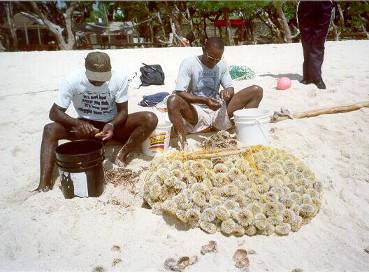
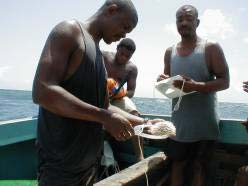
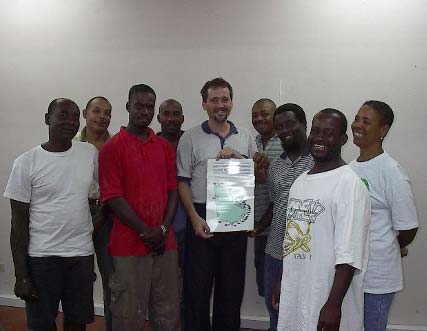
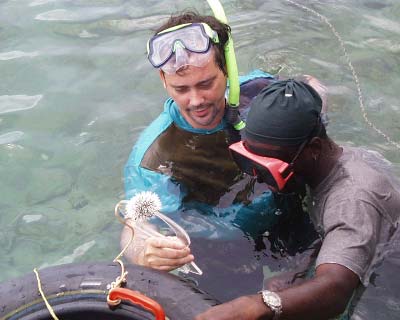
The Sea-egg Fishery Co-management project saw fishers being trained by the Fisheries
Biologist, Mr Christopher Parker, in doing actual stock assessment of the fishery after the fishery
had been closed for three years because it was believed there was a collapse of the fishery due to
over-fishing. Fishers were trained in measuring sea-egg size as well as quantity. These fishers
recorded this information on underwater writing tablets and were then encouraged to come into
the Fisheries Division to enter this information into a computerised fisheries database. It was
explained to them how the data gathered could be used to produce the information that would be
needed to inform the open or extended closure of the sea-egg season.
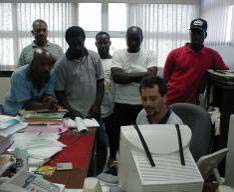
All sea-egg fishers were invited to the Fisheries Division for meetings where they were asked
how the industry might be protected. Fishers have shared their ideas openly, even if in some
cases their recommendations were not all legal. Suffice it to say that, most importantly, members
have agreed that village councils of fishers in the known harvesting areas should be responsible
for monitoring in their area with help from and direct contact with the enforcement agencies in
the island.
Our next involvement came with the work for the revision of the Fisheries Management Plan
(FMP). Our FMP is drawn up and revised every three years, and our most recent work, with
external assistance, has been only the second time that we were really involved in such an effort.
We again worked with the Fisheries Division. Meetings were held with the harvest and
postharvest sectors where ideas were sought for the improvement of the fishing industry. Fishers
1 Sea egg is the local name for the white-spined sea urchin Tripneustes ventricosus
5
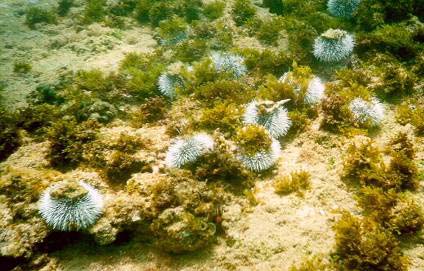
expressed concerns about the fish trap and seine net fisheries as they contended that some fishers
were actually using illegal size mesh and nets. From this we were able to put some things in
motion. The Fisheries Division has now started a programme to work with the makers of fish
pots to ensure that the correct size mesh is used, but also to introduce to them the bio-degradable
escape panels. Identification marks for fish pots were also looked at, so from this exercise some
transfer of information from authority to industry will take place.
BARNUFO has also, on its own, designed a questionnaire for the seine net fishery. We want to
be able to accurately ascertain the amount of people still involved in the fishery, the net sizes and
discuss what needs to be done to take them from the undersize mesh to the correct one. Site
measurements have not as yet taken place but hopefully this season, with some assistance from
the Fisheries Division, we would be able to complete that project. We would then be looking at a
project to fund replacing undersize mesh with the correct mesh size both for pots, as they are
taken up from the sea, and seine nets.
Co-management continues to be a lofty term. We have been striving with the concept for a few
years and are not quite satisfied that some of the scientists and managers are quite ready to
relinquish some of their responsibilities. We have been saying for years a fisher is a fisher and
although different things will capture their imaginations it most certainly will only be a passing
thing; they will never give up fishing for a desk in an office, it is not in their thinking.
Co-management as a working arrangement could benefit the local fishing industry immensely;
things noticed by fishermen on the water can only enhance what is known by the scientists in
theory. More communication is needed, local knowledge can relieve some burdens on the
scientists but it can also let fishers know that what they know is valuable, and when anything
strange is noticed out there and communicated some larger problems can be avoided.
We in Barbados have worked with quite a few agencies that collect information on things in the
sea, fishers are contracted, scientists are taken to the fishing grounds they need for their research.
But when everything is completed, and research papers are written, they then reside in a library
at a university or some other place of great learning and very seldom is the research ever shared
with the fishers so they can ask questions and maybe understand what they need to do keep the
marine environment pure to ensure sustainable livelihoods for years to come.
Co-management to my mind can be simply explained as people having ultimate respect for each
other. That way we would naturally want to share what we each have. In the fishing industry we
are usually happy when people ask a question about our profession; we are only too happy to
talk. This must run both ways, we cannot continue to pass information and get no feedback. If it
continues much longer you might find yourself being ignored when the information required
could be of utmost importance. Co-management will become a way of life, the fishing industry is
but a small part, people working together for mutual benefit could make the world a better place
to live and we must all play our part.
6
2.1.2 Some personal perspectives on co-management of the Barbados sea egg fishery
Submitted by Christopher Parker
My involvement in CORECOMP arose directly through my job as fisheries biologist with the
Fisheries Division of the Ministry of Agriculture and Rural Development, the government
agency responsible for managing fisheries in Barbados. Multi-tasking is a necessity for personnel
in an agency as small as the Barbados Fisheries Division. As such, the fisheries biologist is
responsible for both gathering the scientific information needed for managing fisheries and
implementing the prescribed management measures.
The implementation part of the management process is of course focused on managing people to
promote sustainable utilization of the resource. Having studied the ecology of sea eggs at the
postgraduate level, I considered that I could advise the management process with respect to the
biological aspects of the animals. However, I had no training or indeed natural acumen in the
sociological skills that are needed to effectively organize and manage people. Such sociological
skills are even more important in formulating and implementing co-management arrangements
where the decision-making process is ultimately based on integrating the opinions and even
convictions of people with oftentimes very different perspectives on the same issues. Therefore,
during the course of this project I considered myself a novice in the process of bringing people
together to effect co-management for the sea egg fishery. It is from these perspectives that I offer
the following account of my experiences and opinions.
I first focused on collaborating with fishers to gather scientific information on the status of the
stock. To this end the fishers themselves needed to be trained in underwater survey techniques to
collect the necessary information. To achieve this I formulated a simple sampling programme to
collect information on the abundances and size distributions of sea eggs at a number of index
sites that could be resurveyed in subsequent years to allow inter-annual comparisons of the status
of the stock. With the assistance of some officers of the Fisheries Division, fishers were trained
in the sampling techniques and how the information collected was used for stock assessment
explained to them. The training went very smoothly, the fishers quickly mastered the techniques,
and I think understood the underlying rationales for collecting the data and its application in the
decision-making process. The first island-wide survey was successfully conducted between July
and August 2001, prior to the opening of the harvest season and provided baseline abundance
indices for the sites. Although the numbers of sites and some of the fishers involved have
changed over the subsequent years, an annual survey of these sites using the same sampling
techniques have been conducted every year since 2001 and the information used to determine the
length of the annual harvest seasons. The survival of this collaborative process over time must be
viewed as a major successful outcome of this component of the project.
The main component of CORECOMP was the development of an arrangement to implement
sustainable co-management of the fishery. To this end it has been agreed to form a management
council comprised of representatives of government agencies and fishers that directly advise the
Chief Fisheries Officer on issues pertaining to the fishery including research, regulation and
enforcement. The proposed council must be considered the lynchpin for a successful and
sustainable co-management arrangement and must be put into place as soon as possible. As
presently organized the fisher representatives nominated to serve on the proposed council include
a number of fishers who have continued to show an interest in the decision-making process
7
through participation in the annual surveys or the stakeholder meetings that were held during the
course of the project, mainly to decide on the duration of the annual fishing season. The
establishment of this core group of concerned and involved fishers is probably the single most
important outcome of the project.
Based on my personal experience with working with the persons nominated to serve on the
council, I believe the council will be well equipped in terms of human resources to fulfill its
mandate. However, the survival of the arrangement in the long run depends on how seriously
government treats the council's recommendations. The council is unlikely to survive if its
decisions are overturned by governmental bureaucratic or political interference. This is a real
danger under the present structure whereby the council's recommendations must be passed
through the Chief Fisheries Officer and then the Minister responsible for fisheries. It would seem
that co-management only at the lower end of an essentially top-down management structure can
easily be quashed.
The next important step in the co-management process will be expansion of the fisher
representative base. Some of the management decisions that were taken following consultation
with the fishers engaged during the course of this project were not well accepted by many fishers
outside of the "core" group. Of course, there will always be persons who prefer to stay outside of
any consultative decision-making process and decry any decisions taken rather than participate in
the process. However, the fisher representatives on the council must effectively liaise with the
members of the community that they serve so that the interests of the community are really
brought to the table. This is in keeping with the underlying principles of co-management. In
addition, without a truly representative modus operandi, there is a real danger that the fisher
representatives will be viewed merely as auxiliaries of government in a government-driven
arrangement. Developing workable interrelationships between communities and representatives
is likely to be one of the most challenging steps along the co-management path. It is at this point
that the services of experts in this sociological area are desperately needed to facilitate this
process.
The problem of poor enforcement of management regulations has plagued the sea egg fishery for
many years. Lack of effective enforcement obviously makes a mockery of any management
initiative and if unchecked will frustrate and likely eventually destroy any co-management
arrangement. Illegal harvesting of sea eggs during the close season was understandably a major
topic of concern for stakeholders throughout this project. Unfortunately no concrete solutions to
this problem were formulated during the course of the project although there was some positive
thrust in increased public education. Although a continuation and indeed further increase in
efforts to educate the public is important in curbing the incidence of poaching, I believe that the
public is already fairly well sensitized to the dangers of poaching for the sustainability of the
fishery. However, it is really an affluent group of greedy individuals in the society who
ultimately support poaching by paying fishers to harvest sea eggs for them. The only real
deterrent to this activity is therefore to dissuade the financial support for the activity by these
unscrupulous people probably through identifying and publicly embarrassing them. Although
both harvesting and possession of sea eggs during the close season are illegal acts and carry the
same potential punishment, it has so far only been some of the fishers that have been punished.
As such only the "little man" pays. Of course it is always a daunting task to challenge the
affluent and powerful but the reality is that poaching, or at least the temptation to poach, will
continue as long as funding is available. Therefore enforcement will be a major challenge for
8
successful management of this fishery.
Based on the many formal and informal interactions that I had with fishers and the Barbados
National Union of Fisherfolk Organizations (BARNUFO), the umbrella fisherfolk organization,
during this project I believe that there is generally good consensus on the critical management
issues in the sea egg fishery. During the project everyone has learned from each other and mutual
respect has developed among the participants. There is thus a good basis for developing co-
management among those with whom these relationships have been developed. However, the
test of the sustainability of co-management of this fishery will be if this positive working
relationship can be extended to the wider community of stakeholders that, as already mentioned,
must be undertaken for true and undeniable co-management.
2.1.3 Holetown Community Beach Park Project
Submitted by Robin Mahon and Maria Pena
Dr. Mahon's research activities are in coastal and marine resource management, with emphasis
on assessment and management of transboundary resources. Dr. Mahon is Regional Project
Coordinator for the IOCARIBE Large Marine Ecosystem initiative, and is also leader of the
project "Sustainable integrated development and biodiversity conservation in the Grenadine
Islands" being implemented by CERMES, Caribbean Conservation Association, Projects
Promotion Ltd., and the Carriacou Environmental Committee and funded by the Lighthouse
Foundation, Germany. That project focuses on the role of civil society in sustainable
development in the Grenadines and the modalities of effecting change in complex systems. His
previous professional experience includes working for the Department of Fisheries and Oceans,
Canada; FAO; the CARICOM Fisheries Programme and numerous consultancy projects.
Dr. Mahon's interest in CORECOMP was in the use of participatory approaches to develop the
Holetown Community Beach Park. As this area has a number of user conflicts and residential
issues, a participatory approach was seen as essential in obtaining an approach that would be
acceptable to all parties. Dr. Mahon is affiliated with the Holetown Watersheds Group, the civil
society body that undertook the co-management project.
Ms. Maria Pena's interests are also in coastal and marine resource management. Her background
is in fisheries biology and management and presently assists Dr. Patrick McConney and Dr.
Robin Mahon in the coordination of externally funded projects in the Wider Caribbean, outreach
coordination, project research, presentation and report preparation, and BSc and MSc level
teaching. Recent and current activities include involvement in socioeconomic monitoring for
Caribbean coastal management (SocMon Caribbean) and MPA management effectiveness
evaluation in the Tobago Cays, Grenadines and the Negril Marine Park, Jamaica.
9
Ms. Pena has been involved in CORECOMP for the past three years, particularly in monitoring
the sea egg seasons in Barbados of 2003 and 2004 where she compiled an inventory of sea egg
events (print and audio visual media) for the seasons and assisted in report outputs. She has also
been involved in the site development planning phase of the Holetown Beach Park Community
project in Barbados where she informed and surveyed stakeholders in the area about the project,
coordinated meetings with stakeholders and potential funders and assisted with project report
writing. Working on these projects, her interest in sustainable development of marine and coastal
resources has been peeked and she has enjoyed interacting with the resource users whom are
vital to the sustainability of the projects as well as the resources on which they depend.
The following is an overview of our co-management experiences with the Holetown Community
Beach Park project. Generally, the response to the project was encouraging with many
businesses, in the area being interested in the development of the project. Many stakeholders in
the immediate vicinity of the area, particularly household residents and restaurateurs, were
willing to form a committee that would guide the site development phase of the project.
Although stakeholders were engaged at the beginning of the project (see dissemination flyer; and
Pena and Mahon 2005) and they were keen to monitor its progress and development and provide
their inputs, we had difficulty keeping them engaged due to long time delays with inputs, such as
survey maps and coastal engineering plans for the area.
These delays were, and still are, due to our dependency on the professional services of a
surveyor, coastal engineer and landscape planner whose services are being rendered at
significantly reduced rates and as such is the main reason for slow progress of this project since
low priority has been given to these works by the respective contractors. As such we have
continued to experience difficulty in obtaining these inputs.
Supplementary funds towards drafting the development plan for the area were forthcoming from
a number of sources (see Pena and Mahon 2005) but surprisingly, the stakeholders who stood to
benefit most, i.e. those in avenues 1 and 2 were least forthcoming with funds. The impression
gathered was that these stakeholders would willingly make donations only when physical
development project works commenced in the latter stages of the project rather than upfront.
There seemed to be an underlying reluctance of business stakeholders in the Holetown area to
donate funds to this project since it was taking place on Government land, and there was the
view that it should be paid for by government. There was also skepticism regarding the
likelihood that the Government would follow-through with development once the plan was
submitted.
The initial focus of the project was largely establishment of an amenity area that would restore
ecological function, particularly services that protected the marine environment. Stakeholders
however were primarily interested in recurrent flooding and its associated problems within the
area, an issue which could not be comprehensively addressed within the scope of the project
(Pena and Mahon 2005). Another priority for stakeholders in the area was that of security
enhancement. Restaurateurs were particularly interested in this issue and had questioned whether
it was feasible for the project to provide and improve lighting in the area since some of their
customers had been the victims of crime there, with these incidents having negative impacts on
their businesses.
One major outcome of the delays was that the context for the project changed due to Government
plans and initiatives in adjacent areas, as well as private development, such as Lime Grove. One
10
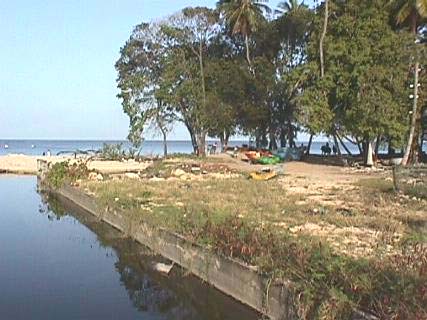
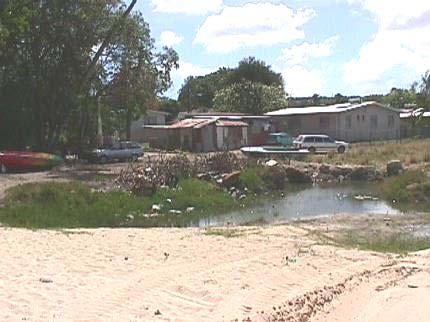
of the activities that was successful was a project by two visiting students to develop a plan for
the restoration of the ecological area (the pond and adjacent wetland). They acquired a great deal
of useful information from residents, particularly regarding how the area used to be in the past.
Several residents provided historical perspectives on the various flora and fauna that used to be
in the area and the way that they would fish or play in the area as children. This has been
documented for use as the project moves into implementation (see Pena and Mahon 2005).
Challenges of co-management:
· Reliance on supplementary funds and the good will of persons providing technical input
to projects at reduced costs.
· Difference in initial environmental focus of the project and that of stakeholders.
· Change in context for the project owing to adjacent development.
Unless funds are sourced to completely cover the costs of such co-management projects as the
Holetown Community Beach Park project, delays will be inevitable resulting in slow progress of
the project. Despite the delays and other challenges described above, there appears to be a
continuing interest in stakeholders in seeing the area improved. At times when they were
engaged, there was genuine interest and enthusiasm for the project. Clearly, the need still exists
for the development of this area as it is central in Holetown.
N
PARKING
S
AREA
DRAI
S
A
GR
RUBBISH
HEAP
Litter raked
here and
burned
POLICE
Residents
Proposed
throw garbage
COMPOUND
pond
on this heap
Present
pond
UNDERCUT WALL
Protect the wall with
OPEN AREA WITH SHADE
boulders under the
TREES
sand
Leave open recreational
POND
Plant sea grapes in
use
Enlarge pond to the
front
Clean up area
BE
north and east
Provide garbage
ACH Raise inland
SURF-
containers
perimeter with
POSSIBLE BEACH
SIDE
Arrange regular col ection
gabions or boulders
ACCESS
to reduce flooding
May be suitable for
Interpretation sign
enhancement as a small
Remove north wall
could be placed
park with benches, picnic
of drain
here
tables, etc.
Plant mangroves
Leave adequate area for
and other
watersports operators
vegetation along
edge to stabilise
Pond already
JUNK -- Batteries, brake drums,
supports tilapia and
furniture, tyres, boat parts,
SEAVIEW GULLY DRAIN OUTFALL
other fishes that
broken glass, etc.
control mosquitoes
PROJECT AREA
TREE
KEY
HOLETOWN WATERSHEDS GROUP
2.2 Belize
2.2.1 Facing the challenges: the Friends of Nature experience
Submitted by Lindsay Garbutt
Friends of Nature (FoN) is a non-governmental organization (NGO) working in southern central
Belize. Just over five years old, FoN works with five coastal communities, two of them
indigenous communities. On behalf of these communities FoN manages the Gladden Spit and
Silk Cayes Marine Reserve, recognized by the World Wildlife Fund as a "priority site" and is a
key "platform site" for The Nature Conservancy's Mesoamerican Barrier Reef Program. This
reserve is one of the major and most studied sites for spawning aggregation, with more than
twenty-six different species of fishes known to spawn there. In addition it has gained a lot of
attention as one of the very few sites where one can see the whale shark. The interest in viewing
whale sharks has made Gladden a prime tourist site and a major income earner for local tourism
stakeholders. FoN also manages the Laughing Bird Caye National Park, a World Heritage Site
and the second most visited protected area in Belize.
Friends of Nature is led by a team of individuals that almost all come from the local communities
it serves. The strength of the organization is based on the great support that it has received from
11
its local communities. Its Board of Directors is the most representative of any in the region,
involving all thee local stakeholder groups. The partnership with CORECOMP has been a very
positive one for the organization, allowing it to undertake a few small but very essential projects.
Lindsay Garbutt, the Executive Director of FoN, has worked with the organization from its
inception. Born in the coastal village of Monkey River, he has worked as a fisherman, assisted in
the formation and management of fishing cooperatives and has served many years as the
representative of southern Belize to the Fisheries Advisory Board, and the Belize Tourism
Board. At the moment, in addition to being the executive director of FoN, he is also the Focal
Point for TRIGOH, the Tri-National Alliance for the Conservation of the Gulf of Honduras, a
group of NGOs from Belize, Guatemala and Honduras involved in protected areas management
in the Gulf of Honduras.
From its inception FoN has had co-management responsibilities for its two protected areas. The
experience has been mostly positive. The positive relationship is to a great extent based on the
fact that these are two of the very few reserves that were declared as a result of strong
community lobby. It was the stakeholders themselves, essentially fishing and tourism
stakeholders that pushed hard for the declaration of these reserves as protected areas. This has
given FoN a strong sense of ownership and excellent community support. Recognizing this
support FoN has sought to develop programs that have direct impact on the communities
particularly in areas of alternative livelihood and community exchange. Through these two
activities FoN has developed several at-risk youths into professional PADI certified Dive
Masters, providing an essential service that was vitally needed for the further development and
increased local participation and ownership of the tourism industry while at the same time
creating an opportunity for more than twenty young males and females, most of whom had no
secondary education. The community exchanges, primarily with Cuba and Mexico, have
resulted in a major shift in the way fishermen fish. It has allowed fishermen to continue fishing
with the same intensity but using methods that are more sustainable.
CORECOMP funding helped FoN realize two essential projects. The first was a Board of
Directors Orientation Workshop. FoN's Board is made up of representatives of all major
stakeholder groups in the region that the organization works. It includes the Village Council
Chairperson from all five communities. One of the major challenges of NGOs regionally is that
of governance. Through this workshop FoN board members were given an opportunity to
understand the essential of serving on a board of an NGO, their responsibilities. This was vital as
while being successful in their chosen field, few of the members have served on a Board of
Directors previously.
The second project funded by CORECOMP was the provision of funds for the initial meeting of
the proposed Southern Fishermen Association. As tourism in the area has grown the fishermen,
many of whom have diverted into tourism, have felt themselves slowly becoming more
marginalized. Given that those who work in the tourism industry, the countries foremost foreign
exchange earner and industry, are generally more educated and have more access to the political
decision makers, the feeling is that more and more they are the ones that have representation on
all the major boards and are invited to all the major forums. The fact that tourism is essentially
owned by foreigners, who have far superior experience in lobbying, and certainly a much greater
access to the powers that be, has contributed even more to this feeling. Too the tourism
stakeholders are more organized and better funded.
12
To combat this widening gap FoN has with the assistance of CORECOMP worked towards
developing a strong fishermen association. This will allow for a greater level of unity among the
fishermen as they come together on a regular basis to discuss their concern and will create a
body that is large enough and with enough political strength to assure their representation on all
bodies that affects or can enhance or impact their activities.
As a boy I remember a speech given to a group of fishermen by an old community leader.
During this speech in which he was soliciting the support of the local fishermen for the formation
of a fishing cooperative he said, "as fishermen what we need is individual cooperation".
Essentially little has changed in the thirty two years since I first heard the need expressed in this
manner. Co-management is essentially getting a group of independent, very strong minded
individuals to cooperate for their personal benefit while respecting their essential individuality.
Most of these individuals, particularly those in the fishing industry, have never had a boss and
rarely have the personality or desire to want one. Co-management therefore almost always
involves tip-toeing around these several egos and understanding the values of these individuals.
It also often means gaining their confidence; very hard to earn but certainly more than worth the
price. It is a difficult, sometimes torturous, and always tricky, process. It is dealing with a group
of individuals that are often short of book learning but extremely intelligent with a clear
knowledge of what they want and an even clearer idea of what they do not want. In particular for
Friends of Nature, it has been even more challenging trying to deal with a variety of stakeholders
whose interests often are diametrically opposed. The tourism stakeholders want more protected
areas for their rising client base and the fishermen who feel that their fishing ground is constantly
diminishing.
Some of the major challenges for FoN have been:
1.
Managing whale shark tourism: The predictable presence of whale shark in the reserve
from March to June of each year has brought unprecedented growth to the tourism
industry of this area. Unregulated, with everyone trying to get their piece of the pie, this
activity was slowly getting out of control and was headed towards the reality of killing
the goose and losing the golden egg. Through the efforts of FoN a Whale Shark
Committee was formed to provide advice to the Fisheries Department for the regulation
of this activity. This group worked hard and in less than three seasons this activity is the
most regulated and best managed tourism activity in the country. Carrying capacity is set
and respected, a slot system has been put in place and today whale shark tourism at the
Gladden Spit and Silk Caye Marine Reserve is an example of good management in the
region.
2.
Southern Fishermen Association: In March of this year FoN brought together a group of
fishermen from throughout the southern half of Belize for a fishermen forum. This
meeting was the first of its kind and the first time that fishermen had ever met in this
manner. The meeting was very positive if at times loud. The decisions coming out of the
meeting were clear and definitive and there is a clear belief on the part of the fishermen
that they must unite, that protected areas has largely benefited them and they are
recognizing that if they become partners with the managers of these reserves that it will
impact greatly on the long term protection of the resource that ensure their livelihood.
3.
Community relations: For quite a while FoN has been trying to find better ways to
interact with the communities. In spite of regular consultation we consistently receive
reports, particularly from consultants, that the community is saying that they don't know
13
who or what FoN is. Over the past year FoN has began to change the way we do
consultation. As opposed to holding meetings in community centers and waiting for the
community members to come out FoN now goes to them. We take a team comprising the
different units of our organization from rangers to biologist to outreach personnel and the
management team and do a house to house visit usually accompanied by the board
member that represents that community. The Board of Directors has also taken a decision
to hold each board meeting in a different community followed by a community meeting
in which the community members get an opportunity to interact directly with the board.
This is a work in progress but initial review suggests that there is much more awareness
about the organization on an individual community basis.
Protected areas management is more about people and less about resources. Left to its own, a
natural resource has a way of replenishing itself. Recognizing that it's about people, FoN's motto
is: "Protecting our natural resource by developing our human resources". It has worked for us.
While we place great emphasis on the sustainable use of our resources we are very cognizant of
the fact that human beings must survive. These resources are more the property of these
communities than anyone else. Our major effort, therefore, is on building a lasting relationship
with the local resource users. While our co-management agreement is signed with the
Government of Belize and the Fisheries Department, it is our stakeholders that are the real
partners, our real co-management partners. Working with CORECOMP has gone a long way
towards creating a better co-management relationship with our stakeholders because we share the
same value. Too, CORECOMP does not only provide financing but provides good sound support
at all levels.
While there are many challenges that we have overcome there are still many even greater
challenges to overcome. The communities are not as interested in what you did for me yesterday
as much as what will you do for me today. It's a constant challenge. But where the challenges are
great the successes are even more rewarding. Friends of Nature has determined from its
inception that co-management is the way it chooses to manage the resources with which it has
been entrusted. Co-management is the way we choose to do it. For those of us who have grown
up in these communities we do not see co-management as a complicated scientific process. We
see it as the only RIGHT way to do it. We see it as a way of life.
2.2.2 CORECOMP and TASTE: Beneficial capacitation for the co-management process of the
Sapodilla Cayes Marine Reserve (SCMR), Belize
Submitted by Jack Nightingale
My name is Jack Nightingale and I function as the acting Executive Director (ED) for the
community co-management NGO, TASTE (Toledo Association for Sustainable Tourism and
14
Empowerment). TASTE along with myself has been engaged in the co-management of the
Sapodilla Cayes Marine Reserve (SCMR) for five and one half years. We are a small group of
three full time employees and a large program.
I bring a varied skill base to the NGO. I have been an aircraft electrical technician; a modern
dancer, choreographer and professor; a marketing and sales officer in high technology business;
a carpenter and builder; tour guide, tourism NGO worker, board member and now an
environmental NGO, ED (acting). A chequered career that has provided me with an enormous
skill based background. I am profoundly concerned with human development both in the
worldly and spiritual contexts. I (and we in TASTE) have had a wonderful time in this co-
management project.
We have worked with CORECOMP in the following areas:
· Co-management process workshop
· Participation in 3 Gulf and Caribbean Fisheries Institute (GCFI) conferences
· TASTE board effectiveness workshop
· Proposal writing workshop
· Socio-economic monitoring workshop
· Management retreat
Building capacity in all these areas has been essential to our growth.
In Belize, the most regular of co-management conditions is delegated responsibility to the NGO
partner. In the case of TASTE and the Department of Fisheries (Government of Belize), it has
been an evolving co-management relationship from a co-operative condition moving towards a
delegated position. It was at the very first workshop with CORECOMP, "the co-management
process", that we were clearly able to identify the process we all were in. A crude plan of this
process was one of the outputs. We, the co management partners, have both witnessed growth of
the SCMR and in its co-management, as measured against this original plan.
There are (in Belize) inherent weaknesses in the government as managers of protected areas.
These weaknesses are evident and are very critical to success creation. Principally they are (a)
FUNDING and (b) BUREAUCRACY.
The constant lack of funds weakens any programs that the government (or NGO) wishes to
employ. Bureaucracy does not empower the human resources with "ownership", "sharing power
with" relationships or "good governance" practices. These features are self evident and do not
need further expression. NGOs in Belize tend to follow government modelling for management
processes, which makes them weak also. NGOs with fully delegated responsibilities look like
`mini-governments' to the community stakeholders in protected areas. TASTE found itself, and
still finds itself, attempting an impossible creation: "To be the model community co-manager".
We are not failing but neither are we creating the success that we envision.
There are many features, which interfere:
1. The communities have been given promises by other NGOs, which can never be
complied with.
2. We never give promises but we fall into the NGO `form' and therefore are seen as giving
promises.
3. Governments practice "patronage", so do NGOs; we do not, and are blamed for not doing
so. YET "good governance" says no to patronage.
15
We walk a line that is narrow and full of treacherous reefs. However, we have succeeded in
environmental education, outreach programming, co-operation, collaboration and partnering in
biophysical monitoring of the SCMR, alternate economic opportunities and youth empowerment.
We have been able to build a highly useful infrastructure as part of a public use programme,
which works strongly for sustainability. We have not yet attracted philanthropy or donations to
the SCMR that will give us a breathing space and allow the Department of Fisheries to go all the
way with delegated responsibility. The position of delegated responsibility is a goal.
From a personal point of view, the single most important lesson is to not take on the challenges
of Executive Directorship without a fully active Board of Directors.
It is essential that the Board members are willing to seek funding and donations and that they are
willing to take on tasks of representation. It is so very easy to take on all the roles if you are keen
to get a job done. When looking at the idealized version of a Board of Directors as described in
the trainings, I would have had 50% more time for other tasks that were taken up by carrying out
Board member duties.
We have had good luck with grant writing and seem to be able to hold our own. Learning such
things as log frame, management by results has helped our skill sets enormously. Even more
significantly they help in how to think about the issues.
It is precisely in this mode, clear thinking process, that presents without doubt the four major
gaps of all MPA management:
1. Lack of enforcement.
2. Lack of lobbying and advocacy.
3. Lack of public education programs (not environmental education, although that is weak
in most places also).
4. Lack of alternate economic opportunities.
We are full of good science and scientific understanding. Common sense tells us clearly that the
world's biodiversity is diminishing. We are full of plans, politics, hierarchies, management
schemes and trainings. Common sense tells us that greed still is in the driver's seat and "power
over" wins from "power with" sharing.
Common sense clearly lets us know that we have not yet fixed that which needs fixing.
I have no doubt that one of the main thrusts of conservation activity is the desire to fix that which
needs fixing. Without a focus to the four gaps mentioned, and real time desire to meet these
challenges head on, will we have any MPAs to co-manage?
We are not always the darlings of the community (this is an understatement anywhere). We have
had stakeholder issues that have required conflict resolution, but not too many. As ever,
participation is hard to create but we find that new stakeholders (youth) offer stronger
participation and more goodwill. Everywhere on earth greed and power are in the driver's seat.
This is as true for stakeholders as NGOs. Treading the middle way is not easy.
With the growth of anything there are needs which must be met. Our co-management has been
groomed with professional help along the way. CORECOMP and CERMES have done a great
job for TASTE-SCMR. Every workshop and the GCFI events have been instructive and helpful
to the process. We in TASTE are looking forward to the next 5 years of positive growth but,
even more importantly, we wish to be able to measure the positive impact we are having in the
SCMR.
16
Looking to the future for TASTE we see the possible full funding we need for obtaining the
delegated co-management in one or other forms. First, the most useful from our point of view
would be to be completely independent from other organizations and be able to present our style
and perspective without too much compromise. However, the second choice will be in the
merging of TASTE with another NGO to create a larger organization with a broader range of
responsibility. This second choice is on the burner and being looked into by board members and
stakeholders. A funder has particular interest in that option, seeing a more economic use of
resources. With a backer behind this choice it becomes more interesting.
Allow me to note here that this is close to the greatest difficulty to confront all NGOs. That
difficulty is the need to keep the organization alive and kicking, taking more energy and
resources than can be put into the activities for which the organization was created. Self-service
becomes more of the goal than serving the need. Finding that balance, to my mind is the main
question.
I conceive of an SCMR that is 50% sustainable in the next 3-5 years. This will require that the
management plan become operational so that we may utilize and place the zonation in the
reserve. It will require full cooperation from the private sector to keep tourism according to a
plan of carrying capacity; it will require far more ownership from workers and stakeholders; and
will require regional participation.
The threats that most affect the reserve are from sources of contamination. These must be
identified and met head on with regional programs of advocacy and lobbying. No easy task, and
by far the most significant. If we cannot keep the corals and biodiversity in the reserve then 50%
sustainability is ridiculous.
2.2.3 Human resource management concepts for NGOs
Submitted by Jack Nightingale
How broad are the issues that govern the life of the people who work for and around your NGO?
What are the primary goals, based on your mission and vision that create the working
environment? Do they reflect the essence of that vision, that mission? Are the human interactions
you generate from your NGO or organization generating "power with" sharing or are they
dominating "power over" hierarchical dictates? If you have studied governance and understand
the basis for good governance, are you practicing it?
Human resources can be considered as everything from throwaway slave labour to the finest
mutually beneficial relationships you could possibly create.
It is typical in this day and age to avoid thinking about these questions and to accept the status
quo of the work place. The speed with which we are to achieve or meet goals precludes time
17
spent thinking about humans, relationships and service. This status quo condition does little but
provide a job for someone, thus giving him, or her, an income. (Let us note here immediately
that this single fact of a job might create more for the individual than ever before and allow for
children to eat regularly). This is positive. However, it might do very little for the overall
improvement of man or his condition, especially in relation to the workplace.
NGO's are created around specific social and environmental conditions. Very high-sounding
language is used in their mission statements and in the expression of their vision. Whenever
presentations are given to donors, funders, boards of directors, stakeholders and community
members, it always seems as if the NGO is beneficial and godlike in its munificence. If however,
you study its day-to-day human interactions you are likely to find top down decision-making,
power over management conditions and poor relationships between all the people. Typically
high staff turnover reflects these poor governance conditions. Does this mean that the high
sounding words of the vision and mission are a fake?
Of course if you look everywhere in life you will find the same conditions in operation. The
private sector is rampant with poor governance. Governments are ridiculous in their bureaucratic
behaviours and their sense of service to the people is a joke.
Why then focus this human resource management concept to NGOs?
It is precisely because NGOs pretend to high social and environmental concerns that they also
could lead the way in human relationship issues, setting a new pace for others to follow. It is not
anywhere near good enough to maintain status quo apathy or mediocrity. Just because you know
that government institutes function with poor governance, and that private sector businesses that
are financially successful and operate under poor governance exist, they should not be the guides
to your choices of management regimes.
It is true to say that history has not produced much in the way of good governance. This is
principally because there is a paucity of good leadership. It is also because no one thinks about
good governance. The ideas of good governance are not discussed openly. How can people be
expected to know about something if the ideas are not shared? Of course one must remember that
there is a natural resistance to this knowledge since it goes against greed and power (over)
experience. Most humans in their poor condition crave power over others and believe that the
world owes them a living, and a darn good one at that. Accumulation and access to resources are
gobbled up by individuals in the knowledge that only they should have it. If this attitude or
worldview persists, we are truly doomed.
In the meantime and before any doom overtakes us, we have opportunity to apply good human
resource management principles in our NGOs.
There are a few main principles in good human resource management:
· Consider the words "human resource"
· Consider the word "good"
· Consider the word "management"
As we started out by saying that human resource could be anything from slavery to the finest
mutually beneficial relationship, we should look at these two ends of the spectrum.
· Slavery is the usage of captive human resources without regard to the humanity, needs,
freedom, development, living conditions, health, welfare, education or ability to survive
of those same resources (the people).
18
· The finest mutually beneficial relationship would be the fullest consideration of a human
resource including full awareness of humanity, needs, freedom, development, living
conditions, health, welfare, education and the ability to survive and share fully.
There are multiple places in between these two ends. The qualities of either end will clearly
appear in the systems chosen. It is not difficult to see where people who provide jobs, choose to
apply these qualities. When a boss shouts at someone that they are lazy, good for nothings, it is
easy to see the dilemma the boss and the human resource experience.
Obviously the worker could care less about the job and so allows those feelings to govern
actions. The boss wants something done but doesn't care about who is doing it or why. This
scenario is common and everyone experiences it, even in school. If you have never thought about
relationships or do not care for the experience of relationships, you are bound to fall into poor
habits either side of the equation. In order to manage human resources you must first of all care
about relationships. If you care about relationships you probably care about humans. If you care,
then the words "human resource" means something you care about. Caring implies that feelings
and thoughts about other humans are co existent. It also stretches to both parties. All feelings and
thoughts of all parties co exist and are responded to. This condition satisfies the word "good".
All parties feeling good about each other qualify this. This is a condition in which
communications are optimized and efficient work is possible. Management is simply the tool by
which you bring about this condition.
It could be crudely stated then that good human resource management is simply the way in
which caring about each other is turned into efficient use of time and other resources to bring
about a mutually defined goal.
Let us look at this from the point of view of governance. Governance is the system by which
things and people are governed (managed). The results of poor governance are clear. People feel
dissatisfied and upset. They might revolt or build strong resistance to this poor governance (think
of slavery). Good governance would bring wonderful qualities of support, strengthening,
efficiency, creativity and good will. Here is a tried but true aphorism that allows choice for
governance. There are only three possible futures from this now:
· Things get worse.
· Things remain the same.
· Things get better.
If anyone in any group perceives that things are not getting better then the chances are that they
are not. This means that the things get better scenario is mutual (a consensus). All are in
agreement. In the case of governance, `good' would have to bring mutual benefits. Obviously
good governance must imply a' things get better' condition from wherever we are. What then
might constitute good governance?
Good governance begins with the self and the self alone. Ask yourself how you govern yourself.
Is it full of indulgence? Do you love your self or hate your self? How do you care for your self?
Do you doubt yourself? There are hosts of questions to ask your self if you really want to know
how you govern your self. It is a lifetime's work to really come to understanding about your self
so it does no good to have too high an expectation of the knowledge of self. Yet, good
governance begins with the self.
If you start by being kind to your self and can find time to really reflect on how it operates in the
19
world, you will quickly make discoveries. If you hate yourself you can only see negative
frameworks for every experience. Your choices on how to govern yourself are going to be hard
and rough. Good governance can contain perceptions of self that allow for growth. They can be
critical but not destructive. Positive perceptions are of course the most useful. If it is difficult to
find positive perceptions about yourself you will need to find some outside assistance. Find
someone who understands what good governance is and ask for help. Do not ask critical people
or people who see only negative things.
Once on the road to good self-governance, you can think about good governance of your own
immediate family. Are you a dictator with them? Do you allow them to talk and interact? Do you
say there is only one-way to do it, my way or the by way? Do you love them? Do you even like
them? This begins another round of analysis of your own behaviours. Good governance of your
own family will allow them to grow and become their own beings. You will make space for them
to be themselves and yet function within mutually defined tolerance of each other's behaviours.
You will like them enough to care that they are making good choices for themselves. You will
take the time to see things the way they do.(living a while in their shoes) You will practice tough
love when negative behaviours erupt. You will especially look to the meaning of "partner for
life".
The third level of good governance is in your local community, your neighbourhood, the school
your kids attend, the sports teams they play in. Now begins a really difficult phase of good
governance since now many strangers will test what you have learned from the first two phases.
Blowing it all away is now the simplest thing to do. Patience is a virtue and this is where this
rubber meets the road. This is where you have to remember that good governance begins with
yourself. The rest is an obvious and clear progression through village, town, region, nation and
world stages. This makes it clear why good governance is so very difficult. How many people
have done this kind of work in preparation for any kind of governance?
Now let's bring this concept down to where we started this essay, an NGO. An NGO (non-
governmental organisation) is usually dedicated to some form of development in communities.
This development could be social, ethnic, infrastructure, legal, advocacy and lobby,
environmental, health, agricultural or a mixture of many aspects of development. Of course it is
interesting to note the designation of non-governmental. It would appear that it is important to
stress the difference. That is a thought full of conflict.
Perhaps the biggest distinction is the `not for profit status' that NGOs legally operate with. It is
this status that creates Civil Society as the third leg of society, the other two legs being the Public
Sector (government) and the Private Sector (business and for-profit status). The not for profit
status implies a standpoint or a worldview. This worldview is moralistic. It is important that
development (see the list above) be implemented without the profit motive since the profit
motive might produce opportunity to be criminal. The simple truth that emerges is that when
people wish to act criminally they will, regardless of position or status. The other fact is that
humans are awfully good at hiding their acts from selves. This is the basis of disillusionment for
many people from the other two sectors of society. The moral standpoint has no basis in reality.
Then of course, those two other sectors are full of criminality.
So what does this chase leave us with? It would seem, that human nature, the lower aspects
govern all. This is a good place to start looking at NGO's and their human resource management.
It states clearly that NGO's are as vulnerable as government and the private sector to base
20
criminal behaviour. Just because it is an NGO, you are on higher ground, is a fallacy.
An appropriate question might be: do NGOs practice good governance any more than the other
two sectors? The answer is clearly NO. As far as anyone can see, greed, `power over'
management, isolation from ownership and poor will, is as rampant as one could expect. Humans
and human behaviour are the same everywhere.
Good governance and good management practices are not hidden. They mean that there has to be
present goodwill towards each other, no matter what role we play. This goodwill is a departure
from the normal and therefore is difficult to achieve. It is by no means impossible, however.
Many groups and companies have made this change with startling results. People take ownership
of the group and start to care what it produces. This reflects enormously in efficiency of manual
labour and of costs. These are good management goals of the first order. NGOs are very sensitive
to costs and efficiency. When everyone in the group cares for each other and what it produces,
one is never short of creativity. Ideas for improvements and `things get better' scenarios arise.
So why could NGOs lead the way forward in this regard? It is precisely the juxtaposition with
the other two legs of society and the `not for profit' status that gives the initiative to NGOs.
Private businesses do operate with good governance in rare cases. No one knows if any
government offices do. This initiative once taken up by NGOs would receive appropriate
publicity or communication. NGOs are in the perfect relationship to teach these approaches to
good governance and management. In fact it is a responsibility that NGO's must pick up if we
are all to move forward.
Then, human resource management for NGOs is really good governance practice as outlined,
beginning with the self and moving out which produces levels of caring which are expressed
through `power with' communications and not `power over' communications. What are some
good expressions of good human resource management?
"Management by walking around" is a book about how a CEO of a manufacturing company
changed his company entirely. He did not stay in his office for very long. He came out and
walked around observing, talking, asking questions, learning to care and instituted changes
which affected his fellow man positively. Pretty soon his factory was a happy place with ideas
and new efficiencies. His profits soured and so he shared with those who created them.
Think of the `Peter Principle'(you rise to the level of your incompetence). This fact occurs so
often in government that it's not a joke. In NGOs people begin their careers fully engaged in the
`Peter Principle'. Just because you have acquired a Bachelors, Masters or Doctorate, does not
make a good manager (of any sort or level). In fact universities are full of poor human resource
management and poor governance. One should expect that the product will have no idea how to
care. Caring is not taught!
"Power over" communications are simple to understand. I am the boss! You will do as I say or
leave! "Power with" communications require a little subtlety. Here is a job description Bill. I
want you to read it and understand it please. When you have done so we can talk about it. I shall
want you to show me that you understand the parameters. When you have done this, we will then
trust that you will always produce to your own standard. In addition we would like you to feel
free to notice and observe how what you do becomes part of a team effort. In fact we will take
time in the week to have team meetings. We accept all ideas from top to bottom with no
comment. They might be discussed, changed by the team and implemented. That will be your
21
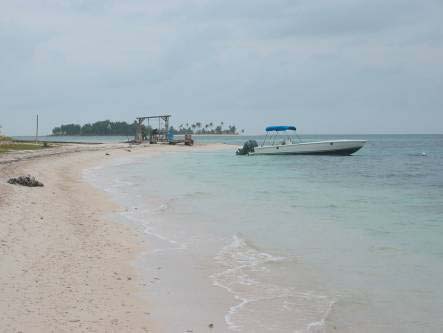
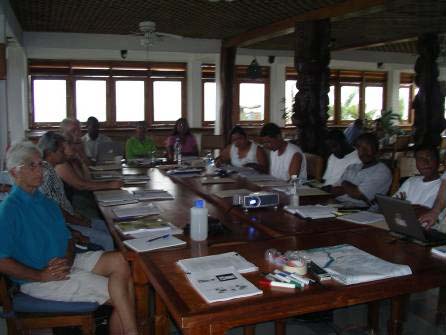
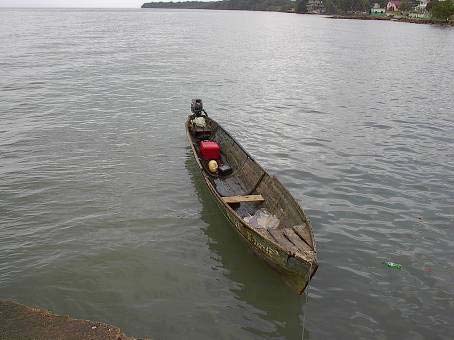
idea at work. Improvements in our efficiency and costs can be reflected in benefits to you.
Welcome!
Good human resource management will never happen by accident. It has to be intended. NGOs:
your public image will be vastly improved if you undertake the responsibility of good
governance. Governments: your next on our list for human resource management and service
principles. NGOs: service is your next topic.
2.3 Nicaragua
2.3.1 Fisheries Co-management in the Caribbean Coast of Nicaragua
Submitted by Karen Joseph
My name is Karen Joseph, working with the University of the Autonomous Region of the
Caribbean Coast of Nicaragua (URACCAN). I have a bachelor degree as a Fishery Engineer
from URACCAN and obtained my MSc from the University of Tromso in Norway at the
Norwegian Fishery College in International Fisheries Management. My work at URACCAN is
in the Faculty of Natural Resources giving tutorials to students who are working on their final
document (thesis). I teach subjects in the in the Fishery Engineer programme such as project
design, fishery technology, fish processing, aquaculture, fishery ecology and others. I do
research and design community outreach projects. I have been doing these activities since 2002.
I have been participating in international workshops and seminars focused on the fisheries in
different countries in Central and North America, including the Caribbean islands. I have
received training in how to conduct socio-economic studies in Spanish (Honduras) and English
(Barbados). I have three publications of work that has been done by myself, an conducted four
research projects, the last one with WCS being not published as yet. Also, I have prepared
community workshops for fishers in different communities on the Caribbean coast of Nicaragua,
Corn Island and in the city of Bluefields. CORECOMP was one of the projects that have focused
mostly on training people that are weak in doing co-management. By involving myself I
obtained the benefit of training capacity and strengthening knowledge, permitting me to transmit
this knowledge to others that need it by giving workshops and short courses based on co-
management.
So far, co-management has been a good way to obtain mutual benefits; it improves
communication between resource users, it has shown that most countries who have experimented
with and put it in practice have obtained positive results. Other members of other countries are
asking what they have done so as to learn how it happened that way, if the resource is the same.
As it says in one co-management document published by Jentoft, co-management means
cooperation, communication, and collaboration which are hard to obtain, especially in countries
22
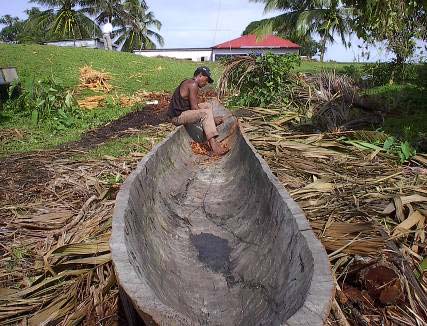
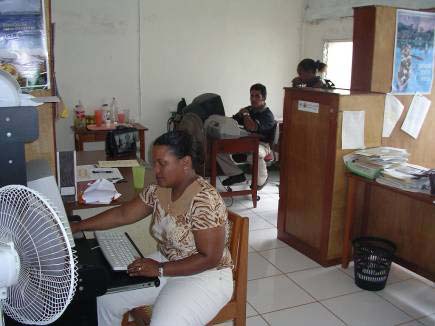
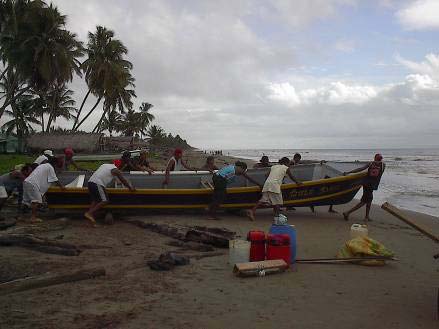
where the resource owners are many and they are living in poor conditions.
The core essence of co-management is the "CO" and the hard part is the management; but the
management of what? I say so because finally every one concludes that what really have to be
managed are people and not the resource. Always we want to find solutions to problems related
to the resource such as overexploitation, and the only thing to do is to find the solution of HOW
to make people use the resource rationally; HOW to make people comply with the law; HOW to
avoid corruption; HOW to avoid trespassing boundaries and piracy; HOW to make people
understand that co-management is to manage themselves to start to do co-management; that they
will obtain a mutual benefit. It is essential that government in first place learns to accept that they
cannot manage something that people depend on and not take them as part of it. But people have
to understand that co-management also is a set of rules that can carry them to success.
The good part of this is that all resource users get the same benefits and co-management bring
different people, with different status and ideas together, they unify countries and focus and one
thing, the well been of the resource that at the end it is the well been of people who depend on
the resource to survive.
The hard part of co-management in some places is the access to money. From my point of view
co-management has failed to address poor people's needs, especially those who live in coastal
areas abandoned by national authorities who remember that these people exist only when there is
a benefit to be obtained. Or especially when government do not come with laws that somehow
promote and protect the different sectors to be managed. Also, co-management will not be
successful if people in the area to co-manage do not have a clear understanding of what co-
management is, or what they really want to do with the resource.
Somehow CORECOMP has been a good initiative; I think one of the most important in the
Caribbean that really works to make sure that government agencies, resource users and other
interested parties get together to share the responsibility and authority for managing coastal
resources. But they needed to put more effort, especially in countries like Nicaragua, where this
issue (co-management) is not developed as a whole, where we are weak, where government still
works based on top-down management.
Considering the challenges of co-management, at first, starting to talk about co-management, I
thought that it was a dream in sight. After my experience with CORECOMP, in supporting me
with travel expenses to participate in several international workshops, and sponsoring workshops
in our country, I gained a lot of experience and learned a lot of things related to co-management
23
2.3.2 Natural resource co-management in Pearl Lagoon, Nicaragua
Submitted by Bertha Simmons
The Coastal Area Monitoring Project Laboratory (CAMP-Lab) was executed in the
Municipality of Pearl Lagoon situated in the Southern Caribbean Region of Nicaragua. The
project was coordinated by Ms. Bertha Simmons who has a bachelor degree in social work and
also did a postgraduate course in conflict resolution.
The co-management experience in the Pearl Lagoon Basin was first of its kind in the South
Caribbean Coast of Nicaragua. It was a positive experience of communities getting together and
demanding the right to protect their resources. Although the communities or the project were
unsure of what a co-management process entailed they knew, however, that in order to protect
their resources they needed to have active participation in decision-making regarding their
resources. In 2001 CAMP established an alliance with CORECOMP. The presence of
CORECOMP within this context was timely since it helped us to grasp the full concept of co-
management, permitting visualization of the broader spectrum of the process and helping to
shape the community approach to co-management of their resources. Their assistance was also
extended to other areas that are indirectly linked to the process, such as assisting with the
creation of an environmental curriculum for the schools in the Basin. The creation of such a
curriculum was a need expressed by the communities to the project in order to fill an existing
void; CAMP in turn sought assistance from CORECOMP in lieu of the need of experts to put
together a comprehensive interactive environmental document. CORECOMP also co-financed an
MSc in natural resource management for the CAMP coordinator at the University of the West
Indies.
Co-management experiences good and bad. Many of these experiences and activities pre-date
CORECOMP, but were relevant in setting the scene for CORECOMP.
The Good
· Communities' willingness jointly protect their natural resources. Although the
communities are composed of different ethnic groups dispersed around the lagoon with a
history of hostilities and mistrust among them, they were able to sit down and establish a
plan to help them protect their remaining resources. Their main concern was the depletion
of the fisheries, their main source of income, and the lack of governmental assistance to
protect the resources or to establish alternative income sources. This perception of
sharing a common enemy as well as a pursuing a common goal permitted the community
to unite and form a joint front in order to address resource depletion within the Basin.
· Establishing an Inter Community Committee. The communities realized that in order to
be heard and be taken into consideration by the government or other entities when
discussing sustainability of their resources it was necessary to provide a communal voice,
hence an inter community committee to serve as ethnic and indigenous communities
watchdog.
· Discussion with indirect stakeholders. The ethnic and indigenous communities after
much discussion saw the need to incorporate the Spanish-speaking communities
established within the Basin into the overall discussion of the natural resource
management plan elaboration and implementation. It was deemed necessary since they
were seen as the exploiters/depredators of the resources due to their slash and burn
24
techniques that affected both the forest and the lagoon and therefore they saw the need to
enlist their cooperation/assistance for resources preservation.
· Municipal Government buy-in. After much negotiation and lobbying with the municipal
government they finally decided to accept the community base natural resource
management plan and gave it an "aval municipal" (municipal endorsement).
The Bad
· The lack of regional assistance or buy-in to community based co-management process.
The Regional Government was not willing to assist a process that was spearheaded by the
communities and facilitated by a local CBO. They are more drawn to assist large budget
or foreign projects bi-laterals or international NGOs mainly as opposed to something
that was born from the communities. There is a paternalistic attitude towards poor
communities which is aggravated by the fact that these are composed of indigenous and
ethnic groups whom they consider don't really know what is best for them.
· Communities' real participation is usually undermined. Government tends to make
decisions and then notify the communities. There are token consultation gestures on
subjects that are practically already decided unless the communities make an issue of it.
International donors also have gone to the communities with a pre-set agenda of what
they consider the ethnic and indigenous communities within the Basin needs. Hope as
well as fear of loosing an opportunity that may benefit them silence communities' doubts.
The talk of community empowerment does not necessarily match the act.
Overcoming the challenges of co-management:
· Lack of a strong community leadership structure. The election of a community leader is
at times based on his/her political affiliation or due to lack of candidates who are willing
to assume such a responsibility. Most of the elected leaders possess an academic level
that hardly ever goes beyond primary school, and at times do not know what the laws are
that protect them in order to have real participation in the decision-making process
regarding the protection and preservation of their resources. As a way to bridge this gap
there was ongoing training of community boards as well as other perceived leaders and
general community members on a range of topics that had to do with resource protection,
different laws that assist them, leadership, negotiation, inter alia. Leaders as such were
respected by the project as well as their opinion, they had a direct participation within
different aspects of the project as part of a learn-by-doing process of developing skills
and increasing confidence to address environmental issues and community problems
among others with outsiders.
· Feedback. Dissemination of the information as well as feedback needed to enrich the co-
management experience proved to be difficult due to the spatial distribution of the
communities as well as difficulty and cost to access them. A way to bridge this was to
bring the different community members together once a year to share their experiences,
monthly project staff meeting with the different communities to discuss where we were
regarding the management plan and gather their inputs among other things, also there was
the creation of a local radio program run by community volunteers to be broadcasted in
the two main languages spoken in the area and a quarterly environmental newsletter with
articles written by staff and community members. The use of both newsletter and radio
using popular communication methodology, provided a useful tool for stimulating
25
broader discussion and understanding of the communities' management plan which
would hopefully lead to more effective implementation by the communities themselves.
· Political culture. The political culture in Nicaragua is a major obstacle to a co-
management process. Governmental cooperation towards a community based project
may very well depend on whether the party in power views them as supporters. If they
are not considered supporters their efforts can be undermined. Partnerships established
with the municipal and regional government may be endangered. The Intercommunal
committee, whose members are from diverse political affiliation, was a way to confront
this drawback. Also the committee tried to maintain a good working and personal relation
with all or the majority of members of the municipal government as well as with the
Basin representatives for the Regional government. The committee also worked closely
with different NGOs established within the Basin as part of their alliance building efforts.
· Conflicting legal issues. Within a country each governmental branch (Central, Regional,
Municipal and Communal government) has its own regulations and degree of autonomy.
However some regulations tend to overlap or are contradicted by others. Traditional
rights and ways of doing things are not always in harmony with the governmental form of
doing. Government then tends to over rule actions taken by the communities in the
protection of their resources. This minimizes community participation and it reduces the
legitimacy of the process that drives the communities. The parties involved
(communities, government) had to learn to negotiate with one and other; at times a third
party (CAMP-Lab) was trusted to represent the communities in the negotiations with
different institutions.
· Inadequate allocation of time, human and economic resources. Establishing successful
co-management requires an extensive period in order to be able to accomplish results, as
well as a multidisciplinary team and the economic resources to sustain such a process in
its beginning. However donors were usually striving for immediate, tangible results. The
project had to work on changing attitudes but also be able to produce immediate
quantifying results. It had to cover a broad area with limited human and economic
resources. In order to do so national and international alliances were sought. Committees
were established in each community these constituted the main project force and
alliance with different universities such as University of Guelph (Canada), CERMES-
UWI in Barbados; URACCAN, BICU and UCA in Nicaragua as well as with
governmental and non governmental organizations and institutions establish on the South
Caribbean Coast. This permitted the facilitators to maximize their resources and provide
training for staff and community members.
Lessons learned:
· Group cohesiveness: The communities around the Basin are diverse and have their own
way of socializing. Different strategies needed to be developed in order to work with
each ethnic group and in turn get them to really work together.
· The presence of co-management and popular communication experts evaluating and
validating the process is a major enhancement to the team working within (staff and
community members), since it serves to put or keep the project on track and/or help to
visualize accomplishments. It sort of help to revitalize the project.
· Process not miracle. It's a long process and as such one must learn to define short term
reachable goals in order not to let the participants get frustrated.
26
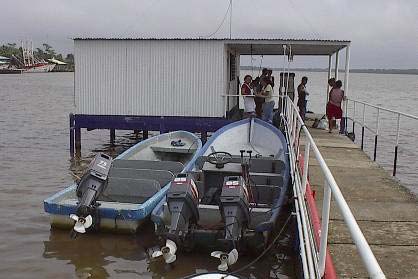
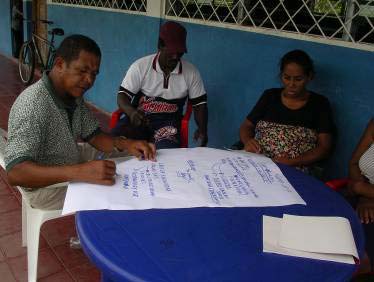
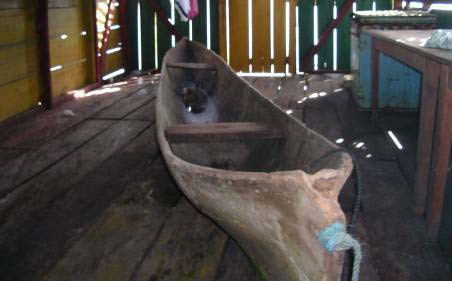
· Lobbying, forming alliance and negotiating at any given opportunity are key to making
things happen.
27
3. LEARNING AND ADAPTING
Along with our partners, we learned a lot from the project. In this chapter some of those insights
are shared with a view to making changes for improvement under the circumstances. This is the
essence of adapting and institutionalizing the practice of adaptive management as the iterative
process of learning-by-doing (by experimenting), using the shared key lessons to make changes
in (co-)management (adapting), and experimenting again to learn more about how to improve.
3.1 Strategic planning
Strategic planning is the process of defining objectives and developing strategies to achieve
them. When a plan is "strategic" it operates on a scale large enough to take in "the big picture".
Going beyond a normal operational plan it facilitates a more desirable future by influencing
external conditions or adapting current plans to have more favorable outcomes under the same
external conditions, often by the identification and removal of blocks or constraints. Participatory
implies that a group of people, such as co-management stakeholders, plan strategically together.
If people and organizations are brought together to plan, and they find that it is an effective and
rewarding experience, chances are that they will be willing to accept the objectives or strategies
developed, and to collaborate in management. When planning is not participatory, or has been
separated from management, strong partnerships among the co-management stakeholders are
less likely. Co-management is more likely to be successful, and objectives-driven, when it
incorporates a participatory planning process. Learning by doing things together successfully
builds capacity, trust, respect and legitimacy of both content (the plan) and process (the
planning).
Participatory Strategic Planning
Based on: The Technology of Participation
Action
Focus Question: The basis for planning - the
Plans
major topic to be worked on.
Shared Practical Vision: The practical picture
Shared
of the desired future.
Vision
Barriers/Blocks: The underlying obstacles or
issues preventing us from realising the vision.
Strategic
Directions
Strategic Directions: The proposed actions to
Focus
deal with the obstacles and move toward the
Question
vision.
Action Plans: The substantial actions required
to carry out the new directions.
Barriers/
Blocks
(Adapted from Spencer 1989)
Most individuals affected by co-management arrangements are included in the group that makes
decisions about, and can change, the arrangements. In Belize, Friends of Nature is led by a team
of individuals that almost all come from the local communities it serves. The strength of the
organization is based on the great support that it has received from its local communities
(Garbutt, this volume). However, participation in co-management in the Caribbean is often
constrained because in many cases, resource users and other non-governmental stakeholders
expect government to have the capacity and will to do things for them and they are reluctant to
get involved in management and management planning.
28
The nature of the participation in planning needs to be decided early on since bottom-up is not
always feasible or affordable. If stakeholders are not well informed, or do not have the capacity
or time, it is not always appropriate to start at the bottom. This usually means that resource users
will make their input after there is a first draft or at least an outline of plan contents. However,
the process must genuinely consider and use the input of stakeholders in order to be credible.
The plan should be endorsed at a political or legal level in preparation for implementation. Prior
to implementation the plan should be widely publicized and disseminated for it to be actively
adopted. Even though stakeholders should have bought into the plan, it may be ignored unless it
is well known and becomes standard operating procedure. This helps to institutionalize the plan.
Although strategic planning for resource management is often thought of as a government
exercise, NGOs and other stakeholders can take the initiative to invite government to plan with
them for a particular area or resource. This is important in MPAs for which co-management
agreements have been signed, such as in Belize. For all stakeholders, but especially organizations
that take on significant management responsibilities, it is very useful to have a strategic plan.
The strategic planning process is embedded within the formulation and revision stages of the
fisheries or MPA planning process.
The participation of fishers in decision-making is not without its problems as illustrated by
fisheries management planning (Fisheries Division 2004) and sea egg fishery co-management
(McConney and Pena 2004, 2005) in Barbados. In the Holetown case (Pena and Mahon 2005),
also in Barbados, although stakeholders were engaged at the beginning of the project and they
were keen to monitor its progress and development and provide their inputs, there was difficulty
keeping them engaged due to long time delays with inputs, such as survey maps and coastal
engineering plans for the area. Participation comes with a price.
There is a need for the formation of community organizations and/or the strengthening of
existing organizations to support engagement in planning and co-management. This was
emphasized by the BARNUFO perspective in Barbados (Watson, this volume). In some places
there tends to be a low degree of social integration at the community level. The absence of
community cohesion and cooperative institutions at the community level is prevalent and reduces
the capacity for collective action for mutual support and self-sufficiency. There is an apparent
need for cooperative institutions and collective action at the local level, but cultural conditions
are such that local initiatives for institutionalizing collaboration are unlikely to occur. Co-
management is not possible in the absence of community organizations (core management
groups) and models of cooperative behaviour. Fishers need to be organized into viable
organizations and exiting organizations strengthened and sustained.
The ongoing establishment of a regional inter-governmental fisheries mechanism (the Caribbean
Regional Fisheries Mechanism or CRFM) is of considerable interest, but it needs to be paralleled
at the community level among fisherfolk organizations. The design and implementation of co-
management in the region will be hindered by having few known formal traditions of
community-based coastal resource management and the limited number and organizational
weakness of fisher organizations. Future efforts in strategic participatory planning and
management in the region can be guided by having effective local organizations which can
require changes in both the behaviour and the organizational structures of the organizations
involved.
29
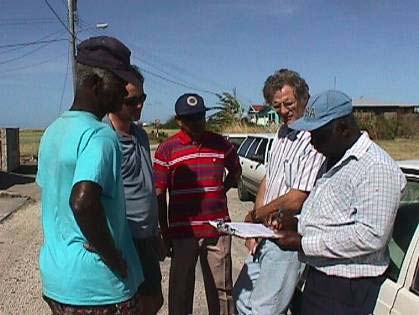
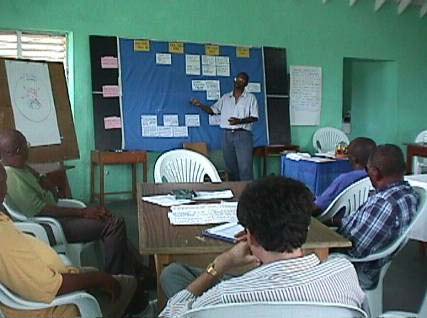
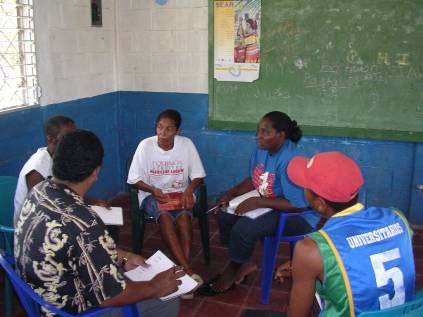
3.2 Capacity building
Organisational capacity building is multi-faceted and much more than staff training. Its aim is to
make organisations more efficient and effective within a well-defined vision or model of what
they hope to be and do. Building capacity is often a long-term process with different types of
interventions tailored to bridge the gap between what the organisation can do at the moment and
what it intends to do in the future. Several skills and disciplines are drawn upon to do this. The
Caribbean Natural Resources Institute (CANARI) has developed a conceptual framework for
capacity building containing seven main elements that organisations should focus on. It
illustrates the extent to which capacity building goes beyond training. The elements are:
· World view: vision and mission guiding capacity requirements
· Culture: an organisation's distinctive climate and way of operating
· Structure: roles, functions, positions, supervision, reporting, etc.
· Adaptive strategies: ways of responding to changing environments
· Skills: knowledge, abilities and competencies for effective action
· Material resources: technology, finance and equipment required
· Linkages: relationships and networks for action and resource flows
The Barbados Programme of Action (BPOA) for Small Island Developing States (SIDS)
developed at the 1994 global conference on SIDS identifies capacity building as a key
requirement. Building stakeholder capacity for co-management is essential in the Caribbean, and
a critical first step in many cases. In addition to the areas in which stakeholder organisations
generally need capacity, coastal co-management stakeholders need to understand resource
system and human system relationships. During the project we found that there were knowledge
deficiencies in these areas that applied to all categories of stakeholder. In many cases capacity
could be built fairly simply if the various stakeholders engaged in collaborative activities in
which skills transfer was undertaken. Learning by doing within partnerships is an approach well
suited to strengthening co-management institutions, and one that is usually cost-effective.
Co-management is usually negotiated between government and organised stakeholders. It is not
usually a practicable arrangement between governments and large numbers of unorganised
individuals. When there are more than a few individuals, the need to organise representative
stakeholder bodies becomes apparent, even if only for logistic reasons. In community-based co-
management the arrangements are normally with a local governance body or institution such as a
village council. If the number of organisations becomes large, then umbrella or secondary
organisations are formed to represent the primary groups (e.g. BARNUFO).
Organisations should set priorities and schedules for building capacity, with testing, monitoring
and evaluation incorporated to measure success. This rigorous approach helps to ensure that
there is minimal sidetracking. Capacity that is required only temporarily is usually not of as high
30
priority as core functions. It is important also to set realistic goals and limits for capacity in
various areas in order to achieve an overall balance that reduces vulnerability. For example, a
fisherfolk organisation would not normally include a fisheries scientist, but some members could
be trained to understand the principles of marine science sufficient for the organisation to
effectively communicate with scientists and vice versa.
Organisations build capacity through the efforts of individuals. The correct individuals must be
selected to build the capacity of organisations. These people should be, or be placed, in positions
where they can use newly acquired skills. Governments in the region are renowned for not
making rational use of human resources due to various constraints in the civil services and public
administration. Transfers of critical skills should also be planned and implemented at every
opportunity. In very small organisations it is common for the same person to take on all types of
training and be expected to perform in many different roles. The entire co-management
arrangement should be organised so as to make best use of both individual and organisational
talents.
Requirements for building capacity to effectively engage in co-management and community-
based management in the region include designing new approaches to training and education to
benefit community institutions and users, multidisciplinary approaches, incorporation of field-
based learning and dissemination of specific skills. The majority of fisherfolk associations and
cooperatives are structurally and financially weak and require technical assistance to engage in
co-management. For example, it was noted that if fisherfolk organizations in Barbados are to
become true partners in co-management, it will be necessary to provide more assistance in the
areas of leadership skills, business management and information acquisition for decision-making.
Structural and operational weaknesses of the existing resource user organizations render their
capacity to assume the obligations and responsibilities involved in effectively participating in co-
managing the resources highly uncertain. A critical barrier to effective co-management of
protected areas in Belize is lack of capacity of community-based organizations to implement
their responsibilities related to co-management of protected areas (Goetze and Pomeroy 2003).
Capacity building is not an end in itself, but is one consideration to be factored into the design
and implementation of natural resource management approaches that are participatory and
sustainable, and that provide economic benefits. To make co-management a cornerstone of the
emerging regional efforts towards integrated coastal management there is a need to build
appropriate social capital amongst local organizations and groups. There is an imbalance in
individual and community organization capacity and level of power that will need to be
addressed. Based on experience of the role of co-management in developing the Folkstone
Marine Park and Reserve in Barbados, there is a need to pay attention to imbalances in
stakeholder capacity to participate in multi-stakeholder processes, e.g. fishers versus tourism.
3.3 Stakeholders and power
In some instances fisheries and coastal management authorities have enormous power and must
be willing to share that power with resource users and stakeholders. In other cases the authorities
may face more powerful opponents and will need the support of resource users and stakeholders
to back them up. Participation requires changes in attitude towards power and authority. More
powerful stakeholders will circumvent participatory processes when it serves their interests to do
so. Even when stakeholders are properly identified, and when their interests are properly taken
31
into account, there are many forces which mitigate against the fair and equitable distribution of
rights, responsibilities and benefits. Access to power, and perceptions of power and influence,
directly affect stakeholders' interest and willingness to come to the negotiating table.
Tourism
Other fishery
Fishers
stakeholders
Many existing community organizations are highly dependent on government for their existence
and will need to become more independent. Based on experience with organizing fisherfolk in
Barbados, although the incremental approach to fisherfolk organization development employed
in recent times places most of the decision-making responsibility in the hands of the fisherfolk,
the directional influence of government is strong. A greater degree of independence and initiative
must be attained by fisherfolk organizations in order to avoid the tendency to become co-opted
into government's management agenda without meaningful participation in decision-making.
While government needs to retain its provision of information and tangible benefits,
implementation of legal frameworks, and otherwise create an environment suitable for
organization development, it needs, if possible, to step back from the task of intimately directing
their development. In an evaluation of the Fisherfolk Organization Development Project in
Barbados, it is reported that at this stage there is understandably much dependence upon
government, but a greater degree of self-reliance must be demonstrated if they are to avoid co-
optation by government, even if unintentional.
The marine resource use in the region involves multiple stakeholders and multiple conflicts that
will need to be addressed through dialogue and consultation with stakeholders. There is a need to
consult and promote dialogue with the multiple resource user groups in order to find ways of
accommodating all, while reducing conflict. There is a need to promote the consultation process
with fishing communities in order to enhance their involvement and participation in decision-
making and planning processes in fisheries management. Often it is implied that stakeholders are
only those outside of the government such as NGOs, CBOs, fishing and other groups in civil
society. In the Caribbean, where many co-management initiatives are led by State agencies, the
inclusion of government is essential. If co-management initiatives are initiated by non-
government organizations then these organizations should exercise their power and make all
efforts to draw government in as a partner, even if in the context of conflict management. Where
the government shows little initial interest in co-management, it will eventually need to become
involved at some stage.
Both fishers and the state are deficient in fishery resource information, and their deficiencies
differ in ways that could make information exchange mutually beneficial. Information is a source
of power. Trust and cooperation within the fishing industry, and between it and the state, could
be improved through information exchange. The uncertainty surrounding the fishery, and the
weakness of the state, provide a strong incentive for the harvest sector and government to
introduce co-management starting with the relatively simple and straightforward exercise of joint
32
data collection and analysis as activities for introducing and promoting stakeholder participation.
This is what was tried, with considerable success, in the Barbados sea egg fishery (Parker, this
volume).
In most countries there is a need for both intensive and extensive use of consultation with the
resource stakeholders, use of participatory approaches to decision-making processes, and
establishment of more local resource management bodies representing all stakeholder groups.
Future efforts in participatory planning and management in the region will work when
participants are provided with the information required to make decisions, when all relevant
stakeholders are incorporated from the outset, and it is appreciated that data collection on
stakeholder groups does not equal participation. There is a need for transparent, negotiated
processes for determining priorities in the face of inadequate resources. There is a need for types
of consultation between government and fishers that create and build trust and respect.
As much as possible, all stakeholders should be identified and included in the co-management
arrangements. In the case of Friends of Nature in Belize, it was the stakeholders themselves,
essentially fishing and tourism stakeholders, who pushed hard for the declaration of the protected
areas. One of the greatest threats to the success and effectiveness of participatory management
processes and institutions is the accidental or deliberate exclusion of one or more groups of
stakeholders from the planning and negotiating stages. In Belize, TASTE has stated that they
have had stakeholder issues that have required conflict resolution, but not too many. As ever,
participation is hard to create but they found that new stakeholders (youth) offer stronger
participation and more goodwill. Management authorities and other participants often have clear
views on the composition of partnerships in existing and potential co-management arrangements.
Within co-management arrangements there may be stronger partnerships and alliances among
certain stakeholders whose interests are closer to each other or who have an umbrella, or
secondary, organization to represent them. An example could be tourism interests (hotels, guest
houses, dive shop operators) forming an alliance that does not include other stakeholders such as
water taxis and fishers. These types of temporary or permanent partnerships within co-
management arrangements can be useful in reducing the number of different parties that are
involved in negotiations or conflict management, and they should be encouraged. One potential
problem with this is if the allied stakeholders form a power faction that tries to take unfair
advantage of the smaller, separate groups such as by forcing their decisions onto the others.
There is need for thorough methods of stakeholder identification, which aim at ensuring that all
parties are properly recognized and given a chance to participate in the process. When complete
participation is not an option, even limited participation can contribute to improved planning
processes. There is a need to recognize the diversity of stakeholders and take into account the
full complexity of their interests and relationships with the resource and with one another.
Beyond identification, stakeholder analysis examines power and other relationships. The
participatory approach to stakeholder identification and analysis takes considerable time and
financial resources but can provide valuable insights. It is not always possible or feasible (e.g.
due to budget limitations or logistics of travel) to have all stakeholders represented in
management, especially not all of the time. In some countries there is a need to recognize and
work with indigenous peoples and their territories, bearing in mind the large proportion of the
region's natural resources that is under their stewardship and their marginalization to date.
33
3.4 Organising and leadership
Compared to Southeast Asia and the Pacific, the Caribbean has fewer coastal and marine non-
governmental and community organisations that are positioned to play roles in co-management.
Community organising will be a critical component of introducing or strengthening co-
management in the Caribbean. This involves the promotion and support of collective action.
Collective action is group effort to reach and implement decisions in three steps. First, one has to
determine the specific aims and objectives of those in the group. Then agree, preferably by
consensus, on the course of action to take. Third, implement the decision or action and monitor
results, with feedback. Collective action needs special attention, especially in relation to
fisherfolk organisations. The weaknesses of fishery organisations in the Caribbean suggest that
much will have to be done to promote sustained collective action to institutionalise co-
management. Crisis driven management responses prevail in both government and industry.
Crisis responses often feature intense, but only temporary, collective action.
Sustained collective action is necessary to make co-management successful. Two of the most
common challenges for collective action are lack of coordination and prevalence of free riders. A
free rider seeks to obtain benefits without cost or effort. There are often high expectations in
fisherfolk organisations that, as with a boat crew, everyone will pull their weight. In Barbados,
organisational leaders see free riding as a serious indictment of the membership, ignoring the
rule of thumb in most organisations that 10% of the members do 90% of the work. Problems of
apparent free riding must be distinguished from the genuine lack of capacity to contribute, the
need to focus on survival as a priority (consider poor members), the mistrust of leaders, the
expectation of free patronage benefits based on political experience and other factors that cause
group members not to actively contribute. This could be due to choice, their inability or the lure
of more attractive options. Sometimes the problem is lack of skills in mobilisation, causing the
initial momentum of group activity to die down as the crisis passes and people tire of
organisational ineffectiveness. Collective action requires constant attention to mobilisation and
keeping the group together through difficult periods.
Political fear of collective action, in the form of organised opposition, may prompt interventions
that seek to stifle it. Separating popular movements from party politics can be a challenge in the
Caribbean. In co-management there is a need to reassure partners of shared goals and willingness
to work together. This causes collective action and organising stakeholder groups to be directed
towards a common goal rather than be dissipated in internal struggles. Where the social myth
that fishers cannot act collectively is deeply embedded, such as in places where cooperatives and
associations have often failed, it is important to learn lessons and build models of success from
other group efforts. In Gouyave, Grenada, the successful social and cultural groups serve as
examples that fishers can emulate.
Most countries have formally organised, even if quite weak, cooperatives and fisherfolk
associations. However, these groups will not automatically be suitable as representative
organisations in co-management. Authorities should be prepared to support and strengthen the
organisation as a whole rather than just steer it towards management roles. This serves the
purpose of more comprehensively looking after the interests of members and may help to address
issues such as of livelihoods and poverty. It is likely that cooperatives were established with
objectives that relate more to expanding exploitation, improving marketing and increasing the
incomes of members. Changes in outlook will be necessary for these groups to play major roles
34
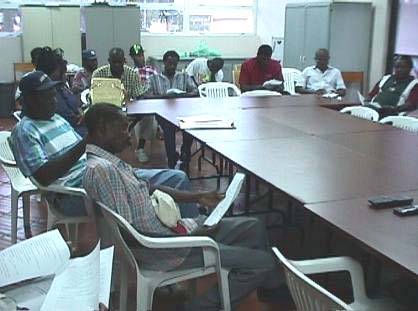
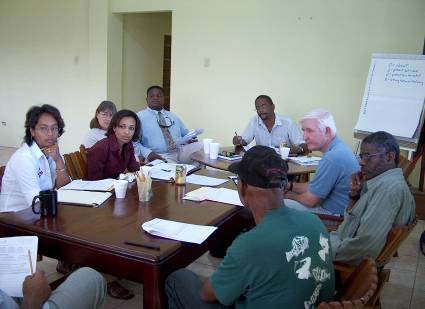
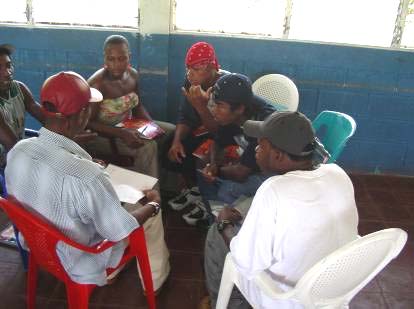
in resource management. These changes may be difficult and lengthy, especially if the
organisation is still struggling to achieve its original development mandate. Putting more focus
on management may strain the internal cohesion of the organisation. To prevent this requires
strong leadership.
Without good leadership it is unlikely that any organisation will survive and prosper. There is an
abundance of good leaders in government and stakeholder organisations for technical matters.
Boat captains are leaders of fishing enterprises and many are exceptionally knowledgeable about
their working environment. Crews follow the captain's instructions at sea, but the captain may be
out of his depth on land when leading the fisherfolk organisation in negotiations with the
fisheries authority or tourism interests. For this activity, the fisher organisation needs a leader
with different skills. It is a common mistake to take leaders out of their element and expect them
to do equally well in another environment. A few people are "born leaders" wherever you put
them, but most people acquire leadership skills with strengths in what they know best. To this
they add learned skills such as group facilitation, meeting planning and conduct, making
presentations, documentation etc.
Style of leadership is also very relevant to co-management. There are three main styles, and
clearly the participative or democratic style is fundamentally most compatible. However,
authoritarian or delegating approaches may be more appropriate at times. Leadership style may
determine the chances of successfully negotiating agreements, reaching consensus and
encouraging buy-in to support compromise outcomes. A leader does not have to be charismatic
or a micro-manager in order to be effective. Recommendations for effective leadership are
tending towards individuals or teams that can bring out the group's vision for the future and
mobilise group members in working towards achieving that vision. The leader of a co-
management institution must command the trust and respect of a diverse array of stakeholders.
Among Caribbean fishers there is often a strong spirit of egalitarianism, or peer group equality.
In Barbados this has worked against the sustainability of organisational leadership since no one
wants to appear superior. Emerging leaders have unrealistic expectations of group input, and are
often dismayed at the high proportions of free riders. Leaders are often suspected of personal
aggrandisement and power seeking. In the Caribbean there is often a close link between power
and party politics. Politicians who fear leaders or co-opt them for political gain can endanger the
integrity of co-management processes. The same goes for stakeholder leaders who seek political
alliances that weaken their allegiance to the organisation and the members that they were
selected or elected to represent.
In non-Caribbean countries it is not unusual for women to play major roles in leading fisheries-
related organisations. Often they are related to the men who fish, and they use their presence on
land during office working hours to look after the affairs of the fishers at sea by going to
35
important meetings and otherwise being the representatives of the workers at sea. While women
in the Caribbean play important roles in fishery and other occupations, particularly in marketing,
they are usually not in the forefront of fisherfolk organisational leadership. Given the strong
roles played by women in Caribbean society and economies, their potential as fisherfolk leaders
should be encouraged. BARNUFO in Barbados offered a role model for this during the project.
3.5 Role of government
Increasingly, government policies and programs stress the need for greater resource user
participation and the development of local organizations to handle some aspect of resource
management. Policies favouring co-management are a necessary but not sufficient condition for
successful co-management. This suggests that it may be insufficient for governments simply to
call for more community involvement and fisher participation; they must also establish
commensurate legal rights and authorities and devolve some of their powers. The delegation of
authority and power sharing to manage the fisheries may be one of the most difficult tasks in
establishing co-management. Government must not only foster conditions for fisher participation
but sustain it. In Nicaragua, for example, the political culture is a major obstacle to a co-
management process. Governmental cooperation towards a community based project may very
well depend on whether the party in power views them as supporters. If they are not considered
supporters their efforts can be undermined.
As a first step, government must recognize local institutions as legitimate actors in the
governance of fisheries resources. In the Pearl Lagoon of Nicaragua, Government tends to make
decisions and then notify the communities (Simmons, this volume). There are token consultation
gestures on subjects that are practically already decided unless the communities make an issue of
it. At a minimum, government must not challenge fishers' rights to hold meetings to discuss
problems and solutions and to develop organizations and institutional arrangements (rights and
rules) for management. Fishers must feel safe to openly meet at their own initiative and discuss
problems and solutions in public forums. They must not feel threatened if they criticize existing
government policies and management methods. As a second step, fishers must be given access to
government and government officials to express their concerns and ideas. Fishers should feel that
government officials will listen to them. As a third step, fishers should be given the right to
develop their own organizations and to form networks and coalitions for cooperation and
coordination. Too often there has been the formation of government-sponsored organizations
which are officially recognized but ineffective since they do not represent the fishers, but these
may be the only type of organization a government may allow. Fishers must be free to develop
organizations on their own initiative that meet their needs.
The cooperation of the local government and the local political elite is important to co-
management. In the Pearl Lagoon of Nicaragua, after much negotiation and lobbying with the
municipal government they finally decided to accept the community based natural resource
management plan and gave it an "aval municipal" (municipal endorsement). There must be an
incentive for the local politicians to support co-management. There must be political willingness
to share the benefits, costs, responsibility, and authority for co-management with the community
members. Co-management will not flourish if the local political ``power structure'' is opposed in
any way to the co-management arrangements. In addition to the political elite, local government
staff must endorse and actively participate in the co-management process. Local government can
provide a variety of technical and financial services and assistance to support local co-
36
management arrangements such as police, conflict management, appeal mechanism, and
approval of local ordinances.
Fishers often develop their own rules for management in addition to those created by
government. For example, fishers may establish rules defining who has access to a fishing
ground and what fishing gear can be used. The fishers may be able to enforce the rules as long as
there is at least a minimal recognition of the legitimacy of these rules by the government. This
can be formal, as through a municipal ordinance, or informal, as through police patrols to back-
stop the local enforcement arrangements. If government does not recognize the legitimacy of the
rules, then it will be difficult for the fishers to maintain the rules in the long run. Thus, the role of
government in establishing conditions for co-management is the creation of legitimacy and
accountability for the local organization and institutional arrangements. The government,
through legislative and policy instruments, defines power sharing and decision-making
arrangements. Only government can legally establish and defend user rights and security of
tenure. One means of establishing these conditions is through decentralization.
devolution
Power of the
satellite or
stakeholder
delegation
Decentralisation:
Delegation:
Devolution:
decentralisation
central authority
central authority
central authority
makes decisions,
allows satellites to
allows satellites
but has satellites
make at least some
independent
Power relinquished
in remote areas
decisions
decision-making
by the central authority
Decentralization refers to the systematic and rational dispersal of power, authority and
responsibility from the central government to lower or local level institutions--to states or
provinces in the case of federal countries, for example, and then further down to regional and
local governments, or even to community associations. The approach of decentralization is for
the centre to delegate some measure of its power to the lower levels or smaller units in the
government system. Increasing local autonomy is a focal point in the decentralization process.
Generally, power and authority are transferred or withdrawn by laws enacted in the centre.
In many countries, government programmes and projects stress the development of local
organizations and autonomy to handle some aspect of fisheries management. Seldom, however,
is adequate attention given to the establishment of administrative and policy structures that
define the legal status, rights and authorities essential for the effective performance of local
organizations. Many attempts at decentralization have not delivered a real sharing of resource
management power.
In the Caribbean region, there has been very little decentralization or delegation, and no
devolution, of significant responsibility and authority by government authorities to fishers,
except in Belize (Goetze and Pomeroy 2003). Governments have relinquished more power in
MPAs, especially in Belize, but also in other places like St. Lucia and Dominica. The reason for
stakeholders having more power in MPAs stems in part from the expectation that managing an
37
MPA should be a profit-making business-like operation that needs little government intervention
except regulation and policy support. In Nicaragua, the Regional Government was not willing to
assist a process that was spearheaded by the communities and facilitated by a local CBO.
If new fisheries co-management initiatives are to be successful, these basic issues of government
policy to establish supportive legislation, rights and authority structures must be recognized. The
devolution of fishery management authority from the central government to local level
governments and organizations is an issue that is not easily resolved. Legislation and policy for
co-management are embedded in a broader network of laws, policies and administrative
procedures, at both national and local government levels. Consequently they will be difficult to
change. Government administrative and institutional structures, and fisheries laws and policies
will, in most cases, require restructuring to support these initiatives. In Barbados, BARNUFO
[ref] still feels that "...not quite satisfied that some of the scientists and managers are quite ready
to relinquish some of their responsibilities."
There may be limitations in stakeholder and state agency capacity, and legal framework that are
barriers to decentralization. For example, in Barbados the fisheries regulations need to be
amended to provide for delegation of authority to fisherfolk organizations and to promote
collaborative co-management through the Fisheries Advisory Committee. These provisions may
then be used as leverage to strengthen the organizations, provided that there is willingness and
leadership to respond. Without strengthening they would not have the capacity to successfully
discharge the additional responsibility. The re-distribution of power from government to other
stakeholders is usually an incremental and gradual process based on good performance assessed
through monitoring and evaluation. The extent of redistribution parallels the three main types of
co-management, with government relinquishing more power as you go from consultative,
through collaborative, to delegated co-management.
Although most stakeholders accept additional authority and responsibility, refusal may be
warranted where it is clear that the government is only interested in passing on the costs and
logistic difficulties of resource management without providing much or any support. Even with
the potential profitability of MPAs there is usually a critical initial period that requires State
support. Giving responsibility without authority or real power has been a criticism of the co-
management thrust in Belize. While it is important not to foster dependency, it is essential to
provide sufficient support to ensure that the co-management arrangement is on a sound footing.
If stakeholders are ready to assume more responsibility than the government has offered to share
through negotiation, then lobbying and pressure group tactics may become necessary. If these are
used, the stakeholders should ensure that a viable plan exists to implement the tasks and
additional activities that will result from a successful re-distribution of power.
In detailing the specifics of the decentralization strategy, questions of implementation become
crucial points of debate. What powers and functions, for instance, can be properly entrusted to
local institutions and which institutions--local government or user group? What are those that
should be left to the central government? How is the sharing of resources to be administered?
What should be the role of non-government organizations and people's organizations (an
organized group of individuals with similar interests)? What is the proper and appropriate mix of
government and private sector participation? Will decentralization occur only for the fisheries
bureaucracy, or will it be a government-wide initiative? This collection of issues impinges on
decentralization strategies and drives the political debate associated with decentralization.
38
4. CONCLUSIONS
In this final brief section we pull some of the threads together to present the key lessons learned
from the project and to suggest directions for new research on coastal resource co-management
in the region.
4.1 Key lessons learned
Some of the lessons learned with our partners in the process of executing this project are of
particular significance to the region, while many others are more site and situation-specific. The
former are the key lessons learned. They have been described in the perspectives of the project
participants, the project outputs in the appendices or standing alone, and in the preceding
sections about learning and adapting. They are briefly reiterated in summary below.
· Government enabling policies and legislation from the top-down are needed to support
co-management initiatives from the bottom-up.
· Government authorities need to change their attitudes and behaviour in order to share
power with community and stakeholder organizations.
· Strategic participatory planning can be one of the main tools for encouraging information
exchange and building trust among stakeholders in new arrangements.
· Government authorities and other non-governmental stakeholders will need to build their
capacity to effectively engage in co-management.
· Leadership is an area in which capacity must be built as a matter of urgency in order to
manage change and sustain collective action.
· Marine resource use in the region involves multiple stakeholders and multiple conflicts
which can be addressed through co-management.
· All stakeholders should be identified and, if possible, included to the extent of their
ability in the co-management arrangements.
· Creation of new stakeholder organizations and/or the strengthening of existing
organizations to engage in co-management are often necessary.
· Imbalances in individual and organizational capacity and power amongst stakeholders
will need to be addressed in pursuit of equitable outcomes.
· Many existing stakeholder organizations are highly dependent on government for their
existence and will need to become more independent and self-organising.
· Incentive structures (economic, social) related to the shared recognition of problems and
solutions are necessary for individuals and groups to actively engage in co-management.
· Restricting user access, especially to marine resources, will be difficult due to existing
property rights arrangements and philosophies that favour open access.
· Strong non-governmental organizations are needed to serve as change agents and mentors
in support of the co-management process throughout all of its phases.
4.2 Directions for new research
Establishing coastal resources (especially small-scale fisheries and marine protected area) co-
management in English-speaking Central America and the Caribbean will be a long-term process
and cannot be achieved unless the partners are well prepared to take on the added responsibilities
this entails. Research is needed to support the preparation of the partners to engage and advance
39
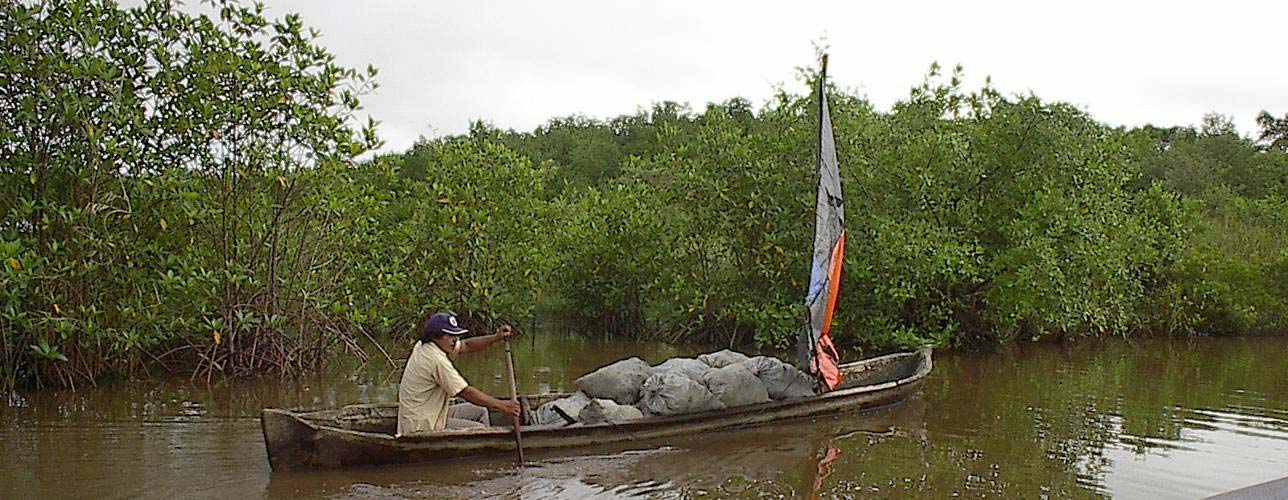
in co-management. Much of this can be participatory action research. Pilot projects should be
initiated in which all partners can gain practical experience with co-management and test and
demonstrate to each other their commitment to the process, developing trust and credibility. The
pilot projects can further serve to identify needed legal and policy changes to support co-
management.
Co-management in the Caribbean region will differ in some respects from that in other regions of
the world. There are a number of research questions related to the process of co-management and
co-management systems that may be useful for directing new research in this region:
· Organizational forms: most appropriate and effective for different stakeholder groups
· Scale: of institutional and organizational arrangements, ecosystems, users
· Adaptation: process of institutional and organizational evolution over time
· Governance: structure and content of co-management agreements, enabling policy
· Monitoring: measurement of short- and long-term changes and impacts
· Networks: linkages and flows among co-management participants and others
· Capacity: how to build and sustain it for and through self-organisation
· Resilience: making successful co-management arrangements more durable
An important point to note is that much of this research can be done fairly simply by the people
of the region who stand to benefit most from successful co-management. So we encourage donor
agencies, applied academic researchers and potential co-management partners to boldly seek new
opportunities for advancement.
40
5. REFERENCES
The list below sets out general and country-related outputs produced by the project either
through direct funding or indirectly through supporting partnerships with other agencies and
individuals. The next section contains the policy briefs produced from the project. The final
section provides references to documents that were not produced by the project but are relevant
to co-management. The project outputs are compiled as an appendix and stand alone documents.
5.1 Outputs by country
5.1.1 Barbados
1. Alleyne, A. 2004. Graeme Hall environmental stewardship: A preliminary assessment of
stakeholders' perceptions of co-management. Draft final report. April 2004. 25pp.
2. Fisheries Division. 2004. Barbados fisheries management plan 2004-2006: Schemes for
the management of fisheries in the waters of Barbados. Ministry of Agriculture and Rural
Development. 68pp.
3. Fisheries Division. 2006. International Commission for the Conservation of Atlantic
Tunas (ICCAT): How does it affect Barbadian fishermen? Brochure. Ministry of
Agriculture and Rural Development.
4. Mahon, R. and M. Pena. 2006. Holetown Community Beach Park Project. Participant
perspective article (this volume).
5. McConney, P. and M. Pena. 2004. Events and institutional arrangements in the
management of the 2003 Barbados sea egg fishing season (15 September 15 October).
Coastal Resources Co-management Project (CORECOMP). Centre for Resource
Management and Environmental Studies, University of the West Indies Cave Hill
Campus, Barbados. 38 pp.
6. McConney, P. and M. Pena. 2005. Summary of events in the 2004 Barbados sea egg
season (15 30 September 2004). Centre for Resource Management and Environmental
Studies. The University of the West Indies, Cave Hill Campus, Barbados. 17pp.
7. Parker, C. 2006. Some personal perspectives on co-management of the Barbados sea egg
fishery. Participant perspective article (this volume).
8. Parker, C. and M. Pena. 2004. Possible Paths to Co-managing the Sea Egg Fishery of
Barbados. Proc Gulf Carib. Fish. Inst. 57:115-128.
9. Pena, M. and R. Mahon. 2005. Compilation report on the Holetown Beach Park Project,
St. James, Barbados. 66 pp.
10. Watson, A. 2006. BARNUFO and co-management. Participant perspective article (this
volume)
5.1.2 Belize
11. Bowman, D. 2005. One-day management team workshop. Sponsored by TASTE
SCMR. 7 April, 2005. 2p.
12. Bowman, D. 2005. Report on the TASTE-SCMR Board Retreat held 1-2 April 2005 at
41
Punta Gorda.
13. CERMES 2004. Report of the workshops on enhancing NGO board effectiveness. Punta
Gorda, 2 February 2004 (hosted by the Toledo Association for Sustainable Tourism and
Empowerment (TASTE)) and Belize City, 3 February 2004 (hosted by the Belize
Fishermen Cooperative Association (BFCA)). 9p.
14. CERMES 2005. Summary report of the workshop on coastal resource co-management for
the Glover's Reef Advisory Committee. 17 March 2005, Belize City, Belize. Hosted by
the Wildlife Conservation Society (WCS). 5p.
15. FON. 2002. Friends of Nature Strategic Plan 2002-2007. Report of Friends of Nature,
Placencia.
16. FON. 2006. Report on the Board of Directors Orientation Workshop, 21 February 2006,
Placencia. Report of Friends of Nature, Placencia.
17. Garbutt, L. 2006. Facing the challenges: the Friends of Nature experience. Participant
perspective article (this volume)
18. Gibson, J., D. Lizama and R. Pomeroy. 2004. Establishing a Socioeconomic Monitoring
Program for Glover's Reef Atoll, Belize. Proc Gulf Carib. Fish. Inst. 57:161-174.
19. Goetze, T. 2005. Muddy Waters: Conservation Discourses and the Politics of Power in
Marine Park Co-management in Belize. PhD dissertation. Department of Anthropology,
McMaster University, Canada
20. Goetze, T. and R. Pomeroy. 2003. Co-managed marine protected areas: a case study of
Friends of Nature, Belize. Proc Gulf Carib. Fish. Inst. 56: 17-32.
21. Nalette, C. A. 2005. Economic valuation of fishing and tourism at Glover's Reef Marine
Reserve, Belize. MS thesis, Department of Agricultural and Resource Economics,
University of Connecticut.
22. Nightingale, J. 2006. CORECOMP and TASTE: Beneficial capacitation for the co-
management process of the Sapodilla Cayes Marine Reserve (SCMR), Belize. Participant
perspective article (this volume)
23. Nightingale, J. 2006. Human resource management concepts for NGOs. Participant
perspective article (this volume)
24. Perez, A. 2003. Assessment of socioeconomic conditions at Placencia, Hopkins and
Monkey River in Belize. Coastal Resources Comanagement Project, Centre for Resource
Management and Environmental Studies, University of the West Indies, Cave Hill
Campus, Barbados. 30pp.
25. Pomeroy, R. 2003. Report of the workshop on Marine Protected Area (MPA)
management. Punta Gorda, 17-18 June 2003. Hosted by the Toledo Association for
Sustainable Tourism and Empowerment (TASTE). 2p.
26. Pomeroy, R. 2003. Report of the workshops on proposal writing and socioeconomic
monitoring. Punta Gorda, 27-28 October 2003. Hosted by the Toledo Association for
Sustainable Tourism and Empowerment (TASTE). 2p.
27. TASTE 2004. Report on SCMR Youth PATH Workshop related to "Creating Tourism
42
Opportunities in the Sapodilla Cayes Marine Reserve" held from 22-25 November 2004
at Punta Gorda and SCMR
28. TASTE. 2005. Report on TASTE-SCMR Funders and Donors Conference held on 19
January 2005 at Punta Gorda, Belize
29. TASTE. 2006. Youth PATH Phase II: Final Report and summary for SCMR.
5.1.3 Nicaragua
30. Fletcher, P. 2006. Report of the Marine Resource Management Coral Reef Research and
Monitoring Workshop Parts I and II with field trip, held 21-23 November 2005 and 3-7
April 2006 at the University of the Caribbean Coast of Nicaragua (URACCAN) and
Crawl Cay.
31. Joseph, K. 2003. Analisis socio-economico de genero en el manejo de los recursos
pesqueros en el municipio de Laguna de Perlas, RAAS. Proc Gulf Carib. Fish. Inst. 56:
87-96
32. Joseph, K. 2004. Socio-economic impact of the closed season for lobster in Corn Island,
RAAS Nicaragua. Proc Gulf Carib. Fish. Inst. 57:87-100.
33. Joseph, K. 2004. IFC-URACCAN Strategic Plan 2004-2009. URACCAN. 33pp.
34. Joseph, K. 2005. Report of the workshop on fisheries co-management. 13-19 March
2005, Pearl Lagoon, RAAS. URACCAN. 5p.
35. Joseph, K. 2005. Report of the workshop on fisheries co-management. 23-25 August
2005, Corn Island, RAAS. URACCAN. 5p.
36. Joseph, K. 2006. Fisheries Co-management in the Caribbean Coast of Nicaragua.
Participant perspective article (this volume)
37. McConney, P. and R. Pomeroy. 2003. Report of the workshops on coastal resource co-
management and other collaborative initiatives in Nicaragua. Coastal Resources Co-
management Project (CORECOMP), Centre for Resource Management and
Environmental Studies (CERMES) of the University of the West Indies (UWI),
Barbados. 30pp.
38. Payne, D. 2004. Report regarding Coastal Resources Co-management Project
(CORECOMP) and Diana Payne, Connecticut Sea Grant for consultation on an
environmental education program in the Pearl Lagoon municipality, Nicaragua, from 4-6
March 2004. 4p.
39. Simmons, B. 2003. Manejo communitario de recursos costeros en Pearl Lagoon,
Nicaragua. Proc Gulf Carib. Fish. Inst. 56:33-44.
40. Simmons, B. 2005. Tobago Cays Marine Park: Are the conditions for successful co-
management likely to be met? Unpublished MSc research paper. Centre for Resource and
Environmental Studies, University of the West Indies, Cave Hill Campus, Barbados
41. Simmons, B. 2006. Natural resource co-management in Pearl Lagoon, Nicaragua
Participant perspective article (this volume)
42. Simmons, B. and P. McConney. 2005. Tobago Cays Marine Park: Are the conditions for
43
successful co-management likely to be met? Poster at 58th Gulf and Caribbean Fisheries
Institute, 7-11 November 2005, San Andres Island, Colombia.
5.2 Policy Perspectives
43. CERMES Policy perspectives. Coastal resource co-management in the Caribbean Part
1. Centre for Resource Management and Environmental Studies, University of the West
Indies, Cave Hill Campus, Barbados. 15 January 2005. 3pp.
44. CERMES Policy perspectives. Coastal resource co-management in the Caribbean Part
2. Centre for Resource Management and Environmental Studies, University of the West
Indies, Cave Hill Campus, Barbados. 15 January 2005. 3pp.
45. CERMES Policy perspectives. Coastal resource co-management in the Caribbean Part
3. Centre for Resource Management and Environmental Studies, University of the West
Indies, Cave Hill Campus, Barbados. 15 January 2005. 3pp.
46. CERMES Policy perspectives. Coastal resource co-management in the Caribbean Part
4. Centre for Resource Management and Environmental Studies, University of the West
Indies, Cave Hill Campus, Barbados. 15 January 2005. 3pp.
47. CERMES Policy perspectives. Relationship between policy and research: finding the best
fit. Centre for Resource Management and Environmental Studies, University of the West
Indies, Cave Hill Campus, Barbados. 30 March 2005. 2pp.
48. CERMES Policy perspectives. Governing fisheries as complex adaptive systems. Centre
for Resource Management and Environmental Studies, University of the West Indies,
Cave Hill Campus, Barbados. 7 April 2006. 4pp
49. CERMES Policy perspectives. Distributed Governance, Policy Networks & Maximizing
Opportunities for Informed Decision-Making- Part 1. 15 June 2006. 4pp.
5.3 Other literature
Adger, W. N., K. Brown, and E. L. Tompkins. 2005. The political economy of cross-scale
networks in resource co-management. Ecology and Society 10(2): 9. [online]
URL:http://www.ecologyandsociety.org/vol10/iss2/art9/
Bay of Bengal Programme 1990. Helping fisherfolk to help themselves: a study in people's
participation. FAO Bay of Bengal Programme, Madras, India.
Berkes, F., R. Mahon, P. McConney, R. Pollnac and R. Pomeroy. 2001. Managing Small-scale
Fisheries: Alternative Directions and Methods. International Development Research Centre,
Canada. 320pp.
Borrini-Feyerabend, G., M. Pimbert, M. T. Farvar, A. Kothari and Y. Renard. 2004. Sharing
Power. Learning by doing in co-management of natural resources throughout the world. IIED
and IUCN/ CEESP/ CMWG, Cenesta, Tehran.
Brown, D.N. and R.S. Pomeroy. 1999. Co-management of Caribbean Community (CARICOM)
fisheries. Marine Policy 23:549-570.
CANARI. 1999. Principles of Participation and Co-management: A Workshop for Professionals.
44
CANARI Technical Report No. 260:24 pp
Chakalall, B., Mahon, R., and P. McConney. 1998. Current issues in fisheries governance in the
Caribbean Community (CARICOM). Marine Policy 22:29-44.
ICLARM and IFM. 1998. Analysis of Co-Management Arrangements in Fisheries and Related
Coastal Resources: A Research Framework. Report Prepared by the Coastal Resources Co-
Management Research Project Core Staff at the International Centre for Living Aquatic
Resources Management (ICLARM) and Institute for Fisheries Management and Coastal
Community Development (IFM): 21pp.
James, C. 2003. Comparative case study analysis of coastal resources co-management in the
wider Caribbean region. MSc thesis. CERMES Cave Hill, Barbados: University of the West
Indies.
James, C. and K. Fourniller. 1993. Marine turtle management in northeast Trinidad: a successful
community-based approach towards endangered species conservation. CANARI Technical
Report No. 81:33 pp
Jentoft, S. 1985. Models of fishery development: the cooperative approach. Marine Policy 9:322-
331.
Jentoft, S. 1989. Fisheries co-management: delegating government responsibility to fishermen's
organizations. Marine Policy 13:137-154.
Jentoft, S. 2000. Legitimacy and disappointment in fisheries management. Marine Policy 24:
141-148.
Kuperan, K and N.M.R. Abdullah. 1994. Small-scale coastal fisheries and co-management.
Marine Policy 18:306-313.
Mahon, R. and P. McConney. 2004. Managing the managers: improving the structure and
operation of fisheries departments in SIDS. Ocean and Coastal Management 47: 529-535
Mahon, R., M. Bavinck and R. Roy. 2005. Governance in action. In J. Kooimann, M. Bavinck,
S. Jentoft and R. Pullin [eds]. Fish for life, interactive governance of fisheries. MARE
Publication Series No. 3, University of Amsterdam Press,
McConney, P. 2003. Grenada case study: the lobster fishery at Sauteurs. Caribbean Coastal Co-
management Guidelines Project. Caribbean Conservation Association, Barbados. 67 pp.
McConney, P. 2003. Grenada case study: legalisation of beach seine traditional rules at
Gouyave. Caribbean Coastal Co-management Guidelines Project. Caribbean Conservation
Association, Barbados. 70pp
McConney, P.A. 1999. Organising fisherfolk in Barbados without completing a clean round.
Proc. Gulf Carib. Fish. Inst.52:290-299
McConney, P.A., A. Atapattu and D. Leslie.1998. Organizing fisherfolk in Barbados. Proc. Gulf
Carib. Fish. Inst. 51: 299-308.
McConney, P., R. Mahon and H. Oxenford. 2003. Barbados case study: the Fisheries Advisory
Committee. Caribbean Coastal Co-management Guidelines Project. Caribbean Conservation
Association, Barbados. 77pp.
McConney, P., R. Mahon and C. Parker. 2003. Barbados case study: the sea egg fishery.
45
Caribbean Coastal Co-management Guidelines Project. Caribbean Conservation Association,
Barbados. 74pp.
McConney, P., R. Pomeroy and R. Mahon. 2003. Guidelines for coastal resource co-
management in the Caribbean: Communicating the concepts and conditions that favour success.
Caribbean Coastal Co-management Guidelines Project. Caribbean Conservation Association,
Barbados. 55pp
Noble, B. F. 2000. Institutional criteria for co-management. Marine Policy 24: 69-77.
Olsson, P. C. Folke and F. Berkes. 2004. Adaptive comanagement for building resilience in
socialecological systems. Environmental Management 34: 75-90
Pinkerton, E., ed. 1989. Co-operative management of local fisheries: new directions for
improving management and community development. University of British Columbia Press,
Vancouver.Pomeroy, R.S. 1998. A process for community-based co-management. AFSSRN
News. ICLARM Contribution 1448:71-76.
Pomeroy, R.S. 1998. A process for community-based co-management. AFSSRN News.
ICLARM Contribution #1448.
Pomeroy, R.S. 2001. Devolution and Fisheries Co-management. In R. Meinzen-Dick, A. Knox
and M. Di Gregorio (eds.) Collective Action, Property Rights and Devolution of Natural
Resource Management Exchange of Knowledge and Implications for Policy. Zentralstelle fur
Ernahrung und Landwirtschaft, Feldafing, Germany.
Pomeroy, R. and F. Berkes. 1997. Two to tango: the role of government in fisheries co-
management. Marine Policy 21: 465-480.
Pomeroy, R. and T. Goetze. 2003. Caribbean Coastal Co-management Guidelines Project: Belize
case study: marine protected areas co-managed by friends of nature. Caribbean Conservation
Association. 73 pp.
Pomeroy, R.S., B.M. Katon and I. Harkes. 2001. Conditions affecting the success of fisheries co-
management: lessons from Asia. Marine Policy 25: 197-208
Pomeroy, R., P. McConney and R. Mahon. 2004. Comparative analysis of coastal resource co-
management in the Caribbean. Ocean and Coastal Management 47: 429-447.
Pomeroy, R.S. and R. Rivera-Guieb. 2005. Fishery co-management: A practical handbook.
CABI/IDRC, Canada. 288pp.
Simmons, B. 2005. Tobago Cays Marine Park: Are conditions for successful co-management
likely to be met? MSc research paper. CERMES Cave Hill, Barbados: University of the West
Indies.
Smith, A. H. and F. Berkes. 1991. Solutions to the "Tragedy of the Commons": sea-urchin
management in St. Lucia, West Indies. Environmental Conservation 18(2):131-136.
Smith, A. H. and R. Walters. 1991. Co-management of the white sea urchin resource in St.
Lucia. CANARI Communication No. 38:12 pp.
46
6. APPENDICES
Appendix 1. Project proposal
Organisation Name and Address:
Natural Resource Management Programme (NRM)
Centre for Resource Management
and Environmental Studies (CERMES)
University of the West Indies, Cave Hill Campus
St. Michael, Barbados
Tel. (246)-417-4565
Fax (246)-424-4204
E-mail: nrm@uwichill.edu.bb
Contact Persons:
[1] Dr. Patrick McConney, Outreach Coordinator
NRM, CERMES, University of the West Indies
Cave Hill Campus, St. Michael, Barbados
Tel. (246)-417-4565; Fax (246)-424-4204
E-mail: nrm@uwichill.edu.bb
Or patrickm@caribsurf.com
[2] Dr. Robert Pomeroy, Associate Professor
Dept. of Agricultural and Resource Economics
and Sea Grant Extension Fisheries Specialist
University of Connecticut-Avery Point
1080 Shennecossett Road, Groton, CT 06350 USA
Tel: (860)-405-9215; Fax: (860)-405-9109
E-mail: robert.pomeroy@uconn.edu
Also an Associate Research Fellow of CERMES
Project Title:
Reforming Governance: Coastal Resources Co-management in
Central America and the Caribbean
Total Project Budget
:
US$665,724
Amount Requested from Oak
US$200,000
Foundation:
Organisational Budget:
US$1,578,052
Proposed Grant Period:
24 months beginning January 2003
Project Summary:
The countries of Central America and the Caribbean (CAC) have a relatively poor record of fisheries management
and the need to reform fisheries governance is urgent. The fishers, most of whom are small scale, are now finding
their food security and livelihoods threatened due to resource overexploitation and environmental and habitat
degradation. Fisheries co-management, as a process of participation, empowerment, power sharing, dialogue,
conflict management and knowledge generation, holds potential as an alternative fisheries management strategy and
as a solution to these problems for the region. The goal of this project is to promote sustainable development of
fisheries and other coastal resources in the region through improved fisheries governance and management. The
project will demonstrate the applicability of fisheries co-management as a viable alternative fisheries management
strategy under varying conditions in the region. General principles and conditions that facilitate successful fisheries
co-management will be identified and documented at both national government and community levels. Specific
strategies and processes for implementing co-management at the national government and community levels will be
available for use in the region.
EXECUTIVE SUMMARY
The countries of the Caribbean have a relatively poor record of fisheries management and the need to reform
fisheries governance is urgent. Many of the fisheries are fully exploited or overexploited. This is especially true for
47
near shore demersal and coral reef fish species, conch and lobster, and coastal pelagics on which many of the fishers
in the region are dependent for their livelihood. The fishers, most of whom are small scale, are now finding their
livelihoods threatened due to resource overexploitation and environmental and habitat degradation. In addition,
tourism and coastal development have caused increased conflicts among various coastal and marine resource users.
Fisheries co-management, as a process of participation, empowerment, power sharing, dialogue, conflict
management and knowledge generation, holds potential as an alternative fisheries management strategy and as a
solution to these problems for the region. Fisheries co-management will, however, involve the establishment of new
fisher organisations, institutional arrangements and laws and policies to support decentralization, fisher participation
in management, and partnerships for management.
The goal of this proposed project is to promote sustainable development of fisheries and other coastal resources and
to ensure food security and livelihoods for those who depend upon these resources in the Central American and
Caribbean region through improved fisheries governance and management. The intermediate objective of the
proposed project is to develop information, strategies and policies for fisheries and coastal resources governance
reform in the Central American and Caribbean region through co-management. Specific-objectives under the
intermediate objective include: 1) The implementation of co-management pilot projects at selected sites; 2) Capacity
building and institutional strengthening of the major partners in co-management, including government, fishers and
non-governmental organisations; and 3) The development of strategies, processes and policies for implementation of
co-management in the region.
The project will demonstrate the applicability of fisheries co-management as a viable alternative fisheries
management strategy under varying conditions in the CAC region using a "learning portfolio" approach. General
principles and conditions that facilitate successful fisheries co-management will be identified and documented at
both national government and community levels through evaluation and learning across pilot sites within the
portfolio. While fisheries co-management may not be a viable alternative fisheries management strategy for all
countries and fishing communities, the project will establish under which conditions it can be a sustainable,
equitable and efficient management strategy and recommend how it can be successfully implemented. Specific
strategies and processes for implementing co-management at the national government and community levels will be
available for use in the region. It is expected that several of the target countries will have taken action at both
national government and community levels to implement fisheries co-management strategies.
1.0 Problem Statement
The countries of Central America and the Caribbean (CAC) have a relatively poor record of fisheries management
and the need to reform fisheries governance is urgent (Chakalall, Mahon and McConney 1998). The fisheries of the
CAC region are heterogeneous, including a wide variety of types of fisheries, distribution, vessels and gear used,
problems, and approaches to management and development. Many of the fisheries are fully exploited or
overexploited. This is especially true for nearshore demersal and coral reef fish species, conch and lobster, and
coastal pelagics on which many of the fishers in the region are dependent for their livelihood. The fishery can be
generally classified as de facto open access, as anyone who cares to fish can do so, with little governmental control
over access or enforcement of fishing regulations. The fishers, most of whom are small scale, are now finding their
livelihoods threatened due to resource overexploitation and environmental and habitat degradation. Poverty in rural
communities is increasing as a result of declining marine resources. In addition, tourism and coastal development
have caused increased conflicts among various coastal and marine resource users. There is also declining coastal
water quality from land-based sources and increasing coastal erosion and flooding.
Fisheries provide employment for approximately one million fishers in the region, of which over 90 percent are in
the small-scale sector. As these fishers compete with one another and with other users for access to dwindling
coastal and marine resources, multiple use conflicts have become increasingly evident between users. Within this
open access fishery, the demographic pressure on the resource and the lack/breakdown of institutions designed to
address the emerging conflicts of multiple user groups have been exacerbated by a booming tourism sector, along
with commercial and industrial development within the narrow coastal strip of most countries. The result of these
conflicts is that the biological sustainability of the fishing and other marine resources are being systematically
undermined, the norms of equity are being violated, and economic efficiency reduced.
48
Fisheries policies in the CAC region have primarily emphasized development without concomitant conservation and
management measures. Most countries have weak legislation and no fishery management plans. It was not until the
early 1980s, for example, that the Organisation of Eastern Caribbean States countries developed harmonized
fisheries laws and regulations. The few regulatory and monitoring and surveillance systems that have been instituted
have not been effective in managing the resources, typically because resource users were never involved in planning
and implementation of such systems, and not enough resources were originally allocated for implementation. Only a
few countries in the region have initiated active integrated coastal management programs (Barbados, Belize) (Brown
and Pomeroy 1999).
Centralized management has been widely criticized as a primary reason for the overexploitation of fisheries
resources in the region, although in reality the fishers have done little to monitor and police themselves. Bureaucrats
and professionals have replaced the resource users as resource managers. The centralized management approach has
involved little effective consultation with the resource users and is often not suited to the conditions of the countries
in the region, many of which have limited financial means or technical capacities to manage fisheries resources. The
command-and-control system (the use of various harvest control regulations), which has been used to manage
fisheries, is seen by many to be outdated and inadequate for the increasing problems in the fishery.
2.0 Project Goal and Objectives
The goal of this proposed project is to promote sustainable development of fisheries and other coastal resources and
to ensure food security and livelihoods for those who depend upon these resources in the Central American and
Caribbean (CAC) region through improved fisheries governance and management.
The intermediate objective of the proposed project is to develop information, strategies and policies for fisheries
and coastal resources governance reform in the Central American and Caribbean region through co-management.
Specific-objectives under the intermediate objective include:
1) The implementation of co-management pilot projects at selected sites;
2) Capacity building and institutional strengthening of the major partners in co-management, including
government, fishers and non-governmental organisations; and
3) The development of strategies, processes and policies for implementation of co-management in the region.
2.1 Project Approach
2.2
In response to the failures of current fisheries and coastal resources management approaches in the CAC region, a
number of alternative approaches have been proposed to fill the management gap. These alternative approaches are
meant to deal with the perverse economic incentive system which arises largely from the fact that these resources
are characterized by ill-defined resource property rights. From an economic perspective, the causes of overfishing
are generally found in the absence of property rights or other institutions that might otherwise provide exclusive
control over harvesting and, as a result, an incentive to conserve.
In addition, fishers, the de facto day-to-day managers, must become equal and active participants in resource
management. An open dialogue must be maintained between all the stakeholders in resource management. Property
rights to the resource must be assigned directly to its stakeholders - the coastal communities and resource users. The
"community" must be reinvigorated through a multi-sector, integrated approach to resource management and
community social and economic development. A new management philosophy is warranted in which the fisher can
become an active member of the resource management team, balancing rights and responsibilities, and working in a
cooperative (rather than antagonistic) mode with the government. Through this cooperative, joint management
approach, a rational extension of evolutionary trends in resource management emerges.
Cooperative management, or "co-management", is increasingly seen as a solution to these problems for the region.
Co-management can be defined as: a partnership arrangement in which government, the community of local
resource users (fishers), external change agents (e.g. non-governmental organisations, academic and research
institutions), and other fisheries and coastal resource stakeholders (e.g. boat owners, hotels, fish traders, sailing
operations, etc.) share the responsibility and authority for decision making over the management of the fishery.
Community-based resource management is a central element of co-management. Co-management is a process of
49
participation, empowerment, power sharing, dialogue, conflict management and knowledge generation.
Implementation of co-management has four integrated components: 1) resource management, 2) community and
economic development, 3) capacity building, and 4) institutional support. Co-management involves giving people
the skills and power to solve their own problems and meet their own needs. The rationale for co-management is that
self-involvement in the management of the resource will lead to a stronger commitment to comply with the
management strategy and lead to sustainable resource use. Co-management covers various partnership arrangements
and degrees of power sharing and integration of local (informal, traditional, customary) and centralized government
management systems. The amount of responsibility and authority that the state-level and various local levels have
will differ and depend upon country and site-specific conditions. Co-management will, however, often involve the
establishment of new fisher organisations, institutional arrangements and laws and policies to support
decentralization, fisher participation in management, and partnerships for management.
In order to improve fisheries management in the CAC region, there is now increasing interest in getting fishers and
other stakeholders more involved in management through co-management and community-based management
(CBM) approaches. Except for a few notable exceptions in Jamaica, Belize, and St. Lucia, there are no strong
traditions of collective action, community-based coastal resource management or of preferential use rights of coastal
resources in the CAC. The history of fisheries management in the region is relatively new and reflects the centrally
managed approaches instituted by the colonial governments that ignored the role of resource users and informal or
traditional systems of management. The fisheries in most countries were never considered to be a very important
sector to most country's economies and thus received limited attention. The historical roots of Caribbean fishing
communities are relatively recent, when compared to other parts of the world, and have been shaped by the slave-
based colonial plantation economy of the region. This plantation system did not support the establishment of local
organisations or the development of a sense of community cohesion among fishers (Brown and Pomeroy 1999).
However, recent research results on the perceptions and attitudes of 937 fisher respondents in 30 fishing
communities in the 12 Caribbean Community (CARICOM) countries about fisheries management and co-
management show strong support for participation in management and for co-management (Espeut 1994).
Recently, there have been several efforts in support of co-management in the region. Most notable are the
harmonized fisheries legislation adopted by the Organisation of Eastern Caribbean States (OECS), and the activities
of the CARICOM Fisheries Resource Assessment and Management Programme (CFRAMP). In addition, a number
of governments and non-governmental organisations have undertaken co-management projects in various countries
in the region. However, while the genuine importance of community participation in the management of natural
resources has now been widely accepted by resource managers and government officials, the reality is that fishers in
the region have only a limited role in management. Moreover, evaluative efforts to assess the collective impact of
individual projects undertaken have not occurred and therefore little learning at the policy level has occurred.
Since co-management is not a common resource management strategy in the CAC region at present, a process and
structure for this approach that meets the needs and conditions of the region will need to be developed through
experience. The design and implementation of co-management in the region is supported and hindered by several
factors. Constraints include: (1) no formal traditions of community-based coastal resource management; (2) lack of
capacity on the part of fishers due to weak or nonexistent fisher organisations and poor leadership; (3) lack of
political will and reluctance on the part of governments to share power and responsibility; (4) lack of expertise of
fisheries managers; (5) lack of a legal and policy framework; and (6) lack of capable non-governmental
organisations to support the process. Advantages includes: (a) strong support for co-management among fishers in
the region; (b) recent successful co-management projects in Belize, St. Lucia and Jamaica; (c) capacity building
activities through CFRAMP; and (d) harmonized fisheries legislation among countries in the OECS region.
There can be no one model of co-management for the region. Each situation is unique and requires the development
of plans, institutions and organisational arrangements that meet the conditions of that site and that country. To date,
two general models of co-management have emerged in the Caribbean. The first, called the "St. Lucia Model",
developed as a consequence of a crisis situation. This model involves intensive and extensive use of consultation
with the resource stakeholders, the use of a participatory approach to the decision-making process, and the
establishment of a local resource management body representing all stakeholder groups. The other model, called the
"Fisher Organisation Model", gives priority to the formation and/or strengthening of existing fisher organisations.
This model stresses community awareness and education programs to build the capacities of fishers to effectively
participate in management and the establishment of co-management arrangements among stakeholders. Experience
50
will see further refinement of these approaches, as well as the likely establishment of new models that fit the diverse
needs and conditions of the region. One such new model is the fisheries advisory committees proposed by Caribbean
States and assisted by CFRAMP (CFRAMP 1997). These advisories committees include fishers who work with
government on the establishment of plans and regulations.
Fisheries co-management holds strong potential as an alternative management strategy for the CAC region. It will
be a long-term process and cannot be achieved unless the partners are well prepared to take on the added
responsibilities entailed. It is clear that the major partners in any co-management strategy for the region - fishers,
government, NGOs - are structurally and organisationally weak. The immediate focus of any regional or country-
specific initiative for co-management will therefore need to be capacity building and institutional strengthening for
fisheries departments or divisions, fishers and NGOs on their future roles as co-managers and on coastal and marine
resource conservation and management. Pilot projects need to be initiated in which all partners can gain practical
experience with co-management and test and demonstrate to each other their commitment to the process, developing
trust and credibility. Such pilot projects can further serve to identify needed legal and policy changes to support co-
management. These changes in law and policy must be undertaken at intergovernmental level and individual country
levels.
The lead implementing organisation for this project will be the Centre for Resource Management and Environmental
Studies (CERMES) of the University of the West Indies. The project will be implemented under the CERMES
multidisciplinary Natural Resource Management Programme (NRM). The principal investigator on this project,
Dr. Robert Pomeroy, is an international expert on co-management and small-scale fisheries. He has a PhD in
Resource Economics from Cornell University. From 1994 to 1999, he led an international research project on
fisheries co-management while he was a Senior Scientist at the International Center for Living Aquatic Resources
Management (ICLARM) in Manila, Philippines. This US$2.5 million, Danish International Development Assistance
(Danida) funded project, had activities in seven Asian countries, eight African countries, and provided assistance to
CFRAMP. Dr. Pomeroy has written over 25 papers and journal articles on co-management. He has worked in the
Caribbean and Central America region since 1987. In 1999, he lived in the British Virgin Islands for over three
months working on an economic analysis of marine protected areas. The co-principal investigator on the project
will be Dr. Patrick McConney. Dr. McConney, based in Barbados, has his PhD degree in fisheries management
from the University of British Columbia and has served as Chief Fisheries Officer in the Barbados Fisheries
Division. He is an expert on fisheries issues and co-management activities in the region. Dr. McConney has
published extensively on fisheries issues in the Caribbean. He has served as a consultant to FAO, CARICOM and
other international organisations. In addition, a Belize-based programme officer will be hired during the first quarter
of 2003 with funds previously made available to the project by the Oak Foundation. This will allow CERMES to
establish an on-the-ground, day-to-day presence for implementing and monitoring the Belize project. It will
strengthen the outreach of the UWI Resident Tutor in Belize and the supervision of Belizean students pursuing
graduate degrees through the NRM.
3.0 Project Strategy and Activities
The geographic focus of the project will be Central America and the Caribbean. Specific countries to be targeted
include Belize, Barbados and Nicaragua. The selection of different countries in the region to implement this project
is to determine if co-management can be a viable management strategy under varying conditions (political, social,
economic, cultural, biophysical, technological).
This project will be conducted in partnership with non-governmental organisations (NGOs), research institutions
and government fisheries agencies in each target country. Partnership is a key implementation strategy of this
project. The principal investigators will provide leadership, coordinating and technical assistance roles in the project,
but national-level and community-level activities will be conducted by and with national partners. National
partners will include local NGOs, government fisheries department staff, researchers, and fishers. This partnership
arrangement will ensure that the capacity of the partners is increased; that local conditions are recognized and
included in all aspects of the project's activities; that project results are engendered from the start of the project by
the national partners; and that policies are developed to address local and national needs and by local organisations.
It should be noted that this project would build on work undertaken by CFRAMP, targeting the 12 member
countries of the Caribbean Community: Antigua and Barbuda, Barbados, Belize, Dominica, Guyana, Grenada,
51
Jamaica, Montserrat, St. Kitts and Nevis, St. Lucia, St. Vincent and the Grenadines, Trinidad and Tobago. CFRAMP
identified community involvement and awareness building and empowerment of fishers as a major thematic area.
CFRAMP, a regional programme jointly funded by the CARICOM and Canada, had an overall goal to establish
systems which promote sustainable management of national and regional fisheries, and to establish a regional
mechanism which will ensure continuity of the process after the life of the programme. The Community
Involvement and Education sub-project has as its objectives: (1) lending support for the formation of, and/or
strengthening of, fisher organisations; (2) preparing fishers for representation on National Fishery Advisory
Committee's for the formulation of fisheries policy; and (3) having an input in the designing of national fisheries
management plans. The programme had limited success in achieving these objectives due to funding constraints.
However, a successful element of the sub-project was the introduction of the concept of co-management to the
region. The proposed project would build on the base established by the CFRAMP to prepare fishers for the role of
co-managers. The principal investigator, Robert Pomeroy, has served as an advisor on CFRAMP and Patrick
McConney has worked closely with CFRAMP.
As the largest project in the CAC region addressing co-management focus, and with its multi-activity and multi-
country focus, it is envisioned that this project will take a leadership and coordinating role in co-management
activities in the region. This role will be accomplished in several ways. First, through networking with project
partners and others engaged in co-management activities. Networking will be undertaken through information
exchange of publications, experiences and knowledge; an electronic discussion list among partners, practitioners and
researchers in the region; a web page on co-management; and coordination of training and conferences. Second,
projects will be brought into a "learning portfolio" that will collectively share and test assumptions regarding
approaches and strategies for co-management (Margolius and Salafsky 1998). The project will serve as a catalyst for
ideas and analysis with its partners. This portfolio will include project national partners, as well as others, including
projects, researchers, NGOs, fishers and government, outside the project with an interest in the project's approaches
and strategies.
3.1
Project Activities
3.2
The project will have three activities related to the three specific-objectives presented above.
a.
Pilot Projects. Since the implementation of co-management pilot projects can be expensive and time
consuming, only a limited number of pilot projects will be initiated in the three target countries of Barbados,
Belize, and Nicaragua. These pilot projects were identified and initiated during the first year of this project.
They will continue under this project. The pilot projects are:
(1)
Barbados: Two pilot projects are being implemented in Barbados. Both projects are being implemented
with the Fisheries Division and the Barbados National Union of Fisherfolk Organisations.
(a)
Co-management of the Sea Egg (Urchin) Fishery. The objective is for the fisheries authority and
fishing industry to collaboratively determine and demonstrate the feasibility of comanagement
arrangements for the Barbados sea egg fishery within the period of the 2001-2003 Fisheries
Management Plan.
(b) National Fisheries Management Planning. The objective is for the fisheries authority and fishing
industry to collaboratively produce and report on annual work plans (AWP) for each of the
fisheries in the 2001-2003 Fisheries Management Plan, including the planning process itself and
progress with plan implementation. Specifically:
· Nine fishery-specific AWPs of 3-5 pages each produced, signed and distributed.
· The annual work planning process, and progress with plan implementation from May 2001 to
March 2002, documented and evaluated (by participatory methods) by April 2002.
(2)
Belize: One pilot project is being implemented in Belize. The project partners are Friends of Nature, an
NGO, in Placencia and the Fisheries Department. The objective of the project is to support Friends of
Nature in their co-management and implementation of the marine reserves at Laughing Bird Cay and
Gladden Spit.
(3)
Nicaragua: One pilot project is being implemented in Nicaragua, although this work is of a more
preliminary nature than that in Barbados and Belize. In the first year, project staff will conduct
systematic meetings with various stakeholders in that country to identify an appropriate co-management
pilot project site, and design project interventions. Implementation will take place during the second
year of the project. Work to date has identified the Pearl Lagoon on the Caribbean coast--where a
government-approved management plan has already been developed--as a strong candidate for a pilot
52
project, and preliminary discussions have been held with CAMP-Lab (an NGO in Haulover), and
AdPesca, the national fisheries department. Further field consultations and analysis are necessary,
however, before on-the-ground pilot project activities will commence in Nicaragua.
The purpose of the pilot projects is to develop, implement and evaluate various approaches and processes of
co-management in the region. As mentioned above, there is no one correct model of co-management for the
region. What may be needed and work in Belize may be different for Barbados. What the pilot sites can
provide is the knowledge and experience to develop a generic process for co-management that can be adapted
to meet the specific conditions and needs of a particular community and country. Pilot projects are useful so
that partners can gain practical experience with co-management and test and demonstrate to each other their
commitment to the process. The pilot projects can be useful as a research and policy tool to test process and
strategy of co-management in the region. Recommendations can be made to government for necessary changes
on laws and policies to support co-management.
Process documentation will be carried out to provide information on the implementation process and for
project monitoring and evaluation. Process documentation, as a learning process approach, is useful for
capturing the unfolding of field processes and events and the knowledge on the dynamics of the relationships
among participants.
b.
Capacity Building and Institutional Strengthening of Major Partners. As mentioned above, government
fisheries departments, fishers and NGOs in the region are generally unprepared for a role in co-management.
Fishers will need to be organized and existing organisations strengthened to participate in and undertake co-
management. Fishers will need training on resource planning and management, participation, leadership, and
conservation, among other topics. The capacity of fisheries departments and NGOs will need to be
strengthened in order to be able to work with fishers and other resource users in the co-management process. A
comprehensive capacity building and institutional strengthening programme will be undertaken through this
project, targeting a broad audience of fishers, government officials, and non-governmental organisations.
Working in the pilot sites, capacity building for fishers, fisher households and the community will be
undertaken. Education and training are integral and ongoing activities of the community-centered co-
management process. They are the main methods of capability building for community members. Education
and training modules will be developed for specific topic areas. The education and training should recognize
and build upon the existing experience and knowledge of community members. Nonformal and formal training
methods are used including small groups, seminars, cross visits, role-playing, radio, video, publications, and
fisher-to-fisher sharing of local knowledge. Environmental education is a focus of these activities. A priority of
the education and training activity is to build capability and confidence to ensure that community members can
make informed and empowered choices and decisions concerning problem articulation, management and
development objectives, strategies and plans, and implementation.
Social and individual empowerment is central to this activity. Community core groups, organisations and
leaders are needed to take on the responsibility and authority for management and development activities.
Community organizing and empowerment is the foundation for mobilizing the human resources of the
community. They also serve as the focus for participation, representation and power sharing in the community.
Education and training can develop the skills and ability of and empower community members to take
responsibility and authority. Leadership development is an important part of this step. Strong and dedicated
leadership has been found to be a critical condition for the success of community-centered co-management.
Lack of social preparation is often a major cause of project failure.
NGO development, to lead co-management activities in the region, will be given priority. Two levels of NGO
development will be undertaken. The first priority is the strengthening of local NGOS and communities in
implementing co-management. This will be undertaken through training, pilot site experience and networking.
One-on-one consultations and assistance will be provided to the NGOs from the project staff. However,
regional NGOs with expertise to assist governments also require strengthening. The Caribbean Conservation
Association (CCA) has been identified as a key regional NGO partner. For 35 years the CCA has focused on
the conservation, protection and wise use of the Wider Caribbean's natural and cultural resources. Visit
www.ccanet.net. Another key regional NGO partner is the Caribbean Natural Resources Institute (CANARI),
53
which has extensive wider Caribbean experience in participatory management. Visit www.canari.org. Through
the project, we will work with CCA and CANARI to develop institutional capacity through training, pilot site
experience and networking to enhance their ability to assist others to implement co-management.
Government decision makers and managers will need to "buy-in" to the concept of co-management. Many in
the region already have. Through training and one-on-one consultations, the role of government in co-
management will be explained, as well as the new role of government decision-makers and managers. This will
be one of the more difficult tasks of the project as it may be difficult to get government to relinquish or share
power. We have found that the most effective method to address this reluctance is to let government officials
talk to their peers in countries where co-management is being implemented. This peer experience and
knowledge exchange can assist in shaping new attitudes towards both the strengths and weaknesses of co-
management.
c.
Strategies, Processes and Policies for Implementation of Co-management. The results of the above two
activities will make it possible to evaluate and document the approaches, processes and performance of co-
management implementation at the community level, and to examine the legal, policy and administrative
conditions for co-management at the national government level. Country-specific and region-wide policy
recommendations for the planning and implementation of co-management will be made. Policy dialogue
between government, fishers and NGOs will be facilitated.
3.2 Project Workplan
The project will be implemented over a 24-month period beginning in January 2003. The proposed activity
workplan and timeline is presented below.
It should be noted that this project is conceived as being a long-term (five to eight year) activity of UWI. Research
in Asia has found that the implementation of co-management is a five to eight year process both at national and
community level. The funding requested from Oak will begin this process. We expect to obtain additional funding to
maintain this project over the planned life.
Specific-objective 1. The implementation of co-management pilot projects at selected sites
Completion
No.
Activity Description
Activity Output/Indicator
Implementer
Date
1.1
Technical assistance in co-
Technical assistance provided
CERMES
On-going
management
Results submitted
1.2
Process Documentation and data
CERMES
12/03; 10/04
collection
Report submitted
1.3
Annual monitoring report
Report completed
CERMES
12/03; 10/04
1.4
Individual pilot site completion
CERMES
10/04
reports
Report completed
1.5
Regional pilot site comparative
CERMES
12/04
analysis
Specific-objective 2. Capacity building and institutional strengthening of the major partners in co-management
including government, fishers and non-governmental organisations.
Completion
No.
Activity Description
Activity Output/Indicator
Implementer
Date
2.1
Regional NGO development-
NGOs' operations strengthened
CERMES
01/03
CCA and CANARI
2.2
Build Capacity of government,
Training and assistance at sites and CERMES
On-going
fishers and NGOs for co-
with partners
management
2.3
Region-wide workshop on co-
Workshop convened with partners
CERMES
10/04
management
to share data and information
Exchange visits, workshop
2.4
Networking and information
participation
CERMES
On-going
exchange
54
Specific-objective 3. The development of strategies, processes and policies for implementation of co-management
in the Region
Completion
No.
Activity Description
Activity Output/Indicator
Implementer
Date
3.1
Project synthesis report
Report completed
CERMES
12/04
3.2
Policy recommendations
Policy brief
CERMES
10/04
3.3
Policy dialogue between co-
Convening of meetings
CERMES
on-going
management partners
3.4
Policy dialogue with government
Convening of meetings
CERMES
on-going
policy-makers
4.0 Evaluation
In regard to project evaluation, by the end of the project an analysis will be led to demonstrate the applicability of
fisheries co-management as a viable alternative fisheries management strategy under varying conditions in the CAC
region using a "learning portfolio" approach. General principles and conditions that facilitate successful fisheries co-
management will be identified and documented at both national government and community levels through
evaluation and learning across pilot sites within the portfolio. While fisheries co-management may not be a viable
alternative fisheries management strategy for all countries and fishing communities, the project will establish under
which conditions it can be a sustainable, equitable and efficient management strategy and recommend how it can be
successfully implemented. Specific strategies and processes for implementing co-management at the national
government and community levels will be available for use in the region. It is expected that several of the target
countries will have taken action at both national government and community levels to implement fisheries co-
management strategies. Learning within the portfolio will also include process lessons from establishing such a
"learning" network, to be led through evaluation by UWI.
The true success of this project is outside the time frame of this project, however, an evaluation protocol will be put
in place to measure long term impacts through collection of baseline resource and ecological, institutional and legal,
and socio-economic assessments and monitoring activities. Impacts to be evaluated will include:
a.
Institutional Strengthening and Capacity Building: through educational, training and awareness building
programs, the government, fishers and NGOs will be strengthened to participate in the co-management
process. Baseline assessments of attitudes towards co-management for the three groups will be undertaken at
the beginning of the project and at the end of the project to assess knowledge, participation and relevance of
co-management.
b.
Stakeholder Empowerment and Sustainability: The affective involvement in, and participation of
community stakeholders in the decision making process, will engender empowerment of resource user groups,
facilitate the emergence of self-governing fishers organisations capable of making their own decisions,
advocating for the promotion of their own interests, and developing institutions for promoting sustainable
resource governance. Baseline assessments of attitudes, perceptions and behavior toward participation and
empowerment of fishers and community members will be conducted at the beginning of the project and
evaluated at the end of the project.
c.
Poverty Alleviation and Community Development: The sustained improvement in production levels
emanating from improved resource management will in the medium and long term contribute to national food
security, promote employment in the small-scale fisheries sector, and contribute to poverty alleviation in the
fishing communities, through higher income earnings and improvement in household incomes. This will, in
turn, contribute to social and community development and enhance the quality of life in fishing communities.
Baseline social and economic assessments of households in the pilot site communities will be undertaken to
monitor and assess changes in livelihood and household economic conditions as a result of co-management
activities.
d.
Sustainable Coastal Fisheries and Habitats: Increased biodiversity conservation of coastal fisheries and
coastal habitats. Baseline resource and ecological assessments will be conducted in each pilot site to be able to
monitor changes in fisheries and habitat conditions over time as a result of co-management activities.
In regard to project performance monitoring, the project will need to be reviewed and adaptively managed over the
course of the project life in order to ensure that a focused impact and the most desirable and useful results and
outputs are produced at the conclusion of the study. Performance monitoring will occur through activity work plan
55
monitoring by CERMES. Performance evaluation will occur: (1) periodic, and (2) post-project. Periodic evaluation
of the project performance would be ongoing following the initial project start-up, and would be achieved through
the tracking of the activity work plan, its associated outputs, and timeline (see tables in project strategy and activities
section above) by the principal investigators, technical partners and national partners. Following project completion,
a post-project peer review (as per the work plan) would occur.
5.0 Budget
5.1 Project Budget (Currency: US Dollars)
See attached budget in Oak Foundation format.
5.2 Budget Description
See separate notes following the project budget.
5.3
Incremental Benefits and Leveraging
The funding provided by this project will be used to leverage additional funding from other donors to fund project
activities (see list of other donors below). It is realized that the funds requested from Oak will not be sufficient to
fully support the project. However, by showing that Oak Foundation will fund part of the project, we will have a
stronger case for our request to other donors to provide additional finding to support project activities. In some
instances, CERMES may assist our partners in identifying donors and preparing proposals.
5.4
Major Project Donors
We have the following donors supporting this project through complementary activities: Homeland Foundation,
Canadian International Development Agency, National Oceanic and Atmospheric Administration, Lighthouse
Foundation.
5.5
Potential Project Donors
Potential project donors include the Avina Foundation, British DFID, Summit Foundation, Surdna Foundation,
Government of the Netherlands, and Inter-American Foundation.
6.0 References
Brown, D.N. and R.S. Pomeroy. 1999. Co-management of Caribbean Community (CARICOM) Fisheries. Marine
Policy. Vol. 23, No.1.
CARICOM Fisheries Resource and Management Programme. 1997. CARICOM Fisheries Newsnet. 4 (1 and 2).
CFRAMP, Belize City, Belize.
Chakalall, B., R. Mahon and P. McConney. 1998. Current Issues in Fisheries Governance in the Caribbean
Community (CARICOM). Marine Policy. Vol. 22.
Espeut, P. 1994. A Socioeconomic baseline survey of Thirty Fishing Communities in Twelve CARICOM Countries.
CARICOM Fisheries Resource and Management Programme, Belize City, Belize.
Margoluis, R. and N. Salafsky. 1998. Measuring Success: Designing, Managing, and Monitoring Conservation and
Development Projects. Island Press, Washington, DC.
Pomeroy, R. 1998. A Process for Community-based Fisheries Co-management. NAGA, the ICLARM Quarterly.
56
Appendix 2. Project partnerships and activities
The table below links the project activities to the three main objectives, identifying the partners involved and
documents (listed by country in the reference section) in which the outputs were reported.
PROJECT ACTIVITIES
DOCUMENTS VERIFYING OUTPUTS
Objective 1) The implementation of co-management pilot projects at selected sites
Case study of marine protected areas (MPAs) co-
Goetze, T. and R. Pomeroy. 2003. Co-managed marine
managed by Friends of Nature (FON) with
protected areas: a case study of Friends of Nature,
government in Belize. Doctoral student Tara Goetze Belize. Proc Gulf Carib. Fish. Inst. 56: 17-32.
of McMaster University in Canada, supported by
Goetze, T. 2005 Muddy Waters: Conservation
International Development Research Centre (IDRC) Discourses and the Politics of Power in Marine Park Co-
served as a research assistant.
management in Belize. PhD dissertation. Department of
Anthropology, McMaster University, Canada
Preparation, using participatory processes, of the
Fisheries Division. 2004. Barbados fisheries
Barbados 2004-2006 Fisheries Management Plan by management plan 2004-2006: Schemes for the
the Fisheries Division and Barbados National Union management of fisheries in the waters of Barbados.
of Fisherfolk Organisations (BARNUFO).
Ministry of Agriculture and Rural Development. 68pp.
Monitoring and evaluating co-management
McConney, P. and M. Pena. 2004. Events and
arrangements for the 2003 sea urchin fishery with
institutional arrangements in the management of the
input into the Barbados 2004-2006 draft Fisheries
2003 Barbados sea egg fishing season (15 September
Management Plan by fishers and fisheries
15 October). Coastal Resources Co-management Project
authorities. Near complete.
(CORECOMP). Centre for Resource Management and
Environmental Studies, University of the West Indies
Cave Hill Campus, Barbados. 38 pp
A report was made on the Barbados 2004 sea urchin McConney, P. and M. Pena. 2005. Summary of events
fishing season. It examines the events of the season
in the 2004 Barbados sea egg season (15 30 September
in relation to the co-management initiatives funded
2004). Centre for Resource Management and
by CORECOMP, and the extent of their success.
Environmental Studies. The University of the West
Indies, Cave Hill Campus, Barbados. 17pp
"Graeme Hall Environmental Stewardship: A
Alleyne, A. 2004. Graeme Hall environmental
Preliminary Assessment of Stakeholders'
stewardship: A preliminary assessment of stakeholders'
Perceptions of Co-management", a study led by the
perceptions of co-management. Draft final report. April
Coastal Zone Management Unit (CZMU), is a
2004. 25pp
stakeholder analysis to establish the co-management Paper copy only brochure: `The concept of co-
of Barbados' most significant wetland.
management'. Produced January 2004 for the CZMU by
the Community Development Department, Ministry of
Social Transformation.
Community-based co-management of a small
Pena, M. and R. Mahon. 2005. Compilation report on
watershed demonstration project at Holetown in
the Holetown Beach Park Project, St. James, Barbados.
Barbados by a group of residents in consultation
66 pp
with the Coastal Zone Management Unit of
government. Recently started.
Socioeconomic (SocMon Caribbean) baseline
Perez, A. 2003. Assessment of socioeconomic
survey of stakeholder communities bordering the
conditions at Placencia, Hopkins and Monkey River in
marine protected areas (MPAs) co-managed by
Belize. Coastal Resources Co-management Project,
Friends of Nature (FON) with government in Belize Centre for Resource Management and Environmental
done by Belizean CERMES MSc student Arlenie
Studies, University of the West Indies, Cave Hill
Perez.
Campus, Barbados. 30pp.
57
PROJECT ACTIVITIES
DOCUMENTS VERIFYING OUTPUTS
CERMES organised a meeting of project partners at Output included in proposal for project extension
the 57th Annual Meeting of the Gulf and Caribbean
Fisheries Institute (GCFI) to plan pilot projects and
other activities for a proposed project extension into
2005
A pilot project to introduce a community-based sea
Still being implemented by Fisheries Division and
urchin fishery management council will be initiated BARNUFO, but without project funding
Friends of Nature (FON) will follow up the
Informal note of discussions received.
socioeconomic assessment study with staff and
community workshops for interpretation of results
and deciding on follow-up action.
Objective 2) Capacity building and institutional strengthening of the major partners in co-management,
including government, fishers and non-governmental organisations
Facilitated fisheries conservation brochures jointly
Fisheries Division. 2006. International Commission for
produced by the Barbados Fisheries Division and
the Conservation of Atlantic Tunas (ICCAT): How does
BARNUFO in support of planning.
it affect Barbadian fishermen? Brochure. Ministry of
Agriculture and Rural Development
Strengthened Friends of Nature in Belize through
FON. 2002. Friends of Nature Strategic Plan 2002-2007.
participatory preparation of a five-year strategic
Report of Friends of Nature, Placencia.
plan and programme of action for implementation
Built capacity of Friends of Nature through
Perez, A. 2003. Assessment of socioeconomic
participatory design of a socio-economic monitoring conditions at Placencia, Hopkins and Monkey River in
survey (SocMon) for their constituent communities
Belize. Coastal Resources Co-management Project,
Centre for Resource Management and Environmental
Internship of a Belizean graduate student of
Studies, University of the West Indies, Cave Hill
CERMES (Arlenie Perez) to transfer her skills to
Campus, Barbados. 30pp.
FON and assist them with execution of their socio-
economic survey.
Sponsored government and NGO partners in
McConney, P. and M. Pena. 2003. Report of the
Barbados, Belize and Nicaragua to participate in a
Training Workshop on Socio-economic Monitoring for
CERMES training workshop on socio-economic
Caribbean Coastal Management, Barbados, 14-16 July
monitoring for coastal management held in
2003. Centre for Resource Management and
Barbados.
Environmental Studies (CERMES) of the University of
the West Indies (UWI). 40pp.
Conducted training workshop for Toledo
Pomeroy, R.2003. Report of the workshop on Marine
Association for Sustainable Tourism and
Protected Area (MPA) management. Punta Gorda, 17-18
Empowerment (TASTE) members in MPA
June 2003. Hosted by the Toledo Association for
management. TASTE co-manages the Sapodilla
Sustainable Tourism and Empowerment (TASTE). 2p
Cayes Marine Reserve in Belize.
Conducted training workshop on funding proposal
Pomeroy, R. 2003. Report of the workshops on proposal
writing and socio-economic monitoring for TASTE
writing and socioeconomic monitoring. Punta Gorda,
and Belize Audubon Society (BAS). FON was
27-28 October 2003. Hosted by the Toledo Association
unable to attend. An agreement exists between
for Sustainable Tourism and Empowerment (TASTE).
FON, TASTE and BAS for joint training and
2p
discussions are in progress for assisting them.
Four undergraduate Coastal Studies students from
Informal report of their stay was received.
the University of Connecticut-Avery Point will do
an internship with TASTE in Belize. The two
58
PROJECT ACTIVITIES
DOCUMENTS VERIFYING OUTPUTS
women and two men will assist TASTE in
developing an adult environmental education
programme and in conducting resource and
ecological assessments in the Sapodilla Cayes
Marine Reserve in 2004.
Conducted three fisheries management and co-
McConney, P. and R. Pomeroy. 2003. Report of the
management workshops in Pearl Lagoon, Bluefields workshops on coastal resource co-management and
and Managua in Nicaragua for NGOs, several
other collaborative initiatives in Nicaragua. Coastal
government agencies and universities. Other
Resources Co-management Project (CORECOMP),
training is being discussed.
Centre for Resource Management and Environmental
Studies (CERMES) of the University of the West Indies
(UWI), Barbados. 30pp.
A lecturer in fisheries at the Universidad de las
Simmons, B. 2003. Manejo communitario de recursos
Regiones Autónomas de la Costa Caribe
costeros en Pearl Lagoon, Nicaragua. Proc Gulf Carib.
Nicaragüense (URACCAN) on the Caribbean coast
Fish. Inst. 56:33-44.
was sponsored to attend the 56th Annual Meeting of
Joseph, K. 2003. Analisis socio-economico de genero en
the Gulf and Caribbean Fisheries Institute (GCFI)
el manejo de los recursos pesqueros en el municipio de
and she has prepared a proposal to CERMES for
Laguna de Perlas, RAAS. Proc Gulf Carib. Fish. Inst.
long-term collaboration between the two
56: 87-96
universities. Under review.
Facilitated sponsorship of Nicaragua partners from
No document from this but the event was worthwhile.
Universidad de las Regiones Autónomas de la Costa
Caribe Nicaragüense (URACCAN) and the Coastal
Area Monitoring Project and Laboratory (CAMP-
Lab) to participate in the White Water to Blue
Water Partnership Conference in Miami, Florida.
Provided technical assistance to CAMP-Lab in
Payne, D. 2004. Report regarding Coastal Resources Co-
Bluefields and a workshop in Pearl Lagoon for rural management Project (CORECOMP) and Diana Payne,
coastal community teachers in environmental
Connecticut Sea Grant for consultation on an
education related to resource co-management
environmental education program in the Pearl Lagoon
through Diana Payne of the University of
municipality, Nicaragua, from 4-6 March 2004. 4p
Connecticut Sea Grant programme.
Conducted training workshops for Toledo
CERMES 2004. Report of the workshops on enhancing
Association for Sustainable Tourism and
NGO board effectiveness. Punta Gorda, 2 February 2004
Empowerment (TASTE), Belize Audubon Society
(hosted by the Toledo Association for Sustainable
(BAS), Coastal Zone Management Authority and
Tourism and Empowerment (TASTE)) and Belize City,
Institute (CZMAI), Fisheries Department and Belize 3 February 2004 (hosted by the Belize Fishermen
Fisherman Cooperative Association (BFCA) in
Cooperative Association (BFCA)). 9p.
NGO Board of Director management effectiveness
Conducted strategic planning workshops and
Joseph S, K. 2004. IFC-URACCAN Strategic Plan
meetings in Nicaragua to assist in strengthening the
2004-2009. URACCAN. 33pp
Fisheries Programme of the Bluefields campus of
the Universidad de las Regiones Autónomas de la
Costa Caribe Nicaragüense (URACCAN) resulting
in a completed strategic plan from which co-
management etc. projects can be drawn for
implementation.
Sponsored Karen Joseph (URACCAN), Jack
Joseph, K. 2004. Socio-economic impact of the closed
Nightingale (TASTE) and Dwight Neal (FON) to
season for lobster in Corn Island, RAAS Nicaragua.
participate in the 57th Annual Meeting of the Gulf
Proc Gulf Carib. Fish. Inst. 57:87-100.
59
PROJECT ACTIVITIES
DOCUMENTS VERIFYING OUTPUTS
and Caribbean Fisheries Institute (GCFI). Ms
Joseph presented a paper on her research and all
project partners participated in various workshops at
GCFI including on marine protected areas and
fisheries management.
Assisted the management of Glover's Reef Marine
Gibson, J., D. Lizama and R. Pomeroy. 2004.
Reserve in Belize to undertake a baseline SocMon
Establishing a Socioeconomic Monitoring Program for
Caribbean socioeconomic assessment. The paper
Glover's Reef Atoll, Belize. Proc Gulf Carib. Fish. Inst.
outlining the research was presented by Janet
57:161-174.
Gibson at the 57th GCFI through CERMES
counterpart funding, and the research assistant is
currently a MSc student at CERMES
Sponsored Christopher Parker (Barbados Fisheries
Parker, C. and M. Pena. 2004. Possible Paths to Co-
Division) to participate in the 57th GCFI through
managing the Sea Egg Fishery of Barbados. Proc Gulf
CERMES counterpart funding. He presented a
Carib. Fish. Inst. 57:115-128.
paper on new developments in sea urchin fishery
co-management made possible in part through
CORECOMP activities and funding
Provided a scholarship to the coordinator of the
Simmons, B. 2005. Tobago Cays Marine Park: Are the
quasi-NGO Coastal Area Monitoring Project and
conditions for successful co-management likely to be
Laboratory (CAMP-Lab) of the Universidad
met? Unpublished MSc research paper. Centre for
Centroamericana (UCA) in Nicaragua who
Resource and Environmental Studies, University of the
commenced her MSc in Natural Resource and
West Indies, Cave Hill Campus, Barbados
Environmental Management at CERMES with
specialisation in Coastal and Marine Resource
Management.
The Wildlife Conservation Society (WCS) in Belize CERMES 2005. Summary report of the workshop on
co-manages the Glover's Reef Marine Reserve.
coastal resource co-management for the Glover's Reef
Members of the Glovers Reef Advisory Committee
Advisory Committee. 17 March 2005, Belize City,
benefited from a Workshop on Coastal Resource
Belize. Hosted by the Wildlife Conservation Society
Co-management on 17 March 2005 run by Dr.
(WCS). 5p.
McConney for the WCS
CORECOMP contributed to cover the travel costs
Workshop evaluation report showed it was a success.
of Mr. John Parks the trainer at a workshop held
from 12-14 April on "Evaluating MPA Management
Effectiveness in Belize". The training followed the
evaluation methodology outlined in the
IUCN/WWF/NOAA publication "How Is Your
MPA Doing? A Guidebook of Natural and Social
Indicators for Evaluating Marine Protected Area
Management Effectiveness" (Pomeroy et al. 2004).
It was organised by the WCS.
Mr. Christopher Nalette, a Master's degree student
Nalette, C. A. 2005. Economic valuation of fishing and
in the Department of Agricultural and Resource
tourism at Glover's Reef Marine Reserve, Belize. MS
Economics at the University of Connecticut spent
thesis, Department of Agricultural and Resource
July 2005 in Belize collecting data for his research.
Economics, University of Connecticut.
He worked with the Wildlife Conservation Society-
Belize and Ms Janet Gibson to conduct a direct
economic valuation study of Glover's Reef Marine
Reserve. The study focused on fisheries and tourism
economic valuation. The valuation study built on
60
PROJECT ACTIVITIES
DOCUMENTS VERIFYING OUTPUTS
work previously undertaken by Robert Pomeroy on
establishing a socioeconomic monitoring program
for Glover's Reef Atoll.
Friends of Nature (FON) in Belize received sub-
FON. 2006. Report on the Board of Directors
grant funding to carry out several capacity-building
Orientation Workshop, 21 February 2006, Placencia.
activities. However, due to a review of the
Report of Friends of Nature, Placencia.
organisation and changes in FON senior staff, these
have been postponed to the second half of the year.
The activities are:
Informal reports of the other activities were received.
o Board of Directors training workshop
o Strategic planning workshop
o Socio-economic monitoring workshop
The Toledo Association for Sustainable Tourism
Bowman, D. 2005. One-day management team
and Empowerment (TASTE) received a sub-grant to workshop. Sponsored by TASTE SCMR. 7 April,
hold a workshop on 7 April for the Sapodilla Cayes
2005. 2p
Marine Reserve (SCMR) co-management team.
The Fisheries Division and Barbados National
Still being implemented by Fisheries Division and
Union of Fisherfolk Organisations (BARNUFO)
BARNUFO, but without project funding
continue work on co-managing the sea urchin
fishery of Barbados. This includes collaboration in
field surveys of urchin populations, data analysis
and sharing, public education and policy advice.
The groups will try to form a community-based sea
urchin management council.
A community workshop on Fisheries Management,
Joseph S, K.M. 2005. Report of the workshop on
Co-management and the Code of Conduct for
fisheries co-management. 13-19 March 2005, Pearl
Responsible Fisheries was organised and run by Ms
Lagoon, RAAS. URACCAN. 5p
Karen Joseph, fisheries lecturer at the Universidad
de las Regiones Autónomas de la Costa Caribe
Nicaragüense (URACCAN) Bluefields Campus in
Joseph S, K.M. 2005. Report of the workshop on
Nicaragua. It took place in Pearl Lagoon from 13 to
fisheries co-management. 23-25 August 2005, Corn
19 March 2005 and was attended by stakeholders
Island, RAAS. URACCAN. 5p.
from nine communities of the Pearl Lagoon basin.
Toledo Association for Sustainable Tourism and
TASTE 2004. Report on SCMR Youth PATH
Empowerment (TASTE) assistance with promoting
Workshop related to "Creating Tourism Opportunities in
co-management through environmental education
the Sapodilla Cayes Marine Reserve" held from 22-25
for youth
November 2004 at Punta Gorda and SCMR
TASTE. 2006. Youth PATH Phase II: Final Report and
summary for SCMR.
TASTE retreat for the Sapodilla Cayes Marine
Bowman, D. 2005. Report on the TASTE-SCMR Board
Reserve (SCMR) co-management team with
Retreat held 1-2 April 2005 at Punta Gorda.
training in NGO board of directors effectiveness
and MPA co-management.
TASTE meeting of funding partners and co-
TASTE. 2005. Report on TASTE-SCMR Funders and
management collaborators to communicate
Donors Conference held on 19 January 2005 at Punta
accomplishments and remaining needs through
Gorda, Belize
institutional strengthening of networks.
Increasing opportunities for MPA management
New CERMES MPA ME project includes TASTE
effectiveness training and evaluation at Sapodilla
Enhancing management effectiveness at three marine
61
PROJECT ACTIVITIES
DOCUMENTS VERIFYING OUTPUTS
Cayes Marine Reserve (SCMR)
protected areas in St. Vincent and the Grenadines,
Jamaica and Belize funded via an International Coral
Reef Conservation Grant from NOAA
Pearl Lagoon, Nicaragua, community workshops to
Fletcher, P. 2005. Report of the Marine Resource
be implemented by URACCAN.
Management Coral Reef Research and Monitoring
Workshop held at the University of the Caribbean Coast
of Nicaragua (URACCAN) 21-23 November 2005
Objective 3) The development of strategies, processes and policies for implementation of co-management in
the region
Case studies of the co-management of MPAs by
Pomeroy, R.S. and T. Goetze. 2003. Belize case study:
FON in Belize and co-management of the sea egg
Marine protected areas co-managed by Friends of
fishery in Barbados contributed to draft guidelines
Nature. Caribbean Coastal Co-management Guidelines
for successful coastal co-management in the
Project. Caribbean Conservation Association, Barbados.
Caribbean.
69p
McConney, P, R. Mahon and C. Parker. 2003. Caribbean
Coastal Co-management Guidelines Project: Barbados
case study: the sea egg fishery. Caribbean Conservation
Association, Barbados. 75 pp
Facilitated the participation of government, NGO
McConney, P., R. Pomeroy and R. Mahon. 2003.
and other partners in Barbados and Belize in
Guidelines for coastal resource co-management in the
workshops held to review conditions that can lead to Caribbean: Communicating the concepts and conditions
successful co-management and to develop
that favour success. Caribbean Coastal Co-management
guidelines on the topic
Guidelines Project. Caribbean Conservation Association,
Barbados. 56pp
CERMES organised a special session on co-
See Joseph, Simmons and Parker & Pena refs and others
management at the 56th Annual Meeting of the Gulf
in the Proceedings
and Caribbean Fisheries Institute (GCFI) at which
sponsored project partners presented papers on co-
management and information was shared on the
status of co-management in the region.
Promoted the case studies of the co-management of
Refer to DfID R8317 Experiment 2 with CCA
MPAs by FON in Belize and co-management of the
sea egg fishery in Barbados with the completed
guidelines for successful coastal co-management in
the Caribbean. Now also developing an on-line
training course, lecture notes, slide presentation and
other products based on this applied research.
Incorporating the outputs from CORECOMP
No documents specifically identify CORECOMP input,
activities into CERMES projects in Jamaica,
but lessons learned were used and disseminated widely
Grenada and St. Vincent and the Grenadines thereby
increasing the dissemination of information and
application of policy to fisheries, marine protected
areas, sustainable development and biodiversity
conservation initiatives.
Continued dissemination of existing project outputs See COMARE Net titles list of CDs distributed.
through the newly established Coastal Management
Research Network (COMARE Net) managed by
CERMES.
The lessons learned from CORECOMP co-
McConney, P., R. Mahon and R. Pomeroy. Coping with
62
PROJECT ACTIVITIES
DOCUMENTS VERIFYING OUTPUTS
management activities and other related initiatives
complexity and uncertainty in coastal resource co-
were shared by Drs. Pomeroy and McConney who
management in the Caribbean. Presented at Symposium
attended an international seminar on "Moving
on Moving Beyond the Critiques of Co-Management:
Beyond the Critiques of Co-Management: Theory
Theory and Practice of Adaptive Co-Management,
and Practice of Adaptive Co-Management" at the
Wilfrid Laurier University, Waterloo, Canada, 4-5
Wilfrid Laurier University, Waterloo, Canada, 4-5
February 2005
February 2005. The presentations they made will
later be published.
(In prep. as a book chapter for publication by UBC
Press.)
With assistance from doctoral candidate Mr.
CERMES. 2005. Policy perspectives. Coastal resource
Emmanuel Genio, a student of Dr. Pomeroy at the
co-management in the Caribbean Part 1. Centre for
University of Connecticut, five issues of the new
Resource Management and Environmental Studies,
policy brief "CERMES Policy Perspectives" were
University of the West Indies, Cave Hill Campus,
produced and distributed to share lessons learned
Barbados. 15 January 2005. 3p.
and strategies, processes and policies for
CERMES. 2005. Policy perspectives. Coastal resource
implementation of co-management in the region.
co-management in the Caribbean Part 2. Centre for
The policy briefs covered the following topics:
Resource Management and Environmental Studies,
o Comparative analysis of coastal
University of the West Indies, Cave Hill Campus,
resources co-management
Barbados. 15 January 2005. 3p.
o Concepts, conditions and challenges
CERMES. 2005. Policy perspectives. Coastal resource
for successful coastal resources co-
co-management in the Caribbean Part 3. Centre for
management: why, when and where to Resource Management and Environmental Studies,
co-manage
University of the West Indies, Cave Hill Campus,
Barbados. 15 January 2005. 3p.
o Concepts, conditions and challenges
for successful coastal resources co-
CERMES. 2005. Policy perspectives. Coastal resource
management: who and how to co-
co-management in the Caribbean Part 4. Centre for
manage
Resource Management and Environmental Studies,
University of the West Indies, Cave Hill Campus,
o Reforming governance for co-
Barbados. 15 January 2005. 3p.
management in the Caribbean
CERMES Policy perspectives. Relationship between
o Policy issues in co-management
policy and research: finding the best fit. Centre for
research and practice.
Resource Management and Environmental Studies,
o Governance
University of the West Indies, Cave Hill Campus,
Barbados. 30 March 2005. 2pp.
CERMES Policy perspectives. Governing fisheries as
complex adaptive systems. Centre for Resource
Management and Environmental Studies, University of
the West Indies, Cave Hill Campus, Barbados. 7 April
2006. 4pp
CERMES Policy perspectives. Distributed Governance,
Policy Networks & Maximizing Opportunities for
Informed Decision-Making- Part 1. 15 June 2006. 4pp.
Lessons learned from CORECOMP activities and
Incorporated into the final CORECOMP report
related initiatives are in papers being prepared by
Drs. Pomeroy and McConney. The purpose is to
deliver messages to improve strategies, processes
and policies for implementation of co-management
in the region.
63