
CERMES Technical Report No 9
A livelihoods analysis of the water taxi operators
in the Grenadines
ALEXCIA LATONIA COOKE, ROBIN MAHON AND PATRICK McCONNEY
Centre for Resource Management and Environmental Studies (CERMES)
University of the West Indies, Faculty of Pure and Applied Sciences,
Cave Hill Campus, Barbados
2007
ABSTRACT
A livelihoods analysis of the water taxi operators in the Grenadines
ALEXCIA LATONIA COOKE, ROBIN MAHON AND PATRICK McCONNEY
The natural resources of the the Grenadine Islands of Grenada and St. Vincent and the
Grenadines area, including the many beaches, reefs and cays, especially the Tobago Cays Marine
Park (TCMP) are the resource base for their water taxi operation. These resources form part of
the water taxi operators' natural assets according to the definition by the Department for
International Development (DFID). Given the importance of the natural resources to the water
taxi operators, their potential for environmental stewardship may be realized through the
monitoring of the same yachts that they supply. They can ensure, possibly through co-
management of the Park, that their natural assets are not undermined by a sector that is poorly
regulated. The other livelihood assets are classified into the physical, social, human and
financial. The vulnerability context and the livelihood strategies were also assessed. The results
show that water taxi operators depend on fishing to supplement their livelihoods, both for
subsistence and sale to yachts, especially the latter.
Keywords: livelihoods analysis, water taxi operators, Grenadines
i
ACRONYMS
CC Counterpart Caribbean
CEC Carriacou Environmental Committee
CERMES Centre for Resource Management and Environmental Studies
CPMWTA Carriacou and Petite Martinique Water Taxi Association
DFID Department for International Development
GEF-SGP - Global Environment Facility Small Grant Programme
GPS Global Positioning System
MPA Marine Protected Area
SGP Sustainable Grenadines Project
SGWTA Southern Grenadines Water Taxi Association
SLA Sustainable Livelihoods Analysis
SMMA Soufriere Marine Management Area
SPSS Statistical Package for Social Sciences
TCMP Tobago Cays Marine Park
UWI University of the West Indies
WTop - Water Taxi Operator
WTA Water Taxi Association
WTP Water Taxi Project
XCD Eastern Caribbean Dollar
ii
ACKNOWLEDGEMENTS
Thanks to the many water taxi operators for their cooperation and readiness to share their
experiences, without whose help, this study would not have been a success
To Sylvester Tannis, Casper Smith, Kim Bethel, Mr. Thomas Alexander, Wendell Rock, Patrick
Forde and Jerome Ollivierre for their assistance in this study in their respective islands
To Dominique Lizama and Bertha Simmons for sharing the load in the field.
iii
CONTENTS
ABSTRACT ................................................................................................................................................................. I
ACRONYMS...............................................................................................................................................................II
ACKNOWLEDGEMENTS ..................................................................................................................................... III
1
INTRODUCTION..............................................................................................................................................1
2
LITERATURE REVIEW..................................................................................................................................3
3
METHODOLOGY.............................................................................................................................................5
4
RESULTS ...........................................................................................................................................................6
4.1
INITIAL SURVEY OF WATER TAXI OPERATORS..............................................................................................6
4.2
SUSTAINABLE LIVELIHOODS SURVEY ........................................................................................................11
4.2.1
Livelihood assets..................................................................................................................................11
4.2.2
Livelihood strategies............................................................................................................................20
4.2.3
Vulnerability context............................................................................................................................21
5
DISCUSSION AND CONCLUSIONS ...........................................................................................................22
6
REFERENCES.................................................................................................................................................25
7
APPENDICES ..................................................................................................................................................27
Citation
Cooke, A.L., R. Mahon and P. McConney. 2007. A livelihoods analysis of the water taxi
operators in the Grenadines. CERMES Technical Report No. 9. 48 pp.
iv
1 INTRODUCTION
The Grenadine Islands are located between the two mainland states of Grenada and St. Vincent
and the Grenadines (Figure 1.1). Their sustainable development has become an important theme
in the Grenadines and is being promoted through the establishment of the Sustainable
Grenadines Project (SGP) in 2002. The project recognizes that the people of the Grenadines are
dependent on their marine and coastal environment and hence an integrated approach to its
sustainable development is paramount. The SGP provides the basis for the Water Taxi Project
(WTP) considering that the water taxi operators (WTops) are one of the primary users of the
marine environment and are an important component of socio-economic well-being in the
islands. The WTops provide a valuable service by transporting visitors, locals and goods
throughout the Grenadines. They are also potential stewards for environmental protection. For
these reasons, they were identified as a priority during participatory strategic planning in Phase 1
of the Sustainable Grenadines Project (CCA/CaMMP, 2002; CERMES, 2004).
Figure 1.1 Location of the Grenadine Islands
Adapted from Mahon et al. 2002
1
The WTP seeks to assist these `small-scale operators who are struggling to make a living'
(CEC1, 2005: 4). `They operate small, open, outboard-powered boats commonly known as
cigarettes. They are currently largely unregulated and the boats are often poorly equipped. The
operators are seldom trained in the skills that are required to operate a passenger craft or a small
business and many lack the necessary capacity to provide safe and efficient service' (CEC1,
2005: 4). For the WTops to fully engage in, and benefit from the tourism sector it will be
necessary for them to upgrade their boats and practices to provide safe and dependable service.
There has been no research on the livelihood assets, strategies or the vulnerability of the WTops
in the Grenadines. The Global Environment Facility Small Grants Programme (GEF-SGP)
proposal provides several reasons for such research including the fact the WTO are primary users
of the marine environment with potentially dangerous practices such as improper garbage
disposal and careless grounding and anchoring which cause damage to the marine environment
(CEC1, 2005: 4).
The WTops have taken a step in moving toward sustainability in that they have come together to
form associations. These associations have undertaken a visioning exercise to determine where
they want to go in the future (CERMES, 2004). This is an initial step in the direction of
sustainable livelihoods according to the Department for International Development (DFID) since
institutional support is important to sustainability (DFID, 1999).
The WTP is funded by the GEF-SGP, The European Union and The Lighthouse Foundation. The
project was developed jointly by the Carriacou Environmental Committee (CEC) which is also
the implementing agency, Counterpart Caribbean (CC), the Centre for Resource Management
and Environmental Studies (CERMES), UWI, and the SGP. The WTP is being pursued under
four major objectives with associated activities as outlined within its Planning-Inception Report
(CEC2, 2005). These objectives include environmental education, customer service training,
safety at sea and organisational strengthening. Education plays a vital role in the conservation of
the natural resources and building the capacity of the WTops as denoted by the overall and
specific objectives of the WTP in Box 1.
Planning for WTops will require a livelihoods analysis to determine the assets and vulnerabilities
of this group as well as the requirements for enhancement. This will inform the development of
appropriate inputs that may enhance their livelihoods and also serve as a baseline for assessing
changes due to the inputs. The project will focus on the livelihood assets and strategies as well as
the evident and perceived stresses and shocks (vulnerability) that have affected or are likely to
affect the WTops. The Sustainable Livelihoods Approach (SLA) (DFID, 1999) will be used and
is discussed in the literature review. However the entire SLA process will not be undertaken in
this project. The vulnerability and livelihood assets and strategies of the sustainable livelihoods
framework will be utilised in assessing the WTops. Their livelihoods strategies will also be
described and categorized depending on the complexity of the operators.
The aim of this project is to carry out a livelihoods analysis of the WTops in the Grenadine
Islands. The specific objectives that will be pursued are:
· To estimate of the number of WTops in the Grenadines.
· To determine the vulnerability context of the WTops.
· To determine the livelihood assets of the WTops.
· To determine the livelihood strategies of the WTops.
2
Box 1.1 Objectives of the Water Taxi Project
The objectives of the project are:
1. To strengthen the capacity of the WTops of the Grenadines Islands. It should be
noted that the two water taxi associations mentioned in this proposal do not include
all WTops in the Grenadine Islands but it is expected that all WTops in the area
will be involved in this project and will receive the appropriate training. This is
expected to encourage them to join the relevant associations.
2. To enable WTops to make a substantial contribution to the conservation of marine
resources in the area through participating in co-management as responsible,
knowledgeable users, thereby allowing them to become better stewards of the
environment upon which their livelihoods depend.
3. To allow the WTops to pursue their livelihoods in a sustainable way by gaining an
equitable share of the market.
The Specific Objectives and training activities within the project are:
1. Environmental Education
· Green Boat Operation Training
· Training in the management of the natural resources and environmental
stewardship
· Production and distribution of environmental education material
2. Customer Service Training
· Customer service and attitude/self marketing/negotiation training
· Self-marketing skills training
· Training in negotiation skills
3. Safety at Sea
· Acquisition of safety demonstration equipment
· Safety equipment demonstration
· safety procedures training
4. Organisational strengthening
· Production of WTAs website
· Training of CEC and WTA leaders
· Individual level record keeping training
· Acquisition of office equipment and supplies
·
Adapted from the CEC1, 2005 and CEC2, 2005.
2 LITERATURE REVIEW
The Sustainable Livelihoods Approach (SLA) was developed by DFID, the development agency
of the Government of the United Kingdom. DFID "supports policies and actions which promote
3
sustainable livelihoods" (DFID, 1997: 3). DFID has thus produced guidance sheets and several
reports which detail the various aspects of the (SLA).
Sustainability is an important concept, which has been used over the years and especially since
the United Nations Convention on Environment and Development in 1992. DFID has defined
sustainability in a number of ways with respect to livelihoods. These include:
· Resilience in the face of external shocks and stresses
· Independence of external support (both economically and institutionally)
· Maintenance of long-term productivity of natural resources
· Avoidance of compromising livelihoods options of others
The SLA framework as devised by DFID (Figure 2.1) is one of several approaches to assessing
livelihoods and has forged linkages with several of them. These other approaches include
Participatory Development, Sector-wide Approaches, National Strategies for Sustainable
Development and Integrated Rural Development. The SLA is thought to have built on the pitfalls
of these approaches with the emphasis being people-centredness and poverty reduction. The SLA
seeks to reduce poverty and ultimately to build up the human capital of the poor. Literacy is seen
as a critical tool in achieving enhanced sustainable livelihoods, since it not only contributes to
human capital but may also lead to the development and improvement of other assets (DFID,
2002).
The SLA has been applied in various circumstances across the world with lessons learnt from the
process being of much importance for the improvement of the approach and to development
projects (Ashley, 2000). A study on the livelihoods within the fishing community of Gouyave in
Grenada revealed three livelihood strategies: combining specialization and multitasking,
livelihood diversification and maintaining social safety nets (networking and sharing) (Grant,
2004). These are the types of outcomes that are yielded from the SLA and are integral to
achieving sustainable livelihoods.
Knowledge of the various aspects of the livelihoods provides information that can be useful in
identifying suitable 'entry points' for external support that are compatible with, and appropriate
to, vulnerable people's survival strategies and priorities (Farrington et al., 1999). This knowledge
can also inform policies at the level of government for appropriate intervention. Knowledge of
the physical assets required by operators and consequently the provision of adequate facilities
may contribute to the increased safety at the various government-owned docks.
4
Figure 2.1 Sustainable Livelihoods Framework (DFID Guidance Sheets, 1997)
3 METHODOLOGY
The study proceeded in two stages. The first was a preliminary survey used to establish an
inventory of the number of WTops throughout the Grenadine Islands (Appendix 1). This was
done by visiting each of the islands, recording all the WTops encountered until no more new
operators were found. The data was entered and analysed using the Statistical Package for Social
Sciences (SPSS). This information was used to produce a preliminary report on the number of
operators along with general information on their operation. The preliminary work was
conducted and compiled in conjunction with Dominique Lizama who investigated the
environmental practices of operators within a `green boat' study.
The second stage was a qualitative in-depth survey that assessed the various livelihood assets and
strategies and the vulnerability context of WTops (Appendix 2). 19 persons from across the
Grenadine Islands were interviewed. Four came from Bequia, five each from Union Island and
Carriacou, three from Mayreau and two from Petite Martinique. The only operator from Canouan
was unavailable for an interview. These operators were selected based on who operators and
other community members thought were knowledgeable of the water taxi business and those
who were willing to share their experiences. Respondents were also identified based on the years
of experience in water taxiing as indicated in the preliminary survey. The choice of operators
was also based on the level of interaction and the information that operators shared in the
preliminary survey.
A major limitation was that the time-frame limited the study to the analysis of the livelihood
assets, strategies and the vulnerability context of the WTops as opposed to the full application of
the SLA. The transforming structures and processes which relate to issues of governance were
5
not assessed. These however may influence the livelihood outcomes of the operators which
include income, reduction of vulnerability and more sustainable use of the natural resource base.
The time-frame also limited the number of WTops interviewed for the in-depth survey which
may have led to a less representative depiction of the livelihoods of the operators given their
diversity.
4 RESULTS
4.1 Initial survey of water taxi operators
The group is mostly male oriented with an initial survey revealing that from a total of 100 water
taxi boat owners, only three were women. These three women who assisted in the operation of
the water taxi along with their male partners. The respondents in this survey ranged in age from
21 to 45 with experience in water taxiing ranging from one year to more than 30 years. WTops in
the Grenadines have various motivations for becoming such. They posited reasons such as mere
coincidence to the need to survive. Many of them, having been raised around the sea find it
inconceivable to move away from this familiar environment. Others were involved in the tourism
industry in hotels prior to water taxiing and having a love for interacting with tourists, saw this as
an opportunity to do so whilst being self-employed.
One hundred water taxi owners were found in this survey with some people owning more than
one boat. The number of boats engaged in water taxi operations was 118. Of the 100 boat
owners, 97 were male and 3 were females. Union Island had the largest percentage of water taxis
(36.4%) with the majority of these operating from Clifton. Union Island was followed by
Carriacou and then Bequia with 27.1% and 15.3% of the water taxis respectively (Figure 4.1).
Bequia
Canouan
Carriacou
I
s
l
and
Mayreau
Petite Martinique
Union Island
0
10
20
30
40
50
Number of Boats
Figure 4.1 Distribution of the Number of Boat Owners by Island
There is some variation in each island, in terms of the sites that are most utilised as home bases
for docking (Figure 4.2). In Carriacou, the majority of the WTops dock in Windward and
Hillsborough. In Bequia a large majority of them dock in Admiralty Bay while in Mayreau,
Saline Bay is most utilised.
Overall there were approximately 242 persons involved in water taxiing as owners and operators
based on the survey. The number of operators is larger than the number of boat owners because
at different times, there are various operators who may operate a given boat. The water taxis
6
were operated both solely (by the owner or otherwise) or by several operators. Figure 4.3 shows
the distribution of boats operated by the respective number of persons.
25
20
15
s
at
o
10
f
B
er o
5
mb
Nu
0
t
t
e
r
e
h
e
d
z
y
a
lty
h
rre
an
h
a
y
he
tle
a
ri
nd
Val
oug
hton
Bay
adis
l
B
m
s
te
Clifton
Beac
Bogles
Dov
ey
Beac
Bay
As
Admir
Belmon
Hamilton
bor
Ta
L
'
E
Par
Tyre
Sanc
Windwar
Saline Ba
Harv
Hills
Mt.Pleas
Salt Whis
Bequia Canouan
Carriacou
PetiteMayreau Union
Martinique
Island
Location of Dock
Figure 4.2 Distribution of Boats by Dock Location in the Grenadines
There were 58 persons who are members of either the Southern Grenadines Water Taxi
Association or the Carriacou and Petite Martinique Water Taxi Association. There were 26
persons who were not members of either. Union Island had the highest number of registered
WTops with 26 persons. Petite Martinique had the lowest number of registered WTops, however
this represented more than half the total number of persons who are WTops in Petite Martinique.
Bequia was excluded from this analysis because there is no water taxi association there (Figure
4.4). There were 33 persons who are registered members of the Southern Grenadines Water Taxi
association. There were 25 persons who are members of the Carriacou and Petite Martinique
water taxi association.
7
3% 1%
Number of Operators
30%
1
2
66%
3
4
Figure 4.3 Distribution of boats by number of operators
35
30
Yes
25
No
20
15
10
5
0
Bequia
Union
Canouan
Mayreau
Carriacou
Petite
Island
Martinique
Southern Grenadines Water Taxi
Carriacou and Petite
Association
Martinique Water Taxi
Association
Figure 4.4:Bar chart showing the number of WTA members by island
The sizes of the boats range from 3.6 m to 15 m with the distribution of these boats being
normally distributed around a mean size of 5.9 m. The most common boat length was 5.5 m (18
ft). Extreme outliers were seen in Carriacou which tended to have larger sized boats than any of
the other islands. The relationship between the horsepower and the mean length of the boats was
8
a positive one, whereby an increase in the mean length of the boat showed a corresponding
increase in horsepower. This is expected because a larger boat would require greater power to
drive it. 31% of the boats carried engines with a horsepower of 40 while 18% had a horsepower
of 85% (Figure 4.5).
The majority of the boats were open, partially-decked, locally called cigarette boats which
accounted for 81.4% of the 118 boats surveyed (Figure 4.6). This type was followed by pirogues
and flat sterns which were much less popular (9.3% and 6.8% respectively). The majority of the
cigarette boats were made of wood and fiberglass (Figure 4.6).
35.0
30.0
)
% 25.0
a
t
s
(
o
B 20.0
of
15.0
t
a
ge
10.0
e
r
c
e
n
P
5.0
0.0
15 18 25 30 40 45 48 55 60 65 75 85 90 100 115 150 200 225 250 671
Horsepower
Figure 4.5: Bar chart showing the distribution of the horsepower of engines
100
90
80
)
70
l
(
%
60
r
i
a
Fiberglass
t
e
a
50
M
40
Wood and Fiberglass
of
pe
30
Ty
20
10
0
Cigarette
Pirogue
Flatstern
Other
Type of Boat
Figure 4.6 Types of water taxis in the Grenadines
9
The total number of boats with one engine was one hundred and eleven (111) and the total
number of boats with two engines was seven (7). Union Island had the highest number of boats
with one engine (42 engines), followed by Carriacou (27 engines) (Figure 4.7).
50
45
40
35
30
25
2 Engines
20
15
1 Engine
10
5
0
n
uia
u
e
ua
reau
land
Beq
rriaco
Cano
Ca
May
artiniqu
M
ion Is
ite
Un
Pet
Figure 4.7 Bar chart showing the number of engines per boat by island
Of the total one hundred and eighteen boats, Yamaha accounts for 90% of the engines
(Figure 4.8). The second most common engine was Mercury with 3% while only a few operators
used other engine brands including Evinrude, Johnson, General Motors, Honda, Mariner and
Perkins Diesel.
Perkins Diesel
Mariner
Honda
a
nds General Motors
e
Br
Mercury
ngin
E
Johnson
Evinrude
Yamaha
0
20
40
60
80
100
% of Boats
Figure 4.8 Bar chart showing the distribution of engine brands
10
4.2 Sustainable livelihoods survey
4.2.1 Livelihood assets
Human capital
Human Capital is defined as the `the skills, knowledge, ability to labour and good health that
together enable people to pursue different livelihood strategies and achieve their livelihood
objectives. At a household level human capital is a factor of the amount and quality of labour
available; this varies according to household size, skill levels, leadership potential and health
status' (DFID, 1999: 7).
Household size varied among the operators with some of them living alone, some with their
immediate family members and others within an extended family arrangement. Those who live
alone may nonetheless have dependents on the same island, throughout the Grenadines and
farther away (Appendix 3). Several of the operators have children and partners in North
America, whom they support on a regular basis.
Few operators incur high costs from ill-health in their household. This is not only important to
their ability to provide adequately for their household but also to the well-being of their
operation. The good health of their families means that operators have to spend less money on
doctor's bills and they do not have to take days off to attend to sick family members. One
operator from PM stated that `the people here are healthy because we eat mostly seafood and
ground provisions'. This was supported by one from Union Island who said `I do not go the
doctor because I take care of myself; what you put in you get out'.
WTops generally have the support of their partners and relatives with whom they share their
home. In most cases, they said that they were assisted with the various types of bills to be paid
around the house. There were not however many operators who had family members within or
from outside their household involved in their operation. The type of involvement was in the
form of providing business for the operator. This was the case for example with one WTO who
receives business from his uncle who runs a guesthouse and requires his service in transporting
guests. Another also benefits from a similar arrangement whereby his mother solicits customers
for him while selling on the beach. From the initial survey, it was recognized that several
members of the same family were WTops. In several instances there were brothers and cousins
involved in water taxiing, whether from the same island or across the Grenadines.
A significant proportion of the operators have not had a secondary education. Many of those who
had did not capitalize on the opportunity as they became involved in various delinquent activities
including drug abuse. Those who completed their secondary education, like the current President
of the CPMWTA, are better able to share information with respect to the environment with their
customers and with those that they may teach about water taxiing. Some of the skills required for
water taxiing are not necessarily taught in the classroom, but may be learned social behaviour,
including courtesy, good hygiene and honesty. `Education can take place outside the classroom'
is the position of an operator from Bequia who was taught to read by a woman from the church.
Local knowledge is also an important component of the knowledge possessed by WTops. This is
especially true with respect to boat handling skills and the safe routes to travel. Operators cited
family members as the source of this knowledge and although they considered themselves self-
taught, it is likely that they would have observed family and friends who were involved in
various boating activities.
11
There are some skills however which must be certified where people are involved especially
international tourists. Many of the operators said that they have no formal training in life-saving
with many of them claiming to be self-taught. This is an important issue given the fact that when
WTops take customers on day-trips, the customers may be in the water at some point and there is
therefore the possibility of them getting into life-threatening situations that would require life-
saving skills. One operator shared an experience whereby he went out to the Tobago Cays
Marine Park (TCMP) on a snorkeling trip with visitors who claimed to be good swimmers but on
seeing a barracuda one of them panicked. He was without a second person on-board at the time
and because he could not anchor, he had a difficult time in trying to handle the boat and save the
woman at the same time. This shows also that it is important to have more than one person on
board to assist, especially with a large group.
The fact that many operators do not have a secondary education dictates a need for training
especially with respect to environmental issues. The level of detail and type of delivery must
however be tailored to such a group. This is the type of `entry point' that is being sought by this
livelihood analysis.
Social capital
Social capital is defined as the `the social resources upon which people draw in pursuit of their
livelihood objectives. These are developed through networks and connectedness, membership of
more formalized groups and relationships of trust, reciprocity and exchanges that facilitate
cooperation' (DFID, 1999: 9).
There is a strong social network in the Grenadines wherein many of the operators have relatives
within their community, elsewhere on the island on which they live and throughout the
Grenadines as a whole (Appendix 4). There were strong family ties for example between
Mayreau and Union Island which were discovered in the preliminary survey. Despite this
integration throughout the Grenadines, many operators said that their relatives would not be able
to provide assistance to them. In many cases the operators stated that they were independent and
did not have to rely on relatives while others conceded that their relatives simply did not have the
ability to help. `Everybody is struggling to make a living' said one operator.
Although there was a general lack of WTops involved in community groups, operators seemed to
be well integrated into their communities, providing assistance to community members in
various ways. They are involved in clean-up campaigns and are often willing to `do anything just
to help out' as one said. This sentiment was echoed by many of the operators. Some operators
stated that because they know the locals that they transport, and some may even be relatives, they
find it hard to charge them anything other than `gas change'. The notion that the neighbour's
child is also the responsibility of the community or village is still evidenced by the actions of one
WTO who buys books for the less fortunate children and seeks out those children who have not
been attending school.
Based on the preliminary survey, disregarding the 18 WTops from Bequia in this analysis since
there is no association there, 61% of the WTops belonged to water taxi associations. This is seen
as a positive step in building the capacity of WTops, as such a group may contribute to the
enhancement of the social and human capital of the operators.
12
Members cited various reasons for membership of such an association including the fact that
they were encouraged to join and thought it would be a good thing. More specific reasons such
as the improved professionalism and organisation among operators were given by some. There is
also the belief that the associations can represent them collectively to achieve cooperation
between the operators and tourism sector, especially when the objective of a maximum level of
safety and comfort for visitors is regulated by the associations and achieved by operators. One
WTO hopes to see `improved communication among operators which could ensure greater safety
at sea'.
Natural capital
Natural capital refers to `the natural resource stocks from which resource flows and services (e.g.
nutrient cycling, erosion protection) useful for livelihoods are derived. There is a wide variation
in the resources that make up natural capital, from intangible public goods such as the
atmosphere and biodiversity to divisible assets used directly for production' (DFID 1999: 11).
WTops utilise the many beaches and cays throughout the Grenadines as natural capital for their
businesses (Table 4.1). Some operators have pre-packaged various activities to include day-trips
with stopovers along the way at the various islands (Box 4.1).
Table 4.1 Locations cited as being most frequently visited by operators from the Grenadines Islands
Carriacou Petite Martinique
Union Island
Mayreau
Bequia
· Tobago Cays
· Tobago Cays
· Tobago Cays
· Tobago Cays
· Tobago Cays
· Sandy Island
· Sandy Island
· Sandy Island
· Sandy Island
· Admiralty Bay
· White Island
· White Island
· Beach on Petite
· Mopion
· Moon Hole
St. Vincent
· Mopion
· Mopion
· Wreck off
· Princess
· Chatham Bay
Mayreau
Margaret Beach
· Black Rock
· Punaise
· Beach on Palm
· Salt Whistle
· Beach on Petite
· Mayreau
Island
Bay
Nevis
Garden (TCMP)
· Cays off
Grenada
· Palm Beach
· Sail Rock
· Anse La Roche
· Paradise Beach
A diversity of activities is promoted in these packages including snorkeling, swimming, bird
watching and diving around the cays and wrecks. On request, the trip may include lunch which
the operators may prepare on the beach; barbeque-style or they may prepare sandwiches. This is
all taken into consideration when a price is cited to the customer. One operator from Union
Island has established a business which entails transporting customers to his restaurant in
13
Chatham Bay from hotels or from their yachts. He has been able to secure business from
international yachting companies the Moorings and Sunsail. WTops have suggested that it is
time that they benefit more from the many cruise ships that come to the area. They argue that
they receive little business and in the case of Mayreau it is only to transport visitors from Saline
Bay to Salt Whistle Bay.
The TCMP is one of the most popular sites for day trips and for soliciting business from yachts.
Goods sold to the yachts may include bread, fruit and vegetables, gasoline and t-shirts. One
operator from Bequia has been supplying yachts for over thirty years with these types of items.
He commences his operation at 6:00 a.m. every morning going from yacht to yacht with his
goods. He bakes the bread and grows his own limes for sale. He is therefore the first person to
recognize if an unoccupied yacht has been vandalized and reports this to the police. Given their
mobility and presence, WTops have the capacity to help ensure that the law is enforced
throughout the Grenadines.
Locals require transport from one island to another and may also make the occasional excursion.
Given the irregularity of a formal ferry service between the islands of Grenada and St. Vincent
and the Grenadines, WTops play an important role in providing this service. Some people go
from Carriacou, for example, to take the mail boat from Union Island. When they return from
their trip they also require transportation back to Carriacou with their goods.
WTops travel all across the Grenadines but there is a tendency for operators from Grenada's
Grenadine Islands to frequent the more southerly sites like Sandy Island, White Island, Punaise,
Mopion and the various cays around the Carriacou and Petite Martinique. Although these
operators do go to the Tobago Cays, it appears to be a less frequent occurrence. WTops from the
Grenada grenadines experience no difficulty in crossing the boundary between jurisdictions to
visit the various attractions. One operator said that it is inconvenient to stop while doing his job
to seek clearance from the immigration department. One operator from Carriacou shared that `the
authorities would be overwhelmed on a daily basis' because of the frequency with which he and
other operators go to Union Island. He also shared that he is known to be a Grenadian and when
he is in Union Island, he encounters no problems from the authorities.
Box 4.1 Packages offered by one WTO from Carriacou (per person)
Trip to the Tobago Cays for snorkeling, swimming, etc
1.
US $55.00 - Trip and stop-over in Mayreau
Lunch is the responsibility of customer.
2.
US $65.00 - Trip to Tobago Cays (lunch and snacks inclusive)
3.
US $70.00 - Trip to Tobago Cays with stop-over in Union Island
(Lunch included).
14
Physical capital
Physical capital `comprises the basic infrastructure and producer goods needed to support
livelihoods. Infrastructure consists of changes to the physical environment that help people to
meet their basic needs and to be more productive whereas producer goods are the tools and
equipment that people use to function more productively (DFID, 1999: 13).
The physical capital of the WTops refers to the facilities that they use to carry out their
operations. WTops beach and stern anchor at the various beaches and cays mainly because of the
lack of sufficient moorings or total absence in some places. They drop their anchor in the near
shore area and further secure their boat by tying the bow to an object on the beach.
At the various islands,
GAPING HOLE AT
they use the jetties
END OF JETTY
provided by the
governments along with
privately owned jetties,
for example, those at
Lambi's Guesthouse in
Clifton, Union Island and
Frangipani's in Bequia.
Figure 4.9 Jetty at Ashton, Union Island
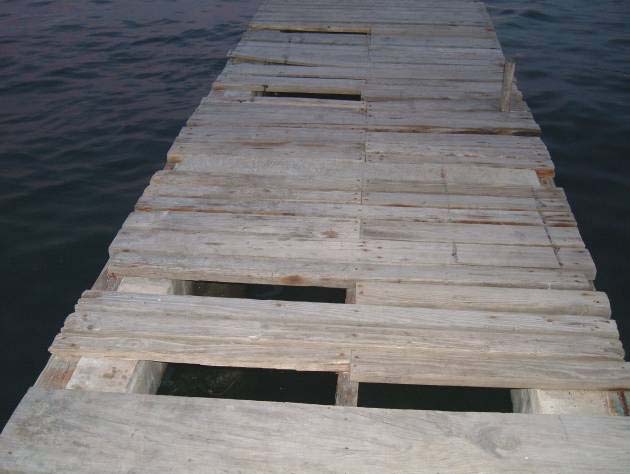
The government-owned jetties have been deemed appropriate generally but a few of them were
cited as being in need of repair or improvement. These include the Ashton jetty (Figure 4.9)
which has a gaping hole at its end and the Clifton jetty which does not have fenders for small
boats. A few of the private jetties are also thought to be in a state of disrepair and are thus
hazardous to those who utilise them (Figure 4.10). There are numerous jetties around Admiralty
Bay, so that there was no concern as to inadequacy there. WTops in Bequia also beach anchor
for convenience.
Figure 4.10 Privately owned jetty in Union Island
Operators usually pull up their boats on the beach (Figure 4.11) or take them to their homes. The
fisheries complex in Clifton, Union Island (Figure 4.12) serves as a haul-up site for those who
15
mainly operate from Clifton.
During storm events, operators
pull their boats as far inland as
possible to reduce damage to
them. The Ashton WTops have
developed their wharf area by
building it up on the discarded
conch shells and this serves as
a drop-off area for passengers
especially when the small jetty
is in use (Figure 4.13). This
shows a level of pro-activeness
on the part of the Ashton
operators, seeing the need for
Figure 4.11 Boats hauled up on the beach at Saline Bay, Mayreau.
the infrastructure although
lacking the legal authority to
create such a structure.
The Public Relations Officer
for the SGWTA and
Community Development
Officer for the Grenadines,
who is also a WTop,
highlighted that there is a
general lack of moorings
throughout the Grenadines and
especially in the TCMP, which
WTops and yachts frequent on
Figure 4.12 Fisheries complex at Clifton, Union Island
a daily basis. He sees
moorings as very important infrastructure for the protection of the natural environment,
especially after visiting the SMMA in St. Lucia and seeing the mooring system there.
JETTY WITH CONCH
SHELL FOUNDATION
DISCARDED CONCH SHELLS
Figure 4.13 Makeshift jetty at Ashton, Union Island
FISHERIES COMPLEX
16
Physical capital also extends to boat ownership and the type of equipment that WTops carry on-
board. From the initial study, there was an estimated 100 boat taxi owners with an estimated 118
boats. A few of them are successful enough to own more than one boat. There were thirteen such
boat taxi owners from Bequia (2), Mayreau (2) Union Island (3) and Carriacou (6). The
preliminary survey revealed that 85% of the boats were owner-operated.
Boats may be built by WTops or purchased either within the Grenadines or from as far as the
United States of America. There are boat builders throughout the Grenadines with Bequia, Union
Island, Carriacou and Petite Martinique cited as places from which boats were both purchased
and custom built. Many of the operators were able to purchase their boats from their savings,
with a few of them gaining assistance through loans. An operator from Carriacou stated that he
was able to build his boat `piece by piece' as he obtained the funds. A WTO from Union Island
is also a boat builder and was recently able to build his own boat after using someone else's boat
to carry out his operation. Many operators use the beach to both build and maintain their boats
(Figures 4.14 and 4.15).
Other physical capital includes
the emergency equipment and
supplies that the WTops carry
on-board. WTops generally
possessed anchor lines, tools
for repair at sea, water, lights
and in most cases, life jackets.
Many operators did not possess
day and night time flares and
first aid kits. These are
important safety items,
especially the flares. Although
the WTops usually have life
Figure 4.14 Boat building area in Windward, Carriacou
jackets, passengers are seldom
asked to wear them. This
diminishes the value of this
investment, particularly given
the small size of the boats, the
speed at which they travel and
the minimal skills-level of the
operators in life saving. Other
pieces of equipment may
include steering wheels,
cables, and a Global
Positioning System (GPS),
which is owned by the most
established WTO from
Carriacou.
Figure 4.15 Boat repairs on the beach in Petite Martinique
17
WTops vary with respect to their personal physical assets. About equal proportions own their
home, rent their home, and reside on family property. Many of the homes are of concrete with
only a few being a combination of wood and wall. The ability to own their own land and home
was not uniform across the entire group. Some have been able to own their own home and land
solely through water taxiing, while others have had to depend on other livelihood activities to
achieve this.
Access to basic amenities was good, with all the operators having electricity and piped water that
is collected in tanks from the roofs of their homes. The majority have indoor plumbing with a
few having outdoor toilet facilities.
The availability of land for farming was definitely not an issue, however, ownership was unclear.
Most of the operators are involved in planting crops and rearing animals. This activity was
mostly for their subsistence, however, with the main crops planted being corn, tomatoes,
watermelon, lettuce and peas. Many operators cited time as a major factor that prevents them
from farming. The lack of sufficient rainfall was also posited as another reason.
Fuel stations are neither
common in the
Grenadines nor easily
accessible by boats and
thus, WTops carry their
tanks on land to get
their fuel. Operators
from the Southern
Grenadines often utilise
the only fuel station
accessible to boats,
located on the jetty in
Petite Martinique
(Figure 4.16).
Figure 4.16 Fuel station at Sanchez in Petite Martinique
This allows for direct
filling of tanks, but is
inconvenient for those who must travel from Union Island. One operator from Mayreau goes to
Union Island daily to get fuel. Operators from Union Island go to both Petite Martinique and
Canouan.
Financial capital
Financial capital `denotes the financial resources that people use to achieve their livelihood
objectives. The definition used here is not economically robust in that it includes flows as well as
stocks and it can contribute to consumption as well as production. However, it has been adopted
to try to capture an important livelihood building block, namely the availability of cash or
equivalent, which enables people to adopt different livelihood strategies' (DFID, 1999: 15).
Operators either buy or build their boats along with the necessary equipment from their savings.
WTops were able to secure loans from the bank to cover either the boat or the engine and in
some cases, both. The average boat costs US$5,000 (US$800 to $29,000) while the average
engine costs US$6,000.00 (US$600 to $15,000) (Appendix 5). WTops strongly believe that
18
saving money is important given the certainty of very little business in the low tourist season.
There are some operators who prefer to save their money at the credit union. Others keep their
cash at home and may even `bury it to keep it safe' as one operator put it. The ability to save
depends however on the amount of business that is secured against the various expenses that they
must incur. One operator drew the analogy that `a boat is like a sinking ship, the more money
you pour into, the heavier it gets and the further it sinks'. This is based on his experience as a
WTO with the constant maintenance of the engine and the bi-annual refurbishment of the boat.
The major daily operating costs relate to the gasoline and oil consumed for the water taxi
operation. The cost of preparing food for customers when requested is incurred by some
operators. Few operators could give an accurate account of how much they spend. Many could
however estimate the cost of gasoline and oil for daily operation and in some cases for a trip to
the Tobago Cays (Appendix 6). According to one operator from Carriacou, his boat which is
6.5 m long uses up to 75 litres of gas per day costing up to US$60.00 along with the four bottles
of oil which cost US$5.00/bottle.
Some operators drive around `hustling' for business opportunities and are therefore increasing
operation costs. Some stated that they go for days without getting any business. The level of
organisation of the operators can be beneficial especially if operators wish to capitalise on the
tourism industry. The organisation of the operators from a base on each island would also have a
similar effect is reducing operation costs. This organisation may take the form of a rotation
system such as that in operation at the Soufriere Marine Management Area in St. Lucia as
reported by a WTO who went to the area on a one-week study attachment from the SGP.
The majority of the repairs to engines are carried out in mechanic shops across the Grenadines.
Operators, especially from Bequia, may take their boats to St. Vincent for maintenance and
repairs. The range of repairs and their associated costs vary considerably depending on the
severity of damage to the boat or the engine (Appendix 7). Most WTops refurbish their boats
yearly by painting and re-fiber-glassing. One operator contended however that if the engine and
the boat are well taken care of, there will be less wear and tear and therefore lower maintenance
costs. He said `it depends on how you take care of you boat'. This sentiment was echoed by
every operator. An operator from Union Island, for example, has his boat serviced in Ashton
every six months at a cost of US $260.00 each time. His boat is painted once every year in Petite
Martinique at a cost of US $450.00.
Many operators paint their own boats at home or on the beach. Despite the fact that painting is
done by the operators themselves, the costs associated with painting and fiber-glassing are still
high, especially for those who use special marine paint. Painting is done throughout the
Grenadines by craftsmen with Petite Martinique being one of the places where operators take
their boats most frequently.
Many operators do not have insurance for their boats: liability or boat loss. This is due to the
difficulty in getting insurance for wooden boats. Two operators do however have their boats
insured. One is among the largest boats which has passed the inspections of the Grenada Port
Authority. The premium is US $5000.00 each year. In addition he is required to pay
XCD$275.00 in tax each year on his operation. These costs along with the other operation,
maintenance and repair costs are proving to be burdensome given the low recent tourist arrivals
in Carriacou.
19
4.2.2 Livelihood strategies
Livelihood strategies is the `the overarching term used to denote the range and combination of
activities and choices that people make/undertake in order to achieve their livelihood goals'
(DFID, 1999: 23). In the Grenadines, complexity defines the livelihoods of WTops. They are
involved in other livelihoods activities that are both boat-related and otherwise (Figure 4-17).
This complexity may be defined as livelihood multiplicity.
The relative importance of water taxiing as an income-earning activity varies among operators
and may range from being a pastime to a means of survival. Its importance depends on the skills
and other capital that individuals may possess. Of their income, the majority originates from
business with visitors, ranging from 25% up to 100%. The average percentage of income earned
from visitors was 70%, with locals accounting for approximately 20% and the sale and transport
of goods for 10%.
LIVELIHOOD
STRATEGIES
Boat related
Non-boating
activities
activities
Water Taxiing*
(10-70%)*
(10-80%)*
(5-100%)
· Artist
· Fishing
· Builder/
· Trading
Contractor
· Tourists
· Boatbuilding
· Security
(25-100%)
· Deck hand
Officer
· Locals
· Restaurant
· Apartment
(0-70%)
· Mooring rental
rental
· Goods
· Vendor
· Property
(5-60%)
management
* percent of total income
Figure 4.17 Livelihood activities of WTops
The sale of goods is important for some operators ranging from 5% to 60% of their income
within water taxiing. They not only supply yachts, but fishing boats from Martinique, hotels and
restaurants with a variety of seafood, including lobster, red hind and snapper. Some operators set
up vending points, for example on the beaches in the Tobago Cays which are manned by their
spouses while they solicit sales from the yachts.
20
Water taxiing and fishing are often linked as income-earning activities, because the physical
capital required for water taxiing and fishing are largely transferable. Fishers have said that they
become involved in water taxiing because they can sell their catch to the yachts, restaurants,
hotels and locals. The physical assets are largely, but not entirely transferable, therefore, many of
the boats originally built for fishing are not properly equipped with emergency equipment and
supplies and are not fit for passengers given their size. Like the fishers, many operators who do
not depend solely on water taxiing, use their boats to supplement their income especially in the
low season.
Locals and visitors are both important to WTops given the fact that business with visitors varies
seasonally. In the tourist high season, operators may receive business up to seven days of the
week as opposed to the slow low season when two days may be the maximum for a week.
WTops need business from locals in the low season to sustain themselves, although many of
them take this time to travel and some to seek more lucrative employment locally or overseas.
The amount of business varies from season to season and between the earnings from locals and
visitors. In many cases operators were unable to place monetary value on the income gained
from each client group but estimated the percentages.
4.2.3 Vulnerability context
Natural disasters along with international events both have an impact on the livelihoods of the
people of the Grenadines with the WTops being no exception. The major type of natural disaster
affecting the WTops has been hurricanes, particularly given the lack of appropriate storage for
boats during such events. International events and trends such September 11th and rising oil
prices were also recognised by two operators in Carriacou as potential threats to the livelihoods
of WTops.
Hurricanes are considered a major threat to the livelihoods of WTops especially in the wake of
Hurricane Ivan in 2004 and Hurricane Emily in 2005, two significant hurricanes which affected
the area in two consecutive hurricane seasons. A macro-socio-economic assessment was carried
out for Grenada and although it was based on the fisheries sub sector, the results were applicable
to water taxis considering that many WTops are fishers as well as the fact that the two groups
utilise similar physical capital. The report highlighted that `the 2,200 fishermen in the sector lost
engines, hulls, fishing gear, safety equipment, communicating facilities, and housing'. Damages
were estimated at EC$5,732,500 (OECS, 2004: 29).
Oil prices have been increasing globally, with an increase at the pump in Petite Martinique from
US$3.00/gallon in September to US$4.50/gallon in October. WTops see the rising oil prices as
an issue since their operation costs will also rise putting them further out of the reach of business
with visitors and locals especially.
WTops believe that a fall in tourist arrivals would have a significant impact on the viability of
their business as a whole. An operator stated that `the business has not been the same since
September 11th, 2001'. He believes that `government needs to invest more in marketing the
islands if WTops are to make a living from tourism'. He has invested in marketing on the
internet for his business but this is not aggressive enough to lure visitors to the island.
Many WTops throughout the Grenadines and especially in the Southern Grenadines have
indicated that when they offer a price to customers based on the price list they have established,
their prices may be undercut by operators who are not members of the association. Those from
21
Union Island have noted that these operators approach their customers, offering lower prices
resulting in them losing business. This has aggravated operators to the point of arguing openly in
the presence of visitors, thus giving the impression of being unprofessional.
Since members of the association are also guilty of this, the issue has to be addressed at the level
of the WTA, having established such a list. Some way of building unity and respect for each
other must be devised in order that there can be fewer of these types of incidences. There must
also be penalties for members who break the rules and regulations of the association.
A similar issue emerged from interviews with the operators from Carriacou and Petite
Martinique. They have expressed concern over the varying prices to various locations not
necessarily due to undercutting of prices but as a result of varying sizes of engines and the
number of engines on the boats which determines the amount of money an operator must spend
on fuel. The fact that operators do not all work from the same location also contributes to the
variation in prices.
5 DISCUSSION AND CONCLUSIONS
Through recent studies, the livelihoods approach has recognised that diversity of livelihoods
strategies may occur at various levels; over geographic areas, across sectors, within households
and over time (DFID, 1999). This study of WTops in the Grenadines lends support to these
findings with operators being involved in multiple livelihood activities. The combination of
activities at various times throughout the year has been adopted by 80% of the operators to meet
their needs. This `livelihood diversification' has been identified as a characteristic of the socio-
cultural fabric of the Caribbean. It has been used by WTops probably to reduce their
vulnerability so that they can continue to earn a living when one livelihood option is no longer
viable (McConney et al, 2003). Livelihood diversity as a strategy should not be discouraged
given the seasonality of their income which is mostly derived from tourism. It is a coping
strategy used to reduce uncertainty which allows operators to take advantage of a wide range of
opportunities.
WTops are stakeholders who are involved in a number of activities also related to the coastal
resources. They therefore have the potential to play a role in the co-management of coastal
resources given their dependence on these resources for their natural capital as WTops and other
livelihood activities. Their development has been undertaken by the WTP which seeks to raise
awareness with regards to the everyday practices of the operators which impact negatively on the
environment. The project seeks also to mould WTops into responsible stakeholders who are able
to see the benefits of protecting and caring for their environment while continuing to make a
living. The possibilities for such an arrangement may be a consideration for the Grenada which is
seeking to develop marine protected areas (MPAs) in its Grenadine islands.
Operators from the southern Grenadines and Carriacou and Petite Martinique identified the
varying prices as an ongoing issue throughout the Grenadines. A solution to this issue is difficult
given the various factors that contribute to varying prices. One solution may be to regulate the
size of boats and have a graded scale of prices with respect to the size of the boat or size of the
engine. Another might be to have a price on the value of the experience to the various sites
(valuation) with the additional cost being for the price of gas, level of comfort provided and the
time spent at the site. This would result in the need for promotion of one's business and may be
advertised by the tourist board in the particular island. Overall however there needs to be an
22
economic analysis of the WTops since their operational and maintenance expenses appear at
times to exceed their receipts, which are unpredictable.
WTops may address costs by conserving on fuel through various measures both on and off the
water (Box 5.1). These fuel-saving measures relate to engine and boat maintenance as well as
consideration of the weight on board the boat (Squires, 2001).
Box 5.1 Fuel-saving options for WTops
MAINTENANCE
· Keep your engine well tuned. Be familiar with the number of hours that your engine
should run before it requires a major overhaul.
· Ensure that your propeller is right for your boat and repair or replace it if it's damaged.
According to a propeller specialist, Ray Curtis, propeller specialist from Temple Hills,
MD, "if you don't have the right propeller for your boat, it doesn't matter how well your
engine runs -- you'll be spending lots more money for gas." It is also therefore important
to ensure that you have the right match for your engine and there are no misalignments or
dents to slow it down.
· Install a fuel-flow, if you have a large engine. This monitors consumption, showing not
only how much fuel you've used but how fast you're using it, helps you find your most
efficient cruising rpms, suggests Annapolis, MD marine engine expert Karl Allen.
Installing trim tabs on a planing hull can also improve fuel consumption, he said.
· Use the right antifouling paint and keep your bottom clean. Even a slightly dirty bottom
can keep your boat from planing or, on a displacement hull, can slow it down
dramatically.
ON THE WATER
· Carry less weight on board. It is not necessary to fill all fuel tanks to the brim.
· Do not overload your boat with people, coolers or other gear, and distribute weight
evenly.
Source: Adapted from B. Squires, 2001.
The President of the CPMWTA is also concerned about other aspects of `free lancers' who are
neither part of the association nor very serious about water taxiing. `They harass tourists and
dispose of garbage poorly while overcharging for the service', he said. This issue was raised also
by an operator from Union Island who witnessed operators taking garbage from yachts, charging
for the service and quickly disposing of it overboard when they believe that they are out of sight.
He said that he was the target of vandalism by these `free lancers' because he has developed a
relationship with various yachting companies which precludes others from benefiting from the
yachts visiting the Chatham Bay area.
There is very little that can be done to curb indiscriminant garbage disposal except intervention
from government and education that leads to peer pressure and community sanctions. Improved
surveillance of the entire Grenadines area is one option that would have to be approached by the
government. One operator suggested that the penalties are not tough enough to deter the
delinquent operators.
23
Disrespect of visitors is another issue that was raised by many operators. Problems arise when
visitors are approached by operators and they decline their services. It is alleged that abusive
language is sometimes directed toward visitors and the offenders may even become violent,
using weapons. An operator lamented that he has been called by customers that he has taken to
various sites with complaints that they were being harassed. There is also difficulty in identifying
the perpetrators.
An approach to this problem lies in the establishment of a fully functional WTA with registration
numbers placed prominently on the boats for easy identification. This allows for easier tracing of
the offender if he belongs to an association. The two associations are at different stages in this
process but it is an important aspect that needs to be implemented.
Training for operators in customer service and conflict management has been recognised by the
water taxi project as an important development activity. Training in life-saving should also be a
priority if operators are to be considered proficient.
The water taxi project can contribute to the enhancement of livelihoods of WTops through
capacity building activities. There are some areas however which require awareness education,
training and further research. These include:
A full sustainable livelihoods study to address the areas omitted in this study
Educational awareness of the impacts of poor garbage disposal on the health of marine
organisms and the marine environment to improve the human and natural capital of the
operators:
Training in life-saving so as to improve the proficiency of operators,
Training to foster mutual respect and trust among operators so as to reduce conflicts
among operators,
An economic study to determine the viability of water taxiing,
A Knowledge-Attitude-Perception (KAP) study at the end of the project to determine the
impact of the WTP
Most WTops are eager to learn how to improve their livelihoods. Many however lack the
financial capital to do much of the improvements that are necessary while some are limited by
their educational backgrounds. In order to address the needs of WTops in a way that is most
effective a practical approach should be adopted in the execution of the WTP.
It has been recognised that multiple livelihood activities is a coping strategy that operators adopt
to protect themselves from vulnerability. Training should therefore not only be applicable to
water taxiing but to developing all aspects of the water taxi operator. There is the need for the
development of other skills so that WTops can pursue other livelihood activities in the low
tourist season. This may contribute to improving the lives of operators through increasing
income which has spin-off benefits.
24
6 REFERENCES
Ashley, C. 2000. Applying Livelihood Approaches to Natural Resource Management Initiatives:
Experiences in Namibia and Kenya. Chameleon Press, London. 30 pp.
CCA CaMMP. 2002. A participatory strategic plan for sustainable development in the
Grenadines. Sustainable Integrated Development and Biodiversity Conservation in the
Grenadine Islands, Coastal and Marine Management Programme, Caribbean
Conservation Association, Barbados, Version 1, 55 pp.
CEC1. 2005. Global Environment Facility Small Grants Programme Project Proposal Outline.
Carriacou Environmental Committee, Hillsborough, Carriacou. 17 pp.
CEC2. 2005. Inception Report: Strengthening Environmental Stewardship among Major
Stakeholders in the Grenadine Islands. Carriacou Environmental Committee,
Hillsborough, Carriacou. 11 pp.
CERMES. 2002. Sustainable Integrated Development and Biodiversity Conservation in
the Grenadine Islands (St. Vincent And The Grenadines and Grenada).
http://cermes.cavehill.uwi.edu/susgrenadinesnew.html, Accessed 2005-06-16
CERMES. 2004. Report of the Vision and Project Planning Workshop for Southern Grenadines
Water Taxi Association and Carriacou Petite Martinique Water Taxi Association held on
June 27-28, 2004, Carriacou, Grenada. Centre for Natural Resource Management and
Environmental Studies, University of the West Indies, Cave Hill Campus,
Barbados, 24 pp.
Chakalall, Y. S., R Mahon and H. A. Oxenford. 2005. Activities of trading vessels and supplying
fishers in the Grenadine Islands, Lesser Antilles. Proceedings of the Gulf & Caribbean
Fisheries Institute 47: 236-263.
DFID. 1999. White Paper on International Development: Sustainable Livelihoods Guidance
Sheets. Department for International Development, London.
(www.dfid.gov.uk. Accessed 2005-02-06)
DFID. 2002. Improving Livelihoods for the Poor: The Role of Literacy. Department for
International Development, London. (www.livelihoods.org/static/DFID_NN269.htm.
Accessed
2005-06-13)
Farrington, J., Carney, D., Ashley, C. and Turton, C. 1999. Sustainable Livelihoods in Practice:
Early applications of concepts in rural areas. Natural Resource Perspectives, No. 42, June
1999. ODI, DFID, London. (www.livelihoods.org/post/Docs/SLA_Aqua.pdf. Accessed
2005-06-14)
Grant, S. 2004. Sustainable Livelihoods and Resilience: Considering Fishing Livelihood Systems
in Fisheries Management. Technical Report No. 3 in Managing Small Scale Fisheries in
the Caribbean. 59 pp., University of Manitoba
Mahon, R., S. Almerigi, P. McConney, C. Ryan and B. Whyte. 2004. Coastal resources and
livelihoods in the Grenadine Islands: Facilitating change in self-organising systems.
Proceedings of the Gulf & Caribbean Fisheries Institute 55: 56-67.
McConney, P., R. Pomeroy and R. Mahon. 2003. Guidelines for coastal resource co-
management in the Caribbean: Communicating the concepts and conditions that favour
success. Caribbean Conservation Association. 56 pp.
OECS. 2004. Grenada: Macro-Socio-Economic Assessment of the damages caused by
Hurricane Ivan, September 7, 2004. Organisation of Eastern Caribbean States, The
Morne, St. Lucia
25
Squires, B. 2001. Saving Fuel Knot So Hard in Boat/US Magazine. Boat Owners Association of
the United States, July 2001. (www.findarticles.com/p/articles.
Accessed
2005-08-23).
26
7 APPENDICES
Appendix 1: Preliminary survey of water taxi operators in the Grenadines
Preliminary Survey of Water Taxi Operators
Purpose of Questionnaire: To establish a database of water taxi operators throughout the
Grenadines for the Sustainable Grenadines Project. It will also provide a basis for selecting a
sample size for the in-depth survey to be carried out on the livelihoods and green boat practices
of water taxi operators.
Surveyor Name:__________________
Respondent
#:________________
Date:________________
1.
Name of Boat:___________________
2.
Registration Number:_________________
3.
(a) Name of Owner:_________________
(b)
Male
Female
4.
(a) If name of boat operator is different from the owner of the boat, please provide the
name of the person: _________________________________________.
Male
Female
5.
How many persons operate this water taxi? _____________________ .
6.
Name and sex of Operator/s:
Name: _____________________
Sex: _______________________
Name: _____________________
Sex: _______________________
7.
Length of Boat: ________________________________.
8.
Type of Boat: __________________________________.
9.
Where do you dock your boat? ________________________________.
10.
Are you a member of a Water Taxi Association (WTA)?
Yes
No
11.
Which WTA? ____________________________.
12.
Number of Engines:_________________.
13.
Type of Engine: ____________________.
14.
Horse Power: _________ and _________.
We will be conducting two in-depth surveys in approximately two weeks on your livelihoods and
your boating practices. We would therefore appreciate if we could interview you again at your
convenience.
27
Appendix 2: In-depth survey of the livelihoods of water taxi operators in the Grenadines
Water Taxi Livelihoods Analysis
This questionnaire inquires about the livelihoods of water taxi operators in six Grenadine
Islands: their livelihood assets and strategies as well as their vulnerability. It is a baseline study
for the Water Taxi Project under the Sustainable Grenadines Project as well as a contribution to
my research paper.
Name of Surveyor: _____________
Location: _____________________
Questionnaire No.: _____________
Respondent #: _________________
1. Age of Respondent: ______
2. Name of Boat Owner (if different from respondent): ___________________________
3. Home Dock: _________________________
4. Island: ___________________
5. Gender: Male
Female
6. Marital Status:
Single
Married
Widowed
Divorced
Other,
specify____________________
7. Boat Name: _______________________
8. Boat Type: _______________________
9. Registration No.: ___________________
10. How many years of experience do you have as a water taxi operator? _____________
11. Why did you start water taxiing?
______________________________________________________________________________
______________________________________________________________________________
______________________________________________________________________________
___________________________________________.
28
Livelihood Assets
12. Where do you operate your water taxi to? (Where do you run?)
______________________________________________________________________________
______________________________________________________________________________
______________________________________________________________________________
__________________________.
13. How do you secure your boat at these various places mentioned above?
______________________________________________________________________________
______________________________________________________________________________
__________________________________________________________________________.
14. During a hurricane where would you store your boat?
_______________________________________________________________________.
15. Is your home
Self-owned
Rented
Family-owned
Other
Please specify ___________________________
16. Is your home of
wood
wall
both
Other
Please Specify __________________________
17. Do you have access to
electricity
running water
in-door toilet facilities
out-door toilet facilities
18. What has your water taxi operation helped you to achieve in life?
29
______________________________________________________________________________
______________________________________________________________________________
__________________________________________.
19. Is the land you occupy
Self-owned
Rented
Family-owned
Other
20. (a) Do you have access to gardening/farming land?
Yes
No
(b) What farming activities are you involved in and for what purpose?
Farming Activity
Subsistence
Sale
Animals
Crops
Both
21. Is water taxiing your primary occupation?
Yes
No
22. What are your income-earning activities in order of importance?
1.
______________________ 2.
_____________________
3.
______________________ 4._____________________
5.
______________________ 6.
_____________________
23. Which of these groups do you cater to?
tourists
locals
goods
others, specify_____________________.
30
What are the services that you provide for the groups below along with number of times/week
and the approximate income /week or proportion of you income that you may earn from these
services?
Groups 24. Services 25. Income earned from
these services (or proportion
of earnings)
Tourists
Locals
Goods
Other
How many times/week and months in the year are you able to carry out these services?
Groups 26. No. times/week
27. No. of Months/Year
Tourists
Locals
Goods
Other
28. Do you take your customers to for day trips? (If not mentioned above, inquire about this)
Yes
No
If yes, where to?
______________________________________________________________________________
__________________________________________________________.
31
29. On average, how many passengers do you transport/take on a trip?
______________________________________________________________________.
30. Are you aware of any conflict among boat taxi operators?
Yes
No
If so, what is the nature of this conflict? (What are the issues, how has this impacted on
your business and has this conflict been resolved - how?)
________________________________________________________________________
________________________________________________________________________
________________________________________________________________________
________________________________________________________________________
___________________________________________________________________.
31. Are you aware of any conflict between boat taxi operators and other people? (related to
water taxi operation)
Yes
No
If yes, what is the nature of this conflict?
________________________________________________________________________
________________________________________________________________________
____________________________________________________________.
32. Do you have relatives on the island//across the Grenadines?
Community
Yes
No
Island
Yes
No
Grenadines
Yes
No
33. (a) Do they provide assistance to you in times of need?
Yes
No
(b) If yes, in what ways?
________________________________________________________________________
__________________________________________________________________.
If no, why not?
32
________________________________________________________________________
___________________________________________________________________.
34. Are you a member of a community group?
Yes
No
35. Do they provide help for group members in times of need?
36. How so?
________________________________________________________________________
______________________________________________________________________.
37. Do you assist members of your community?
Yes
No
(b) If yes, how so?
________________________________________________________________________
________________________________________________________________________
_____________________________________________________.
38. (a) Are you a member of a WTA
Yes
No
(b) If yes/no, why?
________________________________________________________________________
________________________________________________________________________
____________________________________________________________.
39. What level of schooling did you achieve? _____________________.
40. How many persons are there in your household? ________________.
41. How many dependents do you have? _________________________.
42. In the last 12 months were any of the members of your household ill? _____________.
43. How many persons in your household work? _________________.
44. Do they contribute to the household?
Yes
No
Specify
________________________________________________________________________
________________________________________________________________________
__________________________________________________________.
33
45. Do any of your family members assist with your water taxi operation? (both within and
outside of household)
Yes
No
If so, in what ways?
________________________________________________________________________
___________________________________________________________.
46. Where did you learn to drive a boat? _____________________________________.
47. How did you learn the routes? __________________________________________.
48. Do you teach others about water taxiing?
Yes
No
If yes, what kind of information do you share with
them?_________________________________________________________________________
______________________________________________________________________________
____________________________________________________.
49. Are you able to save someone if they fell overboard?
Yes
No
50. Where did you learn to do this?
______________________________________________________________________________
______________________________________________________________________________
________________________________________.
51. What safety equipment do you have on-board?
(If the person does not have one or more of these, inquire as to the reason)
day and nighttime flares
first aid kit
life jackets
tools for repairs at sea
VHF radio
water
anchor lines
lights
34
52. The boat that you operate is
self-owned
rented
family-owned
friend
other
Please Specify ___________________________.
53. Did you build or buy your boat? ____________________.
54. How were you able to afford your boat?
loan
borrow from family savings
savings
Other
Please Specify ___________________.
55. Do you save money?
Yes
No
56. How do you save?
bank deposits
cash
jewelry
other
Specify
_________________________________________________.
57. Is there a community saving method?
Yes
No
If yes, what is it called and how does it work?
______________________________________________________________________________
__________________________.
58. What are your sources of savings?
income
remittances
pensions
other
35
Specify
___________________.
Daily Operating Costs
59. What is your average variable cost/trip?
Item Amount
Cost
Gas/trip
Oil/trip
Other(food preparation if
applicable)
Other
Maintenance/Repair Costs
60. Item 61. Location 62. Cost 63. How often
Engine Maintenance
Painting
Re-fiberglass
Seating
Scrubbing
Insurance
other
Initial Investment
64. What are your long term costs?
Item
Cost
Life Expectancy (how long will it last?)
Original Boat Cost
Engine
Other Equipment
Other
Vulnerability Context
65. What are the things that can stop you from making a living as a water taxi operator?
36
________________________________________________________________________
________________________________________________________________________
______________________________________________.
66. Have you suffered any loss/damage to your boat? (e.g. natural disaster, theft, etc?)
Yes
No
If so, how?
________________________________________________________________________
________________________________________________________________________
________________________________________________________________________
_____________.
67. Is there anything else that you would like to share with me about your water taxi operation?
________________________________________________________________________
________________________________________________________________________
________________________________________________________________________
________________________________________________________________________
________________________________________________________________________
________________________________________________________________________
_________________________________.
End
of
Questionnaire
37
Appendix 3: Human capital of water taxi operators
Eduction
# in
No. of
Illness in
No. persons Do They Contribute
Family involved Boat Skills
Information
household
in household to the Household
in your water
Name
Level
House
Dependents
that work
taxi operation?
Boat
Routes Life-saving Sharing
in last 12 months
Handling
No 1
N/A No Friends
Observe
Oil
Tanker
-
Respect for people, boat
7
Primary 3 2
required
handling
kids
72
Primary 4 1
No
3
Yes Food, bills, etc
No
Observe
Observe
Red
Cross None
Member
child
55
Secondary 5 2
Yes treatment in 2
No
Yes when absent
Friend
Old Job - Self-taught None
Barbados
ferry
old
51
Secondary 3 2-mom No
3
Yes food, rent, bills
No
Friends
Observe
Self-taught
How to drive a boat
Grade 3
brother
1 3
No
N/A
N/A
No
Friend/ Observe,
Self-taught
How to drive a boat
61
College 2nd
year (USA)
Compass
Observe
92
High School 1
0
Yes treatment in N/A
N/A
No
Family
Observe
Previous Job
None
(USA)
New York
every 6 mnths
required
63
Secondary 1 6
No
N/A
N/A
No
Father Maps CPR
course Dangers, Navigation
,
Compass reading
81
Secondary
1
2
No
N/A
N/A
Yes assist as 2nd Observe/Fa
Observe/
Self-taught Hygiene,
Courtesy,
hand
mily
Environmental information.
Family
67
University
4 3
No
2
Yes
household
No
Self-taught
Self-taught
Self-taught
Good communication skills
Diploma
assistance
47
Primary
5
0
No
2
Yes bills, food, etc
Yes business Father Father Self-taught None
from Uncle's
guest house
1
Primary
7
5
Yes Asthma 1 N/A
Very
Rarely
Self-taught
Observe,
Self-taught -
How to approach tourists
SVG
charts
books
4
0
No
4
Yes bills, food, etc
Yes business
Observe Observe Self-taught
-
How to operate a boat
49
Secondary
Grade 3
from mom who is
television
a vendor on beach
89
College
1
1
No
1
N/A
No
Observe
Observe
Never
tried How to deal with people,
before
speed, passenger comfort
102
Primary
5
4
No******
1
N/A
Yes- If busy, use Family Self-taught
Self-taught None
boat for business
19
Primary
4
2
Yes sickly child
1
N/A
Yes drives boat
Self-taught
Self-taught
Self-taught
None
T.V.
13
Primary
2
0
No
2
Yes - food
No
Observe
Maps
Self-taught
Respect
for
tourists,
honesty, speeding in
harbour
2
Secondary 3rd 2
2
No
2
Yes pay bills
No
Friend
Friend
Scuba
diving
How to drive, deal with
form
rescuing
people
certificate
Emergency supplies
5
Primary
4
2
No
2
Yes - bills
No
Family
Observe
Save
the
,
Children Fund
dealing with people,
comfort of customers
31
Primary
7
5
Yes 1 child
2
Yes - bills
Yes help drive, Observe Observe Interviewed
for
How to approach people
take out people
yachting -
required
38
Appendix 4: Social capital of water taxi operators
Operator #
Connections
Provide Assistance?
Member of Community Group?
Do you provide assistance to your community
Member of WTA?
(If yes, how?)
(Why, if yes)
7
I,G
No - Independent
No
Yes Provide school books for less fortunate N/A
children. In any way required.
72
I,G
Yes Backing for bank loan No
Neighbourhood
clean-up
N/A
55
C,I,G
No - Independent
No
Yes - Provide fish, help with monetary N/A
problems, food, etc
51
I,G
N0- Independent
No
Yes - Provide transport if needed
N/A
61
C,I,G
Yes In whatever way No
Yes In any way possible.
Yes To improve communication among
required.
WTops as well as to ensure greater safety
at sea
92
C,I,G
No Independent
No
Yes Help to fix the road
No Boat is not really for water taxiing
63
C,I,G
Yes
Yes CEC
Yes more professional approach.
81
C, I, G
No Not sure
Yes - Church-based group
Clean-ups for the elderly, Provide elderly with
Yes It is beneficial to WTops and the
food and clothing once per year.
protection of the environment.
67 C,I,G No
independent No
Help boatmen with mending sails, preparing
Yes Important to development of water
financial estimates free of charge.
taxi operation.
47
C,I,G
Yes Anything needed
No
Yes transport
Yes Encouraged to join but is unaware
of what is happening.
1
C,I,G
No they are not able to No
Yes transport, help with any work they need Yes Want to see the safe water taxi
help.
done.
operation.
49
C,I,G
Yes food and
No
Yes transport.
Yes Encouraged to join.
accommodation
89
C,I,G
No Everybody is No
Yes clean-up, organisation of fund-raising Yes Thought it would bring help to
struggling to make a living.
activities to help the school, donations to the WTops who were struggling.
school.
102
C
No Everybody for Fishermen's Cooperative assist Yes In whatever way requested, e.g. No
themselves
with search for other boats, help construction of water tanks.
those with damaged boats.
19
St. Vincent
N/A
No
Yes employ men who need work especially
young school-leavers, lend money to those
who ask.
39
Operator #
Connections
Provide Assistance?
Member of Community Group?
Do you provide assistance to your community
Member of WTA?
(If yes, how?)
(Why, if yes)
13
C
No- Do not need help. Bank
No
Yes Assist with food, money
No
Account.
2
C,I,G
No Not financially able
No
Yes clean-up campaigns
Yes Hope for standards to be set.
Training for the operators
5
St. Vincent
Relatives overseas Send No
No
Yes togetherness resulting in
money if needed
compliance with rules and regulations.
Hope for collaboration with hotels.
31
I,G
No Independent
No
Yes help in any way required.
Yes Unity to save Tobago Cays.
40
Appendix 5: Financial capital of water taxi operators
Respondent
Built/Bought How
Do You Method of Savings
Sources of Savings Boat Cost
Engine Cost
Purchased
Save?
Number
7 Bought
Loan
Yes Bank
deposits
income
5,000.00
7,000.00
Savings
72 Bought
Loan
Yes
Bank
deposits
income 6,000.00
12,000.00
55 Built
Savings
Yes
Bank
deposits
income 15,00.00
8,500.00
51 Bought
Loan
Yes Bank
deposits
income
8,000.00
12,000.00
Family savings
61 Built
Savings
No
Bank
deposits
18,000.00
32,000.00
92 Bought
Savings
Yes
Bank
deposits
Income/
24,300.00 5,400.00
pension
63 Bought
Savings
Yes
Bank
deposits
income
59,400.00
(total)
81
Built
Savings
Yes
Bank deposits,
income 10,000.00
18,000.00
Cash
67
Bought
Savings
Yes
Bank deposits
income
40,000.00
47
Bought
Savings
Yes
Bank deposits,
income 7,000.00
11,000.00
Cash
1 Bought
Savings
Yes Bank
deposits
income
5,000.00
7,700.00
Loan
49 Not
the
N/A
Yes
Cash - bury
income
N/A
owner
89 Built
Savings
Yes
Bank
deposits
income 17,000.00
35,000.00
102 Built
Savings
Yes
Bank
deposits
income 8,000.00
7,500.00
19
Bought
Savings
Yes
Bank Deposits, Cash, Credit
income
6,000.00
11,000.00
41
Respondent
Built/Bought How
Do You Method of Savings
Sources of Savings Boat Cost
Engine Cost
Purchased
Save?
Number
Union
13
Bought
Savings
Yes
Cash, Credit Union
income
2,000.00
5,000.00
2
Bought
Loan
Yes
Bank Deposits, Credit Union
income
20,000.00
9,000.00
5 Bought
Loan
Yes
Bank
deposits income
9,000.00
11,000.00
31 Bought
Savings
Yes
Bank
deposits
income 5,000.00
1,500.00
42
Appendix 6: Daily costs associated with water taxiing
Respondent
Amount of Gas
Associated Cost
Bottles of Oil
Associated
Other Costs
#
Required
Cost
74
15 gallons/day
$105.00
2/day
$20.00
Prepares fish the he catches.
72 6
gallons/day $50.00 1/day
$10.00
55 6
gallons/day $48.00 1/day
$10.00
51
8 gallons/day
$64.00
1/day
$10.00
Would prepare approximately $100.00
in food for 4 persons.
61 7
gallons/day $56.00 1/day
$12.00
92
9 ¾ gallons/day
$65.00
1/day
$12.00
63
40 gallons/trip (To
$320.00
8/trip
$96.00
Drinks usually included in entire
Tobago Cays from
package.
Carriacou)
81
20 gallons/day
$160.00
4/day
$52.00
Prepares sandwiches for a minimum of
4 persons - $50.00
67
Unable to determine the amount
47
6 gallons/trip (To Tobago
$50.00 1/trip
$10.00
Cays from Mayreau)
1 6
gallons/day $54.00
1/day
$11.00
103
3 gallons/day
$27.00
1/day
$10.00
$100.00 for 4 persons.
89 10
gallons/day $80.00 2/day
28.00
102
10 gallons/day
$80.00
2/day
$24.00
Prepares food for 4 persons - $100.00
19
12 gallons/trip (Trip to
$120.00 1/trip
$10.00
Tobago Cays from Union
Island)
13
10 gallons/day
$95.00
2/day
$24.00
For 20 persons, food and drinks may
cost between $500.00 and $800.00. The
cost may depend on the menu.
2
6-12 gallons/trip
$54.00 - $100.00
1/trip
$10.00
Approximately $300.00 to $500.00 for
43
Respondent
Amount of Gas
Associated Cost
Bottles of Oil
Associated
Other Costs
#
Required
Cost
food and drinks depending on the
number of customers.
5
12 gallons/trip
$120.00
1/trip
$12.00
For 4 persons the preparation of food
and drinks may cost $310.00.
31 12
gallons/day $120.00
2/day
$20.00
44
Appendix 7 Maintenance and repair costs
Responden Engine Maintenance
Location
Types of Repairs and
Painting (Regularity, Cost (EC$) Other Costs
t
(Regularity and
Associated Costs
Associated and Location)
#
Costs Associated with
Regular Engine Maintenance
(EC$)
74
2/month - $300.00
Workshop in Bequia,
Variable
1/year - $700.00 includes
Howard's in St.
fiberglass work at Southside in
Vincent
Bequia.
72
1/month - $60.00
Workshop in Bequia
Variable
1/year - $500.00. Done by operator
on the beach.
55
3/year - $1300.00
St. Vincent
Variable
2/year - $600.00 each time.
Painting done by operator on the
beach.
51
4/year - Approx. $500.00
Paget Farm, Bequia,
Variable
1/year - $700.00. Painting done by
K.P Marine in St.
the operator on the beach.
Vincent
61
4/year - Self
Beach in
Variable
1/year - $2400.00. Painting and re-
Hillsborough
fibreglassing are done in Petite
Martinique.
92
New Boat with new engine no costs incurred as yet.
63
1/month - Approx. $400.00
Petite Martinique
Depends on parts to be Boat is waxed each time it is Insurance of
replaced
docked.
US $5000.00/yr.
Taxes in Carriacou -
$375.00/yr.
81
Every 2 years Cost Variable
Petite Martinique
Replaced 1 zinc plate - 1/year - $2400.00. Glossed and
$600.00
painted in St. Vincent
67
1/month - Self
Beach in Windward
Variable
1/year - $2000.00. Done by
operator in boat building area on
the beach.
47
Every 2 months - Self
Beach
Depends on what needs Not often only if there is damage.
45
Responden Engine Maintenance
Location
Types of Repairs and
Painting (Regularity, Cost (EC$) Other Costs
t
(Regularity and
Associated Costs
Associated and Location)
#
Costs Associated with
Regular Engine Maintenance
(EC$)
to be done
1
Every 3 weeks - Approx. Mechanic Union
Depends
on
damage
3/year - $330.00 each time.
$120.00
Island
Painting and some re-fibreglassing
is done by the operator on the
beach.
103
Not Applicable Not the owner of the boat.
89
1/week - Self
Beach in Petite
Changed 3 engines 1/year - $2000.00. Painting is done Boat is insured for
Martinique,
within 1 year.
at home by operator.
$60,000.00.
Approximately
Premiums of
Mechanic as well
$1500.00 for repairs
$1500.00/yr.
102
1/year - Self
Beach/Mechanic
Depends on what needs 2/year - $1500.00 total. Done at the
to be done
beach or at home.
19
When necessary Cost Clifton
Change - piston
1/year - $300.00. Done by operator
Variable
$4000.00
on the beach.
13
3/year - Variable
Clifton Mechanic
600.00-700.00 Spark
Painting is done when necessary.
Plugs $15.00, 3 coils - May cost approximately $150.00.
$187.00, Cables -
Done by operator at the dock.
$40.00,
2
2/year - Up to $700.00 each Ashton, Mechanic
Up to $3000.00
1/year - $1200.00. Painting and re-
time
fibreglassing are done in Petite
Martinique.
5
4/year - $100.00 each time
Clifton - Mechanic
Unable to say
2/year - $750.00 each time.
Painting and re-fibreglassing are
done by the operator at the dock.
31
Every 2 months - At least Clifton - Mechanic
Variable
in
cost 2/year - $100.00 each time. Done
$100.00 each time
depending on what by the operator in docking area.
needs to be done
46
Appendix 8: Division of activities by water taxi operators
Respondent
% Tourism
% Locals
% Goods
Number
7
70
30
Sells to yachts every
morning
72
Uncertain of the contribution.
55 100 0
On
request
51 80 15
5
61
50
50
Goods along with
people
92 N/A N/A
N/A
63
95
5 (Locals do not like to pay)
0
81 80 20
N/A
67 30 70
N/A
47 60 40
N/A
1
100
0 (Transport for gas change)
0
49 70 1
N/A
89 25 15
60
102 40 30
30
19 90 10
N/A
13
100
0
Sells goods to yachts
2 80 20
N/A
5
60
30
10 sells goods to
yachts
31
70
20
10 sells goods to
yachts
47
Appendix 9 Livelihood strategies of water taxi operators
Respondent
Primary (%)
Secondary (%)
Tertiary (%) Quaternary
(%)
Number
7
Water taxiing - 100
72
Water taxiing - 50
Fishing - 30
Working w/boats - 10
Labour - 10
55
Property Mgr 60
Mooring Rentals - 20
Water taxiing 10
P-T Sailor - 10
51
Water taxiing - 80
Painter - 20
61
Water taxiing - 100
92
Rental Apts - 60
Supermarket - 35
Water taxiing - 5
63
Builder/Contractor 80
Water taxiing - 20
81
Water taxiing - 50
Construction - 25
Fish - 25
67
Gov't Officer - 50
Build Boats - 30
Water taxiing - 20
47
Fishing - 70
Water taxiing - 30
1
Water taxiing - 70
Security Officer - 30
49
Water taxiing - 80
Other - 20
89
Water taxiing - 90
Retail fish - 10
102
Fishing - 60
Water taxiing 40
19
Restaurant - 60
Carving - 30
Water taxiing 10
(linked with restaurant
13
Water taxiing - 100
2
Water taxiing - 100
5
Water taxiing - 80
Artist - 10
Handyman - 10
31
Fishing - 50
Water taxiing - 50
48