
CERMES
Technical Report No 12
A livelihoods analysis of fishers in the Grenadine
Islands
TANYA STASKIEWICZ AND ROBIN MAHON
Centre for Resource Management and Environmental Studies (CERMES)
University of the West Indies, Faculty of Pure and Applied Sciences,
Cave Hill Campus, Barbados
2007
ABSTRACT
A livelihoods analysis of fishers in the Grenadines
TANYA STASKIEWICZ AND ROBIN MAHON
Fishing is a primary economic and social activity in the Grenadine islands. In order to obtain
a sound understanding of both biological and human factors associated with the exploitation
of marine and coastal resources, a livelihoods analysis of fishers was conducted. The first
phase of the study involved an initial inventory to (1) identify the fishers of Bequia,
Mustique, Canouan, Mayreau, Union, Petite Martinique and Carriacou, (2) determine what
types of fishing they do, (3) document the types of fishing vessels and gears that are used and
(4) obtain preliminary information on the locations of fishing hot spots. The second phase
involved an in-depth survey which focussed on livelihood assets (human, natural, physical,
financial and social capital), strategies and vulnerabilities that fishermen both utilize and face.
Results show that over 60% of the fishers interviewed are solely dependent on fishing. Those
that are involved in multi-occupational livelihoods have chosen additional means of earning
an income because fishing, by itself, can not sustain them or their families throughout the
year. Declining fish abundance, lack of government support and the need for fishers' co-
operatives are key concerns that were also expressed. The goal of this study is to provide
relevant organizations and persons with a basis of information that can contribute to
improving the effectiveness of decision making, interventions and organization with respect
to the management of fisheries and other marine resources. The qualitative information
obtained from this livelihoods analysis can be used as a common ground for working with
fishers to achieve sustainable development and utilization of marine resources within the
Grenadines.
Keywords: fishing, Grenadines, livelihoods, marine resources, sustainable development
ii
ACKNOWLEDGEMENTS
I would like to thank everyone who assisted and supported me throughout this study.
To my partner in crime, David Gill, for putting up with me in the field and for taking great
photographs which were used in this report.
To Kim Baldwin, for making the Grenadines experience a memorable one.
To my supervisors, Dr. Robin Mahon and Dr. Patrick McConney, for their guidance and
patience.
To the CERMES Programme Coordinator, Neetha Selliah, for her constant encouragement
throughout the programme.
To the Grenadine fishers and Fisheries representatives who were willing to share their time
and experiences with me and also for lending their invaluable assistance on their respective
islands.
To Donna Roach and Kali Douglas for keeping me sane during the initial write-up process.
To my family and friends for their unconditional support.
Thanks God for...well everything.
iii
CONTENTS
ABSTRACT .........................................................................................................................................................II
ACKNOWLEDGEMENTS .............................................................................................................................. III
CONTENTS ........................................................................................................................................................IV
1
INTRODUCTION....................................................................................................................................... 1
1.1
BACKGROUND ...................................................................................................................................... 1
1.2
GOAL OF THIS STUDY ........................................................................................................................... 2
1.3
LIVELIHOODS ANALYSIS OF GRENADINE FISHERS................................................................................. 2
2
ISLAND PROFILES................................................................................................................................... 2
2.1
GENERAL HISTORY OF THE GRENADINES ............................................................................................. 2
2.2
BEQUIA ................................................................................................................................................ 3
2.3
MUSTIQUE............................................................................................................................................ 3
2.4
CANOUAN ............................................................................................................................................ 4
2.5
MAYREAU ............................................................................................................................................ 4
2.6
UNION ISLAND ..................................................................................................................................... 4
2.7
PETITE MARTINIQUE ............................................................................................................................ 4
2.8
CARRIACOU.......................................................................................................................................... 4
3
FISHING IN THE GRENADINES ........................................................................................................... 5
3.1
DEVELOPMENT OF THE FISHING INDUSTRY........................................................................................... 5
3.2
STATUS OF THE FISHING INDUSTRY ...................................................................................................... 6
3.3
IMPORTANCE OF FISHING...................................................................................................................... 7
3.3.1
Economic value............................................................................................................................... 7
3.3.2
Fish landings value......................................................................................................................... 8
3.3.3
Employment value........................................................................................................................... 9
3.3.4
Food security value......................................................................................................................... 9
3.4
FISHING TECHNIQUES ........................................................................................................................... 9
3.4.1
Handline fishing.............................................................................................................................. 9
3.4.2
Spear-fishing................................................................................................................................. 10
3.4.3
Pot/trap fishing ............................................................................................................................. 10
3.4.4
Bottom longlining/sinking palang................................................................................................. 10
3.4.5
Gill net fishing .............................................................................................................................. 10
3.4.6
Trolling ......................................................................................................................................... 10
3.4.7
Surface longlining/floating palang ............................................................................................... 10
3.4.8
Seine fishing.................................................................................................................................. 10
3.4.9
Types of vessels used and species caught ..................................................................................... 11
4
IMPORTANCE OF A LIVELIHOODS ANALYSIS ............................................................................ 11
4.1
SUSTAINABLE LIVELIHOODS............................................................................................................... 12
5
METHODOLOGY.................................................................................................................................... 13
5.1
PHASE I: INITIAL SURVEY (JUNE-JULY 2006) ..................................................................................... 14
5.2
PHASE II: IN-DEPTH LIVELIHOODS SURVEY (JULY-AUGUST 2006) ..................................................... 14
5.3
PRESENTATION AND VALIDATION OF RESULTS (OCTOBER 2006)........................................................ 14
6
RESULTS AND DISCUSSION ............................................................................................................... 15
6.1
OBSERVATIONS AND DISCUSSIONS WITH KEY INFORMANTS ............................................................... 15
6.1.1
Bequia........................................................................................................................................... 15
6.1.2
Mustique ....................................................................................................................................... 15
6.1.3
Canouan........................................................................................................................................ 16
6.1.4
Mayreau........................................................................................................................................ 16
6.1.5
Union Island ................................................................................................................................. 16
6.1.6
Petite Martinique .......................................................................................................................... 17
6.1.7
Carriacou...................................................................................................................................... 17
6.2
PHASE I: INITIAL SURVEY ................................................................................................................... 18
6.2.1
Sampling structure........................................................................................................................ 18
iv
6.2.2
Demographic information: Sex and age ....................................................................................... 19
6.2.3
Dependency on fishing.................................................................................................................. 19
6.2.4
Boat ownership ............................................................................................................................. 22
6.2.5
Boat ownership and dependency on fishing.................................................................................. 22
6.2.6
Boat types ..................................................................................................................................... 24
6.2.7
Types of fishing ............................................................................................................................. 26
6.2.8
Fish groups targeted..................................................................................................................... 28
6.2.9
Areas fished .................................................................................................................................. 30
6.3
IN-DEPTH LIVELIHOODS SURVEY ........................................................................................................ 35
6.3.1
Sampling structure........................................................................................................................ 35
6.3.2
Demographic information: Sex, age and ethnicity ....................................................................... 35
6.3.3
Boat ownership ............................................................................................................................. 36
6.3.4
Vulnerability context..................................................................................................................... 36
6.3.5
Livelihood assets........................................................................................................................... 37
6.3.6
Livelihood strategies..................................................................................................................... 50
7
CONCLUSIONS ....................................................................................................................................... 51
7.1
VULNERABILITY CONTEXT ................................................................................................................. 51
7.2
LIVELIHOOD ASSETS AND STRATEGIES ............................................................................................... 51
7.3
RECOMMENDATIONS .......................................................................................................................... 53
8
REFERENCES.......................................................................................................................................... 54
9
APPENDICES ........................................................................................................................................... 57
Appendix 1: Description of fish species groups targeted in the Grenadines .......................................................57
Appendix 2: Description of boat types used in the Grenadines ..........................................................................59
Appendix 3: Rapid assessment survey................................................................................................................60
Appendix 4: In-depth survey ..............................................................................................................................61
Citation
Staskiewicz, T. and R. Mahon. 2007. A livelihoods analyses of fishers in the Grenadine
Islands. CERMES Technical Report No. 12. 71pp.
v
1 INTRODUCTION
1.1
Background
The Grenadines of the Windward Caribbean islands are scattered between mainland St.
Vincent in the north and Grenada in the south (Figure 1.1). This cluster of approximately 600
islands, islets and cays lie atop the 3,000 km2 Grenada Bank and extend for almost 96 km
between the two sovereign nations. Seven of the inhabited Grenadine islands (Bequia,
Mustique, Canouan, Mayreau, Union, Palm and Petite St. Vincent) belong to St. Vincent and
the Grenadines, and the remaining two (Carriacou and Petite Martinique) are a part of
Grenada (Baldwin 2006).
Figure 1.1 Map of the Grenadines (Adapted from Cooke et al. 2005)
The unique coastal and marine environments of the St. Vincent Grenadines (SVG) and the
Grenada Grenadines (GG) provide good conditions for tourism and fishing activities two
major contributors towards social and economic activities in the area. For example,
approximately 7% of the SVG labour force is involved directly or indirectly in the fishing
industry and many of these persons depend exclusively on fishing for their livelihoods (FAO
2002a). Fishing in the Grenadines is small-scale and artisanal, focussing on shallow-shelf and
deep-slope demersals, lobster, conch, and inshore and offshore pelagics. A variety of
traditional gear and fishing techniques are utilized in the islands including handlining, spear
fishing, pots/traps, floating and sinking palang, and more recent methods such as commercial
longlining (Chakalall et al. 1994).
1
1.2
Goal of this study
The people of the Grenadines are significantly dependent on their coastal and marine
resources for sustenance. As with many human activities, the fishing industry can have
negative impacts on the marine environment which supports these island communities. It is
therefore critical to have an understanding of not only the biological, but also economic and
social factors, in order to manage the Grenadine fishery in a sustainable and efficient manner.
The aim of this study is to provide governments, non-governmental organizations (NGOs),
and the people of the Grenadines with basic information that can contribute towards
improving the effectiveness of decision making, interventions and organization with respect
to the management of fisheries and other marine resources. To achieve this aim, a livelihoods
analysis of the Grenadine fishers was conducted.
1.3
Livelihoods analysis of Grenadine fishers
According to the Department for International Development (DFID 1999) "[a] livelihood
comprises the capabilities, assets (including both material and social resources) and activities
required for a means of living." Based on this knowledge of one of the primary extractors of
fishing resources, a livelihoods analysis of the Grenadine fishers can help design appropriate
inputs and focus management priorities that are required for managing the fishery.
Furthermore, the qualitative information obtained from this livelihoods analysis can be used
as a common ground for working with fishers in a participatory manner, to achieve
sustainable utilization of marine resources within the Grenadines.
Results of this study will also contribute to the Sustainable Grenadines Project (SGP) and the
Marine Space-use Information System (MarSIS), which respectively are geared towards
sustainable development and compiling spatial information of coastal resources and their
users within the island chain. The SGP strives to achieve integrated sustainable development
of the Grenadine islands for both the social and economic benefit of its people. A
participatory co-management approach is encouraged by this NGO, which involves resource
users and stakeholders in the planning and management of the resources they depend on
(CERMES 2005).
One of the main projects undertaken by the SGP is the Water Taxi Project (WTP) which
seeks to assist the water taxi operators (WTops) of the Grenadines. Along with fishers,
WTops are primary marine resource users who are important social and economic
contributors to their respective communities. In 2005 an analysis of their livelihoods was also
conducted and according to Cooke et al. (2005), WTops adopt a multi-occupational
livelihood strategy which helps reduce the vulnerabilities associated with water taxiing. The
livelihood studies of both WTops and fishers can assist the SGP in attaining their goals by
generating an overall picture of two very important resource users in the Grenadine island
chain.
2 ISLAND PROFILES
2.1
General history of the Grenadines
The Grenadine islands' geophysical formation resulted from tectonic plate subduction of the
Caribbean and Atlantic plates, and volcanic activities taking place on mainland St. Vincent
and Grenada (Paradise at best 2005). Technically, due to the positioning of the islands on top
of the Grenada bank, they are more geospatially related to Grenada than St. Vincent which is
actually located approximately half a mile off the bank. However, political regimes and
European colonialization have determined the resulting controls of the individual islands that
are seen today.
2
All the populated Grenadine islands share similar ancestry and histories where Amerindians
were the initial settlers. The Arawak group was displaced by the Caribs who inhabited and
defended the islands until the arrival of European planters in the early 1700s. For years
colonial possession of the Grenadines was fought over by France and Britain (Miller
Publishing Company 2004b). The 17th Century Grenadines were dependencies of Grenada
until Britain finally defeated the Amerindians in the 1790s. During this period the chain of
isles were divided into two for easier management: those islands to the north of and including
Petite St. Vincent (PSV) were linked to St. Vincent, while Petite Martinique and Carriacou
fell under the Grenadian regime. Up until the 19th century, the Grenadine islands were
privately owned, after being distributed to individual European families. Today, only
Mustique, Palm Island and Petite St. Vincent are exclusive and privately owned resort
islands, while most of Mayreau remains privately owned (Logan 2001).
Like many other Caribbean islands, the Grenadines began exploiting their natural resources
and building their economies based on agriculture. Small plantations were established by the
Amerindians and British, and crops such as sugar, cotton, coconuts, cassava and potatoes
were cultivated and exported. Eventually, resource extraction shifted from the land and soil to
the coast and sea. Farmers adopted a fishers' livelihood and with modern fishing gear and
boats they were able to efficiently extract fishery resources further offshore. Although
tourism has now become the mainstay of the economy in the Grenadines, fishing still plays a
major role in generating income and providing employment for several coastal communities
(Belmar 2006; FAO 2002a).
The following is a brief profile of the islands visited throughout this study. This section will
portray relevant histories and give a better understanding of what is taking place with respect
to fishing on the individual islands.
2.2
Bequia
Approximately 18.1 km2 comprise the second largest Grenadine island of Bequia. Some of
the earliest settlers were shipwrights and carpenters, and thus maritime activities such as boat
building and fishing were inevitable. Not only were the inhabitants experienced seamen, but
the abundant white cedar on the island and excellent fishing grounds, provided for the
conditions required to make fishing a means of survival. Into the 19th and 20th centuries boat
and ship building became a thriving industry for Bequia who dominated the rest of the
Grenadines in this skill (Bequia Tourism Association 2006).
Whaling is also an important cultural and at one time an economic activity for the island. The
first whaling station was built in the 1870s by William Wallace Junior in Friendship and at
this time, whale oil was ranked fourth in value of exports. To this day, whale meat is a staple
food for many Bequians and bones are used in furniture and as part of home and building
decor (Bequia Tourism Association 2006).
While traditional skills and boat building methods have been passed on throughout the
generations, fishing has progressed in Bequia. Today a fishing complex built by the Japanese
in 1994 is evidence of the type of investment taking place in the industry. It is appropriately
located in Paget Farm, the most active fishing village on the island.
2.3
Mustique
Second in the chain of Grenadine islands is the 5.2 km2, private island of Mustique. This
island is managed by the Mustique Island Company which was established in 1968 under a
development agreement with the St. Vincent Government, to encourage tourism and the
building of private homes on the island (Miller Publishing Company 2004a). Mustique is also
3
one of the two Grenadine islands that have both a fishing complex and camp. The Mustique
Island Company owns and operates this fishing facility.
2.4
Canouan
Approximately 40.2 km south of St. Vincent is the 12.9 km2 island known as Canouan the
Carib word for turtle. In the 19th century, two whaling stations were established on the island
after the British shipwright, Benjamin George Compton, was invited to teach boat building
techniques. These boats were the basis for the whaling trade in the Grenadines although it
was dominated by Bequia (Miller Publishing Company 2004b). Another Japanese built
fishing complex and camp is located in Friendship, Canouan and is operated by the St.
Vincent Government.
Canouan is heavily dependent on tourism and since the 1990s, 3.2 km2 of the 13 km2 island
was sold to an Italian group called the Canouan Resorts Development Limited who began
developing a luxury hotel in the north of the island (Miller Publishing Company 2004b).
2.5
Mayreau
Mayreau is the smallest of the inhabited SVG islands and amounts to 3.9 km2. There is only
one village, one road and one very close knit community that depends primarily on fishing
and tourism for sustenance. Its close proximity to the Tobago Cays and pristine waters make
Mayreau an ideal stop for yachters (Miller Publishing Company 2004c).
2.6
Union Island
Union Island is located midway between mainland St. Vincent and Grenada. Although
farming is an important means of survival, inhabitants are also known for their fishing and
maritime skills, using their earnings to develop homes and the economy of the island. This
dry 7.8 km2 island is also a major attraction for visitors to the Grenadines; hence the high
concentration of water taxi operators and dependency on tourism (Miller Publishing
Company 2004d). The major town Clifton is the location of a fishing complex which was
constructed by the Japanese in the 1990s.
The town of Ashton is another active fishing and community driven settlement in Union
Island. This area was the location of the failed Ashton Marina development which started in
1990s. The project was abandoned, however irreversible damage to the coral reef and
mangrove ecosystems have been observed, and this has had impacts on the fishing and
nursery grounds nearby (Price and Price 1998).
2.7
Petite Martinique
Roughly 0.4 km away from the SVG boundary, which ends with Petite St. Vincent, is the 2.6
km2 island of Petite Martinique. With the migration of Scottish and Irish shipwrights in the
18th century, fishing and boat-building became, and remain to this day, as the basis for both
cultural and economic activities on the island. The majority of demersal fish species caught
around Petite Martinique are exported by trading vessels to French Martinique, with which
Petite Martinique has great ties and linkages since the days of their initial owners. In the past
decade many fishers have become involved in commercial longline or tuna fishing in
Grenada. The catch is sold to buyers on the mainland and then exported to the United States
and the European Union (Logan 2001). Petite Martinique is also the only island in the
Grenadines with an "active" fishers' co-operative.
2.8
Carriacou
Carriacou and its 33.7 km2, is the largest of the Grenadine islands and was named "the land
of reefs" by its earliest Amerindian inhabitants. European settlers from Scotland and Ireland
4
began the traditional boat building culture which is still observed today. The five major
fishing villages of Hillsborough, L'Estere, Harvey Vale, Belmont and Windward also
coincide with the main communities on the island (Wikipedia 2006).
3 FISHING IN THE GRENADINES
Now that the individual Grenadine islands have been described, it is also important to discuss
the history and trends observed in the fishing industry within St. Vincent and the Grenadines
and Grenada. Fishers from the St. Vincent mainland and the Grenadine islands target
different fisheries. Dominating in St. Vincent are the trolling, longline and beach seine
fisheries which are directed towards offshore and inshore pelagics. On the other hand,
handlining for demersals, and the lobster and conch fisheries prevail in the St. Vincent
Grenadines (Mohammed et al. 2003).
Grenada fishers and those in Carriacou and Petite Martinique also target different fish species
using various techniques. Longline and seine fishing dominate the Grenada fisheries for
offshore and coastal pelagics respectively. Carriacou and Petite Martinique fishers mainly
target demersal species via handlining and trap fishing off of the expansive shallow shelf
which surrounds the islands (Mohammed and Rennie 2003).
3.1
Development of the fishing industry
The following section discusses the various government investments, market developments,
and advancements that have occurred in St. Vincent and the Grenadines and Grenada and the
Grenadines.
Commercial exploitation of fishery resources was not carried out in St. Vincent and the
Grenadines until the 1940s. This was due to the small and unreliable market for fish at the
time. Then the demand for fish in Martinique created the incentive to increase fishing and
export of lobster, conch, turtles and demersals from the Grenadine islands to Martinique via
trading vessels which began in the 1940s-1950s. Fishing operations from Bequia in particular
were very important to this neighbouring market for lobster and demersals (Mohammed et al.
2003).
Government support and financial aid to the fishing industry in SVG began in the 1960s with
duty-free concessions for the purchase of engines, timber and gear. There were, however
difficulties associated with the implementation of this programme. By the 1970s 15% of the
fishing fleets in the St. Vincent Grenadines were motorized in contrast to a much lower 6%
on the mainland. This increase in fishing effort helped to achieve the government's goal of
reducing fish imports and increasing local fish catches (Mohammed et al. 2003).
The fishing industry in SVG took a hard hit in the 1980s when high fuel costs, and an
observed decline in fish abundance resulted in low fishing activity and hence reduction in
exports from the St. Vincent Grenadines. As fishers began to make use of SCUBA gear and
larger engines in order to access deeper fishing grounds, it was clear that more fishing effort
was required to make a profitable catch (Mohammed et al. 2003).
In the 1990s, fisheries centres in Bequia, Canouan and Union Island were constructed by the
Japanese along with donations of longline vessels. The addition of these commercially
equipped boats to the fishing fleet has opened a window of opportunity for SVG fishers to
develop the offshore pelagic fishery (Mohammed et al. 2003).
Unfortunately, in 2004 SVG lost their license to export fish to the European Union (EU) and
its dependencies. Consequently, trade of demersal species to Martinique was prohibited, and
this has greatly impacted the livelihoods of the small-scale Grenadine fishers who primarily
targeted these fishes for that market. The EU and SVG are working towards improvements to
5
the fish market and fishing practices that will allow this import sanction to be removed
(Government of St. Vincent and the Grenadines 2006b).
Until the 1950s, fishing in Grenada and its Grenadine islands was subsistence in nature and
targeted coastal species. This situation changed in the 1950s to 1960s when the Grenadian
Government offered loans to encourage the motorization of the fishing fleet. Additional
support such as duty free loans on engines, gear and fishing equipment were also provided.
These allowed fishers to extend their fishing grounds, increase the time spent fishing, and
change target species from depleted demersals to larger, underexploited pelagics
(Mohammed and Rennie 2003).
The 1980s came with new developments towards longline fishing after Cuban donations of
semi-industrial vessels. Grenadian fishers were initially sceptical about adopting these
changes because of the high initial investments needed, and the large catches that would be
required to ensure a profit. By the 1990s however, longlining took over the fishery in
Grenada. Carriacou and Petite Martinique fishers also began to switch to longlining in
response to the decline in demersal fish species in the Grenadines and with the training
provided from the Grenadian Government (Mohammed and Rennie 2003).
Unlike St. Vincent and the Grenadines, Grenada and the Grenadines are certified to export
their fish to the EU, and have therefore not lost this significant market for regional and
international trade.
3.2
Status of the fishing industry
Continued developments in the Grenadine fishery has led to various changes in not only the
status of fish stocks, but also the governments' reactive responses to their relative abundance.
Such biological information is difficult to come by as fish landing records are limited for both
St. Vincent and the Grenadines and Grenada. This also applies and is especially true for the
Grenadine islands between them that have sea-based landing sites aboard multiple trading
vessels scattered amongst the island chain. As a result, there is limited data available on the
amount of fish landed and fishing effort, therefore much of the information related to fish
abundance and the status of fish stocks presented here are qualitative (Chakalall et al. 1994).
The majority of the St. Vincent and the Grenadines fishery resources are considered to be
overexploited due to high fishing effort and destructive fishing practices (Table 1). The
decline in fish abundance is also a result of habitat degradation. It has been recognized by the
authorities that in order to relieve pressure on the demersal species, diversion of effort
towards deep water fish is desirable. Also, sustainable management of the fishery to prevent
the depletion of offshore species is essential (FAO 2002b).
Grenada and its Grenadines fish stocks follow a similar pattern to those in SVG with
demersals showing a substantial reduction in abundance (Table 2). In response to this fact,
according to the Fisheries Officer, the Grenada government sponsored the training of
Grenadine fishers in longline fishing so as to relieve fishing pressure on these species and
allow their populations to rebuild.
6
Table 3.1 Description of stock status, current regulations practiced and objectives for the management of
various fisheries in St. Vincent and the Grenadines
Fish group/
Status of stock
Current regulations
Management objectives
fishery
Shallow shelf
Overexploited - No spear fishing in marine
- Promote stock recovery
demersals
conservation areas
- Divert effort to deep-slope
demersals and offshore pelagics
Deep slope
Underexploited - No spear fishing in marine
- Maximize catches within Maximum
demersals
conservation areas
Sustainable Yield
- Reduce illegal fishing from foreign
vessels
- Protect stock from overfishing by
limiting effort
- Improve the collection of catch and
effort data
Inshore
Moderately
- Net mesh size restrictions
- Encourage co-management
pelagics
exploited
- Use of trammel nets are
- Maintain artisanal nature of the
illegal
fishery
Offshore
Underexploited - None
- Cooperate with ICAAT to assess
pelagics
and preserve the resource
- Promote the wise development of
commercial and sport fisheries by
controlling effort
Lobster
Overexploited - Size restrictions
- Rebuild stocks in depleted areas
(3.5 inches)
- Proper management by controlling
- Close season from
effort is needed to ensure
1st May to 31st August
sustainable extraction
- Illegal to catch or sell out of
season
- Illegal to remove berried
lobsters or their eggs
Conch
Overexploited - Size restrictions
- Manage sustainably and prevent
(7 inches)
further resource depletion by
- Minister can declare any
controlling fishing effort
period as a closed season
Source: FAO 2002b.
3.3
Importance of fishing
The fishing industry in the Grenadines is at risk due to the depletion of fishery resources.
Now the question: "Why is fishing so important to the people of the Grenadines?" can be
addressed. It must be noted that fisheries data is very limited for both the St. Vincent and the
Grenada Grenadines therefore much of the information presented in this section applies to the
Grenadines only as part of their mainland regimes. The facts, however, are still important in
establishing the importance of fishing for these islands.
3.3.1
Economic value
According to the Jardine and Straker (2003), the contribution of fishing to the St. Vincent and
the Grenadines' Gross Domestic Product (GDP) was 1.7%. Seemingly insignificant, fishing
is actually worth more than this value suggests as GDP calculations do not take into account
7
the importance of fishing as employment or its contribution to food production and other
sectors such as tourism (Kirby-Straker 2003). Fish are also valuable trade commodities as
total exports from SVG in 2000 amounted to 175 tonnes and approximately EC$ 2.7 million
(US$ 1.0 million). Lobster and tuna are extremely important to the industry and represent
75% of total exports in the islands (FAO 2002a). In 2002 it was recorded that 80% of shallow
shelf demersal fish species were delivered to trading vessels for export to neighbouring
islands such as Martinique. Imported fish that are usually processed and/or canned surpassed
the export market for 2000 in both weight and value at 300 tonnes and EC$ 3.0 million (US$
1.1 million) (FAO 2002b).
Table 3.2. Description of stock status, current regulations practiced and objectives for the management of
various fisheries in Grenada and the Grenadines
Fish group/
Status of stock
Current regulations
Management objectives
fishery
Demersals
Overexploited
- Net mesh size restrictions
- Expand fishing effort to deep slope
and shellfish
apply
fisheries
- All shellfish are subject to
a 4 month close season (1st
May to 31st August)
Offshore
Underexploited
- No effort restrictions, close - Sustainable exploitation of stocks
pelagics
seasons or area closures
- Relieve overfished demersal
exist yet
grounds
- Apply licensing and taxes etc. to
shape the direction of the fishery
Inshore
-
- Nets require licensing
-
pelagics
- Net mesh size restrictions
apply
Source: FAO 2000b.
In 2001, fishing contributed 1.5% to the GDP of the tri-island state of Grenada, Petite
Martinique and Carriacou. Unlike SVG, revenue from fish exports from the Grenada
Grenadines exceeds the value of fish imports. Exports in 2001 were approximately 200
tonnes and EC$ 9.5 million (US$ 3.5 million), while imports came in at 300 tonnes and EC$
5.1 million (US$ 1.9 million). This makes the fisheries sector one of the few positive
performers within the Ministry of Agriculture (McConney 2003). In 2000, it was recorded
that 25-30% of demersal species were exported (FAO 2000b). Furthermore, trade between
Carriacou and Petite Martinique to French Martinique brought in an average of EC$ 1.3
million (US$ 0.5 million) to the Grenadian economy between the late 1980s and early 1990s
(Logan 2001).
3.3.2
Fish landings value
Fish landings in St. Vincent and the Grenadines were estimated at 1120 tonnes and EC$ 7.3
million (US$ 2.7 million) annually according to the Food and Agriculture Organization
(FAO) Country Profile (2002a). Table 3 illustrates the relative proportions of landed fish by
fish group and their estimated dollar values, taken from Jardine and Straker (2003).
Annual landings for Grenada fluctuate between 1,425-2,000 tonnes. Offshore pelagics
represent 58%, demersals 25%, and inshore pelagics 15-20% of these landings (FAO 2000b).
8
Table 3.3. Table showing proportion and value of fish landings in St. Vincent and the Grenadines.
Fish group
Offshore
Inshore
Conch &
Demersals
Other
pelagics
pelagics
Lobster
Proportion of landings (%)
10 35 45 5
5
Value (million EC$)
0.8 2.4 3.5 0.3
-
Source: Jardine and Straker 2003.
3.3.3
Employment value
According to the Jardine and Straker (2003), 5% of the labour force in St. Vincent and the
Grenadines is employed within the fishing industry. There were 2,500 full-time and part-time
fishers, while approximately 500 persons were involved in trading, vending, gutting and
handling of fish. It is believed that the population of fishers in SVG has declined and this is
especially true for the Grenadines where tourism and construction now dominate the job
market (Jardine and Straker 2003).
There were fewer recorded fishers in Grenada and the Grenadines than SVG, with 1,749 full-
time and part-time fishers and 92 persons employed in the secondary sector or involved in
vending, exporting and boat building (FAO 2000a).
3.3.4
Food security value
Much of the St. Vincent and the Grenadines and the Grenadian population consume fish
which is usually purchased fresh. The most favoured are robins and jacks, with the larger
species such as snapper and kingfish close behind. Ironically, the inshore pelagics are also
mentioned as the most disliked species according to the Fishery Country Profile (FAO
2002a), therefore leading to the conclusion that these fish are popular not by preference, but
because they are easily available on the market (Jardine and Straker 2003, Government of St.
Vincent and the Grenadines 2006a). The demand for fish throughout the Grenadines has been
mounting due to an increase in tourist arrivals and the people's desire to achieve healthier
lifestyles. For example, locally caught fish in SVG supplies 70% of the per capita
consumption of fish, while the remaining 30% is supplied by imported processed and canned
fish (FAO 2002a).
3.4
Fishing techniques
Fishing in both the St. Vincent and Grenada Grenadines is primarily small-scale and artisanal
where multiple fishing techniques and gears target multiple varieties of fish and shellfish
species (FAO 2002a). As a result, very few fishers specialize in and carry out only one type
of fishing method. Now that the development, status and importance of the fishing industry
has been described in substantial detail, it is appropriate to illustrate those fishing techniques
commonly utilized by fishers in the Grenadines.
3.4.1
Handline fishing
Handlining involves one single fishing line, with one or several hooks, that can be swung
over the side of a boat, the edge of a jetty, or even from shore. The line is baited, weighted
and attached to a reel or rod that targets both shallow-shelf and deep-slope demersals such as
red hinds and snappers (Jardine and Straker 2003). This method usually requires many hours
of patience, a range of distances and may accompany trolling fishing which is described
below.
9
3.4.2
Spear-fishing
Fishing with a spear gun can be accomplished either with scuba tanks or free diving known
locally as "bare wind" where the fishers literally dive and shoot their demersal targets on one
breath of air. Lobsters and conch are also picked up by these divers who can reach depths of
up to 25 m (Jardine and Straker 2003).
3.4.3
Pot/trap fishing
Fish traps are usually constructed of wire mesh with either an arrow-head or z-shaped
wooden frame. Pots can be set in either shallow or deep waters where they are confused for
shelter by a variety of demersal fish and lobster (Jardine and Straker 2003). Pot fishing does
not require as many hours out at sea as hauling and resetting the equipment takes a relatively
short period of time.
3.4.4
Bottom longlining/sinking palang
Bottom longlining is yet another fishing method that aims for shallow-shelf and deep-slope
demersal species. Baited branched lines with several hundred hooks are attached to a main
line that remains vertically oriented in the water because of the weights/sinkers attached to
the bottom end and the buoys fastened to the top end of the main line. The gear is usually set
in the water for a few hours before being hauled onto the boat. Sinking palang follows the
same procedure, but is operated on a smaller scale (Jardine and Straker 2003).
3.4.5
Gill net fishing
Gill nets are single panelled mesh nets that function to trap the opercula (gill cover) or any
other bodily projections of pelagic fish species such as flying fish. The nets are usually set for
a few hours before fishers return to haul their catch. Multiple panelled gill nets are called
trammel nets which are actually illegal in SVG and GG due to their non-selectivity and
ability to catch many species and sizes of organisms with little or no commercial value.
Lobsters are also caught with gill nets as they are attracted to the decomposing bodies of the
trapped fish (Jardine and Straker 2003).
3.4.6
Trolling
Trolling is a form of mobile handlining where a baited fishing line is pulled behind a slowly
moving boat. The lack of weights or sinkers allows fishers to target surface, offshore pelagics
such as kingfish, dolphinfish, tuna and billfish (Jardine and Straker 2003).
3.4.7
Surface longlining/floating palang
Surface longlining also targets offshore pelagics, in particular tuna and dolphinfish. Several
hundred baited, branched lines with hooks are attached to a buoyed main line that floats on
the surface without sinkers (Jardine and Straker 2003). Commercial longlining has become
popular especially in the southern Grenadines and these vessels require days out at sea and
hydraulic reels to haul in the gear and catch. Floating palang again uses the same procedure
but is done manually and on a smaller scale.
3.4.8
Seine fishing
Inshore pelagic species such as jacks and robins are caught via mesh seine nets manned by
approximately 15 men and a double-ender boat. Seine fishing also involves persons in the
water who guide the boatmen and help to surround the schooling fish. The fish are hauled
onto the beach and into the boats, or may be pursed and tied off to land and the fish removed
as they are needed (Jardine and Straker 2003).
10
3.4.9
Types of vessels used and species caught
With the exception of commercial longline and seine fishing, the majority of fishing
techniques are carried out in cigarette framed speed boats. As described above, commercial
longliners require much larger and usually modified vessels with an ice box and storage
facilities, while seine boats call for a great deal of manpower and double-ender row boats.
Please refer to Appendices I and II for visual references and detailed descriptions of the fish
species targeted and the fishing vessels used in the Grenadines.
4 IMPORTANCE OF A LIVELIHOODS ANALYSIS
With the St. Vincent and the Grenadines and Grenada fishing industries described, it is now
important to discuss the relevance of pursuing a livelihoods survey of their fishers.
Marine fisheries, both large and small-scale, are critical providers of food and socio-
economic resources to coastal communities around the world. Globally, small-scale fisheries
such as those found in the Grenadines, employ 50 million fishers and produce more than half
the world's annual marine fish catch of 98 million tonnes. Unfortunately, human dependence
on fishery resources lends itself to overexploitation and habitat degradation which have
resulted in the decline in fish abundance experienced worldwide. In order to prevent
biological or economic extinction of fishery resources and the negative human impacts that
will follow (e.g. unemployment and reduction in food provision), management whether
government or community based, is necessary (Berkes et al. 2001; Gelcich et al. 2005).
Small-scale fisheries target multiple species, consist of multiple fishing fleets and fishers tend
to employ multiple occupations in addition to fishing. In most cases, these fishers are located
in developing countries such as the Grenadines, and some are considered to be unorganized
and vulnerable, with low levels of education, skills and assets. These reasons contribute to the
challenges associated with managing small-scale fisheries which are generally not well
managed or sometimes even neglected. The main problem faced by this sector is establishing
a means of reducing poverty and vulnerability of fishing-dependent communities, without
involving further degradation to the resource (Allison and Horemans 2006; Berkes et al.
2001).
Traditional and conventional fisheries management systems are command and control in
nature, involving top-down decisions and controls instituted by the state, which are
bureaucratically communicated to the users of the resource. These systems place great
emphasis on biological characteristics of the fish and tend to ignore the socio-economic
aspects of the fishery (Mölsä et al. 1999). Regulation measures such as licenses and quotas,
as well as monitoring programmes, require substantial financial inputs to cover administrative
and enforcement costs necessary to ensure compliance. Unfortunately, most developing
countries lack the capacity and ability to implement these conventional management
strategies effectively, resulting in low levels of compliance and eventual overexploitation of
fishery resources (Hossain et al. 2006). In addition to limited capacities, given the highly
complex nature of these small-scale fisheries, top-down management would probably not be
appropriate or effective in the Grenadines (Berkes et al. 2001).
More suitable suggestions for managing small-scale fisheries are community based which
directly involve stakeholders in the planning and control of the resource and its uses. The
success (i.e. increased compliance and enforcement effectiveness) of these initiatives
however, will depend greatly on the willingness of fishers to participate in these systems.
Therefore, in order to manage the small-scale fisheries of the Grenadines sustainably, an
interdisciplinary approach that incorporates biological, socio-economic, cultural and
institutional elements is required (Gelcich et al. 2005; Mölsä et al. 1999). Understanding the
11
human component of a fishery can help managers and policy makers apply appropriate
management measures which reflect the needs of stakeholders without degrading the fishery
resource. A useful tool in obtaining this people-centred information, which is required for co-
management to work, is the sustainable livelihoods approach (SLA) (Cinner and Pollnac
2004).
4.1
Sustainable livelihoods
The concept of "sustainable development" and its relationship to natural resource and
environmental management has become a global priority over the past few decades. A
livelihood, along with many other sectors such as tourism, contribute greatly to this overall
objective, and is considered sustainable "when it can cope with and recover from stresses and
shocks and maintain or enhance its capabilities and assets both now and in the future, while
not undermining the natural resource base (DFID 1999)." Figure 2 below is a modified
version of the sustainable livelihoods framework prepared by DFID, and highlights in black
and grey the livelihood strategies, assets and vulnerabilities which are the focus of this study.
This project did not consider the wider institutional and policy context in which livelihoods
are formed and would benefit from such an analysis.
Livelihood Assets
knowledge,
conflicts,
education,
co-operatives,
training,
community
skills
groups
Vulnerability
Livelihood
Context
Strategies
Shocks,
Human Social
F
Various
Trends,
ina
activities
Seasonality
nc
ysical
ia
h
l
Natural
P
earnings,
equipment,
expenditures,
facilities,
savings
material style
abundance,
of life
issues
Transforming
Livelihood
Structures &
Outcomes
Processes
Various
Institutions,
achievements
Organizations,
or outputs
Policies,
Legislation
Figure 4.1. Diagram illustrating the sustainable livelihoods framework (modified from DFID 1999).
According to Brocklesby and Fisher (2003), the sustainable livelihoods framework has four
main components: (1) people live within a vulnerability context where they are exposed to
external risks, shocks, trends and seasonality which are beyond their control; (2) people have
a number of assets which they draw upon to make their livelihoods; (3) these pentagon of
assets (Figure 2) are used to form livelihood strategies (i.e. activities chosen to make a living)
and resulting livelihood outcomes and (4) policies, institutions and processes determine a
person's access to their livelihood assets and strategies, as well as how they are able to cope
with the vulnerabilities they face.
For example, among other things a fisher is subject to natural disasters such as hurricanes and
the seasonal demand for certain species of fish. He/she may choose to become employed in
12
another industry such as construction in order to reduce the vulnerability associated with
fishing as a single occupation. This additional skill contributes toward his/her human capital,
and the livelihood strategy is to do construction work during the slow fishing season or
outside of lobster season as is the case in the Grenadines. Multi-occupationality not only
maximizes their efforts and skills, but also results in an increased level of income from
construction, which would not have been gained while fishing during the off-season. This
livelihood outcome then filters back into the assets pentagon as financial capital.
The SLA has been successfully utilized in West Africa where it contributed towards
connecting the fisheries sector and its issues with a wider development process. The
livelihoods approach improved the understanding of the problems faced by fishers and helped
identify ways for managers to address them (Allison and Horemans 2006). The sustainable
livelihoods theory has also been applied in the Philippines and Indonesia where it was found
that alternative livelihoods, such as seaweed farming, combined with controls on fishing
effort can improve the status of fish stocks and diversify income sources for artisanal fishers
(Sievanen et al. 2005).
Despite its weaknesses, such as the difficulty in establishing relationships and tradeoffs
between livelihood assets (Toner 2003), the SLA has proven itself a useful tool in identifying
the complex people-centred issues which is necessary for a more integrated or holistic
approach to the management of small-scale fisheries. To conclude, a livelihoods analysis of
the Grenadine fishers can help design appropriate inputs and focus management priorities that
are required for managing fishery resources and habitats. Once an intervention has been
accomplished, the baseline information provided by this study can be used to assess any
changes and make the necessary modifications to improve on the initial strategy.
Furthermore, this study can contribute to community development projects, participatory
management of marine protected areas (MPAs), sustainable development, and resolving or
avoiding resource use conflict.
5 METHODOLOGY
The livelihoods analysis of fishers in the Grenadines is based on a two-phased interview
approach. The first phase was an initial survey which sought to (1) identify the fishers of
Bequia, Mustique, Canouan, Mayreau, Union, Petite Martinique and Carriacou, (2) determine
what types of fishing they do, (3) document the types of fishing vessels and gears that are
used and (4) obtain preliminary information on the locations of fishing hot spots. The second
phase involved an in-depth survey which focussed on livelihood assets (human, natural,
physical, financial and social capital), strategies and vulnerabilities that fishermen both utilize
and face. Throughout the six-week fieldwork associated with this study, general observations
and discussions with key informants were also recorded and reported.
Phases I and II were preceded by two preparatory field activities. The first was one week tour
through the major Grenadine islands which provided initial exposure to the coastal issues of
the islands. These considerations, as well as observations of the way of life in the Grenadines
facilitated preparation for the fieldwork associated with this study. The second field activity
was a scoping survey for the MarSIS Project (conducted by Kim Baldwin) where 11 of the
Grenadine islands were visited in May, 2006 and information regarding marine resources,
uses, users, management and areas that require further research was gathered (Baldwin
2006b). The scoping survey also identified and established contact with key informants and
community leaders and introduced them to the MarSIS, socio-economic monitoring
(SocMon; conducted by David Gill) and livelihoods analysis projects that were to follow. The
list of resource users from the scoping report was helpful in identifying key fishers in the
Grenadines.
13
5.1
Phase I: Initial survey (June-July 2006)
The initial survey took place over a two week period in June and July, during which time the
major fishing communities in the islands (Table 4) were visited in order to gain an overall
understanding of fishing in the Grenadines. Any fishers encountered in these villages were
asked to take part in a brief 5-10 minute interview. Responses were recorded on the Phase I
questionnaires (Appendix 3) and the following information was gathered: basic
demographics, fishing practices, operations, ownership of fishing vessels, fish and vessel
types, locations for fishing and also crew and contact information. To conclude, fishers were
asked if they would be willing to participate in an in-depth survey that would focus on their
livelihoods. The goal of Phase I was to interview as many occupational fishers as possible in
an area until the interviewers came across no new fishers. At this point, the next fishing
community was visited where the same Phase I interviewing procedure was carried out.
Table 5.1. Table listing the fishing villages/areas visited in seven of the inhabited Grenadine islands
Island Fishing
Village
Bequia
Port Elizabeth, Lower Bay, La Pompe, Friendship Bay, Paget Farm
Mustique
Mustique Fishing Camp
Canouan
Grand Bay, Canouan Fisheries Complex
Mayreau
Saline Bay, Salt Whistle Bay
Union Island
Clifton, Ashton
Petite Martinique
Sanchez
Carriacou
Hillsborough, Belmont, Windward, L'Estere, Paradise Bay, Harvey Vale
The data collected from the initial survey was then analysed to determine an appropriate and
representative sample for the in-depth survey. The aim was to interview a range of fishers in
terms of age, dependency on fishing and ownership of fishing vessels. The in-depth interview
questionnaires (Appendix 4) were also modified and improved based on the previous initial
interviews.
5.2
Phase II: In-depth livelihoods survey (July-August 2006)
The in-depth survey of this study aimed to assess the livelihoods of fishers in the Grenadines,
therefore the interview questions (Appendix 4) were centred around livelihood strategies,
assets and vulnerabilities. The fieldwork was conducted after the analysis of Phase I data,
over a two-week period, and individual interviews lasted between one and three hours.
During this time, initial surveys were also carried out in order to obtain this valid information
from fishers who were not encountered during the rapid-assessment survey.
5.3
Presentation and validation of results (October 2006)
Two months after the fieldwork, presentations of the major findings from the socio-economic
and livelihood analyses, as well as a MarSIS update were presented to government officials
in St. Vincent and Grenada and to fishers and community members of the Grenadine islands.
These presentations not only served to validate the information obtained from this study, but
to give something back to the people of the Grenadines in the form of trust and genuine
interest. This final stage will also be helpful in reducing fatigue and bitterness associated with
the many interviews that have taken place in these islands, where little or no feedback was
given back to the communities.
14
6 RESULTS AND DISCUSSION
6.1
Observations and discussions with key informants
6.1.1
Bequia
Paget Farm is the home of Bequia's resident Fisheries Department representative and the
fishing complex (Figure 6.1) which is equipped with a boat ramp, locker facilities,
desalination plant, refrigeration facility and also fish cleaning areas. At the time of this
project's field survey, the fishing complex was not yet in operation, however, in October
2006 a business partnership known as the Grenadine Seafood Distributors began renting the
complex from the government at EC$ 7,000 / month (US$ 2,590 / month) with additional
electricity and water bills amounting to approximately EC$ 7,000 / month (US$ 2,590 /
month). Fish are purchased at EC$ 12 / kg (US$ 4 / kg) and then sold to both local and export
markets. This is providing a bit of competition and even loyalty issues with the export trading
vessel nearby that purchases fish at EC$ 10 / kg (US$ 4 / kg).
According to one of the representatives of the Grenadine Seafood Distributors, the company
has intentions of utilizing the complex's desalination plant to provide water, a scarce
commodity in the Grenadines, for the community during the dry season. He also indicated
that there are plans to reduce electricity costs by installing solar panels. The success of this
expensive endeavour undertaken by the Grenadine Seafood Distributors can only be
determined with sufficient time; however the complex has the potential to become both
profitable and beneficial for the fishers and the company.
Another interesting fishing activity which was observed during the field survey is held every
year in the month of July Fisherman's Day is a vibrant celebration that brings both fishers
and communities together. The competition involves the weighing of a team's landings which
are then sold to the awaiting crowds who crown around the boats to select their fish (Figure
6.2). Winners of the different categories are rewarded with fishing gear and the festivities
continue late into the evening. The benefits of such an occasion are both cultural and
financial as the entire island becomes involved in a fishing related event and the fishers make
a great sale that day. These advantages along with proper organization can help realize the
potential for Fisherman's Day to become a more regular and profitable occurrence in Bequia.
6.1.2
Mustique
The fishing complex/camp located in Mustique (Figure 6.3) is owned and operated by the
Mustique Island Company and offers cooking, locker, accommodation and bathroom
facilities where fishers only have to pay for electricity via a slot-token machine. Occupants
are primarily residents of Paget Farm, Bequia who usually stay for weeks at a time, and
return home for special events and weekends. The complex also functions as a refrigerated
storage and purchasing facility where the Mustique Island Company purchases the fish
directly from the fishers and then sells to private owners and locals of the island.
15
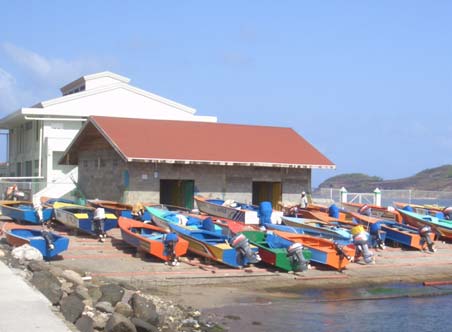






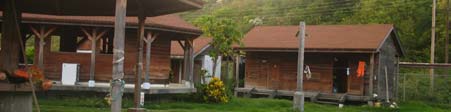

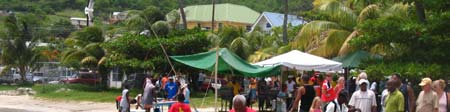
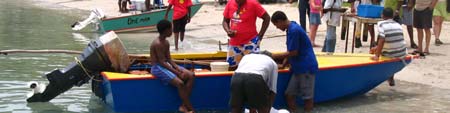

Figure 6.1 Fishing complex lockers and boat ramp Figure 6.2 Fisherman's Day Port Elizabeth,
-
Paget
Farm,
Bequia
Bequia
6.1.3
Canouan
The fishing complex/camp located in Canouan (Figure 6.4) includes a boat ramp, cooking,
locker, accommodation and bathroom facilities for the fishers at EC$ 35 / month (US$ 13 /
month) and is also primarily occupied by Bequian fishers. The refrigerated storage facility
allows the representative of the Fisheries Division to purchase and store a variety of fish and
lobster before selling to the resident hotels and restaurants. Fishers also sell their catch
directly to locals on the roadside in the main town of Charlestown, as few people were
observed entering the complex/camp.
Figure 6.3 Mustique fish market
Figure 6.4 Fishing complex/camp Canouan
6.1.4
Mayreau
The very small fishing community and size of Mayreau does not facilitate the need for a
fishing complex. With few restaurants to purchase fish on the island, fishers mostly sell their
catch to nearby trading vessels.
6.1.5
Union Island
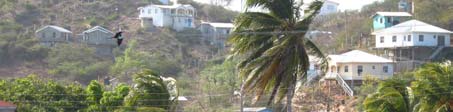
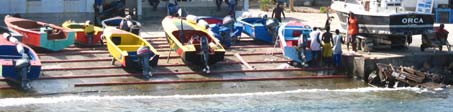
The fishing complex in Clifton, Union Island (Figure 6.5) has a boat ramp and refrigeration
facilities and was not in operation at the time of this project's field survey. According to the
resident Fisheries representative the government believes it is not economically viable as the
fishers do not catch or earn enough to keep the facility running. The authorities plan to have
the fishing complex functioning as a storage facility where fishers will be required to pay a
fee in order to have designated racks to store their catch until they are ready for sale. Due to
its inactivity over the years, the complex has been jokingly referred to as "the white
16

elephant." According to persons in the Fisheries Department, the government hoped that the
complex would be run by the fishers, however because they have been unable to organize and
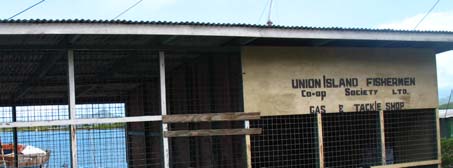
form a co-operation, the complex remains closed. Although Ashton is also an active fishing
community, very little investment in the fishing industry was observed here (Figure 6.6).
Union's close proximity to the Tobago Cays, and the resort destinations of Palm Island and
Petite St. Vincent, provides constant opportunities for fishers to sell their catch directly to
sailing tourists or to the hotels and restaurants.
Figure 6.5 Fishing complex and boat ramp
Figure 6.6 Dilapidated fisheries co-op building
Clifton, Union Island.
Ashton, Union Island.
6.1.6
Petite Martinique
The single operating fishers' co-operative in Petite Martinique has 15 members and monthly
fees which amount to EC$ 5 (US$ 2). The co-op building (Figure 6.7) is licensed to sell
drinks and some fishing gear, however at the time of this survey the organization was not
earning enough money to stay in operation. As a result, in order to keep the facility running,
the President of the co-op is personally renting the building from the co-op so that it can
remain open. According to one member, the organization is not functioning optimally as
membership is lacking and there is a large debt to pay. Nevertheless, government investment
in the fishing industry continues in Petite Martinique as they have funded the construction of
a locker and ramp facility next to the co-op building.
6.1.7
Carriacou
The great expanse of forested hillsides provide the necessary conditions for sustainable
agricultural activities, and thus a greater diversity of employment options for inhabitants of
Carriacou. The Grenada Government is currently investing in the fishing industry on this
island through the construction of a fishing complex located in the capital, Hillsborough.
Current development of the Tyrrel Bay Marina is likely to have severe environmental impacts
on the nearby mangroves and oyster beds which are known breeding, nursery and spawning
grounds for a variety of fish and lobster. Windward is the location of a derelict Japanese
fishing complex which was abandoned years ago and the island's main fish market is situated
in Hillsborough (Figure 6.8). The resident Fisheries Officer for the Grenada Grenadines is
also based in Carriacou.
17






Figure 6.7 Fishing co-op building Petite
Figure 6.8 Current fish market Hillsborough,
Martinique.
Carriacou.
6.2
Phase I: Initial survey
6.2.1
Sampling structure
In the initial rapid survey of Phase I of this project, 230 fishers were interviewed, whereas an
additional 37 fishers were encountered during Phase II during the in-depth surveys. Table 6.1
below shows the distribution of fishers by island, each island's estimated population and also
the proportion of the populations that was interviewed in this initial stage of the study.
Table 6.1. Table showing the sampling distribution of fishers interviewed and the island populations in
the Grenadines.
Proportion of
Number of
* Population
Estimated Fisher
Island
Population
Respondents
Estimates
Population
Interviewed (%)
Bequia 90
4420
2.0
Mustique 20
1290
1.6
Canouan 16
1830
0.9
** 800
Mayreau 22
170
12.9
(1982 records)
Union Island
32
1900
1.7
Petite Martinique
30
600
5.0
** 191
Carriacou 57
8000
0.7
(1988 records)
Total 267
18,210
1.5
991
* Source: Sustainable Grenadines Project 2005; ** Source: Chakalall et al. 1994.
From the MarSIS Scoping Survey in May 2006, it was clear that the fishers were unequally
distributed throughout the Grenadines. Islands such as Bequia and Carriacou contain larger
proportions of fishers because of: (1) their highly active and concentrated fishing villages, (2)
larger populations and (3) strong historical fishing traditions. Most of the fishers in the
Mustique and Canouan fishing camps were not from theses islands but were mainly Bequians
from Paget Farm. The men stated that increased competition in the fishery as well as
proximity to fishing grounds are the two main reasons for residing at these camps.
Although it has been reported that more than 80% of adult males in the Grenadines are
fishermen (CCA 1991), this is an overestimation as it is unlikely that all of these men are
dependent on fishing for some aspect their livelihoods. This was verified after many
conversations with key informants and fishers who gave a drastically lower estimation of the
fishing population on their respective islands. For example in Mayreau it was speculated that
18
all male residents are reliant on fishing, however the fishers themselves identified a much
lower number, between 15 and 20, which was comparable to those encountered in this study.
Due to its small population and size, all the occupational fishers on the island of Mayreau
were interviewed in the initial survey. Greater populations and larger sizes of the other
Grenadine islands contributed to the challenge of conducting a complete inventory of all the
fishers in the island chain. Therefore the 267 fishers that were identified in the Phase I initial
survey is an underestimation. Apart from time limitations there are other reasons why the
full-inventory was not achieved: (1) the study took place out of lobster season, and
consequently, fishers were either engaged in other occupations or out of the island; (2) the
fishers are dispersed throughout the islands which requires a much greater sampling effort
and time to interview each household on the island; and (3) this study focussed on persons
who depended on fishing for their livelihoods, as opposed to recreational fishers.
To overcome these limitations, the sampling design was restructured from an inventory to a
saturation sample, where all persons located in and around the major fishing villages and
markets were surveyed, until the interviewers encountered little to no new fishers.
6.2.2
Demographic information: Sex and age
Only one of the 267 fishers interviewed in the initial phase of this study was female, and the
average age of the fishers was 43 years (median age = 42). The graph in Figure 6.9 follows a
normal distribution with a slight skew to the left. It must be noted that 8% (n=22) of the
fishers were beyond the retirement age of 65. The youngest mean age of 36 years was
observed in Petite Martinique, while the oldest mean age of 46 years was for the fishers
coming from Bequia. The average number of years fishing was 21, and thus fishers in the
Grenadines begin to fish at age of about 22 years.
25.0%
20.0%
y
nc
15.0%
e
que
t fr
10.0%
e
r
c
e
n
P
5.0%
0.0%
11-20
21-30
31-40
41-50
51-60
61-70
71-80
81-90
Age group
Figure 6.9 Age distribution of the 267 fishers interviewed in the Grenadines.
6.2.3
Dependency on fishing
Sixty-four percent of the fishers interviewed stated that they are solely dependent on fishing,
i.e. 100% of their annual income comes from fishing. An additional 23% make half or more
of their income from fishing, leaving only 12% making more income from other occupations.
19
Although most of the persons interviewed (79%) stated that their primary occupation was
fishing, there were 30 other main occupations identified that part-time fishers use to
supplement their income. These were grouped into the categories seen in Figure 6.10.
FIS
FI H
S I
H N
I G
Skil
Sk le
il d
lab
la our
Tourism
bour
is
Ca
C r
a pentry
Art
Ar s, cra
r f
a tfs
ry
Co
C n
o s
n tru
tr c
u tion
Tax
Ta i drirve
v r
on
e
INCO
I
M
NCO E
M
Pai
Pa nt
n ing
Wate
a r
te ta
r
xi
ng
ta
Labo
Lab ur
u e
r r
Ven
Ve d
n i
d ng
r
n
Mas
Ma on
o r
n y
To
T ur
u a
r nd
ry
Mec
Me ha
h n
a ic
Ch
C a
h rt
r er
e irng
n bo
g
ats
nic
Othe
h r
Public S
ublic e
S ct
c or
t
Mar
a it
i i
t m
i e
m and
a
Bar
a O
r w
O ner
Ambul
bu ance w
e o
w r
o k
r er
Trad
a e
d
Gar
Ga d
r en
e i
n ng
Airp
r or
p t
or mai
a nt
n enance
Boat bui
bu ldi
d ng
Kitchen h
h
e
en h l
e pe
p r
Sailin
a
g
ilin /
g Ca
C rg
r o
Sal
Sa es
e Cl
C er
e k
r
Work
o ing
n at
g
port
po s
Far
Fa m
r er
Dom
Do es
e tic worker
e
Figure 6.10 Diagram showing the main income earning activities identified by part-time fishers in the
Grenadines.
The pie chart in Figure 6.11 shows the primary occupations of part-time fishers and clearly
identifies skilled labour as the most common income earning activity. Few fishers (4%) are
employed in the public sector and relatively small proportions are involved in tourism (13%)
and marine and trade (15%) related occupations.
An interesting finding is the strong correlation between age and sole dependency (i.e. 100%
of income) on fishing. A Mann-Whitney test showed that the difference between the mean
age of fishers who are solely dependent on fishing (45 years) is significantly less than the
mean age of fishers who are not (38 years) (Z=-4.118, n=254, p=0.000). The bar graph in
Figure 14 shows the dependency on fishing within the different age groups. It demonstrates a
positive relationship, where sole dependency on fishing increases with age. Note that for the
81-90 age group only two fishers were interviewed which could give an inaccurate
representation for this age group.
These results indicate a considerable vulnerability within the Grenadines fishery where
fishers are becoming more dependent on fishing with age. This could be due to the following
factors, among others: (1) the older generation were traditionally more dependent on fishing
as there were fewer options in the past, whereas younger fishers have more opportunities and
(2) as fishers get older, they are unable to adopt new skills to pursue other trades and thus,
remain or turn to fishing. It is unclear how much of the older population on these islands is
reliant on fishing but it seems to be one of the few options available to them. This is a
possible cause for concern as the older members of the population who may not have national
insurance, pension or welfare, turn to fishing as their only means of survival.
20
19%
Skilled labour
4%
Tourism
49%
Maritime and trade
Public Sector
15%
Other
13%
Figure 6.11 Main occupations of part-time fishers in the Grenadines (n=54).
100%
90%
80%
e
r
s
70%
s
h
60%
100%
>1/2
50%
on of fi
1/2
ti
40%
<1/2
r
opor
30%
P
20%
10%
0%
11-20
21-30
31-40
41-50
51-60
61-70
71-80
81-90
Age Groups
Figure 6.12 Dependency on fishing by age group.
Figure 6.13 compares dependency on fishing within the Grenadines and shows that in
Bequia, Petite Martinique and Union Island a larger proportion of fishers are heavily
dependent on fishing. This highlights a possible vulnerability as a decline in the fishery
would have a greater impact on fishers in these three islands.
It was also observed that fishers at the Canouan and Mustique Fishing camps are on average
4 to 10 years older than the overall average and exhibit 75% and 80% sole dependency on
fishing respectively. It is expected that the fishers who would leave home to reside at fishing
camps would be highly dependant on fishing but the correlation with age is also significant.
21
100%
90%
80%
e
r
s
70%
s
h
60%
100%
f
fi
>1/2
50%
on o
1/2
ti
40%
<1/2
por
30%
r
o
P
20%
10%
0%
Bequia
Canouan
Carriacou
Mayreau
St.Vincent
Union
Petite
Island
Martinique
Home island
Figure 6.13 Dependency on fishing by home island.
Mayreau and Carriacou fishers demonstrate lower sole dependency on fishing and hence have
more alternative sources of income. This may be due to the following reasons, among others:
the large size Carriacou presents greater opportunities for businesses and agriculture, whereas
the small size of Mayreau may result in a greater need for multi-occupationality within the
community. In other words, fishing is one of the many chosen occupations in these islands.
Contrastingly, Petite Martinique is a small island with fishers who depend heavily on this
industry which may be due to historical and cultural influences. To accurately determine what
factors play a role in generating the observed levels of dependency on fishing, a more in-
depth study is required.
6.2.4
Boat ownership
Overall, the proportion of owners to crew remained relatively equal (Figure 6.14) with 46%
of the fishers interviewed being boat owners and 54% either fish from shore or work as crew.
Results show that Bequia has the largest ratio of crew members/shore fishers to boat owners.
It can be speculated that this is due to a lack of initial capital to purchase a boat, along with a
strong cohesion that was observed within the community which facilitates the sharing of
resources such as boats and gear. This co-operation between fishers was again observed in
Mustique where equipment and materials are also shared. Canouan and Union Island have a
greater number of boat owners as fishers tend to operate individually on these islands and
there is a lower density of fishers. The average number of crew overall for the islands is four,
with the Bequia having the highest average crew membership of five.
6.2.5
Boat ownership and dependency on fishing
The levels of dependency on fishing of boat owners and crew were plotted as pie charts in
Figure 6.15 and they clearly demonstrate that boat owners are more heavily dependent on
fishing than crew members and shore fishers, who have other sources of income. To test the
relationship between ownership and dependency, a Chi-squared statistical analysis was
performed and fishers were divided into sole dependents (i.e. 100% of their income from
fishing) and those with other occupations. The results show that dependency on fishing is
22
likely to be influencing boat ownership or visa versa (2=10.9, n=262, p=0.001). A Mann
Whitney test also showed a statistical difference (Z=-0.510, n=261, p=0.000) between the age
of boat owners (47.5 years) and non-owners (38.2 years). That is, those fishers who are solely
dependent on fishing are more likely to purchase fishing vessels or vice versa.
Crew Member/shore fishers
Boat Owner
70%
60%
e
r
s
50%
s
h
40%
30%
r
t
i
on of fi
20%
r
opo
P
10%
0%
Bequia
Canouan
Carriacou
Mayreau
Mustique
Union Island
Petite
Martinique
Home island
Figure 6.14. Proportion of crew members versus boat owners, by home island.
12.1%
13.9%
5.7%
15.0%
5.7%
<1/2
1/2
55.0%
>1/2
100%
17.9%
74.6%
Crew members/shore fishers
Boat owners
Figure 6.15 Proportion of income from fishing for crew members/shore fishers and boat owners.
The average age of boat owners (47.5 years) was significantly higher than that of crew/shore
fishers (38.2 years) according to a Wilcoxon Signed Rank statistical test (Z=-4.076, n=262,
p=0.000). Older fishers are more experienced and may have accumulated the capital and time
necessary to purchase their own fishing vessel. These results illustrate a positive relationship
between age, likelihood of owning a fishing vessel and dependency on fishing. This is
illustrated in the diagram found in Figure 6.16.
23
t
g
boa
i
n
h
s
ng a
ni
on Fi
ow
y
c
n
e
nd
l
i
hood of
pe
e
e
k
D
Li
Age
Figure 6.16 Diagram showing dependency on fishing and boat ownership increasing with age.
6.2.6
Boat types
The predominant boat type observed and recorded in the Grenadines were wooden and fibre-
glass coated "cigarette" frame (bow and stern) boats. Less common were pirogues, cabin
cruisers, sloops and modified speed boats (Figure 6.17). There were six longline vessels
which were only encountered in the south, particularly in the Grenada Grenadines. The
majority of boats (except for longliners and double-enders) are multi-purpose, i.e. are used in
more than one type of fishery and target a variety of species (Chakalall et al. 1994).
Yamaha engines were the most popular in the island chain with an average of 60 hp. Petite
Martinique and Carriacou have the highest average horse power engines of 75.9 hp and 66.3
hp respectively. This may be the result of government subsidization through duty free
concessions in the Grenada Grenadines.
The average boat length in the Grenadines is 6.0 m or 19.6 ft or with the largest boats found
in Petite Martinique (7.0 m; 23.0 ft) and Carriacou (6.8 m; 22.2 ft) while the smallest boats
were located in Mayreau (5.3 m; 17.3 ft) and Union Island (5.4 m; 17.6 ft). This may be a
reflection of a greater intensity of longline fishing which is taking place in the Grenada
Grenadines or the government support within the industry. There was a weak positive
relationship between boat length and horsepower (R2= 0.532) which is seen in Figure 6.18.
24







Speedboat
Pirogue
Double-ender
Sailing/Longliner
Other
1
1. Bequia
2. Mustique
3. Canouan
4. Mayreau
2
5. Union Island
6. Petite Martinique
7. Carriacou
3
4
5
6
7
Figure 6.17 Map showing the distribution of boat types in each island surveyed in the Grenadines.
25
y = 17.588x - 43.602
400
350
300
er 250
w
o 200
r
s
ep
Ho 150
100
50
0
0
2
4
6
8
10
12
14
16
18
Boat length (m)
Figure 6.18 The relationship between boat length and engine horse power.
6.2.7
Types of fishing
In each island, handlining was the predominant type of fishing practiced, except for Petite
Martinique where spear fishing was the most common (Figure 6.19). In terms of percent
frequency within the age groups, handlining exhibits the same distribution as the overall age
frequency distribution throughout the Grenadines (Figure 6.20). This illustrates that
handlining is more frequently practiced among all the age groups. Previous studies have also
shown that this fishing technique, along with trap fishing, are the two most common methods
in the Grenadines (Chakalall et al. 1994).
Traps are also widely used in all islands, especially in Carriacou, Mustique and Mayreau.
Spear fishing and/or scuba diving, with the exception of Petite Martinique, is more
commonly practiced in the northern Grenadines. This unrepresentative distribution of the
fishing types observed in Petite Martinique is likely due to the absence of longline fishers
during the time of the survey who, according to key informants, spend the majority of their
time out to sea or in Grenada.
A significant result is the obvious skew of spear fishing and scuba diving towards the
younger fishers between the ages of 20-40 years (Figure 6.20). This may be due to the large
amount of risk, effort and fitness required to free/scuba dive and also because these are not
the most traditional form of fishing that older fishers may be more familiar with. According
to this initial survey and previous studies, spear fishing is more commonly practiced in the
southern Grenadines (Chakalall et al. 1994).
Gill nets are not commonly used however this may be due to the confusion between gill nets
and the illegal three panel trammel nets. Therefore the data may not give an accurate account
of these types of fishing. Beach seine is not commonly practiced in many islands, but is
focused mainly in Bequia, Carriacou and Mayreau.
26
Bequia
Canouan
25
35
30
20
y
y 25
nc
nc
15
que
que 20
r
e
r
e
t F
t F
n
n 15
e 10
e
e
rc
e
rc
P
P 10
5
5
0
0
Handline Traps
Spear
Scuba Gill nets Beach
Trolling Trammel SL/FP
BL/SP
Handline Traps
Spear
Scuba Gill nets Beach
Trolling Trammel SL/FP
BL/SP
Seine
Seine
Type of Fishing
Type of Fishing
Carriacou
Mayreau
35
35
30
30
y 25
25
nc
ncy
ue
que 20
20
r
e
r
eq
t F
t F
n 15
n 15
e
e
rc
e
r
c
e
P 10
P 10
5
5
0
0
Handline Traps
Spear
Scuba Gill nets Beach
Trolling Trammel SL/FP
BL/SP
Handline Traps
Spear
Scuba Gill nets Beach
Trolling Trammel SL/FP
BL/SP
Seine
Seine
Type of Fishing
Type of Fishing
Mustique
Petite Martinique
30
35
25
30
25
ncy 20
ncy
ue
ue 20
r
eq 15
r
eq
t F
t F
n
n 15
10
e
r
c
e
e
r
c
e
P
P 10
5
5
0
0
Handline Traps
Spear
Scuba Gill nets Beach
Trolling Trammel SL/FP
BL/SP
Handline Traps
Spear
Scuba Gill nets Beach
Trolling Trammel SL/FP
BL/SP
Seine
Seine
Type of Fishing
Type of Fishing
Union Island
Total
50
35
45
30
40
y
y
35
25
nc
nc
30
que
que 20
r
e 25
r
e
t F
t F
n
n 15
e 20
e
e
rc 15
e
rc
P
P 10
10
5
5
0
0
Handline Traps
Spear
Scuba Gill nets Beach
Trolling Trammel SL/FP
BL/SP
Handline Traps
Spear
Scuba Gill nets Beach
Trolling Trammel SL/FP
BL/SP
Seine
Seine
Type of Fishing
Type of Fishing
Figure 6.19 Percent frequency of each type of fishing by island (SL/FP: surface longlining/floating palang;
BL/SP: bottom longlining/sinking palang)
27
Handline
Spear
25
35
30
20
y
25
y
15
uenc
q
20
quenc
ent Fre 10
15
ent Fre
r
c
r
c
Pe
Pe 10
5
5
0
0
11-20
21-30
31-40
41-50
51-60
61-70
71-80
81-90
11-20
21-30
31-40
41-50
51-60
61-70
71-80
81-90
Age Groups
Age Groups
Scuba
35
30
25
y
uenc 20
q
15
ent Fre
r
c
Pe 10
5
0
11-20
21-30
31-40
41-50
51-60
61-70
71-80
81-90
Age Groups
Figure 6.20 Percent frequency of type of fishing by age groups
6.2.8
Fish groups targeted
The majority of fishers interviewed throughout the Grenadines are targeting demersals
(Figure 6.21) which are commonly caught using handline and spear, the two most popular
fishing techniques in the islands. This finding supports the results of a study conducted in the
1993, where deep-water demersals were found to be the most important species group for
75% of Vincentian Grenadine fishers (Chakalall et al. 1994). According to the Grenada
Grenadines Fisheries Officer, the Grenada government encouraged fishers from Carriacou
and Petite Martinique to enter the longline fishery in order to reduce the fishing effort on the
overexploited shallow-shelf demersal species. This appears to be successful as informants on
islands such as Petite Martinique stated that a large majority of the fishers are becoming
involved in the longline fishery. It is not clear if this has reduced fishing pressure on the
demersals and studies will have to be performed with regards to the status of these species.
Lobster is an important target species due to its high value per pound. From discussions with
key informants within the St. Vincent Fisheries Division, it is likely that amount of lobster
fishers found is an underestimate. This is because a large number of fishers enter the fishery
only for this species and this study was not conducted during the appropriate season between
September to April. Lobsters are located on the shallow shelf and the deep reef and thus are
targeted using traps, gill nets and diving (free and scuba) with the use of a small wire noose
(McConney 2003).
28
Bequia
Canouan
45
45
40
40
35
35
y
y
30
30
e
nc
e
nc
u
u
25
e
q
25
e
q
t
Fr 20
t
Fr 20
r
c
en
15
r
c
en
e
15
e
P
P
10
10
5
5
0
0
Inshore
Demersal
Conch
Lobster
Turtles
Whales &
Offshore
Inshore
Demersal
Conch
Lobster
Turtles
Whales &
Offshore
pelagics
Purpoises
Pelagics
pelagics
Purpoises
Pelagics
Species Group
Species Group
Carriacou
Mayreau
45
50
40
45
40
35
y
y 35
nc 30
nc
30
que 25
que
r
e
r
e 25
t F 20
t F
n
n
e
e 20
15
e
rc
e
rc
P
15
P
10
10
5
5
0
0
Inshore
Demersal
Conch
Lobster
Turtles
Whales &
Offshore
Inshore
Demersal
Conch
Lobster
Turtles
Whales &
Offshore
pelagics
Purpoises
Pelagics
pelagics
Purpoises
Pelagics
Species Group
Species Group
Mustique
Petite Martinique
50
50
45
45
40
40
y 35
y 35
nc
nc
30
30
que
que
r
e 25
r
e 25
t F
t F
n
n
e 20
e 20
e
rc 15
e
rc
P
15
P
10
10
5
5
0
0
Inshore
Demersal
Conch
Lobster
Turtles
Whales &
Offshore
Inshore
Demersal
Conch
Lobster
Turtles
Whales &
Offshore
pelagics
Purpoises
Pelagics
pelagics
Purpoises
Pelagics
Species Group
Species Group
Union Island
Total
40
45
35
40
35
30
y
y
nc
nc 30
25
que
que 25
r
e 20
r
e
t F
t F
n
20
n
e 15
e
e
rc
15
e
rc
P
P
10
10
5
5
0
0
Inshore
Demersal
Conch
Lobster
Turtles
Whales &
Offshore
Inshore
Demersal
Conch
Lobster
Turtles
Whales &
Offshore
pelagics
Purpoises
Pelagics
pelagics
Purpoises
Pelagics
Species Group
Species Group
Figure 6.21 Bar graphs showing the proportion of fishers targeting each fish group, by island
Traps were encouraged by the St. Vincent Fisheries Division so as to reduce death and injury
of scuba divers going beyond the recommend limits. One fisher had stated to the interviewer
that up to 30 fishers each year suffered from decompression sickness and had to be airlifted to
29
Barbados for treatment in the decompression chamber. However, this is a costly and difficult
exercise as the fishers have to pay for airfare, treatment and accommodation for the victim
and an accompanying friend/relative. The frequency of scuba diving injuries in the
Grenadines is due to the lack of proper training and the disregard for the recognised safety
regulations. Fishers state that they knowingly go beyond the dive limits so as to increase their
catch per dive and have done repeat dives to 45.7 m or 150 ft.
Offshore pelagics are more important to the southern Grenadines than the northern
Grenadines. This again is due to the Grenadian government's encouragement of longline
fishing. It was also noted that trolling for this fish group is dominated by older fishers where
43% are above the age of 50. However, as previously mentioned, it is believed that the
proportion of fishers targeting these species are much higher than recorded due to the absence
of longline fishers from the islands at the time of this study.
All of the fishers who target whales are from Bequia and they are the least pursued species in
the Grenadines. Sea turtles were rarely reported to be targeted as well but this could be due to
fishers being unwilling to share this information in fear of the consequences of being
identified as fishing illegally.
6.2.9
Areas fished
Fishing areas by island of operation
The majority of fishers interviewed fished around the islands closest to their base of
operations, as is shown in Figure 6.22.
· Approximately half of the fishers operating from Bequia fish around the islands of
Bequia, Petite Nevis, Isle de Quatre, Mustique, Savan, Pillories, Balliceaux and
Batowia (Figure 6.23). These findings confirm previous results which determined that
Bequians are the most mobile fishers of the Grenadines (Chakalall et al. 1994).
· The majority of the fishers operating out of Canouan (42%) remain close to that island
whereas some (13%) venture towards Mayreau. This is logical as most of the fishers
at the Canouan Fisheries complex are from Bequia.
· Approximately ¾ of the fishers operating out of Mustique, all of whom are from
Bequia, fish near Mustique (Figure 6.24). This again makes sense because they would
remain at the Mustique fishing camp for long periods of time. Out of all the fishing
villages, the Musique fishers travel the least, or remain closest to their base of
operations.
· Half of the fishers from operating out of Carriacou fish close to home (Figure 6.25).
· Approximately half of the Mayreau fishermen stay near Mayreau and Canouan.
· Petite Martinique fishers remain close to home (34%) and also fish further south in
Grenada (19%). This is due to the longline fishing that is practiced on this island.
· Union Island fishers exhibit quite an even distribution of fishing throughout the
Grenadines, except for St. Vincent, with 26% fishing closer to Union Island.
Source of fishers
· The majority of fishers fishing near islands in the Eastern Caribbean (e.g. St. Lucia,
Barbados, Martinique, etc) are from Union Island. This however may not be an
accurate representation of the distribution of longliners but due to the interviewing of
crew from one boat. It was difficult to interview the longline fishers from Petite
30
Martinique because they operate from Grenada and were therefore not on their home
island at the time of this study's field survey.
· The majority of fishers in Grenadian waters operate out of the islands from their own
country, Carriacou and Petite Martinique.
· There were only three fishermen encountered (two from Bequia and one from Petite
Martinique) that fish around St. Vincent.
· Interestingly, the Tobago Cays are visited by fishermen from Bequia, Canouan, Petite
Martinique and Union Island. Although there were only 10 fishermen who mentioned
fishing off of the Cays, the exact locations of this practice are not known. In the recent
past, there was an established fishing camp on Petite Tabac and thus some fishers are
returning to the island to fish. This could have implications for the conservation
efforts taking place within the Tobago Cays Marine Park.
· Carriacou, Canouan and Mustique, Savan, Pillories, Balliceau, Battowia and All
Awash are the most intensely fished areas. This may be due to the fact that most of
the fishers in our sample were from Carriacou and Bequia.
· St. Vincent, Tobago Cays and the Eastern Caribbean are the least intensely fished
areas. The Tobago Cays are not fished as intensely because it is a marine park. It is
expected that due to the large investment required for the longlining industry, few
fishers are venturing beyond the Grenadine bank.
Fishing grounds
s
,
nd
ll
la
de
r
ie
A
i
ll
o
n
o
u
a
n
Is
a
l
m
n
,
P
t
i
t
C
t
e
a
n
v
a
ttowia,
e
Pe
& Pa
c
en
t
i
q
u
.
Nevis, Isle
Ba
, Sa
x,
a
r
i
bb
en
Vin
u
, P
u
e
au
Cays
a
u
a
n &
Island
t.
n
C
u
i
a
g
o
ad
atre
s
t
iq
ce
ash
a
no
ba
r
en
s
t
er
St. Vinc
Beq
Qu
Mu
Balli
Aw
C
Mayreau
To
Sail Rock
Union
Petit S
Petit Martin
Carriaco
G
Ea
Bequia
Mustique
Canouan
ns
i
o
Mayreau
at
er
p
Union
o
Petit
Martinique
ase of
B
Carriacou
Legend
1-10%
10-20%
20-40%
40-60%
60-100%
Figure 6.22 Matrix diagram showing the distribution of fishing locations of fishers from each island of
operation.
31
















1-10%
-
1
10-20%
20-40%
40-60%
13
60-100%
1. St. Vincent
2. Bequia, Isle de Quatre,
2
Petite Nevis
3. Mustique, Savan, Pillories,
Baliceaux, Battowia
4. Canouan, Petit Canouan
5. Mayreau
6. Tobago Cays
7. Sail Rock
8. Union Island, Palm Island
9. Petite St. Vincent
10.Petite Martinique
11.Carriacou
3
12.Grenada
13.Eastern Caribbean
4
5
6
7
8
9
10
11
12
Figure 6.23 Map illustrating the location and intensity of fishing around the Grenadines, by fishers based
in Bequia.
32
















1-10%
-
1
10-20%
20-40%
13
40-60%
60-100%
1. St. Vincent
2. Bequia, Isle de Quatre,
2
Petite Nevis
3. Mustique, Savan, Pillories,
Baliceaux, Battowia
4. Canouan, Petit Canouan
5. Mayreau
6. Tobago Cays
7. Sail Rock
8. Union Island, Palm Island
9. Petite St. Vincent
10.Petite Martinique
3
11.Carriacou
12.Grenada
13.Eastern Caribbean
4
5
6
7
8
9
10
11
12
Figure 6.24 Map illustrating the location and intensity of fishing around the Grenadines, by fishers based
in Mustique.
33
























1-10%
-
1
10-20%
20-40%
40-60%
60-100%
1. St. Vincent
2. Bequia, Isle de Quatre, Petite
2
Nevis
3. Mustique, Savan, Pillories,
Baliceaux, Battowia
4. Canouan, Petit Canouan
5. Mayreau
6. Tobago Cays
7. Sail Rock
8. Union Island, Palm Island
9. Petite St. Vincent
10.Petite Martinique
3
11.Carriacou
12.Grenada
13.Eastern Caribbean
4
5
6
7
8
9
10
11
13
12
Figure 6.25 Map illustrating the location and intensity of fishing around the Grenadines, by fishers based
in Carriacou.
34
6.3
In-depth livelihoods survey
6.3.1
Sampling structure
A total of 26 fishers were interviewed during the livelihoods analysis phase of this study.
Discussions lasted approximately one hour and depending on the interviewee's willingness to
share personal information, the conversations may have continued for an additional one or
two hours. Table 6.2 below shows the distribution of fishers that were consulted in each
island and Figure 6.26 illustrates the percentage that were interviewed both in the initial and
in-depth surveys. It is clear that fishers surveyed throughout Phase II, were sampled in
relative proportions to those encountered in Phase I.
Table 6.2 Sampling distribution of fishers interviewed in the Grenadines during the livelihoods analysis
phase of this project.
Number of
Island
% of respondents
respondents
Bequia 8
31
Mustique 3
12
Canouan 1
4
Mayreau 2
8
Union Island
3
12
Petite Martinique
3
12
Carriacou 6
23
In-depth
Initial
40%
e
d
35%
e
w
30%
t
e
rvi
n 25%
ers i
20%
i
sh
f
f
15%
e
o
t
a
g 10%
5%
e
rcen
P
0%
Bequia
Cannouan
Carriacou
Mayreau
Mustique
Petite
Union
Martinique
Home island
Figure 6.26 Graph showing the proportion of fishers interviewed in the Grenadines, during Phases I and
II of this project.
6.3.2
Demographic information: Sex, age and ethnicity
All but one of the respondents in the in-depth survey are male. The single female fisher is
originally from Grenada and has temporarily based herself in Union Island where she fishes
full-time.
35
The average age is 46 years which is comparable to the overall mean age of 43 years found in
the initial survey. Age groups between 21 to 90 years were surveyed, with only one fisher in
the 81-90 age bracket.
Only two ethnic groups were recorded during the second in-depth phase of this study. Eighty
five percent of the fishers interviewed were of African/negro/black descent, while the
remaining 15% were mixed Caucasian, East Indian and/or African descent.
6.3.3
Boat ownership
The majority of fishers interviewed in the in-depth survey were boat owners (73%). The
rationale behind sampling a greater number of boat owners as opposed to crew members is
twofold: (1) they expressed greater motivation for participating in the study; (2) the initial
survey showed that boat owners have a higher dependency on fishing. Consequently, 35% of
fishers in the in-depth survey were boat owners and solely dependent on fishing, whereas
only 8% were crew members that are solely dependent on fishing. Greater dependency may
also be associated with greater knowledge and experience with the issues that surround this
marine based industry. However, including crew members in the analysis was also relevant in
order to gain a broader perspective of the livelihoods of both part-time and full-time fishers.
6.3.4
Vulnerability context
"The [v]ulnerability [c]ontext frames the external environment in which people exist (DFID
1999)." Individuals have little control over external factors such as price trends, seasonality
of fish species, and the shocks brought on by natural disasters which have a great impact on
the status of their livelihood assets. The following will discuss the seasonality associated with
fishing in the Grenadines, the natural disasters such as hurricanes which impact fishing
operations, insurance measures which may be used to reduce the vulnerability context and
fishers' perceptions of the threats to their livelihoods.
It was determined that demersals, conch, offshore pelagics and inshore pelagics are targeted
throughout the year and lobsters are only caught during the designated season from
September to April in the Grenadines. Two fishers interviewed in the in-depth survey, who
are also water taxi operators, stated that they would fish between the months of May to
October and depend on the tourist season for the rest of the year.
Before the approach of severe storms and hurricanes, boats are hauled as far up on land as is
possible. Few houses and boats were damaged by Hurricanes Ivan and Emily and these were
located mainly in the southern Grenadines. A couple fishers were forced to make roof repairs
costing them approximately EC$ 5,000 (US$ 1,850) and EC$ 10,000 (US$ 3,700). One
participant in the livelihoods analysis also had to replace an EC$ 8,000 (US$ 2,960) engine as
a result of the storms.
An alarming finding from this livelihoods study was that 76% of the fishers do not have any
form of insurance in order to reduce risk to their livelihoods. Only three of the six car owners
have car insurance, and three persons have employment, house or life insurance.
The majority of Grenadine fishers interviewed in this livelihoods analysis (39%) stated that
the only thing that would stop them from fishing is bad health or death (Figure 6.27). Bad
weather (17%) and increases in expenses (21%) are also significant reasons for altering
livelihoods from fishing. Few mentioned the lack of a market (10%) and reduction of fish
abundance (3%) as factors that would force them out of the trade. Other answers included
leaving the island or finding another means of earning an income.
36
10%
3%
10%
39%
Bad health
Bad weather/tide
Increase in oil/gas prices
Lack of market
Reduction in fish abundance
Other
21%
17%
Figure 6.27 Bar chart showing the threats to fishing livelihoods in the Grenadines.
It is clear that these men and woman are very dedicated to their occupation as one of the
major factors driving them away from fishing is their own inability to do so. External factors
such as weather and expenses are also important however, as one fisher explained that if their
costs continue to increase, they would have to raise the price of fish. This trickle down effect
may reduce the availability of affordable fish and hence have serious implications for the
local communities that the fishing industry supports. Another vulnerability faced by
Grenadine fishers is their high dependence on the export market to Martinique for shallow-
shelf demersal species. This also contributes toward increasing the fishing pressure on these
already overexploited species.
6.3.5
Livelihood assets
Livelihood assets (human, social, natural, physical and financial capital) are required in order
to achieve certain livelihood outcomes. Access to these assets is influenced by other elements
of the sustainable livelihoods framework such as external factors, institutions and policies
and even the complicated relationships between the assets themselves. Also, persons with
greater assets tend to have more options and opportunities to switch between multiple
strategies in order to sustain their livelihoods (DFID 1999).
Human capital
"Human capital represents the skills, knowledge, ability to do labour and good health that
together enable people to pursue different livelihood strategies and achieve their livelihood
objectives (DFID 1999)," and is required in order to make use of the other four assets. The
length of time spent fishing, intergenerational continuity of the trade, levels of education
obtained, additional information and training required, religious beliefs, as well as marital
status and household characteristics of fishers all contribute towards their human capital
which are drawn upon by the individual.
Fishers that participated in the in-depth interviews have been fishing and gaining experience
in this trade for an average of 22.8 years, therefore entrance into the Grenadine fishery takes
place at an approximate, average age of 23 years. The average hours a week calculated for
37
these fishers was 36.5 hours, however due to the highly flexible nature of fishing, it was
difficult for fishers to specify the average number of hours they would spend fishing in any
given week. The time spent fishing is highly dependant on the weather and type of fishing
that is practiced on that day or by a particular fisher. For example, a trap fisher may spend 3
hours a day or 12 to 18 hours a week fishing because that is the approximate time required for
hauling and re-setting traps alone. Diving, whether free/scuba, can only be practiced for a few
hours a day because of the physical exertions that limit this type of fishing. On the other
extreme, a longline fisher may spend an entire week out at sea, however the exact number of
hours actually spent fishing was not determined. Handlining and trolling would also require
time and patience at sea. In addition, there are those fishers who take part in multiple types of
fishing in the same day or week and estimated between 12 and 40 hours spent fishing in one
week.
This livelihoods analysis of Grenadine fishers also aimed to assess the longevity associated
with fishing, or the passing on of invaluable skills and local knowledge. It was discovered
that the majority of fishers (58%) were taught the skills and biology of fishing primarily by
family members. Others were taught by friends and older members of the community (19%),
and there were those who claimed to have learned to fish on their own (23%) through
observation and trial and error. Only four fishers expressed that they did not teach anyone
their trade, while the remainder was split between assisting friends and family. This is logical
because it is in a captain's best interest to ensure that his crew are capable and skilled fishers.
Sixty-five percent of respondents have one or more family member who also fishes for their
livelihood. These results are evidence of the continuation of fishing throughout the
generations. The tradition has carried on through the years and it is likely that it will continue
to do so in the future.
Table 6.3 below lists the three observed levels of education that fishers interviewed in Phase
II have attained. It is obvious that post-primary education is lacking and this is strongly
linked to the fact that islands such as Mustique, Canouan and Mayreau simply did not have
access to this level of education until recently.
Table 6.3. Levels of education obtained by fishers in the Grenadines.
Level of Education
Number of Respondents
% of Respondents
Primary 20
77
Secondary 5
19
Technical college
1
4
More than half the Phase II respondents did not feel that they required any additional
information with regards to biological characteristics of fish. Those who did respond
positively believe that further information on spawning areas and habitats is needed,
especially if those in the northern Grenadines plan to branch out into other types of fishing.
As 85% of the respondents expressed, it is clear that fishers are very eager to expand their
fishing activities by becoming trained in different types of fishing such as longlining. Despite
the training and activity in longline fishing in Petite Martinique and Carriacou which was
supported by the Grenadian government, fishers from these islands also requested training in
longline fishing. A fisher from Bequia made an excellent comment regarding this
phenomenon: "What's the point in getting this training if we do not have the right boats?"
This presents a subject for further consideration where training may be wasted if fishers do
not have the capacity to make efficient use of it.
38
An issue of possible concern according to the livelihoods interviews is the relatively low need
for safety training expressed by the fishers (12%). This may not mean that they do not
recognize the importance of safety, however perhaps programmes such as the Safety at Sea
programme for water taxi operators should be expanded to include the fishers of the
Grenadines in order to promote the practice and use of proper safety techniques. The
remaining respondents (39%) were evenly distributed between requiring training in
accounting/financing, local knowledge such as reading the tide, new technologies such as
GPS, diving and even no additional training required.
Figure 6.28 below identifies Anglican as the dominant religion of fishers interviewed in the
in-depth survey. This is closely followed by Roman Catholic and Pentecostal denominations.
35%
30%
e
r
s 25%
s
h
f
fi 20%
on o
ti 15%
por
r
o 10%
P
5%
0%
Anglican
Pentecostal
Roman
7th Day
Rastafarian
Baptist
None
Catholic
Adventist
Religion
Figure 6.28 Bar chart showing religious denominations of fishers in the Grenadines.
The majority of fishers interviewed in Phase II were either married (34%) or single (34%).
Common law relationships and divorce were next in line with 12% of respondents each while
only two fishers were widowed (Figure 6.29). The number of children varied between
participants. The average number of boys was 2.2 while the average number of girl children
reported was 1.6.
Most of the fishers encountered in the in-depth survey live with other family members, such
as wives, sons and daughters (62%), while the rest live on their own. Among those who live
with family, the average number of people above the working age of 16 living in a household
is two. Out of a total of 32 household members, the majority (56%) have a secondary
education, while the remainder last attended primary school. This suggests that there has been
an improvement in accessibility and attendance to post-primary schools among the children
of fishers within the last few decades. An interesting finding was that most of the wives and
mothers are housewives or involved in domestic work such as cooking and nursing. Also,
almost 20% of the households have more than one fisher living within them and these were
always the sons or fathers of fishers that were interviewed. This further supports the finding
that fishing is passed on through the generations.
39
8%
12%
12%
Common-law
Divorced
Married
34%
Single
Widowed
34%
Figure 6.29 Pie chart showing the marital status of fishers in the Grenadines
Social capital
Although there is much debate surrounding the definition of social capital, in the context of
livelihoods, it is referred to as the "social resources upon which people draw in pursuit of
their livelihood objectives (DFID 1999)." Social networks are created from the community
level to the household level, increasing the intensity of trust between individuals and thus
reducing their costs of working together. The following will identify what activities
Grenadine fishers engage in for enjoyment, what roles they play within their respective
communities, the possible conflicts that may arise, and the potential for formal organization
of this important resource user group.
The small-scale fishing which takes place in the Grenadines involves much effort, skill and
physical endurance. Knowing what takes place at sea and throughout the fish sale process is
only half the story, however. It is also important to attain knowledge of social and cultural
behaviours of fishers by understanding what they do for recreation and entertainment. This
information is relevant for several reasons and can be considered useful when planning to
hold community meetings, future studies and/or workshops. Through the livelihoods
interviews, it was discovered that at the end of the day, many fishers prefer to simply relax or
enjoy a good "lime" whilst playing dominoes and cards. Some like to indulge in alcohol,
television, music and attend social events in town. Only a couple mentioned sports activities
and hobbies such as football, cycling and racing small sail boats as ways to make use of their
spare time. A few even claimed that fishing was their enjoyment.
Community group involvement seemed rather scarce in this in-depth survey as only six
fishers mentioned being actively involved in sports, games, community or environmental
clubs. The two environmental organizations that a few fishers reported belonging to are Sand
Watch in Bequia and the Carriacou Environmental Committee (CEC). They are both
involved in cleaning and preserving the environment and the respondents expressed that they
enjoy this aspect of their involvement.
Aside from the established community groups that function around goals and memberships,
there are social norms which exist with or without organization that reflect on the
40
community. This livelihoods analysis aimed to determine the roles that fishers play in their
communities by identifying how they interact and assist other fishers, friends and family. It
was found that there is strong cohesion among fishers which promotes the sharing of bait, gas
and fishing grounds; the lending of gear and equipment; giving advice, encouragement and
assistance with maintenance, repairs, cleaning fish and hauling boats. This was particularly
obvious in Paget Farm, Bequia where fishers and community members alike seem to be
highly co-operative. Whereas the interaction between fishers is quite specific, many found it
difficult to describe exactly how they assist friends and family. General answers were
expected however as there are several ways a person can help another in need, while there are
only so many ways that involve fishing. Nevertheless, many fishers were able to state that
they assist their family and friends by providing free fish, helping around the house and
giving financial support when they can.
Although 39% of the fishers that participated in Phase II of this study stated that there are no
problems between them, conflicts, whether large or small in variety, are likely in many, if not
all communities. Forty-two percent claimed that disagreements are the result of fishers
stealing or damaging each others' gear. One must be sceptical especially with fish traps,
however, as natural elements may also be the cause for the loss of equipment. Other
interesting findings were that only three fishers stated that conflicts arose over fishing
grounds and no one mentioned trans-boundary fishing between the St Vincent and the
Grenadines and the Grenada regimes as an issue.
There were even fewer reported conflicts between fishers and other marine resource users
such as water taxi operators (WTops) and recreational divers. Only 7 fishers (27%) pointed
out concerns such as divers and tourists interfering with pots, the fact that foreign vessels are
fishing illegally in their waters and of course issues surrounding maritime boundaries. One
fisher from Union Island gave an example of conflict where WTops would purchase fish
from the fishers and sell them at higher prices to the yachters. He claimed that this reflects
badly on the fishermen and on tourism for the island as a whole, even though the water taxi
operator is acting as a middleman to locate a market for the fish.
Despite the very strong cohesion and cooperation observed among fishers of the Grenadines,
they are not yet formally organized into groups on any of the islands, with the exception of
Petite Martinique. All except one fisher stated that if a co-operative or association did exist
they would become a member and take part. The single dissident is from Petite Martinique
and he argues that the only operational co-op in the Grenadines does not function properly,
and no-one is willing to do the necessary work. The majority, however, believe that the
fishers' co-op is a great idea and hope to realise the following benefits: an increase in
government investment and financial support into fishing; the provision of duty-free
equipment; a reduction in expenses such as gas prices in particular; the institution of a
standard price for different varieties of fish; an increase in co-operation and information
sharing between fishers themselves; and the support and organization of social events such as
birthdays and friendly tournaments between fishers of the different islands. Fishers hope that
organization would create one strong voice that can represent their best interests in the world
of politics and resource management.
Natural capital
Quite simply, "[n]atural capital is the term used for the natural resource stocks, [in this case,
fish] from which resource flows and services, [such as food provision], useful for livelihoods
are derived (DFID 1999)." The influence of the vulnerability context on natural capital is
great, as natural processes which may even be human induced, can destroy the stocks which
comprise the natural capital. This section will identify the fish groups targeted by fishers, and
41
present their perceptions of stock abundance and issues and solutions surrounding the fishing
industry.
As was discovered in Phase I, fishers surveyed in the livelihoods analysis also depend greatly
on demersal fish species and lobster. This is clearly illustrated again in Figure 6.30 as all
fishers targeted demersals and a large proportion (69%) catch lobsters as well. When asked to
rank the fish groups in order of their importance 69% stated that demersals were their number
one species, while the remaining 23% and 8% represent lobsters and offshore pelagics
respectively.
100%
90%
80%
e
r
s
70%
s
h
60%
f
fi
50%
on o
ti
40%
por
30%
r
o
P
20%
10%
0%
Inshore pelagics
Demersals
Conch
Lobster
Turtles
Offshore
pelagics
Fish group
Figure 6.30 Bar graph showing the proportion of fishers that target each fish group
Table 6.4 below demonstrates the fishers' perception of the average abundance of fish groups
5 years ago and today, relative to 10 years ago. It is clear that there is a general downward
trend in fish numbers according the fishers of the Grenadines. This is especially true for
conch and turtle, however only one fisher targeted sea turtle.
Table 6.4. Fishers' perception of the average abundance of fish groups 5 years ago, and today (relative to
10 years ago).
Fish group
Abundance 5 years ago
Abundance today
Inshore pelagics
Same
Low
Demersals Low
Low
Conch Low
Very
low
Lobster Low
Low
Turtles Low
Very
low
Offshore pelagics
Low
Low
Fishers are an important source of information regarding the problems that surround fishing
resources. In addition, they are in a position to suggest appropriate solutions to these issues.
Table 6.5 summarizes the Grenadine fishers' concerns regarding their fishing livelihoods and
their recommendations for solving or dealing with them.
42
Table 6.5 Issues and solutions recommended by fishers
Issues Solutions
There has been a reduction in fish abundance over the
Establishing protected areas, especially where habitats
years due to overfishing, degraded habitats and fishing are destroyed and in areas of spawning aggregations,
in spawning areas. This increases a fisher's expenses
can help build back the stocks. Fishers and divers must
as they have to travel further to fish.
be educated on the importance of having these no fish
zones. It may then be possible to return to these areas
to fish after stocks have recovered. Another suggestion
is to ban the extraction of fish species that are
critically low in abundance. In terms of compliance
fishers call on the government for better enforcement,
and hope that a co-op will also be of assistance.
Vendors and fish vessels take advantage of fishers by
A possible solution is for the government to step in
not paying for the half kg. As a result, fishers do not
and institute a standard price for fish, or play
get their monies worth for the full weight of their
middleman by purchasing the fish and then selling
catch.
them to vendors and exporters.
There is a lack of a market for fish sale and export in
Grenadine fishers all agree that it is the St. Vincent
the St. Vincent Grenadines. This is due to the poor
government's responsibility to regain the EU market.
condition of the St. Vincent fish market which lost
This can be achieved by ensuring that the physical
them their export license to the European Union (EU).
market is always kept in proper condition and will
This has led to an increased dependency on Grenada
therefore meet the standards and pass future
which still has their license with the EU.
inspections.
There is a lack of a stable market for fish in the
Yet again, fishers call for government assistance with
Grenada Grenadines. Fishers claim that the trading
this issue and believe that the authorities should
vessels do not take all their fish and as a result they are purchase fish at a standard price, in order to ensure a
left with rejects. The demand for fish fluctuates to the
regular and stable market for the fish.
point where sometimes fishers can't supply enough
fish, and other days they can't get the fish sold.
The vast majority of fishers in the St. Vincent
Many fishers suggest that government can assist in
Grenadines have expressed their disappointment in the this venture towards organization, but also recognise
fact that there are no fishers' co-operatives to
that it is up to the fishers themselves to come together
represent them.
in unity. Both must work together to form and support
fishers' co-ops.
Fishers have also stated that there is a lack of
The fishers believe that the formation of a co-op will
reasonably priced fishing materials and safety
encourage the government to bring in equipment at
equipment in the northern Grenadines.
duty-free prices. They note that the co-op may even be
able to set up financing and funding schemes for their
members. It was also suggested that government can
promote an increase in competition for suppliers of
equipment and materials.
Fishers feel that there is a general lack of support from The solution to this problem, which was recommended
the government.
by all who identified the issue, was the formation of a
well functioning co-operative so that the fishers'
views and concerns can be appropriately represented
with one powerful voice.
An interesting finding was the great need expressed by fishers to have a properly functioning
co-operative, rather than an association. The fact that there is no formal organization amongst
them is an issue, and was identified as a solution to several problems. It is therefore obvious
that fishers recognize the importance and benefits of a co-operative and hopefully this will
eventually drive them towards establishing a group. It was also observed that fishers place a
43
lot of onus on the government to address their issues. When this does not happen, they claim
that the authorities do not support them and hence they feel neglected. This issue can be
addressed with further investigation into both sides of the story so that concerns can be
expressed by the fishers, and reasons for particular action or inaction on the government's
part, can be understood.
Physical capital
"Physical capital comprises the basic infrastructure and producer goods needed to support
livelihoods (DFID 1999)." Infrastructure is usually free public goods and includes roads and
vendor stalls, whereas private infrastructure such as an individual's home and its access to
water and electricity are paid for privately (DFID 1999). Fishing equipment and facilities in
particular, are very important to the success of fishers' operations, and without capital,
productivity is reduced.
The majority (79%) of the 19 fishers who took part in the in-depth livelihoods survey and
own a fishing vessel, purchased it with their own money, while the remaining 21% used loans
from banks, family and friends or a combination of these with their personal funds. One
fisher inherited his boat after his father died. As with boats, most fishers finance their engine
purchases with their own money (56%), however a significant proportion (33%) said they
required a bank loan. In fact, 86% of bank loans mentioned in this study were taken out for
engines.
Fishing gear is also predominantly purchased with a fisher's own money or may be received
as gifts. The majority of personal funding (40%) was for fishing gear and this is expected
because fishing gear is a great deal cheaper than engines or boats, and must be replaced often.
Fishers therefore prepare to have this money on hand for quick and easy purchase in order to
cover their daily, weekly, or monthly operational costs. Emergency equipment such as radios,
life jackets, cell phones and flares were owned by 15 (58%) fishers. Sources of funds include
their own money (67%), gifts (13%) and one fisher acquired safety gear with the purchase of
their boat.
The average value of the 19 fishing vessels is EC$ 7,574 (US$ 2,802) and engines have an
average value of EC$ 7,300 (US$ 2,701). Fishing gear was valued at a much lower price of
approximately EC$ 1,501 (US$ 555). It must be noted, however, that while fishers could
easily recall the price of a boat or engine, it was difficult for them to specify the exact value
of their gear. This is because gear includes the smallest element such as a hook, to something
as large as a fish trap. These may have to be replaced on a weekly or monthly basis and
fishers are not likely to keep records of every box of hooks or reel of twine that they
purchase.
The average value of emergency or safety equipment was reported to be EC$ 569 (US$ 211).
This low value can be attributed to the following factors: (1) few interviewees had safety or
emergency equipment to begin with, (2) many had cell phones which cost approximately EC$
200 (US$ 74) and (3) a couple expensive items like radios were given to the fishers as gifts so
they did not know their true value.
Fishers are not only sensitive to the issues and the reduction in fish abundance, but they also
have first-hand knowledge of the equipment, materials and facilities that are required to be
efficient fishers. According to this in-depth survey, the majority of fishers appreciate the
usefulness of technology such as GPS and fish finders (42%), and emergency or safety
equipment (35%). Few (12%) mentioned needing specific fishing or dive gear. An interesting
response from 31% of the fishers interviewed was that they saw no need for any additional
gear. They reasoned that GPS in particular was not suitable for the types of boats that they
44
have and for the distances that they travel. This information is useful for any initiative to
provide fishing gear and equipment for the fishers of the Grenadines. Further research can be
conducted to determine exactly what is needed and what can actually be used appropriately.
This will promote the efficient use of the gear and a successful outcome of such an initiative.
The facilities required by fishers in each island are described in Table 6.6. Most fishers in the
Grenadines mentioned the need for gas, fish storage, selling and equipment locker facilities.
However, some of these requests are being fulfilled, for example, a new fishing complex is
being constructed near Hillsborough, Carriacou, and the Grenadian government has also
funded the building of a ramp and locker facility in Petite Martinique.
Table 6.6. Table describing the facilities needed by fishers in each island.
Island
Facilities needed by fishers
Bequia (Paget Farm)
Gas station
Repair facility nearby
Additional space for hauling boats
Mustique
Jetty and secure ramp for hauling boats (boats are currently getting damaged by
conch shells on the beach)
Canouan
Storage facility needs to operate properly
Proper market or shelter to sell fish (not a table on the side of the road)
Mayreau
Ramp and small complex to sell ice and gas
Union Island
Gas station on the island (currently gas is purchased in PM or Canouan for EC$ 9.50
/ gallon and sold by variety stores at EC$ 12 / gallon)
Ramp in Ashton, along with locker facilities for gas tanks and gear
Petite Martinique
Gas station for fishermen
Storage facility for fish
Carriacou
Gas station in Harvey Vale
Proper ramp for hauling boats
Locker facility for tanks and gear
Building to sell and store fish
As Figure 6.31 illustrates, the majority of fishers interviewed in this livelihoods analysis own
their own homes (54%) or live with family (27%). Very few rent their place of residence
(15%) and only one fisher is staying with a friend. Of the fishers who own their homes, 79%
financed this large investment with their personal funds while the remainder took out bank
loans. Seventy-two percent of fishers own land upon which all have built their homes. An
additional 22% own land where they own and operate a bar, and the remaining 17% have
land for gardening and farming activities.
It was found in this in-depth survey that the majority of fisher homes are constructed of
concrete walls, metal or galvanize roofs, and either wooden or concrete flooring (Figure
6.32).
When examining the material style of life of Grenadine fishers, it was discovered that the
majority of households (>60% across the board) have electricity and running water (Figure
6.33). It was not specified if the water was piped or stored in tanks, but field observation can
confirm that most homes collect rainwater from their roofs and store it in tanks. Common
household appliances such as televisions, fridges, stoves, stereos, DVD and video players
were also found in most homes. Half the households were fitted with in-door toilets while
54% use out-door facilities which are still used because of the limited availability of water in
the Grenadines. This value is greater than 100% because two households actually had both
45
in-door and out-door toilets. Only six households (23%) owned vehicles and all of these were
located in the bigger islands of Bequia and Carriacou. Only two persons mentioned having
computers and lastly, a little over 20% of households have washing/drying machines because
the majority of people prefer to hand-wash and hang-dry their clothes. This not only
conserves water, but electricity also.
4%
27%
Family owned
Rented
Self-owned
Staying with friend
54%
15%
Figure 6.31 Pie chart showing fishers' accommodation situation in the Grenadines
100%
90%
s 80%
d
70%
e
hol
60%
Tiles
f
hous
Metal
50%
o
Wood
ge 40%
ta
Concrete
30%
e
r
c
e
n
P 20%
10%
0%
Walls
Roof
Floor
Housing component
Figure 6.32 Bar graph showing the material make-up of fishers' households in the Grenadines
46
90%
80%
ds 70%
e
hol
60%
ous 50%
of h 40%
n
o
ti 30%
20%
r
opor
P 10%
0%
t
ve
r
er
er
ater
ilet
TV
to
toile
ereo
Ca
put
rying
th
ectricity
w
Fridge
Sto
St
m
* O
El
ng
door
Co
nni
In-
ut-door
shing/d
Ru
O
Wa
Facilities and appliances
Figure 6.33 Bar graph showing the proportion of fishers' households with certain facilities and appliances
in the Grenadines (* Other represents DVD, video players and Playstation)
Financial capital
The last livelihood asset to be covered, financial capital "denotes the financial resources that
people use to achieve their livelihood objectives (DFID 1999)." Sources of funds are
primarily regular flows from income, and also stocks which are available through saving.
Money is a very flexible and influential resource because it can be converted into other forms
of capital (DFID 1999). The following section will describe the financial picture of
Grenadine fishers. This includes their catch earnings, how they divide up the boat income
amongst crew, who their customers are, what their expenses amount to and how they save
money.
One of the trials associated with fishing for a livelihood is that supply of and demand for fish
is unstable. Fishers do not have a set salary; they earn based on their catch and expenses.
Sometimes a profit is earned and other times the catch earnings do not cover their operational
costs and result in a loss. One of the most difficult questions in this livelihoods analysis was
related to the monetary value of a fisher's weekly catch. Some could only state what they
would make on a "good day" and maintained that on a "bad day" they would simply make
nothing. Nevertheless, a range of EC$ 90-5,000 (US$ 33-1,850) was determined, and an
average of EC$ 944 (US$ 349) was calculated as the weekly catch earnings for the
respondents of this survey. For a fisher that fishes six days a week, his annual catch is
approximately EC$ 49,000 (US$ 18,130).
According to Espuet (1992) uncovering a fisher's true profits or earnings is a complex task
because it is not as easy as "Sales Costs = Profit." Fishers can place a dollar value on their
expenses and sales as items such as gas, oil and fish are paid for on the spot. However, it is
difficult to value or put a price tag on the work or labour that is fishing. This, on top of the
fact that fishers do not have a fixed salary, makes it difficult to determine exactly how much
money was put into the operation in order to calculate the profits. It is very likely that the
responses to this question were either overestimated to impress the interviewer, or
underestimated for fear of taxation. Examples of questionable responses were from Carriacou
where one fisher stated that he earned between EC$ 90-100 / week (US$ 33-37 / week), while
47
the fisher who works with him stated an average EC$ 550 / week (US$ 204 / week). In this
case, the crew member is making a considerable amount more than the boat owner which is
unlikely.
The division of catch income from fishing in the Grenadines follows a share system that may
vary depending on the owner of the boat. After the costs for oil and gas, etc. are taken out, the
remainder is divided into a combination of 1, 2, and 4, or 3 and 4 as indicated in Table 6.7.
Seiners and pot fishers usually take out half of the earnings for the equipment, and then
divide the remaining half between the boat, engine and crew.
Table 6.7 Share system for catch earnings in the Grenadines
Item
Number of shares
1. Boat
1 share
2. Engine
1 share or ½ share
3. Boat + Engine
1 share
4. Crew
1 share each
The customers for fish in the Grenadines have been categorized into groups (Table 6.8).
Prices also vary depending on the customer and time of year. Demersals are mostly sold
ashore to locals and vendors for EC$ 6-7 / lb (US$ 2-3 / lb) and at sea to the purchasing
vessels seen in Bequia, Carriacou and Petite Martinique for EC$ 4-4.50 / lb (US$ 1-2 / lb).
The vessels then clean the already gutted fish and freeze them for export. It is not clear why
the vessels pay such a low price, however fishers continue to supply them because they are
convenient and reliable buyers. Hotels and restaurants are also consistent buyers of demersals
and purchase the fish at EC$ 6-7 / lb (US$ 2-3 / lb).
Table 6.8. Table showing the proportion of fish sold to the various customers in the Grenadines (*
represents sales to locals on shore).
Customers (% of fish)
Fish group
Export
*Shore Restaurants Hotels Vessels
Tourists Government
companies
Demersals
35 14
12
35 0
4 0
Lobster
4 32
25
4
21
7 7
Conch
37 27
27
0 9
0 0
Offshore pelagics
31 31
31
0 7
0 0
Inshore pelagics
100 0
0
0
0
0 0
Lobster is predominantly sold to restaurants and hotels at a price range between EC$ 7-16 / lb
(US$ 3-6 / lb). Export companies also take a large portion and pay between EC$ 7-15 / lb
(US$ 3-6 / lb). The value of lobster depends on the time of year as early on in the season the
price is low, then later increases as the lobster becomes scarce.
Conch is mostly a local delicacy and is sold to some restaurants and hotels at the same price
as demersals or EC$ 4-5 / conch (US$ 1-2 / conch). Offshore pelagics are evenly distributed
between locals and hotels and restaurants for EC$ 6-7 / lb (US$ 2-3 / lb). Some go to the
exporters for the same price. Only one fisher who targets inshore pelagics was interviewed
and he sold all his catch to the local market for EC$ 4 / lb (US$ 1 / lb).
Although expenditures are "easier" than earnings to quantify they still vary for fishers of this
in-depth survey based on the type of fishing practiced, the time spent fishing, the distance
travelled to fish and the type of boat and engine used. Table 6.9 breaks down the average
48
quantities and costs of oil, gas, ice, bait and food that are used per fishing trip. Cost
information obtained from the longline fisher was reported separately to avoid overestimating
the average costs of small-scale fishers.
Table 6.9. Approximate costs per fishing trip in the Grenadines.
Average quantity per
Average cost
Type of fishing
Item
Price range (EC$) trip
per trip (EC$)
Oil
$11-12 / bottle
1.5 bottles / 24 oz
$16.87
Gas
$9.50-12 / gallon
1.5 tanks / 9 gallons
$92.13
Handline, tow,
spear, trap,
Ice
n/a
1 bag / 5 blocks / 20 lbs
$10.83
palang
Bait
n/a
1 bucket / crate
$68.33
Food n/a
Varies
$12.50
Total
$200.67
Oil
$150 / bucket
2 buckets / 20 gallons
$300.00
Diesel
$7 / gallon
120 gallons
$1000.00
Longline
Ice
$0.15 / lb
3000lbs
$450.00
Bait
$2.50 / lb
700lbs
$1750.00
Food n/a
Varies
$400.00
Total
$3900.00
Note that fishers who use more than one tank of gas were from Bequia, Union and Mayreau.
Carriacou fishers interviewed in this in-depth survey remained closer to their home island as
was shown in the initial survey, therefore they use less gas. Quantities of ice, bait and food
vary because: (1) not all fishers require ice for their short trips; (2) a lot of them catch their
own bait, or sometimes do not buy bait; and (3) some bring food such as sandwiches from
home, or do not take food on trips. Those that did use ice however, were from the southern
Grenadines, which suggests that either regulations or distance travelled to fish demands such
preparations of the fish. Results show that the approximate average cost per trip for a small-
scale fisher is EC$ 200 (US$ 74) and EC$ 3,900 (US$ 1,443) for longline fishers. The
approximate yearly costs for a fisher that fishes 6 days a week is therefore EC$ 62,600 (US$
23,162).
Yearly maintenance costs were also difficult for the fishers of this livelihoods analysis to
quantify. This is because, with the exception of painting, maintenance on the engine and boat
occur on an "as needed" basis, and fishers do not keep records of what was used to get the job
done. On top of this, most maintenance is done by the fisher therefore he would not often
have to pay for labour.
With engines, for example, most respondents stated that their engine was new and so far,
have had no problems with it. A range between EC$ 200-1,200 (US$ 74-444) a year was
determined for cleaning and taking care of the engine. One fisher stated that it costs him EC$
300-400 (US$ 111-148) to service his engine every six months.
Painting costs vary depending on the size of the boat and the quality of paint that is used.
Epoxy and marine paint are the most expensive, and some fishers also make use of regular
and cheaper oil paint. The average yearly cost for painting a boat was therefore EC$ 599
(US$ 222).
Fishers use fibreglass in order to repair damage to their boats. First, epoxy (EC$ 280 / gallon;
US$ 104 / gallon) is mixed with sawdust to form a putty. Then the fibreglass cloth (EC$ 20 /
49
yard; US$ 7 / yard) is used to cover the first layer of putty. Finally, fibreglass liquid (EC$ 85
/ quarter gallon; US$ 31 / quarter gallon) is used to stick and harden. Quantities of each will
depend on the damage therefore a yearly average was not attained. One fisher was able to
approximate EC$ 1,000 (US$ 370) on re-fibreglassing his boat every year. The yearly
maintenance costs for a boat owner are therefore approximately EC$ 1,949 (US$ 721).
Total expenditures for fishers interviewed in the in-depth survey amount to approximately
EC$ 64,557 (US$ 23,886) and Table 6.10 summarizes the yearly finances of a boat owner
who fishes 6 days a week. The EC$ 15,476 (US$ 5,726) loss is a very gross estimation
however, and was calculated out of curiosity.
Table 6.10. Summary table for financial status of Grenadine fishers (boat owners) who fish 6 days a week.
Value (EC$)
Average and approximate annual catch
$49,080.72
Average and approximate yearly expenditures
$64,556.89
Average and approximate loss
-$15,476.17
All fishers interviewed in this livelihoods analysis save some of their income, mostly in bank
accounts, although a couple did keep it at home. Reasons for saving were mainly for
emergency, children, boat maintenance, and for reserve in case fishing does not make much.
The majority of fishers (78%) stated that other members of their household contribute
towards household income and help with bill payments, etc. In all, except two cases, the
fisher was the primary provider for his family.
6.3.6
Livelihood strategies
According to DFID, a livelihood strategy is "the overarching term used to denote the range
and combinations of activities and choices that people make in order to achieve their
livelihood goals (DFID 1999)." It is a combination of various activities that are used to meet
various needs and shows a positive correlation and reinforcing relationship with livelihood
assets (DFID 1999). In order understand the strategies employed by fishers in the Grenadines
to sustain their livelihoods and that of their families, this study aimed to determine why
fishing is chosen as an occupation and what other activities are used to supplement fishing
incomes.
Approximately 85% of the fishers interviewed in Phase II stated that fishing was their main
occupation. The remaining four identified the following as their primary occupations:
farming, gardening, bar owner/operator and construction worker. Notably these four
respondents and their professions are all from Carriacou.
In establishing the reasons why the full-time fishers in this study chose fishing as a livelihood
strategy, it was first important to determine what occupations current fishers of the
Grenadines were previously engaged in. These are grouped into the same categories that were
used in the initial survey (Table 6.11). It is clear that skilled labour, construction in particular,
was the most common income earning activity before they began to fish for a living (Table
6.11). This is similar to Phase I findings where, aside from fishing, skilled labour was the
dominant occupation. A large percentage of fishers was also previously employed in the
maritime and trade industries (35%) whereas only 23% went straight to fishing. Therefore,
more than half the respondents were and continue to depend on marine resources and some
relied on fishing as their first means of earning an income. Four fishers indicated that
tourism, bus driving, working in a store and gardening were their occupations before they
turned to fishing.
50
Table 6.11. Table showing previous occupations of fishers before they began to fish for a livelihood (*
Other represents bus driving, working in a store and gardening).
Occupation
Number of Responses
% of Responses
Skilled labour
11
42
Tourism 1
4
Maritime and trade
9
35
None (straight to fishing)
6
23
* Other
3
12
To understand fishing in the Grenadines it is important to understand why fishers chose
fishing as a livelihood. Regardless of age and previous occupations, the majority of Phase II
participants give a very simple answer to this question: "I enjoy it." The second most
common response is that there are no other options or means of earning an income on the tiny
islands of the Grenadines. This is a significant finding and further research of the general
population is needed to support the statement. If the fishers' perception is true then why have
the respective governments not put greater effort into (1) providing more employment
opportunities for their citizens, or (2) increasing their direct investment in fisheries through
training, support and proper management. Other fishers stated that they turned to fishing
either because a previous job got slow, they prefer to be self-employed, or they saw more
money in fishing.
Forty-two percent of fishers interviewed in Phase II are 100% dependant on fishing as a
source of earning an annual income. Another 42% earn half or more of their income from
fishing, leaving only 15% that makes most of their income from other occupations such as
owning/operating a bar, construction, or farming. Once again it was found that more crew
members (75%) have other main jobs, while a large percentage of boat owners (50%) are
solely dependent on fishing. Also, half of the respondents who considered fishing as their
primary occupation stated that they are in fact solely dependent on the industry.
Construction is the most popular secondary occupation for fishers in the Grenadines and the
majority of those who partake in this labourous activity do so when fishing is slow. Others
believe that fishing and construction are the only options for both young and adult males in
the islands.
7 CONCLUSIONS
7.1
Vulnerability context
Grenadine fishers did not seem to experience much seasonality associated with their
operations. This is of course with the exception of fishers who target only lobster, and those
who are involved in the tourism sector primarily through water taxiing. The shocks to fishing
resources caused by natural disasters that have occurred within recent memory were mainly
concentrated in the southern Grenadines due to Hurricanes Ivan and Emily, however, the
threat is there each year. The men found that their inability to fish was the greatest threat to
their fishing livelihoods, while external factors such as oil/gas prices and market availability
also increase their vulnerability. Insurance such as life, house or car insurance are examples
of ways to cope with this vulnerability however few fishers invested in reducing their future
risks.
7.2
Livelihood assets and strategies
Both human and social capital maintained by fishers in the Grenadines are prominent due to
the traditional nature of fishing, and the strong cohesion that is observed and reported within
the communities and amongst themselves, despite the lack of formal organization. Financial
51
capital is limited due to high expenses and poor access to credit. There is also need for new
and enhanced physical capital such as fishing facilities and boat ramps. Natural capital i.e. the
abundance of fish stocks (shallow-shelf demersals) Grenadine fishers are most reliant upon is
on the decline. There is potential however, to branch off into the deep-slope demersal and
offshore pelagics fisheries which are not considered to be overexploited. Knowledge of the
assets that are already available to fishers can help design and measure the effectiveness of
appropriate support programmes. The livelihood assets which fishers of the Grenadines have
achieved are summarized in Table 7.1 and seem to be in balance with each other with certain
strengths (+) and weaknesses (-) working for and against their livelihoods.
Table 7.1. Table summarizing the livelihood assets of Grenadine fishers (+ represents strengths; - represents
weaknesses).
Livelihood Assets
Categories
Status
Human Capital
Traditional knowledge and skills
+
Post-secondary education
-
Training in advanced fishing techniques
+/-
Social Capital
Co-operation between fishers and other community members
+
Conflicts between fishers and other marine resource users
+/-
Formal organization among fishers
-
Natural Capital
Deep-slope demersals and offshore pelagics fisheries
+
Shallow-shelf demersals, lobster and conch fisheries
-
Physical Capital
Standard of living
+
Ownership and financing of own gear and equipment
+
Additional gear, equipment and facility requirements (safety, GPS,
-
longline vessels, storage and locker facilities)
Financial Capital
Saving money
+
Contribution towards household income
+
Operational costs (per trip and maintenance)
-
Capital for investing in physical capital
-
Although fishers of the Grenadines were and are significantly dependent on marine resources
this study suggests that there is adaptability as fishers, the younger ones in particular, seek
out alternative occupations in order to sustain their livelihoods. Fishing for a livelihood has
traditional, cultural, and economic implications, however and this enjoyable, yet strenuous
activity will likely continue for generations to come.
52
7.3
Recommendations
Fishery management in the Grenadines is difficult because there are several islands, cultures,
traditions, histories, fish species, fishing techniques and market complexities that are
involved. The following are a few general suggestions that may be applied by the relevant
authorities to assist in developing a management plan for the fishery located on the Grenada
Bank.
· Reduce vulnerability of fishers through the provision of insurance and accessible
financial assistance.
· Reduce stress on shallow shelf demersals by diverting fishing efforts towards deep-
slope demersals and offshore pelagics.
· Institute appropriate and sustainable management measures for deep-slope demersals
and offshore pelagics to ensure sustainability.
· Reduce dependency on EU market for demersals by seeking out other regional and
international markets to supplement trade and act as a back-up.
· Provide education and training for fishers in organization, management, conservation
and alternative fishing methods such as longlining.
· Assess fishers' requirements for gear and facilities before issuing support in these
areas to ensure their efficient use.
· Provide assistance with establishing appropriate organisations, whether these may be
associations or co-operatives.
· Promote fisher participation in decision-making, planning and enforcement of
resource management.
· Government co-operation between St. Vincent and Grenada.
53
8 REFERENCES
Allison, E., and B. Horemans. 2006. Putting the principles of the sustainable livelihoods
approach into fisheries development policy and practice. Marine Policy 30: 757-766.
Baldwin, K. 2006. Grenadine bank Marine Space Use Information System (MarSIS) A
concept paper for a PhD project.
Belmar, H. 2006. Presentation to Centre for Resource Management and Environmental
Studies (CERMES) class on Bequia. 23rd May 2006.
Bequia Tourism Association. 2006. Bequia History.
http://www.bequiatourism.com (accessed 18 August 2006).
Berkes, F., R. Mahon, P. McConney, R. Pollnac and R. Pomeroy. 2001. Managing small-
scale fisheries: Alternative directions and methods. International Development Research
Centre. 309 pp.
Brocklesby, M.A., and E. Fisher. 2003. Community development in sustainable livelihood
approaches. Oxford University Press and Community Development Journal.
Caribbean Conservation Association (CCA). 1991. St. Vincent and the Grenadines country
environmental profile. Island Resources Foundation. St. Vincent. 222 pp.
Centre for Resource Management and Environmental Studies (CERMES). 2005. Sustainable
integrated development and biodiversity conservation in the Grenadine islands.
http://cermes.cavehill.uwi.edu/susgrenadinesnew.html (accessed 13 June 2006).
Chakalall, Y., R. Mahon, H. Oxenford and R. Ryan. 1994. Fish exporting in the Grenadine
islands: Activities of trading vessels and supplying fishers. CARICOM Fishery
Research Document No. 17. 84pp.
Cinner, J.E., and R.B. Pollnac. 2004. Poverty perceptions and planning: Why socioeconomics
matter in the management of Mexican reefs. Ocean and Coastal Management 47: 479-
493.
Cooke, A., R. Mahon and P. McConney. 2005. A livelihood analysis of the water taxi
operators in the Grenadines. Centre for Natural Resource Management and
Environmental Studies, University of the West Indies, Cave Hill Campus, Barbados.
45pp.
Department for International Development (DFID). 1999. White paper on international
development: Sustainable livelihoods guidance sheets. Department for International
Development, London.
http://www.dfid.gov.uk (accessed 20 June 2006)
Espuet, P. 1992. Social and economic considerations for fisheries management planning in
the Caribbean. Caricom Fisheries Resource Assessment and Management Programme
(CFRAMP).
Food and Agriculture Organisation (FAO). 2002a. Fishery country profile: St. Vincent and
the Grenadines.
http://www.fao.org/fi/fcp/en/ VCT/profile.htm (accessed 14 June 2006)
Food and Agriculture Organization (FAO). 2002b. Information on fisheries management in
St. Vincent and the Grenadines.
http://www.fao.org/fi/fcp/en/VCT/BODY.HTM. (accessed 18 August 2006).
54
Food and Agriculture Organisation (FAO). 2000a. Fishery country profile: Grenada.
http://www.fao.org/fi/fcp/en/GRD/profile.htm (accessed 16 June 2006).
Food and Agriculture Organization (FAO). 2000b. Information on fisheries management in
Grenada. http://www.fao.org/fi/fcp/en/GRD/body.htm (accessed 18 August 2006).
Gelcich, S., G. Edwards-Jones and M.J. Kaiser. 2005. Importance of attitudinal differences
among artisanal fishers toward co-management and conservation of marine resources.
Conservation Biology 19: 865-875
Government of St. Vincent and the Grenadines. 2006a. Fish consumption in SVG. The
Ministry of Agriculture, Forestry and Fisheries.
http://www.gov.vc/Govt/Government/Executive/Ministries/Agriculture&Fisheries/Fish
eries/Fisheries.asp?z=382&a=2981 (accessed 20 September 2006)
Government of St. Vincent and the Grenadines. 2006b. Fish exports from SVG 1991-2004.
The Ministry of Agriculture, Forestry and Fisheries.
http://www.gov.vc/Govt/Government/Executive/Ministries/Agriculture&Fisheries/Fish
eries/Fisheries.asp?z=382&a=3413 (accessed 20 September 2006)
Hossain, M., A. Islam, S. Ridgway and T. Matsuishi. 2006. Management of inland open
water fisheries resource of Bangladesh: Issues and options. Fisheries Research 77: 275-
284.
Jardine, C., and L. Straker. 2003. Fisheries data information document, St. Vincent and the
Grenadines. Fisheries Division, Ministry of Agriculture, Forestry and Fisheries. 52pp.
Kirby-Straker, R. 2003. Fisheries resources & regulations in St. Vincent and the Grenadines.
Fisheries Division, Ministry of Agriculture and Fisheries, St. Vincent and the
Grenadines.
Logan, D. 2001. The socio-cultural history of Petite Martinique: A fishing island community.
Petite Martinique, Grenada. 120pp.
McConney, P. 2003. Grenada case study: The lobster fishery at Sateurs. Caribbean Coastal
Co-management Project. Caribbean Conservation Association, Barbados. 60pp.
Miller Publishing Company. 2004a. Ins and outs of St. Vincent and the Grenadines: History
of Mustique.
http://www.insandoutssvg.com/article.aspx?articleid=81&zone=History (accessed 21
September 2006).
Miller Publishing Company. 2004b. Ins and outs of St. Vincent and the Grenadines: History
of Canouan.
http://www.insandoutssvg.com/article.aspx?articleid=73&zone=History (accessed 21
September 2006).
Miller Publishing Company. 2004c. Ins and outs of St. Vincent and the Grenadines: History
of Mayreau.
http://www.insandoutssvg.com/article.aspx?articleid=129&zone=History (accessed 21
September 2006).
Miller Publishing Company. 2004d. Ins and outs of St. Vincent and the Grenadines: History
of Union.
http://www.insandoutssvg.com/article.aspx?articleid=139&zone=History (accessed 21
September 2006).
55
Mohammed, E., L. Straker and C. Jardine. 2003. St. Vincent and the Grenadines:
Reconstructed fisheries catch and fisheries effort, 1942-2001. Fisheries Centre Research
Reports (2003). 11(6). 95-116pp.
Mohammed, E., and J. Rennie, 2003. Grenada and the Grenadines: Reconstructed fisheries
catch and fisheries effort, 1942-2001. Fisheries Centre Research Reports (2003). 11(6).
67-93pp.
Mölsä, H., J.E. Reynolds, E.J. Coenen and O.V. Lindqvist. 1999. Fisheries research towards
resource towards resource management on Lake Tanganyika. Hydrobiologia 407: 1-24.
Paradise at best. 2005. Caribbean vacation villas of Mustique: History of Mustique island, St.
Vincent and the Grenadines.
http://www2.gobeach.com/mustique/mushist.htm (accessed 14 June 2006)
Price, S., Price, P. 1998. Paradise lost: A post-mortem of the Ashton lagoon, Union Island, St.
Vincent and the Grenadines. 30pp.
Sievanen, L., B. Crawford, R. Pollnac and C. Lowe. 2005. Weeding through assumptions of
livelihood approaches in ICM: Seaweed farming in the Philippines and Indonesia.
Ocean and Coastal Management 48: 297-313
Sustainable Grenadines Project. 2005. Sustainable integrated development and biodiversity
conservation in the Grenadine islands Overview. Clifton, Union Island, St. Vincent
and the Grenadines. 7pp.
Toner, A. 2003. Exploring sustainable livelihood approaches in relation to two interventions
in Tanzania. Journal of International Development 15: 771-781
Wikipedia. 2006. Carriacou and Petite Martinique.
http://en.wikipedia.org/wiki/Carriacou (accessed 21 September 2006).
56
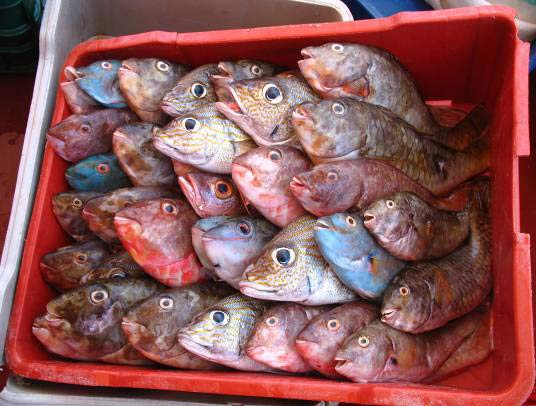
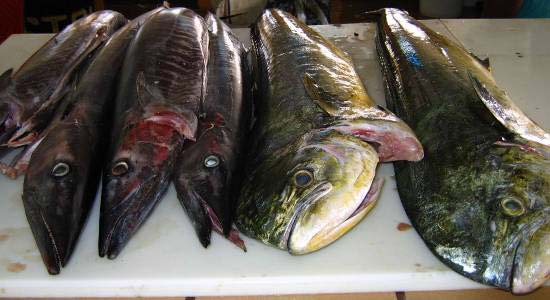
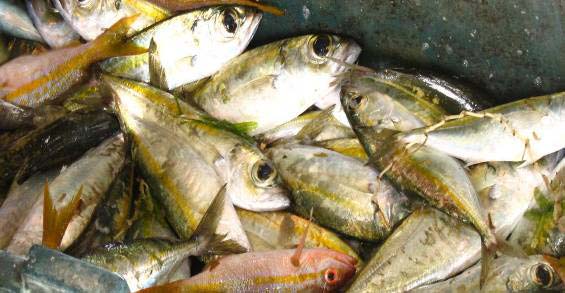
9 APPENDICES
Appendix 1: Description of fish species groups targeted in the Grenadines
Demersals
Major species:
Hinds, groupers, butterfishes
(Serranidae spp.), snappers
(Lutjanidae spp.), parrotfishes
(Scaridae spp.)
Description/
bottom dwelling; found on
Habitat:
shallow shelf, and the deep
slope
Fishing method/
handline, bottom longlining
Gear used:
(sinking palang), traps, spear
gun (free diving and scuba)
Seasonality:
All year
Offshore pelagics
Major species:
dolphinfish (Coryphaena
hippurus), yellowfin tuna
(Thunnus albacares) kingfish
(Scomberomorus cavalla),
barracuda (Sphynaena spp.)
Description/
migratory species; found miles
Habitat:
offshore
Fishing method/
towing, surface longlining
Gear used:
(floating palang)
Seasonality:
All year, mostly January to
May/June
Inshore pelagics
Major species:
Robins (Decapterus sp.), jacks
(Carangidae)
Description/
pelagic; found along the
Habitat:
coastline
Fishing method/
beach seine, cast net
Gear used:
Seasonality:
All year
57
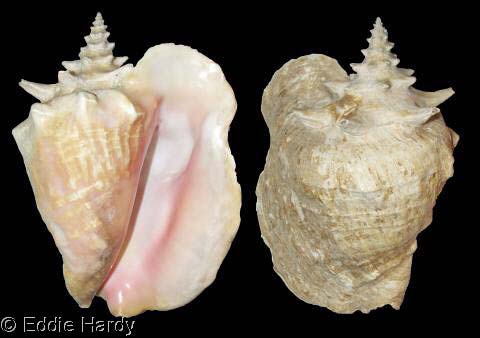
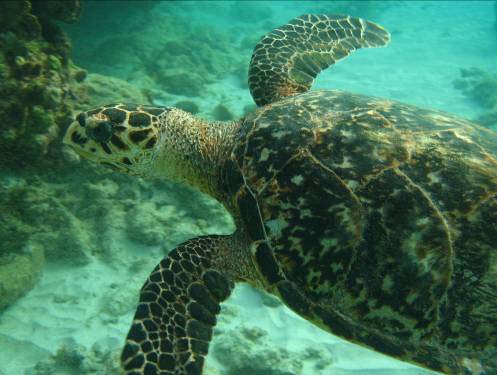
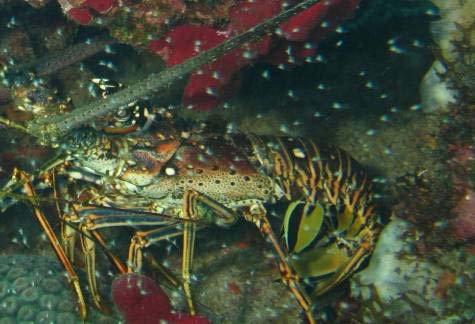
Lobster
Major species:
Caribbean spiny lobster
(Panulirus argus)
Description/ Habitat: benthic; found in reef crevices
on shallow shelf
Fishing method/ Gear scuba and free diving using
used:
wire nooses ("jigs"), traps,
gillnets
Seasonality:
September-April
Conch
Major species:
Queen conch (Strombus gigas),
milk conch (Strombus
costatus).
Description/ Habitat: benthic; found mainly in sea
grass beds
Fishing method/ Gear scuba and free diving
used:
Seasonality:
All year (opportunistic)
Image Source: http://www.jaxshells.org/bitgigj.jpg
Turtles
Major species:
hawksbill turtle (Eretmochelys
imbricata), green turtle
(Chelonia mydas)
Description/ Habitat: pelagic and migratory; green
turtles found on seagrass beds,
hawksbills on reef
Fishing method/ Gear spear, onshore while nesting
used:
Seasonality:
Whales and Porpoises
Major species:
humpback whale, pilot whales
Description/ Habitat: pelagic and migratory; migrates
from the north during the
winter months
Fishing method/ Gear traditional harpoon in a small
used:
double ender boat
Seasonality:
February - April
Image Source: http://www.adfg.state.ak.us/pubs/notebook/marine/hbwhale.gif
58
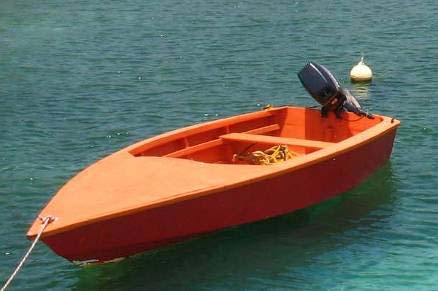
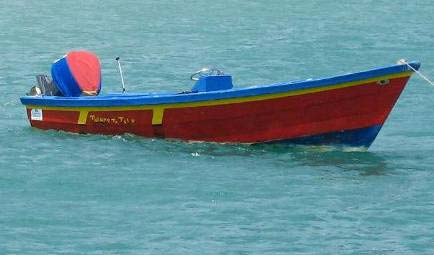
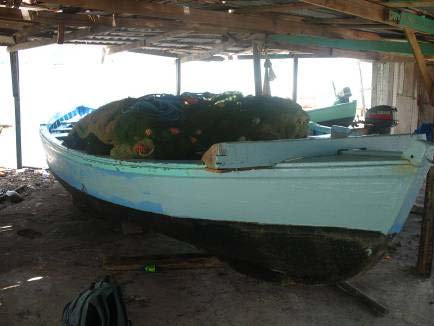
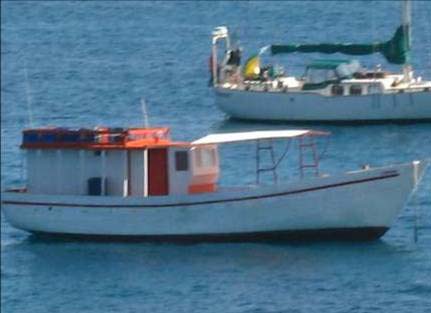
Appendix 2: Description of boat types used in the Grenadines
Bow and Stern (Cigarette/Speedboat)
Description:
Pointed bow and flat stern
Length range:
3.4-8.2 m (11-27 ft)
Width range:
0.9-2.1 m (3-7 ft)
Horsepower range:
14-115 hp
Type of fishing:
Handline, trolling, floating and
sinking palang, traps, spear
(scuba and barewind)
Pirogue
Description:
Higher bow than the speedboat
Length range:
5.8-9.1 m (19-30 ft)
Width range:
1.2-3.0 m (4-10 ft)
Horsepower range:
40-85 hp
Type of fishing:
Trolling & demersals fishery
Double-ender
Description:
Two bows, canoe-shaped
Length range:
3.0-8.8 m (10-29 ft)
Width range:
1.2-2.4 m (4-8 ft)
Horsepower range:
6-48 hp (Mainly oars)
Type of fishing:
Beach seine fishery
Sloop/Longliner
Description:
Most have mechanical
equipment for hauling lines on
board
Length range:
10.6-14.8 m (34.7-48.5 ft)
Width range:
2.9-4.8 m (9.7-15.9 ft)
Horsepower range:
90-190 hp (inboard diesel
engine)
Type of fishing:
Surface longlining for tuna,
trolling, and bottom longlining
59
Appendix 3: Rapid assessment survey
Rapid Assessment/Inventory Survey
Location: ___________________
Respondent #:________________
Date: ________________
Respondent Information & Fishing Practices
1. a) Respondent name:_______________________ b)
M
F
2. a) Age: ________ b) Address: ________________________________
3. a) Is fishing your primary occupation?
Y
N
b) Do you get most of your income from fishing?
Y
N
c) What percentage of your income is from fishing? _______%
4. How long have you been fishing (years)? _______
Boat Information
5. Name of Boat:___________________ Registration Number:____________
6. a) Name of Owner:____________________
b)
M
F
7. Average number of crew working on boat: __________
8. Name and sex of other crew:
__________________________________ __________________________________
__________________________________ __________________________________
9. What gear is used on the boat?
__________________________________________________________________
10. Length of Boat: _______
11. Type of Boat (wood, fibreglass, pirogue, cigarette, flatstern, other):
__________________________________.
12. # of engines: ____ Brand: _____________________ Horsepower ________
Brand: _____________________ Horsepower ________
13. Where do you operate from? ______________________________________
14. What kind of fishing do you do? What islands do you mostly fish around?
15. a) Do you know of any places where fish gather to breed?
Y N
b) What kind of fish? __________________________________________
c) Location/s _________________________________________________
16. Will you be willing to take part in a more in depth interview? Y N
Contact Info: ____________________________________________________
60
Appendix 4: In-depth survey
A Livelihoods Analysis of Fishermen in the Grenadines
This interview will focus on livelihood assets as well as strategies and vulnerabilities that fishers both utilize
and face. The final report on the findings of this study will contribute to my research project for the CERMES
MSc degree, and hopefully be used in further decision making regarding fishery resources.
The respondent's name will be kept confidential and separate from the information contained within this
interview.
General Information
1. Respondent
#:
2. Date:
3. Location:
4. Address:
5. Sex:
Male
Female
6. Age:
7. Boat:
Owner
Crew member
Captain
Livelihood Strategies
8. Is fishing your primary occupation?
Yes
No
9. Did you have other occupation(s) before fishing?
Yes
No
a. Previous
occupation(s):_______________________________________________
10. Why did you start fishing?
11. Presently, what are your income-earning activities (in order of importance) and what
is their proportion of your total income?
Income-earning activities
< ½
½
> ½
All
1.
2.
3.
61
12. Aside from fishing, why have you chosen these activities?
Income-earning activities
Reason(s) for choosing these activities
Livelihood Assets
Human Capital
Knowledge, Education and Skills
13. For how long has fishing earned you an income? _______ years
14. How many hours a week do you spend fishing? _______ hours
15. Who taught you how to fish and about the different types of fishing?
_____________________________________________________________________
16. How did you learn about the different types of fish and their biology (E.g.
spawning/feeding grounds)
17. Are you teaching or have you taught anyone your fishing skills and knowledge?
Yes
No
Relationship:
____________________________________
18. Do you think there is enough information (whether scientific or traditional) available
to you, about the fish species you target?
Yes
No
a. If no, what other information is needed?
19. What is the last type of school you attended?
None
Primary
Secondary
Post-secondary / technical
University
Other
20. If additional training and education were made available to fishers, (E.g. Fishing
skills, financing, safety etc.) what types would you recommend?
62
Personal and Family
21. What is your religion?
Anglican
Methodist
Roman Catholic
Seventh Day Adventist
Protestant
None
Other _______________________________
22. What is your marital status?
Single
Married
Common Law
Widowed Divorced
Other ______________________________
23. How many children do you have? _______ boys
_______ girls
24. How many people over the age of 16 live in your household?
Relationship of HH
Level of
Primary Income
Secondary
member to
Sex Age Education
source
Income source
Respondent
25. Do any of your family members assist you in any aspect of your fishing practices?
Yes
No
Relationship(s): _______________________________
a. How? (E.g. cleaning fish or going out to fish for their own LH as well etc.)
Social Capital
26. What do you do in your spare time (i.e. when not fishing or doing other jobs)? (E.g.
Community festivals, lime at the rum shop, read the papers)
63
27. Are you a member of any social or community groups (E.g. Church, sports, culture)?
Level of
Community Group
Role
Reason for membership
activity
1. Very active
2. Average
3. Not so active
28. If one existed, would you be part of a fishers' organization / co-op? Yes No
a. Why?
29. Are you involved or aware of any conflict amongst fishers?
Yes No
a. Please explain
30. Are you involved or aware of any conflict between fishers and other people?
Yes
No
a. Please explain
31. In times of need or crisis, who would you turn to for help?
Relationship(s): _______________________________________________________
a. Why?
64
32. Do you assist any of the following when they are in need:
If yes, How?
a. Other
fishers
Yes No
Friends within or out
b.
Yes No
of your community
c. Family
Yes No
Natural Capital
33. Rank the following fish types that you catch (in order of importance) and the changes
in abundance relative to 10 years ago:
Fish Type
Abundance 5 years ago
Abundance Today
( ) Reef fish
( ) Bank fish
( ) Lobster
( ) Conch/lambie
( ) Pelagics
( ) Turtle
( ) Porpoise / whale
1. Very low
2. Low
3. Same
4. High
5. Very high
65
34. In your opinion...
What are some of the issues associated
a.
b. What are some solutions to these issues?
with fishing?
Physical Capital
35. If you are a boat owner:
Emergency
Yes
Source of funds
Boat
Engine
Fishing gear
equipment
No
Own money
Types:
Bank loan
Family loan
Other:
Value $
$
$
$
36. If you are a crew member or captain:
a. If own, source of funds
b. Value
Fishing
None
Own
Own $
Bank loan
$
gear
Borrow
Rent
Family loan
Other:
Emergency
None
Own
Own $
Bank loan
$
equipment
Borrow
Rent
Family loan
Other:
66
37. What other gear do you require to be an effective fisherman?
38. What facilities do you use whilst fishing and what are their locations?
Facility
Location
Improvements?
a. Jetties
b. Moorings
c. Gas
Stations
d.
e.
39. What new facilities do you think are required?
40. Home ownership:
a. If own, source of funds:
Self owned
Rented
Own $
Bank loan
Family owned
Other:
Family loan
Other:
41. Materials and facilities within your home:
Walls
Concrete
Wood
Other:
Roof
Tiles
Metal
Other:
Floor
Concrete
Wood
Carpet
Other:
Running
In-door
Facilities
Electricity
Out-door toilet
water
toilet
67
42. Does your household own any of the following:
a. Source of funding for largest item:
TV
Fridge
Stove
Own $
Bank loan
Stereo
Car
Computer
Family loan
Other:
Washing/Drying
Other:
machines
43. Do you own any land?
Yes
No
a. If yes, what activities are carried out on this land?
44. How would you rate the following:
Accessibility Quality
a. Schools
b. Health
centres
c. Fishing
facilities
d. Enforcement
agents
1.
Very
good
2.
Good
3.
Poor
4.
Very
poor
Financial Capital
45. In an average week, how much will your catch be sold for? _____________________
46. How are the earnings from fish sale divided up amongst crew members?
68
47. Customer information:
Quantity Reason
Species Customer
Price/lb
Reliable
Most Half Few
Price Convenience Other
Buyer
48. What is the average cost per fishing trip?
Item Amount Cost
Oil
Gas
Ice
Bait
Food
69
49. What are your maintenance costs like?
Item
Cost per year
Engine
Painting
Re-fiberglass
Seating
Gear (specify type)
50. Saving money...
a. Do you save money?
Yes
No
Why (children, don't make
b.
enough)?
c. If yes, how (bank, etc.)?
If yes, what are the sources
d.
(income, family, etc.)?
51. Do other members of your HH contribute to HH income?
Yes No
52. Are you the primary income provider in your household?
Yes No
70
Vulnerability Context
53. When are you able to fish for your target species?
Fish
type
J F M A M J J A S O N D
* 0 for no fishing at all; 1 for some fishing; 2 for high/normal levels
54. During a hurricane where would you store the boat you own or work on?
55. Did you suffer any recent hurricane damages to your...
Value of damages
Length of time it took to make repairs
a. Home
b. Boat
c. Gear
56. Do you have insurance?
None
Life
House
Boat
Car
Other:
57. Which of these factors threaten your fishing livelihood the most?
Increases in oil/gas prices
Reduction in fish abundance
Maintenance costs
Bad health
Lack of market to sell
Other factors:
58. How do you think tourism impacts you as a fisherman?
71