Connections 22 June2006
An electronic bulletin about interdisciplinary research, teaching and outreach at the
Centre for Resource Management and Environmental Studies (CERMES)
Faculty of Pure and Applied Sciences, University of the West Indies Cave Hill Campus
In the lead up to the end of the second semester at
international research ship, and was part of Dr.
CERMES, we have continued to be occupied with
Oxenford's preparation for joining the FAO-Lesser
lecturing, preparations for research and internship
Antilles Pelagic Ecosystem research cruise in May
projects as well as participation in regional and
2006.
international projects and meetings. Please read on for
FAO-LAPE research cruise
a complete run down on our activities.
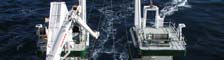
Dr. Hazel Oxenford participated in the second leg of
Land-based sources of marine
FAO's Lesser Antilles Pelagic Ecosystem Biomass
pollution discussed in Cuba
Assessment research cruise, spending two weeks (May
10 - 22) onboard the
Dr. Hazel Oxenford was an invited participant to the
ultra modern research
United Nations Environment Programme and Centro de
vessel "Celtic Explorer",
Ingenieria y Manejo Ambiental de Bahias y Costas
as a member of the
(UNEP/Cimab) regional workshop "Coastal and marine
scientific team charged
water quality indicators and methodologies to determine
with documenting the
pollutant loads in the wider Caribbean" in Havana,
vertebrate and
Cuba, 4-8 April. The workshop was held as
invertebrate biomass of
recommended by the Interim Scientific Technical and
the waters within the
Advisory Committee to the Land-
EEZs of the eastern
Based Sources of Marine
Caribbean islands.
Pollution (LBS) Protocol of the
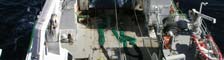
Collections were made
Cartagena Convention. The
using a midwater multi-
target participants were
sampler trawl net
Trawl net with 3 cod-ends on
Government and/or Research
capable of fishing at
aft deck of the Celtic Explorer
Institution personnel responsible
three discrete depths
for, or active in, coastal water
in a single tow. Trawl sets were made during the day
quality monitoring. The key
and night hours on all of the different acoustic targets
objective of the workshop was to
(e.g. dense schools and scattered layers) detected by
discuss methodologies applied
the 24 hr acoustic monitors, and hundreds of different
to determining pollutant loads
taxa (including fish, squid, tunicates, jellyfish and
from point and non-point sources of pollution, and to
crustaceans) were caught from depths of between 20
evaluate and recommend the coastal and marine water
and 600 m below the surface. A full cruise report will be
quality indicators that should be used regionally to
published shortly by the FAO-LAPE project and many
assess the condition of coastal waters across the Wider
collaborative scientific papers are expected to result
Caribbean. In addition, there was information and
from the data collected.
knowledge sharing regarding the characterisation and
quantification of municipal and industrial solid
Charting a new course for adaptive
waste. The preliminary draft update of CEP Techinical
co-management
Report 33 "Land-based sources of pollution in the Wider
Caribbean" was also reviewed.
Dr. Patrick McConney is participating as a research
Safety at sea
collaborator in the study: Charting the New Territory of
Adaptive Co-management: Collaborating, Learning and
Dr. Hazel Oxenford participated in a Safety at Sea
Adapting through Complexity. The project team, lead
training course at CFTDI in Trinidad (12-13 April) and
by Canadian scientists with funding from several
obtained an international Certificate in Personal
Canadian sources, consists of eighteen individuals. The
Survival Techniques (in accordance with STCW 95
aim of the study is to assess the changing directions of
Convention Section A-VI/1-1). This is now a standard
co-management research and to chart a new course for
requirement for anyone joining the crew of an
adaptive co-management (ACM) within the frontier of
examine the potential impact of climate change on
complex systems theory.
the flow rates of the Macal River; and the Mountain
Student field trips
Pine Ridge Forest Reserve to learn of the
devastation of the Pine Bark beetle on the reserve
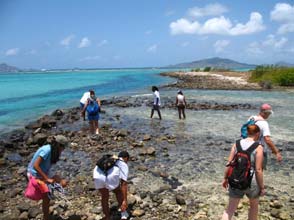
During April and May, students in both the Coastal and
and the impacts of climate variability on this
Marine Resource Management and Climate Change
outbreak.
Streams participated in field trips to the Grenadine
Islands and Belize, respectively.
Ecosystem approach to managing
Our Coastal
fisheries
students, along with
Dr. Patrick McConney attended an FAO Expert
Dr. Robin Mahon
Consultation on Economic, Social and Institutional
and Maria Pena,
Considerations of Applying the Ecosystem Approach to
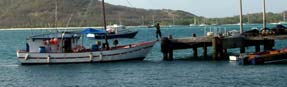
visited four
Fisheries Management in Rome, Italy, from 6-9 June
Grenadine Islands
2006. The international consultation drafted outlines of
Bequia, Union
what a technical paper and guidelines on this topic
Island, Mayreau,
should contain. These documents will be published by
Carriacou and some
FAO in due course.
adjacent marine
Exploring the abandoned
areas such as the
Grenadines Marine Space Use
Ashton Bay Marina, Union
Tobago Cays from 20-
Information System (MarSIS): Part 2
27 May 2006. The purpose of the trip was to broadly
look at issues affecting natural resource management
CERMES PhD candidate, Kim Baldwin, has recently
and sustainable development in these small islands,
completed her preliminary marine resource user data
with an emphasis on both the technical and human
scoping trip for the Grenadines MarSIS project. During
aspects of management. Places of interest visited
May 2006, the Grenadine Islands were visited to better
included the Old Hegg Turtle Sanctuary in Bequia, the
understand the existing marine resources, their uses,
abandoned Ashton Bay Marina Project to examine its
users, infrastructure and current management as well
impacts on the adjacent mangroves and tidal flushing of
as to identify areas for further exploration during the
the area; the Tobago Cays for a snorkeling and diving
project. The project
expedition and to learn of the past proposal to privatize
was introduced to
the Cays and the ensuing opposition from citizens and
community leaders
NGOs; and the marina project in Tyrell Bay, Carriacou
and various marine
to examine its potential impacts on the mangroves in
resource users of
the Bay.
the Grenadines. Kim
will be returning to
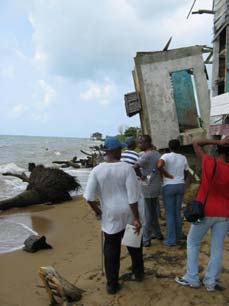
The Climate Change students accompanied by Dr.
the Grenadines later
Leonard Nurse and Neetha Selliah visited Belize from
this month with two CERMES MSc Coastal Resource
28 April 6 May 2006, and
Management students to conduct socio-economic and
were hosted by Dr. Kenrick
livelihoods analyses of all marine resource users in the
Leslie and the Community
Grenadines throughout the summer.
Climate Change Centre
(CCCCC). The purpose of
CERMES adds two professors to
this eight day field trip was
teaching staff
to investigate the
effectiveness of various
Heartiest congratulations to Robin Mahon and Hazel
adaptation and mitigation
Oxenford on their recent UWI promotions from Senior
measures to combat the
Lecturer to Professor on in May 2006.
impacts of climate change.
New publications
Sites visited included the
Monkey River village to
Just hot off the press:
examine the impacts of sea
Mahon, R. 2006. On the role of consulting in fisheries
Coastal erosion in
level rise on coastal erosion
development. Marine Policy 30: 593-596.
Monkey River, Belize
and the potential loss of a
village to the sea; the renewable energy village of San
CERMES 2006. Distributed governance, policy
Benito Poite where electricity is generated through solar
networks and maximizing opportunities for informed
photovoltaic panels; carbon sequestration plots in the
decision-making Part 1. CERMES Policy
Rio Bravo Conservation Area; the Chalillo Dam to
Perspectives. 4p.
CERMES Phone (246)-417-4316; Fax (246)-424-4204; cermes@uwichill.edu.bb; www.cavehill.uwi.edu/cermes
Mailing address: CERMES, University of the West Indies, Cave Hill Campus, St. Michael, Barbados