ANNEXURE 8a-e : GEF STANDARD ANNEXES
8a
Letters of Endorsement
8b
Letters of Co-Finance
8c
Project Site Map
8d
Stakeholder Involvement Plan
8a)
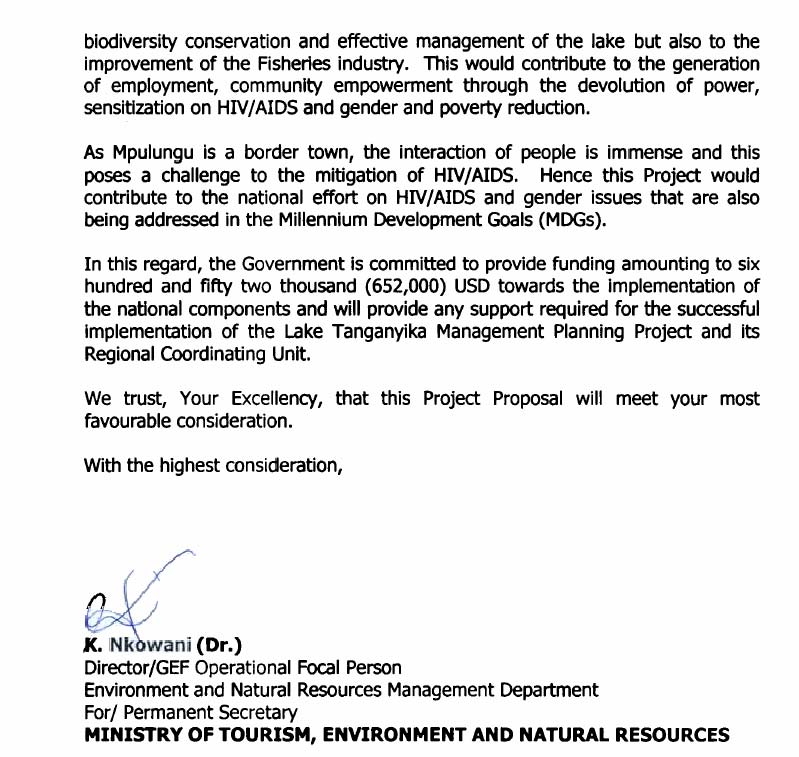
LETTERS OF ENDORSEMENT BY GEF Operational Focal Points
The signatures of GEF Operational Focal Points are attached here within this Annexure.
Country
Date of Endorsement
Name and Position of OFP
Burundi
June 2000
Director General Environment
DRC October
2004
Director
Environment, Kinshasha
Tanzania
September 2004
PS Vice Presidents Office
Zambia
August 2004
Director Environment
8b) LETTERS
OF
CONFIRMATION OF COFINANCE
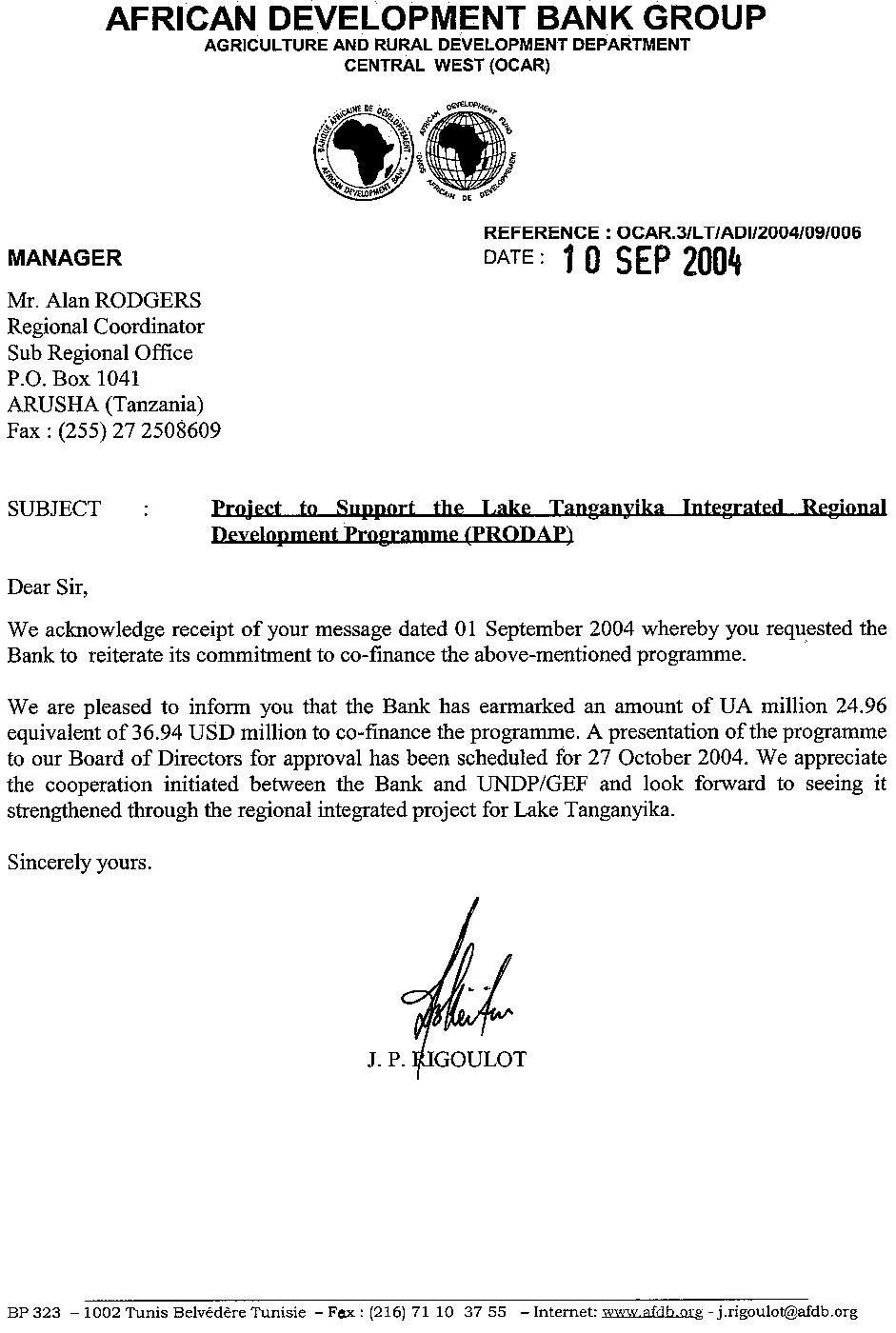
Eight Letters of Confirmation are attached:
· From IUCN for 1.0 million $
· From Nordic Development Fund for potential 4.5 million $
· African Development Bank for 30 million $ (Amount upgraded to 36 mill$)
· Private Sector Contribution to Waste Water in Burundi (0.89 mill $)
· Government of Tanzania for
· Government of Burundi for
· Government of DRC for
· Government of Zambia
From NORDIC DEVELOPMENT FUND<Magnus.Magnusson@ndf.fi>
Date Friday, August 20, 2004 5:10 pm
To <benoitb@unopsmail.org>
Cc <tdamhaug@c2i.net>, <Arnthor.Thordarson@ndf.fi>
Subject RE: RE: RE: Lake Tanganyika Project: Kigoma WasterWaterTreatment Component: Special NDF
Appraisal Mission
Dear Benoit,
Torbjörn Damhaug has informed me that he would be available for conducting the special NDF
appraisal mission to Kigoma (via Dar es Salaam) during the
first week (ten days) of September. I have asked Torbjörn to hereafter take direct contact
with you and Katrin Lervik (who knows Torbjörn -both are Norwegian) with regard to detailed
planning, timing etc. of the mission.
I am confident that the mission will be successful and provide us with sufficient information to
move ahead with project preparation activities.
If all works as planned, I will submit to the NDF-
financed components to NDF's Board of Directors for approval at the Board meeting
on 9 December (or a per-capsulum decision earlier if needed). Please note that my colleague
Arnthor Thordarson will be in charge of project implementation activities after the credit agreement
has been signed by the Government of Tanzania.
All the best and let's stay in touch.
Magnus Magnusson
Regional Manager
Nordic Development Fund
P.O. Box 185
FIN-00171 Helsinki
Finland
RE LETTERS OF CO-FINANCE FROM TANZANIA and ZAMBIA THESE ARE WITHIN THE LETTERS OF
ENDORSEMENT SEE ABOVE
Tanzania
Zambia - 652,000$ - in Kind.
ANNEX 8 d : MAP OF LAKE TANGANYIKA REGION SHOWING MAIN TOWNS
ANNEX 8e STAKE-HOLDER INVOLVEMENT PLAN
1 Details of Stakeholder Interactions:
The project development phase started with a series of meetings at Regional, National and District level. Regional and
National Steering Committees were created and national working groups which included representation from District
Government and Civil Society the "Principal Stakeholders".
Specific objectives of these meetings were:
· To introduce and brief the stakeholders on the GEF PDF B Lake Tanganyika Project: its objectives, outcomes, outputs
and tasks.
· To learn of stakeholders expectations and understand their interests and concerns priorities within the large Strategic
Action Programme for Lake Tanganyika;
· To identify strengths, weaknesses, opportunities and threats among the stakeholders.
The PDF B gathered and compiled available information on:
On-going initiatives that are relevant to the SAP
Resource surveys, and resource utilization
Changes to the Threat Analysis of the TDA.
Existing policy analysis process
Review of lessons learnt and experiences of relevance to this project.
Organize the Stakeholder Planning workshops and
Develop the project brief
A series of informal and formal short meetings between the project and various stakeholders followed these inception
workshops. Most of the meetings were between the Working Group and specific stakeholder groups. These meetings gave
directions for the planning of the four consultancies studies including drafting their terms of references. The studies were also
conducted through participatory methodologies by consultations with stakeholders at national, districts and sub county levels.
On completion of fieldwork and draft reports by the consultants the Vision and Strategy Workshop was organized. The
workshop was held in Jinja from 20th to 21st June 2002. The objectives were :
Develop the Vision, Goal and Purpose of the Project.
Select project field sites
Develop strategies for achieving the validated objectives.
Develop broad actions and action plans.
Develop Monitoring and Evaluation framework.
Define the next steps.
The composition of the workshop participants remained as for the Mbarara Inception workshop. The workshop objectives
were ambitious and could not all be met in the two and half days however the first three objectives were fully covered. The
workshop outputs were the followings:
1. Project Vision, Goal and Purpose
2. Agreed project sites
3. Identified major conservation issues, elaboration on root causes and strategies.
4. Consultation be sought with donors operating in the AR area to prepare co funding.
5. That the project development workshop be held at district level to discuss all the findings and develop a log-frame for
the project.
6. That the studies conducted will be synthesized into one document, and used to sharpen the underlying causes and
strategies for inclusion in the Project Document
1. The time framework for the activities ahead aimed at submitting the Project Document to Ministry of Finance and
Economic Development (MoFEP) by September 2002. But if there is an extension for a maximum of two months, this
may be sufficient to compensate for the time lost due to the delays in start up of the planning process. For that matter, the
latest time for submission of the Project Document would be November 2002.
The final National Consensus Workshop popularity known as the Hoima workshop was held on the 30th October to
1st of November in Hoima town. Key particiapants were form the districts and sub-counties of the project sites, and
the national level stakeholders remained as for the Jinja workshop. The objectives of the workshop was to:
Confirm the project Goal and purpose defined in the Jinja workshop
Carry out a situation analysis of the conservation issues of the forests in the Albertine rift (Kyenjojo, Kibale, Hoima
and Masindi Districts)
Develop log-frame for the ARFCS that defines Objectives, Outputs/ Activities, indicators, and means of verification,
risks and assumptions.
Develop a broad Monitoring and Evaluation framework
Develop framework for implementation modalities.
The workshop objectives were satisfactorily achieved with the exception of the formulation of the monitoring and evaluation
framework. The following additional commitment for consultations was arrived at the closing of the workshop.
WWF shall support the process of project proposal development until completion
Workshop views and expectations will be considered in project brief documentation
Stakeholders will be continuously updated on the Project development progress
The Project leader will volunteer if invited to pay visit to Kibale district and work with the DFO and DEO to explain
the issues of forests on private land.
2 Public Participation Mechanisms and Participation Principles:
The process of stakeholder participation in the GEF Lake Tanganyika Project has been guided by a clear set of principles:
These are:
Principle
Stakeholder participation will:
Value Adding
be an essential means of adding value to the Lake Project
Inclusivity
include all relevant stakeholders
Accessibility/Access be
accessible
and promote access to the process
Transparency
be based on transparency and fair access to information
Fairness
ensure that all stakeholders are treated in a fair and unbiased way
Accountability
be based on a commitment to accountability by all stakeholders
Constructive
seek to manage conflict and promote the public interest
Redressing
seek to redress inequity and injustice
Capacitating
seek to develop the capacity of all stakeholders
Needs Based
be based on the needs of all stakeholders
Flexible
be flexibly designed and implemented
Rational & Coordinated be rationally planned and co-ordinated, and not be ad hoc
Excellence
be subject to ongoing reflection and improvement
Stakeholders
Interests in Project
Influence on Project
Impact of Project & Mitigation
Statutory Environmental Management Project directly promotes their
Direct oversight for key
Project will intensify activity
Agencies
corporate mission
project components. Co-
Project will draw on technical and human
These are Environment Departments
ordination role
resources.
(Authorities, and Councils)
Participation in Project
Committees
International Agency, eg
Project directly promotes mission.
Direct responsibility for key
Project will impose considerable
UNDP, UNOPS, FAO AfDB &
Donor partnership is promoted
project components.
administrative responsibility.
Donor Partners.
Participation in Oversight
Committee
Government Bodies: National Govt:.
Project aligns with, and promotes
Decision making powers vest
Project will impose administrative
Ministries for Water Land, Agric,
policy at all levels; Project gives
in Government on a range of
responsibility
Natural Resources.
opportunities for integrated action
matters;
Local Government at District Level
on key government policy
Existing law and policy will
Government bodies will need to ensure
and City/Town Councils.
initiatives, such as the CBNRM.
act as a legal framework for
alignment with policy. Project will impact
Capacity building and
project activities
on human and financial resources
empowerment of local
government.
The Private Sector
Support to Waste-Water Project
Project partnerships
The benefits from urban waste-water
activities (either directly as in Co-
management should outweigh costs of
Industries in Kigoma and Bujumbura
Finance) or by compliance.
involvement.
International NGOs / CGIAR
Long-term interest in the
Project partnership, with direct Partnership recognition.
Agencies
conservation of Lakes Area and so
responsibility for
Members of implementation
of project
implementation
partnership.
IUCN, WWF, ICRAF
National Civil Society - NGOs:
Project Partnerships, distinct roles
Direct Responsibility for some
Project will impose on capacity of some
Eg TACARE of JGI in Tanzania.
in implementation
project implementation
organizations to deliver efficient and
Newer NGOs in Uvira area of east
effective service. But project provides
DRC
support for this and develops NGO
capacity and profile.
Local Level CBO / NGO:
Project to support them to increase
Involved with local
Project will impose on capacity of
capacity for sustainable natural
governance and service
organizations to deliver efficient and
resource management activities.
provision
effective service
Education and awareness can be
raised
Local community resource user
Local capacity will be
Groups are largely informal
The group's activities will be supported
groups
strengthened. This links to AIG
and still un-organized. Based
by the project and incorporated in the
activity. The activities of illegal
in marginalized and poor
collaborative agreement arrangements
NTFP users will be threatened by
communities. The project will
the project.
give support and formality.
The challenges in stakeholder participation are:
The PDF B process through consultancy studies and national consensus workshops consistently identified lack of technical
capacity among stakeholders to manage the Lake Catchment Resources as one of the major threats to sustainable conservation
inputs. Inadequate human capacity both in skills and numbers were identified as one of the constraints in the management of
the catchment resources.
Local communities do not have capacity to make decisions over natural resources management issues. Their rights have
overtime been over shadowed by the government authorities. There is need to improve the capacities of the local governments
to work with communities and civil society to integrate and mainstream conservation and environmental protection initiatives
in their local development plans and prioritise their funding.
Lack of capacity by the hosts institutions in natural resources management to network and complement each other was
identified during the PDF B as the major cause of weak institutional structural linkages and this at times have resulted in
conflicts among stakeholders over implementation of conservation programmes.
Participation mechanisms:
The project will provide the following opportunities for participation Support to capacity building through training and staff
development for both local government communities in order to effectively implement and oversee the numerous and complex
tasks of catchment and biodiversity conservation. Focal capacity building will be in: training in natural resource management
planning, development of land-use and environmental management plans, alternative Income Generation activities and small-
scale enterprise, conflict resolution skills, erosion control, participatory resource management techniques.
Raising awareness of stakeholders of conservation needs and of opportunities to participate in and/or support project activities.
Pro-active engagement of the local governments, CBOs and NGOs to advocate and execute their rights, roles and
responsibilities over the natural resources under their jurisdictions. Decision-making, through establishment of national and site
specific project committees and processes. Conservation and Resource Committees and User Groups at the project sites.
Where new structures or forums will be established, the necessary support for their successful operation will be given by the
project. This will include support in the facilitation of proceedings at local level. In these cases the process will be designed to
consider the sustainability and ongoing effectiveness of these bodies. All relevant existing structures and fora in the area will
be evaluated for possible involvement. Capacity Building A comprehensive capacity building program will be designed and
will be implemented during the lifetime of the project with an emphasis on technical and institutional development of the civil
societies and the local governments. Skill development - will be directly addressed as an aspect of the economic development
and conservation intervention components of the project.
Annex 9 Lake Tanganyika Integrated Regional Development Programme
Description of Programme (From AfDB ProDoc June 2004)
Generalities. The LTIRDP was designed to implement the policies of the framework fisheries management plan (FFMP)
and SAP II. It translates the determination of the partners involved (ADF. GEF, FAO, IUCN, NDF, EU, FINNIDA) to
accompany the Governments in their efforts to lay the foundations of a sustainable management of the Lake and the
resources of its basin. In addition to the policies of the FFMP and SAP II, the programme is also based on the general
principles of the code of conduct for responsible fishing adopted by FAO in 1995, which on the whole seeks to maintain the
quality, diversity and availability of fish resources in sufficient quantities for the present and future generations of the
countries concerned. More globally, the programme falls within the policies of the Poverty Reduction Strategy Papers
(PRSP) and the interim PRSP prepared by the States, which aim at a lasting and sustainable economic growth for poverty
reduction. It incorporates the Bank's food security, poverty reduction, environmental protection and regional integration
vision.
Objectives and expected results: The overall objective of the programme is to contribute to poverty reduction in the Lake
basin. More specifically, it aims to improve food security and the welfare of the populations of the basin through good
management of Lake Tanganyika. The programme has five components: A) Capacity building; (B) Fisheries development;
(C) Rehabilitation of infrastructure and post conflict operations; (D) Environmental protection and biodiversity; and (E)
Programme management. The results expected from the programme are: (i) the establishment of viable national and regional
institutions for cooperation and integration; (ii) sustainable management of fish resources and their enhancement; (iii)
sustainable improvement of water quality; (iv) promotion of sustainable development initiatives in the basin; (v)
strengthening of local, national and regional institutional capacities; (v) development of joint management measures of the
Lake at the regional level; and (vi) establishment of an integrated regional monitoring, information and communication
system.
Detailed description of the components
Component A: Capacity building. The component seeks to beef up the capacities of national and regional institutions with a
view to a sustainable and integrated management of Lake Tanganyika and its natural resources. In particular, it will enable (i)
the support to the establishment of the Secretariat of the Lake Tanganyika Authority (LTA); (ii) support to the improvement
and harmonisation process of fishery and environmental policies and regulations; (iii) support for the drawing up of the
economic and social master plan of the lake basin; (iv) support for the administration of fisheries and fish research stations in
the areas of fisheries planning and back-up research; (v) development of a permanent regional monitoring and
communication system; and (vi) the implementation of training for the executives of the national institutions and NGOs
involved in the programme. This component also seeks to strengthen the local communities in the areas of socio-
professional organisation, natural resources management and environmental protection.
Component B: Fisheries development. The aim of this component is to ensure a sustainable exploitation of the fish resources
and an environmental preservation of the Lake. In particular, it will: (i) introduce the participatory management of fish
resources by developing the joint fisheries management mechanism and the protection of the reproduction areas; (ii)
establish a sustainable fishery statistics system with the constitution of computerised data bases; (iii) put in place a lake
surveillance device with the effective participation of the fishing communities; and (iv) install basic infrastructure and
equipment to enhance the products.
Component C: Rehabilitation of infrastructure and local development initiatives. The component seeks to improve the
welfare of the communities through rehabilitation/reconstruction of the basic socio-economic infrastructure and the financing
of the local development initiatives of the communities. The programme will in particular finance (i) through the local
development funds, the construction of community infrastructure (class rooms, community health centres, latrines, drinking
water points, rural markets, community lake transport, jetties, etc); (ii) reintegration micro-projects and diversification of
activities in favour of the vulnerable populations; and (iii) rehabilitation of rural roads to open up the production areas and
facilitate the free movement of persons and goods.
Component D: Environmental management and conservation of biodiversity. The component aims to finance a series of
activities contributing to the protection of the environment and biodiversity of the Lake. They are in particular: (i) the
construction of a wastewater treatment plant in Kigoma and Mpulungu and the commissioning of that of Bujumbura; (ii) the
protection of 150,000 ha of catch basins; (iii) the harmonisation of environmental monitoring in the basin; (iv) environmental
and health education (against HIV/AIDS, diarrhoea and malaria).
Component E: Programme management. The programme will initially be implemented by the interim Secretariat of the Lake
Tanganyika Authority and, after ratification of the Convention, by the Secretariat. For purposes of efficiency, availability of
infrastructure and accessibility, the Authority will be based in Bujumbura. The national implementation units will be
established in the lakeside towns of the Lake in Bujumbura, Kigoma, Mpulungu and Kaliémie. A multi-sectoral steering
committee will also be set up in each country. The national programme implementation units will play the role of
coordinating and monitoring the activities. The technical implementation of field activities will be provided by the technical
services of the States, notably the departments of environment, infrastructure, health, etc, NGOs and specialised local
agencies.
Institutional provisions. The Convention on the sustainable management of Lake Tanganyika (ASMLT): Its duties will be
to implement policies and decisions taken by the States, give scientific and technical opinions, prepare and propose
programmes of action for approval by the States, negotiate with the donors, monitor the parameters of the Lake and approve
the annual work programmes. It will comprise the representatives of the Ministries in charge finance, fishery, environment,
water and the Executive Director of the Authority, and may, if necessary, be extended to other structures. The LTMC meets
at least two times a year and the Executive Director of LTA will run its Secretariat. In each country, an inter-ministerial
steering committee (NISC) will be set up. It will comprise a representative of the Ministries in charge of Finance, Fisheries,
Environment, Water, Decentralised administrations and a representative of the private sector, two representatives of the civil
society. The duties of the NISC are to consider and approve the programmes of activity and annual budgets, consider and
adopt the status reports see to the application of the recommendations of the various supervision missions. Periodic project
status reports, audit and follow-up reports will be addressed to them. An operational manual will be prepared to define the
role of each of the partners and the work environment.
Programme cost and financing plan. The programme cost is about USD 81.42 million. In keeping with the financing plan
hereunder, the programme will be jointly financed by African Development Bank (36.43%), the Global Environmental
Facility (16.58%), the World Union for the Conservation of Nature (3.44%), the European Union (18.42), the Nordic
Development Fund (14.74%), the Finnish Development Agency (46%), the World Organisation for Food and Agriculture
(1.23%), the Governments and beneficiaries (5.50%) and the private sector (1.2%).
NOTE THAT THIS ANNEX IS TAKEN FROM THE AFDB DOCUMENT OF JUNE 2004. The FIGURES
CHANGE SLIGHTLY BETWEEN COMPOONENTS AND DONORS
ADF GEF IUCN EU NDF FIN FAO GVT BENEF Private sector TOTAL
Components
1. Strengthening of institutional capacities
1.1 Support to Lake Authority
0.70 3.50
0.40
4.60
1.2 Improvement and update of the policy frameworks
0.35
0.15
0.50
1.3 Technical supervision and training 5.09
1.80
0.20
7.09
1.4 Support to the installation of a monitoring
system
0.50
1.00
1.50
2. Fisheries development
2.1 Sustainable fisheries management support
10.32
1.75
1.00
0.25
13.32
2.2 Studies and back-up research
0.44
1.00
1.44
3. Rehabilitation of infrastructure
0.00
3.1Community projects
2.15
5.00 3.05
1.24
11.44
3.2 Economic infrastructure
4.37
10.00
14.37
3.3 Education and health prevention
0.23
0.23
4. Management of the environment and biodiversity
0.00
4.1 Development of the catch basins
1.93 8.00 1.80
11.73
4.2 Waste water treatment
2.00
5.41
0.98
8.39
4.3
Environmental
education
0.17
0.17
5. Programme management
3.41
3.24
6.65
Total cost
29.66 13.50 2.80 15.00 12.00
2.00
1.00
3.24
1.24
0.98
81.42
Table 2: Programme cost estimate by source of finance and countries/beneficiaries in million USD
ADF GEF IUCN EU NDF FINN FA0 GVT BENEF PRIVATE TOTAL
%
BURUNDI
0.00
2.50 0.00 5.00 0.00
0.00 0.00 0.47
0.00
0.98
8.95
11.0
DRC 10.07
2.50 0.00 5.00 0.00
0.00 0.00 1.05 0.46
0.00
19.08
23.5
TANZANIA 7.40
2.50 0.00 2.50 7.80
0.00 0.00 0.88 0.32
0.00
21.40
26.3
ZAMBIA 4.84
2.50 0.00 2.50 4.20
0.00 0.00 0.84 0.46
0.00
15.34
18.8
Lake Authority
7.35
3.50 2.80
2.00 1.00 0.00 0.00
0.00
16.65
20.4
15.0
Total cost
29.66 13.50 2.80
0 12.00
2.00 1.00 3.24 1.24
0.98
81.42
100
ANNEX 10 Lake Tanganyika and Climate Change
A) Introduction
Eastern Africa has a well documented and long history of climate change, across the Pleistocene / Holocene periods. The
Pleistocene ice ages of northern regions were accompanied by dry cold periods in the tropics, with intervening wet warm
periods. The last cold period (peaking less than 19000 years BP) led to the almost total drying of Lake Victoria. Sediment
cores with pollen analysis have documented changing climates over the last few thousand years (Hamilton). More recent
historical records documented rapidly changing lake levels in a lesser Rift Valley Lake (Rukwa) over the past 200 years
(Rodgers). El-Nino phenomena led to higher lake levers (exacerbated by huge sediment loads in more shallow lakes
(Rukwa and Manyara) in this past 5 years. The Great Lakes Region is clearly an area of rapidly changing climatic processes.
Some change is cyclical, with 10-11 and 30 year rainfall cycles, perhaps linked to sun-spot oscillations. But this last decade
has seen growing concern with more anthropogenic climate change global warming linked to greater and greater emissions
of greenhouse gases, principally carbon dioxide. Unless such emissions are greatly curtailed, such warming patterns will be
permanent and not cyclical or reversible in nature.
Global warming has now become an acknowledged fact within the African context, and the Great Lakes Region of East
Central Africa is no exception. Studies suggest higher temperatures and greater aridity (longer dry seasons with more evapo-
transpiration rather than significant absolute reductions in precipitation), together with more extreme climatic events are still
to come1.
The ecological implications of this can be stated in general terms: greater aridity suggests a reduced woody vegetation
cover, acting synergistically with present patterns of conversion of wooded habitats, dry-season fires, and so greater levels
of bare soil and so both water based erosion (and so sedimentation), and wind based erosion and so greater dust levels. This
latter consequence increases localized temperature increases, and reduced woody covers lowers carbon sequestration levels.
Fire incidence will be increased. In turn generalized impacts on people can be visualized, cultivation will be more based on
annual crops, with greater risk of crop losses, populations will move to more permanent water sources (lake shores), and
livelihoods will be more fragile with greater incidence of poverty. This will increase pressure on natural resources (forest
and fisheries) and so intensify this cycle of degradation. The Precautionary Principle suggests that action is taken to reduce
the scale of impact of these potential changes, and that populations adapt to these changing circumstances. Impacts can be
foretold for both fisheries themselves (due to postulated lake temperature changes) and for the lake watersheds as
catchments continue to degrade.
B) Recent Studies Documenting Warming in Lake Tanganyika:
Two recent studies (Verburg et al 2003 and O'Reilly et al 2003) have used historical (meteorological) and paleolimnological
(carbon isotope signatures and modeling of thermocline density gradient) data to document warming trends in Lake
Tanganyika. In the journal Science (July 2003), Verberg et al report that the surface waters of Lake Tanganyika have
warmed 0.9 degrees Celsius since 1913 and more importantly, this has contributed to density differences between layers
which inhibit mixing and thus the recycling of nutrients upwards. In the journal Nature August 2003, O'Reilly et al report
that surface waters have warmed on average 0.1 degree Celsius per decade for the last three decades and that wind velocities
have decreased about 30%, the combined effect of these factors being to increase stability of the lake's stratification and
reduce mixing depth.
The scientific community does not dispute these trends in climate and water parameters. Some researchers, however, are
concerned with the inferences drawn from these data. Verburg et al attribute a decrease in productivity offshore from
Kigoma in the northern basin to the warming trend. O'Reilly et al infer a potential 20% reduction in primary productivity
from carbon isotope signatures in cores which they maintain would be concordant with a 30% drop in fish yields due to lake
warming.
1 Discussion papers from Dr J Lovett at University of York, UK; with reference to studies from climate group at University of Bonn,
Germany. Whilst these centred on Tanzania forest scenarios the results are applicable to the Lake Tanganyika area.
Most fisheries resource managers on the lake have attributed fish declines to increases in fishing pressure and other direct
anthropogenic activities (e.g. industrial pollution in Bujumbura Bay). Indeed, neither the Verburg or O'Reilly papers
thoroughly analyzes the vast fisheries literature assembled from 1992-2000 by the FAO/FINNIDA Lake Tanganyika
Research Project. Other reasons put forwards for reduced catches (by the same group of researchers) have been reduced
stocks due to increased sediment loads in lake waters and so greater turbidity and habitat substrate change. We note that
climate change has the ability to increase the intensity of dry seasons, with more bare ground and so increased sedimentation
into the lake can be expected in the future.
A consortium of ten scientists from the Lake Region and several European Research Institutes (Sarvala et al 2004) has
prepared a response to these papers that was presented at the International Limnological Society Meetings in August 2004.
They argue that the evidence for decreased productivity is ambiguous, as several studies note that decreased primary
production has also been attributed to increased sediment input in the lake (Donoghue et al 2003 a and b). They report that
total lake-wide fish catches had increased up until 1995 and that the regional declines in the industrial fishery are
outweighed by increased artisanal catches. They conclude that declining fisheries stocks are a result of fishery
intensification.
References
Hamilton, Alan. An Environmental History of Eastern Africa. Academic Press.
O'Reilly, Catherine et al 2003. Climate Change decreases aquatic ecosystem productivity of Lake Tanganyika, Africa.
Nature. 424 p 766.
Rodgers, W A 1981 Ecological changes in Lake Rukwa, South-west Tanzania. African J. of Ecology.
Sarvala, J et al 2004 in press. Fish catches from Lake Tanganyika mainly reflect changes in the fishery not climate
change. (International Limnological Symposium).
Verburg, P et al 2003. Ecological Consequences of a Century of Warming in Lake Tanganyika. Science. 301 pp 505 507.
The position is still unclear and needs further attention in the context of adaptive management by all four nations
we note that the 2000 STAP report on Great Lakes calls for greater scientific documentation based on harder monitoring
data. The project will invest in collaborative research and shared experiences. IW-Learn will form a core of the
dissemination process as well as improved linkages to academia and scientific process and fora such as IDEAL.
C) The Catchment Issues
The lake catchments are badly denuded, satellite imagery shows the scale of loss of woody cover and satellite imagery
shows the size of sediment plumes from the many micro-and macro- (Malagarasi and Ruzizi) catchments around the lake.
Deforestation is a result of converting forest and woodland for agriculture (on very steep slopes), and a result of increasing
pressure on wood resources for domestic and small-scale enterprise energy. Cultivation itself is relatively in-efficient, with
little adaptation to farming steep slopes on easily erodible soils. Kigoma District (and by inference other lake areas) have
shown considerable population growth (in-migration and normal reproductive growth). Increasing rates of HIV-Aids have
tempered this growth but removed productive and innovative members of the work-force, forcing greater reliance on poor
fisheries, annual cropping and fuelwood collection.
The solutions here have to be holistic, integrated and based on participatory approaches. They require greater emphasis on
improved agriculture, maintaining and increasing woody vegetation cover and improving livelihoods through diversified
incomes.
D) The Project Response
The Executive Summary to this document summarised the linkage to these and other climate change concerns as follows:
Over-fishing is an issue, stressed by both the past SAP and FFEM studies. The Co-finance for fisheries inputs from AfDB-
FAO-EU-NDF partners (it was the FAO FINNIDA fisheries project in the 1990s that produced the detailed scientific
information now being debated) address this in four ways:
· The fisheries components will increase the intensity of monitoring fish stock and catch data.
· Fisheries communities will be supported to change fishing practices and reduce pressure by value-adding processing to
fish catches.
· The EU and AfDB components of the partnership programme develop alternative income sources for marginalized
fisher-folk.
· This provides mechanisms to mitigate against and adapt to vulnerability from changes in fish catch.
· The Monitoring Processes will address the issue of climate change and fisheries data.
· The Programme will build linkages to ongoing and potential lake scientific studies.
The lake monitoring and management processes are of great importance. The GEF component, working with IUCN co-
finance, on will put the climate change model on the monitoring agenda and seek additional finance from within the
partnership to further adapt riparian communities and support mechanisms to potential patterns of change.
Catchment Management to Reduce Sediment Inputs forms the bulk of GEF funding (some 7.2 million $ out of 13.5).
Predictions of changing climates in central and eastern Africa suggest increased intensities of climatic phenomena (more
extreme rainfall events and more severe drought periods etc). In the absence of catchment interventions it is probable that
erosion, soil loss and so lake sedimentation would be increased. Catchment interventions therefore have two related benefits
to the question of adaptation and vulnerability. Firstly interventions will reduce silt loads and so allow fish stocks to recover
somewhat. Secondly, improved catchments, through social processes of increasing productivity of land, will allow greater
support to livelihoods and so reduce vulnerability to climate changes.
Such catchment interventions (eg reduced deforestation, less exposed soils) will also increase carbon sequestration through
improved carbon sinks and less soil oxidization.
This overall partner intervention includes elements within both national and regional process that address directly the issues
of adaptation and to climate change. Co-finance addresses fisheries. GEF funding has two main components. Firstly at
regional level, the GEF intervention includes developing environmental protocols and standards, within the umbrella of the
Convention, that include indicators related to CC issues and mitigation measures to reduce vulnerability of communities and
resources. Secondly the emphasis on catchment management with components on maintaining woody cover directly
works to sequester carbon and maintain local catchments in ways that reduce climate change deleterious impacts.
The project seeks funding from two GEF Focal Areas: IW for 8.5 Million US$, and CC Adaptation for 5 million US$.
This latter funding goes to three areas:
· Regional Process updating STAP, adding protocols and standards to the Lake Tanganyika Convention that
specifically target adaptation to Climate Change issues and responses.
· Monitoring and Management Responses increasing our understanding of climate change issues, including
developing a scientific assessment of Climate Change issues on a broad lake basin level.
· Catchment management, with an emphasis on maintaining vegetation cover and improving soil conservation
measures. The project will invest in demonstrating the linkages between catchment health and sediment discharge,
using the innovative and participatory M&E techniques of ICRAF (again with linkages to sharing experiences
between lake projects here from Lake Victoria work).
Annex 11: Monitoring Programme for Lake Tanganyika
Background
Lake Tanganyika has had a century of scientific research; leading to much limnological and biodiversity documentation and
applied fisheries data. Information has been collected from all parts of the lake; through investigations out of all four riparian
countries. Much of this information was collated via the GEF funded TBDA and SAP process, and the FAO-FINNIDA
Fisheries Research Project.
All four countries have national research organisations and regulatory organisations with a mandate to collect information on
the Lake and its natural resources. These include specialised fisheries, hydrobiology, water, agricultural and land use and health
agencies.
Unfortunately; capacities in these organisations have not been high and data collection has been ad-hoc and limited in scope
and coverage. Data collection has been to national formats and criteria, with little regional collaboration. Past monitoring and
much of the scientific data collection has not fed into the planning and implementation processes of the regulatory and
management agencies responsible for the resources of the Lake.
The Monitoring Program
All parties have agreed the need for an integrated monitoring program for Lake Tanganyika. Integration is both cross-sectoral
(fish water, land use) and cross all four countries. All parties have agreed that this monitoring program be linked to the
management of the lake and lake resources and should follow regionally agreed formats and protocols, and fall under the
oversight of the developing Lake Tanganyika Authority and Secretariat.
The Tanganyika monitoring program is thus a negotiation process amongst the four countries. The project will facilitate an
assessment of all relevant existing monitoring that is done on/near the lake by various national institutions, including:
catchment land use, fisheries, water quality and some socio-economic parameters. The countries will come together to
negotiate a regionally harmonised monitoring program. Resource Specialists facilitate the development and field-testing and
revision of the regionally harmonized program, and countries will work at the national level through national institutions. And
such institutions and come together regionally several times during this process to, for example, negotiate indicators and targets
and provide feedback on the new program after field-testing.
Monitoring Parameters
Sustainability; working within (enhanced) national capacities will be the key to a successful program. Networking and
partnerships will link national agencies to other global monitoring programs and data sets; including remote sensed
information.
Key Issues will be:
Water Quality
Temperatures, Oxygen, Phosphates, Nitrates, Solids, Turbidity.
Fisheries
Basic catch and effort statistics with socio-economic parameters.
Land Use
Vegetative cover, erosion, river based silt loads; agricultural crop cover.
Specific Studies
Water and health; point pollution, etc
These parameters, with details of spatial and temporary coverage, will be confirmed during the inception process. These
parameters are considered necessary to address the key issues surrounding the lake and the new dimensions of climate change.
GEF Project Monitoring
This is addressed in Annex 2A; The Results Measurement Template. This is based on the ME Indicators Guidelines for IW
Projects. Monitoring protocols via annual reviews and reporting will be detailed in the operational project document.
THE CONVENTION ON THE SUSTAINABLE MANAGEMENT OF LAKE TANGANYIKA
PREAMBLE
The Governments of the Republic of Burundi, the Democratic Republic of Congo, the United Republic of Tanzan
and the Republic of Zambia, hereinafter referred to as the "Contracting States";
Conscious of Lake Tanganyika's unique aquatic and other biological diversity and of the Lake's significance for th
development of the riparian States;
Recognizing that Lake Tanganyika is a shared heritage of the riparian States;
Conscious of the threats to the Lake Basin as a result of pollution, sedimentation, over-fishing and other adverse
impacts of human activities within the territories of the Contracting States;
Reaffirming that in accordance with principles of international law States have the sovereign right to exploit their
resources pursuant to their own environmental and developmental policies and the responsibility to ensure that
activities within their jurisdictions or control do not cause damage to the environment of other States;
Reaffirming further that the conservation of biological diversity is a common concern of humankind and that State
are responsible for conserving their biological diversity and for using their biological resources in a sustainable
manner;
Recognizing that the riparian States share a common interest in the conservation and equitable utilization of the
resources of Lake Tanganyika;
Recognizing that integrated management of the Lake Basin by the Contracting States is essential to ensure its
conservation and the sustainable use of its natural resources and to optimize the benefits derived from it by the
Contracting States;
Recognizing the necessity of establishing a sustainable legal and institutional framework for co-operative
management of the Lake by the Contracting States and the contribution that this would make to strengthening
relations between them and to promoting development in the region;
Recalling the principles enunciated in the Declaration on Environment and Development adopted by the United
Nations Conference on Environment and Development in 1992, the 1992 Convention on Biological Diversity, and
international and regional agreements and instruments relating to shared watercourses;
Have agreed as follows:
Article 1. USE OF TERMS
For the purposes of the present Convention:
"Access to genetic and biochemical resources" means access to obtain samples of biological and other
materials containing genetic material for the purposes of the conservation of, research on, or the commerci
industrial application of, the genetic material or bio-chemicals; and
"Adverse impact" means any actual or potential detrimental effect on the Lake's environment and any actu
potential consequential detrimental effect on legitimate uses of the Lake, on the health of the
1
people of a Contracting State or on their ability to provide for their health, safety and cultural and economic
well-being, that results directly or indirectly from human conduct originating wholly or partly within the territory
of a Contracting State or from a vessel or aircraft under its jurisdiction or control, beyond that which is
negligible or which has been assessed and determined to be acceptable under this Convention and under any
subsequent protocols;
"Authority" means the Lake Tanganyika Authority established under
Article 23;
"Basin" means the geographical area bounded by the watershed limits of Lake Tanganyika.
"Bio-chemicals" means unimproved or unmodified chemical compounds, other than deoxyribonucleic acid
or ribonucleic acids, formed by the metabolic processes of a living organism.
"Biological diversity" means the variability among living organisms from all sources, including, inter alia,
terrestrial, marine and other aquatic ecosystems and the ecological complexes of which they are part; this
includes diversity within species, between species and of ecosystems;
"Conference of Ministers" means the Conference of Ministers established by Article 24;
"Ecosystem" means a dynamic complex of plant, animal and micro-organism communities and their non-
living environment interacting as a functional unit;
"Environment" includes, but is not limited to, the whole or any component of:
(a) nature, which includes air, water, land, including soils and minerals, energy and living
organisms;
(b) the interaction between the components of nature and between those components and
humans; and
(c) physical, esthetic and cultural qualities or conditions that affect the health and well-being of
people;
"Executive Director" means the chief executive and legal representative of the Authority appointed
according to Article 26.
"Genetic resources" means any material of plant or animal, microbial or other origin containing functiona
units of heredity of actual or potential value;
"Interim Secretariat" means the Interim Secretariat established under Annex V.
"Lake Basin" means the whole or any component of the aquatic environment of Lake Tanganyika and tho
ecosystems and aspects of the environment that are associated with, affect or are dependent on, the aquati
environment of Lake Tanganyika, including the system of surface waters and ground waters that flow into
Lake from the Contracting States and the land submerged by these waters.
"Lake Tanganyika" means the water-body known as Lake Tanganyika.
"Management Committee" means the Management Committee of the Authority described in
Article 25;
"Natural resources" mean any naturally occurring living or non-living component of the environment of
actual or potential use or value to humanity, including: air, land, water, soils, minerals, energy, genetic
resources, bio-chemicals, organisms or parts of organisms, populations and other biotic components of an
ecosystem;
2
"Operator" means any person, association, public or private body, whether corporate or not, including the State
2. The Contracting States shall take appropriate measures to address the causes or potential causes of
and
adverse impacts within their jurisdiction or control, to prevent adverse impacts and to mitigate those
any of its entities which e
adverse im
xercises cont
pacts that cannot be rol over dangerous activiti
prevented, and thereby redu es; and "dangerous
ce the risk and ma
activity" means
gnitude of trans-
any activity
listed
"Pollution"
bo means the introduction by humans
undary adverse impacts.
, directly or indirectly, of substances or energy into the Lake
in Annex II.
Basin,
which results or is likely to result, in hazards to h
Article 7. FI
uman health, harm to
SHERIES MANAGEME li
N vi
T ng organisms and ecosystems, damage
to
amenities or
"S
interference with legitimate uses
ecretariat" means the Secretariat
of the Lake,
of the Author
including fishing and navigation;
ity described in
Article 26;
"Trans-boundary
1. The Contr
adverse impact" me
acting States shall co-operans any
ate to pr adverse im
omot
pact that extends
e sustainable fisheries ma beyond the territory of the
nagement on Lake
Contracting
Tanganyika and shall take, as a matter of priority, appropriate measures to prevent and reduce as far as
State in which the physical
possible adverse im origin of t
pacts from he ad
fi
verse im
shing activit pact is situ
ies under ated.
their ju risdiction or control.
2. In order to promote sust
Article 2. O
ainable fisher
BJECTIVE
ies management the Contracting States, acting separately and
jointly, shall:
1. The objective of
a. de
t
velop, he pre
imple sent Co
m
nvention is to ens
ent and enforce a fram ure the
ework fi protect
sh
ion and conservatio
eries management plan n
fo of t
r
he biolo
Lake Tanggical
anyika
diversity and the sustainabl
that shall conform e use of
to the the natural resourc
strategic action pr es of Lake
ogram
Tanganyika and
prepared in accord
its Basin
ance with
by the Co
Article 13; ntracting
States on the basis of integrated and co-operative management.
b. develop harmonized national fisheries policies based on the relevant principles set out in the
2. In order to achieve t
Code his objecti
of Con
ve, t
duct fo he Cont
r Resp
ractin
onsib
g States:
le Fisheries adopted by the Conference of the Food and
Agriculture Organization of the United Nations;
a. co-operate in the development and implementation of harmonized laws and standards
c. de concerni
velop, adong
p th
t, e management of
implement and enf Lake Ta
or
n
ce harm ganyika and
onized legal, its Basin; an
administrati d
ve and technical
measures to manage fisheries and to eliminate unsustainable fishing practices and to reduce
b. accord particular atte
the pressure on ntion
over-e to e
xpl nsuring th
oited
at prese
fisheries by, int and future
partic
comm
ular, regulatunities living near the
ing fishing effort, practices
Lake benefit
capacity
from the sustainable
and aquaculture; and
use of the Lake's natural resources and amenities.
d. promote broad participation in fisheries management including the development of community
based ma
Article 3.
nageme
JU
nt structur RISDICTI
es with due rONAL SCOPE
egard to local
conditions.
Article 8. PREVENTION AND CONTROL OF POLLUTION
The present Convention applies to Lake Tanganyika and to its Basin in the Contracting States as well as to all human
activities, aircraft and vessels under the control of a Contracting State to the extent that these activities or the
operati
1.
on
The of such aircraft or vessels resu
Contracting States shall, as a m lt or
a
are l
tter of i
pr kely
iorit to
y resu
, ta
lt
ke ap in an
propriadverse im
ate m
pact.
easures to prevent and reduce
pollution of Lake Tanganyika and its environment arising from activities within their jurisdiction or
control.
Article 4. CO-OPERATION
2. In particular, each Contracting State shall:
1. The Cont
a. tracting
o th
States
e extent shall co-oper
possible, c
a
onstr te in go
uct and od faith in
maintain i the m
nst
anagement of
allations within t Lake Tan
heir territ g
oran
y yika and
to reduce its Basin in
the
a manner that
risk mo
of p st effectivel
ollution of y prom
the Lak otes the attai
e and its envinment of
ronm
the
ent ;
objective referred to in Article 2 paragraph 1,
and that gives effect to the general principles set out in Article 5.
b. ensure that waste is not disposed of into Lake Tanganyika except under, and in accordance
2. Such co-operation shal
with, a l incl
perm ude:
it issued by the relevant authority of the Contracting State concerned ; and
a. planning
c. develo and m
p, adop a
t, naging activities
implement an
under t
d enfor
he ju
ce appro ris
p diction
riat
or c
e legal, a o
d ntrol of a Contracting S
ministrative and
tat
technical e
which have an a
measures to pr
dverse im
event, contr pact or
ol, m which
onitor a may have
nd reduce an a
pol
d
luti verse im
on:
pact on the Lake and its Basin;
b. suppor
i. fr ting t
om
h
bote activi
h poi ties and buil
nt and non-poiding th
nt s
e ca
ource pacit
s;
y of the institutions established under this
Convention;
ii. from vessels navigating on the Lake; and
c. formulating and adopting protocols to this Convention as stipulated in Article 34;
3
5
iii. from the manufacture, handling, transportation, use and disposal of toxic or hazardous
materials in the Lake Basin.
3. The Contracting States shall develop and adopt a protocol to this Convention specifying the minimum
measures and standards to be adopted by each Contracting State in order to ensure the harmonized
implementation of pollution prevention and mitigation measures to protect human health and achieve a
high level of protection for the Lake Basin.
Article 9. PREVENTION OF SEDIMENTATION
Each Contracting State shall, as a matter of priority, take appropriate legal, administrative and technical
measures to prevent all causes of excessive sedimentation in the Lake, such as deforestation, land degradation
and the destruction of wetlands.
Article 10. CONSERVATION OF BIOLOGICAL DIVERSITY
1. The Contracting States, acting separately or jointly, shall develop, adopt, implement and enforce
appropriate legal, administrative and technical measures:
a. to conserve rare, fragile and representative ecosystems and rare, depleted, or threatened
species and populations of flora and fauna and their habitats that form part of the Lake Basin;
b. to prevent the introduction of, control and eradicate exotic species that threaten ecosystems,
habitats or species and the genetic resources that form part of the Lake Basin;
c. to prevent the deliberate or accidental introduction of species into areas of the Lake Basin in
which they do not naturally occur.
2. A Contracting State shall not permit the introduction of any exotic species of organism into the
Lake Basin or into any other place where there is an appreciable risk of the organism entering the Lake
Basin, unless the other Contracting States have been consulted and have given their consent, which
shall not be withheld unreasonably.
Article 11. ACCESS TO GENETIC RESOURCES
The Contracting States shall co-operate through the
Authority:
a. to develop, implement and enforce legislative, administrative, policy and other measures to
control access to the genetic and biochemical resources of the Lake and its Basin;
b. to promote research into the protection and utilization of the genetic and biochemical resources
of the Lake and its Basin; and
c. to share in a fair and equitable way the results of research and development and the benefits
arising from the utilization of the genetic and biochemical resources of the Lake and its Basin in
accordance with the Convention on Biological Diversity.
6
Article 12. NAVIGATION
1. Subject to paragraphs 4, 5 and 6 of this article, each Contracting State shall accord any vessel
flying the flag of a Contracting State the freedom to navigate on those parts of Lake Tanganyika
under its jurisdiction and control.
2. In the exercise of the freedom of navigation referred to in the previous paragraph, the
nationals, property and vessels flying the flag of any Contracting State shall be treated equally
in all respects and no exclusive rights of navigation shall be accorded to any natural or legal
person.
3. Each Contracting State shall implement and enforce appropriate legal, administrative and
technical measures in accordance with relevant international standards to prevent and reduce
the risk of pollution from any vessels flying its flag.
4. A Contracting State has the right to reserve to its own flag the right to transport passengers and
goods that are both loaded and discharged at ports under its jurisdiction.
5. A Contracting State shall not be obliged to accord freedom of navigation to a warship of
another Contracting State.
6. Each Contracting State may without discrimination restrict or prohibit the navigation by
vessels flying the flag of a Contracting State on those parts of Lake Tanganyika under its
jurisdiction where this is necessary for the protection of the environment, navigation safety,
human health or for reasons of national security.
Article 13. STRATEGIC ACTION PROGRAM
1. The Contracting States shall collaborate in the preparation and implementation of a strategic
action program to give effect to the measures set out in this Convention.
2. The strategic action program shall include specific aims directed at achieving the objective of
this Convention, strategies for achieving these aims, specific measures to be taken by the
Contracting States separately or jointly to achieve these aims and details of the means to be
used to monitor progress toward the achievement of these aims.
3. The Contracting States shall monitor the effectiveness of the strategic action program and
shall revise it as necessary.
4. The Contracting States shall ensure that the measures contained in the strategic action
program are integrated into relevant national policies, strategies, programs and plans.
Article 14. PRIOR NOTIFICATION
1. The Contracting State or States under whose jurisdiction or control a proposed activity listed in
Part A of Annex I is planned to take place or a public policy, plan or program that is likely to give
rise to trans-boundary adverse impacts has been prepared, shall notify the Secretariat as early
as possible which shall notify the other Contracting States without delay.
2. The notification shall contain information on the proposed activity, program or policy, including
any available information on its possible trans-boundary adverse impacts and effects.
7
3. Any Contracting State that considers that it should have received prior notification under this article
of a proposed activity, public policy, plan or program under the jurisdiction of another Contracting
State, shall request the Secretariat to intercede on its behalf with that Contracting State.
4. The Contracting States undertake to define activities that shall require simple notification and
activities that shall require prior informed consent and the modalities of notification in a Protocol to
the present Convention.
Article 15. ENVIRONMENTAL IMPACT ASSESSMENT
1. Each Contracting State, in order to avoid and minimize adverse impacts, shall:
a. adopt and implement appropriate legal, administrative and other measures requiring an
assessment to be conducted of the environmental impacts of proposed projects and of
activities within its jurisdiction or control, that are likely to give rise to adverse impacts;
b. adopt and implement appropriate legal and administrative procedures and institutional
arrangements to ensure that when public policies, plans and programs are being
developed and implemented, the consequences for the Lake Basin are taken into account
including any comments received from other Contracting States;
c. monitor compliance with and enforce any conditions in development consents or other
authorizations that were imposed for the purpose of protecting the Lake Basin.
2. The Contracting State within whose jurisdiction a proposed activity listed in Part A of Annex I is
planned to take place, shall ensure that the environmental impact assessment procedure results in
the production of documentation conforming with Part B of Annex I.
3. A Contracting State that may be affected by a proposed activity listed in Part A of Annex I shall, at
the request of a Contracting State under whose jurisdiction the proposed activity is planned to take
place, promptly provide the latter through the Secretariat, with all information relevant to the
assessment of the potential trans-boundary adverse impacts within the jurisdiction of the affected
Contracting State as is reasonably obtainable.
4. The Contracting State or States under whose jurisdiction a proposed activity is planned to take
place shall, after completion of the environmental impact assessment documentation, consult with
the other Contracting States and the Secretariat on measures to prevent, reduce or eliminate trans-
boundary and other impacts including any post-project monitoring and analysis that may be
required. At the commencement of the consultation the Contracting States shall agree a
reasonable time-table for the duration of the consultation period.
5. The Contracting States shall ensure that in reaching the final decision on the proposed activity, due
account is taken of the outcome of the environmental impact assessment procedure, including the
environmental impact assessment documentation, comments on it and objections to it and the
consultations under this article. The Contracting State under whose jurisdiction the final decision is
made shall provide the Secretariat with a copy of the final decision.
6. If after an activity has been authorized in accordance with this article, the Secretariat or a
Contracting State obtains additional information on the trans-boundary adverse impact of the
activity which was not available at the time the decision was made and which could have materially
affected the decision, this information shall be communicated immediately to the other Contracting
States through the Secretariat and the Contracting States shall consult to decide whether or not the
decision should be reviewed or additional measures taken to reduce or eliminate the impact.
8
. The Contracting States shall ensure that, subject to Article 20, adequate information is made available
to the public concerning the state of the Lake Basin, planned development activities, measures taken or
planned to be taken to prevent, control and reduce adverse impacts, and the effectiveness of those
measures. For this purpose each Contracting State shall ensure that information is made available to
the public on the following:
a. water and environmental quality objectives to be achieved throughout that part of Lake
Tanganyika that falls under the jurisdiction of that Contracting State;
b. the results of monitoring compliance with permits and the attainment of water and
environmental quality objectives;
c. any notifications received by that Contracting State under Article 14 concerning proposed
activities listed in Part A of Annex I;
d. reports on the environmental impact assessment of any of the proposed activities listed in
Part A of Annex I.
2. The Contracting States shall ensure that any information referred to in paragraph 1 that is held by a
public body is available to the public for inspection at all reasonable times free of charge and shall
provide members of the public with facilities for obtaining, on payment of reasonable charges, copies of
such information.
Article 20. EXCHANGE OF INFORMATION
1. The Contracting States shall exchange through the Secretariat data and information concerning the
sustainable management of the Lake Basin and the implementation of this Convention, as is available
including inter alia data and information on:
a. the state of the Lake Basin and its biological diversity, in particular monitoring data and
information of a hydrological, hydro-geological, meteorological and ecological nature and
related to water quality, as well as related forecasts;
b. the results of research relevant to the management of the Lake Basin;
c. legal, administrative and other measures taken and planned to be taken to prevent, control and
reduce adverse impacts;
d. accidents and emergencies that have given or are likely to give rise to adverse impacts;
e. actions taken to monitor, control and enforce legal provisions or administrative measures
used to give effect to this Convention, including any conditions imposed on activities listed in
Part A of Annex I that were imposed for the purpose of protecting the Lake Basin, and any
fisheries conservation and management measures.
2. If a Contracting State is requested by any other Contracting State or by the Secretariat to provide data
or information that is not readily available, the former shall employ its best efforts to comply with the
request.
10
Article 21. PROTECTION OF CONFIDENTIAL INFORMATION
1. This Convention shall not affect rights or obligations of the Contracting States established in
accordance with their domestic laws, regulations, administrative provisions or accepted legal
practices and international agreements to protect information relating to personal data, intellectual
property, including confidential industrial or commercial information or national security.
2. Contracting States that receive confidential industrial or commercial information or other confidential
information in the course of the exchange of information required under this Convention shall respect
the confidentiality of the information received and the conditions under which it is supplied and shall
use that information only for the purposes for which it was supplied.
Article 22. REPORTING
1. Each Contracting State shall report periodically to the Authority on measures that it has taken to
implement this Convention and on the effectiveness of these measures in meeting the objective of this
Convention and on any other matters determined by a decision of the Conference of Ministers. These
reports shall include in particular:
a. information on the laws and administrative procedures of the Contracting State regulating, or
relevant to the prevention, control and reduction of adverse impacts;
b. legal, administrative and other measures taken relating to the assessment of the
environmental impact of proposed activities and measures to give effect to the obligations
envisaged in Article 15;
c. information on the state of the Lake Basin within the territory of the Contracting
State; and
d. measures taken to implement the provisions of this Convention or to further the attainment of
its objective.
2. The Secretariat shall submit recommendations to the Contracting States regarding the reports that are
required for the effective implementation of this Convention, the information to be included in the
reports, the frequency with which they should be submitted and how reporting should be done, for
consideration by the Contracting States at the second meeting of the Conference of Ministers and at
subsequent meetings.
Article 23. LAKE TANGANYIKA AUTHORITY
1. The Contracting States hereby establish the Lake Tanganyika Authority, hereinafter referred to as "the
Authority".
2. The organs of the Authority are: the Conference of Ministers, the Management Committee and the
Secretariat.
3. The function of the Authority is to co-ordinate the implementation of the present Convention by the
Contracting States and, in accordance with this Convention and the decisions of the Conference of
Ministers, to advance and represent the common interests of the Contracting States in matters
concerning the management of Lake Tanganyika and its Basin.
11
4. The Authority shall have international legal personality and such legal capacity as may be
necessary to perform its functions and mission.
5. The Headquarters of the Authority shall be at the place, within the territory of any of the Contracting
States, designated by the Conference of Ministers. The Authority shall enter into a headquarters
agreement approved by the Conference of Ministers with the Host State.
6. The Authority may with the approval of the Conference of Ministers establish regional offices within
the territory of any of the Contracting States.
7. Each Contracting State shall, having regard to the diplomatic rules governing international
organizations, grant to the Authority and its property, funds and assets, the privileges, immunities
and facilities that it needs to carry out its activities; and the members of the Management Committee
and of the Secretariat the privileges, immunities and facilities that they need to perform their official
functions.
Article 24. THE CONFERENCE OF MINISTERS
1. The Conference of Ministers is the supreme body of the Authority. The first meeting of the
Conference of Ministers shall be convened by the contracting State in which this Convention is
signed not later than one year after the entry into force of the present Convention.
Thereafter, ordinary meetings of the Conference of Ministers shall be held in rotation in the
Contracting States at least once a year, unless the Conference of Ministers decides otherwise.
2. Each meeting of the Conference of Ministers shall be chaired by the Head of the delegation of the
Contracting State that is hosting the meeting.
3. Extraordinary meetings of the Conference of Ministers shall be held at any other time decided by the
Conference, or at the written request of any Contracting State, provided that, within three months of
the request being communicated to the other Contracting States by the Secretariat, it is supported
by at least one other Contracting State.
4. The Conference of Ministers shall unanimously adopt rules of procedure for their meetings. The
Conference of Ministers shall unanimously adopt financial rules, prepared in consultation with the
Secretariat, to determine, in particular, the financial obligations under the present Convention and
protocols to which they are parties.
5. The Conference of Ministers shall regularly evaluate the implementation of this Convention, and, for
this purpose, shall:
a. consider and adopt protocols to be concluded in accordance with Article 34;
b. consider and adopt in accordance with Article 35 additional annexes to this Convention;
c. consider and adopt in accordance with Article 36 amendments to this Convention and its
annexes
d. consider amendments to any protocol as well as to annexes to a protocol and, if so decided,
recommend their adoption to the parties to the protocol concerned;
e. establish whatever subsidiary bodies may be considered necessary for the effective
implementation of this Convention;
12
f. undertake any additional action that may be required for the effective achievement of the
objectives of this Convention in the light of experience gained in implementing it.
6. The African Union, the United Nations and their specialized agencies may be represented as
observers at meetings of the Conference of Ministers. Any State not party to this Convention and
any other body or agency, whether governmental or non-governmental, qualified in fields relating
to the subject matter of this Convention, which has informed the Secretariat of its wish to be
represented as an observer may be admitted unless two or more of the Contracting States present,
object. The admission and participation of observers shall be subject to the rules of procedure
adopted by the Conference of Ministers.
Article 25. THE MANAGEMENT COMMITTEE
1. The Lake Tanganyika Management Committee consists of three members appointed by each
Contracting State. The Executive Director of the
Authority shall serve as the secretary of the
Management Committee and shall attend its meetings but shall not have the right to vote.
2. Each Contracting State shall appoint persons with expertise relevant to the sustainable
management of the Lake Basin and the implementation of the strategic action program as
members of the Management Committee.
3. The first meeting of the Management Committee shall be convened by the first Chairperson of the
Conference of Ministers not later than eighteen months after the entry into force of this Convention.
This meeting shall be presided over by a member of the Management Committee from the host
country who shall hold office for a period of three years. At the end of this mandate, the position of
Chairperson of the Management Committee shall be rotated among the representatives of the
Contracting States in the alphabetical order of the countries starting with the first Chairperson.
Thereafter the Management Committee shall hold ordinary meetings at least once a year.
4. Extraordinary meetings of the Management Committee may be held at such other time decided by
the Management Committee and shall be convened at the written request of any Contracting State
by the Chairperson of the Management Committee.
5. Decisions of the Management Committee shall be made by consensus. If the Management
Committee cannot reach consensus on a particular issue, it shall be re-considered at the next
meeting. If consensus is still not reached, a decision may be made by a two thirds' majority of the
votes of the members present and voting either in person or by proxy. The Management
Committee shall propose rules of procedure for itself and for any subsidiary bodies for approval by
the Conference of Ministers.
6. Subject to the provisions of any rules of procedure approved by the Conference of Ministers for the
Management Committee, the latter may form temporary or permanent sub-committees and
working groups and may request technical advice from third parties.
7. The Management Committee shall support, co-ordinate and monitor the implementation of this
Convention. To this end it shall:
a. implement the policies and decisions of the Conference of Ministers and undertake tasks assigned
to it by the Conference of Ministers;
b. provide scientific and technical advice to the Conference of Ministers;
13
g. to maintain databases of information as required by the Management Committee or the
Conference of Ministers and to facilitate the exchange of information under this
Convention;
h. to arrange and support meetings of the Conference of Ministers and of the Management
Committee;
i. to perform the functions assigned to it by any protocol;
j. to prepare reports on the execution of its functions under this Convention and to present them to the
Management Committee; and
k. to perform any other functions as may be determined by the Conference of Ministers.
4. The Conference of Ministers shall appoint the Executive Director and the Deputy Executive Director of the
Authority subject to terms and conditions of service including provisions on removal approved by the
Conference of Ministers for a period not exceeding three years. An Executive Director or Deputy Executive
Director may, at the discretion of the Conference of Ministers, be appointed for one further term of three
years.
5. The first Executive Director and Deputy Executive Director shall be appointed by the Conference of Ministers
from a list of suitably qualified candidates. Subsequent Executive Directors and Deputy Executive Directors
shall be appointed by the Conference of Ministers from suitably qualified candidates nominated by the
Contracting State which in alphabetical order follows the Contracting State that nominated the previous
Executive Director or Deputy Executive Director. If an Executive Director or a Deputy Executive Director
does not complete a term of office a replacement Executive Director or Deputy Executive Director nominated
by the same Contracting State shall be appointed to complete the term of office. Each Executive Director and
Deputy Executive Director shall be a national of a Contracting State. Both the Executive Director and the
Deputy Executive Director shall not, at any given time, be nationals of one Contracting State. The selection
procedure shall ensure that these two positions are filled with one national from the Anglophone countries
and one national from the Francophone countries and vice versa.
1. The Executive Director of the Authority with the approval of the Management Committee shall appoint the
staff of the Secretariat on the basis of technical competence but with due regard to the need to appoint, as far
as possible, equal numbers of technical professional staff from each of the Contracting States.
Article 27. TECHNICAL COMMITTEES
1. The Management Committee shall be assisted in the performance of its functions by:
a. a Socio-economic Technical Committee comprising one representative from each of the
Contracting States, which shall advise the Management Committee on socio-economic aspects of
the sustainable management and protection of the Lake Basin;
b. a Fisheries Management Technical Committee comprising one representative from each
of the Contracting States, which shall advise the Management Committee on management
measures to conserve the fisheries of Lake Tanganyika and to develop the traditional and
commercial fishing sectors on a sustainable basis; and
C. Biological Diversity Technical Committee comprising one representative from each of the
Contracting States, which shall advise the Management Committee on management measures
15
to protect and conserve the biological diversity of the Lake Basin and on access to the
genetic resources of the Lake Basin and related matters.
d. a Water Quality/Pollution Control Technical Committee comprising one representative from
each of the Contracting States, which shall advise the Management Committee on
management measures to monitor water quality and control pollution into the Lake.
2. The Management Committee may, with the consent of the Conference of Ministers, establish other
technical committees to assist it in the performance of its functions.
3. Technical committees shall be governed by procedures approved by the Conference of Ministers
pursuant to Article 25 paragraph 7.
Article 28. FINANCIAL RESOURCES
1. The Contracting States shall contribute in equal proportions to the budget of the Authority unless
otherwise agreed.
2. The Authority shall seek to obtain funds for its operation and for projects from donors and other
sources.
3. The Authority shall, as far its financial resources permit, fund:
a. the incremental costs to each Contracting State of managing the Lake Basin on a cooperative
basis; and
b. activities undertaken to implement the strategic action program in as far as these benefit more
than one of the Contracting States.
4. Each Contracting State shall fund those activities related to the implementation of the present
Convention that are undertaken within its territory or for its exclusive benefit, unless otherwise agreed
by the Conference of Ministers.
5. The Conference of Ministers shall, no later than its third meeting, discuss the adoption of a protocol to
establish a fund or other financial mechanism to support the implementation of this Convention.
Article 29. SETTLEMENT OF DISPUTES
1. In the event of a dispute between Contracting States concerning the interpretation or implementation of
this Convention, the States concerned shall notify this to the Secretariat of the
Authority and shall seek
a solution through negotiation. The Secretariat shall notify the other Contracting States of the existence
and nature of the dispute.
2. If the States concerned cannot settle the dispute through negotiation they shall agree in good faith a
dispute resolution procedure, which may include:
a. jointly seeking the good offices of, or mediation by, a third party (which shall be a Contracting
State that is not involved in the dispute);
b. submitting the dispute to impartial fact-finding in accordance with the provisions of Annex
III; and/or
16
c. submitting the dispute to arbitration in accordance with the procedure laid down in Annex IV.
3. The provisions of this article shall apply with respect to any protocol unless otherwise provided in the
protocol concerned.
Article 30. LIABILITY OF OPERATORS OF DANGEROUS ACTIVITIES
1. Each Contracting State shall ensure that each Operator that undertakes on its territory one or more of the
activities listed in Annex II:
a. is regularly monitored to ensure that such activities comply with applicable laws and administrative
requirements concerning the protection of the Lake environment;
b. is required to participate in a financial security scheme or to have and maintain a financial guarantee up
to a certain limit, of a type and on terms specified by the domestic laws of that State, to cover liability under
this Convention;
c. is bound by the provisions of this article.
2. An Operator undertaking a dangerous activity shall take necessary and timely response action, including
prevention, containment, clean up and removal measures, if the activity results in or threatens to result in
an adverse impact. The Operator shall notify the Secretariat of action taken pursuant to this paragraph
and the Secretariat shall circulate the notification to all the Contracting States.
3. An Operator shall be strictly liable for:
a. any adverse impacts arising from its dangerous activities, and shall be liable to pay
compensation;
b. loss of or impairment to any legitimate use of the Lake such as navigation, tourism, or fishing,
arising directly from an adverse impact referred to in paragraph (a);
c. loss of or damage to the property of a third party or loss of life of or personal injury to a third
party arising directly from an adverse impact referred to in paragraph (a); and
d. reimbursement of reasonable costs incurred by any person relating to any necessary
response action, including prevention, containment, clean up, removal measures and action
taken to restore the Lake's environment.
4. An Operator shall not be liable pursuant to paragraph 4 if and to the extent that it proves that the adverse
impact has been caused by:
a. a natural disaster which could not reasonably have been foreseen; or
b. armed conflict or an act of terrorism directed against the activities of the Operator, against which
no reasonable precautionary measures could have been effective.
5. If an Operator proves that the adverse impact has been caused wholly or in part by an intentional or
grossly negligent act or omission of the party seeking redress, that Operator may be relieved wholly or in
part from its obligation under paragraph 4 to reimburse costs incurred by such a party or to pay
compensation in respect of any loss, damage or personal injury suffered by such a party.
17
6. The Contracting States may elaborate in a separate protocol further rules and procedures in respect
of liability under this article, which rules and procedures shall be designed to enhance the protection of
the Lake Basin and to facilitate the effective implementation of this Convention.
Article 31. LIABILITY AND COMPENSATION
1. A Contracting State shall be liable in accordance with international law for any trans-boundary
adverse impacts arising from its failure to fulfill its obligations under this Convention, including any
failure to fulfill its obligations under paragraph 1 of Article 30 of this Convention with respect to an
Operator.
2. The liability of a Contracting State for trans-boundary adverse impacts arising from the undertaking
within its territory of an activity listed in Annex II shall be reduced by the extent to which compensation
is paid, restoration is made or expenses are reimbursed by the Operator in accordance with
paragraph 4 of Article 30, or this liability is otherwise satisfied.
Article 32. ACCESS TO COURTS
1. Each Contracting State shall grant any person claiming compensation or other relief arising from an
adverse impact caused by activities carried out within its territory, including claims made pursuant to
paragraph 4 of Article 30, access to legal remedies in accordance with its legal system.
2. In granting the rights and access referred to in paragraph 1 a Contracting State shall not discriminate
on the basis of nationality, residence, or place where the injury occurred.
Article 33. RIGHT TO VOTE
Each Contracting State to this Convention or to any protocol shall have one vote.
Article 34. PROTOCOLS TO THIS CONVENTION
1. The Contracting States shall co-operate in the formulation and adoption of any protocols to this
Convention that they consider appropriate to further the attainment of the objective of this Convention.
2. Protocols shall be adopted at a meeting of the Conference of Ministers.
3. The text of any proposed protocol shall be communicated to the Contracting States by the Secretariat
within a time limit to be determined in the rules of procedure of the Authority.
4. A State may not become a Party to a protocol unless it is, or becomes at the same time, a Contracting
State to this Convention.
5. Decisions under any protocol shall be taken only by the parties to the protocol concerned. A
Contracting State that has not ratified, accepted or approved a protocol may participate as an
observer in any meeting of the parties to that protocol.
18