|
1
|
- Nitrates Directive: requirements and experiences of implementation
- Liliana Cortellini
- European Commission, ENV B1
- Soil and Agriculture
- This presentation does not necessarily represent the view of the European Commission or its
Services
|
|
2
|
- Directive requirements
- Implementation experiences
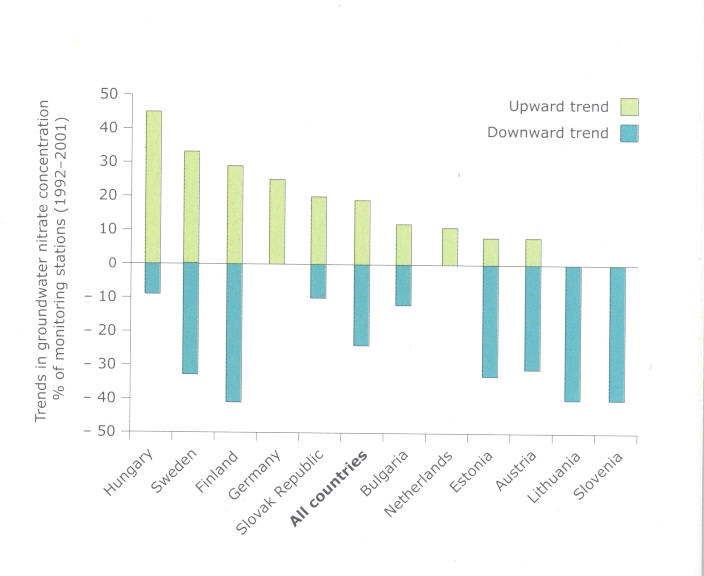
- Water monitoring
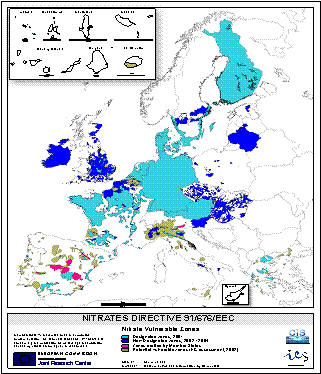
- Designation of nitrate vulnerable zones
- Design and implementation of the action programmes
- Conclusions
|
|
3
|
|
|
4
|
|
|
5
|
|
|
6
|
- Directive 91/676/EEC concerning the protection of waters against
pollution caused by nitrates from agricultural sources
- Reducing water pollution caused or induced by nitrates from agricultural
sources
- Preventing further such pollution
|
|
7
|
- Water monitoring
- Identification of polluted waters, identification of waters which could
be affected by pollution if measures are not taken
- Nitrates Vulnerable Zones (NVZs) designation, revision every four years
- Designation of NVZs not required if an action programme is implemented
on the whole territory
|
|
8
|
- Establish a code or codes of good agricultural practice, to be
implemented by farmers on a voluntary basis
- Design and implement action programmes in NVZs
- Assess effectiveness of action programmes
- Report on the implementation to the Commission
|
|
9
|
|
|
10
|
- In advance of accession
- establish a complete monitoring system (surface and ground waters)
- detect and designate waters affected by pollution
- designate the Nitrates Vulnerable Zones (at least one year before
accession)
- By accession
- establish a Code of Good Agricultural Practices
- establish action programmes
|
|
11
|
- Nitrate concentration in Freshwaters
- where
- sampling stations Directive 75/440/EEC
- other sampling stations representative of surface waters
- when
- at least one year every four years
- monthly and more frequently during flood periods
|
|
12
|
- Nitrate concentration in Ground waters
- where
- sampling stations representative of groundwater aquifers
- when
- At regular intervals
|
|
13
|
- Eutrophic Status
- Fresh surface waters
- Estuarial and coastal waters
- Definition of Eutrophication
- Enrichment of water by nitrogen compounds causing an accelerated
growth of algae and higher forms
of plant life to produce an undesirable disturbance to the balance of
organisms present in the water and to the quality of water concerned
|
|
14
|
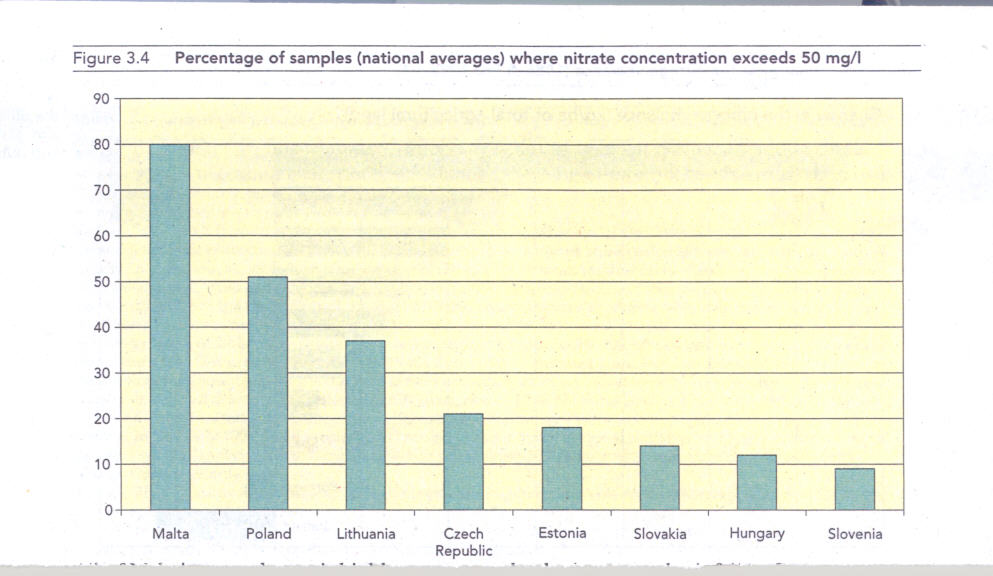
- Nitrate concentration equal or higher than 50 mg/L in groundwaters and
surface waters
- Upwards trends so that 50 mg/L nitrate concentration could be reached if
actions are not taken
- Eutrophic status of freshwaters, estuaries and coastal waters
- Trend towards eutrophication if actions are not taken
|
|
15
|
- Monitoring guidelines prepared by EC
- Procedures for monitoring of surface waters (sampling frequency,
sampling site selection, timing)
- Procedures for monitoring of groundwaters (frequency, site selection,
timing)
- Procedures for monitoring of estuarine, coastal and marine waters
|
|
16
|
- Monitoring guidelines prepared by EC
- Indicators of eutrophic status of freshwaters, estuaries and coastal
waters
- Monitoring in NVZs for the assessment of action programme effectiveness
- Monitoring procedures for Member States which apply the action
programme to the whole territory
|
|
17
|
- Two possible approaches
- Designation of specific zones
- No designation and implementation of the action programme in the whole
territory
|
|
18
|
- .
- Implementation of the action programme on the whole territory
- Germany
- Austria
- The Netherlands
- Luxemburg
- Denmark
- Finland
- Ireland
- Malta
- Slovenia
- Lithuania
|
|
19
|
|
|
20
|
|
|
21
|
|
|
22
|
|
|
23
|
|
|
24
|
|
|
25
|
|
|
26
|
- Measures to be included in the Action Programmes: Annex III and Annex II of the Directive
- Member States may establish different Action Programmes for different
vulnerable zones or part of zones (art.5.2)
- Member States could identify additional and reinforced actions (art.
5.5) in NVZs
|
|
27
|
- Examples of measures to be included in the Action Programmes
- Minimum storage capacity
- Prohibition periods of fertiliser application
- Maximum Nitrogen amount applied with livestock manure: 170 kg/hectare
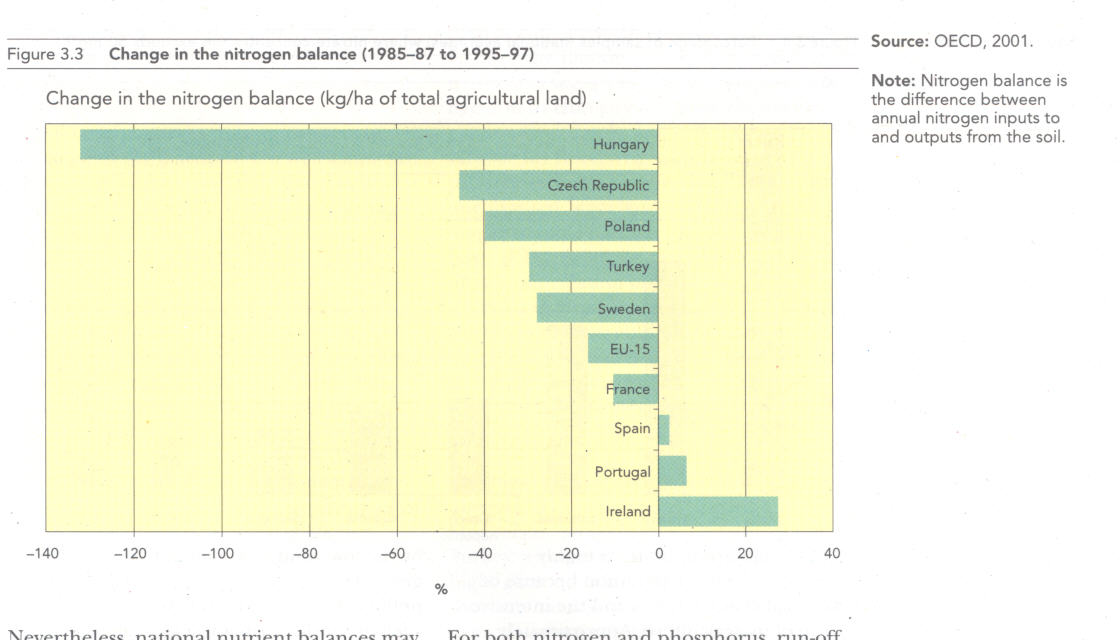
- Fertilization according to a nitrogen balance
- Fertilisation procedures near water courses, on slopes, on frozen, water
logged, snow covered soils
- Vegetation cover in winter periods
|
|
28
|
- Result of the study carried on by the Commission
|
|
29
|
- Requirements of storage capacity ≥ 6 months in several MS (e.g.
Denmark, Austria, Finland, Belgium (Wallonia) individual regions in
Italy, France, Germany
- Funding storage vessels in EU 15: Rural Development and State Aids
|
|
30
|
- Some of the area requiring improvement
- (Report year 2000):
- Storage capacity
- 170 kgN/ha from organic manure
- Prohibition periods in fertiliser application
- Provisions on fertiliser spreading near water course and slopes
|
|
31
|
- The procedure to obtain a derogation
- Denmark derogation (Commission Decision 915/2002)
- Cattle farms with at least 70% grassland: 230 kg/hectare N from
livestock manure
- Farms and arable land encompassed by derogation: 4%
- Livestock units encompassed by derogation :11%
|
|
32
|
- Storage capacity: 9 months, construction standards
- N application with livestock manure: 170 kg/ha (cattle), 140 kg/ha (pig
and poultry)
- N in livestock manure: tables of reference values for all livestock
categories and housing systems (eg: 117-123 kgN/head dairy cattle, large
breed)
|
|
33
|
- Total Nitrogen application standards for all main crops (updated yearly
on the basis of data on experimental and pilot farms)
- Minimum manure nitrogen efficiency:
- Pig slurry: 75%
- Cattle slurry: 70%
- Deep litter: 45%
- Other livestock manure: 65%
|
|
34
|
- Minimum winter cover
- Prohibition period for manure application: from harvest to February
(slurry)
|
|
35
|
- Fertiliser plans
- To be prepared by all farmers every year
- Fertiliser account
- to be provided to the competent
Authorities at the end of each year
- Checking of compliance:
- evaluation of fertiliser plans+on site inspections
|
|
36
|
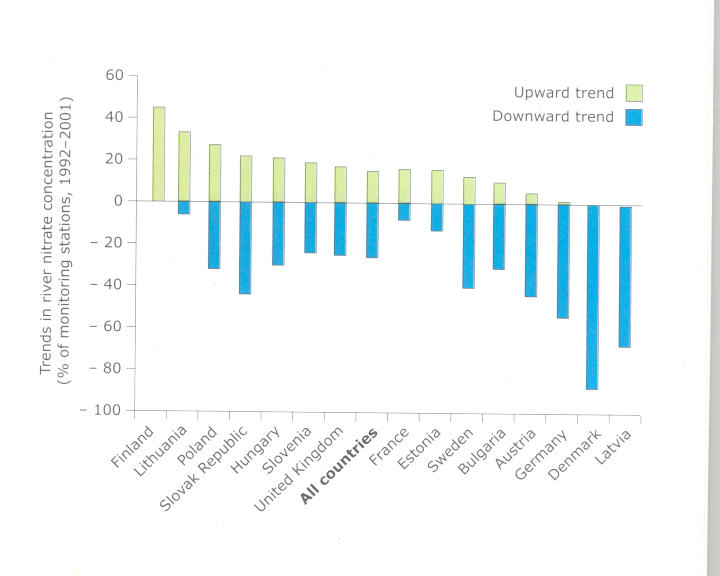
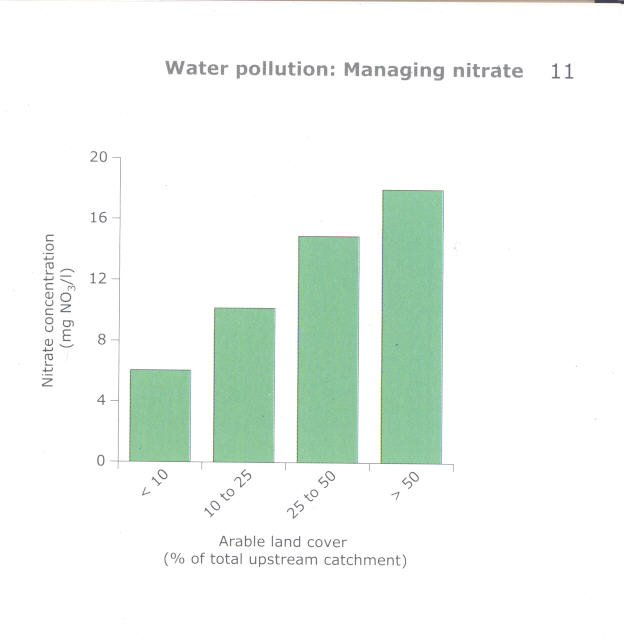
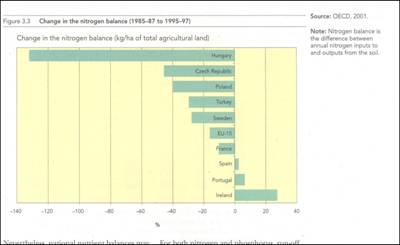
- Nitrogen losses from agriculture represent a main contribution to
pollution of water
- Nitrates Directive has been implemented slowly
- but
- Significant progress has been made in the recent years
|
|
37
|
- Further progress are required in Nitrates Vulnerable Zone Designation
and Action Programme implementation (EU 15)
- Implementation of the Nitrates Directive is essential in the New Members
States to reduce pollution and avoid extensive pollution problems over
the coming years
|
|
38
|
- http://europa.eu.int/comm/environment/water/water-nitrates/index_en.html
- Report on the implementation of the Nitrates Directive year 2000
- Monitoring guidelines
- Reporting guidelines
|

 Notes
Notes