|
1
|
|
|
2
|
- On 12 June 1995 The Europe (Association) Agreement with Lithuania was
signed (it recognised Lithuania's aspiration to become a member of the
European Union and created conditions for Lithuania’s participation in
the Pre-accession Strategy for candidate countries)
- On 8 December 1995 Lithuania has submitted the official application for
the membership of the EU
- On 15 February 2000 Lithuania has started the EU accession negotiations
- On 17 August 2000 Lithuania opened negotiations on Chapter 22 on
Environment
- On 27 June 2001 Chapter 22 on Environment was provisionally closed
at the Conference on Accesion to the European Union
|
|
3
|
- Taking into account financial capacity, the state of the agricultural
sector and the anticipated volume of foreign assistance, Lithuania
requested a transitional period till 2011:
- The estimated cost of implementation of the Directive - 268 million EUR;
- Major part of territory of Lithuania could be identified as a sensitive
area affected by nitrates;
- Agricultural sector still under development aiming to fulfil principles
of the Common Agricultural Policy.
- During negotiations Lithuania withdrew its request for transitional
period because the Nitrates directive offer possibility (via action
programs) for longer terms for the implementation of its requirements
|
|
4
|
- Transposition into Lithuanian legislation by 2002
- Implementation of the requirements via two four-year action programmes
- Establishment of first action programme in 2003 and beginning its
implementation by the date of accession
- During the first Action Programme all measures concerning practices
which create no big investment problems will be made mandatory for all
farms (new and existing)
- The first Action Programme will also require progressive compliance with
the directive’s requirements for all big existing farms, farms with
obvious pollution problems and all farms where new investments take
place.
- During the period of the second Action Programme progressive
rehabilitation will also be achieved for smaller farms.
|
|
5
|
- General legal provisions in:
- Law on Environmental Protection (1992)
- Law on Water (1997, as amended in 2003)
- Law on Land (1994)
- Law on Underground Water (1995)
- Law on Protected Areas (1993)
- Law on Monitoring (1997)
|
|
6
|
- More detailed legal provisions:
- MoE Order On Environmental Requirements for the Manure and Waste Water
Management in the Farms (1999 12 27)
- Code of good agricultural practice (has been endorsed by MoE and MoA in
2000)
- Moe and MoA Order On the Requirements for the Protection of Waters
against Pollution Caused by Nitrogen Compounds from Agricultural Sources
(2001 12 19)
- MoE Order No 666 On General Environmental Protection Requirements for
the Farms (2002 12 23)
|
|
7
|
- MoE and MoA Order on Provision of Information to the EU Commission on
Pollution of Waters from Agricultural Sources (2003 09 29)
- MoA Order on the Requirements on Good Farming Practise (2004 07 16)
|
|
8
|
- Three options:
- The whole country is considered as non-vulnerable
- The country is divided in zones of different vulnerability
- The whole country is considered as one vulnerable zone
|
|
9
|
- Option was considered irrelevant for Lithuania because of:
- High concentrations of nitrate in shallow dug wells
- High eutrophication of the Curronian Lagoon
|
|
10
|
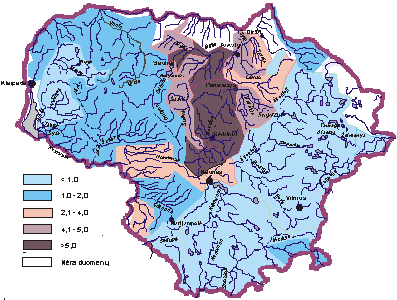
- Nitrate concentration in:
- deep groundwater aquifers is much bellow the limit of 50 mg/l (highest
concentration is between 7 and 20 mg/l)
- shallow dug wells is high or even very high (exceeded 50 mg/l in almost
37 percent of the wells examined)
|
|
11
|
|
|
12
|
- The total area of the proposed nitrate vulnerable zones was 91,2 percent
of the Lithuanian territory
- The part of Lithuania draining to the Curonian Lagoon, via Nemunas and
tributaries
- River basin of direct tributaries of the Baltic Sea
- The areas draining into vulnerable zones in Latvia, i.e. areas so
designated by Latvian authorities
|
|
13
|
- Lithuanian had made the decision to designate all territory as nitrate
vulnerable zone and the Action Programme
will be applicable for the whole territory.
- Currently available documentation isn't sufficient for the EU Commission
to approve that nitrate found in shallow wells in the rest 8,8 percent
of territory is caused by non-agricultural sources
|
|
14
|
- Government Resolution On State Programme for Reduction of Water's Pollution from Agricultural Sources (2003 08 26)
|
|
15
|
- General provisions
- Objectives and tasks
- Evaluation of the situation: Animal density; Installation of manure and
slurry storage; Balanced fertilisation, including periods for the
fertiliser; Crop rotations; Drinking water; Surface water; Permanent
monitoring of water pollution from agricultural sources; Training and
professional development; Scientific research; Public information and
participation.
- Programme implementation
- Expected results
- Action plan and measures for implementation of the Programme
|
|
16
|
- Long-term objective – to implement Nitrate directive, to reduce water
pollution, paying the biggest attention to nitrates and other chemical
factors, which could negatively affect health of inhabitants, biological
diversity, trespass traditional landscape, also to protect water against
eutrophication in the Republic of Lithuania.
- Short-term objective - to create institutional capacity and first of all
to implement measures laid down in the Nitrate directive, to reduce
water pollution in the farms, which have more then 300 livestock units,
to develop monitoring and
information system.
|
|
17
|
- First stage (2004-2008). Pollution caused by big cattle farms will be
minimised, measures will be mandatory in all farms having more then 300
LU in which the amount of manure and slurry accumulated raise the
biggest danger for water pollution.
- Second stage (2008-2012). During this stage nitrate vulnerable zones
will be revised and four year programme including new mandatory
measures will be developed. This
programme will be mandatory to all farms having more then 10 LU.
|
|
18
|
- training and education;
- development of needed technical norms or improvement of the existing
ones according to the EU requirements;
- development of projects for priority pollution minimisation investments
(for livestock farms having more then 300 LU) search for financial
sources for those projects and implementation;
- setting the requirements for the implementation of the measures;
- establishment of information system which is needed for the evaluation
of situation, preparation of plans and reports.
|

 Notes
Notes