|
1
|
- Ain Kendra
- Jäneda Training and Advisory Center
- ESTONIA
|
|
2
|
- Few basic facts
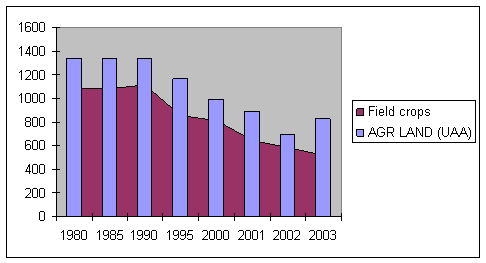
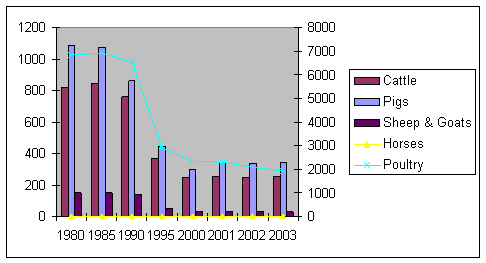
- Transition of agriculture
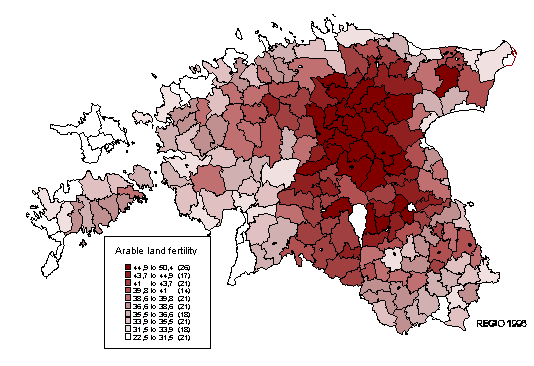
- Regional differences
- Definition of Nitrogen-sensitive areas
- Monitoring of nitrogen in waters
- ACTION PLAN
- Measures to reduce nitrogen (investment)
|
|
3
|
- Population – 1,356 million
- Area – 45,225 km2
- Forest – over 50%
- Agricultural land – under 33%
- Water – inland waterbodies 6,2% of territory
- 1150 lakes & 420 rivers (over 10 km length)
|
|
4
|
- Agricultural reform
- Farming Law 1989 – 12,000 farms before reform
- 1991 - quick destruction of soviet system (350 farms)
- Privatization of buildings & machinery
- Land reform 1993 still not completed (definition)
- Restitution (1939) of possible, to former owners
- Privatization to current users
- Agricultural employment
- 1990 – 136,800
- 2000 – 28,700
|
|
5
|
|
|
6
|
|
|
7
|
|
|
8
|
|
|
9
|
|
|
10
|
- 30 years of nitrate history – research
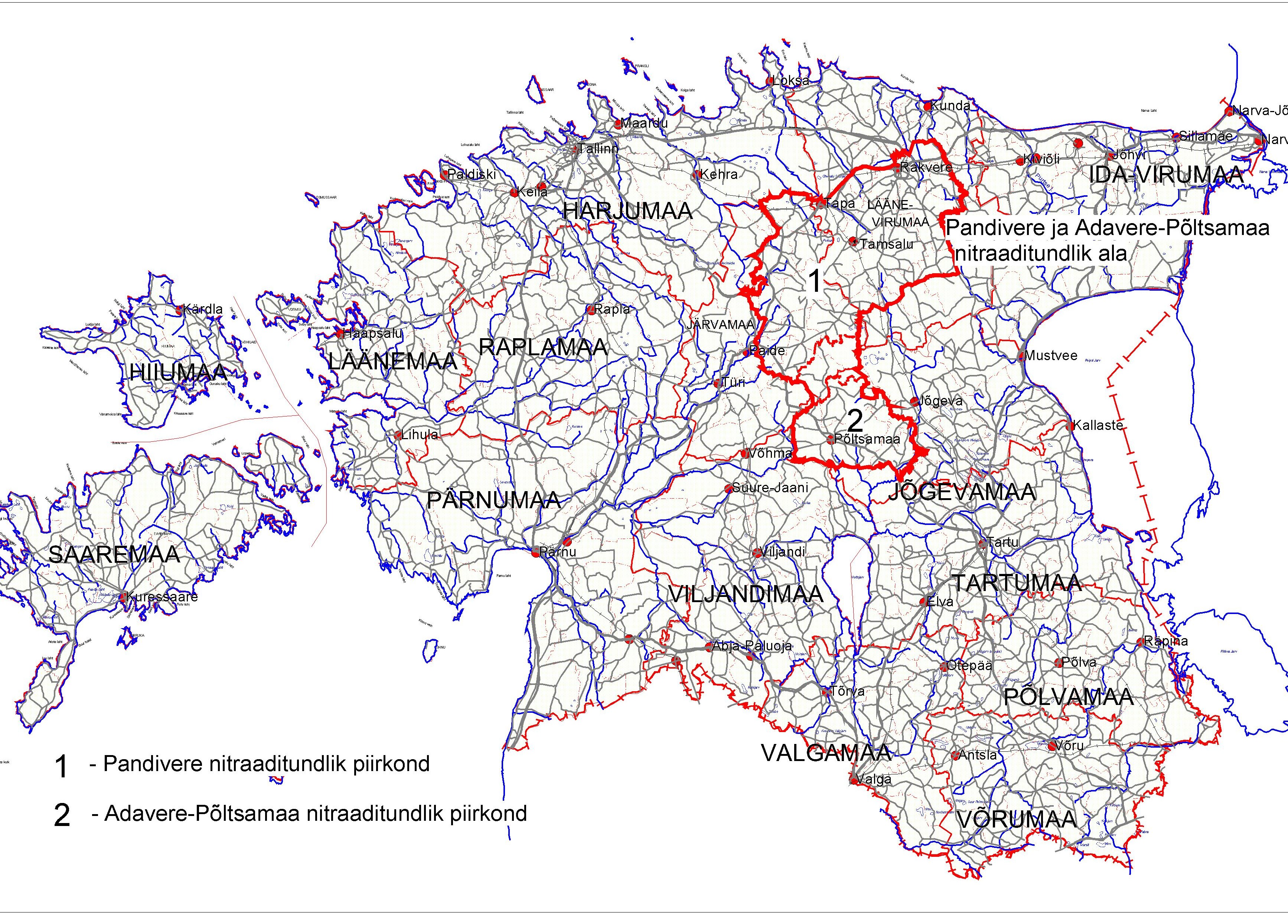
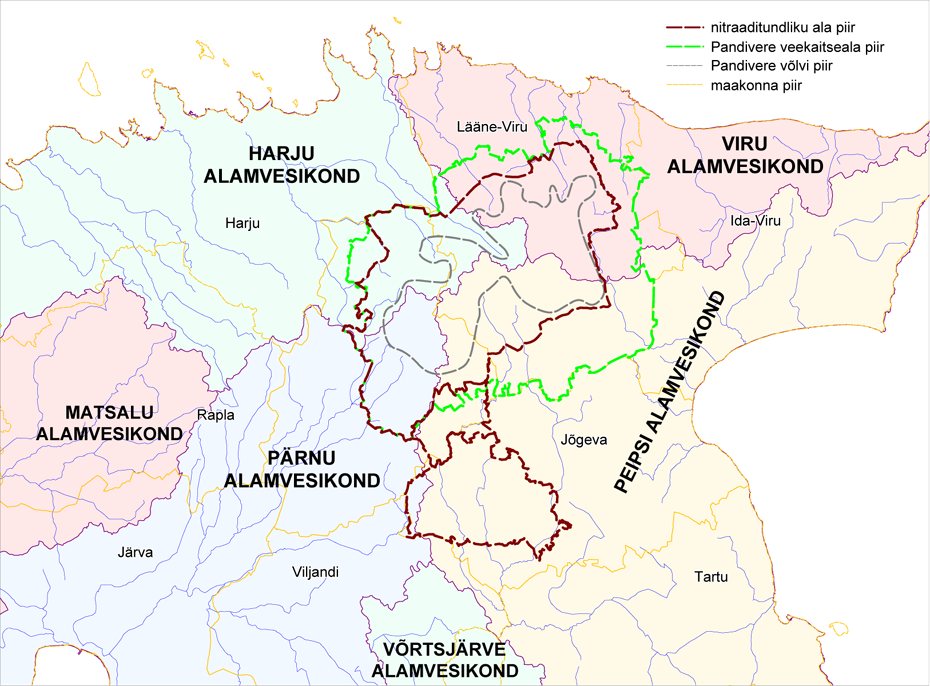
- 1998 Pandivere water protection area established
- 2003 Pandivere-Adavere nitrate-sensitive area (NVZ) has been established
- Pandivere Upland – ground water accumulation area, a lot of karst
springs, impact for almost all territory
- Põltsamaa-Adavere limestone plateau – relatively thin soil cover on
limestone bedrock, also karst areas, impact mostly local, identified as
nitrate concentration over 50 mg/l
- 10% of Estonia, involving three counties, NVZ covers ca 160,000 ha of
arable land
|
|
11
|
|
|
12
|
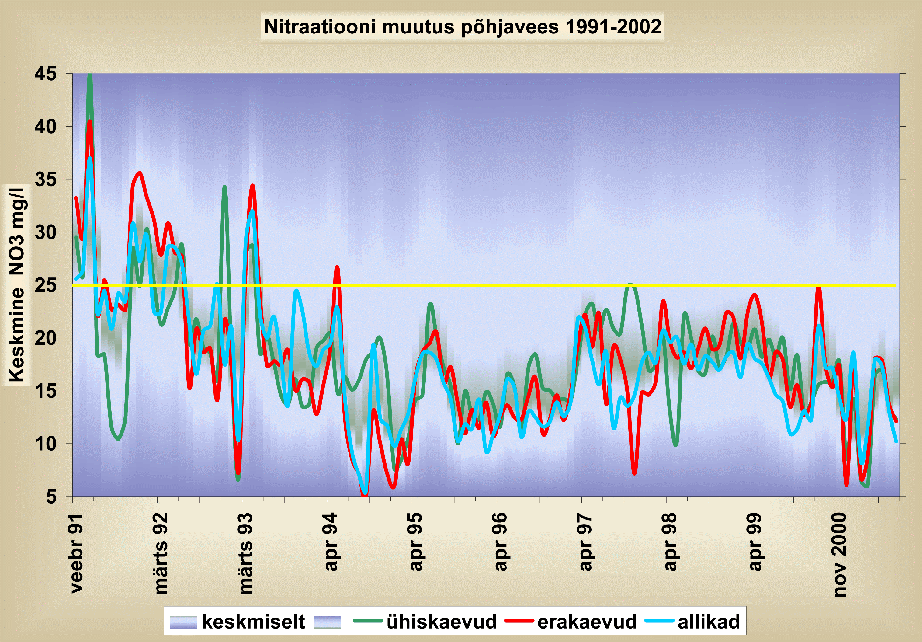
- National water quality monitoring network functioning from 1992, earlier
study-based
- From 2002 the network revised, according to requirements of ND
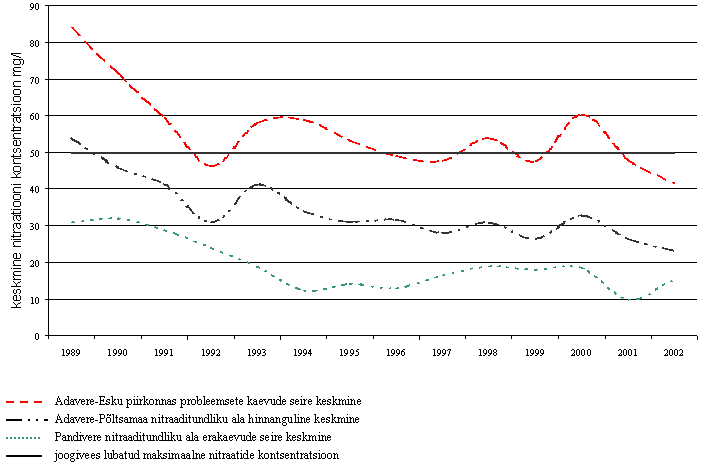
- Level – comparable data available from 1980-s in Adavere, much earlier
periods in Pandivere
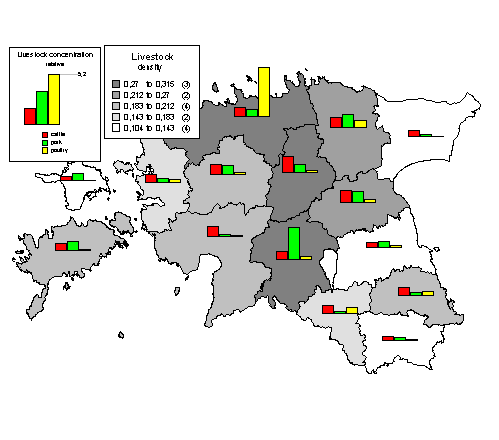
- Production level (intensity) below half (< 0,5 LU/ha), total nitrogen
below normatives, but vulnerable
and dangerous if/when production level will be restored
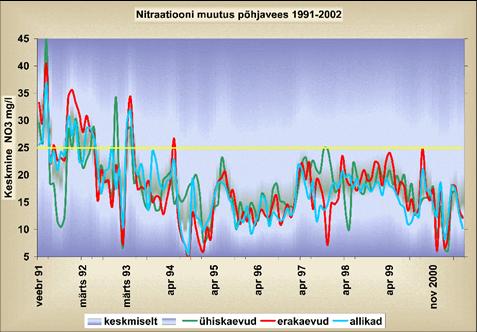
- Nitrate levels depending on water quantities, difficult to make deeper
conclusions from figures depending more on weather than agriculture
|
|
13
|
|
|
14
|
|
|
15
|
|
|
16
|
|
|
17
|
- Problems
- Low quality of small drinking water sources
- Poor water quality in surface water bodies
- Poor groundwater quality in close areas of large farms
- Causes
- Unprotected groundwater, carst areas
- Information on good practices
- Land use and manure management, not balanced fertilizer use
- Point source of liquids (slurry, silage juice, wastewater)
- Lack of funds – rural population to build deeper wells or water
networks
|
|
18
|
- Action Plan for the nitrate sensitive Pandivere and Adavere-Põltsamaa
area for the years 2004-2008
- Approved by regulation 318-k, 30.04.2004
- To limit impact of pollution caused by agricultural production on
surface and ground water
|
|
19
|
- To co-ordinate agricultural and water management activities in the field
of preservation of soil fertility and water management.
- To support through information dissemination and training the use of all
the manure for fertilising.
- To guide agricultural land use so that the soil fertility would be
preserved.
- To find out, based on pilot studies, the possibilities of applying best
from the point of view of soil and water protection available
technologies and agricultural practices as well as optimal support
schemes in nitrate sensitive areas.
- To preserve the mostly good status of groundwater.
- To preserve the mostly good status of surface waters.
- To preserve the habitats of salmonids in watercourses.
- To assist in supplying the population with healthy drinking water.
- To ensure the required control, assessment, and databases of
environmental monitoring and reporting.
- To achieve a better compatibility in the next implementation period
between agricultural and water management development plans, Estonian
National Development Plan and Development plan of Estonian rural regions
for the years 2004 to 2006
|
|
20
|
- Period when use of fertilisers is prohibited: spreading of organic and
mineral fertilisers is banned from 1 November to 31 March;
- Limited use of fertilisers on slopes: spreading of fertilisers on arable
land the slope of which exceeds 10% is prohibited. Where the slope is
5–10%, surface spreading is not allowed from 1 November to 15 April;
|
|
21
|
- Limited use of fertilisers on waterlogged, flooded, frozen or snow
covered land: spreading of organic and mineral fertilisers is banned
from 1 November to 31 March or when the land is covered with snow,
frozen or waterlogged, as well as in periodically flooded sanitary
protection zones and water protection zones of water bodies.
|
|
22
|
- Use of fertilisers near water bodies: in the water protection zone of a
water body fertilising is prohibited. For lakes, reservoirs, rivers and
canals the width of the protection zone is 10 metres from the water’s
edge, and 1 metre for artificial recipients of drainage systems until
they fall into a natural watercourse.
|
|
23
|
- Requirements for manure and silage storages:
- all farm buildings in which over 10 animal units of animals are kept,
must have, depending upon the kind of animals, a manure storage or a
manure storage and a dung water pit;
- livestock - capacity for containing the manure and dung water of eight
months; avoiding access of surface and ground water; leak proof;
watertight;
- on arable land only solid manure heaps that can be used in one
vegetation period are allowed;
- silage storages watertight; silage juice conducted into special tanks
or dung water storages; at least 10 litres of juice per 1 m3 of the
silage storage capacity.
|
|
24
|
- Maximum application amounts of fertilisers:
- the average allowed amount of nitrogen that is applied to arable land
with combined organic and mineral fertilisers is 170 kg per hectare per
year;
- for mineral fertilisers only this amount is 140 kg per hectare per
year; amounts of mineral nitrogen exceeding 100 kg must be applied
partially.
|
|
25
|
- Ministry of Environment
- Environmental Inspection
- Environmental Departments in 3 counties
- Environment Information Centre
- Ministry of Agriculture
- Plant Production Inspectorate
- ARIB
- Jäneda Training- and Advisory Centre
- Ministries of Social and Internal Affairs (involved on drinking water)
- Council of Nitrate Sensitive Area
|
|
26
|
- Training of civil servants
- Guidelines
- Training of agricultural advisors
- Pilot studies
- Training and consulting in situ of producers
- Protection of recharge areas of groundwater intakes
- Healthy drinking water for private users
- Programme for control, assessment, monitoring, fulfilling &
coordination
- NSA protection obligation notices & reports
- Harmonizing actions of WMP, NDP, RDP
|
|
27
|
|
|
28
|
- Investment support – structural funds (SPD)
- Rural Development Program
- Meeting EU standards (manure measure)
- Agri-environment
- Commercial lending
- HELCOM - BRSP project
- NEFCO commercial loan
- WB – GEF grant
- Environmental training
- Usual commercial lending
|
|
29
|
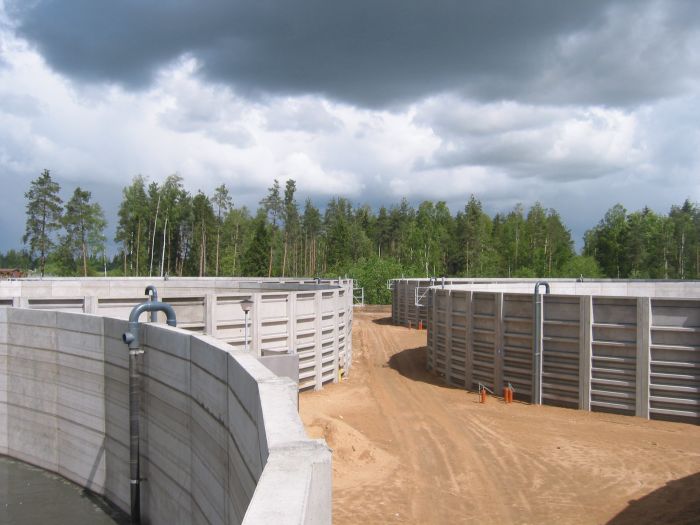
- Barn – incl manure storage & management
- Max 9,4 million EEK/year
- 2004 – 9 new manure storage facilities, 2 rec. (11,8+2,9M)
- 2004 – 12 manure removal equipment (1,8M)
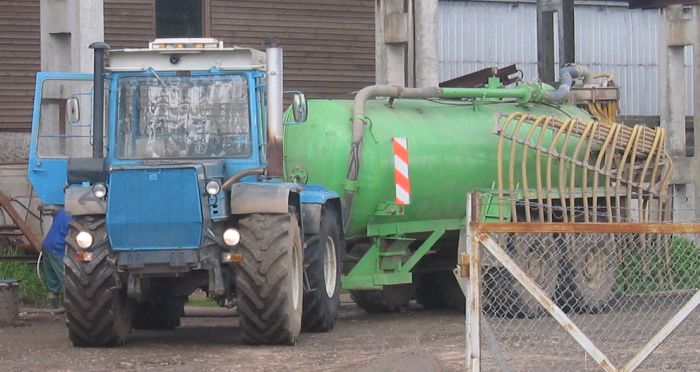
- Plant protection – incl manure spreading
- Max 3,1 million EEK/year
- 2004 – 9 manure spreaders (3,4M)
- 2004 – 42 fertilizers/seeders (1,9M)
- Support of up to 50%
- LFA +10%, young farmers +5%
- Unfortunately, too high interest of beneficiaries to this measure has
resulted in exceeding of estimated allocations, next years budget
significantly reduced
|
|
30
|
|
|
31
|
|
|
32
|
|
|
33
|
- At least 10 LU – cattle, pig, sheep, goat
- Registered building (barn), investment plan, every year investment
- First year – 2004:2006 (8.10-5.11.2004)
- Yearly investment completed by 5.11 next year
- By latest end of 2008 meets EU req
- Grant 1252 EEK/LU/y up to 3 years
- Max 391.165 EEK/y 1.175.945 EEK total
|
|
34
|
- Sub-measures:
- Environment-friendly production
- Organic farming
- Endangered species
- Applications 17.05-15.06.2004
- 2004 applied:
- EFP – 464,000 ha
- Organic farming - 42,000 ha
|
|
35
|
- Main requirements
- Field record
- Manure <170 kg N/y/ha
- No fertilizers & plant protection on natural grasslands
- Accounting of veterinary substances
- EFP (environment-friendly production)
- Fertilizing plan, max 170 kg incl mineral <100 kg
- Crop rotation
- pH & nutrient analyzes
- Grassland management
- Training
|
|
36
|
- EFP
- field crops - 714 EEK/ha
- grasslands - 331 EEK/ha
- excl seminatural grassland (2004 - MoE)
- Organic farming
- Grassland management - 1156 EEK/ha
- At least 0,1 LU/ha, >50% organic livestock
- Field crops - 1516 EEK/ha
- Vegetable, orchards - 3764 EEK/ha
- Estonian Horse – 2550 EEK/y
|
|
37
|
- Training for all participants – environment and management issues
- NEFCO loan
- GEF grant to reduce interest payments
- Estonia –
- 20 farmers trained
- first case approval received, starting bidding procedures (according to
WB rules, International Shopping)
|
|
38
|
- Milk farms have been bought up by local financial investors
- Pig production largely owned by meat processing industries
- If by end of 2008 the requirements are still not OK – closing livestock
farming
- Milk farms are relatively good investment also for commercial lending
- Problems are more related to pork and poultry sectors – too high
production concentration
|
|
39
|
- (semi-) industrial livestock / poultry & land relation
- Country–NUTS-NSA-region-farm–field level
- NSA does not follow any administrative boundaries
- Livestock Units / ha
- L.U. – pork-poultry? Which area?
- No land, manure distribution contract based, but no such contract
register
- No interest for contracts from crop producers – manure fertilizing
quality poor
- Ha – Available? Utilized? Feeding? Rearing?
- Kg N /ha /year (or manure tons)
- Ha – of this year fertilized? Manure impact longer than year
- UAA? Excluding seminatural grasslands? Arable?
|
|
40
|
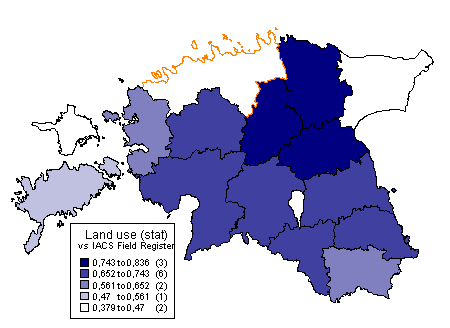
- Field register = eligible for area-based subsidies
- EU - IACS = Utilized (UAA) + temp. unused
- UAA = Arable + natural grasslands
- Arable = fields + cultivated grasslands
- grasslands
- 1 year (in crop rotation)
- 2 to 5 years (lately renewed)
- 5 to 10 years (statistics count already as natural grassland)
- Over 10 years (but on mineral land, probably renewed soon)
- Natural & seminatural grasslands, never to renew but to restore
|
|
41
|
- Jäneda Training and Advisory Center – www.janeda.ee
- Ain Kendra - ain@janeda.ee
- Livi Rooma – livi@janeda.ee
- Ministry of Agriculture – www.agri.ee
- Katrin Rannik – katrin.rannik@agri.ee
|

 Notes
Notes