|
1
|
- Christine Jakobsson, JTI
- Regional Conference on Agricultural Source Pollution in Danube, Baltic
and Black Sea Riparian Countries, Bucharest
- September 30 - October 3, 2003
|
|
2
|
- EU:s Nitrate Directive
- Sweden’s legislation
- and adaptation to EU
- Swedish advisory service & information
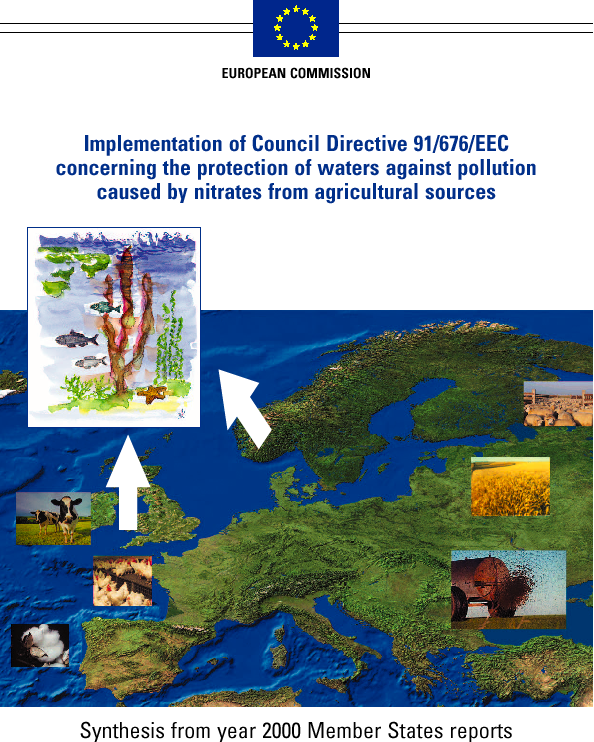
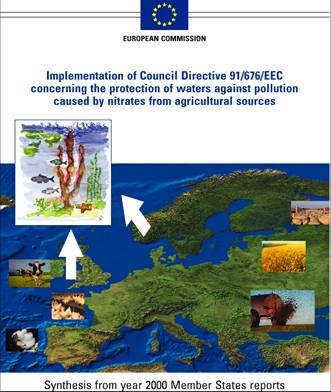
- Synthesis from the implementation of EU:s Nitrate Directive
|
|
3
|
- Nitrogen or phosphorus based systems
- N based systems as in the Nitrate Directive, (170 kg N/ha) are most
common
- P based systems e.g. Sweden, the allowed level of P is defined as
livestock density corresponding to 22 kg P in manure/ha, - no problems with requirements
of 170 kg N/ha returned in animal excreta (Nitrate Directive). Another advantage
is that information on P content in manure is more reliable, as losses
in animal houses and during storage are almost non-existent and
therefore easier for the farmer to calculate.
- N and P-based systems
|
|
4
|
- The Nitrate Directive issued in 1991. Most activities to be implemented
before 2000.
- Objectives are to reduce water pollution caused or induced by nitrates
from agricultural sources and to prevent such pollution.
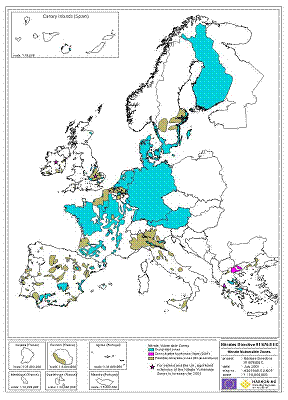
- Member states must identify Nitrate Vulnerable Zones (NZVs) on the basis
of monitoring requirements results.
- Action Programmes with mandatory
measures on agricultural practices must be implemented in NVZs. Maximum
amounts of animal manure that can be applied to land yearly (210 kg N/ha
until mid-December 2002 when the amount will be reduced to 170 kg N/ha).
- Monitoring of water quality according to specific requirements.
- Codes of Good Agricultural Practice (CGAP) must be elaborated and are
mandatory in the NVZs and voluntary outside.
|
|
5
|
|
|
6
|
|
|
7
|
|
|
8
|
|
|
9
|
|
|
10
|
- Measures to be include in action programmes - rules cont.:
- limitation of the land application of fertilisers, consistent with good
agricultural practice and taking into account the characteristics of the
vulnerable zone concerned, in particular:
- soil conditions, soil type and slope;
- climatic conditions, rainfall and irrigation;
- land use and agricultural practices, including crop rotation systems;
and to be based on a balance between:
- the foreseeable N requirements of the crops, and
- the nitrogen supply to the crops from the soil and from fertilisation
corresponding to:
- the amount of N present in the soil at the end of winter
- through net mineralisation of the organic N reserves in the soil
- from livestock manure
- from chemical and other fertilisers
|
|
11
|
|
|
12
|
- Criteria for identifying waters -
- Monitoring programmes and measures
- if the groundwater contains more
than 50 mg/l nitrates
- if surface freshwaters, in particular those used for drinking water,
contain more than 50 mg/l nitrates
- if natural freshwater lakes, other freshwater bodies, estuaries, coastal
waters and marine waters are found to be eutrophic or may become so
|
|
13
|
- Sweden is a very sparsely populated and forest dominated country.
- The environmental problems are small in comparison to many other
countries in Europe.
- Nutrient leakage from agriculture, especially nitrogen, affects coastal
areas and also rivers and lakes negatively.
- Surface run-off of phosphorus can be a problem causing eutrophication,
mainly in inland waters, where phosphorus is generally the growth
limiting factor.
|
|
14
|
- Launched in 1988 by the Swedish Parliament
- The goal was to reduce the amount of N that reaches the Baltic Sea by 50%
from 1985 to 1995 and to substantially reduce the amount of P.
- This goal has not been reached, but 25% reductions in N losses to the
Baltic Sea have been calculated. In Svealand the reduction of nitrogen
losses to the sea was up to 40% (SEPA, 1997).
- Since 1995 specific measures to reduce the ammonia losses from
agriculture were successively elaborated and implemented.
- Measures to tackle the problems are:
- requirements and guidelines
- advisory service and information
- research and development
- economic instruments of control
|
|
15
|
- To ensure that manure is not produced in excess to the amount of arable land on the farm, a balance
must exist between the amount of animals on the farm and the amount of
land available for spreading manure.
- The maximum amount of animals has been precised with consideration taken
to the amount of P and N in manure and a crops normal requirements and
removal of plant nutrients.
- The limiting factor is P, with a maximum amount of approximately 23-25
kg P per hectare.
- As the amount of manure per area will be moderate, the risk of nutrient
leaching of both N and P will be smaller.
- One advantage with using P instead of N is that the figures on P content
in manure are more reliable, as P losses in the stable and during
storage are almost non-existing.
|
|
16
|
|
|
17
|
- Manure, slurry and urine storage requirements in sensitive regions and
for large farms
- 8 months for animal production consisting of cattle, horses, sheep or
goats
- 10 months for other types of animal production.
- Applies to all farms with > 10 animal units in a specified pollution
sensitive area consisting of southern Sweden and a 20 km coastal zone
from the Norwegian border to Stockholm county. They also apply to all
farms in Sweden with > 100 animal units.
- In the rest of Sweden
- The size of the storage facilities for manure should with good margins
be able to handle the need for storage during the time-period when
livestock manure should not be spread - 6 to 10 months production of
manure.
|
|
18
|
- slurry and urine pits must be covered with a stable surface crust layer or other
covering that effectively reduces ammonia emissions
- filling must take place beneath the covering.
- Since 1995, this affects farms with > 10 animal units in three
counties in southern Sweden, and since 1997 in the rest of Götaland and
on the plains of Svealand.
- Slurry pits can either be covered with a natural crust, straw, peat,
plastic, leca pebbles, a roof or other covering materials that
effectively reduce ammonia emissions. Filling beneath the covering is to
prevent the slurry or urine from breaking the cover or ending up on top
of the cover.
|
|
19
|
- Ban on application of manure and other organic manure during winter
- To prevent nutrient leaching, manure and other organic wastes may not be
applied to land in Sweden during the 1st of December to the
28th of February,
unless they are incorporated in the soil the same day to a depth of at
least 10 cm.
- Harrowing the surface is not
enough.
|
|
20
|
- 1. Fertilisers must not be spread in amounts exceeding the crops
nitrogen requirements for the growing season. The amount of fertiliser
applicated should be based on a balance between the crops foreseeable
nitrogen requirements and the nitrogen supply from all external
potential nutrient sources, as well as taking into account:
- a) soil conditions, soil type and slope,
- b) climatic conditions, precipitation and irrigation,
- c) land use and agricultural practices, including crop rotation
systems;
- 2. Fertiliser must not be applicated on water-saturated or flooded
ground;
|
|
21
|
- 3. Fertiliser must not be applicated on snow-covered or deeply frozen
ground;
- 4. Nitrogen containing commercial fertilisers must not be applicated
from the 1st of November to the 15th of February;
- 5. Manure and other organic fertilisers must not be applicated from the 1st
of January to the 15th of February;
- 6. Manure and other organic fertilisers can be spread from the 1st
of August to the 30th of
November only to a growing crop or before autumn sowing.
|
|
22
|
|
|
23
|
- Since 1996, manure, slurry or urine must be incorporated within 4 hours
after land application when spreading on bare soils. This applies to
three counties in southern Sweden.
- When applying manure, slurry and urine it is of great importance that incorporation
takes place as soon as possible, as the largest ammonia emissions take
place immediately after application. The ammonia emissions are high,
when the contents of ammonia nitrogen are high in the urine, slurry or
manure. It is not until the ammonia ion is adsorbed by soil particles
or assimilated by crops, that the risk of ammonia emissions is
practically inhibited.
|
|
24
|
- In the three counties in southern Sweden, from 1998, slurry must be
spread to growing crops with techniques that efficiently reduce losses
of ammonia:
- Bandspreading techniques or other similar techniques, where slurry is
placed directly on the ground beneath the crop cover,
- Injectors or other similar techniques, where slurry is placed directly
in the ground,
- Techniques, where one part slurry is diluted with at least one half part
water before application (broadcasting),
- Techniques, that are followed by irrigation with at least 10 mm water
within 4 hours (broadcasting).
|
|
25
|
- At least 60 respectively 50% winter-green land is required during the
autumn or winter on every farm with more than 5 hectares arable land in
the three most southern counties and in the rest of Götaland
respectively. Only open fields, not natural pastures or grazing land,
are affected by the requirements. Both the time for sowing and for
interrupting plant growth are regulated.
- The following crops are accepted: grassland, winter cereals, winter
oilseeds, energy forest (usually Salix), sugar beets, carrots or other
similar root crops (not potatoes), perennial fruit and berry crops, special
catch crops (usually perennial ryegrass, Lolium perenne), set-aside
arable land with covering plants.
|
|
26
|
- Farms with more than 200 animal units are required to apply for a permit
at the County Administrative Board to be able to operate.
- The permit usually consists of requirements
regarding the maximum amount of animals, the storage capacity and
application of manure etc.
|
|
27
|
|
|
28
|
- Advice free of charge for all farms with more than 20 livestock units
since 1988
- Plant nutrient balance (farm-gate balance)- STANK computer programme
- Plant production plan with special reference to strategies for usage of
manure
- Plant nutrient newsletters
- Demonstrations e.g. manure spreaders and field trials
- Since 2001 “Focus on Nutrients”
|
|
29
|
|
|
30
|
|
|
31
|
|
|
32
|
- Start-planning advisory needs
- Basic nutrient balance
- Repeat nutrient balance
- Nitrogen strategy
- Phosphorus strategy
- Soil compaction
- Handling of plant protection chemicals
- Planning wetlands
- Grass crop strategy
- Animal housing environment
- Planning of buildings
- Inspection of feeding plan for dairy cows
- Inspection of feeding plan for beef cattle
- Grazing strategy
- Feed consumption recording for piglets
- Feed consumption recording for fattening pigs
|
|
33
|
|
|
34
|
|
|
35
|
- Take regular contact and have discussions with DG Environment, Michael
Hamell, chairman(Irland), Liliana Cortelini and Claudia Olasabel
- Be active within the Nitrate Committee
- Difference between guidelines (stricter - should be done, if not
otherwise proven) and guidance (only recommendations)
|
|
36
|
|
|
37
|
|
|
38
|
- At least 30-40% of rivers and lakes show eutrophication symptoms or
bring high nitrogen fluxes to coastal waters and seas. The agricultural
origin is 50 - 80% of total N inputs to EU waters, depending on Member
States, watersheds and annual variations;
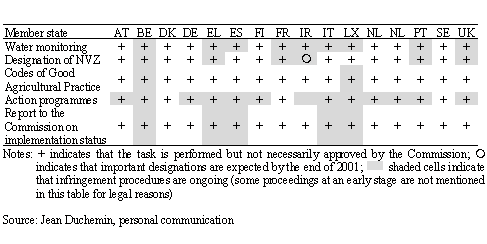
- All M. S. have now transposed the directive, set up a comprehensive
monitoring network, established a code of good practice, and designated
at least partially their vulnerable zones (except Ireland);
- A CAP more oriented towards quality rather than quantity, encouraging extensive
cropping or breeding, “buffer” natural areas and accurate balanced
fertilisation, can further contribute to these purposes;
- Cost-efficiency studies on preventive measures should also be
encouraged, in order to focus action programmes and practice changes
towards the most efficient one;
|
|
39
|
- Besides financial support for a more environmental-friendly agriculture
and dissemination of knowledge, it is necessary that all M.S. arrive at
a full implementation of the Nitrate Directive, reinforce surveys and
controls at field level (including checking of fertilisation plans and
records, manure storage and handling, soil analysis, natural buffer
strips, etc.), and introduce dissuasive penalties for the producers who
do not ensure eco-compliance.
- Investments in urban wastewater treatment will be inefficient regarding
nutrients if a parallel effort is not devoted to an effective reduction
of agricultural nutrients losses.
- Water Framework Directive (WFD). A synergy has to be developed in the
future work for common implementation of these water directives, on
items such as:
- — Harmonisation of water sampling points, networks, parameters and
frequencies for water quality monitoring in order to meet, with minimum
work at field level, the needs linked with EU Directives, OECD-Eurostat
Questionnaires, EEA “Eurowaternet”, Marine and River Conventions, and
local/regional needs.
|
|
40
|
- — Harmonisation of water sampling points, networks, parameters and
frequencies for water quality monitoring in order to meet, with minimum
work at field level, the needs linked with EU Directives, OECD-Eurostat
Questionnaires, EEA Eurowaternet”, Marine and River Conventions, and
local/regional needs.
- — Assessment of point and diffuse losses of nutrients to waters, and of
the breakdown of their origin (agriculture, urban waters, industry, air
deposition…:
- — Models correlating environmental impacts (e.g. algae blooms) and
causative factors (nutrients, natural conditions, etc.), which will
allow forecast of impact of various scenarios in the reduction or
increase of these factors.
- — Cost-efficiency approach for preventive measures. Nitrogen and
Phosphorus will certainly appear as priority polluters in many E.U.
watersheds.
|

 Notes
Notes