|
1
|
- Analysis and evaluation of project activities effects at the farm
holding level
- Evaluation of environmental impact of project implementation (at
regional and national level)
- Conceptualisation of multiplication strategy
|
|
2
|
|
|
3
|
|
|
4
|
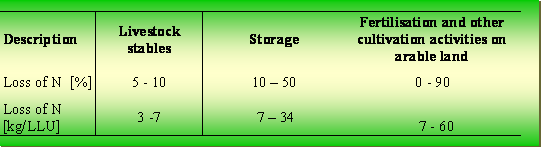
- Estimates as to the reduction of nitrogen losses in rural areas thanks
to the activities undertaken under this project indicate that the
potential reduction scale ranges from
17 to 28 kg/N/ha and from 500 to 800 tonnes of N in the whole
area included in the project activities.
- As for the current environmental effect of the project estimated as the
reduction of nitrogen losses, it amounts to 17,2 kg/N/ha.
|
|
5
|
|
|
6
|
- Project activities have been comprehensive (being a hierarchically
structured package).
- Inclusion of social partners (farmers organisations, agricultural
chambers and local self-government authorities).
- Clear implementation procedures,
- Transparent and fair procedures and criteria to select farmers to
included in the project,
- The project enhances expertise and experience of local extension
services
- Development and implementation of appropriate technical standards with
regard to investment in manure storage facilities.
- Financial support to objectives to be achieved thanks to the project.
- High didactic performance of model solutions that exert influence on
farmers in a positive and permanent manner.
|
|
7
|
- High share of farmers own resources and lack of sufficient funding
capacity in most farms, which hindered the implementation of
environmental investment.
- Limited financial resources of local authorities and institutions
operating in agricultural environment.
- Insufficient farmers qualifications, which did not ensure rational use
of production inputs, especially in line with Good Agricultural
Practices and economic efficiency.
- Lack of tradition in respect of agri-environmental projects
implementation.
|
|
8
|
- Environmental legislation in Poland, including Sustainable Development
Strategy for Poland till 2025,
Act on fertilisers and fertilisation, which provides conditions
conducive to the implementation of agri-environmental projects.
- Expected accession of Poland into the EU and the need to adjust in line with the EU directives accompanied by
the possibility of using pre-accession aid and structural funds of the
EU.
- Increasing role of the National Fund for the Environmental Protection
and Water Management in the activities of agri-environmental projects.
- A growing number of institutions is involved in the implementation of
the environmental projects, including many NGO’s that are set up with a
view to take action in this field.
- Increasing environmental awareness of the public opinion in Poland, including
the representatives of local authorities and farmers.
- Environmental measures and activities can be supported and co-financed
by foreign institutions and funds.
|
|
9
|
- Low profitability of agriculture production and rather unfavourable
outlooks for the near future, which will not facilitate the
implementation of agri-environmental investment projects.
- Unfavourable farm structure in terms of acreage and considerable
fragmentation of farm plots (small acreage of fields).
- Many self-government authorities lack development strategy and even if
they are available not all of them are sustainable or environmentally
friendly.
- No system is in place to prepare agricultural advisors to deal in all
the aspects of specialised farm holdings from the viewpoint of a code of
Good Agricultural Practices in a comprehensive manner.
- Demographic tendencies,
- Limited capacity of local authorities to provide funding for
agri-environmental measures.
|
|
10
|
- Public funds should be used to ensure financing of agri-environmental
measures in animal production farms,
- level of financial support for
agri-environmental measures in agricultural holdings should range
between 50-75%,
- The sources of agri-environmental measures financing should be varied -
private sector, local self-government authorities (at gmina, poviat
level), public funds, foreign aid (loans and assistance funds etc.),
- Clear and transparent procedures
ensuring public accountability.
|
|
11
|
- Farm holdings specialising in animal production shall adopt a package
of measures to ensure the protection of environment in rural areas (Code
of Good Agricultural Practices)
|
|
12
|
- Agricultural extension services will work on environmental aspects
basing on the Code of Good Agriculture Practices
- Farmers will be supported when developing nutrient management plans
- Financial support for ecological investments on farm holdings
- Financial support to purchase agri-environmental machines to be used
collectively
- Tree planting and other agri-environmental activities in agricultural
production space.
|
|
13
|
- Manure pad area - 3,5 m2/LLU
- Capacity of a liquid manure tank - 3 m3/ LLU
- Capacity of a slurry tank - 11m3/ LLU
|
|
14
|
- Assumptions:
- Total number of livestock in Poland - 7,5 million LLU (2001)
- In commercial farms: about 75%
of the total livestock
- Bedding system: 75%; without
bedding - 25%
- Area of manure pads - about 14
million m2
- Capacity of liquid
manure tanks - about 12 million m3
- Capacity of slurry
tanks - about 14 million m3
- Construction cost - PLN 10.600.000.000
- (in IV quarter of 2001, excluding VAT) EUR 2,650,000,000
|
|
15
|
|
|
16
|
|
|
17
|
- Number of farm holdings that apply GAP
- Farmers’ GAP expertise level,
- Nutrient Management Plans,
- Use of agri-environmental machinery,
- Number of contacts with agricultural extension advisers,
- Demand for advisory service.
|
|
18
|
|

 Notes
Notes