
INTERNATIONAL WATERS
EXPERIENCE NOTES
http://www.iwlearn.net/experience
2008 - 12
Coral Reef Targeted Research and
Capacity Building for Management:
Improving scientific information and
management for coral reef ecosystems
around the world.
THE CORAL REEF TARGETED RESEARCH AND CAPACITY BUILDING FOR MANAGEMENT
(CRTR) PROGRAM IS A PROACTIVE RESEARCH AND CAPACITY BUILDING PARTNERSHIP
DESIGNED TO IMPROVE THE SCIENTIFIC KNOWLEDGE NEEDED TO STRENGTHEN
MANAGEMENT AND POLICY. THE CRTR IS FILLING CRUCIAL KNOWLEDGE GAPS IN
THE TARGETED RESEARCH AREAS OF CORAL BLEACHING, CONNECTIVITY, CORAL
DISEASES, CORAL RESTORATION AND REMEDIATION, REMOTE SENSING AND MODELING
AND DECISION SUPPORT. THIS EXPERIENCE NOTE PRESENTS PROGRESS ON THREE
OF THE SIX THEMATIC WORKING GROUPS: CORAL REEF DISEASES, RESTORATION,
AND REMOTE SENSING, AND DISCUSSES HOW THE FINDINGS CAN BE USED TO
STRENGTHEN MANAGEMENT AND POLICY FOR A KEY GLOBAL ECOSYSTEM--ONE
IN WHICH A LARGE NUMBER OF TROPICAL DEVELOPING COUNTRIES DEPEND FOR
LIVELIHOODS AND ECOSYSTEM SERVICES.
and policy. The CRTR has completed its third year
PROJECT DESCRIPTION
of operation of Phase 1.
The Coral Reef Targeted Research and Capacity
The World Bank's role is crucial in this program
Building for Management (CRTR) Program is a
given its routine policy discourse with approximately
proactive research and capacity building partnership
100 countries possessing coral reefs and the natural
designed to improve the scientific knowledge
capital and services that they provide to people,
needed to strengthen management and policy. The
especially in developing countries.
CRTR is filling crucial knowledge gaps in targeted
research areas such as Coral Bleaching, Connectivity,
Coral Diseases, Coral Restoration and Remediation, THE EXPERIENCE
Remote Sensing and Modeling and Decision
Support. Each research theme is facilitated by
The year 1998 witnessed an unprecedented climatic
Working Groups underpinned by the skills of many
event in the world's oceans when a strong El Niño-
of the world's leading coral reef researchers. The
Southern Oscillation episode caused abnormally
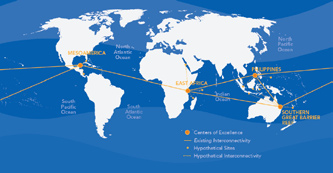
CRTR Program also supports four Centers of Excel-
high sea surface temperatures and affected more
Coral
lence (COEs) in priority regions that serve as focal
than 16% of the world's coral reefs. This was a crucial
Reef
points for building confidence and skills in research, alarm for understanding the differences between
training and in building capacity to sustain coral
climate-related versus local stresses and how man-
reefs and the ecosystem services that they provide
agement responses can be appropriately framed.
to people. The CRTR is envisioned as a three-phase
Rather than committing resources towards reactionary
EXPERIENCE OF THE GEF
initiative that 1) lays the scientific foundation, 2)
response models that only assessed where damage
GEF/WB: CORAL REEF TARGETED
builds capacity in key coral reef regions across a
occurred from this single event, the CRTR program
RESEARCH AND CAPACITY BUILDING
FOR MANAGEMENT PROGRAM
range of stakeholders, and 3) works to integrate
was designed as a proactive initiative targeting in-
findings and improved information into management
vestigations in key world regions. The program's
GEFID: 1531 WORLD BANK: P078034
are infectious, which COEs have the larg-
est coral disease problems, which COEs
environments would be the most tractable
for identifying local factors that might
impact coral disease, and whether climate
factors would affect coral disease levels?
At the end of year three, the DWG has
found answers to many pressing questions
and has published 15 peer-reviewed
papers directly supported by the CRTR
and 15 peer-reviewed papers that were
partially supported by the CRTR or have
contributed substantially to the activities
and goals of the Program.
2
Restoration: The CRTR has defined three
main programs of investigation concerning
Map showing the locations of the CRTR Centers of Excellence.
the restoration and remediation of coral
reefs, combined with the enhancement
purpose is to gain information and under-
stress and coral disease in collaboration
of capacity through training, engaging stu-
standing about the range of impacts and
with the Remote Sensing Working Group,
dents and conducting specific workshops
interactions between stressors--from climate
and is constructing a model of the impacts
on restoration and remediation activities.
change to the more direct local stresses,
of reef protection on coral disease preva-
Within the Restoration and Remediation
like coastal development, pollution,
lence. The DWG is also focusing on the
Working Group (RRWG), the three programs
catastrophic storm events, and over-use
various roles that local water quality has
involve 1) examining the long-term efficacy
and extraction of resources from a range
on coral health and disease. An area of
and cost-effectiveness of restoration inter-
of practices, including impacts from
special interest is the role that Marine
ventions, 2) Enhancing larval recruitment
tourism--and the synergistic effects
Protected Areas have on the health of
and 3) enhancing recovery by culture and
these have on the sustainability of entire
coral reefs and coral disease dynamics.
transplantation of corals.
reef ecosystems.
ACITY BUILDING FOR MANAGEMENT
The DWG is applying previously developed
Program 1 includes long-term studies of
Since 1998, the impacts of climate change
coral resistance assays to investigate how
invertebrate settlement and growth, and
have become increasingly clear, and ad-
temperature stress and disease influences
the varying potential of locations conducive
ditional high ocean temperatures have
coral physiology and to address the huge
to restoration attempts. If water quality and
occurred in various ocean regions in 2000,
information gaps: which disease syndromes
other parameters remain negatively influ-
2002, 2005 (which experienced the highest
enced by human activity affecting near
temperature in the Caribbean Basin in
shore coral reefs, then restoration will not
more than 100 years) and in 2007 in the
likely be successful in the long term. The
South China Sea. These events, which
RRWG is characterizing the rates of key
appear to be increasing in frequency, are
processes influencing recovery: recruitment,
accelerating the urgency to protect natu-
survival, growth, and grazing (such as snails,
ral resources and their ecosystem services,
urchins or fish) and ultimately these outputs
ARGETED RESEARCH AND CAP
and in preparing coastal-dependent peo-
will assist in modeling restoration scenarios.
ple to adapt. However, human population
growth in tropical coastal zones is also
Program 2 has a primary aim of under-
causing tremendous use and transforma-
An example of Black--Band disease on a Caribbean coral species,
standing constraints on site-specific coral
tion pressure that confounds the impacts
Diploria strigosa ©E. Weil.
recruitment rates and the influence of
to coral reefs and associated resources.
larval supply on subsequent reproductive
CORAL REEF T
success. There are three primary objectives
This Experience Note presents progress
TARGETED RESEARCH ON CORAL DISEASE- in this second program: i) to investigate the
on three of the six CRTR thematic working
PRIORITY AREAS FOR INVESTIGATION:
consequences of enhancing larval supply
groups: Coral Reef Diseases, Restoration,
to defined areas of natural and artificial
and Remote Sensing.
MPAs: Do Intact Ecosystems have lower
reef substrate (placed on a damaged reef),
disease prevalence?
i ) to develop a comprehensive database
Addressing the Issue
Philippines, Australia, Palau
on larval competency for a taxonomically
Disease: As of 2008 targeted research for
diverse range of broadcast spawning coral
Aquaculture: Do fish farms incubate and
coral disease has continued to address and
species and iii) to investigate the relation-
convey coral disease?
develop five priority areas of investigation:
ship between the abundance of local
Philippines
Global Assessment of coral diseases and
stocks and recruitment. Studies are being
anthropogenic facilitators, impacts of
Coral Resistance to Disease: How to detect and
carried out in Palau, a satel ite site for the
coral disease on coral diversity, community
characterize immune compromise in a coral?
CRTR program, and Bolinao, Philippines.
diversity and population growth, the epi-
Caribbean, Philippines, Australia
In the Philippines, the first study is examin-
demiology of coral diseases, mechanisms
ing the effects of fragmentation and trans-
Coral Epizootiology: continue isolating
of coral disease resistance, and building
plantation on reproduction in corals with
causative agents
international capacity to assess coral disease.
growth, fecundity and survival of transplants
E. Africa, Australia, Caribbean,
and donor and control colonies being
Philippines, Palau, Israel
Within these priority areas the Disease
monitored. The second examines the rates
Working Group (DWG) has taken additional
Climate and Disease: examine 2005 Caribbean
of coral recruitment on settlement tiles and
steps to address the link between thermal
event and disease surveys to assess causal links
monitoring coral community structure on


tasks, such as environmental monitoring,
KEY RESEARCH QUESTIONS FOR
to be undertaken remotely, thereby freeing
CORAL REEF RESTORATION:
up staff and resources. Moreover, new
technology provides fresh insight into
n To what degree do restoration interventions
coastal impacts and the vulnerability of
significantly enhance recovery of coral reef
communities in comparison to what would be
coastal resources to such impacts. These
achieved by natural recovery processes over a
insights enrich the knowledge-base for
5-10 year time-scale?
management, which, together with more
detailed spatial information, will lead to
n Does enhancement of coral larval recruitment
better decision-making.
significantly enhance efficacy of restoration on
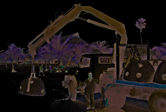
The deployment of artificial reef structures used to standardize the
a 5-10 year timescale and is it cost effective?
types of surfaces that corals may settle upon. These are being used by
The Remote Sensing Working Group (RSWG)
the RRWG in all COE locations. ©K.Kilfoyle.
is developing a multi-scale physical and bio-
n How important is the choice of coral species
logical observing system for coral reefs, with
on both the success of transplants and the
monitoring the health of coral reefs to
the aim to improve the efficacy of coral reef
3
sustained growth and reproduction of
set environmental standards for use,
management using three approaches:
the donor colony?
and to provide an early warning system
1. Provide better information for managers
of major sources of stress. However, reefs
by developing and testing the tools
n What is the relative efficacy of restoration
are complex systems, affected by multiple
using coral fragments, with and without
necessary to measure and monitor the
natural and anthropogenic processes
in situ nursery rearing?
status of coral reef ecosystems at multiple
which operate across many scales. Remote
ecological, spatial and temporal scales
sensing provides the only practical means
n What is the impact of the initial size and
to measure such processes and quantify
structure of pruned coral fragments or nubbins
2. Improve the use of spatial information
on subsequent growth and colony development?
their effects on coral reefs at meaningful,
by developing the application of remote
and often large, spatial scales.
sensing products for conservation science
and spatial decision-making
adjacent reef. The comparison of processes
Remote sensing is a technology-driven
between Bolinao and Palau should greatly
practice and there has been a tendency in
3. Critically examine the cost-effectiveness
improve our understanding of natural recovery
the past for new technologies to be oversold
of new methods to ensure that oversell-
and assist in modeling likely outcomes of
to decision-makers. Oversel ing has occurred
ing does not occur.
restoration under different conditions.
in part because of the high cost of sophisti-
cated new sensors, which often had to be
Issues and Challenges
Program 3 examines the enhancement
deployed on a case-by-case basis. In 1995,
Disease: The DWG has continued to investi-
of recovery by corals, but is studying the
when sixty coastal managers were asked
gate the processes of coral immune response
long-term efficacy and cost-effectiveness
their opinion of remote sensing, 70% believed to disease, and has developed methods to
of restoration. This line of targeted
high cost to be the main hindrance to uptake induce cel ular immunity in response to
research should result in better informed
of the technologies. However, over the last
pathogens and temperature stress (for example,
judgments about what interventions
decade there has been a vast improvement
with gorgonian sea fans) and is in the process
may achieve above natural recovery
in access to remotely sensed data and inno-
of developing these methods for reef-build-
over the course of five to ten years. Given
vation continues. This revolution of informa-
ing corals. The cellular immune response
the tremendous variability in natural reefs
tion is the result of heavy investment in new
may serve as a tool to assess conditions that
worldwide, the RRWG is investigating
technology by governments and industry,
compromise immunity in corals. However,
these questions by using standardized
rapid developments in computing power
isolating all causative agents continues to
TION AND MANAGEMENT FOR ECOSYSTEMS AROUND THE WORLD
artificial structures of sufficient scale and
and storage, and easy dissemination of data
pose significant challenges given the many
replication to allow long-term, statistically
over the internet. Today, remotely sensed
syndromes. The DWG has gained more in-
rigorous comparisons between outcomes
data are available to virtually anyone with a
sight into how the bacterial communities
of natural processes against a range of
desktop computer.
of coral change when challenged with patho-
interventions. These studies have been
gens and environmental stress, but is an ex-
established at all COE locations.
Recent developments in remote sensing will ample of work that will need an extended
enhance the cost-effectiveness of coral reef
time horizon before it can be applied to
Remote Sensing: To manage coral reefs
management. First, the cost of conducting
specific management recommendations.
effectively, practitioners need an array of
many routine remote sensing tasks is falling
spatially-explicit information to support re-
because data are becoming less expensive
The Working Group is confronting the real-
source management decisions, such as de-
and easier to manipulate. Second, and perhaps
ity that infectious disease is a moving target,
signing effective Marine Protected Areas,
more importantly, the effectiveness of man-
it can be infectious at one time and not at
agement will increase. Improved technology
others. Virulence and infectivity of microor-
M. .di
d gi
g tat
a a
IMPROVING SCIENTIFIC INFORMA
al ows several time-consuming management
ganisms as well as coral resistance to dis-
ease are all evolutionary and ecological
moving targets, influenced by pathogen
genotype, host genotype, environment
and all the interaction factors.
Au
A gust
s
t 20
2 0
0 5
Ju
J ne
e 20
2 0
0 6
0
To improve our understanding of mechanisms
behind infectious diseases the DWG is work-
ing closely with other scientists evaluating
various terrestrial wildlife diseases and have
held and attended series of meetings and
P.
P da
d m
a i
m co
c r
o ni
n s
workshops over the past several years on the
Examples of progress with growing and transplanting coral fragments
A Fijian fisherman benefiting from remote sensing technology by
ecology and evolution of infectious disease.
to restore coral reef areas from 2005 to 2006. Significant growth can
looking for vessels of illegal poachers. ©C.Roelfsema
be seen in less than one year. ©RRWG


CORAL REEF DISEASES/SYNDROMES IN WESTERN INDIAN OCEAN
Porites ulcerative white spots (PUWS): Affects mostly massive and branching Porites. White spots have
Depressed center with or without dead area. Spots can coalesce when dense. Possibly caused by a Vibrio
4
INHERENT OPTICAL PROPERTIES
FISH & BENTHIC SURVEYS
N
BENTHIC SURVEYS
Acropora Brown band (BrB): Affects mostly staghorn and tabular acroporids. Band is formed by dense population
TARP EXPERIMENT
GLOVERS REEF, BELIZE N
KILOMETERS
KILOMETERS
of ciliates, moving along the branch. A narrow white band between ciliates and live tissue may be present
4
0
4
8
1
0
1
2
3
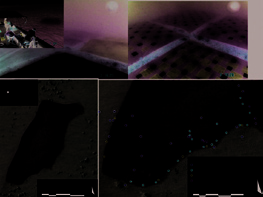
Field experiments conducted by the RSWG in Belize to examine the optical properties of water to "see" coral
© Ernesto Weil and Bette Willis, Disease Working Group, CRTR.
reef formations. This experiment used canvass "tiles" (above left & right) to test satellite sensors.©RSWG
Restoration: The RRWG studies in the field
investigations improve the knowledge base
on the surface of reef corals within the next
are not without risks. In 2007, Hurricane
with a focus on management relevance.
few months. Aquaculture may play a role as
Dean damaged the Akumal study site in
an incubator, conveyor and facilitator of
Mexico, destroying three artificial substrates Disease: The data produced by the DWG
disease into natural populations. Therefore,
(heavy concrete pallet balls; see picture on
suggests coral disease exists in al ocean
the DWG is focusing additional effort on
preceding page) and moving others up to
regions and has been more prevalent in
this investigation and is working in partner-
30 m across the seabed. However, the studies
some areas than previously known. Prior to
ship with the Philippine Center of Excel ence
have been reset and continue along with
the CRTR global surveys, it was believed that
Bolinao, and with the Restoration Working
ACITY BUILDING FOR MANAGEMENT
similar investigations at the other COE sites.
coral reef diseases were largely confined to
Group. The goal is to produce significant
the Caribbean Basin. This new knowledge
new scientific knowledge that may feed
In the Philippines coral bleaching and a
heightens the urgency needed to address
directly into policy in an area of developing
Crown-of-thorns starfish outbreak have
the causative factors and develop interven-
concern: sustainability of aquaculture
killed large numbers of corals being used
tions to strengthen recovery and immunity.
adjacent to coral reef systems.
in experiments at Bolinao. However, the
Working group surveys at the Centers of
research has gained valuable information
Excellence continue to be an important
The DWG now has two full years of
about which species have been able to
group initiative as they not only provide
consistent data, from careful y paired MPA
survive stress and may serve as preferred
invaluable empirical data on changes of
and non MPA locales in the Philippines,
restoration candidates in the future.
coral community structure and disease
controlled for similar environments (except
syndromes over time, but also allow
fish). On these paired reefs, significantly
Remote Sensing: Testing remote sensing
identification of just a few syndromes
fewer coral diseases occur on many of the
ARGETED RESEARCH AND CAP
technologies also carry risk and the RSWG
that will serve as models of how infectious
MPA reefs, compared to non MPA reefs.
has had to face challenges with weather,
diseases affect reef sustainability. Among
Continuing to collect this kind of careful
cloud cover and other logistics in conducting
the tractable syndromes the DWG has
data and testing hypotheses about the
aerial over flights or capturing the appropriate worked with include Aspergillosis, Yellow
causal explanation will be a priority area for
satellite images for analysis and use. However,
Band Disease, Black Band Disease, Porites
research and these studies have received
persistence has been rewarded and the
Ulcerative White Spots (PUWS), Bacterial
much enthusiasm and discussion from the
CORAL REEF T
working group has been able to address
bleaching, and Porites Tumors and Echinopora
local Filipino managers and could have a
such obstacles in furthering technological
vibrio infections in Eastern Africa. The DWG
future impact on management and policy
development for coral reefs thus far in the
has identified a significant number of Caribbean
making decisions regarding MPAs. There-
CRTR program.
and Indo-Pacific and Eastern African disease
fore a future focus will be to understand
syndromes that are infectious and is working
what aspects of these MPAs result in lower
with a range of scientists in identifying the
levels of coral disease. The DWG is also
RESULTS AND LEARNING
new causative agents.
developing a model with the RSWG to
highlight some of the potential influences
So what does al of this targeted research
Research in fish pens has uncovered strong
of MPAs on coral health.
mean in the context of improving manage-
influence on the free living and attached
ment, policy and the sustainability of resources?
bacterial population, nutrient input, primary
These groups' findings are providing a strong,
production and the patterns of energy and
coordinated foundation of information that
carbon flux in the surrounding waters. In a
address long-standing unknowns--ones in
qualitative sense the fish pens create a
which current management efforts have
nutrient and productivity hot spot and thus
either never considered, or have used limited
raise the question as to whether the reefs
knowledge or even guesswork in attempting
fall within its region of influence. The results
to address coral reef decline. While actions
show that the near-field effects are very
to protect coral reef resources should continue
strong. We will know the identity of specific
based on what is already known, these
bacteria exported from fish farms to reside
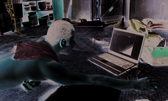
Fish pens located in the Caquiputan Channel between the Bolinao
mainland and the islands of Santiago and Cabarruyan Islands, adjacent
to the Bolinao Marine Laboratory, Philippines ©AJH
The DWG has also made significant discover-
ies in the Caribbean and Australia regarding
the potential impacts of climate warming
events on the outbreak of coral disease. As a
result, the group has developed a productive
collaboration with the Remote Sensing
Working Group to create new algorithms to
predict outbreaks of coral disease, using a
combination of monitoring data from Australia
and from the Caribbean as well as satellite
temperature data.
As of the end of Year 3, the DWG has
held workshops and completed research
at all Centers of Excellence, and one of the
5
major priorities has been to study how local
environmental issues, such as water quality,
are impacting coral health and diseases.
During January 2007, the DWG conducted
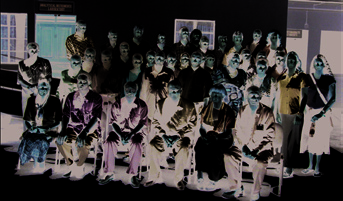
2006 Disease Working Group workshop participants in Zanzibar, Tanzania. ©DWG
workshops and research in Bolinao, Philippines
where the group developed initial methods
for evaluating the influence of fish farms on
coral reef health.
SCIENTIFIC PROGRESS
MANAGEMENT APPLICATION
Restoration: The loss of experiments from
Define limitations of optical remote sensing (RS) for
More cost-ef ective deployment of RS for reef assessment;
unexpected bleaching and crown-of-thorns
coral reef mapping and prioritize the importance of
al ow bet er matching of management goals to appropri-
each source of potential er or
ate technology and techniques
starfish outbreaks were a temporary set back
in planned research, but the events have
Quantify the efficacy of algorithms that predict
Provide tools to detect areas of coast that have exhibited the
lead to important lessons. For example, as a
changes in reef ecosystems from archived imagery
greatest change over ecological and management time scales
result of the 2007 bleaching event in Bolinao,
the RRWG now has new data on which coral
Develop software capable of automating the predic-
Increase cost-effectiveness and scale of coral reef
fragments are more resistant to bleaching
tion of coral cover from towed video
monitoring.
versus those that are more susceptible.
Develop acoustic remote sensing methods that can be
Increase cost-effectiveness of remote sensing,
used to complement optical RS and map substrate
particularly in turbid environments.
The timing of coral reproduction around
rugosity (i.e. three dimensional relief).
Bolinao has been established (the first
detailed data on this ever for the Philippines)
Link acoustic data on substrate rugosity to
Map the distribution and dynamics of the habitat for
with a total of 36 reef-building species
the microhabitat characteristics of reefs and associated
juvenile and smal -bodied reef fish in both the Caribbean
belonging to 14 genera and 7 families
fish communities
and Pacific. Measure loss of substrate complexity rapidly
observed to broadcast spawn in April-June
and over large scales (e.g. after a disturbance)
period. Already, interesting results on the
Convert fish census data on par otfish communities to
Make better use of monitoring data or baseline surveys
effect of fragmentation on reproduction are
a direct metric of grazing potential that incorporates
to compare potential patterns of grazing over time or
beginning to emerge with a clear effect of
species, body size, time of day and tidal height
among sites. Help interpret the impacts of fishing and
TION AND MANAGEMENT FOR ECOSYSTEMS AROUND THE WORLD
size of transplant fragments on reproduction
the selection of management zones.
but not on survival. Gravid coral colonies
Develop new algorithms to predict the likelihood
Better predictive accuracy, empowers managers with
were also successful y spawned in the Bolinao
of coral bleaching incorporating both light and
credible, real-time information. Al ows stratification and
outdoor hatchery and spat were settled
temperature
targeting of field survey and monitoring.
onto conditioned tiles in order to study
how (a) herbivory and (b) spat density affects
Develop algorithms to design connected systems of man-
Practical tools to help select networks of marine re-
post-settlement survival.
agement zones (e.g. marine reserves) based on the local
serves that explicitly attempt to incorporate the impacts
thermal regime, bleaching-stress, and larval connectivity
of rising temperature and bleaching on coral reefs
Remote Sensing: The RSWG research has
Model impacts of coral disease, bleaching and
Provide tools to assess the efficacy of altering the
enabled the ability to prioritize the importance
hur icanes on Caribbean coral reefs
grazing level and algal growth rate of reefs through
of particular considerations when carrying
management action. Identify areas most at risk of
out airborne remote sensing. The table at
climate change and vice versa.
right summarizes progress to date.
IMPROVING SCIENTIFIC INFORMA
The main technical outcomes thus far have
been (1) modeling of the remote sensing of
intensity with insight into spatial variation in
of PhD and post-doctoral students from
coral reef waters which provided new technical model parameters, (4) successful modeling
developing countries.
insight into the planning of airborne remote
of fish density from acoustic remotely-
sensing campaigns (for example, to maximize sensed data, (5) model of coral reef
In this regard, many capacity building
spatial resolution and fly with a sun zenith
processes highlighting the importance of
activities have taken place with the RSWG.
angle of 45 degrees and low wind speed),
coral cover, size distribution and aggregation
The Working Group has conducted
(2) new video-based methods to increase
for discrimination, and (6) generation of new
training of CRTR students in remote sensing
the efficiency of in situ data on coral reefs,
algorithm to predict coral bleaching from
with special application to their research
(3) model to convert in situ fish census
temperature and solar insolation. Each of
throughout Phase 1 and divided among
data of Pacific reefs into predicted grazing
the projects involves the work and activities
Working Group member's institutions.

offers the opportunity to build future leaders
not only among scientists, but also scientifi-
cally trained students who will move into
future management, governance and
decision-making roles in their respective
countries and regions.
REFERENCES
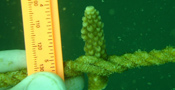
Example of a coral fragment inserted into a polypropylene line and
RADIANCE INTEGRAL
RADIANCE INTEGRAL
suspended for growth. Research has shown that about 80% of such corals
(9 different species) can survive over one year and can be successful y
Disease Working Group, 2007. Coral Disease,
placed onto degraded reefs.
POWER
POWER
Environmental Drivers and the balance between
coral and microbial associates. Oceanography Vol 20,
BAND
BAND
No.1 172-195.
In 2007, four students contributed two draft
A new model developed by the RSWG has enabled the filtering of light spectra Edwards, A.J. and E.D. Gomez, 2006. Reef Restoration
papers at the first national marine habitat map
so that a clearer identification of coral reef features using remote sensing is
Concepts and Guidelines: making sensible management
now possible. ©P.J.Mumby/J.Hedley, RSWG
being created for the government of Palau.
choices in the face of uncertainty. Coral Reef Targeted
Research and Capacity Building for Management.
The RSWG conducted two full CRTR work-
management tools for reef managers and
C/-Centre for Marine Studies
shops for coral reef managers and technical
could be replicated in practice.
The University of Queensland
staff; one in Puerto Morelos, México that
St Lucia QLD 4072.
concentrated on remote sensing products
Restoration: In 2006, the
Mumby, P.J., W.Skirving, A. E. Strong, J. T. Hardy,
for coral reef bleaching, and the second in
RRWG developed a manual
E.F. LeDrew, E.J. Hochberg, R.P. Stumpf, L.T. David. 2004.
Zanzibar, Tanzania that was organized by the
for restoration entitled
Remote sensing of coral reefs and their physical environment.
Marine Pollution Bulletin 48 (2004) 219228.
COE. The latter workshop took place over 7
Reef Restoration Concepts
days and was co-taught by Dr Alasdair Edwards,
and Guidelines: making
Chair of the RRWG. Additional workshops
sensible management
were carried out in Fiji and in Australia. In the
choices in the face of
Philippines, the RSWG initiatives can be of
uncertainty, and offers
value to the national and local government
guidance to managers
by providing the basis for maps of coastal
about what is currently known and advised for
resources for coastal use zoning, MPA
approaches to restoration of coral reefs. The
planning, and management.
document is downloadable from the Internet
CONTACT INFORMATION
(www.gefcoral.org)
A series of new data products have been
generated including a web-portal for directing
Remote Sensing: Since 2005 the RSWG
Marea E. Hatziolos, Team Leader
users to sources of satellite data on factors
has replicated a course in training managers
Senior Coastal and Marine Specialist
affecting coral reefs and new bleaching
in accessing and using a broad range of
Environment Department
metrics for use around COEs. Inter-working
the US National Oceanic and Atmospheric
The World Bank Group,
group activities have included work with the
Administration (NOAA) remote sensing
MSN MC5-523
DWG to convene a meeting that led to new
products, such as sea surface temperature,
1818 H St., N.W.
algorithms being identified for coral disease
coral bleaching hotspots and degree
Washington, D.C. 20433
prediction and new parameterization for
heating weeks. The training has been
+1.202.473.1061 (tel)
modeling, and a joint meeting was held with
replicated at all COEs.
+1.202.522.0367 (fax)
the Bleaching Working Group in Hawaii to
Email: mhatziolos@worldbank.org
develop new algorithms for coral bleaching.
SIGNIFICANCE
Melanie King, Executive Officer
Project Executing Agency
REPLICATION
The CRTR program offers the ability to develop
Coral Reef Targeted Research
a rigorous foundation of targeted scientific
& Capacity Building for
The DWG has developed a set of guidelines
information on which to base stronger
Management Program
entitled A Coral Disease Handbook: Guidelines
management interventions and policy. The
C/-Centre for Marine Studies
for Assessment, Monitoring and Management, enhancement of capacity though training
The University of Queensland
that will be available to the management
opportunities and collaborative research
St Lucia QLD 4072
community in mid-2008.
among leading international and regional
+61.7.3346.9942 (tel)
scientists and students strengthens the parity
Email: m.king4@uq.edu.au
An area of special interest is the hypothesis
among a truly global research network that
www.gefcoral.org
that corals in MPAs may benefit from a healthier,
has only been made possible through GEF
more intact reef ecosystem. Continuing to
catalytic support. This program is strengthening
collect this kind of careful data and testing
global response through col aborative research
Anthony J. Hooten, Synthesis Panel
hypotheses about the causal explanation
and learning together, using the same
Executive Secretary & U.S. Coordinator
will be a priority area for research. The DWG
techniques and tools that enable
Coral Reef Targeted Research
is developing a model with the RSWG to
unprecedented comparisons in regions
& Capacity Building for
highlight some of the influences of MPAs
where coral reefs provide key assets and
Management Program
on coral health. This is an area where new
services for people. The proactive nature
c/o AJH, Environmental Services
scientific knowledge could assist management
of the Targeted Research--even in the face
4900 Auburn Avenue, Suite 201
and policy decisions about MPAs, and
of a changing climate and human population
Bethesda, Maryland 20814 USA
therefore is crucial to understand what
expansion in the world's tropical coastal
+1.240.395.0250 (tel)
aspects of MPAs result in improved coral
zones--offers perhaps the best chance to
+1.240.395.0252 (fax)
health. If the results continue to show a role col aboratively build information, capacity and
Email: ajh@environmentservices.com
for MPAs in coral health, this will provide
the will necessary to work together locally in
www.gefcoral.org
additional support for one of the main
solving a global challenge. The CRTR also