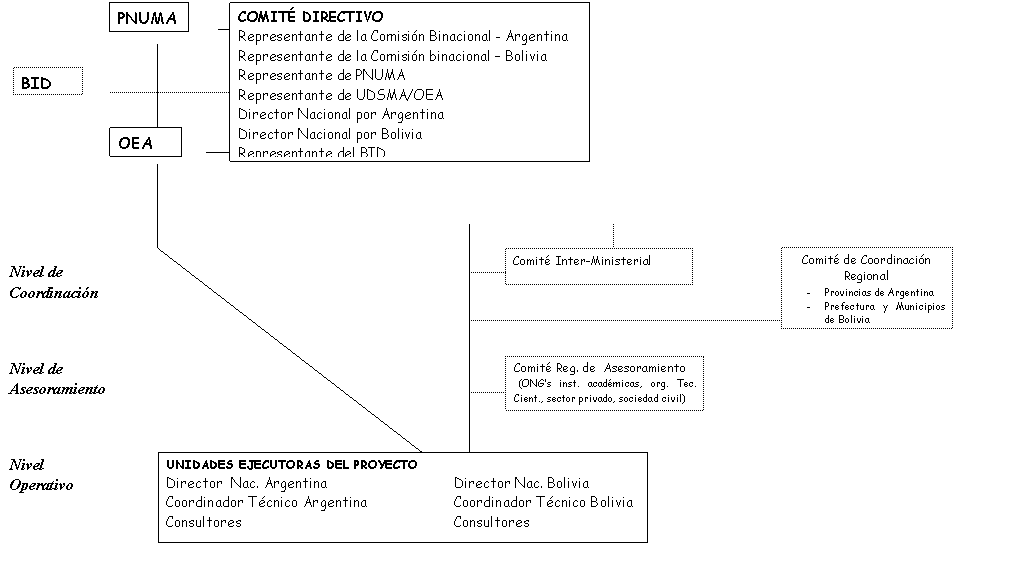
Organigram for the project execution
 | |||||
 | |||||
UNITED NATIONS ENVIRONMENT PROGRAMME
PROJECT DOCUMENT
SECTION 1 - PROJECT IDENTIFICATION
1.3 Project Number: GF/1010-01-05
1.4 Geographical Scope: Latin America and the Caribbean (LAC)
1.5 Implementing Organization: General Secretariat of the Organization of the American States (GS/OAS)
1.6 Duration of the Project: Four and a half years
Commencing: May 2001
Completion: October 2005
1.7 Cost of Project: (Expressed in US $)
_____________________________________________________________________________________ US$ %
_____________________________________________________________________________________
Cost to the Environment Fund (in kind)[1]: 150,000 0.5
Cost to Trust Fund (GEF) [2]: 11,043,600 56
Cost to Counterpart Contribution (countries)[3]: 8,430,000 43
Cost to the Implementing Organization (in kind)[4] : 150,000 0.5
____________________________________________________________________________________
Total Cost of the Project: 19,773,600 100
____________________________________________________________________________________
Signatures:
For the General Secretariat of For the Environment Fund of UNEP
the Organization of the American
States (GS/OAS):
_________________________________ __________________________________
César Gaviria Edmundo Ortega
Secretary General Chief, Budget and Fund Management Unit, UNON
Date: ___________________________ Date: ____________________________
Box 1: Identifiers of project brief as approved by the GEF
|
Identifiers Project Number: Project number not yet assigned (GF/8400-00-#) Project Name: Argentina/Bolivia - Implementation of the Strategic Action Program for the Bermejo River Binational Basin Project Duration: 4.5 years Implementing Agency: UNEP Executing Agency: Binational Commission for the Development of the Upper Bermejo and Grande de Tarija Rivers Basins GS/OASInter-American Development Bank Requesting Country: Argentina and Bolivia Country eligibility: Eligible under paragraph 9(b) of the Instrument. Focal areas: International waters with relevance to the cross-cutting area of Land Degradation GEF Programming Framework: OP 9 Integrated Land-Water Multiple Focal Area Summary This project catalyzes the implementation of the Strategic Action Program for the Bermejo River Binational Basin. The Project will implement specific strategic activities, identified in the GEF-financed strategic action program (SAP), that address the principal root causes of soil degradation as set forth in the transboundary diagnostic analysis (TDA) and, in doing so, will provide the necessary institutional, legal, and informational basis to enhance and restore the environmental functioning of the system, and provide protection to endemic species within the five component ecosystems—montane, humid forest, arid Chaco/savannah, sub-humid Chaco, and humid Chaco. These actions, with incremental costs, will complement Basin-scale interventions by the Binational Commission, and the governments of Argentina and Bolivia, financed in part from national and provincial/prefectural sources and by international loan funding, many of which address expected baseline activities. Strengthening of Basin institutions, building of agency and organizational capacity, and integration of environmental concerns into economic development activities on a sustainable basis, and the promotion of the public awareness and participation are key elements of this project. Costs and Financing (Million US $) GEF: Project US $ 10.40 million Administrative Fees US $ 0.64 million PDF US $ 0Subtotal GEF US $ 11.04 millionCo-financing: UNEP US $ 0.15 million (in kind) GS/OAS US $ 0.15 million (in kind) Governments US $ 8.43 million Subtotal US $ 8.73 million Total Project Costs: US $ 19.77 million Associated Financing to Strategic Actions Inter-American Development Bank US $ 160.75 million The World Bank US $ 159.52 million Other US $ 23.18 million Government US$ 187.29 million Total Associated Financing: US $ 530.74 million Operational Focal Point EndorsementArgentina: Name: Embajadora Elsa Kelly, Title: Directora de Asuntos Medioambientales, Organization: Ministerio de Relaciones Exteriores, Comercio Internacional y Culto, Date: 28/06/00 Bolivia: Name: Embajador Jorge Soruco Villanueva, Title: Primer Delegado ante la Commission Binacional para el Desarrollo de la Alta Cuenca del Rio Bermejo y Rio Grande de Tarija, Vice Ministro de Politica Exterior, Organization: Commission Binacional, Date: 21/06/00 IA Contact: Mr. Ahmed Djoghlaf, Executive Co-ordinator, UNEP/GEF Co-ordination Office, UNEP, Nairobi, Tel: 254 2 624153; Fax: 254 2 520825; Email: ahmed.djoghlaf@unep.org. |
SECTION 2 - BACKGROUND AND PROJECT CONTRIBUTION TO OVERALL
SUB-PROGRAMME IMPLEMENTATION
BACKGROUND AND CONTEXT
1. The development of a Strategic Action Program (SAP) for the Binational Basin of the Bermejo River (hereinafter the BRBB) was the outcome of an highly transparent public interaction process that has identified community-based mechanisms for the protection of the water resources of this Plata Basin tributary river system.[5] The process of formulating the SAP involved the active participation and input of over 750 persons representing governmental, non-governmental, civic, and community interests throughout the Basin. As a result of this process, an expectancy has been created among the riparian communities of greater citizen involvement in the management of the land and water resources of the Basin. While this expectancy differs in quality between the Bolivian portions of the Basin—where public participation has been an element of governmental planning for some time, under the law for popular participation¾and the Argentine portions, the basic concept is one of public involvement in the sustainable use and protection of the Basin’s land and water resources through a process of dialogue between decision-makers and local communities. This project is proposed as a means of creating the necessary institutional, legal, and informational bases to implement this concept.
2. The BRBB extends over some 123,000 km2, originating in the Andes Mountains of northwestern Argentina and southern Bolivia. The river, which flows some 1,300 km, crosses the Chaco Plains, forming an important ecological corridor linking the Andean ecosystem with the Atlantic ecosystem. Because the Bermejo River is the only major river spanning the Chaco, the river system contributes the largest mass of Andean sediment to the Plata River system. The origin and behavior of the sediment has the potential to dramatically condition water uses in the Bermejo and Plata river systems, not only with respect to river-based and river-dependent activities but also with respect to the structure and dynamics of the riverine ecosystems.
3. Combining the foregoing demographic and geographic imperatives implies that community-level interventions to enhance the management of the land surface can contribute to the maintenance of the structure and function of the waterway, whilst preserving the economic benefits derived from the watercourse for local communities. The accuracy of this statement was borne out through the success of localized, community-level demonstration projects conducted during the period of SAP formulation. These projects reinforced local ownership and local leadership roles, while facilitating changes in historic and traditional land-use practices from unsustainable to sustainable practices. In facilitating such changes, the project encouraged the integration of governmental, non-governmental, and private sector interests for the economic benefit of entire community groups and lessened their environmental impacts on the river and its watershed.
4. A hallmark of the Global Environment Facility (GEF), under whose auspices the SAP was formulated, is the emphasis on the potential of projects for replication. The GEF, through Operational Program # 9—the International Waters Integrated Land-Water Multiple Focal Area Project component (paragraph 9.21 of the Operational Program)—encourages the conduct of projects that successfully integrate divergent socio-economic interests in an environmentally sustainable manner. For this reason, the completion of the diagnostic and strategic programming phase of the BRBB project marks the starting point in the sustainable management of the BRBB. This initial phase identified, implemented, and tested sustainable land management practices on the local level, and created a basin-wide expectation for greater civic involvement in resource management and economic development issues. This next phase of GEF programming in the BRBB must identify, develop, and implement mechanisms for the replication of those practices and measures that have been demonstrated to be successful throughout the BRBB and throughout the Plata River Basin. In so doing, the BRBB project can continue to refine and demonstrate the means for, and benefits of, country ownership and community participation in river basin management.[6] This integrated approach to river basin management is wholly consistent with UNEP’s EMINWA process.[7]
5. National Programming Context. The governments of Argentina and Bolivia initiated the BRBB project in 1997 through the Binational Commission for the Development of the Upper Bermejo and Grande de Tarija Rivers Basins (Binational Commission).[8] With the support of the GEF, UNEP, and GS/OAS, the Binational Commission, in cooperation with the National Secretariat of Environment of Bolivia and the Secretariat of Natural Resources and Human Environment of Argentina,[9] and in consultation with the relevant prefectural and provincial governments, conducted the Transboundary Diagnostic Analysis (TDA) that led to the preparation of the SAP. Using an environmental zoning approach, the Basin countries identified general and site-specific needs and priorities for the conservation, rehabilitation, and preservation of degraded lands; initiated the creation of a shared geographic information system to facilitate dissemination of available physical, biological, social, legal, and economic information; and field-tested specific management mechanisms designed to prevent negative impacts in urban and rural areas, especially as related to land degradation insofar as it affects on the water resources in the region.
6. Six priority problems for ecosystem-level conservation, rehabilitation, and preservation were identified in the TDA:[10] (1) degradation of soils and intense erosion and desertification processes; (2) scarcity of water resources and limitations on their management; (3) degradation of water quality; (4) habitat and biodiversity losses and deterioration of terrestrial and aquatic biotic resources; (5) losses due to the occurrence of flood-related and other natural disasters; and (6) deterioration of the quality of life of the population living in the Basin and loss of cultural resources. These problems are endemic throughout the Basin, and most are both natural and anthropogenic in origin.
7. The analysis of their basic and direct causes was the subject of an extensive public consultation process, the results of which defined the strategic actions included in the SAP. As envisioned by Basin stakeholders, the SAP was prepared as a long-term action plan, designed not only to address the root causes of the critical environmental degradation affecting the basin, but also to promote the sustainable development of Basin communities. It is composed of four sets of priority actions: (1) prevention of environmental degradation, and rehabilitation and protection of degraded environments; (2) sustainable development of natural resources in the Basin; (3) institutional strengthening and implementation of an effective legal and institutional framework for integrated water resources planning and management within the Basin; and (4) implementation of a program of consultation, public awareness and participation for environmental protection and management, and replication of project activities in other regions of the Plata Basin. A SAP summary is presented in Annex X.
8. From each of the four strategic areas of the SAP, a restricted number of priority actions, with particular emphasis on erosion and sedimentation issues, have been selected to address the priority transboundary environmental problems affecting the Basin. These actions are considered of immediate priority, and include the execution of specific preventive and remedial activities, the consolidation of participatory mechanisms, and the provision of the necessary legal and institutional framework for the entire program. Each of these activities is being described in greater detail in Annex IX and is also summarized in Table 1 hereafter.
2.2 Project Contribution to overall Sub-Programme implementation:
9. GEF Programming Context. Both countries are eligible for GEF assistance under paragraph 9b of the Instrument for the Restructured GEF. The GEF, through Operational Program # 9—the International Waters Integrated Land-Water Multiple Focal Area Project component (paragraph 9.21 of the Operational Program)—encourages the conduct of projects that successfully integrate divergent socio-economic interests in an environmentally sustainable manner. For this reason, the completion of the diagnostic and strategic programming phase of the BRBB project marks the starting point in the sustainable management of the BRBB.
10. UNEP programming Context. The proposed actions are consistent with the UNEP Environmentally Sound Management of Inland Waters (EMINWA) integrated watershed management planning process and related, regional seas programme.
SECTION 3 - NEEDS AND RESULTS
3.1 Needs:
11. There is the need (1) to promote the sustainable development of the Río Bermejo Basin by implementing the Strategic Action Program for the Binational Río Bermejo Basin (SAP), and (2) to promote and reestablish environmental functioning of the system, by executing selected strategic actions that complement and facilitate the efforts of the Argentine and Bolivian governments and institutions in implementing the SAP.
3.2 Results:
12. Key results will include:
· institutional development and strengthening;
· environmental prevention, protection, and rehabilitation;
· sustainable development of natural resources;
· public participation and awareness.
3.3 Risks and sustainability analysis:
13. This project is designed to address priority environmental matters concerned with sustainable development, and the protection and preservation of the various ecosystems extant within the BRBB. To effect this, it is necessary to formulate a comprehensive program of coordinated actions by the governments of Argentina and Bolivia, the riparian provinces of Argentina (Jujuy, Salta, Chaco, and Formosa), and the riparian prefecture of Bolivia (Tarija). This program is set forth in the SAP for the BRBB. The principal risk facing development in the BRBB is that environmental considerations are not properly included in projects, programs, policies, and actions in such a way as to ensure sustainability. Serious undesirable environmental side effects, such as increased degradation of erosion-prone areas, damage to the underlying natural-resource base, flooding, and pollution of downstream ecosystems, including economic units of production, may result from this failure. Notwithstanding this, opportunities exist for the protection and rehabilitation of the BRBB by strategically introducing effective and adequate environmental management practices and procedures. These opportunities can be given effect by the adoption by the provincial and prefectural governments of complementary legislation consistent with the principles set forth in the SAP, and reinforced by the complementary program of information and education supported by schools, universities, NGOs, and private corporations. The implementation of comprehensive programs of environmental and land-use zoning at the regional and local levels is an initial step in this process. There is a risk that prefectural/provincial and local governments may fail to recognize the need for complementary legislation, and that such legislation, necessary to give effect to a comprehensive strategic action program, will not be adopted. The effect would be a failure to overcome parochialism among governmental units that would hinder the full accomplishment of the sustainable management of the system. Likewise, there is a risk that the complementary program of public participation, including participation by private corporate entities, will not fully develop due to inadequate local resources or staff. Even so, significant improvement in the maintenance of environmental quality and sustainable economic development currently is being, and can continue to be, achieved in the absence of a comprehensive management regime, which suggests that, in any event, the net outcome of conducting this project will be a positive influence on the Basin.
14. There is a further risk that, while the Binational Commission has adopted an active posture that will catalyze and encourage an effective cross-sectoral role for the Commission in the sustainable management of the river basin, lack of adequate levels of financial or human resources could curtail the potential for this posture to result in significant economic and environmental benefit in the Basin. Incremental GEF funding is intended to be catalytic in reversing the unsustainable development trends in this region by, inter alia, helping to popularize sustainable practices among the population, provide the institutional, legal and financial structures necessary for implementation of sustainable practices, and promote mechanisms for continued economic growth, with minimal negative environmental impacts, within the Basin.
15. Project activities (including the participation process) and their implementation are designed to achieve sustainability. Components have been proposed for the purposes of addressing the root causes and effects of degradation of water and natural resources in the Basin, and of reclaiming once-productive areas and keeping them productive. Such components relate directly to the information gathered during SAP formulation to structure appropriate and sustainable responses, both structural and non-structural within the Basin. The extension of demonstration projects, the feasibilities of which were identified as an outcome of SAP formulation, is predicated upon their sustainability, both from the ecological and economic point of view and from the point of view of further evaluating the impact of those practices. Wherever possible, the projects will develop opportunities for the establishment of financial incentives, private-sector investment, and cost recovery in environmental management (e.g., in reclamation of eroded lands, pastures and forests, rational management of natural forests, and exploitation of newly forested or newly irrigated areas), and result in actual, working examples of new or refined land-management actions necessary for the sustainable development of the watershed. Activities on this scale will highlight issues affecting the sustainable implementation of practices allowing refinements or modifications to be made prior to further large-scale use.
16. To minimize risk, the national and local governments have active, ongoing programs of environmental management and are seeking more effective ways to manage and conserve their natural-resource bases, including reviewing legal and administrative practices, operational procedures, and human-resource needs. Innovative approaches have been proposed by governmental agencies during the public participation process. Incremental financing provided through this GEF project is intended to allow more extensive implementation of these approaches as a means of determining their longer-term effectiveness and thereby catalyzing the more widespread adoption of innovative methods by communities and corporations throughout the Basin. Government support of these actions proposed to be implemented in part with GEF funding includes a financial commitment of almost US$8.43 million over a period of four years, with additional funds proposed to be allocated to the implementation of specific demonstration projects under NGO-funded initiatives and international loan-financed programs, including investment programs totaling in excess of US$530 million. These national counterpart contributions, composed of municipal, provincial and prefectural, federal, and international funds from domestic and loan sources, will help to minimize risks during project implementation, help to create support for the watershed-management process, and assist in the development of practicable approaches to environmental resource management in the Basin. In addition, other nationally and internationally funded investment projects in the areas of natural hazard management, wastewater, stormwater, and water quality management infrastructure are being considered. Resource development plans and programs being executed by various governmental units within the Basin, as of mid-1999, are tabulated in Annex VIII.
17. Furthermore, to ensure sustainability of the Project’s results, both countries have taken steps to create an Inter-ministerial Committee, which will help mobilize support for the investments identified, and catalyze the translation of project findings and recommendations into policy, institutional, and legal reforms at the country level. The members of the Committee will be established by the respective governments and will include, among others, ministerial representatives from the areas of economy/finance, water resources, environment, health, sanitation, culture, and tourism, who will participate as observers in the meetings of the Regional Coordination Committee.
SECTION 4 - OUTPUTS, ACTIVITIES, WORKPLAN AND
TIMETABLE, BUDGET, FOLLOW-UP
4.1 Project activities and outputs:
RATIONALE AND OBJECTIVES
18. Building upon the priority actions set forth in the SAP, the primary objective of this GEF International Waters project is to assist the governments of Argentina and Bolivia in addressing the root causes of the principal environmental problems affecting the Bermejo River Basin, with a focus on their main transboundary manifestations—namely, sediment erosion, transport, and deposition—and to promote the sustainable development of the BRBB. Activities for the control of land degradation due to agricultural activities, prevention of erosion, and sediment control—including the creation, restoration and protection of natural vegetated areas, conservation of aquatic and terrestrial habitat, and support to popular participation in the management of natural resources through improved access to information and enhancement of public awareness, control of water-borne contaminants, and related measures—have been selected in order to catalyze implementation of specific actions as recommended in the SAP. A key feature of this project will be the replication and extension, throughout the Bermejo and Plata basins, of the localized activities of the SAP formulation project that were determined to be feasible measures for the integration of the geographic and demographic aspects of watershed management within the BRBB. The set of actions programmed for this purpose is described in Annex IX, Activity 4.4.
Table 1. List of Priority Actions for Addressing Transboundary Environmental Problems in the Binational Basin of the Bermejo River[11]
STRATEGIES/ACTIVITIES |
COSTS (US$ millions) |
Sub-ACTIVITIES | |
|
Total |
GEF | ||
|
I. INSTITUTIONAL DEVELOPMENT 1.Development/strengthening of the institutional framework |
1.91 |
1.10 |
§ Strengthening of the Binational Commission § Strengthening of COREBE § Strengthening of government and civil society orgs. |
|
2. Development of a holistic regional legislative, economic, and environmental framework |
1.84 |
0.79 |
§ Harmonization of regional and jurisdictional legal frameworks § Environmental zoning for land-use regulation in selected areas § Economic instruments for sustainable water use § Incorporation of environmental and social costs in project evaluation |
|
II. ENVIRONMENTAL PROTECTION AND REHABILITATION 1. Soil management and erosion control in critical areas |
2.13 |
1.32 |
§ Sediment control in the Tolomosa River basin § Integral management of natural resources in the Santa Ana River basin § Integrated management of the Iruya River basin § Soil-loss prevention in the Huasamayo sub-basin |
|
2. Consolidating protected areas and protecting biodiversity |
1.79 |
1.30 |
§ Ecotourism activities in piedmont transition forests § Carbon fixation in the Yungas § Implementation of the Baritú-Tariquía- Calilegua biological corridor § Management plan for Sama and Tariquía biological reserves § Evaluation of sub-Andean rangelands § Study and implementation of the Teuco National Park (Chaco region) § Biodiversity study |
|
3. Protection and restoration of water quality |
0.33 |
0.20 |
§ Environmental clean-up of the Guadalquivir River (pilot-scale waste-water treatment plants in rural communities) § Assessment and design of water-pollution control strategies in the Bermejo Triangle |
|
III. SUSTAINABLE DEVELOP- MENT OF NATURAL RESOURCES 1. Implementation of a planning framework for integrated water resource management and sustainable development |
2.67 |
1.53 |
§ Regional integrated program for natural resource management, erosion and pollution control, and sustainable development in the Bermejo Basin |
|
2. Sustainable practices for rehabilitation of degraded areas in the Chaco and Yungas regions |
2.40 |
0.85 |
§ Training and promotion of sustainable resource management techniques in the humid and subhumid Chaco § Diversification of production alternatives to reduce human pressure on natural forest resources in the Yungas region |
|
3. Community extension programs for sustainable production and natural- resource management |
0.34 |
0.19 |
§ Survey, assessment, validation, and extension of traditional natural-resource management practices in representative areas of the Bermejo River basin § Promotion of sustainable production activities and natural-resource management in indigenous and native communities |
|
4. Sustainable agriculture and soil conservation practices along the San Jacinto project area |
0.24 |
0.16 |
· Pilot project for testing and dissemination of soil and water management techniques in irrigated farming along the San Jacinto water reservoir area (Upper Bermejo) |
|
5. Securing of financial resources for the Bermejo River Basin |
0.35 |
0.30 |
· Donor roundtable meeting for securing financial resources to support implementation of SAP activities and other complementary actions oriented to the sustainable development of the Bermejo River Basin |
|
IV. PUBLIC AWARENESS, PARTICIPATION, AND REPLICATION OF PROJECT ACTIVITIES 1. Environmental education programs |
1.17 |
0.51 |
· Implementation of environmental awareness and training programs on sustainable resource use for different ecological regions of the Bermejo basin |
|
2. Public participation program |
0.53 |
0.31 |
§ Information dissemination, consultation workshops, and establishment of suitable mechanisms for public participation in the Bermejo river basin |
|
3. Information system for the Bermejo River Basin |
2.28 |
1.14 |
· Access to information for public participation · Developing networks and articulation mechanisms § Creation and implementation of an environmental information and monitoring system § Definition and adoption of IW indicators |
|
4. Replication of project activities |
0.85 |
0.70 |
· Dissemination and replication of the Bermejo project into the broader context of the Plata Basin |
TOTAL COSTS |
18.83 |
10.4 |
|
19. This project proposal is being compiled at a time when the Bermejo River Binational Commission, the provinces of Jujuy, Salta, Chaco, and Formosa (in Argentina), and the governments of Argentina and Bolivia are implementing measures to integrate stakeholder participation and grassroots-level involvement into water resources management. Such measures have been in place in Bolivia for some time through an established law for popular participation. These measures provide opportunities for the creation, strengthening, and/or implementation of effective organizations, and of control and fiscal instruments, to mitigate and prevent land and water management practices that enhance soil erosion and sediment transport, degrade water quality, modify hydrological and hydraulic characteristics of the Basin, and/or adversely affect the biological integrity of the Chaco and BRBB. In addition, the SAP provides a relevant and appropriate regional planning context for site-specific interventions to be designed and catalyzed under the activities set forth in this proposal. The net result of these actions will be the initiation and development of a program for the environmentally sustainable development of the land and water resources of the BRBB, including those of the Chaco plains. The strengthening of the Binational Commission, and the inter-ministerial articulation of governmental agencies involved in water resources and environmental management within and among the various jurisdictions, are anticipated to be a specific result of these actions. Thus, the sustainability of SAP implementation after GEF intervention and the incorporation of project findings into the institutional and legal frameworks will be ensured.
20. Complementary Interventions. Activities proposed for implementation during the project period would be conducted in a parallel, but active relationship, with numerous ongoing and proposed planning and development activities in the Plata River Basin. Some of these activities are within the various GEF focal areas of interest. In the International Waters focal area, other ongoing GEF-financed projects are being conducted within the Plata Basin, including the Upper Paraguay River and Pantanal project in Brazil, the Maritime Front of the Plata River project in Argentina-Uruguay, and several others under consideration. Among these latter projects, a medium-sized project has been proposed to create an information system for the Upper Paraguay River Basin (SIAP), providing opportunities for regional cooperation at basin level. In addition, infrastructural investments for water supply, wastewater, storm and flood water, and water quality management are being financed or considered for financing from national and international sources within the BRBB.
21. These projects are being conducted, or are proposed to be conducted, with funds provided by the World Bank, the Inter-American Development Bank, FONPLATA, and CAF, and through bilateral cooperation agreements. Integration of these activities within the regional planning context created by the BRBB SAP will provide opportunities for further involvement and coordination of investments within the framework of this project. Within the Plata River Basin, all of these projects, including the proposed activities within the BRBB, will contribute to the knowledge base for the sustainable management and development of natural resources of the Plata River Basin, and provide complementary information on appropriate environmental management measures for sustainable economic development throughout the multiple ecosystems that comprise the Plata River system. In an effort to better integrate these efforts, a comprehensive framework plan for the management of the Plata River Basin is currently being prepared by the Basin countries.
PROJECT COMPONENTS AND EXPECTED RESULTS
22. The proposed project activities are designed to catalyze the implementation of actions necessary to address the root causes of priority transboundary problems identified during SAP formulation, with a focus on soil degradation and sediment transport. These problems are shown, in summary form, in Annex V. The project activities are designed to implement an integrated program of river basin management in the BRBB, and are concentrated in four principal components as set forth below. The schedule of expenditure of GEF funds is presented in Table 1.3 of the incremental cost analysis presented in Annex A. Detailed information on each component is presented in Annex IX.
COMPONENT I: INSTITUTIONAL DEVELOPMENT AND STRENGTHENING FOR INTEGRATED WATER RESOURCES PLANNING AND MANAGEMENT.
23. Component I is designed to provide a broadly based, participatory institutional framework, likewise developing and strengthening the legal basis underlying the regulation, planning, and environmental and social evaluation, environmental zoning, and economic and financial arrangements that are indispensable for effectively implementing sustainable measures for prevention, restoration, planning, and development of the natural resources identified in the SAP. The two clusters of activities that make up this component are aimed explicitly at creating an effective and integrated organizational base that will involve both the public and private sectors in implementing a multisectoral and holistic approach to the environmental management and economic development of the basin, as proposed in Chapter 18 of Agenda 21. This framework is fundamental to support the extension and subsequent implementation of the specific strategic activities in the basin that will address the basic causes of transboundary environmental problems ¾namely, land degradation and sediment transport¾that form the framework for the other components of the project. Activities undertaken within this component specifically address weaknesses within the current organizational base, identified during SAP formulation, that hinder the effective, holistic management of the water resources of the BRBB. This will ensure institutional capacity to implement the new laws, regulations, and procedures necessary for the longer-term success of the watershed management measures by helping to increase participation in decision-making within the Basin, and enhance and underpin the ability of the Binational Commission not only to carry out its current mandate but also to assume additional responsibilities relating to information sharing and coordination among stakeholders. The two clusters of activities to be conducted within the component will include:
· Development and strengthening of the institutional framework designed to (i) to deepen and broaden activities initiated during the SAP formulation stage with respect to implementation of the project and the coordination role of the Binational Commission, (ii) to promote regional coordination and programming, and (iii) to address weaknesses in the complex institutional framework that currently impede a comprehensive vision of the basin and the integrated and sustainable management of its resources. These activities are also intended to develop and broaden the participatory framework, including mechanisms for specific participation by provincial governments, the Prefecture and municipalities of Tarija, and to strengthen the capacities of the institutions that represent them. This will be done through the following specific activities; 1) institutional development and strengthening of the Binational Commission and regional entities within the two countries (COREBE and OTN), and 2) the institutional strengthening and capacity building of local governmental and civil society organizations.
· Development of a holistic regional legislative, economic and environmental framework. By designing and implementing legal and financial instruments and harmonizing standards for water quality management and land use in the basin, these activities will help establish a framework in which dialogue between the public and the agencies responsible for implementing integrated management programs for the basin can be translated into a comprehensive legislative program aimed at strengthening their legal and political foundations. It includes the following specific actions: 1) Development and harmonization of regional and jurisdictional political and legal frameworks; 2) Environmental zoning for land-use regulation in selected areas; 3) Development of economic instruments for sustainable water use; and 4) Incorporation of environmental and social costs into project evaluation.
24. The results of this component will be a documented framework for addressing transboundary problems inherent in the management of the Bermejo River basin, including the articulation of formal and informal mechanisms for participation by government units at the provincial and prefecture level in determining and implementing an integrated water resources management program (IWRMP). This will take the form of fully operational coordination and programming mechanisms within the Binational Commission, with participation by provincial governments and the prefecture of Tarija. These mechanisms will analyze and integrate agreed strategic guidelines for a regional institutional framework into an appropriate and effective binational, inter-jurisdictional entity for the basin, under which national–, provincial/prefectural- and municipal–level institutions can be strengthened in terms of their capacities and abilities to manage natural resources on a sustainable basis. This component will also provide specific support, through the regional entities of the two countries (COREBE and OTN), to provincial entities, the prefecture and municipalities of Tarija, academic organizations, NGOs, and governmental institutions involved in implementing the SAP, in order to develop their institutional, technical, and administrative bases. In addition, it will make substantive progress in the introduction of environmental zoning and land-use planning as management and planning tools, in the form of strategic methodological guidelines validated at the regional level, and concrete environmental management actions at the local level, in particularly critical areas of the Basin. The results of this component will help to optimize policies, practices, and programs for preventing land degradation and sediment transport, and managing water resources, thereby creating the economic and legal foundations for the sustainable development of the basin.
25. The output of this activity will include a documented context for establishing a regional regulatory framework for the use and protection of shared water resources; the determination of water–use charges, including a restructuring of fiscal, financial and legal mechanisms for managing the quantity and quality of water within the basin; and proposed legislation to put this framework into effect. A further explicit output of this activity will be legislative proposals for implementing the IWRMP at all levels of government and civil society as well as developed institutional, technical, and administrative bases.
26. It is anticipated that the execution of these activities will be undertaken by the Binational Commission, relevant governmental agencies at the national and prefectural/provincial levels, universities, and NGOs. The coordination and supervision of the activities will be ensured by the Technical Coordinators at the Binational Commission. Component I is anticipated to be initiated during the first quarter of the project period and continue throughout the project period. GEF: US$1.89 millions; co-funding: US$1.86 millions; total: US$3.75 millions.
COMPONENT II: ENVIRONMENTAL PROTECTION AND REHABILITATION
27. Component II is designed to extend the implementation of feasible measures of basin management identified during formulation of the SAP. Within the regional coordination and planning framework progressively provided by the institutional initiatives to be undertaken as part of Component I, the activities programmed for this component will deal with specific transboundary aspects identified in the TDA. In particular, planned actions focus on soil management and sediment–transport control, either by means of feasible specific prevention and control measures or by preserving the natural landscape in critical, erosion–prone areas through the consolidation of protected areas. Complementary basic natural resource studies and the maintenance of the quality of the Basin’s water resources are parts of this Component. The cluster of activities to be conducted under this component include:
§ Extension and implementation of feasible measures for erosion control in the Upper Rio Basin identified and proved effective during the SAP formulation phase, to promote greater use of soil management practices that minimize degradation and the risk of destabilization
§ Establishment of buffer zones and environmental corridors, and sponsorship of basic studies on natural resources, including pilot demonstration projects that promote effective ways of restoring degraded environments, preserving environments adjacent to nature conservation areas, and protecting biodiversity, while at the same time promoting the sustainable economic development of local communities
§ Protection and restoration of the quality of water in those critical stretches identified during SAP formulation, including implementation of the cleanup of the Guadalquivir River, and the initiation of planning studies of watercourses in the vicinity of the city of Bermejo, another critical point of pollution of the water resources in the Upper Basin.
28. The results of these efforts will encourage broader application of the feasible and proven management practices and thereby contribute to sustainable land use (essentially for farming) and the conservation of areas that, although not yet significantly altered, are at risk from land degradation. A key feature of this component will include the mitigation of erosion in critical zones of the basin.
29. The output of this component will include the application of recommended soil conservation and erosion control measures to limit the loss of soil in the upper basin. By demonstrating the utility of a community-based approach to the management, this component will catalyze the further adoption of community-based management techniques to restore degraded environments.
30. It is anticipated that the execution of these activities will be undertaken by the relevant governmental agencies at the national, prefectural/provincial, and municipal levels; research institutes; universities; and NGOs in the region. The coordination and supervision will be ensured by the Technical Coordinators at the Binational Commission. Component II is anticipated to be initiated during the second quarter of the project period. GEF: US$2.82 million; co-funding: US$1. 43 million; total: US$4.25 million.
31. Additional funding for the structural development aspects of this component is indicated under existing Inter-American Development Bank and World Bank programs. While these programs are independent of the GEF-financed initiatives, the Technical Coordinators at the Binational Commission will endeavor to integrate and coordinate their activities with these development activities to the fullest extent possible and in such manner as may be determined under Component I. Their actions would also involve the participation of, and coordination with, private sector stakeholders as provided under Components III and IV below.
COMPONENT III: SUSTAINABLE DEVELOPMENT OF NATURAL RESOURCES
32. Component III will encourage the implementation of alternative production modes that will be environmentally friendly or will at least minimize environmental degradation, with focus on land degradation and soil erosion, while at the same time providing greater economic opportunities for the local population, in a context of integrated management of water resources and sustainable development planning for the basin as a whole. The initial action under this component will be to formulate an Integrated Management and Sustainable Development Program for the Basin, which will draw upon, and at the same time establish, a regional framework for execution of the remaining activities. The five activities to be conducted under this component are the following:
· Formulation and development of an Integrated Water Resource Management and Sustainable Development Plan (IWRMP) ¾comprising information gathering and dissemination, studies, analyses, sharing of experiences, demonstrations, and evaluations conducted to date or to be undertaken as part of the first stage of implementing the SAP¾to guide the development and implementation of a programming framework for the integrated management of the basin's resources, to place development initiatives in the context of preventing erosion and pollution and conserving nature, and to serve as a basis for decision-making, and the establishment of a threshold of sustainability for development projects undertaken by the various jurisdictions, either alone or jointly. The design of this planning framework will include funding requirements and will also take in account financing opportunities available from local, regional, and international sources.
§ Extension and transfer of feasible approaches to sustainable economic development, resulting from experience during the SAP formulation stage, to the mitigation of environmental problems arising from the degradation of forests and soils by human activities in the form of pilot projects in order to promote diffusion of sustainable resource management techniques to the private sector, at the level of the local community, in order to encourage the restoration of degraded environments in the lower basin, management of forage in humid and sub-humid areas, productive restoration of vinalares, sustainable management of the agro-silvo-pastoral potential of subtropical zones, sustainable soil management and conservation, and management of excessive and deficient water flows.
§ Identification of current subsistence practices in these communities and the introduction of programs designed to encourage the adoption of sustainable water and soil management practices to protect water and soil resources, including native fauna, particularly fish, in the natural ecosystems of the Bermejo river, while at the same time helping to satisfy the demand for food, fuel and shelter in rural communities.
§ Optimization of soil and water use, controlling soil loss in and around areas under cultivation, and at the same time enhancing productivity through the development and implementation of technological packages for soil and water management in irrigated farming areas and the management of marginal lands particularly within the San Jacinto Project's area of influence.
· Securing of financial support for the sustainable development of the Bermejo Basin. Actions will be taken to help catalyze funding for the implementation of SAP project proposals, both those of immediate and long-term priority, as well as other complementary actions related to inter alia life quality improvement, poverty alleviation, health improvement, and the preservation of indigenous cultural heritage considered as important by both Governments for the sustainable development of the Binational basin. Specifically, donor roundtable meetings with representatives of local, regional, and international financing agencies will be convened to explore the possibilities of funds allocation to support development in the Bermejo basin. Both governments have initiated actions at the national level with the Inter-American Development Bank, seeking to obtain its participation as lead agency in the organization and conduct of the meetings planned to be held in the region within the first year of project activities.
33. The results of this activity will provide an agreed planning framework for sustainable management of water and other natural resources, within a regional regulatory context negotiated and supported through a broad process of public participation. It will serve as the basis for extending and deepening strategic efforts within both the public and private sectors at the community level, and will imply a concrete step toward the accomplishment of the objectives of the strategic program.
34. The output of this component will be the implementation of structural and non-structural practices of agricultural development that will also help to mitigate the impact of agriculture on more than 3000 degraded hectares within the humid and dry Chaco zones, and 77 sites where, in addition, other practices will be applied to rehabilitate degraded areas, in relation to specific public and private economic sectors. To this end, the output of the component also will include implementation of appropriate pasture and livestock management practices and the development of traditional, small-scale crops in the Yungas zones, implementing and/or improving traditional productive systems on a basis that is sustainable from an ecological, economic, and social viewpoint, and address land management in typical farm and pasture sites in the humid and sub-humid Chaco region of the lower basin, and undertake complementary actions to restore soil productivity. These outputs will include documented information on the extent of subsistence farming and fishing activities in the basin, a documented program of information dissemination for improving local understanding of sustainable farming and fishing practices, and community extension projects in selected places within the basin.
35. It is anticipated that the execution of these activities will be undertaken by the relevant governmental agencies at the national, prefectural/provincial, and municipal levels; research institutes; universities; NGOs; and private agricultural operations in the region. The coordination and supervision will be ensured by the Technical Coordinators at the Binational Commission. Component III is anticipated to be initiated during the first quarter of the project period. GEF: US$3.03 million; co-funding: US$2.97 million; total: US$6.00 million. Funding provided for this activity will also be used to establish the Project Coordination Unit and to support the Binational Commission for implementation of the IWRMP.
COMPONENT IV: PUBLIC AWARENESS, PARTICIPATION, AND REPLICATION OF PROJECT ACTIVITIES
36. Component IV embraces activities to identify and coordinate the interests of people and organizations with economic and/or institutional responsibilities in the basin, including the agricultural and industrial private sectors. Access to information is an essential part of the process of encouraging local stakeholders to take an interest in sound management of the basin's natural resources. To this end, a central theme of this component will be to inform the citizenry, including corporate citizens, within the basin through an integrated program of environmental education, institutional transparency, and exchange of information among communities, organizations, and government entities. Building on the achievements of the SAP formulation phase, further development of identified participatory mechanisms during the implementation phase, will set the grounds for extension of Project findings into the Plata River Basin. Actions are considered in this component to share experiences and promote international and regional cooperation seeking for mechanisms that will enhance positive synergies at the broader level within the Plata River Basin. The four clusters of activities to be conducted under this component will include.
§ Implementation of environmental education programs (awareness, training, and formal and informal educational programs), including the development and distribution of curricula and materials for use in training teachers, and involving both community and private-sector initiatives in the scope of educational programming, specifically designed to improve educational opportunities in the most vulnerable communities, and promotion of awareness and understanding among the various stakeholder groups¾social, political and economic¾about the environmental consequences of improper use of natural resources and the impact of human activities, through workshops, seminars, meetings, bibliographies, manuals, brochures, the mass media, etc.
§ Stimulation of public participation in environmental management of the BRBB by disseminating information to communities, corporations, and organizations through a variety of means¾including public hearings, community-based legislative initiatives, environmental education courses, consultation and mobilization workshops, capacity strengthening programs, and use of the mass media (radio, television, Internet, newspapers) ¾to build a basic awareness so that individuals, organizations, and businesses will become engaged in the decision-making process.
§ Acquisition and dissemination of technical information among water-resource professionals at all governmental levels involved in the use and management of waters of the Bermejo River¾including data on weather and rainfall, water quality and sediments, hydrogeology, land use, environment, law, demography, economic development, specific development sites, finance, other types of information useful for professional monitoring, and information of more general interest for the public and other interested entities in the basin and beyond the basin within the broader context of the Plata River Basin. The information to be disseminated will stimulate informed participation in community decision-making, foster institutional transparency, and help standardize practices among professionals and jurisdictions. The dissemination system is also planned to provide the grounds for defining and monitoring specific indicators related to sustainable development and the environmental status of the BRBB, including land use and natural resources degradation and restoration trends in the Basin, and to help monitor project achievements. The actual definition and adoption of indicators will be done by means of a series of technical regional workshops, and will include (1) process indicators (focusing on the processes that will lead to desirable results), (2) stress-reduction indicators (focusing on actions with defined targets that will reduce the environmental stress on the water body), and (3) environmental status indicators (focusing on the actual improvement of the ecosystem quality).
§ Replication of the methodological approach, findings, and recommendations of the Bermejo project to areas with similar problems within the Plata basin, in order to contribute to the promotion of a larger-scale and basin-wide strategic framework to address main environmental degradation processes, the identification of critical transboundary issues, and the definition of priority actions at the national and multinational level. This will be done inter alia by means of seminars, workshops, and information dissemination through various media.
37. The outputs of this component will include preparation of appropriate curricula at the different educational levels, publicity materials for promoting public awareness, and materials and manuals for use in teaching and teacher training. They will also provide a documented system of public participation, supported by suitable course materials and general information brochures, that will also benefit the regional public audience beyond the Bermejo Basin boundaries and build acceptance of public participation as a working methodology and philosophy in implementing SAP; documented user groups including a catalogue of information needs and environmental monitoring sites with suitable links to the information system; a regional information system within a GIS environment; and, one or more pilot-scale satellite information systems accessible to water management professionals, industry, and the community are key elements in this component.
38. It is anticipated that the execution of these activities will be undertaken by the relevant governmental agencies at the national, prefectural/provincial, and municipal levels; research institutes; universities; NGOs; and corporations in the region. The coordination and supervision will be ensured by the Technical Coordinators at the Binational Commission. Component IV is anticipated to be initiated during the first quarter of the project period. GEF: US$2.66 million; co-funding: US$2.17 million; total: US$4.83 million. This activity will complement and coordinate with a proposed medium-scale project to be financed by the GEF for the Upper Paraguay River Basin (SIAP, Environmental Information System for the Upper Paraguay) to be developed by Bolivia, Brazil and Paraguay, in order to create compatible and interactive information systems within and throughout the Plata River Basin.
39. At the inception of the project, an exhaustive list of published documents emanating from the various project activities will be prepared by the Technical Units in close consultation with UNEP and GS/OAS. This list will specify documents published in the English language. In any case, all project outputs will have an English Executive Summary. A minimum of 100 copies of each of the published documents will be produced in English and provided to UNEP for its distribution and transmission to the GEF Secretariat. It is assumed that the countries will keep a sufficient number of copies of the published documents in Spanish language.
STAKEHOLDER PARTICIPATION
40. Participation (Annex VI). Public participation in the management of the water resources of Argentina and Bolivia is an integral feature of the project. More than 750 persons, representing in excess of 80 civil, corporate, nongovernmental, and governmental entities (having municipal, prefectural/provincial, federal, and international interests) participated in the consultation process that led to the identification and definition of some 250 detailed project documents. Consultation included, among many other activities, public and stakeholder meetings convened during the SAP formulation process within the Basin. These meetings were held in each of the major prefectural and provincial centers between December 1995 and July 1999. The full proceedings of these meetings, and the supporting documentation listed in Annex VII, are available from the Binational Commission. These meetings represented the continuation of contacts with the agencies, as well as with private sector representatives, academic institutions, and NGOs, initiated during SAP formulation, and improved and clarified specific issues arising from component proposals and other observations made during the project preparation period. Additional communications, including more than 700 letters and 500 sets of workshop documents received from and distributed to some 550 individuals and institutions on the program’s mailing lists, ensured an highly transparent project preparation effort.
41. Private sector involvement. Community-based activities carried out during the SAP formulation phase resulted in the active participation of the private sector, in terms of participation by individuals as well as by producer and user associations. Pilot project demonstrations provided the grounds for active involvement of small- to medium-sized farmers, land owners, and specialized corporations which participated in the development and evaluation of sustainable management practices concerning forest conservation and restoration, forage management, sustainable practices for subsistence farming, and erosion and sediment transport control. Project activities will promote and enhance further participation of the private sector in replicating sustainable management practices and technologies, and provide opportunities and guidelines to offset risks associated with investments in the expansion of such practices. The project seeks to provide a planning framework to promote and catalyze the conduct of actions identified in the SAP, by articulating specific target investment areas comprised of governmental, nongovernmental, and private groups that could productively interact with regional and international banking and investment agencies.
42. The GEF project preparation steering committee met in Washington, D.C., during April and November 1997; in Nairobi, Kenya, during September 1998; and again in Washington, during September 1999. During these meetings, several consultations were held with representatives of the GEF Implementing Agencies, particularly The World Bank. During the SAP formulation, more than 250 individuals representing in excess of 25 institutions (both governmental and nongovernmental) were engaged as consultants in the conduct of demonstration projects, data acquisition and analysis, and needs assessments relating to the preparation of the TDA and SAP documents. Copies of all of the consultants’ reports are available for consultation from UNEP and the GS/OAS. The principle findings identified by the public, government officials, and consultants, as well as the experiences of the agencies and public in the conduct of the demonstration projects, are contained within the SAP and given effect by this proposal. This proposal has been prepared by the Binational Commission of Argentina and Bolivia with the support of UNEP and GS/OAS specialists.
43. Popular participation was built into the demonstration projects and implementation project formulation. This high level of public and stakeholder participation will be continued during the development and implementation of the IWRMP for the BRBB. As noted above, overall stakeholder participation in the project, including community- and corporate-based environmental information and education campaigns, training courses and symposia, and actions, continues to be designed to increase the capacity and future participation of institutions, personnel, and individuals to undertake activities in support of the IWRMP. Further, specific actions are proposed to be conducted under the project which address issues related to public and stakeholder participation in the planning and implementation process, and/or which provide support for the further development of a sound public participation and involvement strategy as one of the strategic actions of the SAP implementation.
EVALUATION AND DISSEMINATION
44. STAP review. (Annex III) This project proposal was reviewed by Dr Williams, Professor Emeritus, Adelaide University, Australia, an International Waters Expert included in the STAP Roster of Experts. Comments made by Dr Williams have been addressed in Annex III but did not require any specific modification to the Brief. In general, the comments of the STAP reviewer were strongly supportive of the project approach, methodology and design.
45. Dissemination. Incorporated into this project are specific activities which explicitly aim to promote and disseminate the experiences obtained during the SAP implementation process to the water resources professionals and to communities within the BRBB and Plata River Basin through a program of public information and education. Further, the project is explicitly designed to encourage the integration of basin actors in various project activities, including transboundary pollutant transport and similar issue identification activities. As previously noted, all project activities will encourage and facilitate technology transfer and information dissemination through programs of public participation, stakeholder involvement, and professional and community-based education and information dissemination. Prefectural/provincial and municipal governmental, NGO, private sector, and citizen involvement in project execution will contribute to the dissemination of information on specific technologies and techniques that contribute to the sustainable environmental management and economic development of the watershed. This emphasis on public participation in the SAP implementation process for the BRBB will facilitate communication with all concerned organizations, agencies and citizens, and the adoption of a comprehensive strategic approach for the management of this critical drainage basin.
4.3 Workplan and Timetable:
TABLE 1: PRELIMINARY DRAFT WORKPLAN AND TIME TABLE. [12]
|
2001 [13] |
2002 |
2003 |
2004 |
2005 | ||||||||||||||||
|
Component/Activity |
1 |
2 |
3 |
4 |
1 |
2 |
3 |
4 |
1 |
2 |
3 |
4 |
1 |
2 |
3 |
4 |
1 |
2 |
3 |
4 |
|
JFM |
AMJ |
JAS |
OND |
JFM |
AMJ |
JAS |
OND |
JFM |
AMJ |
JAS |
OND |
JFM |
AMJ |
JAS |
OND |
JFM |
AMJ |
JAS |
OND | |
|
Approval of UNEP prodoc |
||||||||||||||||||||
|
Preparation of TORS |
||||||||||||||||||||
|
Recruitment process |
||||||||||||||||||||
|
Steering committee meetings |
M |
|||||||||||||||||||
| Evaluation |
||||||||||||||||||||
|
Component #1 |
||||||||||||||||||||
|
Institutional development and strengthening of the Binational Commission for the integrated management of the Basin |
||||||||||||||||||||
|
Institutional development for the integrated management of the Basin at the inter-jurisdictional level in Argentina |
||||||||||||||||||||
|
Institutional strengthening and capacity building for governmental and civil society organizations |
||||||||||||||||||||
|
Development and harmonization of political and legal frameworks for sustainable management of water resources in the Basin |
||||||||||||||||||||
|
Environmental zoning and land-use regulation |
||||||||||||||||||||
|
Strengthening and developing economic instruments to promote sustainable use of water |
||||||||||||||||||||
|
Development of strategies for incorporating environmental and social costs into project management and decision-making |
||||||||||||||||||||
| COMPONENT 2 |
||||||||||||||||||||
|
Sediment control in Tolomosa River Basin |
||||||||||||||||||||
|
Integrated management of natural resources of Santa Ana River Basin |
||||||||||||||||||||
|
Integrated management of the Iruya River Basin |
||||||||||||||||||||
|
Management of the Grande River Basin: mapping of the Huasamayo River subbasin |
||||||||||||||||||||
|
Introducing alternative forms of Ecotourism in piedmont transition forests in the vicinity of the El Rey and Calilegua national parks |
||||||||||||||||||||
|
Carbon fixation in the Yungas |
||||||||||||||||||||
|
Biodiversity study |
||||||||||||||||||||
|
Implementation of the Baritú-Tariquia-Calilegua biological corridor |
||||||||||||||||||||
|
Zoning and management plan for the Sama and Tariquia Reserves |
||||||||||||||||||||
|
Evaluation of sub-Andean rangelands |
||||||||||||||||||||
|
Zoning for the future Teuco National Park |
||||||||||||||||||||
|
Environmental clean-up of the Guadalquivir River |
||||||||||||||||||||
|
Environmental cleanup study for watercourses in the Bermejo Triangle |
||||||||||||||||||||
| COMPONENT 3 |
||||||||||||||||||||
|
Program for Integrated Management of Water Resources and Sustainable Development in the Bermejo River Basin |
||||||||||||||||||||
|
Sustainable management alternatives for natural resources in the humid and subhumid Chaco |
||||||||||||||||||||
|
Productive diversification under conditions of sustainability in the Yungas |
||||||||||||||||||||
|
Implementation of water and natural resource management practices consistent with traditional practices in the basin |
||||||||||||||||||||
|
Sustainable rural development in indigenous and native communities |
||||||||||||||||||||
|
Systematization of irrigated areas of the San Jacinto project |
||||||||||||||||||||
|
Securing of financial resources for the Bermejo River Basin |
||||||||||||||||||||
| COMPONENT 4 |
||||||||||||||||||||
|
Promotion of environmental education activities in the basin |
||||||||||||||||||||
|
Public participation program |
||||||||||||||||||||
|
Access to information in support of public participation |
||||||||||||||||||||
|
Developing networks and mechanisms of articulation among the various economic sectors and jurisdictional authorities in the basin |
||||||||||||||||||||
|
Developing and implementing an environmental information and monitoring system for the Bermejo River basin |
||||||||||||||||||||
|
Definition and adoption of IW indicators |
||||||||||||||||||||
|
Dissemination and replication of the Bermejo project into the broader context of the Plata Basin |
||||||||||||||||||||
4.4 Budget:
46. Incremental Costs are presented in Tables 2 and 3, and in Annex I. Recognizing the domestic benefits that will accrue from this project (e.g., identification of techniques and strategies for the prevention and control of erosion, land degradation, sediment control, flood control, and water supply for drinking and agricultural uses), the Governments of Argentina and Bolivia, the riparian provinces, prefectures and municipal governmental units, and other parties participating in the GEF project activities defined herein have proposed both loan-funding for the major infrastructural improvements required for the implementation of mitigation measures recommended under SAP and counterpart contributions for the cost-sharing of work program activity costs under this GEF project proposal. The Governments and other participating organizations are contributing or underwriting a substantial percentage of the total funds required, thereby demonstrating their full support and interest in this program. This investment is assumed to account for the full value of national benefits gained under this project, and will be applied specifically to costs associated with issues such as waste disposal and flood management. Further, the Governments of Argentina and Bolivia are contributing additional co-funding under internationally-financed programs, including the FONPLATA-PROSOFA program, the Inter-American Development Bank-PRISE program, and The World Bank-PROSAP and -PASMA projects (see Annex VIII). Incremental GEF financing will be applied specifically to catalyze activities such as mitigation and prevention of land degradation, wetland protection, biodiversity preservation, and control and minimization of persistent contaminants, institutional development at basin level for enhancing regional programming and coordination, public access to information and participation.
|
Table 2. Incremental Cost Analysis (US$ millions) | |||
|
Baseline |
Alternative |
Increment | |
|
Global Environmental Benefits |
|||
|
I. Institutional Development and Strengthening for Integrated Water Resources Planning and Management |
1.86 |
3.75 |
1.89 |
|
II. Environmental Protection and Rehabilitation |
1.43 |
4.25 |
2.82 |
|
II. Sustainable Development of Natural Resources |
2.97 |
6.00 |
3.03 |
|
(i) IV. Awareness, Participation and Replication of Project Activities |
2.17 |
4.83 |
2.66 |
|
Sub-total |
8.43 |
18.83 |
10.40 |
|
Administrative Fees |
0 |
0.64 |
0.64 |
(b) TOTAL |
8.43 |
19.47 |
11.04 |
|
Table 3. Component Financing (US$ millions) | |||||
|
ACTIVITY |
GEF |
Co-financing |
TOTAL | ||
|
Government |
UNEP |
GS/OAS |
|||
|
I. Institutional Development and Strengthening for Integrated Water Resources Planning and Management |
1.89 |
1.86 |
0.15 |
0.15 |
4.05 |
|
II. Environmental Protection and Rehabilitation |
2.82 |
1.43 |
4.25 | ||
|
III. Sustainable Development of Natural Resources |
3.03 |
2.97 |
6.00 | ||
|
IV. Awareness, Participation and Replication of Project Activities |
2.66 |
2.17 |
4.83 | ||
|
TOTAL (Project Costs) |
10.40 |
8.43 |
0.15 |
0.15 |
19.13 |
|
Administrative Fees |
0.64 |
0.64 | |||
(c) GRAND TOTAL |
11.04 |
8.43 |
0.15 |
0.15 |
19.77 |
47. The budget as approved by the GEF is presented in Table 3 here above. A detailed GEF budget broken down by workelements is presented in Annex IX. The budget in UNEP format is presented in Annex XI of this document.
4.5 Cash Advance Requirements:
48. An initial cash advance will be made upon signature of the project document by both parties and will cover expenditures expected to be incurred by the GS/OAS during the first six months from the UNEP contribution (i.e. GEF Funds provided by UNEP on behalf of the GEF) (see format in Annex XVI). Subsequent advances are to be made quarterly, subject to:
(I) Confirmation by the GS/OAS, at least two weeks before the payment is due, that the expected rate of expenditure and actual cash position necessitate the payment, including a reasonable amount to cover "lead time" for the next remittance; and
(ii) The presentation of:
(1) A satisfactory financial report showing expenditures incurred for the past quarter, under each project (see format in Annex XVI).
SECTION 5 - INSTITUTIONAL FRAMEWORK
49. Implementation Arrangements. The organizational structure for the implementation of the SAP builds upon and improves that adopted during the formulation project, incorporating binational regional governmental and nongovernmental participatory bodies to provide for regional coordination and general project stewardship. Three functional levels are envisioned. At the highest level, the Binational Commission will be responsible for the execution of the project under the auspices of the Steering Committee. The Steering Committee will be composed of two representatives of the Binational Commission, one from Argentina and one from Bolivia, a representative from UNEP as the GEF Implementing Agency, a representative of the GS/OAS and of IDB as GEF co-Executing Agencies[14], and the national directors of the project from Argentina and Bolivia. The other GEF Implementing Agencies will be informed of, and may participate in, meetings of the Steering Committee in an ex officio capacity. Also, representatives of bilateral and multilateral donors as well as regional entities such as CIC may be invited to participate to the meetings of the Steering Committee in an ex officio capacity. The Steering Committee will approve the work program, oversee technical and financial arrangements relating to the project, and generally manage the progress of the project at regularly scheduled meetings of the Committee.
50. Coordination of the project at the regional level will be provided through a Regional Coordinating Committee composed by representatives of the provincial administrations of Argentina, and the Prefecture and Municipality of Tarija of Bolivia. This Committee will provide coordination, program support, and general supervision of project activities within their jurisdictions, and ensure articulations between and among governmental departments assigned to the management of the BRBB at the subregional level, including encouraging public participation in project activities. In coordination and with the support of the Inter-ministerial Committee, the Regional Coordinating Committee will seek incorporation of project findings and recommendations into the institutional and legal frameworks of the different jurisdictions. In addition, a Regional Advisory Committee, composed of representatives of NGOs, academic institutions, scientific and technical organizations, the private sector, citizens, and corporations with interests in the management of the natural resources of the BRBB, will contribute to the implementation of the project activities by encouraging public participation and providing coordination between nongovernmental organizations. The Regional Advisory Committee will also provide a conduit for public input to the project management.
51. At the operational level, within each country, two Project Executing Units will conduct the day-to-day operations of the project in close consultation with UNEP and GS/OAS. A National Director will be responsible for exercising administrative oversight for the day-to-day implementation of project activities in each country. A Technical Coordinator, based in each country, will have the responsibility for the coordination and execution of project tasks, administering the financial and human resources required, refining and evaluating the outputs of the component activities of the project, preparing periodic financial and technical reports on project progress for the Steering Committee, and providing information on the progress and results of the project activities to interested parties. In addition to this administrative organization, it is envisioned that project activities will be carried out by community-based entities¾including governmental agencies, academic institutions, NGOs, and private enterprises (contractors and consultants)¾who will execute specific portions of the activities set forth in the Work Program in accordance with their specific mandates and in cooperation with other interested parties and the general public under the guidance and direction of the National Director and Technical Coordinator. The National Director for each country will be confirmed at the first meeting of the Steering Committee. The Technical Coordinator for each country, to be contracted with GEF Funds by GS/OAS as the Executing Agency in consultation with UNEP, will also be confirmed at this inaugural meeting of the Steering Committee.
52. Administrative and reporting procedures consistent with UNEP standards and GS/OAS requirements for financial reporting will be established by the Steering Committee at its inaugural meeting. The program of work will be elaborated jointly by the Executing Units prior to the second meeting of the Steering Committee and inauguration of project activities. Finally, the Steering Committee, at its inaugural meeting, shall conduct any other such business as maybe required to initiate project activities, and set a date for the second meeting of the Committee. Subsequent meetings of the Committee shall be scheduled by the Committee but shall be at least every six months during the project period. The activities of the Steering Committee will be supported by the Binational Commission, with funds provided by GEF through the Implementing Agency. UNEP and GS/OAS will support Project Execution. GS/OAS, due to its historic involvement in the Basin, traditional partnership with UNEP in similar projects within the region, and its role in implementing activities under related projects, will act as Executing Agency and manager of the funds provided to the project by UNEP on behalf of GEF, consistent with UNEP financial reporting requirements.
53. Activities of national personnel, with the support of the international agencies, will be based upon preparatory work and Terms of Reference prepared at the Coordinating Committee level, agreed with and approved by the Binational Commission, in consultation with UNEP and GS/OAS. To the extent possible, all activities will be executed by national agencies of Argentina and Bolivia, and/or by consultants from Argentina and Bolivia.
54. The main coordination activities will be implemented from the headquarters of COREBE, in Argentina, and of the OTN, in Bolivia. All project activities will be conducted within the Basin.
55. Under the supervision of UNEP, the General Secretariat of the Organization of American States (GS/OAS), will be responsible for the overall management of the project through their Unit for Sustainable Development and Environment (USDE). The GS/OAS will assign a Project Manager who will be responsible for the timely execution of the project activities, for co-ordinating the inputs of technical Units in Argentina and Bolivia and the various consultants hired under the project, and will liaise with UNEP (The Division of Early Warning and Assessment (DEWA) and the GEF Coordination Office - see below) on all matters regarding the project. For the implementation of the activities, the GS/OAS will work through co-executing arrangements with the Technical Units in Aregntina and Bolivia.
56. UNEP through DEWA, and as the GEF Implementing Agency of this project, will be responsible for overall project supervision to ensure consistency with GEF and UNEP policies and procedures, and will provide guidance on linkages with related UNEP and GEF funded activities. UNEP also has the responsibility for regular liaison with the GS/OAS on substantive and administrative matters; assisting the Technical Units in Argentina and Bolivia upon request; and participating in meetings and workshops as appropriate. The UNEP/GEF Coordination Office will provide assistance and advice to the GS/OAS and UNEP/DEWA in project management (e.g. revisions of workplan and budgets) and policy guidance in relation to GEF procedures, requirements and schedules.
57. The GS/OAS will be responsible for timely production of financial and progress reports to UNEP as mentioned in section 4 and 6.
58. The UNEP/GEF Coordination Office in close collaboration with UNEP/DEWA will be responsible for clearance and transmission of financial and progress reports to the Global Environment Facility. UNEP/DEWA in close collaboration with UNEP/GEF Coordination Office retains responsibility for review and approval of the substantive and technical reports produced in accordance with the schedule of work. UNEP/DEWA also be responsible in collaboration with the GS/OAS for the production of the GEF Quarterly Operational Reports and their submission to the UNEP/GEF Coordination Office (see format in Annex XVII).
1. All correspondence on substantive and technical matters of the project should be addressed to:
(1) In GS/OAS:
Mr. R. Meganck
Director - Unit of Sustainable Development and Environment
With Copy to:Mr. Jorge Rucks
Chief, Geographical group II - Unit of Sustainable Development and Environment
1889 F Street, NW, Room 340
Washington, DC 20006 United Sates of America
Tel: + 1-202-458-3556
FAX: + 1-202-458-3560
Email: rmeganck@aos.org
Email: jrucks@oas.org
(2) In the Technical Units
Argentina Bolivia
Mr. Alfredo Agulleiro Mr. Jorge O’Connor d’Arlach
National Director National Director
COREBE CONAPIBE
Viamonte 783 - 4 Piso Calle Espana Esquina Avenida
1053ABN – Capital Federal Victor Paz Estensorro s/n
Buenos Aires, Argentina Tarija, Bolivia
Tel: +54-11-4322-1990 Tel: +591-66-42610
FAX: +54-11-4322-6298 FAX: +591-66-45246
Email: cbbermejo@cbbermejo.org.ar Email: conapibe@olivo.tja.entelnet.bo
(3) In UNEP:
Mr. Tim Foresman
Director Division of Early Warning and Assessment (DEWA)
With copy to:Ms. Isabelle Vanderbeck
Task ManagerNairobi - Kenya
Tel: + 254-2-624339
FAX: + 254-2-622798
Email: isabelle.vanderbeck@unep.org
Email: tim.foresman@unep.org
And with copy to:
Mr. John Pernetta
Deputy Director
GEF Coordination Office
P.O. Box 30552Nairobi - Kenya
Tel: + 254-2-624153
FAX: + 254-2 623126/520825
Email: john.pernetta@unep.org
All correspondence administrative and financial matters should be addressed to:
(1) In GS/OAS:
Mr. R. Meganck
Director - Unit of Sustainable Development and Environment
With copy toMr. Richard Sims
Administrative Officer - Unit of Sustainable Development and Environment
1889 F Street, NW, Room 340
Washington, DC 20006 - United Sates of America
Tel: + 1-202-458-3556
FAX: + 1-202-458-3560
Email: rmeganck@oas.org
Email: rsims@oas.org
(2) In the Technical Units:
Argentina Bolivia
Mr. Alfredo Agulleiro Mr. Jorge O’Connor d’Arlach
National Director National Director
COREBE CONAPIBE
Viamonte 783 - 4 Piso Calle Espana Esquina Avenida
1053ABN – Capital Federal Victor Paz Estensorro s/n
Buenos Aires, Argentina Tarija, Bolivia
Tel: +54-11-4322-1990 Tel: +591-66-42610
FAX: +54-11-4322-6298 FAX: +591-66-45246
Email: cbbermejo@cbbermejo.org.ar Email: conapibe@olivo.tja.entelnet.bo
(3) In UNEP:
Mr. Edmundo Ortega
ChiefBudget and Fund management Unit
UNONNairobi - Kenya
Tel: + 254-2-623637/ FAX: + 254-2-623755
With copy toMs. Immaculate Njeru
GEF Fund and Administrative Officer
GEF Coordination Office
P.O. Box 30552Nairobi - Kenya
Tel: + 254-2-623595
FAX: + 254-2 623126/624041
| |||||
| |||||
| |||||
SECTION 6: MONITORING AND REPORTING
6.1. MONITORING AND EVALUATION:
59. The administrative, technical, and financial reporting framework will be provided by the Implementing Agency through the Executing Agency and Steering Committee using standard UNEP reporting protocols. Utilizing key process and status indicators will be an intrinsic part of the project. These indicators will be implemented through the establishment and integration of monitoring tools into project components, as agreed by the Steering Committee at their second meeting, as set forth above. A monitoring and evaluation plan, based upon GEF monitoring and evaluation indicators (process, stress reduction, and environmental status), will be prepared by the Project Executing Units and Binational Commission in close consultation with UNEP and the GS/OAS, and will be approved by the Steering Committee. The objective of this monitoring is to contribute to improving, and, if needed, adapting the management of work program activities as well as creating the basis for project evaluation. Implementing Agency supervision will be exercised through the project Executing Units and the Executing Agency and by participation in the regular meetings of the Steering Committee, especially at the first and second meetings of the Steering Committee wherein the work plan will be discussed and agreed.
60. During the conduct of the project, UNEP in cooperation with GS/OAS will undertake two evaluation missions to diagnose possible problems and suggest the necessary corrective measures. It will evaluate the efficiency of the project management, including delivery of inputs and activities in terms of quality, quantity and timeliness.
61. Upon completion of the project, UNEP/DEWA and UNEP/GEF Coordination Office will undertake a desk evaluation to measure the degree to which the objectives have been achieved and highlighting for the GEF in particular, lessons learned in the preparation of a project of national scope. The evaluation should also seek to reflect the views and feedback from the country involved in the achievement of the project goals. This final desk evaluation will be undertaken according to UNEP approved Monitoring and Evaluation procedures.
62. A post facto in depth evaluation will be conducted, under the supervision of UNEP upon project completion, to evaluate the environmental impacts and long term effects of the project, and to make recommendations for future action, identify the conditions for successful replication if appropriate and draw generic lessons. This evaluation of the overall performance of the project undertaken by an external and independent consultant will be consistent with GEF procedures and within the framework of the Monitoring and Evaluation Programme of the GEF Secretariat.
6.2. QUARTERLY OPERATIONAL REPORTS:
63. As at 31 July 2001, 31 October 2001, 31 January 2002, 30 April 2002, 31 July 2002, 31 October 2002, 31 January 2003, 30 April 2003, 31 July 2003, 31 October 2003, 31 January 2004, 30 April 2004, 31 July 2004, 31 October 2004, and 31 January 2005, 30 April 2005, 31 July 2005, and 31 October 2005, GS/OAS shall submit to UNEP/DEWA with a copy to UNEP/GEF Coordination Unit, using the format given in Annex XII and XIII, quarterly/half-yearly operational reports on the progress in project execution, scheduled to be submitted by GS/OAS within 15 days of the end of the reporting period.
6.3. TERMINAL REPORT:
64. Within 60 days of project completion, the GS/OAS shall submit to the Chief Fund Programme Management Branch with copies to UNEP/DEWA and UNEP/GEF Coordination Office a project terminal report, using the format given in Annex XIV.
6.4. SUBSTANTIVE REPORTS:
65. As per section 4 above, copies of the substantive and technical reports produced in accordance with the schedule of work will be submitted to UNEP/DEWA for technical review with copies to UNEP/GEF Coordination Office and to the Chief, Fund Programme Management Branch. An exhaustive list of published documents will be prepared by the Technical Units in close consultation with UNEP and GS/OAS in advance of and for endorsement at the inaugural Steering Committee meeting.
66. The GS/OAS will submit to UNEP electronic draft copies of any substantive project report and publication for clearance prior to their publication in final form. UNEP’s views on the report and any suggestions for amendments of wording will be conveyed expeditiously to GS/OAS with an indication of any disclaimer or recognition, which UNEP might wish to see appear in the publication.
Both the cover and the title page of all substantive reports and publications will carry both UNEP and GEF logos and the title “United Nations Environment Programme” and “Global Environment Facility” respectively, together with that of GS/OAS and the Binational Commission.
67. Copyright and royalties will normally be claimed by UNEP on publications produced and financed under the project.
68. UNEP will receive at least 100 copies of the published work in each of the agreed languages for its distribution purposes and transmission to the GEF Secretariat.
6.5. FINANCIAL REPORTS:
6.5.1 PROJECT EXPENDITURE ACCOUNTS
69. Project expenditures will be reported as follows.
(i) Details of expenditures will be reported, every three months (As at 31 July 2001, 31 October 2001, 31 January 2002, 30 April 2002, 31 July 2002, 31 October 2002, 31 January 2003, 30 April 2003, 31 July 2003, 31 October 2003, 31 January 2004, 30 April 2004, 31 July 2004, 31 October 2004, and 31 January 2005, 30 April 2005, 31 July 2005, and 31 October 2005) on an activity by activity basis, in line with project budget codes as set out in the project document using the format given in Annex XVI. All expenditure accounts will be dispatched to UNEP within 15 days of the end quarter to which they refer, certified by a duly authorized official of the GS/OAS.
(ii) In addition, UNEP requires that GS/OAS produces within 15 days of the end of the year, a end of year expenditure statement which should also be reported as part of an annual independent audit of the External Auditors of the GS/OAS.
(iii) Within 60 days of the completion of the project, the GS/OAS will supply UNEP with a final statement of account in the format as for the three-month statements. The General Secretariat confirms that the financial records of this programme will be an integral part of the financial records of the General Secretariat, which are subject to an independent audit by the board of External Auditors of the GS/OAS, and agrees to furnish copies of these audit reports to UNEP along with such other related information as may be requested by UNEP with respect to any questions arising from the audit report.
(iv) Interests accrued on cash remitted to GS/OAS should be reported as part of cash advance accounts (see format in Annexes XV). Once re-programmed, the amount of interests generated will be credited to the project and the GS/OAS will be notified officially of the project budget revision. A proposal for the re-programming of the funds will be prepared by the Technical Units in close consultation with UNEP and GS/OAS for endorsement at the next Steering Committee meeting.
(v) Any portion of cash advances remaining unspent or uncommitted by the GS/OAS on completion of the project will be reimbursed to UNEP within one month of the presentation of the final statement of accounts. In the event that there is any delay in such disbursement, the GS/OAS will be financially responsible for any adverse movement in the exchange rates.
6.5.2 CASH ADVANCE ACCOUNTS
70. A statement of advances of cash provided by UNEP should be submitted in the format shown in Annex XVI as at 31 January, 30 April, 31 July and 31 October.
SECTION 7: TERMS AND CONDITIONS
7.1. NON-EXPENDABLE EQUIPMENT
71. The GS/OAS will maintain records of non-expendable equipment (items costing $1500 or more as well as items of attraction such as pocket calculators) purchased with UNEP funds, and will submit an inventory of all such equipment to UNEP, indicating description, cost, date of purchase, and present condition of each item attached to the 2nd and 4th quarter reports (see Annex XVIII for the inventory format). Upon completion of project activities, GS/OAS will attach to the terminal report a final inventory of all non-expendable equipment purchased under this project. All such equipment shall remain the property of UNEP until its disposal is authorized by UNEP, in consultation with the GS/OAS. The GS/OAS shall be responsible for any loss of or damage, ordinary wear and tear excepted, caused by GS/OAS to equipment purchased with UNEP funds. The proceeds from the sale of equipment duly authorized by UNEP upon completion of project activities shall be credited to the accounts of UNEP.
7.2 RESPONSIBILITY FOR COST OVERRUNS
72. Any cost overrun (expenditure in excess of the amount budged in each budget sub-line) shall be met by GS/OAS, unless written agreement has been received by letter or Eamil, in advance, from UNEP. In cases where UNEP has indicated its agreement to a cost overrun in budget subline, either to transfer funds from one sub-line to another, or to increase the total cost to UNEP, a revision to the project document amending the budget will be issued by UNEP.
7.3. CLAIMS BY THIRD PARTIES AGAINST UNEP
The GS/OAS shall be responsible for dealing with any claims which may be brought by third parties against UNEP and its staff, in relation to work executed by GS/OAS under this Agreement and UNEP shall not be liable to GS/OAS in relation to those claims unless those claims were caused by the negligence or other conduct of UNEP or UNEP's staff. Nothing in this Agreement may be construed as a waiver of the immunities from suit, legal process, and execution, of either UNEP or GS/OAS.
7.4. DISPUTES RESOLUTION PROVISION
73. Any controversy or claim arising out of, or in accordance with this Agreement or any breach thereof, shall, unless it is settled by direct negotiations, be settled in accordance with the UNCITRAL Arbitration Rules as at present in force.
74. The parties shall be bound by any arbitration award rendered as a result of such arbitration as the final adjudication of any such controversy or claim.
7.5. MODIFICATION
75. This Agreement may be modified or otherwise amended by the written agreement of the Parties, signed by their duly authorized representatives, dated, and attached hereto.
7.6. TERMINATION
76. Either party may terminate this Agreement with sixty days' advanced written notice to the other. In the event of such termination, each party shall provide the corresponding funding in accordance with its obligations herein to cover any project costs up until the termination date, including, but not limited to, the costs of complying with third-party commitments made pursuant to the project that may run beyond the termination date and which cannot be revoked without incurring liability.
LIST OF ACRONYMS
| BRBB |
Bermejo River Binational Basin |
| BC |
Binational Commission for the Development of the Upper Bermejo River and Grande de Tarija River Basins |
| GEF |
Global Environment Facility |
| IWRN |
Inter-American Water Resources Network |
| GS/OAS |
General Secretariat of the Organization of American States |
| OTN |
National Technical Office for the Pilcomayo and Bermejo Rivers (Bolivia) |
| UNEP |
United Nations Environment Programme |
| COREBE |
Regional Commission for the Development of the Bermejo River Basin (Argentina). |
| IWRMP |
Integrated Water Resources Management Program |
LIST OF ANNEXES
Annex I. Incremental Cost
Annex II. Logical Framework Matrix
Annex III. Reviews and responses: (1) STAP Roster Technical Review and response, (2) GEF Sec. review and response, (3) World Bank Concept review and response, (4), and France’s review and response.
Annex IV. Letters of Endorsement
Annex V. Root Causes Analysis and Strategic Actions
Annex VI. Public Involvement Plan Summary
Annex VII. Available Reference Documents
Annex VIII. Plans and Development Programs within the Binational Basin of the Bermejo River Providing Associated Financial Support to Specific Priority Strategic Actions Identified in the SAP
Annex IX. Proposed Work Program
Annex X. SAP Summary
Annex XI. Budget in UNEP format
Annex XII. Format for quarterly reports
Annex XIII. Format for half-yearly reports
Annex XIV. Format for terminal report
Annex XV. Format for Project Expenditure accounts
Annex XVI. Format for cash advance statements
Annex XVII. Format for GEF Quarterly Operation Reports
Annex XVIII. Format for Equipment Inventory
[1] UNEP’s contribution is provided under project FP/1000-00-01 as institutional support to this project covering staff time, and communication costs.
[2] GEF funds cover; (1) US$ 10,400,000 for project per se, and (2) US$640,000 of project support costs for the GS/OAS.
[3] Funds not administered by UNEP corresponding to the contribution of both Governments of Argentina and Bolivia.
[4] Funds not administered by UNEP corresponding to GS/OAS institutional support to this project.
[5] Comisión Binacional para el Desarrollo de la Alta Cuenca del Río Bermejo y el Río Grande de Tarija, Programa de las Naciones Unidas para el Medio Ambiente, Organización de los Estados Americanos, y Fondo para el Medio Ambiente Mundial (1999) Programa Estratégico de Acción para la Cuenca del Río Bermejo, Volumen I. Programa Estratégico de Acción para la Cuenca del Río Bermejo, Buenos Aires-Tarija, Septiembre 1999.
[6] See the GEF 1999 Project Implementation Review, International Waters Portfolio Overview and Issues Paper, published by the GEF Secretariat in November 1999.
[7] The United Nations Environment Programme’s (UNEP) Environmentally Sound Management of Inland Waters (EMINWA) integrated watershed management planning process.
[8] The implementation of the BRBB project was preceded by a Project Development period that was initiated during 1995.
[9] With the recent installation of a new constitutional government in Argentina, on 10/12/99, this agency has been modified and its powers and functions reassigned within the new ministerial structure.
[10] Comisión Binacional para el Desarollo de la Alta Cuenca del Río Bermejo y el Río Grande de Tarija, Programa de las Naciones Unidas para el Medio Ambiente, Organización de los Estados Americanos, y Fondo para el Medio Ambiente Mundial (1999) Diagnóstico Ambiental Transfronterizo de la Cuenca del Río Bermejo. Programa Estratégico de Acción para la Cuenca del Río Bermejo, Buenos Aires-Tarija, enero 2000.
[11] The set of actions listed focuses primarily on erosion and sediment control. Other environmental and developmental issues identified in the TDA which will benefit from implementation of proposed activities, include water-resource degradation; water scarcity and availability restrictions; and loss of biodiversity and biotic resources.
[12] This workplan will be further refined and detailed for endorsement at the first Steering Committee meeting.
[13] The exact project duration is 4.5 years from May 2001 to October 2005. January to April 2001 represents the appraisal phase.
[14] IDB in its capacity of co-Executing Agency being in charge of the organization of donor roundtables (see component III) will be integral part of the Steering Committee. Nevertheless, the GS/OAS remains the main Executing Agency and as such will be in charge of all project administrative matters.