





Procedure for Establishing a Regional System of Fisheries Refugia
in the South China Sea and Gulf of Thailand
in the Context of the UNEP/GEF Project Entitled:
"Reversing Environmental Degradation Trends in the South China
Sea and Gulf of Thailand"
South China Sea Knowledge Document UNEP/GEF/SCS/Inf.4


First published in Thailand in 2007 by the United Nations Environment Programme.
Copyright © 2007, United Nations Environment Programme
This publication may be reproduced in whole or in part and in any form for educational or non-profit
purposes without special permission from the copyright holder provided acknowledgement of the
source is made. UNEP would appreciate receiving a copy of any publication that uses this publication
as a source.
No use of this publication may be made for resale or for any other commercial purpose without prior
permission in writing from the United Nations Environment Programme.
UNEP/GEF
Project Co-ordinating Unit,
United Nations Environment Programme,
UN Building, 2nd Floor Block B, Rajdamnern Avenue,
Bangkok 10200, Thailand.
Tel.
+66 2 288 1886
Fax.
+66 2 288 1094
http://www.unepscs.org
DISCLAIMER:
The contents of this report do not necessarily reflect the views and policies of UNEP or the GEF. The
designations employed and the presentations do not imply the expression of any opinion whatsoever
on the part of UNEP, of the GEF, or of any cooperating organisation concerning the legal status of
any country, territory, city or area, of its authorities, or of the delineation of its territories or boundaries.
Cover Illustration: Schematic representation of types of refugia in relation to the generalised life-cycle
of demersal marine fishes.
For citation purposes this document may be cited as:
UNEP, 2007. Procedure for Establishing a Regional System of Fisheries Refugia in the South China
Sea and Gulf of Thailand in the context of the UNEP/GEF project entitled: "Reversing Environmental
Degradation Trends in the South China Sea and Gulf of Thailand". South China Sea Knowledge
Document No. 4. UNEP/GEF/SCS/Inf.4
PROCEDURE FOR ESTABLISHING A REGIONAL SYSTEM OF FISHERIES REFUGIA 1
Procedure for Establishing a Regional System of Fisheries Refugia in the South China
Sea and Gulf of Thailand
BACKGROUND
The South China Sea and Gulf of Thailand is a global centre of shallow water marine biological
diversity, supporting a significant world fishery that is important to the food security of, and as a
source of export income for, Southeast Asian countries. Landings from this area contribute
approximately 10 percent of reported global fisheries production per annum and make significant
contributions to the economies, of countries bordering the Gulf of Thailand and the South China Sea.
The majority of fisheries are small-scale in nature, and fish are landed in a large number of
decentralised locations for distribution through complex marketing networks at the community level.
As a consequence estimates of fisheries production are considered to be gross underestimates and
do not adequately reflect the importance of the artisanal or subsistence production to the fisheries
sector as a whole.
The majority of Southeast Asian countries are among the top 20 capture fisheries producing countries
in the world, with some experiencing annual increases in production of up to 5 percent. Pelagic fishes
dominate landings by volume and value, as most demersal fisheries are over-exploited (Lundgren et
al. 2006). It is well accepted, however, that regional fisheries statistics rarely reflect: (a) production
from small-scale coastal fisheries, (b) the high level participation of coastal communities in fishing, or
(c) the social and economic importance of artisanal and subsistence fishing to coastal communities.
Fish stocks in the South China Sea and Gulf of Thailand are subject to high levels of fishing effort,
such that stocks of most economically important species are considered to be fully fished or
overexploited. Increasing global demand for fisheries products; and the dependence of coastal
communities on fish for food and income results in a continued increase in fishing effort. This has led
to "fishing down the marine food chain in the region", coupled with an increasing dependence of the
artisanal sector on small pelagic species due to declining availability of demersal species.
The fisheries and habitat components of the UNEP/GEF South China Sea Project focus on the critical
role that habitats such as mangroves, coral reefs, seagrass, and wetlands play in sustaining fisheries
production in the South China Sea and Gulf of Thailand. These habitats are known to act as refuges
for most economically important fish species during critical stages of their life-cycles including as
larvae, for spawning, and for feeding. These habitats therefore play an important role in recruitment
and maintenance of fish stocks.
Declining fish availability, coupled with over-capacity and the dependence of the small-scale sector on
coastal fisheries for income generation, has led to the adoption of destructive fishing practices by
some fishers in order to maintain incomes and food production in the short-term. Fisheries trends
suggest that production from capture fisheries will decline over coming years unless total fishing effort
and capacity are reduced (Lundgren et al. 2006). The obvious problem in the reduction of fishing
capacity is that most fisheries are small-scale with the majority of participants (and their families)
being highly dependent on fisheries for income, food and well-being.
The fisheries refugia concept as developed by the Regional Working Group on Fisheries (RWG-F) is
based on the use of area-based or zoning approaches to fisheries management aimed at maintaining
the habitats upon which fish stocks depend, as well as minimising the effects of fishing on stocks of
important species in areas and at times critical to their life cycle. The fisheries refugia concept
promotes the sustainable use of fish stocks and their habitats, and the use of criteria for the selection
of sites for fisheries and habitat management interventions that focus on fish life-cycle and critical
habitat linkages.
THE PROBLEMS
Whilst actions aimed at reducing the rate of loss of coastal habitats of significance to fisheries have
been implemented by the countries bordering the South China Sea, the decadal rates of loss of such
habitats remain high: seagrass (30%); mangroves (16%); and coral reefs (16%) (UNEP, 2007a).
Increasing levels of fishing effort, coupled with continued decline in the total area of habitats critical to
the life-cycles of most species, have raised serious concerns for the long-term sustainability of
artisanal fisheries in the region.
2 SOUTH CHINA SEA KNOWLEDGE DOCUMENT NO. 4
The dilemma for the fisheries and environment sectors is that conservation of habitat does not
necessarily result in increased fish stocks and lowering of fishing effort does not necessarily result in
improved habitat condition. Although fish production is intrinsically linked to the quality and extent of
habitats; and although the dependence of coastal communities on fish for food and income is high;
understanding of this linkage is limited, such that intensive fishing in inshore areas has been identified
as the key factor contributing to the continued loss of habitats and biodiversity in the region (UNEP,
2006a). The use of inappropriate and destructive gear and practices, such as the use of demersal
trawls and push nets in seagrass areas, and the use of poisons and explosives to catch fish in coral
reef areas, is of continuing concern with respect to the degradation and loss of habitats and
biodiversity.
The expert members of the regional working groups on fisheries and coastal habitats of the South
China Sea Project have agreed that intensive, inshore fishing presents numerous threats to coastal
habitats and biodiversity in the South China Sea and Gulf of Thailand including:
· Degradation and loss of habitats and biodiversity caused by intensive use of inappropriate
and destructive fishing gear and practices in sensitive habitat areas;
· Reduced biomass of fish species of transboundary significance caused by growth and
recruitment over-fishing resulting from the targeting and capture of juvenile fish, fish in
spawning aggregations, and pre-recruits;
· Changes in marine community structure caused by direct reductions of populations
representing specific trophic levels of the community; and
· Decreased abundance and geographical range of rare and endangered species caused by
fishing activities conducted in critical habitat areas.
These threats coupled with the fact that many marine fisheries in Southeast Asia are over-capitalised,
unregulated, and subjected to illegal fishing have provided the impetus for the development of
innovative approaches to the management of fisheries in the region. Significant efforts are being
made in most countries to decentralise the responsibility for fisheries management to the local level
with the aim of establishing co-management particularly of demersal fish stocks. However, the
intrinsic relationship between fish stocks and their habitats necessitates that fisheries management
involving decentralised and rights-based systems will need to incorporate strategies that foster the
improved management of fish life-cycle and critical habitat linkages.
BARRIERS TO EFFECTIVE ACTION
Managing Fish Life-Cycle and Critical Habitat Linkages
The complexity of the key threats to habitats and biodiversity as a result of intensive inshore fishing
necessitate adequate cross sectoral consultation between fisheries and environment departments in
each country. This is particularly important in relation to the designation of Marine Protected Areas
and other habitat management zones in order to ensure that areas designated for protection by
environment ministries are, whenever possible, congruent with critically important habitat areas for
fish stocks. It is equally important to integrate habitat and biodiversity conservation considerations into
fisheries management systems.
The notion of improving the integration of considerations regarding fish habitats with other aspects of
fisheries management represents a significant challenge in that it involves the merging of two related
but, until recently, very distinct management domains. The first, habitat management, aims to
maintain the functional integrity and biodiversity of ecosystems through actions focused on the
biophysical attributes of these systems. The second, fisheries management, aims to secure
sustainable returns from resource use through actions focusing on the relationship between fishing
activities and target species. The RWG-F identified that initiatives to integrate fisheries and habitat
management in Southeast Asia would be constrained by the following barriers to effective action:
· Limited information regarding fish life-cycle and critical habitat linkages, and the role that
marine habitats play in sustaining fisheries;
· Low level of understanding amongst stakeholders, including fisher folk, scientists, policy
makers, and fisheries and habitat managers of the linkages between fish stocks and habitats;
· Low level of community acceptance of "protected" area-based approaches to marine
management in Southeast Asia; and




PROCEDURE FOR ESTABLISHING A REGIONAL SYSTEM OF FISHERIES REFUGIA 3
· Limited experience in national fisheries and environment departments and ministries with
respect to the implementation of integrated fisheries and habitat management approaches
(UNEP, 2006b).
Limited Knowledge of Fish Life-Cycle and Critical Habitat Linkages
Regarding the lack of knowledge concerning fish life-cycles and critical habitat linkages in the South
China Sea basin the RWG-F noted that whilst the life-cycles of most fished species in the region were
thought to follow the generalised three-phase ontogeny of marine fishes1 (Figure 1), very little
information existed at the regional level regarding specific habitats and locations used by most fish
species during critical phases of their life-cycles. This situation results from past fisheries research
programmes having focused on determining sustainable yields of fish stocks, with little emphasis
being placed on fish life-cycle research.
Figure 1
Schematic representation of types of refugia in relation to the generalised life-cycle of
demersal marine fishes.
Most fish life-cycle and habitat data and information in the region are qualitative in nature, providing
information regarding the presence or absence, and life-cycle phase, of fish species in given habitat
areas. Whilst this work is useful in developing an inventory of habitats and locations utilised by fished
species at different phases of their life-cycles, the RWG-F has identified the need for regional level
research on the role of specific habitat areas in terms of fisheries production and sustaining fish
stocks under scenarios of increased fishing effort.
Regional fisheries statistics provide little insight into the role of habitats in fisheries production.
Fisheries production data in all countries bordering the South China Sea is recorded by place of
landing, typically with species grouped into broad generic categories. Information about the fishing
gear and practices used (e.g., gear type, mesh size, time of day) is rarely recorded. The general lack
of data regarding the specific locations in which fish species were harvested, coupled with poor
information about the efficiency and selectivity of the fishing gear used, makes it extremely difficult to
1 The generalised three phase ontogeny for marine fish species involving (1) pelagic larvae and pre-settlement juveniles, (2)
dispersal to shallow inshore habitats, and (3) migration to deeper offshore habitats and spawning grounds
4 SOUTH CHINA SEA KNOWLEDGE DOCUMENT NO. 4
link fisheries production data to a given habitat type or area. The RWG-F noted that this lack of
information regarding the broad scale role of habitats in fisheries production not only hinders the
identification of priority areas for management, but constrains initiatives to increase the understanding
of stakeholders of the importance of fish habitat and life-cycle linkages.
Low Level Community Acceptance of "Protected" Area-Based Approaches
The RWG-F has noted that Marine Protected Areas (MPAs) are increasingly being promoted or
conceived as fisheries management instruments, and noted further that the Food and Agricultural
Organisation of the United Nations (FAO) had recently initiated an evaluation of the effectiveness of
marine protected areas as management and conservation tools for fisheries. Whilst fisheries
ministries and departments in the region will need to improve their working relationships with
organisations promoting MPAs, the key challenge lies in achieving acceptance amongst communities
at the local level of the purpose of marine protected areas.
The consensus view within the working group is that MPAs are widely understood by fisheries
stakeholders to be areas that are closed to fishing. Experience in the region suggests that completely
closing areas to fishing is a difficult if not futile task. The Philippines for example has trialled the use of
no-take areas in fisheries, or fish sanctuaries2. Due to problems of non-compliance and a lack of
acceptance by local communities the government is working to redefine the term "fish sanctuary" to
emphasise sustainable use rather than prohibition of fishing (Paterson et. al, 2006.). It is vital to focus on
the concept of sustainable use rather than the prohibition of fishing when discussing spatial fisheries
management tools with government officials and coastal communities in Southeast Asia.
The initial global promotion of the MPA concept clearly distinguished between the establishment of
MPAs for protection of biodiversity and fisheries. The distinction between these two purposes has been
blurred recently by MPA advocates who have presented general MPA benefits not only in terms of
biodiversity protection but also in terms of enhanced fisheries yields. IUCN noted on their website in
2006 for example that "No take marine reserves have been internationally recognized as critical tools in
the preservation of marine biodiversity and the maintenance of sustainable fisheries"
<http://www.iucn.org/themes/wcpa/biome/marine/programme.htm>3. The working group noted with
concern that most MPAs in the region have been established with a broad objective of "improving the
state of fisheries", whereas the criteria for the selection of MPA sites typically relate to the achievement
of objectives for biodiversity conservation or political gain rather than for fisheries management (UNEP,
2006c).
There is a lack of sound scientific evidence suggesting that no-take Marine Protected Areas increase
the amount of fish available to neighbouring fishing communities. Regional examples of increases in
the abundance of fish within MPAs following their establishment, such as in the Nha Trang Marine
Reserve in Viet Nam, have shown little evidence of benefits either to fish stocks or to fishing
communities outside the protected area. There is little dispute that biomass in strictly enforced no-take
MPAs may increase over time, but it may be unwise with the limited information available to anticipate
increased production across the entire geographic range of a fishery as a result of the establishment
of such areas. As a counterbalance to this argument one must also consider the effects of displaced
fisher folk intensifying fishing efforts in areas adjacent to the MPA.
Limited Practical Experience in the Integration of Fisheries and Environment Considerations
The need to integrate fisheries and habitat management has received high-level international
recognition, over the recent past, particularly within the framework of the approved Reykjavik
Declaration on Responsible Fisheries in the Marine Ecosystem (sic). The Reykjavik Declaration states
that in an effort to reinforce responsible and sustainable fisheries in the marine ecosystems, states
"will individually and collectively work on incorporating ecosystem considerations into that
management to that aim." The Reykjavik Conference requested the FAO to prepare "guidelines for
best practices with regard to introducing ecosystem considerations into fisheries management", and
the World Summit on Sustainable Development (WSSD) in Johannesburg, South Africa, 2002,
considered the Reykjavik Declaration in adopting a political declaration and plan of implementation in
2 Section 32 of the Philippines Fisheries Decree of 1975 defines a fish sanctuary as..."a protected water area where fish are
able to spawn, feed and grow undisturbed and where fishing and other activities are absolutely prohibited."
3 The specific text referring to no-take marine reserves was apparently deleted from the website sometime after August 22nd
2006.
PROCEDURE FOR ESTABLISHING A REGIONAL SYSTEM OF FISHERIES REFUGIA 5
relation to capture fisheries. In the WSSD declaration, the Heads of State agreed to "develop and
facilitate the use of diverse approaches and tools, including the ecosystem approach, the elimination
of destructive practices ...the integration of marine and coastal areas into key sectors".
In 2003, FAO released the Technical Guidelines for Responsible Fisheries dealing specifically with
the ecosystem approach to fisheries (EAF) as part of the FAO Code of Conduct for Responsible
Fisheries (CCRF) (FAO, 2003). In a note regarding the preparation of the document, FAO highlights
that "at the time of writing (the guidelines), there was little practical experience in implementing EAF
anywhere in the world". The background to the document goes on to state that, "these guidelines
attempt to translate the requests for an ecosystem approach to fisheries into operational guidelines
that can be applied to marine capture fisheries" (FAO, 2003: p.4). In brief, the document recognises
that: fisheries have the potential to alter the structure, biodiversity and productivity of marine
ecosystems; ideally, natural resources should not decrease below their level of maximum productivity,
and that ecosystem-based approaches to fisheries should abide by a series of EAF principles.
Most approaches to fisheries management in the South China Sea marine basin have not effectively
integrated spatial considerations into the management framework. The success or failure of past
management has largely been determined by the ability of the management system to control fishing
effort so as not to exceed predetermined catch limits that are based on biological and, to a lesser
extent, the economic attributes of fisheries. The Regional Working Group on Fisheries has noted that
according to the FAO guidelines on the ecosystem approach to fisheries:
a)
Fisheries should be managed to minimise their impact on the ecosystem to the extent possible;
b)
Ecological relationships between harvested, dependent and associated species should be
maintained;
c)
Management measures should be compatible across the entire distribution of the resource that
is across jurisdictions and sectoral management plans;
d)
The precautionary approach should be applied where knowledge of ecosystem processes is
incomplete; and
e)
Governance should ensure both human and ecosystem well-being and equity." (FAO 2003:
p.15).
The ASEAN-SEAFDEC Regional Guidelines on Responsible Fisheries in Southeast Asia provide
similar guidance with regard to minimising the negative impacts of fishing on the environment and
critical fisheries habitats, but the central problem faced by fisheries ministries and departments is a
lack of regionally relevant examples of how to implement such policies at the local level. The RWG-F
has noted that many of the fisheries management measures proposed in the Reykjavik Declaration
and WSSD Declarations, and FAO and ASEAN-SEAFDEC guidelines, promote the safeguarding of
marine habitats and resources from fishing. There is however a need for fisheries management
initiatives that result in tangible benefits in terms of the maintenance of fisheries habitats (and hence
fisheries production), whilst at the same time minimising the costs borne by fishing communities in
terms of reductions in household income and food production.
THE RESPONSE OF THE REGIONAL WORKING GROUP ON FISHERIES
The RWG-F agreed that, given the feed back loops between fish stock and habitat quality on the one
hand, and fishing activities and habitat quality on the other it was necessary to develop a regional
initiative aimed at improving the effective management of the linkages between fish stocks and
habitats. The group agreed that the initiative would need to address the barriers identified above and
noted specifically that, the initiative should:
· Improve the understanding amongst stakeholders, including fisher folk, scientists, policy
makers, and fisheries managers, of habitat and fishery linkages, as a basis for integrated
fisheries and habitat management;
· Build the capacity of fisheries and environment departments and ministries to engage in
meaningful dialogue regarding how broader multiple use planning can best contribute to
improving the state of fisheries habitat management in areas of the South China Sea and the
Gulf of Thailand; and
6 SOUTH CHINA SEA KNOWLEDGE DOCUMENT NO. 4
· Enhance and sustain participation of local fishing communities and the private sector in
management interventions for improved fisheries habitat management and biodiversity
conservation, through a focus on sustainable use rather than prohibition of fishing.
Following a review of existing fisheries and habitat management initiatives in the region, the RWG-F
noted that few of these focused on the above objectives and agreed to elaborate a system of fisheries
management areas (fisheries refugia) in the South China Sea and Gulf of Thailand that focuses on
the critical links between fish stocks and their habitats. The longer-term goal of this system would be
to build the resilience of Southeast Asian fisheries to the effects of high and increasing levels of
fishing effort (UNEP, 2006b).
THE RWG-F APPROACH: ESTABLISHING A REGIONAL SYSTEM OF FISHERIES REFUGIA
The regional fisheries refugia initiative addresses the present problems by drawing on fisheries
management concepts that: are easily understood by the fishing community; and emphasise the
sustainable use of fisheries resources and their habitats rather than the prohibition of fishing. It
focuses on building fishing community support for area-based approaches to fisheries and habitat
management, through which fisheries management and biodiversity conservation objectives can be
achieved simultaneously. This activity has been recognised by regional and International fisheries
organisations as a unique regional initiative in that it represents one of the first attempts to develop
integrated fisheries and environmental management for regional benefit.
In evaluating the factors contributing to the resilience of fish stocks to the effects of high levels of fishing
effort, and how spatial fisheries management tools could effectively contribute to enhancing that
resilience in Southeast Asian fisheries, the RWG-F has focused initially on the concept of natural
refugia. Specifically, the group has considered the following "theoretical" types of natural refugia and
how they may relate to regional fisheries:
· Refugia reflecting the depth stratification of the population or the selectivity of fishing gear that
results in parts of the population having a very low probability of capture;
· Migrations to spawning areas located outside the fishing grounds; and
· A scenario where part of the population is located in the fishing ground, with another part of
the population occupying areas that are not fished thus providing a source of new recruits to
the fished area.
During its Sixth Meeting in Sabah, Malaysia the RWG-F (UNEP, 2006b) recognised the inability of the
group to link these refugia scenarios with important fish stocks in the region, largely due to a lack of
information about the biology and population dynamics of most species at that time. There was,
however, consideration of the role of refugia in fisheries in other regions, with discussion of the example
of high recruitment and catches of hake in the Mediterranean during the 1980s despite a complete lack
of input/output controls and a high percentage of juvenile fish being caught by inshore trawlers. It was
noted that this is believed to have occurred due to larger spawning fish occupying deeper areas of the
continental shelf in refugia resulting from the inability of the fine inshore trawls to successfully catch fish
at that depth. These large fish make a major spawning contribution to the adjacent fishery.
Notwithstanding the lack of readily available regional examples of the role of natural refugia, the group
agreed that the identification of natural refugia should be the focus of efforts to establish management
areas for regional fisheries as: it is "refugia" that most likely contribute to the resilience of fisheries to
the effects of fishing; the concept is likely to be more easily understood by fishers and align closely
with the traditional knowledge of fishers; and it may be easier to manage these areas with limited
research and monitoring, control and surveillance resources than other technical-based measures.
The group was also of the opinion that it is unlikely that many natural refugia remain in the Gulf of
Thailand, considering the: multi-gear/sector/jurisdiction nature of fisheries; the combined problems of
over-exploitation and community dependence on fisheries; reported ecosystem effects of fishing; and
the large scale fisheries habitat losses associated with the development of shrimp farming activities.
PROCEDURE FOR ESTABLISHING A REGIONAL SYSTEM OF FISHERIES REFUGIA 7
Defining the Fisheries Refugia Concept
The RWG-F is promoting the use of a broad based definition of refugia (see Information Box 1) for the
identification of fisheries refugia to "replace" those lost due to over-exploitation and the destruction of
fisheries habitats. There is a now a common and widespread understanding that fisheries refugia relate
to specific areas of significance to the life cycle of particular species, and that they should be defined in
space and time, and serve to protect spawning aggregations, nursery grounds, and migration routes.
THE RWG-F DEFINITION OF FISHERIES REFUGIA
Fisheries refugia in the context of the UNEP/GEF South China Sea Project are defined as:
"Spatially and geographically defined, marine or coastal areas in which specific management measures
are applied to sustain important species [fisheries resources] during critical stages of their life cycle, for
their sustainable use."
Fisheries refugia should:
NOT be "no take zones",
Have the objective of sustainable use for the benefit of present and future generations,
Provide for some areas within refugia to be permanently closed due to their critical importance [essential
contribution] to the life cycle of a species or group of species,
Focus on areas of critical importance in the life cycle of fished species, including spawning, and nursery grounds,
or areas of habitat required for the maintenance of brood stock,
Have different characteristics according to their purposes and the species or species groups for which they are
established and within which different management measures will apply,
Have management plans.
Management measures that may be applied within fisheries refugia may be drawn from the following [non-
exhaustive] list:
Exclusion of a fishing method (e.g. light luring, purse seine fishing),
Restricted gears (e.g. mesh size),
Prohibited gears (e.g. push nets, demersal trawls),
Vessel size/engine capacity,
Seasonal closures during critical periods,
Seasonal restrictions (e.g. use of specific gear that may trap larvae),
Limited access and use of rights-based approaches in small-scale fisheries.
The action of establishing areas where management measures are applied to sustain important
species during critical stages of their life cycle (e.g. nursery areas, spawning areas, migratory routes)
is seen as a reasonable starting point for developing a regional system of refugia. Information needs
will become apparent over time, enabling identification of future areas for research on fish stock life
histories, and for the development of a better understanding of the linkage between critical habitats
and the life cycles of important demersal species.
Dissemination of Information on the Fisheries Refugia Concept
The RWG-F identified two key assumptions (UNEP, 2006b) regarding the potential success of the
fisheries refugia concept in improving fisheries and habitat management in Southeast Asia. The first
was that cross-sectoral co-ordination of activities between the fisheries and environment sectors in
the participating countries would be successful. The second assumption was that small-scale fishing
communities would support the initiative and interventions proposed. Many small-scale fishing
communities, fisheries managers, and local government officials in the region equate area-based
approaches to fisheries management (zoning) as the equivalent of no-take MPAs. As noted above the
latter are often viewed as unacceptable at the community level since they are rarely designated in
locations of importance to the life-cycle of important fish species and neither improve fish stocks, nor
the community's income. The net result of such activities has been the loss of fishing areas for small-
scale fishers and non-compliance with fisheries management measures in the "protected" areas.
In order to promote mainstreaming of the concept within the fisheries and environment sectors, and to
enhance and sustain community participation in the initiative, the RWG-F has disseminated
information on the refugia concept through: regional and national fisheries and environment fora;
national expert, stakeholder, and community consultations; publication of a series of popular articles
on the concept; and promoted the concept online via the South China Sea Project website. The
8 SOUTH CHINA SEA KNOWLEDGE DOCUMENT NO. 4
concept has been well received at all levels, and has been utilised within the participating countries to
build partnerships and to enhance communication between the fisheries and environment sectors. For
example, the concept was used successfully during 2006 to resolve a long running conflict between
the fisheries and environment sectors in the Philippines regarding the utilisation of fish stocks in areas
of critical habitats in the Visayen Sea (UNEP, 2006c).
The refugia concept has been well received at the regional level and has led to the Southeast Asian
Fisheries Development Centre inviting the RWG-F to prepare "Regional Guidelines on the Use of
Fisheries Refugia for Sustainable Capture Fisheries Management in Southeast Asia" for publication
as part of the ASEAN-SEAFDEC Regional Guidelines for Responsible Fisheries in Southeast Asia.
These guidelines were subsequently prepared by the RWG-F, approved by SEAFDEC Council, and
published in April 2006 (SEAFDEC, 2006). They provide participating countries with an effective
policy platform for the elaboration of the concept at both national and regional levels. The outcomes of
extensive community and stakeholder consultations in the participating countries during 2005 and
2006 suggest that the refugia concept is also well accepted by small-scale fishing communities and
local officials (UNEP, 2007b).
To date fishing communities in Cambodia, Philippines, and Viet Nam have expressed their strong
support for the establishment and management of fisheries refugia in areas of critical fisheries
habitats. Thailand is successfully using the concept to achieve the sustainable use of 50,000 km2 of
critical habitats along the western coast of the Gulf of Thailand for regionally significant species, and
have proposed plans to develop an additional area as refugia in the eastern Gulf of Thailand (UNEP,
2007b; 2007c). Similarly, the Research Institute for Marine Fisheries of Viet Nam's Ministry of
Fisheries has recently partnered with the Departments of Environment and Science of Kien Giang
Province to establish and manage a fisheries refugia site covering a 10,000 ha seagrass area on the
east coast of Phu Quoc Island (UNEP, 2007c).
Identification of Fisheries Refugia: Critical Spawning and Nursery Areas
The Sixth Meeting of the RWG-F (UNEP, 2006b) noted that most fish populations are vulnerable to
the impacts of over-fishing in areas and at times where there are high abundances of (a) stock in
spawning condition, (b) juveniles and pre-recruits, or (c) pre-recruits migrating to fishing grounds. It
was highlighted that the impacts of over-fishing are intensified in instances where small-scale fishers
and commercial fishers share the same stock, often leading to disputes of the relative impacts of each
group.
The Working Group agreed that this situation is characteristic of the over-fishing problem in many
marine fisheries in the Gulf of Thailand and the South China Sea. Juveniles and pre-recruits are often
caught in inshore areas by small-scale fishers, while commercial fishers catch adults of the same
species offshore. In circumstances such as this, high levels of fishing effort in inshore waters may
drive growth over-fishing, while the same circumstances in offshore areas may cause recruitment
over-fishing of the same stock. FAO (2007) for example, reports that 18-32% of low value "trash" fish
caught in the Gulf of Thailand is juveniles of commercially important species. It was agreed that the
use of inshore nursery refugia to protect fish during the juvenile and pre-recruit phases of their life-
cycle can assist in the prevention of growth over-fishing. Whereas spawning refugia may assist in the
prevention of recruitment over-fishing (Annex 5 of UNEP, 2006b).
In considering the work of the RWG-F, the Regional Scientific and Technical Committee (RSTC)
noted that fisheries refugia have often been used as a fisheries management tool when more
conventional techniques, such as effort or gear restrictions, have failed to achieve desired
management objectives, particularly in regions where fisheries are subject to intense and
unmanageable fishing pressure, such as in the Gulf of Thailand (UNEP, 2006d). In other cases,
fisheries refugia have been used to separate potentially conflicting uses of coastal waters and their
limited resources. However, the effectiveness of fisheries refugia will likely depend on an appropriate
consideration of known critical spawning and nursery areas in the selection of sites. In this
connection, the RSTC recommended that the RWG-F should: review known spawning areas for
pelagic and invertebrate species, with the aim of evaluating these sites as candidate spawning
refugia; and, evaluate each of the project's habitat demonstration sites as potential juvenile/pre-recruit
refugia for significant demersal species.

PROCEDURE FOR ESTABLISHING A REGIONAL SYSTEM OF FISHERIES REFUGIA 9
During the seventh meeting of the RWG-F (UNEP, 2006c) a preliminary inventory of known spawning
areas in the Gulf of Thailand for significant pelagic, demersal, and invertebrate species was prepared
and the group agreed to compile information on critical spawning and nursery areas for important fish
species during the inter-sessional period and to: identify which of the UNEP/GEF South China Sea
Project's Habitat Demonstration Sites are critical inshore nursery refugia for important demersal
species; identify locations in the South China Sea and Gulf of Thailand that are utilised by important
pelagic species for spawning; and to evaluate which existing fisheries management areas might
qualify as fisheries refugia.
The compilation of this information was considered during the eighth meeting of the RWG-F
(UNEP/GEF/SCS/RWG-F.8/5) and the information sources reviewed included:
· National Reports on Fisheries;
· National Reports on Coral Reefs, Seagrass, Mangroves, and Wetlands;
· Habitat Site Characterisations;
· Habitat Demonstration Site Project Documents;
· The South China Sea Online Meta-Database; and
· Information contributed directly by fisheries and habitat focal points.
This information was used to list and characterise known fish spawning and nursery areas in the Gulf
of Thailand and the South China Sea, (Annex 4 of UNEP, 2007b). The RWG-F reviewed the list of
sites in relation to: information on the distribution and abundance of fish eggs and larvae in the South
China Sea during the post northeast monsoon periods from 1996-1999; and the outcomes of country
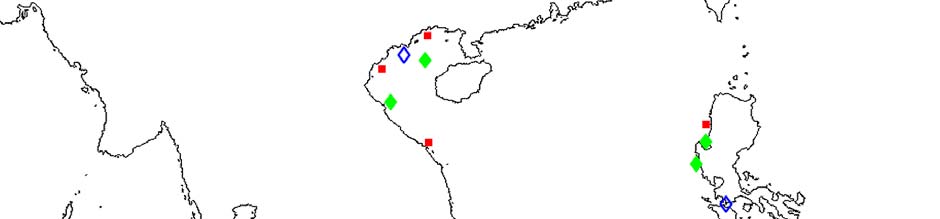
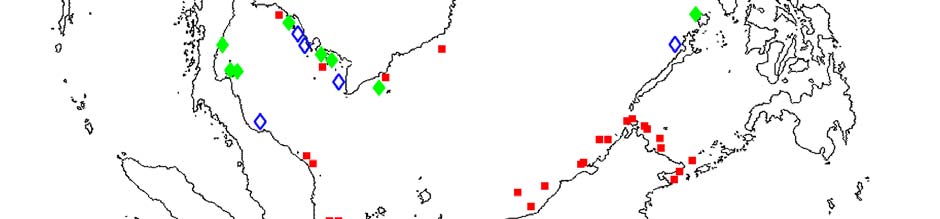
consultations on the identification of fisheries refugia. The group agreed on 14 priority sites for
inclusion in an initial system of fisheries refugia, and an additional 9 sites for which additional
information is required prior to their inclusion in the system. The location of these sites is presented in
Figure 2.
Figure 2 Location of: known spawning and nursery areas of transboundary demersal fish species
[]; initial sites selected for inclusion in the regional system of refugia []; sites of high priority for
inclusion in the regional system once the initial set are established [].
10 SOUTH CHINA SEA KNOWLEDGE DOCUMENT NO. 4
IMPROVING THE SCIENTIFIC BASIS FOR THE IDENTIFICATION OF FISHERIES REFUGIA
As noted above a key constraint to the further development of a regional system of fisheries refugia is
the lack of information regarding the early-life history of the majority of significant transboundary species
in the South China Sea and Gulf of Thailand. In this connection, the development of a collaborative
programme of technical consultations, working group meetings, and training workshops, aimed at
improving the scientific basis for the identification of fisheries refugia was agreed between the South
China Sea Project and the Southeast Asian Fisheries Development Centre during 2006.
SEAFDEC has worked with members of the RWG-F to develop a programme of work to review past and
ongoing fish early-life history research work, and to compile information on known spawning and nursery
areas for important fish species in the Gulf of Thailand and South China Sea. Past research activities
conducted in the 1970s and 1980s largely focused on the identification of spawning areas and migratory
routes for Indo-Pacific Mackerel (Rastrelliger neglectus), round scads (Decapterus spp.), anchovy, and
neritic tunas. There are some limitations in the use of this research for the identification of spawning
refugia including reported ecosystem changes in the Gulf of Thailand over recent decades.
Data collected through research activities initiated by SEAFDEC in the mid 1990s may provide a more
accurate information base for use in identifying current spawning and nursery areas. These activities
involve cruises conducted using the SEAFDEC Research Vessel M.V. SEAFDEC in the following areas:
Gulf of Thailand and East Coast of Peninsular Malaysia (81 stations); West Coast of Sabah, Sarawak,
and Brunei Darussalam (79 stations); West Coast of Luzon, Philippines (31 stations); and in Vietnamese
Waters (58 stations). A total of 249 larval fish samples were collected using bongo nets in the period of
the post-northeast monsoon (April-May) from 1996-1999.
Information collected from fishing communities, processors, and past research suggests that many
economically important species in the Gulf of Thailand and South China Sea spawn during the period
from January to March each year. Consequently the results of larval fish surveys conducted by
SEAFDEC during the post northeast monsoon (April-May) may assist in developing a better
understanding of spawning (sources) and nursery (sinks) locations for important species. Species based
maps of the distribution and abundance of the larvae of important demersal and pelagic fish species in
the South China Sea during the post northeast monsoon periods from 1996-1999 have been developed,
an example of which is provided in Figure 3.
Figure 3
The distribution and relative abundance of fish larvae in the Gulf of Thailand and South China Sea
during the post northeast monsoon period (1996-1999) (all larvae combined).
PROCEDURE FOR ESTABLISHING A REGIONAL SYSTEM OF FISHERIES REFUGIA 11
SEAFDEC has been utilising the M.V. SEAFDEC 2 to conduct fisheries resources assessment surveys
in the South China Sea since 2004, and fish eggs and larvae have been sampled at survey sites over
this period. Due to a shortage of technical expertise in the participating countries however, very few
larval fish samples have been processed to date. In collaboration with SEAFDEC a Regional Training
Workshop on Larval Fish Identification and Fish Early Life History Science was convened from 16th-31st
May 2007, aimed at building regional capacity to process and identify larval fish samples collected as
part of SEAFDEC's regular research cruises. Course participants will form national teams responsible
for the processing of larval and juvenile fish samples with the aim of enhancing the scientific basis for
the identification of important fish spawning and nursery areas.
FUTURE DEVELOPMENT OF THE REGIONAL SYSTEM OF FISHERIES REFUGIA
There are significant differences between countries in primary planning objectives, and in the design
and implementation of spatial approaches to natural resource and environmental management. Such
differences include for example: the preferred types of management, protection or multiple use; the
method of delineating the management unit, administrative or natural system boundaries; and the
responsible management agencies, environment or resource based agency. They also differ in terms
of the procedures used in the establishment and administration of management areas or zones. In
considering these inter-country differences, the RWG-F developed a strategic framework for the
establishment of a regional system of fisheries refugia as shown in Figure 4.
Process/Agency
Component
Development of a Regional Fisheries Refugia Strategy
· Goals, Objectives, Guiding Principles
(Based on ASEAN-SEAFDEC Regional Guidelines for
· Criteria & Guidelines for Refugia Identification/Selection
Responsible Fisheries in Southeast Asia)
· Agreement on Regional Priorities for Refugia System
Fishing Community and Government Consultation on the Development of a
Fisheries Refugia Strategy for the South China Sea and Gulf of Thailand
Identification of Candidate Fisheries Refugia
· Prepare Site Profiles for Known Fisheries Refugia
(UNEP/GEF SCS Project, SEAFDEC, and Relevant
· Apply Criteria and Guidelines to Identify Refugia Sites
National Authorities)
· Define Objectives for Priority Refugia Sites
Fishing Community and Government Consultation on Candidate Fisheries Refugia Sites
and Promotion of the Fisheries Refugia Concept at the Fishing Community Level
Selection of Sites for Inclusion in a Regional System of
· Prepare Fisheries Refugia Site Profiles
Fisheries Refugia
· Apply Criteria and Guidelines to Identify Refugia Sites
(Relevant National Authorities)
· Define Objectives for Priority Refugia Sites
Fishing Community and Government Consultation on Recommended Fisheries Refugia Sites and
their Potential Socio-Economic Impacts
Finalisation of Initial Regional Fisheries Refugia System
· Assess Feasibility of Identified Fisheries Refugia
(Relevant National Authorities and Coastal Fishing
· Select Fisheries Refugia for Regional System
Communities)
· Integrate Socio-Economic Considerations
Government Approval of Recommendations on the Establishment and Management
of a System of Fisheries Refugia in the South China Sea and Gulf of Thailand
Establishment and Management of Regional System of
· Establishment of Individual Refugia Sites
Fisheries Refugia
· Undertake Management Planning
(Relevant National Authorities & Fishing Communities)
· Undertake Day-to-Day Management of Refugia
Figure 4
Framework for the development of a regional system of fisheries refugia for
sustainable capture fisheries.
12 SOUTH CHINA SEA KNOWLEDGE DOCUMENT NO. 4
The fisheries refugia initiative is central to the fisheries component of the revised regional Strategic
Action Programme for the South China Sea (SAP). The specific targets identified for the fisheries
component of the SAP are:
· By 2012 to have established a regional system of a minimum of twenty refugia for the
management of priority, transboundary, fish stocks and transboundary species; and
· By 2012 to have prepared and implemented fisheries management systems in the identified
refugia based on, and consistent with, the ASEAN SEAFDEC Regional Guidelines for
Responsible Fisheries in Southeast Asia.
The regional level actions considered necessary to achieve these targets have been categorised into
the following SAP components:
· Identification of Fisheries and Critical Habitat Linkages in the South China Sea;
· Improving the Management of Critical Habitats for Fish Stocks of Transboundary Significance;
· Developing Human Resource Capacity for the Identification and Management of Fisheries
Refugia;
· Improving Information Management and Dissemination;
· Promotion of Regional Fisheries Management Arrangements; and
· Generation and Uptake of Good Coastal Fisheries Management Practices at the National Level.
EVALUATION OF MARINE PROTECTED AREAS AND SEASONAL, OR AREA CLOSURES FOR
INCLUSION IN THE REGIONAL SYSTEM OF FISHERIES REFUGIA
As the definition of fisheries refugia developed by the RWG-F focuses on sustainable use and clearly
states that refugia will not be no-use areas, refugia cannot be substituted for permanent closures or no-
take MPAs and vice versa. Refugia can, however, be compared to seasonal closures and multiple-use
MPAs. Priority areas for refugia are those in which fish spawn and in which juveniles seek shelter/food,
and the identification of initial candidate refugia has been undertaken on this basis.
Fisheries refugia are very different from the general seasonal closures used in fisheries, and from the
short term area and seasonal closures commonly used in fisheries management (e.g. spot closures and
closed seasons) which are often implemented in small well-defined areas of fishing grounds. The
fisheries refugia concept in contrast, is based on areas of critical importance to the life-cycle of the
species. This means that areas located outside the main fishing grounds for a given species, which are
critical to the life-cycle of that species, qualify as fisheries refugia and should be managed accordingly.
Such management for example, may include interventions aimed at reducing the impacts of the
incidental capture of juveniles of a given species by another fishery operating in areas critical as inshore
nursery refugia for that species. It may also include interventions to provide habitat protection, to ensure
that areas important for egg deposition are not disturbed, and/or to safeguard habitats that provide
protection for juveniles from predators, such as mangroves and seagrass.
The RWG-F understands that individuals taking a "helicopter view" of the definition of refugia, and the
initial actions of identifying important nursery and spawning areas, may misconstrue that the group is
simply identifying areas for a regional system of seasonally managed areas. This is a misperception and
an important role for the RWG on Fisheries is to ensure that when such individuals take a "helicopter
view" of this activity, they see a regional initiative working to:
(a) Develop a system of fisheries refugia, including "replacement" of lost natural refugia, in order to
build resilience in regional fisheries; and to
(b) Provide an institutional mechanism for improved fisheries and habitat management, i.e.,
management based on the linkages between fish stocks and critical habitats.
One aspect of this involves promoting the actions in terms of goals and objectives, rather than a working
definition. General goals and objectives for this activity can be split into two categories: (a) resource-
related and (b) institutional-related (see Tables 1 and 2).
Consideration of these objectives enables one to evaluate whether or not areas subject to seasonal
closures and fisheries management zones within multiple-use MPAs can be classified as fisheries
refugia and form part of a regional refugia system. For instance, short term closures (or spot closures)
are often implemented to redirect fishing effort from areas containing concentrations of juvenile fish or
PROCEDURE FOR ESTABLISHING A REGIONAL SYSTEM OF FISHERIES REFUGIA 13
specific age classes of fish. Similarly, closed seasons are often implemented to safeguard spawning fish
or to reduce the levels of fishing effort at times when pre-recruits are migrating to fishing grounds. A
question regularly asked of the RWG-F is "do such spot closures and closed seasons qualify as
fisheries refugia?" The answer to this question is "they do if the site has been selected in terms of
achieving one or more of the resource-related objectives of the refugia system, and can be managed in
the context of institutional-related objectives for the regional system of refugia."
A similar and perhaps more contentious question asked of the RWG-F is "do MPAs qualify as fisheries
refugia and vice versa?" The simple answer to this question is no, especially if the MPA promotes the
no-take concept in relation to fisheries. MPAs are implemented to limit human activity within a
designated area of the ocean, with most aimed at achieving goals and objectives of biodiversity
conservation. Similarly, the criteria for the identification of MPA sites usually relate to concepts of
representativeness, comprehensiveness, and uniqueness, and a particular MPA cannot qualify as a
fisheries refugium if the site was selected using these criteria. However, parts of multiple-use MPAs,
such as fisheries management zones, may qualify as a replacement fisheries refugium if:
· Such zones promote the concept of sustainable use rather than prohibition of fishing, and
· The selection of the zone was based on criteria relating to the critical linkage between the
area and the life-cycle of the species for which the area is managed.
Table 1
A Preliminary Set of Performance Assessment Criteria and Means of Verification for the
Resource-related Objectives of a Regional Fisheries Refugia Plan.
Resource-Related Objectives
Performance Assessment Criteria
Means of Verification
Longer-Term Objectives
Results of abundance surveys employing
1. Biomass of economically important fish (pelagic and
Biomass trend (multi-year average annual
relative abundance (CPUE), swept area,
demersal) and invertebrate species in the Gulf of
percentage rate of change)
acoustic, or egg production methods
Thailand and South China Sea maintained
2. Average size of economically important fish (pelagic
and demersal) and invertebrate species caught in the Average fish size relative to historical
Results of size-frequency analyses of fish
Gulf of Thailand and South China Sea maintained or
average
landed at key landing places and in markets
increasing
Abundance of eggs and larvae of
3. Egg production of economically important fish and
economically important species in key
Results of surveys of egg and larval fish
invertebrate species in the Gulf of Thailand and South spawning areas relative to historical
density in key spawning areas
China Sea maintained or increasing
average
4. Recruitment of economically important fish and
Results of abundance surveys employing
invertebrate species to fisheries the Gulf of Thailand
Year class strength relative to historical
relative abundance (CPUE) or swept area
and South China Sea maintained or increasing
average
methods
Abundance of juveniles in fishery refugia
areas
a) Results of fishery dependent and
Shorter-Term Objectives
a) Fishing effort dynamics in fishery
independent surveys
1. Reduced capture of juveniles and pre-recruits of
refugia areas
b) Interviews of fishers, fishing communities,
economically important fish (pelagic and demersal)
b) Selectivity of fishing operations
and traders
and invertebrate species, as well as endangered
conducted within juvenile refugia
c) Results of studies of species and size
species, in critical fisheries habitats of the Gulf of
c) Frequency of inappropriate fishing
composition conducted within refugia
Thailand and South China Sea
operations in fishery refugia areas
d) Observations/reports of illegal or
d) Volume and size composition of
destructive fishing in fishery refugia areas
economically important fish (pelagic and
e) Results of studies of the volume and size
demersal) and invertebrate species
of fish landed at main landing places and
landed and traded in main markets
traded in main market
a) Fishing effort dynamics in fishery
a) Interviews of fishers, fishing communities,
refugia areas
and traders
b) Selectivity of fishing operations
b) Results of studies of species and size
2. Reduced targeting and capture of economically
conducted within spawning refugia
composition of landings during known
important fish (pelagic and demersal) and
c) Gonosomatic index (GSI) of
spawning seasons
invertebrate species in spawning condition, and
economically important fish (pelagic and
c) Results of studies of the gonosomatic
when forming spawning aggregations, in the Gulf of
demersal) and invertebrate species
condition of economically important
Thailand and South China Sea
landed and traded in main markets
species landed and traded in main
d) Abundance of eggs and larvae of
markets
economically important species in key
d) Results of surveys of egg and larval fish
spawning areas
density in key spawning areas
The number and size of fisheries refugia as
Total number/size of juvenile refugia and
defined in refugia management plans
3. System of fisheries refugia, including both juvenile
spawning refugia:
adopted by national governments
and spawning refugia, which provides for:
(a) Number of species for which a network
(a) Description of the species specific
(a) networks of fisheries refugia across the geographical
of fisheries refugia has been developed
linkages between refugia in management
ranges of individual species,
across its geographical range
plans for each refugia in a geographical
(b) networks of fisheries refugia that include both
(b) Number of fisheries refugia networks
range based network
juvenile and spawning refugia,
that include multiple refugia types
(b) Description of the life-cycle specific
(c) fisheries management consistent with the
(c) Number of fisheries refugia for which
linkages between refugia in management
RGRFSEA
management systems have been
plans for each refugia in a life-cycle based
developed
network
(c) Adoption of refugia management plans
14 SOUTH CHINA SEA KNOWLEDGE DOCUMENT NO. 4
If the site for a multiple-use MPA has been identified using criteria that did not relate to fish life-cycle and
critical habitat linkages, any fisheries management zone within that MPA may not be worthy of the
research, financial, and management resources required for the development of that site as a fisheries
refugium when compared to sites that were identified purely on critical habitat linkages. Similarly, poorly
designed fisheries management zones within multiple-use MPAs may (a) lead to a loss of community
support for spatial approaches to fisheries management, and (b) lead to the re-direction of fishing effort
towards areas that are more important in terms of critical habitat linkages. Nevertheless, such zones
should not be disregarded and may represent a class of refugia for consideration in any regional refugia
system. Comparisons of the appropriateness of fisheries management zones within MPAs as refugia
and fisheries refugia sites identified purely on the basis of fishery-critical habitat linkages will require the
consideration of information relating to fish life-cycles and habitat associations at the fishery level.
Table 2
A Preliminary Set of Performance Assessment Criteria and Means of Verification for the
Institutional-related Objectives of a Regional System of Fisheries Refugia.
Performance
Institutional-Related Objectives
Means of Verification
Assessment Criteria
Adoption by appropriate regional fora of a management
plan for a regional system of fisheries refugia.
Management plan to include:
a) goals, objectives, target reference points, indicators,
Preparation and publication of
1. Integration of fish life-cycle considerations in
and performance measures for each refugia (and
a management plan for a
fisheries and habitat management in the Gulf of
refugia network in the system)
regional system of fisheries
Thailand and South China Sea
b) system for reporting on results of analysis of data
refugia.
collected in support of the regional refugia system
c) criteria for the identification of new refugia
d) research priorities and national commitments of
support to the conduct of fisheries research
Preparation and publication of
2. National level commitments to integrate the
National Plans of Action for
Adoption of plans of action by appropriate Government
fisheries refugia concept into fisheries and habitat
the Development of the
Ministries.
management
Regional System of Fisheries
Refugia
3. Regionally agreed fisheries refugia science
programme, which details:
Preparation and publication of
Adoption of the programme at a regional expert
a) Objectives
a fisheries refugia science
consultation and then representatives of five SEAFDEC
b) Decision-support inputs
programme
member countries
c) Strategic research partnerships/resourcing
d) Research activities
4. Regionally agreed framework of criteria, target
reference points, indicators, and performance
measures for identifying and evaluating the
performance of refugia that, aim to:
Preparation of a framework of
(a) reduce the capture of juveniles and pre-recruits
criteria, target reference
of economically important fish, and endangered
points, indicators, and
Adoption of the framework at a regional expert
species, in critical fisheries habitats
performance measures for
consultation
(b) reduce the targeting and capture of economically identifying and evaluating the
important fish in spawning condition, and when
performance of fisheries
forming spawning aggregations
refugia
(c) contribute to the development of species-specific
networks of refugia across (i) the geographical
range, and (ii) the life-cycle, of individual species.
5. Regional agreement on standardised
Preparation and publication of
methodology for the identification and
standards for refugia
evaluation of important:
identification and evaluation
Adoption by appropriate intergovernmental fora of
(a) juvenile refugia
methods relating to data
regional standards
(b) spawning refugia, and
collection and storage, and
(c) refugia that can assist in building geographical
analysis
range and life-cycle based networks of refugia
6. Regionally agreed guidelines on the use of the
Regional agreement on
Adoption by appropriate intergovernmental fora of
fisheries refugia concept in fisheries
guidelines for the use of the
regional guidelines
management.
fisheries refugia concept
Discussion
It would appear that the refugia concept is a successful approach to addressing a significant barrier to
effective management action that addresses fish stocks and habitats of importance to critical stages
of the life history of those stocks, namely the adverse reaction to the Marine Protected Area concept
that is elicited from fishing communities and fisheries officers at the local and provincial levels. By
emphasising the "sustainable use" aspects of refugia rather than the "no-take" approach adopted by
many ministries of environment in their approach to marine protected areas adverse reactions are
avoided. More importantly perhaps the fisheries refugia concept since it is being promoted by fisheries
departments provides and initial platform for dialogue between the government institutions
responsible for environment and for fisheries.
PROCEDURE FOR ESTABLISHING A REGIONAL SYSTEM OF FISHERIES REFUGIA 15
Final outcomes:
The original outcome of the project was simply anticipated as being "a system of refugia to maintain
important transboundary fish stocks in the Gulf of Thailand based on marine protected areas
identified as critical habitats for fish stock conservation and protection."
The project document provides no guidance regarding a definition of what:
· Constitute
"fisheries
refugia";
· The criteria for assessing the relative importance of individual areas as potential refugia.
What has resulted from the work of the Regional Working Group on Fisheries is:
· A listing of demersal species of fish, crustacea and molluscs of transboundary significance in
the region;
· A list of 52 known spawning and nursery areas of which 14 are currently under development
as the initial set of refugia and a further 9 have been accorded high priority for development
as refugia once the initial set have been approved;
· Criteria for defining fisheries refugia; and,
· Intergovernmentally approved guidelines for the establishment of fisheries refugia that
constitute part of the ASEAN SEAFDEC Regional Guidelines for Responsible Fisheries in
Southeast Asia.
Christopher Paterson & John C. Pernetta
August 29th 2007.
References
FAO, 2003. The ecosystem approach to fisheries. FAO Technical Guidelines for Responsible Fisheries. No. 4,
Suppl.2. Rome, 112p.
FA0, 2007. The State of World Fisheries and Aquaculture 2006. Food and Agriculture Organisation of the United
Nations. Rome, 180pp.
Lundgren, R., Staples, D.J., Funge-Smith, S.J. and Clausen, J. 2006. Status and potential of fisheries and
aquaculture in Asia and the Pacific 2006. FAO Regional Office for Asia and the Pacific. RAP Publication
2006/22. 62pp.
Paterson, C., Try, I., Tambunan, P., Barut, N., Saikliang, P., Dao, M.S., and Chullasorn, S. 2006. Establishing a
Regional System of Fisheries Refugia. Fish for the People, 4(1): 22-27.
SEAFDEC, 2006. Supplementary Guidelines on Co-Management Using Group User Rights, Fisheries Statistics,
Indicators, and Fisheries Refugia. Southeast Asian Fisheries Development Center, Bangkok, Thailand.
84pp.
UNEP, 2006a. Reversing Environmental Degradation Trends in the South China Sea and Gulf of Thailand.
Report of the Seventh Meeting of the Regional Working Group for the Seagrass Sub-Component.
UNEP/GEF/SCS/RWG-SG.7/3.
UNEP, 2006b. Reversing Environmental Degradation Trends in the South China Sea and Gulf of Thailand.
Report of the Sixth Meeting of the Regional Working Group on Fisheries. UNEP/GEF/SCS/ RWG-F.6/3.
UNEP, 2006c. Reversing Environmental Degradation Trends in the South China Sea and Gulf of Thailand.
Report of the Seventh Meeting of the Regional Working Group on Fisheries. UNEP/GEF/SCS/RWG-F.7/3.
UNEP, 2006d. Reversing Environmental Degradation Trends in the South China Sea and Gulf of Thailand.
Report of the Sixth Meeting of the Regional Scientific and Technical Committee. UNEP/GEF/SCS/
RSTC.6/3.
UNEP, 2007a. Revised draft Strategic Action Programme, (Draft 3) July 26th 2007.
UNEP, 2007b. Reversing Environmental Degradation Trends in the South China Sea and Gulf of Thailand.
Report of the Eighth Meeting of the Regional Working Group on Fisheries. UNEP/GEF/SCS/RWG-F.8/3.
UNEP, 2007c. Reversing Environmental Degradation Trends in the South China Sea and Gulf of Thailand.
Report of the Ninth Meeting of the Regional Working Group on Fisheries. UNEP/GEF/SCS/RWG-F.9/3.
Document Outline