





"Reversing Environmental Degradation Trends
in the South China Sea and Gulf of Thailand"
MANGROVES IN THE SOUTH CHINA SEA
UNEP/GEF
Regional Working Group on Mangroves


First published in Bangkok, Thailand in 2004 by the United Nations Environment Programme.
Copyright © 2004, United Nations Environment Programme
This publication may be reproduced in whole or in part and in any form for educational or non-profit purposes
without special permission from the copyright holder provided acknowledgement of the source is made. UNEP
would appreciate receiving a copy of any publication that uses this publication as a source.
No use of this publication may be made for resale or for any other commercial purpose without prior permission in
writing from the United Nations Environment Programme.
UNEP/GEF Project Co-ordinating Unit, United Nations Environment Programme,
UN Building, 9th Floor Block A, Rajdamnern Avenue, Bangkok 10200, Thailand.
Tel.
+66 2 288 1886
Fax.
+66 2 288 1094
http://www.unepscs.org
DISCLAIMER:
The contents of this report do not necessarily reflect the views and policies of UNEP or the GEF. The
designations employed and the presentations do not imply the expression of any opinion whatsoever on the part
of UNEP, of the GEF, or of any cooperating organisation concerning the legal status of any country, territory, city
or area, of its authorities, or of the delineation of its territories or boundaries .
Cover Photo:
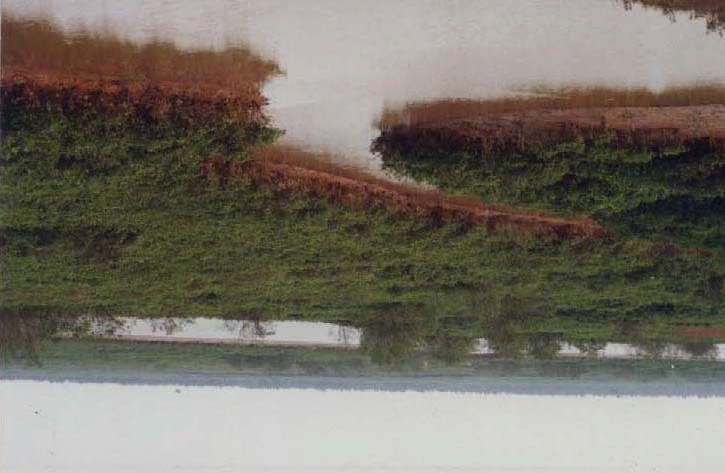
Mangroves in Xhan Thuy, Ramsar site, Viet Nam - Professor Nguyen Hoang Tri.
Photo credits:
Page 4
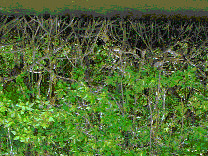
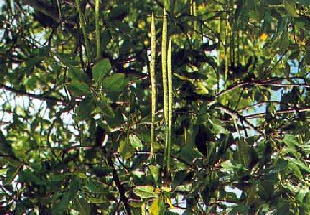
Prop Roots of Rhizophera - Ke Vongwattana & Sok Vong
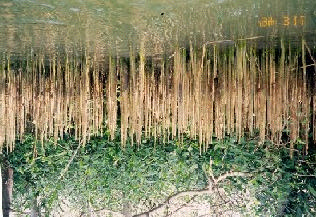
Pneumatophores of Sonneratia. Propagules of Rhizophore Mucronata - Sonjai Havanond
Page 6
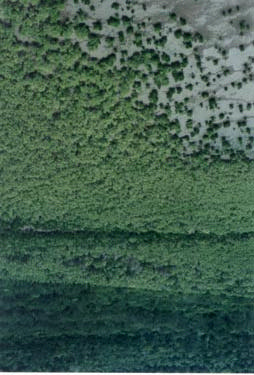
Mangrove zonation at Teluk Bintuni, Papua, Indonesia - Nyoto Santoso
Page 7
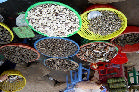
Molluscs from mangrove and tidal flats on sale in South Viet Nam - Unchalee Kattachan
Page 8
Oyster culture in front of mangroves Fanchenggang, China, & Pearl farming in Southern China -
Hangqing Fan
Page 9
Replanted Mangrove, Trad Province, Thailand - John Pernetta
Page 10
Community managed mangroves, Trad Province, Thailand - John Pernetta
Page 11
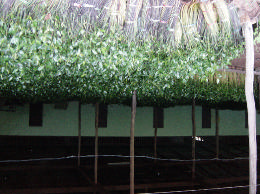
Mangrove propagules prepared for planting, Trad Province, Thailand - John Pernetta
Authors:
Professor Gong Wooi Khoon, Professor Sanit Aksornkoae, Professor Nguyen Hoang Tri, Mr. Ke Vongwattana,
Dr. Hangqing Fan, Mr. Nyoto Santoso, Mr. Florendo Barangan, Dr. Sonjai Havanond, Dr. Do Dinh Sam, and
Dr. John Pernetta.
This publication has been compiled as a collaborative document of the Regional Working Group on Mangroves of
the UNEP/GEF Project entitled "Reversing Environmental Degradation Trends in the South China Sea and Gulf of
Thailand."
For citation purposes this document may be cited as:
UNEP. 2004. Mangroves in the South China Sea. UNEP/GEF/SCS Technical Publication No. 1.

MANGROVES IN THE SOUTH CHINA SE A 1
FOREWORD
The characteristic vegetation of tropical shorelines
is mangrove, a habitat, which has been under-
valued in the past and consequently has been
subject to extensive removal and degradation in the
Southeast Asian Region.
The extensive conversion of mangrove in the
countries bordering the South China Sea during the
sixties and seventies often reflected short term
economic opportunities that benefited a few
individuals and neglected the longer term and more
widely felt, but poorly understood benefits derived
from mangrove services such as coastal protection.
Awareness of the importance of mangroves in
Southeast Asia was increased during the 1980s by
the UNESCO supported COMAR programme that
mobilised and enhanced national capacity to
undertake scientific studies of the mangrove habitat.
This programme significantly increased not only our
scientific understanding of this important habitat but
also increased both public and decision makers
awareness of the goods and services provided by
mangrove vegetation and the animals that depend
upon them.
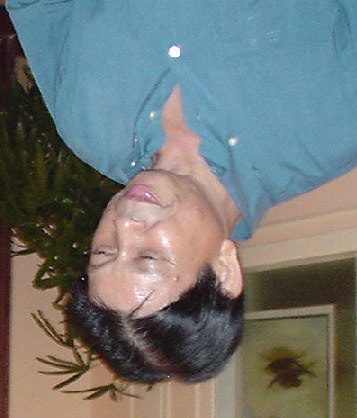
Emeritus Professor Sanit Aksornkoae
One outcome of this UNESCO Programme was the
formation of the International Society for Ma ngrove
One such cause is our inability to value adequately
Ecosystems (ISME), which supports and promotes
in economic terms the goods and services provided
international networking and activities designed to
by mangroves. Since we cannot place a dollar value
promote the study and understanding of mangrove
on the resources we are unable to provide adequate
systems.
economic arguments to convince planners and
developers that the longer term economic benefits
The UNEP/GEF project "Reversing Environmental
of sustainably using our mangrove systems
Degradation of the South China Sea and Gulf of
outweigh the short term economic benefit of their
Thailand builds upon this foundation of regional
removal. The challenge for this project is to address
capacity in attempting to address the continuing
this scientific and information failure.
trends of degradation of mangrove systems. This
project builds not only on the existing knowledge
I am pleased to have been asked to write the
base but also on the human capacity in the
foreword to this booklet which represents the first
countries of the region. Most of the members of the
collective output from the Regional Working Group
Regional Working Group on mangroves received
on Mangroves, and which has been compiled as
training and experience through this UNESCO
background to next phase of project implementation
Programme.
when demonstration activities will be undertaken. As
such it puts into a wider, global perspective the
The support of the United Nations Environment
importance of the mangroves of this region and
Programme and the Global Environment Facility to
hence the need for concrete action. Determining the
this project is timely. Even with an increased
priority that individual national actions have from a
understanding of the importance of mangrove goods
regional perspective has been a significant task for
and services we have been unable to reverse the
the Regional Working Group on mangroves and
trend of loss and degradation at a regional scale.
one, which has served to strengthen collaboration
Although the rate of loss has declined in some
between the focal points from each country. I look
countries around the South China Sea it remains
forward to seeing the outcomes of this initial
alarmingly high given the global significance of this
collaboration.
region for the diversity of plants and animals that
mangroves support.
The UNEP/GEF South China Sea Project is unique,
firstly in being the first programme to which all the
countries bordering the South China Sea have
Professor Sanit Aksornkoae, President
agreed to implement co-operatively. Secondly this
Thailand Environment Institute
project it places a strong emphasis on practical and
Bangkok, Thailand
pragmatic ways to address the root causes of
January 2004
priority problems in the coastal zones.
Reversing Environmental Degradation Trends in the South China Sea and Gulf of Thailand

2
WORLD-W IDE DISTRIBUTION AND EXTENT OF MANGROVE
INTRODUCTION
Global distribution. Mangroves occupy the humid
Loss of Mangrove, world-wide. FAO estimates
tropical belt 30° North and South of the equator,
that a quarter of the world's mangrove has been lost
with extensions beyond these latitudes in certain
over the last twenty years although the rate of loss
areas (Spalding et al., 1997). Two main centres of
during the 1990's (1 percent per annum) is down
diversity have been identified. The eastern area is
from the 1980's rate of 2 percent per annum. This
centred on the Indo-Pacific with its eastern limits in
reflects the fact that many countries have now
the central Pacific, and the western limits, along the
banned the conversion of mangrove for aquaculture,
easter n seaboard of Africa. The western centre
and require environmental impact assessments
includes mangroves found along the African and
prior to large-scale conversion of mangrove lands.
American coasts of the Atlantic Ocean, the
Caribbean Sea and Gulf of Mexico, and the Pacific
The total area of mangrove lost in the seven
coastal areas of the Americas. The eastern group
participating countries over different time spans (70
has about five times the species diversity recorded
years for the Philippines) was estimated in 1998 at
in the western region.
4.2 million ha suggesting that over half of the
original mangrove had been lost during the last
Recent estimates (FAO, 2003) suggest that Asia
century. It should be noted that, estimates of both
supports around 39% of the world's total of 14.6
original and present mangrove area vary greatly in
million hectares of mangrove, down from 42% a
the literature, reflecting differences in definition and
decade ago. The bulk of this, 28% of the world's
modes of assessment. The figures in Table 1 are
remaining mangroves, are found in the seven
considered by FAO as the most reliable estimates,
countries participating in this project.
while the estimates for 2000 are considered
indicative only, given the length of time that has
Biological Diversity. Some 41 genera of true
elapsed since the last reliable assessment.
mangrove species are found in the Indo-west Pacific
compared with only 5 genera in the Atlantic and
The causes of mangrove destruction along the
Pacific seaboard of the Americas. The most diverse
coastlines bordering the South China Sea, include
mangrove stands occur in Southeast Asia with up to
conversion to pond aquaculture, particularly of
42 species occurring in a single location. The
shrimp, clear felling of timber for woodchip and pulp
diversity of plant species, is reflected in the diversity
production, land clearance for urban and port
of the animals, both aquatic and terrestrial that are
development and human settlements, and harvest
resident in these communities. In addition to the
of timber products for domestic use. The national
resident plants and animals, mangrove habitats are
impact of each economic activity is difficult to
important staging posts for migratory species
quantify, nonetheless, shrimp culture would seem to
including many shore birds that move seasonally
be the most pervasive economic imperative for
from the northern to the southern hemispheres.
mangrove conversion.
Reversing Environmental Degradation in the South China Sea and Gulf of Thailand.
Cambodia, China, Indonesia, Malaysia, Philippines, Thailand, Viet Nam
In 1996, the countries bordering the South China Sea requested assistance from UNEP and the GEF in
addressing the issues and problems facing them in the sustainable management of their shared marine
environment. From 1996 to 1998 initial country reports were prepared that formed the basis for the
development of a Transboundary Diagnostic Analysis, which identified the major water related
environmental issues and problems of the South China Sea. Of the wide range of issues identified the
loss and degradation of coastal habitats, including mangrove, coral reefs, seagrass and coastal
wetlands were seen as the most immediate problem. Over-exploitation of fisheries resources and land-
based sources of pollution were also considered significant issues requiring action.
In 1999 the governments, through the Co-ordinating Body for the Seas of East Asia endorsed a
framework Strategic Action Programme that established targets and timeframes for action. In
December 2000, the GEF Council approved this project with UNEP as the sole Implementing Agency
operating through the Environmental Ministries in the seven participating countries and with over forty
specialised Executing Agencies at national level directly engaged in the project activities.
Reversing Environmental Degradation Trends in the South China Sea and Gulf of Thailand
MANGROVES IN THE SOUTH CHINA SE A 3
Table 1
Estimates of area (Ha) and rates of loss of mangrove habitat in seven countries bordering the South
China Sea, compared with the world totals. [Data from FAO, 2003]
Estimates of mangrove area in Ha
Rates of loss
Most recent Date
1980
1990
2000
1980 - 1990 1990-2000
Cambodia
72,835 1997
83,000
74,600
63,700
-1.1
-1.6
China
36,882 1994
65,900
44,800
23,700
-3.8
-6.2
Indonesia
3,493,110 1988
4,254,000
3,530,700
2,930,000
-1.8
-1.8
Malaysia
587,269 1995
669,000
620,500
572,100
-0.7
-0.8
Philippines
127,610 1990
206,500
123,400
109,700
-5
-1.2
Thailand
244,085 2000
285,500
262,000
244,000
-0.9
-0.7
Viet Nam
252,500 1983
227,000
165,000
104,000
-3.1
-4.5
Total
4,814,291
5,790,900
4,821,000
4,047,200 average -1.8 average -1.7
World
15,763,000 1992
19,809,000 16,361,000 14,653,000
-1.9
-1.1
% world total
30.5
29.2
29.5
27.6
Shrimp farming. A recent centre-page spread in
feed and mature, before moving off-shore in later
the Jakarta Post described the world's largest
phases of their life-cycle.
shrimp farm of 80,000 ha constructed on land re-
claimed from mangrove at Bumi Dipasena.
A different form of transboundary influence is seen
Integrated into the farm was a shrimp feed mill
through the operation of the world markets and
producing 220 tonnes of feed per year and a
global trade in shrimp. The high level of demand for
hatchery producing 8 billion fry/year on a 220 ha
shrimp in Japan, North America and Europe sets
site. Production of shrimp was estimated at 50,000
the world price such that, economic incentives for
tonnes/year and 200 tonnes/day could be stored in
conversion of "non-productive" mangrove habitats
a cold storage facility. Infrastructure included a 160
operate at both the individual and national levels in
megawatt power plant, waste water treatment plant,
producing countries. Hard currency income and
a port, a housing estate for 110,000 people and
economic development fuel the motives at the
2,500 Km of canals.
national level whilst individual producers, at least in
the short-term derive considerable cash income
Unlike such large-scale production the major cause
from cutting their mangrove and converting to
of mangrove loss is conversion to small-scale
shrimp ponds. It is recognised in countries such as
extensive shrimp ponds. Systems that are
Thailand that these short-term benefits result in
unsustainable in the longer term since problems of
longer-term costs that have often to be met from
water quality and disease, result in many extensive
public funds.
low technology, shrimp cultivation ponds being
abandoned after three to four years of operation.
On a smaller scale trade in charcoal derived from
They become unproductive without capital and
mangrove in Cambodia to Thailand was a major
technical investment in maintaining water quality.
cause of mangrove loss in the rec ent past, in the
areas of Cambodia close to the Thai border.
Transboundary issues. From a global perspective
the major transboundary issues surrounding the
Loss of biodiversity. Whilst the inventory of the
loss of mangrove habitats include the loss of unique
flora and fauna associated with mangrove areas in
biological diversity that cannot be replaced, and the
the South China Sea region is far from complete, it
loss of mangrove services. Many off-shore fisheries
is nevertheless obvious that loss of these important
resources such as shrimp and demersal fish breed
habitats has resulted in loss and/or decline in
in mangrove areas and are fished off-shore by more
associated species many of which are now
than one nation's fishing fleet.
considered endangered or threatened. Endangered
species found in mangrove in the region include the
From a regional perspective the loss of off-shore
proboscis monkey, Nasalia larvatus, which eats
fisheries production, both shrimp and demersal fish
young shoots and growing tips of Sonneratia and
may have transboundary implications since the off-
Avicennia trees, the crocodile Crocodilus porosus
shore fishing fleets may not come from the country
and swamp birds including Ardea and Egretta (Low
in which the mangrove habitats occurs. Thus cutting
et al., 1994).
mangroves in one country may impact the fishing
community in a neighbouring country.
Around 30% of the world's remaining mangrove,
occurs in this region but the annual rate of loss is
It has been known for many decades that the off-
55% greater than the world average. Such losses
shore shrimp catch is directly proportional to the
represent a loss of global biological diversity that
area of in-shore mangroves since these provide the
must be a matter of global concern.
habitats within which the juvenile penaeid shrimp
Reversing Environmental Degradation Trends in the South China Sea and Gulf of Thailand
4
MANGROVE ECOLOGY AND DIVERSITY
MANGROVE DISTRIBUTION AND DIVERSITY IN THE SOUTH
Animals burrowing in mangrove soils must ventilate
CHINA SEA
their burrows and do so through rythmic movements
of their bodies, producing currents that draw oxygen
Geographic and abiotic limits to mangrove
rich water below the surface. Mangrove trees such
habitats. Mangroves are restricted in their world-
as Avicennia and Sonneratia spp. have
wide distribution by the 240C seawater isotherm
pneumatophores, or breathing roots, that stick up
(Hutchings & Saenger, 1987), thus they form one of
through the surface of the mud, whilst the roots of
the dominant habitats along tropical and sub-tropical
Bruguiera spp. have "knees" above the surface for
coastlines such as those bordering the South China
respiration. These breathing roots have lenticels,
Sea. Mangroves occur on coasts with low wave
which are also found on the bark of Bruguiera and
energy, where land-based sediments carried by
through which oxygen passes into the plant.
rivers, or off-shore marine sediments are deposited
in the inter-tidal and sub-tidal zones.
Unlike coral reefs, mangroves are found in areas
with a wide range of salinities from 0 to 35 psu.
Individual trees may be subjected to varying salinity
regimes depending upon the state of the tide and
the inputs of freshwater from the landward
catchments. Different mangrove species tolerate
different levels of salinity with species such as
Sonneratia ovata preferring the inland more
freshwater environments and S. caseolaris and
Avicennia marina capable of withstanding high
salinity and wave action on the seaward fringe.
Avicennia spp. are also found towards the back of
some mangrove stands where high evapouration
Pneumatophores of Sonneratia sp., Thailand
and low freshwater inputs result in high salinity soils.
In many areas, a distinct zonation in the distribution
Vivipary. Young seedlings of any plant require lots
of plant species can be seen, reflecting the diurnal
of freshwater during their early stages of growth and
patterns of tidal inundation.
the saline environment in which mangroves occur is
not suitable for young seedlings. To overcome this
Ecology of mangroves. Mangrove trees have
problem, species of mangrove trees including those
special adaptations to enable them to live under
in the family Rhizophoraceae are viviparous. The
conditions where the substrate is soft and wave
seeds germinate while still attached to the parent
action threatens to dislodge them. Rhizophora
plant. The long radicle, which enables the propagule
species have stilt roots for support, whilst Avicennia
to penetrate and establish itself in the soft substrate,
and Sonneratia have cable roots.
also serves as a food store once the young plant
becomes separated from its parent.
Prop roots of Rhizophora sp.
Propagules of Rhizophora mucronata
Adaptations to living in a saline environment include
partial exclusion of salt at the root level (as in
Mangrove species and community structure.
Rhizophora) or the presence of salt extruding
The diversity of tree species in the mangroves of the
glands on the leaves (as in Acanthus ). Not only is
South China Sea is the highest in the world. More
salinity high, but oxygen is low in the soils in which
that 30 species of true mangroves are known to
mangroves grow. Just a centimetre or so below the
occur in single locations and some 46 species are
surface of the substrate, the mud is black and
recorded from the region as a whole. Of these
oxygen levels are low. Bacteria that use sulphur to
Brownlowia tersa and Bruguiera hainesii are listed
produce energy thrive in this environment and when
in the IUCN plant red data book, as being
stirred the mud may produce a strong smell of
endangered. Table 2 shows the occurrence of true
hydrogen sulphide.
mangroves in seven countries bordering the South
China Sea.
Reversing Environmental De gradation Trends in the South China Sea and Gulf of Thailand
MANGROVES IN THE SOUTH CHINA SE A
5
Animal diversity is also high, the average number of
Productivity, turnover and carbon storage .
species of macro-crustaceans recorded from 26
Whilst there have been a number of studies on the
sites was 27, with 67 species being found in
abov e-ground biomass and productivity of
Fangchenggang, China. The number of fish species
mangroves, there have been only a few below -
reaches 103 in Can Gio, Vietnam; and the number
ground studies (see Ong et al., 2003).
of resident birds averages 46 species with 98
species occurring in Trad Province, Thailand. These
In terms of sequestering carbon, roots are perhaps
numbers represent minima since the fauna at most
the most important plant component. The annual
locations has not been fully described.
increment of root biomass is 0.42 t C ha-1 in a 20
year-old stand of Rhizophora apiculata, for example
The vertical structure of mangroves in the SCS is
(Ong et al.,1995) which is comparable to the 0.52 t
less complex than that of the lowland terrestrial
C ha-1 annual increment of canopy biomass. Annual
forests in the same area. The number of tree
turnover of small litter (flowers, fruits leaves, twigs,
canopy layers is normally one or two, as compared
and small branches,) accounts for 5.1 t C ha-1.
to the 4 or 5 in terrestrial forests. The height and
diameter of these trees range from over 30 m and
Although, the annual turnover of Rhizophora
100 cm respectively in the case of big Rhizophora
apiculata roots is not available, Ong et al. (1995)
apiculata trees in pristine forests in Indonesia to 2 m
argued that this might be at least in the same order
and 10 cm respectively for small Kandelia candel
as that for leaf turnover. Since this turnover occurs
trees in China. Tree density also varies, ranging
below ground, more of this component will be buried
from around five to six hundred trees per hectare for
than the above-ground small litter (much of which is
mature stands of Bruguiera to around 12,000 trees
exported with the tides or consumed by detritivorous
per hectare of rather stunted trees in
crabs). A significant amount of root organic matter is
Fangchenggang, China. Dominant elements of
leached from roots but the proportion that is
Chinese mangrove forest include the smaller
sequestered in soil is not known.
species such as Avicennia marina and Kandelia
candel.
Table 2
"True" mangrove species recorded from the countries bordering the South China Sea.
Cambodia
China
Indonesia
Malaysia
Philippines
Thailand
Vietnam
Acanthus ebracteatus
X
X
X
X
X
X
Acanthus ilicifolius
X
X
X
X
X
X
Acanthus xiamenensis
X
Acrostichum aureum
X
X
X
X
X
X
X
Acrostichum Speciosum
X
X
X
X
X
X
Aegialitis rotundifolia
X
?
Aegiceras corniculatum
X
X
X
X
X
X
X
Aegiceras floridum
X
X
?
X
--
X
Avicennia alba
X
X
X
X
X
X
Avicennia eucalyptifolia
X
--
Avicennia marina
X
X
X
X
X
X
X
Avicennia marina var rumphiana
X
X
--
Avicennia officinalis
X
X
X
X
X
X
Brownlowia tersa
X
X
X
Bruguiera cylindrical
X
X
X
X
X
X
X
Bruguiera gymnorrhiza
X
X
X
X
X
X
X
Bruguiera hainesii
?
X
Bruguiera parviflora
X
X
X
X
Bruguiera sexangula
X
X
X
X
X
X
X
Bruguiera sexangula Var Rhyncopetala
X
--
Camptostemon philippinense
X
X
--
Ceriops decandra
X
X
?
X
X
X
Ceriops tagal
X
X
X
X
X
X
X
Excoecaria agallocha
X
X
X
X
X
X
X
Heritiera littoralis
X
X
X
X
X
X
X
Kandelia candel
X
X
X
X
X
X
Lumnitzera littorea
X
X
X
X
X
X
X
Lumnitzera racemosa
X
X
X
X
X
X
X
Nypa fruticans
X
N
X
X
X
X
X
Osbornia octodonta
X
?
X
--
Pemphis acidula
X
X
?
X
Peltophorum pterocarpum
?
X
Phoenix paludosa
X
X
X
X
Rhizophora apiculata
X
X
X
X
X
X
X
Rhizophora mucronata
X
X
X
X
X
X
Phizophora stylosa
X
X
?
X
--
X
Scyphiphora hydrophyllacea
X
X
X
X
X
X
Sonneratia alba
X
X
X
X
X
X
X
Sonneratia caseolaris
X
X
X
X
X
X
X
Sonneratia griffithi
X
X
X1
X
Sonneratia hainanensis
X
--
--
Sonneratia ovata
X
X
XX
X
X
X
Sueda maritime
?
X
Xylocarpus granatum
X
X
X
X
X
X
X
Xylocarpus moluccensis
X
X
X
X
X
X
Xylocarpus corniculatum
Reversing Environmental Degradation Trends in the South China Sea and Gulf of Thailand
6
FACTORS LIMITING MANGROVES
Limits to mangrove distribution. The seaward
The genera Avicennia and Sonneratia can withstand
extension of mangroves is limited by inundation,
daily inundation and tidal frequencies of between
since no mangrove can survive continual or
700 and 730 per year, but they cannot withstand
repeated inundation of its crown. The landward
permanent inundation of their pneumatophores,
extent appears to be limited indirectly by saline
which must be exposed to the atmosphere for
influences since outside the zones of saline water
several hours a day if the plants are to survive.
penetration the terrestrial halophilic plants are more
successful than mangroves. Species such as
Hypersaline conditions. Occasionally in flatter
Exocoecaria agallocha are quite capable of growing
coastal areas where evaporation rates are high and
and surviving in freshwater environments but their
freshwater inputs low, such as Kampot Province
rare occurrence in such locations in nature suggests
Cambodia, the mangroves are backed by, areas of
that their landward extent is limited by competition.
very high salinity, salt flats. The trees in such areas
tend to have stunted growth due to physiological
Mangrove zonation. Since mangroves occur as a
stress from infertile saline soils, fine sand
fringe of vegetation bordering the boundary between
accumulation and high evaporation rates due to
the land and sea it is not surprising that
wind exposure. The scrubby mangrove growth is
recognizable zones may be distinguished from
backed on the landward side by halophilic salt
seaward to landward side. At the seaward margins
marsh communities.
smaller species such as Avicennia marina, and
Sonneratia alba that can withstand high salinities
and inundation by the tide for long periods,
predominate. In a typical mangrove stand this
seaward fringe is backed by stands of taller
Rhizophera, which in turn give way to Bruguiera, a
genus that is less tolerant of inundation than the
species of the seaward margin.
Similarly along the sides of estuaries, rivers and
creeks draining the mangroves, zones of different
species occur with mangroves giving way to
terrestrial vegetation inland. In Koh Kong Cambodia,
the margins of the estuaries and canals are
dominated by Rhizophora apiculata and R.
mucronata. Further inland are found Avicennia and
Bruguiera followed by Xylocarpus, Ceriops and
Lumnitzera. Nypa fruticans occurs as extensive
stands in the transitional zone between true
mangrove and terrestrial forests. The mangrove
system is often backed by freshwater swamp forest
of Melalueca or peat swamp forest, habitats which
have been largely destroyed on this region.
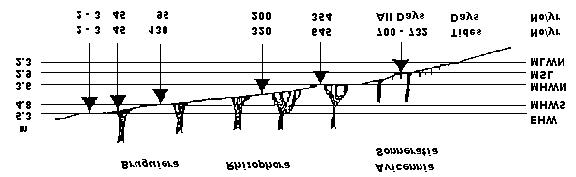
Inundation regimes. Typical inundation regimes
that the dominant mangrove genera of Bruguiera,
Rhizophora, Avicennia and Sonneratia can
withstand are illustrated in Figure 1. Where the
frequency of tidal penetration reaches 200 days and
320 tides per year, Rhizophora is replaced by,
Bruguiera as the dominant genus.
Mangrove zonation at Teluk Bintuni, Papua, Indonesia
Figure 1 Zonation of dominant mangrove genera in relation to annual inundation patterns at Port Klang,
Malaysia. Numbers indicate the number of tides per year and the number of days per year during
which the tide reaches each point in the system.
Reversing Environmental Degradation Trends in the South China Sea and Gulf of Thailand
MANGROVES IN THE SOUTH CHINA SE A
7
DIRECT USE OF MANGROVE RESOURCES
SERVICES PROVIDED BY MANGROVES
Mangrove trees. The direct uses of mangrove
In addition to the direct uses of mangrove trees for
resources are many and varied including
timber, charcoal, thatching, and use of animals such
subsistence use by local communities, and
as fish, crustaceans, and molluscs for food,
commercial, both small and large scale depending
mangroves also provide many important
upon the extent of the system, and the nature of the
environmental services (see Ewel et al., 1998).
resources. The mangrove trees themselves provide
construction timber used for house piles, wharfs and
Coastal protection. In areas of high sediment input
jetties, poles for charcoal making and light
and low wave action the root structure of the
construction. Trees such as Nypa palm provide
mangrove forest traps sediment resulting in upward
fronds used extensively in thatch whilst traditional
accretion of the soil surface, and seaward
communities use the spiny mid-rib to construct thorn
progression of the mangrove fringe. A well-
lined fish traps. Small-scale commercial exploitation
established mangrove forest system not only
of the mangrove trees frequently involves charcoal
provides significant protection to the coastline
production producing fuel for household use whilst
against erosion from the diurnal tidal cycle but also
in contrast, large scale commercial exploitation has
affords some protection against damage from storm
involved clear felling trees for wood chips used to
surges. Because of their shallow root system
produce of rayon.
isolated individual mangrove trees do not withstand
strong winds, and where significant removal of trees
Animal and plant resources. Not only are the
has occurred, the remaining individuals are highly
trees themselves a valuable resource but the
susceptible to wind throw. In a mature mangrove
aquatic animals found in mangrove systems are
stand the inter-locked root systems of neighbouring
used for food and are again exploited at both a
trees provide greater support and hence the habitat
subsistence and a small scale commercial level,
as a whole provides protection to inland areas
often to supply local markets. Frequently the level of
against tropical storm winds.
exploitation reflects not merely the density of people
subsisting directly on the mangroves but also on
Carbon sequestration. Mangroves are also
their proximity to urban centres and the ease with
important as they fix a significant amount of carbon,
which crustaceans, molluscs and fish can be
some 10 tonnes per hectare per year, in the plant
transported to local markets. The mud crab, Scylla
biomass through net primary production. What is
serrata, is a familiar item of cuisine throughout the
more important is the fact that some 1.5 tonnes of
region although pond-culture has now replaced wild
this are sequestered in the mangrove soil for a long
caught animals in many areas. The ponds
period of time (Ong, 1995, 1993). Total root
themselves are often constructed in former
biomass measured in mangroves in Thailand at
mangrove areas contributing to degradation of the
between 138 and 437 tonnes per hectare is
habitat and loss of natural production.
significantly greater than root biomass in temperate
mangroves and tropical rainforest. This particular
Minor uses. A wide variety of minor uses are found
service function may significantly impact the
in different locations throughout the region.
perceived economic value of mangroves in the
Mangrove fruits for example particularly those of
future if trading in carbon credits under the Kyoto
Avicennia, along with sipunculid worms form
Protocol becomes a reality.
distinctive elements of local dishes in southern
China. In Indonesia, Nypa sap is used for alcohol
Biological Diversity Services. In addition to the
production on both a small and large scale, whilst in
intrinsic biological diversity, which mangrove
the Philippines mangrove bark is used as a source
systems support in terms of species restricted to
of Tannin for tanning leather. A widespread but
such ecosystems, mangroves also support both
small scale resource which has potential for larger
migratory and endangered species. Migratory bird
scale production is honey from wild bees, living in
species particularly coastal waders and water fowl
the mangrove habitat.
utilise the mangrove habitats during their seasonal
migrations which may extend from the far North
through the South China Sea to Australia.
Mangroves and associated mud-flats form rich
feeding grounds for such species and breeding
populations of such migratory species may be
dependent upon the continued existence of
mangrove habitats, which are used only for a short
period annually.
Although the number of endangered species, whose
continued existence is dependent upon the
mangrove habitat is small there are nevertheless
several such species in the mangroves bordering
the South China Sea including the estuarine or
saltwater crocodile, the proboscis monkey and two
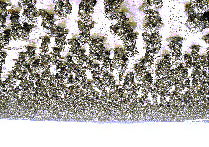
Molluscs from mangroves and tidal flats on sale in South
species of swamp bird.
Viet Nam
Reversing Environmental Degradation Trends in the South China Sea and Gulf of Thailand
8
MANGROVE SERVICES
Nursery areas. MacNae (1974) demonstrated the
Coastal water quality. Mangroves also contribute
relationship between mangrove area and yield of
significantly to maintaining the quality of the nearby
penaeid shrimp from off-shore trawling grounds off
coastal waters. They act as a "sink" not only for
the East coast of Africa. A general relationship is
sediments, but also for nutrients like nitrogen and
apparent between the size of the mangrove nursery
phosphorus, and contaminants such as heavy
area and the resultant fishery, suggesting that
metals (e,g, Tam & Wong, 1995) which are carried
factors regulating the survival of juveniles in the
seawards from sources in the inland areas.
mangroves are important in determining the size of
Quantifying the economic value of such services is
the adolescent and breeding populations
difficult, frequently resulting in an under-valuation of
(Robertson, 1988). The physical complexity of the
the total economic benefits derived from mangrove
habitat provides juvenile shrimps with refuges from
services. In some areas bordering the South China
the high predation rates characteristic of more open
Sea the capacity of natural mangrove systems to
waters. Penaeid shrimp juveniles feed and grow in
absorb additional nutrient inputs from human and
the mangroves before migrating off-shore to
agricultural wastes is being tested, and could
complete their growth.
potentially increase the total economic value of such
systems.
Mud crabs, Scylla serrata undergo a similar life
cycle, the adults undertaking a seaward migration
Without a mangrove fringe to act as a filter
after mating in the mangroves. Berried females can
contaminants and pollutants pass directly to the
be found off-shore at depths of 7 to 70 metres and
coastal waters impacting natural fish production and
the eggs are carried for around 17 days before
aquaculture. The impact of loss of mangroves on
hatching as larvae that use the ocean currents to
pearl production in Guangxi Province China
return to the estuarine environment.
illustrates the importance of this mangrove service
(see box below ).
There is no doubt whatsoever that mangroves are
very important nursery grounds for off-shore
commercial prawn and demersal fish species. The
mangrove national park at Ca Mau in Viet Nam has
been specifically established as a reserve to
enhance and maintain the productivity of off-shore
fisheries.
In addition, since the 1970s, mangroves have been
viewed as providing important sources of food to
coastal fisheries. Recent studies (e.g. Loneragan et
al., 1997 and Chong et al., 2001) using stable
isotopes suggest that this role may in fact be
restricted to areas within the mangrove estuary and
a few kilometers off-shore.
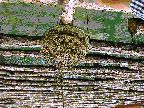
Oyster culture in front of mangroves, Fanchenggang,
China
WATER QUALITY AND PEARL FARMING IN SOUTHERN CHINA
Historically, mangrove thrived along the coastline of Hepu, Guangxi, China, where pearl culture (Pinctada
martensi) has been practiced for nearly 2000 years, mainly in seven areas in the proximity of mangroves,
referred to locally as "pearl pools". By 1995 up to 70% of the mangroves were removed due to coastal
reclamation, and production of good quality pearls declined, suggesting a close link between pearl growth and
mangroves. In Bailong Town of Hepu County, for example, 333 ha of mangroves had been destroyed by 1974.
Before 1974, production was at a level of 1.25 kg of pearls per
10,000 shells, which had dropped to 0.175 kg/10,000 shells by
1999. Over the same period pearl quality declined and the price
also declined to such a low level (5,000 Yuan/kg) that this once
profitable industry was nearly destroyed. Most of the pearl farmers
in Bailong, who had been engaged in pearl production for many
generations, had to choose an alternative job or move to Zhenzhu
Bay in Fangchenggang City of Guangxi to continue their traditional
pearl farming. In 1999, there were still 1030 ha of mangroves in
Zhenzhu Bay where pearl farming is extensively practiced. In 1999
in Zhenzhu Bay , pearl production rate was on average
1.0kg/10,000 shells, and pearl price was 12,000 Yuan/kg. This
suggests that profit from pearl farming in mangrove areas was 13.7
times higher than in areas where no mangrove grows.
Reversing Environmental De gradation Trends in the South China Sea and Gulf of Thailand
MANGROVES IN THE SOUTH CHINA SE A
9
VALUING MANGROVE GOODS AND SERVICES
M ANGROVE DEMONSTRATION SITES
Our current inability to value, in economic terms, the
Goal and Purpose. The primary goal of the
goods and services provided by mangroves stems
demonstration sites is to "test" and "demonstrate"
in part from a lack of agreement concerning the
actions, which either "reverse" environmental
techniques by which value should be determined
degradation or will demonstrate methods of
and in part the lack of comparability between values
reducing degradation trends if adopted and applied
across spatial boundaries.
at a wider scale. In the context of mangrove
ecosystems, environmental degradation results
The total economic value of a natural system
largely from the total or partial conversion of natural
reflects both use and non-use values and whilst it is
habitats to alternative uses, or negative impacts on
possible to value many direct and indirect uses
the biological community structure, productivity or
through market pricing the resulting total value does
species diversity of the habitats, through non-
not reflect the non-use values. Non-use values,
sustainable patterns of resource extraction (over-
such as the value of an endangered species, or the
exploitation). The demonstration sites therefore
aesthetic value of a landscape are difficult to
focus on sustaining biological diversity at the
determine in a manner that allows comparison of
species and habitat levels rather than on the
the results across different social and economic
population or genetic level of biodiversity.
boundaries.
More specifically, demonstration sites are directed
Even the value for direct uses such as the market
to objectives such as: maintaining existing
value of mud crabs collected from mangrove areas
biodiversity; restoring degraded biodiversity;
is highly variable across the region being
attempting to remove or reduce the cause, of
determined by the proximity of the area to markets
degradation; or attempting preventive actions that
and the local economic conditions. Values, where
prevent adoption of unsustainable patterns of use.
they have been determined are therefore highly
specific, relating to a particular area of mangrove at
Maintaining existing biological diversity. Within
a specific point in time.
the region there exist many parks and protected
areas, which with varying degrees of success, are
CONSEQUENCES OF LOSING MANGROVE HABITATS
attempting to maintain the biodiversity that exists
within the park or protected area. Such actions do
When mangrove forests are destroyed and replaced
not address the trend in degradation since they
by alternative land use not only are the species of
effectively establish "refuges" or enclaves of
plants and animals lost but the many services
biodiversity with no, or reduced use. Such
provided by mangrove systems are lost as well.
management regimes can be replicated only by
Since the valuation of such service functions is
extending the total area under this type of
difficult, total economic values of mangroves are
management, and there are severe limitations to
rarely considered in the development decision-
such an expansion, in all countries, which reflect
making process.
land and sea tenure, and current use regimes.
When mangroves are destroyed for shrimp farms
Restoring degraded systems. There are areas in
and other purposes, the decisions are often based
almost all countries of the region where activities
on a consideration of the direct economic returns
involving re-planting and re-forestation, of degraded
from shrimp farming without consideration of the
mangrove are undertaken. Again this type of
total economic value of direct and indirect uses of
potential demonstration activity does not really
mangrove goods and the value of services that are
address the primary objective of the project in that
renewable and sustainable. Mangrove degradation
such actions can only be under-taken once the
causes losses in direct and indirect economic
degradation has occurred.
values that support socio-economic development at
both local and national scales.
Once lost, the productivity of the mangroves that
contributes to wild shrimp and fish production is lost
and whole coastal communities may loose their
means of livelihood. In Viet Nam recognition of the
value of mangrove for coastal protection from storm
surges has led to changes in government policy that
result in the protection and non-use of seaward
mangrove fringes which are seen as protective
barriers for the economic activities taking place
immediately inland.
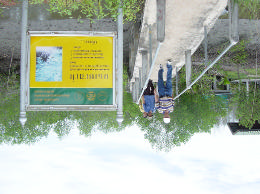
Replanted mangrove, Trad Province, Thailand.
Reversing Environmental Degradation Trends in the South China Sea and Gulf of Thailand
10
DEMONSTRATION SITES
Changing patterns of use. There are, few activities
in Thailand are all examples of this type of site.
in the region designed to attempt to reduce the rate
Such sites must have demonstrated successful
of degradation through halting or changing patterns
sustainable use, for a specific purpose, preferably
of unsustainable use, yet it is these forms of action,
over a long period. Demonstration potential is higher
which if successful, and if replicated, will reverse the
for sites where th e techniques used are not
regional trends in environmental degradation. The
widespread throughout the region. It is likely that
value of such demonstration sites appears obvious,
external grant funding requirements for many such
such actions if successful, can be replicated and
sites would be small.
adopted in areas, which are not under conservation
or protection regimes. Sinc e "use" rather than "non-
Process related sites. Again such sites might
use" is the norm for coastal habitats in this region
include existing sites that demonstrate innovative
the potential opportunities for actions of this type are
management processes that are not widespread in
correspondingly greater.
the region. Some examples might include:
community based, local interventions for sustainable
Reducing the causes of degradation. As noted in
use; transboundary sites demonstrating cross-
the Transboundary Diagnostic Analysis the major
border collaboration in management of single
cause of mangrove loss and degradation in the
ecosystems; management of habitats by one
region is their conversion to shrimp culture. Where
country with benefits to a second; public private
conversion to extensive shrimps ponds is
partnerships; and, application of new modes of
continuing, actions that result in improved efficiency
organisation and/or management, such as the
of pond culture for longer periods of time, whilst at
current decentralisation of responsibilities to
the same time generating the same level of income,
Provincial and local government in Indonesia).
would reduce the trend of continuing loss of habitat.
Identification of alternative livelihoods that generate
comparable income but have a lower impact on the
state of the habitat, and demonstration of their
utility, transferability, and replicability, would ideally
serve the goal and objectives of the project.
Preventing future degradation. Actions that halt
the adoption of unsustainable patterns of use before
they commence are perhaps, the most difficult
demonstration projects to design, since they involve
not only identifying and demonstrating the
alternatives, but also identifying specific areas
where the threats are most imminent and at the
same time can be potentially altered in advance. For
example one might identify in a national forestry
plan a planned development of large-scale
commercial timber exploitation, which could be
Community managed mangroves, Trad Province, Thailand
implemented using a more sustainable approach. In
the case of commercial timber extraction from
Such sites would be chosen on the basis that they
mangrove systems, rather than clear felling the
have, demonstrated already, or potentially could
entire area, adoption of a rotational pattern of
demonstrate in future, new and innovative modes of
extraction, might result in lower economic returns in
managing the resources and the env ironment. This
the short term, but sustainable economic returns
region is particularly rich in examples of community -
over the longer term.
based and local government management of
coastal areas some of which have proven
What is being demonstrated? The term
successful in the longer term, and some of which
"demonstration site", can be interpreted by different
are less successful. Some successful examples of
individuals, to mean quite different things. In the
community-based management have been
context of this project one needs to examine not
identified as models for use as demonstration sites
only the goals and purpose for the sites, but also:
within the region.
"what" is being demonstrated; to "whom" is it being
demonstrated; and, "how" is it being demonstrated.
Problem related sites. Sites could be chosen to
In considering "what" is to be demonstrated one
demonstrate innovative ways of addressing specific
can identify at least three types of potential
environmental problems such as the management
demonstration site, namely; function related sites;
of sewage pollution via non-water treatment
process related sites; and problem related sites.
methods, using mangrove systems as buffer
habitats. Areas in which over-exploitation is
Function related sites. Existing sites that
occurring could be chosen to demonstrate
demonstrate sustainable use of mangroves for
sustainable extractive use of timber or regulation of
timber production, such as the Matang Mangroves
fishing gear and fishing pressure. This type of
in Malaysia, with over 100 years of sustainable
demonstration site could potentially provide models
forestry use of the area; or demonstrate use for eco-
that would be of wider regional and international
tourism such as Can Gio in Viet Nam; or for
significance.
environmental services such as Pak Phanang Bay
Reversing Environmental Degradation Trends in the South China Sea and Gulf of Thailand
MANGROVES IN THE SOUTH CHINA SE A 11
Transboundary management. At present there is
Considerable experience exists in a number of
no area of mangrove habitat under collaborative
countries in the region, including Thailand and
management, involving more than one country, and
Indonesia in the establishment of public awareness
no identified management regime in one country
and extension centres in mangrove areas. Such
that can be shown to provide quantifiable benefits to
centres are designed to enhance public awareness
a second. Identification of such sites and their
of the biology and significance of mangroves and to
adoption as demonstration sites in the framework of
serve as seedling production and training centres
this project provides an innovative demonstration
for mangrove reforestation programmes, operated
site for the region and could serve as a potential
on a community basis.
model for other regions. The mangrove
demonstration proposal in Trad Province, Thailand
is being formulated in collaboration with Cambodian
authorities as one such collaborative management
regime.
In terms of the target audiences and how the
demonstration site is to be operated, the two
questions are clearly related. If one wishes to
transfer a model of successful community based
management from one area to another, or from one
country to another, then the appropriate methods
will differ significantly from those that are applicable
in terms of transferring techniques and experience
at higher organisational levels. Management, at the
level of fisheries extension officers, or management
Mangrove propagules prepared for planting, Trad
at the level of government planners and forestry
Province, Thailand
managers, require quite different mechanisms.
Whilst such centres provide in-country support
Regional Co-ordination. To maximise the potential
through training and public awareness few
benefits of the demonstration site interventions a
mechanisms exist at a regional level for the transfer
regionally co-ordinated framework of structured
of experience between countries. A major role for
visits, study tours an d mechanisms for the transfer
the Regional Working Group on Mangroves lies in
of experiences and good practices must be
providing such mechanisms. Composed of
implemented at the outset. A co-ordinated
government nominated, expert national focal points
programme of exchange visits between
and three regional experts this group represents a
demonstration sites is envisaged that will permit
considerable pool of expertise available in support
individuals from one site to spend extended periods
of the operation and management of the
of on-site training at sites in other countries where
demonstration sites. Each focal point chairs a
appropriate solutions to specific problems are being
national group of institutions with capacity and
applied. Without such a regionally co-ordinated
expertise in all aspects of mangrove research and
programme of training and exchange the lessons
management. This network will serve as the
learned at one site cannot be easily transferred to
mechanism for dissemination , in national
others and the possibilities of self-funded replication
languages , of the experiences and practices
of successful interventions will be reduced.
developed during the execution of the
demonstration site activities.
Table 3
Rank scores for, and primary purpose of, potential mangrove demonstration site proposals.
Total Score Overall rank
Demonstration purpose
Cluster 1
Trad Province
162
1
Community based- management for restoration
Welu River Estuary
133
5
Reversing degradation
Can Gio
120
7
Management for eco-tourism
Pak Phanang Bay
115
9
Management for coastline protection
Cluster 2
Batu Ampar
151
2
Management for multiple uses
Busuanga
135
4
Multiple management through tenurial instruments
Ca Mau
132
6
Management for ecological services
Quinglangang
117
8
Protection of endangered species
Bengkalis
111
10
Management for charcoal production and restoration
Quezon
108
12
Participatory management for aqua-silviculture
Ngurah Rai
108
12
Management for training and public awareness
Angke Kaput
87
14
Management for environmental education
Cluster 3
Fangchenggang
137
3
Cross-sectoral management
Xuan Thuy
109
11
Management for biodiversity conservation
Reversing Environmental Degradation Trends in the South China Sea and Gulf of Thailand
12
DETERMINING REGIONAL PRIORITY
DETERMINING REGIONAL PRIORITY OF POTENTIAL
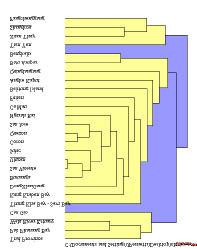
Figure 1 Cluster diagram of twenty-six mangrove sites
DEMONSTRATION SITES
bordering the South China Sea based on
Euclidean distance and mean proximity.
National and Regional Priority. Whilst most
countries have determined national priorities for
intervention including conservation, and sustaining
coastal biodiversity, such priorities have generally
been determined and agreed independently of one
another. The determination of national priority may
not necessarily include consideration of the regional
and or global significance of a particular site or
species. Hence the top priority mangrove site in one
country may fall far below the lower priority sites
from a second country, when both sets are
compared. One major challenge faced by the South
China Sea Project was the determination of the
comparative significance of different national areas
of mangrove habitat that included consideration of
transboundary, regional and global factors.
To initiate the process of determining the
comparative regional importance of national sites it
was agreed by, the Regional Working Group on
Mangroves (UNEP, 2002a; 2002b) that a uniform
set of environmental data would be assembled for
Ranking sites. To arrive at a regional consensus
as many sites as possible bordering the South
regarding the priorities within each cluster the
China Sea. Data were initially assembled for forty-
Regional Working Group initially reviewed the data
four mangrove sites, of which twenty-six data sets
available for all potential sites and developed a set
were judged by, the Regional Working Group, to be
of environmental criteria and indicators reflecting the
sufficiently well documented, to merit inclusion in a
biological diversity, transboundary and regional
regional comparison (UNEP, in press).
significance of each site. A similar system of criteria
and indicators was also developed for the social and
Similarity between sites. Recognising that there
economic characteristics of the sites. Both sets of
exist sub-regional differences in the biological
criteria and indicators were reviewed by, the
diversity contained in mangrove habitats bordering
Regional Scientific and Technical Committee
the South China Sea it was agreed that, a statistical
(UNEP, 2002c; 2003b) prior to being applied to data
comparison of all sites be undertaken in order to
from each site, to derive a score representing a
determine the relative similarity (and difference)
regional view of priority. The system has been
between the sites. These data are presented in
developed in an open and transparent manner
Table 3, where it can be seen that a total of
through the process of consensus such that all
seventeen cells (5.4%) lack entries. This data set
parties understand and accept the final outcome.
represents a compromise between a fully
comprehensive and descriptive set of parameters
Priority sites for intervention. Having agreed the
and what was available for all sites.
criteria, indicators and scoring system and
conducted an independent cluster analysis to group
A cluster analysis was performed using the Clustan
similar sites the rank order within each cluster has
Graphic6 software programme and the resulting
been determined and a set of demonstration
dendrogram is presented in Figure 1. It can be seen
proposals prepared for consideration by the
that the sites fall into three clusters, two of which are
Regional Scientific and Technical Committee and
comparatively small (four sites each). These two
the Project Steering Committee (UNEP, 2003;
small clusters encompass sites in China, Thailand
UNEP, in press).
and Viet Nam representing the northern and north-
western, margins of the South China Sea. The
It can be seen from Table 3 that proposals have not
larger central cluster of 18 sites, is more
yet been developed for all top priority sites within
heterogenous, encompassing both insular and
each cluster, although it is envisaged that this will
mainland sites generally lying in the Southern and
be done at a later date. By focussing on sites for
Eastern portions of the region.
which regional priority is high the project aims to
meet the double objective of conserving globally
The purpose of performing such an analysis was to
significant biological diversity whilst at the same
identify groups of similar sites and ultimately to
time developing, testing, and refining interventions
spread the interventions across different groups
and management actions that can be applied more
thus maximising the between site variation covered
widely throughout the region.
by the selected interventions.
Reversing Environmental Degradation Trends in the South China Sea and Gulf of Thailand
MANGROVES IN THE SOUTH CHINA SE A
13
Table 4
Selected physical and biological data set for mangrove potential demonstration sites bordering the South China Sea.
Zones
True
Density
No.
No.
No
Site
Present
% change
% cover
No
No Fish No Bird
Area
spp
in area mangrove
>1.5m
Crustacean. Bivalve Gastropod Spp
Spp
migratory
assoc
Spp.
high /Ha
Spp.
Spp.
bird Spp.
Trad Province
7,031
5
2
33
1,100
90
32
M
M
55
98
24
Thung Kha Bay - Savi Bay
3,543
4
34
23
1,628
90
58
M
M
36
13
8
Pak Phanang Bay
8,832
3
2
25
1,282
56
36
M
M
85
72
45
Kung Kraben Bay
640
2
0
27
6,100
80
19
M
M
35
75
16
Welu River Estuary
5,478
3
31
33
1,400
60
25
M
M
52
69
15
Tien Yen
2,537
2
-25
13
7,000
60
51
M
M
79
M
M
Xuan Thuy
1,775
3
98
11
9,500
75
61
25
30
90
31
62
Can Gio
8,958
3
100
32
6,000
80
28
17
32
103
96
34
Ca Mau
5,239
3
60
30
7,500
85
12
6
15
36
18
53
Shangkou
812
4
11
9
11,980
90
65
40
33
95
28
76
Quinglangang
1,189
6
-56
25
10,183
80
60
50
62
90
39
32
DongXhaiGang
1,513
5
-14
16
8,433
80
32
24
27
84
43
35
Futien
82
3
-26
7
10,233
80
29
16
21
11
58
99
Fangchenggang
1,415
4
-10
10
12,300
90
67
62
40
71
42
145
Busuanga
1,298
5
-5
24
7,550
90
6
15
36
9
45
27
Coron
1,296
5
-50
26
7,080
M
7
15
37
13
42
34
San Vicente
133
5
-15
14
3,780
80
6
15
36
13
36
40
Ulugan
790
4
-10
16
5,100
85
8
15
36
13
42
39
San Jose
483
4
-80
25
3,180
60
7
13
34
7
48
37
Subic
148
3
-20
23
1,420
90
8
14
35
16
44
57
Quezon
1,939
5
-40
32
4,000
80
5
14
37
11
44
37
Belitung Island
22,457
5
0
8
467
100
5
26
43
71
M
M
Angke Kaput
328
9
-2
12
569
70
29
21
4
22
40
4
Batu Ampar
65,585
5
0
21
2,391
100
11
15
17
51
19
27
Ngurah Rai
1,374
6
27
25
660
100
38
10
32
34
38
42
Bengkalis
42,459
7
-15
18
490
99
12
8
9
3
16
15
Reversing Environmental Degradation Trends in the South China Sea and Gulf of Thailand
14
BIBLIOGRAPHY
BIBLIOGRAPHY
Chong, V.C. Low, C.B. & Ichikawa, T. (2001). Contribution of mangrove detritus to juvenile prawn nutrition: a dual
stable isotope study in a Malaysian mangrove forest. Mar. Biol. 138:77-86.
Hutchings, P. and P. Saengar 1987. Ecology of mangroves. University of Queensland Press. St. Lucia, Australia.
388 pages.
Ewel, K.C., Twilley, R.R. & Ong, J.E. (1998). Different kinds of mangrove forests provide different goods and
services. Global Ecology an Biogeography Letters 7: 83-94.
FAO. 2003. http://www.fao.org/forestry/foris/webview/forestry2
Loneregan, N.R., Bunn, S.E., & Kellaway, D.M. (1997). Are mangroves and seagrasses sources of organic
carbon for penaeid prawns in a tropical Australian estuary? A multiple stable-isotope study. Marine Biology
130:289-300.
MacNae, W., 1974. Mangrove Forests and fisheries. UNDP/FAO, IOFC/DEV/74/34. pp 1-35.
Ong, J.E. (1993). Mangroves - a carbon source and sink. Chemosphere 27:1097-1107.
Ong, J.E. & Gong,W.K. (2002). Vegetated Intertidal : Mangroves & Salt Marshes, in the UNESCO Encyclopaedia
of Life Support Systems (EOLSS), EOLSS Publishers, Oxford, UK. [only in digital format,
http://www.eolss.net].
Ong, J. E., Gong, W. K. & Clough, B. (1995). Structure and productivity of a 20 year-old stand of Rhizophora
apiculata mangrove forest. J . Biogeography 22: 417-424.
Ong, J.E., Gong, W.K. & Wong, C.H. (2003). Allometry and partitioning of the mangrove, Rhizophora apiculata.
Forest Ecology and Management in press.
Talaue-McManus, L. 2000 Transboundary Diagnostic Analysis for the South China Sea. EAS/RCU Technical
Report Series No. 14, 108p p. UNEP Bangkok, Thailand.
Tam, N.F.Y., Wong, Y.S. 1995. Mangrove soils as sinks for wastewater-borne pollutants. Hydrobiologia
295: 231-241.
UNEP, 2002a. First Meeting of the Regional Working Group for the Mangrove Sub-Component of the UNEP/GEF
Project "Reversing Environmental Degradation Trends in the South China Sea and Gulf of Thailand".
UNEP/GEF/SCS/RWG-M.1/3. 44 pp In: UNEP, "Reversing Environmental Degradation Trends in the South
China Sea and Gulf of Thailand", report of the First Meetings of the Regional Working Groups on Marine
Habitats. 179 pp. UNEP, Bangkok, Thailand.
UNEP, 2002b. Second Meeting of the Regional Working Group for the Mangrove Sub-Component of the
UNEP/GEF Project "Reversing Environmental Degradation Trends in the South China Sea and Gulf of
Thailand". Report of the meeting, UNEP/GEF/SCS/RWG-M.2/3. 45 pp. In: UNEP, Report of the Second
Meetings of the Regional Working Groups on Mangrove & Wetlands. UNEP, Bangkok, Thailand.
UNEP, 2002c. Second Meeting of the Regional Scientific and Technical Committee for the UNEP/GEF Project
"Reversing Environmental Degradation Trends in the South China Sea and Gulf of Thailand". Report of the
meeting, UNEP/GEF/SCS/RSTC.1/3. 72 pp. UNEP, Bangkok, Thailand.
UNEP, 2003. Third Meeting of the Regional Working Group for the Mangrove Sub-Component of the UNEP/GEF
Project "Reversing Environmental Degradation Trends in the South China Sea and Gulf of Thailand". Report
of the meeting, UNEP/GEF/SCS/RWG-M.3/3. 50 pp.
UNEP, In press. Fourth Meeting of the Regional Working Group for the Mangrove Sub-Component of the
UNEP/GEF Project "Reversing Environmental Degradation Trends in the South China Sea and Gulf of
Thailand". Report of the meeting, UNEP/GEF/SCS/RWG-M.4/3.
Reversing Environmental Degradation Trends in the South China Sea and Gulf of Thailand
MEMBERS OF THE REGIONAL WORKING GROUP ON MANGROVES
Dr. Sanit Aksornkoae, President, Thailand Environment Institute, 16/151-154 Muangtongthanee, Bond Street
Rd., Bangput, Pakred, Nonthaburi 11120 , Thailand, Tel: (66 2) 503 3333 ext. 401; Fax: (66 2) 504 4826-8,
E-mail: sanit@tei.or.th
Mr. Florendo Barangan, Executive Director, Coastal & Marine Management Office, Department of Environment
and Natural Resources (CMMO/DENR), DENR Compound Visayas Avenue, Diliman, Quezon City,
Philippines, Tel: (632) 926 1004, Mobile: (63) 917 873 3558, Fax: (632) 926 1004; 426 3851,
E-mail: cmmo26@yahoo.com
Dr. Hangqing Fan, Professor, Guangxi Mangrove Research Centre, 92 East Changqing Road, Beihai City
536000, Guangxi Zhuang Autonomous Region, China, Tel: (86 779) 205 5294; 206 5609,
Mobile: (86) 13 367798181, Fax: (86 779) 205 8417; 206 5609, E-mail: fanhq@ppp.nn.gx.cn
Dr. Gong Wooi Khoon, Centre for Marine and Coastal Studies, Universiti Sains Malaysia, 11800 Penang,
Malaysia, Tel: (604) 653 2371, Fax: (604) 657 2960; 656 5125, E-mail: wkgong@usm.my;
gongwk@yahoo.com
Dr. Sonjai Havanond, Expert, Marine and Coastal Resources Division, 92 Pollution Control Building,
Phaholyothin 7 (Soi Aree), Phayathai 10400, Thailand, Tel: (66 2) 298 2591; 298 2058,
Mobile: (66) 1 8114917; 661 1731161, Fax: (66 2) 298 2591; 298 2592; 298 2166,
Email: sonjai_h@hotmail.com; sonjai_h@yahoo.com
Dr. John C. Pernetta, Project, UNEP/GEF Project Co-ordinating Unit, United Nations Environment Programme,
9th Floor, Block A, United Nations Building, Rajdamnern Avenue, Bangkok 10200, Thailand,
Tel: (66 2) 288 1886, Fax: (66 2) 288 1094; 281 2428, E-mail: pernetta@un.org
Dr. Do Din h Sam, Professor, Forest Science Institute of Vietnam, Dong Ngac, Tu Liem, Hanoi, Vietnam,
Tel: (844) 838 9815, Fax: (844) 838 9722, E-mail: ddsam@netnam.vn
Mr. Nyoto Santoso, Lembaga Pengkajian dan Pengembangan Mangrove, (Institute of Mangrove Research &
Development), Multi Piranti Graha It 3 JL. Radin Inten II No. 2, Jakarta 13440, Indonesia,
Tel: (62 21) 861 1710; (62 251) 621 672, Mobile: (62) 81 1110 764, Fax: (62 21) 861 1710;
(62 251) 621 672, E-mail: imred@indo.net.id; puryanti@indo.net.id
Dr. Nguyen Hoang Tri, Director, Center for Environmental Research and Education (CERE), Hanoi University of
Education, 136 Xuan Thuy, Quan Hoa, Cau Giay, Hanoi, Vietnam, Tel: (844) 733 5625; 768 3502,
Mobile: (84) 9 13527629, Fax: (844) 733 5624; 762 7908, E-mail: CERE@hn.vnn.vn
Mr. Ke Vongwattana, Assistant to Minister in charge of Mangrove, Department of Nature Conservation &
Protection, Ministry of Environment, 48 Samdech Preah Sihanouk, Tonle Bassac, Chamkarmon,
Cambodia, Tel: (855 23) 213908, Mobile: (855) 12 855 990; 16 703030, Fax: (855 23) 212540, 215925,
E-mail: vongwattana@camintel.com; kewattana@yahoo.com




UNEP/GEF South China Sea Project Co-ordinating Unit
United Nations Building
Rajadamnoern Nok
Bangkok 10200
Thailand
Department of Nature Conservation and Protection
Ministry of Environment
48 Samdech Preah Sihanouk
Tonle Bassac, Chamkarmon
Cambodia
Guangxi Mangrove Research Centre
92 East Changqing Road
Beihai City 536000
Guangxi Zhuang Autonomous Region
People's Republic of China
Lembaga Pengkajian dan Pengembangan Mangrove
(Institute of Mangrove Research & Development)
Multi Piranti Graha It 3 JL. Radin Inten II No. 2
Jakarta 13440
Indonesia
Coastal & Marine Management Office
Department of Environment and Natural Resources, (CMMO-DENR)
DENR Compound Visayas Avenue
Diliman, Quezon City
Philippines
Marine and Coastal Resources Division
Ministry of Natural Resources & Environment
92 Pollution Control Building
Phaholyothin 7 (Soi Aree)
Phayathai 10400
Thailand
Forest Science Institute of Vietnam
Dong Ngac, Tu Liem
Hanoi
Viet Nam