DEMONSTRATION SITE SUMMARY SHEET
1.
SITE NAME AND GEOGRAPHIC CO-ORDINATES: Prek Ampil, Kampot
Located at: Latitude 10°27' - 10°36' N and Longitude 103°54' - 104°17' E in the South-eastern Coastal
Zone of Cambodia.
2.
COUNTRY IN WHICH THE SITE IS LOCATED: The Kingdom of Cambodia
3.
STATE OR PROVINCE IN WHICH THE SITE IS LOCATED: Kampot Province
Local government approval [yes or no]:
Yes date:
11th June 2004
Local government involvement [yes or no]:
Yes
Local government co-financing [yes or no]:
Yes
if yes then in-kind or in-cash? In-kind
4.
LINKAGE TO NATIONAL PRIORITIES, ACTION PLANS AND PROGRAMMES:
The activities at the demonstration site will address specific problems and build on the current
programmes (5-year and annual fisheries management plans) of the Department of Fisheries (DoF)
and local fisheries and environmental offices that are designated for managing and conserving living
aquatic resources and environment. Managing living coastal resources including seagrass resources
has historically been under the programmes of the DoF and local fisheries offices since 1979. Then,
the government established the Ministry of Environment and Provincial Department of Environment in
Kampot to accelerate the programmes for reversing environmental degradation.
Prek Ampil is adjacent, and linked to Bokor National Park, which was designated by Royal Decree of
Cambodia to protect terrestrial-mountainous nature, flora and fauna. With the National Park, Prek
Ampil is a coastal area, where beaches are considered to be potential destination for eco-tourism.
Therefore, the activities of the demonstration site could be linked to the conservation programmes of
the National Park.
In addition, the activities of the project will address issues identified in national plans and priorities on
marine biological resource management and conservation, outlined in:
National Action Plan for Seagrass and Coral Reef Management (2nd Draft),
National Policy for Marine Fisheries Management, Conservation and Development,
National Biodiversity and Strategic Action Programme (NBSAP) (approved by the government).
Central government involvement [yes or no]: Yes
Central government co-financing [yes or no]: Yes, In-cash and In-kind
5.
DATE OF NTWG MEETING WHICH CONSIDERED THE PROPOSAL: 11th June 2004
6.
NATIONAL TECHNICAL FOCAL POINT ENDORSEMENT AND/OR COMMENTS:
Seagrass beds in Kampot province form one of the most extensive meadows found in Cambodia.
These seagrass meadows play a very important role as spawning and nursery grounds for marine
fauna; particularly as critical habitats for juvenile finfish, molluscs and crustaceans. These seagrass
meadows support small and commercial scales of fisheries, which most of local livelihoods are
depending on. However, these seagrass beds are threatened by an increasing array of impacts from
unsustainable and destructive fishing practices, sedimentation and waste dumping. Central and local
governments have great interest in managing seagrass resources, conserving biodiversity, reversing
environmental degradation, and improving the livelihoods of local communities. As the site is bordered
with Phu Quoc's site of Viet Nam, it has to be jointly managed by the two countries.
Signature:................................................
Date.................................................
Name and Designation: Mr. Koch Savath
National Technical Focal Point for the SCS Project.
1
7. SITE
DESCRIPTION:
Area:
Prek Ampil site is geographically located in the Southern part of the country between 10°27' - 10°36'
N and 103°54'- 104°17' E in Kampot province. It lies in the eastern region of the Gulf of Thailand and
the western area of the South China Sea, adjacent to Phu Quoc Island in Viet Nam. The total area is
66,733 ha, with net seagrass coverage of 25,2401 ha (based on preliminary seagrass survey
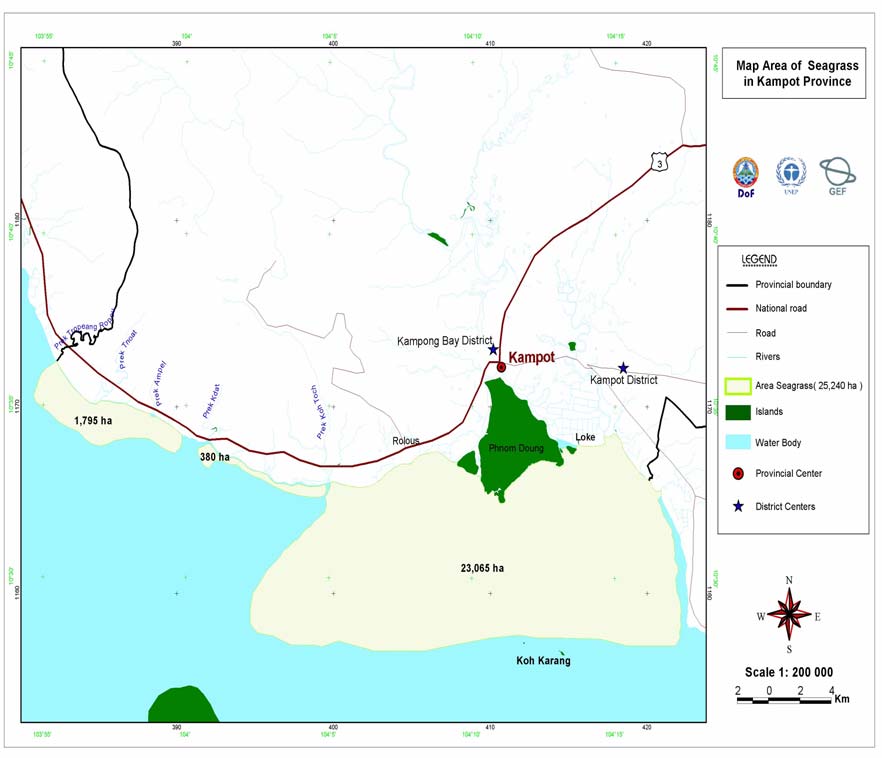
conducted in 2003 by DoF) (DoF, 2004). The seagrass habitat is divided into 3 main areas. The first
extends from Prek Trapeang Ampil to Prek Khdat, covering an area of 1,795 ha; the second extends
from Prek Khdat to Koh Touch, with an area of 380 ha; and the third and largest area extends from
Koh Touch to Kep Municipality with a total area of 23,065 ha (map of the site as in annex 1).
Environment:
The seagrass meadows are located in parallel to the coastline of Prek Ampil, which extends 150-
300m from the shoreline in front of Bokor National Park. The area has a gentle slope with the depth of
the site varying from 1-4m, depending on tide level. The substrate consists of a mixture of sand and
mud and the climate is tropical monsoon with a clear distinction between wet and dry seasons. The
dry season runs from November to May while the wet season is from May to October. Mean annual
temperature is around 26 27oC. Visibility in the water is dependent on the season, with reduced
visibility during the wet season. Much freshwater runoff during heavy rainfall influences salinity which
ranges from 25 30 ppt. Sea surface temperatures range from 26 - 30°C.
Habitats:
A diversity of habitats can be found in this area including seagrass meadows, coral reefs, mangroves
and wetlands. The dominant marine habitat in the Prek Ampil area is the extensive seagrass
meadows that cover 25,240 ha. Based on preliminary surveys with limited resources conducted by the
DoF in 2003, six species of seagrass have been reported in this area: Enhalus acoroides, Thalassia
hemprichii, Halophila decipiens, Syringodium isoetifolium, Cymodocea rotundata, Halodule uninervis
(DoF, 2004). Enhalus acoroides and Cymodocea rotundata, are the dominant species in the area. It is
likely that more species of seagrass and fauna will be identified when intensive surveys are carried
out.
The seagrass meadows play a significant role not only as spawning and nursery grounds but also an
integrated component of the entire coastal ecosystem. A number of other ecosystems are associated
with these seagrass meadows. Small patches of coral are mixed with the seagrass beds and other
patches of coral reef are located about 800m from the seagrass edge. Corals include massive Porites
and Faviids, but no survey of coral species has been conducted at the site. On the landward side,
mangrove forests and wetlands fringe the shoreline. Bokor National Park, reported to contain
elephants and other terrestrial endangered species is located on the mountain beyond the mangroves
and wetlands.
The coastal zone of Cambodia is rich in marine biodiversity; Ing (2003) reported 476 species of
marine finfish, 20 species of crustaceans, 42 species of gastropods and 24 species of bivalves
Although there has been no scientific study on the taxonomy of species at the site; it is assumed that
the area is representative of the rich marine fauna of the country. The area also provides habitat for
economically important, migratory and endangered species; particularly sea turtle, dugong, dolphin
and seahorse.
Present Use:
There are 31 villages, located in 9 communes in close proximity to the demonstration site and a socio-
economic survey (Carl Bro International a/s, 1998) indicated that 42% of local families living in this
area are subsistence fishers and are directly dependent on the seagrass habitat along the coastline,
for food and revenue. In Kampot province, rastrelliger mackerels are the most important finfish
species and fishing vessels are characteristically small, operated close to shore, and return to port on
a daily basis. The Department of Fisheries reported 549 fishing vessels operating in Kampot Province
in 2001 and the figure increased to 633 in 2004 (DoF, 2005). The number of fishing vessels in each
size class is shown in Table 1.
1 This seagrass area is considered a maximum since the initial survey was conducted on assumption that the seagrass
distribution was uniform. It is naturally patchy distribution; and to verify the actual area further surveys will be undertaken.
2
Table 1
Size Classes of Fishing Vessels Registered in Kampot Province in 2001 and 2004.
Engine size
Boats w/o
<10 HP2
10-30HP 31-50HP >50
HP Total
engines
No. of vessels in 2001
133 151 252 1 12
549
No. of vessels in 2004
202 179 243 5 4
633
The predominant fishing practices are trawling and beach seining, while small-scale fishing gear (gill
nets or traps) are also commonly used to collect fish, crab and squid, particularly juvenile crab to be
fattened in cages until they reach commercial sizes. Some local fishers use hand push nets in
seagrass beds to collect shrimp, small fish, and sea horse.
Mariculture is increasing in the area with seaweed farming in and near the seagrass meadows and
coral reef areas. Seaweed farming involves many local people and could seriously damage seagrass
and coral reefs areas as farmers put poles and ropes in seagrass beds and coral reef areas. At
present no zoning has been undertaken by central or local governments. Semi-intensive shrimp
farming by a few commercial enterprises is also found in the area.
The rest of the population is involved in agriculture (rice and vegetable cultivation), small businesses,
and fish processing, the latter undertaken largely by women. On a larger commercial scale, some
local people are employed in a processing factory that produces fish sauce, an important processed
product of Kampot province.
Currently, tourism in the area is limited and dominated by local visitors; however, the government is
committed to promoting eco-tourism in the future since it has both coastal and mountainous
sceneries, the latter in the adjacent Bokor National Park.
Management Regime:
Natural resources, including marine living resources and environment belong to the state; and the
Department of Fisheries (DoF); under the Ministry of Agriculture, Forestry and Fisheries (MAFF); is
the designated government institution responsible for managing and conserving these marine
resources in the marine and coastal water of the Kingdom of Cambodia. Marine resources are
managed under the basic fisheries law, the Fiat Law for Fisheries Management and Administration,
which came into force in March 1987 (Council of Minister, 1987). Furthermore, an important legal
document related to the activities of natural resource management and conservation is the
Declaration No. 1470 on the Organisation and Functioning of the DoF (MAFF, 1990). The declaration
states the role and responsibility of the DoF, as being to:
Develop and implement plans and legal instruments for fisheries resource management and
conservation;
Prepare, enhance and maintain fishing grounds and resources;
Conduct scientific research, and disseminate results and information.
Kampot Province has its' own Fisheries Office, with 34 full time staff, and is operational under the
Provincial Department of Agriculture, Forestry and Fisheries (DAFF). The Provincial Fisheries Office
is responsible for the management of marine resources within provincial waters with officials
responsible for day-to-day management activities. The Provincial Fisheries Office functions under the
direct supervision of both the DoF and DAFF. There are also fisheries staff at district level under
Kampot Provincial Fisheries Office of DAFF, whose direct responsibility is to monitor and control
commercial and subsistence fisheries, and protect marine resources and habitats (mangroves,
seagrass and coral reefs) from illegal and destructive practices.
Apart from fisheries and agriculture, the government has established environmental institutions to
protect environment and natural resources and reverse environmental degradation. These include the
Ministry of Environment (MoE) at national level, and the Provincial Department of Environment (DoE)
at provincial level. The DoE operates under direct supervision of the MoE and the Kampot Provincial
Governor. The responsibilities of the DoE include the conservation of natural resources; oversight of
environmental protection measures; and the management and conservation of marine natural
resources in Marine Protected Areas and National Parks.
2 Horse power.
3
A National Coastal Steering Committee has been established to oversee management and
development of the natural resources and environment for the whole coastline of the Kingdom of
Cambodia involving these two Key Ministries together with the Provincial Department of Tourism, the
Royal Navy and Provincial level institutions from the three coastal municipalities/provinces.
8. STAKEHOLDERS:
Key stakeholder groups having interests and involvement in marine resources are as follows:
National
government
Ministry of Agriculture, Forestry and Fisheries (Department of Fisheries),
Ministry of Environment, Ministry of Tourism, Ministry of Land Use Planning, Construction and
Urbanisation. Representatives from these line ministries are members of the National Coastal
Steering Committee for supervising and guiding the implementation of all coastal projects and
activities including the South China Sea Project.
Local
authorities
The highest level of authority at the local level is the Provincial Governor,
beneath who are the District Governors, Commune councils and village leaders. These are the
local authorities officially recognised in the constitution of the Kingdom of Cambodia. In Kampot
province there are Provincial Technical Departments such as Department of Agriculture, Forestry
and Fisheries (DAFF), Department of Environment (DoE), Department of Tourism (DoT),
Department of Royal Navy (DRN), etc. These departments will serve as members of the
Management Board and Management Advisory Group during implementation of the
demonstration site activities (annex 6).
Local
communities
Local fishers, local villagers, schoolchildren, seaweed farmers, and
Buddhist monks. Following the introduction of decentralisation of government management, and
the initiation of community-based natural resource management, the government has recognised
and supported local community organisations, including some coastal fisheries community
organisations that are officially recognised and have responsibility for management and protection
of the natural resources within their own defined areas.
· Seaweed farming has become dominant in the area with many local people engaged in this
activity. These people should be made aware of the potential adverse impacts of seaweed
farming on coral reef and seagrass ecosystems in order to avoid further damage in the future.
Seaweed farmers are important stakeholders in the project.
· Currently, the marine resources are used by local fishers, who are entirely dependent on the
areas for their livelihoods. They know exactly what the status of the resources is; what causes
the degradation; and how to solve the problems. Their direct involvement in project
implementation is indispensable to the success of the project. These local fisher communities
are the main target group, as they are the primary users of the resources.
Commercial fisheries owners, processors and fish transporters may also be considered
stakeholders, even though they represent a small group in the population they are the influential
people as they are comparatively wealthy. These people could potentially contribute to the
conservation and management of the resources if they were aware, and understand the
significant value of marine habitats and resources.
Private Sector Tourism Currently, there are no large business and tourism activities in the
area. However, the government proposes to develop tourist resorts since the area is adjacent to
Bokor National Park. Tourists visiting Bokor National Park, pass through Prek Ampil's beaches
before reaching the Park therefore, these could attract more domestic and foreign tourists. Local
fishers could be trained, to be service providers for tourists as well as small businessmen instead
of directly exploiting the marine resources,
Finally, there are Non-Governmental organisations (NGOs) working with communities in Kampot
province, including as DANIDA, APHEDA, JICA, and WCS. The role of NGOs is very important in
supporting activities, and they will be encouraged to participate in meetings and workshops for
planning and developing strategy for management and conservation of resources at community
level. Currently, CZM/DANIDA is conducting socio-economic survey in Kampot province, which
will provided additionally valuable information for managing the demonstration site. Furthermore,
APHEDA had introduced small scale aquaculture in some villages. JICA is looking for opportunity
of small scale aquaculture development and marketing in three villages of three districts. WCS
has been working for the conservation of endangered species including marine mammals and
reptiles. These NGOs work closely with local communities in remote areas. As they have
4
experience in working with local communities, these NGOs could be able to provide information
and or even expertise to the project. They can contribute mostly on alternatively livelihood
development (aquaculture, livestock raising, and vegetable farming) and participatory approach
for managing resources.
Key stakeholders and their roles in executing activities at the Kampot demonstration site are identified
and detailed in Annex 2.
9.
THREATS:
During the meeting on "Preparation of National Action Plan for Seagrass Management and
Conservation in Cambodia" in Kampot Province, threats to seagrass beds were identified resulting
from various anthropogenic activities including illegal and over-fishing activities. With potential
development and population growth in the future, seagrass beds could be seriously impacted if
appropriate management plans are not immediately implemented. The major threats are considered
as following:
Illegal fishing activities trawling, which is not allowed in the water column less than 20-meter
depth by the Fisheries Fiat Law No. 33 (Council of Minister, 1987), commonly occurs on
seagrass beds of Kampot province. This is one of the greatest sources of damage to seagrass
habitats and biodiversity particularly young seagrass shoots, small juvenile fauna, and
endangered species. Trans-boundary illegal fishing activities happen everyday as Viet Nam's
fishing boats illegally enter and fish on seagrass or coral reef areas near-shore.
Overfishing increasing numbers of fishing boats and better fishing techniques places
increasing pressure on the resources and habitats that could lead to decline in fish stocks and
yields. The DoF reported an increase in the total number of fishing vessels in Kampot province
from 549 in 2001 to 633 in 2005 (Table 1). Furthermore, even no concrete-scientific data to
prove that the resources are overexploited; everybody from a local fisher to high rank officer
admits that situation is absolutely true. Most fishermen complaint that their daily catch
decreases every year, they have to increase the number of fishing gear to get the same catch.
Pollution/sedimentation littering, waste dumping, land clearing, coastal development and
poor agricultural practices; lead to pollution, increase soil erosion and sedimentation; and cause
the degradation of seagrass beds and small patches of coral reef areas.
Seaweed farming seaweed poles and ropes, which are built on top of seagrass beds and
coral reef areas, result in the destruction of the meadows through construction methods and
trampling. When seaweeds are hung on the surface, benthic corals and seagrass are deprived
of light and die after few months without sunlight. This has already happened in coral reef areas
of Koh Tonsay of Kep municipality, and farmers just abandoned the areas and moved to
Kampot province.
The results of causal chain analysis were illustrated in Annex 3 of the document.
10.
GOALS AND PURPOSE:
The primary purpose of this project is to conserve seagrass habitat and biodiversity through
enhancement of more sustainable uses of the seagrass habitat, and reduction of the impacts of
human activities, through the application of a new co-management strategy. The project focuses on
the importance of ecologically sustainable use of the resources with strong involvement from local
communities. The management strategy developed for this demonstration site can be used as a
model and applied to other seagrass areas experiencing similar threats in Cambodia, and other
countries bordering the South China Sea and Gulf of Thailand.
11. RATIONALE
AND
OBJECTIVES:
Kampot Province contains one of the largest areas of seagrass in the South China Sea, which is rich
in fisheries resources, and provides the habitat for endangered and critically endangered species.
Many local people are dependent on the marine resources for nutritional requirements and income
generation. Current patterns of use are however not sustainable and given the potential for further
economic development in the area, resulting from the government's proposal to develop eco-tourism,
there exists an urgent need to develop a co-management plan that encompasses the needs of the
various stakeholders, whilst at the same time conserving the resources.
5
The Cambodian government is committed to taking an active role in educating communities on
conservative issues, and working closely with them to conserve and sustainably use the seagrass
habitats and resources of Kampot Province.
The proximity of this site to the border with Viet Nam provides an opportunity for joint management of
these transboundary resources with Viet Nam and to facilitate the two governments working together
to solve problems of natural resource management and use. Lessons learned from this joint
management will be valuable for other trans-boundary and regional initiatives.
The overall goal of this project is to reduce the threats to seagrass habitats in Kampot Province by
applying a co-management strategy and plan developed by the participating stakeholders to ensure
more sustainable use of the marine resources. The specific objectives are:
i) To develop and establish a coordinating mechanism among national and local government
agencies, local communities, and between Cambodia and Viet Nam; in managing seagrass
resources in the coastal waters of Kampot Province that will be maintained following completion
of the project.
ii) To develop and implement a long-term management plan including regulations for sustainable
use of seagrass resources and adjacent ecosystems.
iii) To enhance public awareness and to improve understanding among policy makers, managers
and local communities of the ecological significance and economic value of seagrass habitats
through increased survey and monitoring programmes of biological, and socio-economic data.
These data will be analysed and used as basic inputs for planning and management purposes.
iv) To investigate possible mechanisms for ensuring financial sustainability of management and
improving the economic conditions of coastal communities.
12. OUTCOMES:
- Formally established co-management mechanism at the national level that is maintained
beyond the project duration, functioning management plan that is supported and implemented
by all involved stakeholders, and is based on sound data and information regarding the
biological and socio-economic conditions of the area.
- Improved status of seagrass habitats, through zoning types of use, and reduction or limitation
of, the use of destructive types of fishing gear.
- Improved financial sustainability of the management system through application of
appropriate agreed use fees and enhanced income for subsistence fishers through
identification and introduction of alternative livelihoods.
- Joint management Mechanism involving Viet Nam and Cambodia.
13.
PLANNED ACTIVITIES TO ACHIEVE OUTCOMES:
In order to achieve the above mentioned goal and objectives, five main components of planned
activities were designed for implementing:
Component 1: Project Management
The purpose of this component is to manage the execution of the project, and establish a mechanism
for co-ordination between national and local government agencies, local communities, and even
between Kien Giang (Phu Quoc) and Kampot provinces. Detailed activities under this component
include:
National Actions:
The recruitment of a demonstration site manager by the DoF and Kampot Governor. The project office
will be equipped with office equipment and furniture.
A Management Advisory Group (MAG) has been established by the National Seagrass Committee in
a meeting and approved by the Kampot Governor. This MAG is chaired by the Chief of Kampot
Provincial Department of Agriculture, Forestry and Fisheries, and will meet four times per year to
discuss project operation. A Management Board (MB) has been established by the Kampot Governor
(Annex 6). This MB is chaired by the Kampot Governor, and will meet twice a year to provide
oversight to project implementation. The site manager will organise these regular MAG and MB
meetings.
6
Other management activities include project monitoring, evaluation and auditing; which will be done at
the end of each year. Project monitoring will conducted by the MB; while evaluation and auditing will
be done by an independent consultant and auditor, respectively.
Bilateral Actions:
Based on the chart of management framework (Annex 6), the Cambodian MAG will meet with Viet
Nam's MB once a year to discuss the cooperative framework and other technical issues such as
indicators and monitoring methodology. There are totally three joint meetings, where the venue of the
first meeting will be decided by the two groups. However, if the first meeting is held in Phu Quoc, the
second one will be in Kampot.
Similarly, the Cambodian MB will meet with Viet Nam's Project Steering Committee once per year
regarding decision making and bilateral agreement on issued raised by MAGs. The venue of the
meeting will shift from one country to another, which the first one has to be decided and agreed by
both groups. These meetings will be facilitated by the PCU.
Component 2: Data and Information for Management Plan Purpose
The purpose of this component is to produce data and information for developing a long-term
sustainable management plan for seagrass resources and ecosystem. A base map of the
demonstration site will be initially prepared by SEA START RC from satellite imagery.
A field survey will be conducted for 10 days by six people from a technical institution. Three main
parameters will be collected: percentage cover of seagrass, species composition and depth. The
result of this survey will be used for mapping and identifying zones. At the same time, a socio-
economic survey will be conducted for 20 days by four people from a technical institution in order to
collect data on socio-economics, resource use and value. These data will be used as input for
updating GIS database for mapping and identifying zones; and will be used for analyses of present
and potential uses, values, net incomes, costs and potential use conflicts for the establishment of
financial mechanism in the management plan. When all required data are collected, they will be input
into the GIS database by a GIS expert from a technical institution.
Component 3: Development of Management Plan
When having completed the data of the site including field data, socio-economics, value, uses, etc.; a
draft long term management plan for the demonstration site will be prepared by the Site Manager with
involvement of the MAG and external technical support. The management plan; will cover all
management issues such as zones, regulation, management strategy, monitoring guideline, and
establishment of financial mechanism for sustainability.
The draft management plan will be discussed during a series of stakeholder discussion. The site
manager will organise a total of 4 meetings in order to discuss the draft management plan. The first 3
meetings will be conducted at village level; and the last one will be conducted for higher level of
stakeholders such as local resource managers, commune councils, and private sector.
At the end of all stakeholders' meetings, the site manager will incorporate the results into the draft
plan, and then it will be reviewed by MAG and MB during their regular meetings. When the plan has
been finally reviewed and finalised by MB, it will be submitted to Kampot Governor for signing. The
adopted plan will be translated into English, and published in Khmer and English for national and
regional distribution.
Component 4: Enforcement
When the plan has been approved, the first task will be the physical work of zone marked. The site
manager; with accompany some members of MAG, commune councils and chiefs of village to set the
buoys for demarcating zones.
Law enforcement will be carried out as soon as the zones are clearly demarcated. A small patrol boat
will be purchased and two people will be selected from the local community for conducting regular
surveillance.
As soon as the survey on resource use has been conducted, a monitoring methodology for biological
resources and use will be developed at the early stage by a technical institution. The draft monitoring
methodology will be jointly reviewed by MAGs of the two countries. Monitoring on biological resources
and use will be conducted twice during the course of the project.
7
Component 5: Public Awareness and Training
Public Awareness:
The first activity of awareness is the production of 500 copies of a poster of seagrass biodiversity and
sustainable use. They will be distributed to communes and villages. The posters will be displayed in
public places such as commune halls, schools and pagoda. The site manager will be responsible for
creating the poster.
Another activity is the production of 5,000 small-size leaflets in easy-read Khmer language focussing
on the significance of seagrass biodiversity and how to use it sustainably. These leaflets will be
distributed to most relevant stakeholders such as fishers, school children, monks, community leaders,
and farmers. The site manager will be responsible for creating the leaflets.
Another important awareness activity is the production of six Video scenes (15 minutes each) showing
the significance of seagrass biodiversity and sustainable use of the resources. The National
Television will be hired for regular broadcasting this Video in 15 minutes for 12 times. These Video will
also be shown during workshops on seagrass at village level. The site manager will be responsible to
create the Video film.
The most important target group is local people or local fishers. They have to understand basic
aspects of seagrass biology and resources. Five workshops will be held in selected village halls within
and/or surrounding the demonstration site. Very simple and comprehensive presentations will be
delivered to these audiences. Demonstration in the field will also be conducted. The site manager will
organise the workshops.
Most local authorities do not understand about the seagrass resources and ecosystem; therefore, a
seminar on seagrass biodiversity and sustainable use will be held primarily at district hall with
participation of 20 people for local government offices; particularly district offices, commune councils
and village leaders. This should be done by presentations and a short field trip to the seagrass bed
within the demonstration site. The site manager will organise the seminar with presentations from
SEA, other technical institutions, and NGOs.
A five-day study visit to Phu Quoc demonstration site will be conducted with participation of 10
selected commune councils and village leaders. Dealing with language difficulty, an interpreter will
accompany these participants in order to let them fully understand about the management activities in
Phu Quoc. The site manager in liaison with Viet Nam counterpart will organise the study tour.
A seven-day study tour will be organised for members of MB and MAG to the most successful
seagrass demonstration site in the SCS in order to expose them to the best experience of the
management strategy from that site. The site manager in liaison with that demonstration site manager
will organise the study tour.
Training:
In order to enhance the project's implementation, a short course on project administration and
management and an English and report writing course will be provided to the site manager and 5
other relevant people in MB and MAG.
When research methodology is developed and adopted, 20 Cambodian researchers (including site
manager and some local communities) should be trained by an invited regional expert. The site
manager will organise the training course.
14.
SUSTAINABILITY ANALYSIS AND RISK ASSESSMENT:
Sustainability Analysis:
The sustainability of this project is dependent on effective management, financial support and
capacity building.
8
Management this project will play a major role in the development of management
strategy, which will continue to implement in the future. Upon completion of the project, the
Department of Fisheries will continue to be the main responsible agency to coordinate co-
management in the area; as the Cambodian government commits itself to ensuring the
protection, management and recovery of marine resources, threatened species and habitats.
With experience gained from this project, the Department of Fisheries will continue to work
closely with local communities and other government line agencies to manage and protect
Cambodia's seagrass ecosystem. Co-management approach of the seagrass site will
continue to play an important role after gaining experience and lessons learned during the
project period, with the potential to address many marine management and conservation
issues at local level. Local communities will participate in monitoring and controlling fishing
activities within their own defined areas.
Capacity building transfer of knowledge and skills through on-the-job training, workshops,
training courses and awareness manuals; will promote the sustainability of the project at the
community, provincial and national levels. Building awareness of the importance of seagrass
habitats to local communities will also contribute to ecologically sustainable management of
the area.
Financial support Financial support from UNEP/GEF is very important in the initial phase
of long-term conservation and management of this seagrass site. However, the Cambodian
government plans to establish a user-pay fee system, with revenue raised through eco-
tourism and fishing licenses contributing to the costs involved with the sustainable
management of the area. The government will also continue to provide as much in-kind
support as possible after the project life.
Risk Assessment:
Most likely risks anticipated in this project are as follows:
i)
Information creating public awareness reaches only a small number of people.
Information creating public awareness will be distributed in a variety of ways using a variety of
means. Isolated individuals, who are unable to attend a meeting or workshop, will be provided
information via local leaders/authorities.
ii)
Local communities may show little interest in the co-management of their resources.
Workshops and awareness programme will demonstrate the benefits to local communities
from their participation in sustainable fisheries management.
iii)
Inappropriate seagrass monitoring methods may be unable to detect changes.
The project management team together with management team from Phu Quoc of Viet Nam
will jointly develop appropriate methods and guidelines to monitor changes in seagrass
ecosystem within Kampot's site as well as in Phu Quoc's site of Viet Nam.
iv)
Illegal fishing activities.
Increasing public awareness on the ecological significance of seagrass to fisheries
production, regular monitoring resources the local communities, and promoting alternative
livelihood initiatives; should contribute to the reduction of illegal fishing activities and of waste
discharges in/into seagrass site.
v)
Inadequate numbers of trained staff for project implementation.
Training programmes (including on-the-job training) and workshops incorporated in the
project will ensure adequate numbers of skilled staff. Some staff (such as members of
national coral reef and seagrass committee) are already aware and understand the concept of
the project since the preparatory phase. They have had some background and experience in
working with the project.
9
vi)
Future development may potentially impact seagrass site.
The establishment of a Management Board and Management Advisory Group, which
members are representatives from both national and local governmental agencies, will ensure
that the government is aware of the ecological importance of the seagrass and its'
contribution to local economy through fisheries and eco-tourism. Most of them are members
of "National Coastal Steering Committee (Project Steering Committee)", whose responsibility
is to oversee coastal zone management and development. These, planners and policy
makers will attend a workshop on the importance of seagrass and consider the potential
impacts of future development on the seagrass ecosystem, and reverse the environmental
degradation. In this case, before any future development being taken place, it has to be
considered and advised by this committee to ensure the development is environmental
consideration with minimizing impacts on seagrass.
vii)
Lack of resources for law enforcement.
Through the establishment of community fisheries, local communities will be encouraged to
participate in monitoring their defined areas and reporting any illegal fishing activity to the
concerned authorities. At the same time, more staff of provincial agencies will be trained and
will participate in monitoring and control the resources.
viii)
Conflict between management agencies.
All decisions and processes will be undertaken in a transparent manner, with tasks and
obligations are clearly defined and outlined, to assist any conflict resolution between parties
involved. The involvement of other ministries and provincial departments in the Management
Board and Management Advisory Group will play a key role in facilitating and co-ordinating if
issues and conflicts of interest arise between those institutions.
ix)
Local communities may not actively participate in the project.
Workshops and meetings will ensure that local people are informed about the project's
objectives, activities and outcomes. They have to be clearly explained that the objectives of
the project aims at not only improving the quality of environment but also their living standards
through enhancing the resources and environment and introducing alternative livelihood
initiatives. They are the main target group, and their participation in implementing activities is
indispensable to achieving the project's goal. When they clearly understand that this project is
for them and help them and designed to improve their living standards; they will actively
participate in all activities.
x)
Tasks not completed.
The site manager and SEA will ensure strict adherence to clearly defined tasks and
schedules to make certain all activities are completed within the appropriate timeframe.
xi)
Project not financially sustainable.
The development of eco-tourism, establishment of community fishery and continued support
of the government will ensure the management of the area is financially sustainable. The
introduction of user-pay fee, which budget will go to a trust fund for operating the project, is
very crucial to ensure financial sustainability after the project.
15.
BUDGET (IN US$):
Total estimated budget of the trans-boundary demonstration site project for Cambodia's side is
US$290,443, including:
GEF
funding:
US$163,147
Government co-funding in-kind:
US$119,650
Government co-funding in-cash:
US$7,646
10
15.1
Summary Budget by Activities (US$)
Sub-components/ Activities
GEF
Co-Funding
Total
Budget (in $US)
In-cash In-kind
1.1. National Actions
44,580
630
27,600
72,810
1.2. Bilateral Actions
23,780
160
21,560
45,500
2.1. Map baseline and satellite image
2,000
0
0
2,000
2.2. Field Surveys
6,050
450
4,200
10,700
2.3. Use Surveys (for GIS database and Financial
4,391
597
5,880 10,868
Sustainability)
2.4. GIS Database
1,000
0
0
1,000
3.1. Development of Management Plan
7,880
0
4,200
12,080
4.1. Surveillance
34,530
80
2,380
36,990
4.2. Biological and Use Monitoring
3,701
69
4,480
8,250
5.1. Awareness
24,127
4,740
33,670
62,537
5.2. Training
11,108
920
15,680
27,708
TOTAL 163,147
7,646 119,650
290,443
15.2
Summary Budget by Object of Expenditure (US$)
Grand Total
Object of Expenditure
Co-funding
GEF
Total
In-cash In-kind
1000. Project Personal Component
35,454
2,943
46,060
84,457
1100 Project
Personnel
18,000
0
0 18,000
1200 Consultant
11,956
105
37,940 50,001
1300 Administration
support
3,000
0
0 3,000
1600 Travel on official business
2,498
2,838
8,120
13,456
2000. Sub-Contract Component
18,460
0
0
18,460
2200 Sub-Contract
Component
18,460
0
0 18,460
3000. Training Component
49,258
4,703
58,590 112,551
3200 Group
Training
19,618
4,103
20,230 43,951
3300 Meeting/Conference
29,640
600
38,360 68,600
4000. Equipment Component
36,940
0
15,000
51,940
4100 Expendable
Equipment
1,500
0
0 1,500
4200 Non Expendable Equipment
6,940
0
0
6,940
4300 Premises
28,500
0
15,000 43,500
5000. Miscellaneous component
23,035
0
0
23,035
5200 Reporting
Costs
18,215
0
0 18,215
5300 Sundry
4,820
0
0 4,820
TOTAL 163,147
7,646 119,650
290,443
11
16. IMPLEMENTATION
PLAN:
OBJECTIVES/
2006 2007
2008
Sub-components ACTIVITIES
RESPONSIBLE AGENCIES
COMPONENTS
1 2 3 4 1 2 3 4 1 2
1. Project
1.1 National Actions 1.1.1 Recruitment of site manager and an administrative assistant
Kampot
Governor,
SEA
Management
1.1.2 Purchase project office equipment and furniture
Site
Manager
(SM)
1.1.3 Organisation of quarter meetings for MAG (10 meetings)
SM, Chief of DAFF
1.1.4 Organisation of regular meetings for MB twice a year (5 meetings)
SM,
Governor
1.1.5 Project monitoring and evaluation, auditing
Au
Au
MB, Technical Institution (TI),
auditor
1.2 Bilateral Actions 1.2.1 Joint meetings of MAGs once a year (3 meetings)
PCU
1.2.2 Joint meeting of MBs once a year (3 meetings)
PCU
2. Data and
2.1 Map Baseline
2.1.1 SEA START RC to prepare a draft base map from satellite image
SEA
START
RC
Information for
and Satellite Image
Management
2.2 Field Surveys
2.2.1 Field survey for percentage cover, species composition, depth
I
T
Plan Purpose
2.2.2 Mapping and identification of recognised zones based on field data
SM
2.3 Use Surveys
2.3.1 Survey on socio-economics and uses (by socio-economist)
TI
2.3.2 Analysis present and potential uses, values, net incomes and costs
TI
(consultant)
(by socio-economist)
2.3.3 Analysis of potential use conflicts and future management needs costs
TI
(consultant)
(socio-economist)
2.3.4 Prepare data for GIS database (mapping and identifying zones)
SM
2.4 GIS Database
2.4.1 GIS database Development (by GIS expert)
TI
3. Development 3.1 Development of
3.1.1 Draft management plan (zones, regulation, strategy, monitoring
I
T
of Management
Management Plan
methodology on biological resource and use, establishment of financial
Plan
mechanisms for sustainability, etc.)
3.1.2 Review the management plan by stakeholders (in 3 meetings at village
MA
G
level, 1 higher level)
3.1.3 Review the management plan (by MAG and MB in meetings)
MAG,
MB
3.1.4 Sign the management plan by the governor
x
Kampot Governor
3.1.5 Translation the Management Plan
TI
3.1.6 Publication of the Management Plan in Khmer (100 copies)
Publisher
4. Enforcement
4.1 Surveillance
4.1.1 Demarcation of zones (buoy setting)
SM, MAG, local communities
4.1.2 Small patrol boat purchasing
SM
4.1.3 Regular patrolling with involvement of local community
Rangers, local communities
4.2 Biological and
4.2.1 Development of methodology for monitoring (drafted by a TI, jointly
TI,
MAGs
(Cam&VN)
Use Monitoring
reviewed by MAGs)
4.2.2 Regular monitoring activity with involvement of local community (2 times)
TI, local communities
12
16. cont. IMPLEMENTATION
PLAN:
OBJECTIVES/
2006 2007
2008
Sub-components ACTIVITIES
RESPONSIBLE AGENCIES
COMPONENTS
1 2 3 4 1 2 3 4 1 2
5. Public
5.1 Public
5.1.1 Create posters on seagrass importance and sustainable use
SM,
publisher
Awareness and
Awareness
5.1.2 Development and publication of leaflets on seagrass biodiversity and
SM,
publisher
Training
sustainable use (5000 copies)
5.1.3 Production of short Video films on seagrass and use
I
T
(6 of 15-minute movies)
5.1.4 Broadcasting on Public Television (12 times for 15 minutes each)
Public
Televi
sion
5.1.5 Seminar on seagrass biodiversity and sustainable use for policy makers
SM
at provincial and district levels (20 participants)
5.1.6 Workshops at village level about significant seagrass resources
SM
(5 workshops)
5.1.7 Study tour of village and community leaders for visiting Phu Quoc
SM
demonstration site (5 days)
5.1.8 Study tour of MB and MAG to visit the most successful seagrass
SM
demonstration site (7 days)
5.2 Trainings
5.2.1. Training on project management and administration (including
I
T
financing) for site manager and 5 people from (MAG&MB) (1 course)
5.2.2 Training on English and report writing for site manager and 5 people
I
T
from MAG&MB (1 course)
5.2.3 Training on seagrass monitoring for 20 most relevant people
SM
(monitors, site manager, and local community).
13
17. PROPOSED
MANAGEMENT OF THE ACTIVITIES:
Before the demonstration site was proposed, there is an existing inter-agency called National Coastal
Steering Committee (Project Steering Committee), with members from relevant line ministries and
coastal provincial departments including the four coastal governors. Since this project focuses on
Kampot province only, the proposed members of Management Board (MB) and Management
Advisory Group (MAG) are less than the total membership of the National Coastal Steering
Committee. However, the same local members from Kampot province are member of both National
Coastal Steering Committee and MB. In this case, it could be used as linkage between national and
provincial government agencies.
The MB is chaired by the Kampot Provincial Governor; and its members are representatives from
provincial-technical departments such as DAFF, DoE, DoT, etc., including the District Governor (in
which the site is located). The MAG is the organisation which will provide advices to implementing
agencies including site manager to ensure the execution is on the right track. The number of MAG's
members is narrowed down to the most technical relevant agencies, namely, DoF, DAFF, DoE,
Kampot Provincial Fisheries Office, and Kampot Provincial Office of Natural Protection and
Conservation. A list of those management bodies (MB and MAG) to be involved in the project can be
seen in Annex 6.
Due to limitation of human resource at provincial level in implementing the project, it is decided that
the Department of Fisheries of the Ministry of Agriculture, Forestry and Fisheries; the Specialised
Executing Agency (SEA) for Coral Reef and Seagrass Sub-components, will also be the Executing
Agency for the demonstration site. Therefore, there are representatives from the DoF in management
bodies.
Even though commune council, village leaders and local communities; are not included in the MB;
they are the main target groups of the project. In this case, they will play a very active role in decision
making, planning and making strategy for management and conservation of resources in their areas.
They are the main stakeholders who will get benefit from the project. In this case, commune councils
and village leaders of the demonstration site should be included as members of the MAG in order to
allow them to have opportunity in decision making.
The site manager will be responsible for executing the project including developing the management
plan and methodology, organising relevant meetings and workshops for reviewing such plan and
methodology, organising beach clean-up campaign, regular monitoring on the seagrass
demonstration site, holding community meetings, and reporting to MB, MAG and the SEA. The SEA
will report to National Technical Working Group, Regional Working Group on Seagrass, and the PCU.
The MB will report the activities and outcomes of the project to IMC, who will continually report to the
PSC.
The success and experience gained from the implementation of this project can be transferred and
applied to other locations in Cambodia and the South China Sea through existing networks of National
Technical Working Group, Regional Working Group on Seagrass and the PCU. The continued
exchange of information and expertise between demonstration sites of the UNEP/GEF SCS project,
through regular meetings and study tours, communication and linkage between countries in the
region; will be carried out.
18.
INFORMATION ON PROPOSED EXECUTING AGENCY (IES):
The Department of Fisheries is located in the building No. 186, Preah Norodom Boulevard,
Chamcarmon District, Phnom Penh, the Kingdom of Cambodia. It is responsible for managing the
country's fisheries and aquaculture (Master Plan for Fisheries 2001-2010). It was established as a
separate entity in the Ministry of Agriculture in 1960; and has undergone restructuring on several
occasions during the past four decades. In July 2001, the currently institutional structure was adopted.
Totally, the DoF has 1,557 staff working at different levels and locations including Provincial Fisheries
Offices; and there is a director and four deputy directors. The DoF has eight lower management and
administrative offices, four fisheries inspection units, a fisheries research unit, a fisheries research
station, two fishing research units and a state fisheries enterprise (KAMFIMEX3).
3 Kampuchea Fisheries Import and Export.
14
Similar to freshwater fisheries, those management offices deal with marine fisheries resources
conservation and management including fishing ground defining and/or inventory, sustainable
exploitation of marine resources, inspection, mariculture development, marine research and
awareness raising.
In February 2001, the government established a new Community Fisheries Development Office
(CFDO) under the DoF in order to promote locally community-based resource management within
defined areas. In this case, the CFDO has an important role in facilitating and coordinating activities
with local communities. Furthermore, the role of the CFDO is to provide legal approval to a community
fishery; and at the same time the Office conducts monitoring and evaluation programme on
implementing activities.
Until now, the DoF is the main institution in terms of research and monitoring activities on marine
resources. It has qualified staff to be able to conduct research and monitoring on marine fisheries,
coral reefs, seagrass and mangroves.
19.
EXECUTING AGENCY CONTACT PERSON:
Mr. Ouk Vibol, Vice Chief of Fishery Domain and Extension Office, and
Focal Point for Coral Reef and Seagrass Sub-components of the SCS Project
Department of Fisheries, Ministry of Agriculture, Forestry and Fisheries
#186 Norodom Blvd., Chamcarmon,
PO Box 582, Phnom Penh, Cambodia
Phone: (885) 12 836 376
Fax:
(885) 23 221 485
E-mail: aims1@online.com.kh
REFERENCE:
Council of Minister (1987). The Fiat Law No. 33 on Management of Fisheries. Department of
Fisheries. No. 186, PO Box 582, Preah Norodom Blvd., Phnom Penh, Cambodia.
Carl Bro International a/s (1998). Socio-economic and Natural Resources Studies in Six Villages in
Kampot Province. DANIDA Ref. No. 104.Camb.1.MIKA.3. Phnom Penh, Cambodia.
DoF, (2004). Draft of National Report on Seagrasses of Cambodia. Department of Fisheries. No. 186,
PO Box 582, Preah Norodom Blvd., Phnom Penh, Cambodia.
DoF (2005). Annual Fisheries Statistics of Cambodia in 2004. Department of Fisheries. No. 186,
PO Box 582, Preah Norodom Blvd., Phnom Penh, Cambodia.
English, S., Wilkinson, C., and Baker, V. (1997). Survey Manual for Tropical Marine Resource.
Australian Institute of Marine Science, Townsville, Australia.
Ethirmannasingam, S. (1996). Preliminary survey for Cambodian seagrass resources. Unpublished
report to Wetlands International, Cambodia-Mekong Programme. 5pp.
Ing, T. (2003). National Report on Fish Stocks and Habitats of Regional, Global and Trans-boundary
Significance in the South China Sea, Cambodia. The Cambodian Fishery Component of
Reversing Environmental Degradation Trends in the South China Sea and Gulf of Thailand.
Department of Fisheries. No. 186, PO Box 582, Preah Norodom Blvd., Phnom Penh,
Cambodia.
MAFF (1990). The Declaration N. 1470 on the Organization and Implementation of the Department of
Fisheries. Department of Fisheries. No. 186, PO Box 582, Preah Norodom Blvd., Phnom
Penh, Cambodia.
Ministry of Planning (1999). General Population Census of Cambodia 1998. Final Census Results.
National Institutes of Statistics. Ministry of Planning, Phnom Penh.
Nelson, V. (1999). Draft Coastal Profile: Volume I, II: The Coastal Zone of Cambodia-Current status
and Threats. MoE/DANIDA Coastal Zone Management Project, Phnom Penh, Cambodia.
Tana, T.S. (1995). Status of Marine Biodiversity Management in Cambodia and Possible Measures
for Effective Conservation. Paper prepared for formal presentation at the Global Marine
Biodiversity Forum, Jakarta, Indonesia. 12Pp.
15
Appendix 1 - Site Characterisation and Description of Prek Ampil, Kampot
1. Geographic
Location:
Prek Ampil site is geographically located in the Southern part of the country between 10°27' - 10°36'
N and 103°54'- 104°17' E in Kampot province. It is in the eastern region of Gulf of Thailand and the
western part of the South China Sea, situated in the border of Phu Quoc of Viet Nam. The total site
area is 66,733 ha, with a net seagrass coverage area of 25,240 ha, which is divided into 3 smaller
areas.
Figure 1
Map of Prek Ampil Seagrass Demonstration Site in Kampot Province.
2.
Some Physical Characteristics and Climate:
The area has a gentle slope with the depth of the site varying from 1-4m, depends on tide level. The
substrate consists variously a mixture of sand and mud. Climate at Prek Ampil is tropical monsoon
with clear distinction between wet and dry season. The dry season occurs from November to May
while the wet season is from May to October. Mean annual temperature is around 26 27oC. Visibility
in the water is dependent on the season, with reduced visibility during the wet season. Much
freshwater runoff during heavy rainfall influences salinity which ranges from 25 30 ppt. Sea surface
temperatures range from 26 - 30°C.
3.
Biological Characteristics and Other Ecosystems:
Seagrasses can be found in most shallow waters of Cambodia's coastal zone. Recent surveys have
provided information about the locality of significant areas of seagrass. However, the composition of
seagrass species and variations in their distribution and abundance over time are largely unknown
(DoF, 2004).
16
Extensive seagrass beds occur in waters adjacent to Kampot Province and Kep Municipality, with
seagrass a d
n /or mixed seagrass and Caulerpa beds found along the entire coast to the Cambodia-
Vietnam borde
asin
r (Ethirmann
gam 1996 in Nelson 1999).
There have been some surveys aimed at det r
e mining seagrass distribution in a
n tional waters, mostly
financed by t e
h South China Sea Project of UNEP/GEF. The Survey Man a
u l for Tropical Marine
Resources (English et al. 1997) was used as a guide for this work.
stan
For in
ce, two locations were
selected for lying transects in Kampot Province, one near Prek Ampil and another near Km 12. In
each location, three 100 m transects were laid in a direction perpendicular to the coast, with the
transect star
out 1
ting ab
50 m from the shoreline. Along each transect line, a 1m2 quadrate was used
at 20 randomly h
c osen locations, within which seagrass species co positi
m
on and density was
recorded. Hence, 60 samples were collected from each site, enabling h
t e estimation of seagrass
specie
o
s comp sition nd d
a
ensity.
Totally, six species of seagrass have been reported in this area: Enhalus acoroides, Thal ssi
a
a
hemprichii, Halophila decipiens, Syringodium isoetifolium, Cymodocea rotundata, Halodule uninervis
(D F
o , 2004). It was found that Enhalus acoroides and Cymo o
d cea rotundata, are the dominant
species in those areas.
A number of other ecosystems interact with these seagrass meadows. Small patches of coral reefs
are mixed with seagrass beds and other patches of coral reefs are located about 800m from the
seagrass edge. Bokor National Park, reported to contain elephants and other terrestrial endangered
species within its jungle, is located on the mountain beyond the mangroves and wetlands.
v
E en there was no scientific study on taxonomy of species at the site; it is assumed that this area is
rich in marine biological fauna. This area also provides habitat for economical y important, migratory
and endange
c
red spe ies; particularly sea turtle, dug
h
ong, dolp in and seah
.
orse
According to Tana (1995), there are three species of marine mammals in Ca bodia
m
coastline that are
accidental y c u
a ght by gil nets an
d shrimp trawlers in the seagrass beds of Sihanoukvil e and Kampot
bay, i.e. Irrawaddy dolphin (Orcaella brevirostris), Spinner dolphin (Stenella longirostris) and dugong.
Table 1
Estimated Number of Species for Major Groups of Organisms in Cambodian Marine
Waters.
Group
Estimated Number of Species
Reference
Hard Corals
70
Nelson, 1999
Soft Corals
17
Nelson, 1999
Marine Fish
520
Ing, 2003
Echinoderms 21
In ,
g
2003
Crustaceans 0
5
In ,
g
2003
Mol uscs 250
Ing,
2003
Marine Turtles
5
Ing, 2003
Marine Mammals
12
Ing, 2003
Seaweeds 16
Ing,
2003
Seagrass
9
CZM/MoE, 2002 (N
o reference)
4.
Socio-economic Characteristics and Resource Uses:
As can be seen in Table 2, a population in 1988 was 527,904 in Kampot Province (Ministry of
Planning 1999). The average household size in Kampot province is 5.0; and women r p
e resented 52.1
% in Kampot.
The average of population density of Cambodia in 1988 was 64 persons per km2, h
w ile in Kampot
province was higher, accounted 108 persons per square km2.
Table 2
Population Size and Density in Cambodia and Kampot Province.
Location
Areas (Km2)
Population
Women
Density (/km2)
(% of total)
Cambodia 181,035 11,426,223 51.8
64
Kampot 4873
527,904
52.1
108
17
Totally, 31 villages in 9 co
s (in
mmune
2 districts) are located in close proximity to the e
d monstration
site (Table 3). A socio-economic survey indicated that 42% of local families living in t i
h s area are
substantive fishers and are directly dependent on seagrass ecosystem along the co s
a tline, which
supports an area rich in fisheries resources, for food and revenue.
Table 3
The number of villages located in close proximity to the Demonstration Site.
Province (1)
District (2)
Commune (9)
Village (31)
Roluos
Boeng Tuk
Kaeb Thmei
Totueng h
T ngai
Trapeang Thum
Chum Kriel
Chum Kriel
Samraong
Kampong Kandal
Kilou Dabpir
Preaek Chek
Kaoh Touch
Kandal
Kampot
Preaek Ampil
Koun Sat
Koun Satv
Kampong Nong
Kampong Tnaot
Trapeang Ropov
Kampot
Preaek Kraeng
Preaek Tnaot
Preaek Tnaot
Changhaon
Trapeang Sangkae
Trapeang sangkae
Kampong Kes
Trapeang Thum
Sovann Sakor
Kampong Kandal
Muoy Ousaphie
Tvi Khang tboung
Ou Touch
Andoung Khmaer
Andoung Khmaer
Kampong Bay
Ta Deb
Doun Taok
Ta Angk
Traeuy Kaoh
Boeng Ta Pream
Srae
Totally, there are 23 schools located in the demonstration site area (primary schools: 17, mixed
primary and secondary schools: 3, secondary schools: 2, high school: 1).
The predominant fishing practices are trawling and beach seining. Small-scale fishing gears (gill nets
or traps) are also commonly used to collect fish, crab and squid, particularly juvenile crab to be
fattened in cages until they reach commercial sizes. Some local fishers use hand push nets in
seagrass beds to collect shrimp, small fish, and sea horse. Fishing vessels participating in marine
capture fisheries in Kampot province are characteristically small, operated closely to shore, and return
to port in a daily basis.
Mariculture is increasing in the area with seaweed farming occurs in and near the seagrass meadows
and coral reef areas. Seaweed farming is dominant as many local people involve in the activities. This
seaweed farming could seriously damage to seagrass and coral reefs areas as farmers put poles and
ropes on seagrass bed and coral reefs. Both central and local governments should clearly define
zones for cultivating seaweed. Semi-intensive shrimp farming is also found nearby the areas by few
commercial enterprises.
18
The rest of the population involve in agriculture (rice, vegetable and livestock cultivation), small
businesses, and fish processing.
5. Management
Regime:
Natural resources, including marine living resources and environment belong to the state; and the
Department of Fisheries (DoF); is generally the designated institution responsible for management
and conservation marine resources in all marine and coastal water of the Kingdom of Cambodia,
including seagrass resources in Kampot province. Marine resources are managed under the basic
fisheries law, the Fiat Law for Fisheries Management and Administration, which came into force in
March 1987 (Council of Minister, 1987).
Kampot Province has its Fisheries Office, with 34 full time staff, and is operational under the
Provincial Department of Agriculture, Forestry and Fisheries (DAFF). The Provincial Fisheries Office
also involves in the management of marine resources within its own provincial water with officials
responsible for day-to-day management. This Provincial Fisheries Office is functioning under direct
supervision of both the DoF and DAFF. There are also fisheries staff at district level under Kampot
Provincial Fisheries Office of DAFF, whose direct responsibility is to monitor commercial and
subsistence fisheries, and protect marine resources and habitats from illegal and destructive
practices.
The government also established environmental institutions to protect and conserve environment and
natural resources and to reverse degradation. They are Ministry of Environment (MoE) at national
level and Provincial Department of Environment (DoE) at provincial level. Under MoE, there are
differently responsible departments and under which offices are the lowest level of national
government agency. The provincial DoE is operational under direct supervision of MoE and Kampot
Provincial Governor. The responsibilities of DoE include the conservation of natural resources and
overseeing environmental protection from pollution and degradation. The DoE's responsibility is also
focused on management and conservation of marine natural resources in Marine Protected Areas and
National Parks at provincial level.
In occlusion; the DoF of MAFF, Kampot Provincial Fisheries Office of DAFF, DoE and Kampot
Provincial Governor; are the key institutions involve directly in managing and protecting marine
resources and environment in Kampot province.
19
Appendix 2 - Stakeholder Involvement Plan
1. Stakeholder
identification:
The following stakeholders will be involved in the project and were identified during the period of
project development.
Stakeholders Roles
National Government Agencies:
DoF (MAFF),
- As SEA for Coral Reef and Seagrass sub-components
and for Kampot Seagrass Demonstration Site;
- Implementing the Demonstration Site;
- Co-ordinating among members of MB, MAG, site
manager, local authorities, NTWG, RWGs, IMC, RSTC,
PSC, and the PCU;
- Facilitating joint activities with Viet Nam.
MoE and other relevant ministries
- Supervising and guiding the implementation of the
project;
- Consulting (sub-contracts), national networking;
- Participating.
Local Authorities:
Kampot Provincial Governor.
- Being members of MB and MAG;
- Consulting (sub-contracts);
Provincial-Technical Departments:
- Supporting and participating in management and
DAFF, DoE, DoT, DRN, Border Army etc.
implement activities;
- Supporting in law enforcement, research, and field trip;
District Offices:
- Participating in awareness raising, policy and plan
District Governors.
development;
Office of Agriculture, Forestry and
- Attending training courses, workshops and study tours;
Fisheries,
- Being target group.
Local Communities:
Local fishers,
- Being the main target group;
Local communities,
- Direct involving process of planning and implementing
Village leaders,
seagrass demonstration site;
Seaweed farmers,
- Participating in patrolling, zoning and regulating;
Schoolchildren,
- Participating in training, study tour and site visit;
Buddhism monks,
- Supporting in raising public awareness;
Low income groups who entirely depend
- Involving in alternative livelihood initiatives.
on seagrass,
Private sector:
Commercial Fisheries Owners,
- Potential contributing to the conservation and
Fish Processors, Transporters, Whole
management;
Sellers,
- Attending training courses on sustainable resource uses
Seaweed middlemen,
and tourism development;
Small businessmen.
- Participating in eco-tourism modelling.
Tourists resort owners (potential),
NGOs:
CZM/DANIDA, JICA, WCS, APHEDA
- Providing training courses on alternative jobs;
- Participating in awareness and planning and developing
strategy for management and conservation of resources;
- Providing existing information and data of the site.
20
2. Information
Dissemination and Consultation:
Information will be offered to stakeholders using as many proper means as possible, in order to
introduce approaches to the target group. Communication at the management level will be done
through the MB consisted of representatives of concerned groups who will make decision and
determination in planning and implementing of the project's activities. Frequent communication will be
taken place based on stakeholder's meetings and workshops.
The target group will be also informed about events and project activities through direct invitation for
participation and distribution of publications. For general public and local communities, information will
be provided through personnel interview and focus group discussion; and at the same time feedback
of constructive information about project activities received from this group will be valuable for guiding
for better implementation in the future.
A six-monthly progress report will be prepared and used as basic information to inform the public
about project progress and help emphasize key conservative indication. Public media will be used for
broadcasting information about the progress of project activities. Other public awareness materials will
be distributed via local authorities during special occasions such as beach cleaning campaign,
environmental day, or a traditional festival; which is aiming at seagrass ecosystem and biodiversity
conservation.
3.
Stakeholder Participation in Planning, Decision-making, and Executing Activities:
Public participation, especially from local communities, is an indispensable contribution to the success
of the project, which has characterized previous initiatives on seagrass ecosystem and biodiversity
conservation in the demonstration site. The project has to put as much effort as possible in order to
encourage various local people to participate for the whole project period, and beyond.
The project will be launched via an "opening ceremony day", to celebrate the seagrass ecosystem
and biodiversity conservation work, in order to introduce the project team, the project objectives and
planned activities. The ceremony day will be taken place as a big workshop, in which all levels of
stakeholders will be invited to participate. At the workshop, a discussion will be carried out to ask
participants to identify priorities, opportunities, and particular needs.
During the course of the project stakeholder meeting and consultation will be organized to plan the
way forward and make decisions in implementing activities. These results will be used as synergy for
integration with other meetings. A clear implementing plan will be resulted from a series of discussion
from all relevant stakeholders. The plan will be approved by the MB and implemented by site manager
and SEA.
4.
Social and Participatory Issues:
· The SEA and Site Manager will need to be aware of gender issues during the implementation of
the project. Certain project activities will need to be devised with gender roles in mind and in some
cases activities should be specifically targeted towards women. This is likely to be particularly
important in work relating to substantive income generation.
· The economic aspects of this project will be most effective if they are targeted on the neediest in
the community particularly those on low income. However, it is usually very difficult to involve
the people with low income as they cannot afford to take time out from making a living, or
because it is hard to reach them to inform them about an initiative, or simply because they may
lack the confidence to join in. To reach those most needy communities, a special effort and
commitment from the site manager and SEA will be needed. In this case, village leaders or village
elders will be used as a facilitator for communication and coordination with those local community
groups, and a special effort will be used to encourage them to joint the project.
21
Appendix 3 - Causal Chain Analysis of Threats to Seagrass in Prek Ampil, Kampot Province (1)
INTERVENTION
CAUSES
THREATS
IMPACTS
Awareness and
Low public
communication
awareness
Illegal
fishing
Capacity building
Destruction of
for management
Lack of
Seagrass meadow
and law
enforcement
enforcement
Development of
financially
sustainable
Weak
management
management
capacity
Creation of inter-
sectoral planning
and management
Lack of co-
Ineffective
Reduction in fish
mechanism
management
management
Overfishing
stocks
mechanisms
Research and
Lack of baseline
monitoring of
information
seagrass
22
Causal Chain Analysis of Threats to Seagrass in Prek Ampil, Kampot Province (2)
Awareness and
communication
Low public
awareness
Environmental
Littering and
clean up
waste
dumping
Pollution and
sedimentation
Capacity building
for management
and law
enforcement
Weak
management
Degradation of
capacity
seagrass meadow
Development of
financially
sustainable
management
Lack of co-
Ineffective
Seaweed
management
management
farming
Creation of inter-
mechanisms
sectoral planning
and management
mechanism
Lack of baseline
information
Research and
monitoring of
seagrass
23
Appendix 4 - Monitoring and Evaluation Plan
1.
Collecting and Reporting Data on Performance Indicators:
The monitoring and evaluation of the project will require a set of key indicators of success. Monitoring
and evaluation programmes will be conducted by certain assigned consultants. Participatory
evaluation at selected sites and questionnaire surveys will provide key information for monitoring and
evaluation activities. Methods and frequency of data collection will be determined by the assigned
evaluator to follow the donor requirements. The important indicators are as follows:
Improved management capacity of Kampot province with the development of management
plan, expansion of GIS database and more information on biodiversity and resource use of
seagrass ecosystem.
Established appropriate coordinating mechanism for management of coastal resources in
Kampot Province and developed information exchange and management integration with Viet
Nam colleagues.
Established seagrass monitoring methodology.
Annual monitoring of seagrass demonstration site.
Increased awareness on importance of coastal ecosystems and balance of development and
conservation.
Trained 20 people to do monitoring of seagrass.
Reduction of litter on beaches.
Reduction in illegal fishing in seagrass areas.
Clear zoning of areas within demonstration site.
Present and potential future use, value net income and costs identified.
Alternative uses and potential conflicts identified.
Established financial management mechanisms to initiate financial sustainability.
Improved benefit for local communities with more resources in near-shore water for public
fishing.
2.
Schedule of Monitoring and Evaluation:
2006
2007
2008
Monitoring/Evaluation
1
2
3
4
1
2
3
4
1
2
Ecological monitoring
Mid-term review
Evaluation the Progress by
management board
Evaluation in the end of project
Formally independent evaluation of the project will be carried out at the mid point of the project, twelve
months after the start of the project, and at the end of the project, three months before the termination
date. Both reviews will be led by an external evaluator with experience in environmental conservation
and community development. Each study will take the form of a joint evaluation by project staff and
the evaluator into the management and environmental aspects of the project and an independent
review of community gains and stakeholder participation by the evaluator. Evaluation of the progress
of the project will be regularly carried out by the management board. Long-term ecological and socio-
economic monitoring programme will be also performed by the Department of Fisheries.
3.
Description of How Monitoring and Evaluation Activities will Involve Participants and
Stakeholders:
Monitoring and evaluation will be an integral part of the stakeholder participation element of the
project. For each project activity and event, participants will carry out a simple evaluation activity,
wherever possible to meet their own evaluation criteria. Stakeholders will be asked to give their
perceptions of the project as part of the formal independent evaluation activities.
4.
Resources that will be allocated to Monitoring and Evaluation:
Budgetary provision of US$6,000 has been allocated to the mid-term and terminal evaluations to
cover consultancy fees and expenses for external evaluators.
5.
Using Monitoring and Evaluation Results for Management
A six monthly monitoring progress report will be presented to the project management board by the
Site Manager, who will highlight key issues for discussion at management board meetings. As far as
possible, reporting to the management board will be integrated with reporting to the UNEP/GEF/PCU
as well. The Management Advisory Group will also receive quarterly updates on key issue.
25
Appendix 4 - Estimated Budget (US$)
Table 1
Estimated Budget by Components and Activities.
GEF Co-Fundin
g
TOTAL
ACTIVITY
in-
1000 2000 3000 4000 5000 1000 2000 3000 4000 5000 GEF
In-kin
d
Tota
l
cash
1.1
National Actions
1.1.1
Recruitment of a site manager and an
21,000
21,000
21,000
administrative assistant
1.1.2
Purchase office equipment and furniture
8,740
1,000
15,000
9,740
0
15,000
24,740
1.1.3
Organisation of quarter meetings for MAG
2,860
200 150
5,870
3,060 420 5,600 9,080
(10 meetings, 6 people)
1.1.4
Organisation of regular meetings for MB twice a
1,680
100 75
7,135
1,780 210 7,000 8,990
year (for agreement, decision making)
(5 meetings)
1.1.5
Project monitoring (by MB) and evaluation
9,000
9,000 0 0
9,000
(by an independent institution), auditing
1.2
Bilateral
Actions
1.2.1
Joint meeting of MAGs once a year
6,790
15
5,945
6,790
80
5,880
12,750
(for cooperative framework, technical issues,
indicator, monitoring methodology)
(1 time in Kampot, 2 times in Phu Quoc)
1.2.2
Joint meeting of MBs once a year (for
16,990
15
15,745
16,990
80 15,680 32,750
agreement, decision making)
(1 time in Kampot, 2 times in Phu Quoc)
2.1
Map
baseline
and
satellite
image
2.1.1
SEA START RC to prepare a draft base map
2,000
2,000 0 0
2,000
from satellite image
2.2
Field
Surveys
2.2.1
Field survey for percentage cover, species
3,350 0
2,700
4,245
405
6,050
450
4,200
10,700
composition, depth
2.2.2
Mapping and identification of recognised zones
0 0 0 0
based on above field data
2.3
Use Surveys (for GIS database and Financial
Sustainability)
2.3.1
Survey on socio-economics and uses/financial
3,791 0
5,910
567
3,791
597
5,880
10,268
sustainability
2.3.2
Analyses present and potential uses, values, net
300 0
300
300
incomes and costs
2.3.3
Analysis of potential use conflicts and future
300 0
300
300
management needs cost
2.3.4
Prepare data for GIS database
0
0
(mapping and identifying zones)
26
Table 1 cont. Estimated Budget by Components and Activities.
GEF Co-Fundin
g
TOTAL
ACTIVITY
in-
1000 2000 3000 4000 5000 1000 2000 3000 4000 5000 GEF
In-kin
d
Tota
l
cash
2.4
GIS Database
2.4.1
GIS database Development (by GIS expert)
1,000
0
1,000
1,000
3.1
Development of Management Plan
3.1.1
Draft management plan (zones, regulation,
2,000 3,000
5,000
5,000
strategy, monitoring methodology on biological
resource and use, establishment of financial
mechanisms for sustainability, etc.)
3.1.2
Review the management plan (by stakeholders
1,320
4,200
1,320
0 4,200 5,520
in meetings at village level)
3.1.3
Review the management plan (by MAG and MB
0
0
in meetings)
3.1.4
Sign the management plan by the governor
0
0
3.1.5
Translation of the Management Plan
560
560
560
3.1.6
Publication of the Management Plan in Khmer
1,000
1,000
1,000
(100 copies)
4.1
Surveillance
4.1.1
Demarcation of zones (buoy setting)
370
0
0 24,000
3,200
2,395
65
27,570
80
2,380
30,030
4.1.2
Small patrol boat purchasing
1,500
1,500
1,500
4.1.3
Regular patrolling with involvement of local
5,460
5,460
5,460
community
4.2
Biological
and
Use
Monitoring
4.2.1
Development
of
methodology
for
monitoring
2,000
2,000
2,000
4.2.2
Regular monitoring activity with involvement of
845
0 536
320 4,495
54
1,701 69 4,480 6,250
local community
5.1
Awareness
5.1.1
Development and publication of posters on
2,000
2,000
2,000
seagrass biodiversity and sustainable use
5.1.2
Development and publication of leaflets on
2,500
2,500
2,500
seagrass biodiversity and sustainable use
(5000 copies)
5.1.3
Production of short Video films on seagrass and
2,555
2,555
2,555
use (6 of 15-minute movies)
5.1.4
Broadcasting on Public Television
600
600
600
(9 times for 15 minutes each)
5.1.5
Seminar on seagrass biodiversity and
68
360
1,842
42
428
64
1,820
2,312
sustainable use for policy makers at provincial
and district levels (20 participants)
27
Table 1 cont. Estimated Budget by Components and Activities.
GEF Co-Fundin
g
TOTAL
ACTIVITY
in-
1000 2000 3000 4000 5000 1000 2000 3000 4000 5000 GEF
In-kin
d
Tota
l
cash
5.1.6
Workshops at village level about significant
1,950
21,000
1,950 0
21,000
22,950
seagrass resources
(15 workshops by site manager)
5.1.7
Study tour of village and community leaders for
4,389
616
4,675
4,389 1,441 3,850 9,680
visiting Phu Quoc demonstration site (5 days)
5.1.8
Study tour of MB and MAG to visit the most
9,705
1,135
9,100
9,705 3,235 7,000 19,940
successful seagrass demonstration site (7 days)
5.2
Training
5.2.1
Training on project management and
1,215
3,000
3,555
4,215
405
3,150
7,770
administration for site manager and 5 members
of MAG, MB (including financing)
5.2.2
Training on English and report writing for site
1,215 3,000
0
3,555
4,215 405 3,150 7,770
manager and 5 members of MAG, MB
5.2.3
Training on seagrass monitoring for 20 most
0
2,678
9,490
2,678
110
9,380
12,168
relevant people
(monitors, site manager, and local community)
TOTAL
35,454 18,460 49,258 36,940 23,035 49,003
0 63,293 15,000
0 163,147 7,646 119,650 290,443
28
Table 2
Budget Allocation by Object of Expenditure.
1st 2006
2nd 2006
1st 2007
2nd 2007
1st 2008
Grand Total
Co-funding
Co-funding
Co-funding
Co-funding
Co-funding
Co-funding
Object of Expenditure
GEF
In
In
Total
GEF
In
In
Total
GEF
In
In
Total
GEF
In
In
Total
GEF
In
In
Total
GEF
In
Total
cash
kind
cash
kind
cash
kind
cash
kind
cash
kind
cash
In kind
1000.Project Personal Component
1100 Project
Personnel
1101
Recruitment of a site manager
3,600
3,60
0
3,60
0
3,60
0
3,60
0
3,60
0
3,60
0
3,60
0
3,60
0
3,60
0
18,00
0
0
0
18,00
0
(1.1.1)
1199
Total
3,600
0
0
3,600
3,600
0
0
3,600
3,600
0
0
3,600
3,600
0
0
3,600
3,600
0
0
3,600
18,000
0
0
18,000
1200 Consultant
1201
Consultant for Field survey for
3,350
45
4,200
7,595
0
0
0
0
3,35
0
4
5
4,20
0
7,59
5
percentage cover, species (2.2.1)
1202
Survey on socio-economics and
3,791
30
5,880
9,701
0
0
0
0
3,79
1
3
0
5,88
0
9,70
1
uses (2.3.1)
1203
Analyses present and potential
0
30
0
30
0
0
0
0
30
0
0
0
30
0
uses, values, net incomes, costs
(2.3.2)
1204
Analyses present and potential
0
30
0
0
30
0
0
0
0
30
0
0
0
30
0
uses, values, net incomes and
costs (2.3.3)
1205
GIS database Development (by
0
1,00
0
1,00
0
0
0
0
1,00
0
0
0
1,00
0
GIS expert) (2.4.1)
1206
Consultant for Draft management
0
0
2,00
0
2,00
0
0
0
2,00
0
0
0
2,00
0
plan (3.1.1)
1207
Demarcation of zones (buoy
0
0
0
37
0
1
5
2,38
0
2,76
5
0
37
0
1
5
2,38
0
2,76
5
setting) (4.1.1)
1208
Regular monitoring activity
0
0
84
5
1
5
4,48
0
5,34
0
0
0
84
5
1
5
4,48
0
5,34
0
(4.2.2)
1209 Workshops
at
village
level
(5.1.6)
0
21,00
0
21,00
0
0
0
0
0
0
21,00
0
21,00
0
1299
Total
7,141
75
10,080
17,296
1,600
0
21,000
22,600
2,845
15
4,480
7,340
370
15
2,380
2,765
0
0
0
0
11,956
105
37,940
50,001
1300 Administration
support
1301
Administrative
Assistant
(1.1.1)
60
0
600 600
60
0
60
0
600 60
0
600 600
60
0
3,00
0
0
0
3,00
0
1399
Total
600
0
0
600
600
0
0
600
600
0
0
600
600
0
0
600
600
0
0
600
3,000
0
0
3,000
1600
Travel on official business
1601
Travel for Organisation of quarter
3
0
3
0
3
0
3
0
3
0
3
0
3
0
3
0
3
0
3
0
15
0
0
15
0
meetings for MAG (1.1.3)
1602
Travel for Organisation of regular
1
5
1
5
1
5
1
5
1
5
1
5
1
5
1
5
1
5
1
5
0
7
5
0
7
5
meetings for MB twice a year
(1.1.4)
1603
Travel for Joint meeting of MAGs
0
1
5
1
5
0
0
0
0
1
5
0
1
5
once a year (1.2.1)
1604
Travel for joint meeting of MBs
0
0
1
5
1
5
0
0
0
0
0
1
5
0
1
5
once a year (1.2.2)
1605
Travel for Seminar on seagrass
0
6
8
2
2
1,820
1,91
0
0
0
0
0
0 0
0
6
8
2
2
1,82
0
1,91
0
biodiversity and sustainable use
(5.1.5)
1606
International travel for Study tour
0
0
61
6
0
61
6
0
0
0
61
6
0
61
6
of village and community leaders
(5.1.7)
1607
International travel for Study tour
0
0
0
0
0
1,135
1,135
0
0
1,13
5
0
1,13
5
of MB and MAG (5.1.8)
1608
Training on project management
1,215
405
3,150
4,770
0
0
0
0
1,21
5
40
5
3,15
0
4,77
0
and administration (5.2.1)
1609
raining on English and report
1,215
405
3,150
4,770
0
0
0
0
1,21
5
40
5
3,15
0
4,77
0
writing (5.2.2)
1699
Total
2,430
855
6,300
9,585
68
97
1,820
1,985
0
661
0
661
0
1,180
0
1,180
0
45
0
45
2,498
2,838
8,120
13,456
1999
Component Total
13,771
930
16,380
31,081
5,868
97
22,820
28,785
7,045
676
4,480
12,201
4,570
1,195
2,380
8,145
4,200
45
0
4,245
35,454
2,943
46,060
84,457
2000.Sub-Contract Component
2200 Sub-Contract
Component
2201
SEA START RC to prepare a
2,000
2,000
0
0
0
0
0
0
0
2,00
0
0
0
2,00
0
draft base map (2.1.1)
2202
Draft
management
plan
(3.1.1)
0
0
0
0
0
3,00
0
3,000
0
0
3,00
0
0
0
3,00
0
2203 Regular
patrolling
with
0 0
0
0
0
0
2,73
0
0
0
2,730
2,73
0
2,73
0
5,46
0
0
0
5,46
0
involvement of local community
(4.1.3)
2204
Development of methodology for
2,000
2,000
2,000
0
0
0
0
0
0
0
0
0
0
0
2,00
0
monitoring (4.2.1)
2205
Training on project management
3,000
3,000
0
0
0
0
0
0
0
3,00
0
0
0
3,00
0
and administration (5.2.1)
2206
Training on English and report
3,000
3,000
0
0
0
0
0
3,00
0
0
0
3,00
0
writing (5.2.2)
2299
Total
10,000
0
0
10,000
0
0
0
0
3,000
0
0
3,000
2,730
0
0
2,730
2,730
0
0
2,730
18,460
0
0
18,460
2999
Component Total
10,000
0
0
10,000
0
0
0
0
3,000
0
0
3,000
2,730
0
0
2,730
2,730
0
0
2,730
18,460
0
0
18,460
29
Table 2 cont. Budget Allocation by Object of Expenditure.
1st 2006
2nd 2006
1st 2007
2nd 2007
1st 2008
Grand Total
Co-funding
Co-funding
Co-funding
Co-funding
Co-funding
Co-funding
Object of Expenditure
GEF
In
In
Total
GEF
In
In
Total
GEF
In
In
Total
GEF
In
In
Total
GEF
In
In
Total
GEF
In
Total
cash
kind
cash
kind
cash
kind
cash
kind
cash
kind
cash
In kind
3000. Training Component
3200 Group
Training
3201
Activities
(2.2.1),
(2.3.1)
97
2
97
2
0
0
0
0
0
97
2
0
97
2
3202
Regular
monitoring
activity
(4.2.2)
0
0
26
8
2
7
29
5
0
26
8
2
7
29
5
53
6
5
4
0
59
0
3203
Seminar on seagrass biodiversity
0
36
0
4
2
40
2
0
0
0
36
0
4
2
0
40
2
and sustainable use (5.1.5)
3204
Workshops
at
village
level
(5.1.6) 0
1,950
1,950
0
0
0
1,95
0
0
0
1,95
0
3205
Study tour of village and
0
4,389
82
5
3,850
9,064
0
0
0
4,38
9
82
5
3,85
0
9,06
4
community leaders (5.1.7)
3206
Study tour of MB and MAG (5.1.8)
0
0
0
9,705
2,100
7,000
18,805
0
9,705
2,100
7,000
18,805
3207
Training on seagrass monitoring
2,678
110
9,380
12,168
0
0
0
0
2,67
8
11
0
9,380
12,16
8
for 20 most relevant people
(5.2.3)
3299
Total
2,678
1,082
9,380
13,140
6,699
867
3,850
11,416
268
27
0
295
9,705
2,100
7,000
18,805
268
27
0
295
19,618
4,103
20,230
43,951
3300 Meeting/Conferenc
e
3301
Organisation of quarter meetings
572
5
4
1,12
0
1,74
6
57
2
5
4
1,12
0
1,74
6
57
2
5
4
1,12
0
1,74
6
57
2
5
4
1,12
0
1,74
6
57
2
5
4
1,12
0
1,74
6
2,86
0
27
0
5,60
0
8,73
0
for MAG (1.1.3)
3302
Organisation of regular meetings
336
2
7
1,40
0
1,76
3
33
6
2
7
1,40
0
1,76
3
33
6
2
7
1,40
0
1,76
3
33
6
2
7
1,40
0
1,76
3
33
6
2
7
1,40
0
1,76
3
1,68
0
13
5
7,00
0
8,81
5
for MB twice a year (1.1.4)
3303
Joint meeting of MAGs once a
0
2,26
3
6
5
1,96
0
4,28
8
2,26
3
1,96
0
4,22
3
0
2,26
4
1,96
0
4,22
4
6,79
0
6
5
5,88
0
12,73
5
year (1.2.1)
3304
Joint meeting of MBs once a year
0
5,66
3
6
5
5,22
6
10,95
4
5,66
3
5,22
6
10,88
9
0
5,66
4
5,22
8
10,89
2
16,99
0
6
5
15,68
0
32,73
5
(1.2.2)
3305
Review the management plan
0
0
1,32
0
4,200
5,520
0
0
1,32
0
0
4,20
0
5,52
0
(3.1.2)
3306
Demarcation of zones (buoy
0
0
0
0
6
5
6
5
0
0
6
5
0
6
5
setting) (4.1.1)
3399
Total
908
81
2,520
3,509
8,834
211
9,706
18,751
10,154
81
13,906
24,141
908
146
2,520
3,574
8,836
81
9,708
18,625
29,640
600
38,360
68,600
3999
Component Total
3,586
1,163
11,900
16,649
15,533
1,078
13,556
30,167
10,422
108
13,906
24,436
10,613
2,246
9,520
22,379
9,104
108
9,708
18,920
49,258
4,703
58,590
112,551
4000. Equipment Component
4100 Expendable
Equipment
4101
Stationary for maintenance of the
300
300 300
30
0
30
0
30
0
30
0
300 300
30
0
1,50
0
0
0
1,50
0
project office (1.1.2)
4199
Total
300
300
300
300
300
300
300
300
300
300
1,500
0
0
1,500
4200 Non
Expendable
Equipment
4201
Computer, printer, and
6,940
6,940
0
0
0
0
6,94
0
0
0
6,94
0
photocopier (1.1.2)
4299
Total
6,940
0
0
6,940
0
0
0
0
0
0
0
0
0
0
0
0
0
0
0
0
6,940
0
0
6,940
4300 Premise
s
4301
Purchase office equipment and
300
3,00
0
3,30
0
3,00
0
3,00
0
3,00
0
3,00
0
3,00
0
3,00
0
3,00
0
3,00
0
30
0
0
15,00
0
15,30
0
furniture (1.1.2)
4302
Boat and equipment hiring for
2,700
2,700
0
0
0
0
2,70
0
0
0
2,70
0
field survey (2.2.1)
4303
Demarcation of zones (buoy
0
0
0
24,00
0
24,000
0
24,00
0
0
0
24,00
0
setting) (4.1.1)
4304
Small patrol boat purchasing
0
0
0
1,50
0
1,500
0
1,50
0
0
0
1,50
0
(4.1.2)
4399
Total
3,000
0
3,000
6,000
0
0
3,000
3,000
0
0
3,000
3,000
25,500
0
3,000
28,500
0
0
3,000
3,000
28,500
0
15,000
43,500
4999
Component Total
10,240
0
3,000
13,240
300
0
3,000
3,300
300
0
3,000
3,300
25,800
0
3,000
28,800
300
0
3,000
3,300
36,940
0
15,000
51,940
5000. Miscellaneous component
5200 Reporting
Cost
s
5201
Project monitoring and
0
3,500
3,500
0
3,50
0
3,500
2,000
2,00
0
9,00
0
0
0
9,00
0
evaluation, auditing (1.1.5)
5202
Translation of the Management
0
0
0
56
0
56
0
0
56
0
0
0
56
0
Plan (3.1.5)
5203
Publication of the Management
0
0
0
0
1,00
0
1,000
0
1,00
0
0
0
1,00
0
Plan in Khmer (3.1.6)
5204
Development and publication of
2,000
2,000
0
0
0
0
2,00
0
0
0
2,00
0
posters (5.1.1)
5205
Development and publication of
2,500
2,500
0
0
0
0
2,50
0
0
0
2,50
0
leaflets (5.1.2)
5206
Production of short Video films
0
0
2,55
5
2,555
0
2,55
5
0
0
2,55
5
(5.1.3)
5207
Broadcasting on Public Television
0
0
0
20
0
20
0
20
0
20
0
20
0
20
0
60
0
0
0
60
0
(5.1.4)
5299
Total
4,500
0
0
4,500
3,500
0
0
3,500
2,755
0
0
2,755
5,260
0
0
5,260
2,200
0
0
2,200
18,215
0
0
18,215
30
Table 2 cont. Budget Allocation by Object of Expenditure.
1st 2006
2nd 2006
1st 2007
2nd 2007
1st 2008
Grand Total
Co-funding
Co-funding
Co-funding
Co-funding
Co-funding
Co-funding
Object of Expenditure
GEF
In
In
Total
GEF
In
In
Total
GEF
In
In
Total
GEF
In
In
Total
GEF
In
In
Total
GEF
In
Total
cash
kind
cash
kind
cash
kind
cash
kind
cash
kind
cash
In kind
5300 Sundr
y
5301
Purchase office equipment and
200
200 200
20
0
20
0
20
0
20
0
200 200
20
0
1,00
0
0
0
1,00
0
furniture (1.1.2)
5302
Activities
(1.1.3),
(1.1.4)
6
0
60 60
6
0
6
0
60 6
0
60 60 6
0
30
0
0
0
30
0
5303
Activity
(4.1.1)
0
0
0
3,20
0
3,200
0
3,20
0
0
0
3,20
0
5304
Activity
(4.2.2)
0
0
16
0
16
0
16
0
160
0
32
0
0
0
32
0
5399
Total
260
0
0
260
260
0
0
260
420
0
0
420
3,620
0
0
3,620
260
0
0
260
4,820
0
0
4,820
5999
Component Total
4,760
0
0
4,760
3,760
0
0
3,760
3,175
0
0
3,175
8,880
0
0
8,880
2,460
0
0
2,460
23,035
0
0
23,035
9999
Project Total
42,357
2,093
31,280
75,730
25,461
1,175
39,376
66,012
23,942
784
21,386
46,112
52,593
3,441
14,900
70,934
18,794
153
12,708
31,655
163,147
7,646
119,650
290,443
Balance
163,147
7,646
119,650
290,443
31
Table 3
Detailed Budget with Description.
Sub-components/Activities
GEF
Co
-
Funding
Total
Budget (US$)
In-cash In-kind
1.1 National
Actions
44,580
630 27,600 72,810
1.1.1 Recruitment of a site manager
Demonstration site manager (1 person, $600/month, 30 months)
18,000
18,000
Administrative assistant to the site manager (30 person months,
3,000
3,000
$100/month)
1.1.2 Purchase office equipment and furniture
Project Office rental in Kampot (US$500/month, 30 months)
0
0
15,000
15,000
Communication Equipment (internet, phone, fax, postage) (1set)
1,500
0
0
1,500
Computer (2 sets)
2,000
0
0
2,000
Photocopy (1 set)
3,100
0
0
3,100
Printer (1 set)
340
0
0
340
Tables and chairs (2 sets)
300
0
0
300
Stationery 1,500
0
0
1,500
Miscel aneous 1,000
0
0
1,000
1.1.3 Organisation of quarterly meetings for MAG (10 meetings, 8 people)
Travel of people from Phnom Penh for official business
450 150
0 600
(10 times x 2 pers)
Accommodation for people from Phnom Penh for domestic meeting
810 270
1,400
2,480
(10 times x 2 days x 2 pers)
Food for Local Participants (6 pers. x 1 day x 10 times)
300
0
4,200
4,500
Meeting room arrangement (10 times)
400
0
0
400
Meeting material (folders, paper, pens) (10 meetings)
300
0
0
300
Equipment for presentations (10 times)
600
0
0
600
Miscellaneous (10 meetings)
200
0
0
200
Organisation of regular meetings for MB twice a year
1.1.4 (for agreement, decision making) (5 meetings)
Travel of people from Phnom Penh for official business
225 75 0 300
(5 times x 2 pers)
Accommodation of people from Phnom Penh for meeting
405 135
1,400
1,940
(5 timesx2 days x 2 pers)
Food for Local Participants (16 persx1dayx 5 times)
400
0
5,600
6,000
Meeting room arrangement (5 times)
200
0
0
200
Equipment for presentations (5 meetings)
300
0
0
300
Meeting material (folders, paper, pens) (5 meetings)
150
0
0
150
Miscellaneous (5 meetings)
100
0
0
100
Project monitoring (by MB) and evaluation (by an independent
1.1.5 institution), auditing
Project Monitoring (to be done by MB in their regular meetings)
0
0
0
0
Project Evaluation (by an independent institution) (3 times)
6,000
0
0
6,000
Auditing (3 times)
3,000
0
0
3,000
1.2
Bilateral
Actions
23,780
160 21,560 45,500
Joint meeting of MAGs once a year (for cooperative framework,
1.2.1 technical issues, indicator, monitoring methodology)
(1 time in Kampot, 2 times in Phu Quoc)
International travel for meetings in Phu Quoc (2 times x 6 pers.)
2,400
0
0
2,400
Accommodation for international meeting in Phu Quoc
3,600 0
4,200
7,800
(2 times x 5 days x 6 pers.)
Travel of people from Phnom Penh for provincial meeting in Kampot
45 15 0 60
(1 time x 2 pers.)
Accommodation of people from Phnom Penh for provincial meeting in
205 65 0 270
Kampot (1 time x 5 days x 2 pers.)
Food for Local Participants for provincial meetings
120 0
1,680
1,800
(1 time x 6 pers. x 4 days)
Meeting room arrangement (4 days of 1 meeting in Kampot)
200
0
0
200
Meeting material (folders, paper, pens) (1 meeting in Kampot)
60
0
0
60
Equipment for presentations (1 meeting in Kampot)
60
0
0
60
Miscellaneous (1 meeting in Kampot)
100
0
0
100
32
Table 3 cont. Detailed
Budget
with
Description.
Sub-components/Activities
GEF
Co
-
Funding
Total
Budget (US$)
In-cash In-kind
Joint meeting of MBs once a year (for agreement, decision making)
1.2.2 (1 time in Kampot, 2 times in Phu Quoc)
International travel for meetings in Phu Quoc (2 times x 16 pers.)
6,400
0
0
6,400
Accommodation for international meeting in Phu Quoc
9,600 0
11,200
20,800
(2 times x 5 days x 16 pers.)
Travel of people from Phnom Penh for provincial meeting in Kampot
45 15 0 60
(1 time x 2 pers.)
Accommodation of people from Phnom Penh for provincial meeting in
205 65 0 270
Kampot (1 time x 5 days x 2 pers.)
Food for Local Participants for provincial meeting (1 time x 16 pers. x 4
320 0
4,480
4,800
days)
Meeting room arrangement (4 days of 1 meeting in Kampot)
200
0
0
200
Meeting material (folders, paper, pens) (1 meeting in Kampot)
60
0
0
60
Equipment for presentations (1 meeting in Kampot)
60
0
0
60
Miscellaneous (1 meeting in Kampot)
100
0
0
100
2.1
Map baseline and satellite image
2,000
0
0
2,000
2.1.1 SEA START RC to prepare a draft base map from satellite image
Draft base map by SEA START RC
2,000
2,000
2,000
2,000
2.2 Field
Surveys
6,050
450 4,200 10,700
Field survey for percentage cover, species composition, depth by a
2.2.1 technical institution
Designing and supervising field survey, report writing (Consultant fee)
2,000
0
0
2,000
Travel of six experts from TI in Phnom Penh (1time x 6 pers.)
135
45
0
180
Accommodation for six experts from TI in Phnom Penh
1,215 405
4,200
5,820
(1 time x 10 days x 6 pers.)
Boat hiring (3 small boats x 10 days)
1,200
0
0
1,200
Equipment hiring (3 sets of diving gear/day for 10 days)
1,500
0
0
1,500
Mapping and identification of recognised zones based on above field
2.2.2 data
To be done by the Site Manager
0
0
0
0
2.3
Use Surveys (for GIS database and Financial Sustainability)
4,391
597
5,880
10,868
2.3.1 Survey on socio-economics and uses/financial sustainability
Designing tool and supervising field survey, report writing
2,000 0 0
2,000
(Consultant fee)
Travel of 4 experts from TI in Phnom Penh (1 time x 4 pers.)
90
30
0
120
Accommodation for 4 experts (4 pers x 21 days)
1,701
567
5,880
8,148
2.3.2 Analyses present and potential uses, values, net incomes and costs
Analysing present and potential uses, values, net incomes and costs by
300 0 0
300
an expert (2 person days)
2.3.3 Analysis of potential use conflicts and future management needs cost
Analysing use conflicts and management needs costs by an expert
300 0 0
300
(2 person days)
2.3.4 Prepare data for GIS database (mapping and identifying zones)
To be done by the Site Manager
0
0
0
0
2.4 GIS
Database
1,000
0
0 1,000
2.4.1 GIS database Development (by GIS expert)
All data are put together into GIS database by an GIS technical
1,000 0 0
1,000
institution (10 person days)
3.1
Development of Management Plan
7,880
0
4,200
12,080
Draft management plan (zones, regulation, strategy, monitoring
3.1.1 methodology on biological resource and use, establishment of financial
mechanisms for sustainability, etc.)
Review existing data and information, regulation of the site
2,000 0 0
2,000
(20 person days for consultant fee)
Draft the Management Plan by a Technical Institution
3,000 0 0
3,000
(30 person days for consultant fee)
Review the management plan in 4 stakeholders meetings:
3.1.2 (3 meetings for village level, 1 for higher level & private sector)
Lunch for local participants (60 peoplex1dayx4 meetings)
1,200
0
4,200
5,400
Stationeries (4 meetings)
120
0
0
120
Results from discussion will be incorporated by the Site Manager
0
0
0
0
3.1.3 Review the management plan (by MAG and MB in meetings)
The draft plan will be reviewed by MAG and MB in their regular meetings
0
0
0
0
3.1.4 Sign the management plan by the governor
The final draft of management will be signed by the Kampot Governor
0
0
0
0
33
Table 3 cont. Detailed
Budget
with
Description.
Sub-components/Activities
GEF
Co Funding
Total
Budget (US$)
In-cash In-kind
3.1.5 Translation of the Management Plan
Translation the adopted Management Plan (about 70 pages)
560
0
0
560
3.1.6 Publication of the Management Plan in Khmer (100 copies)
The adopted Management Plan will be published in Khmer (100 copies)
1,000
0
0
1,000
4.1 Surveillance
34,530
80 2,380 36,990
4.1.1 Demarcation of zones (buoy setting)
Travel of people from Phnom Penh (1 time x 2 pers.)
45
15
60
Accommodation of people from Phnom Penh (1 time x 5 days x 2 pers.)
205
65
700
970
Buoys and ropes for setting core and community use zones for 3 pairs of
24,000 0 0
24,000
zones (3 x2 x 8 buoys)
Food for local participants (6 pers.x4days)
120
0
1,680
1,800
Boat renting (2 boatsx4 days)
3,200
0
0
3,200
4.1.2 Small patrol boat purchasing
A small boat (fibber glass with two small petrol engines)
1,500
1,500
4.1.3 Regular patrolling with involvement of local community
Petrol (300 litres/month x 12 months)
3,060
0
0
3,060
Allowance for enforcement staff (2pers. X 12 months)
2,400
0
0
2,400
4.2
Biological and Use Monitoring
3,701
69
4,480
8,250
4.2.1 Development of methodology for monitoring
Drafted by monitoring method by a TI
2,000
0
0
2,000
Jointly reviewed by MAGs (part of joint MAGs meetings)
0
0
0
0
4.2.2 Regular monitoring activity with involvement of local community
Practical guiding fee for two experts for 1st time of monitoring
800
0
0
800
Travel of two experts from Phnom Penh (2 people x 1time)
45
15
0
60
Accommodation for two experts ( 2 people x 5days)
216
54
0
270
Boat hiring (1 small boats x 4 days x 2 times)
320
0
0
320
Food for local participants (2 times x 4 days x 8 people)
320
0
4,480
4,800
5.1 Awareness
24,127 4,740 33,670 62,537
Development and publication of posters on seagrass biodiversity and
5.1.1 sustainable use
Publication of poster (500 copies)
2,000
0
0
2,000
Development and publication of leaflets on seagrass biodiversity and
5.1.2 sustainable use (5000 copies)
Publication of 5,000 seagrass leaflets
2,500
0
0
2,500
Production of short Video films on seagrass and use
5.1.3 (12 times for 15 minutes each)
Video production (camera hiring, director, etc..)
1,200
0
0
1,200
Making (editing) Video film (6 scenes)
1,200
0
0
1,200
Distribution to 31 villages in 9 communes
155
0
0
155
5.1.4 Broadcasting on Public Television (12 times for 15 minutes each)
TV broadcasting (12 times x15 minutes)
600
0
0
600
Seminar on seagrass biodiversity and sustainable use for policy makers
5.1.5 at provincial and district levels (20 participants)
Travel of people from Phnom Penh for official business (1 time x 3 pers.)
68
22
0
90
Accommodation of people from Phnom Penh (1 times x 2 days x 3 pers.)
120
42
420
582
Food for Local Participants (20 pers. X 1dayx1 time)
100
0
1,400
1,500
Seminar room arrangements
50
0
0
50
Equipment for presentations (1 seminar)
60
0
0
60
Stationeries 30
0
0
30
Workshops at village level about significant seagrass resources
5.1.6 (5 workshops by site manager)
Lunch for local participants (60 peoplex1dayx5 workshops)
1,500
0
21,000
22,500
Equipment for presentations (5 workshops)
300
0
0
300
Stationeries (5 workshops)
150
0
0
150
Study tour of village and community leaders for visiting Phu Quoc
5.1.7 demonstration site (5 days)
International Travel to Phu Quoc (10 Village leaders+1 Interpreter)
1,650
550
0
2,200
Accommodation in Phu Quoc (11 pers. X 5days)
2,475
825
3,850
7,150
Travelling of village leaders from hometown to P. Penh airport (11pers.)
264
66
0
330
Study tour of MB and MAG to visit the most successful seagrass
5.1.8 demonstration site (7 days)
International Travel (20 members)
3,000
1,000
0
4,000
Accommodation in demonstration site area (20 pers. X 5days)
6,300
2,100
7,000
15,400
Local travel of provincial members from their hometown to P. Penh
405 135
0 540
airport (18 pers.)
34
Table 3 cont. Detailed
Budget
with
Description.
Sub-components/Activities
GEF
Co Funding
Total
Budget (US$)
In-cash In-kind
5.2 Training
11,108
920 15,680 27,708
Training on project management and administration for site manager
5.2.1 and 5 members of MAG and MB (including financing)
A training course on project management and administration for the Site
3,000 0
3,000
Manager and 5 members of MAG and MB by a TI
0
Travelling of 6 training to Phnom Penh (3 times/month for 3 months)
1,215
405
3,150
4,770
Training on English and report writing for site manager and 5 members
5.2.2 of MAG and MB
A training course on English and Report Writing for the Site Manager
3,000 0 0
3,000
and 5 members of MAG and MB by a TI
Travelling of 6 trainees to Phnom Penh (3 times/month for 3 month)
1,215
405
3,150
4,770
Training on seagrass monitoring for 20 most relevant people (monitors,
5.2.3 site manager, and local community)
Invited regional expert on seagrass monitoring (airfare x1 per. x 1 time)
300
0
0
300
Training fee (US$100x6days)
600
0
0
600
Travel of people from Phnom Penh for official business
45 15 0 60
(1 times x 2 pers.)
Accommodation of people from Phnom Penh (1 time x 7 days x 2 pers.)
283
95
980
1,358
Food for Local Participants (20 pers. x 6days)
600
0
8,400
9,000
Training room
120
0
0
120
Boat and equipment hiring (US$80/day x 6 days)
480
0
0
480
Materials and equipment for the workshop
250
0
0
250
TOTAL 163,147
7,646
119,650
290,443
35
Appendix 5 - Management Bodies for Prek Ampil Demonstration Site, Kampot
To implement the proposed demonstration site successfully, a management board, whose members
are mostly from the National Coastal Steering Committee; was established to supervise and guide the
execution. Technically, a management advisory group whose members from scientifically technical
institutions; was also established in order to provide guidance in terms of scientific and
environmentally friendly sound of management of the demonstration site. Both MB and MAG were
established Kampot Governor at the same time. The below message is the unofficially translated
Provincial Declaration on the establishment of MB and MAG.
Kingdom of Cambodia
Nation Religion King
------
Kampot Governor House
No.197
DK
Date: 10 June 2004
Day Ka (Provincial Declaration)
On
Establishment of Management Board and Management Advisory Group
for Prek Ampil Demonstration Site, Kampot Province
============
· Having seen the Royal Decree on the appointment of Provincial Governor and Municipal
Mayor signed by King Norodom Sihanouk on 18th August 2001, No. 0801/276;
· Having seen the Decision No. 63 Sar Chor on 11th October 2001 on "The Establishment of
National Coastal Steering Committee";
· Having seen the declaration on "Rights and Provincial/Municipal Administrative Structure"
signed by the Minister of Interior on15th February 1994, No. 031 Pror. Kor.;
· According to the spirit of the meeting on establishment of Management Board and
Management Advisory Group with Kampot Provincial Governor and his colleagues on 27th
May 2004 at Kampot Provincial Hall;
· Based on an official letter No. 663 on 04th June 2004 on "The Establishment of Management
Board and Management Advisory Group" issued by the Ministry of Environment.
Decision
Article1
The establishment of Management Board (MB) for Prek Ampil Demonstration
Site, which members are as follows:
Role in the
No.
Name
Role in the Government
Management Board
1
H.E. Put Chandararith
The Governor of Kampot Province
Leader
2
Mr. Khim Sokha
Director, Department of Agriculture
Vice Leader
Forestry and Fisheries of Kampot
(permanent)
Province
3
Mr. Khem Bun Heng
Director, Department of Environment of
Vice Leader
Kampot Province
4
Mr. Pang Bunn Rath
Director, Department of Land
Vice Leader
Management of Kampot Province
5
Mr. Nem Sinoan
Director, Department of Tourism of
Member
Kampot Province
6
Mr. Seng Chhourng
Director, Department of Rural
Member
Development of Kampot Province
7
Miss Tit Setha
Director, Department of Women affair of
Member
Kampot Province
36
8
Mr. Seng Lay
Director, Department of Planning of
Member
Kampot Province
9
Mr. Lim Sambo
Director, Department of Public and
Member
Transport of Kampot Province
10
Mr. Keo Sitha
Secretarial Chief of Kampot
Member
11
Mr. Te Chin Narith
Deputy Director, Department of Mine
Member
and industry
12
Mr. Chan Vanna
Director, Department of Water and
Member
Meteorology of Kampot Province
13
Mr. In Chiva
Police superintendent of Kampot
Member
14
Mr. Soun Sathara
Vice chief of military police of Kampot
Member
15
Mr. Din Phon
Vice chief of Navy of Kampot
Member
16
Mr. Khuy Sean
Chief of Kampot District
Member
Article 2
The Project Management Board (MB) has roles and responsibilities as the
following:
1.
Participate in establishment of management plan and strategy for project implementation;
2. Organize discussion meetings and reports to national technical group on output and the
process of project implementation in every 6 months;
3. Advise on policy and project management plan to Management Advisory Group and Site
Manager;
4. Coordinate and provide solutions regarding the implementation of the demonstration site to
Management Advisory Group and Site Manager;
5. Communicate and cooperate with Vietnamese MB in Phu Quoc, Kien Chiang Province in
order to exchange experiences and jointly implement and manage the demonstration site ;
6. This MB has duties and responsibilities to participate (or nominate representatives to
participate) in joint meetings with Vietnamese MB in Phu Quoc, Kien Chiang Province once
a year.
Article
3
Establishment of Management Advisory Group (MAG) for Prek Ampil
Demonstration Site and its members are listed in the following:
Role in the Management
No.
Name
Role in the Government
Advisory Group
1
Mr. Khim Sokha
Director, Department of Agriculture
Leader
Forestry and Fisheries of Kampot Province
2
Mr. Khim Bun Heng Director, Department of Environment of
Vice Leader
Kampot Province
3
Mr. Ouk Vibol4
Coral Reef and Seagrass Focal Point
Permanent member
4
Mr. Prum Sitha5
Seagrass technical expert
Member
5
Mr. Thai Sa Morn
Deputy Chief, Fisheries Office of Kampot
Member
Province
6
Mr. Som Phakdey
Vice Chief of National protection and
Member
conservation office
4 Replaced Mr. Kim Sour.
5 Replaced Mr. Suy Sereywath.
37
Article 4
The Management Advisory Group for Prek Ampil Demonstration Site has roles
and responsibilities as the following:
1. Coordinate and discuss with MB regarding the establishment of management plan and
strategy for project implementation;
2. Advise and guide the Site Manager regarding the implementation of the demonstration site;
3. Monitor the process of project implementation;
4. Participate in regular meetings, and report to MB on outputs and the progress of project
implementation in every 3 months;
5. Participate in establishment of management plan for seagrass resources management and
conservation;
6. MAG has duties and responsibilities to participate (or nominate representatives to participate)
in joint meetings with Vietnamese MAG in Phu Quoc, Kien Chiang Province once a year6.
Article 5
The Management Board for Prek Ampil Demonstration Site has the right to use
the official stamp from Provincial Governor.
Article
6
Kampot Provincial Cabinet, Provincial General Secretary, Provincial line
agencies, Kampot District Governor, Kampong Bay District Governor, and
individuals listed in articles 1 and 3; shall effectively execute this Day Ka
(Declaration) since it is signed.
Kampot Provincial Governor
H.E. PUT CHANDARARITH
6 It used to be designed for joint meeting between both MAGs twice a year.
38
Chart of Management Framework
Cambodia Regional Co-ordination Viet Nam
P
ROJECT STEERING
COMMITTEE
INTER-MINISTRY
INTER-MINISTRY
COMMITTEE
COMMITTEE
R
EGIONAL SCIENTIFIC
A
ND TECHNICAL
COMMITTEE
NATIONAL TECHNICAL
WORKING GROUP
NATIONAL TECHNICAL
WORKING GROUP
RWG-S
PCU
RWG-CR
SEA
SEA-S
SEA-CR
MANAGEMENT BOARD
PROJECT STEERING
COMMITTEE
MANAGEMENT
ADVISORY GROUP
MANAGEMENT
PROJECT MANAGEMENT
ADVISORY GROUP
BOARD
Site Manager
Site Manager
b
b
b
Sub-contracts
b
b
With local
b
b
b
b
Executing Agencies
b
b
b
Reporting and Information flow
Lines of responsibility
Notes for Cambodia side:
Management Board meets nationally every 6 months Policy and Planning,
Management Advisory Group meets at least every quarter Operations,
Cambodian and Viet Nam Management Boards meet jointly once per year,
Cambodian and Viet Nam Management Advisory Groups meeting jointly once per year,
PCU to facilitate joint meetings between the countries, NTFP from each country to participate,
Management Board is to be chaired at the level of Governor/Vice-Governor Chair/Vice-Chair of the
Provincial People's Committee.
39