ADDENDUM
TO THE
MEMORANDUM OF UNDERSTANDING
BETWEEN
THE UNITED NATIONS ENVIRONMENT PROGRAMME
AND
PUSLIT OSEANOGRAFI LIPI IN ITS CAPACITY AS THE SPECIALISED EXECUTING AGENCY
FOR INDONESIA'S CORAL REEF COMPONENT OF THE UNEP/GEF PROJECT ENTITLED:
"REVERSING ENVIRONMENTAL DEGRADATION TRENDS IN THE SOUTH CHINA SEA AND
GULF OF THAILAND"
(Ref.: UNEP GEF/SCS/Ind/MoU 2b/Admendment 2)
OPERATIONAL PLAN1 FOR THE EXECUTION OF
THE BELITUNG DEMONSTRATION SITE ACTIVITIES
This document is drafted under the terms of item xix of the Second Amendment to the original
Memorandum of Understanding, signed on 4th November 2004, between the United Nations
Environment Programme (UNEP) and Puslit Oseanograhei LIPI , in its capacity as the Specialised
Executing Agency for the Indonesia Coral Reef Sub-component of the UNEP/GEF Project entitled
"Reversing Environmental Degradation Trends in the South China Sea and Gulf of Thailand"
I.
TASKS BY DESIGNATED INSTITUTION. The Puslit Oseanograhei LIPI is responsible as
the Specialised Executing Agency for the execution of the activities at the Belitung Demonstration
Site, following the approved Operational Plan, which forms part of this Addendum. The tasks and
responsibilities are outlined as follows:
1. Direct the execution of the activities at the demonstration site in accordance with the
approved work plan, schedule of activities and budget approved by the Project Director;
2. Provide to the PCU by, the due dates (31st July and 31st January) all information regarding
progress of activities at the Demonstration Site, that will be included in the sixth month and
annual progress reports, expenditure reports, and cash advance requests following the
formats provided in Annex 2, 3 and 4 of this document;
3. Take full responsibility for the contents, including data and information in all reports and
publications regarding the substantive activities of demonstration site; Provide the PCU with
five hard copies, and an electronic file in word, of all reports and publications regarding the
substantive activities of demonstration site;
4. Participate in the site exchange programmes organized by the Regional Working Group on
Coral Reefs;
5. The
UP-MSI shall report the end year expenditure accounts at 31 December, certified by a
duly authorised official, but, in addition, UNEP requires that the end of year expenditure
account for cash advances received by the UP-MSI, should be reported in an opinion by a
recognised firm of public accountants, which shall be dispatched to UNEP by 31 March.
In particular, the auditors should be asked to report whether, in their opinion:
· Proper books of account and records have been maintained;
· All project expenditures are supported by vouchers and adequate documentation; and,
· Expenditures have been incurred in accordance with the objectives outlined in the
Operational Plan;
6. Ensure that all activities relating to the Belitung Demonstration Site for Coral Reefs under the
framework of the UNEP/GEF Project entitled "Reversing environmental degradation trends in
the South China Sea and Gulf of Thailand" are conducted by UP-MSI and/or its staff, and/or
the third parties in accordance with Indonesia laws and International Conventions/agreements
that Indonesia has signed, or to which it is a party.
1 This document constitutes Annex 1 of Second Amendment to the Memorandum of Understanding between UNEP and UP-
MSI, as detailed in footnote # 4 of that amendment.
UNEP/GEF/SCS/Ind/MoU 2b/Amendment.2/Add.
Page 2
II.
TASKS BY UNITED NATIONS. UNEP agrees to perform the following tasks:
1. Provide the financial resources according, to the agreed schedule, detailed in the
Operational Plan attached to this document; and
2. Provide financial support to enable the Demonstration Site Manager to travel to such
regional meetings as may be agreed from time to time
______________________________ ________________________________
Dr. Suharsono
Dr. John Pernetta, Project Director
Puslit Oseanografi LIPI
UNEP/DGEF Project Co-ordinating Office
Jl. Pasir putih no. 1. Ancol - timur. Jakarta
United Nations Environment Programme
Indonesia 11048
Bangkok, Thailand
Date:__________________________ Date:________________________
Witness
-------------------------------------------------
Mr. Nazalius Nanang Effendi, Head
Regional Planning and Development Agency
Bangka-Belitung Province
UNEP/GEF/SCS/Ind/MoU 2b/Amendment.2/Add.
Page 3
ANNEX 1
OPERATIONAL PLAN
DEMONSTRATION SITE SUMMARY SHEET
1. SITE NAME AND GEOGRAPHIC CO-ORDINATES
Site name: Belitung (including Bangka and Belitung Islands of Belitung district)
Geographic coordinates:Latitude: 3.36 S - 2.37 S
Longitude:106.99 E - 108.89 E
2. COUNTRY IN WHICH THE SITE IS LOCATED: Indonesia
3. PROVINCE IN WHICH THE SITE IS LOCATED: Bangka-Belitung
Local government approval [ Yes, December, 16, 2004]
Local government involvement [ yes ]
Local government co-financing [ yes in kind ]
4. LINKAGE TO NATIONAL PRIORITIES, ACTION PLANS AND PROGRAMS:
Central government involvement [ yes ]
Central government co-financing [ yes in kind and in-cash ]
The government's strategic priorities emphasize national unity, macro-economic policies to support
economic recovery, poverty reduction, agricultural and rural development, and support for small and
medium-size enterprises, decentralization, and good governance. State Policy Guidelines for 1999-
2000 dictate that natural resources should be managed to ensure that their carrying capacity is
preserved for the welfare of present and future generations, and to protect the national wealth of
biodiversity.
A framework of national strategies has been drawn up to implement the policies regarding coral reefs.
These strategies focus on (i) empowering coastal communities to manage coral reef ecosystems; (ii)
reducing the rate of coral reef degradation; (iii) managing coral reefs on an ecosystem basis in
consideration of their utilization potential, legal status and coastal communities wisdom; (iv)
formulating and coordinating action programs of government agencies, private sector, and
communities; and (v) strengthening the commitment of all parties to implement management of coral
reefs through capacity building, awareness raising, and strengthening the legal environment.
The Indonesian Government intended to implement COREMAP program in all Indonesian Provinces;
however, due to budget limitation, the program can only be implemented in six provinces and 12
districts. The Riau Isles province located in the South China Sea is among the provinces that is
selected for implementation of COREMAP program. In this province four districts have been
nominated as sites of COREMAP program, namely Natuna, Batam Municipality, Riau Isles and
Lingga. The Bangka-Belitung province which is also located in the South China Sea will be the next
priority in the implementation of COREMAP program. Therefore, the establishment of UNEP GEF
project that concerns with the salvation of coral reef in the South China Sea, selection of
demonstration site is directed to the Belitung district which has long been the follow up target of the
COREMAP long term program. Establishment of UNEP GEF project is a good momentum to speed
up and widen the range of coral reef salvation in Indonesia.
5. DATE OF NATIONAL TECHNICAL WORKING GROUP MEETING WHICH CONSIDERED THE
PROPOSAL AND RECOMMENDATION
· 9 September 2003
· 16 September 2003
6. NATIONAL FOCAL POINT AND/OR NATIONAL TECHNICAL FOCAL POINT ENDORSEMENT
AND/OR COMMENTS:
Comments
Signature:
Drs. Sudaryono, National Technical Focal Point
Date: December 15, 2003
UNEP/GEF/SCS/Ind/MoU 2b/Amendment.2/Add.
Page 4
DEMONSTRATION SITE PROPOSAL
7. SITE DESCRIPTION (Site characterisation as Appendix 1)
AREA
Rough interpretation of satellite imagery and ground truthing suggests that reefs around Belitung
Islands covers an area of approximately 34.9306 km2.
ENVIRONMENT
Bangka Belitung Province and Karimata islands are located in the South China Sea area at 01 ° 30' -
02° 46' S and 105° 00' - 108° 35' E. The physical properties of the surrounding waters are very much
influenced by that of the South China Sea. During the easterly monsoon the waters are influenced by,
the movements of three water masses, i.e. water of low temperature and high salinity from the north
and south; water of high temperature and low salinity from the Malaka strait; and fresh river water
from Sumatra (Musi river) and Kalimantan (Kapuas river). Results of research activities indicate that
the influence of rivers from West Kalimantan is stronger than that of rivers from Sumatra. Surface
water temperature at the beginning of the easterly monsoon ranges between 28.87°-30.86°C, with an
average of 30.78°C. In general, water temperature in the coastal area is higher than that in offshore
areas, and water temperature in the deeper layer is lower than that of the surface. Salinity in the
surface layer is more variable and lower compared to that at 10 and 2 meter depth. Lower salinity is
commonly found close to the land and reflects the occurrence of big rivers, such as the Kapuas and
Musi Rivers, which have greatest impact in the Natuna Sea. The impact of the Kapuas river extends
some 30 miles offshore and affects the entire body of water. In September-October 2001 the impact
was noted to reach 120 miles from the coast. At the beginning of the Easterly season of 2002, the
flow pattern of the water mass in the Natuna Sea showed water movement toward the southeast and
southwest at times of high tide, and to the north and northeast during low tide. On the basis of the
water mass circulation, it is concluded that this forms the entry point of the water mass from the South
China Sea to the Java Sea. Coral reefs are found on the western and southern parts of the Natuna
Sea where the seawater is relatively clear, i.e. in the waters of Belitung, east of Bangka and Karimata
Islands.
HABITAT
The west coast of Belitung includes many small islands one of which is the island Sub-District of
Nasik Strait. The coasts are predominantly fringed by mangroves, which are still in relatively good
condition, with reef flats on which sea grass communities develop also being an important coastal
habitat. Generally, the condition of coral communities in Belitung are better than that in Bangka
Island. Corals grow on the reef flat close to the reef edge down to more than 15 m deep. The reef
which slopes down gently is served by a strong water current. The Nasik Strait sub-district is selected
as a demonstration site since it has a great potency of natural resources while they also have high
species diversity. However, these potential resources are currently under stress of various destructive
methods of exploitation.
The coral reef ecosystem found in the western waters of Belitung Island is currently categorized as
being in good condition (Wouthuyzen, personal communication). Rough interpretation of satellite
imagery and ground truthing suggests that reefs covers an area of approximately 34.9306 km2 and it
has a significant potential for supporting a variety of uses, both direct and indirect, that benefit the
coastal community. Coral reef fishery is believed to be the most productive, estimated to yield up to 5
tons /km2.
The reefs at the islands west of Belitung Island such as, Mendanau island, Batu Dinding island are
mostly of sandy bottom, gently sloping, and very extensive. Coral communities develop near the reef
slope down to a depth of 7 m, and are dominated by sub-massive types such as Porites rus, Galaxea
fascicularis and Acropora palifera. Altogether 30 research spots in the location had been surveyed
and the result showed an average coral cover of less than 25%. This value indicated that the coral
colonies in the location were categorically in bad condition. Out of these 30 research spots, 20 spots
had a percentage cover of less than 25 %, 5 spots had a percentage cover between 25-50 %, 3 spots
had a percentage cover of greater than 50 % (excellent condition); while the last two spots had zero
percentage cover, since the spots were dominated by dead coral, followed by dead coral covered by
algae, soft coral and sand.
UNEP/GEF/SCS/Ind/MoU 2b/Amendment.2/Add.
Page 5
BIODIVERSITY
The study that has been done by Research Centre for Oceanography (2002) identified 187 species of
corals belong to 74 genera and 14 families in the Belitung Islands. Observation on coral fish recorded
218 species belonging to 85 genera and 36 families, 105 species of molluscs, 35 species of
crustaceans, 36 species of echinoderms, 20 species of mangroves, 8 species of seagrass and 3
species of endangered species. Fishery resources in this region are still considered good, although
proactive action to prevent over-fishing would be constantly needed. This is already evident from the
fact that most catches of economically important fishes are of undersized individuals.
PRESENT USE
Several people in the coastal area operate shrimp ponds for a living, in addition to being fishermen.
The shrimp ponds cover an area of some 223.57ha and form only a portion of the total pond area in
Bangka Island. In the small islands, local fishermen use net and fish trap (bubu) to catch fish. Big
fishes caught are kept in cold boxes and are transported every other day to the nearest town, while
small fishes are salted, dried and accumulated After sufficient quantity of salted fish has been
accumulated, then it will be taken to Pontianak for sale. Besides fishing and mariculture, many of the
communities in the big islands earn their living by producing pepper, particularly in Belitung Island,
where this product forms an important export commodity.
In 2001 the mean productivity of marine fish farms was just 2.5 ton/ha/year, using only 0.5 % of the
potentially available land. The average productivity of brackish water fishponds is only around 348
kg/ha/year and land used for this purpose amounts to 0.103 % of the potentially available land.
The opportunities for investment in marine fish culture are still open with a potential for development
of up to 1,500,000 floating net-cages. In the Bangka district, suitable areas for marine fish culture are
the waters of the islands of Pongok, Panjang, Ketawai, Bebuar, and Puing, as well as the Kelabat
Bay; while in the Belitung Island complex suitable areas include the islands of Mendano, Nado, Selio,
Sijuk, Konis and Selindung; as well as Balok Bay. To support marine fish culture, some investments
are needed in terms of fish processing and biotechnology (seed production plant for coastal fishes).
The standing stock of target fishes was 8,479 individuals per hectare in Bangka and 7,008 individuals
per hectare in Belitung. The standing stock of major fishes in Belitung waters of 19,460 individuals per
hectare was higher compared with that of Bangka, 13,290 individuals per hectare.
MANAGEMENT REGIME
Belitung district, located in the Bangka-Belitung province, is administratively composed of 5 sub-
districts, one of which , the Selat Nasik sub-district , has been selected as the demo site of the UNEP
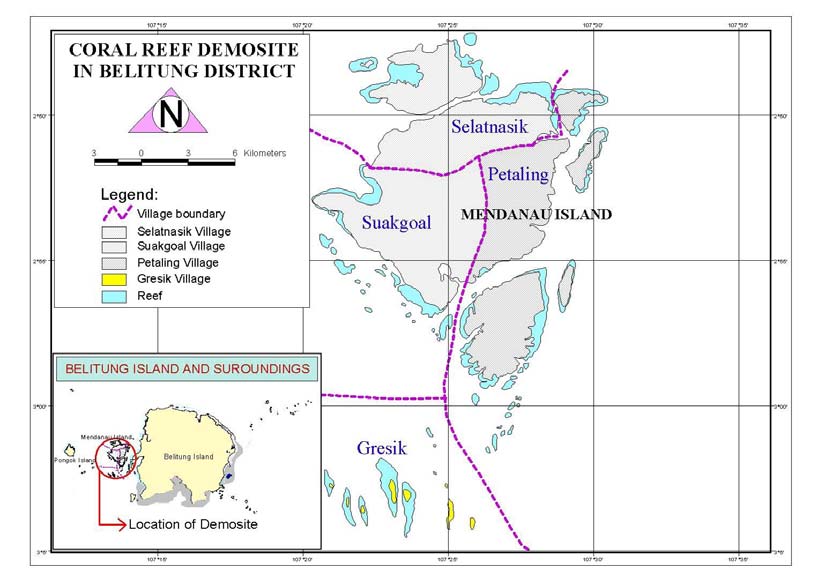
GEF South China Sea Project (Figure 1, Appendix 1). There are 26 islands under Selat Nasik sub-
district, the biggest of which is the Mendanau Island. In the meanwhile, four villages make up the
Selat Nasik sub-district, namely: Selat Nasik, Suak Gual, Petaling and Gresik. Of these four villages,
only Gresik village is located outside Mendanau Island.
Coastal zone management in the Belitung district has not been properly done. Currently, marine
resources management is directed more on fishery activities. Illegal fishing practice using trawl is still
common, done mostly by foreign fishers (Taiwanese) and still beyond government control. This is due
among others to weak law enforcement, limited equipments/ infrastructure for surveillance, and loose
fishing permit. Apart from illegal fishing, destructive fishing techniques such as the use of explosive,
poisons, fish trap and compressor still prevail.
An attempt to curb the destructive fishing practice has been made by the community of Selat Nasik
sub-district by enforcing the "Ripuk Angkam" (a traditional local measure). Foreign or non-resident
fishers who practice destructive fishing will be apprehended, while the boat and fishing gears will be
confiscated.
8. STAKEHOLDERS (Stakeholder involvement as Appendix 2)
There are many stakeholder groups in the Belitung district who will be involved in this project,
including central government institutions, local government institutions, NGO informal leaders and
direct user of the marine resources.
UNEP/GEF/SCS/Ind/MoU 2b/Amendment.2/Add.
Page 6
This project will work with local government, members of the DPRD (Local Parliament), opinion
leaders, law enforcement officers and the private sector to generate support for empowerment of
coastal communities and sustainable reef management. Commitment will be manifested through
programs and activities developed together to address the issues identified during Program
preparation, the initial socialization and ongoing information gathering activities.
The first step of this process is to establish mechanisms for dialogue, and field teams will visit each
village. During these visits the field teams will gather key information about the social, economic and
environmental condition of each community; the degree of dependence, methods and exploitation of
their marine resources; and solicit the local communities views regarding local issues and problems,
and existing management practices. At the same time the team will stress that the goals and strategy
of this project are to develop a community driven program involving all sections of each community.
Their third task will be to initiate discussions regarding: how to maximize long-term benefit from the
reefs; the need to manage the marine resources sustainably; and provide key information about
management options.
The information gathered during this process will be combined with all available information from
government, non-government and the private sector to feed into the development of a long-term
district strategic plan for maximizing coral reef protection and sustaining reef fisheries benefits at the
community and district levels through effective Community Based Management. This plan will be
drafted in map form and discussed at all levels throughout the district as the basis for achieving the
maximum sustainable benefit to the communities of coral reef ecosystems and related resources.
Monitoring, control and surveillance will be implemented by the local law enforcement officials
undertaking joint patrol with other government departments and community representatives. The MCS
will be linked through a radio network to key stakeholders and have the capacity to respond to report
of legal infraction.
9. THREATS (Causal Chain Analysis as Appendix 3)
Destructive Fishing Practices
Gathering information from stakeholder stated that destructive fishing practices such as: bomb,
cyanide, fish trap and compressor still take place at Selat Nasik Sub-District The use of destructive
fishing methods may be due to ignorance, greed, lack of regulation and weak law enforcement. Local
fishers are usually unaware and do not know that catching fish using fish traps (bubu) or using
explosives will give result to diminishing fish production. In contrast the use of cyanide, compressor
and bombs is commonly triggered by greed and the individuals' responsible do not care about the
ecological and environmental impacts of their actions.
Fishing activities using explosives, cyanide and fish-traps degrade the marine environment. These
three fishing practices cause significant negative impacts on the coral reefs, for example based on
research that has been done by SUHARSONO (1999) showed that a 0.5 kg bomb will destroy
everything within a 3 m radius or some 28 m2 of coral ecosystem. Bombing activities have resulted in
decline, in traditional catches that use hook and line or nets to catch fish, particular the grouper.
Generally speaking, fisher communities know that bombing will have a negative impact on the marine
environment, nonetheless, economic pressures may keep them blast fishing.
Fish traps constitute a static fishing gear normally laid on the sea-bed between coral colonies and
kept submerged by weighing it down with dead corals. In the absence of dead corals, the fisherman
will break up live coral colonies to substitute dead coral as weight and often live corals are also used
to cover the trap as camouflage.
Illegal Fishing
The term illegal fishing in this context means catching of fish by foreign fishers. Foreign fishers
commonly use trawl. Trawls constitute dynamic fishing gear that take all benthic organisms both large
and small and result in extensive disturbance to the bottom substrate. Although the use of trawls in
Indonesian waters is currently prohibited by the Indonesian government they are commonly used by
fishers from Hongkong, Thailand and Singapore to fish illegally in Bangka-Belitung waters although,
there are some fishing boats bearing Indonesian flag that operate fishing gear which is a modified
trawl. In most cases regulations are non-existent and even where regulations exist they cannot be
effectively implemented due to the weakness of surveillance by the law enforcement agency, due in
turn to limited manpower and inadequate vehicles and infrastructure.
UNEP/GEF/SCS/Ind/MoU 2b/Amendment.2/Add.
Page 7
Tourism (potential threat)
Tourist activities in Belitung district have not been done on a big scale. Nonetheless, tourism
development in this district may become a threat to coral reef ecosystem, if not under proper
management. To date tourism activities that pose a potential threat to coral ecosystem include
collection of corals and shells for souvenirs and anchor dropping in coral reef area.
Base on causal chain analysis and demonstration site resources some interventions will be
developed to overcome the threats as follows:
-
Enhancement of public awareness on coral reef management and sustainable use
-
Improvement of policy and legislation to support enforcement and co-ordination
-
Resource assessment and monitoring for decision making and planning
-
Development of management plan with participation of local people
-
Establishment of alternative income generation programme to reduce recent threats
10. GOALS & PURPOSE
The proposed project is aimed to protect and to rehabilitate coral reef ecosystem so as to sustain their
use, as well as the use of the associated ecosystems in Bangka-Belitung Islands. The overall goal of
the program is to maintain healthy coral reef ecosystem and increase prosperity of coastal village
communities. This project will improve the condition of coral reefs at high priority areas through
strengthened coordination among local government institutions in preparing "Perda" (local ordinance);
and through community-based programs and public advocacy in coral reef conservation and
sustainable use throughout the Bangka- Belitung province.
11. RATIONALE AND OBJECTIVES
The community of Selat Nasik sub-district is mainly engaged in fishery activities. Proportion of
population engaged in fishery activities are 70 - 80 % in Selat Nasik, 50 % in Petaling, 75 % in Goal
and 100 % in Gresik. These figures clearly indicate the importance of coral reefs to the people of
Selat Nasik sub-district. Despite that, the coral reefs of the waters keep on going under real pressure.
Coral reefs in the area are suffering pressures from poaching and destructive fishing practices.
Trawling done by illegal foreign fishers causes damage to existing ecosystem and also results in
reducing the catch of traditional fishers. Because of that traditional fishers will undergo multiple loses,
namely ecosystem degradation and reduction of income. To date this conflict between foreign and
local fishers has still prevailed.
Presently a few studies supported by the central government to monitor the condition of coral reefs
have been done in this area. Some interventions have been implemented by the central government
in order to promote marine tourism, coral reef conservation and sustainable use of marine resources.
There is still the need for GEF to encourage and assist local communities to develop appropriate
ways of protecting and managing their local marine resources as well as to strengthen the capacities
of local government and non-government organizations in dealing with external issues.
The Regional Autonomy Law (no. 22 of 1999) and the Spatial Use Act (no. 24 of 1992) provides the
legal basis for the district government to plan and manage coral reefs. While the Regional Act and
Revenue Sharing Act (no. 25 of 1999) give district governments responsibility for managing marine
resources. The new laws provide for participatory decision making in planning and resource
allocation. The capacity of local government and community institutions to execute their powers under
these laws is very limited. Therefore support is needed to strengthen local community and district
government in planning and management as well as in securing long-term health of coral reef
resources and ensuring survival of coastal communities.
The general objective of this project is to protect, rehabilitate and sustain the use of coral ecosystem
and associate resources in the Belitung Island. To achieve these general objectives, the project has
five intermediate objectives, namely:
1. Enhance awareness of society at all levels on the value of sustained use of coral reef;
2. Strengthen legal basis of coral reef management in Belitung;
3. Improve information for decision making and planning of sustainable use of resources;
4. Develop and implement resource management plan, involving community participation;
5. Establish livelihood programme in order to reduce threats by poor local people.
UNEP/GEF/SCS/Ind/MoU 2b/Amendment.2/Add.
Page 8
12. OUTCOMES
Improvement of coral reef condition through increase of percentage coral cover will provide positive
contribution in the form of increased catch for the fishers who in turn will increase local community
income.
Coral reef resources in Belitung district, particularly those in Selat Nasik sub-district, will be better
managed whenever coral reef and resource management plans have been formulated. Likewise, law
enforcement will be better executed whenever there is a regulation to base legal action on illegal and
destructive fishing practices. No less important is the creation of young generation that has a high
dedication to the environment.
This project will support the process of strengthening co-ordination between all of stakeholder which
concern in marine resource management, conservation and sustainable development
The project will achieve the outcomes as follows:
Increased community and students awareness in marine environment
Increased capability and effectiveness in law enforcement
Resource Management Plan adopted by Salat Nasik Sub-district
Increased community capability to managing coastal and adjacent waters at Belitung District
Increased percentage of coral cover
Increased income per capita
Strengthened Institutional co-ordination especially at Belitung District
13.
PLANED ACTIVITIES TO ACHIEVE OUTCOMES (Monitoring and Evaluation Plan as
Appendix 4)
Component 1. Public Awareness and Education
Sub-component 1.1 - Public awareness campaigns
The objective of this sub-component is to promote awareness amongst civil society of the benefits of
coral reef ecosystem conservation and sustainable use that will lead to behavioural changes.
Activities will include provision and dissemination of public awareness material regarding co-
management of reef resources and their benefit at the district and village levels.
Sub-component 1.2 - Education
The objective of this sub-component is to develop and produce educational materials regarding coral
reef conservation and sustainable use for mainstreaming into the curricula of formal primary school
classes 1 to 6. Once the materials have been developed, 2 workshops to train district teachers in the
use of the materials will be provided.
Component 2. Legalization and Management Plan
Sub-component 2.1 - Review and develop regulations for sustainable use of marine resources
The objective of this component is to coordinate and facilitate all stakeholders having interest in
marine resources to reassess regulations relating to marine resources management. The activities
involve the review and inventory of all regulations issued by differing sectoral departments and to
provide inputs for improvement and harmonization of the regulations in accordance with current uses,
relevant issues and local needs relating to the utilization and management of marine resources.
Proposals regarding the revision of existing regulations or draft new regulations will be discussed
during a meeting with all relevant stakeholders prior to their finalisation and submission to the
appropriate authorities for approval.
Sub-component 2.2 - Development of Resource Management Plan
This sub-component aims to enhance community capability in managing and using coral reef
resources in the waters of Selat Nasik. The activity will involve the community to work together with
NGOs and the local government in formulating coral reef management plan in Selat Nasik by fostering
surveillance/law enforcement, manage and use marine resources in a sustainable manner, and to
control marine resources in the Selat Nasik waters.
UNEP/GEF/SCS/Ind/MoU 2b/Amendment.2/Add.
Page 9
Measures to be taken to achieve the above output include: (1) To identify existing community groups
and involving them in the management and use of marine resources in Belitung District; (2) To
organize meetings with all stakeholders, aiming to formulate a concept on "coral reef management
plan" for Belitung District; (3) Facilitating the implementation of coral reef management plan. This plan
will be approved by Head of Selat Nasik Sub District for long term application.
Component 3. Strengthening information for decision making
The objectives of this component are to create a ecological and socio-economic database; prepare
marine resource profiles and their uses of Belitung, and enhance human capacity for assessment and
monitoring. This component is further split up into 4 sub-components, namely:
Sub-component 3.1 - Ecological Assessment of Resources
In this sub component, the activities will involve field surveys to collect data regarding coral reef
condition, coral reef fishes, mangroves, seagrass beds, and water quality.
Sub-component 3.2 - Socio-economic Assessment and Resource Valuation
The activities in this sub component will be field surveys to collect the data concerning: the
stakeholders and their activities; current levels of use of coral reef resources; their economic value
(market price) and contribution to household incomes; current management by the community;
Sub-component 3.3 - Marine resources information
Data collected from ecological and socio-economic studies will be incorporated to reflect the profile of
Belitung. The output of this sub-component are Book, CD, thematic map, etc.
Sub-component 3.4 - Training program for resource assessment and monitoring
This sub-component aims to strengthen the capacity of local stakeholders to undertake assessment
and monitoring activities. The participants will come from local villages, local government, and NGOs
concerned with management and utilization of coral reef resources. Training materials will include
among others Rapid Resource Assessment, methodology for socio- economic analysis, and training
for facilitators. The trainees will be involved in survey conducted in the beginning and at the end of the
project. It is hoped that following completion of the project, the trainees have capability to assess and
monitor coral reef ecosystem and marine environment in their areas.
Component 4. Monitoring, Controlling and Surveillance
The traditional boat will be built for patrolling and develop system for leasing these boat to other
stakeholder when requested. The operational cost for patrolling will be covered during the
implementing of the project. When the project finishes the operational boat cost covered by leasing of
these boat. This will be provide income to the community reef watcher groups to cover the
operational cost of boat as well as to build and effective partnership with local stakeholder and local
enforcement agencies in general and reef watcher in particular when project finishes.
Reef watcher members will be selected by communities and trained and equipped with basic gear
such as binoculars and wooden traditional boat with about 40-80 Hp motor for conducting the reef
patrol. The patrol will focus on the Selat Nasik Sub district waters. Each village is served by at least
two reef watchers and will be trained in patrolling technique. These reef watchers will also be trained
to prepare simple MCS data report.
The reef watcher and local law enforcement agencies will be financing as monitoring, controlling and
surveillance (MCS). Funds will be made available to allow for about 12 patrols monthly consisting of
an operational budget as well as some pocket money for incentive. Monthly patrolling report will be
prepared by each village and submitted to Head of Selat Nasik sub district and other relevant
agencies.
Component 5. Livelihood programme in order to reduce current threats
This component is a follow up action of the socio-economic assessment of the sub-component 3.2,
which will identify what alternative income that can be implemented to reduce exploitation pressure on
coral reefs in the Selat Nasik waters. The objective of this component is to increase local community
income through providing alternative incomes suited to each village condition. To achieve the above
objectives the following activities will be undertaken:
UNEP/GEF/SCS/Ind/MoU 2b/Amendment.2/Add.
Page 10
Sub-component 5.1 - An inventory and assessment of alternative income generation activities
Based on the results of the socio-economic assessment, some alternative incomes suitable for each
village will be selected. At this stage, the selected alternative incomes are to be discussed with the
local community. After receiving input from the community, the discussed material will be developed
further into a practical guideline book.
Sub-component 5.2 - Implementation livelihood program
Following finalization of the practical guide book, the alternative income activities will be implemented
in each location. The first step to be taken is to provide training program for the communities on how
to execute the alternative income generation activities, such as mariculture, home industry, etc.
14. SUSTAINABILITY ANALYSIS AND RISK ASSESSMENT
Sustainability
An important consideration in the project design and implementation is that how a critical measure of
success attained through the project intervention will sustain beyond the project's lifetime.
Operation plan of the demonstration project that was jointly prepared by government institutions,
related stakeholders and local community is expected to raise a sense of ownership and commitment
among all involved sectors to carry out what have been planned. In the implementation phase, the
project is to be executed jointly by the local government and the community. Currently budgetary
funding is received from both the central government (APBN) and the local government APBD.
The capacity and capability building must be done properly to ensure sustainability of the processes,
procedures and decisions developed through the project. This project should be seen as building the
capacity and capability of stakeholder participants, communities, organizations and institutions so that
they will be able to maintain and extend the initiative beyond the lifespan and scope of the project. It is
also important that capacity and capability building are for empowerment, skills transfer, increase of
awareness, knowledge sharing, education, training, as well as development of systems, institution
and tools.
Experience from past projects shows that without flexibility and adaptability some project activities
failed to be executed. To prevent the failure from happening again, the project should be made
sufficiently flexible and adaptable to the current requirement, although it must as far as possible
remain within agreed upon corridor. Therefore the approach is to be a staged program of learning and
action. It should be planned as an outline framework which identifies the main objectives and strategy
and then allowed to progress in small increments along a continuing process of design,
implementation, evaluation and adjustment.
Risks
The project proposal has identified and addressed some risks and incorporated them in the mitigation
strategies. The use of adaptive management mechanisms and styles is fundamental to the design of
this project. The adaptive management should permit the emergence of mechanisms and strategies
that can deal with a wide range of conditions such as persistence resource degradation, resource use
conflict and external disaster such as coral bleaching events.
The unmitigated risks that would undermine the effectiveness of management approach might be the
political reversal of current decentralization policies. It seems unlikely that the decentralization polices
and regulations will change so that responsibility and authority will remain in the hand of the regency
and district governments. The risk is most obviously prevalent through the paternalistic attitudes
exhibited by higher level agencies within conventional institutional hierarchies. The reluctance to
transferring some or all control and responsibility to smaller decentralized authorities can potentially
delay the effectiveness of implementing the project activities.
Addressing the risks of this project, therefore the project will incorporate a number mechanism that
may diffuse these risks. For example, the project will encourage networking and interaction among
different participants and stakeholders and this is likely to reduce the risks associated with control-
based attitudes.
UNEP/GEF/SCS/Ind/MoU 2b/Amendment.2/Add.
Page 11
15. ESTIMATED BUDGET
Cost estimates
The total cost of the project is estimated at US$ 613,320, including:
-
GEF Grant: US$ 346,520
-
Co-funding: US$ 266,800 with US$ 96,100 in cash and US$ 170,700 in-kind
Table 15.1
Summary budget by activity. (Detailed budget estimation by activity in Appendix 5.1)
Co-funding
Activity GEF Total
In-Cash In-Kind
1.1 Public Awareness Campaigns 11,400
11,000
0
22,400
1.2 Education
14,000
15,500 25,200 54,700
2.1 Review and develop regulations for sustainable
12,000
11,200 0
23,200
use of marine resources.
2.2 Develop of Resource Management Plan
19,100
9,400
1500
30,000
2.3 Facilitating implementation of management plan
10,000
2,000
0
12,000
3.1 Ecological assessment of resources
32,000
3,000
0
35,000
3.2 Socio-economic Assessment and Resource
20,000
20,000 0
40,000
Valuation
3.3 Marine resources information
19,800
2,000
0
21,800
3.4 Training program for monitoring resources
20,000
0
0
20,000
4.
Monitoring, Controlling and Surveillance
47,220
0
0
47,220
5.1 An inventory and assessment of alternative
24,000
0 0
24,000
income generation activities
5.2 Implementation
livelihood
program
30,000
0
6,000
36,000
6.
Project management
87,000
52,000 108,000 247,000
Total 346,520 126,100
140,700
613,320
Table 15.2
Summary budget by object of expenditure. (Details presented in Appendix 5.2)
Budget component/sub-
Co-funding Co-funding
GEF
Grant total
component
in-cash
In-kind
1000 Project Personal Component
93,800 21,900 103,500
140,400
1100 Project Personnel
26,000
0
72,000
98,000
1200
Consultant
13,600
7,900
0
21,500
1300 Administration support
0
31,500
0
31,500
1600 Travel on office business
54,200
14,000
0
68,200
2000 Sub-Contract Component
77,720
20,000
0
97,720
2200 Sub-Contract Component
77,720
20,000
0
97,720
3000 Training Component
116,700
35,700
0
152,400
3200
Group
Training
62,000
5,500
0
67,500
3300
Meeting/Conference
54,700
30,200
0
84,900
4000 Equipment Component
8,500
0
36,000
44,500
4200 Non Expendable Equipment
8,500
0
0
8,500
4300
Premises
0
0
36,000
36,000
5000 Miscellaneous Component
49,800
17,000
32,700
99,500
5200
Reporting
Costs
28,800
16,000
32,700
77,500
5300
Sundry
11,000
1,000
0
12,000
5500
Valuation
10,000 - - -
Total
346,520
126,100
140,700
613,320
UNEP/GEF/SCS/Ind/MoU 2b/Amendment.2/Add.
Page 12
16. IMPLEMENTATION PLAN
2006 2007
Responsible
Supporting
Activity
1 2 3 4 1 2 3 4
1. Public Awareness and Education
1.1 Public Awareness Campaigns
Create, produce and disseminate billboard at 4 villages
1.1.1
X
RCO CRITC
(1 billboard/village)
1.1.2
Create, produce and disseminate calendar 200 exp @
X X
RCO CRITC
Creation and dissemination VCD or DVD on sustainable use of
1.1.3
X
X
RCO CRITC
coral reef (2 times, @ 200 units)
1.2 Education
Preparation of a curriculum and supporting material for primary
1.2.1
X X
RCO CRITC
school level on coral reef ecosystem (7 books, 200expl)
Meeting with Education Authorities for extension use the
District
1.2.2
X
X
RCO
curriculum ( 2 times, @ 25 person, @ 2 days)
Education
1.2.3
Preparation teachers guide to the curriculum
X X
TOT primary school teachers in the use of curriculum material
District
1.2.4
X X
RCO
(2 times, @ 30 person, @ 3 days)
Education
Adopt the material as formal component of the school curriculum
District
1.2.5
X
RCO
(2 meeting, @25 person, @ 2 days)
Education
2. Legislation and Resource Management Plan
Legal
Identify existing rules, regulation and decrees within Perdas
2.1.1
X
consultant/
(1 person/month)
RTF-L
Local
2.1.2
Review of traditional knowledge (2 times, 30 person, 2 days)
X X
RCO
government
Consultation meeting with stakeholder regarding traditional
Local
2.1.3
knowledge and application of existing rules and regulations
X X
RCO
government
(2 times, 20 person, 2 days)
Draft new or amended ordinances, rules, etc. that are in harmony
RCO/local
2.2.1
X Consultant
with rules deriving from others sectors
government
RCO/local
2.2.2
Stakeholder consultation to review drafts (2 months, 2 person)
X Consultant
government
RCO/local
2.2.3
Revision of the draft for finalization
X Consultant
government
Clearance of the final drafts by the Management Board for
RCO/local
2.2.4
X
X Consultant
submission to the appropriate government authorities
government
Dissemination of draft to appropriate authorities to Pemda and
Local
2.2.5
X
X
RCO
Local Parliament: 2 meeting, @ 30 person, @ 1 day
government
Submission of final draft of a decree and approval at district level
Local
2.2.6
X
RCO
(Perda)
government
Site
2.3.1
Identify community group
X Consultant
Manager
Meeting with all stakeholder at district and village level
Site
2.3.2
X Consultant
4 times/villages, @ 10 person, 1 day
Manager
2.3.3
Produce Resource Management Plan Book
X
RCO CRITC
3. Strengthening information for decision making process
3.1 Ecological assessment of resources
3.1.1
Basemap preparation (2 person/2 weeks)
X
RCO CRITC
3.1.2
Preparation for survey ( 2 times meeting, 16 person, @ 1 day)
X
X
RCO
3.1.3
Filed Survey (2 times, 10 persons, 14 days)
X
X
RCO
3.1.4 Reporting
X X
RCO
3.2 Sosco-economic Assessment and Resource Valuation
3.2.1
Preparation (2 times meeting, 14 person, @ 1 day)
X
X
RCP CRITC
3.2.2
Field Survey (2 times, 8 person, @ 14 days)
X
X
RCP CRITC
3.2.3 Reporting
X X
RCP CRITC
3.3 Marine resources information
3.3.1 Preparation
X
RCO CRITC
3.3.2 Field
study
X X
RCO CRITC
3.3.3 Data
Analysis
X X
RCO CRITC
3.3.4
Reporting (produce thematic map, CD, book)
X X
RCO CRITC
3.4 Training program for monitoring resources
Training for resources assessment and monitoring coral reef
Local
3.4.1
X
X
RCO
(2 times, 30 person, 14 days)
government
UNEP/GEF/SCS/Ind/MoU 2b/Amendment.2/Add.
Page 13
2006 2007
Responsible
Supporting
Activity
1 2 3 4 1 2 3 4
4. Monitoring, Controlling and Surveillance
Local
4.1
Reef Watcher establishment (2 times, 20 person)
X
government
Local
4.2
Boat preparing (wooden boat, binocular)
X
government
Patrol System, Data Collecting and Reporting Training
Local
4.3.
X X X X X X
(2 times, 5 person, 4 villages, 7 days)
government
Coordination with relevant stakeholder in MCS
Local
4.4.
X X
(2 times, 20 persons, 1 day)
government
5. Livelihood programme to reduce Current Threats
5.1 An inventory and assessment of alternative income generation
activities
RCAT
5.1.1
An inventory and assessment of income generation activities
X X X
RCO
Subang
Stakeholders meeting consultations to discuss and preparation
RCAT
5.1.2
proposal for sustainable use of marine resources
X X X
RCO
Subang
(3 times, 20 person, 3 days)
Develop the best practice guideline of alternative income
RCAT
RCO/local
5.1.3
X X X
(produce manual book)
Subang
government
5.2 Implementation of livelihood program
Consultation and preparation of training need assessment
Site
5.2.1
X
X
RCO
(3 times, 20 person,
Manager
RCAT
5.2.2
Preparation material for training programs (2 package/villages)
X
X
RCO
Subang
Implement training program at 4 villages
RCAT
5.2.3
X
RCO
(4 times, 4 villages, 40 person, 5 days)
Subang
6.
Project
Management
6.1 Strengthening Community Based Management at Belitung
Identity member of management board
Local
6.1.1
X
RCO
(2 time meeting, 25 person, 2 days)
government
Establish Management Board
Local
6.1.2
X
RCO
(1 times workshop, 40 person, 2 days)
government
Site Manager and project staff approval
Local
6.1.3
X
RCO
(2 times meeting, 15 person, 1 day)
government
Management Board regular meeting, every 3 month
Management
6.1.4
X X X X X X X
(8 times, 15 person, 2 days)
Board
6.2 Project Coordination
6.2.1
Establishment Project Implementing Unit in RCO-LIPI
RCO
Monitoring project implementation every 6 month by national
6.2.2
X X X X
RCO
focal point and staff (4 times, 2 person)
6.2.3 Annual
audit
X X Auditor
Independent
6.2.4
Independent Mid-term & End Project evaluation, 2 times
X X
evaluator
6.3 Payment for project staff & office maintenance
X
X
X
X
X
X
X
X
RCO
Note:
RCO Research Centre for Oceanography
RCAT Research Centre for Appropriate Technology
CRITC Coral Reef Information and Training Centre
UNEP/GEF/SCS/Ind/MoU 2b/Amendment.2/Add.
Page 14
17. PROPOSED MANAGEMENT OF THE ACTIVITIES (Detail Described in Appendix 6)
The Research Centre for Oceanography, Specialized Executing Agency (SEA) will be responsible to
execute the demonstration site project following approved operation plan. SEA will develop and
manage the proposed project through an integration and coordination with the local governments and
other. In this connection, the national focal point for coral reefs will check the progress of the project
by attending the management board every two month until the project ends. The national focal point
is also responsible to report the progress of the demonstration site to Project Coordinating Unit (PCU)
and Regional Working Group on Coral Reefs.
SEA will assign contracts with all of stakeholders who will help to implement the activities at
demonstration site location. For example, SEA will assign contact with Research Centre for
Appropriate Technology, Local Government or NGOs to implement livelihood activities. SEA will also
assign contract with Research Centre for Population to conduct the Socio-economic Survey, and
assign contract with individual consultant to revise regulation, "Perda" and traditional knowledge in
Belitung District.
Together with Local Government of Belitung District, SEA will set up the Management Board.
Management Board will be chaired by Head of Regional Planning Board, and the member of
management will consist of different stakeholders.
The appointed demonstration site manager is responsible to execute the activities in the work plan.
This is under the direction of management board and also National Focal Point. The demonstration
site manager is also responsible to report the overall progress and problems encountered in project
implementation.
Management Board and Site Manager will oversight all the activities in demonstration site location.
18. INFORMATION ON PROPOSED EXECUTING AGENCY
Research Center for Oceanography (RCO) constitutes one of the research institutions under the
Indonesian Institute of Sciences and engages in marine sciences. RCO manages four different
components, i.e. Natural Resources, Oceanography, Information and Services, and Administration. In
the Indonesian coral reef salvation program which is implemented though COREMAP project, the
RCO served as the executing agency in COREMAP I, while in COREMAP II it plays a role in the
CRITC (Coral Reef Information and Training Center) and in Education
19. EXECUTING AGENCY CONTACT PERSON
Focal Point for Coral Reefs:
Dr. Suharsono
P2O LIPI (Research Center for Oceanography LIPI)
Jl. Pasir Putih 1, Ancol Timur, Jakarta Utara
Indonesia, post code : 11048
Phone: (62 21) 64713850
Fax: ( 62 21) 64711948, (62 21) 3143082
Email: shar@indo.net.id / harsono@coremap.or.id
Site Manager:
Nurul Dhewani Mirah Sjafrie
P2O-LIPI (Research Centre for Oceanography)
Coral Reef Information and Training Centre (CRITC COREMAP LIPI)
Jl Raden Saleh No 43, Jakarta Pusat, Indonesia
Pos Code: 10330
Phone: (62 21) 3143080 ext.503
Fax: (62 21) 31927958
Email: ndhewani@coremap.or.id/ ndhewani@yahoo.com
UNEP/GEF/SCS/Ind/MoU 2b/Amendment.2/Add.
Page 15
Appendix 1 - Site Characterization
1a. Site description
Geographic Location
Belitung district, located in the Bangka-Belitung province at 107º 08' - 107º 58,5' E and 02º 30' 03 º
15' S. Administratively, Belitung District composed of 5 sub-districts, one of which , the Selat Nasik
sub-district , has been selected as the demonstration site on the coral reefs. It takes about 2 hours by
boat to arrive that location. There are 26 islands under Selat Nasik sub-district, the biggest of which is
the Mendanau Island. In the meanwhile, four villages make up the Selat Nasik sub-district, namely:
Selat Nasik, Suak Gual, Petaling and Gresik. Of these four villages, only Gresik village is located
outside Mendanau Island.
Map of Belitung District and Selat Nasik Sub District
Physical Condition
The water temperature at Belitung approximately between 28.87°-30.86°C. Water salinity between
27,3 31,4 ppm.
Marine Biodiversity
Gathering data shows that biodiversity of marine organisms in Belitung waters are variety. Table
below show the type organisms, number of family, number of genera, number of species that were
found in Belitung waters (see list of species)
Number of Number of Number of
No.
Type of Organism
Family
Genera
Species
1. Coral
14
74
187
2.
Coral reef fishes
36
85
218
3. Crustacean
35
4. Echinoderm
36
5. Mollusks
105
6. Seagrass
8
7. Mangroves
20
8. Endanger
species
3
UNEP/GEF/SCS/Ind/MoU 2b/Amendment.2/Add.
Page 16
Socio-economic
The communities of Selat Nasik sub-district are for the most part engaged in fishery activities.
Proportion of population engaged in fishery activities are 70 - 80 % in Selat Nasik, 50 % in Petaling,
75 % in Suak Goal and 100 % in Gresik. Theses figures clearly indicate the importance of coral reefs
to the people of Selat Nasik sub-district. Despite that, the coral reefs of the waters keep on going
under real pressure.
List of Species
Corals
Acroporidae
42
Anacropora
puertogelerae
1 Acropora
acuminata
43
Anacropora
reticulata
2
Acropora aspera
44
Astreopora explanata
3
Acropora austera
45
Astreopora gracilis
4
Acropora brueggemanni
46
Astreopora listeri
5
Acropora carduus
47
Montipora awquituberculata
6
Acropora cerealis
48
Montipora danae
7
Acropora clathrata
49
Montipora digitata
8
Acropora cuneata
50
Montipora efflorescens
9
Acropora cytherea
51
Montipora foliosa
10
Acropora danai
52
Montipora hispida
11
Acropora dendrum
53
Montipora incrassata
12 Acropora
digitfera
54
Montipora
monasteriata
13
Acropora divaricata
55 Montipora
nodosa
14
Acropora echinata
56
Montipora spumosa
15
Acropora elseyi
57
Montipora tuberculosa
16
Acropora florida
58
Montipora undata
17
Acropora formosa
59
Montipora venosa
18
Acropora gemmifera
60
Montipora verrucosa
19
Acropora glauca
61
Porites (synarea) rus
20
Acropora grandis
62
Porites cylindrica
21
Acropora granulosa
63
Porites lichen
22 Acropora
horrida
64
Porites lobata
23 Acropora
humilis
65
Porites lutea
24 Acropora
hyacinthus
66
Porites nigrescens
25 Acropora
intermedia
Agariciidae
26 Acropora
latistella
1
Coeloseris mayeri
27 Acropora
longicyathus
2
Gardineroseris planulata
28 Acropora
microclados
3
Leptoseris mycetoseroides
29 Acropora
millepora
4
Leptoseris papyracea
30 Acropora
multiacuata
5
Leptoseris scabra
31 Acropora
nasuta
6
Pachyseris foliofosa
32 Acropora
nobilis
7
Pachyseris rugosa
33 Acropora
palifera
8
Pavona cactus
34 Acropora
palmerae
9
Pavona minuta
35 Acropora
polystoma
10
Pavona varians
36 Acropora
pulchra
11
Pavona venosa
37
Acropora robusta
Astrocoeniidae
38 Acropora
speciosa
1
Pocillopora damicornis
39 Acropora
subglabra
2
Pocillopora verrucossa
40 Acropora
tenuis
3
Seriatospora hystrix
41 Acropora
vaughani
4
Seriotopra caliendrum
UNEP/GEF/SCS/Ind/MoU 2b/Amendment.2/Add.
Page 17
Corals (cont.)
Astrocoeniidae (cont.)
4
Cyphastrea chalcidicum
5
Stylocoeniella guentheri
5
Cyphastrea serailia
6
Stylophora pistillata
6
Diploastrea heliopora
Caryophylliidae
7
Echinopora gemmacea
1
Cataphyllia jardinei
8
Echinopora lamellosa
2
Euphyllia ancora
9
Favia favus
3
Euphyllia cristata
10
Favia laxa
4
Euphyllia divisa
11
Favia mathaii
5
Euphyllia glabrescens
12
Favia maxima
6
Physogyra lichtensteini
13
Favia palida
7
Plerogyra sinuosa
14
Favia rotumana
Fungiidae
15
Favia rotundata
1
Ctenactis echinata
16
Favia speciosa
2
Cycloseris cycloseris
17
Favia stelligera
3
Fungia danai
18
Favite flexuosa
4
Fungia fungites
19
Favites abdita
5
Fungia granulosa
20
Favites chinensis
6
Fungia horrida
21
Favites pentagona
7
Fungia repanda
22
Goniastrea favulus
8
Fungia scruposa
23
Goniastrea pectinata
9
Fungia scutaria
24
Goniostrea retiformis
10
Halomitra pileus
25
Leptrastrea pruinosa
11
Heliofungia actiniformis
26
Leptrastrea purpurea
12
Herpolitha limax
27
Leptrastrea transversa
13
Lithophyllon undulatum
28
Monstrastrea annuligera
14
Podabacia crustacea
29
Montrastrea magnistellata
15
Polyphyllia talpina
30
Montrastrea valenciennesi
16
Sandalolitha robusta
31
Oulophyllia bennettae
Merulinidae
32
Oulophyllia crispa
1
Hydnophora axesa
33
Platygyra daedalea
2
Hydnophora microconos
34
Platygyra lamellina
3
Hydnophora rigida
35
Platygyra pini
4
Merulina ampliata
36
Platygyra sinensis
Mussidae
37
Plesiastrea versipora
1
Acanthastrea echinata
Oculinidae
2
Blastomussa wellsi
1
Archelia horrescens
3
Cynarina lacrymalis
2
Galaxea astreata
4
Lobophyllia corymbosa
3
Galaxea fascicularis
5
Lobophyllia hemprichii
Pectinidae
6
Pectinia paeonia
1
Echinophyllia echinata
7
Scolymia vitiensis
2
Mycedium elephantotus
8
Symphyllia agaricia
3
Oxypora glabra
9
Symphyllia recta
4
Oxypora lacera
Dendrophylliidae
5
Pectinia alcicornis
1
Turbinaria mesenterina
6
Pectinia lactuca
2
Turbinaria peltata
7
Pectinia paeonia
3
Turbinaria stellulata
Poritidae
Faviidae
1
Goniopora columna
1
Barabattoia amicorum
2
Goniopora djiboutiensis
2
Caulastrea curvata
3
Goniopora lobata
3
Caulastrea tumida
4
Goniopora minor
UNEP/GEF/SCS/Ind/MoU 2b/Amendment.2/Add.
Page 18
Corals (cont.)
Poritidae
(cont.)
Siderastreidae
5
Goniopora stokesi
1
Coscinaraea exesa
6
Goniopora tenuidens
2
Psammocora digitata
7
Porites (synarea) rus
3
Psammocora explanulata
8
Porites cylindrica
4
Psammocora superficialis
9
Porites lichen
5
Pseudosiderastrea tayami
10
Porites lobata
Trachyphylliidae
11
Porites lutea
1
Trachyphyllia geoffroyi
12
Porites nigrescens
Anthipatharia
Anthipates sp.
Crustacean
Echinoderm
Calapidae
Asteroidae
1
Matuta banksii
1
Acanthaster planci
Grapsidae 2
Archaster typicus
1
Metopograpsus messor
3
Asterina burtoni
2
Pachygrapsus plicatus
4
Asteropsis carinifera
Ocypodidae
5
Culcita novaeguineae
1
Macrophthalmus sp.
6
Linckia laevigata
3
Scopimera globosa
7
Ophidiaster granifer
4
Uca annulipes
8
Protoreaster nodosus
5
Uca vocans
Ophiuridae
Portunidae
1
Macrphiothrix longipeda
1
Podophthalmus vigil
2
Ophiarachnella gorgonia
2
Portunus pelagicus
3
Ophiathrum elegans
3
Portunus sanguinolentus
4
Ophiathrum pictum
4
Thalamita admete
5
Ophiocoma brevipes
5
Thalamita danae
6
Ophiocoma erinaceus
6
Thalamita stimpsoni
7
Ophiocoma scolopendrina
7
Thalamita sp.
8
Ophiocoma sp.
8
Scylla serrata
9
Ophiotrix sp.
Xanthidae
Holothuridae
1
Actaeodes tomentosus
1
Actinopyga lecanora
2
Atergatis floridus
2
Actinopyga miliaris
3
Atergatis integerrimus
3
Bohadschia graffei
4
Eriphia scabriuscula
4
Holothuria atra
5
Epixanthus frontalis
5
Holothuria coluber
6
Euxanthus exsculptus
6
Holothuria erinaceus
7
Globopilumnus globosus
7
Holothuria hilla
8
Leptodius exaratus
8
Holothuria leucospilota
9
Lophozozymus sp.
9
Holothuria impatiens
10
Myonippe hardwicki
10
Holothuria pervicax
11
Ozius rogulosus
11
Stichopus variegatus
12
Pilodius areolatus
12
Synapta maculata
13
Pilodius granulatus
Echinoidae
14
Phymodius monticulosus
1
Diadema setosum
15
Phymodius ungulatus
2
Echinometra mathaei
16
Pilumnus longicornis
3
Echinothrix calamaris
Xanthidae (cont.)
Echinoidae (cont.)
17
Pilumnus tomentosus
4
Echinothrix diadema
18
Pilumnus vespertilio
5
Lagnum laganum
19
Xantho distinguendus
6
Tripneustes gratilla
Crinoidae
1
Comanthus sp.
UNEP/GEF/SCS/Ind/MoU 2b/Amendment.2/Add.
Page 19
Mollusks
GASTROPODA 55
Polinices tumidum
1
Astraea calcars
56
Rhinoclavis vertagus
2
Astraea rhodostoma
57
Strombus canarium
3 Cantharus
fumosus
58
Strombus labiatus
4 Cantharus
undosus
59
Strombus urceus
5 Cerithium
nodulosum
60
Thais tuberosa
6 Cerithium
trailli
61
Thais sp.
7 Cerithium
sp.
62
Tectus pyramis
8 Clypeomorus
moniliferus
63
Trochus conus
9 Clypeomorus
sp.
64
Trochus maculatus
10 Chicoreus
bruneus
65
Trochus niloticus
11 Chicoreus
capucinus
66
Trochus sp.
12
Chicoreus torrefactus
67
Turbo bruneus
13
Clanculus sp.
68
Turbo chrysostomus
14
Collumbella scripta
69
Vasum turbinellum
15
Conus miles
70
Volema (Pugilina) myristica
16
Conus vexillum
BIVALVIA
17
Conus sp.
1
Anadara maculosa
18
Coraliophyla sp.
2
Anadara trapezia
19
Cypraea arabica
3
Anadara scapha
20
Cypraea eglantina
4
Asaphis violascens
21
Cypraea errones
5
Asaphis sp.
22
Cypraea annulus
6
Arca baucardi
23
Cypraea lynk
7
Arca sp.
24
Cypraea kieneri
8
Barbatia amygdalumtosum
25
Cypraea moneta
9
Barbatia descusata
26
Cypraea vittelus
10
Chama iostoma
27
Cypraea sp.
11
Corbula sp.
28
Drupa morum
12
Dosinia sp.
29
Drupella concatenela
13
Chlamys sp.
30
Drupella cornus
14
Cardita variegata
31
Drupella rugosa
15
Fragum unedo
32
Engina alveolata
16
Gafrarium tumidum
33
Engina testudinaria
17
Gafrarium pectinatum
34
Euchelus atratus
18
Isognomon isognomum
35
Haliotis assinina
19
Isognomon ephipium
36
Lambis chiragra
20
Isognomon perna
37
Lambis lambis
21
Lima sp.
38
Lambis truncata
22
Hippopus hippopus
39
Littorina scabra
23
Lithopaga nigra
40
Morula granulata
24
Malleus malleus
41
Morula margariticola
25
Placuna sella
42
Morula uva
26
Pinctada margaritifera
43
Monodonta labio
27
Pinctada maxima
44
Murex trapa
28
Pinna bicolor
45
Nerita albicilla
29
Septifer bilocularis
46
Nerita chamaeleon
30
Saccostrea cucullata
47
Nerita lineata
31
Acrosterigma subrugosa
48
Nerita undata
32
Tridacna crosea
49
Otopleura auriscati
33
Tridacna squamosa
50
Peristernia nasatula
34
Tellina inflata
51
Planaxis sulcatus
52
Patella sp.
POLYPLACOPHORA
53
Pyrene versicolor
1
Chiton sp.
54
Pyrene ocellata
UNEP/GEF/SCS/Ind/MoU 2b/Amendment.2/Add.
Page 20
Coral reef fish
Pomacentridae
51
Pomacentrus nigromarginatus
1
Abudefduf bengalensis
52
Pomacentrus philippinus
2
Abudefduf saxatilis
53
Pomacentrus sexfasciatus
3
Abudefduf septemfasciatus
54
Pomacentrus tripunctatus
4
Abudefduf sexfasciatus
55
Pomacentrus sp.
5
Abudefduf sordidus
56
Stegates sp.
6
Abudefduf vaigiensis
Pseudochromidae
7
Amblyglyphidodon aureus
1
Labracinus ccyclopthalmus
8
Amblyglyphidodon curacao
Holocentridae
9
Amblyglyphidodon leucogaster
1
Neoniphon sammara
10
Amphiprion clarkii
2
Sargocentron rubrum
11
Amphiprion ephippium
3
Sargocentron spiniferum
12
Amphiprion frenatus
Acanthuridae
13
Amphiprion ocellaris
1
Zebrasoma scopas
14
Amphiprion perideraion
Platacidae
15
Amphiprion sandaracinos
1
Platax orbicularis
16
Chromis amboinensis
Gerridae
17
Chromis atripes
1
Geress sp.
18
Chromis lepidolepis
Tetradontidae
19
Chromis ternatensis
1
Diodon histrix
20
Chromis viridis
Apogonidae
21
Chromis sp.
1
Cheilodipterus quenquelineata
22
Chrysiptera cyanea
2
Apogon compressus
23
Chrysiptera rollandi
3
Apogon cyanosoma
24
Dascyllus reticulatus
4
Apogon hartzfeldi
25
Dascyllus trimaculatus
5
Apogon macrodon
26
Dischistodus chrysopoecilus
6
Apogon chrysotaenia
27
Dischistodus melanotus
7
Apogon sp.
28
Dischistodus perspicillatus
8
Archamia fucata
29
Dischistodus prosopotaenia
Harpodontidae
30
Hemiglyphidodon plagiometopon
1
Saurida gracilis
31
Lepidozygus tapeinosoma
2
Saurida sp.
32
Neopomacentrus anabatoides
Synodontidae
33
Neopomacentrus azysron
1
Trachinocephalus myops
34
Neopomacentris cynanomos
Centricidae
35
Neopomacentrus filamentosus
1
Aeoliscus strigatus
36
Paraglyphidodon melas
Gobidae
37
Paraglyphidodon nigroris
1
Amblyelectris sp
38
Plectroglyphidodon dicki
2
Ctenogobiops sp1
39
Plectroglyphidodon lacrymatus
3
Ctenogobiops sp2
40
Pomacentrus alexanderae
Serranidae
41
Pomacentrus amboinensis
1
Aetaloperca roghaa
42
Pomacentrus bankanensis
2
Cephalopholis boenack
43
Pomancentrus bracialis
3
Cephalopholis formosa
44
Pomacentrus chrysurus
4
Cephalopholis urodeta
45
Pomacentrus gramorhynchus
5
Cephalopholis cyanostigma
46
Pomacentrus lepidogenys
6
Cephalopholis miniata
47
Pomacentrus margaritifer
7
Cephalopholis pachycentron
48
Pomacentrus moluccensis
8
Epinephelus fasciatus
49
Pomacentrus nigricans
9
Epinephelus fuscoguttatus
50
Pomacentrus nigromanus
10
Epinephelus merra
UNEP/GEF/SCS/Ind/MoU 2b/Amendment.2/Add.
Page 21
Coral reef fish (cont.)
11
Plectropomus leopardus
Mullidae
12
Plectropomus maculatus
1
Upeneus tragula
13
Plectropomus punctatus
2
Parupeneus bifasciatus
14
Diploprion bifasciatum
Nemipteridae
Lutjanidae
1
Pentapodus caninus
1
Lutjanus carponotatus
Scolopsidae
2
Lutjanus decussatus
1
Scolopsis bilineatus
3
Lutjanus fulviflamma
2
Scolopsis cancellatus
4
Lutjanus fulvus
3
Scolopsis lineatus
5
Lutjanus kasmira
4
Scolopsis margaritifer
6 Lutjanus
lineata
5
Scolopsis trlineatus
7
Lutjanus malabaricus
Carangidae
8
Lutjanus russelli
1
Caranx ignobilis
9
Lutjanus vitta
2
Caranx sexfasciatus
Centropomidae
3
Selar spp.
1
Psammoperca waigiensis
Carchanidae
Lehtrinidae
1
Carcharinus sp.
1
Lethrinus harak
Dasyatidae
2
Lethrinus sp.
1
Dasyatis sp
3
Lethrinus lentjan
2
Taeniura lymna
4
Lethrinus variegatus
Bothidae
5
Monotaxis grandoculis
1
Bothus pantherinus
Kyphosidae
Plotosidae
1
Kyphosus vaigiensis
1
Arius sp
Siganidae
Monodactylidae
1
Siganus canalliculatus
1
Monodactylus argentelus
2
Siganus corallinus
Clupeidae
3
Siganus fuscescens
1
Sardinella sp
4
Siganus guttatus
Sphyraenidae
5
Siganus guttatus
1
Sphyraena baracuda
6
Siganus punctatus
Chaetodontidae
7
Siganus sp
1
Chaetodon baronessa
8
Siganus virgatus
2
Chaetodon lineolatus
9
Siganus vulpinus
3
Chaetodon octofasciatus
Haemulidae 4
Chelmon rostratus
1
Plectorhynchus picus
5
Choradion altivelis
2
Plectorhynchus chaetodontoides
Caesionidae
1
Caesio caerulaurea
2
Caesio cuning
3
Caesio lunaris
4
Caesio teres
5
Caesio trilineata
UNEP/GEF/SCS/Ind/MoU 2b/Amendment.2/Add.
Page 22
Mangroves, Seagrass and Endangered species
Mangrove Seagrass
1
Avicennia marina
1
Enhalus acoroides
2
Bruguiera cylindrica
2
Cymodocea rotundata
3
Bruguiera gymnorrhiza
3
Halodule pinifolia
4
Bruguiera parviflora
4
Halodule uninervis
5
Ceriops decandra
5
Halophila decipiens
6
Excoecaria agallocha
6
Halophila ovalis
7
Flagellaria indica
7
Thalassia hemprichii
8
Heritiera littoralis
8
Thalassodendron ciliatum
9
Hibiscus tiliaceus
10
Lumintzera racemosa
11
Nypa fruticans
Endangered species
12
Pemphis acidula
13
Rhizophora apiculata
1
Eretmochelis imbricata
14
Rhizophora micronata
2
Chelonia mydas
15
Rhizophora stylosa
16
Sonneratia alba
17
Sonneratia caseolaris
18
Thespesia populnea
19
Xylocarpus granatum
20
Xylocarpus moluccensis
UNEP/GEF/SCS/Ind/MoU 2b/Amendment.2/Add.
Page 23
Appendix 2 - Major stakeholders and their involvement in the demonstration site
STAKEHOLDERS INVOLVEMENT
1.
Research Centre for
SEA, responsible for execution of demonstration
Oceanography Indonesian
site
Institute of Sciences
2.
Research Centre for Appropriate
Consultant and sub contract in charge of
Technology, Indonesian Institute
implementation livelihood program (identify,
of Sciences
preparing guideline and training)
3.
Research Centre for Population,
Consultant and sub contract in charge of Socio-
Indonesian Institute of Sciences
economic survey
4.
Legal expert - Regional Task
Consultant in charge of identifying existing rules,
Force on Legal Matters
regulation and Perda's
5.
Experts - Regional Task Force on
Consultant and sub contract in charge of economic
Economic Valuation
resource valuation study
6.
Directorate General of Marine
Coordination central government, province and
affair and fisheries
district institution
7.
Regional Planning Agency
Coordination spatial planning
8.
Sub-district and Local NGO
Consultant and sub-contract in charge of livelihood
pilot project
9.
Village representative body
Facilitator for public communication
10.
Informal leaders
Facilitator for public communication
11.
Directorate General forest
Coordination for marine management area
protection and conservation
12.
District regent, sub-district and
Coordination and implementation of the action
village head
13. Fishermen
Former destructive fishing fishers will be involved
as facilitators in order to reduce destructive fishing
14.
Local parliaments
Drafting law and regulation
15. Teachers
Facilitators
for education in primary school
UNEP/GEF/SCS/Ind/MoU 2b/Amendment.2/Add.
Page 24
Appendix 3 - Causal Chain Analysis at Belitung Waters
Interventions Management Underlying
Impacts Ecological
issues
threats
Problem
Livelihood
Low income
Programme
Bombing
Cyanide
Education &
Lack of
fishing,
Public
awareness
Fish trap
Awareness
Week
Regulation
Low law
Illegal
policy &
Coral Reef
review &
enforcement
Trawling
legislation
Degradation
update
Participatory
Anchoring
Week co-
Uncontrolled
Management
Souvenir
ordination
tourism
Plan
collection
Resource
Assessment &
Monitoring
UNEP/GEF/SCS/Ind/MoU 2b/Amendment.2/Add.
Page 25
Appendix 4 - Monitoring and Evaluation Plan
1. Collecting and Reporting data on performance indicators
To assess project implementation and achievements, monitoring in ecological, socio-economic
aspects and community awareness will be carried out.
METHOD AND FREQUENCY OF
PARAMETER
CONDUCT BY
COMMENTS
COLLECTION
Ecological
Field survey using Line intercept
Research Centre
Need to know the
Aspect
transect (LIT), Visual Census and
for Oceanography, condition of coral reef
Reef Check Method. Collecting
Indonesia Institute (such as percentage of live
data will be conducted 2 times, at
of Sciences
coral cover, coral fishes,
beginning and end of project
benthos) before and after
project intervention
Socio-economic
Socio-economic survey, using
Indonesia Institute Need to know the
Aspect
Participatory Rapid Assessment
of Sciences
community
(PRA), Focus Group Discussion
income/welfare before
(FGD) and In depth Interview.
and after project
Collecting data will be conducted 2
intervention
times, at beginning and end of
project
Increasing
Field survey using questionnaires.
Indonesia Institute Need to know the
Awareness
Collecting data will be conducted 2 of Sciences
awareness of the value of
times, at beginning and end of
coral reefs at all levels of
project
society before and after
project intervention
2. Schedule of monitoring, mid-term review, self evaluation, end-of project evaluation
2006 2007
MONITORING/EVALUATION
1 2 3 4 1 2 3 4
Ecological
Monitoring
X
X
Socio-economic
Monitoring
X
X
Awareness
Monitoring
X
X
Mid-term Review
X
Evaluation of the progress by the
X
management board
Evaluation
in
the
end
of
project
X
Formal independent evaluations of the project will be carried out at the mid point of the project, twelve
months after the start of the project, and at the end of the project. Both reviews will be led by external
evaluators with experience in environmental conservation community development. Each study will
take the form of a joint evaluation by project staff and the evaluators into the management and
environmental aspects of the project and an independent review of community gains and stakeholder
participation by the evaluators.
3. Description of how monitoring and evaluation activities will involve participants and
stakeholders
Monitoring and evaluation will be an integral part of the stakeholder participation element of the
project. For each project activity and event, participants will carry out a simple evaluation activity,
wherever possible to meet their own evaluation criteria. Stakeholders will be asked to give their
perceptions of the project as a part of the formal independent evaluation activities. Formal surveys
will be conducted by project stakeholder, universities and research institutes. Local volunteers will be
trained in surveys techniques so that they are able to lead simple community surveys on more
frequents basis.
UNEP/GEF/SCS/Ind/MoU 2b/Amendment.2/Add.
Page 26
4. Resources that will be allocated to monitoring and evaluation
Budgetary provision of $US 10,000 has been allocated to mid term and terminal evaluations to cover
consultancy fees and expenses for internal evaluators. It is estimated that monitoring and evaluation
(including preparation of reports required to be submitted to the UNEP/GEF/SCS project Co-
ordinating Unit will be taken between 3-4 weeks per year (on average) of the project manager's time
and 3 days per year of management team time.
5. Using monitoring and evaluation result for management
A three monthly monitoring report will be presented to the project management board by the Site
Manager, who will highlight key issue for discussion at, management board meetings. As far as
possible, reporting to the management board will be integrated with reporting to the UNEP as well.
The Advisory Group will also receive updates half yearly on key issues and the SEA will provide such
periodic reports to the National Technical Working Group.
As a part of the mid term evaluation time will be set aside to allow the management team to review
progress themselves, and it is anticipated that the findings of the mid-term review will also be
discussed with donor. Following the final evaluation, an evaluation report will be published to help
donor, participants, managers and other interested parties such as global coral reef network learn
lesson from the project.
In order to ensure that the project is carefully monitored and that project derives the benefit of
evaluation reviews, it is essential that the project manager and the chair of the project management
board have a genuine commitment to evaluation and learning. This should be a factor in selecting
appropriate individuals for appointment to these posts.
UNEP/GEF/SCS/Ind/MoU 2b/Amendment.2/Add.
Page 27
Appendix 5.1 - Budget estimation by activity.
GEF Grant
Government Co-financing
Total
Activities
Total
1000 2000 3000 4000 5000 Total 1000 2000 3000 4000 5000
Project
In-Cash In-Kind
1.1.1 Create, produce and disseminate billboard at 4 villages
-
2,400 2,400
2,000 2,000
4,400
(1 billboard/village)
1.1.2 Create, produce and disseminate to schools and villages
calendars /education kits (200 exemplar, 2 times) regarding
-
5,000 5,000
5,000
10,000
co-management of reef resources and the benefits at
5,000
sub-district and village level.
1.1.3 Creation and dissemination of CD's/DVDs (200 units, 2 times)
-
4,000 4,000
8,000
on sustainable use of coral reef resources
4,000 4,000
1.2.1 Preparation of a curriculum and supporting materials for formal
primary school level on coral reef ecosystems ex: local content
-
25,200 25,200
25,200
book (7books, 200 exemplar)
1.2.2 Meetings with Education authorities for extension of the use the
-
5,000 5,000
5,000
curriculum materials (2 times, 25 participants, 2 days @ US$50)
1.2.3 Preparation of teachers guide to the curriculum
-
4,500
4,500
4,500
1.2.4 TOT primary school teachers in the use of the curriculum
materials (2 times, 30 participants, 3 days, @US$50),
-
9,000 9,000
1,000 1,000
10,000
Co-funding portion for meeting room rent etc.
1.2.5 Meeting for Adopt the materials as formal component of the
school curriculum (2 times, 25 persons, 2 days, @50) and
-
5,000 5,000
5,000 5,000
10,000
2 times other meeting funded by co-funding
2.1.1 Identify existing rules, regulations and decrees within the Perda
2,000 2,000
-
-
(4 person, 1 month, @ US$500)
2,000
2.1.2 Review of Traditional Knowledge (2 persons, 30 participants,
2 days, @ US$50), sharing budget with GOI for committee and
-
6,000 6,000
6,000 6,000
12,000
participants honoraria, meeting room rent etc.
2.1.3 Consultation Meeting with stakeholders (20 people, 2 times,
2 days, @50) regarding traditional knowledge & application of
existing rules and regulations. GOI = co funding for rental
-
4,000 4,000
5,200 5,200
9,200
meeting room, accommodation etc.
(20 people, 2 ties, 2 days @ 65)
2.2.1 Draft new or amended ordinances, rules etc. that are in harmony
with rules deriving from other sectors
2,600 2,600
-
-
-
2,600
(4 persons, 1 month, @650)
2.2.2 Stakeholders consultation to review recommended drafts
4,000
-
-
-
(2 months, 2 persons, @ US$ 1000)
4,000
4,000
2.2.3 Revision of the drafts for finalization
3,000 3,000
5,900 5,900
8,900
(2 persons, 1 month, @US$1500)
2.2.4 Clearance of the final drafts by the Management Board for
Submission to the Appropriate Government Authorities
-
2,500 2,500
2,500 2,500
5,000
(2 times, 25 persons, @US$50)
UNEP/GEF/SCS/Ind/MoU 2b/Amendment.2/Add.
Page 28
GEF Grant
Government Co-financing
Total
Activities
Total
1000 2000 3000 4000 5000 Total 1000 2000 3000 4000 5000
Project
In-Cash In-Kind
2.2.5 Dissemination of drafts to appropriate authority to PEMDA and
-
6,000 6,000 -
-
-
6,000
local parliament (2 meetings @ 30 persons, 2 days @ US$50)
2.2.6 Submission final draft of a decree and approval at district levels
-
1,000 1,000
2,500 1,000 1,500 3,500
(Perda)
2.3.1 To Identify Existing Community Group
2,000 2,000
2,000 2,000
4,000
(2 meeting, 20 persons, 2 days, @US$50)
2.3.2 Meetings with all stakeholders at district and village level
conducted by individual consultant
-
3,000 3,000
-
-
3,000
(4 villages, @10 persons, 1 day, US$75)
2.3.3 Design Lay out and produce Resource Management Plan Book,
-
5,000 5,000
-
-
- 5,000
100 books, @US$50
3.1.1 Basemap preparation for Ecological Assessment
-
1,000 1,000
1,000 1,000
2,000
(2 persons, 10 days, @US$50)
3.1.2 Preparation Field Survey for Resources Ecological Assessment
-
-
3,200 -
-
3,200
(2 times meeting, 16 persons, 2 days, @US$50)
3,200
3.1.3 Travel by plane of Field Survey for Resources Ecological
4,000 -
4,000
-
-
-
4,000
Assessment (study site), 2 times, 10 persons, @US$200 (1600)
3.1.4 Local transportation and boat rent for Resources Ecological
Assessment (study site), 2 times, 2 boats, 8 days, @US$150
4,800 -
4,800
-
-
-
4,800
(1600)
3.1.5 Allowance and Accommodation on Field Survey for Resources
Ecological Assessment (study site), 2 times, 10 persons,
14,000 -
14,000
-
-
-
14,000
14 days, @US$75 (1600)
3.1.6 Reporting for Resources Ecological Assessment
-
2,000 2,000
7,000
(2 times, 50 exemplar, @US$50)
5,000 5,000
3.2.1 Assign Research Center for Population (RCP) to conduct Socio-
economic Assessment (study site) and Resource Valuation,
- 20,000 20,000
20,000 20,000
40,000
2 times, 14 days, 8 persons
3.3.1 Preparation of marine resource information
-
2,000 2,000
-
-
2,000
(2 times meeting, 10 persons, 2 days, @US$50)
3.3.2 Travel by plane of Field Study for Marine Resource Information
and there current and potential uses: database and thematic
1,600 -
1,600
-
-
-
1,600
map. (2 times, 4 persons, @US$200) (1600)
3.3.3 Local transportation and boat rent of Field Study for Marine
Resource Information (2 times, 8 days, 1 boat, @US$150)
1,200 -
-
-
- 1,200
1,200
(1600)
3.3.4 Allowance and accommodation on Field Study for Marine
Resource Information (2 times, 10 days, 4 persons, @US$75)
4,000 -
4,000
-
-
-
4,000
(1600)
3.3.3 Data Analysis for Marine Resource Information.
6,000 6,000
-
-
6,000
(2 times, 15 days, 4 persons, @US$50)
UNEP/GEF/SCS/Ind/MoU 2b/Amendment.2/Add.
Page 29
GEF Grant
Government Co-financing
Total
Activities
Total
1000 2000 3000 4000 5000 Total 1000 2000 3000 4000 5000
Project
In-Cash In-Kind
3.3.4 Reporting for Marine Resource Information and produce
-
5,000 5,000
2,000 2,000
7,000
thematic map, CD, book (2 times, 50 exemplar, @US$50)
3.4.1 Training for Resource Assessment and Monitoring of coral reef,
-
20,000 20,000
-
-
20,000
2 times, 30 participants, 14 days
4.1.1 Meeting for Reef Watcher Establishment
-
4,000 4,000
-
-
4,000
(2 times, 20 persons, @US$50)
4.1.2 Purchase the Traditional Wooden Boat including outboard
-
-
8,000 8,000
-
-
8,000
engine (1 unit)
4.1.3 Purchase 2 units of Binocular
-
-
500
500
-
-
500
4.1.4 Operational cost for Monitoring, controlling and surveillance
- 18,720 -
-
18,720
-
-
18,720
(8 times, 18 months, @US$ 130)
4.1.5 Training of Patroly System and Data Collecting & Reporting
-
14,000 14,000
-
-
14,000
(2 times, 5 persons, 4 villages, 7 days, @US$50)
4.1.6 Coordination meeting with relevant stakeholder
-
2,000 2,000
-
-
2,000
(2 times, 20 persons, 1 day, @US$50)
5.1.1 An inventory and assessment of the alternative income
-
5,000 5,000
-
-
5,000
generation activities (4 people, 10 days)
5.1.2 Stakeholder meeting/consultations to discuss and preparation
proposals for sustainable use of marine resources
-
9,000 9,000
-
-
-
9,000
(3 times, 20 participants, 3 days)
5.1.3 Development of best practice guideline of alternative income
- 10,000
10,000
-
-
10,000
5.2.1 Consultations and preparation of a training needs assessment,
-
15,000 -
-
-
15,000
3 times, 20 persons, 5 days, @ US$50
15,000
5.2.2 Prepare materials of training programmes (4 villages)
-
5,000 5,000
6,000
6,000
11,000
5.2.3 Implement Training Programme
-
-
-
(4 villages, 10 persons, 5 days, @US$50) (5.2.3)
10,000 10,000
10,000
6.1.1 identify membership and draft Terms of Reference of the
-
5,000 5,000
-
-
5,000
Management Board (2 meeting, 25 persons, 2 days, @Rp50)
6.1.2 Establishment of a local Management Board,
-
4,000
-
-
(1workshop, 40 participants, 2 days, @ US$50)
4,000
4,000
6.1.3 Meeting of appointment for Site Manager & Project Staff
-
-
1,500 1,500
1,500
(2 times meeting, 15 persons, @US$50)
6.1.4 Management Board Regular Meetings, every 3 month (8 times,
-
12,000 12,000
-
-
-
12,000
15 persons, 2 days, US$50) for food and accommodation
6.2.1 Meeting for Establishment of Project implementing Unit in LIPI
-
-
(25 persons, 2 days, 2 times, @US$50)
5,000 5,000
5,000
6.2.2 Travel on official business by National Focal Point and Local
Government every 6 months, (4 persons, 6 times, @US$625)
15,000 15,000
14,000 14,000
29,000
(Gov't portion for rent boats, cars etc.)
UNEP/GEF/SCS/Ind/MoU 2b/Amendment.2/Add.
Page 30
GEF Grant
Government Co-financing
Total
Activities
Total
1000 2000 3000 4000 5000 Total 1000 2000 3000 4000 5000
Project
In-Cash In-Kind
6.2.3 Annual Audit, (2 times, @ US$5000)
-
-
- 10,000
10,000 10,000
6.2.4 Independent Mid-term & End of project evaluation,
-
-
-
10,000
(2 times @US$5000)
10,000 10,000
6.2.5 Travel by plane of official business (National focal point and
-
-
- 3,200
staffs), 2 persons, 4 times, 2 years, @US$200 (1600)
3,200
3,200
6.2.6 Local transportation and boat rent (National focal point and
2,400 -
2,400
-
-
2,400
staffs), 4 times, 2 years, 2 days @US$150 (1600)
6.2.7 Allowance and accommodation on travel of official business
(National focal point and staffs), 2 persons, 4 times, 2 years, 5
4,000 -
4,000
-
-
4,000
days, @US$75 (1200)
6.2.8 Quarterly Report (5 exemplar, 4 times, 2 years, @US$10)
-
400
400
-
-
400
6.2.9 Annual Reports (20 exemplar, 2 years, @US$25)
-
1,000
1,000
-
-
1,000
6.3.1 National Focal Point Assistants (6 persons, 30 months,
-
- 72,000 72,000
72,000
@US$400)
6.3.2 Treasurer (1 person, 30 months, @350)
-
- 10,500
10,500
10,500
6.3.3 Finance Analyst (1 person, 30 month, @US$350)
-
- 10,500
10,500
10,500
6.3.4 Bilingual Secretary (1 person, 30 months, @US$350)
-
- 10,500
10,500
10,500
6.3.5 Site Manager (24 months, @US$835)
20,000
20,000
-
-
20,000
6.3.6 Office Rent (24 months, @US$1500)
-
-
36,000
36,000
36,000
93,800 77,720 116,700 8,500 49,800 346,520 125,400 20,000 35,700 36,000 49,700 126,100
140,700 613,320
UNEP/GEF/SCS/Ind/MoU 2b/Amendment.2/Add.
Page 31
Appendix 5.2 - Budget estimation by object of expenditure.
2005 2006
2007
2nd 1st
2nd 1st
2nd
Grand
GEF Gov't
GEF Gov't GEF Gov't
GEF Gov't
GEF Gov't
Total
Total
Total
total
In
In
In
In
In
In
In
In
In
In
cash
kind
cash
kind
cash
kind
cash
kind
cash
kind
1000
PERSONNEL PROJECT COMPONENT
1100
Project Personnel w/m (Show title/grade)
1101 Site Manager (24 months @ US$835) (7.1.6)
-
-
-
-
5,000
-
5,000 -
10,000
5,000 -
5,000 -
10,000
20,000
Data Analysis for Marine Resource Information.
1102
-
-
-
-
-
-
3,000 -
3,000
3,000
-
-
-
-
3,000
6,000
(2 times, 15 days, 4 persons, @US$50) (3.3.3)
National Focal Point (1 person, 30 months, @US$500)
1103
-
3,000 -
3,000 -
3,000 -
-
3,000 -
6,000 -
3,000
-
-
3,000 -
6,000
15,000
(7.1.1)
National Focal Point Assistants
1104
- 14,400 -
14,400 - 14,400 -
-
14,400 -
28,800 - 14,400
-
- 14,400 -
28,800
72,000
(6 persons, 30 months, @US$400) (7.1.2)
1199
Total
- 17,400
-
-
5,000 17,400
-
8,000 17,400
-
47,800
8,000 17,400
-
5,000 17,400
-
47,800
-
1200 Consultants w/m Give description of activity/service
Identify existing rules, regulations and decrees within the
1201
-
-
-
2,000 -
- -
2,000
-
-
-
-
-
2,000
PEMDA (4 person, 1month, @ US$500) (2.1.1)
Draft new or amended ordinances, rules etc. that are in
1202 harmony with rules deriving from other sectors
-
-
-
2,600 -
-
-
-
2,600
-
-
-
-
-
2,600
(4 persons, 1 month, @US$650). (2.2.1)
Stakeholders consultation to review recommended drafts,
1203
-
-
-
-
2,000 -
2,000 -
4,000
-
-
-
-
-
4,000
2 times, 20 participants, 2 days, @US$50 (2.2.2)
Revision of the drafts for finalization
1204
-
-
-
-
3,000
-
-
-
3,000 -
5,900
-
-
-
-
5,900
8,900
(2 persons, 1 month, @US$1500) (2.2.3)
To Identify Existing Community Group (2.3.1)
1205
-
-
-
-
2,000 2,000
-
-
-
4,000
-
-
-
-
-
4,000
(2 meeting, 20 persons, 2 days, @US$50)
1299
Total
-
-
11,600
2,000
-
2,000
-
-
15,600
-
5,900
-
-
-
-
5,900
21,500
1300
Administrative support w/m (Show title/grade)
-
-
1301 Treasurer (1 person, 30 months, @350) (7.1.3)
-
2,100
-
2,100 -
2,100 -
-
2,100 -
4,200 -
2,100 -
-
2,100 -
4,200
10,500
1302 Finance Analyst (1 person, 30 month, @US$350) (7.1.4)
-
2,100
-
2,100 -
2,100 -
-
2,100 -
4,200 -
2,100 -
-
2,100 -
4,200
10,500
Bilingual Secretary (1 person, 30 months, @US$350)
1303
-
2,100 -
2,100 -
2,100 -
-
2,100 -
4,200 -
2,100
-
-
2,100 -
4,200
10,500
(7.1.5)
1399
Total
-
6,300
-
6,300
-
6,300
-
- 6,300
-
12,600
-
6,300
-
-
6,300
-
12,600
31,500
1600 Travel
of
Official Business
Travel by plane of Field Survey for Resources Ecological
1601 Assessment (study site), 2 times, 10 persons, @US$200
-
-
-
-
2,000
-
-
-
-
-
2,000
2,000
-
-
-
-
-
2,000
4,000
(3.1.3)
Local transportation and boat rent for Resources Ecological
1602 Assessment (study site), 2 times, 2 boats, 8 days,
-
-
-
-
2,400
-
-
-
-
-
2,400
2,400
-
-
-
-
-
2,400
4,800
@US$150 (3.1.4)
Travel by plane of Field Study for Marine Resource
1603 Information and there current and potential uses: database
-
-
-
-
-
-
-
800 -
-
800 -
-
-
800 -
-
800
1,600
and thematic map. (2 times, 4 persons, @US$200) (3.3.2)
Local transportation and boat rent of Field Study for Marine
1604 Resource Information (2 times, 4 days, 1 boat, @US$150)
-
-
-
-
-
-
-
600 -
-
600 -
-
-
600 -
-
600
1,200
(3.3.3)
Travel by plane of official business (National focal point and
1605
-
-
-
-
800 -
-
800 -
-
1,600
800 -
-
800 -
-
1,600
3,200
staffs), 2 persons, 4 times, 2 years, @US$200 (6.2.5)
Local transportation and boat rent (National focal point and
1606
-
-
-
-
600 -
-
600 -
-
1,200
600 -
-
600 -
-
1,200
2,400
staffs), 4 times, 2 years, 2 days @US$150 (6.2.6)
UNEP/GEF/SCS/Ind/MoU 2b/Amendment.2/Add.
Page 32
2005 2006
2007
2nd 1st
2nd 1st
2nd
Grand
GEF Gov't
GEF Gov't GEF Gov't
GEF Gov't
GEF Gov't
Total
Total
Total
total
In
In
In
In
In
In
In
In
In
In
cash
kind
cash
kind
cash
kind
cash
kind
cash
kind
Allowance and Accommodation on Field Survey for
1607 Resources Ecological Assessment (study site),
-
-
-
-
7,000
-
-
-
-
-
7,000
7,000
-
-
-
-
-
7,000
14,000
2 times, 10 persons, 14 days, @US$50 (3.1.5)
Allowance and accommodation on Field Study for Marine
1608 Resource Information (2 times, 10 days, 4 persons,
-
-
-
-
-
-
-
2,000
-
-
2,000
-
-
-
2,000
-
-
2,000
4,000
@US$50) (3.3.4)
Allowance and accommodation on travel of official business
1609 (National focal point and staffs), 2 persons,
-
-
-
-
1,000
-
-
1,000
-
-
2,000
1,000
-
-
1,000
-
-
2,000
4,000
4 times, 2 years, 5 days, @US$50 (6.2.7)
Travel on official business by National focal point every
1610 6 months, (4 persons, 6 times) (6.2.2) (Gov't portion for rent
-
-
-
-
3,750
3,500
-
3,750 3,500
-
14,500
3,750 3,500
-
3,750 3,500
-
14,500
29,000
boats, cars etc.
1699
Total
-
-
-
-
17,550
3,500
-
9,550 3,500
-
34,100 17,550 3,500
-
9,550 3,500
-
34,100
68,200
1999
Component Total
- 23,700
-
23,700 34,150 29,200
-
19,550 27,200
- 110,100 25,550 33,100
- 14,550 27,200
-
100,400
234,200
2000
SUB CONTRACT COMPONENT
-
2200 Sub-contracts-non
profit
supporting organizations
Socioeconomic Assessment (study site) and Resource
2201
-
-
-
-
10,000 10,000
-
-
-
-
20,000 10,000 10,000
-
-
-
20,000
40,000
Valuation, (2 times, 14 days, 8 persons) (3.2.1)
Operational cost for MCS (8 times, 18 months, @US$130)
2202
-
-
-
-
-
-
-
6,240 -
6,240
6,240 -
6,240 -
12,480
18,720
(4.1.4)
An inventory and assessment of the alternative income
2203
-
-
-
-
5,000 -
- -
5,000
-
-
-
-
-
-
-
generation activities, (study, 4 people, 10 days) (5.1.1)
Stakeholder meeting/consultations to discuss and
2204 preparation proposals for sustainable use of marine
-
-
-
-
3,000 -
-
3,000 -
-
6,000 3,000
-
-
-
-
3,000 9,000
resources. (3 times, 20 participants, 3 days) (5.1.2)
Development of best practice guideline of alternative
2205
-
-
-
-
5,000 -
5,000 - 10,000
-
-
-
-
-
10,000
income (5.1.3)
2206 Prepare material training programmes (4 packages) (5.2.2)
-
-
-
-
-
-
-
5,000
-
5,000
-
-
-
-
-
5,000
Implement Training Programme
2207
-
-
-
-
-
- -
-
10,000
-
-
-
-
10,000
10,000
(4 villages, 10 participants, 5 days, @US$50) (5.2.3)
2299
Total
-
-
-
-
23,000 10,000
-
19,240
-
-
52,240 29,240 10,000
-
6,240
-
-
45,480
97,720
2999
Component Total
-
-
-
-
23,000 10,000
-
19,240
-
-
52,240 29,240 10,000
-
6,240
-
-
45,480
97,720
3000
TRAINING COMPONENT
-
Group training-study tours, field trips, workshop,
3200
seminars
3201 Preparation of teachers guide to the curriculum (1.2.3)
-
-
-
-
-
-
-
-
-
4,500
-
-
-
-
-
4,500
TOT primary school teachers in the use of the curriculum
3202 materials (2 times, 30 participants, 3 days, @ US$50)
-
-
-
-
4,500 500
-
4,500 500
-
10,000
-
-
-
-
- 10,000
(1.2.4) (Co-funding portion for meeting room rent etc.)
Training for Resource Assessment and Monitoring of coral
3203
-
-
-
-
10,000 -
- - 10,000
10,000
-
-
-
10,000
20,000
reef, 2 times, 30 participants, 14 days (3.4.1)
Training of Patroly System and Data Collection & Reporting
3204
-
-
-
-
-
-
-
7,000 -
7,000
7,000 -
-
-
7,000
14,000
(2 times, 5 persons, 4 villages, 7 days, @US$50) (4.1.5)
Consultations and preparation of a training needs
3205
-
-
-
-
5,000 -
-
5,000 -
10,000 5,000
-
-
-
-
5,000 15,000
Assessment (3 times, 20 persons, 5 days, @US$50) (5.2.1)
Establishment of a local Board,
3206
-
-
4,000 -
- -
4,000
-
-
-
-
-
4,000
(1 workshop, 40 participants, 2 days, @US$50) (6.1.2)
3299
Total
-
-
-
-
23,500
5,000
-
16,500
500
-
45,500 22,000
-
-
-
-
-
22,000
67,500
UNEP/GEF/SCS/Ind/MoU 2b/Amendment.2/Add.
Page 33
2005 2006
2007
2nd 1st
2nd 1st
2nd
Grand
GEF Gov't
GEF Gov't GEF Gov't
GEF Gov't
GEF Gov't
Total
Total
Total
total
In
In
In
In
In
In
In
In
In
In
cash
kind
cash
kind
cash
kind
cash
kind
cash
kind
3300
Meeting /conferences (give title)
Meetings with Education authorities for extension of the use
3301 the curriculum materials
-
2,500 -
2,500 -
2,500 -
-
-
2,500 -
-
-
-
-
5,000
(2 times, 25 participants, 2 days, @US$50) (1.2.2)
Meeting for Adopt the materials as formal component of the
3302 school curriculum (2 times, 25 persons, 2 days, @50)
-
-
-
-
-
-
5,000 -
-
5,000 -
5,000 -
-
-
5,000
10,000
(1.2.5) and 2 times other meeting funded by GOI)
Review of Traditional Knowledge (2 persons, 30
participants, 2 days, @ US$50), sharing budget with GOI
3303
-
-
-
-
3,000
3,000
-
3,000 3,000
-
12,000
-
-
-
-
-
12,000
for committee and participants honoraria, meeting room rent
etc. (2.1.2)
Consultation Meeting with stakeholders (20 people, 2 times,
2 days, @50) regarding traditional knowledge & application
3304 of existing rules and regulations. (2.1.3), GOI = co funding
-
-
-
-
2,000 2,600
-
2,000 2,600 -
9,200 -
-
-
-
-
9,200
for rental meeting room, accommodation etc. (20 peopole,
2 times, 2 days @ 65)
Dissemination of drafts to appropriate authority to PEMDA
3305 and local parliament (2 meeting, @30 persons, @ 1 day)
-
-
-
-
-
-
3,000 -
-
3,000
3,000 -
-
-
-
3,000
6,000
(2.2.5)
Preparation Field Survey for Resources Ecological
3306 Assessment
-
-
-
-
1,600 -
-
- -
-
1,600
1,600
-
-
-
1,600
3,200
(2 times meeting, 16 persons, 2 days, @US$50)
Preparation of marine resource information
3307
-
-
-
-
1,000 -
-
- -
-
1,000
1,000
-
-
-
1,000
2,000
(2 times meeting, 10 persons, 2 days, @US$50) (3.3.1)
Meeting for Reef Watcher Establishment
3308
-
-
-
2,000 -
2,000 -
4,000
-
-
-
-
-
4,000
(2 times, 20 persons, @ US$50) (4.1.1)
Coordination meeting with relevant stakeholder
3309
-
-
-
2,000 -
- -
2,000
-
-
-
-
-
2,000
(2 times, 20 persons, 1 day, @US$50) (4.1.6)
Identify membership and draft Terms of Reference of the
3310 Management (2 meeting, 25 persons, 2 days, @Rp50)
-
-
-
5,000 -
- -
5,000
-
-
-
-
-
5,000
(6.1.1)
Meeting of Project Staffs Appointment
3311
-
-
-
-
1,500 -
-
-
1,500 -
-
-
-
-
1,500
(2 times, 15 persons, @US$50) (6.1.3)
Management Board Regular Meetings, every 3 month for
3312
-
-
-
3,000 -
3,000 -
6,000
3,000 -
3,000 -
6,000
12,000
food and hotel (8 times, 15 persons, 2 days, US$50) (6.1.4)
Meeting for Establishment of Project implementing Unit in
3313
-
5,000 -
5,000 -
-
-
-
-
-
-
-
-
-
5,000
LIPI (25 persons, 2 days, 2 times, @US$50)(6.2.1)
Clearance of the final drafts by the Management Board for
Submission to the Appropriate Government Authorities
3314
-
-
-
-
-
-
1,250 1,250
-
2,500
1,250 1,250
-
-
-
-
2,500
5,000
(2 times, 25 persons, @US$50) (2.2.4), Co funding for
accommodation (2 times, 25 persons, @50)
Meetings with all stakeholders at district and village level
3315
-
-
-
3,000
-
-
-
3,000
-
-
-
-
-
(4 villages, 10 persons, 1 days, @US$75) (2.3.2)
3,000
3399
Total
-
7,500
-
7,500 22,600
9,600
-
19,250 6,850
-
58,300
9,850 6,250
-
3,000
-
-
19,100
84,900
3999
Component Total
-
7,500
-
7,500 46,100 14,600
-
35,750 7,350
- 103,800 31,850 6,250
-
3,000
-
-
41,100
152,400
4000
EQUIPMENT & PREMISES COMPONENT
4100
Expendable equipment (items under $200 each)
-
-
-
-
-
-
-
-
-
-
-
-
-
-
4101 Site Manager's Office supplies
-
4102 SEA's Office supplies
-
4199
Total
-
-
-
-
-
-
-
-
-
-
-
-
-
-
-
-
-
-
-
UNEP/GEF/SCS/Ind/MoU 2b/Amendment.2/Add.
Page 34
2005 2006
2007
2nd 1st
2nd 1st
2nd
Grand
GEF Gov't
GEF Gov't GEF Gov't
GEF Gov't
GEF Gov't
Total
Total
Total
total
In
In
In
In
In
In
In
In
In
In
cash
kind
cash
kind
cash
kind
cash
kind
cash
kind
Non-expendable equipment (computers, office equip,
4200
etc.)
Purchase the Traditional Wooden Boat including Outboard
4201
-
-
-
-
-
-
8,000 -
8,000
-
-
-
-
-
8,000
Machine (1 unit)
4202 Purchase 2 units Binocular @US$250
-
-
-
-
-
-
500
-
500
-
-
-
-
-
500
4299
Total
-
-
-
-
-
-
-
8,500
-
-
8,500
-
-
-
-
-
-
-
8,500
4300
Premises (office rent, maintenance of premises, etc.)
4301 Office Rent (24 months, @US$1500) (7.1.7)
-
-
-
-
-
9,000 -
9,000
18,000 -
9,000
-
9,000 18,000 36,000
4399
Total
-
-
-
-
-
-
9,000
-
-
9,000 18,000
-
- 9,000
-
-
9,000
18,000
36,000
4999
Component total
-
-
-
-
-
-
9,000
8,500
-
9,000 26,500
-
- 9,000
-
-
9,000
18,000
44,500
5000
MISCELLANEOUS COMPONENT
Reporting costs-publications, maps, newsletters,
5200
printing
Create, produce and disseminate billboard at 4 villages
5201
-
-
-
2,400 2,000
-
-
-
4,400
-
-
-
-
-
4,400
(2 units x 4 villages x US$ 300) (1.1.1)
Create, produce and disseminate to schools and villages
calendars /education kits (200 exemplar, 2 times) regarding
5202
-
-
-
5,000 -
-
-
5,000 -
10,000 -
-
-
-
-
10,000
co-management of reef resources and the benefits at sub-
district and village level. (200 exp x 2 @ US$25) (1.1.2)
Creation and dissemination of CD's/DVDs (200 units, 2
5203 times) on sustainable use of coral reef resources.
-
-
-
-
2,000 2,000
-
-
-
4,000 2,000 2,000
-
-
-
4,000
8,000
(200 units x 2 times @ 10) (1.1.3)
Preparation of a curriculum and supporting materials for
formal primary school level on coral reef ecosystems,
5204
-
8,400
8,400 -
8,400 -
8,400 16,800
-
-
-
-
-
25,200
classes 1 to 6 and guidance for teacher (Local content
book, 7 books, 200 exemplar, @ US$6) (1.2.1)
Submission final draft of a decree at district level (Perda)
5205
-
-
-
-
-
-
-
-
1,000
1,000 -
-
1,500 3,500 3,500
(2.2.6)
Reporting for Resources Ecological Assessment
5206
-
-
-
-
-
2,500 1,000
-
3,500
-
-
-
2,500 1,000
-
3,500
7,000
(2 times, 50 exemplar, @US$50) (3.1.6)
Reporting for Marine Resource Information
5207
-
-
-
-
-
2,500 1,000
-
3,500
-
-
-
2,500 1,000
-
3,500
7,000
(2 times, 50 exemplar, @US$50) (3.3.4)
Design Lay out and produce Resource Management Plan
5208
-
-
-
-
-
-
5,000 -
5,000
-
-
-
-
-
5,000
Book, 100 books, @US$50 (2.3.3)
5209 Material training programmes (4 packages) (5.2.2)
-
-
-
-
-
-
-
6,000
6,000
-
-
-
-
-
6,000
Quarterly Report (5 exemplar, 4 times, 2 years, @US$10)
5210
-
-
-
-
100 -
100
-
-
200
100
-
100
-
-
200
400
(6.2.8)
5211 Annual Reports (20 exemplar, 2 years, @US$25) (6.2.9)
-
-
-
-
-
-
500
-
-
500
-
-
500
-
-
500
1,000
5299
Total
-
-
8,400
8,400
9,500
4,000
8,400 10,600 7,000 14,400 53,900
3,100 3,000
-
5,600 2,000 1,500
15,200
77,500
5300 Study-communications,
postage, freight, clearance, etc.
3.1.1. Basemap preparation
5301
-
-
-
-
1,000 1,000
-
-
-
-
2,000
-
-
-
-
-
-
2,000
(2 persons, 10 days, @US$50) (3.1.1)
5302 Annual audit (2 times, @ US$5000) (6.2.3)
-
-
-
-
-
-
5,000 -
-
5,000 -
-
5,000 -
-
5,000
10,000
5399
Total
-
-
-
-
1,000
1,000
-
5,000
-
-
7,000
-
-
-
5,000
-
-
5,000
12,000
Evaluation (consultants fees/travel/DSA, admin
5500
support, etc.)
Independent Mid-term & End of project evaluation
5501
-
-
-
-
-
-
5,000 -
-
5,000 -
-
5,000 -
-
5,000
10,000
(2 times, @US$5,000) (6.2.4)
5599
Total
-
-
-
-
-
-
-
5,000
-
-
5,000
-
-
-
5,000
-
-
5,000
10,000
5999
Component Total
-
-
8,400
8,400 10,500
5,000
8,400 20,600 7,000 14,400 65,900
3,100 3,000
- 15,600 2,000 1,500
25,200
99,500
9999
Grand Total
- 13,800 22,800 36,600 113,750 41,400 31,800 103,640 24,150 37,800 352,540 89,740 34,950 23,400 39,390 11,800 24,900
224,180
613,320
UNEP/GEF/SCS/Ind/MoU 2b/Amendment.2/Add.
Page 35
Annex 6 - PROPOSED MANAGEMENT FRAMEWORK
In order to implement activities in demonstration site some steps will be conducted:
1. SEA and Bupati Belitung District will sign MoU to establish the Management Board. Content
of MoU are how coordination between SEA and local government at Bellitung District, what
are their responsibility.
2. SEA will conduct meeting at Belitung District to establish Management Board.
Management Board
The Management Boardy shall have ultimate authority and responsibility for the conduct of activities
at the demonstration site. Management Board members should be composed of major stakeholders
due to interest in and deriving benefit of coral reef resources. Management Board are establish and
are legalized by Bupati Belitung District.
Responsibility of Management Board
Management Board has a function as a working group that coordinate with site manager and are
responsible to Bupati Belitung district and National Focal Point.
· Make coordination with Site Manager
· Control, advise, supervise, facilitate Site Manager during implement activities
· Responsible to Bupati and National Focal Point
· Responsible for conduct of activities at demonstration site.
The members of Management Board are as follows:
1. Head of Regional Planning Board of Belitung District (Chairman)
2. National Focal Point for Coral Reef (Vice chairman)
3. Staff of Research Center for Oceanography (Secretary 1)
4. Staff of Regional Planning Board (as secretary 2)
5. Local Parliament (2 persons, as members)
6. Department of Marine Affair and Fisheries (member)
7. District Education Department (member)
8. District Tourism Department (member)
9. Legal Division of Regional Planning Board (member)
10. Head of Selat Nasik Sub District (member)
11. NGO (member)
12. Private Sector (member)
13. Site Manager (member)
Site Manager : act as manager in the field and involved in community activities. Day-to-day activities,
site manager will coordinate with Management Board. Site Manager are responsible to National Focal
Point of Coral Reef.
Responsibility of Site Manager
· Executing the implementation plan based on the demonstration site proposal prepared by the
respective SEA and the subsequent decisions of the management body.
· Planning and managing on day to day basis the demonstration activities identified in the
implementation plan including annual work plan and time tables.
· Responsibility for execution of the activities in accordance with the work plan and timetable
and schedule of expenditures, initially defined by the demonstration site proposal and
amended from time to time by management body
· Reporting on activities and outcomes, to the management body, the focal point of the SEA,
and the National Technical Focal Point according to an agreed schedule
· Preparing inputs to the six-monthly expenditure report, six monthly progress reports and cash
advance requests to be submitted to the Project Co-ordinating Unit (PCU), through the focal
point of the responsible SEA.
· Preparing and submitting to the PCU, through the focal point of the SEA, technical reports in
accordance with the define outputs of the demonstration site
· Attending such national and regional meetings as shall be determined on an individual basis.
UNEP/GEF/SCS/Ind/MoU 2b/Amendment.2/Add.
Page 36
Coordination Framework of Belitung Demonstration Site
National level
Regional Level
PSC
IMC
RSTC
NTWG
RWG-CR
NWG-CR
PCU
Belitung
Specialized Executing
District
Agency (Research Center
for Oceanography)
Management Board:
- Regional Planning Board
- Government Institution
- Local Parliament
- Head of sub-district
- Site manager
- RCO
- Village Heads
- NGO
- Private Sector
Site manager
RCAT
RCOP
Village
Local Gov.
NGO
Village
Village
UNEP/GEF/SCS/Ind/MoU 2b/Amendment.2/Add.
Page 37
ANNEX 2
UNITED NATIONS ENVIRONMENT PROGRAMME
REVISED FORMAT
SIX MONTHLY PROGRESS REPORT
SECTION 1 - BACKGROUND INFORMATION
1.1
Project Title: Reversing Environmental Degradation Trends in the South China Sea
and Gulf of Thailand.
1.2 MoU
Number:
UNEP/GEF/SCS/Ind/MoU 2b/Amendment.2/Add.
1.3
Responsible Office: South China Sea Project Co-ordination Unit, Bangkok
1.4 Specialised
Executing
Agency (Supporting Organization):Name of Institution
1.5 Reporting
Period: Insert dates of reporting period
1.6
Focal Point Name:
SECTION 2 - PROJECT STATUS
2.1
Status of the Implementation of the Activities and Outputs Listed Under the Work plan
in the Memorandum of Understanding (check appropriate box)
Project activities and outputs listed in the Project work plan for the reporting period
have been materially completed and the responsible Office is satisfied that the project
will be fully completed on time (give reasons for minor variations as Section 3 below).
Project activities and outputs listed in the Project Work plan for the reporting period
have been altered (give reasons for alterations: lack of finance; project reformulated;
project revisions; other at Section 3 below).
Project activities and outputs listed in the Project Work plan for the reporting period
have not been fully completed and delays in project delivery are expected (give reasons
for variations in Section 3.1 and new completion date in Section 3.2 below).
Insufficient detail provided in the Project Work plan.
2.2
List Actual Activities/Outputs Achieved in the Reporting period: (check appropriate box)
(a) MEETINGS (Duplicate this box for each meeting individually)
Inter-Ministry mtg
Expert Group Mtg.
Training Seminar/Workshop
Others
Title:_____________________________________________________________________________
_________________________________________________________________________________
Venue and dates___________________________________________________________________
Convened by __________________________ Organized by _______________________________
Report issued as doc. No/Symbol____________ Languages ___________ Dated _______________
Please indicate: No. of participants _____________and attach annex giving names, nationalities of
participants and meeting summary.
Please indicate co-financing as follows:
Source__________________________________
Cash (US$)____________________________________
In-Kind (person days)___________________________________
UNEP/GEF/SCS/Ind/MoU 2b/Amendment.2/Add.
Page 38
(b) PRINTED MATERIALS (Duplicate this box for each printed item)
Report to IG Mtg. Technical Publication
Technical Report
Others
Title: ____________________________________________________________________________
Author(s)/Editor(s) _________________________________________________________________
Publisher ________________________________________________________________________
Symbol (UN/UNEP/ISBN/ISSN) _______________________________________________________
Date of publication ___________________
(When technical reports/publications have been distributed, attach distribution list)
Please indicate co-financing as follows:
Source__________________________________
Cash (US$)____________________________________
In-Kind (person days)___________________________________
(c)
TECHNICAL INFORMATION
PUBLIC INFORMATION (posters, leaflets, broadcasts etc.)
(Duplicate this box for each item)
Description _______________________________________________________________________
_________________________________________________________________________________
_________________________________________________________________________________
______
Dates _____________
Please indicate co-financing as follows:
Source__________________________________
Cash (US$)____________________________________
In-Kind (person days)___________________________________
(d) SERVICES (Duplicate this box for each item)
Description
_________________________________________________________________________
_________________________________________________________________________________
_________________________________________________________________________________
Dates _____________________
Please indicate co-financing as follows:
Source__________________________________
Cash (US$)____________________________________
In-Kind (person days)___________________________________
(e) OTHER OUTPUTS (Duplicate this box for each item)
Description
_________________________________________________________________________________
_________________________________________________________________________________
_________________________________________________________________________________
Dates ___________________________
Please indicate co-financing as follows:
Source__________________________________
Cash (US$)____________________________________
In-Kind (person days)___________________________________
UNEP/GEF/SCS/Ind/MoU 2b/Amendment.2/Add.
Page 39
(f) OTHER IN-KIND AND CASH CO-FINANCING (Do not include Co-financing listed in the boxes
above)
Sources of co-financing
In-kind Contribution (in person days) Cash Contribution (in US$)
SECTION 3 - PROJECT DELIVERY
3.1
Summary of the Problems Encountered in Project Delivery (if any)
_________________________________________________________________________________
_________________________________________________________________________________
_________________________________________________________________________________
_________________________________________________________________________________
_________________________________________________________________________________
_________________________________________________________________________________
_________________________________________________________________________________
_________________________________________________________________________________
_________________________________________________________________________________
_________________________________________________________________________________
_________________________________________________________________________________
3.2
Actions Taken or Required to Solve the Problems (identified in Section 3.1 above)
_________________________________________________________________________________
_________________________________________________________________________________
_________________________________________________________________________________
_________________________________________________________________________________
_________________________________________________________________________________
_________________________________________________________________________________
_________________________________________________________________________________
_________________________________________________________________________________
_________________________________________________________________________________
_________________________________________________________________________________
_________________________________________________________________________________
___________________________________________________
Signed:_____________________________
Name:
Designation:
UNEP/GEF/SCS/Vie/MoU 1A
Page 40
ANNEX 3
SIX MONTHLY PROJECT EXPENDITURE ACCOUNT FOR SUPPORTING ORGANIZATION
Project Statement of allocation (Budget), expenditure and balance (Expressed in US$) covering the period
from insert Month to insert Month and year
Supporting Organization:Marine Science Institute of the University of the Philippines
Project Number:
GF/2730-02-4340
MoU Number:
UNEP/GEF/SCS/Phi/MoU 2b/Amendment.2/Add.
Project Title:
Reversing Environmental Degradation Trends in the South China Sea and Gulf of Thailand
Project commencing:
January 2002
Project ending:December 2007
NB: The expenditures should be reported in line with the specific object of Project budget allocation Expenditure incurred
Unspent balance of
Co-financing
expenditures as per project budget
for the half-year
for the half-year
budget for the half-year (Co-financing should be included in this
(Insert dates)
(Insert dates)
(Insert dates)
table, in line with the approved budget)
Object of Expenditure in accordance with UNEP Budget codes
Amount (1)
Amount (2)
Amount (1-2)
Cash (US Dollars)
In-Kind (days)
1000
PROJECT PERSONNEL COMPONENT
1200 Consultants w/m Give description of activity/service
1201
0.00
0.00
0.00
1299 Total
0.00
0.00
0.00
1300 Administrative support w/m (Show title/grade)
1301
0.00
0.00
0.00
1399 Total
0.00
0.00
0.00
1999 Component Total
0.00
0.00
0.00
2000 SUB-CONTRACT
COMPONENT
2200 Sub-contracts - non-profit supporting organizations
2215
0.00
0.00
0.00
2299 Total
0.00
0.00
0.00
2999 Component Total
0.00
0.00
0.00
3000 TRAINING
COMPONENT
3300 Meetings/conferences (give title)
3313
0.00
0.00
0.00
3399 Total
0.00
0.00
0.00
3999 Component Total
0.00
0.00
0.00
5000 MISCELLANEOUS
COMPONENT
5200 Reporting costs - publications, maps, newsletters, printing.
5213
0.00
0.00
0.00
5299 Total
0.00
0.00
0.00
5300 Sundry - communications, postage, freight, clearance, etc
5303
0.00
0.00
0.00
5399 Total
0.00
0.00
0.00
5999 Component Total
0.00
0.00
0.00
9999 Total
0.00
0.00
0.00
Signed________________________
Designation:___________________________
Duly authorized officials
NB: The expenditures should be reported in line with the specific object of expenditures as per the approved project budget.
UNEP/GEF/SCS/Ind/MoU 2b/Amendment.2/Add.
Page 41
ANNEX 4
CASH ADVANCE REQUEST
Statement of cash advance as at
Insert terminal date of the reporting period
And cash requirements for the six month period ending
Insert terminal date of the current period
Name of supporting organization
Puslit Oseanografi LIPI, Indonesia
MoU No.
UNEP/GEF/SCS/Ind/MoU 2b/Amendment.2/Add..
Project no.
GF/2730-02-4340
Project title
Reversing Environmental Degradation Trends in the
South China Sea and Gulf of Thailand
I. CASH
STATEMENT
1. Opening Cash Balance as at insert date
US$
2. Add : cash advances received
US$
Date: insert date of first advance
US$
Date: insert date of second advance
US$
Date: insert date of third advance
US$
Date: insert date of fourth advance
US$
Date: insert date of fifth advance
US$
3. Total cash advanced to date
4. Total cumulative expenditures incurred to:
insert terminal date of the first period
US$
insert terminal date of the second period
US$
insert terminal date of the third period
US$
insert terminal date of the fourth period
US$
insert terminal date of the fifth period
US$
5. Total expenditure as at December 31, 2004
6. Closing cash balance as at Insert terminal date of the reporting period US$
II. CASH REQUIREMENTS FORECAST
7. Estimated disbursements for period ending
Insert terminal date of the current period
US$
8. Less : closing cash balance (item 5, above)
9. Total cash requirements for the period ending
Insert terminal date of the current period
US$
Prepared by _______Insert Name______Request approved by :_________________________
Date: Date:
Remarks: