
United Nations
UNEP/GEF South China Sea
Global Environment
Environment Programme
Project
Facility
Reversing Environmental Degradation Trends
in the
South China Sea and Gulf of Thailand
REPORT
Eighth Meeting of the Regional Working Group for
the Fisheries Component
Bangka Belitung Province, Indonesia, 1st 4th November 2006
__________________________________________________________________________________
UNEP/GEF
Bangkok, November 2006

First published in Thailand in 2007 by the United Nations Environment Programme.
Copyright © 2007, United Nations Environment Programme
This publication may be reproduced in whole or in part and in any form for educational or non-profit
purposes without special permission from the copyright holder provided acknowledgement of the
source is made. UNEP would appreciate receiving a copy of any publication that uses this publication
as a source.
No use of this publication may be made for resale or for any other commercial purpose without prior
permission in writing from the United Nations Environment Programme.
UNEP/GEF
Project Co-ordinating Unit,
United Nations Environment Programme,
UN Building, 2nd Floor Block B, Rajdamnern Avenue,
Bangkok 10200, Thailand
Tel.
+66 2 288 1886
Fax.
+66 2 288 1094
http://www.unepscs.org
DISCLAIMER:
The contents of this report do not necessarily reflect the views and policies of UNEP or the GEF. The
designations employed and the presentations do not imply the expression of any opinion whatsoever
on the part of UNEP, of the GEF, or of any cooperating organisation concerning the legal status of
any country, territory, city or area, of its authorities, or of the delineation of its territories or boundaries.
Cover Photo:
For citation purposes this document may be cited as:
UNEP, 2007. Reversing Environmental Degradation Trends in the South China Sea and Gulf of
Thailand. Report of the Eighth Meeting of the Regional Working Group on Fisheries. UNEP/GEF/
SCS/RWG-F.8/3.
UNEP/GEF/SCS/RWG-F.8/3
Table of Contents
1.
OPENING OF THE MEETING .......................................................................................................1
1.1 WELCOME ADDRESS ON BEHALF OF UNEP ...............................................................................1
1.2 INTRODUCTION OF PARTICIPANTS .............................................................................................1
2.
ORGANISATION OF THE MEETING............................................................................................1
2.1 ELECTION OF OFFICERS ...........................................................................................................1
2.2 DOCUMENTATION AND ADMINISTRATIVE ARRANGEMENTS...........................................................2
2.3 ORGANISATION OF WORK .........................................................................................................2
3.
ADOPTION OF THE MEETING AGENDA ....................................................................................2
4.
STATUS OF THE ADMINISTRATIVE REPORTS FOR 2005 AND 1ST HALF 2006:
PROGRESS REPORTS; EXPENDITURE REPORTS; AND AUDIT REPORTS .........................2
5.
DEVELOPMENT OF A LIST OF CANDIDATE FISHERIES REFUGIA SITES IN THE
SOUTH CHINA SEA AND GULF OF THAILAND.........................................................................3
5.1 REVIEW OF INFORMATION COLLATED BY THE FISHERIES AND HABITAT COMPONENTS OF THE
SOUTH CHINA SEA PROJECT ON SPECIFIC LOCATIONS IMPORTANT TO THE LIFE-CYCLES OF
SIGNIFICANT FISH SPECIES ......................................................................................................3
5.2 PAST AND ON-GOING RESEARCH RELATING TO THE DISTRIBUTION AND ABUNDANCE
OF LARVAL AND JUVENILE FISH IN THE GULF OF THAILAND AND SOUTH CHINA SEA ..................... 4
5.3 OUTCOMES OF COUNTRY CONSULTATIONS ON THE IDENTIFICATION OF FISHERIES REFUGIA
SITES ......................................................................................................................................6
6.
MATTERS RELATING TO THE ESTABLISHMENT OF A REGIONAL SYSTEM OF
FISHERIES REFUGIA IN THE GULF OF THAILAND AND THE SOUTH CHINA SEA ..............8
6.1 PREPARATION OF A DRAFT REGIONAL STRATEGY AND NATIONAL PLANS FOR A REGIONAL
SYSTEM OF FISHERIES REFUGIA ...............................................................................................8
6.2 ESTABLISHMENT OF AN ONLINE INFORMATION AND MAPPING SYSTEM IN SUPPORT OF A
REGIONAL SYSTEM OF FISHERIES REFUGIA...............................................................................9
6.3 STRENGTHENING COLLABORATION WITH SEAFDEC FOR THE DEVELOPMENT OF A REGIONAL
SYSTEM OF FISHERIES REFUGIA ...............................................................................................9
7.
DEVELOPMENT OF GUIDELINES FOR IMPROVING THE INTEGRATION OF FISHERIES
AND HABITAT MANAGEMENT IN RELATION TO THE DEMONSTRATION SITES...............10
8.
FINALISATION OF FISHERIES COMPONENT INPUTS TO THE REGIONAL
STRATEGIC ACTION PROGRAMME.........................................................................................10
9.
UPDATE OF THE REGIONAL GIS DATABASE AND META-DATABASE AND
EFFICIENT USE OF THE PROJECT WEBSITE.........................................................................11
10. CONSIDERATION OF THE PROPOSED SOUTH CHINA SEA PROJECT TRAINING
ACTIVITIES REGARDING THE FISHERIES COMPONENT......................................................11
11. REVISION OF THE WORKPLAN AND ACTIVITIES FOR THE REGIONAL WORKING
GROUP ON FISHERIES..............................................................................................................12
12. DATES AND PLACE OF THE NINTH MEETING OF THE REGIONAL WORKING GROUP
ON FISHERIES ............................................................................................................................12
13. ANY OTHER BUSINESS.............................................................................................................12
14. ADOPTION OF THE REPORT OF THE MEETING ....................................................................12
15. CLOSURE OF THE MEETING ....................................................................................................13
UNEP/GEF/SCS/RWG-F.8/3
List of Annexes
ANNEX 1
List of Participants.
ANNEX 2
List of Documents.
ANNEX 3
Agenda.
ANNEX 4
Critical Spawning and Nursery Areas for Important Fish Species in the Gulf of
Thailand and South China Sea.
ANNEX 5
Distribution and Abundance of Fish Larvae in the Gulf of Thailand and South
China Sea.
ANNEX 6
Sites for Inclusion in an Initial Regional System of Fisheries Refugia.
ANNEX 7
Regional and National Plans for a System of Fisheries Refugia.
ANNEX 8
Developing a National Programme of Activities for the Implementation for the
Fisheries Component of the Revised Strategic Action Programme.
ANNEX 9
Preliminary Syllabus for the Training Course on Larval Fish Identification and
Early Life-History Science.
ANNEX 10
Work Plan and Timetable for the Regional Working Group on Fisheries 2007.
UNEP/GEF/SCS/RWG-F.8/3
Page 1
Report of the Meeting
1.
OPENING OF THE MEETING
1.1
Welcome Address on behalf of UNEP
1.1.1 Mr. Christopher Paterson, the Fisheries Expert of the Project Co-ordinating Unit opened the
meeting, at 8.30 am on 1st November 2006, and welcomed participants on behalf of the Executive
Director of UNEP, Dr. Achim Steiner; the Officer-in-Charge of the UNEP Division of Global
Environment Facility Co-ordination, Mr. Olivier Deleuze; and the Project Director, Dr. John Pernetta.
1.1.2 Mr. Paterson noted that the meeting was attended by representatives of all countries
participating in the fisheries component of the project, and noted with delight that Ms. Chee Phaik Ean
was once again able to join the Working Group on behalf of the Department of Fisheries Malaysia. He
extended a warm welcome to the new Regional Expert, Professor Nygiel Armada.
1.1.3 Mr. Paterson informed the meeting that he had met with staff of the SEAFDEC Secretariat
during the inter-sessional period to discuss a programme of meetings and workshops aimed at
strengthening collaborative efforts to establish a regional system of fisheries refugia. In this
connection he noted once again the strong representation of SEAFDEC in the meeting, and
welcomed the SEAFDEC supported observers from Viet Nam and Thailand.
1.1.4 Mr. Paterson noted that the agenda was quite extensive and that the group would need to
give careful consideration to matters relating to the identification of candidate fisheries refugia sites
and fisheries component inputs to the Regional Strategic Action Programme. He expressed the hope
that despite the heavy workload the meeting would be both enjoyable and productive.
1.2 Introduction
of
Participants
1.2.1 Mr. Paterson noted the large number of participants in the meeting and invited participants to
introduce themselves. There followed a tour de table during which participants introduced themselves
and indicated their respective roles in the project. The list of participants is provided in Annex 1 of this
report.
2.
ORGANISATION OF THE MEETING
2.1 Election
of
Officers
2.1.1 Members were reminded that during the sixth meeting of the Regional Working Group on
Fisheries (RWG-F) held in Kudat, Sabah, Malaysia 5th-8th September 2005, Mr. Pirochana Saikliang,
Focal Point from Thailand, Mr. Parlin Tambunan, Focal Point from Indonesia, and Dr. Dao Manh Son,
Focal Point from Viet Nam were elected as, Chairperson, Vice-Chairperson, and Rapporteur
respectively. Members recalled that at the last meeting of the RWG-F held in Bangkok, Thailand 16th-
18th May 2006, Mr. Parlin Tambunan, Focal Point from Indonesia, Mr. Ing Try, Focal Point from
Cambodia, and Mr. Noel Barut, Focal Point from the Philippines were elected as, Chairperson, Vice-
Chairperson and Rapporteur respectively.
2.1.2 Members recalled that in order to facilitate consistency between the seventh and eighth
meetings of the Regional Working Group, it was agreed during the last meeting that the officers
elected during the seventh meeting should serve the same office for the eighth meeting. It was noted
that Mr. Try was unable to participate in the meeting due to serious illness and that the group would
need to consider the re-election of Mr. Parlin and Mr. Barut, and election of a Vice-Chairperson.
2.1.3 The members recalled further that the rules of procedure state that, the Regional Working
Group shall elect, from amongst the members, a Chairperson, Vice-Chairperson and Rapporteur to
serve for one year. The rules state further that, officers shall be eligible for re-election no more than
once, and therefore Mr. Parlin and Mr. Barut were eligible for re-election. Mr. Paterson then called for
nominations for Chairperson, Vice-Chairperson and Rapporteur.
UNEP/GEF/SCS/RWG-F.8/3
Page 2
2.1.4 Mr. Barut nominated Mr. Parlin as Chairperson, and Ms. Chee seconded the nomination. Ms.
Chee nominated Dr. Son as Vice-Chairperson and Mr. Barut seconded the nomination. Mr. Parlin, Dr.
Son, and Mr. Barut were duly elected by acclamation.
2.2
Documentation and Administrative Arrangements
2.2.1 The Chairperson invited Mr. Paterson, the Project Co-ordinating Unit Member of the Working
Group to introduce the documentation available to the meeting. Mr. Paterson reviewed the documents
listed in document UNEP/GEF/SCS/RWG-F.8/Inf.2 and noted that these had been lodged on the
project website and were also available to participants in electronic format. He briefly highlighted the
contents of the discussion documents indicating the key issues requiring discussion and decision by
the Regional Working Group. Members were invited to table any additional documents including
copies of new national reports if any, and the full list of documents available to the meeting is
contained in Annex 2 of this report.
2.3
Organisation of Work
2.3.1 The Chairperson then invited Mr. Paterson to introduce the draft programme for the conduct
of business contained in document UNEP/GEF/SCS/RWG-F.8/Inf.3. Mr. Paterson noted that the
meeting was scheduled to take place over four days and that the working group could form small
working groups to elaborate on matters overnight should the need arise. He noted that formal
sessions of the meeting would be conducted in English and in Plenary.
3.
ADOPTION OF THE MEETING AGENDA
3.1
The Chairperson introduced the Provisional Agenda prepared by the PCU for the meeting as
document UNEP/GEF/SCS/RWG-F.8/1, and the Annotated Provisional Agenda, document
UNEP/GEF/SCS/RWG-F.8/2 and invited members to propose any amendments or additional items for
consideration.
3.2
Dr. Worawit Wanchana of SEAFDEC proposed and the Working Group agreed that the
SEAFDEC supported participants Ms. Nguyen Giang Thu and Dr. Joompol Sanguansin be provided
an opportunity to deliver short presentations on national level activities to promote the fisheries
refugia concept. There being no further proposals or amendments to the agenda the draft as prepared
by the PCU was adopted by the meeting and is presented in Annex 3 of this report.
4.
STATUS OF THE ADMINISTRATIVE REPORTS FOR 2005 AND 1ST HALF 2006:
PROGRESS REPORTS; EXPENDITURE REPORTS; AND AUDIT REPORTS
4.1
The Chairperson, Mr. Parlin invited the PCU Member to introduce document
UNEP/GEF/SCS/RWG-F.8/4, "Current Status of Budgets and Reports from the Specialised Executing
Agencies in the Participating Countries" and to draw to the attention of the meeting any outstanding
issues or matters requiring the attention of the Working Group.
4.2
Mr. Paterson reminded members that UNEP provides to the Specialised Executing Agencies
in each country, Cash Advances on a six monthly basis to meet the costs of producing the national
outputs specified in each Memorandum of Understanding, according to an agreed work plan and
timetable. He noted that financial and administrative reports are critical for review of expenditures in
relation to project activities and outputs, and to evaluate the extent, to which, agreed government co-
financing has been provided in cash and in-kind by the Specialised Executing Agency concerned.
4.3
Mr. Paterson reminded members that audit reports for each calendar year were required
under UN financial rules and drew the attention of the meeting to Table 2 in the document. He noted
that no audit report had been received for Thailand for 2004 and that only Viet Nam submitted an
audit report for 2005 before the 31st March deadline. He noted further that no final audit reports for
2005 had been received from Indonesia, Philippines, and Thailand.
4.4
Mr. Paterson drew the attention of the meeting to Table 3 in the document. He noted that
Thailand had only submitted a draft progress report for the entire year of 2005 and had not submitted
a report for the first half of 2006. He highlighted that only Viet Nam had submitted the final signed
version of the 6 month progress and expenditure reports relating to the first half of 2006. He noted
further that Cambodia and the Philippines had yet to submit final reports for the first half of 2006, and
that Indonesia had not submitted reports for this period despite holding a large cash balance in hand.
UNEP/GEF/SCS/RWG-F.8/3
Page 3
4.5
Mr. Paterson reminded members that according to the decision of the Project Steering
Committee, all six-monthly administrative reports for the first half-year of 2006 should have been sent
to the PCU by 15th July 2006. He highlighted that only Viet Nam had been consistent in ensuring the
timely submission of reports. The members from Indonesia, the Philippines, and Thailand noted that
they had necessary documentation on hand to resolve these reporting matters during the course of
the meeting.
5.
DEVELOPMENT OF A LIST OF CANDIDATE FISHERIES REFUGIA SITES IN THE SOUTH
CHINA SEA AND GULF OF THAILAND
5.1
Review of Information Collated by the Fisheries and Habitat Components of the South
China Sea Project on Specific Locations Important to the Life-Cycles of Significant
Fish Species
5.1.1 The Chairperson invited the PCU Member to introduce document UNEP/GEF/SCS/RWG-
F.8/5, "Review of Information Collated by the Fisheries and Habitat Components of the South China
Sea Project on Specific Locations Important to the Life-Cycles of Significant Fish Species".
5.1.2 Mr. Paterson noted that the RWG-F considered a preliminary inventory of known spawning
areas in the Gulf of Thailand for significant pelagic, demersal, and invertebrate species during the
seventh meeting. He reminded the Working Group that members had agreed during that meeting to
compile information on (a) the UNEP/GEF South China Sea Project's Habitat Demonstration Sites
that are critical inshore nursery refugia for important demersal species, (b) locations in the South
China Sea and Gulf of Thailand that are utilised by significant pelagic species for spawning, and (c)
fisheries management areas that may qualify as candidate sites of fisheries refugia.
5.1.3 Mr. Paterson highlighted that to assist in this task he had compiled all information collated by
the fisheries and habitats components of the South China Sea Project on fish life-cycle and critical
habitat linkages. He noted that the sources of this information included:
· National Reports on Fisheries,
· National Reports on Coral Reefs, Seagrass, Mangroves, and Wetlands,
· 142 Habitat Site Characterisations,
· Habitat Demonstration Site Project Documents,
· South China Sea Online Meta-Database, and
· Information Contributed Directly by Fisheries and Habitat Focal Points.
5.1.4 Mr. Paterson suggested and the meeting agreed that the RWG-F should review this
information to identify known fish spawning and nursery areas in the Gulf of Thailand and South
China Sea. Mr. Barut suggested that members should also table any additional information sources
that could assist in ensuring the completeness of the review. It was agreed that country-based
sessional working groups would be formed to conduct the review and that information regarding
spawning and nursery areas would be tabulated on a country basis for collective review by the
Working Group.
5.1.5 There followed a lengthy discussion regarding the types of information to extract from the
review for known spawning and nursery areas. It was agreed that members would compile information
regarding the name of the site, the geographic location, the species that utilise the site for critical
phases of their life-cycles, the known usage of the site by these species (either nursery or spawning),
the time of the year that the site is used by a given species, and reference to the source of
information. A template was then prepared for the tabulation of information by the sessional working
groups.
5.1.6 The completed country tabulations were compiled into a regional list of 46 known significant
spawning and nursery areas in the South China Sea and Gulf of Thailand. This list was reviewed and
amended by the Working Group as it appears in Annex 4 of this report. Focal Points agreed that they
would work during the inter-sessional period to compile more complete information regarding the
usage of the sites by significant species. A map of known spawning and nursery areas was generated
to highlight the distribution of sites to the meeting.
UNEP/GEF/SCS/RWG-F.8/3
Page 4
5.2
Past and On-Going Research Relating to the Distribution and Abundance of Larval and
Juvenile Fish in the Gulf of Thailand and South China Sea
5.2.1 The Chairperson invited the PCU member to introduce document UNEP/GEF/SCS/RWG-
F.8/6, "Review of Past and On-Going Research Relating to the Distribution and Abundance of Eggs
and Larval Fish in the Gulf of Thailand and South China Sea".
5.2.2 In introducing this document Mr. Paterson informed the meeting that he had recently met with
Dr. Yasuhisa Kato, Dr. Somboon Siriraksophon, Mr. Somsak Chullasorn, and Mr. Pirochana at the
SEAFDEC Secretariat to discuss past and ongoing fish early-life history research work in the Gulf of
Thailand and South China Sea. Mr. Paterson noted that this meeting identified that data collected
through ongoing research activities initiated by SEAFDEC in the 1990s may provide a more recent
and accurate information base for use in identifying significant spawning and nursery areas. He
explained that Dr. Somboon of SEAFDEC was subsequently invited to the eighth meeting of the
RWG-F to deliver a presentation on (a) SEAFDEC's past and on-going fish early-life history research,
and (b) known spawning and nursery areas.
5.2.3 The Chairperson invited Dr. Somboon to make a presentation entitled "Fish Early Life History
Research Work using M.V. SEAFDEC from 1996-1999, and Probable Spawning and Nursery Areas
for Significant Fish Species in the Gulf of Thailand and the South China Sea". Dr. Somboon informed
the meeting that SEAFDEC conducted a series of Marine Fisheries Resources Surveys during the
1990s. He noted that these activities were part of the SEAFDEC Interdepartmental Collaborative
Research Programme operated by the SEAFDEC Marine Fisheries Resources Development and
Management Department, the SEAFDEC Training Department, and national fisheries departments
and research institutes.
5.2.4 Dr. Somboon noted that the main surveys of interest to the task of identifying fish spawning
areas in the Gulf of Thailand and South China Sea were conducted using the SEAFDEC Research
Vessel M.V. SEAFDEC in 4 main areas:
· Gulf of Thailand and East Coast of Penisular Malaysia (81 stations)
· West Coast of Sabah, Sarawak, and Brunei Darussalam (79 stations)
· West Coast of Luzon, Philippines (31 stations)
· Vietnamese Waters (58 stations)
5.2.5 Dr. Somboon noted that the surveys focused on the collation of important fisheries-related
information including the distribution and abundance of key resources, the fisheries biology of
significant species, the primary production of coastal oceans (including distribution and abundance of
phytoplankton), fisheries oceanographic information, and other environmental information. He noted
that a total of 249 larval fish samplings were conducted in the period of post-northeast monsoon
(April-May) from 1996-1999.
5.2.6 Dr. Somboon highlighted that an analysis of all larval fish combined identified 4 key areas with
high larval fish abundances (>6,000 individuals per m3). These were the upper Gulf of Thailand,
Thailand (Lat 12.30N Long 100.25-100.75E), the east coast of Samui Island, Thailand (Lat 9.30N,
Long 100.25E), the Miri Coastal Area of Sarawak, Malaysia (Lat 4.30N, Long 114.00E), and the
Quang Tri Coastal Area of Viet Nam (Lat 15.00N, Long 107.00E).
5.2.7 Dr. Somboon noted that in terms of the relative abundance of the larvae of important pelagic
species, the larvae of 4 groups of species were highly abundant in the upper Gulf of Thailand. These
were Stolephorus spp. (2,000 individuals per 1000m3), Caranx spp. (1,000 individuals per 1000m3),
Decapterus spp. (500 per 1000m3), and Selaroides leptolepis (500 per 1000m3). Larvae of
Decapterus spp. and Stolephorus spp. were also observed to be scattered at lower abundances in the
central Gulf of Thailand and areas off Sarawak, Malaysia.
5.2.8 Dr. Somboon highlighted that nearly all larvae of Sardinella spp. were observed to be
concentrated off the east coast of Samui Island in Thailand and the transboundary area between
Thailand's Narathiwat Province and Kota Baru in Malaysia. He noted that large densities of
Rastrelliger spp. larvae were also observed adjacent to Samui Island, with lower densities observed in
the southern Gulf of Tonkin off Quang Tri Province and at the Mekong River Mouth in Viet Nam. The
larvae of Scomberomorus spp. were shown to be most abundant at the lower end of the Gulf of
Tonkin and adjacent to Con Dao Island in Viet Nam.
UNEP/GEF/SCS/RWG-F.8/3
Page 5
5.2.9 Dr. Somboon noted that the abundances of most tuna larvae were very low, except for
Euthynnus affinis which were observed in significant quantities in the Gulf of Tonkin, Viet Nam. He
highlighted that the larvae of this species appeared to be strongly associated with underwater sea
mounts along the northern coast of Viet Nam. In terms of demersal species he noted that the upper
Gulf of Thailand appeared to be most important for larvae.
5.2.10 Dr. Somboon concluded that based on the post-monsoon data there appears to be three main
sites utilised by fish larvae of significant species in the Gulf of Thailand and the South China Sea: (1)
Gulf of Tonkin, Viet Nam, (2) Upper Gulf of Thailand (Stolophorus spp., Decapterus spp., and Caranx
spp.), and (3) Samui Island (Rastrelliger spp., Sardinella spp., and Nemipterus spp.). He also noted
with interest the absence of larvae from Malaysian waters in areas other than Sarawak, and the large
abundances of larvae in the upper Gulf of Thailand. Detailed figures of larval fish distribution and
abundance are attached in Annex 5 of this report.
5.2.11 In terms of on-going fish early-life history research, Dr. Somboon noted that SEAFDEC are
currently utilising M.V. SEAFDEC 2 for the conduct of fisheries resources assessment surveys. He
informed the meeting that 20 cruises have been conducted using this vessel since 2004, and that
larval fish have been and continue to be sampled at all survey locations using a bongo net up to
depths of 150m. He pointed out some recent survey areas that may be of interest to the Working
Group, including those conducted in the Gulf of Thailand, including Cambodian waters, waters
adjacent to West Kalimantan Province in Indonesia, the Sulu Sea in the Philippines, and the coast of
Viet Nam. He noted that fish larvae samples from these cruises could be used to study known usage
of sites by important species.
5.2.12 Professor Armada recommended that it would be useful to link larval fish distributions and
abundances with an ocean circulation model for the Gulf of Thailand or the South China Sea. He
noted that this would assist in identifying spawning locations and explaining why larvae are more
dense in the three locations identified by Dr. Somboon. The Working Group agreed that linking an
oceanographic circulation model to the distribution and abundance of fish larvae would enable the
group to develop a better understanding of the sources and sinks of fish larvae of significant species.
5.2.13 Mr. Somsak noted that while the results of the surveys reported on by Dr. Somboon provided
some insight into the distribution and abundance of larvae during the post-monsoon period (April-
May), there is in his view a need for surveys during other periods of the year to be better reflect
seasonal differences in the spawning dynamics of many species. He noted that many species had
previously been thought to spawn from January-April and that surveys during this period may enable
the identification of actual spawning times and locations. Ms. Chee agreed that seasonality is an
important consideration in using larval fish information to identify peak spawning areas and seasons.
5.2.14 Mr. Somsak also noted that surveys conducted during the 1970s identified relatively high
abundances of Decapterus spp. larvae in the central Gulf of Thailand, whereas the information
presented by Dr. Somboon showed very little larvae of this group in that area and high abundances in
the upper Gulf of Thailand. Dr. Somboon noted that he had also recognised this shift and showed the
meeting that large areas of the central Gulf have been developed for the oil and gas industry, and
suggested that perhaps this had caused a shift in the utilisation of this area by this group.
5.2.15 Mr. Pirochana noted that past studies had identified large numbers of juvenile Indo-Pacific
mackerel in the Trat Province area of Thailand and that anecdotal information suggested that this
species may spawn in Cambodian waters. He questioned whether the results of surveys in
Cambodian waters had identified Indo-Pacific mackerel larvae. Dr. Somboon demonstrated that the
overall abundance of larvae in Cambodian waters was low in all areas and that very few Indo-Pacific
mackerel were found in the samples collected.
5.2.16 Dr. Son noted that the survey results identified large volumes of anchovy larvae in the Gulf of
Tonkin. He noted further that no larvae of this species were identified in waters adjacent to Phu Quoc
Island, which is a known significant spawning area for this species in Viet Nam.
5.2.17 The meeting then proceeded to compare areas of high fish larvae abundance with the country
tables and a map of known spawning and nursery areas produced in Agenda Item 5.1. It was
identified that most areas with high abundances of fish larvae were located within the spawning and
nursery areas identified and summarised in Annex 5. On this basis the group agreed that the country
tables of known spawning and nursery areas provided a suitable starting point for the development of
UNEP/GEF/SCS/RWG-F.8/3
Page 6
a list of fisheries refugia sites. Focal points then developed a list of fisheries refugia sites for initial
inclusion in a regional system of fisheries refugia. This list is included attached as Annex 6 of this
report.
5.2.18 In recognition of the fact that the identification of most spawning and nursery areas by the
RWG-F was based on secondary information sources, Ms. Chee, Mr. Somsak, and Dr. Somboon
formed a small sessional working group to develop a list of research activities for further development
of the refugia system. The meeting reviewed and amended the proposed research activities as
follows:
· Conduct of fish egg and fish larval surveys in nearshore areas
· Compilation of existing information on fisheries in refugia areas
Fishing gears and practices (methods)
Pre-recruitment size of fish
Status of fisheries resources in overall area
Current management measures
Rare and endangered species
Oceanographic information
· Determination of the location and size of the refugia area
· Determination of appropriate fishing gears and methods for use at the site
· Collection of biological information for relevant species fish life-cycle, reproductive season,
size at first maturity, stages of sexual maturity
· Compilation of indigenous knowledge on fisheries in the refugia area
· Identification of appropriate indicator(s) for monitoring the implementation of fisheries refugia
· Conduct of socio-economic studies in the refugia area
5.3
Outcomes of Country Consultations on the Identification of Fisheries Refugia Sites
5.3.1 The Chairperson invited the focal points, experts, and observers to make presentations
regarding activities at the national level to identify candidate fisheries refugia sites. He noted that
presenters should try to focus on any significant achievements and challenges encountered to date.
5.3.2 Mr. Pirochana reviewed the history of the development of the Prachuap Khiri Khan,
Chumphon, and Surat Thani fisheries management area in Thailand to protect spawning and juvenile
fish. He noted that the main species for which the site is managed is the Indo-Pacific mackerel
(Rastrelliger neglectus). He highlighted that the two main spawning grounds for this species are
offshore from Thailand's Surat Thani Province and Prachuap Khiri Khan Province. He noted that
young fishes migrate from these spawning grounds to the inner Gulf of Thailand for feeding, moving
back offshore early in the year.
5.3.3 Mr. Pirochana explained that this area has been recognised as a fisheries refugia site in
Thailand and highlighted two key challenges faced by the Thai Department of Fisheries in managing
the site. The first challenge relates to constant pressure from fishers calling for a reduction in the area
of the site by 3000 km2 offshore from Chumphon. The second challenge relates to the fishing practice
of "dropping" heavily ballasted gill nets (up to 14 km in length) onto schools of mackerel that have
been detected using echo-sounders. He noted that this fishing practice had been recently adopted to
curtail fishing gear regulations in the fishery. He highlighted that consultations with fishers had
recently been convened with an aim of extending the results of recent research that investigated the
importance of the site as a spawning and nursery refugia.
5.3.4 Mr. Barut informed the meeting that he had conducted two orientation seminars and
stakeholder consultations on the identification and establishment of fisheries refugia. He noted that
these activities where conducted in San Fernando City, La Union 27th December, 2005 and in
Masinloc, Zambales on 30th June, 2006. He noted further that, representatives from local government
units, academe, regional government agencies, law enforcers, fisherfolk organisations, non-
governmental organisations, people's organisations, and national fishery committee members had
participated in the consultations.
UNEP/GEF/SCS/RWG-F.8/3
Page 7
5.3.5 Mr. Barut highlighted that the purpose of the consultations was to introduce participants to the
concept of fisheries refugia and the procedures for the identification and selection of refugia sites. He
noted that the key recommendations of the consultation were: (1) clearly define the concept of
fisheries refugia, and the processes involved in the establishment of refugia; (2) before proceeding be
sure that the refugia concept is clear to all the participants; (3) reach out to the local government
legislative body to ensure that a municipal or local ordinance is passed for the establishment of fish
refugia; and that (4) technical assistance should be provided to provincial and local governments even
after the establishment of any fish refugia.
5.3.6 Professor Armada briefly informed the meeting of activities conducted to identify fisheries
refugia in the Philippines. He reviewed studies conducted at the Calamianes Group of Islands,
Northern Palawan, which had produced information regarding the density distribution of fish eggs and
larvae in Coron Bay. He highlighted that a simulation had been conducted to predict the dispersal of
fish eggs and larvae with the area, enabling the identification of source and sink areas of fish larvae
for the establishment of fisheries refugia. Professor Armada stressed the importance of developing
networks of refugia across the life-cycle of species.
5.3.7 Dr. Son noted that community consultations on the identification of fisheries refugia had been
conducted in Viet Nam. He informed the meeting that a questionnaire survey had been used to collect
information regarding important nursery and spawning areas, and highlighted that six areas had been
proposed as candidate refugia sites. These were (1) the Haiphong - Nam Dinh coastal area including
the Xuan Thuy National Park, (2) the Bach Long Vi Island area adjacent to Hai Phong, (3) the Hon La
Hon Nom Islands in Quang Binh Province, (4) Phu Quoc Island in Kien Giang Province, (5)
southeastern coastal water areas of Viet Nam from Binh Thuan Province to Con Dao Island, and (6)
southwestern coastal waters of Viet Nam from Hon Chuoi to Phu Quoc Island. Dr. Son presented
known information regarding the distribution of fish eggs and larvae in Viet Nam and highlighted that
the proposed refugia sites in Viet Nam represent key fish spawning and nursery areas in Viet Nam.
Dr. Son suggested that, due to the complexity of establishing six sites at once, Viet Nam would initially
establish four sites for inclusion in a preliminary system of fisheries refugia. The sites proposed were
Bach Long Vi Island, Hon La Hon Nom Islands, Phu Quoc Island, and coastal water areas from
Binh Thuan Province to Con Dao Island.
5.3.8 Ms. Thu of Viet Nam's Ministry of Fisheries reviewed regional and national efforts for fisheries
refugia establishment. She informed the meeting that two training workshops had been conducted in
collaboration with the SEAFDEC-Sida Project in Phu Quoc and in Quang Binh during 2006. She
noted that these workshops had focused on defining the similarities and differences of MPAs and
fisheries refugia, and on improving the understanding of the fisheries refugia concept at the national
level. She noted further that the Phu Quoc workshop agreed that "fisheries resources protection area"
is suitable terminology for promoting the refugia concept in Viet Nam. She highlighted that three
fisheries refugia sites were proposed to SEAFDEC during the Quang Binh meeting. These were Bach
Long Vi Island, Hon La Hon Nom Islands, and Phu Quoc Island.
5.3.9 Mr. Parlin informed the meeting that a National Fishery Committee Meeting on the
Identification of Candidate Fisheries Refugia Sites was held in Bogor, West Java from 9th-10th June,
2006. He noted that this meeting was attended by representatives of the Ministry of Marine Affairs
and Fisheries, universities, research agencies (BRKP and LIPI) and relevant NGOs. Mr. Parlin noted
further that this meeting was aimed at gathering the necessary information for the identification of
candidate fisheries refugia sites in Indonesia. He highlighted that five candidate fisheries refugia sites
have since been identified in Indonesia including (1) the east coast of northern Sumatra, (2) the
coastline of Riau Province, (3) the waters adjacent to Riau Islands, (4) Bangka Belitung waters, and
(5) waters adjacent to West Kalimantan Province.
5.3.10 Ms. Chee highlighted the distribution of important fisheries habitats adjacent to the east coast
of Peninsular Malaysia and the States of Sarawak and Sabah. She noted that substantial work has
been conducted on quantifying mangrove area and fish production linkages in Malaysia, especially in
relation to the Matang mangrove site and associated fisheries. She noted further that the seagrass
area off Johor State is perhaps the largest along the east coast of Peninsular Malaysia and supports a
large number of juveniles and pre-recruits of significant fish, shrimp, and crab species. She noted that
despite numerous studies highlighting the importance of this area to fisheries, the Johor State
seagrass site is increasingly being impacted upon by coastal development activities.
UNEP/GEF/SCS/RWG-F.8/3
Page 8
5.3.11 Dr. Joompol reviewed the important role of the Koh Chang Strait/Trat Bay area in the eastern
Gulf of Thailand as a spawning and nursery area for a large number of economically important fish
species. He noted that approximately 1,500 small-scale fishing vessels operate in the vicinity of the
site, including many push net operators. Mr. Joompol noted further that, in his view, this area may
qualify as an important fisheries refugia site in the Gulf of Thailand. He expressed his hope that the
UNEP/GEF South China Sea Project and SEAFDEC would be able to support any Thai Department
of Fisheries initiatives to establish a fisheries refugia site in this area.
6.
MATTERS RELATING TO THE ESTABLISHMENT OF A REGIONAL SYSTEM OF
FISHERIES REFUGIA IN THE GULF OF THAILAND AND THE SOUTH CHINA SEA
6.1
Preparation of a Draft Regional Strategy and National Plans for a Regional System of
Fisheries Refugia
6.1.1 The Chairperson invited the PCU member to introduce document UNEP/GEF/SCS/RWG-
F.8/7, "Developing a Regional Strategy and National Plans for a System of Fisheries Refugia in the
South China Sea and Gulf of Thailand".
6.1.2 Mr. Paterson reminded the Working Group that during the sixth meeting a draft framework
strategy for the development of the regional system of refugia was discussed and agreed as a
reasonable starting point for the development of both the strategy and the system itself. He noted that
during that meeting the group also agreed on: (a) a goal, objectives and expected outcomes for a
regional system of fisheries refugia; (b) priority refugia types, key fisheries problems that refugia may
assist in resolving, and (c) the challenges that are anticipated in developing a system of refugia; (d)
guiding principles for the refugia system, criteria for refugia identification and selection, and indicators
that can be used to evaluate refugia performance.
6.1.3 Mr. Paterson reminded the working group that the draft framework strategy and the above
elements for inclusion in a regional fisheries refugia strategy were reviewed and amended during the
Seventh Meeting. He suggested that these outputs of the group could be used to formulate a
Regional Fisheries Refugia Strategy, and noted that such a strategy may be useful in guiding the
development of a regional system of fisheries refugia beyond the scope of the South China Sea
Project. He also reminded members of the need to develop National Fisheries Refugia Plans, and
suggested that the desired content and a timeline for the completion of these plans should be agreed
during the meeting.
6.1.4 There followed an extensive discussion of the practicalities of implementing a fisheries refugia
strategy. Professor Armada noted that the Working Group had identified candidate fisheries refugia
sites during the course of the meeting, and noted further that the group has little specific information
that can serve as a baseline for the implementation of a fisheries refugia system. Dr. Kato agreed and
suggested that for the system to be effective there is strong need for acceptance by fishers of refugia
sites and associated management measures. In this connection, he noted the need for detailed
information about fish usage of refugia sites for use in convincing fishing communities of the potential
benefits of any interventions.
6.1.5 The Working Group identified that the development of a regional strategy is constrained at
this stage by a lack of baseline information and experience in the establishment and management of
refugia sites. Dr. Kato noted that in the context of SEAFDEC, regional management initiatives are
always difficult to implement due to differences in fisheries management systems between countries.
In this connection, Ms. Chee suggested and the meeting agreed that a pilot site approach to the
establishment of some intitial refugia may enable the identification of the practical challenges and
other issues that a regional strategy would need to consider.
6.1.6 Project component focal points agreed to establish one fisheries refugia pilot site and prepare
a draft of a detailed plan for the implementation of activities at that site by 30th June 2007. The
Working Group then considered and agreed on (a) a procedure for the development of fisheries
refugia pilot sites, (b) minimum content for national fisheries refugia plans, and (c) a detailed work
plan for the establishment of refugia pilot sites and the preparation of national fisheries refugia plans.
These are attached as Annex 7 to this report.
UNEP/GEF/SCS/RWG-F.8/3
Page 9
6.2
Establishment of an Online Information and Mapping System in Support of a Regional
System of Fisheries Refugia
6.2.1 The Chairperson invited Mr. Paterson to introduce the Fisheries Refugia Information Portal
<http://refugia.unepscs.org>.
6.2.2 Mr. Paterson reminded members that several meetings of the Working Group had identified
that a simple online mapping system showing (a) geographical information about the projects habitat
demonstration sites, (b) known inshore nursery and spawning areas for significant fish species, and
(c) currently managed areas in the South China Sea and Gulf of Thailand would greatly enhance the
work of this group. He noted that in response to this a simple and user friendly Google Earth Mapping
system was developed to represent information about specific locations in the South China Sea and
Gulf of Thailand.
6.2.3 Mr. Paterson noted that this mapping tool had been recently integrated into an online web
portal to serve as an information system in support of the project activity of establishing a regional
system of fisheries refugia. He highlighted the mapping system featured a user friendly and intuitive
online tool for adding new sites and revising information about sites online. He noted further that
fisheries component focal points and staff of SEAFDEC can use this tool for adding and revising sites
from their offices. The group was unanimous in agreeing that this tool was extremely valuable as a
means of sharing information and enhancing understanding of the work of the group.
6.2.4 Mr. Paterson proceeded to highlight the sections of the information portal that had been
developed for the storage of national reports and awareness raising materials on responsible
fisheries. Focal points agreed to deliver electronic copies of all awareness raising materials and
national language reports to the PCU member for loading to the portal by the end of November 2006.
6.2.5 Dr. Worawit asked what would happen to the information portal at the completion of the South
China Sea Project. It was noted that in principle it would be possible to transfer responsibility for all or
part of the information portal to an organisation in the region involved in efforts to develop a system of
refugia, such as SEAFDEC.
6.2.6 Dr. Somboon asked whether it was possible to plot the actual area of sites and an overlay
map of ocean circulation patterns on the Google Earth map. Mr. Paterson noted that he was not
aware of any technical barriers preventing this and agreed that this would be a valuable addition to
the map. He indicated that he would attempt to integrate ocean circulation pattern information into the
map by the end of 2006.
6.3
Strengthening Collaboration with SEAFDEC for the Development of a Regional System
of Fisheries Refugia
6.3.1 In introducing this agenda item Mr. Paterson advised members that the development of a
collaborative programme of technical consultations, working group meetings, and training workshops,
aimed at strengthening efforts to establish a regional system of fisheries refugia in the Gulf of
Thailand and the South China Sea, was discussed with SEAFDEC during August 2006. He noted that
all project component focal points had participated in several SEAFDEC meetings and consultations
during the year, and that SEAFDEC had been strongly represented in all recent meetings of the
RWG-F and had made substantive contributions to the work of the group during the course of the
eighth meeting.
6.3.2 The group was unanimous in agreeing that such collaborative arrangements had
strengthened work of the RWG-F, especially in relation to the refugia activity. There followed a lengthy
discussion regarding the implementation of the proposed South China Sea Project training course on
Establishing and Managing Fisheries Refugia and the Joint Workshop on Identifying and Establishing
Fisheries Refugia in Transboundary Waters proposed by the SEAFDEC-Sida project. It was identified
that, in order to minimise any duplication of effort, Mr. Paterson would meet with Dr. Worawit before
the end of 2006 to finalise programmes for each of these activities for comment by members of the
RWG-F.
UNEP/GEF/SCS/RWG-F.8/3
Page 10
7.
DEVELOPMENT OF GUIDELINES FOR IMPROVING THE INTEGRATION OF FISHERIES
AND HABITAT MANAGEMENT IN RELATION TO THE DEMONSTRATION SITES
7.1
The Chairperson invited Mr. Paterson to introduce document UNEP/GEF/SCS/RWG-F.8/8
"Preparation of Guidelines for Improving the Integration of Fisheries and Habitat Management in
Relation to the Demonstration Sites". Mr. Paterson reviewed the deliberations of the RWG-F and the
Regional Working Groups for the Habitat Sub-Components regarding this matter. He presented the
agreed framework for assessing the effects of fishing and aquaculture in the context of the habitat
demonstration sites. He also introduced an outline for a set of guidelines on improving the integration
of fisheries and habitat management in relation to the demonstration sites.
7.2
There followed a lengthy discussion regarding the premise of the framework. Mr. Paterson
reminded members that this activity was initiated with an aim of providing simple and easily
accessible guidance to the project's habitat demonstration sites with regards to improving the
integration of fisheries and habitat management in those areas. He noted that the content of the
framework was based on effects of fishing and aquaculture that had been identified by habitat
demonstration site managers and habitat component focal points.
7.3
It was recommended by Dr. Kato that the guidelines be designed to focus on issues
associated with the management of juveniles of economically important species. Ms. Chee suggested
and the meeting agreed that highlighting the critical links between fisheries habitats and the juveniles
of many species in the guidelines would give additional support to the refugia activity of the project.
7.4
Mr. Barut noted that the existing framework focuses on the negative aspects of fisheries and
aquaculture. He suggested that any guidelines produced may be more inspiring for individuals at the
local and the provincial government levels if they were to promote examples of success stories in
coastal fisheries management in Southeast Asia.
7.5
It was agreed that focal points would submit to the PCU case studies of success stories or
examples of good practice in managing the effects of fishing on juveniles before 31st December 2006.
It was further agreed that Mr. Paterson would compile these case studies for circulation amongst
members of the RWG-F by 26th January 2007 and that members would make comment on the
desired content of the guidelines by 24th February 2007.
8.
FINALISATION OF FISHERIES COMPONENT INPUTS TO THE REGIONAL STRATEGIC
ACTION PROGRAMME
8.1
The Chairperson invited Mr. Paterson to introduce document UNEP/GEF/SCS/RWG-F.8/9
"Regional Working Group for the Fisheries Component Inputs to the Regional Strategic Action
Programme".
8.2
Mr. Paterson reminded members that during the Sixth Meeting of the Regional Scientific and
Technical Committee in December 2005 it was agreed that the RWG-F should evaluate the wording
of all activities in relation to the targets and target dates revised during the Sixth Meeting of the RWG-
F since it had been some time since these were initially discussed by the RWG-F. Mr. Paterson noted
that during its Seventh Meeting the RWG-F evaluated the identified actions in order to ensure that
these were consonant with recent developments resulting from the work of the RWG-F.
8.3
Mr. Paterson noted that the RWG-F agreed during its Seventh Meeting that members would
proceed to develop a programme of national level actions that were site specific and costed for
consideration during the Eighth Meeting of the working group in November 2006. As no focal points
had a programme of national level actions available for presentation during the meeting, country
based sessional working groups were formed to draft these programmes.
8.4
It was noted that Mr. Paterson would compile these programmes in an Annex of the meeting
report for consideration by the Seventh Meeting of the Regional Scientific and Technical. He advised
members that he would inform them of RSTC deliberations regarding this before the end of November
2006. The preliminary programmes of national level actions as prepared by the members of the
RWG-F are attached as Annex 8 of this report.
UNEP/GEF/SCS/RWG-F.8/3
Page 11
9.
UPDATE OF THE REGIONAL GIS DATABASE AND META-DATABASE AND EFFICIENT
USE OF THE PROJECT WEBSITE
9.1
The Chairperson invited Mr. Paterson to introduce document UNEP/GEF/SCS/RWG-F.8/10
"Status of the UNEP/GEF South China Sea Project Website, Online Tools, and Activities to Promote
the Fisheries Component of the Project".
9.2
Mr. Paterson reminded members that the South China Sea Online Meta-Database provides a
central online location for the collation and searching of meta-data regarding coastal habitat, fisheries,
and pollution datasets in Southeast Asia. He reminded focal points that it is a "living" database that
can be revised and updated online and urged focal points to update their sections of the database.
Mr. Barut noted that his assistant was currently working on contributing new meta-data entries to the
database.
9.3
Mr. Paterson noted that since the Seventh Meeting of the RWG-F the PCU had finalised the
South China Sea Projects Database <http://projects.unepscs.org>. He reminded the group that during
the preparatory phase of the South China Sea Project, project component focal points compiled
information on past and on-going coral reef, seagrass, mangrove, wetland, fisheries, and land-based
pollution projects implemented in areas of the South China Sea and Gulf of Thailand. He noted that
the Projects Database was developed to provide a facility for the efficient online storage and
searching of this information.
9.4
Mr. Paterson highlighted that focal points can revise and edit existing information in the
Projects Database via a secure online login. He noted that focal points can also easily add information
about new projects as it becomes available, and that it is also possible for other organisations such as
SEAFDEC to contribute information to the database online.
9.5
Mr. Paterson introduced the idea of sending a regular fisheries component e-mail newsletter
to members of the group to advise them of approaching deadlines regarding the completion of tasks
for the establishment of pilot fisheries refugia sites. The group was unanimous in agreeing that this
would assist in maintaining momentum for the refugia activity.
10.
CONSIDERATION OF THE PROPOSED SOUTH CHINA SEA PROJECT TRAINING
ACTIVITIES REGARDING THE FISHERIES COMPONENT
10.1
The Chairperson invited Mr. Paterson to brief the meeting regarding the status of the South
China Sea Project Training Activities regarding the Fisheries Component.
10.2
Mr. Paterson informed the meeting that since the Seventh Meeting of the RWG-F he had met
with staff of the SEAFDEC Secretariat and Training Department to discuss the development of
proposals for the training courses on (a) larval fish identification, and (b) establishing and managing
fisheries refugia. Mr. Paterson highlighted that Dr. Somboon was responsible for developing
SEAFDEC's proposal for the larval fish identification course. In this connection Dr. Somboon was
invited to inform the meeting of progress to date in finalising the proposal.
10.3
Dr. Somboon noted that he had prepared a draft syllabus for the training course, prepared an
inventory and costing of all required materials, and had made contact with several experts, including
SEAFDEC's larval fish expert, Dr. Konishi, regarding their interest in acting as course instructors. The
amended draft syllabus presented by Dr. Somboon is attached as Annex 9 of this report. It was
agreed that Dr. Somboon would submit the larval fish training programme proposal to the PCU by 31st
December 2006.
10.4 Dr. Kato suggested and the meeting agreed that the activities of the national seminar
component of the training course should be conducted in relation to the implementation of pilot
fisheries refugia site activities. It was further suggested that, where possible, commonly used small-
scale fishing gears should be used when demonstrating the collection of fish larvae in areas of the
pilot fisheries refugia sites.
UNEP/GEF/SCS/RWG-F.8/3
Page 12
11.
REVISION OF THE WORKPLAN AND ACTIVITIES FOR THE REGIONAL WORKING
GROUP ON FISHERIES
11.1
The Chairperson invited the PCU Member to introduce document UNEP/GEF/SCS/RWG-
F.8/11, "Work Plan for the Regional Working Group on Fisheries for 2007-2008". Mr. Paterson
informed the meeting that he had revised the work plan to take into account prior agreements
regarding the submission of outputs and development of pilot fisheries refugia site activities.
11.2
The revised work plan was projected and items considered and discussed in detail by the
members taking into account discussions under earlier agenda items. The amended tables and
agreed work plan and schedule are contained in Annex 10 of this report.
12.
DATES AND PLACE OF THE NINTH MEETING OF THE REGIONAL WORKING GROUP
ON FISHERIES
12.1
The Chairperson reminded the RWG-F that past meetings of the RWG-F have been held
successively in: Bangkok, Thailand, 2002; Phuket, Thailand, 2002; Siem Reap, Cambodia, 2003;
Manila, Philippines, 2004; Phu Quoc, Viet Nam, 2004; Sabah, Malaysia, 2005; and Bangkok,
Thailand, 2006.
12.2
Members of the Regional Working Group were reminded that, in accordance with the decision
of the Project Steering Committee, all Regional Working Group meetings are to be convened at the
demonstration sites.
12.3
The members suggested that the Ninth Meeting of the RWG-F should be convened from 10th-
13th July 2007 to provide for the timely review of national level progress in the establishment of pilot
fisheries refugia sites. The member from the Philippines noted that travel to the Philippines'
demonstration sites in July was constrained by the prevalence of typhoons. Dr. Son invited the
Working Group to Viet Nam for the meeting, and suggested that since he planned to facilitate the
establishment of a fisheries refugia site in the proximity of Phu Quoc Island, he would like to host the
meeting there. He noted and the meeting agreed that travel to Phu Quoc is convenient for all
members.
12.4
Following some discussion regarding the suitability of other habitat demonstration sites in Viet
Nam, it was agreed that the Ninth Meeting would be convened on Phu Quoc Island from 10th-13th July
to provide an opportunity for the group to observe efforts of the Ministry of Fisheries Viet Nam to
establish a pilot fisheries refugia site in the area.
13.
ANY OTHER BUSINESS
13.1
Members of the RWG-F were invited to raise any other matters that needed to be considered
by the RWG-F. Dr. Worawit informed the meeting that he had held discussions with Ms. Thu of the
Ministry of Fisheries Viet Nam regarding the translation of the SEAFDEC UNEP/GEF Guidelines on
the Use of Fisheries Refugia for Sustainable Capture Fisheries Management in Southeast Asia into
Vietnamese.
13.2
Dr. Son expressed his hope that consideration could be given to the revision of the budgets
for the Specialized Executing Agencies for the Fisheries Component to ensure that adequate funds
were available to support any necessary stakeholder consultations. Mr. Paterson noted that he would
discuss this matter with the Project Director upon his return to Bangkok.
14.
ADOPTION OF THE REPORT OF THE MEETING
14.1
The Rapporteur, Mr. Noel Barut presented the draft report of the meeting, prepared by the
Secretary during the meeting. The draft report was considered, amended and adopted as it appears
in this document.
UNEP/GEF/SCS/RWG-F.8/3
Page 13
15.
CLOSURE OF THE MEETING
15.1 The Chairperson, Dr. Son invited participants to make any closing remarks. Ms. Chee
thanked the members of the Project Co-ordinating Unit for their efforts in organising the meeting, and
expressed her appreciated to UNEP/GEF for inviting the Department of Fisheries, Malaysia to
participate in the meeting. Dr. Son, on behalf of Mr. Parlin who was required to return to Jakarta early
for personal reasons, expressed his thanks to the PCU for organising the meeting. Dr. Son also
thanked the PCU and colleagues from SEAFDEC for attending the meeting, and Mr. Parlin for hosting
the meeting. Dr. Son noted again that he looked forward to seeing everyone again in Viet Nam for the
Ninth Meeting of the RWG-F.
UNEP/GEF/SCS/RWG-F.8/3
Annex 1
Page 1
ANNEX 1
List of Participants
Focal Points
Cambodia
Indonesia
Mr. Ek Heng, Vice Chief
Mr. Parlin Tambunan, Director of Fisheries
Fisheries Domain and Extension Office Fisheries Resources, Directorate General of Capture
Administration
Fisheries
Ministry of Agriculture, Forestry and Fisheries
Jln. Harsono RM No.3, Gd. B, Lt VI
186 Norodom Blvd.,
Ragunan Pasar Minggu
P.O. Box 582
Jakarta Selatan,
Phnom Penh, Cambodia
Indonesia
Tel/Fax:(855 23) 215470
Tel/Fax:(62 21) 781 1672
Mobile: (855 12) 404353
Mobile: (62 81) 698 1032
E-mail: heng_at@yahoo.com;
E-mail: dfrmdgf@indosat.net.id;
ekheng80@hotmail.com
dgcfstat@indosat.net.id
Malaysia
Philippines
Ms. Chee Phaik Ean, Senior Research Officer
Mr. Noel Barut
Head of Aquatic Ecosystem Section
National Fisheries Research and Development
Fisheries Research Institute
Institute, Department of Agriculture
11960 Batu Maung
940 Kayumanggi, Press Building I
Penang, Malaysia
Quezon Avenue, Quezon City, Philippines
Tel:
(60 4) 626 5824; 626 3925
Tel:
(63 2) 373 7451
Fax:
(60 4) 626 2210
Fax:
(63 2) 372 5063
E-mail: chee@fri.gov.my
Mobile: (63) 917 8385701
phaikean@hotmail.com
E-mail: noel_barut@hotmail.com
Thailand
Viet Nam
Mr. Pirochana Saikliang, Senior Fishery Biologist
Dr. Dao Manh Son, Vice Director
Chumporn Marine Fisheries Research and
Research Institute for Marine Fisheries
Development Center
170 Le Lai Street
408 Moo 8, Paknum Sub-district,
Haiphong City
Muang District, Chumporn 86120
Viet Nam
Thailand
Tel:
(84 31) 837 898; 836 135
Tel/Fax:(66 77) 522 006; 522 007
Fax:
(84 31) 836 812
Mobile: (66 81) 843 9887
Mobile: (84 91) 332 9782
E-mail: pirochas@fisheries.go.th
E-mail: daoson@hn.vnn.vn
Regional Experts
Mr. Somsak Chullasorn
Prof. Nygiel B. Armada, Senior Fisheries
45, Soi Wattana Niwet 4,
Management Specialist
Sutisan Rd., Huay Kwang
FISH Project, 5th Floor, CIFC Tower,
Bangkok 10320, Thailand
North Reclamation Area,
6000 Cebu City, Philippines
Tel:
(66 2) 277 5015
Fax:
(66 2) 693 1828
Tel:
(63 32) 232 1821
Mobile: (66 89) 686 5016
Fax:
(63 32) 232 1825
E-mail: papasomsak@hotmail.com
E-mail: nbarmada@mozcom.com
UNEP/GEF/SCS/RWG-F.8/3
Annex 1
Page 2
Observers
Dr. Yasuhisa Kato, Special Advisor
Dr. Worawit Wanchana, Project Officer
SEAFDEC Secretariat
SEAFDEC Secretariat
Suraswadi Building,
Suraswadi Building,
Kasetsart University Campus
Kasetsart University Campus
P.O. Box 1046 Kasetsart Post Office
P.O. Box 1046 Kasetsart Post Office
Bangkok 10903, Thailand
Bangkok 10903, Thailand
Tel:
(66 2) 940 6335; 940 6326
Tel:
(66 2) 940 6326
Fax:
(66 2) 940 6336
Fax:
(66 2) 940 6336
Mobile: (66 81) 825 5636
Mobile: (66 89) 488 9644
E-mail: kato@seafdec.org
E-mail: worawit@seafdec.org
Dr. Somboon Siriraksophon, Head of Capture
Mrs. Nguyen Giang Thu
Fishery Technology Division
Official Department of Science and Technology
SEAFDEC Training Department,
Ministry of Fisheries
P.O. Box 97, Phrasamutchedi,
10-12 Nguyen Cong Hoan Street
Samutprakarn 10290, Thailand
Hanoi, Viet Nam
Tel:
(66 2) 425 6140
Tel/Fax:(844) 7714147
Fax:
(66 2) 425 6110
Mobile: (84) 912 516891
Mobile: (66 88) 9477 9968
E-mail: giangthu@mofi.gov.vn
E-mail: somboon@seafdec.org
giangthu@gmail.com
Dr. Joompol Sanguansin, Senior Expert on
Fisheries Ecology, Department of Fisheries
Kasetklang, Chatuchak,
Bangkok 10900 Thailand
Tel:
(66 2) 940 6527
Fax:
(66 2) 562 0571
Mobile: (66 88) 070 6463
E-mail: joompols@fisheries.go.th
Project Coordinating Unit Member
Mr. Christopher Paterson, Expert Fisheries
UNEP/GEF Project Co-ordinating Unit
United Nations Environment Programme
2nd Floor, Block B, United Nations Building,
Rajdamnern Nok Avenue,
Bangkok 10200 Thailand
Tel:
(66 2) 288 1116
Fax:
(66 2) 288 1094
E-mail: patersonc@un.org
Project Co-ordinating Unit
Mr. Reynaldo Molina, Intern
Ms. Saranya Rojananuangnit, Team Assistant
UNEP/GEF Project Co-ordinating Unit
UNEP/GEF Project Co-ordinating Unit
United Nations Environment Programme
United Nations Environment Programme
2nd Floor, Block B, United Nations Building,
2nd Floor, Block B, United Nations Building,
Rajdamnern Nok Avenue,
Rajdamnern Nok Avenue,
Bangkok 10200 Thailand
Bangkok 10200 Thailand
Tel:
(66 2) 288 2606
Tel:
(66 2) 288 2608
Fax:
(66 2) 288 1094
Fax:
(66 2) 288 1094
E-mail: molinar@un.org
E-mail: rojananuangnit@un.org
UNEP/GEF/SCS/RWG-F.8/3
Annex 2
Page 1
ANNEX 2
List of Documents
Discussion documents
UNEP/GEF/SCS/RWG-F.8/1 Agenda.
UNEP/GEF/SCS/RWG-F.8/2 Annotated
Agenda.
UNEP/GEF/SCS/RWG-F.8/3
Report of the Meeting.
UNEP/GEF/SCS/RWG-F.8/4 Current
Status of Budgets and Reports from the
Specialised Executing Agencies in the Participating
Countries.
UNEP/GEF/SCS/RWG-F.8/5
Review of Information Collated by the Fisheries and Habitat
Components of the South China Sea Project on Specific
Locations Important to the Life-Cycles of Significant Fish
Species.
UNEP/GEF/SCS/RWG-F.8/6
Review of Past and On-Going Research Relating to the
Distribution and Abundance of Eggs and Larval Fish in the
Gulf of Thailand and South China Sea.
UNEP/GEF/SCS/RWG-F.8/7 Developing
a
Regional Strategy and National Plans for a
System of Fisheries Refugia in the South China Sea and
Gulf of Thailand.
UNEP/GEF/SCS/RWG-F.8/8 Preparation
of
Guidelines for Improving the Integration of
Fisheries and Habitat Management in Relation to the
Demonstration Sites.
UNEP/GEF/SCS/RWG-F.8/9 Regional
Working Group for the Fisheries Component
Inputs to the Regional Strategic Action Programme.
UNEP/GEF/SCS/RWG-F.8/10 Status of the UNEP/GEF South China Sea Project Website,
Online Tools, and Activities to Promote the Fisheries
Component of the Project.
UNEP/GEF/SCS/RWG-F.8/11
Work Plan for the Regional Working Group on Fisheries for
2007-2008.
Information documents
UNEP/GEF/SCS/RWG-F.8/Inf.1
List of Participants.
UNEP/GEF/SCS/RWG-F.8/Inf.2
List of Documents.
UNEP/GEF/SCS/RWG-F.8/Inf.3 Programme.
The following documents are supplied in hard-copy and are available on the Project Website:
UNEP/GEF/SCS/RTF-E.4/3 Reversing
Environmental Degradation Trends in the South
China Sea and Gulf of Thailand. Report of the Fourth
Meeting of the Regional Task Force on Economic Valuation
UNEP/GEF/SCS/ RTF-E.4/3.
UNEP/GEF/SCS/RTF-L.4/3
Reversing Environmental Degradation Trends in the South
China Sea and Gulf of Thailand. Report of the Fourth
Meeting of the Regional Task Force on Legal Matters
UNEP/GEF/SCS/RTF-L.4/3.
UNEP/GEF/SCS/RTF-E.5/3 Reversing
Environmental Degradation Trends in the South
China Sea and Gulf of Thailand. Report of the Fifth Meeting
of the Regional Task Force on Economic Valuation.
UNEP/GEF/SCS/ RTF-E.5/3.
UNEP/GEF/SCS/RWG-F.8/3
Annex 2
Page 2
UNEP/GEF/SCS/RTF-L.5/3
Reversing Environmental Degradation Trends in the South
China Sea and Gulf of Thailand. Report of the Fifth Meeting
of the Regional Task Force on Legal Matters.
UNEP/GEF/SCS/RTF-L.5/3.
UNEP/GEF/ SCS/RWG-CR.7/3
Reversing Environmental Degradation Trends in the South
China Sea and Gulf of Thailand. Report of the Seventh
Meeting of the Regional Working Group on Coral Reefs.
UNEP/GEF/SCS/RWG-CR.7/3.
UNEP/GEF/ SCS/RWG-F.7/3
Reversing Environmental Degradation Trends in the South
China Sea and Gulf of Thailand. Report of the Seventh
Meeting of the Regional Working Group on Fisheries.
UNEP/GEF/SCS/RWG-F.7/3.
UNEP/GEF/SCS/RWG-LbP.7/3 Reversing
Environmental Degradation Trends in the South
China Sea and Gulf of Thailand. Report of the Seventh
Meeting of the Regional Working Group on Land-Based
Pollution. UNEP/GEF/SCS/RWG-LbP.7/3
UNEP/GEF/SCS/RWG-M.7/3 Reversing
Environmental Degradation Trends in the South
China Sea and Gulf of Thailand. Report of the Seventh
Meeting of the Regional Working Group for the Mangrove
Sub-component. UNEP/GEF/SCS/RWG-M.7/3.
UNEP/GEF/SCS/RWG-SG.7/3 Reversing
Environmental Degradation Trends in the South
China Sea and Gulf of Thailand. Report of the Seventh
Meeting of the Regional Working Group for the Seagrass
Sub-component. UNEP/GEF/SCS/RWG-SG.7/3.
UNEP/GEF/SCS/RWG-W.7/3 Reversing
Environmental Degradation Trends in the South
China Sea and Gulf of Thailand. Report of the Seventh
Meeting of the Regional Working Group on Wetlands
UNEP/GEF/SCS/RWG-W.7/3.
Documents received during the Eighth RWG-F Meeting, Belitung, Indonesia
Indonesia Six
Monthly
Progress
Report
(January 2006-June 2006)
Six Monthly Project Expenditure (January to June 2006)
Cash Advance Request (ending 31 December 2006)
Summary of the National Fishery Committee Meeting South China Sea
Project in Indonesia (Phase II), Bogor, 9-10 June 2006
Contract Agreement for Administrative Assistant UNEP/GEF SCS
Fisheries Project of Indonesia (Ratnawati)
Work Order and Working Agreement (Khaerul Jaelani)
Work Order and Working Agreement (Mrs. Elva Wirda)
Philippines
Six Monthly Project Expenditure (January 2002 to December 2007)
Cash
Advance
Request
(ending 31 December 2006)
Operation Budget for Fisheries Specialized Executing Agency -
Philippines
Thailand
National Report for Fisheries in Thailand (hard copy; 2 copies for PCU)
National Report for Fisheries in Thailand (electronic copy)
UNEP/GEF/SCS/RWG-F.8/3
Annex 3
Page 1
ANNEX 3
Agenda
1.
OPENING OF THE MEETING
1.1 Welcome Address on behalf of UNEP
1.2 Introduction of Participants
2.
ORGANISATION OF THE MEETING
2.1 Election of Officers
2.2
Documentation and Administrative Arrangements
2.3 Organisation
of
Work
3.
ADOPTION OF THE MEETING AGENDA
4.
STATUS OF THE ADMINISTRATIVE REPORTS FOR 2005 AND 1ST HALF 2006:
PROGRESS REPORTS; EXPENDITURE REPORTS; AND AUDIT REPORTS
5.
DEVELOPMENT OF A LIST OF CANDIDATE FISHERIES REFUGIA SITES IN THE
SOUTH CHINA SEA AND GULF OF THAILAND
5.1 Review of Information Collated by the Fisheries and Habitat Components of the South
China Sea Project on Specific Locations Critical to the Life-Cycles of Significant Fish
Species
5.2 Past and On-Going Research Relating to the Distribution and Abundance of Larval and
Juvenile Fish in the Gulf of Thailand and South China Sea
5.3 Outcomes of Country Consultations on the Identification of Fisheries Refugia Sites
6.
MATTERS RELATING TO THE ESTABLISHMENT OF A REGIONAL SYSTEM OF
FISHERIES REFUGIA IN THE GULF OF THAILAND AND THE SOUTH CHINA SEA
6.1 Preparation of a Draft Regional Strategy and National Plans for a Regional System of
Fisheries Refugia
6.2 Establishment of an Online Information and Mapping System in Support of a Regional
System of Fisheries Refugia
6.3 Strengthening
Collaboration
with SEAFDEC for Development of a Regional System of
Fisheries Refugia
7.
DEVELOPMENT OF GUIDELINES FOR IMPROVING THE INTEGRATION OF FISHERIES
AND HABITAT MANAGEMENT IN RELATION TO THE DEMONSTRATION SITES
8.
FINALISATION OF FISHERIES COMPONENT INPUTS TO THE REGIONAL STRATEGIC
ACTION PROGRAMME
9.
UPDATE OF THE REGIONAL GIS DATABASE AND META-DATABASE AND EFFICIENT
USE OF THE PROJECT WEBSITE
10.
CONSIDERATION OF THE PROPOSED SOUTH CHINA SEA PROJECT TRAINING
ACTIVITIES REGARDING THE FISHERIES COMPONENT
11.
REVISION OF THE WORKPLAN AND ACTIVITIES FOR THE REGIONAL WORKING
GROUP ON FISHERIES
12.
DATE AND PLACE OF THE NINTH MEETING OF THE REGIONAL WORKING GROUP
ON FISHERIES
13.
ANY OTHER BUSINESS
14.
ADOPTION OF THE REPORT OF THE MEETING
15.
CLOSURE OF THE MEETING
UNEP/GEF/SCS/RWG-F.8/3
Annex 4
Page 1
ANNEX 4
Critical Spawning and Nursery Areas for Important Fish Species in the Gulf of
Thailand and South China Sea
BACKGROUND
The activity of establishing a regional system of fisheries refugia in the Gulf of Thailand and the South
China Sea is based upon the emerging understanding of the importance of natural refugia in sustaining
fisheries. Fish stocks in the Gulf of Thailand and South China Sea are subjected to high levels of fishing
effort, such that stocks of most economically important species are considered fully fished or over-
fished. Maintenance of natural refugia, or creation of refugia in cases where natural refugia no longer
exist due to over-fishing or habitat loss, should be important priorities for the management of fisheries in
Southeast Asia. These areas may act as effective buffers against uncertainty and recruitment failure, of
which the latter is especially relevant in terms of food security.
SIXTH MEETING OF THE REGIONAL WORKING GROUP ON FISHERIES
The Sixth Meeting of the Regional Working Group on Fisheries (RWG-F) (5th-8th September 2005)
noted that most fish populations are vulnerable to the impacts of over-fishing in areas and at times
where there are high abundances of (a) stock in spawning condition, (b) juveniles and pre-recruits, or
(c) pre-recruits migrating to fishing grounds. It was highlighted that the impacts of over-fishing are
intensified in instances where small-scale fishers and commercial fishers share the same stock, often
leading to disputes of the relative impacts of each group.
The Working Group agreed that this situation is characteristic of the over-fishing problem in many
marine fisheries in the Gulf of Thailand and the South China Sea. Juveniles and pre-recruits are often
caught in inshore areas by small-scale fishers, while commercial fishers catch adults of the same
species offshore. It was highlighted that in situations such as this, high levels of fishing effort in
inshore waters may drive growth over-fishing, while the same circumstances in offshore areas may
cause recruitment over-fishing of the same stock. It was identified that the use of inshore nursery
refugia to protect fish during the juvenile and pre-recruit phases of their life-cycle can assist in the
prevention of growth over-fishing. Whereas spawning refugia may assist in the prevention of
recruitment over-fishing.
SIXTH MEETING OF THE REGIONAL SCIENTIFIC AND TECHNICAL COMMITTEE
The Sixth Meeting of the Regional Scientific and Committee (RSTC) (8th-10th December 2005)
considered document UNEP/GEF/SCS/RSTC.6/7 "Identification of Fisheries Refugia in the Gulf of
Thailand". It was noted that fisheries refugia have often been used as a fisheries management tool
when more conventional techniques, such as effort or gear restrictions, have failed to achieve desired
management objectives, particularly in regions where fisheries are subject to intense and
unmanageable fishing pressure, such as in the Gulf of Thailand. In other cases, fisheries refugia have
been used to separate potentially conflicting uses of coastal waters and their limited resources.
However, the effectiveness of fisheries refugia will likely depend on an appropriate consideration of
known critical spawning and nursery areas in the selection of sites. In this connection, it was
discussed that the RWG-F should take the following two-track approach to the identification of
fisheries refugia:
1. Review known spawning areas for pelagic and invertebrate species, with the aim of
evaluating these sites as candidate spawning refugia.
2. Evaluate each of the project's habitat demonstration sites as potential juvenile/pre-recruit
refugia for significant demersal species.
SEVENTH MEETING OF THE REGIONAL WORKING GROUP ON FISHERIES
During its Seventh Meeting in Bangkok, Thailand (16-18 May 2006) the RWG-F considered a
preliminary inventory of known spawning areas in the Gulf of Thailand for significant pelagic,
demersal, and invertebrate species. To assist in developing a more comprehensive basis for the
development of a list of critical spawning and nursery areas for important fish species, the RWG-F
agreed to compile information during the inter-sessional period on:
UNEP/GEF/SCS/RWG-F.8/3
Annex 4
Page 2
· The UNEP/GEF South China Sea Project's Habitat Demonstration Sites that are critical
inshore nursery refugia for important demersal species,
· Locations in the South China Sea and Gulf of Thailand that are utilised by important pelagic
species for spawning, and
· Fisheries management areas that may qualify as candidate sites of fisheries refugia.
EIGHTH MEETING OF THE REGIONAL WORKING GROUPS ON FISHERIES
The Eighth Meeting of the RWG-F considered document UNEP/GEF/SCS/RWG-F.8/5 "Information
Collated by the Fisheries and Habitat Components of the South China Sea Project on Sites Important
to the Life-Cycles of Significant Fish Species". This document contained a review of all information
collated by the fisheries and habitat components of the South China Sea Project on fish-habitat
linkages. The sources of this information include:
· National Reports on Fisheries,
· National Reports on Coral Reefs, Seagrass, Mangroves, and Wetlands,
· Habitat Site Characterisations,
· Habitat Demonstration Site Project Documents,
· The South China Sea Online Meta-Database, and
· Information Contributed Directly by Fisheries and Habitat Focal Points.
The Eighth Meeting agreed that this information should to identify known fish spawning and nursery
areas in the Gulf of Thailand and the South China Sea. It was further agreed that members would
form country-based sessional working groups to prepare country summaries of known critical
spawning and nursery areas in their respective countries.
UNEP/GEF/SCS/RWG-F.8/3
Annex 4
Page 3
Table 1
Known Critical Spawning and Nursery Areas for Significant Fish Species in Viet Nam.
Known Use of the Site
Site Name
Geographic Location
Species Known to Utilise the Site
Time of Year
Information Sources
Nursery Spawning
Haiphong Nam
19o50' 20o40' N
Bensasi goatfish (Upeneus bensasi)
Multiple species utilise the
National Report on Fisheries
Dinh, including Xuan
Goldband goatfish (Upeneus moluccensis)
site as a critical spawning
Dr. Dao Manh Son, Fisheries
Thuy National Park
106o05' 106o45' E
Golden threadfin bream (Nemipterus virgatus)
area from April July.
Focal Point, and researchers of
Slender threadfin bream (Nemipterus metopias)
Need to identify time of
Research Institute for Marine
Japanese scad (Decapterus maruadsi)
spawning for significant
Fisheries
Sardine (Sardinella jussieu)
species
Ilisha (Ilisha increase)
The site is utilised year
Crimson snapper (Lutjanus erythropterus)
round as a nursery
Grouper (Epinephelus spp.)
habitat, mostly by
Squid (Loligo spp.)
demersal species
Cuttlefish (Sepia spp.)
Asiatic hard clam (Meretrix meretrix)
Karuma prawn (Penaeus japonicus
Bach Long Vi Island
19o40' 20o15' N
Goldband goatfish (Upeneus moluccensis)
Multiple species utilise the
National Report on Fisheries
near Hai Phong
Golden threadfin bream (Nemipterus virgatus)
site as a critical spawning
Dr. Dao Manh Son, Fisheries
107o20' 107o55' E
Japanese scad (Decapterus maruadsi)
area from April July.
Focal Point, and researchers of
Threadfin porgy (Evynnis cardinalis)
Need to identify time of
Research Institute for Marine
Crimson snapper (Lutjanus erythropterus)
spawning for significant
Fisheries
Grouper (Epinephelus spp.)
species
Abalone (Haliotis diversicolor)
The site is utilised year
Sea cucumber (Holothuria spp.)
round as a nursery
Sea urchin (Tripneustes gratilla)
habitat, mostly by
Squid (Loligo spp.)
demersal species
Hon La Hon Nom
17o40' 18o00' N
Painted lobster (Panulirus ornatus)
The site is utilised year
Draft National Report on
Islands in Quang
Chinese spiny lobster (Panulirus stimpsoni)
round as a nursery habitat
Fisheries
Binh Province
106o25' 106o38'
Crimson snapper (Lutjanus erythropterus)
by Panulirus spp.,
Dr. Dao Manh Son, Fisheries
Hong Kong grouper (Epinephelus akaara)
Lutjanus spp.,
Focal Point, and researchers of
Groupers (Epinephelus spp.)
Epinephelus spp., and
Research Institute for Marine
Orange-spotted spinefoot (Siganus guttatus)
Siganus guttatus
Fisheries
Sea cucumber (Holothuria spp.)
Phu Quoc Island
09o50' 10o25' N
Japanese scad (Decapterus maruadsi)
Multiple species utilise the
National Report on Fisheries
Short mackerel (Rastrelliger brachysoma)
site as a critical spawning
Dr. Dao Manh Son, Fisheries
103o50' 104o15' E
Spanish mackerel (Scomberomorus commersoni)
area. Need to identify time
Focal Point, and researchers of
Orange-spotted spinefoot (Siganus guttatus)
of spawning for significant
Research Institute for Marine
Tropical snappers (Lutjanus spp.)
species.
Fisheries
Groupers (Epinephelus spp.)
The site is utilised year
Sea cucumbers (Holothuria spp., Tripneustes
round as a nursery
gratilla)
habitat, mostly by
Banana Prawn (Penaeus merguiensis)
demersal species.
Pearl oyster (Pinctada maxima)
Squid (Loligo spp.)
Cuttlefish (Sepia tigris)
UNEP/GEF/SCS/RWG-F.8/3
Annex 4
Page 4
Table 1 cont. Known Critical Spawning and Nursery Areas for Significant Fish Species in Viet Nam.
Known Use of the Site
Site Name
Geographic Location
Species Known to Utilise the Site
Time of Year
Information Sources
Nursery Spawning
Sea urchin (Tripneustes gratilla)
Threadfin breams (Nemipterus spp.)
Moray eel (Gymnothorax undulates)
Bigeye snapper (Lutjanus lineolatus)
Onespot snapper (Lutjanus monostigma)
Indian goatfish (Parupeneus indicus)
Double whiptail (Pentapodus emeryii)
Striped whiptail (Pentapodus vitta)
Brushtooth lizardfish (Saurida undosquamis)
Monocle bream (Scolopsis lineate)
Asymmetrical goatfish (Upeneus asymmetricus)
Freckled goatfish (Upeneus tragula)
Blue swimming crab (Portunus pelagicus)
Binh Thuan Province
08028' 10015' N
Frigate tuna (Auxis thazard)
Critical spawning area for
National Report on Fisheries
to Con Dao Island in
Skipjack tuna (Katsuwonus pelamis)
Scomberomorus
Dr. Dao Manh Son, Fisheries
southern Viet Nam
106025' 107040' E
Japanese scad (Decapterus maruadsi)
commersoni Stolephorus
Focal Point, and researchers of
Indian mackerel (Rastrelliger kanagurta)
sp. from December to
Research Institute for Marine
Spanish mackerel (Scomberomorus commersoni)
February.
Fisheries
Tunas (Thunnus spp.)
Need to identify time of
National Reports on Coral Reefs
Anchovies (Stolephorus spp.)
spawning for significant
and Seagrass
Red bigeye (Priacanthus macracanthus)
species
Coral Reef and Seagrass
Brushtooth lizardfish (Saurida undosquamis)
The site is utilised year
Habitat Site Characterisations
Crimson snapper (Lutjanus erythropterus)
round as a nursery
Cobia (Rachycentron canadum)
habitat, mostly by
Squid (Loligo spp.)
demersal species
Cuttlefish (Sepia spp.)
Hon Chuoi to Phu
08030' 10000' N
Anchovies (Stolephorus spp.)
Multiple species utilise the
National Report on Fisheries
Quoc Island
Short mackerel (Rastrelliger brachysoma)
site as a critical spawning
Dr. Dao Manh Son, Fisheries
103032' 104028' E
Skipjack tuna (Katsuwonus pelamis)
area from April July.
Focal Point, and researchers of
Japanese scad (Decapterus maruadsi)
Need to identify time of
Research Institute for Marine
Doublespotted queenfish (Chorinemus lysan)
spawning for significant
Fisheries
Goldstripe sardinella (Sardinella gibossa)
species
National Reports on Coral Reefs
Hairtail (Trichiurus haumella)
The site is utilised year
and Seagrass
Cobia (Rachycentron canadum)
round as a nursery
Coral Reef and Seagrass
Frigate tuna (Auxis thazard)
habitat, mostly by
Habitat Site Characterisations
Threadfin breams (Nemipterus spp.)
demersal species
Lizardfish (Saurida sp.)
Moray (Gymnothorax undulates)
Brushtooth lizardfish (Saurida undosquamis)
Asymmetrical goatfish (Upeneus asymmetricus)
Squid (Loligo spp.)
Cuttlefish (Sepia spp.)
UNEP/GEF/SCS/RWG-F.8/3
Annex 4
Page 5
Table 1 cont. Known Critical Spawning and Nursery Areas for Significant Fish Species in Viet Nam.
Known Use of the Site
Site Name
Geographic Location
Species Known to Utilise the Site
Time of Year
Information Sources
Nursery Spawning
Co To to Ha Mai
21024'13''N
Golden threadfin bream (Nemipterus virgatus)
Multiple species utilise the
National Report on Fisheries
Island
107048'01''E
Japaneses scad (Decapterus maruadsi)
site as a critical spawning
Dr. Dao Manh Son, Fisheries
Threadfin porgy (Evynnis cardinalis)
area from April June.
Focal Point, and researchers of
Crimson snapper (Lutjanus erythropterus)
Need to identify time of
Research Institute for Marine
Groupers (Epinephelus spp.)
spawning for significant
Fisheries
species
National Reports on Coral Reefs
The site is utilised year
and Seagrass
round as a nursery
Coral Reef and Seagrass
habitat, mostly by
Habitat Site Characterisations
demersal species
Ninh Co to Lach
19059'05''N
Japanese scad (Decapterus maruadsi)
The site is utilised year
National Report on Fisheries
Ghep Estuary
106o1'35''E
Sardine (Sardinella jussieu)
round as a nursery
Dr. Dao Manh Son, Fisheries
Ilisha (Ilisha increase)
habitat, mostly by
Focal Point, and researchers of
Crimson snapper (Lutjanus erythropterus)
demersal species
Research Institute for Marine
Groupers (Epinephelus spp.)
Fisheries
Squid (Loligo spp.)
National Reports on Coral Reefs
Cuttlefish (Sepia spp.)
and Seagrass
Coral Reef and Seagrass
Habitat Site Characterisations
Cu Lao Thu (Phu
10031'36''N
Threadfin breams (Nemipterus spp.)
Multiple species utilise the
National Report on Fisheries
Qui)
108056'40''
Lizardfish (Saurida spp.)
site as a critical spawning
Dr. Dao Manh Son, Fisheries
Indian goatfish (Parupeneus indicus)
area from April
Focal Point, and researchers of
Brushtooth lizardfish (Saurida undosquamis)
September. Need to
Research Institute for Marine
Monocle bream (Scolopsis lineate)
identify time of spawning
Fisheries
Asymmetrical goatfish (Upeneus asymmetricus)
for significant species.
National Reports on Coral Reefs
Freckled goatfish (Upeneus tragula)
The site is utilised year
and Seagrass
round as a nursery
Coral Reef and Seagrass
habitat, mostly by
Habitat Site Characterisations
demersal species.
Cu Lao Cham
15057'08''N
Banded grouper (Epinephelus amblycephalus)
Multiple species utilise the
National Report on Fisheries
108o1'13''E
Blacktip grouper (Epinephelus fasciatus)
site as a critical spawning
Dr. Dao Manh Son, Fisheries
Tropical snapper (Panulirus ornatus)
area. Need to identify time
Focal Point, and researchers of
of spawning for significant
Research Institute for Marine
species.
Fisheries
The site is utilised year
National Reports on Coral Reefs
round as a nursery
and Seagrass
habitat, mostly by
Coral Reef and Seagrass
demersal species.
Habitat Site Characterisations
Cua Dai (1 of 9
9047'44''N
Threadfin breams (Nemipterus spp.)
Multiple species utilise the
National Report on Fisheries
Mekong River
106033'38''E
Lizardfish (Saurida spp.)
site as a critical spawning
Dr. Dao Manh Son, Fisheries
mouths in Viet Nam)
Bigeye snapper (Lutjanus lineolatus)
area. Need to identify time
Focal Point, and researchers of
Onespot snapper (Lutjanus monostigma)
of spawning for significant
Research Institute for Marine
Indian goatfish (Parupeneus indicus)
species.
Fisheries
Brushtooth lizardfish (Saurida undosquamis)
The site is utilised year
National Reports on Coral Reefs
Monocle bream (Scolopsis lineate)
round as a nursery
and Seagrass
Asymmetrical goatfish (Upeneus asymmetricus)
habitat, mostly by
Coral Reef and Seagrass
Freckled goatfish (Upeneus tragula)
demersal species.
Habitat Site Characterisations
UNEP/GEF/SCS/RWG-F.8/3
Annex 4
Page 6
Table 2
Known Critical Spawning and Nursery Areas for Significant Fish Species in Thailand.
Known Usage of the Site
Site Name
Geographic Location
Species Known to Utilise the Site
Time of Year
Information Sources
Nursery Spawning
Koh Chang Strait and
12009'42''N -
Indo-Pacific mackerel (Rastrelliger
Nursery:
December-January
Sinanant (in press)
Trat Bay, Trat
102015'00''E
neglectus)
Spawning: June-August and
Province
December-February
Spanish
mackerel
(Scomberomorus
February-March and July-
Chullasorn (1978),
commersoni)
September
Supongpun and Chayakul
(1980)
Tunas
(Thunnus spp.)
January-March and May-July
Chuenpun (1996)
Kawakawa (Euthynnus affinis)
January-March and May-July
Chuenpun (1996)
Torpedo scad (Megalaspis cordyla)
December-January
Chuenpakdee
(2002)
Yellowtail scad (Atule mate)
March-April
Dr. Joompol Sanguansin
Yellowstripe scad (Selaroides leptolepis)
March and July-September
Dr. Joompol Sanguansin
Sardines
(Sardinella spp.)
June-August
Munprasit
(1996)
Anchovies (Encrasicholina spp.,
March-April
and
July-
Dr. Joompol Sanguansin
Stolephorus spp.)
September
Threadfin breams (Nemipterus spp.)
May-June
Singhagraiwan
(1996)
Lizardfish
(Saurida spp.)
May-July
Singhagraiwan
(1993)
Cuttlefish
(Sepia spp.)
May-August
Chotiyaputta
(1989)
Penaeid shrimps (Penaeus spp.)
January-June and August-
Roongratri (1980, 1990
December
and 1992)
Chumphon Group
Northern border: From low-water
Indo-Pacific Mackerel (Rastrelliger
February-May and June-
National Fisheries Report
(Prachuap Khiri Khan,
mark to 12012'49'N 105050'46''E
neglectus)
September
Chumphon and Surat
Southern border: From low-water
Thani Province)
mark to 8052'50''N - 105050'46''E
Indian
mackerel
(Rastrelliger sp.)
February-May and June-
National Fisheries Report
September
Tunas
(Thunnus spp.)
January-March and May-July
National Fisheries Report
Kawakawa (Euthynnus affinis)
January-March and May-July
National Fisheries Report
Yellowtail scad (Atule mate)
March-April
National Fisheries Report
Yellowstripe scad (Selaroides leptolepis)
March and July-September
National Fisheries Report
Sardines
(Sardinella spp.)
March-April
and
July-
National Fisheries Report
September
Anchovies
(Encrasicholina spp.,
December-January and April-
National Fisheries Report
Stolephorus spp.)
September
Threadfin breams (Nemipterus spp.)
January-April and June-
National Fisheries Report
September
Khung Krabane Bay
50 economically important demersal and
All year.
National Seagrass Report
Seagrass Areas
pelagic species
Samui Island
36 economcally important demersal and
All year
National Seagrass Report
pelagic species
Pha Ngan Island
23 economically important demersal and
All year
National Seagrass Report
pelagic species
Pattani Bay
103 economically important demersal and
All year. Need to determine
National Seagrass Report
pelagic species
spawning time for significant
species.
UNEP/GEF/SCS/RWG-F.8/3
Annex 4
Page 7
Table 3
Known Critical Spawning and Nursery Areas for Significant Fish Species in the Philippines.
Known Usage of the Site
Site Name
Geographic Location
Species Known to Utilise the Site
Time of Year
Information Sources
Nursery Spawning
Lingayen Gulf
16o12'42'' 120o08'17'' Threadfin
bream
(Nemipterus spp.)
Fisheries and habitat
reports
Mangrove red snapper (Lutjanus
Fisheries and habitat
argentimaculatus)
reports
Brownstripe
red
snapper (Lutjanus vitta)
Fisheries and habitat
reports
Leopard
coralgrouper (Plectropomus leopardus)
Fisheries and habitat
reports
White-spotted spinefoot (Siganus
Fisheries and habitat
canaliculatus) (Rabbitfish)
reports
Mottled spinefoot (Siganus fuscescens)
Fisheries and habitat
(Rabbitfish)
reports
Sixbar grouper (Epinephelus sexfasciatus)
Fisheries and habitat
reports
Greasy
grouper
(Epinephelus tauvina)
Fisheries and habitat
reports
Frigate tuna (Auxis thazard)
Fisheries and habitat
reports
Bullet tuna (Auxis rocheii)
Fisheries and habitat
reports
Spanish mackerel (Scomberomorus
Fisheries and habitat
commersoni)
reports
Short mackerel (Rastrelliger brachysoma)
Fisheries and habitat
reports
Masinloc 15o48'-15o59'N
Skipjack tuna (Katsuwonus pelamis)
Fisheries and habitat
119o89'-119o97'E
reports
Yellowfin
tuna
(Thunnus albacares)
Fisheries and habitat
reports
Bigeye
tuna
(Thunnus obesus)
Fisheries and habitat
reports
Round scads (Decapterus spp.)
Fisheries and habitat
reports
Frigate
tuna (Auxis thazard)
Fisheries and habitat
reports
Bullet
tuna (Auxis rocheii)
Fisheries and habitat
reports
Sardines
(Sardinella spp.)
Fisheries and habitat
reports
Batangas Coast
13O39''N 120o44'E
Frigate tuna (Auxis thazard)
Fisheries
report
Bullet tuna (Auxis rocheii)
Fisheries
report
Sardines
(Sardinella spp.)
Fisheries
report
Rastrelliger kanagurta (Indian mackerel)
Fisheries
report
Rastrelliger brachysoma (Short mackerel)
Fisheries
report
UNEP/GEF/SCS/RWG-F.8/3
Annex 4
Page 8
Table 3 cont. Known Critical Spawning and Nursery Areas for Significant Fish Species in the Philippines.
Known Usage of the Site
Site Name
Geographic Location
Species Known to Utilise the Site
Time of Year
Information Sources
Nursery Spawning
Calamianes
12o00'49''N 120o05'10''
Torpedo scad (Megalaspis cordyla)
FISH Project report
Spatelloides gracilis
FISH Project report
Yellowtail scad (Atule mate)
FISH Project report
Bigeye scad (Selar crumenophthalmus)
FISH Project report
Indian mackerel (Rastrelliger kanagurta)
FISH Project report
Sapanish mackerel (Scomberomorus
FISH Project report
commersoni)
Oxeye scad (Selar boops)
FISH Project report
Leopard
coralgrouper (Plectropomus leopardus)
FISH Project report
White-spotted spinefoot (Siganus canaliculatus)
FISH Project report
(Rabbitfish)
Frigate
tuna (Auxis thazard)
Fisheries
report
Bullet tuna (Auxis rocheii)
Fisheries
report
Blue swimming crab (Portunus pelagicus)
FISH Project report
Malampaya Sound
11o01'N 119o17'E
Indian anchovy (Stolephorus indicus)
Habitat
report
Commerson's
anchovy
(Stolephorus
Habitat
report
commersonnii)
Common ponyfish (Leiognathus equulus)
ADB
RETA
Blue swimming crab (Portunus pelagicus)
Habitat
report
Banana Prawn (Penaeus merguiensis)
Habitat
report
UNEP/GEF/SCS/RWG-F.8/3
Annex 4
Page 9
Table 4
Known Critical Spawning and Nursery Areas for Significant Fish Species in Malaysia.
Known Usage of the Site
Site Name
Geographic Location
Species Known to Utilise the Site
Time of Year
Information Sources
Nursery Spawning
Seagrass Sites
02o44' 104o12'
Multiple demersal and pelagic species
All year
Ms. Chee Phaik Ean
02o4'30'' 104o22'35''
Multiple demersal and pelagic species
All
year
03o11'45'' 112o43'
Multiple demersal and pelagic species
All
year
05o21'15'' 115o12'
Multiple demersal and pelagic species
All
year
06o13'19'' 116o05'
Multiple demersal and pelagic species
All
year
07o16'47'' 116o48'
Multiple demersal and pelagic species
All
year
07o14'05'' 117o20'
Multiple demersal and pelagic species
All
year
05o45' 118o2'30''
Multiple demersal and pelagic species
All
year
04o46' 118o58'
Multiple demersal and pelagic species
All
year
Coral Reef Sites
04o31' 118o41'
Multiple demersal and pelagic species
All
year
05o36' 119o30'
Multiple demersal and pelagic species
All
year
06o10'37'' 118o02'
Multiple demersal and pelagic species
All
year
07o18' 117o19'
Multiple demersal and pelagic species
All
year
07o26' 116o44'
Multiple demersal and pelagic species
All
year
06o14' 115o35'
Multiple demersal and pelagic species
All
year
05o21'55'' 115o11'
Multiple demersal and pelagic species
All
year
04o11'33'' 113o14'
Multiple demersal and pelagic species
All
year
03o49' 112o06'48''
Multiple demersal and pelagic species
All
year
02o46' 104o09'
Multiple demersal and pelagic species
All
year
05o44' 103o01'46''
Multiple demersal and pelagic species
All
year
05o54' 102o42'
Multiple demersal and pelagic species
All
year
UNEP/GEF/SCS/RWG-F.8/3
Annex 4
Page 10
Table 5
Known Critical Spawning and Nursery Areas for Significant Fish Species in Indonesia.
Known Usage of the Site
Site Name
Geographic Location
Species Known to Utilise the Site
Time of Year
Information Sources
Nursery Spawning
Riau Province Coast
1N, 104-105E
Demersal finfish and small pelagic fish
Juveniles of demersal
National Fisheries Report
and Riau Island
species utilise the area
(Sumino and Widodo,
year round. Exact
2003)
spawning times unknown.
West Kalimantan
2N-2S, 108E
Demersal finfish and small pelagic fish
Exact spawning times
National Fisheries Report
Waters
unknown.
(Sumino and Widodo,
2003)
West Kalimantan
5N-3S, 107-109E
Small pelagic
Juveniles of demersal
National Fisheries Report
Waters (South China
species utilise the area
(Haryati, 2003)
Sea)
year round. Exact
spawning times unknown.
Eastern coast of
1N, 104-105E
Multiple demersal and pelagic species
Juveniles of demersal
Dr. Parlin Tambunan
North Sumatra (North
species utilise the area
Sumatra Province)
year round. Exact
spawning times unknown.
Bangka Belitung
2o44'N 107O11'E
Multiple demersal and pelagic species
Juveniles of demersal
Dr. Parlin Tambunan
Waters
species utilise the area
year round. Exact
spawning times unknown.
East Bintan Seagrass
Monocle bream (Scolopsis xenochrous)
Year round
National Seagrass Report
Demonstration Site
Dory snapper (Lutjanus fulviflamma)
Year
round
John's
snapper (Lutjanus johni)
Year
round
Thumbprint
emperor
(Lethrinus harak)
Unkown
Pink ear emperor (Lethrinus lentjan)
Year
round
Freckled goatfish (Upeneus tragula)
Year
round
Yellowstriped goatfish (Upeneus vittatus)
Year
round
Orange-dotted tuskfish (Choerodon anchorago)
Year
round
Freckled
goatfish (Upeneus tragula)
Unknown
Yellowstriped
goatfish (Upeneus vittatus)
Year
round
Orange-dotted tuskfish (Choerodon anchorago)
Unknown
UNEP/GEF/SCS/RWG-F.8/3
Annex 4
Page 11
Table 6
Known Critical Spawning and Nursery Areas for Significant Fish Species in Cambodia.
Known Usage of the Site
Site Name
Geographic Location
Species Known to Utilise the Site
Time of Year
Information Sources
Nursery Spawning
Kampot Seagrass
10o27 10o36 N
Greasy grouper (Epinephelus tauvina )
All year
Mr. Ouk Vibol
Demonstration Site
103o54 104o17 E
Mangrove red snapper (Lutjanus
All
year
argentimaculatus)
Malabar
grouper
(Epinephelus malabaricus)
All
year
Threadfin
bream (Nemipterus spp.)
All
year
Leopard coral grouper (Plectropomus leopardus)
All
year
Lizardfish (Saurida spp.)
All
year
Brownstripe
red
snapper (Lutjanus vitta)
All
year
Sixbar
Grouper (Epinephelus sexfasciatus)
Unknown
Golden spotted spinefoot (Siganus guttatus)
All
year
Whitespotted
spinefoot (Siganus canaliculatus)
All
year
Bluespot grey mullet (Valamugil seheli)
Unknown
Humpback
grouper (Cromileptes altivelis)
All
year
Long fin grouper (Epinephelus quoyanus)
All
year
Orange spotted grouper (Epinephelus coioides)
All
year
Backtip
grouper (Epinephelus faciatus)
All
year
Lined silver grunt (Pomadasys hasta)
Unknown
Wrasse (Halichoeres kallochroma )
All
year
Harrowed
Sole (Strabozebrians cancellatus)
All
year
Streaked
spinefoot (Siganus javus)
All
year
Cambodian waters
Exact locations unknown
Yellowtail scad (Atule mate)
May
National Fisheries Report
Yellowstripe scad (Selaroides leptolepis)
February April
Torpedo scad (Megalaspis cordyla)
September
December
February April
Japanese scad (Decapterus maruadsi)
September
December
Spanish mackerel (Scomberomorus
January March
commersoni)
Cavalla (Alectis kalla)
May June
Trevally
(Alectis indicus)
May June
Doublespotted queenfish (Scomberoides lysan)
February April
UNEP/GEF/SCS/RWG-F.8/3
Annex 5
Page 1
ANNEX 5
Distribution and Abundance of Fish Larvae in the Gulf of Thailand
and South China Sea
BACKGROUND
In evaluating the factors contributing to the resilience of fisheries to the resource-related effects of high
levels of fishing effort, and how spatial fisheries management tools could effectively contribute to
building resilience in Southeast Asian fisheries, the Regional Working Group on Fisheries (RWG-F) has
focused on the natural refugia concept in fisheries. Specifically, the group has considered the following
"theoretical" natural refugia types and how they may relate to regional fisheries:
· Refugia related to depth stratification of the population or the selectivity of fishing gear
causing parts of the population to have a very low probability of capture,
· Migrations to spawning area refugia located outside of the fishing grounds, and
· A refugia scenario where part of the population is located in the fishing ground, with another
part of the population occupying areas that are not fished and providing a source of new
recruits to the fished area.
Sixth Meeting of the Regional Working Group on Fisheries
During its Sixth Meeting in Sabah, Malaysia, 5th - 8th September, 2005, the RWG-F felt uncomfortable
associating any of the above refugia scenarios with important fishes in the region, largely due to a lack
of information about the biology and population dynamics of most species at that time. There was,
however, consideration of the role of refugia in fisheries of other regions, with discussion of the example
of high recruitment and catches of hake in the Mediterranean during the 1980s despite a complete lack
of input/output controls and a high percentage of juvenile fish being caught by inshore trawlers. It was
pointed out that it is believed this occurred due to larger spawning fish occupying deeper areas of the
continental shelf in refugia created by the inefficiency of the fine inshore trawls for large fish, and making
a major spawning contribution to the adjacent fishery.
Regardless of the lack of readily available regional examples of the role of natural refugia, the group
agreed that the identification of such refugia should be the focus of efforts to establish management
areas for regional fisheries as:
· It is "refugia" that most likely contribute to the resilience of fisheries to the effects of fishing,
· The concept is likely to be more easily understood by fishers and align closely with the
traditional knowledge of fishers, and
· It may be easier to manage these areas with limited research and monitoring, control and
surveillance resources than other technical-based measures.
Problems Identifying Natural Refugia in the Gulf of Thailand and South China Sea
Several members of the group have highlighted that they find it difficult to believe that many of the
above-mentioned natural refugia remain in areas such as the Gulf of Thailand, especially considering
the:
· Multi-gear/sector/jurisdiction nature of fisheries,
· The combined problems of over-exploitation and community dependence on fisheries,
· Reported ecosystem effects of fishing, and the
· Large scale fisheries habitat losses associated with the development of shrimp farming
activities.
Accordingly, the RWG-F is of the opinion that it will be very difficult to base fisheries refugia on actual
natural refugia, and is promoting the use of the RWG-F definition of refugia for the identification of
fisheries refugia to "replace" those lost due to over-exploitation and the destruction of fisheries habitats.
There is a common understanding that fisheries refugia relate to specific areas of significance to the life
cycle of particular species, and that they should be defined in space and time, and serve to protect
spawning aggregations, nursery grounds, and migratory routes.
UNEP/GEF/SCS/RWG-F.8/3
Annex 5
Page 2
Since it is not possible at this stage to describe any natural refugia for important species, the group
believes that the action of establishing areas where management measures are applied to sustain
important species during critical stages of their life cycle (e.g. nursery areas, spawning areas,
migratory routes) is a reasonable starting point for a system of refugia and that the region should
proceed on this basis. The group has indicated that they feel information needs will become apparent
over time, enabling identification of future areas for research and the development of a better
understanding of critical habitat-life cycle linkages.
Sixth Meeting of the Regional Scientific and Technical Committee
The Sixth Meeting of the Regional Scientific and Technical Committee in December 2005
recommended that the RWG-F focus part of its efforts on reviewing known spawning areas for pelagic
and invertebrate species, with the aim of evaluating these sites as candidate spawning refugia. It was
noted that by the RSTC that information regarding the spatial dynamics of pelagic fish and
invertebrate populations, oceanographic features, fish behaviour, and fishing effort dynamics should
be used to determine the optimum locations and sizes of spawning refugia in the Gulf of Thailand and
South China Sea.
Joint South China Sea Project SEAFDEC Meeting on Identification of Fish Spawning Areas
The development of a collaborative programme of technical consultations, working group meetings,
and training workshops, aimed at strengthening efforts to establish a regional system of fisheries
refugia, was discussed between the South China Sea Project and SEAFDEC during August 2006. In
this connection it was agreed that it would be beneficial to convene a brief working meeting between
representatives of the RWG-F and SEAFDEC's Special Advisor and Research Scientist on the
identification of fish spawning refugia. It was further agreed that the meeting would provide the RWG-
F and SEAFDEC with an opportunity to develop a programme of work to (a) review past and ongoing
fish early-life history research work, and (b) compile information on known spawning and nursery
areas for significant fish species in the Gulf of Thailand and South China Sea.
This meeting was subsequently convened at the SEAFDEC Secretariat Office in Bangkok, Thailand
on 25th September 2006. Dr. Yasuhisa Kato and Dr. Somboon Siriraksophon of SEAFDEC, and
Christopher Paterson, the PCU Fisheries Expert, Khun Somsak Chullasorn, the Regional Fisheries
Expert, and Khun Pirochana Saikliang, Fisheries Focal Point for Thailand participated in the meeting.
The meeting discussed past research activities conducted in the 1970s and 1980s that had largely
focused on the identification of spawning areas and migratory routes for Indo-Pacific Mackerel
(Rastrelliger neglectus), round scads (Decapterus spp.), anchovy, and neritic tunas. It was noted and
agreed that much of this information had been compiled in the Thai National Fisheries Report and is
summarised in Annex 2 of document UNEP/GEF/SCS/RWG-F.8/5 "Information Collated by the
Fisheries and Habitat Components of the South China Sea Project on Specific Locations Important to
the Life-Cycles of Significant Fish Species".
RECENT INFORMATION REGARDING THE DISTRIBUTION AND ABUNDANCE OF FISH
LARVAE IN THE GULF OF THAILAND AND SOUTH CHINA SEA
Some limitations in the use of abovementioned research for the identification of spawning refugia
were noted during the course of the meeting, including reported ecosystem changes in the Gulf of
Thailand over recent decades, and the fact that most data had been collected as part of short-term
research activities. In this connection it was identified that data collected through ongoing research
activities initiated by SEAFDEC in the late 1990s may provide a more recent and accurate information
base for use in identify spawning and nursery areas.
SEAFDEC conducted a series of Marine Fisheries Resources Surveys from 1996-1999 in the Gulf of
Thailand and South China Sea. These activities were part of the SEAFDEC Interdepartmental
Collaborative Research Programme, and were implemented by the SEAFDEC Marine Fisheries
Resources Development and Management Department, and the SEAFDEC Training Department, in
cooperation with national fisheries departments and research institutes.
UNEP/GEF/SCS/RWG-F.8/3
Annex 5
Page 3
The main surveys of interest to the task of identifying fish spawning areas in the Gulf of Thailand and
South China Sea were conducted using the SEAFDEC Research Vessel M.V. SEAFDEC in the
following areas:
· Gulf of Thailand and East Coast of Penisular Malaysia (81 stations)
· West Coast of Sabah, Sarawak, and Brunei Darussalam (79 stations)
· West Coast of Luzon, Philippines (31 stations)
· Vietnamese Waters (58 stations)
The surveys focused on the collation of important fisheries-related information including the
distribution and abundance of key resources, the fisheries biology of significant species, the primary
production of coastal oceans (including distribution and abundance of phytoplankton), fisheries
oceanographic information, and other environmental information. The information and data collected
during the surveys was subsequently analysed and presented during a series of regional technical
seminars convened from 1997-2000.
A total of 249 larval fish samplings were conducted using bongo nets in the period of the post-
northeast monsoon (April-May) from 1996-1999. Information collected from fishing communities,
processors, and past research suggests that many economically important species in the Gulf of
Thailand and South China Sea spawn during the period from January to March each year. As such, it
was agreed during the 25th September meeting that the results of past and ongoing larval fish surveys
conducted by SEAFDEC during the post northeast monsoon may assist the RWG-F in developing a
better understanding of spawning (sources) and nursery (sinks) locations for important species.
In this connection, Dr. Somboon of SEAFDEC delivered a presentation during the Eighth Meeting of
the RWG-F on the distribution and abundance of larval fish in the South China Sea and Gulf of
Thailand during the post northeast monsoon periods from 1996-1999. Species based maps of the
distribution and abundance of the larvae of important pelagic and demersal fish species were
developed and are presented below. The key conclusions from Dr. Somboon's presentation included:
1. There were four (4) main areas with high larval fish abundances (>6,000 individuals per m3).
These were the upper Gulf of Thailand, Thailand (Lat 12.30N Long 100.25-100.75E), the east
coast of Samui Island, Thailand (Lat 9.30N, Long 100.25E), the Miri Coastal Area of Sarawak,
Malaysia (Lat 4.30N, Long 114.00E), and the Quang Tri Coastal Area of Viet Nam (Lat
15.00N, Long 107.00E).
2. The larvae of four (4) groups of species were highly abundant in the upper Gulf of Thailand.
These were the anchovies (Stolephorus spp.) (2,000 individuals per 1000m3), the jacks and
trevallys (Caranx spp.) (1,000 individuals per 1000m3), the scads (Decapterus spp.) (500
per 1000m3), and the Yelllowstipe scad (Selaroides leptolepis) (500 per 1000m3).
3. Nearly all Sardinella larvae (Sardinella spp.) were concentrated off the east coast of
Thailand's Samui Island and the transboundary area between Thailand's Narathiwat Province
and Kota Baru in Malaysia.
4. The larvae of mackerels (Rastrelliger spp.) were observed to be most abundant adjacent to
Samui Island. Larvae of this group were less observed in lower abundances in the southern
Gulf of Tonkin in Viet Nam's Quang Tri Province and at the Mekong River mouth in Viet Nam.
5. The larvae of Spanish mackerel (Scomberomorus spp.) were shown to be most abundant at
the lower end of the Gulf of Tonkin and adjacent to Con Dao Island in Viet Nam.
6. The abundances of most tuna larvae were very low, except for Euthynnus affinis which were
highly abundant in the Gulf of Tonkin, Viet Nam. The high abundance areas for E. affinis were
located in the immediate vicinity of underwater sea mounts near the entrance to the Gulf of
Tonkin.
7. In terms of demersal species, the upper Gulf of Thailand appeared to be important for the
larvae of most economically important species.
UNEP/GEF/SCS/RWG-F.8/3
Annex 5
Page 4
8. There were three main sites utilised by fish larvae of important species: (1) Gulf of Tonkin,
Viet Nam (Euthynnus affinis, Scomberomorus spp., Rastrelliger spp.), (2) Upper Gulf of
Thailand (Stolophorus spp., Decapterus spp., and Caranx spp.), and (3) Samui Island
(Rastrelliger spp., Sardinella spp., and Nemipterus spp.).
9. Very few larvae of any important fish species were observed along the east coast of
Peninsular Malaysia. The member participating in the meeting on behalf of the Malaysian
Department of Fisheries has noted that larvae of very few economically important species are
known to utilise this area. Similarly, the larvae observed in areas the Malaysian States of
Sarawak and Sabah were of less important genera from the family Gobiidae and
Monacanthus spp. (Pipefish).
10. The linking of an oceanographic circulation model for the South China Sea to the distribution
and abundance of fish larvae would assist the Working Group in developing a better
understanding of the sources and sinks of fish larvae for economically important species.
11. Surveys conducted during the 1970s identified high relative abundances of scad (Decapterus
spp.) larvae in the central Gulf of Thailand. The 1996-1999 surveys identified high relative
abundances of scads in the upper Gulf of Thailand, whereas very few larvae of this group
were observed in the central Gulf. Recent maps of the central Gulf of Thailand show that the
areas utilised by the scads during the 1970s have been subjected to large-scale development
in support of the oil and gas industry.
MAPS OF THE DISTRIBUTION AND ABUNDANCE OF LARVAL FISH IN THE GULF OF
THAILAND AND SOUTH CHINA SEA DURING THE POST NORTHEAST MONSOON PERIODS
FROM 1996-1999
All Larval Fish Combined
Figure 1
The distribution and relative abundance of fish larvae in the Gulf of Thailand and South
China Sea during the post northeast monsoon period (1996-1999) (all larvae combined).
UNEP/GEF/SCS/RWG-F.8/3
Annex 5
Page 5
Pelagic Fish Species
Figure 2
The distribution and relative abundance of fish larvae of jack and trevally (Caranx spp.)
larvae in the Gulf of Thailand and South China Sea during the post northeast monsoon
period (1996-1999).
Figure 3
The distribution and relative abundance of scad (Decapterus spp.) larvae in the Gulf of
Thailand and South China Sea during the post northeast monsoon period (1996-1999).
UNEP/GEF/SCS/RWG-F.8/3
Annex 5
Page 6
Figure 4
The distribution and relative abundance of kawakawa (Euthynnus affinis) larvae in the
Gulf of Thailand and South China Sea during the post northeast monsoon period (1996-
1999).
Figure 5
The distribution and relative abundance of skipjack tuna (Katsuwonus pelamis) larvae in
the Gulf of Thailand and South China Sea during the post northeast monsoon period
(1996-1999).
UNEP/GEF/SCS/RWG-F.8/3
Annex 5
Page 7
Figure 6
The distribution and relative abundance of tuna (Thunnus spp.) larvae in the Gulf of
Thailand and South China Sea during the post northeast monsoon period (1996-1999).
Figure 7
The distribution and relative abundance of mackerel (Rastrelliger spp.) larvae in the Gulf
of Thailand and South China Sea during the post northeast monsoon period (1996-1999).
UNEP/GEF/SCS/RWG-F.8/3
Annex 5
Page 8
Figure 8
The distribution and relative abundance of sardinella (Sardinella spp.) larvae in the Gulf
of Thailand and South China Sea during the post northeast monsoon period (1996-1999).
Figure 9
The distribution and relative abundance of Spanish mackerel (Sardinella spp.) larvae in
the Gulf of Thailand and South China Sea during the post northeast monsoon period
(1996-1999).
UNEP/GEF/SCS/RWG-F.8/3
Annex 5
Page 9
Figure 10
The distribution and relative abundance of yellowstripe scad (Sardinella spp.) larvae in
the Gulf of Thailand and South China Sea during the post northeast monsoon period
(1996-1999).
Figure 11
The distribution and relative abundance of baracuda (Sphyraena spp.) larvae in the Gulf
of Thailand and South China Sea during the post northeast monsoon period (1996-1999).
UNEP/GEF/SCS/RWG-F.8/3
Annex 5
Page 10
Figure 12
The distribution and relative abundance of anchovy (Stolephorus spp.) larvae in the Gulf
of Thailand and South China Sea during the post northeast monsoon period (1996-1999).
Demersal Fish Species
Figure 13
The distribution and relative abundance of tropical snapper (Lutjanus spp.) larvae in the
Gulf of Thailand and South China Sea during the post northeast monsoon period (1996-
1999).
UNEP/GEF/SCS/RWG-F.8/3
Annex 5
Page 11
Figure 14
The distribution and relative abundance of threadfin bream (Nemipterus spp.) larvae in
the Gulf of Thailand and South China Sea during the post northeast monsoon period
(1996-1999).
Figure 15
The distribution and relative abundance of goatfish (Upeneus spp.) larvae in the Gulf of
Thailand and South China Sea during the post northeast monsoon period (1996-1999).
UNEP/GEF/SCS/RWG-F.8/3
Annex 5
Page 12
Figure 16
The distribution and relative abundance of big-eye cod (Bregmaceros rarisquamosus)
larvae in the Gulf of Thailand and South China Sea during the post northeast monsoon
period (1996-1999).
Figure 17
The distribution and relative abundance of Callionymus spp. larvae in the Gulf of
Thailand and South China Sea during the post northeast monsoon period (1996-1999).
UNEP/GEF/SCS/RWG-F.8/3
Annex 5
Page 13
Figure 18
The distribution and relative abundance of cardinalfish (Apogon spp.) larvae in the Gulf
of Thailand and South China Sea during the post northeast monsoon period (1996-1999).
Figure 19
The distribution and relative abundance of toungesole (Cynoglossus spp.) larvae in the
Gulf of Thailand and South China Sea during the post northeast monsoon period (1996-
1999).
UNEP/GEF/SCS/RWG-F.8/3
Annex 5
Page 14
Figure 20
The distribution and relative abundance of flounder (Engyprosopon spp.) larvae in the
Gulf of Thailand and South China Sea during the post northeast monsoon period (1996-
1999).
Figure 21
The distribution and relative abundance of silver biddy (Gerres spp.) larvae in the Gulf of
Thailand and South China Sea during the post northeast monsoon period (1996-1999).
UNEP/GEF/SCS/RWG-F.8/3
Annex 5
Page 15
Figure 22
The distribution and relative abundance of Gobiidae larvae in the Gulf of Thailand and
South China Sea during the post northeast monsoon period (1996-1999).
Figure 23
The distribution and relative abundance of ponyfish (Leiognathus spp.) larvae in the
Gulf of Thailand and South China Sea during the post northeast monsoon period (1996-
1999).
UNEP/GEF/SCS/RWG-F.8/3
Annex 5
Page 16
Figure 24
The distribution and relative abundance of filefish (Monocanthus spp.) larvae in the Gulf
of Thailand and South China Sea during the post northeast monsoon period (1996-1999).
Figure 25
The distribution and relative abundance of bullseye (Priacanthus spp.) larvae in the Gulf
of Thailand and South China Sea during the post northeast monsoon period (1996-1999).
UNEP/GEF/SCS/RWG-F.8/3
Annex 5
Page 17
Figure 26
The distribution and relative abundance of Sciaenidae spp. larvae in the Gulf of Thailand
and South China Sea during the post northeast monsoon period (1996-1999).
Figure 27
The distribution and relative abundance of Serranidae larvae in the Gulf of Thailand and
South China Sea during the post northeast monsoon period (1996-1999).
UNEP/GEF/SCS/RWG-F.8/3
Annex 5
Page 18
Figure 28
The distribution and relative abundance of Saurida spp. larvae in the Gulf of Thailand
and South China Sea during the post northeast monsoon period (1996-1999).
Figure 29
The distribution and relative abundance of Tetraodon spp. larvae in the Gulf of Thailand
and South China Sea during the post northeast monsoon period (1996-1999).
UNEP/GEF/SCS/RWG-F.8/3
Annex 6
Page 1
Annex 6
Sites for Inclusion in an Initial Regional System of Fisheries Refugia
BACKGROUND
The Eighth Meeting of the Regional Working Group on Fisheries considered 3 main information
sources to assist in the identification of specific locations in the Gulf of Thailand and South China Sea
for inclusion in an initial regional system of fisheries refugia. These sources were as follows:
Information Source 1
Document UNEP/GEF/SCS/RWG-F.8/5 "Information Collated by the Fisheries and Habitat
Components of the South China Sea Project on Sites Important to the Life-Cycles of Significant Fish
Species". This document contained a review of all information collated by the fisheries and habitat
components of the South China Sea Project on fish-habitat linkages. The sources of information used
for this review include:
· National Reports on Fisheries,
· National Reports on Coral Reefs, Seagrass, Mangroves, and Wetlands,
· Habitat Site Characterisations,
· Habitat Demonstration Site Project Documents,
· The South China Sea Online Meta-Database, and
· Information Contributed Directly by Fisheries and Habitat Focal Points.
The meeting used this review to develop country-based tables of critical spawning and nursery areas
for important species in the Gulf of Thailand and South China Sea. These tables are attached to the
Report of the Meeting in Annex 4 "Spawning and Nursery Areas for Important Fish Species in the Gulf
of Thailand and South China Sea".
Information Source 2
Dr. Somboon Siriraksophon of the Southeast Asian Fisheries Development Centre (SEAFDEC)
delivered a presentation during the meeting on the distribution and abundance of larval fish in the
South China Sea during the post northeast monsoon periods from 1996-1999. Species based maps
of the distribution and abundance of larvae of important species were prepared and attached to the
meeting report as Annex 5 "Distribution and Abundance of Fish Larvae in the Gulf of Thailand and
South China Sea".
Information Source 3
Fisheries Focal Points and observers from SEAFDEC were invited to deliver presentations to the
meeting on the outcomes of stakeholder consultations on the identification of fisheries refugia in their
respective countries. Focal Points were further invited to comment on any challenges or lessons
learned to date in the identification and establishment of fisheries refugia sites.
The meeting reviewed each of these information sources and compared areas of high fish larvae
abundance with the country tables of known spawning and nursery areas. It was identified that most
areas with high abundances of fish larvae were located within the spawning and nursery areas
identified and summarised in Annex 5. On this basis the group agreed that the country tables of
known spawning and nursery areas provided a suitable starting point for the development of a list of
fisheries refugia sites. Focal points then developed a list of fisheries refugia sites for initial inclusion in
a regional system of fisheries refugia. These sites were plotted on country maps and included in this
Annex as Figures 1-5.
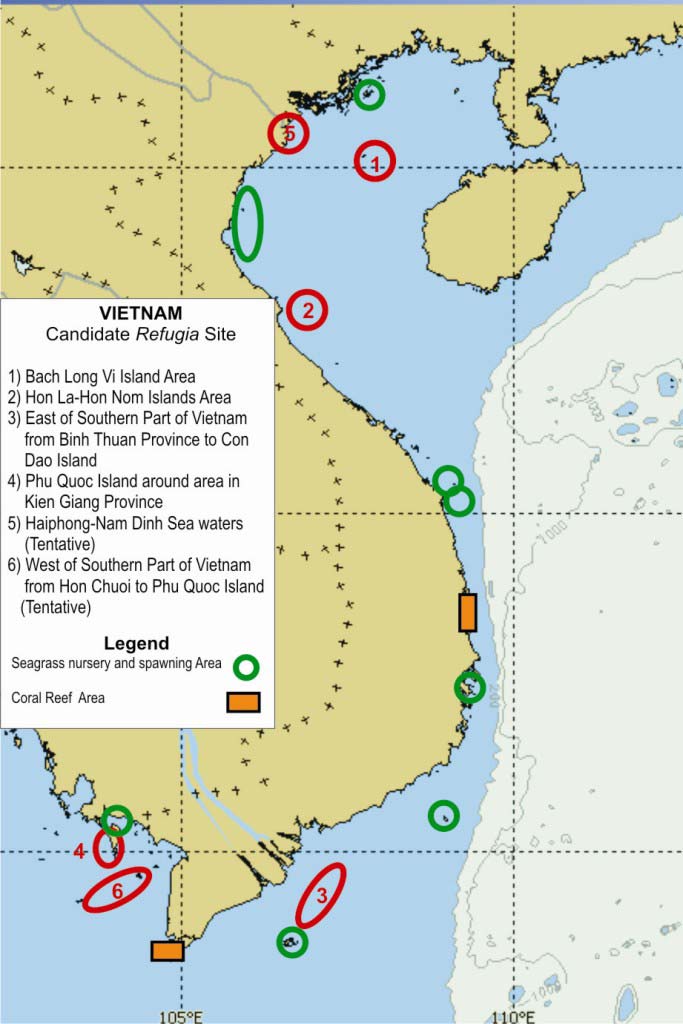
UNEP/GEF/SCS/RWG-F.8/3
Annex 6
Page 2
Figure 1
Sites selected in Vietnam for inclusion in an initial system of fisheries refugia.
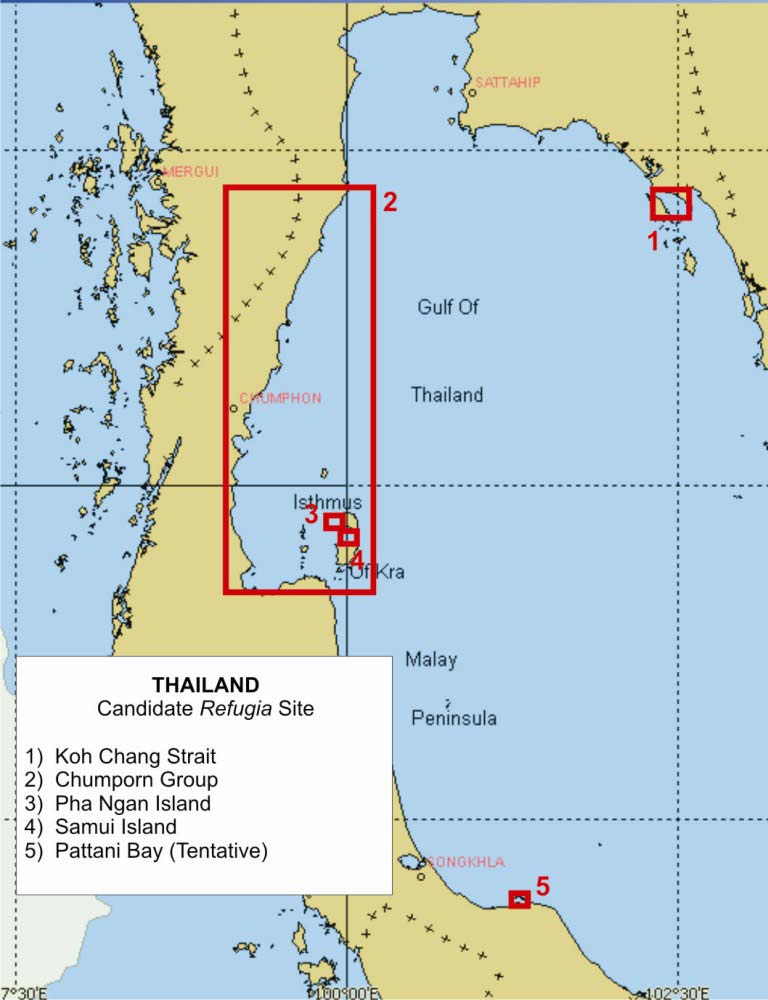
UNEP/GEF/SCS/RWG-F.8/3
Annex 6
Page 3
Figure 2
Sites selected in Thailand for inclusion in an initial system of fisheries refugia.
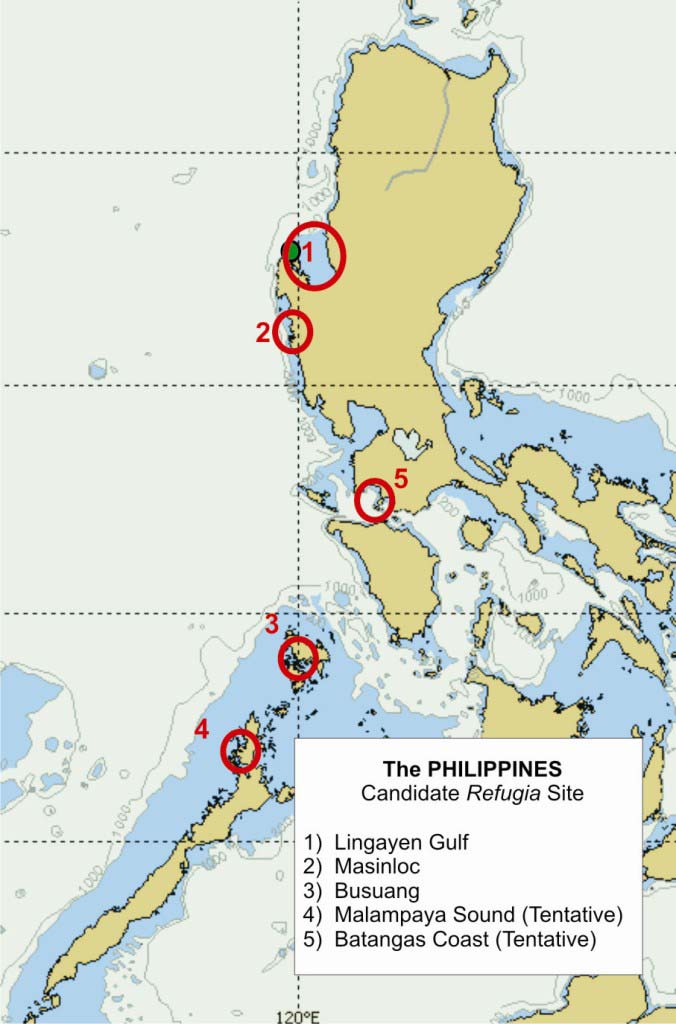
UNEP/GEF/SCS/RWG-F.8/3
Annex 6
Page 4
Figure 3
Sites selected in the Philippines for inclusion in an initial system of fisheries
refugia.
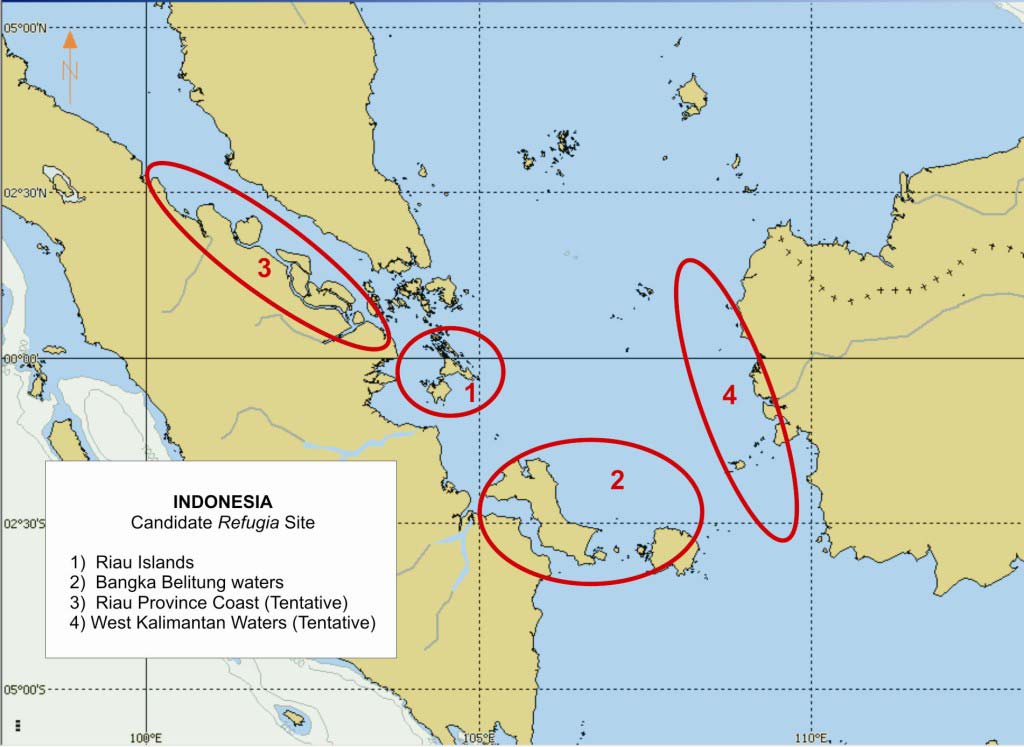
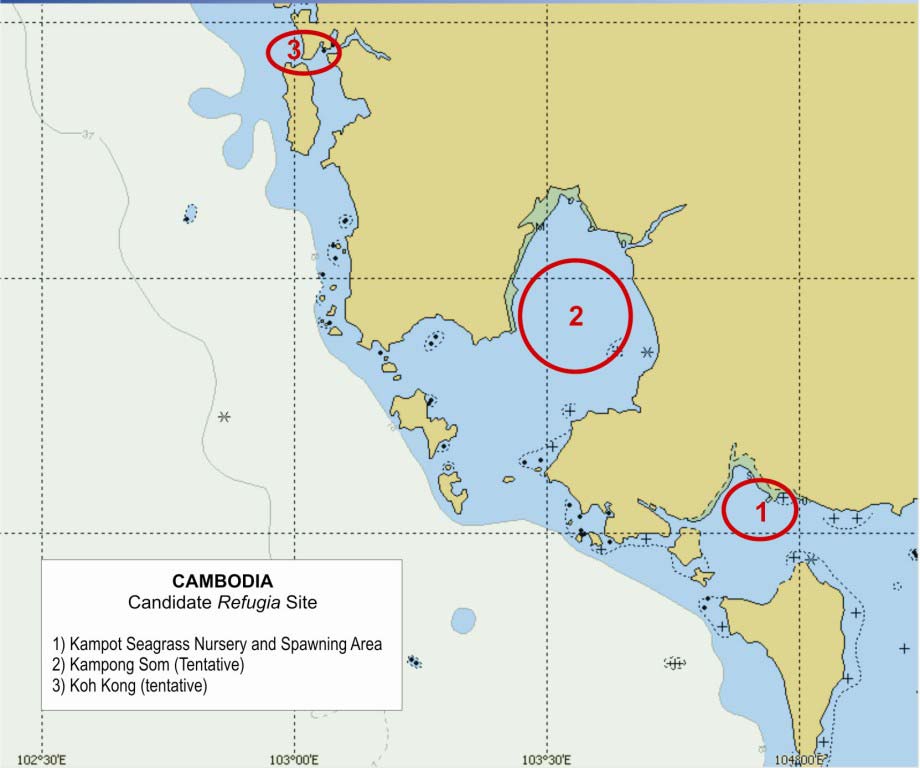
UNEP/GEF/SCS/RWG-F.8/3
Annex 6
Page 5
Figure 4
Sites selected in Indonesia for inclusion in an initial system of fisheries refugia.
Figure 5
Sites selected in Cambodia for inclusion in an initial system of fisheries refugia.
UNEP/GEF/SCS/RWG-F.8/3
Annex 7
Page 1
ANNEX 7
Regional and National Plans for a System of Fisheries Refugia
BACKGROUND
In order to enable the participating countries to take some initial steps to establish refugia sites, the
RWG-F definition of refugia has been framed broadly. The group has proposed that priority areas for
refugia are those in which fish spawn and seek shelter/food, and have selected sites for inclusion in an
initial system of fisheries refugia on this basis.
The group understands that individuals taking a "helicopter view" of the definition of refugia, and the
initial actions of identifying important nursery and spawning areas, may misconstrue that the group is
simply identifying areas for a regional system of seasonally managed areas (e.g. spot closures, closed
seasons). An important role of the Fisheries Component of the SCS Project is to ensure that when such
individuals take a "helicopter view" of this activity, they see a regional initiative working to (a) develop a
system of fisheries refugia, including "replacement" of lost natural refugia, in order to build resilience in
regional fisheries, and to (b) provide an institutional mechanism for improved fisheries and habitat
management, i.e., management based on fisheries-critical habitat linkages.
In terms of developing a Regional Fisheries Refugia Strategy it will be important to define specific
resource and institutional related goals and objectives for the refugia system. Some preliminary (a)
resource-related and (b) institutional-related goals and objectives for the refugia system were
considered by the Eighth Meeting of the RWG-F (Table 1).
Table 1
Preliminary Goals and objectives for a regional system of fisheries refugia.
Resource-Related Goal Increased Resilience of
Institutional-Related Goal Fisheries and Habitat
Regional Fish Stocks to the Effects of Fishing
Management Conducted in an Integrated Manner
Longer-Term Objectives
Longer-Term Objectives
Increased average size of important species
Community-based management of fisheries refugia for
Increased egg production of important species
integrated fisheries and habitat management
Increased recruitment of important species
National and regional level commitments for integrated
Increased biomass of important fish species
fisheries and ecosystem management
Appropriately represented fisheries agenda in broader
multiple use marine planning initiatives
Shorter-Term Objectives
Shorter-Term Objectives
Safeguarding of natural refugia
Community-based management of fisheries refugia for
Reduced capture of juveniles and pre-recruits of
fisheries management
important species in critical fisheries habitats
Understanding amongst fishing communities of critical
Reduced targeting and capture of important species
habitat and fish life-cycle linkages
when forming spawning aggregations
Enhanced capacity of fisheries departments/ministries
Reduced targeting and capture of migrating fish
to engage in meaningful dialogue with the environment
sector
Specific Resource-Related Objectives, Performance Assessment Criteria, and Means for
Verifying the Performance of a Regional System of Fisheries Refugia
A Regional Fisheries Refugia Strategy should define specific criteria for use in measuring the
effectiveness of the system of refugia. These criteria, and associated information regarding how
performance will be measured, can be used to frame realistic and workable targets for the system of
refugia. A preliminary set of performance assessment criteria, and means of verification, for the
resource-related objectives of a regional system of fisheries refugia were considered by the Eighth
Meeting of the RWG-F (Table 2).
UNEP/GEF/SCS/RWG-F.8/3
Annex 7
Page 2
Table 2 A preliminary set of performance assessment criteria and means of verification for
the resource-related objectives of a regional system of fisheries refugia.
Performance Assessment
Resource-Related Objectives
Means of Verification
Criteria
Longer-Term Objectives
Biomass trend (multi-year average
Results of abundance surveys employing
1. Biomass of commercially important
annual percentage rate of change)
relative abundance (CPUE), swept area,
fish (pelagic and demersal) and
acoustic, or egg production methods
invertebrate species in the Gulf of
Thailand and South China Sea
maintained
2. Increased average size of
Average fish size relative to historical
Results of size-frequency analyses of
commercially important fish (pelagic
average
fish landed at key landing places and in
and demersal) and invertebrate
markets
species caught in the Gulf of Thailand
and South China Sea
3. Increased egg production of
Abundance of eggs and larvae of
Results of surveys of egg and larval fish
commercially important fish and
commercially important species in key
density in key spawning areas
invertebrate species in the Gulf of
spawning areas relative to historical
Thailand and South China Sea
average
4. Increased recruitment of
Year class strength relative to historical
Results of abundance surveys employing
commercially important fish and
average
relative abundance (CPUE) or swept
invertebrate species to fisheries the
area methods
Gulf of Thailand and South China Sea
Shorter-Term Objectives
Abundance of juveniles in fishery refugia
a) Results of fishery dependent and
1. Reduced capture of juveniles and
areas
independent surveys
pre-recruits of commercially important a) Fishing effort dynamics in fishery
b) Interviews of fishers, fishing
fish (pelagic and demersal) and
refugia areas
communities, and traders
invertebrate species, as well as
b) Selectivity of fishing operations
c) Results of studies of species and size
endangered species, in critical
conducted within juvenile refugia
composition conducted within refugia
fisheries habitats of the Gulf of
c) Frequency of inappropriate fishing
d) Observations/reports of illegal or
Thailand and South China Sea
operations in fishery refugia areas
destructive fishing in fishery refugia
d) Volume and size composition of
areas
commercially important fish (pelagic
e) Results of studies of the volume and
and demersal) and invertebrate species
size of fish landed at main landing
landed and traded in main markets
places and traded in main market
2. Reduced targeting and capture of
a) Fishing effort dynamics in fishery
a) Interviews of fishers, fishing
commercially important fish (pelagic
refugia areas
communities, and traders
and demersal) and invertebrate
b) Selectivity of fishing operations
b) Results of studies of species and size
species in spawning condition, and
conducted within spawning refugia
composition of landings during known
when forming spawning aggregations, c) Gonosomatic index (GSI) of
spawning seasons
in the Gulf of Thailand and South
commercially important fish (pelagic
c) Results of studies of the gonosomatic
China Sea
and demersal) and invertebrate
condition of commercially important
species landed and traded in main
species landed and traded in main
markets
markets
d) Abundance of eggs and larvae of
d) Results of surveys of egg and larval fish
commercially important species in
density in key spawning areas
key spawning areas
3. System of fisheries refugia, including Total number/size of juvenile refugia and
The number and size of fisheries refugia
both juvenile and spawning refugia,
spawning refugia:
as defined in refugia management plans
which provides for:
(a) Number of species for which a
adopted by national governments
(a) networks of fisheries refugia
network of fisheries refugia has been (a) Description of the species specific
across the geographical ranges of
developed across its geographical
linkages between refugia in
individual species,
range
management plans for each refugia
(b) networks of fisheries refugia that
(b) Number of fisheries refugia networks
in a geographical range based
include both juvenile and
that include multiple refugia types
network
spawning refugia,
(c) Number of fisheries refugia for which (b) Description of the life-cycle specific
(c) fisheries management consistent
management systems have been
linkages between refugia in
with the RGRFSEA
developed
management plans for each refugia
in a life-cycle based network
(c) Adoption of refugia management
plans
Specific Institutional-Related Objectives, Performance Assessment Criteria, and Means for
Verifying the Performance of a Regional System of Fisheries Refugia
A preliminary set of performance assessment criteria for the institutional-related objectives of a
regional system of fisheries refugia were also considered by the RWG-F (Table 3).
UNEP/GEF/SCS/RWG-F.8/3
Annex 7
Page 3
Table 3
A preliminary set of performance assessment criteria and means of verification
for the institutional-related objectives of a regional system of fisheries refugia.
Performance Assessment
Institutional-Related Objectives
Means of Verification
Criteria
1. Integration of fish life-cycle
Preparation and publication of a
Adoption by appropriate regional fora of
considerations in fisheries and
management plan for a regional system
a management plan for a regional
habitat management in the Gulf of
of fisheries refugia.
system of fisheries refugia. Management
Thailand and South China Sea
plan to include:
a) goals, objectives, target reference
points, indicators, and performance
measures for each refugia (and refugia
network in the system)
b) system for reporting on results of
analysis of data collected in support of
the regional refugia system
c) criteria for the identification of new
refugia
d) research priorities and national
commitments of support to the conduct
of fisheries research
2. National level commitments to
Preparation and publication of National
Adoption of plans of action by
integrate the fisheries refugia concept Plans of Action for the Development of
appropriate Government Ministries.
into fisheries and habitat
the Regional System of Fisheries
management
Refugia
3. Regionally agreed fisheries refugia
Preparation and publication of a
Adoption of the programme at a regional
science programme, which details:
fisheries refugia science programme
expert consultation and then
a) Objectives
representatives of five SEAFDEC
b) Decision-support inputs
member countries
c) Strategic research
partnerships/resourcing
d) Research activities
4. Regionally agreed framework of
Preparation of a framework of criteria,
Adoption of the framework at a regional
criteria, target reference points,
target reference points, indicators, and
expert consultation
indicators, and performance measures performance measures for identifying
for identifying and evaluating the
and evaluating the performance of
performance of refugia that, aim to:
fisheries refugia
(a) reduce the capture of juveniles and
pre-recruits of commercially
important fish, and endangered
species, in critical fisheries habitats
(b) reduce the targeting and capture of
commercially important fish in
spawning condition, and when
forming spawning aggregations
(c) contribute to the development of
species-specific networks of refugia
across (i) the geographical range,
and (ii) the life-cycle, of individual
species.
5. Regional agreement on standardised Preparation and publication of standards
Adoption by appropriate
methodology for the identification and
for refugia identification and evaluation
intergovernmental fora of regional
evaluation of important:
methods relating to data collection and
standards
(a) juvenile refugia
storage, and analysis
(b) spawning refugia, and
(c) refugia that can assist in building
geographical range and life-cycle
based networks of refugia
6. Regionally agreed guidelines on the
Regional agreement on guidelines for
Adoption by appropriate
use of the fisheries refugia concept in
the use of the fisheries refugia concept
intergovernmental fora of regional
fisheries management.
guidelines
DELIBERATIONS OF THE EIGHTH MEETING OF THE REGIONAL WORKING GROUP ON
FISHERIES
The Working Group identified that the development of a regional strategy is constrained at this stage
by a lack of baseline information and experience in the establishment and management of refugia
sites. It was discussed that regional management initiatives are difficult to implement in Southeast
Asia due to differences in fisheries management systems between countries. In this connection, the
meeting agreed that a pilot site approach to the establishment of some intitial refugia may enable the
identification of the practical challenges and other issues that a regional strategy would need to
consider.
UNEP/GEF/SCS/RWG-F.8/3
Annex 7
Page 4
The meeting agreed to establish one fisheries refugia pilot site in each country and prepare a draft of
a detailed plan for the implementation of activities at that site by 30th June 2007. To assist focal
points in guiding the establishment of a fisheries site the following step-by-step guide and work plan
was proposed by the working group, the work-plan has been incorporated into the overall plan in
Annex 10
PROPOSED GUIDE FOR THE ESTABLISHMENT OF PILOT FISHERIES REFUGIA SITES
1.
Identify Pilot Fisheries Refugia Site
· Identify goal for the fisheries refugia area
· Identify specific objective(s) for the management of the refugia site
· Gather secondary data and information relating to the pilot site
2.
Conduct community/stakeholder consultation
· Identify stakeholders/participants (e.g. Local and Provincial Government Bodies, Academe,
Government Agencies, Law enforcement bodies, fisherfolk organisations)
· Involve National Fisheries Committee Members
Activities during the consultation
· Introduce the project, activities, objectives, expected output, etc.
· Introduce the concept of fisheries refugia, procedures for identifying and establishing fisheries
refugia sites
· Discuss the difference/similarities between MPAs and the fisheries refugia concept
· Discuss the possible effects on fishing communities once a fisheries refugia is established
· Ensure that all the participants in the consultation have clear understanding of the refugia
concept
· Encourage the participants to ask questions about the refugia concept
3.
Involve fishers and fishing communities in the process of identifying and agreeing
boundaries of the pilot site
· In this manner you will feel (a) if they understood the concept and (b) their acceptance and
willingness to support the establishment of a fisheries refugia site in their area
· Conduct national training seminars
4.
Select sites that have support from local and provincial government officials and bodies
· This will ensure the success of the project and assist in establishing similar sites within the
administrative boundaries of the local government area
· Seek assistance and support from local government officials who work well with the
community
5.
Clearly define the roles of all stakeholders and solicit their support and cooperation
6.
Collection and provision of data and information
7.
Determine the boundaries of the fisheries refugia site, resource attributes, etc.
8.
Conduct small workshops or community meetings to initiate the formulation of a
management plans (including financial plan) for the site
9.
Liaise regularly with local fishing community leaders
10.
Draft a Fisheries Refugia Management Plan for the site
· Goal
· Objectives
· Justification of objectives
· Stakeholder identification
· Targets, strategies and activities to be implemented at the site
· Timeframes for activities/actions
· Prioritisation of activities/actions
· Indicators to measure success of fisheries refugia plan
· Costs of action
· Institutional and other responsibilities, partnerships
· Monitoring, evaluation and review of plan
UNEP/GEF/SCS/RWG-F.8/3
Annex 8
Page 1
ANNEX 8
Developing a National Programme of Activities for the Implementation for the
Fisheries Component of the Revised Strategic Action Programme
BACKGROUND
The Regional Working Group on Fisheries (RWG-F) is currently collaborating with the Southeast Asian
Fisheries Development Center (SEAFDEC) to:
· Establish a system of fisheries refugia in the South China Sea and Gulf of Thailand that
focuses on the critical links between fish stocks and their habitats.
The general longer-term objectives of this activity are to:
· Build the resilience of Southeast Asian fisheries to the effects of high and increasing levels of
fishing effort,
· Improve the understanding amongst stakeholders, including fisher folk, scientists, policy-
makers, and fisheries managers, of ecosystem and fishery linkages, as a basis for integrated
fisheries and ecosystem/habitat management,
· Build the capacity of fisheries departments/ministries to engage in meaningful dialogue with
the environment sector regarding how broader multiple use planning (in whatever form) can
best contribute to improving the state of fisheries in areas of the South China Sea and the
Gulf of Thailand.
This initiative is considered important regionally because of the potential fisheries benefits associated
with effective fisheries and habitat management at the local level. It is likely that the role of such
approaches to fisheries management will become more important in the region, especially in the light of
the continuing importance of fisheries to food security, nutritional security, and maintenance of
livelihoods. Such approaches may also assist in curbing the effects of trends in regional fisheries
relating to over-capacity and over-exploitation, the use of destructive fishing gear and practices, habitat
destruction and pollution, and illegal fishing.
Revised Strategic Action Programme Targets
During the Sixth Meeting of the RWG-F convened in Kudat, Malaysia (5th-8th September 2006), the
RWG-F revised and updated the fisheries component targets for the regional Strategic Action
Programme in order to better reflect efforts to improve the use of fisheries refugia for sustainable
capture fisheries management. These revised targets are as follows:
Targets1
· By 2012 to have established a regional system of refugia for the management of priority,
transboundary, fish stocks and endangered species.
· By 2012 to have prepared and implemented fisheries management systems in the identified
refugia based on, and consistent with, the ASEAN SEAFDEC Regional Guidelines for
Responsible Fisheries in Southeast Asia.
During discussion at the Sixth Meeting it was noted that neither of the above targets are "hard" in a
quantitative sense since they did not enumerate how many refugia involving what size of area were to
be included in the system. It was noted that this was difficult at the present time since the actual areas
of the refugia both in terms of location and extent had not been defined. It was agreed therefore that
these targets would be reviewed in the light of the subsequent development of the strategy for
development of the regional system of refugia.
Revised Regional and National Level Activities
The Regional Scientific and Technical Committee (RSTC) recommended during its Sixth Meeting in
Batam, Indonesia (10th-13th December 2006) that the RWG-F should evaluate the wording of all
proposed regional and national activities in relation to the revised goals and targets. The Seventh
Meeting of the RWG-F (16th-18th May 2006) subsequently considered the wording of the national and
regional level activities, they were amended and the list was expanded as follows:
1 Extracted from document UNEP/GEF/SCS/RWG-F.6/3.
UNEP/GEF/SCS/RWG-F.8/3
Annex 8
Page 2
Regional Level Activities2
· Review the compatibility of existing national policy frameworks against existing
international/regional instruments (with emphasis on the ASEAN SEAFDEC Regional
Guidelines for Responsible Fisheries in Southeast Asia). This should lead to identification of
gaps and directions for improvement of the national policy frameworks to harmonize them
with international/regional instruments.
· Designate fish refugia in addition to, or in conjunction with managed coastal habitat areas.
These refugia should be developed by fisheries related agencies to promote their impacts on
rehabilitating resources and in achieving the objectives of fisheries management. Build
Information and Education Campaign (IEC) and alternative livelihood programs as necessary
for affected fishing communities. Draw lessons from these activities/experiences to define
protocols for establishment of a wider system of refugia for fisheries management purposes.
· Identify fish stocks or areas requiring bilateral, multilateral, and regional management
collaboration.
· Identify regionally important areas requiring special protection and appropriate fishing
technology to reduce impacts on endangered/threatened species (e.g. marine turtles,
dugong) in the region.
· Identify, develop and establish joint fisheries management frameworks between and among
neighbouring countries utilising shared stock through dialogues and consultations.
· Develop criteria for selection of marine habitats and areas (refugia) critical to the maintenance
of regionally important fish stocks, particularly those of transboundary importance.
· Identify and prioritise specific areas for future management and protection and develop
regional and national action plans to develop a regional system of refugia for maintenance of
regionally important fish stock.
· In collaboration with other relevant institutions promote the standardisation of fisheries related
statistics and information exchange.
National Level Activities (the activities should be consistent with related activities proposed at the
regional level) 3
· Evaluate the effectiveness of fisheries management systems.
· Evaluate the status and trends of fisheries resources in relation to catch efforts and
availability of resources in defined areas.
· Reduce the use of fishing gear and practices that damage ecologically sensitive areas with
the long term aim of removing and replacing them with more environmentally acceptable
fishing gear and practices.
· Review compliance with international and regional fisheries agreements and guidelines.
· Promote the application of the Regional Guidelines for Responsible Fisheries in Southeast
Asia through workshops, awareness building, translation into national languages and
education of people.
· Develop educational and public awareness materials on sustainable fishery practices.
· Implement programmes to provide information on sustainable fishery practices among small
and artisanal fishing communities, and commercial fisheries operators as appropriate.
· Train technical fisheries staff in the identification of fish eggs and larvae.
· Design and establish a programme for identifying important spawning and nursery areas.
· Establish refugia in areas identified as critical habitats for the life cycle of fisheries resources.
· Establish in selected refugia sound management systems, which can be tested to determine if
they are leading to sustainable exploitation of resources and reduction of conflicts between
groups of fishermen.
Developing a National Programme of Activities for SAP Implementation
It was agreed during the Seventh Meeting of the RWG-F that each member would develop a national
programme of specific costed activities that would implement to broad national level activities
proposed for inclusion in the SAP. Preliminary programmes for four participating countries are
outlined in Tables 1- 4 of this document.
2 Extracted from document UNEP/GEF/SCS/RWG-F.4/3.
3 Extracted from document UNEP/GEF/SCS/RWG-F.4/3.
UNEP/GEF/SCS/RWG-F.8/3
Annex 8
Page 3
Table 1
Vietnam's National Programme of Activities for the Implementation of the Regional
Strategic Action Programme Proposed during the Eighth Meeting of the Regional
Working Group on Fisheries.
Responsible
Activities Location
Timeframe
Costs (USD)
Organisation(s)
Restoration and
Nationwide
2007-2015
Research Institute for
5,100,000
development of aquatic
Marine Fisheries (RIMF)
resources, conservation of
rare and valuable
endangered species
Development of model of
Several coastal
2008-2012 Department
of
1,800,000
fishing alternation in
provinces
cooperative and private
inshore water
(North and
economics
South)
Planning and development Nationwide
2007-2015
National directorate for
7,200,000
and management of
aquatic exploitation and
MPAs, inland protection
protection (NADAREP)
areas, closure areas and
limited use areas
Development of model of
Several coastal
2007-2010
Vietnam Institute of
700,000
community based
provinces
Fisheries Economics and
management of fisheries
Planning (VIFEP)
resources
Development and
Nationwide 2008-2015
Fisheries
Informatic
1,600,000
management of database
Center (FICEN)
on fisheries resources and
aquatic habitats
Development and
Nationwide 2007-2015
NADAREP
1,700,000
implementation National
Plan of information
dissemination on fisheries
protection and
development
Establishing National
Fisheries Refugia
Pilot site selection
South of
11/06
MoFi and Provincial
4000
Vietnam
Government
Community and
South of
2/07 MoFi,
Provincial
4000
stakeholder consultation
Vietnam
Government, Community,
for promoting the refugia
and Stakeholders
concept
Collection of required
South of
3-4/07 RIMF
1000
information for Action
Vietnam
research
Community and
South of
5/07 MoFi,
Provincial
4000
stakeholder consultation
Vietnam
Government, Community,
for identifying activities in
and Stakeholders
the refugia
Promote the application of
Nationwide
4-6/07
MoFi and RIMF
1000
the RG for responsible F.
Development educational
Nationwide
8-10/07
NADAREP and RIMF
2000
and public awareness
materials on sustainable
fisheries practices
18,116,000
UNEP/GEF/SCS/RWG-F.8/3
Annex 8
Page 4
Table 2
Thailand's National Programme of Activities for the Implementation of the Regional
Strategic Action Programme Proposed during the Eighth Meeting of the Regional
Working Group on Fisheries.
Responsible
Activities Location
Timeframe
Costs (USD)
Organisation(s)
Evaluate the Effectiveness of
Prachuap Khiri Khan,
2007-2012
Department of Fisheries,
270,000
Fisheries Management Systems
Chumporn and Surat
Thailand
Thani Fisheries
Refugia
Koh Chang Strait
2007-2012
Department of Fisheries,
135,000
Thailand
Evaluate the Status and Trends
Prachuap Khiri Khan,
2007-2012 CMDEC/Department
of
330,000
of Fisheries Resources in
Chumporn and Surat
Fisheries, Thailand
Relation to Catch Efforts and
Thani Fisheries
Availability of Resources in
Refugia
Defined Areas
Koh Chang Strait
2007-2012
EMDEC/ Department of
200,000
Fisheries, Thailand
Reduce the Use of Fishing Gear
Koh Chang Strait
2010-2011
Trat Provincial
and Practices that Damage
Government
Ecologically Sensitive Areas with
the Long-Term Aim of Removing
and Replacing them with more
Environmentally Acceptable
Fishing Gear and Practices
Promote the Application of the
Prachuap Khiri Khan,
2008-2010
Department of Fisheries,
Regional Guidelines for
Chumporn and Surat
Thailand
Responsible Fisheries in
Thani Fisheries
Southeast Asia through
Refugia
Workshops, Awareness Building,
translation in National
Languages
Koh Chang Strait
2008-2012
Department of Fisheries,
Thailand
Develop education and
Prachuap Khiri Khan,
2008-2012 SMDEC/Department
of
awareness materials on
Chumporn and Surat
Fisheries, Thailand
sustainable fishing practices
Thani Fisheries
Refugia
Distribute materials developed to
Prachuap Khiri Khan,
(a) 2007-2012
(a) National Fisheries
the local community, schools and
Chumporn and Surat
(b) 2007-2012
Focal Point
education institute
Thani Fisheries
(b) Technology Transfer
Refugia
and Extension Bureau,
Department of Fisheries
Train technical fisheries staff in
CMDEC/Department
2007 CMDEC/Department
of
26,000
the identification of fish eggs and
of Fisheries, Thailand
Fisheries, Thailand
larvae to assist in the
identification of fisheries refugia
sites
Design and establish a
Gulf of Thailand
2007-2012
Department of Fisheries,
800,000
programme for identifying
Thailand
important spawning and nursery
areas
Establish refugia in areas
Prachuap Khiri Khan,
2007-2012
Department of Fisheries,
identified as critical habitats for
Chumporn and Surat
Thailand
the life-cycles of the species
Thani Fisheries
Refugia
Koh Chang Strait
2007-2012
Department of Fisheries,
Thailand
Establish in selected refugia
Prachuap Khiri Khan,
2007-2012
Department of Fisheries,
270,000
sound management systems,
Chumporn and Surat
Thailand
which can be tested to determine
Thani Fisheries
if they are leading to sustainable
Refugia
exploitation of resources and
reduction of conflicts between
groups of fishers
2,031,000
UNEP/GEF/SCS/RWG-F.8/3
Annex 8
Page 5
Table 3
Philippines' National Programme of Activities for the Implementation of the
Regional Strategic Action Programme Proposed during the Eighth Meeting of the
Regional Working Group on Fisheries.
Responsible
Activities Location
Timeframe
Costs (USD)
Organisation(s)
Evaluate the effectiveness of
fisheries management systems
Evaluate the status and trends of
fisheries resources in relation to
catch efforts and availability of
resources in defined areas
· Consolidate data collected by
Lingayen Gulf,
Jan 2007 to
BFAR, NFRDI,
20,000
the National Stock Assessment Ilocos Coast,
Dec 2010
NSAP-1, NSAP-3
Program (NSAP) for priority
Bataan/Zambales
fishing grounds to determine
Coast
number of licenses to be
issued
Reduce the use of fishing gear
and practices that damage
ecologically sensitive areas with
the long term aim of removing and
replacing them with more
environmentally acceptable fishing
gear and practices
· Monitor catch and effort of
Lingayen Gulf
Jan 2007 to
BFAR, NFRDI,
30,000
allowed fine meshed fishing
Dec 2008
NSAP-1
gears to support issuance of
Fisheries Administrative Order
(FAO) for the rationalization of
their use
· Development of FAO and
National Office
Jan 2007 to
BFAR, NFRDI,
3,000
public consultation on the
Dec 2007
proper fishing gear
configuration for small pelagics
and large pelagics
Review compliance with
international and regional fisheries
agreements and guidelines
· Development of mechanisms
National Office
Jan 2007 to
BFAR, NFRDI,
1,000
for compliance
Dec 2007
· Public awareness campaign
National Office
Jan 2007 to
BFAR, NFRDI,
10,000
on international and regional
Dec 2010
Academe
fisheries agreements and
guidelines
Promote the application of the
Regional Guidelines for
Responsible Fisheries in
Southeast Asia through
workshops, awareness building,
translation into national languages
and education of people
Develop educational and public
awareness materials on
sustainable fishery practices
· Adopt and modify IEC
National Office
Jan 2007 to
BFAR, NFRDI, other
5,000
materials developed by
Dec 2012
institutions
external y funded projects and
print for distribution
· Development of new IEC
National Office
Jan 2007 to
BFAR, NFRDI, other
50,000
materials to specifically focus
Dec 2012
institutions
on fish refugia
UNEP/GEF/SCS/RWG-F.8/3
Annex 8
Page 6
Table 3 cont. Philippines' National Programme of Activities for the Implementation of the
Regional Strategic Action Programme Proposed during the Eighth Meeting of the
Regional Working Group on Fisheries.
Responsible
Activities Location
Timeframe
Costs (USD)
Organisation(s)
Implement programmes to provide
information on sustainable fishery
practices among small and
artisanal fishing communities, and
commercial fisheries operators as
appropriate
Train technical fisheries staff in
UNEP, SEAFDEC 2007
BFAR, NFRDI,
the identification of fish eggs and
academe
larvae
Design and establish a
programme for identifying
important spawning and nursery
areas
· Develop and implement
Lingayen Gulf
Jul 2007 to
BFAR, NFRDI,
30,000
national programme on
Jun 2009
BFAR-1, academe
systematic collection of
information to determine
spawning seasons and nursery
areas of commercially
important fish species.
· Staff development programme Lingayen Gulf
Jul 2007 to
BFAR, NFRDI,
10,000
to support systematic collection
Jun 2009
BFAR-1, academe
and analysis of information to
determine spawning seasons
and nursery areas
Establish refugia in areas
identified as critical habitats for
the life cycle of fisheries resources
· Identification of pilot site(s) or
Masinloc,
Nov 2006 to
BFAR, NFRDI,
3,000
fishing community(ies)
Busuanga,
Dec 2006
BFAR-1,3,4b
Bolinao
· Drafting of habitat and fisheries Masinloc,
Nov 2006 to
BFAR, NFRDI,
3,000
and socio economic profile for
Busuanga,
March 2007
BFAR-1,3,4b
the pilot site
Bolinao
· Identification of additional
Jan 2007 to
BFAR, NFRDI
2,000
refugia sites
Dec 2007
· Community and stakeholder
Jan 2007 to
BFAR, NFRDI
8,000
consultations for promoting the
Dec 2007
refugia concept
· Drafting of habitat and fisheries
Jul 2007 to
BFAR, NFRDI
3,000
and socio economic profile for
Dec 2007
the additional refugia
Establish in selected refugia
sound management systems,
which can be tested to determine
if they are leading to sustainable
exploitation of resources and
reduction of conflicts between
groups of fishermen
· Collection of required
Masinloc,
Nov 2006 to
BFAR, NFRDI,
30,000
information for pilot area
Busuanga,
Dec 2007
BFAR-1,3,4b
Bolinao
· Community and stakeholder
Masinloc,
Nov 2006 to
BFAR, NFRDI,
16,000
consultations for identifying
Busuanga,
Apr 2007
BFAR-1,3,4b
activities in the pilot refugia
Bolinao
· Preparation of detailed plan for Masinloc,
Nov 2006 to
BFAR, NFRDI,
10,000
the implementation of activities Busuanga,
Jun 2007
BFAR-1,3,4b
in pilot refugia
Bolinao
UNEP/GEF/SCS/RWG-F.8/3
Annex 8
Page 7
Table 3 cont. Philippines' National Programme of Activities for the Implementation of the
Regional Strategic Action Programme Proposed during the Eighth Meeting of the
Regional Working Group on Fisheries.
Responsible
Activities Location
Timeframe
Costs (USD)
Organisation(s)
· Enforcing fisheries
Masinloc,
Nov 2006 to
BFAR, NFRDI,
5,000
management measures in the
Busuanga,
Sep 2007
BFAR-1,3,4b
pilot refugia
Bolinao
· Collection of required
Jun 2007 to
BFAR, NFRDI
40,000
information for other selected
Dec 2010
refugia sites
· Community and stakeholder
Jun 2007 to
BFAR, NFRDI
20,000
consultations for identifying
Dec 2010
activities in additional refugia
sites
· Preparation of detailed plan for
Jan 2008 to
BFAR, NFRDI
15,000
the implementation of activities
Jun 2009
in additional refugia sites
· Enforcing fisheries
Jan 2008 to
BFAR, NFRDI
10,000
management measures in
Dec 2012
additional refugia sites
Table 4
Cambodia's National Programme of Activities for the Implementation of the
Regional Strategic Action Programme Proposed during the Eighth Meeting of the
Regional Working Group on Fisheries.
Responsible
Costs
Activities Locations
Timeframe
Organisation(s)
(USD)
Evaluate the effectiveness of
Along coastline
2007 - 2012 Fisheries administration
fisheries management system
(Kampot, Koh
Disseminations new laws to fishers
Kong,
and awareness campaigns
Sihanoukville and
Kep City)
Resource and Socio-economic
Kampot,
2007-2012 Fisheries
administration
surveys
Sihanoukville,
Koh Kong
Reduction of fishing gear and
Kampot,
2007 Fisheries
administration
practices
Sihanoukville,
and local fisheries
Awareness campaign on destructive Koh Kong, Kep
authority
fishing practices
City
Conduct awareness programme to
Kampot 2007-2008
Fisheries
administration
promote sustainable fishery practices
and local fisheries
to artisanal and commercial fishery
authority
operators
Fisheries Refugia Activities
Establish fisheries refugia Kampot 2007-2008
Fisheries
administration
and local fisheries
authority
Training of trainers
Training of stakeholders
Consultation
workshops/workshop/seminars
Implementation of pilot project on
refugia
Project management
Monitoring and evaluation of pilot
refugia site, improvement of plan
Review of fisheries refugia plan and
improvement of plan
Establishment of refugia in other
areas, monitoring, review and
improvement of fisheries refugia plan
UNEP/GEF/SCS/RWG-F.8/3
Annex 9
Page 1
ANNEX 9
Preliminary Syllabus for the Training Course on Larval Fish Identification and Early
Life-History Science
BACKGROUND
SEAFDEC are currently utilising M.V. SEAFDEC 2 for the conduct of fisheries resources assessment
surveys. A total of 20 cruises have been conducted using this vessel since 2004, and larval fish have
been and continue to be sampled using a bongo net at all survey sites. M.V. SEAFDEC 2 has recently
conducted work in the Gulf of Thailand, including Cambodian waters, waters adjacent to West
Kalimantan Province in Indonesia, the Sulu Sea in the Philippines, and the east coast of Viet Nam.
Larval fish samples collected during these cruises will form a critical part in any future development of
a regional system of fisheries refugia.
To date very few of these larval fish samples have been processed due to a shortage of technical
expertise in the participating countries regarding the sorting and identification of larval fish. In
recognition of this the Regional Scientific and Technical Committee approved a regional training
course and national "echo" seminars on larval fish identification and early-life history science as part
of the SCS Training Programme. It is aimed that these training activities will result in the
establishment of fish larvae identification teams in each country with the responsibility for the
processing of samples collected during M.V. SEAFDEC 2 cruises. The initial desired content for this
course includes:
· Methods for larval fish sampling and surveys,
· Methods for identifying larval and juvenile fish,
· Preparation of larval fish identification sheets/manuals for key species,
· Building national-level capacity for the processing of larval fish samples and the identification
of larval fish, and
· Standardising the methodology for fish early life history research in Southeast Asia.
Discussions during the Seventh Meeting of the Regional Working Group on Fisheries
The Seventh Meeting of the Regional Working Group on Fisheries (RWG-F) reviewed the training
programme as developed by the RSTC and made comment regarding appropriate course
participants, possible implementing entities, and how materials developed by the RWG-F could be
utilised in training activities. It was agreed that depending on each countries individual needs, the
training should be targeted at technical personnel in specialised executing agencies or research
institutions. It was further agreed that where possible, preference should be given to junior scientists
in the fisheries departments with responsibility for larval identification.
It was also agreed during the Seventh Meeting that the training should be linked with the national
programmes of SEAFDEC cruises that involved the collection of eggs and larvae, and that a key
output of the activity should be egg and larval fish identification sheets for use in laboratories and at
sea. In terms of identification of possible implementing entities, the group was unanimous in agreeing
that the Southeast Asian Fisheries Development Center was the most qualified and well equipped
organisation in the region to act as an Executing Agency for the conduct of the course.
Discussions during the Eighth Meeting of the Regional Working Group on Fisheries
An important task for the Eighth Meeting of the RWG-F was to provide feedback and advice to
SEAFDEC regarding the implementation of this training course. Dr. Somboon of SEAFDEC noted that
he had prepared a draft syllabus for the training course, prepared an inventory and costing of all
required materials, and had made contact with several experts, including SEAFDEC's larval fish
expert, Dr. Konishi, regarding their interest in acting as course instructors. The draft syllabus was
presented by Dr. Somboon and amended as it appears below:
UNEP/GEF/SCS/RWG-F.8/3
Annex 9
Page 2
PRELIMINARY SYLLABUS FOR THE TRAINING COURSE ON LARVAL FISH IDENTIFICATION
AND EARLY LIFE-HISTORY SCIENCE
1 Introduction to Ichthyoplankton (2 days)
· Use of ichthyoplankton (fish eggs and larvae) surveys for fisheries resources research
· Case studies (examples of how fish larvae information can be used to guide management)
· Morphology of fish (squid) eggs, larvae, and juveniles
· General morphology of eggs
· Developmental stages of eggs
· General morphology of larvae (juvenile)
· Developmental stages of larvae (juvenile)
2 Sampling gears (1 days)
· Various types of gears
· Net properties
· Conducting ichthyoplankton surveys using a bongo net, small-scale fishing gears
· Design and implementation of a larval fish survey plan
3 Fishing/Research Vessel Based Training Activities (3 days)
· Calibration of flow meter
· Net towing procedures and towing data record
· Preservation of sampled planktons
· Labelling of sample containers
· Recording supplementary environmental and oceanographic data: water temperature, salinity
and current
4 Laboratory Based Training Activities (3 days)
· Sorting of eggs, larvae and juveniles
· Identification (counts and measurements) of sorted eggs, larvae and juveniles
· Bottling, storing and crating of identified samples
· Data summarisation and standardisation
· GIS based mapping of egg and larval distribution
5 Core Competences to be Evaluated (1 day)
· Sorting of eggs and larvae
· Identification of eggs and larvae
Conduct of National "Echo" Seminars
It was agreed during the meeting that the activities of the National "Echo" Seminar component of the
training course should be conducted in relation to the implementation of pilot fisheries refugia site
activities. It was further suggested that, where possible, commonly used small-scale fishing gears
should be used when demonstrating the collection of fish larvae in areas of the pilot fisheries refugia
sites. This recommendation was based on the group's recognition of the need to involved local fishing
communities in the establishment and monitoring of the fisheries refugia site.
UNEP/GEF/SCS/RWG-F.8/3
Annex 10
Page 1
ANNEX 10
Work Plan and Timetable for the Regional Working Group on Fisheries 2007
BACKGROUND
The work plan and timetable as approved during the Seventh Meeting of the RWG-F was considered
and revised during the course of the Eighth Meeting of the Regional Working Group on Fisheries to
take into agreements relating to:
· The establishment and development of pilot fisheries refugia sites in the participating
countries,
· The implementation of South China Sea Project Training Activities relating to the
establishment of a regional system of fisheries refugia,
· Preparation of Guidelines on Managing the Effects of Fishing in the Habitat Demonstration
Sites, and
· Development of the Fisheries Refugia Information Portal.
Table 1 places the tasks of the group into clear and easily understood task areas. The task
completion dates are aimed at ensuring that the necessary outputs from the national and regional
levels are available for consideration at the ninth meeting.
Table 2 presents the schedule of meetings for 2007.
UNEP/GEF/SCS/RWG-F.8/3
Annex 10
Page 2
Work Plan and Time Table (2007) and Schedule of Meetings for 2007
Table 1
Work Plan and Time Table for the Regional Working Group on Fisheries.
2007
Quarter
1 2 3 4
Month
J
F
M
A
M
J
J
A
S
O
N
D
NATIONAL ACTIVITIES
NATIONAL MEETINGS
National Committee Meetings
X
X
X
X
National Technical Working Group
X
X
X
X
RWG-F Meetings
X
Prepare information for the RWG-F and RSTC
DATABASES
Maintain SCS Meta-database (all countries)
Maintain Regional GIS Database (all countries)
NATIONAL REPORTS
Publication of National Reports in Local Language
Philippines, Thailand, Vietnam completed
Other countries
X
STRATEGIC ACTION PROGRAMME
Provide guidance to IMC on the fisheries component input to SAP
Develop national programme of activities for implementing the Strategic Action
Programme in specific areas, including costing of activities
With stakeholders, review/revise plan to implement the Strategic Action
Programme
AWARENESS MATERIALS AND PROGRAMMES
Develop awareness materials for stakeholders with RWG-F
Indonesia, Philippines, Thailand, Vietnam completed
Other countries
X
Develop and implement awareness programmes among fishing
communities (all countries)
Translate awareness raising materials into English for information exchange
with other countries
Philippines, Thailand, and Viet Nam completed
Other countries
X
UNEP/GEF/SCS/RWG-F.8/3
Annex 10
Page 3
Table 1 cont. Work Plan and Time Table for the Regional Working Group on Fisheries.
2007
Quarter
1 2 3 4
Month
J
F
M
A
M
J
J
A
S
O
N
D
REGIONAL ACTIVITIES
REGIONAL COMMUNICATION AND INFORMATION EXCHANGE
Provide regular input to monthly update on fisheries activities
Submit package of awareness raising materials for refugia information portal
Promote the fisheries refugia information portal in regional and national fora
Contribute country level information relating to (a) fish early-life history science,
(b) the use of area-based approaches to fisheries management, and (c) the
management of fisheries refugia for inclusion in the refugia information portal
Participate in e-fora discussions as appropriate
GUIDELINES ON MANAGING THE EFFECTS OF FISHING
Focal Points and Experts to provide management case studies to CP
X (1/1)
CP to compile case studies for circulation amongst members of the RWG-F
X (26/1)
Review case studies and comment on desired content for the guidelines
X (24/2)
CP to draft guidelines for circulation amongst members of the RWG-F
X (31/5)
Comment on draft guidelines and provide any additional information required
X (22/6)
REGIONAL SYSTEM OF FISHERIES REFUGIA
Community and stakeholder consultations for promoting the refugia concept
Identify pilot site(s) or fishing community(ies)
X (1/1)
Draft habitat, fisheries and socio economic profile for the pilot site
X (31/3)
Trainers training in the identification of fish larvae and national seminars
X (30/4)
Collection of required information for the design of activities at the pilot fisheries
refugia site (Action Research4)
Community and stakeholder consultations for identifying activities in the refugia
Preparation of detailed plan for the implementation of activities at the refugia site
X (22/6)
(initial draft)
Preparation of detailed plan for the implementation of activities (final draft)
X (30/9)
Develop enabling mechanisms in support of fisheries management measures in
the refugia
Implement fisheries management measures in the refugia
FISHERIES REFUGIA TRAINING ACTIVITIES
Nominate suitable participants for establishing and training on establishing refugia
and larval fish identification
Provide inputs to Implementing Agencies and Host Organisations for National
Seminars as required
4 Research done by managers together with the community/stakeholders to solve a specific problem or to introduce management interventions.
UNEP/GEF/SCS/RWG-F.8/3
Annex 10
Page 4
Table 2
Schedule of Meetings for 2007. (RWG = Regional Working Group; -M = Mangroves; -CR = Coral Reefs; -SG = Seagrass; -W = Wetlands; -F= Fisheries;
LbP = Land-based Pollution; RTF-E = Regional Task Force on Economic Valuation; RTF-L = Regional Task Force on Legal Matters) (H = United Nations Holidays)
(RSTC = Regional Scientific and Technical Committee; RSTC-SC = RSTC Sub-Committee; PSC = Project Steering Committee).
S
M
T
W
T
F
S
S
M T W T F S
S
M T W T F S
S
M T W T F S
S
M T W T F S S M
January
1 2 3 4 5 6
7
8 9
10 11
12
13
14
15 16 17 18 19 20
21
22 23
24
25
26
27
28
29 30 31
H
RTF-E-6
February
1 2 3
4
5 6 7 8 9 10
11
12 13 14 15 16 17
18
19 20
21
22
23
24
25
26 27 28
Chinese NY
March
1 2 3
4
5 6 7 8 9 10
11
12 13 14 15 16 17
18
19 20
21
22
23
24
25
26 27 28 29 30 31
April
1
2 3 4 5 6 7
8
9 10 11 12
13
14
15
16 17 18 19 20 21
22
23 24
25
26
27
28
29
30
H
H
RWG-M-8
Joint Mtg.
PKWS-Trat
May
1 2 3 4 5
6
7 8 9 10
11
12
13
14 15 16 17 18 19
20
21 22
23
24
25
26
27
28 29 30 31
RWG-W-8
RTF-L-6
RWG-SG-8
June
1
2
3
4 5 6 7 8 9
10
11 12 13 14 15 16
17
18 19
20
21
22
23
24
25 26 27 28 29 30
RWG-CR-8
July
1
2
3 4 5 6 7
8
9 10 11 12
13
14
15
16 17 18 19 20 21
22
23 24
25
26
27
28
29
30 31
RWG-F-9
August
1 2 3 4
5
6 7 8 9 10
11
12
13 14 15 16 17 18
19
20 21
22
23
24
25
26
27 28 29 30 31
RWG-LbP-8
H
September
1
2
3 4 5 6 7 8
9
10 11 12 13 14 15
16
17 18
19
20
21
22
23
24 25 26 27 28 29
30
Ramadan
October
1 2 3 4 5 6
7
8 9
10 11
12
13
14
15 16 17 18 19 20
21
22 23
24
25
26
27
28
29 30 31
Ramadan
November
1 2 3
4
5 6 7 8 9 10
11
12 13 14 15 16 17
18
19 20
21
22
23
24
25
26 27 28 29 30
December
1
2
3 4 5 6 7 8
9
10 11 12 13 14 15
16
17 18
19
20
21
22
23
24 25 26 27 28 29
30
31
H
H