

A Guide to Bycatch
Reduction in Tropical
Shrimp-Trawl Fisheries
Revised edition
Photography:
Garry Day and Steve Eayrs
SEAFDEC: photos pages 4, 10, 14, 22, 26 and sunset photo on inside back cover
John Mitchell (NOAA Fisheries, Mississippi Laboratories, USA): photos pages 3 and 61
Wilfred Thiele (FAO): photo page 58
A Guide to Bycatch
Reduction in Tropical
Shrimp-Trawl Fisheries
Revised edition
by
Steve Eayrs
Australian Maritime College
Tasmania, Australia
FOOD AND AGRICULTURE ORGANIZATION OF THE UNITED NATIONS
Rome 2005, 2007
Revised edition 2007
The designations employed and the presentation of material in this information product do
not imply the expression of any opinion whatsoever on the part of the Food and Agriculture
Organization of the United Nations concerning the legal or development status of any
country, territory, city or area or of its authorities, or concerning the delimitation of its
frontiers or boundaries.
The mention or omission of specific companies, their products or brand names does not
imply any endorsement or judgement by the Food and Agriculture Organization of the
United Nations.
ISBN
All rights reserved. Reproduction and dissemination of material in this information product
for educational or other non-commercial purposes are authorized without any prior written
permission from the copyright holders provided the source is fully acknowledged.
Reproduction of material in this information product for resale or other commercial purposes
is prohibited without written permission of the copyright holders. Applications for such
permission should be addressed to the Chief, Electronic Publishing Policy and Support
Branch, Communication Division, FAO, Viale delle Terme di Caracalla 00153 Rome, Italy or
by e-mail to copyright@fao.org
c FAO 2005, 2007
Foreword
Bycatch is the unwanted or non-target part of the catch taken by fishermen. It is either discarded at sea or
used for human or animal consumption. The capture of bycatch may pose a threat to species diversity and
ecosystem health because this part of the catch is usually unregulated. In tropical shrimp-trawl fisheries,
bycatch often consists of juvenile food-fish species and is therefore a threat to food security and sustainable
fisheries production. Bycatch is a global problem that must be addressed.
The Food and Agriculture Organization of the United Nations (FAO) is addressing this problem through the
technical project, 'Reduction of discards and environmental impact from fisheries'. Under this project FAO is
executing a five-year global project funded by the Global Environmental Facility (GEF) titled, `Reduction of
environmental impacts from tropical shrimp trawling, through the introduction of bycatch reduction
technologies and change of management'. Twelve countries1 from Latin America, the Caribbean, West Africa,
Southeast Asia and the Gulf region, and one inter-governmental organization2 are also participating in this
project.
A Guide to Bycatch Reduction in Tropical Shrimp-Trawl Fisheries is a result of this project. It is designed for
fishermen, net makers, fishing technologists and others interested in a practical guide to the design, use and
operation of effective bycatch reduction devices. Fishery managers, policy-makers and legislators will find this
guide useful to help develop specifications governing the design and application of these devices in a shrimp-
trawl fishery.
The issue of bycatch is not going away and scrutiny of fishing activity is increasing. All fishermen are strongly
urged to use appropriate bycatch reduction measures to help maintain the productivity of the fishery and the
long term prosperity of the fishing industry. By responding appropriately, fishermen can help to protect the
marine environment and assist global food security both now and in the future.
Eayrs, S.
A Guide to Bycatch Reduction in Tropical Shrimp-Trawl Fisheries.
Revised edition. Rome, FAO. 2007. 108 p.
1 Bahrain, Cameroon, Colombia, Costa Rica, Cuba, Iran, Indonesia, Mexico, Nigeria, Philippines, Trinidad and Tobago, and
Venezuela
2 Southeast Asian Fisheries Development Center (SEAFDEC)
A Guide to Bycatch Reduction in Tropical Shrimp-Trawl Fisheries
I
II
A Guide to Bycatch Reduction in Tropical Shrimp-Trawl Fisheries
Contents
Foreword
I
TED and BRD installation
Frequently Asked Questions
29
Acknowledgements
VII
Where should the TED or BRD be installed
Introduction
1
in the codend? . . . . . . . . . . . . . . . . . . . . . . . . . . . .29
A global problem . . . . . . . . . . . . . . . . . . . . . . . . . . .1
How important is the position and design of the
lifting gear? . . . . . . . . . . . . . . . . . . . . . . . . . . . . . .29
Threatened and endangered species . . . . . . . . . . .1
Will trawl deployment be affected by a TED
Global response to reduce bycatch . . . . . . . . . . . . .1
or BRD? . . . . . . . . . . . . . . . . . . . . . . . . . . . . . . . . .30
FAO response to reduce bycatch . . . . . . . . . . . . . .3
Optimizing TED Performance
31
What is bycatch?
5
Grid size (grid height and width) . . . . . . . . . . . . . .31
What are discards? . . . . . . . . . . . . . . . . . . . . . . . . .5
Grid shape . . . . . . . . . . . . . . . . . . . . . . . . . . . . . . .33
What is trash fish? . . . . . . . . . . . . . . . . . . . . . . . . . .6
Bar spacing . . . . . . . . . . . . . . . . . . . . . . . . . . . . . .34
Why reduce bycatch?
7
Straight- or bent-bar grid . . . . . . . . . . . . . . . . . . . .34
Trawl and processing efficiency . . . . . . . . . . . . . . . .9
Grid orientation . . . . . . . . . . . . . . . . . . . . . . . . . . .35
Product quality and marketing opportunities . . . . . .9
Grid angle . . . . . . . . . . . . . . . . . . . . . . . . . . . . . . .35
Food security . . . . . . . . . . . . . . . . . . . . . . . . . . . . . .9
Escape opening . . . . . . . . . . . . . . . . . . . . . . . . . . .36
Protecting the marine environment . . . . . . . . . . . .10
Escape cover . . . . . . . . . . . . . . . . . . . . . . . . . . . . .36
The ABC of TED and BRD design
11
Guiding panel or funnel . . . . . . . . . . . . . . . . . . . . .38
What is a TED? . . . . . . . . . . . . . . . . . . . . . . . . . . .11
Flotation . . . . . . . . . . . . . . . . . . . . . . . . . . . . . . . . .38
What is the difference between a 'hard' and
Back-wash funnels . . . . . . . . . . . . . . . . . . . . . . . . .39
a 'soft' TED? . . . . . . . . . . . . . . . . . . . . . . . . . . . . .12
Grid material . . . . . . . . . . . . . . . . . . . . . . . . . . . . .40
What are BRDs? . . . . . . . . . . . . . . . . . . . . . . . . . .13
TED maintenance program . . . . . . . . . . . . . . . . . .40
How do BRDs work? . . . . . . . . . . . . . . . . . . . . . . .13
Tips for optimizing TED performance . . . . . . . . . .42
What is a JTED? . . . . . . . . . . . . . . . . . . . . . . . . . .14
TED Performance and Operation
Can square-mesh codends help reduce
Frequently Asked Questions
43
bycatch? . . . . . . . . . . . . . . . . . . . . . . . . . . . . . . . . .15
How large should my TED be? . . . . . . . . . . . . . . .43
What are fisheyes and how can they help to
Is an upward-excluding TED better to exclude
reduce bycatch? . . . . . . . . . . . . . . . . . . . . . . . . . .16
turtles and other animals? . . . . . . . . . . . . . . . . . . .44
What is an RES and a Jones-Davis BRD? . . . . . .17
What grid angle do I use? . . . . . . . . . . . . . . . . . . .44
What is a square-mesh window and how might
How do I install a grid at the correct angle? . . . . .44
it help reduce bycatch? . . . . . . . . . . . . . . . . . . . . .18
How do I check grid angle? . . . . . . . . . . . . . . . . . .45
What is a fishbox? . . . . . . . . . . . . . . . . . . . . . . . . .20
Can grid angle change during a tow? . . . . . . . . . .46
What other modifications can be used to reduce
bycatch? . . . . . . . . . . . . . . . . . . . . . . . . . . . . . . . . .21
What bar spacing should be used? . . . . . . . . . . . .47
Can I rapidly change bar spacing? . . . . . . . . . . . .47
Choosing and Testing a TED or BRD
23
Why use a guiding panel or funnel? . . . . . . . . . . .48
How do I choose a TED or BRD? . . . . . . . . . . . . .23
How can escape covers help? . . . . . . . . . . . . . . . .48
What is the cost of a TED or BRD? . . . . . . . . . . . .25
What does `being TEDed' mean? . . . . . . . . . . . . .48
Who can help with the development and testing
of these devices? . . . . . . . . . . . . . . . . . . . . . . . . . .26
What is meant by 'overtuning' a TED? . . . . . . . . .49
Testing TEDs and BRDs . . . . . . . . . . . . . . . . . . . 26
What are the common causes of shrimp loss
from a TED? . . . . . . . . . . . . . . . . . . . . . . . . . . . . .50
Do nets fitted with a TED still catch turtles? . . . . .50
A Guide to Bycatch Reduction in Tropical Shrimp-Trawl Fisheries
III
What do I do if I catch a turtle? . . . . . . . . . . . . . . .50
Can I use a back-wash funnel to prevent shrimp
How does TED performance differ between
loss? . . . . . . . . . . . . . . . . . . . . . . . . . . . . . . . . . . . .65
fishing grounds? . . . . . . . . . . . . . . . . . . . . . . . . . .51
How do I join diamond mesh to square-mesh
Will a TED increase codend drag? . . . . . . . . . . . .51
netting? . . . . . . . . . . . . . . . . . . . . . . . . . . . . . . . . .65
How heavy is a grid in water? . . . . . . . . . . . . . . . .52
How do fish behave in a shrimp-trawl? . . . . . . . . .66
Why are floats used? . . . . . . . . . . . . . . . . . . . . . . .53
How do shrimp behave in a shrimp-trawl? . . . . . .69
Does the buoyancy of a float change with
How can I prevent bycatch from entering a
depth? . . . . . . . . . . . . . . . . . . . . . . . . . . . . . . . . . .53
shrimp-trawl? . . . . . . . . . . . . . . . . . . . . . . . . . . . . .69
Are TEDs a safety hazard to crew? . . . . . . . . . . . .53
Do fish that escape survive? . . . . . . . . . . . . . . . . .70
Can TEDs improve catch quality and value? . . . .54
How will using a BRD affect shrimp catching
performance? . . . . . . . . . . . . . . . . . . . . . . . . . . . . .71
Do TEDs weaken my codend? . . . . . . . . . . . . . . .54
How will using a BRD affect the economic
Does hauling speed affect shrimp catches? . . . . .54
performance of my fishing operation? . . . . . . . . . .71
How can a back-wash panel or funnel prevent
How will using a BRD affect the way I manage
shrimp loss? . . . . . . . . . . . . . . . . . . . . . . . . . . . . . .55
my business? . . . . . . . . . . . . . . . . . . . . . . . . . . . . .71
Can TEDs exclude fish and other bycatch? . . . . .55
Overcoming the US embargo - TED
How will using a TED affect shrimp catching
regulations and other details
73
performance? . . . . . . . . . . . . . . . . . . . . . . . . . . . . .56
What is the US embargo on shrimp imports? . . . .73
How will using a TED affect economic
performance? . . . . . . . . . . . . . . . . . . . . . . . . . . . . .56
What is a program of comparable effectiveness? . .73
How will using a TED affect the way I manage
What are the US TED regulations? . . . . . . . . . . . .73
my business? . . . . . . . . . . . . . . . . . . . . . . . . . . . . .56
Who does the embargo apply to? . . . . . . . . . . . . .74
Optimizing BRD Performance
57
What countries are currently exempt from the
embargo? . . . . . . . . . . . . . . . . . . . . . . . . . . . . . . . .74
Factors influencing BRD Efficiency . . . . . . . . . . . .57
Who makes the assessment of a turtle
BRD location . . . . . . . . . . . . . . . . . . . . . . . . . . . . .57
protection program? . . . . . . . . . . . . . . . . . . . . . . . .74
Size of BRD . . . . . . . . . . . . . . . . . . . . . . . . . . . . . .57
When did the latest regulations come into
Size of escape openings . . . . . . . . . . . . . . . . . . . .57
effect? . . . . . . . . . . . . . . . . . . . . . . . . . . . . . . . . . .75
Hauling speed . . . . . . . . . . . . . . . . . . . . . . . . . . . .58
How might I benefit from the new regulations? . . .75
Weather conditions . . . . . . . . . . . . . . . . . . . . . . . .59
Can a country seek an exemption from the new
Codend covers and chaffing mats . . . . . . . . . . . . .59
TED regulations? . . . . . . . . . . . . . . . . . . . . . . . . . .75
Vertical distribution of shrimp and bycatch . . . . . .59
Are there alternatives to using TEDs? . . . . . . . . . .75
Behaviour of shrimp and bycatch in the trawl . . . .60
Does a test-net or try-net need to be fitted with
Towing speed . . . . . . . . . . . . . . . . . . . . . . . . . . . . .61
a TED? . . . . . . . . . . . . . . . . . . . . . . . . . . . . . . . . . .75
Guiding panels . . . . . . . . . . . . . . . . . . . . . . . . . . .62
Can individual fisheries seek exemption from
the embargo? . . . . . . . . . . . . . . . . . . . . . . . . . . . . .76
BRD maintenance program . . . . . . . . . . . . . . . . .62
Are shipments of shrimp into the US checked? . .76
Tips for optimizing BRD performance . . . . . . . . . .63
Where can I obtain more information about the
BRD Performance and Operation
TED regulations? . . . . . . . . . . . . . . . . . . . . . . . . . .76
Frequently Asked Questions
65
Can several BRDs be used together? . . . . . . . . . .65
What is the simplest BRD to use? . . . . . . . . . . . . .65
Does BRD performance differ between day
and night? . . . . . . . . . . . . . . . . . . . . . . . . . . . . . . .65
IV
A Guide to Bycatch Reduction in Tropical Shrimp-Trawl Fisheries
The future of bycatch reduction in
shrimp-trawl fisheries
77
Technical data sheets
79
The Turtle Excluder Device (TED) . . . . . . . . . . . . .80
The Double-Cover Offshore Turtle Escape
Opening . . . . . . . . . . . . . . . . . . . . . . . . . . . . . . . . .83
The 181 cm (71-inch) Offshore Turtle
Escape Opening . . . . . . . . . . . . . . . . . . . . . . . . . .85
The NSW Nordmore Grid . . . . . . . . . . . . . . . . . . .87
The Fisheye . . . . . . . . . . . . . . . . . . . . . . . . . . . . . .89
The Square-Mesh Window . . . . . . . . . . . . . . . . . .90
The Composite Square-Mesh Window . . . . . . . . .91
The Square-Mesh Codend . . . . . . . . . . . . . . . . . .92
The Radial Escape Section . . . . . . . . . . . . . . . . . .93
The semi-curved rigid Juvenile and Trash Excluder
Device (JTED) . . . . . . . . . . . . . . . . . . . . . . . . . . . .95
The Cone . . . . . . . . . . . . . . . . . . . . . . . . . . . . . . . .98
The Flapper . . . . . . . . . . . . . . . . . . . . . . . . . . . . . .99
Glossary of terms
100
Appendix 1: A summary of US TED
regulations
103
Appendix 2: TED regulations in Australia's
Northern Prawn Fishery
107
Appendix 3: Turtle recovery procedures
108
Contacts
109
Abbreviations
110
A Guide to Bycatch Reduction in Tropical Shrimp-Trawl Fisheries
V
VI
A Guide to Bycatch Reduction in Tropical Shrimp-Trawl Fisheries
Acknowledgments
First and foremost I would like to acknowledge the efforts of Garry Day a.k.a `TED'. Garry spent many years
working at sea in Australia and overseas testing and developing TEDs and BRDs, often in bad weather,
sometimes with reluctant fishermen. His contribution to the development of these devices has been enormous,
and much of TED and BRD performance and efficiency information used in this guidebook is based on his
efforts at sea. He has no doubt accelerated the uptake of TEDs and BRDs by fishermen and saved them
financial hardship by identifying sources of shrimp loss and solving their gear problems. Garry also spent many
hours producing illustrations for this guidebook that are accurate and geometrically correct.
Thank you to the following people for providing valuable feedback on earlier versions of this guidebook and for
providing technical advice or details. They are: Daniel Aguilar-Ramirez (previously National Fisheries Institute,
Mexico); Eyo Ambrose (Nigerian Institute for Oceanography and Marine Research, Africa); Matt Broadhurst
(NSW Department of Primary Industries, Conservation Technology Unit, Australia); Bundit Chokesanguan
(SEAFDEC Training Department, Thailand); Daniel Foster and John Mitchell (NOAA Fisheries, Mississippi
Laboratories, USA); Robert `Popeye' Bennett (Popeye Netmaking, Australia), Reg Eayrs (Australia) and
Wilfried Thiele (FAO, Italy).
Finally, but by no means least, I want to acknowledge the efforts of all fishermen that have tested a TED or
BRD. Without your efforts much of the operational knowledge of these devices would not have been obtained
in such a timely nor cost-effective manner. By risking a catch reduction and loss of income to contribute to this
knowledge, sometimes while other fishermen do little or nothing, is a generous contribution and greatly
appreciated.
A Guide to Bycatch Reduction in Tropical Shrimp-Trawl Fisheries
VII
VIII
A Guide to Bycatch Reduction in Tropical Shrimp-Trawl Fisheries
Introduction
A global problem
Most commercial fisheries have to deal with bycatch,
which can be broadly defined as anything that a
fisherman does not mean to catch, including fish,
turtles, pieces of coral, sponges, other animals and
non-living material. The Food and Agriculture
Organization of the United Nations (FAO) has
recently estimated that nearly 7 million tonnes of fish
bycatch is discarded globally by commercial
fishermen every year. This is equivalent to about 8%
of the global catch from marine capture fisheries.
Industrial shrimp trawling in tropical waters is a
leading offender in the capture of bycatch and
accounts for about 27% of all global discards.
Shrimp trawling is generally regarded as one of the
least selective fishing methods because the bycatch
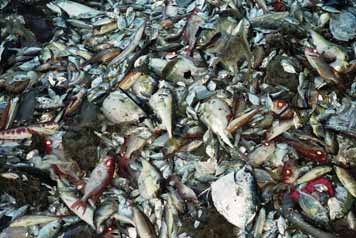
Bycatch from shrimp trawling is dominated by
may consist of over several hundred teleost species
large volumes of fish.
and outweigh the shrimp catch by 20 to 1 or more.
No other fishing method comes close to matching
meat, eggs and shell. Many countries have also
such discarding and wastage of marine resources.
responded to threats posed to these animals by
requiring specific protection within waters under their
Threatened and endangered
jurisdiction. This has led to a range of protective
species
measures including restricted local trade and
consumption of turtle products, protection of nesting
Shrimp trawling is also having a serious impact on
sites and the mandatory use of turtle excluder
sea turtles. In some shrimp-trawl fisheries several
devices (TEDs) in shrimp-trawl fisheries.
thousand turtles are caught and drowned each year.
This impact, combined with other human activity
Other bycatch species that are under threat from
such as long line fishing, hunting and coastal devel-
shrimp trawling include sharks, dugongs, sea
opment, has resulted in six of the world's seven
snakes, sea horses, coral and some fish species. In
species of sea turtle being listed in the 2003 IUCN
some instances these animals are protected by law
World Conservation Union Red List of Threatened
and their capture is illegal. In others, their capture is
Species. Five of these species are listed as critically
a waste of a resource.
endangered (high risk of extinction in the wild in the
immediate future) and one species is listed as
Global response to reduce
endangered (very high risk of extinction in the wild in
bycatch
the immediate future). The threat of these animals
becoming extinct has also led to the listing of all sea
In response to concerns over the capture of turtles
turtle species in Appendix 1 of the Convention on
and other bycatch in shrimp trawls, fishermen in
International Trade in Endangered Species (CITES).
many countries have taken steps to modify the trawl
This means that the international commercial trade
net and use bycatch reduction devices3. The most
of sea turtles is prohibited, including trade in turtle
common modifications are TEDs to prevent the
3In this guide the term `bycatch reduction device' refers to any device or modification made to the trawl net to reduce bycatch. Many countries
have developed regulations that define a TED as a device to exclude sea turtles from the trawl and a BRD (which is the acronym for bycatch
reduction device) as a device to exclude fish and other small bycatch from the trawl. In this guide, use of the acronyms TED and BRD is based on
these definitions, and the term bycatch reduction device includes both TEDs and BRDs and any other modification to the trawl to reduce bycatch.
A Guide to Bycatch Reduction in Tropical Shrimp-Trawl Fisheries
1
capture of turtles and other large animals and BRDs
such as the fisheye are also being used, and there
to prevent the capture of fish bycatch.
is ongoing development of a prototype trawl system
that not only reduces bycatch and seabed impact,
The United States (US) has played a leading role in
but has the potential to reduce fuel consumption.
these efforts by developing and testing a large
range of TEDs and BRDs. These efforts have been
In Australia, TED and BRD development has been
ongoing since the mid-1980's and the use of these
ongoing for well over a decade. In all tropical
devices is now a mandatory requirement in most
Australian shrimp fisheries TEDs are required to
shrimping grounds in the Gulf of Mexico and South-
protect turtles and most require the use of BRDs to
western Atlantic shrimp fisheries. Based on their
reduce the capture of unwanted fish and other
proven ability to exclude at least 97% of turtles that
bycatch. In nearly all Australian temperate water
enter a shrimp trawl, several TED designs have
shrimp fisheries, BRDs such as inclined grids,
been approved for use in these waters. Two types of
composite square-mesh windows and fisheyes are
BRD, the Jones-Davis BRD and the fisheye, are
required to reduce fish bycatch. Australia is also
currently approved for these waters based on their
one of only two countries (Brazil being the other)
ability to reduce fish bycatch, and in particular red
where the US embargo has been lifted from
snapper. The US has also been responsible for
individual fisheries following the introduction of an
accelerating the global development of TEDs in
effective turtle protection program.
tropical shrimp-trawl fisheries. This has been
In Southeast Asia, attempts are being made to
achieved through the introduction of an embargo on
reduce the capture of turtles and other bycatch,
wild-caught shrimp from countries that do not have
particularly the catch of juvenile fish of commercial
in place an effective sea turtle conservation
importance. The Southeast Asian Fisheries
program. This has forced many countries to respond
Development Centre (SEAFDEC) is an inter-
appropriately by requiring the mandatory use of
governmental organization that has been leading
approved TEDs by local shrimp fishermen.
the way in this region and has developed and tested
In Mexico, TED development and research also has
several TED and BRD designs. SEAFDEC has
a long history and these devices are now a
developed a Juvenile and Trash Excluder Device
mandatory requirement in the industrial shrimp-trawl
(JTED) and has tested it widely throughout the
fleets in the Pacific Ocean and Gulf of Mexico. BRDs
region with good success. They have also
developed a specialized TED to better suit local
fishing conditions called a Thai Turtle Free Device
(TTFD). Several countries in Southeast Asia,
including Thailand, Indonesia, Malaysia and the
Philippines, have been working toward the
mandatory introduction of TEDs into their shrimp-
trawl fisheries to reduce turtle capture and seek
removal of the US embargo.
In the Arabian Gulf several countries are also
currently testing and developing bycatch reduction
devices, partly due to concerns over the capture of
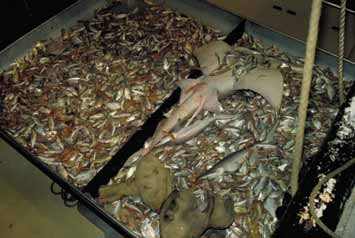
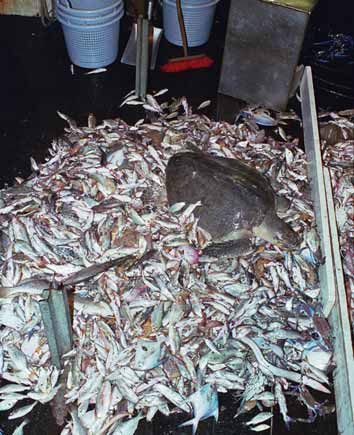
The catch on the right includes large animals
because a TED was not fitted to the trawl.
The catch on the left is the result of using a
TED.
2
A Guide to Bycatch Reduction in Tropical Shrimp-Trawl Fisheries
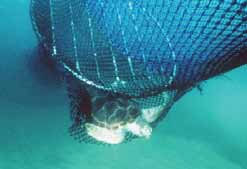
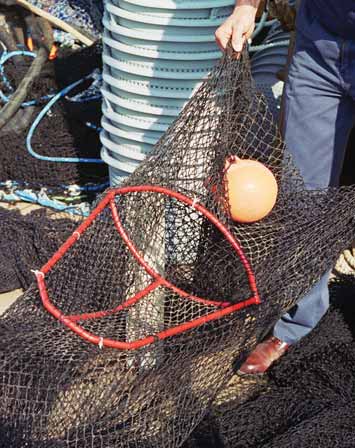
In many countries TEDs are being used to
exclude turtles and other large animals from
the trawl.
'Reduction of discards and environmental impact
from fisheries'. This project concentrates on four
tropical regions of the world, namely Latin America
including the Caribbean, West Africa, the Gulf
Region and Southeast Asia. It is funded by the
Global Environment Facility (GEF) and is imple-
mented by the United Nations Environmental
Programme (UNEP). Key objectives of the project
include minimising the capture of bycatch, such as
turtles and the discard of large numbers of small
turtles, fish and other animals, and the impact of
fish and other bycatch, and partly in response to the
US embargo. In Iran the testing of bycatch
A BRD is a trawl modification designed
reduction devices has been ongoing for several
primarily to reduce fish bycatch.
years, and the Northern Australian Fisheries TED
(NAFTED) and fisheye has proven to be an
effective combination to reduce bycatch. Recently
the performance of several bycatch reduction
devices was assessed in Kuwait on both industrial
and artisanal trawlers (dhows), including TEDs, the
fisheye, a radial escape section (RES), and a
square-mesh codend. The performance of these
devices was encouraging and their development is
continuing. In Bahrain there have also been efforts
to reduce small fish bycatch.
Many other countries in Latin America, the
Caribbean, Asia and Africa are also working toward
the development of effective bycatch reduction
devices. In Nigeria the fisheye has been effective in
reducing catches of juvenile fish and TED devel-
opment is ongoing, while Mozambique has recently
made TEDs a mandatory requirement in their
shrimp-trawl fishery. Research into bycatch
reduction is ongoing in Colombia, Costa Rica,
Ecuador, Guatemala, India, Pakistan, Trinidad and
Tobago, and Venezuela.
FAO response to reduce
bycatch
The FAO is at the forefront of TED and BRD
research in developing countries. Since 2002 FAO
has executed a five-year global project called
A Guide to Bycatch Reduction in Tropical Shrimp-Trawl Fisheries
3
shrimp trawling on the seabed. The project aims to
implementing these devices to suit their specific
achieve these objectives through the introduction of
needs. Fishery managers, policy-makers and
more appropriate fishing gear, and improved fishery
others will find this guide useful to help understand
legislation and management frameworks.
the design, use and application of bycatch reduction
devices in a shrimp-trawl fishery. This information
The FAO Guide to Bycatch Reduction in Tropical
will aid the smooth introduction of these devices into
Shrimp-Trawl Fisheries is a result of this project. It
a fishery and their rapid adoption by fishermen. It
is written primarily for fishermen and others inter-
will help the development of regulations and speci-
ested in the practical aspects of bycatch reduction
fications that are not only effective in reducing
devices, including their design, installation and
bycatch, but that also encourage fishermen to
operation. The Guide includes technical information
further develop these devices and optimize their
and construction details for many devices that have
performance. Importantly this information will also
proven to reduce bycatch in tropical shrimp-trawl
encourage high levels of compliance by fishermen.
fisheries, and provides technical details about their
selection, placement and maintenance. Flow charts
A glossary of terms may be found on page 100 and
enable fishermen to assess a TED or BRD and
an abbreviations list on page 110.
provide a framework to assist with testing and
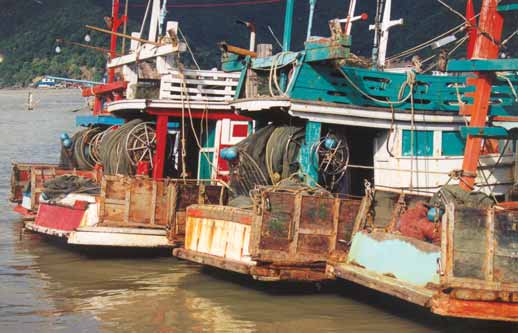
Shrimp fishermen all over the world are acting responsibly to reduce the capture of turtles and
other bycatch by using TEDs and BRDs. Note the TED on the middle trawler.
4
A Guide to Bycatch Reduction in Tropical Shrimp-Trawl Fisheries
What is Bycatch?
In its broadest sense, bycatch includes all non-
target animals and non-living material (debris) which
are caught while fishing. In shrimp-trawl fisheries
bycatch may be defined as anything the fisherman
does not intend to catch and may include turtles,
fish, crabs, sharks, stingrays, pieces of coral, weed
and seabed debris. Sometimes this is called
incidental or accidental catch.
Bycatch also includes animals and non-living
material that interact with the fishing gear but do not
reach the deck of the fishing boat. This includes
coral and weed that are contacted by the passing
ground gear and small fish that are selected out of
the net. These interactions are often brief, lasting no
more than a split-second, and could be a major
source of unaccounted mortality. This part of the
bycatch has not been well researched, but failure to
account for this mortality is counter to the notion of
sustainable fisheries and may threaten the health of
the ecosystem.
Shrimp trawling is a relatively unselective fishing
method because large volumes of bycatch are
typically retained in the codend comprising several
hundred species. In large industrial fisheries this
bycatch is usually discarded overboard, but in small-
scale fisheries it has commercial value and is used
either for human or animal consumption. In
Bycatch from shrimp trawling includes fish
Southeast Asia and West Africa this part of the
and other animals of all sizes.
bycatch is called trash fish. In Australia any part of
the catch that is retained for sale is called byproduct.
Sometimes catches of commercial species exceed
the processing or preservation capacity of the
fishing boat and the excess catch has to be
What are discards?
discarded. This might occur if the crew are unable to
Discards are that part of the bycatch that are
sort through the catch before the onset of spoilage,
released or returned to the sea either dead or alive.
if ice supplies are insufficient to cool the catch or if
It also includes all animals and non-living material
storage space is inadequate. Discarding might also
that interact with the fishing gear but do not reach
be the result of a practice known as high-grading.
the deck of the boat. The discarded catch may
This practice is where fishermen dump catch previ-
consist of species of low commercial value, under-
ously landed to make room for a more valuable or
sized commercially important species, juveniles and
fresher catch. For example, in some small-scale
seabed debris. Fishermen usually discard this part
shrimp fisheries, catches landed in the early part of
of the catch because it is not economical to retain it
a fishing trip may be discarded to make space for a
onboard or regulations forbid it from being landed.
similar-sized catch taken at the end of the trip.
A Guide to Bycatch Reduction in Tropical Shrimp-Trawl Fisheries
5
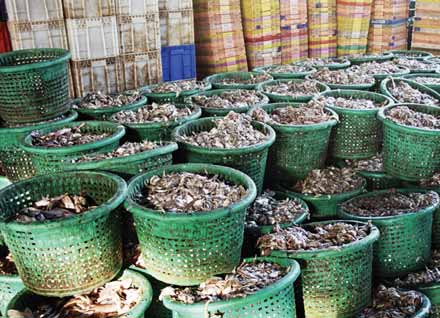
Baskets of trash fish ready for
sale. Trash fish is a threat to
sustainable fisheries and food
security because it includes
juvenile fish.
What is trash fish?
This term usually applies to small, undersized fish
and other animals that were traditionally discarded
overboard because they had no economic value.
However, in recent years this part of the catch has
become a substantial source of income for many
small-scale fishermen because it can be sold as fish
meal or food for cultured fish or shrimp. For some
fishermen, trash fish may generate over one-third of
their income from the catch. In fisheries where trash
fish are landed, codend mesh size may be as small
as 15mm and few animals escape. This practice
poses a threat to sustainable fishing in the region
because juvenile fish are also included as trash fish.
The term trash fish is misleading because it
suggests this part of the catch has no ecological or
commercial value. Clearly this is not the case.
6
A Guide to Bycatch Reduction in Tropical Shrimp-Trawl Fisheries
Why Reduce Bycatch?
The FAO has recently estimated that over 7 million
tonnes of fish bycatch are discarded every year by
commercial fishermen around the world. Shrimp
trawling is a major contributor to this total, and not
surprisingly, there is a call to reduce this bycatch or
to find ways of using more of it. There are also calls
to eliminate catches of other bycatch from shrimp
trawling including sharks, stingrays, and sponges,
as well as catches of endangered or protected
species, such as turtles, sea snakes and some fish.
The FAO Code of Conduct for Responsible
Fisheries requires fishermen worldwide to reduce
bycatch and the environmental impacts of fishing.
The code establishes principles and standards
applicable for responsible fishing activities. It specif-
ically requires that countries take steps to ensure
that fishing operations reduce bycatch and waste,
and that the environmental impacts of fishing are
minimized. The code is voluntary in nature, but it
does reflect global concerns regarding the need to
reduce bycatch. Similar codes of conduct have
been produced by other countries or inter-govern-
mental organizations such as SEAFDEC. These
codes require similar outcomes and are usually
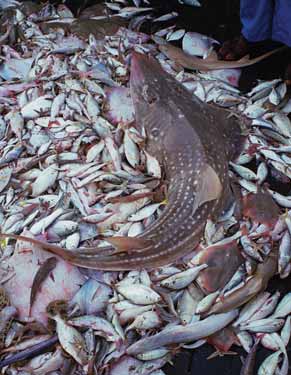
Bycatch from shrimp trawling usually consists
of many fish species and occasionally large
localized to suit regional or local needs. In addition
animals.
to codes of conduct, many countries have intro-
duced environmental policies requiring fisheries to
be managed under the principle of ecologically
sustainable development (ESD) and that bycatch
be reduced as much as practicable.
In many countries, fishermen have been acting
responsibly to these calls by testing or adopting
TEDs and BRDs to reduce bycatch. The use of
TEDs is now mandatory in many countries and the
capture of turtles (and other large animals) is
increasingly an issue of the past. There is now clear
evidence that TEDs have contributed positively to
the recovery of turtle populations. In the United
States, for example, there is documented evidence
that numbers of Olive Ridley turtles has increased
dramatically since the introduction of these devices
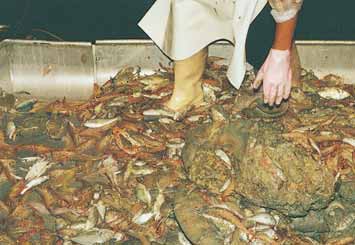
Bycatch also includes sponges and rocks and
to the region. This is an excellent outcome.
may reduce the quality of the shrimp catch.
A Guide to Bycatch Reduction in Tropical Shrimp-Trawl Fisheries
7
Shrimp fishermen are also increasingly using BRDs
of the trawl. In fact, shrimp fishermen have been
to reduce the capture of fish and other bycatch. In
using fishing methods designed to reduce the
many countries fishermen have been using these
capture of many of these animals, including:
devices for some time and there has been a
· trawls with a low headline height to minimise
substantial reduction in fish bycatch. However,
fish catches,
there is still much work to be done. Bycatch levels
are still too high and fishermen are still struggling to
· ground chain arrangements that reduce the
optimise the performance of these devices to
amount of seabed animals, rocks and debris
exclude the many species that are caught in a
taken,
shrimp trawl.
· avoidance of fishing grounds where bycatch is
A common perception by other stakeholders is that
known to be high, including grounds where
shrimp trawls sweep large expanses of the ocean,
coral, sponges and rocks are present,
catching all animals in the path of the trawl. Sure,
· using mesh sizes big enough to allow some
shrimp trawling is a relatively unselective fishing
small animals to escape, and
method compared to many other methods, however
not all animals in the path of the trawl are caught.
· using TEDs and BRDs.
Some animals pass under the ground gear while
While misconceptions exist and some fishermen
others escape around the side or over the headline
still catch large volumes of bycatch, there will be
continued pressure to further reduce bycatch.
Moreover, as other animals are listed for protection
from human impacts, fishermen will be required to
reduce their threat to these animals. If the bycatch
issue is not tackled appropriately it could lead to
eventual closure of sections of productive fishing
grounds, or worse, closure of whole fisheries. This
has already occurred in the United States and
Australia.
To successfully reduce bycatch fishermen must be
part of the research process. This will result in rapid
development of effective TEDs and BRDs and
higher compliance with the rules and regulations. In
addition, understanding the concerns of fishermen,
such as the costs of these devices and fears of
shrimp loss, are matters that must be accommo-
dated as they influence their uptake rate and
adoption of these devices.
A key to the successful involvement of fishermen is
to explore how they may benefit from reducing
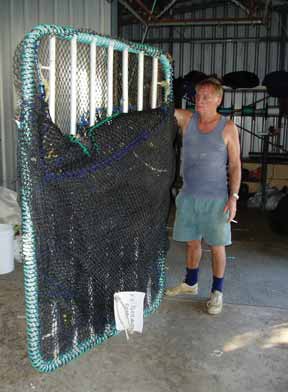
In some fisheries large TEDs are now being
used to rapidly exclude turtles and other large
animals from the trawl with little shrimp loss.
8
A Guide to Bycatch Reduction in Tropical Shrimp-Trawl Fisheries
bycatch. These benefits may include:
caught using trawls fitted TEDs and BRDs. As
consumers become more environmentally aware
· improved trawling and processing efficiency,
they are increasingly redirecting their seafood
· better product quality and marketing
purchases toward products that have been caught
opportunities, and
using environmentally-friendly fishing methods. This
is increasingly obvious in developed countries and
· protecting the marine environment and
there are signs of this occurring in developing
extending the life of the fishery.
countries.
Trawl and processing
Food security
efficiency
Shrimp trawling can pose a threat to food security,
Reducing bycatch may improve trawl and
particularly in developing countries. This is because
processing efficiency because:
many shrimp fishermen use very small meshes in
· trawl duration can be longer, thus decreasing
the trawl and codend so that the escape of small,
the time lost to repeatedly haul and deploy the
juvenile fish and other animals (trash fish) is difficult.
trawl,
The addition of a small mesh cover surrounding the
codend ensures that almost no animals escape
· wingend spread may be maintained for longer
from the trawl.
periods because the drag of the catch is less,
The capture and discarding of these animals is a
· damage to the codend caused by large animals
waste of a source of food. These animals are
and rocks can be reduced,
usually dead or dying when landed, and therefore
· processing (sorting) time should be quicker,
do not have the opportunity to reproduce or grow to
and
a size more suitable for human consumption. Given
an opportunity to grow and become adults these
· injuries to crew from dangerous animals will be
fish would better contribute to overcoming the
reduced.
Product quality and marketing
opportunities
Keeping heavy animals such as sharks and
stingrays out of the trawl means fewer damaged
shrimp in the codend and a more valuable shrimp
catch. Reducing the numbers of unwanted fish can
make sorting and processing a lot quicker,
contributing to better shrimp quality, particularly
during the heat of the day. These shrimp may attract
a higher price and lead to higher income for the
fishermen.
In some instances fishermen may gain new
marketing opportunities through the sale of shrimp
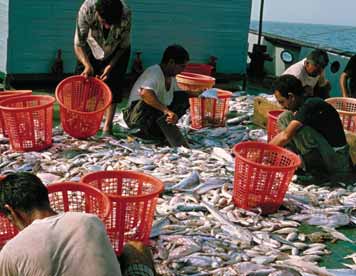
Large catches take a long time to sort and
are demanding on the crew.
A Guide to Bycatch Reduction in Tropical Shrimp-Trawl Fisheries
9
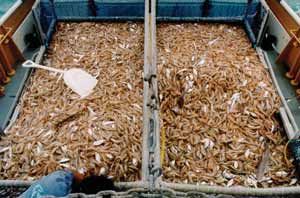
Clean catches of shrimp with little bycatch
means rapid sorting and a good quality product.
detrimental effect on some marine ecosystems and
may even damage the shrimp fishery itself. This is
because the environment that supports the shrimp
fishery consists of many linked parts, and damage
to one part may lead to changes in other parts of the
system. This can be a particular problem in fisheries
where fishermen rely heavily on the bycatch,
problem of food security in developing countries. In
including juvenile fish, to supplement their income.
addition, the capture of these animals is clearly a
threat to reproductive capacity of each species and
By reducing bycatch, shrimp fishermen will help to:
the health of the ecosystem. Retaining this part of
· ensure the health, diversity and integrity of the
the catch for sale may increase this threat because
environment,
fishermen will deliberately target these animals,
particularly if shrimp catches are poor. They are
· enhance shrimp stocks in some fisheries by
also less likely to be willing to use a bycatch
catching fewer juvenile shrimp, and
reduction device and forgo valuable income.
· protect fish stocks by keeping juvenile and
adult fishes out of the catch.
Protecting the marine
By using bycatch reduction devices and adopting a
environment
positive, pro-active attitude fishermen can reduce or
There is growing global concern that shrimp
deflect criticisms by other stakeholders. This
trawling is affecting the marine environment by
criticism is largely undermined when fishermen are
catching bycatch and damaging the seabed.
behaving responsibly to reduce bycatch and the
Studies suggest that shrimp trawling can have a
impacts of fishing.
By excluding bycatch fishermen can reduce the impact of shrimp trawling on the marine environment.
10
A Guide to Bycatch Reduction in Tropical Shrimp-Trawl Fisheries
The ABC of TED and BRD Design
This section answers some of the questions
The most common TED designs use an inclined
fishermen frequently ask about the design of TEDs
grid to prevent large animals from entering the
BRDs. It describes the major types of devices
codend. A panel or funnel of netting immediately in
currently available to reduce bycatch. The advan-
front of the grid may be used to direct animals away
tages and disadvantages of each device is also
from the escape opening and to maximise the
provided based on the assumption that excluding all
length of grid available to separate large animals
bycatch - both living and non-living - from the trawl
from the shrimp and small bycatch. Large animals
is a desirable outcome. In the subsequent section
are then guided by the grid toward an escape
details are provided about choosing and testing a
opening located either in the top or bottom of the
TED or BRD.
codend. Small animals (including shrimp) pass
through the bars of the grid and enter the codend.
What is a TED?
The escape opening is a hole cut in the codend and
In the context of this Guide, a TED or 'turtle excluder
is usually covered with a flap of netting or other
device' is any modification to a shrimp trawl
material to prevent the escape of shrimp.
designed to reduce the capture of turtles. These
devices are sometimes called a 'trawl efficiency
A less common TED design uses an inclined netting
device' because they can also prevent the capture
panel instead of a grid. The netting guides large
of other large animals including sharks, stingrays,
animals toward an escape opening in the top panel
jellyfish and some large fish.
of the trawl while small animals pass through the
meshes and enters the codend.
The Morrison TED is an example of a soft TED
The Nordmore Grid is an example of a hard TED
(note the square-mesh window also fitted to the
codend)
A Guide to Bycatch Reduction in Tropical Shrimp-Trawl Fisheries
11
What is the difference between
Soft TEDs use a non-rigid inclined panel of netting
a 'hard' and a `soft' TED?
to guide bycatch towards the escape opening in the
top of the trawl. Examples of this TED include the
Depending on the material used to construct the
Morrison TED, the Parker TED and the 'blubber'
inclined grid or netting panel, TEDs are either 'hard'
chute. Soft TEDs have been found to be less
or 'soft. A hard TED typically uses a rigid grid made
effective in excluding heavy sponges and other
of aluminium, steel or plastic, for example, the
seabed animals because these foul the netting. The
Nordmore grid and Super Shooter. These are the
Parker TED is now the only soft TED approved for
most common types of TED currently used
use in the Gulf of Mexico and South-western
worldwide. Hard TEDs have been criticised as a
Atlantic shrimp fisheries.
possible safety hazard to crews, particularly in
rough weather, but these fears are largely
unfounded.
Hard TEDs
Soft TEDs
Advantages:
Advantages:
· Very large escape opening may allow large
· Very large escape opening may allow large
leatherback turtles and other large animals
leatherback turtles and other large animals to
to be rapidly excluded
be rapidly excluded
· Exclude some seabed animals (sponges,
· May increase shrimp catch due to longer
corals etc.) and rocks (downward-excluding
towing time (less drag and fewer hauls)
TEDs only)
· May reduce sorting time
· May increase shrimp catch due to longer
· May improve shrimp quality by reducing
towing time (less drag and fewer hauls)
contact with large animals
· May reduce sorting time
· Reduce hazard to crews from large
· May improve shrimp quality by reducing
dangerous animals
contact with large animals
Disadvantages:
· Reduce hazard to crews from large,
· Poor installation may affect trawl performance
dangerous animals
· Damage, fouling or clogging of the guiding
Disadvantages:
panel by large animals and debris could lead
· Damage, fouling or clogging of the guiding
to shrimp loss
panel or funnel by large animals and debris
· Effectiveness depends on trawl spread
could lead to shrimp loss
· More difficult to repair than a standard trawl
· Fouling of escape opening by large animals
· Less effective than hard TEDs at excluding
and debris could lead to shrimp loss (a.k.a
heavy items such as rocks and sponges
TEDed)
· A little more difficult to handle than a
standard codend
· Rigid grid may be a safety hazard to crew
(depends on location in codend)
12
A Guide to Bycatch Reduction in Tropical Shrimp-Trawl Fisheries
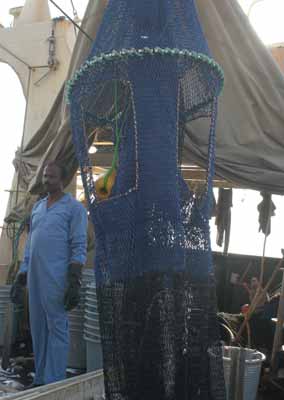
What are BRDs?
In the context of this booklet, a BRD is any modifi-
cation designed principally to exclude fish bycatch
from a shrimp trawl. These devices may also
exclude other animals and non-living material
(debris), but because fish usually dominate the
bycatch most BRD research has attempted to
exclude these animals from the trawl. Most BRDs
are located in the codend of the trawl as this is
where the catch is accumulated and the opportunity
to escape is high.
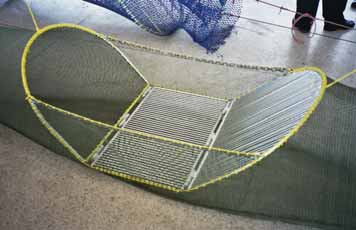
The JTED is a BRD that filters small fish
including trash fish from the catch but not the
larger shrimp.
How do BRDs work?
There are two categories of BRD depending on the
principle method used to exclude bycatch from the
trawl. The first category are BRDs that separate the
catch by size. These devices use inclined grids or
panels of netting to physically block the passage of
bycatch into the codend and guide it toward an
escape opening. Depending on their design, these
devices exclude bycatch either larger or smaller
than shrimp from the trawl. The grid-style JTED and
square-mesh codend are examples of BRDs that
exclude small animals from the trawl. TEDs can
also be included in this category because they
exclude large bycatch animals from the trawl.
The second category of BRDs are those that exploit
behavioural differences between shrimp and
bycatch. Most fish can swim in a moving net,
orientate to the direction of tow, and swim out
through an escape opening. This behaviour is
principally the result of fish responding to the visual
stimulus of the trawl and the generation of water
turbulence as the trawl is towed through the water.
Shrimp, on the other hand, generally exhibit little
directional swimming and passively enter the
codend. They respond principally to tactile stimuli
(touch) and have limited capability to swim in a
moving trawl and through an escape opening.
The design of the RES allows fish to swim
Examples of this type of BRD are the fisheye,
forward in the codend and escape through
square-mesh window, Jones-Davis BRD and RES.
the large escape openings.
A Guide to Bycatch Reduction in Tropical Shrimp-Trawl Fisheries
13
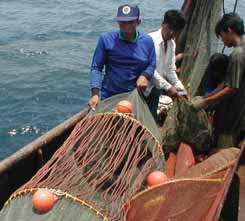
What is a JTED?
the ropes of the JTED. An alternative version of this
device is a cylinder of codend netting with a
JTED stands for 'juvenile and trash excluder device'.
stainless steel hoop fitted to both ends. The entire
This device is designed to exclude small fish - usually
cylindrical section is then inserted in the trawl ahead
juvenile or trash fish - from the trawl and maintain the
of the codend. Similarly to the first rope JTED, a row
catch of shrimp and large fish. The JTED consists of
of parallel ropes is used to provide escape openings
three sections hinged together; the first two sections
for the fish.
are metal grids and the third section is a metal frame
supporting a panel of fine-mesh netting. Small fish
The rope JTED is designed to allow fish
swim between the bars of the grids and escape. The
escape between the parallel ropes.
netting panel in the third section helps maintain the
orientation of the device, prevents shrimp surging
forward in the codend and escaping, and prevents
small fish from re-entering the codend. The JTED
was designed by SEAFDEC and has been tested in
shrimp fisheries in several countries including
Vietnam, Thailand, Malaysia, Myanmar, Philippines,
Brunei Durrussalam and Indonesia.
The SEAFDEC has also developed two rope
JTEDs. One design is a rectangular stainless steel
frame fitted with tightly strung parallel ropes. The
frame is inserted into the top of the codend with the
ropes oriented lengthways along the codend. Small
fish escape from the trawl by rising upward between
JTED
Advantages:
Disadvantages:
· Exclude small fish and trash fish
· Complex design compared to other devices
· May increase towing time (less drag and
(grid-style JTED only)
fewer hauls)
· High construction cost (grid-style JTED only)
· May reduce sorting time
· Hinges may become clogged with mud and
· Bar spacing can be reduced if grid is
other debris and affect grid orientation (grid-
attached to an outer frame
style JTED only)
· Rope spacing can be easily adjusted (rope
· Relies on small fish having the ability to
JTED only)
swim forward and upward through the
escape openings (rope JTED only)
· Relatively simple design and easy to use
(rope JTED only)
· May allow large, valuable fish to push ropes
aside and escape (rope JTED only)
· May increase shrimp catch due to longer
towing time
· Ropes may stretch and become slack (rope
JTED only)
14
A Guide to Bycatch Reduction in Tropical Shrimp-Trawl Fisheries
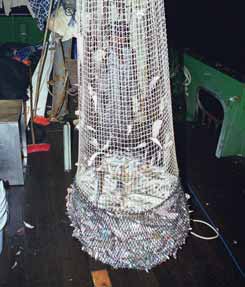
Can square-mesh codends
help reduce bycatch?
A codend constructed entirely from square-mesh
netting can allow a substantial amount of small fish
and other bycatch to escape. This is because
square-mesh netting stays open for the duration of
the tow, unlike diamond-mesh netting that closes
under the weight of the catch. The selection of
mesh size is very important and trial and error is
needed to find the mesh size that maximises fish
exclusion and prevents shrimp loss. Typically, this
mesh size will be 60 - 90% of the diamond mesh
size. Square-mesh codends can also be
constructed from knotted diamond-mesh material
and oriented sideways. However, this is a wasteful
use of netting material and the knots will eventually
slip and distort mesh geometry (unless ropes are
hung along the length of the codend to support the
netting under load).
The last section of this square-mesh codend
is replaced with diamond-mesh to prevent
shrimp escape.
The mesh openings of a traditional diamond-mesh codend collapse as it fills with catch and
prevents the escape of small fish. In contrast, the mesh openings of a square-mesh codend
retain their shape as it fills with catch and are available for fish to escape.
A Guide to Bycatch Reduction in Tropical Shrimp-Trawl Fisheries
15
Square-mesh codends
Advantages:
Disadvantages
· Small fish bycatch may escape
· Shape of fish affects escape rates, so some
· May reduce sorting times
species are more likely to escape than others
· May increase towing time (less drag and
· Relatively difficult to construct, particularly a
fewer hauls)
combined diamond- and square-mesh codend
· May increase shrimp catch due to longer
· Square-meshes may distort if not correctly
towing time
attached to a diamond-mesh netting
· Less reliant on behaviour and swimming
· More difficult to repair than traditional
ability to exclude small fish and animals
diamond-mesh
· May exclude small seabed animals and
· Material wastage and knot slippage, if
debris
constructed from diamond-mesh
Some fishermen are more comfortable using a
The location of the fisheye is important. If it is too
codend constructed from both square- and
close to the accumulated catch shrimp loss can occur
diamond-mesh because this may prevent the
during haul-back, particularly during rough weather.
escape of small shrimp. One option is to replace the
On the other hand, it should not be located too far
top panel of a diamond-mesh codend with square-
forward as fish swimming ahead of the accumulated
mesh. Another option is to replace the entire middle
catch are unlikely to reach the escape opening. The
section of the codend with a cylinder of square-
optimal position of the fisheye is difficult to predict
mesh netting. In this way the last part of the codend
given that performance is influenced by fish
is constructed from diamond-mesh netting so that it
behaviour, catch composition and volume.
closes under load and prevents small shrimp from
escaping. Presumably these BRDs are less
effective in reducing the catch of small fish and
The fisheye is designed to allow strong
other bycatch because there are fewer openings for
swimming fish to escape from the trawl.
these animals to escape and they may become
blocked by gilled fish, seaweed or debris. There is
also considerable work attaching the square-
meshes uniformly to the diamond-meshes.
What are fisheyes and how can
they help to reduce bycatch?
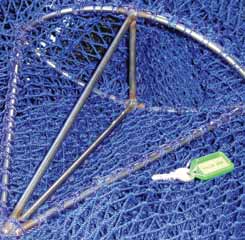
A fisheye is an elliptical steel or aluminium frame
fitted to the codend through which fish swim to
escape. Fisheyes are usually placed in the top or
sides of the codend so that strong swimming fish can
escape, while shrimp passively enter the codend.
Fisheyes must be inserted in the codend so that fish
swim forward to pass through the escape opening.
16
A Guide to Bycatch Reduction in Tropical Shrimp-Trawl Fisheries
Fisheyes
Advantages:
Disadvantages:
· Simpler design and cheaper than many other
· Will not exclude seabed animals and debris
BRDs
· Poor escape for species that behave in the
· Lower maintenance than other BRDs
same way as shrimp
· Easily moved to different positions in the
· Optimal position difficult to determine
codend
· May foul on the side of the vessel during
· May increase shrimp catch due to longer
hauling
towing time (less drag and fewer hauls)
· May reduce sorting times
· Easy to handle
A fisheye in the top of the codend
What is an RES and a Jones-
square-mesh material, although they may simply be
Davis BRD?
large openings cut into the codend. In the USA this
BRD is known as the 'expanded mesh design' or the
The RES was developed to exclude large fish
'extended funnel design' if the tapered funnel has
bycatch. It consists of a tapered netting funnel
an overhanging upper section at the trailing end.
attached to the codend surrounded by large escape
openings that extend radially around the codend
The Jones-Davis BRD is similar to the RES but the
circumference. All animals in the trawl pass through
escape openings are simply large holes cut into the
the funnel and are directed toward the middle of the
codend netting. A cone fish stimulator (deflector) or
codend. As fish exit the funnel, some turn and swim
a float located behind the tapered funnel may be
forward, and escape through the escape openings.
used to promote fish escape.
Water turbulence around the outside of the funnel
helps fish to swim forward and escape. The escape
openings are usually constructed from large
A Guide to Bycatch Reduction in Tropical Shrimp-Trawl Fisheries
17
RES and Jones-Davis BRD
Advantages:
Disadvantages:
· Large escape openings allow large fish to
· Will not exclude seabed animals and debris
escape
· Funnel may become clogged
· May increase shrimp catch due to longer
· More complicated design than most other
towing time (less drag and fewer hauls)
fish excluders
· May reduce sorting time
· May foul on the side of the vessel during
hauling
· More difficult to handle than a standard
codend
The radial escape section
What is a square-mesh
or shrimp will be lost. Conversely, if the square-
window and how might it
mesh window is located too far forward in the
codend, fish swimming ahead of the accumulated
reduce bycatch?
catch will be unable to swim forward and reach the
A square-mesh window is usually a panel of square-
escape openings.
mesh netting located in the top panel of the codend
Large square-mesh windows have also been tested
or trawl body. As fish pass through the trawl they
in the top panel of the trawl in the tapered section of
orientate directionally toward the device and swim
the trawl body immediately ahead of the codend or
through the square escape openings. The selection
behind the headline. The success of these windows
of mesh size is very important and trial and error is
has generally been limited because shrimp loss can
needed to find the mesh size that maximises fish
be very high, particularly if large volumes of shrimp
exclusion and prevents shrimp loss. Like the fisheye
enter the trawl simultaneously.
the size and location of the square-mesh window is
also important. The top of the codend is the
favoured position, as this reduces shrimp loss, and
it should not be too close to the catch in the codend
18
A Guide to Bycatch Reduction in Tropical Shrimp-Trawl Fisheries
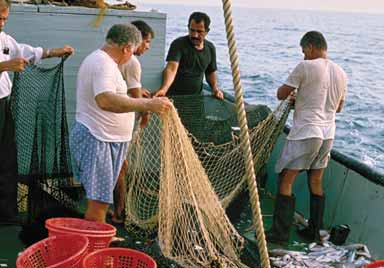
These fishermen are using a very large
square-mesh window to exclude fish
bycatch from the trawl.
The square-mesh window
Square-mesh windows
Advantages:
Disadvantages:
· Small fish bycatch may escape
· Shape of fish affects escape rates, so some
· Relatively simple design and easy to use
species are more likely to escape than others
· May reduce sorting times
· Square-meshes may distort if not correctly
fitted
· May increase towing time (less drag and
fewer hauls)
· Performance (if located in the codend) linked
to catch volume
· May increase shrimp catch due to longer
towing time
· More difficult to repair than traditional
diamond mesh
· Will not exclude seabed animals and debris
A Guide to Bycatch Reduction in Tropical Shrimp-Trawl Fisheries
19
What is a Fishbox?
device as the trawl is towed through the water. The
bulk movement of this water is forward into the
A fishbox is designed to alter the movement of
fishbox and inclined through the escape opening in
water in the codend. It is a box-like device fitted to
the bottom of the device. Many fish species actively
the top or bottom of the codend with an opening
seek regions of water turbulence because
through which fish can swim and escape. A plastic
swimming is easier and it is thought that the inclined
or metal plate (foil) is installed to the front of fishbox
movement of water helps direct fish out of the trawl.
frame and another to the top of the frame. These
This is a relatively new BRD that has been success-
plates generate water turbulence adjacent the
fully tested in the United States and Australia.
escape openings in the bottom and sides of the
The fishbox
Fishbox
Advantages:
Disadvantages:
· Easily installed
· Poor escape for species that behave in the
· Large opening allows large fish to escape
same way as shrimp
· May increase shrimp catch due to longer
· Limited knowledge of fish behaviour and
towing time (less drag and fewer hauls)
influence of foil design and orientation on
fish exclusion rates
· May reduce sorting time
· May foul on the side of the boat during
hauling
· Will not exclude seabed animals and debris
20
A Guide to Bycatch Reduction in Tropical Shrimp-Trawl Fisheries
What other modifications can
be used to reduce bycatch?
A range of simple rigging modifications to the trawl
may be used to reduce the capture of bycatch.
These modifications may not be suitable for all
fisheries, and many have not been widely tested,
but they may serve to stimulate new ideas. They
are:
· A triangular or diamond-shaped cut into the top
of the codend. This is a very simple modification
that can reduce the capture of strong swimming
fish.
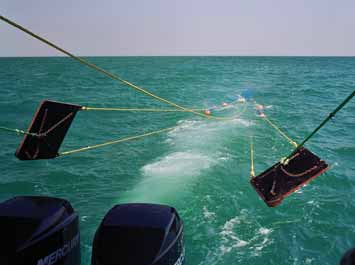
The use of long sweeps and headline floats
will increase the amount of bycatch that
· Changes to ground chain settings. This
enters a trawl.
modification may reduce the capture of large
sponges and seabed debris. For example,
compartments, each leading to separate
releasing the centre dropper chains of a 'texas
codends. This panel allows rocks, shell, crabs
drop' ground chain system may allow this
and other bottom-dwelling animals to be kept
bycatch to escape underneath the trawl
separate from the remainder of the catch. Either
footrope.
codend can be left open if desired or made of
· Longer sweeps between the otter board and
larger mesh so that small animals can escape.
trawl. This can be used to reduce the capture of
· Large mesh barrier across the trawl mouth. The
small sea urchins such as 'sea eggs', other
barrier is fitted between the headline and
benthic animals and seabed debris, although
footrope of the trawl to prevent large animals
sometimes this may increase fish catches.
from entering the codend. Fouling by large
· Headline height reduction. By reducing headline
animals or debris is likely to reduce wingend
height some fish will escape capture by
spread and catching performance.
swimming over the headline of the trawl. This
· Large cuts in the top panel of the net ahead of
modification could reduce catches of schooling
the codend. This modification has successfully
or large swimming fish. By reducing headline
reduced bycatch in daylight fisheries but been
height, the wingend spread of the trawl may
less successful during the night. In Australia this
increase and potentially increase catches of
modification is known as the Bigeye.
bottom dwelling shrimp (and offset any loss of
swimming shrimp).
· Square-mesh netting adjacent the footrope of the
trawl. This modification has been successfully
· A length of twine stretched between the otter
used in some fish-trawl fisheries to reduce the
boards to frighten fish away from the trawl. The
capture of less mobile seabed animals such as
twine will vibrate as it is towed through the
sea urchins and starfish. It has some potential for
water, warning fish of the approaching trawl and
use in shrimp-trawl fisheries, but has not been
giving them time to escape.
widely tested. The success of this modification
· A horizontal separator panel. This is a panel of
relies on shrimp passing over the square-mesh
net that divides the trawl into two
panel following ground chain contact.
A Guide to Bycatch Reduction in Tropical Shrimp-Trawl Fisheries
21
· Reducing the size of codend covers and
· Altering the joining (hanging) ratio of codend
chaffing gear. This modification will allow more
meshes to trawl meshes. By reducing the
codend meshes to be available for small
joining ratio the codend meshes are unable to
animals to escape.
close under load. This may allow more small
fish to escape near the front of the codend, but
· Increased codend mesh size. This will allow
may have limited effectiveness near the
more small animals to escape. It is one of the
accumulated catch.
simplest BRDs to implement but interestingly
one of the least favoured options, particularly
where small fish are retained for sale. A good
starting point for bycatch reduction research.
· Lastridge ropes 'hung' along the length of the
codend. This can allow codend meshes to
remain open and small fish to escape. Usually
at least four ropes are required, and they must
be about 5% shorter than the stretched length
of the codend. This modification is used mainly
for diamond-mesh codends and prevents
meshes closing under load from the catch,
although it can also be useful in square-mesh
codends, particularly if knotted material is used.
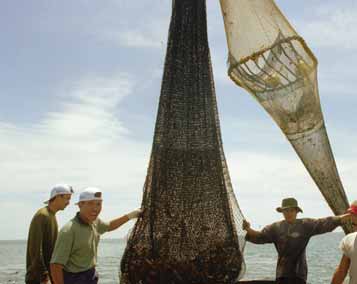
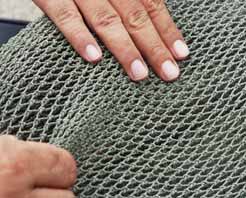
The mesh size above is small and
The effectiveness of this modification is likely to
unselective and few animals will be able to
be limited if long codends are used.
escape from the codend.
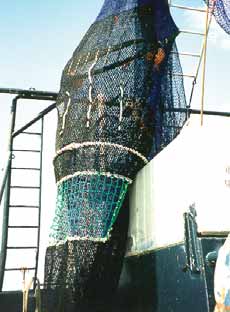
These fishermen are using a TED to exclude
large animals from the trawl. However the
small mesh codend and codend cover will
allow few (if any) small animals to escape.
22
A Guide to Bycatch Reduction in Tropical Shrimp-Trawl Fisheries
Choosing and Testing a TED or BRD
This section provides information on how to choose
bycatch to be retained and catch rates are ecologi-
and construct a TED or BRD that will suit particular
cally sustainable. Given the variable size, behaviour
operating conditions. Details on methods of testing
and composition of the bycatch it may be necessary
a device through collaboration with recognised
to use several different devices simultaneously to
research organizations are also provided. The
maximise bycatch reduction.
subsequent section answers frequently asked
Getting hold of a TED or BRD to test is the next
questions related to the installation of these
step. The technical data sheets at the back of this
devices.
guide provide construction details of the most
How do I choose a TED or
common types of devices available today. At this
BRD?
stage it might also be useful to contact other
fishermen, net makers or fishing technologists
The flow diagram on page 24 describes the main
experienced in the construction and use of these
steps for choosing and testing a TED or BRD for
devices. They can provide advice on the TED or
your particular needs.
BRD best suited for a particular fishery. It is
The initial choice of a TED or BRD depends on what
important that the device does not contravene any
type of bycatch is going to be excluded. The choice
existing regulations, particularly those related to the
is influenced by:
design, size or type of the device, and it must not
jeopardize the survival of endangered or threatened
· the need to protect endangered or threatened
animals.
species,
· the size and behaviour of shrimp being caught,
By using an upward-excluding TED and a
· the size and behaviour of bycatch,
square-mesh window, large animals and fish
bycatch can be excluded from the trawl.
· variations in catch composition,
· the desire to retain valuable bycatch,
· variations in the amount of bycatch caught
through the season and between fishing
grounds, and
· the cost of the device.
Clearly, the need to protect endangered or
threatened species is a high priority, and it is
essential that fishermen choose the correct TED or
BRD to exclude these animals from the trawl.
However, in some instances this choice may be
predetermined by legislation designed to protect
these animals. Knowledge of catch composition in
all areas of the fishery and throughout the fishing
season is also required to choose an effective TED
or BRD. This choice may be influenced by a desire
to maintain valuable bycatch, and this should not be
discouraged providing regulations allow this
A Guide to Bycatch Reduction in Tropical Shrimp-Trawl Fisheries
23





How to choose and test a TED or BRD
Identify type of bycatch to
be excluded
(see diagram on page 25)
Choose appropriate
TED or BRD
(see diagram on page 25)
Need a technical
description of the
YES
Read technical
TED or BRD?
data sheets
NO
Need help to make the
Contact the
S
YE
TED or BRD?
research
organisation
NO
Need help to collect data
to measure TED or BRD
Contact the
S
YE
research
Discard
performance?
organisation
NO
NO
S
YE
SEA TRIALS
Modify?
Does the TED or BRD
reduce bycatch and
NO
perform to expectation?
YES
Adopt
TED or BRD
24
A Guide to Bycatch Reduction in Tropical Shrimp-Trawl Fisheries


Choosing a TED or BRD
BYCATCH IDENTIFICATION
small fish
small fish
large fish
large animals
square-mesh
square-mesh
JTED
fisheye
fishbox
RES
TED
codend
window
The first steps toward reducing bycatch is to identify the type of bycatch to be excluded. This is
followed by selection of an appropriate bycatch reduction device. In this figure the bycatch that
can be excluded by the most common types of bycatch reduction device are shown. The dashed
line indicates the less common option used to reduce a particular type of bycatch.
What is the cost of a TED or
these devices it may be wise to select a cheap and
BRD?
simple device, such as a fisheye or square-mesh
window. This is a good choice because it is a
The cost of purchasing or constructing a TED or
relatively inexpensive way to get started and will
BRD varies considerably between devices. It is
help fishermen gain confidence and experience in
influenced mainly by material availability, cost, and
their use. It might also be useful to select a device
labour rates. A simple device will require less
that is currently being used by other fishermen to
material and time to construct so will be relatively
exclude similar bycatch species. In this way
cheap. For example, a square-mesh window can be
fishermen can be reasonably assured that the
constructed from scraps of netting and may cost no
device will reduce bycatch and shrimp loss will
more than a few dollars at most. It can also be
(hopefully) not be too high.
easily made by the fisherman. In south east Asia the
cost of a small steel TED may be less than US$100.
When fishermen first use a TED or BRD it is
In contrast, a large stainless steel or aluminium TED
possible that shrimp loss occurs relatively
in Australia or the United States may cost more than
frequently and is initially high. It is important not be
ten times that amount.
discouraged. Experience and knowledge are the
keys to efficient bycatch reduction.
Given little experience in the use and operation of
A Guide to Bycatch Reduction in Tropical Shrimp-Trawl Fisheries
25
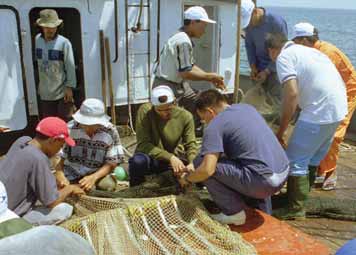
Collaboration between researchers and
fishermen is a key requirement for the
successful introduction of a TED or BRD into
a fishery.
introduce the JTED. This has resulted in the JTED
being tested onboard commercial shrimp trawlers in
many countries in the region, including training of
fishermen in the installation and operation of the
device. The development of an effective turtle
protection program and lifting of the US embargo
requires all shrimp fishermen in a country to use
approved TED designs. This will not happen if there
Who can help with the
is no collaboration with other fishermen and fishery
development and testing of
managers.
these devices?
Testing TEDs and BRDs
To fully assess a TED or BRD it is important to ask:
To fully assess the performance of a TED or BRD a
· is it working? (less or no bycatch),
detailed testing program is recommended. This will
need to be a rigorous process, with performance
· is it affecting the size of the shrimp catch?
targets in place to ensure that the device performs
(more or less shrimp),
as claimed and satisfies the concerns of other
· is it affecting the quality of the shrimp? (fewer
stakeholders. In Australia's Northern Prawn Fishery,
damaged shrimp),
a testing protocol has been established to help
fishermen test their own TED and BRDs and to
· is it easily handled onboard? and
identify new devices suitable for approval in the
· is there any change in trawl spread and drag?
fishery. The protocol has three assessment phases:
(longer towing time and greater efficiency)
· an initial assessment phase;
These are often difficult questions to answer so it
· a visual assessment phase; and
might be a good idea to work with a fisheries
research organization. Many of them have
· an at-sea testing phase.
experience in developing and testing a TED or BRD
The initial assessment phase involves the
and can assist with the selection, installation,
fisherman providing members of a special
testing and assessment of the device. While collab-
committee brief notes of the TED or BRD to be
oration is not essential, it could save considerable
tested, including a description of the device, its
time, effort and money.
operation and claimed performance. The committee
It is important to realise that the results of a collab-
- consisting of a fishing technologist, an
oration are usually more favourably accepted by
independent fisherman and the fishery manager -
other stakeholders because the testing program is
determines if the device has potential to perform as
usually more rigorous (thorough) and involves an
claimed. The committee will then either request a
independent party. An example of benefits gained
visual assessment of the device or recommend
by collaboration is provided by SEAFDEC working
commencement of the at-sea phase.
with researchers and fishermen in Southeast Asia to
26
A Guide to Bycatch Reduction in Tropical Shrimp-Trawl Fisheries
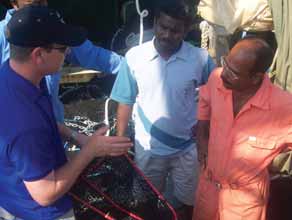
The visual assessment phase involves the
committee viewing the device or testing it in a flume
tank. This phase is required only if some doubt
about the claimed ability of the device exists or
further clarification is required. It also provides a
mechanism to assess complex or unusual TED or
BRD designs.
The at-sea testing phase involves the fisherman
being provided a permit to test the new device
under normal fishing conditions. The committee
By working together information is exchanged
provides instruction to the fisherman regarding
between researchers and fishermen.
testing conditions, duration and data collection -
these instructions are designed to minimize any
· providing fishermen a quick, simple and
disturbance to the normal fishing operation and
inexpensive means of assessing TED or BRD
recognize that fishermen usually have limited ability
performance onboard their fishing boat (they
to collect catch data. If the new device performs as
pay only for the device and feed the observer);
claimed then a trained observer may board the boat
· empowering fishermen to take greater control
for several weeks to enable an independent
assessment of the device.
of TED and BRD development (this improves
compliance with TED and BRD regulations);
Currently a new TED is deemed to have performed
satisfactorily if no turtles are caught during the
· providing a rigorous testing process that
entire at-sea testing phase. This ensures that any
satisfies the concerns of other stakeholders;
new TED design performs as well as those currently
· promoting the ongoing development of more
approved for the fishery. In the case of a BRD there
efficient TED or BRDs; and
is no bycatch target at present; the codend with the
· enhanced bycatch reduction.
new device simply needs to retain less bycatch than
a standard codend. It has been suggested that new
To test a specific TED or BRD, obtain more infor-
BRD designs should be tested against a currently
mation, discuss issues or to share results, any of
approved device. The new device would need to
the research organizations listed under `Contacts'
exclude the same amount of bycatch or more to
on page 108 can be contacted.
gain acceptance as an approved BRD. The new
device could also be the benchmark to compare the
performance of future devices, and in this way the
bycatch target would continue to increase. Once the
at-sea testing is completed the results are provided
to the committee for recommendation or otherwise
as an approved bycatch reduction device.
The benefits of the protocol include:
· a method of demonstrating the achievement of
reduced bycatch, while accommodating the
difficulties of testing under commercial fishing
conditions;
A Guide to Bycatch Reduction in Tropical Shrimp-Trawl Fisheries
27
28
A Guide to Bycatch Reduction in Tropical Shrimp-Trawl Fisheries
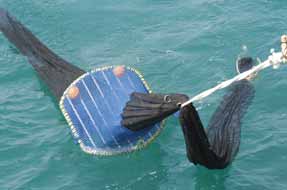
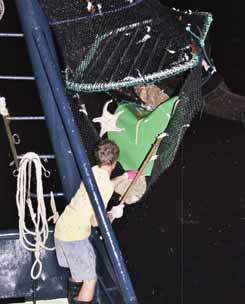
TED and BRD Installation
Frequently Asked Questions
Once a TED or BRD has been chosen, there are a
number of factors to consider that could affect its
performance. The first consideration will be where
to install the device in the trawl for optimal
performance and how it might influence trawl
deployment and hauling. This section attempts to
answer these questions.
Where should the TED or BRD
be installed in the codend?
The location of the TED or BRD is influenced by
codend size and rigging, catch volume, fish and
Choker lifts can prevent the catch from
shrimp behaviour and towing speed. Large codends
reaching the codend and may drown turtles if
usually allow greater flexibility in the location of
located ahead of the TED.
these devices, particularly if a small codend cover is
used. These codends also allow larger TEDs or
will need to be located in a position that allows fish
BRDs to be used with larger and/or more escape
to escape but not the shrimp. If located too far ahead
openings.
of the accumulated catch, fish will struggle to escape
A TED or BRD needs to be positioned so that shrimp
but shrimp retention will be good. If located too close
are retained in the codend and unable to swim
to the catch shrimp loss will be high. There is no
through the escape openings of the device. For
simple rule for determining the optimal position of
BRDs designed to exploit differences in swimming
these devices because catch volume is seldom
performance between fish and shrimp, the device
consistent. This makes determining the precise
location of a BRD difficult. However, as a starting
point the BRD should be located about 1 - 2 m
ahead of the accumulated catch when the codend is
hauled onboard. If shrimp loss is high then the
device can be moved further away from the catch.
Consideration of weather conditions will also be
required in determining the optimum position; in bad
weather shrimp loss may be high due to surging of
the catch in the coded. Rapid hauling of the codend
and maintaining `way' or forward motion should
reduce this problem.
How important is the position
and design of the lifting gear?
Poorly positioned or designed lifting gear are a
common cause of shrimp loss from trawls equipped
If the lifting gear is placed between the TED
and codend the removal of sponges and
debris from the trawl is a simple task.
A Guide to Bycatch Reduction in Tropical Shrimp-Trawl Fisheries
29
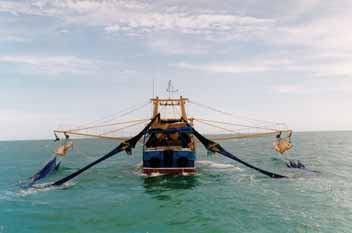
Locating the lifting gear between the TED and
codend ensures that the TED remains
outboard as the catch is retrieved and
minimizes the risk of injuring the crew.
accumulated catch, the lifting rope may need to be
located well ahead of these devices to ensure the
hauling rope (lazy-line) does not block the escape
openings. Care is also required that the hauling
rope does not become twisted. This will twist the
'elephant ears' and block the passage of animals
with a TED or BRD. A choker lift is not recom-
into the codend.
mended because it may constrict the codend and
To prevent shrimp loss the hauling rope needs to be
interfere with the performance of the device. If
long enough to stop the codend and bycatch
placed ahead of the device the constriction may
reduction device from twisting sideways under tow.
restrict the passage of large animals into the
As a guide, the first 6m (approximately 18 feet) of
codend and toward the TED or BRD. This may
the hauling rope should hang directly behind the
drown turtles and prevent the exclusion of other
lifting position at the codend when the gear is
bycatch from the trawl. The orientation of a device
streamed at the surface.
may also be affected by a choker lift in this location.
If the choker lift is placed aft of the device, the
Will trawl deployment be
constriction may impede the passage of shrimp into
affected by a TED or BRD?
the codend and they may move forward during
haul-back and escape through the TED or BRD.
In most cases, trawl deployment will not be affected
by a TED or BRD and the time taken to shoot the
Lifting ropes or 'elephant ears' have been tested
trawl away should not change. However, fishermen
both ahead and behind TEDs and BRDs. Lifting
must be careful to ensure that the codend is not
ropes located ahead of the device may restrict
twisted when the trawl is deployed. This may
bycatch from escaping if water pressure drags the
prevent the passage of shrimp through the codend
rope over the escape openings. Moreover, hauling
and they may be lost through the escape openings
and lifting of heavy codends may place consid-
of the device. By watching the device and visible
erable strain on rigid devices, such as a TED or
floats as the trawl is being deployed, a fisherman
JTED, and cause them to become bent or
can see if the codend is twisted and rectify the
damaged. It is better to position the lifting rope a
problem without wasting a tow. Increasing vessel
short distance behind these devices so it cannot
speed before deployment may cause the device to
block the escape openings and the risk of damage
sit up higher in the water and better indicate if the
is reduced. The device will also remain out-board as
codend is twisted. It may also flop to one side but
the codend is hauled and emptied, minimising the
will usually correct itself once the trawl has been
risk of animals and debris falling out the escape
deployed. Care must be taken to ensure that
opening and injuring crew. In this position the
turbulent wash generated by the trawler at higher
removal of debris, sponges and other animals
speeds does not cause the TED or BRD to flip over.
fouled by the bars of the grid is also a simple and
safe operation. As BRDs such as a fisheye or
square-mesh window need to be close to the
30
A Guide to Bycatch Reduction in Tropical Shrimp-Trawl Fisheries
Optimizing TED Performance
A well-designed and maintained TED should ensure
A summary of the important tips to optimize TED
that large animals and objects are rapidly excluded
performance is provided on page 42.
from the trawl and shrimp loss is minimal or non-
existent. This is influenced by the design,
Grid size (grid height and
construction and rigging of the various TED compo-
width)
nents under the full range of conditions experienced
Grid size influences the area of the grid that is
in the fishery. The maintenance of these components
available to exclude turtles and other large animals
is also important to optimize performance.
from the trawl. Both large and small grids are
similarly effective in excluding these animals
The diagram on page 32 highlights the various
providing they can quickly pass through the escape
design and construction parameters that influence
opening of the TED. Large grids are usually recom-
TED performance.
mended because they allow larger escape
However, research has found that TED performance
openings to be used. In turn, this allows larger
is not consistent in all areas of a fishery and that
animals to be excluded from the trawl. Large grids
performance can deteriorate with time. This has
also reduce the risk of shrimp loss because they are
made the task of optimizing TED performance
further from the escape opening as they pass
difficult, and highlights the need to seek expert assis-
through the grid (particularly if a guiding panel or
tance until experience and knowledge is gained.
funnel is used ahead of the grid). Furthermore,
Guiding funnel
Grid
Escape cover
Guiding panel
Escape cover
Grid
The various components typically incorporated into the design of a downward-excluding TED
(top) and an upward-excluding TED (bottom).
A Guide to Bycatch Reduction in Tropical Shrimp-Trawl Fisheries
31
when large grids are used the passage of shrimp
distance between the top and bottom of the outer
into the codend is less likely to be hampered by
frame of the grid when the codend is horizontal. In
partial blockage of the grid by animals or debris. If
contrast, the height of a bent-bar grid is usually the
shrimp cannot pass through the grid there is a risk
vertical distance from the bends in the bars to the
they may pass through the escape opening of the
outer frame of the grid when the codend is
TED and escape.
horizontal. For example, if a bottom excluding TED
is used this height is measured from the top of the
Grid size also affects grid angle and the ability of the
outer frame of the grid to the bends in the bars. This
escape cover (or flap) to seal tightly over the escape
slightly underestimates the true grid height but
opening. The correct grid size slightly distorts or
helps ensure the escape cover seals snugly against
enlarges the circumference of the codend immedi-
the grid.
ately around the grid. This will allow the escape
cover to be tightly held over the escape opening and
If a small codend is being used and a large grid is
against the grid by water pressure. The risk of
required it may be necessary to increase the
shrimp loss will be low. If the grid is too small, the
circumference of the codend. Some distortion of the
escape cover may flounder over the escape opening
codend is necessary but it should not be excessive.
and not seal tightly. The risk of shrimp loss will be
It should not be necessary to alter the extension or
high. The height of a rectangular grid is the vertical
body of the trawl to fit the new codend.
The various design and construction parameters that influence TED performance and efficiency.
Note that a failure to exclude large animals is likely to cause shrimp loss.
escape
opening
bar
escape
spacing
covers
grid
backwash
shape
funnels
Exclusion of large animals
TED EFFICIENCY
grid size
grid
angle
Retention of the shrimp catch
guiding
panel or
flotation
funnel
bent
grid
bars
orientation
grid
material
32
A Guide to Bycatch Reduction in Tropical Shrimp-Trawl Fisheries
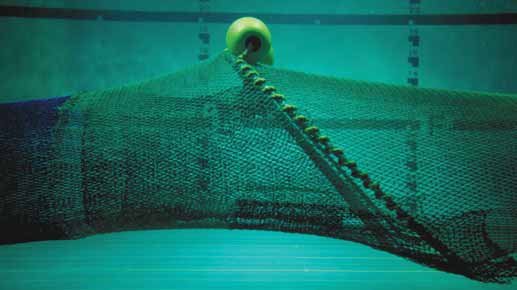
Grid shape
over the escape opening and prevent shrimp loss.
This is because the escape opening is attached to
The shape of a grid usually fits into one of three
categories; rectangular, oval, or a hybrid rectan-
the sides of the grid. The upper-most section of the
gular and oval grid (often referred to as a
grid now protrudes above the escape opening and
'tombstone' grid). Rectangular grids are the
the escape cover is held by water pressure tightly
simplest to construct. They have a relatively large
over the escape opening and against the grid. The
escape opening because it is similar in width to the
risk of shrimp loss is now reduced. A disadvantage
grid. A disadvantage of this shape is the risk of
of an oval grid is that the escape opening is usually
netting abrasion at the corners of the grid. This can
not as wide as that for a similar-sized rectangular
result in broken meshes, loss of grid angle and
grid of similar width. Attempts to increase this width
reduced TED efficiency. A rectangular grid will also
require the escape opening to be cut further around
distort and stretch the codend meshes adjacent the
the sides of the codend. As fewer codend meshes
corners of the grid. With time this will reduce grid
now support the grid, the risk of the remaining
angle and compromise TED efficiency.
meshes stretching and loss of grid angle is high.
Increasing the overall size of the grid is one way to
Oval or rounded grids better conform to the cylin-
overcome this risk and enable a larger escape
drical shape of the codend and the problem of net
opening to be used.
abrasion is reduced - any abrasion is spread over a
greater area of the grid. Oval grids may also
Tombstone-shaped grids can be used so that the
increase the ability of an escape cover to seal tightly
square end of the grid provides for a wide escape
A Super shooter TED tested in the flume tank at the Australian Maritime College (AMC). The
working height of the grid is sufficient to distort the circumference of the codend and the escape
cover seals tightly over the escape opening and against the grid. Note that grid height is
measured from the bends in the bars of the grid.
A Guide to Bycatch Reduction in Tropical Shrimp-Trawl Fisheries
33
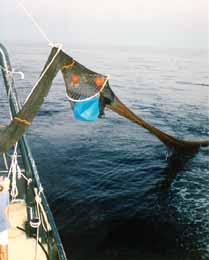
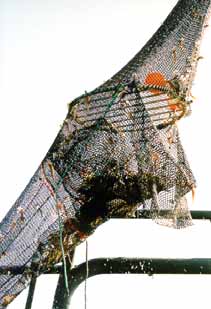
opening while the opposing rounded end of the grid
better conforms to the shape of the codend. In this
way, the grid provides a good compromise between
rectangular and oval grids. These grids can also be
used inverted with the rounded end of the grid
adjacent to the escape opening.
Bar spacing
A grid is usually constructed with an outer frame to
which parallel bars are welded. These bars are
spaced at an interval that allows large bycatch to be
separated from the catch and excluded from the
trawl. Bar spacing is typically between 100 - 120
mm, but 15 - 80 mm spacing has been successfully
used in some fisheries. A grid with a narrow bar
spacing will usually exclude smaller-sized bycatch
such as sponges, jellyfish and fish, and may reduce
the risk of these animals lodging between the bars
of a grid. However, a narrow bar spacing may
Oval grids conform well to the cylindrical shape
hamper the passage of shrimp into the codend and
of the codend. Note the escape opening
increase the risk of escape.
extends part way round the sides of the grid.
Straight- or Bent-bar grid
The bars of a grid can be either straight or bent.
Straight-bar grids (sometimes called flat-bar grids)
are the simplest to construct, but sponges and other
heavy objects may lodge against the grid adjacent
the escape opening where the bars meet the outer
frame of the grid. This can block the passage of
shrimp into the codend and push the escape cover
away from the escape opening. The risk of shrimp
loss will be high.
Bent-bar grids overcome the problem of grid
blockage because the bycatch is unable to lodge
against the outer frame of the grid. The bars are
typically bent about 10 - 20° at a distance approxi-
mately 100 - 200 mm from the outer frame of the
grid. Both rectangular and oval-shaped bent-bar
grids may also protrude above the escape opening
A tombstone-shaped grid is a compromise
between a rectangular - and an oval-shaped
(where the bars meet the outer frame of the grid),
grids. The canvas sheet in front of the grid is
and the escape cover should seal tightly and
used to assist the rapid exclusion of animals
prevent shrimp loss.
from the trawl.
34
A Guide to Bycatch Reduction in Tropical Shrimp-Trawl Fisheries
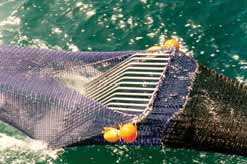
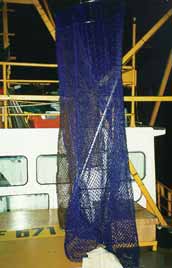
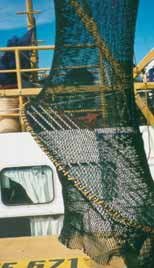
The AMC designed NAFTED is an example
of a rectangular bent-bar grid. Note that the
width of the escape opening is equivalent to
the width of the grid. This version of the
NAFTED has no escape cover and was
designed with a bar spacing of 60 mm to
exclude large jellyfish.
Grid angle
When the codend is horizontal, grid angle is
measured upward from a line parallel to the codend
toward the bars of the grid. This measurement
Grid orientation
applies to both bent-bar and straight-bar grids. Grid
The orientation of a grid refers to the direction large
angle has a strong relationship with grid size and is
animals and objects are excluded from the trawl.
one of the most critical factors influencing TED
Two options for grid orientation are usually
efficiency. Typically grid angle is between 45 and
available; either upward (top) or downward (bottom)
60°.
exclusion. A downward excluding grid is usually
If a low grid angle is desired then a large grid is
best suited to exclude heavy sponges, rocks and
needed to sufficiently distort the circumference of
other debris because the escape opening is located
the codend and ensure the escape cover fits tightly
in the bottom of the codend. An upward excluding
over the escape opening. If the grid is too short -
grid is best suited for fishing grounds where this
irrespective of grid orientation - shrimp can be lost
bycatch is seldom encountered. These grids can be
because the escape cover will not seal tightly
used without an escape cover to allow more fish to
against the escape opening. If a high grid angle is
be excluded, but a guiding panel is required to
desired then a smaller grid can be used but large
minimise shrimp loss. There is no evidence that
animals or objects may lodge against the bars of the
either orientation is less effective in excluding turtles
and other large animals from the trawl and retaining
the shrimp catch.
In some fisheries upward excluding grids have been
used with horizontal bars near the base of the grid.
This modification is designed to allow flatfish easy
passage into the codend. Care is required that this
does not impede the rapid exclusion of turtles,
sponges or other heavy objects.
The grid on the left lost substantial amounts
of shrimp due to a low grid angle (25°) and
loose fitting escape cover (brown netting).
The same grid (right) was re-hung at a
greater angle (45 - 50°) and caught more
shrimp than a standard net. Note how the
grid on the right expands the circumference
of the codend netting; this indicates an
appropriate grid height for the selected grid
A Guide to Bycatch Reduction in Tropical Shrimp-Trawl Fisheries
35
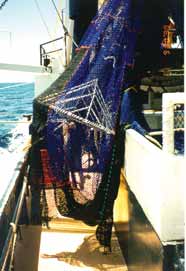
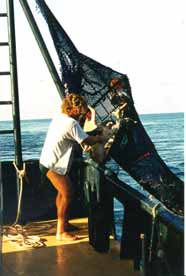
grid and block the passage of shrimp into the
codend.
Because netting adjacent to the grid can become
stretched and distorted over time, it is important to
regularly check that grid angle has not changed. The
rope used to support and bind the grid to the codend
may also become loose, allowing the meshes to
stretch and slide down the outer frame of the grid,
and contribute to loss of grid angle. It will need to be
tightened on a regular basis. To maintain grid angle,
short 'belly' ropes can be attached to the TED and
codend netting either side of the escape opening.
These ropes extend for about 1 metre ahead and
behind the grid. If netting near the grid stretches or
the rope bindings become loose, these ropes will
support the grid and prevent loss of grid angle.
Escape opening
The pyramid TED was designed to exclude
large animals through escape openings in the
An escape opening is a hole cut into the codend
top and bottom of the codend. Shrimp loss
directly ahead of the grid through which large
was high probably because the grid is too
animals and objects are excluded from the trawl. As
small and the escape covers were attached
too tightly to the codend.
a general rule, the larger the escape opening the
better a TED performs because large bycatch is
quickly excluded from the trawl. If a small escape
opening is used, the exclusion of this bycatch may
be delayed. This may cause grid blockage and
shrimp loss through the escape opening. All things
being equal, larger or wider grids allow larger
escape openings to be used.
Escape cover
An escape cover (or flap) is a piece of netting fitted
over the escape opening to help prevent shrimp
loss. It is usually sewn to the codend ahead of the
escape opening and partially down each side while
the trailing edge of the cover remains free. In this
way it operates much like a trap door, allowing large
animals to move the cover aside and escape. An
escape cover works best if it does not extend further
than 6 - 10 meshes past the grid, with no weight or
flotation added.
Small escape openings can block the grid
The knot orientation of an escape cover is crucial to
and result in shrimp loss.
36
A Guide to Bycatch Reduction in Tropical Shrimp-Trawl Fisheries
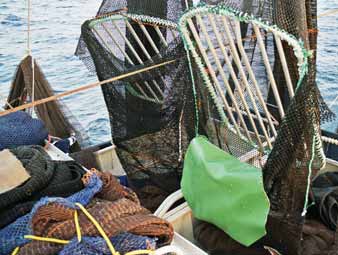
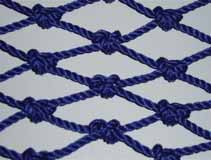
The TED on the left has a new escape cover
and the TED on the right has an old stretched
escape cover (and reduced grid angle). Note
the large, gaping escape opening and how
attachment of the escape cover has slipped
down the sides of the grid. This TED was
loosing a substantial amount of shrimp. The
canvas sheet was used to assist the rapid
exclusion of large animals from the trawl.
ensuring a snug fit and reduced shrimp loss, partic-
ularly if a small grid is used or grid angle is low. The
knots should be oriented so that water pressure
forces the cover to sit tightly over the escape
opening when the net is towed through the water. If
excluded from the trawl. There will also be a greater
an oval or bent-bar grid is used, water pressure will
number of knots pushed down by water pressure
hold the escape cover in contact with the part of the
and the cover will sit tightly over the escape
grid that protrudes beyond the escape opening. If a
opening.
rectangular or straight-bar grid is used this pressure
may not be sufficient to ensure the escape cover
An alternative to a large single escape cover is to
seals tightly over the escape opening and contacts
use two sections of netting that overlap along their
the grid. This explains why rectangular grids should
length over the escape opening. This is called a
be larger than oval grids for the same sized codend.
double cover flap design. It is designed to allow
rapid exclusion of very large animals such as
The repeated exclusion of large animals will stretch
leatherback turtles from the trawl. The benefits of
an escape cover width-wise over time and reduce
two escape covers include greater coverage of the
its elasticity. This can be a source of shrimp loss
escape opening and protection against shrimp loss
because the cover can no longer return to its
as animals escape from the trawl. There is also less
original shape and seal tightly over the escape
stretching and distortion of the netting in each panel
opening. The length of the escape cover is also
due to repeated exclusion of large animals. This
reduced and it may no longer cover the entire
should maintain the performance of the TED and
escape opening. To overcome these problems it is
reduce the need to regularly replace the escape
best to use depth-stretched knotted polyethylene
cover.
netting. This material is very elastic and the knots
are usually heat-set for greater stability. Depth-
stretched netting better conforms to the shape of
the codend and TED to seal tightly over the escape
opening. If a wider escape cover is used (more
netting) over the same sized escape opening, less
stretching of the meshes will occur as animals are
Towing
direction
As this netting panel is towed through the
water, water pressure acting on the raised
section of the knots forces the panel
downwards.
A Guide to Bycatch Reduction in Tropical Shrimp-Trawl Fisheries
37
Care is required to ensure this does not impede the
passage of sea turtles and large animals through
the TED. A better option is to replace the funnel with
new netting. It is worth noting that guiding funnels or
panels may not be required if the TED is fitted with
an escape cover.
The selection of mesh size in the construction of a
guiding panel or funnel is critical, particularly where
there is a high risk of encountering large starfish,
sponges or other fouling animals. These may block
the passage of shrimp into the codend or even
delay the exclusion of large animals from the trawl.
A poorly fitting escape cover may allow
Trial and error will be required to determine the
shrimp to escape because it does not sit
optimum mesh size. The use of heat-set polyeth-
snugly against the grid.
ylene netting is recommended to construct a
guiding panel or funnel because of its elastic
Guiding panel or funnel
properties. The netting should also be depth-
stretched so that it will expand laterally and allow
Guiding panels are sections of netting sewn into the
rapid passage of large animals toward the grid.
codend ahead of the TED to direct the catch away
Heavy canvas has proven to be a successful
from the escape opening. As the name implies,
replacement for netting material as it eliminates the
funnels are tapered tubes of netting that perform the
problem of animals fouling the netting material.
same task as guiding panels. They are critical in
However, because canvas does not stretch it can
preventing shrimp loss from TEDs that use no
tear away from the codend if an extremely large
escape cover. When an effective escape cover is
animal enters the net. This material can also be
used, the panel or funnel has been removed from
used ahead of the grid (on the bottom of the
the TED with no loss of shrimp catch.
codend) to prevent fouling and help the passage of
Poorly designed or fitted panels and funnels may
these animals toward the grid.
fail to direct the shrimp away from the escape
opening. The greater the distance between the
Flotation
funnel exit and the inclined grid, the greater the
likelihood of this happening. A quick and simple
Floats are sometimes used to compensate for the
solution is to extend the length of the funnel so it
weight of the TED or BRD, to stabilise the device,
contacts the bars of the grid. Over time the panel
maintain the geometry of the codend and prevent
will become stretched as large animals distort the
chafing of netting on the seabed. They are particu-
netting. In the case of a downward-excluding TED
larly important if downward-excluding TEDs are used
the netting will need to be replaced. In the case of
to ensure there is adequate clearance for turtles and
an upward excluding TED, weight (such as chain or
other animals to escape from the trawl. This could be
lead core rope) can be added to the end of the
a serious problem if a trawl is constructed from
funnel. This will allow the shrimp to exit the funnel at
polyamide (nylon) because this material sinks and
the bottom of the codend further from the escape
the codend may be very close to the seabed. As
opening. The weight should be uniformly distributed
polyethylene netting floats trawls constructed from
along the end of the funnel to prevent distortion.
this material are less likely pose such a risk.
38
A Guide to Bycatch Reduction in Tropical Shrimp-Trawl Fisheries
This TED is designed with a guiding funnel in front of the grid and a back-wash funnel behind the
grid. The guiding funnel helps prevent shrimp loss as they enter the codend. The back-wash
funnel prevents the catch from surging forward and being lost through the escape opening.
Back-wash funnel
Guiding funnel
The required amount of flotation differs between
Back-wash funnels
devices and construction material. For example, a
Back-wash is a term that describes the forward
fisheye constructed from steel or aluminium rod is
movement (surging) of the catch. This occurs when
usually light enough that only a small float is
towing speed is reduced and the trawl is hauled to
required to maintain codend geometry. A grid
the surface, particularly in bad weather. This can
constructed from lightweight aluminium tubing may
cause shrimp to surge forward and be lost through
not require flotation if fitted to a codend of buoyant
the escape opening of the TED (or BRD).
polyethylene netting. In contrast, a stainless steel
grid will require flotation to help counter its
Back-wash funnels are conical-shaped sections of
additional weight.
netting fitted inside the codend aft of the TED. They
are attached by their leading edge to the codend,
Floats should be attached to the upper half of a grid
while the trailing edge remains free or is attached by
and inside the codend. This will prevent tangling
a few meshes to the bottom of the codend. They
with the lazy-line or fouling on rigging as the codend
remain open under tow to allow the catch entry into
is hauled onboard. They must not interfere with the
the codend, but collapse when the trawl slows or is
escape cover, the passage of large animals from
hauled. This prevents forward movement of the
the trawl or the passage of shrimp into the codend.
catch in the codend. It is important that the trailing
Hard plastic floats are preferred over foam or
edge of the funnel cannot surge forward and
polystyrene floats as they are more resistant to
become fouled around the bars of the grid. It is also
crushing and do nor lose buoyancy in deeper
important that the funnel does not block trail behind
waters (greater than 25 - 30 m). Brightly coloured
the TED and block the escape openings of a BRD
floats can help with visual location of the TED when
the trawl is at the surface and help check for twists
Back-wash can also be a problem when the boat
in the codend.
makes a sharp turn with the trawl at the surface,
particularly if the codend contains a large volume of
A Guide to Bycatch Reduction in Tropical Shrimp-Trawl Fisheries
39
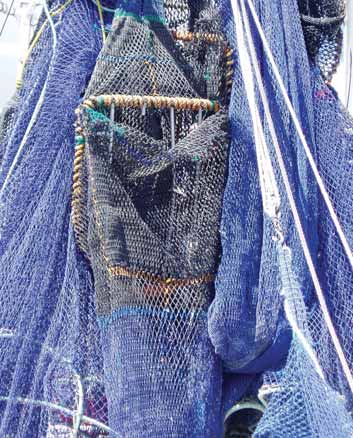
shrimp. This problem typically occurs when target-
damaging the grid. There is little evidence of these
fishing schools of shrimp and the boat turns sharply
grids being used in tropical shrimp fisheries. The
for a second shot.
use of SWR to construct a grid has been attempted
in Australia. This grid was known as the AusTED
Grid material
and it performed well. The SWR was encased in
Most grids are constructed from aluminium or
plastic to avoid problems with corrosion and crew
stainless steel to avoid problems of corrosion.
injury due to broken strands of wire. When located
Because stainless steel grids are heavy they are often
in the codend, the grid formed a concave shape and
constructed from smaller diameter rod or pipe than
grid angle was not consistent, although this did not
that used in an aluminium grid. Additional flotation
seem to affect performance. However, in fisheries
may also be required to provide adequate buoyancy.
where grid angle is legislated this will be
problematic.
Plastic and steel wire rope (SWR) has also been
used to construct a grid. In some temperate water
TED maintenance program
shrimp fisheries plastic grids are used so that the
It is clearly important that a TED is well maintained
net can be wound around a net drum without
to ensure peak performance. There are a number of
TED components that must be checked and
maintained on a regular basis. The following table
(overleaf) provides inspection details of these
components and the frequency of inspection.
Damage to these components will occur more often
if fishing in a region where large animals are
frequently encountered. If a TED is well maintained
there is no reason why it will not last for several
fishing seasons.
The broken bar of this TED may allow turtles
and other large animals to enter the codend
and be caught. Alternatively these animals
may become jammed in the grid.
40
A Guide to Bycatch Reduction in Tropical Shrimp-Trawl Fisheries
COMPONENT
INSPECTION
INSPECTION
SUGGESTED
DETAILS
FREQUENCY
ACTION
Guiding panel or
Check for mesh stretch or
Daily
Replace if necessary or
funnel
damage and detachment from
re-attach to codend
codend meshes
Grid bars
Bent or damaged bars, bar
Daily
Straighten if possible or
spacing
replace
Grid angle
Loss of angle
In the first week, daily for
Re-attach grid to
new grid then weekly
codend at correct angle
Grid bindings
Check for abrasion, frayed rope
Weekly
Replace or retighten if
strands and loose bindings
necessary
Escape opening
Damaged meshes adjacent the
Daily
Repair or reattach
opening; mesh slippage around
adjacent meshes to grid
frame of grid
frame
Escape cover
Stretched meshes and
Daily
Replace or reattach to
attachment to codend
codend
Backwash funnel
As for guiding panel or funnel
Daily
As for guiding panel or
funnel
Floats
Check strong attachment to grid
Weekly
Reattach to grid or
or codend
codend
This TED is well maintained and should rapidly exclude turtles and other large animals and
maintain the shrimp catch. The meshes around the grid (left photo) are evenly distributed and
grid angle is about 50°. The bars are straight and evenly spread. The escape cover (right photo)
sits tightly over the escape opening and is in contact with the bars of the grid. It also extends a
short distance past the escape opening.
A Guide to Bycatch Reduction in Tropical Shrimp-Trawl Fisheries
41
Tips for optimizing TED performance
The following table provides a summary of the important tips to optimise TED performance.
TED COMPONENT
TED TIP
Grid size
The size of a grid influences the size of the escape opening and the ability of the escape
cover to sit tightly over the escape opening. Grid size should be as large as possible. A
small grid will need to be fitted at a higher angle to distort the codend ensure good escape
cover performance.
Grid shape
The shape of a grid can affect the size of the escape opening, the exclusion of large
animals, shrimp retention and wear and tear on the codend.
Bar spacing
A small bar spacing allows exclusion of more bycatch species, although unfounded
concerns over increased shrimp loss has prevented most fishermen from using less than
100 mm bar spacing.
Bent bars
Bent-bar grids can improve the speed of large animal exclusion and consequently reduce
shrimp loss.
Grid orientation
This can be altered to target the exclusion of particular species groups. For example
downward-excluding grids are thought to be best suited to excluding heavy, negatively
buoyant items such as large sponges or rocks.
Grid angle
Incorrect grid angle can result in shrimp loss or poor bycatch reduction. The relationship
between grid angle and size is important to ensure efficient operation. Grid angle should
be 45 - 60º.
Escape opening
Larger escape openings improve the exclusion speed of large animals and reduce shrimp
loss, although there are issues with maintaining the shape and strength of the codend for
larger openings.
Escape cover
There are many misconceptions about these devices and they are a major cause of over-
tuning. They should be made of depth-stretched or heat set netting; not be too narrow or
too long, and not have weight or flotation added. They need to be replaced regularly.
Guiding panel or
They are easily blocked and are best used for fishing on 'clean' grounds or when no
funnel
escape cover is used. Canvas may also be considered as an alternative to netting.
Flotation
Floats assist grid stability and orientation, and help overcome the weight of the grid.
Backwash funnel
These prevent shrimp loss in bad weather. Care is required they do not block the escape
openings of a BRD.
Grid material
Aluminium and stainless steel are the most common grid materials as they do not corrode
and they resist damage.
42
A Guide to Bycatch Reduction in Tropical Shrimp-Trawl Fisheries
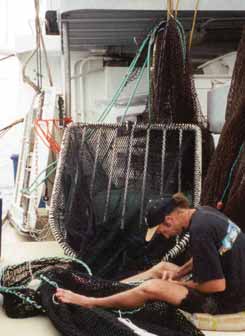
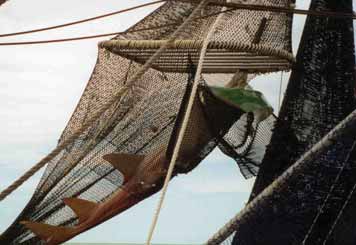
TED Performance & Operation
Frequently Asked Questions
This section answers many frequently asked
questions about the design and operation of a TED.
How large should my TED
be?
The TED will need to be large enough to satisfy the
fishery regulations and/or sea turtle protection
program. In many countries the size of a TED refers
to the height and/or width of the grid. In the United
States, however TED measurement refers to the
size of the escape opening as this dimension
reflects the size of turtles that are excluded from the
trawl. For those countries seeking to introduce an
effective sea turtle conservation program, a good
starting point would be to ensure that a TED meets
the US regulations and then adapt it to suit the
The exclusion of sawfish from a TED is
fishing operation and conditions of the fishing
difficult irrespective of grid orientation. Note
ground. A TED can always be made larger if the
this TED does not have a guiding panel or
conditions of the fishery warrant it.
funnel.
As a guide, a TED with a large grid is better
have further distance to swim to escape. Larger
because it has a larger filtering area and shrimp
grids are usually fitted with larger escape openings
so turtles and other large animals can be excluded
more quickly. If the grid is large enough to distort
(enlarge) the circumference of the codend, the
escape cover will seal tightly over the escape
opening and prevent shrimp loss.
There is no precise rule to determine optimum grid
size. However, as an approximate guide, the
circumference of a grid should be about 60% of the
stretched-mesh circumference of the codend. This
will ensure the grid distorts the codend and the
escape cover seals tightly over the escape opening.
TEDs have been used effectively measuring
between 52 - 75% of codend circumference. At
lower grid angles a higher percentage will be
required to distort the codend.
This TED has a large filtering area to reduce
the risk of shrimp loss. It will also have a
large escape opening to exclude large
animals.
A Guide to Bycatch Reduction in Tropical Shrimp-Trawl Fisheries
43
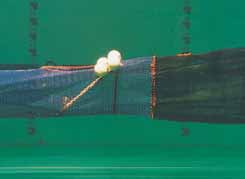
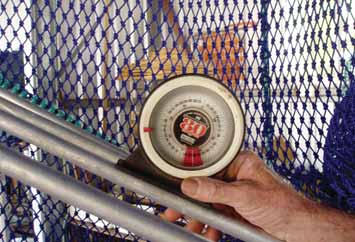
Is an upward-excluding TED
better to exclude turtles and
other animals?
Providing a TED is well designed and maintained,
there is no evidence that an upward-excluding TED
is more efficient than a downward-excluding TED to
exclude turtles and other large animals. There is
also no evidence that these animals cannot escape
from a downward-excluding TED because the
escape opening is too close to the seabed. The use
of adequate flotation will help ensure there is suffi-
This TED is used in estuarine fisheries in
cient clearance under a TED for these animals to
eastern Australia. The grid angle is about
escape.
45°.
If fishing in a location where the catch includes large
sponges, rocks and other debris a downward-
What grid angle do I use?
excluding TED is generally a better option. This is
Research has shown that the best grid angle is 45°
because it is difficult to guide heavy objects up the
- 60° for both upward- and downward-excluding
bars of an upward-excluding grid and through the
TEDs. At higher angles, the grid may become
escape opening. To exclude fish or jellyfish from the
clogged with debris, sponges and other animals and
trawl an upward-excluding TED may be desirable
prevent shrimp from entering the codend. At lower
because the escape cover can be removed to allow
angles, more shrimp might escape because the
rapid escape with minimal shrimp loss.
escape cover is unable to seal tightly over the
escape opening and against the grid. A longer
A protractor is a simple method of measuring
guiding panel or funnel may solve this problem. As
grid angle during construction of the TED. It
a last resort the size of the grid may need to be
should also be frequently used at sea to
enlarged or replaced with a larger one.
check that grid angle has not changed.
How do I install a grid at the
correct angle?
There are two simple techniques that can be used
to install a grid at the desired angle. The simplest
technique is to insert the grid into the tubular
codend or extension piece, hang it up and adjust
the grid until the desired angle is reached. A
protractor or bevel gauge can be used to measure
this angle. Care must be taken as the angle of the
grid may decrease by 5° or more after the escape
opening is cut into the codend. If required reposition
the grid to the desired angle.
A second technique involves counting the codend
meshes and using a calculator. This technique is
44
A Guide to Bycatch Reduction in Tropical Shrimp-Trawl Fisheries
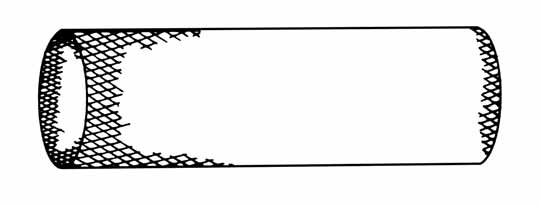
Trawl mouth
Grid length
Codend
x
Number of meshes
slightly more complicated but provides a useful
be largely determined by the size of the grid
estimate of grid angle if a protractor or bevel gauge
compared to the stretched mesh circumference of
is not available. The top of the grid is first attached
the codend. Failure to account for this will result in
to the seam joining the codend netting (the seam
inadequate grid angle and poor TED performance.
should be located along the top of the codend).
The following table is provided for those unfamiliar
From this position count halfway around the circum-
with the cosine (Cos) function. By inserting the
ference of the codend and mark this position
appropriate number for a given grid angle it is
(position X).
simply a matter of completing the above formula.
Then determine the number of meshes from this
position that the bottom of the grid needs to be
Angle ()
Cos Angle ()
attached to provide the desired grid angle. The
30
0.866
following formula can be used to estimate the
number of meshes required to produce this angle:
35
0.819
40
0.766
No. of meshes = Grid length x Cos angle () x 0.6
Mesh size
45
0.707
For example, if a grid measuring 100 cm was to be
50
0.642
inserted at 55° into a codend with a mesh size of
55
0.573
35mm the number of meshes required would be:
60
0.500
No. of meshes = 100 cm x Cos 55 x 0.6
3.5 cm
= 100 cm x 0.573 x 0.6
3.5 cm
How do I check grid angle?
Grid angle is measured from the horizontal to the
= 10 meshes
bars of the grid. An easy method of checking grid
The bottom of the grid would be attached 10
angle is to suspend the codend vertically, free of
meshes along the length of the codend to produce
twists, with the grid at eye level. A large protractor or
an angle of 55°. It should be noted that in this
bevel gauge is then inserted through the escape
example the meshes are assumed to be stretched
opening to measure the grid angle (in this position
to 60% of their total stretched length when the trawl
the angle is measured from the vertical). If a
is in the water. The amount of assumed stretch will
protractor is not available then a simple option is to
A Guide to Bycatch Reduction in Tropical Shrimp-Trawl Fisheries
45
use a thin, triangular-shaped sheet of timber
Can grid angle change during
measuring 8 cm, 8 cm, and 11.2 cm respectively.
a tow?
The angle between the two short sides of the
The angle of a grid should be checked regularly, as
triangle will measure 90° and the remaining two
the bindings securing the grid to the net may
angles will each be 45°. From one corner (between
become loose or new netting may become
a short and long side of the triangle) measure 4 cm,
stretched. Failure to do this will result in loss of grid
5.6 cm and 6.4 cm along one side of the triangle
angle and poor TED efficiency. In the worse case
and mark the triangle. Draw lines from these points
grid angle may reduce to 30° or less and shrimp
to the opposite corner of the triangle (repeat this on
loss will be high. Fishermen will blame the TED for
the other side of the triangle). Make a small notch or
this loss but poor maintenance is the real culprit.
hole in this corner and attach a short length of string
with a small weight attached. The angle between
A technique to prevent or delay loss of grid angle is
the 4 cm side and a line to the opposite corner of
to use 'belly ropes'. These ropes are attached to the
the triangle is 60°. The angles between the 5.6 cm
grid and the codend netting for a distance of 1 m
and 6.4 cm sides and a line to the opposite corner
forward and aft of the grid. Usually two ropes are
are 55° and 50° respectively. By resting the marked
used, one either side of the grid. If the ropes are
side of the triangle against a bar of the grid the
attached to a newly constructed TED they will take
weighed string will hang vertically. The position of
up the strain as the codend netting stretches.
the string at the marked side of the triangle is the
Braided rope is best for this purpose because it
grid angle.
does not stretch, although twisted rope will work
fine. Rope diameter is typically 8 - 14 mm.
A weighted string and a triangular-shaped
piece of timber can be used to make a simple,
inexpensive and effective grid angle gauge. In
this figure the grid angle is about 57°.
46
A Guide to Bycatch Reduction in Tropical Shrimp-Trawl Fisheries
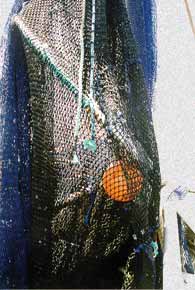
grid becomes blocked or if this method successfully
clears the grid until the trawl is hauled. The appli-
cation of this clearance technique therefore relies
solely on the judgement of the fisherman.
What bar spacing should be
used?
Clearly there is a need to ensure that bar spacing is
effective in preventing the capture of turtles and
other large animals while allowing shrimp to enter
the codend. A narrow spacing will result in more
animals being excluded from the trawl but it could
also result in shrimp loss. The US regulations
prevent the use of a bar spacing greater than 102
mm to protect turtles but in other countries a
spacing between 100 - 120 mm is common. For
example, in Nigeria bar spacing is 102 mm but in
Australia it is typically 120 mm, including those
Belly ropes (lastridge ropes) are a simple
fisheries where the US embargo has been lifted.
option to prevent loss of grid angle,
particularly as the meshes supporting the grid
Can I rapidly change bar
become worn and stretched.
spacing?
During a tow, large animals, rocks and other debris
There are two techniques available to rapidly
blocking the grid may reduce grid angle and prevent
change bar spacing. The first involves the
the escape cover from sealing tightly over the
attachment of a second grid to the main grid. The
escape opening. This will lead to shrimp loss. A well
bars of the second grid reduce the overall bar
designed and maintained TED can reduce this risk,
spacing available for bycatch to pass through. This
however this problem is sometimes unavoidable.
may improve bycatch reduction although care is
There may be no sign of a problem until the trawl is
required to ensure an equal distance between
hauled - the cause of the blockage may remain
adjacent bars. Failure to do this may increase
fouled in the grid and the shrimp catch will be poor.
shrimp loss and fouling of turtles and other large
A simple technique that can be applied to clear the
animals between the bars of the grid. It is for this
grid requires boat speed to be reduced suddenly for
reason that this modification is not recommended
several seconds whilst trawling. This may allow fish
for countries seeking to lift the US embargo.
and other animals that are blocking the grid to float
free as the trawl slows. It may even allow heavy
The second technique involves attaching the grid to
objects to fall through the escape opening of a
an outer frame of the same material. The frame is
bottom-excluding TED. Boat speed may have to be
attached to the codend at the desired angle and the
reduced to near zero to be effective but care is
grid is simply inserted into the codend and attached
required to prevent the otter boards from collapsing
to the frame using cable ties or twine. This
or sinking into the mud or sand. Unless the trawl is
technique allows a damaged grid to be exchanged
fitted with sophisticated acoustic or video
within minutes (as opposed to an hour or more for a
equipment it is not possible to determine when the
grid to be attached to a codend and bound with
A Guide to Bycatch Reduction in Tropical Shrimp-Trawl Fisheries
47
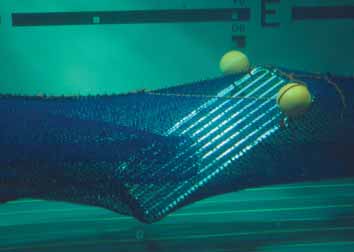
rope) and the option of using a different bar spacing
these turbulent regions to conserve energy, so if
to suit different locations of the fishery. The grid will
escape openings are placed near them, more fish
also be inserted at the correct angle because the
escape.
outer frame is still in place. This 'cassette-style'
The use of smaller mesh or canvas in the funnel
approach requires the grids to closely fit the outer
may help to reduce 'meshing' or entanglement of
frame and ensure turtles and other animals cannot
fish, starfish and other debris. Partial or complete
foul the grid. The US TED regulations do not permit
blockage can also occur and the funnel will need to
this modification as turtle flippers may become
be modified to permit the passage of large animals.
fouled in the space between the frame and grid.
Funnels and panels of netting must be checked
regularly for damage.
Why use a guiding panel or
funnel?
How can escape covers help?
Although not used with all TEDs (or BRDs), guiding
An escape cover may be placed over the escape
panels or funnels of netting can be fitted immedi-
opening of a TED to prevent shrimp loss but allow
ately ahead of the device to guide the catch away
large animals and other debris to be excluded from
from the escape opening and prevent shrimp loss.
the trawl. Escape covers are usually made from
They are either conical in shape or simply a tapered
netting or solid material such as plastic sheeting
panel of netting sewn at an angle into the codend.
and should be large enough to overlap the escape
opening. They may be held tightly over the escape
It was originally thought that a netting funnel would
opening by water pressure or, in the case of burst
increase the speed of water passing through the
TED and assist the passage of shrimp into the
panels, until a large animal breaks the holding
codend. For this reason it was called an "accel-
twine. They must be easily pushed aside by large
erator funnel". However, flume tank tests and sea
animals escaping from the trawl and readily return
trials have since found that when the funnel is made
to their original position immediately after escape.
from shrimp netting there is little acceleration of the
What does "being TEDed"
water. These tests also found an area of turbulent
water outside the perimeter of the funnel. Fish seek
mean?
When fishermen use TEDs and tow several trawls
at the same time, the shrimp catch in one trawl is
sometimes substantially less than that in the other
trawl. In the worse case the shrimp catch may be
less than half that in another trawl! Understandably
this is very frustrating and a major cause for
concern. In Australia, fishermen call this "being
TEDed" because the TED is blamed for the
reduction in the shrimp catch. In some instances the
cause of this loss is the inability to exclude large
animals and debris, such as fish traps or tree
A guiding panel or funnel is useful to guide
shrimp through the grid and into the codend.
However, they may not be required if an
escape cover is used over the escape opening.
48
A Guide to Bycatch Reduction in Tropical Shrimp-Trawl Fisheries
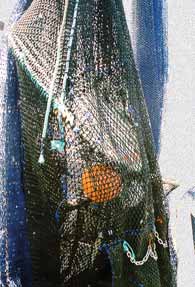
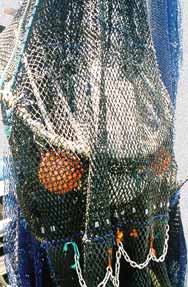
trunks, from the trawl. However, in the majority of
an excessively long escape cover, excessive grid
instances the real cause of this loss is poor TED
angle, and excessive amount of cover that is sewn
selection or operation in a specific area of the
to the codend netting. All of these modifications are
fishery. Examples of this include the use of a small
designed to help the escape cover seal more tightly
TED in a region where very large animals are
over the escape opening. They achieve this aim, but
frequently encountered, use of an upward excluding
they also serve to delay the escape of large animals
TED in a location where large rocks and heavy
from the trawl. The TED is now over-tuned. Large
sponges are caught, and poor TED maintenance.
animals now struggle to escape from the trawl and
the escape cover is pushed aside for longer
What is meant by "over-
periods. During this time the escape cover is unable
tuning a TED"?
to effectively prevent shrimp escape and shrimp
loss is high. The fisherman has now been TEDed.
Over-tuning refers to excessive TED modifications
The modifications that were initially used to prevent
made by fishermen in an attempt to reduce or
shrimp loss are now the major cause of shrimp loss!
prevent shrimp loss and being TEDed. Examples of
these modifications include heavy weights attached
Careful selection of a TED to suit operating condi-
to the escape cover of an upward excluding TED,
tions and good maintenance is essential to prevent
This TED has been over-tuned. Note that the escape cover has been lengthened (attached to the
original escape cover using blue twine) and chain and lead weights added (left photo). These
modifications were made by the fisherman in the mistaken belief they would solve his problem of
shrimp loss. Instead, they only served to increase grid blockage, delay the exclusion of large
animals from the trawl and further increase his problem. The initial problem with this TED was
not related to poor escape cover performance, but was the result of using an under-sized grid
and low grid angle (right photo). The grid was reinstalled at a higher angle and an escape cover
without any weights was used extending only 6 meshes past the grid frame. Shrimp loss was
eliminated and the incidence of grid blockage significantly reduced.
A Guide to Bycatch Reduction in Tropical Shrimp-Trawl Fisheries
49
being TEDed. The need to over-tune a TED is a
installation, operation and maintenance of the
signal that this has not been achieved and usually
device. Over-tuning of the TED to account for poor
an indication that there is a problem elsewhere with
escape cover performance is also a common cause
the TED. The TED must be carefully inspected and
of shrimp loss.
all components checked and replaced if necessary.
In particular the escape cover must be designed to
Do nets fitted with a TED still
readily move aside as a large animal is being
catch turtles?
excluded and return quickly to its original position
An efficient, well designed and operated TED
over the escape opening. If a bottom excluding TED
should exclude all turtles that enter a trawl.
is used a canvas sheet attached to the bottom of the
However, occasionally a turtle may enter a trawl a
codend may prevent fouling animals such as
few minutes before hauling commences and have
sponges and starfish from blocking the escape
insufficient time to escape through the TED. The
opening of the TED. In the worse case these
turtle is likely to be active and can be released alive.
animals could foul the escape cover and prevent it
from sealing tightly over the escape opening. A
On rare occasions small turtles may pass through
canvas sheet in this position may also assist the
the bars of the grid and be caught. This will require
rapid progress of large animals through the TED.
bar spacing to be reduced. This can either be
achieved by replacing the grid with one that has
It is important to note that over-tuning a TED may in
smaller bar spacing or inserting a second grid with
fact solve the problem of shrimp loss at locations
bars offset to the first grid.
where few large bycatch animals are encountered,
particularly if the escape cover is stretched or grid
What do I do if I catch a turtle?
angle is too low. However, when used at locations
Unless regulations prevent otherwise, all turtles,
where large numbers of these animals are encoun-
either dead or alive, must be released to the water.
tered, the risk of being 'TEDed' is high.
The release of live turtles from the trawl can be
The problem of over-tuning clearly highlights the
achieved using one of two methods. The first
difficulties fishermen face trying to optimise TED
method is to slowly haul the trawl out of the water so
performance across an entire fishery. An option not
that the turtle gently slides down the netting toward
widely practiced at present, but which may go a
the trawl mouth and into the water. Care is required
long way to avoiding the problem of shrimp loss, is
that the turtle does not become fouled in the netting
for fishermen to use different TED designs at
or is injured. The boat should be stationary and the
different locations of the fishery. For example, a
propeller not moving as this procedure is attempted.
downward-excluding TED might be used where
The second option is to gently remove the turtle
sponges are commonly encountered and an
through the escape opening of the TED. This will
upward-excluding TED for locations where they are
probably require a rope strop to choke the trawl off
less common. In this way, a TED suited to specific
ahead of the turtle. The strop can then be tied
conditions in the fishery is used and optimal TED
against the side of the boat and the codend lowered
performance and efficiency can be maintained.
onto the deck. Caution will need to be taken to
ensure the turtle does not fall onto the deck and
What are the common causes
suffer injury. If the turtle is active it should be gently
of shrimp loss from a TED?
returned to the water as previously described. If a
The most common causes of shrimp loss are grid
turtle is not active or appears dead it should not
blockage and delayed exclusion of large animals
immediately be thrown overboard. The turtle could
from the trawl. These are linked to poor selection,
be comatose and simply require some time (several
50
A Guide to Bycatch Reduction in Tropical Shrimp-Trawl Fisheries
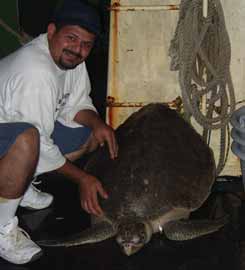
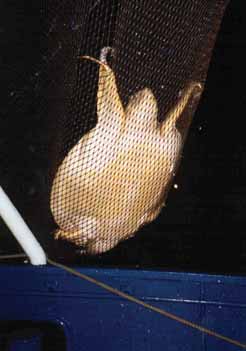
This turtle entered the trawl immediately
before haul-back and there was insufficient
time for it to be excluded by the TED. The
trawl was hauled onboard and the turtle
escaped alive through the trawl mouth.
encountered. The TED will need to have a large
escape opening so that this bycatch can be readily
excluded from the trawl. Grid angle will need to be
low to reduce the risk of grid blockage without
affecting the ability of the escape cover to seal tightly
over the escape opening.
Will a TED increase codend
drag?
The overall effect of the TED on codend drag has
not been quantified and remains a subject of further
research. However, the addition of a TED to a
codend is unlikely to have any noticeable impact on
codend drag and it should not make the trawl more
difficult to tow through the water. Even the smallest
shrimp trawler should be able to tow a TED. The
drag increase associated with towing the TED and
hours or more) to recover. Appendix 3 provides
having a distorted codend may in fact be more than
instruction on the resuscitation and release of
offset by a drag decrease associated with reduced
turtles that are comatose when hauled onboard.
high pressure (and associated water turbulence)
How does TED performance
differ between fishing
grounds?
As fishermen gain experience in the use of these
devices they may find it necessary to regularly adjust
or replace the TED to suit the various conditions of
the fishery. As previously mentioned an upward-
excluding TED is best suited to regions where heavy
animals and debris is not encountered. These TEDs
can also be used with the escape cover removed or
shortened to allow the escape of fish from the trawl.
A downward-excluding TED is best for regions
where heavy debris and large animals are frequently
If a turtle is caught it should be elevated so
that water can drain from its lungs. This may
take several hours.
A Guide to Bycatch Reduction in Tropical Shrimp-Trawl Fisheries
51
ahead of the catch, reduced capture of large
mention of catch weight. This is because catch
animals, and reduced catch-induced distortion of
weight has no impact on codend drag unless it
codend geometry.
results in the codend sliding along the seabed to
produce associated contact friction, alters the
To better understand why a TED may not increase
profile of the codend or the flow characteristics of
codend drag we need to understand the type and
the codend.
amount of drag that is experienced by the compo-
nents of a trawl (including otter boards, wires, net,
The addition of a TED will increase the profile
codend and ground gear). Drag is best thought of
(circumference) of the codend, and based on the
as a resistance force generated by movement of the
above expression this will increase the pressure
trawl components as they are towed through the
drag acting on the codend. Furthermore, the
water. It is a force that must be overcome by the
components of the TED, such as the grid, funnel,
thrust of the fishing boat to enable the trawl to be
floats and escape cover, will displace water as they
towed at the desired speed.
are towed along and also generate pressure drag
forces. Clearly it seems that the addition of a TED
As a trawl is towed along two types of drag are
serves to increase the overall pressure drag acting
present, pressure drag and friction drag. Pressure
on the codend. However, the effect of the TED is not
drag is caused by variation in water pressure acting
as simple as it seems, and there are several
on the trawl, and is the result of forced displacement
secondary effects that may compensate for a
of water through and around the components of the
presumed increase in pressure drag. Firstly, an
trawl. In the case of a codend, the accumulated
increase in the profile area of an object will increase
catch displaces water forward and sideways
the drag force only if the object is solid or maintains
through the meshes of the codend. This generates
water flow characteristics around the object. The
high pressure immediately ahead of the catch while
codend is obviously not solid, and because the TED
lower pressure exists adjacent and behind the
enlarges the circumference of the codend, the
codend - the codend is now experiencing pressure
meshes adjacent the TED are stretched open wider.
drag. Friction drag is caused by the viscosity of
This may improve the escape of water from the
water, and it occurs when water slides over the
codend and reduce the high pressure region that
surface of the trawl components. As friction drag
exists in front of the accumulated catch. In turn, this
acting on a codend (including the catch) is much
will reduce pressure drag and make the codend
smaller than pressure drag it is usually not
easier to tow through the water. A further reduction
considered important and is ignored.
in high pressure may be provided by water turbu-
The pressure drag acting on a codend can be found
lence trailing behind the components of the TED.
by the following expression, which shows the
This turbulence is the result of displaced water
factors that can cause it to change:
around these components and it will further reduce
the high pressure region ahead of the accumulated
Drag = 1/2 x sea water density x codend profile area x
catch. Finally, the exclusion of large animals by the
speed2 x Cd
TED may also reduce pressure drag by minimizing
where sea water density = 1 025 (kg/m3); codend
catch-induced increases in codend profile area.
profile area = area of a circle; speed = towing speed
(m/s); Cd = a dimensionless drag coefficient that
How heavy is a grid in water?
accounts for flow characteristics around the
All objects placed in water will either float (positively
codend, codend size and shape, and viscosity of
buoyant), sink (negatively buoyant) or remain at the
the water. Note that the expression makes no
same depth (neutrally buoyant). The following
52
A Guide to Bycatch Reduction in Tropical Shrimp-Trawl Fisheries
expression is used to determine the buoyancy
Does the buoyancy of a float
(weight) of a grid in water:
change with depth?
Grid buoyancy (kg) =
It is a common belief that the buoyancy of a float
changes with depth due to changes in water
( Seawater density - 1) x TED weight in air
Grid density
pressure. To see if this is true, we must first under-
stand that the buoyancy force acting on a float is the
where seawater density = 1025 kg/m3; grid density
difference between the lift force provided by the
= 7400 kg/m3 (stainless steel) or 2500 kg/m3
water and the weight of the object:
(aluminium). For example, a stainless steel grid that
weighs 20 kg in air has a buoyancy of -17.2 kg in
Float buoyancy (kg)
water (the negative sign in the calculation indicates
= float lift - float weight (in air)
that the grid sinks) while a 20 kg aluminium grid has
= (float volume x seawater density) - float weight
a buoyancy of -11.8 kg. All metal grids will sink, but
it is important to realise that they may weigh up to
= (4/3 x x float radius3 x 1025) - float weight
40 % less in sea water. This should be remembered
= (4/3 x 3.14 x float radius3 x 1025) - float weight
when confronted with the spectre of using large
Note that the above expression makes no mention
grids, for example, to meet the US regulations and
of water pressure. This is because water pressure
protect large turtles.
has no impact on buoyancy unless it reduces the
If the grid is fitted into a section of polyethylene
radius of the float or causes it to implode and allow
netting then the above expression can be used to
water to enter. A hard plastic float at 100 m will
calculate the buoyancy of the netting, provided its
therefore have the same amount of buoyancy as it
weight is known and a density of 950 kg/m3 is used.
does at 2 m providing it remains watertight. A
The difference between the buoyancy of the grid
polystyrene float on the other hand, will have its
and codend netting (and floats if used) is the overall
radius reduced by water pressure in deep water and
buoyancy of the entire codend. Note the weight of
its buoyancy dramatically reduced. Note also the
the grid calculated above will be reduced even
cubic relationship between float radius and float
further when fitted to polyethylene material. If fitted
buoyancy; a twofold increase in radius will result in
to polyamide (nylon) netting the weight of the grid
an eightfold increase in buoyancy.
will be greater because the density of polyamide is
about 1 140 kg/m3.
Are TEDs a safety hazard to
crew?
Why are floats used?
In many fisheries, concerns have been raised about
Many bycatch reduction devices are made of heavy
the potential safety hazard of using TEDs. These
materials such as steel or aluminium. Some
hazards include injury caused by TEDs striking
flotation is needed to stabilise the device, maintain
crew when codends are hauled aloft (particularly in
the geometry of the codend and prevent chafing of
bad weather), and rocks, fish and other bycatch
netting on the seabed. With downward-excluding
falling onto the crew below. Such hazards can be
TEDs, floats may help with the exclusion of large
minimized by careful handling of the TED and
animals by increasing the distance between the
awareness of the potential for objects to fall from
seabed and the escape opening. The floats must be
the TED. Careful location of the TED in the codend
placed so they do not block the opening. They can
will ensure it remains outboard as the codend is
also be used to indicate the orientation of a TED or
hauled onboard, thus further minimizing the risk of
BRD prior to deployment, particularly at night.
injury. It is interesting to note that in many fisheries
A Guide to Bycatch Reduction in Tropical Shrimp-Trawl Fisheries
53
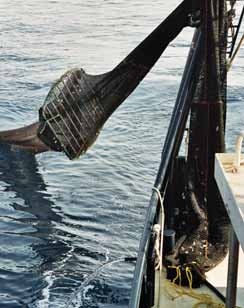
that require the use of these devices few injuries
Do TEDs weaken my codend?
have occurred. In fact, these devices can actually
Some fishermen have raised concerns that a TED
improve crew safety because they do not have to
can weaken the codend, particularly when large
manhandle large animals overboard. Rigged
catches are being hauled onboard. There is no
correctly, TEDs should not be a hazard to crew.
evidence that such a problem exists and it is difficult
to understand how this might occur. If the TED is
Can TEDs improve catch
correctly attached to the codend, any tension in the
quality and value?
codend meshes is evenly distributed throughout the
The exclusion of turtles, other large animals such as
netting. Moreover, if the lifting strops are located
sharks, stingrays, fish, sponges, rocks and other
between the TED and codend, the TED is unlikely
debris from the trawl can reduce damage to the
to hamper the safe hauling of large catches
shrimp catch. Shrimp can be damaged by crushing
onboard. In contrast, the hauling of large catches
in the codend or on the sorting tray or deck, or by
may cause the grid of the TED to be bent and
penetration by spikes or teeth.
damaged, particularly if the frame and bars of the
The time required to sort the catch and discard
grid are constructed from small diameter rod or
bycatch overboard can delay shrimp processing
pipe. If large catches are expected the grid should
and impair shrimp quality, particularly in the heat of
be reinforced or constructed from stronger material.
the day. Therefore, bycatch reduction has the
Does hauling speed affect
potential to substantially improve the value of the
shrimp catches?
shrimp catch.
It is important that the codend is hauled to the
surface and onboard as quickly as possible. Failure
Careful location of the TED ensures it
remains clear of the boat and minimizes risk
to do this may allow shrimp (and other valuable
of injury to crew.
animals) to move forward in the codend and
through the escape openings of the TED (or BRD).
Generally the longer it takes to haul the net onboard
the greater the risk of shrimp loss.
Shrimp loss can also be prevented during the
hauling process by ensuring the net maintains
forward movement through the water. This is
important when the codend is full and the accumu-
lated catch is close to the escape openings of the
device. It is particularly important in bad weather
when surging of the catch in the codend can result
in large numbers of shrimp escaping from the
device. A suggested option to reduce this problem is
to haul the trawl while heading into the sea. When
the otter boards have reached the trawl blocks, a
short burst of speed will help flush the catch into the
codend. Rapid retrieval of the hauling rope immedi-
ately afterwards will obstruct the forward passage of
shrimp toward the escape opening of the TED. A
back-wash funnel or panel can help prevent the
54
A Guide to Bycatch Reduction in Tropical Shrimp-Trawl Fisheries
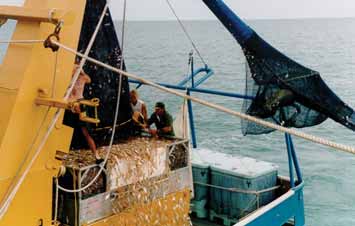
Over 14,000 kg of shrimp were caught in one
day and the TED and codend remained in
perfect condition.
catch from surging toward the escape opening,
particularly in bad weather or if hauling is slow.
How can a back-wash funnel
or panel prevent shrimp loss?
A back-wash funnel is a conical section of netting
located aft of a grid (or BRD) and is designed to act
jellyfish as they attempt to avoid contact with the
as a one-way valve. Shrimp and other animals
grid, and a bottom excluding TED will minimise the
freely pass through the funnel but the tapered exit-
capture of rocks, sponges and other debris.
opening prevents these animals from passing back
the other way. The end of the funnel may be
Although normally in combination with a BRD,
attached by a few meshes to the bottom of the
additional modifications that can exclude fish
codend to prevent it from surging forward when
through the escape opening of a TED includes the
hauling the trawl or in bad weather. The funnel may
use of 'hummer bars', 'cones' or floats. These
also be weighted at its trailing end to collapse when
devices are located immediately behind the grid
tow speed slows.
and are designed to deter fish from entering the
codend. The hummer bar is a wire grid strung
A back-wash panel performs a similar role to a
between a circular aluminium hoop. It is fitted verti-
funnel, except it is usually a rectangular- or trape-
cally to the codend and the wires vibrate or 'hum'
zoidal-shaped sheet of netting. It is attached along
as it is towed through the water. This is thought to
its leading edge and sides to the codend in such a
stimulate fish to stay ahead of the wires and seek
way that it guides the catch toward the bottom of
the escape openings of the TED. Problems with
the codend. There is only a small opening between
'hummer bars' include fouling or damage by
the panel and the codend so the catch cannot
sponges, starfish, weed and fish.
easily surge forward and escape. Care is required
to ensure that the panel does not trail back and
The 'cone' consists of a small wire hoop encased in
block the escape openings of a BRD.
plastic surrounding a cone-shaped section of
netting. This device is held in place behind the grid
Can TEDs exclude fish and
by several lengths of twine attached to the codend.
other bycatch?
Visual and physical contact with the cone stimulates
fish to swim forward and through the escape
TEDs are primarily designed to exclude turtles and
openings. A simpler option to stimulate fish is to
other large animals from the trawl but it is possible
replace the cone with a single float. As the trawl is
to exclude smaller bycatch. For example, an
towed through the water the float bobs about
upward excluding TED without an escape cover will
around and deters fish from entering the codend.
allow some fish to swim upward and through the
escape opening. This TED should also allow sea
In some fisheries seaweed may foul the bars of the
snakes to escape; an important outcome given
grid and stimulate shrimp escape. Bent-bar grids
several species around the world are threatened by
and so-called weedless grids are designed to
fishing activity. A grid with a smaller bar spacing
overcome this problem. As the seaweed contacts
should help exclude a high proportion of fish and
the grid it slides down the inclined bars toward the
A Guide to Bycatch Reduction in Tropical Shrimp-Trawl Fisheries
55
escape opening of the TED. When the seaweed
How will using a TED affect
reaches the bend in the bars the change in bar
economic performance?
direction causes the weed to fall off and (hopefully)
be lost through the escape opening.
All things equal, an increase in catching
performance should also increase economic
How will using a TED affect
performance because more shrimp will be landed.
shrimp catching performance?
Moreover, TEDs have the potential to increase catch
quality and reduce fuel consumption through
The use of a TED has the potential to provide
reduced drag. This will put more money into the
fishermen with gains in catching performance
pockets of fishermen. The initial outlay for a TED
because the negative impact of large animals on
could be several hundred dollars or more, and while
catching performance are reduced. For example, the
several will need to be purchased to ensure
capture of these animals has the potential to distort
adequate spares are available, gains in economic
the geometry of the trawl and adversely affect
performance could more than offset this outlay.
seabed contact, particularly if a small trawl is used.
Ignoring unforeseen mishaps, a TED should last
Clearly this will reduce the catch rate of shrimp.
several seasons depending on maintenance regime,
There are also some reports that large catches in a
quality of construction and care of operation.
codend can reduce the wingend spread of a trawl.
This is probably due to catch-induced drag forces
How will using a TED affect the
reducing the ability of the otter boards to maintain
way I manage my business?
high wingend spread. By excluding bycatch from the
The use of a TED has the potential to empower
trawl, codend drag will increase at a slower rate and
fishermen with greater control over their fishing
wingend spread may be maintained. In instances
operation, particularly through improved control over
where towing times are limited by the time it takes to
tow duration, catch volume and quality. Moreover, the
fill a codend, excluding the bycatch may allow tow
use of these devices demonstrates a positive, pro-
times to be increased. Therefore, shrimp catches
active attitude towards conservation of the marine
should also be increased.
environment and reduces associated concerns and
The exclusion of large animals from the trawl has
threats from other stakeholders. In some instances
the potential to minimize damage to the codend. If a
this may pave the way towards the eco-labelling of
TED is not used these animals may bite or break
the shrimp catch, and allow operators to maintain or
holes in the netting as they actively try to escape,
even increase market share.
and shrimp may be lost through these holes.
A TED can also impair the catching performance of
a trawl, particularly if becomes blocked for an
extended period. The capture of large animals, tree
trunks, 44 gallon drums, lost fish traps and other
debris has been responsible for catch loss in trawls
fitted with a TED (although some of these items
would damage the trawl and cause shrimp loss
even if a TED was not used).
56
A Guide to Bycatch Reduction in Tropical Shrimp-Trawl Fisheries
Optimizing BRD Performance
A well-designed and maintained BRD should
the escape openings of the device. For the same
ensure that fish and other bycatch is rapidly
reason, shrimp loss will be low. Clearly the ideal
excluded from the trawl and that shrimp loss is
location of a BRD is difficult to predict, given that
minimal or non-existent.
catch volume can differ widely between fishing
grounds and consecutive tows. For this reason trial
Traditionally, most effort to reduce bycatch in
and error is the only way to identify the optimum
tropical shrimp-trawl fisheries has focussed on the
location of a BRD.
development of TEDs, but attention is increasingly
being directed toward reducing catches of small fish
Knowledge of bycatch behaviour can also influence
and other bycatch.
the location of the BRD. The most common
example of this fish behaviour is the use of BRDs
Factors influencing BRD
located in the top or sides of the codend. These
efficiency
devices rely on strong swimming fish turning ahead
of the accumulated catch, swimming forward and
The efficiency of a BRD is a function of the ease
though the escape openings of the BRD. A fisheye
with which it can exclude fish and other bycatch
is an example of this type of BRD.
from the trawl and retain the shrimp catch. This is
achieved either by filtering the catch by size (so-
Other examples of BRDs that exploit knowledge of
called mechanical or physical separation) or
bycatch behaviour include ground chain modifica-
exploiting behavioural differences between the
tions to avoid the capture of crabs or sponges and
shrimp and bycatch (so-called behavioural
a reduction in headline height to allow fish to
separation). The ability of a BRD to perform these
escape over the trawl.
functions is influenced by the design and operation
of the device under the full range of operating condi-
Size of BRD
tions experienced in the fishery.
The size of a BRD is important because it influ-
The diagram on page 58 highlights the various
ences the number and size of escape openings
parameters that influence BRD performance. A
available for bycatch to escape. In turn, this influ-
summary of the important tips to optimize BRD
ences the volume and size of bycatch that can
performance is provided on page 63.
escape from the trawl. For example, a large square-
mesh window will provide a greater number of
BRD location
escape openings to be available for fish to escape.
Clearly, the size (length and circumference) of a
Most BRDs are fitted to the codend because this is
codend will play a role in determining the size of a
where the catch is accumulated and a higher
BRD that can be located in this part of the trawl.
proportion of the bycatch will encounter the device.
The location of a BRD in the codend is important. If
it is located close to the accumulated catch, bycatch
Size of escape openings
reduction will be good because relatively little effort
The size of a BRD escape opening is important
is required for the bycatch to swim through the
because it influences the size of the animals that
escape openings of the device. however, if the BRD
can escape. The mesh openings of a square-mesh
is too close to the accumulated catch shrimp loss
codend must be small enough to prevent shrimp
will be high, particularly when the trawl is hauled or
from escaping but large enough for small bycatch to
used in bad weather. If the BRD is located too far
escape. On the other hand, the large escape
forward of the catch, bycatch reduction will be poor
openings of the fisheye and RES will allow larger
because it will struggle to swim forward and reach
fish and other bycatch to escape from the trawl.
A Guide to Bycatch Reduction in Tropical Shrimp-Trawl Fisheries
57
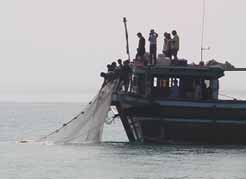
size of
escape openings
BRD location
BRD size
codend covers &
towing speed
chaffing mats
Exclusion of fish & other small bycatch
BRD EFFICIENCY
ertical
behaviour
vertical
haviour
behaviour o
f
of
distribution of
di t ib ti
f
shrimp & bycatch
hri
guiding panels
R
hauling speed
tention of the shrimp catch
behaviour of
shrimp & bycatch
weather
vertical
distribution of
shrimp & bycatch
The various parameters that influence BRD performance and efficiency.
Determining the optimum size of escape openings
a major cause of shrimp loss as they also swim
is difficult, particularly if the size and composition of
forward and escape. It is therefore recommended
the bycatch changes between fishing grounds and
that the trawl is hauled as quickly as possible.
throughout the fishing season. An estimate of the
required size of an escape opening is possible
Hauling a shrimp trawl by hand is a laborious
based on knowledge of catch composition, but at-
process that may allow large numbers of fish
sea testing using a trial-and-error approach will be
and shrimp to escape from the trawl.
required to accurately determine the optimum size
of these openings.
Hauling speed
If the trawl is hauled slowly to the sea surface and
onboard, fish and other bycatch may swim forward
and escape through the BRD. There is some
evidence that for some devices, such as the fisheye
and RES, a high proportion of the bycatch escapes
from the trawl during the hauling process. While
slow hauling is good for bycatch reduction, it can be
58
A Guide to Bycatch Reduction in Tropical Shrimp-Trawl Fisheries
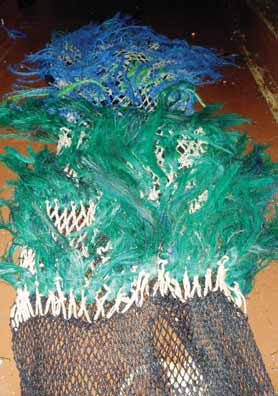
The frayed lengths of rope attached to the
codend cover help protect the codend from
damage. However, as they also block the
codend meshes the escape of small bycatch
is impossible.
Weather conditions
In bad weather the catch may surge forward in the
codend and escape. This may improve bycatch
reduction but it can also increase shrimp loss. This
problem occurs mainly when the trawl is being
hauled to the surface and onboard the boat. Hauling
the trawl with the boat heading into the sea or swell
may go some way to minimising catch surging and
shrimp loss. Hauling the codend with the sea
abeam would further reduce this problem but in bad
weather crew safety may be threatened.
Codend covers and chaffing
mats
These modifications are designed to prevent codend
damage due to seabed contact or attack by sharks
Vertical distribution of shrimp
and other animals. Codend covers are typically a
and bycatch
cylinder of old netting that surrounds the codend. It is
Most shrimp are distributed on or near the seabed
common for an old, worn codend to be used, and
and low-opening trawls are used to capture these
sometimes frayed lengths of rope are attached to
animals. The height of these trawls is generally
further prevent codend damage. In some fisheries
between 1 to 1.5 m, and is equal to otter board
codend covers surround the entire codend. The use
height because the headline is attached directly to
of these covers is an irresponsible practice because
the top of the otter board. Many fish escape from
they prevent the escape of small, juvenile fish and
these trawls by simply swimming over the headline.
other bycatch. If possible codend covers should be
However, in other fisheries, the trawl is separated
eliminated or reduced in overall size. This will allow a
from the otter boards by sweep wires that may
greater number of small fish to escape and also
measure 10m or more in length. Floats are also
increase the amount of codend available for locating
attached to the headline and the height of the trawl
the BRD.
may now approach 3m or more. While this
Chaffing mats are typically a thin sheet of rubber that
configuration is designed to catch schooling species
extends along the length of the codend. They are
of shrimp, or those with a more pelagic lifestyle,
usually attached only to the bottom of the codend to
these trawls are likely to catch greater amounts of
protect it from seabed contact and abrasion. Chaffing
bycatch. The sweeps are likely to herd fish toward
mats also reduce the number of codend meshes
the trawl mouth and fewer fish will now be able to
available for fish to escape, but are preferred
escape over the headline. Clearly this is
because they block fewer codend meshes. The size
undesirable, and a reduction in headline height and
of chaffing mats should also be reduced if possible.
removal of the sweeps should be considered to
A Guide to Bycatch Reduction in Tropical Shrimp-Trawl Fisheries
59
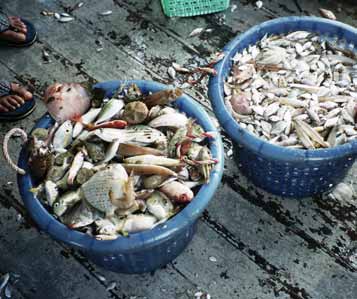
swimming although a few may be close to the
bottom panel of the codend. The most obvious
difference in distribution is the presence of sponges,
coral and bottom-dwelling fish entering the codend
near the bottom panel of the trawl.
Behaviour of bycatch and
shrimp in the trawl
Most attempts to reduce bycatch have involved
placing a TED or BRD in the codend of the trawl.
However, based on knowledge of bycatch and
shrimp behaviour it is possible to reduce some
bycatch before they enter the codend. For example,
modifying the ground gear or providing escape
openings in the bottom panel of a trawl can reduce
catches of crabs, starfish and sponges. Some
species of fish, including many pelagic species,
swim in the trawl mouth for a period and then rise
upwards to seek escape through the top panel of
The catch in the basket on the right was
excluded by a JTED and consists mainly of
the trawl (sometimes large numbers of these fish
small fish. The swimming performance of
can be seen caught in the meshes of this panel). A
these fish is poor and so they must be filtered
larger mesh size or even a square-mesh window
from the trawl using a grid or small mesh.
strategically placed in this location may be effective
in allowing these animals to escape from the trawl.
reduce this bycatch. Although this may not be
Many fish species can have their schooling
possible when schooling shrimp are being sought,
behaviour disrupted if they are herded or confined
the trawl should be modified when catch rates
into a small area, such as the tapered section of
decrease or other shrimp species are targeted.
netting immediately ahead of the codend. In this
When targeting shrimp that are scattered over the
location fish may respond by suddenly 'exploding' in
seabed, there is some potential to reduce headline
all directions and a square-mesh window or cylinder
height to less than 1 m. This can be achieved simply
may allow these fish to escape.
by re-attaching the headline to a lower position on
Efficient bycatch reduction devices can also be
the otter board. A lower attachment height may
developed to exploit differences in the swimming
cause the otter boards to stand upright and the
behavior of bycatch and shrimp as they pass
towing chains may need adjusting to increase otter
through the codend. These differences are currently
board heel. This modification has the potential to
exploited by the fisheye, fishbox, and RES. The
increase shrimp catches because wingend spread
escape openings of these devices are located in the
may increase in response to reduced trawl height.
top or upper sides of the codend ahead of the
There is little difference in the vertical distribution of
accumulated catch. Strong swimming fish are able
bycatch and shrimp in the codend. Underwater
to swim faster than the towing speed and they can
video footage indicates that these animals enter the
swim forward and out through the escape openings
codend at various heights. Shrimp are usually still
of the BRD. On the other hand, small fish are less
60
A Guide to Bycatch Reduction in Tropical Shrimp-Trawl Fisheries
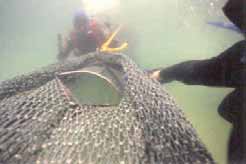
likely to escape because they do not have the
Knowledge of this behaviour is used in the design of
swimming capability to reach the BRD. Other BRDs
BRDs that allow the escape of strong swimming
are required to exclude these animals, such as the
fish. For example, the funnel of an RES extends
JTED or square-mesh codend.
past the escape openings to guide shrimp toward
the codend. Unlike most fish, shrimp are unable to
The design and shape of some BRDs produces a
swim forward and through the escape openings of
region of turbulent water flow (eddies) immediately
the device.
adjacent the escape openings of the device. Within
the region of turbulence some water is carried
Towing speed
forward and fish actively seek these regions
because swimming is easier (fish have also been
The effect of towing speed on BRD performance is
observed actively seeking these regions behind the
unclear and requires further study. In the first
bars of a grid, behind floats and even behind a
instance, it might be expected that BRDs that
codend where water turbulence can carry them
exploit differences in swimming performance
forward). The fisheye, fishbox and RES are BRDs
between bycatch and shrimp will be less effective at
that produce water turbulence to assist fish escape.
higher speed because fewer fish will be able to
The shape of the fisheye is designed to distort the
reach the escape openings of the device. The
codend meshes ahead of the escape opening, and
average size of fish that are caught may also
these meshes generate turbulent flow as the trawl is
decrease as fewer small fish escape from the trawl.
towed forward. Fish are 'attracted' to this region by
However, there is some evidence that the effect of
the turbulence and only need to swim forward to
increased towing speed on bycatch may not be so
escape. The funnel of an RES has a similar role. Not
straightforward. Some studies have found little or no
only does it concentrate the catch to the middle of
difference in rates of bycatch reduction with
the codend but it also serves to generate turbulence
increased speed, and this is thought to be due to
near the escape openings of the device. Fish then
increased water turbulence and velocity in the
swim forward and out through the escape
codend at higher speed. This in turn increases the
openings.The fishbox is designed with foils to
lateral movement of water out of the codend and
produce water turbulence as the trawl is towed
helps fish swim toward the escape openings of the
through the water. Similarly to the other devices, fish
device. Clearly there is a need to research the
are attracted to this region and can escape from the
relationship between bycatch reduction and towing
trawl.
speed in greater detail.
In contrast, shrimp have poor directional swimming
capability and they passively enter the codend. They
typically enter the codend at any height above the
seabed swimming horizontally in a random direction.
If they make contact with other animals or codend
netting they usually respond with rapid flexing of the
tail (tail-flicks) to propel themselves backwards and
away. This response has limited directional
capability.
The fisheye BRD relies on strong swimming
fish being able to swim forward and through
the escape opening of the device.
A Guide to Bycatch Reduction in Tropical Shrimp-Trawl Fisheries
61
Guiding panels
These are panels of netting located ahead of a BRD
guided away from the BRD and can only escape if
to guide shrimp away from the escape openings of
it can swim forward and reach the device. This may
the device. They are typically used in front of
reduce the escape of small fish and other bycatch.
fisheyes and square-mesh windows. The leading
However, it is possible that this criticism is unwar-
edge of these panels is attached to the top of the
ranted and in fact these panels actually increase
codend several meshes ahead of the BRD. The
bycatch reduction. This is because water turbulence
sides of the panel are generally sewn to the sides of
is generated as these panels are towed through the
the codend at an angle (for example, along a row of
water making it easier for fish to reach the BRD. All
bars). Care is required that they are attached well
things held equal, a higher proportion of smaller fish
forward of the BRD to ensure they do not cover the
could therefore be expected to escape. The effect of
escape openings of the device.
these panels has not been rigorously tested and
their actual impact remains unclear.
A criticism of these panels is that they also guide
bycatch away from the escape openings of the
If a TED is not used these panels may suffer
device. Bycatch near the top of the codend is
damage by large animals as they enter the codend.
BRD maintenance program
It is clearly important that a BRD is well maintained to ensure peak performance. The following table provides
inspection details of the various BRD components, the frequency of inspection and suggested action.
COMPONENT
INSPECTION
INSPECTION
SUGGESTED
DETAILS
FREQUENCY
ACTION
Escape openings
Damaged meshes; mesh
Daily
Repair or replace
distortion (square-mesh); mesh
meshes; re-attach to
slippage/detachment around
BRD
frame of BRD
Guiding panel or
Check for mesh stretch or
Daily
Replace if necessary;
funnel
damage; detachment from
reattach to codend
codend meshes
Floats
Check attachment to BRD or
Weekly
Re-attach to BRD or
codend netting
codend
Backwash funnel
As for guiding panel or funnel
Daily
Replace
Grid (JTED only)
Bent or damaged bars, bar
Daily
Straighten if possible or
spacing
replace
Grid angle
Loss of angle
In the first week, daily
Re-attach grid to
(JTED only)
for new grid; weekly
codend at correct angle
Grid bindings
Check for abrasion, frayed rope
Weekly
Replace/retighten if
(JTED only)
strands, loose bindings
necessary
62
A Guide to Bycatch Reduction in Tropical Shrimp-Trawl Fisheries
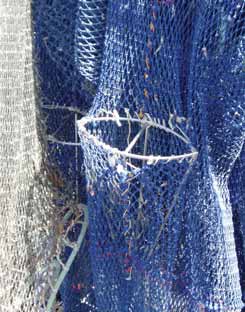
Tips for optimizing BRD performance
The following table provides a summary of the important tips to optimize BRD performance.
BRD COMPONENT
BRD TIP
BRD size
A large BRD will allow large escape openings to be used. The number of escape
openings may also be increased.
BRD location and
If located in the codend, the BRD must be close enough to the accumulated catch for
attachment
fish to escape, but not too close that shrimp loss is high. The BRD should be securely
attached to the trawl and correctly orientated.
Escape opening
The size of the escape opening(s) determines the size of the bycatch that can escape.
Guiding panel or
They are used to guide shrimp away from the escape openings as they pass through
funnel
the codend. They must not block the escape openings of the BRD.
Flotation
Floats assist BRD stability and orientation. They must not block the escape openings of
the BRD.
Backwash funnel
These funnels prevent shrimp loss as the trawl is hauled, particularly in bad weather.
They must not be located in a position where they can block the escape openings of a
BRD.
The attachment of this fisheye to the codend
is poor (uneven and loose bindings) and may
reduce its performance.
A Guide to Bycatch Reduction in Tropical Shrimp-Trawl Fisheries
63
64
A Guide to Bycatch Reduction in Tropical Shrimp-Trawl Fisheries
BRD Performance & Operation
Frequently Asked Questions
This section answers many frequently asked
to reduce bycatch. There are many fisheries where
questions about the design and operation of a BRD.
these regions are closed to fishing but there are also
many fisheries where they are not.
Can several BRDs be used
Does BRD performance differ
together?
between day and night?
There is no reason why several BRDs cannot be
used simultaneously (in addition to the TED). For
In many fisheries, BRDs exclude a higher proportion
example, a square-mesh codend could be used
of fish bycatch during the day time. This is thought to
with a fisheye so that both small and large fish are
be linked to differences in fish behaviour and their
excluded from the trawl. The handling and
improved ability to observe the BRD. It is therefore
operation of the codend would be little different to
important to measure the performance of these
that of a standard diamond-mesh codend and
devices during night and day for a full assessment of
would exclude fish of a wider size-range. Other
their capability.
possible BRD combinations to exclude both large
and small fish include a JTED with a square-mesh
Can I use a back-wash funnel
window or an RES with a codend constructed from
to prevent shrimp loss?
larger diamond-mesh.
There is no reason why a back-wash funnel cannot
In many fisheries the use of both a TED and BRD
be used to prevent shrimp loss. The funnel would be
is mandatory. This ensures that large animals such
located aft of the BRD and ahead of the accumulated
as turtles and sharks are excluded as well as
catch. When the trawl is hauled to the surface the
smaller fish and other animals.
tapered end of the funnel would collapse and prevent
surging of the catch toward the BRD. This is particu-
What is the simplest BRD to
larly important if hauling is slow or the weather is bad.
use?
If the funnel is located in this position there is no need
to have a second funnel aft of the TED.
Possibly the simplest modification to reduce bycatch
is to adjust the ground gear of the trawl. If a so-
How do I join diamond mesh
called texas-drop ground chain system is used,
to square-mesh netting?
increasing ground chain length by one or two links
will reduce the amount of benthic fish, shell and
To do this is quite simple but requires a few simple
debris that is caught. Increasing the length of the
calculations to determine the joining ratio of
dropper chains will also reduce this catch because it
diamond mesh to square mesh. Using the square-
can easily pass under the footrope of the trawl.
mesh window described in page 90 the first step is
Other examples of simple BRDs include larger
to determine the number of diamond meshes
codend mesh size, the use of flappers or large holes
required to be attached to the window. Note that is
cut into the codend, shorter sweep wires, or codend
important that all diamond and square meshes are
rigging such as lastridge ropes.
attached evenly and not distorted, and the window
is fully open.
While not classed as a BRD a simple way to prevent
bycatch is to avoid regions where bycatch levels are
When the trawl is towed the width or opening of a
known to be high. These areas include inshore and
codend mesh (ahead of the accumulated catch) is
estuarine regions where small fish are often
typically 20 - 30% of its mesh size. As the exact
abundant. Avoiding known fish and shrimp nursery
mesh opening is difficult to measure an assumed
grounds, including seagrass beds, is another option
opening is used; in this example a mesh width of
A Guide to Bycatch Reduction in Tropical Shrimp-Trawl Fisheries
65
25% (0.25) is assumed. The expression to calculate
Using the square-mesh codend on page 92 as an
the number of diamond meshes is;
example, the expression becomes;
No. diamond meshes =
No. of square mesh bars = 150 x 45 x 0.3 = 107 bars
19
no. square mesh bars x square mesh bar length (mm)
diamond mesh size (mm) x mesh opening
So, 107 bars are attached to the 150 mesh
No. diamond meshes = 6 x 75
45 x 0.25
extension piece at a ratio of 3 diamond meshes to 2
square mesh bars (and to account for the 7 bars,
= 40
picking up an extra bar every 20 diamond meshes).
Note that in this example a mesh opening of 30%
So, 40 diamond meshes are to be joined to the 6
(0.3) was assumed. This was simply to enlarge the
square-mesh bars across the width of the window.
square-mesh codend to accommodate large
Now, the next step is to determine the number of
animals or catches and to provide additional mesh
diamond meshes required to be attached to the
openings for small fish to escape.
sides of the window. As we have assumed the
codend mesh has a stretched width of 25%, the
How do fish behave in a
length of the mesh must be reduced accordingly. In
shrimp trawl?
this example, the mesh length is reduced to 97% of
As a trawl approaches, fish will be aware of the
initial length (if a mesh width of 20% is assumed the
sounds made by the trawl as it is towed through the
length is reduced to 98%, and if 30% is assumed
water and over the seabed. Despite this awareness
the length is reduced to 95%). The expression to
they seem unable or unprepared to respond to
calculate the number of diamond meshes now
these sounds by swimming away (a fortunate
becomes;
behaviour when fish are the target species). This is
confirmed by observations of fish under ultra low-
No. diamond meshes = 6 x 75
45 x 0.97
light conditions being run over by approaching trawl
ground gear. The reasons for this behaviour are
= 10
unclear, but may be linked to the noisy underwater
environment and the speed of sound through water
So, we need to attach 10 diamond meshes to the 6
(about three times the speed of sound in air). In this
square-mesh bars along the length of the window.
environment responding to sounds, even that of an
The above example is based on fitting a square-
approaching trawl, uses valuable energy and
mesh window of known dimensions to a diamond
increases the risk of predation from more immediate
mesh codend. However, if the number of diamond
threats. This means that fish mainly respond to the
meshes is known but the number of square meshes
visual and physical stimuli of an approaching trawl.
is not, for example, when determining the circum-
ference of a square-mesh codend to join to a
Fish in the water column may escape over or
diamond mesh extension piece, the expression can
around the approaching trawl or enter the trawl
be transposed thus;
mouth. Those fish in the trawl mouth may attempt to
swim with the trawl for a period of time. This is
No. of square mesh bars =
linked to a desire to swim with an object that has a
strong visual contrast with the background. It is
no. diamond meshes x diamond mesh size (mm) x mesh opening
called an optomotor reaction. If towing speed is
square mesh bar length (mm)
66
A Guide to Bycatch Reduction in Tropical Shrimp-Trawl Fisheries
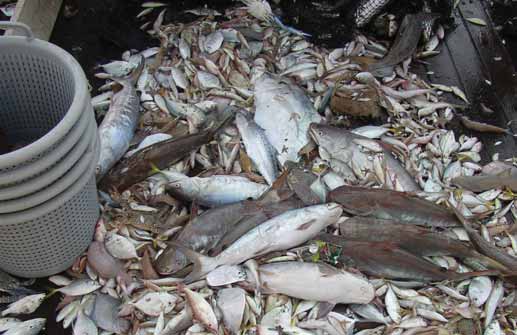
higher than sustained fish swimming (cruising)
manoeuvres in random directions. Those that enter
speed, they attempt to maintain position with the
the trawl passively are quickly overrun and are
trawl repeatedly using short bursts of acceleration
retained in the codend. Fish that are burst-speed
followed by a gliding movement. This is a so-called
swimming typically contact the trawl netting at high
kick-and-glide response, and it is used by fish to
speed. Some become gilled in the netting and some
conserve energy and avoid predation. The fish in
may escape through the meshes. Others will
the trawl mouth eventually tire and either attempt
rebound off the netting and swim in another
escape around or through the meshes of the trawl,
direction. This may continue until they make their
or they enter the trawl. Many small fish will also be
way into the codend. Many schooling pelagic fish
swimming with the trawl in the same direction. As
may attempt an upward escape by swimming
they are weak swimmers they do not have the
through the meshes in the top panel of the trawl as
luxury of using a kick-and-glide response. To keep
they become tired.
up with the trawl they must swim at a speed that
Fish on the seabed usually remain motionless until
rapidly leads to exhaustion, and they are soon
contact is imminent or made. They react with a kick-
overrun by the trawl and enter the codend.
and-glide response to keep ahead of the
Other fish do not respond by swimming with the
approaching trawl, and may even settle back on the
trawl. Instead they will enter the trawl mouth either
seabed before contacted by the trawl. This may be
passively or with burst-speed swimming
repeated several times before they either escape
Shrimp trawls catch fish of many different sizes and swimming capability. Knowledge of fish
behaviour including swimming performance is important to develop effective bycatch reduction
devices.
A Guide to Bycatch Reduction in Tropical Shrimp-Trawl Fisheries
67
(usually over the lower sweep or under the
Sometimes the turbulence is sufficient to allow fish
footrope) or enter the trawl.
to briefly remain motionless while being carried
forward with the trawl. Knowledge of this behaviour is
As fish swim through the trawl and approach the
useful because it allows the development of BRDs
codend, some will attempt escape through the trawl
that deliberately generate water turbulence near the
meshes. It is possible that crowding in the narrow
part of the trawl elicits this response. Other fish will
escape openings. The fisheye, fishbox and RES are
continue burst-speed swimming in random direc-
three BRDs that deliberately generate water turbu-
tions, haphazardly bumping into codend netting and
lence to assist bycatch reduction.
other fish. Fish sensitive to the optomotor reaction
While water turbulence can attract fish toward the
may respond to the visual contrast of codend
escape openings of a BRD, stimulating them to
netting against the background. They will orientate
escape can be difficult, particularly for species
and swim with the netting for a while before tiring
strongly responsive to the optomotor reaction. Many
and being overrun by the codend. They may even
fish prefer to remain in this location swimming easily
attempt to burst-swim through the trawl meshes.
with the trawl. Overcoming this problem is difficult
Fish that live on the seabed may rest on the bottom
and success has not yet been widely achieved.
panel of the trawl for several minutes before
What is required is some way of temporarily
reaching the codend.
disrupting the effects of the optomotor reaction. The
Upon reaching the codend weak swimming fish will
use of plastic cable ties attached to the fisheye
simply be overrun and join the accumulated catch.
adjacent the escape opening has been one attempt
In contrast, stronger swimming fish may seek out
at overcoming this problem but with limited success.
regions of water turbulence. These regions are
One option to consider might be to temporarily slow
attractive because some of the turbulent water
the towing speed. It has been observed that many
moves forward and it is easier for fish to swim and
fish escape during the hauling process -
maintain station with the trawl. Examples of this
presumably because the forward motion of the trawl
behaviour include small fish swimming immediately
is less and the altered trawl geometry upsets the
behind the bars of a grid or behind a trawl float.
optomotor reaction. A sudden reduction in towing
The accumulated catch generates water turbulence as the trawl is towed through the water.
Some of this water is directed sideways through the codend meshes. A BRD located in this
region may be effective because the water movement helps fish reach the escape opening of the
device.
68
A Guide to Bycatch Reduction in Tropical Shrimp-Trawl Fisheries
speed could potentially achieve the same result and
made. Their escape response is rapid swimming or
stimulate these fish to escape. Care would be
contraction of their abdomen and rapid propulsion
required to prevent bogging of the otter boards and
(tail-flicks) away from the trawl. As this response is
trawl in soft mud or sand. Fortunately not all fish are
not sustained they are eventually overrun by the
as difficult to remove from the trawl and many do
trawl and enter the codend. There is no herding of
escape through the openings of the BRD.
shrimp into the trawl.
A BRD can be strategically located to take
Shrimp that are on the seabed respond to ground
advantage of water turbulence generated by the
chain contact with rapid tail-flicks backwards and
trawl or the catch. For example, as the catch
upwards. This response may be repeated several
accumulates in the codend water is pushed forward
times to a height of several meters. The combined
by the forward movement of the trawl. This
influence of towing speed, head line height and
generates a region of water turbulence ahead of the
cover (lead-ahead) ensures that many of these
catch and some water is directed laterally
shrimp are unable to escape from the trawl. They
(sideways) out through the meshes of the codend.
are not responsive to the optomotor reaction.
This is attractive to fish because it allows them to
Shrimp that do escape the approaching trawl may
swim easily with the trawl for a period and avoid
swim in the water column for several minutes before
joining the accumulated catch. These fish are able
returning to the seabed.
to save energy and can take advantage of the
Shrimp that enter the trawl mouth have limited
lateral water movement to swim out through the
swimming capability, particularly if they have
escape openings of a nearby BRD. As this method
responded several times to trawl contact. They
is partially reliant on catch volume, identifying the
usually enter the codend passively, although some
ideal location for the BRD is not always possible
shrimp may first be impinged on the netting for a
because catch volume varies during the tow and
period of time. If shrimp are then contacted by other
between fishing grounds. Clearly, the location of the
animals, the trawl or bycatch reduction device, they
BRD should not be immediately adjacent of the
may take evasive action and tail-flick several times.
catch or shrimp loss may be high. Locating the BRD
This may result in shrimp unintentionally escaping
too far from the catch (several meters) is unlikely to
through the TED or BRD. There is little evidence
help bycatch reduction - although it will protect the
that they are capable of deliberately swimming
shrimp catch. The final location of the BRD must be
through the escape openings of a device. Shrimp
based on knowledge of expected catch volume
enter the codend at any height but are usually
followed by a trial and error approach to deter-
exhausted and do not have the ability to swim with
mining its most effective position.
the trawl.
How do shrimp behave in a
How can I prevent bycatch
shrimp trawl?
from entering a shrimp trawl?
As the trawl approaches, shrimp are located either
This is a worthwhile notion because it avoids trawl-
on the seabed or swimming in the water column.
induced damage to fish and other bycatch, improves
Shrimp on the seabed generally respond to the
the catching performance of the trawl and improves
approaching trawl by remaining motionless. This
the quality of the shrimp catch. Reducing the amount
behaviour is thought be used to avoid detection by
of bycatch that enters a trawl will compliment the
predators. Shrimp that are swimming do not
performance of BRDs in the codend.
respond to the trawl until contact is imminent or
A Guide to Bycatch Reduction in Tropical Shrimp-Trawl Fisheries
69
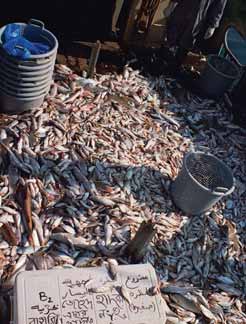
There are several options to preventing bycatch
escaped fish and place them into a recirculating
from entering a trawl. The simplest is to avoid areas
water tank for several days. The survival rate of
of high bycatch density. This is not always possible,
tank-held fish can then be used to indicate the
particularly if shrimp catches are high. Another
potential survival rate of fish that escape through
option is to stop fishing when catch rates are low
the BRD. A third option to assess fish survival is to
and bycatch levels are high. An example of this is
physically inspect escaped fish for signs of damage,
daylight closures. Modifying the ground gear is a
including scale loss, fin damage or bruising or
simple option to avoid sponges, rocks and coral
swelling of the body. Badly damaged fish are likely
from entering the trawl providing it does not impact
to suffer higher mortality rates, so this is also a
on the shrimp catch. In at least one instance a large
useful indicator of fish survival. The latter two
mesh panel has been tested extended across the
options are difficult to achieve because they require
entire trawl mouth to prevent the entry of large
the collection of animals that have escaped from the
animals into the trawl. The meshes of the panel
BRD, usually in a secondary codend located around
were large enough to allow the entry of shrimp and
the escape openings of the device or the main
small bycatch, but this idea was not successful due
codend. It is also important that escaped fish are
to fouling and damage to the panel by bycatch. An
not further damaged by the collection process.
option that has not been widely tested is a reduction
With few exceptions there has been little work in
in headline height so that fish can escape over the
tropical shrimp-trawl fisheries assessing the
headline of the trawl. This modification has some
survival of fish that have escaped from a BRD. This
potential in fisheries that target bottom dwelling
is because studying the survival rate of fish is
shrimp and can be easily introduced to existing
difficult and expensive. Many countries are still
trawl gear.
struggling with the introduction of effective BRDs
Do fish that escape survive?
It is important that the survival of fish is evaluated to
fully assess the effectiveness of a BRD. Clearly if
fish escaping from a BRD suffer high mortality rates
then it needs to replaced by another device. One
option to assess fish survival is to use underwater
cameras to observe how they escape from the
trawl. Survival rates are likely to be high if fish swim
rapidly through the escape openings of a BRD
without having contacted the trawl, other fish or the
device. However, if they heavily contact the device
or squeeze through the escape openings they are
likely to suffer serious damage and internal injury,
and the mortality of these fish is a high possibility. A
more difficult but effective option is to collect the
Most fish and other bycatch that are landed
on deck are either dead or dying. With the
exception of crustaceans and a few other
animals the survival of animals returned to
the sea is unlikely.
70
A Guide to Bycatch Reduction in Tropical Shrimp-Trawl Fisheries
(and TEDs) and it is perhaps premature to conduct
How will using a BRD affect
this work until greater experience in the use of these
the way I manage my
devices has been obtained.
business?
How will using a BRD affect
By reducing bycatch fishermen have greater control
over their fishing operation, including the option of
shrimp catching performance?
increased towing times and increased control over
In the same way that a TED can improve the catching
catch volume and quality of the shrimp catch. The
performance of a trawl, a BRD can also provide
use of BRDs is a responsible move that may allow
fishermen with gains in catching performance. This is
eco-labelling of the shrimp catch and associated
achieved by overcoming the negative effects of
opportunities to expand market share or open new
bycatch on trawl efficiency, such as reduced wingend
markets.
spread and towing times. By using a BRD the area
swept by the trawl per unit of time is increased and all
things held equal the shrimp catch should increase.
Moreover, towing times are now less influenced by
catch volume, meaning that time lost due to repeated
hauling of the trawl is reduced and additional time is
available for fishing.
How will using a BRD affect
the economic performance of
my fishing operation?
By improving the catching performance of the trawl
and increasing the shrimp catch a BRD should put
more money into the pockets of the fisherman. In
addition, the exclusion of fish with spikes or sharp
teeth has the potential to improve the quality of the
shrimp catch, thus improving catch value. Overall,
using a BRD could improve the economic
performance of a fishing operation.
A Guide to Bycatch Reduction in Tropical Shrimp-Trawl Fisheries
71
72
A Guide to Bycatch Reduction in Tropical Shrimp-Trawl Fisheries
Overcoming the US Embargo
TED Regulations & Other Details
This section briefly describes the US embargo on
monitoring and enforcement program will need to
shrimp imports and the requirements for an
be developed and evidence that fishermen are
effective sea turtle protection program4. A summary
using these devices must be provided. Documented
of the US TED regulations is provided in Appendix
evidence will need to be provided demonstrating
1. It is essential that countries seeking to lift the
that the approved TEDs are excluding sea turtles.
embargo have regulations in place governing the
The NMFS has found that effective TED designs
design and size of TEDs that are comparable to the
are capable of excluding 97% of sea turtles that
US regulations.
enter a shrimp trawl (usually within 5-minutes of
entering the trawl mouth), and TEDs used in other
What is the US embargo on
countries will normally be required to provide
shrimp imports?
evidence that they are achieving a similar rate of
exclusion. However, in some cases the NMFS may
In 1989 the US Government passed Section 609 of
assume a country is achieving a similar rate of turtle
the US Public Law 101 - 162 restricting the import
exclusion if they have adopted the US dimensions
of shrimp to countries with shrimp fisheries that did
for grid size and escape opening and they may not
not have an adverse impact on sea turtles. Initially,
request documented evidence that 97% of turtles
this embargo was introduced to protect local sea
are being excluded from the trawl.
turtle populations and applied only to countries in
South America and the Caribbean Sea. In 1996 the
There are also likely to be additional reporting
embargo was extended to include all countries
requirements to compliment the introduction of
worldwide that export shrimp to the US. In effect this
TEDs and demonstrate that a comparable level of
embargo means that the US will not import shrimp
turtle protection is being achieved, for example,
from any country that does not have in place a sea
uptake levels by fishermen and compliance rates.
turtle protection program of comparable effec-
These requirements may vary between countries
tiveness to the US program. The responsible
due to variations in fishery location, fishing method
agencies for the implementation of this law are the
and operation, and it is therefore advisable before
US Department of State and the US National
commencing a turtle protection program to confirm
Marine Fisheries Service (NMFS).
these requirements with the US Department of
State and the NMFS.
What is a program of
comparable effectiveness?
What are the US TED
A program of comparable effectiveness is one that
Regulations
has laws and regulations requiring mandatory turtle
A summary of the regulations is provided in
protection measures and achieves a comparable
Appendix I. These regulations describe the main
level of turtle protection to that required in the US.
design details for the use of TEDs in the Gulf of
In tropical shrimp-trawl fisheries, such a program
Mexico and southeast Atlantic shrimp-trawl
will usually require the mandatory introduction and
fisheries. Countries attempting to develop an
use of TEDs by all fishermen. This will need to be
effective turtle protection program and seeking
supported by appropriate regulations governing
removal of the embargo should consider these
TED design, rigging and operation. An effective
regulations as a foundation upon which to build their
4The detailed description of the US TED regulations in this guidebook in no way implies that the FAO, its staff, nor the author
support the use of trade embargoes to restrict trade and meet national environmental criteria. The regulations are included here
because they serve as a useful foundation to develop effective TED designs given their demonstrable success in preventing
turtle capture in shrimp-trawl fisheries worldwide.
A Guide to Bycatch Reduction in Tropical Shrimp-Trawl Fisheries
73
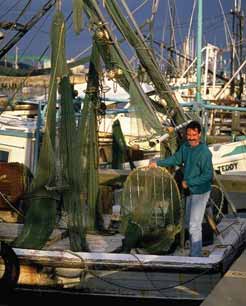
own fishery-specific regulations of comparable
What countries are currently
effectiveness. The regulations are designed to
exempt from the embargo?
provide sufficient protection for large turtles such as
loggerhead and leatherback turtles.
Since 1989 many countries have been exempted
from the US embargo. This includes countries with
As these regulations are subject to change in
cold water fisheries not frequently inhabited by
response to renewed concerns about turtles it is
turtles. In 2004 there were 14 certified countries on
advisable to check for recent amendments or
the basis that their turtle protection programs were
changes prior to developing a turtle protection
comparable to the US program. These countries
program.
were: Belize, Colombia, Costa Rica, Ecuador, El
Salvador, Guatemala, Guyana, Honduras, Mexico,
Who does the embargo apply
Nicaragua, Pakistan, Panama, Surinam, and
to?
Trinidad and Tobago. There was an additional 16
The embargo applies to all countries that export
shrimp catching countries with fishing grounds
wild-caught shrimp to the US. It does not apply to
located in cold waters not frequented by turtles.
cultured or farmed shrimp. In 2004 Bangladesh,
They were: Argentina, Belgium, Canada, Chile,
Haiti, India, Indonesia, Nigeria, Thailand and
Denmark, Finland, Germany, Iceland, Ireland, the
Venezuela did not have an effective turtle protection
Netherlands, New Zealand, Norway, Russia,
program in place and were unable to export shrimp
Sweden, the United Kingdom and Uruguay. The
to the United States.
Bahamas, China, the Dominican Republic, Fiji,
Hong Kong, Jamaica, Oman, Peru and Sri Lanka
The use of TEDs is an essential component
are also exempt from the embargo on the basis that
of a sea turtle protection program and
they either catch shrimp using small boats with less
removal of the US embargo on shrimp
than five crew and no mechanical means of hauling
imports.
the nets, or they use fishing methods not deemed to
threaten turtles.
Who makes the assessment
of a turtle protection
program?
A delegation of staff from the US Department of
State and the NMFS will assess a turtle protection
program for comparable effectiveness. These staff
are experienced in the design, use and regulation of
TEDs and therefore well qualified to assess the
program. The assessment usually involves the
delegation making an initial visit to a country
seeking approval in order to inspect the fishery and
help prepare the protection program. This will then
be followed by periodic inspections by the
delegation to provide ongoing technical assistance
and ensure that the program continues to protect
turtles.
74
A Guide to Bycatch Reduction in Tropical Shrimp-Trawl Fisheries
When did the latest
Are there alternatives to
regulations come into effect?
using TEDs?
The latest revision of the regulations came into
In some instances it may be possible to catch
effect in August, 2004. This means that all countries
shrimp for import to the US without the need to use
currently certified and those seeking certification
a TED, but only in exceptional circumstances. The
must incorporate these new regulations into their
use of short towing times is one option available to
protection program in order to provide a comparable
some fisheries. In the US, for example, towing times
level of turtle protection. These regulations must
less than 75 minutes can be used providing the
also be incorporated into the laws and regulations
fishing boat has no hydraulic or mechanical-
of each country and their use made mandatory.
advantage hauling system (ie. no blocks or pulleys),
is a so-called bait shrimper that retains all live
How might I benefit from the
shrimp onboard (no dead shrimp onboard for
new regulations?
human consumption) or uses a push net, skimmer
The NMFS also determined that these changes
trawl or wing net. Towing time is measured from the
may in fact allow large animals and debris to be
time the otter boards enter the water until they are
released from the trawl more rapidly. TEDs must
hauled above the water. For a trawl that is attached
now be fitted with a larger escape opening and
to the otter board via sweeps or ropes the tow time
modified escape cover, which allows easier
is measured from the time the codend enters the
passage of these animals from the trawl. The
water until it is removed. It is unclear how other
escape cover can then quickly return to its original
countries might apply towing-time restrictions but
position and seal tightly over the escape opening.
presumably they would need to demonstrate that
This should reduce or minimise shrimp loss.
such a restriction was comparable to TEDs in
protecting sea turtles. Under special circumstances
Can a country seek an
it may also be possible to apply towing-time restric-
exemption from the new TED
tions where the presence of sea weed, sponges or
regulations?
other environmental conditions makes trawling with
TEDs impracticable.
Yes. However, any request for such an exemption
must demonstrate that the commercial shrimp
Does a test-net or try-net
fishery does not interact with turtles including large
need to be fitted with a TED?
loggerhead and leatherback turtles. Evidence that
If a single net with a headline length measuring 3.6
there is no interaction must be based on scientifi-
m or less and a footrope length measuring 4.6 m or
cally sound data, preferably provided by
less is used then in does not have to be fitted with
independent observer based studies that represent
a TED. However, this net must not be attached to
a sizeable sample of the fishing fleet and overall
another net and there must only be one try-net used
fishing effort over the fishing season.
at any one time. It must also not be towed as a
The US Department of State and the NMFS can be
primary net. This clearly assumes the try net will be
contacted to provide information and details
used only to provide a sample of shrimp density and
describing how such a study might be pursued. It
that towing times will be short and not threaten
should be noted that countries are still required to
turtles. Tow time restrictions do apply to the use of
introduce and use these new regulations until an
try-nets.
exemption is granted.
A Guide to Bycatch Reduction in Tropical Shrimp-Trawl Fisheries
75
Can individual fisheries seek
Where can I obtain more
exemption from the embargo?
information about the TED
Where a country has more than one shrimp fishery,
regulations?
approval to export shrimp to the US can be granted
There are several possible options for obtaining
to individual fisheries providing it has been demon-
information about the US TED regulations and the
strated that the fishery has an effective turtle
development of programs to reduce turtle capture
protection program. Currently this situation only
and lift the embargo, including:
exists in fisheries in Australia and Brazil. The TED
· The US Embassy in each country.
regulations in Australia's Northern Prawn Fishery
are provided in Appendix 2. An exemption can also
· Foreign Affairs Officer. Office of Marine
be granted to an individual fishery if the US
Conservation, US Department of State, 2201
C.St. NW, Room 5806, Washington DC 20520
Department of State and the NMFS are satisfied
that turtles do not inhabit the region.
· National Marine Fisheries Service. TED
Technology Transfer Program. P.O. Box 1207,
Are shipments of shrimp into
Pascagoula, Mississippi. 39568-1207.
http://www.nmfs.noaa.gov or
the US checked?
http://www.mslabs.noaa.gov/teds.html
Every shipment of shrimp imported into the US
· Fisheries research institutes or management
must be accompanied by a form confirming that the
authorities in each country.
shrimp was caught under circumstances that are
· Copies of the Federal Register, Code of Federal
not harmful to sea turtles. The form must be
Regulations, Title 50 Part 223.206 and 223.207
completed and signed by both the exporter and
(50 CFR 223.206, 50 CFR 223.207) located on
importer. If the shrimp was caught by a country
the internet.
certified by the US Department of State under
Section 609, it is assumed that the shrimp satisfies
this standard.
Interestingly, Section 609 allows the import of
shrimp caught in an uncertified country, but only if a
government official in the uncertified country also
signs the form and affirms that the shrimp was
caught under specific conditions that do not pose a
threat to turtles.
76
A Guide to Bycatch Reduction in Tropical Shrimp-Trawl Fisheries
The Future of Bycatch Reduction
in Shrimp-Trawl Fisheries
The issue of bycatch is not going away and
capability is inadequately resourced. This means
fishermen will always be under pressure to reduce
that fishing activity may be unregulated and the
catches of non-target animals and non-living
management of a fishing closure an unattainable
material. However, in many countries fishermen
goal. Failure to redress this problem threatens the
have already come a long way and bycatch has
long-term health of the fishery and ecosystem, and
been dramatically reduced. TEDs are now used in
must be overcome. The enforcement of fishing
most tropical shrimp-trawl fisheries and the capture
regulations, including those related to the design
of turtles and other large animals is increasingly a
and use of TEDs and BRDs, is also clearly required.
rare occurrence. In many fisheries fishermen are
The introduction of these devices into a fishery is
also using BRDs to reduce fish capture and other
meaningless if an effective MCS program is not
bycatch. While the overall performance of these
implemented.
devices is not spectacular, at least some bycatch is
The development of effective BRDs is also required
being excluded from the trawl.
to further reduce bycatch. In the near future
In some fisheries, the problem of bycatch may
improvements will be made as fishermen gain more
increase in the near future as shrimp stocks
experience in the use and operation of current BRD
continue to be overfished and fishermen increas-
designs. This will include better selection of a
ingly rely on income derived from the sale of
device to suit the fishing ground and improved
bycatch species. Here, the distinction is blurred
positioning in the codend. The selection of appro-
between a shrimp-trawl fishery and a multi-species
priately sized escape openings and good mainte-
fishery that also targets fish and other animals, and
nance will also go a long way to optimizing the
the ability to introduce BRDs into these fisheries will
performance of these devices. Fishermen may also
be hampered by fears for catch loss and reduce
begin to use several BRDs at the same time to more
income.
effectively exploit the size and behavioural differ-
ences between shrimp and bycatch. This will
The future of bycatch reduction probably lies in
require greater knowledge of fish and shrimp
better management of fishing activity and the devel-
behaviour. There is also a need to evaluate the
opment of effective BRDs. The management of
design of existing shrimp trawls. In many fisheries
fishing activity can be improved by introducing area
trawl design has changed little over recent decades,
or seasonal closures, particularly in locations that
from a time when there was little concern for the
are nursery grounds for juvenile fish and other
capture of bycatch. It is now time to re-evaluate
animals. In many countries this is already a
trawl design, particularly the impact of sweeps,
commonly used option because it is immediately
ground gear, head line height and mesh size on
effective. Once the closure is in place and fishing is
bycatch.
prohibited no bycatch will be (legally) caught.
Closures also afford total protection to all bycatch
Greater focus on preventing bycatch from entering
while they remain within closed areas; it is unlikely
a trawl could also help. Clearly, allowing bycatch to
that BRDs will ever achieve a comparable level of
freely enter a trawl and then make efforts to exclude
protection. Given the effectiveness of closures in
them is a clumsy way to deal with the problem.
protecting bycatch, their use as a management tool
Innovative options that may have some potential to
will be increasingly common. Better management of
prevent the entry of bycatch include the use of
fishing activity also requires effective Monitoring,
sound barriers, glow-netting, light beams, air bubble
Control and Surveillance (MCS). In some countries,
curtains and electrical fields. All of these options
particularly those in developing regions, this
have been tested in other fisheries, some with
A Guide to Bycatch Reduction in Tropical Shrimp-Trawl Fisheries
77
limited application and others with limited success,
specifications governing the design and operation
and it is perhaps timely that consideration be given
of these devices, and the development of effective
to testing them in a shrimp trawl.
monitoring and surveillance programs. Such efforts
will clearly require adequate financing and
The bycatch that interacts with the trawl but is not
commitment by all stakeholders.
landed on deck also needs to be researched. The
magnitude of this impact is presently unknown but it
The future of bycatch reduction may also include
could be sizeable, particularly if the escaped
the identification of bycatch-reduction targets. This
animals do not survive contact with the trawl.
may be a pro-rata reduction in catch volume or a
Measuring the survival of bycatch is extremely
specific species or group. At-risk species (such as
difficult but an attempt to do so is a responsible
long-living, slow-growing species) will need to be
move. While the conduct of survival experiments
identified and indicators developed to demonstrate
has been done in several fish-trawl fisheries, it has
if their numbers are responding to the use of
not been widely attempted in tropical shrimp
bycatch reduction devices. In developing countries,
fisheries.
the use of observers can be used to monitor the
performance of these devices and the realisation of
The development of new, more effective BRD
bycatch targets. In developing countries this is not
designs is likely to take considerable time, effort and
an option, and alternatives will need to be found
money. However, collaboration is the key to
including education and landing inspections.
success and it should not be expected that
fishermen can do this alone. Fishing technologists,
All fishermen are encouraged to join the bycatch-
scientists, fishery managers and others should be
reduction journey. Only with a commitment to
encouraged to work with fishermen to overcome the
reduced environmental impact and improved trawl
bycatch problem. This collaboration will need to be
selectivity can they protect the viability of the fishery
wide-ranging, and includes training in the design,
and ecosystem. To do so now will go a long way
use, operation and maintenance of these devices,
toward protecting their livelihood and ensuring the
the development of testing protocols and
fishery remains productive for future generations.
The bycatch reduction journey requires a commitment from fishermen and other stakeholders to
work together to improve trawl selectivity and reduce environmental impact.
78
A Guide to Bycatch Reduction in Tropical Shrimp-Trawl Fisheries
Technical Data Sheets
This section of the guide contains technical data
Each data sheet also indicates the major bycatch
sheets showing how to construct commonly used
groups that can be excluded with each device, a
TEDs and BRDs. Not all TED designs currently
brief description of the device and a trouble-
used in shrimp-trawl fisheries around the world are
shooting section that outlines solutions to problems
included. This is not only beyond the scope of this
that may be commonly encountered.
guide but unnecessary given that general
Note that all dimensions are in millimetres unless
construction details of these devices is similar.
otherwise indicated. It is very important that the
Therefore, this section provides generic
entire data sheet is read before commencing
construction details for one TED as well as details
construction of a device. This may save costly
for two TED designs from the United States; these
errors.
are included because their design provides an
insight into the minimum requirements to avoid the
capture of leatherback turtles and overcome the US
embargo. The major BRDs used today are also
included in this section.
A Guide to Bycatch Reduction in Tropical Shrimp-Trawl Fisheries
79
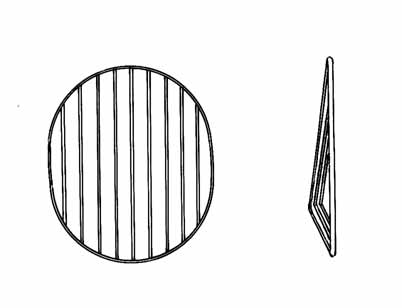
The Turtle Excluder Device (TED)
Excluded Species
Figure 1
Figure 2
Description
The TED is primarily designed to exclude turtles and other large animals from the trawl although smaller animals may
also be excluded (Figure 1). The TED described here features an oval shaped grid secured to the trawl at an angle of
about 55 degrees, with a bar spacing of 110 mm (4 1/3"). A funnel of netting guides all animals toward the top of the
grid and prevents shrimp loss through the escape opening in the bottom of the codend. Large animals are then guided
by the grid through the escape opening while shrimp and other small animals pass between the bars and enter the
codend (Figure 2). A cover of buoyant polyethylene netting is fitted over the escape opening to further prevent shrimp
loss. The guiding funnel described here is optional and may not be required provided the escape cover works
effectively. The TED is fitted to a 48 mm (1 7/8") mesh codend measuring 200 meshes in circumference. The TED and
codend are designed to be fitted to a large trawl net; smaller versions of this TED can be designed for smaller nets,
however care is required to ensure that the escape opening allows large turtles and other animals to escape.
Construction
1. Grid placement
110
· Construct grid as shown (Figure 3). The outer frame
of the grid is constructed from 40 mm aluminium
pipe and measures 4 750 mm in diameter. The
outer height and width of the grid measures 1 670
mm and 1 140 mm respectively. The bars of the grid
are constructed from rectangular-section aluminium
1350
bars measuring 40 mm by 25 mm (the narrow side
1670
of the 25 mm bar faces the towing direction). The
grid consists of seven bars; the largest measures 1
680 mm and is bent (cut and welded) 330mm from
330
the bottom of the grid (these measurement are
taken from the inside of the grid frame). The length
1140
of the remaining bars are reduced to fit the inside of
Figure 3
the frame; their length depends on the shape of the
outer frame.
80
A Guide to Bycatch Reduction in Tropical Shrimp-Trawl Fisheries
· Hang codend vertically and identify the desired
location of the grid (alternatively the codend can be
stretched vertically between two points). Insert grid
into the codend. Locate the top of the codend (with
the codend vertical this is the position of the
uppermost mesh;it is easier to construct the TED if
the seam joining the sides of the codend are
uppermost) and attach the top of the grid frame to
this mesh with twine or a cable tie.
· Locate the bottom of the codend and mark this mesh.
From this mesh follow the line of meshes (toward the
drawstring) for a total of 19 meshes. Attach the
bottom of the grid frame to this mesh.
· Attach the sides of the grid frame to the codend in 2
or 3 locations on either side of the frame. Check grid
angle.
Figure 4
· As the grid angle will decrease by about 5 degrees
after the escape opening is cut into the codend the
remaining steps are followed after the completion of
the escape opening and cover (see next section
below).
101
· Check grid angle. To adjust the grid remove twine or
cable ties except that fixing the top of the grid frame
to the codend. Reposition the grid to desired angle
and re-attach using twine or cable ties. Re-check grid
30
angle.
· Thread a 30 m length of rope tightly around the
circumference of the grid frame and adjacent meshes.
Ensure that the meshes are not distorted or under
strain. The ends of the rope can be tied together or
5
5
knotted around one of the bars before securely
P3B
P3B
attaching the ends to a few rows of codend meshes
(in case adjustment of the grid is required 200 - 300
78
mm of this rope should be attached to the codend).
Trailing edge
Figure 5
2. The escape opening and cover
· Cut escape opening in the codend as shown (Figure
4) starting full mesh ahead of the grid frame. The
3rd mesh previously marked. Attach the remainder of
width of the escape opening (adjacent to the grid)
this side of the escape cover to the codend following
should be 60 meshes wide. Reinforce this opening
a mesh-to-mesh joining ratio. Then attach the shorter
with heavy twine or small-diameter rope.
sides of the escape cover to the codend until 10
· Cut out the escape cover. The escape cover
meshes past the grid. The escape cover should
measures 65 meshes wide by 40 meshes long.
extend 21/2 meshes either side of the escape opening
· On the leading edge of the escape opening mark the
at the base of the grid. The remaining 10 meshes of
middle (14th) mesh. Count forward (toward the trawl
the cover should be left unattached.
mouth) a total of 3 meshes. The leading edge of the
3. Guiding funnel attachment
escape cover will be attached to the this row of
· Construct guiding funnel as shown (Figure 5) using
meshes.
48 mm codend netting (or smaller mesh-netting if
· On one of the 65 mesh-long sides of the escape
available). Join the 30 mesh sides of the funnel
cover mark the 33rd mesh. Attach this mesh to the
together.
A Guide to Bycatch Reduction in Tropical Shrimp-Trawl Fisheries
81
· From the top of the grid frame count 30 meshes
forward (toward the trawl mouth) and mark the mesh.
Secure the 51st mesh on the leading edge of the
panel to the marked mesh. Check that the 30th mesh
of the funnel contacts the bars of the grid. Attach the
leading edge of the guiding panel to the 30th row of
codend meshes using a mesh-to-mesh joining rate.
Ensure that the seam joining the sides of the panel
together is attached to the uppermost mesh in the
codend.
· If desired, 5 - 10 meshes of the funnel can be
attached to the codend immediately ahead of the top
of the grid frame. In this way the start of the tapered
Figure 6
section is attached to the grid. The remainder of the
funnel stays free.
4. Belly-ropes and flotation
· Attach one 2 m length of small diameter (8 - 14 mm)
rope to either side of the grid and codend. The middle
of each rope should be securely attached to the grid
as shown (Figure 6) and the remainder along the
length of the codend. The meshes should be pulled
reasonably tight as the rope is attached; in this way
the rope will take up the strain as the meshes
become stretched over time.
· Attach float to the grid frame near the top of the
Figure 7
codend. Ensure they do not impede the passage of
animals through the escape opening (Figure 7).
Trouble Shooting
Shrimp loss: This may be due to incorrect grid angle, grid blockage, stretched funnel netting, stretched escape cover or a
large animal caught in the escape opening.
Clogged guiding funnel:This may be caused by starfish, coral, crabs, sponges or large animals fouling the meshes of the
funnel. A smaller mesh size or canvas material may prevent clogging. Increasing funnel diameter may allow larger animals to
pass more freely through the funnel but may also cause shrimp loss through the escape opening.
Poor exclusion rate: This may be due to inadequate bar spacing or inadequate grid size. Increasing bar spacing or grid
length may improve fish escape. If the bars are fitted to a second, inner frame, the inner frame can simply be quickly replaced
with another of different bar spacing. In this way the outer frame does not have to be detached from the extension piece and
grid angle is maintained.
Clogged grid: A clogged grid may be caused by large animals, sponges and other debris. Reducing grid angle may
overcome this problem.
Twisted codend: This may be due to poor codend deployment (prior to shooting away) and may result shrimp loss through
the escape opening. Careful observation of the grid floats will assist checking for a twisted codend. Meshes unevenly secured
to the grid or an excessively short lazy line may also cause twisting of the codend.
Hauling: When hauling the codend care must be taken to ensure the grid does not foul on the lazy line guides or 'bull horns'
82
A Guide to Bycatch Reduction in Tropical Shrimp-Trawl Fisheries
The Double-Cover Offshore Turtle Escape Opening
Excluded Species
Description
This technical data sheet describes the construction details for the double-cover
turtle escape opening for a single-grid hard TED. The double-cover escape
opening is a recent innovation from the US that has proven effective in allowing
the escape of large turtles (Figure 1), including loggerhead turtles, while retaining
the shrimp catch. In the US, a so-called double-cover escape flap can only be
Figure 1
used if the escape opening measures at least 142 cm (56") wide when stretched
and 51 cm (20") long when stretched. All measurements are stretched mesh
measurements. Note that many US shrimp fishermen have voluntarily increased
the size of the escape opening to meet the requirements of the 181 cm offshore
turtle escape opening (see following data sheet for details).
Construction
1. Grid
· Construct grid to required size and design. Attach to
· Attach the right hand escape cover to position A and
the codend in desired location.
sew two escape cover meshes to one escape
2. Cutting the escape opening
opening mesh. Repeat this joining rate until point B is
reached (this joining rate helps ensure both escape
· In the codend ahead of the grid cut an escape
covers overlap along their entire length). Continue
opening with a stretched mesh measurement of 51
sewing the escape cover using a joining rate of one
cm (20") forward on each side of the grid and 142 cm
cover mesh to one escape opening mesh for a
(56 inches) across at the leading edge (Figure 2).
distance of two or three meshes past the edge of the
When making the cut leave 1/2 mesh immediately
escape opening.
forward of the grid frame. If the codend mesh size is
38 mm (11/
· Repeat this procedure for the left hand escape cover.
2") the cut will be approximately 14 meshes
long by 41 meshes wide. If the codend mesh size is
· Attach the outer side of the right hand escape cover
25 mm (1") the cut will be approximately 20 meshes
along a straight row of meshes adjacent the escape
long by 56 meshes wide.
opening (Figure 2). The trailing edge of the cover
3. Escape covers
must not extend more than 61 cm (24") past the
posterior edge of the grid frame.
· Cut 2 rectangular pieces of netting (preferably depth
stretched and heat set). The stretched width of each
· Repeat this procedure for the left hand escape cover.
panel must measure at least 147 cm (58") and the
Note: if an accelerator funnel is used with this TED
approximate length of each escape cover should be
the funnel must have an inside horizontal opening in
145 cm (57") (Figure 2). The mesh size should be no
a straight line measuring at least 28 cm (71"). No
larger than 41 mm (1 5
more than 1/ of the accelerator funnel can be
/
3
8") to prevent turtles from
fouling the meshes and delayed escape.
attached to the grid.
4. Escape cover attachment
5. Edge lines
· The escape covers are attached to the leading edge
· These are optional but serve to strengthen the
of the escape opening (Figure 2). Mark the center
escape covers and prevent stretching of meshes
mesh of the leading edge of the escape opening.
(Figure 2). They must be made from polyethylene line
Determine the number of meshes to the left and right
(rope) with a diameter not exceeding 0.95 cm. The
of the center mesh needed to obtain a stretched
line can only be attached to the inside and trailing
mesh measurement no greater than 38 cm. Mark
edges of each cover. If edge lines are used the
these meshes (points A and B in Figure 2).
outside edge of each cover must be attached to the
codend along its entire length.
A Guide to Bycatch Reduction in Tropical Shrimp-Trawl Fisheries
83
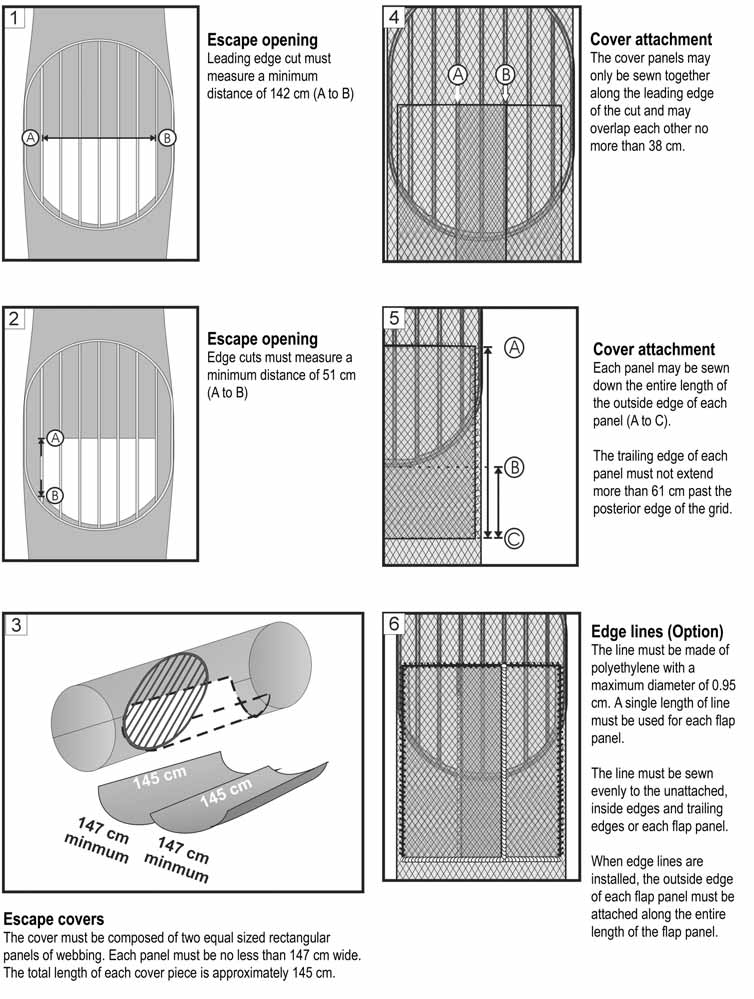
Figure 2
Details of the Double Cover Opening were provided by John Mitchell, NOAA.
84
A Guide to Bycatch Reduction in Tropical Shrimp-Trawl Fisheries
The 181 cm (71-inch) Offshore Turtle Escape Opening
Excluded Species
Description
This technical data sheet describes the construction details for the 181
cm (71") escape opening for a single-grid hard TED in offshore US
waters. The size of the escape opening has proven to be effective in
allowing the escape of large turtles (Figure 1), including loggerhead
turtles, while retaining the shrimp catch. In the US, an escape opening
Figure 1
measuring 181 cm (71") in width must be accompanied by a length
measuring 66 cm (26"). Note all measurements are stretched mesh
measurements.
Construction
1. Grid
4. Escape cover attachment
· Construct grid to required size and design. Attach to
·· Attach the escape cover to the leading edge of the
the codend in desired location.
escape opening (Figure 2). Depending on the mesh
2. Cutting the escape opening
size of the codend and escape cover, a joining ratio
of escape cover meshes to escape opening meshes
· In the codend ahead of the grid cut an escape
will be required, e.g. 2:1 or 3:2. The escape cover
opening with a stretched mesh measurement of 66
may extend past the sides of the escape opening by
cm (26") forward of the grid and 181 cm (71") across
a distance no more than 13 cm (5") on each side.
(Figure 2). When making the cut leave 1/2 mesh
immediately forward of the grid frame. If the codend
· Attach the outer sides of the escape cover along a
mesh size is 38 mm (11/
straight row of meshes down the sides of the escape
2 ") the cut will be
approximately 18 meshes long by 48 meshes wide. If
opening for a distance no more than 15 cm (6") past
the codend mesh size is 25 mm (1") the cut will be
the posterior edge of the grid (Figure 2). The trailing
approximately 27 meshes long by 73 meshes wide.
edge of the cover must not extend more than 61 cm
past the posterior edge of the grid frame. Up to 46 cm
3. Escape covers
(18") of the cover may trail behind the grid
· Cut a rectangular piece of netting (preferably depth
unattached.
stretched and heat set) with a stretched mesh
· Check that the aft edge of the escape opening
measurement of 338 cm (133") wide by 132 cm (58")
measured at least 181 cm (71") when stretched.
long (Figure 2). The mesh size should be no larger
Note: if an accelerator funnel is used with this TED
than 41 mm (1 5/8") to prevent turtles from fouling the
the funnel must have an inside horizontal opening in
meshes and delayed escape.
a straight line measuring at least 28 cm (71"). No
more than 1/3 of the accelerator funnel can be
attached to the grid.
A Guide to Bycatch Reduction in Tropical Shrimp-Trawl Fisheries
85
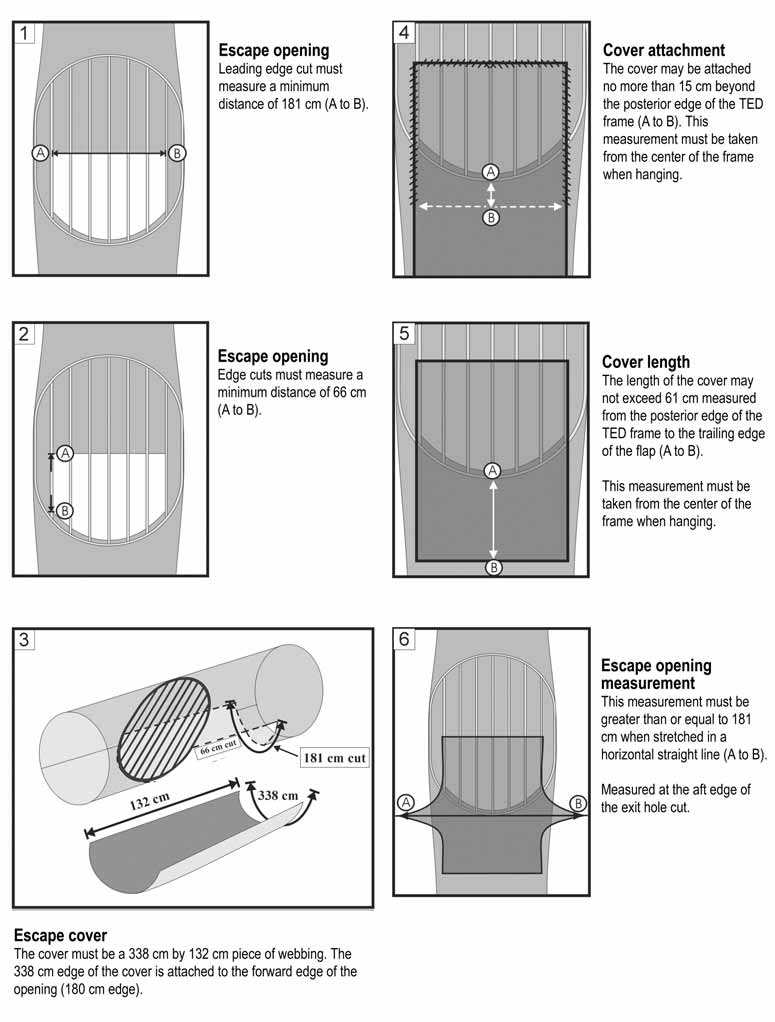
Figure 2
Details of the 181 cm Offshore Turtle Escape Opening were provided by John Mitchell, NOAA.
86
A Guide to Bycatch Reduction in Tropical Shrimp-Trawl Fisheries
The NSW Nordmore Grid
Excluded Species
Description
The NSW Nordmore grid is primarily designed to reduce unwanted bycatch from
estuarine shrimp trawls such as jellyfish and finfish while maintaining catches of
shrimp (Figure 1). The Nordmore grid is made up of an aluminium grid with 20 mm
(3/4") bar spaces, an escape exit and a guiding panel, all of which are inserted into
a tube section of 40 mm (11/2") netting 60 meshes in length. The guiding panel
directs the entire catch to the base of the grid where the separating process
begins. Shrimp pass through the bar spaces while other, larger organisms are
directed along the grid and out through the escape exit. The Nordmore grid has
Figure 1
also been tested without a guiding panel and a netting cover over the escape exit.
Construction
1. Assembling the grid and netting
· Construct aluminium grid as shown (Figure 2).
A bar spacing of 20 mm (3/4") will require a
total of 12 bars.
· Cut a 100 mesh by 100 mesh panel of
codend netting into five panels as shown
(Figure 3). Panel 1 will become the tube,
panels 2 & 3 the guiding panel and panels 4 &
5 will be left over to make a spare guiding
panel.
· Cut out the triangular escape exit shown in
panel 1.
· Sew the top edges of panels 2 and 3 together
Figure 2
as shown. This will ensure the correct knot
direction for the guiding panel.
· Lay the guiding panel on top of panel 1 and
sew or lace (mesh for mesh) the top edge of
the guiding panel to the centre of the top edge
of panel 1.
· Mark out the dotted line shown in panel 1. The
line should start 12 meshes from the centre of
the panel, making a 1P2B `path' down the
netting and finish 13 meshes from the outside
edge. Sew or lace the sides of the guiding
panel row for row to the marked line (the
guiding panel will tend to pull quite tightly as
the two bodies of net are sewn together).
· Turn up the two outside edges of panel 1 and
sew them together. This will form a
seam that will correspond to the bottom
centre line of the net.
Figure 3
A Guide to Bycatch Reduction in Tropical Shrimp-Trawl Fisheries
87
Figure 4
2. Inserting the grid
· Insert the grid into the tube and lace the top edge of the
· The edges of the escape exit should be reinforced by
grid to the 25 meshes that form the base of the
`picking up' two bars and tightly selvaging to 8mm rope.
triangular escape exit (Figure 4). Where the row of
The ends of the rope can be spliced to the corners of
meshes meets the seam (at the bottom), count forward
the grid. This will help to support and maintain correct
10 meshes and lace the bottom of the grid to at least 15
grid angle.
meshes along this row. The grid should then sit inside
· A few links of light chain can be added to the aft end of
the netting an an angle of approximately 45 degrees. If
the guiding panel. This will reduce any lifting caused
the netting you are using has a mesh size greater than
by water pressure and minimise the risk of shrimp
40 mm (1 1/2") you should only count forward 9 to 9 1/2
escape.
meshes (Figure 5).
· Four 100 mm (4") diameter polystyrene floats should
· The remaining netting, between the top and bottom of
be attached to the top of the sides of the grid.
the grid, should be laced to the grid by equally spacing
· The entire tube section, made up of guiding panel, grid
the rows down each side and across the bottom. This
and escape exit can then be inserted between the
will require some care to avoid distorting the net.
codend and the main body of the net.
Figure 5
Trouble Shooting
Shrimp Loss: Shrimp loss may be due to incorrect grid angle, grid blockage (see below), stretched funnel netting, a
stretched escape cover or a large animal caught in the escape opening.
Twisted codend: this may be due to poor codend deployment (prior to shooting away) and may result in shrimp loss through
the escape opening. Careful observation of the grid floats will assist checking for a twisted codend. Meshes unevenly
secured to the grid may also cause twisting of the codend.
Clogged grid: A clogged grid may be caused by large animals, sponges and other debris. Reducing grid angle may prevent
this problem.
Composite Square Mesh Panel construction details provided by Matt Broadhurst of the NSW Department of Primary Industries.
88
A Guide to Bycatch Reduction in Tropical Shrimp-Trawl Fisheries
The Fisheye
Fisheye
Excluded Species
Figure 1
Figure 2
Description
The fisheye is designed to allow fish to voluntarily swim from the trawl (Figure 1). This BRD features a steel or
aluminium frame secured to the top or side of the codend (Figure 2). The frame provides a rigid elliptical or "eye
shaped" escape opening through which fish can swim while shrimp passively enter the codend. The orientation of the
fisheye is variable, however, to prevent shrimp loss it must cause fish to swim forward through the escape opening.
The fisheye can be placed anywhere in the codend and more than one may be fitted to the trawl to increase fish loss.
The following details describe the construction of a fisheye to fit a codend with a 45 mm (1 3/4") mesh size.
Construction
· Construct fisheye from 8-12 mm diameter steel or
aluminium rod as shown (Figure 3). The internal
opening of the ellipse measures 400 mm and the
circumference measures 1 040 mm
400
· Make a 46 mesh cut across the codend (Figure 4).
200
· Insert fisheye into the codend. Secure the leading
edge of the cut to the bottom of the ellipse
ensuring the meshes are distributed evenly.
200
· Secure the top of the ellipse to the top meshes of
the cut.
320
520
· Secure the sides and middle brace to the codend
meshes.
100
· Secure a 100 mm (4") float 5 meshes behind the
100
ellipse to counter the weight of the steel and hold
100
Figure 3
the BRD upright and level.
Trouble Shooting
Float
Shrimp Loss: Shrimp loss may be due to poor
positioning of the fisheye and relocating the fisheye
further forward of the catch will reduce this problem.
Shrimp loss may also occur during haulback and during
rough weather when the catch surges forward in the
9
46
codend.
Poor exclusion rate: This may be due to poor fisheye
location. Relocating the fisheye closer to the
11
accumulated catch may increase fish loss, but may
also increase the risk of shrimp loss particularly when
Figure 4
large catches are taken.
A Guide to Bycatch Reduction in Tropical Shrimp-Trawl Fisheries
89
The Square-Mesh Window
Excluded Species
Description
The square-mesh window is designed to allow fish to voluntarily swim from the trawl
(Figure 1). This BRD is simply a panel of large meshes hung on the bar so they
remain open during the tow (Figure 2). This is in contrast to diamond meshes which
tend to close under tension. The following details describe the construction of a 150
mm (75 mm bar length) square-mesh window measuring 6 bar lengths long by 6 bar
Figure 1
lengths wide to fit a codend with a 45 mm (1 3/4") mesh size.
Square-mesh window
Figure 2
Construction
· Cut out a rectangular hole in the top of the
codend measuring 40 meshes wide by 12
meshes long (Figure 3).
· Cut out the square-mesh window from 150 mm
(6") netting measuring 6 bar lengths wide by 6
bar lengths long.
40
· Reinforce the edges of the window with 4mm
rope.
· Secure the window to the codend at desired
10
location ensuring codend meshes are distributed
evenly between the bars.
Figure 3
Trouble Shooting
Shrimp loss: This may be due to knot slippage, incorrect mesh or window size selection and poor window location. To
prevent knot slippage the window may need to be replaced with knotless netting or netting made from thicker twine.
Reducing mesh or window size will reduce shrimp loss, as will relocating the window further forward of the catch.
Poor exclusion rate: The mesh size may be too small, however, careful selection of a larger mesh size is required to
prevent shrimp loss. Relocating the window closer to the accumulated catch may increase fish loss, but may increase the risk
of shrimp loss particularly when large catches are taken.
90
A Guide to Bycatch Reduction in Tropical Shrimp-Trawl Fisheries
The Composite Square-Mesh Panel
Excluded Species
Description
The Composite Square-Mesh Panel has been found to be effective in excluding large
quantities of bycatch while maintaining catches of shrimp and byproduct (Figure 1).
This BRD is simply a number of netting panels joined together and orientated so they
remain open during the tow (Figure 2). The Composite Square-Mesh Panel is designed
so that the load is distributed forward and lateral to the main escape panel allowing it
Figure 1
to remain open. The following details describe the construction of a Composite Square-
Mesh Panel using 45 mm and 60 mm mesh.
Composite Square-Mesh Panel
Figure 2
Construction
· Cut panels, A, B, and C from 45 mm mesh (22.5 mm bar)
the top and bottom and along each of the sides. These
as shown (Figure 3). This will make it easy to match and
can be `picked up' (ie as a selvedge) where panel D is
sew the panel to the meshes in the top of the codend (ie. 2
sewn to panels A, B and C.
meshes to each bar).
· After each of the square mesh panels have been cut out,
· Cut panel D from 60 mm mesh as shown. It is important
attach panels A and B to D. It is best to sew panels A
that the stretched length of panels A, B and D are equal.
and B so that the square meshes pull in opposite
· The width of panel D is equal to the width of 11 meshes of
directions (ie simply flip either panel A or panel B over
panel C.
before sewing).
· Because panel D is usually made from lighter ply, it may
· To complete the Composite Square-Mesh Panel evenly
be necessary to include an extra row of meshes across
sew panel C to A, D and B.
Installation
21
· On top of the codend, cut out a piece of netting
Panel C
Panel A
6B
measuring 48 meshes across by 21 meshes
12
27B
forward at the desired location.
Panel D
· Evenly lace the panel into the codend, starting
48 24B
11B
24
9B
across the bottom and then along each of the
17B
sides and finally across the top.
Panel B
16B
8
13
Figure 3
Composite Square Mesh Panel construction details provided by Matt Broadhurst of the NSW Department of Primary Industries.
A Guide to Bycatch Reduction in Tropical Shrimp-Trawl Fisheries
91
The Square-Mesh Codend
Excluded Species
Square-mesh codend
Figure 1
Figure 2
Description
The square-mesh codend is designed to exclude small fish from a shrimp trawl (Figure 1). Unlike most other BRDs
which modify a diamond mesh codend, this BRD replaces the entire codend (Figure 2). By hanging diamond mesh
netting on the bars, square-meshes are created which remain open during the tow. Knotless netting is sometimes
preferred to avoid problems with knot slippage. The size of the mesh will determine the size of the animals that
escape, however, careful selection is required to prevent shrimp loss. The following details describe the construction
of a square-mesh codend made from 38 mm (1 1/2") diamond mesh netting designed to replace a 45 mm codend
measuring 150 meshes around by 100 mesh deep (Figure 3). The square-mesh codend is then joined to a 50 mesh
long cylinder of diamond mesh netting - called the extension piece - with the lifting strop attached (Figure 4). The
diamond meshes of the extension piece are assumed to have a horizontal mesh opening of 30% (0.3).
112.5
53.5
Construction
· Cut out the square-mesh panel as shown (Figure 3).
· Join the longer sides of the panel together to
53.5
form the codend.
225B
107B
· Secure the square-mesh codend to the diamond
166
mesh netting using a joining rate of 2 square-meshes
to 3 diamond meshes and pick up an extra bar every
20 diamond meshes (Figure 4).
112.5
166
Trouble Shooting
Figure 3
Shrimp Loss: This may be due to knot slippage or poor
mesh size selection, and in both cases replacing the
Throat
Lifting
codend is recommended. Hanging ropes along the length
Square-mesh
strop
codend
of the codend (so they take the load of the catch) may
prevent knot slippage or alternatively the codend may be
Diamond
replaced with knotless netting.
mesh
extension
Poor exclusion rates: The mesh size may be too small,
however, careful selection of a larger mesh size is
required to prevent shrimp loss.
Twisted codend: This problem may be due to uneven
Figure 4
hanging of the codend to the diamond mesh extension.
92
A Guide to Bycatch Reduction in Tropical Shrimp-Trawl Fisheries
The Radial Escape Section
Excluded Species
Description
The Radial Escape Section (RES) is designed to allow fish to voluntarily swim from
the trawl (Figure 1). This BRD features a guiding funnel to concentrate all animals
into the middle of the codend. As fish exit the funnel, some swim forward and
through a panel of large square-meshes that extend radially around the codend
(Figure 2). In contrast, shrimp do not have this swimming ability and they passively
enter the codend. A plastic encased wire hoop can be fitted behind the square
meshes to help the RES maintain shape and resist deformation. The following
details describe the construction of a RES fitted to a 45 mm (1 3/4") mesh cylinder of
codend netting measuring 120 meshes in circumference. The square-mesh escape
Figure 1
openings are constructed from 200 mm netting (100 mm bar length). Larger escape
openings can be used if desired.
Wire hoop
Guiding funnel
Square mesh
Figure 2
Construction
· Cut panels A and C from 45 mm (1 3/4") netting and
· Secure the leading edge of the funnel to the 2nd row
panel B from 200 mm (100 mm bar length) netting as
of meshes from the leading edge of panel A using a
shown (Figure 3).
mesh to mesh joining rate.
· With the seams of each panel uppermost attach all
· Attach the completed RES to the standard codend
panels together using a joining rate of six 45 mm
using a joining rate of 5 codend meshes to 4 RES
meshes to one 100 mm bar.
meshes.
· Construct an 18 mm wire hoop measuring 2.5 m in
· Thread a length of 12 mm rope around the hoop and
length and swage the ends together. Attach the hoop
adjacent meshes to prevent chafing.
5 meshes from the leading edge of panel C.
· Cut out netting panels as shown (Figure 4). Join the
outer edges of each panel to form a funnel.
A Guide to Bycatch Reduction in Tropical Shrimp-Trawl Fisheries
93
Trouble Shooting
Clogged guiding funnel: This may be caused by
14.5
3B
5
35
starfish, sponges or large animals fouling the funnel
meshes. A smaller mesh size or canvas material may
prevent clogging. Increasing funnel diameter may allow
larger animals to pass more freely through the funnel.
120
A
20
B
120
C
Poor exclusion rate: This may be due to excessive
funnel length or inadequate mesh size. Shortening the
length of the funnel or increasing the size of the mesh
openings may improve fish escape.
Wire hoop
Figure 3
29
29
29
29
1P2B
1P2B
23
29
6
29
6
Figure 4
94
A Guide to Bycatch Reduction in Tropical Shrimp-Trawl Fisheries
The semi-curved rigid Juvenile and Trash
Excluder Device (JTED)
Excluded Species
JTED
Figure 1
Figure 2
Description
As the name implies the Juvenile and Trash Excluder Device (JTED) is designed to exclude small fish - usually
juvenile or trash fish - and other trash from the trawl (Figure 1). This BRD features three rigid metal sections hinged
together; the first two sections are metal girds and the third section is a metal frame supporting a panel of fine-mesh
netting (Figure 2). The JTED is located in the top of the codend, and between the lifting ropes and the accumulated
catch in the codend. The dimensions provided here are for the construction of a JTED to fit a 25 mm (1") mesh codend
measuring 300 meshes in circumference.
Construction
further 60 meshes in the same direction. Mark this
mesh. Cut the escape opening in the extension as
1. Extension piece and escape opening
shown (Figure 3) between the two marked meshes.
· Construct a codend extension piece from PE 380D/15
Secure a thin rope to the escape opening ensuring
netting material with a mesh size of 25 mm. The
the meshes are uniformly attached to the rope (this is
length of the extension piece should be 300 meshes
optional but provides support to the meshes and
wide and measure about 350 cm long. Sew the sides
additional strength).
of the netting together to form a cylinder 300 meshes
2. Metal frames
in circumference.
· Construct outer frames as shown (Figure 4). Each
· Form a 250 cm metal rod into a circular hoop with a
outer frame is constructed from a 260 cm length of 12
diameter of 80 cm. Attach one end of the extension
mm metal rod bent into the desired shape. The ends
piece uniformly to the hoop. Construct a second
of the rod are welded together.
identical hoop and attach to the other end of the
extension piece. Attach several lengths of rope to
· The bars of each grid are constructed from 6 mm rod
each hoop and pull tightly so the extension piece is
and welded into place at the desired bar spacing.
stretched horizontally - this makes attachment of the
Care is required to ensure all bars are parallel and
JTED easy. Alternatively, the extension piece can be
bar spacing is uniform. Bar spacing is typically 10 -
hung vertically from one hoop at the leading end.
40 mm.
· With the seam joining the sides of the extension piece
· Weld a chain link to the shoulder of each semi-curved
uppermost, count 40 meshes from the leading edge
frame 40 cm from the base of the frame.
of the extension piece toward the trailing edge of the
· To the long side of each frame weld short lengths
extension piece. Mark this mesh and then count a
(~75 mm) of steel pipe. One end of each pipe should
A Guide to Bycatch Reduction in Tropical Shrimp-Trawl Fisheries
95
contact the end of the pipe welded to the adjacent
Trouble Shooting
frame. Insert a steel bolt through both lengths of pipe
Shrimp loss: This may be due to excessive bar spacing or
and fix with a bolt. A second bolt can be used for
damaged bars. This can be overcome by reducing bar
added security. Alternatively, small hammer locks can
spacing or repairing/replacing the bars. Damaged bars
be used to connect each frame or even cable ties.
may be caused by large animals striking the device. A TED
Prime and paint all metal surfaces to prevent rusting.
located ahead of the JTED will overcome this problem.
· Cut the netting panel as shown (Figure 5) from PE
Poor exclusion rate: This may be due to inadequate bar
380D/12 netting with a mesh size of 15 mm. Attach
spacing or inadequate grid size. Increasing bar spacing or
this panel to the semi-curved frame ensuring the
grid length may improve fish escape. If the bars are fitted
meshes are attached evenly.
to a second, inner frame, the inner frame can simply be
· Using small shackles, attach two 1 060 mm lengths of
quickly replaced with another of different bar spacing. In
chain to the welded chain links on each semi-curved
this way the outer frame does not have to be detached
frame.
from the extension piece and grid angle is maintained.
· Fit completed JTED frames to the extension piece
Clogged grid: This may be caused by large animals,
ensuring the meshes are attached evenly.
sponges and other debris. Reducing grid angle may
· Remove the metal hoops from the extension piece
overcome this problem. A TED located ahead of the JTED
and attach the competed JTED to the codend. The
will overcome this problem.
final location of the JTED should be about 10 m from
the trailing end of the codend.
Incorrect grid angle: This may be caused by sand, mud
or other debris fouling the hinges and preventing the
· Attach sufficient flotation to counter the weight of the
correct grid angles from being obtained. The hinges should
JTED. At least one 150 mm (6") float should be
be flushed out regularly and checked that they are free to
attached to the top of the leading semi-curved frame
move. At the same time the tightness of the attachment
and two floats to the aft semi-curved frame.
bolts should be checked as the loss of these bolts will also
result in incorrect grid angle and poor performance.
Twisted codend: this may be due to poor codend
deployment (prior to shooting away) and may result in
shrimp loss through the escape opening. Careful
observation of the grid floats will assist checking for a
twisted codend. Meshes unevenly secured to the grid may
also cause twisting of the codend.
Clogged grid: A clogged grid may be caused by large
animals, sponges and other debris. Reducing grid angle
may prevent this problem.
96
A Guide to Bycatch Reduction in Tropical Shrimp-Trawl Fisheries
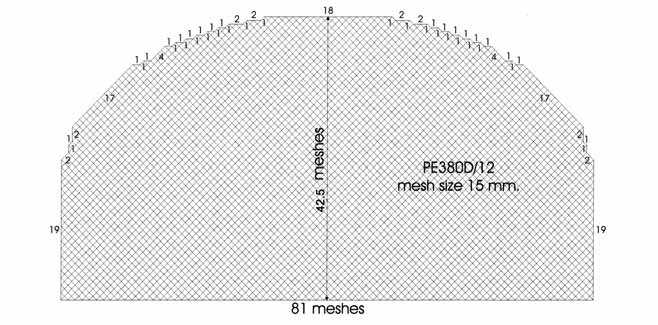
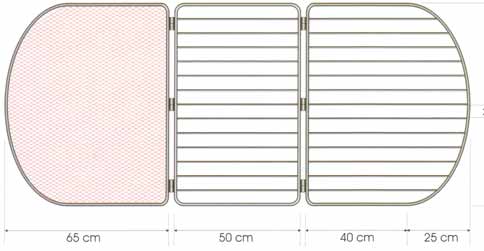
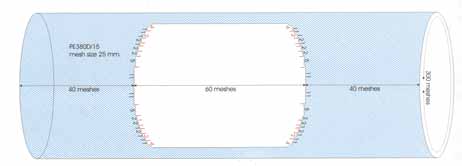
Figure 3
Figure 4
Figure 5
The details outlining the construction of the JTED were provided by the SEAFDEC Training Department, Samut Prakan, Thailand.
A Guide to Bycatch Reduction in Tropical Shrimp-Trawl Fisheries
97
The Cone
Excluded Species
Cone
Figure 1
Figure 2
Description
The cone is not a BRD but has been designed to increase the efficiency of BRDs to exclude fish from the trawl (Figure
1). It is simply two panels of netting attached to a small wire hoop and inserted behind a BRD such as a fisheye,
square-mesh window or RES (Figure 2). The cone impedes the passage of fish into the codend and `stimulates' them
to swim forward and through the escape openings. The following details describe the construction of a cone made
from 45 mm (1 3/4") codend material. A simple alternative to the cone is to insert a 200 mm float in the same location
and tethered to the sides of the codend. The float will bob about and stimulate fish to swim forward.
Construction
· Cut out two triangular panels of netting. The sides of
Hoop
each panel measure 40 bars and the base measures
40 meshes. Secure the sides of the panels together
23B
to form a cone (Figure 3).
· Construct the hoop from 10 mm wire measuring 1 m
in length. Encase the wire in plastic to prevent
corrosion.
16B
· Locate one seam and count 16 bars from the point of
the cone. Secure the hoop to the 16th bar of the
seam. Repeat for the other seam and then secure the
40B
remainder of the hoop to the netting. Ensure the
meshes are distributed evenly around the hoop.
· Cut out a 1 500 mm length of 4 mm rope. Secure the
Figure 3
middle of the rope to the point of the cone.
· Count 23 bars from the point of the cone and secure
Installation
a 300 mm length of 4 mm rope to this bar. Repeat
· Secure the rope (attached to the point of the cone) to
for the opposite side of the cone.
the sides of the codend. The point of the cone should
be approximately 300 mm from the escape opening
of the fisheye or square-mesh window, or the trailing
edge of the RES funnel.
· The two remaining ropes are secured to the top and
bottom of the codend. Ensure there is approximately
125 mm of rope between the codend and the cone.
98
A Guide to Bycatch Reduction in Tropical Shrimp-Trawl Fisheries
The Flapper
Excluded Species
Description
The flapper or `fish escape cut' is designed to allow fish to voluntarily swim from
the trawl (Figure 1). This BRD is simply a hole located in the top of the codend
through which fish can swim and the size of the hole will determine the size of
fish that can escape (Figure 2). More than one flapper may be used to increase
fish loss. This BRD has the advantage that it is easy to close, enlarge or
reposition if required. The following details describe the construction of a flapper
suitable for all codend mesh sizes. The orientation of the triangular escape
opening is optional, however, the flap folded back as shown below may generate
water turbulence as the trawl is towed that aids the escape of fish.
Figure 1
Flapper
Figure 2
Construction
Trouble Shooting
· Make two 20 bar cuts to form a triangular
Shrimp loss: Shrimp loss may be due to poor positioning
flap of netting.
of the flapper. The distance between the catch and the
flapper reduces as the catch accumulates, making it
· Reinforce the edges of the flapper with
easier for shrimp to swim through the escape opening.
twine to prevent damage to the netting.
Shrimp loss may also occur during haulback and during
· Fold the flap back and attach the apex of the
rough weather when the catch surges forward in the
triangular flap to the codend 8 meshes ahead of the
codend. As a rule of thumb the larger the escape opening
escape opening.
the greater the chance of shrimp loss.
Poor fish loss: This may be due to poor flapper location
or inadequate escape opening. Relocating the flapper
closer to the accumulated catch may increase fish loss,
but may increase the risk of shrimp loss particularly when
large catches are taken. Increasing the size of the escape
opening may allow more or larger fish to escape.
A Guide to Bycatch Reduction in Tropical Shrimp-Trawl Fisheries
99
Glossary of Terms
Accidental catch
Discard
A reference to non-target animals and non-living
That part of the catch released or returned to the
material captured by the fishing gear. This term is
sea, dead or alive, whether or not such fish are
synonymous with bycatch.
brought fully on board a fishing vessel.
Bycatch
Fish Excluder Device (FED)
Part of the catch taken incidentally to the target
In some parts of the world this term is used to
species toward which fishing effort is directed. It
describe a device that reduces the catch of fish
includes all non-target animals and non-living
bycatch. This term is synonymous with bycatch
material, including those that escape from the
reduction device.
fishing gear during the fishing operation and are not
landed onboard. Some or all of the landed bycatch
Incidental catch
may be returned to the sea as discards, usually
Has the same meaning as accidental or non-target
dead or dying.
catch.
Bycatch excluder device
Industrial fishery
(BED)
A fishery involving commercial companies using
See bycatch reduction device. In Indonesia this
relatively large amounts of capital and energy,
term is synonymous with TED.
relatively large fishing vessels and fishing gear,
making long fishing trips, usually offshore, usually
Bycatch reduction device
for export.
Any modification to a trawl designed to reduce the
Monitoring Control and
capture of bycatch. Strictly speaking a TED is a type
of bycatch reduction device that excludes turtles
Surveillance
and other large animals from the trawl. The
Activities undertaken by the fishery enforcement
acronym BRD stands for `bycatch reduction device'
system to ensure compliance with fishery regula-
but usually refers to devices that are specifically
tions.
designed to reduce the capture of fish bycatch and
other small animals and debris. Other modifications
Non-target species
that may reduce bycatch include larger meshes in
Species for which the fishing gear is not specifically
the main body of the trawl, ground gear modifica-
deployed or set, but may have immediate
tions or headline height adjustment.
commercial value and be a desirable component of
Byproduct
the catch. Includes bycatch and byproduct.
Any part of the catch which is kept or sold by the
Responsible Fishing
fisherman but which is not the target species.
Fishing activities that are not only sustainable but
also provides consumers with high quality, nutritious
Catchability
seafood that meets appropriate food safety
In a broad sense, catchability is the extent to which
standards.
a fish or shrimp is susceptible to capture by fishing
gear. In stock assessment it is the proportion of the
stock removed by one unit of fishing effort.
100
A Guide to Bycatch Reduction in Tropical Shrimp-Trawl Fisheries
Selective fishing gear
Target species
A fishing gear allowing fishermen to capture few (if
Those species that are primarily sought by
any) species other than the target species.
fishermen in a particular fishery. The subject of
directed fishing effort in a fishery.
Selectivity
Ability to target and capture fish by size and species
TED
during the fishing operation while allowing bycatch
A term that initially meant turtle excluder device, but
to escape unharmed. In shrimp fishing this can be
sometimes means trawl efficiency device. It is an
influenced by the timing and location of the fishing
inclined grid or net panel that prevents large
operation, the size, design and operation of the
animals from entering the codend. TEDs not only
fishing gear and onboard processing practices.
exclude turtles but also sharks, stingrays, jellyfish,
sponges and large fish.
Small-scale fishery
A traditional fishery involving fishing households (as
TEDed
opposed to commercial companies), using relatively
A colloquial term used by fishermen when the
small amount of capital and energy, relatively small
shrimp catch from a net is considerably less than
fishing vessels (if any), making short fishing trips,
expected. Implies that the TED is responsible for
close to shore, mainly for local consumption. This
the reduced catch.
term is synonymous with artisanal fishery.
Trash fish
Stakeholder
Usually part of the bycatch with little or no
An individual, company or organization with an
commercial value. In some countries, trash fish are
interest in a fishery. In the broadest sense everyone
used in fish or shrimp culture. It can also be used for
is a stakeholder because fishery resources are a
fishmeal production. In many developing countries
community asset.
(e.g. China, India) it is used extensively for human
consumption.
Subsistence fishery
A fishery where the catch is shared and consumed
Undersized
directly by the families and relatives of the
Fish (caught) at a size smaller than the minimum
fishermen rather than being bought by a middleman
size limit established by regulation.
and sold at the next larger market.
Sustainable Fishing
Fishing activities that do not cause or lead to
undesirable changes in biological and economic
productivity, biological diversity, or ecosystem
structure and functioning from one human gener-
ation to the next. Fishing is sustainable when it can
be conducted over the long-term at an acceptable
level of biological and economic productivity without
leading to ecological changes that foreclose options
for future generations.
A Guide to Bycatch Reduction in Tropical Shrimp-Trawl Fisheries
101
102
A Guide to Bycatch Reduction in Tropical Shrimp-Trawl Fisheries
APPENDIX 1: A Summary of US TED
Regulations
This section is a summarised account of the US
use on shrimp trawlers) and the Weedless TED.
TED regulations for the Gulf of Mexico and South
Soft TEDs are defined as those that use netting to
Atlantic shrimp-trawl fisheries. These regulations
guide turtles toward an escape opening located in
provide countries seeking to remove the US
the top of the codend. The Parker TED is the only
embargo a useful guide about important TED
approved example of a soft TED. The regulations
design details and regulations. However, it is unnec-
cited below for this TED are based on the require-
essary for these countries to exactly follow the US
ments for fishing in offshore waters and inshore
regulations provided that they establish a sea turtle
waters in Georgia and South Carolina.
protection program that provides a comparable
level of turtle protection. This means that countries
Construction material
have the flexibility to develop their own national
regulations that accommodate for differences
(a) Hard TEDs are constructed from solid steel,
between shrimp fisheries (see Appendix 2 for an
aluminium or fibreglass rod, or steel or aluminium
example). Such countries should therefore consider
tubing. The minimum outside diameter of steel rod
the US regulations as a foundation upon which to
is 6.4 mm and 12.7 mm for aluminium or fibreglass
build their own national or fishery specific regula-
rod. If tubing is used the minimum outside diameter
tions. It is advisable that these countries review the
is 12.7 mm with a minimum wall thickness of 3.2
complete US regulations before embarking on a
mm. The bars of the grid must be permanently
TED development program. These details can be
attached to the outer frame of the grid.
obtained from the Federal Register, Code of
(b) The Weedless TED must be constructed from
Federal Regulations, Title 50 Part 223.206 and
aluminium or steel pipe with a minimum outside
223.207 (50 CFR 223.206, 50 CFR 223.207).
diameter of 32 mm (11/4") and a minimum wall
Copies of these regulations are available on the
thickness of 3 mm (1/8"). The bars of the grid
Internet.
opposite the escape opening must be permanently
The US TED regulations are contained within four
attached to the outer frame of the grid. The ends of
key categories: (a) Hard TEDs; (b) Special hard
the bars nearest the escape opening must be
TEDs; (c) Soft TEDs, and; (d) Revision of design
angled forward of the leading edge of the outer
frame adjacent the escape opening.
criteria and allowable modifications. Hard TEDs are
constructed with rigid bars and are either
(c) The Parker TED must be constructed from
categorised as 'hooped hard TEDs' such as the
polyethylene or polypropylene netting material.
NMFS, Coulon and Cameron TEDs or 'single-grid
hard TEDs' such as the Matagorda, Georgia and
Grid or netting shape
Super Shooter TED. The specifications cited below
(a) Hard TEDs can be either oval, round or
for the Hooped hard TED and the single-grid hard
tombstone in shape.
TED are based on the requirements for fishing
(b) The Weedless TED must have a tombstone
operations in offshore waters where leatherback
shaped grid.
turtles may be encountered (these dimensions are
reduced where these turtles are not encountered,
(c) The Parker TED must be constructed from a
ie. inshore waters). The so-called special hard
triangular-shaped panel of netting that forms a
TEDs are those that do not meet all the design and
complete barrier inside the trawl.
construction criteria of hard TEDs. This includes
TEDs used in the Atlantic summer bottom trawl
fishery to target flounder (that are not approved for
A Guide to Bycatch Reduction in Tropical Shrimp-Trawl Fisheries
103
Grid angle
The grid size of a single-grid hard TED must have
inside horizontal and vertical measurements of at
(a) In a Hard TED the angle of the grid must be
least 813 mm (32"). The required inside measure-
between 30o and 55o from the horizontal when the
ments must be taken at the mid-point of the
trawl is in operation.
deflector grid.
(b) In a Weedless TED the angle of the grid must
(b) In a Weedless TED the size of the grid is the
be between 30o and 55o from the horizontal when
same as that for a single-grid hard TED.
the trawl is in operation.
Bar spacing or mesh size
Flotation
(a) In a Hard TED the spacing between bars of the
(a) & (b) Floats can be attached either inside or
grid must not exceed 102 mm (4").
outside the codend using heavy twine or rope, but
not to the escape cover or flap. They must either be
The bars of the grid must run from top to bottom
constructed of aluminium, hard plastic, expanded
(vertically) when the TED is positioned in the net. If
polyvinyl chloride or expanded ethylene vinyl
a so-called Flounder TED is used then up to four of
acetate. If floats are attached inside the net they
the bottom bars and two of the top bars (including
must be located behind the rear surface of the TED
the frame) may run from side to side (horizontally)
so they do not impede the passage of sea turtles
when the TED is positioned in the net.
toward the escape opening. The combined
(b) In a Weedless TED the bars of the grid must
buoyancy of the floats must be at least be 6.4 kg (14
also run from top to bottom when the TED is
lb) and sufficient to overcome the weight of the grid.
positioned in the net. The space between the ends
If a downward excluding hard TED is used all floats
of the bars and the bottom frame of the TED must
must be attached to the upper half of the grid.
be no more than 102 mm (4"). A horizontal brace
bar must be permanently attached to the outer
Float dimension requirements
frame of the TED and each bar of the grid. This
(a) & (b) For all hard TEDs and the Weedless TED
brace must be attached to the rear side of each bar
at least one aluminium or hard plastic float no
and outer frame and constructed from the same
smaller than 250 mm (10") in diameter, or two
material. It must be located to the lower-most half of
expanded polyvinyl chloride or expanded ethylene
the grid and frame, and may be offset behind the
vinyl acetate floats, each no smaller than 172 mm
grid using spacers not exceeding 127 mm (5").
(63/4") in diameter by 222 mm (8 3/4") in length, must
(c) The Parker TED must be constructed from a
be attached.
triangular-shaped panel of netting with a mesh size
of 203 mm (8") and two trapezoidal panels of netting
Location and size of escape
with a mesh size of 102 mm (4"). All mesh sizes are
opening
stretched-mesh measurements.
(a) In a hard TED the escape opening must be
centred on and immediately forward of the grid
Hoop or grid size
frame. If a upward excluding TED is used the escape
(a) In a hooped hard TED the front hoop must have
opening must be located in the top of the codend and
an inside horizontal measurement of at least 1 016
if a downward excluding grid is used the escape
mm (40") and an inside vertical measurement of at
opening must be located in the bottom of the codend.
least 762 mm (30"). The bars of the grid must be at
The escape opening must be made by removing a
least 590 mm (231/5") from the top of the front hoop.
rectangular-shaped piece of netting from the codend.
104
A Guide to Bycatch Reduction in Tropical Shrimp-Trawl Fisheries
The required size of the escape opening depends
The leading edge of the excluder panel must be
on the type of TED used and location fished. The
attached to the inside of the bottom of the trawl
escape opening that can be used on an offshore
across a straight row of meshes. Every mesh of the
hooped hard TED is 1 016 mm (40") wide by 889
leading edge of the excluder panel must be
mm (35") long with each measurement taken simul-
attached evenly to the row of meshes in the bottom
taneously. On a single-grid hard TED used in all
of the trawl. The apex of the excluder panel must be
offshore waters, the cut across the width of the
attached to the inside of the top of the trawl at the
codend cannot be less than 1 803 mm (71") when
centreline of the trawl. The distance, measured
stretched. The forward cuts of escape opening must
along the centreline of the top panel of the trawl,
also have a stretched length of at least 660 mm
from the row of meshes to which the leading edge
(26"). The total circumference of the escape
of the excluder panel is sewn to the apex
opening should be at least 3 610 mm (142"). The
attachment point must be 78 - 83 meshes if trawl
maximum width of the escape opening in a single-
mesh size is 57 mm (21/4"). If a smaller mesh size is
grid hard TED cannot be narrower than the outside
used the number of meshes is increased.
width of the grid minus 102 mm (4") on both sides
of the grid.
Accelerator funnel
(a) & (b) An accelerator funnel can be used if it is
If a so-called double-cover flap (overlapping escape
made of netting with a stretched mesh size not
cover) is used the size of the escape opening must
greater than 41 mm (1 5/
at least measure 1 420 mm (56") wide when
8"). It must be inserted into
the codend immediately ahead of the TED and its
stretched and the forward cuts must measure 508
trailing (rear) edge must not extend past the bars of
mm (20") long when stretched.
the grid. In offshore areas where leatherback turtles
(b) In a Weedless TED the location and shape of
may be encountered the horizontal opening of the
the escape opening must be the same as for a hard
inside of the funnel must measure at least 1 803
TED. The required size of the escape opening is
mm (71") when the meshes are stretched. Only
identical to that required for a single-grid hard TED.
one-third of the circumference of the funnel can be
(c) In a Parker TED the escape opening must
attached to the codend irrespective of grid orien-
measure at least 2 438 mm (96") directly forward of
tation. The trailing edge of the funnel can be
the apex of the excluder panel. This measurement
attached to the bars of the grid on the side opposite
is made with the meshes taut.
the escape opening.
Other details
Escape cover
(a) A hard TED must be sewn into the trawl around
(a) & (b) An escape cover may be fitted over the
the entire circumference of the grid frame with
escape opening providing no device or restriction
heavy twine.
prevents it from being moved aside and sea turtles
can escape. The escape cover must be constructed
(b) The Weedless TED must also be sewn into the
from netting material. A hinged escape cover
trawl around the entire circumference of the grid
framed with steel or aluminium rod or tubing (a so-
frame.
called door frame) cannot be used. The mesh size
(c) The Parker TED must be designed to guide
of the escape cover can be no larger than 41 mm (1
3
turtles toward an escape opening located in the top
/4") stretched mesh and it must be attached along
of the codend.
its entire forward edge to the outside of the codend
A Guide to Bycatch Reduction in Tropical Shrimp-Trawl Fisheries
105
forward of the escape opening. The sides of the
Chafing gear and rollers
escape cover must be attached to the same row of
(a) & (b) A single piece of nylon netting with a twine
meshes (measured in the fore and aft direction) for
diameter no smaller than 2 1/2 mm may be attached
a distance not exceeding 150 mm (6") behind the
to the outside of the escape cover to prevent
posterior edge of the grid. The sides of the cover
chafing on bottom opening TEDs. This netting may
must not overlap the sides of the escape opening by
be attached along its leading edge only and may not
more than 127 mm (5") on each side. In offshore
extend beyond the trailing edge or sides of the
waters the cover must measure 3 378 mm (133")
existing escape cover. It must not negatively impact
wide by 1 321 mm (52") long. The trailing edge of
on the ability of the TED to exclude turtles. A chafing
the panel must not extend more than 610 mm (24")
flap cannot be used with the double cover flap
beyond the posterior edge of the grid.
modification
If a double cover flap is used it must be constructed
Roller gear may be attached to the bottom of a TED
from two panels of netting of equal size. Each panel
to prevent chafing on the bottom of the grid frame
must measure at least 1 473 mm (58") wide and
and the trawl net. Roller gear basically consists of a
overlap each other by no more than 381 mm (15").
hard plastic roller or tube mounted on a steel or
The panels can be attached together at the leading
aluminium axle rod. The maximum diameter of the
edge of the escape opening. The trailing edge of the
roller shall be 152 mm (6") and the maximum width
panels must not extend more than 152 mm (6")
of the axle rod shall be 304 mm (12"). The escape
beyond the posterior edge of the grid. No chaffing
cover must be designed and attached to the trawl
gear can be used with this escape cover.
so it cannot come into contact with any part of the
roller gear. Currently, few US fishermen use roller
gear to protect the TED.
106
A Guide to Bycatch Reduction in Tropical Shrimp-Trawl Fisheries
APPENDIX 2: TED Regulations in Australia's
Northern Prawn Fishery
In 2000 the US embargo was lifted from the
NPF Regulations
Northern Prawn Fishery (NPF) because a turtle
A TED is defined as any device fitted to a net or
protection program was in place that satisfactorily
modification that allows turtles to escape immedi-
minimised the impact of shrimp trawling on turtles
ately after capture in the net. NPF fishermen can
and was comparable in effectiveness to the US
use any TED design provided it meets this criteria
program.
and meets the following requirements:
The regulations for this fishery are much simpler
1. The TED must have a rigid or semi-rigid grid of
than the US regulations. There are several reasons
inclined bars to guide turtles to an escape opening
for this simplicity. The bulk of shrimp caught in this
immediately forward of the grid.
fishery are destined for overseas markets, particu-
larly those in Asia. The catch is processed quickly,
2. The TED must be attached to the entire circum-
finger packed into small (1.5 - 3.0 kg) boxes and
ference of the net.
placed into freezers usually within minutes of
3. The TED must be fitted with one or more escape
landing. The high value of shrimp provides a strong
openings that measure at least 780 mm across the
economic incentive for fishermen to optimise shrimp
width of the net (when the netting is pulled taut) and
quality and minimise damage caused by turtles and
at the same time measures 380 mm in a perpendi-
other heavy animals in the codend. Fishermen
cular direction from the midpoint of the width
understand that a poorly performing TED can
measurement.
impact negatively on their income and therefore
strive to optimise the ability of the TED to rapidly
4. The distance between the bars of the TED must
exclude these animals from the trawl. This fishery
not exceed 120 mm. If the TED is made from wire
also has a wide-spread monitoring program with
or other semi-rigid material then the TED must be
enforcement officers boarding approximately 70%
braced or designed so that this distance cannot be
of the fishing fleet each year to check that TEDs
exceeded.
(and other fishing gear) comply with fishery regula-
Note that the orientation of the grid, the design of
tions. Independent observers are also sometimes
the escape opening, accelerator funnel or guiding
used to monitor the effectiveness of TEDs by
panel, the required flotation and grid angle are not
spending time at sea recording fishing practices and
specified in these regulations. This provides
collecting catch data. High TED compliance rates
fishermen the freedom to develop TED designs that
are also linked to effective extension programs that
suit their fishing operation and fishing ground, and
keep fishermen well informed about TED develop-
therefore optimise TED performance. A failure to
ments. In this way fishermen are provided up to
achieve this result will fail to protect turtles and risks
date information about TED regulations and opera-
reducing the shrimp catch; hence the design and
tional details of TED performance, and are able to
operation of these TED components are effectively
make informed decisions about their fishing
self-regulating.
operation. This extension has been in the form of
videos, newsletters, booklets, port workshops, and
loans of various TED designs. It has also included
at-sea assistance to test TEDs under normal
commercial fishing conditions.
A Guide to Bycatch Reduction in Tropical Shrimp-Trawl Fisheries
107
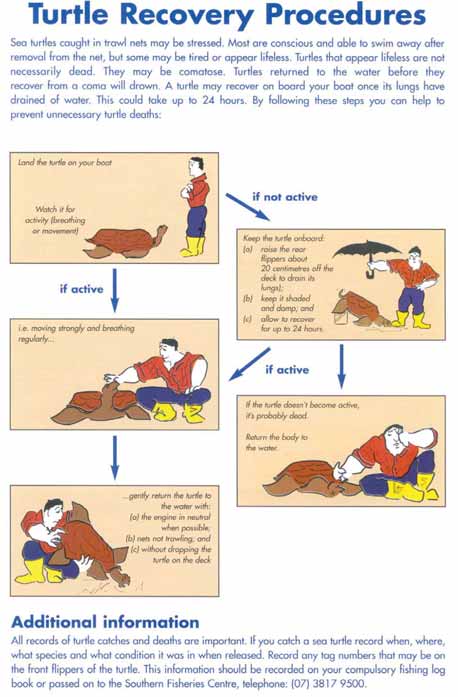
Appendix 3: Turtle Recovery Procedures
Turtle recovery procedures provided by Julie Robins of the QLD Department of Primary Industries and Fisheries.
108
A Guide to Bycatch Reduction in Tropical Shrimp-Trawl Fisheries
Contacts
Further information on bycatch reduction can be obtained from the following organizations:
The Food and Agriculture Organization of the
Viale delle Terme di Caracalla 00153 Rome ITALY
United Nations (FAO)
Ph +39 06 57051 Fax +39 06 5705 5188
Fishing Technology Service
www.fao.org
Australian Maritime College
PO Box 21 Beaconsfield
Tasmania 7270 AUSTRALIA
Ph +61 (0)3 6335 4404 Fax +61 (0)3 6335 4459
Southeast Asian Fisheries Development Centre
PO Box 97 Phrasamutchedi
(SEAFDEC)
Samut Prakan 10290 THAILAND
Training Department
Ph +662 425 6100 Fax +662 425 6110
National Marine Fisheries Service
PO Box 1207 Pascagoula Mississippi
National Oceanic & Atmosphere Administration
US 39568-1207
US Department of Commerce
Ph +1 228 762 4591
TED Technology Transfer Program
NSW Department of Primary Industries
PO Box J321
Conservation Technology Unit
Coffs Harbour New South Wales 2450
National Marine Science Centre
AUSTRALIA
Ph +61 (0)2 6648 3905 Fax +61 (0)2 6651 6580
CSIRO Division of Marine Research
233 Middle St Cleveland
Northern Fisheries & Ecosystems Research Group
Queensland 4163 AUSTRALIA
Ph +61 (0)7 3826 7200 Fax +61 (0)7 3826 2582
National Fisheries Institute
Pitagoras 1320 Col. Santa Cruz Atoyac
CP 03310 Mexico DF
Australian Fisheries Management Authority
PO Box 7051 Canberra Business Centre
ACT 2610 AUSTRALIA
Ph +61 (0)2 6272 5029 Fax +61 (0)2 6272 5175
Queensland Department of Primary Industries
P.O.Box 76
and Fisheries
Deception Bay Queensland 4508 AUSTRALIA
Southern Fisheries Centre
Ph +61 (0)7 3817 9562 Fax +61 (0)7 3817 9555
A Guide to Bycatch Reduction in Tropical Shrimp-Trawl Fisheries
109
Abbreviations
AFMA
Australian Fisheries Management Authority
AMC
Australian Maritime College
BED
Bycatch Excluder Device
BRD
Bycatch Reduction Device
CSIRO
Commonwealth Scientific and Industrial Research Organisation (Australia)
FAO
Food and Agriculture Organization of the United Nations
FED
Fish Excluder Device
FSD
Fish Separator Device
IUCN
International Union for Conservation of Nature and Natural Resources
JTED
Juvenile and Trash Fish Excluder Device
NMFS
National Marine Fisheries Service
MCS
Monitoring Control and Surveillance
RES
Radial Escape Section
SEAFDEC
Southeast Asian Fisheries Development Centre
TED
Turtle Excluder Device or Trawl Efficiency Device
TTED
Thai Turtle Excluder Device
110
A Guide to Bycatch Reduction in Tropical Shrimp-Trawl Fisheries
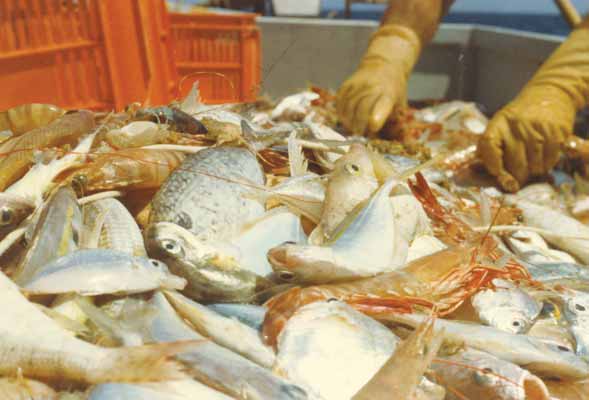
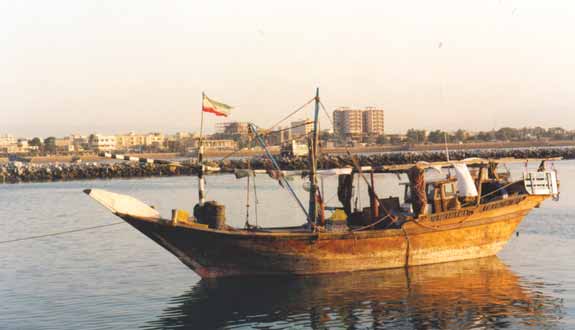

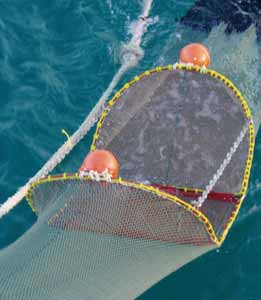


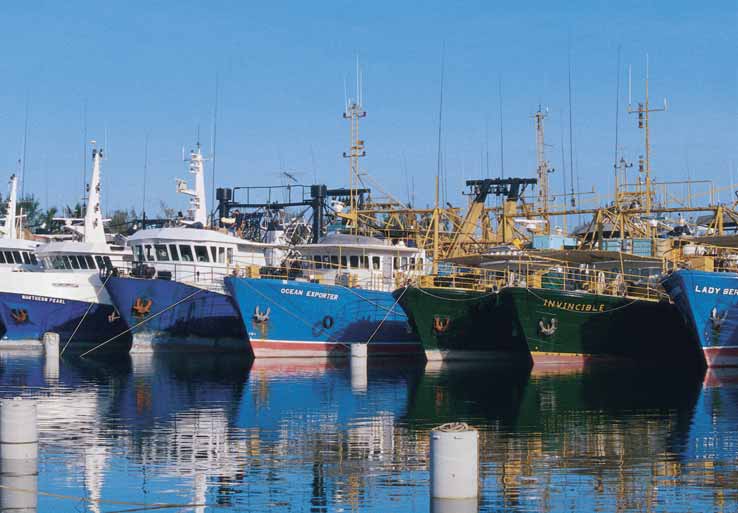


GEF