PROJECT SUMMARY
|
PROJECT IDENTIFIERS | ||
|
1. Project name: Transfer of Environmentally Sound Technology (TEST) to Reduce Transboundary Pollution in the Danube River Basin |
5. GEF Implementing Agency: UNDP | |
|
2. Country or countries in which the project is being implemented: Bulgaria, Croatia, Hungary, Romania and Slovakia |
6. Country eligibility: Eligible under para. 9(b) of GEF Instrument | |
|
3. GEF focal area(s):International Waters |
7. Operational programme/Short-term measure: Waterbody-Based (8) and Contaminant-based (10) Operational Programs | |
|
4. Project linkage to national priorities, Strategic Action Plans, and programmes: These countries signed the Danube River Protection Convention, which committed them to taking action to reduce transboundary pollution. In addition these countries must meet EU water quality guidelines as part of the accession process to the EU. Moreover, they have actively participated in UNDP/GEF programme (June 1997 to June 1999), that supported the revision of the Danube Strategic Action Plan (DSAP) as well as the development of a Danube River Pollution Reduction Programme for reducing transboundary pollution both within the Danube River Basin as well as to the Black Sea. | ||
|
3. GEF national operational focal point and date of country endorsement: Ministry of Environment and Water, Sofia, Bulgaria, 4 July 2000; Ministry of Environmental Protection and Physical Planning, Zagreb, Croatia, 5 May 2000; Ministry for Environment International Funding Department, Budapest, Hungary, 26 May 2000; Ministry of Waters, Forests and Environmental, Bucharest, Romania, 12 June 2000; and Ministry of the Environment, Bratislava, Slovak Republic, 2 June 2000. | ||
|
PROJECT OBJECTIVES AND ACTIVITIES | ||
|
9. Project rationale and objectives: The objective of the project is to build capacity in existing cleaner production institutions to apply the UNIDO Transfer of Environmentally Sound Technology (TEST) procedure to technology transfer to 20 pilot enterprises that are contributing to transboundary pollution, primarily nutrients, in the Danube River Basin and the Black Sea. The Transboundary Analysis Report (TDA) identified a total of 130 major industrial polluters in 11 countries. The vast majority are not convinced that it is possible to reduce transboundary pollutants and still remain financially viable. |
Indicators: The specifics of the transboundary pollution problems in the Danube River Basin and Black Sea originating from the industrial plants in the five countries selected to participate in the TEST program are delineated in Annex A. Briefly summarized: Bulgaria -- 8 plants contributing to nutrient loadings of 50 tons/year or greater; Croatia-- 3 plants contributing to nutrient loadings of 50 tons/year or greater and 2 plants with other pollutant loading affecting Significant Impact Areas (SIAs) in a neighboring country; Hungary -- 4 plants contributing to nutrient loadings of 50 tons/year or greater and 3 plants with other pollutant loadings affecting a SIA in a neighboring country; Romania--more than 35 plants contributing to nutrient loadings of 50 tons/year and 12 plants with other pollutant loadings affecting a SIA in a neighboring country and Slovakia-- 2 plants contributing to nutrient loadings of 50 tons/year or greater and 10 plants with other pollutant loadings affecting a SIA in a neighboring country. | |
C:\MSP12July00.
|
10. Project outcomes: Outputs would be: 1) Strengthened capacities to introduce Cleaner Technologies for pollution reduction 2) improved water quality. |
Indicators: 1) Cleaner production centers supporting industries to reduce pollution 2) reduction of Danube industrial hot spots. |
|
11. Project activities to achieve outcomes: There are three immediate objectives. One is to establish a TEST focal point in the NCPC/PPC (US$180,000). Two is that the 20 pilot enterprises in the five countries will be on their way or even may have achieved within the lifetime of the project a significant reduction in their discharge of transboundary pollution/nutrients into the Danube River and Black Sea. (US$2,380,000) The third is dissemination of the 20 pilot enterprises to other enterprises in the five countries as well as other Danubian countries (US$100,000). |
Indicators: 1. quarterly reports from NCPC/PPCs; Report on Establishment, description of institutional arrangements, national implementation plans prepared, endorsed by governments and participating industries. 2. 20 pilot projects (enterprise strategy prepared, financing obtained, implementation begun, investment negotiations underway. 3. Revised TEST manuals; five national workshops and one regional seminar |
|
12. Estimated budget (in US$): The total budget for the project is $US 2.4 million (plus 13 per cent overhead cost). The amount requested from GEF is $US990,000 (including 10 per cent AOS). The remaining is being requested from donors to the Industrial Development Fund (IDF) of UNIDO. Two donors have shown positive interest in partial funding of the project. |
|
|
INFORMATION ON INSTITUTION SUBMITTING PROJECT BRIEF | |
|
13. Information on project proposer: The United Nations Industrial Development Organization (UNIDO) is the project proposer. UNIDO has in-house capacity and historical experience (since 1996) in transferring technology to the industrial sector in developing countries and countries in transition that cannot be matched by other technical assistance organizations. Some of its relevant experience in the region are (1) National Cleaner Production Centers in the Czech Republic, Hungary and Slovakia (1994/96 to present; $US 1.6 million); (2) Assistance to the Ministry of Industry to Establish Cleaner Production at Two Polluting Plants at Copsa Mica in Romania ($US 0.3;1994-1996) (3) Promotion of Small and Medium Private Industries in Romania ($US 2.5 million;1992-1997); (4) UK/UNIDO Restructuring Project in Poland ($US3.6 million; 1991-1996); (5) Restructuring Assistance to Privatized SMIs in Romania ($US 0.2 million;1997-1998 (6) Restructuring Assistance to Istirochme in Slovakia (US$ 0.3 million; 1995-1996 and (7) Regional Business Development Centres in Bosnia ($US 0.7 million; 1997-1999). Information on proposed executing agency: Ralph A. Luken, Senior Technical Advisor, Cleaner Production and Environmental Management Branch, Sectoral Support and Environmental Sustainability Division Tel: 43-1-26026-3352; Fax 43-1-26026-6819 email: rluken@unido.org | |
|
14. Date of initial submission of project concept: 20 December 1999 | |
|
INFORMATION TO BE COMPLETED BY IMPLEMENTING AGENCY: |
|
15. Project identification number: |
|
16. Implementing Agency contact person: Chris Briggs, GEF Regional Coordinator, RBEC Tel. 1-212-906-5460; fax 1-212-906-5102 email: chris.briggs@undp.org |
|
17. Project linkage to Implementing Agency programme(s): The project supports implementation of the UNDP-GEF Danube Pollution Reduction Programme (PRP), the anticipated Regional Danube project and the GEF Black Sea Basin programmatic approach to reduction of transboundary pollution in the Danube River and Black Sea. The project design was based on reports by the PRP as well as extensive consultation with PRP staff, Secretariat for the International Commission for the Protection of the Danube River (ICPDR), Heads of Delegation and/or Country Programme Coordinators (CPCs) for the Danube River Protection Convention (DRPC) and National Cleaner Production or Pollution Prevention Centers in the five countries. |
|
18. Date of submission of project brief: 20 January 2000; revised 6 April 2000; revised 2 June 2000; revised 12 July 2000. |
PROJECT DESCRIPTION
1. PROJECT RATIONALE AND OBJECTIVES
The Danube River Protection Convention (DRPC), which came into force in 1998, commits countries in the basin to taking action to reduce transboundary pollution in the Danube River and Black Sea. The Transboundary Analysis (TDA) for the Danube River Basin (1999) identifies the major sources of transboundary pollution, being agriculture, human settlements and industry whereas the Pollution Reduction Programme (PRP) has recommended priority projects and measures to address these “hot spots” of pollution. The TDA identified a total of 130 major industrial polluters in 11 countries. Given the difficult transition that industry is undergoing in the region as well as the general lack of knowledge of the potential uses of cleaner technologies in the respective industrial sectors, many industries are not convinced that it is possible to reduce pollution and still remain financially viable.
The project’s objective is to build capacity in existing cleaner production institutions to apply the UNIDO Transfer of Environmentally Sound Technology (TEST) procedure to 20 pilot enterprises in five countries that are contributing to transboundary pollution, primarily nutrients. The project will enhance the skills of the institutions by training, advice and hands on experience with the pilot enterprises. As a result the pilot enterprises should be in a position to come into compliance with the environmental norms of the Convention, at the same time to remain competitive and to deal with the social consequences of major technology upgrading. The enhanced institutional capacity would then be available to assist other priority plants in these countries as well as in other Danubian countries.
2. CURRENT SITUATION
Danube River Protection Convention
Recognizing the growing regional and transboundary character of water management issues and related environmental problems, the Danubian countries together with the interested members of the international community met in Sofia in September 1991 to consider a new regional initiative to support and enhance the national actions that would be required. The countries agreed to develop and implement a program of priority actions and studies in support of a new Environmental Programme for the Danube River Basin (EPDRB). The countries also agreed to form a Task Force to oversee the EPDRB. The Commission of the European Communities (CEC), in its role as G-24 Coordinator, agreed to provide support and coordination for the Task Force. The main objective of the EPDRB has been to strengthen the operational basis for environmental management in the Danube River Basin.
To secure the legal basis for protecting the water resources, the Danube River Basin countries and the European Union signed the Convention on Cooperation for the Protection and Sustainable Use of the Danube River (DRPC) in Sofia, on 29th of June 1994. The main objective of the Convention is that all parties cooperate by taking all appropriate legal, administrative and technical measures to maintain and improve the current environmental and water quality conditions of the Danube river and of the waters in its catchment area. This includes among others the improvement and rational use of surface and ground water, pollution reduction from point and non-point sources and loads to the Black Sea, as well as accidental prevention and response measures.
The Convention entered into force on 22 of October 1998. Thus far it has been ratified by eleven parties: ten Danubian countries (Austria, Bulgaria, Croatia, Czech Republic, Germany, Hungary, Moldavia, Romania, Slovakia, Slovenia) and the European Union.
Water Quality in the Danube River
The TDA indicates that the following are the main problems that effect Danube water quality: high loads of nutrients and eutrophication; contamination with hazardous substances, including oils; microbiological contamination; contamination with substances causing heterotrophic growth and oxygen depletion and competition for available water. The human activities contributing significantly to these problems are human settlements, agriculture and industry.
The most recent information indicates that industry, atmospheric deposition, etc. cause about 20-30 per cent of the problem of excessive nitrogen and phosphorus in the Danube. Old-fashioned fertilizer factories are major dischargers of nitrogen and their outdoor piles and lagoons of phosphor-gypsum are a special source of nutrient pollution. Even if production on these sites is reduced or stopped, the gypsum stores will continue to be serious pollution sources in the future.
Industry and mining are responsible for most of the direct and indirect discharges of hazardous substances into the Danube basin. Depending on the type of industry, the effluent might contain heavy metals (smelting, electroplating, chlorine production, tanneries, metal processing, etc.), organic micro-pollutants (pulp and paper, chemical, pharmaceuticals, etc.) or oil products and solvents (machine production, oil refineries, etc.). Mining activities result in drainage water from the mines, run off from tailings and from process water containing metals and sometimes-organic solvents. Data are available on loading of hazardous pollutants from individual enterprises, but in most cases data are lacking or are unreliable. Sewage is a main source of ammonia.
Organic materials discharged by human settlements and industry consume available dissolved oxygen. The impact is dependent on the total load, the type of organic substances, the water temperature, and the dilution capacity and the initial oxygen concentration of the receiving waters. In particular the high level of nutrient loadings in the Danube are causing serious environmental problems in the Black Sea. One primary goal of this project is to reduce nutrient loadings to the Black Sea. Nevertheless high nutrient loadings are also of transboundary importance within the Danube River Basin. Serious oxygen deficiencies are most likely to occur in slow-flowing and stagnant waters. Downstream of major outlets, the oxygen concentration may drop below the level that can support aquatic life forms including fish populations and render the receiving waters unsuitable for drinking water supply and recreation. Such situations are occurring in the Danube tributaries: for example, the Vit River in Bulgaria is unable to support fish downstream of the city of Plevin, primarily due to discharges from a sugar factory. Discharges from the pulp and paper factory in Pietra Neamt have made one of the Siret tributaries unfit for most uses. The main stream of the Danube, however, has a very large dilution and oxygen mixing capacity that enables it to cope with heavy loads of organic materials.
Industrial Polluters
In the frame of the UNDP/GEF Pollution Reduction Programme (PRP) in 1998/1999, country expert teams, under the guidance of the respective country program coordinators, undertook a new, comprehensive review of the sources of pollution and their effects on the Danube River Basin and Black Sea. Each national team developed a national review for their respective countries based on a common methodology. The results were then compiled and analyzed at the regional level in TDA. Based on the TDA the ICPDR Emission Expert Group, 130 industrial enterprises of concern (known as hot spots) within the Danube River Basin were identified (Table 1).
Table 1. Major Manufacturing Discharges identified by the GEF Danube River Basin Pollution Reduction Programme, 1998
|
ISIC Code |
Bosnia Herzegov. |
Bulgaria |
Croatia |
Czech Rep. |
Hungary |
Romania |
Slovak. Rep. |
Slovenia |
Ukraine |
Yugo- slavia |
Total |
| 311 Food & 313 Beverages |
5 |
14 |
2 |
5 |
5 |
31 | |||||
| 321 Textiles |
2 |
1 |
3 | ||||||||
| 323 Leather |
1 |
2 |
1 |
1 |
1 |
6 | |||||
|
331 Wood processing |
1 |
1 |
2 |
1 |
5 | ||||||
| 332 Furniture |
1 |
1 | |||||||||
| 341 Paper |
1 |
1 |
3 |
3 |
2 |
5 |
2 |
1 |
18 | ||
|
351 Ind. Chem. & Fertilizers |
2 |
2 |
1 |
3 |
23 |
6 |
2 |
39 | |||
|
352 Other chemicals |
2 |
2 |
3 |
7 | |||||||
|
353 Petrol. Ref. |
1 |
1 |
2 | ||||||||
| 371 Iron |
1 |
1 |
2 |
5 |
9 | ||||||
|
372 Non-ferrous |
1 |
1 |
1 |
3 | |||||||
| 381 Metals |
2 |
2 | |||||||||
|
Oth. Major ind. |
1 |
1 |
1 |
1 |
4 | ||||||
|
Grand Total |
Bosnia-H. 4 |
Bulgaria 16 |
Croatia 20 |
Czech R. 3 |
Hungary 13 |
Romania 44 |
Slovak Rep. 12 |
Slovenia 10 |
Ukraine 4 |
Yugo. 4 |
G.T. 130 |
The specifics of the transboundary pollution problems in the Danube River Basin and Black Sea originating from the industrial plants in the five countries selected to participate in the TEST program are identified in Annex A. Briefly summarized: Bulgaria – 8 plants contributing to nutrient loadings of 50 tons/year or greater; Croatia—3 plants contributing to nutrient loadings of 50 tons/year or greater and 4 plants with other pollutant loading affecting Significant Impact Areas (SIAs) in a neighboring country; Hungary – 4 plants contributing to nutrient loadings of 50 tons/year or greater and 3 plants with other pollutant loadings affecting a SIA in a neighboring country; Romania—more than 35 plants contributing to nutrient loadings of 50 tons/year and 12 plants with other pollutant loadings affecting a SIA in a neighboring country and Slovakia—2 plants contributing to nutrient loadings of 50 tons/year or greater and 10 plants with other pollutant loadings affecting a SIA in a neighboring country.
The major polluting industrial sectors in terms of enterprises are food, paper, chemicals and iron. Together these four subsectors account for more than 75 percent of the significant industrial pollutant discharges.
Thus despite the period of transition in most of Central and Eastern Europe that has lead to a significant decrease in the level of industrial and agricultural activity, industrial pollution still remains a significant problem to be addressed by Danubian Countries. More importantly, as the economies in the region recover and industrial production increases, industrial pollution will significantly increase unless the source of pollution is adequately addressed beforehand.
3. EXPECTED PROJECT OUTCOMES
At the end of the 36 months project period, the following specific situation is anticipated:
3. All enterprises participating in the full programme would have prepared a Sustainable Enterprise Strategy (SES) that combines the essential elements of business plans, social action commitments and negotiated environmental compliance schedules. The SESs will explain how the enterprises, as required by the Convention, would implement best available techniques and best environmental practices needed to integrate successfully ESTs into their production processes;
b. Environmentally sound technology options (some combination of advanced process, pretreatment and final pollution control technologies) successfully identified for three-quarters of the the 20 enterprises. These options would bring these enterprises into compliance with environmental norms of the EU and the Convention;
c. Significant (at least 30 per cent) pollutant reductions, with an emphasis on nutrients, in at least one-half of the participating enterprises and some pollutant reductions in the other one-half as a result of implementing only cleaner production (process change) measures;
d. As a result of training courses provided by international experts, hands on experience working with international experts when they advise the 20 enterprises and a study tour, capacity is built in networks of national institutions to advise the some of the 73 remaining industrial hot spots in the five participating countries on how to implement the TEST procedure.
e. A TEST management toolkit (technical manuals on enterprise viability, cleaner production, industrial management, environmentally sound technology assessment, sustainable enterprises strategy, environmental management systems and investment negotiations as well as 20 case studies and information sources on subsector specific ESTs tailored for the needs of Danubian enterprises) would be available for teams of national experts in working with the remaining 80 enterprises to identify and install the most appropriate ESTs at least cost; and
f. The TEST programme and toolkit disseminated in a regional workshop to the other six Danubian countries to industrial enterprises identified as hot spots in the TDA. It is foreseen that based on the results of this phase of activity, a follow-up stage should be implemented in some if not all of the other Danubian countries. In this case a project document will be prepared for a technical cooperation programme in these countries.
4. ACTIVITIES AND FINANCIAL INPUTS NEEDED TO ENABLE CHANGES (INCREMENTAL)
The strategy to achieve the project objectives consists of three elements: establishing a TEST focal point/network in each of the five countries, applying the TEST procedure to a selected set of enterprises in the five countries and introducing the TEST procedure in the other countries that are signatories to the Convention.
Establishment of TEST focal points includes the following activities: US$ 180,000
3. Setting up the TEST focal point in the National Cleaner Production Centers (NCPC) or Pollution Prevention Centers (PPCs). These units are already functioning and have the necessary management and office support facilities to carry out the project (See annex B for detailed information about the history and achievements of each center);
(b) Identifying the most appropriate institutions/experts to support the NCPC/PCPs in carrying out the project based on advice from UNIDO Headquarters staff, UNIDO national focal points in each country, Secretariat for the International Commission for the Protection of the Danube River (ICDRPC) and country counterparts for the DRPC; and
3. ©Introducing the focal points to the TEST programme, installing an information management system (with a linkage to the ICPDR Information System) and preparing an implementation schedule for application of TEST to selected enterprises.
Application of the TEST procedure to 20 enterprises: US$2,100,000
(a) Selecting enterprises and securing their commitment to participate in TEST programme;
(b) Training of the TEST teams in the analytical techniques (enterprise viability survey, cleaner production, industrial management, environmentally sound technology (EST) selection, sustainable enterprise strategy, environmental management systems and investment promotion) that constitute the TEST (Annex C for additional information);
(c) Applying the TEST procedure to the 20 enterprises in order to identify the least cost solution for complying not only with water related environmental norms, but also with other environmental norms as required by EC Directive on Integrated Pollution Prevention and Control. The TEST procedure introduces enterprises to a sequential series of analytical techniques for two reasons. One is that the sequential application of these techniques has the greatest potential for identifying the least cost path to compliance with environmental norms. The other is that application of cleaner production and industrial management measures has often changed the perspective of the type of EST needed to come into compliance with environmental norms. The change is usually a less costly configuration of EST than originally envisaged before the application of the TEST procedure.
The application of the TEST procedure is uniquely different from earlier and currently on-going technical cooperation programs addressing industrial pollution in the Danube River Basin in two aspects. First, continued participation of enterprises in the TEST programme is contingent upon improving while assessing. This means that enterprises must implement at least some of the improvements identified by each assessment before they proceed to the next assessment in the TEST procedure. For example, they must implement no and low cost cleaner production options identified during the audit before proceeding to the industrial management assessment. Second, the TEST procedure is not the typical diagnostic study primarily undertaken by outside international and national experts. Rather it is an integrated assessment and improvement project conducted by enterprise teams under the guidance and supervision of outside international and national experts. The integrated approach usually results in a greater number of improvement options generated and implemented than the diagnostic approach.
Dissemination of the TEST results at 20 enterprises to other enterprises in the five participating countries and other countries in the Danube River Basin: US$100,000
(a) Preparing informational material for the TEST procedure. The informational material would include the TEST manual along with case studies;
(b) Hosting national seminars in each of the five countries;
(c) Offering a one-day assessment at polluting enterprises to show them the potential benefits of applying the TEST procedure at their enterprises;
(d) Introducing the TEST procedure to the six other Danubian countries in a regional workshop.
Implementing the TEST procedure will draw on several analytical methods that have been developed/applied by UNIDO in other technical cooperation projects. These include those for enterprise viability (Manual on Diagnostic and Industrial Restructuring), cleaner production, (Audit and Reduction Manual for Industrial Emissions and Wastes), industrial management (Manual on Diagnostic and Industrial Restructuring), environmentally sound technology assessment (A Interactive Eco-Investment Decision Support Software and Manual on Technology Negotiation), environmental management systems (ISO 14000 and Eco-Management and Audit Scheme) and investment promotion (Investment Promotion Services/Agencies).
|
Immediate Objectives |
Locations |
Index Measure |
Outputs |
|
Establishing the TEST focal points |
Bulgaria, Croatia, Hungary, Romania, Slovakia |
Annual activity Quarterly activity reports from NCPC/PPCs |
Organization of TEST focal points; training of team; information management system and implementation schedule |
|
Applying TEST approach to 20 enterprises |
Bulgaria, Croatia, Hungary, Romania, Slovakia |
20 pilot projects |
Pilot enterprises selected; viability assessment; cleaner production assessment; industrial management assessment; EST identification; sustainable enterprise strategy; environmental management system; investment promotion package |
|
Disseminating results to other enterprises and countries |
Bulgaria, Croatia, Czech Republic, Hungary, Moldavia, Romania, Slovakia and Slovenia |
Revised TEST manual and case studies; five country workshops and one regional seminar; assessment reports on new TEST focal points |
National seminars held in five countries; revised TEST manual with country case studies; 10 enterprises in each country offered one day seminar; regional seminar; teams identified in non-participating countries |
5. SUSTAINABILITY ANALYSIS AND RISK ASSESSMENT
Two factors suggest that the TEST programme will be effectively implemented and disseminated in the Danube River Basin. First, the TEST programme is a direct follow-up activity to the Danube River PRP and supports the SAP and the DRPC. Its design addresses the constraints facing industry that were identified in the reports from National Planning Workshops and the “Causal Chain Analysis for the Middle and Lower Danube Countries.” The proposed project has been introduced to the PRP and its country counterparts on several occasions in 1999, including the final workshop for the PRP at Hernstein (May 1999). Second, the TEST programme is a logical extension of the work currently being undertaken by five cleaner production/pollution prevention centers set up either by UNIDO/UNEP or USAID/World Environment Center. The centers are currently working with industry in these five countries to implement cleaner production measures, which reduce pollution discharge, but usually not to the extent necessary to comply with environmental norms. The TEST programme will enhance the capacity of these centers to assist enterprises to comply with environmental norms and at the same time address issues of enterprise competitiveness and social responsibility.
Three major risks could reduce the effectiveness of the TEST programme. One is that the environmental authorities may not enforce environmental norms that are necessary to protect water quality in the Danube River. If they fail to enforce norms, there may not be sufficient incentives for enterprises to participate in the TEST programme. The risk is there, but it is acceptable because the national governments are signatories to the Convention and there are numerous environmental action groups in these countries monitoring the progress in implementing the requirements of the Convention. Furthermore, countries that plan to enter the EU must comply with water quality standards. This will be an additional incentive to implement pollution reduction programs. The second is that environmentally sound technology options (combination of process and pollution control technologies) identified for some of the 20 plants may be too costly. If implemented by these enterprises, they would no longer be profitable operations. The risk is acceptable because there is considerable evidence that compliance with environmental regulations is not excessive (in the range of two to four per cent of production costs). The third is that financing may not be available for the enterprises to implement EST options. This risk is acceptable both because there are number of programs providing financial support for environmental projects and the enterprises themselves have to begin to address environmental compliance with their own resources if they are to remain in operation.
One minor risk is that some of the participating enterprises may drop out of the TEST programme, diminishing the number of completed plant demonstrations undertaken by this project. This has happened in the case of the PHARE programme on Clean Technology with one plant. This risk can be monitored and probably avoided by the NCPC/PPCs maintaining a continuous dialogue with the enterprises about their concerns with project activities.
6. STAKEHOLDER INVOLVEMENT AND SOCIAL ASSESSMENT
As explained above (section 5), UNIDO has designed the TEST programme for the Danube River Basin in close association with the PRP and the ICPDR Secretariat and its country representatives as well as NCPCs or PPCs in each of the five countries. All parties have reviewed the draft project document and their comments have been taken into account. In addition, UNIDO has received official country requests from the UNIDO national focal points in each of the five participating countries.
UNIDO will keep the Secretariat of the ICPDR informed on a regular basis about the activities of the TEST programme for the Danube River Basin
At the beginning of the project, the TEST focal points in each country will establish a Board of Advisors. The Board of Advisors will include the programme coordinators for the Convention and other institutions that are directly involved in industrial environmental management issues. In addition, efforts will be made to encourage the participation of non-governmental organizations (NGOs) and community groups where possible. Another possibility is to explore possible linkages with the Public Participation project being carried out by the Regional Environmental Centre for Hungary and Slovenia (also supported by a GEF Medium Sized Grant.)
INCREMENTAL COST ASSESSMENT
The proposed project is complementary for the purposes of incremental cost assessment. The project will build on baseline activities, principally within national cleaner production centers or their equivalents, to move from cleaner production (partial reduction of pollutants) to environmental compliance with norms for nutrient and toxic pollutant discharge into the Danube River Basin and Black Sea. Without the project, the additional capacity to assist enterprises to comply with environmental norms would not be available on such accessible terms.
The funding requested from GEF is additional because without the GEF support there would not be an application of the TEST concept in the five countries. International funding for NCPC/PCPs has ended for four out of the five countries (only Hungary is still being supported by the UNIDO/UNEP programme). The four centers are continuing their work in cleaner production with their own resources and fees for service. However, they do not have the capacity or incentive to offer a newer, more comprehensive service without initial support and experience in its application.
Cost recovery from the project beneficiaries (enterprises assisted) would be introduced in the pilot phase of the project, but would not be high enough to cover the full costs of services delivered by the NCPC/PCPs and international experts. All enterprises that participate in the pilot phase would be requested to pay approximately 10 percent of the costs of the service. Thereafter, the NCPC/PPCs should move rapidly to full cost pricing of the TEST service as they have already done in many cases for CP services. This is feasible as each of the proposed countries aspires to entry to the EU and will have to finance a majority of the needed investments themselves.
INCREMENTAL COST MATRIX
|
Activity Number |
Baseline |
Alternative |
Incremental (Alt-Base) |
|
1. Focal Points Established in NCP/PPCs |
|||
|
Global Benefits |
Capacities needed to address both competitiveness and environmental issues remain isolated in separate institutions and companies |
Capacities needed to address both competitiveness and environmental issues recognized and linked among institutions and companies |
Networks in five countries to provide integrated package of services needed to achieve compliance with environmental norms |
|
Domestic Benefits |
Lack of appreciation by service institutions of the cost-effectiveness for enterprises in providing them an integrated package of services |
Appreciation by service institutions of the cost-effectiveness for enterprises in providing them an integrated package of services |
NCPC/PPCs have a new service to market to industrial clients |
| Costs |
US$ 180,000 |
(GEF) US$ 100,000 (IDF) US$ 80,000 | |
|
2. Application of TEST approach to 20 enterprises |
|||
|
Global Benefits |
Lack of practical demonstrations that enterprises can reduce nutrient and toxic discharges to the degree required by environmental regulations and still remain competitive |
Practical demonstrations that enterprises can reduce nutrient and toxic discharges to the degree required by environmental regulations and still remain competitive |
EST options for nutrient and toxic pollutant reduction under active investment negotiation in at least one-half of 20 enterprises and measurable pollutant reduction (at least 30 percent) in at least three-quarters of the 20 enterprises at the end of the project |
|
Domestic Benefits |
Lack of practical demonstrations that enterprises can reduce organic pollutants to the degree required by environmental regulations and still remain competitive |
Practical demonstrations that enterprises can reduce pollutants to the degree required by environmental regulations and still remain competitive |
EST options for organic pollutant reduction under active investment negotiation in at least one-half of 20 enterprises and a significant pollutant reduction (at least 40 percent) in at least three –quarters of 20 enterprises at the end of the project |
| Costs |
US$2,100,000 |
(GEF) US$ 800,000 (IDF)US$1,300,000 | |
|
3. Dissemination of the TEST results to other enterprises and other countries |
|||
|
Global benefits |
Lack of a toolkit for industry that would allow it to reduce nutrient and toxic pollutants as required by environmental regulations and still remain competitive |
Toolkit available to industry that would describe how to reduce nutrient and toxic pollutants as required by environmental regulations and still remain competitive |
TEST management toolkit (technical manuals and enterprises reports) for nutrient and toxics reduction available to enterprises |
|
Domestic benefits |
Lack of understanding on the part of industry that it can reduce organic pollutants as required by environmental regulations and still remain competitive |
Understanding on the part of industry that it can reduce organic pollutants as required by environmental regulations and still remain competitive |
TEST management toolkit (technical manuals and enterprise reports) for organic pollutant reduction available to enterprises |
| Costs |
0 |
US$100,000 |
(GEF) US$ 0.0 (IDF) US$100,000 |
|
Global Environmental Benefits |
Most of the 100 enterprises in the five countries remain unconvinced that they can reduce nutrient and toxic pollutants as required by environmental regulations and still remain competitive |
Most of the 100 enterprises in the five countries are aware that they can reduce nutrient and toxic pollutants as required by environmental regulations and still remain competitive |
At least 20 of the 130 enterprises are committed to implementing the TEST procedure by the end of the project |
|
Domestic Environmental Benefits |
Most of the 100 enterprises in the five countries remain unconvinced that they can reduce organic pollutants as required by environmental regulations and still remain competitive |
Most of the 130 enterprises in the five countries are persuaded that they can reduce organic pollutants as required by environmental regulations and still remain competitive |
At least 20 of the 130 enterprises are committed to implementing the TEST procedure by the end of the project |
| Total project: |
US$2,380,000 |
(GEF) US$ 900,000 (IDF) US$1,480,000 |
BUDGET
Full funding of the project is US$2,380,000 for five countries. Full financing requires donors to the UNIDO Industrial Development Fund to provide support for US$1,480,000 needed for the project in addition to the US$ 900,000 (plus 10 per cent AOS) from the GEF. Two donors ( the Governments of Austria and Switzerland) are currently considering the project, but their deliberations will not be completed before Autumn 2000. The ratio of co-financing to funding requested from GEF is approximately 1.6:1.
|
Component |
GEF |
Other sources |
Project total |
|
Project Preparation |
25,000* |
25,000* | |
| Personnel: |
|||
|
International Experts: |
220,000 |
402,000 |
622,000 |
|
National Experts/Support Staff: |
520,000 |
710,000 |
1,230,000 |
| Subcontracts: |
25,000 |
25,000 | |
| Training: |
100,000 |
200,000 |
300,000 |
| Equipment: |
20,000 |
20,000 | |
|
Travel/Evaluation mission(s): |
60,000 |
115,000 |
175,000 |
| Miscellaneous: |
8,000 |
8,000 | |
|
Project Total (PDF excluded): |
900,000 |
1,480,000 |
2,380,000 |
| Support Costs |
90,000 |
||
| Total GEF |
990,000 |
||
* Costs for UNIDO staff in preparing GEF submission as well as project document requesting funds from other sources (not included in the project total).
IMPLEMENTATION PLAN
|
DURATION OF PROJECT (IN MONTHS): |
|
| ACTIVITIES |
PROJECTS-MONTHS |
|
I. Establish Focal Point Within NCPC/PPCs |
|
|
1. Institutional arrangements specified |
1 |
|
2. Trained TEST teams |
2 |
|
3. Information system functioning |
3 |
|
4. Implementation Schedule |
4 |
|
II. Application of TEST procedure to 20 enterprises |
|
|
1. Pilot enterprises selected |
4-5 |
|
2. Viability assessments |
6-9 |
|
3. Cleaner Production assessments |
9-14 |
|
4. Industrial Management assessments |
11-16 |
|
5. EST assessments |
15-19 |
|
6. Sustainable Enterprise Strategies |
18-25 |
|
7. Environmental Management Systems |
24-28 |
|
8. Investment Promotion Packages |
26-27 |
|
III. Diffusion of Experience to other enterprises in five countries and to other countries in the Basin |
|
|
1. National Seminars |
26-28 |
|
2. Revised TEST manual with case studies |
27-29 |
|
3. Twenty-five enterprises offered one-day seminar |
30-31 |
|
4. Danube River Basin seminar |
32-33 |
|
5.TEST teams identified and trained for four countries |
33-36 |
PUBLIC INVOLVEMENT PLAN
1. Stakeholder Identification
There are two major groups of stakeholders who will be involved in the project. The first group is the host institutions that will house the TEST programme and be its manager. These institutions are the Clean Industry Center (CIC) in Bulgaria, the Croatian National Cleaner Production Center (Cro CPC), National Cleaner Production Center of Hungary (HCPC), Pollution Prevention Centre (PPC) of Romania and Slovak Cleaner Production Centre (SCPC). Annex C briefly describes for each host institution its history, organizational structure, in-plant assessments conducted, training programs, information dissemination activities and policy dialogue with government. All five host institutions were consulted in the design of the TEST programme for the Danube and have agreed to be the host institution.
The second group is a subset of the 130 industrial enterprises identified by the TDA as being major contributors to water pollution in the Danube River and Black Sea. The subset of 79 plants located in the five countries is contributing to transboundary nutrient loadings and/or toxic pollutant loadings. Additional information about the plants is given in Annex A as well as briefly summarized earlier in this document.
Other important stakeholders are the ICPDR and its Secretariat, the country programme coordinators for the Convention, and relevant country NGOs working within the Danube Environment Forum.
Another set of stakeholders is investment banks that can utilize the SESs prepared by this project. The World Bank will be implementing the Danube/Black Sea Partnership Programme with up to 60 million USD for investment projects. The EBRD is also investigating the establishment of a Danube Credit Facility or something similar as a mechanism to fund projects.
2. Information dissemination and consultation
UNIDO has consulted with and drawn on the work of the PRP, particularly the SAP, the reports from the national planning workshops in each country, “Causal Chain Analysis for the Middle and Lower Danube Countries and the inventory of pollution sources. In addition it consulted with the five NCPC/PPCs in the design of the project. It presented a draft project document to the ICPDR and country programme coordinators for the Convention at the final workshop for the Pollution Reduction Programme at Hernstein in May 1999
3. Stakeholder participation
The primary mechanism for stakeholder participation in the project is membership in the Board of Advisors for the TEST programme in each country. Members of the Board of Advisors will include the country programme coordinators for the Convention, ministries of industry and environment, industry associations and financial institutions likely to be able to draw on World Bank or EBRD funds.
In the case of Hungary and elsewhere if possible, at least one NGO identified by the Regional Environment Centre as part of its forthcoming GEF project “Building Environmental Citizenship to Support Transboundary Pollution Reduction in the Danube: A Pilot Project in Hungary and Slovenia” will be added to the Board of Advisors.
4. Social and participation issues
The most important social issue that the project will have to confront is the fact that enterprise modernization strategies recommended by the TEST procedure will most likely involved some reduction in the workforce of the enterprises. These reductions have occurred with most modernization efforts, whether just to improve the competitive position of enterprises or to address a host of issues including compliance with environmental norms.
The TEST procedure to this issue is to deal with it in as transparent way as possible and to assist redundant workers in finding alternative sources of income or employment. The NCPC/PPCs will request each enterprise involved in the project to set up a team to implement the TEST procedure. Each team will have a union representative. The TEST procedure calls for the preparation of a Sustainable Enterprise Strategy, one component of which is a social action plan on how to assist workers who are made redundant as a result of technological modernization. Previous UNIDO projects in the region (Poland and Romania) on industrial restructuring and modernization have developed social actions plans which have been remarkably successful in addressing the problem of redundant workers.
MONITORING AND EVALUATION PLAN
An Annual Project Report (APR) will be prepared for this project. In addition, a Tripartite Review will be conducted with UNDP, the executing agency and the participating governments. The project will also participate in the GEF Project Implementation Review (PIR). Finally, an independent (external) evaluation will be conducted upon completion of the project. These measures will ensure that the project is monitored and evaluated in accordance with relevant UNDP and GEF procedures.
PROJECT CHECKLIST
|
Project activity category |
|
International Waters |
|
Water body: xxx |
|
Integrated land and water: |
|
Contaminant: xxx |
|
Technical Services |
|
Institution Building: xxx |
| Investments: |
|
Policy advice: xxx |
|
Targeted research: |
|
Technical/management advice: xxx |
|
Technology transfer: xxx |
|
Awareness/information/training: xxx |
| Other: |
ANNEX A: Major Manufacturing Discharges identified by the GEF Danube River Basin Pollution Reduction Programme, 1998 for Bulgaria, Croatia, Hungary, Romania and Slovakia (attached).
ANNEX B: INFORMATION ON NCPC/PPCs
The criteria for selecting the five countries that will participate in the first phase of the TEST programme were two. One is that the country has an operating cleaner production center or its equivalent. Six of the 11 countries that the 1998/1999 National Reviews identified with industry significantly contributes to pollution of the Danube River have an established cleaner production center or its equivalent (Bulgaria, Croatia, Czech Republic, Romania and Slovakia). The other is that there is a significant number of polluting industrial enterprises (at least five) to participate in the first phase of the TEST programme. The Czech Republic was not included because the National Review identifying a few industrial hot spots and they have begun implementation of pollution reduction measures at these hot spots.
The TEST focal points in each country will be an operating entity within a UNIDO/UNEP National Cleaner Production Centre, (Hungary and Slovakia), a USAID/ World Environment Centre Pollution Prevention Centre (Bulgaria and Romania) or a UNIDO funded cleaner production project (Croatia). All of these centers have an established track record, as documented below, in providing cleaner production services (in-plant demonstrations, training, information and policy advice) to industry. All of the centers have the necessary office facilities and equipment that will be needed by the project.
Bulgaria
Organizational structure
The Clean Industry Center (CIC) was established as a separate operational unit of the Bulgarian Industrial Association in September 1995 according to the cooperation agreement concluded with the World Environment Center. The Association is the major business association in Bulgaria. It represents companies, entrepreneurs and employers of the state, private, cooperative and municipal sectors. The activities and objectives of the Associations’ Environmental Policy are directly connected with the efforts of the industry achieve sustainable development, minimize their impact on the environment and raise overall production efficiency. In this respect the CIC implements a diverse range of activities and services, including quality and environmental management systems.
In plant assessments
The Center has completed the following activities: (a) waste minimization/cleaner production programs have been undertaken at the Lead and Zinc Complex, Verila, Neftochim, Sofarma; (b) implementation of ISO 14001, including management training and consultation and environmental review including mass balances have been undertaken at Biovet Peshter; (c) feasibility studies have been prepared for Sevlievo and Sevco tannery integrated WWTP; (d) environment site assessment (past contamination) under the privatization legal procedure have been prepared for MDK Pirdop Union Minier, Lead and Zinc Complex, Kardjaly; and (e) technical services including gas leakage measurements and consequent losses have been conducted for Neftochim.
TrainingThe Center has organized a series of seminars for the main industrialized areas in Bulgaria; for a whole industrial branch (e.g., the pharmaceutical and the metallurgical sectors); for the regional and branch associations - members of BIA; for particular plants such as: Neftochim-Burgas, Biovet-Peshtera and others. More than 200 representatives from industry, municipalities and other sectors have been trained in Environmental Management Systems (EMS) implementation at two-day seminars.
Information dissemination
CIC maintains databases on the air emissions, water discharges, solid waste and polluted soils for 400 major polluting companies and is supporting the establishment of the National Pollutants Release and Transfer Register (Toxic Release Inventory). It has published the results of seminars, case studies, pilot projects on Cleaner Production (CP) and EMS and the publications are listed on the Center’s homepage.
Policy Dialogue
The CIC facilitates the dialog among Industry, government and society, by encouraging, strengthening and supporting the capabilities of the various industrial sectors in the formulation and implementation of their own environmental policies. Two assessments have been produced on the industrial restructuring and environmental performance of the Bulgarian industry and submitted to the Ministry of Industry and Ministry of Environment. CIC is a leading party in the official adoption of ISO 140001 as an official Bulgarian Standard.
Croatia
Organizational Structure
The Croatian National Cleaner Production Center (Cro CPC) has been hosted by APO ‑ Hazardous Waste Management Agency, Zagreb since its inception in 1997. Its staff consists of two full time professionals including the director and part time clerical support as provided by host institution. The counterpart to the Centre is the Czech National Cleaner Production Centre.
In‑plant assessments
During the first long‑term training, 11 CP demonstration projects in 9 industrial companies were undertaken. Participating companies represent various industrial sectors: chemical, food processing, pharmaceutical, cosmetics and detergents, ceramics, electronics and adhesive tapes production. During the second long term training, nine industrial companies are participating: food processing, chemical, pharmaceutical, shipyards and thermal power plant. Ten in‑plant assessments have been initiated as part of the training.
TrainingSince 1997 two long‑term interactive "train the trainer" training courses have been organized. Long‑term training consists of three five‑day workshops. Between the workshops the participants undertake demonstration projects in their enterprises. Outputs of first training were 32 experts awarded the professional development certificate in Environmental Management and Cleaner Production, and 11 CP demonstration projects completed in 9 companies. The second training course, which started in December 1998, will be completed in October 1999. In this course, 26 experts in CP and Environmental Management will be trained and 10 CP case studies will be completed.
Information dissemination
Information dissemination is performed through long‑term training and promotional seminars. Besides two long‑term training, seven branch and five regional promotional seminars have been organized by Cro CPC and the Croatian Chamber of Industry. Introductory and promotional presentations have been given at the Chemical Engineers Society and the High Technical School. CP has also been promoted by presentations at several national and international conferences and symposia and by articles in national magazines dealing with waste management and environment.
Policy dialogue
Croatian CP experts have been involved in the process of environmental legislation making. The Cro CPC is participating in preparation of the National Environmental Strategy, which should be completed at the end of 1999. At the request of the Government, Cro CPC has prepared two reports as part of the United Nations Economic Commission for Europe (UNECE) project entitled "Environmental Performance Review: Croatia”.
Hungary
Organizational structure
The National Cleaner Production Centre of Hungary (HCPC) started its operation in May 1997. It is located in its host institution, the Budapest University of Economic Science, and cooperates with a number of national institutions involved in CP in Hungary. The office consists of five staff members, including the director. The office staff works together with 8‑10 national experts. The HCPC affiliate (regional sub‑centre) opened in Györ in June 1998. The counterpart to the Centre is STENUM, Graz/Austria.
In‑plant assessments
Five workshops have already been completed in two regional CP projects in Salgotarjan and Dorog with 12 participating companies altogether. These projects are based on the Ökoprofit methodology, which has been developed by STENUM, and are carried out in close cooperation with the two municipalities. HCPC staff members are taking part in a CP‑EMS project in a Hungarian brewery.
TrainingIn September 1998, the staff of the Centre and seven national experts took part in an in‑depth CP training, which was organized by STENUM in Graz/Austria. Six national experts have recently been trained in Ökoprofit programs. Preparatory work is under way for further training programs. CP has been included in the curriculum of environment management courses at the University of Economics. One of the main tasks of the new regional centre in Györ will be to extend the training capacities of the HCPC.
Information dissemination
The director and the staff of the centre have organized or participated in various CP awareness seminars in Hungary. The HCPC and partners were present at an international fair in Budapest in May 1998. Several presentations at various conferences have been made. The HCPC has set up an Internet database on cleaner technologies. The HCPC has been requested to organize the European Cleaner Production Round Table in 1999.
Policy dialogue
The HCPC is participating in the establishment of a national accreditation body for EMS (environment management systems) and is member of the National Accreditation Committee. Also, the NCPC is taking part in the development of economic and legal conditions in order to promote the CP concept, e.g. creation of an environmental insurance system for companies, where the fee is based on the environmental performance of the company. The director and staff members are taking part in the project initiated by the Hungarian Academy of Sciences to develop the environmental strategy for the EU accession.
Romania
Organizational Structure
The Pollution Prevention Centre (PPC) of Romania is an independent not-for-profit non-governmental organization operating since 1995 as a civic association. Its initial funding came from the U.S. Agency for International Development via the World Environment Centre, which has supported several pollution prevention centers in Central and Eastern European and Baltic countries. Financial support for the PPC from the World Environment Centre ended in March 1999. It is staffed by six professionals, mostly engineers, and one of these is the executive director of the Centre. It is housed in a modern office building with adequate computers and space in Bucharest.
In-plant Assessments
The PPC has undertaken three CP demonstration projects in the leather sector, which included equipment and training in monitoring and analysis of wastewater discharge. The PPC has undertaken eight CP projects in companies from different industrial sectors (metal finishing, steel processing, metallurgy, wood processing, leather work), which included training in CP principles and were continued by the companies which implemented a series of CP projects. In addition, the PPC has undertaken six energy conservation demonstration projects, which included training in the use of analytical equipment.
TrainingThe PPC has organized 11 workshops for the management staff of industrial plants. The plants included the main industries in Romania, including oil processing, chemicals, ferrous and non-ferrous metals, leather tanning and pulp and paper. The workshops covered CP, energy conservation and EMS.
Information Dissemination
The PPC has written and distributed manuals on waste minimization (more than 200 copies), energy conservation (more than 300 copies) and EMS (more than 150 copies). The PPC has published a report that describes CP projects undertaken in Romania, Bulgaria, Czech Republic and Slovakia.
Policy Dialogue
The PPC has proposed to the local Environmental Protection Agencies to make an inventory of pollution sources and to encourage industry to adopt CP measures. The first phase of this inventory will focus on major cities. In addition there are several joint activities with the Ministry of Waters, Forests and Environment Protection, the Ministry of Industry and the Ministry of Public Health.
Slovakia
Organizational structure
The Slovak Cleaner Production Centre (SCPC) is an independent not‑for‑profit non‑governmental organization operating since 1995 as a civic association affiliated with the Slovak University of Technology in Bratislava. At its inception, the Centre received funds within the framework of the Slovak‑Norwegian Cleaner Production Programme and later also from other sources. The Centre is a member of the PREPARE core group working in the European Union in the area of CP, and of the International Network of Environmental Management. The Centre represents Slovakia in activities of ISO TC 207 ‑Environmental Management. Methods applied by the Centre were based and developed upon the experience of the counterpart institution STENUM, the Norwegian approach and the Center’s own experience. The focus is on small and medium enterprises.
In‑plant assessments
In April 1995, SCPC organized the first workshop for a regional assessment project in the city of Martin. The ten participating companies represent various sectors, such as brewery, energy supply, metallurgy (Martin Metal), agriculture, glass production (Skloobal Nemsovar), hospital and wood furniture. In February 1996, the second regional assessment project started in the city of Trnava. Nine companies from the agro‑industry and the chemical industry sectors, and the municipality of Trnava are participating in this project. In April 1997 the results of the Trnava project were officially presented. In 1997, a new EMS capacity building project was started by training consultants. In 1998 implementation of CP and EMS projects started in four companies.
TrainingIn November 1995, 11 Slovak experts participated in a five‑day workshop on EMS organized by STENUM. During the demonstration projects in Martin and Trnava, ten consultants received in‑depth training in CP. In total the Centre has trained 260 national CP experts, consultants and managers. In 1997 the SCPC created a Club of national CP experts and managers. In October 1997 a long‑term training course on EMS and CP was started. In 1998 the EMS+CP course focused on training of 20 national experts and implementation of EMS+CP in four national companies, to meet the demands of ISO 14000. New projects, integrating CP, EMS and a health and safety management system were started as well. In October 1998 a joint training with Regional Training Centre for Basel Convention was held for government representatives of 20 CEE and NIS countries.
Information dissemination
In its four years of operation, the SCPC has organized 32 CP workshops and introductory seminars for participants from industry, services, municipalities and research and development institutions. It has published a 28‑page brochure on the Slovak CP programme, three newsletters and 33 articles in bulletins and newspapers and has received press and radio coverage. The first conference on CP in Slovakia was held in June 1996. At that time, the Club of Cleaner Production Experts and Managers was formed. In September 1996, in cooperation with SUSTAIN Austria, the SCPC organized the second Slovak Cleaner Production Conference and a conference on the Glass Industry and the Environment. During the last two years, activities and results of the Centre were presented at 29 national conferences and seminars and 10 international events.
Policy Dialogue
SCPC has prepared several reports for the Government and the Ministry of Economy, the most important ones being cleaner technologies in Slovak industry and development of biotechnologies. In addition, it has proposed that the Ministry of Economy should include CP in its document on industrial policy in the Slovak. This proposal was approved by the country’s Parliament. Several joint activities with the Ministry of Environment and the Agency for Environment Protection were undertaken.
ANNEX C: TEST PROCEDURE
The TEST procedure starts with enterprise viability assessment, which determines whether the enterprise has the potential to remain in business for more than five years given its market position included in the project because new investment in the plant, which would include investment in EST, and costs of production (Figure C.1). If the answer is negative, an enterprise would no longer be would not be warranted. If the answer is positive, then the enterprise would proceed with a clean production assessment because this assessment would identify pollutant reduction measures that an enterprise could undertake within its own financial resources. If these CP measures are implemented, which would demonstrate an enterprise’s commitment to environmental improvement, then an industrial management assessment is undertaken. If the plant implements the measures recommended in this assessment, then the TEST team would proceed to an environmentally sound technology assessment. If the industrial management options are not implemented, enterprise would no longer be included in the project. At the end of these two assessments (cleaner production and industrial management), the enterprise would have sufficient information about its production processes and problems to undertake an environmentally sound technology assessment. The EST assessment would identify the combination of best available techniques (combination of process change, pre‑treatment and final treatment) and best available practice (sectoral environmental control strategies and measures) that would bring the enterprise into compliance with environmental norms. If the EST assessment identifies a technically and financially feasible combination of technologies and these technologies are available on acceptable terms to the enterprise, the TEST team would prepare a sustainable enterprise strategy. If the EST assessment does not identify a satisfactory combination, then the enterprise would be dropped out of the project. The sustainable enterprise strategy. The strategy would combine an updated business plan that includes the financial justification for the EST investment, a social action plan on how to assist workers who would potentially be made redundant as a result of technological modernization and a negotiated environmental compliance schedule if the strategy is near a successful finalization (agreement with labour unions and environmental authorities), an enterprise would enter into the last two steps of the TEST procedure.
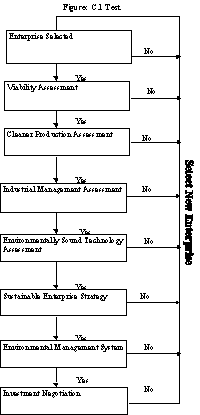
It would formalize an environmental management system for its operations as most of the preparatory work for setting up the system would have already been done in undertaking the earlier steps. And, it would begin the process of investment negotiation, which move in the direction of finding a strategic partner to bring into its operations or in the direction of approaching major lending institutions, such as the World Bank and EBRD. If the former direction is envisaged (making a business alliance), the enterprise would certainly want to include the proposed partner in finalization of its sustainable enterprise strategy because the proposed partner would most likely have proposals that could primarily shape the revised business plan.