Document of
The World Bank
Public Disclosure Authorized
Report No: ICR0000721
IMPLEMENTATION COMPLETION AND RESULTS REPORT
(TF-027739)
ON A
Public Disclosure Authorized
GLOBAL ENVIRONMENT FACILITY TRUST FUND GRANT
IN THE AMOUNT OF US$11.0 MILLION
TO THE
CENTRAL AMERICAN COMMISSION ON
ENVIRONMENT AND DEVELOPMENT
FOR THE
CONSERVATION AND SUSTAINABLE USE OF THE
Public Disclosure Authorized
MESOAMERICAN BARRIER REEF SYSTEM (MBRS) PROJECT
December 26, 2007
Environmentally and Socially Sustainable Development Sector Management Unit
Central America Country Management Unit
Latin America and the Caribbean Region
Public Disclosure Authorized
CURRENCY EQUIVALENTS
(Project operated in US$)
FISCAL YEAR
January 1 December 31
ABBREVIATIONS AND ACRONYMS
BICA
Bay Island Conservation Association
CAS
Country Assistance Strategy
CCAD
Central American Commission on Environment and Development
CORAL
Coral Reef Alliance
DO
Development
objective
EIS
Environmental Information System
EOP
End of Project
FM
Financial
management
GEF
Global Environmental Facility
GEO
Global Environment Objectives
GIS
Global Information System
ICR
Implementation
Completion and Results Report
ICRAN
International Coral Reef Action Network
ISR
Implementation Status Report
M&E
Monitoring and evaluation
MAR
Mesoamerican Reef Fund
MBC
Mesoamerican
Biological
Corridor
MBRS
Mesoamerican Barrier Reef System
MC
Monitoring
Coordinator
MPA
Marine Protected Area
MTR
Mid-Term
Review
NBRC
National Barrier Reef Committee
NC
National
Coordinator
NGO
Nongovernmental
organization
PA
Protected
Area
PACT
Protected Areas Conservation Trust in Belize
PAD
Project Appraisal Document
PCU
Project Coordinating Unit
PDF
Project Development Fund
PNAX
Parque Nacional de Arrecifes de Xcalak
PPF
Project Preparation Facility
PWG
Project Working Group
REIS
Regional Environmental Information System
RSC
Regional Steering Committee
SICA
Sistema para la Integración Centroamericana
SMP
Synoptic Monitoring Program
SPAWS
Fish spawning aggregation sites
TNC
The Nature Conservancy
TRCA
Threat and root cause analysis
TWG
Technical Working Group
UNDP
United Nations Development Programme
UNF
United Nations Foundation
USAID
United States Agency for International Development
WRI
World Resources Institute
WWF
World Wide Fund for Nature
Vice President: Pamela Cox
Country Director: Jane Armitage
Sector Manager: Laura Tlaiye
Project Team Leader: Marea Eleni Hatziolos
ICR Team Leader: Marea Eleni Hatziolos
ICR Primary Author: Gunars Platais
CENTRAL AMERICAN COMMISSION ON
ENVIRONMENT AND DEVELOPMENT
Conservation and Sustainable Use of the Mesoamerican Barrier Reef System (MBRS)
CONTENTS
A. Basic Information........................................................................................................ i
B. Key Dates .................................................................................................................... i
C. Ratings Summary ........................................................................................................ i
D. Sector and Theme Codes ........................................................................................... ii
E. Bank Staff................................................................................................................... ii
F. Results Framework Analysis ..................................................................................... iii
G. Ratings of Project Performance in Implementation Status Reports (ISRs) .............. vi
H. Restructuring (if any)................................................................................................ vi
I. Disbursement Profile ................................................................................................ vii
1. Project Context, Global Environment Objectives, and Design .................................. 1
2. Key Factors Affecting Implementation and Outcomes .............................................. 4
3. Assessment of Outcomes ............................................................................................ 8
4. Assessment of Risk to Development Outcome......................................................... 11
5. Assessment of Bank and Borrower Performance ..................................................... 11
6. Key Lessons Learned................................................................................................ 15
7. Comments on Issues Raised by Borrower/Implementing Agencies/Partners .......... 15
Annex 1. Project Costs and Financing.......................................................................... 17
Annex 2. Outputs by Component ................................................................................. 18
Annex 3. Economic and Financial Analysis................................................................. 29
Annex 4. Bank Lending and Implementation Support/Supervision Processes ............ 30
Annex 5. Beneficiary Survey Results ........................................................................... 32
Annex 6. Stakeholder Workshop Report and Results................................................... 33
Annex 7. Summary of Borrower's ICR and/or Comments on Draft ICR .................... 34
Annex 8. Comments of Co-financiers and other Partners/Stakeholders ...................... 45
Annex 9. List of Supporting Documents ...................................................................... 46
Annex 10. Amendment to Grant Agreement TF027739 .............................................. 47
Annex 11. Performance Indicators ............................................................................... 52
Annex 12. Project Institutional Arrangements ............................................................. 60
Map: IBRD 35846 ........................................................................................................ 62
A. Basic Information
Mesoamerican Barrier
Country:
Central America
Project Name:
Reef System (GEF)
Project ID:
P053349
L/C/TF Number(s):
MULT-27739
ICR Date:
12/28/2007
ICR Type:
Core ICR
CENTRAL
AMERICAN
COMMISSION ON
Lending Instrument:
SIL
Borrower:
ENVIRONMENT
AND
DEVELOPMENT
Original Total
USD 11.0M
Disbursed Amount:
USD 10.8M
Commitment:
Environmental Category: B
Global Focal Area: B
Implementing Agencies:
CCAD
Co-financiers and Other External Partners:
B. Key Dates
Revised / Actual
Process
Date
Process
Original Date
Date(s)
Concept Review:
03/11/1999
Effectiveness:
11/15/2001
11/30/2001
Appraisal:
12/11/2000
Restructuring(s):
Approval:
05/22/2001
Mid-term Review:
03/09/2004
Closing:
06/30/2006
06/30/2007
C. Ratings Summary
C.1 Performance Rating by ICR
Outcomes:
Satisfactory
Risk to Global Environment Outcome
Moderate
Bank Performance:
Satisfactory
Borrower Performance:
Satisfactory
C.2 Detailed Ratings of Bank and Borrower Performance
Bank
Ratings
Borrower
Ratings
Quality at Entry:
Satisfactory
Government: Moderately
Satisfactory
Implementing
Quality of Supervision:
Satisfactory
Satisfactory
Agency/Agencies:
Overall Bank
Overall Borrower
Satisfactory
Satisfactory
Performance:
Performance:
i
C.3 Quality at Entry and Implementation Performance Indicators
Implementation
QAG Assessments
Indicators
Rating
Performance
(if any)
Potential Problem Project
Quality at Entry
No
None
at any time (Yes/No):
(QEA):
Problem Project at any
Quality of
No
None
time (Yes/No):
Supervision (QSA):
GEO rating before
Satisfactory
Closing/Inactive status
D. Sector and Theme Codes
Original
Actual
Sector Code (as % of total Bank financing)
Animal production
8
8
Central government administration
21
21
General agriculture, fishing, and forestry sector
50
50
General education sector
13
13
Other industry
8
8
Theme Code (Primary/Secondary)
Biodiversity
Primary
Primary
Environmental policies and institutions
Primary
Primary
Export development and competitiveness
Primary
Secondary
Water resource management
Primary
Secondary
E. Bank Staff
Positions
At ICR
At Approval
Vice President:
Pamela Cox
David de Ferranti
Country Director:
Jane Armitage
D-M Dowsett-Coirolo
Sector Manager:
Laura Tlaiye
John Redwood
Project Team Leader:
Marea Eleni Hatziolos
Marea Eleni Hatziolos
ICR Team Leader:
Marea Eleni Hatziolos
ICR Primary Author:
Gunars H. Platais
ii
F. Results Framework Analysis
Global Environment Objectives (GEO) and Key Indicators (as approved)
The global objective of the project is to enhance protection of the ecologically unique and
vulnerable marine ecosystems comprising the Mesoamerican Barrier Reef System
(MBRS), by assisting the littoral states to strengthen and coordinate national policies,
regulations, and institutional arrangements for the conservation and sustainable use of
this global public good.
The global Development Objective (DO) has the following component DOs:
DO1: Ecoregional approach to MBRS Marine Protected Area (MPA) management
incorporated into conservation planning.
DO2: Steps initiated toward regional harmonization of policies and legislation.
DO3: Forum for regional cooperation at technical and policy levels operational.
DO4: Biological representation and ecological interconnectivity maintained in coastal
and marine ecosystems throughout MBRS.
Revised Global Environmental Objectives (as approved by original approving
authority) and Key Indicators and Reasons/Justifications
(a) GEO Indicator(s)
Original Target
Formally
Actual Value
Values (from
Revised
Achieved at
Indicator
Baseline Value
approval
Target
Completion or
documents)
Values
Target Years
Steps toward harmonization of relevant policies and legislation regarding MPA
Indicator 1: Management in transboundary areas, sustainable fisheries, sustainable tourism,
etc., initiated in all countries.
Belize, Guatemala,
and Honduras have
adopted, at
ministerial level, a
No harmonization in
Policies on the use
Value
common policy
policies regarding use of of shared MBRS
(Quantitative or
framework for use of
shared MBRS resources resources
qualitative)
shared resources in
at start of project.
harmonized.
these sectors.
A bilateral agreement
between Belize and
Mexico is pending.
Date achieved 11/30/2001
09/05/2005
06/29/2007
Comments
(incl. %
achievement)
iii
Ecoregional approach to MBRS MPA management incorporated into conservation
Indicator 2: planning.
MPA master
management plans or
operations plans
A fully
drafted or updated for
Paper parks established representative
17 representative
Value
without management
network of MPAs
MPAs. MPA
(Quantitative or plans or trained
established and
management
qualitative)
personnel. Enforcement functioning in the
effectiveness tracking
sporadic.
MBRS ecoregion.
tool in use at each
site; ecological and
management
baselines established.
Date achieved 11/30/2001
12/28/2006
12/30/2005
Comments
(incl. %
achievement)
Renewed commitment to conservation and sustainable use of the MBRS, as agreed
Indicator 3: to in the Tulum Declaration signed in 1997, demonstrated at the highest levels as
indicator of sustainability.
Heads of State of four
The four countries
MBRS countries sign the
signed the Tulum+8
Tulum Declaration,
Declaration in which
outlining their
they reaffirmed their
commitment to jointly
Value
commitment. A
conserve and manage the
(Quantitative or
revised Action Plan
MBRS and its resources
qualitative)
was prepared and
for current and future
endorsed by the four
generations, and
Ministers of
commission the
Environment for
preparation of an Action
future actions.
Plan.
Date achieved 06/05/1997
07/10/2006
Comments
(incl. %
achievement)
Indicator 4: Increased awareness of value of MBRS by general public.
The MBRS is now
widely recognized as
The MBRS's
a world-class
importance as an
Little appreciation among
resource in part due
Value
economic, natural,
general public of value of
to the inclusion in the
(Quantitative or
and cultural
MBRS as a world-class
school curriculum of
qualitative)
regional resource
resource.
material emphasizing
is widely
its importance; media
recognized.
spots and other
MBRS publicity.
Date achieved 11/30/2001
06/30/2007
06/30/2007
Comments
(incl. %
achievement)
iv
(b) Intermediate Outcome Indicator(s)
Original Target
Actual Value
Formally
Values (from
Achieved at
Indicator
Baseline Value
Revised
approval
Completion or
Target Values
documents)
Target Years
Three of four MBRS countries have agreed to harmonize policies at national
Indicator 1: level consistent with common policy framework adopted at a ministerial
conference (Dec 04).
(a) Several
regulations enacted
Ministers of Fisheries,
by ministerial
Environment, and
Commitment to
decree, but not all
Tourism of Belize,
harmonize relevant
ratified; (b)
Guatemala, and Honduras policies across
Fishermen's
Value
signed common policy
four MBRS
Congress with 4
(Quantitative or
framework governing
countries
countries
qualitative)
closed seasons for
embedded in
represented actively
fisheries, MPA
legally binding
promoted
management, dive
instruments.
harmonization; (c)
tourism, etc.
Draft Regional
Cruise Ship policy
prepared.
Date achieved 05/22/2001
06/30/2006
06/30/2007
Harmonization of policies is especially important for the transboundary areas. As
Comments
a result, an agreement was signed for the Southern transboundary area between
(incl. %
Belize, Guatemala, and Honduras. Negotiations between Belize and Mexico for a
achievement) bilateral agreement in the northern transboundary area have stalled indefinitely,
possibly due to federal/state jurisdictional issues in the area.
Marine Protected Area managers using tracking tool to monitor management
Indicator 2: effectiveness regularly and reporting on progress.
Tracking tool
A Baseline Report
introduced to all
on MPA
No MPAs using any
MPAs in the
management
Value
kinds of assessment of
MBRS region and
effectiveness, based
(Quantitative or management
in use by MPA
on Tracking Tool
qualitative)
effectiveness tool at
managers to assess
indicators, prepared
outset of project.
management
for 20 MPAs and
effectiveness over
posted on the web.
time.
Date achieved 11/30/2001
06/30/2007
06/30/2007
Comments
(incl. %
achievement)
Heads of State of all four MBRS countries reaffirmed their commitment to the
Indicator 3: Tulum+8 Declaration in a summit in July 2006 where they signed a new
declaration to protect the MBRS and coordinate efforts for its sustainable use.
Value
No new joint declaration Renewed
The Tulum+8
(Quantitative or by all four Heads of State commitment made
Declaration was
qualitative)
to demonstrate ongoing by Heads of State
signed in July 2006.
v
commitment to protect
to objectives of
MBRS since original
Tulum+8
Tulum+8 Declaration
Declaration and
signed in June 1997.
Updated MBRS
Regional Action
Plan endorsed to
address gaps and
new threats.
Date achieved 11/30/2001
06/30/2007
06/30/2007
Comments
This demonstrates sustained political support at highest levels for transboundary
(incl. %
ecosystem management, transcending changes in administration.
achievement)
G. Ratings of Project Performance in Implementation Status Reports (ISRs)
Actual
Date ISR
Implementation
No.
GEO
Disbursements
Archived
Progress
(USD millions)
1
06/28/2001
Satisfactory
Satisfactory
0.00
2
12/26/2001
Satisfactory
Satisfactory
1.06
3
05/13/2002
Satisfactory
Satisfactory
1.09
4
08/19/2002
Satisfactory
Satisfactory
1.62
5
02/27/2003
Satisfactory
Satisfactory
2.12
6
06/24/2003
Satisfactory
Satisfactory
2.74
7
12/22/2003
Satisfactory
Satisfactory
4.46
8
06/21/2004
Satisfactory
Satisfactory
5.22
9
12/16/2004
Satisfactory
Satisfactory
6.32
10
04/30/2005
Satisfactory
Satisfactory
7.33
11
02/28/2006
Satisfactory
Satisfactory
8.56
12
11/20/2006
Satisfactory
Satisfactory
9.79
13
06/20/2007
Satisfactory
Satisfactory
10.65
14
12/09/2007
Satisfactory
Satisfactory
10.83
H. Restructuring (if any)
Not Applicable
vi
I. Disbursement Profile
vii
1. Project Context, Global Environment Objectives, and Design
1.1 Context at Appraisal
The Mesoamerican Barrier Reef System (MBRS), which extends from the north of the
Yucatan Peninsula to the Bay Islands of Honduras, represents the longest barrier reef system
in the Western Hemisphere. This highly diverse and complex ecosystem contributes to the
stabilization and protection of coastal landscapes, helps maintain coastal water quality, and
serves as breeding and feeding grounds for marine mammals, reptiles, fish, and invertebrates,
many of which are commercially important. The MBRS is also of immense socioeconomic
significance, providing employment and a source of income for an estimated 1 million people
living in the adjacent coastal areas. Associated with the coral reefs of the MBRS are
extensive areas of relatively intact coastal wetlands, lagoons, seagrass beds, and mangrove
forests that sustain exceptionally high biodiversity and provide critical habitat for threatened
species. Complementing this rich array of species and habitats are extensive Mayan ruins,
dating back to the 12th century. The outstanding ecological and cultural significance of the
MBRS has resulted in the establishment of numerous national parks and reserves, with
several of these being designated World Heritage Sites. In the last 25 years, tourism
development oriented around the MBRS, especially cruise ship and diving operations, has
dramatically increased foreign exchange contributions to the gross national product of the
four littoral nations, Belize, Guatemala, Honduras, and Mexico.
Despite the outstanding ecological and cultural amenities of this world-class destination,
there were signs of declining reef health in the mid-to-late 1990s. A threat and root cause
analysis (TRCA) was carried out to systematically determine the nature, location, magnitude,
and root causes of current and anticipated threats to the ecological health of the MBRS. The
TRCA showed that the ecological health of the MBRS was being compromised by rapid and
unregulated coastal development, overfishing, pollution from land-based sources, habitat loss,
and climate change. It would be only a matter of time before these destructive forces resulted
in significant loss of ecosystem services, with important economic and social implications for
the region. The transboundary nature of the MBRS called for a coordinated, regional
approach, involving the four littoral nations working together to conserve and manage it for
future generations.
The MBRS Project was created with the political support at the highest level of government
and with a formal strategy for the management of the MBRS. In 1997, the leaders of the four
countries convened in Tulum, Mexico, and pledged their commitment to protecting the
MBRS in the Tulum Declaration. A 15-year Action Plan, aimed at safeguarding the integrity
and productivity of the MBRS, was prepared with the help of the World Bank, the Global
Environmental Facility (GEF), numerous nongovernmental organizations (NGOs), and
representatives of the four countries. It was adopted in 1999 by all four Ministers of
Environment under the sponsorship of the Central American Commission on Environment
and Development (CCAD). The World Bank/GEF project was designed to focus on regional
aspects of a strategy that would not normally be included in national action plans and the
incremental costs of which would not be supported by national budgets. It was recognized
that achieving meaningful outcomes that would safeguard the sustainability of the MBRS
would require prolonged commitment--about 15 years. A single, five-year effort would not
1
be sufficient to transform human behavior and achieve measurable changes in environmental
quality. This long-term commitment was implicit in the high-level political support contained
in the Tulum Declaration, and the parallel support from donors, NGOs, and the conservation
community to implement the Regional Action Plan. The visible and highly credible political
and technical effort meant that the project was launched under highly favorable conditions.
The MBRS Project was designed to assist the four countries bordering the MBRS to:
· Strengthen existing Marine Protected Areas in transboundary locations and other key
sites;
· Develop and implement a standardized regional monitoring and environmental
information system for the MBRS;
· Promote measures to reduce nonsustainable patterns of resource use in the MBRS,
focusing initially on the fisheries and tourism sectors;
· Increase local and national capacity for environmental management through
education, information sharing, and training; and
· Strengthen and coordinate national policies, regulations, and institutional
arrangements for marine ecosystem conservation and sustainable use.
1.2 Original Global Environment Objective and Key Indicators
The Global Environment Objective of the project was to enhance protection of the
ecologically unique and vulnerable marine ecosystems comprising the MBRS. The
Development Objective of the MBRS Project was to assist the countries of Belize, Guatemala,
Honduras, and Mexico to manage the MBRS as a shared regional ecosystem, safeguard its
biodiversity values and functional integrity, and create a framework for its sustainable use.
This would be done by assisting the littoral states to strengthen and coordinate national
policies, regulations, and institutional arrangements for the conservation and sustainable use
of this global public good.
The global development objective (DO) had the following component DOs:
DO1: The incorporation into conservation planning of an ecoregional approach to MBRS
Marine Protected Area management;
DO2: The initiation of steps toward regional harmonization of policies and legislation;
DO3: An operational forum for regional cooperation at the technical and policy levels;
DO4: The maintenance of biological representation and ecological interconnectivity in
coastal and marine ecosystems throughout the MBRS.
While ambitious, this multifaceted development objective clearly responded to the need for a
holistic approach to managing a shared coastal system. Although the multinational nature of
the project added a substantial level of complexity to implementation, this regional approach
was, and continues to be, an appropriate and desirable strategy, given the threats faced by the
MBRS.
Key performance indicators include:
· Regional frameworks in place for management of diverse resources of the MBRS;
2
· Biological representation and ecological interconnectivity maintained in coastal and
marine ecosystems throughout the MBRS;
· Capacity developed for an ecoregional approach to MBRS management and
incorporated into conservation planning at the local, national, and regional levels;
· Heightened awareness of the value of the MBRS and of the benefits from its
conservation; and
· Steps toward harmonization of relevant policies and legislation regarding MPA
management in transboundary areas, sustainable fisheries management, sustainable
tourism development, and protection of coastal water quality agreed and initiated in all
four countries.
1.3 Revised Global Environment Objective and Key Indicators, and
Reasons/Justification
Neither the original Global Environment Objective nor key indicators were revised. Some
adjustments were introduced, however, after the Mid-term Review, in the Output Indicators
in order to better account for the activities being supported by the project. These are
presented in Annex 10 (Amendment to Grant Agreement TF027739).
1.4 Main Beneficiaries
The project improved conservation outcomes and opportunities for sustainable use of the
MBRS and its resources. By encouraging a transboundary focus, which replaced historically
national and sector-specific management interventions, it resulted in a systemwide approach
to coastal and marine resource management, enhancing regional cooperation, uniform and
high performance standards, and sustainability of outcomes.
Beneficiaries of the Project included:
· The global and regional environment, including ecosystems of Belize, Honduras,
Guatemala, and Mexico;
· Local populations in the four countries, including women and indigenous groups, such
as the Garifuna, Ladino, Mayan, and Miskito communities;
· Various sectors including the private sector, the tourism industry, fishing cooperatives,
NGOs, and the scientific community; the donor community; and regional institutions,
such as CCAD.
1.5 Original Components
To achieve the development objectives in the context of significant knowledge gaps, weak
technical capacity, and the absence of any regional coordination, the Project was designed
around four components:
Component 1. Marine Protected Areas (US$5.0 million). This component focused on
planning, management, and monitoring of a select group of Marine Protected Areas (MPAs)
and institutional strengthening. This was done recognizing that many of the MBRS's more
than 60 existing and proposed coastal and MPAs exist only on paper and have little or no on-
site management, and that a significant number lack up-to-date master and operational plans
3
and the associated basic infrastructure and equipment needed for their implementation. It was
divided into two subcomponents: Subcomponent A Planning, Management, and Monitoring
of Marine Protected Areas (US$4.45 million); and Subcomponent B Institutional
Strengthening of MPAs (US$0.55 million).
Component 2. Regional Environmental Information System (US$4.4 million). This
component focused on providing timely and reliable data to managers and decisionmakers. It
established and distributed a web-based Regional Environmental Information System (REIS)
to provide an essential tool to organize and manage data to support improved
decisionmaking. A second objective of the component was the establishment of a Synoptic
Monitoring Program (SMP) to be used to support more informed management decisions. It
has two corresponding subcomponents: Subcomponent A Creation and Implementation of a
Distributed, Web-based Environmental Information System (EIS) (US$1.70 million); and
Subcomponent B Establishment of a Synoptic MBRS Monitoring Program (US$2.65
million).
Component 3. Promoting Sustainable Use of the MBRS (US$1.9 million). The objective
of this component was to support the introduction of new policy frameworks and
management tools to increase institutional capacity, disseminate key information, and create
the necessary incentives for stakeholders to shift toward patterns of sustainable use of MBRS
resources. The subcomponents reflect the focus on the two most important and potentially
harmful economic sectors dependent on the MBRS, fishing and tourism: Subcomponent A
Promotion of Sustainable Fisheries Management (US$1.04 million); and Subcomponent B
Facilitation of Sustainable Coastal and Marine Tourism (US$0.85 million).
Component 4. Public Awareness and Environmental Education (US$1.5 million). A
major underlying cause of threats identified in the Threat and Root Cause Analysis
completed in support of MBRS Program preparation was the lack of public education on and
awareness of the significance of the MBRS and the issues that need to be addressed to ensure
its sustainability. The component consisted of the development of an environmental
awareness campaign and formal and informal education: Subcomponent A Development of
an Environmental Awareness Campaign (US$0.93 million); and Subcomponent B Formal
and Informal Education (US$0.55 million).
1.6 Revised Components
Not Applicable
1.7 Other Significant Changes
The project was granted a one-year extension to allow for disbursement of the remaining
funds and preparation of a follow-on phase, which had been anticipated from the beginning.
2. Key Factors Affecting Implementation and Outcomes
2.1 Project Preparation, Design, and Quality at Entry
Because adequate preparation and stakeholder buy-in was considered essential for a regional
project of this scope, significant effort went into project preparation and planning. This was
4
carried out over a 26-month period at a cost of US$1.2 million, or 10 percent of the total GEF
amount. Preparation was financed by several donors: the Dutch Trust Fund I (US$360,000),
the Canadian Government (US$150,000); the Food and Agriculture Organization (FAO)
(which financed a fisheries specialist); and GEF in the form of a Project Development Fund
(PDF) Block A grant (US$25,000), and two GEF Block B grants (totaling US$494,000).
Both the Mid-Term Review and the Terminal Evaluation teams judged the participatory
decisionmaking and coordination among the four countries (see below) to be one of the key
factors in the project's success.
Learning from Earlier Operations
Experience has taught that gaining the commitment of stakeholders to regional cooperation to
solve transboundary issues requires creating a sense of ownership in the management process,
and consultation, consensus, and a reaffirmation of the benefits of a regional compared to a
nationalist approach. Overcoming the tendency to focus on national priorities rather than the
regional good was a challenge to the Project. Thus, the project team included several
activities to promote public awareness and dialogue about the importance of the MBRS to
create a strong constituency for the harmonization of policies and enforcement of legislation
that would be needed to sustain a regional approach.
Another key lesson drawn from environmental management projects around the world was
that initiatives of this type are typically long-term efforts, requiring sustained commitments
of political will and resources. With this in mind, the Project was designed as the initial phase
of a 15-year program, with the expectation that funding for the out-years would be secured by
leveraging GEF financing and expanding the partnership to new stakeholders, including the
private sector.
Consultation and Participation
Project preparation included three multistakeholder, regional workshops, each hosted by a
different member country. A social assessment involving national-level consultations was
carried out with the help of national coordinators under the aegis of a regional coordinator,
whose job was to consolidate the findings. To ensure that participation in the design phase
would be carried over during implementation, several mechanisms were incorporated into the
project structure. These included regional technical working groups, drawn from
multistakeholder National Barrier Reef Committees (NBRC) established in each country, to
help design relevant components of the project, and later monitor their implementation
through review and approval of annual work plans. A regional Steering Committee,
comprised of the ministers of environment from each country and the executive secretary of
CCAD (appointed by the Council of Environment Ministers of Mesoamerica) provided
overall policy guidance and acted as the key agents for harmonizing relevant policies and
regulations across the four countries. With a multinational Project Coordination Team drawn
from the four participating countries and reflecting both gender and ethnic diversity to
execute the project, the MBRS project was seen as highly representative of interests in the
region.
Quality at Entry
Quality at entry is rated Satisfactory. The project enjoyed a high level of political support,
and reflected shared objectives of the four countries. It was consistent with Country
Assistance Strategy (CAS) goals for all four countries, including improving public sector
5
governance in Mexico through institutional development and better management of natural
resources. Belize, Guatemala, and Honduras shared similar CAS goals of reducing rural
poverty through improved environmental security and better management of natural
resources. Building social capital through information networking, training, and broader
participation of local stakeholders in the management of resources was identified as a
complementary goal among the three countries. The Project supported these goals by first
promoting a regional vision of ecosystem sustainability and productivity. It further supported
public awareness about the importance of the MBRS as a world-class resource, its
importance to the cultural and economic future of the region, and its role as a vital
component of the biosphere.
The Project would further seek to reduce fragmentation in the governance of the MBRS and
promote regional integration by creating a platform for regional coordination, improving
regional information systems for decisionmaking and harmonizing policy frameworks across
the four countries in line with principles of environmental and social sustainability. In light of
the above, the project's Quality at Entry is rated Satisfactory to Highly Satisfactory.
2.2 Implementation
2.2.1 Factors Outside the Control of Government or Implementing Agency
During the lifetime of the project there were no major forces (such as natural disasters) that
affected its implementation or that were outside the control of the four governments or the
implementing agency.
2.2.2 Factors Generally Subject to Government Control
Project effectiveness was delayed six months due to the unusual amount of coordination
necessary for this unprecedented regional effort involving four countries managing a
complex ecosystem. Part of this delay was due also to the project aligning its financial
management (FM) with the World Bank's FM requirements. Although this six-month delay
did not substantially affect project implementation once the project was launched, it did
affect the disbursements schedule, resulting in the need for a one-year project extension to
fully disburse project funds.
2.2.3 Factors Generally Subject to Implementing Agency Control
The quick recovery from the six-month effectiveness delay can be directly linked to the
substantial investments during project preparation in consultation, representative
decisionmaking, and coordination among the four countries. Housed in new facilities in
Belize City, which also included the Coastal Zone Management Authority and the Belize
Fisheries Department, the Project was able to coordinate effectively with both the Ministry of
Environment (as a member of CCAD) and the Ministry of Agriculture, whose Director of
Fisheries served as the MBRS National Coordinator. The National Barrier Reef Committee
(NBRC), which provided input into the Project's annual work plans through representation
on the regional Technical Working Groups (comprised of NBRC members according to their
technical expertise), also lent stability, credibility, and a high degree of local ownership to
this regional initiative.
2.3 Monitoring and Evaluation (M&E) Design, Implementation, and Utilization
6
2.3.1 M&E Design
Monitoring was one of the main pillars of the project--both in terms of assessing
implementation outcomes and in evaluating the health of the MBRS. As mentioned, the
project's preparation had a strong participatory nature, with technical working groups
contributing to annual work plans, the review of project benchmarks, and, in the Synoptic
Monitoring Program of the Project, the identification of key indicators. The M&E design
benefited from this participatory nature, resulting in a set of indicators that was widely agreed,
succinct, and targeted.
2.3.2 M&E Implementation
The M&E plan was carried out in a timely manner. Results and progress were a vital part of
the national and regional M&E program. They were tracked through a log frame matrix and
Annual Progress Reports (Annex 11). Another important aspect of the M&E program was its
state-of-the-art website (http://www.mbrs.org.bz/), which not only posted a rich array of
technical and scientific reports, but also was used to post progress reports, agreements, and
other administrative documents. This allowed the project to not only disseminate pertinent
technical information but also to be transparent.
The M&E plan was put into effect as planned, and tracked project outputs and outcomes. The
Key Performance Indicators were robust enough to track progress toward reaching the
project's goals, but they did not provide enough information to monitor the long-term
financial sustainability of the project.
2.3.3 M&E Utilization
The Synoptic Monitoring Program and the Regional Environmental Information System
(REIS), a component of the project's overall M&E System, represent the first such
standardized information gathering and dissemination on the status of MBRS indicators in
the region. The results from monitoring are slowly making their way into the decisionmaking
process of MBRS management. The use of evidence collected from fish Spawning
Aggregation Sites (SPAWS) has contributed to setting some of these areas aside with fishing
communities' support. At the scientific level it has provided input for technical reports and
articles in peer-reviewed journals. More important, monitoring results (including
socioeconomic aspects) will constitute a major input to the biannual report on the State of
MBRS Health, commissioned by the Ministers of Environment in the updated Regional
Action Plan for the Mesoamerican Barrier Reef System, endorsed in 2006.
2.4 Safeguard and Fiduciary Compliance
An Environmental Analysis was carried out during Project preparation. Recommendations on
how to mitigate potential adverse impacts from the Project related primarily to small-scale
infrastructure for MPAs. These were presented in the form of an Environmental Management
Plan, including preparation of guidelines for siting of construction and operation of MPA
infrastructure. These were incorporated into Project design and applied during project
implementation in the selected MPAs.
A Social Assessment, involving extensive consultations, was carried out during Project
preparation. The results and recommendations were incorporated into an Indigenous People's
Participation and Development Plan, which was implemented under the Project.
7
2.5 Post-completion Operation/Next Phase
As noted, a second-phase project following on the heels of phase 1 was anticipated at the
outset and is now in the early stages of preparation. However, a key determinant of whether
the Project will move forward with GEF support is the identification of adequate co-
financing. Donors often wish to leverage their resources and are reluctant to make a
commitment until there is already evidence of strong financial support from one or more
partners. Several partners have indicated their interest in supporting a second phase and have
committed to raising funds if core funding is forthcoming.
3. Assessment of Outcomes1
3.1 Relevance of Objectives, Design, and Implementation
The overall objective of the MBRS Project was to enhance protection of the unique and
vulnerable marine ecosystems comprising the MBRS, and to assist the countries of Belize,
Guatemala, Honduras, and Mexico to strengthen and coordinate national policies, regulations,
and institutional arrangements for the conservation and sustainable use of this global public
good.
This objective continues to be highly relevant to the MBRS, particularly in the wake of
information gleaned from the baseline monitoring--the first such effort of its kind in the
region--which indicates that human pressures on the reef are increasing and climate change
is having a significant impact on coral reefs throughout the MBRS region.
Strengthening the management of Marine Protected Areas (MPAs) has significantly
improved the potential effectiveness of these tools for conservation.2 In many instances, the
Project turned MPAs from marginally operating, well-intentioned efforts into functional
MPAs that were able to attract new funding through entrance fees, grant writing, and other
financing strategies. The Project also brought public awareness of the value of the reef to a
much higher level throughout the region, from the elementary classroom to the highest levels
of government.
The regional approach pioneered by this Project, including human and institutional capacity
building to identify and address issues of regional importance, and access to key
decisionmakers to both communicate these findings and provide a conduit for regional action,
remains even more valid in the face of globalization (including tourism and demand for fish
products) and other threats to the MBRS such as climate change.
The Project was, however, less successful in its attempts to manage tourism impacts, promote
sustainable tourism development, or create alternative livelihoods for those engaged in
unsustainable natural resource extraction, such as fisheries. In particular, it was felt that one
1 This section should be read in conjunction with the independent Terminal Evaluation of the Project,
commissioned by the Bank and submitted to the GEF. The evaluation rated the project between
Satisfactory and Highly Satisfactory on all but one of the Outcomes.
2 The results of the first baseline report on MPA Management Effectiveness, using a tracking tool
developed by the Bank and partners in the region, highlights both the strengths and weaknesses of these
protected areas, alerting managers where strategic investments are most likely to have a payoff in achieving
overall objectives.
8
of the shortcomings of the project was its inability to bring the tourism sector into strategic
discussions and engagement in implementation of tourism-related activities and alternative
livelihoods. While less effort was put into the design of this subcomponent, it was always
anticipated that capacity building in the tourism sector would come from a parallel
investment project prepared as co-financing for the MBRS Project--Sustainable Coastal
Tourism--in Honduras. Unfortunately, the Instituto Hondureño de Turismo, which was
implementing the latter project, chose not to become involved in the regional tourism forum
that was to bring stakeholders in the industry together, with the result that this component of
the MBRS project had little technical support or institutional buy-in.
3.2 Achievement of Global Environmental Objectives and Sustainability
The Global Objective of the MBRS Project was to enhance the protection of the ecologically
unique and vulnerable marine ecosystems comprising the MBRS, by assisting the littoral
states to strengthen and coordinate national policies, regulations, and institutional
arrangements for the conservation and sustainable use of this global public good.
The Project has been highly successful in achieving its Global Objective. It catalyzed
international cooperation among Belize, Guatemala, Honduras, and Mexico and is widely
regarded as a model for regional coordination and joint management of a transboundary
resource. Key achievements of the Project are:
1. Catalyzed the adoption of a common policy framework for sustainable management of
resources in the areas of fisheries, tourism, and Marine Protected Areas (MPAs) among
the three countries on the Gulf of Honduras; adoption in Mexico is pending.
2. Fostered new mechanisms for coordination and multistakeholder representation within
the countries themselves via the National Barrier Reef Committees (NBRCs), comprised
of representatives from both the public and private sectors.
3. Established a standardized regional Synoptic Monitoring Program, including information
on reef health, seagrass, and mangrove status, water quality, and water contamination to
track changes in MBRS ecosystem health.
4. Developed and established a web-based Regional Environmental Information System
(REIS) with over 20 institutions permanently contributing data to the system.
5. Strengthened management capacity in 16 MPAs through the development and
implementation of numerous MPA training tools, the training of more than 200 park
rangers, infrastructure support, and tracking tools to report on management effectiveness.
6. Harmonized primary and secondary school curriculums in all four countries on the value
of the MBRS to the people of the region and to future generations, and trained over 2,000
teachers in their use.
7. Organized the first-ever Mesoamerican Fishermen's Congress to gain fishers' support for
harmonized policies and norms.
8. Formulated a Draft MBRS Cruise Ship Policy.
9
9. Served as a catalyst in achieving recognition of the MBRS as a region of global
importance, attracting attention and interest of numerous international actors.
3.3 Efficiency
The objectives of the Global Environment Facility (GEF) to conserve and sustainably
manage globally important biodiversity resources in a transboundary setting were met. With
GEF support of US$11 million, the project was able to catalyze additional investments (in-
kind and in cash) by the countries and other partners in the region, to achieve substantial,
concrete results in capacity building (technical and physical), policy reform, and collection of
baseline data on the reef system. Given these outcomes, the Project was highly efficient in its
use of limited project resources.
3.4 Justification of Overall Outcome Rating
Rating: Satisfactory
Given its high relevance and the significant outputs and the resulting outcomes achieved in a
complex regional context, this project has an overall satisfactory outcome rating.
3.5 Overarching Themes, other Outcomes and Impacts
(a) Poverty Impacts, Gender Aspects, and Social Development
The Project did not directly target poverty alleviation, gender, or social development. Its
impact on these issues, if any, was indirectly through the improved management of the
marine resources, which would in the medium to long term improve sustainability of fisher
and other communities that depend on the MBRS.
(b) Institutional Change/Strengthening
The Project made important contributions to institutional strengthening in the region, first by
setting a standard for regional cooperation in addressing issues of common concern over a
shared resource. With the help of CCAD, the executing agency for the Project, it created the
political space for unprecedented regional coordination and progress toward policy
harmonization in the governance of marine resources in the region. Second, the project
strengthened the technical capacity of MPA managers and facilitated public access to key
information about the value of the MBRS and its condition. This, in turn, has empowered
civil society to demand greater accountability from policymakers on MBRS resource
governance.
(c) Other Unintended Outcomes and Impacts
The GEF support was a magnet for new investments in conservation and sustainable use of
the MBRS, with the result that considerable leverage from the international conservation
community was brought to bear on decisionmaking in the region.
As a result of information from spawning aggregation studies supported by MBRS and other
partners, new fishing regulations to protect remaining spawning aggregations of the
threatened Nassau Grouper in Belize have been issued. Other reforms, including the banning
of commercial fishing and the sale of parrotfish, key grazers that keep in check overgrowth of
seaweed on the reef, are pending. Closure of fishing seasons and gear restrictions have been
harmonized across the four countries, reducing poaching opportunities and destructive
10
fishing. In Mexico, a new law has been passed to strengthen protection of mangroves in
response to greater public awareness and concern over coastal erosion in exposed areas from
more frequent and intense hurricanes. Effective enforcement, however, remains a challenge,
given the money to be made from tourism development.
The capacity of MPAs to raise funds (for example, from entrance fees, grants from the
Protected Areas Conservation Trust in Belize [PACT], and the Mesoamerican Reef [MAR]
Fund [a regional facility established by NGOs in the region to finance marine conservation
activities at US$50 million over the next 10 years]) is far greater now than when the Project
started. The infrastructure, human resources development, and MPA operational management
plans supported by the Project are an important legacy that can be used to leverage additional
resources from external sources to cover some operating and program costs.
Despite these solid achievements, however, some outcomes will most likely not be
sustained in the absence of continued external support. The Synoptic Monitoring Program
(SMP) and the Regional Environmental Information System (REIS) do not currently have
a dedicated source of funds to continue beyond phase 1. While the Governments of
Belize and Mexico are committed to funding basic monitoring in the absence of external
support, this is not the case in Guatemala and Honduras. A second phase project was
regarded as essential to creating a market demand for data to be generated by the SMP.
4. Assessment of Risk to Development Outcome
Rating: Moderate
The main threat to the development outcome of the project is lack of long-term funding for
the continued monitoring and data collection that feeds both the Regional Environmental
Information System (REIS) and the Synoptic Monitoring Program (SMP).
The Regional Coordinator at the time of this report was actively seeking resources for the
continued financial support for these and other project-related activities. While some
commitments have been made, for example, for construction of a Regional MBRS Center,
and pledges to raise funds have been obtained (for example, for priority activities under a
phase 2 to reduce threats in the watersheds draining into the MBRS), a critical mass of core
funding will need to be identified soon to secure the additional co-financing required.
5. Assessment of Bank and Borrower Performance
5.1 Bank
(a) Bank Performance in Ensuring Quality at Entry
Rating: Satisfactory
The World Bank Task Manager's extensive expertise in marine biology was an important
factor in the success of project preparation. Given the complexity of the Project, it was
important not only to have this expertise but also to be able to rely on a broad range of
experts. Even though project design reflected this broad range of skills, adjustments were
recommended and later adopted.
11
(b) Quality of Supervision
(including of fiduciary and safeguards policies)
Rating: Satisfactory
The World Bank Task Manager has been with the Project since its inception and was
acknowledged by all interviewed as highly committed to the project and an important driving
force in the project's success. The long-standing relationship with the project provided
important continuity, which was even more essential given the complex nature of the Project.
The Project's March 2004 Mid-Term Review (MTR) provided extensive guidance, with
some 50 recommendations. These included: consultation with political partners outside the
current cast of MBRS ministries, coordination with bilateral donors and international NGOs,
socioeconomic studies to identify alternative livelihood opportunities, directly engaging
coastal communities in project planning and execution, developing a plan for approaching the
private sector to help set up an endowment fund for coastal and marine resource conservation,
and securing financing sources via user fees. In the end, fewer, more targeted
recommendations, and more systematic follow-up would probably have been more effective.
Perhaps the biggest constraint in terms of Bank performance was the lack of a policy
dialogue between the Country Departments and the governments on key policy reforms. This
is often the case with grant funding, where significant investments are not at stake, and even
more likely with regional projects, such as this one, which cut across three country
departments in the Bank.
(c) Justification of Rating for Overall Bank Performance
Rating: Satisfactory
The Bank's supervision is rated as satisfactory given its commendable effort on a complex
project in a multinational setting, contending with difficult ecological conditions and
institutional arrangements. As is to be expected, certain shortfalls were identified during
project implementation and were captured in the recommendations of the mid-term
evaluation. A concerted effort was made to address these to the extent possible under the
remaining time frame of the project.
5.2 Borrower
(a) Government Performance
Rating: Moderately Satisfactory
Given the project's regional approach involving four separate countries, implementation
arrangements were by necessity, complex and multilayered (Annex 12).
The involvement of CCAD elevated the profile of the MBRS as a system of regional
importance to the ministerial level, which should result in continued institutional interest. The
Steering Committee provided an essential mechanism for coordination among the
participating countries and was an effective tool for project implementation and regional-
level oversight of the Project Coordinating Unit (PCU).
The funding of the National Coordinator (NC) was part of the countries' counterpart
contribution, meant to demonstrate their commitment to the project. However, the ability of
12
the NCs to adequately fulfill their roles was constrained by limited human and financial
resources intrinsic to their countries. All the NCs mentioned that, in retrospect, the lack of a
dedicated person to the MBRS Project hampered their country's ability to participate
optimally. The Project was deliberately designed not to finance NC salaries in deference to
sustainability concerns. Perhaps an arrangement can be considered in the future, whereby the
NC is provided resources to employ help for specific project-related activities. While this
means additional costs to the project, strengthening the capacity at the national level may be a
cost-effective investment.
At the field level, some Protected Areas personnel reported problems getting basic support,
and felt that responsiveness to their needs was highly variable.
The NBRC committees were established by ministerial decree at the outset of the project to
represent multistakeholder interests in management of the MBRS. Their degree of
engagement varied from country to country (Belize, for example, had a strong and active
NBRC, while those in Guatemala, Honduras, and Mexico met irregularly).
The Technical Committees met with varying degrees of success. One limitation was that the
members in these committees served in an honorary capacity, and as such, were not always
able or willing to give the project the level of attention needed. Still, members participated in
the development of the Annual Work Programs, and many individuals generously gave many
hours of their time and expertise at little or no cost to the project.
The benefits envisioned in the Project Appraisal Document of the Consultative Group--a
donor/partner group in the MBRS region--were not fully realized. While the group met
formally on two occasions on how to improve collaboration and increase synergy, these
meetings were not sustained. Bilateral meetings were more frequent between the Bank and
other partners in the region and resulted in a productive collaboration, Healthy Reefs for
Healthy People, with guidance to managers on reporting on the health of the MBRS.
As mentioned, the Heads of State of the four participating countries gave the project strong
political support; however, this did not always filter down to the line ministries with
jurisdiction over MBRS resources. More often than not, economic interests in one ministry
trumped efforts by another to protect valuable but threatened resources. This underscored the
need, in the future, to include all relevant ministries in project implementation and as part of
the Steering Group. This is anticipated in the updated regional Action Plan for the MBRS.
(b) Implementing Agency or Agencies Performance
Rating: Satisfactory
The Central American Commission on Environment and Development (CCAD) was selected
to execute the project after a detailed institutional analysis during project preparation
indicated that CCAD was the only organization in Central America that had the mandate and
government buy-in to deal with environmental policy at the regional level. Its convening
power and ability to raise policy issues to the highest levels of government through the
Sistema para la Integración Centroamericana (SICA) made it the strategic choice for
advancing regional coordination and harmonization of policies governing shared resource use
in the MBRS. Although CCAD's operational experience in coastal and marine issues was
13
limited at the outset, it put together a strong regional coordination unit (the Project
Coordinating Unit, PCU), of technical experts from all four participating countries to run the
day-to-day operations of the project. CCAD proved to be invaluable in facilitating agreement
on the Common Policy Framework in the Southern Transboundary Area, and in bringing
Mexico on board as an Observer to CCAD. This opened the door to discussions on a
common policy framework for the Northern Transboundary area of the MBRS, and the
signing of the Tulum+8 Declaration.
At the operational level, National Coordinators were unanimous in expressing their
satisfaction with the way the PCU carried out its responsibilities. In particular, the PCU
executive director was both highly qualified and efficient, and provided strong leadership and
direction to the Project. The feedback received from government officials interviewed
indicated that the PCU was respectful of their countries' sovereignty, receptive to their input,
and responsive to their needs. There was a sense among those interviewed that the PCU had
managed the Project in a fair and transparent manner.
One area of weakness of the PCU, however, was procurement expertise. The PCU suffered
from repeated turnover in staff assigned to this function, beginning with the United Nations
Development Programme (UNDP) (originally contracted to oversee this and later replaced by
contracted local staff). Although this did not detract substantially from project
implementation, it did point out the need for adequate training to administer a project as
complex as this one.
The Project was rated satisfactory on its financial management and accounting function until
the last supervision mission, when several discrepancies regarding documentation of
expenditures and submission of withdrawal requests for the Special Account led to certain
expenditures being ruled ineligible, and delays in final reconciliation of the project accounts
were noted. This was corrected and a final independent audit of expenditures during this
period found no outstanding issues with respect to the overall accounting and financial
management. However, in the final Implementation Status Report (ISR) the financial
management function was rated as Marginally Satisfactory because of the earlier
documentation problems.
The PCU posted on its website all the information related to project activities, including all
Annual Work Programs, Annual Progress Reports, and Auditors Reports. This level of
transparency lends a high degree of credibility to the project.
(c) Justification of Rating for Overall Borrower Performance
Rating: Satisfactory
Despite some delays, all countries eventually were aligned with project objectives not only at
a high political level but also at a policy and technical implementation level. The Tulum+8
Declaration committed and reaffirmed the four countries' support of the objectives of the
MBRS. The transboundary agreement in the south, among Belize, Guatemala, and Honduras,
was a major achievement, but needs to be followed up with regulations in each country.
Negotiations are still pending for a similar agreement on the northern transboundary area
between Belize and Mexico. The Bank could help clear the bureaucratic impasse that appears
to be blocking this agreement.
14
6. Key Lessons Learned
· Implementing regional projects to protect transboundary public goods is complicated
by (a) processes and institutional arrangements in the Bank that are designed
primarily for single-country operations, (b) differences in client country readiness and
capacity, and (c) biases that favor national interests over shared regional ones.
Overcoming these barriers requires flexibility in administrative processes, innovative
financing to access regional financing, and educating stakeholders about the benefits
of a regional approach through continuous dialogue, consultation, and outreach.
· Flexibility is needed in designing and allocating budgets to project activities to
accommodate unanticipated externalities (such as climate change), to respond to new
opportunities, and to meet changes in client needs during implementation.
· Regional data collection and dissemination should be demand-driven to ensure use of
information and markets to pay for it.
· Alternative livelihoods must be introduced in tandem with restrictions on former
resource use and closures on new entrants to the sector to reduce pressure on targeted
resources. Training in alternative livelihoods must be accompanied by marketing and
incubation of new lines of business.
· The private sector must be involved in setting codes of conduct for sustainable
tourism and in generating investments in greener operations, but to engage the
industry effectively, regulatory policies must be aligned with economic incentives.
7. Comments on Issues Raised by Borrower/Implementing Agencies/Partners
(a) Borrower/Implementing Agencies
Most of the issues raised by the borrower related to Bank procedures, which often proved
cumbersome and resulted in implementation delays. An example was the Loan
Administration Change Initiative, a financial management (FM) procedure that was imposed
as a condition of effectiveness. This led to several delays in the PCU's establishment of its
FM function, and was later abandoned by the Bank as being impractical. Procurement also
proved to be a continuous problem in that different thresholds and procurement procedures
were required for different countries, depending on their capacity. Inadequate field training
opportunities and repeated turnover in procurement staff in the PCU contributed to the
problem.
The PCU also indicated that they felt that the Bank did not have good arrangements in place
to deal with absences of their disbursement officers--when this officer was on leave, the
person covering for them did not know the project well enough, creating disbursement delays
and imposing additional burdens on the PCU by requesting documentation already provided.
(b) Co-financiers
There was parallel co-financing from the World Wide Fund for Nature (WWF), the Oak and
Summit Foundation, the United States Agency for International Development (USAID), the
United Nations Foundation (UNF), and The Nature Conservancy (TNC). It is estimated that
their cumulative contribution was approximately US$10million.
15
(c) Other Partners and Stakeholders
The TNC, USAID, WWF, the World Resources Institute (WRI), and the Coral Reef Alliance
(CORAL) were all stakeholders in a complementary USAID/UNF-supported initiative called
the International Coral Reef Action Network (ICRAN), totaling US$3 million. This initiative
focused on the ridge-to-reef approach for managing land-based threats to the MBRS,
sustainable tourism, and sustainable fisheries. The MBRS Project collaborated with CORAL
in the production of Voluntary Codes of Conduct for Tour Guide Operators, with TNC in the
organization of the first MBRS Fishermen's Congress, and with other NGOs in the
production of a draft Cruise Ship Tourism Policy, thus leveraging its resources with partners
to achieve common objectives. Despite its track record of collaboration, there was criticism
from some of the larger NGOs that the MBRS Project used its unique relationship with the
four governments to advance its own agenda at the expense of others. However, the interest
expressed by several groups in collaborating in a second phase if core funding from the GEF
is forthcoming suggests this criticism is more related to differences in management style and
turf issues than substance.
16
Annex 1. Project Costs and Financing
(a) Project Cost by Component (in US$ million equivalent)
Actual/Latest
Appraisal Estimate
Percentage of
Components
Estimate
(US$ millions)
Appraisal
(US$ millions)
MARINE PROTECTED
5.00 2.13
43
AREAS
REGIONAL
ENVIRONMENTAL
4.40 2.61
59
MONITORING AND
INFORMATION SYSTEMS
PROMOTING SUSTAINABLE
1.90 1.19
63
USE OF THE MBRS
PUBLIC AWARENESS AND
ENVIRONMENTAL
1.50 0.94
62
EDUCATION
REGIONAL COORDINATION
AND PROJECT
2.40 3.95
164
MANAGEMENT
Total Baseline Cost
15.20
10.82
71
Total Financing Required
15.20
10.82 71
(b) Financing
Appraisal Actual/Latest
Type of Co-
Estimate
Estimate Percentage of
Source of Funds
financing
(US$
(US$
Appraisal
millions)
millions)
Local Sources of Borrowing Country
3.70
4.13
111.52
Global Environment Facility (GEF)
11.03 10.82
98.10
17
Annex 2. Outputs by Component3
Component 1. Marine Protected Areas (MPAs)
(US$5.0 million; GEF funding US$2.5 million)
Component Rating: Satisfactory
Objective: Support immediate improvements in MPA protection and management while
increasing the sustainability of management efforts; measure management effectiveness
and build capacity to manage through the development of management and operational
plans, trainings, and infrastructure development; improve regional conservation efforts
through transboundary cooperation.
Subcomponent A. Planning, Management, and Monitoring of Marine Protected Areas
MPAs played a significant role in the Mesoamerican Barrier Reef System (MBRS)
Project by protecting important areas of recognized biodiversity significance from
overuse, degradation, and destruction. In addition, the project built new constituencies for
conservation around MPAs through educational efforts, and promoted new opportunities
for livelihoods that are compatible with conservation objectives, principally through
tourism.
The project successfully assisted in upgrading the operational plans of 11 MPAs and in
the drafting of four new master plans. The project also produced a "Training Manual on
Design and Development of Management Plans for Marine Protected Areas" that can be
used throughout the region for new areas or for updating existing plans as necessary, and
carried out trainings for management plan development, increasing MPA planning
capacity throughout the MBRS.
The MBRS Project expended considerable time and effort reviewing existing systems for
measuring effectiveness and created a new hybrid system for use in MPAs, described in
MBRS Technical Document No. 5, "Recommendations for Monitoring Management
Effectiveness in Marine Protected Areas" (available in English and Spanish). The Project
developed a suite of 11 biophysical and 8 socioeconomic measures, and an application
methodology for measuring management effectiveness. This is an explicit commitment to
the adaptive management model that seeks to achieve area objectives by responding to
local conditions and changes in those conditions as measured by agreed-upon
3 The Implementation Completion and Results Report (ICR) has borrowed liberally from the findings of the
independent Terminal Evaluation of the Project, prepared for submission to the Global Environmental
Facility (GEF), because a thorough review of project components was carried out at this time and there was
no desire to reinvent the wheel.
18
measurements (standards). Identifying the relevant indicators and then agreeing to
standards has always presented a great challenge for Protected Area (PA) managers and
planners. This was equally true for the MBRS team. Extensive review of many effective
management models led to the creation of a survey instrument that was distributed to the
target MPAs (Reserva Biosfera Banco Chinchorro, Arrecifés de Xcalac Reserve,
Santuario del Manati, Corazol Bay Wildlife Sanctuary, Bacalar Chico Marine Reserve
and National Park, South Water Caye Marine Reserve, Glovers Reef Marine Reserve,
Gladden Spit, Sapodilla Cayes Marine Reserve, Port Honduras-Deep River Forest
Reserve, Sarstoon-Temash National Park, Rio Sarstón Proposed National Park, Punta de
Manabique Proposed Special Protection Area, Omoa-Baracoa Proposed Marine Reserve,
and Turtle Harbor Wildlife Refuge and Marine Reserve).
The documentation produced, and the process of developing a model for measuring
effectiveness in MPAs, are major accomplishments and represent significant project
outcomes. However, they do not necessarily translate to improved management
effectiveness in the target MPAs and, as noted in the document, neither the process
proposed nor the measurement of effectiveness was full achieved. It was possible to make
general assessments only about the effectiveness of specific areas and the state of MPAs
in the region. Important information was gathered but at an expense and effort that may
not have been effective. The questions as to who should be responsible for measuring
effectiveness, at what cost and in what manner, require further investigation. The project
did provide important insights and practical advice about measuring management
effectiveness for MPAs and terrestrial Protected Areas (PAs). The report recognizes the
high cost of measuring effectiveness relative to scarce resources and staffing, "Given the
average staffing level of 3.9 persons in each of the 13 MPAs for which we have data
(range of 0 to 7), and the reports on their current responsibilities and funding (Section 4),
it is clear that the human resources are not in place to undertake even the basic
monitoring protocol, much less the full suite of 43 metrics recommended to be monitored.
The managers are too busy managing to evaluate their management effectiveness!" (p.
46) and suggests that establishing effectiveness must be a long-term process that will
involve greater cooperation of a variety of governmental agencies, the private sector,
nongovernmental organizations (NGOs), and other conservationists.
It is important to emphasize that the entire concept of measuring management
effectiveness is unsettled among conservation scientists and practitioners. To say that we
should measure effectiveness implies that we can, and this may not be possible due to the
complexity of biotic and cultural variables that influence natural systems. Equally
important is the effectiveness of measuring management effectiveness. As pointed out in
the MBRS report, even the most basic efforts may not be merited within the constraints
of extremely limited resources. It may be much wiser to dedicate such resources to
measuring the effectiveness of particular management actions and using those results in
the adaptive management framework. For example, if poaching protected species on reefs
is a major problem, it may be worth measuring the effectiveness of enforcement
compared to education to determine which action merits resources or greater emphasis.
The construction of five multifunction buildings that serve as administration, visitor, and
19
community centers, and lodging for park personnel and researchers, is one of the largest
investments of the project. Major investments were made in Bacalar Chico (Belize),
Xcalak (Mexico), Sapodilla Cayes (Belize), Rio Sarstún (Guatemala), and the Turtle
Harbor Wildlife Refuge and Marine Reserve (Honduras).
During the planning process it was decided that one basic design would be chosen and
modified as necessary for specific sites. This approach was intended to save design costs
and standardize construction details. Facilities included a multi-use room, offices,
dormitories, bathrooms, and food preparation areas. In addition, an interpretative trail
was built in most areas so that visitors could understand and experience the terrestrial
environment. The project also supplied significant amounts of furnishings, and equipment
such as computers, boats, scuba gear, and communication equipment. In all cases the
management presence, capacity, and effectiveness were greatly augmented and
strengthened by these investments.
The new infrastructure legitimized the MPA presence and has been a major factor in
securing grants, partners, and co-financing. There is strengthened governmental support
for interpretation, educational, and enforcement activities, and operational and
maintenance funding. Site examinations and interviews with staff at all of the MPAs that
received infrastructure indicated that the infrastructure was very helpful in maintaining
management presence, improving morale, and providing the base for implementing
management plans. This was exactly what the Project Appraisal Document (PAD) had
envisioned.
It is notable that each MPA uses its facility differently. In Bacalar Chico the public area
is devoted to interpretation and has a strong tourism/education/visitor orientation. At
Xcalak, the public area is more devoted to community involvement and public awareness,
as is suited for this site since it is located in the community. The center at Rio Sarstún
provides a base of operations for the managing NGO, a hub for patrolling and housing for
staff, volunteers, and university researchers. In Sapodilla Cayes MPA the facility is
jointly used by the Belize Fisheries and TASTE NGO, which co-manage the site. The
Sapodilla Cayes facility is still awaiting educational and interpretative materials.
At Utila, the Project provided a multi-use center based on the uniform design used in the
other sites. The Bay Island Conservation Association (BICA), the NGO in charge of the
PA, used only a small part of the center because the rest of the building was temporarily
used as classroom facilities by the local school until May 2007. This was a good example
of community integration promoted by the MBRS.
Subcomponent outputs:
· Management and/or operational plans for 15 target areas;
· System for measuring MPA effectiveness;
· Target MPAs measured and rated as to their capacity for conservation activities;
· Significant equipment provided to regional protected areas for monitoring,
operations, environmental education and tourism management; and
20
· Major infrastructure investments at five protected areas.
Subcomponent outcomes:
· Greatly increased capacity at national, regional, and local levels for marine
conservation;
· New constituencies to support conservation in the MBRS region;
· Greater NGO capacity and recognition locally and regionally;
· Major contributions to the protected area literature on the themes of MPA
management, community involvement, and transboundary cooperation;
· Greatly improved morale and respect among rangers, managers, and others
involved in MBRS conservation initiatives;
· Assistance with Belize National Protected Areas System Plan;
· Regional cooperation among Protected Areas; and
· Improved baseline data on protected area effectiveness.
Subcomponent B. Institutional Strengthening of MPAs
The Project successfully carried out a series of regional training courses and workshops
for Protected Area directors, technical staff, rangers, and key collaborators from local and
national government agencies, collaborating NGOs, and local communities. One of the
most significant outputs was a series of bilingual manuals that will serve far beyond the
life of the Project for many aspects of MPA management. The Project, by undertaking
these activities, also developed significant training and facilitation capacity for
management planning, community involvement, income generation, and financial
planning.
Examples include courses held early in the project in MPA Management Plan
Development for directors and administrators of MPAs, park management staff,
governmental organizations, NGOs, and universities involved in management and co-
management of MPAs within the MBRS region. The training course covered zoning,
environmental education, tourism, research, monitoring, park protection and patrolling,
and financial strategies, among other subjects. A bilingual Training Manual on Design
and Development of Management Plans for Marine Protected Areas was published and
distributed throughout the region.
A Training Workshop on Income Generation for Protected Areas was held in Puerto
Barrios, Izabal, Guatemala in 2002. The workshop was a joint effort of the MBRS Project,
PROARCA/APM, the Mesoamerican Biological Corridor, WWF-Central America, and
the Nature Conservancy. Financial strategies were proposed for several MPAs as a direct
result of the workshop.
To promote greater regional MPA effectiveness, both Southern and Northern Trans-
boundary Park Commissions were established. Commission meetings produced
recommendations on fisheries, tourism, and MPAs, which were then used to formulate
regional policies.
21
The Project developed a wealth of training materials, technical manuals, environmental
educational materials and other books, pamphlets, curriculums, and co-management
strategies to aid MPAs carry out their activities. This body of material is one of the most
important contributions of the project and will serve the intended MPAs and the global
conservation community. The original objective was to have a standardized training
library in each MPA headquarters and in ranger stations throughout the region. While the
material does exist and most is available on the Internet, not one of the MPAs visited had
the library as described in the PAD. This is unfortunate because the material could be
quite helpful to managers, rangers, community members, and other MPA partners. Most
of the MPAs visited do not have Internet access, so the online versions are of little use to
them. In addition, it would be quite costly and beyond the means of the areas to
reproduce the materials.
Subcomponent outputs:
· High-quality manuals and guides on MPA management techniques, training,
community conservation and involvement, and alternative livelihoods; and
· Trainings and workshops for rangers, fishers, community members, and NGOs.
Subcomponent outcomes:
· Regional cooperation among protected areas; and
· Increased capacity in multiple sectors to promote conservation in the MBRS
region.
Component 2. Regional Environmental Information System
(US$4.4 million; GEF funding US$2.3 million)
Component Rating: Satisfactory
Objective: Increase knowledge and dissemination of information relating to coastal and
marine ecosystem health in the MBRS.
Subcomponent A. Creation of a Regional Environmental Information System (REIS)
The REIS was designed to consolidate and analyze data collected from various sources,
including the Synoptic Monitoring Program. The database was designed by national and
international experts as part of several consultancies and is well thought out, easy to
understand, and is a good example of the high standards of project products. There is
extensive documentation on how to enter data, and attention has been paid to
accommodate two languages, different names for the same species across the region, and
different categories of species threats across the region.
The oversight of not initially designing the database to be spatially explicit in a Global
Information System (GIS) format possibly delayed the release of some of the spatial
information relevant to the region. However, the addition of GIS functionality in 200506
22
greatly enhanced the future of the database and its power to focus monitoring and
management activities. The maps show key health indicators such as seagrass biomass,
disease coverage, and presence of nutrients, and provide a snapshot of the situation across
the region. Data from the REIS will help provide status reports on the health of the
MBRS region to decisionmakers and on-the-ground managers.
In addition, the website interface of the REIS serves as the gateway to all the MBRS
documents and technical reports. It is easy to use and is available in two languages with
exceptional transparency in terms of documentation. This is in itself a landmark for a
large conservation project.
Subcomponent Outputs:
·
REIS designed and fully operational;
·
Web-based interface for data providers and users;
·
GIS-based dataset;
·
Public access to database;
·
Baseline and summary maps in JPEG format for 13 sites;
·
Ninety-eight biologists trained to date in the use of the REIS database;
·
Web-based, CD, and printed format of all published material;
·
Documents:
User Manual for the REIS Volume 13, June 2005
Database Design Documentation, August 2005.
Subcomponent Outcomes:
·
First regional, public database on Marine Protected Area information;
·
Essential tool to fill in information gaps needed for sound decisionmaking on
natural resources;
·
Greatly improved capacity to disseminate regional patterns and results;
·
Regional coordination of scientists and biologists;
·
Greatly improved transparency of data through public access to data;
·
First steps to integrate data from the socioeconomic monitoring program under
Component 4 (Public Awareness and Environmental Education) with REIS.
Subcomponent B. Establishment of a Synoptic Monitoring Program (SMP)
The SMP was developed as a regional, multilevel methodology to monitor changes in
ecosystem health. It was designed to be comprehensive in terms of data collection, time
frames (short, medium, and long term), and geographic coverage. The SMP methodology
was developed to be implemented by monitoring teams, consisting largely of a mixture of
members from the MBRS Support Agencies (government, NGOs, and fishers) in the four
countries. A Monitoring Coordinator (MC) in each country had the responsibility for
supervising each monitoring team. The MC then liaised with the PCU to update and
23
verify data. The PCU managed and maintained the database and created summary base
maps.
For a decade prior to the MBRS Project, several attempts were made to establish a
regional monitoring program. When the project was designed, the goal was to streamline
existing methodologies and agree on and adopt a regionwide program. The process for
developing the methodology appears to have been very consultative and assimilates most
of the best practices in comprehensive coral reef monitoring worldwide. It is tailored to
meet the specific needs for monitoring the health of the reef in the four countries
involved. Four types of data are collected at each site (site description, meta data,
physical data, and specific parameters) and the time window (season) for each is well
described. At each monitoring site, several locations are included that contain different
ecosystems to maximize the information collected. This stratification is strategic and
cost-efficient and is based on best practice sampling methodologies. The project also
produced a well-organized data entry system in two languages, with established protocols
for entering data for species that may have different names across the region. This is a
key accomplishment in itself. Finally, the methodology covered both static and dynamic
measures of reef and ecosystem health.
The first summary of results, taken as the baseline for all future monitoring episodes, was
published in October 2006 in Linea Base del Estado del Sistema Arrecifal
Mesoamericano. The report summarizes sites monitored and baseline data for each area
of interest. The results for coral reefs are comprehensive and clearly presented. Results
for seagrass and mangroves are, however, fairly sparse. Results for water contamination
and water quality are preliminary and not as robust in terms of temporal and spatial
sampling. The lack of seagrass and mangrove data is most notable in Belize, where only
one site has been monitored. By 2006, 49 sites were included, 13 of which received
comprehensive assessments. Results for 2004 and 2005 are posted on the MBRS website.
Data for 2006 were released internally to users and will be made public in early 2007. A
full analysis of the SMP data is expected by March 2007, including an executive
summary for decisionmakers.
Overall, the SMP would not have been achieved without the partnerships established with
the Supporting Agencies, which, as mentioned earlier, included a mix of NGOs, fishers,
and private partners, who contributed generously to this effort. The SMP enabled
synergies among disparate groups monitoring different sections of the MBRS and
supported the harmonization and standardization of a monitoring methodology, which is
in itself a considerable accomplishment. By producing a simple method that was well
documented, the SMP was made accessible to a large number of people in the region, and
this enhanced its credibility. More data collection is needed on seagrasses and mangroves,
as are data on water quality and contamination (as capacity is built and effective
partnerships for analysis are established). In the final analysis, the long-term usefulness
of the SMP for management and decisionmaking will depend on continuing the process
of analyzing results on a regular basis and disseminating the information.
Subcomponent Outputs:
24
·
SMP designed and under implementation;
·
Monitoring of 49 sites to date;
·
Comprehensive baseline data for 13 sites across region;
·
Results analyzed for 13 sites;
·
Basic field equipment provided to Support Agencies;
·
Training of monitoring personnel in Support Agencies;
·
Documents:
Manual Methods for the MBRS Synoptic Monitoring Program, April 2003
Linea Base del Estado del Sistema Arrecifal Mesoamericano, October 2006
Measuring Coral Reef Ecosystem Health, September 2006.
Subcomponent Outcomes:
· Increased capacity at national, regional, and local levels for monitoring ecosystem
health;
· Harmonized monitoring methodologies across the MBRS region;
· Increased Support Agency capacity to identify important indicators for coral reefs,
mangroves, and seagrass beds, sources of marine pollution, and ocean circulation
and gyres patterns;
· Improved baseline and temporal data on key ecosystem indicators;
· Improved regional and interagency cooperation;
· Inclusion of baseline results in Belize's "State of the Reef" report; and
· Clear local ownership of the methodology.
Component 3. Promoting Sustainable Use of the MBRS
(US$1.9 million, GEF funding US$1.12 million)
Component Rating: Moderately Satisfactory
Objective: To support the introduction of new policy frameworks and management tools
to increase institutional capacity, disseminate key information, and create the necessary
incentives for stakeholders to shift toward patterns of sustainable use of MBRS resources.
Subcomponent A - Promotion of Sustainable Fisheries Management
Working with local fishers, researchers, and MPA personnel, the project identified fish
spawning aggregation sites (SPAWS) and established monitoring protocols for those
areas. Trainings and workshops, including the first regional workshop involving fishers,
community leaders, NGOs, and agency personnel, moved the area toward consensus on
policy and best practice guidelines. Extensive trainings to promote alternative livelihoods,
principally carried out by local NGOs, built new constituencies and training capacity.
Subcomponent outputs:
25
· Policy agreements and regulation standardization on gill net use and on conch,
lobster, and snapper takes;
· Agreement on seasons for lobster and queen conch;
· Four training manuals (themes: business management and tour guiding) that
contribute to sustainable tourism; and
· Training of over 300 individuals on various aspects of sustainable tourism
development and practices.
Subcomponent outcomes:
· Groundbreaking regional cooperation on sustainable use of the MBRS;
· Policy dialogue among the four participating countries;
· New dialogue between fishers and policymakers;
· Elevated profile of the importance of conservation of the Reef; and
· New constituencies for sustainable activities.
Subcomponent B - Facilitation of Sustainable Coastal and Marine Tourism
This subcomponent sponsored regional forums to establish baseline information and
clarify the current tourism landscape in the MBRS region. Several important policy
guidelines were developed including the Policy Proposal for Sustainable Cruise Tourism
in the MBRS Region and a Training Manual on Environmental Impact Assessments. All
documents were produced in English and Spanish.
Subcomponent outputs:
· Regional tourism forums that raised the profile of conservation and the
environment in regional tourism;
· "Training Manual on Environmental Impact Evaluations and Environmental
Auditing of Coastal Marine Tourism Operations and Infrastructure";
· A new policy proposal for cruise tourism in the MBRS region.
Subcomponent outcomes:
· Elevated profile of the importance of conservation of the reef system;
· New constituencies for sustainable activities;
· Increasing involvement of the tourism sector in sustainability issues;
· Increasing interest of governmental ministries involved in tourism regulation
throughout the MBRS.
26
Component 4. Public Awareness and Environmental Education
(US$1.5 million; GEF funding US$1.26 million)
Component Rating: Satisfactory
Objective: To increase environmental awareness among a variety of stakeholders and
develop the human capital necessary to plan and manage the diverse resources of the
MBRS within a proven framework of conservation and sustainable use.
Subcomponent A. Development of an Environmental Awareness Campaign
This subcomponent created and fostered constituencies for sustainable reef use by
working with public and private sectors to increase recognition of the importance of the
MBRS to the tourism and fishing industries, and all those who benefit from the
environmental services the reef provides. The MBRS Project website is particularly
notable as a high-quality source of educational materials, scientific data, training and
management manuals, and Project information.
Subcomponent outputs:
· Prepared and distributed more than 550 "Environmental Eco-tips" containing
practical advice for preventing pollution of coastal marine ecosystems;
· At least 1,000 posters and 1,200 brochures on cultures in the MBRS were
distributed in English, Spanish, and Garifuna;
· Production of the Regional Strategy for Environmental Awareness and the
Manual of Graphic Standards for the institutional logo;
· Provided materials and support to other components of the project such as
graphics, and sociocultural data, and assisted in communication and outreach;
· Training for press chiefs in environmental ministries;
· Publicity spots on appropriate fishing techniques for radio;
· Numerous T-shirts, caps, posters, and other promotional material to "brand" the
MBRS activities; local and regional TV and radio spots to promote environmental
awareness;
· National Journalists Workshop to promote activities in Belize and Guatemala; and
· Innovative program to put conservation messages in utility bills.
Subcomponent outcomes:
· Greatly elevated the profile of the MBRS at the national, regional, and
institutional levels;
· Created new constituencies for MBRS conservation in institutions (government
ministries and educational institutions); and
· Wider distribution of MBRS materials.
27
Subcomponent B. Formal and Informal Education
The project wisely invested in future generations by introducing educational curriculums
and training methods that teach the value of the MBRS and its importance to the lives of
all members of the region. A leader in the development of school curriculums in Belize
said that the MBRS Project not only helped revamp the entire natural history curriculums
regarding the environment, but that it also brought a dynamic new methodology for
curriculum development that was now being used countrywide. Curriculum uptake has
been slower in Guatemala, Honduras, and Mexico, where national curriculum review is
more complicated. It is expected that the MBRS-developed curriculums will be integrated
into the schools as new curriculum reviews are undertaken in all four countries.
Subcomponent outputs:
· Preparation and production of teachers' guides;
· Regional teachers' workshops to promote environmental awareness in teaching
activities and to demonstrate products available through the project;
· Training of teachers as trainers for promoting MBRS-developed materials;
· National Workshops in Omoa and Utila in Honduras, Puerto Barrios in Guatemala,
and five local workshops in Punta Gorda, Sarteneja, South Water Caye, Belize
City, and Dangriga in Belize; two local workshops in Puerto Cortes and Cuyamel
in Honduras; 657 teachers trained; 5 teacher workshops in Mexico; and 514
teachers trained.
Subcomponent outcomes:
· Created new constituencies for MBRS conservation in institutions (government
ministries and educational institutions); and
· New methods for curriculum generation for public education.
28
Annex 3. Economic and Financial Analysis
N/A
29
Annex 4. Bank Lending and Implementation Support/Supervision Processes
(a) Task Team Members
Responsibility/
Names
Title
Unit
Specialty
Lending
Coastal and Marine
Marea Eleni Hatziolos
Task Team Leader
ENV
Resources
Management
John Kellenberg
Natural Resource Economist
LCR
Environmental and
Arsenio Rodriguez
Consultant
LCSEN
Natural Resource
Management
Social Science,
Juan Martinez
Social Scientist
LCSSO Indigenous Peoples
Luz Zeron
Financial Management Specialist
LCSFM
Irani Escolano
Procurement Specialist
LCSPT
Ferenc Molnar
Legal Specialist
LEGLA
Jeff Lecksell
Cartographer
GSDPG
Editing and Quality
Katherin George Golitzen
Consultant
ENV
Control
Lourdes Guzzone
Team Assistant
ENV
Contracting and SAP
Bari Robin
Operations Analyst
ENV
Reynaldo Pastor
Legal Specialist
LEGLA
Supervision/ICR
Dinesh Aryal
Operations Officer
LCSEN
Edward William Bresnyan
Sr. Rural Development Economist
LCSAR
Irani G. Escolano
Procurement Spec.
LCSPT
Procurement
Natural Resource
Carlos Eduardo Gallegos Kattan
E T Consultant
LCSSD
Management
Lina Maria Ibarra Ruiz
Junior Professional Associate
ENV
Financial
Emmanuel N. Njomo
Consultant
LCSFM
Management
Diana P. Rebolledo
Language Program Assistant
LCSAR
Nelvia Diaz
Language Program Assistant
LCSEN
Financial
Luz A. Zeron
Consultant
LCSFM
Management
Charles Di Leva
Legal Specialist
LEGLA
Gunars Platais
Sr. Environmental Economist
LCSEN
ICR Author
30
(b) Staff Time and Cost
Staff Time and Cost (Bank Budget Only)
Stage of Project Cycle
US$ Thousands (including
Number of Staff Weeks
travel and consultant costs)
Lending
FY98
4.81
17.34
FY99
26.87
96.83
FY00
26.83
91.73
FY01
23.00
86.87
FY02
0.08
FY03
0.00
FY04
0.00
FY05
0.00
FY06
0.00
FY07
0.00
FY08
0.00
Total:
81.51 292.85
Supervision/ICR
FY98
0.00
FY99
0.00
FY00
0.00
FY01
0.00
FY02
15.04
111.60
FY03
14.87
58.38
FY04
10.38
139.11
FY05
9.33
78.10
FY06
42.55
114.04
FY07
19.29
67.40
FY08
7.00
14.19
Total:
118.46 582.82
31
Annex 5. Beneficiary Survey Results
Not applicable
32
Annex 6. Stakeholder Workshop Report and Results
Not applicable
33
Annex 7. Summary of Borrower's ICR and/or Comments on Draft ICR
Executive Summary
The Mesoamerican Barrier Reef System (MBRS) Project was satisfactorily implemented,
for the most part, with a lesser degree of success in the fisheries and tourism sectors.
Marine Protected Areas (MPAs) benefited tremendously from investments made in
management planning and institutional strengthening. The Synoptic Monitoring Program
and the Regional Environmental System were successful in establishing a regional
baseline on reef health, on which future monitoring efforts can be based and decisions
made for the improved management of this global resource. Primary and secondary
schools in the region are now formally teaching a reef conservation curriculum, while
building solid reef conservation awareness among both children and adults. The Project
has placed reef management issues at the forefront of the political agenda at the highest
possible level in the region, and has achieved a significant milestone by getting three of
the four countries to sign off on a first set of harmonized policies and norms for the
sustainable management of MBRS resources. The MBRS Project has placed the region
on the global map and has played a major catalytic role in attracting world attention to the
region, especially as it relates to the large number of international actors now having a
major presence in the region.
Several lessons were learned relating to project design. The most significant include the
importance of the definition of scale and added value in the regional approach, to avoid
investments in regional projects being perceived as substitutes or disincentives for
national investments. The need for broad stakeholder consultations and an impartial
institutional identity is crucial for the credibility of the project preparation process. The
need to comprehensively assess proposed activities beyond the Performance Indicators
was very evident in the alternative livelihood activities. The lack of true private sector
involvement in the tourism activities of the project clearly demonstrated that the design
for this component was weak in its approach, especially when the proposed outcomes
require voluntary investments and adoption by the tourism sector. In addition, limited
participation by the regulatory agencies of tourism in the decisionmaking structures of the
project also contributed to poor delivery of that component of the project.
The dynamic and complex nature of regional projects such as the MBRS require tailor-
made institutional arrangements for their successful execution. Administrative guidelines
developed initially for national projects do not necessarily address the needs of regional
projects. Future projects such as this one require special attention in the development of
operational manuals and other administrative guidelines, which truly capture their
regional nature and provide the flexibility needed for effective project implementation.
The sustainability of many of the processes initiated under the MBRS is dependent upon
the provision of external financial support. Beyond a second phase of the MBRS, a
permanent institution is needed to absorb, expand, and continue the initiatives of the
project to ensure the long-term achievement of the intended objectives: the conservation
and sustainable use of MBRS resources.
34
1. Project Evaluation (Scope and Approach)
This Implementation Completion Report (ICR) for the Conservation and Sustainable Use
of the Mesoamerican Barrier Reef System Project (MBRS) is based primarily on the final
report of the "Terminal Evaluation of the Mesoamerican Barrier Reef Systems Project,"
published in March 2007. The Project's Extension Period concluded on June 30, 2007;
therefore, this ICR includes additional aspects that the Terminal Evaluation may not have
addressed, and other opinions of the Central American Commission on Environment and
Development (CCAD), the Executing Agency of the MBRS.
The MBRS was evaluated by a team of three highly qualified independent consultants, in
accordance with terms of reference developed and approved specifically for that purpose.
The team evaluated Project components according to the descriptions and stipulations in
the Project Appraisal Document (PAD), Annual Work Plans, Technical and Financial
Progress Reports, World Bank Supervision Reports, Independent Auditors Reports, and
with particular attention to compliance with Performance and Outcome Indicators as
presented in the Project's Logical Framework Matrix in Annex 1 of the PAD, and as
amended in response to recommendations of the Mid-Term Evaluation of the MBRS.
2. Achievement of Project's Development Objective
The Development Objective of the MBRS Project was to assist the countries of Belize,
Guatemala, Honduras, and Mexico to manage the MBRS as a shared regional ecosystem,
safeguard its biodiversity values and functional integrity, and create a framework for its
sustainable use. The Project's achievement of this development objective is rated as
Satisfactory to Highly Satisfactory.
Working across the borders of four countries in multiple sectors and across multiple
disciplines is a monumental task. Stakeholders and managers are not used to thinking
beyond their borders and thus have major difficulties differentiating between national and
regional priorities, especially as they relate to prioritization of investments on the ground.
Numerous stakeholder consultations across multiple levels during project design proved
to be challenging but crucial for reaching agreement on a regional approach to the
management of transboundary resources. The availability of an MBRS Action Plan with
national and regional priorities facilitated this task to some extent, but also proved to be a
double-edged sword.
Nevertheless, the four countries participating in the MBRS showed great ownership of
the regional approach, despite total acceptance that it was innovative in many aspects and
essentially represented "uncharted territory" in maritime transboundary cooperation in
this part of the world. Six years later, countries now fully embrace the regional approach
to managing the Mesoamerican Barrier Reef as the only viable approach, and have
demonstrated this via the adoption of various harmonized policy and management tools
developed specifically by the MBRS. Countries have gone further to recognize and
formally agree that the approach should be more integrated to include root causes of
35
threats to the Mesoamerican Barrier Reef, expanding the approach to address land-based
sources of pollution via watershed management interventions. The political support of the
MBRS at the highest levels, and broad stakeholder participation, coupled to tangible
results, were all key elements for the achievement of the MBRS's Development
Objective.
3. Achievement of the Project's Results (Components)
The achievement of Project's results by component is presented below. Performance
ratings were assessed using the following symbols:
HS = Highly Satisfactory
S = Satisfactory
MS = Moderately Satisfactory
MU = Moderately Unsatisfactory
U = Unsatisfactory
HU = Highly Unsatisfactory
Overall Project Rating/Outcome:
S-HS
Quality at Entry:
HS
Assessment of Project Results by Component
Component 1. Marine Protected Areas
S-HS
Component 2. Regional Environmental Information System
S-HS
Component 3. Promoting Sustainable Use of the MBRS
MS
Component 4. Public Awareness & Environmental Education
HS
Component 5. Project Management
HS
4. Project Impact and Sustainability
a. Impacts
In general, the Project's impact can be rated as Satisfactory to Highly Satisfactory. The
project achieved an unprecedented level of regional cooperation and coordination among
the four participating countries in the sustainable management of this globally significant
ecosystem. The regional focus, broad participation, and ownership engendered in the
project have demonstrated the possibility of intergovernmental cooperation and
agreement for transboundary natural resource management. The Synoptic Monitoring
Program has created an initial regional baseline and database that provides a foundation
for the establishment of a comprehensive regional database to inform policy decisions
and guide future conservation agendas for the region. The institutional strengthening of
existing Marine Protected Areas (MPAs) and capacity building for managing those areas
have significantly improved the possibility of meaningful conservation throughout the
MBRS region. In a number of cases, the Project turned MPAs from marginally
functioning, well-intentioned efforts into functional MPAs that were able to leverage
funding elsewhere and undertake meaningful management. The Project established an
important cadre of trained technicians and managers in environmental monitoring and
36
MPA planning and management, developing a series of training tools that are now used
in different parts of the world, demonstrating a clear extraregional impact. Another
notable impact is the high level of awareness regarding reef health that now exists in the
region compared to six years ago. Schools in the region are now engaged in the formal
teaching of reef conservation themes, as a result of curriculums developed by the Project.
Numerous opportunities for dialogue among fishers were created, included the first-ever
Mesoamerican Fishermen's Congress, in which all presenters were the fishers themselves.
The Project placed reef conservation and management on the agenda at the highest levels
of government across the four MBRS countries, and achieved the harmonization of
transboundary policies in MPAs, fisheries, and tourism. Finally, the Project played an
important catalytic role in attracting global attention to the region, resulting in a large
number of conservation and academic actors now investing and researching in the
Mesoamerican Barrier Reef System.
b. Sustainability
Sustainability of a significant portion of the Project's outcomes is likely. These include:
adoption of a common policy framework for sustainable management of resources in the
areas of fisheries, tourism, and MPAs; benefits derived by MPAs from having adequate
infrastructure and management tools; methodologies developed for measuring MPA
management effectiveness; increased local capacity to manage MPAs; methodologies for
synoptic monitoring of the reef system; a framework for a regionwide database for
storing and analyzing data; an extensive body of new conservation literature including
policy documents, training manuals, and technical papers; and an institutionalized
environmental education curriculum.
The sustainability of other outcomes such as reef monitoring is moderately unlikely in the
absence of continued external support or a more assertive ownership by national
institutions. Likewise, the long-term sustainability of the SMP is moderately unlikely
without a large contribution from either a follow-on project or another donor, especially
since continued monitoring is an expensive but necessary activity, but outside the
budgetary capabilities of national institutions. Without it, monitoring of all reef variables
is at risk of being decreased or discontinued in all sites. Most important, the monitoring
of water pollution and water quality, components that require a large amount of funding
and analysis, will most likely be seriously threatened.
The sustainability of MPA management is only moderately likely if long-term partners
are not forthcoming in the near future to assist the ministries in charge of MPAs with
additional financing and personnel. The sustainability of the alternative livelihoods
component is unlikely without a more comprehensive approach, broader partnerships
with NGOs and other organizations, a substantial increase in financing of these activities,
and the establishment of an institutional mechanism to provide necessary follow-on and
technical assistance beyond the life of the Project.
37
The funding gap between the Project's end and the proposed second phase threatens the
capacity developed under the first phase of the project. This is particularly true for the
PCU, because one of the strongest assets of the MBRS Project is its highly experienced
staff. This threat also extends to some of the partnerships established by the Project,
including those conducting analyses (for example, water quality, contamination, and GIS
data processing) and based at universities or other research-based institutions.
The leaders of the four countries have reaffirmed their commitment to the protection of
the reef, and are actively seeking financing for the second phase of the MBRS 15-year
Action Plan. In the case of Mexico, additional difficulties are posed by the overlap of
natural resource management jurisdiction between federal- and state-level entities. The
involvement of CCAD elevated the profile of the MBRS as a system of regional
importance at the ministerial level, which should produce continued institutional interest.
There are serious environmental threats to the MBRS, intrinsic to developing countries--
pervasive poverty and population pressures that are beyond the scope of any single
project.
Threats to the MBRS will not be addressed without a significant commitment from the
international community to assist the four countries to tackle some of these issues. These
threats will not be negated by a single project, and continued support will have to be
sought from a variety of sources to systematically address these threats. The strong
foundation set by this project, however, provides a sound framework for future
investments. It is clear that a regional Mesoamerican Barrier Reef institution that can
provide continuity to the processes and outcomes of the MBRS Project(s), and ensure the
necessary sustainability and further development of sound transboundary management, is
in order.
5. Lessons Learned
a. Project Design
The design of a transboundary project that is multidisciplinary in nature requires careful
analysis of the outputs and outcomes being proposed, the inputs and processes required
for their delivery, the challenges posed by legal circumstances across borders, the
imminent apparent competition among national and regional interests, and their resulting
impacts on resource mobilization, distribution, and investments. The design of the MBRS
Project captured most of these considerations, but proved to be weak in other aspects that
were overlooked, but which were not obvious at the time of project design.
The fact that in 1998 the transboundary approach was a relatively new concept with not
many successfully demonstrated examples around the world meant that this approach was
a "concept in evolution" and that there was a lot to be learned as the concept matured.
The first lessons to be appreciated from the design of the MBRS are the fact that: (a)
regional priorities do not compete with national priorities if issues of scale and value
added are properly articulated, and (b) the sum of "nationally" prioritized interventions
across countries is not equivalent to a regional approach. The regional design of the
38
MBRS Project allowed for the strengthening of national priorities, providing the enabling
environment for additional resources to be leveraged elsewhere to finance national
activities, while MBRS resources were strictly concentrated on providing incremental
value. A project design that allows for the funding of nationally identified priorities
"disguised" under a regional approach essentially ignores the very incremental value the
regional approach is supposed to provide and may be easily interpreted as both a
substitute and a disincentive for national investments.
An important lesson in the design of the MBRS Project was the importance of broad
stakeholder participation. The multisector and multidisciplinary nature of the issues
addressed demanded exhaustive consultations at all levels. Four primary sectors and six
different disciplines across four countries were consulted. One invaluable lesson learned
is the fact that there is no direct relationship between consultations held with the upper
levels of decisionmaking and the degree of success achieved at the lower levels of
execution. Every key stakeholder at every level in institutions across the countries, both
governmental and nongovernmental, required their own convincing until ownership of
the Project's concept and proposed objectives was achieved. This lesson challenges the
common belief in Latin American governance culture that approval by superiors is
synonymous with subordination below. This multilevel consultation gave the project an
unprecedented degree of ownership by hundreds of stakeholders throughout the region
that participated in the preparation process, creating a favorable environment for
successful project implementation. This approach to project design is ideal but very
expensive. Project principals, however, must be convinced of this need and be desirous of
making the necessary investments in project design to maximize delivery of the project's
proposed outputs and outcomes. Too often compromises in project design end up
sacrificing key project outputs and reducing project impact.
In addition to the need for broad consultations, project design needs to be sensitive to the
asymmetries in institutional capacity that exist among countries and among sectors within
a given country. Understanding these differences in a country may sometimes mean
understanding where the relative decisionmaking power lies, and thus how project
preparation needs to adjust to best benefit from these asymmetries. Understanding where
the economic, social, and political strength of targeted sectors lies may mean the
difference between a successful or a failed project preparation process. The most
influential sector in a country may not carry over to a neighboring country that is also in
the project, demanding a cross-border multisector balance between the key players of the
project.
The institutional arrangements included in the project design played a key role in
ensuring participation and securing the required political leadership. Beyond reaching
agreement on the technical design of the project, a neutral supranational body was
indispensable for providing impartial credibility to the project preparation process. The
CCAD, through a Project Preparation Coordinator, played this role, leading up to the
successful negotiations of the Project with the GEF and the World Bank, and in ensuring
the establishment of the Project Coordinating Unit in Belize.
39
b. Project Execution
There were many lessons learned in Project execution, most of which have been
addressed in the Terminal Evaluation and others in the body of the ICR Report itself.
This section will attempt to provide additional information or a different perspective on
those issues already raised, and will also include some other lessons that might not have
been mentioned before.
Shortcomings in Conceptual Design: There were several challenges experienced during
project execution that were mainly a result of issues that were overlooked during project
design. The best example of this is the alternative livelihood component of the project,
which focused at the training of fishers in alternative income-generating activities.
Substantial sums of money were invested in training fishers in tour guiding, kayaking,
sport-fishing, and as recreational dive guides, and the project exceeded the anticipated
number of trained people. From a Performance Indicator perspective the Project did well;
from an impact perspective, the same cannot be said. When this subcomponent was
designed, no consideration was given to the magnitude of the challenges involved in
introducing a new alternative to a fisher. Many of the fishers in the region have
absolutely no interest in becoming tour guides, yet all investments were focused on tour-
guiding. Taking on this new alternative assumed that there is enough market demand to
absorb these services, but underestimated the start-up financial capital required to get the
alternative moving. Newly trained fishers had no knowledge of market dynamics and
structure, and had no idea how to access and compete in the tour-guiding marketplace.
The project effectively executed the activity as designed, but it was not designed to be
effective.
Another example of complications in Project execution refers to the tourism
subcomponent of the project. The activities were designed to impact the tourism sector,
but they were not designed with the private sector in mind. All of the proposed measures
to be introduced required the ownership and leadership of the private sector, not the
regulatory agencies. The codes of conduct and certification processes that were
contemplated require both financial investments and voluntary adoption by the private
sector, yet they played a minor role in the execution of the tourism subcomponent of the
Project. In addition, the governance structure of the Project did not include the Tourism
Ministries as part of the primary decisionmaking body of the Project. The leading
government tourism agencies felt "sidelined" and showed no true commitment in trying
to engage the sector in long-term tourism best practices under the MBRS initiative.
Institutional Arrangements: The fact that the Project's overall performance was rated as
Satisfactory to Highly Satisfactory suggests that institutional arrangements were
appropriate enough to ensure efficient operations and maximize performance. This
suggestion is generally true; however, there are a few issues worth mentioning, because
these would be useful considerations for a second phase of the MBRS and for other
similar projects that may be developed in the future.
The necessary follow-up of numerous activities across four countries requires an intense
and persistent presence of the Project staff and carries a high transaction cost. The MBRS
40
Project worked with four ministries in each of four countries, more than 30 NGOs, and
over 200 people on a continuous basis. The scale of operations and the necessary delivery
of the Project's Performance Indicators, while ensuring broad participation, is a
monumental task when being implemented simultaneously in multiple countries. The
amount of in-house paperwork, communications, supervision, and personal follow-up is
several degrees of magnitude greater than what is usually required for national projects.
In addition, it is inappropriate to apply conventional budgetary restrictions on
administrative expenses to a project like this; such a project requires budgetary flexibility
to address ever-changing and unexpected needs. It is a fact that regional projects carry a
high transaction cost, and project principals have to be convinced that the proposed
outputs and outcomes of regional projects are worth the higher levels of investments in
administration. Complex transnational deliverables cannot be achieved with
administration investments designed for national projects. Such an approach restricts
proper delivery of project outputs and creates a high level of risk for successful project
implementation.
Consistent with the above is the fact that more activities simply mean more transactions
and processes. This demands a complicated administrative system, and clear and
complete administrative procedures, with rigorous internal controls. A proper system of
internal controls requires clear separation of functions and thus the need for more
administrative personnel, meaning higher administrative costs. In addition, established
international procurement procedures were designed to address national projects, and
they introduced an additional layer of complexity in a regional project where investment
thresholds per procurement procedure vary among the countries participating in the
regional project. Depending on the size of the contract to be procured, these thresholds
may mean eliminating bidders from one or more of the project's countries from the
bidding process, creating unrest and expressions of dissatisfaction among the
participating countries. On a similar note, because thresholds placed on investment
categories during project design are simply estimates, necessary adjustments to these
categories should be via simple administrative request. The need to have the legal
agreement amended every time the project needed to make adjustments to investment
categories imposed unnecessary delays and frustrations on project execution.
Other issues relating to Project Execution are better described under Coordination and are
thus presented below.
c. Coordination
A project such as the MBRS is all about coordination. It is impossible to get anything
done in this type of project without the synchronized coordination of many people, at
various levels, in varying roles, in numerous disciplines, across four countries, and
including many institutional partners that are outside the geographic scope of the project.
This kind of undertaking requires creative and labor-intensive approaches to coordination.
The formal coordinating structures defined in the governance framework of the Project
are in no way enough to achieve the objectives proposed in the MBRS Project. No single
academic training can prepare a person for the profile needed to achieve effective
coordination of a multicountry, multisector, and multidisciplinary project. The nature of
41
the project demands a coordination approach that is characterized by continuous and
effective negotiation techniques, adaptive management skills, institutional leadership, and
political sensitivity. The frequent occurrence of conflicts among stakeholders is inherent
in this type of project, and the coordination traits described above are the key ingredients
for consensus building and effective conflict resolution.
Coordination with key project principals proved to be very effective throughout project
execution. The same cannot be said for some players in the region, in particular certain
international NGOs. The MBRS Project established a high level of transparency and
access to Work Plans, Technical and Financial Reports, and Technical documents. The
same was requested by the MBRS of certain actors and potential partners in the region,
who, six years later, are yet to disclose information to the level done by the MBRS. This
lack of reciprocal consideration and transparency made effective coordination with
certain actors extremely difficult. In addition, every potential partner had their own
convenient definition of what coordination means, which was rarely ever compatible with
a genuine interest to do joint investments on the ground. Nevertheless, the MBRS
established an unmatched coordination record with over 40 local NGOs and universities
in Belize, Guatemala, Honduras, Mexico, and with others outside the geographic scope of
the Project.
The continuous level of consultation and coordination required by the MBRS Project
Coordinator makes the position seem like it is an itinerant job. Frequent travel is required,
which takes a heavy toll on the physical health of the Project Coordinator, but is
indispensable for Project success. The dynamism of the project challenges conventional
administrative guidelines established for travel, and requires that, for the future, specific
guidelines are developed that appropriately capture the nature of the travel and the
circumstances that are outside conventional procedures.
6.
Recommendations
1. Project Design
a. Project design must be sensitive to all asymmetries within and among countries
participating in the Project.
b. Ensure that issues of scale and the added value provided by the regional approach
are properly articulated. Activities to be funded by regional projects should not be
perceived as substitutes for or disincentives to national investments.
c. Do not compromise proper project design simply in response to cost limitations
imposed by artificial budget ceilings. The costs of poor delivery of project outputs
and outcomes will be far more expensive than the additional investments made
during project preparation.
d. The outcomes of proposed investments must comprehensively address all factors
that determine the impact of project activities, including but not limited to:
secondary costs, cultural adaptations, political viability, and capital and market
requirements. Efforts must be made to ensure that the definition of Performance
Indicators is comprehensive enough to secure delivery of project outcomes.
42
e. The technical outputs achieved in phase 1 of the MBRS Project are exemplary
and must be applauded; however, from an ecosystem perspective, only if a
comprehensive watershed approach is adopted will the threats to the Reef be
properly addressed. This is the focus of a proposed second phase.
f. All technical outcomes and indicators at the regional level must lead to the
formulation, adoption, and implementation of policies and norms at the national
level. Policy adopted at the regional level is ineffective unless incorporated into
the national regulatory framework. This national incorporation will be a primary
focus of the second phase of the MBRS Project.
2. Project Execution
a. Proper project execution requires tailor-made institutional arrangements. While
conventional guidelines provide an effective means of ensuring proper
administrative procedures, their lack of flexibility creates administrative hurdles
to effective project execution, at the expense of timely output delivery.
b. Ceilings for administrative expenses for regional projects should not be
determined based on percentages used for national projects.
c. Adaptive management requires greater flexibility in reallocating budgets to
project activities based on shifting country needs, without having to resort to
project amendments, which incur high transaction costs. Delivery of Performance
Indicators should be the driving force behind project investments, not the
thresholds estimated for investment categories.
d. The dynamic nature of regional projects demands a high level of movement of
project staff among countries and partners. This unusual amount of travel, under
varying circumstances, will many times pose challenges to the guidelines that
were developed for national projects. Specific guidelines must be developed to
appropriately address the needs of regional projects. This is especially required to
establish clear and unmistakable guidelines for representation costs and travel
under unusual circumstances, and should not be left to discretion.
e. Project execution must ensure maximum ownership by principals at all levels,
while ensuring that every investment contributes to the predefined list of outputs
and outcomes.
3. Coordination
a. Another phase of the MBRS needs to broaden its governance structure to better
represent all key sectors on the Steering Committee. This is crucial for true
ownership by the tourism sector, and for creating the necessary participation
opportunity for the agriculture and forest sectors, consistent with the ridge-to-reef
approach.
b. The Technical Working Groups must be strengthened and broadened to include
participation of international NGOs, with a clear understanding of reciprocity.
c. Opportunities for strategic collaboration must be created with all partners in the
region, especially in light of the magnitude of the threats existing in the MBRS
and the fact that a joint collaborative effort is required to effect the desired change.
43
d. Meaningful and effective regional coordination is expensive. Future initiatives in
the region must consider the cost of coordination as a required expense.
4. Sustainability
a. Investments made by MBRS phase 1 require the support of immediate follow-on
investments to be able to consolidate most of the processes and results initiated.
b. The region by itself cannot meet all of the required expenses at this time, and
external funding is indispensable.
c. The long-term sustainability of all investments made by both the first and second
phases of the MBRS will require establishment of a permanent institution to
absorb, expand, and carry through the initiatives to their ultimate objectives.
44
Annex 8. Comments of Co-financiers and other Partners/Stakeholders
These have been incorporated into the main text, where relevant.
45
Annex 9. List of Supporting Documents4
Alderman, C., L. Lechner, and K. Richardson. 2007. "Terminal Evaluation
Conservation and Sustainable Use of the Mesoamerican Barrier Reef System
(MBRS) Project." World Bank, Washington, D.C.
M. Garcia-Salgado, T. Camarena L., G. Gold B., M. Vasquez, G. Galland, G. Nava,
G. Alarcon D., and V. Ceja M. 2006. "Baseline of the Status of the Mesoamerican
Barrier Reef Systems: Results of Synoptic Monitoring from 2004 and 2005."
MBRS Technical Document No. 18.
MBRS (Mesoamerican Barrier Reef System). 2003. "Recommendations for Monitoring
Management Effectiveness in Marine Protected Areas." Technical Document No.
5.
______. 2007. "Propuesta de Política para Turismo sostenible de Cruceros en la Región
del Sistema Arrecifal Mesoamericano/Policy Proposal for Sustainable Cruise
Toursim in the Mesoamerican Barrier Reef System Region." Technical Report No.
27.
______. 2007. "Rapid Assessment of Anthropogenic Impacts on Select Transboundary
Watersheds of the Mesoamerican Barrier Reef Systems (MBRS) Region."
______. Virtual Information Center. http://www.mbrs.org.bz/english/InfoCenter.htm.
World Bank. 2001. "The Conservation and Sustainable Use of the Meso-American
Barrier Reef System (MBSR)." Project Document. Washington, D.C.
______. 2004. "MBRS Mid-Term Review Report March 921, 2004." Washington, D.C.
______. 2006. "Measuring Coral Reef Ecosystem Health: Integrating Societal
Dimensions." http://www.worldbank.org/icm. Washington, D.C.
______. 2006. "Scaling-up Marine Management The Role of Marine Protected Areas."
http://www.worldbank.org/icm. Washington, D.C.
4 A full list of products/reports prepared by the Project is available on the Project website at
http://www.mbrs.org.bz and in the Independent Terminal Evaluation.
46
Annex 10. Amendment to Grant Agreement TF027739
Central America Commission on Environment and Development
Conservation and Sustainable Use of the Mesoamerican Barrier Reef System
Project Design Summary
Hierarchy of Objectives
Key Performance Indicators
Monitoring and
Critical Assumptions
Evaluation
a. Sector-related CAS
Sector Indicators:
Sector/Country Reports (Goal to Bank Mission)
Goal:
More rational use of coastal
National surveys, sector
· Other externalities do not
Reduced rural poverty and
and marine resources to
work in environment
undermine social and
improved environmental
balance economic development and social policy.
economic benefits from
security through
and conservation needs.
integrated management of
sustainable management of
the coastal zone.
natural resources.
Increased human and
institutional capacity for
environmental management.
b. GEF Operational
Maintenance of ecological
Regional Monitoring
· Climate-change-related
Program:
integrity, resilience to natural
and EIS reports, MBRS
phenomena do not swamp
To enhance protection of
disturbance, and continued
Atlas, and targeted
natural resilience of coastal
ecologically unique and
productivity of MBRS.
research reports.
and marine ecosystems to
vulnerable marine
moderate levels of stress
ecosystems through
and periodic disturbance
introduction of an
nor generate unanticipated
ecosystem approach to
social response.
conservation and
sustainable use.
Global Objective
Outcome/Impact Indicators
Project Reports
(Objective to Goal)
To assist the countries of
· Biological representation
(a) Annual reports of
· National interests do not
Belize, Guatemala,
and ecological
CCAD,
undermine incentives for
Honduras, and Mexico to
interconnectivity maintained
SEMERNAP (MX),
regional approaches to
manage the MBRS as a
in coastal and marine
CZMA-I (BZ),
management of
shared, regional
ecosystems throughout
CONAMA/
transboundary
ecosystem; safeguard its
MBRS.
Secretariat on the
systems/resources.
biodiversity values and
· Ecoregional approach to
Environment (GT),
· CCAD is successful in
functional integrity; and
MBRS management
and SERNA (HN).
raising awareness of
create a framework for its
incorporated into
MBRS policy issues and in
sustainable use.
(b) Changes in policies
conservation planning at
or operating
prioritizing harmonization
local, national, and regional
guidelines in
of policies and legislation
levels.
relevant sectors (or
on SICA agenda.
· Steps toward
in standards and
· Lack of precedents for
Global Objectives
harmonization of relevant
regulations, e.g.,
regional cooperation at the
To enhance protection of
policies and legislation
use of EIA and land
technical level do not act as
the ecologically unique
regarding MPA
use planning
a barrier to creation of new
and vulnerable marine
management in
governing resource
institutional arrangements
ecosystems comprising the
transboundary areas,
use).
for such collaboration on
MBRS by assisting
sustainable fisheries
the ground.
(c) Surveys of donors,
riparian nations to
management, sustainable
· Appropriate measures are
multilateral
strengthen and coordinate
tourism development, and
being implemented at local
projects, and
national policies,
protection of coastal water
and national levels to
academia.
regulations, and
quality agreed and initiated
mitigate land-based sources
institutional arrangements
in all four countries.
(d) Investment trends in
of pollution.
for the conservation and
· Forums for regional
tourism sector.
sustainable use of this
cooperation at technical and
(e) Regional coastal
47
Hierarchy of Objectives
Key Performance Indicators
Monitoring and
Critical Assumptions
Evaluation
global public good.
policy levels operational.
development plans
(in Belize,
Honduras, and
Mexico).
Outputs from each
Output Indicators
Project Reports
(Outputs to Objective)
Component:
Regional network of
· MPA data baseline
(a) Review of
· There is sustained political
MPAs ensuring
established and monitoring
completed
and budgetary commitment
geographic and ecosystem
programs implemented by
management plans.
to management of MPAs.
representation established
PY4.
(b) Project biannual
and/or strengthened
· 10-year management plans
reviews and
throughout the MBRS.
developed for 4 MPAs by
supervision reports.
PY3.
(c) Technical reports of
· 2-year operational
monitoring
plans/updates developed for
activities.
15 MPAs by PY4.
(d) Course evaluations
· 160 people trained in MPA
completed by
management by PY5.
trainees.
· Infrastructure and
equipment provided to two
regional MPA complexes by
EOP.
· Basic equipment provided
to 11 MPAs by EOP.
Increased knowledge and
· Synoptic Monitoring
(a) Monitoring reports
· Sufficient supply of
dissemination of
Program designed and
and technical papers
technical assistance
information relating to
under implementation by
incorporated into
specialized in sustainable
coastal and marine
PY2.
EIS.
management of coastal and
ecosystem health in the
· Web-based, distributed
(b) Project biannual
marine resources are
MBRS.
regional EIS established
reviews and
available.
and operational by PY3.
supervision reports.
· MBRS stakeholders are
· 15 baseline reports on
(c) International access
willing to harmonize data
MBRS ecosystem health
to knowledge
access agreements for use
produced and disseminated
generated regarding
of information in EIS.
by PY5.
MBRS via web-
· Required counterpart
· 32 people trained in
based EIS.
funding is available on a
operation and management
timely basis to support
of EIS by PY5.
participation of technical
· Basic equipment and
working groups and
infrastructure provided to
maintaining EIS nodes.
four national nodes of EIS
by PY2.
· Basic field-monitoring
equipment provided to
implementing organizations
by PY2.
48
Hierarchy of Objectives
Key Performance Indicators
Monitoring and
Critical Assumptions
Evaluation
Increased opportunities for · Formulation of draft
(a) Technical reports of · Political will exist on the
sustainable use of coastal
regional strategy for
fisheries monitoring
part of national-level
and marine resources
management of spawning
activities.
authorities to adopt a
developed.
aggregation sites
(b) Review of draft
regional strategy for
completed by PY5.
regional strategy.
sustainable fisheries
· 168 people trained in
(c) Project biannual
management.
sustainable fisheries
reviews and
management and
supervision reports.
alternative income-
(d) Course evaluations
generating activities by
completed by
PY5.
trainees.
· Catalogue of exemplary
(e) Review of technical
practices for coastal and
reports relating to
marine tourism industry
sustainable tourism,
developed by PY2.
including catalogue
· Regional environmental
of exemplary
certification program
practices and
designed and implemented
regional
by PY5.
certification
· Marine tourism exemplary
program.
practices study tour
designed and executed for
"emerging" marine tour
operators by PY2.
· Analysis of tools for
voluntary compliance with
harmonized policies
related to use of MBRS
resources.
· 236 people trained in
sustainable tourism-related
activities by PY5.
· At least 35% of fishers
trained in alternative
livelihoods generating
50% of their income
from the new alternative
by June 2006.
Increased public
· 160 schoolteachers,
(a) Project biannual
· Public sector and civil
awareness of the
community leaders, and
reviews and
society are committed to
importance of and demand
business leaders trained in
supervision reports.
incorporating project
for the conservation of the
MBRS concepts by PY5.
(b) Course evaluations
lessons into broader
MBRS at regional and
· 10,000 copies of training
completed by
initiatives for coastal
international levels.
materials distributed by
trainees.
resources management.
community leaders
(c) Stakeholder
· Management staff of
throughout MBRS by PY5.
surveys.
regional and national
· At least 200 people being
environmental authorities
able to say that they can
and nongovernmental
appreciate the benefits of
stakeholders within civil
rationally using MBRS
society adopt good practice
resources by June 2006.
and lessons learned through
· At least 6 beaches with a
training.
reduced volume and
49
Hierarchy of Objectives
Key Performance Indicators
Monitoring and
Critical Assumptions
Evaluation
types of solid waste
produced by the coastal
community by June 2006.
· 4 new spaces created in
major communications
media for the promotion
of MBRS principles and
objectives by June 2006.
Increased regional
· 1 MBRS Regional
(a) Project biannual
· There is sustained political
coordination and sustained
Steering Committee, 1
reviews and
commitment to MBRS
collaboration among
Technical Advisory
supervision reports.
principles.
MBRS countries in
Committee, and 5
(b) Minutes of
· MBRS Regional Steering
management of a shared
Technical Working Groups
meetings of
Committee reaches
transboundary ecosystem.
established and operational
Steering Committee
consensus on annual work
by PY2.
and technical
program design and
committees.
implementation.
· 130 schools in the MBRS
(c) Review of annual
· Appropriate expertise and
region using the MBRS
work program.
political authority is
Teacher's Guide as part
represented on MBRS
of the curriculum by
Regional Steering
June 2006.
Committee and Technical
(a) Project annual
Working Groups.
· 120 school children
reviews.
· Other donors and partners
having participated in
(b) Public records of
agree to cooperate in
Radio Programs on the
laws and
design and implementation
conservation of MBRS
regulations in
of activities within long-
resources by June 2006.
concerned
term programmatic
ministries.
framework.
· A set of norms in the
areas of fisheries,
tourism, and protected
areas prepared and
ready for adoption by the
countries in the MBRS
region by June 2006.
CCAD effectively
· Analysis of economic
(a) CCAD and SICA
·
integrates regional
development scenarios in
annual reports.
environmental concerns
the region to inform
into SICA economic
Program development and
agenda.
guide design of subsequent
phases PY 2.
· Subset of policies in at
least three critical areas of
shared MBRS resources
management (e.g.,
fisheries, tourism, MPA
enforcement, water quality
standards, EIA protocols,
etc.) harmonized by EOP.
50
Hierarchy of Objectives
Key Performance Indicators
Monitoring and
Critical Assumptions
Evaluation
· CCAD regularly engages
finance and other sectoral
ministries represented
under SICA in
development dialogue.
· Regional environmental
concerns are reflected in
SICA's economic agenda.
Project
Inputs: (budget for each
Project Reports
(Components to Outputs)
Components/Sub-
component)
components: (see Annex
2 for project description)
1. Marine Protected
US$5.0 million
(a) Annual and
· Required counterpart
Areas
quarterly reports.
funding is available on a
(b) Procurement
timely basis.
records.
· There is continued political
(c) Evaluation reports.
support for regional
(d) Copies of
cooperation and national-
contracts.
level implementation.
(e) Bank supervision
· Civil society supports the
reports.
principles behind and
(f) Field management
implementation of specific
reports.
project activities.
2. Regional
US$4.4 million
· Competent staff is
Environmental
appointed and maintained
Information System (EIS)
to coordinate project
activities on a timely basis.
3. Promotion of
US$1.9 million
· PCU has sufficient
Sustainable Use of the
autonomy and authority to
MBRS
implement project
4. Public Awareness and
US$1.5 million
activities.
Environmental Education
US$2.4
million
51
Annex 11. Performance Indicators
Conservation and Sustainable Use of the Mesoamerican Barrier Ref. Systems Project (MBRS)
Project ID: GE-P053349; GEF Trust Fund No. TF027739
(Project Life: November 30, 2001 to June 30, 2007)
Monitoring and Evaluation of Project Implementation
Performance Indicators as of June 30, 2007
Performance Indicators at End of Project
Observations/Comments
Project Component/Activity
(December 2006)
Progress to Date
%
1. Marine Protected Areas
A. Planning, Management, and
1. 8 MPA data baseline established and
The design of the baseline and monitoring,
100%
The baseline has been generated with the Directors of
Monitoring.
monitoring programs implemented by PY4.
publication and distribution of the completed
the MPAs. It has been completed for 20 MPAs; 4 in
document. 20 MPA with a baseline, the
Honduras (Utila, Cayos Cochinos, Cuero y Salado,
presentation of the final regional report with
and Laguna Guaimoreto), 3 in Guatemala
management effectiveness in MPAs.
(Manabique, Sarstun, and Chocon Machacas), 6 in
Belize (Port Honduras, Sapodilla Cayes, Bacalar
Chico, Hol Chan, South Water Cye, and Glovers
Reef), 7 in Mexico (Xcalak, Banco Chinchorro,
Sanctuario del Manati, Punta Cancún, Sian Ka'an,
Isla Convoy, and Yum Balam). The report has been
presented in two regional meetings and in a regional
training course.
2. 10- year Management Plans developed for 4
Management Plans for 3 MPAs have been
90%
There has been no advancement for the final
MPAs by PY3.
completed and two public consultations have been
consultation in Xcalak; however, the documents for
developed for PY4. The third consultation is
the Public Use and Financial Plan have been revised,
being planned to conclude by PY4.
and, pending approval of the Parque Nacional de
Arrecifes de Xcalak (PNAX), will result in the third
consultation. There was no success in reaching an
agreement between the expert and the authorities of
the park in reference to the third consultation,
because it was not possible to conclude.
3. 2-year operational plans developed for 15
Support for the development of the Management
100%
The activity was changed to a Ranger Exchange
MPAs by PY4.
Plan for Omoa Protected Area was completed.
Program and support to implementation of
Training of MPA Rangers in Belize has been
Management Plans. The executive version of the
completed. Support for the Management Plan for
Management Plan of Manabique was distributed, the
Sian Ka'an has been completed, as has Support
support for the Santuario del Manati is pending so as
for Manabique.
not to depend on CONANP, the coordination and
communication is not effective. What had been
solicited has been executed.
4. 160 people trained in MPA management by
All 169 people were trained. In January 2006, 17
100%
This activity is being implemented in accordance
PY5 (EOP).
people were trained in environmental
with what was planned. The manuals have been
interpretation of MPAs.
distributed.
52
Conservation and Sustainable Use of the Mesoamerican Barrier Ref. Systems Project (MBRS)
Project ID: GE-P053349; GEF Trust Fund No. TF027739
(Project Life: November 30, 2001 to June 30, 2007)
Monitoring and Evaluation of Project Implementation
Performance Indicators as of June 30, 2007
Performance Indicators at End of Project
Observations/Comments
Project Component/Activity
(December 2006)
Progress to Date
%
5. Transbounadary Park Commissions
4 Meetings of the Transboundary Commissions
100%
First sets of recommendations for transboundary
established and recommendations for
held and 2 PWG.
policy received and with the assistance of the IUCN
transboundary policy made by EOP.
Law Center, the policy proposals were developed and
adapted in Belize, Guatemala, and Honduras. The
adaptation in Mexico has progressed more slowly
than was anticipated.
B. Institutional Strengthening
6. Infrastructure and equipment provided to two
A multipurpose visitors center has been handed
100%
The road to Bacalar Chico was initiated and the
regional MPA complexes by EOP.
over to Bacalar Chico, Utila, Xcalak, Sapodilla
proposal to complete the road for Sarstun has been
Caye, and Río Sarstún. Equipment has been given
finalized. Due to lack of completed quotations the
to, Belize, Guatemala, Honduras, and Mexico.
support to Sarstun was not completed.
The repairs for Sarstún were delivered
satisfactorily in January 2006.
7. Basic equipment provided to 11 MPAs by
Equipment has been delivered to Belize,
100%
It will be necessary for the Project to invest in
EOP.
Guatemala, Honduras, and Mexico; in addition, a
additional equipment to provide some critical articles
boat engine was delivered to Chocon Machacas
that have been recently identified and which were not
and computer equipment was delivered to three
considered in initial purchases.
areas in Honduras.
2. Regional Environmental
To increase the knowledge and the dissemination
Monitoring and Information
of information related to the health of the marine
System
and coastal ecosystems in the MBRS and the
watersheds that are being impacted to achieve
putting into focus an integrated management.
A. Creation and
Implementation of
Distributed REIS
1.Training of trainers to
1. Consolidated the national capacity in the use
1. There is at least one person in every country
100%
There is 1 person in Honduras, 1 person in
increase the national capacity
of the REIS.
capable of training new users and who is capable
Guatemala, 1 person in Belize, and 2 people in
and the supervision of the
of supervising the data being collected.
Mexico who are able to train and supervise the
users.
upload of information into the system.
2. Regional Environmental
Monitoring and Information
System
2. Supervision of the
2. To ensure the continuous actualization of the
2. All the data collected up to December 2006
90%
A strong effort has been made to ensure that the users
information gathered.
database with the information of the
have been entered into the REIS.
are aware of the data that are being uploaded into the
monitoring in the REIS.
REIS. We offer support to the organizations that
request it. We depend on goodwill and availability of
the users to comply with our goal. In rare cases some
organizations have not complied with our request of
53
Conservation and Sustainable Use of the Mesoamerican Barrier Ref. Systems Project (MBRS)
Project ID: GE-P053349; GEF Trust Fund No. TF027739
(Project Life: November 30, 2001 to June 30, 2007)
Monitoring and Evaluation of Project Implementation
Performance Indicators as of June 30, 2007
Performance Indicators at End of Project
Observations/Comments
Project Component/Activity
(December 2006)
Progress to Date
%
entering the information.
3. Maintenance of the REIS
3. The website has been maintained current and
100%
20 new documents were added between July 2006
and of the MBRS website.
offers all the publications that the MBRS
and June 2007.
Project has published up to June 2007.
4. The REIS functions appropriately and was
100%
The REIS has been functioning and is accessible
accessible by all users up to June 2007.
during the project's transition period.
4. Initiate the design module
3. Integrate activities of the Monitoring of
5. A Concept Document and Terms of
80%
A meeting took place to define the monitoring
of watersheds that will be
Watersheds in the baseline data.
Reference for the Monitoring of Watersheds
indicators in Watershed Monitoring. Several
incorporated into the REIS.
Module will be incorporated into the REIS.
consultations will be needed to finalize the design of
the Monitoring Program.
5. Meeting of Experts to
4. Increase the processing and spatial analysis
6. Recommendations in the use of geographic
100%
A Meeting of Experts took place in May 2007.
define the necessities of
of information in the REIS.
information and GIS tools to support the
processing geographic data.
REIS.
6. Design and incorporate a
5. Implement the socioeconomic monitoring in
7. A socioeconomic module will be
40%
It was not possible to design a socioeconomic
socioeconomic module in
the REIS.
incorporated into the REIS.
module. The monitoring socioeconomic program is
the REIS.
in continuous evolution, limiting the design with the
corresponding module. Advances were made in a
Meeting of Experts Reunion in May 2007 to define
the indicators that are to be monitored.
Training was not possible until the socioeconomic
7. Train Monitoring personnel
8. 8 people trained in the use of the
0%
module is completed.
in the use of the
socioeconomic module.
socioeconomic module.
8. Generate maps and other
6. Support activities of the MBRS with
100%
Maps have been produced and added to the technical
analytical products related
geographic products.
equipment as are appended.
to the activities of the
9. Technical Equipment to obtain maps of
MBRS.
watersheds, protected areas, and the well-being
of the reef to support their work.
54
Conservation and Sustainable Use of the Mesoamerican Barrier Ref. Systems Project (MBRS)
Project ID: GE-P053349; GEF Trust Fund No. TF027739
(Project Life: November 30, 2001 to June 30, 2007)
Monitoring and Evaluation of Project Implementation
Performance Indicators as of June 30, 2007
Performance Indicators at End of Project
Observations/Comments
Project Component/Activity
(December 2006)
Progress to Date
%
10. At least 5 maps have been distributed to the
100%
21 maps have been published on the website and are
public through the MBRS website related to
accessible through the Internet.
7. Disseminate geographic information to the
the health of the reef, watershed, and protected
public to add a spatial dimension to the
areas.
understanding of the MBRS.
9. Coordinate with the
8. To increase the understanding of the health of
40%
A detailed analysis of the data presented more
Environmental Monitoring
the MBRS through analysis of temporary
challenges than expected. Considerable effort was
Specialists to produce an
tendencies and spatial models noted in the
invested in completing the baseline, which serves as a
analysis of time and of the
consecutive rise of the monitoring.
11. GIS products prepared for the inclusion of a
point of reference for a following analysis with
region of all the data
Comprehensive Analysis Report that was to
temporary and spatial dimensions.
compiled under the Synoptic
be available June 2007 based on all the data
Monitoring Progam (SMP).
gathered and entered into the REIS until
December 2006.
B. Establishment of a
1. SMP designed and under implementation by
The Synoptic Monitoring Manual was produced.
100%
The SMP Manual was finalized in January 2007,
Synoptic Monitoring
PY2.
150 people have been trained in the
based on the experience gained during the
Program (SMP).
implementation of the different components of the
implementation and with the actualization of some
manual during the training programs of the four
techniques and protocols.
different countries.
2. Upon completion of phase I of the Project,
The collection of data was carried out in
100%
In December 2006 the Spanish version of the Line
the Line Base Reports on the MBRS
accordance with the proposed scheme to establish
Base Report was finalized and in January 2007 the
ecosystem health were disseminated.
the line base to commence in May 2004. To date,
English version of the Report was finalized.
it has been established: Reefs: 13 locations with
Once the report is translated and revised it will be
65 sites. Marine: 7 locations with 32 sites.
published digitally on the MBRS website.
Mangroves: 8 locations with 12 sites. Pollution:
The report was printed in English and Spanish and
15 Locations with 18 sites.
hard copies were distributed in March and April
2007.
3. During PY2 of the Project, basic equipment
The purchasing of goods was concluded for
100%
The minor equipment that was not identified
will be delivered to implementing organizations. Belize, Guatemala, Honduras, and Mexico.
previously was purchased.
3. Promotion of Sustainable
Use of MBRS
A. Promoting Sustainable
1. Formulation of draft regional strategy for
Completion of technical document of Spawning
90%
Additional Training was given to Guatemala and
Fisheries Management.
management of spawning aggregation sites
Aggregation Sites. Completion of monitoring
Honduras. Initiated the Monitoring of "Manijua,"
completed by PY5 (EOP).
protocols and one regional training. Completed
UNIPESCA in Guatemala gathered funding and
Monitoring in Belize and Mexico. Delivered
guarantees to present the expected products. Funds
equipment to Belize, Guatemala, Honduras and
were identified to conclude the 12-month monitoring
55
Conservation and Sustainable Use of the Mesoamerican Barrier Ref. Systems Project (MBRS)
Project ID: GE-P053349; GEF Trust Fund No. TF027739
(Project Life: November 30, 2001 to June 30, 2007)
Monitoring and Evaluation of Project Implementation
Performance Indicators as of June 30, 2007
Performance Indicators at End of Project
Observations/Comments
Project Component/Activity
(December 2006)
Progress to Date
%
Mexico. Belize and Mexico delivered their final
in Manjua.
report in reference to the monitoring aggregations.
There are 3 reports in reference to the Monitoring
of Manjua.
2. 168 people trained in sustainable fisheries
Training on the monitoring of Spawning
100%
In addition, a Regional Fishermen's Congress was
management and alternative income-generating
Aggregation Sites and fisheries co-management
held, which included participation of 80 delegates
activities by PY5 (EOP).
both regional and national was conducted. 377
who had received alternative livelihood training; they
people were trained.
reviewed and updated training materials, resulting in
publication and distribution of 4 new manuals on
sustainable livelihoods.
B. Facilitation of Sustainable
3. Catalogue of exemplary practices for coastal
Best practices were discussed during the
90%
The manual of exemplary practices was supposed to
Coastal and Marine Tourism.
and marine tourism industry was proposed in the
Tourism Forum and are being compiled and will
be a document in continuous evolution; however, it
Forum and to be developed by PY2.
be published in a Manual of Exemplary Practices.
was decided that the forum should not continue due
There is a final version of the manual and a
to the fact that there was not enough value found to
second relative to exemplary practices in Cruise
support the amount of money that was being invested
Tourism.
in the activity. The exemplary practices
recommended will be continued. To date we have
the manual of best practices for Cruise Tourism.
4. Regional Environmental Certification Program
Regional Consultation on Certification conducted
90%
Given that the Certification of Sustainable Tourism is
designed and implemented by PY5 (EOP).
with the Consejo Centroamericano de Turismo
specific for hotels and infrastructure, the project can
(CCT), the tourism authorities of the MBRS
make investments in certificates in other tourism
Region, and the social partners of the Project.
activities that have a direct impact on the reefs.
The project was informed of the adaptation by all
However, due to the cost and institutional
the Central American countries of the
requirements that a certification program requires, it
Certification of Sustainable Tourism. The
was recommended during the consultation that the
consultation in reference to the codes of Conduct
Projects should consider promoting and developing
will be in March.
the codes of conduct instead of the certification. This
option has been partially undertaken in the
development of the Transboundary Policies with the
collaboration of Coral Reef Alliance. The Codes of
Conduct are being formulated. The codes of Conduct
for Cruise Tourism have been completed.
5. Marine Tourism exemplary practices study
This activity is intimately related with the
70%
At this level, the activity depends on completing the
B. Facilitation of Sustainable
tour designed and executed for emerging marine
exemplary practices manual, given that the
exemplary practice manual. However, it will explore
Coastal and Marine Tourism.
tour operators by PY2.
defined exemplary practices in the manual should
other ways of implementing the tour without having
be focused in the tour; for example, the intention
to wait for the manual. This implies the identification
is to expose the new tour operators to the
of 4 to 6 exemplary practices in the region that can be
exemplary practices within the region and confirm
used as demonstration sites for the emerging tourism
the practices that are highlighted in the manual.
tour operators. This activity will be carried by the
Four sites have been identified to accomplish the
end of 2006, as a sustainable community tourism
community tourism pilot program.
pilot program.
56
Conservation and Sustainable Use of the Mesoamerican Barrier Ref. Systems Project (MBRS)
Project ID: GE-P053349; GEF Trust Fund No. TF027739
(Project Life: November 30, 2001 to June 30, 2007)
Monitoring and Evaluation of Project Implementation
Performance Indicators as of June 30, 2007
Performance Indicators at End of Project
Observations/Comments
Project Component/Activity
(December 2006)
Progress to Date
%
6. Analysis of tools for voluntary compliance
The transboundary policies developed and the
75%
Codes of conduct will be included in the manual of
with harmonized policies related to MBRS
exemplary practices manual that are in process
Exemplary Practices, given that two separate
resources by PY5 (EOP).
will provide the initial steps in defining the codes
documents makes no sense. The Project is receptive
of conduct that are to be adapted. However, this
to the idea. The transboundary politics provide the
will require the assistance of experts to determine
structure within the codes of conduct and the
the voluntary adaptation and mechanisms of
exemplary practices can be adopted. Mechanisms for
implementation.
compliance and implementation should be identified.
Depending on the progress made by the Coral Reef
Alliance, this activity should be revised. However,
the codes of conduct for volunteers in cruise tourism
can proceed.
7. Development of a Regional Tourism Strategy
TORs have been formulated for the elaboration of
0%
The activity depends on the validation of the tourism
by Project end.
the Regional Tourism Strategy and presented for
strategy formulated by CCT-SICA, which depends on
its approval.
a regional-level strategy. In contrast, the four
countries have their own strategies already
formulated or in process of being validated.
8. 236 people trained in sustainable tourism
Training in auditing and environmental impact
100%
During 2006 the tour of exemplary practices study
activities including forms of alternative
studies for coastal tourism activities was
will be carried out for the emerging tourism
livelihoods for PY5 (EOP).
concluded. For the purposes of this indicator, the
operators, which will be classified as training. In
forums were considered training activities. The
addition, all the training in forms of alternative
first group in alternative livelihoods training was
livelihood training will be registered under this
carried out. A total of 259 people have been
indicator.
trained to date.
9. Proposal of a regional cruise policy.
4 working groups in every country and 4 public
100%
The final report has been approved and is in the
consultations in the four countries were carried
process of publication and distribution, and a
out. The final report has been presented and the
presentation is being planned for the four authorities
Project Coordinating Unit has made its comments
of the four countries.
and is awaiting other comments. The comments
were incorporated and Spanish and English
versions have been approved.
57
Conservation and Sustainable Use of the Mesoamerican Barrier Ref. Systems Project (MBRS)
Project ID: GE-P053349; GEF Trust Fund No. TF027739
(Project Life: November 30, 2001 to June 30, 2007)
Monitoring and Evaluation of Project Implementation
Performance Indicators as of June 30, 2007
Performance Indicators at End of Project
Observations/Comments
Project Component/Activity
(December 2006)
Progress to Date
%
4. Public Awareness and
Environmental Education
(a) Development of an
1. Environmental Awareness Campaign Strategy
(a) 7 kilometers of beach benefited from the
100%
The massive campaign of cleaning up the beach in La
Environmental Awareness
Developed and under implementation by PY2.
activity of cleaning up the beach and monitoring
Ceiba, Honduras was carried out with the
Campaign.
for the reduction of solid waste.
participation of all the sectors of La Ceiba and the
(i) Implementation and
(a) 6 beach spaces show the reduction in the
(b) 5 media outlets maintain interest in the
presence of the authorities including the Minister of
monitoring of programs of
volume of waste produced by the coastal
activities of the MBRS (San Pedro Sun, Flora and
Natural Resources of SERNA, Honduras.
clearing up beaches.
communities.
Fauna, Canal 7 Mas, Channel 5, and Love FM).
(b) Monitoring and
(b) 4 new spaces of communication promote the
The training of the media in the subject of coastal and
Coordination with the media to
theme of the MBRS permanently.
marine issues of the MBRS was not carried out due
promote the MBRS
(c) 10 key actors were involved in the
to the politics between the reporters and the national
SAM.
elaboration and implementation of the
coordination in Mexico. The planning in another
Communication Strategy and appropriation of
country did not coincide with the time for the
the MBRS.
disbursement of resources by the project.
(c) Lobby negotiation started
100%
between local and regional
stakeholders for the
The contract for the implementation of a new
construction and
communication strategy arranged and adapted in
implementation of a new
reference to the MBRS did not obtain the no
communication strategy of the
objection because of delays in administration.
MBRS.
150 green guides were distributed to the newly
trained teachers in Mexico and 2,000 to the hotels
and tour operators as an awareness element for the
conservation of resources in Quintana Roo.
Two newspaper ads were written and a television
posting was carried out in the local channels during
the award ceremony of the TIDE freshwater cup
soccer tournament in Punta Gorda, Belize.
A second children's radio show that was to be carried
out in the Garifuna language has yet not been
established due to delayed payment by
administration.
(d) Consolidation and
(d) Two children's radio show programs
monitoring of children's radio
consolidated in the region.
shows.
58
Conservation and Sustainable Use of the Mesoamerican Barrier Ref. Systems Project (MBRS)
Project ID: GE-P053349; GEF Trust Fund No. TF027739
(Project Life: November 30, 2001 to June 30, 2007)
Monitoring and Evaluation of Project Implementation
Performance Indicators as of June 30, 2007
Performance Indicators at End of Project
Observations/Comments
Project Component/Activity
(December 2006)
Progress to Date
%
(e) 200 people knowing the work of the MBRS
and the impact of the local issues.
4. Public Awareness and
Environmental Education
B. Formal and Informal
2 160 school teachers, community leaders, and
1,607 primary and secondary school teachers
100%
Mexico accomplished training 102 new teachers at
Education
business leaders trained in MBRS concepts
were trained in the concepts of the MBRS.
the secondary level in the north zone and in the
(a) Promote a continuous
by PY5 (EOP).
central state of Quintana Roo.
analysis of the challenges in
the use of the guide and the
generation of knowledge in the
alumni.
3. 10,000 copies of training materials,
Recently informed by the terminal evaluation of
100%
Positive reactions were obtained by teachers,
brochures, posters, stickers, etc. distributed
the Projects, the listing of distribution of materials
directors, and others.
throughout the MBRS by PY5 (EOP).
confirmed that around 21,000 copies of bulletins,
manuals, folders, rulers, stickers, and pamphlets
have been distributed in the MBRS region. In
addition, a campaign has been developed to
promote the health of the marine ecosystems
through the distribution of 10 T-shirts with cogent
messages.
C. Implementation of the
4. Ensure the participation of indigenous people
To date, 523 of the 1,909 people involved with
Possible candidates were identified but no plan was
Development Plan and the
and women in the activities of the MBRS.
the activities of the MBRS are indigenous people
27.3 %
generated due to the cutting of the budget.
participation of indigenous
and 746 are women. 4 local organizations will be
indigenous
communities to elaborate an
10 fruitful experiences are identified and a
monitored with the goal to document and
The numbers represent the participation in the
integral plan to follow the
strategic plan is generated for the continuous
strengthen their management capacity through the
national reef committees, technical working groups,
activities of the MBRS during
activities to be developed at a local level,
participation of the activities of the MBRS or in
38.5%
and transboundary commissions and training groups.
the first phase to include a
especially for the activities developed by those
other national or regional programs that have
women
permanent communication
involved in the MBRS Development Plan.
relevance to local development.
(Ministry of Education has only provided total
channel among those
number of teachers trained by data and not by
stakeholders.
listings. A request is in with the Ministry for listings
data).
AWP = Annual Work Plan; CCAD = Comisión Centroamericana de Ambiente y Desarrollo; CONANP = Comisión Nacional de Areas Naturales Protegidas; EOP = End of Project; IUCN = World
Conservation Union; MPA = Marine Protected Area; PARCA = Programa Ambiental de Centroamérica; PY = Project Year; REIS = Regional Environmental Information System; SAM = Sistema
Arrecifal Mesoamericano; SICA = Sistema de la Integración Centroamericana; TORs = Terms of Reference; UNIPESCA = Guatemalan Fisheries Organization.
59
Annex 12. Project Institutional Arrangements
The key elements for the project were as follows: (a) the Executing Agency for the
project was the Central American Commission on Environment and Development
(CCAD); (b) a Project Coordinating Unit (PCU), based in Belize City, was responsible
for day-to-day management of the project; (c) a National Coordinator (NC), in each
country was responsible for facilitating the activities within their respective country; (d)
four National Barrier Reef Committees (NBRC), which comprised representatives from
both the public and private sectors in each country, were created as mechanisms to
promote communication and coordination across sectors on a broad set of issues dealing
with the MBRS as a whole, not only those directly related to the MBRS Project; (e) the
Regional Steering Committee (RSC), which comprised the four National Coordinators,
and was chaired by the Executive Secretary of CCAD. The role of the RSC was to
provide policy guidance, approve the annual work plans prepared by the PCU and the
NBRCs, and oversee overall program implementation; (f) Technical Working Groups
(TWGs), one for each thematic area of the project, provided technical support to the
project; and (g) a Consultative Group, which comprised representatives from donor
organizations and partner institutions working in the region, was established as a
mechanism to facilitate coordination between the project and other activities in the region,
to identify synergies for program development, and to attract long-term co-financing.
60
Figure A12.1. Project Institutional Arrangements
CCAD & Mexico
Ministries of
Environment
Regional Steering
Committee
Project Coordination Unit
(Belize)
Technical Advisory
Committee
Consultative Group
National Barrier Reef Committee
Technical Working Groups
Governments
Non-Governmental
Consultants
Universities
Organizations
61
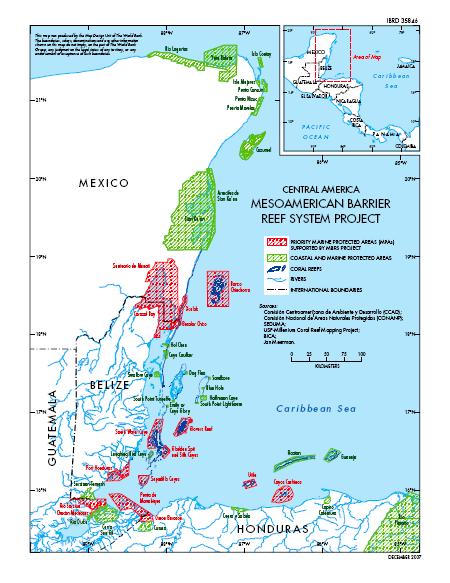
Map: IBRD 35846
62