Chapter 6
PTS contamination
of indigenous residencies
and domestic food
6.1. General overview
Chapter 6
exceeding 0.10 µg/kg (Table 6.4), whilst according
6.1. General overview
to national food safety standards, this toxicant
Results obtained from a survey targetting the resi-
should not be present in any foodstuff. Across the
dencies of selected indigenous families, reveal that
nation as a whole, only 0.1% to 0.4% of monitored
the indoor environment, including home-processed,
foodstuffs contained pesticide residues at concentra-
stored, and ready-to-eat foodstuffs, is widely contam-
tions exceeding food safety limits.
inated by POPs (Tables 6.1 and 6.2). A high frequen-
cy of contaminated foodstuffs in the home environ-
DDT and HCH appear to be the pesticides most fre-
ment seems to be consistent with the likelihood of
quently detected in food consumed by indigenous
residents showing increased blood concentrations of
families. At present, however, their concentrations are
PCBs congeners and DDT metabolites. The occur-
generally below guideline levels provided by food safe-
rence of persistent organochlorines at detectable
ty limits (Tables 6.56.8). For native communities of
concentrations, in both local and imported food-
the lower Pechora river basin, the highest PCB con-
stuffs sampled in indigenous communities, is much
centrations were measured in local freshwater fish and
higher than that found in national averages obtained
duck fat, whereas on the Taymir Peninsula, the highest
from nationwide food safety monitoring pro-
concentrations were found in smoked fish and rein-
grammes (Table 6.3). 8.6% of local foodstuffs were
deer meat.
contaminated by heptachlor at concentrations
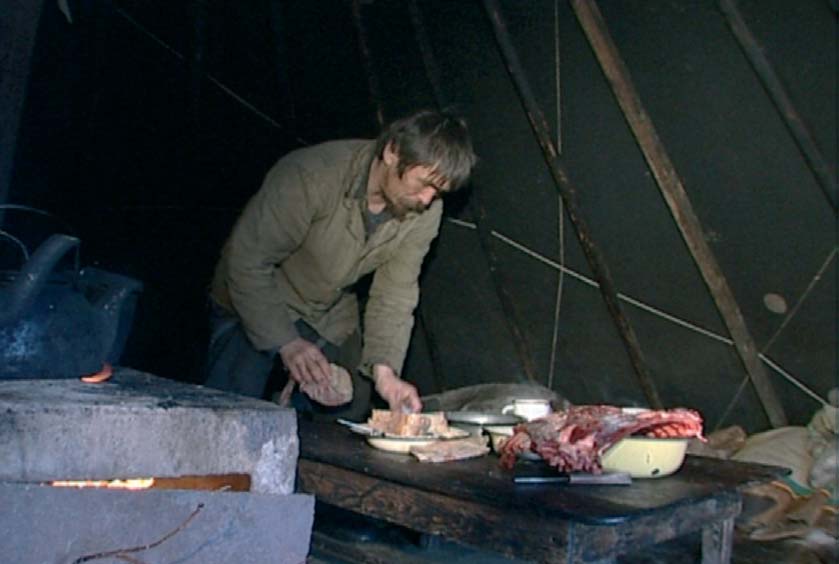
A comparison of POPs concentrations in local foods
samples from indigenous residencies, with those meas-
ured in fish species and reindeer meat sampled in the
natural environment, clearly indicates that both the
occurrence and level of contamination may well be
increased as a result of home storage, processing, and
preparation of foodstuffs. Hence, the mean concentra-
tion of the sum of PCBs measured in samples of rein-
deer meat after a period of indoor storage, was three
times higher than that measured in fresh reindeer mus-
cle sampled in the natural environment. For the sum of
DDTs, there was a 1.6-fold increase in concentrations in
samples of reindeer meat that had been stored and
processed in the home compared to the fresh environ-
Table 6.1. Pechora River Basin household survey. Percentage of specimens
mental samples.
contaminated by selected POPs at detectable levels.
Table 6.4. Heptachlor occurrence in local and imported foods at detectable levels.
Table 6.2.
1
Taymir Peninsula household survey. Percentage of specimens
Cooked by boiling for 2hrs.
2
contaminated by selected POPs at detectable levels.
Prepared for cooking (trimmed and sliced in the kitchen).
Table 6.3. Pesticide monitoring of market food in Russia. Results for 2000 2002.*
* Data courtesy of the Federal Center for Sanitary and Epidemiological Surveillance. Russian Ministry of Health (unpublished data).
124
Chapter 6
6.2. Effects of cooking on PTS food contamination
Table 6.5.
Concentrations of POPs
(µg/kg wet wt) in foodstuffs
sampled in the region of the
lower Pechora River Basin.
1 prepared for cooking
(trimmed and sliced in the
kitchen);
2 ready to eat food.
Table 6.6. Concentrations of POPs (µg/kg lipid wt) in foodstuffs sampled
in the region of the lower Pechora River Basin.
Table 6.8. Concentrations of POPs (µg/kg lipid wt) in foodstuffs sampled
on the Taymir Peninsula.
es a significant reduction in both PCB and pesticide
contamination of food. Concentrations of POPs in
boiled food are 2.2 to 5 times lower than those meas-
ured in the uncooked meat of sea mammals.
However, microbially-mediated fermentation in
ground pits, and also fermentation by long-term
immersion in salt water were found to increase POP
concentrations in food.
6.2.2. Fermentation of marine mammal meat
Many native communities still do not benefit from
high standards of environmental protection and
often do not have access to good sanitation arrange-
ments. Because of these circumstances and also due
to economic reasons, home-fermentation of local
produce is frequently undertaken in situations that
may contribute to their contamination. Examples
are the uncontrolled use of discarded plastic con-
Table 6.7. Concentrations of POPs (µg/kg wet wt) in foodstuffs sampled
tainers, which may have contained a range of chem-
on the Taymir Peninsula.
ical substances, as well as the use of ground pits
1 prepared for cooking (trimmed and sliced in the kitchen); 2 ready to eat food.
which are not properly sealed from waste water
drainage or may be sited in potentially contaminat-
6.2. Effects of cooking on PTS food contamination
ed soils.
6.2.1. Boiling of meat
Fermented walrus meat, known as `kopalchen', was
The contamination levels of POPs in local food can
sampled during targeted surveys in the Chukotka
be significantly affected by the choice of cooking
region in 2003. It was found to have the highest level
method. As seen from the data presented in Table
of PCB contamination of all ready-to-eat foodstuffs
6.9, boiling meat for a period of at least 2 hours caus-
collected from the selected families (Table 6.10).
125
6.2. Effects of cooking on PTS food contamination
Chapter 6
Table 6.11. Concentrations of POPs (ng/L) in alcoholic mash 'braga'
and moonshine "samogon" sampled in the northeastern area of the Chukchi AO.
hol is not widely consumed. In contrast, in regions
such as the Chukotka Peninsula, where marketed
alcoholic drinks are very costly, and therefore of lim-
Table 6.9. Mean concentrations of POPs (µg/kg wet wt) in fresh (frozen)
ited availability to most indigenous people, moon-
and cooked local foods.
shining and the making of alcoholic mash "braga"`' is
n.d. not determined (below the detection limit).
common, albeit illegal. Of the two, `braga' produc-
tion is throught to be more popular than moonshin-
ing due to its lower cost. According to the dietary
questionnaire study that was undertaken, `braga' con-
sumption in northeastern Chukotka ranges from 30-
50 litres per adult per year. A significant reduction in
concentrations of POPs in the final product is
achieved if "braga" is distilled to moonshine
("samogon") (Table 6.11).
Analysis of `braga' and `samogon' showed higher PCB,
HCH and DDT levels in `braga', with significantly
Table 6.10. Concentrations of POPs (µg/kg wet wt) in fresh walrus meat, and wal
lower levels in `samogon'. As found for kopalchen, p,p'-
rus meat fermented for 4 months by traditional methods in a ground pit ('kopalchen').
DDE is the major contributer to overall DDT metabo-
lite concentrations in `braga', whereas p,p'-DD con-
Kopalchen consists of the eviscerated unsalted flesh
centrations are relatively insignificant, suggesting that
of walrus or other sea mammals and includes the
DDT contamination may be occuring through the use
skin and adjacent fat and meat tissue, which has
of waste chemical containers during the production of
been subjected to a period of natural microbial fer-
`braga'.
mentation lasting up to several months, in a ground
pit covered by soil. Generally, such pits are situated
The health impacts and importance of secondary con-
within residential areas, close to houses and are not
tamination of local food can be illustrated by the ele-
properly protected from waste and drainage water
vated PCB serum concentrations found in families liv-
incursion. Once dug, these pits are used on a long-
ing in houses where higher levels of contaminantion
term basis.
of local food as a result of storage and processing were
found (Table 6.12). Families living in houses where
Ground pits or soil, where kopalchen fermentation
home-processed fish was found to be more highly con-
takes place, appear to be heavily contaminated by PCBs
taminated (the same fish species being analyzed in
(as indicated by a 200-fold increase in PCB concentra-
each case) had, on average, a 16-fold increase in the
tion in kopalchen compared to fresh walrus meat) and
relative risk factor of elevated PCB serum concentra-
also by DDT (20-fold increase in concentration).
tions.
6.2.3. Home made alcoholic beverages
Secondary contamination of reindeer meat was not so
Among the indigenous communities of the western
great as that of fish, probably due to the simpler pro-
part of the Russian Arctic (for example the Kola
cessing methods used for reindeer, involving more lim-
Peninsula), where the social and economic status of
ited contact with waste materials and other contami-
indigenous people is relatively high, home-made alco-
nanted media.
Table 6.12.
Comparison of PCB
concentrations measured in
foodstuffs sampled in select
ed households with levels in
blood of adults from the
same households, and the
relative risk values associat
ed with the foodstuffs.
126
Chapter 6
6.2. Effects of cooking on PTS food contamination
Table 6.13.
Linear correlation coeffi
cients between blood POP
levels among relatives of
high dose and low dose
groups and POP concentra
tions in wash outs from the
walls of their dwellings.
Due to significant individual variation in concentrations
Although such a restricted (case) study is of limited use
of the major PTSs found in maternal and cord blood of
(i.e., the resulting data have low statistical power and
sampled indigenous people residing the same communi-
are generally inconclusive), the information on POPs
ties, it was considered of particular importance that con-
exposure at the individual indigenous family level,
taminant sources and exposure pathways associated with
involving the identification of risks associated with the
some private and occupational activities involving PTS
use of specific chemicals in the household, and in
contaminated materials should be evaluated, even if
occupational settings, may provide some insight into
only approximately. Clear relationships between contam-
exposure sources and pathways. Generally, such
ination of dwellings by particular substances (as shown by
sources of PTS exposure have not yet been adequately
contamination of water from the wash-outs of the walls of
evaluated or documented for the types of situation that
dwellings) and and levels of those same contaminants in
exist in the Arctic, especially with respect to some of
the blood of inhabitants was found (Table 6.13).
the more vulnerable groups of indigenous people.
127