4.3. Preliminary assessment of riverine fluxes as PTS sources
Chapter 4
Yenisey basin, are heavily industrialized. Industrial
enterprises within these areas include non-ferrous met-
allurgy, pulp and paper manufacture, chemical indus-
tries, and mining, etc., which are recognized as signifi-
cant sources of PTS emissions and discharges.
The catchment area of the Pechora river comprises
0.325 million km2 (world ranking 46), with a mean
long-term annual runoff of 141 km3 (world ranking:
30). The Pechora river basin, including the catchments
of its primary and secondary tributaries the Vorkuta,
Bol'shaya Inta, Kolva, Izhma and Ukhta rivers, contain
areas rich in mineral resources, with associated oil, gas
and coal extraction activities.
4.3.2. Objectives and methodology of the study
The objective of this study was to estimate PTS fluxes in
the flows of the Pechora and Yenisey rivers to areas
inhabited by indigenous peoples. Calculations of PTS
loads in the lower reaches of the Pechora and Yenisey
rivers used a range of data, included hydrometric meas-
urements at the closing cross-sections of the
Roshydromet basic hydrological network (in the area of
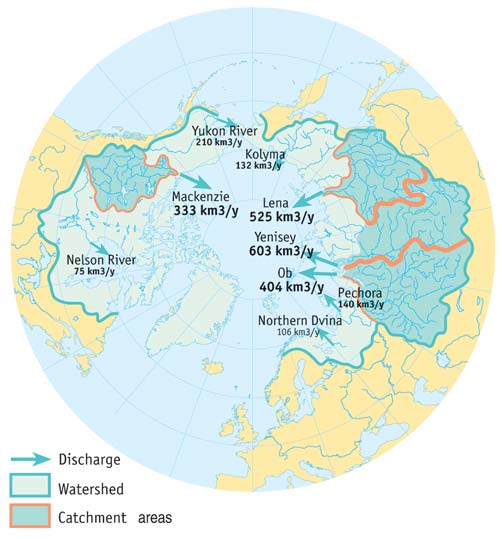
Figure 4.36. Arctic Ocean watershed, and catchment areas
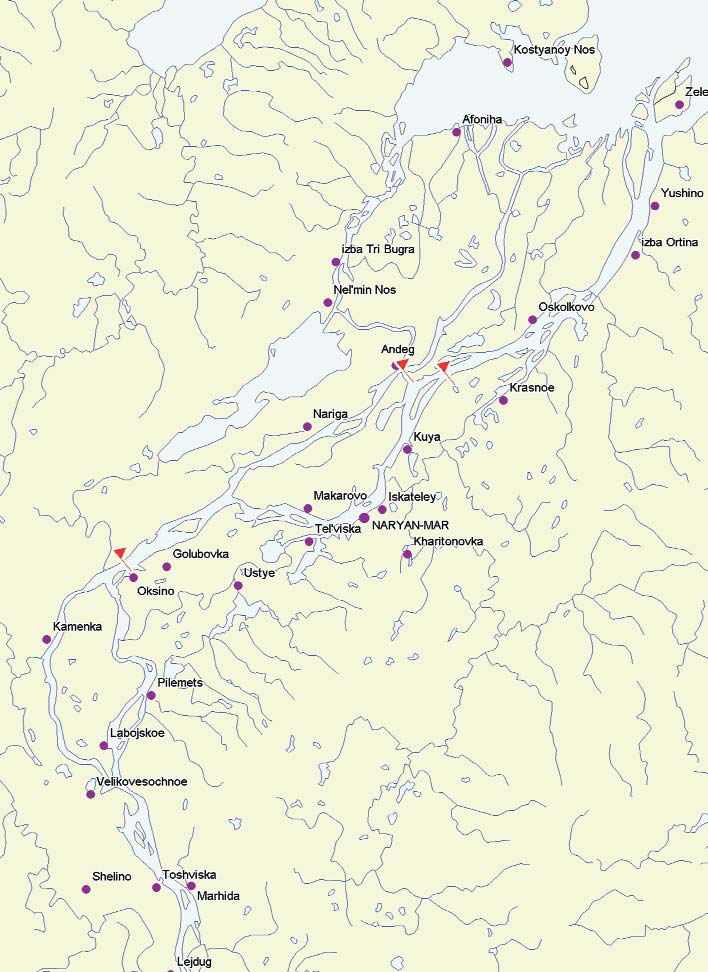
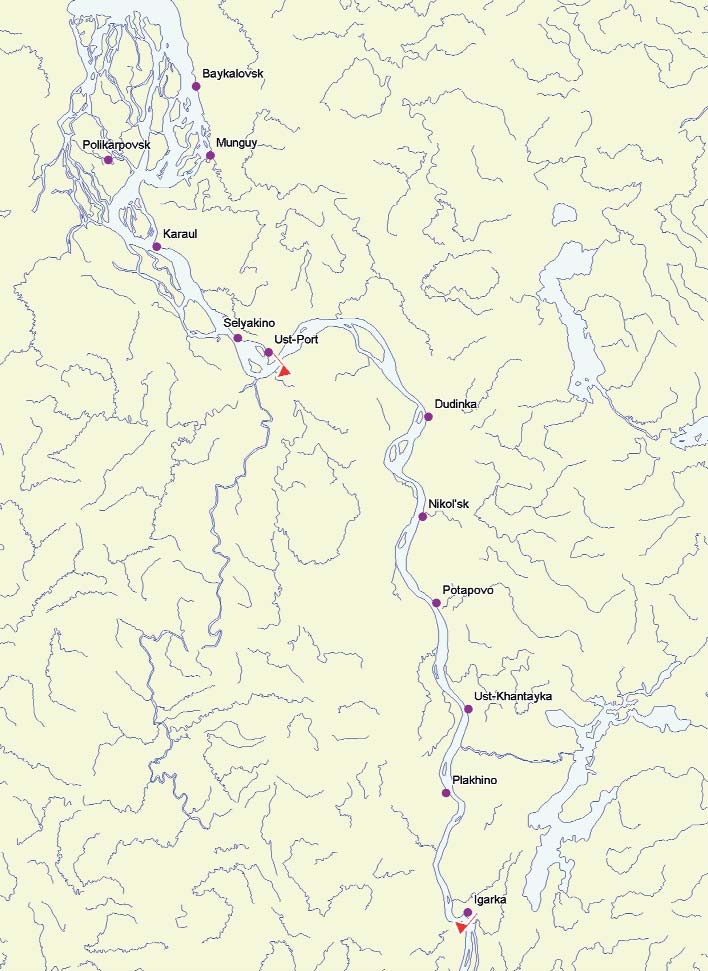
Oksino settlement on the Pechora River and Igarka set-
of the largest Arctic rivers (AMAP, 1998).
tlement on the Yenisey River), and at the lowermost
cross-sections in the delta apexes, upstream of the rivers'
The Yenisey is one of the world's ten largest rivers, with
main branching points (in the vicinity of Andeg settle-
a catchment area of 2.59 million km2 (world ranking: 7)
ment, on both the Large and Small Pechora rivers, and
and mean long-term annual runoff of 603 km3 (world
of Ust'-Port settlement, on the Yenisey River) (Figures
ranking 5) (GRDC, 1994). Its basin incorporates the
4.37 and 4.38). In addition, data were obtained from
East-Siberian economic region, parts of which, particu-
analysis of pooled water and suspended matter samples
larly those located in the upper and central parts of the
collected during periods of hydrological observations.
Figure 4.37. Location of hydrometric cross sections on the Pechora river.
Figure 4.38. Location of hydrometric cross sections on the Yenisey river.
50
Chapter 4
4.3. Preliminary assessment of riverine fluxes as PTS sources
Hydrometric measurements and water sampling at
each of the cross-sections were carried out according to
internationally accepted methodologies (GEMS, 1991;
Chapman, 1996) during four typical hydrological
water regime phases: during the spring flood fall peri-
od (late-June to early-July), during the summer low
water period (late-July to early-August), before ice for-
mation during the period of rain-fed floods (late-
September to October), and during the winter low
water period (March to April).
During each field survey period, measurements of
flow velocity at various sampling points in the channel
Figure 4.39. Channel profile and sampling/measurement points
profile were made every 6 hours, for 3 days. Water
on the Large Pechora river at the closing cross section near Oksino settlement.
level observations were conducted every 2 hours.
Water sampling was carried out twice during the first
observation day and once a day during the next two
days (a total of 4 single samples for each sampling
point). The volume of each pooled sample was not less
than 20 litres.
Initial data for each water regime phase included:
·
For the Pechora river at the closing cross-section
near Oksino settlement (see Figure 4.39):
15 flow velocity measurements (3 horizontal lev-
els on each of 5 vertical profiles );
measurement of the channel profile;
Figure 4.40. Channel profile and sampling/measurement points on the Large
36 measurements of the river water level;
Pechora river at the downstream cross section near Andeg settlement.
analytical data on PTS concentrations in 11
pooled water and 11 pooled suspended matter
samples collected over a 3-day period in 11 cross-
section segments;
suspended matter concentrations for samples
taken at the flow velocity measurement points,
in 11 pooled water samples, collected over a
3-day period in 11 cross-section segments.
·
For the Large and Small Pechora rivers at the down-
stream cross-sections near Andeg settlement (see
Figures 4.40 and 4.41):
Figure 4.41. Channel profile and sampling/measurement points on the Small
12 flow velocity measurements (3 horizontal lev-
Pechora river at the downstream cross section near Andeg settlement.
els on each of 4 vertical profiles, in both rivers);
measurement of the channel profile;
36 measurements of the river water level;
analytical data on PTS concentrations in 3
pooled water samples and 3 pooled suspended
matter samples from the surface, middle and
near-bottom horizons collected over a 3-day
period;
suspended matter concentrations in 3 pooled
water samples collected over a 3-day period from
the surface, middle and near-bottom horizons.
Figure 4.42. Channel profile and sampling/measurement points on the Yenisey
·
For the Yenisey river at the closing cross-section
river at the closing cross section near Igarka settlement.
near Igarka settlement (see Figure 4.42):
15 flow velocity measurements (3 horizontal lev-
matter samples collected over a 3-day period in
els on each of 5 vertical profiles);
11 cross-section segments;
measurement of the channel profile;
suspended matter concentrations for the flow
36 measurements of the river water level;
velocity measurement points in 11 pooled water
analytical data on PTS concentrations in 11
samples, collected over a 3-day period from 11
pooled water samples and 11 pooled suspended
cross-section segments.
51
4.3. Preliminary assessment of riverine fluxes as PTS sources
Chapter 4
4. calculation of partial and total mean daily fluxes of
PTS in dissolved form during the typical water
regime phases;
5. calculation of partial and total mean daily fluxes of
PTS in suspended matter during the typical water
regime phases.
The river channel profiles used in the hydrometric
measurement cross-sections were evaluated on the
basis of depth measurements and water level observa-
tions. Depth measurements (at various points across
Figure 4.43. Channel profile and sampling/measurement points on the Yenisey
the channel) were taken once, prior to the start of the
river at the downstream cross section near Ust' Port.
3-day observation period. Water level observations
were then made every two hours for three days. To
·
For the Yenisey river at the downstream cross-sec-
model the channel profile, an averaged single value
tion near Ust'-Port settlement (see Figure 4.43):
for water level above the original gauging station
15 flow velocity measurements (3 horizontal lev-
datum was applied across the river cross section.
els on each of 5 vertical profiles);
Thus, 16 profiles were evaluated (one for each of the
measurement of the channel profile;
four cross-sections in each of the four water regime
36 measurements of the river water level;
phases) on the basis of average `effective' cross-sec-
analytical data on PTS concentrations for 3
tional areas during the 3-day observational periods.
pooled water samples and 3 pooled suspended
Ice thickness was taken into account in the construc-
matter samples from the surface, middle and
tion of the channel profile during the winter low
near-bottom horizons collected over a 3-day
water period.
period;
suspended matter concentrations in 3 pooled
The cross-section areas were subdivided into seg-
water samples collected over a 3-day period from
ments corresponding to the points of flow velocity
the surface, middle and near-bottom horizons.
measurements and sampling. The profile schemes
During the winter low water period, ice thickness was
for each cross-section showing segments are pre-
also measured at each of the cross-sections.
sented in Figures 4.39 to 4.43. The numbers of seg-
ments coincides with the number of observations
For calculations of mean monthly and annual PTS flux-
points.
es through the closing and downstream cross-sections
for the year in which the observations were made, oper-
In order to calculate partial and total mean daily PTS
ational data consisting of water discharge measure-
fluxes in dissolved and suspended form during the typ-
ments at river cross-sections in the area of Oksino and
ical water regime phases, the following assumptions
Igarka settlements were used. These data were provid-
were made:
ed by the Northern (Pechora river) and Central
·
At the closing cross-section, within a given segment,
Siberian (Yenisey river) Territorial Branches of
the PTS concentrations in water and suspended
Roshydromet.
matter do not vary over the time period being rep-
resented, and are equal to the measured concentra-
In order to calculate mean monthly and annual PTS
tion at the corresponding observation point.
fluxes through the closing cross-sections of the rivers for
·
At the downstream cross-section, within the com-
a year with `average' runoff, and to assist in the prepara-
bined segments identified, the PTS concentrations
tion of a brief review of the inter-annual variability in
in water and suspended matter do not vary over the
water runoff via the Pechora and Yenisey rivers, pub-
time period being represented, and are equal to the
lished hydrographical data from 1932-1998, obtained
measured concentrations in the corresponding
from the Roshydromet hydrological network, were used.
pooled samples.
·
Any PTS that were either not found in any of the
Calculation of mean daily PTS fluxes over the 3-day
samples during the entire observation period, or
observation periods was undertaken in several stages:
were found in less than 10% of the total number of
1. evaluation of the river channel profiles at the cross-
samples collected at both the closing and the more
sections where hydrometric measurements were
downstream cross-sections of a river, were excluded
taken;
from PTS flux calculations for the given hydrologi-
2. division of the cross-sectional area into segments,
cal phase.
for calculation of partial discharges and PTS fluxes;
·
Edge effects are not taken into account.
3. calculation of the partial mean daily water and sus-
pended matter discharges (for each segment iden-
An assessment of mean monthly PTS flux (µy) in dis-
tified) and total water and suspended matter dis-
solved and suspended form was made according to the
charges (for the whole cross-section) during each of
calculation method proposed by E.M.L. Beal (Frazer
the typical water regime phases;
and Wilson, 1981).
52
Chapter 4
4.3. Preliminary assessment of riverine fluxes as PTS sources
(4.1)
where:
µx mean daily water discharge for the given month
(L/day);
my mean daily flux of the substance under considera-
tion in the dissolved or suspended forms (kg/day),
obtained for a 3-day observation period;
mx mean daily water discharge (L/day), obtained for
a 3-day observation period;
n number of observation days in a month (using
our assumptions three).
and:
Xi, Yi values of the water discharge and flux of the sub-
stance under consideration for each specific day when
measurements were conducted.
In our case Yi=my and Xi=mx, as the concentration of
suspended matter and PTS concentrations were deter-
mined from a single integral sample collected during
the 3-day observation period and the water discharges
were calculated on the basis of the average flow veloci-
ty for a 3-day period.
In this case, equation (1) above for the calculation of
mean monthly PTS flux can be simplified to:
(4.2)
In applying this, the following assumptions were
adopted:
·
Values of my and mx were assumed to be constant
for the months which fall within each hydrological
season: i.e., May-July (spring flood); August-
September (summer low water period); October
(period before the onset of ice formation);
Table 4.12. PCB flux (kg/y) at the closing cross sections of the Roshydromet
November-April (winter low water period).
network, calculated for the period of observations (2001 2002), and for the long term
·
The ratio of the PTS fluxes in dissolved and particu-
mean annual water discharge.
late associated phases is constant inside the cross-sec-
tion and during the hydrological season represented.
·
For the Pechora, mean monthly water discharges at
·
The ratio of the PTS fluxes in dissolved and partic-
the Andeg cross-section were assumed to be equal to
ulate associated phases during the spring freshet is
the discharges at the Oksino cross-section.
assumed to be equal to the ratio during periods of
·
For the Yenisey, mean monthly water discharges at the
low discharge.
Ust'-Port cross-section were assumed to be 3% higher
than the discharges at the Igarka cross-section.
As mentioned above, mean monthly water discharges at
the closing cross-sections of the Pechora and Yenisey
Analytical studies covered the whole range of PTS includ-
rivers (near Oksino settlement and Igarka, respectively)
ed within the project scope, with the exception of dioxins
for both the observation year and an `average' water dis-
and brominated compounds, which were excluded due
charge year, for use in the calculations, were provided by
to their extremely low levels in abiotic freshwater environ-
Roshydromet. For the two downstream cross-sections,
ments. However, analysis of samples collected during field
similar data were not available. Consequently, the follow-
work also showed that levels of toxaphene compounds
ing assumptions were adopted for calculation purposes:
in all samples from the Pechora and Yenisey were lower
53
4.3. Preliminary assessment of riverine fluxes as PTS sources
Chapter 4
than effective detection limits (0.05 ng/L for water,
Although it is difficult to make a definite conclusion
and 0.01 ng/mg for suspended matter), therefore toxa-
regarding the cause of this peak appearance, the fol-
phene was also excluded from the assessment of fluxes.
lowing information should be noted:
·
the peak was observed not only during the summer
4.3.3. Overview of the assessment results
low water period, when it was detected for the first
time, but also during the period before ice forma-
PCB
tion in October (Figure 4.62);
Estimated PCB fluxes via the Pechora and Yenisey
·
the peak is due to increased fluxes in PCB con-
rivers are presented in Table 4.12. It is worth noting
geners associated with suspended matter, with dis-
that the estimated fluxes of specific PCB congeners
solved forms showing practically unchanged fluxes;
through both the closing cross-sections of the regular
·
compared to the spring flood peak, which, as in the
hydrometric network and the downstream cross-sec-
case of the Pechora, is a result of fluxes of tri- and
tions are very similar (Figure 4.44). Based on this infor-
tetra-chlorobiphenyls, the second flux peak has a
mation, the overview of assessment results for other
higher contribution of penta- and hexa-chloro-
contaminant groups, below, focuses mainly on fluxes in
biphenyls, particularly CB118 and CB138 (Figure
the closing cross-sections of the rivers.
4.46).
Figure 4.46.
Monthly fluxes (kg)
of selected PCB congeners in
(a) dissolved
(b) suspended form
in the Yenisey river.
a
Figure 4.44. Estimated fluxes (kg/y) of PCB congeners at the closing (Oksino)
and downstream (Andeg) cross sections of the Pechora river.
The total PCB flux in the Pechora river consists almost
entirely of tri- and tetra-chlorobiphenyls. Fluxes of the
heavier PCB congeners are negligible. This is consis-
tent with information presented to the OSPAR
Commission by Sweden (Axelman, 1998).
The structure of PCB fluxes in the Yenisey river are
b
more complex. As expected, peak PCB fluxes in both
rivers coincide with springtime peaks in water dis-
charge, which occur later in the lower Yenisey than in
the lower Pechora. However, flux values for the Yenisey
river also exhibit a distinct second peak in the late sum-
mer-autumn period (Figure 4.45).
Figure 4.45.
Monthly fluxes (kg) of PCB
in the Pechora and Yenisey
rivers.
Two possible explanations for the second peak are:
·
instrumental/procedural errors during analysis of
the samples;
Table 4.13. Fluxes of polychlorinated benzenes (kg/y) in flows of the Pechora
·
accidental PCB release from some unknown pollu-
and Yenisey rivers, calculated for the period of observations (2001 2002),
tion source.
and for the long term mean annual water discharge.
54
Chapter 4
4.3. Preliminary assessment of riverine fluxes as PTS sources
This evidence, whilst indirect, argues for the likely
explanation being an accidental PCB release from a
non-identified local source. However, in case of a short-
term release, estimation of the annual flux based of
this data can be overestimated.
Polychlorinated benzenes
Estimates of annual fluxes of polychlorinated benzenes
(PCBz) in the flows of the Pechora and Yenisey rivers
are presented in Table 4.13. As expected, hexa-
chlorobenzene (HCB) is the main compound in this
contaminant group, with relatively high fluxes in both
rivers. Although tetra-chlorinated benzenes (TeCBz)
have occasionally been found in both water and sus-
pended matter of both rivers, their concentrations
were close to detection levels, and as such they cannot
be considered contaminants that pose a significant
threat to either the aquatic environment or humans.
Seasonal distribution of fluxes exhibit the a typical pat-
tern of a peak during the spring flood period (Figure
4.47).
Figure 4.47. Monthly fluxes (kg) of QCB and HCB
in the Pechora river.
Table 4.15. Fluxes of DDT compounds (kg/y) in flows of the Pechora
and Yenisey rivers for 2001 2002.
HCH compounds increase downstream in the Pechora
river, while the Yenisey shows the opposite trend. A pos-
sible explanation is that the downstream section of the
Pechora rivers shows the impact of local HCH usage,
while HCH fluxes in the lower Yenisey river are the
result of long-range transport alone, and thus the down-
stream section of the river has lower loads due to self-
purification processes in the aquatic environment. It
should be noted however that in case of short-term envi-
ronmental releases annual fluxes can be overestimated.
(b) DDTs
Fluxes of DDTs in flows of the Pechora and Yenisey
Table 4.14. Fluxes of HCH compounds (kg/y) in flows of the Pechora
rivers show similar trends as for HCHs (Table 4.15),
and Yenisey rivers for 2001 2002.
with a strong increase in concentrations between the
Oksino and Andeg cross-sections of the Pechora, and a
Organochlorine pesticides and their metabolites
decrease between the Igarka and Ust'-Port cross-sec-
tions of the Yenisey. This can be explained by a large
(a) Hexachlorocyclohexane (HCH)
local input of DDT into the lower part of Pechora, par-
Data on HCH fluxes in the Pechora and Yenisey rivers
ticularly during the spring flood period (Figure 4.48),
are presented in Table 4.14. For both rivers, total HCH
whereas in the Yenisey, the contamination is the result
fluxes are dominated by - and -HCH isomers, with -
of long-range transport of contaminants in the Yenisey,
HCH the most prevalent. However, the two rivers do
with fluxes decreasing downstream due to self-purifica-
not show consistent trends between the closing cross-
tion. This conclusion is supported by the significant
sections of the regular observation network and the
change seen in the composition of the total DDTs flux
more downstream cross-sections, established close to
at the downstream Andeg cross-section when com-
areas inhabited by indigenous population. Fluxes of all
pared to Oksino. At Andeg, the proportion of the DDT
55
4.3. Preliminary assessment of riverine fluxes as PTS sources
Chapter 4
Figure 4.50.
DDT concentrations (ng/mg)
in suspended matter of the
Pechora river at the Andeg
cross section (PA 1: surface
layer, PA 2: middle layer,
PA 3: bottom layer)
(see Figures 4.40 and 4.49).
(c) Other chlorinated pesticides
Figure 4.48. Monthly fluxes (kg)
of DDT in the Pechora river.
Other chlorinated pesticides included in the priority
list of PTS considered in the project were either found
component is far greater (Figure 4.49). Considering
only at levels below detection limits, or had fluxes that
that the absolute value of DDD, which is a dechlori-
would not be expected to have any noticeable impact
nated DDT analog in the technical DDT mixture
on the health of indigenous human populations (Table
(AMAP, 1998), also shows an almost three-fold
4.16).
increase, it is reasonable to assume that the DDT flux
increase is due to fresh local input of DDT. For the
Yenisey river, the DDT flux composition did not alter
between the two cross-sections. In this case, like in case
of HCH, annual fluxes can be overestimated.
It should be noted that the increase in DDT flux at the
Pechora, Oksino
Pechora, Andeg
Table 4.16. Fluxes of other chlorinated pesticides (kg/y) in flows of the Pechora
and Yenisey rivers for 2001 2002.
Yenisey, Igarka
Yenisey, Ust-Port
Polycyclic aromatic hydrocarbons (PAHs)
DDT
DDE
DDD
The list of PAHs included in the scope of the prelimi-
nary assessment of riverine fluxes included 20 com-
Figure 4.49. Composition of total DDT fluxes in the Pechora and Yenisey rivers.
pounds. Annual fluxes of 10 PAHs in the Pechora and
Yenisey are presented in Figures 4.51 and 4.52, respec-
Andeg cross-section is mostly determined by an
tively. However, fluxes of several PAHs could not be
increase in its suspended form. Data quality can be ver-
assessed, as their concentrations in water and suspend-
ified from the comparability of data obtained for the
ed matter in both rivers were below detection limits.
suspended matter flux in different layers of the Andeg
These were:
cross-section (Figure 4.50). The ratio of o,p'-DDT to
acenaphthene, benzo[a]anthracene,
p,p'-DDT in the surface, middle and bottom layers of
benzo[b]fluoranthene, benzo[e]pyrene, perylene,
the river flow remains constant, however, the surface
benzo[k]fluoranthene, benzo[a]pyrene,
layer shows lower levels of DDT when compared to the
dibenzo[a,h]anthraceneindeno[1,2,3-c,d]pyrene,
middle and bottom layers.
and benzo[ghi]perylene.
56
Chapter 4
4.4. Preliminary assessment of riverine fluxes as PTS sources
In both rivers, PAH fluxes are dominated by the more
PAHs (fluoranthene and pyrene). Increase in fluxes of
soluble 2-cyclic PAHs (naphthalene, 2-methylnaphtha-
these less readily transported 4-cyclic PAHs provides
lene, biphenyl) and, to certain extent, 3-cyclic PAHs
additional evidence of local pollution sources between
(fluorene, phenanthrene). At the downstream Ust'-
the Oksino and Andeg cross-sections of the Pechora
Port cross-section of the Yenisey river, PAH fluxes are
river.
significantly lower. This confirms an absence of addi-
tional PAH sources between the two cross-sections
Heavy metals.
along this part of the river. However, fluxes of some
Data on annual fluxes of heavy metals that were includ-
PAHs at the downstream Andeg cross-section of the
ed in the study (lead, cadmium, and mercury) are pre-
Pechora river are significantly higher than at the
sented in Table 4.17.
upstream Oksino cross-section. This is true not only for
2- and 3-cyclic PAHs, such as 2-methylnaphthalene, flu-
(a) Lead
orene and phenanthrene, but also for the heavier
The intra-annual distribution of lead fluxes in flows of
the Pechora and Yenisey rivers are presented in Figures
4.53 and 4.54. For both rivers, peaks of lead fluxes coin-
cide with the peak of the spring flood. It is noticeable
that the composition and annual distribution of lead
flux in the Yenisey river has a more complicated pat-
tern than that of the Pechora river. During low-water
periods, and particularly during the ice cover season,
lead flux at both the Igarka and Ust'-Port cross-sections
is dominated by the dissolved form of the metal, with
levels almost twice as high at the upstream cross-sec-
tion. However, during the flood period, the flux at the
Table 4.17. Fluxes of heavy metals (t/y) in flows of the Pechora and Yenisey rivers
Ust'-Port cross-section is significantly higher than at
for 2001 2002.
Igarka, and is mostly due to suspended forms of lead.
Figure 4.51.
Estimated fluxes (t/y)
of PAHs in the flow
of the Pechora river.
Oksino
Andeg
Figure 4.52.
Estimated fluxes (t/y)
of PAHs in the flow
of the Yenisey river.
Igarka
Ust-Port
57
4.3. Preliminary assessment of riverine fluxes as PTS sources
Chapter 4
during the spring flood period (Figures 4.58 and 4.59).
The Yenisey river mercury flux almost totally consists of
suspended forms of the metal. The composition of the
mercury flux of the Pechora river is more complicated,
and differs between the Oksino and Andeg cross-sec-
tions (Figure 4.60). Total flux at the upstream Oksino
cross-section is higher relative to that at Andeg (Figure
4.61). During the spring flood period, suspended forms
of mercury are dominant in the flux, particularly at
Figure 4.53. Monthly fluxes (t)
of lead in the Pechora river.
July
September
Figure 4.54. Monthly fluxes (t)
of lead in the Yenisey river.
This suggests that during the ice cover season, lead flux
is almost totally determined by long-range transport of
the more mobile dissolved form of lead, from industri-
alized regions in the central part of the Yenisey basin;
whereas, during the flood period, lead flux is dominat-
ed by local runoff from the area between Igarka and
November
April
Ust'-Port, which can be significantly affected by the
dissolved
suspended
Norilsk industrial region.
Figure 4.56. Seasonal changes in the ratio of dissolved and suspended fluxes
of cadmium in the Pechora river flow.
(b) Cadmium
Compared to the other PTS, the difference in cadmi-
um fluxes seen in the flows of the Pechora and Yenisey
rivers is much more pronounced (Figure 4.55). It is
also notable that the composition of cadmium fluxes in
the two rivers are different (Figures 4.56 and 4.57). The
Pechora river flux has a much greater proportion of
the suspended form of cadmium, particularly during
the spring flood period. During the ice cover season,
this difference is not so noticeable. This could be
explained by the higher sediment load of the Pechora,
July
September
compared to the Yenisey.
Figure 4.55.
Monthly fluxes (t)
of (dissolved+suspended)
cadmium in the Pechora
and Yenisey rivers.
November
April
(c) Mercury
In general, the intra-annual distribution of mercury
dissolved
suspended
fluxes in the Pechora and Yenisey correspond to the
Figure 4.57. Seasonal changes in the ratio of dissolved and suspended fluxes
respective river hydrographs, with the highest fluxes
of cadmium in the Yenisey river flow.
58
Chapter 4
4.3. Preliminary assessment of riverine fluxes as PTS sources
a
July
b
Figure 4.58. Monthly fluxes (kg)
of mercury in the Pechora river.
Figure 4.59.
Monthly fluxes (kg)
of mercury in the Yenisey
river.
a
September
b
Andeg. During low water periods, the dissolved pro-
portion of the total mercury flux is larger, amounting
to 74% of the total at Andeg during the ice cover sea-
son. It should be also noted that during this period, the
dissolved flux at these two cross-sections is fairly con-
stant (17-20 kg), while suspended flux is noticeably
lower at Andeg than at Oksino (Figure 4.61); this can
be explained by sedimentation processes.
a
November
b
The significant difference in the composition of mer-
cury fluxes in the Pechora and Yenisey rivers may be
explained by differences in their water composition.
Concentrations of total organic matter in the Pechora
are almost twice as high as those in the Yenisey, reach-
ing 13-15 mg/L Total Organic Carbon (TOC), 98% of
which is in dissolved form (Kimstach et al., 1998). As
TOC in natural waters is mostly represented by humic
and fulvic acids, which form strong complexes with
mercury, the trends in the Pechora mercury fluxes are
understandable.
a
April
b
dissolved
suspended
4.3.4. Conclusions
1. In general, PTS fluxes in the Pechora and Yenisey
Figure 4.60. Ratio of dissolved and suspended fluxes of mercury
river flows correspond to seasonal river discharges.
at (a) the Oksino and (b) the Andeg cross sections of the Pechora river
Highest fluxes usually coincide with spring peak
discharges.
2. Among the chlorinated persistent organic pollu-
tants, the highest fluxes are observed for PCBs,
HCH and DDTs. The amounts of these contami-
nants transported by river flows to areas inhabited
by indigenous peoples are such that they could con-
tribute to risks to human health.
3. Levels of other chlorinated organic pollutants are
Oksino
Andeg
either below detection limits, or their fluxes are not
dissolved
suspended
sufficiently high to represent a significant risk to the
Figure 4.61.
indigenous population.
Mercury fluxes (kg) at two cross sections in the Pechora river
in April 2002
59
4.4. Local pollution sources in the vicinities of indigenous communities
Chapter 4
4. PCB fluxes are mostly in the form of tri- and tetra-
North (RAIPON), and also from expert estimates of
chlorobiphenyls. Fluxes of the heavier PCB con-
PTS release resulting from use of organic fuel (as this
geners are practically negligible.
information is not included in official statistical data
on PTS emissions). This latter source of atmospheric
5. HCH and DDT fluxes in the Yenisey river flow are
PTS is important for pollutants such as heavy metals,
the result of long-range transport. In the Pechora
PAHs, and dioxins. It should be mentioned that in
river, local sources may contribute to the fluxes of
Russia, dioxin emissions have not been recorded and,
HCH and DDT in the lower reaches of the river.
among PAHs, only benzo[a]pyrene emissions are
DDE to DDT ratios indicates that the increased
recorded.
DDT flux in the lower part of the river may be
caused by fresh use of this pesticide. However, tak-
Under the study, expert estimates were made for emis-
ing into account possible short-term environmental
sions of the following PTS: lead, cadmium, mercury,
release of these substances, their annual fluxes can
benzo[a]pyrene, benzo[k]fluoranthene, indeno[1,2,3-
be overestimated.
c,d]pyrene, and dioxins. These estimates were made
using statistical data relating to consumption of the var-
6. Fluxes of polycyclic aromatic hydrocarbons (PAHs)
ious kinds of fuels and associated emission factors (for
in both rivers consist mostly of 2- and 3-cyclic com-
the amount of contaminants released to the atmos-
pounds. In addition to contamination through
phere per tonne of a specific fuel). Emission factors
long-range transport, the lower reaches of the
were determined either in accordance with existing
Pechora river may also be affected by local sources
Russian methodology, or by adapting Western Euro-
of PAHs, which contribute some heavier com-
pean emissions factors to take account of Russian tech-
pounds.
nologies.
7. Fluxes of heavy metals (lead, cadmium and mercu-
Statistical data were provided by the State statistic
ry) in the flow of the Yenisey river, are the result of
offices of the relevant administrative territories of the
local contamination, in addition to contamination
Russian Federation, environmental protection author-
from long-range transport, particularly during the
ities, and reports by the Russian Federation's State
spring flood period. This can be explained by the
Committee for Statistics (Goskomstat).
influence of pollution from the Norilsk industrial
complex.
Regional Branches (Committees) of the Russian
Federation's Ministry of Natural Resources were
4.4. Local pollution sources
responsible for the initial collection and processing of
in the vicinities of indigenous communities
data and information. The inventory of pollution
sources was based upon the following sources of infor-
4.4.1. Introduction
mation:
The main objectives of undertaking an assessment of
local pollution sources were to determine their role in
State Statistic Reports on emissions of gaseous
general environmental pollution, in the contamina-
pollutants discharges of waste waters, and solid
tion of traditional food products and, accordingly, to
waste from industrial, municipal and agricultur-
determine their influence on human health. For inven-
al enterprises and transport;
tory purposes, `local sources' were taken to mean
Ecological passports of industrial enterprises;
sources within an approximate maximum distance of
Reports on environmental protection activities
100 km of sites of residence of indigenous peoples.
of the local environmental protection authori-
Specific boundaries for inventory zones, however, were
ties, sanitary-epidemiological control services,
defined more exactly in each case by taking account of
agricultural administrative authorities, and
local conditions (dominating winds, river flows and the
other information sources (Murmansk, 1991-
scale of regional sources, etc.). As some of the pilot
2000; Murmansk, 1996-2000; Murmansk, 2001;
study areas within the project are affected by pollution
Murmansk, 1994-2000; Nenets, 1998; Nenets,
which originates from large industrial complexes locat-
1999; Nenets, 2001);
ed in their vicinity, the pollution source inventory
Annual reports and reviews of Federal Ministries
included such towns as Apatity, Monchegorsk,
and Departments (MNR, 2001; Roshydromet,
Olenegorsk, Revda, and Kirovsk (in Murmansk
1995-2000);
Oblast); Nar'yan-Mar (in the Nenets AO); Norilsk
Other relevant official sources and literature.
(located in the Taymir AO, but under the administra-
tive authority of Krasnoyarsk Krai); and Anadyr (in the
It is necessary to mention, however, that there was
Chukotka AO).
variation in the completeness and volume of infor-
mation provided by the various regions for the inven-
The assessment was based on official data relating to
tory, due to different technical, organizational, and
PTS emissions, obtained from the various administra-
other aspects of the relevant local services. Due to
tive territories and regions, representatives of the
this, a certain amount of data are derived from
Russian Association of Indigenous People of the
expert estimates.
60
Chapter 4
4.4. Local pollution sources in the vicinities of indigenous communities
Table 4.19. Total air emissions of pollutants (thousand tonnes) from major
industrial pollution sources in the inventory area in Murmansk Oblast, 2002,
and their percentage contribution to emissions from the
corresponding cities/districts.
Table 4.18. Industrial air emissions of major contaminants in the cities
and districts of the Murmansk Oblast in 2002, thousand tonnes (NEFCO, 2003).
4.4.2. Murmansk Oblast
4.4.2.1. General description
The inventory of PTS sources covered the territory
Table 4.20. Wastewater discharges (million m3) from selected large industrial
within a radius of at least 100 km of the settlement of
enterprises in 2002, and associated discharges (tonnes) (NEFCO, 2002).
Lovozero. It includes the cities of Monchegorsk,
Olenegorsk, Apatity, Kirovsk, and Revda.
These include the Nickel and Copper Combined
Smelter JSC GMK Pechenganikel, in the city of
Murmansk Oblast is one of the largest and most eco-
Zapolyarny and the town of Nikel; the Iron Ore
nomically developed regions of Russia's European
Concentration Plant JSC Olkon, in the city
North. Almost the entire territory lies to the North of
of Olenegorsk; the Nickel and Copper Combined
the Arctic Circle. The population amounts to 958,400
Smelter JSC Severonikel, in the city of Monche-gorsk;
residents, of whom 91.7% are urban and 8.3% percent
the Mining Plant Apaptit JSC, in the cities of Kirovsk
are rural. The northern indigenous peoples, mostly
and Apatity; the Iron Ore Kovdor Mining and
Saami, amount to 0.2% of the total population.
Concentration Plant JSC, and the Concen-
tration Plant Kovdorslyuda JSC, in the city of Kovdor;
The economy of Murmansk Oblast is mainly oriented
and the rare metals extraction and concentration plant
towards the extraction and reprocessing of natural
Sevredmet JSC, in the settlement of Revda. The contri-
resources. The region produces 100% of Russia's
butions made by the large enterprises located in the
apatite concentrate, 12% of iron-ore concentrate, 14%
inventory area to total air emissions in the correspon-
of refined copper, 43% of nickel, and 14% of fish food-
ding city/district are presented in Table 4.19.
stuffs. Concerning production industries, 90% of the
gross regional product is created by primary industrial
Surface water bodies located close to settlements and
enterprises.
industrial complexes have a high degree of pollution,
as determined by their acidification (pH) and levels of
Estimates of emissions of general air pollutants (SO2,
fluorine (F), aluminium (Al), iron (Fe), and man-
NOx, CO, and dust) from industries in the region are
ganese (Mn), which all exceed maximum permissible
presented in Table 4.18. Although these pollutants are
concentrations. Data on wastewater discharges from
not representative of any specific PTS, they do charac-
the selected large industrial enterprises in the survey
terize levels of general environmental pollution, and
area are presented in Table 4.20.
thus are related to pollution impacts on human health.
As shown, industrial enterprises located in the vicinity
Monchegorsk area
of the study area, which is densely populated by the
A zone of `extremely unfavorable environmental pol-
Saami people, emit a significant part of the total indus-
lution' lies within the area influenced by the cities of
trial air emissions in Murmansk Oblast, particularly
Monchegorsk and Olenegorsk. This zone occupies
NOx and dust.
an area of about 1400 km2, and has the form of an
ellipse with the city of Monchegorsk at its epicenter
Mining and processing plants provide the basis for the
and its long axis extending 48-50 km to the south
economies of the majority of the regions large towns
(due to the prevailing wind direction). In the north,
and cities where a third of the Oblast's population live.
the zone extends as far as the city of Olenegorsk,
61
4.4. Local pollution sources in the vicinities of indigenous communities
Chapter 4
incorporating the urban agglomeration, and in the
km2), hazardous (200 km2), moderately hazardous
south, it extends to Viteguba. The Monchegorsk
(240 km2) and acceptable (435 km2) with respect to
area is characterized by extreme levels of annual
pollution of soils. The total area of polluted land
deposition of nickel (Ni) and copper (Cu) (115.9
amounted to 565 km2. With increasing distance from
and 136.5 kg/km2, respectively). Cadmium levels in
the industrial pollution sources and the Lovozero
the surface geological horizon in this area are five
Massif (an ore-rich feature, which itself creates a natu-
times higher than the background level for the
ral geochemical anomaly), a drastic reduction in the
region. These figures confirm the high environmen-
content of all polluting substances in soils, with the
tal impact of the Monchegorsk `Severonickel' com-
exception of sulphur, can be observed. Sulphur con-
bined smelter.
tent in soils has a patchy occurrence, with localised
`hotspots', usually seen in remote places, far from the
Kirovsk Apatity
sources of gas and dust emissions.
This area is located within the limits of the Khibiny
Massif, which is a natural geochemical anomaly with
As in the case of soils, the highest pollution levels in
respect to the vast number elements and the unique
mineral bottom sediments of water bodies are
deposits of apatite and nepheline ores. `Apatit' JSC,
observed in the area of the Lovozero Massif and its
which processes and enriches deposits of apatite and
spurs, where the main mining and concentration
nepheline ores, is considered as the main pollution
plants are located. Similar to soils, the maximum levels
source for this area. The plant is one of the world's
of toxic elements (for the same group of main pollu-
biggest manufacturers of raw phosphate used in the
tants) found in bottom sediments generally corre-
production of mineral fertilizers. `Apatit' JSC is a huge
spond to the level of emissions. Contrary to its distri-
mining and chemical complex which currently
bution in soils, however, maximum concentrations of
includes four mines, a concentration plant, railway
sulphur are found in the bottom sediments of water
facilities, an automobile workshop, and about thirty
courses in urban areas.
other service workshops.
4.4.2.2. Inventory of PTS pollution sources
Since opening, the `Apatit' plant has extracted and
transported more than 1.4 x 10⁹ tonnes of ore to the
Pesticides
concentration plant, and produced about 520 million
According to data provided by the Murmansk
tonnes of apatite and more than 52 million tonnes of
Territorial Station for Plant Protection, chlorinated
nepheline concentrates. The concentrates also con-
pesticides that are the main subject of the PTS inven-
tain fluorine, strontium oxide, and rare-earth ele-
tory have not been used, and are not currently used, in
ments, which may be separated as individual products
Murmansk Oblast. Other types of pesticides used over
during processing. Nepheline concentrate is used as a
the last twenty years, according to the information
raw material for producing alumina, and in the glass
available from this office, are shown in Table 4.21. The
and ceramic industries. It is also used as a raw materi-
quantity of pesticides used on open ground varies from
al for producing soda, potash, cement, and other
tens to a few hundred kilograms in weight, because the
products.
area of agricultural land is limited.
Lovozero Revda
This area is located in a zone of heavy metal contami-
nation created by the `Severonickel' combined
smelter. The largest local pollution source is the rare
metals combined enterprise JSC `Lovozero GOC' (for-
merly known as `Sevredmet'), located in the settle-
ment of Revda. The enterprise consists of two mines
(Karnasurt and Umbozero) and two concentration
plants. Tailings and rocks left after drifting and strip-
ping are stockpiled in surface dumps and storage sites.
Mining and drainage waters are discharged into sur-
face water bodies.
The river with the highest anthropogenic load is the
Sergevan, which receives untreated and poorly-treated
mining, filtration, and domestic wastewaters from the
Karnasurt mine and concentration plant. Fluorine, sul-
phates, and nitrates are typical constituents of the min-
ing waters. Environmental and geochemical mapping
of the northern part of the Lovozero Massif which was
carried out between 1993 and 1996, (Lipov, 1997),
Table 4.21. Use of pesticides in 1990 2000 in the Murmansk Oblast inventory area,
depicted areas classed as extremely hazardous (125
data from the Murmansk Territorial Station for Plant Protection.
62
Chapter 4
4.4. Local pollution sources in the vicinities of indigenous communities
Such agricultural enterprises as `Industria', `Revda',
which, according to available information, contain no
and `Monchegorsky' and "POSVIR", store pesticides in
synthetic PCB additives. The PCB-containing trans-
standard or customized warehouses, which are regis-
former fluid `Sovtol' (total amount: 35.92 t) is used
tered by the sanitary and epidemiological surveillance
only in 13 transformers of the TNZ type at `Apatit' JSC.
bodies. The agricultural enterprise `Tundra' has
The inventory did not find any other enterprises with-
received one-off permissions for delivery and use of
in Murmansk Oblast that use PCB-containing fluids in
plant protection chemicals.
any type of electric equipment.
It should be noted that the table contains data on her-
At the same time, it is notable that of the 180000 t of
bicides only, and that no other types of pesticides, par-
PCB that was produced in the former USSR/Russia,
ticularly insecticides, are included. It is, therefore, like-
53000 t were in the form of the product `Sovol' that was
ly that the data and information provided by the
used in the production of varnish and paint (37000 t)
regional authorities responsible for pesticide use and
and lubricants (10000 t). In addition, ca. 5500 t were
handling is incomplete.
used by defence-related industrial enterprises for
unknown purposes (AMAP, 2000) and tracing the fate
According to the Regional Veterinary Medicine
of these PCB-containing products has proved problem-
Administration (pers. comm.: letter no. 38/482 of
atic. In view of the fact that Murmansk Oblast is known
08.04.2003), the pesticide `Etacyde' was used in the
to have a high concentration of defence-related activi-
1960-1970s on reindeer farms in the Murmansk region
ties, particularly in previous decades, it might reason-
to treat the animals against subcutaneous reindeer gad-
ably be assumed that a considerable proportion of
flies. From the early-1980s until the present, the pesti-
these products were used here, and probably con-
cide `Ivomex' has been used. According to the infor-
tributed to PCB contamination of the area.
mation received, there has been no treatment used
against blood-sucking insects.
Dioxins and Furans
Data on emissions of dioxins and furans from industrial
A tentative (but not comprehensive) inventory of
enterprises are not included in the state statistical
stocks of obsolete pesticides in Murmansk Oblast, has
reporting system, and therefore there is no information
identified a number of stocks in the study area (Table
on their contribution to pollution of the survey area.
4.22). It should be noted that this information also
Some enterprises, such as the combined nickel smelter
lacks data on stocks of chlorinated pesticides, except
`Severonikel' are likely to be sources of dioxins, but
one enterprise in the city of Murmansk.
there is no information available to confirm this assump-
tion. Overall, there are a number of dioxin sources that
are likely to affect the survey area (Table 4.23).
Table 4.22. Stocks of obsolete pesticides in the Murmansk Oblast, kg.
(in bold letters the inventory area)
Polychlorinated biphenyls (PCBs)
There is no statistical registration or control of PCB
release to the environment. Therefore, for the invento-
ry of possible PCB pollution sources, all enterprises in
the cities and villages mentioned above, plus the enter-
prises of the regional energy company `Kolenergo' JSC
were canvassed. According to data provided by these
enterprises, the total number of power transformers in
the survey area is 1590, including 1458 in operation
and 132 in reserve. However, most of them are filled
with the following mineral oils: T-1500, Tkp, Tk, T-750,
Table 4.23. Main sources of dioxin formation
GOST 982-56, GOST 10121-76, TP-22, and OMTI,
and emissions (Kluyev et al., 2001).
63
4.4. Local pollution sources in the vicinities of indigenous communities
Chapter 4
Polyaromatic hydrocarbons (PAHs)
·
`Rick-market' Ltd (Kolsky Distrikt), a new installa-
Of the large group of PAH compounds, only emissions
tion with environmentally sound recovery of mer-
of benzo[a]pyrene are documented. No instrumental
cury wastes;
control measurements of benzo[a]pyrene emissions are
·
`Ecord' Ltd (Kirovsk), an outdated installation that
carried out, however. Emissions have therefore been
entered into operation in 1994. According to envi-
estimated for heat and power plants using fossil fuels;
ronmental protection authorities, this plant,
metallurgical plants (`Severonikel' JSC, `Olcon' JSC);
although utilizing a proportion of lamps from
and mining enterprises (`Apatit' JSC, `Sevredmet' JSC).
Murmansk Oblast, actually contributes itself to mer-
cury contamination of the environment. It should
In general, the two major PAH pollution sources are
be stressed that this enterprise is located within the
fossil fuel, including raw oil, combustion, and the
survey area.
incomplete incineration of organic materials such as
wood, coal and oil. Usually, the heavier the fuel source,
Re-cycling of other equipment and instruments con-
the higher the PAH content.
taining mercury, as well as of metallic mercury itself, is
not systematically organized. Also, the two plants men-
The main anthropogenic sources of PAH are:
tioned above only treat used lamps from industrial
production of acetylene from raw gas;
enterprises and not from the wider community.
pyrolysis of wood, producing charcoal, tar and
soot;
Another significant source of mercury contamination
pyrolysis of kerosene, producing benzene,
is the mobilisation of mercury impurities within differ-
toluene and other organic solvents;
ent industrial activities. According to expert estimates,
electrolytic aluminum production with graphite
the annual mobilization of mercury impurities within
electrodes;
the Russian Federation comprises 83% of the annual
coke production;
intentional use of this metal. However, the amount of
coal gasification;
mercury released to the air through mobilisation is six
production of synthetic alcohol;
times greater than that from intentional use (COWI,
oil-cracking.
2004).
Large amounts of PAH can also be formed as a result
Nickel and copper production are among the most
of:
important sources of mercury mobilisation. As one of
incineration of industrial and domestic wastes;
the largest producers of primary nickel in the Russian
forest fires;
Federation, the `Severonickel' combined smelter (with
energy production based on the incineration of
annual production of 103000 t of nickel and 132700 t of
fossil fuel;
copper in 2001) is located in Monchegorsk, it must be
motor vehicles.
considered as a significant source of mercury contami-
nation in the area. The average content of mercury in
Benzo[a]pyrene emission data for the inventory area
the sulphide copper-and-nickel ore that is used in this
(Table 4.24), clearly show that information on emis-
smelter is 1 mg/kg (Fedorchuk, 1983). However, this
sions from industrial enterprises, even based on esti-
level can vary depending on the origin of the ore, from
mates, is extremely scarce.
0.05-0.11 mg/kg in ore from the Monchegorsk deposit
to 2.78 mg/kg in ore from the Nittis-Kumuzhie (Kola
Mercury
peninsula) deposit. It should be noted that, in recent
Intentional use of mercury in industrial production
decades, the `Severonickel' combined smelter has also
within Murmansk Oblast has not been documented.
used ore from different deposits, including those on
However, mercury-containing devices, luminescent
the Taymir peninsula. Given this, the average content of
lamps in particular, are widely used and contribute to
1 mg/kg provided above may be considered as a fair
environmental contamination, due to the lack of envi-
estimate. Expert estimates carried out within the ACAP
ronmentally sound waste handling. Mercury-contain-
project `Assessment of Mercury Releases from the
ing wastes (mostly discarded luminescent lamps), are
Russian Federation' concluded that mercury emissions
the main contributors to wastes of the highest hazard
from the `Severonickel' combined smelter were 0.18-
class (31.7 t in 2001. There are two enterprises involved
0.22 t in 2001. In addition, a further 0.0750.111 t was
in the treatment of spent luminescent lamps:
accumulated in captured dust (COWI, 2004).
Table 4.24.
Trends in emissions
of benzo[a]pyrene to the
atmosphere in the Murmansk
Oblast inventory area.
64
Chapter 4
4.4. Local pollution sources in the vicinities of indigenous communities
Lead
Coal combustion is considered a major contributor to
lead emissions, along with the combustion of other fos-
sil fuels. (Figure 4.62). In the middle of the 1990s, con-
tributions from coal and gasoline combustion were
comparable. However, in the late-1990s, due to the
reduction in the use of leaded gasoline, coal became
the dominant source of lead emissions. Total emissions
Figure 4.62. Trends in lead emissions from the combustion of fossil fuels
from the combustion of fossil fuels in the area have
in the Lovozero area, kg.
decreased in recent years, mainly due to the reduction
in emissions from motor vehicles (Figure 4.63).
Figure 4.63.
Contribution of different
branches of economic
Mercury
activity to total lead
Mercury mobilization due to the use of fossil fuels is
emissions through the use
mostly determined by fuel combustion in industrial
of fossil fuels in the
Lovozero area, kg.
sectors and energy plants (heat and power plants,
HPP). Fuel consumption by municipal services and the
general population comprises only a minor part of
total emissions (Figure 4.64). It should be noted that
mercury emissions from this source have not changed
significantly during recent years.
The role played by fossil fuel combustion in total mer-
cury contamination arising from local sources, is sig-
nificantly less than that due to mercury mobilization
through nickel and copper production at the
`Severonickel' combined smelter (not more than 3%).
However, given that domestic use of organic fuel, par-
ticularly coal, often contributes to the contamination
of the indoor environment, its significance in terms of
Figure. 4.64. Contribution of different branches of the economy to total mercury
human intake may be much greater.
emissions through fossil fuel combustion in the Lovozero area, kg.
Polyaromatic hydrocarbons (PAHs)
Estimates of PAH mobilization through the use of
organic fuel in the Lovozero area were made using
methods similar to those for heavy metals (Figure 4.65).
PAH releases have gradually decreased since the early-
1990s, possibly due to changes in the fuel types used.
However, after 1998, the amount of PAH released sta-
bilized, possibly due to the recovery of economy after
the 1997 crisis.
Figure 4.65. Mobilization of PAH compounds (benzo[a]pyrene, benzo[b]fluoran
thene, benzo[k]flouranthene, and indeno[1,2,3 c,d]pyrene) through the combustion
Dioxins
of organic fuel in the Lovozero area.
The trend in dioxin emissions with organic fuel com-
bustion in the Lovozero area is presented in Figure
4.66, which shows a decline during the early-1990s, but
4.4.2.3. PTS mobilization from combustion of fossil fuels
little change in emission levels since the mid-1990s.
Official statistical data exists on the consumption of
fossil fuels in Murmansk Oblast as a whole, but there
Industrial enterprises are the main source of dioxin
are no data on organic fuel consumption in the survey
pollution from organic fuel in the Lovozero area
area itself. According to statistics, about 23% of the
according to Figure 4.67. However, it should be noted
total population of the Murmansk Oblast live in the
Figure 4.66.
survey area, and in order to estimate emissions from
Dioxin emission trend
fossil fuel consumption it was therefore decided to
in the Lovozero area from
assume that use of fuel is proportional to the share of
organic fuel combustion.
the population. For calculation of dioxin and lead
emissions from gasoline combustion, it was assumed
that consumption of leaded gasoline in the survey area
comprised about 20% of total gasoline consumption
within the Oblast.
65