Global Environment Facility
United Nations Environment Programme
Arctic Monitoring and Assessment Programme
Russian Association of the Indigenous Peoples
of the North, Siberia and Far East
Persistent Toxic Substances,
Food Security and Indigenous Peoples
of the Russian North
Final Report
Oslo, 2004
Persistent Toxic Substances, Food Security
and Indigenous Peoples of the Russian North. Final Report.
ISBN 82-7971-036-1
© Arctic Monitoring and Assessment Programme, 2004
Published by
AMAP Secretariat, P.O. Box 8100 Dep., N-0032 Oslo, Norway
Printed by
Polar Foundation, Moscow, Russian Federation
Acknowledgements
EMEP UN-ECE
Project Steering Committee
University of Tromsø, Norway
Centre de Toxicologie du Québec, Canada
Pavel Sulyandziga (Co-Chair, RAIPON), Lars-Otto
Inuit Circumpolar Conference (PDF-A Phase)
Reiersen (Co-Chair, AMAP Secretariat), Bahar Zorofi
RAIPON (PDF-A Phase)
(UNEP/GEF), Takehiro Nakamura (UNEP/GEF),
AMAP Secretariat (PDF-A Phase)
Larisa Abryutina (RAIPON), Vitaly Kimstach (AMAP
CINE, Canada (PDF-A Phase)
Secretariat), David Stone (Canada), Mikala Klint
(Denmark) Helena Kuivila (Finland), Jan Tore Holvik
Project participants:
(Norway), Jon Oyvind Odland (Norway), Yuri Tsaturov
·
Russian Association of Indigenous Peoples of
(Russia), Valery Chashchin (Russia), Oksana Tsitser
the Russian North, Siberia and Far East
(Russia), Mats Ekenger (Sweden), Johan Huber (The
Russian Executing Agency
Netherlands), Jonh Calder (USA), John Cramp (IPS),
·
AMAP Sectretariat International Executing
Alona Yefimenko (IPS), Sergey Dutchak (EMEP UN-
Agency
ECE), Bo Wahlstrom (UNEP Chemicals), Brettania
·
Ministry of Natural Resources of the Russian
Walker (WWF), Terry Fenge (Salamander Foundation).
Federation
Center for International Projects, Moscow
Acknowledgements
Environmantal protection authorities of
Murmansk Oblast, Nenets, Taymir and Chukchi
The project Steering Committee would like to thank:
Autonomous Okrugs
Donor countries and organizations:
·
Ministry of Health and Social Affairs of the
Global Environment Facility
Russian Federation
Canada
North-Western Public Health Research Center,
·
Department on Foreign Affairs and International
St. Petersburg
Trade
Health authorities and hospitals of Murmansk
·
Department of Indian Affairs and Northern
Oblast, Nenets, Taymir and Chukchi Autonomous
Development
Okrugs
·
Salamander Foundation
·
Russian Federal Service for Hydrometeorology
Denmark
and Environmental Monitoring
·
Ministry of Environment and Energy
Regional Center "Monitoring of the Arctic",
Finland
St. Petersburg
·
Ministry of Foreign Affairs
SPA "Typhoon", Obninsk
Norway
Territorial agencies for hydrometeorology
·
Ministry of Foreign Affairs
·
Meteorological Synthesizing Center-East,
·
University of Tromsø
Moscow
Sweden
·
Polar Foundation, Moscow
·
Environmental Protection Agency
·
University of Tromsø, Norway
The Netherland
·
Unilab Analyse AS, Tromsø, Norway
·
Ministry of Foreign Affairs
·
Centre de Toxicologie du Québec, Canada
USA
·
National Oceanic and Atmospheric
Scientific editor: Vitaly Kimstach
Administration
Linguistic editors: Adrienne Wilson, Simon Wilson
·
Environmental Protection Agency
Cover photo: Alexei Dudarev
GEMS /Water
Pictures from movie "The Arctic dialogue with the
Nordic Council of Ministers
future" by "STO" TV company, St. Petersburg are used.
Salamander Foundation, Canada
UNEP Chemicals
Lead authors of the chapters of the Final Report:
World Meteorological Organization
Chapter 1 Vitaly Kimstach
WWF, Arctic Programme
Chapter 2 Larisa Abryutina and Valery Chashchin
Chapter 3 Valery Klopov and Valery Chashchin
In-kind contributors:
Chapter 4 Vitaly Kimstach and Sergey Dutchak
Russian Federal Service for Hydrometeorology and
Chapter 5 Valery Klopov and Anatoly Bulgakov
Environmental Monitoring
Chapter 6 Alexei Dudarev and Valery Chashchin
Ministry of Natural Resources of the Russian
Chapter 7 Alexei Konoplev, Rimma Pervunina
Federation
and Dmitry Samsonov
Regional Center "Monitoring of the Arctic",
Chapter 8 Georgy Miretsky and Alexei Dudarev
St. Petersburg, Russia
Chapter 9 Valery Chashchin
SPA "Typhoon", Obninsk, Russia
Chapter 10 Valery Chashchin
3
Acknowledgements
Contributing experts:
Kaplin, Nikita
Resnyansky, Yuri
Abryutina, Larisa
Karakchev, Leonid
Rogacheva, Galina
Abryutin, Pavel
Kataeva, Svetlana
Romanova, Natalia
Afanasyeva, Irina
Kazantseva, Anna
Romanovich, Ivan
Amelina, Natalia
Kholod, Sergey
Russelo, Vladimir
Amirova, Zarema
Kimstach, Vitaly
Ryabtseva, Margarita
Apitsyn, Andrey
Kirillova, Svetlana
Ryjhov, Oleg
Arteeva, Galina
Klementenok, Peter
Safronov, Jakov
Baiduk, Sergey
Klopov, Valery
Samsonov, Dmitry
Baranova, Olga
Konoplev, Alexey
Sandanger, Torkjel
Bogdanova, Alexandra
Kopylova Lyubov
Saychenko, A.
Bogoyavlensky, Dmitry
Kotkin, Vladimir
Scherbakov, Nikolay
Bragina, Irina
Kosakovskaya, Ekaterina
Sedenkov, Dmitry
Bulgakov, Anatoly
Kostin, Anatoly
Semenova, Irina
Chashchin, Maxim
Krutelev, Sergey
Shafrannik, Irina
Chashchin, Valery
Kudryakova, Galina
Shamyshev, Vladimir
Chebakova, Alexandra
Kudryavtseva, Tamara
Shatalov, Victor
Chernik, Galina
Kutsenko, Victor
Shuytsev, Juri
Chernogaeva, Galina
Lekhanova, Fenya
Skorobogatov, Anatoly
Demin, Boris
Lipasova, Elena
Smirnova, Olga
de Wit, Cynthia
Makrotova, Olga
Spiridonova, Oksana
Dordina, Yana
Malanichev, Alexander
Stepanova, Natalia
Dorofeev, Vitaly
Mamchenko, Tatyana
Strukov, Boris
Dubitskaya, Marina
Maryasova, Zinaida
Sychin, Yuri
Dudarev, Alexey
Mataev, Sergey
Terentyev, Yuri
Dukhnich, Alexander
Melnikov, Sergey
Terletskaya, Tatyana
Dunaeva, Natalia
Miretsky, Georgy
Todyshev, Mikhail
Dutchak, Sergey
Morshina, Tamara
Travnikov, Oleg
Enminkau, Ayvana
Moshkarova, Galina
Treger, Yuri
Fedyunin, Mikhail
Muir, Derek
Tretyakova, Anastasiya
Fenge, Terry
Myakoshin, Oleg
Tsibulsky, Vladimir
Frazer, Andrew
Neshataev, Vasily
Tuzova, Nadezhda
Gabrielsen, Kjersti Lie
Nikanov, Alexander
Tyulpanova, Ekaterina
Gavrilo, Marina
Nikolaeva, Galina
Ufimtsev, Alexander
Gavrilov, Anatoly
Odland, Jon Øyvind
Varygina, Marina
Glotov, Andrey
Osipov, Leonid
Vinokurov, Nikolay
Golovleva, Lina
Pacyna, Jozef
Virchenko, Elena
Gorshkov, Andrey
Panin, Lev
Vishnevsky, Alexey
Graevsky, Alexander
Pasynkova, Elena
Vlasov, Sergey
Grishin, Valery
Pavlova, Natalia
Vlasova, Tatyana
Gusev Alexey
Pereyaslavtseva, Alexandra
Vulykh, Nadeghda
Ilyin, Ilya
Pervunina, Rimma
Wilson, Simon
Ivanov, Andrey
Protasov, Yevgeny
Yufit, Sergey
Ivanova, Zoya
Puckett, Keith
Zelenko, Anatoly
Ivantsova, Tatyana
Rakhmanova, Tatyana
Zibarev, Yevgeny
Kal'te, Zinaida
Reiersen, Lars-Otto
Zotova, Raisa
The Steering Committee expresses special appreciation to the Administrations of Murmansk Oblast, Nenets,
Taymir and Chukchi Autonomous Okrugs for efficient support of the project implementation.
4
Contents
Contents
Preface .......................................................................................................................................................................................................6
Chapter 1 Background and introduction.....................................................................................................................................................7
Chapter 2 Lifestyle, social and economic status of indigenous peoples.....................................................................................................17
Chapter 3 PTS limits and levels of concern in the environment, food and human tissues.........................................................................29
Chapter 4 Persistant toxic substances (PTS) sources and pathways........................................................................................................33
Chapter 5 PTS levels in biota and biomagnification in food chains............................................................................................................81
Chapter 6 PTS contamination of indigenous residencies and domestic food.............................................................................................123
Chapter 7 PTS levels in humans.................................................................................................................................................................129
Chapter 8 The demographic situation and health status of indigenous peoples in the project study areas ...............................................153
Chapter 9 Health effects associated with lifestyle, diet and exposure to PTS.............................................................................................167
Chapter 10 Discussion on human health effects ........................................................................................................................................177
Overall conclusions and recommendations ..............................................................................................................................................184
References .................................................................................................................................................................................................187
5
Preface
Preface
The project "Persistent Toxic Substances, Food
Wide participation of the Russian Association of the
Security and Indigenous Peoples of the Russian North"
Indigenous Peoples of the North, Siberia and Far East
has been initiated by the Indigenous Peoples
(RAIPON) and its regional branches in the project
Organizations -- Permanent Participants of the Arctic
should be specifically highlighted. For the first time,
Council and the Secretariat of the Arctic Monitoring
the indigenous experts acted in this project not as assis-
and Assessment Programme (AMAP) as a follow-up of
tants, but as equal partners of the research teams.
the conclusion of the 1st AMAP Assessment Report
Efficient work of the indigenous peoples coordinators,
that some Arctic indigenous communities are among
both at the central level and in the regions, and their
the most exposed groups of population in the World to
collaboration with the local administrations and
persistent toxic substances. This initiative has been
human health authorities, was one of valuable lessons
supported by the Global Environment Facility (GEF),
learned during the project implementation. Work
in particular its UNEP Coordination Unit, practically
among the indigenous communities, particularly at
all countries-members and observers of the Arctic
the stages of the dietary and lifestyle surveys and
Council, as well as by a number international organiza-
human sampling, would not be feasible without their
tions. Without their political, substantial financial and
everyday involvement.
technical support, implementation of this exclusive
work would not be feasible.
On behalf on the project Steering Committee, we
would like to thank all experts involved in the field
The project has been fulfilled mostly by Russian insti-
work, assessment of the results and drafting the final
tutions and experts, with the organizational support
documents of the project, and people who took a hard
from the relevant Russian federal governmental execu-
technical work on issuing this report. Special thanks
tive bodies and the local administrations of the regions
should be addressed to a large number of indigenous
of the Russian Federation. At the same time, active par-
persons, particularly to the mothers of newborn chil-
ticipation of a number of international experts in all
dren for their understanding of the project impor-
stages of the project, from drafting the project propos-
tance and active participation in the survey. We highly
al to the compilation of its conclusions and recom-
appreciate all donor countries and organizations for
mendations and development of the dissemination
their generous support. The project Steering
strategy, was important for its success. Close collabora-
Committee expresses sincere hope that the project
tion of the project team with the AMAP Human Health
results will make its contribution to the improvement
Expert Group was a necessary step for making its out-
of the health status of the indigenous peoples of the
comes consistent with the circumpolar assessment
Russian North, and will serve as an information tool for
work being made in all Arctic states under the auspices
the Russian Government, local authorities, indigenous
of AMAP.
organizations and the international community.
Co-Chairs of the Project Steering Committee:
Pavel Sulyandziga
Lars-Otto Reiersen
RAIPON Vice-President
AMAP Executive Secretary
August 2004
6


Chapter 1
Background
and introduction
1.1. Background
Chapter 1
range transport of contaminants, and that in some
1.1. Background
areas this is compounded by local pollution occurring
In 1997, the Arctic Monitoring and Assessment
as a result of the heavy industrialisation of the Russian
Programme (AMAP) presented the report `Arctic
North. Recently, as a result of economic and social
Pollution Issues: A State of the Arctic Environment Report'
changes in Russia following the break-up of the
(AMAP, 1997) to the Fourth Ministerial Meeting of the
U.S.S.R., after years of declining consumption, use of
Arctic countries (Alta, Norway). This first AMAP
traditional foods by indigenous peoples appears to be
assessment was supported by a substantial scientific
increasing again. In Chukotka, the harvesting of walrus
background document, the `AMAP Assessment Report:
in greater numbers, as well as the recent resumption in
Arctic Pollution Issues' (AMAP, 1998), which was submit-
native hunting of bowhead whales for subsistence pur-
ted to the First Ministerial Conference of the Arctic
poses, are examples of this trend. However, at the time
Council (Iqaluit, Canada) in 1998. Both of these
of the first AMAP assessment, the situation of the
reports clearly documented the fact that persistent
Russian Arctic indigenous peoples had not been stud-
toxic substances (PTS) are transported to, and accu-
ied sufficiently to allow a clear understanding of the
mulate in, the Arctic region.
impact of contaminants on the overall health status of
indigenous populations. This lack of information pre-
The explanation for this lies in the physical and chem-
cluded a reliable assessment of the Russian situation
ical properties of PTS, which promote their long-range
with respect to PTS exposure within the circumpolar
transport by atmospheric, oceanic, and riverine path-
context. It also prevented the development of ade-
ways to the Arctic. Due to their low solubility in water
quate measures to reduce the risks to Russian northern
and high solubility in fat, they tend to accumulate in
populations associated with exposure to PTS.
lipid-rich Arctic biota species, and to biomagnify in
food webs, particularly in long marine food chains. As
Representatives of the Arctic Indigenous Peoples
a result, the upper trophic levels of Arctic food webs
Organizations (IPOs), which, at the time of the first
are highly exposed to PTS, and certain Arctic indige-
AMAP assessment, included the Russian Association of
nous populations, whose lifestyle is based on the con-
Indigenous Peoples of the North (RAIPON), the Inuit
sumption of traditional country foods, are subject to
Circumpolar Conference (ICC), the Saami Council
some of the highest exposure levels to PTS of any pop-
(SC), and the Aleut International Association (AIA) are
ulation groups on Earth.
permanent participants in the Arctic Council. Deeply
concerned by the findings of the AMAP assessment
The AMAP assessment provided evidence that, for
regarding possible impacts of PTS on the health of
example, blood levels of some PTS, such as polychlori-
their peoples, particularly through contamination of
nated biphenyls (PCBs) and mercury, can be several
traditional foods, the IPO representatives, in collabo-
times higher in residents of Arctic Canada and
ration with the AMAP Secretariat and supported by the
Greenland than levels measured in residents of indus-
Arctic Council, took the initiative to launch a special
trialized areas of North America. In some cases, PTS
project to address the deficiencies in information iden-
intake exceeded World Health Organization (WHO)
tified by the AMAP reports. The aims of this project
guidelines, and attained levels comparable to those
were not only to assess the situation with respect to PTS
associated with the potential to cause negative impacts
impacts on the health of indigenous peoples, but also
on human health in areas such as neurological devel-
to develop recommendations to federal and local
opment, reproductive health, immuno-suppression,
authorities, to the indigenous peoples themselves, and
and cancer, etc. Due to the ability of some PTS to cross
also to the international community on (a) measures to
the placenta, and also to accumulate in breast milk,
reduce the exposure of indigenous peoples of the
this raises concerns regarding the potential of PTS to
Russian North to PTS, and (b) means to empower
affect the growing foetus and young children, during
indigenous peoples to participate actively and fully in
the most critical periods of human development.
the process of PTS elimination.
At the same time, it is important to note the benefits
It is important to note that the IPOs consider the elim-
that traditional diets provide. For many indigenous
ination of risks to human health from PTS as a key com-
peoples, the traditional diet is not only a vital source
ponent of their activities, and are active participants in
of nourishment, but also an integral part of their cul-
all relevant international negotiations that are con-
tural and spiritual identity. Any threat to continued
cerned with reducing use and environmental releases
consumption of these foods, including chemical con-
of these chemicals. Their role in the development and
tamination, is not only a potential threat to the health
adoption of the Persistent Organic Pollutants (POPs)
of the individual concerned, but also to the social
and Heavy Metal Protocols to the United Nations
structures and entire cultural identity of these indige-
Economic Commission for Europe (UN ECE)
nous peoples.
Convention on Long-range Transboundary Air
Pollution (LRTAP), and particularly in promoting the
Preliminary studies in the Russian Arctic have shown
development of the United Nations Environment
that, as in Arctic Canada and Greenland, levels of PTS
Programme (UNEP) global Stockholm Convention on
in biota may be significantly elevated as a result of long-
POPs, cannot be overestimated. Due to the current
8
Chapter 1
1.2. Scope of the project
economic situation in Russia, the Russian Federation
Protection of Habitats and Subsistence Activities of Indigenous
has yet to become a signatory to the above-mentioned
Minorities Of The North'. Following from this, the
UN ECE LRTAP Protocols, and also has still to ratifiy
Federal Law, `Fundamentals of the State Regulation of Social
the Stockholm Convention. The proactive work of the
and Economic Development of The Russian Federation North',
IPOs, and of RAIPON in particular, in such processes,
with an Article dedicated to environmental protection
is vital if the major goals of these Conventions are to be
and the use of natural resources, was adopted in 1996.
realised.
The Federal programme `Children Of The North 1998-
2000', which was adopted by the Russian government
The IPOs initiative, to develop and implement the
in 1997, also proposed practical steps for improving
project `Persistent Toxic Substances, Food Security and
the situation in the region. Unfortunately however, the
Indigenous Peoples of the Russian North', received full sup-
critical economic situation affecting the country has
port from the UNEP Global Environment Facility
meant that these measures have not received the nec-
(GEF), the Arctic Council, and all the Arctic Countries
essary financial support, and, consequently, that they
and International Organizations. Additionally, and of
have failed to achieve the desired results. Although the
vital importance for the project, it received support
adopted Federal Law `On Guarantees of the Rights of
from all relevant Federal executive bodies of the
Indigenous Minorities in The Russian Federation' created a
Russian Government, the Russian Parliament (the
legislative framework for improving the existing situa-
State Duma), and the local authorities in all the pilot
tion, it is not able to solve problems associated with the
regions selected for project implementation. The proj-
lack of the financial resources required to implement
ect formally started in February 2001, although some
necessary remedial actions.
preliminary studies had already been undertaken in
the summer and autumn of 2000.
The Russian Federation actively participates in circum-
polar monitoring and assessment activities conducted
There are, today, some 30 indigenous minority peoples
within the framework of AMAP. In this, they provide
in Siberia, the North, and the Far East of the Russian
significant contributions of data and information
Federation, in total numbering approximately 200000
needed to complete the Russian component of the
persons. Eleven of these minorities live in the Arctic
AMAP circumpolar assessment. Due to financial con-
region, the combined land area of which is approxi-
straints, however, studies during the first phase of
mately 3.1 million km2. Together with five other north-
AMAP (1992-1997) concerning the impacts of environ-
ern indigenous minority peoples who live close to, or
mental contamination on human health were restrict-
partly within, the Arctic region, the indigenous minor-
ed to a limited area of the Russian North, and were
ity population within Arctic Russia numbers some
essentially lacking for the eastern part of the region.
67000. Approximately 75% of the minority population
Activities under the `Persistent Toxic Substances, Food
within the Arctic Russia live in rural areas. In addition,
Security and Indigenous Peoples of the Russian North' proj-
the two most numerous groups of indigenous peoples
ect have contributed significantly to the assessments
(the Komi and Yakuts), which represent the majority
conducted during the second phase of AMAP (1998-
within their territories, have lifestyles that are similar
2002) (AMAP, 2002, 2003a, 2004) and have assisted in
to the indigenous minorities, and hence are exposed
the elimination of gaps previously identified with
to similar environmental risks.
respect to geographical scope and knowledge.
Conditions for indigenous peoples in the Russian
1.2. Scope of the project
Arctic have been steadily worsening over recent years.
The effects of economic changes occurring through-
1.2.1. Project overall goal and objectives
out Russia have been felt acutely in the Arctic, with
The project `Persistent Toxic Substances (PTS), Food Security
indigenous minorities being particularly affected.
and Indigenous Peoples of the Russian North' is designed to
According to a report by RAIPON and UNEP/GRID-
help reduce contamination of the Arctic environment
Arendal, the indigenous peoples in northern Russia
by PTS. To further this aim, the following objectives
are on the brink of `physical extinction' (GRID-
were established:
Arendal, 1998). Health issues, particularly those relat-
1. To assist indigenous peoples to reduce the health
ed to environmental contamination, are a matter of
risks resulting from contamination of their environ-
urgent concern, with life expectancy of the indige-
ment and traditional food sources through the
nous peoples twenty years shorter than that of the
development of appropriate remedial actions.
average Russian (as low as 41-42 years for men in some
2. To enhance the position of the Russian Federation
regions). Infant mortality is increasing, as is the inci-
in international negotiations concerning reduction
dence of disease.
of PTS use; and to empower indigenous peoples to
participate actively and fully in these negotiations.
During recent years, Russian Federal authorities have
3. To enable the Russian Federation and the Russian
taken a number of steps to address the critical eco-
Association of Indigenous Peoples of the North
nomic, social and health problems affecting the indige-
(RAIPON) to increase their involvement in the
nous peoples. In 1992, the President of the Russian
work of the eight-nation Arctic Council aimed at
Federation issued a special Decree: `Urgent Actions on
reducing emissions of PTS.
9
1.2. Scope of the project
Chapter 1
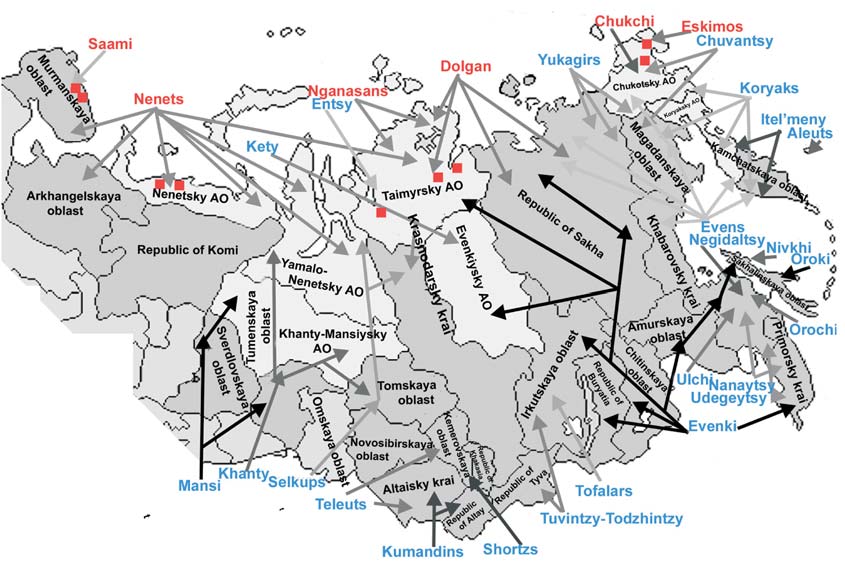
Figure 1.1.
Indigenous peoples and
administrative territories
of the Russian Federation.
The indigenous peoples
groups and the locations of
the pilot study areas covered
by the PTS project work are
indicated by red labels and
markers, respectively.
The project has been designed as an integral compo-
The project has been designed to obtain the following
nent of a wider strategy that addresses identified infor-
three key outcomes:
mation needs regarding the extent of environmental
1. Recommendations to federal and local authorities,
contamination in Arctic Russia; its effects on indige-
indigenous peoples and the international commu-
nous peoples; and identification of measures to
nity on measures to reduce exposure of indigenous
improve the situation in the region. A number of inter-
peoples to PTS, including identification of priority
national projects and programmes, including those of
areas where actions are needed.
the Arctic Monitoring and Assessment Programme
2. Assessment of the significance of aquatic food
(AMAP), provide data and information that both com-
chains as a pathway of exposure of indigenous peo-
plement and support this project. In many respects,
ples to PTS.
the project itself is envisaged as the key component in
3. Assessment of the relative importance of local and
this overall strategy, providing information that would
distant sources, and the role of atmospheric and
not otherwise be available.
riverine transport of PTS.
Table 1.1.
Populations of the Russian
Arctic, by the administrative
territories and ethnicity
(1989 census).
10
Chapter 1
1.2. Scope of the project
1.2.2. Geographic and ethnographic scope
In 1998 there were some 117 native communities
recorded in the selected study areas (Table 1.2.). By
The Russian North is populated by a variety of indige-
national legislation, these settlements are under the
nous peoples with different cultures and traditional
administrative jurisdiction of four separate administra-
lifestyles (Figure 1.1, Table 1.1). Careful consideration
tive territories of the Russian Federation: Murmansk
was therefore given to selecting a study strategy capable
Oblast; the Nenets Autonomous Okrug; the Taymir
of providing results with optimal regional and demo-
Autonomous Okrug; and the Chukotka Autonomous
graphic significance. In order to ensure that recom-
Okrug. It is worth noting that the number of indige-
mendations based on surveys of the relatively limited
nous people permanently residing in the selected areas
study groups were applicable to indigenous popula-
represent approximately two-thirds of the total indige-
tions throughout the Russian Arctic, the survey groups
nous population of the Russian Arctic.
were selected to represent a range of traditional
lifestyles involving use of different natural resources.
The present day population of most of the communi-
ties in the region is a mixture of both indigenous and
To optimise use of project resources, compatible infor-
non-indigenous people. The latter generally dominate
mation from other projects has been used to provide a
in the ethnic composition (see Table 1.2), although
more comprehensive information base than would
there are a number of settlements, particularly in the
otherwise be the case. The following regions, which
eastern part of the Russian Arctic, where indigenous
coincide with AMAP key monitoring areas, were there-
people still constitute the majority.
fore selected as the pilot areas for implementation of
the project.
i) The Kola Peninsula (Murmansk Oblast): populated
by the Saami people who rely heavily on reindeer
and freshwater fish as components of their tradi-
tional diet. Pollutants affecting the area are derived
from local mining activities, metallurgical indus-
tries (non-ferrous metal smelting), and long-range
transport of European emissions. The area can be
also affected by such a large population centre of
Murmansk, with its harbour activities, including
radioactive waste storage associated with Russian
northern fleet operations. The pilot study area was
centred on Lovozero and its surroundings, which is
the main settlement for the Saami population in the
Table 1.2. Populations of the selected pilot areas.
region, as well as the village of Krasnoshchelye.
* data provided by the local authorities (as recorded at 01.01.1998)
ii) The lower basin of the Pechora River: the area is
Table 1.3.
populated by the Nenets, whose traditional diet
Breakdown of the mother
includes reindeer and freshwater fish. The area is
child survey participants
subject to long-range transported pollution, and
by ethnicity.
multiple local pollution sources, including sources
associated with oil activities in the region.
iii) The Taymir Peninsula, including the lower reaches
of the Yenisey River: populated by the Dolgans and
the Nenets whose traditional diet includes reindeer,
freshwater fish and game. This area is affected by
multiple pollution stresses, including the mining
and metallurgical industries at Norilsk, and river-
borne pollution, including radioactive contamina-
tion, from the catchment of the Yenisey River. Two
areas within the region were selected for study,
Under the project, both mother-child pairs and gener-
Dudinka (Nenets) and Khatanga (Dolgans).
al indigenous population surveys were undertaken.
iv) The Chukotka Peninsula: populated by the Chukchi
Thirteen ethnic groups are represented in these sur-
and Eskimo (Yupik) peoples, whose traditional diet
veys. (Table 1.3. and 1.4.). This represents a large pro-
includes marine mammals, fish and reindeer. The
portion of the eighteen officially recognized indige-
area is affected by long-range transported pollu-
nous ethnic peoples of the North (Governmental
tants, particularly from sources in south-east Asia. As
Decree No 255 dated 24.03.2000), although the main
the traditional diet of coastal and inland indigenous
groups represented in the study were the Chukchi,
people of Chukotka differs significantly, two areas
Nenets, Dolgans, Komi, Saami, and Yupik (Eskimo),
within the region were selected for study: Kanchalan
who together constituted about 97% of total number
(inland) and Lavrentiya Uelen (coastal).
of survey participants.
11
1.2. Scope of the project
Chapter 1
Table 1.4.
financing. Russian ministries and other federal execu-
Breakdown of the general
tive authorities were also represented in the SC.
indigenous population survey
participants by ethnicity.
Countries and institutions providing other types of
contribution, and whose involvement was considered
useful for the project implementation, could obtain
SC observer status.
The AMAP Secretariat was designated as the interna-
tional project coordinator and, with assistance from
RAIPON, was responsible for the execution, coordina-
tion and administration of the project. In addition,
RAIPON participated in project activities concerning
assessments of local pollution sources; food consump-
tion and traditional diets; assessment of the levels and
effects of pollution in the indigenous population;
impacts of socio-economic and demographic condi-
Thus, the study areas and ethnic groups selected for
tions on the lifestyle and health of the indigenous pop-
the surveys are believed to adequately represent the
ulation; and information dissemination.
general variety of dietary habits and other key charac-
teristic of the traditional lifestyles of the indigenous
Activity 2: Assessment of local pollution sources
populations in the Russian Arctic. This representative
in the vicinity of selected indigenous communities
coverage has allowed the inclusion in the project of
The objective of this activity was to produce an inven-
both exposed and non-exposed groups of people from
tory of PTS sources in areas populated by indigenous
different indigenous populations, demonstrating dis-
peoples. This work was implemented by the Centre for
tinct dietary characteristics, as well as groups living in
International Projects (CIP), Moscow, on the authori-
geographically diverse locations which are exposed to
sation of the Ministry of Natural Resources, and with
different primary sources of contaminants.
the active participation of the local environmental
protection authorities responsible for pollution con-
1.2.3. Project activities
trol in the regions/areas concerned. The work relied
In addition to activities targeted towards reaching spe-
to a large extent on baseline activities carried out by
cific project objectives and undertaken within a geo-
the Ministry of Natural Resources. Also, local indige-
graphically defined area, the project implementation
nous organizations played an active role in obtaining
plan included a range of core activities, concerned
the data and information needed for this part of the
with support of the overall project. These core activi-
assessment.
ties included project coordination; administration and
management activities, including organization of
Activities within the framework of the Arctic Council
Steering and Coordination Group meetings; transla-
Plan to Eliminate Pollution of the Arctic (ACAP) also
tion, provision of ongoing information on the project;
provided an important contribution to this activity.
progress reporting, and part of the work associated
This included results from projects such as the Phase 1
with dissemination of key results and the preparation
of `Multilateral Cooperative Project on the Phase-out of PCB
of project reports. Additional activities included the
Use and Management of PCB-contaminated Wastes in the
provision of supporting information and data, such as
Russian Federation' (AMAP, 2000) and the project on
emission inventories, meteorological input data for
`Environmentally Sound Management of Stocks of Obsolete
modelling work and associated data handling activi-
Pesticides in the Russian Federation'. Another work being
ties, required for assessing the long-range transport of
implemented in part of the project area that con-
pollutants (i.e. from sources not linked to any specific
tributed significant data and information to the proj-
geographical area within the study region).
ect was the NEFCO/AMAP activity `Updating of
Environmental `Hot Spots' List in the Russian Part of the
The following activities were included into the project
Barents Region: Proposal for Environmentally Sound
work program:
Investment Projects' (AMAP, 2003b).
Activity 1: Co-ordination, management,
Activity 3: Assessment of distant sources
and support to the project.
The objective of this activity was to assess PTS transport
General project management and coordination was
from distant sources to areas of northern Russia inhab-
conducted by the project Steering Committee (SC).
ited by indigenous peoples. The activity consisted of
The SC comprised one representative from the
two independent components:
Implementing Agency (UNEP); one from each of the
Executing Agencies (RAIPON and the AMAP
i) Assessment of long-range atmospheric transport
Secretariat); and one from each of the international
of PTS to the Russian North
organizations, countries, NGOs, financial institutions
Information on PTS concentrations, from measure-
and foundations who contributed to the project
ments at background air monitoring stations operated
12
Chapter 1
1.2. Scope of the project
under the AMAP monitoring network and through
activity, without awaiting the outcome of the dietary
bilateral and national monitoring activities, was pro-
surveys. In general, this approach has subsequently
vided by AMAP and the organizations concerned.
proved to be valid, with some limited exceptions for
which adjustments were been made during the later
Modelling work required to assess the atmospheric
stages of project implementation.
transport of PTS from long-range sources was under-
taken by the Meteorological Synthesising Centre-East
Field sampling, pre-treatment and conservation of
(MSC-E), Moscow, the centre responsible for model-
samples was conducted by qualified personnel from
ling heavy metals and persistent organic pollutants
the Regional Center `Monitoring of the Arctic'. Field
under the Co-operative Programme for Monitoring
work was strongly supported by the local indigenous
and Evaluation of the Long-range Transboundary Air
communities. It should be noted that a number of spe-
Pollution in Europe (EMEP). In addition to work
cific biota samples could not have been collected with-
directly associated with the project, other EMEP activi-
out active involvement of local hunters; particularly
ties undertaken within the European part of the
since only indigenous communities are licensed to
Russian North constituted contributions to the project
hunt certain species. Standardized and prescribed sam-
by the UN ECE. Meteorological data needed for the
pling, pre-treatment, storage and transportation proce-
modelling of long-range atmospheric transport was
dures were used to ensure that contamination was
provided by the Russian Federal Service for
avoided, necessary measurements at the time of sam-
Hydrometeorology and Environmental Monitoring as
pling (e.g., location, age and sex of organism, etc.)
part of its in-kind contribution.
were correctly carried out; and samples were appropri-
ately packaged and transported to the laboratory.
The modelling work was based on preparatory activi-
ties such as the AMAP `Workshop on Long-range Transport
Samples were analysed for PTS in the analytical labora-
Modelling and Source-Related Activities' (Bergen, June
tory of the Regional Center `Monitoring of the Arctic'
1999) where a number of relevant issues were
which was selected by the Steering Committee follow-
addressed, in particular the need for global inventories
ing a tender for the work. All work was performed
of PTS and the development of global/hemispheric
according to internationally acknowledged methodol-
transport models.
ogy and strict Quality Assurance/Quality Control
(QA/QC) procedures. Since the RCMA laboratory is
ii) Preliminary assessment of riverine fluxes
not certified for analytical determination of
as a source of PTS to Arctic Russia
dioxins/furans, this work was undertaken by the
Riverine fluxes of PTS have been assessed for the Pechora
Bashkortostan Analytical Center (Ufa). As an addition-
and Yenisey Rivers. Assessments were made using data
al quality assurance measure, fifty of the environmental
collected at the most downstream sampling sites of the
samples were split for duplicate analysis; these were
Russian Federation's national freshwater monitoring net-
conducted by Unilab Analyse (Tromsø, Norway).
work, and additional cross-sections further downstream
located in areas inhabited by indigenous peoples.
Activity 5: Dietary surveys of selected indigenous communities
Sampling, together with simultaneous hydrological obser-
The work under this activity was performed by the
vations, was conducted during four typical hydrological
North-Western Public Health Research Centre, St.
phases of the year. This work was carried out by the
Petersburg, with active participation of medical per-
Regional Centre `Monitoring of the Arctic' (RCMA, St.
sonnel from local hospitals and regional branches of
Petersburg). Long-term hydrological data for the rivers
RAIPON.
concerned was provided by the Russian Federal Service
for Hydrometeorology and Environmental Monitoring as
Prior to surveys being undertaken, guidelines for
part of its in-kind contribution.
dietary surveys were developed and a detailed ques-
tionnaire, compatible with that used in the AMAP
Activity 4: Study of biomagnification in Arctic food chains
Human Health Circumpolar Programme, was com-
This activity considered marine, freshwater and terres-
piled. Practical survey activities were anticipated by
trial food webs, the upper trophic levels of which are
special workshops arranged under Activity 8 (Capacity
used as traditional food sources by the local indige-
building) of the project, at which local medical per-
nous population. Samples were taken of key species
sonnel and RAIPON coordinators were given instruc-
(and, where relevant, abiotic media) from the food
tion on ethical and professional aspects of dietary sur-
chains leading to the main food sources identified.
veys, filling in questionnaires, and for medical
The selection of primary food items was made accord-
personnel, procedures for blood sampling and sample
ing to the geographical location and consumption pat-
conservation.
terns of the indigenous peoples concerned, and there-
fore depends to a large extent on the results of the
A detailed questionnaire was used for individuals that
dietary survey (Activity 5). However, in order not to
participated in the study of PTS levels in humans. The
miss the field season in the Arctic and to get timely
purpose of the questionnaire was to establish the nutri-
data, it was decided to use expert and traditional
tional adequacy of their diet; to evaluate the dietary
knowledge to design the field missions under this
importance of the various food items; and also to reveal
13
1.2. Scope of the project
Chapter 1
any dietary differences among the ethnic groups.
Provisional results of the dietary surveys and blood
Lifestyle factors, e.g. alcohol consumption, smoking
sample analysis indicated that PTS levels in the
habits, socio-economic conditions, etc., were also
blood of some indigenous families could not be
included. In addition to pregnant women, who were
explained by consumption of contaminated tradi-
the main target of the study, the survey was extended to
tional food alone. To substantiate conclusions and
represent other groups within the indigenous popula-
recommendations of the project, the Steering
tion (males, different age groups, etc.) to ensure cover-
Committee requested the North-Western Public
age of the overall indigenous population in the select-
Health Research Centre to arrange an additional tar-
ed communities.
geted survey of selected indigenous families with the
highest and lowest PTS levels in blood. This survey
Information obtained from the dietary surveys and
covered the sampling and analysis of not only
data on PTS levels in humans (see Activity 6) were com-
human blood from the given family members and
piled in a data base specifically designed for the project
foodstuff consumed by them, but also their indoor
needs.
and occupational environments. Due to the short
time frame available for conducting this additional
Activity 6: Monitoring of PTS levels in humans
activity, it was decided to divide the resulting sam-
The fetal period is regarded as the most vulnerable
ples between the Regional Centre `Monitoring of the
time for exposure to toxic substances, so pregnant
Arctic' and `SPA Typhoon' laboratories.
women and their newborn children constituted the
primary study group for the project. Key information
After completion of the analytical work, the AMAP
for this activity is therefore provided by sampling
Secretariat convened a special international expert
maternal and cord blood of delivering women for
meeting to evaluate the validity of the data, with par-
analysis for PTS. The sampling strategy needed to take
ticipation by all of the analytical laboratories involved
into account the fact that the study covered small pop-
in the project. This meeting made a significant contri-
ulation groups living in small communities. A mini-
bution to ensuring the reliability of data and informa-
mum sample size of 30 mother/child pairs at each
tion used in the assessment process and in the devel-
location was established, representing sample numbers
opment of conclusions and recommendations.
that provided a compromise between achieving a desir-
able level of statistical validity for the study, and a real-
Activity 7: Assessment of the role of pollution on health,
istic work programme. In addition, during the dietary
and development of recommendations
surveys, a considerable number of blood samples were
This activity is considered as a keystone of the whole
collected from various other groups within the general
project. It's objectives are to assess the exposure of
indigenous population to provide additional back-
indigenous peoples to PTS including the means by
ground data.
which PTS are acquired, the effects on health, and
the risks associated with PTS; and to develop recom-
The activities were based on the sampling of indige-
mendations for federal and local authorities, indige-
nous people attending hospitals located in regional
nous peoples, and the international community con-
centres, with possible visits to more isolated communi-
cerning measures to reduce exposure of indigenous
ties where necessary or feasible. To increase capacity of
peoples to PTS.
these hospitals to arrange sampling and sample stor-
age, the work plan included installation of necessary
The assessment process and development of recom-
equipment for sample storage (freezers, liquid nitro-
mendations was directed by an Assessment Group,
gen supplies, etc.) and for registration at these centres.
established by the project Steering Committee. The
Special storage of samples of maternal and cord blood
group consisted of the lead Russian experts involved in
(at 70°C) for later analysis of additional selected
the project implementation, as well as a number of
parameters was also arranged.
international experts selected from relevant AMAP
Expert Groups. The Russian members of the
Analytical work was carried out at the Centre for
Assessment Group were responsible for the prepara-
Environmental Chemistry `SPA Typhoon' (Obninsk).
tion of the first draft of the assessment report.
The Centre was selected by the Steering Committee fol-
lowing a tender for the work and taking account of the
Activity 8: Capacity building
results of the circumpolar ring-test on analyses of
The major component of this activity during project
human blood samples organized by AMAP. Analytical
implementation was the training of local personnel
work was conducted using internationally acknowl-
(representatives of the indigenous peoples and med-
edged methodology and QA/QC procedures. A num-
ical staff) in how to conduct dietary surveys and health
ber of the human blood samples were also analyzed in
related interviews. Additionally, local medical staff
the laboratory of the Norwegian Institute for Air
were trained to take human blood and breast milk sam-
Research (NILU, Norway), and at the Institut National
ples according to internationally recognized guide-
de Santé Publique du Québec (INSPQ, Québec,
lines. Equipment necessary for the sampling and stor-
Canada) to ensure data quality and comparability with
age of samples, and other expendables were also
other circumpolar blood analyses.
supplied to the local hospitals involved.
14
Chapter 1
1.2. Scope of the project
Local indigenous hunters and other personnel
However, it is the regional workshops, to be held fol-
involved in environmental sampling were trained in
lowing publication of the project results and involving
procedures for the sampling of biota species, with assis-
the participation of local administrations, human
tance from project scientific field personnel. This was
health and environmental protection authorities, and
particularly important where hunting of species is
the regional branches of RAIPON, which are consid-
restricted by licence to the indigenous communities.
ered to be the main mechanism for communication
and information dissemination.
All pregnant indigenous women, who participated in
the study, received a newborn child care kit on depar-
After completion of the regional workshops, a meeting
ture from hospital, together with detailed instructions
in Moscow is planned as the final stage of the project,
for taking care of newborn children.
with participation by the Government of the Russian
Federation, the State Duma (the lower chamber of the
It is envisaged that, following publication of the project
Russian parliament), relevant federal executive
results in Russian, special workshops will be arranged
authorities, and RAIPON.
in each of the pilot regions. Besides the role of these
workshops in information dissemination, they will also
1.2.4. Persistent Toxic Substances
have a strong capacity building component, since
included in the project
future training of the local human health authorities
The project covers the following Persistent Toxic
and indigenous representatives will be based on activi-
Substances:
ties that follow from the project recommendations.
Persistent Organic Pollutants (POPs):
Activity 9: Dissemination
RAIPON, the AMAP Secretariat, and the agencies of the
Selected congeners from both parent compounds and
Government of the Russian Federation are fully com-
metabolites of the following classes of industrial products:
mitted to making all research results public. All project
·
Polychlorinated biphenyls (PCBs): (major con-
participants in the human health survey will receive
geners found in blood: PCB 28, 52, 99, 101,
information on their individual contaminant levels,
105(132), 118, 128, 138(163), 153, 156, 170,
with any conclusions made regarding the risk to their
180, 183 and 187)
health, likely sources of contamination, and recommen-
·
Hexachlorobenzene
dations on risk reduction. This commitment will be car-
·
Brominated flame-retardants (PBD, PBDEs)
ried out in close collaboration with, and through the
active participation of local health authorities, medical
Selected chlorinated pesticides and their metabolites:
personnel and regional branches of RAIPON.
·
Hexachlorocyclohexanes (-HCH, -HCH,
-HCH)
Although the project Steering Committee, and
·
DDT-group (e.g. o,p'-DDT, p,p'-DDT, o,p'-DDE
RAIPON in particular, has so far directed and moni-
and p,p'-DDE)
tored the ongoing dissemination of information and
·
Toxaphenes
results from the project, the major phase of dissemina-
·
Cyclodienes (e.g. cis/trans-chlordane, dieldrin)
tion work will follow publication of the project final
·
Mirex (this pesticide has not been used in
report, with its conclusions and recommendations. To
Russia/former USSR but can be a good indica-
improve awareness of the project and increase the
tor of long-range transport)
effectiveness of communication, four levels of written
information will be prepared
Combustion by-products:
·
the project Final Report (this report), in English,
·
Selected polycyclic aromatic hydrocarbons
for wide international distribution;
(PAHs), dioxins/furans
·
the project Executive Summary, in Russian and
English;
Heavy metals:
·
booklets for distribution in each of the pilot
·
Mercury, cadmium and lead
regions, containing specific conclusions and rec-
ommendations;
In some cases different types of samples have been
·
recommendations to the relevant federal executive
analysed for different groups of contaminants, as
bodies and the Government of the Russian
appropriate to the geographic location and the objec-
Federation.
tives of the specific activity for which samples were col-
lected. Selection of sampled media and contaminant
Written material will be supported by a video film, pro-
combinations for which analysis was undertaken was
duced by professional media bodies in consultation
based on AMAP guidelines, in combination with avail-
with project consultants representing health profes-
able baseline information such as likely pollution
sionals and indigenous peoples.
sources.
15