ar1
The Arctic
Setting the Stage
Environmental contaminants are a global
Under this framework, the countries pledged
problem. Their presence and role in the Arctic
to work together on issues of common con-
reflects the physical, biological, and social
cern. Recognizing the importance of the envi-
characteristics of the region, as well as the way
ronment to the indigenous communities of the
the Arctic interacts with the rest of the world.
Arctic, the countries at that time included three
Current concern about Arctic contaminants
indigenous organizations in their cooperative
began with discoveries of high levels of persis-
programs. In 1996, the eight Arctic countries
tent organic pollutants (POPs) in some indi-
created the Arctic Council, incorporating the
genous inhabitants of the Arctic. Subsequent
Arctic Environmental Protection Strategy and
research confirmed that Arctic animals have
expanding it to include sustainable development
elevated levels, posing a threat not only to the
issues. They have also included three more indi-
people who eat them but also to the animals
genous organizations for a total of six perma-
themselves, and their ecosystems.
nent participants.
In 1997 and 1998, the Arctic Monitoring
One of the programs created under the Arc-
and Assessment Programme (AMAP) pub-
tic Environmental Protection Strategy and con-
lished a comprehensive assessment of what
tinued under the Arctic Council is the Arctic
was then known about contaminants in the
Monitoring and Assessment Programme.
Arctic. In light of recent discoveries and new
AMAP was designed to address environmental
information, AMAP has prepared five new
contaminants and related topics, such as cli-
scientific assessments, covering persistent or-
mate change and ozone depletion, including
ganic pollutants, heavy metals, radioactivity,
their impacts on human health. Its specific task
human health, and changing pathways. In ad-
in Phase I of its existence was to prepare a
dition, this volume presents a plain-language
comprehensive scientific assessment on these
summary of each of the scientific assessments.
matters.
To set the stage, this chapter describes the pre-
vious assessment and what it led to, provides
The 1998 scientific assessment
an overview of the Arctic and its special char-
acteristics, and outlines the contents of the rest
The AMAP Assessment Report: Arctic Pollu-
of the volume.
tion Issues, published in 1998, was the result
of collaboration between over 400 scientists
and administrators from all eight Arctic coun-
AMAP Phase I
tries plus several non-Arctic countries and
international programs. Its conclusions and
In 1991, the eight Arctic countries ญ Canada,
recommendations were adopted by consensus
Denmark, Finland, Iceland, Norway, Sweden,
of the eight Arctic countries.
Russia, and the United States ญ initiated the
The assessment described the geography,
Arctic Environmental Protection Strategy.
ecology, and people of the Arctic. It then re-
A R C T I C C O U N T R I E S
Permanent Participants (indigenous peoples organizations)
Observers (countries and organizations)
A R C T I C C O U N C I L
A C A P
A M A P
C A F F
E P P R
PA M E
S D W G
Arctic Council
Arctic Monitoring
Conservation
Emergency, Prevention,
Protection of
Sustainable
Action
and Assessment
of Arctic Flora
Preparedness
the Arctic Marine
Development
Plan
Programme
and Fauna
and Response
Environment
Working Group
viewed the state of knowledge about pathways
The Arctic Council also decided to take co-
2
of contaminants; their levels, trends, and effects;
operative actions to reduce pollution of the
Setting the Stage
human exposure; and potential threats. Its ex-
Arctic. In 1998, the Regional Programme of
tensive recommendations addressed future
Action to Prevent Pollution of the Arctic Mar-
research and monitoring, the need for remedial
ine Environment from Land-Based Activities
action, and the need for international agree-
was adopted. As a direct follow-up of the
ments to reduce emissions of contaminants.
AMAP scientific assessment, the Arctic Coun-
Overall, AMAP concluded that the Arctic
cil Action Plan to Eliminate Pollution of the
remains a clean environment compared with
Arctic was created to address sources identified
most regions of the world. Nonetheless, the
by AMAP. This plan was approved in 2000
assessment warned that for certain contami-
and several projects have begun.
nants, Arctic residents are among the most ex-
The assessment had made it clear that there
posed populations in the world. This is espe-
was a general lack of data about contaminant
cially true for Arctic indigenous people, whose
levels in the Russian Arctic. A special project,
traditional diets place them at the top of Arctic
Persistent Toxic Substances, Food Security,
food webs. Through their dietary exposure,
and Indigenous Peoples of the Russian North,
some groups are exposed to levels above nat-
was initiated to fill this gap. The work is spon-
ional and international guidelines for daily
sored by the Global Environmental Facility,
intakes. The health risk was considered great-
Arctic countries, and others and is being coor-
est for newborns and infants. Concerns were
dinated by the AMAP Secretariat and the Rus-
also raised about the potential effects on
sian Association of Indigenous Peoples of the
some wildlife populations.
North. Some of the first results are presented
in the updated AMAP assessment.
In addition to its recommendations on con-
Results from AMAP Phase I
taminants, the AMAP assessment recommended
The conclusions and recommendations from
further work on climate change and ultraviolet
the first scientific assessment led to substantial
radiation. In 2000, the Arctic Council approved
progress in addressing the problem of contami-
the Arctic Climate Impact Assessment, over-
nants. They raised the profile of environmental
seen by AMAP, its sister working group on
contamination in the Arctic as a public policy
Conservation of Arctic Flora and Fauna, and
issue, and helped in the preparation of dietary
the International Arctic Science Committee.
guidelines in several countries.
This impact assessment will deliver a report to
At the time AMAP began its work, the
the Arctic Council in 2004.
United Nations Economic Commission for
Europe (UN ECE) Convention on Long-range
Transboundary Air Pollution was already con-
The Arctic
sidering whether it should take action on POPs
and heavy metals. The data compiled by AMAP
The behavior of environmental contaminants
over the next several years established a strong
depends in part on the characteristics of the
case for restricting or eliminating several POPs.
environment they are in. Several physical, bio-
In 1998, a protocol to the Convention cover-
logical, and cultural features of the Arctic are
ing 16 POPs was adopted, as was a protocol
distinct from those of lower latitudes, with sig-
on heavy metals.
nificant implications for contaminants. The
As the protocols were being completed,
previous AMAP reports contain general back-
the United Nations Environment Programme
ground chapters on geography, ecology, peo-
(UNEP) began negotiations for addressing
ple, and pathways. The information in these
12 POPs worldwide. Here, too, Arctic data
chapters is still relevant. A brief summary is
and Arctic countries were instrumental in pro-
provided here for readers new to these topics.
moting, negotiating, and concluding, in 2001,
the Stockholm Convention on Persistent Or-
Geography
ganic Pollutants. Arctic indigenous organiza-
tions also played a significant role in the nego-
The Arctic covers the northern part of the Earth;
tiations. They were able to do so in part be-
it has been given various boundaries (see map
cause they had learned much from AMAP con-
on top of the opposite page). Key characteris-
cerning transboundary contaminants in the
tics, especially of the High Arctic, are dry and
Arctic. Indeed, the preamble to the Stockholm
cold air, prolonged darkness in winter con-
Convention explicitly recognizes the risks
trasting with continuous daylight in summer,
POPs pose to Arctic ecosystems and indige-
permafrost over much of the land, and seasonal
nous health and well-being.
sea ice over much of the ocean.
The findings of the first AMAP assessment
The Arctic climate is variable both from
also led the Arctic Council in 2000 to ask
place to place and from year to year. The ocean
UNEP to take action on mercury. As a result,
is a moderating influence, reducing seasonal
UNEP is currently conducting a global study
temperature variation along the coast. Inland
on mercury and is also tackling the issue of
areas can experience annual ranges in tempera-
lead in gasoline.
ture as great as 100ฐC. The extreme variability
in climate and weather means that Arctic spe-
Arctic Circle
cies must be prepared for a variety of condi-
10ฐC July
isotherm
tions, or have the ability to wait several years
Treeline
to grow or reproduce.
Marine
The Arctic landscapes and seascapes include
AMAP area
mountains and lowlands, wetlands and deserts,
deep basins and shallow continental shelves,
rivers and ponds, isolated islands and vast land-
masses. Geologically, it includes the still-form-
ing land of Iceland, and some of the oldest
rocks in the world in Greenland. Across this
diversity, snow and ice dominate the land and
waters of the Arctic, shaping all that lives there.
80ฐN
Pathways
70ฐN
Southern boundaries of
Air, water, and ice carry contaminants great
the High Arctic and
distances, to, from, and within the Arctic.
the subarctic delineated
on a basis of vegetation
In the global climate system, the Arctic cools
60ฐN
High Arctic
the air and water warmed in lower latitudes.
subarctic
Cooler air can hold less moisture, and thus the
Boundaries of the Arctic.
Arctic is dry. As the cooling air releases rain
and snow, contaminants are deposited as well.
These contaminants end up on the ground, in
meltwater in rivers, and in the top layer of the
ocean, where biological productivity is highest.
Sea ice can carry contaminants across the Arc-
tic and release them in the productive melting
Transpolar Drift
Beaufort Gyre
zone of the North Atlantic (see map right).
Ocean currents are a slow but important
pathway for contaminants to, within, and
from the Arctic. The significance of ocean
pathways appears higher than once realized.
For radionuclides in particular, it is a major
route from coastal sites outside the Arctic to
marine food webs in the Arctic.
Rivers carry contaminants and process them
through sedimentation and resuspension of
Ocean currents
particles. Lakes, deltas, and estuaries serve as
Surface water
circulation
sinks for contaminants in sediment.
River inflow
The transport and deposition of contami-
Rivers and ocean currents are
nants follow seasonal patterns. In winter, the
important pathways for water-
Arctic is home to a stable zone of high pressure
soluble contaminants and
centered over the Arctic Ocean and reaching
those that are attached to par-
far to the south (see map at bottom of page).
ticles in the water.
This polar air mass becomes a trap for airborne
Wind frequencies
Winter: 25%
contaminants, especially those generated in the
Summer: 5%
industrial areas of Eurasia that are within the
stable zone. In spring and summer, the energy
from sunlight breaks up this system, causing
greater mixing with air from lower latitudes.
er
m
Arctic front, wint er
Ecology
front, sum
tic
rc
In terrestrial, freshwater, and marine ecosys-
A
tems, Arctic plants and animals have developed
many strategies for coping with Arctic condi-
Wind frequencies
Winter: 15%
tions. These include long periods of inactivity,
Summer: 5%
the storage of nutrients and fat, the ability to
grow and reproduce quickly when conditions
are good, and flexibility in behavior. Arctic
plants and animals also tend to be long-lived.
Wind frequencies
Winds provide a fast route for
These characteristics, combined with the
Winter: 40%
Summer: 10%
contaminants from industrial
geography of the region, have a great influence
areas to the Arctic, especially
on the uptake of contaminants in food webs.
in the winter.
4
Setting the Stage
Aleuts*
Aleuts* *
Aleuts*
Yup'ik
*
*
Alutiiq
Yupik**
(Eskimo)
Koryaks
Chuvans*
Chukchi
Evens
*
*
Tlingit
*
*
*
*
Yakuts
Yukaghirs
Evens*
Evenks*
I๑upiat
Athabaskans
Gwich'in
Evens
*
*
Aleut International
/ M้tis
Evenki*
*
Dene
Association
Dolgans
Evenks*
Arctic Athabaskan
*
Inuvialuit
Council
Gwich'in Council
Nganasans
*
Evenks*
* International
Inuit
Inuit Circumpolar
*
* Conference
Kets*
*
Enets*
RAIPON
* Russian Association
*
Enets*
of Indigenous Peoples
*
*
of the North
Inuit*
uit
Saami
In
Nenets
Selkups
* Council
*
Inuit*
Selkups
Khanty*
Cree
*
Mansi*
uit
*
In
Innu
Saami* *
Nenets
Inuit*
*
Komi
Saami
Indigenous peoples of the
Arctic and their affilia-
tions with the six perma-
nent participants of the
Arctic Council.
The ability to store fat is critical to many spe-
contaminants that remain in their bodies.
cies, and predators tend to prefer fatty tissues
In extreme cases, contaminant concentrations
for their great energy content. Many contami-
in fatty tissues can increase greatly in marine
nants, especially among POPs, dissolve in fat,
mammals that fast for months at a time, such
and thus become concentrated in Arctic ani-
as pregnant polar bears. In that case, the prob-
mals. Moving up the food web, these concen-
lem is made worse as the mother bear nurses
trations increase in a process called biomagni-
her cubs, injecting them with a heavy dose of
fication. This is especially prominent in the
contaminants dissolved in the fats of her milk.
long, fat-dominated marine food webs.
Some contaminants are difficult for animals
People
to excrete. Long-lived species can accumulate
these substances throughout their lives, so that
There are great economic, social, cultural,
old animals have much higher levels than
and demographic variations around the Arctic.
young ones. This process is called bioaccumu-
These variations reflect not only geography
lation. Scavengers can bring these contami-
and climate, but also national conditions and
nants back into the food web, keeping them
policies, as in Russia where economic hardship
available for long periods even without addi-
has caused many people to move south. The pro-
tional inputs.
portion of the population that is indigenous
Rapid bursts of productivity accompany the
varies from 85% Inuit in Canada's Nunavut
onset of favorable conditions, such as snow-
Territory, to 2.5% in the Saami region of Fen-
melt in spring. When contaminants have been
noscandia and the Kola Peninsula, Russia, to
deposited in snow and ice, this burst can result
0% in Iceland and the Faroe Islands.
in the uptake of contaminants available in melt-
Historical factors are significant, too, includ-
water. At other times, nutrient shortages may
ing the rush to exploit whales, gold, fur, oil,
cause plants and animals to take up contami-
fish, seabird eggs and down, and other natural
nants that have similar chemical properties to
resources around much of the Arctic. As large
the unavailable nutrient elements.
numbers of people moved into the region, they
When animals are inactive for long periods,
spread disease and caused social dislocation
they lose weight, thereby concentrating the
and competition for land and resources. At the
same time, modernization brought benefits to
5
Arctic communities.
Setting the Stage
Despite these challenges, Arctic indigenous
people retain distinct cultures with long-stand-
USA, Alaska
ing traditions of land occupancy and resource
481 054
use. Their hunting, fishing, trapping, herding
and gathering take place over vast areas of
Canada
92 985
land and sea. They also retain their close and
Russia
complex relationship with the environment,
1 999 711
including a wealth of detailed ecological knowl-
edge and a powerful spiritual connection with
the animals and places surrounding them.
Norway
Greenland
379 641
Traits and customs vary from group to group,
55 419
Finland
but practices such as the sharing of foods are
Iceland
266 783
200 677
Non-indigenous
Indigenous
found throughout the Arctic, reflecting the
population
population
Sweden
need for a communal approach to survival in
Faroe Islands
263 735
43 700
Total Arctic population
a harsh climate.
Total and indigenous
Today's Arctic residents range from urban
populations of the Arctic
dwellers in large cities to isolated families and
in the early 1990s,
small villages largely dependent on their local
manner and with a traditional diet posed a risk
by Arctic area of each
environment. Traditional hunting and fishing
to one's children was deeply shocking. The tra-
country.
contrast with large-scale commercial fishing.
ditional foods that had been a mark of cultural
The development of oil, gas, and minerals pro-
stability were turned into a pathway for toxic
vides wealth, attracts new residents, and threat-
contaminants. For indigenous people, this prob-
ens landscapes supporting reindeer herders
lem raises fundamental questions of cultural
and others.
survival, for it threatens to drive a wedge of
Contaminants enter this picture as another
fear between people and the land that sustains
threat to the integrity of the Arctic way of life.
them. In response, Arctic indigenous groups
The discovery that contaminants were present
have staunchly supported AMAP and related
in breast milk was an unwelcome surprise.
research, and have pushed hard for national
The fact that living one's life in the traditional
and international action to combat the problem.
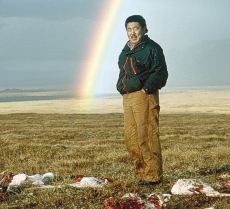
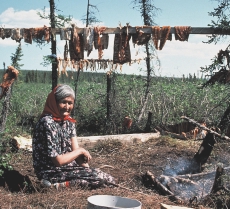
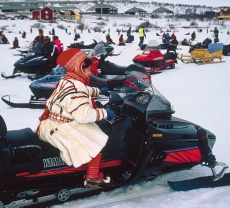
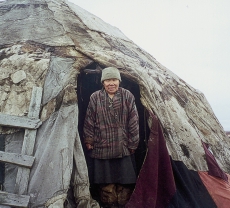
I๑upiat, Anaktuvuk Pass,
Alaska.
NWT ARCHIVES
/
Dene, Midway Lake,
HENRY HUNTINGTON
GNWT
NWT, Canada.
Saami, Kautokeino,
Norway.
Chukchi, Kanchalan,
STAFFAN WIDSTRAND
PTS PROJECT
Russia.
tic and threshold levels for effects that have
6
been determined in other parts of the world,
Setting the Stage
sometimes using other species. This may be
more or less valid depending on the species
and the contaminant of concern. Effects thresh-
olds for Arctic animals are largely unknown.
The structure of this volume
Five scientific reports have been prepared for
delivery to the Arctic Council in 2002 pres-
enting the results of AMAP's second phase.*
The main findings of the reports and the rec-
ommendations of the AMAP Working Group
are contained in the Executive Summary. Each
of the scientific reports is summarized by a
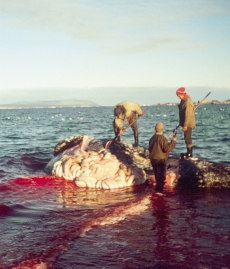
Samples were taken from
chapter in this volume:
a gray whale in the
Persistent Organic Pollutants describes new
Lavrentiya Bay during
the Persistent Toxic Sub-
findings in trends, levels, and effects of POPs,
stances project in Russia.
PTS PROJECT
including several contaminants that have re-
cently been detected in the Arctic. The implica-
Special concerns
tions of POPs for people are addressed in the
about interpreting data
chapter Human Health.
Heavy Metals reviews recent data and discov-
The different contaminants found in the Arctic
eries concerning mercury, lead, and cadmium.
have substantial differences in sources, path-
It also looks at the localized impacts of smelters
ways, trends, and effects. Nonetheless, a few
in the Russian Arctic. As with the previous
general points apply to the data presented in
chapter, the implications of metals for people
the subsequent chapters of this report.
are addressed in the chapter Human Health.
First, identifying spatial trends is often com-
Radioactivity covers the sources, pathways,
plicated by a lack of standardization. This is
uptake, and effects of radionuclides. Emphasis
particularly true for samples from plants and
is on the behavior of radionuclides in ecosys-
animals. Not only must collection and analyti-
tems and on hazards connected with potential
cal methods and techniques be comparable,
sources. In contrast to POPs and heavy metals,
but researchers must take into account sex,
human health implications of radioactivity are
age, and food-web structure. Although these
addressed in this chapter.
requirements pose a problem for quantifying
Human Health examines what has been
the differences from place to place, it is pos-
learned recently concerning Arctic people and
sible to identify general trends.
the ways in which contaminants affect them.
Second, determining temporal trends is also
It describes the basic health parameters of
complex, particularly when other environmen-
Arctic populations as a basis for considering
tal changes have been occurring at the same
the potential impacts of contaminants.
time. The climatic regime of the Arctic has
Changing Pathways discusses the potential
shifted dramatically from the conditions that
impacts of climate change on the ways in
prevailed during most of the 1970s and 1980s
which contaminants are carried to the Arctic
to those that prevailed during the 1990s, and
and taken up in Arctic food webs. The antici-
these changes may have had significant effects
pated changes may greatly alter the distribution
on contaminant pathways. This period is
and trends of many contaminants throughout
exactly the time covered by most of the data
the Arctic.
available for the assessment of recent temporal
The inside front cover has a circumpolar
trends. This raises the question of the extent to
map, a list of species with their scientific names,
which observed trends may reflect changes in
and a list of units. The inside back cover has a
pathways as opposed to changes in, for exam-
list of contaminants with their abbreviations.
ple, emissions. As discussed in the chapter
ญญญญญญญญญญญญญญญญญญญญญญญญญญญญญญญญญญญญญญญญญญญญญญญญญ
Changing Pathways, shifts in climate and
* AMAP Assessment 2002: Human Health in the Arctic.
weather can greatly alter contaminants path-
isbn 82-7971-016-7
ways to and within the Arctic.
AMAP Assessment 2002: The Influence of Global
Third, there is still little information on
Change on Arctic Contaminant Pathways.
effects of contaminants on Arctic biota. This
isbn 82-7971-020-5
is especially true for the effects of low-level,
AMAP Assessment 2002: Persistent Organic Pollutants
in the Arctic. isbn 82-7971-019-1
chronic exposures, which may result in subtle
AMAP Assessment 2002: Heavy Metals in the Arctic.
effects such as stress responses or reduction in
isbn 82-7971-018-3
overall fitness. Risk assessments often have to
AMAP Assessment 2002: Radioactivity in the Arctic.
rely on comparisons between levels in the Arc-
isbn 82-7971-017-5