

(1,1) -1- Cover 38_only.indd 2004-04-05, 16:09:52
Global International
Waters Assessment
Patagonian Shelf
GIWA Regional assessment 38
Mugetti, A., Brieva, C., Giangiobbe, S., Gallicchio, E., Pacheco, F.,
Pagani, A., Calcagno, A., González, S., Natale, O., Faure, M.,
Rafaelli, S., Magnani, C., Moyano, M.C., Seoane, R. and I. Enriquez
Global International
Waters Assessment
Regional assessments
Global International
Waters Assessment
Regional assessment 38
Patagonian Shelf
GIWA report production
Series editor: Ulla Li Zweifel
Report editors: David Souter, George Roman
Editorial assistance: Johanna Egerup, Malin Karlsson
Maps & GIS: Niklas Holmgren
Design & graphics: Joakim Palmqvist
Global International Waters Assessment
Patagonian Shelf, GIWA Regional assessment 38
Published by the University of Kalmar on behalf of
United Nations Environment Programme
© 2004 United Nations Environment Programme
ISSN 1651-9403
University of Kalmar
SE-391 82 Kalmar
Sweden
United Nations Environment Programme
PO Box 30552,
Nairobi, Kenya
This publication may be reproduced in whole or in part and
in any form for educational or non-profit purposes without
special permission from the copyright holder, provided
acknowledgement of the source is made. No use of this
publication may be made for resale or for any other commercial
purpose whatsoever without prior permission in writing from the
United Nations Environment Programme.
CITATIONS
When citing this report, please use:
UNEP, 2004. Mugetti, A., Brieva, C., Giangiobbe, S., Gallicchio, E.,
Pacheco, F., Pagani, A., Calcagno, A., González, S., Natale, O.,
Faure, M., Rafaelli, S., Magnani, C., Moyano, M.C., Seoane, R. and
Enriquez, I. Patagonian Shelf, GIWA Regional assessment 38.
University of Kalmar, Kalmar, Sweden.
DISCLAIMER
The views expressed in this publication are those of the authors
and do not necessarily reflect those of UNEP. The designations
employed and the presentations do not imply the expressions
of any opinion whatsoever on the part of UNEP or cooperating
agencies concerning the legal status of any country, territory,
city or areas or its authority, or concerning the delimitation of its
frontiers or boundaries.
This publication has been peer-reviewed and the information
herein is believed to be reliable, but the publisher does not
warrant its completeness or accuracy.
Printed and bound in Sweden by Sunds Tryck Öland AB.
CONTENTS
Contents
Executive summary
9
La Plata River Basin
9
South Atlantic Drainage System
11
Acknowledgements
13
Abbreviations and acronyms
14
Regional definition
18
Boundaries of the Patagonian Shelf region
18
Physical characteristics
19
Socio-economic characteristics
27
Assessment
34
La Plata River Basin
Freshwater shortage
35
Pollution
40
Habitat and community modification
47
Unsustainable exploitation of fish and other living resources
52
Global change
55
South Atlantic Drainage System
Freshwater shortage
58
Pollution
61
Habitat and community modification
66
Unsustainable exploitation of fish and other living resources
68
Global change
72
Priority concerns: La Plata River Basin & South Atlantic Drainage System
74
Causal chain analysis
76
Uruguay River Basin upstream of the Salto Grande Dam
System description
76
Impacts
80
Immediate causes
81
Root causes
82
CONTENTS
Buenos Aires Coastal Ecosystem Argentinean-Uruguayan Common Fishing Zone
System description
86
Causal model and links
90
Root causes
93
Conclusions
96
Policy options
98
Uruguay River Basin upstream of the Salto Grande Dam
Definition the of problem
98
Construction of policy options
99
Performance of selected policy options
100
Final considerations
103
Buenos Aires Coastal Ecosystem Argentinean-Uruguayan Common Fishing Zone
Definition of the problem
105
Construction of policy options
106
Identification of recommended policy options
108
Performance of selected policy options
109
Conclusions and recommendations
113
La Plata River Basin
113
South Atlantic Drainage System
115
Further research recommended for the Patagonian Shelf region
117
References
118
Annexes
128
Annex I List of contributing authors and organisations involved
128
Annex II Detailed scoring tables
131
Annex III Detailed assessment worksheets for causal chain analysis
139
Annex IV List of important water-related programmes and assessments in the region
152
Annex V List of conventions and specific laws
153
Annex VI Tables
160
The Global International Waters Assessment
i
The GIWA methodology
vii
Executive summary
GIWA region 38, Patagonian Shelf, comprises the La Plata River Basin, the
Assessment
South Atlantic Drainage System, and the Patagonian Shelf Large Marine
The impacts of Freshwater shortage in the La Plata River Basin were
Ecosystem. Given the significant differences in terms of biophysical and
assessed as moderate. Although freshwater supply aggregated at basin
socio-economic aspects, the assessment was carried out separately
level greatly exceeds demand, the temporal and spatial distribution of
for two systems: La Plata River Basin and the South Atlantic Drainage
flow is uneven, and the degradation of water quality by pol ution is
System.
progressively decreasing the usability of supplies. Shortages in many
locations have already been observed, and these are likely to become
more common in the future.
La Plata River Basin
The modification of water sources around major cities, the rising costs of
water treatment, and the high cost of restoring degraded water sources
The La Plata River Basin is shared by Argentina, Bolivia, Brazil, Paraguay
stand out as pressing socio-economic issues that could potential y
and Uruguay. Covering over 3.1 mil ion km2, it is the second largest
initiate conflicts at both sub-national and regional levels.
drainage basin in South America and the fifth largest in the world. The
Guaraní Aquifer, shared by Argentina, Brazil, Paraguay, and Uruguay, and
The impacts of Pol ution in the Basin were assessed as moderate.
containing over 40 000 km3 of freshwater, is also located in the region.
The limited treatment of industrial wastes leads to widespread
contamination by chemical pol utants. The lack of sewage treatment
The region contains many large urban and industrial centres and
leads to the contamination of supplies by pathogens, particularly in the
political y important cities, including Buenos Aires, Asuncion,
vicinity of cities. The use of agro-chemicals has introduced significant
Montevideo, Brasilia, Sao Paulo, and Curitiba.
sources of chemical pollutants, and there is evidence of eutrophication
in some areas of large reservoirs. In addition, land use changes and
The Basin is an important centre for the regional economy. Approximately
unsustainable agricultural practices have resulted in erosion that has
50% of the population of the countries sharing the La Plata Basin live
greatly increased the turbidity of water supplies. Final y, occasional
within the drainage basin while around 70% of GNP of the countries
significant oil spil s occur.
involved is produced within the same area.
Economic impacts associated with Pollution were assessed as severe,
The La Plata River Treaty provides a supra-national legal framework
particularly due to increases in water treatment costs. There is also
for the region, and the Intergovernmental Coordinating Committee
considerable evidence of health impacts due to water-borne diseases.
(CIC) of the La Plata River Basin provides an institutional framework
For example, diarrhoea and schistosomiasis are common, and during
for management. International institutional agreements and basin
the 1990s, cholera epidemics were registered in al of the countries
committees can also be found within several sub-basins.
of La Plata River Basin except Uruguay. At local levels, there has been
evidence of decreased viability of fish stocks due to pol ution. Future
improvements in pol ution control wil require major investments,
EXECUTIVE SUMMARY
9
but are necessary for avoiding health problems, as wel as a range of
Based on the assessment of each major concern and the constituent
environmental and social impacts.
issues, and a consideration of environmental, socio-economic, and
health impacts, the GIWA Task team prioritised Pol ution for further
The impacts of Habitat and community modification were assessed as
analysis, and chose the Uruguay River Basin to il ustrate the Causal
moderate. The construction of reservoirs for hydropower generation
chain and Policy options analyses.
has caused modifications to several types of fluvial and riparian
ecosystems. Migratory routes of fish species have been disturbed,
Causal chain analysis and Policy option analysis
flow regulation has affected species that use downstream floodplains
for Pollution: Uruguay River Basin upstream
for spawning, and there have been records of fish mortality due gas
from the Salto Grande Reservoir
supersaturation caused by dam operations. In addition, alien bivalve
The primary immediate causes of pollution in the Uruguay River Basin
species accidental y introduced from Asia (Limnoperna fortunei and
were identified as: inadequate treatment of urban and industrial
Corbicula fluminea) have spread throughout a large part of La Plata
wastewater, application of agro-chemicals (fertilisers and biocides),
River Basin and have displaced native benthic species. An increasing
inefficient irrigation practices, and soil erosion.
abundance of carp in the inner La Plata, Paraná and Uruguay rivers has
also been evident. Urbanisation has also resulted in the loss of certain
Identified root causes for pollution include:
aquatic ecosystems types.
Lack of a framework for Integrated Water Resources Management,
and lack of coordination between different levels of government;
Socio-economic impacts caused by these changes include the loss of
Lack of stakeholder participation in decision-making;
educational and scientific values, and increased costs associated with
Inadequate valuation of ecosystem goods and services;
the control of invasive species and the restoration of habitats. Future
Persistence of unsustainable agricultural practices;
impacts due to habitat modification are likely to either continue to
Inadequate budgets of institutions in charge of management, which
worsen, or to improve slightly.
contributes to the lack of enforcement of existing agreements and
policies;
The impacts of Unsustainable exploitation of fish and other living
Poor spread of scientific and technological knowledge and
resources were assessed as moderate. The sustainability of major
training;
commercial and recreational inland fisheries in the La Plata River
Market incentives for short term economic gain;
Basin are at risk due to inadequate management practices and
Poverty.
overexploitation. When combined with habitat modification, pol ution,
and impending climate change, overexploitation is threatening the
After analysing several policy options, the fol owing policy instruments
long-term viability of fish stocks.
were highlighted as recommended options:
Improved wastewater treatment by strengthening and
Although the fishing sector is smal , socio-economic impacts have been
coordinating financial mechanisms between private and public
assessed as considerable due to subsistence concerns associated with
sectors (including international sources);
non-professional fishermen. A moderate increase in the impacts due to
Promote sustainable agricultural practices by enforcing regulations
fishing are expected in the future.
concerning agrochemicals (`pol uter pays'), facilitating the
introduction of practices that reduce soil erosion, and making
The impacts of Global change were assessed as moderate. The La Plata
irrigation more efficient (`user pays');
River Basin has been extensively influenced by climatic variability and is
Carry out systematic campaigns of environmental awareness and
very sensitive to El Niño events. In spite of present uncertainties, global
education that target specific stakeholders;
change seems to have had a significant effect on the hydrological
Use subsidies to promote the treatment and/or reuse of wastes
cycle, and cities located in the vicinity of rivers are now at greater risk
originating from livestock production;
of flooding disasters, especial y in Argentina. In the future, it is assumed
Create basin management mechanisms with transboundary,
that global change will cause the global hydrological cycle to become
integrated approaches. These would include and/or extend the
more volatile and unpredictable, which wil increase the risk of flooding
scope of existing institutions.
and attendant socio-economic consequences due to impacts upon
infrastructure, agricultural production, and the economy.
10
GIWA REGIONAL ASSESSMENT 38 PATAGONIAN SHELF
EXECUTIVE SUMMARY
11
South Atlantic Drainage System Based on the assessment of the major concerns and their issues, the
fol owing linked concerns were prioritised within the transboundary
The South Atlantic Drainage System comprises basins located between
regions of the Argentinean-Uruguayan Common Fishing Zone and the
the Andean ranges and the Atlantic Ocean, which drain large arid areas
Buenos Aires Coastal Ecosystem:
of Argentina and some small parts of southern Chile. This sub-system
Habitat and community modification, which is tightly linked to
also contains one of the world's largest continental shelves, which
unsustainable exploitation of fish and other living resources, and
is over 769 400 km2, and extends up to 850 km from the coast at its
also linked to pollution.
southernmost point.
Causal chain analysis and Policy option analysis
This system is characterised by very low population densities, and the
for the Argentinean-Uruguayan Common Fishing
primary economic activities include farming (e.g. fruit, sheep), mining
Zone and the Buenos Aires Coastal Ecosystem
(oil and coal), and fishing.
The Argentinean-Uruguayan Common Fishing Zone and the Buenos
Aires Coastal Ecosystem were selected as a case study for the Causal
Assessment
chain and Policy options analyses. The most significant immediate
The impacts of Freshwater shortage were assessed as moderate.
causes of habitat modification are related to the fisheries sector,
Localised overexploitation of groundwater and pol ution of water
and include: overexploitation of target species, by-catch, and the
supplies have had major impacts on freshwater supplies. In addition,
modification of the sea floor by fishing gear. Other significant causes
the construction and operation of dams has modified riparian habitats
of habitat modification include urbanisation and shipping activities.
and changed seasonal flow patterns.
Habitats are also being altered by pollution originating from urban and
industrial wastewater discharges and agricultural non-point sources.
The impacts of Pollution were assessed as slight. Oil spil s, suspended
solids, and microbial pol ution are responsible for most of the
Besides market forces, the primary root cause for habitat modification
environmental impacts. Wastewater discharges are the main sources
is a general lack of surveil ance and regulation. This applies primarily
of microbiological pol ution. The extensive use of pesticides and
to fishing activities, but also to urbanisation, tourism development,
fertilisers has impacted some lakes, and eutrophication has been
and agriculture. Ineffective governance leads to inadequacies in the
evident in areas with restricted water circulation. In addition, oil spil s
budgets and personnel of agencies charged with management, hinders
and toxic waste spil s have had negative impacts on both ecosystems
the efficient application of legal instruments, and contributes to a lack
and water supplies.
of research and knowledge development. There is also a lack of consent
between Argentina and Uruguay in many aspects related to joint
The impacts of Habitat and community modification were assessed
administration of shared resources and joint research and assessment
as moderate. Marine ecosystems have been extensively modified due
of ecosystems. In addition, technology to increase selectivity of fishing
to fishing, dredging and tourism development. In addition, reservoir
gears is missing, and fishers show significant socio-cultural resistance
development has altered many fluvial and riparian ecosystems,
to the use or development of new types of fishing gear.
particularly in the Limay River.
Policy options to address the identified root causes require
The impacts of Unsustainable exploitation of fish were assessed as
management policies based on a set of multiple tools that should be
moderate. Hake has been exploited beyond safe biological limits,
applied simultaneously. Recommended actions include:
resulting in the col apse of fish stocks. Overexploitation, by-catches
Demarcate a coastal area and restrict fishing operations in this area
and discards of organisms without commercial value, and habitat
to small boats only (under 25-30 m);
destruction by trawling methods have generated threats to ecosystem
Include a National Programme of Preservation of the Marine
integrity and marine biodiversity.
Environment within Argentina's Science and Technology System
(SCYT);
The impacts of Global change on the South Atlantic Drainage System
Link fisheries development to national programmes for the
were assigned a score of 0 or no impact. However, impacts of global
preservation of the marine environment;
change are expected to increase in the future.
Reorient research policies to reconcile research and development
issues with state policies;
10
GIWA REGIONAL ASSESSMENT 38 PATAGONIAN SHELF
EXECUTIVE SUMMARY
11
Optimise national, provincial, and state budget al ocations to
fisheries management agencies;
Develop a mechanism to finance long-term research aimed at
achieving the sustainable management of ecosystems;
Strengthen efforts to systematical y compile and analyse fisheries
data;
Coordinate research data from several projects at both national and
international levels;
Regulate fishing efforts "in paral el" (Argentina-Uruguay), al owing
each country to develop its own fishery exploitation models and
then reconcile both practices;
Jointly evaluate the state of resources and obtain more reliable
scientific data. This requires continuous bi-national research
campaigns;
Promote the exchange of data and knowledge among regional
organisation through research units and workshops (Argentina,
Uruguay, Brazil) to identify shared resources and assess genetic
diversity;
Optimise communication systems among scientists, administrators
and managers;
Improve the capacity of land-based and on-board fisheries
inspectors to undertake control and monitoring activities;
Involve fishermen in developing selective practices and devices;
Disseminate information throughout communities in order to
foster public awareness about goods and services related to marine
ecosystems;
Launch educational campaigns among the general population
to discourage consumption of products based on endangered
species, or species whose exploitation is likely to undermine the
integrity of the ecosystem or disrupt ecosystem function;
Carry out technical studies to develop selective fishing gear that
minimises by-catch and safeguards biodiversity and habitats;
Expand research on species exposed to incidental exploitation.
12
GIWA REGIONAL ASSESSMENT 38 PATAGONIAN SHELF
Acknowledgements
The Argentine Institute of Water Resources (IARH) has been the Focal
Point for the regional GIWA assessment of the Patagonian Shelf.
The Argentine Institute of Water Resources (IARH) is a non-
governmental organisation created in 1984 by professionals interested
in water resources management. Its goal is the study, promotion and
dissemination of issues related to the knowledge, use, preservation
and management of water resources. In doing so, IARH promotes
experience and professionals and institutions exchange, from both
national and foreign locations. Among other activities, IARH gives
specialised courses, organises technical meetings, workshops and
seminaries, edits a newsletter, elaborates and disseminates reports,
and fosters debate about relevant rational use, preservation and
integrated water resources management. Since 1994, IARH has actively
participated in the RIGA (Environmental and Management Research
Network of La Plata Basin) implementation process.
The conduct of this project has been made possible by the col aboration
of a large number of professionals and specialist who have contributed
to it through the compilation of information and participation in the
GIWA workshops. Therefore the Coordination of the Patagonian Shelf
region would like to express thanks to the fol owing persons who have
contributed to the success of the project: Ricardo Delfino, María Josefa
Fioriti, Marcelo Gaviño Novil o, Carlos Lasta, Oscar Padín, Sara Sverlij,
Carlos Tucci and Víctor Pochat.
ACKNOWLEDGEMENTS
13
Abbreviations and acronyms
AIC
Autoridad Interjurisdiccional de Cuenca de los ríos Limay-
CLAEH
Centro Latinoamericano de Economia Humana
Neuquen y Negro/Interjurisdictional Basin Authority of the
CODEVASF Companhia de Desenvolvimento do Vale do São Francisco
Limay-Neuquen and Negro River
COFREMAR Comisíon Técnica Mixta del Frente Marítiom/Technical
AIDIS
Asociación Argentina de Ingeniería Sanitaria y Ciencias del
Commission of Maritime Front
Ambiente
COIRCO
Comisión Interjurisdiccional del Río Colorado Argentina/Inter
ANA
Agencia Nacional del Agua, Brazil/National Water Agency,
Jurisdictional Committee of Colorado river Argentina
Brazil
COMIBOL Corporación Minera de Bolivia / Mining Corporation of
ANEEL
Agencia Nacional de Energia Electrica, Brasil/National
Bolivia
Agency of Electric Energy, Brazil
COMIP
Comisión Mixta Argentino-Paraguaya del Río Paraná/
BID
Banco Interamericano de Desarrol o/Inter American
Paraná River Argentine-Paraguayan Commission
Development Bank
COMSUR
Bolivia's Compañia Minera del Sur
BTEX
Volatile lineal and aromatic hydrocarbons
CONAMA Comision Nacional de Meio Ambiente, Brasil/National
CARP
Comisión Mixta Administradora del Río de la Plata/
Committee of Environment, Brazil
Administration Commission of the La Plata River; Argentina
CONICET
Proyecto Peces Patagónicos en el Cenpat
and Uruguay
COPEL
Companhia Paranense de Energia
CARU
Comisión Administradora del Río Uruguay/Administrative
CPUE
Catch per Unit of Effort
Commission for the Uruguay River
CRC
River Cuareim Commission
CCREM
Canadian Council of Resource and Environment Ministers
CYTED
Programa Iberoamericano de Ciencia y Tecnología para el
CEHPAR
Centro de Hidráulica e Hidrologia Professor Parigot de Souza"
Desarrol o
CELA
Centro de Economía, Legislación y Administración del Agua
DFS
Dirección de Fauna Silvestre
CENPAT
Centro Nacional Patagónico
DINAMA
Dirección Nacional de Medio Ambiente
CEPIS
Centro Panamericano de Ingeniería Sanitaria y Ciencias del
DINARA
Dirección Nacional de Recursos Acuáticos/Uruguayan
Ambiente/Pan-American Center of Sanitary Engineering
Director of Aquatic Resources
and Environmental Sciences
DNH
Dirección Nacional de Hidrografía, Uruguay/National
CESP
Companhia Energética de São Paulo
Hydrographic Steering, Uruguay
CETA
Centro de Estudios Transdisciplinarios del Agua
DNPCyDH Dirección Nacional de Políticas Coordinación y Desarrol o
CETESB
Companhia de Tecnología de Saneamento Ambiental, São
Hídrico
Paulo, Brasil
DNPH
Dirección Nacional de Programas Habitacionales
CFP
Federal Fishing Council
DRIyA
Dirección Nacional de Recursos Ictícolas y Acuícolas,
CIC
Intergovernmental Co-ordinating Committee for La Plata
Secretaría de Ambiente y Desarrol o Sustentable de la
Basin
Nación, Argentina / National Department of Ichthyic and
CITES
Convention for the International Trade on Endangered
Aquatic Resources, National Secretariat of Environment and
Species of Wild Flora and Fauna
Sustainable Development, Argentina
14
GIWA REGIONAL ASSESSMENT 38 PATAGONIAN SHELF
ABBREVIATIONS AND ACRONYMS
15
ENAPRENA Estrategia Nacional parala Proteccióny el Manejo de los
INTA
Instituto Nacional de Tecnología Agropecuaria
Recursos Naturales del Paraguay
IPCC
Intergovernmental Panel of Climate Change
ENOHSA
Ente Nacional de Obras Hídricas de Saneamiento, Argentina
IPH
Instituto de Pesquisas Hidráulicas
FAO
Food and Agriculture Organization of the United Nations
IRGA
Instituto Riograndense de Arroz
FECIC
Fundación para la Educación, la Ciencia y la Cultura,
LME
Large Marine Ecosystems
Argentina/Education, Science and Culture Foundation,
MAC
Maximum Al owable Catches
Argentina
MERCOSUR Mercado Común del Sur/Southern Common Market
FEP
Fisheries Economic System
MTOP
Ministerio de Transporte y Obras Públicas
FICH
Facultad de Ingenieria y Ciencias Hidricas
NGO
Non Governmental Organisations
FI-UNLP
Facultad de Ingeniería - Universidad Nacional de La Plata
NTU
Nephelometric Turbidity Unit
FPN
Fundación Patagonia Natural
OEA
Organización de los Estados Americanos
FREPLATA Protección Ambiental del Río de la Plata y su Frente
OMS
Organización Mundial de la Salud/World Health Organization
Marítimo/Environmental Protection Project of the Río de
OPS
Organización Panamericana de la Salud/Panamerican
la Plata and Its Sea Coast
Health Organization
FUCEMA
Fundación para la Conservación de las Especies y el Medio
PAH
Polycyclic Aromatic Hydrocarbons
Ambiente
PLAMACH-BOL
FUEM
Fundação Universidade Estadual de Maringá, Nupelia and
Plan Nacional de Cuencas Hidrográficas de Bolivia/National
Itaipú Binacional
Plan of Hydrologic Basins, Bolivia.
GCM
General Circulation Model
POP
Persistent Organic Pollutant
GDP
Gross Domestic Product
PROSAP
Programa de Servicios Agrícolas Provinciales/Provincial
GEF
Global Environment Facility
Agricultural Services Program
GFDL
US national Oceanic and Atmospheric Administration
ROU
República Oriental del Uruguay
Geophysical Fluids Dynamic
SABESP
Companhia de Saneamiento Básico do Estado de São Paulo,
GISS
US NASA Goddard Institute for Space Sciences
Brasil/Basic Sanitation Company of São Paulo State, Brazil
GIWA
Global International Waters Assessment
SAGPyA
Secretaría de Agricultura, Ganaderìa, Pesca y Alimentación/
GNP
Gross National Product
Argentinean Secretary of Agriculture, Cattle Raising, Fishing
GWP
Global Water Partnership
and Food
HDI
Human Development Index
SAyDS
Secretaría de Ambiente y Desarrol o Sustentable
IARH
Instituto Argentino de Recursos Hídricos/Argentinean
SCYT
Argentina's science and technology system
Institute of Water Resources
SECyT
Argentinean National System of Science and Technique
IBGE
Instituto Brasileiro de Geografía e Estatística/Brazilian
SEMA
Secretaria de Estado do Meio Ambiente do Paraná
Institute of Geography and Statistical
SENASA
Servicio Nacional de Sanidad y Calidad Agroalimentaria,
ICA
Instituto Correntino del Agua
Argentina
IDB
International Development Bank
SSRH
Subsecretaría de Recursos Hídricos de la Nación, Ministerio
IHH
El Instituto de Hidráulica e Hidrología
de Economía, Argentina/National Undersecretariat of
ILEC
International Lake Environment Committee Foundation
Water Resources, Ministry of Finance, Argentina
INA
Instituto Nacional del Agua, Argentina /National Institute
THL
Trialomethanes
of Water, Argentina
THM
Tri-Halo-Methane
INDEC
Instituto Nacional de Estadística y Censos, Argentina/
UBA
Universidad de Buenos Aires
National Institute of Statistical and Census, Argentina
UFRGS
Universidade Federal Rio Grande do Sul
INE-Bolivia Instituto Nacional de Estadística, Bolivia / National Institute
UI C
Uniform International Industrial Classification
of Statistical, Bolivia
UKMO
United Kingdom Meteorological Office
INE-Uruguay Instituto Nacional de Estadística, Uruguay/National Institute
UNEP
United Nations Environment Programme
of Statistical, Uruguay
UNL
Universidad Nacional del Litoral, Santa Fe, Argentina
INIDEP
Instituto Nacional de Investgacíon y Desarrol o Pesquero/
WCU
World Conservation Union
National Institute of Fisheries Research and Development
ZCP
Common Fising Zone (Uruguay and Argentina)
14
GIWA REGIONAL ASSESSMENT 38 PATAGONIAN SHELF
ABBREVIATIONS AND ACRONYMS
15
List of figures
Figure 1
Boundaries of the Patagonian Shelf region. . . . . . . . . . . . . . . . . . . . . . . . . . . . . . . . . . . . . . . . . . . . . . . . . . . . . . . . . . . . . . . . . . . . . . . . . . . . . . . . . . . . . . . . . . . . . . . . . . . . . . . . . . . . . . . . . . . . 18
Figure 2
Boundaries between La Plata River Basin, South Atlantic Drainage System, and GIWA region 39 Brazil Current.. . . . . . . . . . . . . . . . . . . . . . . . . . . . . . . . . . . . . . . . . . . . . . . . . 19
Figure 3
The drainage basins of the tributaries comprising La Plata River Basin. . . . . . . . . . . . . . . . . . . . . . . . . . . . . . . . . . . . . . . . . . . . . . . . . . . . . . . . . . . . . . . . . . . . . . . . . . . . . . . . . . . . . . . . . 20
Figure 4
Climate zones.. . . . . . . . . . . . . . . . . . . . . . . . . . . . . . . . . . . . . . . . . . . . . . . . . . . . . . . . . . . . . . . . . . . . . . . . . . . . . . . . . . . . . . . . . . . . . . . . . . . . . . . . . . . . . . . . . . . . . . . . . . . . . . . . . . . . . . . . . . . . . . . . . 20
Figure 5
Ecoregions.. . . . . . . . . . . . . . . . . . . . . . . . . . . . . . . . . . . . . . . . . . . . . . . . . . . . . . . . . . . . . . . . . . . . . . . . . . . . . . . . . . . . . . . . . . . . . . . . . . . . . . . . . . . . . . . . . . . . . . . . . . . . . . . . . . . . . . . . . . . . . . . . . . . . . 21
Figure 6
Land cover. . . . . . . . . . . . . . . . . . . . . . . . . . . . . . . . . . . . . . . . . . . . . . . . . . . . . . . . . . . . . . . . . . . . . . . . . . . . . . . . . . . . . . . . . . . . . . . . . . . . . . . . . . . . . . . . . . . . . . . . . . . . . . . . . . . . . . . . . . . . . . . . . . . . . . 21
Figure 7
Main reservoirs in La Plata River Basin. . . . . . . . . . . . . . . . . . . . . . . . . . . . . . . . . . . . . . . . . . . . . . . . . . . . . . . . . . . . . . . . . . . . . . . . . . . . . . . . . . . . . . . . . . . . . . . . . . . . . . . . . . . . . . . . . . . . . . . . . 22
Figure 8
Guaraní Aquifer.. . . . . . . . . . . . . . . . . . . . . . . . . . . . . . . . . . . . . . . . . . . . . . . . . . . . . . . . . . . . . . . . . . . . . . . . . . . . . . . . . . . . . . . . . . . . . . . . . . . . . . . . . . . . . . . . . . . . . . . . . . . . . . . . . . . . . . . . . . . . . . . 24
Figure 9
South Atlantic Drainage System and main reservoirs. . . . . . . . . . . . . . . . . . . . . . . . . . . . . . . . . . . . . . . . . . . . . . . . . . . . . . . . . . . . . . . . . . . . . . . . . . . . . . . . . . . . . . . . . . . . . . . . . . . . . . . . . . 25
Figure 10 Ramsar sites and protected areas. . . . . . . . . . . . . . . . . . . . . . . . . . . . . . . . . . . . . . . . . . . . . . . . . . . . . . . . . . . . . . . . . . . . . . . . . . . . . . . . . . . . . . . . . . . . . . . . . . . . . . . . . . . . . . . . . . . . . . . . . . . . . . 25
Figure 11 Political division of the Patagonian Shelf region. . . . . . . . . . . . . . . . . . . . . . . . . . . . . . . . . . . . . . . . . . . . . . . . . . . . . . . . . . . . . . . . . . . . . . . . . . . . . . . . . . . . . . . . . . . . . . . . . . . . . . . . . . . . . . . 29
Figure 12 Variation in annual water level at Ladário (Upper Paraguay) and rainfall (3 year moving average) at Cuiabá (Paraguay River).. . . . . . . . . . . . . . . . . . . . . . . . . . . . . . . . 35
Figure 13 Daily minimum mean and annual mean flow of Paraná River at Tunel (Paraná-Santa Fe, Argentina). . . . . . . . . . . . . . . . . . . . . . . . . . . . . . . . . . . . . . . . . . . . . . . . . . . . . . . . . . 35
Figure 14 Water quality in the Brazilian area of La Plata River Basin. . . . . . . . . . . . . . . . . . . . . . . . . . . . . . . . . . . . . . . . . . . . . . . . . . . . . . . . . . . . . . . . . . . . . . . . . . . . . . . . . . . . . . . . . . . . . . . . . . . . . . 36
Figure 15 Aerial view of São Paulo Metropolitan area (Brazil). . . . . . . . . . . . . . . . . . . . . . . . . . . . . . . . . . . . . . . . . . . . . . . . . . . . . . . . . . . . . . . . . . . . . . . . . . . . . . . . . . . . . . . . . . . . . . . . . . . . . . . . . . . . 37
Figure 16 Location of major cities in Metropolitan area of Buenos Aires. . . . . . . . . . . . . . . . . . . . . . . . . . . . . . . . . . . . . . . . . . . . . . . . . . . . . . . . . . . . . . . . . . . . . . . . . . . . . . . . . . . . . . . . . . . . . . . . . . 38
Figure 17 Water quality for leisure use in Paranoa Lake, Brasilia (Brazil). . . . . . . . . . . . . . . . . . . . . . . . . . . . . . . . . . . . . . . . . . . . . . . . . . . . . . . . . . . . . . . . . . . . . . . . . . . . . . . . . . . . . . . . . . . . . . . . . . 41
Figure 18 Itaipú dam, Paraná River.. . . . . . . . . . . . . . . . . . . . . . . . . . . . . . . . . . . . . . . . . . . . . . . . . . . . . . . . . . . . . . . . . . . . . . . . . . . . . . . . . . . . . . . . . . . . . . . . . . . . . . . . . . . . . . . . . . . . . . . . . . . . . . . . . . . . . . 48
Figure 19 Relative frequency of species in Itaipú River. . . . . . . . . . . . . . . . . . . . . . . . . . . . . . . . . . . . . . . . . . . . . . . . . . . . . . . . . . . . . . . . . . . . . . . . . . . . . . . . . . . . . . . . . . . . . . . . . . . . . . . . . . . . . . . . . . . . 49
Figure 20 Percentage of species transferred in Yacyretá Reservoir (Argentina-Paraguay). . . . . . . . . . . . . . . . . . . . . . . . . . . . . . . . . . . . . . . . . . . . . . . . . . . . . . . . . . . . . . . . . . . . . . . . . . . . . . . . . 49
Figure 21 Riachuelo River in Buenos Aires (Argentina). . . . . . . . . . . . . . . . . . . . . . . . . . . . . . . . . . . . . . . . . . . . . . . . . . . . . . . . . . . . . . . . . . . . . . . . . . . . . . . . . . . . . . . . . . . . . . . . . . . . . . . . . . . . . . . . . . . . 50
Figure 22 Annual discharge at Puente Camino Buen Pasto gauging site. Senguerr River near Colhué Huapi Lake.. . . . . . . . . . . . . . . . . . . . . . . . . . . . . . . . . . . . . . . . . . . . . . . . . . . . . . . . 59
Figure 23 Discharge at Paso Cordoba gauge (province of Río Negro) before operation of Cerros Colorados System (1978). . . . . . . . . . . . . . . . . . . . . . . . . . . . . . . . . . . . . . . . . . . . . . . . 59
Figure 24 Discharges at Paso Cordoba gauge (province of Río Negro) after operation of Cerros Colorados System (1978). . . . . . . . . . . . . . . . . . . . . . . . . . . . . . . . . . . . . . . . . . . . . . . . . 59
Figure 25 Main gully downstream the Aguada del Sapo mallín. . . . . . . . . . . . . . . . . . . . . . . . . . . . . . . . . . . . . . . . . . . . . . . . . . . . . . . . . . . . . . . . . . . . . . . . . . . . . . . . . . . . . . . . . . . . . . . . . . . . . . . . . . . 61
Figure 26 Fish landings in 1950-2001. . . . . . . . . . . . . . . . . . . . . . . . . . . . . . . . . . . . . . . . . . . . . . . . . . . . . . . . . . . . . . . . . . . . . . . . . . . . . . . . . . . . . . . . . . . . . . . . . . . . . . . . . . . . . . . . . . . . . . . . . . . . . . . . . . . . . 69
Figure 27 Argentine fish export between 1987 and 1999.. . . . . . . . . . . . . . . . . . . . . . . . . . . . . . . . . . . . . . . . . . . . . . . . . . . . . . . . . . . . . . . . . . . . . . . . . . . . . . . . . . . . . . . . . . . . . . . . . . . . . . . . . . . . . . . . . 72
Figure 28 Links between the GIWA concerns.. . . . . . . . . . . . . . . . . . . . . . . . . . . . . . . . . . . . . . . . . . . . . . . . . . . . . . . . . . . . . . . . . . . . . . . . . . . . . . . . . . . . . . . . . . . . . . . . . . . . . . . . . . . . . . . . . . . . . . . . . . . . . 75
Figure 29 Uruguay River Basin. . . . . . . . . . . . . . . . . . . . . . . . . . . . . . . . . . . . . . . . . . . . . . . . . . . . . . . . . . . . . . . . . . . . . . . . . . . . . . . . . . . . . . . . . . . . . . . . . . . . . . . . . . . . . . . . . . . . . . . . . . . . . . . . . . . . . . . . . . . 77
Figure 30 Sowed area by jurisdiction in the Uruguay River Basin.. . . . . . . . . . . . . . . . . . . . . . . . . . . . . . . . . . . . . . . . . . . . . . . . . . . . . . . . . . . . . . . . . . . . . . . . . . . . . . . . . . . . . . . . . . . . . . . . . . . . . . . . . 79
Figure 31 Causal chain diagram illustrating the causal links for Pollution in the Uruguay River Basin.. . . . . . . . . . . . . . . . . . . . . . . . . . . . . . . . . . . . . . . . . . . . . . . . . . . . . . . . . . . . . . . . . . . . 83
Figure 32 Buenos Aires Coastal Ecosystem and Argentinean-Uruguayan Fishing Zone and their relative location in South Atlantic Drainage System.. . . . . . . . . . . . . . . . . . . . 87
Figure 33 Average landings of main species in the Buenos Aires Coastal Ecosystem,1992-1999.. . . . . . . . . . . . . . . . . . . . . . . . . . . . . . . . . . . . . . . . . . . . . . . . . . . . . . . . . . . . . . . . . . . . . . . . . . . 89
Figure 34 Average landings of main species unloaded in Uruguayan ports, 1992-1999. . . . . . . . . . . . . . . . . . . . . . . . . . . . . . . . . . . . . . . . . . . . . . . . . . . . . . . . . . . . . . . . . . . . . . . . . . . . . . . . . . . 89
Figure 35 Hake landings in the Common Fishing Zone. . . . . . . . . . . . . . . . . . . . . . . . . . . . . . . . . . . . . . . . . . . . . . . . . . . . . . . . . . . . . . . . . . . . . . . . . . . . . . . . . . . . . . . . . . . . . . . . . . . . . . . . . . . . . . . . . . . 89
Figure 36 Causal chain diagram illustrating the causal links for Habitat and community modification in the Buenos Aires Coastal Ecosystem Argentinean-Uruguayan Common
Fishing Zone. 91
Figure 37 Effort, total landings and landing of condrichthyes from the coastal fleet of Buenos Aires and Uruguay. . . . . . . . . . . . . . . . . . . . . . . . . . . . . . . . . . . . . . . . . . . . . . . . . . . . . . . . 92
Figure 38 Catch of Whitemouth croaker (Micropogonias furnieri) from the Argentinean and Uruguayan fleets at the Common Fishing Zone. . . . . . . . . . . . . . . . . . . . . . . . . . . . 94
16
GIWA REGIONAL ASSESSMENT 38 PATAGONIAN SHELF
ABBREVIATIONS AND ACRONYMS
17
List of tables
Table 1
Selected sub-systems for region 38 Patagonian Shelf.. . . . . . . . . . . . . . . . . . . . . . . . . . . . . . . . . . . . . . . . . . . . . . . . . . . . . . . . . . . . . . . . . . . . . . . . . . . . . . . . . . . . . . . . . . . . . . . . . . . . . . . . . . . 19
Table 2
Main rivers of La Plata River Basin.. . . . . . . . . . . . . . . . . . . . . . . . . . . . . . . . . . . . . . . . . . . . . . . . . . . . . . . . . . . . . . . . . . . . . . . . . . . . . . . . . . . . . . . . . . . . . . . . . . . . . . . . . . . . . . . . . . . . . . . . . . . . . 22
Table 3
Main chemical characteristics of La Plata Basin rivers. . . . . . . . . . . . . . . . . . . . . . . . . . . . . . . . . . . . . . . . . . . . . . . . . . . . . . . . . . . . . . . . . . . . . . . . . . . . . . . . . . . . . . . . . . . . . . . . . . . . . . . . . . 22
Table 4
Main rivers of South Atlantic Drainage System. . . . . . . . . . . . . . . . . . . . . . . . . . . . . . . . . . . . . . . . . . . . . . . . . . . . . . . . . . . . . . . . . . . . . . . . . . . . . . . . . . . . . . . . . . . . . . . . . . . . . . . . . . . . . . . . . 24
Table 5
Gross domestic product by country. . . . . . . . . . . . . . . . . . . . . . . . . . . . . . . . . . . . . . . . . . . . . . . . . . . . . . . . . . . . . . . . . . . . . . . . . . . . . . . . . . . . . . . . . . . . . . . . . . . . . . . . . . . . . . . . . . . . . . . . . . . . 27
Table 6
Structure of economy by country.. . . . . . . . . . . . . . . . . . . . . . . . . . . . . . . . . . . . . . . . . . . . . . . . . . . . . . . . . . . . . . . . . . . . . . . . . . . . . . . . . . . . . . . . . . . . . . . . . . . . . . . . . . . . . . . . . . . . . . . . . . . . . . 27
Table 7
Distribution of income in urban households, by quintiles. . . . . . . . . . . . . . . . . . . . . . . . . . . . . . . . . . . . . . . . . . . . . . . . . . . . . . . . . . . . . . . . . . . . . . . . . . . . . . . . . . . . . . . . . . . . . . . . . . . . . . 27
Table 8
Poor households in urban and rural areas by country.. . . . . . . . . . . . . . . . . . . . . . . . . . . . . . . . . . . . . . . . . . . . . . . . . . . . . . . . . . . . . . . . . . . . . . . . . . . . . . . . . . . . . . . . . . . . . . . . . . . . . . . . . 27
Table 9
Total population, area, density, and population growth per country. . . . . . . . . . . . . . . . . . . . . . . . . . . . . . . . . . . . . . . . . . . . . . . . . . . . . . . . . . . . . . . . . . . . . . . . . . . . . . . . . . . . . . . . . . . 28
Table 10
Population with access to drinking water and sanitation.. . . . . . . . . . . . . . . . . . . . . . . . . . . . . . . . . . . . . . . . . . . . . . . . . . . . . . . . . . . . . . . . . . . . . . . . . . . . . . . . . . . . . . . . . . . . . . . . . . . . . . 28
Table 11
Annual extraction of water by economic sector. . . . . . . . . . . . . . . . . . . . . . . . . . . . . . . . . . . . . . . . . . . . . . . . . . . . . . . . . . . . . . . . . . . . . . . . . . . . . . . . . . . . . . . . . . . . . . . . . . . . . . . . . . . . . . . . 28
Table 12
Harvested area and percentage covered by main crops by country. . . . . . . . . . . . . . . . . . . . . . . . . . . . . . . . . . . . . . . . . . . . . . . . . . . . . . . . . . . . . . . . . . . . . . . . . . . . . . . . . . . . . . . . . . . . . 29
Table 13
Area under irrigation in the La Plata River Basin.. . . . . . . . . . . . . . . . . . . . . . . . . . . . . . . . . . . . . . . . . . . . . . . . . . . . . . . . . . . . . . . . . . . . . . . . . . . . . . . . . . . . . . . . . . . . . . . . . . . . . . . . . . . . . . . 29
Table 14
Total population, area, density and population growth in the Argentinean provinces of the South Atlantic Drainage System. . . . . . . . . . . . . . . . . . . . . . . . . . . . . . . . . . . 31
Table 15
Main cities of South Atlantic Drainage System. . . . . . . . . . . . . . . . . . . . . . . . . . . . . . . . . . . . . . . . . . . . . . . . . . . . . . . . . . . . . . . . . . . . . . . . . . . . . . . . . . . . . . . . . . . . . . . . . . . . . . . . . . . . . . . . . . 31
Table 16
Evolution of areas under irrigation in Argentinean provinces of South Atlantic Drainage System. . . . . . . . . . . . . . . . . . . . . . . . . . . . . . . . . . . . . . . . . . . . . . . . . . . . . . . . . . . . . . . 32
Table 17
Argentinean PROSAP projects. . . . . . . . . . . . . . . . . . . . . . . . . . . . . . . . . . . . . . . . . . . . . . . . . . . . . . . . . . . . . . . . . . . . . . . . . . . . . . . . . . . . . . . . . . . . . . . . . . . . . . . . . . . . . . . . . . . . . . . . . . . . . . . . . 32
Table 18
High Seas fishing in South Atlantic Drainage System by port. . . . . . . . . . . . . . . . . . . . . . . . . . . . . . . . . . . . . . . . . . . . . . . . . . . . . . . . . . . . . . . . . . . . . . . . . . . . . . . . . . . . . . . . . . . . . . . . . . . 32
Table 19
Coastal fishing in South Atlantic Drainage System by port. . . . . . . . . . . . . . . . . . . . . . . . . . . . . . . . . . . . . . . . . . . . . . . . . . . . . . . . . . . . . . . . . . . . . . . . . . . . . . . . . . . . . . . . . . . . . . . . . . . . . 32
Table 20
Evolution of the coastal fleet crew employment in the South Atlantic Drainage System. . . . . . . . . . . . . . . . . . . . . . . . . . . . . . . . . . . . . . . . . . . . . . . . . . . . . . . . . . . . . . . . . . . . . . . . 33
Table 21
Scoring table for La Plata River Basin.. . . . . . . . . . . . . . . . . . . . . . . . . . . . . . . . . . . . . . . . . . . . . . . . . . . . . . . . . . . . . . . . . . . . . . . . . . . . . . . . . . . . . . . . . . . . . . . . . . . . . . . . . . . . . . . . . . . . . . . . . . 34
Table 22
Water quality in transboundary reaches of Brazilian rivers. . . . . . . . . . . . . . . . . . . . . . . . . . . . . . . . . . . . . . . . . . . . . . . . . . . . . . . . . . . . . . . . . . . . . . . . . . . . . . . . . . . . . . . . . . . . . . . . . . . . . 40
Table 23
Deforestation evolution in São Paulo and Paraná states (Brazil) and in eastern Paraguay. . . . . . . . . . . . . . . . . . . . . . . . . . . . . . . . . . . . . . . . . . . . . . . . . . . . . . . . . . . . . . . . . . . . . 43
Table 24
Mean annual residence time of water in river sub-systems of La Plata River Basin. . . . . . . . . . . . . . . . . . . . . . . . . . . . . . . . . . . . . . . . . . . . . . . . . . . . . . . . . . . . . . . . . . . . . . . . . . . . . . 49
Table 25
Major floods in northeast Argentina. . . . . . . . . . . . . . . . . . . . . . . . . . . . . . . . . . . . . . . . . . . . . . . . . . . . . . . . . . . . . . . . . . . . . . . . . . . . . . . . . . . . . . . . . . . . . . . . . . . . . . . . . . . . . . . . . . . . . . . . . . . 56
Table 26
Number of people evacuated, auto-evacuated and isolated during three major floods in northeast Argentina.. . . . . . . . . . . . . . . . . . . . . . . . . . . . . . . . . . . . . . . . . . . . . . . . 57
Table 27
Scoring table for South Atlantic Drainage System. . . . . . . . . . . . . . . . . . . . . . . . . . . . . . . . . . . . . . . . . . . . . . . . . . . . . . . . . . . . . . . . . . . . . . . . . . . . . . . . . . . . . . . . . . . . . . . . . . . . . . . . . . . . . . 58
Table 28
Main reservoirs built in the South Atlantic Drainage System.. . . . . . . . . . . . . . . . . . . . . . . . . . . . . . . . . . . . . . . . . . . . . . . . . . . . . . . . . . . . . . . . . . . . . . . . . . . . . . . . . . . . . . . . . . . . . . . . . . . 66
Table 29
Hake landings and percentage of overfishing in Argentina.. . . . . . . . . . . . . . . . . . . . . . . . . . . . . . . . . . . . . . . . . . . . . . . . . . . . . . . . . . . . . . . . . . . . . . . . . . . . . . . . . . . . . . . . . . . . . . . . . . . . 69
Table 30
Composition by species of the secondary fishing of prawn in Argentina. . . . . . . . . . . . . . . . . . . . . . . . . . . . . . . . . . . . . . . . . . . . . . . . . . . . . . . . . . . . . . . . . . . . . . . . . . . . . . . . . . . . . . . . 70
Table 31
Precipitation variation scenarios for the different Argentinean regions.. . . . . . . . . . . . . . . . . . . . . . . . . . . . . . . . . . . . . . . . . . . . . . . . . . . . . . . . . . . . . . . . . . . . . . . . . . . . . . . . . . . . . . . . 73
Table 32
Main hydrological characteristics of Uruguay River. . . . . . . . . . . . . . . . . . . . . . . . . . . . . . . . . . . . . . . . . . . . . . . . . . . . . . . . . . . . . . . . . . . . . . . . . . . . . . . . . . . . . . . . . . . . . . . . . . . . . . . . . . . . 78
Table 33
Total and urban population with access to sewage system and drinking water in Uruguay River Basin. . . . . . . . . . . . . . . . . . . . . . . . . . . . . . . . . . . . . . . . . . . . . . . . . . . . . . . . . 78
Table 34
Infant mortality rate in Uruguay River Basin. . . . . . . . . . . . . . . . . . . . . . . . . . . . . . . . . . . . . . . . . . . . . . . . . . . . . . . . . . . . . . . . . . . . . . . . . . . . . . . . . . . . . . . . . . . . . . . . . . . . . . . . . . . . . . . . . . . 79
Table 35
Total cultivated area and the percentages of rice and soybean in Uruguay River Basin. . . . . . . . . . . . . . . . . . . . . . . . . . . . . . . . . . . . . . . . . . . . . . . . . . . . . . . . . . . . . . . . . . . . . . . . . 79
Table 36
Total population and inter-census population growth of main coastal cities in selected oceanic systems.. . . . . . . . . . . . . . . . . . . . . . . . . . . . . . . . . . . . . . . . . . . . . . . . . . . . . . 88
Table 37
Fish landing in the main ports of Buenos Aires province, Argentina 1991-2000. . . . . . . . . . . . . . . . . . . . . . . . . . . . . . . . . . . . . . . . . . . . . . . . . . . . . . . . . . . . . . . . . . . . . . . . . . . . . . . . . 88
Table 38
Fish landings in the main Uruguayan ports. . . . . . . . . . . . . . . . . . . . . . . . . . . . . . . . . . . . . . . . . . . . . . . . . . . . . . . . . . . . . . . . . . . . . . . . . . . . . . . . . . . . . . . . . . . . . . . . . . . . . . . . . . . . . . . . . . . . 89
Table 39
Landing by type of fleet in Buenos Aires province ports, Argentina. . . . . . . . . . . . . . . . . . . . . . . . . . . . . . . . . . . . . . . . . . . . . . . . . . . . . . . . . . . . . . . . . . . . . . . . . . . . . . . . . . . . . . . . . . . . . 90
Table 40
Summary of root causes related to modification of the sea floor by destructive fishing practices. . . . . . . . . . . . . . . . . . . . . . . . . . . . . . . . . . . . . . . . . . . . . . . . . . . . . . . . . . . . . . . 96
Table VI.1 Main cities of La Plata Basin.. . . . . . . . . . . . . . . . . . . . . . . . . . . . . . . . . . . . . . . . . . . . . . . . . . . . . . . . . . . . . . . . . . . . . . . . . . . . . . . . . . . . . . . . . . . . . . . . . . . . . . . . . . . . . . . . . . . . . . . . . . . . . . . . . . 160
Table VI.2 Hydropower and dams in La Plata River Basin.. . . . . . . . . . . . . . . . . . . . . . . . . . . . . . . . . . . . . . . . . . . . . . . . . . . . . . . . . . . . . . . . . . . . . . . . . . . . . . . . . . . . . . . . . . . . . . . . . . . . . . . . . . . . . . . . 161
Table VI.3 Hydropower and dams in the South Atlantic Drainage System. . . . . . . . . . . . . . . . . . . . . . . . . . . . . . . . . . . . . . . . . . . . . . . . . . . . . . . . . . . . . . . . . . . . . . . . . . . . . . . . . . . . . . . . . . . . . . . . 164
16
GIWA REGIONAL ASSESSMENT 38 PATAGONIAN SHELF
ABBREVIATIONS AND ACRONYMS
17
Regional definition
Brieva, C., Enriquez, I., González, S., Magnani, C., Mugetti, A. and S. Rafael i
This section describes the boundaries and the main physical and
socio-economic characteristics of the region in order to define the
Brasilia
area considered in the regional GIWA assessment and to provide
Paraguai
sufficient background information to establish the context within
Bolivia
which the assessment was conducted.
Brazil
Grande
Tiet
Pilcom
e
ay
ParanaibaParanapanema
Bermej
o
Paraguay
o
Boundaries of the Patagonian
Chile
La Plata River
Asuncion
Iguaz
Sao Paulo
ú
Curitiba
Shelf region
Sa
Basin
lad
Paraná
o
The Patagonian Shelf, GIWA region 38, is located in southern South
ai
Paraguay
America and comprises the entire La Plata River Basin, a major part of the
Argentina
Urugu
Argentinean continental territory, the Chilean basins draining Argentina
Cordoba
into the South Atlantic Ocean, and part of the Uruguay maritime shelf
Rosario
(Figure 1). The six countries entirely or partly located within the
Uruguay
region are Argentina, Bolivia, Brazil, Chile, Paraguay and Uruguay. The
South Atlantic
Buenos Aires Montevideo
boundaries between the Patagonian Shelf region and the GIWA regions
Drainage System
39 (Brazil Current), 40a (Brazilian Northeast) and 40b (Amazon) to the
C
north fol ow the limits of the La Plata drainage basin. In the west, the
olorado
Rio Negr
watershed between the Atlantic and Pacific drainage systems defines
o
the boundary with GIWA region 64 (Humboldt Current). To the east, the
oceanic border corresponds with the borders of the Patagonian Shelf
Elevation/Depth (m)
Large Marine Ecosystem.
3 000
2 000
1 000
Given the significant differences in terms of physical, environmental
500
100
and socio-economic characteristics between La Plata River Basin and
0
-200
the South Atlantic Drainage System, the Assessment was conducted
-1 000
separately for each system (Figure 1). This division also facilitated
-2 000
-3 000
data organisation, as wel as assessment development since the
La Plata River Basin already has an institutional framework set by the
0
500 Kilometres
© GIWA 2004
Figure 1
Boundaries of the Patagonian Shelf region.
18
GIWA REGIONAL ASSESSMENT 38 PATAGONIAN SHELF
REGIONAL DEFINITION
19
Intergovernmental Coordinating Committee (CIC) for the La Plata Basin,
Florianopolis
Argentina
and because some basin-wide studies has been performed in the last
Brazil
GIWA region 39
Uruguay
Paraná
three decades. Strongly differing cultural features and, consequently,
Brazil Current
different natural resource management characterise both systems.
Both systems were separated into sub-systems comprising international
Uruguay
GIWA region 38
reaches or sub-national inter-jurisdictional continental waters (Table 1)
La Plata River Basin
Negro
and the oceanic component.
La Plata
Punta del Este
r r e n t
u
Official Border of
C
La Plata River Basin
The northern limit of the oceanic boundary of the region, which
il
Punta Rasta
z
divides it from GIWA region 39 Brazil Current, has been fixed fol owing
r
a
B
the continental limit of La Plata River Basin. Based on hydrologic data
GIWA region 38
in the area, there is an interaction between river freshwater discharges
South Atlantic
Drainage System
(particularly the La Plata River), the Malvinas Current and Brazil Current
a l v i n a s C u r r e n t
M
up to the Florianopolis region in Brazil (Figure 2). This interaction
Península
de Valdes
ranges as far as the area near "Península de Valdes". Therefore, the
© GIWA 2004
limits between GIWA region 38 and 39, regarding the oceanographic
Figure 2
Boundaries between La Plata River Basin, South Atlantic
Drainage System, and GIWA region 39 Brazil Current.
conditions, suppose a permeable character due to migration, dispersion,
space and time variations of the convergence.
Physical characteristics
Table 1
Selected sub-systems for region 38 Patagonian Shelf.
Shared surface or groundwater sub-system
Country
La Plata River Basin
Apa (Paraguay River system)
Brazil and Paraguay
La Plata River Basin is the second largest basin in South America,
Bermejo (Paraguay River system)
Argentina and Bolivia
occupying an area of about 3 100 000 km2 (CIC 1997) and territories
Pilcomayo
Argentina, Bolivia and Paraguay
within five countries: Argentina, Bolivia, Brazil, Paraguay and Uruguay
Paraguay
Argentina, Bolivia, Brazil and Paraguay
(Figure 3).
Iguazú (Paraná River system)
Argentina and Brazil
a
s
i
n
San Antonio (Iguazú River system)
Argentina and Brazil
Climate
i
v
e
r B
Paraná
Argentina, Brazil and Paraguay
The Basin comprises several climatic zones as shown in Figure 4. One
l
a
t
a R
Uruguay
Argentina, Brazil and Uruguay
of the most important characteristics of the Basin is the high variation
L
a P
Cuareim (Uruguay River system)
Brazil and Uruguay
in rainfal (Baetghen et al. 2001). Mean annual precipitation ranges
Negro (Uruguay River system)
Brazil and Uruguay
between 1 800 mm along the Brazilian coast, which is subject to
Pepiri Guazú (Uruguay River system)
Argentina and Brazil
marine influence, and 200 mm at the western border of the Basin. The
La Plata River
Argentina and Uruguay
exceptions are some areas associated with the sub-Andean ranges,
Guaraní Aquifer
Argentina, Brazil, Paraguay and Uruguay
where rainfal increases substantial y. Spatial variation of seasonal
Alfa
Argentina and Chile
rainfal regime is also significant. The northern area has a distinct
Chico del sur
Argentina and Chile
seasonal pattern with maximum rainfal during summer, whereas in
Cul en
Argentina and Chile
Chico
Argentina and Chile
the central area seasonal distribution is more uniform, with maximum
Gamma
Argentina and Chile
rainfal in spring and autumn. The amplitude of the annual cycle in
y
s
t
e
m
Gal egos
Argentina and Chile
rainfall decreases from north to south both in absolute and in relative
r
a
i
n
a
g
e S
Grande
Argentina and Chile
terms. Summer rainfall exceeds winter rainfall by almost eight times in
San Martín
Argentina and Chile
the Upper Paraguay and Upper Paraná basins, is twice as great in the
t
l
a
n
t
i
c D
Tierra del Fuego
Argentina and Chile
Middle Paraná, and much less in the south. Since the rivers general y run
S
o
u
t
h A
Colorado
Argentina
from north to south, this rainfall regime contributes to the attenuation
Chubut and Chico
Argentina
of the hydrological seasonal cycle downstream (Baetghen et al. 2001).
Limay, Neuquén and Negro
Argentina
Between the 1970s and the present, the Basin has been under the
Santa Cruz
Argentina
influence of a humid period, which increases annual precipitation.
18
GIWA REGIONAL ASSESSMENT 38 PATAGONIAN SHELF
REGIONAL DEFINITION
19
Cuiaba
Cuiaba
Brasilia
Goiania
Pantanal
Taquari
Bolivia
Ver Ladario
de
Capivari
Paranaiba
Negro
Potosi
Ve
Brazil
Gr
r
a
d
n
Campo
e
d
Grand
e
e
São Jose do Rio Preto
Tarija
Tieté
A
Riberao Preto
pa
Mision La Paz
Pa
Par
Bauru
Paraguay r
Paraná
apanem
Patiño
a
a
Piracic
g
aba
u
S
Iva
o
í
a
ro
Campinas
y
c
P
a
Quirquincho
La Estrella
ilc
ba
om
São Paulo
a
S. S. de Jujuy
yo
Yema Lag
Salta
Bermejo Blanca Lag
Asuncion
Formosa
Iguazú
Curitiba
Uniao do
Posadas
UruguayVictoria
Resistencia
Pepiri Guazu
Main wetlands
Sgo. del Estero
Corrientes
Encarnación
Ibera
Main reservoirs
In operation
Salado
Under construction
Ibicui
Planned
Monte Caseros
Quarai
Cuar
Artigas
eim
0
500 Kilometres
Argentina
Salto
Santa Fe
Paraná
Uruguay
Tercero
o
Negr
Rosario
Cuarto
Yi
Zárate
Campana
Colonia
Buenos Aires
Montevideo
Sal
Punta del Este
ado
La Plata
Magdalena
2
3
a
. Vallimanc
4s
4sd
1
4d
© GIWA 2004
5dw
Figure 3
The drainage basins of the tributaries comprising
La Plata River Basin.
6sh
H
(Source: ANEEL 2000)
6h
Climate zones
7
1: Rainy equatorial
2: Monsoon and littoral alisios winds
5d
8h
3: Dry and wet tropical
The average annual temperature in the Basin ranges from 15°C in the
8sh
4d: Desert tropical
south to more than 25°C in the northwest. In winter, there is a well
4s: Semi arid tropical
4sd: Semi desert tropical
established north-south gradient in monthly-mean temperatures. In
5d: Desert sub-tropical
5dw: Western coasts desert dry sub-tropical
July, the mean temperature in the southern area is between 8°C and
6h: Humid sub-tropical
10°C, while in the northwest of the Basin, it is higher than 20°C. In
6sh: Sub-humid sub-tropical
7: Mediterranean
summer, the gradient is governed by the land-ocean distribution. In
9
8: Western coast maritme
8h: Western coast maritime humid
January, the mean maximum temperatures exceed 27.5°C in the Chaco
8
8sh: Western coast maritime sub-humid
region and in western Argentina, while they are lower than 22.5°C in
9: Dry of middle latidude
H: High altitude climate
© GIWA 2004
the coastal areas of southern Brazil, Uruguay and Argentina (Baetghen
Figure 4
Climate zones.
et al. 2001).
(Source: CIAT 1998, Strahler & Strahler 1989))
20
GIWA REGIONAL ASSESSMENT 38 PATAGONIAN SHELF
REGIONAL DEFINITION
21
Biotopes
savannah of pastures has developed. The Pantanal and the Paraná
The main biotopes of the Basin are the forests and the savannahs.
deltas are important flooding pastures; the latter interrupts the Pampa,
The climate and the variations in topography and soil influence these
a large gramineous pasture (Dinerstein et al. 1995). There are large
biotopes, which are also highly transformed by human intervention.
numbers of protected areas that were created to preserve the remains
The remains of the sub-tropical conifer forest, associated with humid
of the diverse biotypes and to protect biodiversity.
tropical forest, are located in the Lower Iguazú Basin. There is another
humid tropical forest (regional y known as "Yungas") located in the
Land use
eastern Andean mountain sides. Final y, the Atlantic forest of the
Agriculture is the main land activity in the Basin (Figure 6). By the end
Brazilian littoral is a humid broad-leaf forest (Dinerstein et al. 1995).
of the 1960s, a gradual expansion of the farming border and changes in
the main crops was registered in the Brazilian and Argentinean sectors
In the central area of the Basin are the Chaco savannahs, an ecoregion
of the Basin. For example, until 1970, most of the Paraná state (Brazil)
shared by Argentina, Brazil, Paraguay and Bolivia and dominated
and a large part of São Paulo state (Brazil) cultivation areas were used for
by deciduous vegetation (Figure 5). The Cerrado, a savannah-
coffee. Large areas of these plantations were destroyed by fire, causing
forest complex composed of several types of habitats and natural
major financial losses. Subsequently, annual crops such as corn and
communities, occupies the northern area (between 15°-22° S and
soybean replaced coffee. Meanwhile, in the Argentinean sector, the
58°-59° W). The Cerrado is more open along the São Lorenço, Taquari
main rural areas also changed crop and agricultural systems. At the
and Paraguay rivers. Final y, in Uruguay and southern Brazil, a humid
end of the 1960s, the annual wheat crop was substituted by a wheat and
soybean rotation system. The same system occurs in Paraguay, where
the soybean is the main crop and on the increase due to the application
of new technologies and the expansion of productive areas.
Pantanal
Cerrado
Central
Andean
puna
Chaco
savannahs
Humid
Chaco
Cordoba montane
savannahs
Uruguayan
steppe
savannahs
ndean A
Argentina Espinal
e
rn
S
outh
Monte
Ecoregions
Flooded grasslands
Montane grasslands
Land cover
Snow, ice, glaciers, and rock
Steppes of
Barren
Patagonia
Temperate broadleaf and mixed forests
Tundra
Temperate coniferous forests
Cropland
Temperate grasslands,
Forest
savannahs, and shrublands
Tropical and sub-tropical
Developed
dry broadleaf forests
Grassland
Tropical and sub-tropical grasslands,
savannahs, and shrublands
Savannah
Tropical and sub-tropical
moist broadleaf forests
Shrubland
© GIWA 2004
© GIWA 2004
Figure 5
Ecoregions.
Figure 6
Land cover.
(Source: Olson et al. 2001)
(Source: Data from Loveland et al. 2000)
20
GIWA REGIONAL ASSESSMENT 38 PATAGONIAN SHELF
REGIONAL DEFINITION
21
Wheat, barley and oats are the main crops in Uruguay. Rice is also
cultivated in southern Brazil and eastern Argentina. This crop places
a strong demand on the water resources of the Uruguay River
Itumbiara
and its tributaries, for instance, about 13% of the Ibicuy river flow
Cachoeira Dourada
Emboracao
(Tucci & Clarke 1998).
Bolivia
Sao Simao
Ilha Solteira
Agua Vermelha
Jupia
Estreito
Final y, regarding livestock farming, bovines predominate in the Basin.
Tres Irmaos
Marimbondo
Paraguay
In Argentina, more than 70% of the country's bovines are raised within
Brazil
Furnas
Capivara
the La Plata River Basin. Likewise in Brazil, about 10% of the country's
Itaipu
bovines and more than 80% of Uruguay's livestock are raised within the
Acaray
Salto Osorio
Argentina
Basin. In Paraguay, 90% of the agricultural production is livestock.
Yacyreta
Salto Grande
Rivers
Uruguay
The Paraná and Uruguay rivers col ect all water from the Basin, draining
Rincon del Bonete
into La Plata River (Figure 3). The Paraná River, formed at the junction
Baygorria
of the Paranaiba River and Grande River in Brazil, receives water from
numerous large tributaries. Some major sub-basins are distinguished,
0
500 Kilometres
as are those corresponding to the Paraguay, Pilcomayo, Bermejo
© GIWA 2004
and Iguazú rivers (Table 2 and Figure 3). Table 3 shows the chemical
Figure 7
Main reservoirs in La Plata River Basin.
characteristics of the main rivers in the La Plata Basin.
(Source: ANEEL 2000)
The Upper Paraná River spreads over the Brazilian Southern Plateau,
Table 2
Main rivers of La Plata River Basin.
River
Basin area
while the Lower Paraná River traverses an area of plains. The system
(km2)
Length (km)
Average discharge (m3/s) Average depth (m)
Uruguay
440 000
1 850
4 500
ND
is characterised by large mean annual flows, resulting from heavy
Paraguay
1 095 000
2 415
3 8101
5
precipitation in the upper Basin. The width and bed morphology
Paraná
1 600 000
2 570
17 1402
15-50
changes greatly along the course. Several important wetlands, such
Iguazú
61 000
1 320
1 540
ND
as the Iberá marshes, Submeridional Lowlands, Middle Paraná alluvial
Bermejo
120 000
1 780
550
1.3
val ey and the Paraná Delta in Argentina, are associated with the Paraná
Pilcomayo
272 000
1 125
195
ND
River (Canevari et al. 1998).
La Plata
3 100 000
270
23 000-28 000
10
Notes: 1Paraguay at Puerto Bermejo. 2Paraná at Corrientes. ND = No data. (Source: Framiñan &
Brown 1996, Giacosa et al. 1997, SSRH 2002 and ANEEL, SRH/MMA, IBAMA 1996)
In Brazil, the Paraná River and its main tributaries (Parapanema and
Table 3
Main chemical characteristics of La Plata Basin rivers.
Tietê) are mainly used to generate hydropower and a large number of
Nutrient concentration (mg/l)
Turbidity
reservoirs (Figure 7) have been built. Itaipú Dam (Brazil and Paraguay)
River
pH
Nitrite
Nitrate
Phosphate
(NTU)
stands out and, together with Yacyretá Dam (Argentina and Paraguay),
Upper Uruguay (Iraí Station)
0.007
1.61
0.125
7.2
18
they constitute examples of joint developments by riparian countries in
Middle Uruguay (Uruguaiana)
0.050
1.5
0.36
7.1
51
the Basin. In Argentina, the Middle and Lower Paraná river reaches are
Lower Uruguay (Paysandú)
0.01
3.5
ND
7.0
34
important waterways and their shores host large urban settlements and
Upper Paraguay (Porto Murtinho)
0.02
0.29
0.01
7.5
60
Middle and Lower Paraguay
major industrial activities. In both countries, the Paraná River is used for
0.009
0.91
0.025
7.2
81
(Puerto Pilcomayo)
freshwater supply, industrial use, fishing, recreational activities and as a
Upper Paraná (Guaira)
0.001
0.21
0.029
7.2
14.2
recipient of domestic and industrial effluents.
Middle Paraná (Corrientes)
0.05
0.178
0.198
7.3
243.7
Lower Paraná (Rosario)
0.06
1.0
ND
7.3
120
Iguazú (Foz do Iguazú)
0.63
ND
0.02
7.5
17
The Uruguay River Basin has also its upper areas on the Brazilian Plateau
Bermejo
0.15
0.001
0.03
6.5
554 (mg/l)
and the lower ones in the plains. The Uruguay River rises at Serra do Mar
Pilcomayo (Tres Pozos)
0.066
0.002
ND
7.7
55
(Brazil) and has a graded cross section due to its geological formation
La Plata (Coastal border from San
0.01-0.5
4.5
0.03-0.14
7-7.4
10 - 200
which presents some significant narrow stretches along its main course
Fernando to Magdalena)
Note: ND = No Data. (Source: CIC 1997)
(Coimbra Moreira et al. 2002). Its flow regime shows considerable
22
GIWA REGIONAL ASSESSMENT 38 PATAGONIAN SHELF
REGIONAL DEFINITION
23
seasonal variability. The Uruguay River is utilised for various purposes
The Bermejo River Basin has sectors with very active sediment
by the riparian countries. Its most important use is Salto Grande
generation processes, mainly in the upper basin. The Bermejo River
hydroelectric power plant (shared by Argentina and Uruguay, Figure 7),
rises in Real ranges (Bolivia) and in the sub-Andean ranges areas of Salta
which was completed in early 1980s. The River is navigable downstream
and Jujuy provinces (Argentina). After entering the Chaco plain (lower
of the dam for about 340 km and it supplies water to irrigated rice fields
basin), the River dramatical y reduces its slope and looses its capacity to
in Uruguay and Brazil (Yelpo & Serrentino 2000). The Cuareim (or Quarai)
carry sediment, which results in the deposition of part of the suspended
and Negro rivers are both transboundary water bodies and are the main
sediments. Despite this fact, the Bermejo River contributes with over
tributaries of the Uruguay River left margin.
80% of the suspended sediments transported by the Paraná River into
the La Plata River (CCBermejo 2000). Its water is used to irrigate farming
The Paraguay River, the main tributary of Paraná River and its basin,
areas and for human and livestock consumption, both in Bolivia and
spreads over an area of plains. It rises to the north, in the Parecis ranges
Argentina. There are some wetlands associated with the Bermejo River
(Brazil), which divides the La Plata River Basin and the Amazon River
system, such as Quirquincho swamps and Yema Lagoon in Argentina
Basin. A major feature of the Upper Paraguay Basin is the Pantanal,
(Canevari et al. 1998).
the world's largest wetland. The Pantanal is a huge floodplain, 770 km
long with an area of about 80 000 km2 (high water season), that
The La Plata River is a funnel-shaped coastal plain tidal river. It is oriented
serves as a reservoir which regulates the Paraguay-Paraná regime
in a northwest-southeast direction. Its mouth, defined by a line joining
(Canevari et al. 1998). Downstream of the Pantanal, the Paraguay River
Punta Rasa (Argentina) and Punta del Este (Uruguay) is about 230 km
flows between high natural embankments, forming multiple meanders
wide. Based on its hydrodynamics and morphology, the La Plata River
next to the mouth. The Paraguay River is mainly used in Brazil and
may be divided into two main areas: the inner area, which has a two-
Paraguay as a waterway, which also serves Bolivia.
dimensional flow; and the outer area, which has a three-dimensional
flow resulting from the widening of the River towards its mouth. The
The Iguazú (or Iguaçú) River Basin spreads on the Brazilian Plateau.
interaction of nutrient rich freshwater with coastal marine water in the
The Iguazú River rises in Serra do Mar (Brazil) and because of the relief,
outer area supports the spawning and nursery area of several important
the riverbed presents sharp changes in gradient and narrow val eys.
fishery resources (Framiñan & Brown 1996). On the Argentinean coast,
There are many waterfalls, such as the renowned Iguazú Falls, and
the La Plata River waters are used for human consumption and as a
rapids along its course. Such features indicate the large hydropower
disposal site for urban and industrial wastes of Buenos Aires and its
potential of the River, which has been developed through a cascade
metropolitan area (like Matanza-Riachuelo and Reconquista rivers).
of reservoirs (Figure 7). Furthermore, the Iguazú River supplies water
Along the Uruguayan coast, the La Plata River is used for the same
for human and industrial use and is the main water source for Curitiba
purposes. Also, the wastes of agricultural activities, especial y fertilisers,
city in Brazil (Urban 2000). The lower section of the Iguazú River and
affect some Uruguayan tributaries, such as the Santa Lucía River. There
the San Antonio River (left margin tributary) form the border between
are also recreational uses (e.g. water sports and fishing) and other
Argentina and Brazil.
activities of relative importance on both coasts.
Pilcomayo River Basin spreads its upper part over a plateau and the
The Guaraní Aquifer (Figure 8) is also located in the La Plata River Basin.
lower part over an extended sedimentary plain (Chaco plain). Pilcomayo
It is one of the biggest groundwater storages in the world, with about
River has two main characteristics: an exceptional production of
40 000 km3 of freshwater, spreading below the territories of Argentina,
sediments generated by erosive processes in the upper basin, and a
Brazil, Paraguay and Uruguay. Its average thickness is about 250 m. It ranges
high variability of flows owing to seasonal and spatial rainfall variation.
from a few metres at the borders of the Basin to about 600 m in central
During the flood season, the River is heavily loaded with sediments
areas. The aquifer recharge areas, which are also the most vulnerable,
and floods several wetlands in the lower Basin (like Patiño marsh and
coincide with its outcropping areas, general y next to the boundaries of
La Estrel a swamp in Paraguay, and Blanca Lagoon in Argentina), which
the groundwater basin. The depth of the aquifer drops to over 1 000 m
have a central role in the development of ichthyofauna. The final section
near the Uruguay River in Argentina. In such regions, thermal water flows
of the River has progressively receded upstream because of sediment
natural y from deep wel s with temperatures between 33°C and 50°C, and
deposition. Groundwater from this basin is the largest source of water in
average flows of about 100 m3/hour. Currently, thermal waters are used
this part of the Chaco plain, where rainfall is relatively scarce. This water
for health and tourism purposes, although it could be potential y used as
is also used for livestock and recreational activities.
a heat source for industrial purposes (GEF-OAS 2002).
22
GIWA REGIONAL ASSESSMENT 38 PATAGONIAN SHELF
REGIONAL DEFINITION
23
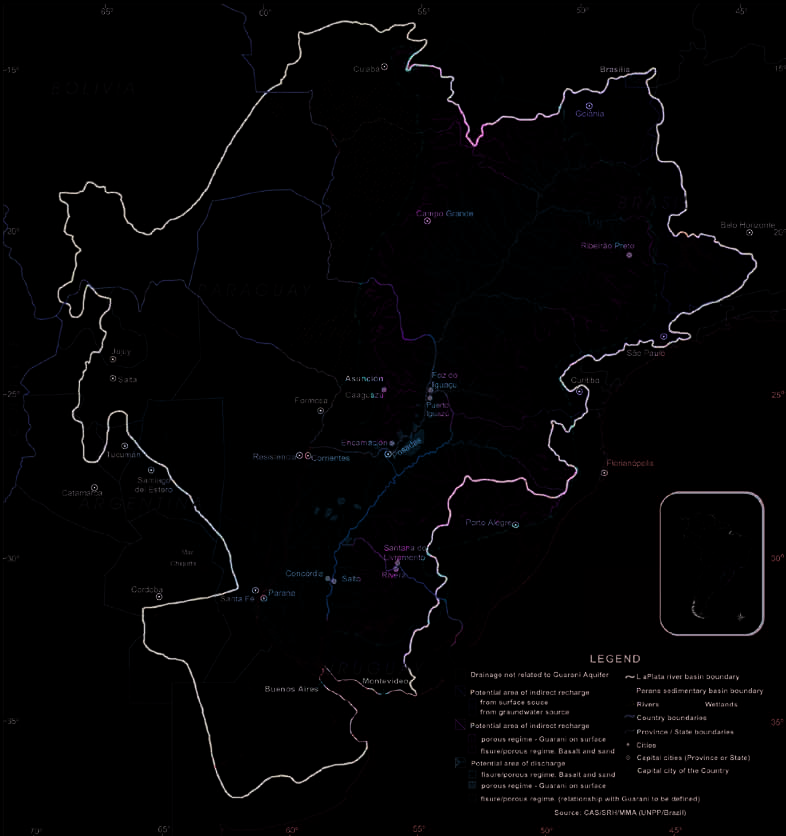
Figure 8
Guaraní Aquifer.
(Source: CAS/SRH/MMA
(UNPP/Brazil))
South Atlantic Drainage System
This system comprises the basins located between the Andean ranges
Table 4
Main rivers of South Atlantic Drainage System.
and the South Atlantic Ocean coast, which drain across extended arid
Basin area
Length
Average discharge
River
(km2)
(km)
(m3/s)
areas of Argentina, into the sea (Figure 9). The main feature of the area
Colorado
50 236
923
1 301
is the Andean ranges and the Patagonian Plateau. The plateau develops
Negro
19 778
637
846
to the south of the Colorado River. It is over 1 000 m high in the west
and progressively slopes down to the sea. The Colorado, Negro, Chubut
Neuquen
50 774
510
308
and Santa Cruz rivers are the main water systems crossing the plateau
Limay
61 723
430
ND
from west to east. The Gal egos and Chico del Sur rivers (Santa Cruz
Chubut
53 801
820
30
province) and the Alfa, Cul en, San Martín, Gamma and Chico y Grande
Santa Cruz
28 056
383
698
rivers (Tierra del Fuego province), located in the extreme southern part
Chico del Sur1
1 335
75
ND
of Argentina, are water resources shared with Chile (Table 4). All of these
Gal egos1-Cül en1-Chico1-Gamma1
676
ND
ND
rivers rise in the Andean ranges and their flows increase with melting
Grande1
7 021
230
ND
snow and rainfal . In general, on their way to the ocean, these rivers do
San Martín1-Tierra del Fuego1
8 406
ND
ND
not receive significant tributaries (Urciuolo 2001).
Notes: 1Transboundary waters. ND = No data. (Source: SSRH-INA 2002, Castellanos 1975)
24
GIWA REGIONAL ASSESSMENT 38 PATAGONIAN SHELF
REGIONAL DEFINITION
25
Bolivia
Main reservoirs
3
1
4
2
5
6
7
8
9
10
S.F.V. de Catamarca
11
12
13
La Rioja
15
14
16
17
Córdoba
San Juan
18
Mendoza
Argentina
San Luis
19
20
El Nihuil I
Agua del Toro
21
o
Los Reyunos
El Nihuil II
Santa Rosa
Chile
esaguader
Neuqu
D
Casa de Piedra
én
Mar del Plata
o Planicie Banderita
Cnia Catriel
Colorado
Bahía Blanca
Arroyito
Cinco Saltos Río Colorado
Neuquén
Pichi Picun Leufu
Negro
Viedma
Piedra del Aguila
El Chocon
Alicura
N
A
22
Pto. Madryn
t
E
24
Ramsar site
Trelew
n
C
23
National park
Rawson
Chubut
rre
O
Sen
F. Ameghino
u
© GIWA 2004
g
C
u
c
e
o
I
rr
Chic
s
T
a
No Name
Country
Area (ha) Founded
1 Reserva Particular do Patrimonio Natural SESC Pantanal Brazil
87 871
2002
Comodoro Rivadavia
N
in
A
2 Pantanal Matogrossense
Brazil
135 000
1993
3 Pantanal Boliviano
Bolivia
3 189 888
2001
Pto. Deseado
l
v
L
4 Palmar de las Islas y las Salinas de San José
Bolivia
856 754
2001
a
T
5 Río Negro
Paraguay
370 000
1995
Chico
M
A
6 Cuenca de Tajzara
Bolivia
5 500
2000
7 Laguna de los Pozuelos
Argentina
16 224
1992
Pto. San Julián
8 Lagunas de Vilama
Argentina
157 000
2000
9 Estero Milagro
Paraguay
25 000
1995
Cte. L. Piedrabuena
Falkland Islands /
10 Tinfunque
Paraguay
280 000
1995
Pto. Santa Cruz
11 Rio Pilcomayo
Argentina
55 000
1992
Santa Cruz
Malvinas
12 Lago Ypoá
Paraguay
100 000
1995
Río Gallegos
13 Laguna del Negro Francisco y Laguna Santa Rosa
Chile
62 460
1996
Gallegos
14 Reserva Provincial Laguna Brava
Argentina
405 000
2003
15 Lagunas y Esteros del Iberá
Argentina
24 550
2002
16 Jaaukanigás
Argentina
492 000
2001
Chico del Sur
Cullen
17 Bañados del Río Dulce y Laguna de Mar Chiquita
Argentina
996 000
2002
Río Grande
18 Lagunas de Guanacache
Argentina
580 000
1999
19 Laguna de Llancanelo
Argentina
65 000
1995
Grande
20 Bahía de Samborombón
Argentina
243 965
1997
0
500 Kilometres Ushuaia
21 Laguna Blanca
Argentina
11 250
1992
22 Bertha's Beach
Falkland Islands/Malvinas Islands
4 000
2001
© GIWA 2004
23 Sea Lion Island
Falkland Islands/Malvinas Islands
1 000
2001
24 Reserva Costa Atlantica de Tierra del Fuego
Argentina
28 600
1995
Figure 9
South Atlantic Drainage System and main reservoirs.
Figure 10 Ramsar sites and protected areas.
(Source: CIAT 1998)
(Source: UNEP-WCMC 2003)
Climate, biotopes and land use
(La Pampa and Mendoza provinces), is covered in another steppe
The South Atlantic Drainage System is located in a predominantly arid
shrub cal ed "Monte", and has few vegetal species and communities
area, characterised by a significant water deficit (mean annual rainfall
(Figure 5). The "Espinal" is a distinctive ecoregion that surrounds the
below 400 mm). Nevertheless, the Andean ranges and the influence
Pampa pasture, characterised by the presence of low woods alternating
of anticyclones from the South Pacific (south of Colorado River) and
with savannahs and pastures. Final y, in the Andean hil sides, the relative
the South Atlantic (north of Colorado River) determine the existence
high humidity supports the existence of the Patagonian-Andean forests
of areas relatively more humid southeast of Buenos Aires province and
(Daniele & Natenzon 1994, Dinerstein et al. 1995).
in the southern Andean hil sides. The Patagonian Plateau (provinces of
Río Negro, Chubut and Santa Cruz) is covered in a shrub steppe, with
The main land use is sheep rearing in the steppe areas and forestry
low dispersed vegetation. The central area, the so-called "arid diagonal"
activity in the forest areas (Figure 6). The intense use of shrubs for sheep
24
GIWA REGIONAL ASSESSMENT 38 PATAGONIAN SHELF
REGIONAL DEFINITION
25
grazing has led to desertification of the steppe. The beautiful landscape
The River rises in the eastern end of the Argentino Lake. The upper
in the Andean forest is an attraction for national and international
river flows through narrow reaches, rocky beds and numerous rapids.
tourism. Both La Plata River Basin and South Atlantic Drainage System
Downstream, in the lower reaches approaching the estuary, the River
have a large number of protected areas and Ramsar sites (Figure 10).
enlarges and forms meanders, providing a navigable zone.
Rivers
The Gal egos and Chico del Sur rivers form the most austral basin of
The Colorado River Basin extends from west to east, comprising areas
continental Argentina. Their upper basins lies in territories of Argentina
of mountains, plateaus and plains. The Colorado River rises from the
and Chile, constituting transboundary water resources. The Chico del
confluence of two mountain rivers (Grande and Barrancas) and, on its
Sur River is almost an independent watercourse, which drains into the
way to the ocean, constitutes the border of five Argentinean provinces
same estuary together with the Gal egos River in its mouth. Coal mining
(Buenos Aires, La Pampa, Neuquén, Mendoza and Río Negro) (see Figure
in the Río Tubio deposit (near the Argentinean-Chilean border) is one of
11). Relief features determine some reaches where the River flows
the most important activities in this basin. Rio Gal egos, the capital of
through narrow stretches and other zones where meanders are formed.
Santa Cruz province, is located at the mouth of Gal egos River.
Next to its mouth, the River develops a smal delta formed by several
branches. The principal water uses are mainly the supply of riparian
Tierra del Fuego has a dense drainage system, as it benefits from a
urban settlements and irrigation. The Casa de Piedra Dam has been
relatively uniform distribution of rainfal through the year. Rivers of
built for irrigation and flow-regulating purposes. The Desaguadero
glacial origin flow predominantly in the west-east direction, fol owing
River drains into the Colorado River and col ects water from several
the geological formations that define the fluvial val eys. In the northern
rivers (Atuel, Diamante and Tunuyán), that irrigate farming areas in the
part of the province, the resources of the Alfa, Cul en, San Martín,
western part of the Mendoza province.
Gamma and Chico rivers are shared with Chile where their upper
basins are located. The Chico River is the most important of these rivers,
The Negro River rises from the junction of Neuquén and Limay
which general y have smal flows. Activities linked with oil extraction
rivers, which drain from mountain range and lake areas in the west.
are significant in the Cul en River Basin (Urciuolo 2001).
Important systems of hydropower plants and reservoirs have been
built on both rivers, providing flood control and supplementing river
To the south, there are the so-cal ed "transition basins" that occupy the
flows for irrigation when water is scarce. The Neuquén River supplies
mountainous area of Tierra del Fuego Grande Island. The Grande River
water to a large irrigation system in the Negro River val ey, known as
is the major surface drainage system and its main flow contribution
the "upper val ey oasis", devoted to high quality fruit plantations. The
comes from the Chilean side, although there are important tributaries in
Negro River itself crosses the Patagonian Plateau before it discharges
the Argentinean sector. Its val ey is constrained by glacier terraces that
into the Atlantic Ocean. It supplies water to riparian urban settlements
have been eroded by water in many sectors (Urciuolo 2001).
and smal er irrigation systems.
The Oceanic component
The Chubut River rises from mountain streams flowing down from the
The Patagonian Shelf region comprises one of the world's largest
Nevado Mayor range and, on its way to the sea, crosses three different
continental shelves (769 400 km2). The continental shelf is relatively
areas: mountains, the central Patagonian Plateau and the lower val ey.
narrow in the north, but widens progressively to the south, where
The Florentino Ameghino Reservoir regulates water supply to the
it extends about 850 km from the coast. The Patagonian Shelf Large
irrigation system of the lower val ey (Urciuolo 2001). Apart from being
Marine Ecosystem has a total area of 2.7 million km2 (Patagonian Shelf
the water source of Rawson and Trelew cities (Chubut province) located
LME 2003). The joint influence of the Brazil warm current, which flows
in the lower valley, the Chubut River also supplies water to the industrial
to the south, and the Malvinas cold current, which flows to the north,
city of Puerto Madryn (fisheries, aluminium). The Chico/Senguerr River
results in nutrient rich waters that maintain a large variety of marine
and its lakes system is an old tributary of the Chubut River, rarely active
mammals and birds, fish and invertebrates (DRIyA 2001).
nowadays, only with exceptional high flows.
Within the region the Argentinean coastline stretches 4 989 km between
The Santa Cruz River is the most important in the Santa Cruz province
La Plata River and Tierra del Fuego (excluding the oceanic islands). From
because of the extent of its basin and the magnitude of its flows. It
a geological point of view, the coast of Argentina can be split into two
possesses a very important undeveloped hydroelectric power potential.
regions that are divided by the mouth of the Colorado River: the coast
26
GIWA REGIONAL ASSESSMENT 38 PATAGONIAN SHELF
REGIONAL DEFINITION
27
of Buenos Aires province to the north and the Patagonian coast to the
Socio-economic characteristics
south, which corresponds to the Río Negro, Chubut, Santa Cruz and
Tierra del Fuego provinces (DRIyA 2001). From a biological point of view,
The countries1 that share the Patagonian Shelf region have experienced
the Uruguayan-Argentinean coast is one of the world's most productive
different situations related to their economic profiles2 in the 1990s.
and complex marine systems in terms of interactions among fauna, flora
Each country experienced a decline in their Gross Domestic Product
and physical marine and terrestrial elements. Final y, taking into account
(GDP) between 1998 and 1999, but Brazil, Bolivia and Paraguay have
the fishing activity, the marine ecosystems can be divided into two
since experienced a period of growth (Table 5). The participation of
sectors, the Argentinean province (north of 41° S) and the Patagonian
the different economic sectors in the GDP reflects the importance of
province (south of 41° S) (Lasta et al. 2001).
services associated particularly with the main urban centres (Table 6).
As wel as the California and Benguela currents, the Patagonian Shelf
There is an enormous disparity in the distribution of income in urban
exhibits a combination of important factors for several valuable fish
areas. Table 7 shows the differences between the poorest and the
and mollusc species: (i) enrichment of food web by physical processes,
richest households in all countries of the region and illustrates that the
(i ) concentrated patch structure of food particles (lack of turbulent
most equal income distribution occurs in Uruguay, while Brazil exhibits
mixing and/or convergence in frontal structures), and (iii) availability of
the biggest differences between rich and poor.
mechanisms to promote retention or transport of larvae to appropriate
habitats. These three factors only combine favourably in special
In al the countries within the Basin, the lack of sanitary services coincides
configurations as otherwise turbulence and mixing may disperse larvae
with the location of deprived housing areas. Consequently, access to
away from food source (Patagonian Shelf LME 2003).
basic sanitary services, drinking water and sewerage constitutes a
problem that relates to poverty. Considering the five great cities of the
Hake (Merluccius hubbsi) and prawn (Pleoticus muel eri) are the most
region, Curitiba possesses the greatest percentage of the population in
valuable species and are the focus of Patagonian commercial fishing.
marginal settlements, fol owed by the Buenos Aires Metropolitan Area,
The total catch of fish and invertebrates has increased four-fold since
Montevideo, São Paulo and Asunción. Table 8 shows the percentages
the 1970s (DRIyA 2001).
of urban and rural poor households in 1999.
Table 7
Distribution of income in urban households, by
Table 5
Gross domestic product by country.
quintiles.
Growth of Gross Domestic Product (GDP)
Percentages (1999)
Country
Average annual rates (%)
Country
Quintile 1 (poorest)
Quintile 5 (richest)
Quintile 2 Quintile 3 Quintile 4
1990
1997
1998
1999
2000
2001
Decile 1
Decile 2
Decile 1
Decile 2
Argentina
-2.0
8.0
3.8
-3.4
-0.8
-4.4
Argentina
2.3
3.7
9.8
13.3
19.2
14.9
36.7
Bolivia
4.4
4.9
5.4
0.8
2.3
1.3
Bolivia
1.6
3.5
10.1
14.3
21.0
16.8
32.7
Brazil
-4.6
3.1
0.1
1.1
4.0
1.5
Brazil
1.1
2.3
7.1
10.2
17.6
15.9
45.7
Paraguay
3.0
2.4
-0.6
-0.1
-0.6
2.4
Paraguay
2.0
3.9
10.6
14.7
22.1
13.9
32.8
Uruguay
0.4
5.0
4.3
-3.8
-1.9
-3.4
Uruguay
3.6
5.1
12.9
16.0
20.9
14.5
27.0
Note: Based on figures at constant 1995 market prices. (Source: CEPAL 2003)
(Source: CEPAL 2003)
Table 6
Structure of economy by country.
Table 8
Poor households in urban and rural areas by country.
Sector
Poor households (1999)
Country
Country
Agriculture (% of GDP)
Industry (% of GDP)
Services (% of GDP)
Urban (%)
Rural (%)
Total (%)
Argentina
5.7
28.7
65.6
Argentina
16
ND
ND
Bolivia
15.4
28.7
55.9
Bolivia
42
76
55
Brazil
8.4
28.8
62.8
Brazil
26
45
30
Paraguay
24.9
26.2
48.9
Paraguay
41
65
52
Uruguay
8.5
27.5
64.0
Uruguay
6
ND
ND
(Source: World Bank 2000)
Note: ND = No data. (Source: CEPAL 2003)
1This section does not include considerations about socio-economic aspects of Chile since the participation of the Chilean territory in this system is minimal and it is not possible to specify the quantitative
data for such area. 2Data related to health status, GDP per capita, structure of economy, income distribution and poverty are analysed country by country, with no differences between La Plata River Basin
and the South Atlantic Drainage System. The remaining socio-economic data is analysed seperately for the two systems.
26
GIWA REGIONAL ASSESSMENT 38 PATAGONIAN SHELF
REGIONAL DEFINITION
27
Despite the lack of information that explicitly links morbidity and
urbanisation rates in Argentina, Brazil and Uruguay reflect the
mortality with water pol ution, there are reports that indicate the
importance of the large metropolitan areas of the region, especial y
existence of water-related diseases in each of the countries. In the 1990s,
in Argentina and Brazil (Table 9). The growth of intermediate cities has
a cholera epidemic occurred in the region. Between 1992 and 1996,
also been important in the last decades. Al the larger cities have, in
there were 2 000 cases registered in Argentina, 2 600 in Bolivia, 150 000
general, good water supply and sanitation systems. However, sewage
in Brazil and 10 in Paraguay. Other water-related diseases that generate
treatment is still underdeveloped. Table 10 shows the current situation
concern among the community and government, are schistosomiasis
in the countries and urban areas.
(especial y in Brazil) and diarrhoea. Diarrhoea is the primary cause of
morbidity in children up to one year of age in Bolivia, and the second
Economic sectors
most important in Paraguay and Brazil.
Table 11 shows the annual water extraction by each economic sector.
Though this data is analysed by country, it can be considered as
La Plata River Basin
representative of the water demand in the La Plata River Basin. As the
Population
table shows, agriculture is by far the most water-demanding sector,
The distribution of the population in the five countries (Argentina,
being the most important activity in the Basin. Industrial water use is
Bolivia, Brazil, Paraguay and Uruguay) within the La Plata River Basin is
also important, especial y in Argentina and Brazil.
unequal. With the exception of Uruguay, population density is relatively
low in all countries. The rate of population increase, based on the last
The La Plata River Basin is an important centre for the regional
two Censuses3, exhibits large variations (Table 9).
economy; about 70% of the Gross National Product (GNP) of Argentina,
Brazil, Uruguay, Bolivia and Paraguay is produced within the Basin
The La Plata Basin is inhabited by about 50% of the combined
(Tucci & Clarke 1998).
population in al five countries. The main industrial belt of Argentina
(between Santa Fe and La Plata), including the two biggest urban
Cereals, soybean and oleaginous fruit are grown in the Argentinean
settlements (Great Rosario and Buenos Aires Metropolitan Area), is
plains, soybean and sugar cane in southern Brazil, soybean, cotton and
located in this basin; the former area included Buenos Aires City, the
grains in Paraguay and cereals and forage in Uruguay. The cultivation
Argentinean capital. The most densely populated areas in the south and
of soybean has greatly increased in the last years. Data compiled in
southeast of Brazil, including the large metropolitan areas of São Paulo
2001 shows that soybean is the most important crop in Argentina
and Curitiba, also occur within the La Plata River Basin. Montevideo,
Table 10 Population with access to drinking water and
Brasilia and Asunción, the capital cities of Uruguay, Brazil and Paraguay,
sanitation.
respectively, are also located in the La Plata River Basin. Table VI.1 in
Sanitation
Annex VI shows the main cities of the La Plata Basin.
Drinking water
Country1
Total (%)
Urban areas (%)
Total (%) Urban areas (%) With connection In situ2 With connection In situ2
With the exception of Paraguay and Bolivia, the urban population
Argentina
67.0
72.0
48.7
35.3
54.7
33.8
largely exceeds the rural population in each of the countries. High
Bolivia
64.6
87.4
28.0
35.5
45.1
37.2
Table 9
Total population, area, density, and population growth
Brasil
75.3
90.6
47.5
37.3
59.1
34.5
per country.
Paraguay
42.2
69.0
7.1
91.9
13.2
85.8
Inter census
Density
Urban
Uruguay
90.3
93.7
46.2
48.2
50.6
44.7
Total
population
Country1
Area (km2)
(inhabitants
population
Note: 1 Data refer to entire countries. 2 Houses with cesspools. (Source: OPS-OMS 2000)
population
growth
per km2)
(%)
(% per decade)
Table 11 Annual extraction of water by economic sector.
Argentina
27 740 527
1 176 840
23.6
9.2
82.8
Country1
Domestic (%)
Industry (%)
Agriculture (%)
Bolivia
3 661 232
577 986
6.3
32.8
61.5
Argentina
9
18
73
Brazil
91 668 241
3 026 539
30.3
8.1
86.9
Bolivia
10
5
85
Paraguay2
5 496 450
406 752
13.5
32.4
45.5
Brazil
22
19
59
Uruguay
3 198 147
154 936
9.6
4.9
86.5
Notes: 1Provinces in Argentina, states in Brazil and departments in Uruguay and Bolivia which are
Paraguay
15
7
78
partially or totally included in La Plata River Basin. 2Projected to year 2000 .
(Source: INDEC 2001, INE (Bolivia) 2002, IBGE 2000, DGEEC 2002, INE (Uruguay) 2002)
Uruguay
6
3
91
Note: 1 Data refer to entire countries. (Source: GWP 2000)
3 The last two National Censuses were made in different years in each country. In Argentina they were made in 1991 and 2001; in Bolivia 1992 and 2001; in Brazil 1991 and 2000; and in Paraguay 1992
and 2002. In Uruguay the last Census was made in 1996; this country makes annual publications to update demographic data. This report has used information from Censuses and other statistical
publications in those cases where available data is old.
28
GIWA REGIONAL ASSESSMENT 38 PATAGONIAN SHELF
REGIONAL DEFINITION
29
Table 12 Harvested area and percentage covered by main crops
by country.
Mato Grosso
Distrito Federal
Argentina
Bolivia
Brazil
Paraguay
Uruguay
Bolivia
Goias
Harvested area (1 000 ha)
25 000
1 944
53 200
2 290
1 300
Brazil
Minas Gerais
Cotton
1.4
2.7
1.6
13.0
ND
Mato Grosso do Sul
Rice
0.6
7.7
5.9
1.2
11.8
Sao Paulo
Jujuy
Paraguay
Chile
Rio de Janeiro
r
e
a
)
Coffee
ND
1.3
4.3
0.2
ND
Parana
Salta
Formosa
Sugar cane
1.1
4.4
9.4
1.9
0.2
Santiago Chaco
Tucuman
a
r
v
e
s
t
e
d a
del Estero
Misiones Santa Catarina
f h
Sunflower
7.6
6.9
0.2
1.3
3.8
Catamarca
Corrientes
Maize
9.9
15.7
23.2
15.7
2.8
La Rioja
Rio Grande do Sul
r
o
p
s
(
% o
Santa Fe
Cassava
0.07
2.2
3.3
11.2
ND
Cordoba
San Juan
a
i
n c
Entre
M
Soybean
41.3
28.6
25.6
52.8
0.8
Rios
Uruguay
San
Sorghum
2.5
2.2
0.9
1.1
2.9
Luis
Mendoza
Argentina Buenos Aires
Wheat
28.4
5.6
3.2
7.5
9.8
Note: ND = No Data. (Source: CEPAL 2003)
La Pampa
Neuquen
and Paraguay, representing around 50% of the total harvested area. In
Rio Negro
Bolivia, it represents almost 30% of the total harvested area. In Brazil,
soybean represents 26% of the farming area, fol owed by maize, 23%
Chubut
(Table 12). In some areas of Argentina, Brazil and Uruguay farming is
complemented with cattle raising and dairy industry (GWP 2000).
Santa Cruz
The Basin includes the main industrial centre in Argentina, which
Falkland Islands /
Malvinas
extends between Santa Fe and La Plata cities. In southern Brazil,
industries are diverse and expanding. Many industries process raw
Tierra del Fuego
0
500
Kilometres
material, refine steel and oil, produce food, paper and clothes. In
© GIWA 2004
Figure 11
Uruguay, industry has grown thanks to the import of fuel and raw
Political division of the Patagonian Shelf region.
materials. The main industrial produce is food, fol owed by fertilisers
and transport equipment.
from Cáceres Port in Brazil to Nueva Palmira Port in Uruguay. The
total length is approximately 3 400 km and it directly influences
Water-related infrastructure
1.75 mil ion km2 of the South Common Market (Mercosur) countries and
International waterways and bridges, irrigation schemes and dams are
Bolivia, with an estimated population of 17 mil ion. The Tietê-Paraná
included among the engineering projects undertaken in the region.
waterway is another important transport system that wil help Brazil
The Paraguay-Paraná waterway and the Tietê-Paraná waterway are
to increase the competitiveness of its agricultural products in foreign
partially developed projects. The Paraguay-Paraná waterway extends
markets. The main reference points at the extremities of the waterway
Table 13 Area under irrigation in the La Plata River Basin.
Irrigation area
Country
Public irrigation
Private irrigation
Total irrigation
% of
% of
Year
Current irrigated area (%)
(ha)
(ha)
(ha)
cultivated area
potential area
Argentina
1995
1 209 182
341 051
1 550 233
5.7
25.3
ND
Bolivia
1999
23 800
104 439
128 239
5.7
6.4
100
Brazil
1998
160 000
2 710 204
2 870 204
5.8
9.8
56
Paraguay
1997
ND
ND
67 000
3.0
ND
ND
Uruguay
1998
0
181 200
181 200
13.9
10.3
100
Note. ND = No Data. (Source FAO 2000)
28
GIWA REGIONAL ASSESSMENT 38 PATAGONIAN SHELF
REGIONAL DEFINITION
29
are Foz de Iguazú, in the south, Conchas and Piracicaba, in the east,
The supranational legal framework is provided by the La Plata River
Três Lagoas, in the west and São Simão, in the north. The Tietê-Paraná
Treaty, which contributes to common and integrated research on
waterway impacts an area of 1.5 million km2 with 75 million inhabitants.
the Basin and tries to establish a juridical regime of the waters.
Once the Tietê-Paraná and Paraná-Paraguay waterways are finished,
The results, however, have not lived up to expectations, although
the system wil impact a total area of 4.8 mil ion km2 with 90 mil ion
the Intergovernmental Coordinating Committee (CIC) (Comité
inhabitants, generating more than 85% of Mercosur GDP.
Intergubernamental Coordinador para la Cuenca del Plata) has made
advances in the interchange of information and the coordination of
Irrigated agricultural areas in the region are described in relation to
some joint actions.
countries within the Basin (FAO 2000). The area under irrigation is
shown in Table 13. Finally, the main hydroelectric reservoirs and dams are
Some of the sub-basins within the La Plata River Basin with shared water
shown in Annex VI, Table VI.2 and in Figure 7. The most important dams
resources have institutional agreements based on treaties between
at a bi-national level are the Itaipú (Brazil-Paraguay, hydro capacity of
countries, with specific purposes. The most important ones are:
12 600 MW), Yacyretá (Paraguay-Argentina, hydro capacity of 1 800 MW)
Bi-national Commission for the Administration of the Lower Basin of
and Salto Grande (Uruguay-Argentina, hydro capacity of 1 890 MW).
the Pilcomayo River; Argentina and Paraguay (Comisión Binacional
Administradora de la Cuenca Inferior del Río Pilcomayo);
Legislation and institutions related to water
Tri-national Commission for the Development of the Pilcomayo
Argentina and Brazil have a federal institutional organisation whereas
River Basin; Argentina, Bolivia and Paraguay (Comisión Trinacional
Uruguay, Paraguay and Bolivia have a centralised organisation. Figure 11
para el Desarrol o de la Cuenca del Río Pilcomayo);
shows the political division of the Patagonian Shelf region.
Bi-national Commission for the Development of the Upper Basin of
the Bermejo River and Grande de Tarija River; Argentina and Bolivia
Brazil is the only country with modern water legislation striving
(Comisión Binacional para el Desarrol o de la Alta Cuenca del Río
for sustainable use of surface and groundwater. An explicit policy,
Bermejo y el Río Grande de Tarija);
management organisations with a high hierarchic level, and
Paraná River Argentine-Paraguayan Commission (COMIP) (Comisión
instruments, have been created in support of this goal. Bolivia and
Mixta Argentino-Paraguaya del Río Paraná);
Uruguay have outdated legislation, which does not fulfil present
Administrative Commission for the Uruguay River; Argentina and
requirements, and their management organisations are ineffective.
Uruguay (CARU) (Comisíon Administradora del Río Uruguay);
Argentina and Paraguay have no national legislation related to water.
Brazilian-Uruguayan Commission for the development of the
There is a division at legislative and institutional level that also affects
Cuareim River (Comisión Mixta Brasilero-Uruguaya para el
responsibilities and decision-making. In Argentina, the situation is
Desarrol o del Río Cuareim);
aggravated due to the federal system; the provincial states own and
Administration Commission of the La Plata River; Argentina and
administer their waters. Brazil also has a federal system and each state
Uruguay (CARP) (Comisión Mixta Administradora del Río de la
owns its waters. There is, however, federal jurisdiction in the case of
Plata).
interstate, bordering or border crossing waters, and the system falls
under current legislation.
Annex V presents a list of conventions and environmental and water
agreements by country, including the most important treaties and
Argentina and Brazil have environmental laws at national level and
institutions through their legal framework.
most of the states (Brazil) and provinces (Argentina) have established
regulations within their jurisdiction. Paraguay and Bolivia have modern
South Atlantic Drainage System4
Constitutional Letters and advanced framework laws on environmental
Population
matters that are no more than "intention" politics, lacking in effectiveness
This system is characterised by a very low population density (Table 14)
and efficiency (policy). Uruguay is at an intermediate level between the
and a high dispersity. Populations are concentrated especial y around
two above-mentioned countries.
water bodies (rivers and lakes), in coastal areas or in areas with relatively
favourable climatic conditions.
The legislation and institutions of these countries (with the exception of
Brazil) possess common flaws as they do not relate to national or local
The main urban areas are located in the Argentinean territory, the
problems, or guarantee environmental sustainability.
Córdoba and Mendoza provinces. The population of the metropolitan
4 The description of this system is mainly centered in the socio-economic features linked with interjurisdictional and international water bodies, which are located mostly in western and southern areas.
30
GIWA REGIONAL ASSESSMENT 38 PATAGONIAN SHELF
REGIONAL DEFINITION
31
Table 14 Total population, area, density and population growth
According to data from 1990-2000, the total population with access
in the Argentinean provinces of the South Atlantic
to drinking water reached 61.2% and 31.8% of the population was
Drainage System.
connected to sewage networks (INDEC 1991). In urban areas, the
Population
Argentinean
Area
Density
Total population
growth (%)
percentage of the urban population with access to drinking water and
province
(km2)
(inhabitants/km2)
(1991-2001)
connected to a sewage network has improved to 79.9% and 51.6%
Catamarca
333 661
102 602
3.3
26.3
respectively (ENOHSA 2002).
Chubut
413 240
224 686
1.8
15.7
Córdoba
3 061 611
165 321
18.5
10.3
Economic sectors
La Pampa
298 460
143 440
2.1
14.6
Farming is developed in many areas along the system. In the large
Mendoza
1 576 585
148 827
10.6
11.6
area south of the Colorado River (Patagonian steppes), the widespread
La Rioja
289 820
89 680
3.2
31.3
traditional activity is sheep farming. This activity has degraded the soil,
Neuquen
473 315
94 078
5.0
21.7
resulting in severe desertification. To the north of the Colorado River
Río Negro
552 677
203 013
2.7
9.1
(area of "Monte" shrubland), the aridity restricts animal rearing. In this
area, goats cope better with the environmental conditions than other
San Juan
622 094
89 651
6.9
17.7
species.
San Luis
366 900
76 748
4.8
28.1
Santa Cruz
197 191
243 943
0.8
23.4
Farming is limited to the oases related to the existence of rivers (or
Tierra del Fuego
100 960
21 571
4.7
45.8
other water bodies) and the "mal ines", the regional name given to flood
(Source: INDEC 2001)
meadows in Patagonia. The oases of San Juan, Mendoza and La Rioja
provinces are centres for wine production, for local and international
Table 15 Main cities of South Atlantic Drainage System.
markets, as is the Pampeanas Hil s oasis, located in the western central
City
Province
Last registered population (2001)
part of the country.
Great Córdoba
Córdoba
1 368 109
Great Mendoza
Mendoza
1 576 585
Fruit growing is also an important activity in the Negro River high
Mar del Plata
Buenos Aires
541 857
val ey (Río Negro and Neuquén provinces). Forests located in the
San Miguel de Tucumán
Tucumán
525 853
Patagonian Andean hillsides are set apart for different uses. There
Santa Rosa
La Pampa
298 460
are several protected areas (especial y national parks) to preserve the
Bahía Blanca
Buenos Aires
272 166
environment and forest species (see Figure 10). On the other hand, the
Neuquen
Neuquen
201 729
forest is exploited to obtain diverse products (even for export) and is
San Luis
San Luis
152 918
deforested for the purpose of smal -scale farming.
La Rioja
La Rioja
143 921
San Fernando del Val e de Catamarca
Catamarca
140 556
Another central activity in this system is the exploitation of underground
Comodoro Rivadavia
Chubut
135 813
resources (oil and coal). The main Argentine petroleum poles are:
the Neuquina Basin (Upper Colorado River Basin); the Cuyana Basin
San Juan
San Juan
115 556
(Mendoza and San Juan provinces); the San Jorge Gulf Basin (South
Trelew
Chubut
88 397
of Chubut province and North of Santa Cruz province) and the Austral
Río Gal egos
Santa Cruz
79 072
Basin (Santa Cruz province and North of Tierra del Fuego province).
Viedma
Río Negro
46 767
Oil production is exported through the ports of Comodoro Rivadavia
Usuahia
Tierra del Fuego
45 205
(Chubut province) and Bahía Blanca (Buenos Aires province).
Puerto Madryn
Chubut
57 571
(Source: INDEC 2001)
Water-related infrastructure
areas of these two cities were 1 208 600 and 773 100 respectively in
The main water-related engineering projects include irrigation
2001. Other cities of regional and provincial importance are shown in
schemes and dams. Irrigated agricultural areas in the Argentinean
Table 15. During recent years, in areas with very few inhabitants such as
provinces (years 1984 and 1994) are shown in Table 16. A smal increase
Patagonia, it was noted that the urban population is increasing faster
during this time can be noted. The more important provinces with
than the total population.
irrigation systems are Mendoza and Río Negro. Table 17 shows current
30
GIWA REGIONAL ASSESSMENT 38 PATAGONIAN SHELF
REGIONAL DEFINITION
31
Table 16 Evolution of areas under irrigation in Argentinean
Table 17 Argentinean PROSAP projects.
provinces of South Atlantic Drainage System.
Co-financing
Project name
Status
Province
amount
1984
1994
(USD)
Argentinean province
% of irrigated
% of irrigated
Irrigation area
Irrigation area
Currently under
area in
area in
Rehabilitation of irrigated area in Constitutión.
Mendoza
6 883 000
(1 000 ha)
(1 000 ha)
execution
Argentina
Argentina
Currently under
Catamarca
26.9
1.8
29.3
1.8
Rehabilitation of irrigated area in Monte Caseros.
Mendoza
3 227 289
execution
Chubut1
26.4
1.8
26.4
1.6
Rehabilitation of irrigated area in the low reach of
Currently under Mendoza
24 989 000
Córdoba
55.9
3.8
55.9
3.4
Mendoza River.
execution
La Pampa
4.0
0.3
6.5
0.4
Programme remains in the province of Mendoza (minor
works; Control ed Water and Soil Quality, Fol ow-up
Currently under Mendoza
11 125 377
Mendoza
359.5
24.7
359.5
22.1
and Assessment; Modernisation of Hydric Resources
execution
Management).
La Rioja
13.5
0.9
13.5
0.8
Currently under
Neuquen2
14.4
0.9
17.7
1.1
Rehabilitation of irrigated area in Colonia Centenario.
Neuquén
12 848 000
execution
Río Negro2
117.1
8.0
117.1
7.2
Hydric Resources Management Program and
productive transformation of the irrigated areas in the To be executed Chubut
1 747 874
San Juan
96.1
6.6
96.1
5.9
province of Chubut.
San Luis
8.8
0.6
8.8
0.5
Modernisation of irrigation system of Mendoza-Luján
-
Mendoza
14 154 169
Santa Cruz1
2.0
0.1
2.2
0.1
Sur River right margin.
Tierra del Fuego
-
-
-
-
Los Andes Reduction (Irrigation network and al uvium
Protection, Transference of Technology, Institutional
-
Mendoza
9 942 857
Total area in Argentina
1 455
100
1 627
100
Fortification).
Notes: 1Mountain areas are not included. 2Chocón and Patagonian mountain areas are not
(Source: PROSAP 2003)
included. (Source: Morábito 1997)
Table 18 High Seas fishing in South Atlantic Drainage System by port.
Puerto
Mar del Plata
Punta Quilla
Puerto Madryn Cdro. Rivdavia
Bahía Blanca
Quequén
San Antonio
San Antonio
Others
Total
Year
Deseado
(tonnes)
(tonnes)
(tonnes)
(tonnes)
(tonnes)
(tonnes)
Este (tonnes)
Oeste (tonnes)
(tonnes)
(tonnes)
(tonnes)
1996
340 413
140 023
131 648
124 637
28 798
26 007
25 019
22 024
1 862
2 784
1 059 613
1997
325 419
148 054
117 392
106 962
35 061
26 389
40 738
17 618
2 112
29 923
1 180 291
1998
271 653
128 020
49 189
121 537
88 614
21 226
34 147
4 668
2 216
24 497
996 961
1999
222 550
119 818
47 119
106 043
31 135
11 187
38 216
5 885
3 069
11 608
886 956
2000
194 625
82 981
43 759
109 000
16 493
9 601
28 723
3 329
2 621
23 987
759 475
(Source: SAGPyA, Dirección Nacional de Pesca y Acuicultura 2003)
Table 19 Coastal fishing in South Atlantic Drainage System by port.
Mar del Plata
Rawson
Usuahia
Puerto Madryn Cdro. Rivdavia
Bahía Blanca
Quequén
San Antonio
San Antonio
Others
Total
Year
(tonnes)
(tonnes)
(tonnes)
(tonnes)
(tonnes)
(tonnes)
(tonnes)
Este (tonnes)
Oeste (tonnes)
(tonnes)
(tonnes)
1996
139 318
17 853
445
777
1 389
309
3 090
1 571
5 965
7 948
178 665
1997
116 590
17 790
463
85
10 267
242
3 021
2 415
5 875
4 220
160 967
1998
74 633
6 649
475
469
18 870
191
4 698
2 127
4 564
7 054
119 729
1999
81 275
7 582
327
493
16 189
260
3 152
635
6 673
9 264
125 849
2000
65 599
5 439
328
99
6 317
203
3 461
508
6 330
4 966
93 206
(Source: SAGPyA, Dirección Nacional de Pesca y Acuicultura 2003)
projects (May 2003) in relation to irrigation processes financed by the
The Atlantic Ocean coast is the centre for fishing activity. Mar del Plata
World Bank and Inter-American Development Bank, and implemented
(Buenos Aires province) and Puerto Madryn (Chubut province) are
by the Provincial Agricultural Services Programme (PROSAP) (Programa
the main high sea fishing ports of Argentina, while Mar del Plata and
de Servicios Agrícolas Provinciales) from the Argentinean Secretary
Puerto Deseado (Santa Cruz province) are the main coastal fishing ports
of Agriculture, Cattle Raising, Fishing and Food (SAGPyA) (Secretaría
(Tables 18 and 19).
de Agricultura, Ganaderìa, Pesca y Alimentación). The hydropower
stations and dams in this region are shown in Annex VI, Table VI.3 and
Fish catch in Patagonia is distributed as fol ows: 71% from factory fleet,
in Figure 9.
18% from trawling fresh fleet and 11% from coastal fleet. Processing
32
GIWA REGIONAL ASSESSMENT 38 PATAGONIAN SHELF
REGIONAL DEFINITION
33
involves both factories and cooperatives. Although the whole sector
Legislation and institutions related to water
employment rate has decreased about 11% between 1987 and 1996,
In the continental area, the situation does not vary from that described
there was a manufacturing employment rate increase (about 37%) in
in the section on La Plata River Basin as the legislative and institutional
Patagonia due to the establishment of several plants (DRIyA 2001). In
fragmentation problem stil exists due to Argentina's federal government
recent years, the arrival of foreign ships increased the catch, which put
system.
several valuable species at risk of extinction; particularly the Argentine
hake (Merluccius hubbsi).
Each province in the region owns its natural resources and is responsible
for establishing its legal-institutional regulations. Argentina lacks clear
In 1997, a maximum crew employment rate was registered. As shown in
policies on this. Although there has been some advances in national
Table 20, the employment rate has decreased by about 22% since 1997.
environmental legislation, it does not apply to water legislation.
In 2000, the decrease was about 8-9%, 13% in the Patagonian coastal
A principle solution has been found in the constitution of basin
provinces (Río Negro, Chubut and Santa Cruz) and 6% in the Buenos
organisations:
Aires province (Bertolotti et al. 2001a).
Interjurisdictional Committee of the Colorado River (COIRCO)
(Comité Interjurisdiccional del Río Colorado);
Table 20 Evolution of the coastal fleet crew employment in the
Interjurisdictional Basin Authority of the Limay-Neuquen and
South Atlantic Drainage System.
Negro River (AIC) (Autoridad Interjurisdiccional de Cuenca de los
Crew in the
Crew in the
ríos Limay-Neuquen y Negro).
Years
Total crew
Buenos Aires littoral*
Patagonian littoral
1997
1 540
259
1 799
These organisations constitute "supra-provincial" authorities. Their
functions are limited to research, information and planning, and do
1998
1 416
265
1 681
not include management, as they are an approving authority. Recently,
1999
1 459
265
1 724
the Patagonian Hydrological Council (Consejo Hídrico Patagónico) was
formed.
1st semester of 2000
1 283
233
1 516
In accordance with the specific Environmental Agreement and the
2nd semester of 2000
1 272
241
1 513
Additional Protocols subscribed by Argentina and Chile, both countries
1st semester of 2001
1 199
202
1 401
are working on various basins of shared water resources, seeking criteria
Note: * Buenos Aires data referred to maritime littoral. (Source: Bertolotti et al. 2001)
harmonisation for the sustainable management of such resources.
Production, fishing days and employment rates of the high sea fleet
In Argentina and Uruguay, the territorial sea covers up to 12 nautical
decreased around 13%, 9% and 9% respectively, between 1999 and
miles, the adjacent zone up to 24 nautical miles and the exclusive
2000. In the same period, the decrease for factory fleets was 14%, 7%
economic zone up to 200 nautical miles. In Uruguay (a country with
and 9% (Bertolotti et al. 2001a).
centralised organisation), the territorial sea belongs to the nation,
while in Argentina, it belongs to the provinces, due to its federal
Out of 38 industrial plants established in 2001, only 26 remained
system. Argentina has legislated federal fishing rules, it has constituted
operative in the same year. Since 1998, some fishing factories are
the Federal Fishing Council (Consejo Federal Pesquero), it has national
operated as cooperatives. The consequences have been lower incomes
environmental and fishing institutions and its coastal provinces (Buenos
and loss of work benefits such as social security. The processing plants
Aires, Río Negro, Chubut, Santa Cruz and Tierra del Fuego) have specific
of Comodoro Rivadavia, Trelew and Rawson (Chubut province) are
legislation and environmental and fishing institutions. Uruguay also has
mainly devoted to hake processing. Due to the decrease in hake landing,
specific legislation and environmental and fishing institutions.
there has been a sharp reduction in the fishery industry. Consequently,
many plants were closed and numerous jobs lost. In 1999, fishery
In the northern area of the oceanic component of the system, Argentina
export reached 794 mil ion USD showing a decrease compared with
and Uruguay share the administration of the so-cal ed Common Fishing
previous years; 1 014 mil ion USD in 1996, 1 003 mil ion USD in 1997
Area. Annex V presents a list of conventions and environmental and
and 860 million USD in 1998. This was mainly due to international and
water agreements by country, including the most important treaties
national market conditions, and smal er catches.
and institutions through their legal framework.
32
GIWA REGIONAL ASSESSMENT 38 PATAGONIAN SHELF
REGIONAL DEFINITION
33
Assessment
Brieva, C., Calcagno, A., Faure, M., González, S., Moyano, C., Mugetti, A., Natale, O., Rafael i, S. and R. Seoane
This section presents the results of the assessment of the impacts
Table 21 Scoring table for La Plata River Basin.
of each of the five predefined GIWA concerns i.e. Freshwater
Assessment of GIWA concerns and issues according
The arrow indicates the likely
to scoring criteria (see Methodology chapter)
direction of future changes.
shortage, Pollution, Habitat and community modification,
T
T
C
C
Increased impact
P
A 0 No known impacts
P
A 2 Moderate impacts
Unsustainable exploitation of fish and other living resources,
I
M
I
M
T
T
No changes
C
C
P
A 1 Slight impacts
P
A 3 Severe impacts
I
M
I
M
Decreased impact
Global change, and their constituent issues and the priorities
identified during this process. The evaluation of severity of each
La Plata River
p
a
c
t
s
u
n
i
t
y
e
n
t
a
l
m
p
a
c
t
s
m
issue adheres to a set of predefined criteria as provided in the
c
o
r
e
*
*
Basin
i
c i
m
o
m
chapter describing the GIWA methodology. In this section, the
p
a
c
t
s
p
a
c
t
s
E
n
v
i
r
o
n
m
i
m
E
c
o
n
o
m
H
e
a
l
t
h i
O
t
h
e
r c
i
m
O
v
e
r
a
l
l S
P
r
i
o
r
i
t
y
*
*
*
scoring of GIWA concerns and issues is presented in Table 21
Freshwater shortage
1.4*
2.0
1.6
1.9
1.8
and 27.
Modification of stream flow
1
Pol ution of existing supplies
2
Changes in the water table
1
Pollution
1.9*
3.0
1.6
2.3
1.9
Microbiological pol ution
2
Eutrophication
2
Chemical
2
Suspended solids
2
Solid waste
1
Thermal
1
Radionuclide
0
Spil s
2
Habitat and community modification
2.5*
2.0
0
2.0
2.0
Loss of ecosystems
3
Modification of ecosystems
2
Unsustainable exploitation of fish
1.5*
2.2
0
2.2
1.6
Overexploitation
2
Excessive by-catch and discards
1
Destructive fishing practices
1
Decreased viability of stock
1
Impact on biological and genetic diversity
2
Global change
0.8*
2.7
2.4
2.0
1.9
Changes in hydrological cycle
2
Sea level change
0
Increased UV-B radiation
0
Changes in ocean CO 2source/sink function
0
* This value represents an average weighted score of the environmental issues associated
to the concern.
** This value represents the overall score including environmental, socio-economic and
likely future impacts.
*** Priority refers to the ranking of GIWA concerns.
34
GIWA REGIONAL ASSESSMENT 38 PATAGONIAN SHELF
ASSESSMENT
35
La Plata River Basin
Socio-economic issues are more significant than environmental issues
in terms of their potential to cause conflicts at sub-national and regional
levels.
T
C
P
A
Freshwater shortage
Environmental impacts
I
M
Modification of stream flow
The impacts of Freshwater shortage are moderate in the La Plata River
In the Upper Paraná River Basin, stream flows have increased by 20 to
Basin. Although the available freshwater resources in the La Plata River
45% in several tributaries upstream of the Itaipú Reservoir compared
Basin easily exceeds the current total demand, uneven temporal and
with those recorded during the 1960-1970s (Mül er et al. 1998). Similar
spatial distribution of water flow in the basin headwaters and degradation
trends were found in the Uruguay and the Paraguay River Basins
of water sources are causing freshwater shortages in some areas.
(Figure 12) where, despite only minor increases in rainfal , there has
been a considerable increase in the water level of the rivers since 1970
There is evidence of significant decreases in discharge in localised areas
(Col ishonn et al. 2001). In addition, other factors, such as changes in
due to intensive water extraction in shared basins, which will probably
land use and land cover, have increased terrestrial run-off and have
increase in the future. Changes in low water flow and also, to some
also contributed to the increased stream flows observed in these rivers
extent, in high water flow have occurred in the international stretch
(Mül er et al. 1998).
of the Paraná River system (Argentina, Brazil and Paraguay) because of
land use changes and the construction and operation of reservoirs. As
Taking into account the history of river discharges, it is possible to
a result of reports of fish kil s, extended bacteriological contamination
identify three periods within the Middle and Lower Paraná River Basin.
due to raw sewage discharges and high pol ution levels in some
The first period, from the beginning of 1900 up to 1930 river flows
urban and industrial areas, including toxic substances close to rivers
general y increased, while in the second period, between 1930 and
with different transboundary status, pol ution of freshwater sources
1970, the lowest flows of the century were recorded. Final y, the last
was considered the most significant cause of freshwater shortage.
period from 1970 to 1998, was characterised by increased stream flow
In addition, sub-national and multi-national aquifers that are used as
and more frequent outstanding peak flows (Giacosa et al. 2000).
urban and industrial water supplies are contaminated by domestic and
industrial pol ution and intensive agriculture and cattle raising activities.
Although lack of information indicating the contribution of climate
Also, there is evidence that water tables are receding and, as a result,
changes and seasonal anomalies to changes in stream flow makes it
wel s have been deepened, and that overexploitation of aquifers has
difficult to assess the influence of human activities on these issues,
caused salinisation in some hot spots in Brazil, Uruguay and Argentina
the environment of these basins has been modified by changing land
(Buenos Aires Metropolitan Region).
uses and the construction of reservoirs and dams for hydropower
30 000
Nondimensional
2
Daily minimum mean flow
Rainfall
25 000
1.8
Annual mean flow
Level
1.6
/s) 20 000
3
1.4
(m
1.2
15 000
1
10 000
0.8
Discharge
0.6
5 000
0.4
0.2
0
0
1900
1910
1920
1930
1940
1950
1960
1970
1980
1990
2000
Year
1904-1905
1909-1910
1914-1915
1919-1920
1924-1925
1929-1930
1934-1935
1939-1940
1944-1945
1949-1950
1954-1955
1959-1960
1964-1965
1969-1970
1974-1975
1979-1980
1984-1985
1989-1990
1994-1995
1999-2000
Year
Figure 12 Variation in annual water level at Ladário (Upper
Paraguay) and rainfall (3 year moving average) at
Figure 13 Daily minimum mean and annual mean flow of Paraná
Cuiabá (Paraguay River).
River at Tunel (Paraná-Santa Fe, Argentina).
(Source: Tucci & Clarke 1998)
(Source: SSRH 2000)
34
GIWA REGIONAL ASSESSMENT 38 PATAGONIAN SHELF
ASSESSMENT
35
generation and irrigation. Dam operation changes the hydrological
Additional y, incidental pol ution events have been recorded, such
regime downstream since it causes either a decrease in peak flows
as a mining spil at Porco in the Upper Pilcomayo River in 1996 and a
and/or an increase in minimum flows. Figure 13 shows changes in the
hydrocarbon spil at Bloque de los Monos, which affected the Pilcomayo
mean daily minimum discharges and mean annual discharges of the
River 5 km upstream of Vil amontes in 1998. These events illustrate the
Paraná River (Paraná-Santa Fe cities, Argentina) from 1970.
risks to humans resulting from consumption of untreated water and
the problems associated with the accumulation of pollutants in biota
Notwithstanding the history of water supply and irrigation demands
(Centro de Análisis y Desarrol o de la Universidad Juan Saracho 2001,
within the La Plata River Basin, at present, in some areas, urban water
Instituto de Tecnología de Alimentos 2002).
supply and irrigation compete for available water, especial y during
periods of low flow, when the demand for water increases (Arcelus 1999,
In the Upper Paraguay River, the main sources of pollution are mining
ANA 2001). In the Uruguay River Basin, there is a private rice production
(Mato Grosso, Brazil), sediment loads from erosion due to soil fragility
development. Irrigation occurs mainly along the Ibicuí River in Brazil
and overgrazing, mainly in the Taquarí River Basin (Mato Grosso do
and the Cuareim River, which is shared by Uruguay and Brazil, both
Sul, Brazil), and untreated discharges. In general, water quality is good
tributaries of the Uruguay River. In these areas, there are conflicts
except near the cities.
between the demand for water for human consumption and the
demand for irrigation during the dry months (Tucci & Clarke 1998).
Figure 14 shows graphical y the results of a short-term assessment of
water quality at selected stations associated with international river
Rice, irrigated between November and February, has been cultivated
reaches in the Brazilian area of the La Plata River Basin. The graphs are
for 25 years in the Cuareim River Basin, which is about 14 900 km2 in size
based on water quality index parameters over a one-year period.
(Figure 3). Since 1986-1987, cultivated areas have significantly increased
and water availability has become an obstacle to continued growth
The Upper Paraná Basin in Brazil supports a population of 46.7 million
(Comision del Rio Cuareim 2003).
and covers 1 mil ion km2, five states and the Federal District
(see Figure 11). A major part of the industries and many of the greatest
In several areas within Tietê River Basin and Grande River Basin in
cities of the La Plata Basin are located in this region. Organic matter
São Paulo state (Brazil), irrigation cannot be expanded since there
discharge is estimated at 730 000 tonnes BOD per year. Pol ution of
5
are conflicts between domestic water supply and irrigation due to
water supplies is a common but localised problem in many urban
freshwater shortage. Similar conflicts between industrial and domestic
settlements (CETESB 2001).
water supply have occured in Baxio Pardo-Mogi (São Paulo) where
sugar cane and alcohol industries are responsible for about 22% of the
Water quality
Mato Grosso
Acceptable
industrial water consumption (Tucci 2001).
Pantanal
Poor
Goias
Excellent
Bolivia
Good
Very poor
Pollution of existing supplies
Pollution of surface and groundwater bodies is becoming an extended
Mato Grosso do Sul
Minas Gerais
P
Ti
a
eté
r
a
problem with growing trends in the Basin. Consequently, the costs of
gu
Paraná
ay
Iva
treatment have increased and there is a need to find alternative sources
í
São Paulo
to cope with growing demand and increasing shortages of water.
Paraguay
Pilcom
The Pilcomayo and Bermejo rivers and their tributaries are important
ayo
Paraná
Population density
sources of domestic water in Bolivia. Water quality is good except in
Bermejo
persons/km2
0
the vicinity of human settlements. However, additional pre-treatment
2
5
Santa Catarina
of the water is required because of the increase in turbidity due to
25
50
large sediment loads carried by these systems during the summer
Argentina
100
500
Rio Grande do Sul
rainy season. The Water Monitoring Programme in the Department
2 500
5 000
of Tarija (Bolivia) have detected higher concentration levels of arsenic,
© GIWA 2004
99 999
Figure 14
lead, cadmium, nickel, zinc, manganese, cyanide, phosphorous, iron
Water quality in the Brazilian area of
La Plata River Basin.
and boron than permitted under Bolivian environmental legislation.
(Source: ANEEL 2001)
36
GIWA REGIONAL ASSESSMENT 38 PATAGONIAN SHELF
ASSESSMENT
37

Run-off from rural and urban areas is another source of pollution. This
region has accelerated agricultural growth which is replacing forests
with intensive mechanised agricultural areas. This process has resulted
in significant consumption of natural resources that has caused serious
erosion problems resulting in increased turbidity in water withdrawn
for domestic purposes and, as a consequence, a higher degree of
purification is needed (Merten 1989).
In the Lower Paraná River near Rosario city, the algal concentration is
about 15 000 to 300 000 cel s per litre and turbidity is about 30-230 NTU
(Nephelometric Turbidity Unit). Although conventional water treatment
Figure 15 Aerial view of São Paulo Metropolitan area (Brazil).
plants guarantee the absence of pathogens in the treated water, they
(Photo: PMAI)
cannot guarantee the absence of algae, even with the improvements
carried out in several treatment steps. Consequently, there are operative
The metropolitan area of São Paulo located in the Upper Tietê River Basin
problems, possible increase in trihalomethane (THM) and nutrients,
has 18 mil ion inhabitants (Figure 15) which require about 60 m3/s of safe
such as organic matter, which might enable microorganisms to grow
drinking water. At present, 33 m3/s are imported from neighbouring
in the water supply network (Vazquez et al. 1997, Cepero 2000).
basins since the Tietê system lacks high quality water (Tucci & Clarke
1998). Water pol ution is a significant concern, as untreated domestic
Intense urban and industrial water uses and poor water quality causes
and industrial effluents are discharged in the rivers and reservoirs. The
severe impacts in a large inshore coastal area of the La Plata River that
Tamanduateí and Pinheiros rivers (upper metropolitan zone of São
is associated with the Buenos Aires Metropolitan Area, although the
Paulo) have a high pol ution load with extremely low or even zero
concentrations of pol utants decline rapidly away from the shore. Oxygen
dissolved oxygen levels (CETESB 2000). The Cantareira system supplies
demands (BOD and COD) show high values between the Riachuelo River
around 50% of the metropolitan area's requirement, while the Billings-
and Punta Colorada. Dissolved oxygen reaches the lowest values near
Guarapiranga Reservoir system, mainly to the southern part of São Paulo
the coast and the maximum about 3 km offshore. High concentrations
Metropolitan Region, supplies an additional 20%. According to the
of ammonium, nitrates and phosphates, as well as heavy metals, agro-
Water Quality Report of Inland Waters in São Paulo state (CETESB 2001),
chemicals and biphenyl poly-chlorines have also been found. The
the concentration of phosphorous and chlorophyll a indicate that both
highest bacterial concentrations occur within 500 m from the coast,
reservoirs exhibit generalised eutrophic conditions and that, since 1999,
and decreases beyond 3 km. Microbiological parameters such as total
these levels have increased in the Guarapiranga Reservoir.
coliforms and faecal coliforms exceed the values recommended by
the Environmental Protection Agency of the United States. In 1997, a
A similar stress on water sources is found in Curitiba, in the Upper
geometric mean of about 12 000 faecal coliforms/100 ml were detected
Iguazú River, where the water quality in general is good (ANEEL 2001).
in the Riachuelo River (Consejo Permanente para el Monitoreo para la
However, there are local cases of high pollution, such as the main reach
Calidad del Agua de la Franja Costera Sur del Río de la Plata 1997).
of the Iguazú River and Iraí Reservoir, that cause water supply problems,
mainly due to increasing eutrophication (ANEEL 2001). In the Iguazú
In the Buenos Aires Metropolitan Area, leaching from il egal landfills
River, sewage is discharged without prior treatment. The potential
impact on water availability for human consumption (Aguas Argentinas
pol ution load is about 140 tonnes BOD per day. Only 29% of the urban
1997, Virgone 1998). In addition, Buenos Aires and Rosario (the third
5
population is connected to sewage network.
urban area of Argentina) discharge untreated sewage and other waste
directly into the La Plata and Paraná rivers, respectively. Further, even
Nitrate and coliform bacteria has been found in wel s indicating that
when waste treatment is carried out, as in La Plata City, only a minor
some groundwater sources are pol uted. Groundwater vulnerability
fraction of col ected sewage water is purified (CEPIS & OPS 2000).
studies identify Ribeirao Preto/Franca, Bauru, Campinhas and the
recharge zone of the Guaraní Aquifer in Brazil as the main areas of
Severe pol ution problems have been identified in several water
environmental concern (CETESB 2001).
supplies in Uruguay. In the Santa Lucía River Basin, which supplies
water to 60% of the country's population and in the Laguna del Sauce
36
GIWA REGIONAL ASSESSMENT 38 PATAGONIAN SHELF
ASSESSMENT
37




Basin, eutrophication reduces the quality of water to unacceptable
this conflict more serious by reducing water availability, particularly
levels causing water shortages for Maldonado and Punta del Este cities
during the summer months when domestic and crop requirements
(OEA et al. 1992).
are higher (Gonzalez & Hernández 1998).
Changes in water table
Preliminary studies of the Guaraní Aquifer System (Figure 8) have
Information about quantity, availability and exploitation of groundwater
found no evidence of overexploitation at regional level. However, at
in La Plata Basin is still incomplete and variable. However, groundwater
local level, mainly in recharge areas or natural spring areas with urban
overexploitation for domestic water supply has been observed in the
development, there is evidence of overexploitation and risk of pol ution
urban belt of Buenos Aires City, the most densely inhabited area in
from human activities (Gregoraschuk 2001).
Argentina, with about 12 mil ion inhabitants. It extends from Zárate City
to La Plata City (Figure 16). In La Plata for example, groundwater was
In the state of São Paulo, Brazil, groundwater sources are not highly
overexploited before 1950 (Banco Mundial 2000). During the 1970s, the
exploited. The extraction rate is about 60 m3/s, representing only 18%
salt intrusion rate was 70 m per year, but the trend has now decreased
of the available recharge, estimated at 336 m3/s. However, in local
as many wells have been abandoned and others have reduced the
areas such as do Pardo (Ribeirão Preto); Turvo/Grande (São José do
extraction. At the same time, the intensive exploitation resulted in a
Rio Preto); Paraíba do Sul (São José dos Campos); and Tietê/Jacaré
decrease of the hydraulic potential of the good quality semi-confined
(Bauru), overexploitation has resulted in a lowering of the water table
aquifer which supplies the city, favouring the downward flow of water
(CETESB 2001).
polluted with nitrates from the upper aquifer (CYTED 2000).
In the Upper Tietê River Basin, extraction rates from the sedimentary
Nowadays, in the aquifer supplying Buenos Aires Metropolitan Region,
aquifer are higher than the recharge rates. This negative balance is due
there is an increase in water availability, mainly due to: (i) rainfal increase
to losses from freshwater and sewage networks. In addition, lower levels
in the aquifer recharge area; (i ) a decrease of industrial activity and
in the water table due to aquifer overexploitation are inverting the
water use; and (i i) substitution of groundwater by surface water
natural underground flow from the River towards the aquifer, reducing
supply. In the Buenos Aires urban belt, 55% of the population receives
the basic discharge of the River (CETESB 2001).
freshwater from the network, while only 33% is served by sewage
col ection systems (Unidad Ejecutora de Programas para el Conurbano
Socio-economic impacts
Bonaerense 1996).
Economic impacts
Contamination of water supplies was identified as the most important
In the northwestern part of Buenos Aires province, irrigation and
cause of economic impacts. This results from the loss of drinking
domestic water supply compete for the same groundwater sources.
water supply, which leads to increased costs in water treatment or
Salinisation processes due to a lowering of the mean water table makes
the incorporation of alternative supply sources. The loss of surface
and groundwater water supply sources for urban settlements in
large metropolitan areas, such as São Paulo, Buenos Aires and other
important cities in Argentina like Rosario, Santa Fe, Resistencia, Posadas
or La Plata, affects millions of people and many industries, increasing
Zárate
provision service costs.
Buenos Aires City
Tigre
Berazategui
A good approach for evaluating the problem is based on the
percentages of the population with access to drinking water and
Quilmes
sewage system. Table 10 shows the urban and total percentage of the
La Plata City
population with access to water and are serviced by a sewage system
in the countries sharing the La Plata Basin. It il ustrates that a greater
percentage of the population in cities are supplied with water and are
connected to a sewage system. In addition, during the late 1990s, there
Figure 16 Location of major cities in Metropolitan area of
has been an increase in coverage in al countries and urban areas within
Buenos Aires.
(Photo: Jacques Descloitres, MODIS Land Rapid Response Team, NASA/GSFC)
the La Plata Basin (CEPIS & OPS 2000).
38
GIWA REGIONAL ASSESSMENT 38 PATAGONIAN SHELF
ASSESSMENT
39
In al the countries the lack of sanitary services coincides with the
The rural and urban population in marginal areas is the worst affected
location of poor housing areas and consequently, poverty. According
by water shortages. In tropical regions, with high temperatures, there
to the CEPIS & OPS's report analysing the five great cities in La Plata
are health problems, particularly in low-income populations with
River Basin, Curitiba has the highest percentage of population in
greater water demands.
marginal settlements, fol owed by the Buenos Aires Metropolitan Area,
Montevideo, São Paulo and Asunción (CEPIS & OPS 2000).
The presence of nitrates in the groundwater on the outskirts of Buenos
Aires Metropolitan Area may affect populations not served by sewage
The percentage of treated effluent varies between a maximum of 76%
systems. In the Pilcomayo River Basin, it can be assumed that indigenous
in Uruguay and a minimum of 8% in Paraguay. Values for Argentina and
people may have health problems related to the consumption of the
Brazil are at the lower end, with only 10% treated in each country. Bolivia
fish Sábalo that have accumulated heavy metals (lead) in their tissues.
treats approximately 30% of its effluent (CEPIS & OPS 2000).
Other social and community impacts
In the Upper Paraná system, problems associated with the supply of
Social and community impacts include the increase in potential
drinking water in the São Paulo Metropolitan Area are related to the
upstream-downstream conflicts due to reservoir management which,
pollution of the Tietê River. In addition to high water treatment costs,
in some cases, have transboundary implications.
the treatment of sewage has required considerable investment in
sanitation measures. The Tietê Project, an integrated sanitation plan
There are also conflicts due to differences in regulations regarding the
(SABESP 2002, CEPIS & OPS 2000) and the "Projeto de Despolução do
physical-chemical and bacteriological parameters of water quality in
Rio Tietê" (SABESP 2002) aims to completely clean the Tietê River in
Argentina and Brazil. Table 22 shows the main parameters of water
approximately 20 years. During its first stage, which finished in 1999,
quality measured in the transboundary reaches of the Brazilian
the sewage network was extended and effluent treatment capacity
rivers. Brazilian guidelines describing the physical-chemical and
increased from 20 to 60%. It is calculated that approximately 80 tonnes
bacteriological standards of water quality that should be met through
of untreated effluent was prevented from being discharged into the
conventional treatment are different from Argentinean guidelines.
Pinheiros River (Tietê tributary) during 1995-1999.
Brazilian guidelines take into account water uses together with aquatic
life supporting variables, while Argentina treats these separately.
Additional y, the intensive use of natural resources, which has caused
serious erosion problems, has economic implications for agriculture and
In the Pilcomayo River, high heavy metal concentrations in sediments,
the environment. For example, the increase of turbidity has resulted
originating from mining activities, deleteriously affects water and
in increased costs for water purification operations (Merten 1989).
fishing for human consumption. The dramatic reduction of artisanal
Within Brazil, water shortages are reducing the capacity to generate
fishing and a decrease of economic resources induce migration of
hydropower, which affects large economic sectors and the population
indigenous people to the urban centres of Bolivia (e.g. Yacuiba and
as a whole.
Santa Cruz) and Argentina.
Health impacts
Losses in recreational uses due to water shortage in extreme low flow
Although reliable epidemiological records to quantitatively assess
situations have been considered. Although the critical period only lasts
water-related diseases are not available, water pollution is known to be
for about two months, this issue is very significant in Uruguay where
the cause of many health problems, particularly in urban populations
the river integrates culture and traditional lifestyle. As the crops of
in marginal tropical areas that lack safe water supply. In addition to the
smal farmers located next to the riverbanks become affected, social
impacts caused by domestic and industrial pol ution, the health of
problems arise as a result of the reduction of cultivated areas and the
the population is also affected by contamination of water supplies by
increasing size of settlements.
microbes, nitrates and even toxic metals.
Conclusions and future outlook
In Brazil, about 65% of hospitalised people suffer from water-related
It is difficult to assess the relative contribution of human activities
diseases which affects especial y low-income populations that do not
and climate change to impacts associated with freshwater shortage
have either freshwater supply or sewage infrastructure.
because of the lack of historical information describing climatic trends
and seasonal anomalies. Although pol ution of freshwater sources is
38
GIWA REGIONAL ASSESSMENT 38 PATAGONIAN SHELF
ASSESSMENT
39
Table 22 Water quality in transboundary reaches of Brazilian
The economic consequences of pol ution are reflected in the source
rivers.
changes, which take place in the main cities, increased water treatment
Iguazú National
Foz do Iguazú
Murtinho Port
Iraí
costs, and the restoration of supply sources. However, pol ution control,
Park
(Paraná River)
(Paraguay River)
(Uruguay River)
Parameter
MVA*
(Iguazú River)
particularly at an industrial level and within major urban settlements,
1993-
1993-
1993-
1993-
1998
1998
1998
1998
wil improve. Population growth, urban concentration and economic
1997
1997
1997
1997
Arsenic (mg/l)
0.05
0.005
0.02
0.005
0.02
0.01
0.02
ND
ND
limitations may restrict the possibility of drastical y improving the
Cadmium
0.001
0.004
0.001
0.004
0.001
ND
0.001
ND
0.001
very low percentage of wastewater that is currently treated. Thus,
(mg/l)
water sources will continue to be degraded, while water demands will
Lead (mg/l)
0.03
0.04
0.03
0.04
0.03
0.02
0.02
0.01
0.02
Cyanide
natural y be greater. Health problems associated with the lack of safe
0.01
0.01
0.01
0.007
0.01
0.01
0.008
ND
ND
(mg/l)
water wil increase and consequently, social and community impact
Chloride
250
2.2
2
1.3
2
5.5
3.5
3.5
1.5
(mg/l)
will increase. The economic and health impact is expected to increase
Copper (mg/l)
0.02
0.01
0.01
0.009
0.01
0.003
0.007
ND
0.02
during the next decade and then decline in the long-term. Therefore,
Faecal coliforms
1
25
110
320
210
20
110
ND
ND
the impacts of freshwater shortage are not expected to increase in the
(#/100 ml)
Total coliforms
future due to implementation of quality controls in the countries within
5
10
700
3.2
1.3
650
4
10.3
12.1
(#/100 ml)
the Basin and are predicted to remain moderate.
Colour
75
70
40
85
50
85
60
ND
135
(mg Pt/Co)
Total Chromium 0.05 0.05
0.01
0.05
0.01
0.005
0.005
ND
0.01
(mg/l)
BOD (mg/l O )
5
1
1
1
1
5
7
0.5
1
2
T
C
P
A
Detergents
0.5
0.02
0.05
0.03
0.05
0.07
0.04
0.04
0.08
Pollution
I
M
(mg/l LAS)
Total
Phosphate
0.025
0.02
0.015
0.036
0.03
0.12
0.074
0.09
0.14
The general lack of sewage treatment in the La Plata River Basin has had a
(mg/l P)
negative impact on the water quality of many rivers, mainly in the vicinity
Phenol Index
0.001
0.001
0.005
0.001
0.005
0.003
0.001
0.002
0.007
(mg/l C H OH)
6 5
of cities. Industrial contamination as a result of the limited treatment of
Mercury
0.0002 0.0002
ND
0.0002
ND
0.0002 0.0002
ND
0.0002
industrial waste and revamping of industrial processes is particularly
(mg/l)
Nitrates
important. Heavy metal pollution is ubiquitous in the La Plata River
10
0.33
0.23
0.49
0.47
0.15
0.17
0.6
1.6
(mg/l)
Basin and is the main chemical pol ution stress. Waste discharges from
Nitrites (mg/l)
1
0.008
0.005
0.003
0.005
0.001
0.003
0.007
0.02
mining activities in the Upper Pilcomayo River Basin have transboundary
Ammonium
0.02
0.03
0.03
0.04
0.03
0.35
0.23
0.1
0.1
(mg/l)
consequences for Argentina and Bolivia downstream.
Oils and grease Absent
5
4
5
4
ND
0.25
ND
ND
(mg/l)
Dissolved
Inadequate treatment of domestic sewage is demonstrated by
5
9.6
9
9.6
9.2
3
4.6
6.1
7.8
oxygen (mg/l)
numerous instances of bacteriological contamination. Usual y, the
pH
6-9
7.5
7.5
7.2
7.4
5.8
6.8
7.5
7.5
impacts resulting from microbial contamination of rivers are restricted
Turbidity
100
17
9.5
27
9.2
30
15
35
28
(NTU)
to sub-national levels but, in some cases, the impacts extend beyond
Zinc (mg/l)
0.18
0.02
0.06
0.04
0.03
0.06
0.02
0.1
0.16
national frontiers, as seen in the Bermejo River (Argentina and Bolivia),
Notes: ND = No Data. * MVA: maximum values allowed by CONAMA 20/1986, Brazil. In red:
Data that exceed the guide values of water sources for human consumption with conventional
Pilcomayo River (Argentina, Bolivia and Paraguay) and Uruguay River
treatment suggested by Technical Argentine Group to the La Plata River Basin Intergovernmental
Coordinating Committee (1987). In green: Data that exceed the maximum values allowed in
(Argentina, Brazil and Uruguay).
Brazil. (Source: IARH 2003 based on Diagnóstico da situaçao do monitoramento da qualidade
da água da bacia do Prata em territorio brasileiro. Brasilia: Agencia Nacional de energia Elétrica
2001)
Large amounts of suspended sediments can be found in particular
moderate, the present environmental impacts of freshwater shortage as
rivers, e.g. the Bermejo and Pilcomayo rivers, but most of the
a whole are slight, while the socio-economic impacts are moderate.
suspended material originates from natural landslides and soil erosion.
However, there are indications of increased turbidity in some rivers
Importantly, there was no comparable information for the five
due to changes in land use and unsustainable agricultural practices.
countries of the La Plata River Basin, and only scarce information about
This is occurring mainly in humid and semi-arid areas that have been
groundwater exploitation for different uses. As a consequence, it is
subjected to extensive deforestation, such as the Upper Paraná,
recommended that further regional studies on groundwater availability,
Paraguay and Uruguay basins in Brazil, which have exerted impacts
exploitation and management should be conducted.
downstream in Argentina, Paraguay and Uruguay.
40
GIWA REGIONAL ASSESSMENT 38 PATAGONIAN SHELF
ASSESSMENT
41
Eutrophication is mainly a localised problem but can cause major
economic loss, since algal blooms affect the operation of dams and
require increased water treatment. Accidental oil spills and heavy metal
contamination from mining activities occur regularly and often has
transboundary implications. Accidental spil s have also caused major
economic loss in terms of emergency and remediation costs.
There is no impact from radionuclide pol ution due to the absence
Water quality
of radionuclide sources in the region. Slight impact was assigned to
Excellent (<150 fecal coliforms per 100 ml)
thermal pollution because of the effects of water discharges of open
Very good (150-500 fecal coliforms per 100 ml)
Satisfactory ( 500-1000 fecal coliforms per 100 ml)
cooling systems of major thermoelectric facilities located next to the
Inappropriate (>1000 fecal coliforms per 100 ml)
Paraná River in the cities of Rosario and San Nicolas. In the La Plata
River in Buenos Aires City water discharges are quite limited without
transboundary effects.
Health impacts related to pol ution mainly concerns water-related
diseases. Cholera epidemics have occurred in al countries of the
La Plata River Basin, except in Uruguay, during the 1990s, and diarrhoea
Figure 17 Water quality for leisure use in Paranoa Lake, Brasilia (Brazil).
is a significant disease affecting children.
(Source: CAESB 2002)
Overal , pol ution is considered to have a moderate impact in the
La Plata River Basin.
for water for human consumption with conventional treatment. In the
Middle Paraná River, faecal coliforms measured in 1994 showed an
Environmental impacts
average number of 609/100 ml and a median of 210/100 ml, exceeding
Microbiological pollution
the standard for leisure activities. The same situation occurs in the
There is a generalised lack of sewage treatment in the La Plata River
Paraguay River; with an average and median of 651/100 ml and 218/100 ml,
Basin that impacts on the water quality of many rivers, mainly in the
respectively. Although in the Lower Uruguay River the average and
vicinity of cities. In the Upper Uruguay, Peixe, Cuareim and Lower
median of faecal coliform concentrations measured have been below
Uruguay rivers microbiological pol ution can be considered severe
the guidelines, there are values in the range of 4-480/100 ml which has
and, in the Upper Paraguay River, it is moderate due to the dilution
had a significant influence on the type of recreational activities al owed
capacity of the River.
in the coastal areas (DNPCyDH & SSRH 1999).
In the São Paulo Metropolitan Region (Brazil), the Upper Tietê River
In the La Plata River and its southern shoreline during 1994-1995,
system is anoxic due to discharge of untreated industrial effluents and
the average faecal coliform concentration ranged between
sewage. The absence of fish and the emission of disagreeable odours
13-630 957/100 ml, significantly exceeding acceptable standards. The
for most of the year have turned it into a sewage dump. It receives
highest bacteria concentrations occur within 500 m of the coast. In
permanent wastewater discharges, at a rate of about 40 m3/s, which
1997, a geometric mean of about 12 000/100 ml faecal coliforms was
represents 60% of the river's mean dry-weather flow. This pol ution
detected in the Riachuelo River. Consequently, recreational activities
affects 8 mil ion people and it is the cause of water quality deterioration
resulting in direct contact were prohibited in many areas along the
in the reservoirs downstream (IDB 1995). The Paranoa Lake receives
coast (Consejo Permanente para el Monitoreo para la Calidad del Agua
treated effluents from Brasilia City and exhibits water quality problems
de la Franja Costera Sur del Río de la Plata 1997).
(Figure 17) (CAESB 2002).
Eutrophication
The "Guidelines of Water Quality for La Plata River Basin" proposed
Eutrophication is present in localised areas of the large reservoirs in the
by Argentina recommend a maximum number of faecal coliforms of
transboundary rivers but is more common in a number of water bodies
200/100 ml for leisure activities with direct contact and 1 000/100 ml
in their tributaries. In all cases, eutrophication affects water treatment.
40
GIWA REGIONAL ASSESSMENT 38 PATAGONIAN SHELF
ASSESSMENT
41
In the Brazilian territory of the Paraná River Basin, serious problems
of chromium and zinc in sediments at different points at Asunción
in water treatment affects the water supply of São Paulo from the
Bay exceeded those reported for moderately pol uted world rivers
Billings-Guarapiranga Reservoir system due to excessive algal blooms
(chromium: 103 mg/kg versus 16-27 mg/kg; zinc: 163.2 mg/kg versus
(Beyruth 2000). The series of reservoirs in the Middle Tietê River,
26-99 mg/kg) (ENAPRENA 1995).
Brazil, receive input from sugar cane processing plants and upstream
discharges from São Paulo City (CETESB 2002b).
Persistent organic pollutants such as DDT and hexachlorocyclohexane
have been detected in fish (ENAPRENA 1995) also in the Paraguay
In the Negro River Basin (Uruguay), deterioration of the water
River. Heavy metal contamination of sediments in the Pilcomayo River
quality in reservoirs became evident through increased nutrient
system is particularly problematic since the predominant fish species
levels (mesotrophic-eutrophic) and toxic algal blooms, particularly
are detritivorous organisms (Sandi 1998). High concentrations of lead,
of nanoplanktonic phytoflagel ates, diatoms (Aulacoseira) and
arsenic, copper, mercury, zinc and silver in sediments were found at
cyanobacteria (Microcystis accompanied by Anabaena) (Gorga et al.
Misión La Paz (Salta, Argentina) (Comision Trinacional para el Desarrol o
2001).
de la Cuenca del Río Pilcomayo 1999). At Potosí (Bolivia), lead, cadmium
and zinc concentrations were sufficiently high to declare the water
In the south coastal fringe of the La Plata River, nutrients originate
supply unacceptable for human consumption and for recreational use
from different sources, such as industries and domestic effluents. The
with direct contact.
most affected zone extends 500 m offshore. The phytoplanktonic
species found are characteristic of freshwater environment, with a
The Uruguay River receives organic pol utants from agricultural
predominance of mesosaprobic and eutrophic species (Gómez &
exploitation. These inputs are general y associated with pesticides
Bauer 1998).
and aromatic and aliphatic hydrocarbons from urban activities. In
addition, phenol concentrations that exceeded the Environmental
Chemical pollution
National Council (CONAMA) (Conselho Nacional do Meio Ambiente)
Chemical pollution, due to its broad spatial and temporal scale, is the
guidelines were found (1993-1998, Iraí station, Brazil). A similar situation
main aspect of pol ution. In the Paraná River, heavy metal concentrations
was observed at Monte Caseros (Argentina, Uruguay) where the
in the São Paulo metropolitan zone have been found to exceed Brazilian
concentration of phenol exceeds the Administrative Commission for
guidelines (CONAMA 1986) for "Freshwater Aquatic Life". Persistent
the Uruguay River (CARU) (Comisión Administradora del Río Uruguay)
organic pollutants such as DDT and hexachlorocyclohexane have
guidelines for freshwater aquatic life (INA 1999).
been detected in fish from the Paraná River (ENAPRENA 1995). In the
Tamanduateí and Pinheiros rivers, the concentrations of zinc (0.64 mg/l),
Critical metal concentrations of lead, iron, cadmium and, especial y,
mercury (0.00039 mg/l), copper (0.12 mg/l) and lead (0.13 mg/l) exceeded
mercury have been recorded at El Soberbio (Brazil and Argentina). The
acceptable levels (zinc: 0.18 mg/l, mercury: 0.0002 mg/l, copper: 0.02 mg/l
latter may be referred to an industrial discharge point (INA 1999).
and lead: 0.03 mg/l). The Tietê River registered the highest nickel levels
(0.07 mg/l) (CETESB 2002b).
Organic pol utants also affect water quality in the southern reach of
the Uruguay River. The heavy use of agro-chemicals is a consequence
The Upper Paraguay River Basin has been subject to intensive gold
of agricultural exploitation. High concentrations of pp'DDT and aldrin
mining and agricultural exploitation. Mercury pol ution from mining
exceeding the CARU guidelines have been found at Monte Caseros
operations is particularly significant in the state of Mato Grosso,
(INA 1999).
Brazil (Banks 1991). Agro-chemicals such as fertilisers, herbicides and
insecticides, constitute another significant problem, as they are washed
Water samples taken in the Iguazú River (Iguazú National Park station,
into streams.
1998) exhibited high concentrations of cadmium and lead exceeding
CONAMA guidelines. Significant phenol levels were reported between
Agriculture and industry are the major threats concerning the Paraguay
1993 and 1997, also exceeding the above guidelines (ANEEL et al. 1999).
River in Paraguay. Traces of heavy metals and pesticides have been
found. Lead, chromium, cadmium, iron and mercury concentrations
The La Plata River system receives either directly or through its
(1988-1995, Pilcomayo and Formosa ports) exceed international water
tributaries, urban and industrial wastes that flow through agricultural
quality guidelines for freshwater aquatic wildlife. Concentrations
areas. Some records of chromium and lead concentrations exceed water
42
GIWA REGIONAL ASSESSMENT 38 PATAGONIAN SHELF
ASSESSMENT
43
quality guidelines. Metal concentrations in sediments, bivalves and in
28 tonnes/ha/year when agricultural production is continuous. In the
suspended particulate matter are comparable with those reported for
Upper Uruguay Basin, the rate of erosion is ranges between 16 and
other moderately polluted world rivers. The chromium concentration
32 tonnes/ha/year and in the Bermejo River Basin it is between 390
in suspended particulate matter is relatively high; the highest value is
and 2 000 tonnes/ha/year (FECIC 1988, Tucci & Clarke 1998, Brea et al.
double that of the maximum concentration recorded for the Rhine/
1999).
Meuse estuary (Bilos et al. 1997).
The amount of sediment carried by the Bermejo and Pilcomayo rivers
Persistent organic pol utants (POPs) are widely distributed and
is usual y high. Sediment discharged by the Bermejo River represents
concentrated in sediment and biota. Despite its considerable
about 70% of the total suspended solids of the Paraná River at
dimensions, POPs affect the entire La Plata River coastal ecosystem.
Corrientes (Argentina). During the last 20 years, it has constituted 80%
These pollutants concentrate in organic sediments and in detritivorous
of the total sediment load. The construction and operation of reservoirs
organisms such as Sábalo (Prochilodus lineatus), a fatty fish that is an
upstream in the Paraná and Iguazú basins may explain the increase in
efficient accumulator of POPs (Colombo et al. 2000).
the discharge of suspended solids (Brea et al. 1999).
Suspended solids
The amount of sediment carried by the Upper Pilcomayo Basin is about
Erosion due to changes in land use and unsustainable farming practices
84 million tonnes per year with mean suspended solid concentrations
have caused an increase in water turbidity, mainly in areas subject to
as high as 12 g/l (Vil amontes, Bolivia). The large amount of sediment
deforestation for agricultural use in both humid and semi-arid areas
deposited along the River in the Chaco Plain is reducing flow rates and
of the La Plata River Basin. The development of agriculture and urban
increasing the rate of deposition upstream in the Argentinean and
settlements has resulted in extensive deforestation in the Upper
Paraguay territory. The rate of recession was estimated at about 5 km
Paraná, Paraguay and Uruguay basins in Brazil. Table 23 shows changes
per year between 1940 and 1975, and up to 40 km per year in recent
in original cover in the states of Paraná and São Paulo, Brazil, both of
years (CONAPIBE 1994).
which are within the Paraná River Basin (Tucci & Clarke 1998).
The production and transport of sediment in the Upper Paraguay Basin
In the state of Rio Grande do Sul (Brazil), forest cover at the beginning
is of great concern. In the Planalto, there has been a dramatic increase of
of this century was about 40% of the total area of the state. Today, it is
the areas planted with annual crops since the 1970s, which has resulted
estimated to cover only about 2.6% (Tucci & Clarke 1998). Since 1970,
in a significant increase of soil erosion and sediment transport into the
there has been a change in land use within the Upper Paraná, Uruguay
Pantanal. At the same time, the short-term increase of annual rainfall in
and Paraguay River basins. In the Brazilian sector, annual crops such as
the upper part of the Basin has caused soil losses in the Planalto with
corn and soya, have replaced the main perennial coffee crop.
deposition in some reaches and, in the Pantanal, greater deposition of
sediment and reduced channel conveyance (Tucci 2002, Col ischonn
The rate of erosion in the Upper Paraguay Basin is about 4 tonnes/ha/year.
et al. 2001). In the Salto Grande Reservoir (Lower Uruguay River), the
In the Middle Paraná River, erosion rate is less than 10 tonnes/ha/year,
deposition rate, original y estimated at 330 m3/year, is now about
while in the Lower Paraná River it varies between 18 tonnes/ha/year,
1 130 m3/year, due to changes in land use in the upper basin as well as
when agriculture and cattle raising are rotated on an annual basis, and
stream flow. The above increase was measured between the years 1980
to 1992 (Irigoyen et al. 1998). Normal reservoir operation causes bank
Table 23 Deforestation evolution in São Paulo and Paraná states
erosion downstream with an increase in water turbidity.
(Brazil) and in eastern Paraguay.
Original forest cover
Original forest cover
Original forest cover
Year
Year
Year
of Paraná state (%)
of São Paulo state (%)
eastern Paraguay (%)
Solid waste
< 1890
83.4
< 1886
81.8
1945
55
The impact of solid waste is negligible in surface waters and has a local
1890
83.4
1886
70.5
1960
45
impact on groundwater in large metropolitan areas within the region.
1930
64.1
1907
58.0
1970
35
1937
58.7
1935
26.2
1980
25
Nevertheless, attention should be given to the increasing development
1950
39.7
1952
18.2
1990
15
of unregulated disposal of municipal and industrial waste in urban
1965
23.9
1962
13.7
areas, linked to the declining socio-economic status of the Mercosur
1980
11.9
1973
8.3
countries.
1990
5.2
(Source: Tucci & Clarke 1998)
42
GIWA REGIONAL ASSESSMENT 38 PATAGONIAN SHELF
ASSESSMENT
43
The Pilcomayo River receives solid waste from different human activities
ships collided in the La Plata River near Magdalena's coast, Argentina.
in Bolivian territory. This is a result of urban growth and unsustainable
The spil of 4 600 m3 affected 20 km of the Buenos Aires coast (Vil alonga
solid waste disposal along streets and rivers and in open dump sites.
2000). In 2000, a ship spil ed 3 000 litres of crude oil in the La Plata River
Final disposal of solid waste is around 50% in controlled landfills, and
near the Berisso coast, Buenos Aires. Contingency operations were
50% in open dump sites (Acurio et al. 1998).
hampered by bad weather conditions, al owing hydrocarbon waste to
reach the coast (Vil alonga 2000).
The estimated generation of solid waste in Paraguay is around
3.3 tonnes per day; less than 20% is col ected and disposed of in
In the Iguazú River Basin, in 2000, a spil of 4 000 m3 of petroleum from a
a control ed manner (BID et al. 2001). Some hazardous solid waste
refinery, occurred in Curitiba (Paraná state, Brazil). The estimated amount
containing heavy metals and toxic organic compounds is dumped in
of oil that reached the River was 1 300 m3. Volatile lineal and aromatic
the environment with industrial wastewaters or goes into landfills as
hydrocarbons (BTEX), and polycyclic aromatic hydrocarbons (PAH) were
solid waste.
however not detected in dissolved and particulate phases (INA 2002).
The Upper Paraná River, in Brazil, receives a significant load of solid
A heavy metal spill from the tailings pond of the COMSUR Mine has had
waste and wastewater from human activities in riparian cities and
a significant impact. In the Upper Pilcomayo River Basin (Porco, Bolivia)
urban shanty towns, which affect the quality of the watercourse. For
in 1996, 235 000 m3 of mine tailings containing high concentrations
example, in São Paulo's Metropolitan Area the quantity of solid waste
of heavy metals were spil ed because of a ruptured dike (Vargas
generated is 22 100 tonnes per day with 1.3 kg per inhabitant per day
Bal ester 1996). Concentrations of heavy metals and suspended solids
(Acurio et al. 1998).
exceeded Bolivian standards. Immediate remediation measures were
performed along a 10 km reach of the River. The load of heavy metals
The La Plata River receives solid waste from the coastal cities
was transported along the entire basin through particles, limiting heavy
Montevideo and Colonia in Uruguay and Buenos Aires Metropolitan
metal bioavailability. Today a Mining Residues Recovery Programme is
Area in Argentina. In Montevideo City, one of the most important
carried out in Bolivia.
environmental problems is the dumping of waste in watercourses
due to a malfunctioning sewage col ection system. The dumping is
In the Bermejo River Basin (Argentina), incipient contamination from
performed by solid waste scavengers (hurgadores) concentrating the
oil residues originating from oil exploration wells were reported in
waste near the river shores or on open dump sites, leading to disease
2001. A spil from a breaking mine tailings pond was also reported in
and uncontrol ed plague (Acurio et al. 1998).
this basin (Aguilar Mine). Issues related to water quality and quantity,
are of a high concern in the Bermejo River Basin due to increasing and
The Buenos Aires Metropolitan Area generates 10 500 tonnes per day
diversified water uses.
of solid waste. In 1994, on the outskirts of Buenos Aires City more
than 100 open dump sites were detected affecting 400 ha of soil
In 1992, a truck-tank transporting liquefied phenol crashed (Caieiras,
with 1.2 mil ion tonnes of urban and industrial solid waste. Recently,
São Paulo), spilling 22 m3 on the roadside. Part of this spilled material
the percentage of solid waste that receives some kind of control ed
entered the road drainage system and eventual y ended up in Juquerí
final disposal has declined, increasing the number of open dump sites
River (Paraná tributary). After this accident, the phenol concentration in
(Virgone 1998).
the Juaqueri River exceeded its mean value by 20 times; contaminating
water for a two-month period (Haddad & Aventurato 1994).
Spills
Occasional major oil spil s occur in the La Plata and Iguazú rivers, with
Socio-economic impacts
significant impact at local levels. The La Plata River has seen four such
Economic impacts
spills. In 1996, in the access channel to Buenos Aires port, two ships
The pol uted state of the Tietê River requires great investments in water
col ided and lost 2 400 m3 of fuel oil, contaminating 40 km of the
treatment and sanitation in São Paulo (Brazil). Sanitation measures have
coastal area (BRECHA Newspaper). In 1997, a ship breached 20 miles
been carried out by the Drainage Company of São Paulo state (SABES)
from Punta del Este (Uruguay) and spil ed 2 000 to 3 000 tonnes of
(Companhia de Saneamiento Básico do Estado do São Paulo). Algal
crude oil. The spill of raw petroleum reached the beaches of Uruguay
blooms in the Guarapiranga Reservoir have affected dam operations
and affected 20 km of coastline and the Sea Wolves Island. In 1999, two
due to their resistance to algaecide and consequently, have cause an
44
GIWA REGIONAL ASSESSMENT 38 PATAGONIAN SHELF
ASSESSMENT
45
increase in water treatment costs (Beyruth 2000).In the São Paulo state
Between 1992 and 1996, cholera epidemics were reported, which
(Brazil), emergency and remediation operation costs of an accidental
affected principal y the indigenous communities of the Salta province
spil in the Juquerí River system (1992) was estimated at about
(CEPIS & OPS 2000). The most important epidemic centres were cities
150 000 USD (Haddad & Aventurato 1994).
within the Bermejo and Pilcomayo river systems, with a peak of 2 080
cases (6.5 per 100 000 inhabitants) and a mortality rate of 1.6% in 1993
Problems related to suspended solids of anthropogenic origin were
(OPS & OMS 1998). There were also reports of disease outbreaks in the
detected in Paraná state (Brazil), where erosion caused by land use
province of Chaco (Norte Newspaper 1997).
changes produced a considerable increase in river turbidity in water
supplied to more than 200 cities, which caused an increase in water
In Brazil, the most problematic water-related diseases are
treatment costs (Merten 1993).
schistosomiasis, malaria and dengue fever. In addition, there are a
few cases of yel ow fever and filariosis. It is estimated that there are
Several activities in the Pantanal have been seriously impacted resulting
approximately 10 mil ion people affected with schistosomiasis (a
in higher maintenance costs for navigation in the Paraguay River and
disease caused by water contact) (CEPIS & OPS 2000). Information
significant economic loss to commercial and sport fishing (Moiragh
from 1995 indicates that diarrhoea was the second biggest reason for
de Pérez 2000). Sediment progressively fills channels and riverbeds,
hospitalisation and the third largest cause of mortality among 1-year-
increasing overflow and flooding. This has a negative economic impact
olds. An epidemic of cholera was also registered in the early 1990s
on cattle raising and land values (Tucci 1996).
(OPS-OMS 1998), but the majority of cases were located outside the
Patagonian Shelf region.
Due to successive mining accidents in the Pilcomayo River system,
environmental actions were started. The World Bank, the Swedish
In Paraguay, diarrhoea is the most common water-related disease and
International Development Cooperation Agency (Sida), and the
the second biggest cause of mortality among of children between the
Bolivian Mining Corporation (COMIBOL) (Corporación Minera de
age of 0 and 5 (CEPIS & OPS 2000). The regional cholera epidemic that
Bolivia ) assigned 3 million USD for mitigation and prevention actions
occurred in the 1990s also involved Paraguay, although the number
(Veneros 1998). In the Lower Pilcomayo River (Argentina), it is necessary
of registered cases was relatively few (seven in 1993 and four in
to remove heavy metals present in suspended solids and to treat water
1996). Although there are no studies that associate the occurrence of
for human and agricultural uses (Lopardo 1998).
infectious and parasitic diseases with solid waste pol ution, it is possible
to associate the 1999 dengue epidemic with poor waste management
As a consequence of the spil s in Magdalena on the La Plata River coast
(BID et al. 2001).
(Argentina), the Government and affected people have filed indemnity
claims against the companies responsible for the spil s.
In Uruguay, there have not been any cases of diseases produced by
vectors (schistosomiasis, malaria and dengue). Intestinal infections
Until 1976, the water intake for the Buenos Aires Metropolitan Area was
in children under the age of one are the second largest reason for
located some 600-700 m from the coast. Because of the high pollution
consultation in public hospitals, while in 1995, severe diarrhoea was
levels, the intake was moved to 1 050 m from the coast. The cost of this
the 8th most common cause of infant mortality. No cholera cases were
is directly associated with the negative impact of pol ution. Despite this
registered during the 1990 epidemic (OPS & OMS 1998).
change, the water intake point continues to receive discharge from the
Reconquista River (one of most contaminated rivers in the Buenos Aires
Final y, in Bolivia, diarrhoea is the most significant water-related disease
Metropolitan Area), which may lead to increased water treatment costs
and accounts for 64% of all registered cases of water-related diseases
(World Bank 1995).
(PLAMACH-BOL 1996). Despite the lack of statistical information, studies
link the occurrence of diarrhoea in urban areas with microbiological
Health impacts
pollution and deficiency in sanitary services (Barrera Arraya 1996). This
Despite the absence of information to explicitly link morbidity and
is also common among indigenous populations, where diarrhoea is
mortality with water pollution, there are reports that indicate the
the primary cause of infant mortality. The regional cholera epidemic
existence of water-related diseases in each country. In Argentina, the
reached a maximum peak in 1996, with 2 634 registered cases and a
most frequent diseases are gastrointestinal disease, paratyphoid, typhoid
mortality rate of 2.4% (OPS & OMS 1998), concentrated in La Paz and
fever, intestinal parasites and methemoglobinemia (CEPIS & OPS 2000).
Potosí departments.
44
GIWA REGIONAL ASSESSMENT 38 PATAGONIAN SHELF
ASSESSMENT
45
Serious problems affect the water supply of São Paulo from Bil ings-
both in Bolivia and Argentina. There is, however, a lack of quantitative
Guarapiranga Reservoir system due to excessive algal blooms.
information, which makes it difficult to evaluate the magnitude of the
Massive applications of copper sulphate in the dam to control algae
problem. It is estimated that forced migration jeopardises the survival
growth are becoming less efficient and hazardous to human health
of the communities, through loss of identity, communal disintegration
(Beiruth 2001).
and loss of native language (Castro Arze 1998). The accident in the Porco
Mine temporarily aggravated the process of migration (Condori 1997). In
Phenol spills in the surroundings of the Juquerí River (Upper Paraná
1996, at the Group of Work of Indigenous Peoples assembled in Ginebra,
system) caused an interruption of the water supply service during several
the death of three indigenous farmers due to polluted drinking water
days, which placed the local population in a risk situation (Haddad &
was denounced (Más sobre el Río Pilcomayo 2002).
Aventurato 1994). In the Pilcomayo River Basin, the population's health
is considered at risk due to pol ution caused by mining residues and
The oil spil near Punta del Este (Uruguay) affected tourist beaches in
effluents discharged by Sucre, Potosí and other cities (Arce et al. 1998).
high summer season, as wel as other places such as the Sea Wolves
In Potosí and Chuquisaca departments (Upper Pilcomayo River Basin),
Island, an important habitat of birds and marine mammals (Vil alonga
cases of lead poisoning have been registered (Sandi 1998).
2000). The spill near the coast of Magdalena, Argentina, degraded the
coastal landscape and affected recreational activities (INA 2000). These
In the Paraguayan tributaries of the Upper Paraná system, pol utants
spil s have direct and indirect consequences on human health and there
from agro-chemical origin have been detected (Azodrín 400, Apadrín
are claims from people affected.
60), and have been related to cases of poisoning (Gobierno de la
República del Paraguay 2000).
Conclusions and future outlook
Present environmental impact of pollution in the region is moderate,
In the La Plata River, some municipalities of Buenos Aires Metropolitan
although microbiological and chemical pol ution is severe at local
Area are at high sanitary risk due to water pol ution from biological
levels. Solid waste, thermal and radionuclides have lesser impact.
(lecptospirosis and diverse parasites) and chemical origin
Nevertheless, the economic impact is severe, although there are no
(metahemoglobinemia). These diseases together with the above
quantitative regional data. Health and other social and community
mentioned severe effect of diarrhoea are related to deficient sanitary
impacts are moderate.
services, especial y in deprived settlements (CEPIS & OPS 2000). The
leptospirosis cases are related to water recreational uses such as bathing
In the long-term, a slight improvement is expected due to governmental
in rivers and ditches and coastal fishing. Cases of metahemoglobinemia
action, the influence of environmental NGOs, enhanced community
are related to anthropogenic aquifer pol ution (Aguas Argentinas 1997).
awareness and commitment and increased self-regulation of industry
(ISO standards). There is a trend towards reducing organic pol ution
Other social and community impacts
in Argentina and Brazil, and it is considered that an improvement and
In the Upper Paraná system, severe pol ution of the Tietê River has
more effective enforcement of the regulatory framework to control
affected the urban landscape (Secretaria Estadual do Meio Ambiente
pollution should take place in the Basin. Most effort should be devoted
2002). At Guarapiranga Basin, landscape degradation, loss of vegetable
to cope with large pollution sources, mainly represented by industrial
and animal species and loss of ecosystem ecological functions have
facilities and large urban settlements.
been observed (CETESB 1997). In the Guarapiranga Reservoir's beaches,
microbiological pollution impacts recreational use (CETESB 2002a).
Improvements in pol ution control wil require major investments by the
private and public sectors and, as a consequence, improvements in the
High concentrations of cadmium and lead and significant phenol levels
condition of the environment wil come with increased economic costs.
in the Iguazú River at Iguazú National Park is a priority concern, not only
In the future, the economic impacts of pol ution wil remain severe,
because Iguazú National Park is a major international tourist resort, but
but it is anticipated that impacts on the health of the population and
because this area is an important habitat for the conservation of local
other social and community impacts wil be slightly reduced as a
biodiversity (ANEEL & SRH/MMA 2000).
consequence of better environmental conditions.
The negative impact of pol ution in Pilcomayo River on the economy of
indigenous communities has caused migration towards urban centres,
46
GIWA REGIONAL ASSESSMENT 38 PATAGONIAN SHELF
ASSESSMENT
47
T
C
P
A
Habitat and community
I
M
tilapia is well known in reservoirs and lakes in the sub-tropical areas of
modification
the Basin. As a consequence, the ecosystems exhibit species exclusion
and changes in the food web.
The major part of the population and annual gross national production
of Argentina, Bolivia, Brazil, Paraguay, and Uruguay is located in La Plata
There are also habitat modifications due to heavy pollution, such as in
River Basin. A major loss or transformation of aquatic fluvial and riparian
the Tietê and Riachuelo rivers with sub-national transboundary impact
ecosystems has taken place within this basin as a consequence of the
in Brazil and Argentina respectively.
construction of reservoirs for hydropower generation as wel as the
settlement of large urban areas.
There is no indication of direct impact on human health as a result of
habitat losses, even with the creation of lentic littoral ecotones (as a result
The construction of a large number of reservoirs in the main reaches
of reservoir water impoundments, areas with a tendency to harbour
and their tributaries has caused the transformation of fluvial lotic
tropical diseases, like schistosomiasis, yellow fever, etc. are increased).
systems into lentic1 or almost lentic ecosystems. Riparian river ecotones
have been turned into lake ecotones and the impoundment has turned
Consequently, habitat and community modification in the La Plata
terrestrial habitats into aquatic littoral habitats. These losses affect more
River Basin is moderate, although there are frequent cases of severe
than 30 % of the international y shared portion of the river. As many of
local impact.
these reservoirs are bi-national developments, the ecosystem loss has
impacted on the territories of the countries involved.
Environmental impacts
Loss of ecosystems and ecotones
In the Paraná River, the construction of polders has resulted in the
Although quantitative indicators reflecting the degree of transformation
disruption of natural delta habitats. The development of large urban
have not yet been published, it is possible to state, based on the
settlements along the river shores, such as São Paulo (Brazil), Posadas
compilation of graphic and written data2, that over 35% of the total
(Argentina) and Encarnación (Paraguay), the coastal belt of the Lower
length of the Paraná River, about 2 570 km, has been altered by the
Paraná River and the La Plata River in Argentina has destroyed riparian
creation of large reservoirs, such as the Ilha Solteira, Jupia and Porto
habitats.
Primavera (Brazil), Itaipú (Brazil-Paraguay) and Yacyretá (Argentina-
Paraguay). Likewise, the riparian zones have been transformed into
Reservoir cascades built on international y shared rivers and their
urban settlements built along the riverbanks, mainly in the urban and
tributaries, such as the Paraná River (Argentina, Brazil and Paraguay),
industrial belt of the Lower Paraná River in Argentina. For example,
have altered the habitats and interrupted system continuity, affecting
Rosario, Zárate and Campana each occupy stretches of the River more
community structure and the population dynamics of migratory
than 100 km long3.
species of biological and commercial value. Their impact is important
at international and sub-national level.
In addition, a large number of reservoirs have been built on the
tributaries of the Paraná River in Brazilian territory. A considerable
Accidental y introduced alien species of Asiatic origin, such as Golden
proportion of the lotic environments have been transformed into lentic
mussel (Limnoperna fortunei) and Asian clam (Corbicula fluminea), have
and semi-lentic habitats. Along the Uruguay River about 10% of the
spread in a great part of La Plata Basin with evidence of substitution
lotic environments have been transformed, while in the Tietê, Iguazú,
and displacement of native benthic species in the Pantanal, inner and
Grande and Paranapanema rivers, 36%, 46%, 48% and 64% have been
medium La Plata River, Paraná, Paranapanema, Iguazú and Uruguay
transformed respectively2. Also, the expansion of large metropolitan
rivers. The great area that these species have invaded (in Argentina,
regions of São Paulo and Curitiba has resulted in substantial losses
Brazil, Paraguay and Uruguay) has resulted in severe impact with
of natural riparian ecosystems in the Tietê and Iguazú systems
transboundary consequences.
respectively.
It is evident that there is an increasing abundance of carp in the inner
The fauna of reservoirs is poorer than the fauna of the rivers due to
La Plata River, Paraná and Uruguay rivers. Wide distribution of alien
the decrease in flow velocity and the formation of a great pelagic area.
1A lentic system is a non-flowing or standing body of freshwater, such as a lake, swamp, marsh or pond and a lotic system is a flowing body of freshwater, such as a river or stream (National Weather
Service 1997). 2IARH, based on data of original river lengths from ANEEL 2000 and 2001, SSRH 2002 and Castellanos 1975 and data of modified river lengths by reservoir building calculated on GIS
(information provided by ANEEL 2000 and CIAT 1998). 3IARH, based on data of original river lengths from SSRH 2002 and Castellanos 1975 and data of urban coast calculated on GIS (information provided
by CIAT 1998).
46
GIWA REGIONAL ASSESSMENT 38 PATAGONIAN SHELF
ASSESSMENT
47
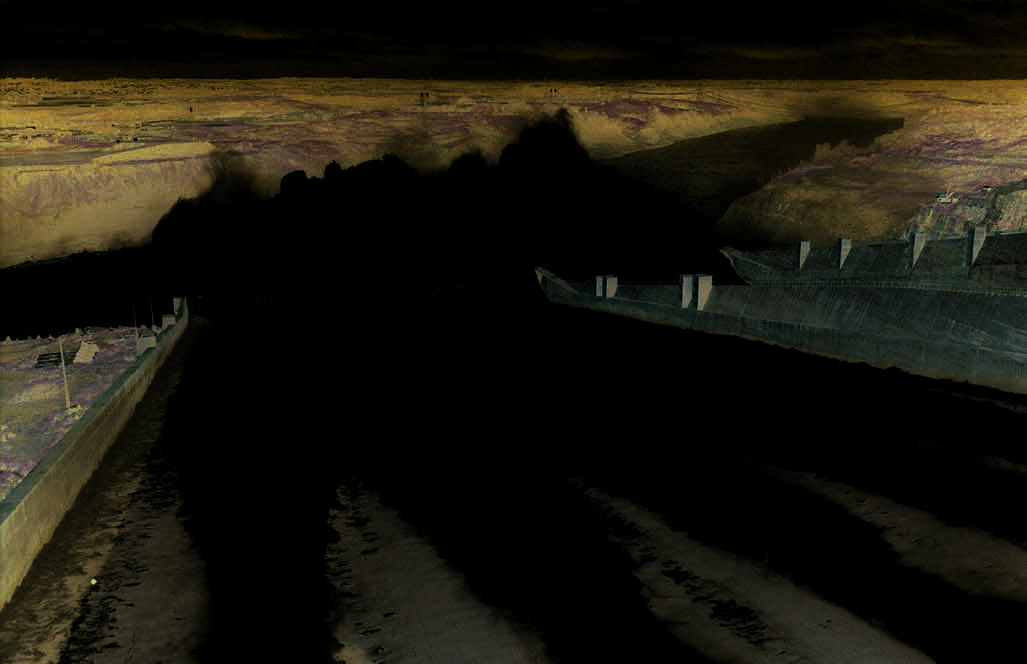
Figure 18 Itaipú dam, Paraná River.
(Photo: Stillpicture)
For example, in the Itaipú Reservoir, several studies have described the
operate, rooted aquatic plants characterised the aquatic vegetation
changes in the fauna after the river closure. Prior to the construction
of this reach of the Iguazú River, while floating plants were extremely
of the reservoir (1978-1981), there were 113 species of fish upstream of
rare. Today, in a lentic environment, aquatic macrophytes and floating
Saltos de Guayra while only 83 species were found after the construction
plants dominate. In addition, there have been changes in the trophic
of the reservoir (Agostinho et al. 1994).
web among aquatic fauna. Such changes might have important
consequences for biodiversity, not only because there are fewer species
The creation of a reservoir transforms fluvial riparian ecosystems into lake
in the Iguazú River but also because of their high endemism. However,
type ecosystems, notably increasing their longitudinal development, as
the fish community was already affected by Foz do Areira Reservoir,
well as changing terrestrial ecosystems into aquatic ones. The sum of
located upstream (Agostinho & Gomes 1997).
reservoir areas by sub-basin4 is a proxy indicator of the latter which, in
the case of reservoirs on the Paraná River, amounts to about 6 800 km2.
Another interesting indicator of transformation is the increase in
The total area of the main reservoirs in the Paraná system, including
average annual residence time in the various water sub-systems.
major tributaries, is over 16 000 km2, which amounts to about 1% of its
Table 24 il ustrates the situation before and after the construction of
basin (Figure 18). The Salto Grande Reservoir (Argentina and Uruguay)
the reservoirs, revealing significant transformations imposed on the
has modified almost 8% of the length of the Uruguay River, including a
natural fluvial environment.
development situated on the shoreline that occupies over 500 km2.
In the Salado River Basin, province of Buenos Aires, negative impact
In the Iguazú River, mainly in its middle zone, several reservoirs
on the ecosystems has resulted from the construction of drainage
devoted to hydropower generation have been built changing the
canals, especial y in the Samborombón Bay, which is a Ramsar Site. In
physical, chemical and biological features of the River. The cascade of
1997, Channel 15 was made deeper and wider and, as it takes al the
reservoirs has transformed about 36% of lotic environments into lentic
water from the Salado River except during floods, some downstream
and semi-lentic habitats, and over 40% with Salto Caxias in operation
reaches have become lentic as a consequence of such interruption
(Agostinho & Gomes 1997). Before the Segredo Reservoir started to
(Miretzki et al. 2002).
4IARH, based on data of original reservoirs areas from SSRH 2002, ANEEL 2000 and data calculated on GIS (information provided by CIAT 1998).
48
GIWA REGIONAL ASSESSMENT 38 PATAGONIAN SHELF
ASSESSMENT
49
Table 24 Mean annual residence time of water in river
of plankton, other invertebrates and smal fish, with a significant
sub-systems of La Plata River Basin.
increase in abundance of the fauna that preyed on these food sources
Residence time (days)
River sub-system
(Canevari et al. 1999). "Curimbata" (Prochilodus scrofa), the dominant
Natural1
Reservoir2
fish prior to the construction and of high commercial value, suffered a
Grande
15
695
reduction of around 25% after damming. The abundance of Piranhas
Paranaiba
14
627
Tietê
12
593
(Serrasalmus marginatus) increased significantly in the upper reaches of
Paranapanema
8
907
the reservoir farthest from the dam.
Iguazú
15
355
Paraná
30
159
Analysis of fish communities with similar food habits revealed that
Notes: 1Reference values assuming a mean velocity of 1 m/s. 2Calculated on the basis of reservoir
maximum total volume and mean annual discharges. (Source: Values specially calculated by
detrivorous fish were more abundant before the impoundment
IARH for the GIWA Project. Based on ANEEL 1999 and 2001, SSRH 2002)
amounting to 57% of the catch and that, in the fol owing six years,
this figure decreased to between 8.6% and 19.7%. Insectivores have
Modification of habitats or communities
proliferated in the reservoir area and, together with piscivorous species,
The main human impact comes from overexploitation of fish,
they are the predominant group in the community. The number of
pol ution and eutrophication, as wel as the building and operation
carnivorous species remained stable, but changes in their specific
of reservoirs. Fish mortality resulting from agro-chemical discharge,
composition have been observed (Agostinho et al. 1997).
organic discharge, hydrocarbon pollution, and gas oversaturation due
to dam operations has influenced structural and community dynamics
Reservoir developments have reduced spawning and reproduction
(DRIyA 2002). The death of around 120 000 fish, mainly demersal
areas. For example, in the Itupararanga Reservoir in the Sorocaba River
species, due to gas oversaturated water (bubble il ness) as a result of
(tributary of the Tietê River), fish biodiversity may have diminished due
the floodgate operation of Yacyretá Reservoir has caused ecological
to the decrease and species, such as Apareiodon cf. piracicabae, "Sábalo"
damage to the trophic web (Jacobo et al. 1994).
(Prochilodus lineatus) and "Tabarana" (Salminus hilarii) which are present
in unaffected reaches, may have become extinct in the reservoir (Smith
Habitat modification, mainly due to reservoir building, has a direct
& Petrere 2001).
impact on the aquatic wildlife and biodiversity (Agostinho et al. 1997).
Of the 10 most frequently occurring species in the Itaipú River
The ichthyofauna has been largely affected by the construction of large
before the construction of the dam, only the "Corvine" (Plagioscion
reservoirs in the Upper Paraná River and its tributaries. Due to lack of
squamosissimus, an alien species imported from the Paranaíba River)
fish ladders aiding the passage of migratory species, vital functions,
remained after the River was closed (Figure 19). During the first stages
of the river closure and impoundment, there was high production
Curimatorbis platanus 3%
Species
Hypostomus sp.
Pterodoras granulosus 12%
P. molocatus
A. nasutus
P. scrofa
A. valenciennesi
B. stromimineus
H. pequira
L. vittatus
Other species 13%
S. borelli
P. squamosissimus
I. labrasus
H. edentatus
A. nuchalis
C. insculpta
T. paraguayensis
S. marginatus
L. oriscaria
Post Impoundment (1982-1987)
Loricariichthya sp.
Pre Impoundment (1978-1981)
Pimelodus clarias 72%
P. goleatus
0
2
4
6
8
10
12
14
Relative Frequency %
Figure 20 Percentage of species transferred in Yacyretá Reservoir
Figure 19 Relative frequency of species in Itaipú River.
(Argentina-Paraguay).
(Source: Agostinho et al. 1994)
(Source: Baigún & Oldani 2001)
48
GIWA REGIONAL ASSESSMENT 38 PATAGONIAN SHELF
ASSESSMENT
49

such as reproduction, or spawning that occurred in upstream reaches
The introduction of alien species, such as carp (Cyprinus carpio),
of the rivers, were retarded. Furthermore, where fish ladders have been
negatively affects the community structure and dynamics at higher
constructed, they have not functioned properly or have not been able
trophic levels. As a consequence, the ecosystems exhibit species
to mitigate the negative impacts of the reservoir development on the
exclusion and changes in the food web (DRIyA 2002).
environment (Canevari et al. 1998). The fish ladders built in Yacyretá
(Figure 20), have not facilitated the migration of important species that
In lower trophic levels, Asian mol uscs have been introduced by
constitute the basis of regional fisheries (Baigún & Oldani 2001). Instead,
international shipping. Among them, Asian clam (Corbicula fluminea and
they have really only helped the transfer of small species, such as Yel ow
C. largillerti) and the mytilidae Limnoperna fortunei have spread widely
catfish (Pimelodus clarias) and "Armados" (Pterodoras granulosus), that are
in the La Plata River, Lower and Middle Paraná River and Uruguay River
ubiquitous and have little importance to fishing. Among the important
causing significant ecological impacts. Autochthonous benthic species
migratory species, Sábalo was the most abundant in the fish ladders
have disappeared as a result of these invasive molluscs (Canevari et al.
but only represented 2.5% of al fish migrating through the transfer
1998). In addition, the introduction of these molluscs has modified the
facilities. However, experimental examination of the fish community
food web mainly for ox-eyed cackerel, catfish and atherine, all of them
downstream of the reservoir revealed that Sábalo comprised 30% of the
economical y important species (CARU 2002). Also, because these
community. This suggests that fish reach the bottom of the dam but
molluscs are filter feeders they can increase the clarity of the water by
do not enter the fish ladders. The efficiency of transfer mechanisms of
as much as 200 times and, as a consequence, the ecosystem can be
the dam is too low; only 1.9% of the total migratory species reach the
dramatical y modified.
reservoir and the efficiency is as low as 0.6% taking into account only
the most valuables species (Fundación Proteger 2001). Similar impact
Limnoperna fortunei, which was presumably introduced via shipping
on migratory species has been found in the Salto Grande Reservoir in
traffic between Hong Kong and Argentina, maintains large populations
the Uruguay River (Canevari et al. 1998).
in estuarine habitats. This mol usc species has spread from La Plata River
where it has established a stable population as dense as 80 000 per m2
In addition, the regulation of stream flow by the reservoir has affected
in littoral areas of the River (Dress 1996) reaching up to the Yacyretá
species that use downstream floodplains for spawning. The most
Reservoir. It has also reached Brazilian waters and occurs in the Itaipú
affected species was the Sábalo with a reduction of about 50% of the
Reservoir (Paraná River), the Salto Osorio and Salto Santiago (Iguazú
stock in the Upper Paraná River (Agostinho & Gomes 2002).
River), Mato Grosso (Pantanal), the Paranapanema River and the water
supply in Foz do Iguazú City.
Impact has also been recorded in the community structure and
dynamics due to pol ution from point and diffuse sources. In the
Serious ecosystem impact due to accidental spil s has already been
Lower Uruguay River, pol ution concentrations above the Uruguay River
reported under Pollution. In Magdalena town, province of Buenos
Administrating Committee aquatic living standards have been found.
Aires, spills of raw oil has affected mainly the riparian ecosystem.
Although the impact on the fish community is low, invertebrate,
In the Upper Pilcomayo River so-cal ed "tailings" or toxic mud from
amphibian, mammal and bird habitats have been seriously affected.
mining activity in the Potosí department have negatively impacted
several tributaries. There is a high concentration of heavy metals in
water and sediments and a sharp decrease has been observed in the
benthic fauna, as well as fish extinction in some reaches where water
cannot be used even for irrigation (Medina Hoyos 1996).
In the La Plata River, the major source of pol ution is the urban
belt from Riachuelo (Figure 21) to Berazategui because of its high
industrial and population concentration. Persistent organics pollutants
(POPs) are widely spread and concentrated mainly in sediments and
bioaccumulated in detritivorous organisms such as Sábalo. Organo-
chlorate agro-chemicals as wel as PCBs are accumulated in the fat
Figure 21 Riachuelo River in Buenos Aires (Argentina).
tissue of fish (Canevari et al. 1998).
(Photo: Strategic Planning Website for Buenos Aires)
50
GIWA REGIONAL ASSESSMENT 38 PATAGONIAN SHELF
ASSESSMENT
51
According to an assessment carried out by a United Nations specialist,
decrease, between 300 000 and 500 000 people who rely on subsistence
the restoration of the damaged ecosystem wil take at least 10 years
fishing would move to the cities, resulting in impoverishment (Dario El
(Morton 1999). In 1996, at Porco in the Upper Pilcomayo River, a dam
Litoral 2002).
containing mine tailings broke causing a widespread impacts on
the ecosystem due to high concentrations of heavy metals (Preston
In the Middle Iguazú River, due to the modification of the ecosystem
1998).
by reservoir building, the riparian fishing communities had to change
their fishing practices. The adaptation to such new fishing practices is
Final y, selective fishing practices in local areas in the La Plata Basin
considered to be an important social impact resulting from the reservoir
may cause changes in the community structure and dynamics, since
building (Agostinho & Gomes 1997). The lack of conservation and the
the most valuable sport and commercial species are the main target.
systematic destruction of the ecosystem may damage traditional ways
There are many indications of overexploitation of different species in
of life which, in many cases, are merely of subsistence character. These
the Paraná, Paraguay, Upper Pilcomayo and Middle and Lower Paraná
changes in traditional ways of living generate economic as wel as
rivers. Such overexploitation by fisheries is strongly linked to the
cultural losses, inducing migration.
Unsustainable exploitation of fish and other living resources in the
La Plata River Basin.
Conclusions and future outlook
The present impact of environmental issues related to habitat and
Socio-economic impacts
community modification is severe. The loss of ecosystems or ecotones
Economic impacts
is serious as it transforms fluvial lotic systems into lentic or semi-lentic
Considering the present economic situation, the economic impact of
ecosystems in a large number of reservoirs in the main reaches and its
habitat destruction and modification is moderate. It becomes evident
tributaries.
mainly in relation to decrease in fishing and the decline of commercial y
important species in communities dependent on them for food or
Although dam construction and reservoir development is expected to
trade. Consequently, there is a greater impact on regional economies
decrease in the next decades, the loss and modification of ecosystems
and fishing, sporting and tourism activities. For example, in the Itaipú
already caused by existing dams and reservoirs wil not change.
Reservoir, the fishing effort has increased and is now above the optimal
Nevertheless, in the future, the dam construction process wil be longer
recommended rate, while the Catch per Effort Unit (CPUE) has been
and will take into consideration environmental, social and health issues.
decreasing (FUEM et al. 1999, Okada 2001).
The process wil be based on option assessments and multi-stakeholder
participation, thus minimising impact, through the selection of less
The cost of control ing invasive species, habitat restoration, loss of
impacting options and improved mitigation measures.
educational and scientific values and fundamental y, generational
inequity, should be added. The invasion of Limnoperna fortunei causes
Though the long-term impacts of alien species introduced either
significant socio-economic impact due to the obstruction of filters in
deliberately or accidental y is unknown, a social awareness about
water supply pipes, acceleration of corrosive processes in al metal ic
water resources to stop degradation is emerging. As regards continental
components of ships, tanks, etc. In the Itaipú Dam alone, losses of nearly
habitats and ecosystems, new nature conservation areas are being
1 million USD per day occur due to operational standstil s for cleaning
created, but it is general y expected that there wil be an increase in
purposes, with consequent lack of hydropower generation (Agencia
the pressure on natural resources and environment, while no restoration
Brasil 2003).
is taking place in areas that are already degraded. Consequently, the
degradation of the environment wil continue and the impacts resulting
Other social and community impacts
from the most likely future scenario until 2020 will remain severe.
A number of communities, riparian or directly related to water systems
that depend on the characteristics, goods and services provided by
Despite efforts and improvements carried out by the various sectors
the ecosystems and shoreline ecotones, have been affected. Many
of society towards environmental protection and restoration, it is
of these communities carry out crafts of great social, economic and
anticipated that habitat and community structures wil continue to
cultural significance at local level. The decrease in fish stocks due
be modified and, as a result, it is expected that economic and social
to overexploitation could have serious impact on communities that
impacts, directly associated with ecosystem degradation will increase,
depend on this resource. Experts believe that if Sábalo resources
but will remain moderate.
50
GIWA REGIONAL ASSESSMENT 38 PATAGONIAN SHELF
ASSESSMENT
51
T
C
P
A
Unsustainable exploitation of
I
M
Although the fishing sector is smal , impacts on the national economy
fish and other living resources
and social impacts are significant. In addition, fishing is an important
subsistence activity. Human health issues are not more important than
The La Plata River Basin is the primary focus of the continental fishery,
environmental issues in terms of their impact on potential conflicts at
both from a commercial and recreational point of view. Sustainability
sub-national and regional level.
of fisheries is at risk due to the inadequate management of aquatic
resources. Building and operation of reservoirs, mainly in Brazil, is
Overal , the impacts of Unsustainable exploitation of fish and other
the main cause of human impact on fisheries, with transboundary
living resources are moderate in the La Plata River Basin.
consequences at multinational and sub-national level.
Environmental impacts
There are important fisheries in al Brazilian basins, and the
Overexploitation
species composition shows an important spatial and temporal
Latin-American rivers show a remarkable fish biodiversity comprising
heterogeneity. Species present in the rivers within the Paraná Basin
migratory species of economic importance such as Sábalo, ray-finned
are general y migratory with a great predominance of Spotted sorubim
fish (Leporinus), "Patí" (Luciopimelodus) and Surubí. Their migratory
(Pseudoplastitoma corruscans) and "Dorado" (Salminus maxil osus).
cycles have a great influence over the trophic structure of the fish
In the Itaipú Reservoir (Paraná River), landings are composed of
community. The Sábalo is one of the system key species since its eggs
around 50 species, five of which contribute 78% of the annual yield
and larvae are the base of the food web (Oldani 1990).
(1 600 tonnes). Fisheries in the Paraguay River are mostly commercial
and sporting and include large migratory species. Between 1999 and
There are indications of overexploitation of "Pacú" (Piaractus
2002, the continental fishery in Brazil showed a moderate increase in
mesopotamicus) and "Manguruyu" (Paulicea lüetkeni) in the Brazilian
total catch.
areas of the Paraná River and Paraguay River basins (Ministério do Meio
Ambiente y Programa Nacional do Meio Ambiente I 2001). Quirós (1990)
In the Paraná River in Argentina, some 220 species can be found, 20 of
suggests that the decrease of Pacú in the lower sector of the Paraná and
which are valuable either commercial y or as food. Among them the
Uruguay rivers is due to deforestation.
Sábalo (Prochilodus lineatus) is the key species of the ecosystem due to
its role in the trophic chain; 70% of the chain depends on it and it also
In the Upper Paraná River, there has been a reduction in the catfish
affects other fishing resources such as "Surubí" (Pseudoplatystoma sp.)
Rhinelepis aspera stock, and the catch has decreased by 70%.
and Dorado. In Victoria City (Entre Ríos province), there is evidence of
Overexploitation of granulated catfish (Pterodoras granulosus),
an alarming increase in the exploitation of Sábalo in the Lower Paraná
Manguruyu and Spotted sorubim has been reported in the Itaipú
over the past few years. The fishery in the Paraná is mainly commercial
Reservoir (FUEM et al. 1999). In this reservoir, fishing effort was
and for recreational sport. There are also subsistence fishers, but there
67.5 days in 1987, 120 days in 1993 and 106.5 days in 1998. The optimal
is limited information available on their activities. There is no data
recommended rate is 95.5 days per year (FUEM et al. 1999). Catch per
confirming that fishery is at risk in the medium and lower sections of
Effort Unit has been decreasing; 21.7 kg per day in 1987, 15.5 kg per day
the Paraná, although the opinions of local experts differ.
in 1992 and 11.5 kg per day in 1998 (Okada 2001).
Most fishing activities in the upper Paraná and Paraguay rivers are by
There is evidence of Sábalo exploitation in the Middle Paraná River since
trawling, while long lines with several fishhooks and gill nets are used
its capture rate is now twice or three times higher than previously. Of
in the lower Paraná and Uruguay rivers. Exploitation of stocks in these
200 recorded species, about 20 feed on Sábalo, its loss might therefore
rivers have transboundary impacts as many species are migratory.
cause the extinction of many valuable species (Fundación Proteger
2002). In the San Javier river area, the catch is frequently comprised
There is evidence of a decreased viability of fish stocks due to pollution
of fish under four years old and smal er than the legal minimum size,
at local level, but the effects are not significant at regional level.
affecting the probability of Sábalo population recuperation (Oldani
The introduction of alien species could have a detrimental effect
et al. 2001).
on community structure and dynamics in the rivers of the La Plata
Basin, such as species exclusion and changes in the food web, with
There is also evidence of a decrease in the catches of fish species
transboundary impact.
downstream the Santa Fe-Paraná axis, such as catfish and Pacú.
52
GIWA REGIONAL ASSESSMENT 38 PATAGONIAN SHELF
ASSESSMENT
53
Some local experts attribute these decreases to overexploitation,
Commercial fishing in the Pilcomayo River, carried out by Argentinean,
stating that the mean size of fish, such as Sábalo and Dorado, has
Bolivian and Paraguayan fishermen, particularly indigenous people,
decreased. Catches of "Armado chancho" (Oxydoras kneri), silverside
includes different practices such as traps, nets and explosives
(Odontesthes bonariensis), salmon (Brycon orbignyanus), Manguruyu
(Correo del Sur 2002).
and "Tres Puntos" (Hemisorubin platyrhynchus) have also dramatical y
declined, and some species have not been registered for years. These
Decreased viability of stocks through pollution and disease
declines are attributed to a variety of factors by local experts, such as
There are records of fish mortality due to different causes such as
overexploitation, environmental impact of dams on migration, loss of
agro-chemical and organic discharge, high temperatures, pol ution
habitat for reproduction, deforestation and pollution.
by hydrocarbons, and gas oversaturation due to dam operations,
which affect structure and community dynamics. There is evidence of
In the Upper Pilcomayo River, high inter-annual variations in the
decreased viability of stocks due to deforestation, pol ution and disease,
capture of valuable species have been reported. The catches of
in the most polluted areas.
Sábalo il ustrate the decline with average landings decreasing from
over 1 000 tonnes per year between 1980-1989 to 400 tonnes per year
Heavy metal pol ution in the Pilcomayo River poses hazards to both
between 1990-1998 and, in some years, as low as 100 tonnes per year
human and other biota. Bioaccumulation of these toxins in fish fat
(Smolders 2001). The Bolivian Red Book of vertebrates has classified
and muscles is a major problem. Detritivorous fish, such as Sábalo,
Sábalo as a vulnerable species (Correo del Sur 2002). Although the
are particularly affected and, because of its commercial importance
decrease in stream flow of the Pilcomayo River in the 1990s may
as a primary source of income, there are economic impacts resulting
have affected Sábalo landings, the decreasing catch rate may also
from the contamination of these species. In the Upper Pilcomayo Basin,
be due to overexploitation together with river receding in the Lower
the main water quality impact associated with the presence of heavy
Pilcomayo, which has isolated upstream populations making them
metals from mining effluents and spil s is closely related to the impact
more vulnerable (Smolders 2001).
on edible fish species such as Sábalo, Long-whiskered catfish (Pimelodus
albicans) and Tiger fish (Hoplias malabaricus).
Final y, selective fishing practices in local areas in the La Plata Basin may
produce changes in the community structure and dynamics, since the
In the Brazilian Pantanal, the use of mercury in mining can be detected
most valuable sport and commercial species like Surubí and Dorado
and quantified in sediment core chronologies and biological tissues,
are the main target.
although species at different trophic levels show dissimilar impact.
Mechanisms involved in mercury magnification along food chains
Excessive by-catch and discards
deserve more attention, particularly in tropical regions where the
In rivers of the La Plata Basin in Argentina, by-catches involve non-
threat of chronic exposure to this neurotoxin may have the greatest
migratory species. In the Uruguay and Paraná Rivers by-catch by
implications for biodiversity (Leady & Gottgens 2001).
entanglement is negligible.
Persistent organic pol utants are also degrading the water quality of the
Lake conditions in Itaipú Reservoir have caused a depletion of large
southern reaches of the Uruguay River. Heavy agro-chemical use is likely,
piscivores and an increased density of piranhas. This compels fishers to
as agricultural exploitation is a major economic activity in Uruguay.
use gill nets, increasing both the number of species exploited and the
Organic pollution is regarded as an important cause of decline in the
amount of by-catch but reducing overall profitability.
population of migratory fish species in the upper and middle course of
the Uruguay River, posing negative commercial impact (FAO 2003).
Destructive fishing practices
The lack of definite policies or changes in sustainable practices has
Impact on biological and genetic diversity
made fisheries management difficult and has generated conflicts.
The introduction of alien species general y has a negative effect on
Some existing resources are threatened or continue to be managed
community structure and dynamics and, as a result, ecosystems exhibit
inadequately (Baigún 2003). Although there a few land-based
species exclusion and changes in the food web. The introduction of
subsistence fishers that use lines with several fishhooks or nets, trawling
carp (Cyprinus carpio) in the entire La Plata River Basin could seriously
is the most common fishing practice (Agosthino & Gomes 1997).
threaten native species such as silverside, catfish and Sábalo, although
its effect has not been demonstrated. Similar effects could be produced
52
GIWA REGIONAL ASSESSMENT 38 PATAGONIAN SHELF
ASSESSMENT
53
by the introduction of South American silver croaker (Plagioscion
who practice subsistence fishing wil move to the cities, resulting in
squamosissimus) and tilapia (Oreochromis sp.) in the Upper Paraná River,
impoverishment (Diario El Litoral 2002).
and sturgeon (Ascipencer baeri) in the Lower Uruguay River and in the
Middle and Lower Paraná River (DRIyA 2002).
In the Upper Paraná River, during the closed season, fishers have no
income to support their families. Thus, many engage in il egal activities
Two Amazon predators are captured in Itaipú Reservoir, South American
such as car thefts and drug trafficking across the Brazil-Paraguay border
silver croaker and ray-finned fish (Cichla monoculus), which came from
(Agostinho & Gomes 2002). During this period, Argentinean Provincial
upstream reservoirs. In 1997, an accidental introduction of alien species
governmental bodies offer a subsidy or some form of aid (e.g. food) to
from an aquatic farm occurred in the Parapanema River due to an
fishermen.
extraordinary flood. In addition to the many alien species spread in
the River after the accident, the parasite Laernea cyprinacea was also
In the Middle Iguazú River the adaptation of riparian fishing
introduced (Agostinho & Gomes 2002).
communities from using fish line and fishhook to waiting nets, due to
the modification caused by the construction of reservoirs, is considered
Socio-economic impacts
an important social impact of the construction of the reservoirs
Economic impacts
(Agostinho & Gomes 1997). These changes have generated economic
Economic impact is moderate in relation to decreased catches of
and cultural loss, inducing migrations.
commercial y valuable species in communities relying on fishing for
food and trade.
Conclusions and future outlook
Environmental issues relating to the unsustainable exploitation of fish
The Sábalo fisheries have both an economic and social value in the
and other living resources are of major concern and have a moderate
Upper Pilcomayo Basin, mainly in Villamontes (Tarija, Bolivia), where a
impact, although overexploitation in some sectors of the La Plata
decrease in catch since the late 1980s (Smolders 1998), has affected
Basin is severe. In the future, a moderate negative change is foreseen
the regional economy. More than 3 000 families in Vil amontes (90 % of
in the development of this concern. It is thought that the exploitation
the total employment) depend on fishing income during five month
of fishery resources wil remain stable in areas where regulations
of the year. Fishing of Sábalo is the only subsistence for the "matacos",
have been instituted, but wil tend to deteriorate in other areas. The
indigenous of the region (Correo del Sur 2002).
unsustainable exploitation of fish is strongly linked to habitat and
community modification since it is evident that it affects population
In the Upper Paraná River, a closed fishing season from November 1
and community structure.
to January 31 has been established in order to ensure the migration of
migratory species to spawning areas. Although the impact on fisheries
Economic, social and community impacts of overexploitation of fish
has not yet been assessed, such prohibition produces social and
and other living resources are moderate at present. A slight increase in
economical problems due to a lack of income for many fishermen to
the severity of these impacts can be expected as a result of continued
support their families during those three months (Agostinho & Gomes
unsustainable exploitation of fish and the environmental impact
2002).
associated with these practices.
Social and community impacts
Impacts to the health of the population of the sub-system are negligible
A large proportion of the population along more than 3 000 km of
because of the relative low fish consumption in the region. It is likely that
the Paraná River, from Mato Grosso up to the delta, relies on this water
the proportion of fish in the diet of people living in the basin will not
resource for their livelihood. Due to the high rate of unemployment
increase and, as a consequence, the future impacts of overexploitation
and the hard economic situation in Argentina, many people practice
of fish and other living resources on health will remain negligible.
subsistence fishing as a way to feed their families and obtain some
income by selling fish.
Differing opinions from local experts have been observed regarding
overexploitation in the Argentinean Paraná River. Future research efforts
Decreasing fish populations due to overexploitation could have a
in the whole basin are considered a priority. At present, it is not possible
serious impact on the communities depending on this resource. Some
to describe the actual situation due to lack of reliable information.
experts believe that if the catch of Sábalo decreases, many people
54
GIWA REGIONAL ASSESSMENT 38 PATAGONIAN SHELF
ASSESSMENT
55
T
C
P
A
Global change
I
M
consequences for hydrology and water resources. Flood frequency is
affected by changes in the year-to-year variability in precipitation and by
In 1996, the Second Assessment Report of the IPCC concluded that
changes in short-term properties. The frequency of low or drought flows
the balance of evidence suggested that there was a discernible human
are affected primarily by changes in the seasonal distribution of rainfal s
influence on the global climate. Nevertheless, there was an array of
and year-to-year variability, and the occurrence of prolonged droughts.
uncertainties concerning the real magnitude of that influence on
global warming and other effects of global climate change. The Third
Since 1960, significant increases in annual precipitation has been
Assessment Report of the International Panel on Climate Change
recorded in the eastern and central regions of Argentina, southern
(IPCC 2001a) partial y resolved these uncertainties, concluding that the
Brazil and Uruguay. The greater values go as far as 50%, which indicates
best agreement between model simulations and observations over the
exceptional change (Barros 2002).
last 140 years has been found when both the anthropogenic and the
natural factors were combined. Simulations of the response to natural
Stream flow in the La Plata Basin (especial y in the Paraguay, Paraná
forcing alone do not explain the warming in the second half of the
and Uruguay rivers) showed a negative trend from 1901 to 1970, but
20th century, but they may have contributed to the observed warming
reversed after this period. Variability over decades is also observed
in the first half of the 20th century (IPCC 2001a).
in discharge. Moreover, there are written reports of alternating flood
and drought periods during the 16th and 18th centuries, indicating
The La Plata Basin has been permanently influenced by the climatic
high natural variability. In sub-tropical Argentina, Paraguay and Brazil,
variability with consequent variations in river level. Fluctuations have
rainfal exhibits a long-term change, with a sharp increase between
reached extremes, which produces frequent high and low water
1956 and 1990, after a drier period during 1921-1955. There is a positive
conditions.
precipitation trend in the period 1890-1984 in the Argentinean plains.
This increase in annual precipitation was accompanied by a relative
Even though it is stil uncertain how global warming may affect
increase in rainfall during spring and summer (IPCC 2001b).
frequency and intensity of extreme events, extraordinary combinations
of hydrological and climatic conditions have historical y produced
Impact assessments of climate change obtained from the General
disasters in some parts of the La Plata River Basin. To this natural
Circulation Model (GCM) vary depending on the latitude and longitude
variability must be added the possible impact in the Basin of global
considered in the La Plata Basin. There is a case study of one application
change produced by human activities. Cities and other settlements
of GCM approach to assess the impact of climate change in the Uruguay
developed on the banks of the big rivers within the Basin have
River Basin (Tucci & Damiani 1994). US NASA Goddard Institute for Space
suffered flooding, especial y in northeastern Argentina. Consequently,
Sciences (GISS), US National Oceanic and Atmospheric Administration
the economic impact is severe.
Geophysical Fluids Dynamic Laboratory (GFDL), and the United
Kingdom Meteorological Office (UKMO) which simulate the percentage
An increase in frequency and magnitude of extreme events associated
increase of temperature and rainfal , produced different results. The
with El Niño phenomena, like flooding, is expected. The La Plata River
GISS scenario predicts a reduction in the maximum and annual mean
Basin is one of the most sensitive regions to El Niño signals.
stream flow of 9 to 14%, although stream flow increases in February-
March. The GFDL's scenario, on the other hand, anticipates an increase
There is no evidence of change in the sea level, increase in UV-B
of 14 to 33%, with the largest increase in October, which is consistent
radiation or changes in the ocean function as a CO source/sink.
with warmer sea surface temperature in the tropical Pacific at a time
2
of year when connections with the climate in southeastern South
Consequently, the impacts of climate change are moderate in the
America are strongest. The UKMO's scenario predicts increases of
La Plata River Basin considering variations in the rainfal and stream
5 to 21%. Minimum stream flows were shown to decrease in all cases.
flow patterns mainly due to El Niño phenomena.
Nevertheless, the models are still not consistent with each other, and
regional precipitation is not accurately simulated for present climate
Environmental impacts
conditions (Baetghen et al. 2001).
Changes in the hydrological cycle and ocean circulation
Precipitation is the main driver of variability in water balance over
In several cities of southern and southeastern Brazil, studies of long-
space and time, and changes in precipitation have very important
term trends in air temperatures, from the beginning of the 20th century,
54
GIWA REGIONAL ASSESSMENT 38 PATAGONIAN SHELF
ASSESSMENT
55
have indicated a general warming. These trends could be attributable
Table 25 Major floods in northeast Argentina. Affected surface
to increase in urbanisation or systematic warming observed in the
and economic losses.
South Atlantic since the beginning of the 1950s. In southern tropical
Paraná river flow at
Affected surface
Economic losses
Year
Posadas (m3/s)
(mil ions of ha)
(mil ion USD)
Argentina, warming is only observed during the autumn season and
1966
37 885
ND
751
in the Argentinean humid plains, warming is a result of increased
1977
30 081
ND
265
urbanisation (IPCC 2001b). Changes have been detected in the zonal
1982-1983
50 882
4.0
1 790
air circulation over Paraguay, Brazil, Uruguay and northeast Argentina.
1992
48 790
3.0
905
In this area, the air circulation associated with the sub-tropical Atlantic
1997-1998
33 0001
18.52
17 502
anticyclone increased after 1954.
Notes: ND = No Data. 1Subsecretaría de Recursos Hídricos.2Subunidad Central de Coordinación
para la Emergencia. (Source: GWP 2000)
Climate variability can influence water levels in the La Plata River.
Even though it is stil uncertain how global warming is linked to the
Several studies in Argentina, Uruguay and Brazil, based on general
behaviour of the El Niño phenomenon in this region, there is evidence
circulation models and crop models project decreased yields for
of increasing flow anomalies in the La Plata River Basin during the last
several crops (maize, wheat, barley), even when the direct effect of CO ,
2
El Niño events. The discharge of Paraná River increased its maximum
fertilisation and the implementation of moderate adaptation measures
monthly values between two and six times above normal values during
at farm level are considered.
El Niño events that occurred in 1982-1983, 1992, 1994 and 1997-1998
(Moyano 2001). During previous El Niño events (1902-1977), the
In Brazil, the drier conditions in major plantation states such as Minas
Paraná river flow was between one and two times above its normal
Gerais, Paraná and São Paulo, that are likely to result from global warming
maximum monthly values. Despite the fact that the impact of the
and/or reduced water vapour transportation from the Amazon forest
El Niño phenomenon varies in magnitude, it was suggested that the
can be expected to reduce silvicultural yields (IPCC 2001b).
frequency has increased in the last years.
Health impacts
Socio-economic impacts
The risk to human health increases, particularly in relation to tropical
Economic impacts
and water-related diseases. Climatic change increases the viability of
Economic sectors affected by flooding and water table elevation in the
certain disease vectors and the propagation of existing ones. Extremes
Basin are considerable. Damage to public and private property, loss of
in the hydrological cycle, such as water shortage and flooding, could
agricultural production and long-lasting change in agricultural, fishery
increase the risk of diarrhoea. Water shortages cause diarrhoea through
and forestry productivity is significant (IPCC 2001b).
poor hygiene, and flooding can pollute drinking water from watershed
run-off or sewage overflow.
Argentina has been permanently affected by extreme flood or water
shortage events. There are stil doubts as to whether climate change
There is good evidence that the El Niño Southern Oscil ation (ENSO)
or environmental degradation is the main cause, or whether random
cycle is associated with increased risk of certain diseases and can affect
natural processes are to blame (World Bank 2000). The frequency of
distribution, reproduction and mortality of disease vectors. Several
extreme events is high and the rehabilitation period is over 10 years.
studies have speculated that the cholera outbreak in the early 1990s
However, 11 events have taken place since 1957, on average one every
was linked with the 1992-1993 El Niño event (IPCC 2001b).
four years, causing several deaths, infrastructure and agricultural losses,
as wel as serious social and economic impact (Mugetti 2002). The
Other social and community impacts
1982/1983 El Niño event flooded 4 mil ion ha and caused economic
The size of the community affected is moderate to large, since the
losses of about 1 800 million USD (World Bank 2000).
whole population in the fluvial littoral zone in the Basin is involved. The
inhabitants of the large areas affected by water table increase should
Together with changes in land use in the upper basin, the increase in
also be considered. The degree of severity is quite high where people
frequency of extreme events since 1970 might be related to El Niño
have been forced to migrate, and moderate when they are subject to
phenomena. Table 25 shows the relationship between peak flows and
temporary relocations. More often, the most vulnerable segments of
affected surface and losses in Argentina (Mugetti 2002).
the society are affected by the events.
56
GIWA REGIONAL ASSESSMENT 38 PATAGONIAN SHELF
ASSESSMENT
57
The number of people evacuated, auto-evacuated or isolated is another
good indicator of the severity of the event (Mugetti 2002). Table 26
shows the number of people in each of these categories for three
different events in Argentina.
Table 26 Number of people evacuated, auto-evacuated and
isolated during three major floods in northeast
Argentina.
Year
1982-1983
1992
1997-1998
Number of people affected
177 035
133 106
121 348
(Source: Mugetti 2002)
Conclusions and future outlook
The IPCC Report on climate change indicates that warming will
accelerate as an increase of +0.6°C in the mean annual world
temperature is expected during the present century (IPCC 2001a).
Even if the Kyoto Protocol is signed and effectively implemented by all
participating countries, the situation wil worsen. According to forecasts,
climate evolution in the La Plata River Basin will be negative. Although
smal modifications in the total annual precipitation are expected,
precipitation intensities and distribution wil change, and climatic
variability will increase.
Considering that the environmental impact of global change is likely
to increase in the near future, an increase in costs, health problems and
social and community impact is expected. It is also predicted that, as
a consequence of climate changes, tropical and sub-tropical disease
vectors wil increase expanding to areas where the population is neither
prepared nor resistant to their effects. Therefore, the future impact will
be severe.
It is also recommended that regional studies should be carried out to
assess and predict impact due to climate variability, through a deeper
knowledge of climate and hydrological factors that define flood and
drought frequency in the La Plata River Basin.
56
GIWA REGIONAL ASSESSMENT 38 PATAGONIAN SHELF
ASSESSMENT
57
South Atlantic
T
C
P
A
Freshwater shortage
I
M
Drainage System
The impacts of freshwater shortage in the South Atlantic Drainage
System were assessed as moderate. Water shortages are common
features in the arid and semi-arid zones within this system. However,
a decrease of spring water areas has been observed in some parts of
the system and there is evidence of salinity change in some coastal
Table 27 Scoring table for South Atlantic Drainage System.
lagoons. The construction and operation of reservoirs in the Limay,
Assessment of GIWA concerns and issues according
The arrow indicates the likely
to scoring criteria (see Methodology chapter)
direction of future changes.
Neuquén and Lower Chubut rivers (inter-jurisdictional rivers) have
T
T
C
C
Increased impact
P
A 0 No known impacts
P
A 2 Moderate impacts
I
M
I
M
resulted in changes in the seasonal flow pattern, which have affected
T
T
No changes
C
C
P
A 1 Slight impacts
P
A 3 Severe impacts
I
M
I
M
Decreased impact
the drainage of irrigated land, caused water tables to rise and become
contaminated with salt and impaired the use of groundwater as a
South Atlantic
p
a
c
t
s
u
n
i
t
y
e
n
t
a
l
m
p
a
c
t
s
m
rural freshwater source. At some monitoring stations there have been
c
o
r
e
*
*
Drainage System
i
c i
m
o
m
indications of bacteriological contamination, hydrocarbons from oil
p
a
c
t
s
p
a
c
t
s
E
n
v
i
r
o
n
m
i
m
E
c
o
n
o
m
H
e
a
l
t
h i
O
t
h
e
r c
i
m
O
v
e
r
a
l
l S
P
r
i
o
r
i
t
y
*
*
*
spil s and pollution of groundwater from oil industry activities.
Freshwater shortage
1.0*
2.3
0
2.3
1.5
Modification of stream flow
1
In addition, there is evidence of salinisation at regional level in irrigated
Pol ution of existing supplies
1
Changes in the water table
1
areas associated with major inter-jurisdictional rivers (Chubut, Negro,
Pollution
1.4*
2.3
2.0
1.0
1.5
Colorado) due to rising water tables resulting from low irrigation
Microbiological pol ution
1
efficiency and insufficient underground drainage capacity. In other
Eutrophication
1
areas where water tables are replenished by springs, there are also
Chemical
1
Suspended solids
2
indications of lowering in water table as a consequence of soil
Solid waste
1
compaction due to sheep overgrazing and trampling in local recharge
Thermal
0
zones. Water availability in flood meadows ("mal ines") is affected by
Radionuclide
0
Spil s
2
human intervention. In some places, salinisation processes due to
Habitat and community modification
2.0*
2.3
0
2.0
2.2
overexploitation are impairing groundwater supply.
Loss of ecosystems
2
Modification of ecosystems
2
Economic impacts are moderate mainly because of increased water
Unsustainable exploitation of fish
1.8*
2.2
0
2.2
2.0
treatment costs and effects on agricultural activities. There is no readily
Overexploitation
3
Excessive by-catch and discards
2
available data describing the magnitude of the impact of this concern
Destructive fishing practices
2
on human health. Low population density, the intensity of agriculture
Decreased viability of stock
0
and land use in the region and the deterioration of water quality have a
Impact on biological and genetic diversity
1
significant social impact on rural workers who, although not numerous,
Global change
0.2*
1.4
0
1.6
0.6
Changes in hydrological cycle
1
are severely affected in the long-term.
Sea level change
0
Increased UV-B radiation
1
Environmental impacts
Changes in ocean CO 2source/sink function
1
* This value represents an average weighted score of the environmental issues associated
Modification of stream flow
to the concern.
Modification of stream flow has a slight impact on the system,
** This value represents the overall score including environmental, socio-economic and
likely future impacts.
manifested mainly by a reduction in the surface area of wetlands and
*** Priority refers to the ranking of GIWA concerns.
changes in annual river flows due to dam construction and operation.
The Colhue Huapi Lake within the Senguerr River Basin is located in the
province of Chubut and is suffering desiccation and desertification due
to both human and natural causes. The system has become endorheic,
characterised by a negative water balance over the second half of the
20th century. Due to progressive reduction in size and increased salt
58
GIWA REGIONAL ASSESSMENT 38 PATAGONIAN SHELF
ASSESSMENT
59
concentration, the zooplankton diversity has noticeably diminished.
50
Today, the surface area of the Colhué Huapi Lake is about 1/8 of its
45
original size due to: (i) a decrease in flow of the Senguerr River resulting
40
from declines in the amount of rainfall and melting ice in recent years;
35
/s)3
and (i ) extraction of large amounts of water mainly for irrigation,
(m 30
25
domestic water supply and the oil industry. Previously, the Colhué Huapi
20
Lake occasional y discharged water into the Chico River but this has
Discharge 15
ceased, likely due to the continuous increase in the area of irrigated land
10
together with withdrawal of water for domestic supply and industrial
5
use (Malinow et al. 2001).
0
Irrigation practices in the Lower Senguerr Basin involves mostly
1946-1947
1947-1948
1948-1949
1982-1983
1986-1987
1987-1988
1990-1991
1991-1992
1993-1994
1994-1995
1995-1996
1996-1997
1997-1998
1998-1999
1999-2000
Year
extensive grassland flooding. Control ed irrigation occurs over a
Figure 22 Annual discharge at Puente Camino Buen Pasto
considerably smal er area. Such inefficient generalised irrigation
gauging site. Senguerr River near Colhué Huapi Lake.
practices in the Basin are usual y conducted using poor infrastructure
(Source: SSRH-EVARSA 2000)
(channels, dams, smal embankments), favouring the infiltration of large
water volumes and causing, as in Colonia Sarmiento, the elevation of
3 500
the water table and soil salinisation. Similar practices, near the town of
Mean
3 000
Alto Río Senguerr, floods the steppe plains at lower elevations which,
MAX
in the summer, may represent up to 78% of the mean flow of the
2 500
MIN
/s)3
Senguerr River (Malinow et al. 2001). These water resource practices
(m 2 000
results in much lower input into the Colhué Huapi Lake than in the
past (Figure 22).
1 500
Discharge
1 000
Building and operation of dams in the Limay, Neuquén and Chubut
500
rivers has changed the seasonal pattern of drainage as wel as increased
evaporation from reservoirs. The first dam in the Limay River was built
0
Apr May
Jun
Jul Aug Sep
Oct Nov Dec
Jan Feb
Mar
in 1973 and four more dams have been built since 1983.
Month
Figure 23 Discharge at Paso Cordoba gauge (province of
Changes in mean discharges, as wel as in maximum and minimum
Río Negro) before operation of Cerros Colorados
discharges, due to reservoir operation are shown in Figures 23
System (1978).
(Source: SSRH-EVARSA 2000)
and 24. These figures il ustrate the stream flow measured at Paso
Córdoba gauge that lies downstream of the confluence of Limay
1 800
River and Neuquén River before and after the construction of the dam
Mean
1 600
(SSRH 2000). The seasonal variability and the monthly discharge during
MAX
/s)3 1 400
MIN
the year have both decreased with the operation of the dam. Similar
(m 1 200
changes were observed in the Colorado River at Pichi Mahuida gauge
1 000
downstream of Casa de Piedra Reservoir, as wel as downstream of
800
Discharge
600
Florentino Ameghino Reservoir, in the Chubut River.
400
200
On the other hand, building and operation of reservoirs has increased
0
Apr May
Jun
Jul Aug Sep
Oct Nov Dec
Jan Feb
Mar
water availability, al owing new land to be irrigated in the provinces of
Month
Neuquén, Río Negro and Chubut, which has led to an important economic
development and improved situation for the farmers. However, the increase
Figure 24 Discharges at Paso Cordoba gauge (province of
Río Negro) after operation of Cerros Colorados
in minimum discharges in the regulated rivers has caused an elevation of
System (1978).
the water table affecting the lowest areas in the near val eys. Elevated water
(Source: SSRH-EVARSA 2000)
58
GIWA REGIONAL ASSESSMENT 38 PATAGONIAN SHELF
ASSESSMENT
59
tables affect the root zone of irrigated crops (mainly apple and pear trees)
In the province of Mendoza, 80 000 ha are irrigated by groundwater.
by depleting them of oxygen. Some cases of soil salinisation due to poor
In the northern oasis, including Mendoza City, salinisation, due to
drainage, capil ary ascent and water evaporation has also been caused by
inefficient irrigation practices, and pol ution, due to agro-chemical,
the increase in water table.
industrial and domestic discharge, affected the first layer of the aquifer
in the 1970s. The second layer of the aquifer with better water quality
Pollution of existing supplies
was then exploited, but some problems during wel construction
In the Colorado River between 1997 and 1999, a detailed assessment
allowed infiltration from the upper polluted layer, and the wells were
was conducted that examined the potential sources of pol ution
abandoned. Today, a third deeper layer of the aquifer is being exploited
related to the main human activities in the Basin, such as urban
(DGI 1999).
discharge, agriculture, oil industry, mining, etc., and their impacts on
water quality for different uses. The assessment took into account the
Inefficient irrigation practices, together with lack of drainage
aquatic environment in the Grande, Barracas and Colorado rivers, as
infrastructure and poor soil drainage capacity, have resulted in elevated
wel as Casa de Piedra Reservoir. Monitoring of polynuclear and aliphatic
water tables and started a salinisation process. Such salt accumulation
hydrocarbons, heavy metals and metal oids, agro-chemicals, as well as
changes the structure and chemical properties of the soil and, as a
analysis of riverbed sediments, determined that water quality was not
consequence, affects the normal growth of crops. Affected areas include
limiting water use. This conclusion was confirmed by complementary
the lower irrigated val eys of the Colorado, Negro and Chubut rivers.
studies carried out in 2000 (COIRCO 2000).
There is also evidence of lowered water tables in many areas due to
In some zones of the Negro River Basin, water treatment for domestic
overgrazing and changes in physical and chemical properties of the
water supply is made complicated by the presence of algae. Similar
soil, affecting water dynamics in the soil.
problems are found in Trelew City downstream of Florentino Ameghino
Reservoir in the Chubut River Basin. There are also water treatment
Flood meadows or "mallines" are wetlands in arid regions developing
problems due to eutrophication in Paso Piedras Reservoir, the water
in areas where there is water available for extended periods of the year.
supply for Bahía Blanca City. The reservoir is mesotrophic with recurrent
The deterioration of mal ines is basical y related to human activities.
algal blooms (more than 1 mil ion cells/ml, varying from diatoms to
Quantity and quality of vegetation is decreasing due to overgrazing
filamentous cyanobacteria). Water treatment by disinfectants is
and increasing run-off towards the central channel of the mal ines.
not effective and the algae remain in the water supply generating
Flow increases create a riverbed channel, operating as drainage of the
trialomethanes (THM), unpleasant odours and taste. There are also
mal ín by lowering the water table (Figure 25). In addition, increased
risks of bacterial re-growth (Marquez 1991).
salt concentrations have also contributed to the deterioration of
the mal ines, particularly in eastern Patagonia and the coastal zones
Some cases of impacted groundwater have been reported in the
(Horne 1999).
system. Río Gal egos City, located near the mouth of the Río Gal egos
River, is supplied from both groundwater and surface water. The
Although the groundwater used for domestic water supply in the
groundwater supply network has 30 wel s. Some wel s located near
region is not widely affected, some local areas are affected by pol ution
the estuary of the river are more affected by seawater and show an
from oil industry and overexploitation. In Río Gal egos City, located in
increasing chloride/bicarbonate ratio indicating seawater intrusion,
the southern part of the province of Santa Cruz, groundwater is a very
and there is an increasing trend for such conditions (Baumann &
important source of water supply that has changed its quality since
Castil o 1999). In Mar del Plata City seawater intrusion affects the
1982. Overexploitation might have caused seawater intrusion changing
water supply.
water chemistry from bicarbonate type to chloride type indicating
declines in water quality (Baumann & Castil o 1999).
Changes in water table
Groundwater is a very important resource in Patagonia since it is the
Socio-economic impacts
only source of freshwater, for domestic, irrigation and animal (sheep
Economic impacts
raising) requirements in many areas. However, this important resource is
Despite large and obvious benefits, the regulation of stream flows has
affected by human activities. There is evidence of salinisation, pol ution,
resulted in elevated water tables and, as a consequence, increases in the
and changes in water table, both increasing and decreasing.
salinity of groundwater. This is due to more frequent and longer periods
60
GIWA REGIONAL ASSESSMENT 38 PATAGONIAN SHELF
ASSESSMENT
61
Conclusions and future outlook
Modification of stream flows in the South Atlantic Drainage System are
mainly explained by a moderate decrease of spring water observed
in some zones, as wel as building and operation of dams that have
changed the stream flow pattern in some rivers.
Biological pollution, due to sewage effluents, and hydrocarbons, due
to oil spil s, are the main sources of pol ution of water supplies in the
system. Eutrophication is low but affects almost al the reservoirs to
some extent. Both pollution and eutrophication impact on freshwater
supplies.
Regarding changes in the water table, there is some evidence of
salinisation in the irrigated areas and indications of lowering of
Figure 25 Main gully downstream the Aguada del Sapo mallín.
water table, associated with springs in the local recharge zones.
(Photo: Horne 1999)
In some local places, salinisation resulting from overexploitation
of low water levels which determine regional drainage and also the
has degraded the quality of groundwater. However, there is no
construction of the Cerros Colorados dam. The dam acts as sediment
information on groundwater salinisation or lowering in water table
trap reducing the quantity of sediment transported downstream. Prior
due to overexploitation at regional level. Therefore, it is recommended
to the construction of the dam, sediment transported by the river was
that studies are conducted at a regional level to generate baseline
deposited natural y along irrigation channels forming a barrier that
information describing the extent and impacts of these factors.
retarded seepage of water into the ground and water table adjacent
to irrigation channels. Without the natural deposition of sediment,
It is anticipated that there wil be a slight worsening of the present
the water has eroded the beds and banks of irrigation channels
situation concerning freshwater shortage, mainly caused by further
al owing water to seep into the surrounding ground elevating water
pressure on the flood meadows ("mal ines"). A productive expansion
tables. In addition, the lower turbidity of water downstream from the
of these fragile ecosystems is expected. Final y, it is assumed that some
dam allows greater light penetration and, as a consequence, enabled
progress wil be achieved in relation to the environmental regulatory
algae to proliferate in the irrigation channels. These problems have
framework.
generated losses in agricultural land use. A large part of the economic
sector is affected in terms of productive capacity. Recent studies on
Considering the predicted slight increases in freshwater shortage
the effects of clear water in the High Val ey of the Negro River irrigation
during the next decades, it becomes apparent that economic costs
system estimated economic losses at about 225 million USD due to the
associated with increased water treatment and the restoration and
absence of sediments in the last 21 years (Landricini et al. 2000).
replacement of supply sources will increase similarly. However, a
more serious increase in health problems is expected due to lack
Since agriculture is responsible of about 75% of al freshwater withdrawal
of safe water. Social and community impact wil likely also become
for human use in Argentina, its development has enormous influence
more severe.
on the use of water resources. In developing countries, irrigation is
expected to increase by 14% by 2030 (FAO 2002).
T
C
The cost of water supply treatment has slightly increased in some local
P
A
Pollution
I
M
areas related to eutrophication of water sources.
The intensive use of pesticides and fertilisers in extensive areas in the
Other social and community impacts
South Atlantic Drainage System has impacted on water bodies such
Potential conflicts among sectors (agriculture, industry and urban water
as the Nahuel Huapi Lake (shared by the provinces of Neuquén and
supply) may arise relating to diminishing water availability to meet
Río Negro) and the Pel egrini Lake, causing eutrophication of some
different user requirements, and increasing water treatment costs.
localised areas with restricted water circulation.
60
GIWA REGIONAL ASSESSMENT 38 PATAGONIAN SHELF
ASSESSMENT
61
Surface water pol ution by oil spills has a transboundary impact
Fundación Patagonia Natural (FPN) has detected pathogens along the
at sub-national level. There is also impact on groundwater due to
Atlantic seashore that have, in some cases, exceeded international y
secondary oil recovery in the province of Santa Cruz, and impact
recommended levels for recreational water use. In the Chubut River
on other sectors along the Atlantic coast, where some species have
outlet, diatoms characteristic of eutrophic environments, such as
become contaminated or poisoned due to frequent oil spil s. There is
Aulacoseira granulata and Stephanodiscus spp., and other harmful
also evidence of some toxic spills during the transportation of high-
pathogens, such as Alexandrium tamarense and Dinophysis acuminate,
risk material.
and faecal coliforms have been found (Fundación Patagonia Natural
1999).
Discharge of thermal waters has been observed without significant
impact, and there is no evidence of radionuclide impact in the South
Eutrophication
Atlantic Drainage System.
In the Negro River Basin, the Interjurisdictional Basin Authority has
conducted systematic monitoring of water quality since 1998. The
Moderate economic impacts are caused by pol ution in the South
presence of algae due to dam building and operation has caused
Atlantic Drainage System mainly because of the increased costs of
problems in water treatment, since they are not removed by
water treatment.
conventional treatment. A similar situation is found in the Chubut
River, downstream of the Florentino Ameghino Reservoir, where
Environmental impacts
there are problems in the purification process of water supplied to
Microbiological pollution
Trelew City.
Microbiological pol ution exerts slight transboundary impacts in the
South Atlantic Drainage System indicated by the concentration of faecal
According to the monitoring carried out in the Pellegrini Lake (Neuquen)
coliforms and total coliforms in water sources.
during November 1996, the environment could be characterised
as mesotrophic-eutrophic (Amalfi & Verniere 1995). Several records
During the summer 2000-2001, the microbial content of the water
from 1995 indicate cyanobacterial blooms in the summer, with a
from 36 recreational resorts was surveyed. According to the results,
predominance of Microcystis aeruginosa and Anabaena spiroides (Amalfi
the water of 31 resorts was suitable for direct contact, while water
& Verniere 1995).
at the remaining five, which are situated near the confluence of the
Limay and Neuquén rivers and in the upper reaches of the Negro
The Nahuel Huapi Lake (shared by the provinces of Neuquen and
River (Neuquen and Rio Negro provinces), was unsuitable (Autoridad
Río Negro) has been classified as ultra-oligotrophic because of the
Interjurisdiccional de Cuenca de los Ríos Limay, Neuquén y Negro,
low concentrations of nitrogen, phosphorus, chlorophyl a, high
2001). The monitoring was carried out in the framework of the
transparency of the water and small phytoplankton biomass. However,
Programme of Bacteriological Control of River Beaches (Secretary
some areas are characterised by restricted water circulation, presenting
of Environmental Management, Interjurisdictional Basin Authority
a different status with higher nutrient concentrations due to the
of the Negro River) according to the criteria recommended by the
discharge of point and non-point sources. This al ows phytoplankton
Canadian guidelines on Water Quality. The bacteria Escherichia coli,
development, as occurred in summer 2000-2001, near the sewage
was considered the main indicator.
treatment plant (Pedrozo et al. 1997).
The main sources of microbiological pol ution in the South Atlantic
The Ramos Mejia Reservoir in the area of El Chocón vil age (Neuquen) is
Drainage System are industrial and urban discharges. Mar del Plata,
characterised as mesotrophic (Labol ita and Pedrozo 1997) with periodic
Buenos Aires province, which is the main tourist city in Argentina, and
algal blooms.
Bahía Blanca city only pre-treat their effluent before it is subsequently
discharged into the sea. Many cities of the provinces of Santa Cruz and
Serious problems of water treatment exist as a result of eutrophication
Chubut, such as Puerto Deseado, Puerto Santa Cruz, Comandante
in Paso Piedras Reservoir, which supplies Bahía Blanca city (Buenos Aires
Piedrabuena, Puerto San Julián and Puerto Madryn, have secondary
province). The Lake is mesotrophic and is characterised by frequent
treatment of wastewater before discharge to the sea. Final y, Río
algal blooms (more than 1 mil ion cells/ml, varying from diatoms to
Gal egos and Comodoro Rivadavia cities discharge untreated effluent
filamentous cyanobacteria) (Marquez 1991).
directly to the sea.
62
GIWA REGIONAL ASSESSMENT 38 PATAGONIAN SHELF
ASSESSMENT
63
Along the Atlantic seashore, impact from eutrophication has been
The Patagonian coastal zone experiences slight to moderate pollution
found in the Nuevo Gulf, since the secondary biological treatment
of toxic chemicals. Petrogenic hydrocarbons in sediments have
of effluent (aerated lagoons) from Puerto Madryn City is overloaded,
reportedly the highest concentrations in oil shipping locations (Caleta
inefficient and does not remove nutrients.
Córdova, Comodoro Rivadavia and Caleta Olivia), where discharges of
oil effluents and tanker bal ast washing is carried out. This is especial y
Toxic algal blooms together with poisonings that occur through the
important at Caleta Córdova where hydrocarbon concentrations are
consumption of contaminated mol uscs have serious consequences
increasing. Winds and marine currents are potential transport agents
for public health, and has caused deaths in the Patagonian region
of such persistent pol utants (a situation already reported in Faro
where at least two groups of noxious species can be found:
Aristazábal) posing environmental risks to vulnerable coasts with great
Alexandrium tamarense and A. catenel , Pseudonitzschia multiseries,
ecological sensitivity.
P. pseudodelicatissima and P. australis, and Dinphysis acuminata and
Prorocentrum lima. It is therefore necessary to implement an adequate
High concentrations of heavy metals in sediments (lead, zinc and
monitoring of these groups (Fundación Patagonia Natural 1999).
copper) have been registered in San Antonio Bay and in San Matías
Gulf. These were the only coastal areas where cadmium was found,
Chemical pollution
affecting local flora and fauna, and threatening migratory species such
Oil and agricultural exploitation affect the Colorado River. In the past,
as the birds Calidris melanotos and Charadrius wilsonia, which cross
oil refining industries have discharged effluents into this system. Today,
this zone during seasonal migration. High cadmium concentrations
farming activities in Neuquén, Río Negro and La Pampa provinces are
were detected in the kidney and liver of the Commerson's dolphin
potential sources of agro-chemical input.
(Cephalorhynchus commersoni ) and the Dusky dolphin (Lagenorhynchus
obscurus), and in kidneys of the Kelp gull (Larus dominicanus). The only
In a study on chemical pollutants carried out in 1987, it was found that
halogenated persistent pol utant detected in biota was pp'-DDE, which
copper concentrations in sediments downstream oil refining industries
was found in the Magellanic penguin (Spheniscus magellanicus) and the
and at the entrance to Casa de Piedra Dam (Río Negro and La Pampa
Kelp gul , although recent studies have found significant quantities of
provinces, Colorado River) were clearly higher than those found at other
halogenated residues in dead new-born cubs of the Sea lion (Otaria
reference stations, suggesting the influence of anthropogenic activities.
flavescens) suggesting that these residues are transmitted from the
The same research showed that lead and chromium concentrations in
parent (Fundación Patagonia Natural 1999).
the fine sediment fraction, less than 63 µm, also exceeded guidelines
for freshwater organisms. Acenaphthene was detected in 7 out of 12
Suspended solids
sampling stations. This contaminant was the only aromatic hydrocarbon
Mining activities have caused a sharp increase in turbidity in various
that exceeded guidelines for freshwater organisms (CCREM 1987).
streams, reservoirs and marine water bodies and has altered the natural
vegetation cover of extensive sedimentary areas devoted to sheep
This study also found that mercury and selenium concentrations in fish
raising in southern Patagonia.
muscle exceeded the National Service of Agro-food Health and Quality
(SENASA) (Servicio Nacional de Sanidad y Calidad Agroalimentaria)
In the province of Santa Cruz, the Río Turbio mining industry discharges
edible food guidelines for human consumption in al fish species at
large quantities of solids generated by mineral carbon treatment which
all sampling stations. The highest mercury concentration in fish tissue
flush into the Gal egos River. Carbon waste at the banks of the San José
was reported in silverside (Odonthesis argentinensis) at Desfiladero Bayo,
and Turbio Rivers is carried by pluvial and eolic erosion and discharged
while the highest selenium fish tissue concentration was recorded in
into the River. The concentration of suspended solids upstream of the
Perca fluviatilis at Rio Barrancas (CCREM 1987).
mining complex is 0.05 g/l reaching as high as 15.5 g/l downstream of
the mine. The amount of suspended solids in the water affects aquatic
Despite long-term exposure to oil and agricultural exploitation, the
life as well as its suitability for human use (Brea & Loschacoff 2000).
Colorado River system is suitable for supplying drinking water, and has no
restrictions for human fish consumption or serious risks for aquatic biota
Wind and water erosion are additional sources of sediment. About 30%
(Alcade et al. 1999). Nevertheless, further studies are needed, especial y
of Patagonia is suffering desertification caused primarily by overgrazing
to detect metal residues in fish. Sampling has not been sufficient to
by sheep and cattle. Intensive sheep raising with high animal densities
assess human consumption recommendations (Alcade et al. 1999).
started at the beginning of the 20th century which, together with the
62
GIWA REGIONAL ASSESSMENT 38 PATAGONIAN SHELF
ASSESSMENT
63
hard climate features of the region, accelerated the degradation process
1995, linked to oil dril ing, have seriously affected the water quality of
(SAyDS 2003). Reduction in vegetation coverage has increased run-off
this course. One of the most serious accidents happened in early 1997
and soil losses and, in many cases, has affected the water bodies.
when an oil spil of 100-300 m3 of petroleum pol uted the River. The
impact generated by the spil caused the closure of drinking water
On the other hand, a decrease of suspended solids can also affect water
supply to nearby towns (more than 10 000 inhabitants were affected)
resources and cause economic impacts. In the Negro River, there has
and the interrupted of irrigation supply to an area of 5 000 ha. A 10 km
been a considerable decrease of suspended solids after the building and
coastal stretch was also affected (La Cuenca negra del Colorado 1997,
operation of the Cerros Colorados System in 1978. Before the reservoir
Daniele & Natenzon 1997). Records of relevant oil spills go back to
was constructed, suspended sediments, mainly clay and mud, coated
January 1992, when an oil spil (a 30 ha oil plume) from a fracture in a YPF
irrigation channels reducing the infiltration rate and subsequent water
(Yacimientos Petrolíferos Fiscales) oil pipeline at Rincón de los Sauces,
loss. Sedimentation in the channels was 2.3 cm per year and sediment
affected irrigation water intakes and caused the closure of drinking
accumulation for about 50 years in the irrigated field represented almost
water supply to Catriel and 25 de Mayo cities. In February 2002, another
3% of the soil. After the dam was completed, sediments were retained
oil spil occurred due to overflow of two oil ponds containing chemicals,
in the reservoir, and the clear water discharged in the irrigation channels
generating an avalanche of mud contaminated with hydrocarbons that
increased water infiltration and caused algal growth due to decreased
entered into the Colorado River.
turbidity. Such higher infiltration, which represents about 68 to 74% of
the channel inflow, has raised the water table, affecting up to 66% of
The Inter-jurisdictional Committee of the Colorado River Basin
irrigated land (Landricini et al. 2000).
(COIRCO) (Comité Interjurisdiccional del Río Colorado), together with
the Argentine Energy and Mining Secretary and the Oil Enterprises
Solid waste
Group, performed a water quality survey (1997-1999) recording the
The analysis of information related to the contamination of water
concentration of PAHs (polycyclic aromatic hydrocarbons) in water,
resources by solid waste indicates a negligible impact on surface water.
sediments and biota, particularly fish, and performing ecotoxicological
Nevertheless, along the Patagonian Atlantic coast interference of solid
bioassays (zooplankton, benthos) (COIRCO 2001). The data showed
waste with fishing activities has been observed.
naphthalene concentrations in sediment at Casa de Piedra intakes
exceeding international reference standards, and accepted conditions
There are some environmental impacts in the coastal area of the South
in the remaining sampling locations. Chronic toxicity to the amphipod
Atlantic Drainage System due to solid waste disposal practices, mainly
Hyalel a curvispina was found at Puesto Hernández, in the oil dril ing
in urban areas close to the coast, where it is common to dispose solid
area. PAHs were detected in the muscle tissue of various species of fish
waste in open dump sites. Some landfil s located in harbour areas also
(Odontesthes bonaerensis, Oncorhynchus mykiss, Percichthys colhuapiensis,
receive large quantities of fishing waste, which produce offensive
Percichthys altispinnis, Cyprinus carpio and Diplomystes viedmensis) at
odours, water pollution and negative effects on the coastal landscape,
standard levels in the ng/g order of magnitude at two sampling sites
tourism and recreation activities.
(Desfiladero Bayo in the Colorado River and Casa de Piedra Reservoir).
The obtained values indicated that it was not necessary to apply
Regarding the Negro River, the dumping of solid waste in open sites,
restrictions to human consumption based on the US Environmental
riverbanks and lakes generates an environmental and human health
Protection Agency risk assessment (COIRCO 2001).
impact, mainly due to non-biodegradable waste.
On the Patagonian maritime coast, impact due to accidental spil s or
Spills
daily activities in coastal ports, has been observed. The most relevant
Spills are closely related to chemical pol ution in the South Atlantic
accident occurred in September 1995, when approximately 30 tonnes
Drainage System, both according to the nature of the pollution source,
of diesel oil were spilt, affecting 10 km of beach in the surroundings
the presence of treatment facilities and the frequency of events.
of Puerto Deseado (Santa Cruz province). Another oil spill occurred in
1991, when unidentified hydrocarbon (crude oil or fuel oil) was spilt near
In the Upper Colorado River Basin (Mendoza and Neuquén provinces),
Valdés Peninsula (Chubut province). Due to this oil spil , approximately
significant oil dril ing activities are performed (40% of the Argentine
1 100 penguins were covered with oil and died from hypothermia and
oil production comes from this basin) and have been the cause of
poisoning (DRIyA 2001).
intermittent oil spil s for quite some time. Accidental spill events since
64
GIWA REGIONAL ASSESSMENT 38 PATAGONIAN SHELF
ASSESSMENT
65
In case of pol ution due to harbour activity, beaches remain affected by
population with access to drinking water has increased to 79.9%, while
the presence of tar bal s and birds become covered in oil. The incidents
51.6% is connected to sewage networks (ENOHSA 2002).
are related to operative problems in the ports and the washing of hul s
and tanks (DRIyA 2001).
Due to eutrophication and oil spills, the incidents described under
economic impact also present aspects linked to human health. Since
Socio-economic impacts
1977, episodes of algal blooms have been commonplace in the Paso
Economic impacts
Piedras Reservoir. In the summer-autumn of 2000, a significant incident
Economic impacts derived from pol ution in the South Atlantic
took place resulting from an Anabaena spiroides bloom. Between April
Drainage System are mainly related to increased water treatment
and May, the crisis reached its maximum. The Health Department of the
costs. Algal blooms in reservoirs and oil spil s demand major economic
province of Buenos Aires deemed the water not suitable for drinking
investment for contingency measures and water treatment.
and recommended a complete suspension of the water supply (Mancini
& Santoro 2000). There was long-term risk for human health due to the
Paso Piedras Reservoir, which supplies water to Bahia Blanca, Paso
appearance of trihalomethanes (THMs), formed by the combination of
Alto and other cities in the province of Buenos Aires, suffers severe
the algae with chlorine utilised in the water treatment.
eutrophication. The main problem in the reservoir is the occurrence
of algal blooms during autumn and summer (Marquez 1991). Water
Another example of serious impact and risk to human health is the
treatment is not effective and the algae remain in water used for
300 000 tonnes oil spil that occurred in March 1997, which caused
human consumption posing risks of bacterial re-growth and generation
the interruption of drinking water supply in Rincón de los Sauces and
of THM.
other cities in the province of Neuquen. Local authorities declared an
epidemiological alert (La Cuenca negra del Colorado 1997) due to the
In the upper basin of the Colorado River there are problems in
possibility of disease related to polluted water, such as diarrhoea. This
water supply due to recurrent oil spills. These spills have especial y
interruption was mainly caused by hydrocarbons in the water purifying
affected irrigated agriculture in the area near Catriel (province of Rio
systems, which did not guarantee sanitary conditions (Daniele &
Negro) and 25 de Mayo (province of La Pampa) cities. In an area of
Natenzon 1997).
approximately 48 000 ha, cultivated with vegetables, alfalfa and fruits,
30% was affected by the interruption of irrigation water supply causing
Other social and community impacts
considerable economic losses. Spil s also affected Rincón de los Sauces,
Algal blooms in the Paso Piedras Reservoir have caused other impacts
a small town in the province of Neuquén. In this case, local authorities
associated with the disagreeable smel and taste of the water. The
interrupted water distribution and private oil companies assumed the
cyanobacteria Anabaena spiroides caused a problem due to highly
cost of the emergency by distributing thousands of litres of mineral
disagreeable taste and smell and greenish-blue coloration of the water
water for human consumption (Daniele & Natenzon 1997).
and the algae Ceratium hirundinel a caused problems to the water
supply system in 1997-1999, giving a brown colour and high turbidity
In the oceanic component of the South Atlantic Drainage System,
to the water (Mancini & Santoro 2000).
negative economic impact has been reported by the private sector
devoted to exploitation and seafood production, since harvest and
In the Upper Colorado River Basin, inhabitants and officials of towns
commercialisation has been prohibited due to toxic algal blooms.
affected by successive oil spil s led protests and presented lawsuits to
the provincial authorities (En Neuquén protestan por los derrames de
Health impacts
petróleo 1997). In Rincón de los Sauces, local NGOs and representatives
Access to drinking water and sanitation systems are a fairly accurate
from the Chamber of Commerce took part in the complaint (En
indication of sanitary conditions in relation to pol ution in the South
Neuquén protestan por los derrames de petróleo 1997). Primary
Atlantic Drainage System. According to data from the 1990s, the total
producers, invoking loss in soil quality, pol ution of groundwater and
population supplied with drinking water was 61.2%, whereas only 31.8%
decreases in crop yields also led protests (La Nación 1997).
of the population was connected to sewage networks (INDEC 1991).
Although the census carried out in 2001 by INDEC did not specifical y
Conclusions and future outlook
record the proportion of the total population supplied with drinking
Pollution is considered to have moderate overall impact in the South
water and serviced by sewage networks, the proportion of the urban
Atlantic Drainage System. The highest environmental impact is from
64
GIWA REGIONAL ASSESSMENT 38 PATAGONIAN SHELF
ASSESSMENT
65
spil s and suspended solids. Demographic pressure in the region will
The main cause of community modification is however intensive fish
continue to be low and therefore the pressure on water resources will
exploitation which, together with incidental captures, discards and
not increase significantly.
fishing practices, has sharply affected aquatic community structure
and population dynamics at various trophic levels.
Action from environmental NGOs and increased community awareness
is likely to improve the situation and result in diminished pol ution
Economic and social and community impacts are moderate. No
loads. Major investments in the region may be carried out by large
significant links between health impact and this concern have been
enterprise subject to international funding, which would force them
identified.
to be environmental y friendly and comply with self-regulating ISO
standards. Even so, some degradation is expected.
Environmental impacts
Losses of ecosystems and ecotones
Improvements in pol ution control wil require major investments
A large number of reservoirs have been built in the South Atlantic
by the private and public sectors. Thus, improvement in terms of
Drainage System, mainly in the Neuquén and Limay rivers (Table 28).
environmental impact wil be offset by an increase of the economic
The construction of reservoirs transforms fluvial riparian ecosystems
impact. Health problems and other social and community impact will
into lentic systems with long water residence times and changes
likely improve as a consequence of better environmental conditions.
terrestrial ecosystems into aquatic systems. Approximately 44% of lotic
environments along the Limay River have been transformed into lentic
and semi-lentic environments.
T
C
P
A
Habitat and community
I
M
Other ecosystems at risk due to anthropogenic activities are the
modification
flood meadows so cal ed "mal ines". The mal ines are wetlands in
arid and semi-arid regions. Although they represent only 4% to 8%
The construction of reservoirs in inter-jurisdictional rivers in the South
of the provinces of Río Negro, Neuquén, Chubut and Santa Cruz,
Atlantic Drainage System to regulate flow and control floods has altered
these ecosystems are quite important for the economy since they
seasonal flow patterns affecting the environmental conditions for most
are an important resource for sheep and cattle raising. The structure
species. This includes the transformation of fast running water courses
and dynamics of the mal ines are highly related to water availability.
into lentic reservoir environments with longer residence times, large
Alteration of the mallines features due to overgrazing, mainly by sheep,
impounded areas and lengthy lake shores.
Table 28 Main reservoirs built in the South Atlantic Drainage
System.
Areas with large productive potential, such as flood meadows
Reservoir feature
("mal ines") are seriously deteriorating. About 30% of the territory
Reservoir
River
Province
Country
Surface
Residence
between 41° N and Magal anes Strait, is affected by intense wind and
(km2)
time (years)
water erosion processes (SAyDS 2003).
Arroyito
Limay
Neuquen/Río Negro
Argentina
39
0.013
Piedra del Aguila
Limay
Neuquen/Río Negro
Argentina
292
0.56
Along the ocean environment, mainly on the coast in the province of
Buenos Aires, there is evidence of fragmentation of sandy foreshores,
Alicurá
Limay
Neuquen/Río Negro
Argentina
67.5
0.38
the littoral belt system and coastal fringes as a consequence of discrete
E. Ramos Mexia
Limay
Neuquen/Río Negro
Argentina
816
1.17
urban settlements, infrastructure works, fishing and recreational
Florentino Ameghino Chubut
Chubut
Argentina
74
0.82
beach facilities. Erosion from human origin also modifies habitats and
El Chañar
Neuquen Neuquen
Argentina
10
0.004
ecosystems.
Loma de la Lata
Neuquen Neuquen
Argentina
409
2.83
Operation of harbours and oil shipping facilities in some areas (Puerto
Portezuelo Grande
Neuquen Neuquen
Argentina
39
0.001
Madryn, Caleta Cordoba, etc.) along the coast has resulted in pollution
Planicie Banderita
Neuquen Neuquen
Argentina
174
1.41
hot spots that local y affect coastal habitats and attached aquatic
Casa de Piedra
Colorado La Pampa/Río Negro Argentina
360
1.04
communities.
(Source: SSRH 1995)
66
GIWA REGIONAL ASSESSMENT 38 PATAGONIAN SHELF
ASSESSMENT
67
has interrupted a delicate equilibrium causing deterioration and loss of
building, stabilisation of the coast, fishing methods, the construction of
vegetation cover (Horne 1999). Some mallines that were seeded until
embankments and aquaculture ponds (DRIyA 2001). Harbour activities
1975 have been degraded by overgrazing.
have increased in several areas such as Puerto Deseado, Caleta Olivia,
Ushuaia, Comodoro Rivadavia, Bahia Camarones and Puerto Madryn
Most beaches on the province of Buenos Aires coast have suffered
(Fundación Patagonia Natural 1999).
significant erosion, increased by anthropogenic activity, which has
altered the coastline and also negatively affected properties and
Urban and industrial pollution is a general problem on the Patagonian
population activities. Some of these areas (e.g. beaches and coastal
coast, since liquid wastes either are inadequately treated or not treated
dunes) are particularly vulnerable to environmental stress due to the
at al . These effluents have caused eutrophication in some areas off
presence of coastal wetlands and their potential for service and activity
the shore (Fundación Patagonia Natural 1999). Chemical discharges
development. For example, at Mar Chiquita, the beach is receding at a
and other elements such as sediment and solid waste pollute the sea.
rate of 5 m per year at some points (Bonamy et al. 2002).
Commercial fishing and fish industrial waste affect bird communities,
benthic organisms and human population due to high BOD discharge
The main alteration of the physical environment on the Patagonian
(DRIyA 2001).
coast is a consequence of mining activities, urban and coastal
development (harbours and roads), and degradation due to tourism
Hydrocarbons derived from petroleum show the highest concentration in
activities (DRIyA 2001).
the areas of oil transport. An increasing trend has been observed in Caleta
Cordova in the province of Chubut. However, negative impacts on the
Modification of habitats or communities
ecosystem affects shores beyond the harbour areas, since currents and
The Patagonian coast is a highly important component of the Argentine
wind carry pollutants towards other more ecologically sensitive areas,
marine shelf, which has a wide variety of environments and a highly
generating chronic pol ution that is difficult to mitigate, such as areas of
productive sea. Marine resources have been under pressure from
industrial algal harvest (Fundación Patagonia Natural 1999).
demographic and industrial growth during the last 15 years. Although
such economic development has had a positive impact on provincial
A critical situation due to unsustainable exploitation practices is evident
livelihood, it has been developed in an uncontrol ed way and without
for marine living resources, which are subject to intense fishing activity
infrastructure and coordinated management. Thus, biodiversity as well
by Argentina and Uruguay, in the Buenos Aires Coastal Ecosystem and
as sustainable exploitation of the renewable resources are seriously
the Argentine-Uruguayan Common Fishing Zone. An indicator of such
endangered (Fundación Patagonia Natural 1999). As a consequence
overexploitation is the decreasing trend of total and reproductive
of human settlement and activities, there is a modification of the
biomass (Pérez 2000), as wel as landed catch, integrated to 50% by
marine ecosystems by degradation, fragmentation or loss of habitats
age-2 juveniles (Renzi et al. 1999).
(Gray 1997). Although the detrimental impacts are known, there are no
quantitative estimates of such habitat modifications.
There is little information about the introduction of alien species. Some
accidental y introduced species are the brown alga (Undaria pinnatifida),
There is growing pressure on marine resources by human activities due
Asian clam (Corbicula fluminea) and "Dog's teeth" (Balanus glandula).
to overextraction and the development of aquaculture activities. There
Other intentional y introduced species for aquaculture are Brown trout
is an impact on the structure of the seashore communities, mortality
(Salmo trutta), Rainbow trout (Onchorhynchus mykiss), Chinook salmon
of fauna, and conflicts among different uses of this resource (tourism,
(O. tshawystcha), Pacific oyster (Crassostrea gigas), Chilean oyster (Tiostrea
aquaculture and fishing).
chilensis), and beavers (DRIyA 2001).
The main threats for biodiversity and, as a consequence for
The brown alga Undaria pinnatifida, original y from the Japanese coast,
communities, in Patagonian are: (i) overexploitation of natural resources,
was accidentally introduced in Puerto Madryn in the bal ast water of
mainly fisheries; (i ) pol ution; (i i) introduction of alien species; (iv) loss of
foreign ships and has quickly spread in the Nuevo Gulf area (Casas &
habitats; and (v) activities linked to tourism (FUCEMA 1999).
Piriz 1996). Sewage discharge, oil spil s and waste discharged from ships
and boats have probably contributed to this brown alga remaining and
Physical alteration or habitat destruction of marine ecosystems occur
developing in this area (Fundación Patagonia Natural 1999).
mainly in the shal ow waters off the shore due to dredging, port
66
GIWA REGIONAL ASSESSMENT 38 PATAGONIAN SHELF
ASSESSMENT
67
The Asian clam was probably introduced with bal ast water in the Paraná-
Decrease in fish yield has resulted in serious economic loss to local
Uruguay River system in the 1960s. The southern most area colonised is
fishermen inducing the authorities to establish catch limits and
the Colorado River. South of the Colorado River the water becomes colder
controls to al ow recovery of stocks of major commercial species.
which inhibits propagation of the Asian clam (Cazzaniga 1997).
Social and community impacts are even larger due to the vulnerability
of the affected sector (see Unsustainable exploitation of fish, Socio-
Tourism has also had a negative impact on the ecosystems. Motorcycles
economic impacts).
and 4x4 trucks disturb feeding and reproductive areas, such as dunes and
beaches, along the coast. Such impact is more severe on the coast of the
Other social and community impacts
province of Buenos Aires, and only in local areas along the Patagonian
Habitat and community modification, mainly due to overexploitation
coast. Another important impact from tourism is the excessive number
of fish, has resulted in significant social and economic problems due to
of boats engaging in whale observation (DRIyA 2001).
the loss of employment and closing of fishing enterprises, with quite
strong impact on the local community. The more the resource becomes
Finally, a critical region where significant modification of habitats and
affected, the higher likelihood of conflict among different sectors.
communities has occurred is the Buenos Aires coast. This includes the
main beach zone of the Atlantic coast, where the most important Buenos
The loss of agricultural productivity is particularly important because it
Aires tourist activity has developed. The historic lack of planning and
affects labour resources and results in many ranches being abandoned
territorial ordering has resulted in significant degradation of the coast line
and the occupants emigrating to urban settlements. The effect of
with the consequent increase of coastal erosion, which strongly affects
tourist activities also contributes to this phenomenon.
tourist income (beach and dunes degradation, urban infrastructure
damage). The advance of urbanisation has produced this situation along
Conclusions and future outlook
the coastline. Dunes, forming a natural protection against winds and tides,
Habitat and community modification is considered to have a moderate
have been removed and/or fixed. Settlement landslide is frequent, as wel
impact, having the same impact as loss of ecosystems and ecotones,
as pedestrian and vehicle roadways that require refil ing. Many affected
and modification of structure or communities. The impact of this
municipalities are now designing or executing expensive projects to stop
concern is expected to increase in the future. Although the recent
these processes. Another cause of degradation is associated with the
trend of creating protected areas is expected to continue, degradation
unsustainable use of natural resources. In spite of severe erosion problems
in other areas will continue and even increase.
affecting the coastline, the sand extracting process due to construction
continues (Bonamy et al. 2002).
Based on the expected slightly negative trend toward further habitat
and community structure modification and despite efforts and
Socio-economic impacts
improvements by the various sectors of society towards protection
Economic impacts
and restoration of the environment, it is considered that economic
Climate and soil conditions make the Patagonian region extremely
and social impacts directly associated with ecosystem degradation
dependent on water resources and goods and services provided by
will increase. A very slight increase was predicted for both issues, while
aquatic ecosystems. Most of the population is concentrated in urban
health impact was difficult to assess and not considered significant.
settlements near the Atlantic coast. A considerable proportion are
highly dependent on ocean fisheries or live in river val eys where
irrigation provides opportunities for intense economic activity.
T
C
P
A
Unsustainable exploitation of
I
M
Therefore, habitat loss and modification of the aquatic community have
fish and other living resources
significant economic and social impacts on the populations concerned,
particularly from the construction of dams and their influence on water
Hake (Merluccius hubbsi) is the main resource exploited in the oceanic
tables and the availability of water for irrigation and also the exploitation
component of the South Atlantic Drainage System. This resource is
of fish. Economic losses and elevated costs associated with this concern
seriously affected, as it has been exploited beyond safe biological limits.
affect both public and private sectors; the latter mainly comprising small
In addition, incidental by-catch and discards comprises between 30 and
enterprise, cooperatives and individuals being the most vulnerable.
60% of the total catch caught in the hake fishery. Only sport fishing is
carried out in inland waters.
68
GIWA REGIONAL ASSESSMENT 38 PATAGONIAN SHELF
ASSESSMENT
69
Fishing activity generates a series of threats to biological marine
diversity. Most important are overexploitation of resources, incidental
1 600 000
1 400 000
by-catch and discard of organisms without commercial value
1 200 000
Hake
Squid
Others
(DRIyA 2001). Destructive fishing practices result from intensive
1 000 000
800 000
trawling on the continental shelf where the sea floor is often trawled
T
onnes
600 000
more than 10 times per fishing operation, seriously affecting the habitat.
400 000
200 000
The introduction of carp and trout (of great economic importance for
0
the region) in rivers and the cultivation of algae for the extraction of
1960
1962
1964
1966
1968
1970
1972
1974
1976
1978
1980
1982
1984
1986
1988
1990
1992
1994
1996
1998
2000
thickening agents in the Nuevo Gulf have not changed community
Year
Figure 26
structure.
Fish landings in1950-2001.
(Source: DRIyA 2001)
Economic impacts were based mainly on hake overexploitation and its
in 1998-1999 when the proportion of hake in total landings fel from
effects on al sectors involved in fishing activity. There are no indications
62 to 31% (Table 29). In 1999, hake, squid and southern blue whiting
of major impacts on the population as a consequence of disease or
represented 31, 34 and 5.4 % of total landings, respectively (DRIyA 2001).
pol ution. No significant links between health impacts and this concern
Intense exploitation may have caused important changes in the
were identified.
structure and productivity of the aquatic ecosystems. The promotion
of new fisheries tends to conceal decreases in the trophic levels of
Environmental impacts
the most exploited fisheries. The abundance of the pelagic species
Overexploitation
increased due to the excessive exploitation of hake; that is why between
Recent studies have found that overexploitation of fish has not
1993 and 1996 stocks of "Anchoita" tripled in Buenos Aires and doubled
only affected the Argentine hake stock, which is almost completely
in Patagonia. Due to the fact that marine mammals and birds prey on
exhausted, but has also negatively affected marine mammals and birds
many species of fish and crustaceans, the increase in exploitation rate
and their habitats. The FAO estimates that Argentine and foreign ships
generates concern for the possible competition between fishers and
are responsible for about 90% of hake fishing in the oceanic component
these predators. The disappearance of the exploited stocks causes
of the South Atlantic Drainage System (FAO 2000a). Some indicators of
deleteriously effects on the survival of marine mammals and birds.
overexploitation are (DRIyA 2001):
In addition, the selective fishing of big and old individuals changes
Fishing effort of freezer-trawling ships has increased five-fold
the size and age structure of the exploited population, reducing
between 1989 and 1996;
the reproductive capacity of the population and the probability of
Fishing effort of fresh fleet has tripled between 1989 and 1996;
successful recruitment (DRIyA 2001).
Large proportion of catch is made up of juvenile and spawning
fish;
Table 29 Hake landings and percentage of overfishing in
Argentina.
Absence of adult fish both in stocks and captures;
Maximum permissible
Increased population mortality has effectively reduced fishing
Hake landing
Overfishing
Year
capture of hake
(tonnes)
(%)
yield;
(tonnes)
High discards of small fish due to present fishing practices.
1992
390
369
-5
1993
390
422.2
8
Fisheries in Argentina have undergone a period of accelerated growth
1994
390
435.8
12
in the last decades (Figure 26), involving mostly hake (Merluccius hubbsi),
squid (Illex argentinus), Southern blue whiting (Micromesistius australis),
1995
398
574.3
44
Tail hake (Macruronus magallanicus) and prawn (Pleoticus muel eri). Hake
1996
395
589.8
49
stocks have been overexploited which has led to the current col apse
1997
395
585.7
48
of the population. Although the ecological consequences of this
col apse have not yet been evaluated (Fundación Patagonia Natural
1998
289.5
458.6
58
1999), measures to avoid the continued overexploitation of hake, such
1999
188
313.9
67
as catch limits and controls to al ow recovery of stocks, have been taken.
2000
130
187
44
The regulatory measures have resulted in a decrease of total landings
(Source: DRIyA 2001)
68
GIWA REGIONAL ASSESSMENT 38 PATAGONIAN SHELF
ASSESSMENT
69
Overexploitation of hake in the Mar del Plata area (province of
The main target of the Argentine high seas trawling fleet is the hake
Buenos Aires) became evident in 1997 due to increased landings
(Merluccius hubbsi). This fleet uses non-selective nets that capture a
(Bertolotti et al. 2001a). In 2000, the estimates of the size of the
wide variety of species, which are later either selected or discarded.
reproductive hake stock south of the 41° latitude were the smal est since
In areas with high average yields of hake, accompanying species such
1986 (Pérez 2001). Status indicators show a critical situation; north and
as cod and tail hake are discarded. However, in areas with low average
south stocks were overfished, total biomass decreased, reproductive
yields of hake (Buenos Aires seashore) the relative importance of
biomass was lower than the biological y acceptable level and the fishery
accompanying species such as Gatuzo, codfish and Pescadil a becomes
was sustained by only a few year classes (Aubone 2000, Bezzi 2000,
higher (Irusta et al. 2001).
Grupo de Evaluación Merluza 2000, Pérez 2000).
Incidental captures of benthic organisms have been recorded. For
The predominance of the bivalve mol usc "Vieyra" (Zigochlamys
example, in the shrimp fishery of the San Jorge Gulf and along the
patagónica) in Nuevo and San Jose gulfs has decreased and has shown
coast of Chubut, non-target macrobenthic organisms were caught in
signs of overexploitation in recent years (Ciocco 1996). The decline in
89% of all hauls investigated (Roux 2000).
Vieyra stocks has prompted a ban on the col ection of this species
(Elías 2002).
Discards produce changes in the community structure, food web and
marine bed composition. Assessments carried out during 1993-1996
The estimated size of the Southern blue whiting population has
found that out of about 100 species caught, around 85 were thrown
decreased by around 77%. Decreasing average size of individuals
back as discard (21 with some commercial value). The high seas fleet
comprising the "Gatuzo" (Mustelus schmitti) population, diminishing
discards about 25% to 30% of their catches while the coastal fleet
coastal density in Buenos Aires and Uruguay, and a decreasing
discards are about 25% (Caille & González 1998). The fishery of Argentine
Catch per Unit Effort (CPUE) are some signs of overexploitation
prawn lands a significant by-catch of hake (Table 30).
(Massa et. al. 2001).
According to official estimations, in 1990-1996 between 20 000 and
Mackerel (Scomber japonicus), as well as Blood corvine (Micropogonias
75 000 tonnes per year of young hake were discarded, representing
furnieri) and shore ray species (Family Rajidae) biomasses have decreased
80-300 million fish. The majority of these discards were hake younger
in the oceanic component of the South Atlantic Drainage System since
than 2 years old. In 1997, the prawn trawling fleet landed 5 500 tonnes
1996. Fishing pressure on cod (Genypterus blacodes) stocks has increased
of prawn and 40 000 tonnes of hake. The total discards of young hake
since 1999 and is now being exploited near sustainable biological limits
by prawn fishing fleet was estimated at about 20 000 tonnes per year.
(Carroza et al. 2001a, Cordo 2001, Perrota & Garciarena 2001).
Discards of young and adult hake from the factory fleet and fresh
trawling fleet are also significant (DRIyA 2001).
Excessive by-catch and discards
Trawling for prawns has high incidental by-catch rates of juveniles of
commercial y valuable fish species, as well as mammals such as Marine
Table 30 Composition by species of the secondary fishing of
hair wolf (Otaria flavescens), Dark dolphin (Lagenorhynchus obscurus) and
prawn in Argentina.
"Tonina overa" (Cephalorhynchus commersoni ). Capture of hair seal has
Species or group of species
Biomass (%)
Frequency (%)
been estimated around 1 to 2% of the whole population per year in
Argentine hake (Merluccius hubbsi)
66
91
the southern part of the Chubut province (Crespo et al. 1997). The rate
of incidental by-catch of the freezer and factory fleet varies between
Argentine prawn (Pleaticus muel eri)
18
91
9.9% to 24.3%, and 2.3% to 37.2% respectively (Cañete et al. 1999). The
Anchoita (Engraulis anchoita)
4.8
24
size of codfish stocks has declined since 1999 because of high levels of
Southern blue whiting (Genyperus blacodes)
2.2
35
by-catch in hake fishing (Cordo 2001).
Other invertrebrates
1.7
56
Vessels and commercial trawl fishing also affects penguins, albatrosses,
Skates (Rajidae)
1.6
32
petrels and seagulls. Albatrosses are the most vulnerable species
Crabs (Brachyura)
1.4
53
because of their low reproductive rate and high age of maturity
Lobsters (Munida spp.)
0.88
29
(DRIyA 2001).
(Source: Caille & González 1998)
70
GIWA REGIONAL ASSESSMENT 38 PATAGONIAN SHELF
ASSESSMENT
71
In the factory fleet, observers verified that catches showed no relation
Socio-economic impacts
to the factory processing capacity. There is a trend to catch much more
Economic impacts
than the amount that can be processed. There is no control over what
The moderate impacts on the South Atlantic Drainage System exerted by
enters the net to regulate trawl duration. In general, trawl frequency
overexploitation of fish and other living resources are primarily caused by
and duration are independent of the presence of raw product in the
the overexploitation of hake. However, banning hake fishing would result
processing plant. The discard level is very high and related to variable
in severe social problems, loss of employment and the closure of fishing
criteria that are difficult to predict. To a large extent this is conditioned
enterprises, as wel as affecting tourism. More weight has been assigned
by the previous item, since bad quality fish is rejected or the processing
to frequency and duration, taking into account that impact on the local
line excessively accelerated. This is not exclusively associated with
community is quite strong.
fishing gear selectivity. Failures were detected in the processing lines
that can be attributed to equipment calibration and maintenance,
In Patagonia, 71% of fishers are employed within the factory fleet which
handling and selection of specimens by operators and the quality of
supplies processed fish products, 18% within the fresh fish trawl fleet
raw material (crushed fish that block the machinery). All those factors
and 11% in the coastal fleet. The manufacturing of fish products involves
diminish yield and increase discard levels (Cañete et al. 2000).
both factories and cooperatives. Although the total number of people
employed in the entire fishing sector decreased by about 11% between
Destructive fishing practices
1987 and 1996, the number of people employed within fish processing
Trawling of the sea floor has a significant impact on the benthic habitats,
industries in Patagonia has constantly increased (about 37%) due to the
and its continued use could result in serious consequences - not only
construction of several fish processing factories (DRIyA 2001).
for the target species but also for other marine organisms. Although
there are a wide variety of possible negative effects on the ecosystem,
By the time hake overexploitation became evident in 1997, maximum
an environmental impact assessment of trawling practices in the
crew employment was registered. Since 1997, employment in the fishing
Argentine seashore has not been carried out. In the San Jorge Gulf and
sector has decreased by about 22% while in 2000 alone, it decreased by
along the Chubut coast, the groups most affected by trawling nets were
about 8 to 9 % in total, 13% for the Patagonian region and 6% for Buenos
seahorses and polychaetes (Roux & Bertuche 1998). Benthic habitats are
Aires Region (Bertolotti et al. 2001a).
usual y trawled more than 10 times per fishing operation.
Recent estimates from the coastal fishing fleet show that landings have
Drag is another fishing practice that could also greatly affect the marine
decreased and fishing days increased indicating a reduction in catch
bed. This practice is used by the vieiras fishing boats which, in San Matías
per sailing and a decrease in average revenue. Since profits are divided
Gulf between 1969 and 1972, negatively affected the marine beds as
between crew members the average income per person has also
well as several species (Ciocco et al. 1998, Orensanz et al. 1991).
decreased (Bertolotti et al. 2001b).
Impact on biological and genetic diversity
In 1999-2000, production, fishing days and employment of the high seas
As mentioned in the section on Habitat and community modification,
fleet decreased about 13%, 9% and 9% respectively. During the same
there is little information about the impact induced by the introduction
period, for freezer and factory fleets the decreasing rates were 14%, 7%
of alien species such as the brown alga (Undaria pinnatifida), Asian
and 9% (Bertolotti et al. 2001a).
clam (Corbicula fluminea), "Dog's teeth" (Balanus glandula) and other
intentional y introduced species such as Brown trout (Salmo trutta),
In 1999, fish export reached 809 mil ion USD showing a decrease compared
Rainbow trout (O. mykiss), Pacific oyster (Crassostrea gigas), Chilean
with previous years; 1 014 mil ion USD in 1996, 887 mil ion USD in 1997
oyster (Tiostrea chilensis), Chinook salmon (Onchorhynchus tshawystcha)
and 923 mil ion USD in 1998 (Figure 27). The decrease was mainly due to
and beavers.
international and national market conditions but also reduced landings.
These species might become a threat for biodiversity by excluding
Other social and community impacts
native species. At the same time, alien species might introduce new
The processing plants of Comodoro Rivadavia, Trelew and Rawson are
pathogens affecting the native species and the ecosystem negatively
mainly devoted to hake manufacturing. Due to the decrease in hake
(DRIyA 2001).
landing there has been a sharp drop in industrial input. Many plants were
closed and many jobs were lost (Table 20) (Bertolotti et al. 2001b).
70
GIWA REGIONAL ASSESSMENT 38 PATAGONIAN SHELF
ASSESSMENT
71
T
C
P
A
Global change
I
M
1 200
)
1 000
Global change models, mainly relating to global heating by the
800
greenhouse effect, applied in the region, show a temperature and
(million USD
600
precipitation change for different future scenarios.
t value 400
The possible after-effects of regional climatic changes, even those
Expor 200
suggested by the most moderate scenarios, may affect among other
0 1992 1993 1994 1995 1996 1997 1998 1999 2000 2001 2002
aspects, biodiversity, coastal habitat characteristics, forest fires and
Year
production activities such as agriculture, cattle raising, hydropower
Figure 27 Argentine fish export between 1987 and 1999.
generation and tourism. Therefore, it is recommended that the impact
(Source: DRIyA 2001)
of global change in these fields should be investigated.
Of 38 established plants, only 26 were operative in 2001. Since 1998,
Changes in the hydrological cycle have been indicated by movement
there has been an ongoing trend towards poorer working conditions,
of the isohyets towards the west. Although ongoing research has not
lower incomes and even loss of work benefits such as health cover and
yet reached conclusions, there is preliminary evidence of changes
retirement pensions.
affecting phytoplankton and ichthyoplankton due to increased UV-B
radiation. Research is also being carried out to assess changes in ocean
Conclusions and future outlook
CO source/sink function. There is no evidence of changes in sea level.
2
The overal impact of Unsustainable exploitation of fish and other
living resources is moderate. Highly linked to the concern Habitat and
Considering the current regional climate, no significant effect on
community modification, intensive fish exploitation, incidental captures
the health could be attributed to climate change. In addition, the
and discards, and fishing practices have affected aquatic community
anticipated changes in the hydrological cycle are likely to yield
structure and population dynamics at various trophic levels.
economic benefits to the system.
In future, the exploitation of living resources is likely to increase. Visible
Environmental impacts
results from implemented regulations are not expected in the oceanic
Changes in the hydrological cycle and in the ocean circulation
component of the system. In continental areas, where regulations are
Between 20° and 38° S, rainfall around the Andes occurs mainly during
usual y not fulfil ed, unsustainable exploitation is also predicted to
summer. Between 38° and 48° S, rainfal around the Andes occurs
increase.
mainly during winter. Southward precipitation occurs almost al year.
Snow accumulates in the high parts of the Andes and melts during
A slight increase is expected in economic, social and community
spring, becoming the main source of water for the rivers of the sub-
impacts exerted by unsustainable exploitation of fish, considering that
system. Between the end of the 1800s and the middle of the 1970s, the
this concern is expected to cause greater environmental impacts in
sub-system has been under the influence of a declining trend in the
the future.
amount of precipitation (IPCC 2001b). However, since the mid-1970s,
this trend has reversed. A similar trend has been detected for stream
It is estimated that fish consumption wil be slightly higher than it
flows in the system (IPCC 2001b).
was at the end of the 1990s, based on the assumption that total
quantity consumed per person per year wil remain fairly constant.
The estimates of precipitation changes caused by the greenhouse
A breakthrough in aquaculture (e.g. an extremely rapid spread of tilapia
effect show that, in summer, the semi-arid zone located in western
culture in Latin America) would be the only major reason to alter this
Argentina would show a decrease of 10% in precipitation for each
prediction (FAO 2000b).
degree that the average global temperature increased. In winter,
models show precipitation increases of 5% in the austral zone and
5-10% in northeastern Argentina, as a result of global warming.
Table 31 shows these variations expressed as percentages of present
value (Labraga 1998).
72
GIWA REGIONAL ASSESSMENT 38 PATAGONIAN SHELF
ASSESSMENT
73
Table 31 Precipitation variation scenarios for the different
Depending on latitude, a 1° C increase in temperature would increase
Argentinean regions.
alfalfa yields. For the area located south of 36° S, an average increase in
Precipitation variation range (%)
Region
alfalfa yields of 50-100% is expected for most varieties (IPCC 2001b).
Year 2030
Year 2070
Summer
Middle-West
Other social and community impacts
-1 to -17
-2 to -42
(West of 65° and from 35° to 45° S)
The increase in productive land surface does not only improve welfare
Winter
of the population directly involved in agriculture but also extends its
South
0 to +8
0 to +21
(South of 45°S)
benefits to all indirectly related sectors.
Note: The effective variation precipitation ranges (not standardised) are expressed as percentages
of the actual values. (Source: Labraga 1998)
Conclusions and future outlook
In the high altitudes of the Andes, large amounts of snow are recorded.
In the South Atlantic Drainage System, detrimental environmental and
Melting of this accumulated snow is the main cause of river run-off
socio-economic impacts could not be attributed to Global change.
during spring and summer. In central and western Argentina, to the
In fact, changes in the hydrological cycle are expected to yield slight
north of 37°, stream flows are normal or above normal during El Niño
socio-economic and social benefits for the region.
years. On the other hand, during cold events (La Niña), negative
anomalies of rainfal and snowfal occur, with reverse consequences,
Considering the likely future conditions, it is probable that the overall
including below-normal summer stream flows. For this area, the
negative environmental impact of global change wil increase in the
likelihood of dry conditions during La Niña are higher than wet
near future. This negative perspective is shown in the slight reduction
conditions during El Niño (IPCC 2001b).
of positive scores assigned to present conditions.
Since the 1970s, there has been a shifting in the isohyets towards the
Phenomena like El Niño, with a great importance in the climatic
west, mainly southwest of the province of Buenos Aires and La Pampa
variability each year, have not yet been model ed in a satisfactory way.
(Sierra et al. 1994). Ocean currents have not been affected.
For that reason, it is difficult to infer future El Niño behaviour in this
system in the presence of an intensification of the greenhouse effect.
Increase in the UV-B radiation as a result of a reduction of the
ozone layer
The impact of UV-B radiation in the region is not clear. On one hand,
Patagonia is not likely to be affected by ozone layer depletion since
seasonal cloudiness takes place during the few days when it might exert
an influence on the region. On the other hand, preliminary research data
suggests changes in phytoplankton and zooplankton communities that
may be attributed to increased UV-B radiation.
Changes in ocean function as a CO source/sink
2
There are huge doubts about this issue, although suspicions about its
effects exist. Research is just starting with the instal ation of measuring
equipment in the southern zone of the Atlantic Ocean where measuring
is easier.
Socio-economic impacts
Economic impacts
Economic impacts from changes in the hydrological cycle are
considered beneficial. As a result of such changes, about 1 mil ion ha
have been incorporated into production in the province of La Pampa.
Given that the system is arid, increases in precipitation induce positive
impact in the economic sector.
72
GIWA REGIONAL ASSESSMENT 38 PATAGONIAN SHELF
ASSESSMENT
73
Priority concerns:
Considering the socio-economic impact produced by the contamination
La Plata River Basin &
of drinking water supply in the two big cities in the Basin, São Paulo in
Brazil with 18 mil ion inhabitants and Buenos Aires in Argentina with
South Atlantic Drainage System
13.5 mil ion inhabitants, it can be inferred that pol ution, directly or
indirectly, affects the greatest population. At the same time, priority is
Al the concerns in La Plata River Basin are moderate taking into
based on the important economic, educational and awareness efforts
account their weighted impact; consequently the assessment did
of the community and necessary controls to improve environmental
not result in a clear identification of priorities. Numerical differences
conditions.
were not significant enough to establish priorities among the related
concerns. These priorities were final y assigned on the basis of common
In the South Atlantic Drainage System, four concerns were assessed as
expert judgement and intense discussion during the GIWA workshop
moderate considering their weighted impact: Habitat and community
and further assessment of the individual scores (Annex I ). The priority
modification; Unsustainable exploitation of fish and other living
concerns selected were:
resources; Pol ution; and Freshwater shortage. Slight beneficial impacts
Habitat and community modification
can be attributed to Global change (Annex I ). Nevertheless, significant
Pollution
numerical differences relating to the impact of the above four concerns
has meant that the fol owing can be considered a priority:
Despite the fact that Pollution contributes to Habitat and community
Habitat and community modification
modifications, a higher impact is attributed to the construction and
Unsustainable exploitation of fish and other living resources
operation of reservoirs and dams; widespread presence of invasive
species like Limnoperna fornei; and overexploitation of fish. The main
Taking into account the magnitude of the environment and economic
socio-economic impact comprises the cost of control ing invasive
impact, mainly in the oceanic component of the system, as well as the
species, increased fishing effort and changes in fishing practices.
extent of impacts and the number of people involved, Habitat and
community modification and Unsustainable exploitation of fish and
The widespread distribution and the long-term degradation caused
other living resources, constitute the principal problems. The negative
by habitat and communities modification and pol ution justified the
impacts are reversible but requires great effort, economic resources,
prioritisation of these concerns over the other three considered in the
education, awareness and political and institutional agreements.
GIWA Assessment.
Habitat and community modification in the continental area is
The possibility of reverting existing dams and reservoirs is almost non-
mainly due to the development of reservoirs and impacts on flood
existent as there is a great dependency on the use of water resources to
meadows ("mallines"). On the other hand, in the oceanic component,
generate electric power, mainly in Brazil. Therefore, the transformation
overexploitation of target species, unsustainable fishing practices,
of lotic ecosystems into lentic ecosystems wil continue. In addition,
as wel as pol ution are the most important causes of habitat and
facilities constructed for species migration are not effective, and
community modification. Loss of agricultural productivity, increasing
operations of dams do not always fulfil environmental requirements.
fishing effort and economic losses for local fishermen constitute the
Demands for water and electricity will increase in the future together
main socio-economic impact.
with the human population and improvements in the quality of life
in the region exerting greater pressures on the water resources in the
Unsustainable exploitation of fish and other living resources in the
basin. Also, economic and human efforts dedicated to control ing
oceanic component is particularly related to the overexploitation and
invasive species have not succeeded.
incidental by-catch and discards, with consequences for habitat and
community modification. Overexploitation of fish results in severe social
Chemical contamination is the most important issue of pol ution;
and economic problems due to the loss of employment and the closure
heavy metal pol ution ubiquitous in the Basin is the main chemical
of fishery enterprises.
pollution stress. There are also numerous indications of bacteriological
contamination, and some spil events during the last five years. The main
Based on the GIWA Assessment of each concern and their constituent
socio-economic impact is the increased costs for water treatment, and
issues in both systems, the fol owing concerns have been prioritised for
impact on tourism and recreational values.
Causal chain and Policy option analyses:
74
GIWA REGIONAL ASSESSMENT 38 PATAGONIAN SHELF
ASSESSMENT
75
Habitat and community modification in the entire region, highly
linked with Overexploitation of fish in the oceanic component of
the South Atlantic Drainage System;
Pollution in La Plata River Basin.
The links between GIWA assessed concerns for the Patagonian Shelf
region as a whole resulted from the aggregation of the analysis made for
La Plata River Basin and South Atlantic Drainage System (Figure 28).
I. Freshwater
shortage
III. Habitat and
II. Pollution
community
modification
IV. Unsustainable
exploitation of living
V. Global change
resources
Figure 28 Links between the GIWA concerns.
Pol ution of water sources has been identified as the main issue
concerning water shortages in the La Plata River Basin, as wel in Buenos
Aires and São Pablo cities in terms of water supply. On the other hand,
freshwater shortage increases the impact of pol ution by decreasing the
dilution capability of water bodies, as is the case in the Quareim River in
the La Plata Basin during summer.
Habitat and community modification is the central concern in the
Patagonian Shelf since al other concerns are linked to this. Pol ution
(spil s and urban discharge) and unsustainable fishing practices affect
aquatic habitats (overexploitation of target species and trawling),
particularly marine resources and ecosystems.
In the South Atlantic Drainage System habitat modification due to
anthropogenic activities aggravate natural water deficits that occur
in this mostly arid region. Modification of stream flow due to the
construction and operation of reservoirs of dams affects habitat and
community structure throughout the entire Patagonian Shelf region.
Final y, global change wil affect aquatic ecosystems and habitat and
community structures through large variations in climate and changes
in the water balance.
74
GIWA REGIONAL ASSESSMENT 38 PATAGONIAN SHELF
ASSESSMENT
75
Causal chain analysis
Giangiobbe, S., González, S. and F. Pacheo
This section aims to identify the root causes of the environmental and socio-economic impacts resulting from those issues and concerns
that were prioritised during the assessment, so that appropriate policy interventions can be developed and focused where they will
yield the greatest benefits for the region. In order to achieve this aim, the analysis involves a step-by-step process that identifies the
most important causal links between the environmental and socio-economic impacts, their immediate causes, the human activities
and economic sectors responsible and, finally, the root causes that determine the behaviour of those sectors. The GIWA Causal chain
analysis also recognises that, within each region, there is often enormous variation in capacity and great social, cultural, political and
environmental diversity. In order to ensure that the final outcomes of the GIWA are viable options for future remediation, the Causal
chain analyses of the GIWA adopt relatively simple and practical analytical models and focus on specific sites within the region. For
further details, please refer to the chapter describing the GIWA methodology.
Uruguay River Basin
upstream of the Salto Grande Dam
The water resources of the Uruguay River Basin are shared by three
in the Uruguay River can be taken as a practical representation of the
countries: Argentina (provinces of Corrientes, Entre Ríos, and Misiones),
situation within other sub-basins of the greater La Plata River Basin.
Brazil (states of Rio Grande do Sul and Santa Catarina), and Uruguay.
Throughout the Basin, water resources are stressed by extensive
agricultural and industrial activities. Rice cultivation, livestock
System description
production, and various other agricultural activities have caused
extensive chemical and microbial pol ution and eutrophication of
The total surface area of the Uruguay River Basin is 385 000 km2
freshwater resources. The lack of proper wastewater treatment systems
(ANEEL 2001). Within the Basin, the area selected for the Causal chain
in the urban and industrial centres of al three countries has exacerbated
and Policy options analysis covers the area upstream of the Salto Grande
conditions further. The situation is expected to worsen unless effective
Reservoir (Figure 29). Sections of the Basin with shared water resources
pollution control measures are implemented, which will require major
include the Middle Uruguay River (Argentina and Brazil), the Lower
investments by both the public and private sectors. Pol ution in the
Uruguay River (Argentina and Uruguay), the Pepiri Guazú River Basin
Uruguay River Basin is similar to the situation in other sub-basins of the
(Argentina and Brazil), and the Cuareim River Basin (Brazil and Uruguay).
La Plata River Basin. As a result, the causal chain analysis for pol ution
76
GIWA REGIONAL ASSESSMENT 38 PATAGONIAN SHELF
CAUSAL CHAIN ANALYSIS
77
Physical and natural aspects
Argentina). The salinity of the River is low, and pH varies between
The Uruguay River begins at the confluence of the Pelotas and Peixe
6.5 and 8 (Canevari et al. 1998). Other chemical characteristics are
rivers, and flows into the La Plata River. In the upper reaches of the
shown in Table 3.
Basin, there are large topographical differences and wide variations in
the riverbed slope. These characteristics continue until Santo Tomé
Other shared water bodies include the Cuareim and Pepiri Guazú rivers.
(Argentina), where the River gradual y begins to widen as it flows
The Cuareim River is relatively short (351 km) and has a low slope. The
southwards. The River reaches a width of 1 200 m at Paso de los Libres
maximum river flow of 4 653 m3/s was registered in April 1991, in Artigas
(Corrientes, Argentina) and 1 900 m upstream of the Salto Grande
city (Cuenca del Río Cuareim 2003). The Pepiri Guazú River has a stony
Reservoir.
riverbed with 4-5m waterfal s, and contains several plunge pools and
backwaters.
Rain is well distributed throughout the year, and tends to be abundant
in the northern part of the Basin during summer, and the southern
The Uruguay River ichthyofauna belongs to the Parano-Platense
part of the Basin during winter. Maximum river flow occurs in winter
biogeographical province, but there are distinct differences between
and spring, a secondary peak occurs during summer, and minimum
the upper and lower parts of the River. Recent research from several
river flow usual y occurs during April and May (OEA et al. 1992). Table 32
reservoirs in the upper river discovered certain species restricted only
summarises the main hydrological parameters of the Uruguay River.
to this area (IPH 1998). In the middle and lower reaches, the fauna is
dominated by catfish in the orders Characiformes and Siluriformes.
The River and its tributaries transport an estimated 17 mil ion tonnes
Predators such as Salminus sp. and Brycon sp. dominate open waters,
of sediment every year. As a result, water transparency is low.
and Hoplias malabaricus dominate calm waters. The most common
Measured visibility with a Secchi disk is roughly 20-30 cm upstream
species include Loricaria sp., Plecostomus sp., Pterodoras granulosus, and
of the Argentina-Brazil border, and 10-45 cm near Colón (Entre Ríos,
the commercial y valuable Doras sp. (Canevari et al. 1998).
Paraná
Cropland
uazú
Forest
Misiones
Pepiri G
Developed
Chapeco
Videira
Grassland
Erexim
Santa Catarina
Savannah
Argentina
Peixe
Dams
Erechim
C
Ijuí
a
P
onas
elotas
Lages
Santo Tomé
Ijuí
Sao Borja
Brazil
Corrientes
Rio Grande do Sul
ay
Urugu
Paso De Los Libres
Ibicuy
Uruguaiana
C
Barra do Quaraí
u
Bella Union
are
Monte Caseros
im
Quarai
Artigas
Mocoretá
rapey
Arapey
A
Entre Rios
Santana do Livramento
Salto Grande
Reservoir
Salto
Uruguay
Colón
0
200
Kilometres
© GIWA 2004
Figure 29 Uruguay River Basin.
(Source: Loveland et al. 2000)
76
GIWA REGIONAL ASSESSMENT 38 PATAGONIAN SHELF
CAUSAL CHAIN ANALYSIS
77
Table 32 Main hydrological characteristics of Uruguay River.
Table 33 Total and urban population with access to sewage
system and drinking water in Uruguay River Basin.
Total length
Average flow
Maximum flow
Minimum flow
(km)
(m3/s)
(m3/s)
(m3/s)
Total population
Urban population
1 850
6 000
20 000
600
Sewage
Drinking
Sewage
Drinking
(Source: OEA-BID-ROU 1992)
Jurisdiction1
Population
system
water
Population
system
water
(%)
(%)
(%)
(%)
The western part of the Uruguay River Basin contains relatively large,
Río Grande do Sul
10 187 798
23.1
76.6
8 317 984
32.9
92.6
important wetlands. The inter-fluvial plain between the Ibicuy and
Santa Catarina
5 356 360
13.7
65.4
4 217 931
23.8
89.1
Cuareim rivers is relatively flat, but there are some hills close to the
Artigas
75 059
40.6
81.3
66 589
94.4
93.0
Uruguay River. The landscape is dominated by grass steppes, while
Salto
117 597
55.1
78.8
104 031
94.7
92.1
gal ery forests are restricted to the drainage network (Canevari et al.
Entre Ríos
1 158 147
36.1
80.7
915 772
58.8
93.6
1998). The entire basin extends over the Guaraní Regional Aquifer, which
Corrientes
930 991
3.4
67.4
736 638
58.8
89.0
contains an estimated stored volume of 40 000 km3 and is the main
Misiones
965 522
5.3
27.3
725 151
19.4
65.7
freshwater reservoir in South America.
Note: 1Corresponding to the Brazilian States, Argentinean Provinces and Uruguayan Departments
partially included in the study area.
(Source: IBGE 2000, INE 1996, INDEC 2001, ANA 2002, INE 1996, ENHOSA 1999)
The main construction on the Uruguay River is the Salto Grande Dam.
Constructed in 1982, this dam is a bi-national development managed
in the provinces of Corrientes and Misiones. In Brazilian sections of the
by Argentina and Uruguay and primarily devoted to the generation
Basin, the number of people connected to a sewage system is below
of hydropower. Water in the Salto Grande Reservoir is also used for
average in 9 out of 13 municipalities. In the urban areas of the Brazilian
domestic consumption, navigation, and waste disposal (Chalar et al.
states, domestic and industrial effluents are often discharged without
1993, Catalogo Lagos y Embalses en Argentina 2003).
treatment. The main industrial pol ution sources are located in the
upper basin on the Peixe and Caonas rivers, where paper, leather and
Based on the average concentration of chlorophyl a in the water,
food processing industries are located in the cities of Lages, Videira, and
the Salto Grande Reservoir can be classified as either oligotrophic or
Caçador (Santa Catarina state, Brazil) (Tucci 2001).
mesotrophic (Catalogo Lagos y Embalses en Argentina 2003). Since
the fil ing of the Salto Grande Reservoir began in 1979, water quality
In the Brazilian parts of the Basin, Human Development Index (HDI)
changes have been detected due to excessive influxes of nutrients and
values indicate a reasonably good socio-economic situation, despite
organic matter from terrestrial systems, which has led to repeated algal
the low percentage of sewage system coverage. Socio-economic
blooms (Chalar et al. 1993).
indicators for the two states in the Brazilian portion of the Basin show
that infant mortality rates are below the national average (Table 34),
In the Cuareim Basin, Brazil's São Marcos Dam has been constructed,
while the GDP and HDI in both states exceeds the national average
primarily for the purpose of irrigation (ANA 2002).
(ANA 2002). In Uruguay, infant mortality rates are the lowest within the
entire Basin; however, the Uruguayan component of the Basin is the
Socio-economic aspects
least economical y active region in Uruguay. In Argentina, no provinces
According to data from 2000 and 2001, the population within the Basin
in the Basin exceed the national mean HDI value of 0.884, and Corrientes
is 4.9 million inhabitants. Of these, 69.1% live in urban areas. The major
province exhibits the highest infant mortality rate and the lowest HDI
urban centres in the Basin are shown in Figure 29. These include the
in all of Argentina.
cities of Santo Tomé, Paso de los Libres, and Monte Caseros (Corrientes,
Argentina), Lages, São Borja, and Chapecó (Santa Catarina, Brazil), and
Agricultural activities are widespread throughout the Basin (Figure 30),
Erechim, Ijuí, Uruguaiana, Santana do Livramento and Bagé (Rio Grande
and the demand for irrigation water exerts significant pressure on water
do Sul, Brazil). In addition, the cities of Artigas and Bel a Union (Uruguay),
resources in some sub-basins. Rice cultivation is a significant consumer
and Quarai and Barra do Quarai (Brazil), are located on the banks of the
of irrigation water. In the Brazilian portion of the Basin, water demand for
Cuareim River.
irrigation represents 91% of the total (ANA 2002). The Middle Uruguay
contains over 440 000 ha of rice, and Rio Grande do Sul is in fact the
Table 33 shows the percentage of the total and urban population served
main rice-producing state in Brazil, producing over 2.5 million tonnes
by sewage and drinking water systems in the various jurisdictions of the
of rice per year (IRGA 2002). Rice cultivation is concentrated around
Basin. Existing weaknesses in sanitary facilities are evident, especial y
the Ibicuy River, where data from the 1980s has shown the demand for
78
GIWA REGIONAL ASSESSMENT 38 PATAGONIAN SHELF
CAUSAL CHAIN ANALYSIS
79
Table 34 Infant mortality rate in Uruguay River Basin.
Table 35 Total cultivated area and the percentages of rice and
soybean in Uruguay River Basin.
Jurisdictions1
Infantile mortality rate (per 1000 live births)
Jurisdictions1
Farming area (ha)
Rice (%)
Soybean (%)
Santa Catarina
21.7
Santa Catarina
1 638 686
7.7
13.4
Rio Grande do Sul
18.1
Rio Grande do Sul
3 522 074
28.1
86.5
Artigas
16.6
Artigas
29 170
85.3
ND
Salto
16.5
Salto
11 527
67.2
ND
Misiones
21.7
Misiones
674 644
0.04
0.7
Corrientes
22.9
Corrientes
430 978
14.8
1.2
Entre Ríos
19.5
Note: 1Data correspond to entire jurisdictions. (Source: ANA 2002, INDEC 2000, INE 2002)
Entre Ríos
1 638 686
3.0
49.7
Notes: ND = No Data. 1Data corresponding to entire jurisdiction.
(Source: IBGE 1999, INDEC 2002, MGAP 2000, MAGyP 2002)
irrigation water at over 13% of the average flow of the Ibicuy River (Tucci
2001). Soybean and mil et have also been recently introduced in Brazil.
Table 35 shows the total cultivated area and the percentages of rice
Practices associated with the cultivation of these crops have increased
and soybean.
soil erosion, and combined with deforestation, this has resulted in
increasing concentrations of suspended sediments and significant
In the Uruguayan part of the Basin, the main activities are the
impacts on water quality (Tucci 2001).
cultivation of rice, citrus fruits, and sugar cane. The cultivation of rice
near the Cuareim River in Uruguay began 25 years ago. At first, water
In the Upper Uruguay River, pig and poultry production predominates.
was obtained by pumping, while later, several smal reservoirs were
In fact, Brazil is the seventh largest producer of pigs in the world
constructed. According to the Uruguayan National Hydrographic
(17.2 million animals in 1997), and the second largest poultry producer
Institute (DNH), over the period 1977-1998, 260 reservoirs with a total
in the world (7.2 million tonnes in 2002).
capacity of 309 mil ion m3 were constructed within the provinces of
Salto and Artigas.
Farming is also the main activity in the Argentinean provinces bordering
the Uruguay River. Cattle raising and the cultivation of rice, wheat, maize,
The Uruguay River Basin has been highly valued for hydropower
yerba mate (Ilex paraguariensis), tea, tobacco, soybean, and citrus fruits
generation. The estimated hydropower generation capacity of the Basin
are al widespread. Forestry also occurs in Argentina. Rice cultivation
is approximately 40.5 kW/km2, while the potential instal ed power has
and cattle raising are mainly concentrated in the province of Corrientes.
been calculated at 16 500 MW (ANA 2002). The current instal ed power is
Entre Ríos province also produces rice, grain, fodder and oleaginous
2 680 MW (ANA 2002). Besides Salto Grande, only Passo Fundo Reservoir
fruits, and in recent years, wheat and soybean production has been
on the Erexim River is currently used to generate hydropower. In the
replacing sunflower and maize (INDEC 2001). The province of Misiones
future, the construction of several reservoirs is anticipated to solve the
is the primary Argentinean producer of yerba mate (Ilex paraguariensis).
energy deficit of Rio Grande do Sul, which has been estimated at over
60% (Tucci 2001).
3 500 000
The Uruguay River Statute has been signed between Argentina and
3 000 000
Uruguay, resulting in the formation of the Administrative Commission
2 500 000
for the Uruguay River (CARU, Comisión Administradora del Río Uruguay),
(ha) 2 000 000
and the Cooperation Agreement for the prevention and fight against
1 500 000
pol ution. The bi-national Brazilian-Uruguayan Commission for the
ed area
Cuareim/Quarai River has also been formed between Brazil and
1 000 000
S
o
w
Uruguay.
500 000
0
Artigas
Salto
R.G. do S. Catarina Corrientes E. Rios
Misiones
Sul
Province
Figure 30 Sowed area by jurisdiction in the Uruguay River Basin.
(Source: IBGE 1999, INDEC 2002, MGAP 2000)
78
GIWA REGIONAL ASSESSMENT 38 PATAGONIAN SHELF
CAUSAL CHAIN ANALYSIS
79
Impacts
Brasil), temporary variations of over 1 000 coliforms/100 ml have been
measured (FEPAM 2002). Data from 14 HIDROSUL sampling stations in
Pollution is a significant problem within the Uruguay River Basin, and is
the Upper Uruguay demonstrate the potential for water-transmitted
therefore the primary GIWA concern subjected to causal chain analysis.
diseases due to the lack of suitable wastewater treatment and the
Some of the immediate causes for pol ution include: inadequate
presence of urban and industrial solid wastes (Instituto de Pesquisas
treatment of point-source pollution from urban and industrial effluents
Hidráulicas 1998).
(including animal slaughterhouses), agricultural practices such as weed
and insect control, cropping and irrigation patterns, and til ing practices
On a local scale, water quality is poor within reaches of the Cuareim
that lead to soil erosion.
River between Quaraí City (Rio Grande del Sur, Brazil), and Artigas City
(Artigas, northern Uruguay) (Comisión del Río Cuareim 2002).
Chemical pol ution was assigned the highest priority due to the adverse
Recreational swimming in the Artigas City municipal bathing site has
effects caused by this type of pollution and the risks it poses to human
been prohibited due to contamination by wastewater discharged by
health. Studies carried out in the reaches where water resources
Quaraí City. Contamination by wastewater discharged by Barra do
are shared between Uruguay and Argentina have measured many
Quaraí (Rio Grande del Sur, Brazil) has also been recorded. Within the
dissolved biocides and suspended materials. Concentrations of aldrin,
Cuareim River, a number of international conflicts have resulted from
dieldrin, hepatachlor and heptachlor epoxi often exceed recommended
increasing demands placed on water for drinking water supply, rice
safe levels for drinking water (Comisión Técnica Mixta de Salto Grande
irrigation, and recreational use (Comisión del Río Cuareim 2002).
1992 and 1994, and later samplings campaigns). In addition, samples
of effluents discharged along the length of the Uruguay River and its
In the Pepiri Guazú River, urban effluent discharges and pig and poultry
tributaries have measured phenol and metal concentrations above
breeding have contaminated the River with pathogens (ANA 2002).
recommended safe limits.
The magnitude of impacts associated with microbiological pol ution
varies along the length of the River. In general, impacts are severe in
In the Salto Grande Reservoir, studies conducted by the Salto Grande
the Upper Uruguay, moderate in the Middle Uruguay, and low in the
Joint Technical Commission (Comisión Técnica Mixta de Salto Grande)
Lower Uruguay. However, throughout the Basin strong local impacts
have detected a wide range of restricted organic chloride biocides in
can be found in the vicinity of discharges.
fish tissues (Leites & Bel agamba 2002). Samples of fish obtained from
the Salto Grande Reservoir and the Mocoretá River (the boundary
Eutrophication is evident, particularly in areas where rice cultivation is
between Corrientes and Entre Ríos) found that one quarter of all
common. Algal blooms occur primarily at the end of summer in small
fish contained pesticides such as dieldrin, endrin, endosulfan I, and
ponds and reservoirs. The frequency and intensity of algal blooms
endosulfan II (Leites & Bel agamba 2002).
depends on both the hydrological regime and the operation of the
irrigation systems. In the Salto Grande Reservoir, the explosion of blue-
The impacts of chemical contaminants are manifested mainly in the
green algae populations has occurred with varying frequency and
Upper Uruguay and its tributaries, and tend to be reduced or concealed
intensity since the development of the reservoir, and these algal blooms
in the Middle and Lower Uruguay River due to the processes of chemical
tend to be concentrated at the margins of the Argentinean side of the
degradation and dilution. However, in the higher trophic levels of the
lake (Comisión Técnica Mixta de Salto Grande 1992, Comisión Técnica
Middle Uruguay, persistent organic pollutants (POPs) classified as part
Mixta de Salto Grande 1994).
of the so cal ed "dirty dozen" (UNEP 2001) have been found, revealing a
need for more in-depth studies.
Monitoring of the Salto Grande Reservoir during the 1990s showed
that pelagic and detrivorous species were increasing in numbers,
Microbiological pollution, eutrophication, and suspended solids were
and this has been attributed to the influx of nutrients. A progressive
al assigned to the same category as second priority. Microbiological
decline of migratory species has also been recorded (Espinach Ros,
pol ution was identified as a significant problem due to measured
Delfino et al. 1994).
concentrations of faecal coliforms and the presence of pathogenic
organisms in the water. Published data has shown faecal coliform
A large amount of the nutrient influx comes from the upstream cities
values in both the Ibicuí and Santa Maria rivers at over 1 000/100 ml,
of Bel a Union (Artigas, Uruguay) and Monte Caseros (Corrientes,
while on the beaches of the Ibicuí River Basin (Rio Grande del Sur,
Argentina). If the concentration of phosphorus is used as a guideline,
80
GIWA REGIONAL ASSESSMENT 38 PATAGONIAN SHELF
CAUSAL CHAIN ANALYSIS
81
Salto Grande Reservoir can be classified as eutrophic; however, if the
Intensive, inefficient irrigation is driven mainly by the high water
concentration of chlorophyll a is considered, the water body would be
availability in the area. The resulting low irrigation efficiencies permit
classified as oligotrophic (Comisión Técnica Mixta de Salto Grande 1992,
high volumes of water contaminated with agro-chemicals to flow back
Comisión Técnica Mixta de Salto Grande 1994).
into the drainage network. In the case of irrigated rice, more than half
the water applied to fields returns to the hydrological system through
The increased concentration of suspended solids in the Uruguay
drainage, percolation, and sub-surface flow.
River and its tributaries is strongly related to both eutrophication and
chemical pol ution. Detrimental impacts of high concentrations of
The industrial and urban sectors both discharge pol uted effluents
suspended solids include: the loss of soil, the transport of nutrients
into water bodies and streams. The pulp and paper, wood, and leather
and chemical pol utants absorbed in silt and clay particles, and the
industries are the primary sources of chemical pollution in the Upper
disturbance of aquatic ecosystems due to habitat loss and modification.
Uruguay's Brazilian sections (ANA 2002). In Uruguay, various small
Highly turbid water also results in poor light penetration through the
urban industries add to the problem further. Generally, there is a lack
water column, which can limit algal growth.
of independent treatment systems for industrial wastes; as a result,
industrial effluents are often dumped into the urban col ection system.
Studies from Brazil estimate that rates of sediment loss in the Uruguay
An additional immediate cause originates from the inadequate disposal
River Basin are between 75 to 100 tonnes/km2/year, and measured
of urban and industrial solid wastes, which tends to leach pol utants into
average concentrations of suspended solids in the River are 100 mg/l,
the hydrological system.
which makes this river basin one of the four most erosive regions in
Brazil (Bordas et al. 1998, Empresa Brasileira de Pesquisas Agropecuarios
Microbiological pollution
2002). In southwestern Brazilian sectors of the Middle Uruguay,
The discharge of effluents (point-source pol ution) is the primary
desertification is occurring, and has intensified since the introduction
immediate cause of microbiological pol ution. Animal wastes (non
of soybean monoculture in the 1980s (Suertegaray 2001). In Salto
point-source pol ution) are a secondary immediate cause. Populated
Grande Reservoir, the predicted sedimentation rate of 330 m3/year is
centres in al three countries in the study area are characterised by either
now estimated at 1 130 m3/year (Irigoyen et al. 1998).
inadequate wastewater treatment systems or a complete absence of
treatment altogether. As a result, pathogens are rarely removed prior
There is no data available from the Basin to quantify the economic
to the discharge of wastewater.
impacts associated with the pol ution of water supplies. Information
on social impacts and health impacts also requires improvement.
The state of Rio Grande do Sul in Brazil particularly lacks adequate
treatment: in this state only 32% of urban effluents are collected, and
only 22% of wastewater is treated, which is 12% below the Brazilian
national average (IBGE 2002). However, other regions of the Basin
Immediate causes
are not performing much better. For example, Argentina's Misiones
province only col ects 21% of urban effluents, and Uruguay's Artigas
Chemical pollution
city treats only 30% of its wastewater (Dirección Nacional de Medio
The application of biocides (herbicides and pesticides), inefficient
Ambiente, Ministerio de Vivienda, Ordenamiento Territorial y Medio
irrigation, and the discharge of effluents are the primary immediate
Ambiente de Uruguay). Intensive breeding of poultry and pigs, in
causes of chemical pollution in the Uruguay River.
the Brazilian Upper and Middle Uruguay Basin also contribute large
amounts of microbiological pollutants.
Studies conducted by the Salto Grande Joint Technical Commission
have concluded that 90% of the biocide contaminants in the Salto
Eutrophication
Grande Reservoir originate upstream of Bel a Union/Monte Caseros. At
Effluent discharges (point-source pollution) are the primary immediate
more local scales, citrus farmers in Corrientes and Entre Ríos (Argentina),
causes of eutrophication. Additional immediate causes can be
and in Salto (Uruguay) are also responsible for contamination. The main
categorised as non point-source pol ution, and are caused primarily
source of chemical contamination in the Middle and Lower Uruguay
by the application of fertilisers, inefficient irrigation practices, and soil
River can be traced to the application of herbicides on rice fields.
erosion, as well as from animal wastes and leachate from solid wastes.
Effluents discharged into streams contain nutrients from various
80
GIWA REGIONAL ASSESSMENT 38 PATAGONIAN SHELF
CAUSAL CHAIN ANALYSIS
81
industrial, commercial and household, wastes, including detergents.
Root causes
The industrial slaughter of cows, pigs, and poultry also tends to
discharge effluents with high concentrations of nutrients.
This section first discusses root causes of pol ution that are common
across several economic sectors, and then proceeds to apply
The application of fertilisers (both organic and inorganic) contributes
these root causes towards the analysis of agricultural practices and
large influxes of phosphorus and nitrogen from the agricultural sector.
wastewater treatment systems. The end of the causal chain analysis
Excess nutrients are often transported into rivers as run-off that results
discusses the cross-cutting theme of a lack of Integrated Water
from inefficient irrigation practices. Rice cultivation in particular requires
Resources Management (IWRM), and the need to establish river basin
high rates of fertiliser application and intensive irrigation, which causes
organisations. The causal chain is outlined in Figure 31.
significant inputs of nutrients into rivers. From November to March, rice
fields consume almost 15 000 m3 of water per ha, and more than half
Common root causes
of the water applied to rice fields returns to the hydrological system
Common root causes for the observed pol ution of the Uruguay
through drainage, percolation, and subsurface flow. As a result, rice
River Basin can be classified into five basic categories: economic,
cultivation is the primary cause of eutrophication in both the Middle
technological, legal, governance, and knowledge.
Uruguay River and the beginning of the Lower Uruguay River.
Economic
Nutrients are also absorbed within silt and clay particles, and are
Economic root causes are also related to deficiencies in governance,
transported into rivers by soil erosion. These mechanisms are considered
law, and knowledge. The inadequate valuation of the benefits gained
as the main cause of eutrophication in the Upper Uruguay River. Animal
from environmental resources and services is a common, overarching
wastes and the inadequate disposal of urban and industrial wastes
root cause in al three countries in the Basin. Healthy rivers provide
provide additional nutrients that contribute to eutrophication.
benefits to the economy (e.g. provision of fish habitat, flood control),
to human health (e.g. clean drinking water, uncontaminated fish), and
Suspended solids
also indirectly to society (e.g. provision of recreational venues). These
Soil erosion is the most important immediate cause of increased
benefits are typical y undervalued in policy-making and decision-
concentrations of suspended solids in rivers. The progressive
making in the Uruguay Basin.
deforestation of native forests and poor agricultural practices are the
primary causes of soil erosion (IPH 1998). The intensive use of soil and
Market incentives favour short-term economic gain over long-term
poor land use practices has degraded and compacted soil structure
sustainability and environmental y friendly technologies. Because
and changed its' infiltration capacity, leading to high observed rates
industrial chemicals and biocides can be obtained cheaply and
of soil erosion.
tend to promote efficient production and competitiveness on the
market, there are very large economic incentives for using these
The largest influxes of suspended solids into rivers originates in
inputs. When combined with the lack of penalties for pol ution, the
the Brazilian sector of the Basin, where poor land use practices,
high cost of instal ing wastewater treatment systems, the lack of
deforestation, slash-and-burn agriculture, and heavy ploughing have
enforcement of existing regulations, and the low cost of water due to
al resulted in increased erosion. The mechanisation of agriculture,
its' high availability, this virtual y ensures that industries and farmers will
which began in the 1950s, further aggravated the situation. The worst
continue to pollute rivers.
extremes were reached in the 1970s, when soybean prices rose and
fuel ed rapid deforestation and an expansion of agriculture (IPH 1998).
General y, there are no economic incentives to encourage compliance
Recently, the urgent need to reduce soil erosion has brought about
with environmental regulations. Higher operation costs associated
initiatives for more sustainable agricultural practices, including the
with adherence to environmental regulations could be facilitated by
introduction of direct sowing practices.
tax credits or fiscal penalties (`pol uter pays'), but this has not been
occurring. In 2000, economic incentives and taxes were established
as valid legal instruments for environmental management through
Law 17 283 (Uruguay). However, such incentive policies have yet to
be applied. Brazil has made the most progress towards solving this
problem.
82
GIWA REGIONAL ASSESSMENT 38 PATAGONIAN SHELF
CAUSAL CHAIN ANALYSIS
83
Impacts
Issues
Immediate causes
Sectors/Activities
Root causes
Environmental impacts
Application of
Persistant organic
Chemical
biocides
Governance
pollutants in the trophic
chain
Industry
Modification of base
Discharge of
quality character in
untreated
some zones
wastewater
Microbiological
Law
Urban Sector
Presence of faecal
coliforms
Livestock
waste
Algal blooms
Technology
Application of
Euthrophication
Agriculture
Changed community
fertilisers
structure (fish & algae
species composition)
Inefficient
Knowledge
Changed
sedimentation
irrigation
patterns & rates
practices
Suspended
Forestry
solids
Socio-economic impacts
Market Incentives
Loss of recreational values
Soil erosion
Increased costs of drinking
water treatment
Potential international
conflicts
Costs in search for
alternative sources of
drinking water
Risk increase in human
health
Figure 31 Causal chain diagram illustrating the causal links for Pollution in the Uruguay River Basin.
The existence of poverty also is tied in with several aspects of pol ution.
For example, in Argentina, a 1997 report by AIDIS Argentina concluded
Most apparent is the fact that the poorest sectors of the Basin cannot
that environmental legislation has been inefficient and has not achieved
finance urban wastewater treatment infrastructure. In addition, poor
its intended results (World Bank Group 1999). Inefficient environmental
farmers general y do not have the means to apply environmental y
legislation and a lack of human and financial resources to enforce
friendly practices in the absence of external assistance.
environmental policies has also been reported from Uruguay and Brazil.
In Uruguay, the absence of legal actions against pol uters demonstrates
Final y, it is important to highlight that in the Argentinean and Uruguayan
a lack of resources assigned to enable monitoring of the effluents
regions of the Basin, a large proportion of the goods produced are fuel ed
discharged into rivers (Dames & Moore 1999). In 1996, the budget
by demands created by export markets located in Brazil.
assigned to "Dirección Nacional de Medio Ambiente" represented
only 0.03% of Uruguay's national budget. In Argentina, provinces
Governance & Law
in the Uruguay River Basin al ocated less than 4% of their financial
Various environmental laws and regulations have been developed in
resources towards water resources monitoring and management
each of the three countries. Multilateral agreements have also been
(World Bank Group 1999). Therefore, a primary reason for the observed
reached concerning water resources shared by more than one country.
lack of enforcement of agreements and policies are the inadequate
However, the capacity to promote conformity and fulfil agreements and
budgets assigned to environmental assessment and environmental
policies is general y very low. As a result, the national, provincial, and
regulation. Due to low salaries within those institutions responsible
state bodies responsible for environmental issues often fail to enforce
for management, experienced personnel with the relevant technical
decrees and laws.
training and competence often turn to other activities.
82
GIWA REGIONAL ASSESSMENT 38 PATAGONIAN SHELF
CAUSAL CHAIN ANALYSIS
83
Mechanisms to promote participatory decision-making are often
Root causes for agricultural practices
inadequate, and when they do exist they are not implemented in an
Environmental y damaging and unsustainable agricultural practices
effective way. The negotiation capacity and economic influence of
persist throughout the Basin.
specific groups often disproportionately influences existing power
structures and contributes to the disregard of environmental legislation,
Economic
and the delay of potential solutions to pollution problems.
Market incentives for short-term economic gain virtual y assure the
continued persistence of both biocides and fertilisers due to the
A general lack of policy coordination across the various levels of
aggressive marketing campaigns of the agro-chemical companies
government (national, state/provincial, local, etc.) compounds
and the high yields obtained when these inputs are used. Unless
the problem further. Because environmental legislation has been
widespread outbreaks of biocide-resistant insect plagues or weed
developed differently in al three countries, it is difficult to achieve
infestations occur, farmers are not likely to invest in environmental y-
a coordinated approach at the basin level. Furthermore, national
friendly practices such as the biological control of pests and weeds.
and regional policies for economic development are often poorly
Market incentives have also encouraged the existence of monocultures,
coordinated with environmental policies. In Argentina, provincial
such as the highly destructive soybean monocultures.
authorities are responsible for the management of natural resources,
yet these provincial bodies often do not consider existing national or
Governance & Law
regional policies or agreements that are relevant to water resources
Despite existing regulations, several biocides official y restricted or
management. In Uruguay, although industrial effluent discharges
prohibited have been detected in water samples. This reveals that
have been regulated since 1979 based on permissible discharge
the enforcement of existing regulations pertaining to biocides is
concentrations, activities responsible for producing urban and industrial
inadequate.
solid wastes are not regulated at the national level. In Brazil, regulations
related to water resources at national and state levels have advanced in
Knowledge & Technology
recent years, but require additional fine-tuning.
Poor access to scientific and technological knowledge and training
hampers efforts to determine the environmental impacts of biocides
Knowledge
with scientific studies. Each of the three countries has almost 600
A lack of technical studies on superficial water resources is evident
registered agro-chemicals, and determining the impacts of all of these
in al parts of the Uruguay River Basin. Consequently, it is difficult to
as wel as the interactions and cumulative effects between multiple
accurately determine the magnitude of impacts resulting from the
compounds requires highly skilled staff, expensive sampling campaigns,
pollution of water resources (including groundwater). The absence of
and complex analyses. Controlling the distribution and application of
data is particularly evident within the Pepiri Guazú River Basin, which
biocides after negative impacts are identified is also likely to be both
makes it impossible to carry out an adequate assessment or causal
difficult and expensive. Complicating the issue is the fact that the public
chain analysis.
and farmers are both usual y unaware of the negative effects and health
risks associated with the use of biocides.
The general lack of awareness of environmental concerns in society
exacerbates the situation further. Water is perceived as a plentiful
Poor access to knowledge on til ing methods that would conserve
resource that is easily able to cope with the discharge of wastes. These
soil structure and reduce soil erosion has also been an issue, although
perceptions make it difficult to implement a tax policy for the use and
campaigns to introduce direct sowing techniques are beginning to
contamination of water resources in the Basin. The poor commitment
address this problem.
from society to environmental issues has led to inadequacies in urban
and industrial wastewater treatment systems, with the exception of
There is inadequate access to technology and knowledge to improve
specific cases where these inadequacies have resulted in direct, highly
irrigation efficiencies. When combined with the high availability and
visible impacts on public interests. The lack of vision and awareness of
low cost of water, this effectively prevents farmers from adopting
environmental issues among the productive workforce also delays the
irrigation practices that would decrease their profligate use of water.
development and utilisation of new products that would have fewer
As a result, agro-chemicals continue to contaminate waters when they
environmental externalities.
are leached into excess run-off from farms.
84
GIWA REGIONAL ASSESSMENT 38 PATAGONIAN SHELF
CAUSAL CHAIN ANALYSIS
85
Root causes for urban & industrial effluent
Cross-cutting root cause
discharges
Lack of Integrated Water Resources Management
The discharge of wastewater by the urban and industrial sectors are
Most problems related to governance are further rooted in the lack
linked to several common root causes. In fact, industrial wastewater
of effective mechanisms to encourage integrated water resources
often enters the urban disposal system in many municipalities, which
management. In the absence of a cross-sectoral multidisciplinary
means that many policy options to address this issue should analyse
analysis of the competing interests placed on water resources, it is not
both the urban and industrial sectors together as one system.
possible to effectively integrate environmental, socio-economic, and
developmental aspects into management (Agarwal et al. 2000).
Economic
Poverty is a problem that is more applicable to the analysis of deficiencies
The creation of management organisations at the river basin level
in the treatment of urban wastewater. In the poorest areas, returns on
(River Basin Organisations) could be the first step towards coordinating
investments made in infrastructure works and water treatment would
actions and improving the management of water resources. However,
not be amortised with tariffs col ected from users.
any decisions made by such organisations must coordinate the different
levels of government involved to explicitly reflect their policies.
Market incentives for wastewater treatment are general y poorly
developed or completely absent. Although fees are sometimes assessed
The Brazilian sector of the Basin has made the most progress towards
for discharging industrial effluents into urban wastewater networks,
achieving such integrated management. Since 1998, the National Council
industries responsible for pol uting water resources usual y are not
of Water Resources (Consejo Nacional de Recursos Hídricos) has been
penalised. As a result, there are no economic incentives to discourage
active at national level, and Law 9 433 and Decree 2 612 are both directly
industries from dumping wastes into urban col ection systems.
applicable. Brazil has also installed basin committees in the Uruguay
River Basin. However, although Brazilian water management systems
Governance & Law
exist at the national level, effective initiatives at the state or local levels is
Poor enforcement of existing regulations is a major problem that
lagging behind. In addition, there is a strong need for a greater degree of
impedes the adequate treatment of wastewater. In particular, tasks
multilateral cooperation between Brazil, Argentina, and Uruguay.
associated with pol ution control systems are often centralised
in national or regional governments, and coordination with local
A positive step was the creation of the River Cuareim Commission (CRC)
governments remains highly inadequate.
by Brazil and Uruguay in 1991, which is intended to coordinate actions
related to the shared Cuareim River. Furthermore, in an effort to increase
The inadequate participation of stakeholders in decision-making
public participation to assist in identifying issues within the Basin, and to
processes makes it difficult to effectively manage pol ution. The
achieve effective representation of the interests of Uruguayan citizens
impacts of industrial pol ution tend to affect many components of
in the CRC, Uruguay created a Local Coordination Committee in 1999
the environment and many components of society, yet the benefits
(Comisión del Río Cuareim 2002).
of industrial production tend to flow only to specific groups, which
is a classic case of the `tragedy of the commons' (Hardin 1968). For
Another positive development was the signing of the Uruguay River
example, communities downstream from wastewater discharges are
Statute between Argentina and Uruguay, which led to the Administrative
usual y impacted most by pollution, yet decision-makers acting at the
Commission for the Uruguay River (CARU-Comisión Administradora
scale necessary for improving treatment often do not incorporate the
del Río Uruguay). Argentina and Uruguay have also developed the
perspectives of these downstream stakeholders and do not consider
Cooperation Agreement to help coordinate the fight against aquatic
the impacts that inadequate wastewater treatment wil have on their
pol ution.
interests. Efforts to avoid such tragedies requires improving governance
by involving stakeholders more during decision-making and policy-
These recent institutional developments seem to be working towards
making, and al ocating authority at scales that enable meaningful
the type of nested institutions that are considered to be necessary for
governance to occur based on the boundaries of specific impacts
the comprehensive management of water resources (Dietz et al. 2003).
(Dietz et al. 2003).
However, to work towards Integrated Water Resources Management,
there is still much room for improving the dialogue between different
stakeholders in the River Basin.
84
GIWA REGIONAL ASSESSMENT 38 PATAGONIAN SHELF
CAUSAL CHAIN ANALYSIS
85
Buenos Aires Coastal Ecosystem
Argentinean-Uruguayan Common Fishing
Zone
The Buenos Aires Coastal Ecosystem and the Argentinean-Uruguayan
Front'. Nevertheless, the application of legal instruments remains
Common Fishing Zone (Figure 32) was selected a as case study to
inefficient due to a lack of control, inadequate budgets for research
il ustrate the Causal chain and Policy option analyses for Habitat and
and management, a lack of qualified personnel, a lack of technology,
community modification. There were three reasons behind this choice.
and socio-cultural resistance to the introduction of new fishing
First, the system is the richest marine ecosystem in the Patagonian Shelf
techniques.
region. Second, it is an important area from a socio-economic point of
view for both Argentina and Uruguay. Final y, there are clear signs of
transboundary impacts.
System description
Transboundary impacts from Habitat and community modification
in the South Atlantic Drainage System are higher in the oceanic
Physical and natural aspects
component. According to the Assessment, the most severe impact
The system that is analysed (Figure 32) comprises the Argentinean-
is due to overexploitation of living resources. Within the oceanic
Uruguayan Common Fishing Zone and the Buenos Aires Coastal
component of the system, the northern zone is more representative
Ecosystem. The Argentinean-Uruguayan Common Fishing Zone is
since it exhibits transboundary impacts at both bi-national and sub-
bounded by the 12 nautical mile coastal limit and the 200 nautical
national levels.
mile arcs extending from Punta del Este (Uruguay) and Punta Rasa
(Argentina). The Buenos Aires Coastal Ecosystem extends from the
The jurisdiction of the Common Fishing Zone is national for both
coast to the 50 m depth contour, and is bounded at its southern limit
Argentina and Uruguay, which manage their marine and fisheries
by the 41° latitude (San Matías Gulf - ecotone), and at its northern limit
resources together by means of the La Plata River Administrative
by the border between Uruguay and Brazil. The Causal chain and Policy
Commission, as established by the `Treaty on the La Plata River and its
options analyses are carried out in the portion of this aquatic system
Maritime Front'. The jurisdiction of the Buenos Aires Coastal Ecosystem,
considered to fall within the boundaries of GIWA region 38.
which extends 12 nautical miles from the coast, belongs to the province
of Buenos Aires, and the remainder belongs to Argentina, in agreement
Buenos Aires' northeast coast is the most important sediment deposition
with the federal fishing regime.
area in Argentina (Codignotto 1997). However, dune forestation, sand
extraction, and urban development have al contributed towards
The most significant immediate causes of ecosystem modification are:
coastal erosion. Sand extraction has changed beach profiles, while the
overexploitation of target species, by-catch, modification of sea bottom
development and forestation of dunes has caused coastal erosion by
by fishing gear, and pollution by land sources and hydrocarbons. The
preventing sand stored in the dune from replenishing beaches (Dadon
first three are related to fishing activities, while the last is associated
et al. 2002).
with urban development and sewage, industrial effluents, agricultural
run-off, and operational spil s in the maritime sector.
Platform waters are mainly formed by sub-Antarctic waters from the
North Drake Passage, and by waters from the Malvinas Current. The
Root causes are directly related to the policy level at which they can
waters are modified by continental discharge and ocean-atmospheric
be influenced (national level in Argentina and Uruguay). Both nations
interactions. The most important continental tributaries are the
have appropriate legal frameworks that are general y adequate. In
La Plata and Negro rivers. Over the continental slope and in a north-
addition, they have signed the `Treaty of La Plata River and its Maritime
south direction, the warm Brazil Current can be observed transporting
86
GIWA REGIONAL ASSESSMENT 38 PATAGONIAN SHELF
CAUSAL CHAIN ANALYSIS
87
GIWA regional border
Uruguay
Buenos Aires
La Paloma
Economic Exclusive Zone
Montevideo
Piriapolis Punta del Este
50 m depth contour
Argentinean-Uruguayan Common fishing zone
Study area
Common Argentinean-Uruguayan Fishing Zone
Buenos Aires Coastal Ecosystem
S. C. del Tuyu
Mar de Ajo
Sta. Teresita
Villa Gesell
Argentina
Pinamar
N
A
Mar Del Plata
E
Miramar
C
Necochea
Bahia Blanca
Claromeco Orense
O
Ing. White
Monte Hermoso
C
I
Depth (m)
0
T
-50
N
A
-200
L
41° South
-1 000
T
-2 000
A
© GIWA 2004
Figure 32 Buenos Aires Coastal Ecosystem and Argentinean-Uruguayan Fishing Zone and their relative location
in South Atlantic Drainage System.
sub-tropical waters to 36° S-38° S, where it converges with the Malvinas
an upper layer diluted by continental run-off and a bottom layer with
Current and defines the sub-tropical confluence.
high salinity from the intermediate platform (Lasta et al. 1998). The
second is the Buenos Aires province central coastal area (between
The Argentinean-Uruguayan Common Fishing Zone is an administrative
37° S and 38° 20' S), defined by a 30 km strip with waters originating
area that corresponds with the environmental area of the La Plata
from the platform. In spring and summer, thermal tidal fronts limited
River Maritime Front. Here, the waters discharged into the La Plata
to the coastal region can be observed. These fronts divide stratified
River interact with the platform waters defining a long marine front
outer waters and vertical y mixed inner waters (Lasta et al. 1998). These
characterised by marked salinity gradients. The mixture and diffusion
fronts are areas where high concentrations of plankton and particulate
of salt between both systems and the drift currents, forced by the
material accumulate and augment productivity.
winds, govern the balance of this front. The waters resulting from
these processes are those that characterise the central platform waters
In the El Rincon area, waters are characterised by two wel -defined
north of the 38° S and those that interact along the front slope with the
regimes. The first is formed by platform waters flowing from the south
Brazil-Malvinas confluence system.
along the mid platform current; the second corresponds to a coastal
strip with waters diluted by the continental contributions of the Negro
The Buenos Aires Coastal Ecosystem corresponds with the Argentinean
and, to a lesser extent, Colorado rivers (Carroza et al. 2001b, Lasta et al.
bio-geographical province (Lasta et al. 1998), where the cyclic influence
1998). Between these two regimes, a coastal front is defined by high
of elements from the western area of the Brazil Current has been
salinity gradients oriented in a north-south direction. There is also a high
observed in summer. In this area, water volumes exhibiting different
salinity discharge from San Matías Gulf (Guerrero & Piola 1997).
characteristics can be distinguished. The first is the Argentinean-
Uruguayan Common Fishing Zone statutory area, which consists of
86
GIWA REGIONAL ASSESSMENT 38 PATAGONIAN SHELF
CAUSAL CHAIN ANALYSIS
87
The eastern limit of the Buenos Aires Coastal Ecosystem coincides with
Table 36 Total population and inter-census population growth
the location of the thermal front. It is a stable and diverse ecosystem
of main coastal cities in selected oceanic systems.
that is an important area for the reproduction and breeding of many
Total population
Inter-census
City
population growth
different species (Boschi et al. 2001). The fish fauna is dominated by
1991
2001
(%)
the family Serranidae (White sea bass, Small net hake, Black small hake,
Mar del Plata
512 880
541 857
5.6
"Pargo" and Black sea bass) and is part of the "Buenos Aires coastal
Bahía Blanca
260 096
272 176
4.6
demersal fish assemblage" (Carroza et al. 2001a). About 30 species are
Necochea- Quequén
73 276
78 556
7.2
fished in the region, and White sea bass and Smal net hake are the
Mar de Ajó-San Bernardo
17 016
24 800
45.7
most important. There is also a considerable catch of shrimp and prawn
Miramar
19 569
24 076
23.0
(Boschi et al. 2001).
Vil a Gesel
15 555
21 740
39.8
Pinamar-Ostende
10 242
20 189
97.1
In the Argentinean-Uruguayan Common Fishing Zone, two other
Santa Teresita-Mar del Tuyú
11 862
19 873
67.5
fisheries can be distinguished by the depth at which they are located.
San Clemente del Tuyú
7 987
11 056
38.4
The inner and outer platform fishery (50-225 m) is characterised by
Punta del Este1
6 731
8 294
23.3
relatively high biological potential. It consists of a group of about
Note: 1Punta del Este data from censuses of 1985 and 1996. (Source: INDEC 2001, INE 1996)
38 resident species: hake, codfish, spiny dogfish, "Pintarroja", "Castañeta"
and various species of sole and "Nototenias"; while the small anchovy
Socio-economic aspects
("Anchoita") is the most important species in the pelagic community.
In Argentina, the Federal Fishing Council was created in 1998 to
The second fishery is the talus deep water fishery (220-300 m), which
establish a national fishing policy. In Uruguay, there is a Law of Estate
consists of typical species from the Malvinas Current. The grenadier
Property and Jurisdiction over living resources.
dominates the benthic community, and the "Polaca", Common hake,
Austral hake, and Tail hake dominate the pelagic community.
Important coastal urban centres include Mar del Plata, Bahía Blanca,
Necochea (Argentina) and Punta del Este (Uruguay). Populations of the
At regional level, the introduction of alien species into the benthic
main coastal cities are presented in Table 36. The data show growth
community has been detected. The main alien species identified are
in al locations, especial y in the regions north of Mar del Plata, such
Undaria pinnatifida and Balanus glandula, which have been transported
as Pinamar-Ostende, Santa Teresita-Mar del Tuyú, and Mar de Ajo-San
to the region on the hul s of ships or in bilge water.
Bernardo (Figure 32). These seaside resorts grew at a very intense pace
during the second half of the 20th century, and are one of the most
Pollution resulting from the dumping of sewage or industrial and agro-
dynamic regions in the country.
chemical effluents exerts pressure on the ecosystems along the Atlantic
coast of Argentina and Uruguay. The so-cal ed `Maritime Front' of the
The main ports in the province of Buenos Aires are Mar del Plata,
La Plata River defines the limit of the Argentinean-Uruguayan Common
Necochea-Quequén, Ingeniero White and Bahía Blanca. Table 37
Fishing Zone, and receives residual and industrial waters from both
shows the total catch landed at these ports during the 1990s. The main
Buenos Aires and Montevideo. It is also impacted by intense maritime
Uruguayan ports that receive catches from the fleet operating in the
traffic and port activities.
Argentinean-Uruguayan Common Fishing Zone include Montevideo,
Piriápolis and La Paloma (Table 38).
Table 37 Fish landing in the main ports of Buenos Aires province, Argentina 1991-2000.
Catchment by year (tonnes)
Port
1991
1992
1993
1994
1995
1996
1997
1998
1999
2000
Bahía Blanca
18 200
8 54
20 641
1 862
2 674
23 681
26 630
21 415
11 446
9 803
Ingeniero White
36 256
18 563
32 694
19 576
20 631
ND
ND
ND
ND
ND
Mar del Plata
301 867
300 837
313 111
323 034
439 811
473 814
442 009
346 286
16 547
20 950
Necochea-Quequén
20 950
37 598
25 574
21 757
32 128
28 109
43 758
38 848
41 374
32 184
Total
377 273
365 551
392 019
366 229
495 243
525 604
512 398
406 549
69 367
62 937
(Source: SAGPyA Dirección Nacional de Pesca y Acuicultura 2002)
88
GIWA REGIONAL ASSESSMENT 38 PATAGONIAN SHELF
CAUSAL CHAIN ANALYSIS
89
Table 38 Fish landings in the main Uruguayan ports.
and squid fol ow with a lower percentage. Common hake is also the
Landing by year (tonnes)
dominant species caught by the Uruguayan fleet in the Argentinean-
Port
Uruguayan Common Fishing Zone. Other important species unloaded
2000
2001
in Uruguayan ports include Sea bass, "pescadil a" (Striped weakfish),
La Paloma
3 169
3 084
and squid (Figure 34).
Piriápolis
461
566
Montevideo
109 780
96 595
(Source: DINARA 2003)
The most recent stock assessments seem to indicate overexploitation.
In addition, many smal hake and a number of other species are
The most important coastal species unloaded in the Buenos Aires
accidental y caught while bottom trawling for hake. The Maritime
Coastal Ecosystem between 1986 and 1999 included White sea bass,
Front Technical Commission regulates fishing in the Argentinean-
small net hake, "Gatuzo", Sole, and "Palo". After 1992, there has been an
Uruguayan Common Fishing Zone. This commission determines the
increase in the species unloaded as "coastal assort" (Carroza et al. 2001a).
hake catch quota for both countries, sets fishing gear restrictions, and
Figure 33 illustrates the average landings of each of the main species in
has prohibited fishing in some areas. This has resulted in decreased
the coastal fishery between 1992 and 1999.
landings of hake, especial y from 1991 (Figure 35).
Argentina and Uruguay share the north hake stock. Data describing the
catches of deep-sea species in ports in the province of Buenos Aires
250
between 1986 and 1992 show the importance of Common hake. Cod
Total CFZ
200
Argentina
Uruguay
6 %
150
3 %
18 %
3 %
4 %
Whitemouth croaker
(million tonnes) 100
Striped weakfish
Narrownose
8 %
smooth-hound
50
Patagonian flounder
Landings
Brazilian flathead
17 %
Sea bass
0
Spotback skate
9 %
Argentine angelshark
1982
1983
1984
1985
1986
1987
1988
1989
1990
1991
1992
1993
1994
1995
1996
1997
1998
1999
2000
2001
Sand perch
Year
Argentine croaker
Figure 35 Hake landings in the Common Fishing Zone.
9 %
Others
(Source: Dirección Nacional de Resursos Acuáticos 2003)
12 %
9 %
Figure 33 Average landings of main species in the Buenos Aires
In the Buenos Aires Coastal Ecosystem and the Argentinean-Uruguayan
Coastal Ecosystem,1992-1999.
(Source: Carozza et al. 2001)
Common Fishing Zone, three fleet types operate: roads or estuary,
coastal, and high sea. Table 39 shows the trend in landings from the
16 %
three fleet types between 1992 and 1999 in ports located in Buenos
Aires province. The table shows that the coastal fleet have contributed
44 %
1%
Argentine hake
between 40 to 60% of total annual catches.
Whitemouth croaker
7 %
Striped weakfish
Sharks
1%
The fishing industry in the province of Buenos Aires plays an important
Squid
role in relation to the rest of the country. For example, 71% of fish
Tunids
10 %
Others
processing plants have been established in this province. Almost all of
the industrial fishing activities (96%) are located in the port of Mar del
Plata, with the exception of the dry salting process, which takes place in
21 %
Necochea, Quequén and other areas (Bertolotti et al. 2001b).
Figure 34 Average landings of main species unloaded in
Uruguayan ports, 1992-1999.
Between 1982 and 1996, the number of operating plants was stable,
(Source: INE 2002)
with the port of Mar del Plata contributing 80% of the production.
88
GIWA REGIONAL ASSESSMENT 38 PATAGONIAN SHELF
CAUSAL CHAIN ANALYSIS
89
Table 39 Landing by type of fleet in Buenos Aires province ports,
Causal model and links
Argentina.
Landing by type of fleet (%)
With the aim of identifying the root causes of major transboundary
Year
Estuary
Coastal
High sea
environmental and socio-economic impacts, this report focused on
1992
36.27
42.00
21.73
those issues with the highest relative impact within the selected major
1993
20.96
50.32
28.72
concern, according to the best available information and the presence
1994
22.41
50.76
26.83
of indicators. The most significant immediate causes were those
1995
20.81
51.06
28.13
related to the unsustainable exploitation of living marine resources,
1996
16.33
51.59
32.09
which has also been linked to habitat and community modification.
1997
14.60
49.75
14.60
Indicators supporting this hypothesis have included: progressive
1998
6.33
53.07
40.60
decreases in biomass, depletion of fishery resources, excessive by-
1999
13.78
55.99
30.23
catch, and mortality of specimens from higher trophic levels due to
(Source: Carroza et al. 2001)
interactions with fisheries. In both countries, this is directly related to
the implementation of development policies for the fishing sector that
Mar del Plata is also the most important fish supplier for the Argentinean
were devoid of sustainability criteria.
domestic market, with percentages varying from 90% of sales in 1993
to 85% in 1997 (Bertolotti et al. 2001b).
Presently, it is difficult to assign priorities according to the magnitude
of impacts of various anthropogenic activities in the area, due to the
Fish-farming is not yet a ful y developed activity in Argentina and
lack of interdisciplinary studies that describe the impacts on a regional
Uruguay. According to data from the FAO, in 2000, Argentina produced
scale. Nevertheless, the fol owing order of priority for transboundary
1 784 tonnes of aquaculture products, and Uruguay produced
impacts has been suggested:
85 tonnes (DINARA 2003). The Japanese oyster (Crossostrea gigas),
1. Overexploitation, by-catch, and modification of the sea bottom by
which was accidental y introduced to the areas of Bahía Blanca
fishing activities;
and San Blas, is commercial y exploited in the Buenos Aires Coastal
2. Pollution from shipping activities;
Ecosystem. This species later formed a natural shoal, from which mature
3 Coastal habitat destruction by urban development, mining, and
individuals were selected in order to obtain artificial seed in laboratories
navigation;
(SAGPyA 2003).
4. Introduction of alien species, particularly from aquaculture.
Tourism in the province of Buenos Aires is focused on the Buenos
It is important to highlight the expected contributions from the
Aires Tourist Corridor ("Corredor Turistico Bonaerense"), which
"Strategic Action Plan for the Environmental Protection of the La
extends 1 300 km between Punta Rasa on the San Antonio Cape
Plata River and its Maritime Front" Project (FREPLATA-GEF-UNDP),
and the mouth of the Negro River, and receives 7.5 mil ion tourists
which includes these issues and is currently in progress. In the
per year (Dadon et al. 2002). In the Corridor, Mar del Plata is the most
"Environmental Diagnosis" 1998 Form, there is a ful compilation of
visited tourist city in Argentina (about 3 mil ion visitors a year). The
available bibliographic information and research projects in the La
development of seaside resorts has caused coastal erosion, pollution,
Plata River - Common Fishing Zone and neighbouring systems (coastal
biodiversity changes and pressure on drinking water supplies (Dadon
systems of both countries). The conclusion was that there is insufficient
et al. 2002).
baseline data describing the various ecological characteristics of the
region and that the scarcity of interdisciplinary projects has hindered
Along the Uruguayan coast, Punta del Este is the second largest tourist
the understanding of the ecological processes of the area.
destination in Uruguay, and received between 0.5 to 0.6 million tourists
in 1999-2001 (INE 2002). The beaches are very popular in summer and
To offer an integrated view of the area, a Causal chain analysis was
suffer various impacts related to sand extraction (dune removal) and
conducted including al the major immediate causes responsible for
pollution resulting from the discharge of domestic sewage (OEA 1992,
habitat and community modification. A preliminary cause checklist
BID et al. 1992).
has been prepared and sorted according to priorities. This list will
either be corroborated or rectified with contributions from the
"Environmental Protection of the La Plata River and is Maritime Front"
90
GIWA REGIONAL ASSESSMENT 38 PATAGONIAN SHELF
CAUSAL CHAIN ANALYSIS
91
Impacts
Issues
Immediate causes
Sectors/Activities
Root causes
Fisheries
Conflicts
Overexploitation
Environmental impacts
sector/catch
of target species (1)
effort (1)
Loss of natural production
Reduction of target species
Changes in habitat and
Fisheries
Legal
community structure
By-catch (fishes,
sector/fishing
Changes in ecosystem stability
invertebrates,
gear (1)
Changes in migratory species
higher fauna) (1)
populations
Changes in trophic chains
Political
Modification of natural barriers
Urban
and reduction of erosion
development
protection
Modification of
and tourism (3)
sea bottom by
fishing gears (1)
Technology
Mining/sand
extraction (3)
Habitat
modification (3)
Modification of
Navigation/
Socio-cultural
ecosystems
dredging of
Socio-economic impacts
channels (2 and 3)
Loss of employment
Loss of income
Urban
Pollution by land
development/
Conflicts between user groups
Economic
sources (sewage,
effluents
Intergenerational equity aspects
industry,
Industries/
Loss of aesthetic and
agro-chemicals)
effluents
recreational values
and hydrocarbons (2)
Agriculture/
Loss of cultural heritage
run-off
Knowledge
Higher risk of natural disasters
Transport/loading
and unloading (2)
Introduction of alien
species (4)
Governance
Aquaculture (4)
Note: Numbers 1 to 4 show priority order based on transboundary impacts.
Figure 36 Causal chain diagram illustrating the causal links for Habitat and community modification in the Buenos Aires Coastal
Ecosystem Argentinean-Uruguayan Common Fishing Zone.
Project. However, policy option analysis wil be carried out only for
resource by Argentina (Irusta 2002). Total biomass and reproductive
the issue and immediate causes identified as Priority 1 according to
biomass for this species both decreased drastical y over the period
transboundary environmental and socio-economic impacts. The causal
1986-1999 (INIDEP 2000). Landed catch integrated to 50% by age-2
chain is outlined in Figure 36.
juveniles also decreased rapidly over this period (Renzi et al. 1999). Catch
per Unit Effort (CPUE) has been reduced drastically by 72% (Irusta 2002).
Impacts of overexploitation
Total effort has also dropped, particularly in 2000 due to the imposition
Marine living resources are subject to intense fishing pressures within
of restrictive management measures (Irusta 2002).
both countries, producing a critical situation due to unsustainable
exploitation. The overexploitation of target species (assigned Priority 1)
In the multi-species coastal fishery, the overal trend from 1992-1999
was noted. The fishing sector was identified as responsible and the
indicates decreased catches, despite the increase in fishing effort (hours)
specific activity addressed was the level of fishing effort.
(Figure 37) (Massa et al. 2000). After 1997, there are sharp decreases in
total landings due to lower Whitemouth croaker (Micropogonias furnieri)
For the northern stock of Argentinean hake (Merluccius hubbsi), fishing
catch and an increase in the proportion of "Skates" landed (Massa et
effort approximately doubled from 1989 to 1998, and eventual y
al. 2000). For Whitemouth croaker, the main target species for both
declined in 2000 due to the restrictive measures imposed on this
countries, significant declines in landings have occurred, and the
90
GIWA REGIONAL ASSESSMENT 38 PATAGONIAN SHELF
CAUSAL CHAIN ANALYSIS
91
the Southern sea lion (Otaria flavescens) within both coastal and offshore
500
Total landings
140 000
450
Landing of condrichthyes
bottom trawl-nets. These species are included in different categories
Effort (hours of fishing)
120 000
400
Landings
in appendices and lists from CITES and IUCN and CMS (Convention of
350
100 000
Migratory Species) (Cané et al. 1999).
300
80 000 (tonnes)
250
60 000
200
There are also reports of accidental catches of albatrosses, petrels,
t
(thousands of hours) 150
40 000
or
shearwaters, cormorants and seagulls in the Buenos Aires coastal
100
Eff
20 000
and offshore fishing grounds. Green turtles and false carey have also
50
0
0
been accidental y caught in coastal fishing grounds, particularly in the
1992
1993
1994
1995
1996
1997
1998
1999
northern area of the Buenos Aires province (Cané et al. 1999).
Year
Figure 37 Effort, total landings and landing of condrichthyes from
the coastal fleet of Buenos Aires and Uruguay.
Impacts of destructive fishing practices
(Source: Massa et al. 2000)
The type of fishing gear used and the intensity of bottom trawl
operations significantly modifies benthic communities and the sea
conservation status of this resource is a matter of controversy for both
bottom (assigned Priority 1). However, further research is required to
countries. The biomass for most species of bony fish targeted in the
determine the extent to which this affects ecosystem dynamics and
multi-species coastal fishery have also shown decreasing trends (INIDEP
long-term productivity.
Coastal Project 2003).
Impacts of pollution
A decrease in mean density of fish belonging to the group Condrichthyes
The intense maritime traffic, especial y in the Common Fishing Zone, is
have also been observed, with a reduction in the distribution of Electric
a potential source of pollution and also requires continuous dredging
ray (Discopyge tschudii), Elephant fish (Callorhynchus callorhynchus) and
of access waterways to harbours. In turn, this has direct impacts
Tope shark (Galeorhinus galeus) (Massa et al. 2000).
on habitats and associated communities. In this area, there are no
designated navigation routes.
Impacts of by-catch
The proportion of by-catch and discards (assigned Priority 1) are
Along the Atlantic coast of both countries, there are reports of
presumably high in this area due to the indiscriminate use of fishing gear
contamination by industrial, urban, and agro-chemical sources, as
(bottom trawl-net) and the high local exploitation dynamics. Although
well as oil pollution (assigned Priority 2). Pollution by sewage effluents
there is only one report assessing discard rates of the Argentinean ice-
(urban development/effluent discharge) occurs in the main coastal
chil er and freezer fleets during 1998 (Cañete et al. 1999), it suggests
urban centres, such as Mar del Plata, Bahía Blanca, and Punta del Este.
that discards vary according to latitude, depth, season and fleet type.
Contamination by industrial effluents (industries/effluent discharge)
Therefore, permanent monitoring over several seasons is needed to
is also present in these locations. Both countries engage in intense
estimate the impact of discards on biotic communities. Discard rates
agricultural activities (agriculture/agricultural run-offs) in continental
for coastal fisheries have not been estimated, although fisheries
areas, which leads to the contamination of the Buenos Aires Coastal
scientists constantly stress the need for additional studies to assess the
Ecosystem with fertilisers and agro-chemicals transported by rivers or
effectiveness of various management alternatives. For instance, some
as direct run-off. Oil contamination has also been reported (transport/
species historical y discarded in Argentina, such as Myliobatis spp., are
charge and discharge) due to accidental spills, run-off and spil age
possibly "keystone species" that exert significantly greater effects on
in oil station operations, leaks during refil ing and unloading, tank
ecosystems than suggested by their abundance (Power et al. 1996).
washing, and bilge water (Formulation of the Strategic Action Plan
for the Environmental Protection of the La Plata River and its Maritime
There are reports on incidental catches of marine mammals of the
Front 1998).
following species: La Plata dolphin (Pontoporia blainvil ei) by Argentinean
and Uruguayan artisan coastal fisheries, Dusky dolphin (Lagenorhynchus
Impacts of modification of coastal habitats
obscurus) in fisheries for Argentinean anchovy, Burmeister's porpoise
Immediate causes of habitat modification (assigned Priority 3) include
(Phocoena spinipinnis) in Buenos Aires coastal fisheries, Common
urban development, tourism, and mining in the coastal areas of
dolphin (Delphinus delphis) in fisheries for Argentinean anchovy, and
Buenos Aires province (Argentina) and Uruguay. These activities
92
GIWA REGIONAL ASSESSMENT 38 PATAGONIAN SHELF
CAUSAL CHAIN ANALYSIS
93
damage ecosystems on the coastal margin, contribute to habitat loss
estimated at 30 000 tonnes (Argentinean fishing statistics). Argentina
or modification, coastal erosion, and a higher risk of natural disasters.
is included within the countries that intensively exploit these resources
Harbour or pier construction, sand dune immobilisation, rain outlets,
(Rose 1996).
and sand extraction are activities that have altered the natural balance
of beaches and subsequently caused the loss of aesthetic and
Markets (both countries): "Without the participation of al pertinent
recreational values.
markets, programmes of fishery conservation do not have any possibility
of success. The powerful international convention existing nowadays for
Impacts of introduction of alien species
the protection of endangered species could help in the future to enforce
The introduction of alien species was assigned Priority 4. There has been
conservation measures, but for now it lacks experience" (Le Blanc 2003).
a notable increase in the abundance of Pacific oysters (Crassostrea gigas)
This paragraph summarises to a certain extent how little states can do
in the south of the Buenos Aires Province (Argentina), with differing
at the local level to influence international fish markets.
opinions on the impact of this species on the ecosystem. Currently,
there is no evidence that the introduction of this alien species has had
Entrepreneurial profit (Argentina): In Argentina, the decrease in
negative impacts on marine ecosystems.
abundance of traditional fishing resources, mainly Argentinean hake
(Merluccius hubbsi), has resulted in a shift by part of the fleet to the
coastal sector in search of profitable catches. This is associated with
the unlimited nature of fishing licences with respect to areas or species,
Root causes
which favours the movement of fleets to different areas in search of
profitable catches.
Root causes related to overexploitation of target
species
Legal
The influence of international markets was identified as one of the most
Unlimited fishing licences (Argentina): Most of the Argentinean fishing
relevant root causes related to overexploitation. For Argentina, there are
fleet have fishing licences that do not restrict them to specific fishing
some legal aspects related to the presence of vessels with unlimited
areas or target species. This al ows boats to focus on different target
fishing licenses, as wel as aspects related to governance, such as the
species or fishing grounds to locate profitable catches that fulfil market
failure to regulate fishing effort in the Buenos Aires Coastal Ecosystem
demands (entrepreneurial profit).
(Consejo Federal Pesquero 2001). Within both countries, these trends
are reinforced by failures in the control and surveil ance systems, and a
Governance
lack of budget for an adequate assessment of the Buenos Aires Coastal
Failure of fisheries regulations for the Buenos Aires Coastal Ecosystem
Ecosystem.
(both countries): Unlimited fishing licences in Argentina has encouraged
unsustainable fisheries when new markets for coastal species were
In addition, within both countries, failures were identified in data
opened up. This situation produced an increased fishing effort in the
management, and a general lack of knowledge concerning biological
area, and caused the overexploitation of several species, such as several
and socio-economic aspects of fisheries. The most important political
species of cartilaginous fish and Whitemouth croaker (Figures 37 and
root causes are disagreements between Argentina and Uruguay related
38). With the aim of limiting fishing effort in the area, the National
to the administration of shared marine resources. Lack of expert advice
Institute of Fisheries Research and Development (Instituto Nacional
was also identified as a technological root cause.
de Investigación y Desarrol o Pesquero, INIDEP) proposed to manage
the Buenos Aires Coastal Ecosystem as a unit based on ecological and
Economic
technological criteria, and limiting access to vessels under 25-30 m
One of the most relevant root causes associated with overexploitation
in length. However, this could not be implemented due to a lack of
in both countries is the presence of important international markets.
consensus within Argentina's Federal Fishing Council. This demonstrates
The Brazilian and European market for hake fil et is one example.
that there is a lack of political support for unpopular decisions, which
In Argentina, the opening of Asian markets for Whitemouth croaker
constitutes the basis for fisheries management. Governments exhibit
during 1992 contributed to the overexploitation of this species.
a lack of political leadership when they seek short-term solutions and
In the same way, the opening of the European and Asian markets
postpone difficult management decisions due to fears of economic
for the group of "rays" produced a significant increase in catches,
and social consequences. It is important to note that although Uruguay
92
GIWA REGIONAL ASSESSMENT 38 PATAGONIAN SHELF
CAUSAL CHAIN ANALYSIS
93
For example, in the multi-species fishery, cartilaginous fishes can be taken
80 000
as a specific case study. General y, these species are overexploited due
70 000
Uruguay
to their biological characteristics and high market demand. International
Argentina
60 000
instruments, including CITES (Convention for the International Trade on
50 000
Endangered Species of Wild Flora and Fauna), and the CBD (Convention
(tonnes) 40 000
on Biological Diversity) are relevant for managing these species, and an
a
t
c
h
C 30 000
increasing number of sharks, rays and chimeras are being added to the
20 000
World Conservation Union's Red List (2000). Many species on this Red List
10 000
are currently being caught by the fishing fleet in the Argentinean Shelf,
0
and yet many basic aspects of their biology remain unknown.
1986
1987
1988
1989
1990
1991
1992
1993
1994
1995
1996
1997
1998
1999
2000
2001
Year
There are also weaknesses in the col ection process of statistical data
Figure 38 Catch of Whitemouth croaker (Micropogonias furnieri)
from the Argentinean and Uruguayan fleets at the
in both countries, especial y for cartilaginous fish. Current research and
Common Fishing Zone.
management does not distinguish between resources with different
(Source: JICA-INIDEP 2002)
degrees of vulnerability and different levels of exploitation. In addition,
has a fishing licence system that differentiates between fleet types, its
there is a vast historical record of catch under-declaration in both
fishing capacity would seem to be far higher than the actual fishery
countries, which negatively affects the quality of scientific information
resources.
and makes it difficult for relevant authorities to plan and carry out
specific management measures.
Failures in control systems (both countries): Coast guard, on-board and
land-based fishing inspectors have failed in their duties with respect to
For many species in the "coastal mixture", basic biological and
managing the Buenos Aires Coastal Ecosystem. These agencies have
population parameters remain unknown, which makes it difficult to
not guaranteed compliance with existing regulations such as minimum
design and implement specific management measures that would
landed sizes, total length restrictions in different areas, and no-take
reduce overexploitation (Consejo Federal Pesquero 2001). For example,
zones banning fishing. On-board and land-based control systems lack
if the location of spawning grounds could be determined, fishing could
suitable, qualified personnel to carry out such functions.
be banned in these critical areas to ensure both successful reproduction
and protection of juveniles.
Failures in data management: Fishing statistics are not compatible
between the Argentinean provincial, Argentinean national, and
Political/Conflicts
Uruguay jurisdictions.
There is a lack of agreement between Argentina and Uruguay in
certain aspects of administering shared resources. Organisations from
Lack of budget: assigned by both countries to adequately assess
both countries have different opinions on the conservation status of
the Buenos Aires Coastal Ecosystem and the Buenos Aires mid-shelf
Whitemouth croaker, which makes it difficult to reach agreements on
Ecosystem relates to the lack of research assessment cruises in both
annual maximum al owable catches (MAC) for this species. Technical
systems (Knowledge).
delegations have also failed to reach agreements regarding quotas for
Argentinean anchovy (Engraulis anchoita). The countries do not share a
Knowledge
common control system, and there are no agreements concerning the
There is a serious lack of knowledge of the biology of demersal offshore
creation of common on-board fishery monitoring systems. Furthermore,
and coastal species. When research campaigns are carried out, they are
the existence of important differences in criteria and objectives within
usual y designed to assess stock sizes of Argentinean hake, Whitemouth
both countries prevents the efficient management of marine resources.
croaker, and Stripped weak fish (Consejo Federal Pesquero 2001). The
failure to conduct comprehensive stock assessments is directly related
Technological
to governance and a lack of funds assigned for this purpose, which
Lack of expert advice in multi-species fisheries: On this particular
negatively affects the quality of scientific information and hampers the
subject, there is no experience either in Argentina or in Uruguay.
design of effective management strategies.
Therefore, it is essential to address this concern with proposals for the
sustainable management of complex multi-species fisheries.
94
GIWA REGIONAL ASSESSMENT 38 PATAGONIAN SHELF
CAUSAL CHAIN ANALYSIS
95
Root causes related to incidental catches
Lack of monitoring plans to al ow adequate assessments of incidental
(by-catch and higher fauna)
catches of higher fauna (i.e. seabirds). The Argentinean-Uruguayan
Economic
Common Fishing Zone contains many important natural resources,
Market: Incidental catches of fish and invertebrates are sometimes
including migratory species of global importance that deserve special
discarded because they have very low market values. A good case
attention (FREPLATA 1999). It is also important to mention that in the
study is provided by the cartilaginous fishes. Most of the species in this
case of marine birds, Argentina is seeking to ratify the "International
group have historical y been discarded because of their low economic
Agreement for the Conservation of Albatrosses and Petrels", as there
value. However, as of 1994, Whitemouth croaker stocks decreased, and
are important nesting and feeding centres for these species on the
new European and Asian markets for rays opened up, which created
Argentinean Shelf.
alternative export markets for the coastal fleet.
Governance
Important species such as notothenians, hawkfish (Cheilodactylus
Inadequate integration of environmental aspects in public policies:
bergi) and blackbel y rosefish (Helicolenus dactylopterus) are part of
There is a general lack of policies to encourage the study of the
the discarded by-catch in the hake fishery, but these could constitute
impacts fishing activities have on biodiversity. This is related to the lack
alternative products because of their abundance and quality.
of policies to increase the selectivity of fishing gears.
Considering the depletion of stocks of species that have traditional y
been caught in the area, both countries wil have to formulate active
Lack of adequate systems to control on-board discards: Fishing logs
policies in the future to develop new markets for species that have not
only sporadical y include discards. When inspection systems are
yet been exploited.
present, they are inefficient. A legal framework exists, but it is not
implemented.
Technological
Use of non-selective fishing gear (trawl-net): Both countries should
Lack of budget: A programme of on-board observers to monitor the
encourage research into technology to improve the selectivity of
proportion of accidental catches and discards cannot be implemented
fishing gears, and should conduct an adequate technical analysis
without adequate funding.
for each type of gear. This technological problem is also related to
ineffective governance processes, such as a lack of coordination
Socio-cultural
between academic knowledge, public opinion, law, and the attitudes
Tradition: Unwil ingness from the fishing sector to change their
and behaviour of fishermen. The fishing sector is also quite rigid to any
traditional fishing gear - they do not use statutory selectivity devices.
changes to their traditional fishing systems and resist the introduction
This is aggravated by failures in control systems.
of new gear types.
Root causes related to modification of the sea
Knowledge
floor by destructive fishing practices
Lack of studies on incidental catches, by-catch, and discards: The
The use of inappropriate fishing gear is related to the technological
proportion of by-catch discarded from the multi-species coastal
root cause use of non-selective fishing gear for catch purposes (bottom
fishery has not been quantified. In the case of "coastal mixed" fishery,
trawl-nets). Resistance towards the adoption of selective fishing gears
where al species are subject to the same fishing effort, less abundant
occurs primarily because of socio-cultural traditions. In addition,
species can become local y extinct, even though dominant species will
authorities lack the ability to control the types of fishing gear used, and
be capable of enduring fishing pressures (Camhi et al. 1998). By-catch
the knowledge of the impacts of fishing on the ecosystem is very poor
species may be indirectly more vulnerable than target species since
due to the lack of research on ecosystem biodiversity and the absence
they are poorly monitored and signs of catch decline and col apse
of programmes to monitor by-catch (Mizrahi et al. 2000, Fundación Vida
are not noted in assessments (Camhi et al. 1998). This underlines the
Silvestre Argentina and Asociación Ornitológica del Plata 2003).
importance of reporting discards from each fishery. Regarding the
offshore fleet, the large spatial and temporal variations observed in
Included in the most relevant root causes is a dearth of knowledge,
discarded species requires improvements in long-term monitoring
since no data exists to describe the impacts of fishing on benthic
programmes.
communities, due to the lack of policies encouraging this type of
research.
94
GIWA REGIONAL ASSESSMENT 38 PATAGONIAN SHELF
CAUSAL CHAIN ANALYSIS
95
Table 40 Summary of root causes related to modification of the
Root causes related to modification of coastal
sea floor by destructive fishing practices.
habitats
Root cause
Argentina
Uruguay
For both countries, a root cause associated with governance is the
Markets
inadequate integration of environmental aspects in public policies,
Economic
Entrepreneurial profit
-
and the absence of considerations of coastal vulnerability within
Legal
Unlimited fishing licenses
-
urban and tourist development planning (OEA 1992, Isla et al. 1998).
Failures in the management (Buenos Aires Coastal Ecosystem and Argentinean-
A lack of coordination between executive and scientific organisations
Uruguayan Common Fishing Zone)
has also been determined (Acha et al. 1998, Isla et al. 1998). Within the
Governance
Failures in control and surveil ance systems
area of knowledge, inadequate access to information was identified,
Lack of assigned budgets for adequate monitoring and assessment
which prevents the translation of research results into management
Inadequate integration of environmental aspects in public policies
Conflicts
tools (Acha et al. 1998).
Political
Lack of agreement between the two countries on matters related to the administration
of certain shared resources
Policy option analysis is not carried out for Habitat modification.
Inadequate knowledge of some coastal and shelf species and of ecosystems in general
Unreliable statistical information
Knowledge
Lack of studies of incidental capture of by-catch species and higher fauna
Lack of studies of fishing impact on the sea bottom
Lack of expert advice
Conclusions
Technological
Indiscriminate fishing gear
Traditions
The most important conclusion from the Causal chain analysis is that
Socio-cultural
Resistance of the fishing sector to change traditional fishing methods
policies aimed at protecting biodiversity are scarce, and overexploitation,
by-catch and modification of the sea bottom by fishing gear are both
Economic, Legal and Governance root causes related to the use
widespread in spite of efforts from both countries within administrative
of destructive fishing practices overlap with those related to
and scientific areas to manage fisheries and control fishing (i.e. defining
Overexploitation. Root causes related to destructive fishing practices
maximum sustainable catches, implementing fishing ban areas for
are summarised in Table 40.
target species, enforcing minimum landed sizes, etc.). Consequently,
fisheries in the area are judged to be unsustainable.
Root causes related to pollution
Concerning pol ution related to maritime traffic, a root cause associated
The lack of baseline studies (biodiversity, trophic relationships,
with governance can be identified: the inadequate integration of
oceanography etc.) to describe the ecosystem restricts the incorporation
environmental aspects in public policies due to a lack of planning of
of environmental concerns into management processes. The ability to
navigation routes (Acha et al. 1998).
achieve this goal wil depend on advances in the scientific knowledge of
the marine ecosystem in general and the interaction of fish populations
Root causes related to pol ution by industry, agriculture and urban
with other ecosystem components in particular.
development, include governance factors such as the inadequate
integration of environmental aspects in public policies, low budgets
Considering the strong transboundary ecosystem relationships within the
assigned to management, and a lack of bi-national instruments
area, achieving these goals should take into account the national research
and cooperation mechanisms for pol ution control and prevention
policies of Argentina and Uruguay and integrate these into bilateral policies.
(Formulation of the Strategic Action Plan for the Environmental
Data col ection and management should also be improved. These issues are
Protection of the La Plata River and its Maritime Front 1998). There
especial y interesting when we consider that resources are being exploited
are also gaps in knowledge, including insufficient knowledge on the
by jurisdictions with different legal and administrative characteristics.
ecology of the region, and limited knowledge on pollutants and their
effects on ecological systems (Formulation of the Strategic Action Plan
Both countries have developed an appropriate legal framework,
for the Environmental Protection of the La Plata River and its Maritime
including the `Treaty of La Plata River and its Maritime Front'.
Front 1998).
Nevertheless, issues related to governance (control, research policies,
budgetary policies, lack of qualified personnel) do not permit the
Policy option analysis is not carried out for Pollution.
efficient application of these legal instruments.
96
GIWA REGIONAL ASSESSMENT 38 PATAGONIAN SHELF
CAUSAL CHAIN ANALYSIS
97
The Buenos Aires coastal ecosystem contains the main reproductive
area and nursery grounds of many coastal and shelf species, and is
therefore of great biological importance. As a result, securing a rational,
long-term management plan for the area should be a high priority.
According to indicators, such as Catch per Unit Effort, the Argentinean
hake fishery and its by-catch already requires a recovery strategy. This
strategy should lead to technical improvements that increase the
selectivity of fishing gear and achieve reductions in fishing effort.
The development of a permanent monitoring system for the
sustainability of this fishery is also essential, since fishery impacts on
the ecosystem, including by-catch, depletion of higher fauna, and the
alteration of the sea bottom and its associated benthic communities are
unknown. This is important not only from the environmental viewpoint
but also as a tool to identify under-exploited species that are potential y
of commercial interest. Technological studies to reorient the fishing
activities by diversifying product types should also be carried out in
paral el.
Regarding other anthropogenic activities with impacts on the
ecosystem, it is important to note contributions expected from the
FREPLATA "Strategic Action Plan for the Environmental Protection
of the La Plata River and its Maritime Front" project. The goal is to
develop and approve a Transboundary Diagnostic Analysis to fill
relevant information gaps, and to supply key data and instruments
for the development of a Strategic Action Plan for the prevention and
mitigation of transboundary environmental problems in the La Plata
River and its Maritime Front. This Strategic Action Plan wil include policy
proposals, legal and institutional frameworks, and the prioritisation of
investments for the La Plata River and its Maritime Front.
96
GIWA REGIONAL ASSESSMENT 38 PATAGONIAN SHELF
CAUSAL CHAIN ANALYSIS
97
Policy options
Gal icchio, E., Magnani, C. and A. Pagani
This section aims to identify feasible policy options that target key components identified in the Causal chain analysis in order to
minimise future impacts on the transboundary aquatic environment. Recommended policy options were identified through a pragmatic
process that evaluated a wide range of potential policy options proposed by regional experts and key political actors according to a
number of criteria that were appropriate for the institutional context, such as political and social acceptability, costs and benefits and
capacity for implementation. The policy options presented in the report require additional detailed analysis that is beyond the scope
of the GIWA and, as a consequence, they are not formal recommendations to governments but rather contributions to broader policy
processes in the region.
Uruguay River Basin
upstream of the Salto Grande Dam
Definition the of problem
The causal chain analysis carried out for pol ution in the Uruguay
irrigation purposes during low water periods wil generate conflicts
River Basin identified the most significant immediate causes, sectors
over water use, which will increase the problem of poor water quality
and activities, and the root causes of problems related to pol ution
in sub-basins such as Cuareim River Basin, where water resources are
and the deterioration of the quality of water resources in the basin.
shared by Brazil and Uruguay.
Intensive land use, coupled with agricultural practices designed to
increase productivity, have increased the concentration of chemical
The analysis revealed that the impacts of pol ution result from root
substances, nutrients, and suspended solids in the rivers. The presence
causes which can be categorised as fol ows:
of pathogenic organisms in some parts of the River Basin results from
Economic;
failure to comply with regulations related to wastewater discharges, as
Technological;
well as from poultry and pig production. The lack of urban wastewater
Legal;
treatment also increases the concentration of nutrients. It is expected
Governance;
that the absence of policies governing the operation of dams for
Knowledge.
98
GIWA REGIONAL ASSESSMENT 38 PATAGONIAN SHELF
POLICY OPTIONS
99
More specific root causes include:
the capacity to implement management strategies at the sub-basin
Lack of a framework for Integrated Water Resources Management;
level must first be created. Although new ideas and approaches are
Lack of stakeholder participation (Governance and Legal root
emerging, transboundary issues are usual y not considered in the
causes);
social, political and economic decision-making culture of the region.
Inadequate valuation of goods and services (Economic, Governance
Therefore, it is necessary to introduce new ways of governance and
and Knowledge root causes);
management to incorporate these perspectives.
Unsustainable agricultural practices (Knowledge, Technological
and Legal root causes);
Inadequate budget of institutions in charge of management, which
causes the lack of enforcement of existing agreements and policies
Construction of policy options
(Economic, Legal and Governance root causes);
Poor dissemination of scientific and technological knowledge and
The fol owing section presents a list of potential policy options for
training (Knowledge & Technological root causes);
preliminary evaluation, and is based on several different criteria,
Market incentives (Economic root cause);
including efficiency, effectiveness, equity, political feasibility, and
Poverty (Economic root cause).
application capacity. Based on the results of this preliminary evaluation,
several potential policy options will then be recommended.
The economic and technological causes of pol ution in the Uruguay
River Basin are strongly linked to activities in the urban, industrial, and
Policy options for Integrated Water Resources
agricultural sectors. In the urban areas, significant discharges of urban
Management
and industrial wastewater are the primary causes of pollution. In rural
Governance
areas, the excessive use of fertilisers and herbicides, particularly on
Coordinate inter-ministerial/inter-territorial policies. This implies a
rice and soy crops, soil erosion, and industrial and agricultural effluent
real change in policy formulation and implementation. Argentina,
discharges are the primary causes of pollution.
for instance, has created different coordination instruments among
the provinces, such as the Federal Council of Environment, and the
Even though pol ution originating from urban areas and poultry and pig
Federal Water Council.
production exert the greatest influences on the Basin, these activities
Initiate basin management mechanisms with an integrated
are general y restricted to the Upper Uruguay River. Although decision-
transboundary approach that include and extend the scope of
making will require the involvement of stakeholders from each of the
existing organisations (e.g. the Administrative Commission for
three countries sharing the Basin, national, state or municipal authorities
the Uruguay River, CARU). An important step could be to establish
in Brazil wil have to make very important decisions to reduce future
working groups with technical coordination roles according to
pollution and mitigate the impacts of existing problems.
specific topics related to the management of both the quality
and quantity of water. An integrated basin institution involving
Chemical pollution due to the use of biocides is most significant in the
Argentina, Brazil and Uruguay could be created, or CARU could
Lower Uruguay River. In this case, Argentina and Uruguay must develop
be extended to include the management of the Uruguay
and implement policies linked to agricultural practices. In the Lower
River between Argentina and Brazil. Alternatively, CARU could
Uruguay River, eutrophication is a major pollution issue, and nutrients
be transformed into a basin institution that involves al three
originate from within the entire basin. Furthermore, in the Salto Grande
countries.
Reservoir, backwater conditions favour the accumulation of sediments
Implement mechanisms that secure the participation and support
and the nutrients they carry.
of a wide variety of stakeholders, especial y stakeholders from civil
society and from the private sector. Actors such as NGOs and the
It should be highlighted that possible options for intervention at the
private sector should be incorporated into discussions that promote
basin level cannot be implemented by only one country. In order to
new links between regional and local governments. Brazil's basin
address issues related to governance and knowledge, particularly
committees are working in this direction and could be a good start
the harmonisation of laws, coordination of policies, exchange of
as a mechanism for social participation.
information, resolution of conflicts, and engagement in territorial
Establish local working teams that involve the private sector,
planning discussions, appropriate transboundary instruments with
NGOs, and the public, to facilitate both the systematic evaluation
98
GIWA REGIONAL ASSESSMENT 38 PATAGONIAN SHELF
POLICY OPTIONS
99
of environmental problems, and the implementation of effective
systems, since the elimination of pathogens with chlorinated
solutions. These teams could be used to build knowledge,
disinfectants could produce secondary compounds with significant
strengthen human resource capabilities, and overcome the lack
impacts on biota.
of enforcement of policies and agreements caused by inadequate
When deciding upon the method and location for the disposal of
institutional budgets. Although such mechanisms should be
sludge that results from the wastewater treatment process, a wide
strengthened throughout the Uruguay River Basin, they require
range of stakeholders should be consulted.
special attention in Uruguay, which currently has made the least
progress towards developing effective basin organisations.
Policy options for agricultural practices
Impose levies on high water consumption or the excessive use of
Legal
biocides.
Control water use and water pol ution through the imposition of
Implement legal mechanisms to control the use of biocides,
taxes. The funds generated from such a policy could be used to
including the establishment of penalties.
ensure management capacity and the enforcement of compliance
Introduce the `pol uter-pays' legal concept in Argentina and
with recognised standards. Brazilian laws have established a fee
Uruguay to create market incentives for non-polluters.
system for the use of water, as well as economic incentives for non-
Carry out systematic campaigns to promote awareness among
pol uters. The same type of system should now be developed in
farmers and the public concerning the risks associated with the
Argentina and Uruguay.
use of pesticides and herbicides (biocides).
Establish land use regulations that address diffuse and point sources
Carry out pilot studies on alternative methods of pest and weed
of pol ution. To reduce the likelihood that water supplies important
control.
to neighbouring or downstream communities are contaminated
Educate and train farmers on more sustainable agricultural practices
by pol ution, critical areas to protect the quality of water could
that improve irrigation efficiency and decrease the amount of
be defined near key boundaries between nations, states, or
biocides applied to fields.
communities. The low cost of marginal land next to populated
Educate and train farmers on more sustainable agricultural practices
centres could be used to construct artificial wetlands that filter
that conserve soil structure and decrease soil erosion, such as direct
and control the movement of pollution through the hydrological
sowing' techniques, which can significantly decrease the rate of soil
system.
erosion (IPH 1998).
Coordinate and harmonise water quality standards throughout the
Conduct educational campaigns to raise awareness and engage
Uruguay River. Locations with existing transboundary conflicts or
stakeholders, including teachers, students, farmers, industries, and
the potential for future conflicts should be targeted first.
national, regional and local governments.
Harmonise legal tools among al three countries concerning
Introduce technologies for the treatment and reuse of effluents
Integrated Water Resources Management, as wel as other
that originate from livestock production, especial y in the Upper
comprehensive frameworks for managing natural resources with
Uruguay Basin. This could be facilitated through credits or
integrated approaches.
subsidies.
Economic
Strengthen and coordinate financial mechanisms between the
public and private sectors.
Performance of selected policy
Create economic incentives for non-polluters.
options
Policy options for wastewater treatment
Policy option 1: Improve wastewater treatment
Construct and maintain wastewater treatment infrastructure on
by strengthening and coordinating financial
the Middle and Upper Uruguay River. In order to achieve this goal,
mechanisms between the public and private sectors
financial support must be obtained from both public (national and
The lack of municipal wastewater treatment systems in the main urban
international) and private sources.
centres of the sub-basin, especial y in the poorest municipalities, is a basic
Tertiary treatment of wastewater should be pursued. However,
problem that must be addressed. Wastewater treatment facilities should
special attention should be paid to final effluent disinfecting
be constructed, and existing facilities should operate effectively.
100
GIWA REGIONAL ASSESSMENT 38 PATAGONIAN SHELF
POLICY OPTIONS
101
According to regulations, governments at different levels should
resources were obtained, stakeholders would approve the construction
assume the costs of wastewater treatment. However, current practices
of infrastructure.
of data aggregation makes it difficult to compare poverty indicators
at the municipal level. The data that does exist indicates that basic
Implementation capacity: Local capacity to manage/administrate
sanitation needs are not being met, and financial resources should
the entrepreneurship is uncertain. Human resources from outside the
be sought to address this deficiency. Various funding mechanisms or
municipalities involved will probably be required.
other innovative approaches, such as the establishment of a special
international fund, should be examined to ensure the most effective
Policy option 2: Promote the adoption of
and expeditious transfer of environmental y sound technologies to
sustainable agricultural practices
developing countries (UNCED 1992).
This policy option could be addressed taking a basin-wide or sub-basin
approach. Relevant information on alternative herbicides and fertilisers
Wastewater treatment systems could be financed either by government
is not publicly available. There is general y very little information about
funds or by the private sector (concessionaire of the service). However,
products currently in use or their alternatives. However, their impact on
the re-payment capacity of the inhabitants is a problem. When this
the cost of rice per hectare can be estimated as less than 10% of the total
problem occurs within Brazilian municipalities of the Uruguay River
and there are alternatives to traditional y used fertilisers and biocides.
Basin, this has ramifications for the whole basin, since al other areas
The establishment of policies that promote the use of environmental y
are downstream from Brazil.
appropriate alternatives to agro-chemicals, as wel as tighter controls
on water use, both seem to be viable policy options. Programmes
The operational costs of wastewater treatment facilities could be met
promoting direct sowing technology have also proved to be useful for
by a mixed system of costs paid by water supply users according to
reducing soil erosion in the Upper Uruguay Basin (IPH 1998).
their ability to pay, combined with public budgets through transparent
subsidies. In accordance with the United Nations Millennium Declaration
Instrument: Enforcement of regulations for water use, and regulations
(United Nations 2000), bilateral and multilateral donors should increase
governing the use of fertilisers and herbicides (including `pol uter
financial and technical assistance to meet the wastewater treatment
pay').
needs of developing countries. To access different financial mechanisms
at the international and national levels, the construction of wastewater
Efficacy: The policy option has high efficacy for achieving rational use
treatment facilities requires the formulation of plans that contain clear
of water resources and decreasing pollution levels. This measure would
goals and investment evaluations.
raise awareness among producers, citizens and decision-makers of the
causal links between the condition of the environment and agricultural
Instrument: Construction of infrastructure for urban development/
and livestock production, and would encourage the adoption of
wastewater treatment systems.
agricultural methods that are more likely to be sustainable.
Efficacy: The policy option has a high efficacy to solve the pol ution
Efficiency: Producers who adopt sustainable technologies will
problem.
eventually absorb the costs. However, costs will not be above 10% of
the total investment. The success of this policy depends on the attitudes
Efficiency: The likelihood of accomplishing goals depends on the
of the lobbies representing the agricultural and livestock sectors and
availability of funds from regional (states, provinces, departments) and
the support of governmental authorities (not shown until now).
local governments (municipalities).
Equity: Responsibility for environmental degradation is linked to the
Equity: This action would have a deep impact on equity, as it would
obligation to pay for it or change products, which tends to generate
substantial y improve the environment and the quality of life, especial y
social and environmental equity.
in poor municipalities.
Political feasibility: Non-pol uting producers as well as the population
Political feasibility: Undoubtedly, both the municipalities and their
in general wil support the idea. However, it would certainly be
authorities are al ies. There is no evidence of previous efforts made
necessary to deal with lobbies and pressures from the entrepreneurial
by national governmental actors to solve this problem. If financial
sector in order to carry out this policy. Also, from a cultural point of view,
100
GIWA REGIONAL ASSESSMENT 38 PATAGONIAN SHELF
POLICY OPTIONS
101
the main interest of local populations is economic growth irrespective
Implementation capacity: Al iances with the social, economic and
of environmental costs. Soy and rice production are undoubtedly
educational sector must be sought in order to carry out the educational
polluting activities and alternative sustainable methods of production
campaign. An innovative education programme should be based on
are not yet available. It is evident that al producers wil be strongly
specific and multidisciplinary courses. However, courses are general y
against this option.
too technical, or are based on an environmental approach that does not
consider sustainable development. The agreements obtained and the
Implementation capacity: Initial identification of the pol uters and the
diversity of people responsible for education is essential for the success
development of effective mechanisms are both required prior to the
of the environmental education policy.
implementation of any economic tools. Public sector capacities should
also be strengthened in order to make this policy feasible. To carry out
Policy option 4: Treat and/or reuse wastes
this measure, national governments must be supported to achieve
originating from livestock production
agreements with producer organisations.
This policy option relates to previous options. It is difficult to build
wastewater treatment systems for the smal and medium-scale rural
Policy option 3: Carry out systematic campaigns
production of poultry and pigs. Therefore policy options should be
of environmental awareness and education
linked to the industrialisation phase.
It should be highlighted that there is a great lack of knowledge in the
Basin concerning links between the economy, the environment, human
Instrument: Incorporating environmental considerations in the
health, and legal aspects of environmental management. Furthermore,
industrialisation of pig and poultry production. Industries that comply
efforts towards education and public awareness of environmental issues
with environmental policies and treat or reuse wastewater could benefit
are central on the agenda. At the policy option level, it is necessary for
from subsidies, and those that do not meet requirements could be
the public to acknowledge that water resources are valuable and that
penalised by sanctions.
their appropriate management is desirable.
Efficacy: This policy option has medium efficacy for reducing water
Instrument: Environmental Education Programmes tailored for specific
pollution levels.
stakeholders and problems.
Efficiency: The success of this option depends on the attitude of
Efficacy: This policy option has high efficacy in terms of process
lobbies associated with the production sector and the support of
sustainability.
government authorities (not shown until now).
Efficiency: Difficulties in carrying out this policy are foreseen if
Equity: This measure favours equity, as sanction mechanisms would
differences between actors are not considered. Different education
transfer financial resources to the community from polluters, in order
modalities should be used according to target actors; further research
to efficiently implement environmental policies.
is necessary.
Political feasibility: As in the previous policy, the majority of politicians
Equity: This option promotes equity among stakeholders through
and al social actors wil be al ies. Nevertheless, fears generated by
raised awareness and the wide dissemination of information.
economic and political lobbies, and statements about the potential
negative impacts these measures will have on employment are certain
Political feasibility: The support and opposition to this option wil
to appear.
depend on how environmental education is carried out. If education
fosters development it wil find al ies. However, if the educational
Implementation capacity: The policy's success wil depend on the
approach closes the way to production and development upon the
capacity of local, regional and national governments. The presence or
grounds of a healthy environment, it wil surely fail and it wil not
absence of conflict in the implementation of policies wil depend on
find enough support to justify a massive programme. The balance
the negotiation capacities of the production sector.
achieved among actors involved in education is essential to secure
support and disseminate knowledge of more sustainable methods
of production.
102
GIWA REGIONAL ASSESSMENT 38 PATAGONIAN SHELF
POLICY OPTIONS
103
Policy option 5: Create basin management
Political feasibility: The local governments and the main economic
mechanisms with a transboundary and
and social actors wil be al ies in the suggested policy. There would
integrated approach, that includes and extends
certainly be opposition from national governments, as the delegation of
the scope of existing institutions
power on supra-national mechanisms will present resistance. There are
Some aspects to be considered with these types of initiatives include:
already a few institutions working on the generation of management
Overlapping competencies and administrative and institutional
mechanisms with a transboundary approach, which can serve as
fragmentation. The co-existence of competence in supra-national,
embryonic basin authorities.
national, territorial, and local governments can often lead to
conflict. When faced with new basin management mechanisms, it
Implementation capacity: Human and legal resources wil be required
is necessary to generate new ways of governance that include all
for the new institutional mechanism proposed for basin management.
stakeholders and management agencies.
The development of a network of connections and trust among the
Cooperation between different public bodies. Mechanisms should
different actors involved is also needed. The policy definition in the
be established that promote inter-state cooperation at various
stated terms - negotiation, environment and mutual trust - is the
levels and in different fields of expertise. The existing administrative
key to efficiently manage the chal enges and appears to be the only
fragmentation is a difficult problem to solve. However, participation
way to deal with the area's chal enges in terms of development and
by all governmental actors through the appropriate administrative
environment in the medium and long-term.
and management bodies should be promoted.
The participation of local stakeholders is crucial. Territorial
actors, including individuals representing provinces, states, small
communities, NGOs, farmers, local governments and industries, are
Final considerations
often competent and knowledgeable. Consequently, mechanisms
that incorporate their opinions during both the planning and
To avoid the duplication of actions and/or conflicting objectives, the
implementation of policies can help lead to policies that are
development and implementation of the policy options discussed
comprehensive, equitable, and implementable.
above should be integrated with existing programmes, including:
Although transboundary cooperation is an essential component of
Environmental Protection of the Rio de la Plata and its Maritime Front,
sustainable river basin management, historical and cultural factors
Pol ution Prevention and Control and Habitat Restoration (Argentina
have not promoted the necessary cooperation among countries
and Uruguay), and Environmental Protection and Sustainable Integrated
within the river basin.
Management of the Guaraní Aquifer (Argentina, Brazil, Paraguay and
Uruguay).
Instrument: A new institutional order to support the basin's governance
or a Basin Agency wil be created based on existing institutions. The
The causal chain and policy option analyses focused on identifying the
structure of this institution would be based on national governmental
most significant root causes of problems stemming from pol ution in
levels, with the participation of local government, and a consideration
the Uruguay River Basin, and considered possible options to mitigate
of the opinions of local stakeholders.
them. In recommending suitable policy options, priority has been
given to those instruments whose effectiveness can be assessed
Efficacy: The policy option has high efficacy for managing
in the short-term (pol ution reduction measures, construction of
transboundary water resources.
infrastructure), as wel as others that would have an impact in the
short to medium-term (related to new ways of governance and
Efficiency: The successful implementation of this option depends on
environmental education).
the wil ingness of existing institutions (i.e. CARU) to harmonise and
transform their roles and goals. Social legitimisation and respect of the
In addition, options that recognise and address the links between
laws will depend heavily on how well the opinions and knowledge of
production development policies and environmental problems have
regional social and economic actors are included.
also been suggested. This is particularly relevant for those aspects
related to rice and soy production in the Middle Basin, as well as those
Equity: This option fosters equity as it encourages more participation
related to poultry and pig production in the Upper Basin.
and commitment in the decision-making process.
102
GIWA REGIONAL ASSESSMENT 38 PATAGONIAN SHELF
POLICY OPTIONS
103
Final y, it is important to bear in mind that al measures proposed can be
effective in relatively short time frames, provided that relevant political
measures are taken, and some advances have been made by the three
countries involved in this direction. This, added to the creation of an
institutional framework to improve basin governance, would guarantee
big chances of success for decreasing pollution in the Basin.
104
GIWA REGIONAL ASSESSMENT 38 PATAGONIAN SHELF
POLICY OPTIONS
105
Buenos Aires Coastal Ecosystem
Argentinean-Uruguayan
Common Fishing Zone
Definition of the problem
intensive exploitation of only a few species, high levels of by-catch, and
fishing practices that contribute to habitat degradation (Pauly 2002).
The most important immediate causes of habitat and community
modification, from a transboundary point of view, include the
Argentina and Uruguay have appropriate internal legal frameworks and
unsustainable exploitation of marine living resources, and pol ution and
coherent bilateral regulations through the `La Plata River Treaty and its
habitat degradation associated with shipping activities. Transboundary
Maritime Front'. Nonetheless, root causes associated with governance,
impacts include the depletion of fish biomass, excessive by-catch,
policy, and knowledge prevent legal instruments from being applied
depletion of fauna in higher trophic levels, and habitat degradation.
in an effective manner.
These impacts validate the perception of widespread unsustainable
exploitation of marine living resources, and habitat and community
This section presents potential policy options to address the major root
modification within the Buenos Aires Coastal Ecosystem, as wel as
causes presented in the causal chain analysis. In addition, policy options
the Argentinean-Uruguayan Common Fishing Zone (Zona Común
to promote improvements in technology that consider socio-cultural
de Pesca, ZCP). With respect to pol ution and habitat change due to
factors are also analysed. The importance of knowledge availability is
shipping activities, the poor state of knowledge on the environmental
also recognised as an essential component to ensure that adequate
and socio-economic impacts of these issues does not permit valid
capacity exists for making management decisions and implementing
policy options to be developed for these issues.
policies.
Living marine resources are subjected to intense fishing pressure
Buenos Aires Coastal Ecosystem
by both countries (Argentina and Uruguay), and currently are in a
The Argentinean fishing sector operates as a highly complex open
critical situation due to unsustainable exploitation practices, such as
system that interchanges goods and products with other economic
overexploitation of target species, incidental by-catch, and modification
systems, demands production factors, satisfies direct and indirect needs
of the sea floor. Fisheries throughout the area involve mismatches
of the community, and influences the natural and social environments.
between coastal and marine ecosystems on the one hand, and the
institutions and markets on the other.
The Fisheries Economic System (FEP) is comprised of a complex set of
rules, customs and institutions that regulate the behaviour of fishers
Fisheries should be managed sustainable to ensure that living
based on resource availability. The fisheries economic system includes
resources are not depleted, which is analogous to spending income
the primary (fishing), secondary (industrial), and tertiary (services)
while ensuring that the standing stock of capital remains intact. If the
sectors related to fisheries, and a complex set of rules, customs, and
resource extraction rate is higher than the renewal rate, the price of
institutions to regulate the behaviour of actors within this system. The
resources tends to increase as they approach depletion, fishing effort
FEP requires production factor inputs, including resources, capital, and
increases in response to these market forces, and wealth availability
working capacity, which affects levels of employment according to
typical y decreases.
fishery cycles of higher and lower production. The fisheries sector is
characterised by high-risk investments due to the degree of uncertainty
Many coastal countries face problems similar to those found in this area.
associated with yields and the difficulty of fulfilling investments, which
Fish stocks are usual y regarded as a common property resource, and
tends to lead to overcapitalisation in the long-term. Outputs of the
fisheries are often characterised by inadequate management, levels of
fishery system include: employment, income generated from the sale
fishing effort that prevent the sustainable reproduction of fish stocks,
of catches (wages, salaries and benefits for workers and entrepreneurs),
104
GIWA REGIONAL ASSESSMENT 38 PATAGONIAN SHELF
POLICY OPTIONS
105
invested capital revenues, fisheries resource rent (in licensing fees, etc.),
It should also be mentioned that there have been numerous efforts
and important sources of food and protein. Fisheries development
(research, development and monitoring), on administrative, scientific,
should be regulated according to criteria that promotes long-term
and entrepreneurial fronts, to develop guidelines that would
sustainability. Criteria for fisheries sustainability should consider
regulate the sustainable exploitation of ecosystems and their natural
environmental, economic, social and political factors.
resources. State research institutes and universities carry out research
and development activities to advise policy-makers, authorities,
Common Fishing Zone (Argentina-Uruguay)
producers, and entrepreneurs. The administrative sector has on
The FES of the Common Fishing Zone is composed of three sectors:
numerous occasions resolved to integrate ecosystem coordination and
primary (fishing activities), secondary (industrial and processing
management. Nevertheless, there is a trend towards the formulation
activities) and tertiary (local and foreign markets and sale of products).
and application of short-term policies, which remain poorly integrated
The theoretical framework within which potential policy options have
with global policies of structural type (national policies for sustainable
been proposed focuses on the different sectors involved in fishing, and
exploitation of natural resources, environmental conservation, etc.).
considers several interrelated factors, including the health of stocks and
species targeted by each country's fleet, the amount of fish caught by
There should be a distinction between aspects of governance
fishing fleets, the fish processing industry, and final y, markets sel ing
incorporated in `state policies' and those included in `government
processed fish products. The performance of fisheries can be described
policies'. State policies are structural and their design and execution
by analyzing each economic sector. It is also possible to evaluate the
involves long-term application independent of the current elected
possible impacts of different exploitation strategies and construct
government. Government policies are based on the political orientation
scenarios of foreseeable consequences.
of the government in power, and require design and execution
characterised by flexibility, opportunity, and short-term application.
Policy options related to governance could include:
Construction of policy options
Delimit boundaries for the coastal area, and enforce restrictions
for vessels operating within the defined area. For instance, access
Policy options developed included existing planned policy actions
should be restricted to vessels under 25 m in length and inshore of
as wel as ideas not yet discussed in traditional forums. Potential
the 50 m depth contour between the latitudes 34° S and 42° S.
policy options were evaluated according to several criteria (efficiency,
Regulate fishing effort in Argentina and respect historical rights
effectiveness, equity, political feasibility, and application capacity). Only
acquired by vessels that traditional y have operated in the area.
those that were feasible or that would be expected to yield tangible
These include the smal est fishing boats (painted yel ow), which
results were advanced as recommended policy options. Proposed
operate mostly from Mar del Plata, Necochea and Bahia Blanca.
policy options are categorised within one of two geographical areas:
Adopt stronger unification criteria in fisheries policies between the
the Argentina-Buenos Aires Coastal Ecosystem, and the Common
national, state and Buenos Aires provincial governments.
Fishing Zone (ZCP Argentina-Uruguay). Policy options in each of these
Link fisheries development to national programmes for preserving
jurisdictions are presented in relation to prioritised immediate causes
the marine environment.
and relevant root causes.
Reorient research policies to reconcile research and development
issues with state policies.
Policy options for the Buenos Aires Coastal
Optimise national, provincial, and state budget al ocations to
Ecosystem
fisheries management agencies.
Governance
Develop a mechanism to finance long-term research aimed at
Many aspects of the overexploitation of target species, by-catch, and
achieving the sustainable management of natural resources.
habitat modification are associated with governance root causes.
Coordinate and share research information obtained by different
Environmental considerations are often not adequately integrated
projects at the national (e.g. SECyT, INIDEP, NGOs) and international
within public policies, there is a general lack of integrated coastal zone
levels, in order to optimise results and maximise existing sources
management plans, a lack of coordination between different institutions
of funding. Implement specific actions to mitigate the impacts of
and different levels of government, and inadequate budget al ocations
fishing on biodiversity.
for a thorough assessment of the Buenos Aires Coastal Ecosystem.
106
GIWA REGIONAL ASSESSMENT 38 PATAGONIAN SHELF
POLICY OPTIONS
107
Optimise communication systems among scientists, administrators
indices obtained from commercial fleets, as well as those gathered from
and managers to facilitate the application of scientific results to
specific assessments of the abundance of species affected by multi-
fisheries management.
species fisheries.
Improve the capacity of land-based and on-board fisheries
inspectors to undertake control and monitoring activities.
The goal should be to develop an adequate "model" to ensure the
Reformulate existing mono-specific fisheries management systems
sustainable exploitation of both fish stocks and the ecosystem. This
that do not recognise the importance of interactions between
requires high-quality data that describes the current conditions of the
species (predator-prey equilibrium), and that do not assess the
fishery and ecosystem, and predicts changes to fish stocks and the
capacity of the ecosystem to recover from fishing activities
condition of the environment as a result of fishing activities. The causal
(ecosystem resilience, population viability, etc.).
chain analysis identified inadequacies in data management, lack of
Review the obligations of the Secretariat of Agriculture, Livestock,
biological knowledge for some species, and lack of knowledge of the
Fisheries and Food (SAGPyA), which is the national fisheries
impacts of fishing on the ecosystem as significant contributors to the
application authority, and the Federal Fishing Council (CFP).
inadequate management of fisheries resources. The failure to obtain
Include within the "Pluriannual National Plan" of the National
the specific knowledge required to manage fish resources sustainable
System of Science and Technology (SECyT) a National Programme
is directly attributable to the lack of research policies to encourage the
of Preservation of the Marine Environment that considers different
investigation of the ecological consequences of fisheries.
development policies. Within this programme, the fol owing
national priorities should be included:
It wil be the responsibility of the science and technology sectors as
Identification, characterisation and delimitation of marine
well as academics to raise awareness and to advise authorities on the
ecosystems.
benefits of focusing on more long-term global policies, rather than the
Promoting awareness of the importance of top predators
current focus on short-term policies which are poorly integrated.
(i.e. cartilaginous fishes, marine mammals) in marine ecosystems,
and their roles in controlling prey populations.
Suggested specific policy options related to knowledge include:
Implementation of actions aimed at reducing the number of
Continue efforts to analyse existing fisheries data (catches, landings,
incidental catches of cartilaginous fishes, mammals and marine
exports, domestic sales, etc.), and obtain additional data in order to
birds, especial y those most threatened. The goal should be
manage fisheries resources appropriately;
to maintain the number of accidental captures below levels
Promote studies that investigate the impacts that fishing gear has
that wil affect the health and continued existence of those
on the sea floor and benthic communities;
populations.
Involve fishermen in the development of selective fishing gears;
Restructure the scientific research conducted on fisheries and
Knowledge & Technology
fish stocks to focus on investigating the impacts of fishing, and
The overexploitation of target species is often caused by inadequate
monitoring the condition of the marine ecosystem;
scientific knowledge on coastal and shelf species, and unreliable
Increase the number of qualified technical staff in institutions
fisheries statistics. The management of multi-species coastal fisheries
responsible for fisheries administration;
is a particular chal enge. In any multi-species fishery where all species
Increase the knowledge of local scientists and managers to regulate
are subject to the same fishing effort and death rates per catch, less
multi-species fisheries by obtaining practical advice and assistance
abundant species risk extinction, even if dominant species are able to
from experts concerning the management of such systems;
persist (Mussik 1997, Camhi et al. 1998). Likewise, species included in by-
Improve monitoring of the most vulnerable species within fishing
catch might be indirectly more vulnerable than target species because
grounds.
their abundance is poorly monitored and signs of declining catches may
go undetected (Camhi et al. 1998).
In order to carry out several of these policies, the main problem is that
resources are partly shared with Uruguay in the Common Fishing Zone.
Therefore, in the absence of basic technical standards and guidelines
Since a management system established by the Technical Commission
for sustainable exploitation, managing a multi-species fishery involves
of Maritime Front (Comisión Técnica Mixta del Frente Marítimo,
taking precautions to protect the more vulnerable species, such as
COFREMAR) already exists, some policy options would not be ful y
cartilaginous fishes. In addition, it is essential to monitor stock (volume)
viable under the current institutional framework.
106
GIWA REGIONAL ASSESSMENT 38 PATAGONIAN SHELF
POLICY OPTIONS
107
Economic
If joint assessments are not possible, an alternative could be to:
Market performance (associated with resource exploitation) and
Evaluate the state of resources separately, but maintain common
entrepreneurial profit (achieved by market operators) were identified
protocols for col ecting and analysing data on factors such as
as economic root causes. However, the international economic
catches of different species, landings, by-catch, exports, domestic
environment, as well as the national market system and their operators
sales, and imports. This would help to assimilate al of the
are highly influential, and as a result, policies for addressing economic
information required for fisheries research and management.
root causes seem to have low feasibility.
Knowledge
Nonetheless, initiatives to promote new exploitation strategies and
Carry out studies to investigate the selectivity of various fishing
influence markets and economic factors, could be promoted, including:
gears, in order to support management regulations that would aim
Develop new fisheries products, based on clear scientific
to minimise by-catch and safeguard biodiversity and habitats.
assessments;
Expand research on species being discarded as by-catch.
Establish a promotional organisation associated with the
Involve fishermen in research and development to increase the
Argentinean Ministry of Foreign Affairs, to strongly influence the
selectivity of fishing gears and devices.
private sector and promote the diversification and acceptance of
Disseminate information throughout communities to foster public
non-traditional fish products.
awareness about goods and services related to ocean ecosystems
and the importance of proper management.
Policy options for the Argentinean-Uruguayan
Launch educational campaigns among the general population
Common Fishing Zone
in order to discourage consumption of products based on
The overexploitation of target species, by-catch, and habitat destruction
living resources and species that face extinction and/or whose
are caused by failures in regulatory frameworks, inadequate budgetary
exploitation is incompatible with an ecosystem-based approach.
al ocations for ecosystem management, and disagreement between
Promote the exchange of data and knowledge among regional
Argentina and Uruguay on matters such as the management of
organisations, such as common research units and workshops
shared resources (Governance). There is also a lack of scientific data
(Argentina, Uruguay and Brazil) to identify shared resources. These
on many coastal and continental shelf species, and unreliable statistics
activities should complement existing tools that specifical y deal
(Knowledge).
with fisheries, including the Río de la Plata Treaty (Tratado del Río de
La Plata, TRP) and the Comisión Técnica del Frente Marítimo (CTFM).
Governance
Other vehicles for information dissemination and participation
Suggested policy options to address governance problems include:
include seminars and discussion forums.
Joint regulation of fishing activities by both Argentina and Uruguay.
In this respect, a positive step has been to define marine protected
areas and promote fishing gears that selectively target desired
species (Mizrahi et al. 2000).
Identification of
recommended policy options
If joint regulations are considered unfeasible, it would be appropriate to:
Institute compatible fisheries management regulations (Argentina-
Since root causes of overexploitation are diverse, they require
Uruguay) where each country retains the freedom to develop its
management policies based on a set of multiple and complex actions
own fishery exploitation model but the overal objectives and
and tools, to be applied simultaneously.
principles of each model are consistent.
Carry out studies investigating the selectivity of various fishing
Actions recommended for the Buenos Aires Coastal Ecosystem
gears to support management regulations (minimising by-catch,
Zone coastal waters to permit only smal traditional vessels in
safeguarding biodiversity and the habitat).
certain areas (Governance).
Joint assessments of the condition of resources by both Argentina
Optimise criteria for national and local budget al ocations to
and Uruguay. This would help enable the col ection of more reliable
institutions in charge of management (Governance).
scientific data. Continuity in bilateral research programmes is
Refocus research policies according to state objectives regarding
necessary for these assessments to occur.
research and development (Governance).
108
GIWA REGIONAL ASSESSMENT 38 PATAGONIAN SHELF
POLICY OPTIONS
109
Establish a mechanism for financing long-term Research and
Performance of selected policy
Development (R&D) in order to achieve sustainable exploitation of
options
fish resources (Governance).
Integrate research data from different projects at the national
Selection of assessment criteria
(SECYT, INIDEP, and NGOs) and international levels (Governance).
for policy options
In conjunction with other development policies, develop a
Policy options proposed to mitigate the overexploitation of fish
programme that promotes the preservation of the marine
species will be assessed using available economic and social indicators
environment within Argentina's science and technology system
(mentioned in the Causal chain analysis, Causal model and links).
(SCYT) (Governance).
Indicators include the abundance of different species, catch (in tonnes
Involve fishermen in the development of technologies that increase
per square nautical mile and/or operative unit), maximum catch per tide
selectivity of fishing practices, gears and devices (Knowledge &
(i.e. between high waters), and the number of people employed in the
Technology, Governance).
fishing fleet and in fish processing plants. The choice of these indicators
Standardise the col ection and analysis of fisheries statistics,
is justified for the fol owing reasons:
including catches, landings, exports, imports, and local sales, in
They are considered useful for the socio-economic assessment
order to assimilate the information required for adequate fisheries
described in the causal chain analysis;
research and management (Knowledge).
They illustrate the magnitude of impacts on the ecosystem;
Disseminate information throughout communities to foster public
They are obtained using a known method and are easily available.
awareness about goods and services related to oceanic ecosystems
and the importance of proper management (Knowledge).
Analysing the effectiveness of options for preventing the
Launch educational campaigns among the general population to
overexploitation of target species by changing conditions related to
discourage consumption of products based on living resources and
root causes of governance, knowledge, technology, and socio-cultural
species that are at risk of extinction and/or whose exploitation is
elements requires repeated monitoring of key indicators to determine
incompatible with an ecosystem approach (Knowledge).
whether proposed actions are achieving desired objectives. In addition,
potential detrimental impacts of proposed policy options should also
Actions recommended for the Argentinean-Uruguayan
be identified and analysed.
Common Fishing Zone
Institute compatible fisheries management regulations between
Policy option 1: Regulating fishing effort in
Argentina and Uruguay. Each country would retain the freedom
Buenos Aires Coastal Ecosystem
to develop its own fisheries exploitation models, but the overall
Effectiveness: A policy that limits fishing effort to levels that reflect
objectives and principles of each model would be consistent
the estimated annual ecosystem surplus of 80 000 tonnes would be
(Governance, Knowledge).
likely to produce an increase in the standing stock biomass of inshore
Jointly assess the condition of resources and procure more
species along the coast of the province of Buenos Aires (Carroza et al.
reliable scientific data. This requires continuity in bilateral research
2001a). Future monitoring of changes in the stock sizes of species could
programmes (Governance, Knowledge).
be used to indicate the effectiveness of actions. In connection with the
Standardise the col ection and analysis of information (catch, unloading,
successful enforcement of actions, adverse or col ateral effects must
exports, imports, local sales), in order to assimilate information required
be taken into account, particularly negative socio-economic impacts
for fisheries research and management (Governance, Knowledge).
on the private sector (primary, secondary, and tertiary), such as those
Carry out studies to investigate the selectivity of various fishing gears,
suffered by fishing operators who are excluded from certain fishing
to support management regulations aimed at minimising by-catch and
grounds (those with ships longer than 25 m).
safeguarding biodiversity and habitats (Knowledge, Technology).
Expand research on species that inhabit similar environments as
Efficiency: The benefits derived from conservation and management
target species and are being discarded as by-catch (Knowledge).
are likely to build up over time, as these measures promote their long-
Promote the exchange of data and knowledge among regional
term availability. However, in order to achieve the sustainable use of
organisations, such as common research units and workshops
natural resources, considerable proportions of management budgets
(Argentina, Uruguay, Brazil), in order to identify shared resources
will have to be spent on monitoring and enforcement.
(Knowledge).
108
GIWA REGIONAL ASSESSMENT 38 PATAGONIAN SHELF
POLICY OPTIONS
109
Equity: By preserving the ecosystem and ensuring it does not become
In order to achieve this objective, a key factor wil be the institutional
irreversibly degraded, this would benefit everyone in the community
strengthening of the National Institute of Fisheries Research and
over longer time scales. Over short time frames, operators of fishing
Development (INIDEP). This includes employing temporary personnel
boats shorter than 25 m, and traditional crafts sailing from the provincial
full-time, increasing the budget of the institution by 25%, guaranteeing
ports of Buenos Aires, would directly benefit from this policy. However,
funding for research ships and campaigns, funding projects related to
the operators of ships longer than 25 m, which would be excluded from
monitoring and control, reinstating the 12% cut from the budget in
certain zones, and the land-based operations that depend on the fish
2002, and incremental y building a 20% increase for research, while
caught by these larger vessels, are the groups that would stand to lose
continuing current projects with at least 10 professionals in the first
the most from this proposed option.
two years of field work.
Furthermore, these operators would not be entitled to compensation
Adverse and collateral effects: No direct risks are associated with
under the current circumstances. Implementing this option is also
the implementation of this option. However, there may be obstacles
likely to incur political costs on certain administrators and managers.
such as bureaucracy, red-tape, lack of planning, cultural or traditional
However, when considering the total costs and benefits over longer
limitations, and rising financial costs.
time scales, sustainable management of fisheries using an ecosystem
approach seems to be ful y justified. Monitoring economic indicators
Efficiency: Benefits derived from conservation and management wil
will enable quantitative and qualitative appraisals of the impacts of the
accrue as these measures promote optimum exploitation of resources
proposed option.
and ensure the long-term availability of resources. However, to achieve
sustainable use of natural resources, a considerable proportion of
Political feasibility: Excluded sectors wil always be opponents and
management budgets must be spent on monitoring and enforcement.
may present obstacles and block enforcement. There is also a tendency
towards a stubborn bureaucracy and economic and social forces that
Equity: Preservation of the ecosystem will benefit many stakeholders
wish to maintain the status quo. These forces include political, business
and the community. In addition, operators of smal er ships shorter than
and union lobbies.
25 m and traditional craft sailing from Buenos Aires provincial ports
wil also benefit directly. Operators of ships longer than 25 m, which
Implementation feasibility: Resources (human, financial,
wil be excluded from the proposed coastal area, and the land-based
technological, and legal) are not considered sufficient for implementing
operations that depend on the fish caught by these larger vessels will
the proposed option. In today's Argentina, a lack of professionalism
be the losers in the proposed option. Furthermore, under current
among managers and poor leadership among politicians are seen as
circumstances, these operators would not be entitled to compensation.
the main stumbling blocks. However, scientific, academic and research
Certain administrators and managers may incur political costs from the
groups may eventual y convince officials of the pressing need to exploit
implementation of this option. Losses and gains are ful y justified in
natural resources in a sustainable manner. However, the political will for
terms of the rational exploitation of resources and the ecosystem
this is currently deemed to be weak.
approach to managing fishing grounds. Monitoring of economic
indicators wil enable quantitative and qualitative appraisal of the
Policy option 2: Enhance governance and
impacts of the proposed option.
knowledge in Buenos Aires Coastal Ecosystem
Effectiveness: The objective is to strengthen institutional capacities
Political feasibility: Excluded interests wil be hostile to the
in research, education and outreach, and enforcement, in order to
implementation of this option and might present obstacles to enforcement.
propose and apply regulatory measures. Education and outreach
In addition, stubborn bureaucracy and other economic or social interests,
are tied in with governance, as this wil help to foster increasing
such as political, business and union lobbies, may also hinder the
awareness among fishers on the need for sustainable exploitation of
implementation of this option. Management capabilities and resources
the ecosystem, wil build up an understanding and trust of scientific
(human, financial, technological, legal) are not considered sufficient
research among fishers, and wil help promote conformity with
to implement the proposed option. However, the implementation of
regulations.
programmes to enhance the capacity of managers would yield medium
and long-term benefits. Unfortunately though, political wil is, at present,
insufficient to ensure the success of this option.
110
GIWA REGIONAL ASSESSMENT 38 PATAGONIAN SHELF
POLICY OPTIONS
111
Policy option 3: Overcome technological
sea resources, and an ecosystem-based approach to approach to
restraints and conflicts arising from socio-
the management of fishing grounds. Monitoring of socio-economic
cultural traits in Buenos Aires Coastal Ecosystem
indicators, such as the number of selective devices in use, their degree
Effectiveness: The objectives are:
of acceptance among fishermen, and the success of current educational
To incorporate equipment, best practices, and technological
campaigns, wil provide quantitative and qualitative information to
developments that increase the selectivity of various fishing gears
describe the impacts of proposed options.
into fisher's practical and operative knowledge.
To generate awareness among the general population on the
Political feasibility: A stubborn administrative bureaucracy might
importance of sustainable management of marine ecosystems.
limit the effectiveness of this option, although this type of intervention
is general y accepted and is considered by most social groups as
The first objective could be achieved through the implementation of
favourable. Moreover, politicians that promote such actions present a
research projects on selective fishing by scientists or technicians at
good image and, as a consequence, secure widespread approval.
the INIDEP. Such initiatives should involve coastal fishers, preferably
from the cooperative that gathers most small ships along the Buenos
Implementation feasibility: Economic resources required for
Aires shores. The second objective could be achieved through the
advertising, public awareness and community education campaigns
implementation of public awareness campaigns, using television,
are usual y high. Considering Argentina's current situation, the likelihood
radio and newspapers that disseminate information that describes
of diverting funds from the existing scarce budgets towards areas
the value of marine resources, ecosystem services, and endangered
considered less essential to people's bare needs is not very high.
species. It would be expected that such a campaign would reduce
the consumption of products produced in environmental y damaging
Policy option 4: Address political questions,
ways, and would generate acceptance of management interventions
governance and state of knowledge in the
that promote the sustainable use of marine resources.
Argentinean-Uruguayan Common Fishing Zone
Effectiveness: The objectives are:
Adverse and collateral effects: No definite hindrances are apparent.
To maintain and strengthen institutional capabilities in both
However, there may be some unforeseen obstacles caused by the
countries.
cultural traditions of fishermen, which must be taken into account and
To advocate and implement measures to manage ecosystems
treated tactful y. If not, their natural mistrust and aversion to change will
sustainable.
prevent them from supporting managers openly, even if they usually
To standardise data col ection and analysis in the Common Fishing
cooperate with scientists and technicians in developing devices for
Zone (FAO 1995).
selective fishing. Also, political bureaucracy and the costs associated
with implementation, monitoring and enforcement may slow down
The success of the proposed option could be measured through the
actions.
number of joint projects implemented, as wel as by establishing
agreements for standardising data col ection and analysis within both
Efficiency: Expected outcomes are the adoption of selective fishing
countries. The initiation of projects to investigate selective fishing
practices and gears and the development of pro-environmental
practices in the area would also be a measure of success.
behaviour among al parties concerned with the sustainable
exploitation of resources. Such attitudes wil be perpetuated as long
Adverse or collateral effects: There are no apparent risks associated
as stakeholders continue to be included in the development process.
with the implementation of this option. The obstacles are bureaucracy,
Projected economic and financial costs can be al ocated to education
lack of long-term plans, problems associated with the standardisation
and dissemination, research and development, administration,
of data col ection and handling procedures, and political pressure in
monitoring, and enforcement. It could also be divided between
both countries.
immediate and longer-term costs.
Efficiency: Expected benefits would be derived from the long-term
Equity: Al members of society are winners in the long-term if
sustainable exploitation of resources and the minimisation of risks
ecosystem conservation can be achieved. If there are any losers over
that fishing and other extractive activities wil cause ecosystems to
the short-term, this wil be whol y justified by the sustainable use of
col apse. Estimated costs include the time required by teams of qualified
110
GIWA REGIONAL ASSESSMENT 38 PATAGONIAN SHELF
POLICY OPTIONS
111
scientists, as well as policies to define types of actions and draft a long-
term "continuity strategy". Furthermore, these costs would have to be
added to the management, monitoring and enforcement costs.
Equity: In general, the populations of Argentina and Uruguay will
emerge as winners from sustainable exploitation in the Common Fishing
Zone. In the medium-term, operators whose fishing activity would be
limited if both countries initiate conservation measures simultaneously
might suffer losses. As with other proposed policy options, gains and
losses result from implementation of basic environmental y sound
resource management principles. Advantages would be derived from
the sustainable exploitation of natural resources and the application of
an ecosystem-based approach to fisheries management. Monitoring
of socio-economic indicators will provide quantitative and qualitative
data that describe the impacts of the proposed option. In addition,
monitoring and enforcement will provide continuity.
Political feasibility: The bureaucracies and foreign offices of both
countries negotiate to prevent or deal with international conflicts.
Therefore, negotiation and implementation are likely to be very slow
processes. However, the implementation of the proposed option is
deemed to be highly feasible.
Implementation feasibility: Scientific and technical knowledge is
adequate for offering advice to both governments. However, Argentina
and Uruguay are both undergoing deep economic and financial crises,
which may delay the implementation of proposed options.
112
GIWA REGIONAL ASSESSMENT 38 PATAGONIAN SHELF
Conclusions and recommendations
Brieva, C. and A. Mugetti
GIWA region 38 Patagonian Shelf, comprises the entire La Plata River
Intensive water extraction in shared basins is showing evidence of
Basin, a major part of the Argentinean continental territory and a small
significant declines in discharge, which is projected to increase in the
part of the Chilean basins that drain into the South Atlantic Ocean. The
future. Shortages in many locations have already been observed, and
marine component encompasses the Patagonian Shelf Large Marine
problems of water shortage are likely to become increasingly common.
Ecosystem, and the coastal shelf regions of Argentina and part of the
Uruguay.
The modification of water sources around major cities, the rising costs of
water treatment, and the high cost of restoring degraded water sources
Given the significant differences in terms of biophysical and socio-
stand out as pressing socio-economic issues that could potential y
economic characteristics, the Assessment was carried out separately
initiate conflicts at both sub-national and regional levels.
for two systems: the La Plata River Basin and the South Atlantic Drainage
System.
In addition, there are significant information gaps concerning socio-
economic impacts associated with freshwater supply shortages, which
makes it difficult to ful y assess present and future impacts of freshwater
shortages. It is recommended that further regional studies should be
La Plata River Basin
conducted to address this apparent paucity of information.
Because al of the GIWA concerns in the La Plata River Basin were
Although increasing attention will be paid to the control of pollution
assessed as causing moderate impacts, there was no clear list of
from urban and industrial sources, population growth, urbanisation
priorities among the concerns. However, after intense discussions and
and economic limitations will make it difficult to significantly increase
further assessments of individual scores, two concerns were identified
wastewater treatment. Therefore, water sources wil continue to
as top priorities: Habitat and community modification, and Pollution.
be degraded, while the demand for water from various sectors will
continue to increase. These issues are expected to intensify during the
The impacts of Freshwater shortage in the La Plata River Basin were
next decade, but will be abated over longer time frames. Therefore, it
assessed as moderate. Although freshwater supply aggregated at basin
is likely that future impacts of Freshwater shortage in the La Plata River
level greatly exceeds demand, the temporal and spatial distribution
Basin will continue to be moderate.
of flow is uneven, and water quality by degradation is progressively
decreasing the usability of supplies.
The impacts of Pollution in the La Plata River Basin were assessed as
moderate. There is evidence of microbiological pol ution, eutrophication,
With respect to groundwater, evidence suggests that domestic,
chemical pol ution, suspended solids, and oil spil s. Solid waste, thermal
industrial, and agricultural activities have contaminated aquifers, that
pol ution, and radionuclides have a much lower impact.
water tables are receding due to the overexploitation of groundwater,
and that overexploitation of aquifers has caused salinisation of certain
Microbiological contamination is mainly a problem in the vicinity of
aquifers.
cities, due to the general lack of sewage treatment. Although impacts
CONCLUSIONS AND RECOMMENDATIONS
113
caused by microbial contamination of rivers are mostly restricted to sub-
Oil spills and microbiological pol ution has damaged protected areas,
national levels, in some cases impacts extend beyond national borders
affected biodiversity, and caused the closure of some beaches, which
and have transboundary implications. In addition, eutrophication in
has caused losses of tourism, recreation, and aesthetic values.
localised areas of large international reservoirs is evident.
Government actions, the activities of environmental NGOs, enhanced
Chemical pol ution by heavy metals is widespread in the Basin due
community awareness and commitment, and increased self-regulating
to the limited treatment of industrial wastes and the revamping of
behaviour of industries (International Organisation for Standardisation
industrial processes. High fish mortality has been observed near
- ISO standards) are expected to improve the pollution situation in the
effluent discharges. In addition, the application of biocides is a common
future, but in the long term only slight improvements are expected to
agricultural practice in the Basin, and when combined with inefficient
occur.
irrigation practices, waters become contaminated with biocides.
Waste discharges from mining activities are also present in the Upper
The impacts of Habitat and community modification on the La Plata
Pilcomayo River Basin.
River Basin were assessed as moderate. The construction of reservoirs
for hydropower generation has caused modifications to several types
In addition, land use changes (i.e. deforestation of humid areas) and
of fluvial and riparian ecosystems. The construction of a large number
unsustainable agricultural practices have resulted in soil erosion that
of reservoirs in the main reaches of rivers and their tributaries has
has greatly increased the turbidity of water supplies. Concentrations
transformed fluvial lotic systems into lentic or semi-lentic ecosystems.
of suspended sediments are particularly high in the Bermejo and
Reservoir cascades in the main international rivers (Paraná River) and
Pilcomayo rivers, although a large proportion of these sediments have
their tributaries have altered habitats and interrupted system continuity,
been generated through natural processes of soil erosion. Although the
affecting community structure and the population dynamics of
overall proportion of sediments generated by anthropogenic activities
migratory species with considerable biological and commercial value.
is low, it remains considerable and there are significant transboundary
Migratory routes of fish species have been disturbed, flow regulation
impacts. Sediments can also play key roles in transporting other
has affected species that use downstream floodplains for spawning, and
pol utants downstream. However, regional studies to quantify the
there have been records of fish mortality due gas supersaturation caused
relative impact of sediments from various sources have been very
by dam operations. In addition, riparian river ecotones have been turned
limited, which should be addressed in further studies.
into lake ecotones, and terrestrial habitats have been submerged.
Occasional y, significant spills of oil or toxic chemicals occur in the
Urbanisation has also resulted in the loss of certain aquatic ecosystems
La Plata and Iguazú rivers. Of particular importance was the heavy metal
types. The development of large urban settlements along the river banks
spill from a mine tailings pond near the Pilcomayo River, which exerted
(e.g. São Paulo, Posadas and Encarnación), and the coastal belt of the
severe transboundary impacts. Considering that mining activities in the
Lower Paraná River and the La Plata River has destroyed riparian habitats.
Basin are significant, and considering that 30 smal mines discharge their
effluents directly into the River without treatment or regulation, it is
The loss of habitats due to heavy pol ution exerts sub-national
recommended that studies of the impacts of these discharges should
transboundary impacts.
be conducted in the future.
Accidental y introduced alien species of Asiatic origin, such as
Although there is a lack of quantitative regional data, it was possible to
Limnoperna fortunei and Corbicula fluminea, have dispersed throughout
determine that pol ution is causing severe socio-economic impacts in the
a large part of the La Plata River Basin. The methods and extent of
La Plata River Basin due to increasing costs of water treatment (especial y
dispersal (Argentina, Brazil, Paraguay and Uruguay) have resulted in
in large metropolitan areas), increasing costs of emergency clean-ups
severe impacts with transboundary characteristics.
in the case of spil s, declining fish sales linked with microbiological and
chemical pollution, increasing costs of fishing, and losses in property
Also evident is the increase in abundance of carp in the inner La
values. In addition, the health of the population in the system is being
Plata River, Paraná, and Uruguay rivers. The introduction of tilapia in
affected by pollution. The lack of adequate water treatment and
many reservoirs and lakes in the sub-tropical areas is well known. As a
sanitation systems promotes the spread of water-borne diseases. The
consequence, these ecosystems have exhibited species exclusion and
discharge of effluents from industries and mines presents health risks.
changes in food webs.
114
GIWA REGIONAL ASSESSMENT 38 PATAGONIAN SHELF
CONCLUSIONS AND RECOMMENDATIONS
115
Moderate economic, social and other community impacts are evident
agricultural production, and long-lasting changes to the productivity of
mainly in relation to the decline of fishing and, to some extent, the hunting
natural resource systems (agriculture, forestry, fisheries) are significant.
of commercial y valuable species. As a consequence, impacts are highest
Climate change also poses increasing risks to human health, particularly
on fishing, sporting, and tourism activities. Additional y, there are direct
due to new disease vectors for tropical and water-related diseases.
costs associated with control ing invasive species and restoring habitats,
and indirect costs associated with the loss of educational and scientific
In the future, it is expected that the magnitude of the impacts of global
values. The issue of intergenerational inequity is also an important issue that
change wil increase slightly, particularly in the La Plata River Basin
should be studied and incorporated into regional plans and programmes.
which has proved to be a sensitive area to climatic phenomena. The
There are no indications that habitat modifications have any direct impacts
environmental impacts of global change are likely to cause increases in
on human health. The expected trend in habitat modification is a moderate
the economic, social, community, and health impacts. Regional studies
deterioration between now and the year 2020.
should be carried out to assess and predict the impacts of both climate
variability and climate change, and to obtain a deeper knowledge of
The Unsustainable exploitation of fish and other living resources was
climatological and hydrological factors that determine flood and
also assessed as moderate within the La Plata River Basin, which contains
drought frequencies in the La Plata River Basin.
major inland commercial and recreational fisheries. Overexploitation,
pol ution (including eutrophication), and the construction and operation
A Causal chain analysis and Policy options analysis for Pol ution has
of reservoirs are the primary causes of anthropogenic impacts on fisheries,
been conducted, using the Uruguay River Basin as a case study, and
and there are significant transboundary influences at multi-national and
several policy options have been identified to mitigate or address this
sub-national levels. There is also evidence of decreased viability of fish
priority issue.
stocks due to pol ution, although these effects tend to be insignificant at
the regional level. The introduction of alien species can have detrimental
effects on transboundary aquatic ecosystems, due to species exclusions
changes to the food web structure, and altered community structure
South Atlantic Drainage System
and dynamics. Although the fishing sector is relatively smal , impacts on
the national economy and society are significant. In addition, there are
On the basis of the assessment in the South Atlantic Drainage System,
food security issues for artisanal fishers.
the major concerns and their constituent issues were grouped into
three categories. The impacts of Habitat and community modification
In the future, a moderate increase in the impact of fisheries is foreseen.
and Unsustainable exploitation of fish and other living resources
However, existing impacts of fisheries are likely to remain stable if
were assessed as moderate. The impacts of Freshwater shortage and
regulations are successful y implemented.
Pollution were also assessed as moderate, but were considered to be
significantly less severe than those of the previous two concerns. Final y,
Local experts differ in opinion regarding the magnitude of
the impacts of Global change were actual y predicted to be slightly
overexploitation, particularly within the Argentinean section of the
beneficial to the system as a whole. Based on these assigned scores,
Paraná River. Therefore, it is a priority for this issue to be resolved in
the fol owing concerns were prioritised:
the future by research that determines the status of fish stocks in the
Habitat and community modification in the marine component,
entire basin.
which is strongly linked to Unsustainable exploitation of fish and
other living resources.
The impacts of Global change were also assessed as moderate. This
was based primarily on the consideration of the effects of anomalous
The impacts of Freshwater shortage were assessed as moderate. A
rainfall and stream flow patterns during El Niño phenomena, and the
measurable decrease of spring water in some locations provides
recent increase in the intensity of these events. There is no evidence
evidence of stream flow modification. In addition, there have been
of either changes in sea level, increases in UV-B radiation or changes
indications of microbiological contamination, hydrocarbons from oil
in CO dissolution.
spil s, and pollution of groundwater from the oil industry, which affect
2
existing sources. The impacts of eutrophication are general y low but
Economic sectors are affected primarily by flooding and the elevation
widespread, and affect almost every reservoir in the system.
of water tables. Damage to public and private properties, losses to
114
GIWA REGIONAL ASSESSMENT 38 PATAGONIAN SHELF
CONCLUSIONS AND RECOMMENDATIONS
115
Evidence of salinisation in irrigated areas and indications of fal ing
wil force environmental y friendly behaviour and compliance with
water tables associated with springs in localised recharge zones
self-regulating International Organisation for Standardisation - ISO
support impact scores assigned to the issue of changes in water
standards. Demographic pressures in the region wil continue to be low
tables. However, there is not enough information on groundwater
and therefore pollution of water resources is not expected to increase
salinisation or changes in water tables to reliably assess impacts at
significantly, which provides a positive outlook for the future.
the regional level. Therefore, it is recommended to carry out studies to
assess the condition of groundwater resources throughout the entire
The overal impact of Habitat and community modification was assessed
region. There is also evidence that suggests that water tables associated
as moderate. Impacts are caused mainly by the construction and
with springs ("mal ines"), have been affected and have started to
operation of dams, the fragmentation of sandy foreshores, changes to
recede. Consequently, it is recommended that existing studies being
the littoral belt system and coastal fringes due to localised urbanisation
conducted on mallines should be supported in the future.
and the construction of recreational beach facilities. In addition, fisheries
activities and the degradation of water springs near sheep and cattle
Health problems due to the lack of safe water are expected to increase
raising areas are other issues that are linked with habitat modification.
rapidly in the future, along with related social and community impacts.
In addition, economic costs associated with water treatment, restoration
The modification of ecosystem and ecotones results mainly from the
of supply sources, or exploitation of more costly new sources, will
overexploitation of fish populations, and the operation of harbours and
increase slightly in the coming decades.
oil shipping facilities in some areas along the coast have resulted in
pol ution `hot spots' which locally affect coastal habitats and associated
At present, Pollution has only a slight impact on the system caused by
aquatic communities. The main cause of community modification is the
the moderate impacts exerted by suspended solids and spil s and the
intensive exploitation of fish, which, when combined with incidental
smal impacts resulting from microbiological and chemical pol ution,
captures, discards, and other fishing practices, has significantly affected
eutrophication, and solid wastes.
aquatic community structure and population dynamics of species at
various trophic levels.
Industrial and urban discharges, especial y in Bahía Blanca and Rio
Gal egos cities, are the primary sources of microbiological pol ution
Unsustainable exploitation of fish and other living resources was
in the region. There is evidence of eutrophication in some reservoirs,
assessed as moderate. Fishing practices, including intensive fish
and increases in the turbidity in various streams, reservoirs and marine
exploitation, incidental captures, and discards, have affected the
water bodies due to increasing concentrations of suspended solids. The
population dynamics of species at various trophic levels, altered food
impacts of chemical pollution are limited and tend to be restricted to
webs, and changed the structure of the community. As a result, this
local scales. Hydrocarbons from oil fields and harbours are the main
concern is clearly linked to Habitat and community modification.
chemical pollutants in both the continental and oceanic waters of the
South Atlantic Drainage System.
Severe impacts due to overexploitation occur mainly in the marine
component of the system, particularly concerning fishing for hake,
The interference of solid waste with fishing activities is observed all
which is seriously affected due to exploitation beyond safe biological
along the Patagonian Atlantic coast, but has a negligible impact on
limits.
surface waters due to the limited extent of the problem. Frequent
pollution of surface waters in the Colorado River caused by oil spil s has
Incidental by-catch and discards amount to approximately 30-60% of
degraded the quality of water, and has affected irrigation and drinking
fish production in the hake fishery, and destructive fishing practices
water supply in this semi-arid region. In the province of Santa Cruz and
as a result of trawling methods used in marine areas have a significant
other areas along the Atlantic coast, pol ution of groundwater is caused
impact on benthic habitats. The sea floor is often trawled more than
by secondary recovery of oil.
10 times per fishing operation, seriously affecting the benthic habitat.
In addition, the overexploitation of the hake fishery results in social and
Action from environmental NGOs and increased community awareness
economic problems due to employment losses and the bankruptcy
wil tend to improve the situation and wil diminish pol ution loads.
of fishing enterprises. The exploitation of living resources within both
It is thought that major investments in the region wil be carried
marine and inland fisheries is expected to increase, unless tangible
out by large enterprises subject to international funding, which
results from implemented regulations take place in the near future.
116
GIWA REGIONAL ASSESSMENT 38 PATAGONIAN SHELF
CONCLUSIONS AND RECOMMENDATIONS
117
Global change was assessed as having no negative impacts on the
system. Positive impacts from changes in the hydrological cycle and
in the oceanic circulation have been identified based on shifts in the
isohyets towards the west, and there is no evidence of sea level changes.
However, increased UV-B radiation has had slight impacts given some
evidence of changes to phytoplankton and ichthyoplankton. Changes
in ocean CO source/sink function is also estimated to be slight,
2
although further research is being carried out.
In the future, it is considered that the overal negative environmental
impact of global change wil increase, resulting in higher costs and
negative social and community impacts.
A Causal chain analysis and Policy options analysis for Habitat and
community modification has been conducted, using the Buenos Aires
Coastal Ecosystem and Argentinean-Uruguayan Common Fishing
Zone as a case study, and several policy options have been identified
to mitigate or address this priority issue.
Further research recommended
for the Patagonian Shelf region
Considering the lack of available information it is recommended that
the fol owing projects are conducted within the Patagonian Shelf
region:
Baseline studies for land use regulation based on indicators of
anthropogenic activities with transboundary impacts, taking into
account point and diffuse sources of pollution in the Uruguay River
Basin. Such studies should be complemented with harmonisation
of legal frameworks.
Regional study on sediment generation and transport in the
La Plata River Basin aimed at identifying the critical areas as
regards human impact. Outcomes should be presented in a GIS
environment.
Regional studies to assess and predict impacts due to climate
variability obtained through a deeper knowledge of climate and
hydrological factors that define flood and drought frequency in
the La Plata River Basin.
Regional studies on salinisation and receding water tables in the
South Atlantic Drainage System identifying the anthropogenic
causes of these problems.
In-depth studies on fauna associated with species targeted in the
fisheries of the region and those incidental y exploited.
116
GIWA REGIONAL ASSESSMENT 38 PATAGONIAN SHELF
CONCLUSIONS AND RECOMMENDATIONS
117
References
Acha, E., Gómez, M., Guerrero, R., Lasta, C., Mianzan, H., Muñiz, P. and
Agostinho, A. and Gomes, L. (2002). Biodiversity and Fisheries
Perdomo, A. (1998). Diagnóstico Ambiental. Report No. PNUD-
Management in the Paraná River Basin: Successes and Failures. Blue
GEF, RLA/97/G41 Project, Programa de Acción Estratégica para
Mil enium-World Fisheries Trust-CRDI-UNEP, Universidade Estadual
la protección ambiental del Río de la Plata y su frente marítimo,
de Maringa, Maringá.
Montevideo.
Aguas Argentinas (1997). Investigación y análisis de los antecedentes
Acurio, G., Rossin, A., Teixeira, P. and Zepeta, F. (1998). Diagnóstico de la
de la problemática de agua subterránea en el área metropolitana.
situación del manejo de residuos sólidos municipales en América
Informe Técnico 12. Aguas Argentinas, Buenos Aires.
Latina y el Caribe. BID-OPS, Washington D.C.
Alcade et al. (1999). Evaluación de la calidad del agua del sistema Río
Agarwal, A., de los Angeles, M., Bhatia, R., Cheret, I., Davila-Poblete,
Colorado-Embalse Casa de Piedra para sus diferentes usos. In: 4º
S., Falkenmark, M., Gonzalez-Vil areal, F., Jonch-Clausen, T., Kadi,
Jornadas de Preservación de Agua, Aire y Suelo en la Industria del
M., Kindler, J., Rees, J., Roberts, P., Rogers, P., Solanes, M., and
Petróleo y del Gas I. In. IAGP -Instituto Argentino del Petróleo y el
Wright, A. (2000). Technical Paper #4: Integrated Water Resources
Gas, Salta, p 309-311.
Management. Global Water Partnership (GWP), Stockholm, Sweden.
Amalfi, M. and Verniere, B. (1995). Efectos de la eutrofización sobre
Available at: http:www.gwpforum.org/gwp/library/Tacno4.pdf
la pesca en el lago Pel egrini., Centro Hidrobiológico del Lago
Agencia Brasil (2003). Retrieved from http://radiobras.gov.br
Pel egrini, Cinco Saltos.
Agenda 21 (1992). Conferencia de las Naciones Unidas para el Medio
ANA, Agência Nacional de Aguas (2001). Bacias brasileiras do Rio da
Ambiente (1992). Available at: http://www.medioambiente.gov.ar/
Prata. Retrieved January 30, 2003, from http://www.ana.gov.br
acuerdos.convevciones/rio92/agenda21
ANA, Agência Nacional de Aguas (2002). Plan Nacional de Recursos
Agostinho, A., Borghetti, J. and Gomes, L. (1994). Itaipú Reservoir: impacts
Hídricos. Retrieved May 20, 2003 from http://www.ana.gov.br
on the ichthyofauna and biological bases for its management. In:
ANEEL, Agência Nacional de Energia Eléctrica, SRH/MMA -Secretaria
Environmental and Social Dimensions of Reservoir Development
do Recursos Hídricos / Ministerio de Meio Ambiente and IBAMA
and Management in the La Plata River Basin, Research Report Series
- Instituto Brasileiro de Meio Ambiente (1999). Atlas Hidrológico do
N°4. UNCRD, Nagoya, Japan.
Brasil, Série Estudos e Informações Hidrológicas e Energéticas Nº
Agostinho, A. and Gomes, L. (1997). Reservatório de Segredo: bases
1. ANEEL, Brasilia.
ecológicas para o manejo. EDUEM, Maringa.
ANEEL, Agência Nacional de Energia Eléctrica and SRH/MMA, Secretaria
Agostinho, A., Júlio, H, Jr., Gomes, L., Bini, L. and Agostinho, C. (1997).
do Recursos Hídricos / Ministerio de Meio Ambiente (2000).
Composição, abundância e distribuição espaço-temporal da
Relatório de Qualidade das Águas da Bacia do Prata. Retrieved
ictionfauna. In: Vazoler, A., Agostinho, A. and Hahn, N. (eds), A
August 5, 2002, from http://hidroweb.aneel.gov.br.
planície de inundação do alto rio Paraná: aspectos físicos, biológicos
ANEEL, Agência Nacional de Energia Eléctrica (2001). Diagnóstico da
e socioeconômicos. EDUEM/UEM, Nupelia, Maringá, p 179-208.
situaçao do monitoramento da qualidade da água da bacia do Prata
em territorio Brasileiro. ANEEL, Brasilia.
118
GIWA REGIONAL ASSESSMENT 38 PATAGONIAN SHELF
REFERENCES
119
Arce, A., Cárdenas, A. and Junkow, M. (1998). Situación socioeconómica
Bezzi, S. (2000). Síntesis de las evaluaciones y sugerencias de manejo
de la cuenca del río Pilcomayo. In: Situación ambiental del río
efectuadas sobre el recurso merluza (Merluccius hubbsi) entre el
Pilcomayo. Ministerio de Desarrol o Sostenible y Planificación,
año 1986 y mayo de 1997. INIDEP Internal Technical Report Nº 30.
Sucre.
INIDEP, Mar del Plata.
Arcelus, A. et al. (1999). La gestión de los recursos hídricos en la cuenca
BID, Banco Interamericano de Desarrol o, Banco Mundial, UNICEF,
del Río. In: VI Jornadas del CONAPHI-CHILE Cuareim. CONAPHI,
PNUD and Presidencia de la República (2001). Análisis sectorial de
Santiago.
residuos sólidos del Paraguay. Secretaría Técnica de Planificación,
Aubone, A. (2000). El colapso de la merluza (Merluccius hubbsi) y su
Asunción.
recuperación biológica, Technical Report Nº 17. INIDEP, Mar del
Bilos, C., Colombo, J. and Rodriguez Presa, M. (1997). Trace metals
Plata.
in suspended particles, sediments and Asiatic clams (Corbicula
Baetghen, W., Barros, V., Hugo Berbery, E., Clarke, R., Cul en, H., Ereño,
fluminea) of the Río de la Plata Estuary, Argentina. Environmental
C., Grassi, B., Lettenmaier, D., Mechoso, C. and Silva Dias, P. (2001).
pollution, 99:1-11.
Climatology and Hidrology of the La Plata Basin. VAMOS Scientific
Bonamy, J., Daniele, C., Fernández, A. and Trueba, J. (2002). SOGREAH:
Study Group in the La Plata Basin, Montevideo.
Informe de Consultoría, Fundamentos Económicos. SOGREAH,
Baigún, C. (2003). La pesca en la Mesopotamia. Fundación Proteger,
Buenos Aires-Montevideo-Grenoble.
Santa Fe.
Bordas, M.A., Balebona, M.C., Rodriguez-Maroto, J.M. and Borrego, J.J.
Baigún, C. and Oldani, N. (2001). Funcionamiento de los sistemas de
(1998). Chemotaxis of Pathogenic Vibrio Strains towards Mucus
transferencia para peces en represas de la baja La Plata river basin:
Surfaces of Gilt-Head Sea Bream (Sparus aurata L.). Applied
resultados y perspectives. In: Thrid International Workshop on
Environmental Microbiology. 64:1573-1575.
Regional Approaches to Reservoir Development and Management
Boschi, E., Carreto, J., Ramírez, F., Sorrarain, D. and Sánchez, F. (2001).
in the La Plata Basin, Posadas. ILEC-UNEP.
Ecosistemas del mar Argentino, sectores y conjuntos pesqueros
Banco Mundial (2000). Argentina. Gestión de los Recursos Hídricos.
regionales. INIDEP Internal Technical Report no. 6-2001. INIDEP,
Elementos de política para su desarrol o sustentable en el siglo
Mar del Plata.
XXI. Informe principal, Informe de integración y análisis, Anexos
Brea, J., Busquets, M. and Spal etti, P. (1999). Generación y transporte
Temáticos. Banco Mundial,Oficina Regional de América latina y el
de sedimentos en la Alta Cuenca del río Bermejo. Impacto en la
Caribe, Washington.
Hidrovía, Delta del Paraná y Río de la Plata. Informe Final. Informe
Banks, V. (1991). The Pantanal: Brazil's Forgotten Wilderness. Publicado
LHA-177-0499. INA, Ezeiza.
por San Francisco: Sierra Club Books.
Brea, J. and Loschacoff, C. (2000). Estudio de la sedimentación de
Barros, V. (2002). El cambio climático en la Argentina. Encrucijadas, 10:
descargas carboníferas en el río Turbio. In: XVI I Congreso Nacional
28-29.
del Agua, Córdoba. Instituto de Recursos Hídricos, Universidad
Baumann, O. and Castil o, M. (1999). Evolución de las Familias de Agua
Nacional de Santiago del Estero.
en la Ciudad de Río Gal egos. Periodo 1982-1999. Cátedra de Manejo
CAESB, Companhia de Saneamento do Distrito Federal (2002).
de Agua, Unidad Académica Río Gal egos, Universidad Nacional de
Qualidad da agua. Retrieved August 30, 2003, from: http://
la Patagonia, Río Gal egos.
www.caesb.df.gov.br/quali.asp
Bertolotti, M., E. Errazti. and Pagani, A. (2001a). Sector pesquero
Cail e, G. and González, R. (1998). La pesca costera en Patagonia:
Marplatense. INIDEP Technical Report. Nº 20-2001. INIDEP, Mar del
principales resultados del Programa de Biólogos Observadores
Plata.
a Bordo (1993-1996). In: Informes Técnicos del Plan de Manejo
Bertolotti, M., Pagani, A. and Errazti, E. (2001b). Actividad pesquera.
Integrado de la Zona Costera Patagónica, 38. Fundación Patagonia
Incidencia relativa de la Provincia de Buenos Aires. INIDEP Technical
Natural, Puerto Madryn.
Report Nº 70-2001. INIDEP, Mar del Plata.
Camhi, M., Fowler, S., Mussik, J., Bräutigam, A. and Fordham, S. (1998).
Beyruth, Z. (2000). As algas e a previsão da qualidade ambiental. Represa
Sharks and their relatives: ecology conservation. Occasional paper
do Guarapiranga. In XXVI Congresso Interamericano de Engenharía
of the IUCN Species Survival Commission 20.
Sanitaria e Ambiental. Associação Brasileira de Engenharia Sanitária
e Ambiental, Porto Alegre.
118
GIWA REGIONAL ASSESSMENT 38 PATAGONIAN SHELF
REFERENCES
119
Cané, B., Padín, O., Giangiobbe, S. and Arias, A. (1999). Reseña de la
Cepero, et al. (2000). Remoción de algas en planta potabilizadora
situación actual de los recursos del Mar Argentino. In: Congreso de
Rosario. In: Seminario Internacional: Identificación and Control of
Gestión Ambiental para el Desarrol o Sustentable y Simposio de
algae during drinking water production, Rosario. Aguas Provinciales
Manejo Integrado de la Zona Costera, La Habana, Cuba. Secretaría
de Santa Fe
de Recursos Naturales y Desarrol o Sustentable
CEPIS, Centro Panamericano de Ingeniería Sanitaria y Ciencias del
Cañete, G., Blanco, G., Marchetti, C., Brachetta, H. and Buono, P. (1999).
Ambiente and OPS, Organización Panamericana de la Salud (2000).
Análisis de la captura incidental en la pesquería de la merluza
Evaluación de los servicios de agua y saneamiento 2000 en las
común en el año 1998. INIDEP, Mar del Plata.
Américas. Retrieved July 25, 2002, from http://www.cepis.org.pe
Cañete, G., Dato, C., Vil arino, M. (2000). Caracterización del proceso
CETESB, Companhia de Tecnología de Saneamento Ambiental (1997).
de descarte de merluza (Merluccius hubbsi) en la flota de buques
Saneamento ambiental y rehabilitación urbana da bacia do
congeladores y factorías. Resultados preliminares a partir de los
Guarapiranga (Brasil). Programa Guarapiranga. BIRD-Governo
datos recolectados por observadores del INIDEP en seis mareas
do Estado do São Paulo. Retrieved July 17, 2002, from http://
realizadas entre agosto y diciembre de 1995. INIDEP Informe
www.cetesb.gov.br
Técnico. 32:18 p.
CETESB, Companhia de Tecnología de Saneamento Ambiental (2001).
Canevari P., Blanco, D., Bucher, E., Castro, G. and Davidson, I. (eds) (1999).
Relatório de Situação dos Recursos Hídricos do Estado de São Paulo.
Wetlands of Argentina. Classification, current situation, conservation
Retrieved August 29, 2002, from http://www.sigrh.sp.gov.br
and legislation. Wetlands International Publication 46, Buenos Aires,
CETESB, Companhia de Tecnología de Saneamento Ambiental (2002a).
Argentina (in Spanish).
Programa de balneabilidade das praias interiores. Retrieved August
Carroza, C., Navarro, L., Jaueguizar, A., Lasta, C. and Bertolotti, M. I.
29, 2002 from http://www.cetesb.gov.br
(2001a). Situación del variado costero I. Informe I. INIDEP Technical
CETESB, Companhia de Tecnología de Saneamento Ambiental (2002b).
Report Nº 38-2001. INIDEP, Mar del Plata.
Relatório de qualidade das aguas interiores do estado de São Paulo
Carroza, C., Navarro, L., Jaueguizar, A., Lasta, C. and Bertolotti, M.I. (2001b).
2001. CETESB, São Paulo.
Asociación íctica costera bonaerense "Variado costero". Informe I.
Chalar, G., De León, L., De León, R., Fabián, D. and Gorga, J. (1993).
INIDEP Technical Report Nº 48-2001. INIDEP, Mar del Plata.
Evaluación de la eutroficación en el embalse de Salto Grande. In:
CARU, Comisión Administradora del Río Uruguay (2002). Fishing and
Second International Workshop on regional approaches to reservoir
other living resources. Purposes and synthesis of activities. Available
development and managemen in the La Plata River Basin: focus on
at: http://www.caru.org.uy/pesca.htm (in Spanish).
lake management, Concordia, Argentina.
Casas, G. and Piriz, M. (1996). Surveys on Undaria pinnatifida in Golfo
CIAT, Centro Internacional de Agricultura Tropical (1998). Atlas de
Nuevo, Argentina. Hydrobiology, 326-37:213-215.
indicadores ambientales y de sustentabilidad para América Latina
Castro Arze, M. (1998). La contaminación del río Pilcomayo y su impacto
y el Caribe. PNUMA, Colombia.
sobre las comunidades indígenas. In: Situación ambiental del río
CIC, Comité Intergubernamenal Coordinador de los países de la Cuenca
Pilcomayo. Ministerio de Desarrol o Sostenible y Planificación,
del Plata (1997). Sistema de información sobre calidad del agua y
Sucre.
para el alerta hidrológico de la Cuenca del Río de la Plata. Primera
Catálogo Lagos y Embalses en Argentina. (2003). Embalse Salto Grande.
etapa: diagnóstico y prediseño. CIC, Buenos Aires.
Ministerio de Economía de la Nación. Retrieved April 10, 2003, from
Ciocco, N. (1996). Marisquería mediante buceo en el Golfo San José;
http://www.mecon.gov.ar/lagos/salto.htm
Primeras experiencias privadas de cultivo de bivalvos en los Golfos
Cazzaniga, N. (1997). Asiatic clam, Corbicula fluminea, reaching
San José y Nuevo. Informes Técnicos del Plan de Manejo Integrado
Patagonia (Argentina). Journal of Freshwater Ecology, 12:629-630.
de la Zona Costera Patagónica, 2. Fundación Patagonia Natural,
CCBermejo, Comisión Binacional para el Desarrol o de la Alta Cuenca del
Puerto Madryn.
Río Bermejo y el Río Grande de Tarija (2000). Diagnóstico ambiental
Ciocco, N.F., Lasta, M.L. and Bremec, C. (1998). Pesquerías de bivalvos:
transfronterizo. CCBermejo, Buenos Aires.
mejil ón, vieiras (tehuelche y patagónica) y otras especies. In: Boschi
CCREM, Canadian Council of Resource and Environment Ministers
(ed). El Mar Argentino y sus recursos Pesqueros. 2:142-166, INIDEP,
(1987). Canadian Water Quality Guidelines. CCM, Canadá.
Mar del Plata.
Centro de Análisis y Desarrollo de la Universidad Juan Saracho (2001).
Muestreo y análisis del río Pilcomayo. Oficina Técnica Nacional de
los ríos Pilcomayo y Bermejo, Tarija.
120
GIWA REGIONAL ASSESSMENT 38 PATAGONIAN SHELF
REFERENCES
121
Codignotto, J. (1997). Geomorfología y dinámica costera. In: Boschi,
Condori, T. (1997). La contaminación del río Pilcomayo afecta la salud
E. (ed) El Mar Argentino y sus recursos pesqueros. Tomo I:
de los pueblos indígenas. In: 15º period of Sesions, Working Group
Antecedentes históricos de las exploraciones en el mar y las
on Indigenous People, Ginebra
características ambientales. INIDEP, Mar del Plata, p 89-105.
Consejo Federal Pesquero (2001). Diagnóstico del Conocimiento de la
Coimbra Moreira, R., Loureiro Rocha, C. and Adami Avila, F. (2002). O
Pesca Costera Demersal en la Provincia de Buenos Aires. Retrieved
estado das aguas na Bacia do Prata. ANEEL. Retrieved May 13, 2002,
April 20, 2003, from http://www.cfp.gov.ar
from
http://www.mma.gov.br/port/srh/acervo/publica/doc/
Consejo Permanente para el Monitoreo para la Calidad del Agua de la
oestado/texto/233-242.html
Franja Costera Sur del Río de la Plata (1997). Calidad de las aguas de
COIRCO, Comisión Interjurisdiccional de la Cuenca del río Colorado
la franja costera sur del río de la Plata. Secretaría de Obras Públicas,
(2000). Programa Integral de Calidad de Aguas del Río Colorado.
Buenos Aires.
Calidad del Medio Acuático. COIRCO, Bahía Blanca.
Cordo, H. (2001). Evaluación del estado actual del recurso abadejo
COIRCO, Comité Interjurisdiccional del río Colorado (2001). Programa
y recomendaciones sobre su explotación a partir del año 2002,
Integral de Calidad de Aguas del Río Colorado. Año 2000, Calidad
INIDEP Technical Report Nº 98. INIDEP, Mar del Plata.
del Medio Acuático. COIRCO, Bahía Blanca.
Correo del Sur (2002). El Pilcomayo está sobreexplotado. Retrieved May
Col ischonn, W., Tucci, C. and Clarke, R. (2001). Further evidence of
28, 2003, from http://www.aguabolivia.org/prensaX/Prensa2002/
changes in the hydrological regime of the Paraguay River. Journal
junio/junio1/E3-12-18
of Hydrology, 245:218-238.
Cuenca del río Cuareim. (2003). Ministerio de Relaciones Exteriores
Colombo, J.C., Bilos, C., Remes Lenicov, M., Colautti, D., Landoni, P.
del Uruguay. Comisión del Río Cuareim, Delegación Uruguaya.
and Brochu, C. (2000). Ditritivorous fish contamination in the Rio
Retrieved April 11, 2003, from http://www.mrree.gub.uy/crc/
de la Plata Estuary: a critical accumulation pathway in the cycle
cuenca.html.
of antropogenic compounds. Revista Cubana de Investigación
CYTED, Programa Iberoamericano de Ciencia y Tecnología para el
Pesquera, 57:1139-1150.
Desarrol o (2000). El agua en Iberoamérica: Acuíferos, lagos y
Comisión del Río Cuareim (2002). Retrieved May 5, 2002 from http://
embalses. CYTED, Buenos Aires.
argiasweb.com - http://www.mree.gub.uy.crc
Dadon, J., Chiappini, G. and Rodríguez, M.C. (2002). Impactos
Comision del Rio Cuareim, Delegacion Uruguaya (2003). Descripción
ambientales del turismo costero en la provincia de Buenos Aires.
de la Cuenca. Ministerio de Relaciones Exteriores del Uruguay.
Gerencia ambiental, 88:5-52.
Retrieved April 11, 2003, from http://www.mrree.gub.uy/crc/
Dames, G. and Moore, T. (1999). Programa de fortalecimiento
cuenca.html
institucional BID-ATN/SF-4375-UR. World Bank, Montevideo.
Comisión Técnica Mixta de Salto Grande (1992). El programa de
Daniele, C. and Natenzon, C. (1994). Las regiones naturales de la
vigilancia amibental de la Comisión Técnico Mixta de Salto Grande.
Argentina: caracterización y diagnóstico. In: Bukart, E. (ed) El
CTMSG, Uruguay.
sistema nacional de Areas Naturales Protegidas de la Argentina.
Comisión Técnica Mixta de Salto Grande (1994). Estudios sobre la calidad
Diagnóstico de su patrimonio natural y su desarrol o institucional.
del agua en el Embalse de Salto Grande. In: Second International
APN, Buenos Aires.
Workshop on Regional approaches to reservoir development and
Daniele, C. and Natenzon, C. (1997). Diagnóstico Ambiental de la Cuenca
management in La Plata river basin: focus on lake management.,
del Río Colorado. Secretaría de Desarrol o Sustentable y Medio
Concordia, Argentina. ILEC-UNEP
Ambiente de la Nación, Buenos Aires.
Comision Trinacional para el Desarrol o de la Cuenca del Río Pilcomayo
Diario El Litoral (2002). Depredación en el río Paraná. 3/03/2002 Media
(1999). El río Pilcomayo en Misión La Paz (Salta, Argentina).
information, Santa Fe, Argentina.
Caracterización físico- química de la Cuenca y resultados ictiológicos
Dietz, T., E. Ostrom, and P. Stern. (2003). The Struggle to Govern the
y toxicológicos. Campaña 1997-1998. Comision Trinacional para el
Commons. Science 302:1907-1912.
Desarrol o de la Cuenca del Río Pilcomayo, Buenos Aires.
DGI, Dirección General de Irrigación (1999). Plan Hídrico para la Provincia
CONAMA, Conselho Nacional do Meio Ambiente (1986). Resolução
de Mendoza. DGI, Mendoza.
CONAMA 20-86. CONAMA, Brasilia.
DINAMA, Dirección Nacional de Medio Ambiente (2003). Base de
CONAPIBE (1994). Comisión Nacional de los ríos Pilcomayo y Bermejo.
datos del Departamento de Emisiones al Ambiente. DINAMA,
Proyecto Caipipendi, Síntesis. Tarija, Bolivia.
Montevideo.
120
GIWA REGIONAL ASSESSMENT 38 PATAGONIAN SHELF
REFERENCES
121
DINARA, Dirección Nacional de Recursos Acuáticos (2003). Informe
FAO, United Nations Food and Agriculture Organization (1995). Código
sectorial pesquero 2000-2001. DINARA, Montevideo.
de conducta para la pesca responsable. FAO, Roma.
Dinerstein, E., Olson, D., Graham, D., Webster, A., Primm, S., Bookbinder,
FAO, United Nations Food and Agriculture Organization (2000a). El riego
M. and Ledec, G. (1995). Una evaluación del estado de conservación
en América Latina y el Caribe en Cifras. Informe de temas hídricos
de las ecorregiones terrestres de América Latina y el Caribe. World
20. FAO, Roma.
Bank-WWF, Washington.
FAO, United Nations Food and Agriculture Organization (2000b). The
DNPCyDH, DirecciónNacional de Políticas Coordinación y Desarrol o
state of world fisheries and aquaculture. FAO, Rome.
Hídrico and SSRH, Subsecretaría de Recursos Hídricos de la Nación
FAO, United Nations Food and Agriculture Organization (2002).
Grupo de Trabajo en Niveles Guía de Calidad del Agua (1999).
World agriculture: towards 2015/2030. Retrieved from: http://
Informe detal ado de datos de calidad de agua recolectados entre
www.fao.org/DOCREP/004/Y3557S/Y3557S00.htm
abril de 1987 y marzo de 1998 por la Contraparte Técnica Argentina.
FAO, United Nations Food and Agriculture Organization (2003).
Comité Intergubernamental Coordinador de los Países de la Cuenca
Fertilizer and pol utants. Grasslands and pasture crops. Forage
del Plata. In: Consejo Permanente para el Monitoreo de la Calidad de
Resource Profiles, Uruguay. Retrieved September 29, 2003 from
las Aguas de la Franja Costera Sur del Río de la Plata, Buenos Aires.
http://www.fao.org
Secretaría de Obras Públicas
FECIC, Fundación para la Educación, la Ciencia y la Cultura (1988). El
Dress, L. (1996). Zebra Mussel and other aquatic nuisance species.
deterioro del ambiente en la Argentina. FECIC-PROSA, Buenos
Strategies for the West. In: Proceedings of The Sixth International
Aires.
Zebra Mussel and other aquatic nuisance species Conference.
FEPAM, Fundação Estadual de Proteção Ambiental Henrique Luiz
DRIyA, Dirección Nacional de Recursos Ictícolas y Acuícolas (2001). La
Roessles (2002). Resumen anual sobre la situación dos recursos
biodiversidad marina en la Plataforma Patagónica. (unpublished).
hídricos no Estado de Rio Grande do Sul. FEPAM, Porto Alegre.
DRIyA, Dirección Nacional de Recursos Ictícolas y Acuícolas (2002).
Formulation of the Strategic Action Plan for the Environment Protection
Casos de mortandad de peces reportados por Prefectura Naval
of the River Plate and its Maritime Front (1998). Conclusions of the
Argentina y Organismos Provinciales y Municipales competentes.
Workshop. Mar del Plata, FREPLATA.Framiñan, M. and Brown, O.
DRIyA, Buenos Aires.
(1996). Study of Río de la Plata turbidity front, Part I: spatial and
Elías, I. (2002). Biología de peces y pesquerías. CENPAT, Puerto Madryn.
temporal distribution. Continental Shelf Research, 16:1259-1282.
Empresa Brasileira de Pesquisas Agropecuarias (2002). Vulnerabilidade
FREPLATA (1999). Diagnóstico Ambiental. Montevideo, Proyecto
das terras brasileiras à degradação. Contribuições para o GEO
Protección Ambiental del Río de la Plata y su Frente Marítimo.
BRASIL: Perspectivas do Meio Ambiente no Brasil. Rio de Janeiro,
FUCEMA, Fundación para la Conservación de las Especies y el Medio
2002.
Ambiente (1999). Consultoría en análisis de pesquerías. Dirección
En Neuquén protestan por los derrames de petróleo. (1997). La
de Recursos Ictícolas y Acuícolas. SAyDS, Buenos Aires.
Nación Newspaper, 28-5-97. Retrieved May 30, 1997, from http://
FUEM, Fundação Universidade Estadual de Maringá, Nupelia and Itaipú
www.lanacionline.com.ar
Binacional (1999). Reservatório de Itaipu - aspectos biológicos e
ENAPRENA, Estrategia Nacional para la Protección y el Manejo
socioeconômicos da pesca. Annual Report. Project Report Itaipu
de los Recursos Naturales del Paraguay (1995). Estudio de la
Binacional, Maringá.
contaminación industrial y urbana en el Paraguay. GTZ/MAG-
Fundación Patagonia Natural (1999). Análisis técnico de los problemas
SSERNMA, Asunción.
de la contaminación en la zona costera del patagónica. Proyecto
ENOHSA, Ente Nacional de Obras Hídricas de Saneamiento (2002).
de la contaminación costera y gestión de la biodiversidad marina.
Población argentina con disponibilidad de servicios sanitarios.
DRIyA, Buenos Aires.
Retrieved May 24, 2002, from http://www.enhosa.gov.ar/SPIDES/
Fundación Proteger (2001). En defensa de nuestra pesca. Boletín
inicioConsulta.htm
Informativo de la Fundación Proteger, 1. Fundación Proteger, Santa
Espinach Ros, A., Delfino, R., Sverlij, S., Salzmann, C. and Fuentes, C.
Fe.
(1994). La fauna íctica del embalse de Salto Grande. In: Second
Fundación Proteger (2002). Esta amenazada la pesca en el Río
International Workshop on regional approaches to reservoir
Paraná. Retrieved March 18, 2002 from http://proteger.org.ar/
development and management in the La Plata River Basin: focus
documento.php?id=35
on lake management, Concordia, Argentina
122
GIWA REGIONAL ASSESSMENT 38 PATAGONIAN SHELF
REFERENCES
123
Fundación Vida Silvestre Argentina and Asociación Ornitológica del
Horne, F. (1999). Estudio del Funcionamiento hidrológico de Mal ines
Plata (2003). Taller sobre la interacción de aves marinas y pesquerías
para un manejo productivo sustentable. Proyecto de Investigación
en el mar Argentino. INIDEP, Mar del Plata, Argentina.
A049. Universidad Nacional del Comahue, Neuquen.
GEF-OAS (2002). Project appraisal document - Project for the
IBGE, Instituto Brasileiro de Geografia e Estatística (2002). Indicadores de
Environmental Protection and Sustainable Development of the
desarrol o sustentable. IBGE, Brasilia.
Guaraní Aquifer System 2002.
IDB, International Development Bank (1995). Tietê River. IDB Project
Giacosa, R., Paoli, C. and Cacik, P. (2000). Conocimiento del régimen
Number TC-00-1202-7. IDB, São Paulo.
hidrológico. El río Paraná en su tramo medio. FICH- UNL, Santa Fe.
INA, Instituto Nacional del Agua (1999). Reporte datos de calidad de
Gobierno de la República del Paraguay. (2000). Perfil nacional de manejo
agua recolectados durante el período abril 1987-marzo 1998 por
de sustancias químicas en el Paraguay. Retrieved July 17, 2002, from
la Contraparte Técnica Argentina, Comité Intergubernamental
http://ecb.jrc.it/natprof/paraguay
Coordinador de los Países de la Cuenca del Plata. Control de la
Gómez, N. and Bauer, D. (1998). Coast phytoplankton of the ,,Río de la
Calidad de las Aguas en la Cuenca del Plata. INA, Ezeiza.
Plata" River and its relation to pol ution. International Association of
INA (2000). Informe Pericial Municipalidad de Magdalena c/SHELL
Theoretical and Applied Limnology, 26:1032-1036.
CAPSA, Schiffahrts Gessellschaft MS Primus and Co.S/solicita
Gonzalez, N. and Hernández, M. (1998). Impactos previsibles de la
medida de prueba.
práctica del riego sobre los sistemas geohidrológicos. In: XVII
INA, Instituto Nacional del Agua (2002). Derrame de petróleo en el río
Congreso Nacional del Agua, Santa Fe. UNL
Iguazú. Monitoreo de calidad de aguas, sedimentos y biota acuática
Gorga et al. (2001). Problemática de la calidad de agua en el sistema
en el río Iguazú. CTUA-INA, Ezeiza.
de grandes embalses del río Negro (Uruguay). In: Seminario
INDEC, Instituto Nacional de Estadística y Censos (1991). Censo Nacional
Internacional de Gestión Ambiental e Hidroelectricidad: Un
de Población y Vivienda 1991. INDEC, Buenos Aires.
camino hacia la sustentabilidad, Concordia (Argentina) and Salto
INDEC, Instituto Nacional de Estadística y Censos (2001). Encuesta
(Uruguay).
Nacional Agropecuaria 2001 (ENA 2001). INDEC, Buenos Aires.
Gray, J. (1997). Marine biodversity: patterns, threats and conservation
INE, Instituto Nacional de Estadística de Uruguay (2002). Anuario
needs. Biodiversity and Conservation, 6:153-175.
Estadístico del Uruguay 2002. Retrieved February 2003 from: http:
Gregoraschuk, J. (2001). Proyecto de Protección Ambiental y Manejo
//www.ine.gub.uy/biblioteca/anuario2002/datos/4.7.2.xls
Sostenible Integrado del Sistema Acuífero Guaraní. Estudio del
INTA, Instituto Nacional de Tecnología Agropecuaria (2001).
Uso Actual y Potencial del Acuífero. GEF, World Bank, OAS. Buenos
Relevamiento arrocero 2000-2001 con apoyo de escenas Landsat
Aires, Argentina.
en la provincia de Corrientes. INTA, Buenos Aires.
Grupo de Evaluación Merluza (2000). Resumen ejecutivo sobre el
IPCC (2001a). Climate Change 2001: The Scientific Basis - Summary
estado del efectivo de merluza (Merluccius hubbsi) al sur de 41 °S
for Policymakers and Technical Summary of the Working Group
y sugerencias de manejo para 2000. INIDEP Technical Report N° 18.
I Report. Part of the Working Group I contribution to the Third
INIDEP, Mar del Plata.
Assessment Report of the Intergovernmental Panel on Climate
Guerrero, R. and Piola, A. (1997). Masas de agua en la plataforma
Change. Cambridge University Press.
continental. In: Boschi, E. (ed) El Mar Argentino y sus recursos
IPCC (2001b). Climate Change 2001: Impacts, Adaptation, and
pesqueros. Tomo I: Antecedentes históricos de las exploraciones
Vulnerability - Summary for Policymakers and Technical
en el mar y las características ambientales. INIDEP, Mar del Plata,
Summary of the Working Group I Report. Part of the Working
p 107-118.
Group I contribution to the Third Assessment Report of the
GWP, Global Water Partnership (2000). Agua para el Siglo XXI en América
Intergovernmental Panel on Climate Change. Cambridge University
del Sur: de la visión a la acción. GWP-SAMTAC, Buenos Aires.
Press.
Haddad, E. and Aventurato, H. (1994). Presentación de casos prácticos de
IPH, Instituto de Pesquisas Hidráulicas (1998). Bacia do Uruguay. In: Plano
accidentes. Atención y acciones de recuperación de áreas afectadas
Nacional do Recursos Hídricos. FGV, Porto Alegre.
por accidentes de tránsito que implican fenol. CESTESB. Retrieved
IRGA, Instituto Riograndense de Arroz (2002). Caracterização da zafra de
June 25, 2003, from http://www.disasters.info.desastres.net/
arroz irrigado 1999-2000. IRGA, Rio Grande do Sul.
quimicos/index_folder/world_html/10/home10.html
Hardin, G. (1968). The Tragedy of the Commons. Science 162:1243-124.
122
GIWA REGIONAL ASSESSMENT 38 PATAGONIAN SHELF
REFERENCES
123
Irigoyen, M., Simonet, D., Zamanil o, E. and Prendes, H. (1998). Análisis
Leites, V. and Bel agamba, M. (2002). Estudio sobre la presencia de
de la sedimentación en el Embalse de Salto Grande. In: 1º Reunión
biocidas organoclorados en peces para el embalse de Salto Grande.
Internacional de Generación y Transmisión CIER/99- Optimización
In: Tercer Seminario sobre Calidad de Aguas y Contaminación,
de los Procesos de Generación y Transmisión en Ambientes
Buenos Aires
Competitivos. CIER, Colombia.
Lopardo, R. (1998). Evaluación y manejo de riesgos para la salud humana
Irusta, C., Castrucci, R. and Blanco, G. (2001). Análisis espacio-temporal
y la biota acuática por la presencia de metales pesados en la cuenca
de los rendimientos de merluza (Merluccius hubbsi) y de otros
del río Pilcomayo. INA, Ezeiza.
organismos de su fauna acompañante. INIDEP Technical Report N°
Loveland, T.R., Reed, B.C., Brown, J.F., Ohlen, D.O., Zhu, J, Yang, L., and
59. INIDEP, Mar del Plata.
Merchant, J.W. (2000). Development of a Global Land Cover
Isla, F., Juárez, V., Cortizo, L., Bértola, G. and Farenga, M. (1998). Inventario
Characteristics Database and IGBP DISCover from 1-km AVHRR Data.
de la vulnerabilidad costera bonaerense. Quintas Jornadas
International Journal of Remote Sensing, 21:1 303-1 330.
Geológicas y Geofísicas Bonaerenses, 2:117-124.
Malinow et al. (2001). Cuenca del Río Senguerr: Estudio de Posibles
Jacobo, W., Domitrovic, H. and Bechara, J. (1994). Informe técnico de
Medidas Alternativas a nivel de Inventario para Disminuir el Impacto
auditoría sobre la mortandad de peces ocurrida en el río Paraná
ante Situaciones Extraordinarias. Secretaría de Recursos Hídricos de
a partir del día 10 de agosto de 1994. Universidad Nacional del
la Provincia de Chubut, Trelew.
Nordeste, Ituzaingó.
Mancini, T. and Santoro, M. (2000). La crisis del agua potable en Bahía
La Cuenca negra del Colorado. (1997). La Razón Newspaper. 11-03-97.
Blanca, Mayo 2000: Crónica de un problema anunciado. In:
Labollita, H. A. and Pedrozo, F. L. (1997). Factors controlling the trophic
Prevención y respuesta ante emergencias en la Ciudad de Buenos
state of reservoirs at the basins of' Limay, Neuquén and Negro
Aires. Defensoría del Pueblo Adjunta de la Ciudad, Buenos Aires.
Rivers (Argentina). Proceeding 7th International Conference on
Marquez, H. (1991). Remoción de algas. In: Tal er sobre tratamiento de
Lake Conservation and Management Lacar'97, San Martín de los
algas eutróficas. In: 7º Congreso Argentino de Saneamiento y Medio
Andes, Argentina.
Ambiente, Buenos Aires
Labraga, J. (1998). Escenarios de Cambio Climático para la Argentina. In:
Más sobre el Río Pilcomayo. (2002). Retrieved July 18, 2002, from
Ciencia Hoy, Vol 8, Buenos Aires.
http://www.puebloindio.org/Mailinglist/mail_96/Pilcomayo_
La Nación Newspaper (1997). "En Neuquén protestan por los derrames
contaminación.htm
de petróleo", in La Nación Newspaper, 28-5-97. Internet edition.
Massa, A., Hozbor, N., Lasta, N. and Carozza, C. (2000). Impacto de
Landricini et al. (2000). Efecto de las aguas claras en el sistema de riego
la presión pesquera sobre los condricitos de la región costera
del Alto Val e de Río Negro. CFI, Buenos Aires.
bonaerense (Argentina) y Uruguaya. Período 1994-1999. In: IX
Lasta, C., Carozza, C. and Ruarte, C. (1998). Diagnóstico y propuesta
Congreso Latinoamericano de Ciencias del Mar, San Andres Isla,
de manejo para la pesquería costera del sector bonaerense. In:
Colombia.
Bezzi, S., Akselman, R. and Boschi, E. (eds), Síntesis del estado de
Massa, A., Lasta, C. and Carozza, C. (2001). Estado actual y explotación
las pesquerías marítimas argentinas y de la Cuenca del Plata. Años
de gatuzo (Mustelus schmitti) en la Plataforma Argentina, Informe
1997-1997, con una actualización de 1999. INIDEP, Mar del Plata, p
Técnico INIDEP N° 29.
159-164.
Medina Hoyos, I. (1996). Problemas del río Pilcomayo: soluciones
Lasta, C., Ruarte, C. and Carozza, C. (2001). Flota costera argentina:
planteadas. Foro Boliviano de Medio Ambiente y Desarrol o
antecedentes y situación actual. In: Boschi, E. (ed) El Mar Argentino
(FOBOMADE) and Foro Tarijeño, Tarija.
y sus recursos pesqueros. Tomo I: Antecedentes históricos de las
Merten, G. (1989). Erosión actual en el estado de Parana (Brazil), sus
exploraciones en el mar y las características ambientales. INIDEP,
causas y consecuencias económicas. In: Erosión de suelos en
Mar del Plata, p 89-106.
América Latina. FAO, Santiago de Chile.
Leady, B.S. and Gottgens, J.F. (2001). Mercury accumulation in sediment
Merten, G. (1993): Erosión actual en el estado de Parana (Brasil), sus
cores and along food chains in two regions of the Brazilian Pantanal.
causas y consecuencias", In: Erosión de suelos en América Latina.
Wetlands Ecology and Management, 9:349-361.
Santiago de Chile, FAO.
Le Blanc, J. (2003). El mercado pesquero mundial y la necesidad de
Ministério do Meio Ambiente y Programa Nacional do Meio Ambiente
disciplinas multilaterales para la pesca. Perspectivas Económicas,
I (2001). Diagnóstico da Gestão Ambiental nas Unidades da
Periódico electrónico del Departamento de Estado de Estados
Federação. Relatório Final. Estado de Minas Gerais, Brasilia D.F.,
Unidos, 8:33-36.
Abril 2001.
124
GIWA REGIONAL ASSESSMENT 38 PATAGONIAN SHELF
REFERENCES
125
Miretzki, P., Conzonno, V., Hernández, H. and Fernández Cireli, A. (2002).
Olson, D.M., Dinerstein, E., Wikramanayake, E.D., Burgess, N.D., Powel ,
Influencia antrópica en la hidrología regional. Cuenca baja del río
Underwood, G.V.N.E.C., D'Amico, J.A., Strand, H.E., Morrison, J.C.,
Salado. Buenos Aires, Argentina.
Loucks, C.J., Al nutt, T.F., Lamoreux, J.F., Ricketts, T.H., Itoua, I.,
Mizrahi, E., Bertolotti, I., Nion, A., Verazay, G. and Fernández, A. (2000).
Wettengel, W.W., Kura, Y., Hedao, P. and Kassem, K. (2001). Terrestrial
Informe preliminar del Grupo de Trabajo ad-hoc de la CTMFM
ecoregions of the world: A new map of life on Earth. BioScience,
(Argentina-Uruguay). CTMFM, Buenos Aires.
51:933-938.
Moiragh de Pérez, L. (2000). Hidrovía: contaminación e impacto
OPS-OMS, Organización Panamericana de la Salud - Organización
ambiental. Facultad de Ciencias Sociales y Políticas, Corrientes.
Mundial de la Salud (1998). La salud en las Américas. OMS,
Morton, J. (1999). Revista Petroquímica, Petróleo, Gas y Química, 094/18-
Washington.
14.098/20. In: PQ (ed) Revista Petroquímica, Petróleo, Gas y Química,
Orensanz, J.M., Pascual, M. and Fernández, M. (1991). Scal op Resources
151, Buenos Aires, p 14.
from the Southwestern Atlantic (Argentina). In: Shumway, S.E.
Moyano, M. (2001). Anomalías climáticas. El Niño, impacto en los ríos
(ed), Scal ops: Biology, Ecology and Aquaculture, Elsevier Science
Paraná, Bermejo y Limay. INA, Ezeiza.
Publication, Amsterdam, p 981-996.
MTOP, Ministerio de Transporte y Obras Públicas (2000).
Patagonian Shelf LME (2003). Large Marine Ecosystems. Retrieved
Aprovechamiento de lo recursos hídricos superficiales, Inventario
May 9, 2003, from http://www.edc.uri.edu/lme/text/patagonian-
Nacional. MTOP, DNH, Montevideo.
shelf.htm
Mugetti, A. (2002). El informe sobre inundaciones. Secretaría de
Pauly, D. (2002). Towards sustainability in world fisheries. Nature 418:
Recursos Hídricos de la Nación, Buenos Aires.
689.
Mül er, I., Krüger, C. and Kaviski, E. (1998). Analise de estacionariedade
Pedrozo, F., Baffico, G., López, W., Temporetti, P. and González, P. (1997).
de series hidrológicas na bacia incremental de Itaipú. CEHPAR,
Aportes atmosféricos de nutrientes, Programa de Evaluación y
Curitiba.
Vigilancia de la Calidad del Lago Nahuel Huapi. AIC-CRUB-DPA,
Mussik, J. (1997). Ecology and conservation of long lived marine
Bariloche.
mammals. In: Mussik J. (ed), Life in the slow lane: ecology and
Pérez, M. (2000). Executive summary on the status and Hake (Merluccius
conservation of long lived marine mammals. American Fisheries
hubbsi) management suggestions in the North of 41º S for 2000.
Society Simposium XXIII. Virginia Institute of Marine Science, School
INIDEP Technical Report Nº 59. INIDEP, Mar del Plata, Argentina.
of Marine Science Col ege, Bethesda, Maryland.
Pérez, M. (2001). Resumen sobre la evaluación y sugerencias de manejo
Norte newspaper (1997). "Confirmación oficial de dos casos de cólera"
para el efectivo de merluza sur de 41°S. Año 2001. INIDEP Technical
14-5-97. Chaco, Argentina.
Report Nº 19. INIDEP, Mar del Plata.
OEA, Organización de los Estados Americanos, BID, Banco
Perrota, R. and Garciarena, D. (2001). Indices de abundancia de dos
Interamericano de Desarrol o and ROU, República Oriental del
especies pelágicas: cabal a (Scomber japonicus) y savorin (Seriolel a
Uruguay (1992). Uruguay. Estudio Ambiental Nacional. Retrieved
porosa) derivados de la operación de la flota comercial de arrastre.
July 17, 2002, from http://www.oas.org/used/publications/Unit/
Período 1989-2000. INIDEP Technical Report Nº 41. INIDEP, Mar del
oea10s/begin.htm
Plata.
Okada, E. (2001). Gradientes espaço-temporais na pesca artesanal do
PLAMACH-BOL (1996). Plan Nacional de Cuencas Hidrográficas. Bolivia
reservatório de Itaipu, PR, Brazil. Universidade Estadual de Maringá,
Plan de Manejo del Parque Provincial Moconá. (2003). Ministerio
Maringá.
de Ecología, Recursos Renovables y Turismo de la provincia de
Oldani, N. O. (1990). Variaciones de la abundancia de peces del val e del
Misiones. Retrieved April 11, 2003, from http://www.misiones.gov.ar/
río Paraná (Argentina). Rev. Hidrobiol. Trop. 23:67-76.
ecología/Todo/Planes_de_Manejo/pp%20mocona/PlanMocona
Oldani, N., Minotti, P., Rodríguez, R., Delfino, R. and Baigún, C.
Power, M., Tilman, D., Estes, J., Menge, B., Bond, W., Mills, L., Daily, G.,
(2001). Incidencia de factores ambientales en la abundancia y
Castil a, J., Lubchenco, J. and Payne, R. (1996). Chal enges in the
distribución de peces del río Paraná y su relación con los sistemas
quest for keystones. BioScience, 48:609-620.
de transferencia de la represa Yaciretá. In: Natura Neotropicalis, 32.
Preston, D. (1998). Report of the British Mission of November, 1998,
Asociación de Ciencias Naturales del Litoral, Santa Fe.
about the Porco mine tailings spil and problems related with
environmental pol ution due to mining activity in the Pilcomayo
River basin (in Spanish).
124
GIWA REGIONAL ASSESSMENT 38 PATAGONIAN SHELF
REFERENCES
125
Project for the Environmental Protection and Sustainable Development
Smolders, A. (1998). La contaminación del pez sábalo (Prochilodus
of the Guaraní Aquifer System. Annex 6: Description of Guaraní
lineatus) con metales pesados. In: Situación Ambiental del
Aquifer System. (2000). SSRH, CODEVASF, DGRH and DNH. Retrieved
Río Pilcomayo. Sucre, Ministerio de Desarrol o Sostenible y
May 13, 2000, from http://www.aaas.org/international/lac/plata/
Planificación.
rocha.shtml
Smolders, A. (2001). El Río Pilcomayo: Estudio sobre su dinámica, el
Quirós, R. (1990). The Paraná river Basin development and the changes
Sábalo (Prochilodus lineatus) y la contaminación minera. Katholieke
in the lower basin fisheries. Interciencia, 15:442-451.
Universiteit. Nijmegen.
Renzi, M., Santos, B. and Simonazzi, M. (1999). Edad, crecimiento y
SSRH, Subsecretaría de Recursos Hídricos de la Nación and EVARSA,
estructura poblacional de la Merluza Argentina. In: Avances en
Evaluación de Recursos Sociedad Anónima (2000). Estadística
métodos y tecnología aplicados a la industria pesquera. Seminario
Hidrológica del Siglo XX. República Argentina. EVARSA, Buenos
final del Proyecto INIDEP-JICA sobre evaluación y monitoreo de
Aires.
recursos pesqueros 1994-1999, Mar del Plata. INIDEP.
Strahler, A. N. and Strahler, A. H. (1989). Elements of Physical Geography.
Rose, D. (1996). An overview of world trade of sharks and other
New York, John Wiley & Sons.
cartilaginous fishes. Traffic International, Cambridge, United
Suertegaray, D.M.A., Guasseli, L.A., Verdum, R., Basso, L.A., Medeiros,
Kindom.
R.M.V., Bel anca, E.T. and de Aveline Bertê, A.M. (2001). Projeto
Roux, A. (2000). Evaluación del estado de los fondos de pesca de
arenização no Rio Grande do Sul, Brasil: gênese, dinámica e
langostino (Pleoticus muel eri) a través del análisis de la fauna
espacialização. In: Biblio 3W, Revista Bibliográfica de Geografía y
bentónica acompañante en el Golfo de San Jorge y litoral de
Ciencias Sociales. Universidad de Barcelona. Retrieved August 10,
Chubut, Argentina. In: Frente Marítimo 18 (A). INIDEP, Mar del
2002, from http://www.ub.es/geocrit/b3w-287.htm
Plata.
Tucci, C. (1996). Hidrossedimentologia do Alto Paraguai. IPH, Porto
Roux, A. and Bertuche, D. (1998). Effects of fishing on benthic
Alegre.
community structure in red shrimp (Pleoticus muel eri Bate,
Tucci, C. (2001). Some scientific chal enges in the development of
1988) Patagonian fishing grounds, Argentina. In: Marine Benthos
South America's water resources. Hydrological Sciences Journal,
Dynamics: Environmental and Fisheries Impacts. ICES Symposium,
46:937-946.
Crete. IMBC
Tucci, C. (2002). Recursos Hídricos e Conservacao do Alto Paraguay. IPH
SABESP (2002). Projeto Rio Tietê. Retrieved August 19, 2002 from http:
Instituto de Pesquisas Hidráulicas. IPH-UFRGS, Porto Alegre, Brazil.
//www.sabesp.com.br/o_que_fazemos/projectos_especiais/
Tucci, C. and Clarke, R. (1998). Environmental Issues in the La Plata Basin.
projecto_tiete/index.htm
Water Resources Development, 14:157-173.
SAGPyA, Secretaría de Agricultura, Ganadería, Pesca y Alimentación,
Tucci, C. and Damiani, A. (1994). Potencial impacto da modificação
Dirección Nacional de Pesca y Acuicultura (2003). El cultivo de los
climática no Río Uruguay. Caderno de Recursos Hídricos, 12:5-34.
moluscos bivalvos en Argentina. Retrieved February 2003 from:
United Nations (2000). United Nations Mil ennium Declaration.
http://www.mecon.gov.ar/0-5/acuicultura/moluscos.htm
Resolution A\RES\55\2, adopted by the General Assembly of the
Sandi, M. (1998). Identificación, análisis y evaluación de la cuenca del río
United Nations, September 18, 2000.
Pilcomayo. In: Situación ambiental del río Pilcomayo. Ministerio de
UNCED (1992). United Nations Conference on Environment and
Desarrol o Sostenible y Planificación, Sucre.
Development. Agenda 21, the United Nations Programme of Actions
SAyDS, Secretaría de Ambiente y Desarrol o Sustentable (2003).
from Rio. New York, UN Department of Public Information.
Programa de Acción Nacional de Lucha contra la Desertificación.
UNEP (2001). The Stockholm Convention on Persistent Organic
Documento de Base. Retrieved July 14, 2003, from http://
Pollutants. UNEP Chemicals/WHOGEENET.
www.medioambiente.gov.ar/suelo/programas/pan/default.htm
UNEP-WCMC (2003). World Database on Protected Areas. Retrieved
Secretaria Estadual do Meio Ambiente (2002). Projeto Pomar. Sao Pablo,
November 2003 from http://sea.unep-wcmc.org/wdbpa/
Brazil.
index.htm
Sierra, E., Hurtado, R. and Spescha, L. (1994). Corrimiento de las isohietas
Unidad Ejecutora de Programas para el Conurbano Bonaerense (1996).
anuales medias decenales en la región pampeana 1941-1990.
Plan Director de Agua Potable y Saneamiento. FI-UNLP, La Plata.
Revista de la Facultad de Agronomía, 14:139-144.
Urban, T. (2000). A crônica degradação do Rio Iguacu. Sociedade
Smith, W.S. and Petrere M. (2001). Peixes em represas: o caso de
de Pesquisa em Vida Silvestre e Educação Ambiental. Retrieved
Itupararanga. Rev. Ciência Hoje, 29:74-78.
October 10, 2002, from http//:www.spvs.org.br
126
GIWA REGIONAL ASSESSMENT 38 PATAGONIAN SHELF
REFERENCES
127
Urciuolo, A. (2001). Subregión 38, Plataforma Patagónica. Cuencas
Patagónicas y Sur de la provincia de Buenos Aires. Preliminary
Report prepared to Subregional Focal Point. GIWA-UNEP, Bueno
Aires, Argentina.
Vargas Bal ester, W. (1996). Ruptura del dique de colas Mina Porco.Potosí-
Bolivia. SNRNyMA; MDSyMA.
Vazquez et al. (1997). Removal of micro-organisms by clarification
and filtratio proceses. In: IWSA World Congress, Ente Regulador
de Servicios Sanitarios de la provincia de Santa Fe and Centro de
Ingeniería Sanitaria, Rosario. Universidad de Rosario.
Veneros, R. (1998). Evaluación y manejo de riesgos para la salud humana
y la biota acuática por la presencia de metales pesados en la cuenca
del Río Pilcomayo. INA, Buenos Aires.
Villalonga, J. (2000). Menos petróleo, más energía limpia. Greenpeace
Argentina, Buenos Aires.
Virgone, N. (1998). La Gestión de Residuos Sólidos domiciliarios en
el Area Metrolitana. In: Mesa Redonda sobre residuos sólidos
municipales. Secretaria de Planejamento, Ciencia y Tecnología,
Bahia.
World Bank (1995). Argentina. Managing environmental pol ution: Issues
and options. Washington, Report Nº 14070-AR.
World Bank Group (1999). World Development Report 1999-2000. The
World Bank, Washington.
World Bank (2000). World Bank Atlas 2000. International Bank for
Reconstruction and Development, The World Bank, Washington.
Wöhler, O., Hansen, J. , Cordo, H. and Cassia, M. (2001). Evaluación de
la abundancia y recomendación de la captura biológicamente
aceprable de Polaca (Micromesistius australis) para el año 2001.
INIDEP Technical Report Nº 16. INIDEP, Mar del Plata.
Yelpo, L. and Serrentino, C. (2000). Informe Nacional sobre la Gestión del
Agua en Uruguay. In: Global Water Partnership: Agua para el siglo
XXI para América del Sur: de la visión a la acción. GWP-SAMTAC,
Buenos Aires.
126
GIWA REGIONAL ASSESSMENT 38 PATAGONIAN SHELF
REFERENCES
127
Annexes
Annex I
List of contributing authors and organisations involved
Regional Focal Point:
Argentine Institute of Water Resources (IARH)
Name
Institutional affiliation
Country
Field
Ing. Brieva, Carlos (Coordinator
Argentine Institute of Water Resources (IARH)
Argentina
Water resources management
Causal chain and Policy options)
MSc. Calcagno, Alberto
Argentine Institute of Water Resources, International Lake Environment Committee
Argentina
Water resources and environmental management
(Coordinator Scaling & Scoping)
Foundation (IARH - ILEC)
Prof. Mugetti, Ana
Argentine Institute of Water Resources, National Undersecreteriat of Water Resources,
(Coordinator Scaling & Scoping,
Argentina
Water resources management
Ministry of Finance (IARH-SSRH)
Casual chain and Policy options)
BSc. Acerbi, Marcelo
Faculty of Philosophy and Letters, University of Buenos Aires (FFyL-UBA)
Argentina
Environmental Impact Assessment
Dr. Agostinho, Angelo Antonio
Maringa University
Brazil
Foodplain, fish and reservoir ecology, fisheries
Dr. Alberti, Sandra
Institute of Technology for Development (LATEC)
Brazil
Environmental management, water quality, aquatic chemistry
Ing. Angelaccio, Carlos
National Institute of Water (INA)
Argentina
Water resources environmental management
Ing. Arcelus, Alejandro
National Hydraulic Department (DNH)
Uruguay
Water resource management
Ms. Barrenechea, Julieta
Faculty of Philosophy and Letters, University of Buenos Aires (FFyL-UBA)
Argentina
Social and institutional aspects
BSc. Benzaquen, Laura
Secreteriat of Environment and Sustainable Development (SAyDS)
Argentina
Wetlands
Center for Water Economics, Legislation and Administration, National Institute of Water
Dr. Bertranou, Armando
Argentina
Natural and water resource economy
(CELA-INA)
Ing. Bianchi, Guil ermo
Faculty of Engineering, National Unitersity of La Plata (FI-UNLP)
Argentina
River engineering
Ing. Brea, Daniel
National Institute of Water (INA)
Argentina
River engineering
Ing. Bustos, Silvia
Public Service State Society (SPSE)
Argentina
Water quality
Dr. Col ischonn, Walter
Rio Grande do Sul Federal University (UFRGS)
Brazil
Water resources applied research and management
Prof. Colombo, Juan C.
National University of La Plata (FCENM-UNLP)
Argentina
Chemical pol ution
Department of Water resources and Sanitation of Córdoba Province and National
MSc. Cossavel a, Ana M.
Argentina
Water quality - Lake ecosystems
University of Córdoba (DIPAS-UNC )
Ing. Crespo Mil iet, Alberto
Institute of Hydraulics and Hydrology (IHH)
Bolivia
Water resources applied research and management
Patagonian National Centre, National Council of Scientific and Technological Research
Dr. Crespo, Enrique
Argentina
Ocean resources management
(CENPAT-CONICET)
Institute of Geography, Faculty of Philosophy and Letters-University of Buenos Aires
BSc. Daniele, Claudio
Argentina
Nature conservation biodiversity
(IG-FyL-UBA)
National Department of Ichthyic and Aquatic Resources, National Secreteriat of
BSc. Delfino, Ricardo
Argentina
Ocean and inland fisheries
Environment and Sustainable Development (DRIyA)
128
GIWA REGIONAL ASSESSMENT 38 PATAGONIAN SHELF
ANNEXES
129
Ing. Duarte, Oscar
Hydraulic Department of Entre Ríos Province (DH-ER)
Argentina
Water resources management
Department of Atmospheric Science, School of Natural, Chemical and Exact Sciences-
Prof. Ereño, Carlos
Argentina
Water resources and climate change
University of Buinos Aires (DCA-FCEQyN-UBA)
Ing. Faure, Marta
Argentine Institute of Water Resources (IARH)
Argentina
Sanitation engineering
Dr. Fernández Cirel i, Alicia
Center of Interdisciplinary Water Studies, University ofBuenos Aires (CETA-UBA)
Argentina
Water quality
National Undersecreteriat of Water Resources, Argentine Institute of Water Resources
BSc. Fioriti, María J.
Argentina
Water resources information systems
(SSRH-IARH)
Environmental analysis, EIA, Environmental management and planning,
Dr. Fuentes Dias, Pedro
Special Secretariat for Environment (SEMA) Paraná
Brazil
environmental policies
Ing. Gabriel de Camargo, Arilde
Energy Generation Company of Paraná (COPEL Geração)
Brazil
Water resources management information systems
BSc. Gaite, Gabriel
National Commission for Pilcomayo and Bermejo Rivers (CONAPIBE)
Bolivia
Water resources management
Mr. Gal icchio, Enrique
Latin American Center of Human Economy (CLAEH)
Uruguay
Environmental policies and programs
MSc. Gaviño Novil o, Marcelo
Faculty of Engineering, Unitersity of La Plata (FI-UNLP)
Argentina
Water resources and environmental management
Wild Life Department, Secreteriat of Environment and Sustainable Development
BSc. Giangiobbe, Silvia
Argentina
Ocean fisheries
(DFS-SAyDS)
Dr. Goniadzki, Dora
National Institute of Water (INA)
Argentina
Water resources information and warning systems
BSc. González, Nilda
University of La Plata (FCEN-UNLP)
Argentina
Groundwater management
BSc. González, Silvia
Argentine Institute of Water Resources (IARH)
Argentina
Socio-economic aspects
Ing. Goransky, Ruben
-
Argentina
Water quality
Dr. Hernández, Mario
National University of La Plata (UNLP)
Argentina
Groundwater management
Ing. Hildebrandt, Matilde
National Undersecreteriat of Water Resources Chubut (SSRH)
Argentina
Water resources management
Dr. Horne, Federico
University of Comahue, Faculty of Agrarian Sciences
Argentina
Water resources and environmental research
Institute of Water Resources, National Undersecreteriat of Water Resources, Ministry of
Dr. Enriquez, Ignacio
Argentina
Legal and institutional aspects
Finance (IARH-SSRH)
Dr. Lasta, Carlos
Environmental Protection of La Plata River Basin and its Maritime Front Project
Uruguay
Ocean resources management
BSc. Lingua, Guil ermo
Secreteriat of Environment and Sustainable Development (SAyDS)
Argentina
Wetlands
Ing. Lowy, Claudio
Secreteriat of Environment and Sustainable Development (DFS-SAyDS)
Argentina
Environmental management
Ing. Lozeco, Cristóbal
Department of Engineering and Water Science-National University of Litoral (FICH-UNL) Argentina
Water resources research and education
Interjurisdictional Basin Authority of the Limay-Nequen and Negro River-National
Dr. Magnani, César
Argentina
Legal and institutional aspects
Undersecreteriat of Water Resources, Ministry of Finance (AIC-SSRH)
Ing. Manuel, Mirta
Provincial Department of Water Resources (DPA)
Argentina
Sanitation engeneering
BSc. Mestre, José
Secreteriat of Environment and Sustainable Development (SAyDS)
Argentina
Freshwater ecology and freshwater Patagonian fisheries
Ing. Michelena, Oscar
Soil Institute, National Institute of Agricultural Technology (IS-INTA)
Argentina
Erosion and desertification
Ing. Molina Carpio, Jorge
Institute of Hydraulic and Hydrology, San Andrés Major University (IHH-UMSA)
Bolivia
Water resources management
Dr. Motta Marques, David
Hydraulic Research Institute, Federal University of Rio Grande do Sul (IPH-UFRGS)
Brazil
Limnology, water quality, Aquatic Ecosystems Assessment
BSc. Moyano, María C.
National Institute of Water (INA)
Argentina
Water resources and climate change
Ing. Mul er, Ingrid I.
Professor Parigot de Souza Hydraulics and Hydrology Center (CEHPAR)
Brazil
Water resources research and technology
MSc. Natale, Oscar
National Institute of Water (INA)
Argentina
Water quality management
Dr. Natenzon, Claudia
Faculty of Philosophy and Letters, University of Buenos Aires (IG-Fy-UBA)
Argentina
Social and economic aspects
Dr. Norbis, Walter
Faculty of Sciences, Ecology Department, Oceanographic Section
Uruguay
Ocean resources conservation
Dr. Nugent, Percy
Secreteriat of Environment and Sustainable Development (SAyDS)
Argentina
Ecology
Ing. Pacheco, Fernando
National Environmental Department (DINAMA)
Uruguay
Water resources management
National Departament of Ichthyic and Aquatic Resources, National Secretariat of
BSc. Padin, Oscar
Argentina
Ocean and inland fisheries
Environment and Sustainable Development (DRIyA-SMA)
MSc. Pagani, Andrea
National Institute of Fisheries Research and Development (INIDEP)
Argentina
Fisheries economy
Ing. Pérez, Nestor
National Undersecreteriat of Water Resources, Ministry of Finance (SSRH)
Argentina
Water resources management
128
GIWA REGIONAL ASSESSMENT 38 PATAGONIAN SHELF
ANNEXES
129
Ing. Perl, Juan E.
Inter Juristictional Committee of Colorado River Argentina (COIRCO)
Argentina
Water resources management
Ing. Petri, Daniel
Department of Water Resources of Río Negro Province (DPA)
Argentina
Water resources environmental management
MSc. Pochat, Víctor
National Undersecreteriat of Water Resources (SSRH)
Argentina
Water resources management
Dr. Poggiese, Anahi M.
Sanitation Institute of Misiones (IMAS)
Argentina
Water resources management and sanitation
Dr. Rafael i, Silvia
Argentine Institute of Water Resources (IARH)
Argentina
Water resources research and technology
Ing. Rujana, Mario R.
Instituto Correntino del Agua (ICA)
Argentina
Water resources environmental management
Prof. Salati Marcondes, Daniel A.
Energy Public Services Commission for Sao Paulo State (CESP)
Brazil
Water resources environmental management
Dr. Schiavini, Adrián
Southern Centre of Scientific Research (CADIC)
Argentina
Ocean resources management
Ing. Seoane, Rafael
National Institute of Water (INA)
Argentina
Water resources and climate change
BSc. Silberman, Bettina
Secreteriat of Environment and Sustainable Development (SAyDS)
Argentina
Marine mammals
Dr. Silveira, Luis
Department of Fluid Mechanics and Environmental Engineering (IMFIA)
Uruguay
Water resources reserch and techonolgy
BSc. Sverlij, Sara
Secretariat of Environment and Sustainable Development (SAyDS)
Argentina
Large rivers ecology and fisheries
BSc. Testani, María
Secreteriat of Environment and Sustainable Development (SAyDS)
Argentina
Ichthyopathology
BSc. Tombesi, María Laura
Secreteriat of Environment and Sustainable Development (SAyDS)
Argentina
Marine fisheries
MSc. Trento, Alfredo E.
Faculty of Water Resources Science-National Litoral University (FICH-UNL)
Argentina
Reservoir water quality
Prof. Tucci, Carlos
Hydraulic Research Institute-Water Resources Brazilian Association (IPH/ABRH)
Brazil
Water resources applied research and management
MSc. Uhlig de Oliveira, Alexandre
Energy Public Services Commission for Sao Paulo State (CESP)
Brazil
Water resources environmental management
Ing. Urciuolo, Adriana
Water Resources Department of Tierra del Fuego Province (DPRH)
Argentina
Water resources management
Mr. Velásquez, Celso
Environmental Secretary
Paraguay
Water resources management and hydrology
Prof. Verazay, Guil ermo
National Institute of Fisheries Research and Development (INIDEP)
Argentina
Fisheries management
130
GIWA REGIONAL ASSESSMENT 38 PATAGONIAN SHELF
ANNEXES
131
An
A n
n ex I
n
I
ex I
De
D ta
e i
ta lie
l d sc
d s o
c r
o i
r n
i g ta
n
b
g ta l
b e
l s
e : La Plata River Basin
I: Freshwater shortage
II: Pollution
Weight
Weight
Environmental
Environmental
Environmental issues
Score
Weight %
averaged
Environmental issues
Score
Weight %
averaged
concern
concern
score
score
1. Modification of stream flow
1
40
Freshwater shortage
1.4
4. Microbiological
2
20
Pol ution
1.9
2. Pol ution of existing supplies
2
40
5. Eutrophication
2
20
3. Changes in the water table
1
20
6. Chemical
2
20
7. Suspended solids
2
15
Criteria for Economic impacts
Raw score
Score Weight %
8. Solid wastes
1
5
Size of economic or public sectors
Very small
Very large
2
40
affected
0
1
2
3
9. Thermal
1
5
Degree of impact (cost, output changes
Minimum
Severe
2
30
etc.)
0
1
2
3
10. Radionuclide
0
0
Occasion/Short
Continuous
Frequency/Duration
2
30
0
1
2
3
11. Spil s
2
15
Weight average score for Economic impacts
2.0
Criteria for Health impacts
Raw score
Score Weight %
Criteria for Economic impacts
Raw score
Score Weight %
Very small
Very large
Number of people affected
1
40
Size of economic or public sectors
Very small
Very large
0
1
2
3
3
40
affected
0
1
2
3
Minimum
Severe
Degree of severity
1
30
Degree of impact (cost, output changes
Minimum
Severe
0
1
2
3
3
30
etc.)
0
1
2
3
Occasion/Short
Continuous
Frequency/Duration
3
30
Occasion/Short
Continuous
0
1
2
3
Frequency/Duration
3
30
0
1
2
3
Weight average score for Health impacts
1.6
Weight average score for Economic impacts
3.0
Criteria for Other social and
Raw score
Score Weight %
community impacts
Criteria for Health impacts
Raw score
Score Weight %
Number and/or size of community
Very small
Very large
1
40
Very small
Very large
affected
0
1
2
3
Number of people affected
1
40
0
1
2
3
Minimum
Severe
Degree of severity
2
30
Minimum
Severe
0
1
2
3
Degree of severity
2
40
0
1
2
3
Occasion/Short
Continuous
Frequency/Duration
3
30
Occasion/Short
Continuous
0
1
2
3
Frequency/Duration
2
20
0
1
2
3
Weight average score for Other social and community impacts
1.9
Weight average score for Health impacts
1.6
Criteria for Other social and
Raw score
Score Weight %
community impacts
Number and/or size of community
Very small
Very large
2
30
affected
0
1
2
3
Minimum
Severe
Degree of severity
2
40
0
1
2
3
Occasion/Short
Continuous
Frequency/Duration
3
30
0
1
2
3
Weight average score for Other social and community impacts
2.3
130
GIWA REGIONAL ASSESSMENT 38 PATAGONIAN SHELF
ANNEXES
131
III: Habitat and community modification
IV: Unsustainable exploitation of fish and other
living resources
Weight
Weight
Environmental
Environmental
Environmental issues
Score
Weight %
averaged
Environmental issues
Score
Weight %
averaged
concern
concern
score
score
Habitat and community
12. Loss of ecosystems
3
50
2.5
Unsustainable
modification
14. Overexploitation
2
30
1.5
exploitation of fish
13.Modification of ecosystems or
15. Excessive by-catch and
1
15
ecotones, including community
discards
2
50
structure and/or species
composition
16. Destructive fishing practices
1
15
17. Decreased viability of stock
1
20
through pol ution and disease
Criteria for Economic impacts
Raw score
Score Weight %
18. Impact on biological and
2
20
genetic diversity
Size of economic or public sectors
Very small
Very large
2
40
affected
0
1
2
3
Degree of impact (cost, output changes
Minimum
Severe
1
30
etc.)
0
1
2
3
Criteria for Economic impacts
Raw score
Score Weight %
Occasion/Short
Continuous
Frequency/Duration
3
30
0
1
2
3
Size of economic or public sectors
Very small
Very large
1
20
affected
0
1
2
3
Weight average score for Economic impacts
2.0
Degree of impact (cost, output changes
Minimum
Severe
2
40
etc.)
0
1
2
3
Criteria for Health impacts
Raw score
Score Weight %
Occasion/Short
Continuous
Frequency/Duration
3
40
0
1
2
3
Very small
Very large
Number of people affected
0
33
0
1
2
3
Weight average score for Economic impacts
2.2
Minimum
Severe
Degree of severity
0
33
0
1
2
3
Criteria for Health impacts
Raw score
Score Weight %
Occasion/Short
Continuous
Frequency/Duration
0
33
0
1
2
3
Very small
Very large
Number of people affected
0
33
0
1
2
3
Weight average score for Health impacts
0
Minimum
Severe
Degree of severity
0
33
0
1
2
3
Criteria for Other social and
Raw score
Score Weight %
Occasion/Short
Continuous
community impacts
Frequency/Duration
0
33
0
1
2
3
Number and/or size of community
Very small
Very large
2
40
affected
0
1
2
3
Weight average score for Health impacts
0
Minimum
Severe
Degree of severity
1
30
Criteria for Other social and
0
1
2
3
Raw score
Score Weight %
community impacts
Occasion/Short
Continuous
Frequency/Duration
3
30
0
1
2
3
Number and/or size of community
Very small
Very large
1
20
affected
0
1
2
3
Weight average score for Other social and community impacts
2.0
Minimum
Severe
Degree of severity
2
40
0
1
2
3
Occasion/Short
Continuous
Frequency/Duration
3
40
0
1
2
3
Weight average score for Other social and community impacts
2.2
132
GIWA REGIONAL ASSESSMENT 38 PATAGONIAN SHELF
ANNEXES
133
V: Global change
Weight
Environmental
Environmental issues
Score
Weight %
averaged
concern
score
19. Changes in the hydrological
2
40
Global change
0.8
cycle
20. Sea level change
0
20
21. Increased UV-B radiation as a
0
20
result of ozone depletion
22. Changes in ocean CO 2
0
20
source/sink function
Criteria for Economic impacts
Raw score
Score Weight %
Size of economic or public sectors
Very small
Very large
2
33
affected
0
1
2
3
Degree of impact (cost, output changes
Minimum
Severe
3
33
etc.)
0
1
2
3
Occasion/Short
Continuous
Frequency/Duration
3
33
0
1
2
3
Weight average score for Economic impacts
2.7
Criteria for Health impacts
Raw score
Score Weight %
Very small
Very large
Number of people affected
2
30
0
1
2
3
Minimum
Severe
Degree of severity
3
40
0
1
2
3
Occasion/Short
Continuous
Frequency/Duration
2
30
0
1
2
3
Weight average score for Health impacts
2.4
Criteria for Other social and
Raw score
Score Weight %
community impacts
Number and/or size of community
Very small
Very large
2
33
affected
0
1
2
3
Minimum
Severe
Degree of severity
2
33
0
1
2
3
Occasion/Short
Continuous
Frequency/Duration
2
33
0
1
2
3
Weight average score for Other social and community impacts
2.0
132
GIWA REGIONAL ASSESSMENT 38 PATAGONIAN SHELF
ANNEXES
133
Comparative environmental and socio-economic impacts of each GIWA concern
Types of impacts
Environmental score
Economic score
Human health score
Social and community score
Concern
Overall score
Present (a)
Future (b)
Present (c)
Future (d)
Present (e)
Future (f)
Present (g)
Future (h)
Freshwater shortage
1.4
2.0
2.0
2.0
1.6
2.0
1.9
2.5
1.9
Pol ution
1.9
1.6
3.0
3.0
1.6
1.5
2.3
2.0
2.1
Habitat and community
2.5
3.0
2.0
2.5
0
0
2.0
2.5
1.8
modification
Unsustainable exploitation of fish
1.5
2.0
2.2
2.5
0
0
2.2
2.5
1.6
and other living resources
Global change
0.8
2.0
2.7
3.0
2.4
3.0
2.0
2.5
2.3
If the results in this table were not giving a clear prioritisation, the scores were weighted by assigning different relative importance to present/future and environmental/socio-economic impacts in the
following way:
Weight averaged environmental and socio-economic impacts of each GIWA concern
Present (%) (i)
Future (%) (j)
Total (%)
60
40
100
Other social and
Environmental (k)
Economic (l)
Health (m)
Total (%)
community impacts (n)
50
15
20
15
100
Types of impacts
Time weight averaged
Time weight averaged
Time weight averaged
Time weight averaged
Time weight averaged overall
Social and community
Environmental score (o)
Economic score (p)
Human health score (q)
score
Concern
score (r)
(a)x(i)+(b)x(j)
(c)x(i)+(d)x(j)
(e)x(i)+(f)x(j)
(g)x(i)+(h)x(j)
(o)x(k)+(p)x(l)+(q)x(m)+(r)x(n)
Freshwater shortage
1.6
2.0
1.8
2.1
1.8
Pol ution
1.6
3.0
1.6
2.2
1.9
Habitat and community
2.7
2.2
0
2.2
2.0
modification
Unsustainable exploitation of fish
1.7
2.3
0
2.3
1.6
and other living resources
Global change
1.3
2.8
2.6
2.2
1.9
134
GIWA REGIONAL ASSESSMENT 38 PATAGONIAN SHELF
ANNEXES
135
Detailed scoring tables: South Atlantic Drainage System
I: Freshwater shortage
II: Pollution
Weight
Weight
Environmental
Environmental
Environmental issues
Score
Weight %
averaged
Environmental issues
Score
Weight %
averaged
concern
concern
score
score
1. Modification of stream flow
1
30
Freshwater shortage
1.0
4. Microbiological
1
10
Pol ution
1.4
2. Pol ution of existing supplies
1
30
5. Eutrophication
1
20
3. Changes in the water table
1
40
6. Chemical
1
20
7. Suspended solids
2
15
Criteria for Economic impacts
Raw score
Score Weight %
8. Solid wastes
1
15
Size of economic or public sectors
Very small
Very large
2
30
affected
0
1
2
3
9. Thermal
0
0
Degree of impact (cost, output changes
Minimum
Severe
2
40
etc.)
0
1
2
3
10. Radionuclide
0
0
Occasion/Short
Continuous
Frequency/Duration
3
30
0
1
2
3
11. Spil s
2
20
Weight average score for Economic impacts
2.3
Criteria for Health impacts
Raw score
Score Weight %
Criteria for Economic impacts
Raw score
Score Weight %
Very small
Very large
Number of people affected
0
33
Size of economic or public sectors
Very small
Very large
0
1
2
3
2
30
affected
0
1
2
3
Minimum
Severe
Degree of severity
0
33
Degree of impact (cost, output changes
Minimum
Severe
0
1
2
3
2
40
etc.)
0
1
2
3
Occasion/Short
Continuous
Frequency/Duration
0
33
Occasion/Short
Continuous
0
1
2
3
Frequency/Duration
3
30
0
1
2
3
Weight average score for Health impacts
0
Weight average score for Economic impacts
2.3
Criteria for Other social and
Raw score
Score Weight %
community impacts
Criteria for Health impacts
Raw score
Score Weight %
Number and/or size of community
Very small
Very large
2
30
Very small
Very large
affected
0
1
2
3
Number of people affected
2
40
0
1
2
3
Minimum
Severe
Degree of severity
2
40
Minimum
Severe
0
1
2
3
Degree of severity
1
30
0
1
2
3
Occasion/Short
Continuous
Frequency/Duration
3
30
Occasion/Short
Continuous
0
1
2
3
Frequency/Duration
3
30
0
1
2
3
Weight average score for Other social and community impacts
2.3
Weight average score for Health impacts
2.0
Criteria for Other social and
Raw score
Score Weight %
community impacts
Number and/or size of community
Very small
Very large
1
40
affected
0
1
2
3
Minimum
Severe
Degree of severity
1
30
0
1
2
3
Occasion/Short
Continuous
Frequency/Duration
1
30
0
1
2
3
Weight average score for Other social and community impacts
1.0
134
GIWA REGIONAL ASSESSMENT 38 PATAGONIAN SHELF
ANNEXES
135
III: Habitat and community modification
IV: Unsustainable exploitation of fish and other
living resources
Weight
Weight
Environmental
Environmental
Environmental issues
Score
Weight %
averaged
Environmental issues
Score
Weight %
averaged
concern
concern
score
score
Habitat and community
12. Loss of ecosystems
2
60
2.0
Unsustainable
modification
14. Overexploitation
3
25
1.8
exploitation of fish
13.Modification of ecosystems or
15. Excessive by-catch and
2
25
ecotones, including community
discards
2
40
structure and/or species
composition
16. Destructive fishing practices
2
20
17. Decreased viability of stock
0
10
through pol ution and disease
Criteria for Economic impacts
Raw score
Score Weight %
18. Impact on biological and
1
20
genetic diversity
Size of economic or public sectors
Very small
Very large
2
30
affected
0
1
2
3
Degree of impact (cost, output changes
Minimum
Severe
2
40
etc.)
0
1
2
3
Criteria for Economic impacts
Raw score
Score Weight %
Occasion/Short
Continuous
Frequency/Duration
3
30
0
1
2
3
Size of economic or public sectors
Very small
Very large
1
20
affected
0
1
2
3
Weight average score for Economic impacts
2.3
Degree of impact (cost, output changes
Minimum
Severe
2
40
etc.)
0
1
2
3
Criteria for Health impacts
Raw score
Score Weight %
Occasion/Short
Continuous
Frequency/Duration
3
40
0
1
2
3
Very small
Very large
Number of people affected
0
33
0
1
2
3
Weight average score for Economic impacts
2.2
Minimum
Severe
Degree of severity
0
33
0
1
2
3
Criteria for Health impacts
Raw score
Score Weight %
Occasion/Short
Continuous
Frequency/Duration
0
33
0
1
2
3
Very small
Very large
Number of people affected
0
33
0
1
2
3
Weight average score for Health impacts
0
Minimum
Severe
Degree of severity
0
33
0
1
2
3
Criteria for Other social and
Raw score
Score Weight %
Occasion/Short
Continuous
community impacts
Frequency/Duration
0
33
0
1
2
3
Number and/or size of community
Very small
Very large
1
30
affected
0
1
2
3
Weight average score for Health impacts
0
Minimum
Severe
Degree of severity
2
40
Criteria for Other social and
0
1
2
3
Raw score
Score Weight %
community impacts
Occasion/Short
Continuous
Frequency/Duration
3
30
0
1
2
3
Number and/or size of community
Very small
Very large
1
20
affected
0
1
2
3
Weight average score for Other social and community impacts
2.0
Minimum
Severe
Degree of severity
2
40
0
1
2
3
Occasion/Short
Continuous
Frequency/Duration
3
40
0
1
2
3
Weight average score for Other social and community impacts
2.2
136
GIWA REGIONAL ASSESSMENT 38 PATAGONIAN SHELF
ANNEXES
137
V: Global change
Weight
Environmental
Environmental issues
Score
Weight %
averaged
concern
score
19. Changes in the hydrological
+1
60
Global change
+0.2
cycle
20. Sea level change
0
0
21. Increased UV-B radiation as a
1
20
result of ozone depletion
22. Changes in ocean CO 2
1
20
source/sink function
Criteria for Economic impacts
Raw score
Score Weight %
Size of economic or public sectors
Very small
Very large
+1
20
affected
0
1
2
3
Degree of impact (cost, output changes
Minimum
Severe
+1
40
etc.)
0
1
2
3
Occasion/Short
Continuous
Frequency/Duration
2
40
0
1
2
3
Weight average score for Economic impacts
+1.4
Criteria for Health impacts
Raw score
Score Weight %
Very small
Very large
Number of people affected
0
33
0
1
2
3
Minimum
Severe
Degree of severity
0
33
0
1
2
3
Occasion/Short
Continuous
Frequency/Duration
0
33
0
1
2
3
Weight average score for Health impacts
0
Criteria for Other social and
Raw score
Score Weight %
community impacts
Number and/or size of community
Very small
Very large
+1
33
affected
0
1
2
3
Minimum
Severe
Degree of severity
2
33
0
1
2
3
Occasion/Short
Continuous
Frequency/Duration
2
33
0
1
2
3
Weight average score for Other social and community impacts
+1.6
136
GIWA REGIONAL ASSESSMENT 38 PATAGONIAN SHELF
ANNEXES
137
Comparative environmental and socio-economic impacts of each GIWA concern
Types of impacts
Environmental score
Economic score
Human health score
Social and community score
Concern
Overall score
Present (a)
Future (b)
Present (c)
Future (d)
Present (e)
Future (f)
Present (g)
Future (h)
Freshwater shortage
1.0
1.2
2.3
2.5
0
1.0
2.3
2.5
1.6
Pol ution
1.4
1.0
2.3
2.5
2.0
1.5
1.0
1.0
1.6
Habitat and community
2.0
3.0
2.0
3.0
0
0
2.0
3.0
1.9
modification
Unsustainable exploitation of fish
1.8
2.4
2.2
2.5
0
0
2.2
2.5
1.7
and other living resources
Global change
+0.2
0
+1.4
+1.0
0
0
+1.7
+1.0
+0.7
If the results in this table were not giving a clear prioritisation, the scores were weighted by assigning different relative importance to present/future and environmental/socio-economic impacts in the
following way:
Weight averaged environmental and socio-economic impacts of each GIWA concern
Present (%) (i)
Future (%) (j)
Total (%)
60
40
100
Other social and
Environmental (k)
Economic (l)
Health (m)
Total (%)
community impacts (n)
50
15
20
15
100
Types of impacts
Time weight averaged
Time weight averaged
Time weight averaged
Time weight averaged
Time weight averaged overall
Social and community
Environmental score (o)
Economic score (p)
Human health score (q)
score
Concern
score (r)
(a)x(i)+(b)x(j)
(c)x(i)+(d)x(j)
(e)x(i)+(f)x(j)
(g)x(i)+(h)x(j)
(o)x(k)+(p)x(l)+(q)x(m)+(r)x(n)
Freshwater shortage
1.0
2.4
0.4
2.4
1.5
Pol ution
1.2
2.4
1.8
1.0
1.5
Habitat and community
2.4
2.4
0
2.4
2.2
modification
Unsustainable exploitation of fish
2.0
2.3
0
2.3
2.0
and other living resources
Global change
+0.1
+1.2
0
+1.4
+0.6
138
GIWA REGIONAL ASSESSMENT 38 PATAGONIAN SHELF
ANNEXES
139
Annex III
Detailed assessment worksheets for causal chain analysis
Worksheet 1a: Description of indicators or quantitative information substantiating links between Issue and Immediate cause in the Causal chain analysis
Region 38a La Plata River Basin: Uruguay River Basin / Concern: POLLUTION / Issue: MICROBIOLOGICAL / Immediate cause: DISCHARGE OF UNTREATED WASTEWATER & LIVESTOCK WASTE
Indicator or supporting
Extent or area
Explanation or justification how the indicator
Format
Duration Reliability
Availability
Source
information
covered
support the link
FEPAM Fundación Estadual de Protección
Uruguay River
Reports from
Public,
Faecal coliforms
Report
2002
Ambiental Enrique Luis Roessles de Río Grande
Bacteriological samples from permanent stations.
Basin, Brazil
national agencies
Portuguese
del Sur, Brazil, Internet
Available if
Publications from
Evaluation of existing data
Report
Upper Uruguay
1998
requested,
IPH Instituto de Pesquisas Hidráulicas, Brazil
Data assessment by Ing. Carlos Tucci.
universities
Portuguese
Description of river basin
Cuareim River
Reports from
Report
2003
Public, Spanish Comisión Río Cuareim, Internet
Bacteriological samples.
problems
Basin
national agencies
Water resources national
Uruguay Basin,
Reports from
Public,
Description of existing wastewater treatment
Report
2003
ANA Agencia Nacional del Agua, Brazil, Internet
plan
Brazil
national agencies
Portuguese
plants.
Statistics of wastewater
Uruguay Basin,
Reports from
Public,
IBGE Instituto Brasilero de Geografía
Sewerage network and wastewater treatment
col ection and treatment
Report
2003
Brazil
national agencies
Portuguese
Estadística, Brazil, Internet
data.
systems
Province activities, basic
Misiones Province,
Reports from
Report
2002
Public, Spanish Ministerio de Economía, Argentina, Internet
Basic data.
data
Argentina
national agencies
Percentages of wastewater Data
Artigas City,
col ection and treatment
2003
Unpublished
Not available
OSE Obras Sanitarias del Estado, Uruguay
Calculations by OSE technical personnel.
table
Uruguay
systems
Data on final disposal of
Upper and Middle
Reports from
Public,
River basin activities, description and type of final
Report
2002
FEPAM, Internet
effluents
Uruguay, Brazil
national agencies
Portuguese
disposal of effluents.
Worksheet 1b: Description of indicators or quantitative information substantiating links between Issue and Immediate cause in the Causal chain analysis
Region 38a La Plata River Basin: Uruguay River Basin / Concern: POLLUTION / Issue: EUTROPHICATION / Immediate cause: INEFFICIENT IRRIGATION PRACTICES & RUN-OFF
Indicator or supporting
Extent or area
Explanation or justification how the indicator
Format
Duration Reliability
Availability
Source
information
covered
support the link
SAMAN S.A. Arrozales Nacionales, Uruguay,
Statistics on algal blooms in
Uruguayan rice
Interview
2003
Unpublished
Not available
Ing. Angel Cabral, Jefe del Departamento de
Description of algal bloom events.
reservoirs
zone
Riego de SAMAN
Available if
Reports from
Statistics on algal blooms in
Salto Grande
1978
requested
Description of algal bloom events during the
Report
international
CTMSG Comisión Técnica Mixta de Salto Grande
reservoirs
Reservoir
- 1994
from CTMSG,
study period.
agencies
Spanish
Available if
Reports from
Nutrient concentrations,
Salto Grande
1992-
requested
Report
international
CTMSG Comisión Técnica Mixta de Salto Grande
Phosphorus and chlorophyll concentrations.
description of sources
Reservoir
1997
from CTMSG,
agencies
Spanish
Middle Uruguay
Publications
Area cultivated with rice per
Public,
IRGA Instituto Riograndense do Arroz, Brazil,
Report
and Cuareim
2002
from private
Cultivated or seeded area.
municipality
Portuguese
Internet
River, Brazil
organisations
Available if
MGAP Ministerio de Ganadería Agricultura y
Uruguayan
Reports from
Farmed area per department Report
2002
requested,
Pesca, Uruguay; MGAP and other organisations'
Seeded area.
Sector
national agencies
Spanish
libraries
Available if
MTOP Ministerio de Trasporte y Obras Públicas,
Reports from
Existing water inlet and available volumes in
Volume of reservoirs
Report
Uruguay
2000
requested,
Uruguay; MTOP and other organisations'
national agencies
reservoirs.
Spanish
libraries
Corrientes
Reports from
INTA Instituto Nacional de Tecnología,
Farmed area
Report
2001
Public, Spanish
Cultivated area.
province
national agencies
Agropecuara, Internet
138
GIWA REGIONAL ASSESSMENT 38 PATAGONIAN SHELF
ANNEXES
139
Worksheet 1c: Description of indicators or quantitative information substantiating links between Issue and Immediate cause in the Causal chain analysis
Region 38a La Plata River Basin: Uruguay River Basin / Concern: POLLUTION / Issue: CHEMICAL / Immediate cause: APPLICATION OF BIOCIDES & DISCHARGE OF UNTREATED WASTEWATER
Indicator or supporting
Explanation or justification how the
Format Extent or area covered
Duration
Reliability
Availability
Source
information
indicator support the link
Uruguayan - Argentinean
Reports from
CTMSG Comisión Técnica Mixta de
Water quality sampling at Salto Grande
Pesticide concentrations
Report
1992
Public, Spanish
shared sector
international agencies
Salto Grande
Reservoir.
Uruguayan - Argentinean
Reports from
Available if requested, CTMSG Comisión Técnica Mixta de
Water quality sampling at Salto Grande
Pesticide concentrations
Report
1994
shared sector
international agencies
Spanish
Salto Grande
Reservoir.
Data
Uruguayan - Argentinean
Reports from
Available if requested, CTMSG Comisión Técnica Mixta de
Water quality sampling at Salto Grande
Pesticide concentrations
1994
table
shared sector
international agencies
Spanish
Salto Grande
Reservoir.
CTMSG Comisión Técnica Mixta de Salto
Pesticide concentrations
Reports from
Available if requested,
Report
Salto Grande Lake
2002
Grande; CARU Comisión Administradora Organic chloride biocides in fish.
in tissues
international agencies
Spanish
del Río Uruguay
Provinces developed
Uruguay River Basin at
Reports from national
Available if requested, Ministerio de Economía, Argentina,
Report
2000
Data on activities.
activities, basic data
Entre Rios Province
agencies
Spanish
Internet
MGAP Ministerio de Ganadería
Reports from national
Available if requested,
Cultivated areas
Report
Uruguayan sector
2002
Agricultura y Pesca, Uruguay; MGAP
Seeded area.
agencies
Spanish
and other organisms libraries
Reports from national
ANA Agencia Nacional del Agua, Brazil, Description of existing industrial
Industrial activities
Report
Upper Uruguay
2003
Public, Portuguese
agencies
Internet
activities.
Data
Reports from national
Available if requested, DINAMA Dirección Nacional de Medio
Type of existing industries. Production
Industrial activities
Uruguayan sector
2003
table
agencies
Spanish
Ambiente, Uruguay
and final discharge data.
Worksheet 1d: Description of indicators or quantitative information substantiating links between Issue and Immediate cause in the Causal chain analysis
Region 38a La Plata River Basin: Uruguay River Basin / Concern: POLLUTION / Issue: SUSPENDED SOLIDS / Immediate cause: SOIL EROSION
Explanation or justification
Indicator or supporting
Format
Extent or area covered
Duration
Reliability
Availability
Source
how the indicator support
information
the link
Projeto arenização no Rio Grande
Details of sedimentation
Publications from
Sedimentation processes and
Report
Uruguay River Basin, Brazil
2001
Public
do Sul, Brazil: gênese, dinâmica e
processes
universities
vulnerability data.
espacialização, Brazil, Internet
Data on sedimentation
Reports from
Available for
GIWA Regional assessment, La Plata
Sedimentation data at Salto
Report
Uruguay Basin
-
rates
international agencies
technicians
River Basin
Grande Reservoir.
Description and evaluation
Brazilian sector of Uruguay
Publications from
IPH Instituto de Pesquisas Hidráulicas,
Report
1998
Available if requested
Evaluation of farming practices.
of soil erosion processes
River Basin
universities
Brazil
Worksheet 2a: Description of indicators or quantitative information substantiating links between Immediate cause and Sector activities in the Causal chain analysis
Region 38a La Plata River Basin: Uruguay River Basin / Concern: POLLUTION / Issue: MICROBIOLOGICAL / Immediate cause: DISCHARGE OF UNTREATED WASTEWATER /
Sector: AGRICULTURE & URBAN SECTOR
Indicator or supporting
Extent or area
Explanation or justification how
Format
Duration Reliability
Availability
Source
information
covered
the indicator support the link
Description of urban effluent
Uruguay River Basin,
Reports from national Available,
ANA Agencia Nacional del Agua, Brazil,
Urban wastewater discharges with
Report
2003
treatment systems
Brazilian Sector
agencies
Portuguese
Internet
unsuitable disinfection.
Description of river basin activities
Uruguay River Basin,
Reports from national Available,
Urban wastewater discharges with
Report
2003
FEPAM Rio Grande del Sur, Brazil, Internet
and final disposal of effluents
Brazilian Sector
agencies
Portuguese
unsuitable disinfection.
Description of river basin activities
Uruguay River Basin,
Publications from
Available,
IPH Instituto de Pesquisas Hidráulicas,
Urban wastewater discharges with
Report
1998
and final disposal of effluents
Brazilian Sector
universities
Portuguese
Brazil, Internet
unsuitable disinfection.
OSE Obras Sanitarias del Estado, Uruguay, Urban wastewater discharges with
Artigas city treatment systems data Data table
Artigas City, Uruguay 2003
Unpublished
Not available OSE.
unsuitable disinfection.
World Bank, Water Resources
Misiones and Corrientes provinces
Reports from
Available,
Urban wastewater discharges with
Report
Argentina
1999
Management in Argentina, Economic and
sewerage data
international agencies Spanish
unsuitable disinfection.
Financial Aspects, Argentina, Internet
Uruguay River Basin,
Publications from
Available,
ACSURS, Associação do Rio Grande do Sul Urban wastewater discharges with
Data of Brazil swine production
Report
-
Brazilian Sector
private organisations
Portuguese
Criadores de Suínos, Brazil, Internet
unsuitable disinfection.
Sewerage information national
system, Data of sewerage systems
Reports from national Available,
FUNASA Fundacao Nacional de Saude,
Urban wastewater discharges with
Reports
Brazil
-
in Rio Grande del Sur and Santa
agencies
Portuguese
Brazil, Internet
unsuitable disinfection.
Catarina municipalities, Brazil
Misiones Province,
Reports from national Available,
IMAS Instituto Misionero del Agua y
Urban wastewater discharges with
Province sewerage data
Data table
2003
Argentina
agencies
Portuguese
Saneamiento, Argentina, Internet
unsuitable disinfection
Supply resources contamination
Data on contamination caused by
Reports from national Available,
Producao de suínos no Brazil: impacto
caused by swine wastewater
Paper
Santa Catarina, Brazil 2000
swine breeding
agencies
Portuguese
ambientais y sustentabilidade, Internet
discharges with unsuitable
disinfection.
Contamination data caused by swine Technical
Reports from national Available,
EMBRAPA Empresa Brasileira de Pesquisas Contamination data caused by swine
Santa Catarina, Brazil 2002
breeding at Peixe River
Communication
agencies
Portuguese
Agropecuarias, Brazil, Internet
breeding in Peixe River Basin.
140
GIWA REGIONAL ASSESSMENT 38 PATAGONIAN SHELF
ANNEXES
141
Worksheet 2b: Description of indicators or quantitative information substantiating links between Immediate cause and Sector activities in the Causal chain analysis
Region 38a La Plata River Basin: Uruguay River Basin / Concern: POLLUTION / Issue:EUTROPHICATION / Immediate cause: INEFFICIENT IRRIGATION PRACTICES /
Sector: AGRICULTURE & URBAN SECTOR
Indicator or supporting
Extent or area
Explanation or justification how
Format
Duration
Reliability
Availability
Source
information
covered
the indicator support the link
Description of urban effluent
Uruguay River Basin,
Reports from national
Available,
ANA Agencia Nacional del Agua, Brazil,
Wastewater discharges with high
Report
2003
treatment systems
Brazilian Sector
agencies
Portuguese
Internet
nutrient concentrations.
Description of river basin activities
Uruguay River Basin,
Reports from national
Available,
Wastewater discharges with high
Report
2003
FEPAM, Rio Grande del Sur, Brazil, Internet
and final disposal of effluents
Brazilian Sector
agencies
Portuguese
nutrient concentrations.
Description of river basin activities
Uruguay River Basin,
Publications from
Available,
IPH Instituto de Pesquisas Hidráulicas,
Wastewater discharges with high
Report
1998
and final disposal of effluents
Brazilian Sector
universities
Portuguese
Brazil,Internet
nutrient concentrations.
Artigas city treatment systems
Artigas City,
Wastewater discharges with high
Data table
2003
Unpublished
Not available
OSE Obras Sanitarias del Estado, Uruguay
data
Uruguay
nutrient concentrations.
World Bank, Water Resources Management
Reports from
Available,
Wastewater discharges with high
Artigas department sewerage data Report
Argentina
1999
in Argentina, Economic and Financial
international agencies
Spanish
nutrient concentrations.
Aspects, Argentina, Internet
Uruguay River Basin, Not
Publications from
Available,
ACSURS Associação do Rio Grande do Sul
Wastewater discharges with high
Data on Brazil swine production
Report
Brazilian Sector
available
private organisations
Portuguese
Criadores de Suínos, Brazil, Internet
nutrient concentrations.
Sewerage information national
system, data of sewerage systems
Not
Reports from national
Available,
FUNASA Fundacao Nacional de Saude,
Wastewater discharges with high
Reports
Brazil
in Rio Grande del Sur and Santa
available
agencies
Portuguese
Brazil, Internet
nutrient concentrations.
Catarina municipalities, Brazil
Misiones Province,
Reports from national
Available,
IMAS Instituto Misionero del Agua y
Wastewater discharges with high
Sewerage data, Misiones
Data Table
2003
Argentina
agencies
Portuguese
Saneamiento, Argentina, Internet
nutrient concentrations.
Data on contamination caused by
Santa Catarina,
Reports from national
Available,
Producao de suínos no Brazil: impacto
Wastewater discharges with high
Paper
2000
swine breeding
Brazil
agencies
Portuguese
ambientais y sustentabilidade, Internet
nutrient concentrations.
Data on contamination caused by
Technical
Santa Catarina,
Reports from national
Available,
EMBRAPA Empresa Brasileira de Pesquisas
Wastewater discharges with high
2002
swine breeding in Peixe River
Communication Brazil
agencies
Portuguese
Agropecuarias, Brazil, Internet
nutrient concentrations.
Worksheet 2c: Description of indicators or quantitative information substantiating links between Immediate cause and Sector activities in the Causal chain analysis
Region 38a La Plata River Basin: Uruguay River Basin / Concern: POLLUTION / Issue:EUTROPHICATION / Immediate cause: RUN-OFF & RAINWATER /
Sector: AGRICULTURE
Indicator or supporting
Explanation or justification how the
Format
Extent or area covered
Duration Reliability
Availability
Source
information
indicator support the link
Description of agriculture in
Uruguay River Basin,
Reports from national Available,
ANA Agencia Nacional del Agua, Brazil,
Fertiliser uses, run-off, increase in
Report
2003
the area
Brazilian Sector
agencies
Portuguese
Internet
nutrient contribution.
Description of river basin
Uruguay River Basin,
Reports from national Available,
FEPAM, Rio Grande del Sur, Brazil,
Fertiliser uses, run-off, increase in
activities and final disposal of
Report
2003
Brazilian Sector
agencies
Portuguese
Internet
nutrient contribution.
effluents
Description of river basin
Uruguay River Basin,
Publications from
Available,
IPH Instituto de Pesquisas Hidráulicas,
Fertiliser uses, run-off, increase in
Report
1998
activities
Brazilian Sector
universities
Portuguese
Brazil, Internet
nutrient contribution.
Middle Uruguay and
Publications from
Public,
IRGA Instituto Riograndense do Arroz,
Rice cultivated area, fertiliser uses,
Cultivated or seeded area
Report
2002
Cuareim River, Brazil
private organisation
Portuguese
Brazil, Internet
increase in nutrient contribution.
Available if
MGAP Ministerio de Ganadería
Reports from national
Rice cultivated area, fertiliser uses,
Seeded area
Report
Uruguayan Sector
2002
requested,
Agricultura y Pesca, Uruguay; MGAP and
agencies
increase in nutrient contribution.
Spanish
other organisms libraries
Available if
MTOP Ministerio de Trasporte y Obras
Existing water inlet and available
Reports from national
Report
Uruguay
2000
requested,
Públicas, Uruguay; MTOP and other
Farming area, calculation.
volumes in reservoirs
agencies
Spanish
organisms libraries
Reports from national Public,
INTA Instituto Nacional de Tecnología,
Cultivated area
Report
Corrientes Province
2001
Farming area, calculation.
agencies
Spanish
Agropecuaria, Internet
Misiones, Entre Rios and
Reports from national Public,
Ministerio de Economía, Argentina,
Description of cultivated area
Report
Corrientes Provinces,
2002
Farming area, calculation.
agencies
Spanish
Internet
Argentina
O licenciamento ambiental dos
Environmental impacts, cultivated
Reports from national Public,
Rice cultivated are, fertiliser uses, increase
Paper
Rio Grande do Sul, Brazil
2002
produtores de arroz no Rio Grande do Sul,
area, irrigation methodologies
agencies
Portuguese
in nutrient contribution.
Brazil, Internet
140
GIWA REGIONAL ASSESSMENT 38 PATAGONIAN SHELF
ANNEXES
141
Worksheet 2d: Description of indicators or quantitative information substantiating links between Immediate cause and Sector activities in the Causal chain analysis
Region 38a La Plata River Basin: Uruguay River Basin / Concern: POLLUTION / Issue:CHEMICAL / Immediate cause: APPLICATION OF BIOCIDES/
Sector: AGRICULTURE
Indicator or supporting
Explanation or justification how the
Format
Extent or area covered Duration
Reliability
Availability
Source
information
indicator support the link
Problem
Uruguay River Basin,
Reports from National
Public,
Intensive use of agro-chemicals in
Problem description
2002
FEPAM, Internet
description Brazil
Agencies
Portuguese
farming.
Uruguay River Basin,
Publications from
Public,
IPH Instituto de Pesquisas Hidráulicas,
Intensive use of agro-chemicals in
Problem description
Report
1998
Brazil
Universities
Portuguese
Brazil, IPH
farming.
Uruguay River Basin,
Reports from National
Public,
ANA Agencia Nacional del Agua, Brazil,
Intensive use of agro-chemicals in
Problem description
Report
2003
Brazil
Agencies
Portuguese
Internet
farming.
Comitê de Meio Ambiente, Sociedade
Reports from National
Public,
Intensive use of herbicides in Brazilian
Herbicides use per state, Brazil Paper
Brazil
2002
Brasileira da Ciência das Plantas Daninhas,
Agencies
Portuguese
states.
Uso de Herbicidas no Brasil, Internet
CTMSG Comisión Técnica Mixta de Salto
Water quality technical studies
Uruguayan-Argentinean
Reports from
Public,
Agro-chemical origin at Salto Grande
Report
1992
Grande; CARU Comisión Administradora del
at Salto Grande Reservoir
shared sector
International Agencies
Spanish
Reservoir.
Río Uruguay
Worksheet 2e: Description of indicators or quantitative information substantiating links between Immediate cause and Sector activities in the Causal chain analysis
Region 38a La Plata River Basin: Uruguay River Basin / Concern: POLLUTION / Issue:CHEMICAL / Immediate cause: DISCHARGE OF UNTREATED WASTEWATER/
Sector: INDUSTRY AND URBAN SECTOR
Indicator or supporting
Explanation or justification how
Format
Extent or area covered Duration
Reliability
Availability
Source
information
the indicator support the link
Problem
Uruguay River Basin,
Reports from national
Public,
Problem description
2002
FEPAM, Internet
Type of industries.
description
Brazil
agencies
Portuguese
Uruguay River Basin,
Publications from
Public,
Problem description
Report
1998
IPH Instituto de Pesquisas Hidraulicas, IPH
Type of industries.
Brazil
universities
Portuguese
Uruguay River Basin,
Reports from national
Public,
ANA Agencia Nacional del Agua,
Problem description
Report
2003
Type of industries and their impacts.
Brazil
agencies
Portuguese
Brazil, Internet
Worksheet 2f: Description of indicators or quantitative information substantiating links between Immediate cause and Sector activities in the Causal chain analysis
Region 38a La Plata River Basin: Uruguay River Basin / Concern: POLLUTION / Issue:SUSPENDED SOLIDS / Immediate cause: SOIL EROSION/
Sector: FORESTRY & AGRICULTURE
Indicator or supporting
Explanation or justification how the
Format
Extent or area covered Duration
Reliability
Availability
Source
information
indicator support the link
Problem
Uruguay River Basin,
Reports from National Public,
Historical studies of land occupation
Problem description
2002
FEPAM, Internet
description
Brazil
Agencies
Portuguese
and soil working methods.
Uruguay River Basin,
Reports from National Public,
Comparison of soil working techniques
Problem description
Report
1998
IPH Instituto de Pesquisas Hidraulicas
Brazil
Agencies
Portuguese
and contribution rates.
Uruguay River Basin,
Reports from National Public,
ANA Agencia Nacional del Agua,
Problem description
Report
2003
Soil vulnerability and associated costs.
Brazil
Agencies
Portuguese
Brazil, Internet
Worksheet 3a: Description of indicators or quantitative information substantiating links between Sectors and Root causes in the Causal chain analysis
Region 38a La Plata River Basin: Uruguay River Basin / Concern: POLLUTION / Issue: MICROBIOLOGICAL / Immediate cause: DISCHARGE OF UNTREATED WASTEWATER /
Sector: INDUSTRY & URBAN
Indicator or supporting
Extent or
Explanation or justification how the
Root cause
Format
Duration
Reliability
Availability
Source
information
area covered
indicator support the link
Dirección Nacional
Laws, decrees and
Reports from
Available,
Report
Uruguay
2003
de Medio Ambiente,
Analysis of existing legislation.
regulations.
national agencies Spanish
Uruguay, Internet
Inadequate valuation of
Laws, decrees and
Reports from
Available,
FEPAM, FATMA, ANA,
Report
Brazil
2003
Analysis of existing legislation.
environmental goods and services.
regulations.
national agencies Portuguese
Internet
Secretaría de
Laws, decrees and
Reports from
Available,
Report
Argentina
2003
Ambiente y Desarrol o
Analysis of existing legislation.
regulations.
national agencies Spanish
Sustentable, Internet
Summary of river basin
Reports from
Available,
Local populations cannot afford sewage
Poverty
Report
Brazil
2003
FEPAM, Internet
characteristics.
national agencies Portuguese
treatment.
Dirección Nacional
Laws, decrees and
Reports from
Available,
de Medio Ambiente
Report
Uruguay
2003
Analysis of existing legislation.
regulations.
national agencies Spanish
(DINAMA), Uruguay,
Internet
Regulations
Laws, decrees and
Reports from
Available,
FEPAM, FATMA, ANA,
Report
Brazil
2003
Analysis of existing legislation.
regulations.
national agencies Portuguese
Internet
Secretaría de
Laws, decrees and
Reports from
Available,
Report
Argentina
2003
Ambiente y Desarrol o
Analysis of existing legislation.
regulations.
national agencies Spanish
Sustentable, Internet
142
GIWA REGIONAL ASSESSMENT 38 PATAGONIAN SHELF
ANNEXES
143
Reports from
Legislation efficiency
Available,
Report about water resources
Report
Argentina
1999
international
World Bank
and effectiveness
Spanish
management.
agencies
BID Banco
Assigned budgets,
Reports from
Interamericano de
Report about Uruguayan government
Capacity to promote conformity and
Available,
efficiency and legislation Report
Uruguay
1999
international
desarrol o, Progama
expenses in environmental law
fulfill agreements and policies.
Spanish
effectiveness
agencies
de fortalecimento
administration.
institucional
Reports from
Available,
Assigned amounts to water resources in
Assigned budgets
Report
Argentina
1999
international
World Bank Group
Spanish
Misiones and Corrientes provinces.
agencies
The lack of societal interest to
fulfill environmental issues hinders
Deficiency in direct interested
No data
No data
No data
No data
No data
No data
No data
environmental management institutions
participation.
to demand suitable treatment system
construction.
Central government decisions and policies
Poor coordination between different
are distant and ignorant of local problems.
government levels and inadequate
Central governments advance in the
No data
No data
No data
No data
No data
No data
No data
coordination of national, federal,
development of management tools (in a
state and local policies.
theoretical context), regardless of local
possibilities.
Inadequate integration of
Regional governments are dedicated to
environmental concerns in public
No data
No data
No data
No data
No data
No data
No data
promote production, workmanship and
policies.
social wel -being.
Big productive groups negotiation power
(absence of regulating organisations to
Power structure.
No data
No data
No data
No data
No data
No data
No data
impose environmental issues) delays
necessary investments in treatment
systems.
Reports from
Dirección Nacional
Companies' control system expenses. No
Available,
Legal incentives
Report
Uruguay
1999
international
de Medio Ambiente,
incentives in present legislation for those
Spanish
agencies
Uruguay
which fulfill environmental regulations.
Cost - Benefit and incentives.
Reports from
Available,
Palacio Legislativo,
Economic incentives as instrument of
Legal incentives
Report
Uruguay
2003
international
Spanish
Uruguay
companies' management.
agencies
Dirección Nacional
Laws, decrees and
Reports from
Available,
Report
Uruguay
2003
de Medio Ambiente,
Analysis of existing legislation.
regulations
national agencies Spanish
Uruguay Internet
Inadequate valuation of
Laws, decrees and
Reports from
Available,
FEPAM, FATMA, ANA,
Report
Brazil
2003
Analysis of existing legislation.
environmental goods and services.
regulations
national agencies Portuguese
Internet
Secretaría de
Laws, decrees and
Reports from
Available,
Report
Argentina
2003
Ambiente y Desarrol o
Analysis of existing legislation.
regulations
national agencies Spanish
Sustentable, Internet
Reports from
Legislation efficiency
Available,
Report about water resources
Report
Argentina
1999
international
World Bank
and effectiveness
Spanish
management.
agencies
BID Banco
Report about Uruguayan government
Assigned budgets
Reports from
Interamericano de
Capacity to promote conformity to
Available,
expenses in environmental law
Efficiency and legislation Report
Uruguay
1999
international
desarrol o, Progama
fulfill agreements and policies.
Spanish
administration.
effectiveness
agencies
de fortalecimento
institucional
Reports from
Available,
Assigned amounts to water resources in
Assigned budgets
Report
Argentina
1999
international
World Bank Group
Spanish
Misiones and Corrientes Provinces.
agencies
The absence of society interest to
fulfill environmental issues hinders
Deficiency in social participation.
No data
No data
No data
No data
No data
No data
No data
environmental management institutions
to demand suitable treatment system
construction.
Poor participation of local governments
Poor coordination between different No data
No data
No data
No data
No data
No data
No data
in the control of wastewater treatment
government levels.
systems.
142
GIWA REGIONAL ASSESSMENT 38 PATAGONIAN SHELF
ANNEXES
143
Worksheet 3b: Description of indicators or quantitative information substantiating links between Sectors and Root causes in the Causal chain analysis
Region 38a La Plata River Basin: Uruguay River Basin / Concern: POLLUTION / Issue: CHEMICAL / Immediate cause: DISCHARGE OF UNTREATED WASTEWATER / Sector: INDUSTRY
Indicator or supporting
Extent or
Explanation or justification how the indicator
Root cause
Format
Duration
Reliability
Availability
Source
information
area covered
support the link
Difficulty to access differential product markets
which fulfill environmental regulations; delays
Market forces
No data
No data
No data
No data
No data
No data
No data
necessary investment in processes and raw
material substitution to environmental y suitable
alternatives.
Laws, decrees and
Reports from
Available,
Dirección Nacional de Medio
Report
Uruguay
2003
Analysis of existing legislation.
regulations
National Agencies Spanish
Ambiente, Uruguay, Internet
Fundación Estadual de Protección
Inadequate
Ambiental Enrique Luis Roessles
valuation of
Laws, decrees and
Reports from
Available,
de Río Grande del Sur (FEPAM),
environmental
Report
Brazil
2003
Analysis of existing legislation.
regulations
National Agencies Portuguese
Fundación del Medio Ambiente de
goods and
Santa Catarina (FATMA), Agencia
services.
Nacional de Aguas (ANA), Internet
Laws, decrees and
Reports from
Available,
Secretaría de Ambiente y Desarrol o
Report
Argentina
2003
Analysis of existing legislation.
regulations
National Agencies Spanish
Sustentable, Internet
Worksheet 3c: Description of indicators or quantitative information substantiating links between Sectors and Root causes in the Causal chain analysis
Region 38a La Plata River Basin: Uruguay River Basin / Concern: POLLUTION / Issue: CHEMICAL / Immediate cause: APPLICATION OF BIOCIDES / Sector: AGRICULTURE
Indicator or supporting
Extent or area
Explanation or justification how the
Root cause
Format
Duration
Reliability
Availability
Source
information
covered
indicator support the link
More suitable environmental technologies
Technology access
No data
No data
No data
No data
No data
No data
No data
are not available (requires important
adjustments in production methods).
Costs of substitution and elimination of
Prices
No data
No data
No data
No data
No data
No data
No data
biocides have to be absorbed by producers.
Laws, decrees and
Reports from
Available,
Dirección Nacional de Medio
Report
Uruguay
2003
Analysis of existing legislation.
regulations
national agencies Spanish
Ambiente, Uruguay, Internet
Fundación Estadual de
Protección Ambiental Enrique
Luis Roessles de Río Grande
Inadequate valuation
Laws, decrees and
Reports from
Available,
del Sur (FEPAM), Fundación
of environmental goods
Report
Brazil
2003
Analysis of existing legislation.
regulations
national agencies Portuguese
del Medio Ambiente de Santa
and services.
Catarina (FATMA), Agencia
Nacional de Aguas (ANA),
Internet
Laws, decrees and
Reports from
Available,
Secretaría de Ambiente y
Report
Argentina
2003
Analysis of existing legislation.
regulations
national agencies Spanish
Desarrol o Sustentable, Internet
Inadequate scientific
Complexity of involved chemical substance
knowledge, information No data
No data
No data
No data
No data
No data
No data
performance.
and qualification.
Prices and inadequate
valuation of
Improvement in yields due to agro-chemical
No data
No data
No data
No data
No data
No data
No data
environmental goods
use and absence of additional costs.
and services.
Information and
Ignorance by producers of environmental
No data
No data
No data
No data
No data
No data
No data
qualification.
effects of products used.
Worksheet 3d: Description of indicators or quantitative information substantiating links between Sectors and Root causes in the Causal chain analysis
Region 38a La Plata River Basin: Uruguay River Basin / Concern: POLLUTION / Issue: SUSPENDED SOLIDS / Immediate cause: EROSION / Sector: AGRICULTURE
Indicator or supporting
Extent or
Explanation or justification how the indicator
Root cause
Format
Duration
Reliability
Availability
Source
information
area covered
support the link
Uruguay
Studies of erosion rate
Publications
IPH Instituto
River Basin,
Available if
Information and qualification
reduction by the use of
Report
1998
from
de Pesquisas
Technology available and evaluated for many years.
Brazilian
requested
direct sowing methods
universities
Hidráulicas, Brazil
sector
144
GIWA REGIONAL ASSESSMENT 38 PATAGONIAN SHELF
ANNEXES
145
Worksheet 4: Description of indicators or quantitative information substantiating links between Issue and Immediate cause in the Causal chain analysis
Region 38b South Atlantic Drainage Basin / Concern: HABITAT AND COMMUNITY MODIFICATION / Issue: MODIFICATION OF ECOSYSTEMS OR ECOTONES / Immediate cause: SEE TABLE
Indicator or supporting
Extent or
Explanation or justification how
Immediate cause
Format
Duration
Reliability
Availability Source
information
area covered
the indicator support the link
Marine species,
Reports with
annual data from
Publication
The biomass decrease of some
Free public
INIDEP, Argentina
Decrease of biomass.
tables and
Survey area
1986 to 2000 Coastal from research
resources due to overfishing has
access
DINARA, Uruguay
graphs
species 1994-1995-
institute
changed the ecosystem productivity.
1996-1999
Marine species,
Decrease of density or CPUE is
Decrease in density index
Reports with
annual data from
Publication
Overfishing of
Free public
INIDEP, Argentina
an indicator of the decrease in
Tn/mn2 or CPUE (Catch per
tables, maps
Survey area
1986 to 2000 Coastal from research
target species.
access
DINARA, Uruguay
abundance and indicates a change of
Unit Effort).
and graphs
species 1994-1995-
institutes
ecosystem productivity.
1996-1999
The high incidence of juveniles in
Publication
the captures indicate changes in
Reports with
Annual data 1986
Free public
INIDEP, Argentina
Capture ages (%).
Survey area
from research
the population structure due to
graphs
to 2002
access
DINARA, Uruguay
institute
overfishing, deteriorating biotic
components.
Percentage of discarded
Technical
Publication
The high values of by-catch and
Free public
species (size, latitude, depth) report with
North of 41ºS
1998
from research
INIDEP, Argentina
discards affect the ecosystem
access
per type of fleet.
tables
institute
biodiversity.
Fowls, mammals and
INIDEP, Argentina
tortoises: not quantitatively
DINARA, Uruguay
By-catch tortoise,
measured. Isolated reports
Secretaría de Ambiente
fowls, mammals
Localised
Report from
about interaction of this
y Desarrol o Sustentable,
and others.
areas
national and
fauna with fisheries (number
Discontinuous
Free public
Argentina
By-catch of these species during
Report
associated
international
of animals per voyage).
data
access
Fundación Vida Silvestre
fishing cause conservation problems.
with some
agencies, and
Argentina Asociación
fisheries
NGOs
Ornitológica del Plata,
Argentina
UNMdP, Argentina
Modification of the A high impact on the seabed
seabed due to the
is presumed due to the use of
Deterioration of the biotic and abiotic
No data1
No data1
No data1
No data1
No data1
No data1
use of destructive
bottom trawling nets and the
components of the ecosystem.
fishing gears.
high exploitation of the area.
SHN, Argentina
SOHMA, Uruguay
Land-based
Publication
DINAMA, Uruguay
pol ution
from research
Localised
UNMdP, Argentina
(industries,
institutes
Heavy metals, hydrocarbon
Reports with areas
Localised and
Secretaría de Política
Evidence of pol ution impacts on
agricultural
Reports from
Free public
and pesticides in the water,
tables and
associated
discontinuous
Ambiental de Buenos Aires,
biotic and abiotic components of the
chemicals,
national and
access
sediments and organisms.
graphs
with cities and surveys
Argentina
ecosystem.
untreated sewage)
international
industries
FREPLATA,Argentina-Uruguay
and vessel source
Agencies, and
ECOPLATA, Uruguay
pol ution (oil).
NGOs
Fundación Vida Silvestre,
Argentina
Centro de Geología de Costas
Coastal
Publication
y del Cuaternario (UNMdP)
The habitat loss or its modification
Increase of coastal erosion
Reports with
Free public
areas of both
Annual
from research
Departamento de Ecología
produces changes in the diversity or
(m/year).
maps
access
countries
institute
(UNMdP)
abundance of the ecosystem species.
Habitat
DINARA, Uruguay
modification.
Dredging of channels
Coastal
Publication from
associated with an intense
areas of both
Free public
Disturbs the habitat and benthic
Reports
No data
international
FREPLATA
maritime activity. No
countries and
access
communities associated to it.
agencies
quantitative measurments.
La Plata River
Departamento de Ecología de
UNMdP, Argentina
Publications
Secretaría de Política
San Blas
Scientific
from universities
Ambiental de la Provincia
Introduction of
(Buenos Aires
Free public
Disturbance in the abundance of
Abundance per unit area
paper (In
No data
reports from
de Buenos Aires, Argentina
alien species.
Province,
access
some species of local communities.
preparation)
national
Dirección de Acuicultura de la
Argentina)
agencies
SAGyP, Argentina
Dirección de Pesca Provincia
de Buenos Aires, Argentina
Note: 1There are no studies about the impact on the ecosystems linked to the marine bed modification due to fishing gear. Nevertheless, it is included in the CCA because it is presumed as high due to
overexploitation in the area. Likewise, there are no researches about the impact of continuous dredging of navigation channels, which are relevant due to the intense maritime traffic of the area.
144
GIWA REGIONAL ASSESSMENT 38 PATAGONIAN SHELF
ANNEXES
145
Worksheet 5a: Description of indicators or quantitative information substantiating links between Immediate cause and Sector activities in the Causal chain analysis
Region 38b South Atlantic Drainage Basin / Concern: HABITAT AND COMMUNITY MODIFICATION / Issue: MODIFICATION OF ECOSYSTEMS OR ECOTONES /
Immediate cause: OVERFISHING OF TARGET SPECIES /Sector: FISHERY
Indicator or supporting
Extent or area
Format
Duration
Reliability
Availability Source
Explanation or justification how the indicator support the links
information
covered
CPUE (Catch per Unit
Reports with
Publication from
Free public
INIDEP (Argentina)
Survey area
Annual
The decrease of the CPUE of some species is an indicator of overfishing.
Effort)
graphs
research institutes
access
DINARA (Uruguay)
Total and reproductive
Reports with
Publication from
Free public
INIDEP (Argentina)
Survey area
Annual
A decreasing trend of total and reproductive biomass has been observed.
biomass
graphs
research institutes
access
DINARA (Uruguay)
Worksheet 5b: Description of indicators or quantitative information substantiating links between Immediate cause and Sector activities in the Causal chain analysis
Region 38b South Atlantic Drainage Basin / Concern: HABITAT AND COMMUNITY MODIFICATION / Issue: MODIFICATION OF ECOSYSTEMS OR ECOTONES /
Immediate cause: BY-CATCH / Sector: FISHERY
Indicator or supporting
Explanation or justification how the
Format
Extent or area covered
Duration
Reliability
Availability
Source
information
indicator support the links
INIDEP, Argentina
DINARA, Uruguay
% of discarded species
Reports from national
Secretaría de Ambiente y Desarrol o
The discard of non-target species or of
according to latitude,
Reports
Free public
The whole area
1998
and international
Sustentable, Argentina
species with small size is the result of the use
depth, season and type
with tables
access
agencies, and NGOs
Fundación Vida Silvestre Argentina
of non-selective fishing gears.
of fleet.
Asociación Ornitológica del Plata, Argentina
UNMdP, Argentina
INIDEP, Argentina
Number of specimens of
DINARA, Uruguay
Some reports point out the impact of
Sporadic and localised
marine mammals, birds
Reports from national
Secretaría de Ambiente y Desarrol o
different fishing gears on mammals,
surveys associated to
Free public
and tortoise per fishing
Reports
No data
and international
Sustentable, Argentina
bird and tortoises. No quantitative
each fishery and fishing
access
occassion of a certain
agencies, and NGOs
Fundación Vida Silvestre Argentina
measurements are available at the regional
gear
fishery.
Asociación Ornitológica del Plata, Argentina
level.
UNMdP, Argentina
Worksheet 5c: Description of indicators or quantitative information substantiating links between Immediate cause and Sector activities in the Causal chain analysis
Region 38b South Atlantic Drainage Basin / Concern: HABITAT AND COMMUNITY MODIFICATION / Issue: MODIFICATION OF ECOSYSTEMS OR ECOTONES /
Immediate cause: MARINE BED MODIFICATION BY BOTTOM TRAWLING / Sector: FISHERY
Extent or area
Indicator or supporting information
Format
Duration
Reliability Availability
Source
Explanation or justification how the indicator support the links
covered
The bottom trawling net disturbs the seabed
The use of trawling net and the high exploitation in the area presume a high
and the benthic communities associated
No data1
No data1
No data1
No data1
No data1
No data1 impact on the seabed and benthic communities. No quantitative measurements
to it.
are available.
1The bottom trawling net disturbs the seabed, damages or remove the sessiles marine species associated (epifauna, infauna). The high level of this activity produce a high impact on the ecosystem.
Worksheet 5d: Description of indicators or quantitative information substantiating links between Immediate cause and Sector activities in the Causal chain analysis
Region 38b South Atlantic Drainage Basin / Concern: HABITAT AND COMMUNITY MODIFICATION / Issue: MODIFICATION OF ECOSYSTEMS OR ECOTONES /
Immediate cause:HABITAT MODIFICATION / Sector: SEE TABLE
Indicator or supporting
Extent or area
Explanation or justification how
Sector
Format
Duration
Reliability
Availability Source
information
covered
the indicator support the links
Construction of ports and piers.
Urban construction. Dune fixation,
Centro de Geología The non-planned urban development
Urban
drainage, urban constructions. There Reports with maps,
Publication from
de Costas y del
Coastal areas of
Free public
activities and the coastal tourism
development
are different indicators: number of
tables and aerial
No data
universities, reports from
Cuaternario,
both countries
access
produce habitat loss or modification
and tourism.
constructions per area and % built
photographs
national agencies
UNMdP, Argentina
and progressive coastal erosion.
area. Beach loss (m/year) Coastal
DINAMA, Uruguay
erosion (m/year)
Centro de Geología
Reports from
de Costas y del
Mining industry/
Coastal areas of
International agencies,
Free public
Non-planned coastal mining (sand
No quantitative measures
Reports
No data
Cuaternario,
sand extraction
both countries
publication from research access
extraction) produce habitat loss.
UNMdP, Argentina
institutes
DINAMA, Uruguay
Shipping/
The continuous dredging of channels
Access areas to
Reports from
Free public
dredging of
No quantitative measures
Reports
No data
FREPLATA
produces re-suspension of sediments
the ports
international agencies
access
channels
and destruction of benthic habitats.
Note: Mining industry /Sand extraction takes place in beaches and coastal dunes. There are not quantitative measures. There are municipal reports that indicate an increase in erosion associated to
extraction areas. Shipping/channels dredge , no quantitative measures. Shipping is intense, diverse and not regulated. The Fishery Common Zone is one of the most important path to the MERCOSUR
(FREPLATA), so the activity may be considered of high impact on the local ecosystems.
146
GIWA REGIONAL ASSESSMENT 38 PATAGONIAN SHELF
ANNEXES
147
Worksheet 5e: Description of indicators or quantitative information substantiating links between Immediate cause and Sector activities in the Causal chain analysis
Region 38b South Atlantic Drainage Basin / Concern: HABITAT AND COMMUNITY MODIFICATION / Issue: MODIFICATION OF ECOSYSTEMS OR ECOTONES /
Immediate cause:POLLUTION / Sector: SEE TABLE
Explanation or justification
Indicator or supporting
Extent or area
Sector
Format
Duration
Reliability
Availability
Source
how the indicator support
information
covered
the links
Secretaría de Política, Ambiental de la
Bacterial and organic pol ution
Provincia de Buenos Aires, Argentina
in coastal areas close to the big
Reports
Reports from
The reports show the
Obras Sanitarias de la Provincia de Buenos
cities. Presence of indicators of
and
international and
presence of organic and
Urban
Point sources
Aires y Aguas Argentinas, Argentina
organic enrichment (nitrates and papers
Dis-
national agencies,
Free public
bacterial pol ution associated
development/
associated with
UNMdP, Argentina
phosphates). No quantitative
with
continuous publications of
access
to urban development:
urban sewage
the main cities
IADO, Argentina
measurements of the impact
maps and
research institutes
untreated sewage and rain
SHOMA, Uruguay
on the regional-transboundary
tables
and universities
sewage.
ECOPLATA, Uruguay
level.
FREPLATA, Uruguay and Argentina
Presence of phenols,
Secretaría de Política, Ambiental de la
Reports
Reports from
phosphates, detergents, heavy
Provincia de Buenos Aires, Argentina
and
Point sources
international and
metals in sediments and in
UNMdP, Argentina
The reports indicate impact
Industries/
papers
associated with Dis-
national agencies,
Free public
organisms. No quantitative
IADO, Argentina
of industrial activities on the
sewage
with
the main cities
continuous publications of
access
measurements of the impact
SHOMA, Uruguay
marine ecosystem.
maps and and industries
research institutes
on the regional -transboundary
ECOPLATA, Uruguay
tables
and universities
level
FREPLATA, Uruguay and Argentina
Secretaría de Política, Ambiental de la
Organic and microbiological
Reports
Reports from
Provincia de Buenos Aires, Argentina
pol ution and presence of
and
Point sources
international and
UNMdP, Argentina
The reports indicate impact
Agriculture/
pesticides in sediment and
papers
associated with Dis-
national agencies,
Free public
IADO, Argentina
of agriculture on the marine
run-off
organisms. No quantitative
with
main cities and
continuous publications of
access
SHOMA, Uruguay
ecosystems.
measures of the impact on the
maps and industries
research institutes
ECOPLATA, Uruguay
regional-transboundary level
tables
and universities
FREPLATA, Uruguay and Argentina
Secretaría de Política, Ambiental de la
Provincia de Buenos Aires, Argentina
Chronic pol ution in coastal
Reports
Reports from
Obras Sanitarias de la Provincia de Buenos
areas. Accidental spil s that
and
Point sources
international and
The reports indicate impact
Oil:Transport,
Aires y Aguas Argentinas, Argentina
affect communities and habitat. papers
associated with Dis-
national agencies,
Free public
of transport and oil loading
loading and
UNMdP, Argentina
No quantitative measures of
with
main cities and
continuous publications of
access
and unloading activities on
unloading
IADO, Argentina
the impact on the regional
maps and industries
research institutes
the marine ecosystem.
SHOMA, Uruguay
-transboundary level
tables
and universities
ECOPLATA, Uruguay
FREPLATA, Uruguay and Argentina
Note: It is not possible to establish indicators that quantify the impact of these activities in the regional level ( transboundary) due to lack of interdisciplinary surveys that allow a proper characterisation
of the ecological process in the area ( oceanographic, biodiversity) and of the source of pollution. The FREPLATA, in its first stage, is elaborating a Transboundary diagnose in order to fill the information
gaps and to identify the main sources of degradation of the area.
Worksheet 5F: Description of indicators or quantitative information substantiating links between Immediate cause and Sector activities in the Causal chain analysis
Region 38b South Atlantic Drainage Basin / Concern: HABITAT AND COMMUNITY MODIFICATION / Issue: MODIFICATION OF ECOSYSTEMS OR ECOTONES /
Immediate cause: INTRODUCTION OF ALIEN SPECIES / Sector: AQUACULTURE
Indicator or supporting
Extent or area
Format
Duration
Reliability
Availability
Source
Explanation or justification how the indicator support the links
information
covered
Cooperative that exploits Crassostrea
South of Buenos
Reports from
SAGPyA
Presence of an alien species in the benthic communities of the south
gigas in a low level addressed to the
Reports
No data
Free public access
Aires province
national agencies
(Argentina)
of Buenos Aires Province, introduced for commercial purposes.
domestic market.
Worksheet 6a: Description of indicators or quantitative information substantiating links between Sectors and Root causes in the Causal chain analysis
Region 38b South Atlantic Drainage System / Concern: HABITAT AND COMMUNITY MODIFICATION / Issue: MODIFICATION OF ECOSYSTEMS OR ECOTONES /
Immediate cause: OVERFISHING OF TARGETED SPECIES / Sector: FISHERY
Extent or
Explanation or justification how
Root cause
Indicator or supporting information Format
Duration
Reliability
Availability
Source
area covered
the indicator support the link
Reports
Reports from
The presence of important
Data taken
Free public
DINARA (Uruguay) SAGPyA
Economic: Markets
Exported tonnes
with
All area
national
external markets for some species
annual y
access
(Argentina)
tables
agencies
has increased fishing effort.
Comisión Técnica Mixta
As long as there is positive
Gross value, production, first sale and Reports
Reports of
del Frente Marítimo
profitability on resource
Economical entrepreneurial
Data taken
Confidential
fisheries added value (primary and
with
All area
international
- COFREMAR (Technical
extraction, their exploitation will
profit
annual y
information
industrial)
tables
agencies
Commission of Maritime
be rational in entrepreneurial
Front, Argentina-Uruguay) terms.
Easier access to the Buenos Aires
Coastal Ecosystem for vessels
Presence of boats with unrestricted
Legal: Unlimited fishing
Confidential
which historical y fished offshore
fishing licenses (no limits for fleet
No data
Argentina
No data
No data
SAGPyA (Argentina)
licenses
information
species, with the subsequent
type, area and species)
increase in fishing effort at the
Buenos Aires Coastal Ecosystem.
146
GIWA REGIONAL ASSESSMENT 38 PATAGONIAN SHELF
ANNEXES
147
MACs (Maximum al owable catches)
Publications
FARN, Argentina
have surpassed, total length/limits
There is no guarantee for the
Governance: Failures of the
from
CEDEPESCA, Argentina
are not respected in different areas,
Free public
fulfilment of valid regulation for
control and surveil ance
Report
Area of study
No data
NGOs and
Fundación Vida silvestre
minimum landed sizes are not
access
Buenos Aires Coastal Ecosystem
system.
international
Argentina SAy DS,
control ed, and selective devices are
arrangement.
agencies
Argentina
not used.
Governance: Lack of budget
Budgets for the assessment of species
Lack of studies al owing improved
for an adequate assessment
Confidential
considered important from the
No data
Area of study
No data
No data
No data
administration of other exploited
of the Buenos Aires Coastal
information
commercial standpoint.
species.
ecosystem and EPI.
Political: Conflicts between
Lack of agreement between
Argentina and Uruguay by
Record of COFREMAR Technical
Common
Confidential
COFREMAR, Argentina and Argentina and Uruguay prevents
disagreement related to the
No data
No data
No data
Meetings.
Fishing Zone
information
Uruguay
an effective management of
administration of several
shared resources.
shared stocks.
There are species that have reached
Lack of Knowledge: On
and even surpassed their maximum
Reports
Publications
Adequate levels of exploitation,
biological and biological
sustainable yields. Their biological
Annual
Free public
DINARA, Uruguay
with
Area of study
from research
fishing ban areas, nursery grounds,
fisheries knowledge of the
and population parameters remain
information
access
INIDEP, Argentina
tables
institutes
etc. cannot be established.
same species.
unknown, no fishing ban areas or
nursery grounds have been defined.
Exports higher than declared
Report from
catches, mistakes in the compilation
national
Strikes negatively on the quality
SAGyP, Argentina
Knowledge: Failures in
process, no specific discrimination
Annual
agencies,
Free public
of scientific information and
Reports
Area of study
DINARA, Uruguay
statistical compilation.
of some groups (chondrichthyans),
information publications
access
arrangement measures that the
INIDEP, Argentina
incompatible statistical systems in
of research
administrators have to take .
different jurisdictions.
institutes
There is no experience in either
Report from
Does not al ow advancement
Technological: Lack of expert
Free public
Consejo Federal Pesquero,
country with respect to management Document Area of study
No data
national
towards a better administration of
advice.
access
Argentina
of multi-species fisheries.
agencies
the multispecies fishery.
Worksheet 6b: Description of indicators or quantitative information substantiating links between Sectors and Root causes in the Causal chain analysis
Region 38b South Atlantic Drainage System / Concern: HABITAT AND COMMUNITY MODIFICATION / Issue: MODIFICATION OF ECOSYSTEMS OR ECOTONES /
Immediate cause: BY-CATCH / Sector: FISHERY
Indicator or supporting
Extent or area
Explanation or justification how the
Root cause
Format
Duration Reliability
Availability
Source
information
covered
indicator support the link
Under-exploited
There are under-exploited species
species with potential
Publication of research Free public
INIDEP, Argentina
presently discarded that are
Economic: Markets.
Reports
Area of study
Annual
commercialisation
institutes
access
DINARA, Uruguay
potential y interesting because of their
possibilities.
characteristics.
Technology: Use of
INIDEP, Argentina
Use of non-selective fishing gear
By-catch discards. Not
Publication of research Free public
non-selective fishing
Reports
Area of study
No data
COFREMAR, Argentina and
generates high by-catch discards and
quantified.
institutes
access
gear.
Uruguay
incidental catches of higher fauna.
COFREMAR, Argentina and
Governance:
Lack of monitoring of
Uruguay
Inadequate
discards. Lack of studies
Report from
Non-public
SAyDS, Argentina
There are no policies encouraging the
integration of
to improve present
international and
Reports
Area of study
No data
work Free
Fundación Vida Silvestre,
study of measures to reduce or mitigate
environmental
catch systems. Lack of
national agencies,
public access
Argentina-WWF
fishing impact on biodiversity.
aspects in public
monitoring of fishing
and NGOs
Asociación Ornitológica del
polices.
impact on higher fauna.
Plata, Argentina
Statutory selectivity
devices are not used.
Governance: Lack of
Discards are not declared.
Reports from national
Control failure/ lack does not guarantee
or failure in control
Reports
Area of study
No data
No data
SAyDS, Argentina
Landings of species with
agencies
the fulfilment of valid regulations.
system.
smal er size than statutory
values.
Records of the
Necessary budgets for
The complexity of administrative
Argentinean
Governance: Lack of
an adequate control and
Documents of national Free public
SAGPyA, Argentina
regulations increases the cost of the
Federal
Area of study
No data
budget.
studies of by-catch are not
agencies
access
DINARA, Uruguay
public administrative sector, which
Fishing
assigned.
may not be afforded.
Council
Resistance from the private sector to
Socio-cultural:
Statutory selective devices
Reports from national
CFP-SAyDS, Argentina
Report
Area of study
No data
No data
change its traditional fishing methods,
Traditions.
are not used.
agencies
DINARA, Uruguay
lack of incentives to fulfil regulations.
148
GIWA REGIONAL ASSESSMENT 38 PATAGONIAN SHELF
ANNEXES
149
Worksheet 6c: Description of indicators or quantitative information substantiating links between Sectors and Root causes in the Causal chain analysis
Region 38b South Atlantic Drainage System / Concern: HABITAT AND COMMUNITY MODIFICATION / Issue: MODIFICATION OF ECOSYSTEMS OR ECOTONES /
Immediate cause: MODIFICATION OF SEA BOTTOM BY FISHING GEARS / Sector: FISHERY
Extent or
Explanation or justification how the indicator
Root cause
Indicator or supporting information
Format
Duration Reliability
Availability
Source
area covered
support the link
Knowledge: Lack of studies
High exploitation dynamics in the area and use of
Not quantified with the exception of
on the impact of fishing
No data
No data
No data
No data
No data
No data
bottom trawlnets makes the quantification of impact on
scal op seafloors within the CFZ.
gear on the sea bottom.
the seafloor and benthic communities necessary.
Governance: Inadequate
No policies encouraging the study of
Study of impact of the bottom trawlnets is necessary
integration of
impact on seafloors and their associate
because of the high exploitation dynamics of the area
No data
No data
No data
No data
No data
No data
environmental aspects in
communities, with the exception of
and its potential effect on seafloors of the benthic
public polices.
more profitable fisheries (scal op).
communities (infauna and epifauna).
Worksheet 6d: Description of indicators or quantitative information substantiating links between Sectors and Root causes in the Causal chain analysis
Region 38b South Atlantic Drainage System / Concern: HABITAT AND COMMUNITY MODIFICATION / Issue: MODIFICATION OF ECOSYSTEMS OR ECOTONES /
Immediate cause: HABITAT MODIFICATION / Sector: URBAN DEVELOPMENT AND TOURISM
Indicator or supporting
Extent or area
Explanation or justification how
Root cause
Format
Duration Reliability
Availability
Source
information
covered
the indicator support the link
Urban developments do
Governance: Inadequate
Centro de Geología de
not respect the natural
Reports with
Publications of research
integration of
Coastal areas for
Free public
Costas y el Cuaternario, Urban development and tourism are
landscape. Tourist
tables, maps,
No data
institutes, reports from
environmental aspects in
both countries
access
UNMdP, Argentina
not adequately planned.
activities degrade the
satel ite images
national agencies
public polices.
DINAMA, Uruguay
environmental quality.
There are organisations
There are no formal communication
Governance: Lack of
carrying out these
Publications of
Publications of research
channels between scientists
co-ordination between
studies, but there
Coastal areas for
Free public
research institutes,
Reports
No data
institutes, reports from
and managers. This does not
executive and scientific
are no established
both countries
access
reports from national
national agencies
al ow scientific knowledge to be
organisations.
communication
agencies
incorporated into management tools.
mechanisms.
Scientific information is
not accessible to political
Centro de Geología de
Publications of research
Knowledge: Inadequate
decision-takers because of
Coastal areas for
Free public
Costas y el Cuaternario, Public and private sectors do not have
Reports
No data
institutes, reports from
access to information.
technical language used
both countries
access
UNMdP, Argentina
adequate information.
national agencies
or restricted distribution
FREPLATA
channels.
No studies on
transboundary impact
Important inasmuch as they affect
Lack of studies on
of coastal habitat
Coastal areas for
Reports from national
Free public
Reports
No data
FREPLATA
availability of transboundary
transboundary impacts.
degradation. Goal of
both countries
agencies
access
resources (e.g. reproduction areas).
FREPLATA Project for
critical habitats.
Worksheet 6e: Description of indicators or quantitative information substantiating links between Sectors and Root causes in the Causal chain analysis
Region 38b South Atlantic Drainage System / Concern: HABITAT AND COMMUNITY MODIFICATION / Issue: MODIFICATION OF ECOSYSTEMS OR ECOTONES /
Immediate cause: HABITAT MODIFICATION / Sector: MINING & SAND EXTRACTION
Indicator or supporting
Extent or area
Explanation or justification how the
Root cause
Format
Duration Reliability
Availability
Source
information
covered
indicator support the link
Governance:
Inadequate
Centro de Geología de Costas
There is no integrated vision on the problem.
Publications from
integration of
Coastal mining activity not
Coastal areas of
Free public
y el Cuaternario, UNMdP,
This activity is planned at municipal level
Reports
No data
reserch institutes
environmental
adequately planned.
both countries
access
Argentina
(Province of Buenos Aires, Argentina) or at
and universities
aspects in public
DINAMA, Uruguay
department level (Uruguay).
polices.
There are organisations
Governance: Lack
carrying out these
Centro de Geología de Costas
There are no formal communication channels
of coordination
Publications from
studies, but there
Coastal areas of
Free public
y el Cuaternario, UNMdP,
between scientists and managers. This does not
between executive
Reports
No data
reserch institutes
are no established
both countries
access
Argentina
al ow scientific knowledge to be incorporated
and scientific
and universities
communication
DINAMA, Uruguay
into management tools.
organisation.
mechanisms
Scientific information
not accessible to political
Centro de Geología de Costas
Knowledge:
Publications from
decision-takers because of
Coastal areas of
Free public
y el Cuaternario, UNMdP,
Public and private sectors do not have timely
Inadequate access to
Reports
No data
reserch institutes
technical language used
both countries
access
Argentina
and adequate information.
information.
and universities
or restricted distribution
DINAMA, Uruguay
channels
148
GIWA REGIONAL ASSESSMENT 38 PATAGONIAN SHELF
ANNEXES
149
Worksheet 6f: Description of indicators or quantitative information substantiating links between Sectors and Root causes in the Causal chain analysis
Region 38b South Atlantic Drainage System / Concern: HABITAT AND COMMUNITY MODIFICATION / Issue: MODIFICATION OF ECOSYSTEMS OR ECOTONES /
Immediate cause: HABITAT MODIFICATION / Sector: NAVIGATION & DREDGING OF CHANNELS
Indicator or supporting
Extent or area
Explanation or justification how the
Root cause
Format
Duration
Reliability
Availability
Source
information
covered
indicator support the link
Governance:
Inadequate integration
Reports from
Navigation activities must be adequately
Navigation/channel
Free public
Free public
of environmental
Report
No data
international
FREPLATA
planned to avoid interference in critical areas
dredging is not planned.
acces
access
aspects in public
agencies
from the ecological viewpoint.
polices.
Coastal areas
Lack of access to
Knowledge:
both countries,
Reports from
information on vessel,
Free public
Lack of necessary information to plan
Inadequate access to
Report
La Plata River
No data-
international
FREPLATA
charges and operation
access
navigation activities.
information.
and Common
agencies
records.
Fishing Zone
Worksheet 6g: Description of indicators or quantitative information substantiating links between Sectors and Root causes in the Causal chain analysis
Region 38b South Atlantic Drainage System / Concern: HABITAT AND COMMUNITY MODIFICATION / Issue: MODIFICATION OF ECOSYSTEMS OR ECOTONES /
Immediate cause: POLLUTION / Sector: URBAN DEVELOPMENT
Indicator or supporting
Explanation or justification how the indicator
Root cause
Format
Extent or area covered
Duration
Reliability
Availability
Source
information
support the link
Both countries have
developed programmes
Coastal areas both
Governance: Inadequate
to improve the
Reports from
countries, La Plata River
Free public
A Strategic Integrated Plan is necessary. Goal of the
integration of environmental
quality of their water
Report
No data
international
FREPLATA
and Common Fishing
access
FREPLATA Project.
aspects in public polices.
bodies. Nevertheless,
agencies
Zone
transboundary impact is
not considered yet.
Coastal areas both
Both countries and the
Reports from
countries, La Plata River
Free public
Lack of funds at national and bi-national level. Goal
Governance: Lack of budget.
Bi-national Commissions
Report
No data
international
FREPLATA
and Common Fishing
access
of the FREPLATA Project
have little resources.
agencies
Zone
There are only bi-national
Politics: Lack of bi-national
Reports from
Weak institutional capacity to confront
instruments and
La Plata River and
Free public
instrument and cooperation
Report
No data
international
FREPLATA transboundary effects of pol ution. Goal of the
strategies for fisheries
Common Fishing Zone
access
mechanisms.
agencies
FREPLATA Project.
administration.
Lack of inventories of
Coastal areas both
Knowledge: Insufficient
Reports from
Actual state of knowledge in descriptive stages,
biodiversity, species
countries, La Plata River
Free public
knowledge on the ecology of
Report
No data
international
FREPLATA few studies dedicated to the study of ecological
distribution, and primary
and Common Fishing
access
the region.
agencies
processes. Goal of the FREPLATA Project.
production levels.
Zone
Knowledge: Limited and
Coastal areas both
Lack of ecological
Reports from
fragmented knowledge on
countries, La Plata River
Free public
Impacts of sector activities are unknown. Goal of the
characterisation of areas
Report
No data
international
FREPLATA
pol utants and their effect on
and Common Fishing
access
FREPLATA Project.
and their standard levels.
agencies
ecosystems.
Zone
Coastal areas both
Fragmented information
Reports from
Knowledge: Inadequate access to
countries, La Plata River
Free public
Limited information, with inadequate spatial and
in many institutions with
Report
No data
international
FREPLATA
information.
and Common Fishing
access
temporal coverage.
different jurisdictions.
agencies
Zone
150
GIWA REGIONAL ASSESSMENT 38 PATAGONIAN SHELF
ANNEXES
151
Worksheet 6h: Description of indicators or quantitative information substantiating links between Sectors and Root causes in the Causal chain analysis
Region 38b South Atlantic Drainage System / Concern: HABITAT AND COMMUNITY MODIFICATION / Issue: MODIFICATION OF ECOSYSTEMS OR ECOTONES /
Immediate cause: POLLUTION / Sector: AGRICULTURE & SEWAGE
Indicator or supporting
Extent or area
Explanation or justification how the indicator
Root cause
Format
Duration Reliability
Availability
Source
information
covered
support the link
Both countries have developed
Coastal areas both
Governance: Inadequate
programmes to improve the
Reports from
countries, La Plata
Free public
A Strategic Integrated Plan is necessary. Goal of the
integration of environmental
quality of their water bodies.
Report
No data
international
FREPLATA
River and Common
access
FREPLATA Project.
aspects in public polices.
Nevertheless, the transboundary
agencies
Fishing Zone
impact is not considered yet.
Coastal areas both
Both countries as well as bi-
Reports from
countries, La Plata
Free public
Lacking of funds at national and bi-national level. Goal
Governance: Lack of budget.
national Commissions have little
Report
No data
international
FREPLATA
River and Common
access
of the FREPLATA Project
resources.
agencies
Fishing Zone
Politics: Lack of bi-national
There are only binational
La Plata River and
Reports from Free public
Weak institutional capacity to confront transboundary
instrument and cooperation
instrument and strategies for
Report
Common Fishing
No data
international
FREPLATA
access
effects of pol ution. Goal of the FREPLATA Project
mechanisms.
fisheries administration.
Zone
agencies
Coastal areas both
Knowledge: Insufficient
Lack of inventories of biodiversity,
Reports from
Actual state of knowledge in descriptive stages, few
countries, La Plata
Free public
knowledge on the ecology of
species distribution, and primary
Report
No data- international
FREPLATA studies dedicated to the study of ecological processes.
River and Common
access
the region.
production levels.
agencies
Goal of the FREPLATA Project.
Fishing Zone
Knowledge: Limited and
Coastal areas both
Lack of ecological characterisation
Reports from
fragmented knowledge on
countries, La Plata
Free public
Impacts of sector activities are unknown. Goal of the
of areas and standard pol utant
Report
No data
international
FREPLATA
pol utants and their effect on
River and Common
access
FREPLATA Project.
levels.
agencies
ecosystems.
Fishing Zone
Coastal areas both
Fragmented information in
Reports from
Knowledge: Inadequate access
countries, La Plata
Free public
Limited information with inadequate spatial and
many institutions with different
Report
No data
international
FREPLATA
to information.
River and Common
access
temporal coverage.
jurisdictions.
agencies
Fishing Zone
Worksheet 6i: Description of indicators or quantitative information substantiating links between Sectors and Root causes in the Causal chain analysis
Region 38b South Atlantic Drainage System / Concern: HABITAT AND COMMUNITY MODIFICATION / Issue: MODIFICATION OF ECOSYSTEMS OR ECOTONES /
Immediate cause: POLLUTION / Sector: INDUSTRY & SEWAGE
Indicator or supporting
Explanation or justification how the indicator
Root cause
Format Extent or area covered
Duration Reliability
Availability Source
information
support the link
Both countries have
developed programmes
Coastal areas both
Governance: Inadequate
to improve the the
Reports from
countries, La Plata River
Free public
A Strategic Integrated Plan is necessary. Goal of the
integration of environmental
quality of their water
Report
No data
international
FREPLATA
and Common Fishing
access
FREPLATA Project.
aspects in public polices.
bodies. Nevertheless,
agencies
Zone
transboundary impact is
not considered yet.
Coastal areas both
Both countries as well as
Reports from
countries, La Plata River
Free public
Lack of funds at national and level. Goal of the
Governance: Lack of budget.
bi-national Commissions
Report
No data
international
FREPLATA
and Common Fishing
access
FREPLATA Project.
have little resources.
agencies
Zone
There are only bi-national
Politics: Lack of bi-national
Reports from
Weak institutional capacity to confront
instruments and
La Plata River and
Free public
instrument and cooperation
Report
No data
international
FREPLATA transboundary effects of pol ution. Goal of the
strategies for fisheries
Common Fishing Zone
access
mechanisms.
agencies
FREPLATA Projec
administration.
Insufficient knowledge
Coastal areas both
Knowledge: Insufficient
on the biodiversity of
Reports from
Actual state of knowledge in descriptive stages,
countries, La Plata River
Free public
knowledge on the ecology of
the region. Insufficient
Report
No data
international
FREPLATA few studies dedicated to the study of ecological
and Common Fishing
access
the region.
characterisation of
agencies
processes. Goal of the FREPLATA Project.
Zone
sensitive areas.
Knowledge: Limited and
Lack of ecological
Coastal areas both
Reports from
fragmented knowledge on
characterisation of areas
countries, La Plata River
Free public
Impact of industrial sewages on biotic and abiotic
Report
No data
international
FREPLATA
pol utants and their effect on
and their base-line
and Common Fishing
access
components of the ecosystem cannot be evaluated.
agencies
ecosystems.
pol ution levels.
Zone
Coastal areas both
Fragmented information
Reports from
Knowledge: Inadequate access to
countries, La Plata River
Free public
Limited information, with inadequate spatial and
in many institutions with
Report
No data
international
FREPLATA
information.
and Common Fishing
access
temporal coverage.
different jurisdictions.
agencies
Zone
150
GIWA REGIONAL ASSESSMENT 38 PATAGONIAN SHELF
ANNEXES
151
Annex IV
List of important water-related programmes and assessments in
the region
Total project cost
Project name
ID
Country
External funds
Implementing agency1 Project stage
Source2
(million USD)
Drainage Infrastructure Management Project:
IBRD + IDA
Water sanitation and flood protection (sewerage) (65%)
Ministry of Economy of
P057453
Argentina
Commitment
100
ND
1
Water sanitation and flood protection (solid waste management) (20%)
Argentina
100 mil ion USD
Water sanitation and flood protection (flood protection) (15%)
National Board of Water
AR-0175 and
IDB
Reform of the Water Supply and Sanitation Sector
Argentina
570.6
and Sanitation Works
Approved 1998
2
1134/OC-AR
250 mil ion USD
(ENOHSA)
Emergency Flood Rehabilitation Program
1118/OC-AR
Argentina
ND
ND
ND
Approved 1998
2
Comité Ejecutor
AR-0136 and
IDB
Environmental Management of the Matanza-Riachuelo River Basin
Argentina
500
Matanza-Riachuelo
Approved 19 97
2
1059/OC-AR
250 mil ion USD
(CEMR)
AR0238 and
IDB
Aguas Argentinas Capital Investment - Water and Sanitation
Argentina
300
Aguas Argentinas
Approved 1999
2
1182/OC-AR
75 mil ion USD
Coastal Contamination Prevention and Sustainable Fisheries
GEF grant
CEO Endorsed
459
Argentina
29.2
IBRD
3
Management
8.7 mil ion USD
Approved 1998
Management and Conservation of Wetland Biodiversity in the Esteros
GEF grant
CEO Approved
1312
Argentina
10.39
UNDP
3
del Ibera
1.0 mil ion USD
2002
Consolidation and Implementation of the Patagonia Coastal Zone
GEF grant
CEO Endorsed
205
Argentina
18.11
UNDP
3
Management Programme for Biodiversity Conservation
5.2 mil ion USD
Approved 1997
Parana-Paraguay Waterway between Quijarro Port (Canal Tamengo),
ARG/02/010 Argentina
CAF-UNDP
0.92
Implemented
4
Corumba and Santa Fe
BID 899/OC-
BID: 125 mil ion USD
Ministry of Economy
PROSAP - Program for Provincial Agricultural Sector, Argentina
AR BIRF
Argentina
337
Implemented
7
BIRF: 125 mil ion USD
and Production
4150-AR
IBRD + IDA
Small Municipalities Integrated Water Supply and Sanitation Project
P060555
Brazil
Commitment
85
Ministry of cities
ND
1
60 mil ion USD
IDB
Ministry of the
Sustainable Development Program for the Pantanal
1290/OC-BR
Brazil
400
Approved 2000
2
200 mil ion USD
Environment
Integrated Watershed Management Program for the Pantanal and Upper
GEF grant
CEO Endorsed
583
Brazil
16.40
UNDP
3
Paraguay River Basin
6.6 mil ion USD
Approved 1998
Development and Implementation of Mechanisms to disseminate Lessons
GEF grant
CEO Approved
Learned and Best Practices in Integrated Transboundary Water Resources 1426
Brazil
1.64
UNEP
3
0.97 mil ion USD
2002
Management in Latin America and the Caribbean
Support to the Brazilian Electric Sector in Relation to the Global Climate
BRA/00/029 Brazil
583.78
Implemented
4
Change
Strengthening Dialogue on Water Resources to Support the Development
of Regional Strategies and Policies and Sustainable Development Projects AE-078/00 Brazil
CIDI(FEMCIDI)
0.08
OAS
Approved 2000
5
in Critical Areas for the Integrated Management of Water Basins and
Coastal Areas
IBRD + IDA
Coastal and Marine Management Project
P057753
Uruguay
Commitment
35
OPP
ND
1
20 mil ion USD
Implementation of Strategic Action Program for the Bermejo River
GEF grant
CEO Endorsed
886
Argentina, Bolivia
19.77
UNEP
3
Binational Basin: Phase II
11.04 mil ion USD
Approved 1998
Environmental Protection and Sustainable Integrated Management of
Argentina, Brazil,
GEF grant
Council
974
27.24
IBRD
3
the Guarani Aquifer
Paraguay, Uruguay
13.94 mil ion USD
Approved 2001
Environmental Protection of the Rio de la Plata and Its Maritime Front:
GEF grant
Council
613
Argentina, Uruguay
10.81
UNDP
3
Pol ution Prevention and Control and Habitat Restoration
6.01 mil ion USD
Approved 1999
Europeaid/
Argentina, Bolivia
EU
On
Master Plan of Integrated Management of Pilcomayo River Basin
ND
6
111998/C/sc Paraguay
3 445 300 EUR
implementation
Notes: ND = No Data
1List of agencies: CAF: Andean Development Corporation CIDI: Inter-American Agency for Cooperation and Development - AICD EU: European Union GEF: Global Environment Facility
IBRD: International Bank for Reconstruction and Development IDA: International Development Association IDB=BID: International Development Bank
BIRF: International Bank for Reconstruction and Development OAS: Organization of American States OPP: Office of Planning and Budget UNDP: United Nation Development Programme
UNEP: United Nations Environment Programme
2Source of information (May 2003): 1: http://www.worldbank.org 2: http://www.iadb.org/ 3: http://www.gefweb.org 4. http://www.undp.org 5. http://www.oas.org 6. http://pilcomayo.org.py
7: http://www.sagpya.mecon.gov.ar
152
GIWA REGIONAL ASSESSMENT 38 PATAGONIAN SHELF
ANNEXES
153
Annex V
List of conventions and specific laws
International agreements
Biological Diversity Agreement. Ratified by Argentina (1994-11-22),
Treaty on the Rio de la Plata Basin, signed by Argentina, Brazil,
Bolivia (1994-10-03), Brazil (1994-02-28), Paraguay (1994-02-24) and
Bolivia, Paraguay and Uruguay.
Uruguay (1993-11-05).
Statute of the Uruguay River signed by Argentina and Uruguay,
International Watershed Agreement (Ramsar sites), effective in
establishing needed mechanisms to rational exploitation.
Argentina (1992-09-04), in Bolivia (1990-10-27), in Brazil (1993-09-24),
Treaty on the Rio de la Plata and the Maritime Front signed by
in Paraguay (1995-10-07) and in Uruguay (1984-09-22).
Argentina and Uruguay.
Convention on international trade of threatened wild fauna and
Cooperation Agreement between Argentina and Uruguay to
flora. Ratified by Argentina (1981-04-08), Bolivia (1979-10-04), Brazil
prevent and fight against contamination incidents produced to
(1975-11-04) and Paraguay (1977-02-13).
the aquatic environment by hydrocarbons and other damaging
Vienna Convention for the Protection of the Ozone Layer, 1985.
substances.
Ratified by Argentina (1990-01-18), the remaining countries adhere
Agreement for the Development of the Bermejo River and Grande
to this Agreement, Bolivia (1994-03-20), Brazil (1990-03-19), Paraguay
de Tarija River Upper Basin.
(1992-12-03) and Uruguay (1989-02-27).
Constitutive Agreement of the Comisión Trinacional de la Cuenca
Montreal Protocol relative to substances which deplete the Ozone
del Río Pilcomayo (Trinational Commission of the Pilcomayo Basin)
Protection Covering, ratified by Argentina (1990-09-18), the
signed by Argentina, Bolivia and Paraguay.
remaining countries adhere Bolivia (1994-10-03), Brazil (1990-03-19),
Agreement on Climatic Changes signed with the United Nations.
Paraguay (1992-12-03) and Uruguay (1991-01-08).
Agreement on Cooperation on Environmental Issues, signed by
Approval of Convention on wild animal migratory species
Argentina and Brazil.
conservation, signed in Bonn (Germany). Ratified by Argentina
Agreement on Environmental Cooperation signed by Brazil and
(1992-01-01), Bolivia (1903-03-01) y Paraguay (1999-01-01) and
Uruguay.
Uruguay (1990-05-01).
Treaty on Environmental Cooperation between Chile and
Argentina.
International organisations
International Agreement on Cooperation, Preparation and Fight
Comité Intergubernamental de Coordinación de los Países de la
against hydrocarbon contamination.
Cuenca del Río de la Plata (CIC) (Intergovernmental Coordinator
Fluvial Transport Agreement through Paraguay-Paraná Hidrovía
Committee of the River Plate Basin Countries).
signed by Argentina, Bolivia, Brazil, Paraguay and Uruguay.
Comisión Administradora del Río Uruguay (CARU) (Administration
Agreement on Ichthyic Resource Conservation in Paraná and
Commission of the River Uruguay), Argentina and Uruguay.
Paraguay Rivers signed by Argentina and Paraguay.
Comisión Mixta Argentina-Paraguaya del Río Paraná (COMIP) (Mixed
United Nation's Convention on Law of the Sea signed by Argentina,
Commission of the Paraná River).
Brazil, Bolivia, Paraguay and Uruguay.
Comisión Mixta Administradora del Río de La Plata (CARP) (Mixed
Basic Cooperation Agreement on the use of Natural Resources and
Administration Commission of the La Plata River), Argentina and
the Development of the Cuareim River Basin, signed by Brazil and
Uruguay.
Uruguay.
Comisión Binacional para el Desarrol o de la Alta Cuenca del Río
Complement to the Basic Agreement on Scientific, Technical and
Bermejo y Río Grande de Tarija (Binational Commission for the
Water Resource Issues Cooperation, signed by Brazil and Uruguay.
Development of the Bermejo River and Grande de Tarija River
Basic guidelines for Environmental Policies. Resolution N° 10/94 of
Upper Basin)Argentina and Bolivia.
the Common Market Group (GMC-MERCOSUR) on Environmental
Comisión Trinacional para el Desarrol o de la Cuenca del Río
Issues.
Pilcomayo (Trinational Commission for the Development of the
MERCOSUR Framework Agreement on Environment. Decision
Pilcomayo River Basin), Argentina, Bolivia and Paraguay.
N° 2/01 of the Common Market Group (GMC-MERCOSUR) on
Environmental Issues (Argentina, Brazil, Paraguay and Uruguay).
152
GIWA REGIONAL ASSESSMENT 38 PATAGONIAN SHELF
ANNEXES
153
Comisión Binacional Administradora de la Cuenca Inferior del Río
Environmental: Secretaría del Ambiente y Desarrol o Sustentable
Pilcomayo (Binational Administration Commission of the Pilcomayo
(SAyDS) (Secretariat of Environment and Sustainable Development
River Lower Basin), Argentina and Paraguay.
depending on Social Development Ministry).
Comité Intergubernamental de la Hidrovía Paraguay - Parana (CIH)
Provincial States have water title deeds and jurisdiction in the
(Intergovernmental Committee of the Paraguay-Paraná Hidrovía).
National Government Issues.
Comisión Técnica Mixta del Frente Maritimo (COFREMAR) (Technical
Commission Maritime Front), Argentina and Uruguay.
Provincial laws
Comisión Técnica Mixta de Salto Grande (Technical Commission of
Buenos Aires
Salto Grande), Argentina and Uruguay.
Constitution.
Comisión Mixta para el Desarrol o del Río Cuareim (CRC) (Brazilian-
Law 2078 - Creation of the Undersecretariat of Environmental
Uruguayan Commission for the Development of the Cuareim River
Policies.
Basin).
Law 4732 - Competence of the Secretariat of Environmental Policy
Entidad Binacional Yacyreta (EBY) (Binational Organization Yacyretá),
to exert police power.
Argentina and Paraguay.
Law 10907 Natural Park Reserve regulated by decree 218/94 and
FONPLATA, Argentina, Brazil, Bolivia, Paraguay and Uruguay.
modified by Law 12459.
Law 11469 - Creation of the Provincial Environment Institute.
Argentina
Law 11723 - Protection, Preservation, Improvement and Restoration
National laws
of Natural Resources and Environment.
Constitution: Consecrates Federal Structure of the State: Attributes
Law 11964 - Regulation on territorial demarcation, cartography and
Provinces' domain on existing natural resources within the
risk zones mapping, wild fauna and flora protected areas and flood
territory (including water resources) with special reference to the
control.
environment.
Law 12257 - Water code and creation of Water Administration
Civil Code: Consecrates National and Provincial public property,
(ADA).
territorial sea and superficial and underground waters.
Resolution 538/99 - Rules to evaluate Environmental Impact of
Law 17094 - Extension of sovereignty on territorial sea as far as
Building Projects or other Activities.
200 nautical miles.
Law 18502 - Provincial jurisdiction on territorial sea as far as
Catamarca
3 nautical miles.
Constitution.
Law 23879 - Evaluation of environmental consequences of dam
Law 2577/72 - Approval of Water code.
constructions.
Decree 2142/74 - Regulation of Provincial Water Law 25773/73.
Law 23968 - Determines part of the territorial sea as far as
Decree 829/96 - Creation of the State Secretariat of Environment.
12 nautical miles, adjacent area as far as 24 nautical miles and exclusive
Decree 1064/99 - Regulation of natural areas.
economic zone as far as 200 nautical miles. Continental platform
includes seabed and underground waters as far as 200 nautical miles.
Buenos Aires City
Law 24922 - Federal Fishing Regime and processing of marine live
Constitution.
resources.
Law 119 - Environmental Management Plan of the Matanza-
Law 25612 - Minimum Environmental Budget.
Riachuelo Basin.
Law 25675 - Environment General Law. Regulation on minimum
Law 123 - Technical-Administrative Evaluation of Environmental
budget for Environmental Policy.
Impact.
Law 25688 - Minimum budget for Management of the Water
Law 303 - Environmental information.
Environment.
Law 336 - River and Watercourses periodic contamination
monitoring.
National application authorities
Decree 1252/99 - Impacts categorisation. Competence Authority.
Water Resources: Subsecretaría de Recursos Hídricos de la Nación
Environmental Aptness Certification.
(SSRH) (Undersecretariat of National Water Resources depending
on Federal Planning and Public Investment Ministry).
154
GIWA REGIONAL ASSESSMENT 38 PATAGONIAN SHELF
ANNEXES
155
Córdoba
Law 9172 - Water code.
Constitution.
Law 9172 - Creation of the Regulation Council of Water Source Use
Law 5589 - Approval of Water law.
(CORUFA).
Law 6964 - Natural areas conservation regime.
Formosa
Law 8789 - Creation of Environment State Secretariat.
Constitution.
Law 25657 - Approval of Environmental Policy.
Law 1060 - Environmental Policy - Related to protected areas.
Law 1246 - Water code.
Corrientes
Law 7343 - Environmental Impact Evaluation.
Constitution.
Law 32028 and modifications - Creation of the Water and
Jujuy
Environment Institute of Corrientes (ICAA).
Constitution.
Law 3066 - Water code.
Law 1961 - Modified by Laws 2427 and 4396 - Water code.
Law 3979 - Environmental Protection.
Law 3011 - Fishing and protection, preservation, restoration and
Law 4736 - Protected areas modified by decree-law 18/00.
dissemination of ichthyic fauna.
Decree 660/75 and modifications - Fishing Regulations.
Law 4090 - Creation of Water Resources Administration, water
service, drainage and energy.
Chaco
Law 4203 - Preservation of natural resources, parks, reserves and
Constitution.
provincial monuments.
Law 3230 - Water code.
Law 4861 - Hydraulic Administration.
Law 4302 - Environmental and Natural Resources Protection Rules.
Law 5063 - Environmental Law.
Law 4358 - Protected areas system.
Decree 174/90 - Integration and Regulation's Approval of the
La Pampa
Provincial Water Institute of Chaco (IPACH).
Constitution.
Law 607 - Approval of Water code.
Chubut
Law 773 - Creation of Water Provincial Administration (APA).
Constitution.
Law 1321 - Protected areas - Regulatory decree 1283/95.
Law 1503 and modifications - Water and atmosphere Protection.
Law 1666 - Creation of Environment Undersecretariat.
Law 3780 and modifications - Commercial fishing.
Law 1914 - Provincial Environment.
Law 3847 - Environmental: Prohibition of toxic-waste discharges or
Decree 409/90 - Creation of Water Resources Secretariat.
water contamination.
Decree 759/96 - Creation of Environment Provincial Council.
Law 4069 and modification Decrees - Creation of the
Undersecretariat of Water Resources.
La Rioja
Law 4148 - Water code.
Constitution.
Law 4617 - Protected natural Areas.
Law 3914 - Approval of Agreement: Abaucan - Colorado - Salado
Law 4563 - Environmental General Law.
River Basin Committee.
Law 4272 - Creation of Water Provincial Administration (APA).
Entre Ríos
Law 4295 - Water code.
Constitution.
Law 4678 - Fishing.
Law 4892 - Fishing Regulation.
Law 6416 - Soil Use and Occupation Regulation in the area
Mendoza
influenced by the Salto Grande Reservoir.
Constitution - Creation of the Irrigation General Department as
Law 8613 and Modification Decrees - Creation of the
Application Authority.
Undersecretariat of Water Resources and Environment.
Waters General Law, Year 1884.
Law 8967 - Protected areas Provincial system.
Law 4035 and 4036 - Underground water.
Law 9008 - Riverside demarcation and water risk zone mapping in
Law 5961 - Environment Preservation.
the Paraná, Uruguay and local navigable rivers of the Province.
Law 6045 - Provincial natural areas.
154
GIWA REGIONAL ASSESSMENT 38 PATAGONIAN SHELF
ANNEXES
155
Decree 2109/94 - Environment Preservation and Environmental
Law 1009 - Creation of Water Resources Provincial Administration.
Impact Evaluation.
Law 1451 - Use and preservation of non-maritime provincial public
waters.
Misiones
Law 1464 and modification laws 2144 and 2325 - Fishing.
Constitution.
Law 2210 - Natural and cultural Patrimony.
Law 1040 - Fishing and ichthyic fauna preservation.
Law 2326 - Commercial fishing.
Law 1838 - Water resources preservation.
Decree 1880/89 - Creation of the Maritime Fishing Provincial
Law 2557 - Competence of the Environment and Renewable Natural
Commission.
Resources Ministry.
Law 2932 - Natural Parks and reserves modified by Law 3242.
Santiago del Estero
Law 3079 - Environmental Impact.
Constitution.
Law 3337 - Sustainable protection and exploitation of the biological
Law 4745 - Creation of the Water Resources Provincial
diversity and its components. Biodiversity Law.
Administration.
Law 4869 - Provincial Water code.
Neuquén
Law 5787 - Environment and natural resources protection.
Constitution.
Law 6321 - Environment and natural resources protection,
Law 899 - Water code.
preservation and improvement.
Law 1875 - Environment Preservation, Protection and
Improvement.
Santa Fe
Decree 1131/96 - Creation of the Environment Provincial
Constitution.
Committee.
Law 775 - Waters Legislation. Water code.
Law 4495 - Water code Modification.
Río Negro
Law 4830 - Hunting and Fishing.
Constitution.
Law 6253 - Environmental Protection, Preservation and
Law 2631 - Adhesion to Sustainable Development Regulation.
Improvement.
Law 2669 - Protected Natural Areas.
Law 6292 - Renewable Natural Resources and Protected Natural
Law 2701 - Hydropower building and operation.
Areas.
Law 2951 - Coasts.
Law 6837 - Nation and Northwest Provinces Ratification Agreement
Law 2952 - Water code. Creation of Water Provincial Department as
to create Water Basin Committees.
Application Authority.
Law 9830 - Constitution of Basin Committees.
Law 3266 - Environmental Impact.
Law 11001 - Creation of hydraulic buildings Provincial
Law 6986 - Environment.
Administration.
Law 11717 - Environment and sustainable development - Creation
Salta
of the Secretariat of Sustainable Development. Creation, protection,
Constitution.
defense and maintenance of protected areas.
Decree/Law 433/57 and modifications - Creation of Salta Waters
General Administration (AGAS).
San Juan
Law 4495 - Water code.
Constitution.
Law 6986 - Environment Protection.
Law 0886 - Creation of the Hydraulic Department.
Law 7107 - Protected Areas.
Law 4363 - Fishing and pisciculture Regulation.
Law 4392 - Water code.
Santa Cruz
Law 4683 - Ichthyic Law.
Constitution.
Law 5824 - Preservation of water, soil and air resources and
Law 786 - Regulation of parks, monuments and provincial
contamination control.
reserves.
Law 6571 - Environmental Impact Evaluation.
Law 1005 - Multiple Development Program of Santa Cruz River.
Law 6634 - Environment.
156
GIWA REGIONAL ASSESSMENT 38 PATAGONIAN SHELF
ANNEXES
157
Law 6911 - Protection and sustainable utilisation of flora and
Law 2113/94 - Municipalities' Organisation Regulation on Natural
ichthyic fauna and protected natural areas.
Resources and Environment.
Law 1715/96 - National Agriculture Reform and Land Distribution
San Luis
Regime.
Constitution.
Law 5057 - Creation of Environmental Administration.
National Application Authorities
Law 5122 - Water code.
Water Resources: Administration of Water Resources (depending
on National Secretariat of Natural Resources and Environment).
Tucumán
Environmental: Secretariat of Environmental and Sustainable
Constitution.
Development (depending on Sustainable Development and
Law 6253 - Environment protection, preservation and improvement.
Planning Ministry).
Law 6292 - Renewable natural resources protection and protected
natural areas.
Brazil
Law 7139/7140 - Waters Legislation. The Irrigation Administration
Federal laws
and the Water Provincial Department share the Application
Constitution: Consecrates al bodies of water to the Federal or State
Authority.
domain - October 1988.
Law 9433 - Water Resources and Water Resources Management.
Tierra del Fuego
Decree 2612 - Water Resources National Council.
Constitution.
Law 9984 - National Water Agency (ANA) as application authority
Law 25 and modifications - Creation of Secretariat of Natural
of Water Resources.
Resources, General Administration of Environment and Water
Law 6938 - Environment National Policy.
Resources Department.
Decree 4548/02 - Environment Brazilian-Institute (IBAMA).
Law 55 - Environment and Natural Resources.
Law 9059 - Fishing Protection and Incentive.
Law 244 - Fishing Regulation.
Law 272 - Protected natural areas.
Federal application authorities
As a federal country, States have the domain and jurisdiction of
Interjurisdictional organisations
certain waters.
Comisión Regional del Río Bermejo (COREBE) (Regional Commission
General competence: Ministerio do Meio Ambiente, dos Recursos
of the Bermejo River).
Hídricos e da Amazonia Legal (Environment Ministry and Water
Comité Interjurisdiccional del Río Colorado (COIRCO) (General
Resources of the Legal Amazon).
Interjurisdictional Committee of the Colorado River).
Environmental: Instituto Brazileiro do Meio Ambiente e dos
Autoridad Interjurisdiccional de las Cuencas de los Ríos Limay,
Recursos Naturais Renovaveis.
Neuquen y Negro (AIC) (Interjurisdictional Administration of the
Instituto Brasileiro do Meio Ambiente e dos Recursos Naturais
Limay, Neuquén and Negro River Basins).
Renovaveis (IBAMA) (Environment Brazilian Institute).
Water Resources: Agencia Nacional da Aguas (ANA) (National Water
Bolivia
Agency).
Constitution: Attributes Waters State domain.
Supreme Decree Year 1879 (Legal value in 1906) - Waters Domain
State laws
and Exploitation.
Goias
Law 1333/92 - Environment.
Constitution.
Law 1493/93 and modifications - Creation of the Ministry of
Ministry Law creates the Secretariat of Environment and Water
Environmental Sustainable Development and Planning.
Resources.
Law 1551/94 - Population participation. Promotion and preservation
Law 3550 - Environment Goiana Agency (AGMA).
of environment by local organisations.
Law 13025 - Fishing and protection of aquatic fauna.
Law 1654/94 - Administrative Decentralization. Attributes
Law 13123 - Water Resources State Policy.
environment faculties to Prefects.
156
GIWA REGIONAL ASSESSMENT 38 PATAGONIAN SHELF
ANNEXES
157
Mato Grosso
Law 10350 - Creation of the Water Resources State System and Water
Constitution.
Resources State Council (CERH).
Law 38 - Approval of Environment State Code.
Law 8850 - Water Resources Investment Fund.
Law 6945 - Water Resources Code.
Law 7155 - Fishing regime.
San Pablo
Decree 10170 - Creation of the Secretariat of Environment and
Constitution.
State Council of Sustainable Development Policies Management
Decree 24932 - Creation of the State Secretariat of Environment (SMA).
(COGEDES) and Environment Institute - Pantanal.
Law 9509 - Environment Policy and creation of Environment State
Council (CONSEMA).
Minas Gerais
Law 997 - Environmental Contamination Prevention and Control
Constitution.
System.
Law 772 - Environment protection, preservation and
Law 7663 - Water Resources Policy and Management. Creation of
improvement.
Water Resources State Council and Water Resources Fund.
Law 12265 - Policy and protection of aquatic fauna, fishing and
Law 8275 - Creation of the State Secretariat of Water Resources,
aquaculture.
Drainage and Building.
12571 - Creation of the State Secretariat of Environmental and
Law 9034 - Water Resources Plan (PERH).
Sustainable Development (SEMAD).
Law 7750 - Drainage Policy.
Law 12503 - Water Protection State Programme.
Law 9866 - Protection and Recovery of Region Water Basins.
Law 12584 - Creation of the Water Management Mine Institute
Law 6134 - Underground waters preservation.
(IMGA).
Law 12583 - Creation of the Environment State Foundation (FEMA).
Santa Catarina
Law 12585 - Creation of the Environment State Council (COPA).
Constitution.
Law 13199 - Water Resources Policy.
Decree 28458 and modifications: Creation of the State Secretariat
Decree 3872 - Creation of the Water Resources State Council
of Urban and Environmental Social Development. Water Resources
(CERH-MG).
Administration and Environmental Management (DIMA) and Water
Resources Management (GGRH).
Parana
Law 9748 - Water Resources Policy.
Constitution.
Law 10744 - Creation of the Water Resources Council (CERH).
Law 7109 - Environment Protection System.
Decree 2648 - Creation of the Water Resources State Fund
Law 10066 - Creation of Environment State Secretariat.
(FEIHIDRO).
Law 11352 - Creation of the Environment Parana Institute (IAP) and
Environment State Council (CEMA).
Paraguay
Law 12726 - Water Resources Policies. Creation of the Information
Constitution: Consecrates environmental sustainability obligation
System and Water Resources State Fund and Water State Council.
through priority objectives of environment protection and
Conformation of Basin Committees, Water Agencies, Consortiums
protection of life quality.
and Municipal Associations.
Law 96 - Wildlife.
Decree 4647 - Water Resources State Fund - Regulation.
Law 294 - Environmental Impact Evaluation.
Law 352 - Protected Wild Areas.
Rio Grande do Sul
Law 716 - Transgressions against Environment.
Constitution.
Law 758 - Agreement for the preservation of fauna, flora and natural
Law 10356 - Creation of the Secretariat of Environment and
landscapes of the American countries.
Environment State Council (CONSEMA).
Law 799 - Fishing.
Law 9077 - Creation of the Environment Protection State
Law 816 - Protection of Natural Resources.
Foundation.
Law 1561 - Creation of the Environment National Council and
Decree 23082 - Environment Protection State Policy.
Environment National Fund integrated to the Environment National
Decree 29621 - Environment Protection System.
System.
158
GIWA REGIONAL ASSESSMENT 38 PATAGONIAN SHELF
ANNEXES
159
Application authority
As regards water: Water Resource Protection and Preservation
General Administration within the Secretariat of Environment.
Environmental: Secretariat of Environment depends on the
President.
Uruguay
Constitution.
Law 9481 - Protection of national fauna.
Law 13833 - Exploitation, preservation and study of water resources
is declared of national interest. Establishes territorial sea limit as far
as 200 nautical miles.
Law 16466 - Environmental impact evaluation.
Law 16688 - Possible waters contamination - prevention and
survey.
Law 16736 - Domain and jurisdiction on live resources.
Law 17033 - Territorial sea, exclusive economic zone and continental
platform.
Law 17283 - Environmental General Regime.
Decree/Law 14859 - Water code.
Application authority
Water Resources: Hydrography National Administration (depending
on Transport and Public Building Ministry).
Environmental: Environment National Administration (depending
on Housing, Territorial Regulation and Environment Ministry).
158
GIWA REGIONAL ASSESSMENT 38 PATAGONIAN SHELF
ANNEXES
159
Annex VI
Tables
Table VI.1 Main cities of La Plata Basin.
Last registered
City
Country
State / Province / Department
Last
population1
City
Country
State / Province / Department
registered
São Paulo Metropolitan Area
Brazil
São Paulo
17 878 703
population1
Santo Angelo
Brazil
Rio Grande do Sul
76 745
Buenos Aires Metropolitan Area Argentina
Ciudad Autónoma de Buenos Aires
13 318 677
Paranavai
Brazil
Paraná
75 750
Great Rosario
Argentina
Santa Fe
2 997 376
Paysandú
Uruguay
Paysandú
74 568
Curitiba Metropolitan Area
Brazil
Paraná
2 726 556
Encarnación
Paraguay
Itapuá
69 769
Brazilia
Brazil
Federal District
2 051 146
Tupã
Brazil
São Paulo
63 333
Goiania Metropolitan Area
Brazil
Goias
1 639 516
Rivera
Uruguay
Rivera
62 859
Montevideo
Uruguay
Montevideo
1 303 182
Maldonado
Uruguay
Maldonado
48 936
Campinas
Brazil
São Paulo
969 396
Melo
Uruguay
Cerro Largo
46 883
Great La Plata
Argentina
Buenos Aires
681 832
Tacuarembó
Uruguay
Tacuarembó
45 891
Campo Grande
Brazil
Mato Grosso do Sul
663 621
Mercedes
Uruguay
Soriano
39 320
Asunción
Paraguay
Asunción
513 399
Vil arrica
Paraguay
Guaira
38 151
Ribeirao Preto
Brazil
São Paulo
504 923
San José de Mayo
Uruguay
San José
34 552
Uberlandia
Brazil
Mato Grosso
501 214
Concepción
Paraguay
Concepción
31 376
Cuiaba
Brazil
Mato Grosso
483 346
Durazno
Uruguay
Durazno
30 607
Salta
Argentina
Salta
462 668
Treinta y Tres
Uruguay
Treinta y Tres
26 390
Great Santa Fe
Argentina
Santa Fe
451 571
Pilar
Paraguay
Neembucú
24 096
Londrina
Brazil
Paraná
447 065
Salto
Uruguay
Salto
24 030
São Jose do Rio Preto
Brazil
São Paulo
358 523
Quarai
Brazil
Rio Grande do Sul
24 002
Bauru
Brazil
São Paulo
316 064
Colonia del Sacramento
Uruguay
Colonia
22 200
Corrientes
Argentina
Corrientes
314 247
Fray Bentos
Uruguay
Río Negro
21 959
San Salvador de Jujuy
Argentina
Jujuy
277 985
Trinidad
Uruguay
Flores
20 031
Paraná
Argentina
Entre Ríos
246 587
Mariscal Estigarribia
Paraguay
Boquerón
19 908
Resistencia
Argentina
Chaco
274 004
Canelones
Uruguay
Canelones
19 388
Ponta Grossa
Brazil
Paraná
273 616
Vil a Hayes
Paraguay
Presidente Hayes
15 466
Posadas
Argentina
Misiones
280 454
Artigas
Uruguay
Artigas
13 537
Santa María
Brazil
Rio Grande do Sul
243 611
San Juan Bautista
Paraguay
Misiones
10 339
Santiago del Estero
Argentina
Santiago del Estero
230 424
Aregua
Paraguay
Central
10 045
Ciudad del Este
Paraguay
Alto Paraná
223 350
Note: 1Years of last registered data: 2002 in Argentina and Paraguay; 2001 in Bolivia; 2000 in Brazil
Dourados
Brazil
Mato Grosso do Sul
164 949
and 1996 in Uruguay.
(Source: DGEEC 2002, IBGE 1999, INDEC 1991, INE-Bolivia 2001, INE-Uruguay 1996)
Rondonópolis
Brazil
Mato Grosso
150 227
Coronel Oviedo
Paraguay
Caaguazú
141 975
Poços de Caldas
Brazil
Mato Grosso
135 627
Potosí
Bolivia
Potosí
112 078
Bagé
Brazil
Rio Grande do Sul
118 767
Corumbá
Brazil
Mato Grosso do Sul
95 701
Tarija
Bolivia
Tarija
90 113
Alegrete
Brazil
Rio Grande do Sul
84 338
Tres Lagõas
Brazil
Mato Grosso do Sul
79 059
Pedro Juan Cabal ero
Paraguay
Amambay
77 478
160
GIWA REGIONAL ASSESSMENT 38 PATAGONIAN SHELF
ANNEXES
161
Table VI.2 Hydropower and dams in La Plata River Basin.
Dam name
Hydropower capacity in
Hydropower capacity
River
Dam height (m)
Year dam completed
Year of initial operation
(hydroplant in brackets if different)
operation (MW)
u/c or planned (MW)
ARGENTINA (La Plata River Basin)
Yacyretá (binational - Paraguay)
Paraná
43
1994
1 800
1300
1997
Urugua-í
Urugua-í
90
1991
120
ND
1991
Salto Grande (bi-national - Uruguay)
Uruguay
47
1979
1 890
ND
1979
Arrazayal
Alto Bermejo
120
planned
ND
93
ND
Cambarí
Tarija
110
planned
ND
102
ND
Las Pavas
Alto Bermejo
110
planned
ND
88
ND
Garabi (bi-national-Brazil)
Uruguay
81
planned
ND
1 500
ND
Chapetón
Paraná
15
planned
ND
3 000
ND
Corpus Christi (bi-national - Paraguay)
Paraná
40
planned
ND
2 880
ND
Añacuá (bi-national - Paraguay)
Paraná branch
ND
planned
ND
250
ND
BRAZIL1
Ituparacanga
Sorocaba
38
1914
56.2
ND
ND
Itutinga
Grande
23
1955
52
ND
ND
Alecrim
Jupiá
54
1955
72
ND
ND
Peixoto (Mascarenhas de Moraes)
Grande
72
1956
478
ND
ND
Río Bonito
Bonito
19
1958
57
ND
ND
Jurimirim (Armando A. Laydner)
Paranapanema
50
1962
97
ND
ND
Furnas
Grande
127
1963
1 216
ND
ND
Jacuí
Jacuí
15
1963
180
ND
ND
Barra Bonita
Tietê
32.5
1963
141
ND
ND
Bariri (Alvaro de S. Lima)
Tietê
32.5
1965
143
ND
ND
Cachoeira Dourada
Paranaíba
26
1966
658
ND
ND
Graminha (Caconde)
Pardo
60
1966
80
ND
ND
Jupiá
Paraná
43
1968
1 411
ND
ND
Ibitinga
Tietê
31.7
1969
131
ND
ND
Jaguara
Grande
55
1970
424
ND
ND
Xavantes
Paranapanema
98
1970
414
ND
ND
Passo Fundo
Passo Fundo
47
1972
226
ND
ND
Passo Real
Jacuí
58
1973
158
ND
ND
Ilha Solteira
Paraná
74
1973
3 444
ND
ND
Volta Grande
Grande
55
1974
437
ND
ND
Coaracy Numes - Paredão
Araguari
43
1975
70
ND
ND
Marimbondo
Grande
90
1975
1 440
ND
ND
Salto Osorio
Iguaçu
56
1975
1 096
ND
ND
Promissão
Tietê
50
1975
264
ND
ND
Boa Esperança
Paranaíba
53
1976
238
ND
ND
Capivara
Paranapanema
60
1976
640
ND
ND
Serraria
Jupiá
61
1977
24
ND
ND
Itaúba
Jacuí
97
1978
500
ND
ND
Saõ Simão
Paranaíba
127
1978
1 710
ND
ND
Agua Vermelha
Grande
63
1979
1 396
ND
ND
Foz de Areira
Iguaçu
160
1980
1 676
ND
ND
Salto Santiago
Iguaçu
80
1980
2 000
ND
ND
Itumbiara
Paraníba
110
1980
2 280
ND
ND
Jaguari
Jaguari
77
1981
28
ND
ND
160
GIWA REGIONAL ASSESSMENT 38 PATAGONIAN SHELF
ANNEXES
161
Itaipú (bi-national Paraguay)
Paraná
196
1982
12 600
1 400
ND
Emborcação
Paranaíba
158
1982
1 192
ND
ND
Nova Avanhandava
Tietê
71
1982
348
ND
ND
Rosana
Paranapanema
30
1985
372
ND
ND
Segredo
Iguaçu
145
1992
1 260
ND
ND
Nova Ponte
Araguarí
142
1994
510
ND
ND
Derivaçao Río Jordão
Jordão
95
1996
6.5
ND
ND
Miranda
Araguari
85
1997
408
ND
ND
Salto Caxias
Iguaçu
67
1998
1 240
ND
ND
Taquaruçú
Paranapanema
61
1999
555
ND
ND
Tres Irmãos
Tietê
82
1999
808
ND
ND
Dona Francisca
Jacuí
ND
2000
125
ND
ND
Itá
Urugui
125
2000
1 450
ND
2001
Machadinho
Pelotas
126
2001
1 140
ND
2002
Jauru
Jauru
51
2003
ND
110
ND
Euclides da Cunha
Pardo
60
1960/1977
109
ND
ND
Corumbá I
Corumbá
90
ND
375
ND
ND
Estreito
Grande
92
ND
1 040
ND
ND
Igarapa
Grande
32
ND
210
ND
ND
Porto Colômbia
Grande
40
ND
320
ND
ND
Jaguari dike
Jaguari
60
ND
ND
ND
ND
Jordão
Jordão
67
ND
ND
ND
ND
Manso (MT)
Manso
60
ND
210
ND
ND
Porto Primavera
Paraná
38
ND
1 814
ND
ND
Canoas I
Paranapanema
29
ND
82.5
ND
ND
Canoas II
Paranapanema
25
ND
72
ND
ND
Salto Grande
Paranapanema
25
ND
70
ND
ND
Campos Novos
Canoas
196
ND
ND
880
ND
Quebra Queixo
Chapecó
75
ND
ND
120
2003
Ponte de Pedra
Correntes
35
ND
ND
176
n/c
Corumbá IV
Corumbá
ND
ND
ND
127
n/c
Funil (MG)
Grande
54
ND
ND
180
n/c
Pirajú
Paranapanema
37
ND
ND
70
n/c
Barra Grande
Pelotas
186
ND
ND
690
2005
Capim Branco I
Araguari
55
planned
ND
240
planned
Capim Branco II
Araguari
49
planned
ND
210
planned
São João
Chopim
51
planned
ND
60
planned
Barro dos Coqueiros
Claro
60
planned
ND
90
planned
Caçú
Claro
38
planned
ND
65
planned
Itumirim
Corrente
ND
planned
ND
50
planned
Corumbá II
Corumba
60
planned
ND
94
planned
Salto Santiago 2
Iguaçu
65
planned
ND
710
planned
Fundão
Jordão
52
planned
ND
119
planned
Santa Clara
Jordão
70
planned
ND
119
planned
162
GIWA REGIONAL ASSESSMENT 38 PATAGONIAN SHELF
ANNEXES
163
Monjolinho
Passo Fundo
74
planned
ND
67
planned
Pai Querê
Pelotas
158
planned
ND
292
planned
Foz do Chapecó
Uruguai
48
planned
ND
855
planned
Garabi (bi-national - Argentina)
Uruguay
81
planned
ND
1 500
planned
Salto
Verde
ND
planned
ND
108
planned
Salto do Rio Verdinho
Verde
42
planned
ND
93
planned
PARAGUAY
Itaipú (bi-national - Brazil)
Paraná
196
1982
12 600
1 400
ND
Yacyretá (bi-national - Argentina)
Paraná
43
1994
1 800
1 300
1997
Acaray
Acaray
41
1972
256
ND
ND
Yguazú
Yguazú
43
1972
ND
200
planned
Añacuá (bi-national - Paraguay)
Paraná branch
ND
planned
ND
250
ND
Corpus Christi (bi-national - Argentina)
Paraná
40
planned
ND
2 880
ND
URUGUAY
Salto Grande (bi-national - Argentina)
Uruguay
47
1979
1 890
ND
1979
Constitución/Rincón del Bonete
Negro
66
1983
333
ND
ND
Gabriel Terra
ND
ND
152
ND
ND
Baygorria
Negro
ND
ND
108
ND
ND
Notes: 1Many other planned hydro projects in Brazil are to be granted concessions by ANEEL. A further 2 734 MW is planned to initiate operation before the end of 2002, and 6 390 MW in 2003.
ND = No Data.
u/c = under construction.
(Source: Hydropower and Dams 2002)
162
GIWA REGIONAL ASSESSMENT 38 PATAGONIAN SHELF
ANNEXES
163
Table VI.3 Hydropower and dams in the South Atlantic Drainage System.
Dam name
Hydropower capacity in
Hydropower capacity
River
Dam height (m)
Year dam completed
Year of initial operation
(hydro plant in brackets if different)
operation (MW)
u/c or planned (MW)
Piedra del Aguila
Limay
170
1993
1 400
ND
1993
Los Reyunos PSP
Diamante
131
1980
224
ND
1980
Alicura
Limay
130
1983
1 000
ND
1984
Futaleufu
Futaleufu
130
1976
440
ND
1976
Agua del Toro
Diamante
120
1976
130
ND
1976
Val e Grande
Atuel
115
1965
22
ND
1965
Florentino Ameghino
Chubut
113
1963
47
ND
1963
La Viña
Los Sauces
106
1944
16
ND
1944
Cerro Pelado (Río Grande I PSP)
Grande
104
1984
750
ND
1984
Cuesta del Viento
Jachal
100
2002
11
ND
2002
Las Maderas
Perico
98
1974
20
ND
1974
El Chocón
Limay
86
1972
1 200
ND
1973
El Cadil al
Salí
85
1966
13
ND
1966
Las Pirquitas
Del Val e
83
1961
ND
ND
1961
Escaba
Marapa
83
1948
24
ND
1948
La Florida
Quinto
75
1953
ND
ND
1953
Piedras Blanca
Quinto
63
1953
ND
ND
1953
Los Molinos I
Los Molinos
63
1953
59
ND
1957
Itiyuro
Carapari
62
1974
ND
ND
1974
Esteban Agüero
Grande (Quinto)
60
1999
ND
ND
2000
Quebrada de Ul um
San Juan
60
1981
45
ND
1981
Planicie anderita
Neuquén
34
1977
450
ND
1978
Pichi Picun Leufu
Limay
48
1999
260
ND
1999
El Nihuil II (Aisol)
Atuel
38
1968
133
ND
1969
Arroyito
Limay
37
1982
120
ND
1983
El Nihuil I
Atuel
28
1947
74
ND
1956
Casa de Piedra
Colorado
47
1989
60
ND
1997
Arroyo Corto (Río Grande I PSP)
Grande
42
1989
60
ND
1989
Tierras Blancas (El Nihuil II )
Atuel
37
1973
52
ND
1973
Potreril os
Mendoza
116
2004
170
ND
ND
Caracoles
San Juan
155
u/c
ND
123
ND
Punta Negra
San Juan
122
u/c
ND
60
ND
Saladil o
Quinto
70
u/c
ND
ND
ND
Chihuido II
Neuquén
78
planned
ND
230
ND
Cabra Corral (Gral M. Belgrano)
Juramento
112
1973
102
ND
1973
Note: ND = No Data. u/c = under construction.
(Source: Hydropower and Dams 2002)
164
GIWA REGIONAL ASSESSMENT 38 PATAGONIAN SHELF
The Global International
Waters Assessment
This report presents the results of the Global International Waters
Adequately managing the world's aquatic resources for the benefit of
Assessment (GIWA) of the transboundary waters of the Patagonian
al is, for a variety of reasons, a very complex task. The liquid state of
Shelf region. This and the subsequent chapter offer a background
the most of the world's water means that, without the construction
that describes the impetus behind the establishment of GIWA, its
of reservoirs, dams and canals it is free to flow wherever the laws of
objectives and how the GIWA was implemented.
nature dictate. Water is, therefore, a vector transporting not only a
wide variety of valuable resources but also problems from one area
to another. The effluents emanating from environmental y destructive
activities in upstream drainage areas are propagated downstream
The need for a global
and can affect other areas considerable distances away. In the case of
international waters
transboundary river basins, such as the Nile, Amazon and Niger, the
assessment
impacts are transported across national borders and can be observed
in the numerous countries situated within their catchments. In the case
of large oceanic currents, the impacts can even be propagated between
Global y, people are becoming increasingly aware of the degradation of
continents (AMAP 1998). Therefore, the inextricable linkages within
the world's water bodies. Disasters from floods and droughts, frequently
and between both freshwater and marine environments dictates that
reported in the media, are considered to be linked with ongoing global
management of aquatic resources ought to be implemented through
climate change (IPCC 2001), accidents involving large ships pol ute public
a drainage basin approach.
beaches and threaten marine life and almost every commercial fish stock
is exploited beyond sustainable limits - it is estimated that the global
In addition, there is growing appreciation of the incongruence
stocks of large predatory fish have declined to less that 10% of pre-
between the transboundary nature of many aquatic resources and the
industrial fishing levels (Myers & Worm 2003). Further, more than 1 bil ion
traditional introspective national y focused approaches to managing
people worldwide lack access to safe drinking water and 2 bil ion people
those resources. Water, unlike laws and management plans, does not
lack proper sanitation which causes approximately 4 billion cases of
respect national borders and, as a consequence, if future management
diarrhoea each year and results in the death of 2.2 mil ion people, mostly
of water and aquatic resources is to be successful, then a shift in focus
children younger than five (WHO-UNICEF 2002). Moreover, freshwater
towards international cooperation and intergovernmental agreements
and marine habitats are destroyed by infrastructure developments,
is required (UN 1972). Furthermore, the complexity of managing the
dams, roads, ports and human settlements (Brinson & Malvárez 2002,
world's water resources is exacerbated by the dependence of a great
Kennish 2002). As a consequence, there is growing public concern
variety of domestic and industrial activities on those resources. As a
regarding the declining quality and quantity of the world's aquatic
consequence, cross-sectoral multidisciplinary approaches that integrate
resources because of human activities, which has resulted in mounting
environmental, socio-economic and development aspects into
pressure on governments and decision makers to institute new and
management must be adopted. Unfortunately however, the scientific
innovative policies to manage those resources in a sustainable way
information or capacity within each discipline is often not available or
ensuring their availability for future generations.
is inadequately translated for use by managers, decision makers and
GLOBAL INTERNATIONAL WATERS ASSESSMENT
i
policy developers. These inadequacies constitute a serious impediment
The Global Environment Facility (GEF)
to the implementation of urgently needed innovative policies.
The Global Environment Facility forges international co-operation and finances actions to address
six critical threats to the global environment: biodiversity loss, climate change, degradation of
international waters, ozone depletion, land degradation, and persistent organic pol utants (POPs).
Continual assessment of the prevailing and future threats to aquatic
The overal strategic thrust of GEF-funded international waters activities is to meet the incremental
ecosystems and their implications for human populations is essential if
costs of: (a) assisting groups of countries to better understand the environmental concerns of
their international waters and work col aboratively to address them; (b) building the capacity
governments and decision makers are going to be able to make strategic
of existing institutions to utilise a more comprehensive approach for addressing transboundary
policy and management decisions that promote the sustainable use of
water-related environmental concerns; and (c) implementing measures that address the priority
transboundary environmental concerns. The goal is to assist countries to utilise the full range of
those resources and respond to the growing concerns of the general
technical, economic, financial, regulatory, and institutional measures needed to operationalise
public. Although many assessments of aquatic resources are being
sustainable development strategies for international waters.
conducted by local, national, regional and international bodies, past
United Nations Environment Programme (UNEP)
assessments have often concentrated on specific themes, such as
United Nations Environment Programme, established in 1972, is the voice for the environment
biodiversity or persistent toxic substances, or have focused only on
within the United Nations system. The mission of UNEP is to provide leadership and encourage
partnership in caring for the environment by inspiring, informing, and enabling nations and
marine or freshwaters. A globally coherent, drainage basin based
peoples to improve their quality of life without compromising that of future generations.
assessment that embraces the inextricable links between transboundary
UNEP work encompasses:
freshwater and marine systems, and between environmental and
Assessing global, regional and national environmental conditions and trends;
Developing international and national environmental instruments;
societal issues, has never been conducted previously.
Strengthening institutions for the wise management of the environment;
Facilitating the transfer of knowledge and technology for sustainable development;
Encouraging new partnerships and mind-sets within civil society and the private sector.
International call for action
University of Kalmar
University of Kalmar hosts the GIWA Co-ordination Office and provides scientific advice and
administrative and technical assistance to GIWA. University of Kalmar is situated on the coast of
The need for a holistic assessment of transboundary waters in order to
the Baltic Sea. The city has a long tradition of higher education; teachers and marine officers have
been educated in Kalmar since the middle of the 19th century. Today, natural science is a priority
respond to growing public concerns and provide advice to governments
area which gives Kalmar a unique educational and research profile compared with other smal er
and decision makers regarding the management of aquatic resources
universities in Sweden. Of particular relevance for GIWA is the established research in aquatic and
environmental science. Issues linked to the concept of sustainable development are implemented
was recognised by several international bodies focusing on the global
by the research programme Natural Resources Management and Agenda 21 Research School.
environment. In particular, the Global Environment Facility (GEF)
Since its establishment GIWA has grown to become an integral part of University activities.
The GIWA Co-ordination office and GIWA Core team are located at the Kalmarsund Laboratory, the
observed that the International Waters (IW) component of the GEF
university centre for water-related research. Senior scientists appointed by the University are actively
suffered from the lack of a global assessment which made it difficult
involved in the GIWA peer-review and steering groups. As a result of the cooperation the University
can offer courses and seminars related to GIWA objectives and international water issues.
to prioritise international water projects, particularly considering
the inadequate understanding of the nature and root causes of
environmental problems. In 1996, at its fourth meeting in Nairobi, the
causes of degradation of the transboundary aquatic environment and
GEF Scientific and Technical Advisory Panel (STAP), noted that: "Lack of
options for addressing them. These processes led to the development
an International Waters Assessment comparable with that of the IPCC, the
of the Global International Waters Assessment (GIWA) that would be
Global Biodiversity Assessment, and the Stratospheric Ozone Assessment,
implemented by the United Nations Environment Programme (UNEP) in
was a unique and serious impediment to the implementation of the
conjunction with the University of Kalmar, Sweden, on behalf of the GEF.
International Waters Component of the GEF".
The GIWA was inaugurated in Kalmar in October 1999 by the Executive
Director of UNEP, Dr. Klaus Töpfer, and the late Swedish Minister of the
The urgent need for an assessment of the causes of environmental
Environment, Kjel Larsson. On this occasion Dr. Töpfer stated: "GIWA
degradation was also highlighted at the UN Special Session on
is the framework of UNEP´s global water assessment strategy and will
the Environment (UNGASS) in 1997, where commitments were
enable us to record and report on critical water resources for the planet for
made regarding the work of the UN Commission on Sustainable
consideration of sustainable development management practices as part of
Development (UNCSD) on freshwater in 1998 and seas in 1999. Also in
our responsibilities under Agenda 21 agreements of the Rio conference".
1997, two international Declarations, the Potomac Declaration: Towards
enhanced ocean security into the third mil ennium, and the Stockholm
The importance of the GIWA has been further underpinned by the UN
Statement on interaction of land activities, freshwater and enclosed
Mil ennium Development Goals adopted by the UN General Assembly
seas, specifical y emphasised the need for an investigation of the root
in 2000 and the Declaration from the World Summit on Sustainable
ii
REGIONAL ASSESSMENTS
GLOBAL INTERNATIONAL WATERS ASSESSMENT
iii
Development in 2002. The development goals aimed to halve the
International waters and transboundary issues
proportion of people without access to safe drinking water and basic
The term "international waters", as used for the purposes of the GEF Operational Strategy,
sanitation by the year 2015 (United Nations Millennium Declaration
includes the oceans, large marine ecosystems, enclosed or semi-enclosed seas and estuaries, as
wel as rivers, lakes, groundwater systems, and wetlands with transboundary drainage basins
2000). The WSSD also cal s for integrated management of land, water and
or common borders. The water-related ecosystems associated with these waters are considered
living resources (WSSD 2002) and, by 2010, the Reykjavik Declaration on
integral parts of the systems.
Responsible Fisheries in the Marine Ecosystem should be implemented
The term "transboundary issues" is used to describe the threats to the aquatic environment
linked to globalisation, international trade, demographic changes and technological advancement,
by al countries that are party to the declaration (FAO 2001).
threats that are additional to those created through transboundary movement of water. Single
country policies and actions are inadequate in order to cope with these chal enges and this makes
them transboundary in nature.
The international waters area includes numerous international conventions, treaties, and
agreements. The architecture of marine agreements is especial y complex, and a large number
The conceptual framework
of bilateral and multilateral agreements exist for transboundary freshwater basins. Related
conventions and agreements in other areas increase the complexity. These initiatives provide
and objectives
a new opportunity for cooperating nations to link many different programmes and instruments
into regional comprehensive approaches to address international waters.
Considering the general decline in the condition of the world's aquatic
the large-scale deforestation of mangroves for ponds (Primavera 1997).
resources and the international y recognised need for a global y
Within the GIWA, these "non-hydrological" factors constitute as large
coherent assessment of transboundary waters, the primary objectives
a transboundary influence as more traditional y recognised problems,
of the GIWA are:
such as the construction of dams that regulate the flow of water into
To provide a prioritising mechanism that al ows the GEF to focus
a neighbouring country, and are considered equal y important. In
their resources so that they are used in the most cost effective
addition, the GIWA recognises the importance of hydrological units that
manner to achieve significant environmental benefits, at national,
would not normal y be considered transboundary but exert a significant
regional and global levels; and
influence on transboundary waters, such as the Yangtze River in China
To highlight areas in which governments can develop and
which discharges into the East China Sea (Daoji & Daler 2004) and the
implement strategic policies to reduce environmental degradation
Volga River in Russia which is largely responsible for the condition of
and improve the management of aquatic resources.
the Caspian Sea (Barannik et al. 2004). Furthermore, the GIWA is a truly
regional assessment that has incorporated data from a wide range of
In order to meet these objectives and address some of the current
sources and included expert knowledge and information from a wide
inadequacies in international aquatic resources management, the GIWA
range of sectors and from each country in the region. Therefore, the
has incorporated four essential elements into its design:
transboundary concept adopted by the GIWA extends to include
A broad transboundary approach that generates a truly regional
impacts caused by globalisation, international trade, demographic
perspective through the incorporation of expertise and existing
changes and technological advances and recognises the need for
information from al nations in the region and the assessment of
international cooperation to address them.
all factors that influence the aquatic resources of the region;
A drainage basin approach integrating freshwater and marine
systems;
The organisational structure and
A multidisciplinary approach integrating environmental and socio-
economic information and expertise; and
implementation of the GIWA
A coherent assessment that enables global comparison of the
results.
The scale of the assessment
Initial y, the scope of the GIWA was confined to transboundary waters
The GIWA builds on previous assessments implemented within the GEF
in areas that included countries eligible to receive funds from the GEF.
International Waters portfolio but has developed and adopted a broader
However, it was recognised that a truly global perspective would only
definition of transboundary waters to include factors that influence the
be achieved if industrialised, GEF-ineligible regions of the world were
quality and quantity of global aquatic resources. For example, due to
also assessed. Financial resources to assess the GEF-eligible countries
globalisation and international trade, the market for penaeid shrimps
were obtained primarily from the GEF (68%), the Swedish International
has widened and the prices soared. This, in turn, has encouraged
Development Cooperation Agency (Sida) (18%), and the Finnish
entrepreneurs in South East Asia to expand aquaculture resulting in
Department for International Development Cooperation (FINNIDA)
ii
REGIONAL ASSESSMENTS
GLOBAL INTERNATIONAL WATERS ASSESSMENT
iii
1
15
11
16
14
12
28
10
13
25
17
29
9
18
19
30
23
22
8 6 7
31
20
24
26
35
33
2
34
27
5
21
50
32
51
36
37
41
52
4
49
53
43
65
55
3
48
54
42
56
46
62
47
40b
40a
57
62
45b
39
59
45a
58
60
64
44
61
38
63
66
1
Arctic
12
Norwegian Sea (LME)
24 Aral Sea
36 East-China Sea (LME)
46 Somali Coastal Current (LME)
58 North Australian Shelf (LME)
2
Gulf of Mexico (LME)
13
Faroe plateau
25 Gulf of Alaska (LME)
37
Hawaiian Archipelago (LME)
47
East African Rift Valley Lakes
59 Coral Sea Basin
3
Caribbean Sea (LME)
14
Iceland Shelf (LME)
26 California Current (LME)
38 Patagonian Shelf (LME)
48 Gulf of Aden
60 Great Barrier Reef (LME)
4
Caribbean Islands
15
East Greenland Shelf (LME)
27 Gulf of California (LME)
39 Brazil Current (LME)
49 Red Sea (LME)
61
Great Australian Bight
5
Southeast Shelf (LME)
16
West Greenland Shelf (LME)
28 East Bering Sea (LME)
40a Brazilian Northeast (LME)
50 The Gulf
62 Small Island States
6
Northeast Shelf (LME)
17
Baltic Sea (LME)
29 West Bering Sea (LME)
40b Amazon
51
Jordan
63 Tasman Sea
7
Scotian Shelf (LME)
18
North Sea (LME)
30 Sea of Okhotsk (LME)
41
Canary Current (LME)
52 Arabian Sea (LME)
64 Humboldt Current (LME)
8
Gulf of St Lawrence
19
Celtic-Biscay Shelf (LME)
31
Oyashio Current (LME)
42 Guinea Current (LME)
53 Bay of Bengal S.E.
65 Eastern Equatorial Pacific
9
Newfoundland Shelf (LME)
20 Iberian Coastal (LME)
32 Kuroshio Current (LME)
43 Lake Chad
54 South China Sea (LME)
66 Antarctic (LME)
10
Baffin Bay, Labrador Sea,
21
Mediterranean Sea (LME)
33 Sea of Japan/East Sea (LME)
44 Benguela Current (LME)
55 Mekong River
Canadian Archipelago
22 Black Sea (LME)
34 Yellow Sea (LME)
45a Agulhas Current (LME)
56 Sulu-Celebes Sea (LME)
11
Barents Sea (LME)
23 Caspian Sea
35 Bohai Sea
45b Indian Ocean Islands
57 Indonesian Seas (LME)
Figure 1
The 66 transboundary regions assessed within the GIWA project.
(10%). Other contributions were made by Kalmar Municipality, the
Considering the objectives of the GIWA and the elements incorporated
University of Kalmar and the Norwegian Government. The assessment of
into its design, a new methodology for the implementation of the
regions ineligible for GEF funds was conducted by various international
assessment was developed during the initial phase of the project. The
and national organisations as in-kind contributions to the GIWA.
methodology focuses on five major environmental concerns which
constitute the foundation of the GIWA assessment; Freshwater shortage,
In order to be consistent with the transboundary nature of many of the
Pol ution, Habitat and community modification, Overexploitation of fish
world's aquatic resources and the focus of the GIWA, the geographical
and other living resources, and Global change. The GIWA methodology
units being assessed have been designed according to the watersheds
is outlined in the fol owing chapter.
of discrete hydrographic systems rather than political borders (Figure 1).
The geographic units of the assessment were determined during the
The global network
preparatory phase of the project and resulted in the division of the
In each of the 66 regions, the assessment is conducted by a team of
world into 66 regions defined by the entire area of one or more
local experts that is headed by a Focal Point (Figure 2). The Focal Point
catchments areas that drains into a single designated marine system.
can be an individual, institution or organisation that has been selected
These marine systems often correspond to Large Marine Ecosystems
on the basis of their scientific reputation and experience implementing
(LMEs) (Sherman 1994, IOC 2002).
international assessment projects. The Focal Point is responsible
for assembling members of the team and ensuring that it has the
Large Marine Ecocsystems (LMEs)
necessary expertise and experience in a variety of environmental
Large Marine Ecosystems (LMEs) are regions of ocean space encompassing coastal areas from river
and socio-economic disciplines to successful y conduct the regional
basins and estuaries to the seaward boundaries of continental shelves and the outer margin of the
major current systems. They are relatively large regions on the order of 200 000 km2 or greater,
assessment. The selection of team members is one of the most critical
characterised by distinct: (1) bathymetry, (2) hydrography, (3) productivity, and (4) trophical y
elements for the success of GIWA and, in order to ensure that the
dependent populations.
The Large Marine Ecosystems strategy is a global effort for the assessment and management
most relevant information is incorporated into the assessment, team
of international coastal waters. It developed in direct response to a declaration at the 1992
members were selected from a wide variety of institutions such as
Rio Summit. As part of the strategy, the World Conservation Union (IUCN) and National Oceanic
and Atmospheric Administration (NOAA) have joined in an action program to assist developing
universities, research institutes, government agencies, and the private
countries in planning and implementing an ecosystem-based strategy that is focused on LMEs as
sector. In addition, in order to ensure that the assessment produces a
the principal assessment and management units for coastal ocean resources. The LME concept is
also adopted by GEF that recommends the use of LMEs and their contributing freshwater basins
truly regional perspective, the teams should include representatives
as the geographic area for integrating changes in sectoral economic activities.
from each country that shares the region.
iv
REGIONAL ASSESSMENTS
GLOBAL INTERNATIONAL WATERS ASSESSMENT
v
The GIWA is comprised of a logical sequence of four integrated
components. The first stage of the GIWA is cal ed Scaling and is a
process by which the geographic area examined in the assessment is
defined and al the transboundary waters within that area are identified.
Once the geographic scale of the assessment has been defined, the
assessment teams conduct a process known as Scoping in which the
magnitude of environmental and associated socio-economic impacts
of Freshwater shortage, Pol ution, Habitat and community modification,
Unsustainable exploitation of fish and other living resources, and Global
Figure 2
The organisation of the GIWA project.
change is assessed in order to identify and prioritise the concerns
that require the most urgent intervention. The assessment of these
predefined concerns incorporates the best available information and
In total, more than 1 000 experts have contributed to the implementation
the knowledge and experience of the multidisciplinary, multi-national
of the GIWA il ustrating that the GIWA is a participatory exercise that
assessment teams formed in each region. Once the priority concerns
relies on regional expertise. This participatory approach is essential
have been identified, the root causes of these concerns are identified
because it instils a sense of local ownership of the project, which
during the third component of the GIWA, Causal chain analysis. The root
ensures the credibility of the findings and moreover, it has created a
causes are determined through a sequential process that identifies, in
global network of experts and institutions that can col aborate and
turn, the most significant immediate causes fol owed by the economic
exchange experiences and expertise to help mitigate the continued
sectors that are primarily responsible for the immediate causes and
degradation of the world's aquatic resources.
final y, the societal root causes. At each stage in the Causal chain
analysis, the most significant contributors are identified through an
analysis of the best available information which is augmented by the
expertise of the assessment team. The final component of the GIWA is
GIWA Regional reports
the development of Policy options that focus on mitigating the impacts
of the root causes identified by the Causal chain analysis.
The GIWA was established in response to growing concern among the
general public regarding the quality of the world's aquatic resources
The results of the GIWA assessment in each region are reported in
and the recognition of governments and the international community
regional reports that are published by UNEP. These reports are designed
concerning the absence of a global y coherent international waters
to provide a brief physical and socio-economic description of the
assessment. However, because a holistic, region-by-region, assessment
most important features of the region against which the results of the
of the condition of the world's transboundary water resources had never
assessment can be cast. The remaining sections of the report present
been undertaken, a methodology guiding the implementation of such
the results of each stage of the assessment in an easily digestible form.
an assessment did not exist. Therefore, in order to implement the GIWA,
Each regional report is reviewed by at least two independent external
a new methodology that adopted a multidisciplinary, multi-sectoral,
reviewers in order to ensure the scientific validity and applicability of
multi-national approach was developed and is now available for the
each report. The 66 regional assessments of the GIWA will serve UNEP
implementation of future international assessments of aquatic resources.
as an essential complement to the UNEP Water Policy and Strategy and
UNEP's activities in the hydrosphere.
UNEP Water Policy and Strategy
The primary goals of the UNEP water policy and strategy are:
(a) Achieving greater global understanding of freshwater, coastal and marine environments by
conducting environmental assessments in priority areas;
Global International Waters Assessment
(b) Raising awareness of the importance and consequences of unsustainable water use;
(c) Supporting the efforts of Governments in the preparation and implementation of integrated
management of freshwater systems and their related coastal and marine environments;
(d) Providing support for the preparation of integrated management plans and programmes for
aquatic environmental hot spots, based on the assessment results;
(e) Promoting the application by stakeholders of precautionary, preventive and anticipatory
approaches.
iv
REGIONAL ASSESSMENTS
GLOBAL INTERNATIONAL WATERS ASSESSMENT
v
References:
AMAP (1998). Assessment Report: Arctic Pol ution Issues. Arctic
Monitoring and Assessment Programme (AMAP), Oslo, Norway.
Barannik, V., Borysova, O. and Stolberg, F. (2004). The Caspian Sea Region:
Environmental Change. Ambio, 33:45-51.
Brinson, M.M. and Malvárez, A.I. (2002). Temperate freshwater wetlands:
types, status, and threats. Environmental Conservation, 29:115-133.
Daoji, L. and Daler, D. (2004). Ocean Pol ution from Land-based Sources:
East China Sea, China. Ambio, 33:98-106.
FAO (2001). Reykjavik conference on responsible fisheries in the marine
ecosystem. Iceland, 1-4 October 2001.
IOC (2002). IOC-IUCN-NOAA Consultative Meeting on Large Marine
Ecosystems (LMEs). Fourth Session, 8-9 January 2002, Paris,
France.
IPCC (2001). Climate Change 2001: The Scientific Basis. Contribution
of Working Group I to the Third Assessment Report of the
Intergovernmental Panel on Climate Change. In: Houghton,
J.T., Ding, Y., Griggs, D.J., Noguer, M., van der Linden, P.J., Dai, X.,
Maskel , K. and Johnson, C.A. (eds). Cambridge University Press,
Cambridge, United Kingdom and New York, NY, USA.
Kennish, M.J. (2002). Environmental threats and environmental future of
estuaries. Environmental Conservation, 29:78-107.
Myers, R.A. and Worm, B. (2003). Rapid worldwide depletion of predatory
fish communities. Nature, 423:280-283.
Primavera, J.H. (1997) Socio-economic impacts of shrimp culture.
Aquaculture Research, 28:815-827.
Sherman, K. (1994). Sustainability, biomass yields, and health of coastal
ecosystems: an ecological perspective. Marine Ecology Progress
Series, 112:277-301.
United Nations conference on the human environment (1972). Report
available on-line at http://www.unep.org
United Nations Mil ennium Declaration (2000). The Mil ennium
Assembly of the United Nations, New York.
WHO-UNICEF (2002). Global Water Supply and Sanitation Assessment:
2000 Report.
WSSD (2002). World Summit on Sustainable Development.
Johannesburg Summit 2002. Key Outcomes of the Summit,
UN Department of Public Information, New York.
vi
REGIONAL ASSESSMENTS
The GIWA methodology
The specific objectives of the GIWA were to conduct a holistic and global y
The assessment integrates environmental and socio-economic data
comparable assessment of the world's transboundary aquatic resources
from each country in the region to determine the severity of the
that incorporated both environmental and socio-economic factors
impacts of each of the five concerns and their constituent issues on
and recognised the inextricable links between freshwater and marine
the entire region. The integration of this information was facilitated by
environments, in order to enable the GEF to focus their resources and to
implementing the assessment during two participatory workshops
provide guidance and advice to governments and decision makers. The
that typical y involved 10 to 15 environmental and socio-economic
coalition of al these elements into a single coherent methodology that
experts from each country in the region. During these workshops, the
produces an assessment that achieves each of these objectives had not
regional teams performed preliminary analyses based on the col ective
previously been done and posed a significant chal enge.
knowledge and experience of these local experts. The results of these
analyses were substantiated with the best available information to be
The integration of each of these elements into the GIWA methodology
presented in a regional report.
was achieved through an iterative process guided by a special y
Table 1
Pre-defined GIWA concerns and their constituent issues
convened Methods task team that was comprised of a number of
addressed within the assessment.
international assessment and water experts. Before the final version
of the methodology was adopted, preliminary versions underwent
Environmental issues
Major concerns
an extensive external peer review and were subjected to preliminary
1. Modification of stream flow
testing in selected regions. Advice obtained from the Methods task
2. Pol ution of existing supplies
I Freshwater shortage
team and other international experts and the lessons learnt from
3. Changes in the water table
preliminary testing were incorporated into the final version that was
4. Microbiological
5. Eutrophication
used to conduct each of the GIWA regional assessments.
6. Chemical
7. Suspended solids
II Pollution
8. Solid wastes
Considering the enormous differences between regions in terms of the
9. Thermal
10. Radionuclide
quality, quantity and availability of data, socio-economic setting and
11. Spil s
environmental conditions, the achievement of global comparability
12. Loss of ecosystems
required an innovative approach. This was facilitated by focusing
III Habitat and community
13. Modification of ecosystems or ecotones, including community
modification
the assessment on the impacts of five pre-defined concerns namely;
structure and/or species composition
Freshwater shortage, Pollution, Habitat and community modification,
14. Overexploitation
15. Excessive by-catch and discards
IV Unsustainable
Unsustainable exploitation of fish and other living resources and Global
16. Destructive fishing practices
exploitation of fish and
change, in transboundary waters. Considering the diverse range of
17. Decreased viability of stock through pol ution and disease
other living resources
18. Impact on biological and genetic diversity
elements encompassed by each concern, assessing the magnitude of
the impacts caused by these concerns was facilitated by evaluating the
19. Changes in hydrological cycle
20. Sea level change
V Global change
impacts of 22 specific issues that were grouped within these concerns
21. Increased uv-b radiation as a result of ozone depletion
22. Changes in ocean CO source/sink function
(see Table 1).
2
THE GIWA METHODOLOGY
vii


political boundaries but were instead, general y defi ned by a large but
discrete drainage basin that also included the coastal marine waters into
which the basin discharges. In many cases, the marine areas examined
during the assessment coincided with the Large Marine Ecosystems
(LMEs) defi ned by the US National Atmospheric and Oceanographic
Administration (NOAA). As a consequence, scaling should be a
relatively straight-forward task that involves the inspection of the
boundaries that were proposed for the region during the preparatory
phase of GIWA to ensure that they are appropriate and that there are
no important overlaps or gaps with neighbouring regions. When the
proposed boundaries were found to be inadequate, the boundaries of
the region were revised according to the recommendations of experts
from both within the region and from adjacent regions so as to ensure
that any changes did not result in the exclusion of areas from the GIWA.
Once the regional boundary was defi ned, regional teams identifi ed all
the transboundary elements of the aquatic environment within the
region and determined if these elements could be assessed as a single
Figure 1
Illustration of the relationship between the GIWA
coherent aquatic system or if there were two or more independent
approach and other projects implemented within the
GEF International Waters (IW) portfolio.
systems that should be assessed separately.
The GIWA is a logical contiguous process that defi nes the geographic
Scoping Assessing the GIWA concerns
region to be assessed, identifi es and prioritises particularly problems
Scoping is an assessment of the severity of environmental and socio-
based on the magnitude of their impacts on the environment and
economic impacts caused by each of the fi ve pre-defi ned GIWA concerns
human societies in the region, determines the root causes of those
and their constituent issues (Table 1). It is not designed to provide an
problems and, fi nal y, assesses various policy options that addresses
exhaustive review of water-related problems that exist within each region,
those root causes in order to reverse negative trends in the condition
but rather it is a mechanism to identify the most urgent problems in the
of the aquatic environment. These four steps, referred to as Scaling,
region and prioritise those for remedial actions. The priorities determined
Scoping, Causal chain analysis and Policy options analysis, are
by Scoping are therefore one of the main outputs of the GIWA project.
summarised below and are described in their entirety in two volumes:
GIWA Methodology Stage 1: Scaling and Scoping; and GIWA Methodology:
Focusing the assessment on pre-defi ned concerns and issues ensured
Detailed Assessment, Causal Chain Analysis and Policy Options Analysis.
the comparability of the results between diff erent regions. In addition, to
General y, the components of the GIWA methodology are aligned
ensure the long-term applicability of the options that are developed to
with the framework adopted by the GEF for Transboundary Diagnostic
mitigate these problems, Scoping not only assesses the current impacts
Analyses (TDAs) and Strategic Action Programmes (SAPs) (Figure 1) and
of these concerns and issues but also the probable future impacts
assume a broad spectrum of transboundary infl uences in addition to
according to the "most likely scenario" which considered demographic,
those associated with the physical movement of water across national
economic, technological and other relevant changes that wil potential y
borders.
infl uence the aquatic environment within the region by 2020.
Scaling Defining the geographic extent
The magnitude of the impacts caused by each issue on the
of the region
environment and socio-economic indicators was assessed over the
Scaling is the fi rst stage of the assessment and is the process by which
entire region using the best available information from a wide range of
the geographic scale of the assessment is defi ned. In order to facilitate
sources and the knowledge and experience of the each of the experts
the implementation of the GIWA, the globe was divided during the
comprising the regional team. In order to enhance the comparability
design phase of the project into 66 contiguous regions. Considering the
of the assessment between diff erent regions and remove biases
transboundary nature of many aquatic resources and the transboundary
in the assessment caused by diff erent perceptions of and ways to
focus of the GIWA, the boundaries of the regions did not comply with
communicate the severity of impacts caused by particular issues, the
viii
REGIONAL ASSESSMENTS
THE GIWA METHODOLOGY
ix
results were distil ed and reported as standardised scores according to
Table 2
Example of environmental impact assessment of
the fol owing four point scale:
Freshwater shortage.
Weight
0 = no known impact
Environmental
Environmental issues
Score
Weight %
averaged
concerns
1 = slight impact
score
2 = moderate impact
1. Modification of stream flow
1
20
Freshwater shortage
1.50
3 = severe impact
2. Pol ution of existing supplies
2
50
The attributes of each score for each issue were described by a detailed
3. Changes in the water table
1
30
set of pre-defined criteria that were used to guide experts in reporting
Table 3
Example of Health impacts assessment linked to one of
the results of the assessment. For example, the criterion for assigning
the GIWA concerns.
a score of 3 to the issue Loss of ecosystems or ecotones is: "Permanent
Criteria for Health impacts
Raw score
Score Weight %
destruction of at least one habitat is occurring such as to have reduced their
Very small
Very large
surface area by >30% during the last 2-3 decades". The full list of criteria is
Number of people affected
2
50
0
1
2
3
presented at the end of the chapter, Table 5a-e. Although the scoring
Minimum
Severe
Degree of severity
2
30
0
1
2
3
inevitably includes an arbitrary component, the use of predefined
Occasion/Short
Continuous
Frequency/Duration
2
20
criteria facilitates comparison of impacts on a global scale and also
0
1
2
3
Weight average score for Health impacts
2
encouraged consensus of opinion among experts.
The trade-off associated with assessing the impacts of each concern
After al 22 issues and associated socio-economic impacts have
and their constituent issues at the scale of the entire region is that spatial
been scored, weighted and averaged, the magnitude of likely future
resolution was sometimes low. Although the assessment provides a
changes in the environmental and socio-economic impacts of each
score indicating the severity of impacts of a particular issue or concern
of the five concerns on the entire region is assessed according to the
on the entire region, it does not mean that the entire region suffers
most likely scenario which describes the demographic, economic,
the impacts of that problem. For example, eutrophication could be
technological and other relevant changes that might influence the
identified as a severe problem in a region, but this does not imply that all
aquatic environment within the region by 2020.
waters in the region suffer from severe eutrophication. It simply means
that when the degree of eutrophication, the size of the area affected,
In order to prioritise among GIWA concerns within the region and
the socio-economic impacts and the number of people affected is
identify those that will be subjected to causal chain and policy options
considered, the magnitude of the overal impacts meets the criteria
analysis in the subsequent stages of the GIWA, the present and future
defining a severe problem and that a regional action should be initiated
scores of the environmental and socio-economic impacts of each
in order to mitigate the impacts of the problem.
concern are tabulated and an overall score calculated. In the example
presented in Table 4, the scoping assessment indicated that concern I I,
When each issue has been scored, it was weighted according to the relative
Habitat and community modification, was the priority concern in this
contribution it made to the overal environmental impacts of the concern
region. The outcome of this mathematic process was reconciled against
and a weighted average score for each of the five concerns was calculated
the knowledge of experts and the best available information in order
(Table 2). Of course, if each issue was deemed to make equal contributions,
to ensure the validity of the conclusion.
then the score describing the overal impacts of the concern was simply the
arithmetic mean of the scores al ocated to each issue within the concern.
In some cases however, this process and the subsequent participatory
In addition, the socio-economic impacts of each of the five major
discussion did not yield consensus among the regional experts
concerns were assessed for the entire region. The socio-economic
regarding the ranking of priorities. As a consequence, further analysis
impacts were grouped into three categories; Economic impacts,
was required. In such cases, expert teams continued by assessing the
Health impacts and Other social and community impacts (Table 3). For
relative importance of present and potential future impacts and assign
each category, an evaluation of the size, degree and frequency of the
weights to each. Afterwards, the teams assign weights indicating the
impact was performed and, once completed, a weighted average score
relative contribution made by environmental and socio-economic
describing the overal socio-economic impacts of each concern was
factors to the overal impacts of the concern. The weighted average
calculated in the same manner as the overall environmental score.
score for each concern is then recalculated taking into account
viii
REGIONAL ASSESSMENTS
THE GIWA METHODOLOGY
ix
Table 4
Example of comparative environmental and socio-economic impacts of each major concern, presently and likely in year 2020.
Types of impacts
Environmental score
Economic score
Human health score
Social and community score
Concern
Overall score
Present (a)
Future (b)
Present (c)
Future (d)
Present (e)
Future (f)
Present (g)
Future (h)
Freshwater shortage
1.3
2.3
2.7
2.8
2.6
3.0
1.8
2.2
2.3
Pol ution
1.5
2.0
2.0
2.3
1.8
2.3
2.0
2.3
2.0
Habitat and community
2.0
3.0
2.4
3.0
2.4
2.8
2.3
2.7
2.6
modification
Unsustainable exploitation of fish
1.8
2.2
2.0
2.1
2.0
2.1
2.4
2.5
2.1
and other living resources
Global change
0.8
1.0
1.5
1.7
1.5
1.5
1.0
1.0
1.2
the relative contributions of both present and future impacts and
should be regarded as a framework to guide the analysis, rather than
environmental and socio-economic factors. The outcome of these
as a set of detailed instructions. Secondly, in an ideal setting, a causal
additional analyses was subjected to further discussion to identify
chain would be produced by a multidisciplinary group of specialists
overall priorities for the region.
that would statistical y examine each successive cause and study its
links to the problem and to other causes. However, this approach (even
Final y, the assessment recognises that each of the five GIWA concerns
if feasible) would use far more resources and time than those available
are not discrete but often interact. For example, pollution can destroy
to GIWA1. For this reason, it has been necessary to develop a relatively
aquatic habitats that are essential for fish reproduction which, in turn,
simple and practical analytical model for gathering information to
can cause declines in fish stocks and subsequent overexploitation. Once
assemble meaningful causal chains.
teams have ranked each of the concerns and determined the priorities
for the region, the links between the concerns are highlighted in order
Conceptual model
to identify places where strategic interventions could be applied to
A causal chain is a series of statements that link the causes of a problem
yield the greatest benefits for the environment and human societies
with its effects. Recognising the great diversity of local settings and the
in the region.
resulting difficulty in developing broadly applicable policy strategies,
the GIWA CCA focuses on a particular system and then only on those
Causal chain analysis
issues that were prioritised during the scoping assessment. The
Causal Chain Analysis (CCA) traces the cause-effect pathways from the
starting point of a particular causal chain is one of the issues selected
socio-economic and environmental impacts back to their root causes.
during the Scaling and Scoping stages and its related environmental
The GIWA CCA aims to identify the most important causes of each
and socio-economic impacts. The next element in the GIWA chain is
concern prioritised during the scoping assessment in order to direct
the immediate cause; defined as the physical, biological or chemical
policy measures at the most appropriate target in order to prevent
variable that produces the GIWA issue. For example, for the issue of
further degradation of the regional aquatic environment.
eutrophication the immediate causes may be, inter alia:
Enhanced nutrient inputs;
Root causes are not always easy to identify because they are often
Increased recycling/mobilisation;
spatial y or temporal y separated from the actual problems they
Trapping of nutrients (e.g. in river impoundments);
cause. The GIWA CCA was developed to help identify and understand
Run-off and stormwaters
the root causes of environmental and socio-economic problems
in international waters and is conducted by identifying the human
Once the relevant immediate cause(s) for the particular system has
activities that cause the problem and then the factors that determine
(have) been identified, the sectors of human activity that contribute
the ways in which these activities are undertaken. However, because
most significantly to the immediate cause have to be determined.
there is no universal theory describing how root causes interact to
Assuming that the most important immediate cause in our example
create natural resource management problems and due to the great
had been increased nutrient concentrations, then it is logical that the
variation of local circumstances under which the methodology will
most likely sources of those nutrients would be the agricultural, urban
be applied, the GIWA CCA is not a rigidly structured assessment but
or industrial sectors. After identifying the sectors that are primarily
1 This does not mean that the methodology ignores statistical or quantitative studies; as has already been pointed out, the available evidence that justifies the assumption of causal links should
be provided in the assessment.
x
REGIONAL ASSESSMENTS
THE GIWA METHODOLOGY
xi
responsible for the immediate causes, the root causes acting on those
The policy options recommended by the GIWA are only contributions
sectors must be determined. For example, if agriculture was found to
to the larger policy process and, as such, the GIWA methodology
be primarily responsible for the increased nutrient concentrations, the
developed to test the performance of various options under the
root causes could potential y be:
different circumstances has been kept simple and broadly applicable.
Economic (e.g. subsidies to fertilisers and agricultural products);
Legal (e.g. inadequate regulation);
Global International Waters Assessment
Failures in governance (e.g. poor enforcement); or
Technology or knowledge related (e.g. lack of affordable substitutes
for fertilisers or lack of knowledge as to their application).
Once the most relevant root causes have been identified, an
explanation, which includes available data and information, of how
they are responsible for the primary environmental and socio-economic
problems in the region should be provided.
Policy option analysis
Despite considerable effort of many Governments and other
organisations to address transboundary water problems, the evidence
indicates that there is stil much to be done in this endeavour. An
important characteristic of GIWA's Policy Option Analysis (POA) is that
its recommendations are firmly based on a better understanding of
the root causes of the problems. Freshwater scarcity, water pol ution,
overexploitation of living resources and habitat destruction are very
complex phenomena. Policy options that are grounded on a better
understanding of these phenomena wil contribute to create more
effective societal responses to the extremely complex water related
transboundary problems. The core of POA in the assessment consists
of two tasks:
Construct policy options
Policy options are simply different courses of action, which are not
always mutual y exclusive, to solve or mitigate environmental and
socio-economic problems in the region. Although a multitude of
different policy options could be constructed to address each root
cause identified in the CCA, only those few policy options that have
the greatest likelihood of success were analysed in the GIWA.
Select and apply the criteria on which the policy options will be
evaluated
Although there are many criteria that could be used to evaluate any
policy option, GIWA focuses on:
Effectiveness (certainty of result)
Efficiency (maximisation of net benefits)
Equity (fairness of distributional impacts)
Practical criteria (political acceptability, implementation feasibility).
x
REGIONAL ASSESSMENTS
THE GIWA METHODOLOGY
xi
Table 5a: Scoring criteria for environmental impacts of Freshwater shortage
Issue
Score 0 = no known impact
Score 1 = slight impact
Score 2 = moderate impact
Score 3 = severe impact
Issue 1: Modification
No evidence of modification of stream
There is a measurably changing trend in
Significant downward or upward trend
Annual discharge of a river altered by more
of stream flow
flow.
annual river discharge at gauging stations
(more than 20% of the long term mean) in
than 50% of long term mean; or
"An increase or decrease
in a major river or tributary (basin >
annual discharges in a major river or tributary Loss of >50% of riparian or deltaic
in the discharge of
40 000 km2); or
draining a basin of >250 000 km2; or
wetlands over a period of not less than
streams and rivers
There is a measurable decrease in the area
Loss of >20% of flood plain or deltaic
40 years (through causes other than
as a result of human
of wetlands (other than as a consequence
wetlands through causes other than
conversion or artificial embankment); or
interventions on a local/
of conversion or embankment
conversion or artificial embankments; or
Significant increased siltation or erosion
regional scale (see Issue
construction); or
Significant loss of riparian vegetation (e.g.
due to changing in flow regime (other than
19 for flow alterations
There is a measurable change in the
trees, flood plain vegetation); or
normal fluctuations in flood plain rivers);
resulting from global
interannual mean salinity of estuaries or
Significant saline intrusion into previously
or
change) over the last 3-4
coastal lagoons and/or change in the mean
freshwater rivers or lagoons.
Loss of one or more anadromous or
decades."
position of estuarine salt wedge or mixing
catadromous fish species for reasons
zone; or
other than physical barriers to migration,
Change in the occurrence of exceptional
pol ution or overfishing.
discharges (e.g. due to upstream
damming.
Issue 2: Pollution of
No evidence of pol ution of surface and
Any monitored water in the region does
Water supplies does not meet WHO or
River draining more than 10% of the basin
existing supplies
ground waters.
not meet WHO or national drinking water
national drinking water standards in more
have suffered polysaprobic conditions, no
"Pol ution of surface
criteria, other than for natural reasons; or
than 30% of the region; or
longer support fish, or have suffered severe
and ground fresh waters
There have been reports of one or more
There are one or more reports of fish kil s
oxygen depletion
supplies as a result of
fish kil s in the system due to pol ution
due to pol ution in any river draining a
Severe pol ution of other sources of
point or diffuse sources"
within the past five years.
basin of >250 000 km2 .
freshwater (e.g. groundwater)
Issue 3: Changes in
No evidence that abstraction of water from Several wel s have been deepened because Clear evidence of declining base flow in
Aquifers are suffering salinisation over
the water table
aquifers exceeds natural replenishment.
of excessive aquifer draw-down; or
rivers in semi-arid areas; or
regional scale; or
"Changes in aquifers
Several springs have dried up; or
Loss of plant species in the past decade,
Perennial springs have dried up over
as a direct or indirect
Several wel s show some salinisation.
that depend on the presence of ground
regional y significant areas; or
consequence of human
water; or
Some aquifers have become exhausted
activity"
Wel s have been deepened over areas of
hundreds of km2;or
Salinisation over significant areas of the
region.
Table 5b: Scoring criteria for environmental impacts of Pollution
Issue
Score 0 = no known impact
Score 1 = slight impact
Score 2 = moderate impact
Score 3 = severe impact
Issue 4:
Normal incidence of bacterial related
There is minor increase in incidence of
Public health authorities aware of marked
There are large closure areas or very
Microbiological
gastroenteric disorders in fisheries product
bacterial related gastroenteric disorders
increase in the incidence of bacterial
restrictive advisories affecting the
pollution
consumers and no fisheries closures or
in fisheries product consumers but no
related gastroenteric disorders in fisheries
marketability of fisheries products; or
"The adverse effects of
advisories.
fisheries closures or advisories.
product consumers; or
There exists widespread public or tourist
microbial constituents of
There are limited area closures or
awareness of hazards resulting in
human sewage released
advisories reducing the exploitation or
major reductions in the exploitation or
to water bodies."
marketability of fisheries products.
marketability of fisheries products.
Issue 5:
No visible effects on the abundance and
Increased abundance of epiphytic algae; or
Increased filamentous algal production
High frequency (>1 event per year), or
Eutrophication
distributions of natural living resource
A statistical y significant trend in
resulting in algal mats; or
intensity, or large areas of periodic hypoxic
"Artificial y enhanced
distributions in the area; and
decreased water transparency associated
Medium frequency (up to once per year)
conditions, or high frequencies of fish and
primary productivity in
No increased frequency of hypoxia1 or
with algal production as compared with
of large-scale hypoxia and/or fish and
zoobenthos mortality events or harmful
receiving water basins
fish mortality events or harmful algal
long-term (>20 year) data sets; or
zoobenthos mortality events and/or
algal blooms; or
related to the increased
blooms associated with enhanced primary Measurable shal owing of the depth range
harmful algal blooms.
Significant changes in the littoral
availability or supply
production; and
of macrophytes.
community; or
of nutrients, including
No evidence of periodical y reduced
Presence of hydrogen sulphide in
cultural eutrophication
dissolved oxygen or fish and zoobenthos
historical y well oxygenated areas.
in lakes."
mortality; and
No evident abnormality in the frequency of
algal blooms.
xii
REGIONAL ASSESSMENTS
THE GIWA METHODOLOGY
xiii
Issue 6: Chemical
No known or historical levels of chemical
Some chemical contaminants are
Some chemical contaminants are above
Chemical contaminants are above
pollution
contaminants except background levels of
detectable but below threshold limits
threshold limits defined for the country or
threshold limits defined for the country or
"The adverse effects of
natural y occurring substances; and
defined for the country or region; or
region; or
region; and
chemical contaminants
No fisheries closures or advisories due to
Restricted area advisories regarding
Large area advisories by public health
Public health and public awareness of
released to standing or
chemical pol ution; and
chemical contamination of fisheries
authorities concerning fisheries product
fisheries contamination problems with
marine water bodies
No incidence of fisheries product tainting;
products.
contamination but without associated
associated reductions in the marketability
as a result of human
and
catch restrictions or closures; or
of such products either through the
activities. Chemical
No unusual fish mortality events.
If there is no available data use the fol owing High mortalities of aquatic species near
imposition of limited advisories or by area
contaminants are
criteria:
outfal s.
closures of fisheries; or
here defined as
If there is no available data use the fol owing Some use of pesticides in small areas; or
Large-scale mortalities of aquatic species.
compounds that are
criteria:
Presence of small sources of dioxins or
If there is no available data use the fol owing
toxic or persistent or
No use of pesticides; and
furans (e.g., small incineration plants or
criteria:
If there is no available data use the fol owing
bioaccumulating."
No sources of dioxins and furans; and
bleached kraft/pulp mil s using chlorine);
Large-scale use of pesticides in agriculture
criteria:
No regional use of PCBs; and
or
and forestry; or
Indications of health effects resulting
No bleached kraft pulp mil s using chlorine Some previous and existing use of PCBs
Presence of major sources of dioxins or
from use of pesticides; or
bleaching; and
and limited amounts of PCB-containing
furans such as large municipal or industrial Known emissions of dioxins or furans from
No use or sources of other contaminants.
wastes but not in amounts invoking local
incinerators or large bleached kraft pulp
incinerators or chlorine bleaching of pulp;
concerns; or
mil s; or
or
Presence of other contaminants.
Considerable quantities of waste PCBs in
Known contamination of the environment
the area with inadequate regulation or has
or foodstuffs by PCBs; or
invoked some public concerns; or
Known contamination of the environment
Presence of considerable quantities of
or foodstuffs by other contaminants.
other contaminants.
Issue 7: Suspended
No visible reduction in water transparency; Evidently increased or reduced turbidity
Markedly increased or reduced turbidity
Major changes in turbidity over wide or
solids
and
in streams and/or receiving riverine and
in small areas of streams and/or receiving
ecological y significant areas resulting
"The adverse effects of
No evidence of turbidity plumes or
marine environments but without major
riverine and marine environments; or
in markedly changed biodiversity or
modified rates of release
increased siltation; and
changes in associated sedimentation or
Extensive evidence of changes in
mortality in benthic species due to
of suspended particulate No evidence of progressive riverbank,
erosion rates, mortality or diversity of flora
sedimentation or erosion rates; or
excessive sedimentation with or without
matter to water bodies
beach, other coastal or deltaic erosion.
and fauna; or
Changes in benthic or pelagic biodiversity
concomitant changes in the nature of
resulting from human
Some evidence of changes in benthic or
in areas due to sediment blanketing or
deposited sediments (i.e., grain-size
activities"
pelagic biodiversity in some areas due
increased turbidity.
composition/redox); or
to sediment blanketing or increased
Major change in pelagic biodiversity or
turbidity.
mortality due to excessive turbidity.
Issue 8: Solid wastes
No noticeable interference with trawling
Some evidence of marine-derived litter on
Widespread litter on beaches giving rise to
Incidence of litter on beaches sufficient
"Adverse effects
activities; and
beaches; or
public concerns regarding the recreational
to deter the public from recreational
associated with the
No noticeable interference with the
Occasional recovery of solid wastes
use of beaches; or
activities; or
introduction of solid
recreational use of beaches due to litter;
through trawling activities; but
High frequencies of benthic litter recovery
Trawling activities untenable because of
waste materials into
and
Without noticeable interference with
and interference with trawling activities;
benthic litter and gear entanglement; or
water bodies or their
No reported entanglement of aquatic
trawling and recreational activities in
or
Widespread entanglement and/or
environs."
organisms with debris.
coastal areas.
Frequent reports of entanglement/
suffocation of aquatic species by litter.
suffocation of species by litter.
Issue 9: Thermal
No thermal discharges or evidence of
Presence of thermal discharges but
Presence of thermal discharges with large
Presence of thermal discharges with large
"The adverse effects
thermal effluent effects.
without noticeable effects beyond
mixing zones having reduced productivity
mixing zones with associated mortalities,
of the release of
the mixing zone and no significant
or altered biodiversity; or
substantial y reduced productivity or
aqueous effluents at
interference with migration of species.
Evidence of reduced migration of species
noticeable changes in biodiversity; or
temperatures exceeding
due to thermal plume.
Marked reduction in the migration of
ambient temperature
species due to thermal plumes.
in the receiving water
body."
Issue 10: Radionuclide No radionuclide discharges or nuclear
Minor releases or fal out of radionuclides
Minor releases or fal out of radionuclides
Substantial releases or fal out of
"The adverse effects of
activities in the region.
but with well regulated or wel -managed
under poorly regulated conditions that do
radionuclides resulting in excessive
the release of radioactive
conditions complying with the Basic Safety
not provide an adequate basis for public
exposures to humans or animals in relation
contaminants and
Standards.
health assurance or the protection of
to those recommended under the Basic
wastes into the aquatic
aquatic organisms but without situations
Safety Standards; or
environment from
or levels likely to warrant large scale
Some indication of situations or exposures
human activities."
intervention by a national or international
warranting intervention by a national or
authority.
international authority.
Issue 11: Spills
No evidence of present or previous spil s of
Some evidence of minor spil s of hazardous Evidence of widespread contamination
Widespread contamination by hazardous
"The adverse effects
hazardous material; or
materials in small areas with insignificant
by hazardous or aesthetical y displeasing
or aesthetical y displeasing materials
of accidental episodic
No evidence of increased aquatic or avian
smal -scale adverse effects one aquatic or
materials assumed to be from spil age
from frequent spil s resulting in major
releases of contaminants
species mortality due to spil s.
avian species.
(e.g. oil slicks) but with limited evidence of
interference with aquatic resource
and materials to the
widespread adverse effects on resources or
exploitation or coastal recreational
aquatic environment
amenities; or
amenities; or
as a result of human
Some evidence of aquatic or avian species
Significant mortality of aquatic or avian
activities."
mortality through increased presence of
species as evidenced by large numbers of
contaminated or poisoned carcasses on
contaminated carcasses on beaches.
beaches.
xii
REGIONAL ASSESSMENTS
THE GIWA METHODOLOGY
xiii
Table 5c: Scoring criteria for environmental impacts of Habitat and community modification
Issue
Score 0 = no known impact
Score 1 = slight impact
Score 2 = moderate impact
Score 3 = severe impact
Issue 12: Loss of ecosystems or
There is no evidence of loss of
There are indications of fragmentation Permanent destruction of at least one
Permanent destruction of at least one
ecotones
ecosystems or habitats.
of at least one of the habitats.
habitat is occurring such as to have
habitat is occurring such as to have
"The complete destruction of aquatic
reduced their surface area by up to 30
reduced their surface area by >30%
habitats. For the purpose of GIWA
% during the last 2-3 decades.
during the last 2-3 decades.
methodology, recent loss will be
measured as a loss of pre-defined
habitats over the last 2-3 decades."
Issue 13: Modification of
No evidence of change in species
Evidence of change in species
Evidence of change in species
Evidence of change in species
ecosystems or ecotones, including
complement due to species extinction
complement due to species extinction
complement due to species extinction
complement due to species extinction
community structure and/or species
or introduction; and
or introduction
or introduction; and
or introduction; and
composition
No changing in ecosystem function
Evidence of change in population
Evidence of change in population
"Modification of pre-defined habitats
and services.
structure or change in functional group
structure or change in functional group
in terms of extinction of native species,
composition or structure
composition or structure; and
occurrence of introduced species and
Evidence of change in ecosystem
changing in ecosystem function and
services2.
services over the last 2-3 decades."
2 Constanza, R. et al. (1997). The value of the world ecosystem services and natural capital, Nature 387:253-260.
Table 5d: Scoring criteria for environmental impacts of Unsustainable exploitation of fish and other
living resources
Issue
Score 0 = no known impact
Score 1 = slight impact
Score 2 = moderate impact
Score 3 = severe impact
Issue 14: Overexploitation
No harvesting exists catching fish
Commercial harvesting exists but there One stock is exploited beyond MSY
More than one stock is exploited
"The capture of fish, shel fish or marine
(with commercial gear for sale or
is no evidence of over-exploitation.
(maximum sustainable yield) or is
beyond MSY or is outside safe
invertebrates at a level that exceeds the
subsistence).
outside safe biological limits.
biological limits.
maximum sustainable yield of the stock."
Issue 15: Excessive by-catch and
Current harvesting practices show no
Up to 30% of the fisheries yield (by
30-60% of the fisheries yield consists
Over 60% of the fisheries yield is
discards
evidence of excessive by-catch and/or
weight) consists of by-catch and/or
of by-catch and/or discards.
by-catch and/or discards; or
"By-catch refers to the incidental capture
discards.
discards.
Noticeable incidence of capture of
of fish or other animals that are not the
endangered species.
target of the fisheries. Discards refers
to dead fish or other animals that are
returned to the sea."
Issue 16: Destructive fishing
No evidence of habitat destruction due Habitat destruction resulting in
Habitat destruction resulting in
Habitat destruction resulting in
practices
to fisheries practices.
changes in distribution of fish or
moderate reduction of stocks or
complete col apse of a stock or far
"Fishing practices that are deemed to
shel fish stocks; or
moderate changes of the environment;
reaching changes in the environment;
produce significant harm to marine,
Trawling of any one area of the seabed
or
or
lacustrine or coastal habitats and
is occurring less than once per year.
Trawling of any one area of the seabed
Trawling of any one area of the seabed
communities."
is occurring 1-10 times per year; or
is occurring more than 10 times per
Incidental use of explosives or poisons
year; or
for fishing.
Widespread use of explosives or
poisons for fishing.
Issue 17: Decreased viability of
No evidence of increased incidence of
Increased reports of diseases without
Declining populations of one or more
Col apse of stocks as a result of
stocks through contamination and
fish or shel fish diseases.
major impacts on the stock.
species as a result of diseases or
diseases or contamination.
disease
contamination.
"Contamination or diseases of feral (wild)
stocks of fish or invertebrates that are a
direct or indirect consequence of human
action."
Issue 18: Impact on biological and
No evidence of deliberate or accidental Alien species introduced intentional y
Measurable decline in the population
Extinction of native species or local
genetic diversity
introductions of alien species; and
or accidental y without major changes
of native species or local stocks as a
stocks as a result of introductions
"Changes in genetic and species diversity No evidence of deliberate or accidental
in the community structure; or
result of introductions (intentional or
(intentional or accidental); or
of aquatic environments resulting from
introductions of alien stocks; and
Alien stocks introduced intentional y
accidental); or
Major changes (>20%) in the genetic
the introduction of alien or genetical y
No evidence of deliberate or accidental
or accidental y without major changes Some changes in the genetic
composition of stocks (e.g. as a result
modified species as an intentional or
introductions of genetical y modified
in the community structure; or
composition of stocks (e.g. as a result
of escapes from aquaculture replacing
unintentional result of human activities
species.
Genetical y modified species
of escapes from aquaculture replacing
the wild stock).
including aquaculture and restocking."
introduced intentional y or
the wild stock).
accidental y without major changes in
the community structure.
xiv
REGIONAL ASSESSMENTS
THE GIWA METHODOLOGY
xv
Table 5e: Scoring criteria for environmental impacts of Global change
Issue
Score 0 = no known impact
Score 1 = slight impact
Score 2 = moderate impact
Score 3 = severe impact
Issue 19: Changes in hydrological
No evidence of changes in hydrological Change in hydrological cycles due
Significant trend in changing
Loss of an entire habitat through
cycle and ocean circulation
cycle and ocean/coastal current due to
to global change causing changes
terrestrial or sea ice cover (by
desiccation or submergence as a result
"Changes in the local/regional water
global change.
in the distribution and density of
comparison with a long-term time
of global change; or
balance and changes in ocean and coastal
riparian terrestrial or aquatic plants
series) without major downstream
Change in the tree or lichen lines; or
circulation or current regime over the
without influencing overall levels of
effects on river/ocean circulation or
Major impacts on habitats or
last 2-3 decades arising from the wider
productivity; or
biological diversity; or
biodiversity as the result of increasing
problem of global change including
Some evidence of changes in ocean
Extreme events such as flood and
frequency of extreme events; or
ENSO."
or coastal currents due to global
drought are increasing; or
Changing in ocean or coastal currents
change but without a strong effect on Aquatic productivity has been altered
or upwel ing regimes such that plant
ecosystem diversity or productivity.
as a result of global phenomena such
or animal populations are unable to
as ENSO events.
recover to their historical or stable
levels; or
Significant changes in thermohaline
circulation.
Issue 20: Sea level change
No evidence of sea level change.
Some evidences of sea level change
Changed pattern of coastal erosion due Major loss of coastal land areas due to
"Changes in the last 2-3 decades in the
without major loss of populations of
to sea level rise has became evident; or
sea-level change or sea-level induced
annual/seasonal mean sea level as a
organisms.
Increase in coastal flooding events
erosion; or
result of global change."
partly attributed to sea-level rise
Major loss of coastal or intertidal
or changing prevailing atmospheric
populations due to sea-level change or
forcing such as atmospheric pressure
sea level induced erosion.
or wind field (other than storm
surges).
Issue 21: Increased UV-B radiation as No evidence of increasing effects
Some measurable effects of UV/B
Aquatic community structure is
Measured/assessed effects of UV/B
a result of ozone depletion
of UV/B radiation on marine or
radiation on behavior or appearance of
measurably altered as a consequence
irradiation are leading to massive loss
"Increased UV-B flux as a result polar
freshwater organisms.
some aquatic species without affecting
of UV/B radiation; or
of aquatic communities or a significant
ozone depletion over the last 2-3
the viability of the population.
One or more aquatic populations are
change in biological diversity.
decades."
declining.
Issue 22: Changes in ocean CO
No measurable or assessed changes
Some reasonable suspicions that
Some evidences that the impacts
Evidences that the changes in
2
source/sink function
in CO source/sink function of aquatic
current global change is impacting the
of global change have altered the
source/sink function of the aquatic
2
"Changes in the capacity of aquatic
system.
aquatic system sufficiently to alter its
source/sink function for CO of aquatic
systems in the region are sufficient to
2
systems, ocean as well as freshwater, to
source/sink function for CO .
systems in the region by at least 10%.
cause measurable change in global CO
2
2
generate or absorb atmospheric CO as a
balance.
2
direct or indirect consequence of global
change over the last 2-3 decades."
xiv
REGIONAL ASSESSMENTS
THE GIWA METHODOLOGY
xv

(1,1) -1- Cover 38_only.indd 2004-04-05, 16:15:24
The Global International Waters Assessment (GIWA) is a holistic, globally
comparable assessment of all the world's transboundary waters that recognises
the inextricable links between freshwater and coastal marine environment and
integrates environmental and socio-economic information to determine the
impacts of a broad suite of infl uences on the world's aquatic environment.
Broad Transboundary Approach
The GIWA not only assesses the problems caused by human activities manifested by
the physical movement of transboundary waters, but also the impacts of other non-
hydrological infl uences that determine how humans use transboundary waters.
Regional Assessment - Global Perspective
The GIWA provides a global perspective of the world's transboundary waters by assessing
66 regions that encompass all major drainage basins and adjacent large marine ecosystems.
The GIWA Assessment of each region incorporates information and expertise from all
countries sharing the transboundary water resources.
Global Comparability
In each region, the assessment focuses on 5 broad concerns that are comprised
of 22 specifi c water related issues.
Integration of Information and Ecosystems
The GIWA recognises the inextricable links between freshwater and coastal marine
environment and assesses them together as one integrated unit.
The GIWA recognises that the integration of socio-economic and environmental
information and expertise is essential to obtain a holistic picture of the interactions
between the environmental and societal aspects of transboundary waters.
Priorities, Root Causes and Options for the Future
The GIWA indicates priority concerns in each region, determines their societal root causes
and develops options to mitigate the impacts of those concerns in the future.
This Report
This report presents the assessment of Patagonian Shelf and associated river basins.
The report focuses on the La Plata River Basin, the second largest watershed in South
America, and the South Atlantic Drainage System, comprising basins that drain large arid
areas of Argentina and one of the world's largest continental shelves. Pollution in the La
Plata River Basin has caused considerable environmental degradation while fi shing has
changed marine habitats and communities. The root causes of environmental degradation
in the Argentinean and Uruguayan Common Fishing Zone and the Uruguay River Basin,
shared by Argentina, Brazil and Uruguay, are identifi ed and potential remedial policy
options are presented.