

Global International
Waters Assessment
Regional assessments
Global International
Waters Assessment
Regional assessment
1b Arctic Greenland
15 East Greenland Shelf
16 West Greenland Shelf
Greenland Institute of Natural Resources
GIWA report production
Series editor: Ulla Li Zweifel
Report editor: UNEP Collaborating Centre on Water and Environment (UCC-Water)
Contributors: Søren Anker Pedersen, GINR (Compiler and editor),
Jesper Madsen, NERI (Co-editor), Mogens Dyhr-Nielsen, UCC-Water (Co-editor)
Global International Waters Assessment
Arctic Greenland, East Greenland Shelf, West Greenland Shelf,
GIWA Regional assessment 1b, 15, 16.
Published by the University of Kalmar on behalf of
United Nations Environment Programme
© 2004 United Nations Environment Programme
ISSN 1651-940X
University of Kalmar
SE-391 82 Kalmar
Sweden
United Nations Environment Programme
PO Box 30552,
Nairobi, Kenya
This publication may be reproduced in whole or in part and
in any form for educational or non-profi t purposes without
special permission from the copyright holder, provided
acknowledgement of the source is made. No use of this
publication may be made for resale or for any other commercial
purpose whatsoever without prior permission in writing from the
United Nations Environment Programme.
CITATIONS
When citing this report, please use:
UNEP, 2004. Pedersen, S.A., Madsen, J. and M. Dyhr-Nielsen, Arctic
Greenland, East Greenland Shelf, West Greenland Shelf, GIWA
Regional assessment 1b, 15, 16. University of Kalmar, Kalmar,
Sweden.
DISCLAIMER
The views expressed in this publication are those of the authors
and do not necessarily refl ect those of UNEP. The designations
employed and the presentations do not imply the expressions
of any opinion whatsoever on the part of UNEP or cooperating
agencies concerning the legal status of any country, territory,
city or areas or its authority, or concerning the delimitation of its
frontiers or boundaries.
This publication has been peer-reviewed and the information
herein is believed to be reliable, but the publisher does not
warrant its completeness or accuracy. This particular report in the
GIWA Regional assessments series has been edited by the UNEP
Collaborating Centre on Water and Environment (UCC-Water).
Contents
Preface 9
Executive summary
10
Regional defi nition
12
Boundaries of the regions
12
Physical characteristics
12
Socio-economic characteristics
20
Conclusion
23
Assessment 24
Freshwater shortage
25
Pollution
25
Habitat and community modifi cation
30
Unsustainable exploitation of fi sh and other living resources
33
Global change
36
Priority concerns
38
Causal chain analysis
40
Introduction
40
Immediate causes
40
Root causes
45
Conclusion
47
Policy options
49
Key issues and causes
49
Options for policy intervention
49
Conclusions
54
References 55
Annexes 62
Annex I List of contributing authors and organisations involved
62
CONTENTS
7
List of figures
Figure 1
Boundaries of the Arctic Greenland, East Greenland Shelf and West Greenland Shelf regions.. . . . . . . . . . . . . . . . . . . . . . . . . . . . . . . . . . . . . . . . . . . . . . . . . . . . . . . . . . . . . . . . . . . 13
Figure 2
Greenland map showing a typical situation during the winter. The locations of the larger polynyas around Greenland are shown. . . . . . . . . . . . . . . . . . . . . . . . . . . . . . 15
Figure 3
Ocean surface currents. Blue arrows indicate cold currents and red arrows show warm ones. . . . . . . . . . . . . . . . . . . . . . . . . . . . . . . . . . . . . . . . . . . . . . . . . . . . . . . . . . . . . . . . . . . . 15
Figure 4
Gross primary production from July to August is greatest along edge of the ice off East Greenland and Labrador and near the coast where bottom
water is brought to the surface by upwelling. . . . . . . . . . . . . . . . . . . . . . . . . . . . . . . . . . . . . . . . . . . . . . . . . . . . . . . . . . . . . . . . . . . . . . . . . . . . . . . . . . . . . . . . . . . . . . . . . . . . . . . . . . . . . . . . . . 16
Figure 5
(a) Annual pelagic primary production versus length of productive open water period. b) Geographical location of investigations. . . . . . . . . . . . . . . . . . . . . . . . . . . . . 17
Figure 6
Catches of fish from region 16, West Greenland Shelf (upper figure) and region 15, East Greenland (lower figure). . . . . . . . . . . . . . . . . . . . . . . . . . . . . . . . . . . . . . . . . . . . . . 18
Figure 7
National parks and protected areas indicated by their name. . . . . . . . . . . . . . . . . . . . . . . . . . . . . . . . . . . . . . . . . . . . . . . . . . . . . . . . . . . . . . . . . . . . . . . . . . . . . . . . . . . . . . . . . . . . . . . . . . . 19
Figure 8
Population pyramid for Greenland, 2001.. . . . . . . . . . . . . . . . . . . . . . . . . . . . . . . . . . . . . . . . . . . . . . . . . . . . . . . . . . . . . . . . . . . . . . . . . . . . . . . . . . . . . . . . . . . . . . . . . . . . . . . . . . . . . . . . . . . . . . 20
Figure 9
Mercury (left) and PCB (right) concentrations in human blood. . . . . . . . . . . . . . . . . . . . . . . . . . . . . . . . . . . . . . . . . . . . . . . . . . . . . . . . . . . . . . . . . . . . . . . . . . . . . . . . . . . . . . . . . . . . . . . . . 30
Figure 10 Polar bears live in ice-covered fjords and seas, their most important prey being ringed seals. . . . . . . . . . . . . . . . . . . . . . . . . . . . . . . . . . . . . . . . . . . . . . . . . . . . . . . . . . . . . . . . . . . . 31
Figure 11 Walruses occur in coastal waters. They often rest on small, sturdy ice floes. Thus, these floes are part of their habitat. . . . . . . . . . . . . . . . . . . . . . . . . . . . . . . . . . . . . . . . . . 32
Figure 12
Time series of the winter NAO index (a), winter air temperature (b), sea temperature (c), landings of Atlantic cod (d), and northern shrimp (e)
in the West Greenland LME (16), 1950-2000. . . . . . . . . . . . . . . . . . . . . . . . . . . . . . . . . . . . . . . . . . . . . . . . . . . . . . . . . . . . . . . . . . . . . . . . . . . . . . . . . . . . . . . . . . . . . . . . . . . . . . . . . . . . . . . . . . . . 37
Figure 13
Pathways for pollutants transported to Greenland. . . . . . . . . . . . . . . . . . . . . . . . . . . . . . . . . . . . . . . . . . . . . . . . . . . . . . . . . . . . . . . . . . . . . . . . . . . . . . . . . . . . . . . . . . . . . . . . . . . . . . . . . . . . . 44
Figure 14 Estimated cumulative global usage of PCBs (1930-2000). Most of the use was in the northern temperate region.. . . . . . . . . . . . . . . . . . . . . . . . . . . . . . . . . . . . . . . . . . . . . . . 44
Figure 15
Causal chain analyses regarding overexploitation. . . . . . . . . . . . . . . . . . . . . . . . . . . . . . . . . . . . . . . . . . . . . . . . . . . . . . . . . . . . . . . . . . . . . . . . . . . . . . . . . . . . . . . . . . . . . . . . . . . . . . . . . . . . . 48
Figure 16
Causal chain analyses regarding chemical pollution. . . . . . . . . . . . . . . . . . . . . . . . . . . . . . . . . . . . . . . . . . . . . . . . . . . . . . . . . . . . . . . . . . . . . . . . . . . . . . . . . . . . . . . . . . . . . . . . . . . . . . . . . . 48
List of tables
Table 1
Scoring tables for the Arctic Greenland, East Greenland and West Greenland regions. . . . . . . . . . . . . . . . . . . . . . . . . . . . . . . . . . . . . . . . . . . . . . . . . . . . . . . . . . . . . . . . . . . . . . . . . . 24
Table 2
Heavy metals in the environment in Greenland. . . . . . . . . . . . . . . . . . . . . . . . . . . . . . . . . . . . . . . . . . . . . . . . . . . . . . . . . . . . . . . . . . . . . . . . . . . . . . . . . . . . . . . . . . . . . . . . . . . . . . . . . . . . . . . . 27
Table 3
Persistent organic pollutants (POPs) in the environment in Greenland. . . . . . . . . . . . . . . . . . . . . . . . . . . . . . . . . . . . . . . . . . . . . . . . . . . . . . . . . . . . . . . . . . . . . . . . . . . . . . . . . . . . . . . . . 27
Table 4
Other contaminants of concern. . . . . . . . . . . . . . . . . . . . . . . . . . . . . . . . . . . . . . . . . . . . . . . . . . . . . . . . . . . . . . . . . . . . . . . . . . . . . . . . . . . . . . . . . . . . . . . . . . . . . . . . . . . . . . . . . . . . . . . . . . . . . . . . 28
Table 5
Human health impacts of contaminants in Greenland. . . . . . . . . . . . . . . . . . . . . . . . . . . . . . . . . . . . . . . . . . . . . . . . . . . . . . . . . . . . . . . . . . . . . . . . . . . . . . . . . . . . . . . . . . . . . . . . . . . . . . . . 29
Table 6
Reported number of individuals by part-time and full-time hunters, 1996-2000. . . . . . . . . . . . . . . . . . . . . . . . . . . . . . . . . . . . . . . . . . . . . . . . . . . . . . . . . . . . . . . . . . . . . . . . . . . . . . . 34
Table 7
Calculated number of belugas in the area Qeqertarsuaq og Maniitsoq, West Greenland. From aerial observations.. . . . . . . . . . . . . . . . . . . . . . . . . . . . . . . . . . . . . . . . . . . 34
Table 8
Prioritisation of impacts of Major Concern at present and in 2020 in Arctic Ocean (1), East- and West Greenland Shelf (15 and 16). . . . . . . . . . . . . . . . . . . . . . . . . . . . . . 38
8
GIWA REGIONAL ASSESSMENT 1B, 15, 16 ARCTIC GREENLAND, EAST GREENLAND SHELF, WEST GREENLAND SHELF
Preface
Globally, people are becoming increasingly aware of the degradation
Two task team meetings were held in 2003:
of the world's water bodies. The need for a holistic assessment of
1) August 15, at the National Environmental Research Institute in
transboundary waters in order to respond to growing public concern
Roskilde, Denmark, and
and provide advice to governments and decision makers regarding
2) September 3, at the Greenland Institute of Natural Resources in Nuuk,
management of aquatic resources has been recognised by several
Greenland.
international bodies focusing on global environment. To compile a
global overview, the Global International Water Assessment (GIWA) has
A number of selected experts were participating in these task team
been implemented by the United Nations Environment Programme
meetings. Other selected experts were unable to attend to the
(UNEP) in conjunction with the University of Kalmar, Sweden
meetings. The experts consulted for inputs and reviews of this report
(www.giwa.net).
are presented in Annex 1. The report was peer-reviewed by Dr. Henrik
Sparholt and Dr. Raphael V. Vartanov.
The importance of the GIWA has been underpinned by the UN
Millennium Development Goals adopted by the UN General Assembly
The report has been compiled and edited by:
in 2000 and the Declaration from the World Summit on Sustainable
Søren Anker Pedersen, GINR (Compiler and editor)
Development in 2002. The development goals aimed to halve the
Jesper Madsen, NERI (Co-editor)
proportion of people without access to safe drinking water and basic
Mogens Dyhr-Nielsen, UCC-Water (Co-editor)
sanitation by the year 2015. WSSD also calls for integrated management
of land, water and living resources and, by 2010 the Reykjavik
Declaration on Responsible Fisheries in the Marine Ecosystems should
be implemented by all countries that are party to the declaration.
This report presents the results of GIWA assessments of the three
Greenlandic GIWA regions Arctic Ocean (1), East Greenland Shelf (15),
and West Greenland Shelf (16). The report is the Greenland contribution
to GIWA and it is funded by the Danish Environmental Protection
Agency as part of the environmental support programme DANCEA
Danish Cooperation for Environment in the Arctic. The report has been
carried out in collaboration between National Environmental Research
Institute (contractor), Greenland Institute of Natural Resources, and
UCC-Water.
The report is based on the GIWA Methodology: "STAGE 1: Scaling and
Scoping" and "Causal chain analyses" (see www.giwa.net).
PREFACE
9
Executive summary
Greenland and its surrounding marine waters comprise a unique
where they are bioaccumulated in tissues of animals. Because these
arctic and fairly undisturbed ecosystem of global signifi cance. 85%
are important local diet items, both animals and human health might
of Greenland is covered by a continuous icecap, and the population
be aff ected. Over the next 20 years, environmental and human
of less than 60,000 lives in small towns and settlements along the
health impacts from pollution are expected to increase, unless strict
coast. The population is traditionally highly dependent on the marine
regulations and internationally adopted environmental protection
ecosystems, and also today, the economy of Greenland is strongly
measures are implemented.
related to the productivity of the marine waters. In the 20th century,
Greenland has experienced two major transitions, from seal hunting
With the large importance of the fi shing sector (locally as well as
to cod fi shery, then from cod to shrimp fi shery. Both aff ected the
internationally), unsustainable exploitation of fi sh has also been
human population centers of West Greenland and the economy. The
identifi ed as a key concern in both East Greenland Shelf and West
economic transitions refl ected large-scale shifts in the underlying
Greenland Shelf. Southern Greenland waters are moderately impacted,
marine ecosystems, driven by interactions between climate and
and due to the remoteness , the Northern waters are not aff ected
human impacts.
at all.
Accordingly, the coastal and marine waters hold by far most of
In the Northern and eastern waters, changes in ice cover and water
the international environmental aspects in relation to the Global
temperature due to climatic heating cause increasing impacts on these
International Water Assessment, whereas land and river issues are
unique ecosystems, in particular the habitats of endangered species
of minor or no importance. The eastern waters are characterized
like the polar bear.
by southern currents from the Arctic basin, and in the spring and
summer large amounts of sea ice drifts south. The western waters are
The key causes for the toxic pollution are related to toxic emissions to
infl uenced by a northern current, mixed by the cold eastern current
water and air in industrial areas in Northern Asia, Europe and America.
and the warmer waters from the Irminger current. The oceanographic
These sources are outside the control of the Greenland authorities and
and sea ice conditions are closely linked to climate variability. The last
can be controlled by international agreements only.
decades warming of the northern hemisphere has reduced summer ice
cover and increased open-water periods in East Greenland. But in the
The issue of overexploitation is caused by inappropriate management,
same period regional lower temperatures has increased ice cover, and
due to a lack of understanding of how the marine resources react
reduced open-water periods in West Greenland. The arctic ecosystems
to the combined pressures of fi sheries and climate change. The
are fragile and their stability is closely related to ocean temperature and
disappearance of the cod and the replacement by shrimp has been
to changes in ice cover.
related to changes in water temperature, but the actual impact of
the fi sheries are diffi
cult to determine. Accordingly, there is a need
A major environmental concern of the marine waters around Greenland
to improve the scientifi c understanding of the marine ecosystems
have been identifi ed to be chemical and toxic pollutants. Long-range
around Greenland, and to use these results in an ecosystems approach
transport of toxic contaminants reach the coastal waters of Greenland,
to fi sheries management.
10
GIWA REGIONAL ASSESSMENT 1B, 15, 16 ARCTIC GREENLAND, EAST GREENLAND SHELF, WEST GREENLAND SHELF
It is also apparent that the potential future impacts of global warming
on the fragile arctic ecosystems can be mitigated only by control of the
release of greenhouse gasses by the larger consumers of fossil fuels in
the developed world. A continued international eff ort to control these
sources is mandatory to save the ecosystems of the Northern waters,
including the large mammals like the polar bear and the walrus.
EXECUTIVE SUMMARY
11
Regional defi nition
This section describes the boundaries and the main physical and
Norway (180 km south of Anchorage, Alaska, USA). The ice-free parts
socio-economic characteristics of the region in order to defi ne the
alone have a topography dominated by alpine areas and cover an area
area considered in the regional GIWA assessment and to provide
of 2 175 600 km2.
suffi
cient background information to establish the context within
which the assessment was conducted.
85% of Greenland is covered by a continuous, slightly convex ice cap,
which is the world's second-largest ice sheet. In a borehole drilled in
the central part of the ice cap, the drill reached the bedrock in a depth
of 3 030 m. The remaining 15% of the island is a narrow stretch of land
Boundaries of the regions
between the ice cap and the sea, where fl ora and fauna exists and the
people live mainly in the coastal areas, with access to open water.
The marine waters of Greenland holds by far most of the international
aspects in GIWA, whereas land and river issues are of minor or no
The coast around Greenland is dominated by bedrock shorelines
importance. Greenland holds three GIWA regions: Arctic (1), East
with many skerries and several archipelagos. Very large diff erences in
Greenland Shelf (15), and West Greenland Shelf (16) (Figure 1). It was
depths can be found within a short distance in the coastal zone. Some
agreed among task team experts to assess Greenland waters in these
of the world's largest fj ord complexes are found in East Greenland, e.g.
three predefi ned regions in order to maintain the comparability with
Kejser Franz Josephs Fjord and Scoresby Sund, leading out north of the
the other UNEP/GIWA regions and to use the GIWA methods. However,
Denmark Strait. In several places the icecap reaches the coast as glaciers
there are major diff erences between ecosystems from south to north
at the heads of fj ords; so called icefj ords. Deep fj ords often continue as
within regions 15 and 16 due to diff erences in physical characteristics,
deep channels outside the coastal line, dividing the off shore banks.
species compositions, and community structures on both the East and
West Greenland Shelf.
Greenland is located in the Arctic. That means that the average
temperature in July does not exceed 10°C, that there is permafrost
in most regions, so only the top layers of soil thaw in the summer,
and there are no forests. In southwest, however, there is generally no
Physical characteristics
permafrost and at a few locations close to the inland ice the average
temperature in July may exceed 10°C. The country can be divided from
Geography (location, geology, climate)
south to north into sub-arctic, low-Arctic and high-Arctic climate zones.
Geographically, Greenland is part of the North American continent,
The mean summer temperatures on both the west and the east coast
geopolitically, a part of Europe. Greenland is the biggest island in
diff er by only a few degrees from south to north, despite a distance of
the world. It stretches from Nunap Isua (Kap Farvel) in the south at
more than 2 600 km. The reason for this is the vast iceshield on the one
59°46' N lat to Odaap Qeqertaa (Odak Island) at 83°40' N lat (Figure 1).
hand, and the summer midnight sun in north Greenland on the other.
Odaap Qeqertaa lies only 700 km from the North Pole, and Kap Farvel,
Conversely, winter darkness and the absence of warm sea currents from
2 600 km further south, is at the same latitude as Oslo in southern
North and East Greenland mean that the temperature during the winter
12
GIWA REGIONAL ASSESSMENT 1B, 15, 16 ARCTIC GREENLAND, EAST GREENLAND SHELF, WEST GREENLAND SHELF
Svalbard
Odaap Qegertaa
1b. Arctic Greenland
Thule
G R E E N L A N D S E A
Canada
B A F F I N B A Y
Greenland
16. West
Scoresbyund
Greenland
Shelf
Godhavn
D A V I S S T R A I T
D E N M A R K
S T R A I T
Iceland
Angmagssalik
Godthab
Elevation/Depth (m)
15. East
4 000
Greenland
2 000
Shelf
1 000
500
L A B R A D O R S E A
100
Nunap Isua
C
0
I
-50
-200
T
-1 000
N
-2 000
A
L
0
500 Kilometres
A
T
© GIWA 2004
Figure 1
Boundaries of the Arctic Greenland, East Greenland Shelf and West Greenland Shelf regions.
period diff ers considerably from north to south, average temperatures
the months of the year except deep inside the large fj ords in southern
in February 1961-1990: -30.9°C in the north and -3.9°C in the south (see
and western Greenland during the summer months. The "frostfree"
www.dmi.dk).
period in southern Greenland varies from 60 to 115 days per year.
The highest temperature offi
cially recorded in Greenland since 1958
The coldest place in Greenland is naturally on the ice cap, where the
is 25.5°C. It was recorded near the "ice cap" in Kangerlussuaq (West
temperature can fall to below -70°C. Temperatures in Greenland have
Greenland) in July 1990. In Greenland, frost can occur in principle in all
shown a slightly increasing trend for the last 125 years, although, on a
REGIONAL DEFINTION
13
shorter time scale, temperatures have generally fallen since the 1940s
2003; Heide-Jørgensen and Laidre, 2004). In the white stretch of frozen
(Anon, 2003a, Figure 2.10). This has been most marked on the west
Arctic Sea, there exist many winter refugia or "microhabitats" for air-
coast, where a temperature rise trend has only been seen over the last
breathing marine animals. Several species seek access to open water
few years. On the east coast, however, there has been an increasing
leads and productive foraging opportunities for many months of the
trend since the 1970s.
year. The refugia range widely in size, from a few hundred meters to
many kilometres of vast open water. They remain ice-free during even
Recorded precipitation in Greenland decreases with rising latitude
the coldest period of winter and are generally surrounded by solid sea
and from the coast to the inland area. In the south and particularly
ice. Often these areas are annual recurrent `polynyas' (the Russian word
in the southeastern region, precipitation is signifi cant with average
for `open water area surrounded by ice'), variable shore leads and cracks,
annual precipitation ranging from 800 to 2 500 mm along the coasts.
or tidal- and/or wind-driven openings in the consolidated pack ice.
Further inland, towards the ice cap, considerably less precipitation is
What defi nes these microhabitats is that they occur predictably in the
recorded.
same locations year after year, independent of how they are generated
and maintained. This geographical and temporal predictability permits
In the northern regions of Greenland there is very little precipitation,
numerous Arctic sea birds and marine mammals to utilise open water
from around 250 mm down to 125 mm per year. In the northeastern
during winter, when survival in the Arctic sea ice is most critical. Many
most coastal areas there are "arctic deserts", i.e. areas that are almost free
of these open water habitats demonstrate conspicuous levels of
of snow in winter, and where evaporation in summertime can exceed
production, generally due to large-scale upwelling events along the
precipitation.
ice edge driven by the absence of ice providing early availability of light
for photosynthesis. This widely attracts sea birds and marine mammals
Not surprisingly, snow is very common in Greenland. In principle, in the
that seek to benefi t from zooplankton production and associated fi sh
coastal region it can snow anytime during the year without snow cover
abundance in these areas (Heide-Jørgensen and Laidre, 2004).
necessarily forming. The winter snow depth is greatest in southern
Greenland, averaging from one to more than two metres in all the
Species that utilise open water winter refugia include Arctic cetaceans,
winter months and sometimes reaching up to six meters.
pinnipeds, sea birds and polar bears and their winter behavioural
preferences are specifi c to requirements for survival and reproductive
The prevailing patterns of wind direction, especially in winter,
success (Heide-Jørgensen and Laidre, 2004). One of the largest winter
transport air masses from industrialised areas to the Arctic. The cold
refugia is the North Water Polynya (NOW) found during winter in Smith
Arctic climate seems to create a sink for pollutant compounds (certain
Sound and the northernmost Baffi
n Bay (Figure 2). NOW is utilised
heavy metals and persistent organic pollutants), resulting in a so-called
during winter and spring by approximately 13 000 belugas or white
bio-accumulation in higher animals (fi sh, sea birds, marine mammals),
whales (Delphinapterus leucas) (who undertake a northbound migration
causing concern for human health of Greenlanders consuming these
to this locality from Lancaster Sound in the fall), thousands of narwhals
animals.
(Monodon monoceros), and 30 million little auks (Alle alle) feeding in the
area prior to the breeding season. Alternate and smaller open water
The Greenland ice cap, icebergs, and sea ice
localities of great importance are situated over shallow banks, such
The Greenland ice cap (1.7 million km2) holds 9 % of the world's
as Store Hellefi ske Bank in West Greenland, containing vast benthic
freshwater. The Greenland ice cap produces about 300 km3 of
resources utilised by species such as king eiders (Somateria spectabilis)
icebergs per year. About 10 % of all Greenland's icebergs stem from
and common eiders (Somateria mollissima) and walrus (Odobenus
one particularly active glacier near the town Ilulissat ("Icebergs" in
rosmarus) with limited diving abilities. Hundred of thousands of thick
Greenlandic) in Disko Bay, This glacier (Sermeq Kujalleq) is the most
billed murres (Uria lomvia) from Canada, Greenland and Svalbard over
prolifi c glacier in the Northern Hemisphere and produces 22 million
winter in smaller regions along the productive coastal open water area
tonnes of ice each day (Chisholm and Parfi t, 2002).
in West Greenland.
The extensive sea ice is one of the most characteristic and most
Oceanography
important features of the Arctic Ocean, North Greenland and adjacent
Comprehensive descriptions of the physical oceanography of the
waters. Sea ice plays a decisive role for marine productivity and life in
Greenland waters have been given by Buch (1990), Valeur et al. (1996),
Arctic Greenland (e.g., Rysgaard et al., 2003; Born et al., 2003; Wiig et al.,
Buch et al. (2004), and Rudels et al. (2002).
14
GIWA REGIONAL ASSESSMENT 1B, 15, 16 ARCTIC GREENLAND, EAST GREENLAND SHELF, WEST GREENLAND SHELF
© GIWA 2004
Odaap Qegertaa
Nares strait
Northeast Water
North water
F R A M S T R A I T
ARES STRAIT
N
G R E E N L A N D S E A
W
est
Greenla
Kangertittivaq
n
Scoresby Sund
d
curr
r r e n t
e
n
c u
t
d
n
t
l a
n
n
e
e
rr
t
r e
u
n
G
c
r e
t
r
s
ic
u
a
t
c
E
n
r
la
o
t
d
A
a
h
r
t
b
r
a
o
© GIWA 2004
L
N
Polynyas
Figure 3
Ocean surface currents. Blue arrows indicate cold
currents and red arrows show warm ones.
0
500 Kilometres
100% Icecover January
Nunap Isua
(Source: Modified from Born and Bøcher, 2001)
Figure 2
Greenland map showing a typical situation during the
winter. The locations of the larger polynyas around
Greenland are shown. `Polynyas' is the Russian word for
the warmer Irminger Current. These two water masses mix intensely.
`open water area surrounded by ice'.
The hydrographic conditions along West Greenland depend greatly
(Source: Born and Bøcher, 2001)
on the relative strengths of these two currents. The West Greenland
East Greenland
Current, which fl ows over the Greenland shelf, continues northward
The surface layer in the eastern part of the Greenland Sea is dominated
until it reaches a latitude of about 65-66° N in the Davis Strait. At this
by the northward fl owing Norwegian Atlantic Current, an extension of
point, a part of it turns westward and unites with the south fl owing
the North Atlantic Current. Waters from the Arctic Basin are transported
Baffi
n Current along the Canadian east coast, and a part continues
southward through the Fram Strait along the east coast of Greenland
northward in Baffi
n Bay.
to the Greenland Sea (Figure 3). The East Greenland Current fl ows over
the Greenland shelf. During spring and early summer it carries large
North Greenland
amounts of pack ice along with it.
Baffi
n Bay receives polar water from the Arctic Ocean through the Nares
Strait and the Canadian Archipelago. This polar water fl ows southward
The East Greenland Current fl ows southward along the coast of East
along the eastern Canadian coast. Baffi
n Bay is covered by ice during
Greenland and rounds Cape Farewell. A branch of the North Atlantic
winter, and in very cold winters, the ice can cover the whole Davis
Current, known as the Irminger Current, turns westward along the west
Strait. In summer the ice breaks up and drifts south along Canada's
coast of Iceland. Part of the current turns further towards Greenland,
east coast.
where it fl ow southward parallel to the East Greenland Current down to
Cape Farewell, where it joins the East Greenland Current (Figure 3), and
Climate-oceanography-sea ice
fl ows up the west coast, securing largely open water in the harbours of
The oceanographic and sea ice conditions around Greenland are linked
Southwest and West Greenland.
to climate variability and the changes in the distributions of atmospheric
pressures on the northern hemisphere (e.g. Buch et al., 2001, 2004;
Southwest and West Greenland
Serreze et al., 2000; Johannesen et al., 2002; Macdonald et al., 2003). For
The water masses fl owing northward along the West Greenland coast
example the winter (December-March) North Atlantic Oscillation Index
originate partly from the cold East Greenland Current, and partly from
(NAO-index) tends to be positively correlated with next years winter sea
REGIONAL DEFINTION
15
ice concentrations in West Greenland, but negatively correlated with
mg C per m2 per day
next years sea ice concentrations in Northeast Greenland (Stern and
<100
Heide-Jørgensen, 2003). The last decades warming of the northern
100-200
hemisphere has given reduced summer ice cover and increased open-
200-300
water periods in East Greenland, however, at the same time regional
>300
lower temperatures, increased ice cover, and reduced open-water
periods has been observed in West Greenland (e.g. Stern and Heide-
Jørgensen, 2003).
Marine ecosystems
Basic information on biological diversity and marine ecosystems in
Greenland has been given in Jensen (1999) and Born and Bøcher (2001).
Specifi c research and reviews of potential environmental impacts and
status of species and their habitats have recently been given in reports
and scientifi c papers e.g. Heide-Jørgensen and Johnsen (1998), Riget et
al. (2000), Buch et al. (2001), Petersen et al. (2001), Glahder et al. (2003),
Mosbech et al. (1996, 1998), Mosbech (2002), Pedersen (2003), Møller et
al. (2003), Born et al. (2003), Wiig et al. (2003), Buch et al. (2004), Rysgaard
et al. (2003), Hansen et al. (2003), Heide-Jørgensen and Laidre, 2004).
Primary production
Figure 4
Gross primary production from July to August is
greatest along edge of the ice off East Greenland and
The annual pelagic primary production in the low arctic south Greenland
Labrador and near the coast where bottom water is
waters averages 40-80 g C/m of sea surface. Annual productions as high
brought to the surface by upwelling.
as 605 g C/m have been registered. This is more than in most boreal
(Source: Nielsen, 1958 in Born and Bøcher, 2001)
and tropical waters, but still compares poorly with annual productions
of 5.5 kg C/m near Antarctica and over 3.5 kg C/m off the Peruvian coast.
While the surface community in the open water is nutrient depleted in
Sea ice, ocean currents, light, nutrients, temperature, and grassing by
the late summer, the continuous supply of nutrients from the melt water
herbivores are primary factors determining the distribution of marine
at the marginal ice zone can support a high phytoplankton biomass.
productivity and animal life. Areas, in which water masses are vertically
Thus blooms can be observed at the ice edges throughout the season
mixed, with a continuous supply of nutrients to the surface, are
while it is more episodic in the open water.
especially productive. One example is the front area between polar
and Atlantic water masses that predominates off the southeast coast
To understand the carbon drawdown, it is essential to have a good
of Greenland. Another is the mixed water mass on the banks off West
description of the structure and succession of the zooplankton of
Greenland, where the surface layers are well supplied with nutrients
the area. The zooplankton infl uences the carbon dynamics in several
throughout the summer (Figure 4).
ways; by vertical migration, through grazing activity and by acting as
accelerators of sedimentation of organic matter through production
The annual cycle in primary production in the seas of Greenland is
of faecal material. During the last decade, the views on high latitude
normally initiated in May reaching peak biomasses in June. Large
pelagic food web structure have changed.
diatoms dominate the spring bloom, but depending on the nutrient
availability, the fl agellate Phaeocystis may also contribute. After the
Pelagic food web
spring bloom where silicate or nitrate is depleted from the surface
The present knowledge of pelagic food chain structure in high
layer, the phytoplankton biomass is low and dominated by autotrophic
latitude ecosystems is primarily based on sampling with coarse nets
fl agellates < 10 µm.
(>200 µm) ignoring the smaller components of the food web. However,
use of nets with smaller mesh size has documented that the smaller
Obviously there are signifi cant regional diff erences in the timing and
copepod species can contribute signifi cantly to standing stock of the
composition of the spring bloom within the northern North Atlantic.
grazer community, especially after the oldest Calanus stages have
16
GIWA REGIONAL ASSESSMENT 1B, 15, 16 ARCTIC GREENLAND, EAST GREENLAND SHELF, WEST GREENLAND SHELF
left the surface layer. During the recent cruises in connection to the
removing and/or inhibiting the algae at the sea ice-water interface
Danish Global Change Program in the Greenland Sea, a pronounced
through physical disturbance and exposure to freshwater. Thus, seen
shift in the copepod community was observed from June to August;
on an annual scale, the primary production of sea ice algae in Young
in June Calanus dominated while the small copepod species and
Sund was <1% of the pelagic primary production.
developmental stages of Calanus took over in August. It is important to
keep in mind that the Calanus species have a 2-4 year life cycle while
In Young Sund the phytoplankton community was dominated by
the smaller species likely go through 2-3 generations per year. So the
diatoms in the surface samples as well as in the subsurface bloom
turnover of the copepod community and grazing rates in August is
succeeding the spring bloom. Pelagic primary production was limited
much higher than in June.
by light during sea ice cover. After break-up of the sea ice, silicate initially
limited primary production in the surface water due to a well established
Knowledge of the role of the microbial food web in the Arctic has
pycnocline, and maximum photosynthesis occurred in a subsurface
been limited because the microbial loop in cold water ecosystems
layer at 15-20 m depth. In August, production was displaced to deeper
has been considered less important than at lower latitudes. However,
water layers presumably due to nitrogen limitation. The carbon
recent comprehensive investigations in Disko Bay, West Greenland, have
budget describing the fate of the annual pelagic primary production
documented that bacterioplankton and unicellular zooplankton also
revealed that the pelagic production was tightly coupled to the grazer
play a prominent role in the food web of Arctic ecosystems (Hansen
community since total consumption by the grazer community. The
et al., 2003).
classical food web dominated this northeastern Greenlandic fj ord
and it was estimated that copepods account for >80% of the grazing
Young Sund
pressure upon phytoplankton (Rysgaard et al., 1999). Based on this
Since 1994 there has been an extensive research activity in the high
study and other values of annual pelagic primary production and sea
Arctic fj ord Young Sund (74°N) on the northeast coast of Greenland
ice cover found in the literature, annual pelagic primary production
(Rysgaard et al., 2003). In the Young Sund estuary, sea ice algae, primarily
in the Arctic was found to increase with the length of the open water
diatoms, were heterogeneously distributed in the sea ice both vertically
light period (Figure 5). Rysgaard et al. (2003) proposed future increase
and horizontally. Annual ice algal production at the sea ice-water
in the annual pelagic primary production, secondary production, and
interface in Young Sund may be highly variable and regulated by the
hence food production for higher trophic level animals in a wide range
thickness of snow cover. Primary production was <0.01 g C/m during
of Arctic marine areas, as a consequence of reduction and thinning
1998-1999. Compared to other coastal fast ice areas in the literature
of sea ice cover due to global warming. The reduction in sea ice may
this rate seems low but comparable to measurements further out in
be a benefi t to some marine mammals e.g. Atlantic walruses (Born et
the Greenland Sea. The low biomass and productivity in Young Sund
al., 2003), but probably not for others e.g. polar bears (Ursus maritimus)
was caused by a combination of poor light conditions due to snow
(Wiig et al., 2003).
cover and freshwater drainage from melt ponds and river discharge
120
)-1
yr
100
-1
(g C m
80
tion
oduc
y pr
60
40
20
Annual pelagic primar
0
0
2
4
6
8
10
12
Productive open water period (months)
© GIWA 2004
Figure 5 (a) Annual pelagic primary production versus length of productive open water period. b) Geographical location of investigations.
Further details are given by Rysgaard et al. (1999)
REGIONAL DEFINTION
17
Due to physical diff erences and because diff erent species have diff erent
600
ranges of temperature and habitat tolerance there are diff erences
Other fish and shellfish
in species composition and community structure of the marine
Northern shrimp
500
Greenland halibut
ecosystems from south to north along East and West Greenland.
Wolffish
400
Redfish
Water temperatures and sea ice distributions play a decisive role in
Atlantic cod
determining the distribution of fi sh, sea birds and marine mammals.
onnes
300
For example the distribution of a fi sh species is limited not only by
1 000 t
200
the temperatures at which the species can survive, but especially by
100
the narrow temperature interval in which reproduction is successful.
Accordingly, the geographical range of Greenlandic fi sh species is
0
primarily determined by the distribution of cold water of polar origin
1960
1964
1968
1972
1976
1980
1984
1988
1992
1996
2000
and warmer water of Atlantic origin.
Year
160
Southwest and southeast Greenland
With respect to commercial fi sheries resources, the marine ecosystems
140
Other fish and shellfish
Northern shrimp
of Southwest and Southeast Greenland waters are the most productive
120
Greenland halibut
Redfish
in Greenland and the best investigated ones. They are intermediate
Atlantic cod
100
between the cold polar water masses of the Arctic region and
onnes
80
the temperate water masses of the Atlantic Ocean and they are
1 000 t
60
characterised by relatively few dominant species (e.g. Jensen, 1939;
Hansen, 1949; Rätz, 1999; Pedersen and Zeller, 2001). Ocean currents
40
that transport water from the polar and temperate regions aff ect the
20
marine productivity in the Greenland shelf areas, and changes in the
0
North Atlantic circulation system therefore have major impact on the
1960
1964
1968
1972
1976
1980
1984
1988
1992
1996
2000
distribution of species and fi sheries yield (Rätz, 1999; Rätz et al., 1999
Year
Pedersen and Rice, 2002; Pedersen et al., 2002, 2003; Wieland and
Figure 6
Catches of fi sh from region 16, West Greenland
Shelf (upper fi gure) and region 15, East Greenland
Hovgaard, 2002; Buch et al., 2004). The relative strengths of the warm
(lower fi gure).
vs. cold water currents contribute to the defi nition of the habitat of the
(Data from Horsted, 2000; NAFO, 2003; ICES, 2003; and Greenland Institute of
Natural Resources. Data for catches of fish in "LME: East Greenland" other than
fl ora and fauna.
cod is lacking before 1969)
Fish
the present very low levels (Rätz, 1999; Buch et al., 2004). During the
Since the beginning of the 20th century, cod (Gadus morhua) has been
same period, however, catches (inshore and off shore combined)
the most important commercial fi sh species in Greenland waters, with
of two other important species, Greenland halibut (Reinhardtius
annual catches peaking at levels between 400 000 and 500 000 tonnes
hippoglossoides) and northern shrimp (Pandalus borealis) increased and
in the 1960s (Mattox, 1973; Horsted, 2000). Until the introduction of the
annual catches are presently about 25 000 tonnes and 100 000 tonnes,
200 mile EEZ in 1977, most of the catch was taken by foreign vessels.
respectively.
During the late 1960s, the annual catches of cod and other commercially
important fi sh species - mainly taken as by-catch in the cod fi shery, e.g.,
Other living resources
redfi sh (Sebastes marinus), Atlantic halibut (Hippoglossus hippoglossus)
In addition to the fi sheries yields from mainly the West Greenland,
and wolffi
sh (Atlantic wolffi
sh, Anarhichas lupus, and spotted wolffi
sh,
but also the East Greenland large marine ecosystem, one has to add
A. minor) declined drastically (Figure 6).
the hunting (and consumption) of more than 100 000 seals, several
hundred whales and several hundred-thousand seabirds per year
After 1970 the catches of cod and redfi sh showed fl uctuations at much
on average (e.g. Mosbeck et al., 1998; Greenland Institute of Natural
lower levels compared to the 1960s (Figure 6). Except for a temporary
Resources, 2000; Namminersornerullutik Oqartussat, 2002). The seal
improvement of the cod fi shery during 1988-1990, the catches of cod,
hunt targets primarily ringed seals (Phoca hispida) and harp seals (Phoca
redfi sh, Atlantic halibut and wolffi
sh showed decreasing trends towards
groenlandica), but also other species including the walrus (Odobenus
18
GIWA REGIONAL ASSESSMENT 1B, 15, 16 ARCTIC GREENLAND, EAST GREENLAND SHELF, WEST GREENLAND SHELF
rosmarus). The whale hunt is mainly on fi n whales (Balaenoptera
sustainable development issues. They have also included three more
physalus), minke whale (B. acutorostrata), beluga (Delphinapterus
indigenous organisations for a total of six permanent participants. One
leucas), narwhal (Monodon monocerus) and occasionally others. The
of the programs created under the Arctic Environmental Protection
seabird hunt is primarily on Brünnich's guillemot / thick-billed murre
Strategy and continued under the Arctic Council is the Arctic
(Uria lomvia), king eider (Somateria spectabilis), common eider (S.
Monitoring and Assessment Programme (AMAP). AMAP was designed
mollissima), little auk (Alle alle) and kittiwake (Rissa tridactyla). Polar bear
to address environmental contaminants and related topics, such as
(Ursus maritimus) is hunted and a total of about 170 animals are killed in
climate change and ozone depletion, including their impacts on human
Greenland per year with approximately an equal number in West- and
health (AMAP, 2002). In 2000, the Arctic Council approved the Arctic
East Greenland (Namminersornerullutik Oqartussat, 2002).
Climate Impact Assessment, overseen by AMAP, its sister working group
on Conservation of Arctic Flora and Fauna (CAFF), and the International
Transboundary aspects
Arctic Science Committee. According to AMAP (2002), this impact
The marine animal resources, e.g. fi sh, sea birds and sea mammals,
assessment will deliver a report to the Arctic Council in 2004.
generally have an extensive distribution area, involving the waters of
several nations. This means that fi shery, hunting and other infl uences
Greenland has responded to threats to the freshwater systems and
on one part of a population will eventually aff ect the rest of it, within
the fauna and fl ora these habitats support by establishing protected
as well as outside of Greenland waters. International cooperation
areas and designating important wetland areas under the Convention
on management and protection of marine species and resources is
on Wetlands of International Importance (Ramsar) (Figure 7; Egevang
thus imperative if sustainable yields and protections of endangered
and Boertmann, 2001).
species are to be attained. Accordingly, Greenland is member of several
international organisations that advise a sustainable use of Greenland's
The objective of the UNESCO Convention concerning World Heritage
marine resources, e.g. North Atlantic Fisheries Organisation (NAFO),
is to help protecting irreplaceable expressions of former cultures and
International Council for the Explorations of the Sea (ICES), North
of natural landscapes of great importance and beauty. The foundations
East Atlantic Fishery Commission (NEAFC), North Atlantic Salmon
for two international conventions were laid in the mid-1960s and later,
Conservation Organisation (NASCO), Joint Commission for the
Conservation and Management of Narwhal and Beluga (JCNB), North
Atlantic Marine Mammal Conservation Organisation (NAMMCO), and
International Whaling Commission (IWC).
Thule
Greenland's membership of e.g. ICES and IWC is through Denmark
North and Northeast Greenland
National Park
and Greenland has an active Greenlandic representation/participation.
Greenland is a self-governing part of the Kingdom of Denmark. In
Melville Bay
1979 the Home Rule Act transferred the mandate of legislation to
the Greenland Parliament in all areas defi ned to be issues of self-
government. Hence, regulations issued in Denmark or international
conventions ratifi ed by her are not automatically in force also in
Lyngmarken
Greenland.
Qeqertarsuaq
Ilulissat Icefjord
Arnangarup Qoorua
In 1991, the eight Arctic countries Canada, Denmark, Finland,
(Paradisdalen)
Iceland, Norway, Sweden, Russia, and the United States initiated the
Nuuk
Arctic Environmental Protection Strategy. Under this framework, the
Akilia
countries pledged to work together on issues of common concern.
Recognising the importance of the environment to the indigenous
Ikka
communities of the Arctic, the countries at that time included three
0
500 Kilometres
© GIWA 2004
Qinguadalen
indigenous organisations in their cooperative programs. In 1996, the
Figure 7
National parks and protected areas indicated by their
eight Arctic countries created the Arctic Council, incorporating the
name.
Arctic Environmental Protection Strategy and expanding it to include
(Greenland Home Rule, 2004).
REGIONAL DEFINTION
19
in 1972, merged into one, the UNESCO World Heritage Convention. The
Kingdom of Denmark, some fi elds of responsibility remain under the
fi ve Nordic countries, among others, ratifi ed the convention between
Danish state, including the Constitution, the right to vote, eligibility for
1977 and 1995. As Greenland is not a sovereign state, in these matters
election of justice, the concept of citizenship, inspection and enforcing
Greenlandic interests are upheld through the Danish government.
of jurisdiction in territorial waters, as well as all foreign policy and
monetary aff airs.
After a request by the Danish Ministry of the Environment in 1988,
the Greenland government has selected natural heritage areas and
The Home Rule Government is responsible for all other administrative
cultural monuments in Greenland for inclusion in the UNESCO World
areas, including transport and communication, and the environment
Heritage List (Mikkelsen and Ingerslev, 2002). This work was properly
and nature. The rights to Mineral and Petroleum are shared between
organised in 1995 when cooperation was established between the
the Danish Government and the Greenland Home Rule. Greenland is
Greenland Department of Culture, Education and Ecclesiastical Aff airs,
not a member of the EU, but has an OCT scheme (Overseas Countries
the Department of Health, Environment and Research, the Greenland
and Territories) that ensures the country open access to the European
National Museum and Archives, and the Greenland Institute of Natural
market for its fi sh products.
Resources. The Greenland National Museum selected culturally
signifi cant historical objects and the Institute of Natural Resources
Population
pointed out areas of special interest for the natural environment.
The population of Greenland was 56 542 in 2002 of which ~88%
Subsequently, these proposals comprised sites of both natural and
were born in Greenland, which is the offi
cial proxy measure for
cultural history.
Greenlandic (Inuit) ethnicity (Anon, 2003b). Most of the remainder of
the population (~12%) comes from Denmark. The population pyramid
The icefj ord of Ilulissat/Jakobshavn, West Greenland, which covers
for the indigenous population is relatively broad based until the age
an area of 796 km2 are being evaluated to become the fi rst UNESCO
group 30-34. Around 1970, a very high fertility rates decreased rapidly
World Heritage area in the Arctic (Mikkelsen and Ingerslev, 2002).
which, in combination with relatively few women of childbearing age,
The result of this evaluation will be announced in 2004. The icefj ord
resulted in small birth cohorts (Figure 8). After the dramatic decrease,
contains the Jakobshavn Glacier, which is a fl oating, calving ice cap
the size of the birth cohorts increased steadily from 1974 to 1995 but is
glacier. The glacier is presently located about 40 km east of the town
now once more on the decrease (Bjerregaard, 2003).
of Ilulissat. Because of the relatively easy access to the glacier from the
settlements in the immediate vicinity, the fj ord and glacier are well
known. The glacier is particularly famous for its high speed of 1 m/h
Age
Males
Females
and its production of calving ice which amounts to about 30 km3/year.
80+
This is more than any other glacier and comprises about 10% of the
75-79
entire production of calving ice from the Greenland ice cap (Mikkelsen
70-74
and Ingerslev, 2002).
65-69
60-64
55-59
50-54
Socio-economic characteristics
45-49
40-44
35-39
Political structure
30-34
Greenland has been a colony of Denmark since 1728, and obtained
25-29
20-24
home rule in 1979, so it is at present a semi-independent province of
15-19
Denmark. The Home Rule Government consists of a directly elected
10-14
parliament (the Landsting), comprising 31 members. A general
5-9
election is held every four years. The Landsting elects a government
0-4
(the Landsstyre), which is responsible for the central administration
6
5
4
3
2
1
0
1
2
3
4
5
6
%
under the Prime Minister (the Landsstyreformand). The members of
Figure 8
Population pyramid for Greenland, 2001.
the government head the various ministries. As Greenland is part of the
(Source: Greenland Statistics; AMAP, 2003)
20
GIWA REGIONAL ASSESSMENT 1B, 15, 16 ARCTIC GREENLAND, EAST GREENLAND SHELF, WEST GREENLAND SHELF
East Greenland is inhabited by only about 3 600 people. West
Lifestyle
Greenland is inhabited by the majority of the Greenland population,
A sedentary lifestyle is becoming increasingly common among the
about 53 000 people, and the Greenland fi shing industry and all major
Greenlanders. In the villages, only 7% are self-reported sedentary
cities including the Capital Nuuk are situated in West Greenland. In
while this increased to 23% among the well-educated residents of
the capital, Nuuk, lives 13 500 people. 80% of the population lives in
the capital, Nuuk. Overweight is an increasing problem among the
coastal towns and settlements in Southwest Greenland and the Disko
Greenlanders; 35% and 33% of men and women, respectively, are
Bay, where also most of the commercial fi shing takes place and the fi sh
overweight (BMI 25.0-29.9) and 16% and 22% are obese (BMI=> 30)
processing plants are located. Outside this area subsistence hunting and
(Bjerregaard, 2003).
fi shing are predominant occupations. The fi shery in East Greenland is
performed by off shore fi shing vessels, both Greenlandic and foreign
The consumption of alcohol and tobacco has increased considerably
vessels, whereas the local and coastal fi shery is small, but of cultural
during the last 30-40 years but is now stagnant (Bjerregaard, 2003). The
and sociological importance.
impact of alcohol on social and family life is marked. Among those born
after 1960, more than 50% state that they experienced alcohol related
Culture
problems in their parental home.
The Danish/Norwegian colonisation of West Greenland started in
1721, and what today is termed the traditional Greenlandic culture is
According to import statistics, the average consumption of cigarettes
a mixture of Inuit and European culture. The traditional occupation of
increased from 5 cigarettes per day in 1955-59 to 9 in 1990-94. Recent
the Greenlanders until the early 20th century was the hunting of marine
population surveys estimate the proportion of cigarette smokers to be
mammals (seal, whales, and walrus). During the 20th century hunting
70-80% among both men and women compared with 40% in Denmark,
was increasingly substituted by fi shing, fi rst from small dinghies but later
but the proportions of heavy smokers are similar in the two countries.
from large sea-going vessels using the most modern equipment. The
Young people start smoking very early, often well before the age of 15,
Greenlandic culture today is still very much centred around traditional
and the lowest smoking prevalence is found among the elderly.
Greenlandic food (kalaalimernit), which is understood as the meat and
organs of marine mammals and fi sh often eaten raw, frozen or dried.
Economy
Seal meat, for instance, is usually ascribed several positive physical as
In 1998 gross national income (GNP) was more than 7.5 billion Dkr,
well as cultural qualities, and asking a person whether he or she likes
corresponding to 134 000 Dkr per capita. (Dkr = Danish Crowns; 1 Euro
seal meat is equivalent to asking whether he or she considers himself/
equals approximately 7.4 Dkr) (Anon., 2003b). Principal income for the
herself to be a true Greenlander (Bjerregaard, 2003).
Home Rule Government comes from a block grant from the Danish
state, which constitutes about 2/3 of the Greenland economy. The
Traditional sealing and whaling still plays an important role in the life of
remaining 1/3 is overwhelmingly based on fi shery and its products.
people especially in Northwest, North, and East Greenland although it
In addition, the Home Rule Government and the municipalities have
is not the dominant industry in economic terms. Leisure time hunting
revenue from personal and corporate taxes, indirect taxes, and licences.
and fi shing is a very common activity.
In addition, Greenland receives payment from the EU for access by EU
fi shermen to Greenland's fi shing waters.
The consumption of marine mammals, fi sh and sea birds is high, but
the young and the population in towns eat considerably less than
Exports
the elderly and the population in the villages. Seal is the most often
In 2001, 87% of Greenland's exports of 2 251 million Dkr consisted of fi sh
consumed traditional food item followed by fi sh. On average, 20% of
products, 60% of which were shrimps (Anon., 2003b). The export value
the Greenlanders eat seal 4 times a week or more often while 17% eat
of fi sh products is heavily dependent on the prices on the world market.
fi sh similarly often. Traditional food is valued higher than imported
Although there was a considerably larger production of shrimps in 2001
food; the highest preference is given to mattak (whale skin), dried
than ever, falling prices on the world market considerably reduced the
cod, guillemot, and blackberries. Almost all value traditional food as
export value.
important for health and less than one percent (in 1993-94) restricted
their consumption of marine mammals or fi sh because of fear of
Imports
contaminants (Bjerregaard, 2003).
Apart from fi sh and hunting products, only few goods are produced
in Greenland. Imports therefore include almost all goods used in
REGIONAL DEFINTION
21
households, business and institutions. In 2001 imports amounted to
Greenland halibut (Reinhardtius hippoglossoides) on the other hand, has
2 466 million Dkr.
in the last 2 decades become important to the economy of the country.
The yearly catch of more than 20 000 tonnes comes fi rst and foremost
Industry
from the northwesterly districts.
Fishing is the main industry, and it is estimated that about 2 500 people
are directly employed by it. In addition, around 3 000 people work in
Redfi sh, catfi sh, Atlantic halibut, salmon and char are of minor
the fi sheries industry and derivative occupations. Hunting is of direct or
economical importance, however, important to the local socio-
indirect signifi cance for about twenty percent of the population, and is
economy in towns of Southwest Greenland.
the principal occupation Northern and Eastern Greenland. Sheep and
reindeer are raised in South Greenland. For many years it was expected
A number of marine mammals are essential for the survival of the
that tourism and the extraction of raw materials eventually would
traditional hunting communities. The most important of these are the
become leading industries, supplementing fi shing as major sources of
fi ve species of seal which are found in the waters around Greenland.
income. So far, however, the expectations have not been met.
The most common is the ringed seal, and the Greenlanders still harvest
around 80 000 of these every year whereas they also harvest 80 000 of
The fi sheries in Greenland are characterised by three main sectors
all the other species put together. A number of walruses and whales
with distinct diff erences between large-scale off shore, intermediate
are also caught (see Assessment, Unsustainable exploitation of fi sh and
and small-scale inshore activities. This is not only due to structural and
other living resources). Considerable sums are involved in the lively
economic patterns, but also caused by political relations of importance
trade in meat which is only used locally. The only commercial use of
for the development process. The large-scale sector is dominated by a
the seals comes from the sale of skins to the Great Greenland tannery in
capital rationale, with concentration and centralisation through large-
Qaqortoq (Julianehåb). The Home Rule Government provides generous
scale projects and economy of scale as the fundamental mechanisms,
subsidies to the sealers because of the diffi
culty in selling the skins on
giving access to resources otherwise inaccessible, and the major
the world market. Polar bear hunting and the sale of polar bear skin are
contributor to the national economy. The intermediate sector of the
socio-economical important locally in West and East Greenland.
regional fi sheries is partly based on capital rationality, partly on a life
form which has become a backbone of many of the larger settlements,
The rich bird life around the coasts has also played a role in the life of
but also present in many smaller settlements. This sector is important
the Greenlanders. In addition to a number of diff erent types of gulls and
for the regional economies. The small-scale sector, relying on small
ducks, of which the most important is the common eider, uses have also
boats, dog-sledges and skidoos, is vital for the small settlements, and
been found for a number of colony birds, not least Brünnich's guillemot,
consequently constituting the backbone of the cultural heritage, and
known commonly as the polar guillemot.
important for the direct and indirect political attempts to maintain
reasonable living conditions for the smaller places. At the same time its
The fi shing and marine mammal hunting in Greenland is founded
contribution to the maintenance of the informal and subsistence sector
on resource assessments and quotas given by international advisory
is certainly not negligible (Rasmussen, 1998c; Caulfi eld, 1997; Marquardt
organisations and committees on fi shery and marine mammal
and Caulfi eld, 1995).
management (NAFO, ICES, NASCO, NEAFC, JCCM, NAMMCO, and IWC)
of which Greenland is a member. The Greenland Institute of Natural
Fishing and hunting
Resources is responsible for providing scientifi c advice on the level
Northern shrimp (Pandalus borealis) constitute the most important
of sustainable exploitation of the living resource to the Greenland
commercial export. The annual catches of around 100 000 tonnes
Government, including long-term protection of the environment
contribute more than 1 billion Dkr to the Greenland economy. However,
and biodiversity. As of today, the scientifi c advice to the Greenland
this contribution is depending on e.g. the world marked prize for shrimp
Government of sustainable use of the renewable resources is entirely
products.
based on single-species assessments given for one year. However, for
northern shrimp (the most important commercial fi shery) an analytical
Cod (Gadus morhua) previously played a central role in the development
assessment framework using a stochastic version of a surplus-
of the economy, but the cod landings have fallen to <2 000 tonnes and
production model that included an explicit term for predation by cod
cod fi shing in Greenland today is of very low economic importance
was applied for the fi rst time in 2002.
compared to former periods.
22
GIWA REGIONAL ASSESSMENT 1B, 15, 16 ARCTIC GREENLAND, EAST GREENLAND SHELF, WEST GREENLAND SHELF
Today cooperation between Greenland and EU is dominated by
Conclusion
fi sheries agreements. Within these agreements EU pays Greenland for
rights to fi sh parts of the quotas of the Greenland fi sh stocks. However,
The GIWA regions of Greenland, Arctic (1), East Greenland Shelf (15),
from 2007 Greenland and EU are expected to make a wider partnership
and West Greenland Shelf (16), cover huge areas, but they are sparsely
agreement.
populated. The development of modern Greenland has been based
on fi shing and hunting natural resources. Besides the importance of
The Greenland Government regulates the utilisation of renewable
transfers from Denmark, the society of Greenland, including the local
resources by quotas, license's and technical measures (e.g. mesh
economies, depends on living resources from the sea, and more than
sizes or closed seasons) (Namminersornerullutik Oqartussat, 2002;
90% and Greenland's total export value stems from fi sh products.
www.nanoq.gl). To enforce the decided regulations and laws on
Likewise, the social and physical health of Greenlanders, notably those
fi shing and hunting, Greenland has established the "Greenland
living in the more isolated areas, depends to a high degree on the
Fishing License Control" (GFLK) and "Greenland Hunting Patrol"
collection and consumption of traditional food.
(Jagtbetjentordningen).
Farming and land use
Geographically, Greenland's agriculture is placed in the south. It consists
mainly of sheep farming, and 25 000-30 000 lambs are produced each
year. There are also two farms with domesticated reindeer. The number
of sheep has remained relatively stable since 1990, whereas the number
of domesticated reindeer has more than halved. The area farmed has
increased by 85% since 1990 due to cultivation of heath lands for hay
cutting.
There is no forestry in Greenland apart from four experimental
plantations with conifers, with a total area of 100 ha.
In Greenland there are no roads connecting towns. Therefore all traffi
c
between towns and settlements is either by ship, boat, dog-sledge
(seasonally), snowscooter (seasonally) or by fi xed-wing aircraft or
helicopter. In the towns most goods are transported by car. The main
gateways to Greenland are the international airports (former American
military bases) in Narsarsuaq (South Greenland) and Kangerlussuaq
(West Greenland). From here traffi
c to all Greenland destinations is
being distributed either by small airplanes or by helicopters. The two
towns in East Greenland are accessible by air from Iceland.
Almost all goods transport, both to and within Greenland, is by sea.
A small proportion, mainly mail and perishable goods, is transported
by air. Only the areas from Paamiut (Frederikshåb) to Sisimiut
(Holsteinsborg) on the west coast is open water all year round, and
therefore accessible by boat. South of Paamiut (Frederikshåb) drift ice
from the east coast can cause trouble for fi sheries and transportation in
the summer months. North of Sisimiut (Holsteinsborg), ice conditions
limit navigation during winter. On the east coast ice may cause troubles
year round, as the east coast can only be navigated for a few months
in the summer.
REGIONAL DEFINTION
23
Assessment
This section presents the results of the assessment of the impacts of each of the fi ve predefi ned GIWA concerns i.e. Freshwater shortage,
Pollution, Habitat and community modifi cation, Overexploitation of fi sh and other living resources, Global change, and their constituent
issues and the priorities identifi ed during this process. The evaluation of severity of each issue adheres to a set of predefi ned criteria
as provided in the chapter describing the GIWA methodology. In this section, the scoring of GIWA concerns and issues is presented in
Table 1.
Table 1
Scoring tables for the Arctic Greenland, East Greenland and West Greenland regions.
Arctic Greenland
East Greenland
West Greenland
y
y
y
a
l
a
c
t
s
a
c
t
s
a
c
t
s
p
*
*
a
l
p
*
*
a
l
p
*
*
a
c
t
s
a
c
t
s
a
c
t
s
ent
p
ent
p
ent
p
m
i
c
i
m
m
i
c
i
m
m
i
c
i
m
n
i
m
Score
n
i
m
Score
n
i
m
Score
c
t
s
m
m
m
o
communit
c
t
s
communit
communit
r
i
t
y
*
*
*
c
t
s
o
c
t
s
r
i
t
y
*
*
*
c
t
s
o
c
t
s
r
i
t
y
*
*
*
v
i
r
o
n
n
n
o
a
l
t
h
a
l
t
h
a
l
t
h
t
her
erall
io
v
i
r
o
o
t
her
erall
io
v
i
r
o
o
t
her
erall
io
En
impa
Ec
He
O
impa
Ov
Pr
En
impa
Ec
He
O
impa
Ov
Pr
En
impa
Ec
He
O
impa
Ov
Pr
Freshwater shortage
0*
0
0
0
0
4
0*
0
0
0
0
5
0*
+1
0
0
0
5
Modification of stream flow
0
0
1
Pollution of existing supplies
0
0
1
Changes in the water table
0
0
0
Pollution
2*
0
0
0
2
3
3*
0
3
3
3
1
2*
0
3
0
2
2
Microbiological pollution
0
0
0
Eutrophication
0
0
0
Chemical
2
3
2
Suspended solids
0
0
0
Solid waste
0
0
1
Thermal 0
0
0
Radionuclide
0
0
0
Spills
0
0
0
Habitat and community modification
0*
0
0
0
0
2
1*
0
1
0
1
3
2*
0
0
0
2
3
Loss of ecosystems
0
0
0
Modification of ecosystems
0
1
2
Unsustainable exploitation of fish
0*
0
0
0
0
5
*3
0
2
0
3
2
3*
0
0
0
3
1
Overexploitation
0
3
3
Excessive by-catch and discards
0
1
1
Destructive fishing practices
0
3
3
Decreased viability of stock
0
0
0
Impact on biological and genetic diversity
0
0
0
Global change
2*
0
0
0
2
1
1*
0
0
0
1
4
1*
0
0
0
1
4
Changes in hydrological cycle
2
1
1
Sea level change
0
0
0
Increased UV-B radiation
1
1
1
Changes in ocean CO source/sink function
1
1
1
2
Assessment of GIWA concerns and issues according to scoring criteria (see Methodology chapter)
The arrow indicates the likely direction of future changes.
T
T
T
T
C
C
C
C
A
A
A
A
Increased impact
No changes
Decreased impact
0 No
known
impacts
1 Slight
impacts
2 Moderate
impacts
3 Severe
impacts
IMP
IMP
IMP
IMP
* This value represents an average weighted score of the environmental issues associated to the concern. ** This value represents the overall score including environmental, socio-
economic and likely future impacts. *** Priority refers to the ranking of GIWA concerns.
24
GIWA REGIONAL ASSESSMENT 1B, 15, 16 ARCTIC GREENLAND, EAST GREENLAND SHELF, WEST GREENLAND SHELF
Freshwater shortage
Socio-economic impacts
Economic impacts
The Greenland ice cap contains nine percent of the world's freshwater.
West Greenland (region 16) a hydro power plant outside the Capital of
Greenland's water is renowned as some of the fi nest in the world. The
Greenland, Nuuk, has been positive for the economic development.
purity of the water has been measured at various locations in Greenland
in order, so to speak, to set the instruments used for measuring pollution
Health impacts
at zero (Pedersen, 2002).
No known impact.
Environmental impacts
Other social and community impacts
Modifi cation of stream fl ow
In several settlements the access to a continuous fl ow of drinking water
One river has been regulated due to build a hydropower dam outside
is limited throughout the year. In some settlements in the north the
of Nuuk, the Capital of Greenland, situated in West Greenland (region
supply of freshwater during winter is based on the melting of ice, which
16). However, modifi cation of stream fl ows in Greenland is generally
is expensive and may open up for contamination. In a few settlements
considered an environmental problem of minor concern. Hydropower
in the south the sources of drinking water can become scarce during
was considered as a socio-economic benefi t for Greenland as the
summer, and can then be limiting for commercial fi sh processing (Friis
country has no own oil or gas resources. A few other hydro power
and Rasmussen, 1989). In several settlements freshwater is so scarce that
plants are planned.
supplies are produced from seawater by osmosis.
Pollution of existing supplies
Conclusions and future outlook
Although clean water is plentiful there are special factors in Greenland
Freshwater shortage is generally not a problem of major concern for
that have to be taken into account when water is piped into the towns
Greenland at present or in the foreseeable future. Greenland holds
for use by households and the fi shery industry (Pedersen, 2002).
plenty of unpolluted water in the ice cap and in lakes and rivers.
However, the surface of the ice-cap can be contaminated with
In all towns, the water is chlorinated at the waterworks to combat
persistent organic pollutants (see later, Jacobsen et al.(2003)).
harmful bacteria in the drinking water. When the content of humus
and silt is high, so-called trihalomethanes sometimes form in
connection with chlorination. Trihalomethanes are suspected of
being carcinogenic, so there is every reason to try to prevent them
Pollution
from forming. Therefore, the local authority in Ilulissat (Jabokshavn)
adds aluminium sulphate to the water at the same time as it is
The experts agreed that pollution and almost exclusively chemical
aerated, whereby the humus and silt are removed before the water is
pollution has a moderate to severe impact and it is an issue of major
chlorinated (Pedersen, 2002).
concern for Greenland at present.
Surface water is only chlorinated in towns. In settlements, where the
A comprehensive assessment of the levels and trends of contaminants
water is not chlorinated, this can mean that food products cannot
in the Greenland marine environment, their eff ects in the environment,
be directly processed for export. The EU's Drinking Water Directive
particularly in sea-birds, ringed seals, polar bears and to human health
demands a water quality that is free of micro-organisms, parasites and
have recently been made in connection with the Arctic Monitoring and
substances in quantities or concentrations that present a potential risk
Assessment Programme (AMAP) (Riget et al. 2003; Deutch and Hansen,
to health. All new waterworks are designed and constructed to meet
2003; AMAP, 2002, 2003).
the EU's requirements for reasons of public health and the export of
Greenlandic food products (Pedersen, 2002).
In general, people in Greenland are more exposed to contaminants from
their diet than people in Europe and North America, who eat processed
Changes in the water table
foods under strict standards. The reason is that marine traditional food
No evidence that use of water from aquifers exceeds natural
items (fi sh, seabirds, seals and whales) are much more important in the
replenishment.
Greenland diet, and at the same time some of these food items have
high levels of contaminants, i.e. metals such as mercury and cadmium
ASSESSMENT
25
and organochlorines such as PCBs. Within the Arctic, Greenlanders have
The rise of the sun after the polar winter is a time of celebration in the
the highest concentrations of mercury and PCBs (Hansen, 1998).
Arctic. The lengthening days herald warmer weather and the return of
migratory animals. But the recent discovery that the Arctic may be an
Since the Arctic lies far from the industrialised world, one would not
important global sink for atmospheric mercury casts a shadow over
expect environmental problems to be serious. However, the presence
polar sunrise (AMAP, 2002).
of chlorinated organic compounds and heavy metals in arctic food
chains testifi es to the fact that certain pollutants are transported over
Each spring, a substantial amount of airborne mercury is deposited on
long distances to the Arctic. Pollutants enter the Greenland marine
Arctic snow and ice as a result of reactions spurred by sunlight (AMAP,
environment via the atmosphere and ocean currents. The importance
2002; Macdonald et al., 2003). Once in the snow, some of the mercury
of sources and pathways are not fully understood, but in general the
is present in reactive, biologically available forms. As the snow melts,
anthropogenic contribution to the contaminant levels is expected to be
some of the mercury can enter the food web just as the burst of spring
dominated by pollutants originating from sources outside Greenland.
productivity begins, a time when life in the region is vulnerable.
Numerous inorganic and organic pollutants occur in the industrial
In mammals, mercury causes nerve and brain damage, especially in
products of daily use, leading to a current emission into the
foetuses and the very young (AMAP, 2002). It can also interfere with the
environment, where they will be transported by the atmosphere
production of sperm. In birds, high levels of mercury can cause erratic
and the sea. Studies in the Arctic region have shown that long-range
behaviour, appetite suppression, and weight loss. At lower levels, egg
transport of compounds produced and emitted in industrialised
production and viability are reduced, and embryo and chick survival are
countries to the remote regions of the Arctic takes place. Additionally,
lower. Outside the Arctic, some seabirds show signs of kidney damage
the use of imported industrial products in the Arctic has also been
from accumulated mercury. Fish exposed to high mercury levels suff er
indicated to lead to a certain emission of pollutants.
from damage to their gills and sense of smell, from blindness, and from
a reduced ability to absorb nutrients through the intestine. Plants with
Coal burning, waste incineration and industrial processes around
high concentrations of mercury show reduced growth.
the world emit mercury to the atmosphere, where natural processes
transport the metal. The Arctic is vulnerable because unique pathways
Sonne-Hansen et al. (2003) compiled the available knowledge
appear to concentrate mercury in forms that are available to the
of contaminant eff ects in the Greenland environment. Although
food web. Environmental changes, e.g. increase in the distribution of
histopathological changes were observed in 10% of the ringed seal
wetlands due to melting of permafrost may have made these pathways
kidneys these were not specifi c enough to be concluded as cadmium
more effi
cient in recent years (AMAP, 2002). However, the pathways for
induced. No demineralisation in the skeletal system could be linked to
contaminants between its deposition to surfaces, and its concentration
cadmium levels and/or nephropathological changes in selected ringed
in apex aquatic feeders are very poorly known (AMAP, 2002).
seals from northwest Greenland with high cadmium levels in the kidney.
Furthermore the degree of mineralisation of the skeleton was not
Environmental impacts
correlated with gender but was highly signifi cant correlated to age.
Chemical pollution
Heavy metals
The knowledge of heavy metals in the Greenland environment is
Metals are naturally occurring elements. They are found in elemental
summarised in Table 2.
forms and in a variety of other chemical compounds. Each form or
compound has diff erent properties, which aff ect how the metal is
Persistent organic pollutants (POPs)
transported, what happens to it in the food web, and how toxic it is.
The evidence that persistent organic pollutants aff ect Arctic wildlife
Some metals are vital nutrients in low concentrations.
is accumulating (AMAP, 2002). The class of POPs covers a large
number of chemicals with some common characteristics that make
The metals raising most concern in the Arctic are mercury and cadmium.
them potential problems in the environment. By defi nition, POPs
They have no known biological function but bioaccumulate, can be
are persistent, which means that they break down slowly in the
toxic in small quantities, and are present at high levels for a region
environment. Persistent chemicals are more likely to be transported
remote from most anthropogenic sources.
over long distances and reach remote regions such as the Arctic. Once
in the Arctic, some compounds may last even longer in the cold and
26
GIWA REGIONAL ASSESSMENT 1B, 15, 16 ARCTIC GREENLAND, EAST GREENLAND SHELF, WEST GREENLAND SHELF
Table 2
Heavy metals in the environment in Greenland.
matter of similar polarity and thus be likely to concentrate in sediment
Heavy metals
and/or to accumulate in animal lipids. The compounds have been found
Mercury (Hg) concentrations in landlocked Arctic char in Greenland are relatively
to bioaccumulate in animals and the highest levels are found in the top
Freshwater
high especially in southwest Greenland. No significant difference was found in Hg
environment
predators of the Arctic. As marine food, including tissues from the top
concentrations in Arctic char from southwest Greenland between 1994/95 and 1999.
Recently observed cadmium (Cd), mercury (Hg) and selenium (Se) levels in marine
predators, contributes signifi cantly to the diet of many people in the
biota were generally within the range observed previously in the mid 1980'ies. The
Arctic, humans are exposed to a high intake of organochlorines and
recent Cd data confirms the previously observed relatively high level in the marine
biota from Qeqertarsuaq (central west Greenland) compared to other Arctic regions.
metals, which may aff ect their health.
Beside that, no pronounced difference in Cd levels between marine biota from west
and east Greenland was observed. Hg levels tended to be higher in east Greenland
than in west Greenland for shorthorn sculpin, black guillemot (egg) and ringed seals,
However, other groups of organic chemicals could also be of concern
whereas polar bears appear to show the opposite pattern.
Only few time series of Cd and Hg data covering the recent 20 years are available
in the Arctic (Table 4). Brominated and fl uorinated compounds are
so no firm conclusions can be made concerning trends. Cd in ringed seals from
Marine
Avanersuaq and Ittoqqortoormiit tended to have lower levels in 1994 and 1999/2000
examples. These compounds have many physical and chemical
environment
than in the mid 1980'ies. In Qeqertarsuaq Cd levels tended to be higher in 1994 than
properties in common with their chlorinated counterparts and can
in 1999/2000 in ringed seals, and Hg concentrations in blue mussels and ringed
seals tended to have higher levels in 1994 than in 1999. In Avanersuaq, Hg levels in
therefore be expected to increase in the Arctic environment in the
ringed seals showed an increasing trend from the mid 80'ies to mid 90'ies and again
to 1999/2000. In Ittoqqortoormiit, no apparent trend in Hg levels was observed in
same manner as the chlorinated substances. Some compounds might
ringed seals and polar bears.
be more persistent at higher latitudes than further south. This may be a
Seabirds hunted with lead shot have significantly elevated lead levels in their muscle
tissues. This probably constitutes the most important single lead source in Greenland
problem if the compounds are toxic at very low concentrations.
human diet (Johansen et al., 2004).
Greenland marine sediments are not enriched by arsenic as reported for large areas
of the Barents Sea.
Radionuclide pollution
(Source: Riget et al., 2003a,b)
Concentrations of 99Tc, 137Cs and 90Sr in seawater are decreasing in
dark environment than they would in more temperate climates (e.g.
the order North East Greenland and the coastal East Greenland
Jacobsen et al., 2003).
Current > Southwest Greenland > central West Greenland and
Northwest Greenland > Irminger Sea ~ Faroe Islands (AMAP, 2002;
Many POPs are taken up by organisms, either directly from their
Riget et al., 2003b). This is caused by the general large-scale oceanic
surroundings or via food. If the chemicals cannot be broken down
circulation combined with European coastal discharges and previous
or excreted as fast as they are taken up, they will accumulate in the
contamination of the Arctic Ocean. The same tendency is seen in
organisms' tissues. Most POPs are poorly soluble in water but readily
marine biota. The peak 99Tc discharge from Sellafi eld 1994-1995 has
soluble in fat and therefore become concentrated in the fat of animals.
Table 3
Persistent organic pollutants (POPs) in the environment
At high enough levels, many POPs can have adverse eff ects on wildlife
in Greenland.
and on human health, including eff ects on reproduction, development,
POPs
and resistance to disease.
Organochlorine (CO) levels in landlocked Arctic char were in the same range
as found in marine fish species. No consistent geographical pattern of OC
Freshwater
concentrations was observed. Concentrations of DDT, HCH and CHL were
POPs have a range of potential eff ects on animals. A sensitive target
environment
lower in a southwest Greenland Arctic char population in 1999 than in 1994. No
is the immune system, where new information reveals that eff ects are
significant changes were found of PCB-10 and HCB concentrations between
1999 and 1994.
apparent among some Arctic populations of polar bear, northern fur
In marine fish the highest organochlorine (OC) levels were found in bottom
seals, and glaucous gulls. Current contaminant levels may also pose
fish-eating species such as Greenland halibut. In seabirds, the highest OC
levels were found in opportunistic feeders such as glaucous gull and in species
a threat to reproduction and brain development in wildlife. POPs
wintering off North America and Europe such as kittiwake. The highest OC
levels in marine mammals were found in narwhals, beluga and polar bear.
interacting with hormones, especially during development in the
Considerable evidence now exists of higher OC levels in marine biota from east
womb or at a very young age, is probably a common link between
Greenland than from west Greenland.
In general, OC levels in biota from west Greenland were comparable with OC
many eff ects. The knowledge of POPs in the Greenland environment
levels found in similar species from east Arctic Canada, whereas biota from East
Marine environment
Greenland were intermediate the levels in west Greenland and Svalbard or at
is summarised in Table 3.
the same level as found in Svalbard. Circumpolar patterns of PCB, DDT, CHL
in ringed seal, minke whales and polar bears generally increase eastward from
east Arctic Canada, west Greenland to east Greenland and Svalbard, whereas
Other contaminants of concern
the opposite trend was found for HCH.
OC concentrations in biota from Qeqertarsuaq showed no consistent changes
Up to now the main focus on long range transported POPs has been
from 1994 to 1999/2000. In shorthorn sculpin from Ittoqqortoormiit PCB and
on strongly hydrophobic organic pollutants such as polychlorinated
HCH were significantly lower in 1999/2000 than in 1994. This was also the case
HCH in male ringed seals. In polar bears from Ittoqqortoormiit in 1999/2000,
biphenyls (PCBs) and chlorinated pesticides. Due to the hydrophobic
PCB and CHL levels were considerably lower than in 1990.
character of the compounds they will primarily be linked to organic
(Riget et al., 2003a,b)
ASSESSMENT
27
Table 4
Other contaminants of concern.
the physico-chemical form of the accident plutonium. A recent study
indicates that "hot particles" hold considerably more plutonium than
Other contaminants
TBT and degradation products were detected in the marine environment in
previously anticipated and that the Bylot Sound sediments may account
Tributyltin (TBT):
mussels sampled outside Nuuk and in harbour sediments. The TBT levels in
for the major part of the un-recovered amount, i.e. around 3 kg (Riget
mussels were low compared to Danish coastal waters.
Dioxins, furans and coplanar PCBs were detected in polar bears. Compared to
et al., 2003b). However, transfer of plutonium to the biota is low and
Dioxins, furans and
marine mammals in other Arctic regions the concentrations were relatively
coplanar PCBs:
at present not considered a problem of concern. Riget et al. (2003b)
low.
Toxaphene concentrations in the Greenland marine biota were within the
recommend that the plutonium contamination should be monitored
range observed in other Arctic regions. Toxaphene levels in Greenland
Toxaphene:
regularely, e.g. every 5 years.
terrestrial biota were lower than in marine biota. The highest toxaphene levels
were found in marine mammals especially narwhals.
The highest chlorobenzene concentrations were found in blubber of narwhal
Oil spills
Chlorobenzene:
and beluga. The by far dominating chlorobezene in Greenland biota is
hexachlorobenzene (HCB).
Oil exploration in Greenland (regions 1, 15, and 16) is likely in the future.
The highest levels of aldrin, dieldrin, endrin, heptaclor, endosulfan,
However, the Arctic is particularly vulnerable to oil pollution. The speed
methoxychlor and mirex were comparable to levels detected elsewhere in
New chlorinated
the Arctic. Data on levels of endosulfan and methoxychlor, two chlorinated
with which oil spills disappear depends on the type of oil and various
pesticides:
pesticides still in use, in Arctic biota are sparse. The concentrations found were
lower than observed in more industrialised parts of the world.
climatic and biological conditions: winds, currents, temperatures, light,
PBDEs are found in all organisms analysed, as a result of not only long-range
and microbial activity (bacteria). Oil is a mixture of hundreds of diff erent
Polybrominated
transport but also local sources. The concentrations measured are lower than
diphenyl ethers
found in industrialised parts of the world and below levels that can acutely
carbon compounds. The simplest of them usually evaporate rapidly, but
(PBDE):
affect organisms detrimentally.
because temperatures in the Arctic are low, evaporation takes place
PAH levels in south Greenland are of the same magnitude as levels measured in
slowly. The oil products used by communities in Greenland is mainly
more urbanised parts of the world, even exceeding the EAC values (OSPAR) for
light oils which relatively fast disperse or evaporate if they are spilled at
Polycyclic aromatic
e.g. anthracene. The highest levels were found in fish, e.g. shorthorn sculpin
hydrocarbons (PAH):
indicating a higher potential for bioaccumulation than seen in the temperate
sea, while the worst environmental threat is the heavy crude or heavy
zone.
fuel oils where oil slicks can persist on the ocean surface or in pack ice
The compound groups PFOS, synthetic musks, polychlorinated naphthalenes,
for many weeks. Oil spills at sea can be deadly for many animals and
other brominated flame retardants (HBCD, TBBPA and PBB), polybrominated
dibenzodioxins and dibenzofurans, aromatic amines and the biocide triclosan
large marine spills has the potential to aff ect sensitive populations
Contaminants of
are examples of high volume chemicals of high international concern found
future concern:
(Mosbech et al., 1996, 1998; Mosbech, 2002). According to Mosbech
in the environment at lower latitudes. Studies have indicated the presence of
some of these compounds in the Arctic.
(2002), a large spill of crude oil or heavy oil in Greenland could lead to
Pécseli et al. (2003) analysed a range of compounds not previously included in the Danish
long-term contamination of certain habitats.
AMAP programme. Their conclusions are given in this Table. According to Pécseli et al. (2003)
the groups of contaminants considered are not new strictly speaking. The group of polycyclic
aromatic hydrocarbons (PAHs) has for instance been analysed in the environmental samples from
Temperate Zone for the last thirty years but data from the Arctic are sparse. Other compounds
There is now one off shore oil exploration license and an increased level
have not been analysed previously in samples from Greenland.
of off shore oil exploration is expected. In relation to oil exploration,
and oil production and transport of crude oil, careful planning of
only been slightly visible in year 2000. Although, the concentrations
activities and oil spill contingency preparedness can minimise the
are expected to increase in the future, especially in East Greenland, this
environmental risk related to oil spills. However, the risk cannot be
issue is not considered a problem of concern, and it will have no impact
eliminated and effi
cient response to an oil spill in heavy seas or in
on the biota now or in the future.
pack ice is still a technological problem. Because of the risk of oil spills
one should develop strategies for long-term monitoring programs to
On 21 January 1968 a B-52 bomber carrying four nuclear weapons
assess oil concentrations and eff ects in the environment in case of a
crashed on the ice in Bylot Sound near Thule, North Greenland. The
spill. This would consist primarily of performing chemical analyses on
impact triggered conventional explosives, which led to fragmentation
oil composition and monitoring of oil induced stress on biota.
of the nuclear weapons on board, and the plutonium spread over the
ice. Not all the plutonium was recovered (one bomb is still missing),
A Circumpolar assessment of "Petroleum Hydrocarbons in the Arctic"
and an unknown amount fell to the bottom of Bylot Sound. In the
has been initiated by the Arctic Council and is planed to be fi nished in
plutonium contaminated Bylot Sound, biological activity has mixed
2006. It is planned to be a comprehensive and wide-ranging assessment
plutonium effi
ciently into the 5-12 cm new sediment resulting in
of the environmental impacts of oil and gas developments in the Arctic,
continued high surface sediment concentrations 3 decades after the
and of pollution of petroleum hydrocarbons and PAHs from other
accident in 1968. Transfer of plutonium to benthic biota is low and
sources, also including possible impacts on human health.
lower than observed in the Irish Sea. This is supposed to be caused by
28
GIWA REGIONAL ASSESSMENT 1B, 15, 16 ARCTIC GREENLAND, EAST GREENLAND SHELF, WEST GREENLAND SHELF
Solid wastes
clean products from a pollution free sea. In case of oil spill and other
Pollution with solid wastes was locally considered a minor problem
types of contamination this reputation may be threatened and result
in the towns and settlements. It is, however, a problem for most of
in much lower prices (Friis and Rasmussen, 1989; Rasmussen, 1998e). At
the towns, and in several of the towns combustion plants have been
present this is not considered a problem of concern, but future oil spills
established in order to reduce the solid waste problem, and instead
may have a negative impact on the Greenland economy. However, oil
produce heat for warming of houses. This has contributed to solving
activity also has a positive impact on the economy.
one problem, but there have been reporting of local pollution due
to fumes and potentially also contaminations with dioxins due to
Human health impacts
combustion plant management problems, i.e. maintenance of a suitable
Food is the major exposure route for contaminants in the human
combustion environment in the oven (Pedersen, 2002).
Arctic populations. The combination of environmental conditions and
biomagnifi cation in the marine food webs result in accumulation of
Similarly ongoing and abandoned military installations and base
certain persistent contaminants in traditional food of the Greenland
activities add to the potential pollution level (Glahder et al., 2003).
people. As a consequence Greenlanders are much more highly exposed
Abandoned materials, extensive use of paints with PCB's, and large
through the diet than most populations in the temperate zone (AMAP,
number of drums with oil residues and undetermined substances
1998, 2002, 2003; Deutch and Hansen, 2003). The AMAP, Human
both add to the health hazards in connection with cleaning activities,
Health, monitoring programme has recently been extended to cover
and contaminations of the surrounding environment (Rasmussen and
all geographic regions of Greenland (Table 5).
Jensen, 2000; Glahder et al., 2003).
Although levels of mercury (Hg), cadmium (Cd), and persistent organic
Suspended solids
pollutants (POPs) are relatively low compared to industrialised areas,
Pollution from mining activities includes contamination in connection
these compounds are of concern because of their ability to bio-magnify,
with exploration activities, production activities, and due to waste
and because in Greenland marine mammals and seabirds constitute a
materials from abandoned mines. With only one small gold mine in
signifi cant part of the human diet. The cold Arctic climate seems to
South Greenland, and most of the exploration activities taking place
create a sink for certain pollutant compounds. The high concentrations
far from other human activities, they only contribute marginally to the
of contaminants, heavy metals (especially Hg, and Cd), and POPs found in
pollution risks. Similarly the abandoned mines only contribute locally
fi sh, seabirds, marine mammals, and humans, causes concern for animals
to the pollution level and contaminant levels at these are decreasing
(Johansen and Asmund, 1999). However, at three closed mines, at which
Table 5
Human health impacts of contaminants in Greenland.
environmental monitoring is conducted, lead pollution from the mining
Human health
operations (ore, waste rock, and concentrate handling) still is important
A geographical survey has revealed that the highest human blood levels of POPs in particular of PCB
are to be found in East Greenland, with close to 100 % in excess of the Canadian blood-guidelines for
(Johansen and Asmund, 1999, 2003).
PCB-aroclor1260 for both men, women of fertile age, and pregnant women.
Exposures to methyl mercury are more geographically uniform. In several areas close to 100% of the
samples exceed the blood concentration corresponding to the strict US-EPA guideline and a considerable
Microbiological
part also exceeds the WHO guidelines.
Selenium gives some protection against the toxic effects of some forms of mercury. Selenium
No known impact.
intake through the diet is high among Greenlanders, however, there is at the moment not sufficient
information on a protective effect against POPs and methyl mercury.
It has so far not been possible to assess time trends in POPs exposure, due to too short an observation
Eutrophication
period. There are no indications of declined exposures to methyl mercury, whereas the blood levels of
lead are continuing to decrease.
No known impact.
New data on contaminant concentrations in animals used for food, in combination with improved
dietary surveys have made exposure estimates possible with identification of species and organs with
the highest contributions to human exposure. On country wide basis seal blubber followed by whale
Thermal
blubber are the predominant sources of POPs whereas seal meat is the main source of methyl mercury.
However, in areas where polar bear is consumed that can be a major additional source of POPs.
No known impact.
It is known that POPs negatively influence the immune system. As the exposure to POPs in some
Greenland districts is among the highest ever measured it is reasonable to expect an influence on the
immune status in these populations. As POPs are only one of several influential factors, causality is
Socio-economic impacts
difficult to establish in these small populations.
There is no epidemiological evidence from Greenland to correlate pregnancy outcomes, neonatal
Economic impacts
mortality, or prevalence of infectious diseases to POP exposure. No overt health effects of endocrine
disrupting POPs have so far been confirmed. The exposure level is very high in some communities, in
Pollution can seriously aff ect the economy if natural resources became
excess of e.g. Canadian guidelines. Because the possible effects should be viewed in a perspective of
polluted with contaminants. Greenland's main exporting income
several generations the present situation warrants public health measures to be taken in order to reduce
the exposure without jeopardising the nutritional values of the traditional diet.
is from fi sh and shellfi sh export, and an important trademark is the
(Deutch and Hansen, 2003)
ASSESSMENT
29
Mercury
Mercury
PCB
n.a.
50.0
n.a.
45.0
PCB
40.0
n.a.
35.0
35.0
30.0
30.0
25.0
20.0
25.0
15.0
20.0
10.0
7.5
n.a.
15.0
5.0
2.5
0.5
10.0
µ g /liter
7.5
5.0
2.5
0.5
µg/liter
Figure 9
Mercury (left) and PCB (right) concentrations in human blood.
(Source: AMAP, 2002)
and human health in Greenland (Figure 9). The present levels of mercury
Over the next 20 years, environmental and human health impacts from
and some POPs in sea animals have a negative eff ect on the health of
pollution are considered to remain moderate or to be increased, unless
Greenlanders, because these animals are an important part of their diet
strict regulations and internationally adopted environmental protection
(Grandjean et al., 1998; AMAP, 2002, 2003; Deutch and Hansen, 2003).
measures are implemented (see The Arctic Monitoring and Assessment
Programme: Recommendations in AMAP, 2002, 2003).
In Greenland, diet is the main source of exposure to most contaminants.
Dietary intake of mercury and PCBs exceeds established national
Over the next 20 years pollution of radio-nuclides and oil spill have
guidelines in a number of communities in Greenland, and there is
a potential to increase, e.g. due to leakage from radioactive waste
evidence of neurobehavioral eff ects in children in some areas of the
stored in interim depots (outside Greenland) and off shore oil activities,
Arctic. In Greenland, a local public health intervention has achieved
respectively. Increasing shipping, oil exploration, and the transport of
a reduction of exposure to mercury by providing advice on the
oil have heightened the risk of oil spills. Other local environmental
mercury content of available traditional foods. The physiological
pollution issues were considered of no or little concern today and in
and nutritional benefi ts of traditional food support the need to base
20 years.
dietary recommendations on risk-benefi t analyses. The health benefi ts
of breast-feeding emphasise the importance of local programs that
inform mothers how adjustments within their traditional diet can
reduce contaminant levels in their milk without compromising the
Habitat and community
nutritional value of their diet.
modification
Other social and community impacts
Since the two issues are closely connected, the assessment focused on
A suggested change in diet to reduce human contaminant intake will
the modifi cation of ecosystems or ecotones. This issue was considered
aff ect lifestyle and culture of people in Greenland (see Deutch and
to have a moderate environmental impact.
Hansen, 2003).
Environmental impacts
Conclusions and future outlook
Global climate change
For the Major Concern Pollution as a whole, the present levels of
The recent signifi cant reduction in sea ice cover in East and North
environmental impact were considered to be of a moderate degree.
Greenland and the increase in ice cover observed in some areas of
A major concern is long range transport of contaminants, which are
West Greenland are most probably related to warming and global
bioaccumulated in tissues of animals, and because these are important
climate change (Serreze et al., 2000; Johannesen et al., 2002; Stern and
local diet items, both animals and human health might be aff ected.
Heide-Jørgensen, 2003). Increased open water period will increase
30
GIWA REGIONAL ASSESSMENT 1B, 15, 16 ARCTIC GREENLAND, EAST GREENLAND SHELF, WEST GREENLAND SHELF
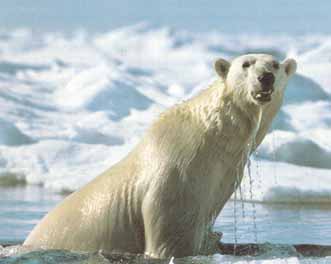
annual pelagic primary production and food production for higher
have a powerful eff ect in the top levels of the food chain. Today, water
trophic level animals in a wide range of Arctic marine areas (Rysgaard
copepods (crustaceans that live on algae) are limited by food (Rysgaard
et al., 1999, 2003).
et al., 2003), and stimulation of plankton production will immediately
mean increased grazing and growth of copepods).
The reduction in sea ice and increased open water period may be a
benefi t to some marine mammals e.g. Atlantic walrus which may get
Sedimentation of the copepods' faeces will therefore increase, thereby
improved feeding conditions (Born et al., 2003). However, polar bear
increasing the quantity of food for bottom-living animals. This will, for
may have reduced habitats and feeding areas (Wiig et al., 2003).
example, increase growth in mussels, which are today very limited by
food. The increased mussel growth will benefi t for example walruses
North and East Greenland (region 1 and 15)
(Born et al., 2003). Rising winter temperatures will mean that the ice
In Northeast Greenland the expected global warming is predicted
does not reach the same thickness as today and will therefore break up
to result in severe changes and in reductions of ice thickness and
earlier in spring and that the walruses could seek food on the mussel
prolonged open-water periods up to halving in the fj ords and a
banks for longer periods.
doubling of the ice-free period (Johannesen et al., 2002; Ryesgaard
et al., 2003). As a result, more light will penetrate down in the water
Problems for polar bears
column, which will stimulate the production of both plankton algae and
The polar bear, on the other hand, is facing an uncertain future in East
bottom-living algae. However, the increased precipitation (snow) will
Greenland. The eff ects of global warming on East Greenland polar bears
impair the light conditions in the ice in early spring and probably have
have not been documented. However, with reference to what has been
an adverse eff ect on the production of sea-ice algae and the animals
found in other parts of the Arctic (e.g. Hudson Bay and Svalbard) polar
that benefi t from the early production. All in all, however, production is
bears in East Greenland may be negatively aff ected (Lunn et al., 2002;
predicted to increase (Rysgaard et al., 1999, 2003; Meltofte et al., 2003).
Wiig et al., 2003). In areas where the ice disappears fast it reduces the
bears' hunting grounds and the bears' will probably follow the ice
Algae, water copepods, mussels, and walruses
northwards. However, another possible scenario is that starving bears
An increased freshwater supply as a consequence of increased
seek land and become an easy hunting target for bear hunters (E.W.
precipitation and melting of the ice cap in the inner parts of the fj ords
Born, Greenland Institute of Natural Resources, pers. comm.). Seals,
is likely to increase the water exchange in the fj ords and bring more
which are attached to the ice, will presumably become concentrated
nutritious water in from the open sea and thus contribute still further to
in smaller areas with ice and may therefore be more easily accessible to
increased primary production. The increased production is predicted to
the bears, but in the longer term, the number of bears will decrease. In
addition, the polar bears are not good at hunting seals in water.
Fish
Rising surface temperatures will also have a major eff ect on the
composition of fi sh in the high-Arctic zone (i.e. region 1). In the case of
Arctic char, reproduction ceases when the temperature rises above 5°C
because the enzymes in the egg sacs denature when the temperature is
just a little over 5°C. As a result, the eggs rot in the body and the fi sh dies.
At the same time, a number of Arctic fi sh species will be more exposed
to parasites and bacterial and fungal attack, and their immune defence
system will be reduced with rising temperatures.
Crabs, copepods, and sea birds
There are no crabs in areas with temperatures below 0.5ºC, which
Figure 10 Polar bears live in ice-covered fj ords and seas, their
characterises large areas off East Greenland. The temperature rises in the
most important prey being ringed seals. It has been
future will perhaps mean that crabs will migrate into the area and thus
estimated that the polar bears of Baffi
n Bay and Davis
distinctly change the composition of bottom-living fauna. According
Strait eat about 160 000 ringed seals each year.
(Source: Born and Bøcher, 2001) (Photo: Oliver Gilg)
to Soto (2002) temperature directly aff ects the metabolic rate and
ASSESSMENT
31
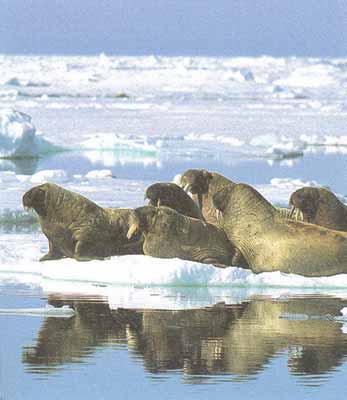
West Greenland (region 16)
Sea ice and open-water refugia are of crucial importance for marine
productivity and the occurrence, distribution and abundance of sea
birds and marine mammals in the Arctic marine ecosystems of the
Northwest Atlantic (Heide-Jørgensen and Laidre, 2004). The timing and
extent of primary production is strongly related to the ice formation.
Late break up of sea ice may delay phytoplankton production and
modify connections between phytoplankton and copepod grazers
that ascend from the depth at specifi c times of the year. In Disko Bay,
West Greenland, the behavioural adaptations of Calanus spp. to climate
change may have strong eff ects on the food web structure, generating
trophic cascades and eventually infl uence sea birds, marine mammals,
and the fi sheries (Hansen et al., 2003). The cascading eff ects of sea ice
coverage and marine productivity on the Arctic trophic web is diffi
cult
to assess in remote areas. According to Heide-Jørgensen and Laidre
(2004) both the cetaceans (Bowhead whales, narwhals, and belugas)
and sea birds (king and common eider, little auk, thick-billed murre)
are vulnerable to an increase in sea ice and decrease in open water, as
observed during the last decades. For example the migrating cetaceans
are vulnerable to decrease open-water because they need oxygen
after dives that can rarely exceed 25 minutes (Heide-Jørgensen and
Figure 11 Walruses occur in coastal waters. They often rest on
Laidre, 2004). It seems most likely that the above described decrease
small, sturdy ice fl oes. Thus, these fl oes are part of their
in temperature in West Greenland is only a small variation from the
habitat.
(Source: Born and Bøcher, 2001) (Photo: Lars Åby)
general trend in the arctic area of a signifi cant temperature increase
in the future.
other physiological features such as growth rate and incubation time
on invertebrates and fi sh. Increased temperatures increased growth
Fish and shellfi sh
rate, while decreasing incubation time (Soto, 2002), the direct eff ects
In the last 30 years, cod and a number of other boreal fi sh species in
of temperature on the species will change species compositions in the
South and West Greenland marine waters have decreased substantially
systems.
as a consequence of generally colder climate combined with
unsustainable exploitation. Today, more cold-adapted populations
Another marked change that could happen is a change in currents, so
of shrimp, crab, and halibut constitute the main commercial fi shing
that North Atlantic seawater containing a smaller species of copepod
resources in Greenland (Buch et al., 2004). A change in sea currents
(Calanus fi nmarchicus) could penetrate areas that are today dominated
and a rise in temperature as a consequence of the climate changes are
by polar water with larger and longer-living species of copepod (C.
assumed to improve the conditions of life for cod and other boreo-
glacialis and C. hyperborus). If C. fi nmarchicus ousted the larger species
atlantic commercial fi sh species in Southeast and West Greenland, while
it will have very serious consequences for little auks, which breed in
impeding arctic species such as Greenland halibut. In addition, a larger
millions in the Thule area and around Scoresbysund, and which are
cod population will most probably reduce the shrimp population due
specialised in foraging along the edges of ice with high concentrations
to predation (e.g. Pedersen, 1994a,b; Pedersen and Zeller, 2001; Hvingel,
of food animals (Egevang et al., 2003). The little auk lives almost
2002a). It can therefore be envisaged that there will be a change in the
exclusively from the large species of copepod and can probably not
fi shing resources from today's dominance by shrimp to dominance by
sustain on the smaller species (Egevang and Falk, 2001). Conversely,
cod under a warmer ocean climate. However, it may be that shrimps and
the Atlantic guillemot may be able to immigrate in large numbers, just
other shrimp habitat associated organisms will be distributed more to
as a number of other sea bird species may benefi t from the increased
the north without a reduction in stock size or productivity. The latter
marine production and the reduced ice cover.
is but one possible and speculative scenario which need to be further
investigated.
32
GIWA REGIONAL ASSESSMENT 1B, 15, 16 ARCTIC GREENLAND, EAST GREENLAND SHELF, WEST GREENLAND SHELF
Resource exploitation
Health impacts
Modifi cation of bottom habitats and community structures in
No known impact.
Southeast and West Greenland due to bottom trawl fi shery was seem
as an environmental problem. The bottom trawl fi shery for shrimp
Other social and community impacts
in the Davis Strait, West Greenland, is one of the world's largest cold
No known impact.
water shrimp fi sheries, with an annual catch of about 80 000 tonnes in
recent years, corresponding to an area of 16 000 km2 trawled each year.
Conclusions and future outlook
From other areas of the North Atlantic e.g. direct and indirect eff ects of
The knowledge about the way the water ecosystems function is
fi sheries on marine ecosystems has been reported as a major concern
constantly improving, but to predict the biological impacts of the
(see e.g. Svelle et al., 1997). However, in Greenland no or little data
large-scale reductions in ice cover etc., observed in the East Greenland
exists to evaluate the extent of e.g. modifi cation of bottom habitats
Shelf ecosystems in summer 2002 and 2003, more knowledge on the
and community structures due to fi sheries.
coupling between physics and biology is needed. These fast changes
in the habitats for the Greenland biota will have a high impact on life
Human disturbance of breeding sites for seabirds was also seen as a
cycles, productivity, and probability of survival for all animals e.g. polar
threat to local seabird populations. Hunting aff ects seabird populations
bears and walruses.
not only by killing birds. Delayed eff ects on fi tness may arise due to
embedded shots and disturbance factors, such as disruption of
One of the biggest uncertainties in connection with the marine
breeding activities, interrupted feeding opportunities, displacement
environment in South Greenland is the extent to which the sea currents
from preferred feeding habitats, and increased energetic expenditures
and thus sea temperatures follow changes in air temperature. The
due to fl ying which eventually may aff ect body condition and
balance between the part of the seawater in Southwest Greenland that
subsequently reproductive success (Merkel, 2002a).
comes from the cold East Greenland Current and the warm Irminger
Current, and the cold water masses in Baffi
n Bay and Davis Strait, thus
There is no documentation where disturbance impacts on seabird
totally determine the ecological conditions off Southwest Greenland,
populations breeding in Greenland have been separated from hunting
where most of Greenland's human population live.
impacts. But experience from other areas show that disturbance is
closely linked to hunting activities, both in terms of the activities as
In conclusion there is a need for development of coupled climate-
such, and also in terms of how birds react to disturbance (e.g. Fox and
ocean-biological models and ecosystem based management of natural
Madsen 1997, Madsen 1998). Therefore disturbance impacts will be
resources in Greenland waters. A research programme to establish a
dealt with elsewhere.
scientifi c basis for a long-term ecosystem-based management of
natural resources in West Greenland waters was outlined in 2001
Socio-economic impacts
(Jarre, 2002). This programme is currently under development and
Economic impacts
planning by the Greenland Institute of Natural Resources and several
Large-scale tourism development is generally absent in Greenland,
other international partner institutes (Greenland Institute of Natural
except maybe for Disko Bay where several research projects assess the
Resources, 2002).
environmental impact of tourism that has been increasing rapidly over
the past few years. Two other existing forms of tourism are expensive
tourism in the hunting districts on the one hand, mainly interacting
with specially developed services mimicking the traditional hunting
Unsustainable exploitation of
communities (Danielsen et al., 1998), and hiking tourism mainly in South
fish and other living resources
Greenland, often connected to rod fi shing and farm stays, supplying
an additional income to sheep farmers. These services appear not to
Environmental impacts
be infl uenced by changes in resource usage patterns (Rasmussen and
Overexploitation
Hansen, 2002). According to Kaae (2003) there is a need for improved
Fishing
interactions between tourism, management of natural resources, and
In West Greenland, overexploitation has been reported for Atlantic
the local societies in Greenland.
cod, Atlantic halibut, redfi sh, wolfi sh, starry ray, long rough dab (e.g.
Buch et al. 1994; ICES, 2003; NAFO, 2003; Greenland Institute of Natural
ASSESSMENT
33
Resources, 2000). In East Greenland, overexploitation has been reported
Table 6
Reported number of individuals by part-time and full-
time hunters, 1996-2000.
for Atlantic cod, Greenland halibut, and redfi sh (ICES, 2003).
1996
1997
1998
1999
2000
Many of the Greenlands fi sh resources are unstable because temperature
Sea birds
limits their distribution. Even small changes in ocean circulations and sea
Brünnich's guillemot
254 728
236 466
221 783
227 121
176 760
temperatures can have profound eff ects on species productivity and
Common eider
83 810
76 991
72 109
71 041
61 702
distribution (see causal chain analysis). At present cod is very sparse in
King eider
5 557
4 030
3 362
3 535
2 694
both off shore and inshore areas of West Greenland. ICES recommends
Little auk
64 494
49 220
21 017
25 296
44 871
no fi shing on cod until a substantial increase in recruitment and biomass
Small whales
is evident (ICES, 2003). According to ICES (2003), a recovery plan for both
Narwhal 738
797
822
775
597
inshore and off shore components should be developed in order to take
Beluga 542
577
746
493
609
advantage of strong year classes when they occur and to protect all
Harbour porpoise
1 662
1 550
2 051
1 830
1 607
inshore spawning components. For other fi sh species such as redfi sh,
Pilot whale
67
208
365
115
5
wolfi sh, starry ray, and long rough dab, NAFO similarly recommends
Seals
no fi shing until a substantial increase in recruitment and biomass is
Ringed seal
90 309
80 387
82 108
83 453
80 265
evident (NAFO, 2003).
Harp seal
74 645
69 663
82 491
95 097
99 847
Hooded seal
9 906
7 500
6 328
7 458
5 834
Sea bird hunting
Bearded seal
2 134
2 349
2 354
2 336
2 695
Several species of seabird populations belonging to the West Greenland
Harbour seal
256
295
217
148
124
ecosystem, Brünnich's guillemot, king eider, common eider, and Arctic
Walrus 305
317
610
311
329
tern have been reduced due to human activities, and in most cases
(Source: Namminersornerullutik Oqartussat, 2002)
hunting, egg collection, and associated disturbance has been assigned
Table 7
Calculated number of belugas in the area Qeqertarsuaq
as the main impact factors (Frich, 1997; Mosbech et al., 1998; Jensen,
og Maniitsoq, West Greenland. From aerial
1999; Falk and Kampp, 2001; Merkel and Nielsen, 2002; Merkel et al., 2002;
observations.
Merkel, 2002a,b; Egevang and Boertmann, 2003; Greenland Institute of
Year
Number of belugas
Natural Resources, 2000). Catch statistics are given in Table 6.
1982
19 689
1994
10 230
At least 57 000 common eiders are bagged annually in Greenland,
1999
7 941
which corresponds to app. 12% of the total winter population estimated
(Source: Greenland Institute of Natural Resources, www.natur.gl)
for West Greenland (Merkel, 2002a). According to a population model
(Gilliland et al. in prep.; Merkel, 2002a) the West Greenland winter
Excessive by-catch and discards
population can sustain a take of app. 8%. As a consequence of the
Fish
overexploitation, the model predicts the West Greenland breeding
In addition to reported landings one will have to add an unknown
population to decline by 3.2% per year, which is close to survey fi gures
amount of unreported fi sh and shrimp catches discarded at sea. Large
detected at some breeding grounds.
amounts of small fi sh, especially redfi sh, are discarded or die due to
contact with the fi shing gear in the sea (e.g. Pedersen, 1995).
Beluga, narwhal and walrus hunting
In West Greenland the declining abundances of walrus, narwhal, and
Although little quantitative information on the by-catch and discards of
beluga are believed to be mainly caused by overexploitation (Born et al.,
fi shes in the West Greenland shrimp fi shery is available, the considerable
1994; Greenland Institute of Natural Resources, 2000; Heide-Jørgensen,
fi shing eff ort of shrimp fi shery (e.g. 164 000 trawl hours in 2001, see
2001; Heide-Jørgensen and Acquarone, 2002). Catch statistics are given
Hvingel, 2002b) seems to aff ect the demersal fi sh community (Kingsley
in Table 6.
et al., 1999; Buch et al., 2004; Siegstad et al., 2003a,b).
Of marine mammals the reductions in the Northwest Greenland beluga
Sorting grids (22 mm) have, however, been mandatory in the shrimp
population have caused concern (Table 7).
fi shery since October 1, 2000, in order to reduce the by-catch of
juvenile fi sh. Results of experimental fi shing with 22mm sorting grids
34
GIWA REGIONAL ASSESSMENT 1B, 15, 16 ARCTIC GREENLAND, EAST GREENLAND SHELF, WEST GREENLAND SHELF
shows a nearly complete protection to fi nfi sh larger than about 20
Socio-economic impacts
cm, but poor protection of the smallest fi sh (Engelstoft et al., 2001).
Economic impacts
Besides the introducing of sorting grids Greenland shrimp trawling
There was some discussions and doubt about the economic score
regulations require ships to change grounds by at least 5 miles as soon
impact of overfi shing and discards of small fi sh and shellfi sh in the
as by-catch exceeds certain limits. To reduce by-catch and discards in
bottom trawl fi shery. By-catch and discard data are largely missing
e.g. the Greenland Commercial shrimp fi shery, the Greenland Home
However, based on very preliminary trophic modelling and comparisons
Rule Government has introduced by-catch regulations and laws, and
with experience in similar systems, for example the Newfoundland shelf,
inspectors onboard large trawlers to ensure that the fi shing laws and
it was judged that there was a moderate economic impact (score 2) of
regulations are enforced.
by-catch of small fi sh and shellfi sh in region 15 and 16.
In 2003, ICES advises that technical measures to avoid the by-catch of
The fi sheries in Greenland are characterised by three main sectors
juvenile cod in the shrimp fi shery should be maintained (ICES, 2003).
with distinct diff erences between large-scale off shore, intermediate
This advice was partly based on a cod recruitment model which
and small-scale inshore activities. This is not only due to structural and
indicates a signifi cant eff ect on potential stock recovery of even low
economic patterns, but also caused by political relations of importance
fi shing mortality on pre-recruits.
for the country's development process. A series of social science studies
related to the Greenland fi sheries sector were carried out in the 1980s
Sea birds
(e.g., Winther, 1988; Roth 1988; Roth 1989; Vestergaard and Christensen
Current studies indicate that by-catch of eiders in gillnets is a problem
1993; Vestergaard et al. 1993), and business cultures, particularly related
during late winter and spring in southwest Greenland. In Nuuk around
to the political wish for further independence, of Denmark, have
16% of all eiders sold at the local market in 2000/2001 originated from
recently been analysed (e.g., Winther, 2000, 2001).
gillnet by-catch (Merkel pers.com). Nearly all the by-catch came from
the lumpsucker fi shery in March and April.
The large-scale sector dominated by a capital rationale, with
concentration and centralisation through large-scale projects and
There is also an unaccounted mortality of seabirds wounded by
economy of scale as the fundamental mechanisms, giving access to
gunshots but not retrieved during hunting. The number of wounded
resources otherwise inaccessible, and the major contributor to the
birds, which later die of the wounds is unknown. However, that
national economy.
wounded birds is not uncommon is indicated by the estimate that
about 30% of the adult eiders caught as by-catch in gillnets in Nuuk
The intermediate sector of the regional fi sheries, partly based on
Fjord carry lead pellets from gun shots (Merkel, pers. comm.)
capital rationality, and partly based on a life form which has become
a backbone of many of the larger settlements, but also present in
Destructive fi shing practices
many smaller settlements. This sector is important for the regional
The high eff ort of bottom trawling in the Greenland shrimp fi shery
economies.
was considered to have a moderate environmental impact. The
main concern was modifi cation of bottom habitats and community
Greenland does not a priori appear to be an exception to the general
structures due to bottom trawl fi shery. However, to date no data
pattern of potentially excessive eff ort. Continued renewal of the coastal
exists to evaluate the extent of modifi cation of bottom habitats and
fl eet is constantly being discussed in public despite decreasing prices for
community structures.
northern shrimp, and rapidly increasing eff ort has been documented,
e.g., in the fi sheries for Greenland halibut and snow crab. In a large,
Decreased viability of stock through pollution and disease
sparsely populated country, incentives that increase the probability of
In spite of the considerable degree of chemical pollution detailed
rule compliance have been recognised of overriding importance to the
above, this is at present not a problem of concern for Greenland.
implementation of a management system (e.g., Heilman 1998).
Impact on biological and genetic diversity
The small-scale sector, relying on small boats, dog-sledges and/or
Not known no data.
snowscooters, is vital for the small settlements, and constituting the
backbone of the cultural heritage, and important for the direct and
indirect political attempts to maintain reasonable living conditions for
ASSESSMENT
35
the smaller places. At the same time its contribution to the maintenance
list a number of issues for which a balanced solution needs to found,
of the informal and subsistence sector is certainly not negligible
e.g. maximising economic effi
ciency, safeguarding employment and
(Rasmussen, 1998c; Caulfi eld, 1997; Marquardt and Caulfi eld, 1995).
cultural values (Det rådgivende udvalg vedrørende Grønlands økonomi,
2002). A more detailed analysis is presently carried out.
A general obstacle to a rational evaluation of the diff erent scales of
activities is the way the economy of the diff erent sectors of fi sheries is
A comprehensive research programme into the structure and
perceived. An evaluation of the total output per person (output=Dkr)
functioning of the marine ecosystem in West Greenland, including
involved in fi sheries (Rasmussen, 1994) demonstrates the dominance
both natural and social sciences, is currently being developed (Jarre
of the off -shore fi sheries with an outcome 10 times the medium-scale
2002, Greenland Institute of Natural Resources 2002, and see below) in
fi sheries and 200 times the output of the small-scale fi sheries. But an
order to contribute towards improved management of human activities
evaluation of the output in relation to the invested capital shows a very
in the respective ecosystems.
diff erent pattern, with the off -shore sector as the least capital effi
cient
activity, the small-scale fi sheries being ~1œ times more effi
cient than
Modeling and predicting the optimal outcome of exploitation of
the off -shore sector, and the medium-scale fl eet the most capital
marine resources depends on many factors of which some of the most
effi
cient activity being ~2œ times more effi
cient than the off -shore
important are to be found in good/adequate knowledge about resource
sector (Rasmussen, 1998a; Rasmussen et al., 1998; Rasmussen, 2000a).
dynamics, exploitation (fi shing/hunting, technology, gear) and socio-
economics. This knowledge is especially important for the Greenland
Although the potentials of participatory ownership are emphasised and
society facing changing climatic conditions, because the dynamics
elaborated (Winther, 2001), concrete examples also exist that highlight
and productivity of marine resources, follows climatic conditions. The
the gap between private and cooperative interest in a developing
dynamic impact on the two main forces on the marine resources, 1)
context (Olsen, 2001).
climate and 2) exploitation, are not well described and addressed in the
present management of Greenland's marine resources.
Health impacts
No known impact.
Other social and community impacts
Global change
Unsustainable fi shery and hunting may lead to 1) unemployment, social,
cultural, and economic loss (e.g. Hamilton et al., 2000; Rasmussen and
Environmental impacts
Hamilton, 2001), 2) changes in human diet and lifestyle, and 3) tourism
Changes in oceanography
may also potentially be adversely aff ected, because many tourists
Global changes in climate, oceanography, and sea ice, and the possible
expect to see a well-managed, relatively unspoilt nature in Greenland
impacts on marine biota in Greenland have been described and
with plenty of wildlife typically species that are top predators in the
addressed in e.g. Jensen (1939), Smidt (1989); Heide-Jørgensen and
respective food webs (Kaae, 2003).
Johnsen (1998), Buch et al. (2001), Petersen et al. (2001), Rudels et
al. (2002), Johannesen et al., (2002), Buch et al. (2004), Meltofte et al.
Conclusions and future outlook
(2003), Hansen et al. (2003), Stern and Heide-Jørgensen (2003) and
The task team experts found unsustainable exploitation of fi sh and
Heide-Jørgensen and Laidre (2004). The infl uence of global change
other living resources to have severe impact in East Greenland Shelf
on contaminant pathways to, within, and from the Arctic has been
(15) and West Greenland Shelf (16), but no impact in Arctic North
described in Macdonald et al. (2003).
Greenland (1).
Changes in atmospheric pressures over the past 3-4 decades have
Overexploration and by-catch of fi sh and shellfi sh in South Greenland
caused changes in ocean circulation, water temperatures, sea ice
(region 15 and 16) were assessed to have moderate economic impact.
extent, etc, which have generated changes in the marine ecosystems
of Greenland.
In a preliminary analysis, the Danish government's Advisory Committee
on Greenland's Economy, emphasises the importance of optimising the
These changes have been most clearly seen in the changes in the
fi shery policy in Greenland from a national economics perspective and
exploited natural resources - from mainly cod fi shery before 1970 to
36
GIWA REGIONAL ASSESSMENT 1B, 15, 16 ARCTIC GREENLAND, EAST GREENLAND SHELF, WEST GREENLAND SHELF
a gradually increasing shrimp fi shery after 1970 - refl ecting a shift in
conditions in the northeast Atlantic and coasts of northern Europe
the ocean climate from generally "warm" conditions before 1970 to
and Great Britain. In contrast, during negative phases of the NAO, the
generally "cold" conditions after 1970 (Figure 12).
westerly winds diminish in intensity and the storm track shifts to the
south. These changes lead to colder, stormier conditions in the western
The oceanographic and sea ice conditions around Greenland are linked
Atlantic and east coast of the United States; milder conditions in the
to climate variability and the changes in the distributions of atmospheric
northwest Atlantic and Greenland; and colder, drier conditions in the
pressures on the northern hemisphere. The North Atlantic Oscillation
northeast Atlantic and coasts of northern Europe and Great Britain.
Index (NAO-index) refl ects climate changes in the North Atlantic region
(Hurrell, 1995; Dickson et al., 2000). During positive NAO phases, the
The winter (December-March) NAO-indeces tend to be positively
planetary westerly winds intensify, and the North Atlantic storm track
correlated with next year's winter sea ice concentrations in West
shifts to the north. These changes lead to milder conditions in the
Greenland, but negatively correlated with next year's sea ice
western Atlantic and east coast of the United States; colder, stormier
concentrations in Northeast Greenland (Stern and Heide-Jørgensen,
conditions in the northwest Atlantic and Greenland; and milder
2003).
6
The warming of the northern hemisphere during the last decades
a)
NOA winter index
4
has given reduced summer ice cover and increased open-water
2
0
periods in East Greenland, however, at the same time regional lower
-2
temperatures, increased ice cover, and reduced open-water periods have
NAO winter index
-4
-6
been observed in West Greenland. These changes have major impacts
0
b)
Mean winter air temperatur (°C) Nuuk (Godthåb)
on species distributions and fi sheries as described under Physical
(°C)
-4
r
e
characteristics of Greenland and Habitat and community modifi cation.
t
u
r
a
-8
e
p
m -12
Te
Sea level change
-16
Only one water level (WL) recorder in Nuuk, West Greenland, has
4
c)
Mean sea surface temperature (°C) Fyllas Bank, June-July
(°C)
measured WL over a long period. A slight increase in WL since 1960
3
r
e
t
u
has been registered, but it is insignifi cant and of no importance for
r
a
2
e
p
Greenland (E. Buch, Danish Meteorological Institute).
m
1
Te
0
Increased UV-b radiation as a result of ozone depletion
d)
Atlantic cod
400
UV-b mesurements have been made in Greenland over several years.
nnes)
o
Changes in ozone concentrations have been compensated by an
300
increase in cloud cover and there have therefore been no changes in
(1 000 t
h 200
tc
the UV-b radiation.
Ca
100
Changes in ocean CO source/sink function
2
0
The east and west Greenland shelf areas (region 15 and 16) and the Arctic
80
e)
Northern shrimp
ocean (region 1) are remote areas with few observations of the marine
60
carbon chemistry. However, the open ocean area in the Nordic Seas are
40
(1 000 tonnes)
h
one of the globally most effi
cient regions per area in sequestering CO
2
20
tc
Ca
from the atmosphere (e.g., Takahashi et al., 2002), and therefore signifi cant
0
1950
1960
1970
1980
1990
2000
changes would be expected in the near shore surface pCO fi eld around
2
Year
Greenland and in the Arctic ocean as a consequence of global change,
Figure 12 Time series of the winter NAO index (a), winter air
in particular the rising atmospheric CO level. Therefore the assessment
temperature (b), sea temperature (c), landings of Atlantic
2
cod (d), and northern shrimp (e) in the West Greenland
is: Some reasonable suspicions that current global change is impacting
LME (16), 1950-2000.
the aquatic system suffi
ciently to alter its source/sink function for CO .
2
(Source: S.A. Pedersen, Greenland Institute of Natural Resources, unpubl.; redrawn
from Petersen et al., 2001)
ASSESSMENT
37
Socio-economic impacts
In the 20th century Greenland has experienced two great transitions,
Economic impacts
from seal hunting to cod fi shery, then from cod to shrimp fi shery, both
The interactions between climate and human resource use have large
aff ected the human population centers of West Greenland and the
socio-economic impact. The combination of climate variation and
economy. The economic transitions refl ected large-scale shifts in the
fi shing pressure, for example, proved fatal to West Greenland's cod
underlying marine ecosystems, driven by interactions between climate
fi shery (e.g. Smidt, 1989; Buch et al., 1994; Horsted, 2000; Hamilton et al.,
and human resource.
2000). The socio-economic consequences may diff er substantially due
to diff erent response patterns, both regionally and sectoral (Rasmussen
Model predictions of future climate change and its impact on the
and Hamilton, 2001). The resilience of the social systems, however, may
habitats, communities, living resources, pollution, and socio-economics
contribute to solving some of the adverse eff ects of climate change,
are needed for Greenland.
for instance enabling a continuous consumption of traditional food
products, in spite of attempts to globalise the consumption patterns
(Rasmussen, 2002).
Priority concerns
Health impacts
No known impact.
The result of the impact assessments of GIWA issues in the three
Greenland regions are summarises in Table 8.
Other social and community impacts
For the Greenland society, a warmer climate would probably mean
The environmental factors were considered to be far most important
increased fi shing in the form of more boreo-atlantic species such as cod,
and the sum of present and future score were used as the overall score
and haddock, but fewer shrimps. The possibilities for hunting ring seals
of Major Concern (0 lowest and 5 highest overall score).
and polar bears would probably be reduced in the long run, while the
occurrence of several other game animals would depend more on the
pressure of hunting itself. Transport conditions would be much better
Table 8
Prioritisation of impacts of Major Concern at present
because the period of open water would be longer, making it easier
and in 2020 in Arctic Ocean (1), East- and West
for boats to call at many towns and villages. There would probably be
Greenland Shelf (15 and 16).
far less fi eld ice, but on the other hand, a reduced possibility of using
Major Concern
Impact/
Impact/2020
Overall Score
Present
Sum
weight%
the ice to get from place to place. Retraction of glaciers and the ice
Arctic North Greenland (region 1)
cap, together with less "Arctic wilderness" could adversely aff ect the
I Freshwater shortage
No known (0)
No known (0)
0
0
tourist industry, but the improved communication including a longer
II Pollution
Moderate (2)
Slight (1)
3
10
summer season could have a benefi cial eff ect.
III Habitat and community modification
No known (0)
No known (0)
0
45
IV Unsustainable exploitation of fish
No known (0)
No known (0)
0
0
Conclusions and future outlook
V Global change
Moderate (2)
Moderate (2)
4
45
The task team assessed a moderate impact of global change in the
East Greenland Shelf (region 15)
High Arctic, North Greenland (1) and a slight impact in East (15) and
I Freshwater shortage
No known (0)
No known (0)
0
0
West Greenland (16). The Arctic is vulnerable to global environmental
II Pollution
Severe (3)
Slight (1)
4
30
threats, such as the greenhouse eff ect. Even small changes in
III Habitat and community modification
Slight (1)
Moderate (2)
3
10
average temperatures will probably have profound consequence
IV Unsustainable exploitation of fish
Severe (3)
Moderate (2)
5
30
in an environment where many organisms are adapted to specifi c
V Global change
Slight (1)
Slight (1)
2
30
distribution patterns of ice.
West Greenland Shelf (region 16)
I Freshwater shortage
No known (0)
Slight (1)
1
0
Although climate change was assessed to have slight impact in East-
II Pollution
Moderate (2)
Moderate (2)
4
20
and West Greenland, decadal climate variability is a very important
III Habitat and community modification
Moderate (2)
Moderate (2)
4
10
factor for the distributions and productivity of Greenland's natural
IV Unsustainable exploitation of fish..
Severe (3)
Moderate (2)
5
50
renewable resources. Climate is a driving force for habitat modifi cations
V Global change
Slight (1)
Slight (1)
2
20
and linked to overexploitation of resources and pollution.
38
GIWA REGIONAL ASSESSMENT 1B, 15, 16 ARCTIC GREENLAND, EAST GREENLAND SHELF, WEST GREENLAND SHELF
Habitat modifi cation and overexploitation at West Greenland
Shelf (16)
Far most of the Greenland population lives on the west coast of
Greenland, about 53 000 people. "Unsustainable exploitation of fi sh
and other living resources", "Pollution" and "Habitat and community
modifi cations" were assessed to have severe and moderate impact,
respectively. Overexploitation and chemical pollution were given high
priority issues partly because harvesting the natural resources is the
backbone of the Greenland society and culture. In addition fi shing and
hunting are the main or only income for many Greenlanders.
Chemical Pollution at East Greenland Shelf (15)
East Greenland is inhabited by only about 3 600 people. "Pollution",
"Unsustainable exploitation of fi sh and other living resources", and
"Habitat and community modifi cations" were assed to have severe
and moderate impact, respectively. The system was assessed severely
impacted by the issues chemical pollution and overexploitation by
off shore fi shing vessels from West Greenland and foreign countries.
Chemical pollution was considered to be a high priority problem
because contamination of the Greenlanders natural food sources (fi sh,
sea birds and marine mammals) causes human health problems and
changes in the Greenlandic life style.
Habitat and Community modifi cation in Arctic North Greenland (1)
Although "Habitat and community modifi cation" was given zero score
at present and in 2020, "Habitat and community" modifi cation caused
by climate change was considered to be high priority issue under both
present and future conditions. The reduced ice-cover and increased
open water period in Northeast Greenland and vice versa for Northwest
Greenland most probably have a profound impact on the ecosystem
dynamics and the unique high Arctic biota (e.g., polar bear, beluga
and walrus). However, at present much too little information exists to
document these impacts and changes. There is therefore a need for
continued and increased research.
Major concern issues were the future changes in climate, melting of
sea ice, ice cover, ocean circulation, and the resulting eff ects on biota,
habitats, contamination and ecosystem dynamics. The biota was
moderate impacted by chemical pollution. However, very few people
live in this region.
ASSESSMENT
39
Causal chain analysis
This section aims to identify the root causes of the environmental
great concern for the biota and Greenland society. However, in the
and socio-economic impacts resulting from those issues and
GIWA context, it is considered as an environmental driving force, as it is
concerns that were prioritised during the assessment, so that
basically related to activities outside the Greenland region.
appropriate policy interventions can be developed and focused
where they will yield the greatest benefi ts for the region. In order
to achieve this aim, the analysis involves a step-by-step process
that identifi es the most important causal links between the
Immediate causes
environmental and socio-economic impacts, their immediate
causes, the human activities and economic sectors responsible
Immediate causes are the direct reasons behind the environmental
and, fi nally, the root causes that determine the behaviour of those
concerns and issues. It is important to identify the main direct causes
sectors. The GIWA Causal chain analysis also recognises that,
as a scientifi c basis for policies and activities to achieve an improved
within each region, there is often enormous variation in capacity
environment.
and great social, cultural, political and environmental diversity.
In order to ensure that the fi nal outcomes of the GIWA are viable
Overexploitation and fish/seafood habitat
options for future remediation, the Causal chain analyses of the
modification in GIWA region 16, West Greenland
GIWA adopt relatively simple and practical analytical models and
Fishing
focus on specifi c sites within the region. For further details, please
The main immediate causes of overfi shing and the associated habitat
refer to the chapter describing the GIWA methodology.
modifi cation are a combination of several factors: increasing fi shery
due to higher effi
ciency (new catch technology), inadequate resource
management, and vulnerable resources due to climate variability. The
impact of these factors is illustrated in the historically variable fi shery
Introduction
for cod, the former most important fi sheries resource.
Based on the assessment results it was decided to perform a causal chain
The cod fi sheries decline: The fl uctuations in cod populations are well-
analysis of the high priority issues overexploitation, chemical pollution,
known, as shown in Figure 12. The presence of cod in Greenland waters
and habitat modifi cation. Overexploitation and fi sh/seafood habitat
has a periodic character. The changes in the temperature conditions in
modifi cation were high priority issues in West and Southeast Greenland.
West Greenland in the 20th century generally coincide with the change
Chemical pollution has severe impact in East Greenland and moderate
of the cod fi shery, indicating the existence of a relatively strong climatic
impact in North and West Greenland. Habitat modifi cations due to
eff ect on the cod stock. When biological fi sheries research began in West
climatic change in high Arctic Greenland are a high priority problem.
Greenland in 1908-09, only small, local fj ord populations of cod were
present. A climatic change in the 1920's caused ocean temperatures to
Climate is a key driving force for problems of overexploitation, chemical
rise and during the following years cod became abundant along the
pollution and habitat modifi cation and therefore, climate change is of
coast of West Greenland and they dispersed northward. The general
40
GIWA REGIONAL ASSESSMENT 1B, 15, 16 ARCTIC GREENLAND, EAST GREENLAND SHELF, WEST GREENLAND SHELF
warming of the northern hemisphere around 1920 evidently lead to the
2) Continuing absence of the West Greenland cod spawning stock. The
establishment of a self sustaining and very abundant West Greenland
spawning stock at the banks off West Greenland is virtually absent
cod population. From about 1930 to the late 1960s this stock produced
since the collapse in the 1970s.
good year classes at relatively short intervals. The drastic decline in
3) Reduced infl ow of cod larvae from Icelandic spawning grounds. Since
the cod stock in the late 1960s was attributed to a combination of
the collapse of the West Greenland spawning stock in the early
unfavorable cold climatic conditions and a too high fi shing take in
1970s, cod stocks at Greenland have been entirely dependant on
the off shore international fi shery (Buch et al., 1994; Horsted, 2000). No
recruiting year-classes from Iceland. In addition to local production
good year classes were produced by the West Greenland population
signifi cant infl ow of cod larvae from Iceland occurred almost every
after the late 1960s due to generally lower and more fl uctuating water
year in the 1950s and early 1960s; this infl ow disappeared thereafter
temperatures in the West Greenland area (Figure 12). All important cod
except for the big 1973 and 1984 year classes.
year classes in West Greenland from 1970 to the present time seem to
4) Reduced predation on shrimp. The low abundance of shrimp
have been of Icelandic origin (Buch et al., 1994). The most recent of
predators, mainly cod, but also other fi sh species has probably
these, the 1984 and 1985 years classes sustained relatively high catches
improved the survival success and productivity of shrimp in recent
during 1988-1990 but evidently left West Greenland thereafter (e.g.,
years.
ICES, 2003). Today there are only very small local fj ord populations of
5) Overexploitation of cod. Fishing mortality on cod has been too
cod in West Greenland.
high due to by-catch in the shrimp fi shery and due to unregulated
fi shery directed for cod in the fj ords. The resource management
Increasing shrimp abundance: The Greenland economy, formerly being
has been unable to adequately protect the few remaining cod
highly dependant on a rich cod fi shery, is today almost entirely dependant
spawning populations during periods of cold climate and low cod
on northern shrimp fi shery. As seen from Figure 12, the decline of cod
productivity.
fi sheries was replaced by a corresponding increase in shrimp fi sheries.
Apparently, climatic and oceanographic changes play a very important
In the beginning of the 1970s new deepwater fi shing technology made
role in the modifi cation of the habitats and in the sustainability of the
it possible to develop an off shore West Greenland fi shery for shrimp.
fi sheries sector. This is further aggravated by overfi shing in the fragile
An inshore fi shery for Greenland halibut has been taking place in
and highly variable ecosystems (Rätz et al., 1999; Buch et al., 2004).
Northwest Greenland fj ords since the beginning of the last century. This
fi shery developed gradually during the 1980s and 1990s and catches
Changes in the ocean climate are probably the main cause to changes
are at present around 20 000 tonnes annually.
in productivity and structures of the marine ecosystems. For example,
for many of Greenland's fi sh species, the seas off Greenland limit
During the last two decades shrimp and Greenland halibut have been
their dispersal, for example, cod, redfi sh, striped catfi sh, halibut and
the commercially most important fi shery resources in West Greenland.
herring, which have their northern limit there. Conversely, too high sea
Export of shrimp to e.g. Japan, has provided a high-value economic
temperatures set a southern limit for the dispersal of Arctic species, such
alternative to cod, comprising 73% of Greenland's total exports in
as polar cod, and Arctic ray. Therefore, relatively small variations in the
1995. However, new fi sheries on snow crabs, started in late 1990s, and
temperature of the sea could result in considerable fl uctuations in the
scallops, started in the mid 1980's, and other mainly coastal and local
dispersal and productivity of many fi sh species, as also observed earlier
fi sheries on cod, salmon, redfi sh, wolffi
sh, halibut, herring and others
(Jensen, 1939). The trend in cod distribution by-and-large follows the
are also important for the Greenland society.
average sea temperature (Horsted, 2000).
Today's low abundance of cod and high abundance of shrimp most
In South Greenland many years of bottom trawling is believed to have
probably have the following main causes:
impacted species compositions and community structures. By-catch
of shrimp predators mainly cod, redfi sh, Greenland halibut and others
1) A general cold climate after 1970. Since 1970 the Greenland climate
in the steady growing fi shery for shrimp during the last part of the 20th
has been considerably colder than during the more stable warm
century has been suggested to be an important factor in the shift from
period between 1920 and 1970. The cold and variable conditions
cod dominated to shrimp dominated ecosystems by modifi cations of
after 1970 have been unfavourable for growth, reproduction and
habitats and community structures (e.g. Buch et al., 2004).
survival of cod.
CAUSAL CHAIN ANALYSIS
41
A general characteristic of the mainly long-lived resources exploited in
with Brünnich's guillemot populations from other breeding areas, such
Greenland waters has been a population structure with many large, old
as Svalbard, Northeast Canada and Iceland. However, the winter hunt
individuals when the fi shery begins. However due to slow reproduction
primarily takes juvenile and immature birds, while hunt in spring and
and growth rate in cold and/or deep water, the population age
summer near the breeding sites mainly takes local adult birds.
structure shifts downwards as fi shing intensifi es, and the large older fi sh
are removed. This trend has been observed not only with cod, but also
In the early 1970s by-catch in salmon gill-nets took huge numbers of
with halibut, wolfi sh, scallops and other species. In the case of isolated
Brünnich guillemots in Davis Strait in autumn. This by-catch declined
stocks, even a short period of overfi shing leads to a drastic reduction.
to insignifi cant levels in the late 1970s, because the salmon quota
For example, some Greenland halibut stocks appear resident in certain
was reduced and timing and location of the fi shery were changed,
fj ord complexes, although reproduction occurs elsewhere (Riget and
eliminating much of the overlap with the occurrence of the Brünnnich's
Boje, 1989). Such stocks are particularly vulnerable to overfi shing, on the
Guillemots (Falk and Durinck, 1991).
off shore spawning grounds.
The part of the Brünnich guillemot breeding population wintering
Sea bird hunting
in Newfoundland waters is exposed to chronic oil polluting from the
The breeding populations of Brünnich's guillemot and common eider
heavy shipping activities in these waters (Wiese and Ryan, 2003), but
have both declined signifi cantly in West Greenland during the 20th
the impact on the population is not known.
century. The immediate cause is ascribed to overexploitation (Kampp
et al., 1994; Meltofte, 2001; Merkel et al., 2002). The life strategy of both
The common eider breeding population was very large in West
species are characterised by a slow population turn-over making
Greenland late in the 1800s, documented by eider down trade fi gures.
the stability of the population dependant on a high adult survival.
As early as in the beginning of the 1900s concern was expressed for
This makes the populations particularly sensitive to exploitation in
the status of the population due to overexploitation (Boertmann et
periods when adult birds are exposed (mainly in spring and summer).
al., 2004). Locally the population has been reduced by 80% since 1960,
The present annual levels of harvest as expressed by the offi
cial bag
when the population already was reduced compared to earlier in the
records system is about 84 000 common eiders and. 255 000 Brünnich's
century (Merkel and Nielsen, 2002). Exploitation is mainly hunting, and
guillemots (maximum recorded numbers over the period 1994-2001)
as much as 32% of the hunting bag has been taken in the spring months
(Namminersornerullutik Oqartussat, 2002).
when the population is particularly vulnerable. The open hunting
season has been reduced since 2002. The high hunting pressure is
The main reasons for overexploitation in the last century is the increased
documented by the fact that a high proportion of the common eiders
human population in West Greenland and the technical development
carry embedded lead shots in their tissues (Falk and Merkel, unpubl.).
of the hunt (more effi
cient weapons, faster and more far-reaching
Egg collection and previously also down collection also impact the
boats) combined with the low productivity of the exploited species.
population as well. Preliminary studies indicate that by-catch in gill-
However, besides the hunting harvest, climatic changes, as for example
nets (mainly for lumpsucker) also contribute to the mortality (Merkel,
the extension and duration of winter sea ice, by-catch in gillnets and
2002b), but the impact is not known. King eiders at moulting sites also
disturbance (mainly hunting related) at colonies and moulting sites may
show population declines (Mosbech and Boertmann, 1999).
also have had an impact on the populations.
Marine mammals: Beluga, narwhal and walrus hunting
Since 1930 the breeding population of Brünnich's guillemot has
A number of marine mammals have been exploited commercially
decreased by 80 % in West Greenland, and by 35 - 50 % in Greenland
in Greenland in recent times, either by whalers or by organised
as a whole (Falk and Kamp, 2001; Kampp et al., 1994). Only in the
hunting cooperations that have sold their products on the national
northernmost part of the breeding range (in Qaanaaq in North
and international market. Subsequently, several species were and are
Greenland) the population seems stable (Falk and Kampp, 2001). The
exploited by local hunters whose hunting techniques and economic
population is migratory, wintering in the open waters of Southwest
motivations resemble those of commercial whalers. This has been
Greenland and in Newfoundland waters (Kampp, 1988; Lyngs, 2003).
particularly obvious in cases where the hunting of marine mammals
In both areas the guillemots are exposed to hunting and signifi cant
has been part of an overall pattern of exploitation that included fi shing.
numbers are taken. But it is diffi
cult to assess the impact on the
Examples of this are belugas, narwhals, and walruses (Born et al., 1994;
Greenland breeding population because the winter quarters are shared
Heide-Jørgensen, 2001).
42
GIWA REGIONAL ASSESSMENT 1B, 15, 16 ARCTIC GREENLAND, EAST GREENLAND SHELF, WEST GREENLAND SHELF
The hunting of walruses in West Greenland during the 20th century
to increase hunting eff ort and maintain it at a high level, even though
is an example of how increasingly effi
cient hunting methods and lack
there were signs that the population was being overexploited. Today
of regulation may rapidly lead to overexploitation of a group of marine
hunting is not self-regulating mainly do to effi
cient transportation and
mammals in which the innate capacity of increase is relatively low.
hunting equipment.
Beginning in 1911, hunting expeditions using government schooners
The above historic example emphasises the necessity of monitoring
were sent to the walrus haul-outs in West Greenland. Private motorboats
and regulating hunting eff orts; this is especially true when it becomes
soon began to participate in the hunt. The most obvious result of this
technically and economically feasible to intensify the hunt on a
intensifi ed and uncontrolled hunting pressure was the complete
population of marine mammals.
disappearance after about 30 years of walruses from their haul-outs in
West Greenland. They have not since returned to these haul-outs.
Chemical pollution
Long range transport and climate
Since 1932, walruses have also been hunted during the spring in the
The vast majority of chemical pollution in Greenland is due to long-
West Ice off Sisimiut/Holsteinsborg to Aasiaat/Egedesminde and west
transported contaminants from outside Greenland (AMAP, 2002;
of Qeqertarsuaq/Disko. The vessels used were likewise partially fi nanced
Macdonald et al., 2003).
by public funds. The walrus hunt thus had the character of a commercial
activity that was subsidised by the government. Great amounts of hides,
Main sources of marine pollution are the industrialised areas in Europe,
tusks, and blubber were sold to the Royal Greenland Trade Company,
Russia and USA (AMAP, 1998, 2002; Christensen et al., 2003). Pollutants
which continued to buy these products long after it became diffi
cult
are transported to Greenland by the atmosphere and by the marine
to sell them on the international market. For a number of years catches
currents, however, transportation by ice may also play a role. The
were very large; in West Greenland alone at least 12 000 walruses were
prevailing patterns of wind direction, especially in winter, transport air
landed between 1900 and 1987. The actual number of animals killed
masses from industrialised areas to the Arctic (Figure 13). The cold Arctic
was probably much higher, because not all catches were reported and
climate seems to create a sink for e.g. Hg and POPs (AMAP, 1998, 2002;
because many animals sank and were lost during hunting. Furthermore,
Macdonald et al., 2003; Christensen et al., 2003).
mainly females with young were hunted in the West Ice because they
were more accessible than males. The males preferred to stay in the
Three major mines have been in production in Greenland, and
dense pack ice further off shore. Moreover, during spring females have
elevated heavy metal levels have been observed in fj ord areas within
a relatively greater content of blubber, making them a more attractive
approximately 40 km from the mine sites (Riget et al., 2000). However,
commodity.
local sources of pollutants in the marine environment around Greenland
play a minor role, except for lead pollution from the use of lead shot
Even though the decrease of the walrus population in these areas
(Johansen et al., 2004).
was obvious relatively early, hunting regulations were not introduced
until around 1950, fi nally aff ording the walruses a certain degree of
Heavy metals
protection.
The heavy metals assessment in AMAP focuses on mercury, lead, and
cadmium. Of the metals, mercury (Hg) pollution generate the greatest
The population is still far below earlier levels. Aerial surveys between
concern because levels in the Arctic are already high, and are not
1981 and 1994 indicated that during the spring there are less than
declining despite signifi cant emissions reductions in Europe and North
1 000 animals in the West Ice between Sisimiut/Holsteinsborg and
America (Macdonald et al., 2003).
Qeqertarssuatsiaq/Hare Island. During this period, in which hunting
continued, there have been no signs of growth in the stock.
Coal burning, waste incineration, and industrial processes around the
world emit Hg to the atmosphere, where natural processes transport
In a "traditional" hunting community without the mechanisms of
the metal. The Arctic is vulnerable because unique pathways appear
a market economy, the hunting eff ort is reduced as soon as the
to concentrate Hg in forms that are available to the food web.
number of animals decreases, allowing the population to recover. This
Environmental changes may have made these pathways more effi
cient
"feedback" regulation mechanism was put out of operation in the case
in recent years. In the Arctic, Hg is removed from the atmosphere and
of the walruses of West Greenland, because public funds were used
deposits on snow in a form that can become bioavailable. A recently
CAUSAL CHAIN ANALYSIS
43
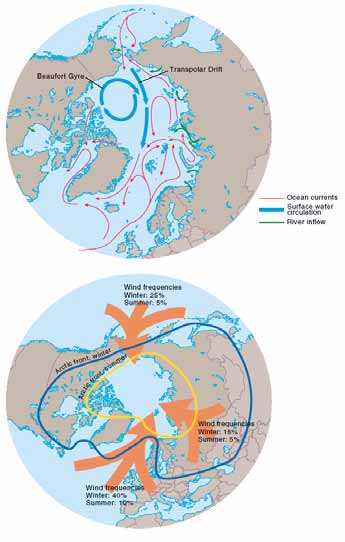
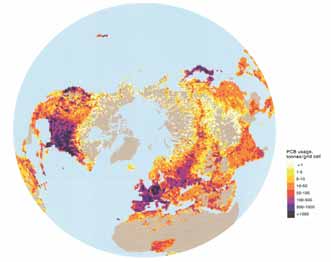
studied. The connection between atmospheric transport and
deposition to Arctic surfaces (Hg depletion events) shows the Arctic
to possess a unique, climate-sensitive process that may explain much
of its susceptibility to Hg contamination. However, the pathway for Hg
between its deposition to surfaces, especially following polar sunrise,
and its concentration in apex aquatic feeders is very poorly known.
AMAP recommends that studies continue on the Hg cycle in the Arctic
with emphasis on the processes implicated in Hg depletion events
and in the biogeochemical cycling of Hg in ice-covered environments
(Macdonald et al., 2003).
POPs
Most of the total quantity of POPs found in the Arctic environment is
derived from distant sources (Figure 14). Most POPs are semi-volatile
and their transport is complex.
In temperate and tropical regions, they are picked up by the winds
as gases. When temperatures drop, they condense onto atmospheric
particles and other surfaces, reaching the ground via rain, snow,
or direct deposition onto land and water. The role of atmospheric
transport varies with the seasons. Generally, atmospheric long range
transport to the Arctic from source areas in North America and Eurasia
is much higher in winter and early spring than in summer (Macdonald
et al., 2003).
The precise importance of ocean transport for each compound
depends on the physical properties of the substance (AMAP, 2002;
Macdonald et al., 2003). The role of ocean currents in transport is
Figure 13 Pathways for pollutants transported to Greenland.
Upper map: Rivers and ocean currents are important pathways for water-soluble
contaminants and those that are attached to particles in water.
Lower map: Winds provide a fast route for contaminants from industrial areas to
the Arctic, especially in the winter.
(Source: AMAP, 2002)
discovered process links enhanced deposition of Hg to the polar
sunrise, which is unique to high latitude areas. The resulting enhanced
deposition may mean that the Arctic plays a previously unrecognised
role as an important sink in the global Hg cycle (AMAP, 2002). Some
of the deposited Hg is released to the environment at snowmelt,
becoming bioavailable at the onset of animal and plant reproduction
and rapid growth. Although poorly understood, this process may be the
chief mechanism for transferring atmospheric Hg to Arctic food webs.
Despite declining anthropogenic emissions, at least in the period
between the 1980s and the 1990s, the Arctic ecosystem appears to be
Figure 14 Estimated cumulative global usage of PCBs (1930-2000).
increasingly exposed to Hg (Macdonald et al., 2003). It is unclear why
Most of the use was in the northern temperate region.
this is so because the complete Hg pathway has not been adequately
(Source: AMAP, 2002)
44
GIWA REGIONAL ASSESSMENT 1B, 15, 16 ARCTIC GREENLAND, EAST GREENLAND SHELF, WEST GREENLAND SHELF
probably more important for contaminant levels in the Arctic than
Root causes
was previously thought. Water soluble chemicals that are effi
ciently
removed from the air by precipitation or air-to-sea gas exchange may
The root causes are the more fundamental reasons behind the
reach the Arctic primarily via ocean currents.
direct causes for environmental decline. Experience has shown that
addressing the direct, immediate causes is not suffi
cient to achieve
The POPs are transported to the Arctic by regional and global physical
sustainable results. It is equally and sometimes more - important to
processes, and are then subjected to biological mechanisms that
identify and consider actions related to the root causes.
lead to the high levels found in certain species. Given the length and
complexity of the POP pathways into top predators of aquatic systems
Examples of some fundamental root causes are population growth,
in the Arctic, exposure to these chemicals is particularly sensitive to
unsustainable economic development, social and cultural conditions.
global change (Macdonald et al., 2003).
But lack of knowledge, inadequate governance, and lack of awareness
may also be important root causes. Of special importance for the fragile
Habitat modification in GIWA region 1, Northern
ecosystems of Greenland are the basic root causes related to natural and
Greenland
man-induced climatic changes.
Climate change
The oceanographic and sea ice conditions around Greenland are
Overexploitation of living resources
linked to climate variability and the changes in the distributions of
Climate change
atmospheric pressures on the northern hemisphere. The last decades
Overexploitation of fi sh and shellfi sh in Greenland is linked to global
warming of the northern hemisphere has given reduced summer ice
changes in climate and ecosystem functioning as illustrated in the
cover and increased open-water periods in East Greenland, however,
above description of historic fl uctuations in the cod populations and
at the same time regional lower temperatures, increased ice cover, and
fi sheries yields. A more detailed description is given in Buch et al. (2004).
reduced open-water periods has been observed in West Greenland (e.g.
Changes in the thermal regime can have a considerable impact on the
Stern and Heide-Jørgensen, 2003). These changes have major impact on
abundance of fi shes and shellfi sh. Fore example Northern shrimp,
the marine ecosystems and the habitats for the Arctic animals.
snow crab and Icelandic scallop prefer relatively cold temperatures in
the range of 1-5oC and especially their larvae are less vulnerable to low
In Northeast Greenland, Rysgaard et al. (1999) expects future increase
temperatures compared to e.g. cod. The better ability of shellfi sh larvae
in the annual pelagic primary production, secondary production, and
to cope with low temperature environment partly explain the positive
hence food production for higher trophic level animals in a wide range
reaction of the shrimp and snow crab stocks to the changed climatic
of Arctic marine areas, as a consequence of reduction and thinning of
conditions observed in West Greenland in last decades. However, the
sea ice cover due to global warming. However, the reduction in sea
shift in the underlying marine ecosystems at Greenland may have been
ice may be a benefi t to some marine mammals e.g. Atlantic walruses
amplifi ed by the declining cod stock due to a release in predation
(Born et al., 2003), but probably not for others e.g. polar bears (Wiig et
pressure on e.g. sandeel and shrimp as observed in Eastern Canada
al., 2003).
(Koeller, 2000; Lilly et al, 2000).
In West Greenland, Heide-Jørgensen and Laidre (2004) found the
Inadequate management
increased ice cover and reduction in open water refugia to be a threat
An overall diffi
culty in fi sheries and hunting assessment is to
to a number of sea birds and marine mammals.
assess whether changes in the stocks are due to overexploitation
or environmental changes (changes in climate, ocean circulation,
The above described changes in ice cover and open water occur and
turbulence etc.). Up until now the fi sheries assessment and the
impact the habitats of mainly the northern high Arctic areas of East
subsequent management methods used have generally been
and West Greenland. In these areas the impact of climate change are
inadequate (e.g. Maguire, 2001).
predicted to be most severe whereas in South Greenland changes in
climate are expected to have less impact on habitats and ecosystems.
During the task team meeting in Nuuk a number of root causes for
overexploitation of fi shes, shellfi sh, sea birds and marine mammals
were mentioned and discussed. They are listed according to the four
dimensions of a fi shery system as used by the ICES Working Group
CAUSAL CHAIN ANALYSIS
45
on Fishery Systems (WGFS, 2003), i.e., scientifi c, political, related to
where vessels belonging to a member state of the Northeast
monitoring, control and surveillances (MCS), and user group related.
Atlantic Fisheries Commission, re-fl ag under a non-member
country, thereby avoiding restrictions in the fi shery.
(a) Scientifi c documentation
Variable market prize diff erentiate fi shing and hunting pressure on
Inadequate data: For example for inshore cod.
resources.
No quantitative and analytical biological assessment and advice:
Lack of transparency and accountability in the process of balancing
For example off shore snow crab.
between natural resource conservation, social and economic issues.
Inadequate stock assessment: For example cod. The biological
Lack of management plans.
advice for and management of the cod fi shery off Greenland is
Partly lack of political will to listen to biological advice.
based on a combined assessment of cod in its distribution area East
and West Greenland. However, the cod populations in these areas
(c) Administrative constraints
are partly separate and additionally connected to the Icelandic cod
Lack of control or inadequate control: In the wide areas of the North
stock in a complicated way, resulting in a complex stock structure
Atlantic schemes of control and enforcement are most often hard
(e.g., Wieland and Hovgaard, 2002; Stein et al., 2002; Anon.,
to accomplish, although introduction of satellite devices and a
2003c). The complexity of the stock structure is not considered
vessel monitoring system have improved control and enforcement
in the assessment as it is done today by ICES. There is a need for
substantially.
improved assessments by a better use of the available biological
Inadequate logbook reporting: For example inshore cod.
and hydrographic knowledge in the assessments not only for cod
No gear registration and no lost gear registration (in contrast to
but also for several other exploited resources of fi sh, shellfi sh, sea
practice in, e.g., the Faroe Islands), resulting, e.g., in the possibility
birds and marine mammals.
of ghost fi shing by gill nets.
There is a need for improved regional stock assessments by
Inadequate
fi shery administration: Fishery and hunting controls too
development of coupled models of the dynamic relationship
costly or not prioritised.
between climate, ocean circulation, and variability in key species
abundance not only for cod but also for several other exploited
(d) User-group related
resources of fi sh, shellfi sh, sea birds and marine mammals (e.g.
Many local communities and settlements are dependent on the
Pedersen et al., 2002; Pedersen and Bergström, 2003; Ribergaard et
harvest of marine resources because there are no other income
al., 2004; Heide-Jørgensen and Laidre, 2004).
possibilities.
Improved fi shing and hunting technology over the years.
(b) Political constraints
No fl exibility in the medium- and large-scale fi shery e.g. seasonal
No regulations or inadequate regulations: This mostly applies to
shifts in target species.
widely distributed fi sh stocks such as Greenland halibut. Often,
Overcapitalisation (e.g., snow crab fi shery).
ineffi
cient and uncoordinated management measures lead to an
The need of monetary income (after change of the society to
uncontrolled and most probably high exploitation of the resource
a money-based economy) increases pressure on vulnerable
as is the case for Greenland halibut in East Greenland and Iceland.
resources.
No formal agreement on the management of the shared Greenland
Disagreement about the current resource situation between on the
halibut stocks exists among the three coastal states, Greenland,
one hand biologists and on the other hand fi shers and hunters.
Iceland and the Faroe Islands. The regulation schemes of those
states have previously resulted in catches well in excess of TAC's
Socio-economic problems
advised by ICES.
A discussion among task team members on root causes revealed the
The Government subsidises fi shing and hunting gear, boats and
necessity to discriminate between recreational and professional fi shing
engines.
and hunting. For recreational fi shermen and hunters a root cause may
Foreign nations that are non-members of commissions are not
be inadequate knowledge about the resources and inadequate
restricted by regulations and measures set up by the respective
understanding of the importance of observing rules and restrictions.
coastal nations or commissions that have taken the responsibility
For local professional fi shermen and hunters the main root cause is
to regulate international fi sheries. Examples of this is seen in the
probably the lack of alternatives to fi shing and hunting. In families
pelagic redfi sh fi shery in the Irminger Sea and adjacent areas,
with annual income of about 50 000 Dkr per family (i.e., well below
46
GIWA REGIONAL ASSESSMENT 1B, 15, 16 ARCTIC GREENLAND, EAST GREENLAND SHELF, WEST GREENLAND SHELF
the poverty line), it is naturally diffi
cult to reduce exploitation and
system is complex and large uncertainties exist in the understanding
thereby family budgets. Therefore, to rebuild overexploited resources,
and prediction of climate change, the question is no longer if we will
alternative income possibilities must be off ered to the professional
experience climate change, but how large anthropogenic and natural
fi shermen and hunters.
changes will be, how fast they will appear and their regional variations
(Jørgensen et al., 2001).
Chemical pollution in East Greenland
Lack of knowledge
Analyses with global climate models show the following general trend
In spite of recent progress, in particular due to the fi ndings of the
for the climate in Greenland in 2100 in relation to 1990 (Anon., 2003a):
AMAP programme, there are still considerable uncertainties about the
In South Greenland a rise in mean annual temperature of just over
sources, the transport mechanisms and the impacts of the arctic food
2°C, slightly more in winter and slightly closer to 2°C in summer, and
chains of chemical pollutants. In particular, documentation to pinpoint
in North Greenland, a rise in temperature of 6-10°C in winter but
key international causes is needed to form a better scientifi c basis for
only small rises in summer;
reduction of the impacts
A general increase of 10-50% in precipitation, but little or no increase
in Southeast Greenland. In winter, however, a considerably bigger
Lack of international governance
increase in North Greenland, locally up to more than 100%.
The major sources for the chemical contamination of the waters and the
ecosystems around Greenland can be found in the pollutant releases in
Such changes will cause signifi cant impacts on the oceanographic
Europe, Asia and North America. The only possibility of reducing these
conditions and on the stability of the ice cover. It is questionable if
sources is a continued focused and signifi cant international eff ort to
the present arctic ecosystems will be able to accommodate these
control these emissions, and to enforce existing agreements.
changes.
Socio-economic conditions
Lack of knowledge
The combination of environmental conditions and biomagnifi cation
There is a considerable lack of both data and understanding of how the
in the marine food webs result in accumulation of certain persistent
arctic ecosystems will react to possible drastic changes in the climate
contaminants in traditional food of the Greenland people. For many
and ice-cover.
reasons, traditional food still plays an important role in the diet of the
population, in particular in the settlements
The consumption of marine mammals, fi sh and sea birds is high but
Conclusion
the young and the population in towns eat considerably less than
the elderly and the population in the villages. Seal is the most often
Overexploitation of the marine resources, in particular in West
consumed traditional food item followed by fi sh. On average, 20% of
Greenland, GIWA region 16, partly due to climate change, inadequate
the Greenlanders eat seal 4 times a week or more often while 17% eat
knowledge of the living resource dynamics, and management, and
fi sh similarly often. Traditional food is valued higher than imported
partly due to the ability or inability of the municipality to react and
food; the highest preference is given to mattak (whale skin), dried
adapt to changes, is a severe problem and one of the large challenges
cod, guillemot, and blackberries. Almost all value traditional food as
for Greenland now and in the future (Figure 15).
important for health and less than one percent (in 1993-94) restricted
their consumption of marine mammals or fi sh because of fear of
Chemical pollution from outside Greenland is a threat to the biota at
contaminants (Bjerregaard, 2003).
higher trophic levels, human health and the culture of the Arctic people,
in particular in East Greenland, GIWA region 15 (Figure 16).
Habitat modification
Climate change
And fi nally, habitat and community modifi cations due to climate
The main root cause for habitat modifi cations in the Northern waters
change, but also overexploitation are threats to many unique Arctic
is variability in climate, and hence, global climate change. In addition
animals, (e.g., polar bears, walrus) in particular in the North, GIWA
to the natural variations, anthropogenic climate change is one of
region 1
the major emerging environmental problems. Although the climate
CAUSAL CHAIN ANALYSIS
47
Issues
Immediate causes
Sectors/Activities
Root causes
Overexploitation
Climate change
Fishing / Bottom
Depletion of fish stocks
trawling
Technology
By-catch
Hunting / Sea birds
Reduction and threat of certain
egg collections
Long-lived
sea bird species
resources / Slow
reproduction
Hunting / Marine
mammals
Inadequate
management
Reduction and threat of certain
marine mammal species
Socio-economic
problems
Figure 15 Causal chain analyses regarding overexploitation.
Complex models of interactions are not easily tractable and it will be necessary to extract from complex interactions, those processes which are the most important in the causal-chain
analyses. The essential task is to discover how to combine social and natural science scale analyses to understand the impact of natural systems on people and the impact of people on
natural systems (Perry and Ommer, 2003). The causal-chain analysis represents a general picture. Overexploitation in Greenland is a complex function of many factors, which interact in
complex ways. Key factors are: 1) a climate with large short-term variability and long-term changes which affects the productivity and distributions of natural resources, 2) a technology which
constantly is developed and becoming more effective, 3) by-catch of non-target species, 4) long-lived resources with slow growth in a cold environment, slow reproduction and therefore
vulnerable to fishing and hunting, 5) inadequate management due to e.g. lack of knowledge, economy and political will, 6) socio-economic problems due to increased human needs of
modern equipment and technology (e.g. TVs, motor boats, etc.) and lack of natural resources to support economical development due to overexploitation, 7) gradual societal shift from
commercial to recreational exploitation.
Issues
Immediate causes
Sectors/Activities
Root causes
Technological
Chemical
Long-range transported
Industry & urban /
Economic
pollution
pollutants
emission & discharges
Legal
Political
Local waste discharges
Urban / sewage treatment
Technological
Economic
Leachates from waste dumps
Legal
Urban / dump locations
Political
Governance
Emission from combustion
Urban / waste kind
Technological
Releases from mining
Economic
Mining / deposition types
Legal
Political
Figure 16 Causal chain analyses regarding chemical pollution.
The major sources for the chemical contamination of the waters and the ecosystems around Greenland can be found in the pollutant releases in Europe, Asia and North America (Macdonald
et al., 2003). The only possibility of reducing these sources is a continued focused and significant international effort to control these emissions, and to enforce existing agreements. Local
pollution is generally a minor problem in Greenland. For example there is a need to reduce the leaching from several locations all over Greenland.
Some of the root causes for the key environmental concerns of
Greenland's marine resources are to be found and solved within
Greenland. However, climate change greatly infl uences the natural
resources and is a very important factor for Greenland's ability to
manage natural resources and socio-economics relationships in the
society.
Hence, the main international problems for the waters around
Greenland, the biota and the society are chemical pollution and climate
change. Both these problems are caused by the industrialised world
and they are global international problems to be solved in international
cooperation.
48
GIWA REGIONAL ASSESSMENT 1B, 15, 16 ARCTIC GREENLAND, EAST GREENLAND SHELF, WEST GREENLAND SHELF
Policy options
This section aims to identify feasible policy options that target
North Greenland (GIWA region 1) is presently fairly undisturbed, but it
key components identifi ed in the Causal chain analysis in order
is expected that global climatic changes related to emission of green
to minimise future impacts on the transboundary aquatic
house gases may cause signifi cant threats to the arctic ecosystems,
environment. Recommended policy options were identifi ed
in particular the unique arctic mammals (polar bears, walrus, etc.).
through a pragmatic process that evaluated a wide range of
There is a need to further understand these impacts, and to use this
potential policy options proposed by regional experts and
information in the international climate negotiations.
key political actors according to a number of criteria that were
appropriate for the institutional context, such as political
and social acceptability, costs and benefi ts and capacity for
implementation. The policy options presented in the report
Options for policy intervention
require additional detailed analysis that is beyond the scope
of the GIWA and, as a consequence, they are not formal
The politicians and the administration in Greenland are fully aware of the
recommendations to governments but rather contributions to
issues and the threats they pose to the socio-economic development.
broader policy processes in the region.
Accordingly, a large number of policy initiatives both nationally and
internationally have been initiated. The following sections will highlight
some of particular importance to the issues identifi ed above, and also
point out some additional options for intervention.
Key issues and causes
Addressing Overexploitation of marine
The assessments and the causal chain analysis identifi ed the following
resources in West Greenland
key issues:
In 1987 the "Brundtland Report" (World Commission on Sustainable
West Greenland (GIWA region 16) suff ers from overexploitation of the
Development 1987), also known as Our Common Future, alerted
marine resources, due to climatic changes, inadequate knowledge
the world to the urgency of making progress toward economic
about the resource dynamics and productivity of the ecosystems,
development that could be sustained without depleting natural
inappropriate management frameworks, and a lack of population
resources or harming the environment. The report provided a key
awareness and ability on how to best adapt to the changes.
statement on sustainable development, defi ning it as: development
East Greenland (GIWA region 15) - and to a certain degree West
that meets the needs of the present without compromising the ability
Greenland - suff ers from the impacts of chemical pollution,
of future generations to meet their own needs.
transported by the air and ocean currents from Europe, Asia and
North America, and building up in the food webs of the arctic marine
There is great awareness in Greenland about the urgency of sustainable
ecosystems. There is a need to further improve the understanding of
development in the society (see www.nanoq.gl/sustainability). Quoting
the transport processes and to improve the international cooperation
Jonathan Motzfeldt, former Premier, Greenland Home Rule Government
to reduce emission of hazardous chemicals.
(Greenland Institute for Natural Resources 2002: Foreword):
POLICY OPTIONS
49
"The marine ecosystem is the life-blood of Greenland. There is a tight
the merging of two diff erent but related and it is hoped converging
connection culturally, socially, and economically, and mankind is, more
paradigms. The fi rst is that of ecosystem management, which aims to
signifi cantly than anywhere else, integrated into the ecosystem.
meet its goal of conserving the structure, diversity and functioning of
ecosystems through management actions that focus on the biophysical
The wide-spread realms of the Arctic marine region have, through the
components of ecosystems (e.g. introduction of protected areas). The
centuries, drawn fi shermen and hunters from far and wide. But human
second is that of fi sheries management, which aims to meet the goals
infl uence, and rapid climatic change, have induced marked shifts in
of satisfying social and human needs for food and economic benefi ts
the ecosystem, and the focal points of exploitation have changed
through management actions that focus on the fi shing activity and the
through time.
target resource. Up until recently, these two paradigms have tended to
diverge into two diff erent perspectives, but the concept of sustainable
Rapid climatic shifts and a low level of complexity make the Greenland
development (World Commission on Environmental and Development,
marine ecosystem uniquely suitable for the study of the eff ects of
1987) requires them to converge towards a more holistic approach that
climate change. At the same time, the situation of the ecosystem
balances both human well-being and ecological well-being. Ecosystem
within a single economic zone gives good possibilities for studying the
Approach to Fisheries (EAF) is, in eff ect, a way to implement sustainable
interactions between it and society. Together, these factors make this a
development in a fi sheries context (FAO, 2003).
unique study area, of international interest for investigating the eff ects
and interactions between mankind, climate, and ecosystem."
The Greenland Institute of Natural Resources is the Greenland Home
Rule Government's centre for research on living natural resources. It
Improved knowledge
advises the government on sustainable use of resources, including
In their discussion of the concept of sustainability in fi sheries, Steele
conservation of the environment and biological diversity. The Institute's
and Hoagland (2003) argue that one of the main diffi
culties in fi sheries
vision is to understand the interrelationship between ecosystem,
management is the "ratchet" eff ect (Ludwig et al., 1993). When the
climate and human impact.
abundance of a stock increases, the fi shing capacity goes up. But
when later the stock decreases often by natural causes - , the eff ort
The Greenland Institute for Natural Resources wishes to initiate a long-
stays the same, usually with disastrous consequences for the stock
term research programme towards its vision, in order to meet the
and the economy. This general sequence occurs on top of a trend
increasing interest in ecosystem-based advice for management (Jarre,
for "improved" gear technology. The critical scientifi c problem is to
2002). The focus will be the marine ecosystem off West Greenland, both
distinguish between these two causes: natural environmental variability
economically and socially most important to Greenland's society.
and changes in eff ort, fi shing boats and gear. According to Steele and
Hoagland (2003) the time scale of natural changes in the sea - a few
The goal of the "Ecosystem West Greenland" (ECOGREEN) research
decades - is comparable to the economic scales of human adaptation;
programme is to establish a scientifi c basis for a long-term ecosystem-
specifi cally the "lifetime" of a fi shing vessel. It is this resonance in time
based management of natural resources in West Greenland waters"
scales that makes the attribution of cause to the quasi-cycles in stock
abundance more than a purely scientifi c problem. There is a need to
Through the research programme ' ECOGREEN', Greenland expects
understand the natural physical and ecological causes of these "cycles"
to attract international expertise within the natural- and social-
in marine ecosystems and subsequently devise suffi
ciently long-
science research communities, which in fellowship with Greenlandic
term management to ameliorate rather than amplify the economic
institutions can create a scientifi c basis for holistic management of a
consequences (Steele and Hoagland, 2003).
marine ecosystem.
Much of this and related discussion was taken up by the Food and
The results from ECOGREEN could well become the basis for
Agriculture Organisation (FAO) of the United Nations in discussions
developments in more complex systems, and its perspective therefore
related to the Convention relating to the Conservation and Management
extends far beyond Greenland.
of Straddling Fish Stocks and Highly Migratory Fish Stocks (UN, 1994) and
the Code of Conduct for Responsible Fishing (FAO, 2001), and recently
Improved management
resulted in Technical Guidelines for an Ecosystem Approach to Fisheries
Key questions concerning management of human use of natural
Management (FAO, 2003). These guidelines have been adopted to refl ect
resources and the need for socio-economic research in the West
50
GIWA REGIONAL ASSESSMENT 1B, 15, 16 ARCTIC GREENLAND, EAST GREENLAND SHELF, WEST GREENLAND SHELF
Greenland ecosystem were discussed during a workshop at Greenland
in management of natural resources in Greenland" (Greenland Home
Institute of Natural Resources in 2001. The following is quoted from the
Rule, www.nanoq.gl). Quoting from the proposal:
workshop report (Jarre, 2002, p77-78):
"The programme's aim of seeking a broader basis for management
The need for communication on management issues: "In the end it is the
principles - and letting the process of reaching agreement on the basic
person with the fi nger on the trigger or the person setting the net, who
principles become a part of the programme, thereby creating local
decides whether their action is complying with, or violating the law."
awareness of the consequences of a general natural resource policy
said Paviaraq Heilman, then member of the Home Rule Government,
- is new in Greenland".
during the seminar on Greenland's living resources conducted by the
Greenland Institute of Natural Resources in 1998. In a country where
"One of the conditions for solving these problems is that a real
it is practically impossible to control compliance with hunting and
alternative is created to enable many of those who are today
fi shing regulations, it is the people's knowledge, understanding and
dependent on the very direct utilisation of our live resources to earn a
acceptance of management measures that leads to compliance with
living. Moreover, subsidies to the fi shing industry and the hunting trade
regulations. In connection with strategies for sustainable exploitation,
should be arranged so that they do not contribute to maintaining the
experts and practitioners have been analysing for a number of years
existing pattern".
how the needed change of behaviour can be achieved. Consensus is
growing that active participation in the management process is one of
"In order to counter any negative development there is a distinct
the necessary conditions.
need for two concrete initiatives: 1. an information campaign and an
open and honest dialogue about the problems in this country, and 2.
Solution co-management: In International Union for Conservation of
the formulation of an overall policy for the solution of the problems,
Nature (IUCN), World Wildlife Fund (WWF) and the Arctic Council,
resulting in an actual strategy and action plan"
co-management is propagated as the best solution to management
issues. In the report "Arctic Flora and Fauna. Status and conservation"
According to Greenland Home Rule (www.nanoq.gl), the purpose of the
(CAFF (ed.) 2001, Edita, Helsinki. 272 p.- free online version: www.caff .is
campaign is to ensure better dialogue between interest groups and to
it is concluded that "One of the most notable recent innovations is the
disseminate factual information about the status of living resources, the
involvement of hunters and fi shers in wildlife management. In theory,
objective being to create a common understanding of what is needed
hunters and fi shers who help develop the regulations will better
to conserve the natural environment for future generations.
understand the rationale for them and be more willing to abide by
them. In practice this approach has enjoyed success in North America,
At the same time the campaign is hoped to enable Greenland to
where support for co-management has grown widely, although
live up to its obligations in terms of information to the public about
diffi
culties remain."
environmental issues and protection of the natural environment as
required in two international conventions:
However, eff orts like "better communication" by themselves may not
The Biodiversity Convention, which Greenland has signed and
solve the problems. There are genuine divergence of interests and a
according to which signatory countries are obliged to initiate public
major problem in fi shery management is lack of organisation among
education and awareness programmes; and
fi shers and lack of confi dence among them: If an individual fi sher restrict
The Aarhus Convention on access to information about
himself in his fi shing he will not receive the benefi ts himself. Thus the
environmental matters, which Greenland stated it would
individual fi sher has little incentive to restrict himself.
endeavour to observe when Denmark ratifi ed it. According to the
Aarhus Convention citizens are not only entitled to information
There are genuine confl icts of interests among stakeholders. Shrimp
about environmental matters: public authorities have an obligation
and cod fi shers might have diff erent interests. Environmentalists and
of pro-active dissemination of information. With the new nature
fi shers clearly have diff erent interests as well. Thus, only a socio-political
conservation act which is expected to be adopted within the
realistic approach to "comanagement" will be effi
cient.
next twelve months. Greenland lives up to the spirit of the
Acknowledging that co-management in Greenland is only in its
Aarhus Convention in a number of areas: the establishment of an
infancy, the Directorate for Environment and Nature of the Home Rule
environmental complaints board and the potential establishment
Government published a "programme proposal for local engagement
of a nature protection council.
POLICY OPTIONS
51
According to Sejersen (2003) the Greenland society should continue
One of the programs created under the Arctic Environmental
discussions and reevaluations of the terms optimal and sustainable use
Protection Strategy and continued under the Arctic Council is the
of the natural resources under the changing environment.
Arctic Monitoring and Assessment Programme. AMAP was designed to
address environmental contaminants and related topics, such as climate
In relation to development of tourism in Greenland, Kaae (2003)
change and ozone depletion, including their impacts on human health
suggests priority to projects integrating tourism, natural science, and
(AMAP, 2002). Its specifi c task in Phase I of its existence was to prepare a
sustainable use of nature. For example project cooperation between
comprehensive scientifi c assessment on these matters.
research institutions and the tourist business, and projects which better
integrate and make use of local Greenlandic expertise.
The conclusions and recommendations from the fi rst scientifi c
assessment led to substantial progress in addressing the problem of
Addressing chemical pollution in West and East
contaminants. They raised the profi le of environmental contamination
Greenland
in the Arctic as a public policy issue, and helped in the preparation of
Environmental chemical contaminants are a global problem. Their
dietary guidelines in several countries.
presence and role in the Arctic refl ects the physical, biological, and
social characteristics of the region, as well as the way the Arctic interacts
Improved international cooperation
with the rest of the world.
At the time AMAP began its work, the United Nations Economic
Commission for Europe (UN ECE) Convention on Long-range
The pollution stemming from the industrialised world is caused by a
Transboundary Air Pollution was already considering whether it should
complex of causes and the solution is to stop/reduce the chemical
take action on POPs and heavy metals. The data compiled by AMAP
pollution which leads to problems for the biota in Greenland. The latter
over the next several years established a strong case for restricting or
needs international actions such as AMAP and the OSPAR Commission
eliminating several POPs.
(see AMAP, 2002; OSPAR Commission, 2000). However, pollution from
mining and hunting is mainly a "local Greenland" problem, as the use of
Several important steps have already been taken to address the threats
lead shot contaminates bird's meat, which subsequently is a signifi cant
POPs pose to the Arctic environment, such as the Stockholm Convention
lead source to bird eaters (Johansen et al., 2004). This problem may be
and the UN ECE POPs Protocol. The AMAP (2002) assessment shows the
solved by replacing lead with non-toxic alternatives.
continued need to bring Arctic concerns about POPs to the attention
of these international policy fora to ensure continued emphasis on
Improved knowledge
Arctic needs.
Current concern about Arctic contaminants began with discoveries of
high levels of persistent organic pollutants (POPs) in some indigenous
Conventions regulate some POPs
inhabitants of the Arctic. Subsequent research confi rmed that Arctic
At a national level, the use and emissions of many POPs have been
animals have elevated levels, posing a threat not only to the people who
restricted since the 1970s. In 1998, the United Nations Economic
eat them but also to the animals themselves, and their ecosystems.
Commission for Europe (UN ECE) negotiated a regional protocol on
POPs under the Convention on Long-range Transboundary Air Pollution,
In 1991, the eight Arctic countries Canada, Denmark, Finland, Iceland,
the Aarhus POPs Protocol, which covers Europe, all states of the former
Norway, Sweden, Russia, and the United States initiated the Arctic
Soviet Union, and North America. All AMAP countries except Russia are
Environmental Protection Strategy.
signatories to this convention. As of August 1, 2002, the following AMAP
countries had ratifi ed the POPs Protocol: Canada, Denmark, Norway,
Under this framework, the countries pledged to work together on issues
and Sweden. They were able to do so in part because they had learned
of common concern. Recognising the importance of the environment
much from AMAP concerning transboundary contaminants in the
to the indigenous communities of the Arctic, the countries at that time
Arctic. Indeed, the preamble to the Stockholm Convention explicitly
included three indigenous organisations in their cooperative programs. In
recognises the risks POPs pose to Arctic ecosystems and indigenous
1996, the eight Arctic countries created the Arctic Council, incorporating
health and well-being.
the Arctic Environmental Protection Strategy and expanding it to include
sustainable development issues. They have also included three more
The regional UN ECE agreement paved the way for global negotiations
indigenous organisations for a total of six permanent participants.
on banning POPs under the auspices of the United Nations Environment
52
GIWA REGIONAL ASSESSMENT 1B, 15, 16 ARCTIC GREENLAND, EAST GREENLAND SHELF, WEST GREENLAND SHELF
Programme. The Stockholm Convention on Persistent Organic Pollutants
and their associated costs and eff ectiveness. In addition, the UNEP
was opened for signature in May 2001. All AMAP countries have signed
Governing Council requested, for consideration at its next session in
the Stockholm Convention. As of July, 2002, Canada, Iceland, Norway,
February 2003, an outline of options to address any signifi cant global
and Sweden had ratifi ed it.
adverse impacts of mercury. These options may include reducing and
or eliminating the use, emissions, discharges, and losses of mercury and
Both agreements identify a number of specifi c POPs to be banned or
its compounds; improving international cooperation; and enhancing
whose use or emissions are to be restricted. They include industrial
risk communication.
chemicals and by-products, such as PCBs, dioxins, furans, and
The Arctic Council also decided to take cooperative actions to reduce
hexachlorobenzene. Also included are a number of organochlorine
pollution of the Arctic. In 1998, the Regional Programme of Action to
pesticides: aldrin, chlordane, dieldrin, DDT, endrin, heptachlor, mirex,
Prevent Pollution of the Arctic Marine Environment from Land-Based
and toxaphene. Together, these are often called the `dirty dozen'. Some
Activities was adopted. As a direct follow-up of the AMAP scientifi c
POPs, most notably the pesticide hexachlorocyclohexane (HCH), are
assessment, the Arctic Council Action Plan to Eliminate Pollution of the
covered in the UN ECE Protocol but not the Stockholm Convention.
Arctic was created to address sources identifi ed by AMAP. This plan was
For several of the listed substances, some limited use is allowed, for
approved in 2000 and several projects have begun.
example DDT for fi ghting malaria.
In addition to its recommendations on contaminants, the AMAP
The conventions also defi ne criteria for including new chemicals
assessment recommended further work on climate change and
based on their persistence, bioaccumulation, potential for long-
ultraviolet radiation. In 2000, the Arctic Council approved the Arctic
range transport, and adverse eff ects. The Arctic is well suited as
Climate Impact Assessment, overseen by AMAP, its sister working group
an indicator region for long-range transport. Monitoring data that
on Conservation of Arctic Flora and Fauna (CAFF), and the International
provide information about the fate of chemicals in the Arctic will
Arctic Science Committee. According to AMAP (2002), this impact
therefore be critical in identifying new POPs to be considered under
assessment will deliver a report to the Arctic Council in 2004.
the agreements.
Addressing habitat modification in North Greenland
In addition to national regulations concerning emissions and use
As described above
of heavy metals, some signifi cant steps have recently been taken
internationally to address the heavy metals. The United Nations
Addressing global climate change
Economic Commission for Europe (UN ECE) Convention on Long-Range
Habitat modifi cation due to climate change is a global problem, and
Transboundary Air Pollution adopted a Protocol on Heavy Metals in
climate change is dealt with by UN Intergovernmental Panel on Climate
1998. The protocol targets mercury, lead, and cadmium. Countries that
Change (IPCC) (e.g., Jørgensen et al., 2001; Anon., 2003a).
are party to the protocol will have to reduce total annual emissions to
below the levels they emitted in 1990.
The Kingdom of Denmark comprises Denmark, Greenland and the Faroe
Islands. The UN Framework Convention on Climate Changes has been
As of June 15th, 2002, there were 36 signatories to the protocol, including
ratifi ed on behalf of all three parts of the Kingdom (Anon., 2003a).
all the Arctic countries except Russia. Of these, 10 had ratifi ed it, including
Canada, Denmark, Finland, Norway, Sweden, and the United States. For
The ultimate objective of international climate cooperation is described
the protocol to enter into force, sixteen countries must ratify it. At
in Article 2 of the UN Framework Convention on Climate Change,
its meeting in 2000, the Arctic Council called on the United Nations
namely to achieve a "stabilisation of greenhouse gas concentrations in
Environment Programme (UNEP) to initiate a global assessment of
the atmosphere at a level that would prevent dangerous anthropogenic
mercury that could form the basis for appropriate international action.
interference with the climate system".
This request was based on the fi ndings of AMAP's fi rst assessment.
In September 2001, the UN Intergovernmental Panel on Climate Change
In 2001, the UNEP Governing Council agreed to undertake such a
(IPCC) presented its Third Assessment Report. The report shows that
study. At the same time, UNEP agreed to tackle the issue of lead in
there is now stronger evidence for a human infl uence on the global
gasoline. The study on mercury will summarise available information
climate than previously assumed, and that most of the observed
on the health and environmental impacts of mercury, and compile
warming at the Earth's surface over the last 50 years is likely to have
information about prevention and control technologies and practices
been due to human activities.
POLICY OPTIONS
53
The climate changed during the twentieth century, and larger changes
to inform the UN and the world about the impact of climate change
are expected in the twenty-fi rst century. No one knows the exact scope
and chemical pollution and to take active part in solving the root causes
of future climate change. However, today no one can doubt the risk that
to the problems. Through its memberships and active participation in
climate change will aff ect humans and the environment in both the rich
international organisations e.g. Arctic Council, AMAP, ICES, NAFO,
and the poor parts of the world. Taking climate change seriously has
NEAFC, JCCM, NAMMCO, IWC, etc., Greenland is very aware of the
become a prerequisite for achieving sustainable development.
threats to the habitats, biota, and human health of overexploitation,
climate change and chemical pollution, and want to actively participate
The Danish government takes global climate change seriously, within
in the international discussions to address the external impacts on the
the framework of the Kyoto Protocol, under the auspices of the EU,
marine ecosystems of Greenland.
Denmark is committed to reducing its emissions of greenhouse gases
by 21% in 2008-12 compared to the level in 1990, taking into account
the unusually high import of electricity in 1990 (Anon, 2003a). This is
one of the hardest reduction targets in the world.
Since Denmark issued its First (1994) and Second (1997) National
Communication under the UN Climate Convention, the Kyoto Protocol
has been adopted, and the Conference of the Parties has taken the
decisions necessary on realisation of the Protocol. Denmark ratifi ed the
Kyoto Protocol together with the other EU countries on 31 May 2002.
The Danish government hopes that the Protocol will enter into force
in 2003, policies and measures, including national action plans are
described in Anon. (2003a).
As part of the national action plans for Greenland the GIWA-Greenland
task team experts recommended that Greenland participate actively
in the International Polar Year 2007. The year 2007-2008 will mark the
125th anniversary of the First International Polar Year (1882-1883), the
75th anniversary of the Second Polar Year (1932-1933), and the 50th
anniversary of the International Geophysical Year (1957-1958). It will
obviously be a good idea for Greenland to actively participate in the
planning of the International Polar Year 2007 (http://ipy.gsfc.nasa.gov).
The IPY-2007 will be a good opportunity for Greenland to inform the
world of the severe changes for Arctic life caused by the predicted
global warming.
Conclusions
Many of the root causes for overexploitation of Greenland's marine
resources are to be solved within Greenland. However, climate change
and chemical pollution from outside Greenland infl uence and have
severe impact on the dynamics of natural resources and human health
in Greenland. Both climate change and chemical pollution are caused
by the industrialised world and they are global international problems
to be solved in international cooperation. It is important for Greenland
54
GIWA REGIONAL ASSESSMENT 1B, 15, 16 ARCTIC GREENLAND, EAST GREENLAND SHELF, WEST GREENLAND SHELF
References
AMAP, 1998. AMAP Assessment Report: Arctic Pollution Issues. Arctic
Born E.W. and J. Bøcher (Editors), 2001. The Ecology of Greenland.
Monitoring and Assessment Programme (AMAP), Oslo, Norway.
Ministry of Environment and Natural Resources, Ilinniusiorfi k, Nuuk
Xii+859 pp
2001.ISBN: 87-558-1514-6, 429p.
AMAP, 2002. Arctic Pollution 2002. Arctic Monitoring and Assessment
Born, E.W, Heide-Jørgensen, M. P. and Davis, R.A. 1994. The Atlantic
Programme (AMAP), Oslo, Norway. Vii + 112 pp. www.amap.no.
walrus (Odobenus rosmarus) in West Greenland. Meddr. Grønland,
AMAP, 2003. AMAP 2002: Human Health in the Arctic. Arctic Monitoring
Biosci, 40: 1-33.
and Assessment Programme (AMAP), Oslo, Norway. Xiv + 137 pp.
Born, E.W., S. Rysgaard, G. Ehlmé, M. Sejr, M. Acquarone, and N.
Anonymous, 1996. Handlingsplan for den fremtidige aff aldshåndtering
Levermann. 2003. Underwater observations of foraging free-living
i byerne i Grønland. Report from Carl Bro as. 68 pp.
Atlantic walruses (Odobenus rosmarus rosmarus) and estimates of
Anon., 2003a. DenmarkŽs third national communication on climate
their food consumption. Polar Biology 26: 348-357.
change. Under the United Nations Framework Convection on
Buch, E. (1990). A Monograph on the Physical Oceanography of the
climate change. Danish Environmental Protection Agency, Danish
Greenland Waters. Greenland Fisheries Resource Institute. 405 pp.
ministry of the Environment. 212 pp.
Buch, E., Horsted, S. Aa. and Hovgård, H. 1994. Fluctuations in the
Anon., 2003b. GREENLAND 2001-2002, Statistical Yearbook, 6th of March
occurrence of cod in Greenland waters and their possible causes.
2003 (www.greenstat.gl).
ICES Mar. Sci. Symp. 198: 158 - 174.
Anon., 2003c. North-Western Working Group.NWWG, Report for
Buch, E., T. G. Nielsen, C. Lundsgaard, and J. Bendtsen 2001. Deep Water
2003.(www.ices.dk).
Convection and Biogeochemical Cycling of Carbon in the Northern
Bjerregaard, P., 2003. Chapter 2. Sociocultural environment, lifestyle, and
North Atlantic. In: Climate Change Research - Danish Contributions.
health in Greenland. In: Deutch B. and J.C. Hansen (Editors), 2003.
Danish Meteorological Instititute.DMI Ministry of Transport. Gads
AMAP Greenland and the Faroe Island 1997-2001. Vol. 1: Human
Forlag. 53-76.
Health. DANCEA. Ministry of Environment, Denmark: 15-19.
Buch, E., Pedersen, S.A. and Ribergaard, M.H., 2004. Ecosystem variability
Bjerregaard, P. and Young, T. K., 1998. The Circumpolar Inuit - health of a
in West Greenland waters. Journal of Northwest Atlantic Fishery
population in transition. Munksgaard, Copenhagen.
Science Vol. 34: 13-28.
Bjerregaard, P., Senderovitz, F., Ramlau-Hansen, L., 1995. Kalaallit Nunaanni
Caulfi eld, R., 1997. Greenlanders, Whales and Whaling: Self-determination
inuit peqqinnerlu - Mennesker og sundhed i Grønland. Dansk
and Sustainability in the Arctic. Hanover NH and London, University
Institut for Klinisk Epidemiologi. Sektion for Grønlandsforskning.
Press of New England.
Peqqinnissamut, Avatangiisinut Illisimatusarnermullu
Chisholm, S. and Parfi t M. 2002. For National Geographic Today, October
Naalakkersouisoqarfi k. In Greenlandic and Danish.
24, 2002. (http://news.nationalgeographic.com/news/2002/10/
Boertmann, D., P. Lyngs, F.R. Merkel, and A. Mosbech, 2004. The
1024_021024_TVGreenland.html)
signifi cance of Southwest Greenland as winter quarters for seabirds.
- Bird Conservation international, 14: 87-112.
REFERENCES
55
Christensen, J. H., M. Goodsite, N. Z. Heidam, H. Skov and P. Wåhlin, 2003.
FAO, 2001. What is the code of conduct for responsible fi sheries? FAO
Chapter 1. Atmospheric Environment. In: Riget, F., J. Christensen and
Rome, 2003. 13pp.
P. Johansen (Editors). AMAP Greenland and the Faroe Islands 1997-
FAO, 2003. The ecosystem approach to fi sheries. FAO Technical
2001 Vol. 2: The Environment of Greenland. DANCEA, Ministry of
Guidelines for Responsible Fisheries. No. 4, Suppl. 2. FAO Rome,
Environment, Denmark: 11-46
2003. 112p.
Dahl, J., 1989. The Integrative and Cultural Role of Hunting and
Fox, A.D. and Madsen J. 1997. behavioral and distributional eff ects of
Subsistence in Greenland. In Études/Inuit/Studies, 13(1): 23-42
hunting disturbance on waterbirds in Europe: implications for
Det Rådgivende Udvalg Vedrørende Grønlands Økonomi. 2002.
refuge design. - Journal of Applied Ecology 34: 1-13.
Den økonomiske udvikling i Grønland. Danish State Ministry,
Frich, A. S. 1997. Ederfuglefangst i Grønland 1993. Teknisk rapport nr. 9.
Copenhagen. 113 p.
December 1997. In Danish. 33pp.
Deutch B. and J.C. Hansen (Editors). 2003. AMAP Greenland and the
Friis, P. and Rasmussen, R. O. 1989. The Development of Greenland's main
Faroe Island 1997-2001. Vol. 1: Human Health. DANCEA. Ministry of
industry - the fi shing industry. NORS Papers no.6, Publications from
Environment, Denmark. 234pp.
the Institute of Geography, Socio-economic Analysis and Computer
Dickson, R. R., Osborn, T. J., Hurrell, J. W., Meincke, J., Blindheim, J.,
Science. Research report no. 67. Roskilde, Roskilde University
Adlandsvik, B., Vinje, T., Alekseev, G. and Maslowski, W. 2000. The
Gilliland, S., Gilchrist, H. G., Rockwell, R., Robertsen, G. J., Savard, J.-P.,
Arctic Ocean Response to the North Atlantic Oscillation. Journal of
Merkel, F. R., & Mosbech, A. 2003. Evaluating the sustainability of
Climate, Aug. 2000.
fi xed-number harvest of northern common eiders in Greenland
Egevang, C. and Boertmann, D. 2001. The Greenland Ramsar sites,
and Canada.manuscript submitted
a status report. National Environmental Research Institute,
Glahder, C. M., Asmund, G., Mayer, P., Lassen, P., Strand, J. and Riget,
Denmark, NERI Technical Report No. 346, 96pp.
F. 2003: Marin recipientundersøgelse ved Thule Air Base 2002.
Egevang, C. and K. Falk. 2001. Chick diet of dovekies Alle alle in
Danmarks Miljøundersøgelser. 126 s. -Faglig rapport fra DMU nr.
Northwest Greenland. Polar Biol. 24: 53-58.
449. http://faglige-rapporter.dmu.dk
Egevang & Boertmann 2003. Havternen i Grønland. Status og
Grandjean, P., Weihe, P., White, R.F., and Debes, F., 1998. Cognitive
undersøgelser 2002. Danmarks Miljøundersøgelser. - Faglig rapport
performance of children prenatally exposed to "safe" levels of
fra DMU 438 (elektronisk): 72 s.
methylmercury. Env. Res. Sec A. 77, 165-172.
Egevang, C., D. Boertmann, A. Mosbech, and M. P. Tamstorf, 2003.
Greenland Institute of Natural Resources (ed.). 2000. Status 2000
Estimating colony area and population size of little auks Alle alle at
a biological status of the living resources of Greenland. Internal
Northumberland Island using aerial images. Polar Biol. 26: 8-13.
Report, Greenland Institute of Natural Resources, Nuuk. 36 pp. (In
Engelstoft, J. J, Isaksen, B., Larsen, R. B., Rosing, M., Zachariassen, K
Greenlandic and Danish).
2001. Studies of technical methods for secure shrimp fi shery in the
Greenland Institute of Natural Resources. 2002. ECOGREEN: an integrated
Redfi sh Box, East Greenland. Project Report for the Nordic Strategy
research programme into the structure and function of the marine
for the Environment and Fisheries. Greenland Institute of Natural
ecosystem off West Greenland. Internal Report, Greenland Institute
Resources. Report.
of Natural Resources, Nuuk, July 2002.
Falk, K. and K. Kampp. 2001. Lomvien i Grønland: mulige eff ekter af
Hamilton, L., P. Lyster, and O. Otterstad. 2000. Social change, ecology and
forskellige faktorer, praktiske grænser for ressourceudnyttelse.
climate in 20th-century Greenland. Climate Change, 47: 193211.
Teknisk rapport nr. 38, marts 2001. Grønlands Naturinstitut. In
Hansen, A.S., Nielsen, T.G., Levinsen, H., Madsen, S.D., Thingstad, T.F.,
Danish. 54 pp.
and Hansen B.W. 2003. Impact of changing ice cover on pelagic
Falk, K. and J. Durinck, 1991. The by-catch of Thick-billed Murres in
productivity and food web structure in Disko Bay, West Greenland:
salmon drift nets off West Greenland in 1998. In Gaston, A.J. and
a dynamic model approach. Deep-Sea Research I, 50: 171-187.
Elliot, R.D. eds. Studies of high-latitude seabirds. 2. Conservation
Hansen, J.C. 1998. Pollution and Human Health. In: AMAP Assessment
biology of Thick-billed Murres in the Northwest Atlantic. - Canadian
Report: Arctic Pollution Issues. AMAP, Oslo Norway, pp. 775-844.
Wildlife Service, Occasional Papers 69.
Hansen, P.M. 1949. Studies on the biology of the cod in Greenland
Falk K. and F. Merkel (unpublished). Embedded lead shots in Common
waters. Conseil Permanent International pour lŽExploration de la
and King Eiders wintering in West Greenland. - Greenland Institute
Mer: Rapports et Procés-verbaux des Réunions volume 123:1-77.
of Natural Resources.
56
GIWA REGIONAL ASSESSMENT 1B, 15, 16 ARCTIC GREENLAND, EAST GREENLAND SHELF, WEST GREENLAND SHELF
Heide-Jørgensen, H.S. and Johnsen, I., 1998: Ecosystem Vulnerability to
Johannesen, O. and eleven co-authors, 2002. Arctic climate change
Climate Change in Greenland and the Faroe Islands. Miljønyt no. 33,
observed and modeled temperature and sea ice variability. Nansen
Danish Environmental Protection Agency, 266 pp.
Environmental and Remote Sensing Center. Technical report No.
Heide-Jørgensen, M. P. 2001. Modern Hunting and research. In Born
218, Bergen. 22p.
E. W. and J. Bøcher (Editors), 2001. The Ecology of Greenland.
Johansen, P. and Asmund, G. 1999. Pollution from mining in Greenland
Ministry of Environment and Natural Resources, Ilinniusiorfi k, Nuuk
- monitoring and mitigation of environmental impacts. In: Azcue,
2001.ISBN: 87-558-1514-6, page:365-379.
J.M. (ed.) Environmental Impacts of Mining Activities - Emphasis on
Heide-Jørgensen, M.P. and Acquarone, M. 2002. Size and trends of the
Mitigation and Remedial Measures. Springer-Verlag, pp. 245-262.
bowhead whale, beluga and narwhal stocks wintering off West
Johansen, P., G. Asmund and F. Riget, 2001. Lead contamination of
Greenland. NAMMCO Scientifi c Publications 4, 191- 210.
seabirds harvested with lead shot implications to human diet in
Heide-Jørgensen, M.P. and K.L. Laidre, 2004. Declining open-water
Greenland. Environ. Pollut. 112: 501-504
refugia for top predators in Baffi
n Bay and adjacent waters. Ambio,
Johansen, P. & Asmund, G. 2003. Tungmetaller i tang og musling ved
in press.
Ivittuut 2001. Danmarks Miljøundersøgelser. - Faglig rapport fra
Heilman, P. 1998. Optakt til den anden dag, p. 60-65 In Grønlands
DMU 444 (elektronisk): 34 s.
Naturinstitut (Ed.) Seminar om de levende ressourcer, Nuuk, 9-11
Johansen, P., G. Asmund and F. Riget, 2004. High human exposure to
October 1998. Teknisk Rapport No. 20.
lead through consumption of birds hunted with lead shot. Environ.
Horsted, S.A., 2000. A Review of the Cod Fisheries at Greenland, 1910-
Pollut. 127: 125-129.
1995. J. Northw. Atl. Fish. Sci. Vol. 28, 1 - 109.
Jørgensen, A.M.K., J. Fenger, and K. Halsnæs. 2001. The Scope of
Hurrell, J. W., 1995. Decadal Trends in the North Atlantic Oscillation
Human Induced Climate Change. In: Climate Change Research
Regional Temperatures and Precipitation. Science 269, 676679
- Danish Contributions. Danish Meteorological Instititute.DMI
Hvingel, C., 2002a. Assessment, Prediction and Risk Analysis of Stock
Ministry of Transport. Gads Forlag. 1-22. (available online version:
Development: Shrimp off West Greenland, 2002. Northwest Atlantic
www.dmi.dk).
Fishery organization, Serial No. N4786, NAFO SCR Doc. 02/157. 10p.
Kaae, B. C. 2003. Udredningsprojekt om turisme, naturforvaltning og
Hvingel, C., 2002b. The Fishery for Northern Shrimp (Pandalus borealis)
lokalsamfund i Grønland. DANCEA and Center for skov, landskab og
off West Greenland, 1970-2002. Northwest Atlantic Fishery
planlægning. 139p. (In Danish). http://www.fsl.dk/pub/
organization, Serial No. N4780 NAFO SCR Doc. 02/151. 20p.
Kampp, K., 1988. Migration and winter ranges of Brünnich's Guillemots
ICES, 2003. Advisory Committee on Fisheries Management (ACFM),
Uria lomvia breeding or occurring in Greenland. - Dansk
Report on Northwest Atlantic Fish Stocks, 2003 (www.ices.dk).
Ornithologisk Forenings Tidsskrift 83: 117130.
Jacobsen, C.S., M. Bender, and G. Felding. Global forurening af
Kampp, K., Nettleship, D. N. and G.H. Evans, 1994. Thick-billed murres
den Grønlandske indlandsis med miljøfremmede stoff er og
of Greenland: status and prospects. In Nettleship, D. N., Burger, J.
tilstedeværelse af levedygtige mikrobielle kim. GEUS rapport
and Gochfeld, M. eds. Seabirds on Islands, Threats, case-studies and
2003/64. 35pp. (In Danish).
action plans. - BirdLife International, Conservation series No. 1.
Jarre, A. (ed.). 2002. Workshop "Ecosystem West Greenland". A stepping
Kingsley, M. C. S., Kanneworff , P. and Carlsson, D. M., 1999. By-catches of
stone towards an integrated marine research programme. INUSSUK,
Fish in the West Greenland Shrimp Survey: an Initial Analysis. NAFO
Arctic Research Journal No. 2002-1:1-99.
SCR Document no. 111, serial No. N4191, 7p.
Jensen, A.S. 1939. Concerning a change of climate during recent
Koeller, P.A., 2000. Relative Importance of Abiotic and Biotic Factors
decades in the Arctic and subarctic regions, from Greenland in
to the Management of the Northern Shrimp (Pandalus borealis)
west to Eurasia in the east, and contemporary biological and
Fishery on the Scotian Shelf. Journal of Northwest Atlantic Fishery
geophysical changes. Det Kgl. Danske Videnskabernes Selskab.
Science, Volume 27: 21-33.
Biologiske Meddelelser XIV,8. København. (Munksgaard. 75pp.
Lage, S., and R. O. Rasmussen, 1993. Ressourceforvaltning og kontrol
with 2 charts.)(in English).
indenfor fi skeriet. Nationalt notat Grønland. Nordisk Ministerråd.
Jensen, D.B. (Editor), 1999. Greenland Biodiversity a natinal study.
Nordisk Seminar- og Arbejdsrapporter 1993:583.
Teknisk rapport nr. 27, maj 1999. Pinngortitalriffi
k, Grønlands
Lilly, G. R., Parsons, D. G., Kulka, D.W., 2000. Was the Increase in Shrimp
Naturinstitut. 220s.(in Danish).
Biomass on the Northeast Newfoundland Shelf a Consequence of
a Release in Predation Pressure from Cod? Journal of Northwest
Atlantic Fishery Science, Volume: 4561.
REFERENCES
57
Lyngs, P. 2003. Migration and winter ranges of birds in Greenland. -
Merkel, F.R., Mosbech, A., Boertmann, D. and L. Grøndahl, 2002. Winter
Dansk Ornitologisk Forenings Tidsskrift 97: 1-167.
seabird distribution and abundance off West Greenland, 1999. Polar
Ludwig, D., Hilborn, R., Walters, C., 1993. Uncertainty, resource
Research 21: 1736.
exploitation and conservation. Science 260, 1726.
Mikkelsen, N. and Ingerslev, T.(eds) 2002: Nomination of the Ilulissat
Lunn, N. J., Schliebe, S., and Born, E.W. (comps. And eds.), 2002. Polar
Icefj ord for inclusion in the World Heritage List. Geological Survey
Bears: Proceedings of the 13th Working Meeting of the IUCN/
of Denmark and Greenland. Copenhagen: Schultz Forlag, 136 pp.
SSC Polar Bear Specialist Group, Nuuk, Greenland. IUCN, Gland,
Mosbech, A. (ed.), 2002: Potential Environmental impacts of oil spills
Switzerland and Cambridge, UK.vii+ 153pp.
in Greenland. An assessment of informations status and research
Macdonald, R.W., T. Harner, J. Fyfe, H. Loeng and T. Weingartner,
needs. National Environmental Research Institute, Denmark. 118 pp.
2003. AMAP Assessment 2002: The Infl uence of Global Change
NERI Technical Report No. 415. http://technical-reports.dmu.dk
on Contaminant Pathways to, within, and from the Arctic. Arctic
Mosbech, A. and Boertmann, D. 1999. Distribution, abundance and
Monitoring and Assessment Programme (AMAP), Oslo, Norway.
reaction to aerial surveys of post-breeding king eiders (Somateria
xii+65 pp.
spectabilis) in western Greenland. Arctic 52(2), 188-203.
Madsen, J., 1998. Experimental refuges for migratory waterfowl in
Mosbech, A., Boertmann, D., Nymand, J., Riget, F. and Acquarone, M.
Danish wetlands. II. Tests of hunting disturbance eff ects. - Journal
1998: The Marine Environment in Southwest Greenland. Biological
of Applied Ecology 35: 398-417.
resources, resource use and sensitivity to oil spill. National
Maguire, J-J. 2001. Fisheries Science and Management in the North
Environmental Research Institute, NERI Technical Report nr. 236.
Atlantic. Pages 36-48 in Pitcher, T.J., Sumaila, U.R. and Pauly, D. (eds)
205 pp.
(2001) Fisheries Impacts on North Atlantic Ecosystems: Evaluations
Mosbech, A., Dietz, R., Boertmann, D. and Johansen, P. 1996: Oil
and Policy Exploration. Fisheries Centre Research Reports 9 (5): 94
Exploration in the Fylla Area, An Initial Assessment of Potential
pp.
Environmental Impacts. National Environmental Research Institute,
Marquardt, O. and Caulfi eld, R. A., 1995. Development of West
92pp. - NERI Technical Report no. 156.
Greenlandic Markets for Country Foods Since the 18th Century.
Møller, P., Glahder, C. and Boertmann, D. 2003: Foreløbig miljøvurdering
Arctic 49(2): 107-119.
af land- og havområder i Nordgrønland. Status i forbindelse med
Mattox, W.G., 1973. Fishing in West Greenland 1910-1966. The
afgrænsning af kontinentalsoklen. Danmarks Miljøundersøgelser. 68
Development of a new native industry. Meddelelser om Grønland
s. - Faglig rapport fra DMU nr. 431, http://faglige-rapporter.dmu.dk
bind 197, nr 1, København: C.A. Reitzels Forlag
NAFO, 2003. Northwest Atlantic Fisheries Organisation (NAFO), Scientifi c
Meltofte, H. 2001. Unsustainable take of murres in Greenland. In CAFF
Council Reports 2002 "Redbook 2002", www.nafo.ca.
(Conservation of Arctic Flora and Fauna) Arctic fl ora and fauna:
Namminersornerullutik Oqartussat, 2002. Piniarneq 2003. Nuuk:
Status and conservation. - Helsinki: Edita.
Namminersornerullutik Oqartussat/Atuakkiorfi k.
Meltofte H., Rysgaard, S. and Pedersen, S.A., 2003. Climate change in
Olsen, A. 2001. Co-operative societies in Greenland what went
Greenland. In: DenmarkŽs third national communication on climate
wrong? p. 261-270. In G. Winther (ed.) Participatory ownership and
change. Under the United Nations Framework Convection on
management in Greenland and other Arctic regions. Inussuk, Arctic
climate change. Danish Environmental Protection Agency, Danish
Research Journal No. 2001-1.
ministry of the Environment. 212 pp.
OSPAR Commission, 2000. Quality Status Report 2000, Region I
Merkel, F.R., 2002a. The impact of fi shing and hunting on the Marine
Arctic Waters. OSPAR Commission, London. 102 + xiv pp.
Ecosystem. In, Jarre, A. (ed.). 2002. Workshop "Ecosystem West
(www.ospar.org)
Greenland". A stepping stone towards an integrated marine
Pauly, D., Palomares, M. L., Froese, R., et al., 2001. Fishing down Canadian
research programme. INUSSUK, Arctic Research Journal 1:1-99.
aquatic food webs. Canadian Journal of Fisheries and Aquatic
Merkel, F.R., 2002b. Ederfugleoptællinger i Ilulissat, Ummannaq og
Sciences, January 1, 2001, Vol. 58, No. 1, 5162.
Upernavik Kommuner, 19982001. - Pinngortitaleriffi
k, Grønlands
Pécseli, M., F. Riget, K. Vorkamp, M. Glasies, and G. Asmund, 2003.
Naturinstitut, teknisk rapport nr. 43.
Chapter 5. Other Contaminants. In: Riget, F., J. Christensen and P.
Merkel, F.R. and S.S. Nielsen, 2002. Langsigtet overvågningsprogram
Johansen (Editors). AMAP Greenland and the Faroe Islands1997-
for ederfuglen i Ilulissat, uummannaq and Upernavik Kommuner
2001. Vol. 2: The Environment of Greenland. DANCEA. Ministry of
- vejledning og baggrund. - Pinngortitaleriffi
k, Grønlands
Environment, Denmark: 115-154.
Naturinstitut, teknisk rapport nr. 44.
58
GIWA REGIONAL ASSESSMENT 1B, 15, 16 ARCTIC GREENLAND, EAST GREENLAND SHELF, WEST GREENLAND SHELF
Pedersen, H., (ed.), 2002. Greenland a modern society. Ministry of the
Petersen, H., H. Meltofte, S. Rysgaard, M. Rasch, S. Jonasson, T.R.
Environment, Environmental Assistance to the Arctic. (www.mst.dk).
Christensen, T. Friborg, H. Søgaard, and S.A. Pedersen. 2001. The
95 pp.
Arctic. In: Climate Change Research - Danish Contributions. Danish
Pedersen, H. 2003. Det ukendte Grønland de 10.000 arters land.
Meteorological Instititute.DMI Ministry of Transport. Gads Forlag.
Direktoratet for Miljø og Natur, Grønland. 95.pp. (In Danish).
303-330. Online version: http://www.dmi.dk/f+u/publikation/dkc-
Pedersen, S.A. 1994a. Mortality on Northern shrimp (Pandalus borealis)
publ/klimabog/CCR-chap-20.pdf
and species interactions on the off shore West Greenland shrimp
Poole, G., 1995. The Development of Greenland's Shrimp Fishing and
grounds. Ph. D. thesis, University of Copenhagen - Five papers in
Processing Industry since 1979: A Study in Applied Economics.
English and a summery in Danish of 19p.
Institut for Nationaløkonomi, Handelshøjskolen i København
Pedersen, S.A. 1994b. Multispecies interactions on the off shore West
Rasmussen, E. and M. Aarø-Hansen (Editors), 2003. Denmark's Third
Greenland shrimp grounds. ICES C.M. 1994/P:2.
National Communication on Climate Change. Under the United
Pedersen, S.A. 1995. Feeding habits of starry ray (Raja radiata) in West
Nations Framework Convention on Climate Change. Ministry
Greenland waters. ICES J. Mar. Sci. 52:43-54.
of the Environment, Danish Environmental Protection Agency
Pedersen, S. A. and Smidt, E. L. B., 2000. Zooplankton distribution
(www.mst.dk). 212 pp.
and abundance in West Greenland waters, 19501984. Journal of
Rasmussen, R. O. 1994. Types of social importance of fi sheries. Improving
Northwest Atlantic Fishery Science vol. 26, 45102.
the links between Fisheries Science and Management. ICES C.M.
Pedersen, S.A. and Zeller, D., 2001. A mass balance model for the West
1994/T:33.
Greenland marine ecosystem. In: Guenette, S., Christensen, V. and
Rasmussen, R. O., 1998a. "Settlement structure, resource management,
Pauly, D. (eds). Fisheries impacts on North Atlantic Ecosystems:
and sustainable development: Megaprojects vs. Local participation
Models and Analyses. Fisheries Centre Research Reports 9(4).,
in Greenland". in: Duhaime, G., Rasmussen, R.O., Comtois, R. :
111127.
Sustainable Development in the North - Local Initiatives vs.
Pedersen, S.A., and Rice, J. 2002. Dynamics of fi sh larvae, zooplankton,
Megaprojects. Circumpolar Arctic Social Sciences Ph.D. Network.
and hydrographical characteristics in the West Greenland Large
Proceedings of the Second Conference. Quebec.
Marine Ecosystem 1950-1984. In: Large Marine Ecosystems of the
Rasmussen, R. O., 1998c. Settlement development and the formal,
North Atlantic. Changing States and Sustainability. K.S. Shermann,
informal and subsistence sector in the Arctic. Geografi sk Tidsskrift,
H.-R. and Skjoldal (eds). Chapter 5. Elsevier Science. p.151-193.
Danish Journal of Geography, Special Issue 1.
Pedersen, S.A. and B. Bergström (Editors). 2003. Proceedings of the
Rasmussen, R. O., 1998e. Managing resources in the Arctic - problems
Workshop on "Coupling biological models to ocean circulation
in the development of fi sheries. Working paper #135. Publications
models of the seas of Greenland, Iceland, and Norway with special
from Geography, Department of Geography and Development
emphasis on northern shrimp (Pandalus borealis) recruitment",
Studies, Roskilde University, Denmark.
Held 7-9 October 2002 at the Danish Meteorological Institute,
Rasmussen, R. O., 2000a. "Formal economy, renewable resources and
Copenhagen, Denmark. 52p. (Nordic Council of Ministers in 2003).
structural change in West Greenland." Études/Inuit/Studies 24(1):
Pedersen, S.A., Storm, L., and Simonsen, C.S. 2002. Northern shrimp
4178.
(Pandalus borealis) recruitment in West Greenland waters. Part I.
Rasmussen, R. O., 2000b. Langtidskonsekvenser af Greenex minen ved
Distribution of Pandalus shrimp larvae in relation to hydrography
Maarmorilik Uummanaq kommune - del 1: Historik, Beskæftigelse
and plankton. Journal of Northwest Atlantic Fishery Science, 30:
og Mobilitet. Arbejdspapirer nr. 163, NORS-skrifter nr. 50,
19-46.
Publikationer fra Geografi , Institut for Geografi og Internationale
Pedersen, S.A, M.H. Ribergaard & C.S. Simonsen 2003. Micro- and
Udviklingsstudier: Roskilde Universitetscenter.
mesozooplankton in Southwest Greenland waters - Juni 1999, May
Rasmussen, R. O. 2002. Food Consumption Patterns and Local Markets
and July 2000. Greenland Institute of Natural resources, Technical
in the Arctic. In Gérard Duhaime (ed): Sustainable Food Security
Report no.53. 59 pp (downloaded from: www.natur.gl).
in the Arctic: State of Knowledge. CCI Press and GÉTIC, Occasional
Perry, R. and R. Ommer 2003. Scale issues in marine ecosystems and
Publication Series No. 52. (pp 117-144)
human interactions. Fish. Oceanogr. 12:4/5, 513522.
Rasmussen, R. O. og Jensen, K. 2000. Konsekvenser af storskala råstof og
energiprojekter i Arktis. Arbejdspapirer nr. 161, NORS-skrifter nr. 48,
Publikationer fra Geografi , Institut for Geografi og Internationale
Udviklingsstudier: Roskilde Universitetscenter.
REFERENCES
59
Rasmussen, R. O., and L. C. Hamilton, 2001. The Development of
Rysgaard S, Nielsen TG, Hansen B., 1999. Seasonal variation in nutrients,
Fisheries in Greenland, with Special Focus on Paamiut/Frederikshab
pelagic primary production and grazing in a high-Arctic coastal
and Sisimiut/Holsteinsborg. Roskilde, Denmark: North Atlantic
marine ecosystem, Young Sound, Northeast Greenland. Mar. Ecol.
Regional Studies.
Prog. Ser. 179:13-25
Rasmussen, R. O. og K. G. Hansen, 2002. Aspekter af bæredygtig
Rysgaard S., Vang T., Stjernholm M., Rasmussen B., Windelin A..
udvikling i Grønland. Begreber, borgerdeltagelse og økonomi.
Kiilsholm,S. 2003. Physical conditions, carbon transport and climate
Naturforvaltning og kultur. Sisimiut Museum. Nors forskningsrapport
change impacts in a NE Greenland fj ord. Arctic, Antarctic and Alpine
nr. 54. 168s.
Research 35:301-312
Rasmussen, R. O., Danielsen, M., Andersen, Th., Knudsen, Th., Nielsen, O.,
Rätz, H.-J. 1999. Structures and changes of the demersal fi sh assemblage
1998. "Fiskeri/Fangst". In: Danielsen, M., Andersen, Th., Knudsen, Th.,
off Greenland, 1982-96. NAFO Sci. Coun. Studies, 32: 1-15.
Nielsen, O.: Mål og strategier i den grønlandske erhvervsudvikling.
Rätz, H.-J., Stein, M. and Lloret, J., 1999. Variation in growth and
Nuuk, Sulisa.
recruitment of Atlantic cod (Gadus morhua) off Greenland during
Ribergaard, M.H., S.A. Pedersen, B. Ådlandsvik, and N. Kliem. 2004.
the second half of the twentieth century. Journal of Northwest
Modelling the ocean circulation on the West Greenland shelf with
Atlantic Fishery Science, Volume 25, 161 170.
special emphasis on northern shrimp recruitment. Continental
Sejersen, F. 2003. Grønlands Naturforvaltning ressourcer og
Shelf Research, Vol 24/13-14: 1505-1519.
fangstrettigheder. Akademisk Forlag. 191p. (In Danish).
Riget, F. and J. Boje. 1989. Fishery and some biological aspects of
Siegstad, H., Rätz, H.-J. and Stransky C. 2003a. Assessment of Demersal
Greenland halibut (Reinhardtius hippoglossoides) in West
Redfi sh in NAFO Subarea 1. Northwest Atlantic Fishery Organization.
Greenland waters. Sci. Council Studies, 13: 41-52.
Serial No. N4853, NAFO SCR Doc. 03/35. 8p.
Riget, F., P. Johansen, H. Dahlgaard, A. Mosbech, R. Dietz, and G. Asmund,
Siegstad, H., Rätz, H.-J. and Stransky C. 2003b. Assessment of Other
2000. Chapter 1: The Seas Around Greenland. In C. Sheppard
Finfi sh in NAFO Subarea 1. Northwest Atlantic Fishery Organization.
(Editor). Seas at The Millennium: An Environmental Evaluation.
Serial No. N4851, NAFO SCR Doc. 03/34. 6p.
Elsevier Science Ltd.:5-16.
Smidt, E.L.B. 1989. Min tid i Grønland Grønland i min tid. Fiskeri-Biologi-
Riget, F., J. Christensen and P. Johansen (Editors), 2003. AMAP Greenland
Samfund 1948-1985. Nyt Nordisk Forlag Arnold Busck, København.
and the Faroe Islands1997- 2001. Vol. 2: The Environment of
214 p. (In Danish).
Greenland. DANCEA. Ministry of Environment., Denmark. 193pp.
Sonne-Hansen, C. , R. Dietz, F. Riget, E. Born, L. Hyldstrup and P. S.
Riget, F., H. Dahlgaard and D. Muir, 2003a. Chapter 3. Fresh Water
Leifsson, 2003. Chapter 6. Eff ects. In: Riget, F., J. Christensen and
Environment. . In: Riget, F., J. Christensen and P. Johansen (Editors).
P. Johansen (Editors). AMAP Greenland and the Faroe Islands1997-
AMAP Greenland and the Faroe Islands1997- 2001. Vol. 2: The
2001. Vol. 2: The Environment of Greenland. DANCEA. Ministry of
Environment of Greenland. DANCEA. Ministry of Environment,
Environment, Denmark: 155-164.
Denmark: 59-66.
Soto, C.G. 2002. The potential impacts of global climate change on
Riget, F., P. Johansen, M. Glasius, K. Vorkamp, H. Dahlgaard, D., Muir, G.
marine protected areas. Reviews in Fish Biology and Fisheries 11:
Asmund1 and E.W. Born, 2003b.: Chapter 4. Marine Environment. In:
181-195.
Riget, F., J. Christensen and P. Johansen (Editors). AMAP Greenland
Steele, J. and P. Hoagland, 2003. Are fi sheries "sustainable"?. Fisheries
and the Faroe Islands1997- 2001. Vol. 2: The Environment of
Research 64 (2003) 13
Greenland. DANCEA. Ministry of Environment, Denmark: 67-114.
Stein, M., Wieland, K., Nielsen, M.H., Jonsson, S., Brander, K. and Harms,
Roth, E. 1988. Belysning af de økonomiske konsekvenser ved valg
I., 2002. Stocks at Iceland and Greenland. Chap. 4 in: Report of the
mellem produktion of pillede, søkogte og japanrejer. Syddansk
Workshop on the Transport of Cod Larvae. ICES CM 2002/C:13.
Univeristet, Fiskeriøkonomisk Institut Rapport No. 6/88, 49 p.
Stern, H.L. and M.P. Heide-Jørgensen 2003. Trends and variability of sea
Roth, E. 1989. Mål og midler i Grønlands fi skeripolitik. Syddansk
ice in Baffi
n Bay and Davis Strait, 1953-2001. Polar Research 22(1),
Univeristet, Fiskeriøkonomisk Institut Rapport No. 8/89, 80 p.
11-18.
Rudels, B., E. Fahrbach, J. Meincke J, G. Budéus, and P. Eriksson, 2002. The
Svelle, M., H. Aarefj ord, H.T. Heir, and S. Øverland. 1997. Assessment
East Greenland Current and its contribution to the Denmark Strait
Report on Fisheries related Species and Habitats Issues. Fifth
overfl ow. ICES Journal of Marine Science, 59: 1133-1154.
International Conference on the Protection of the North Sea.
Intermediate Ministerial Meeting 1997. 127 pp.
60
GIWA REGIONAL ASSESSMENT 1B, 15, 16 ARCTIC GREENLAND, EAST GREENLAND SHELF, WEST GREENLAND SHELF
Takahashi, T., S. C. Sutherland, C. Sweeney, A. Poisson, N. Metzl, B.
Tilbrook, N. Bates, R. Wanninkhof, R. A. Feely, C. Sabine, J. Olafsson,
Y. Nojiri. 2002. Global sea-air CO2 fl ux based on climatological
surface ocean pCO2 and seasonal biological and temperature
eff ects. Deep-Sea Research, II, 49:1601-1622.
United Nations 1994. Convention related to the Management of
Straddling Fish Stocks and Highly Migratory Fish Stocks. URL http:
//www.un.org/Depts/los/convention_agreements/convention_
agreements.htm. Accessed on 24 November 2003.
Valeur, H.H., Hansen, C., Hansen, K.Q., Rasmussen, L. and Thingvad,
N. (1996). Weather, sea and ice conditions in eastern Baffi
n Bay,
off shore Northwest Greenland., A review. Danish Meteorological
Institute. Technical Report No. 96-12. 36 pp.
Vestergaard, N. and S. Christensen. 1993. Analyse af det grønlandske
fi skerierhverv, Del 1. Syddansk Univeristet, Fiskeriøkonomisk Institut
Rapport No. 13/93 (1/2).
Vestergaard, N., C.L. Jensen and H. Frost. 1993. Analyse af det
grønlandske fi skerierhverv, Del 2. Fiskeriøkonomisk Institut Rapport
No. 13/93 (2/2).
Wieland, K. and Hovgaard, H. 2002. Distribution and Drift of Atlantic Cod
(Gadus morhua) Eggs and Larvae in Greenland Off shore Waters. J.
Northw. Atl. Fish. Sci. 30: 6176.
Wiese, F.K. and Ryan P.C. 2003. The extent of chronic marine oil pollution
in southeastern Newfoundland waters assessed through beached
bird surveys 1984-1999. - MARINE POLLUTION BULLETIN 46 (9):
1090-1101.
Wiig, Ø., E.W. Born, and L.T. Pedersen. 2003. Movements of female
polar bears (Ursus maritimus) in the East Greenland pack ice. Polar
Biology 26: 509-516.
Winther, G. 1988. Erhvervsudvikling i Grønland: en selvforvaltet
fi skeindustri? Ålborg Universitet, Rapport Serie om Nordatlantiske
Forhold No. 11.
Winther, G. 2000. Ejerformer og økonomiske systemer i Grønland, p.
117-164. In M. Holm and R.O. Rasmussen (eds.) Udviklingsforskning,
udviklingspolitik of udvikklingsenterprise: 3 faktorer i det
grønlandske samfunds forandring og udvikling. Inussuk, Arktisk
Forskningsjournal No. 2000-1.
Winther, G. 2001. Participation and self-management in Greenland
revisited, p. 233-252. In G. Winther (ed.) Participatory ownership
and management in Greenland and other Arctic regions. Inussuk,
Arctic Research Journal No. 2001-1.
WGFS, 2003. Working Group on fi
shery systems. Resource
Management Committee. ICES CM 2003/D:06. Ref. ACFM, ACE.
32p. (www.ices.dk)
World Commission on Environment and Development. 1987 - Our
common future. Oxford, UK; Oxford University Press: 398 pp.
REFERENCES
61
Annexes
Annex I
List of contributing authors and organisations involved
Name
Institutional affiliation
Country
Field of work
Stage 1: Scaling and Scoping" meeting held 15. August 2003 at the National Environmental Research Institute (NERI)
Frank Riget
Senior Research Scientist, NERI
Denmark
Chemical pollution/Environmental assessment/Exploitation
Anders Mosbech
Senior Research Scientist, NERI
Denmark
Environmental assessment/Exploitation
Poul Johansen*
Senior Research Scientist, NERI
Denmark
Chemical pollution/Environmental assessment/Exploitation
Jesper Madsen
Chief Research Scientist, NERI
Denmark
Chemical pollution/Environmental assessment/Exploitation
Torkel G. Nielsen*
Research Professor, NERI
Denmark
Environmental assessment
Ole Jørgensen
Senior Research Scientist, Danish Institute for Fisheries Research
Denmark
Exploitation
Jesper Boje*
Senior Research Scientist, Danish Institute for Fisheries Research
Denmark
Exploitation
Søren A. Pedersen
Senior Research Scientist, GINR/DIFRES
Denmark
Environmental assessment/Exploitation
Erik Buch*
Chief Research Scientist, Danish Meteorological Institute
Denmark
Global change
Rasmus Ole Rasmussen*
Associated Professor, NORS, Roskilde University
Denmark
Socio-economic development
Søren Rysgård*
Senior Research Scientist, NERI
Denmark
Environmental assessment
Jørgen Bendtsen*
Research Scientist, NERI
Denmark
Global change
The "Stage 1: Scaling and Scoping" meeting held 3. September 2003 at the Greenland Institute of Natural Resources (GINR)
Astrid Jarre
Senior Research Scientist, GINR
Greenland
Environmental assessment/Exploitation/Economy
Per Kanneworff
Senior Adviser, GINR
Greenland
Exploitation
Marie Storr-Paulsen
Research Scientist, GINR
Greenland
Exploitation
Mads-Peter Heide-Jørensen
Senior Research Scientist, GINR
Greenland
Exploitation
Carsten Egevang
Research Scientist, GINR
Greenland
Exploitation
Karen Motzfeldt
Head of Section, Greenland Home Rule, Direktoratet for Fiskeri, Fangst og Landbrug
Greenland
Exploitation
Mette-Astrid Jessen
Head of Section, Greenland Home Rule, Direktoratet for Miljø og Natur
Greenland
Exploitation
Andreas Vedel
Head of Section, Greenland Home Rule, Direktoratet for Miljø og Natur
Greenland
Freshwater storage/Pollution
* Not present at the scaling and scoping meetings
62
GIWA REGIONAL ASSESSMENT 1B, 15, 16 ARCTIC GREENLAND, EAST GREENLAND SHELF, WEST GREENLAND SHELF
The Global International
Waters Assessment
This report presents the results of the Global International Waters
Adequately managing the world's aquatic resources for the benefi t of
Assessment (GIWA) of the transboundary waters of the Arctic
all is, for a variety of reasons, a very complex task. The liquid state of
Greenland region, East- and West Greenland Shelf regions. This
the most of the world's water means that, without the construction
and the subsequent chapter off er a background that describes the
of reservoirs, dams and canals it is free to fl ow wherever the laws of
impetus behind the establishment of GIWA, its objectives and how
nature dictate. Water is, therefore, a vector transporting not only a
the GIWA was implemented.
wide variety of valuable resources but also problems from one area
to another. The effl
uents emanating from environmentally destructive
activities in upstream drainage areas are propagated downstream
and can aff ect other areas considerable distances away. In the case of
The need for a global
transboundary river basins, such as the Nile, Amazon and Niger, the
international waters assessment
impacts are transported across national borders and can be observed
in the numerous countries situated within their catchments. In the case
of large oceanic currents, the impacts can even be propagated between
Globally, people are becoming increasingly aware of the degradation of
continents (AMAP 1998). Therefore, the inextricable linkages within
the world's water bodies. Disasters from fl oods and droughts, frequently
and between both freshwater and marine environments dictates that
reported in the media, are considered to be linked with ongoing global
management of aquatic resources ought to be implemented through
climate change (IPCC 2001), accidents involving large ships pollute public
a drainage basin approach.
beaches and threaten marine life and almost every commercial fi sh stock
is exploited beyond sustainable limits - it is estimated that the global
In addition, there is growing appreciation of the incongruence
stocks of large predatory fi sh have declined to less that 10% of pre-
between the transboundary nature of many aquatic resources and the
industrial fi shing levels (Myers & Worm 2003). Further, more than 1 billion
traditional introspective nationally focused approaches to managing
people worldwide lack access to safe drinking water and 2 billion people
those resources. Water, unlike laws and management plans, does not
lack proper sanitation which causes approximately 4 billion cases of
respect national borders and, as a consequence, if future management
diarrhoea each year and results in the death of 2.2 million people, mostly
of water and aquatic resources is to be successful, then a shift in focus
children younger than fi ve (WHO-UNICEF 2002). Moreover, freshwater
towards international cooperation and intergovernmental agreements
and marine habitats are destroyed by infrastructure developments,
is required (UN 1972). Furthermore, the complexity of managing the
dams, roads, ports and human settlements (Brinson & Malvárez 2002,
world's water resources is exacerbated by the dependence of a great
Kennish 2002). As a consequence, there is growing public concern
variety of domestic and industrial activities on those resources. As a
regarding the declining quality and quantity of the world's aquatic
consequence, cross-sectoral multidisciplinary approaches that integrate
resources because of human activities, which has resulted in mounting
environmental, socio-economic and development aspects into
pressure on governments and decision makers to institute new and
management must be adopted. Unfortunately however, the scientifi c
innovative policies to manage those resources in a sustainable way
information or capacity within each discipline is often not available or
ensuring their availability for future generations.
is inadequately translated for use by managers, decision makers and
GLOBAL INTERNATIONAL WATERS ASSESSMENT
i
policy developers. These inadequacies constitute a serious impediment
The Global Environment Facility (GEF)
to the implementation of urgently needed innovative policies.
The Global Environment Facility forges international co-operation and fi nances actions to address
six critical threats to the global environment: biodiversity loss, climate change, degradation of
international waters, ozone depletion, land degradation, and persistent organic pollutants (POPs).
Continual assessment of the prevailing and future threats to aquatic
The overall strategic thrust of GEF-funded international waters activities is to meet the incremental
ecosystems and their implications for human populations is essential if
costs of: (a) assisting groups of countries to better understand the environmental concerns of
their international waters and work collaboratively to address them; (b) building the capacity
governments and decision makers are going to be able to make strategic
of existing institutions to utilise a more comprehensive approach for addressing transboundary
policy and management decisions that promote the sustainable use of
water-related environmental concerns; and (c) implementing measures that address the priority
transboundary environmental concerns. The goal is to assist countries to utilise the full range of
those resources and respond to the growing concerns of the general
technical, economic, fi nancial, regulatory, and institutional measures needed to operationalise
public. Although many assessments of aquatic resources are being
sustainable development strategies for international waters.
conducted by local, national, regional and international bodies, past
United Nations Environment Programme (UNEP)
assessments have often concentrated on specifi c themes, such as
United Nations Environment Programme, established in 1972, is the voice for the environment
biodiversity or persistent toxic substances, or have focused only on
within the United Nations system. The mission of UNEP is to provide leadership and encourage
partnership in caring for the environment by inspiring, informing, and enabling nations and
marine or freshwaters. A globally coherent, drainage basin based
peoples to improve their quality of life without compromising that of future generations.
assessment that embraces the inextricable links between transboundary
UNEP work encompasses:
freshwater and marine systems, and between environmental and
Assessing global, regional and national environmental conditions and trends;
Developing international and national environmental instruments;
societal issues, has never been conducted previously.
Strengthening institutions for the wise management of the environment;
Facilitating the transfer of knowledge and technology for sustainable development;
Encouraging new partnerships and mind-sets within civil society and the private sector.
International call for action
University of Kalmar
University of Kalmar hosts the GIWA Co-ordination Offi ce and provides scientifi c advice and
administrative and technical assistance to GIWA. University of Kalmar is situated on the coast of
The need for a holistic assessment of transboundary waters in order to
the Baltic Sea. The city has a long tradition of higher education; teachers and marine offi cers have
been educated in Kalmar since the middle of the 19th century. Today, natural science is a priority
respond to growing public concerns and provide advice to governments
area which gives Kalmar a unique educational and research profi le compared with other smaller
universities in Sweden. Of particular relevance for GIWA is the established research in aquatic and
and decision makers regarding the management of aquatic resources
environmental science. Issues linked to the concept of sustainable development are implemented
was recognised by several international bodies focusing on the global
by the research programme Natural Resources Management and Agenda 21 Research School.
environment. In particular, the Global Environment Facility (GEF)
Since its establishment GIWA has grown to become an integral part of University activities.
The GIWA Co-ordination offi ce and GIWA Core team are located at the Kalmarsund Laboratory, the
observed that the International Waters (IW) component of the GEF
university centre for water-related research. Senior scientists appointed by the University are actively
suff ered from the lack of a global assessment which made it diffi
cult
involved in the GIWA peer-review and steering groups. As a result of the cooperation the University
can offer courses and seminars related to GIWA objectives and international water issues.
to prioritise international water projects, particularly considering
the inadequate understanding of the nature and root causes of
environmental problems. In 1996, at its fourth meeting in Nairobi, the
causes of degradation of the transboundary aquatic environment and
GEF Scientifi c and Technical Advisory Panel (STAP), noted that: "Lack of
options for addressing them. These pro cesses led to the development
an International Waters Assessment comparable with that of the IPCC, the
of the Global International Waters Assessment (GIWA) that would be
Global Biodiversity Assessment, and the Stratospheric Ozone Assessment,
implemented by the United Nations Environment Programme (UNEP) in
was a unique and serious impediment to the implementation of the
conjunction with the University of Kalmar, Sweden, on behalf of the GEF.
International Waters Component of the GEF".
The GIWA was inaugurated in Kalmar in October 1999 by the Executive
Director of UNEP, Dr. Klaus Töpfer, and the late Swedish Minister of the
The urgent need for an assessment of the causes of environmental
Environment, Kjell Larsson. On this occasion Dr. Töpfer stated: "GIWA
degradation was also highlighted at the UN Special Session on
is the framework of UNEPŽs global water assessment strategy and will
the Environment (UNGASS) in 1997, where commitments were
enable us to record and report on critical water resources for the planet for
made regarding the work of the UN Commission on Sustainable
consideration of sustainable development management practices as part of
Development (UNCSD) on freshwater in 1998 and seas in 1999. Also in
our responsibilities under Agenda 21 agreements of the Rio conference".
1997, two international Declarations, the Potomac Declaration: Towards
enhanced ocean security into the third millennium, and the Stockholm
The importance of the GIWA has been further underpinned by the UN
Statement on inter action of land activities, freshwater and enclosed
Millennium Development Goals adopted by the UN General Assembly
seas, specifi cally emphasised the need for an investigation of the root
in 2000 and the Declaration from the World Summit on Sustainable
ii
REGIONAL ASSESSMENTS
Development in 2002. The development goals aimed to halve the
International waters and transboundary issues
proportion of people without access to safe drinking water and basic
The term "international waters", as used for the purposes of the GEF Operational Strategy,
sanitation by the year 2015 (United Nations Millennium Declaration
includes the oceans, large marine ecosystems, enclosed or semi-enclosed seas and estuaries, as
well as rivers, lakes, groundwater systems, and wetlands with transboundary drainage basins
2000). The WSSD also calls for integrated management of land, water and
or common borders. The water-related ecosystems associated with these waters are considered
living resources (WSSD 2002) and, by 2010, the Reykjavik Declaration on
integral parts of the systems.
The term "transboundary issues" is used to describe the threats to the aquatic environment
Responsible Fisheries in the Marine Ecosystem should be implemented
linked to globalisation, international trade, demographic changes and technological advancement,
by all countries that are party to the declaration (FAO 2001).
threats that are additional to those created through transboundary movement of water. Single
country policies and actions are inadequate in order to cope with these challenges and this makes
them transboundary in nature.
The international waters area includes numerous international conventions, treaties, and
agreements. The architecture of marine agreements is especially complex, and a large number
The conceptual framework
of bilateral and multilateral agreements exist for transboundary freshwater basins. Related
conventions and agreements in other areas increase the complexity. These initiatives provide
and objectives
a new opportunity for cooperating nations to link many different programmes and instruments
into regional comprehensive approaches to address international waters.
Considering the general decline in the condition of the world's aquatic
the large-scale deforestation of mangroves for ponds (Primavera 1997).
resources and the internationally recognised need for a globally
Within the GIWA, these "non-hydrological" factors constitute as large
coherent assessment of transboundary waters, the primary objectives
a transboundary infl uence as more traditionally recognised problems,
of the GIWA are:
such as the construction of dams that regulate the fl ow of water into
To provide a prioritising mechanism that allows the GEF to focus
a neighbouring country, and are considered equally important. In
their resources so that they are used in the most cost eff ective
addition, the GIWA recognises the importance of hydrological units that
manner to achieve signifi cant environmental benefi ts, at national,
would not normally be considered transboundary but exert a signifi cant
regional and global levels; and
infl uence on transboundary waters, such as the Yangtze River in China
To highlight areas in which governments can develop and
which discharges into the East China Sea (Daoji & Daler 2004) and the
implement strategic policies to reduce environmental degradation
Volga River in Russia which is largely responsible for the condition of
and improve the management of aquatic resources.
the Caspian Sea (Barannik et al. 2004). Furthermore, the GIWA is a truly
regional assessment that has incorporated data from a wide range of
In order to meet these objectives and address some of the current
sources and included expert knowledge and information from a wide
inadequacies in international aquatic resources management, the GIWA
range of sectors and from each country in the region. Therefore, the
has incorporated four essential elements into its design:
transboundary concept adopted by the GIWA extends to include
A broad transboundary approach that generates a truly regional
impacts caused by globalisation, international trade, demographic
perspective through the incorporation of expertise and existing
changes and technological advances and recognises the need for
information from all nations in the region and the assessment of
international cooperation to address them.
all factors that infl uence the aquatic resources of the region;
A drainage basin approach integrating freshwater and marine
systems;
A multidisciplinary approach integrating environmental and socio-
The organisational structure and
economic information and expertise; and
implementation of the GIWA
A coherent assessment that enables global comparison of the
results.
The scale of the assessment
Initially, the scope of the GIWA was confi ned to transboundary waters
The GIWA builds on previous assessments implemented within the GEF
in areas that included countries eligible to receive funds from the GEF.
International Waters portfolio but has developed and adopted a broader
However, it was recognised that a truly global perspective would only
defi nition of transboundary waters to include factors that infl uence the
be achieved if industrialised, GEF-ineligible regions of the world were
quality and quantity of global aquatic resources. For example, due to
also assessed. Financial resources to assess the GEF-eligible countries
globalisation and international trade, the market for penaeid shrimps
were obtained primarily from the GEF (68%), the Swedish International
has widened and the prices soared. This, in turn, has encouraged
Development Cooperation Agency (Sida) (18%), and the Finnish
entrepreneurs in South East Asia to expand aquaculture resulting in
Department for International Development Cooperation (FINNIDA)
GLOBAL INTERNATIONAL WATERS ASSESSMENT
iii
1
15
11
16
14
12
28
10
13
17
25
29
9
18
30
19
23
22
8
7
31
6
20
24
26
35
33
2
34
27
5
21
50
32
51
36
37
41
52
4
49
53
43
65
55
48
54
3
42
56
46
62
47
40b
40a
57
62
45b
39
59
45a
58
60
64
44
61
38
63
66
1 Arctic
12
Norwegian Sea (LME)
24 Aral
Sea
36 East-China
Sea
(LME)
46
Somali Coastal Current (LME)
58 North
Australian
Shelf
(LME)
2
Gulf of Mexico (LME)
13 Faroe
plateau
25
Gulf of Alaska (LME)
37
Hawaiian Archipelago (LME)
47
East African Rift Valley Lakes
59 Coral
Sea
Basin
3
Caribbean Sea (LME)
14
Iceland Shelf (LME)
26
California Current (LME)
38
Patagonian Shelf (LME)
48
Gulf of Aden
60 Great
Barrier
Reef
(LME)
4 Caribbean
Islands
15
East Greenland Shelf (LME)
27
Gulf of California (LME)
39 Brazil
Current
(LME)
49
Red Sea (LME)
61 Great
Australian
Bight
5
Southeast Shelf (LME)
16
West Greenland Shelf (LME)
28
East Bering Sea (LME)
40a Brazilian Northeast (LME)
50 The
Gulf
62 Small
Island
States
6
Northeast Shelf (LME)
17
Baltic Sea (LME)
29
West Bering Sea (LME)
40b Amazon
51 Jordan
63 Tasman
Sea
7
Scotian Shelf (LME)
18 North
Sea
(LME)
30
Sea of Okhotsk (LME)
41
Canary Current (LME)
52
Arabian Sea (LME)
64 Humboldt
Current
(LME)
8
Gulf of St Lawrence
19
Celtic-Biscay Shelf (LME)
31
Oyashio Current (LME)
42
Guinea Current (LME)
53
Bay of Bengal S.E.
65 Eastern
Equatorial
Pacific
9
Newfoundland Shelf (LME)
20 Iberian
Coastal
(LME)
32
Kuroshio Current (LME)
43 Lake
Chad
54 South
China
Sea
(LME)
66 Antarctic
(LME)
10
Baffin Bay, Labrador Sea,
21 Mediterranean
Sea
(LME)
33
Sea of Japan/East Sea (LME)
44 Benguela
Current
(LME)
55 Mekong
River
Canadian Archipelago
22 Black
Sea
(LME)
34 Yellow
Sea
(LME)
45a Agulhas Current (LME)
56
Sulu-Celebes Sea (LME)
11
Barents Sea (LME)
23 Caspian
Sea
35 Bohai
Sea
45b Indian Ocean Islands
57 Indonesian
Seas
(LME)
Figure 1
The 66 transboundary regions assessed within the GIWA project.
(10%). Other contributions were made by Kalmar Municipality, the
Considering the objectives of the GIWA and the elements incorporated
University of Kalmar and the Norwegian Government. The assessment of
into its design, a new methodology for the implementation of the
regions ineligible for GEF funds was conducted by various international
assessment was developed during the initial phase of the project. The
and national organisations as in-kind contributions to the GIWA.
methodology focuses on fi ve major environmental concerns which
constitute the foundation of the GIWA assessment; Freshwater shortage,
In order to be consistent with the transboundary nature of many of the
Pollution, Habitat and community modifi cation, Overexploitation of fi sh
world's aquatic resources and the focus of the GIWA, the geographical
and other living resources, and Global change. The GIWA methodology
units being assessed have been designed according to the watersheds
is outlined in the following chapter.
of discrete hydrographic systems rather than political borders (Figure 1).
The geographic units of the assessment were determined during the
The global network
preparatory phase of the project and resulted in the division of the
In each of the 66 regions, the assessment is conducted by a team of
world into 66 regions defi ned by the entire area of one or more
local experts that is headed by a Focal Point (Figure 2). The Focal Point
catchments areas that drains into a single designated marine system.
can be an individual, institution or organisation that has been selected
These marine systems often correspond to Large Marine Ecosystems
on the basis of their scientifi c reputation and experience implementing
(LMEs) (Sherman 1994, IOC 2002).
international assessment projects. The Focal Point is responsible
for assembling members of the team and ensuring that it has the
Large Marine Ecocsystems (LMEs)
necessary expertise and experience in a variety of environmental
Large Marine Ecosystems (LMEs) are regions of ocean space encompassing coastal areas from river
and socio-economic disciplines to successfully conduct the regional
basins and estuaries to the seaward boundaries of continental shelves and the outer margin of the
major current systems. They are relatively large regions on the order of 200 000 km2 or greater,
assessment. The selection of team members is one of the most critical
characterised by distinct: (1) bathymetry, (2) hydrography, (3) productivity, and (4) trophically
elements for the success of GIWA and, in order to ensure that the
dependent populations.
most relevant information is incorporated into the assessment, team
The Large Marine Ecosystems strategy is a global effort for the assessment and management
of international coastal waters. It developed in direct response to a declaration at the 1992
members were selected from a wide variety of institutions such as
Rio Summit. As part of the strategy, the World Conservation Union (IUCN) and National Oceanic
and Atmospheric Administration (NOAA) have joined in an action program to assist developing
universities, research institutes, government agencies, and the private
countries in planning and implementing an ecosystem-based strategy that is focused on LMEs as
sector. In addition, in order to ensure that the assessment produces a
the principal assessment and management units for coastal ocean resources. The LME concept is
also adopted by GEF that recommends the use of LMEs and their contributing freshwater basins
truly regional perspective, the teams should include representatives
as the geographic area for integrating changes in sectoral economic activities.
from each country that shares the region.
iv
REGIONAL ASSESSMENTS
The GIWA is comprised of a logical sequence of four integrated
components. The fi rst stage of the GIWA is called Scaling and is a
Steering Group
process by which the geographic area examined in the assessment is
defi ned and all the transboundary waters within that area are identifi ed.
GIWA Partners
IGOs, NGOs,
Core
Thematic
Once the geographic scale of the assessment has been defi ned, the
Scientific institutions,
Team
Task Teams
private sector, etc
assessment teams conduct a process known as Scoping in which the
66 Regional
magnitude of environmental and associated socio-economic impacts
Focal Points
of Freshwater shortage, Pollution, Habitat and community modifi cation,
and Teams
Unsustainable exploitation of fi sh and other living resources, and Global
Figure 2
The organisation of the GIWA project.
change is assessed in order to identify and prioritise the concerns
that require the most urgent intervention. The assessment of these
predefi ned concerns incorporates the best available information and
In total, more than 1 000 experts have contributed to the implementation
the knowledge and experience of the multidisciplinary, multi-national
of the GIWA illustrating that the GIWA is a participatory exercise that
assessment teams formed in each region. Once the priority concerns
relies on regional expertise. This participatory approach is essential
have been identifi ed, the root causes of these concerns are identifi ed
because it instils a sense of local ownership of the project, which
during the third component of the GIWA, Causal chain analysis. The root
ensures the credibility of the fi ndings and moreover, it has created a
causes are determined through a sequential process that identifi es, in
global network of experts and institutions that can collaborate and
turn, the most signifi cant immediate causes followed by the economic
exchange experiences and expertise to help mitigate the continued
sectors that are primarily responsible for the immediate causes and
degradation of the world's aquatic resources.
fi nally, the societal root causes. At each stage in the Causal chain
analysis, the most signifi cant contributors are identifi ed through an
analysis of the best available information which is augmented by the
expertise of the assessment team. The fi nal component of the GIWA is
GIWA Regional reports
the development of Policy options that focus on mitigating the impacts
of the root causes identifi ed by the Causal chain analysis.
The GIWA was established in response to growing concern among the
general public regarding the quality of the world's aquatic resources
The results of the GIWA assessment in each region are reported in
and the recognition of governments and the international community
regional reports that are published by UNEP. These reports are designed
concerning the absence of a globally coherent international waters
to provide a brief physical and socio-economic description of the
assessment. However, because a holistic, region-by-region, assessment
most important features of the region against which the results of the
of the condition of the world's transboundary water resources had never
assessment can be cast. The remaining sections of the report present
been undertaken, a methodology guiding the implementation of such
the results of each stage of the assessment in an easily digestible form.
an assessment did not exist. Therefore, in order to implement the GIWA,
Each regional report is reviewed by at least two independent external
a new methodology that adopted a multidisciplinary, multi-sectoral,
reviewers in order to ensure the scientifi c validity and applicability of
multi-national approach was developed and is now available for the
each report. The 66 regional assessments of the GIWA will serve UNEP
implementation of future international assessments of aquatic resources.
as an essential complement to the UNEP Water Policy and Strategy and
UNEP's activities in the hydrosphere.
UNEP Water Policy and Strategy
The primary goals of the UNEP water policy and strategy are:
(a) Achieving greater global understanding of freshwater, coastal and marine environments by
Global International Waters Assessment
conducting environmental assessments in priority areas;
(b) Raising awareness of the importance and consequences of unsustainable water use;
(c) Supporting the efforts of Governments in the preparation and implementation of integrated
management of freshwater systems and their related coastal and marine environments;
(d) Providing support for the preparation of integrated management plans and programmes for
aquatic environmental hot spots, based on the assessment results;
(e) Promoting the application by stakeholders of precautionary, preventive and anticipatory
approaches.
GLOBAL INTERNATIONAL WATERS ASSESSMENT
v
References:
AMAP (1998). Assessment Report: Arctic Pollution Issues. Arctic
Monitoring and Assessment Programme (AMAP), Oslo, Norway.
Barannik, V., Borysova, O. and Stolberg, F. (2004). The Caspian Sea Region:
Environmental Change. Ambio, 33:45-51.
Brinson, M.M. and Malvárez, A.I. (2002). Temperate freshwater wetlands:
types, status, and threats. Environmental Conservation, 29:115-133.
Daoji, L. and Daler, D. (2004). Ocean Pollution from Land-based Sources:
East China Sea, China. Ambio, 33:98-106.
FAO (2001). Reykjavik conference on responsible fi sheries in the marine
ecosystem. Iceland, 1-4 October 2001.
IOC (2002). IOC-IUCN-NOAA Consultative Meeting on Large Marine
Ecosystems (LMEs). Fourth Session, 8-9 January 2002, Paris,
France.
IPCC (2001). Climate Change 2001: The Scientifi c Basis. Contribution
of Working Group I to the Third Assessment Report of the
Intergovernmental Panel on Climate Change. In: Houghton,
J.T., Ding, Y., Griggs, D.J., Noguer, M., van der Linden, P.J., Dai, X.,
Maskell, K. and Johnson, C.A. (eds). Cambridge University Press,
Cambridge, United Kingdom and New York, NY, USA.
Kennish, M.J. (2002). Environmental threats and environmental future of
estuaries. Environmental Conservation, 29:78-107.
Myers, R.A. and Worm, B. (2003). Rapid worldwide depletion of predatory
fi sh communities. Nature, 423:280-283.
Primavera, J.H. (1997) Socio-economic impacts of shrimp culture.
Aquaculture Research, 28:815-827.
Sherman, K. (1994). Sustainability, biomass yields, and health of coastal
ecosystems: an ecological perspective. Marine Ecology Progress
Series, 112:277-301.
United Nations conference on the human environment (1972). Report
available on-line at http://www.unep.org
United Nations Millennium Declaration (2000). The Millennium
Assembly of the United Nations, New York.
WHO-UNICEF (2002). Global Water Supply and Sanitation Assessment:
2000 Report.
WSSD (2002). World Summit on Sustainable Development.
Johannesburg Summit 2002. Key Outcomes of the Summit,
UN Department of Public Information, New York.
vi
REGIONAL ASSESSMENTS
The GIWA methodology
The specifi c objectives of the GIWA were to conduct a holistic and globally
The assessment integrates environmental and socio-economic data
comparable assessment of the world's transboundary aquatic resources
from each country in the region to determine the severity of the
that incorporated both environmental and socio-economic factors
impacts of each of the fi ve concerns and their constituent issues on
and recognised the inextricable links between freshwater and marine
the entire region. The integration of this information was facilitated by
environments, in order to enable the GEF to focus their resources and to
implementing the assessment during two participatory workshops
provide guidance and advice to governments and decision makers. The
that typically involved 10 to 15 environmental and socio-economic
coalition of all these elements into a single coherent methodology that
experts from each country in the region. During these workshops, the
produces an assessment that achieves each of these objectives had not
regional teams performed preliminary analyses based on the collective
previously been done and posed a signifi cant challenge.
knowledge and experience of these local experts. The results of these
analyses were substantiated with the best available information to be
The integration of each of these elements into the GIWA methodology
presented in a regional report.
was achieved through an iterative process guided by a specially
Table 1 Pre-defi ned GIWA concerns and their constituent issues
convened Methods task team that was comprised of a number of
addressed within the assessment.
international assessment and water experts. Before the fi nal version
of the methodology was adopted, preliminary versions underwent
Environmental issues
Major concerns
an extensive external peer review and were subjected to preliminary
1. Modification of stream flow
testing in selected regions. Advice obtained from the Methods task
2. Pollution of existing supplies
I Freshwater shortage
3. Changes in the water table
team and other international experts and the lessons learnt from
preliminary testing were incorporated into the fi nal version that was
4. Microbiological
5. Eutrophication
used to conduct each of the GIWA regional assessments.
6. Chemical
7. Suspended
solids
II Pollution
8. Solid
wastes
Considering the enormous diff erences between regions in terms of the
9. Thermal
10. Radionuclide
quality, quantity and availability of data, socio-economic setting and
11. Spills
environmental conditions, the achievement of global comparability
12. Loss of ecosystems
required an innovative approach. This was facilitated by focusing
III Habitat and community
13. Modification of ecosystems or ecotones, including community
modification
structure and/or species composition
the assessment on the impacts of fi ve pre-defi ned concerns namely;
Freshwater shortage, Pollution, Habitat and community modifi cation,
14. Overexploitation
15. Excessive by-catch and discards
IV Unsustainable
Unsustainable exploitation of fi sh and other living resources and Global
16. Destructive fishing practices
exploitation of fish and
change, in transboundary waters. Considering the diverse range of
17. Decreased viability of stock through pollution and disease
other living resources
18. Impact on biological and genetic diversity
elements encompassed by each concern, assessing the magnitude of
19. Changes in hydrological cycle
the impacts caused by these concerns was facilitated by evaluating the
20. Sea level change
V Global change
impacts of 22 specifi c issues that were grouped within these concerns
21. Increased uv-b radiation as a result of ozone depletion
22. Changes in ocean CO source/sink function
(see Table 1).
2
THE GIWA METHODOLOGY
vii

political boundaries but were instead, generally defi ned by a large but
T
r
ansboundar
The GIWA approach
discrete drainage basin that also included the coastal marine waters into
which the basin discharges. In many cases, the marine areas examined
1
Scaling
st
W
orkshop
Detailed
during the assessment coincided with the Large Marine Ecosystems
y
D
(LMEs) defi ned by the US National Atmospheric and Oceanographic
iagnostic
A
ssessment
Scoping
Administration (NOAA). As a consequence, scaling should be a
relatively straight-forward task that involves the inspection of the
Analy
boundaries that were proposed for the region during the preparatory
Causal Chain
2
sis
nd
Analysis
phase of GIWA to ensure that they are appropriate and that there are
W
orkshop
no important overlaps or gaps with neighbouring regions. When the
Policy Option
proposed boundaries were found to be inadequate, the boundaries of
Analysis
the region were revised according to the recommendations of experts
from both within the region and from adjacent regions so as to ensure
that any changes did not result in the exclusion of areas from the GIWA.
Once the regional boundary was defi ned, regional teams identifi ed all
SAP
the transboundary elements of the aquatic environment within the
SAP
region and determined if these elements could be assessed as a single
Figure 1
Illustration of the relationship between the GIWA
coherent aquatic system or if there were two or more independent
approach and other projects implemented within the
systems that should be assessed separately.
GEF International Waters (IW) portfolio.
The GIWA is a logical contiguous process that defi nes the geographic
Scoping Assessing the GIWA concerns
region to be assessed, identifi es and prioritises particularly problems
Scoping is an assessment of the severity of environmental and socio-
based on the magnitude of their impacts on the environment and
economic impacts caused by each of the fi ve pre-defi ned GIWA concerns
human societies in the region, determines the root causes of those
and their constituent issues (Table 1). It is not designed to provide an
problems and, fi nally, assesses various policy options that addresses
exhaustive review of water-related problems that exist within each region,
those root causes in order to reverse negative trends in the condition
but rather it is a mechanism to identify the most urgent problems in the
of the aquatic environment. These four steps, referred to as Scaling,
region and prioritise those for remedial actions. The priorities determined
Scoping, Causal chain analysis and Policy options analysis, are
by Scoping are therefore one of the main outputs of the GIWA project.
summarised below and are described in their entirety in two volumes:
GIWA Methodology Stage 1: Scaling and Scoping; and GIWA Methodology:
Focusing the assessment on pre-defi ned concerns and issues ensured
Detailed Assessment, Causal Chain Analysis and Policy Options Analysis.
the comparability of the results between diff erent regions. In addition, to
Generally, the components of the GIWA methodology are aligned
ensure the long-term applicability of the options that are developed to
with the framework adopted by the GEF for Transboundary Diagnostic
mitigate these problems, Scoping not only assesses the current impacts
Analyses (TDAs) and Strategic Action Programmes (SAPs) (Figure 1) and
of these concerns and issues but also the probable future impacts
assume a broad spectrum of transboundary infl uences in addition to
according to the "most likely scenario" which considered demographic,
those associated with the physical movement of water across national
economic, technological and other relevant changes that will potentially
borders.
infl uence the aquatic environment within the region by 2020.
Scaling Defining the geographic extent
The magnitude of the impacts caused by each issue on the
of the region
environment and socio-economic indicators was assessed over the
Scaling is the fi rst stage of the assessment and is the process by which
entire region using the best available information from a wide range of
the geographic scale of the assessment is defi ned. In order to facilitate
sources and the knowledge and experience of the each of the experts
the implementation of the GIWA, the globe was divided during the
comprising the regional team. In order to enhance the comparability
design phase of the project into 66 contiguous regions. Considering the
of the assessment between diff erent regions and remove biases
transboundary nature of many aquatic resources and the transboundary
in the assessment caused by diff erent perceptions of and ways to
focus of the GIWA, the boundaries of the regions did not comply with
communicate the severity of impacts caused by particular issues, the
viii
REGIONAL ASSESSMENTS
results were distilled and reported as standardised scores according to
Table 2
Example of environmental impact assessment of
Freshwater shortage.
the following four point scale:
Weight
0 = no known impact
Environmental
Environmental issues
Score
Weight %
averaged
concerns
1 = slight impact
score
2 = moderate impact
1. Modification of stream flow
1
20
Freshwater shortage
1.50
3 = severe impact
2. Pollution of existing supplies
2
50
The attributes of each score for each issue were described by a detailed
3. Changes in the water table
1
30
set of pre-defi ned criteria that were used to guide experts in reporting
Table 3
Example of Health impacts assessment linked to one of
the results of the assessment. For example, the criterion for assigning
the GIWA concerns.
a score of 3 to the issue Loss of ecosystems or ecotones is: "Permanent
Criteria for Health impacts
Raw score
Score
Weight %
destruction of at least one habitat is occurring such as to have reduced their
Very small
Very large
surface area by >30% during the last 2-3 decades". The full list of criteria is
Number of people affected
2
50
0 1 2 3
presented at the end of the chapter, Table 5a-e. Although the scoring
Minimum
Severe
Degree of severity
2
30
0 1 2 3
inevitably includes an arbitrary component, the use of predefi ned
Occasion/Short
Continuous
Frequency/Duration
2
20
0 1 2 3
criteria facilitates comparison of impacts on a global scale and also
Weight average score for Health impacts
2
encouraged consensus of opinion among experts.
The trade-off associated with assessing the impacts of each concern
After all 22 issues and associated socio-economic impacts have
and their constituent issues at the scale of the entire region is that spatial
been scored, weighted and averaged, the magnitude of likely future
resolution was sometimes low. Although the assessment provides a
changes in the environmental and socio-economic impacts of each
score indicating the severity of impacts of a particular issue or concern
of the fi ve concerns on the entire region is assessed according to the
on the entire region, it does not mean that the entire region suff ers
most likely scenario which describes the demographic, economic,
the impacts of that problem. For example, eutrophication could be
technological and other relevant changes that might infl uence the
identifi ed as a severe problem in a region, but this does not imply that all
aquatic environment within the region by 2020.
waters in the region suff er from severe eutrophication. It simply means
that when the degree of eutrophication, the size of the area aff ected,
In order to prioritise among GIWA concerns within the region and
the socio-economic impacts and the number of people aff ected is
identify those that will be subjected to causal chain and policy options
considered, the magnitude of the overall impacts meets the criteria
analysis in the subsequent stages of the GIWA, the present and future
defi ning a severe problem and that a regional action should be initiated
scores of the environmental and socio-economic impacts of each
in order to mitigate the impacts of the problem.
concern are tabulated and an overall score calculated. In the example
presented in Table 4, the scoping assessment indicated that concern III,
When each issue has been scored, it was weighted according to the relative
Habitat and community modifi cation, was the priority concern in this
contribution it made to the overall environmental impacts of the concern
region. The outcome of this mathematic process was reconciled against
and a weighted average score for each of the fi ve concerns was calculated
the knowledge of experts and the best available information in order
(Table 2). Of course, if each issue was deemed to make equal contributions,
to ensure the validity of the conclusion.
then the score describing the overall impacts of the concern was simply the
arithmetic mean of the scores allocated to each issue within the concern.
In some cases however, this process and the subsequent participatory
In addition, the socio-economic impacts of each of the fi ve major
discussion did not yield consensus among the regional experts
concerns were assessed for the entire region. The socio-economic
regarding the ranking of priorities. As a consequence, further analysis
impacts were grouped into three categories; Economic impacts,
was required. In such cases, expert teams continued by assessing the
Health impacts and Other social and community impacts (Table 3). For
relative importance of present and potential future impacts and assign
each category, an evaluation of the size, degree and frequency of the
weights to each. Afterwards, the teams assign weights indicating the
impact was performed and, once completed, a weighted average score
relative contribution made by environmental and socio-economic
describing the overall socio-economic impacts of each concern was
factors to the overall impacts of the concern. The weighted average
calculated in the same manner as the overall environmental score.
score for each concern is then recalculated taking into account
THE GIWA METHODOLOGY
ix
Table 4
Example of comparative environmental and socio-economic impacts of each major concern, presently and likely in year 2020.
Types of impacts
Environmental score
Economic score
Human health score
Social and community score
Concern
Overall score
Present (a)
Future (b)
Present (c)
Future (d)
Present (e)
Future (f)
Present (g)
Future (h)
Freshwater shortage
1.3
2.3
2.7
2.8
2.6
3.0
1.8
2.2
2.3
Pollution
1.5
2.0
2.0
2.3
1.8
2.3
2.0
2.3
2.0
Habitat and community
2.0
3.0
2.4
3.0
2.4
2.8
2.3
2.7
2.6
modification
Unsustainable exploitation of fish
1.8
2.2
2.0
2.1
2.0
2.1
2.4
2.5
2.1
and other living resources
Global change
0.8
1.0
1.5
1.7
1.5
1.5
1.0
1.0
1.2
the relative contributions of both present and future impacts and
should be regarded as a framework to guide the analysis, rather than
environmental and socio-economic factors. The outcome of these
as a set of detailed instructions. Secondly, in an ideal setting, a causal
additional analyses was subjected to further discussion to identify
chain would be produced by a multidisciplinary group of specialists
overall priorities for the region.
that would statistically examine each successive cause and study its
links to the problem and to other causes. However, this approach (even
Finally, the assessment recognises that each of the fi ve GIWA concerns
if feasible) would use far more resources and time than those available
are not discrete but often interact. For example, pollution can destroy
to GIWA1. For this reason, it has been necessary to develop a relatively
aquatic habitats that are essential for fi sh reproduction which, in turn,
simple and practical analytical model for gathering information to
can cause declines in fi sh stocks and subsequent overexploitation. Once
assemble meaningful causal chains.
teams have ranked each of the concerns and determined the priorities
for the region, the links between the concerns are highlighted in order
Conceptual model
to identify places where strategic interventions could be applied to
A causal chain is a series of statements that link the causes of a problem
yield the greatest benefi ts for the environment and human societies
with its eff ects. Recognising the great diversity of local settings and the
in the region.
resulting diffi
culty in developing broadly applicable policy strategies,
the GIWA CCA focuses on a particular system and then only on those
Causal chain analysis
issues that were prioritised during the scoping assessment. The
Causal Chain Analysis (CCA) traces the cause-eff ect pathways from the
starting point of a particular causal chain is one of the issues selected
socio-economic and environmental impacts back to their root causes.
during the Scaling and Scoping stages and its related environmental
The GIWA CCA aims to identify the most important causes of each
and socio-economic impacts. The next element in the GIWA chain is
concern prioritised during the scoping assessment in order to direct
the immediate cause; defi ned as the physical, biological or chemical
policy measures at the most appropriate target in order to prevent
variable that produces the GIWA issue. For example, for the issue of
further degradation of the regional aquatic environment.
eutrophication the immediate causes may be, inter alia:
Enhanced
nutrient
inputs;
Root causes are not always easy to identify because they are often
Increased
recycling/mobilisation;
spatially or temporally separated from the actual problems they
Trapping of nutrients (e.g. in river impoundments);
cause. The GIWA CCA was developed to help identify and understand
Run-off and stormwaters
the root causes of environmental and socio-economic problems
in international waters and is conducted by identifying the human
Once the relevant immediate cause(s) for the particular system has
activities that cause the problem and then the factors that determine
(have) been identifi ed, the sectors of human activity that contribute
the ways in which these activities are undertaken. However, because
most signifi cantly to the immediate cause have to be determined.
there is no universal theory describing how root causes interact to
Assuming that the most important immediate cause in our example
create natural resource management problems and due to the great
had been increased nutrient concentrations, then it is logical that the
variation of local circumstances under which the methodology will
most likely sources of those nutrients would be the agricultural, urban
be applied, the GIWA CCA is not a rigidly structured assessment but
or industrial sectors. After identifying the sectors that are primarily
1 This does not mean that the methodology ignores statistical or quantitative studies; as has already been pointed out, the available evidence that justifies the assumption of causal links should
be provided in the assessment.
x
REGIONAL ASSESSMENTS
responsible for the immediate causes, the root causes acting on those
The policy options recommended by the GIWA are only contributions
sectors must be determined. For example, if agriculture was found to
to the larger policy process and, as such, the GIWA methodology
be primarily responsible for the increased nutrient concentrations, the
developed to test the performance of various options under the
root causes could potentially be:
diff erent circumstances has been kept simple and broadly applicable.
Economic (e.g. subsidies to fertilisers and agricultural products);
Legal (e.g. inadequate regulation);
Global International Waters Assessment
Failures in governance (e.g. poor enforcement); or
Technology or knowledge related (e.g. lack of aff ordable substitutes
for fertilisers or lack of knowledge as to their application).
Once the most relevant root causes have been identifi ed, an
explanation, which includes available data and information, of how
they are responsible for the primary environmental and socio-economic
problems in the region should be provided.
Policy option analysis
Despite considerable eff ort of many Governments and other
organisations to address transboundary water problems, the evidence
indicates that there is still much to be done in this endeavour. An
important characteristic of GIWA's Policy Option Analysis (POA) is that
its recommendations are fi rmly based on a better understanding of
the root causes of the problems. Freshwater scarcity, water pollution,
overexploitation of living resources and habitat destruction are very
complex phenomena. Policy options that are grounded on a better
understanding of these phenomena will contribute to create more
eff ective societal responses to the extremely complex water related
transboundary problems. The core of POA in the assessment consists
of two tasks:
Construct policy options
Policy options are simply diff erent courses of action, which are not
always mutually exclusive, to solve or mitigate environmental and
socio-economic problems in the region. Although a multitude of
diff erent policy options could be constructed to address each root
cause identifi ed in the CCA, only those few policy options that have
the greatest likelihood of success were analysed in the GIWA.
Select and apply the criteria on which the policy options will be
evaluated
Although there are many criteria that could be used to evaluate any
policy option, GIWA focuses on:
Eff ectiveness (certainty of result)
Effi
ciency (maximisation of net benefi ts)
Equity (fairness of distributional impacts)
Practical criteria (political acceptability, implementation feasibility).
THE GIWA METHODOLOGY
xi
Table 5a: Scoring criteria for environmental impacts of Freshwater shortage
Issue
Score 0 = no known impact
Score 1 = slight impact
Score 2 = moderate impact
Score 3 = severe impact
Issue 1: Modification
No evidence of modification of stream
There is a measurably changing trend in
Significant downward or upward trend
Annual discharge of a river altered by more
of stream flow
flow.
annual river discharge at gauging stations
(more than 20% of the long term mean) in
than 50% of long term mean; or
"An increase or decrease
in a major river or tributary (basin >
annual discharges in a major river or tributary Loss of >50% of riparian or deltaic
in the discharge of
40 000 km2); or
draining a basin of >250 000 km2; or
wetlands over a period of not less than
streams and rivers
There is a measurable decrease in the area
Loss of >20% of flood plain or deltaic
40 years (through causes other than
as a result of human
of wetlands (other than as a consequence
wetlands through causes other than
conversion or artificial embankment); or
interventions on a local/
of conversion or embankment
conversion or artificial embankments; or
Significant increased siltation or erosion
regional scale (see Issue
construction); or
Significant loss of riparian vegetation (e.g.
due to changing in flow regime (other than
19 for flow alterations
There is a measurable change in the
trees, flood plain vegetation); or
normal fluctuations in flood plain rivers);
resulting from global
interannual mean salinity of estuaries or
Significant saline intrusion into previously
or
change) over the last 3-4
coastal lagoons and/or change in the mean
freshwater rivers or lagoons.
Loss of one or more anadromous or
decades."
position of estuarine salt wedge or mixing
catadromous fish species for reasons
zone; or
other than physical barriers to migration,
Change in the occurrence of exceptional
pollution or overfishing.
discharges (e.g. due to upstream
damming.
Issue 2: Pollution of
No evidence of pollution of surface and
Any monitored water in the region does
Water supplies does not meet WHO or
River draining more than 10% of the basin
existing supplies
ground waters.
not meet WHO or national drinking water
national drinking water standards in more
have suffered polysaprobic conditions, no
"Pollution of surface
criteria, other than for natural reasons; or
than 30% of the region; or
longer support fish, or have suffered severe
and ground fresh waters
There have been reports of one or more
There are one or more reports of fish kills
oxygen depletion
supplies as a result of
fish kills in the system due to pollution
due to pollution in any river draining a
Severe pollution of other sources of
point or diffuse sources"
within the past five years.
basin of >250 000 km2 .
freshwater (e.g. groundwater)
Issue 3: Changes in
No evidence that abstraction of water from Several wells have been deepened because Clear evidence of declining base flow in
Aquifers are suffering salinisation over
the water table
aquifers exceeds natural replenishment.
of excessive aquifer draw-down; or
rivers in semi-arid areas; or
regional scale; or
"Changes in aquifers
Several springs have dried up; or
Loss of plant species in the past decade,
Perennial springs have dried up over
as a direct or indirect
Several wells show some salinisation.
that depend on the presence of ground
regionally significant areas; or
consequence of human
water; or
Some aquifers have become exhausted
activity"
Wells have been deepened over areas of
hundreds of km2;or
Salinisation over significant areas of the
region.
Table 5b: Scoring criteria for environmental impacts of Pollution
Issue
Score 0 = no known impact
Score 1 = slight impact
Score 2 = moderate impact
Score 3 = severe impact
Issue 4:
Normal incidence of bacterial related
There is minor increase in incidence of
Public health authorities aware of marked
There are large closure areas or very
Microbiological
gastroenteric disorders in fisheries product
bacterial related gastroenteric disorders
increase in the incidence of bacterial
restrictive advisories affecting the
pollution
consumers and no fisheries closures or
in fisheries product consumers but no
related gastroenteric disorders in fisheries
marketability of fisheries products; or
"The adverse effects of
advisories.
fisheries closures or advisories.
product consumers; or
There exists widespread public or tourist
microbial constituents of
There are limited area closures or
awareness of hazards resulting in
human sewage released
advisories reducing the exploitation or
major reductions in the exploitation or
to water bodies."
marketability of fisheries products.
marketability of fisheries products.
Issue 5:
No visible effects on the abundance and
Increased abundance of epiphytic algae; or
Increased filamentous algal production
High frequency (>1 event per year), or
Eutrophication
distributions of natural living resource
A statistically significant trend in
resulting in algal mats; or
intensity, or large areas of periodic hypoxic
"Artificially enhanced
distributions in the area; and
decreased water transparency associated
Medium frequency (up to once per year)
conditions, or high frequencies of fish and
primary productivity in
No increased frequency of hypoxia1 or
with algal production as compared with
of large-scale hypoxia and/or fish and
zoobenthos mortality events or harmful
receiving water basins
fish mortality events or harmful algal
long-term (>20 year) data sets; or
zoobenthos mortality events and/or
algal blooms; or
related to the increased
blooms associated with enhanced primary
Measurable shallowing of the depth range
harmful algal blooms.
Significant changes in the littoral
availability or supply
production; and
of macrophytes.
community; or
of nutrients, including
No evidence of periodically reduced
Presence of hydrogen sulphide in
cultural eutrophication
dissolved oxygen or fish and zoobenthos
historically well oxygenated areas.
in lakes."
mortality; and
No evident abnormality in the frequency of
algal blooms.
xii
REGIONAL ASSESSMENTS
Issue 6: Chemical
No known or historical levels of chemical
Some chemical contaminants are
Some chemical contaminants are above
Chemical contaminants are above
pollution
contaminants except background levels of
detectable but below threshold limits
threshold limits defined for the country or
threshold limits defined for the country or
"The adverse effects of
naturally occurring substances; and
defined for the country or region; or
region; or
region; and
chemical contaminants
No fisheries closures or advisories due to
Restricted area advisories regarding
Large area advisories by public health
Public health and public awareness of
released to standing or
chemical pollution; and
chemical contamination of fisheries
authorities concerning fisheries product
fisheries contamination problems with
marine water bodies
No incidence of fisheries product tainting;
products.
contamination but without associated
associated reductions in the marketability
as a result of human
and
catch restrictions or closures; or
of such products either through the
activities. Chemical
No unusual fish mortality events.
If there is no available data use the following
High mortalities of aquatic species near
imposition of limited advisories or by area
contaminants are
criteria:
outfalls.
closures of fisheries; or
here defined as
If there is no available data use the following
Some use of pesticides in small areas; or
Large-scale mortalities of aquatic species.
compounds that are
criteria:
Presence of small sources of dioxins or
If there is no available data use the following
toxic or persistent or
No use of pesticides; and
furans (e.g., small incineration plants or
criteria:
If there is no available data use the following
bioaccumulating."
No sources of dioxins and furans; and
bleached kraft/pulp mills using chlorine);
Large-scale use of pesticides in agriculture
criteria:
No regional use of PCBs; and
or
and forestry; or
Indications of health effects resulting
No bleached kraft pulp mills using chlorine Some previous and existing use of PCBs
Presence of major sources of dioxins or
from use of pesticides; or
bleaching; and
and limited amounts of PCB-containing
furans such as large municipal or industrial Known emissions of dioxins or furans from
No use or sources of other contaminants.
wastes but not in amounts invoking local
incinerators or large bleached kraft pulp
incinerators or chlorine bleaching of pulp;
concerns; or
mills; or
or
Presence of other contaminants.
Considerable quantities of waste PCBs in
Known contamination of the environment
the area with inadequate regulation or has
or foodstuffs by PCBs; or
invoked some public concerns; or
Known contamination of the environment
Presence of considerable quantities of
or foodstuffs by other contaminants.
other contaminants.
Issue 7: Suspended
No visible reduction in water transparency; Evidently increased or reduced turbidity
Markedly increased or reduced turbidity
Major changes in turbidity over wide or
solids
and
in streams and/or receiving riverine and
in small areas of streams and/or receiving
ecologically significant areas resulting
"The adverse effects of
No evidence of turbidity plumes or
marine environments but without major
riverine and marine environments; or
in markedly changed biodiversity or
modified rates of release
increased siltation; and
changes in associated sedimentation or
Extensive evidence of changes in
mortality in benthic species due to
of suspended particulate No evidence of progressive riverbank,
erosion rates, mortality or diversity of flora
sedimentation or erosion rates; or
excessive sedimentation with or without
matter to water bodies
beach, other coastal or deltaic erosion.
and fauna; or
Changes in benthic or pelagic biodiversity
concomitant changes in the nature of
resulting from human
Some evidence of changes in benthic or
in areas due to sediment blanketing or
deposited sediments (i.e., grain-size
activities"
pelagic biodiversity in some areas due
increased turbidity.
composition/redox); or
to sediment blanketing or increased
Major change in pelagic biodiversity or
turbidity.
mortality due to excessive turbidity.
Issue 8: Solid wastes
No noticeable interference with trawling
Some evidence of marine-derived litter on
Widespread litter on beaches giving rise to
Incidence of litter on beaches sufficient
"Adverse effects
activities; and
beaches; or
public concerns regarding the recreational
to deter the public from recreational
associated with the
No noticeable interference with the
Occasional recovery of solid wastes
use of beaches; or
activities; or
introduction of solid
recreational use of beaches due to litter;
through trawling activities; but
High frequencies of benthic litter recovery
Trawling activities untenable because of
waste materials into
and
Without noticeable interference with
and interference with trawling activities;
benthic litter and gear entanglement; or
water bodies or their
No reported entanglement of aquatic
trawling and recreational activities in
or
Widespread entanglement and/or
environs."
organisms with debris.
coastal areas.
Frequent reports of entanglement/
suffocation of aquatic species by litter.
suffocation of species by litter.
Issue 9: Thermal
No thermal discharges or evidence of
Presence of thermal discharges but
Presence of thermal discharges with large
Presence of thermal discharges with large
"The adverse effects
thermal effluent effects.
without noticeable effects beyond
mixing zones having reduced productivity
mixing zones with associated mortalities,
of the release of
the mixing zone and no significant
or altered biodiversity; or
substantially reduced productivity or
aqueous effluents at
interference with migration of species.
Evidence of reduced migration of species
noticeable changes in biodiversity; or
temperatures exceeding
due to thermal plume.
Marked reduction in the migration of
ambient temperature
species due to thermal plumes.
in the receiving water
body."
Issue 10: Radionuclide No radionuclide discharges or nuclear
Minor releases or fallout of radionuclides
Minor releases or fallout of radionuclides
Substantial releases or fallout of
"The adverse effects of
activities in the region.
but with well regulated or well-managed
under poorly regulated conditions that do
radionuclides resulting in excessive
the release of radioactive
conditions complying with the Basic Safety
not provide an adequate basis for public
exposures to humans or animals in relation
contaminants and
Standards.
health assurance or the protection of
to those recommended under the Basic
wastes into the aquatic
aquatic organisms but without situations
Safety Standards; or
environment from
or levels likely to warrant large scale
Some indication of situations or exposures
human activities."
intervention by a national or international
warranting intervention by a national or
authority.
international authority.
Issue 11: Spills
No evidence of present or previous spills of
Some evidence of minor spills of hazardous Evidence of widespread contamination
Widespread contamination by hazardous
"The adverse effects
hazardous material; or
materials in small areas with insignificant
by hazardous or aesthetically displeasing
or aesthetically displeasing materials
of accidental episodic
No evidence of increased aquatic or avian
small-scale adverse effects one aquatic or
materials assumed to be from spillage
from frequent spills resulting in major
releases of contaminants
species mortality due to spills.
avian species.
(e.g. oil slicks) but with limited evidence of
interference with aquatic resource
and materials to the
widespread adverse effects on resources or
exploitation or coastal recreational
aquatic environment
amenities; or
amenities; or
as a result of human
Some evidence of aquatic or avian species
Significant mortality of aquatic or avian
activities."
mortality through increased presence of
species as evidenced by large numbers of
contaminated or poisoned carcasses on
contaminated carcasses on beaches.
beaches.
THE GIWA METHODOLOGY
xiii
Table 5c: Scoring criteria for environmental impacts of Habitat and community modification
Issue
Score 0 = no known impact
Score 1 = slight impact
Score 2 = moderate impact
Score 3 = severe impact
Issue 12: Loss of ecosystems or
There is no evidence of loss of
There are indications of fragmentation Permanent destruction of at least one
Permanent destruction of at least one
ecotones
ecosystems or habitats.
of at least one of the habitats.
habitat is occurring such as to have
habitat is occurring such as to have
"The complete destruction of aquatic
reduced their surface area by up to 30
reduced their surface area by >30%
habitats. For the purpose of GIWA
% during the last 2-3 decades.
during the last 2-3 decades.
methodology, recent loss will be
measured as a loss of pre-defined
habitats over the last 2-3 decades."
Issue 13: Modification of
No evidence of change in species
Evidence of change in species
Evidence of change in species
Evidence of change in species
ecosystems or ecotones, including
complement due to species extinction
complement due to species extinction
complement due to species extinction
complement due to species extinction
community structure and/or species
or introduction; and
or introduction
or introduction; and
or introduction; and
composition
No changing in ecosystem function
Evidence of change in population
Evidence of change in population
"Modification of pre-defined habitats
and services.
structure or change in functional group
structure or change in functional group
in terms of extinction of native species,
composition or structure
composition or structure; and
occurrence of introduced species and
Evidence of change in ecosystem
changing in ecosystem function and
services2.
services over the last 2-3 decades."
2 Constanza, R. et al. (1997). The value of the world ecosystem services and natural capital, Nature 387:253-260.
Table 5d: Scoring criteria for environmental impacts of Unsustainable exploitation of fish and other
living resources
Issue
Score 0 = no known impact
Score 1 = slight impact
Score 2 = moderate impact
Score 3 = severe impact
Issue 14: Overexploitation
No harvesting exists catching fish
Commercial harvesting exists but there One stock is exploited beyond MSY
More than one stock is exploited
"The capture of fish, shellfish or marine
(with commercial gear for sale or
is no evidence of over-exploitation.
(maximum sustainable yield) or is
beyond MSY or is outside safe
invertebrates at a level that exceeds the
subsistence).
outside safe biological limits.
biological limits.
maximum sustainable yield of the stock."
Issue 15: Excessive by-catch and
Current harvesting practices show no
Up to 30% of the fisheries yield (by
30-60% of the fisheries yield consists
Over 60% of the fisheries yield is
discards
evidence of excessive by-catch and/or
weight) consists of by-catch and/or
of by-catch and/or discards.
by-catch and/or discards; or
"By-catch refers to the incidental capture
discards.
discards.
Noticeable incidence of capture of
of fish or other animals that are not the
endangered species.
target of the fisheries. Discards refers
to dead fish or other animals that are
returned to the sea."
Issue 16: Destructive fishing
No evidence of habitat destruction due Habitat destruction resulting in
Habitat destruction resulting in
Habitat destruction resulting in
practices
to fisheries practices.
changes in distribution of fish or
moderate reduction of stocks or
complete collapse of a stock or far
"Fishing practices that are deemed to
shellfish stocks; or
moderate changes of the environment;
reaching changes in the environment;
produce significant harm to marine,
Trawling of any one area of the seabed
or
or
lacustrine or coastal habitats and
is occurring less than once per year.
Trawling of any one area of the seabed
Trawling of any one area of the seabed
communities."
is occurring 1-10 times per year; or
is occurring more than 10 times per
Incidental use of explosives or poisons
year; or
for fishing.
Widespread use of explosives or
poisons for fishing.
Issue 17: Decreased viability of
No evidence of increased incidence of
Increased reports of diseases without
Declining populations of one or more
Collapse of stocks as a result of
stocks through contamination and
fish or shellfish diseases.
major impacts on the stock.
species as a result of diseases or
diseases or contamination.
disease
contamination.
"Contamination or diseases of feral (wild)
stocks of fish or invertebrates that are a
direct or indirect consequence of human
action."
Issue 18: Impact on biological and
No evidence of deliberate or accidental Alien species introduced intentionally
Measurable decline in the population
Extinction of native species or local
genetic diversity
introductions of alien species; and
or accidentally without major changes
of native species or local stocks as a
stocks as a result of introductions
"Changes in genetic and species diversity No evidence of deliberate or accidental
in the community structure; or
result of introductions (intentional or
(intentional or accidental); or
of aquatic environments resulting from
introductions of alien stocks; and
Alien stocks introduced intentionally
accidental); or
Major changes (>20%) in the genetic
the introduction of alien or genetically
No evidence of deliberate or accidental
or accidentally without major changes
Some changes in the genetic
composition of stocks (e.g. as a result
modified species as an intentional or
introductions of genetically modified
in the community structure; or
composition of stocks (e.g. as a result
of escapes from aquaculture replacing
unintentional result of human activities
species.
Genetically modified species
of escapes from aquaculture replacing
the wild stock).
including aquaculture and restocking."
introduced intentionally or
the wild stock).
accidentally without major changes in
the community structure.
xiv
REGIONAL ASSESSMENTS
Table 5e: Scoring criteria for environmental impacts of Global change
Issue
Score 0 = no known impact
Score 1 = slight impact
Score 2 = moderate impact
Score 3 = severe impact
Issue 19: Changes in hydrological
No evidence of changes in hydrological Change in hydrological cycles due
Significant trend in changing
Loss of an entire habitat through
cycle and ocean circulation
cycle and ocean/coastal current due to
to global change causing changes
terrestrial or sea ice cover (by
desiccation or submergence as a result
"Changes in the local/regional water
global change.
in the distribution and density of
comparison with a long-term time
of global change; or
balance and changes in ocean and coastal
riparian terrestrial or aquatic plants
series) without major downstream
Change in the tree or lichen lines; or
circulation or current regime over the
without influencing overall levels of
effects on river/ocean circulation or
Major impacts on habitats or
last 2-3 decades arising from the wider
productivity; or
biological diversity; or
biodiversity as the result of increasing
problem of global change including
Some evidence of changes in ocean
Extreme events such as flood and
frequency of extreme events; or
ENSO."
or coastal currents due to global
drought are increasing; or
Changing in ocean or coastal currents
change but without a strong effect on
Aquatic productivity has been altered
or upwelling regimes such that plant
ecosystem diversity or productivity.
as a result of global phenomena such
or animal populations are unable to
as ENSO events.
recover to their historical or stable
levels; or
Significant changes in thermohaline
circulation.
Issue 20: Sea level change
No evidence of sea level change.
Some evidences of sea level change
Changed pattern of coastal erosion due Major loss of coastal land areas due to
"Changes in the last 2-3 decades in the
without major loss of populations of
to sea level rise has became evident; or
sea-level change or sea-level induced
annual/seasonal mean sea level as a
organisms.
Increase in coastal flooding events
erosion; or
result of global change."
partly attributed to sea-level rise
Major loss of coastal or intertidal
or changing prevailing atmospheric
populations due to sea-level change or
forcing such as atmospheric pressure
sea level induced erosion.
or wind field (other than storm
surges).
Issue 21: Increased UV-B radiation as No evidence of increasing effects
Some measurable effects of UV/B
Aquatic community structure is
Measured/assessed effects of UV/B
a result of ozone depletion
of UV/B radiation on marine or
radiation on behavior or appearance of
measurably altered as a consequence
irradiation are leading to massive loss
"Increased UV-B flux as a result polar
freshwater organisms.
some aquatic species without affecting
of UV/B radiation; or
of aquatic communities or a significant
ozone depletion over the last 2-3
the viability of the population.
One or more aquatic populations are
change in biological diversity.
decades."
declining.
Issue 22: Changes in ocean CO
No measurable or assessed changes
Some reasonable suspicions that
Some evidences that the impacts
Evidences that the changes in
2
source/sink function
in CO source/sink function of aquatic
current global change is impacting the
of global change have altered the
source/sink function of the aquatic
2
"Changes in the capacity of aquatic
system.
aquatic system sufficiently to alter its
source/sink function for CO of aquatic
systems in the region are sufficient to
2
systems, ocean as well as freshwater, to
source/sink function for CO .
systems in the region by at least 10%.
cause measurable change in global CO
2
2
generate or absorb atmospheric CO as a
balance.
2
direct or indirect consequence of global
change over the last 2-3 decades."
THE GIWA METHODOLOGY
xv