
Global International
Waters Assessment
Regional assessments
Other reports in this series:
Russian Arctic GIWA Regional assessment 1a
Caribbean Sea/Small Islands GIWA Regional assessment 3a
Caribbean Islands GIWA Regional assessment 4
Barents Sea GIWA Regional assessment 11
Baltic Sea GIWA Regional assessment 17
Caspian Sea GIWA Regional assessment 23
Gulf of California/Colorado River Basin GIWA Regional assessment 27
Yellow Sea GIWA Regional assessment 34
East China Sea GIWA Regional assessment 36
Patagonian Shelf GIWA Regional assessment 38
Brazil Current GIWA Regional assessment 39
Amazon Basin GIWA Regional assessment 40b
Canary Current GIWA Regional assessment 41
Guinea Current GIWA Regional assessment 42
Lake Chad Basin GIWA Regional assessment 43
Benguela Current GIWA Regional assessment 44
Indian Ocean Islands GIWA Regional assessment 45b
East African Rift Valley Lakes GIWA Regional assessment 47
South China Sea GIWA Regional assessment 54
Sulu-Celebes (Sulawesi) Sea GIWA Regional assessment 56
Indonesian Seas GIWA Regional assessment 57
Pacifi c Islands GIWA Regional assessment 62
Global International
Waters Assessment
Regional assessment 24
Aral Sea
GIWA report production
Series editor: Ulla Li Zweifel
Editorial assistance: Matthew Fortnam, Monique Stolte
Maps & GIS: Rasmus Göransson
Design & graphics: Joakim Palmqvist
Global International Waters Assessment
Aral Sea, GIWA Regional assessment 24
Published by the University of Kalmar on behalf of
United Nations Environment Programme
© 2005 United Nations Environment Programme
ISSN 1651-940X
University of Kalmar
SE-391 82 Kalmar
Sweden
United Nations Environment Programme
PO Box 30552,
Nairobi, Kenya
This publication may be reproduced in whole or in part and
in any form for educational or non-profi t purposes without
special permission from the copyright holder, provided
acknowledgement of the source is made. No use of this
publication may be made for resale or for any other commercial
purpose whatsoever without prior permission in writing from the
United Nations Environment Programme.
CITATIONS
When citing this report, please use:
UNEP, 2005. Severskiy, I., Chervanyov, I., Ponomarenko, Y.,
Novikova, N.M., Miagkov, S.V., Rautalahti, E. and D. Daler. Aral
Sea, GIWA Regional assessment 24. University of Kalmar, Kalmar,
Sweden.
DISCLAIMER
The views expressed in this publication are those of the authors
and do not necessarily refl ect those of UNEP. The designations
employed and the presentations do not imply the expressions
of any opinion whatsoever on the part of UNEP or cooperating
agencies concerning the legal status of any country, territory,
city or areas or its authority, or concerning the delimitation of its
frontiers or boundaries.
This publication has been peer-reviewed and the information
herein is believed to be reliable, but the publisher does not
warrant its completeness or accuracy.
Printed and bound in Kalmar, Sweden, by Sunds Tryck Öland AB.
Contents
Preface 9
Executive summary
11
Acknowledgements 14
Abbreviations and acronyms
15
Regional defi nition
17
Boundaries of the region
17
Physical characteristics
18
Socio-economic characteristics
22
Assessment 29
Freshwater shortage
29
Pollution
34
Habitat and community modifi cation
39
Unsustainable exploitation of fi sh and other living resources
43
Global change
43
Priority concerns for further analysis
47
Causal chain analysis
48
Introduction
48
Causal chain analysis
48
Conclusions
55
Policy options
56
Defi nition of the problem
56
Policy options
57
Recommended policy options
57
Conclusion
59
Conclusions and recommendations
60
References 62
Annexes 67
Annex I List of contributing authors and organisations
67
Annex II Detailed scoring tables
68
Annex III List of important water-related projects
71
The Global International Waters Assessment
i
The GIWA methodology
vii
CONTENTS
Preface
Water has always been the most limiting factor for the inhabitants
limited progress realised. In fact, a sardonic proverb concludes that, "If
of Central Asia. Historically, the countries of the region have adapted
all visiting experts had brought a bowl of water with them the Aral Sea
to the water scarce conditions through a legacy of sustainable water
would have been fi lled up again."
management that dates back several thousand years.
With the present global agenda set on achieving sustainable
The Global International Waters Assessment (GIWA) of the Aral Sea Basin
development and eradicating poverty, the countries of Central Asia
describes how since the 1960s water abstraction for economic activities,
must foremost address the root causes of its water problems. The
particularly irrigated farming, has become unsustainable and now
UN International Decade for Action 20052015, Water for Life, was
exceeds the carrying capacity of the region's ecosystems. Insuffi
cient
launched by the President of Tajikistan who also raised international
water is allocated to the lower reaches of the region's rivers and the
awareness of the water crisis in Central Asia. In the forthcoming years
Aral Sea, which has resulted in an environmental catastrophe. The
water polices, aimed at achieving the Millennium Development Goals,
inhabitants of the region are now forced to survive under conditions
will be implemented in all the countries of the region.
of increasing water stress. Against this backdrop, poverty and poor
health are rife throughout the region, from the Tajik mountains to the
In this context the GIWA assessment serves as a useful tool for decision
waterlogged wetlands of Karakalpakstan.
makers when exploring new mechanisms to resolve the situation.
Complementary to the GIWA assessment, the Global Water Partnership
The assessment takes a holistic approach to analysing the transboundary
(GWP) provides a neutral forum for regional stakeholders to discuss
environmental concerns of the region and in identifying the root causes
relevant water issues and formulate solutions through sustainable and
behind these problems. Specialists of various environmental and socio-
equitable water management practices.
economic disciplines expressed the immanency of the situation and
the need to take urgent action. Recent progress in addressing water
During the GWP Central Asia and Caucasus stakeholder conference
management issues is also discussed in the report and various options
in Bishkek, Kyrgyzstan, in January 2005, the outcomes of the GIWA
are proposed to reverse the negative trends in the condition of the
assessment were presented and discussed by participants. While the
aquatic environment of the Aral Sea Basin.
global community may assist in catalysing change, restructuring the
water agenda of Central Asia into a sustainable framework must be
Donors for over a decade have funded various initiatives aimed at
undertaken by regional policymakers.
resolving the causes of freshwater shortage in the region, but with
Björn Guterstam
Network Offi
cer
Global Water Partnership Secretariat, Stockholm
PREFACE
9
Executive summary
The Aral Sea Basin (GIWA region 24) is located in Central Asia and entirely
In view of this situation the concern of freshwater shortage, and more
or partially, covers Kazakhstan, Kyrgyzstan, Uzbekistan, Tajikistan,
specifi cally the issue of stream fl ow modifi cation, was prioritised for
Turkmenistan, Afghanistan and Iran. The transboundary waters of
Causal chain analysis (CCA) and Policy options analysis (POA). The GIWA
the region are the Syrdarya and Amudarya rivers, which have a major
Task Team identifi ed the following as immediate causes of modifi cation
hydrological impact on the Aral Sea Basin.
of stream fl ow:
Increased
diversion;
The GIWA Assessment evaluates the current status and the historical
Decreased ice resources;
trends of each of the fi ve predefi ned GIWA concerns i.e. freshwater
Inter-annual
climatic
variability.
shortage, pollution, habitat and community modifi cation, unsustainable
exploitation of fi sh and other living resources, global change, and
The main root causes of increased diversion stem from the regulation
their constituent issues. The assessment determined that freshwater
of rivers by reservoirs, which store huge volumes of water for irrigation
shortage exerted the greatest impacts on the Aral Sea Basin. The eff ect
and power generation. The collapse of the USSR triggered further
of climate change on freshwater shortage has also been considered in
problems for the region. The previously integrated economic system
this report.
fragmented, and social and economic turmoil followed, e.g. civil war
in Tajikistan (1992-1997). The quotas from the Soviet era have been
Freshwater shortage is a fundamental problem for the countries of
maintained and they regulate water use to some degree. However, in
Central Asia which has led to the destruction of ecosystems in the
recent years Kyrgyzstan and Tajikistan have persistently disputed the
Aral Sea and the degradation of terrestrial and aquatic ecosystems in
current system of quotas and demand that they be revised. There is
Priaralye. As a result of freshwater shortages, the reuse of return waters
insuffi
cient coordination between upstream and downstream states
in irrigated farming is becoming more frequent, resulting in heavy
regarding the allocation of water resources and a lack of mechanisms
soil salinisation and the pollution of surface and underground waters.
aimed at regulating the diversion of rivers. Confl icts between the
Consequently, poor quality drinking water is having severe health
various water users, particularly hydropower engineering and irrigation,
impacts on the population, particularly in Priaralye.
remain unresolved.
In the 1960s when the total population in fi ve countries in the region
The following were identifi ed as root causes of freshwater shortage in
(excluding Afghanistan and Iran) was approximately 15 million, more
the region:
than 50% of the annual water yield of the Syrdarya and Amudarya
rivers was used for economic purposes. Since the beginning of the
Demographic: Increases in population have led to greater pressure on
1980s the renewable water resources of the Syrdarya and Amudarya
the water resources of the Aral Sea Basin.
basins are fully exploited and the regional economy is developing under
conditions of increasingly severe water shortages.
Economic: The collapse of the economic system formed under
Soviet rule, has led to a recession in the region and social upheavals.
Consequently, investment in the agricultural sector reduced, which led
EXECUTIVE SUMMARY
11
to a decline in the productivity and the water effi
ciency of irrigation
The current use of transboundary water resources in Central Asia
systems. Water users are not given economic incentives to conserve
is complex due to a range of demographic, socio-economic and
water resources and there is no common approach to economically
ecological trends. In the post-Soviet period essential diff erences have
evaluating water.
been revealed concerning the approaches used by the countries within
the region to the mutual use of regional water resources, especially
Legal: There is weak legislation regulating water management. A
regarding the principles and criteria of interstate water sharing and
mutually acceptable legislative framework for interstate sharing of
the legal and economic mechanisms of water use. In addition to
transboundary water resources is absent. The current water legislation
the economic problems encountered during the transitional period
was formulated during the Soviet period and is not appropriate under
from Soviet rule, coordination between the countries in the sharing
present-day conditions.
of transboundary water resources and nature protection has also
proved problematic. Despite eff orts by the region's governments and
Governance: The transboundary nature of the major watershed basins in
the international community, the situation of water supply in Central
the region makes it impossible to solve the freshwater shortage concern
Asian states remains critical. One of the main reasons for the lack of
without inter-state agreements. Many of the agreements made to date
progress is the tendency of governments to take unilateral decisions
have not been implemented or adhered to by the countries of the
and actions, which often exacerbate problems in other countries due
region. For example, despite the governments signing agreements
to the transboundary nature of water resources.
aimed at resolving the water management issues, all of the countries
in the region intend to increase their irrigated areas. The transboundary
A signifi cant reduction in the volume of water resources used in human
water management system is inadequate as it is based on the principles
activities is unlikely in the region, at least in the immediate future.
of centralised regulation formed in the Soviet period. There is a lack
However, water management in the forthcoming decades can be
of clearly formulated national water strategies and each country's is
based upon the modern volume of available water resources, as there
signifi cantly diff erent, adopting various approaches to addressing the
is not believed to be signifi cant reductions in freshwater availability
problems of interstate use of water resources of transboundary basins
as a result of climate changes. Despite the considerable reduction
management. The national strategies are not integrated at the regional
in glacial resources, the fl ow rates of the main rivers have remained
level, for example, through a regional water strategy.
relatively unaltered in recent decades, suggesting the existence of a
compensating mechanism. It is believed that an infl ow of freshwater
Knowledge: The lack of knowledge regarding the contemporary
from the melt-water of underground ice accumulates in the perennial
characteristics of the region's water resources and future climatically
permafrost. The area of perennial permafrost is many times greater
induced changes in freshwater availability, is severely hindering
than the area of present-day glaciers, and therefore even slight melting
policy makers in making informed decisions in order to resolve water
of the permafrost could compensate for the reduction in freshwater
management issues.
supply caused by the decline in the area of the glaciers. This has yet
to be adequately researched by the scientifi c community, despite its
Technology: Water resources are not being utilised effi
ciently due to
importance when considering the infl uence of climate changes on
irrigated agriculture employing outmoded technology. Economic
freshwater resources.
constraints and the lack of economic incentives for farmers to save
water, is preventing the adoption of water saving technologies.
Increased water abstraction may lead to an ecological disaster by the
year 2010. The situation is so critical that this scenario may transpire if
Climatic variability: Freshwater shortage may become even more acute
only one of the countries increases abstraction of surface waters. The
over the next few decades if as predicted, water resources in the region's
success of interstate agreements on the sharing of water resources
major river basins reduce by 20-40%. However, some predictions show
may be jeopardised by the current level of water use, the continued
anthropogenic induced climate change to play a less signifi cant role
deterioration of water infrastructure and degradation of the environment.
than was previously thought as there is evidence of a compensating
A prerequisite to resolving the freshwater shortage problem is a
mechanism in the formation of run-off which is maintaining the total
comprehensive knowledge of the hydrodynamics of the region.
volume of renewable water resources.
12
GIWA REGIONAL ASSESSMENT 24 ARAL SEA
The report highlights policy options which governments could
Financial, technical and organisational support is required from
implement and incorporate into strategic policies. The main
international organisations in the:
recommendations are:
reconstruction and updating of irrigation systems to increase water
The development and enactment of national water strategies
effi
ciency;
that comply with international water law and take into account
development of legislative principles and mechanisms for water
the interests of all the countries in the region. They should aim to
use at all levels, and in the implementation of integrated water
increase the effi
ciency of water use, primarily in irrigated farming,
resources management principles, and,
and promote the conversion of water intensive crops, such as rice
monitoring of the environment, particularly regarding climatically
and cotton, to less water intensive crops.
driven glaciosphere dynamics in the zone of run-off formation,
To broaden the understanding of socio-economic and
where approximately 75% of the region's renewable water
environmental characteristics and their relationship with the water
resources orginate.
resources of the region.
To initiate and support scientifi c research on water and the
These policy options are intended to considered by the international
environmental and socio-economic problems of the region.
scientifi c community, local, regional and international decision-makers,
funding bodies, and the general public, although at present, the latter is
At the regional level, it is recommended that: i) the existing system of
not suffi
ciently organised or powerful to act as a key stakeholder.
water resources management be reorganised; ii) a new multi-lateral
water sharing agreement be created; and iii) water pricing systems be
In conclusion, the water resources of transboundary basins in Central
introduced.
Asia are not optimally utilised, thus the freshwater shortage situation
remains unresolved and continues to deteriorate. Progress in this area
The tasks deserving special attention by the region's governments and
can be achieved through political rather than technical measures and
the international community are:
fi rstly requires the development of legal agreements at the national,
The creation of an interstate body empowered to implement
regional and international level.
eff ective and confl ict-free regional water resources management.
The development of a system of mutually acceptable political
and legislative decisions and measures in order to facilitate the
equitable and sustainable use of the region's water resources.
EXECUTIVE SUMMARY
13
Acknowledgements
This report presents the results of the Global International Waters Assessment
of the Aral Sea Basin, GIWA region 24. The assessment has been carried out by
a multidisciplinary team of international experts that included representatives
from each riparian country. Regional scientifi c institutions, such as the Russian
Academy of Science (RAS), Kazakhstan's Institute of Geography and Uzbekistan's
Hydrometeorology Institute all contributed to the assessment. The results were
discussed at the Regional Conference of GWP CACENA Stakeholders on the
17- 18th January 2005 in Bishkek and with the Committee for Water Resources of
the Ministry of Agriculture of Kazakhstan, IFAS, the Ministry of Nature protection of
Turkmenistan, and other local and regional authorities and executive bodies. The
Environment Programme (CEP) was also consulted.
14
GIWA REGIONAL ASSESSMENT 24 ARAL SEA
Abbreviations and acronyms
ASBP-1 First
Aral
Sea
Basin
Program
IPPC
Intergovernmental Panel on Climate Change
ASBP-2 Second
Aral
Sea
Basin
Program
IWP
Index of Water Pollution
CCA Causal
Chain
Analysis
IWRM Integrated
Water
Resources
Management
CDF Comprehensive
Development
Framework
MAC Maximum
Allowable
Concentration
CIA
Central Intelligence Agency
NATO
North Atlantic Treaty Organisation
CIS
Commonwealth of Independant States
NPRS
National Poverty Reduction Strategy
CNR Commission
for
National
Reconciliation
SIC
Center of Scientifi c Information
DDT Dichlorodiphenyltrichloroethane
SPECA
Special Programme for the Economies of Central Asia
FSU
Former Soviet Union
SRC ICWC Scientifi c-Research Center of Interstate Commission for
GDP Gross
Domestic
Product
Water Coordination of Central Asia
GEF Global
Environment
Facility
TACIS
Technical Assistance to the CIS
GFDL Geophysical
Fluid
Dynamics
Laboratory.
UNDP
United Nations Development Programme
GIWA
Global International Waters Assessment
UNEP
United Nations Environment Programme
GNP Gross
National
Product
UNESCO United Nations Educational, Scientifi c and Cultural
ICG International
Crisis
Group
Organization
ICSD
International Commission on Sustainable Development
USSR
Union of Soviet Socialist Republics
ICWC
Interstate Coordination Water Commission
UTO
United Tajik Opposition
IDA International
Development
Association
WTO World
Trade
Organization
IFAS
International Fund for saving the Aral Sea
IMF International
Monetary
Fund
INTAS
The Interrnational Association for the Promotion
of Co-operation with Scientists from the
New Independent States (NIS) of the Former Soviet Union
ABBREVIATIONS AND ACRONYMS
15
List of figures
Figure 1
Boundaries of the Aral Sea region. . . . . . . . . . . . . . . . . . . . . . . . . . . . . . . . . . . . . . . . . . . . . . . . . . . . . . . . . . . . . . . . . . . . . . . . . . . . . . . . . . . . . . . . . . . . . . . . . . . . . . . . . . . . . . . . . . . . . . . . . . . . . . . 17
Figure 2
Vegetation types in the Aral Sea region. . . . . . . . . . . . . . . . . . . . . . . . . . . . . . . . . . . . . . . . . . . . . . . . . . . . . . . . . . . . . . . . . . . . . . . . . . . . . . . . . . . . . . . . . . . . . . . . . . . . . . . . . . . . . . . . . . . . . . . . 18
Figure 3
Mean air temperatures in January and July. . . . . . . . . . . . . . . . . . . . . . . . . . . . . . . . . . . . . . . . . . . . . . . . . . . . . . . . . . . . . . . . . . . . . . . . . . . . . . . . . . . . . . . . . . . . . . . . . . . . . . . . . . . . . . . . . . . . . 19
Figure 4
Annual precipitation in the Aral Sea region. . . . . . . . . . . . . . . . . . . . . . . . . . . . . . . . . . . . . . . . . . . . . . . . . . . . . . . . . . . . . . . . . . . . . . . . . . . . . . . . . . . . . . . . . . . . . . . . . . . . . . . . . . . . . . . . . . . . 20
Figure 5
Aerial view of meandering Syrdarya River. . . . . . . . . . . . . . . . . . . . . . . . . . . . . . . . . . . . . . . . . . . . . . . . . . . . . . . . . . . . . . . . . . . . . . . . . . . . . . . . . . . . . . . . . . . . . . . . . . . . . . . . . . . . . . . . . . . . . . 25
Figure 6
Correlation between mortality from infectious diseases (per 100 000 people) and a deviation of water quality from the accepted standards . . . . . . . . . . . . . . . . . . 38
Figure 7
Correlation between infant mortality rate (per 1 000 live births) and a deviation of water quality from the accepted standards. . . . . . . . . . . . . . . . . . . . . . . . . . . . . . . . 38
Figure 8
The Toktogul hydroelectric dam on the Naryn (Syrdarya) River, Kyrgyzstan. . . . . . . . . . . . . . . . . . . . . . . . . . . . . . . . . . . . . . . . . . . . . . . . . . . . . . . . . . . . . . . . . . . . . . . . . . . . . . . . . . . . 40
Figure 9
Beached boat in a part of the Aral Sea which was once covered in water. . . . . . . . . . . . . . . . . . . . . . . . . . . . . . . . . . . . . . . . . . . . . . . . . . . . . . . . . . . . . . . . . . . . . . . . . . . . . . . . . . . . . . . 44
Figure 10
Peaks rising from a glacier in the Pamirs, Tajikistan. . . . . . . . . . . . . . . . . . . . . . . . . . . . . . . . . . . . . . . . . . . . . . . . . . . . . . . . . . . . . . . . . . . . . . . . . . . . . . . . . . . . . . . . . . . . . . . . . . . . . . . . . . . . 50
Figure 11
Causal chain analysis model for the Aral Sea region.. . . . . . . . . . . . . . . . . . . . . . . . . . . . . . . . . . . . . . . . . . . . . . . . . . . . . . . . . . . . . . . . . . . . . . . . . . . . . . . . . . . . . . . . . . . . . . . . . . . . . . . . . . . 55
Figure 12
Changes in surface area of the Aral Sea. . . . . . . . . . . . . . . . . . . . . . . . . . . . . . . . . . . . . . . . . . . . . . . . . . . . . . . . . . . . . . . . . . . . . . . . . . . . . . . . . . . . . . . . . . . . . . . . . . . . . . . . . . . . . . . . . . . . . . . . 58
List of tables
Table 1
Land resources of the Aral Sea Basin. . . . . . . . . . . . . . . . . . . . . . . . . . . . . . . . . . . . . . . . . . . . . . . . . . . . . . . . . . . . . . . . . . . . . . . . . . . . . . . . . . . . . . . . . . . . . . . . . . . . . . . . . . . . . . . . . . . . . . . . . . . . 19
Table 2
Mean annual river run-off in the Aral Sea Basin. . . . . . . . . . . . . . . . . . . . . . . . . . . . . . . . . . . . . . . . . . . . . . . . . . . . . . . . . . . . . . . . . . . . . . . . . . . . . . . . . . . . . . . . . . . . . . . . . . . . . . . . . . . . . . . . 20
Table 3
Water reservoirs in the Aral Sea Basin. . . . . . . . . . . . . . . . . . . . . . . . . . . . . . . . . . . . . . . . . . . . . . . . . . . . . . . . . . . . . . . . . . . . . . . . . . . . . . . . . . . . . . . . . . . . . . . . . . . . . . . . . . . . . . . . . . . . . . . . . . 22
Table 4
Ethnic composition of the population. . . . . . . . . . . . . . . . . . . . . . . . . . . . . . . . . . . . . . . . . . . . . . . . . . . . . . . . . . . . . . . . . . . . . . . . . . . . . . . . . . . . . . . . . . . . . . . . . . . . . . . . . . . . . . . . . . . . . . . . . . 22
Table 5
Demographic characteristics. . . . . . . . . . . . . . . . . . . . . . . . . . . . . . . . . . . . . . . . . . . . . . . . . . . . . . . . . . . . . . . . . . . . . . . . . . . . . . . . . . . . . . . . . . . . . . . . . . . . . . . . . . . . . . . . . . . . . . . . . . . . . . . . . . 22
Table 6
Economic characteristics of the Aral Sea countries. . . . . . . . . . . . . . . . . . . . . . . . . . . . . . . . . . . . . . . . . . . . . . . . . . . . . . . . . . . . . . . . . . . . . . . . . . . . . . . . . . . . . . . . . . . . . . . . . . . . . . . . . . . . . 23
Table 7
Scoring table for the Aral Sea region. . . . . . . . . . . . . . . . . . . . . . . . . . . . . . . . . . . . . . . . . . . . . . . . . . . . . . . . . . . . . . . . . . . . . . . . . . . . . . . . . . . . . . . . . . . . . . . . . . . . . . . . . . . . . . . . . . . . . . . . . . . 29
Table 8
Groundwater reserves in the Aral Sea Basin and their uses. . . . . . . . . . . . . . . . . . . . . . . . . . . . . . . . . . . . . . . . . . . . . . . . . . . . . . . . . . . . . . . . . . . . . . . . . . . . . . . . . . . . . . . . . . . . . . . . . . . . . 32
Table 9
Water pollution in Syrdarya River Basin. . . . . . . . . . . . . . . . . . . . . . . . . . . . . . . . . . . . . . . . . . . . . . . . . . . . . . . . . . . . . . . . . . . . . . . . . . . . . . . . . . . . . . . . . . . . . . . . . . . . . . . . . . . . . . . . . . . . . . . . 35
Table 10
Salinity along the Amudarya River. . . . . . . . . . . . . . . . . . . . . . . . . . . . . . . . . . . . . . . . . . . . . . . . . . . . . . . . . . . . . . . . . . . . . . . . . . . . . . . . . . . . . . . . . . . . . . . . . . . . . . . . . . . . . . . . . . . . . . . . . . . . . 35
Table 11
Change in salinity along some rivers. . . . . . . . . . . . . . . . . . . . . . . . . . . . . . . . . . . . . . . . . . . . . . . . . . . . . . . . . . . . . . . . . . . . . . . . . . . . . . . . . . . . . . . . . . . . . . . . . . . . . . . . . . . . . . . . . . . . . . . . . . . 35
Table 12
Historical changes in salinity in some rivers in the Amudarya and Syrdarya basins. . . . . . . . . . . . . . . . . . . . . . . . . . . . . . . . . . . . . . . . . . . . . . . . . . . . . . . . . . . . . . . . . . . . . . . . . . . . . 36
16
GIWA REGIONAL ASSESSMENT 24 ARAL SEA
Regional defi nition
This section describes the boundaries and the main physical and
Boundaries of the region
socio-economic characteristics of the region in order to defi ne the
area considered in the regional GIWA Assessment and to provide
According to the GIWA regional boundaries, the Aral Sea region includes
suffi
cient background information to establish the context within
the territory of three closed water basins - the Aral Sea, Lake Balkhash
which the assessment was conducted.
and Lake Issyk Kul. Each of these basins has specifi c natural and socio-
economic features which should be evaluated separately. This report
T
focuses on the Aral Sea Basin exclusively, which is
Russia
obol
situated between 55°00' E and 78°20' E and 33°45' N
and 51°45' N and has a total area of 2.7 million km2
Turgay
(2.4 million km2 within the border of fi ve former
republics of the USSR) (Bortnik & Chistijaeva 1990)
(Figure 1).
su
Sary
Kazakhstan
The Aral Sea Basin includes the basins of the Syrdarya
A r a l S e a
and Amudarya rivers which fl ow into the Sea, and
su
ry
Sa
the Tedzhen and Murgabi rivers, the Karakum canal,
Chu
and shallow rivers fl owing from Kopet Dag and
western Tien-Shan, as well as closed areas near these
rivers and the Aral Sea (Figure 1). Administratively,
Uzbekistan
arya
Bishkek
the region entirely covers Uzbekistan and Tajikistan,
Am
yrd
S
udar
some parts of Kazakhstan (the Kyzylorda and
ya
Tashkent
Naryn
ya
Syrdar
Kyrgyzstan
Shimkent regions and the southern part of the
Turkmenistan
Aktyubinsk region), Kyrgyzstan (the Osh and Naryn
Vakhsh
Karakum
Dushanbe
regions), Turkmenistan (excluding the Krasnovodsk
skiy Kanal
Tajikistan
region), and part of northern Afghanistan and
b
Murgab
a
Mashhad
h
Elevation/
northeastern Iran. This assessment does not focus
Murg
ndz
n
Karamb
Depth (m)
ar
eh
Pya
on the latter two countries and when the report
Iran
edz
4 000
T
Afghanistan
2 000
discusses `the fi ve countries of the region' it does
1 000
Harirud
500
not include these, but is referring rather to the fi ve
100
0
-50
former Soviet countries of the region.
-200
-1 000
0
500 Kilometres
-2 000
© GIWA 2005
Figure 1
Boundaries of the Aral Sea region.
REGIONAL DEFINITION
17
Physical characteristics
Soil and vegetation
The region is dominated by zonal semi-desert, semi-bush and desert
Geological composition and relief
dispersed bush and graminaceus vegetation (Figure 2). Semi-deserts
The geological composition and relief form the lithogenic background
and deserts cover approximately one third of the regions' surface.
of the geographical landscape. Figure 1 shows the main physio-
geographical features of the Aral Sea region. The territory is
The region contains the following soil and vegetation zones:
heterogeneous in terms of its geology. The plain-lands belong to the
Dry steppe with feather grass and tipchack vegetation, found upon
Turanian plate of the Gercian platform, where a deep covering layer
the chestnut (brown) soils, which cover approximately one quarter
(more than 10 km thick) of Mesozoic and Cenozoic sediments lies upon
of the territory (northern part);
highly rugose Paleozoic sediments.
Semi-deserts with grass and shrubby vegetation, situated on lurid
(dark brown) semi-desert soils;
The mountainous areas of the region (the Pamirs, Tien-Shan, Pamiro-
Deserts of the temperate climatic belt with grey and brown soils;
Alay) comprise of newly formed rugose geological structures, which
Sands of semi-deserts and deserts with sporadic vegetation cover,
originate from the same plate formed in the Neogene period of the
which support a high diversity of plant species, but with limited soil
Cenozoic aeon. Continental neogene-quaternary sediments are found
cover. For example the Karakum desert hosts 827 species of higher
above this layer, which were formed by river processes and temporary
plants. The area is characterised by the anthropogenic degradation
water fl ows, as well as sea transgressions and aeolic (dust) processes.
of forests;
Grey soils of semi-deserts where trees and perennial vegetation
The geological constitution has a signifi cant impact on the relief and
prevail. Desertifi cation is observed and there has been degradation
landscape of the territory. The relief of the territory can be divided into
of steppes (grassy communities) as a result of agricultural activities,
two types: plain and mountainous.
and the savannahs (complexes of trees and grassy vegetation) due
to the salinisation of soils;
The plain relief is found in the Kazakh tableland (nipple-land) and
Xerophytic forests and bushes of the foothills and low mountains,
Turanian lowland. The Kazakh nipple-land covers the northern part
found upon brown and grey-brown soils;
of the plain and is actually a peneplain (hilly, elevated plain), which in
Wide-leaf forests situated upon mountainous grey and dark brown
some places is occupied by low-lying residual mountains. It is generally
soils.
200-500 m high, but the residual mountains of Ulu-Tau are over 1 100 m
in height.
Russia
Zone
The Turanian lowland is situated on the Turanian plateau, which
Desert
Forest
has predominantly fl at monotonous relief (-43 m in Sary-Kamysch
Intrazonal
depression), which rises to about 200 m above sea level (Sultan-
Open woodland
Semidesert and desert
Wis-Dag). This area contains alluvial and sea formed lowland plains,
Steppe
Kazakhstan
with benches and dry seabeds. It encompasses the southern areas
A r a l
S e a
of the plain territory. The arenaceous deserts Karakum, Kyzilkum
and Muyunkum are characterised by aeolic sandhills and ridges. The
elevated plateau of Usturt is located in the south of the region.
Uzbekistan
Bishkek
Tashkent
The Turanian lowland is bordered by the foothills of the Kopet-Dag
Turkmenistan
Kyrgyzstan
mountains and Parapamize (in Turkmenistan). To the southeast of the
Dushanbe
Tajikistan
territory, the catchment area is partially occupied by foothills and the
Mashhad
high mountains of Pamirs, Pamiro-Alai and Tien Shan, which are covered
Iran
Afghanistan
by more than 800 mountain glaciers.
© GIWA 2005
Figure 2
Vegetation types in the Aral Sea region.
18
GIWA REGIONAL ASSESSMENT 24 ARAL SEA
Intrazonal soils are formed locally in river valleys and especially along
Biodiversity
broad deltas, and under "tugays" (periodically inundated forested
Biodiversity in the region is determined by the plain, sub-mountain and
areas). Permanent or periodically excessive humidifi cation results in
mountain landscapes, as well as the considerable latitudinal extension
the growth of tugay forests and bushes on alluvial soils.
of the region (almost 20° latitude). Mountain regions are characterised
by altitudinal and horizontal zoning with a high level of heterogeneity
Land use
caused by relief peculiarities. The highest numbers of endemic species
Central Asia's prosperity is strongly linked with the patterns of land
are observed in the isolated habitats. The relatively homogeneous
use development. At present, the total area of potential arable land is
structure of the fl at landscapes of the region becomes more complex
59 million ha, of which only 10 million ha are actually being cultivated
closer towards the mountain areas. The regional fl ora includes 1200
(Table 1).
species of anthophyta (fl owering plants) and 560 species of woody
vegetation, including 29 endemic species of Central Asia. The fl ora of
Table 1
Land resources of the Aral Sea Basin.
the Aral Sea coast includes 423 species of plant (Novikova 2001).
Potential arable
Total area
Arable area
Irrigated area
Country
area
(ha)
(ha)
(ha)
(ha)
Climate and climatic variability
Kazakhstan*
34 440 000
23 872 400
1 658 800
786 200
Owing to the extreme remoteness of the region from the oceans, it
Kyrgyzstan*
12 490 000
1 570 000
595 000
422 000
has a distinct continental climate. It is not subject to the monsoons of
Tajikistan
14 310 000
1 571 000**
874 000
719 000
Southern Asia as it is separated by high mountains, and it is seldom
Turkmenistan
48 810 000
7 013 000
1 805 300
1 735 000
subject to cyclones from the west.
Uzbekistan
44 884 000
25 447 700
5 207 800
4 233 400
Aral Sea Basin
154 934 000
59 474 100
10 140 900
7 895 600
The radiation balance (kkal/ cm2 annually) in the marine area of the
Notes: *Territories within the Aral Sea Basin. ** Areas suitable for irrigation.
Aral Sea averages as R=55.7. It is characterised in this region by an
(Source: FAO 1997)
absolute predominance of turbulent fl ows of heat compared with the
Half of the cultivated land belongs to the oasis, where it is naturally
expenditures of heat from the transpiration of moisture, whereas on
drained and the soil is fertile. The rest of the potential arable land would
the majority of the earth's surface there is a reverse interrelationship
require complex and costly development, including drainage, landscape
between these two parameters.
modifi cation and improvements in soil structure (SPECA 2004).
To
T
ob
bo
ol
January
Russia
l
Temperature
Russia
July
(°C)
-40
Turgay
Turgay
-30
-20
-10
0
Kazakhstan
Kazakhstan
su
su
10
Aral
Sary
Aral
Sary
Sea
20
su
Sea
su
Sary
Sary
30
Chu
Chu
more
Uzbekistan
Uzbekistan
a
a
r
'
y
r
'
y
a
a
d
r
d
yr
Bishkek
y
Bishkek
S
S
Tashkent
Tashkent
Turkmenistan
Turkmenistan
Naryn
Naryn
Syrdar'ya
Kyrgyzstan
Syrdar'ya
Kyrgyzstan
Am
Am
ud
ud
a
a
r
Vakhsh
Vakhsh
'y
r
'y
a
a
Te
Kara
Dushanbe
Te
K
Dushanbe
k
a
um
ra
dz
k
s
um
ki
dz
y K
ski
he
a
y K
na
h
a
l
na
en
l
n
Tajikistan
Tajikistan
Mashhad
Mashhad
Murgab
Murgab
b
h
ab
zhd
a
dz
rg
n
r
g
n
ya
u
Mu
ya
P
M
P
Iran
Karambar
Iran
Karambar
Afghanistan
Afghanistan
Harirud
Harirud
GIWA 2005
Figure 3
Mean air temperatures in January and July.
REGIONAL DEFINITION
19
The region is characterised by large variations in temperature and
Table 2
Mean annual river run-off in the Aral Sea Basin.
precipitation (Figure 3 and 4). The aridity of the climate increases in the
Annual river run-off (km3)
Aral Sea Basin
centre of the region. Annual precipitation ranges from 1 500 -2 500 mm
Country
Syrdarya
Amudarya
Aral Sea
(%)
at the glacier belts of West Tien Shan and West Pamir, to 500-600 mm at
Basin
Basin
Basin
Kazakhstan
2. 43
-
2.43
2.1
the foothills, and to 150 mm at the latitude of the Aral Sea. To the north
Kyrgyzstan
26.85
1.60
28.45
24.4
of this latitude, in Northern Kazakhstan, annual precipitation increases
Tajikistan
1.00
49. 58
50.58
43.4
to between 250 and 350 mm.
Turkmenistan
-
1.55
1.55
1.3
Precipitation
Uzbekistan
6.17
5.06
11.22
9.6
Russia
(mm/year)
Afghanistan and Iran
-
21.59
21.59
18.5
0-100
100-200
China
0.756
-
0.756
0.7
200-600
Total for the Aral Sea Basin
37.20
79.38
116.58
100
600-1 400
(Source: Kipshakbayev & Sokolov 2002)
1 400-2 800
Kazakhstan
2 800-5 600
Aral
5 600-10 000
territorial distribution of renewable water resources and a high degree
Sea
of variation in inter-annual run-off . About 43% of the Aral Sea Basin
resources are formed in the territory of Tajikistan and more than 24%
Uzbekistan
in the territory of Kyrgyzstan. A considerable fraction of surface run-
off resources (18.6%) is also formed in the territories of Afghanistan
Turkmenistan
Kyrgyzstan
and Iran (table 2). The main consumers of water resources, however,
are Uzbekistan, Turkmenistan and Kazakhstan. The annual river run-
Tajikistan
off fl uctuates between a maximum volume 1.5-2.5 times greater,
Iran
and a minimum 2.0-2.2 times less, than the average annual run-off
Afghanistan
(Shultz 1965, Bolshakov 1974, Kipshaskbayev & Sokolov 2002). With an
arid climate and increasingly defi cient water resources such run-off
variations present an extreme risk for irrigated farming.
GIWA 2005
Figure 4
Annual precipitation in the Aral Sea region.
Rivers
The majority of the Aral Sea region belongs to the basins of the two
Hydrological characteristics
major rivers - the Amudarya and Syrdarya. The territory of the Tadjen,
The term "water resources" in this region refers to the annual volume
Murghab, Chu and Talas rivers orographically belong to the Aral Sea
of river fl ow measured where headwaters leave the mountains for the
Basin but the waters are exploited for irrigation or are lost on the sub-
lowlands and upstream of water intake structures used for irrigation.
mountain plain and do not reach the Aral Sea.
Table 2 shows the mean annual surface river run-off in the Aral Sea
Basin. The Amudarya Basin receives far greater water in the area of run-
The mountainous areas play an important role in maintaining the
off formation (0.256 km3/km2 per year compared to 0.170 km3/km2 per
ecological integrity and food security for the entire region. They only
year in the Syrdarya Basin), with 62% of its annual river run-off formed
occupy about 20% of the total area of the Aral Sea Basin but are the
on the territory of Tajikistan. The Aral Sea is supplied with 68% of its
source of approximately 75% of renewable water resources and contain
renewable water resources by the Amudarya Basin. It should be noted
freshwater resources within glaciers and underground ice; a reliable
that table 2 does not take into account the run-off from the Chu and
guarantee of stable river fl ow for the future.
Talas rivers, which orographically belong to the Aral Sea Basin. Taking
these waters into account, the total water resources in the Aral Sea Basin
The Aral Sea
is 123.6 km3 (Chub 2000).
Origins of civilisation and farming in the Aral Sea Basin can be traced
back 2 000 years. Natural environmental variance and human activity
Water supply in the region is not only aff ected by the modifi cation
have led to signifi cant ecological changes in the Aral Sea Basin.
of the main transboundary rivers in the region, but also by their
hydrological regime, which is characterised by an extremely irregular
20
GIWA REGIONAL ASSESSMENT 24 ARAL SEA
Prior to the 1960s, the Aral Sea comprised an area of 68 300 km²,
Mountains. The total lake volume is 17 km3. Lake Sarez is under constant
including a water surface area of 66 100 km² and islands of 2 200 km².
observation by the government of Tajikistan and the international
The volume of seawater amounted to 1 066 km³ (Hurni et al. 2004,
community due to the possibility that the lake's dam could burst,
Bortnik & Chistjaeva 1990). The maximum depth of the Sea is 69 m,
putting an area of more than 5 000 km2 and over 5 million people at
but depths of less than 30 m are common in a large proportion of
risk (Olimov 2001).
the sea. The average sea level, meanwhile, fl uctuates between 52 to
53 m. Mineralisation of the Aral Sea waters over the past 100 years
The largest lakes in the low-lying areas of the Aral Sea Basin are
of instrumental observations has varied within a range of 10-12 g/l
situated in Uzbekistan and partially in Kazakhstan, in the lower and
(Glazovsky 1990 and 1995, Amirgaliev & Ismuchanov 2002).
middle reaches of the Amudarya and Syrdarya. The largest of them
were formed by drainage waters, which today consist predominantly
Historically, the Sea has risen and fallen considerably. During the
of drainage effl
uent from irrigated areas. The largest of these lakes
Quaternary period, variations in the level of the Aral Sea were as much
are Aydarkul (surface area of 30 km2), Sarykamysh (8 km2), Sudochye
as 36 m. In the fi rst half of the twentieth century the variance in sea level
and Parsankul (2 km2 each). The fi rst of the above-mentioned lakes
did not exceed 1 m, and the ecological situation was quite stable up to
is situated in the Arnarsay depression at the boundary between
the end of the 1950s. However, substantial variations have taken place
Kazakhstan and Uzbekistan; its total volume is about 30 km3. It was
during the last 40 years, and this report focuses on this time period.
formed by the discharge of excess water from Chardarya water reservoir
(mainly due to winter water discharges from Tokhtogul water reservoir)
Decreased river infl ow since the early 1960s has changed the water
and drainage waters from the irrigated fi elds of the Golodnaya steppe
budget of the Aral Sea. By 1990, the area of the Sea had decreased to
in Uzbekistan and Kazakhstan.
34 800 km² and its volume to 304 km³ (Glazovsky 1995), and since the
end of the 1950s the level of the Sea had fallen by more than 22 m
The majority of the once numerous and biologically productive
(Amirgaliev & Ismuchanov 2002). A signifi cant proportion (about
freshwater lakes in the delta of the Amudarya and Syrdarya have
33 000 km²) of the sea fl oor has dried up, the confi guration of the
completely dried up or lost their economic value, constituting one
shoreline has changed, and water mineralisation has increased from
of the most important and dramatic consequences of the irrational
10-12 in the 1930-1960s to 83-85 in 2002 (Amirgaliev & Ismuchanov
use of water resources in the Aral Sea Basin. It has caused the rapid
2002). Today the inland sea covers about half of its former area and its
degradation of the delta landscapes and an abrupt reduction in the
water volume has decreased by about 75%. As water mineralisation
biodiversity of aquatic and terrestrial ecosystems.
increased, the spawning sites of fi sh disappeared and the forage reserve
depleted, which led to a decline in fi sh resources. Only fi ve species of
Water reservoirs
fi sh remain and nearly all limnoplankton and numerous haloplankton
The total volume of water reservoirs in the Aral Sea Basin is over 74 km3
became extinct (Aladin 1999, Aladin & Kotov 1989, Aladin et al. 2001,
(Table 3). The largest is Tokhtogul reservoir, which has a total volume
Treshkin 2001).
of 19.5 km3 and a useful volume of more than 14 km3. All of the large
water reservoirs have multi-purposes, but are mainly used for power
Lakes
generation and irrigation. On the territory of Uzbekistan, in addition to
There are more than 5 000 lakes in the Aral Sea Basin, of which more
numerous ponds and small-capacity water reservoirs used for irrigation,
than 4 000 are situated in the Amudarya and Syrdarya basins. Most
50 relatively large reservoirs with a total volume of 19 km3 have been
of the lake water reserves are concentrated in the Amudarya Basin
constructed.
(46 km3), whereas water reserves in the Syrdarya Basin only amount to
4 km3 (Chub 2000&2002, Chub & Myagkov 2002). The majority of these
A total of 45 hydropower plants with a total capacity of 34.5 GWh/year
lakes are of small area and limited volume, with many low-lying plain
were constructed on the largest reservoirs. The Nurek hydropower
lakes drying out in extremely dry years.
station on the Vakhsh River in Tajikistan (2 700 MWh/year) and the
Tokhtogul hydropower station (1 200 MWh/year) on the Naryn River in
Lake Karakul, a high-mountainous closed lake located in the Eastern
Kyrgyzstan are the largest (Kipshkbayev & Sokolov 2002, Duskayev 2000,
Pamirs, is the largest lake in the region with a water volume of more
Burlibayev et al. 2002, Mamatkanov 2001). Of all the countries of the Aral
than 26 km3. Lake Sarez was formed as the result of a tremendous
Sea Basin Tajikistan has the greatest hydroelectric potential of all the
landslide during an earthquake in 1911 and is also located in the Pamirs
countries in the Aral Sea Basin - more than 52 000 GWh/year.
REGIONAL DEFINITION
21
Table 3
Water reservoirs in the Aral Sea Basin.
of the population, Kazakhs (16.8%) and Russians (13.4%). In the fi ve
Water-storage
countries of the region the indigenous population dominate, especially
Largest water-storage reservoirs
reservoirs
Country
in Uzbekistan (80%) and Turkmenistan (77%). The highest percentage
Capacity
Capacity
Number
Name
River
(km3)
(km3)
of small ethnic groups united in the table under the heading "Other"
Kazakhstan
1
5.7
Chadarya 5.7
Syrdarya
is registered in Kyrgyzstan (11.8%) and Kazakhstan (8%). These are the
Tokhtogul
19.5
Naryn (Syrdarya)
most ethnically diverse countries.
Kyrgyzstan
13
23.5
Kirov
0.55
Talas
Orto-Tokay 0.47
Chuy
In general, the region is characterised by high population growth rates
Nurek
10.5
Vakhsh
(except in Kazakhstan), a negative balance of migration and a high infant
Tajikistan
19
29.0
Kayrakum
4.16
Syrdarya
mortality rate. The demography of Kazakhstan diff ers from the other
Nizhne-Kafirighan
0.9
Kafirnighan
countries due to its low rate of population growth (0.1), the greatest
Turkmenistan
18
2.86
Naue-Khan
0.88
Karakum canal
negative balance of migration (-6.16 migrants/1 000 population) and
Charvak
1.99
Charvak (Syrdarya)
the smallest percentage of the population living below the poverty line
Uzbekistan
50
19.0
Andizhan
1.90
Karadarya (Syrdarya)
(26% as compared with 34-80% in other countries of the region).
(Source: Kipshkbayev & Sokolov 2002, Duskayev 2000, Burlibayev et al. 2002, Mamatkanov 2001)
According to estimations it is technically feasible to harness about half
Kazakhstan has the smallest percentage of young people (under 15
of this potential energy. Until now only about 4 GWh/year have been
years old) in the region, accounting for only 26% of the population,
utilised.
whereas in the other countries of the region this fi gure ranges from 34
to 40%. Kazakhstan also has the highest proportion of the population
that are older than 65 (7.5%) (Table 5). These factors combined with the
lowest birth rate (17.83 births/1 000 population as compared with 26-
Socio-economic characteristics 32/1 000 in other countries) and the highest death rate in the region
(10.69/1000 population in 2002) may induce social and economic
Demographic characteristics
problems in the near future. It is also worth noting that Kazakhstan
Recent population growth fi gures may not be representative of future
trends. There is likely to be a decline in population growth rates, but it is
Table 4
Ethnic composition of the population.
not known by how much and when this is to occur. In principle, smaller
Ethnic group (%)
State
families will be desirable for the urban population, but for subsistence
Kazakh
Kyrgyz
Uzbek
Tajik
Turkmen Russian Ukrainian
German
Other
farmers it will remain attractive to have larger families, with more than 4
Kazakhstan
53.4
-
-
-
-
30.0
3.7
2.4
8.0
children. In any case, in the next 25 years the population of the region is
Kyrgyzstan
-
52.4
-
-
-
18.0
2.5
2.4
11.8
predicted to grow due to the age structure of the present population.
Uzbekistan
3.0
-
80.0
5.0
-
5.5
-
-
6.5
Tajikistan
-
-
25.0
64.9
-
3.5
-
-
6.6
Table 4 shows the ethnic breakdown of the population of each country
Turkmenistan
2.0
-
9.2
-
77.0
6.7
-
-
5.1
in the Aral Sea Basin, excluding Afghanistan. There are three dominant
Total
16.80
4.31
40.3
9.63
6.17
13.40
2.26
0.88
7.26
ethnic groups in the region: Uzbeks, who account for more than 40%
(Source: CIA 2002)
Table 5 Demographic
characteristics.
Migration
Infant
Life expectancy at birth
Total health expenditure
Death rate
Age structure
Growth rate
rate
mortality
Birth rate
Country
Population
(deaths/
(%)
(migrate/
rate (deaths/
Per capita
(births/1 000)
Female
Male
% of GDP
1 000)
0-14 (%)
15-64 (%)
1 000)
1 000)
(USD)
Kazakhstan
16 741 519
0.1
-6.16
58.95
69.01
58.02
211
3.7
17.93
10.69
26.0
66.5
Kyrgyzstan
4 822 166
1.45
-2.51
75.92
67.98
59.35
145
6.0
26.11
9.10
34.5
59.4
Uzbekistan 25
563
441
1.62
-1.94
71.72
67.60
60.38
86
3.7
26.09
7.98
35.5
59.8
Tajikistan
6 719 567
2.12
-3.27
114.77
67.46
61.24
29
2.5
32.99
8.51
40.4
54.9
Turkmenistan
4 688 963
1.84
-0.98
73.21
64.80
57.57
286
5.4
28.27
-
37.3
58.6
Total
58 435 656
(Source: CIA 2002, World Bank 2002)
22
GIWA REGIONAL ASSESSMENT 24 ARAL SEA
has a relatively high level of social welfare for its population, which
of Kazakhstan also has the highest real growth of GDP in the region
is explained by the country having the greatest GDP/per capita
(12.2% as compared with 3-10% in other countries), a positive export
(5 900 USD) in the region, the highest percentage of elderly people, and
and import balance (2.3 billion USD), relatively low infl ation (8.5%)
relatively high expenditure on health care (211 USD per capita) (Table 5).
and low unemployment (Table 6). Kazakhstan also has the lowest
In contrast, Kyrgyzstan has the lowest percentage of elderly people in
population percentage living below the poverty line. The ratio of the
the region (less than 1%), which relates to the low level of social welfare.
contribution of the industrial sector in comparison to the agricultural
Tajikistan has the highest level of infant mortality (114.7deaths/1 000
sector towards the formation of GDP is 3.0, which is 1.8-4.6 times higher
live births), the highest birth rate (33.0/1 000 population), the lowest
than the corresponding ratio for the other countries in the region. In
GDP (1 140 USD per capita), the greatest percentage of the population
2003 GDP increased by 9.2%, the share of industrial output increased
living below the poverty line and the highest unemployment rate - 20%
by 8.7%, foreign trade by 8.3%, and investments into fi xed assets by
compared with 7-10% in the other countries (Table 5).
17.2%. Defi ciency of the budget in 2003 was less than 1% of GDP and
real wages increased by 8.3%. The general fi ve year growth of GDP in
Economic characteristics
Kazakhstan meant that in 2003, GDP had increased by 6.3% compared
Table 6 outlines the economic characteristics of the countries in the
to 1991.
region. Unfortunately the data for Turkmenistan is not complete.
Kazakhstan has undergone the most successful economic development;
The break-up of the USSR and the severe decline in demand for heavy
it has the highest GDP (98 billion USD), which is almost one third higher
industrial products from Kazakhstan resulted in the short-term collapse
than that of Uzbekistan and more than ten times that of Tajikistan. The
of the economy, with the steepest annual decline recorded in 1994.
poorest economic situation can be found in Tajikistan. In general, the
Between 1995 and 1997, the pace of economic reform and privatisation
region has experienced positive economic tendencies in recent years.
quickened, resulting in a substantial shifting of assets to the private
In Kazakhstan GDP growth has exceeded 6-7% over the last fi ve years.
sector. In 1993, Kazakhstan began a comprehensive structural reform
programme aimed at moving towards a market economy which was
Kazakhstan
internationally supported by bilateral and multilateral donors, including
Kazakhstan, the largest of the former Soviet republics excluding
the World Bank and the International Monetary Fund (IMF).
Russia, is rich in fossil fuel resources and has plentiful supplies of other
minerals and metals, including gold, iron ore, coal, chrome and zinc.
Today, poverty in the country persists. In 2001, approximately 28% of
It also has a thriving agricultural sector in the areas of livestock and
the population were earning below the minimum subsistence level. A
grain production. There are vast areas of arable land. The agricultural
considerable proportion of the population has no access to potable
and the industrial sectors' share of GDP is estimated at 15% and 30%,
water and suff ers from the eff ects of pollution and environmental
respectively. Kazakhstan's industrial sector relies on the extraction
degradation.
and processing of natural resources and also on a growing sector
specialising in the construction of equipment, agricultural machinery
In 2000 and 2001, Kazakhstan experienced economic growth due to its
and defence technology.
booming energy sector, economic reform, good harvests, and foreign
investment. The opening of the Caspian Consortium pipeline in 2001,
Kazakhstan has a relatively high standard of infrastructure and the
from western Kazakhstan's Tengiz oilfi eld to the Black Sea, substantially
contribution of the services sector to the GDP is 60%. The economy
raised export capacity. The industrial policy in Kazakhstan is designed
Table 6
Economic characteristics of the Aral Sea countries.
GDP
Population
Industrial
Budget
below
production
Export
Import
Inflation rate Unemployment
State
Purchasing power parity
(million USD)
Per
Agriculture Industry
poverty line
growth rate
(million USD)
(million USD)
(%)
rate (%)
Total
Real growth
capita
(%)
(%)
(%)
(%)
(billion USD)
rate (%)
Kazakhstan
4 200
98.1
12.2
5 900
10
30
26.0
11.4
10 500
8 200
8,5
10.0
Kyrgyzstan
207
13.5
5.0
2 800
38
27
55.0
6.0
475
420
7.0
7.2 (1999)
Uzbekistan
4 000
62.0
3.0
2 500
33
24
-
3.5
2 800
2 500
23.0
10.0
Tajikistan
-
7.5
8.3
1 140
19
25
80.0
10.3
640
700
33.0
20.0
Turkmenistan
589
21.2
10.0
4 700
27
45
34.4
-
2 700
2 300
10.0
-
(Source: CIA 2002, World Bank 2002)
REGIONAL DEFINITION
23
to direct the economy away from overdependence on the oil sector
aid for development programmes in Kyrgyzstan over the past fi ve years,
by developing light industry (CIA 2002). Infl ation decreased from an
poverty remains a signifi cant issue in the country (UNDP 2003).
annual rate of 29% in 1996 to only 6.4% in 2003. In 1996, GDP growth
was estimated at 0.5%, compared to 9.2% in 2003.
Recent economic development is beginning to show as a result of
these measures. The rate of infl ation declined from 1 000% in 1993 to
Kyrgyzstan
15% in 1997. Following a cumulative decline of approximately 51% in
Kyrgyzstan is a small mountainous country with an economy
1991-1995, GDP grew by 7% in 1996 and 1997, by 6.7% in 2003 and 7.1% in
predominantly based on agriculture. The country has undergone
2004 (ICWC 2004). After concerted eff orts to attract private capital and
an economic transformation following the dissolution of the Soviet
interest to the mining sector, the Kumtor gold mine, the eighth largest
Union. Cotton and wool constitute the main agricultural products
in the world, began production in 1997 and achieved commercial levels
and exports. Industrial exports include gold, mercury, uranium, and
in May 1997, adding 4% to GDP. Agriculture, the largest sector in the
electricity. Kyrgyzstan has been one of the most progressive countries
economy of Kyrgyzstan, accounted for 45% of GDP and for half of the
of the former Soviet Union in carrying out market reforms.
total employment in 1997 (UNESCO 2000).
Policymakers have had diffi
culties dealing with the termination of
The production of most crops declined considerably between 1990
budgetary support from Moscow, the disruption of the former Soviet
and 1995 but has begun to recover more recently. Livestock and wool
Union's trade system and a large deterioration in the Kyrgyzstan
production however, two of the mainstays of the rural economy, have
Republic's terms of trade, primarily owing to large increases in import
declined severely and still remain depressed. Agro-industry faced crisis
prices of oil and natural gas. By 1999, GNP had declined to 260 USD per
between 1990 and 1996, with annual production declining by over 90%
capita, with severe declines in living standards.
for most commodities. In recent years state support has stimulated
growth in the agrarian sector.
Early reforms by the Government included the liberalisation of
most prices, the creation of a national currency, the introduction
Government intervention in agricultural marketing has largely
of a liberal trade regime, and the elimination of most capital fl ows.
disappeared. The foreign trade regime and prices have been
Substantive progress in tightening fi scal policies followed in parallel
liberalised. Over 65% of the agro-business has been privatised and
with a successful reform of the fi nancial sector, and monetary policy
demonopolised.
framework and instruments. In 1994, deposit and interest rates were
liberalised, directed credits were discontinued, and domestic fi nancing
However, the government and the international fi nancial institutions
of the budget defi cit was sharply curtailed.
have embarked on a comprehensive medium-term poverty reduction
and economic growth strategy. In November 2001, with fi nancial
On July 17, 1998, the Kyrgyz Republic successfully concluded World
assurance from the Paris Club, the IMF Board approved a three-year
Trade Organization (WTO) accession negotiations, paving the way for
93 million USD Poverty Reduction and Growth Facility (CIA 2002).
the Kyrgyz Republic to become the 133rd and the fi rst Commonwealth
of Independent States member to join the WTO.
Uzbekistan
Uzbekistan is a dry, landlocked country of which 11% of the territory
In 2001 infl ation was lowered to an estimated 7%. Much of the
consists of intensely cultivated, irrigated river valleys. More then 60%
government's stock enterprises have been sold. Production had
of its population live in densely populated rural communities. The
severely declined since the break-up of the Soviet Union, but by 1995
country possesses signifi cant economic potential with a well educated
production had begun to recover and increase. Growth increased from
population and qualifi ed labour force. Uzbekistan is rich in natural
2.1% in 1998 to 5% in 2000, and again 5% in 2001. Nevertheless, poverty
resources such as gold, natural gas, oil, coal and copper. It is the world's
remains acute: approximately 40% of the Kyrgyz population lives in
ninth largest producer of gold (with an annual output of approximately
poverty, with 51% and 41% of the population in 2001 living in poverty in
60 tonnes) and is among the largest suppliers of natural gas (with an
rural and urban areas, respectively. In September 2002, the Government
annual production of more then 50 billion m3). In spite of its potential,
released the National Poverty Reduction Strategy (NPRS): 2003-2005,
Uzbekistan presently remains an underdeveloped country. Its GNP per
one element of the Comprehensive Development Framework (CDF) of
capita was estimated at 350 USD in 1999.
the Kyrgyz Republic to the year 2010. Despite substantial international
24
GIWA REGIONAL ASSESSMENT 24 ARAL SEA
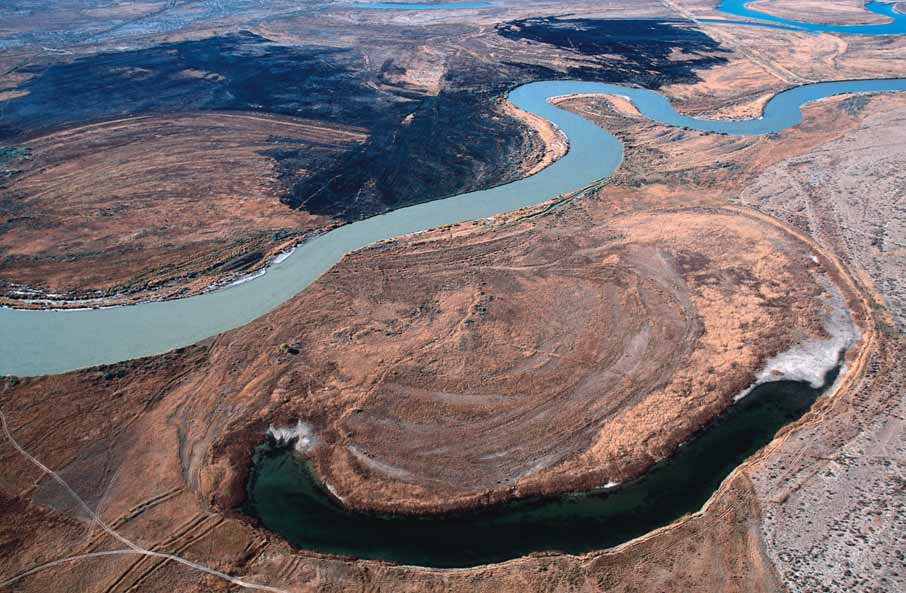
Figure 5
Aerial view of meandering Syrdarya River.
(Photo: CORBIS)
More than 20% of Uzbekistan's GDP is generated in agriculture, which
In 1997 and during the fi rst half of 1998 economic trends were mixed. In
employs about 49% of the country's labour force. Primary commodities,
an eff ort to curb accelerating infl ation and a widening current account
such as cotton fi bre, mining and energy products, account for about 75%
defi cit, the authorities started tightening fi scal policies at the beginning
of its merchandise exports; cotton alone accounts for 40% of exports.
of 1997. As a result, macroeconomic performance began to improve
The cautious approach to reform, combined with a focus on developing
again. According to offi
cial statistics, real GDP grew by 5.2% in 1997 and
self-reliance in energy and improving the mining and agricultural
by 4.0% in the fi rst half of 1998, while average monthly consumer price
sectors including trade diversifi cation (especially of cotton export),
infl ation fell to 2.1% in 1997 and to 1.7% in the fi rst half of 1998. The IMF's
allowed Uzbekistan to avoid an output collapse recorded in many other
estimates suggest that the GDP growth in 1997 may have been only
former Soviet Union countries during the fi rst years of independence.
2.4%, while average monthly infl ation was estimated at about 3.5%.
Uzbekistan's GDP declined by less than 145 USD in 1991-1993, compared
with a former Soviet Union average of almost 40% (UNESCO 2000).
Uzbekistan is now the second largest cotton exporter, a large producer
of gold and oil, and a regionally signifi cant producer of chemicals
Uzbekistan has introduced some elements of a market system over the
and machinery. Following independence in 1991, the government
past decade (for example privatisation and capital markets). However,
sought to support its Soviet-like command economy with subsidies
the government has opposed, to varying degrees, the following: trade
and tight controls on production and prices. The state continues
liberalisation; currency convertibility and a unifi ed exchange rate; full
to be a dominating infl uence in the economy and has so far failed
price liberalisation; the elimination of government interference into the
to bring about necessary structural changes. The IMF suspended
key sectors of the economy (e.g. cotton production); and central bank
Uzbekistan's 185 million USD standby arrangement in late 1996
independence.
because of governmental steps that made impossible the fulfi lment
REGIONAL DEFINITION
25
of a Fund contribution. Uzbekistan has responded to the negative
fi scal performance has also been impressive, with the fi scal defi cit (on
external conditions generated by the Asian and Russian fi nancial crises
a cash basis) in the last quarter of 1997 narrowing to only 0.2% of GDP.
by emphasising import substitute industrialisation and tightening
During the fi rst quarter of 1998, the defi cit was 1.6% of GDP. Owing to
export and currency within its already closed economy. Economic
the restored macroeconomic stability and the availability of external
policies that have repelled foreign investment are a major factor in the
fi nancing for cotton production, GDP grew by 1.7% in 1997; the fi rst
economy's stagnation. A growing debt burden, persistent infl ation, and
real growth since independence in 1991. The recovery has continued,
a poor business climate led to disappointing growth in 2001. However,
with real GDP in the fi rst quarter of 1998 estimated to be 1.3% over the
in December 2001 the government voiced a renewed interest in
corresponding period in 1997.
economic reform, seeking advice from the IMF and other fi nancial
institutions (CIA 2002).
Tajikistan has the lowest GDP per capita among the 15 former Soviet
republics, the highest unemployment in the region and 80% of the
Tajikistan
population lives below the poverty line. Tajikistan has a negative
The Republic of Tajikistan has inherited a developed infrastructure
export-import balance and the highest infl ation level. At the same time
and a well-organised and varied industrial and agricultural basis from
Tajikistan has one of the highest rates of GDP growth in the region (only
its former Soviet period. However, transition to the market type of
Kazakhstan has greater GDP growth).
economy has led to serious changes in the economic system and in
the economic links between the countries of the region. As a result of
Cotton is the most important crop. Mineral resources, varied but
confl ict, economic stagnation, and changes in the structure of export
limited, include silver, gold, uranium, and tungsten. Industry consists
and import, the level of industrial output dropped by 60%, a fi gure
of a large aluminium plant, hydropower facilities, and small obsolete
which only started recovering at the end of the 1990s. The agrarian
factories, mostly in light industry and food processing. The availability
sector plays a major role in the modern economy of Tajikistan, but
of hydroelectric power has infl uenced the pattern and structure of the
the industrial sector is less signifi cant. To stop the deterioration in
industrial sector, with aluminium, chemicals and other energy-intensive
economic conditions, the government introduced several reform
industries as the sector's mainstays. The civil war (1992-1997) severely
measures in 1995, including fi scal retrenchment and price liberalisation,
damaged the already weak economic infrastructure and caused a sharp
supported by an IMF Stand-by arrangement and an IDA rehabilitation
decline in industrial and agricultural production. On independence in
credit in 1996. In the following two years the policy performance of
1991, the collapse of the trade and payments system among former
Tajikistan was mixed, largely because of the renewed confl ict and
Soviet Union countries triggered a precipitous decline in output. As a
weak institutional capacity. Much of the reform agenda contained in
result, national poverty increased, particularly in the more remote and
the above credit was eroded or even reversed because of the confl ict
war aff ected areas, with as much as 85% of the population considered
and the reform programme had been disrupted by mid-1997. The civil
poor. A large proportion of the labour force in Tajikistan (as high as
confl ict diverted resources to defence and security purposes to the
25%) and Kyrgyzstan depends on work abroad (particularly in Russia),
detriment of other essential needs, and at the same time revenues
remitting a signifi cant volume of income to their home countries.
declined. As of June 1997, the fi scal defi cit reached 10% of GDP, social
safety net payments were eight months in arrears, infl ation exceeded
Tajikistan has experienced strong economic growth since 1997.
60% and the currency depreciated rapidly. Recognising that the reversal
Continued privatisation of medium and large state-owned enterprises
of this situation required dramatic action in the areas of political and
will further increase productivity. Tajikistan's economic situation,
macroeconomic stability and structural reform, the government and
however, remains fragile due to the uneven implementation of
the United Tajik Opposition (UTO) signed a Peace Agreement in July
structural reforms, weak governance, and the burden of external
1997. The Commission for National Reconciliation (CNR) was created as
debt. Servicing of the debt, owed principally to Russia and Uzbekistan,
the focal point to foster national reconciliation.
required as much as 50% of government revenues in 2002, thus limiting
the nation's ability to address pressing development issues (CIA 2002).
The government, in consultation with the IMF and the World Bank, also
moved quickly on the stabilisation and structural reform fronts and
Despite Tajikistan's current economic problems, the country has
has made signifi cant progress in achieving macroeconomic stability.
considerable potential for development. The population is well
Average monthly infl ation for the fi rst four months of 1998 was brought
educated, the land is very fertile and the country has demonstrated
down to 1.3%, compared with over 20% per month in July 1997. Recent
a capacity to produce competitively for international markets. The
26
GIWA REGIONAL ASSESSMENT 24 ARAL SEA
country also has an established but idle industrial base with assets
Economic reforms have lagged in Turkmenistan compared to other
that can be deployed more effi
ciently and productively. This industrial
FSU countries. In November 1993, Turkmenistan introduced its own
base can serve as the basis for economic growth especially in the
currency, the manat, and established a dual exchange rate system with
agriculture sector. The development of this potential will, however,
an offi
cial rate used for all transactions related to gas exports, and a
depend on whether peace and security can be maintained throughout
commercial rate which was substantially higher. From 1995-1998, the
the country.
government took some steps towards a market economy. It removed
price controls on most consumer goods, privatised most micro or
Turkmenistan
small enterprises and trade and catering establishments, and initiated
Turkmenistan is a largely desert country with intensive agriculture
a leasehold programme to transfer agricultural land to private farmers.
in irrigated oasis and huge hydrocarbon resources; the country has
It also made several attempts at unifying the exchange rate, the last
the fi fth largest gas reserves in the world. The cornerstone of the
in April 1998. However, little progress was made in macroeconomic
Turkmenistan economy is energy. With 2.7 trillion m3 in proven and
stabilisation or structural reforms. The government has recently
probable gas reserves and additional indicative reserves estimated at
formulated a ten-year production and investment plan that includes
14 trillion m3, Turkmenistan is the second largest natural gas producer
large investments in infrastructure and energy fi nanced by foreign
in the former Soviet Union after the Russian Federation, and the fourth
direct investment and the fi scal budget.
largest producer in the world. The country also has an estimated
1.1 billion tonnes of oil reserves (UNESCO 2000).
One half of its irrigated land is used for cotton production, making it the
world's tenth largest producer. Until the end of 1993, Turkmenistan had
Turkmenistan has considerable potential for diversifi cation into mineral
experienced less economic disruption than other former Soviet states
resource-based industries. However, agriculture still predominates,
because its economy received a boost from higher prices for oil and gas
accounting for 10% of GDP and 44% of employment. Turkmenistan is
and a sharp increase in hard currency earnings. With an authoritarian
among the top 10 cotton producers in the world. Other major crops
ex-Communist regime in power and a tribally based social structure,
include grains, vegetables, and fruits. Natural gas, oil products and
Turkmenistan has taken a cautious approach to economic reform,
cotton account for 84% of exports. The main imports in 1997 were
hoping to use gas and cotton sales to sustain its ineffi
cient economy.
machinery and metalwork (43%), processed food (19%), industrial
Privatisation goals remain limited. In 1998-2001, Turkmenistan suff ered
chemicals (11%) and non-food consumer products (11%). Real GDP
from the continued lack of adequate export routes for natural gas and
declined by 30% in 1993-1995 and by 3% in 1996. In 1997, GDP fell a
from obligations on extensive short-term external debt. At the same
further 26%, refl ecting the combined eff ect of deep declines in exports
time, total exports have risen sharply because of higher international
of gas (73%) and cotton fi bre (52%), tempered by a 34% growth in
oil and gas prices. Turkmenistan is the most closed, inward-oriented
the domestic sector buoyed by the increase in cotton and wheat
country in the region, relying heavily on its rich natural gas deposits.
production and a boom in the construction industry.
Turkmenistan economic statistics are state secrets, and other GDP and
fi gures are subject to wide margins of error (CIA 2002). Turkmenistan has
The underlying fi scal position has weakened markedly over the years, as
good long-term potential for development given its natural resource
budget defi cits were avoided mainly through expenditure compression,
base. The large share of the gas sector in the country's GDP indicates
implicit taxes and subsidies. Credit policy has been expansionary, with
that even a modest upturn in gas output would imply growth in GDP.
large directed credit programmes and enterprises facing lax budget
constraints. Infl ation averaged roughly 1 800% in 1994, 1 000% in 1995,
International programmes and agreements
450% in 1996, and 20% in 1997. From 1993 to 1995, wage adjustments
related to water
lagged far behind infl ation, and real minimum monthly wages declined
The sharing of transboundary water resources in Central Asia
by an estimated 80%. During 1996-1997, a series of wage increases
has become one of the main problems regarding the relations
raised average real wages by 84%, but only to two-thirds of their 1994
between the countries of the region since gaining independence.
levels. Per capita income (970 USD in 1995, 870 USD in 1996, 630 USD in
Acknowledging that regional water resources management is one of
1997, and 690 USD in 1999) is now signifi cantly below the Former Soviet
the most important issues for sustainable development, in 1992 Water
Union (FSU) average.
Management bodies of Kazakhstan, Kyrgyzstan, Tajikistan, Turkmenistan
and Uzbekistan signed an agreement on cooperation in the joint usage
and protection of transboundary water resources. The parties agreed
REGIONAL DEFINITION
27
to coordinate their actions establish rules of water resources usage, to
A GEF project entitled "Water and environmental management in
fi nd joint solutions to ecological problems, and determined minimum
the Aral Sea Basin", fi nanced by the World Bank, and governments
sanitary conditions downstream. It was agreed not to alter the order
of the Netherlands, Sweden and Central Asian countries which
of interstate water division and water quotas which existed under the
focussed on the development of a national and regional water
USSR. In order to take coordinated decisions, the Interstate Coordination
strategy, the improvement of dam safety, the monitoring of
Water management Commission (ICWC) was established.
transboundary waters and the formation of public opinion
promoting stability in Central Asia (Aslov 2003).
In March 1993, at the Kyzylorda conference on the Aral Sea, the heads
Special United Nations programme on rational and eff ective use
of the states took the decision to organise the Interstate Council on the
of energy and water resources of Central Asia (SPECA). Within
problems of the Aral Sea Basin. The ICWC with its associated divisions;
the framework of this, a diagnostic report was developed on the
the Center of Scientifi c Information (SIC) and the Basin's administration
concepts of strategy and regional cooperation on rational and
along the Amudarya and Syrdarya rivers, got the rank of organisations
eff ective usage of regional water and energy resources. These
subordinate to the International Fund for saving the Aral Sea (IFAS)
documents are oriented around the improvement of a normative-
(Velmuradov 2003, Kipshakbaev 2004, Sarsembekov at al. 2004).
legal base, the creation of an economic mechanism of water usage,
and cooperation in achieving stable development of Central Asian
The International Commission on Sustainable Development (ICSD),
countries (Koimdodov 2003).
organised under the IFAS, became responsible for the coordination
"Programme on concrete actions on improvement of ecological
and control of regional cooperation regarding environmental
and socio-economic situation in the Aral Sea Basin for the years
protection and sustainable development of Central Asian countries.
2003-2010" (ASBP-2). The priority issues of the programme were
This included the development of the main principles and criteria for
approved by the regional heads of states at the meeting in
passing legislative acts concerning the problems of the stabilisation and
Dushanbe in October, 2002. The programme guides the countries
improvement of the environment (Esenov & Mamieva 2003, Dzhalavov
on the: continual coordination of the mechanisms of water
2003, Aslov 2003, Nurushev 2003).
resources management; rehabilitation of water resources objects;
improvement of the use of water and land resources; struggle
A conceptual base for the improvement of water management and the
against desertifi cation and natural disasters; implementation
ecological situation in the Aral Sea Basin was formulated in the joint
of water saving measures; strengthening of the legal base of
declarations on the Aral Sea problems signed by the heads of Central
cooperation in the context of sustainable development; and the
Asian states in Kzyl Orda (1993), Nukus (1995), Almaty (1997), Ashgabat
improvement of socio-economic conditions for the population of
(1999), and Dushanbe (2002). These documents stress the necessity of
the Aral Sea Basin (Koimdodov 2003, Esenov & Mamieva 2003).
normative-legal regulation of regional water resources management.
These agreements became central to large-scale international
The governments of the Central Asian countries, IFAS, and its institutions
programmes and projects on the Aral Sea problems, including those
ICWC and ICSD, and with the help of international aid, are taking steps
fulfi lled with fi nancial support of international funds and organisations.
to resolve the priority issues of water distribution, ecological safety
The most important projects include;
and economic development, taking into account the interests of each
A programme of concrete actions on the improvement of the
country. The creation of water-energy, transport and food consortiums,
ecological situation of the Aral Sea Basin (ASBP-1). The main
a concept which was approved by the presidents of states and members
priorities include the development of sustainable strategies
of the organisation "the Central - Asian Cooperation" in the summer of
of water resources management and the improvement of the
2004, aims to develop integration processes (ICWC 2004).
methods of regional water resources management (Ryabtsev 2003,
Aslov 2003).
28
GIWA REGIONAL ASSESSMENT 24 ARAL SEA
Assessment
Table 7
Scoring table for the Aral Sea region.
This section presents the results of the assessment of the impacts
Assessment of GIWA concerns and issues according
The arrow indicates the likely
of each of the fi ve predefi ned GIWA concerns i.e. Freshwater
to scoring criteria (see Methodology chapter).
direction of future changes.
T
T
C
C
Increased impact
shortage, Pollution, Habitat and community modifi cation,
A
A
0 No
known
impact
2 Moderate
impact
IMP
IMP
T
T
No changes
C
C
A
A
Unsustainable exploitation of fi sh and other living resources,
1 Slight
impact
3 Severe
impact
IMP
IMP
Decreased impact
Global change, and their constituent issues and the priorities
i
t
y
a
l
a
c
t
s
p
n
u
*
*
identifi ed during this process. The evaluation of severity of each
a
c
t
s
Aral Sea
ent
p
m
m
i
c
i
m
m
n
i
m
o
Score
issue adheres to a set of predefi ned criteria as provided in the
c
t
s
m
o
c
t
s
r
i
t
y
*
*
*
v
i
r
o
n
e
r c
o
a
l
t
h
t
h
erall
io
chapter describing the GIWA methodology. In this section, the
En
impa
Ec
He
O
impa
Ov
Pr
scoring of GIWA concerns and issues is presented in Table 7.
Freshwater shortage
3.0*
3.0
2.8
2.3
2.9
1
Modification of stream flow
3
Pollution of existing supplies
3
Changes in the water table
3
T
Pollution
2.4*
2.4
2.8
2.3
C
2.5
2
A
Freshwater shortage
IMP
Microbiological pollution
0
Eutrophication
1
Chemical
3
The rational use of water resources is a major component of the present-
Suspended solids
1
day strategy of nature management and sustainable development.
Solid waste
2
Thermal 1
Problems associated with the sharing of transboundary water resources
Radionuclide
1
can provoke confl icts and are becoming the subject of increasingly
Spills
1
complicated interstate negotiations. The rapid development of irrigated
Habitat and community modification
2.4*
2.4
2.4
2.3
2.4
3
areas in the region has destabilised the water level of the Aral Sea and is
Loss of ecosystems
2
Modification of ecosystems
3
jeopardising the preservation of ecosystems in Priaralye.
Unsustainable exploitation of fish
0*
0
0
0
0
5
Overexploitation of fish
0
This situation is accompanied by poor water quality as a result of the
Excessive by-catch and discards
0
discharge of drainage water from irrigated areas. Consequently in the
Destructive fishing practices
0
early 1990s the socio-economic and ecological situation in Priaralye
Decreased viability of stock
0
Impact on biological and genetic diversity
0
was assessed as critical.
Global change
1.0*
1.0
1.0
1.0
1.0
4
Changes in hydrological cycle
0
The freshwater concern is inextricably linked with the other assessed
Sea level change
1
concerns. In particular, habitat modifi cation of the Aral Sea and the
Increased UV-B radiation
1
Changes in ocean CO source/sink function
0
2
Syrdarya and Amurdarya river basins, and the resultant changes in
*
This value represents an average weighted score of the environmental issues associated
to the concern. For further details see Detailed scoring tables (Annex II).
abundance and distribution of biological resources was caused by
** This value represents the overall score including environmental, socio-economic and
the upstream modifi cation of streams for the purposes of irrigated
likely future impacts. For further details see Detailed scoring tables (Annex II).
*** Priority refers to the ranking of GIWA concerns.
agricultural. Therefore to obtain a comprehensive understanding of
ASSESSMENT
29
the freshwater shortage concern, refer to the habitat modifi cation
percentage remains relatively consistent from one country to another,
concern.
fl uctuating between 88.5% and 92.6% (Kipshakbayev & Sokolov 2002).
Environmental impacts
Irrigated areas in the Aral Sea Basin grew from 4.51 million ha in 1960 to
Modifi cation of stream fl ow
6.92 million ha in 1980 and to 7.85 million ha in 2000. Accordingly, total
The most acute problem in the Aral Sea region is the irrational use of
water intake for irrigation rapidly increased and by the beginning of the
surface water resources. The volume of water consumed in the areas
1980s had reached 120.7 km3/year and overall water consumption in the
of the region where water is predominantly used is largely determined
Aral Sea Basin exceeded the available river water resources. Today, due
by the interests of irrigated farming, which accounts for 50% of GDP
to the use of return waters, the volume of water resources used exceeds
(Schultz 2002). A sophisticated farm-to-farm and inter-farm irrigation
available supplies; in the Syrdarya Basin 130-150% of available water
network of a total length of 316 000 km and a drainage system of a total
resources are used and in the Amudarya Basin, 100-110% (Kipshakbayev
length of more than 190 000 km have been constructed in the region
& Sokolov 2002).
(Duskayev 2000). A complex system of river fl ow regulation includes a
large number of river and off -river water reservoirs, and is controlled
Naturally, the increase in water consumption, particularly in low-water
by two basin administrations; the Syrdarya and the Amudarya offi
ces
years, has severely aff ected the numerous rivers in the region. The Irtysh
which were established before the collapse of the USSR. These offi
ces
and Ishym in the east, the Chu, Talas, Syrdarya and Amudarya in the
were incorporated into the Interstate Coordination Water Management
south, the Ural in the west and the Ishim and Tobol in the north are
Committee (ICWC) in 1992.
transboundary rivers and the largest of these, the Amudarya and the
Syrdarya, cross the borders of three or more countries. In the Amudarya
On the territory of Uzbekistan, in addition to numerous ponds and
Basin the reduction in river fl ow following the construction of the
small-capacity water reservoirs used for irrigation, 50 relatively large
Takhiatash and Tyuyamuyn reservoirs and the excessive use of water
reservoirs with a total volume of 19 km3 have been constructed. The
in irrigated areas has modifi ed the delta and fl oodplain environment.
total volume of reservoirs constructed on the Syrdarya in Uzbekistan
By the year 2000 the total annual run-off of the Amudarya near the
is 5 km3, and 29 water-storage reservoirs with a total capacity of
estuary (Chatly-Samanbay measuring station) had reduced by almost
14 km3 have been built on the Amudarya. The largest water reservoirs
ten times in comparison with 1970. As a result, less than 10% of the total
are Charvak water reservoir on the Charvak River near Tashkent and
area of delta lakes in the Amudarya lower reaches remained, and the
Andizhan water reservoir in Osh valley on the Karadarya River. The
once profi table fi shery and water rat fi shery practically disappeared.
existing reservoirs have a run-off control rate of 0.94 for the Syrdarya
Furthermore, some regions in Tajikistan suff er from water defi ciency,
(i.e. close to its maximum), and 0.78 for the Amudarya, with capacity
despite being on the territory where the majority of the Amudarya
for further increases. Upstream fl ow regulation in the Amudarya Basin
fl ow is formed and which seems to have an excess of water resources
is provided by three main reservoirs, namely the Nurek and Baypasin on
(Olimov 2001).
the Vakhsh River and the Tuyamuyun on the Amudarya, as well as by
a network of river reservoirs and their associated canals. There are four
The reduction in the fl ows of the Amudarya and Syrdarya rivers
river reservoirs on the Karakum Canal, two on the Amubuchara Canal
resulted in a decline in the water level of the Aral Sea and threatened
and one on the Karshin Canal, which can hold a combined volume of
the preservation of the Priaralye ecosystem (Kamalov 2002). The area
6 km3 (SPECA 2004).
of the Aral Sea has reduced more than two-fold. In 1986, the Sea
divided into two independent water reservoirs-the Big and Small
The greatest consumer of water resources is Uzbekistan which, on
seas-and by July 2002 the water level in the Big Sea had decreased by
average, uses approximately 54% of the region's total water resources,
22 m (Zholdasova et al. 2002). The dramatic shrinkage of the Aral Sea
a fi gure which rose to 60% in 1999. Turkmenistan uses about 19% of the
since the 1960s is one of the greatest environmental catastrophes ever
regional water resources. The overwhelming proportion of river fl ow
recorded. The salinity of the lake's waters has tripled, killing plant and
(almost 68%) is formed on the territory of Tajikistan and Kyrgyzstan, yet
animal life. In addition, the climate has been aff ected; both summer
the main irrigated areas where most of the total river fl ow is used are
and winter temperatures have become more extreme. Plans have been
located on the territories of Uzbekistan, Turkmenistan and, to a lesser
made to use less water from the Amudarya and Syrdarya for irrigation
extent, in Kazakhstan. It is estimated that more than 90% of total water
in order that more can fl ow into the Aral, though these eff orts may not
resources are used by irrigated farming in these countries, and this
be suffi
cient to save the Aral Sea.
30
GIWA REGIONAL ASSESSMENT 24 ARAL SEA
The extreme degradation of the water and deltas of the Amudarya
high salinity levels. Subsequently they cannot be used for fi shing, and
and Syrdarya and the multiple reductions in the area of delta lakes and
fl ora and fauna are unable to survive (SPECA 2004).
swamp water areas caused a severe reduction in bio-diversity and a
greater concentration of pollution in surface and groundwater supplies.
The mineralisation of the Amudarya water increases from 0.4-0.5 g/l in
The total area of lakes in the Amudarya delta reduced from 300 000
mountain rivers, to 2.0 g/l or more in the deltas (Chembarisov & Lesnik
to 30 000 ha and water mineralisation increased to 20-25 g/l, which
1995, Khasankhanova & Abdullaev 2001, Chembarisov et al. 2001a).
resulted in an abrupt reduction of fi sh and animal reproduction.
According to research carried out along the Amudarya and Syrdarya
rivers, copper, zinc and hexavalent chromium concentrations exceed
In 1960 fi sh catches in the Amudarya delta weighed a total of
the Maximum Allowable Concentration (MAC). Along almost the entire
22 520 tonnes compared with only 1 100 tonnes in 2000. Similarly, the
Amudarya River phenol concentrations exceed their MAC. Salinity has
water rat population decreased from 1 130 000 to 1 000 (Amirbekov et al.
increased from 10 g/l to 40-50 g/l due to a lack of freshwater infl ow to
2002). Between 1970 and 1999 the area of tugay forests in the Amudarya
the rivers.
delta reduced ten times from 300 000 to 30 000 ha and no successful
attempts were made to restore the natural forest (Bakhiev & Treshkin
An average of 11 km3 (36.8%) of return waters are discharged into
2002). Desertifi cation and the degradation of aquatic ecosystems has
natural depressions in the landscape and are subsequently not
severely aff ected wildlife; in the Amudarya delta, besides a reduction
used for economic purposes. The overwhelming proportion of such
in the water rat population, about 6 species and subspecies of fauna
waters (85.8%) is formed by the drainage waters of the Amudarya
disappeared, more than 20 species became rare, and approximately 30
Basin. Drainage effl
uents from irrigated fi elds discharged into rivers
species of ornithofauna disappeared.
are degrading riverbeds and deteriorating the water quality of the
Amudarya. This is adversely aff ecting the ecology of Priaralye.
Pollution of existing supplies
A considerable part of available (accessible for use) water resources
The waters of the rivers in the Aral Sea Basin as well as the Aral Sea itself
consist of return waters (drained effl
uents from irrigated areas,
are heavily polluted by salts and chemical pollutants discharged by the
industrial wastewaters and municipal sewerage waters). Their average
agricultural and industrial sectors. These issues are discussed further in
annual volume in the Aral Sea Basin is 32.4 km3 which between 1990
the assessment of Pollution.
and 1999 increased from 28 to 33.5 km3 (Kipshakbayev & Sokolov 2002,
Dzhalalov 2003). Some return waters are used repeatedly for irrigation,
A major environmental problem facing the Aral Sea Basin is the
more than 51% of return fl ow is discharged into rivers and 31% into
increasing salinisation of irrigated areas which is reducing their
natural relief depressions. More than 95% of the total volume of return
productivity. Soil salinisation is occurring through the use of inadequate
waters is formed by drainage waters from irrigated fi elds, which is
drainage systems. Following the collapse of the USSR, a programme
the reason why return waters have high mineralisation and are one
of drainage reconstruction and development, and land melioration
of the main sources of pollution of surface and groundwater in the
was signifi cantly reduced, producing a ten-fold cutback in investment.
region. About 60% of the total volume of return waters is formed in
This resulted in increased salinisation and the bogging of lands, and
Uzbekistan.
correspondingly a decline in land productivity (ICWC 2004). The high
mineralisation of irrigation water is increasing salinisation; for the last 30
Approximately 15% of surface water supplies in the Aral Sea Basin
years mineralisation in the Amudarya Basin increased from 0.4-0.6 g/l
have been contaminated with polluted drainage and wastewaters
to 1.3-2.0 g/l (Dmitriev 1995).
(Kipshakbayev & Sokolov 2002). Today, it is severely aff ecting water
quality; mineralisation has increased dramatically, and in some cases
Between 1990 and 1999, the area of salinised soils increased in the
has diminished the ecological and economic functions of reservoirs.
Amudarya Basin from 1.16 to 1.82 million ha (by 57%), and from 0.34
This is particularly true for the numerous water reservoirs that collect
to 0.61 million ha (by 79%) in the Syrdarya Basin. Between 30 and
drainage and wastewaters in the lower reaches of the Amudarya and
66% of the total area of irrigated fi elds in the region are polluted, with
the Syrdarya. The largest of these are the Sarykamysh (with a volume of
concentrations sometimes exceeding the MAC by 20-40 times. The
about 26 km3) and the Aydar-Arnasay Lake (about 30 km3) as well as the
effi
ciency coeffi
cient of drainage systems between 1990 and 2000
Dengizkul, Sudochye and the Solenoye lakes, each containing several
decreased by 30%, and if this trend continues, over 50% of the drainage
million cubic meters of water. Most of them are stagnating and have
systems in the region will be out of operation by the mid 21st century.
ASSESSMENT
31
According to experts, inadequate drainage systems result in annual
groundwater supplies, resulting in a lowering of the water table by up
losses of about 1 billion USD (ICWC 2004). In some areas soil salinity
to 50 cm per year on non-irrigated territories and in some regions by
and pollution has caused such a decrease in fertility that irrigation
as much as 10-15 m.
expenses quite often exceed profi t and lead to a reduction in product
quality (Glazovsky 1995).
On irrigated land, however, the groundwater levels have risen with
consequential fl ooding of populated centres. For example, groundwater
The increase in salinised soils has necessitated the further use of
levels have increased by up to 1.5 m in 70% and over 50% of the total
water to wash the soils. In Uzbekistan alone it is necessary to wash
area of Khorezm oblast and in the lower reaches of the Zeravshan River
up to 2 million ha of salinised soils annually, which requires up to
respectively (Abdulkasimov et al. 2003). According to estimates, about
2 million m3 of water per hectare. Annually, total water consumption
30% of the irrigation return waters in the upper watershed percolate
for these purposes in the region ranges between 6 and 8 billion m3. The
through the soil to the water table. Some of this water eventually returns
process of improving the salinity of soils in irrigated areas would require
to the rivers as saline infl ow, but much does not. In eff ect, much of
considerable quantities of water. It is therefore imperative to implement
the water from the Aral Sea has accumulated in the groundwater. As
such measures as soon as possible.
the groundwater is used for irrigation applications downstream, even
regions that do not have a high water table are aff ected. Changes in
Changes in the water table
the biota, unforeseen and often disregarded during the planning of
Total groundwater reserves in the region are estimated at 43.49 km3
projects, are associated with irrigation causing the water table to rise
per year (Table 8), of which 25.1 km3/year is found in the Amudarya
on an area of 3.23 million ha in the Aral Sea Basin.
Basin and 18.4 km3/year in the Syrdarya Basin. Over half of total reserves
(58%) are located in the Amudarya Basin. The total volume of approved
Socio-economic impacts
groundwater intake in the Aral Sea Basin is 17.0 km3, of which present-
Economic impacts
day net intake barely exceeds 11.0 km3/year (Table 8). The greatest
The freshwater shortage concern is severely impacting the regional
groundwater deposits are found in Uzbekistan and Tajikistan (more
economy. The poor quality and lack of freshwater is hindering
than 42% of regional reserves).
industries in need of water for operations. In the Aral coastal zone
economic activity has been suspended, which is additionally aff ecting
In the Kazakhstan area of the Aral Sea Basin the majority of groundwater
inland industries. The rapid drying-up of the Aral Sea and the associated
is used for drinking water (more than 68%), compared with about 40%
degradation of its marine ecosystem has led to the collapse of a
in Turkmenistan and Uzbekistan. In Kyrgyzstan and Tajikistan accessible
previously well-developed fi shery and fi sh processing industries. There
groundwater resources are predominantly used for irrigated farming,
has consequently been a dramatic decrease in available employment
59.4% and 69.5% respectively.
and income for the inhabitants of the Aral Sea region. Since the end of
the 1980s in the Kyzylorda region of Kazakhstan and in Karakalpakstan
Water logging and salinisation of soils has resulted in groundwater
of Uzbekistan, unemployment has been continuously increasing.
deterioration. Groundwater levels have changed signifi cantly as a result
of abstraction for anthropogenic activities. Declining water levels in the
A serious consequence of the change in the run-off regime of the main
region's rivers and the Aral Sea have aff ected their ability to recharge
regional rivers is that water is redirected away from pasture lands to fi ll
Table 8
Groundwater reserves in the Aral Sea Basin and their uses.
Groundwater reserves (km3/year)
Groundwater use (km3/year)
Used 1999
Country
Approved for
(km3)
Drinking water
Experimental
Explored
Industry
Irrigation
Vertical drainage
Other purposes
usage
supply
pumping
Kazakhstan
1.846
1.270
0.293
0.200
0.081
0
0
0
0.012
Kuyrgyzstan
1.595
0.632
0.244
0.043
0.056
0.145
0
0
0
Tajikistan 18.230
6.020
2.294
0.485
0.200
1.594
0
0
0.015
Turkmenistan
3.360
1.220
0.457
0.210
0.036
0.150
0.060
0.001
0
Uzbekistan
18.455
7.796
7.749
3.369
0.715
2.156
1.349
0.120
0.040
Total for the Aral Sea Basin
43.486
16.938
11.037
4.307
1.088
4.045
1.409
0.121
0.067
(Source: Kipshakbayev & Sokolov 2002, SPECA 2004)
32
GIWA REGIONAL ASSESSMENT 24 ARAL SEA
lowland depressions, resulting in reduced pasture land. For example,
The most diffi
cult situation is observed in Turkmenistan and Uzbekistan,
in the area surrounding the Anasay-Aidarkul reservoir more than
where 80-90% of the national economy depends on the water resources
2.5 million ha of pasture land has disappeared (Abdulkasimov et al.
supplied by transboundary rivers from neighbouring states. Currently
2003). Furthermore, desertifi cation resulting from freshwater shortages
the population of Uzbekistan is allocated less than 2 500 m3 of water
has also resulted in a reduction of pasture productivity. For the past
per person per year, falling short of sanitary standards. If predicted
15 years pasture productivity in Uzbekistan has reduced by more than
rates of population growth are realised, the situation will deteriorate
20% and the harvesting of dry mass fed to animals has reduced from
substantially.
2.4 to 1.8 centner/ha (Abdulkasimov et al. 2003).
Health impacts
A particularly alarming factor is the rapid reduction in the volume of
The health impacts of freshwater shortage are considered as severe,
water consumed per capita. According to available data (Kipshakbaev
as water quality and quantity is directly associated with the spread of
& Sokolov 2002), between 1960 and 2000 water intake per capita in the
disease, especially of the central nervous system, the digestive tract, the
Aral Sea Basin reduced 1.7 times from 4 270 to 2 530 m3/person and it
vascular system, as well as infectious diseases and immunity defi ciency.
may reduce to below sanitary standards within the next 20 years if the
Health issues associated with the region's ecological crisis include the
current rate of population growth continues.
spread of anaemia, diminished thyroid function, and renal and liver
diseases.
A similar situation exists concerning the distribution of arable lands.
Despite a considerable increase in irrigated areas, due to the rapid
Although in general the health of the population in all fi ve countries
increase in population irrigated areas per capita reduced almost two-
is relatively good, there has been a deterioration of epidemiological
fold between 1960 and 2000 from 0.32 ha per person to 0.18 ha per
conditions in the region resulting in greater morbidity. Between 1995
person (Kipshakbaev & Sokolov 2002). This barely meets the required
and 2003 in Samarkand oblast (Uzbekistan) incidences of disease
minimum level for the production of the daily human bread quota
increased by a factor of 3, the incidence of blood circulation diseases
(Reteyum 2003). If the current rate of population growth is maintained,
among children increased by a factor of 5, and over the last 8 years the
four out of fi ve countries in the Aral Sea Basin (besides Kazakhstan
number of children suff ering from anaemia increased by a factor of 4.
and Afghanistan) will reduce the "irrigated area per capita" factor to
In the Republic of Karakalpakstan, river water is unsuitable for drinking
practically zero over the next 50 years (Rodina 2002).
supply for 10 months a year (its mineralisation goes up to 2.5-2.8 g/l of
solid residue).
Water shortage and widespread secondary soil salinity cause a
rapid reduction of usable fi elds and the productivity of agriculture.
As the Aral Sea recedes it leaves behind a harmful layer of chemical
Thousands of hectares are drying up and becoming salinised. As
pesticides and natural salts which are blown by the wind into noxious
a result, the current socio-economic and ecological situation in
dust storms, seriously aff ecting the health of the inhabitants of the
Priaralye is considered to be in crisis (Kamalov 2002). There have been
area. It is estimated that 100 000 tonnes of salt and sand contaminated
severe economic losses for irrigated farming as a result of freshwater
with pesticide residues are carried away each year by storms with
shortages. In the Amudarya Basin, economic losses were approximately
increasing frequency and severity. Cancer and respiratory diseases
260 million USD in the harvest of 2000 (Sorokin 2002). The most severe
have subsequently increased in prevalence as well as the rate of infant
situation regarding water supply is observed in the lower reaches of the
mortality.
Syrdarya and Amudarya, resulting in considerable economical losses in
Uzbekistan and Kazakhstan.
The pollution of surface and groundwater is becoming increasingly
alarming and is directly impacting the health of the population.
Increasingly salinised and polluted soils have exacerbated the chemical
Only water in the run-off formation zone in the mountains, with rare
and biological aggressiveness of the air and water environment.
exceptions, meets sanitary standards. Further away from the mountains,
Chemical reagents and microorganisms in the air damage isolators of
the quality of surface and groundwater worsens abruptly and in the
high-voltage transmission lines and salinised groundwater threatens
lower parts of the river and in the irrigation canals it is regarded as
building and construction foundations. As a result, fi nancial expenses
harmful for human health.
exceed estimated annual investments by 2.8 times (Abdulkasimov et
al. 2003).
ASSESSMENT
33
Food safety is becoming increasingly alarming due to the lack of
The freshwater shortage concern was assessed as severe, and it can
potable water for the population located in the downstream sections
be concluded that surface water resources in the Aral Sea region are
of the rivers, and famine may occur in future (Rakhmonov 2003).
fully exploited and the economy of the region is developing under
Today, Tajikistan can only provide a quarter of the population with
conditions of ever increasing water shortages.
domestically grown agricultural products (Reteyum 2003). If current
rates of population growth persist, by the middle of this century the
country will experience a catastrophic reduction of arable land per
T
C
A
capita, thus jeopardising food security (Rodina 2002).
Pollution
IMP
Other social and community impacts
Many of the rivers in the Aral Sea Basin are contaminated, except in the
The sharing of transboundary water resources between the countries
area of run-off formation. Most pollution consists of various chemical
of the Aral Sea region can provoke confl icts. There have been increased
contaminants. The index of water pollution (IWP) is a classifi cation for
expenses for deepening wells and pumping and for providing
the pollution levels in the region. The IWP not only takes into account
alternative water distribution. The region has witnessed a permanent
whether the concentration of a substance exceeds Maximal Allowable
decrease in agricultural effi
ciency (including grain crops, livestock, and
Concentration (MAC), but also its danger to human health.
aquatic crops). The fi shing industry, which once employed thousands
of people, has practically collapsed. The shores are barren and several
Environmental impacts
villages and large towns, such as Aralsk and Moynoq which were located
Microbiological pollution
on the shore before 1960, are now stranded inland.
Poor sanitary standards are evident in the settlements in the Amudarya
and Syrdarya deltas. The standard treatment facilities (settling,
Due to the water shortage many local populations are choosing
coagulating, fi ltration, chlorination) do not off er adequate bacteria
to migrate rather than tolerate the unfavourable conditions. There
removal treatment and in 25-50% of samples the water does not meet
has been an estimated 100 000 people displaced due to the poor
national bacterial standards.
environmental conditions in the Aral Sea region. Despite eff orts by
the governments of the region and the international community, the
Chemical pollution
issue of domestic and economic water supply remains serious and is
The excessive application of agro-chemicals has compromised the
frequently a subject of political confl ict between the nations of the
quality of surface and groundwater supplies. A large number of
region.
herbicides, pesticides, mineral fertilisers and defoliants are used every
year in the production of cotton, with ecological, social and economic
Conclusion and future outlook
consequences for the region (Chembarisov 1998, Chembarisov & Lesnik
In the Aral Sea Basin the irrational use of transboundary water resources
1995, Chembarisov et al. 2001a&b, National report 1998, Myagkov
is the primary issue aff ecting the ecological health and socio-economic
1991a&b, Myagkov & Miagkova 1998, Isida et al. 1995, IFAS 2000). In
integrity of the region. Freshwater shortages are severely aff ecting
the coastal zone surrounding Muinak City, pesticides are applied in
the welfare of the population and this issue is impeding sustainable
quantities ten-fold the average for the former USSR countries, while
development in the countries of the region.
the total use of pesticides in Uzbekistan exceed the standard level by
six times.
The most prominent impacts of the modifi cation of stream fl ow and
the pollution of existing water supplies are: the modifi cation of riparian
The agro-chemicals not utilised by the plants and soil are washed
habitats; the reduction in agricultural and ecological bio-productivity;
away from the fi elds and into rivers via irrigation canals. By the end
depleted fi sh stocks and a reduction in species diversity, including the
of the 1980s, more than 3 billion m3 of water contaminated with
extinction of a number of species; a deterioration in water quality of
agro-chemicals from the fi elds of Uzbekistan and Turkmenistan were
surface and groundwater; a reduction in the extent of wetlands; and
discharged annually into the Amudarya River (Chub 2000).
the reduced capacity of rivers to transport sediments and disperse
pollution. The water table has risen in irrigated areas due to recharge
A large amount of industrial and domestic wastes has been stored
by polluted drainage water, but lowered in non-irrigated areas due to
on the territory of the Central Asian countries over a long period of
abstraction.
economic activity. The issue of their removal, storage and processing is
34
GIWA REGIONAL ASSESSMENT 24 ARAL SEA
becoming increasingly important as they are negatively aff ecting the
Table 9
Water pollution in Syrdarya River Basin.
environment.
Index of water
Location of the site of water quality
River/channel
pollution
assessment
(IWP)
The most polluting industries in Kyrgyzstan are the mining, tanning,
Syrdarya
5.0 km above the Keles river mouth
3.75
cement, chemical, galvanising and textile industries. As the Republic
Naryn
0.2 km above the mouth
2.67
does not have any special facilities to store and process harmful
Karadarya
5.0 km below the dam of the Andijan reservoir
3.30
industrial waste, nor sites for their disposal, the industrial enterprises
Northern Baghdad channel
0.5 km above the mouth
2.97
are obliged to store them on their territories.
Tadjigen
0.2 km above the mouth
3.15
Ahangaran
0.5 km above the mouth
3.56
Until recently, 70 mineral deposits were exploited on the territory of
Kyzylcha
At the mouth
1.50
Tajikistan. The mining and processing industries extract huge amounts
Karasu channel(northern banc)
3.0 km above the mouth
3.55
of mountain rocks and use only 3-10% of these as useful raw material.
Chirchik
3.5 km above the mouth
3.81
The rest is stored in tailing dumps and dump pits. Industrial wastes
Akbulak
At the mouth
2.09
contain over 400 substances, some of them toxic. The main producers
Bozsu channel
At the mouth
3.79
of toxic wastes are Tajik Aluminium Plant (TAP), the industrial association
Shuruzyac collector
At the mouth
3.03
"Tajikchimprom," and other enterprises. There are 3 sites for toxic wastes
(Source: Rubinova 2000)
in Turkmenistan: Mariinsk velayat "Karipaty", Lebap velayat "Zerger" and
The situation in the Amudarya Basin is
Table 10 Salinity
along
Dashhovuz velayat "Takhta". 1 350 tonnes of out-dated and prohibited
the Amudarya
no better. The discharge of drainage
chemical pesticides such as keltan, butiphos, metilethylchlorophos
River.
water results in the deposition of
were disposed on these sites.
River
Salinity (g/l)
contaminants on the riverbeds. Upper Amudarya
0.71
Consequently, mineralisation increases
On the territory of Uzbekistan there are 43 enterprises with more than
Kelif
0.73
along the course of the River, from
80 storage sites for industrial wastes. They occupy about 22 000 ha,
Kerki
0.84
0.7 g/l at the boundary of Turkmenistan
comparable in size to an administrative district. In Uzbekistan,
Chardjou
0.91
and Uzbekistan to 1.7-2.0 g/l at the
300 million m3 of contaminated industrial wastes are produced annually,
Il'chik
0.98
river delta (Table 10). Furthermore,
of which approximately 10% is discharged into water reservoirs without
Tuyamuyun
1.27
the salinity of water also increases
treatment. More than 25 billion tonnes of industrial wastes from mining
Nukus
1.69
progressively along the course of the
enterprises, a considerable fraction of which is formed by toxic wastes
Kizildjar
1.92
rivers in the Aral Sea Basin (Table 11).
from non-ferrous industries, have accumulated in the region.
(Source: Rubinova 2000)
Table 11
Change in salinity along some rivers.
As a result of these economic activities, the rivers of the Aral Sea Basin
River
Upper river (g/l)
River mouth (g/l)
are generally highly polluted. However, the water quality of rivers in the
Amudarya
0.700
2.000
mountainous regions of the Syrdarya and Amudarya basins is relatively
Surhandarya
0.385
1.500
good, though water in the high reaches of some mountainous rivers
Kashkadarya
0.270
2.500
(e.g. the Pskem, the Chatcal, the Ugam) has a medium level of pollution
Zaravshan
0.255
1.800
and a satisfactory IWP (1-3).
Karakum channel
0.700
0.900
Syrdarya
0.650
1.800
Downstream of the mountains the level of river pollution intensifi es.
Naryn
0.250
0.500
Although in some rivers and canals self-cleaning of the water is evident,
Karadarya
0.345
0.520
the general situation of water quality in the Syrdarya Basin is poor and
Ahangaran
0.140
0.660
in the lower reaches of the rivers and canals the index of water quality
Chirchik
0.190
0.500
is bad. Water quality is unsatisfactory and contains concentrations of
(Source: Rubinova 2000)
phenols, copper, zinc and chromium higher than their MACs in the rivers
According to sanitary research the amount of chemical pollutants
of Ahangaran (below the Tuyamuyunskoe reservoir) and Karadarya
discharged every year into the Amudarya amounts to 300 tonnes of
(near the city of Andijan). Table 9 shows the water quality of the rivers
oil products, 1.35 million tonnes of sulphates, and 19 000 tonnes of
in the Syrdarya Basin.
surface-active substances. Similarly, 23 000 tonnes of oil products,
ASSESSMENT
35
787 000 tonnes of sulphates, 925 000 tonnes of chlorides, 5 tonnes
of the Zeravshan River is classifi ed as dangerous. Over the past few years
of phenols and 7 tonnes of surface active substances are discharged
increases in concentrations of sulphate and chloride and magnesium
into the Syrdarya every year. In certain sections of the Amudarya
and potassium have been recorded (Chub 2000).
(Temirbai) and the Syrdarya (Kyzylorda and Kazalinsk) mineralisation
of water between the early 1930s and the late 1980s has increased by
According to research only 8% of water in Uzbekistan are categorised as
2-3 times. In the Aral Sea, until the year 2000, mineralisation increased
polluted or very polluted, but 25% are moderately polluted, i.e. they are
5-6 times compared to the beginning of the 1960s. Today, the rate of
at the "red line" which determines a conventional boundary between
mineralisation in the rivers is static. The mineralisation trends at the
satisfactory and unsatisfactory water quality. The water bodies in
main sections of the Amudarya and Syrdarya basins during the last 6
Uzbekistan have a total area of 173 600 km2, of which 8.6% is classifi ed as
decades are given in Table 12.
good quality water, 35.2% as satisfactory, and 44% as bad quality water.
In addition, 5.2% of the country's water quality is classifi ed as harmful
Table 12
Historical changes in salinity in some rivers in the
for human health and in 7.2% very harmful. Only 2.3% of the population
Amudarya and Syrdarya basins.
live within the area of good water quality, yet more than 49% live in the
Salinity (g/l)
River
areas of bad water quality, 2.4% use harmful and 0.2% use very harmful
1932-1950
1951-1960
1961-1970
1971-1980
1981-1990
1991-1999
water (Chembarisov et al. 2001a&b).
Amudarya Basin
Surkhandarya -
0.3-0.57
0.32-0.6
0.35-0.88
0.38-1.08
0.40-1.2
0.42-1.2
Fortunately, only background concentrations of heavy metals and oil
Zhdanov - Manguzar
Amudarya - Kerki
products are observed in the majority of the region's rivers, and most
0.5-0.51
0.51-0.52
0.57-0.64
0.59-0.75
0.57-1.2
0.57-1.2
- Samanbai
pollution is concentrated around industrial and urban conglomerations.
Kashkadarya -
0.26-0.38
0.27-0.49
0.28-1.01
0.3-1.82
0.31-2.57
0.35-2.57
Varganza -Karatikon
The discharge of heavy metal compounds, chlorine and organic
Zerafshan - Dupuli
0.22-0.3
0.23-0.55
0.24-0.73
0.24-0.88
0.24-1.22
0.25-1.22
pesticides into the Aral Sea has resulted in the mortality of game-fi sh,
- Navoi
fi sh tumour diseases, and changes in cytogenetic parameters. In 1970
Syrdarya Basin
Naryn - Toktogul
maximum levels of oil hydrocarbons were recorded in the Aral Sea.
0.24-0.28
0.24-0.29
0.25-0.29
0.25-0.3
0.26-0.3
0.26-0.3
- Uchkurgan
However, since 1978 recorded pollution from oil hydrocarbons has been
Karadarya - Uchtepe
0.3-0.48
0.31-0.49
0.32-0.5
0.35-0.52
0.40-0.53
0.42-0.53
- Kampyrravat
within the national standards (Chembarisov et al. 2001a&b, Myagkov &
Chirchik -
Myagkova 1998, Bragin et al. 2001).
0.17-0.34
0.18-0.4
0.18-0.44
0.19-0.65
0.23-0.72
0.25-0.72
Khodjikent - Chinaz
Angren - Turk
0.12-0.32
0.13-0.33
0.13-0.44
0.13-0.68
0.13-0.85
0.13-0.85
- Soldatskoie
Solid waste
Syrdarya - Kal
0.4-0.42
0.45-0.59
0.62-1.03
1.04-1.2
1.1-1.25
1.12-1.26
Billions of tonnes of solid industrial wastes have been stored in
- Kyzylkishlak
(Source: Rubinova 2000)
Kazakhstan. The non-ferrous industry was responsible for more than
5.2 billion tonnes of wastes, of which 4 billion tonnes are stored in the
In the region around the city of Nukus, the waters of the Amudarya
waste disposal sites of the mining industry, the ore-dressing industry
River are contaminated with heavy metals, hexachloran, sodium and
more than 1.1 billion tonnes and metallurgical processing 105 million
magnesium. At the section of Kyzylzhar, pesticides are 20-30 times the
tonnes of waste.
MAC and the water is classifi ed as dangerous.
Radionuclides
The discharge of wastewater causes a rapid deterioration in the
The level of radiation contamination in the region varies relatively little.
ion composition of the river water. Thus, at the narrowing of the
The dosage rate of gamma radiation ranges between 5-25 mR/hour,
Kyzyldzhar River, concentrations of calcium ions increase by 240%,
with an average value of 14.4 mR/hour. The density of precipitation
magnesium by 420%, hydrocarbons by 120%, sulphates by 620% as
of beta-ionising radionuclides from the atmosphere ranges between
compared with the zone of run-off formation. One of the most polluted
0.5 Bq/m2 per day in Kazakhstan to 5.0 Bq/m2 per day in Uzbekistan,
rivers is the Zeravshan. Mineralisation of water in this river increases
the average value for the region was 2.6 Bq/m2 per day (excluding
from 0.27-0.30 g/l at the headwaters to 1.5-1.6 g/l at the estuary and
Tajikistan).
concentrations of pesticides exceed the MAC by 5.8-6.2 times. High
concentrations of antimony have also been detected which implies
grave health implications for the population. Water in the lower section
36
GIWA REGIONAL ASSESSMENT 24 ARAL SEA
Socio-economic impacts
Kazakhstan and Uzbekistan have experienced a permanent increase in
Economic impact
respiratory, infectious and internal diseases (Khasankhanova & Abdullaev
Pollution is currently one of the most pressing issues in the region and
2001).
its impact on the economy was assessed as severe. There is a lack of
eff ective preventative measures to tackle the problem of pollution and
The issue of deteriorating water quality is having a detrimental impact on
its consequences. Pollution has had signifi cant impacts on industrial
the health of the population of the Aral Sea Basin. This is most prominent
development, competition and investment within the regional
in the lower reaches of the Amudarya and the Syrdarya, especially in
economy.
the ecologically unstable territory of Priaralye. Serious health problems
concerning the population of Priaralye were registered at the end of
The economic impacts of pollution in the region include: increased
the 1980s (Rudenko 1989). The mineralisation of drinking water was
expenses for animal protection; loss of economically important
equal to 2-4 g/l and bacteria exceeded MAC by 5-10 times. By the end
species; a decline in the productivity of agricultural land; and the cost
of the 1980s the health of the population in the region had reduced
of remediation programmes. Commercial fi shing in the Aral Sea, which
dramatically; 60% of the local population examined had serious health
peaked in the 19th century when more than 40 000 tonnes of fi sh were
problems, 80% of pregnant women suff ered from anaemia, and cases
caught annually, had almost ceased operations by the beginning of
of infant mortality were 82 per 1000 children born alive (Glantz 1998;
the 1980s as a result of increased water mineralisation and pollution
Rudenko 1989). The incidence of tuberculosis, mortality from infectious
(Glazovsky 1995, SPECA 2004).
and parasite-caused diseases as well as infant mortality is much worse in
Priaralye than in the rest of the region. From the 1970s to the 1980s the
One of the most alarming consequences of the irrational use of land
death rate in diff erent areas of Priaralye increased by a factor of between
and water resources is the degradation of arable lands. This has resulted
3 and 29 (Tsukatani 1998). In addition, pests are abundant in the desert
primarily from increasing soil salinity and contamination due to the
zone of Priaralye and act as a vector for diseases. For example, in 1999,
excessive application of herbicides and fertilisers. Nowadays, out of a
4 cases of plague and two cases of Crimean gemmorogical fever were
total of 7.8 million ha of irrigated land in the Aral Sea Basin, more than
registered in Kyzylorda oblast (Tokmagambetova 2000).
50% has experienced increased salinisation. In the last 20 years humus
concentrations, the main factor determining soil fertility, has reduced by
A major factor causing the high level of morbidity is the mineralisation
at least 40% (Abdulkasimov et al. 2003).
of drinking water and the high concentrations of chemical fertilisers,
pesticides and defoliants introduced into cotton fi elds, such as the
In Uzbekistan, moderately and severely salinised soils increased by
DDT, methyl mercaptophos, ostametyl, dutifos, milbex, hexachlorane,
more than 50% and by 80% in the irrigated areas of the Fergana valley
lenacil, and ronit (Ro-Neet), Yalan which are contaminating surface and
(Glazovsky 1995). More than 30% of irrigated land is salinised in Tajikistan,
groundwater supplies and the atmosphere.
up to 40% in Kyrgyzstan (Khamidov 2002) and in Turkmenistan as much
as 95% (Yermolov 2003). As a result of soil salinisation and contamination,
Furthermore, the disinfection of drinking water using chlorine causes
the productivity of the main agricultural products - grain crops,
the formation of the highly hazardous organo-halogen compounds
vegetables, cotton and berries - has decreased since the 1980s. Even with
in concentrations that exceed local health standards 2-4 times. The
minimal soil salinisation, cotton productivity can decrease by 50-60%,
genotoxicity of mother's milk, revealed in the urban areas of Nukus and
barley by 30-40%, corn productivity by 40-60%, and wheat by 50-60%
Turtku, is likely connected with the use of chlorinated water.
(Askarova 2002). Total reduction in crop yield from irrigated areas caused
by soil salinisation was 30% in Uzbekistan, 40% in Turkmenistan, 18% in
These pollutants are also contaminating food products. As early as the
Tajikistan, 30% in Kazakhstan, and 20% in Kyrgyzstan (Abdulkasimov et al.
mid 1980s pesticides, mineral fertilisers, various microorganisms and
2003). In addition, the productive quality of irrigated lands in Central Asia
their toxic derivatives became the main pollutants of food products in
is declining due to toxicants deposited by contaminated water being
Kazakhstan and particularly in Priaralye (Sharmanov 1998). Analysis of
washed onto the low-lying areas of the region.
diff erent fi sh species caught in the Syrdarya delta showed an increase
in the concentrations of insecticides and heavy metals in their organs
Health impacts
and tissues.
There has been an increase in the rate of morbidity and the spread of
disease in the region. Populations residing within the coastal zone of
ASSESSMENT
37
Increased concentrations of lead, cadmium and manganese have been
80
70
found in children's organisms, resulting in considerable damage to the
60
functions and structure of their cells. The number of people suff ering
50
40
from oncological diseases is increasing at an alarming rate. For example,
30
in Kyzylorda oblast 800 people reportedly suff er from oncological
20
per 100 000 people 10
diseases every year; primarily from oesophagus cancer (46.6 cases
0 0
5
10
15
20
25
30
per 100,000 people) and stomach cancer (Tokmagambetova 2001).
Disparity in drinking water quality standards (%)
A signifi cant correlation (0.80-0.99) between the salt composition of
Figure 6
Correlation between mortality from infectious diseases
drinking water and the number of oncological oesophagus diseases
(per 100 000 people) and a deviation of water quality
from the accepted standards.
has been established.
(Source: Khasankhanova & Abdullaev 2001)
100
Poor quality drinking water is recognised as a major factor for the high
ds
Karakalpakstan
80
ing
morbidity rate in the region. This conclusion is supported by the data
Khorezm
60
of fi gures 6 and 7, which show a correlation between the percentage of
y standar
40
y in drink
infant mortality and mortality from infectious diseases in Karakalpakstan
20
r qualit
and Khorezm oblast (data presented by the Public Health Ministry of
t
e
Disparit
a
0
w
Uzbekistan) and the disparity of water quality from the standards of
0
10
20
30
40
50
60
per 1 000 live births
Uzbekistan (Khasankhanova & Abdullaev 2001). A deviation in water
Figure 7
Correlation between infant mortality rate (per 1 000
quality from the standards by only 25% causes an increase in mortality
live births) and a deviation of water quality from the
from infectious diseases by 25 to 60 cases per 100 000 people (Figure 6).
accepted standards.
(Source: Khasankhanova & Abdullaev 2001)
As the deviation from water quality standards increased from 20% to
80%, infant mortality increased from 18-20 to 50-55 per 1 000 live births
between 1990 and 1999) is often greater than that of Priaralye. During
(Figure 7).
the last decade only in Kyzylorda oblast did cases increase more
persistently than in Kyrgyzstan. Cases of enteric fever have been
In the majority of the Aral Sea Basin sanitary conditions are similar.
recorded in Kyrgyzstan and in 1998 there was an outbreak of enteric fever
For example, in Kyrgyzstan, where in general the ecological situation
with 1 200 cases (Vashneva & Peredkov 2001).
exceeds that of Priaralye, the sanitary-epidemiological situation is
relatively poor. Every year more than 200 000 cases of infectious
The declining quality of the region's water resources has been a
diseases are registered in this republic. The number of reported cases
primary cause of the deterioration in the health status of the region,
of acute intestinal infections (20.4% in 2000) and hepatitis (9.3%) is also
but socio-economic factors and the general degradation of the region's
very high, especially in the areas with an insuffi
ciently developed central
environment have also played an important role. Since the beginning
water supply network. The main reason for this situation is poor water
of the 1990s, higher unemployment, a reduction in family income and
quality, with drinking water receiving inadequate treatment. About 36%
associated poverty and unbalanced nutritional intake, combined with
of water supply sources in the republic have inadequately wide sanitary
a degrading medical service have undoubtedly aff ected the health of
protection zones, more than 8% of water supply receives no treatment
the region's inhabitants.
and more than 60% of water does not pass preliminary disinfection.
Overall 700 000 residents (1/6 of Kyrgyzstan's population) are not
Other social and community impacts
connected to the central water-pipe network. The unsatisfactory state
Many communities have lost the recreational and amenity value of their
of rural water-pipes obliges the population to use water from surface
local environment due the reduction in species diversity. The social
water reservoirs and irrigation systems (Vashneva & Peredkov 2001).
and cultural integrity of communities in the most aff ected areas has
been threatened by the deterioration in the environmental quality of
As a consequence, the incidence of acute intestinal diseases is very high
the region. Pollution has led to a loss of ecosystem services resulting in
in Kyrgyzstan. The sanitary-epidemiological situation in the Osh oblast
increased unemployment, greater prevalence of diseases and economic
is particularly alarming, due to it having the fewest number of houses
hardship. The quality of agricultural products, and subsequently their
with access to running water in Kyrgyzstan. The incidence of common
nutritional value, has been reduced. Governmental support has been
intestinal diseases in Kyrgyzstan (382.2-637.7 per 100 000 people
required to assist the public and implement remediation measures.
38
GIWA REGIONAL ASSESSMENT 24 ARAL SEA
Overall, other social and community impacts of pollution were assessed
species (Amirgaliev & Ismukhanov 2002, Ashirbekov et al. 2002, Askarova
as moderate.
2002, Bakhiev & Treshkin 2002, IFAS 2000, Novikova 1999, Novikova et
al. 2001).
Conclusion and future outlook
Overall pollution was considered as severe. The issue of chemical
Changes to the Aral Sea ecosystem
pollution has the most devastating transboundary impacts. The
The reduction of the water infl ow to the Aral Sea has resulted in
excessive application of agro-chemicals is compromising water quality as
irreversible changes to the Sea's hydrological and hydrochemical
drainage water from the irrigated fi elds is discharged into surface water
characteristics and its ecosystems. The changes in the saline balance
and leaches into groundwater supplies, thus increasing mineralisation
have trebled the salinity, and subsequently transformed the Aral Sea
and salinity, particularly in the lower reaches of the rivers. Industrial,
into a biological desert.
mining and domestic waste is inadequately disposed and contaminates
aquatic ecosystems. Pollution is hindering economic development and
The early 1980s witnessed great changes in water fauna. The freshwater
increasing the prevalence of disease. Unless eff ective measures are
and brackish water fauna, for example phytoplankton and zooplankton
established and adhered to, the extent of pollution in regional surface
species, were replaced by more salt tolerant marine and haline species.
and groundwater is expected to increase in the future.
There has been a four to fi ve-fold reduction in microorganisms (bacteria
and yeast) that inhabit the waters and saline sediments. The population
and biomass of the phytoplankton decreased three to fi ve-fold, and
was replaced by diatom algae. The diversity of zooplankton was also
T
C
A
Habitat and community
IMP
impoverished, but its biomass remained at a similar level. Even more
modification
striking shifts were observed in the macro-zoobenthos. In the late
1970s, colonising marine species from adjacent saline waters practically
Large-scale irrigation projects, particularly for cotton production, have
replaced the indigenous species. 44 species existed in the benthos in
resulted in signifi cant habitat modifi cation, especially in the vicinity
1970, 15 in 1978, and 32 in 1982. When the mean salinity of the sea
of the drying Aral Sea. The ecosystems of the Sea have been severely
exceeded 17, only 9 species remained from the native fauna (Aladin &
degraded, particularly those of the Syrdarya and Amurdarya river
Kotov 1989, Aladin et al. 2001).
deltas. Habitat modifi cation has been largely caused by the diversion of
freshwater resources for irrigated farming and the pollution of existing
The ichthyofauna of the Aral Sea has undergone considerable changes.
water supplies, and therefore this concern needs to considered with the
The addition of colonising fi sh has increased the number of fi sh species
freshwater shortage concern.
from 20 to 34. Previously the dominant species were freshwater fi sh,
including bream, sazan, vobla (Caspian roach) and harbel. The
Environmental impacts
continuing salinisation of the sea has not favoured reproduction,
The drying-up of the Aral Sea has resulted in: a more arid climate, with an
resulting in decreased catches (except of pike, perch and chub). In the
intensifi cation of desertifi cation; increases in groundwater mineralisation
early 1960s the fi sh catch in the Aral Sea was 46 000 tonnes per year
and the salinisation of soils; greater wind blown salt and dust from the
(over 15% of the total freshwater catches in the USSR), of which nearly
dried-up sea bottom; and a sharp reduction in biodiversity. The Syrdarya
70% was large fi sh. By 1970 annual catches had fallen from 41 000
and Amurdarya deltas have suff ered the greatest impacts. The area of
to 10 000 tonnes and in the early 1980s the total catch had fallen to
natural lakes in the Amudarya and Syrdarya delta were reduced from
1 000 tonnes. Nowadays fi shing has practically ceased altogether
640 and 833 km2 to 80 and 400 km2, respectively. Alluvial-meadow
(Aladin 1999).
and marsh-meadow soils were transformed into meadow-takyr and
meadow-desert soils. Over 1 million ha of fl ood-lands have dried-up
An increase in salinity to over 23 has led to the brackish water
and the productivity of reeds have decreased by a factor of 30-35. The
Caspian invertebrates dying out or retreating into the delta waters. The
area of Tugai forests was reduced by almost 90% as a result of reduced
only survivors were the marine forms and salt-tolerant hydrobionts,
water availability. Consequently, 18 species of higher plant were lost,
which arrived in the Aral Sea from hypersaline waters. In recent
and 54 species of higher plants are now threatened with extinction,
decades the invertebrate fauna has consisted exclusively of colonising
including relict and endemic plants. The degradation of nesting sites
species, the majority of which have remained untouched due to the
resulted in a severe reduction in bird fauna in river deltas from 173 to 30
exhaustion of fi sh stocks. Today, salinity in the Big Aral Sea is nearly
ASSESSMENT
39
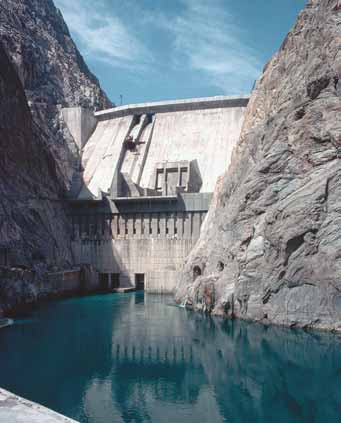
agricultural coenoses. To regulate water feed to the fi elds, reservoirs
(Chardara on the Syrdarya River; Takhiatash and Tyuyamuyun
on the Amudarya River) were created, inundating 277 000 ha of
fl oodplain and desert ecosystems. Furthermore, canals were created,
destroying 40 000 ha of the natural environment. The total length
of the irrigation and drainage channels in Uzbekistan is 180 000 km.
Thus, as a result of irrigation development over the last 30 years,
approximately 4.5 million ha of natural ecosystems have been lost,
with a total biological productivity of 5.4 million tonnes (including
1.8 million tonnes of useful products). The total biological production
of the agro-coenoses on irrigated areas is 120
million
tonnes,
10 million tonnes of useful production (Kuksa et al. 1991).
Changes in the biota, unforeseen and often disregarded during
the planning of projects, are associated with raising the water table
by irrigation. In removing the collector/drainage waters from the
oases, 530 000 ha of desert ecosystems have undergone fl ooding,
waterlogging and salinisation. Thus, as a result of the processes
accompanying irrigation, salty solonchak-type ecosystems have
developed on an area of 4.06 million ha, where weedy halophile
mixed herbs and halophile shrubs and sub-shrubs dominate, with an
impoverished diversity of fauna. Remembering that about half of the
Figure 8
The Toktogul hydroelectric dam on the Naryn
present irrigated lands have become saline and parts of them are not
(Syrdarya) River, Kyrgyzstan.
(Photo: CORBIS)
sown every year, the total area of anthropogenic solonchak systems
approaches 5 million ha.
63 and consequently very little is able to survive in these waters
(Zholdasova 1999).
A change in the water balance of the rivers and increased water
mineralisation has resulted in the loss of unique biocenosis and a
The drained tract of the Aral Sea Basin is characterised by a lower
number of endemic animal species. Until 1960 over 70 species of
biodiversity in comparison with the coast. Among the plant species of
mammals and 319 species of birds inhabited the river deltas. Nowadays
the Aral Sea coast, 30 species are valuable fodder plants, there are more
these numbers have been reduced to 32 species of mammals and 160
than 30 species of medicinal plants and 31 species of weed plants. More
species of birds. In the low-lying areas of Syrdarya more than 100 000 ha
than 60 species of local fl ora are potential phytomeliorants for the dried
of alluvial soils have become alkali soils and more than 500 000 ha of
coasts (Novikova 2001).
wetlands have dried up. This has resulted in the modifi cation and
destruction of 5-7 food sources for sheep, goats, horses and camels
The area aff ected by irrigation practices is not restricted merely to the
(Saiko 2000).
land which is actually irrigated but instead includes the feed source
(the river), the reservoirs, the main and subsidiary canals, the man-made
Changes to the wetland (tugai) ecosystem
lakes (for accumulation of the collector-drainage waters) and the river
Syrdarya delta
valleys, deltas, and fi nal lakes. All these components of irrigation cause
The ecological changes to the Syrdarya delta began slightly earlier
signifi cant changes in the region's terrestrial and aquatic ecosystems
than in the Amudarya delta. As early as the 1960s, the renewable water
(Bakhiev & Treshkin 2002, Novikova 1999, Novikova et al. 2001, Treshkin
resources of the Syrdarya Basin were fully exploited, and in the 1970s
2001).
this level was exceeded as return waters also began to be exploited.
The further increase in river-water abstraction led to a reduction in
The development of irrigated agriculture in the Aral Sea Basin has
fl ow in the lower reaches of the delta. In the late 1970s, only an average
replaced natural desert ecosystems of an area of 7.2 million ha with
of 4% of the annual resources formed in the catchment area actually
40
GIWA REGIONAL ASSESSMENT 24 ARAL SEA
entered the Syrdarya delta. The summer-spring fl oods on the Syrdarya
caught on a non-commercial scale until 1990 on Lakes Togus -Tore and
ceased as early as 1971. Simultaneously, there was a rapid fall in the
Sudochye.
level of the Aral Sea, which led to desertifi cation on the delta plain. By
1978 approximately 114 000 ha of alluvial meadow soils had turned into
With the persisting and worsening aridity and desertifi cation of the
solonchaks and 532 000 ha of marshy and meadow-marshy soils had
environment in the Amudarya river delta, the productivity of the
dried out and 31 000 ha had become desert. Thus, 732 000 ha eff ectively
meadow and pasture communities continues to decline in the current
went out of agricultural use. The productivity of the grass/mixed-herb
environmental conditions of the Aral Sea region.
and mixed-herb meadows was reduced to one-third of its former level
(Bakhiev et al. 1987).
Desertifi cation in the delta is leading to the replacement of highly
productive reed communities by mixed communities of low growing
Formerly rich areas of hydrophile vegetation (hay and fodder areas)
reed, annual Salsola spp., often by bushes of tamarix and in some
died on a large part of the delta. Total fodder resources fell from 1.5
places by Karelinia caspica and Alhagi pseudalhai. The yield of these
to 0.5 million tonnes. The area of riparian woodland was halved, and
communities does not exceed 400-500 kg/ha. By 1985 only 70 000 ha of
the remaining was severely degraded and desertifi ed. Desert species
watered reedy hay lands remained in the Amudarya delta. Commercially
of plants and animals started to expand in the delta and fl oodplain,
valuable reed areas can only be preserved by irrigation on the bottom
and impoverished desert ecosystems began to form (Novikova 1999).
of the drying up lakes and depressions between the streambeds for
Colony-forming birds relocated away from the lower reaches of the
about 2 months a year.
Syrdarya.
The increasing aridity of the Amudarya fl oodplain and delta, and
Amudarya delta
the practice of unsustainable forestry have threatened the existence
The reduction in river fl ow following the construction of the Takhiatash
of the unique riparian woodland ecosystems. In the early 1930s the
and Tyuyamuyn reservoirs and the excessive use of water in irrigated
riparian woodlands occupied 300 000 ha in the lower reaches of the
areas has modifi ed the delta and fl oodplain environment. The area
River, but by 1986 this had been reduced to 33 000 ha. In 50 years their
occupied by plant communities found in the fl oodplain habitats only
area within the lower reaches and Amudarya delta had decreased by
under annual spring-summer fl ood inundation was reduced from 35%
nearly 90%. The degradation and loss of the riparian woodlands gained
to 8% and plant communities characteristic of periodically fl ooded
impetus in the late 1970s and 1980s. In 8 years (1978-1986) the area of
habitats above the fl oodplain were reduced from 40 to 20%. At the
riparian forests in the delta halved. The rate of mortality of the riparian
same time, the number of communities associated with salinised and
woodland reached a "record" of 5 778 ha per year. Today these forests
desertifi ed parts of the fl oodplains and delta rose from 25 to 75%
form less than 3% of the total forest resources of Karakalpakstan. Many
(Novikova 1999).
of the stands that have persisted are now dieing, and illegal felling
continues (Treshkin & Kuzmina 1993).
Vast reed thickets occupied more than 300 000 ha in the Amudarya
delta. They were a rich habitat for bird fauna, inhabited by 21 species
Floristically the Amudarya riparian forests are the richest ecosystem
of waterfowl (including 11 nesting species, the Khivin pheasant, 9
in Central Asia and include 567 species of higher plants, including
species of waders, including spoonbills), several species of raptors and
29 endemic species and many relict plants of the Tertiary geological
more than 10 species of passerine birds. Wild boar and reed cat were
period. Presently, the profound disruptions in habitat have led to the
widespread and until the late 1930s the Central Asian tiger inhabited the
near extinction of 54 species of plants (in 46 genera and 26 families).
fl ood plains. By the mid 1980s the area of reed thickets had reduced fi ve-
Even by the end of the 1980s, white and yellow water-lilies, Aldrovanda,
fold, and the green weight yield decreased from 30 000-40 000 kg/ha in
Agropyrum repens, and ferns no longer existed (Novikova 2001).
the 1960s to 4 000-12 000 kg/ha in the 1980s. The populations of reed
dwelling animals were considerably depleted. By the 1980s the wild
The number of mammals has declined. The Khangul-Bokhara deer, the
boar population had declined almost six-fold (Kuksa et al. 1991).
typical inhabitant of the riparian woodlands, has virtually disappeared
from the wild. Only about 10 semi-wild deer in the Baday-Tugai reserve
In the maritime area of the delta, a large muskrat population inhabited
survive today.
lakes. In the early 1980s this whole network of lakes had dried up,
putting an end to hunting and trade. The muskrat continued to be
ASSESSMENT
41
Environmental degradation has resulted in a reduction in the trophic
In the Aral Sea itself, salinisation has led to a severe decline in the fi sheries.
potential for birds and mammals. The fi sh mortality in the Aral Sea and
Fish catches fell from 46 000 tonnes in the early 1960s, to 10 000 tonnes
the impoverishment of food sources in the delta waters makes survival
in the 1970s and by the 1980s only 1 000 tonnes were landed. Today, the
diffi
cult for fi sh of higher trophic levels and insectivorous birds of the
fi sheries industry has practically collapsed (Aladin 1999).
water-swamp ecosystem.
Health impacts
There was widespread migration of waterfowl and aquatic-swamp birds
Habitat and community modifi cation has had detrimental eff ects on
both within the Aral Sea region and further a fi eld. As early as 1978, a
the health of the population. In areas where severe habitat modifi cation
complex of birds including thousands of red-legged and red-crested
has occurred, living conditions have deteriorated, and subsequently
pochards and river ducks, whooper swans, spoonbills, cormorants and
incidences of anaemia, diminished thyroid function, and renal and liver
white and Dalmatian pelicans left the Syrdarya delta, which had lost its
diseases has increased. The morbidity rate over the last 10-12 years has
fl ooded areas, and migrated to the Turgai lakes, 350-400 km north. The
been permanently rising and this trend is predicted to continue. The
total number of species which relocated amounted to several hundred
decline in productivity of the regional ecosystems has reduced their
thousand (Zaletaev 1989).
nutritional value for humans, for example, from pasture lands and the
fi sheries. The health impacts associated with this concern were assessed
Socio-economic impacts
as severe.
Economic impacts
The impacts caused by habitat and community modifi cations aff ect
Other social and community impacts
practically all economic sectors. Considering the signifi cant and
The population of the region is now forced to survive upon poor quality
continual damage caused by this concern, and the high gravity of the
and scarce food supplies. The ecosystems have lost their assimilate
consequences, economic impacts were assessed as severe.
capacity for human activities, and it has become diffi
cult to utilise
alternative territorial resources without infl icting further environmental
Changes in vegetation caused a reduction in pasture productivity
degradation. The employment structure has changed as individuals
from 1.2 million to 600 000 tonnes, and the productivity of cereal
are forced to adopt alternative livelihood strategies due to the collapse
mixed-grass meadows and mixed-grass meadows decreased three-
of traditional industries, such as the fi sheries. There has been a loss
fold. Commercial use of water-marsh areas has ceased completely
in the cultural and recreational value of the natural environment for
(Kuksa et al. 1991).
the communities of the region. The impacts are occasional but long-
term, and the degree of gravity is medium. Overall, other social and
Desertifi cation led to a decline in the areas of hay and pastures and
community impacts were assessed as severe.
a reduction in their yields. Since 1960, the area of hay was reduced
from 420 000 ha to 70 000-75 000 ha by the end of the 1980s. Along
Conclusion and future outlook
with this 6-fold reduction in area, the hay yield on the periodically
The modifi cation of habitats has been severe in the Aral Sea region.
watered areas fell from 1 500-4 000 to 300-1 600 kg/ha (dry plant
However, it is primarily a function of freshwater shortage rather than
weight) and to 70-80 kg/ha on the non-watered decertifying areas.
a result of direct habitat modifi cation by humans. For example, the
Only a third of pastures in the Amudarya delta remained, falling from
loss and modifi cation of the habitats associated with the Aral Sea
348 000 to 120 000 ha, and pasture productivity fell from 100-1 400 to
and the river deltas is attributed to the reduction of stream fl ow as a
50-500 kg/ha. The reason for the sharp fall in biological productivity of
result of water abstraction for irrigation purposes. This concern was
the meadow communities in the Amudarya delta was the reduction
therefore not selected as the region's priority concern despite its severe
in water supply to the terrestrial ecosystems by 3-4 classes according
environmental and socio-economic impacts.
to Ramenskii's scale, from moist-meadow to dry-steppe and desert
(Novikova et al. 1998 & 2001).
The intensity of anthropogenically induced desertifi cation, secondary
soil salinisation and destruction of the region's biodiversity, especially in
In the Syrdarya Basin the commercial potential of the water-marsh areas
Priaralye, has not decreased in recent years. Since the end of the 1980s
was lost. In the 1950s the yield of muskrat skins was 70 000 to 230 000. In
no research has been carried out in the zones of run-off formation, and
1968 this fi gure was reduced to 9 000 skins, and by 1978 only 72. There
there is little information available on the degradation of mountain
is now no muskrat trade (Kuksa et al. 1990).
ecosystems (i.e. concerning reductions in the area of woodland
42
GIWA REGIONAL ASSESSMENT 24 ARAL SEA
vegetation and intensive erosion). Furthermore, the recreational amenity
current physical conditions. Today, the plaice-gloss accounts for more
provided by the mountain regions is being developed; if this is not
than 30% of the total amount of fi sh caught in the Aral Sea.
suffi
ciently regulated there may be ecological consequences. According
to GIWA experts, besides developing a network of protected areas for
Socio-economic impacts
conservation in all countries of the region, the rehabilitation of degraded
Economic impacts
ecosystems necessitates the establishment of national and regional
The decline in the fi sheries has impacted the economy of the region
ecological programmes aimed at evaluating ecosystem degradation and
due to the importance of the industry to many communities. The
understanding the dynamics of natural processes in order to identify the
impact on the regional GDP from the collapse of the fi shing industry
impacts of development trends and future proposals.
can be assessed as medium to high. However, it should be noted that
the economic impacts have been primarily a result of environmental
changes rather than the overexploitation of fi sh.
T
C
A
Unsustainable exploitation of
IMP
Health impacts
fish and other living resources
This concern has limited direct aff ects on the health of the population,
and there is consequently limited available data.
The fi shing industry has practically collapsed in the Aral Sea Basin.
Annual fi sheries production declined from 46 000 tonnes in the early
Other social and community impacts
1960s to 1 000 tonnes in the 1980s and today very little fi shing is
Fishers surrounding the Aral Sea have been forced to migrate or change
practiced. There have also been signifi cant changes in the taxonomic
their livelihood strategy as the Sea receded. The communities have lost
composition and diversity of fi sh species. For example, freshwater
a valuable source of nutrition and income, in addition to the loss of
species have been replaced by more salt-tolerant marine and haline
many other ecosystem services. Consequently, the quality of life for
species. However, this has not been the result of the unsustainable
these communities has been diminished.
exploitation of fi sh and other living resources, but resulted rather from
the habitat and community modifi cation concern. This in turn has
Conclusion and future outlook
been driven by the diversion of water for irrigated agriculture, which
GIWA experts agreed that the concern of unsustainable exploitation of
has prevented the suffi
cient allocation of water for the downstream
fi sh and other living resources is irrelevant and non-applicable to the
habitats of fi sh and other aquatic organisms.
region under the current freshwater shortage scenario.
Environmental impacts
The restoration of marine biota may be possible following the
The former thriving ecosystem, which supported 24 game fi sh species,
construction of the Kokaral Dam which will considerably raise the
has been severely impoverished. Fish species included carp, grouper,
water level of the Small Sea. Opportunities to improve the ecological
sturgeon, salmon, met sheat-fi sh and sea-pike. The fi shing industry was
situation in the critical zone of Priaralye, as well as in the entire basin, are
based primarily on the three fi sh species: bream, carp, and Aral dace.
dependent on freshwater availability and the allocation of water. In order
In the Aral Sea, the valuable fi sh species of sawyer and white-eye fi sh
to rehabilitate the fi sheries water needs to be equitably distributed, the
were fi shed near the coastal areas and in the lower reaches of the rivers.
sea level needs to be regulated and suffi
cient minimum discharges from
Changes in the saline structure of the Aral Sea and a loss of biota have
the Amudarya and Syrdarya need to be maintained.
resulted in the collapse of the fi shing industry in the Sea by the year
2000, although some fi shing still continues in the water bodies of the
Syrdarya and Amudarya basins.
T
C
A
Global change
IMP
Since the mid-1970s members of the Aral department of Kazakhstan
Scientifi c and Research Institute of Fisheries have conducted research into
Environmental impacts
salt-aff ected fi sh species, including Caspian sturgeon, kurin salmon, azov
Changes in the hydrological cycle
and chernomor plaice-gloss and plaice-calcan. With its high ecological
Variations in precipitation and temperatures
plasticity and ability to spawn in water with a salinity level of 17-60,
The recession of the Aral Sea has, to a certain extent, changed the
the plaice-gloss has proven the most successful species to survive in the
climate of the Aral Sea region (Molostnova et al. 1987, Zolotokrylin &
ASSESSMENT
43
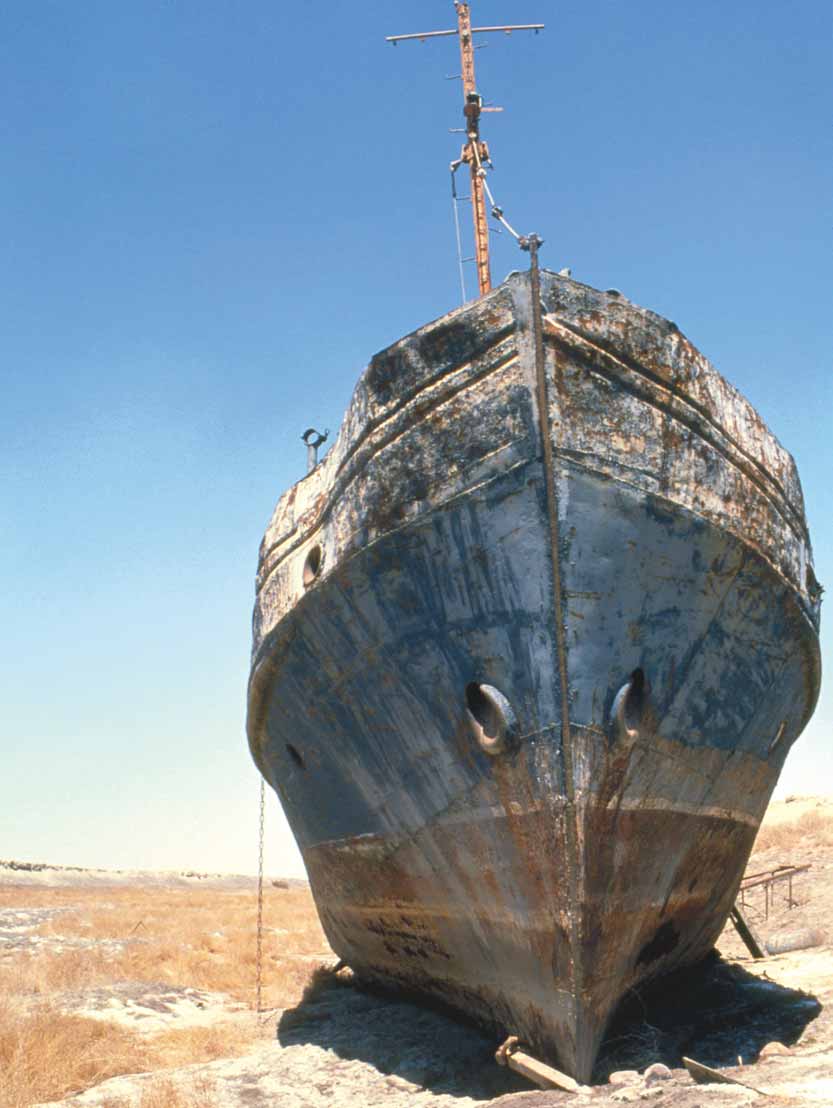
Figure 9
Beached boat in a part of the Aral Sea
which was once covered in water.
(Photo: SPL)
44
GIWA REGIONAL ASSESSMENT 24 ARAL SEA
Tokarenko 1991, Zolotokrylin 2003). Summer and winter air temperatures
snow-water equivalent (the main component of snow resources) has
at measuring stations near the shore have increased by 1.5-2.5°C and
not changed (Pimankina 1998, Schröder & Sevrskiy 2004). Similar results
diurnal temperatures have increased by 0.5-3.3°C. At coastal stations
were found by Artemjeva and Tsarev (2003) for Western Tien Shan and
the mean annual relative air humidity decreased by 23%, reaching 9%
Gissaro-Alai. In addition, the volume of river run-off has also been
in spring and summer. The number of days the region experienced
consistent (Schröder & Sevrskiy 2004, Chub 2000).
drought increased by 300%.
The situation concerning the evaluation of the dynamics of ice
The annual cycle of precipitation has also changed. In 1959 maximum
resources is more complicated. Investigations (Shchetinnikov 1993, 1998,
precipitation fell during February and March and the minimum in
Shchetinnikov & Likhacheva 1994, Dikih 2001, Dikih et al. 2001, Vilesov &
September, whereas between 1970 and 1979 the maximum was
Uvarov 2001, Cherkasov 2002, Cherkasov et al. 2002, Durgerov et al. 1997,
observed in April and the minimum in July. A three-fold increase in
Glazirin & Kodoma 2003, Severskiy & Tokmagambetov 2004) confi rm
refl ected solar radiation in the Aral area due to a seven-fold rise in the
that the glacial systems of Central Asian mountains develop in the same
albedo of the area previously occupied by the Aral Sea has contributed
direction and have similar rates of change. Therefore, over the last few
to the increase in climate continentality (Kondratyev & Donchenko 1999).
decades the area of glaciers in diff erent regions of Tien Shan, Gissaro-Alai,
Although the drying of the Aral Sea and anthropogenically induced
Pamirs and Dzhungarskiy Alatau has decreased at the average annual
global warming have played roles in changing the climate, the
rate of 0.8-1.0% (Shchetinnikov 1993, Shchetinnikov & Likhacheva 1994,
temperature increases and changes in precipitation rates recorded
Dikih 2001, Cherkasov 2002, Severskiy & Tokmagambetov 2004). These
over the last 40 years in Southern Priaralye are more likely a refl ection
results therefore suggest that contemporary and prognostic changes
of natural cyclic fl uctuations in the climate (Zolotokrylin 2003).
in ice resources of Central Asian mountains can be assessed using the
example of a single representative area that has reliable information on
According to estimations by the Intergovernmental Panel on Climate
its glacier dynamics. In Central Asia one such area is the Balkhash Lake
Change (IPPC), the mean global temperature of the atmosphere has
Basin (southeast Kazakhstan and China). The state of the glaciers of this
increased by 0.3-0.6°C during the last century. This factor, together
basin was analysed for 1956, 1972 (the Dzhungarskiy Glacier System),
with rising trends in the concentration of CO in the atmosphere, has
1975 (the Zailiyskiy-Kungeiskiy Glacier System) and 1979, and 1990 (the
2
led to conclusions that the climate, including that of Central Asia, will
Northern Slope of Zailiyskiy Alatau's glacier system).
warm up signifi cantly in the immediate decades resulting in further
environmental changes (Chichasov & Shamen 1997, Eserkepova et al.
According to the results of the comparative analysis the average annual
1996, Chub 2000).
rate of decrease in the glacier area on the northern slope of the Zailiyskiy
Alatau was 0.92% between 1955 and 1990 and the decrease in the net
According to predictions, the water resources in the main watersheds
glacier volume was 1.0%. As previously mentioned, ice resources of the
of Kazakhstan will reduce by at least 20-22%, droughts will increase in
Ili-Balkhash Lake Basin have decreased by more than 30%. The rate of
frequency, and the grain crop productivity will decrease by 20-23%.
glacier retreat has not remained constant over the last few decades. An
The scale of probable alterations in the availability of water resources
increase of nearly 50% took place between 1975 and 1979, in comparison
in the Aral Sea Basin according to four established scenarios of climate
with the previous 20 years. The rates of glacier retreat has continued to
changes is rather broad, ranging from positive values (GFDL model) to
increase, however not so sharply. Similar glacier characteristics were
a decrease in the Syrdarya run-off by 25% and the Amudarya run-off
observed for the Jazgulem River Basin on the Western Pamir (Glazirin
by 40%. It is obvious that such a decrease in water resources will result
& Kodama 2003). Moreover, this is consistent with data from recent
in serious consequences for the countries of the region.
research (Batyrov & Yakovlev 2004). Glacial retreat in four large basins
of Gissaro-Alai between 1980 and 2001 is half the rate of that over the
Contemporary and predicted changes in snow-ice and renewable water
period 1957-1979. Thus, the increasing rate of glacier retreat slowed
resources
between the mid 1970s and the early 1980s.
In Central Asia melted snow and ice water contribute to the formation
of renewable water resources. Therefore the evaluation of possible
As the level of precipitation in the mountains of Central Asia has
changes in water resources in the foreseeable future requires a reliable
remained constant, there is a basis to assume that the reduction in the
prediction of the changes in snow resources. According to analysis
rate of glacier retreat can be attributed to the rise in air temperature.
in Northern Tien Shan, over the last decades the average maximum
There is further evidence from long-term observations of the perennial
ASSESSMENT
45
permafrost in Zailiyskiy Alatau. According to this data, the temperature
There are at least two pieces of evidence that suggest such a mechanism
of the top layer of the perennial permafrost increased steadily during
exists. According to the results of long-term geocryological studies
the 1970 and 1980s and has stabilised since the mid-1990s.
carried out at the Zhusalykezen Pass (Northern Tien Shan, Zailiiskiy Alatau
Range) between 1973 and 1996, the temperature of frozen grounds has
If glaciers continue to reduce in area and volume at the current rate, it
increased signifi cantly. Although there have been signifi cant inter-annual
can be assumed that by the middle of the 21st century the glaciers on
fl uctuations, in Northern Tien Shan there have been general trends of
the mountains of Central Asia will reduce by only one third and will
rising annual ground temperatures, increased depths of thawing and
not disappear by the end of the century as was previously expected
decreases in the thickness of the seasonally frozen layer (Gorbunov et
(Cherkasov 2002, Dikih 2001, Glazirin 1996, Golodkovskaya 1982, Vilesov
al. 1997). The ground depth of seasonal thawing, measured in boreholes
& Uvarov 2001). Taking into account the recurrence of the climatic cycles
at the Zhusalykezen Pass, increased by over 1.1 m between 1973 and
over the last 100 years in the region, there may be more favourable
1996 (Gorbunov et al. 1997). Thus, for the specifi ed period melt waters
climatic conditions for glaciation in the future.
from a 1.1 m thick layer of recently frozen ground may have contributed
freshwater to the run-off in the Aral Sea Basin.
Changes in glaciation were confi rmed by the results of the comparative
analysis of photogrammetric surveys of the glaciers in the Small
Isotope analysis used to study the genesis of water resources also gave
Almatinka River Basin carried out by German experts between 1958 and
evidence of a compensatory mechanism. According to the results of
1998. The thickness of ice on each glacier has been signifi cantly reduced
the study, 40-50% of water, and in some cases all of the water, in the
over most of their extent. For 40 years the thickness of the bottom layer
lake-dam complexes of alpine areas of Kyrgyzstan (Top-Karagai, Tuyuk-
of the Tuyuksu tang glacier, for example, has decreased by more than
Tor, Kashka-Suu) are comprised of melt-water from buried moraine ice
45 m, and total losses of ice amounts to more than 40 million m3 (Eber
(Tuzova 2002).
et al. 2005). A reduction in the thickness of the buried parts of glaciers
is also typical.
Socio-economic impacts
Since the 1960s, climatic variations have changed the community
Similarly, on the majority of the area of a zone of a feed of glaciers the
structure of fl ora and fauna in the region. A reduction in the biodiversity
mass balance of ice for the specifi ed period was close to zero (changes
and quality of freshwater has been caused by increasing salinity. The
have made from - 5 up to 5 m). Moreover, according to a survey of 1998
greater aridity of the territory surrounding the Aral Sea has reduced
in a zone of a feed of all glaciers signifi cant sites on the area where the
agro-productivity and resulted in the loss of ecosystem services.
mass balance for the specifi ed period appeared positive. The common
Consequently, the employment structure has changed and there are
increment of thickness of ice (fi rn) in a zone of a feed of Tuyuksu glacier
fewer investment opportunities.
has made 15-25 m. Last circumstance in a combination to stability
of norms of an atmospheric precipitation gives the basis to assume
There is not suffi
cient evidence to suggest that global climate changes
probability of forthcoming change of a sign on mass balance of glaciers
are responsible for all these impacts. There is no doubt that the primary
with negative on positive.
factor responsible for the acute aggravation of the ecological and socio-
economic situation in the Aral Sea Basin is freshwater shortage as a
The fact that despite a considerable reduction in glacier resources the
result of the modifi cation of stream fl ow rather than a consequence of
fl ow rates of the main rivers have practically not changed in recent
global climate changes.
decades suggests that there is some compensating mechanism. One
explanation is that water from the melting of underground ice has
There is no proof to suggest that there is a link between global changes
accumulated as perennial permafrost. The area covered by perennial
and the health status of the region's population. There is cause to hope
permafrost in Central Asia is many times greater than the area of present-
that the present upward trend in average annual air temperatures may
day glaciers (Gorbunov & Severskiy 1998, Gorbunov et al. 1997). Therefore
start to reduce during this century and consequently improve the
even slight melting of the permafrost could compensate for the loss of
environmental conditions of the region.
water caused by the reduction in the region's glaciers. Until now this has
not been considered by the scientifi c community and deserves further
Conclusion and future outlook
attention given the importance of freshwater availability on the ecology
The impacts from the concern of global changes were assessed as
and socio-economic development of the region.
slight. Present-day warming refl ects a cyclic trend in the climate and
46
GIWA REGIONAL ASSESSMENT 24 ARAL SEA
the role of the anthropogenic component in this process is not believed
Though this optimistic conclusion gives us the opportunity to predict
to be as signifi cant as often diagnosed. Hence, there is not enough
the development of the situation in the near future, it does not make the
evidence to rely on the predicted warming of between 2 and 6°C in
problem less acute: water shortage in the region is one of the limiting
the next few decades.
factors of sustainable development. However, the water shortages
are a result of the diversion of water for human activities rather than
The conclusions diff er considerably from contemporary and prognosis
a reduction in the supply of freshwater resources. The transboundary
changes of climate and renewable water resources. Contrary to the
nature of these regional water resources is one of the main premises for
established estimations which state that due to global warming,
the development of international processes in Central Asia.
regional water resources will reduce by 20-40% in the near future (Chub
2000, SPECA 2004), there are grounds to argue that the volumes of river
run-off will remain stable, at least over the next few decades.
Priority concerns for further
Gradual air temperature increases are believed to be attributable to
analysis
natural climatic changes. The glacier resources in the mountainous
countries of Central Asia have reduced by more than one third
The GIWA concerns were prioritised in the following order:
during the last 30-35 years. Scientifi c explorations confi rm that glacier
1. Freshwater
shortage
resources in the Tien Shan Mountains have reduced over the past
2 Pollution
30-40 years; by 0.92% in area and by 1% in volume annually (Severskiy
3. Habitat and community modifi cation
& Tokmagambtov 2004). Experts predict that this process will continue
4. Global
change
for at least 100 years (Cherkasov 2002).
5. Unsustainlable exploitation of fi sh
For the past 40 years the maximum snow storage (snow-water
Considering the above impacts, the GIWA experts concluded that
equivalent) volume has remained constant and the volume of river
freshwater shortage was the priority issue in the Aral Sea region, as
run-off has not changed signifi cantly. The reduction in the area of
it is driving the other environmental issues facing the region. The
glaciers has changed the inter-annual distribution of run-off , as it now
priority issue of freshwater shortage was identifi ed as the modifi cation
contributes slightly less run-off during the vegetation period.
of stream fl ow, which by GIWA Task Team estimations accounts for
approximately 70% of the development of the concern. The second
Despite a considerable reduction in glacier resources, the fl ow rates
most important issue for the region is pollution of existing supplies,
of the main rivers have remained relatively constant over the last
which, it is estimated, accounts for 30% of the development of the
few decades. One possibility for this could be that water infl ow from
situation in the region.
underground melted ice accumulated in the perennial permafrost,
which is now melting and contributing freshwater to the region's rivers.
There has been an abrupt decrease in the natural run-off of the largest
Until now this issue has not received scientifi c attention, but taking
rivers in the region - the Amudarya and Syrdarya - which resulted
into account the extreme importance of probable changes in water
in the rapid drying up of the Aral Sea. This has led to severe habitat
resources as a reaction to climate changes, this aspect of the problem
modifi cation including deterioration of the landscape, intensive
deserves particular consideration.
desertifi cation, secondary soil salinisation, an increase in the extent of
climate continentality and more frequent recurrence of droughts and
It has been forecasted that a signifi cant diminution of water resources
dust storms. The above processes caused severe degradation of both
over the next few decades due to anthropogenic caused warming of
water and land ecosystems and a reduction in biodiversity. The impacts
the climate is unlikely. There are insuffi
cient reasons to fear signifi cant
are most pronounced in the Priaralye zone.
climate warming, a corresponding reduction in water resources or
consequential economic losses.
ASSESSMENT
47
Causal chain analysis
This section aims to identify the root causes of the environmental
scale of the region's freshwater shortage concern and the necessity to
and socio-economic impacts resulting from those issues and
manage water resources at the regional level.
concerns that were prioritised during the assessment, so that
appropriate policy interventions can be developed and focused
where they will yield the greatest benefi ts for the region. In order
to achieve this aim, the analysis involves a step-by-step process
Causal chain analysis
that identifi es the most important causal links between the
environmental and socio-economic impacts, their immediate
Environmental and socio-economic impacts
causes, the human activities and economic sectors responsible
For further detail of environmental and socio-economic impacts,
and, fi nally, the root causes that determine the behaviour of those
please refer to the concerns of freshwater shortage and habitat and
sectors. The GIWA Causal chain analysis also recognises that,
community modifi cation in the Assessment section.
within each region, there is often enormous variation in capacity
and great social, cultural, political and environmental diversity.
Environmental impacts include the following:
In order to ensure that the fi nal outcomes of the GIWA are viable
By the year 2000 the discharge of the Amudarya had reduced
options for future remediation, the Causal chain analyses of the
almost ten-fold compared with 1970. As a result, less than 10% of
GIWA adopt relatively simple and practical analytical models and
the total area of delta lakes in the Amudarya lower reaches remains
focus on specifi c sites within the region. For further details on the
(Olimov 2001).
methodology, please refer to the GIWA methodology chapter.
The area of the Aral Sea has reduced more than two-fold and there
has been a sharp decrease in sea level (by mid-2002 the Big Sea had
decreased by 22 m).
The salinity of the Sea's waters has tripled, killing plant and animal
Introduction
life.
Summer and winter temperatures have become more extreme.
Freshwater shortage was selected as the priority concern for the Aral
A severe reduction in biodiversity and a greater concentration of
Sea region. The focus of the Causal chain analysis (CCA) is to determine
pollution in surface and groundwater supplies.
the root causes of freshwater shortage in the region and, specifi cally,
The total area of lakes in the Amudarya delta reduced from 300 000
the prioritised GIWA issue of stream fl ow modifi cation, so that the
to 30 000 ha and water mineralisation increased to 20-25 g/l, which
driving forces of the issues can be addressed by policy makers. The
resulted in an abrupt reduction in fi sh and animal reproduction.
Causal chain analysis traces the cause-eff ect pathways associated
Between 1970 and 1999 the area of tugay forests in the Amudarya
with the freshwater shortage concern in the Aral Sea Basin from the
delta reduced ten times from 300 000 to 30 000 ha (Bakhiev &
socio-economic and environmental impacts back to the root causes.
Treshkin 2002).
The analysis will consider the entire Aral Sea region due to the spatial
Change in the taxonomic composition of aquatic ecosystems from
brackish water species to more salt-tolerant species.
48
GIWA REGIONAL ASSESSMENT 24 ARAL SEA
Socio-economic impacts include the following:
run-off resources in the Aral Sea region are fully exhausted and the
The collapse of a previously well-developed fi shery and fi sh
economy of the region is developing under conditions of increasing
processing industries.
water shortage.
Industrial development is hindered by the lack and poor quality of
freshwater.
The natural run-off regime has only been preserved within the
In the Aral coastal zone economic activity has ceased, also aff ecting
run-off formation zone in the mountains. Further downstream the
inland industries.
rivers become increasingly regulated due to water requirements by
Unemployment
has
continuously
increased.
economic activities. Changes in water run-off have resulted from the
Loss and decreased productivity of agricultural and pasture land.
construction of numerous water reservoirs for irrigation and power-
Epidemiological conditions have deteriorated in the region
generation. There are more than 100 water reservoirs with a total
resulting in greater morbidity.
capacity of over 74 km3 in the Aral Sea Basin and numerous ponds and
As the Aral Sea recedes, it leaves behind a harmful layer of
small capacity water reservoirs. The largest are the Tokhtogul reservoir
chemical pesticides and natural salts which are blown by the
on the Naryn River, with a capacity of 19.5 km3, Nurek reservoir on the
wind into noxious dust storms, seriously aff ecting the health of the
Vakhsh River (10.5 km3), Tuyamujun on the Amudarya River (7.3 km3)
inhabitants of the area.
and Charvak reservoir on the Syrdarya River (5.2 km3). More recently
An estimated 100 000 people have been displaced due to the poor
there has been a switch in the function of the main water reservoirs in
environmental conditions in the Aral Sea region.
Kyrgyzstan and Tajikistan from irrigation to power generation, further
altering the regime of the Amudarya and Syrdarya rivers.
Immediate causes
According to GIWA experts, the following are the immediate causes of
Reduction in ice resources
the modifi cation of stream fl ow:
During the last century the extent of glaciation declined on the
Increased
diversion;
Central Asian mountains (Pamir, Tien Shan, Gissaro-Alai, Dzhunghar
Reduction in ice resources;
Alatau). Between the 1950s and 1980s, the average annual rate of
Inter-annual
climate
variability.
glacier retreat was approximately 0.9%, and the ice volume of glaciers
reduced by more than a third. Contrary to expectations, this has not
Increased diversion
essentially aff ected the run-off characteristics of the main rivers in the
The increased diversion of water to supply irrigated agriculture is the
region: the average run-off and its inter-annual fl uctuations over the last
primary reason for the change in the regime of the region's major rivers.
40-50 years have practically remained constant.
Between 1960 and 2000 the area of irrigated land increased almost two-
fold, from 4.51 million ha to 7.85 million ha. Consequently, by the early
Observations of the Tuyuksu glacier (Northern Tien Shan) has shown
1980s total water intake from the Aral Sea Basin exceeded available
that the proportion of thawed glacial waters in the total river run-off
water resources, with over 120 km3 abstracted per year (Kipshakbaev &
has gradually reduced, owing to the reduction in the area of glaciers.
Sokolov 2002).
During the period of glacier retreat there was an increase in melt waters
due to the increased thawing of ice in response to a warmer climate. The
Today, there is an annual shortfall of water resources of approximately
additional melt water was not enough to compensate for the reduction
17.0 km3/year, and if the use of return waters is included the volume of
in glacial run-off due to the decline in the area of glaciers (Vilesov &
consumed water resources actually exceeds available supplies; in the
Uvarov 2001). The dominant factor controlling the amount of glacial
Syrdarya Basin 130-150% of available water resources are used and in the
run-off was therefore found to be the reduction in glacier area rather
Amudarya Basin, 100-110% (Kipshakbayev & Sokolov 2002). Taking into
than changes in glacial run-off caused by global warming.
account inter-annual run-off variability, an estimated 50-60% of surface
run-off is a threshold volume in order to sustain current water use in
The fact that despite the considerable reduction in glacial resources
the region. Water availability is at a critical level in all of the countries in
the fl ow rates of the main rivers have not altered signifi cantly in recent
the region, and they are highly dependent on climatic fl uctuations to
decades suggests a compensating mechanism exists. It is believed
meet water demand (Rodina 2002). Irrigated land in the Aral Sea region
that an infl ow of freshwater from the melt-water of underground
is expected to increase in the immediate future and by 2020 could reach
ice accumulates in the perennial permafrost. The area of perennial
an estimated 8.4 million h (Ruziev & Prichodko 2002). Thus, natural
permafrost is many times greater than the area of present-day glaciers
CAUSAL CHAIN ANALYSIS
49
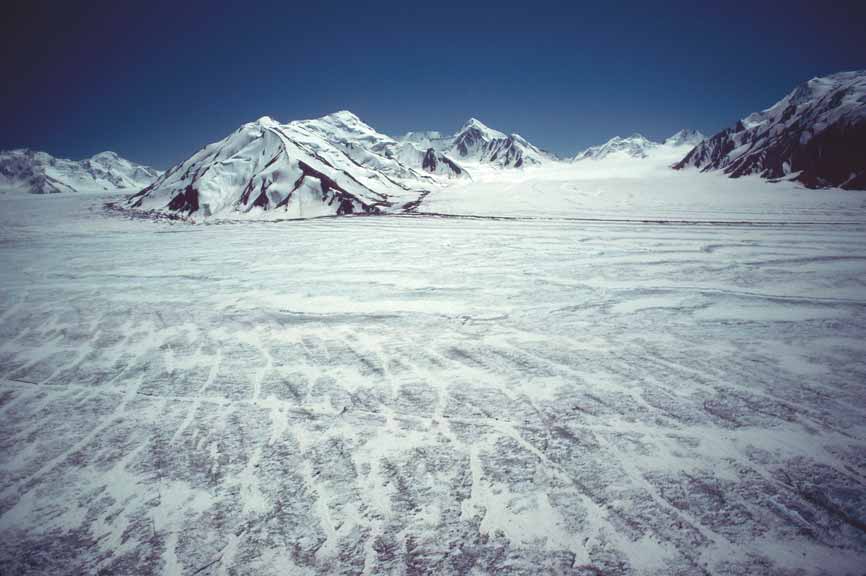
Figure 10 Peaks rising from a glacier in the Pamirs, Tajikistan.
(Photo: CORBIS)
(Gorbunov et al. 1997, Gorbonov & Severskiy 1998), and therefore even
Irrigated agriculture in Uzbekistan, Turkmenistan and Kazakhstan is
a slight melting of the permafrost could compensate for the reduction
particularly aff ected by the water shortages. In extremely dry years
in freshwater supply caused by the decline in the area of glaciers. As
there are severe economic losses. For example, in the year 2000 irrigated
the area of perennial permafrost repeatedly exceeds the area of modern
agriculture suff ered economic losses of 77 million USD in Turkmenistan
glaciation, and stocks of underground ice are comparable to the volume
and 187 million USD in Uzbekistan (Sorokin 2002).
of glacial ice of glaciers, it is possible that even if the majority of glaciers
disappear, it may not aff ect the availability of regional water resources,
Root causes
at least not in the forthcoming decades. This has not been adequately
Demographic
studied by the scientifi c community and is particularly important when
Increases in population have led to greater pressure on the natural
considering the infl uence of climate changes on freshwater resources,
resources of the Aral Sea Basin, including the water resources. The
particularly if average temperatures increase in the future.
annual population growth rate is over 3%.
Inter-annual climatic variability
Economic
Fluctuations in climatic conditions cause annual water resources to
Collapse of Soviet economic mechanisms
vary considerably. The Syrdarya River Basin has approximately 23.6 km3
Since the early 1990s the disintegration of the USSR and the pursuing
(63% of the average run-off ) of water resources in scarce water years
collapse of its integrated economic system, the catastrophic decline
and 51.1 km3 (137%) in abundant years. In the Amudarya River Basin
in the economy of the countries of the region and associated social
annual water resources range from 58.6 km3 (74%) to 109.6 km3 (138%).
upheavals, for example the civil war in Tajikistan and confl icts in
Thus, in the Syrdarya River Basin there is essentially a more critical water
Uzbekistan and Kyrgyzstan, have not favoured regional cooperation
situation; available freshwater resources in dry years are 37% below the
and the equitable sharing of transboundary water resources.
long-term average, compared to 24% in the Amudarya River Basin.
50
GIWA REGIONAL ASSESSMENT 24 ARAL SEA
The transition to a market economy was accompanied by an economic
water by irrigated farming and unauthorised water diversion has been
crisis in the region's agricultural sector and the collapse of economically
attributed, in part, to the weak legislative and regulatory system in the
powerful agricultural cooperatives. A subsequent lack of investment in
region. The absence of regulations governing the use of return water
agriculture has led to the deterioration of agricultural machinery, and
in irrigated farming has resulted in negative consequences, such as the
irrigation and other water infrastructure. This has caused a decline in the
salinisation of agricultural fi elds and a reduction in productivity.
water effi
ciency of irrigated farming and agricultural production. The
productivity of irrigated farming decreased from 1 600-2 000 USD to
Water rights
500-900 USD per ha and the effi
ciency of using 1 m3 of irrigation water
The current water legislation is in need of revision as it was formulated
decreased from 0.18-0.25 USD to 0.03-0.10 USD (Duchovny 2002a&b).
during the Soviet period and is inappropriate for present-day conditions.
Countries abstracting the most water resources insist on maintaining
Furthermore, the introduction of water saving technology has been
the quotas established in the Soviet era and claim transboundary waters
impeded by the economic downtown in the agricultural sector.
to be common property, whereas countries in the run-off formation
Despite eff orts by the governments of the region and the international
zone, namely Kyrgyzstan and Tajikistan, argue that the quotas are
community this situation remains problematic.
unfair and demand payment for water which fl ows to the countries
located downstream, which is categorically refused by Uzbekistan and
Lack of economic incentives
Kazakhstan (SPECA 2004, Mazakhirov 2003, Babaev 2003). Uzbekistan
There is a lack of economic mechanisms aimed at regulating water use,
maintains that, to achieve an equitable distribution, water resources
particularly in irrigated farming, which is a major obstacle in improving
should be allocated per capita. The other countries disagree with
water resource management at all levels, local to regional. There
this proposal, especially Kyrgyzstan and Tajikistan. There are also
are no economic incentives to conserve water resources. Currently
discrepancies between countries on the joint usage of interstate
irrigation farmers do not pay for the water they apply to their fi elds
facilities, such as power generation stations which were constructed
and consequently there is no incentive for them to employ irrigation
in the Soviet era (Mambetov 2003, SPECA 2004).
systems that are more water effi
cient.
There is no common legal approach among the countries of the region
A joint approach to economically evaluating river water is absent
towards the allocation of transboundary water resources, though there
in the region. There is no uniform understanding of even the most
is a general opinion that all actions concerning the use of regional water
fundamental economic principles of river fl ow regulation, let alone
resources are to be based on the statement that it is necessary to keep
questions of water pricing (Petrov & Leonidova 2003).
the existing system concerning use of regional water resources, including
quotas on water (Dzhalalov 2003). But it has been demonstrated
Overdependence on the agricultural sector
worldwide that, even in areas with very high average precipitation rates,
Agriculture, and more specifi cally irrigated farming, constitutes the
relations between countries concerning the sharing of transboundary
largest proportion of GNP in Uzbekistan, Turkmenistan and Tajikistan.
water resources can be problematic (Petrov & Leonidiva 2003).
Development in most countries of the region is determined by the
economic success of irrigated farming. Due to a long recession in the
An alternative principle governing the rights of any state over the use
agricultural sector following the collapse of the Soviet Union, in the
of hydropower resources and its aff ect on other states is as follows: "A
1990s the governments of the region supported farmers through special
sovereign state has the right to establish any regime of river run-off
programs. Productivity subsequently increased, especially in Kazakhstan,
regulation in accordance with its national interests on the territory of
Uzbekistan and Turkmenistan, but the fundamental problems regarding
its water reservoirs. If the regime aff ects or contradicts the interests of
the management of the region's water resources were not resolved.
any other state, the state-owner is obliged to change the regime in
favour of the aff ected state and provide corresponding compensation"
Legal
(Petrov & Leonidiva 2003).
Weak legislation
There is a lack of a clearly formulated and mutually accepted legislative
Governance
framework for inter-state use of water resources. There is subsequently
Lack of integrated water management
opposing national legislation which impedes regional cooperation
The collapse of the Soviet Union required the reliance of the new
in the management of water resources. The highly ineffi
cient use of
independent states on their own resources for economic development.
CAUSAL CHAIN ANALYSIS
51
Naturally, this has resulted in diff ering development strategies and rates
the Sangtudin reservoir and several other water reservoirs which will
of economic growth in the countries of the region. The governments
be mainly used for power generation (ICG 2002, Rakhmonov 2003).
also re-evaluated former priorities, including those for the management
Turkmenistan also plans to increase its irrigated areas by 450 000 ha
of water resources. States in the zone of run-off formation (e.g. Tajikistan
and create a lake with a volume of 5-6 km3 in the Karakum desert called
and Kyrgyzstan) found it more economically attractive to use water
"Lake of the Gold Century". It plans to use the accumulated drainage
resources for hydroelectricity generation (including export) rather than
water to irrigate between 700 000 and 1 million ha of desert pastures.
irrigated farming which had limited expansion prospects due the relief
According to estimates made by Uzbek experts, the maintenance of
of the area (Duchovny 2002a&b, Sokolov 2001). Water use strategies
this lake will necessitate an additional intake of approximately 13.5 km3
have consequently diverged and cooperation between the various
of Amudarya river water (ICG 2002). There are plans in Uzbekistan to
national water management institutions has become problematic.
construct 15 hydroelectric power stations and a long-term vision to
construct a further 140 (ICWC 2004).
Despite declarations by regional governments to coordinate water
policies, there remains a tendency to take unilateral decisions and
Inadequate and confl icting water use strategies
actions favouring national, rather than regional, interests. ICG experts
Inadequate political strategies have developed a water-dependent
have stated "the problems of coordination of water and energy
regional economy which is reliant on irrigated farming and the
resources in the Central Asian region as a current source of tension
production of water intensive crops, i.e. cotton and rice. The confl ict
are so important that they can be considered only less important than
of interests regarding the use of water resources by the irrigation and
Islamic extremism" and the "struggle for water resources will become
power generation industries has not yet been resolved. At present,
more intensive unless more eff ective mechanisms to solve the problems
interrelations between these activities are regulated by the Syrdarya
are not created" (ICG 2002).
agreement of 17th March, 1998, which runs counter to the interests of
the upstream countries (Petrov & Leonidova 2003).
The decision to create a water-power generation consortium was made
by the presidents of all Central Asian countries in 1997 and confi rmed in
Power resources were previously guaranteed to Krygyzstan and
July, 2003. Unfortunately, despite fi ve years of eff orts, there has been no
Tajikistan, but since the collapse of the USSR deliveries are only possible
success in establishing the consortium (Koimdodov 2003).
through interstate agreements, which are often not fully implemented.
The discontinuation of power resources to Kyrgyzstan and Tajikistan
The regulations governing interstate water management are
and additional economic diffi
culties forced the governments of
unsystematic, poorly coordinated, and often contradictory, impeding
these countries to convert the Tokhtogul and Nurek reservoirs from
the implementation of water management systems (Petrov & Leonidiva
irrigation to power generation. This action dramatically changed the
2003).
hydrodynamics of the major rivers in the region, the Amudarya and
Syrdarya, resulting in signifi cant economic losses to the agricultural
This situation, combined with unilateral and uncoordinated decisions
sector in Uzbekistan and Kazakhstan. This stimulated diffi
cult interstate
and actions, is leading to signifi cant changes in the hydrological
negotiations and agreements between the relevant nations.
regime of the region's transboundary rivers, thus demonstrating the
ineff ectiveness of the current system of interstate water allocation. This
The hydroelectric power stations operate at maximum capacity during
has led to complications in international relations in the region.
the winter, when demand for electricity is greatest. Therefore, a greater
volume of water is released during the winter from the reservoirs,
Expansion of irrigated farming
resulting in a defi ciency of water for irrigated agriculture during warmer
Despite the fact that the majority of regional water resources (more than
periods of the year. This change in water use policy has resulted in the
90%) are used for irrigated farming, particularly for the production of
ineffi
cient use of water resources, the degradation of downstream
water intensive crops, such as cotton and rice, practically all countries in
ecosystems, and dangerously high water levels in the lower reaches of
the region intend to increase their irrigated areas. Tajikistan is planning
the Syrdarya in the winter.
to increase its irrigated area by 700 000 ha in the near future, which will
require an additional annual intake of more than 9 km3 of water from
Despite annual agreements between the upstream and downstream
the Amudarya River. Moreover, Tajikistan, following the construction of
nations regarding the release of water from the hydropower reservoirs
the Ragun water reservoir with a capacity of 10 km3, intends to construct
on the Naryn-Syrdarya cascade, communities in Kyzylorda oblast
52
GIWA REGIONAL ASSESSMENT 24 ARAL SEA
in Kazakhstan are threatened by fl oods practically every year. This
1946. If Afghanistan fulfi ls its quota, there will be considerable changes
has necessitated regular consultations and negotiations between
in the Amudarya run-off (ICG 2002).
representatives and heads of the relevant states. For example, the
release of water to the Arnasays' hollow was only increased when in
Kazakhstan was the only Central Asian country to participate in the 1992
the winter of 2004/2005 concern over the safety of the dam of the
Helsinki water convention and the 1997 Convention on non-navigable
Shardara water reservoir was raised and there was intervention by the
river usage. Some items of the legislation of the countries contradict
heads of the states of Kazakhstan and Uzbekistan.
clauses of the above conventions. The national legislation of each of the
Central Asian countries diff er considerably and requires coordination,
There are plans for the further development of hydropower engineering
especially regarding transboundary river fl ows (Koimdodov 2003).
in Tajikistan and Kyrgyzstan. Future projects include the construction of
the Kambaratin hydropower station in Kyrghyzstan and the Sangtudin
Approval of the Kyzylorda declaration of March 1993 required that all
and Ragun hydroelectric power stations in Tajikistan. Kyrgyzstan
Central Asian states: recognise the system of regulation; improve water
plans to supply electricity to the CIS countries and Pakistan, and
use discipline in the basin; develop corresponding interstate legal and
Tajikistan to Iran and other neighbouring countries. It is feared that the
normative documents envisaging regional principles of reimbursement
construction of new water reservoirs will further aggravate the confl ict
of losses and damages as common problems for the region. However,
between the interests of hydropower and irrigation. At the same time,
practical results to these problems are yet to be seen, and only
the introduction of new power capacities can promote economic
theoretical plans in the form of reports, presentations and proposals
integration between the countries of region and stimulate industrial
exist, which do not always correspond to each other in either content
growth, and subsequently reduce the dependence of the economy on
or principles (Ashirbekov & Zonn 2003).
water-intensive irrigated farming.
The countries of the region have only succeeded in signing one
Following the collapse of the USSR, the countries on whose territory
agreement on the regulation of hydropower generation, the 1998
the headwaters originated became responsible for the maintenance
Bishkek agreement on the use of hydropower resources of the Syrdarya,
of water distribution systems, including the large water reservoirs and
with alterations and amendments according to the protocol of June
channels. Tajikistan and Kyrgyzstan insist on shared participation in the
1999. A similar agreement on the Amudarya, which was prepared by
funding of these systems.
Tajikistan in 1988 and presented to all other republics, has not yet been
considered. Other regional agreements on water resources used for
Lack of compliance with inter-governmental agreements
power generation including those prepared by SRC ICWC have also not
The sharing of the regions transboundary water resources has become
been signed. The main agreements are:
the subject of increasing interstate negotiations. Approximately 30
Agreement on the development of cooperation and diff erentiation of
interstate agreements were negotiated concerning the distribution
the functions of interstate organisations in protection, management
of the Amudarya River water. Unfortunately, political agreements have
and development of water resources in the Aral Sea Basin (1996);
been diffi
cult to implement in practice and are frequently disregarded.
Agreement on joint usage of transboundary water resources
For example, an agreement between Kazakhstan, Kyrgyzstan and
(1996);
Uzbekistan on water discharges from the Tokhtagul and Shardarya
Agreement on the organisational structure of joint control,
reservoirs in the Syrdarya Basin was impractical. Winter fl oods in the
protection and development of water resources in the Aral Sea
lower reaches of the Syrdarya in November to January, 2003-2004
Basin (1997);
destroyed water regulatory structures and fl ooded some settlements in
Agreement on cooperation in the joint usage of water objects,
Kyzylorda oblast in Kazakhstan. In the post-Soviet period, an agreement
water resources and water facilities (1998);
was made to consider the Aral Sea as an independent (along with the
Agreement on information exchange and the creation of the Aral
states of the region) consumer of water resources. However, river
Sea Basin database on the transboundary water resources of the
discharges to the Sea were below the stipulated volume and in some
Aral Sea (1999).
years there was no infl ow at all.
Thus even the preparation and signing of joint agreements remains
Afghanistan only utilises 10 km3 of a total 19 km3 of the Pyandzh run-off
a contentious issue. Signed agreements often remain unfulfi lled.
it was allocated in the agreement signed by Afghanistan and the USSR in
In particular, Kazakhstan does not adhere to the agreement on the
CAUSAL CHAIN ANALYSIS
53
Syrdarya regarding the mutual payment for changes in the operational
collapse of the USSR and the newly independent states now have
regime of Kayrakkum water reservoir. Agreed quotas of electricity
limited access to the monitoring data of the other nations in the region.
are supplied to Tajikistan by Uzbekistan, with some deviations from
Information offi
cially presented by the countries of the region to form
the agreement. In addition, Kazakhstan and Uzbekistan disregard
regional databases by the ICWC is limited and unreliable regarding the
their obligations stipulated by the agreement by not compensating
use of water resources (Ginijatullin 2002a&b, SPECA 2004).
Kyrgyzstan (Petrov & Leonodova 2003).
Scientifi c investigations in the mountainous areas of the region through
Inappropriate international support
regular expeditions and mountain monitoring stations ceased with the
The international community has inadequately contributed to solving
collapse of the USSR. Moreover, at the planning stage of most water
the problems of the region (Mambetov 2003). Up to 50% of the projects
projects, changes in the hydrological regime of mountain territories are
initiated by donor countries have failed (Duchovny 2002a&b). The
often not considered at all or out-of-date information on water resources
countries of the region doubt the effi
ciency of foreign participation on
is used, thus the real situation becomes less reliable every year.
account of the following reasons:
Predisposition of donor countries to adopt technical solutions,
The monitoring of the climatically-driven dynamics of the high-
which often do not achieve their aims because they are not
mountain belt glaciosphere (which includes glaciers, snow fi elds,
supported by legislative and political policies (ICG 2002);
ice mounds, snow cover, and underground ices above 3000-3200 m
Irrational use of project funds;
above sea level) deserves particular attention. It constitutes the region's
Incompetence of offi
cial decision making;
glaciers and the majority of underground ice and snow resources, and
Inadequately funded fi nancing systems for research by the State
therefore the main sources of renewable water resources. Unfortunately,
Budget and donor funds;
the region's glaciosphere has not been comprehensively investigated.
Insuffi
cient use of local scientifi c resources in solving regional
problems;
An inadequate capacity to predict future water resource dynamics is
Inappropriate foreign specialists employed by international projects
resulting in poorly planned water use strategies. The current defi cit
who often lack an interest in the fi nal results and have insuffi
cient
in appropriate scientifi c studies has resulted in policy-makers lacking
knowledge of local conditions.
reliable information to make informed decisions regarding the
conservation and allocation of water resources. However, warnings
Knowledge
by scientists of environmental impacts were not heeded, when the
Literacy in the former Soviet Union countries of Central Asia is among
governments decided to increase irrigated areas in the Aral Sea Basin
the highest in the world. Scientifi c human resources are of a high
(Glazovsky 1995).
standard and infrastructure, such as laboratories, is well maintained.
However, there is an extensive `brain-drain' to other economic activities
Technology
and countries. There are a limited number of young scientists, and
The irrigation canals are highly outmoded and ineffi
cient, resulting in
institutions can only survive with foreign contracts (UNESCO 2000).
the unproductive use of the region's scarce water resources; up to 50%
Greater investment in the scientifi c capacity of the region may enable
of irrigation water is lost before reaching the fi elds (Ginijatullin 2002a & b,
constructive solutions to the ecological and social problems.
Glazovsky 1995). During the economic recession of the post-Soviet
period water infrastructure was not suffi
ciently maintained. Following
There is a lack of knowledge regarding the natural dynamics of the region,
the collapse of collective farming (kolkhozes and sovkhozes) many
particularly in the run-off formation zone, which is fundamental to solving
irrigation canals which connected the various farms were not privatised
the region's problems. The last estimation of total water resources was
and were poorly maintained. This is considered as one of the primary
made 40 years ago. Since then, considerable changes have occurred in
obstacles to a large scale introduction of modern irrigation techniques
the run-off formation zone, including the depletion of glaciers, which
in the region. During this period hydraulic structures, water-distributing
have undoubtedly aff ected conditions of run-off formation.
systems, and hydrological monitoring stations deteriorated.
The region lacks a common system for the collection and processing
Today, farmers lack the investment to update or adopt water saving
of real data on the hydrometeorological regime of the region and the
technologies in irrigated farming. Large-scale reconstruction of irrigation
water resources used. Such a system ceased operating following the
systems is vital but not feasible due to economic constraints and the lack
54
GIWA REGIONAL ASSESSMENT 24 ARAL SEA
Impacts
Issue
Immediate causes
Sectors/Activities
Root causes
Environmental:
Demographic
- Reduction of river discharge
- Reduction of Aral Sea area
and sea level
- Increased salinity
Increased diversion
Agriculture
Stream flow
Economic
- Reduction of biodiversity and
modification
changes in species composition
- Reduction of forest area
Decreased ice sources
Legal
Domestic water supply
Socio-economic:
- Collapse of fisheries
- Industrial development is
Climate variability
Governance
hindered
Water allocation
- Increased unemployment
mechanisms
- Loss and decreased productivity
of agricultural land
Knowledge
- Increased risk for epidemics
- Displacement of people
Technology
Climate change
Figure 11 Causal chain analysis model for the Aral Sea region.
of technical human resources. In addition, there is a lack of awareness
that regulates water management. The transboundary nature of the
about the benefi ts of employing water effi
cient technologies.
major watershed basins in the region makes it impossible to solve the
problems of rational water use without inter-state agreements. Many of
Climate change
the agreements made to date have not been implemented or are not
The problem of freshwater shortage may become even more acute over
strictly adhered to by the countries of the region.
the next few decades if, as is predicted, water resources in the region's
major river basins reduce by 20-40% (Chub 2000, SPECA 2004). Such
The transboundary water management system is inadequate as it
a reduction in water resources will have severe ecological and socio-
is based on the principles of centralised regulation formed in the
economic consequences unless drastic measures are taken to reduce
Soviet period. There is a lack of clearly formulated water strategies in
the region's water requirements.
the countries of the region and the absence of a mutually acceptable
legislative framework for interstate sharing of transboundary water
However, some predictions show that anthropogenic induced climate
resources.
changes may play a less signifi cant role than was previously thought;
estimations of a 2-4°C rise in temperature in the near future cannot
The lack of knowledge regarding the dynamics of the region's water
be relied upon (Severskiy 1999a&b, Kondratyev & Demchenko 1999,
resources, primarily in the run-off formation zone, is severely hindering
Kondratyev et al. 2001). The fact that run-off volumes have remained
the capacity of policy makers to resolve the issues. Water resources
stable despite considerable reductions in glacier resources suggests the
are not being utilised effi
ciently due to the employment by irrigated
existence of a compensating mechanism in the formation of run-off .
agriculture of outmoded technology. Irrigation canals are ineffi
cient and
Such a mechanism may become increasingly active as underground ice
there is limited technical capacity in the region necessary to renovate
melts as the result of a warmer climate and accumulates as permafrost.
or construct a new irrigation system. Economic constraints and the lack
of economic incentives for farmers to save water are preventing the
adoption of water saving technologies.
Conclusions
The Causal chain analysis indicated the root causes that are driving the
Freshwater shortage concern (Figure 11). According to GIWA experts,
the majority of the root causes stem from the inadequate legislation
CAUSAL CHAIN ANALYSIS
55
Policy options
This section aims to identify feasible policy options that target
Following the breakdown of the Soviet Union, the fi ve Aral Sea Basin
key components identifi ed in the Causal chain analysis in order to
states (excluding Iran and Afghanistan) came to an agreement on the
minimise future impacts on the transboundary aquatic environment.
principles of water sharing and in 1992 established the Interstate Water
Recommended policy options were identifi ed through a pragmatic
Commission, ICWC. The results of the Commission's activities and
process that evaluated a wide range of potential policy options
recommendations formed the basis of numerous interstate agreements
proposed by regional experts and key political actors according
on the use of water resources, including 25 agreements on joint usage
to a number of criteria that were appropriate for the institutional
and annual agreements on joint usage of the Syrdarya resources for
context, such as political and social acceptability, costs and benefi ts
power generation.
and capacity for implementation. The policy options presented in
the report require additional detailed analysis that is beyond the
International organisations have attempted to resolve the regional
scope of the GIWA and, as a consequence, they are not formal
problems, primarily those concerning water. Projects executed/
recommendations to governments but rather contributions to
sponsored by the World Bank, UNEP, UNESCO, UNDP as well as a
broader policy processes in the region.
number of research and applied projects funded by INTAS, NATO,
TACIS, INCO-COPERNICUS, MACCARTUR have contributed to the
understanding of the situation in the region, suggested solutions,
and implemented projects with an aim of achieving sustainable
development. However, the countries of the region have expressed
Definition of the problem
doubt towards the effi
ciency of foreign participation, as outlined in
the Causal chain analysis.
The situation in the sphere of water management remains both
regionally and locally contentious. There is no regionally accepted
The actual situation in the region was far more severe than was
water strategy or eff ective regional agreements to provide a regulatory
fi rst envisaged by the region's governments and the international
framework for the allocation and conservation of river water. The current
community. Consequently, much of what was planned in the
interstate status of regional water resources and water management
region has not been fulfi lled: approximately half the projects
infrastructure has not been defi ned (Mambetov 2003, Nazirov 2003,
which had international fi nancial and technical support have failed
Nurushev 2003).
(Duchovny 2002a&b).
Despite considerable eff orts by the governments of the region and the
In the Aral Sea, signifi cant improvements to the Small Sea ecosystem
international community, the freshwater shortage situation remains
are likely with the construction of the Korakal dam between the Small
critical and is adversely aff ecting the socio-economic development
Sea and the Big Sea. As a result, between 1996 and 1999 the water level
(ICG 2002) and ecological integrity of the Aral Sea region.
of the Small Sea rose by 2.5 m, mean salinity reduced by 14.5%, and a
vast freshwater zone formed where freshwater creatures reappeared
(Amirbekov at al. 2002).
56
GIWA REGIONAL ASSESSMENT 24 ARAL SEA
The transferral of water from Siberian rivers to the Aral Sea Basin is seen
The schedules governing water intake and discharge at facilities
as one solution to the freshwater shortage concern in the Aral Sea Basin.
on transboundary rivers and in water-management systems
A project developed in the early 1980s redirected water from the Ob
supplying water to neighbouring countries and capable of having
River via a channel running through the Turgai defl ection to Central Asia.
transboundary impacts are subject to agreement;
However, in 1986 due to pressure from scientists and the public, the
Water use should not lead to a signifi cant deterioration in water
project was suspended but has been reactivated in recent years. In Russia,
quality in transboundary river basins, and pollutant concentrations
certain ambiguities surround the validity of this project for ecological and
should not exceed agreed limits.
economic reasons. According to GIWA experts, the region should not rely
upon the transfer of water from Siberian rivers but rather should maximise
The complexity of the freshwater shortage concern and the danger
the effi
ciency of using the region's available water supplies.
of its spontaneous development are recognised by all relevant parties
and eff orts to solve this problem continue. In order to increase the
effi
ciency of regional water management there have been discussions
on the creation of an interstate water-power generation consortium,
Policy options
with much wider powers than the ICWC.
The policy options need to address the freshwater shortage concern
Although the countries of the region have demonstrated a commitment
through the development of political and legislative measures. The
to solving the freshwater shortage concern, the fact that each of the
principles of inter-state water allocation in the region were formulated
countries of the region intend to expand their irrigated areas or to
by the SPECA-Programme and presented in a report entitled
construct new water reservoirs to satisfy their own needs indicates an
`Strengthening cooperation for the rational and effi
cient use of water
exacerbation of the problem with likely disagreements regarding the
and energy resources in Central Asia (SPECA 2004). As determined in
sharing of transboundary water resources.
this report, water will be allocated among Central Asian states according
to the following principles:
Thus, the problem of sharing transboundary water resources in Central
Water resources subject to allocation are summed up in each
Asia remains complicated. The solution to this problem requires
transboundary river basin as per the agreed list of basins;
the development of legislative agreements based on the following
Each state retains the right to use its territorial water resources
principles:
within its agreed quotas;
Equal representation of the countries of the region in inter-state
Quotas are adjusted on the basis of mutually acceptable criteria and
agencies responsible for water management, including basin
procedures are addressed in intergovernmental agreements;
administration. In the interstate management institutions there
The long-term and seasonal fl ow regulation of transboundary rivers
are practically no representatives from the main water users,
by storage reservoirs used for irrigation and power generation are
i.e. farming and water user associations, industrial and scientifi c
subject to agreement. The fi lling and discharge schedules for
organisations;
storage reservoirs are established to ensure integrated use of water
Fairness when allocating water quotas and in the regulation of
and energy resources and to meet environmental requirements;
stream fl ow;
In 1989-1990, the Aral Sea
Between November 2000 and June 2001,
separated into two parts:
Vozrojdeniya Island joined the
the 'Big Sea' and the 'Small Sea'
mainland to the south
1957
1977
1982
1984
1993
November 2000
June 2001
from a map
from satellite images
from satellite images
from satellite images
from a map
from satellite images
from satellite images
Figure 12 Changes in surface area of the Aral Sea.
(Source: UNEP 2002)
POLICY OPTIONS
57
Obligatory compensation for mutual damage. It is only possible
Adapt water saving technologies for irrigated farming to the
to come to mutually acceptable decisions if this principle is
specifi c physical conditions of the Aral Sea region;
observed;
Monitor the soil contamination dynamics and agro-climatic
Consider ecosystems as an equal consumer of water resources to
conditions, including through the application of remote sensing;
human uses. Under the existing system of regional water resources
Develop technical methods and techniques for the rehabilitation
management the interests of the environment are considered last
of salinised and highly contaminated soils;
or not at all;
Increase
the
effi
ciency of irrigation systems.
Equal access to information on the hydrometerorological dynamics
of all countries in the Aral Sea Basin, including the volume and
Regional level
regime of each country's water abstraction.
Governance
Revise the interstate legislative framework regarding the sharing
and equitable use of the Aral Sea Basin transboundary waters;
Develop a regional strategy for the integrated management of
Recommended policy options
water and power resources, including the allocation of water
quotas and the coordinated control and enforcement of the
National level
established water regime based on the IWRM principles;
Governance
Formulate and ratify regional agreements which require shared
Revision and enactment of national water strategies, based on the
participation of the countries situated in both the zone of
principles laid down in the IWRM. These should be established in
predominant water resource usage and in the run-off formation
accordance with international water law and take into account the
zone in the management and funding of maintenance of the major
interests of all the countries in the region;
water distribution systems;
The governments of each country should recognise the importance
Each country should adhere more strictly to the obligations
of interstate (regional) agreements over national legislation and
they made when ratifying agreements aimed at addressing the
regulations regarding the use of water resources;
freshwater shortage issues of the region;
Creation of water user associations with an aim to improve water
Develop legal procedures for the implementation of the `polluter
effi
ciency, particularly amongst farmers;
pays' principle;
Participation of water users' associations in the decision making
Create regional databases on the distribution, availability and use
process;
of water resources;
Enhance administrative and legal mechanisms for regulating water
Reform existing, or create new, interstate organisations with
use;
suffi
cient authority to enable the effi
cient and unbiased governance
Increase the administrative and legal responsibility of water users
of regional water and power resources of the Aral Sea Basin.
for ineffi
cient use of water, particularly in irrigated farming.
A solution to this problem is to reform the ICWC by:
Knowledge
Providing equal representation of all the countries in the ICWC;
Initiate and support scientifi c research in the following fi elds:
Extend the Commission's mandate to include interstate water and
Monitor natural processes in the run-off formation zone, primarily
power generation issues;
in the high-mountain belt, where the majority of renewable water
Strengthen the enforcement capacity of agreements regarding
resources are formed;
water quotas and the operation of reservoirs;
Develop environmental approaches to water resource management;
Implement new legislative norms and rules, which express the
Monitor desertifi cation and landscape degradation dynamics in the
authority and independence of the ICWC.
zone where the water is predominantly consumed;
Assess available water and energy resources, forecast future demand.
Economic
Introduce market prices for water, taking into account the ecological
Technology
health, water quality and the reliability of its delivery to the consumer.
Optimise the productivity of agricultural land by assessing the
The loss in ecosystem services and the cost of protecting and
appropriateness of crops for the agro-climatic conditions;
58
GIWA REGIONAL ASSESSMENT 24 ARAL SEA
rehabilitating ecosystems should be economically evaluated and
obstacle in achieving the integrated management of regional water
considered in the pricing system (Khristoforov 2001). This will
resources is the lack of a regional organisation with the authority to
encourage a more effi
cient use of water by human activities.
facilitate eff ective and confl ict-free management, taking into account
Develop and introduce economic mechanisms for the regulation
the interests of all the countries in the region. A successful solution to
of land-water use, protection and improvement in water quality
this problem necessitates the development of a legislative framework
(Babaev 2003, Sarsembekov at al. 2004, Kipshakbaev 2004).
which ensures the equitable use of water resources, whilst preventing
unilateral actions capable of changing the hydrological regime of the
region. Despite regional disagreements regarding water resources, all
of the countries in the region understand the necessity of interstate
Conclusion
cooperation in resolving the freshwater shortage issues.
The transboundary nature of the major basins in the region makes
it impossible to solve the freshwater shortage concern without the
implementation of inter-state agreements. The adoption of the IWRM
principles constitutes the most viable option for the region. A signifi cant
POLICY OPTIONS
59
Conclusions and recommendations
The Aral Sea Basin contains the territories of six countries, Kazakhstan,
of irrigation systems. Outmoded and ineffi
cient irrigation technology
Kyrgyzstan, Uzbekistan, Tajikistan, Turkmenistan, and Afghanistan. The
continues to be employed, and the continued economic diffi
culties
priority concern of the region is that of freshwater shortage. The water
and the lack of fi scal incentives for farmers to save water prevents the
defi ciency became apparent in the early 1960s when the population
adoption of water saving technologies.
in fi ve countries of the region (excluding Afghanistan and Iran) was
approximately 15 million. In this period more than 50% of the annual
Water use is controlled by weak legislation and the region lacks a
water yield of the Syrdarya and Amudarya river basins was used for
mutually acceptable legislative framework for interstate sharing of
human activities. However, since the beginning of the 1980s practically all
transboundary water resources. The current water legislation was
renewable water resources are being used, predominantly for irrigation,
formulated during the Soviet period and is not appropriate under
and the regional economy is developing under conditions of increasing
the present-day conditions. The transboundary nature of the major
freshwater shortages. This scenario has arisen from two main factors,
watershed basins in the region makes it impossible to solve the
fi rstly, the rapid increase in the region's population and, secondly, by the
Freshwater shortage concern without inter-state agreements. Many
orientation of the regional economy towards irrigated agriculture.
past agreements have not been implemented or the countries have
not fulfi lled their obligations. Governments lack clearly formulated
Accordingly, GIWA experts selected freshwater shortage as the priority
national water strategies and management is not integrated at the
concern, and specifi cally the issue of modifi cation of stream fl ow.
regional level. Contrary to governmental eff orts to resolve the water
Pollution, and most importantly pollution of existing water supplies,
management problems, all of the countries in the region intend to
was identifi ed as the second most signifi cant concern.
increase their irrigated areas.
The Causal chain analysis (CCA) aimed to identify the root causes behind
Freshwater shortage may become even more acute over the next
freshwater shortage to serve as a foundation for the selection of policy
few decades if, as is predicted, water resources in the region's major
options. The immediate causes of the modifi cation of Stream fl ow were
river basins reduce by 20-40%. However, some predictions show that
defi ned as the following:
anthropogenic induced climate change may play a less signifi cant
Increased
diversion;
role than was previously thought due to evidence of a compensating
Decreased ice resources;
mechanism in the formation of run-off which is maintaining the total
Inter-annual
climatic
variability.
volume of renewable water resources. Thus, further research is needed
regarding the dynamics of the region's water resources, primarily in
The root causes behind freshwater shortages were identifi ed to serve as
the run-off formation zone, as policy makers cannot make informed
a foundation for the selection of policy options. The collapse of the USSR
decisions without accurate predictions of future renewable water
led to the fragmentation of the previously integrated economic system,
resources.
which was followed by social and economic turmoil. Investment in the
agricultural sector reduced due to economic recession in the region,
Experience of the countries in the region cooperating in the
which led to a decline in agro-productivity and the water effi
ciency
management of transboundary water resources in the post-Soviet
60
GIWA REGIONAL ASSESSMENT 24 ARAL SEA
period has revealed essential diff erences in their approaches to
Progress in this area can be achieved through political rather than
resolving key issues. This is particularly true for the equitable use
solely technical means and requires development of a package of
of regional water resources, in defi ning the principles and criteria
legal agreements at the national, regional and international level. The
for interstate water sharing, and in establishing legal and economic
following policy options are recommended as a priority:
mechanisms for water use. Economic pressures experienced during
the transitional period from Soviet rule, common to all countries
Reconstruction and more effi
cient operation of irrigation systems;
in the region, has predetermined not only diffi
culties in achieving
Development of legislative principles and mechanisms for water
coordinated solutions, but has led to failures in the implementation of
use;
accepted interstate agreements and obligations at the national level.
Support of research projects to develop monitoring databases,
Despite the eff orts of the region's governments and the international
water saving technologies and techniques to rehabilitate salinised
community, the situation of water supply in Central Asia remains critical
lands;
and is anticipated to increase in severity. The tendencies of nations in
Development of a central water supply system and medical service
the region to take unilateral decisions and actions is provoking political
for the population, especially in ecological crisis zones;
confl icts, and thus complicating and hindering the resolution of the
Institutional and legislative support for water user associations and
situation to the mutual benefi t of all states.
the creation of a legislative framework which facilitates participation
of stakeholders in water management at all levels - from regional to
By the year 2010, the escalating water abstraction in the region
local;
is predicted to result in an ecological disaster. The situation is so
Consideration of the specifi c environmental conditions of the
critical that the situation could escalate to a crisis if only one of the
region in the adoption of progressive water technologies for
countries increases water abstraction from surface supplies. Thus the
irrigated farming.
equitable use of transboundary water resources in Central Asia remains
problematic and is likely to worsen in future.
CONCLUSIONS AND RECOMMENDATIONS
61
References
Abdulkasimov, H.P., Alibekova, A.V., Vakhabov, A.V. (2003). Desertifi cation
Problems of desert development. Vol. 1:2730 (in Russian).
Problems in Central Asia and its Regional Strategic development.
Askarova, M.A. (2002). Transformation of geosystems under the human.
Abstracts, NATO Advanced Research Workshop. Samarkand 11-14
Ecological problems of Turkestan's Region. Issue of International
June, 2003. p 4-7.
Ecological Conference Turkestan. p 175178 (in Russian).
Aladin N. (1999). Creeping changes in biological communities in the
Aslov, S.M. (2003). IFAS: prospects and new tasks, a way to rational
Aral Sea. In: Glantz, M.H. (ed.) Creeping environmental problems
cooperation. Dushanbe, Tajikistan. p 56-64 (in Russian).
and sustainable development in the Aral Sea Basin. Cambridge,
Babaev A.G. (2003). Transboundary probems in Amudarya basin.
Cambridge University Press. p 261-282.
Transboundary problems of NIS countries. Moskow. p 224-233 (in
Aladin, N.V. and Kotov, S.V. (1989). Natural state of Aral Sea ecosystem and
Russian).
its changes under anthropogenic impact. Issue of zoology institute
Bakhiev, A.B. and Treshkin, S.E. (2002). Desertifi cation problems of the
of the AS of USSR. Vol. 199:4-25 (in Russian).
south Priaral region. Problems of Desert Development, Nr. 1:31-35
Aladin, N.V., Fillippov, A.A., Plotnikov, I.S. and Egorov, A.N. (2001). Modern
(in Russian).
Ecological state of the Small Aral Sea. In: Ecological research
Bakhiev, A.B., Novikova, N.M., Shenkareva, M.E. (1987). Changes of the
and Monitoring of the Aral Sea deltas. A basis for restoration.
vegetation resources under of decreasing of watering of the delta
Book 2. UNESCO Aral Sea Project 1997-2000 Final Scientifi c
plains. Water resources, Nr. 2:167-169 (in Russian).
Reports. p 79-82.
Batyrov, R.S., Jakovlev, A.V. (2004). Monitoring of mountain glaciers of
Amirbekov, U.A., Kurbanbaev, E.K., Karimov, O.Yu. (2002). Desertifi cation
some areas Gissaro-Alai with use of space images ASTER TERRA.
of Amudarya delta and ratify of dried bottom of Aral Sea. Problems
Glaciology of mountain areas. Works. Hydrometeorological
of desert development. Nr. 1:27-30 (in Russian).
Scientifi c Research Institute. Release 3 (248). Tashkent, Uzbekistan.
Amirgaliev, N.A. and Ismukhanov, N.K. (2002). Hydroecological situation
p 22-27.
and questions of fi sh economy in Aral -Syrdarya Basin. Ecological
Bolshakov, M.N. (1974). Water resources of northern Tien Shan rivers.
problems of Turkestan Region. Issue of International Ecological
Frunze, Ilim. 308p. (in Russian).
conference. p 94-97 (in Russian).
Bortnik, V.N., Chistjaeva, S.P. (ed.)(1990). Hydrometeorology and
Artemjeva, S.S. and Tsarev, B.R. (2003). Climatical changes of winter
hydrochemistry of the USSR's. Seas. Volume VII. Aral Sea. Leningrad,
period West Tien Shan Mountains. Risk-2003, Tashkent, Uzbekistan,
Hydrometeoizdat. 195p. (in Russian).
p 138-142 (in Russian).
Bragin, B.I., Sokolov, S.B., Jashenko, R.V. (2001). Organic pesticides in
Ashirbekov, U., Zonn, I. (2003). Aral: the history of Sea disappearance.
components and trophic chains of water areas of the Sirdarya
Dushanbe, Tajikistan. 86p. (in Russian).
River delta. In: Ecological Research and Monitoring of the Aral Sea
Ashirbekov, U.A. (2003). The Aral Sea's Ecological crisis: the ways for
Deltas. A basis for restoration. Book 2. UNESCO Aral Sea Project. Final
surmounting. IFAS: a way to rational cooperation. Dushanbe,
Scientifi c Report. p 55-72.
Tajikistan. p 89-97 (in Russian).
Burlibayev, M.Zh., Dostay, Zh.D., Tursunov., A.A. (2002). The Aral -
Ashirbekov, U.A., Kurbanbaev, E.K., Karimova, O.Yu. (2002). Desertifi cation
Syrdarya basin. Hydroecological problems and problems of water
of Amudaria delta and stabilization of dried bottom of the Aral
division. Almaty, Dayir. 180p. (in Russian).
62
GIWA REGIONAL ASSESSMENT 24 ARAL SEA
Chembarisov, E.I. (1998). Hydrochemistry of Irrigated Areas (by an
Duchovny, V.A. (2002b). Water economy problems of the Aral Sea Basin
example of the Aral Sea), Tashkent, Uzbekistan. 104p. (in Russian).
countries, 10 years of cooperation and perspectives. Melioration
Chembarisov, E.I. and Lesnik, T.V. (1995). To the preserve of surface waters
and water economy, 1:66-70 (in Russian).
of Central Asia Trudy of SANIGMI. Fresh Water, Tashkent, Uzbekistan.
Durgerov, M.B., Shaohay, L. Zichu, S. (eds). (1997). Tien Shan glaciation.
p 64-71 (in Russian).
Moscow, 233p.
Chembarisov, E.I., Lesnik T.V. and Ranneva I.V. (2001b). Contemporary
Duskayev, K.K. (2000). Transboundary problems of water division in
River's water quality of Uzbekistan. Water and Sustainable
Central Asia. International Ecological Forum Balkhash-2000, Almaty.
development of Central Asia, Bishkek, Kyrgyzstan. p.39-41. (in
p 354-359 (in Russian).
Russian).
Dzhalalov, A.A. (2003). Aral's crisis: problems and tasks on the future.
Chembarisov, E.I., Lesnik, T.V. and Ranneva, I.V. (2001a). Hydroecological
IFAS: a way to rational cooperation. Dushanbe, Tajikistan. p 49-55
state of the Amudaria river. Problems of Desert development, 4:
(in Russian).
56-58 (in Russian).
Eber, K., Geib, T., Rentsch, H., Kokorev, A. and Uvarov, V. (2005). Surveying
Cherkasov, P.A. (2002). Preliminary analyses of quantity and area of
and mapping of the Tuyuksu glacier region, Tien Shan. Fluctuations
glaciers change on the Zailiyskiy Alatau northern slope during the
of glaciers 1995-2000 (in press)
1955-1990 years period. Hydrometeorology and ecology, 1:135-140
Esenov, P. and Mamieva, I. (2003). Regional cooperation in Central Asia
(in Russian).
in sphere of environment protection and sustainable development.
Cherkasov, P.A., Eriskovskaya, L.A., Udartsev, S.V, Solodovnikova, T.V.
IFAS: a way to rational cooperation. Dushanbe, Tajikistan. p 112-120
(2002). Contemporary status of the Ili-Balkhash basin glaciers.
(in Russian).
Contemporary ecological Chichasostatus of Balkhash Lake. Almaty,
Eserkepova, I.B., Piliphosova, O.V., Chichasov G.N. and Shamen, A. (1996).
Kaganat. p 141-198 (in Russian).
About research of infl uence global warming on natural resources
Chichasov, G.N. and Shamen, A. (1997). Long-time changes of climate
and economy of Kazakhstan and action for mitigation of negative
and their consequence for grain agriculture of Kazakhstan.
consequences of possible changes of climate. Hydrometeorology
Hydrometeorology and ecology, 3:29-41 (in Russian).
and ecology, 2:58-75 (in Russian).
Chub, V.E. (2000). Climate change and its infl uence on natural resource
Geldieva, G. V., Budnikova T.I. and Gobernik, I.A. (1998) Assessment of
potential of the republic of Uzbekistan, Tashkent. 252p. (in
deertifi cation process in natural complexes in the lower Amu -
Russian).
Dar'ya and Syr-Dar'ya deltas. UNESCO Aral Sea Project, 1992 - 1996,
Chub, V.E., Myagkov, S.V. (2002). Water resources of Central Asia and their
Final Scientifi c reports. Paris.
Variability. Port-au-Prince, HAITI, Int. Colloqium.
Ginijatullin, R.A. (2002a). Serving your country. Melioration and water
Chub, V.E. (2002). Meteorological and hydrological monitoring of water
economy, 1:4-5 (in Russian).
resources in Central Asia. Water resources of Central Asia. Tashkent,
Ginijatullin, R.A. (2002b). Regional cooperation on rational usage of
Uzbekistan. p 99-104 (in Russian).
water resources in the Aral Sea Basin. Water resources of Central
CIA (2002). The World Factbook. US Central Intelligence Agency.
Asia, Proceedings. Tashkent, Uzbekistan. p 8-19 (in Russian).
Dikih, A.N. (2001). Problem and prognosis of glaciation and river water
Glantz, M.H. (1998). Creeping environmental problems in the Aral Sea
content in Central Asia. Water and sustainable development in
Basin. In: Kobori, I and Glantz, M.H. (eds). Central Eurasia Water Crisis.
Central Asia. Bishkek, Kyrgyzstan. p 88-92 (in Russian).
United Nations University Press, New York. p 25-52.
Dikih, A.N., Usubaliyev, R. and Dzhumashev, K. (2001). Dynamics of
Glazirin, G.E. (1996). The reaction of glaciers in West Tien Shan to climate
glaciation of the Kyrgyz Alatoo northern slope and its infl uence on
changes. Zeitschrift fur Gletscherkunde und Glacialgeologie, Band
river water content (on example of the Ala-Archa). Meteorology and
32:33-39.
hydrology in Kyrgyzstan, issue 1. Bishkek. p 19-25 (in Russian).
Glazirin, G.E. and Kodama, Yu. (2003). Assessment of glaciation change
Dmitriev, L. (1995). The Problem of Agricultural Crop Diversity in the
in transitional regime under climate change. Materials of glaciology
Lower Part of the Syrdarya Basin. Forum On the Caspian, Aral and
investigation, 94:212-215 (in Russian).
Dead Seas. Perspectives of Water Environment Management and
Glazovsky, N.F. (1990). The Aral's crisis. Moscow (in Russian).
Politics. Symposium On the Aral Sea and the Surrounding Region.
Glazovsky, N.F. (1995). The Aral Sea Basin. In: Kasperson, J.X., Kasperson,
Osaka/Shiga. p 49-52.
R.E. and Turner, B.L. (eds). Regions at risk: comparison of threatened
Duchovny, V.A. (2002a). Science in the system of the Aral Sea Basin.
environments. United Nations University Press, New York. p.. 92-
Melioration and water economy, 1:28-31 (in Russian).
139.
REFERENCES
63
Golodkovskaya, N.A. (1982). Reconstruction of the Central Caucasus
Kipshakbayev, N.K. and Sokolov, V.I. (2002). Water resources of the Aral
freezing in XIII-XX centuries (on lichenometric data). Thesis of
Sea Basin-formation, distribution, usage. Water resources of Central
candidate dissertation. Moscow. 27p. (in Russian).
Asia. Tashkent, Uzbekistan. p 63-67. (in Russian).
Gorbunov, A.P. and Severskiy, E.V. (1998). Evaluation of underground ice
Koimdodov, K.K. (2003). International cooperation on use of water
reserves in northern Tien Shan. Hydrometeorology and ecology,
resources in Aral Sea basin. IFAS: a way to rational cooperation.
No.3-4:138-150. (in Russian).
Dushanbe, Tajikistan. p 13-20 (in Russian)
Gorbunov, A.P., Marchenko, S.S., Severskiy, E.V. and Titkov, S.N. (1997).
Kondratyev, K.Ya. and Donchenko, V.K. (1999). Economics and
Geocryological condition changes in the Northern Tien Shan in
Geopolitics. Vol.1 The Global Problems. St.Petersburg. 1039p. (in
connection with global climate warming. Hydrometeorology and
Russian).
Ecology, Nr. 3 (in Russian).
Kondratyev. K.Ya., Adamenko, V.N., Demirchian, K.S., Baliunas, S.,
Hurni, H., Wiesmann, U. and Schertenleib, R. (Ed). (2004). Research
Boehmer-Christianes S., Idso, S.B., Kukla, G., Postmentier, E.S. and
for Mitigating Syndromes of Global Change. A Transdisciplinary
Soon, W. (2001). Global Climate Change: conceptual aspects.
Appraisal of Selected Regions of the World to Prepare Development-
St.Petersburg. 125p. (in Russian).
Oriented Research Partnerships. Perspectives of the Swiss National
Kuksa, V.I., Zaletaev, V.S. and Novikova, N.M. (1991). The ecological
Centre of Competence in Research (NCCR) North-South, University
aspects of the Aral sea problem. Water resources, 5:143-154.
of Berne, Vol. 1. Berne: Geographica Bernensia. 468p.
Mamatkanov, D.M. (2001). Contemporary status and perspectives of
ICG (2002). Central Asia: Water and Confl ict. International Crisis Group.
regional cooperation on rational usage of water and hydropower
Asia Report Nr. 34. 47p.
potentials of Central Asia. Water and sustainable development in
ICWC (2004). Interstate Coordination Water Commission of Central Asia.
Central Asia. Bishkek, Kyrgyzstan. p 14-17 (in Russian).
Press releases. Retrieved from http://sic.icwc-aral.uz (in Russian).
Mambetov, B.E. (2003). Improvement of regional cooperation on
IFAS (2000). State of the Environment of the Aral Sea Basin. The World
water resources management in the Aral Sea basin. Requirements
Bank, Norwegian Trade Council, IFAS, UNEP/GRID.
and alternatives. IFAS: a way to rational cooperation. Dushanbe,
Isida, N., Tsuimura, S., Kubota, N. and Izumi, K. (1995). Environmental
Tajikistan. p 31-37 (in Russian).
Problems in the Area of Syrdarya and the Aral Sea. Forum On the
Mazachirov, Sh.N. (2003). Role of Tajikistan's water resources in economic
Caspian, Aral and Dead Seas. Perspectives of Water Environment
development of Central Asia// IFAS: a way to rational cooperation.
Management and Politics. Symposium On the Aral Sea And the
Dushanbe, Tajikistan. p 107-111 (in Russian).
Surrounding Region. Osaka/Shiga. p 58-63.
Molostnova, T.I., Subbotina, O.I. and Chanysheva, S.G. (1987). Climatic
Kamalov, T.K. (2002). Water crisis of southern Priaralje, contemporary
eff ects of humane activity in Aral Sea's zone. Moskow. GIMIZ.
status and perspectives. Water resources of Central Asia. Tashkent,
p.119.
Uzbekistan. p 74-78 (in Russian).
Myagkov, N.V. and Myagkova, E. (1998). Prognosis of the runoff of
Khamidov, M.N. (2002). Ten years interstate water-sharing in Syrdarya
collector-drainage waters in the Amudarys basin. Tashkent,
Basin. Melioration and Water Economy, 1:42-48 (in Russian).
Uzbekistan (in Russian).
Khasankhanova, G and Abdullaev, U. (2001). Water and Human Health:
Myagkov, S.V. (1991a). Mathematical modeling of water-salt regime
Water Quality and Health of Population in the Amudarya basin.
of irrigated areas in the Amudarya lower reaches. Tashkent,
Water Security-Opportunity for Development and Cooperation
Uzbekistan. (in Russian).
in the Aral Sea Area. Proceedings SIWI/RSAS/UNIFEM Seminar,
Myagkov, S.V. (1991b). Modelling of the process of salt transfer along the
Stockholm, Sweden, August 13. p 51-56.
Amudarya. SANIIRI . Tashkent, Uzbekistan (in Russian).
Khristoforov, A.V. (2001). Hydroecological security of the river basins.
National report (1998). On the state of the environment and usage of
The methods of assessment and ways its availability. In: Water and
natural recourses in Uzbekistan in 1996. Tashkent, Uzbekistan (in
Sustainable Development of Central Asia. Tuzova,T.V. (ed.). Materials
Russian).
of the projects "Regional cooperation on the usage of water and
Nazirov, A.A. (2003). A Regional cooperation and participation of
power resources in Central Asia (1998)" and "Hydroecological
Tajikistan in water resources management in the Central Asia.
problems and sustainable development of Central Asia". Bishkek,
IFAS: a way to rational cooperation. Dushanbe, Tajikistan. p 75-88
p 85-87. (in Russian).
(in Russian).
Kipshakbaev, N. (2004). The regional problems of Water Economy.
Novikova, N.M. (1999). Priaralye ecosystems and creeping environmental
Almaty, Kazakhstan. 466p. (in Russian).
changes in the Aral Sea. In: Glantz, M.H. (ed.) Creeping
64
GIWA REGIONAL ASSESSMENT 24 ARAL SEA
environmental problems and sustainable development in the Aral
sustainable development of the states of the Aral Sea Basin with the
Sea Basin. Cambridge, Cambridge University Press. p 100127.
help of modeling calculations. Melioration and a water economy,
Novikova, N.M. (2001). Ecological basis for Botanical diversity
1:54-56 (in Russian).
conservation within the Amudarya and Syrdarya river deltas. In:
Ryabtsev, A.D. (2003). Strengthening of interstate cooperation - a
Breckle, S.-W., Veste, M., and Wucherer, W. (Eds). Sustainable land
way to the decision of Priaralye problems. IFAS: a way to rational
use in deserts. Springer, Berlin. p 84-94.
cooperation. Dushanbe, Tajikistan. p 65-74 (in Russian).
Novikova, N.M., Kust, G.S., Kuzmina, J.V., Dikareva, T.V. and Trofi mova,
Saiko, T. (2000). Environmental Crises: Geographical Case Studies in Post-
G.Yu. (1998). Contemporary plant and soil cover changes in the
socialist Eurasia. Prentice Hall, New York.
Amudarya and Syrdarya deltas. Ecological research and monitoring
Sarsembekov, T.T., Nurushev, A.N., Kozhakov, A.E. and Ospanov, M.O.
of the Aral Sea deltas. UNESCO. Aral Sea project 1992-1996. Final
(2004). Use and protection of transboundary rivers in Central Asia.
scientifi c reports, Paris. p 55-80.
Almaty, Kazakhstan. 271p. (in Russian).
Novikova, N.M., Kuzmina, J.V., Dikareva, T.V., Trofi mova, T.U. (2001).
Schröder, H. and Severskiy, I. (eds.) (2004). Water resources in the basin
Preservation of the tygai bio-complex diversity within the
of the Ili River (Republic of Kazakhstan). Berlin. 310p.
Amu-Darya and Syr-Darya River deltas in aridization conditions.
Schultz, E. (2002). Water for food and ecological stability in rapidly
Ecological research and Monitoring of the Aral Sea deltas. A basis
changing conditions. Water resources of Central Asia. Tashkent,
for restoration Book 2.UNESCO Aral Sea Project 1997-2000 Final
Uzbekistan. p 36-46.
Scientifi c Reports. p 155-188.
Severskiy, I.V. (1999). To the problem of changes in climate. Reports
Nurushev, A.N. (2003). For sustainable regional development. IFAS: a way
Ministry of Science and Higher Education, National Academy of
to rational cooperation. Dushanbe, Tajikistan. p 80-88 (in Russian).
Sciences, Republic of Kazakhstan. Almaty, Nr. 2:86-93.
Olimov, M. (2001). Hydro-resources of Tajikistan: Resources and
Severskiy, I.V. (1999). Trustworthiness of the Long-term Series of the
problems. Water and sustainable development of Central Asia. Fund
Climatological Characteristics. Issue of Russian Academy Sciences,
Soros-Kyrgyzstan. Materials of the projects: Regional cooperation
Geographical series, Nr. 4:22-28 (in Russian).
on the usage of water and power resources in Central Asia (1998)
Severskiy, I.V. and Tokmagambetov, T.G. (2004). Modern Glaciation
and Hydroecological problems and sustainable development of
degradation of the Southeastern Kazakhstan mountains.
Central Asia (2000). Bishkek, Kyrgyzstan. p 46-48 (in Russian).
Hydrometeorology and ecology, Nr. 1:72-86 (in Russian).
Petrov, G.N. and Leonidova, N.V. (2003). Interstate problems of
Sharmanov, T.S. (1998). Nutrition and Health in Relation to Ecology.
interrelations between irrigation and hydraulic energy in Central
Vestnik Akad. Nauk SSSR. p 27-30 (in Russian).
Asia and crisis of Aral Sea. IFAS: a way to rational cooperation.
Shchetinnikov, A.S. (1993). Changes in water resources in the Pamiro-
Dushanbe, Tajikistan. p 132-154 (in Russian).
Altai glaciers from 1957 to 1980. MGI, Issue 76:83-89 (in Russian).
Pimankina, N.V. (1998). Tendencies of changes of snow conditions in
Shchetinnikov, A.S. (1998). Morphology and regime of the glaciers of
Kazakhstani part of the Tien Shan for the last 30 years. Geographical
Pamir-Alai. Tashkent, Trudy SANIGMI. 219p. (in Russian).
principles of sustainable development of Kazakhstan. Almaty,
Shchetinnikov, A.S. and Likhacheva, L.I. (1994). Changes in glaciation
Kazakhstan. p 75-79 (in Russian).
and runoff from the glaciers of Central Asia caused by climate
Rakhmonov, E.S. (2003). Clear water - a long life. IFAS: a way to rational
changes by the year 2005. SANIGMI transactions. Tashkent. p 63-77
cooperation. Dushanbe, Tajikistan. p 6-12 (in Russian).
(in Russian).
Reteyum, A.Yu. (2003). The factors and results of desertifi cation of central
Shultz, V.L. (1965). Rivers of Central Asia. Hydrometeoizdat, 692p. (in
Asia. Desertifi cation Problems in Central Asia and its Regional
Russian).
Strategic development. Abstracts, NATO Advanced Research
Sokolov, V. (2001). Formulation and analysis of Regional Strategies on
Workshop. Samarkand 11 -14 June. p 69-70 (in Russian).
Land and Water Resources Management in the Aral Sea Basin. Water
Rodina, E.M. (2002). Ways of sustainable natural use in Aral Sea basin.
Security - Opportunity for Development and Cooperation in the
Problems of Desert development, 1:38-42 (in Russian).
Aral Sea Area. p 65-72.
Rubinova, F. (2000). Regularities of anthropogenic changes of fl ow of
Sorokin, A.G. (2002). Modelling of management of transboundary river
the Central Asia Rivers. SANIGMI. Tashkent, Uzbekistan.
water resources in the Amudarya and Syrdarya basins. Melioration
Rudenko, B. (1989). The salty sands of the Aral. Nauka i zhizn. 44p (in
and water economy, Nr. 1:48-50 (in Russian).
Russian).
SPECA (2004). Strengthening cooperation for rational and effi
cient use
Ruziev, M.T. and Prichodko, V.G. (2002). Estimation of prospects of
of water and energy resources in Central Asia. Special Programme
REFERENCES
65
for the Economies of Central Asia, UN, New York. 75p.
Velmuradov, T.M. (2003). The International Fund of rescue the Aral
Tokmagambetova, R.Yu. (2001). Human health in Kyzylorda oblast under
Sea and its structure as historical necessity. IFAS: a way to rational
the conditions of desertifi cation. Geographic science in Kazakhstan:
cooperation. Dushanbe, Tajikistan. p 38-48 (in Russian).
results and perspectives of development. Almaty, Kazakhstan. p
Vilesov, E.N. and Uvarov, V.N. (2001). The evolution of modern glaciation
209-214 (in Russian).
of the Zailiyskiy Alatau in 20th century. Almaty, Kazakh State
Treshkin, S.E. (2001). Transformation of tugai ecosystems in the
University. 252p. (in Russian).
fl oodlands of the lower reaches and delta of the Amudarya and
World Bank (2002). World development indicators. Washington DC,
their protection. Ecological research and Monitoring of the Aral Sea
US.
deltas. A basis for restoration Book 2. UNESCO Aral Sea Project 1997-
Yermolov, A. (2003). After a drop of water. IFAS: a way to rational
2000 Final Scientifi c Reports. p 189 - 202.
cooperation. Dushanbe, Tajikstan. p 195-199 (in Russian).
Treshkin, S.E. and Kuzmina, Zh.V. (1993). The present situation of
Zaletaev, V.S. (1989). Ecologically destabilized environment. Nauka.
fl ood forest ecosystems of the Amudarya and Sumbar Rivers in
189p. (in Russian).
connection with anthropogenic infl uence. Problems of desert
Zholdasova, I. (1999). Fish population as an ecosystem component and
development. Ashkhabad: Ylym, Nr. 2:14-19 (in Russian).
economic object in the Aral Sea. In: Glantz, M.H. (ed.) Creeping
Tsukatani, T. (1998). The Aral Sea and socio-economic development.
environmental problems and sustainable development in the Aral
Central Eurasia Water Crisis. Caspian, Aral and Dead Seas. p 53-74.
Sea Basin. Cambridge, Cambridge University Press. p 204-224.
Tuzova, T.V. (2002). Usage of isotope methods to study water resources
Zholdasova, I.M., Pavlovskaya, L.O. and Urazymbetova, B.K. (2002).
and to control hydroecological situation in Central Asia. Water and
Transformation of river's hydrological regime of Aral Sea basin as
sustainable development in Central Asia, Bishkek, Kazakhstan. p
the factor of succession of fi sh population. Issue of International
110-113 (in Russian).
Water Conference. Turkestan. p 169-172. (in Russian).
UNDP (2003). Strategy for Central Asia 2003-2005.
Zolotokrylin, A.H. and Tokarenko, A.A. (1991). About variations of climate
UNEP (2002). Vital Water Graphics An Overview of the State of the
in the Aral Region during the last 40 years. Proceedings of the USSR
World's Fresh and Marine Waters. UNEP, Nairobi, Kenya.
Academy of Sciences. Geographical series, Nr. 4:69-75 (in Russian).
UNESCO (2000). Water related vision for the Aral Sea Basin. UNESCO,
Zolotolkrylin, A.N. (2003). Climatical diversifi cation. Moscow. 245p. (in
Paris, France. 237p.
Russian).
Vashneva, N.S. and Peredkov, A.V. (2001). Water and Health. Water and
Sustainable Development of Central Asia. Fund Soros-Kyrgyzstan,
p 122-125 (in Russian).
66
GIWA REGIONAL ASSESSMENT 24 ARAL SEA
Annexes
Annex I
List of contributing authors and organisations
Name
Institutional affiliation
Country
Dr Igor Severskiy
Institute of Geography of the Ministry of Education and Science.
Kazakhstan
Prof. Felix Stolberg
Kharkiv State Academy of Municipal Economy
Ukraine
Dr. Yevgeniy Ponomarenko
Kharkiv State Academy of Municipal Economy
Ukraine
Dr.Olena Borysova
Kharkiv State Academy of Municipal Economy
Ukraine
Prof. Georgy Sukhorukov
Ukrainian Institute for the Ecological Problems
Ukraine
Dr. Valery Barannick
Ukrainian Institute for the Ecological Problems
Ukraine
Prof. Igor Chervanyov
Department of Geographical Monitoring and Environmental Protection
Ukraine
Prof Victor Sapozhnikov
Marine Ecology Laboratory, Russian Federal Research Institute of Fisheries and Oceanography
Russia
Dr. Natali Movchan
Ministry of ecology and natural resources
Ukraine
Prof. Valery Michailov
Ukraine Scientific Center of Sea Ecology
Ukraine
Prof. Nina Novikova
Laboratory of the Terrestrial ecosystems dynamics under water factor
Russia
Dr. Sergey Mjagkov
Central Asian Hydrometeorological Institut (SANIGMI)
Uzbekistan
Dr Valeriy Lysenko
department of georesearches of Institute of ecology and steady development
Kazakhstan
Dr.Rowshan Mahmudov
Caspian Center for Pollution Control
Azerbaijan
Dr. Radu Mihnea
Marine Pollution Monitoring Program
Rumania
Dr. Svetoslav Chesmedjiev
`Water Monitoring Department'-Executive Environmental Agency
Bulgaria
Dr.Ylia Kopanina
Ukrainian Institute for the Ecological Problems
Ukraine
Dr.Lilian Mara
Ministry of Water and Environmental Protection
Romania
ANNEXES
67
Annex II
Detailed scoring tables
I: Freshwater shortage
II: Pollution
Weight
Weight
Environmental
Environmental
Environmental issues
Score
Weight
averaged
Environmental issues
Score
Weight
averaged
concern
concern
score
score
1. Modification of stream flow
3
N/a
Freshwater shortage
2.9
4. Microbiological
0
N/a
Pollution
2.5
2. Pollution of existing supplies
3
N/a
5. Eutrophication
1
N/a
3. Changes in the water table
3
N/a
6. Chemical
3
N/a
7. Suspended solids
1
N/a
Criteria for Economics impacts
Raw score
Score
Weight %
8. Solid wastes
2
N/a
Very small
Very large
Size of economic or public sectors affected
N/a
N/a
0 1 2 3
9. Thermal
1
N/a
Minimum
Severe
Degree of impact (cost, output changes etc.)
N/a
N/a
10. Radionuclides
1
N/a
0 1 2 3
Occasion/Short
Continuous
Frequency/Duration
N/a
N/a
11. Spills
1
N/a
0 1 2 3
Weight average score for Economic impacts
3.0
Criteria for Economics impacts
Raw score
Score
Weight %
Criteria for Health impacts
Raw score
Score
Weight %
Very small
Very large
Very small
Very large
Size of economic or public sectors affected
N/a
N/a
Number of people affected
N/a
N/a
0 1 2 3
0 1 2 3
Minimum
Severe
Minimum
Severe
Degree of impact (cost, output changes etc.)
N/a
N/a
Degree of severity
N/a
N/a
0 1 2 3
0 1 2 3
Occasion/Short
Continuous
Occasion/Short
Continuous
Frequency/Duration
N/a
N/a
Frequency/Duration
N/a
N/a
0 1 2 3
0 1 2 3
Weight average score for Economic impacts
2.4
Weight average score for Health impacts
2.8
Criteria for Health impacts
Raw score
Score
Weight %
Criteria for Other social and
Raw score
Score
Weight %
community impacts
Very small
Very large
Number of people affected
N/a
N/a
Very small
Very large
0 1 2 3
Number and/or size of community affected
N/a
N/a
0 1 2 3
Minimum
Severe
Degree of severity
N/a
N/a
Minimum
Severe
0 1 2 3
Degree of severity
N/a
N/a
0 1 2 3
Occasion/Short
Continuous
Frequency/Duration
N/a
N/a
Occasion/Short
Continuous
0 1 2 3
Frequency/Duration
N/a
N/a
0 1 2 3
Weight average score for Health impacts
2.8
Weight average score for Other social and community impacts
2.3
Criteria for Other social and
N/a = Not applied
Raw score
Score
Weight %
community impacts
Very small
Very large
Number and/or size of community affected
N/a
N/a
0 1 2 3
Minimum
Severe
Degree of severity
N/a
N/a
0 1 2 3
Occasion/Short
Continuous
Frequency/Duration
N/a
N/a
0 1 2 3
Weight average score for Other social and community impacts
2.3
N/a = Not applied
68
GIWA REGIONAL ASSESSMENT 24 ARAL SEA
III: Habitat and community modification
IV: Unsustainable exploitation of fish
Weight
and other living resources
Environmental
Environmental issues
Score
Weight
averaged
concern
score
Weight
Environmental
Environmental issues
Score
Weight %
averaged
Habitat and community
concern
12. Loss of ecosystems
2
N/a
2.4
score
modification
13. Modification of ecosystems or
Unsustainable
14. Overexploitation
0
N/a
0
ecotones, including community
3
N/a
exploitation of fish
structure and/or species composition
15. Excessive by-catch and
0
N/a
discards
16. Destructive fishing practices
0
N/a
Criteria for Economics impacts
Raw score
Score
Weight %
Very small
Very large
17. Decreased viability of stock
Size of economic or public sectors affected
N/a
N/a
0
N/a
0 1 2 3
through pollution and disease
Minimum
Severe
18. Impact on biological and
Degree of impact (cost, output changes etc.)
N/a
N/a
0
N/a
0 1 2 3
genetic diversity
Occasion/Short
Continuous
Frequency/Duration
N/a
N/a
0 1 2 3
Criteria for Economics impacts
Raw score
Score
Weight %
Weight average score for Economic impacts
2.4
Very small
Very large
Size of economic or public sectors affected
N/a
N/a
Criteria for Health impacts
Raw score
Score
Weight %
0 1 2 3
Minimum
Severe
Very small
Very large
Degree of impact (cost, output changes etc.)
N/a
N/a
Number of people affected
N/a
N/a
0 1 2 3
0 1 2 3
Occasion/Short
Continuous
Minimum
Severe
Frequency/Duration
N/a
N/a
Degree of severity
N/a
N/a
0 1 2 3
0 1 2 3
Occasion/Short
Continuous
Weight average score for Economic impacts
0
Frequency/Duration
N/a
N/a
0 1 2 3
Criteria for Health impacts
Raw score
Score
Weight %
Weight average score for Health impacts
2.4
Very small
Very large
Criteria for Other social and
Number of people affected
N/a
N/a
Raw score
Score
Weight %
0 1 2 3
community impacts
Minimum
Severe
Very small
Very large
Degree of severity
N/a
N/a
Number and/or size of community affected
N/a
N/a
0 1 2 3
0 1 2 3
Occasion/Short
Continuous
Minimum
Severe
Frequency/Duration
N/a
N/a
Degree of severity
N/a
N/a
0 1 2 3
0 1 2 3
Occasion/Short
Continuous
Weight average score for Health impacts
0
Frequency/Duration
N/a
N/a
0 1 2 3
Criteria for Other social and
Raw score
Score
Weight %
Weight average score for Other social and community impacts
2.3
community impacts
Very small
Very large
N/a = Not applied
Number and/or size of community affected
N/a
N/a
0 1 2 3
Minimum
Severe
Degree of severity
N/a
N/a
0 1 2 3
Occasion/Short
Continuous
Frequency/Duration
N/a
N/a
0 1 2 3
Weight average score for Other social and community impacts
0
N/a = Not applied
ANNEXES
69
V: Global change
Weight
Environmental
Environmental issues
Score
Weight
averaged
concern
score
19. Changes in the hydrological cycle
0
N/a
Global change
1.0
20. Sea level change
1
N/a
21. Increased UV-B radiation as a
1
N/a
result of ozone depletion
22. Changes in ocean CO2
0
N/a
source/sink function
Criteria for Economics impacts
Raw score
Score
Weight %
Very small
Very large
Size of economic or public sectors affected
N/a
N/a
0 1 2 3
Minimum
Severe
Degree of impact (cost, output changes etc.)
N/a
N/a
0 1 2 3
Occasion/Short
Continuous
Frequency/Duration
N/a
N/a
0 1 2 3
Weight average score for Economic impacts
1.0
Criteria for Health impacts
Raw score
Score
Weight %
Very small
Very large
Number of people affected
N/a
N/a
0 1 2 3
Minimum
Severe
Degree of severity
N/a
N/a
0 1 2 3
Occasion/Short
Continuous
Frequency/Duration
N/a
N/a
0 1 2 3
Weight average score for Health impacts
1.0
Criteria for Other social and
Raw score
Score
Weight %
community impacts
Very small
Very large
Number and/or size of community affected
N/a
N/a
0 1 2 3
Minimum
Severe
Degree of severity
N/a
N/a
0 1 2 3
Occasion/Short
Continuous
Frequency/Duration
N/a
N/a
0 1 2 3
Weight average score for Other social and community impacts
1.0
N/a = Not applied
Comparative environmental and socio-economic impacts of each GIWA concern
Types of impacts
Environmental score
Economic score
Human health score
Social and community score
Concern
Overall score
Rank
Pr
esent (a)
F
uture (b)
Pr
esent (a)
F
uture (b)
Pr
esent (a)
F
uture (b)
Pr
esent (a)
F
uture (b)
Freshwater shortage
3.0
3.0
3.0
3.0
2.8
3.0
2.3
3.0
2.9
1
Pollution
2.4
3.0
2.4
2.0
2.8
3.0
2.3
2.0
2.5
2
Habitat and community
2.4
2.4
2.4
2.4
2.4
2.4
2.3
2.4
2.4
3
modification
Unsustainable exploitation of fish
0
0
0
0
0
0
0
0
0
5
and other living resources
Global change
1.0
1.0
1.0
1.0
1.0
1.0
1.0
1.0
1.0
4
70
GIWA REGIONAL ASSESSMENT 24 ARAL SEA
Annex III
List of important water-related
projects
Projects action in the region
Aral Sea Basin Capacity Development Project (1996 - ongoing)
http://www.resource.nl/uk/projecten
Aral Sea Basin Project (fi nancing by The World Bank and The
Ministry for Foreign Aff airs of Finland.) Duration 1995-1997
Aral Sea Geographic Information System http://www.dfd.dlr.de/
Environment in Central Asia 2000. Region environmental report on
the Aral Sea Basin http://www.grida.no/aral/aralsea/index.htm
The Aral Sea Area Programme (ASAP) http://www.msf.org/aralsea/
Aral Sea sustainable water management 1993
Water and Environmental Management Project of the Aral Sea
Basin Programme (World Bank September 1998 - June 2003)
http://www4.worldbank.org/sprojects/
ANNEXES
71
The Global International
Waters Assessment
This report presents the results of the Global International Waters
Adequately managing the world's aquatic resources for the benefi t of
Assessment (GIWA) of the transboundary waters of the Aral Sea
all is, for a variety of reasons, a very complex task. The liquid state of
region. This and the subsequent chapter off er a background that
the most of the world's water means that, without the construction
describes the impetus behind the establishment of GIWA, its
of reservoirs, dams and canals it is free to fl ow wherever the laws of
objectives and how the GIWA was implemented.
nature dictate. Water is, therefore, a vector transporting not only a
wide variety of valuable resources but also problems from one area
to another. The effl
uents emanating from environmentally destructive
activities in upstream drainage areas are propagated downstream
The need for a global
and can aff ect other areas considerable distances away. In the case of
international waters
transboundary river basins, such as the Nile, Amazon and Niger, the
assessment
impacts are transported across national borders and can be observed
in the numerous countries situated within their catchments. In the case
of large oceanic currents, the impacts can even be propagated between
Globally, people are becoming increasingly aware of the degradation of
continents (AMAP 1998). Therefore, the inextricable linkages within
the world's water bodies. Disasters from fl oods and droughts, frequently
and between both freshwater and marine environments dictates that
reported in the media, are considered to be linked with ongoing global
management of aquatic resources ought to be implemented through
climate change (IPCC 2001), accidents involving large ships pollute public
a drainage basin approach.
beaches and threaten marine life and almost every commercial fi sh stock
is exploited beyond sustainable limits - it is estimated that the global
In addition, there is growing appreciation of the incongruence
stocks of large predatory fi sh have declined to less that 10% of pre-
between the transboundary nature of many aquatic resources and the
industrial fi shing levels (Myers & Worm 2003). Further, more than 1 billion
traditional introspective nationally focused approaches to managing
people worldwide lack access to safe drinking water and 2 billion people
those resources. Water, unlike laws and management plans, does not
lack proper sanitation which causes approximately 4 billion cases of
respect national borders and, as a consequence, if future management
diarrhoea each year and results in the death of 2.2 million people, mostly
of water and aquatic resources is to be successful, then a shift in focus
children younger than fi ve (WHO-UNICEF 2002). Moreover, freshwater
towards international cooperation and intergovernmental agreements
and marine habitats are destroyed by infrastructure developments,
is required (UN 1972). Furthermore, the complexity of managing the
dams, roads, ports and human settlements (Brinson & Malvárez 2002,
world's water resources is exacerbated by the dependence of a great
Kennish 2002). As a consequence, there is growing public concern
variety of domestic and industrial activities on those resources. As a
regarding the declining quality and quantity of the world's aquatic
consequence, cross-sectoral multidisciplinary approaches that integrate
resources because of human activities, which has resulted in mounting
environmental, socio-economic and development aspects into
pressure on governments and decision makers to institute new and
management must be adopted. Unfortunately however, the scientifi c
innovative policies to manage those resources in a sustainable way
information or capacity within each discipline is often not available or
ensuring their availability for future generations.
is inadequately translated for use by managers, decision makers and
GLOBAL INTERNATIONAL WATERS ASSESSMENT
i
policy developers. These inadequacies constitute a serious impediment
The Global Environment Facility (GEF)
to the implementation of urgently needed innovative policies.
The Global Environment Facility forges international co-operation and fi nances actions to address
six critical threats to the global environment: biodiversity loss, climate change, degradation of
international waters, ozone depletion, land degradation, and persistent organic pollutants (POPs).
Continual assessment of the prevailing and future threats to aquatic
The overall strategic thrust of GEF-funded international waters activities is to meet the incremental
ecosystems and their implications for human populations is essential if
costs of: (a) assisting groups of countries to better understand the environmental concerns of
their international waters and work collaboratively to address them; (b) building the capacity
governments and decision makers are going to be able to make strategic
of existing institutions to utilise a more comprehensive approach for addressing transboundary
policy and management decisions that promote the sustainable use of
water-related environmental concerns; and (c) implementing measures that address the priority
transboundary environmental concerns. The goal is to assist countries to utilise the full range of
those resources and respond to the growing concerns of the general
technical, economic, fi nancial, regulatory, and institutional measures needed to operationalise
public. Although many assessments of aquatic resources are being
sustainable development strategies for international waters.
conducted by local, national, regional and international bodies, past
United Nations Environment Programme (UNEP)
assessments have often concentrated on specifi c themes, such as
United Nations Environment Programme, established in 1972, is the voice for the environment
biodiversity or persistent toxic substances, or have focused only on
within the United Nations system. The mission of UNEP is to provide leadership and encourage
partnership in caring for the environment by inspiring, informing, and enabling nations and
marine or freshwaters. A globally coherent, drainage basin based
peoples to improve their quality of life without compromising that of future generations.
assessment that embraces the inextricable links between transboundary
UNEP work encompasses:
freshwater and marine systems, and between environmental and
Assessing global, regional and national environmental conditions and trends;
Developing international and national environmental instruments;
societal issues, has never been conducted previously.
Strengthening institutions for the wise management of the environment;
Facilitating the transfer of knowledge and technology for sustainable development;
Encouraging new partnerships and mind-sets within civil society and the private sector.
International call for action
University of Kalmar
University of Kalmar hosts the GIWA Co-ordination Offi ce and provides scientifi c advice and
administrative and technical assistance to GIWA. University of Kalmar is situated on the coast of
The need for a holistic assessment of transboundary waters in order to
the Baltic Sea. The city has a long tradition of higher education; teachers and marine offi cers have
been educated in Kalmar since the middle of the 19th century. Today, natural science is a priority
respond to growing public concerns and provide advice to governments
area which gives Kalmar a unique educational and research profi le compared with other smaller
universities in Sweden. Of particular relevance for GIWA is the established research in aquatic and
and decision makers regarding the management of aquatic resources
environmental science. Issues linked to the concept of sustainable development are implemented
was recognised by several international bodies focusing on the global
by the research programme Natural Resources Management and Agenda 21 Research School.
environment. In particular, the Global Environment Facility (GEF)
Since its establishment GIWA has grown to become an integral part of University activities.
The GIWA Co-ordination offi ce and GIWA Core team are located at the Kalmarsund Laboratory, the
observed that the International Waters (IW) component of the GEF
university centre for water-related research. Senior scientists appointed by the University are actively
suff ered from the lack of a global assessment which made it diffi
cult
involved in the GIWA peer-review and steering groups. As a result of the cooperation the University
can offer courses and seminars related to GIWA objectives and international water issues.
to prioritise international water projects, particularly considering
the inadequate understanding of the nature and root causes of
environmental problems. In 1996, at its fourth meeting in Nairobi, the
causes of degradation of the transboundary aquatic environment and
GEF Scientifi c and Technical Advisory Panel (STAP), noted that: "Lack of
options for addressing them. These pro cesses led to the development
an International Waters Assessment comparable with that of the IPCC, the
of the Global International Waters Assessment (GIWA) that would be
Global Biodiversity Assessment, and the Stratospheric Ozone Assessment,
implemented by the United Nations Environment Programme (UNEP) in
was a unique and serious impediment to the implementation of the
conjunction with the University of Kalmar, Sweden, on behalf of the GEF.
International Waters Component of the GEF".
The GIWA was inaugurated in Kalmar in October 1999 by the Executive
Director of UNEP, Dr. Klaus Töpfer, and the late Swedish Minister of the
The urgent need for an assessment of the causes of environmental
Environment, Kjell Larsson. On this occasion Dr. Töpfer stated: "GIWA
degradation was also highlighted at the UN Special Session on
is the framework of UNEP´s global water assessment strategy and will
the Environment (UNGASS) in 1997, where commitments were
enable us to record and report on critical water resources for the planet for
made regarding the work of the UN Commission on Sustainable
consideration of sustainable development management practices as part of
Development (UNCSD) on freshwater in 1998 and seas in 1999. Also in
our responsibilities under Agenda 21 agreements of the Rio conference".
1997, two international Declarations, the Potomac Declaration: Towards
enhanced ocean security into the third millennium, and the Stockholm
The importance of the GIWA has been further underpinned by the UN
Statement on inter action of land activities, freshwater and enclosed
Millennium Development Goals adopted by the UN General Assembly
seas, specifi cally emphasised the need for an investigation of the root
in 2000 and the Declaration from the World Summit on Sustainable
iI
REGIONAL ASSESSMENTS
Development in 2002. The development goals aimed to halve the
International waters and transboundary issues
proportion of people without access to safe drinking water and basic
The term "international waters", as used for the purposes of the GEF Operational Strategy,
sanitation by the year 2015 (United Nations Millennium Declaration
includes the oceans, large marine ecosystems, enclosed or semi-enclosed seas and estuaries, as
well as rivers, lakes, groundwater systems, and wetlands with transboundary drainage basins
2000). The WSSD also calls for integrated management of land, water and
or common borders. The water-related ecosystems associated with these waters are considered
living resources (WSSD 2002) and, by 2010, the Reykjavik Declaration on
integral parts of the systems.
The term "transboundary issues" is used to describe the threats to the aquatic environment
Responsible Fisheries in the Marine Ecosystem should be implemented
linked to globalisation, international trade, demographic changes and technological advancement,
by all countries that are party to the declaration (FAO 2001).
threats that are additional to those created through transboundary movement of water. Single
country policies and actions are inadequate in order to cope with these challenges and this makes
them transboundary in nature.
The international waters area includes numerous international conventions, treaties, and
agreements. The architecture of marine agreements is especially complex, and a large number
The conceptual framework
of bilateral and multilateral agreements exist for transboundary freshwater basins. Related
conventions and agreements in other areas increase the complexity. These initiatives provide
and objectives
a new opportunity for cooperating nations to link many different programmes and instruments
into regional comprehensive approaches to address international waters.
Considering the general decline in the condition of the world's aquatic
the large-scale deforestation of mangroves for ponds (Primavera 1997).
resources and the internationally recognised need for a globally
Within the GIWA, these "non-hydrological" factors constitute as large
coherent assessment of transboundary waters, the primary objectives
a transboundary infl uence as more traditionally recognised problems,
of the GIWA are:
such as the construction of dams that regulate the fl ow of water into
To provide a prioritising mechanism that allows the GEF to focus
a neighbouring country, and are considered equally important. In
their resources so that they are used in the most cost eff ective
addition, the GIWA recognises the importance of hydrological units that
manner to achieve signifi cant environmental benefi ts, at national,
would not normally be considered transboundary but exert a signifi cant
regional and global levels; and
infl uence on transboundary waters, such as the Yangtze River in China
To highlight areas in which governments can develop and
which discharges into the East China Sea (Daoji & Daler 2004) and the
implement strategic policies to reduce environmental degradation
Volga River in Russia which is largely responsible for the condition of
and improve the management of aquatic resources.
the Caspian Sea (Barannik et al. 2004). Furthermore, the GIWA is a truly
regional assessment that has incorporated data from a wide range of
In order to meet these objectives and address some of the current
sources and included expert knowledge and information from a wide
inadequacies in international aquatic resources management, the GIWA
range of sectors and from each country in the region. Therefore, the
has incorporated four essential elements into its design:
transboundary concept adopted by the GIWA extends to include
A broad transboundary approach that generates a truly regional
impacts caused by globalisation, international trade, demographic
perspective through the incorporation of expertise and existing
changes and technological advances and recognises the need for
information from all nations in the region and the assessment of
international cooperation to address them.
all factors that infl uence the aquatic resources of the region;
A drainage basin approach integrating freshwater and marine
systems;
A multidisciplinary approach integrating environmental and socio-
The organisational structure and
economic information and expertise; and
implementation of the GIWA
A coherent assessment that enables global comparison of the
results.
The scale of the assessment
Initially, the scope of the GIWA was confi ned to transboundary waters
The GIWA builds on previous assessments implemented within the GEF
in areas that included countries eligible to receive funds from the GEF.
International Waters portfolio but has developed and adopted a broader
However, it was recognised that a truly global perspective would only
defi nition of transboundary waters to include factors that infl uence the
be achieved if industrialised, GEF-ineligible regions of the world were
quality and quantity of global aquatic resources. For example, due to
also assessed. Financial resources to assess the GEF-eligible countries
globalisation and international trade, the market for penaeid shrimps
were obtained primarily from the GEF (68%), the Swedish International
has widened and the prices soared. This, in turn, has encouraged
Development Cooperation Agency (Sida) (18%), and the Finnish
entrepreneurs in South East Asia to expand aquaculture resulting in
Department for International Development Cooperation (FINNIDA)
GLOBAL INTERNATIONAL WATERS ASSESSMENT
iII
1b
1c
1d
16
15
11
14
12
1a
13
17
28
10
18
25
30
9
19
23
7
22
8
31
6
24
33
20
34
26
2
5
27
50
51
32
21
36
37
41
52
4
49
53
43
54
55
65
42
3
56
42
46
42
47
62
40b
57
40a
40a
47
47
45b
59
39
45a
58
64
60
44
38
61
63
66
© GIWA 2005
1a Russian Arctic (4 LMEs)
8 Gulf of St Lawrence
17 Baltic
Sea
(LME)
26 California Current (LME)
38 Patagonian Shelf (LME)
45b Indian Ocean Islands
52 Arabian
Sea
(LME)
61 Great
Australian
Bight
1b Arctic
Greenland
(LME)
9 Newfoundland
Shelf
(LME)
18 North
Sea
(LME)
27 Gulf of California (LME)
39 Brazil
Current
(LME)
46 Somali Coastal
53 Bay of Bengal
62 Pacifi c Islands
1c Arctic
European/Atlantic
10 Baffi
n Bay, Labrador Sea,
19 Celtic-Biscay
Shelf
(LME)
28 Bering Sea (LME)
40a Northeast Brazil
Current (LME)
54 South China Sea (2 LMEs)
63 Tasman
Sea
1d Arctic North American
Canadian Archipelago
20 Iberian Coastal Sea (LME)
30 Sea of Okhotsk (LME)
Shelf (2 LMEs)
47 East
African
Rift
55 Mekong
River
64 Humboldt Current (LME)
2
Gulf of Mexico (LME)
11 Barents
Sea
(LME)
21 North
Africa
and
31 Oyashio
Current
(LME)
40b Amazon
Valley Lakes
56 Sulu-Celebes
Sea
(LME)
65 Eastern Equatorial
3 Caribbean
Sea
(LME)
12 Norwegian
Sea
(LME)
Nile River Basin (LME)
32 Kuroshio
Current
(LME)
41 Canary
Current
(LME)
49 Red Sea and
57 Indonesian
Seas
(LME)
Pacifi c (LME)
4 Caribbean
Islands
(LME)
13 Faroe
plateau
22 Black Sea (LME)
33 Sea of Japan (LME)
42 Guinea Current (LME)
Gulf of Aden (LME)
58 North Australian
66 Antarctic (LME)
5 Southeast
Shelf
(LME)
14 Iceland
Shelf
(LME)
23 Caspian
Sea
34 Yellow Sea (LME)
43 Lake
Chad
50 Euphrates and
Shelf (LME)
6 Northeast
Shelf
(LME)
15 East
Greenland
Shelf
(LME)
24 Aral Sea
36 East China Sea (LME)
44 Benguela Current (LME)
Tigris River Basin
59 Coral
Sea
Basin
7 Scotian
Shelf
(LME)
16 West
Greenland
Shelf
(LME)
25 Gulf of Alaska (LME)
37 Hawaiian
Archipelago
(LME)
45a Agulhas Current (LME)
51 Jordan
60 Great Barrier Reef (LME)
Figure 1
The 66 transboundary regions assessed within the GIWA project.
(10%). Other contributions were made by Kalmar Municipality, the
Large Marine Ecocsystems (LMEs)
University of Kalmar and the Norwegian Government. The assessment of
Large Marine Ecosystems (LMEs) are regions of ocean space encompassing coastal areas from river
regions ineligible for GEF funds was conducted by various international
basins and estuaries to the seaward boundaries of continental shelves and the outer margin of the
major current systems. They are relatively large regions on the order of 200 000 km2 or greater,
and national organisations as in-kind contributions to the GIWA.
characterised by distinct: (1) bathymetry, (2) hydrography, (3) productivity, and (4) trophically
dependent populations.
The Large Marine Ecosystems strategy is a global effort for the assessment and management
In order to be consistent with the transboundary nature of many of the
of international coastal waters. It developed in direct response to a declaration at the 1992
world's aquatic resources and the focus of the GIWA, the geographical
Rio Summit. As part of the strategy, the World Conservation Union (IUCN) and National Oceanic
and Atmospheric Administration (NOAA) have joined in an action program to assist developing
units being assessed have been designed according to the watersheds
countries in planning and implementing an ecosystem-based strategy that is focused on LMEs as
of discrete hydrographic systems rather than political borders (Figure 1).
the principal assessment and management units for coastal ocean resources. The LME concept is
also adopted by GEF that recommends the use of LMEs and their contributing freshwater basins
The geographic units of the assessment were determined during the
as the geographic area for integrating changes in sectoral economic activities.
preparatory phase of the project and resulted in the division of the
world into 66 regions defi ned by the entire area of one or more
The global network
catchments areas that drains into a single designated marine system.
In each of the 66 regions, the assessment is conducted by a team of
These marine systems often correspond to Large Marine Ecosystems
local experts that is headed by a Focal Point (Figure 2). The Focal Point
(LMEs) (Sherman 1994, IOC 2002).
can be an individual, institution or organisation that has been selected
on the basis of their scientifi c reputation and experience implementing
Considering the objectives of the GIWA and the elements incorporated
international assessment projects. The Focal Point is responsible
into its design, a new methodology for the implementation of the
for assembling members of the team and ensuring that it has the
assessment was developed during the initial phase of the project. The
necessary expertise and experience in a variety of environmental
methodology focuses on fi ve major environmental concerns which
and socio-economic disciplines to successfully conduct the regional
constitute the foundation of the GIWA assessment; Freshwater shortage,
assessment. The selection of team members is one of the most critical
Pollution, Habitat and community modifi cation, Overexploitation of fi sh
elements for the success of GIWA and, in order to ensure that the
and other living resources, and Global change. The GIWA methodology
most relevant information is incorporated into the assessment, team
is outlined in the following chapter.
members were selected from a wide variety of institutions such as
iV
REGIONAL ASSESSMENTS
an assessment did not exist. Therefore, in order to implement the GIWA,
a new methodology that adopted a multidisciplinary, multi-sectoral,
Steering Group
multi-national approach was developed and is now available for the
implementation of future international assessments of aquatic resources.
GIWA Partners
IGOs, NGOs,
Core
Thematic
The GIWA is comprised of a logical sequence of four integrated
Scientific institutions,
Team
Task Teams
private sector, etc
components. The fi rst stage of the GIWA is called Scaling and is a
66 Regional
process by which the geographic area examined in the assessment is
Focal Points
defi ned and all the transboundary waters within that area are identifi ed.
and Teams
Once the geographic scale of the assessment has been defi ned, the
Figure 2
The organisation of the GIWA project.
assessment teams conduct a process known as Scoping in which the
magnitude of environmental and associated socio-economic impacts
universities, research institutes, government agencies, and the private
of Freshwater shortage, Pollution, Habitat and community modifi cation,
sector. In addition, in order to ensure that the assessment produces a
Unsustainable exploitation of fi sh and other living resources, and Global
truly regional perspective, the teams should include representatives
change is assessed in order to identify and prioritise the concerns
from each country that shares the region.
that require the most urgent intervention. The assessment of these
predefi ned concerns incorporates the best available information and
In total, more than 1 000 experts have contributed to the implementation
the knowledge and experience of the multidisciplinary, multi-national
of the GIWA illustrating that the GIWA is a participatory exercise that
assessment teams formed in each region. Once the priority concerns
relies on regional expertise. This participatory approach is essential
have been identifi ed, the root causes of these concerns are identifi ed
because it instils a sense of local ownership of the project, which
during the third component of the GIWA, Causal chain analysis. The root
ensures the credibility of the fi ndings and moreover, it has created a
causes are determined through a sequential process that identifi es, in
global network of experts and institutions that can collaborate and
turn, the most signifi cant immediate causes followed by the economic
exchange experiences and expertise to help mitigate the continued
sectors that are primarily responsible for the immediate causes and
degradation of the world's aquatic resources.
fi nally, the societal root causes. At each stage in the Causal chain
analysis, the most signifi cant contributors are identifi ed through an
analysis of the best available information which is augmented by the
expertise of the assessment team. The fi nal component of the GIWA is
GIWA Regional reports
the development of Policy options that focus on mitigating the impacts
of the root causes identifi ed by the Causal chain analysis.
The GIWA was established in response to growing concern among the
general public regarding the quality of the world's aquatic resources
The results of the GIWA assessment in each region are reported in
and the recognition of governments and the international community
regional reports that are published by UNEP. These reports are designed
concerning the absence of a globally coherent international waters
to provide a brief physical and socio-economic description of the
assessment. However, because a holistic, region-by-region, assessment
most important features of the region against which the results of the
of the condition of the world's transboundary water resources had never
assessment can be cast. The remaining sections of the report present
been undertaken, a methodology guiding the implementation of such
the results of each stage of the assessment in an easily digestible form.
Each regional report is reviewed by at least two independent external
UNEP Water Policy and Strategy
reviewers in order to ensure the scientifi c validity and applicability of
The primary goals of the UNEP water policy and strategy are:
each report. The 66 regional assessments of the GIWA will serve UNEP
(a) Achieving greater global understanding of freshwater, coastal and marine environments by
as an essential complement to the UNEP Water Policy and Strategy and
conducting environmental assessments in priority areas;
(b) Raising awareness of the importance and consequences of unsustainable water use;
UNEP's activities in the hydrosphere.
(c) Supporting the efforts of Governments in the preparation and implementation of integrated
management of freshwater systems and their related coastal and marine environments;
(d) Providing support for the preparation of integrated management plans and programmes for
aquatic environmental hot spots, based on the assessment results;
Global International Waters Assessment
(e) Promoting the application by stakeholders of precautionary, preventive and anticipatory
approaches.
GLOBAL INTERNATIONAL WATERS ASSESSMENT
v
References:
AMAP (1998). Assessment Report: Arctic Pollution Issues. Arctic
Monitoring and Assessment Programme (AMAP), Oslo, Norway.
Barannik, V., Borysova, O. and Stolberg, F. (2004). The Caspian Sea Region:
Environmental Change. Ambio, 33:45-51.
Brinson, M.M. and Malvárez, A.I. (2002). Temperate freshwater wetlands:
types, status, and threats. Environmental Conservation, 29:115-133.
Daoji, L. and Daler, D. (2004). Ocean Pollution from Land-based Sources:
East China Sea, China. Ambio, 33:98-106.
FAO (2001). Reykjavik conference on responsible fi sheries in the marine
ecosystem. Iceland, 1-4 October 2001.
IOC (2002). IOC-IUCN-NOAA Consultative Meeting on Large Marine
Ecosystems (LMEs). Fourth Session, 8-9 January 2002, Paris,
France.
IPCC (2001). Climate Change 2001: The Scientifi c Basis. Contribution
of Working Group I to the Third Assessment Report of the
Intergovernmental Panel on Climate Change. In: Houghton,
J.T., Ding, Y., Griggs, D.J., Noguer, M., van der Linden, P.J., Dai, X.,
Maskell, K. and Johnson, C.A. (eds). Cambridge University Press,
Cambridge, United Kingdom and New York, NY, USA.
Kennish, M.J. (2002). Environmental threats and environmental future of
estuaries. Environmental Conservation, 29:78-107.
Myers, R.A. and Worm, B. (2003). Rapid worldwide depletion of predatory
fi sh communities. Nature, 423:280-283.
Primavera, J.H. (1997) Socio-economic impacts of shrimp culture.
Aquaculture Research, 28:815-827.
Sherman, K. (1994). Sustainability, biomass yields, and health of coastal
ecosystems: an ecological perspective. Marine Ecology Progress
Series, 112:277-301.
United Nations conference on the human environment (1972). Report
available on-line at http://www.unep.org
United Nations Millennium Declaration (2000). The Millennium
Assembly of the United Nations, New York.
WHO-UNICEF (2002). Global Water Supply and Sanitation Assessment:
2000 Report.
WSSD (2002). World Summit on Sustainable Development.
Johannesburg Summit 2002. Key Outcomes of the Summit,
UN Department of Public Information, New York.
v I
REGIONAL ASSESSMENTS
The GIWA methodology
The specifi c objectives of the GIWA were to conduct a holistic and globally
The assessment integrates environmental and socio-economic data
comparable assessment of the world's transboundary aquatic resources
from each country in the region to determine the severity of the
that incorporated both environmental and socio-economic factors
impacts of each of the fi ve concerns and their constituent issues on
and recognised the inextricable links between freshwater and marine
the entire region. The integration of this information was facilitated by
environments, in order to enable the GEF to focus their resources and to
implementing the assessment during two participatory workshops
provide guidance and advice to governments and decision makers. The
that typically involved 10 to 15 environmental and socio-economic
coalition of all these elements into a single coherent methodology that
experts from each country in the region. During these workshops, the
produces an assessment that achieves each of these objectives had not
regional teams performed preliminary analyses based on the collective
previously been done and posed a signifi cant challenge.
knowledge and experience of these local experts. The results of these
analyses were substantiated with the best available information to be
The integration of each of these elements into the GIWA methodology
presented in a regional report.
was achieved through an iterative process guided by a specially
Table 1 Pre-defi ned GIWA concerns and their constituent issues
convened Methods task team that was comprised of a number of
addressed within the assessment.
international assessment and water experts. Before the fi nal version
of the methodology was adopted, preliminary versions underwent
Environmental issues
Major concerns
an extensive external peer review and were subjected to preliminary
1. Modification of stream flow
testing in selected regions. Advice obtained from the Methods task
2. Pollution of existing supplies
I Freshwater shortage
3. Changes in the water table
team and other international experts and the lessons learnt from
preliminary testing were incorporated into the fi nal version that was
4. Microbiological
5. Eutrophication
used to conduct each of the GIWA regional assessments.
6. Chemical
7. Suspended
solids
II Pollution
8. Solid
wastes
Considering the enormous diff erences between regions in terms of the
9. Thermal
10. Radionuclide
quality, quantity and availability of data, socio-economic setting and
11. Spills
environmental conditions, the achievement of global comparability
12. Loss of ecosystems
required an innovative approach. This was facilitated by focusing
III Habitat and community
13. Modification of ecosystems or ecotones, including community
modification
structure and/or species composition
the assessment on the impacts of fi ve pre-defi ned concerns namely;
Freshwater shortage, Pollution, Habitat and community modifi cation,
14. Overexploitation
15. Excessive by-catch and discards
IV Unsustainable
Unsustainable exploitation of fi sh and other living resources and Global
16. Destructive fishing practices
exploitation of fish and
change, in transboundary waters. Considering the diverse range of
17. Decreased viability of stock through pollution and disease
other living resources
18. Impact on biological and genetic diversity
elements encompassed by each concern, assessing the magnitude of
19. Changes in hydrological cycle
the impacts caused by these concerns was facilitated by evaluating the
20. Sea level change
V Global change
impacts of 22 specifi c issues that were grouped within these concerns
21. Increased uv-b radiation as a result of ozone depletion
22. Changes in ocean CO source/sink function
(see Table 1).
2
THE GIWA METHODOLOGY
vii

political boundaries but were instead, generally defi ned by a large but
T
r
ansboundar
The GIWA approach
discrete drainage basin that also included the coastal marine waters into
which the basin discharges. In many cases, the marine areas examined
1
Scaling
st
W
orkshop
Detailed
during the assessment coincided with the Large Marine Ecosystems
y
D
(LMEs) defi ned by the US National Atmospheric and Oceanographic
iagnostic
A
ssessment
Scoping
Administration (NOAA). As a consequence, scaling should be a
relatively straight-forward task that involves the inspection of the
Analy
boundaries that were proposed for the region during the preparatory
Causal Chain
2
sis
nd
Analysis
phase of GIWA to ensure that they are appropriate and that there are
W
orkshop
no important overlaps or gaps with neighbouring regions. When the
Policy Option
proposed boundaries were found to be inadequate, the boundaries of
Analysis
the region were revised according to the recommendations of experts
from both within the region and from adjacent regions so as to ensure
that any changes did not result in the exclusion of areas from the GIWA.
Once the regional boundary was defi ned, regional teams identifi ed all
SAP
the transboundary elements of the aquatic environment within the
SAP
region and determined if these elements could be assessed as a single
Figure 1
Illustration of the relationship between the GIWA
coherent aquatic system or if there were two or more independent
approach and other projects implemented within the
systems that should be assessed separately.
GEF International Waters (IW) portfolio.
The GIWA is a logical contiguous process that defi nes the geographic
Scoping Assessing the GIWA concerns
region to be assessed, identifi es and prioritises particularly problems
Scoping is an assessment of the severity of environmental and socio-
based on the magnitude of their impacts on the environment and
economic impacts caused by each of the fi ve pre-defi ned GIWA concerns
human societies in the region, determines the root causes of those
and their constituent issues (Table 1). It is not designed to provide an
problems and, fi nally, assesses various policy options that addresses
exhaustive review of water-related problems that exist within each region,
those root causes in order to reverse negative trends in the condition
but rather it is a mechanism to identify the most urgent problems in the
of the aquatic environment. These four steps, referred to as Scaling,
region and prioritise those for remedial actions. The priorities determined
Scoping, Causal chain analysis and Policy options analysis, are
by Scoping are therefore one of the main outputs of the GIWA project.
summarised below and are described in their entirety in two volumes:
GIWA Methodology Stage 1: Scaling and Scoping; and GIWA Methodology:
Focusing the assessment on pre-defi ned concerns and issues ensured
Detailed Assessment, Causal Chain Analysis and Policy Options Analysis.
the comparability of the results between diff erent regions. In addition, to
Generally, the components of the GIWA methodology are aligned
ensure the long-term applicability of the options that are developed to
with the framework adopted by the GEF for Transboundary Diagnostic
mitigate these problems, Scoping not only assesses the current impacts
Analyses (TDAs) and Strategic Action Programmes (SAPs) (Figure 1) and
of these concerns and issues but also the probable future impacts
assume a broad spectrum of transboundary infl uences in addition to
according to the "most likely scenario" which considered demographic,
those associated with the physical movement of water across national
economic, technological and other relevant changes that will potentially
borders.
infl uence the aquatic environment within the region by 2020.
Scaling Defining the geographic extent
The magnitude of the impacts caused by each issue on the
of the region
environment and socio-economic indicators was assessed over the
Scaling is the fi rst stage of the assessment and is the process by which
entire region using the best available information from a wide range of
the geographic scale of the assessment is defi ned. In order to facilitate
sources and the knowledge and experience of the each of the experts
the implementation of the GIWA, the globe was divided during the
comprising the regional team. In order to enhance the comparability
design phase of the project into 66 contiguous regions. Considering the
of the assessment between diff erent regions and remove biases
transboundary nature of many aquatic resources and the transboundary
in the assessment caused by diff erent perceptions of and ways to
focus of the GIWA, the boundaries of the regions did not comply with
communicate the severity of impacts caused by particular issues, the
viii
REGIONAL ASSESSMENTS
results were distilled and reported as standardised scores according to
Table 2
Example of environmental impact assessment of
Freshwater shortage.
the following four point scale:
Weight
0 = no known impact
Environmental
Environmental issues
Score
Weight %
averaged
concerns
1 = slight impact
score
2
=
moderate
impact
1. Modification of stream flow
1
20
Freshwater shortage
1.50
3 = severe impact
2. Pollution of existing supplies
2
50
The attributes of each score for each issue were described by a detailed
3. Changes in the water table
1
30
set of pre-defi ned criteria that were used to guide experts in reporting
Table 3
Example of Health impacts assessment linked to one of
the results of the assessment. For example, the criterion for assigning
the GIWA concerns.
a score of 3 to the issue Loss of ecosystems or ecotones is: "Permanent
Criteria for Health impacts
Raw score
Score
Weight %
destruction of at least one habitat is occurring such as to have reduced their
Very small
Very large
surface area by >30% during the last 2-3 decades". The full list of criteria is
Number of people affected
2
50
0 1 2 3
presented at the end of the chapter, Table 5a-e. Although the scoring
Minimum
Severe
Degree of severity
2
30
0 1 2 3
inevitably includes an arbitrary component, the use of predefi ned
Occasion/Short
Continuous
Frequency/Duration
2
20
0 1 2 3
criteria facilitates comparison of impacts on a global scale and also
Weight average score for Health impacts
2
encouraged consensus of opinion among experts.
The trade-off associated with assessing the impacts of each concern
After all 22 issues and associated socio-economic impacts have
and their constituent issues at the scale of the entire region is that spatial
been scored, weighted and averaged, the magnitude of likely future
resolution was sometimes low. Although the assessment provides a
changes in the environmental and socio-economic impacts of each
score indicating the severity of impacts of a particular issue or concern
of the fi ve concerns on the entire region is assessed according to the
on the entire region, it does not mean that the entire region suff ers
most likely scenario which describes the demographic, economic,
the impacts of that problem. For example, eutrophication could be
technological and other relevant changes that might infl uence the
identifi ed as a severe problem in a region, but this does not imply that all
aquatic environment within the region by 2020.
waters in the region suff er from severe eutrophication. It simply means
that when the degree of eutrophication, the size of the area aff ected,
In order to prioritise among GIWA concerns within the region and
the socio-economic impacts and the number of people aff ected is
identify those that will be subjected to causal chain and policy options
considered, the magnitude of the overall impacts meets the criteria
analysis in the subsequent stages of the GIWA, the present and future
defi ning a severe problem and that a regional action should be initiated
scores of the environmental and socio-economic impacts of each
in order to mitigate the impacts of the problem.
concern are tabulated and an overall score calculated. In the example
presented in Table 4, the scoping assessment indicated that concern III,
When each issue has been scored, it was weighted according to the relative
Habitat and community modifi cation, was the priority concern in this
contribution it made to the overall environmental impacts of the concern
region. The outcome of this mathematic process was reconciled against
and a weighted average score for each of the fi ve concerns was calculated
the knowledge of experts and the best available information in order
(Table 2). Of course, if each issue was deemed to make equal contributions,
to ensure the validity of the conclusion.
then the score describing the overall impacts of the concern was simply the
arithmetic mean of the scores allocated to each issue within the concern.
In some cases however, this process and the subsequent participatory
In addition, the socio-economic impacts of each of the fi ve major
discussion did not yield consensus among the regional experts
concerns were assessed for the entire region. The socio-economic
regarding the ranking of priorities. As a consequence, further analysis
impacts were grouped into three categories; Economic impacts,
was required. In such cases, expert teams continued by assessing the
Health impacts and Other social and community impacts (Table 3). For
relative importance of present and potential future impacts and assign
each category, an evaluation of the size, degree and frequency of the
weights to each. Afterwards, the teams assign weights indicating the
impact was performed and, once completed, a weighted average score
relative contribution made by environmental and socio-economic
describing the overall socio-economic impacts of each concern was
factors to the overall impacts of the concern. The weighted average
calculated in the same manner as the overall environmental score.
score for each concern is then recalculated taking into account
THE GIWA METHODOLOGY
ix
Table 4
Example of comparative environmental and socio-economic impacts of each major concern, presently and likely in year 2020.
Types of impacts
Environmental score
Economic score
Human health score
Social and community score
Concern
Overall score
Present (a)
Future (b)
Present (c)
Future (d)
Present (e)
Future (f)
Present (g)
Future (h)
Freshwater shortage
1.3
2.3
2.7
2.8
2.6
3.0
1.8
2.2
2.3
Pollution
1.5
2.0
2.0
2.3
1.8
2.3
2.0
2.3
2.0
Habitat and community
2.0
3.0
2.4
3.0
2.4
2.8
2.3
2.7
2.6
modification
Unsustainable exploitation of fish
1.8
2.2
2.0
2.1
2.0
2.1
2.4
2.5
2.1
and other living resources
Global change
0.8
1.0
1.5
1.7
1.5
1.5
1.0
1.0
1.2
the relative contributions of both present and future impacts and
should be regarded as a framework to guide the analysis, rather than
environmental and socio-economic factors. The outcome of these
as a set of detailed instructions. Secondly, in an ideal setting, a causal
additional analyses was subjected to further discussion to identify
chain would be produced by a multidisciplinary group of specialists
overall priorities for the region.
that would statistically examine each successive cause and study its
links to the problem and to other causes. However, this approach (even
Finally, the assessment recognises that each of the fi ve GIWA concerns
if feasible) would use far more resources and time than those available
are not discrete but often interact. For example, pollution can destroy
to GIWA1. For this reason, it has been necessary to develop a relatively
aquatic habitats that are essential for fi sh reproduction which, in turn,
simple and practical analytical model for gathering information to
can cause declines in fi sh stocks and subsequent overexploitation. Once
assemble meaningful causal chains.
teams have ranked each of the concerns and determined the priorities
for the region, the links between the concerns are highlighted in order
Conceptual model
to identify places where strategic interventions could be applied to
A causal chain is a series of statements that link the causes of a problem
yield the greatest benefi ts for the environment and human societies
with its eff ects. Recognising the great diversity of local settings and the
in the region.
resulting diffi
culty in developing broadly applicable policy strategies,
the GIWA CCA focuses on a particular system and then only on those
Causal chain analysis
issues that were prioritised during the scoping assessment. The
Causal Chain Analysis (CCA) traces the cause-eff ect pathways from the
starting point of a particular causal chain is one of the issues selected
socio-economic and environmental impacts back to their root causes.
during the Scaling and Scoping stages and its related environmental
The GIWA CCA aims to identify the most important causes of each
and socio-economic impacts. The next element in the GIWA chain is
concern prioritised during the scoping assessment in order to direct
the immediate cause; defi ned as the physical, biological or chemical
policy measures at the most appropriate target in order to prevent
variable that produces the GIWA issue. For example, for the issue of
further degradation of the regional aquatic environment.
eutrophication the immediate causes may be, inter alia:
Enhanced nutrient inputs;
Root causes are not always easy to identify because they are often
Increased
recycling/mobilisation;
spatially or temporally separated from the actual problems they
Trapping of nutrients (e.g. in river impoundments);
cause. The GIWA CCA was developed to help identify and understand
Run-off and stormwaters
the root causes of environmental and socio-economic problems
in international waters and is conducted by identifying the human
Once the relevant immediate cause(s) for the particular system has
activities that cause the problem and then the factors that determine
(have) been identifi ed, the sectors of human activity that contribute
the ways in which these activities are undertaken. However, because
most signifi cantly to the immediate cause have to be determined.
there is no universal theory describing how root causes interact to
Assuming that the most important immediate cause in our example
create natural resource management problems and due to the great
had been increased nutrient concentrations, then it is logical that the
variation of local circumstances under which the methodology will
most likely sources of those nutrients would be the agricultural, urban
be applied, the GIWA CCA is not a rigidly structured assessment but
or industrial sectors. After identifying the sectors that are primarily
1 This does not mean that the methodology ignores statistical or quantitative studies; as has already been pointed out, the available evidence that justifies the assumption of causal links should
be provided in the assessment.
x
REGIONAL ASSESSMENTS
responsible for the immediate causes, the root causes acting on those
The policy options recommended by the GIWA are only contributions
sectors must be determined. For example, if agriculture was found to
to the larger policy process and, as such, the GIWA methodology
be primarily responsible for the increased nutrient concentrations, the
developed to test the performance of various options under the
root causes could potentially be:
diff erent circumstances has been kept simple and broadly applicable.
Economic (e.g. subsidies to fertilisers and agricultural products);
Legal (e.g. inadequate regulation);
Global International Waters Assessment
Failures in governance (e.g. poor enforcement); or
Technology or knowledge related (e.g. lack of aff ordable substitutes
for fertilisers or lack of knowledge as to their application).
Once the most relevant root causes have been identifi ed, an
explanation, which includes available data and information, of how
they are responsible for the primary environmental and socio-economic
problems in the region should be provided.
Policy option analysis
Despite considerable eff ort of many Governments and other
organisations to address transboundary water problems, the evidence
indicates that there is still much to be done in this endeavour. An
important characteristic of GIWA's Policy Option Analysis (POA) is that
its recommendations are fi rmly based on a better understanding of
the root causes of the problems. Freshwater scarcity, water pollution,
overexploitation of living resources and habitat destruction are very
complex phenomena. Policy options that are grounded on a better
understanding of these phenomena will contribute to create more
eff ective societal responses to the extremely complex water related
transboundary problems. The core of POA in the assessment consists
of two tasks:
Construct policy options
Policy options are simply diff erent courses of action, which are not
always mutually exclusive, to solve or mitigate environmental and
socio-economic problems in the region. Although a multitude of
diff erent policy options could be constructed to address each root
cause identifi ed in the CCA, only those few policy options that have
the greatest likelihood of success were analysed in the GIWA.
Select and apply the criteria on which the policy options will be
evaluated
Although there are many criteria that could be used to evaluate any
policy option, GIWA focuses on:
Eff ectiveness (certainty of result)
Effi
ciency (maximisation of net benefi ts)
Equity (fairness of distributional impacts)
Practical
criteria
(political
acceptability,
implementation
feasibility).
THE GIWA METHODOLOGY
xi
Table 5a: Scoring criteria for environmental impacts of Freshwater shortage
Issue
Score 0 = no known impact
Score 1 = slight impact
Score 2 = moderate impact
Score 3 = severe impact
Issue 1: Modification
No evidence of modification of stream
There is a measurably changing trend in
Significant downward or upward trend
Annual discharge of a river altered by more
of stream flow
flow.
annual river discharge at gauging stations
(more than 20% of the long term mean) in
than 50% of long term mean; or
"An increase or decrease
in a major river or tributary (basin >
annual discharges in a major river or tributary Loss of >50% of riparian or deltaic
in the discharge of
40 000 km2); or
draining a basin of >250 000 km2; or
wetlands over a period of not less than
streams and rivers
There is a measurable decrease in the area
Loss of >20% of flood plain or deltaic
40 years (through causes other than
as a result of human
of wetlands (other than as a consequence
wetlands through causes other than
conversion or artificial embankment); or
interventions on a local/
of conversion or embankment
conversion or artificial embankments; or
Significant increased siltation or erosion
regional scale (see Issue
construction); or
Significant loss of riparian vegetation (e.g.
due to changing in flow regime (other than
19 for flow alterations
There is a measurable change in the
trees, flood plain vegetation); or
normal fluctuations in flood plain rivers);
resulting from global
interannual mean salinity of estuaries or
Significant saline intrusion into previously
or
change) over the last 3-4
coastal lagoons and/or change in the mean
freshwater rivers or lagoons.
Loss of one or more anadromous or
decades."
position of estuarine salt wedge or mixing
catadromous fish species for reasons
zone; or
other than physical barriers to migration,
Change in the occurrence of exceptional
pollution or overfishing.
discharges (e.g. due to upstream
damming.
Issue 2: Pollution of
No evidence of pollution of surface and
Any monitored water in the region does
Water supplies does not meet WHO or
River draining more than 10% of the basin
existing supplies
ground waters.
not meet WHO or national drinking water
national drinking water standards in more
have suffered polysaprobic conditions, no
"Pollution of surface
criteria, other than for natural reasons; or
than 30% of the region; or
longer support fish, or have suffered severe
and ground fresh waters
There have been reports of one or more
There are one or more reports of fish kills
oxygen depletion
supplies as a result of
fish kills in the system due to pollution
due to pollution in any river draining a
Severe pollution of other sources of
point or diffuse sources"
within the past five years.
basin of >250 000 km2 .
freshwater (e.g. groundwater)
Issue 3: Changes in
No evidence that abstraction of water from Several wells have been deepened because Clear evidence of declining base flow in
Aquifers are suffering salinisation over
the water table
aquifers exceeds natural replenishment.
of excessive aquifer draw-down; or
rivers in semi-arid areas; or
regional scale; or
"Changes in aquifers
Several springs have dried up; or
Loss of plant species in the past decade,
Perennial springs have dried up over
as a direct or indirect
Several wells show some salinisation.
that depend on the presence of ground
regionally significant areas; or
consequence of human
water; or
Some aquifers have become exhausted
activity"
Wells have been deepened over areas of
hundreds of km2;or
Salinisation over significant areas of the
region.
Table 5b: Scoring criteria for environmental impacts of Pollution
Issue
Score 0 = no known impact
Score 1 = slight impact
Score 2 = moderate impact
Score 3 = severe impact
Issue 4:
Normal incidence of bacterial related
There is minor increase in incidence of
Public health authorities aware of marked
There are large closure areas or very
Microbiological
gastroenteric disorders in fisheries product
bacterial related gastroenteric disorders
increase in the incidence of bacterial
restrictive advisories affecting the
pollution
consumers and no fisheries closures or
in fisheries product consumers but no
related gastroenteric disorders in fisheries
marketability of fisheries products; or
"The adverse effects of
advisories.
fisheries closures or advisories.
product consumers; or
There exists widespread public or tourist
microbial constituents of
There are limited area closures or
awareness of hazards resulting in
human sewage released
advisories reducing the exploitation or
major reductions in the exploitation or
to water bodies."
marketability of fisheries products.
marketability of fisheries products.
Issue 5:
No visible effects on the abundance and
Increased abundance of epiphytic algae; or
Increased filamentous algal production
High frequency (>1 event per year), or
Eutrophication
distributions of natural living resource
A statistically significant trend in
resulting in algal mats; or
intensity, or large areas of periodic hypoxic
"Artificially enhanced
distributions in the area; and
decreased water transparency associated
Medium frequency (up to once per year)
conditions, or high frequencies of fish and
primary productivity in
No increased frequency of hypoxia1 or
with algal production as compared with
of large-scale hypoxia and/or fish and
zoobenthos mortality events or harmful
receiving water basins
fish mortality events or harmful algal
long-term (>20 year) data sets; or
zoobenthos mortality events and/or
algal blooms; or
related to the increased
blooms associated with enhanced primary
Measurable shallowing of the depth range
harmful algal blooms.
Significant changes in the littoral
availability or supply
production; and
of macrophytes.
community; or
of nutrients, including
No evidence of periodically reduced
Presence of hydrogen sulphide in
cultural eutrophication
dissolved oxygen or fish and zoobenthos
historically well oxygenated areas.
in lakes."
mortality; and
No evident abnormality in the frequency of
algal blooms.
xii
REGIONAL ASSESSMENTS
Issue 6: Chemical
No known or historical levels of chemical
Some chemical contaminants are
Some chemical contaminants are above
Chemical contaminants are above
pollution
contaminants except background levels of
detectable but below threshold limits
threshold limits defined for the country or
threshold limits defined for the country or
"The adverse effects of
naturally occurring substances; and
defined for the country or region; or
region; or
region; and
chemical contaminants
No fisheries closures or advisories due to
Restricted area advisories regarding
Large area advisories by public health
Public health and public awareness of
released to standing or
chemical pollution; and
chemical contamination of fisheries
authorities concerning fisheries product
fisheries contamination problems with
marine water bodies
No incidence of fisheries product tainting;
products.
contamination but without associated
associated reductions in the marketability
as a result of human
and
catch restrictions or closures; or
of such products either through the
activities. Chemical
No unusual fish mortality events.
If there is no available data use the following
High mortalities of aquatic species near
imposition of limited advisories or by area
contaminants are
criteria:
outfalls.
closures of fisheries; or
here defined as
If there is no available data use the following
Some use of pesticides in small areas; or
Large-scale mortalities of aquatic species.
compounds that are
criteria:
Presence of small sources of dioxins or
If there is no available data use the following
toxic or persistent or
No use of pesticides; and
furans (e.g., small incineration plants or
criteria:
If there is no available data use the following
bioaccumulating."
No sources of dioxins and furans; and
bleached kraft/pulp mills using chlorine);
Large-scale use of pesticides in agriculture
criteria:
No regional use of PCBs; and
or
and forestry; or
Indications of health effects resulting
No bleached kraft pulp mills using chlorine Some previous and existing use of PCBs
Presence of major sources of dioxins or
from use of pesticides; or
bleaching; and
and limited amounts of PCB-containing
furans such as large municipal or industrial Known emissions of dioxins or furans from
No use or sources of other contaminants.
wastes but not in amounts invoking local
incinerators or large bleached kraft pulp
incinerators or chlorine bleaching of pulp;
concerns; or
mills; or
or
Presence of other contaminants.
Considerable quantities of waste PCBs in
Known contamination of the environment
the area with inadequate regulation or has
or foodstuffs by PCBs; or
invoked some public concerns; or
Known contamination of the environment
Presence of considerable quantities of
or foodstuffs by other contaminants.
other contaminants.
Issue 7: Suspended
No visible reduction in water transparency; Evidently increased or reduced turbidity
Markedly increased or reduced turbidity
Major changes in turbidity over wide or
solids
and
in streams and/or receiving riverine and
in small areas of streams and/or receiving
ecologically significant areas resulting
"The adverse effects of
No evidence of turbidity plumes or
marine environments but without major
riverine and marine environments; or
in markedly changed biodiversity or
modified rates of release
increased siltation; and
changes in associated sedimentation or
Extensive evidence of changes in
mortality in benthic species due to
of suspended particulate No evidence of progressive riverbank,
erosion rates, mortality or diversity of flora
sedimentation or erosion rates; or
excessive sedimentation with or without
matter to water bodies
beach, other coastal or deltaic erosion.
and fauna; or
Changes in benthic or pelagic biodiversity
concomitant changes in the nature of
resulting from human
Some evidence of changes in benthic or
in areas due to sediment blanketing or
deposited sediments (i.e., grain-size
activities"
pelagic biodiversity in some areas due
increased turbidity.
composition/redox); or
to sediment blanketing or increased
Major change in pelagic biodiversity or
turbidity.
mortality due to excessive turbidity.
Issue 8: Solid wastes
No noticeable interference with trawling
Some evidence of marine-derived litter on
Widespread litter on beaches giving rise to
Incidence of litter on beaches sufficient
"Adverse effects
activities; and
beaches; or
public concerns regarding the recreational
to deter the public from recreational
associated with the
No noticeable interference with the
Occasional recovery of solid wastes
use of beaches; or
activities; or
introduction of solid
recreational use of beaches due to litter;
through trawling activities; but
High frequencies of benthic litter recovery
Trawling activities untenable because of
waste materials into
and
Without noticeable interference with
and interference with trawling activities;
benthic litter and gear entanglement; or
water bodies or their
No reported entanglement of aquatic
trawling and recreational activities in
or
Widespread entanglement and/or
environs."
organisms with debris.
coastal areas.
Frequent reports of entanglement/
suffocation of aquatic species by litter.
suffocation of species by litter.
Issue 9: Thermal
No thermal discharges or evidence of
Presence of thermal discharges but
Presence of thermal discharges with large
Presence of thermal discharges with large
"The adverse effects
thermal effluent effects.
without noticeable effects beyond
mixing zones having reduced productivity
mixing zones with associated mortalities,
of the release of
the mixing zone and no significant
or altered biodiversity; or
substantially reduced productivity or
aqueous effluents at
interference with migration of species.
Evidence of reduced migration of species
noticeable changes in biodiversity; or
temperatures exceeding
due to thermal plume.
Marked reduction in the migration of
ambient temperature
species due to thermal plumes.
in the receiving water
body."
Issue 10: Radionuclide No radionuclide discharges or nuclear
Minor releases or fallout of radionuclides
Minor releases or fallout of radionuclides
Substantial releases or fallout of
"The adverse effects of
activities in the region.
but with well regulated or well-managed
under poorly regulated conditions that do
radionuclides resulting in excessive
the release of radioactive
conditions complying with the Basic Safety
not provide an adequate basis for public
exposures to humans or animals in relation
contaminants and
Standards.
health assurance or the protection of
to those recommended under the Basic
wastes into the aquatic
aquatic organisms but without situations
Safety Standards; or
environment from
or levels likely to warrant large scale
Some indication of situations or exposures
human activities."
intervention by a national or international
warranting intervention by a national or
authority.
international authority.
Issue 11: Spills
No evidence of present or previous spills of
Some evidence of minor spills of hazardous Evidence of widespread contamination
Widespread contamination by hazardous
"The adverse effects
hazardous material; or
materials in small areas with insignificant
by hazardous or aesthetically displeasing
or aesthetically displeasing materials
of accidental episodic
No evidence of increased aquatic or avian
small-scale adverse effects one aquatic or
materials assumed to be from spillage
from frequent spills resulting in major
releases of contaminants
species mortality due to spills.
avian species.
(e.g. oil slicks) but with limited evidence of
interference with aquatic resource
and materials to the
widespread adverse effects on resources or
exploitation or coastal recreational
aquatic environment
amenities; or
amenities; or
as a result of human
Some evidence of aquatic or avian species
Significant mortality of aquatic or avian
activities."
mortality through increased presence of
species as evidenced by large numbers of
contaminated or poisoned carcasses on
contaminated carcasses on beaches.
beaches.
THE GIWA METHODOLOGY
xiii
Table 5c: Scoring criteria for environmental impacts of Habitat and community modification
Issue
Score 0 = no known impact
Score 1 = slight impact
Score 2 = moderate impact
Score 3 = severe impact
Issue 12: Loss of ecosystems or
There is no evidence of loss of
There are indications of fragmentation Permanent destruction of at least one
Permanent destruction of at least one
ecotones
ecosystems or habitats.
of at least one of the habitats.
habitat is occurring such as to have
habitat is occurring such as to have
"The complete destruction of aquatic
reduced their surface area by up to 30
reduced their surface area by >30%
habitats. For the purpose of GIWA
% during the last 2-3 decades.
during the last 2-3 decades.
methodology, recent loss will be
measured as a loss of pre-defined
habitats over the last 2-3 decades."
Issue 13: Modification of
No evidence of change in species
Evidence of change in species
Evidence of change in species
Evidence of change in species
ecosystems or ecotones, including
complement due to species extinction
complement due to species extinction
complement due to species extinction
complement due to species extinction
community structure and/or species
or introduction; and
or introduction
or introduction; and
or introduction; and
composition
No changing in ecosystem function
Evidence of change in population
Evidence of change in population
"Modification of pre-defined habitats
and services.
structure or change in functional group
structure or change in functional group
in terms of extinction of native species,
composition or structure
composition or structure; and
occurrence of introduced species and
Evidence of change in ecosystem
changing in ecosystem function and
services2.
services over the last 2-3 decades."
2 Constanza, R. et al. (1997). The value of the world ecosystem services and natural capital, Nature 387:253-260.
Table 5d: Scoring criteria for environmental impacts of Unsustainable exploitation of fish and other
living resources
Issue
Score 0 = no known impact
Score 1 = slight impact
Score 2 = moderate impact
Score 3 = severe impact
Issue 14: Overexploitation
No harvesting exists catching fish
Commercial harvesting exists but there One stock is exploited beyond MSY
More than one stock is exploited
"The capture of fish, shellfish or marine
(with commercial gear for sale or
is no evidence of over-exploitation.
(maximum sustainable yield) or is
beyond MSY or is outside safe
invertebrates at a level that exceeds the
subsistence).
outside safe biological limits.
biological limits.
maximum sustainable yield of the stock."
Issue 15: Excessive by-catch and
Current harvesting practices show no
Up to 30% of the fisheries yield (by
30-60% of the fisheries yield consists
Over 60% of the fisheries yield is
discards
evidence of excessive by-catch and/or
weight) consists of by-catch and/or
of by-catch and/or discards.
by-catch and/or discards; or
"By-catch refers to the incidental capture
discards.
discards.
Noticeable incidence of capture of
of fish or other animals that are not the
endangered species.
target of the fisheries. Discards refers
to dead fish or other animals that are
returned to the sea."
Issue 16: Destructive fishing
No evidence of habitat destruction due Habitat destruction resulting in
Habitat destruction resulting in
Habitat destruction resulting in
practices
to fisheries practices.
changes in distribution of fish or
moderate reduction of stocks or
complete collapse of a stock or far
"Fishing practices that are deemed to
shellfish stocks; or
moderate changes of the environment;
reaching changes in the environment;
produce significant harm to marine,
Trawling of any one area of the seabed
or
or
lacustrine or coastal habitats and
is occurring less than once per year.
Trawling of any one area of the seabed
Trawling of any one area of the seabed
communities."
is occurring 1-10 times per year; or
is occurring more than 10 times per
Incidental use of explosives or poisons
year; or
for fishing.
Widespread use of explosives or
poisons for fishing.
Issue 17: Decreased viability of
No evidence of increased incidence of
Increased reports of diseases without
Declining populations of one or more
Collapse of stocks as a result of
stocks through contamination and
fish or shellfish diseases.
major impacts on the stock.
species as a result of diseases or
diseases or contamination.
disease
contamination.
"Contamination or diseases of feral (wild)
stocks of fish or invertebrates that are a
direct or indirect consequence of human
action."
Issue 18: Impact on biological and
No evidence of deliberate or accidental Alien species introduced intentionally
Measurable decline in the population
Extinction of native species or local
genetic diversity
introductions of alien species; and
or accidentally without major changes
of native species or local stocks as a
stocks as a result of introductions
"Changes in genetic and species diversity No evidence of deliberate or accidental
in the community structure; or
result of introductions (intentional or
(intentional or accidental); or
of aquatic environments resulting from
introductions of alien stocks; and
Alien stocks introduced intentionally
accidental); or
Major changes (>20%) in the genetic
the introduction of alien or genetically
No evidence of deliberate or accidental
or accidentally without major changes
Some changes in the genetic
composition of stocks (e.g. as a result
modified species as an intentional or
introductions of genetically modified
in the community structure; or
composition of stocks (e.g. as a result
of escapes from aquaculture replacing
unintentional result of human activities
species.
Genetically modified species
of escapes from aquaculture replacing
the wild stock).
including aquaculture and restocking."
introduced intentionally or
the wild stock).
accidentally without major changes in
the community structure.
xiv
REGIONAL ASSESSMENTS
Table 5e: Scoring criteria for environmental impacts of Global change
Issue
Score 0 = no known impact
Score 1 = slight impact
Score 2 = moderate impact
Score 3 = severe impact
Issue 19: Changes in hydrological
No evidence of changes in hydrological Change in hydrological cycles due
Significant trend in changing
Loss of an entire habitat through
cycle and ocean circulation
cycle and ocean/coastal current due to
to global change causing changes
terrestrial or sea ice cover (by
desiccation or submergence as a result
"Changes in the local/regional water
global change.
in the distribution and density of
comparison with a long-term time
of global change; or
balance and changes in ocean and coastal
riparian terrestrial or aquatic plants
series) without major downstream
Change in the tree or lichen lines; or
circulation or current regime over the
without influencing overall levels of
effects on river/ocean circulation or
Major impacts on habitats or
last 2-3 decades arising from the wider
productivity; or
biological diversity; or
biodiversity as the result of increasing
problem of global change including
Some evidence of changes in ocean
Extreme events such as flood and
frequency of extreme events; or
ENSO."
or coastal currents due to global
drought are increasing; or
Changing in ocean or coastal currents
change but without a strong effect on
Aquatic productivity has been altered
or upwelling regimes such that plant
ecosystem diversity or productivity.
as a result of global phenomena such
or animal populations are unable to
as ENSO events.
recover to their historical or stable
levels; or
Significant changes in thermohaline
circulation.
Issue 20: Sea level change
No evidence of sea level change.
Some evidences of sea level change
Changed pattern of coastal erosion due Major loss of coastal land areas due to
"Changes in the last 2-3 decades in the
without major loss of populations of
to sea level rise has became evident; or
sea-level change or sea-level induced
annual/seasonal mean sea level as a
organisms.
Increase in coastal flooding events
erosion; or
result of global change."
partly attributed to sea-level rise
Major loss of coastal or intertidal
or changing prevailing atmospheric
populations due to sea-level change or
forcing such as atmospheric pressure
sea level induced erosion.
or wind field (other than storm
surges).
Issue 21: Increased UV-B radiation as No evidence of increasing effects
Some measurable effects of UV/B
Aquatic community structure is
Measured/assessed effects of UV/B
a result of ozone depletion
of UV/B radiation on marine or
radiation on behavior or appearance of
measurably altered as a consequence
irradiation are leading to massive loss
"Increased UV-B flux as a result polar
freshwater organisms.
some aquatic species without affecting
of UV/B radiation; or
of aquatic communities or a significant
ozone depletion over the last 2-3
the viability of the population.
One or more aquatic populations are
change in biological diversity.
decades."
declining.
Issue 22: Changes in ocean CO
No measurable or assessed changes
Some reasonable suspicions that
Some evidences that the impacts
Evidences that the changes in
2
source/sink function
in CO source/sink function of aquatic
current global change is impacting the
of global change have altered the
source/sink function of the aquatic
2
"Changes in the capacity of aquatic
system.
aquatic system sufficiently to alter its
source/sink function for CO of aquatic
systems in the region are sufficient to
2
systems, ocean as well as freshwater, to
source/sink function for CO .
systems in the region by at least 10%.
cause measurable change in global CO
2
2
generate or absorb atmospheric CO as a
balance.
2
direct or indirect consequence of global
change over the last 2-3 decades."
THE GIWA METHODOLOGY
xv