


Newsletter No 4 December 2004
Global International
Waters Assessment
Dear GIWA friends,
2004 comes to an end and it is time to sum
GIWA reports to Mauritius
up the GIWA activities. It has been a success-
GIWA is launching four regional reports on
in Barbados. The conference adopted the
ful year for GIWA. A large number of regional
the small island developing states at the up-
programme that set forth specific actions and
reports have been completed and published.
coming Mauritius International Meeting on
measures to be taken at the national, regional
The results have been launched and received
SIDS in January. The four are covering the re-
and international levels in support of the sus-
attention by decision makers and by media.
gions Indian Ocean, Pacific Islands, Caribbe-
tainable development of SIDS. A comprehen-
The GIWA project to assess the major en-
an Islands and Caribbean Sea/Small Islands
sive review of the BPOA was to be held at an
vironmental threats to international waters is
and present the environmental conditions in
international meeting to be held in Mauritius
an important contribution to the internation-
the international waters of the SIDS.
al efforts to obtain sustainable future devel-
some ten years after its adoption. The meeting
opment. Our results give advice for priorities
in January is expected to have more than 2000
in a complicated world where water is essen-
The GIWA reports are important contribution
participants from the islands, their traditional
tial in many ways. The Mil ennium Develop-
to the review of implementations of the Bar-
donor partners and other countries, including
ment Goals set the targets and we must al
bados Programme of Action (BPOA) for the
some 25 heads of State and Government.
make our efforts to reach there.
sustainable devel-
During this year I have been fortunate to
opment of SIDS. In
meet people in different parts of the world
1994, the United Na-
devoted to make a better future for the envi-
tions Global Confer-
ronment. In the region of Barents Sea in the
ence on the Sustain-
Arctic the waters look different from the Lake
able Development of
Chad region in Africa. There are special condi-
SIDS was convened
tions for the international waters of the Pata-
The GIWA regional reports can be downloaded from www.giwa.net
gonian Shelf, yet others in the Pacific Ocean.
But when the GIWA experts assess the prob-
lems and their root causes there are stil some
Major environmental changes
common major concerns. One dominating
issue to take action on is the overexploitation
in the Colorado River Delta
of fish and other living resources. Another is
Freshwater shortage was the most signifi-
sources of the Basin. Salinity is considered as
pol ution which is seriously threatening the
cant GIWA concern for the Gulf of California/
a significant and continuous issue, historical y
lives of many people.
Colorado River region. The modification of
affecting U.S.-Mexico relations since the early
The GIWA reports not only list the prob-
stream flow by dams, the canalisation of riv-
1940s.
lems, we also give options for solutions. Of-
erbeds, and the alteration of riparian zones
In order to implement effective conserva-
ten our recommendations underline interna-
tional and cross-disciplinary col aboration. I
by agricultural activities in the Colorado River
tion programme more water flowing directly
am certain that it can be done by connecting
Basin have resulted in major environmental
into the delta is needed. Economic and tech-
the right experts and decision makers and by
changes causing loss of fish, wildlife, and na-
nical support from the U.S. wil be necessary,
focusing on the future issues, not bonds from
tive flora, particularly in the Colorado River
according to the report.
the past. We are al citizens of the world, al
Delta region.
However the preservation of the Colorado
depending on a sustainable environment.
Pol ution of water resources in the Colora-
River Delta ecosystem wil remain a complex
do River was also considered a major concern
task, say the authors of the GIWA report. To
Season's greetings to you al !
affecting the ecology and population, since
maintain sufficient stream flows in the River,
heavy metals, arsenic, lead pesticides, ura-
the alignment of numerous institutions, agree-
Dag Daler,
Scientific Director
nium, and other toxins have all been found
ments, and organisations wil be required.
in excessive levels in the soils and waters re-
Cooperation key to improvement
in the Baltic Sea region
The GIWA Baltic Sea report states two major
The GIWA report on the Baltic Sea
future issues for the improvement of the Bal-
was presented in a key note speech at
tic Sea: Environmental policies must be inte-
the 12th Baltic Sea States Subregional
grated with agricultural policies and the EU
Cooperation conference in Malmö, Swe-
Youth project. GIWA has invited youth to a project
Water Framework Directive must be imple-
den, where 300 regional representatives
for better environmental water conditions in the
mented in al the countries of the Baltic Sea,
from the region were assembled. The report
regions of Lake Victoria and Baltic Sea. Read
including Russia.
gives options for actions to mitigate the major
about the project at www.giwa.net,
environmental problems of the Baltic Sea: eu-
news and highlights.
trophication and over-fishing.
The GIWA report concludes that agricul-
tural run-off, urban wastewater discharges,
According to the report, environmental
industrial chemical pol ution and oil spil s are
policies must be integrated with the agricul-
problems in the Baltic Sea region. There is a
tural policies, by for instance supporting co-
decreased viability of fish stocks in the Baltic
operation network and action programmes.
Sea ecosystem. Cod, herring, salmon and eel
The Baltic Sea countries are also advised to
are suffering from the reduced water quality
cooperate in the field of control and enforce-
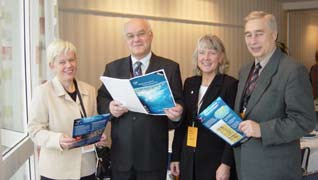
Elina Rautalahti-Miettinen, Dag Daler, Marianne Lindström and Ain
Lääne presented the GIWA Baltic Sea report in Malmö.
and being fished at unsustainable rates.
ment in fisheries.
The regional teams give GIWA strength
It is with great sorrow that I will leave GIWA in
national, regional and global levels". GIWA met
rine waters. Comparing the severity of different
January 2005. The last three years at GIWA have
this objective by identifying the regions with the
sets of problems in so many diverse regions was a
been immensely rewarding for me both profes-
most severe impacts and analyzing their institu-
great chal enge. To do so, GIWA produced a stan-
sionally and personally. I feel very fortunate to
tional capacity to implement actions to remediate
dard methodology. The application of this meth-
have been associated with GIWA, UNEP and the
these impacts. This information wil be very use-
odology has taught us many lessons and we have
University of Kalmar. My experiences and train-
ful for GEF and other international donors and fi-
clear ideas as to how the methodology can be
ing have been invaluable, and I will leave with
nancing institutions. GIWA has demonstrated
improved. Both the methodology and the ideas
many pleasant memories and useful skills. My
the feasibility of conducting complex assess-
to improve it will be very useful for future as-
departure is a good occasion to look back and
ments on a global scale that include not only an
sessments.
reflect on the collective achievements of the
analysis of the regional environmental problems
In my view, the main strength of the GIWA
GIWA community.
of international waters but also of their related
has been the task teams that conducted the re-
The objective of the GIWA is "to develop
socio-economic impacts, their root causes and
gional assessments. The teams were formed by
a comprehensive, strategic framework for the
policy options. Almost all GEF eligible regions
experts in different disciplines and from most
identification of priorities for remedial and miti-
were covered by GIWA regional reports. The
of the countries included in each GIWA region.
gatory actions in international waters, designed
root cause and policy option analyses were con-
Around 1500 experts from al over the world col-
to achieve significant environmental benefits at
ducted through case studies developed by the
laborated in the assessment. These experts are
regional teams. The development of more than
now familiar with a methodology that analyzes
80 case studies across the world, al owed GIWA
environmental conditions, causes and policy
to have a global perspective of both causes and
options in international waters. Furthermore,
potential solutions to water related problems. The
regional teams were able to go beyond fields of
reports have been wel received in their regions.
specialization and took an integrated approach in
They have already been used by policy makers
linking environmental threats to their root causes
and as sources of information for administrative
and to actions for reform.
and research purposes.
I wish al my GIWA col eagues the great suc-
As you wel know, GIWA analyzed four sets
cess that this innovative project and competent
of problems (freshwater shortage, pol ution, un-
professionals deserve.
The GIWA coordinator for Southern Hemisphere Juan Carlos
sustainable exploitation of living resources, and
Belausteguigotia moves on to new challenges at the World
Bank. Scientific Advisor Ulla Li Zwiefel goes on maternity
habitat modification) in both freshwater and ma-
Juan Carlos Belausteguigoitia
leave and Professor Olof Lindén is reentering this position.
GIWA Co-ordination Office
Web Site: www.giwa.net E-mail: info@giwa.net
Postal Address: Global International Waters Assessment, GIWA
Telephone Secretariat: +46 480 44 73 53
SE-391 82 Kalmar, Sweden
Fax: +46 480 44 73 55