N E W S L E T T E R N o 4 S e p t e m b e r 2 0 0 2
Overexploitation of fisheries
a global problem
Scaling and Scoping assessments have
sub-regions, where the use of dynamite
been received from 30 different sub-
and cyanide to catch fish is prevalent, the
regions distributed around the world.
condition of coral reefs is declining rapidly.
Most of these sub-regions have been
assessed as single hydrological entities.
Freshwater
However, seven sub-regions have been
In other sub-regions of the world,
divided into either two or more sub-
particularly those in A frica, central A sia
systems, yielding a total of 38 discrete
and China, freshwater shortage caused
assessments of the environmental and
by the construction of so-called "mega-
socio-economic impacts of water
dams", the overabstraction of water for
related issues around the world.
irrigation and the diversion of water from
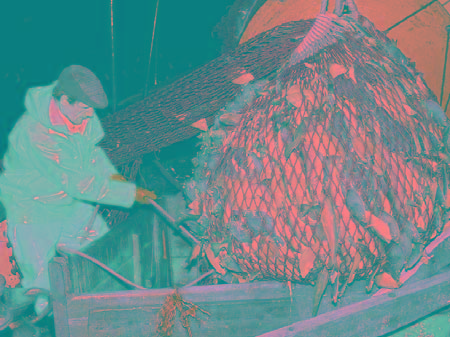
The overexploitation of fisheries is considered
severe by most sub-regional experts.
their natural courses into other systems,
The most significant result that these sub-
has caused severe environmental and
Only in the Oyashio Current and Coral Sea
regional assessments show, the worldwide
socio-economic impacts. For example, in
sub-regions did pollution have no impact
overexploitation of fisheries and other
the Aral Sea sub-region, the diversion of
on any of the socio-economic indicators.
living resources. Recently, the United
the rivers A mu Darya and Syr Darya for
Nations Food and Agriculture Organisation
irrigation has changed the hydrological
Global change
(FA O) estimated that 75% of the world's
cycles of the entire region. Water
Global change is considered to be a major
commercial fish stocks were currently being
evaporating from the Aral Sea was once
concern in the future. Almost all task
fished at, or above mean sustainable yields.
the primary source of precipitation for
teams reported that there were inadequate
The results of the GIWA Scaling and Scoping
central Asia but now the Aral Sea supplies
data to determine confidently that global
corroborate this statement by the FAO. In
very little of the water to this area.
change had had a significant impact on
76% of sub-regions or sub-systems, the
Sub-regional Task Teams indicated
their sub-regions, particularly in the GEF-
overexploitation of fisheries was con sidered
that the impacts of pollution, particularly
eligible sub-regions. Now sub-regional
severe by sub-regional experts indicating
eutrophication, chemical, suspended solids
task teams generally assessed the impacts
that the decline of fish stocks and the
and solid waste, were moderate to severe
of global change as only slight or none
associated disruption of food security
in many sub-regions, while thermal and
at all. Several sub-regions along the coast
and economic wellbeing it brings is a
radionuclide pollution rarely had a
of Africa indicated that the large oceanic
global problem that requires immediate
significant impact on sub-regional water
currents had altered their velocity or
attention. Unfortunately, in many sub-
resources. Eutrophication was particularly
direction in the recent past which had
regions, particularly in South-east A sia,
severe in central and east Asian sub-regions
moderate impacts on these sub-regions.
Africa and South America, the decline in
that have large terrestrial catchments
In addition, many of the coral reef bearing
fish stocks has pushed many fishers to
that can accumulate nutrients and excess
sub-regions had indicated that recent
resort to using increasingly destructive and
fertiliser from agriculture and drain into
anomalous increases in sea temperatures
indiscriminate forms of fishing. Furthermore,
reservoirs with limited water exchange
had caused a severe coral bleaching event
sub-regional Task Teams highlighted the
such as the Baltic, Black and Caspian Seas.
which had moderate impacts on the
fact that the use of destructive fishing
The impacts of pollution on the economy,
condition of those reefs.
techniques had severe impacts on many
human health and other social aspects of
habitats. For example, in south-east Asian
the sub-regions, tended to be moderate.
david.souter@giwa.net
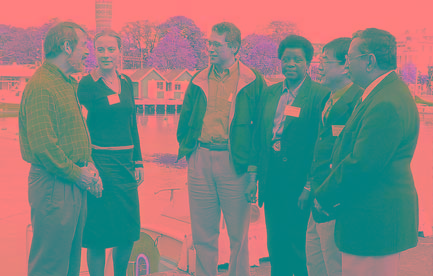

ETT members discuss
In memory of Manuel Alepuz
at the Kalmar
meeting, from left
Manuel Alepuz, GIWA´s focal point
John Dixon, USA,
in the Caribbean Islands, died in La
Susanna Stymne-
Airey, Sweden,
Habana, Cuba, on September 16.
Ronaldo Seroa da
Manuel had an outstanding career
Motta, Brasil, Edith
both as a civil servant and as a
Mussukuya, Sweden,
Chan Huan Chiang,
researcher. He was the General Manager of
Malaysia, and Paul P.
Cuba's railroads (1960) and Deputy-Minister for
Appasamy, India
Transport (1963-1980). From 1980 onwards he
dedicated his professional life to the creation and
Meeting with focus on
strengthening of research institutions, like the
Center for Coastal Environmental Management.
environmental economics
He was appreciated and respected by his
colleagues both in Cuba and abroad. Manuel will
be greatly missed.
The first meeting of the Economics Task Team took place in Kalmar on
September 17. The ETT members were appointed taking into account their
internationally recognized expertise as well as the team balance both between
Water agreement in Johannesburg
the Northern and Southern Hemispheres and between genders. The overall
Commitment to halve the proportion of people
objective of the Economics Task Team is to oversee the soundness of the socio-
without access to sanitation by 2015: this matches
economic components of the GIWA project. The meeting focused on the Causal
the goal of halving the proportion of people
Chain and Policy Option Analyses. The GIWA approach, i.e. to focus on the
without access to safe drinking water by 2015.
variables that influence and constraint human behavior, was considered in line
This agreement announced during the
with current thinking in the field of Environmental Economics.
Johannesburg Summit underlines the importance
The ETT recommended that guiding questions should be formulated to
of the GIWA assessment. GIWA was present at
better analyze the role of the root causes in the processes that lead to
the huge world summit in Johannesburg, invited
environmental and socio-economic deterioration. These guiding questions will
by both UNEP and the Swedish government.
soon be posted on the GIWA website. The next meeting of the ETT will focus
Information on GIWA was posted in the Water
on the socio-economic aspects of the regional and global reports.
Dome, where also Olof Lindén, scientific advisor,
gave a presentation.
The GIWA Co-ordination office in Kalmar is preparing a background paper
on the Regional Seas of the New Independent States (NIS) of former
Upcoming events.....
Soviet Union including the Aral, Baltic, Barents, Black and Caspian Sea. The
3-4 October in Copenhagen, Denmark: Joint
background paper will be used to prepare the NIS Environment Strategy to
GIWA-WWF CCA and POA workshop for SR 17, the
Baltic.
be endorsed at the "Environment for Europe" meeting in Kiev, May 2003.
3-5 October in Helsinki, Finland: UN
The objective of the paper is to identify challenges and recommend actions
Economic and Social Council meeting on the
to resolve the environmental degradation in the concerned seas.
protection and use of transboundary watercourses
and international lakes.
8-9 October in Kalmar, Sweden: 5th GIWA
Four system teams in the Gulf of Guinea
Steering Group Meeting.
15-18 October in Greenville, NC, USA:
A very successful Casual Chain and
GTOS Conference (Global Terrestial Observation
Policy Options Analyses Training
System).
workshop for focal points and
28 October in the Hague, Netherlands: 4th
selected experts from sub-regions
Conference of Monitoring Tailor made.
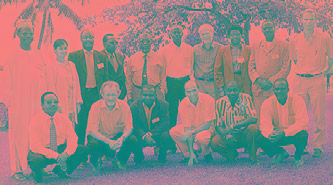
41, 42 43 and 45b took place
18-20 November in Mexico: 1st International
Congress of Transboundary Waters.
in Abidjan, Cote d' Ivoire, 8-13
16-23 March, 2003, in Kyoto, Japan:
September, 2002. Juan Carlos
3rd World Water Forum
Belausteguigoitia and Edith Mussukuya from the GIWA Core Team conducted
11-14 August, 2003: Stockholm Water
the training, supported by UCC experts. Following this training each of the sub-
Symposium
regions shall now train their task teams and carry out the exercise.
18-20 August, 2003, in Kalmar, Sweden:
Read more about how the sub-regional work was organized in the Gulf of
Joint GIWA-University of Kalmar Conference on
Transboundary Waters.
Guinea on our website: www.giwa.net under "News and highlights".
GIWA Co-ordination Office
Web Site: www.giwa.net E-mail: info@giwa.net
Postal Address: Global International Waters Assessment, GIWA
Telephone Secretariat: +46 480 44 73 50
SE-391 82 Kalmar, Sweden
Fax +46 480 44 73 55