Newsletter No 3 September 2004
Global International
N E W S L E T T E R N o 1 M a r c h 2 0 0 4
Waters Assessment
Dear GIWA friends,
Overfishing of cod, nuclear waste storage
and the invasion of the red king crab are al
Klaus Töpfer Launched
issues threatening the unique Barents Sea
ecosystem. They are described in the recently
released GIWA Barents Sea report, which re-
the Barents Sea Report
ceived high attention, both by media world-
The GIWA regional report on Barents
wide and by official agencies concerned with
the future of the Barents Sea region.
Sea was launched August 24 by UNEP's
The Barents Sea report is a good exam-
Executive Director Klaus Töpfer at the
ple of the important compilation of facts for a
Offshore Northern Seas conference in
sustainable future of a region's waters. Here,
Stavanger, Norway. The new report on
as in al the GIWA regions, scientists from dif-
the threats to the unique Arctic eco-
ferent countries and disciplines have come
system received high attention in in-
together to evaluate a number of environ-
ternational media.
mental issues that cause problems in inter-
The increased exploration activi-
national waters. The issues are the same no
ties for petroleum resources in the Bar-
matter where you are on this globe. These
ents Sea, the offshore developments
regional assessments along with their causal
and the shipping of oil and gas along
chain analysis and the described policy op-
the coasts represent significant poten-
tions are welcomed by concerned experts on
both scientific and governmental levels.
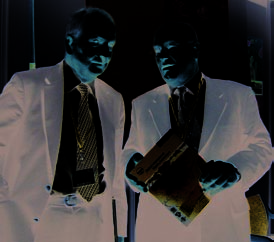
tial threats, said Dr. Töpfer at the press UNEP's Executive Director Klaus Töpfer presented the GIWA Barents Sea
Our report on Lake Chad is another ex-
conference in Stavanger.
report, assisted by GIWA's Scientific Director Dag Daler.
ample. I had the opportunity to participate
The report states that the overex-
Major news wire services, print media
in the 51st Ministerial session of the Lake
ploitation of fish stocks is the most alarming prob-
and TV networks in different parts of the
Chad Basin Commission in Nigeria recently.
lem for the region at present. Pol ution is identified
world reported on the launch.
I was proud to recognise that the GIWA re-
as the next most important concern.
gional report was welcomed by the minis-
ters of al the Lake Chad Basin countries as
an important contribution to the work of
GIWA at World Water Week
the commission.
The printed GIWA reports from regions in South America, Africa and the Barents Sea region were
Several other GIWA regional reports are
now being published and it is my hope and
exhibited at the World Water Week in Stockholm in August. Delegates also learned about the re-
ambition that they al wil attract at least the
sults of the assessment by attending a GIWA Side Event. At this event the GIWA Steering group
same level of attention as the ones men-
chairman Steve Lonergan presented UNEP's
tioned above.
recognition of the GIWA work. The GIWA co-
Dag Daler,
ordinator for Sub-Saharan Africa Edith Mus-
Scientific Director
sukuya made an overview of the results in
the African regions. This annual meeting in
Upcoming events
Stockholm attracts water experts from all
parts of the world and many expressed in-
8-10 November, 2004, Sydney, Australia: Leading-Edge Con-
terest for the upcoming GIWA reports from
ference on Sustainability in Water-Limited Environments.
10-14 January, 2005, Mauritius: International Meeting to
their water regions.
Review the Implementation of the Barbados Programme of
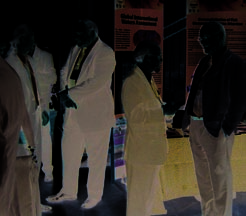
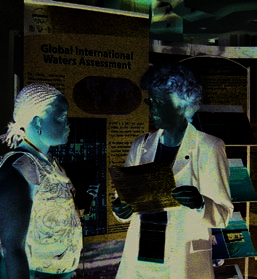
The GIWA exhibition in Stockholm received many visitors,
Action for the Sustainable Development of Smal Island Devel-
here Al Duda, GEF, and GIWA's Dag Daler in discussion with
oping States meeting.
some World Water Week participants.
Several Workshops Held in Kalmar
What are the most important issues to be addressed
A workshop on the GIWA reports in the Arctic and
for transboundary waters in the future? What are
Far East regions has been held in Kalmar. Partici-
the the most important future needs ? How to avoid
pants were Arkady Alekseev from the Russian Acad-
more "troubled waters"?
emy of Science in Moscow, Galina Titova, Ecological
GIWA Workshop
on Russian reports:
from top Arkady
Alekseev, Giovana
Zukiswa Tynfa from the University of Fort Hare
Salomon, Elina
in South Africa learned about GIWA from Infor-
Rautalahti-Mi-
mation Officer Elisabet Idermark.
ettinen, Najah
Mustafa, Marianne
Lindström, Galina
Marrakech
Titova, Natalia Gol-
ubeva, and Ulla Li
Zweifel.
Congress
Troubled waters workshop participants, from left Mike Bonell, UNES-
2 200 participants representing
CO, Björn Guterstam, GWP, Sara Gräslund, GEF, Olof Lindén, WMO, Dag
one hundred countries attended
Daler, GIWA, Werner Ekau, IOI, and Ulf Lidman, UoK.
the 4th World Water Congress in
These were the questions raised when the
Marrakech, Morocco, in Septem-
"Troubled waters-Bridging Science and Society"
ber. GIWA was there, invited by
workshop met in Kalmar in August. The workshop
the organiser International Water
was hosted by the University of Kalmar in col abo-
Association. One theme for the dis-
ration with GIWA, and brought together interna-
cussions at the congress was how
tional experts dealing with different aspects of
Safety Scientific Research Centre in St Petersburg,
to attain the Mil ennium Develop-
transboundary waters.
and Natalia Golubeva, Murmansk Marine Biologi-
ment Goals. The Marrakech meet-
-We hade very fruitful discussions and the work-
cal Institute. Together with several members of the
ing gave GIWA an excel ent oppor-
shop statement wil be distributed to stakeholders
GIWA Core Team they improved and finalized the re-
tunity to meet a number of water
involved in the strive for sustainable use of interna-
sults for the assessments done in the Sea of Okhosk,
experts who expressed interest in
tional waters, said Ulf Lidman, University coordina-
Oyashio Current, Japan/East Sea, Black Sea and the
the methodology and the results
tor for the workshop.
Arctic Russian sector.
of the assessment.
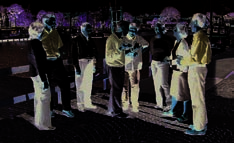
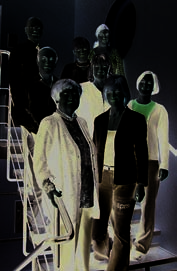
A workshop on policy strategy for marine waters in South-
east Asia has been held in Kalmar, chaired by Dr. Sherry
Heileman, consultant to GIWA. Members of the GIWA task
teams in Southeast Asia and Australia participated as did
members of the GIWA Core Team. Here in picture from
left: Sherry Heileman, David Souter, Seang Tana Touch,
Clive Wilkinson, Ketut Putra, Pinya Sarasas, Ul a Li Zweifel
and Loke Ming Chou.
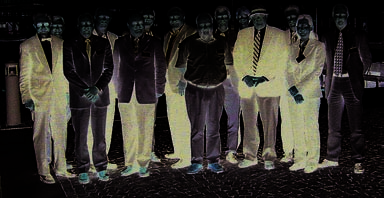
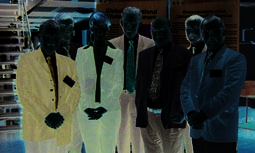
The steering group for the present
GIWA mission has had its last meet-
ing in Kalmar, Sweden; from left
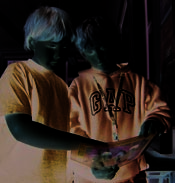
Environment Day. Sixten Karlsson
Professor Gotthilf Hempel, GIWA
and Johan Lundegårdh were two of
Ambassador, Germany, Professor
Åke Hagström, University of Kalmar,
the students in the Kalmar elemen-
Sweden, Chair Steve Lonergan,
UNEP-DEWA, Kenya, Inesis Kiskis,
tary school Falkenbergsskolan who
World Bank, Lithuania, GIWA Sci-
chose to discuss international wa-
entific Director Dag, Daler, Michael
Huber, GESAMP,Australia, Al Duda,
ters when they participated in an
GEF, USA, Eero Kontula, Finnish Min-
istry of Foreign Affairs, Finland, Björn
Environment Day recently. GIWA
Guterstam, GWP, Sweden, Sara Gräs-
lund, GEF, USA, Ken Sherman, NOAA,
was there to present its work and
USA, Andrew Hudson, GEF-UNDP,
the students showed great interest
USA, Pinya Sarasas, UNEP, Kenya,
and Mats Eriksson, SIDA, Sweden.
in the issues.
GIWA Co-ordination Office
Web Site: www.giwa.net E-mail: info@giwa.net
Postal Address: Global International Waters Assessment, GIWA
Telephone Secretariat: +46 480 44 73 53
SE-391 82 Kalmar, Sweden
Fax: +46 480 44 73 55