Issue No.3, March 2001
Dear GIWA friends,
Important activities for GIWA are taking place these days. The
peer review was completed with a science expert workshop, and
the GIWA Steering Group met. Although some issues were found
to require further development and refining before being fully
used in the assessment, these bodies gave the marching order;
the scaling/scoping activities are to be started on the sub-re-
gional level and the first results are to be reported on the first
GIWA General Assembly 16-18 June 2001.
Parts of the Peer Review Board during a coffee break: Bo Bergbäck,
Capacity building workshops introducing the GIWA
Kalmar University, Joan-Albert Sanchez Cabeza, GESAMP and Janos
methodology to sub-regional task forces will be held in the near
Bogardi, UNESCO
future, in Bangkok, Kharkov, and Moscow. A milestone of great
thank all of those who contributed with their valuable knowledge
significance has been passed and GIWA is now in the
and time in this process. The Peer Review Board convened on
operational/analytical phase of the project. In this issue of the
2 March, and dedicated a long day to a comprehensive, deep
newsletter some of these events are highlighted. You may also
and cordial discussion about the Methodology and how it could
read about the status of the GIWA network, and recent events
be improved to fulfil the needs of the GIWA project. The meeting
related to GIWA.
was chaired by Prof. Bo Wiman, Kalmar University. The
discussion was facilitated by a presentation held by the leader
I am impressed with the number of highly qualified experts that
of the Methodology Development Team, Prof. Laurence Mee,
have joined the GIWA sub-regional task forces. The intellectual
Plymouth University. The GIWA Core Team presented the
capacity certainly is in place to reassure the continued success
contributions from the Open Peer Review to the Board.
of GIWA. Finally, I remind you all about the first GIWA General
Furthermore, GIWA Steering Group members participated as
Assembly that takes place in Kalmar 16 18 June 2001. Here
observers, and also gave their constructive input to the
participants from the sub-regional task forces and invited
discussion. The Board agreed on a number of recommendations
scientists will meet to discuss the results and the future opera-
to the development of the Methodology, i.a. that
tions of GIWA. GIWA friends and representatives from other
· the Methodology in general needs to be simplified and
programs related to GIWA will also participate. Improving rela-
shortened
tions with other programs and institutions are of strategic
importance. The formal invitations will be issued in the near
· the final stages of the Methodology, scenario building
future, but set aside the time in your diary today.
and options analysis, should be developed to ensure
that the preceding stages are providing appropriate inputs
I look forward to see you all in Kalmar in June.
The Methodology
Dag Daler, Project Manager
The Methodology, also called the Assessment Protocol, is central to
the GIWA project.
Assessments will be made according to this protocol in all sub-regions
worldwide, and hence comparable information will be produced
Simplification of the Methodology
regarding the status of and causes of environmental problems of
The GIWA Methodology has been peer reviewed during a period
transboundary waters in the regions. This information will be used by
GEF and others as a basis for prioritisation of issues and areas where
of several months by a group of selected scientists constituting
action needs to be taken.
the Peer Review Board. Simultaneously in the Open Peer Review,
The developed Methodology has been tested in two regions, the
other experts and organisations were invited to access the
Baltic and the Gulf of Thailand. Additionally, a number of GEF funded
Methodology through the GIWA web site, and to peer review it
projects use the GIWA Methodology in their assessment work.
according to their respective area of expertise. We sincerely
Do you have comments or requests regarding the content of the GIWA Newsletter? Contact sara.graslund@giwa.net
GIWA Web Site
As reported in the last newsletter, the Methodology has been
implemented and tested in the Baltic region and in the Gulf of
Thailand. This process resulted in several reports that are now
available on the open GIWA web site, www.giwa.net. At the
web site, you can also find this and previous issues of our
newsletter.
Messages from the Sea
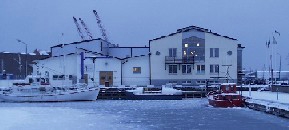
The GIWA co-ordination office in the harbour of Kalmar
Students and others came to listen to the open lecture "Messages
from the Sea" at Kalmar University 1 March, given by Prof.
Steering Group Supports GIWA's
Mee, leader of the GIWA Methodology Development Team. He
discussed the complexity of environmental problems in
Present Direction
international waters, and this was illustrated with three cases:
The GIWA Steering Group members met in Kalmar on the 3 rd of
the destruction of mangrove ecosystems, the eutrophication of
March. This late winter day, the harbour by the GIWA office
the Black Sea, and the destruction of coral reefs. He also
was coated with ice, and a layer of snow covered the houses
encouraged scientists to reach out to the public with their
and streets. The meeting was attended by the Steering Group
knowledge in order to bring environmental degradation of
members, observers from the Peer Review Board and GIWA
aquatic ecosystems higher on the political agenda.
Core Team. The Steering Group discussed, among other things,
budgetary matters, the development of the Methodology, and
the development of the GIWA network.
GIWA Events and Milestones
Status of the GIWA Network
· The GIWA network: agreements have been reached
with focal points in a third of the sub-regions, tentative
Agreements have now been reached with focal points in about
agreements have been reached with another third
one third of all sub-regions. The network has entered a phase
of rapid development, there are tentative agreements with
· The GIWA Methodology Peer Review was finalised
additional one third of the sub-regions, and the Core Team is
with the Peer Review Board meeting in Kalmar, 2 March,
working hard to establish agreements with experts in the
and resulted in recommendations to the development of
remaining sub-regions.
the Methodology
· Annual GIWA Steering Group meeting, Kalmar, 3 March
Assessment Methods Workshops
· Participation of GIWA in the sixth meeting of the
To help start up the assessment work in the sub-regions, several
SBSTTA of the Convention on Biological Diversity,
workshops will be held during March and April.
Montreal, 12-14 March
· To begin with, an assessment methodology workshop will
· The annual World Water Day is 22 March. The theme
be held in Bangkok, 22-23 March. It will be attended by sub-
2001 is Water for Health, and the lead organisation is the
regional experts from South-east Asia, the North and South
World Health Organisation. Read more at
Pacific, and Sub-Saharan Africa.
www.worldwaterday.org
· Subsequently, a workshop will be held in Kharkov, 28-29
· Workshops on GIWA assessment methods will be held
March, for experts from the Black Sea, Caspian Sea and Aral
Sea sub-regions.
in Bangkok, 22-23 March
·
in Kharkov, 28-29 March
The third planned workshop will take place in Moscow 9-10
April, and will gather Russian experts who will work with the
in Moscow, 9-10 April
assessments in the sub-regions covering parts of northern
·
Russia.
The first GIWA General Assembly will be held in
Kalmar 16-18 June 2001
These meetings, together with individual experts' dedicated
work, will get the assessment work off the ground.
GIWA Co-ordination Office
Visit the GIWA Web Site: www.giwa.net
Poastal Address: Global International Waters Assessment
E-mail to GIWA Co-ordination Office: info@giwa.net
GIWA, SE-391 82 Kalmar, Sweden
Telephone Secretariat: +46 480 447353 Fax: +46 480 447355