
C O N T E N T S
> IN THIS ISSUE
THE MEDITERRANEAN ACTION PLAN MAGAZINE
# 4 7 | 2 0 0 2
EDITORIAL
EDITOR
Baher Kamal
> A TURNING POINT IN THE TRANSITION
baher@unepmap.gr
TOWARDS SUSTAINABLE DEVELOPMENT .......................................................................1
AUTHORS
Andreas Demetropoulos
Kostas Katselidis
BUREAU MEETING
Fouad Abousamra
S. Çolpan Polat-Beken
> THE BUREAU SETS UP THE MAP PRIORITIES ............................................................. 2
Giovanni Cannizzaro
Marko Prem
José Luis Gallego
BIOLOGICAL DIVERSITY
Enrique Villamore
> TOURISM AND CONSERVATION: THE CASE OF ZAKYNTHOS .............................. 3
CREATIVE
/fad.hatz
chatzigeorgakidis@freenet.de
BIOLOGICAL DIVERSITY
REPRO
> THE STORY OF THE INVASIVE ALIEN SPECIES ........................................................... 6
Kandiloros & Kormaris
kandkorm@otenet.gr
OFFSET PRINTING
MED POL
Kontoroussis Bros.
info@kontorousis.gr
> A COMMON PLATFORM FOR POLLUTION REDUCTION ............................................ 9
I S S N 1 1 0 5 - 4 0 3 4
MED POL
> WANT TO REDUCE MARINE POLLUTION? MONITOR IT! ...................................... 10
MedWaves is published by
the Coordinating Unit of
REMOTE SENSING
the Mediterranean Action Plan
in Arabic, English and French.
> SATELLITES SUPPORT COASTAL PLANNING ............................................................. 12
It is an informal source of information
and it does not necessarily reflect
the official point of view of MAP or UNEP.
COASTAL AREA MANAGEMENT PROGRAMME
Contents, except for pictures,
may be reproduced without permission
> SLOVENIA AND CYPRUS: THE CAMP NEW GENERATION ................................... 14
and only for non-commercial use.
Credit to the source, however, is required.
The publisher would appreciate
receiving a copy of any publication
CLEANER PRODUCTION
that uses MedWaves'
news, articles and interviews.
> CLEANER PRODUCTION AND THE SMEs ...................................................................... 16
The designation of geographical entities
and the presentation of the material
do not imply the expression of any opinion
THE KIOSK
whatsoever on the part of the publisher
concerning the legal status of any country,
> A SELECTION OF PUBLICATIONS ........................................................... inside backcover
territory or area, of its authorities,
frontiers or boundaries.
> CALENDAR OF MAIN MEETINGS 2003 ................................................. inside backcover
C O V E R P H O T O
UNITED NATIONS ENVIRONMENT PROGRAMME
RIVERSIDE FERNS
MEDITERRANEAN ACTION PLAN
by ANDREAS DEMETROPOULOS
E D I T O R I A L
> A TURNING POINT IN THE TRANSITION
TOWARDS SUSTAINABLE DEVELOPMENT
has been the year for
ratification / acceptance of the amendments to
2002 Sustainable Development,
the MAP legal instruments is in progress.
the year in which several
> A reporting system is being tested by seven volun-
key building blocks have been established,
teer countries and a monitoring system for the
paving the way towards Sustainable
enforcement of the MAP legal instruments is
Development.
being considered.
> The sustainable management of coastal regions is
At the global level:
heading for an adequate regional legal instru-
> The preparatory process and holding of the
ment, while practical cases through the Coastal
World Summit on Sustainable Development have
Areas Management Programme continue to assist
brought together, in an integrated way, the eco-
countries for a more efficient management of
nomic, social and environmental pillars of Sus-
their resources.
tainable Development, as well as the good gover-
> The preparation of a Mediterranean Environment
nance factor.
and Development outlook is well advanced while a
> A greater awareness of all partners and major
major regional project on protected areas is being
groups has been achieved, notably by the Civil
implemented; awareness and assistance on clea-
Society and the business sector.
ner production techniques, widely promoted, and
> Partnership, (corporate) accountability, trans-
the use of remote sensing tools, extended.
parency, common but differentiated responsibili-
> Implementation of the GEF / SAP project has
ty, and public participation are now widely
gone through an intensive momentum, with a
accepted as basic principles.
series of activities being implemented in various
> With the notable exception of the United States
countries.
of America, most countries have ratified the
> The Euro-Mediterranean Partnership confirmed
Kyoto Protocol, and the Global Environment
the need for Sustainable Development as an
Facility (GEF) has been replenished.
action framework; recognised the importance of
cooperating with the MAP, and decided to pro-
At the Mediterranean regional level:
vide support to the MCSD and the Mediterranean
> The preparatory process for the Mediterranean
Strategy for Sustainable Development.
Strategy for Sustainable Development has been
launched, as well as the appraisal of prospects for
There are of course shortcomings, constraints and
improving the efficiency of the Mediterranean
gaps in the course towards Sustainable Develop-
Commission on Sustainable Development (MCSD)
ment, but we prefer to end the year with a positive
as a "decision making tool" towards regional Sus-
and encouraging note, aware as we are that huge
tainable Development.
challenges are still ahead.
> A new Protocol concerning Cooperation in Pre-
venting Pollution from Ships and, in Cases of
Emergency, Combating Pollution of the Medi-
A R A B H O B A L L A H
D E P U T Y C O - O R D I N A T O R
terranean Sea has been signed and the process of
M E D I T E R R A N E A N A C T I O N P L A N
1
B U R E A U M E E T I N G
> THE BUREAU SETS UP
THE MAP PRIORITIES
n their meeting in Monaco on 1718 October under the
task force deliberations on the future of the MCSD; towards
Ipresidency of Minister Bernard Fautrier, senior officials an increasing presence of MAP in the European context
from Algeria, Bosnia and Herzegovina, Greece, Monaco,
(Euromed Partnership; EU legislation, etc.), and towards a
Slovenia, and Syria (members of the Bureau of the Contrac-
more sustained involvement of MAP in technical assistance
ting Parties to the Barcelona Convention) adopted, among
activities extended to countries.
others, the following decisions:
A first progress report will be submitted to the Bureau at
Status of ratifications: To remind the MAP Focal
its next meeting, to be subsequently transmitted to the Con-
Points that once the ratification process (of the amended
tracting Parties meeting.
Barcelona Convention and its Protocols) has been completed
Second Euromed Conference on the Environment: The
in their respective country, they are requested to immediate-
Bureau welcomed the content of the Athens Ministerial
ly inform the Depositary State. Regarding the SPA and
Declaration (July 2002), which indicates a real will to greater
Biodiversity Protocol, the Bureau also recalled that its ratifi-
cooperation between the Euromed Partnership and the MAP,
cation concerns both the Protocol and its annexes, which con-
and recognised inter alia the role of the latter and of MCSD in
stitute one single document.
the formulation of the Mediterranean strategy.
Reporting System: The Bureau stressed the importance
The Secretariat will establish the necessary contacts with
of the trial exercise carried out by several countries on a vo-
the EC so that the will expressed in the Declaration be trans-
luntary basis enabling a Reporting System to be set up at
lated into concrete actions
MAP, in view of the enforcement of the new and amended
List of MAP partners: The Bureau examined and ap-
MAP legal instruments in the near future. It should be ratio-
proved the new list of MAP partners, drawn up according to
nal and consistent with the other regional or international
the common and additional criteria. Consequently, it equally
environmental conventions.
approved the withdrawal from the list of 15 organisations
Liability and compensation: The Secretariat will con-
that did not meet these criteria.
vene a restricted group of experts who, after detailed analy-
SAP activities: The Bureau decided to urge countries to
sis, will report at the next Bureau meeting on the advisabili-
start, in cooperation with the Secretariat, the process of pre-
ty and feasibility of setting up a Mediterranean legal mecha-
paring their 2003 national baseline budget of pollutants'
nism on the subject.
releases that is the basis for the gradual achievement of the
Monitoring system for the enforcement of MAP legal
pollution reductions foreseen by the SAP.
instruments: The Secretariat will submit, at the next meeting,
Coastal Area Management Programme: The Bureau
a proposal on the composition and working method of the pro-
was in favour of continuing the CAMPs which, for the benefi-
posed technical committee whose task will be to deal with the
ciary countries, represent a unique opportunity to take direct
difficulties related to the implementation of MAP legal instru-
ments. This should be done on a non-jurisdictional basis. It will
and practical advantage of the expertise of all the MAP com-
be for the next Contracting Parties meeting to make a final
ponents. However, it insisted on the shortcomings found in
decision.
the follow-up of programmes.
Evaluation of MAP: The Secretariat will set up as soon
So as to correct this situation, it suggested that, in future,
as possible a Think Tank to prepare a global assessment of
the new CAMP agreements include a clause on the follow-up
MAP as requested by the Contracting Parties at their
and relevant funding. The Secretariat will draft a document
Monaco meeting. The group will consist of the President of
of a political nature on the general vision of the CAMP to be
the Bureau (Monaco) and representatives from: a
submitted at the next Contracting Parties meeting.
Mediterranean country member of the EU (Greece); a
The Bureau has given its approval in principle for the star-
Southern or Eastern Mediterranean country (Syria); a
ting of a feasibility study on a CAMP proposed by Spain for
Mediterranean country included in the next enlargement of
the Mar Menor (Murcia region) to be approved by the Con-
the EU (Slovenia); and two experts to be appointed by the
tracting Parties meeting. Such a CAMP should not entail a
Secretariat.
financial burden for the MAP and the allocation of human re-
The group may consult IGOs and NGOs, and will gear its
sources, which would not be compatible with the other
evaluation: towards a prospective approach; towards an ad-
CAMPs.
justment of MAP and in particular of the MCSD to the post
The next Bureau meeting will take place in Sarajevo,
Johannesburg situation by including in its considerations the
between mid April and mid May 2003.
2
B I O L O G I C A L D I V E R S I T Y
> TOURISM AND CONSERVATION:
THE CASE OF ZAKYNTHOS
Tourism and conservation of The measures foreseen in the adop- In view of this situation, several inter-
Nature can be compatible and
ted legislation (regulation of access to
national organizations have taken action
even complementary activi-
the beaches, prohibition of vehicles,
to encourage the Greek Government to
ties provided that a good planning for
banning of night flights at Laganas air-
take the necessary effective measures to
sustainable development is adopted.
port, maritime traffic regulation in the
protect the area. The Bern Convention
In some cases this planning is particu-
Bay, public awareness campaigns, con-
adopted a strong Declaration related to
larly difficult and, thus, special mea-
trol of activities by wardens,..) could
the situation in Zakynthos.
sures and precautions are to be taken.
have been very positive, especially
In the framework of the Mediterra-
This is the case for the few places
because the most dangerous pressure
nean Action Plan (MAP) an Action Plan
where marine turtles are still nesting
--the one generated by tourism-- was
for the Conservation of Mediterranean
in the Mediterranean. The coincidence
still very small in that period: around
Sea Turtles was adopted in 1989 and
of the places (sand beaches) and the
20,000 tourists in 1984.
amended in 1999. The amended version
season (summer) creates serious diffi-
culties in preserving the availability of
these areas for turtle nesting.
The case of Zakynthos Island
(Greece) is a good example of this situa-
tion and the result of the current acti-
vities undertaken by the authorities
will be a clear reference for future sus-
tainable tourism alternatives in the re-
gion.
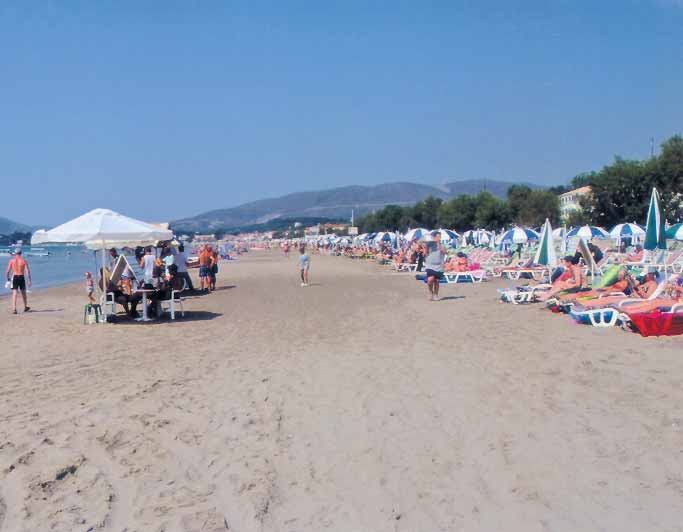
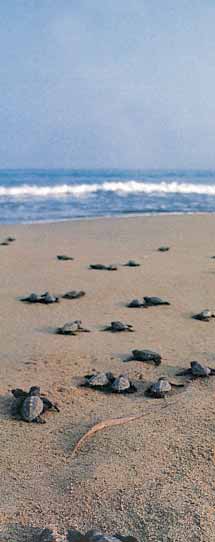
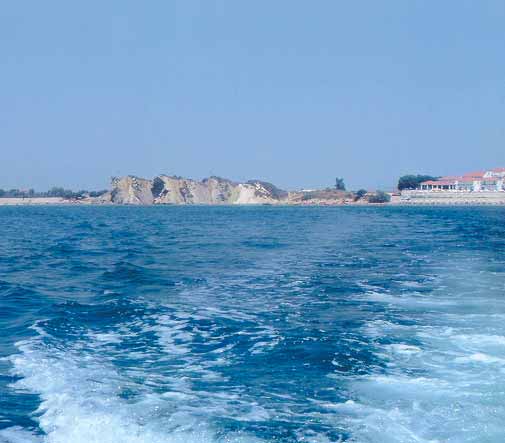
The Bay of Laganas on Zakynthos is
one of the most important nesting
areas for loggerhead turtle (Caretta
caretta) in the Mediterranean. The six
nesting beaches in the Bay (Maratho-
nissi, East Laganas, Kalamaki, Sekania,
Daphni and Gerakas) host an average of
1,300 nests per season. This average
represents the highest known in the
whole Mediterranean region
H. DA CRUZ
Taking this into account, several
NGOs, scientific bodies and other
Unfortunately, the insufficient en-
stressed that Greece should "finalize the
institutions have asked the Greek
forcement of the adopted measures
process of setting up the Zakynthos
authorities, since the beginning of the
made possible an increasing degrada-
National Marine Park and its managing
eighties, to adopt protection measures
tion of the area by illegal activities
body, and further conservation and
in order to avoid the degradation of the
(such as beach facilities in crucial nes-
management of the site".
nesting sites by human activities.
ting areas; buildings; vehicles and hor-
Finally, the National Marine Park of
As a consequence, in 1984 the Greek
ses on the nesting beaches; degradation
Zakynthos was declared on 22 Decem-
Government and the local authorities
of sand dunes; violation of maritime
ber 1999.
approved several legal and administra-
traffic rules,..), as well as the pressure
The declaration of the National
tive measures aiming at safeguarding
by some landowners and some eco-
Marine Park of Zakynthos has proved to
the most important nesting areas and
nomic interests for continuing their
be a positive step and has facilitated
its surroundings.
activities.
some improvements in the implementa-
3
B I O L O G I C A L D I V E R S I T Y
>> TOURISM AND CONSERVATION: THE CASE OF ZAKYNTHOS
tion of the protection measures for the
declaration of the Park are still far from
> to drastically implement measures
area. The establishment of a Manage-
the approved objectives.
to avoid and correct the illegal acti-
ment Agency to run the Park is as well a
At present the following are the
vities in the area of Daphni (illegal
positive step.
most relevant problems to be solved:
beach facilities, buildings, taverns
In spite of this advance and as un-
> to prevent visitors, beach facilities,
and canteens);
derlined by a recent judgement of the
boats, cars and motorbikes from ex-
> to prevent the violation of the mea-
European Court of Justice, the results
ceeding the legal limitations or
sures established to regulate mari-
of the activities carried out since the
using prohibited areas;
time traffic in the protected areas;
> THE VIEW OF THE ZAKYNTHOS PARK COORDINATOR
Zakynthos island, Greece, hosts, at the southern part (Laganas Bay),
> co-operation with environmental organisations;
one of the most important nesting rookeries in the Mediterranean for the
> co-operation with tourist companies to promote the protection of
loggerhead sea turtles Caretta caretta; a habitat essential for protection.
the environment;
The efforts to protect the nesting beaches started in 1984. Unfortunately,
> international co-operation (collaboration with the Pan-European
until 2000 the enforcement of the protection measures was very poor.
Ecological Network and Europark federation; co-operation with
The establishment of the National Marine Park of Zakynthos (NMPZ)
other national marine parks).
and the Board of the Management Agency, in 2000, is definitely a major
Of course there are still actions that have to be undertaken, in order
breakthrough for sea turtle conservation in Greece and the Mediterranean.
to solve the conservation problems within Laganas Bay. Such are:
In the last two years since the Management Agency
> the implementation of the compensation mea-
of the NMPZ has been operating, several positive steps
sures;
have been taken.
> the better enforcement of the protection mea-
As Mr. Jean-Francois Verstrynge (Deputy Director
sures, especially on Daphni beach;
General, European Commission / DG Environment) said,
> the better control of the number of the beach fur-
during his visit to Zakynthos in September 2002, "we are, in
niture on the nesting beaches;
conclusion, in a situation that has clearly improved and we
> the better regulation of the navigation within the
are very satisfied about this, if we are to compare the situ-
maritime area;
ation today with the situation 2 to 3 years ago. But there is
> completion of a land register (cadastre).
still some distance to go to get the satisfactory solution for
The Management Agency of the NMPZ has given prio-
the first Marine Park, Natura 2000 Park, in Greece and we
rity to these issues and has already started the procedure
hope that we can resolve all the issues we have men-
to resolve them.
tioned."
In order to protect and conserve an area like the
In these two years the Management Agency of the NMPZ
National Marine Park of Zakynthos, there is a lot a work
has successfully implemented the following activities:
to be done, requiring the co-operation of all parties
> guarding programme of the nesting beaches;
involved in this issue (Ministry of Environment, local
> public awareness programme for the visitors;
authorities, locals, conservationists, tourist companies,
> delineation of the NMPZ land area (sign posting);
stakeholders, visitors etc).
> delineation of the NMPZ maritime area;
This is the task that the Management Agency of the
> building control within the Park area;
NMPZ has to carry out in order to bring together all the
A. DEMETROPOULOS
> environmental education programme;
different opinions and also to find the proper solutions for
> monitoring of sea turtle nesting activity and on site nests protection;
the problems that occur, in order to protect the essential habitat of
> co-operation with local authorities in order to protect the nesting
Laganas Bay.
beaches;
K O S T A S K A T S E L I D I S
NATIONAL MARINE PARK OF ZAKYNTHOS
Ktirio Dimotikou Diamerismatos Argasiou | GR-29100 Zakynthos tel 0030 2695 29 870/1 fax 0030 2695 29 872 e-mail info@nmp-zak.org website www.nmp-zak.org
4
B I O L O G I C A L D I V E R S I T Y
> to establish compensation measures
pulation to facilitate a more active
The Mediterranean Action Plan is
to legal landowners damaged by
support to the Marine Park of
fully confident that the efforts under-
the protection of the zone;
Zakynthos.
taken by the Greek Authorities and, in
> to provide effective support to the
This expected progress requests
particular, by the National Marine Park
management body by national and
additional resources to be provided to
of Zakynthos, will lead to the proper
local authorities;
the National Marine Park of Zakynthos
solution to all the issues raised, in the
> to develop educational campaigns
as well as co-operation from all con-
interest of the Mediterranean marine
and alternative plans for local po-
cerned actors at the local level.
biodiversity.
> THE VIEW OF NGOs
The establishment of the National Marine Park of Zakynthos in
local authorities. All these problems represent serious threats to the
Laganas Bay (1999) was the result of persistent pressure exerted by se-
nesting efforts made by sea turtles every summer in the Bay, and the
veral NGOs on the local authorities, the Greek government, the Council of
Agency has made attempts to control them through specific management
Europe (Bern Convention), and the European Commission. These NGOs in-
techniques
clude ARCHELON, the Sea Turtle Protection Society of Greece, that has
Two years later, the Management Agency is moving in the right
been conducting loggerhead sea turtle monitoring and public awareness
direction by establishing itself at a local level. It has also become a be-
work on the island since 1983, and MEDASSET --the Mediterranean
neficiary of an EC co-funded programme, and in order to reach its objec-
Association to Save the Sea Turtles-- which has spearheaded national and
tives, has signed an agreement with ARCHELON involving monitoring
international lobbying since 1984,
nesting activity, raising public
urging the EC to take Greece to the
awareness, and investigating spe-
European Court of Justice on the
cific compensation measures for
grounds of infringement of EU
affected landowners. Both WWF
Habitats Directive (92/43/EEC). In
Greece and MEDASSET have signed
turn, WWF Greece purchased land
an agreement of co-operation with
behind the beach with the highest
the Agency.
loggerhead nesting density in the
There is still a long way to go
Mediterranean, thanks to support
before the Management Agency
from the European Commission and
reaches the desired level of protec-
others. An important contribution
tion and management. The upcom-
was also made by the Zakynthian
ing drafting of a Management Plan
Ecological Movement to influence
will contribute towards delineating
the local authorities and society.
its long-term strategy for the area.
The Management Agency of the
Indeed, if progress is to be made, it
National Park was formed in July,
will be achieved through strengthe-
2000, with ARCHELON and WWF
ning the Agency to build a local
H. DA CRUZ
Greece representing the NGOs on
consensus and develop partner-
the 10-member Board. This body is the first of its kind in Greece, and
ships. History is in the making on the verdant island of Zakynthos: let it
inherited several problems arising from unplanned tourist development,
become an example for other protected areas soon to be established in
illegal activities, lack of law enforcement, and insufficient support from
Greece.
ARCHELON - THE SEA TURTLE PROTECTION SOCIETY OF GREECE
57, Solomou Street | GR-10432 Athens tel/fax 0030 210 52 31 342 e-mail stps@archelon.gr website www.archelon.gr
MEDASSET - THE MEDITERRANEAN ASSOCIATION TO SAVE THE SEA TURTLES
1c, Lycavittou Street | GR-10672 Athens tel 0030 210 36 40 389 tel/fax 0030 210 36 13 572 e-mail medasset@hol.gr website www.euroturtle.org/medasset
5
B I O L O G I C A L D I V E R S I T Y
> THE STORY OF THE INVASIVE ALIEN SPECIES
According to
the Convention
on Biological Diversity,
"invasive alien species
are species introduced
deliberately
or unintentionally
outside their natural
habitats where they have
the ability to establish
themselves, invade,
out-compete natives
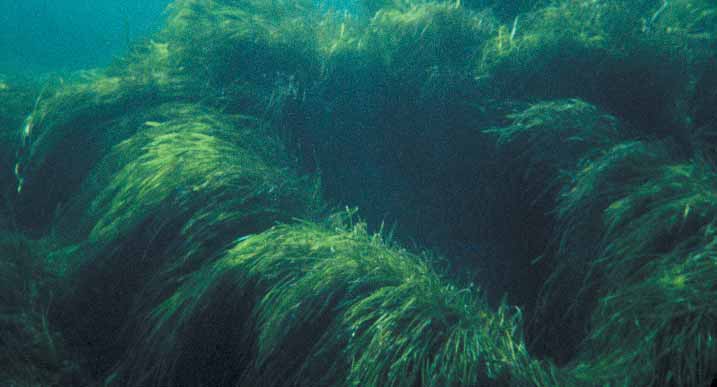
At risk: Mediterranean habitats such as Posidonia meadows
and take over
the new environments.
They are widespread
in the world
Biological invasions operate alien species in the marine environment
now on a global scale and are
is not a realistic option, at least in the
expected to undergo rapid in-
foreseeable future.
crease in this century due to interac-
National and supranational organi-
and are found
tions with other global changes such
sations are active in promoting mea-
in all categories
as increasing globalisation of markets,
sures to control the introduction of
of living organisms
high rises in global trade, travel,
alien species and to eradicate invasive
and all types
tourism, and exchange of goods.
species. The issue concerns of course
Invasive alien species can have
not only marine but also terrestrial and
of ecosystems.
significant irreversible environmental
freshwater environments.
The threat to biodiversity
impact at the genetic, species and eco-
due to invasive
system levels. They can also have
Everyone is worried:
alien species
socio-economic impacts. Their ma-
CBD, IMO, GEF, MAP
is considered second
nagement costs include not only costs
The Convention on Biological Diver-
only to that
of prevention, control and mitigation,
sity (CBD) highlighted the problem by
of habitat loss."
but also indirect costs due to impacts
including it as one of the five main
on ecological services. Environmental
issues of concern for marine and
The Mediterranean
and socio-economic impacts of harm-
coastal biodiversity. The Bern and the
is affected.
ful invasive alien species are already
Barcelona Conventions are showing
being felt.
concern and so is the International
In the last couple of decades in-
Maritime Organisation (IMO), the
creasing attention has been given to
Global Environment Facility (GEF) and
alien species and to biological invasions
others and their activities reflect this.
in marine ecosystems. Of course not all
Within the Mediterranean Action
alien species are invasive. Alien species
Plan (MAP), the Regional Activity
often disturb ecological equilibria; inva-
Centre for Specially Protected Areas
sive species can revolutionise them
(SPA/RAC) is now active towards draf-
--and have economic repercussions-- on
ting an Action Plan concerning species
recreation, tourism and fisheries. Expe-
introductions and invasive species in
rience has shown that eradication of
the Mediterranean.
6
B I O L O G I C A L D I V E R S I T Y
The Mediterranean is a semi-
Probably, however, the lar-
isolated ecosystem with high
gest avenue for alien species into
endemism that is susceptible to
the Mediterranean is the Suez
invasions from other seas and
Canal. The Canal was opened in
oceans. It was formed about 5.3
1869. For the first time the Medi-
million years ago when move-
terranean's pure Atlantic-origin
ments in the Earth's crust opened
fauna faced competition from
up the Gibraltar straits, enough
Indopacific species.
for the Atlantic waters to fill the
Several hundred species
enormous salt depression that
have since then entered and
was the more or less dry Mediter-
established themselves in the
ranean basin. This water brought
Eastern Mediterranean, in what
with it living organisms that
is now known as the Lessepsian
were the precursors of today's
immigration. Five to ten new
Mediterranean biodiversity.
immigrant species are recorded
A. DEMETROPOULOS
every year.
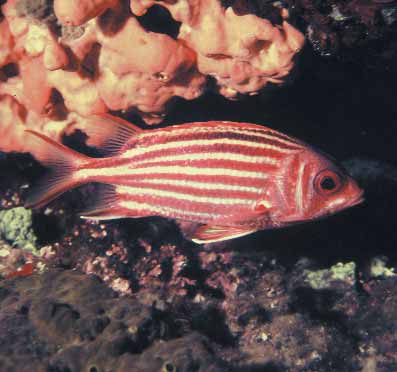
Red Soldier fish
Where alien species come
These Indopacific species now
to the Mediterranean from
The unintentional introduction in
form over 12% of the marine fauna of the
Alien species reach the Mediterra-
the late 1980s, through the aquarium of
East Mediterranean and 5% of the entire
nean through various pathways. Ballast
the Oceanographic Museum of Monaco,
Mediterranean marine fauna. (Fredj et
water brought Mnemiopsis, an Ameri-
and the spread of the tropical, highly
al., 1990; Bellan-Santini, 1992; Fredj et
can comb jelly, into the Black Sea in the
invasive alga, Caulerpa taxifolia, is of
al., 1992).
early 1980s. There it proliferated and
course well known, as are the un-
spread to the East Mediterranean. It
successful efforts to control it.
Red Soldiers and Siganids,
feeds on plankton and impacts fish
It has since been spreading fast and
caught in the nets
populations feeding on plankton.
can now be found as far as Majorca, Tu-
Many species, such as the Red
In 1999 Beroe ovata, another comb
nisia and the Adriatic. Its first direct im-
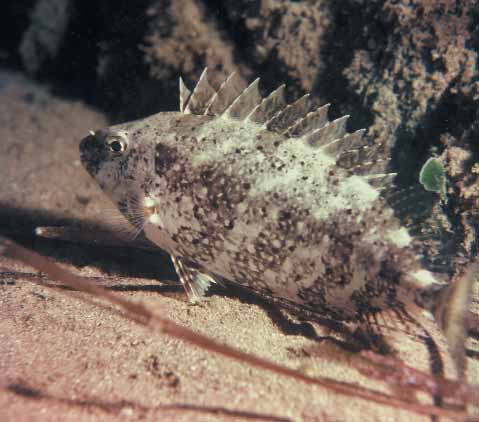
Soldier fish and two Siganids are now
jelly, apparently also invaded the Black
pact is on other algae and on sea grasses
common in fish-catches in the Levan-
Sea, feeding on Mnemiopsis and control-
which it smothers and displaces.
tine basin and Upeneus moluccensis, a
ling its proliferation. The Ameri-
goatfish, has been replacing the
can blue crab, Callinectes sapi-
more valuable local Red Mullet.
dus, was also introduced in the
Many species of benthic or-
Eastern Mediterranean in ballast
ganisms have also colonised the
water. Other species have come
Levantine Basin and are slowly
in as fouling organisms on ships.
spreading west.
Many species have come into
Halophila stipulacea, a mud
this sea by way of mariculture
dwelling seagrass, has colo-
introductions, mainly of oysters,
nised vast areas of the seabed
such as the Pacific oyster, Cras-
and has reached the Aegean.
sostrea gigas. Mariculture activi-
The spread of Indopacific
ties have resulted in many unin-
species in the Levantine basin
tentional introductions of alien
seems to follow an anticlock-
species, such as the macroalga
wise pattern, no doubt fol-
Sargassum muticum, in the
A. DEMETROPOULOS
lowing the prevailing coastal
North Mediterranean.
Siganid
currents.
9
7
B I O L O G I C A L D I V E R S I T Y
>> THE STORY OF THE INVASIVE ALIEN SPECIES
The explosive blooms of the jelly-
fish Rhopilema nomadica, on the
Levant coast are also well known and
have caused a multitude of problems
to fisheries, clogging nets, to recrea-
tion and tourism (stinging bathers) and
occasionally to water intakes of power
stations.
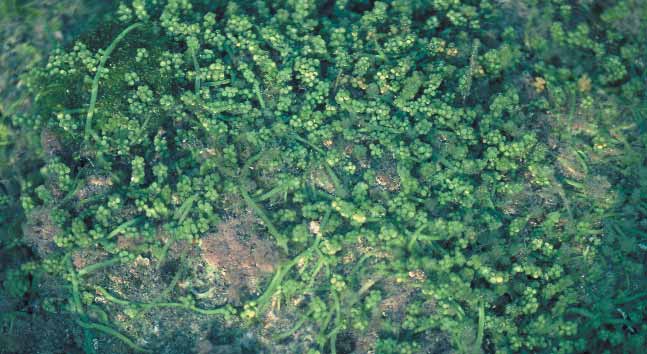
The Caulerpas, fifty years after
Another Caulerpa, Caulerpa race-
mosa, is now posing problems, this
time in the East Mediterranean.
It entered the Mediterranean about
Caulerpa racemosa
50 years ago, but did not spread until
about 1990 when it covered very large
More measures
Some steps are already being taken
areas of seabed around Cyprus and
to be taken...
in these directions --more are needed.
elsewhere. It forms mats a few centi-
The behaviour of alien species in
There is also the obvious need for
metres thick especially on soft sub-
the Mediterranean is unpredictable
some serious thinking on setting up
strates, competing very successfully
and can have revolutionary ecological
and funding suitable barriers, such as
with species such as Caulerpa pro-
--and economic-- impacts; eradication
salinity barriers, in the Suez Canal, to
lifera and Cymodocea nodosa.
after the event is obviously not an
stop or at least minimise the inflow of
It threatens not only the native
option.
alien species into the Mediterranean.
marine flora but also the marine fauna.
These points, inevitably, empha-
If no effective measures are taken
Its impact on Cymodocea nodosa for
sise the need for effective measures to
to stop new introductions further in-
example can have effects on the Green
prevent the introduction of species
stability of the Mediterranean eco-
turtle, which feeds practically exclu-
into this sea --in ballast water, through
system will be inevitable.
sively on this sea grass, at least up to its
mariculture or through other possible
A N D R E A S D E M E T R O P O U L O S
sub-adult stage.
pathways.
M A R I N E B I O L O G I S T
Caulerpa racemosa fortunately, for
the time being at least, seems to have
"lost vigour" and is apparently prolife-
rating more slowly now.
At about the same time, i.e., in 1989--
1990 and periodically since then, an
Indopacific Cladophora species (Clado-
phora is a notoriously difficult group
from a taxonomic point of view), aided
by favourable weather conditions and
probably nutrient increases, has caused
serious problems and some controversy
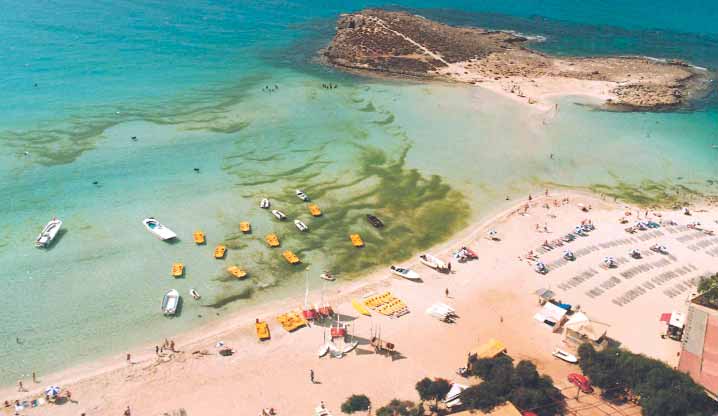
in Cyprus, with its proliferation impac-
ting both Cystoseira habitats and tourist
beaches. It is an epiphytic filamentous
alga.
Cladophora on a beach
1 0
8
M E D P O L
> A COMMON PLATFORM
FOR POLLUTION REDUCTION
Five sub-regional meetings set the basis for harmonized and co-operative activities
for Mediterranean countries to further work for the reduction of land-based pollution.
Damascus, Split, Monaco, Rabat, The sub-regional meetings took place compounds (Halogenated Aliphatic
and Ankara were the scenes
in Damascus (with the participation of
Hydrocarbons, Halogenated Aroma-
where experts from 20 Medi-
Syria, Libya, Egypt, Lebanon); Split
tic Hydrocarbons, Chlorinated Phe-
terranean countries took new steps
(Croatia, Albania, Bosnia-Herzegovina,
nolic Compounds, Organohalogena-
towards the establishment of a common
Slovenia); Monaco (Monaco, France,
ted Pesticides); Radioactive Substan-
background for the preparation of the
Italy, Spain, Greece); Rabat (Morocco,
ces; Nutrients and Suspended Solids;
National Diagnostic Analysis (NDA), the
Tunisia, Algeria), and Ankara (Turkey,
Hazardous Wastes (obsolete chemi-
identification of the amount of every tar-
Israel, Malta, Cyprus).
cals. lubricating oil, batteries).
geted pollutant being released from the
Considered as a key activity towards
All countries are expected to provide
coastal areas (Baseline Budget of Relea-
effective actions for reducing land-
information on the actual quantities of
ses, BB), and the consequent elaboration
based pollution, the National Dia-
pollutants released into the Mediterra-
of National Action Plans (NAPs), all of
gnostic Analysis are aimed at identi-
nean sea. These quantities are named
them aiming at reducing pollution from
fying and assessing:
Baseline Budget of Releases, taking
land based sources in the region.
i. the nature and severity of problems
2003 as the base year for each SAP tar-
Six key goals were targeted by these
caused by the land based activities
geted pollutant.
meetings, which were organised by MED
on the national coastal line and the
Due to the fact that the Mediterra-
POL in the framework of the Strategic
coastal area;
nean is characterised by great hetero-
Action Programme (SAP) with the assis-
ii. the extent of physical alterations
geneity, in sectors, size of enterprise
tance of the Global Environment Facility
and destruction of habitats along
and applied technology, the existing
(GEF) Mediterranean Project:
the coast;
information should be complemented
> to create a hub of regional experts to
iii. the sources of degradation of habi-
as to calculate the BB and additional
promote the SAP and exchange re-
tats and the marine environment
calculations are to be made, when no
lated information;
iv. coastal and marine areas which are
data is available. Calculation can be
> to enhance horizontal co-operation
endangered by land based activities
based on Emission Factors according
and transfer of knowledge between
and proposing a preliminary ranking
to the "Guidelines for the calculation
the countries;
of environmental priority issues, ta-
of Baseline Budget of Releases".
> to review the overall strategy for the
king into account, for each adminis-
A specific software and database
preparation of NAP, NDA and Base-
trative region of the country, the rela-
have also been developed by MED POL
line Budget;
tive importance of each environ-
in co-operation with the secretariat of
> to review the national strategy for
mental issue on food safety, public
RAMOGE (co-operation agreement
the implementation of NAP, NDA
health, coastal and marine resources,
signed by Italy, Monaco and France to
and Baseline Budget;
and the health of the ecosystem and
protect neighbouring coasts) to facili-
> to identify gaps, barriers and difficul-
socio-economic benefits related to
tate the calculation of the BB. The soft-
ties that would alter the implemen-
the following contaminants: Sewage;
ware and database were presented at
tation process at national levels;
Urban Solid Wastes; Persistant Orga-
the sub-regional meetings and partici-
> to identify appropriate means to
nic Pollutants (12 Priority POPs and
pants were trained on their use.
overcome such gaps, barriers and
others); Heavy metals and Organo-
F O U A D A B O U S A M R A
E N V I R O N M E N T A L C H E M I S T
difficulties;
metallic compounds; Organohalogen
M E D P O L P R O G R A M M E O F F I C E R
CO-ORDINATING UNIT FOR THE MEDITERRANEAN ACTION PLAN
MED POL 48, Vassileos Konstantinou Avenue | GR-11635 Athens tel 0030 210 72 73 131 fax 0030 210 72 53 196/7 e-mail medpol@unepmap.gr
1 1
9
M E D P O L
> WANT TO REDUCE MARINE POLLUTION? MONITOR IT!
Between the end
of the sixties
and the beginning
I t was therefore in those years when specific investments are planned,
that the MED POL Programme
for example, for the hot spots.
for the Assessment and Control
Monitoring can provide a clear
of Marine Pollution in the Mediterra-
image of the magnitude of the problem
of the seventies,
nean was conceived within the Medi-
and of its effects and can therefore give
marine pollution
terranean Action Plan (MAP) in order to
precise indications of what remedial
became visible along
assist the countries of the region in
action should be taken and where.
tackling marine pollution.
As a result, the related activities
the Mediterranean coasts
One of the first activities organised
and actors of the SAP should be up to
and not only in the eyes
was monitoring, i.e. a series of regular
date with the outputs of monitoring
of specialists.
measurements of the concentration of
activities, in order to be able to inform
Oil, litter,
marine pollutants in water, biota and
the decision makers on the real state of
unsafe beaches, etc.
sediments. Soon, the MED POL Pro-
the environment. This is extremely
were common
gramme set up a network of national
important on the long-term for ob-
in many tourist areas,
institutes working with common ob-
taining the expected results from any
jectives and methods and assisted by a
planned action requiring comprehen-
bringing along
large capacity building programme
sive efforts from many sectors.
epidemics and other
covering provision of instruments and
Today, the general objectives of the
diseases contracted
chemicals, as well as training and data
monitoring activities implemented as
from swimming and
quality assurance.
part of MED POL Phase III are:
seafood consumption.
The monitoring programme has
> to present periodical assessments of
Once the effects
since then widely developed. The ini-
the state of the environment in hot
were evident,
tial objective (to simply measure the
spots and coastal areas (needed to
pollution) gradually became an instru-
provide information for decision
the problem was
ment for the countries to proceed to
makers on the basic environmental
to identify the causes,
appropriate coastal management, i.e.
status of the areas which are under
i.e. to quantify and qualify
to control the quality of bathing water
anthropogenic pressures);
marine pollution
and beaches, to verify if the existing
> to determine temporal trends of some
and possibly intervene
emission limits were respected (and if
selected contaminants in order to
with adequate measures.
the Protocols were applied), and also to
assess the effectiveness of actions
survey the existing trends in pollution.
and policy measures,
The adoption of the Strategic
and
Action Programme (SAP) brought a
> to enhance the control of pollution
new prospect to the monitoring activi-
by means of applying national /
ties, which became the main assess-
international regulatory limits.
ment tool on the basis of which the
As for the trend-monitoring compo-
countries will eventually take remedial
nent, this aims at detecting site-specific
measures and make interventions.
temporal trends of selected contami-
Thus, the entry of the SAP into an
nants at hot spots and coastal / reference
operational phase now gives the moni-
areas. Trend monitoring of loads aims to
toring activities an even more impor-
provide estimates of inputs of some
tant role. In fact, a national environ-
major groups of pollutants, hazardous
mental monitoring network is a funda-
substances and nutrients (all listed in
mental need while formulating and
the Land Based Sources Protocol) to the
revising the national action plans and
coastal marine environment via point
1 2
0
M E D P O L
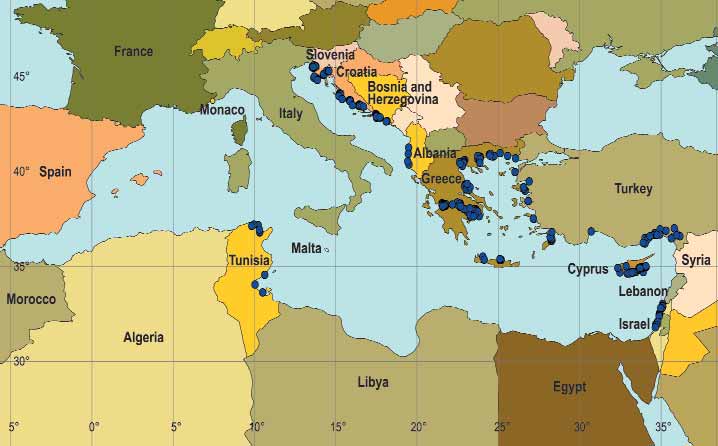
POL. The countries mainly make the
selection of the monitoring areas. The
spatial coverage of hot spots can be
considered satisfactory. However, the
selected monitoring areas in some of
the programmes are still too few to per-
mit the evaluation of the state of the
environment and the assessment of
the impacts of the land-based activi-
ties.
Currently, the common monitoring
strategy of MED POL is basically fol-
lowed in all the ongoing national pro-
grammes. However, there are cases in
which some components are not fully
UNEP/MAP (V. MYROSHNYCHENKO for MED POL)
covered. For example, the monitoring
MED POL III Monitoring Sites, September 2002
of loads from both point and non-
point land-based sources is not widely
(rivers, municipal and industrial efflu-
and shellfish / aquaculture waters,
performed, while the formulation and
ents) and non-point (atmospheric) land-
effluents and hot spots, supports the
implementation of compliance moni-
based sources.
pollution control component. In order
toring activities are not carried out in
Biological effects monitoring
to fully achieve the objectives of this
all countries, basically due to complex
(monitoring with biomarkers) has been
component, countries are encouraged
institutional arrangements.
included in the monitoring pro-
to prepare compliance reports by com-
Some countries are still not partici-
grammes as a pilot activity to test the
paring the results of the monitoring
pating in the MED POL monitoring pro-
methodology to be used as an early-
with the existing limit values of their
gramme in spite of the fact that they are
warning tool to detect any destructive
national and / or the international and
known to have well-established natio-
effects of pollutants to the organisms
regional legislations.
nal monitoring programmes whereas
at the initial stage of exposure.
Capacity building programmes to
others still have no monitoring net-
A new component regarding the
support all the components of moni-
work.
monitoring of the eutrophication (algal
toring have been organised, including
The task ahead is to try to complete
noxious blooms) in the Mediterranean is
direct technical and financial assis-
as much as possible the geographical
being included in the MED POL monito-
tance to the countries, quality assu-
coverage of the monitoring compo-
ring programme. The monitoring sites of
rance programmes and support for the
nent in all Mediterranean countries
interest will be those where eutrophica-
scientific follow-up of emerging envi-
and set up a solid platform of data and
tion phenomena are common and, in
ronmental issues.
information on which the countries
addition, potential-risk areas under the
The effective implementation of
will base their efforts to reduce pollu-
direct impact of anthropogenic nutrient
national monitoring programmes in-
tion.
and organic material inputs.
cluding these components started in
Compliance monitoring, referring
1999. At present, eight countries are
S . Ç O L P A N P O L A T - B E K E N
M A R I N E S C I E N T I S T
to health-related conditions in bathing
implementing them jointly with MED
M E D P O L P R O G R A M M E O F F I C E R
CO-ORDINATING UNIT FOR THE MEDITERRANEAN ACTION PLAN
MED POL 48, Vassileos Konstantinou Avenue | GR-11635 Athens tel 0030 210 72 73 131 fax 0030 210 72 53 196/7 e-mail medpol@unepmap.gr
1 3
1
R E M O T E S E N S I N G
> SATELLITES SUPPORT COASTAL PLANNING
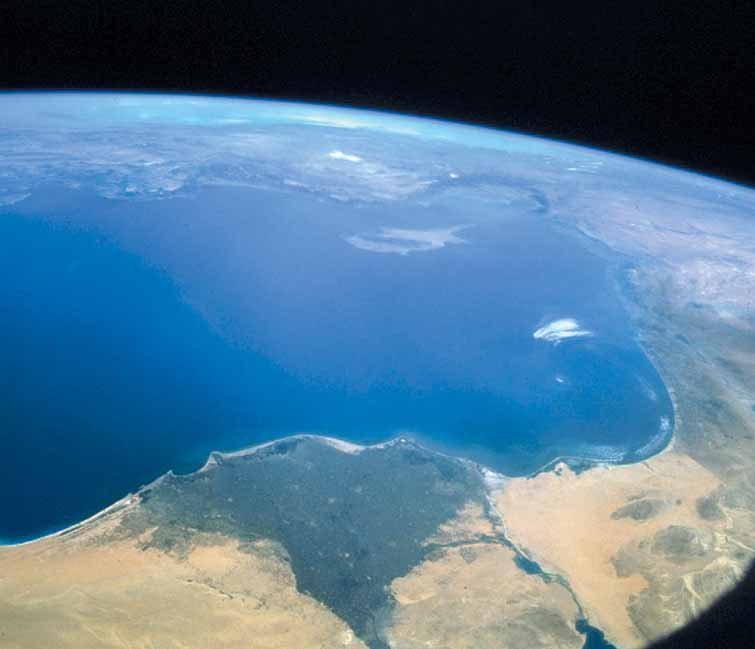
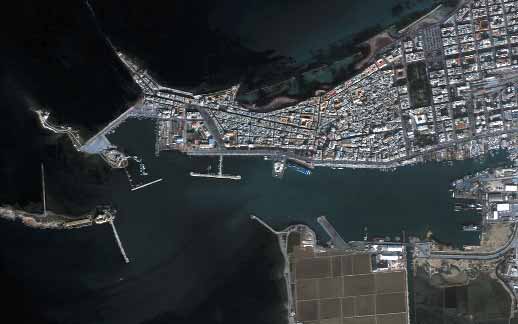
The pictures you see in this article are the result of merging a number of images
taken by artificial satellites continuously orbiting the Earth.
The technology enabling the acquisition of such pictures and information
is called Remote Sensing. It is employed in the Mediterranean as a tool to support
sustainable coastal planning and effective pollution control.
Remote Sensing satellites are In particular, the approach in the In brief, the benefits of using RS are:
part of a number of satellite
use of RS vs in situ data is based on the
> quick and updated overview or de-
constellations. There are
following:
tailed mapping: RS data are avail-
around 15 different civilian satellite
a) the strong points of RS, that are: the
able in short time;
constellations orbiting the Earth, pos-
provision of a spatial (horizontal and
> gaps in time series of in situ data:
sessing different characteristics in
vertical) dimension; synopticity,
Satellites are always orbiting. RS
terms of details that can be visualised
repetitivity, continuity and homo-
time series are generally consistent;
and imaging frequency. Spatial fea-
geneity in collecting data;
> remote and difficult to access areas
tures on the land as small as 50 cm can
b) RS is a strong environmental or car-
(e.g. wetlands);
be detected; the imaging frequency can
tographic data integration tool;
> areas undergoing rapid changes;
be as low as a few hours.
c) observation capabilities from Space
> transnational standardisation often
In these days, the need is arising to
are improving thanks to new sen-
difficult with ground networks only:
improve suitable integrated monito-
sors and satellite missions: new
Satellite RS is intrinsically homoge-
ring in line with Sustainable Develop-
generation of high revisit satellites;
neous;
ment Policy --using also advanced
hyperspectral; Synthetic Aperture
> facilitate exchange of information
techniques-- in order to support sus-
Radar; very high resolution (0.5--
among various actors (e.g. public
tainable coastal planning and efficient
1m).
administration, NGOs, private sector).
control of sea pollution.
With respect to the objectives of
the Mediterranean Action Plan (MAP),
coastal areas and relevant sea pollu-
tion, its control, understanding and
the research of integrated remedies for
it are important issues, which have
concerned the Mediterranean Commu-
nity for many years.
Satellite Remote Sensing can pro-
vide updated and frequent data, pos-
sessing an intrinsic spatial dimension,
that are used --integrated with conven-
tional data-- within Geographic Infor-
mation Systems and Decision Support
Systems for spatial and integrated
planning and assessment. Remote Sen-
sing (RS) in particular can be used for:
monitoring of specific parameters (e.g.
water quality, oil slicks); mapping (base
and land cover / use), and statistics (e.g.
indicators).
1 4
2
R E M O T E S E N S I N G
Due to the particular high relevance
> optical properties. The water optical
As a conclusion, in monitoring and
of water pollution --a fundamental fac-
properties are fundamental para-
protection of coastal areas it has been
tor also for the other monitoring issues
meters that define the physical
shown that Satellite Remote Sensing
mentioned above-- more details are
characteristics of the water column,
data, integrated with in situ data and
given on the use of remote sensing for
with regard to light, in particular:
models in Geographic Information sys-
that specific monitoring.
>> diffuse attenuation coefficient
tems, can be a very useful tool for ob-
The potential for application of
(K ), as a measurement of the tur-
taining updated, frequent, homoge-
d
remote sensing for water characterisa-
bidity of the medium;
neous and accurate monitoring and
tion is relevant to the surface (or near
>> volume reflectance;
forecasting data and information. In the
surface) values of the following para-
>> Secchi depth;
near future Satellite RS capabilities will
meters:
>> water colour.
increase thanks to the growing number
> water temperature (SST).
of satellite constellations and
The surface temperature
improved performance.
as measured by space sen-
Important actions to be car-
sors is representative of
ried out in order to improve the
the water / atmosphere in-
use of Remote Sensing are the
terface. Remotely sensed
setting up of pilot projects with
temperature may be more
the active participation of the
or less representative of
users, the raising of awareness
the skin (most frequent
on technology among the users
case), or the bulk, or the air
and the decision makers; the
near the surface, depen-
training of the experts; the in-
ding on sea wind / rough-
ERS/RAC
crease in the capacity to handle
ness and on the spectral band used
Other parameters relevant to water
such data in a number of Mediterranean
to perform the observation (infra-
characteristics could be indirectly de-
Countries.
red or microwave).
rived, namely:
The Regional Activity Centre for
> water constituents (optically active
> photic depth which is derived from
Environment Remote Sensing (ERS/RAC),
constituents):
the diffuse attenuation coefficient
based in Palermo (Italy), one of the six
>> algae chlorophyllous pigments,
K ;
Regional Activity Centres within the
d
namely chlorophyll-a;
> net organic matter production (daily
MAP, contributes to the planning proces-
>> coloured dissolved organic mat-
primary production rate) from
ses in the Mediterranean by using advan-
ter, known as yellow substance.
measurements of chlorophyll-a;
ced techniques.
It characterises the terrestrial
> detritus concentration (measure-
In particular, its aim is to cooperate
discharge as well as the organic
ment of such parameters is the fruit
with and assist MAP components and
decomposition level in surface
of recent research development, it is
Mediterranean countries in improving
waters;
expressed as a percentage of chloro-
the monitoring of environmental sta-
>> inorganic suspended sediments
phyll-a in surface waters).
tus and changes through the use of
relevant to land and river dis-
As for the assessment of sea pollu-
space and advanced technology.
charge as well as re-suspension
tion, current sensors allow the detec-
of sedimented material through
tion of oil slick extent on the sea sur-
G I O V A N N I C A N N I Z Z A R O
P H Y S I C I S T
hydrodynamic processes.
face, through microwave sensors.
E R S / R A C D I R E C T O R
ENVIRONMENT REMOTE SENSING / REGIONAL ACTIVITY CENTRE (ERS/RAC)
2, Via G. Giusti | IT-90144 Palermo tel 0039 091 342 368 fax 0039 091 308 512 e-mail ctmrac@tin.it website www.ctmnet.it
1 5
3
C O A S T A L A R E A M A N A G E M E N T P R O G R A M M E
> SLOVENIA AND CYPRUS: THE CAMP NEW GENERATION
The Mediterranean Action Plan launches the new generation
of Coastal Area Management Programme (CAMP), with two projects in Cyprus and Slovenia.
Cyprus and Slovenia are candi-
date countries for the member-
ship of the European Union
(EU), which they are expected to join in
2004. Therefore, the CAMP projects in
these countries could have a number of
common characteristics, particularly
with regard to the compliance to some
relevant EU directives, such as the EU
Water Framework Directive, the Direc-
tive on Strategic Environmental Assess-
ment (SEA) and Recommendations for
ICZM.
But at the same time, these new
projects will also be in line with the
new MAP approach towards CAMP im-
plementation, such as focusing on
more strategic issues through the pre-
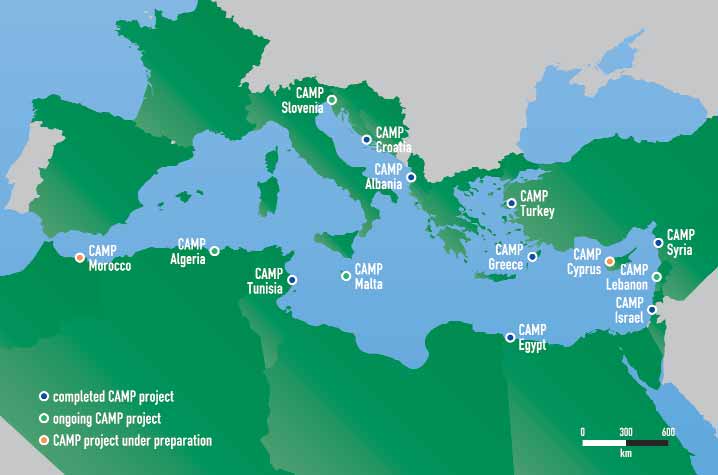
DISTRIBUTION AND STATUS OF CAMP PROJECTS IN THE MEDITERRANEAN REGION.
CAMP Malta is scheduled to be completed at the end of this year. CAMP Lebanon and CAMP Algeria are in the
paration of coastal strategies and vi-
implementation phase. The project in Murcia, Spain, will be submitted to the Contracting Parties for
sions, or extending the territorial scope
approval, while the preparation of a Feasibility Study for CAMP Morocco is to start shortly.
of the project towards the entire Medi-
terranean watersheds of one country,
the financial contribution of these
Also, development pressures, im-
or covering the whole coastal area in a
countries is expected to be higher than
plementation constraints and policy
country.
in former projects.
issues are common to all coastal areas
The proposed projects fully comply
and underlie the development / envi-
with the new MAP approach, and
CAMP Cyprus
ronment interactions and the multiple
therefore present a new generation of
The major problems and issues
threats to the quality of the coast.
CAMPs.
affecting the coastal environment in
The pressures for the expansion of
The projects also offer an opportuni-
Cyprus exhibit an overriding uniformi-
tourist zones, the loss of agricultural
ty for MAP Regional Activities Centres
ty due to the small size of the island
land, the transformation of village
(RACs), especially for Priority Actions
and the dominance of tourism deve-
settlements into tourist centres, or the
Programme (PAP/RAC), to improve their
lopment (in 1981 nearly 420,000
local reactions against various levels of
assistance to countries by concentra-
tourist arrivals, in 1995 more than two
coastal protection, are uniform and
ting resources on MAP priorities, as well
million).
share a common relationship to the
as on countries' immediate objectives
The rapid pace of coastal develop-
whole policy and institutional frame-
by complying to the EU regulations in
ment is the direct outcome of the pro-
work.
those approaching membership.
ximity to the sea. However, the econo-
In 1974, 12% of coasts were urba-
In practice this would mean less
mic and demographic decline of the
nised, and in 2000, 19%. In the same
individual activities within projects,
hinterland areas is indirectly affected
period the amount of undeveloped
but more concentrated and focused
by the pull of resources to the coastal
coast was reduced from 83% to 40%.
ones. Also, projects should be comple-
areas that offer diverse economic oppor-
Most importantly, the proposal of
ted within a shorter timeframe, while
tunities.
the Government of Cyprus for the
1 6
4
C O A S T A L A R E A M A N A G E M E N T P R O G R A M M E
CAMP is based on the need to address
change of traditional and charac-
existing gaps in the policy framework
teristic landscape;
Coastal Area Management Pro-
for coastal planning and management,
> decline of traditional town centres;
gramme (CAMP) was launched in the
and to explore and introduce tools of
> new settlements, new activities in
framework of MAP in 1989, as a conti-
Integrated Coastal Area Management
immediate neighbourhoods; urban
nuation of the Country Pilot Projects
with a view to strengthening and har-
sprawl in nearby hills around coastal
(CPP) implemented by PAP between
monising the policy process.
towns and bigger centres, new tou-
1987 and 1989. The rationale was to
Two main activities are proposed:
rist resorts on the coast;
harmonise involvement of all MAP
components for a better use of the li-
Integrated Coastal Zone Management,
> denaturation of the coast: only 20%
mited resources in accordance with
and Tools for Integrated Coastal Zone
of the coast is still natural;
long-term sustainable development
Management.
> excessive growth of car traffic, heavy
principles in respective coastal areas.
transport infrastructure;
Through the implementation of
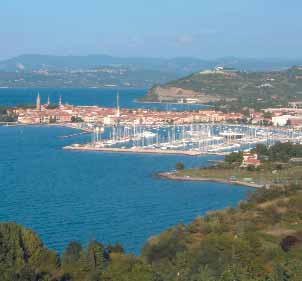
CAMP Slovenia
and
CAMP projects the principles of Inte-
The most pronounced environmen-
> development of the Port of Koper.
grated Coastal Area Management
tal problems in the area are related to
The area of South Primorska region
(ICAM) have been applied in practice.
incomplete infrastructure of waste
(3 coastal and 4 karst municipalities)
With the exchange of knowledge and
water drainage and treatment (in karst
and the municipality of Ilirska Bistrica
experience, work with local and inter-
communities only 21% of users are con-
are proposed as the CAMP area. The
national experts, and integration of
nected to the wastewater collection and
CAMP area corresponds to the Adriatic
activities of all MAP components, the
CAMP projects significantly assist the
treatment system); solid waste manage-
river basin of Slovenia, thus giving an
countries in dealing with priority
ment (in Ilirska Bistrica, for example,
ideal organisational framework also
coastal issues, being now a vehicle for
there are still 60 illegal dumps); manage-
for the Integrated Coastal Area and
sustainable development.
ment of protected areas at the local
River Basin Management (ICARM).
level; drinking wa-
The Regional
ter resources ma-
D e v e l o p m e n t
A short list of activities envisages
nagement; land-
Agency (RDA) for
the preparation of Regional Spatial
use planning and
South Primorska
Structure Plan, Tourism Development
development con-
will probably act
Strategy, workshop on recreational
trol; marine trans-
as the local ma-
and nature protection zone, pro-
port and pollution
nagement unit of
gramme for the reduction of non-point
of coastal waters,
the CAMP project.
pollution sources, establishment of
and lack of appro-
The organisatio-
the regional environmental informa-
priate data bases
nal structure of
tion system, training course on ICAM
and of informa-
the agency assures
tools and techniques, and an aware-
tion systems for
I. MAHER
a broad partner-
ness raising campaign.
effective coastal management.
ship and involvement of all major stake-
The spatial development pattern of
holders in the area. By appointing the
M A R K O P R E M
L A N D S C A P E A R C H I T E C T
the area thus shows the following dis-
RDA for the local management unit of
P A P / R A C D E P U T Y D I R E C T O R
tinctive characteristics:
the CAMP Slovenia project a very impor-
> littoralisation: depopulation and age-
tant goal --long-term sustainability of
for full details on the two projects:
ing of agricultural hinterland,
the project-- could be achieved.
www.pap-thecoastcentre.org/publications.html
PRIORITY ACTIONS PROGRAMME / REGIONAL ACTIVITY CENTRE (PAP/RAC)
Kraj Sv. Ivana 11 | HR-21000 Split tel 0038 5 21 343 499, 0038 5 21 591 171 fax 0038 521 361 677 e-mail pap@gradst.hr website www.pap-thecoastcentre.org
1 7
5
C L E A N E R P R O D U C T I O N
> CLEANER PRODUCTION AND THE SMEs
In the Mediterranean, the intense industrial activities, which represents 33 % of its economy,
coming second only after tourism, generates a high level of pollution.
The challenge of safeguarding Therefore, the Mediterranean in- to identify opportunities for preven-
the environment while promo-
dustry must integrate environmental
ting and reducing pollution at the
ting development (a process in
considerations in its productive pro-
source in a short period of time.
which the industry is called upon to play
cess by means of alternatives that help
In this task, the exchange of infor-
the main role) creates the necessity of set-
minimise the impact of their activities.
mation and experience is fundamental
ting up a new approach for the manage-
so that small and medium-sized indus-
ment process of all companies and in-
tries can identify those initiatives suc-
dustry in particular, in order to achieve a
cessfully carried out by other compa-
balance between economic development
nies for the integration of environ-
and conservation. This requires a change
ment in its own business manage-
aiming at reducing and ultimately elimi-
ment.
nating the negative impacts of industrial
The Mediterranean Action Plan
activity on the environment.
(MAP) assists countries in promoting a
In order to achieve this objective,
modern industry based on environ-
the issue should be addressed directly
mentally sustainable criteria, through
at its origin, i.e. to prevent and reduce
a Regional Centre for Cleaner Produc-
pollution within the productive pro-
tion (CP/RAC) that works for the pro-
cess itself. This is what is known as
CP/RAC
motion of pollution prevention at the
"cleaner production".
While large industrial companies
source.
This approach suggests the adop-
have the necessary resources to invest
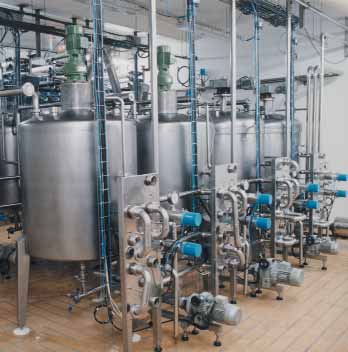
The centre spreads options and tech-
tion of new methods that allow the
time and money into modernising their
niques of prevention and cooperates
preservation of resources and the sub-
processes based on an economically fea-
with the countries through their Insti-
stitution of raw materials that are con-
sible environmental approach, Small
tutions in order to transmit to the in-
sidered harmful to the environment.
and Medium-sized Enterprises (SMEs),
dustrial sector, a set of strategies of en-
The process of cleaner production
mainly in the industrial sector, face grea-
vironmental and business manage-
analyses the so-called cycle of produc-
ter difficulties in having a share in new
ment, either directly or through public
tion, proposing methods for its reformu-
markets that demand environmental ex-
or private intermediaries.
lation with the objective of reducing the
cellence as a sign of competitiveness.
The dissemination of news on prac-
environmental impact as much as pos-
The lack of financial and technical
tical cases and studies on cleaner pro-
sible throughout the whole cycle: from
resources needed to invest in new ma-
duction and its implementation in in-
the extraction of the raw materials to
nagement techniques and the often
dustries are, along with capacity buil-
the waste they generate.
weak support provided by the central
ding, some of the tasks through which
The industrial sector has traditio-
administration are the major obstacles
CP/RAC contributes to promoting this
nally applied different solutions for
for an environmentally sound process
new parameter of modernisation in Me-
reducing the environmental impacts of
of modernisation.
diterranean SMEs to help them conci-
its activities. These however proved to
In many cases, this process does
liate environment with development.
be insufficient, not to talk about the
not require great investments. A re-
J O S É L U I S G A L L E G O , J O U R N A L I S T
additional investments they required.
vision of the productive process allows
E N R I Q U E V I L L A M O R E , C P / R A C
REGIONAL ACTIVITY CENTRE FOR CLEANER PRODUCTION (CP/RAC)
Paris, 134 | ES-08036 Barcelona tel 0034 93 415 1112 fax 0034 93 237 0286 e-mail cleanpro@cema-sa.org website www.cema-sa.org
1 6
T H E K I O S K
> A SELECTION OF PUBLICATIONS
for other publications, please check MAP's and RACs' websites
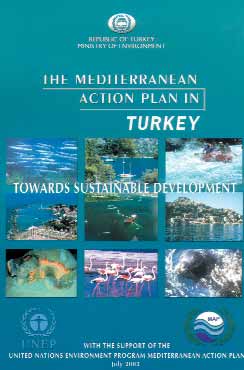
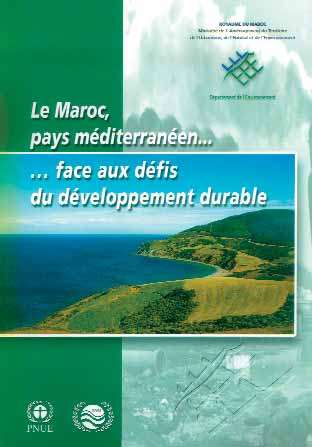
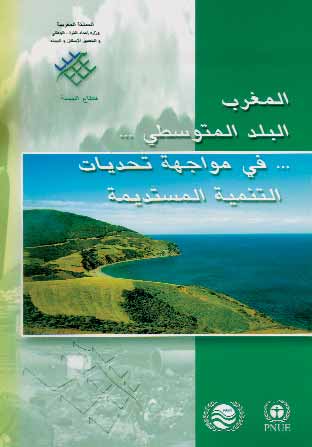
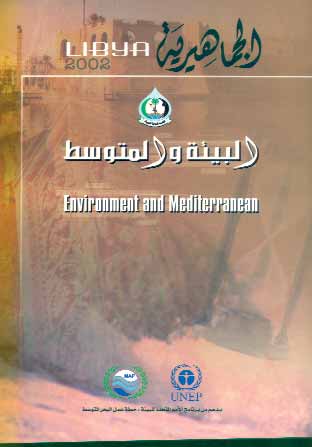
> NATIONAL MIRRORS: Environment and sustainable development in MAP countries
> Croatia
> Libya
> Morocco
> Turkey
Croatia, Libya, Morocco, and Turkey, have presented
in each concerned country. They are addressed to all actors in
their latest state of the environment and sustainable deve-
all areas and at all levels, and also represent a further step
lopment, in the form of national publications, following a
towards the implementation of those activities geared at pro-
MAP initiative. With these, the number of MAP countries
moting wide public awareness at the national and local levels,
that have up to now implemented the initiative, amount to
this being as well among the major activities boosted by the
twelve. Albania, Bosnia and Herzegovina, Egypt, Greece,
Mediterranean Commission on Sustainable Development in
Lebanon, Malta, Slovenia and Syria have already launched
the field of information and public awareness.
their respective publications (see MedWaves 45).
All national publications have been printed in the respec-
These national publications intend to act as a mirror, re-
tive national language, in addition to English and, in some
flecting the rather complex however interesting mosaic of
cases, also French.
relations between environment and sustainable development
e-mail info@unepmap.gr
{ CALENDAR OF MAIN MEETINGS 2003 }
1214 February
Malta
6th Meeting of REMPEC's Focal Points
1315 March tentative
Barcelona, Spain
MCSD Experts' Meeting on "Orientations"
and Preparation for a Mediterranean Sustainable Development Strategy
79 May tentative
Croatia
8th Meeting of the MCSD
2730 May
Italy
Meeting of MED POL National Coordinators
End of May
Dubrovnik, Croatia
Meeting of Joint National Focal Points of BP/RAC, PAP/RAC, ERS/RAC
1518 September
Athens
Meeting of MAP National Focal Points
2730 November
Catania, Italy
13th Ordinary Meeting of the Contracting Parties
or 25 December
to the Barcelona Convention