E2150
v6
Public Disclosure Authorized
ENVIRONMENTAL IMPACT ASSESSMENT ON
GEF SHANGHAI AGRICULTURAL AND
NON-POINT POLLUTION Reduction PROJECT
Public Disclosure Authorized
Public Disclosure Authorized
Public Disclosure Authorized
EAST CHINA NORMAL UNIVERSITY
AUGUST 20, 2009
Environmental Impact Assessment on GEF Shanghai Agricultural and Non-point Pollution Reduction Project
CONTENTS
1 INTRODUCTION .........................................................................................................................1
1.1 Project
Background.......................................................................................................1
1.2
Consistency with Governmental Plans..........................................................................1
1.3 Purpose and Scope of Assessment ......................................................................................2
1.4 Basis of the EIA ..................................................................................................................3
1.4.1 EA Documents and FSRs of Related Components ..................................................3
1.4.2 Laws of the PRC for Environmental Protection.......................................................3
1.4.3 Shanghai's Rules for Environmental Protection ......................................................4
1.4.4 World Bank's Safeguard Policies ............................................................................4
1.4.5 Technical Documents for Assessment .....................................................................5
1.5 Standards of Assessment .....................................................................................................5
1.5.1 Standard of Environment Quality Assessment.........................................................5
1.5.2 Pollutants Discharge Standard..................................................................................8
1.6 Grade of Assessment.........................................................................................................12
1.7 Range of Assessment ........................................................................................................12
1.7.1 Water Environment ................................................................................................12
1.7.2 Ambient Air............................................................................................................13
1.7.3 Acoustic Environment............................................................................................13
1.8 Environment Protection Objective....................................................................................13
1.8.1 Water Environment Protection Objective...............................................................13
1.8.2 Ambient Air Protection Objective..........................................................................13
1.8.3 Acoustic Environment Protection Objective..........................................................13
1.8.4 Environmental Sensitive Objectives ......................................................................13
1.9 Organization of the EA Report .........................................................................................14
2 OVERVIEW OF PROJECT.........................................................................................................16
2.1 Project Framework............................................................................................................16
2.2 Description of Livestock Waste Management Technology Demonstration ......................17
2.2.1 Livestock Waste Management on Large Farm (Jinshan Dairy Farm)Component
1-A ..............................................................................................................................18
2.2.2 Livestock Waste Management on Medium Farm (Chongming Dairy Farm)
Component 1-B .......................................................................................................21
2.2.3 Integrated Livestock and Agricultural Waste Management (Qianwei Village)
Component 1-C .......................................................................................................23
2.3 Description of Wetland Demonstration for Pollution Reduction ......................................29
2.3.1 Jiading Town River-network Wetland DemonstrationComponent 2-A..........29
2.3.2 Qingpu Village Wetland Sewage Treatment SystemComponent 2-B ............33
2.4 Investment Estimation.......................................................................................................35
i
Environmental Impact Assessment on GEF Shanghai Agricultural and Non-point Pollution Reduction Project
3 OVERVIEW OF LOCAL ENVIRONMENT ..............................................................................36
3.1 Physical Environment .......................................................................................................36
3.1.1 Locations of the Project .........................................................................................36
3.1.2 Geology and Terrain Features ................................................................................37
3.1.3 Climate ...................................................................................................................37
3.1.4 Surface Water.........................................................................................................37
3.1.5 Groundwater...........................................................................................................39
3.1.6 Surface Temperature ..............................................................................................39
3.1.7 Natural Calamity ....................................................................................................39
3.2 Water Quality ....................................................................................................................39
3.2.1 Zoning of Surface Water Quality in Shanghai .......................................................39
3.2.2 Water Quality in Shanghai Area.............................................................................40
3.3 Quality of Ambient Air .....................................................................................................42
3.4 Ambient noise ...................................................................................................................43
3.5 Ecological Environment....................................................................................................43
3.5.1 Jinze Town and Liantang TownQingpu District.................................................43
3.5.2 Langxia Town, Jinshan District..............................................................................43
3.5.3 Shuxin Town and Zhongxing Town, Chongming County......................................43
3.5.4 Waigang Town and Juyuan New Area, Jiading District .........................................44
3.6. Social and Economic Conditions .....................................................................................44
3.6.1 Population and Land ..............................................................................................44
3.6.2 Social Economy Condition ....................................................................................44
4 PROJECT ALTERNATIVE ........................................................................................................46
4.1 With and Without Projects................................................................................................46
4.1.1 With and Without the Livestock Waste Management Technology Demonstration
Project .............................................................................................................................46
4.1.2 With and Without the Wetland Demonstration for Pollution Reduction................46
4.2 Alternative Locations........................................................................................................47
4.2.1 Alternative Locations for the Livestock Waste Management Technology
Demonstration Project.....................................................................................................47
4.2.2 Determination of Wetland Demonstration for Pollution Reduction Site................48
4.3 Alternative Technical Process...........................................................................................59
4.3.1 Livestock Waste Management Technology Demonstration ...................................59
4.3.2 Wetland Demonstration for Pollution Reduction ...................................................63
5 IMPACT ASSESSMENT AND MITIGATION MEASURES.....................................................70
5.1 Analysis of Pollution Source.............................................................................................70
5.1.1 Livestock Waste Management Technology Demonstration...................................70
5.1.2 Wetland Demonstration for Pollution Reduction ...................................................84
5.2 Measures to Reduce Environmental Impact in the Project Construction Period ..............88
5.2.1 Livestock Waste Management Technology Demonstration ...................................88
5.2.2 Wetland Demonstration for Pollution Reduction ...................................................96
5.3 Measures to Reduce Environmental Impact in the Project Operation Period .................101
ii
Environmental Impact Assessment on GEF Shanghai Agricultural and Non-point Pollution Reduction Project
5.3.1 Livestock Waste Management Technology Demonstration .................................101
5.3.2 Wetland Demonstration for Pollution Reduction .................................................117
5.4 Risks and Hidden Danger................................................................................................119
5.4.1 Explosion and Deflagration..................................................................................119
5.4.2 Disastrous weather ...............................................................................................119
5.4.3 Analysis on Environmental Risks ........................................................................119
6 PROJECT BENEFITS ...............................................................................................................124
6.1 Expected Benefits of Component 1-A ............................................................................124
6.1.1 Social Benefits .....................................................................................................124
6.1.2 Environmental Benefits........................................................................................124
6.1.3 Economic Benefits ...............................................................................................126
6.2 Expected Benefits of Component 1-B.............................................................................126
6.2.1 Social Benefits .....................................................................................................126
6.2.2 Environmental Benefits........................................................................................126
6.2.3 Economic Benefits ...............................................................................................127
6.3 Expected Benefits of Component 1-C.............................................................................128
6.3.1 Social Benefits .....................................................................................................128
6.3.2 Environmental Benefits........................................................................................128
6.3.3 Economic Benefits ...............................................................................................129
6.4 Expected Benefits of Component 2-A ............................................................................129
6.4.1 Social Benefits .....................................................................................................129
6.4.2 Environmental Benefits........................................................................................130
6.4.3 Economic Benefits ...............................................................................................131
6.5 Expected Benefits of Component 2-B.............................................................................131
6.5.1 Social Benefits .....................................................................................................131
6.5.2 Environmental Benefits........................................................................................131
6.6 Expected Benefits for Integrated Agricultural Pollution Reduction Techniques.............132
6.7 Summary for Environmental Benefits.............................................................................133
7 PUBLIC CONSULTATION & INFORMATION DISCLOSURE ...........................................134
7.1 Information Disclosure ...................................................................................................134
7.2 Public Participation .........................................................................................................134
7.2.1 Results of Public Participation in Internet Survey ...............................................134
7.2.2 Results of Public Participation in Questionnaire Survey .....................................135
7.2.4 Main Conclusion for the public participates ........................................................137
8 DESCRIPTION AND EMP FOR INTEGRATED AGRICULTURAL POLLUTION
REDUCTION TECHNIQUES......................................................................................................139
8.1 Description of Integrated Agricultural Pollution Reduction Techniques ........................139
8.1.1 Project Base and Objective ..................................................................................139
8.1.2 Project Location ...................................................................................................140
8.1.3 Project Description...............................................................................................140
8.1.4 Training and Publicity..........................................................................................142
iii
Environmental Impact Assessment on GEF Shanghai Agricultural and Non-point Pollution Reduction Project
8.1.5 Project Demonstration and Promotion Plan .........................................................142
8.1.6 Project Schedule...................................................................................................142
8.2 Environmental Monitoring Plan......................................................................................143
8.2.1 Environmental Monitoring Plan for Integrated Agricultural Pollution Reduction
Techniques ....................................................................................................................143
8.2.2 Environmental Investigating Plan for Integrated Agricultural Pollution Reduction
Techniques ....................................................................................................................143
8.3 Environmental Management Plan ...................................................................................145
9 ENVIRONMENTAL MANAGEMENT PLANEMPAND MONITORING PLAN .........148
9.1 Objectives of EMP ..........................................................................................................148
9.2 Role of EMP....................................................................................................................148
9.3 Contractual Management ................................................................................................148
9.3.1 Execute the Contract ............................................................................................148
9.3.2 Obligations of contractors ....................................................................................148
9.4 Entities implementing EMP ............................................................................................149
9.5 Environmental Management Cost Estimation.................................................................150
9.6 Monitoring Program for Components.............................................................................152
9.6.1 Monitoring Program for Component 1-A ............................................................152
9.6.2 Monitoring Program for Component 1-B.............................................................154
9.6.3 Monitoring Program for Component 1-C.............................................................156
9.6.4 Monitoring Program for Component 2-A ............................................................158
9.6.5 Monitoring Program for Component 2-B.............................................................160
9.7 EMP Summary for Components ...................................................................................162
9.7.1 Environmental Management Plan for Component 1-A........................................162
9.7.2 Environmental Management Plan for Component 1-B........................................169
9.7.3 Environmental Management Plan for Component 1-C........................................174
9.7.4 Environmental Management Plan for Component 2-A........................................180
9.7.5 Environmental Management Plan for Component 2-B........................................184
10 CONCLUSIONS......................................................................................................................189
iv
Environmental Impact Assessment on GEF Shanghai Agricultural and Non-point Pollution Reduction Project
1 INTRODUCTION
1.1 Project Background
Shanghai is the most economically developed and the most populated city in China. At the
end of 2007, Shanghai had a population of 18 million across its 6340.5 km2 of land. The
suburban area beyond the outer ring is an important production base for agriculture and
industry of Shanghai. N, P and organic matters discharged to water bodies in suburban area
account for 60-70%, mainly from agriculture and animal husbandry, agricultural chemicals
and surface runoffs including rain runoff and farmland irrigation water drainage, livestock
and poultry manure and untreated industrial and domestic wastewater are the major causes
for eutrophication of water bodies. Non-point pollution has become a major form of pollution
for the water environment of Shanghai. Contaminated surface waters draining into Huangpu
River and Yangtze River impose an adverse impact on the two rivers that we cannot afford to
neglect. As the municipal drinking water source protection area upstream Huangpu River
suffers from increasingly heavier contamination of water in recent years, the development of
the higher-quality new Qingcaosha municipal drinking water source has to be accelerated. To
reduce land-based pollution of offshore waters of Yangtze River Estuary, improve natural
and ecological environment of Shanghai, and eliminate the conflicts between agricultural and
non-point pollution in Shanghai and its objective of becoming an environment-friendly city,
Shanghai Municipal Government cooperates with the World Bank, the PIU of GEF, to seek a
feasible new approach to pollution reduction in relation to the non-point pollution in
suburban areas where the economy experience ongoing growth, and to find solutions for
difficulties in regional economic growth and urbanization.
In November 2007, GEF approved the Shanghai Agricultural and Non-Point Pollution
Reduction Project (SANPRP). The Ministry of Finance of China entered into the Shanghai
GEF Project Preparation Grant (PPG) Agreement on June 24, 2008. The project is invested in
jointly by Shanghai Municipal Government and GEF and implemented by Shanghai
Municipal Government. The project consists of a series of environmental protection
demonstration components aiming at mitigating agricultural and non-point pollution,
reducing pollutants discharged via runoffs into Huangpu River and Yangtze River, and
protecting and improving water environment.
1.2 Consistency with Governmental Plans
The Eleventh Five-year Plan for Shanghai's National Economy and Social Development
implemented since 2006 is a strategic overall plan that provides a framework for economic
and social development of Shanghai during the 11th Five-year Plan. According to the plan,
Shanghai will develop cyclic eco-agriculture, reduce use of chemical fertilizers, pesticides
and mulch plastic films, promote integrated use of crop straws and livestock and poultry
manure, and increase the use of commodity organic fertilizers; improve the quality of water
environment; accelerate watercourse regulation in suburban areas, and further improve water
1
Environmental Impact Assessment on GEF Shanghai Agricultural and Non-point Pollution Reduction Project
quality of suburban watercourses; boost development of modern agricultural parks, with
focus on the three islands in Chongming County, Huangpu River upstream area, northern
bank of Hangzhou Bay and the wedge-shaped agricultural zone at urban fringe.
The Eleventh Five-year Plan for Shanghai's Marine Economy Development sets out that, in
respect of marine ecological environment, Shanghai should protect the marine environment
and strictly control new pollution, and the major land-derived pollutants discharged into sea
will decrease by 15% from 2005 by 2010.
The Three-year Action Plan for Shanghai's Environmental Protection in 2006-2008 sets out
that, in respect of compliance of livestock and poultry farms and comprehensive use of
livestock and poultry manure, Shanghai should enhance law enforcement regulation over
livestock and poultry farms and further establish and improve facilities turning livestock and
poultry manure into useful resources, and, in respect of agricultural and non-point pollution
control, the city should promote the use of organic fertilizers, reduce use of chemical
fertilizers, effectively reduce agricultural and non-point pollution and improve the ecological
environment of farmland. Therefore, the Project is consistent with the municipal
government's plan for environmental protection and pollution control.
1.3 Purpose and Scope of Assessment
According to the laws and regulations of the People's Republic of China and World Bank
Operational Policies 4.01 and 4.09 in relation to environmental impact assessment, and based
on the type, location, sensitivity, sizes of Component s and as well as the nature and extent of
possible environmental impact of the Project, the environmental impact assessment of the
Project falls into Class B and has been carried out. An environment management plan has
been prepared as an operational basis and assurance for environmental impact mitigation in
construction and operation of the Project.
According to the Circular on Enhancing Management of Environmental Impact Assessment
on Projects Financed by International Financial Institutions and World Bank assurance
policies issued by PRC on Jun. 21, 1993, Shanghai Project Management Office (PMO) and
the project owner has commissioned Shanghai University to prepare the Environmental
Impact Report on Integrated Use of Bio-Agricultural Wastes in Qianwei Village, Shuxin
Town, Chongming County ("Component 1-C") and the Environmental Impact Report on
Straw Gasification-based Power Generation and Biomass Briquetting in Qianwei Village,
Shuxin Town, Chongming County ("Component 1-C"), commissioned Shanghai Normal
University to prepare the Environmental Impact Report on Livestock and Poultry Manure
Treatment Center in East Chongming County ("Component 1-B"), and commissioned
Shanghai Academy of Environmental Sciences to prepare the Environmental Impact Report
on Biogas Power Generation at Shanghai Bright Holstein Jinshan Dairy Farm ("Component
1-A").
2
Environmental Impact Assessment on GEF Shanghai Agricultural and Non-point Pollution Reduction Project
1.4 Basis of the EIA
1.4.1 EA Documents and FSRs of Related Components
The GEF SANPRP environmental impact assessment documents for the Report are based on
the following environmental impact assessment documents and feasibility study reports:
(1) Environmental Impact Report on Integrated Utilization of Bio-Agricultural Wastes in
Qianwei Village, Shuxin Town, Chongming County, June 2006, Shanghai University;
(2) Environmental Impact Report on Straw Gasification-based Power Generation and
Biomass Briquetting in Qianwei Village, Shuxin Town, Chongming County, June 2006,
Shanghai University;
(3) Environmental Impact Report on Livestock and Poultry Manure Treatment Center in East
Chongming County, November 2007, Shanghai Normal University;
(4) Environmental Impact Report on Cow Manure-to-Biogas Generation at Jinshan Dairy
Farm, June 2009, Shanghai Academy of Environmental Sciences;
(5) Feasibility Study Report on Cow Manure-to-Biogas Generation at Jinshan Dairy Farm,
March 2009, Shanghai Environmental Sanitation Engineering Design Institute;
(6) Feasibility Study Report on Livestock and Poultry Manure Treatment Center in East
Chongming County, July 2008, Shanghai Shenye Dairy Farm;
(7) Feasibility Study Report on Integrated Utilization of Bio-Agricultural Wastes in Qianwei
Village, Shuxin Town, Chongming County, July 2008, Biomass Energy Research Center
of Tongji University;
(8) River Network Wetland Demonstration Project in Waigang Town and Juyuan New Area,
Jiading District, April 2009, Shanghai Investment Consulting Co., LTD.
(9) Feasibility Study Report on Qingpu District Rural Domestic Wastewater Treatment Phase
I Project, February, 2009, Shanghai Municipal Engineering Design General Institute;
1.4.2 Laws of the PRC for Environmental Protection
(1) Law of Environmental Protection of the PRC, December, 1989;
(2) Law of Environment Impact Assessment of the PRC, October, 2002;
(3) Law of Air Pollution Prevention and Control of the PRC, April, 2000;
3
Environmental Impact Assessment on GEF Shanghai Agricultural and Non-point Pollution Reduction Project
(4) Law of Water Pollution Prevention and Control of the PRC, February, 2008;
(5) Law of Environmental Noise Pollution Prevention and Control of the PRC, October,
1996
(6) Management Regulations on Environmental Protection for Construction Projects, People
Republic of China State Council No.253 order, November. 1998;
(7) Law of Solid Waste Pollution Prevention and Control of the PRC, December, 2004.
(8) Law of Cleaning Production Promotion of the PRC, June, 2002;
(9) Law of the People's Republic of China on Regenerated Energy, February, 2005;
(10) Management Regulations for Electricity Generation from Renewable Energy, National
Development and Reform Commission, January, 2006;
1.4.3 Shanghai's Rules for Environmental Protection
(1) Regulations of Shanghai Municipality on Environmental Protection, May, 2006;
(2) Functional Division of Shanghai Water Environment, December, 2004;
(3) Functional Division of Shanghai Ambient Atmospheric Quality, July, 2004;
(4) Functional Division of Shanghai urban noise Environment, June, 2008;
(5) Eleventh Five Year Plan of Shanghai National Economic and Social Development;
February, 2006;
(6) Shanghai Wastewater Plan (2005-2020);
(7) Shanghai Three-Year Environment Protection, Construction and Action Plan for
2006-2008;
1.4.4 World Bank's Safeguard Policies
(1) The World Bank's OP/BP4.01, Environmental Assessment;
(2) The World Bank's OP4.09, Pest Management;
(3) The World Bank's OP/BP4.12, Involuntary Resettlement;
(4) The World Bank's OP/BP 4.36, Forests;
(5) The World Bank's OP/BP 4.37, Safety of Dams;
4
Environmental Impact Assessment on GEF Shanghai Agricultural and Non-point Pollution Reduction Project
(6) The World Bank's OP/BP7.50 , International Waterways;
(7) The World Bank's /BP7.60, Projects in Disputed Areas;
(8) The World Bank's OP/BP4.11, Physical Cultural Resources;
(9) The World Bank's OP/BP4.10, Indigenous Peoples;
(10) The World Bank's OP/BP 4.04, Natural Habitats;
1.4.5 Technical Documents for Assessment
(1) Professional Standard, The Technology Guiding of Environment Impact Assessment
the Principle, HJ/T2.1-93;
(2) Professional Standard, The Technology Guiding of Environment Impact Assessment
Environment air, HJ/T2. 2-93;
(3) Professional Standard, The Technology Guiding of Environment Impact Assessment
Surface Water Environment, HJ/T2. 3-9;
(4) Professional Standard, Technology Guiding of Environment Impact Assessment Sound
Environment, HJ/T2. 4-1995;
(5) Professional Standard, Technology Guiding of Environment Impact Assessment
Ecological Environment of Nature Resource Development, HJ/T19-1997;
1.5 Standards of Assessment
The following assessment standards are employed in line with the location of the Project and
Shanghai Municipal Government's zoning water environment, ambient air and noise and
applicable laws and regulations.
1.5.1 Standard of Environment Quality Assessment
(1) Environmental Quality Standard for Surface Water
According to the Shanghai Water Environment Zoning, Component 2-B is located within the
municipal drinking water source protection area upstream Huangpu River and subject to
Class II standard defined in the Environmental Quality Standards for Surface Water;
Components 1-B and 1-C are seated in Chongming Island and subject to Class III standard;
Component 1-A is situated in Langxia Town, Jinshan District and subject to Class V standard,
falling into Class V area; Component 2-A is located in Waigang Town and Juyuan New Area,
5
Environmental Impact Assessment on GEF Shanghai Agricultural and Non-point Pollution Reduction Project
Jiading District, subject to Class IV standard. Table 1.1 lists selected indicators for the
environmental quality standards for surface water.
Table 1.1 Environment Quality Standard for Surface Water (GB3838-2002)
mg/Lexcept pH
No. Parameter
Class II
Class III
Class IV
Class V
1 pH
69 69 69 69
2
DO
6 5
3
2
3 CODCr 15
20
30
40
4 BOD5 3
4
6
10
5 NH3-N 0.5
1.0
1.5
2.0
6
TP 0.1
0.2 0.3 0.4
(2) Environmental Quality Standard for Noise
According to the Shanghai Environmental Noise Zoning, Components 1-B, 1-C and
2-B are within Class 1 zone and subject to Class 1 standard defined in Standard of
Environmental Noise of Urban Area; Components 1-A and 2-A fall into Class 2 zone and is
subject to Class 2 standard. Table 1.2 lists the standard values of environmental noise of
urban area.
Table1.2 Environmental Quality Standard for Noise (GB3096-2008) Leq(A):dB
Standard Value
Standard Value
Grade
Grade
Daytime Nighttime
Daytime Nighttime
0 50 40 3 65 55
1 55 45 4 70 55
2 60 50
(3) Ambient Air Quality Standard
According to the Zoning of Ambient Air Quality in Shanghai, Components 1-B and 1-C are
within Class I Zone and subject to Class I standard. Component 2-B consists of two parts.
The Sun Island nature protected area and Dianshan landscape and water body protection area
are within Class 1 Zone and subject to Class I standard, and the remaining areas are subject
to Class II standard. Components 1-A and 2-A are subject to Class II standard. Table 1.3 lists
the standard values of Ambient Air Quality (GB3095-1996).
6
Environmental Impact Assessment on GEF Shanghai Agricultural and Non-point Pollution Reduction Project
Table 1.3 Ambient Air Quality StandardGB3095-1996 mg/m3
Grade Sampling
Time TSP PM10 SO2 NO2
Annual average
0.08 0.04 0.02 0.04
1st
Daily
average 0.12 0.05 0.05 0.08
Standard
Hourly average
0.15 0.12
Annual average
0.20 0.10 0.06 0.08
2nd
Daily
average 0.30 0.15 0.15 0.12
Standard
Hourly average
0.50 0.24
(4) Standard of Assessment for Sediment
The Class II standard defined in Environmental Quality Standard for Soils (GB156181995)
is used for assessment on river sediment removal involved in the Project, see Table 1.4.
Table1.4 Executive Standard of Assessment for Sediment
Environmental
Standard
Pollutant
Unit Standard
Value
Factor
Reference
Parameter
Copper mg/kg 100
Environmental
Lead mg/kg 350
quality standard for
Chromium mg/kg
250
soils GB15618
Soil
Zinc mg/kg 300
1995
Cadmium mg/kg
0.60
Grade II
Arsenic mg/kg
30
Mercury mg/kg
1.0
The analysis on heavy metal content of removed bottom sediments of watercourses is as per
the Solid Waste - Extraction Procedure for Leaching Toxicity (HJ/T299-2007).
If any hazardous component of the leaching solution of a solid waste prepared as per
HJ/T299 exceeds the concentration limit specified in the table Table1.5, such solid waste is
considered hazardous waste with leaching toxicity characteristics.
Table1.5 Standard Values for Determination of Leaching Toxicity (HJ/T299-2007)
S/N
Hazardous Component
Concentration Limit of
Analysis Method
Hazardous Component in
Leaching Solution(mg/L)
1
Lead(total lead)
5
ICP-AES, ICP-MS, etc.
2
Cadmium(total cadmium)
1
ICP-AES, ICP-MS, etc.
3
Copper (total copper)
100
ICP-AES, ICP-MS, etc.
4
Zinc(total zinc)
100
ICP-AES, ICP-MS, etc.
5 Mercury(total
mercury)
0.1
ICP-MS
7
Environmental Impact Assessment on GEF Shanghai Agricultural and Non-point Pollution Reduction Project
1.5.2 Pollutants Discharge Standard
(1) Wastewater Discharge Standard
Wastewater discharge is subject to Shanghai Integrated Wastewater Discharge Standard
(DB31/1991997) and the standard for pollutant discharge by urban wastewater treatment
plants. Component 2-B is located within the municipal drinking water source protection area
upstream Huangpu River, and its wastewater treatment plant is subject to Class1B standard
defined in GB18918-2002; Components 1-B and 1-C fall into Class III water quality area and
are subject to Class I standard for discharge; Component 1-A is within Class V water quality
area and Component 2-A within Class IV water quality area, both subject to Class II standard
for discharge. After expansion of capacity, the wastewater treatment facilities of Component
1-A shall suffice to treat the liquid fraction from bio-digester and other wastewater produced
in the Project, with pollutants contained in the effluent to comply with the Discharge
Standard for Municipal Sewerage System(DB31/425-2009). Table 1.6 lists selected
indicators for the Shanghai Integrated Wastewater Discharge Standard (DB31/1991997),
Table 1.7 lists selected indicators for the Discharge Standard of Pollutants for Municippal
Wastewater Treatment Plant (GB18918-2002) and Table 1.8 lists selected indicators for the
Discharge Standard for Municipal Sewerage System(DB31/425-2009).
Table1.6 Shanghai Integrated Wastewater Discharge Standard (DB31/199-1997)
mg/L
Standard
Maximum allowable concentration of Class II
pollutants discharged
Parameter
Class I
Class II
BOD5 20
30
CODcr 100
100
Petroleum
5 10
NH3-N 10
15
SS 70
150
Vegetable and animal oils
10
15
Table1.7 Discharge Standard of Pollutants for Municippal Wastewater Treatment Plant
(GB18918-2002)
(mg/L)
Standard
Grade I
Grade II
Grade III
A
B
BOD5 10
20
30
60
CODcr 50
60
100
120
Petroleum 1
3
5
15
NH3-N 58 8(15) 25(30) -
TN 15
20
-
-
8
Environmental Impact Assessment on GEF Shanghai Agricultural and Non-point Pollution Reduction Project
SS 10
20
30
50
Vegetable and animal oils
1
3
5
20
TP 0.5
1
3
5
Table 1.8 Discharge Standard for Municipal Sewerage SystemDB31/425-2009
Maximum allowable concentration of
S/N
Parameter
pollutants discharged
1 pH
69
2 CODCrmg/L 500
3 BOD5 mg/L 300
4
SS mg/L 400
5
TN mg/L 60
6
NH3-N mg/L 40
7
TP mg/L 8
(2) Integrated Emission Standards for Air Pollutants
According to the State Environmental Protection Administration and the National
Development and Reform Commission jointly issued the Circular on Strengthening
Management of Environmental Impact Assessment on Biomass-Fueled Power Generation
Projects (HF [2006] No. 82), the flue gas emission in biogas-based power generation projects
is subject to the maximum allowable emission concentration for air pollutants emitted by
gas-fired boilers defined in the Emission Standard for Air Pollutants from Boilers
(DB31/387-2007), see Table 1.9 Unorganized emission of malodorous pollutants is subject to
Class II standards for plant boundary defined in the Emission Standards for Odor Pollutants.
Table 1.9 Emission Standard for Air Pollutants from Boilers (DB31/387-2007)
Maximum allowable emission concentration
No.
Pollutants
Unit
for air pollutants emitted by gas-fired boilers
1
SO2
mg/m3
50
2
NOx
mg/m3
200
3
Smoke
mg/m3
30
Nitrogen oxide contained in exhaust gas of generator units shall meet the Stage II limit (7.0
g/kW.h) provided in Limits and measurement methods for exhaust pollutants from positive
ignition (P.I.) engines of vehicles and vehicles equipped with P.I. engines GB14762-2002,
sulfur dioxide to meet Class II standard defined in Integrated Emission Standard of Air
Pollutants GB16297-1996, and these Standards are listed in Table 1.10 and Table 1.11.
9
Environmental Impact Assessment on GEF Shanghai Agricultural and Non-point Pollution Reduction Project
Table1.10 Limits and measurement methods for exhaust pollutants from positive
ignition (P.I.) engines of vehicles and vehicles equipped with P.I. engines
GB14762-2002
Pollutant
Limits for Exhaust Pollutants from Positive Ignition NG Engine g/(kw·h)
NOx 7
Table1.11 Integrated Emission Standard of Air PollutantsGB16297-1996
Rate of Maximum Allowable Emission (kg/h)
Concentration of Maximum
Pollutant
Allowable Emission (mg/m3)
Height of Exhaust Stackm
Class II
15 3.0
SO2 1200
20 5.1
In Components 1-B, the cow production size meets the intensive farm requirements, and the
livestock and poultry manure treatment works are within the dairy farm. Therefore, the
Discharge Standard of Pollutants for Livestock and Poultry Breeding (GB18596-2001) is
applicable to discharge of odor pollutants( see Table1.12). Component 1-A and the
wastewater treatment plant of Component 2-B are subject to class II plant boundary standard
defined in the Plant Boundary Standard for Odor Pollutants(GB14554-93), while Component
1-C subject to Class I plant boundary standard, see Table 1.13.
Table 1.12 Discharge Standard of Pollutant for Livestock and Poultry Breeding
(GB18596-2001)
Discharge Pollutant
Limited Value
Odor concentrationNo unit 70
Table 1.13 Plants Boundary Standard Value of Odor Pollutants (GB14554-93)
Class II
Discharge Pollutants
Class I
New build or
Before June 8, 1994
rebuild
NH3-N (mg/m3) 1.0
1.5
2.0
H2S (mg/m3) 0.03
0.06
0.10
Odor concentrationNo unit 10
20
30
(2) Emission standards for noise
According to the Emission Standard for Industrial Enterprises Noise at Boundary
10
Environmental Impact Assessment on GEF Shanghai Agricultural and Non-point Pollution Reduction Project
(GB12348-2008), Components 1-B, 1-C and 2-B fall into Class 1 area, where the noise at
plant boundary must meet Class 1 standard. Component 2-A falls into Class 2 area, where the
noise at plant boundary must meet Class 2 standard. Component 1-A must meet Class 3
standard of noise at boundary. These standards are listed in Table 1.14.
Table 1.14 Emission Standard for Industrial Enterprises Noise at Boundary
(GB12348-2008),
Leq(A)dB
Standard Value
Standard Value
Grade
Grade
Daytime Nighttime
Daytime Nighttime
0 50 40 3 65 55
1 55 45 4 70 55
2 60 50
4Discharge Standard for Sediment
In addition to the environmental quality standard for soils, the Control Standard for Pollutants in Sludge
from Agricultural Use is also used for river sediment removal to control disposal and discharge of sludge
from river sediment removal (details see Table 1.15).
Table1.15 Control Standards of Pollutants in Sludge for Agricultural Use (GB 4284-84)
Standard Limited Value(mg/kg dried sludge)
Standard
Pollutant
Parameter
Reference
Acidic Soil
Neutral and Basic Soil
(pH<6.5)
(pH6.5)
Cadmium and
5 20
its compounds
Mercury and its
5 15
compounds
Lead and its
300 1000
Control
compounds
Standards of
Chromium and
Pollutants in
600 1000
its compounds
Sediment Sludge for
Arsenic and its
Agricultural
75 75
compounds
Use (GB
4284-84)
Copper and its
250 500
compounds
Zinc and its
500 1000
compounds
Nickel and its
100 200
compounds
11
Environmental Impact Assessment on GEF Shanghai Agricultural and Non-point Pollution Reduction Project
1.6 Grade of Assessment
Base on Technology Guiding of Environment Impact Assessment (HJ/T2.12.3-93
HJ/T2.4-1995HJ/T19-1997, The grade of assessment could be defined as follows:
(1) Waste Water
In Component 1-A, the liquid fraction from bio-digester will be discharged into the
municipal sewer network after treatment at the wastewater treatment station reconstructed. In
Components 1-B and 1-C, harmless liquid (liquid fraction from bio-digester) from anaerobic
fermentation of livestock and poultry manure will be directly used for farmland and not
directly discharged into surface water. Component 2-B is subject to treatment at wastewater
treatment plants and constructed wetland, with a small quantity of tail water (less than 500
m3/day station) that meets Class IB standard, water environment assessment falling into
Class III.
(2) Noise
The noise is temporary in construction period, low-noise equipments are used, and the noise
increment value is very low [<3 dB(A)]. Therefore, the acoustic environment assessment
falls into Class III.
(3) Ambient Air
The impact on ambient air is mainly from fugitive dusts in the construction period, while
from odor of livestock and poultry manure in the operation period. Malodorous gases,
typically H2S and NH3, are unorganized discharge. The malodorous pollutants generated in
the Project are not discharged in a huge quantity, and can meet relevant standards after
proper treatment. Air pollutants from boilers, i.e. SO2, NOx and Smoke, have an equivalent
standard emission level of less than 2.5*108m3/h, thus the ambient air assessment falls into
Class III.
1.7 Range of Assessment
1.7.1 Water Environment
For Components 2-A and 2-B, the assessment covers watercourses receiving tail water from
constructed wetland. For Component 1-A, the assessment covers Hongqiao Port adjacent to
the dairy farm. For Components 1-B and 1-C, the assessment covers adjacent water systems
and, of course, effect on the East China Sea.
12
Environmental Impact Assessment on GEF Shanghai Agricultural and Non-point Pollution Reduction Project
1.7.2 Ambient Air
The assessment covers the project area and 2500 m beyond the project boundary.
1.7.3 Acoustic Environment
The assessment covers the project area and 100 m beyond the project boundary.
1.8 Environment Protection Objective
1.8.1 Water Environment Protection Objective
For Components 1-B and 1-C, the water environment protection objective is that the water
quality should meet Class III standard defined in the Environmental Quality Standards for
Surface Water (GB3838-2002). For Component 1-A, the water quality in Hongqiao water
quality should meet Class V standard defined in the Environmental Quality Standards for
Surface Water (GB3838-2002). For Components 2-A, the water environment protection
objective is that the water quality should meet Class IV standard defined in the
Environmental Quality Standards for Surface Water (GB3838-2002). For Component 2-B,
the water quality in Hongqiao water quality should meet Class II standard defined in the
Environmental Quality Standards for Surface Water (GB3838-2002).
1.8.2 Ambient Air Protection Objective
For Components 1-B and 1-C, the ambient air quality should meet Class I defined in the
Ambient Air Quality Standard (GB3095-1996); for the part of Component 2-B within the Sun
Island nature protected area and Dianshan water body protection area, the ambient air quality
should meet Class I standard defined in the Ambient Air Quality Standard (GB3095-1996),
and the remaining part should meet Class II standard.
1.8.3 Acoustic Environment Protection Objective
For Components 1-B, 1-C and 2-B, the acoustic environment protection objective should
meet Class I standard defined in the Standard of Environmental Noise of Urban
Area(GB3096-2008). Components 1-A and 2-A should meet Class II standard.
1.8.4 Environmental Sensitive Objectives
13
Environmental Impact Assessment on GEF Shanghai Agricultural and Non-point Pollution Reduction Project
The sites of Components 1-B and 1-C are far away from villages, without any sensitive
residential area around; there are villages residing within the 300 m protection area of
Component 1-A; residential houses are situated south of the constructed wetland of
Component 2-A; residential houses are found adjacent to the constructed wetland and
wastewater treatment plant of Component 2-B. Table1.16 lists the Position of the
Environmental Sensitive Objectives.
Table1.16 Position of the Environmental Sensitive Objectives
No.
Components
Sensitive objectives
Position
Distancem
1
Component
Yonggan village
Southeast
About 200
2
1-A
Nantang village
North
About 200
3
Component
Zhujiazhai village
North
About 15
2-A
4 No.34,Jintian
village North
About
10
5
No.82,Qianwan village
West
About 10
6 No.167,Beiwangbang
village
South
About
10
Component2-B
7
No.289,the South of Beiwangbang village
North
About 10
8
No.76,the West of Xiezhuang village
North
About 10
9
The East of Xiezhuang village
North
About 10
1.9 Organization of the EA Report
The chapters of this report deal with the following topics:
Chapter 1 Introduction
Based on EA documents of Components, this chapter provides an overview of project
background; purpose, scope and basis of preparation of EA reports; discharge standards,
assessment classes, assessment scope and environmental protection objectives; and at last
provides a summary of all chapters of the Report.
Chapter 2 Overview of Project
Briefly introduce composition of the Project and Components
Chapter 3 Overview of Local Environment
Briefly introduce natural environment, environmental quality and social environment of the
project area.
Chapter 4 Project Alternatives
14
Environmental Impact Assessment on GEF Shanghai Agricultural and Non-point Pollution Reduction Project
Analysis will be made on whether or not to implement the alternative site selection or
technological process solutions for the Project and its Component s.
Chapter 5 Impact Assessment and Mitigation Measures
This chapter analyzes and predicts environmental impact of Components during their
implementation and operation and provides mitigation actions against negative impacts.
Chapter 6 Expected Benefits of Project
This chapter analyzes positive effects of the Project in respect of social, environmental and
economic benefits.
Chapter 7 Public Participation
This chapter provides an overview of information disclosure and public participation
methods of the Project and comments and suggestions on the Project.
Chapter 8 Description and EMP for Integrated Agricultural Pollution Reduction
Techniques
This chapter briefly introduces the comprehensive agricultural and non-point pollution
control technology demo project, and propose the environment management plan for
comprehensive agricultural and non-point pollution control technology demo project. As the
use and management of pesticides are involved, the pest management plan will be developed
separately.
Chapter 9 Environmental Management Plan and Monitoring Plan
This chapter briefly describes the purpose, role, organization and budget of environment
management plan, and the environment management plan and monitoring plan of
Components.
Chapter 10 Conclusions
This chapter briefly summaries the main conclusions on the EA report.
15
Environmental Impact Assessment on GEF Shanghai Agricultural and Non-point Pollution Reduction Project
2 OVERVIEW OF PROJECT
The Project focuses on the most serious and the most urgent agricultural and
non-point pollution problems in suburban and rural areas of Shanghai. These
pollutants are mainly livestock and poultry manure, agricultural chemicals (chemical
fertilizers and pesticides), agricultural wastes and crop straws. The Project is
consistent with the overall work of the government and included into the 4th
three-year action plan for environment protection (2009-2011).
2.1 Project Framework
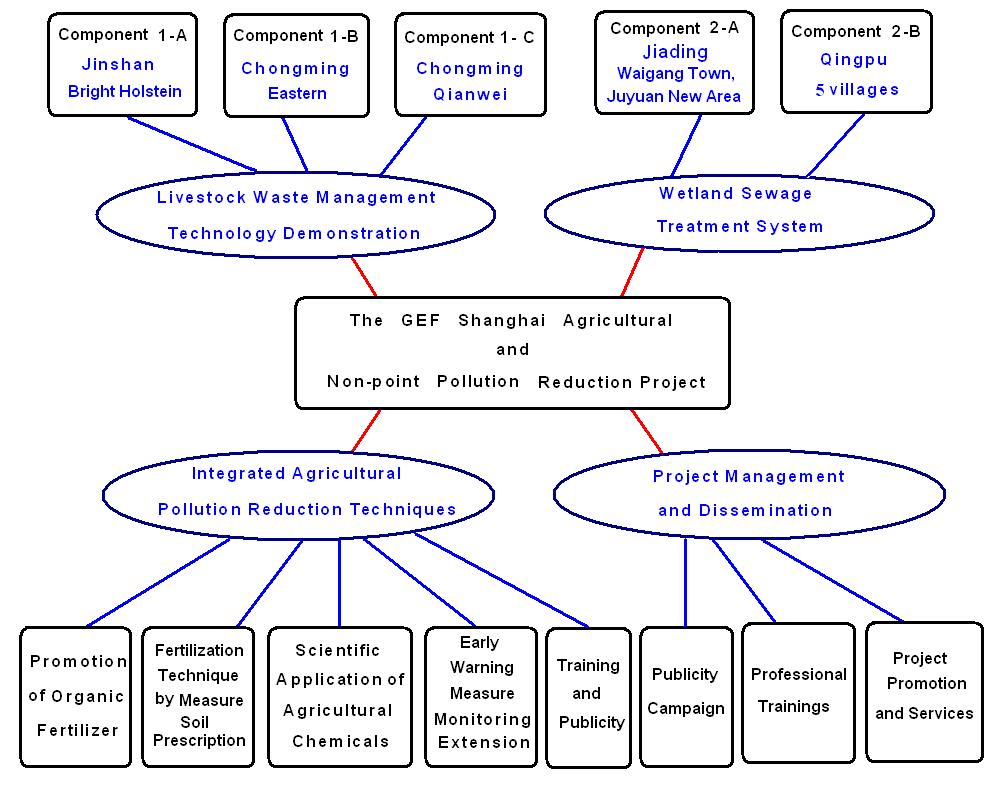
In general, the Project is intended to play a demonstration role by implementing
integrated management of livestock and poultry manure and agricultural wastes, rural
wetland wastewater treatment system and comprehensive agricultural pollution
reduction technology. Some sites will be selected in suburban and rural areas of
Shanghai to implement effective and innovative pollution reduction project and
finally reduce contamination of water bodies of Yangtze River Estuary and the East
China Sea arising from agricultural pollution.
Figure2.1 Project Framework of the GEF Shanghai Agricultural and Non-point
Pollution Reduction Project
In the foregoing Components, environmental impact assessment (EA) and the
environment management plan (EMP) will be made for livestock and poultry wastes
16
Environmental Impact Assessment on GEF Shanghai Agricultural and Non-point Pollution Reduction Project
integrated management technology demonstration and wetland wastewater treatment
technology. Therefore, this chapter will provide a brief introduction. According to the
Environmental Impact Assessment Law of the People's Republic of China, the
environmental impact assessment will not be made for the comprehensive agricultural
pollution reduction technology demonstration of Components, but a separate chapter
will be provided to briefly describe the environmental impact, and a separate EMP
will be developed. The following chapters will no longer involve the fourth
component (project management and promotion) of GEF SANPRP.
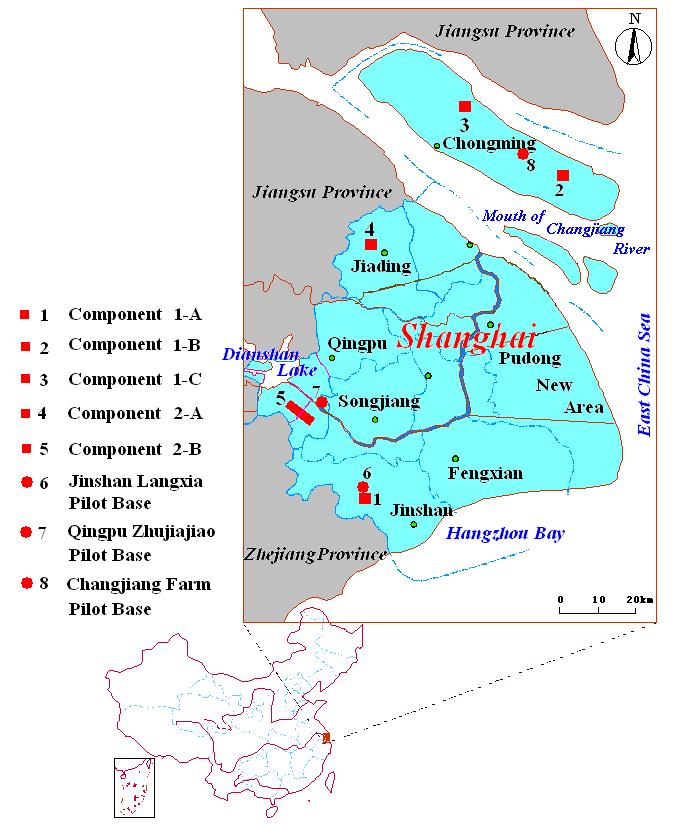
Fig.2.2 Locations of GEF Shanghai Agricultural and Non-point Pollution
Reduction Project
2.2 Description of Livestock Waste Management Technology
Demonstration
The Livestock Waste Management Technology Demonstration Project consists of
three Components. Details are provided as follows:
17
Environmental Impact Assessment on GEF Shanghai Agricultural and Non-point Pollution Reduction Project
2.2.1 Livestock Waste Management on Large Farm (Jinshan Dairy
Farm)Component 1-A
(1).Owner
Shanghai Bright Holstan Co., Ltd.
(2) Project Location and Description
The project is located at the existing site of Shanghai Bright Holstein Dairy Farm in
the Jinshan Modern Agricultural Park, Langxia Town, Jinshan District, Shanghai.
The project will produce biogas through pre-treatment and anaerobic digestion of cow
wastes, silage leachate and wastewater from milking stall rinsing and cooling
sprinklers generated each day by 5,000 cows in the dairy farm, and use the purified
biogas to generate electricity with the cogeneration units fueled by biogas; the
residual heat from cogeneration units is used for heating anaerobic feeds; the liquid
fraction from bio-digester will be discharged into the municipal sewer network after
treatment at the wastewater treatment station reconstructed to the discharge standard
of Jinshan Langxia Wastewater Treatment Plant, and the sludge is shipped to organic
fertilizer plant and turned into organic fertilizer for sale.
The project mainly consists of civil works and plant works. The civil works include
anaerobic reactor, biogas storage tank, power generation building, storage tank for
liquid fraction from biodigester and reconstructing wastewater treatment station. The
plant works include power generation units, grid connection system and pipework
(3) Discharge System
Adopt the system of separate sewer and stormwater. The stormwater will be
discharged into the epidemic prevention river (moat) after sedimentation.
(4) Economical Technical Index
The main economical technical indexes of Component 1-A are shown in Table 2.1.
Table 2.1 The Main Economical Technical Indexes of Component 1-A
No. Item
Unit
Economical
Technical
Index
1
Total covered area
m2 2460
2
Total floor area of new buildings
m2 820
3
Total covered area of structures
m2 740
4 Road
m2 400
5 Greening
m2 500
6 Treatment
capacity
t/d
270
18
Environmental Impact Assessment on GEF Shanghai Agricultural and Non-point Pollution Reduction Project
7 Construction
phase
month 17
8
Total works investment
Million RMB
36.0002
9
Total cost unit price
RMB /t
37.77
10
Operating cost unit price
RMB /t
14.27
5Integrated Waste Treatment Process
For the process flow diagram of integrated waste treatment of the project, see Fig. 2.3.
Fig. 2.3: Integrated Waste Treatment Process Flow Diagram
6Process flow of wastewater treatment station
For the process flow diagram of wastewater treatment station, see Fig. 2.4.
Fig. 2.4: Process Flow Diagram of the Wastewater Treatment Station
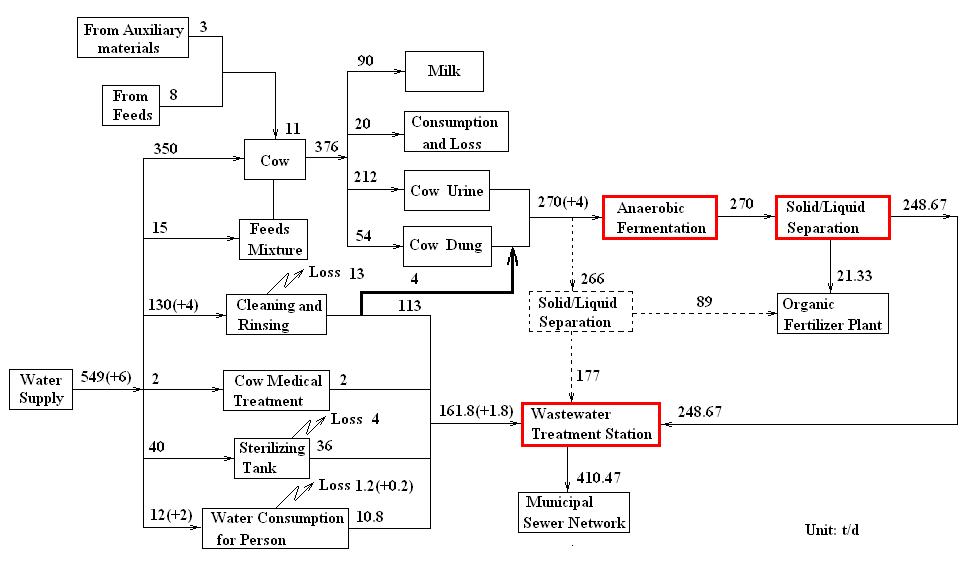
7Water Balance
For water balance of the project, see Fig. 2.5.
19
Environmental Impact Assessment on GEF Shanghai Agricultural and Non-point Pollution Reduction Project
Remarks:
The additional water consumption in this Project is 6 t/d (indicating in positive figure).
Dry feed moisture content is estimated as 10%.
The part enclosed with dotted line will be cancelled after the completion of this Project.
The moisture content in the solid part after solid/liquid separation is 80% in the original
process, v. but 75% in the new process.
In the figure, the part in red boxes is the newly-built or modified works in this Project.
Fig. 2.5: Water balance in the whole plant after implementation of this Project
8Process flow of biogas-fueled power generation
For the process flow of biogas-fueled power generation, see Fig. 2.6.
Grid connection
Biogas
Hot water tank
Generator
purification
Residual heat
Hot water for cow farm
Pretreatment
Anaerobic
Cow wastes
Solid/liquid
digester
collection truck
separation
Storage tank for
Wastewater treatment
liquid fraction
station
from bio-digester
Processed at organic
fertilizer plant and
Solid organic
sold
fertilizer
Fig. 2.6: Process Flow Diagram of Biogas-fueled Power Generation
20
Environmental Impact Assessment on GEF Shanghai Agricultural and Non-point Pollution Reduction Project
After pretreatment and anaerobic digestion, the cow dung and urine of the project
produce biogas, which is then purified and generate electricity with the biogas-fueled
co-generation units; the residual heat from the biogas-fueled co-generation units are
used to heat anaerobic feedstock; the liquid fraction from bio-digester will be
discharged into the municipal sewer network after treatment at the wastewater
treatment station reconstructed to the discharge standard of Jinshan Langxia
Wastewater Treatment Plant, while the sludge is shipped to organic fertilizer plant and
made into organic fertilizer for sale.
2.2.2 Livestock Waste Management on Medium Farm (Chongming
Dairy Farm)Component 1-B
(1) Owner
Shanghai Shenye Dairy Cooperative
(2) Project location and description
The project is located at Chongming Dairy Farm, Beiliuyao Section, Chongming
Modern Agricultural Park. The park is included into Chongming overall development
plan. The project covers a total land area of 18,750 m2. The farm now has a stock of
1,600 cows.
The project plans to build the Eastern Chongming Livestock Waste Treatment Center
that produces 6,000t solid organic fertilizers and 10,500t liquid organic fertilizers (the
center to be under management of Shanghai Shenye Dairy Farm). The project mainly
includes the dry livestock waste treatment system and the livestock farm livestock
wastewater treatment and transfer system.
In the project, the total floor area of new buildings is 7,075 m2, with volume of
structures being 2,130 m3, fermentation workshop being 4,000 m2 and on-farm slurry
transfer pipeline being 3,000 m. Specifically:
A. The 7,075 m2 new buildings consist of 2,000 m2 storage shed, 2,000 m2
fermentation workshop, 300 m2 fertilizer workshop, 2,400 m2 storehouse, 125 m2
office space, 100 m2 of living space and 150 auxiliary spaces.
B. The 2,130 m3 new structures of the wastewater treatment and transfer system
consist of 900 m3 fermentation tank, 1,230m3 pre-sedimentation tank and 3,000
on-farm liquid fertilizer transfer pipeline.
(3) Economical Technical Index
The main economical technical indexes of Component 1-B are shown in Table 2.2.
21
Environmental Impact Assessment on GEF Shanghai Agricultural and Non-point Pollution Reduction Project
Table 2.2 The Main Economical Technical Indexes of Component 1-B
Economical
No. Item
Unit
Technical index
1 Total covered area
m2 18750
2 Total floor area of new buildings
m2 7075
3 Volume of structures
m3 2130
4 Road and paved surface
m2 2500
5 Greening
m2 1600
6 Dispose of Wet dung
t/d
49.3
7 Construction
phase
month
9
8 Total works investment
Million RMB
6.449
(4) Process Technology
The separate dry manure and urine wastewater treatment process is adopted.
A. Dry Livestock Waste Treatment
The dry livestock wastes, after collected from farms, are transferred to the
fermentation workshop, where automatic oxygen input occurs during turning by
turners. Then, after addition of biological agents, automatic cutting of straws
(auxiliary materials) and mixing, they enter the high-efficiency composting stage
(secondary fermentation). The materials after removal of disease-causing bacteria and
pest eggs are sent to the deep processing system where they are made into
high-quality organic fertilizers in power or pellet form.
B. Livestock Wastewater Treatment
Livestock wastewater is collected and transferred into the underground unpowered
anaerobic and aerobic digestion systems. The wastewater, after anaerobic and aerobic
digestion, is made into high-quality organic fertilizers and conveyed to crop fields via
channels and pipelines, thereby being recovered to farmlands harmlessly.
5Technological Process
For the process flow of livestock wastewater, see Fig. 2.7 and the process flow of the
dry livestock wastes, see Fig. 2.8.
Fig. 2.7: Liquid Fertilizer Production Process Flow Diagram
22
Environmental Impact Assessment on GEF Shanghai Agricultural and Non-point Pollution Reduction Project
Remarks: There is only one set of pelletizer, operated alternately for the two types of fertilizers.
Fig. 2.8: Process Flow Diagram of Solid Organic Fertilizers from Livestock
Wastes
2.2.3 Integrated Livestock and Agricultural Waste Management
(Qianwei Village)Component 1-C
(1) Project Owner
Chongming ShuxinTown Qianwei Village Committee
(2) Project Location
The project is located at Eco-farming Demonstration Zone, Qianwei Ecological
Village, to the north of the east-west axis of the village, between Jing'er Road and
Jingsi Road, and to the north of Wei'er Road. The project covers a total area of 6,900
m2 or 10.3 Mu.
The land for the project is in the possession of Qianwei Ecological Village and
currently used as fish ponds, breeding farms and crop fields. There are ditches drained
23
Environmental Impact Assessment on GEF Shanghai Agricultural and Non-point Pollution Reduction Project
to river course, 150 m2 brick-laid single-floor buildings, a 3 m wide unpaved road
connected to a 4 m gravel road that allows access by farm tractors. No water or power
supply facilities are available. To the south of the land lot is the hog breeding base of
Qianwei Village that has a hog stock of 4,000 and produces 10,000 hogs a year.
(3) Project Description
The project consists of two independent sub-systems: the multiple agricultural
wastes-based biogas-fueled power generation and nutrients recovery sub-system, and
the straw gasification-based power generation and biomass briquetting sub-system.
The two sub-systems are inter-adjusted in operation to ensure stability of energy
supply.
The project coves a land area of 6,900 m2 (90m×60m+50m×30m), including 5,400 m2
for the multiple agricultural wastesbased biogas-fueled power generation and
nutrients recovery sub-system (90m×60m), and 1,500 m2 for the straw
gasification-based power generation and biomass briquetting sub-system (50m×30m).
There are over 2,550 m2 structures for the multiple agricultural wastesbased
biogas-fueled power generation and nutrients recovery sub-system, including 1,190
m2 greenhouse structures, over 650 m2 workshops and auxiliary buildings, 11,000 m
long slurry pipes in fields, and over 1,200 m3 slurry holding ponds in fields.
The straw gasification-based power generation and biomass briquetting sub-system
consists of over 280 m2 buildings, 50 m3 structures and over 500 m2 greenhouse
structures.
After the Project is completed, the 600 m3 biogas plant completed in 1993 with
investment of RMB2.66 million Yuans and having an annual output of 150 m3 biogas
will be removed. Residuals in the biogas digester will be used as raw materials of
organic fertilizers, construction wastes will be disposed of according to requirements
of the Construction Wastes Management Office, and the original site will be prepared
and afforested.
4Economical Technical Index
The main economical technical indexes of Component 1-C are shown in Table 2.3.
Table 2.3 The Main Economical Technical Indexes of Component 1-C
Economical
No. Item
Unit
Technical index
1
Total covered area
m2 6900
2
Buildings covered area
m2 2620
3
Volume of structures
m3 2600
4
Power generation capacity
kwh
940000
5 Biogas
m3/d 2138
24
Environmental Impact Assessment on GEF Shanghai Agricultural and Non-point Pollution Reduction Project
6
Output of solid organic fertilizer
t/a
1801
7
Output of liquid organic fertilizers
t/a
11093
8 Construction
phase
month
8
9
Total works investment
Million RMB
20.72
10
Annual profit
Million RMB/a
1.06
11
Phase of return on investment
year
20
5Process Technology
A.Technological Process
The project consists of two independent sub-systems: the multiple agricultural
wastesbased biogas-fueled power generation and nutrients recovery sub-system, and
the straw gasification-based power generation and biomass briquetting sub-system.
The two sub-systems are inter-adjusted in operation to ensure stability of energy
supply (See Fig. 2.9). In the multiple agricultural wastesbased biogas-fueled power
generation and nutrients recovery sub-system, different raw materials are separately
treated and digested in anaerobic digestion to avoid difficult feeding and discharge
due to mixed raw materials.
Fig. 2.9: Overall Process Flow Diagram
25
Environmental Impact Assessment on GEF Shanghai Agricultural and Non-point Pollution Reduction Project
B. Anaerobic Digestion Process of Livestock Wastes and Wastewater
The dung and wastewater from livestock farms are mixed and then digested on a fully
mixed. The liquid generated from digestion and the acid solution from acid crop straw
combine to further deepen digestion, which in turn provides nitrogen and phosphorus
for acid solution. For the process flow of anaerobic digestion process of livestock
wastes and wastewater, see Fig. 2.10.
Fig. 2.10: Anaerobic Digestion Process Flow Diagram for Livestock Wastes and
Wastewater
C. Anaerobic Digestion Process of Organic Domestic Wastes
The domestic wastes are first pre-treated separately and then hydrolyzed. The
hydrolytic liquid of wastes is mixed with dung and wastewater from livestock farms
and then digested on a fully mixed. The liquid generated from digestion and the acid
solution from acid crop straw combine to further deepen digestion, which in turn
provides nitrogen and phosphorus nutrients for acid solution. For the process flow of
anaerobic digestion process of organic domestic wastes, see Fig. 2.11.
26
Environmental Impact Assessment on GEF Shanghai Agricultural and Non-point Pollution Reduction Project
Fig. 2.11: Anaerobic Digestion Process of Organic Domestic Wastes
D Anaerobic Digestion Process of Crop Straw
This project adopts the moderate temperature internal circulation acid generation gas
co-generation and two-stage anaerobic digestion process developed by the Biomass
Energy Research Center of Tongji University (hereinafter the "BERC Process"). The
BERC process, through special process management, controls the acid generation
phase and separate the acid and gas generation phases so that the acid generation
phase is in semi-open digestion while the gas generation phase is in closed digestion,
which simplifies the intensity of feeding/discharge and improves the reaction
efficiency of the system. For the process flow of anaerobic digestion process of crop
straw, see Fig. 2.12.
27
Environmental Impact Assessment on GEF Shanghai Agricultural and Non-point Pollution Reduction Project
Fig. 2.12: Anaerobic Digestion Process Flow Diagram of Crop Straw
E. Straw Gasification Process
After pulverizing of crop straw, the down-draft fixed bed gasifier is used to produce
forced air discharge through the two-stage gasifier in the feeding section. On the one
hand, that gasifier is simple and easy to start; on the other hand, the water and
hydrocarbon from the raw materials reduced under high temperature are used to
increase the proportion of hydrogen and methane in the gas and improve gas quality.
For the process flow of straw gasification process, see Fig. 2.13.
Fig. 2.13: Straw Gasification Process Flow Diagram
28
Environmental Impact Assessment on GEF Shanghai Agricultural and Non-point Pollution Reduction Project
F. Biomass Briquetting Process
The ring mill type briquetting equipment is used for rice chaff biomass briquetting,
which consumes less energy and produces pellets of suitable sizes. For the process
flow of biomass briquetting process, see Fig. 2.14.
Fig. 2.14: Biomass Briquetting Process Flow Diagram
2.3 Description of Wetland Demonstration for Pollution Reduction
2.3.1 Jiading Town River-network Wetland Demonstration
Component 2-A
(1) Project Owner
Shanghai International Automobile City Newanting United Development Co.,
Ltd.
(2) Project Location
The River Network Wetland Demonstration Area is situated northwest of the planned
North Suburban Wetland, encompassing the area confined by Lianqihe, Gujing and
Miaojing, sized around 667407.34 m2. The location of River Network Wetland
Demonstration Area is shown on the Fig.2.15.
Location of the Demonstration Area Monitoring Point of Pengmen
Fig.2.15 Location and Scope of the Demonstration Area
29
Environmental Impact Assessment on GEF Shanghai Agricultural and Non-point Pollution Reduction Project
3Situation of the Rivers Dredging
A. River Dredging and Its Function
In the range of the dredging project there are main rivers, like Miaojing River, Gujing
River and Shenzhaijing River, as well as some natural creeks, all of which are
governed by the Town. These rivers have now the principal functions of flood control
and drainage, and provision of agricultural and fisheries water. In the future after the
completion of the river regulation, apart from the current functions, new functions
will be added such as wetland and landscape, thus becoming a model project of
river-network and wetland construction. Table 2.4 lists the present situation of the
rivers.
Table 2.4 the Present Situation of the Rivers.
Length
Wide
Area of the Rivers
River
Beginning and End
m
m
ha
Miaojing Gujing
Lianqi
river
1104
1015
1.7
Gujing
Lianqi river - Miaojing
783
813
1
Shenzhaijing
Miaojing - Lianqi river
487
811
0.54
Natural creeks
2405
7-15
3
Total
6.24
B. Present situation of river bed material
According to the heavy metal content sampling analysis and the sediment toxic
leaching test done on the bottom sludge dredged from Miaojing River, Shenzhaijing
River and Gujing River (The monitoring results of heavy metal content test are shown
in Table 5.19, the results of the toxicity characteristic leaching test are shown in Table
5.20.), the contents of heavy metals do not exceed the requirements in "Control
standards for pollutants in sludge from agricultural use" GB4284-84, and the
concentration of leach solution are not exceeded the concentration limits of hazardous
components (Identification standard hazardous wastes- leaching toxicity
identification GB5085.3-2007), therefore, these bottom sludge dredged are not
hazardous wastes and can be used for agricultural use or forestry purposes.
C. Purpose of River Dredging
In consideration of the following reasons:
the water from the Yangtze River estuary has a high content of SS, which is easy
to settle down as the flow slows down in inland rivers;
surface runoff resulting from rainstorm often carries out large amount of sediment
into rivers, causing deposition; and
falling leaves from the trees and other plants along rivers, and water discharged
from farmland come to river courses, so that sediment with large quantity of
30
Environmental Impact Assessment on GEF Shanghai Agricultural and Non-point Pollution Reduction Project
organic matters settle down to deposition;
therefore, the river courses in rural area have to be regulated every few years
(clean-up work included). Otherwise, they would be silted up, seriously affecting the
basic functions of the river courses, such as flood control and drainage, irrigation of
farmland and others. Meanwhile, river mud dredged is a good organic fertilizer. In the
Chinese countryside, there is a fine tradition that every winter there is usually a period
of time arranged for irrigation work, including dredging of small and medium rivers
in the rural area. In so doing, on one hand, the river courses are dredged through, and
on the other hand, the dredged mud can be used for agricultural purpose. For example,
the river mud is often used in winter wheat field, to be dried in cold weather to cover
wheat seedling, thus protecting the seedling and improving the farmland soil. In
addition, the dredged mud serves as an outer layer of isolation for outdoor livestock
manure and green manure anaerobic compositing. Therefore, this river dredging
project fundamentally aims to enlarge wetted cross-section of river courses for
smooth flow, increase the water storage capacity, and enhance the basic functions of
river, such as flood control and drainage, irrigation of farmland, etc, as well as some
help for improvement of river water quality.
(4) Project Description
The project consists of the following two aspects:
A. To form river network wetland by means of eco-restoration to restore functions of
river network wetland.
This part includes 3 aspects: base repair, construction of vegetation buffer zone and
connection of river system.
Basement Repair
Base repair mainly refer to dredge exist rivers. This project of river dredging and
widening is to achieve the following objectives:
- to maintain the wetland function of the original river courses as far as possible,
including reeds;
- to strengthen river dikes, improve soil and water conservation capacity of river
bank, so as to conform with the requirements of stability of river side slope, and
decrease silting-up resulting from collapse;
- to build a various-wide bed configuration structure as appropriate with deep
pools and shallow beaches, instead of a unification of river bed configuration,
so as to provide a variety of ecological environment for zoobenthos.
The design standard of the river substrate restoration works are as follows:
Ratio of River to Slope
According to geological data and based on the overall stability of the slope of the river,
the ratio of river to slope is set to 1:2.0. Because rivers on the site are relatively small
31
Environmental Impact Assessment on GEF Shanghai Agricultural and Non-point Pollution Reduction Project
ones, construction will generally be carried out under water cut-off.
Standard of Flood Drainage:
The standard of flood drainage: once every 20 years, based on the fact that max.
24-hour rainfall is 209 mm locally, and max. 1-hour rainfall is 36 mm. So it is adapted
to the drainage standard of "once a year" adopted in the urban drainage system;
Designed Water Level:
The highest control water level: 3.9 m; the design lowest one: 2.0 m; and the normal
one: 2.5 - 2.8 m; and
Total Earthwork Volume of River Dredging
According the estimation of the project feasibility study report, the total earthwork
volume of the connection and dredging will be 99,200 m3.(See Table 2.5)
Table2.5 Total Earthwork Volume of River Dredging and Connection
River
Length of the
Earthwork Volume of
Earthwork Volume of
Connection (m)
the Connection (m3)
the Dredging (m3)
Gujing
72.5
3290
13430
Shenzhaijing /
/
7046
Miaojing /
/
41590
Natural creeks
192.5
7277
26567
Total 265 10567
88633
Construction of Vegetation Buffer Zone:
This project will construct within the site vegetation buffer zones of 6-9 meters wide
to hold back non-point farmland pollutants, filter out N and P organic fertilizer.
Through retention, filtration and conversion by vegetation buffer zone, eutrophication
of water caused by non-point pollutants could be reduced.
Connection of River System
In order to increase the exchange of water and to form a water ring in the site, the
connection shall be at the dead end of watercourse as far as possible without any
resettlement. Field survey shows two interconnections can be made. The
interconnection at the landfill section of Gujing in Miaopuyuan is 72.5 m. The
interconnection between the north end of the N-W natural watercourse and
Shenzaijing Creek is 192.5 m. These interconnections enable an unobstructed
network of waterways and free flow of water bodies. The watercourse
32
Environmental Impact Assessment on GEF Shanghai Agricultural and Non-point Pollution Reduction Project
interconnection can be made via a combination of mechanical and manual excavation.
Arrangement of works: The watercourse trend and layout are maintained "as is" in
principle. In line with the water system planning requirements in the area, the three
planned watercourses are widened towards both sides of the centerlines, with original
trends and curves maintained unchanged if possible. Other natural watercourses are
all maintained as they are now, except necessary interconnection is made.
BTo construct artificial wetlands to treat rural domestic sewage
It is recommended that the project adopts a reed - grit vertical underflow constructed
wetland system with the area 120 m2, consisting mainly of substrate, plants and water
distribution system.
Total designed volume of domestic sewage shall be 12m3/d, designed outfall quality
shall meet at least Class II discharge standard.
(5) Economical Technical Index
The main economical technical indexes of Component 2-A are shown in Table 2.6.
Table 2.6 The Main Economical Technical Indexes of Component 2-A
No. Item
Unit
Economical
Technical
Index
1 Earthwork
dredging
m3 99,200
2 Watercourse
interconnection
m
265
3 Slope
vegetation
m2 47,264
4 Constructed
wetland
m2 120
5
Designed total wastewater
m3/d 12
6
Total works investment
Million RMB
9.88
(6) Sewage Treatment Process
Sewage Grille tank Compound constructed wetland bed Discharge
Fig.2.16 Process Flow Diagram of Sewage Treatment
2.3.2 Qingpu Village Wetland Sewage Treatment SystemComponent
2-B
(1). Project Owner
Liantang Town Government and Jinze Town Government, Qingpu District, Shanghai
33
Environmental Impact Assessment on GEF Shanghai Agricultural and Non-point Pollution Reduction Project
(2). Project Location
The project is located at Jintian Village, Qianwan Village and Beiwangbang Village of
Liantang Town; and Xiezhuang Village of Jinze Town, Qingpu District. The service
area of the project covers all households of the foregoing four natural villages.
(3). Project Description
The project consists of wastewater treatment plants (WWTPs) separately constructed
in four natural villages, including collection pipework and wastewater and sludge
treatment facilities, with a total treatment capacity of 502 m3/d. According to the
overall plan, the four natural villages within the range of project, phase I, are
described in Table 2.7 below:
Table 2.7 Conditions of Four Villages within Phase I Project
S/N Natural Admin.
No. of
Population Designed
Total
Village
Village
Households
Wastewater (m3/d)
1 Jintian Jinqian 155
918
117
2 Qianwan Jinqian 260
641
82
3 Beiwangbang Taibei
440
1224
156
4 Xiezhuang
Lianhu 300
1077
147
5 Total
3860
502
(4) Economical Technical Index
The main economical technical indexes of Component 2-B are shown in Table 2.8.
Table 2.8 The Main Economical Technical Indexes of Component 2-B
No. Item
Unit
Economical
Technical
index
1 Total
works
investment
Million
11.3966
RMB
2
Designed Total Wastewater
m3/d 502
3
Designed Quality of
Discharge standards of Class
Effluent
1B (GB 18918-2002)
(5) Sewage Treatment Process
With specific conditions of villages in Qingpu District being considered, the
compound filter tank - activated bio-filter technology is recommended for wastewater
treatment.
It is economical to dispose together with urban domestic wastes, for the sludge output
of WWTPs at these villages is very small. As no additives are added, sludge may be
recovered as fertilizer in a long-term view.
34
Environmental Impact Assessment on GEF Shanghai Agricultural and Non-point Pollution Reduction Project
For wastewater treatment process of the project, see Fig. 2.17:
WastewaterGrilleCollecting tankLift pumpCompound filter tank
Settling tankWater distribution wellActivated biofilterDischarge
Fig.2.17 WWTP Process Flow Diagram
2.4 Investment Estimation
According to estimation, the total investment of this project is RMB 324.691
million, or USD 49.953 million converted on the basis of the exchange rate of 1: 6.5
between US dollar and Renminbi. The total investment of livestock wastes treatment
technique demonstration project is RMB 64.185 million, or USD 9.8746 million. The
total investment of wetland wastewater treatment project is RMB 23.489 million, or
USD 3.6137 million. The estimated total investment of the livestock wastes
management technology demonstration and wetland wastewater treatment system
project is shown in Table2.9.
Table2.9 The Estimated Total Investment of the Components
Estimated Total Investment
Project
Million RMB
Million USD
Component 1-A
36
5.538
Component 1-B
7.465
1.148
Component 1-C
20.72
0.3188
Component 2-A
9.88
1.52
Component 2-B
13.609
2.094
Total 87.674 13.4883
35
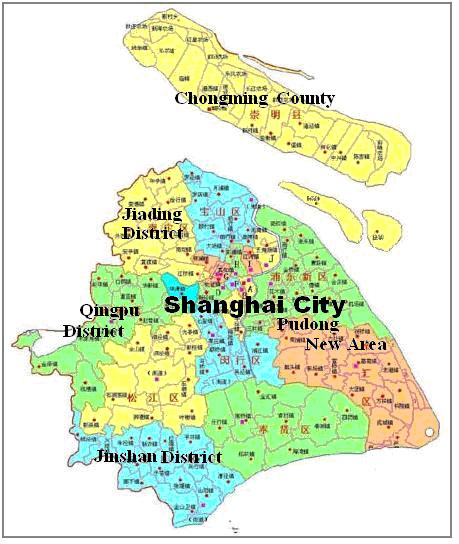
Environmental Impact Assessment on GEF Shanghai Agricultural and Non-point Pollution Reduction Project
3 OVERVIEW OF LOCAL ENVIRONMENT
3.1 Physical Environment
3.1.1 Locations of the Project
Component 1-A is located at Langxia Town, Jinshan District in South Shanghai.
Component s 1-B and 1-C are located at Zhongxing Town and Shuxin Town,
Chongming County in East Shanghai. Component 2-A is situated at Waigang Town
and Juyuan New Area, Jiading District in Northwest Shanghai. Component 2-B is
located at Jinze Town and Liantang Town, Qingpu District in Southwest Shanghai.
Shanghai is in the southeast of the Yangtze Delta, and the sites of GEF SANPRP are
decentralized in the East, South, Southwest and Northwest of Shanghai.
Figure 3.1: The Map of Shanghai Municipality Administrative Area
36
Environmental Impact Assessment on GEF Shanghai Agricultural and Non-point Pollution Reduction Project
3.1.2 Geology and Terrain Features
This area is a part of the alluvial plain of the Yangtze Delta, flat and level. According
to its microtopographic features, components of the earth surface and development
history, it falls into sedimentary geomorphology. The area is a dish-edge highland at
the toe of the Yangtze Delta, with surface elevation ranging from 3.5 m-4.5 m and
averaging 3.87 m.
3.1.3 Climate
The project area is in the oceanfront at the northern edge of the northern subtropical
zone where the East Asian monsoon prevails and falls into the tropical oceanic
monsoon climate. As an effect of the monsoon climate, northwest wind prevails in
winter, and the weather is cold and dry; southeast wind prevails in summer, and the
weather is hot and humid. The alternative winter and summer monsoons create
obvious monsoon weather. The area is coordinated in sunlight and heat and rich in
precipitation. The annual average precipitation is 1,145 mm, and the annual sunshine
hours are 1,872-2,115. The annual average temperature is 15.7°C, the summer
extreme temperature 39.6°C, and the winter extreme temperature -8.5°C. The annual
mean precipitation is 1,127.7 mm, the annual mean sunshine hours are about 2,170,
and annual mean wind speed is 3.2 m/s. Typhoon and tropical storm often occur in
summer.
3.1.4 Surface Water
The main rivers and lakes in the project area are listed below:
Huigao Creek and its tributary Hongqiao Port are in Langxia Town, Jinshan District;
Liuyao River are in Zhongxin Town, Chongming County, and Beiheng Diversion
River in Shuxin Town; there is a river network in Waigang Town and Juyuan New
Area in Jiading District, mainly including Lianqi River; a dense network of rivers are
present in Jinze Town and Liantang Town, Qingpu District, mainly including
Dianshan Lake, Taipu River and Huangpu River. Fig. 3.2 lists locations of these
rivers.
37






Environmental Impact Assessment on GEF Shanghai Agricultural and Non-point Pollution Reduction Project
Figure 3.2 The Location of the Main River in the Project Area
The river network in Shanghai includes lakes and rivers, about 26-27 km/km2. Most
rivers belong to the Taihu Lake water system, mainly including Yangtze River,
Huangpu River and Suzhou River. The main lake is Dianshan Lake.
Yangtze River is the largest water source flowing across Shanghai, about 70 km from
Liuhe River Estuary to Shanghai Chaoyang Farm, and 90 km at the widest point.
According to data from Datong Hydrologic Station, the historical annual mean runoff
is about 29,300 m3/s, the historical maximum runoff is 92,600 m3/s, minimum runoff
4620 m3/s, and annual runoff 924 billion m3/A. Runoff varies obviously with seasons.
Regular semidiurnal tide is present outside the Yangtze River Estuary. Due to impact
of the Yangtze River runoff, the irregular semidiurnal tide occurs inside the Yangtze
River Estuary.
Huangpu River is the last tributary of the Yangtze River before draining into the sea,
38
Environmental Impact Assessment on GEF Shanghai Agricultural and Non-point Pollution Reduction Project
and the main sluice way of Taihu Lake. It originates from Dianshan Lake and drains
80% of the water discharge of Taihu Lake. Huangpu River is about 108 km in length,
and about 8-17 m in depth, with a mean runoff of 304 m3/s in recent years. Huangpu
River flows across Qingpu, Songjiang, Jinshan, Fengxian, Pudong New Area, Xuhui,
Luwan, Huangpu, Hongkou, Yangpu and Baoshan. Huangpu River is a tidal river, and
the multi-year mean tide difference at Wusong Hydrologic Station is about 3.28 m.
Inland rivers not affected by tides usually stay at a water level of about 2.5 m, utilized
for flood control, shipping and irrigation.
3.1.5 Groundwater
Shanghai is rich in groundwater resource. The groundwater level is high, with a
groundwater table of 0.5 m-1.5 m. Deep groundwater is mainly stored in the gravel
stratum of different thicknesses. In the project area, there are four aquifers in 20-30 m
and 240-250 m below ground. The shallow groundwater is mainly brackish, while the
deep groundwater is primarily freshwater. The shallow groundwater has been broadly
extracted and utilized.
3.1.6 Surface Temperature
The surface temperature is about 3.5°C above the mean temperature, and the annual
temperature from 0.5 cm to 10 cm below the surface is about 1.7-1.9°C higher than
the mean temperature.
3.1.7 Natural Calamity
Shanghai is at the frontal zone of the Yangtze Delta in the northern middle latitude
region. Due to the impact of monsoon, Shanghai is often affected by typhoon from
July to June each year, and typhoon will become stronger during spring tide.
Shanghai is in the east of the Kunshan-Huzhou seismic belt of the Yangtze Delta,
which falls into the infrequent and low-intensity earthquake area.
3.2 Water Quality
3.2.1 Zoning of Surface Water Quality in Shanghai
The Zoning of Surface Water Quality in Shanghai is shown on Fig. 3.3.
39
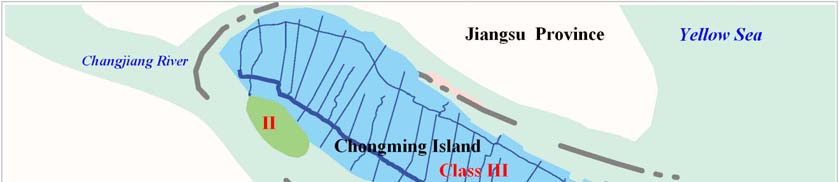
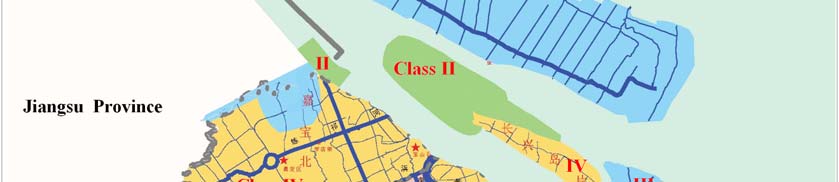
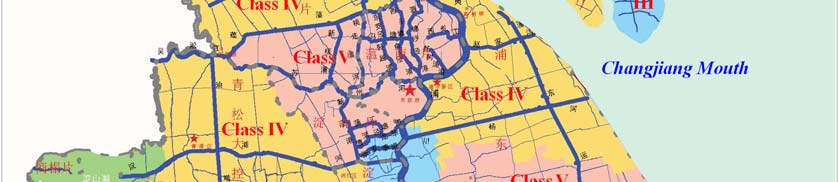
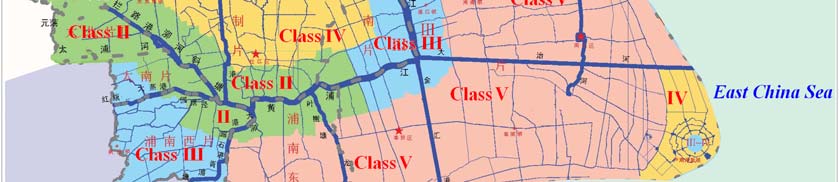
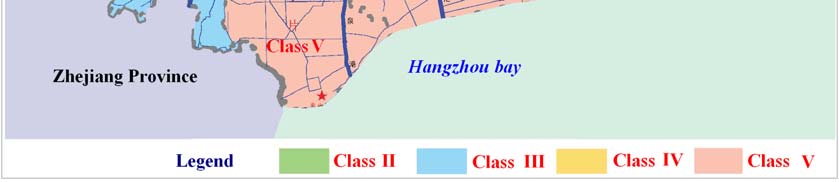
Environmental Impact Assessment on GEF Shanghai Agricultural and Non-point Pollution Reduction Project
Fig. 3.3 Zoning of Surface Water Quality in Shanghai
3.2.2 Water Quality in Shanghai Area
(1) Water Quality at Dianfeng Station of Dianshan Lake
(Control Section of Upstream Water Outflow of Huangpu River in Component 2-B)
The Dianfeng Station of Dianshan Lake is located outside the intake of Dianshan
Lake, Huangpu River, where the annual mean water quality in 2007 is described
below:
The dissolved oxygen (DO) is 7.79 mg/L (Class I), COD is 16.3 mg/L (Class III),
five-day BOD is 3.65 mg/L (Class III), ammonia nitrogen is 1.81 mg/L (Class V),
40
Environmental Impact Assessment on GEF Shanghai Agricultural and Non-point Pollution Reduction Project
total phosphorus is 0.201 mg/L (inferior to class V)and total nitrogen is 3.71 mg/L
(inferior to class V).
In 2007, as for the overall water quality of Dianshan Lake, the chemical oxygen
demand (COD) and the five-day biochemical oxygen demand (BOD) concentrations
declined as compared with 2006, but the concentrations of ammonia nitrogen, total
nitrogen and total phosphorus increased slightly.
(2) Water Qualities at Huangpu River Dianfeng Station
(Control Section of Upstream Water Outflow of Huangpu River in Component 2-B)
Huangpu River Dianfeng Station is located within the municipal drinking water
source protection area upstream Huangpu River, where the annual mean water quality
in 2007 is described below:
The dissolved oxygen (DO) is 6.08 mg/L (Class II), COD is 18.5 mg/L (Class III),
five-day BOD is 3.64 mg/L (Class III), ammonia nitrogen is 1.60 mg/L (Class V),
total nitrogen is 4.19 mg/L and total phosphorus is 0.187mg/L (Class III). The COD,
five-day BOD, ammonia nitrogen and total phosphorus exceed the Class II standards
for surface water defined in GB 3838-2002. and
(3) Water Qualities at Huangpu River Songpu Bridge Station
(Control Section of Upstream Water Outflow of Huangpu River in Component 2-B)
Huangpu River Songpu Bridge Station is located at the southwestern end of
Zhujiajiao Town, Qingpu District, where the annual mean water quality in 2007 is
described below:
The dissolved oxygen (DO) is 3.87 mg/L (Class IV), COD is 18.0 mg/L (Class III),
five-day BOD is 3.04 mg/L (Class III), ammonia nitrogen is 1.47 mg/L (Class V),
total phosphorus is 0.263mg/L(Class III) and. total nitrogen is 4.19 mg/L. The DO,
COD, five-day BOD, ammonia nitrogen and total phosphorus exceed the Class II
standards for surface water defined in GB 3838-2002.
(4) Water Qualities at Taipu River Bridge Station
Within Component 2-B Area
The Taipu River Bridge Station is located in Liantang Town, Qingpu District, where
the annual mean water quality in 2007 is described below:
The dissolved oxygen (DO) is 4.98 mg/L (Class IV), COD is 15.6 mg/L (Class III),
41
Environmental Impact Assessment on GEF Shanghai Agricultural and Non-point Pollution Reduction Project
five-day BOD is 4.22 mg/L (Class IV), ammonia nitrogen is 2.59 mg/L (inferior to
class V), total phosphorus is 0.165mg/L(Class III) and. total nitrogen is 5.07 mg/L.
(5) Water Qualities at Lianqi River Jiading New Water Treatment Plant Station
Control Section of Downstream Lianqi River in Component 2-A Area
The Lianqi River Jiading New Water Treatment Plant Station is located east of Jiading
District, where the annual mean water quality in 2007 is described below:
The dissolved oxygen (DO) is 2.84 mg/L (Class V), COD is 19.0 mg/L (Class III),
five-day BOD is 4.89 mg/L (Class IV), ammonia nitrogen is 3.59 mg/L (inferior to
Class V), total phosphorus is 0.338mg/L(ClassV) and. total nitrogen is 5.62 mg/L.
(6) Water Qualities at Yangtze River Estuary Chaoyang Farm Station
Control Section of Surface Water Quality in Nanhui at Yangtze River Estuary
The Yangtze River Estuary Chaoyang Farm Station is located to the east of Chaoyang
Farm, Nanhui District downstream the Bailong Port, where the annual mean water
quality in 2007 is described below:
The dissolved oxygen (DO) is 8.46 mg/L (Class I), COD is 7.12 mg/L (Class I),
five-day BOD is 1.06 mg/L (Class I), ammonia nitrogen is0.53 mg/L (Class III), total
phosphorus is 0.203mg/L(Class IV) and. total nitrogen is 1.97 mg/L.
The overall water quality of Yangtze River Estuary in 2007 basically remained flat
with the 2006 level. From 2001 to 2007, the COD declined in general, ammonia
nitrogen and total nitrogen decreased slowly, and total phosphorus rose in general.
3.3 Quality of Ambient Air
The pollutants in Component 1-A area are mainly nitrogen oxides, total suspended
particulate (TSP), sulfur dioxide and dustfall. In the area, the average concentrations
of air pollutants in 2007 are as follows: about 0.0500.054 mg /m3 for SO2, about
0.0470.052 mg /m3 for NO2, and about 0.1640.172 mg /m3 for TSP. The ambient
air quality in the area currently meets national Class II standard for ambient air.
The pollutants in Components 1-B and 1-C area are mainly nitrogen oxides, total
suspended particulate (TSP), sulfur dioxide and dustfall. In the area, the average
concentrations of air pollutants in 2007 are as follows: about 0.029 mg /m3 for SO2,
about 0.038mg /m3 for NO2, and about 0.1460.152 mg /m3 for TSP. The ambient air
quality in the area currently meets national Class I standard for ambient air.
42
Environmental Impact Assessment on GEF Shanghai Agricultural and Non-point Pollution Reduction Project
The pollutants in Component 2-A area are mainly nitrogen oxides, total suspended
particulate (TSP), sulfur dioxide and dustfall. In the area, the average concentrations
of air pollutants in 2007 are as follows: about 0.059 mg /m3 for SO2, about 0.055
0.058 mg /m3 for NO2, and about 0.1580.164 mg /m3 for TSP. The ambient air
quality in the area currently meets national Class II standard for ambient air.
The pollutants in Component 2-B area are mainly nitrogen oxides, total suspended
particulate (TSP), sulfur dioxide and dustfall. In the area, the average concentrations
of air pollutants in 2007 are as follows: about 0.0500.054 mg /m3 for SO2, about
0.0520.058 mg /m3 for NO2, and about 0.1640.172 mg /m3 for TSP. The ambient
air quality in the area currently meets national Class II standard for ambient air.
3.4 Ambient noise
According to assessment on noises in function zones of Shanghai and the monitoring
results in 2003-2007, except noises in Class I function zone of Shanghai fail to meet
the applicable standard at night, noises in the remaining function zones all meet their
corresponding standards. All Components of the Project are located in suburban/rural
areas, and the noises meet standards for the corresponding function zones.
3.5 Ecological Environment
The Project is located in the suburb of Shanghai and has typical suburban biological
features.
3.5.1 Jinze Town and Liantang TownQingpu District
Jinze Town and Liantang Town are seated in Qingpu District in West Shanghai, where
Dianshan Lake and the Sun Island upstream Huangpu River are situated,
characterized by natural ecology. The vegetation mainly includes green belt with
distinct suburban style. The crops there are mainly rice, water bamboo and vegetables.
3.5.2 Langxia Town, Jinshan District
Langxia Town, Jinshan District is located in south Shanghai, also characterized by
suburban natural ecology. The main crops are rice and vegetables.
3.5.3 Shuxin Town and Zhongxing Town, Chongming County
43
Environmental Impact Assessment on GEF Shanghai Agricultural and Non-point Pollution Reduction Project
Shuxin Town and Zhongxing Town, Chongming County are located in East Shanghai,
adjacent to the national forest park and Shanghai Chongming Dongtan Bird Reserve,
characterized by local natural biology and landscapes. Main birds are winter visitors
and mallards. Main plants are bulrush, shrubs and aquatic plants. Main crops are rice
and vegetables.
In the Yangtze River Estuary area, there are diverse species of aquatic animals, mainly
including freshwater species, brackish water spices and offshore low-salinity species.
3.5.4 Waigang Town and Juyuan New Area, Jiading District
Waigang Town and Juyuan New Area are located outside west Jiading urban area and
in Northwest Shanghai. Currently, they are rural areas and characterized by suburban
natural biology. Main wetland vegetation includes bulrush and nursery. Main crops
are rice and vegetables. There artificial fish ponds in the two areas that produce
various commercial fishes.
3.6. Social and Economic Conditions
3.6.1 Population and Land
Table 3.1 Population and Land
District/
Town Land
Area
Population by
Density of Population
County
(km2)
the End of 2007
( /km2)
Jinze
108.50 81961
755
Qingpu
Liantang
93.66 70040
748
Shuxin
58.85 44580
758
Chongming Zhongxing
45.54 30819
677
Jinshan
Langxia
51 41000
804
Juyuan New Area
18.61 42000
2257
Jiading
Waigang
50.91 65000
1277
3.6.2 Social Economy Condition
(1) Langxia TownJinshan District
Langxia Town, planned as a municipal modern agricultural park of Shanghai, has a
rural population of 33,600 and an urbanization rate of 17%. In 2006, the park
generated a GDP of RMB730 million, state revenue of RMB125 million and farmers'
44
Environmental Impact Assessment on GEF Shanghai Agricultural and Non-point Pollution Reduction Project
per capita income of RMB8,711.
(2) Liantang TownQingpu District
Liantang Town consists of 4 Neighborhood Committees and 25 Administrative
Villages. The town produced RMB3,249.79 million of value added and RMB768.48
million of state revenue in 2006. The farmers' per capita income reached RMB12,982.
High-quality rice and water bamboo are specialty products of Liantang.
(3) Jinze TownQingpu District
Jinze Town consists of 5 Neighborhood Committees and 30 Administrative Villages.
In 2006, the town produced RMB3,725.94 million of value added and RMB338.39
million of state revenue, up 15.9% from last year.
(4) Zhongxing TownChongming County
Zhongxing Town consists of 5 Neighborhood Committees and 12 Administrative
Villages. The cultivable area is 2329.6 hectares and forest coverage rate is 26%. The
high-quality cauliflower is specialty product of Zhongxing Town.
(5) Shuxin TownChongming County
Shuxin Town consists of 2 Neighborhood Committees and 21 Administrative Villages.
The town has a rural population of 38,378. In 2004, the town produced RMB493.9
million of domestic value added, RMB28,769,500 of state revenue, and RMB3,430 of
farmers' per capita income.
(6) Juyuan New Area, Jiading District
Juyuan New Area consists of 5 Neighborhood Committees and 5 Administrative
Villages. Juyuan New Area has a permanent population of 42,000. In 2006, the area
produced RMB 1,143.2 million of GDP, up 20.51% from the previous year; the
service sector value added amounted to RMB560 million, up 26.62% from lat year.
The total tax revenue of the area was RMB471 million, up 14.23% from the previous
year.
(7) Waigang Town, Jiading District
Waigang Town consists of 2 Neighborhood Committees and 22 Administrative Villages.
Waigang Town has a total area of 5,091 hectares. Shanghai International Automobile
City and Waigang Town are subject to a single fiscal administration system. The main
crops are rice and vegetables.
45
Environmental Impact Assessment on GEF Shanghai Agricultural and Non-point Pollution Reduction Project
4 PROJECT ALTERNATIVE
4.1 With and Without Projects
4.1.1 With and Without the Livestock Waste Management
Technology Demonstration Project
According to the analysis on environmental and social benefits of the Project and
requirements on local economic development, without the livestock and poultry
manure management technology demo project, the environmental quality in these
rural areas will deteriorate, and, in particular, the environmental quality of surface
waters will continue to worsen, which may undermine the safety of the municipal
drinking water source protection area and drag on the reduction of rural and
agricultural non-point pollution to the Yangtze River Estuary and the East China Sea.
As for the livestock and poultry sector, the environmental pollution caused by
livestock and poultry manure must be addressed.
In the organic fertilizer center at Shanghai Bright Holstein Jinshan Dairy Farm, odors
arising from manure storage will disperse in an unorganized way and cause heavy
pollution to the farm and ambient environment. If the 18,000 t cow dung and 10,500 t
urine produced by Shanghai Shenye Dairy Farm each year are discharged without
treatment, the water environment of the East China Sea will be polluted eventually.
Qianwei Village produces about 7,320 t organic wastes a year, including 2,500 t
straws, 800 t domestic wastes, 2,920t farm manure and 1,100 t rice chaff. 4,380 t farm
wastewater (hog urine) is also produced. Without the project, these wastes would be
discharged without proper treatment and finally pollute the water environment of the
East China Sea. Therefore, the Project is necessary.
4.1.2 With and Without the Wetland Demonstration for Pollution
Reduction
According to the analysis on environmental and social benefits of the Project and
requirements on local economic development, without the river network wetland
demo project at Waigang Town and Juyuan New area, Jiading District and the Qingpu
rural wastewater treatment Phase I project, famers in these areas will discharge
domestic wastewater directly or indirectly into the surface water, it is impossible to
build a local wastewater collection system, and the environmental quality of surface
water will continue to worsen, which cannot help reduce pollution of water
environment of Taihu Lake and the East China Sea, and also pose an adverse impact
on local farmers. Therefore, the Project is necessary.
46
Environmental Impact Assessment on GEF Shanghai Agricultural and Non-point Pollution Reduction Project
4.2 Alternative Locations
4.2.1 Alternative Locations for the Livestock Waste Management
Technology Demonstration Project
(1) Selection Principles for Location
To the extent as permitted by the State's land policies, the sites of the Project are
selected under the following principles.
Site selection will take into account the convenience and advantages of land,
such as proximity to pasture and remoteness from residential community.
Avoid resettlement of local residents and environmentally sensitive points.
Saving investment for project construction;
(2) Alternative Locations for Component 1-A
Based on field conditions of Shanghai Bright Holstein Jinshan Dairy Farm, the Project
will be located on the existing site, which is less in environmental impact, less in
investment, and the most cost effective and the most reasonable in operation than all
other options. Thus the optimal option is seating the Project at the existing site of
Shanghai Bright Holstein Jinshan Dairy Farm.
(3) Alternative Locations for Component 1-B
East Chongming Livestock and Poultry Manure Treatment Center is located at the
existing site of Shenye Dairy Farm in the Beiliuyao reclamation area, Chongming
County, without any residence within 500 m around. Compared with the option of
constructing the treatment works of the same size in any other place, the site is less in
environmental impact, less in investment, and the most cost effective and the most
reasonable in operation. Thus the optimal option is seating the Project at the existing
site of Shenye Dairy Farm.
(4) Alternative Locations for Component 1-C
The proposed site of the Project is within Qianwei Eco-village Cyclic Eco-agriculture
Demonstration Area, to the north of E-W axis of Qianwei Village, between Jing'er
Road and Jingsi Road, and to the north of the intensive hog farm under construction.
The land to be used for the Project is owned by Qianwei Eco-village and is now
utilized in the form of fish ponds, livestock and poultry production farm and cropland.
Land acquisition is not involved in the Project. There are no residential communities
within 500 m beyond the boundary of the Project, and the Project site is downwind in
47
Environmental Impact Assessment on GEF Shanghai Agricultural and Non-point Pollution Reduction Project
summer. Compared with any alternative option of constructing treatment facilities of
the same size in a different site, the proposed site of the Project is less in
environmental impact, less in investment, and the most cost effective and the most
reasonable in operation. Thus the site selection of the Project is reasonable.
4.2.2 Determination of Wetland Demonstration for Pollution
Reduction Site
(1) Selection Principles for Location
To the extent as permitted by the State's land policies, according to local topographty
and distribution of residential houses, roads and rivers, the following aspects are also
taken into account:
Convenience of construction and maintenance;
Avoid environmental sensitive spot;
Good conditions of receiving water bodies and compliance with drainage
laws and regulations
Saving investment for project construction;
Low operation cost;
Compliance with local plans;
(2) Alternative Locations for Component 2-A
Component 2-A is located in the northwest of the planned northern suburban wetland
and covers the area bound by Lianqi River, Gujing Creek and Miaojing Creek. The
area has the characteristics of rural river network natural wetland, which will, together
with the auxiliary constructed wetland, play a demo role in environmental protection
via river network wetland. With due consideration given to the foregoing site
selection principles and specific local conditions, the site of the project is reasonable.
(3) Alternative Location of Component 2-B
A. Alternative Location of WWTP in Jintian Village
Most of the areas served by Jintian Village WWTP are flat. The WWTP may be
located in line with the landform and available vacant land in the village, see Table
4.1.
48
Environmental Impact Assessment on GEF Shanghai Agricultural and Non-point Pollution Reduction Project
Table 4.1 Comparison of Proposed Sites of Jintian Village WWTP
Item
Proposal 1
Proposal 2
Basketball court in front of
South of No. 34, South Area,
Location
Jintian Village Community
Jintian Village
Center
Area 1200
m2 560
m2
Flat and currently abandoned Ground surface paved; presently
Landform
land
basketball court
Good geological conditions;
Good geological conditions,
Geology
paved road surface should be
suitable for the project
treated before use
Demolition
None
Ground surface preparation
works
Accessibility Very
good
Good
Water/power
Convenient
Convenient
supply
Wastewater
About 58 m from river
About 1 m from river
outfall
Expandability High
Low
Environmental Low Low
impact
Wastewater
Long Short
pipeline
Fig.4.1 Wastewater Collection System of Jintian Village (Proposal 1)
49
Environmental Impact Assessment on GEF Shanghai Agricultural and Non-point Pollution Reduction Project
Fig.4.2 Wastewater Collection System of Jintian Village (Proposal 2)
According to the foregoing analysis on comparison, both proposals meet requirements
of the overall plan and environmental protection objectives of the District. The
proposed sites are principally abandoned land or afforestation area, easily accessible
and meet water/power supply requirements of the project. No structural fracture,
landslide, earth cave or land fissure that affects project stability is found within the
proposed sites. They are suitable for Jintian Village WWTP construction after proper
foundation treatment. The site in proposal 1 is relatively flat and large, easily
expandable, conducive to design arrangement of on-site facilities, low in environment
impact and free of demolition works, but far from the effluent discharge point. By
contrast, the site in proposal 2 is currently a basketball, less in independency and land
acquisition is required. Though the effluent discharge point is nearby, the site is
flanked by old trees and will affect these trees in construction and operation.
Because of its low environmental impact and convenience in construction and
long-term planning, proposal 1 is the optimal option. Therefore, proposal 1 is adopted
for location of Jintian Village WWTP.
B. Alternative Location of WWTP in Qianwan Village
Most of the areas served by Qianwan Village WWTP are flat. The WWTP may be
located in line with the landform and available vacant land in the village. As the
Northeast Area of Qianwan Village has been covered by the existing wastewater
collection system, the report only conducts feasibility study on the Western Area and
the Southeastern Area of the village.
Proposal 1:
The wastewater discharged in the Western Area of Qianwei Village is collected and
transferred to the Southeastern Area for treatment. The DN225 PVC-U reinforced
pipes are used as the sewer main laid along the current household distribution range,
50
Environmental Impact Assessment on GEF Shanghai Agricultural and Non-point Pollution Reduction Project
with the starting end of pipe to be buried for 1.0 m below grade. Wastewater from
farther households are collected by sewer branches (DN225 PVC-U reinforced pipes)
and then fed into the main. Pipes routed across river are laid by mean of pipe pulling.
The proposed WWTP site is located west of No. 82, Southeastern Area and covers an
area of 2,500 m2, 50 m in length (E-W) and 50 m in width (S-N). The site is close to
public road and thus easily accessible, but 70 m away from the river. Geological
conditions are good and no pollution source exists on or near the site. The WWTP is
designed to treat 69 m3/d. The proposed wastewater collection method is shown in Fig.
4.3.
Fig. 4.3: Wastewater Collection System of Qianwan Village (Proposal 1)
Proposal 2:
Domestic wastewater from West Area and Southeast Area are separately collected and
treated, i.e. two WWTPs are built, one in West Area and the other in Southeast Area.
The plant in West Area serves 221 villagers with a treatment capacity of 40 m3/d; the
plant in Southeast Area serves 297 villagers with a treatment capacity of 30 m3/d.
In the proposed wastewater collection system, the DN225 PVC-U reinforced pipes are
used as the sewer main laid along the current household distribution range, with the
starting end of pipe to be buried for 1.0 m below grade. Wastewater from farther
households are collected by sewer branches (DN225 PVC-U reinforced pipes) and
then fed into the main. No lift pump stations are provided halfway.
The proposed WWTP sites are located west of No. 82, Southeast Area and north of
No. 15, Qianwan Village, West Area, respectively. The site in Southeast Area covers
an area of about 2,500 m2, 50 m in length and 50 m in width. The site in West Area
covers an area of about 270 m2, 27 m long E-W and 10 m N-S. No pollution source
exists on or near the site. The proposed wastewater collection method is shown in Fig.
4.4.
51
Environmental Impact Assessment on GEF Shanghai Agricultural and Non-point Pollution Reduction Project
Fig. 4.4: Qianwan Village Wastewater Collection System (Proposal 2)
Proposal 1 is less in capital cost than proposal 2. As the main operational cost of
WWTP is from electricity consumption and equipment depredation, Proposal 1 is also
much less in operational cost than proposal 2. In the environmental aspect, the
effluent of both proposals meets Class 1B. Thus proposal 1 is recommended for
wastewater treatment of Qianwan Village.
C. Alternative Location of WWTP in Beiwangbang Village
The service area of Beiwangbang WWTP is divided by river course into five parts,
namely North Area, Northwest Area, Southwest Area and Southeast Area. Centralized
collection and treatment will surely add to the difficulty in works and result in too
long main pipeline and higher cost. Therefore, decentralized treatment is proposed for
Beiwangbang. The landform of Beiwangbang slopes down from west to east.
According to the WWTP arrangement principle and other factors and taking
Beiwangbang River as the dividing line, wastewater north of the river is collected and
treated centrally, and that south of Beiwangbang River is collected and treated
centrally. The proposed sites of Beiwangbang North Shore WWTP are described as
follows:
a. Beiwangbang North Shore WWTP
Proposal 1:
The proposed site is located north of No. 167, Northeast Area. It covers an area of 880
m2, 20m long E-W and 44 m S-N. The whole site is presently abandoned land. Its
landform falls into the scope of plain. The area is adjacent to river bank and not
accessible by public roads. The ground should be treated due to its proximity to the
52
Environmental Impact Assessment on GEF Shanghai Agricultural and Non-point Pollution Reduction Project
river bank.
In the proposed wastewater collection system, the DN225 PVC-U reinforced pipes are
used as the sewer main laid along the current household distribution range, with the
starting end of pipe to be buried for 0.7 m below grade. Wastewater from farther
households are collected by sewer branches (DN225 PVC-U reinforced pipes) and
then fed into the main. The sewer main is erected by mean of pipe pulling when
routed across river. For the layout plan of the proposed site, see Fig. 4.5.
Fig. 4.5: Beiwangbang Village Wastewater Collection System (Proposal 1)
The proposed site is located north of No. 174, North Area. It covers an area of 750 m2,
30m long E-W and 25m S-N. The whole site is presently abandoned land. Its
landform falls into the scope of plain. The area is adjacent to river bank and not
accessible by public roads. The ground should be treated due to its proximity to the
river bank.
In the proposed wastewater collection system, the DN225 PVC-U reinforced pipes are
used as the sewer main laid along the current household distribution range, with the
starting end of pipe to be buried for 1.0 m below grade. Wastewater from farther
households are collected by sewer branches (DN225 PVC-U reinforced pipes) and
then fed into the main. The sewer main is erected by mean of pipe pulling when
routed across river. For the layout plan of the proposed site, see Fig. 4.6.
53
Environmental Impact Assessment on GEF Shanghai Agricultural and Non-point Pollution Reduction Project
Fig. 4.6: Beiwangbang Village Wastewater Collection System (Proposal 2)
For comparison of the two foregoing proposed WWTP sites, see Table 4.2.
Table 4.2: Comparison of Proposed Sites of Beiwangbang North Shore WWTP
Item
Proposal 1
Proposal 2
North of No. 167, Northeast North of No. 174, North Area,
Location
Area, Beiwangbang
Beiwangbang
Area 880
m2 750
m2
Flat and currently abandoned
Landform
Flat and currently abandoned land
land
Along rive bank, foundation to Along rive bank, foundation to be
Geology
be reinforced
reinforced
Demolition
None
Ground surface preparation
works
Accessibility Poor
Poor
Water/power
Easily accessible
Easily accessible
supply
Wastewater
About 1 m from river
About 1 m from river
outfall
Expandability Low
High
Environmental Low Low
impact
Wastewater
Long Long
pipeline
According to the foregoing analysis on comparison, both proposals meet requirements
54
Environmental Impact Assessment on GEF Shanghai Agricultural and Non-point Pollution Reduction Project
of the overall plan and environmental protection objectives of the District. The
proposed sites are principally abandoned land or afforestation area, less accessible and
meet water/power supply requirements of the project. No structural fracture, landslide,
earth cave or land fissure that affects project stability is found within the proposed
sites. They are suitable for Beiwangbang North Shore WWTP construction after
proper foundation treatment. The site in proposal 1 is relatively flat and large, easily
expandable, conducive to design arrangement of on-site facilities, low in environment
impact and free of demolition works, and can take advantage of the landform sloping
down from west to east. By contrast, proposal 2 has less expandability.
Because of its low environmental impact and convenience in long-term planning,
proposal 1 is the optimal option. Therefore, proposal 1 is adopted for location of
Beiwangbang North Shore WWTP.
b. Beiwangbang South Shore WWTP
Proposal 1:
The proposed site is located south of No. 289, Southwest Area. It covers an area of
780 m2, 20m long E-W and 39m S-N. The whole site is presently abandoned land. Its
landform falls into the scope of plain. The site is accessible by a path along the river
bank. It is in good geological conditions and adjacent to farmlands, without impact on
surrounding farming households.
In the proposed wastewater collection system, the DN225 PVC-U reinforced pipes are
used as the sewer main laid along the current household distribution range, with the
starting end of pipe to be buried for 0.7 m below grade. Wastewater from farther
households are collected by sewer branches (DN225 PVC-U reinforced pipes) and
then fed into the main. The sewer main is erected by mean of pipe pulling when
routed across river. For the layout plan of the proposed site, see Fig. 4.5.
Proposal 2:
The proposed site is located at the crop drying ground of the Southeast Area. The site
covers an area of about 456 m2, 19 m long E-W and 24 m N-W. The whole site is now
a crop drying ground with paved surface, and thus should be properly treated before
use. The area is adjacent to river bank and not accessible by public roads, but
accessible by path along the river bank.
In the proposed wastewater collection system, the DN225 PVC-U reinforced pipes are
used as the sewer main laid along the current household distribution range, with the
starting end of pipe to be buried for 1.0 m below grade. Wastewater from farther
households are collected by sewer branches (DN225 PVC-U reinforced pipes) and
then fed into the main. The sewer main is erected by mean of pipe pulling when
routed across river. For the layout plan of the proposed site, see Fig. 4.6.
55
Environmental Impact Assessment on GEF Shanghai Agricultural and Non-point Pollution Reduction Project
For comparison of the two foregoing proposed WWTP sites, see Table 4.3.
Table 4.3: Comparison of Proposed Sites of Beiwangbang South Shore WWTP
Item
Proposal 1
Proposal 2
South of No. 289, Southwest Crop drying field, Southeast Area,
Location
Area, Beiwangbang
Beiwangbang
Area 780
m2 456m2
Flat and currently abandoned
Landform
Flat, presently crop drying field
land
Geology Good
Paved
surface
Demolition
None
Ground surface treatment required
works
Accessibility Poor
Poor
Water/power
Convenient
Convenient
supply
Wastewater
About 10 m from river
About 1 m from river
outfall
Expandability High
Low
Environmental Low Low
impact
Wastewater
Long
Short main pipeline
pipeline
According to the foregoing analysis on comparison, both proposals meet requirements
of the overall plan and environmental protection objectives of the District. The
proposed sites are principally abandoned land or afforestation area, less accessible and
meet water/power supply requirements of the project. No structural fracture, landslide,
earth cave or land fissure that affects project stability is found within the proposed
sites. They are suitable for Beiwangbang South Shore WWTP construction after
proper foundation treatment. The site in proposal 1 is relatively flat and large, easily
expandable, conducive to design arrangement of on-site facilities, low in environment
impact and free of demolition works. By contrast, proposal 2 has less expandability
while requires shorter sewer main than proposal 1, and can take advantage of the
landform sloping down from west to east in Beiwangbang.
Because of its low environmental impact and convenience in long-term planning,
proposal 1 is the optimal option. Therefore, proposal 1 is adopted for location of
Beiwangbang South Shore WWTP.
D. Alternative Location of WWTP in Xiezhuang Village
The existing Xicen WWTP is 0.6 km west of Xiezhuang Village, Liantang Town, with
56
Environmental Impact Assessment on GEF Shanghai Agricultural and Non-point Pollution Reduction Project
a designed treatment capacity of 5,000 m3/d, and currently treats 1,200 m3/d. The
WWTP employs the MSBR process and produces effluent compliant with Class 1A
standard defined in Discharge standard of pollutants for municipal wastewater
treatment plants (GB18918-2002), satisfying the water quality requirement on
municipal drinking water source upstream Huangpu River.
Two design options are proposed as follows in line with existing municipal
wastewater treatment facilities adjacent to Xiezhuang Village and specific conditions
of Xiezhuang Village:
(1): Incorporating wastewater into Xicen WWTP for treatment
(2): Building a new WWTP for separate treatment
On that basis and through comparison of environmental, economic and social benefits,
strong technical supports will be provided for final decision-making.
Proposal 1:
The wastewater collection system has a planned capacity of 144 m3/d. The DN225
PVC-U reinforced pipes are used as the sewer main laid along the current household
distribution range, with the starting end of pipe to be buried for 1.0 m below grade.
Wastewater from farther households are collected by sewer branches and then fed into
the main. The sewer main is erected by mean of pipe pulling when routed across river.
After the Sichagang Bridge, DN225 PVC-U reinforced pipes are laid along Shanshen
access road as sewer main, with the starting end of pipe to be buried for 1.0 m below
grade. The sewer main is connected with the inlet main of Xicen WWTP.
Proposal 2:
Given the distance of 300 m between Dongxiezhuang Village and Xiezhuang Village,
it is economically unfeasible to collecting and piping Dongxiezhuang Village
wastewater to Xiezhuang Village. Thus wastewater in Dongxiezhuang Village is
collectively separately.
A river flows across Xiezhuang Village and most farmers reside along river banks.
Ground surface along the river bank is paved, which goes against piping works. The
conditions are also not good for pipes to be laid across the river. Thus, taking the N-S
river course as dividing line, wastewater in the Northwest Area and the Southwest
Area of Xiezhuang Village is collected to the Xiezhuang Village West Shore WWTP,
while wastewater in the East Area of Xiezhuang Village is treated by Xiezhuang
Village East Shore WWTP. Xiezhuang Village West Shore WWTP serves 580 people
and, assuming a daily wastewater output of 110 L per person, has a designed
treatment capacity of 78 m3/d.
57
Environmental Impact Assessment on GEF Shanghai Agricultural and Non-point Pollution Reduction Project
The proposed site of Xiezhuang Village West Shore WWTP is located at the crop
drying ground south of No. 76, Northwest Area of Xiezhuang Village and covers an
area of 400 m2, 20 m E-W and 20 m N-S. The whole site is currently a crop drying
ground close to the river, only accessible via a path that does not allow vehicle travel.
The ground surface has been paved.
The proposed site of Xiezhuang Village East Shore WWTP is located at the crop
drying ground at the fork, East Area of Xiezhuang Village and covers an area of 480
m2, 24m E-W and 20 m N-S. The site is mainly a crop drying ground close to the river,
only accessible via a path that does not allow vehicle travel. The ground surface has
been paved.
For proposal 2, see Fig. 4.7.
Fig. 4.7: Xiezhuang Village Wastewater Collection System (Proposal 2)
Proposal 2 recommends three WWTPs for treatment and operation/maintenance
of Xiezhuang Village wastewater. The land surface in the village has been paved, and
only the crop drying field with less expandability is available as WWTP site.As the
wastewater treatment via constructed wetland is low in cost and easily acceptable to
farmers, the second option is adopted for the Xiezhuang wastewater treatment project.
58
Environmental Impact Assessment on GEF Shanghai Agricultural and Non-point Pollution Reduction Project
4.3 Alternative Technical Process
4.3.1 Livestock Waste Management Technology Demonstration
(1) Alternative Process of Component 1-A
After pretreatment and anaerobic digestion, the cow dung and urine of the project
produce biogas, which is then purified and generate electricity with the biogas-fueled
co-generation units; the residual heat from the biogas-fueled co-generation units are
used to heat anaerobic feedstock; the liquid fraction from bio-digester will be
discharged into the municipal sewer network after treatment at the wastewater
treatment station reconstructed to the discharge standard of Jinshan Langxia
Wastewater Treatment Plant, while the sludge is shipped to organic fertilizer plant and
made into organic fertilizer for sale.
A Selection of key techniques of the anaerobic reactor process
The application of currently available typical anaerobic reactors is compared in Table
4.4:
Table 4.4: Comparison of Typical Anaerobic Reactors
Scope of
Name
Pros
Cons
Application
Continuously
Low investment, simple
Stirring device
Treatment of
stirred tank
operation and
required
livestock wastes
reactor
management, strong
with high
(CSTR)
resistance to shock load,
concentration and
high gas output rate
high percentage of
suspended solids
Anaerobic
Low investment, simple
Long residence
Organic wastewater
contact reactor operation and
time; sludge
with high
management, strong
backflow device
concentration and
resistance to shock load
required
high percentage of
suspended solids
Upflow
High treatment
High investment, Soluble organic
anaerobic
efficiency, good output
stringent
wastewater with low
sludge blanket water quality
requirements on
SS content
(UASB)
SS content of
wastewater
Upflow solid
High treatment efficiency Stringent
Organic wastewater
reactor (USR) and high volumetric
requirement on
with high solid
loading rate
uniform
content
distribution of
feedstock
59
Environmental Impact Assessment on GEF Shanghai Agricultural and Non-point Pollution Reduction Project
After comparison, the CSTR is selected for the project. It features high treatment
capacity, high biogas output, easy management, readily startup and low operational
cost. It is generally suitable for areas focusing on biogas production and use of liquid
organic fertilizers. This technology has been extensively used in biogas plants of
Europe and other developed regions.
In line with the structural characteristics of anaerobic digester, the integrated
anaerobic digester is used for the project. Major advantages of integrated anaerobic
digester are described below:
1 Suitable for mixed dung and grass materials: TS 8%-12%;
2 Safe and reliable: Producing and storing gas at low pressure to prevent biogas
leakage;
3 Low cost: Less split-type gas holders to bring down cost by 15%;
4 Small footprint: Small size of facilities to cut footprint by 30%;
5 Short construction period: Shorten construction period by 50%;
6 Available for normal operation in winter at cold areas;
B. Selection of Biogas Co-generators
For comparison between China-made and imported generators, see Table 4.5.
Table 4.5: Comparison between China-made and Imported Generators
Effective
Effective
Total
Shutdown
Type
Price
power
heat
efficiency
cycle
China-made
30% 40% 70%
3
years
Cheap
biogas generator
Imported biogas
32~%
40~45%
Up to 80%
5 years
Costly
generator
Currently, China-made biogas generators turn 30% of biogas to power and 40% to
heat, having a total efficiency of 70%. Imported biogas generators turn around
35-40% of biogas to power and recover around 40-45% as residual heat, having a
total efficiency of up to 80%. The power generated by biogas generators may be
delivered to power grid and sold. The residual heat recovered by the residual heat
recovery converter may be used to heat anaerobic digester or produce hot industrial
water for the dairy farm. Therefore, the project may use imported generators.
60
Environmental Impact Assessment on GEF Shanghai Agricultural and Non-point Pollution Reduction Project
(2) Alternative Process of Component 1-B
Livestock waste treatment methods include anaerobic digestion for integrated
utilization of biogas, sludge and slurry, treatment towards organic fertilizers and
decomposition towards farming fertilizers or cultural materials. In line with specific
conditions of the project, the optimal treatment method is production of organic
fertilizers in solid and liquid forms. The biogas plant is not suitable here, for
Beiliuxiao Section is surrounded by a large area of farmland with urgent demand for
fertilizers, yet without little residential households and small fuel gas demand.
Through comparison, the "separate dung and urine treatment" process is used for the
Project. The livestock and poultry dung is turned into solid organic fertilizers via
bio-treatment, including composting and turning, while urine wastewater is recovered
to farmland after harmless underground unpowered anaerobic process. The process
took the first place among the 52 livestock and poultry manure treatment processes in
the expert assessment organized by Shanghai Investment Consultants in 1999.
The process is safe in operation, less time- and labor-consuming and low in
operational cost, and fully meets the overall requirements on environmental protection.
The process is characterized by economical feasibility, low operational cost, easy
operation, turning wastes into resources, site-specificity and full fermentation via
superficial terrestrial heat. The process is particularly suitable for continuous cereal
and economic crop planting areas and large-sized animal production farms.
(3) Alternative Process of Component 1-C
A. Selection of Anaerobic Digestion Technology for Crop Straw and Other
Agricultural Solid Wastes
In addition to livestock wastes commonly used in conventional biogas projects, the
raw materials for the project also include crop straw and organic domestic wastes.
Crop straw was used as a major type of digestion materials for biogas plants in the
1960's. However, crop straw as biogas production materials in the pas were
confronted with many problems occurred due to lack of proven technologies, and thus
abandoned by people. The biogas digestion materials basically have shifted to
livestock wastes. Due to change in rural life styles, the function of crop straw as a
source of rural energy has virtually disappeared. However, the straw is not well
utilized, except a small part of them are currently directly recovered as fertilizer or
used as feeds and paper-making materials, and a major part of straw has been burnt by
farmers on the farms or directly discarded. Such a way of disposal wastes many
resources and has given rise to a series of ecological and environmental problems.
Burning crop straw on farms causes air pollution or even air or land traffic accidents,
while direct discarding has caused pollution to surface waters. So then, fully using
crop straw to produce gas will be set to the direction of China's biogas development,
61
Environmental Impact Assessment on GEF Shanghai Agricultural and Non-point Pollution Reduction Project
and crop straw is also a major source of raw materials for the project.
The Table 4.6 is a comparison between the BERC process and the conventional
moderate temperature sing phase solid anaerobic digestion process.
Table4.6: Comparison between Two Processes Converting Agricultural Solid
Wastes into Biogas
Conventional moderate
Description BERC
process temperature sing phase solid
anaerobic digestion process
Treatment
Over 80%
Over 70%
efficiency
Digestion
Complicated structure and larger
Simple structure and smaller
facility
difficulties in design
difficulties in design
Operation
Simple, stable
Difficult, unstable
management
Biogas output
About 2400 m³/d
About 2100 m³/d
Investment
RMB 2.2 million
RMB 2 million
Note: The investment is an estimate on the digestion unit.
It is clear from the table 4.6 that the BERC process has higher treatment efficiency
and higher gas output, and shows simple and stable operation management despite its
complicated structure.
The process is designed by Tongji University and recommended for the Project.
B Selection of Using Straw Gasification and Biomass Briquetting for Auxiliary
Energy Supply
Thermal gasification of biomass is using gasification agent to gasify biomass at high
temperature on a thermal chemical basis. The gasification agents currently in use
include air, pure oxygen, vapor, vapor-air and hydrogen. Using vapor-air as the
gasification agent overcomes the air's shortcoming of low gas heat value and the
vapor's shortcoming of external heat supply required. The vapor-air may produce gas
having a medium heat value of about 11.5 MJ/m3, suitable for industrial and domestic
use and adjustable with biogas. The raw gas generated in biomass gasification at high
temperature mainly includes CO, CO2, N2, H2, CH4, CmHn and O2 and also contains
some toxic substances such as H2S, HCl, HCN, SO2 and NH3 as well as such
impurities as ashes, carbon grains, alkali metal compounds, tar and moisture.
The biomass briquetting technology is to pressing loose and formless raw materials
into formed and dense solid fuel by mechanical compression of various biomass
wastes, such as straw, rice hulls, sawdust and chips. The compressed biomass may
62
Environmental Impact Assessment on GEF Shanghai Agricultural and Non-point Pollution Reduction Project
reach a density of 0.8~1.3 kg/m3, with energy density equivalent to
medium-heat-value coal. The formed fuel is obviously improved in combustion
characteristics and easily stored, shipped and used, clean and healthful. It may be used
as a substitute for fossil fuel in industrial and domestic fields.
However, the raw materials of straw gasification are broadly available. Given stable
fuel supply, complete gasification and the characteristics and quick startup and
flexible control, the straw gasification process can overcome the anaerobic digestion's
shortcoming of less flexibility in energy use control. Therefore, using straw
gasification and biomass briquetting are crucial to flexible control of the whole energy
system.
4.3.2 Wetland Demonstration for Pollution Reduction
(1) Alternative Process and Design of Component 2-A
After selection of the watercourse plane morphology, slope-protecting plants and
bank-protection structure as well as comparison of preliminary proposals for the
elevation structure of watercourse, the preliminary plan is to retain the natural form of
river banks and curves and avoid single straight line to diverse water flow patterns.
Local plants are used, while exotic plants are avoided as much as possible to avoid
intrusion of exotic plants into watercourses and damage to local plants. The plant
species easy to survive and maintain are selected. Due consideration is given to the
diversity of aquatic plants. Diverse elevation patterns are created for watercourses to
form a continuous "hydrophyte - hygrophyte - mesophyte - terrestrial" succession
series. The gradient is controlled within 1:2.5-1:4.
In the constructed wetland for rural domestic wastewater treatment project, the river
buffer strip for farmland non-point pollution control project and the natural wetland
for river wastewater treatment project, the bulrush - coarse sand vertical subsurface
flow constructed wetland system is used for purification of domestic wastewater. The
interception, filtration and conversation effect of the buffer strips at both sides of river
are utilized to mitigate eutrophication of river water arising from non-point pollution.
The natural wetland is used to treat landscape water and bio-watercourse water within
the demo area.
For the alternative analysis on river sediment removal works, see Table4.7.
63
Environmental Impact Assessment on GEF Shanghai Agricultural and Non-point Pollution Reduction Project
Table4.7: Alternative Analysis on River Sediment Removal Works
Process
Wet Process
Dry Process
Machine
Hydraulic dredging pump
Excavator
Transport
The sludge removed is piped to To be shipped by trucks; roads are
Method
the sludge storage tank. The required for trucks; general
sludge remission hoses are dredging points are not accessible
easy to lay, and also easily by trucks; even small tractors
removed, erected and moved cannot access riverside.
as dredging proceeds.
Effect on
Minor impact on vegetation at Major impact on vegetation at
riverside
both sides of river; sludge both sides of river; easy to
vegetation pipes may be placed in damage vegetation and difficult to
farmland drain ditches.
recover.
Effect on
The wet process can minimize Easy to leak; wheels carry wet
ambient air fugitive dust.
mud; fugitive dust easy to occur
along road in fine days.
Nature of river Cut-off wet process is a normal The dry process is usually used
dredging method for small and for canal digging, and vehicle
medium watercourses in rural transport is feasible due to dry
areas
sludge.
Nature of
High in water content and Easy to leak, not suitable for
sludge to be
suitable for wet process.
vehicle transport
removed
Temperature
No need to occupy land at both Temperature land occupation is
land
sides; only a sludge storage required; an access road to
occupation
tank is required
riverside is needed.
Sludge storge Cose to Lianqi River, easy to High in transport cost
tank
be shipped and lost in transport
cost.
For the foregoing reasons, the wet process recommended in the feasibility study
report is reasonable for river sediment removal.
(2) Alternative Process of Component 2-B
In alternative process analysis for wastewater treatment, the following principles must
be taken into account: Place, treatment level, discharge standards, nature of
wastewater, capital cost and operational cost. For decentralized domestic wastewater
in rural areas, the Decentralized Sanitation and Reuses (DESAR) system with simple
process, reliable treatment and simple operation and maintenance is the optimal
technology, which has great significance in both wastewater treatment and resource
64
Environmental Impact Assessment on GEF Shanghai Agricultural and Non-point Pollution Reduction Project
conversion, focusing on decentralized and local treatment and recovery of nutrients.
For conventional processes and technologies for rural wastewater treatment at home
and aboard and their pros and cons, see Table 4.8.
Table 4.8: Comparison of Rural Domestic Wastewater Treatment Processes and
Technologies in China and Other Countries
Processes/
S/N Country
Principles Pros/Cons
Technologies
1 China Biogas-based
Use conventional biogas It has such pros as
domestic
technology to treat
sterilization, clean
wastewater
domestic wastewater
energy (biogas) and
purification
through anaerobic
unpowered operation.
facilities
digestion, filtration
But domestic
before discharge
wastewater falls into the
category of low load
pollution. It should be
treated in combination
with other pollutants in
the digester and, less
feasible in practices.
2 China Soil
Absorption and
The technology is
infiltration
purification by plants and feasible when conditions
field
soil before incorporation permit. But pollution of
into groundwater, Similar local groundwater and
to land treatment system.
surface waters is a
potential problem.
3 China Hybrid
Combining biomembrane Higher system reliability
biological
reaction system with
and environmental
treatment
activated sludge system;
adaptability; with the
system
addition of packing leads ability of nitrogen and
to dramatic changes in
phosphorus removal.
treatment mechanism
and efficiency
4 China Earthworm Using the artificial
Convenient in operation
bio-filter tank ecosystem in the filter to and management,
treat organic pollutants
resistant to heavy impact
via synergism of
load, resource/energy
earthworms and other
efficient and bio-
microorganisms in the
friendly; zero emission,
filter, based on the
no blockage and good
earthworms' ability of
environmental
improving soil
sanitation; collection of
ventilation and water
earthworms and
65
Environmental Impact Assessment on GEF Shanghai Agricultural and Non-point Pollution Reduction Project
permeability and
earthworm wastes
promoting
produces economic
decomposition of organic benefits.
matters.
5 China Compound New energy efficient
Compound filter tank
filter tank -- modular compound filter allows oxygen
active
tank ("compound filter
absorption and
bio-filter bed tank") consists of filter
utilization by
(bed and filter media),
microorganisms without
water distributor and
aeration, and avoids the
discharge system.
large footprint of
Wastewater has full
conventional activated
contact with micro-
bio-filter process.
organisms on the bio-
membrane of filter
media, thereby
absorbing, decomposing
and turning pollutants
into CO2 and N2. Further
treatment through
activated bio- filter
produces purified water.
6 China Unpowered Similar to the A/O2
Low cost and little
efficient
approach, generally
energy consumption.
domestic
consists of hydrolytic
Less sludge; purification
wastewater
precipitation tank, bio-
facilities can be buried.
treatment
filter and bio-contact
Heavy-load treatment is
plant
oxidation tank. The
preferably avoided.
bio-contact oxidation
tank has an oxidation
structure that allows
more oxygen to be
dissolved in wastewater
trough horizontal and
vertical stirring.
66
Environmental Impact Assessment on GEF Shanghai Agricultural and Non-point Pollution Reduction Project
7 Australia
"FILTER" A wastewater reused
Filtered wastewater is
wastewater
system combining
collected to subsurface
treatment and filtration, land treatment
draining system and
reuse system
and subsurface pipe
controlled by water
drainage. The principle is pumps that can control
to irrigate crops with
drainage flow of
wastewater and, after
wastewater after primary
land treatment, collect
treatment above
and filtered treated water subsurface pipes.
via subsurface pipes.
"FILTER" system is
very efficient in
domestic water
treatment and low in
operational cost,
particularly suitable for
areas rich in land
resources and allowing
crop rotation, or pasture
planting areas (yet at
higher cost).
8 Korea Wetland
A land-plant system
Low energy demand,
treatment
where pollutants in
low maintenance cost,
system
wastewater is filtered or
but extensive land is
absorbed by wetland or
required and single
turned by
wetland treatment
microorganisms into
cannot enable discharge
harmless substances.
to standards.
9 Japan Biomembrane
An artificial treatment
The system requires
treatment
technology mainly used
simple equipments, low
system
in decentralized domestic energy consumption,
wastewater treatment
and low capital and
process, including
maintenance cost and
anaerobic and aerobic
treats wastewater
biomembranes. The
efficiently. But it needs
biomembrane consists of operation and
anaerobic or aerobic
maintenance by
microorganisms on the
professionals, unsuitable
medium that absorb and
for Chinese rural areas.
decompose pollutants in
wastewater, thereby
enabling purification.
67
Environmental Impact Assessment on GEF Shanghai Agricultural and Non-point Pollution Reduction Project
10 China Stabilization Removing pollutants
Low capital and
pond
from wastewater mainly
operational costs, simple
technology
via lichenism.
maintenance, easy
operation, efficient
removal of organic
matters and pathogens,
and no need for sludge
treatment.
Disadvantages are large
footprint, low treatment
efficiency and difficulty
in meeting effluent
discharge standards in
cold seasons.
11 China Anaerobic A combination of
The anaerobic process
process -
anaerobic process and
avoids large footprint of
constructed
constructed land process. wetland, while wetland
wetland
The anaerobic process
mitigate or eliminates
dramatically reduces
strong odor present in
organic matters in
the anaerobic process.
wastewater and eases the
load of constructed
wetland.
12
USA
MBR
A combination of
High removal rate of
membrane separation
pollutants; efficient in
unit and bio-treatment
solid/liquid separation
unit that purifies
and removal of
wastewater through
disease-causing
physical filtration and
microorganisms;
biological
compact structure,
decomposition.
modular design,
integrated automatic
control, high flexibility
and adaptability in
operation; short and easy
construction. But
membrane is vulnerable
to blockage.
In the foregoing 12 wastewater treatment processes, the combined anaerobic process -
constructed wetland treatment technology and the composite biolfilter - activated
biolfilter technology are selected for further comparison, see Table 4.9.
68
Environmental Impact Assessment on GEF Shanghai Agricultural and Non-point Pollution Reduction Project
Table 4.9: Comparison of Technologies Suitable for Rural Wastewater Treatment
in Qingpu District
Anaerobic Process - constructed
Compound Filter Tank - activated
Wetland Technology
Bio-filter Technology
Stable, complaint with effluent standards,
Stable, complaint with effluent standards, successful cases in Shanghai, Changsha,
proven in many projects
Zhangjiangjie, etc.
Presence of noise and biogas
Absence of noise and gas pollution.
Stable sludge without need for anaerobic Extremely low output of sludge; stable
digestion
sludge in most cases.
No need for aeration, few equipments, No need for aeration, few equipments,
simple management, low repair and simple management, low repair and
maintenance workload
maintenance workload.
Large total volume of structures, large Large total volume of structures, large
quantities and high capital cost of civil quantities and less capital cost of civil
works
works.
Suitable for treatment of rural domestic Suitable for treatment of rural
wastewater and the wastewater from farm wastewater, landscape water, lake water
product deep-processing and livestock and organic industrial wastewater;
production; also suitable for treatment of Field-installed, suitable for various
decentralized domestic wastewater from environment conditions; treatment
hotels and villa areas; treatment capacity capacity adjustable.
adjustable.
Large footprint; About 15 m2 land is Small footprint; About 3 m2 land is
required for treatment of 1t wastewater.
required for treatment of 1t wastewater.
Power consumption (when powered) Power consumption: 0.1Wh/ m3; low
0.1Wh/ m3; low operational cost
operational cost.
Capital cost of main structures and Capital cost of main structures and
equipments: RMB 11,800
equipments: RMB 7,020
Operational cost: RMB 0.05/ m3 when
powered; RMB 0.15/ m3 when Operational cost: RMB 0.1-0.15/ m3
unpowered
Table 4.9 shows that the anaerobic process - constructed wetland technology is
disadvantaged in large footprint, high cost of civil works, etc. economically, the
compound filter tank - activated bio-filter technology is less in both capital and
operational costs. Based on the foregoing analysis, the compound filter tank -
activated bio-filter technology has pronounced advantages in technical/economic
aspects, system reliability and energy efficiency. This technology represents stable
effluent quality, high efficiency and high potential for purification.
Therefore, with specific conditions of villages in Qingpu District being considered,
the compound filter tank - activated bio-filter technology is recommended for
wastewater treatment.
69
Environmental Impact Assessment on GEF Shanghai Agricultural and Non-point Pollution Reduction Project
5 IMPACT ASSESSMENT AND MITIGATION MEASURES
5.1 Analysis of Pollution Source
5.1.1 Livestock Waste Management Technology Demonstration
5.1.1.1 Pollution Analysis for Component 1-A
(1). Main Environmental Impacts in the Construction Period
According to field surveys, the main environmental impacts in the construction period
are listed in Table 5.1.
Table 5.1 The Main Environmental Impacts in the Construction Period
Environmental
No.
Main Environmental Impacts
Element
1
Slurry and domestic wastewater generated
Wastewater
in construction
2
Fugitive dust from construction and exhaust
Ambient Air
gas of machines
3
Noises from construction equipments
Noise
4
Domestic wastes from construction
Solid Wastes
personnel and decoration wastes;
5
Construction wastes from removal and
Solid Wastes
upgrading of existing workshops;;
6
Temporary occupation of lands and roads
Social Environment
during construction;
7
Occupation of the existing composting site
Surface water,
during construction and temporary
Ambient Air
displacement of the existing composting
site;
8 Transplant
trees Ecological
Environment
Pollutants that affect ambient air in construction period are mainly fugitive dusts and
exhaust gas emitted by construction machines and vehicles. Excavation surfaces,
loading and unloading of construction materials, excavation spoils, construction
wastes and vehicles entering and leaving site will all produce fugitive dusts; noises
are principally from construction and moving vehicles. Impact on surface water
environment in construction period is primarily from oil and SS contained in drainage
from construction process.
70
Environmental Impact Assessment on GEF Shanghai Agricultural and Non-point Pollution Reduction Project
(2). Main Environmental Impacts in the Operation Period
The main environmental impacts in the operation period are listed in Table 5.2
Table 5.2 Main Environmental Impacts in the Operation Period
Environmental
No.
Main Environmental Impacts
Element
1
Stormwater on the composting site
Sreface water
discharged into the stormwater drainage
system and the epidemic prevention river;
2
Odor from animal manure;
Ambient Air
3
Noises from power generation, fertilizer
Noise
workshop and equipments;
4
Exhaust gas from biogas combustion
Ambient Air
5 Odor
from
wastewater treatment station and
Ambient Air,
noise from its equipments;
Noise
6
Dust from solid organic fertilizer workshop;
Ambient Air
(3). Analysis on Pollution Source
A. Analysis on Wastewater
Wastewater in the Project principally includes liquid fraction from bio-digester and domestic
wastewater.
Liquid fraction from bio-digester
The final output of liquid fraction from biodigester is about 248.67 m3/d in the Project
(see Fig.2.5: Water Balance). With reference to the measured data of comparable
enterprises, the final output of liquid fraction from bio-digester in the Project is
described as follows:
Table 5.3 Liquid fraction from biodizester of the Project
Pollutants Contained
CODcr BOD5 SS NH3-N
Raw liquid manure (mg/L)
11250
4500
8750
500
After Solid/liquid separation and
6750 3300 4800 300
sedimentation tank (mg/L)
After Acidification/regulation
1000 330 480 100
tank and anaerobic tank (mg/L)
Pollutants output before the project
1021.1 408.4 794.2 45.4
Reduction by the Project
930.3 378.5 750.6 36.3
Annual discharge of pollutants (t/a)
90.8
30.0
43.60
9.1
71
Environmental Impact Assessment on GEF Shanghai Agricultural and Non-point Pollution Reduction Project
Domestic Wastewater
The Project has 10 additional persons. Assuming a water consumption of 200 L/d for
each person and a domestic wastewater output equal to 90% of water consumption,
the Project will generate additional domestic wastewater of 1.8 m3/d. With reference
to the average output of domestic wastewater in Shanghai, the domestic wastewater
generated in the Project is described as follows.
Table 5.4 Domestic Wastewater of the Project
Pollutants contained
CODcr BOD5 SS NH3-N Plant/Animal
Oil
Concentration of
300 150 100 25
20
Pollutants (mg/L)
Output of pollutants (t/a)
0.20
0.10
0.07
0.02
0.01
B. Analysis on Exhaust Gas
Combustion Emissions
In biogas combustion, the purified biogas has a very little content of H2SH2S20
mg/m3, assessment as per the design limit of 20 mg/m3) and other impurities.
According to the Emission Standard of Air Pollutants for Industrial Kiln and Furnace
(GB9078--1996), the excess air coefficient is 1.7; according to the chemical reaction
equation for SO2 generation from H2S:
2H2S+3O2=2SO2+2H2O
Oxygen accounts for 21% of air and the maximum emission concentration of SO2
contained in the combustion emissions is 2.86 mg/m3.
(20÷34×64)mg/m3÷1+1.5÷21%×1.7=2.86mg/m3
According to the monitoring data of comparative natural gas combustion, the dusts
produced has a concentration <20 mg/m3.
The final pollutant emission is described below:
Table 5.5: Exhaust Gas Emission of the Project
Exhaust Gas Output
SO2 NOx Dust
Concentration, mg/m3
950m3/h
2.86 300 20
Annual Emission (t/a)
8322000 m3/h
0.024
2.50
0.17
72
Environmental Impact Assessment on GEF Shanghai Agricultural and Non-point Pollution Reduction Project
Odor (Malodorous Gas)
Malodorous gas is mainly from exhaust gas from biogas combustion and biogas
emitted in an unorganized way from conveying system, pretreatment system,
fermenting installations, stored slurry and manure pits. Malodorous gas principally
originates from first few working procedures, including those at conveying system,
pretreatment system and fermenting installations. Due to the anaerobic process,
procedures after fermenting installations produce exhaust gas with a small content of
malodorous gas and have little impact.
Malodorous gas emitted in an unorganized way from conveying system, pretreatment
system and fermenting installations has a high concentration, compared with a low
concentration of malodorous gas emitted in an unorganized way from facilities and
workshop sections after fermentation. The odor primarily comes from hydrogen
sulfide and ammonia generated from sulfur and nitrogen contained in organic matters,
which offends people's olfactory, causes nausea and make people uncomfortable.
The main contents of biogas are CH4 (50-70%) and CO2 (30-40%), with a little H2,
CO, NH3 and H2S contained. CO2 and CH4 are greenhouses having a smaller
environmental impact than toxic or hazardous gases, and thus excluded from control
in standards. Yet the small quantity of NH3 and H2S contained give off a strong
offensive odor are toxic to some extent, thus posing a large impact on the
environment.
The biogas before desulfurization has a H2S concentration of 1-1.2 g/m3, which falls
to below 20 mg/m3 after purification.
The Project uses a "fully-closed" design for wastewater collection and conveying
system, pretreatment system, fermenting installations and other facilities producing
malodorous gas, thereby minimizing unorganized emission of malodorous gas.
According to surveys on comparative projects, the odor concentration at 2 m
downwind the odor sources in the Project is about 70.
C. Analysis on Solid Wastes
During operation of the Project, solid wastes are mainly biogas sludge. The Project
generates about 10380.6 t/a of biogas sludge, which will be treated in the existing
manure treatment system and turned into fertilizers or otherwise used for the purpose
of integrated utilization.
Domestic wastes
Assuming an additional domestic waste output of 1 kg/d for each person, there will be
additional 3.65 t/a of domestic wastes.
73
Environmental Impact Assessment on GEF Shanghai Agricultural and Non-point Pollution Reduction Project
Biogas Desulfurizer
The desulfurizer should be replaced every six months in the biogas purification
process. The desulfurizer is fed in a dose of 3 tons each time and can be regenerated
for three times before failure. 6 tons of desulfurizer can serve for 4 years, with 1.5
tons of spent desulfurizer produced a year.
Control measures: All to be returned to the supplier for central disposal, so as to avoid
discharge to outside and prevent new pollution resources.
D. Analysis on Noises
Noises are mainly from pumps, motors, mixers and power generators. Motors operate
at a noise level of about 75 dB (A), while power generators work at a noise level of
around 100 dB (A).
Use low-noise equipments, take vibration isolation measures, use soundproof doors
and windows for power generation chambers, and provide green belt.
To mitigate noise from power generators in operation, the environmental impact
assessment recommends the container-type sound attenuated enclosures that allow
easy mobility and reduce loss of real properties. Through diffusion, absorption,
vibration isolation and sound insulation, noises can be reduced to below 70 dB (A).
E. Summary of Pollutants
Table5.6 Summary of Pollutants in the Project
Pollutants
Unit Production Reduction Discharge
Waste water
m3/a
91421.55 0 91421.55
COD t/a 1021.3 1003.5 17.8
BOD5
t/a
408.5 405.6 2.9
NH3-N
t/a
45.4 42.2 3.2
SS t/a 794.3 790.1 4.2
Flue gas
104Nm3/a 832.2
0
832.2
Combustion
Dust t/a 0.17 0 0.17
Emissions
SO2
t/a 0.024 0 0.024
NOx t/a 2.50 0 2.50
Residue t/a 10380.6
10380.6 0
Biogas
0
Waste solid
t/a 1.5 1.5
Desulfurizer
Domestic
0
t/a 3.65 3.65
wastes
74
Environmental Impact Assessment on GEF Shanghai Agricultural and Non-point Pollution Reduction Project
5.1.1.2 Pollution Analysis for Component 1-B
1 Main Environmental Impacts in the Construction Period
According to field surveys, the main environmental impacts in the construction period
are listed in Table 5.7.
Table 5.7 The Main Environmental Impacts in the Construction Period
No.
Main Environmental Impacts
Environmental
Element
1
Slurry and domestic wastewater generated
wastewater
in construction
2
Fugitive dust from construction and exhaust
Ambient Air
gas of machines
3
Noises from construction equipments
Noise
4
Domestic wastes from construction
Solid Wastes
personnel and decoration wastes;
5
Temporary occupation of lands and roads
Social Environment
during construction;
6 Transplant
trees Ecological
Environment
Pollutants that affect ambient air in construction period are mainly fugitive dusts and
exhaust gas emitted by construction machines and vehicles. Excavation surfaces,
loading and unloading of construction materials, excavation spoils, construction
wastes and vehicles entering and leaving site will all produce fugitive dusts; noises
are principally from construction and moving vehicles. Impact on surface water
environment in construction period is primarily from oil and SS contained in drainage
from construction process.
2Main Environmental Impacts in the Operation Period
The main environmental impacts in the operation period are listed in Table 5.8
Table 5.8: Main Environmental Impacts in the Operation Period
Environmental
No.
Main Environmental Impacts
Element
1
Stormwater on the composting site
Surface water
discharged into the stormwater drainage
system and the epidemic prevention river;
2
Odor from animal manure;
Ambient Air
3
Noises fromfertilizer workshop and equipments;
Noise
75
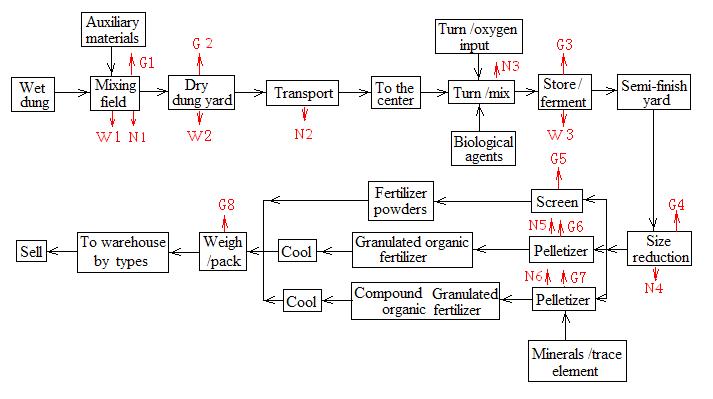
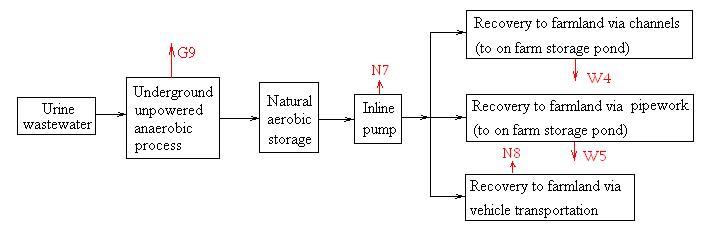
Environmental Impact Assessment on GEF Shanghai Agricultural and Non-point Pollution Reduction Project
4
Possible leakage or rainy-day overflow of
Surface waterSoil
the farmland liquid fraction from
bio-digester fertilization system;
5
Nitrogen and phosphorus elements in liquid Surface waterSoil
fraction from biodigester exceeding the
receiving capacity of farmland;
6
Dust from solid organic fertilizer workshop;
Ambient Air
3 Analysis on Pollution Source
A. Pollution Points
Please refer to Fig. 5.1 for solid manure treatment process and pollution points, and
refer to Fig. 5.2 for liquid manure treatment process and pollution points.
Fig. 5.1 The pollution points for solid manure treatment process
Fig. 5.2 The pollution points for liquid manure treatment process.
76
Environmental Impact Assessment on GEF Shanghai Agricultural and Non-point Pollution Reduction Project
B. Sources and Treatment Measures of Pollutants
For sources and treatment measures of pollutants, see Table 5.9:
Table 5.9: Sources and Treatment Measures of Pollutants
S/N Pollution
Source
Pollutants
Pollution points Control measures
1
G1 waste gas
Odor
Mixing field
Ventilation should be
strengthened.
2
G2waste gas
Odor
Dry dung yard
Ditto
3
G3 waste gas
Odor
Store fement
Ditto
4
G4 waste gas
Dust
Mixers,
Provide dust collectors
and cyclones above
production equipments,
and mitigate noises
through insulation by
buildings and attenuation
over distance;
5
G5 waste gas
Dust
Screen
Ditto
6
G6 waste gas
Dust
Pelletizer
Ditto
7
G7 waste gas
Dust
Pelletizer
Ditto
8
G8 waste gas
Dust
Weight,pack
Ditto
9
G9 waste gas
Biogas
Anaerobic
Collect, desulfurize and
fermentation
deliver to gas users;
10 W1
leakage
COD,BOD,SS,
Mixing
field
Collect and deliver to
NH3-N
Anaerobic fermentation,
11
W2 leakage
Ditto
Dry dung yard
Ditto
12
W3 leakage
Ditto
Store fement
Ditto
13 W4
leakage
COD,BOD,SS,
Storage tank for Take anti-seepage
NH3-N
liquid fraction
measures, use watertight
of bio-digester membrane;
14 W5
leakage
Ditto
Ditto
Ditto;
15
N1 noise
Leq
Mixing field
Choose low-noise
equipment
16
N2 noise
Leq
Vehicle
Take vehicle speed control
measures
16
N3 noise
Leq
Turn/mix
Choose low-noise
equipment;
18
N4 noise
Leq
mixers,
Choose low-noise
equipment; building
sound insulation
vibration mitigation
measure;
19 N5
noise
Leq
Screen
Ditto
20 N6
noise
Leq
Pelletizer
Ditto
21 N7
noise
Leq
Pelletizer
Ditto
22
N8 noise
Leq
Vehicle
Take vehicle speed control
measures
77
Environmental Impact Assessment on GEF Shanghai Agricultural and Non-point Pollution Reduction Project
C. Waste water:
The cooperative now has 38 employees with about 9 t/d of domestic wastewater
discharged. Oily wastewater from kitchens are pretreated in the separation tank and
then sent together with other domestic wastewater to the anaerobic treatment system
for liquid cow manure.
D. Solid waste:
Assuming 1 kg domestic wastes per day per employee, about 38 kg wastes are
generated a day. Domestic wastes are classified, collected and delivered to
environmental sanitation agencies for disposal.
4 Analysis on Nutrients Balance
The 1,600 cows in stock produce 18,000 t solid wastes and 10,500 t wastewater each
year. Solid wastes are processed into organic fertilizer; wastewater is revered as liquid
fertilizer to farmlands, mainly for rice and cauliflower.
According to the nitrogen and phosphorus contents of wastewater (as shown in Table
5.10), the liquid fertilizers generated a year contain 113.9t N and 9.01 t P. Given the
nitrogen and phosphorus demands of rice (9.15 kg N/Mu/year, 5.13 kg P/Mu/year),
the total farmland area matched by the generated liquid fertilizer can be calculated (as
shown in Table 5.11).
Table 5.10: Cow Waste Output and N&P Contents
Cow Waste
Daily Output (kg/d)
Total N content
Total P Content (%)
Solid waste
30
0.43
0.34
Wastewater 29.5
0.67
0.053
Table 5.11: Farmland Area Matched by Liquid Fertilizer based on N&P
Demands of Crops
Rice Cauliflower
Crop
N-based P-based N-based P-based
Area
(mu)
12448 1756 5363 1733
In addition, according to the buckets effect of N&P demands and average fertilizer
utilization ratio of around 62.5% in Shanghai, and in line with the local
double-harvesting of cauliflower a year, the farmland area matched by the liquid
fertilizer to be recovered is calculated as follows:
a. 20,000 mu farmland is required if only rice is fertilized;
78
Environmental Impact Assessment on GEF Shanghai Agricultural and Non-point Pollution Reduction Project
b. 5,000 mu farmland is required if only cauliflower is fertilized;
c. If both rice and cauliflower are fertilized, the relevant farmland areas required are
determined in proportion to farmland sizes.
At present, Chongming Modern Agricultural Park plants 12,000 mu cauliflower, 1,500
mu green-house vegetables and 6,000 mu rice, the farmlands in Chongming Modern
Agricultural Park can fully absorb nitrogen and phosphorus contained in liquid
fraction from biodigester.
5.1.1.3 Pollution Analysis for Component 1-C
(1). Main Environmental Impacts in the Construction Period
According to field surveys, the main environmental impacts in the construction period
are listed in Table 5.12.
Table 5.12 The Main Environmental Impacts in the Construction Period
Environmental
No.
Main Environmental Impacts
Element
1
Slurry and domestic wastewater generated
wastewater
in construction
2
Fugitive dust from construction and exhaust
Ambient Air
gas of machines
3
Noises from construction equipments
Noise
4
Domestic wastes from construction
Solid Wastes
personnel and decoration wastes;
5
Construction wastes from removal and
Solid Wastes
upgrading of existing anaerobic biogas
system;
6
Temporary occupation of lands and roads
Social Environment
during construction;
7
Exhaust gas from biogas combustion
Ambient Air
Pollutants that affect ambient air in construction period are mainly fugitive dusts and
exhaust gas emitted by construction machines and vehicles. Excavation surfaces,
loading and unloading of construction materials, excavation spoils, construction
wastes and vehicles entering and leaving site will all produce fugitive dusts; noises
are principally from construction and moving vehicles. Impact on surface water
environment in construction period is primarily from oil and SS contained in drainage
from construction process.
(2). Main Environmental Impacts in the Operation Period
79
Environmental Impact Assessment on GEF Shanghai Agricultural and Non-point Pollution Reduction Project
The main environmental impacts in the operation period are listed in Table 5.13.
Table 5.13: Main Environmental Impacts in the Operation Period
Environmental
No.
Main Environmental Impacts
Element
1
Stormwater on the composting site discharged
Surface water
into the epidemic prevention river;
2
Odor from animal manure;
Ambient Air
3 Noises from power generation, fertilizer
Noise
workshop and equipments;
4
Possible leakage or rainy-day overflow of the Surface waterSoil
farmland liquid fraction from bio-digester
fertilization system;
5
Nitrogen and phosphorus elements in liquid Surface waterSoil
fraction from bio-digester exceeding the
receiving capacity of farmland;
6
Dust from solid organic fertilizer workshop;
Ambient Air
7
Exhaust gas from biogas combustion
Ambient Air
(3) Treatment Process and Pollution Points during Operation Phase
A. Treatment process and pollution points
Please refer to Fig. 5.3 for integrated utilization of bio-agricultural wastes treatment
process and pollution points, and refer to Fig. 5.4 for straw gasification-based power
generation process and pollution points.
Fig. 5.3 The pollution points for integrated utilization of bio-agricultural wastes
treatment process
80
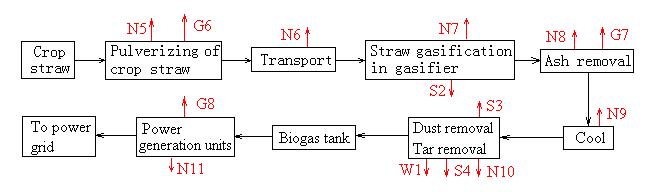
Environmental Impact Assessment on GEF Shanghai Agricultural and Non-point Pollution Reduction Project
Fig. 5.4 The pollution points for straw gasification-based power generation
process.
B. Sources and treatment measures of pollutants
For sources and treatment measures of pollutants, see Table 5.14:
Table 5.14 Sources and Treatment Measures of Pollutants
S/N.
Pollution Source
Pollutants
Pollution Points
Control Measures
1
G1 waste gas
Dust
Pulverizing
of Dusts from crushing of
straw
crop straws are collected
by capturing hood and
treated by baghouse
2
G2 waste gas
Odor
Mixing tank
Collected by capturing
hood and deodorized
by deodorization device;
3
G3 waste gas
Odor
Measurement
ditto
tank
4
G4 waste gas
Odor
Fermentation
ditto
tank
5
G5 waste gas
Odor
Fertilizer
Dusts from crushing of
workshop
crop straws are collected
by capturing hood and
treated by baghouse
6
G6 waste gas
Odor
Pulverizing
of Ditto
straw
7
G7 waste gas
Odor
Ash removal
Waste solid
8
G8 waste gas
Combustion
Power generation Piped to the roof of
Emissions,
units
workshops for emission
SO2,smoke
to atmosphere.
NOx
9
W1 waste water
PetroleumSS Biogas
The waste solid must be
purification
collected for disposal by a
qualified organization.
10 N1
noise
Leq
Pulverizing of
Choose low-noise
straw
equipment; building
sound insulation;
vibration mitigation
measure;
81
Environmental Impact Assessment on GEF Shanghai Agricultural and Non-point Pollution Reduction Project
11 N2
noise
Leq
Power
generation
Choose low-noise
units
equipment;
12 N3
noise
Leq
Solid/liquid
Choose low-noise
separation
equipment; building
sound insulation;
vibration mitigation
measure;
13 N4
noise
Leq
Organic
Fertilizer
Ditto
workshop
14 N5
noise
Leq
Pulverizing of
Ditto
straw
15 N6
noise
Leq
Transporter
Ditto
16
N7 noise
Leq
Gasifier
Building sound insulation
17
N8 noise
Leq
Ash removal
Choose low-noise
equipment;
18
N9 noise
Leq
Cool
Choose low-noise
equipment; building
sound insulation
vibration mitigation
measure;
19 N10
noise
Leq
Ash removalTar Choose low-noise
removal
equipment; building
sound insulation;
20 N11
noise
Leq
Power
generation
Choose low-noise
units
equipment; building
sound insulation;
foundation vibration
damping and
silencing ;
21
S1 waste solid
Discarded
Biogas
Waste desulfurizer will
desulfuration
purification
totally be returned to the
agent
supplier for uniform
disposal and is prohibited
to discharge.
22
S2 waste solid
Dust
Gasifier
The waste solid must be
collected for disposal by a
qualified organization.
C. Waste Water:
The project has 12 employees with about 1.1 t/d of domestic wastewater discharged.
Domestic wastewater is pretreated to Class III discharge standard and then discharged
to Qianwei Village wastewater treatment plant for centralized treatment.
Fuel gas is purified by means of sprinkling, absorption and condensation in the
production process, which produces about 10 t/d of wastewater. The wastewater so
produced is discharged to the municipal sewer network after sedimentation, where the
treated wastewater can meet Class III standard for discharge. The treated wastewater
then enters the wastewater treatment plant in Qianwei Village for central treatment.
D. Solid wastes
82
Environmental Impact Assessment on GEF Shanghai Agricultural and Non-point Pollution Reduction Project
Domestic and office wastes are disposed of by environmental sanitation agencies;
gasifier slag is disposed of by specialized agencies; waste residues, tar and spent
desulfurizer from wastewater sedimentation process of desulfurizer and detarrer
towers are disposed of by qualified agencies.
(4). Farmland Fertilizers
a. Current situation of farmland fertilization in Qianwei Village
Investigations show that the farmland fertilization is made in the pattern as shown in
Table 5.15 in Qianwei Village currently, including 70.4 t total nitrogen, 5.3 t total
phosphorus, 37.3t total potassium, with little organic fertilizers used. The fertilization
quantities are very unreasonable, for nitrogen and potassium are excessive while
phosphorus and organic fertilizers are seriously insufficient.
Table 5.15: Farmland Fertilization Pattern of Qianwei Village (kg·/ha)
Rape Rice
Nutrient
Basal
Top
Basal
Top
Total
Fertilizer
Dressing
Fertilizer
Dressing
N
75 75 90 90 330
P
12 / 13 0 25
K
79 / 96 / 175
Decomposed
/ / / / /
organic matters
b. Project Nutrients Supply and Nutrient Balance of Farmland Fertilizers
The nutrients supply in the project is principally from sludge and liquid fraction from
bio-digester, for nutrients of which see Tables 5.16 and 5.17.
Table 5.16: Nutrient Equivalents and Absorption of Sludge and Solid Organic
Fertilizers
T-N
T-P
T-K
Organic
Item
Remarks
%
%
%
Matters %
Sludge from fully mixed
Massive inorganic matters
digestion (absolute dry 3.9 0.7 0.9
30.4 remain in sludge
substance)
The majority of inorganic
Residues from straw acid 0.1 0.03 0.3
86
matters entrapped in straw
generation
acid liquid
Solid organic fertilizer to be
Solid organic fertilizer
1.25 0.23
0.48
69.24
a mixture of the foregoing
two
83
Environmental Impact Assessment on GEF Shanghai Agricultural and Non-point Pollution Reduction Project
Table 5.17: Nutrient Equivalents and Absorption of Liquid Fraction from
Bio-digester Organic Fertilizers
T-N
T-P
T-K
COD
Item
cr
Remarks
(mg/L)
(mg/L)
(mg/L)
(mg/L)
Containing 3%
Slurry 985
96
1043
500
sludge
The sludge and liquid fraction from bio-digester generated in the whole process
contain 55.7t nitrogen, 7.1t phosphorus, 45.6t potassium and 2,513t organic matters.
Given the current planned farmland area of 3,200 Mu, equivalent to 213 hm2, the
farmland nutrients demand each year are 67.2t total nitrogen, 9.6t total phosphorus,
33.7t total potassium and 1,323t decomposed organic matters in the village. Through
analysis on nutrients supply and farmland demand, the farmlands in Qianwei Village
can fully absorb nitrogen and phosphorus contained in sludge and liquid fraction from
bio-digester. For analysis results, see Table 5.18:
Table 5.18: Project Nutrients Supply and Nutrient Balance of Farmland Fertilizers
Organic
Item N
P
K
Remarks
Matter
Nutrition supply 55.7 7.1 45.6
2513
From project system
(t/a)
Farmland demand 67.2 9.6 33.7
1323
(t/a)
Excess after nutrients recovery to
Gap (t/a)
-11.5
-2.5
11.9
1190
farmland
Gap percentage
Excess as percentage of farmland
-17 -26 26
90
(%)
demand
5.1.2 Wetland Demonstration for Pollution Reduction
(1) Pollution Analysis for Component 2-A
A. Heavy Metal Content Test and the Toxicity Characteristic Leaching Test
According to field surveys, the heavy metal content test and the toxicity characteristic
leaching test are conducted for removed sediments of Miaojing Creek, Shenzhai
Creek and Gujing Creek. The monitoring results of heavy metal content test are
shown in Table 5.19. The results of the toxicity characteristic leaching test are shown
in Table 5.20. For the Sampling sites, see Fig. 5.5.
84
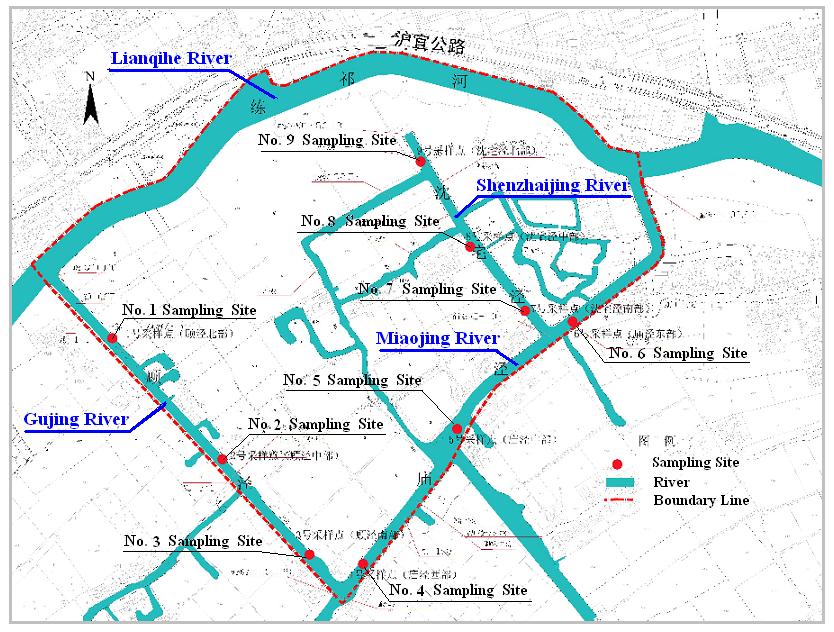
Environmental Impact Assessment on GEF Shanghai Agricultural and Non-point Pollution Reduction Project
Fig.5.5: Monitoring sites in Gujing, Miaojing and Shenzhai Creeks for water and
Sediments
Table 5.19: The Monitoring Results of Heavy Metal Content for the Sediments
River Monitoring
sites
Heavy metal content (mg/kg)
Pb Cd Cu Zn Hg
Gujing Creek No.1 30
0.142
32.5
130
0.134
No.2 50
0.72
132
466
0.250
No.3 16
0.248
29.9
134
0.122
mean value
32
0.370
64.8
243
0.169
Miaojing
No.4 20
0.068
34.2
115
0.150
Creek
No.5 29
0.140
36.9
118
0.310
No.6 23
0.466
36.9
119
0.720
mean value
24
0.225
36.0
117
0.393
Shenzhai
No.7 13
0.050
15.1
70.5
0.068
Creek
No.8 12
0.058
13.5
62.6
0.028
No.9 13
0.090
16.3
116
0.024
mean
value
13 0.066
15.0
83 0.040
Table 5.20: The Results of the Toxicity Characteristic Leaching Test for the
Sediments
T
River Monitoring oxicity CharacteristicLeaching Concentration (mg/L)
sites
Pb Cd Cu Zn Hg
Gujing
No.1
<0.02 <0.002 0.012 0.020 <0.02
Creek
No.2
<0.02 <0.002 0.012 0.019 <0.02
No.3
<0.02
<0.002
0.024 0.022 <0.02
85
Environmental Impact Assessment on GEF Shanghai Agricultural and Non-point Pollution Reduction Project
mean value
<0.02
<0.002
0.016 0.020 <0.02
Miaojing
No.4
<0.02 <0.002 0.013 0.010 <0.02
Creek
No.5
<0.02 <0.002 0.018 0.026 <0.02
No.6
<0.02 <0.002 0.019 0.043 <0.02
mean value
<0.02 <0.002 0.017 0.026 <0.02
Shenzhai
No.7
<0.02 <0.002 0.007 0.010 <0.02
Creek
No.8
<0.02 <0.002 0.016 0.018 <0.02
No.9 <0.02
<0.002 0.027 0.017 <0.02
mean value
<0.02
<0.002 0.017 0.015 <0.02
Table 5.19 shows that the heavy metal content of the removed sediments of
Miaojing Creek, Gujing Creek and Shenzhai Creek does not exceed the Control
standards for Pollutants in Sludge from Agricultural Use (GB4284-84). Therefore,
these removed sediments can be used for farming or forestry purposes. According to
the toxicity characteristic leaching test (GB5085.3-2007) conducted on removed
sediments of Miaojing Creek, Gujing Creek and Shenzhai Creek, the concentration
limits of hazardous components of leach solution are not exceeded (see Table 5.20).
Therefore, these removed sediments are not hazardous wastes.
B Main Environmental Impacts in the Construction Period
According to field surveys, the main environmental impacts in the construction period
are listed in Table 5.21.
Table 5.21: The Main Environmental Impacts in the Construction Period
Environmental
No.
Main Environmental Impacts
Element
1
Slurry and domestic wastewater generated Wastewater
in construction
2
Fugitive dust from construction and exhaust Ambient air
gas of machinesFugitive dust from storage
of removed sediments;
3
Noises from construction equipments
Noise
4 Domestic wastes from construction
Solid wastes
personnel and decoration wastes;
5
Fugitive dust from storage of removed Solid wastes,
sediments; leakage of removed sediments Ambient air
during shipment;
6
Temporary occupation of lands and roads Social environment
during construction;
7 Transplant
trees
Ecological
environment
Pollutants that affect ambient air in construction period are mainly fugitive dusts and
exhaust gas emitted by construction machines and vehicles. Excavation surfaces,
86
Environmental Impact Assessment on GEF Shanghai Agricultural and Non-point Pollution Reduction Project
loading and unloading of construction materials, excavation spoils, construction
wastes and vehicles entering and leaving site will all produce fugitive dusts; noises
are principally from construction and moving vehicles. Impact on surface water
environment in construction period is primarily from oil and SS contained in drainage
from construction process.
C. Main Environmental Impacts in the Operation Period
The main environmental impacts in the operation period are listed in Table 5.22.
Table 5.22: Main Environmental Impacts in the Operation Period
No.
Main Environmental Impacts
Environmental
Element
1
Surface runoff
Surface water
2
Foreign Plant Invading
Ecological
environment
3
Discharging sewage or tail water into river
Surface water
(2) Pollution Analysis for Component 2-B
A. Main Environmental Impacts in the Construction Period
According to field surveys, the main environmental impacts in the construction period
are listed in Table 5.23.
Table 5.23:The Main Environmental Impacts in the Construction Period
No.
Main Environmental Impacts
Environmental Element
1
Slurry and domestic wastewater generated wastewater
in construction
2
Fugitive dust from construction and exhaust Ambient air
gas of machines
3
Noises from construction equipments
Noise
4 Domestic wastes from construction
Solid wastes
personnel and decoration wastes;
5
Construction wastes from removal of paved Solid wastes
road surfaces;
6 leakage of removed spoil and building Solid wastes , Ambient
garbage;
air
7
Temporary occupation of lands and roads Social environment
during construction;
8
Transplant trees
Ecological environment
Pollutants that affect ambient air in construction period are mainly fugitive dusts and
exhaust gas emitted by construction machines and vehicles. Excavation surfaces,
87
Environmental Impact Assessment on GEF Shanghai Agricultural and Non-point Pollution Reduction Project
loading and unloading of construction materials, excavation spoils, construction
wastes and vehicles entering and leaving site will all produce fugitive dusts; noises
are principally from construction and moving vehicles. Impact on surface water
environment in construction period is primarily from oil and SS contained in drainage
from construction process.
B. Main Environmental Impacts in the Operation Period
The main environmental impacts in the operation period are listed in Table 5.24.
Table 5.24 Main Environmental Impacts in the Operation Period
No.
Main Environmental Impacts
Environmental
Element
1
Surface runoff
Surface water
2 Pumps
running
Noise
3
Discharging sewage or tail water into river
Surface water
4
Odor from pump room and grille
Ambient Air
5.2 Measures to Reduce Environmental Impact in the Project Construction
Period
In the construction period of the project, construction would have a negative impact
on the environment to some extent, but the impact is of temporary and local nature.
If appropriate mitigation measures are adopted, this impact can be minimized or even
eliminated, while other impacts are insignificant. Possible potential impacts generated
in the construction period include soil, air, noise, greening and surrounding
communities.
5.2.1 Livestock Waste Management Technology Demonstration
(1) Potential Environmental Impacts and Related Mitigation Measures for
Component 1-A
Table 5.25 Potential Environmental Impacts and Related Mitigation Measures
for Component 1-A during the Construction Period
Environment
Related Mitigation Measures
Impact
Dust
Spoil, building garbage, building materials (sand and cement)
would generate dust to pollute air in the process of handling,
stacking and mixing, so that TSP is increased, in particular in
windy days. Following measures shall be adopted:
"Shanghai Dust Pollution Control Management Methods"
88
Environmental Impact Assessment on GEF Shanghai Agricultural and Non-point Pollution Reduction Project
should be strictly enforced. Spoil generated in road
excavation should be frequently watered in fine and windy
days. Construction period shall be shortened as far as
possible and dust shall be timely removed. In
transportation, watering or covering shall be conducted to
prevent dust pollution.
Sand, cement and other building materials easy to produce
dust should be put in appropriate places with wind boards
and isolated wall installed; cement should be put in
warehouse. Dust prevention bag shall be installed when
unloading bulk cement.
Vehicles entered on to the construction site should have their
speed limited. Road surface shall be maintained clean
and wet to reduce dust.
Construction site management shall be strengthened. When
choosing construction units, PIA shall consider the quality
of construction unit. Environmental impact mitigation
measures shall be included in the contractwhich shall be
under strict supervision and inspection from the beginning
to the end.
In transportation, spoil, building garbage, building materials
(sand and cement) shall be covered.
Greening
If project buildings or structures are constructed on the
original greening area, this will have impact on greening,
which shall be addressed in accordance with provisions of
the "Shanghai Municipal Afforestation and Green Land
Administration Regulation". Trees within construction area
should be transplanted. In order to ensure the survival
rate of trees, the construction unit shall engage green
professionals to be responsible for this work.
After the completion of the project, greening shall be
restored as far as possible to minimize the adverse impact on
green space and trees.
Noise
Low-noise construction machinery and equipment should be
chosen as far as possible. Simple noise barriers should be
set up when construction area is quite close to residential
areas.
In the construction period, construction noise should be
strictly controlled and it is required to meet the requirements
in GB12523-2008. No high-noise operations could be
performed from 22:00 to 6:00. In case night operation is
required by technology, application to the local
environmental protection department for approval shall be
made before operation to be carried out. Prior-notice shall
89
Environmental Impact Assessment on GEF Shanghai Agricultural and Non-point Pollution Reduction Project
be given to gain forgiveness of the masses.
In order to reduce noise impact on the environment in the
operation of equipment, sound insulation measures shall be
adopted in civil works and surrounding environment shall be
considered in the civil works design.
Spoil and
Construction of this project will produce a certain amount of
building
spoil and building garbage. PIA should, in accordance with
garbage
the requirements set in the "Management and Regulation of
the Shanghai Municipality Regarding Disposal of Building
Garbage and Engineering Spoil", apply to the Shanghai
Municipal Spoil Management Department for approval of
its building garbage and spoil disposal plan prior to the
commencement of construction. Do accordingly after
approval.
In case toxic and hazardous wastes are produced,
construction should be suspended and the EP and health
department contacted timely. Construction can be restarted
after safety measures are adopted.
Residential
Construction of the project requires a certain amount of
wastes
construction staff. Contractors will often provide
necessary facilities within the temporary work area for
construction workers in order to complete the project on
quality and time. Thus, a certain amount of domestic
wastes will be produced. PIA must contact with sanitation
department for timely removal of wastes.
Contractor is required to carry out education for
construction workers, who shall develop civilized
construction, creating a clean and hygiene environment for
work and living.
Waste gases
A certain amount of diesel machinery and vehicles will be
employed in construction and tail gas emissions will cause
air pollution. Good quality diesel machinery of sufficient
combustion shall be chosen and operated in places as far as
possible away from residential areas and other sensitive
points.
Similar transport vehicle emission mitigation measures shall
be adopted. Vehicles of inadequate combustion causing
heavy pollution should be repaired before use.
Waste water
The construction process (such as land excavation and open
caisson construction, etc.) will produce a lot of mud water.
Sedimentation tanks of different sizes shall be installed
according to mud water volume. Water on the upper level
of the tank can be discharged into rivers nearby as ordinary
wastewater. Sediment shall be treated regularly as solid
90
Environmental Impact Assessment on GEF Shanghai Agricultural and Non-point Pollution Reduction Project
wastes and should not be put together with domestic
garbage.
Social impact Road excavation shall have an impact on traffic. Before
(traffic and construction, the consent of the traffic management
immigrant, etc.
department should be obtained. Excavation site shall set
up isolation binder or board. Persons on duty shall be
arranged at the crossroads to direct traffic to guard against
the occurrence of traffic accidents.
Construction of this project does not involve the issue of
resettlement and immigrant.
Cultural relics
No relics are found. If cultural relics are discovered in the
construction, stop the construction and report the case
promptly to the local cultural relics management
department.
(2) Potential Environmental Impacts and Related Mitigation Measures for
Component 1-B
Table 5.26: Potential Environmental Impacts and Related Mitigation Measures
for Component 1-B during the Construction Period
Environment
Related Mitigation Measures
Impact
Dust
Spoil, building garbage, building materials (sand and cement)
would generate dust to pollute air in the process of handling,
stacking and mixing, so that TSP is increased, in particular in
windy days. Following measures shall be adopted:
"Shanghai Dust Pollution Control Management Methods"
should be strictly enforced. Spoil generated in road
excavation should be frequently watered in fine and windy
days. Construction period shall be shortened as far as
possible and dust shall be timely removed. In
transportation, watering or covering shall be conducted to
prevent dust pollution.
Sand, cement and other building materials easy to produce
dust should be put in appropriate places with wind boards
and isolated wall installed; cement should be put in
warehouse. Dust prevention bag shall be installed when
unloading bulk cement.
Vehicles entered on to the construction site should have their
speed limited. Road surface shall be maintained clean
and wet to reduce dust.
Construction site management shall be strengthened. When
choosing construction units, PIA shall consider the quality
91
Environmental Impact Assessment on GEF Shanghai Agricultural and Non-point Pollution Reduction Project
of construction unit. Environmental impact mitigation
measures shall be included in the contractwhich shall be
under strict supervision and inspection from the beginning
to the end.
In transportation, spoil, building garbage, building materials
(sand and cement) shall be covered.
Greening
If project buildings or structures are constructed on the
original greening area, this will have impact on greening,
which shall be addressed in accordance with provisions of
the "Shanghai Municipal Afforestation and Green Land
Administration Regulation". Trees within construction area
should be transplanted. In order to ensure the survival
rate of trees, the construction unit shall engage green
professionals to be responsible for this work.
After the completion of the project, greening shall be
restored as far as possible to minimize the adverse impact on
green space and trees.
Noise
Low-noise construction machinery and equipment should be
chosen as far as possible. Simple noise barriers should be
set up when construction area is quite close to sensitive
areas.
In the construction period, construction noise should be
strictly controlled and it is required to meet the requirements
in GB12523-2008. No high-noise operations could be
performed from 22:00 to 6:00. In case night operation is
required by technology, application to the local
environmental protection department for approval shall be
made before operation to be carried out. Prior-notice shall
be given to gain forgiveness of the masses.
Spoil and
Construction of this project will produce a certain amount of
building
spoil and building garbage. PIA should, in accordance
garbage
with the requirements set in the "Management and
Regulation of the Shanghai Municipality Regarding
Disposal of Building Garbage and Engineering Spoil",
apply to the Shanghai Municipal Spoil Management
Department for approval of its building garbage and spoil
disposal plan prior to the commencement of construction.
Do accordingly after approval.
In case toxic and hazardous wastes are produced,
construction should be suspended and the EP and health
department contacted timely. Construction can be restarted
after safety measures are adopted.
Residential
Construction of the project requires a certain amount of
wastes
construction staff. Contractors will often provide
92
Environmental Impact Assessment on GEF Shanghai Agricultural and Non-point Pollution Reduction Project
necessary facilities within the temporary work area for
construction workers in order to complete the project on
quality and time. Thus, a certain amount of domestic
wastes will be produced. PIA must contact with sanitation
department for timely removal of wastes.
Contractor is required to carry out education for
construction workers, who shall develop civilized
construction, creating a clean and hygiene environment for
work and living.
Waste gases
A certain amount of diesel machinery and vehicles will be
employed in construction and tail gas emissions will cause
air pollution. Good quality diesel machinery of sufficient
combustion shall be chosen and operated in places as far as
possible away from residential areas and other sensitive
points.
Similar transport vehicle emission mitigation measures shall
be adopted. Vehicles of inadequate combustion causing
heavy pollution should be repaired before use.
Waste water
The construction process (such as land excavation and open
caisson construction, etc.) will produce a lot of mud water.
Sedimentation tanks of different sizes shall be installed
according to mud water volume. Water on the upper level
of the tank can be discharged into rivers nearby as ordinary
wastewater. Sediment shall be treated regularly as solid
wastes and should not be put together with domestic
garbage.
Cultural relics
No relics are found. If cultural relics are discovered in the
construction, stop the construction and report the case
promptly to the local cultural relics management
department.
(3) Potential Environmental Impacts and Related Mitigation Measures for
Component 1-C
Table 5.27 Potential Environmental Impacts and Related Mitigation Measures
for Component 1-C during the Construction Period
Environment
Related Mitigation Measures
Impact
Dust
Spoil, building garbage, building materials (sand and cement)
would generate dust to pollute air in the process of handling,
stacking and mixing, so that TSP is increased, in particular in
windy days. Following measures shall be adopted:
93
Environmental Impact Assessment on GEF Shanghai Agricultural and Non-point Pollution Reduction Project
"Shanghai Dust Pollution Control Management Methods"
should be strictly enforced. Spoil generated in road
excavation should be frequently watered in fine and windy
days. Construction period shall be shortened as far as
possible and dust shall be timely removed. In
transportation, watering or covering shall be conducted to
prevent dust pollution.
Sand, cement and other building materials easy to produce
dust should be put in appropriate places with wind boards
and isolated wall installed; cement should be put in
warehouse. Dust prevention bag shall be installed when
unloading bulk cement.
Vehicles entered on to the construction site should have their
speed limited. Road surface shall be maintained clean
and wet to reduce dust.
Construction site management shall be strengthened. When
choosing construction units PIA shall consider the quality of
construction unit. Environmental impact mitigation
measures shall be included in the contractwhich shall be
under strict supervision and inspection from the beginning
to the end.
In transportation, spoil, building garbage, building materials
(sand and cement) shall be covered.
Greening
If project buildings or structures are constructed on the
original greening area, this will have impact on greening,
which shall be addressed in accordance with provisions of
the "Shanghai Municipal Afforestation and Green Land
Administration Regulation". Trees within construction area
should be transplanted. In order to ensure the survival
rate of trees, the construction unit shall engage green
professionals to be responsible for this work.
After the completion of the project, greening shall be
restored as far as possible to minimize the adverse impact on
green space and trees.
Noise
Low-noise construction machinery and equipment should be
chosen as far as possible. Simple noise barriers should be
set up when construction area is quite close to residential
areas.
In the construction period, construction noise should be
strictly controlled and it is required to meet the requirements
in GB12523-2008. No high-noise operations could be
performed from 22:00 to 6:00. In case night operation is
required by technology, application to the local
environmental protection department for approval shall be
94
Environmental Impact Assessment on GEF Shanghai Agricultural and Non-point Pollution Reduction Project
made before operation to be carried out. Prior-notice shall
be given to gain forgiveness of the masses.
In order to reduce noise impact on the environment in the
operation of equipment, sound insulation measures shall be
adopted in civil works and surrounding environment shall be
considered in the civil works design.
Spoil and
Construction of this project will produce a certain amount of
building
spoil and building garbage. PIA should, in accordance
garbage
with the requirements set in the "Management and
Regulation of the Shanghai Municipality Regarding
Disposal of Building Garbage and Engineering Spoil",
apply to the Shanghai Municipal Spoil Management
Department for approval of its building garbage and spoil
disposal plan prior to the commencement of construction.
Do accordingly after approval.
In case toxic and hazardous wastes are produced,
construction should be suspended and the EP and health
department contacted timely. Construction can be restarted
after safety measures are adopted.
Residential
Construction of the project requires a certain amount of
wastes
construction staff. Contractors will often provide
necessary facilities within the temporary work area for
construction workers in order to complete the project on
quality and time. Thus, a certain amount of domestic
wastes will be produced. PIA must contact with sanitation
department for timely removal of wastes.
Contractor is required to carry out education for
construction workers, who shall develop civilized
construction, creating a clean and hygiene environment for
work and living.
Waste gases
A certain amount of diesel machinery and vehicles will be
employed in construction and tail gas emissions will cause
air pollution. Good quality diesel machinery of sufficient
combustion shall be chosen and operated in places as far as
possible away from residential areas and other sensitive
points.
Similar transport vehicle emission mitigation measures shall
be adopted. Vehicles of inadequate combustion causing
heavy pollution should be repaired before use.
Waste water
The construction process (such as land excavation and open
caisson construction, etc.) will produce a lot of mud water.
Sedimentation tanks of different sizes shall be installed
according to mud water volume. Water on the upper level
of the tank can be discharged into rivers nearby as ordinary
95
Environmental Impact Assessment on GEF Shanghai Agricultural and Non-point Pollution Reduction Project
wastewater. Sediment shall be treated regularly as solid
wastes and should not be put together with domestic
garbage.
Social impact
Road excavation shall have an impact on traffic. Before
(traffic and
construction, the consent of the traffic management
immigrant, etc.
department should be obtained. Excavation site shall set
up isolation binder or board. Persons on duty shall be
arranged at the crossroads to direct traffic to guard against
the occurrence of traffic accidents.
Construction of this project does not involve the issue of
resettlement and immigrant.
Cultural relics
No relics are found. If cultural relics are discovered in the
construction, stop the construction and report the case
promptly to the local cultural relics management
department.
5.2.2 Wetland Demonstration for Pollution Reduction
(1) Potential Environmental Impacts and Related Mitigation Measures for
Component 2-A
Table 5.28 Potential Environmental Impacts and Related Mitigation Measures
forComponent 2-A during the Construction Period
Environment
Related Mitigation Measures
Impact
Dust
Spoil would generate dust to pollute air in the process of
handling and stacking, so that TSP is increased, in particular in
windy days. Following measures shall be adopted:
"Shanghai Dust Pollution Control Management Methods"
should be strictly enforced. Spoil generated in road
excavation should be frequently watered in fine and windy
days. Construction period shall be shortened as far as
possible and dust shall be timely removed. In
transportation, watering or covering shall be conducted to
prevent dust.
Sand, cement and other building materials easy to produce
dust should be put in appropriate places with wind boards
and isolated wall installed; cement should be put in
warehouse. Dust prevention bag shall be installed when
unloading bulk cement.
Vehicles entered on to the construction site should have their
speed limited. Road surface shall be maintained clean
and wet to reduce dust.
Construction site management shall be strengthened. When
choosing construction units PIA shall consider the quality of
96
Environmental Impact Assessment on GEF Shanghai Agricultural and Non-point Pollution Reduction Project
construction unit. Environmental impact mitigation
measures shall be included in the contractwhich shall be
under strict supervision and inspection from the beginning
to the end.
Greening and River dredging and rehabilitation will have impact on
vegetation
greening, which shall be addressed in accordance with
provisions of the "Shanghai Municipal Afforestation and
Green Land Administration Regulation". Trees within
construction area should be transplanted. In order to
ensure the survival rate of trees, the construction unit shall
engage green professionals to be responsible for this work.
After the completion of the project, greening shall be
restored as far as possible to minimize the adverse impact on
green space and trees.
Water Plant
River dredging will affect the growth of original water plant.
Invading of foreign water plant shall be avoided.
Noise
Low-noise construction machinery and equipment should be
chosen as far as possible. Simple noise barriers should be
set up when construction area is quite close to residential
areas.
In the construction period, construction noise should be
strictly controlled and it is required to meet the requirements
in GB12523-90. No high-noise operations could be
performed from 22:00 to 6:00. In case night operation is
required by technology, application to the local
environmental protection department for approval shall be
made before operation to be carried out. Prior-notice shall
be given to gain forgiveness of the masses.
Spoil
Construction of this project will produce a certain amount of
spoil. PIA should, in accordance with the requirements set
in the "Management and Regulation of the Shanghai
Municipality Regarding Disposal of Building Garbage and
Engineering Spoil", apply to the Shanghai Municipal
Spoil Management Department for approval of its building
garbage and spoil disposal plan prior to the commencement
of construction. Do accordingly after approval.
In case toxic and hazardous wastes are produced,
construction should be suspended and the EP and health
department contacted timely. Construction can be restarted
after safety measures are adopted.
Bed mud in
Sedimentation tanks shall be installed near by. Water on
dredging
the upper level of the tank can be discharged into rivers
while the sediment mud can be used as farmland or for
greening if the test shows that it is in conformity with the
agricultural use standard. Otherwise it should be treated
regularly as solid wastes and should not be put together with
domestic wastes.
Residential
Construction of the project requires a certain amount of
wastes
construction staff. Contractors will often provide
necessary facilities within the temporary work area for
97
Environmental Impact Assessment on GEF Shanghai Agricultural and Non-point Pollution Reduction Project
construction workers in order to complete the project on
quality and time. Thus, a certain amount of domestic
wastes will be produced. PIA must contact with sanitation
department for timely removal of wastes.
Contractor is required to carry out education for
construction workers, who shall develop civilized
construction, creating a clean and hygiene environment for
work and living.
Waste gases
A certain amount of diesel machinery and vehicles will be
employed in construction and tail gas emissions will cause
air pollution. Good quality diesel machinery of sufficient
combustion shall be chosen and operated in places as far as
possible away from residential areas and other sensitive
points.
Similar transport vehicle emission mitigation measures shall
be adopted. Vehicles of inadequate combustion causing
heavy pollution should be repaired before use.
Waste water
The construction process (such as land excavation and open
caisson construction, etc.) will produce a lot of mud water.
Sedimentation tanks of different sizes shall be installed
according to mud water volume. Water on the upper level
of the tank can be discharged into rivers nearby as ordinary
wastewater.
Blocking-up of If dredging must block-up of rivers, prior consent of water
rivers
authority must be obtained.
Pay attention to the climate and adopt precaution measures
of flood control. Keep a smooth drainage of fields.
Blocking up of rivers would affect fields' irrigation. This
should be informed to the related organizations and farmers
to gain their forgiveness.
Social impact Road excavation shall have an impact on traffic. Before
(traffic and construction, the consent of the traffic management
immigrant, etc.
department should be obtained. Excavation site shall set
up isolation binder or board. Persons on duty shall be
arranged at the crossroads to direct traffic to guard against
the occurrence of traffic accidents.
Construction of this project does not involve the issue of
resettlement and immigrant.
Cultural relics
No relics are found. If cultural relics are discovered in the
construction, stop the construction and report the case
promptly to the local cultural relics management
department.
Environmental impact of the dredging works in construction period
and its countermeasures
The environmental impact of the construction of this dredging works mainly consists
of construction noise, vehicle traffic noise, spoil dumps excavated in communication
channel works, dust raised in transportation, and stoppage of the river under dredging
98
Environmental Impact Assessment on GEF Shanghai Agricultural and Non-point Pollution Reduction Project
so affecting farmland irrigation and flood drainage. To reduce effects of dredging
works on watercourse functions, works will be implemented by sections to avoid
concurrent operations throughout the course. The duration of works at each section
shall be minimized. As there is a dense network of rivers in the project area, blocking
the river by sections for a short period of time will not affect farmland irrigation and
flood control. Wet-process dredging is used to mitigate adverse impacts on
environment and farmland. According to the feasibility study report, the project is
scheduled to last for two years, and dividing works into sections helps minimize
effects on watercourse. With these measures taken, impacts of works on water quality
of rivers, farmers' life, farmland irrigation and flood control are literally ignorable.
(2) Potential Environmental Impacts and Related Mitigation Measures for
Component 2-B
Table 5.29 Potential Environmental Impacts and Related Mitigation Measures
forComponent 2-B during the Construction Period
Environment
Related Mitigation Measures
Impact
Dust
Spoil would generate dust to pollute air in the process of
handling and stacking, so that TSP is increased, in particular in
windy days. Following measures shall be adopted:
"Shanghai Dust Pollution Control Management Methods"
should be strictly enforced. Spoil generated in road
excavation should be frequently watered in fine and windy
days. Construction period shall be shortened as far as
possible and dust shall be timely removed. In
transportation, watering or covering shall be conducted to
prevent dust.
Sand, cement and other building materials easy to produce
dust should be put in appropriate places with wind boards
and isolated wall installed; cement should be put in
warehouse. Dust prevention bag shall be installed when
unloading bulk cement.
Vehicles entered on to the construction site should have their
speed limited. Road surface shall be maintained clean
and wet to reduce dust.
Construction site management shall be strengthened. When
choosing construction units PIA shall consider the quality of
construction unit. Environmental impact mitigation
measures shall be included in the contractwhich shall be
under strict supervision and inspection from the beginning
to the end.
Greening and The construction of waste water treatment stations and the
99
Environmental Impact Assessment on GEF Shanghai Agricultural and Non-point Pollution Reduction Project
vegetation
laying of pipelines will have impact on greening, which
shall be addressed in accordance with provisions of the
"Shanghai Municipal Afforestation and Green Land
Administration Regulation". Trees within construction area
should be transplanted. In order to ensure the survival
rate of trees, the construction unit shall engage green
professionals to be responsible for this work.
After the completion of the project, greening shall be
restored as far as possible to minimize the adverse impact on
green space and trees.
Noise
Low-noise construction machinery and equipment should be
chosen as far as possible. Simple noise barriers should be
set up when construction area is quite close to residential
areas.
In the construction period, construction noise should be
strictly controlled and it is required to meet the requirements
in GB12523-2008. No high-noise operations could be
performed from 22:00 to 6:00. In case night operation is
required by technology, application to the local
environmental protection department for approval shall be
made before operation to be carried out. Prior-notice shall
be given to gain forgiveness of the masses.
Spoil and
Construction of this project will produce a certain amount of
building
spoil and excavation of hardened filed will produce a certain
garbage
amount of building garbage. PIA should, in accordance
with the requirements set in the "Management and
Regulation of the Shanghai Municipality Regarding
Disposal of Building Garbage and Engineering Spoil",
apply to the Shanghai Municipal Spoil Management
Department for approval of its building garbage and spoil
disposal plan prior to the commencement of construction.
Do accordingly after approval.
In case toxic and hazardous wastes are produced,
construction should be suspended and the EP and health
department contacted timely. Construction can be restarted
after safety measures are adopted.
Residential
Construction of the project requires a certain amount of
wastes
construction staff. Contractors will often provide
necessary facilities within the temporary work area for
construction workers in order to complete the project on
quality and time. Thus, a certain amount of domestic
wastes will be produced. PIA must contact with sanitation
department for timely removal of wastes.
Contractor is required to carry out education for
100
Environmental Impact Assessment on GEF Shanghai Agricultural and Non-point Pollution Reduction Project
construction workers, who shall develop civilized
construction, creating a clean and hygiene environment for
work and living.
Waste gases
A certain amount of diesel machinery and vehicles will be
employed in construction and tail gas emissions will cause
air pollution. Good quality diesel machinery of sufficient
combustion shall be chosen and operated in places as far as
possible away from residential areas and other sensitive
points.
Similar transport vehicle emission mitigation measures shall
be adopted. Vehicles of inadequate combustion causing
heavy pollution should be repaired before use.
Waste water
The construction process (such as land excavation etc.) will
produce a lot of mud water. Sedimentation tanks of
different sizes shall be installed according to mud water
volume. Water on the upper level of the tank can be
discharged into rivers nearby as ordinary wastewater.
Social impact Road excavation shall have an impact on traffic. Before
(traffic and construction, the consent of the traffic management
immigrant, etc.
department should be obtained. Excavation site shall set
up isolation binder or board. Persons on duty shall be
arranged at the crossroads to direct traffic to guard against
the occurrence of traffic accidents.
Construction of this project does not involve the issue of
resettlement and immigrant.
Cultural relics
No relics are found. If cultural relics are discovered in the
construction, stop the construction and report the case
promptly to the local cultural relics management
department.
5.3 Measures to Reduce Environmental Impact in the Project Operation Period
Environmental impact produced in the project operation period mainly refers to noise
generated by running of machinery, such as pump noise and so on, offensive smell
from livestock wastes and sewage treatment sites and solid wastes like sludge from
sewerage sumps and sedimentation tanks.
5.3.1 Livestock Waste Management Technology Demonstration
5.3.1.1 Potential Environmental Impacts and Related Mitigation Measures for
Component 1-A
(1) Analysis on Environmental Impact in Operation Period
101
Environmental Impact Assessment on GEF Shanghai Agricultural and Non-point Pollution Reduction Project
A. Analysis on Environmental Impact of Wastewater
Wastewaters
Mainly liquid fraction from biodigester, domestic wastewater and washing
wastewater:
Liquid fraction from bio-digester: After treatment in solid-liquid separation process,
sedimentation tank, Acidification/regulation tank and anaerobic tank, the
concentrations of CODCr, BOD5, SS and ammonia nitrogen in liquid fraction from
bio-digester are 1000 mg/L, 330 mg/L, 480 mg/L and 100 mg/L respectively (see
Table 5.3). The liquid fraction from bio-digester will be discharged into the municipal
sewer network after treatment at the wastewater treatment plant reconstructed to the
discharge standard of Jinshan Langxia Wastewater Treatment Plant.
Domestic Wastewater: The plant has 10 additional employees. Assuming a domestic
wastewater discharge level of 180 L/d for each person, 657 m3/a of domestic
wastewater will be generated a year, discharged into the municipal sewer network
after treatment at the existing wastewater treatment station to the discharge standard
of Jinshan Langxia Wastewater Treatment Plant.
Washing Wastewater: About 4 m3/d of washing wastewater is produced a day in the
Project. Washing wastewater is reused and generally replaced every 2-3 days.
Washing wastewater is used to dilute cattle manure and not discharged to outside.
Disposal of Liquid Fraction from Bio-digester and Wastewater
The Project will upgrade process and expand capacity of the existing WWTP. After
these improvements, the liquid fraction from bio-digester, domestic wastewater and
spent rinsing water are all sent to the WWTP for treatment and incorporated into
Langxia Wastewater Treatment Plant when treated to standards for discharge into the
municipal sewer system.
Design Capacity of WWTP
The existing works have a wastewater output of 337.4m3/d (see Fig.2.5: water
balance). With this biogas project implemented, upgrading of the cow manure
treatment process will result in an additional wastewater output of 73.07m3/d,
increasing to the total wastewater output to 410.47m3/d. However, the design capacity
of the WWTP is 250m3/d. The Project Owner, therefore, shall implement process
upgrading and capacity expansion of the WWTP as soon as possible to meet needs of
liquid fraction from bio-digester treatment. With fluctuations in wastewater output
considered, we recommend a design capacity of 500m3/d.
102
Environmental Impact Assessment on GEF Shanghai Agricultural and Non-point Pollution Reduction Project
Feasibility Study on WWTP Treatment Process and Compliance
Liquid fraction from biodigester and other wastewater are sent into the flocculation
and sedimentation system, where polymer flocculant is added to remove the great
majority of suspended particles from wastewater. As wastewater after the biogas
fermentation process is poor in biochemical ability, the wastewater following
flocculation shall be sent to the facultative tank to degrade macromolecular pollutants
into micromolecular ones via hydrolysis, with B/C ratio adjusted when organic
substances are removed. Effluent from the facultative process is improved much in
biochemical ability. The effluent then flows into the intermittent aerobic system - SBR
tank. The SBR tank provides such functions as dilution, aeration, discharge, nitration
and denitrification, and removes COD and ammonia nitrogen through a cycle. For
details of the WWTP treatment process, please refer to Fig. 2.4.
According to the Waste Treatment Handbook and practices of domestic counterparts,
the removal rates of pollutants contained in the liquid fraction of biodigester from
SBR treatment are provided in the Table 5.30.
Table 5.30: WWTP Treatment Efficiency and Compliance Analysis (mg/L)
Volume of
Item
wastewater
CODCr BOD5 SS NH3-N
(m3/d)
Washing
113 1050 400 400 80
wastewater
Animal and
medical
2 500 100 150 40
wastewater
Disinfection
36 800 50 600 40
tank
Domestic water
10.8
300
150
100
25
Liquid fraction
from
248.67 1000 330 480 100
biodigester
Mixed water
410.47
975.4
318.9
456.9
87.0
quality
Removal rate
80% 90% 90% 60%
of pollutants
Effluent quality
195.1
31.9
45.7
34.8
Standard for
inclusion into
500
300
400 40
the municipal
sewer system
To meet the
To meet the
To meet the
To meet the
Compliance stantard
stantard
stantard
stantard
103
Environmental Impact Assessment on GEF Shanghai Agricultural and Non-point Pollution Reduction Project
It is shown in the Table 5.30 that Liquid fraction from biodigester produced in the
Project can meet the standard for inclusion into the municipal sewer system after
treatment by the upgraded WWTP. With reference to average pollutant concentrations
of Shanghai domestic wastewater and performance of existing wastewater treatment
plants, wastewater discharged by the Project will be eligible for discharge into the
municipal sewer system and meet environment management requirements.
Introduction to Jinshan Langxia Wastewater Treatment Plant
The Jinshan Langxia wastewater treatment project was completed and accepted in
November 2008. Sample analysis and monitoring conducted by environment
authorities on 31 March 2009 demonstrated compliance of effluent quality with
design standards. The WWTP has a design capacity of 10,000 t/d and currently treats
about 5,000 t a day, fully capable of receiving all wastewater of the Project. Jinshan
Langxia Wastewater Treatment Plant has consented to accept treated wastewater of
the Project and entered into an agreement with the Owner (see Annex 1)
B. Analysis on Impact of Exhaust Gas
Gas pollutants in the Project are gas emissions from biogas combustion and
malodorous gas from conveying system, pretreatment system and fermenting
installations.
Source Intensity of Air Pollutants from Biogas Combustion
For the source intensity of air pollutants from biogas combustion, please see Table
5.30.
Table5.30 Source Intensity of Air Pollutants in the Project
Exhaust Stack Parameters Pollutants Emission (kg/h)
Exhaust
Source
Height, Diameter, Temp,
Gas (m3/h)
SO
m
m
2
Smoke NO2*
Flare
950 20 0.3 100 0.003 0.019 0.257
*Quantity of NO2 discharged is assumed to be 90% of NOX discharged.
According to the analysis of source intensity of air pollutants in the Project, Nitrogen
oxide contained in exhaust gas of generator units can meet the Stage II limit provided
in Limits and measurement methods for exhaust pollutants from positive ignition (P.I.)
engines of vehicles and vehicles equipped with P.I. engines GB14762-2002, sulfur
dioxide to meet Class II standard defined in Integrated Emission Standard of Air
Pollutants GB16297-1996.
104
Environmental Impact Assessment on GEF Shanghai Agricultural and Non-point Pollution Reduction Project
The Project uses a "fully-closed" design for wastewater collection and conveying
system, pretreatment system, fermenting installations and other facilities producing
malodorous gas, thereby minimizing unorganized emission of malodorous gas.
According to surveys on comparative projects, the odor concentration at 2 m away
from the pretreatment workshop is about 70.
Analysis on Impact of Combustion Emissions
Based on projection of the impact of combustion emissions according to the
calculation approaches set out in the Guidelines for Environmental Impact
Assessment - Atmospheric Environment (HJ/T 2.2-2008), the projection results of
maximum downwind concentrations are set out in the table below.
Table 5.31 Projection Results of Maximum Downwind Concentrations
Location
Maximum Downwind Concentrations (mg/m3)
SO2 NO2 PM10
Downwind 100 m
0.00219
0.02087
0.00154
Lujiayan 0.00070
0.00671
0.00050
Nantang Village
0.00051
0.00485
0.00036
Standards value of the function area
0.30mg/m3 0.24
mg/m3 0.15
mg/m3
It is clear from the table that, due to the small quantity of pollutants contained in the
combustion emissions in the Project, the one-repetition maximum concentration
downwind is extremely low, far below the assessment standard. The maximum impact
on sensitive points is as follows: SO2 being 0.00070 mg/m3, with Pmax of 0.14%;
NO2 being 0.00671 mg/m3, with Pmax of 2.80%; PM10 being 0.00050 mg/m3, with
Pmax of 0.33% (as a percentage of daily mean value). In general, the Project
discharges a small quantity of pollutants and thus has little impact on local air
environment. In the project area, the annual mean concentration of SO2 is 0.004
mg/m3, the annual mean concentration of NO2 is 0.032 mg/m3, and the annual mean
concentration of TSP is 0.180 mg/m3, all meeting standards for Class II function area
defined in the Ambient air Quality Standard. When the Project is completed, the
environmental quality in adjacent areas of the Project will remain basically unchanged,
with SO2, NO2 and PM10 all meeting Class II standard defined in the Ambient air
Quality Standard.
C. Analysis on the Impact of Odor Gas Emissions
The unorganized-emission foul gases produced by conveying equipment,
pre-treatment system, fermentation facility, etc, are relatively high in concentration,
while that brought in by post-fermentation follow-up facility and various sections, are
relatively low in concentration.
105
Environmental Impact Assessment on GEF Shanghai Agricultural and Non-point Pollution Reduction Project
The main components of biogas are CH4 (50-70%), CO2 (30-40%), and a small
amount of H2, CO, NH3, H2S, etc. Both of CO2 and CH4, as greenhouse gases, have a
smaller impact on the environment, compared with the toxic/harmful gases, so not in
the list of standard control. However, even a small amount of NH3 and H2S has a
strong odor stimulus, and some toxicity, thus bring about a greater impact on the
surrounding environment.
The pre-treatment plant in this Project, will be of full enclosed design, so that oder
gases produced will be collected for biological deodorization. The H2S concentration
in biogas is in a range of 1-12 g/m3 before the deodorization, but reduces below 200
mg/m3 after the purification. The H2S after combustion would basically turn into SO2,
thus there are little amount of foul gas emission from the burning gas. In this Project,
the odor gas concentration I meter away out of the pre-treatment plant is about 70
after the deodorization. Therefore, the odor gas concentration within the area of this
Project can reach the level of 70 provided in "Discharge standard of pollutants for
livestock and poultry breeding" (GB18596-2001) (and the other foul factors should
meet Grade II in "Emission standards for odor pollutants" (GB14554-93)).
Internationally, the odor intensity is divided into six grades usually based on olfactory
discrimination criteria, and the specific classification is shown in the table below:
Table 5.32 The Relationship between Intensity and Concentration of Some Foul
Odor
Grade
Grade
Grade
Grade
Grade
Grade
Intensity
0
1
2
3
4
5
Hardly feel a Easy to feel a
Clearly
slight odor
slight odor
feel the
The
Olfactory
No
(the tested
(the felt
odor (can Strong
strong
receptor
odor concentration concentration
sniff out
odor
odor not
of the seizure of the seizure the types
tolerate
threshold)
threshold)
of odors)
Pollutants Concentration
mg/m3
NH3
0.1 0.1 0.6 2 10 40
H2S
0.0005 0.0005 0.006 0.06
0.7
8
The odor intensity in the summer is greater than in the winter, mainly because the
temperatures are high in the summer, facilitating bacterial growth and reproduction,
and also easily bringing in sludge corruption. During the sludge corruption, the
volume and emission of odor gases would be great, but in the winter no such
phenomenon would appear generally.
The main ingredients of odor gases are foul substances, like H2S and NH3, both of
which are generated by the sulfur and nitrogen in organic compounds, to stimulate the
human olfactory organs, and cause people's aversion or cause unpleasant. The odor
106
Environmental Impact Assessment on GEF Shanghai Agricultural and Non-point Pollution Reduction Project
intensity is related to its concentration in the air. H2S is a colorless gas, fetid and toxic,
with rotten eggs smell of corruption, and its olfactory threshold (normal people can
feel the odor concentration) is 0.0005 ppm (0.00065 mg/m3). NH3 is also a colorless
gas, has a strong odor stimulation, and its olfactory threshold is 0.037 ppm. Its foul
gas concentration on the human body can generally be divided into four cases as
follows:
Do not have a direct or indirect impact;
The dense foul gas has been harmful to plants, affects the men's eyes and
decreases their visual acuity;
Result in obstacles and disease in the central nervous system of human, and cause
chronic disease and shorten life;
Lead to acute and likely to cause death.
The impact of foul gas pollution on the human body normally only remains in the
concentration levels of and , of course, in case of any large-scale foul pollution
incidents, the concentration of foul gas pollution would reach the levels of and
.
After the completion of this Project, the foul pollution on the surrounding
environment would be confined with the scope of 300 m. Because the existing works
has already set up a 300 m width belt for health protection around the Project, and the
demolition work has been basically fulfilled within this belt, only a handful of
families reluctant to remove out, so the odor gases from this Project has little impact
on the surrounding environment, and, however, we should take the following
measures:
a. Standardized design
In accordance with the requirements in "Technical specifications of pollution
prevention and treatment in the livestock and poultry breeding trade", any sewage
collection and delivery system should not be arranged in open channel. At the same
time, the facilities, such as conveying equipment, pre-treatment system, fermentation
facility, etc, which would produce high concentration of unorganized-emission foul
gases, must be designed to have reasonable tight measures, so as to reduce the
unorganized emission of foul gases as far as possible.
b. Enhancement of greening
Greening works is very important to the improvement of the environmental quality in
the breeding farm and this Project. The greening within the plant aims to eliminate all
bare ground as main target, extensively plant grass, flowers and trees that can get rid
107
Environmental Impact Assessment on GEF Shanghai Agricultural and Non-point Pollution Reduction Project
of odor, and strong disinfection. On the fringe of the plant, it is necessary to cultivate
tall tree species, like Poplar Cassia, etc, thus forming multi shelter belts to reduce the
impact of foul pollution.
c. Strengthening of management
It is necessary to strengthen the daily management of biogas works, to reduce
unorganized emission caused by "escape and leakage" as far as possible, especially to
avoid any accidental emission.
D. Analysis of Noise Impact
Noise Sources
Various water pumps, electric motors, mixers and generators consist of main noise
sources. According to analogy investigation, a running motor may emit noise with
about 75 dB (A); the generator house in operation may make noise with about 100 dB
(A).
Noise control measures: building sound insulation
Selection of Predicting Models
The sizes of noise sources in the project are much smaller than their distances from
the battery limits. In line with the relevant provisions in "Guidelines on Assessment
Technology for Environmental Impact - Acoustic Environment", the impact of
geometric dimensions on a noise source can be ignored so that a noise source can be
simplified to a spot source with simple shape. The formula for forecasting point noise
propagation shall be adopted for prediction of noise spread.
Prediction Results
The results have shown that after the establishment and operation of the project, the
impact of noise on the northern, eastern and southern boundaries is not so great, the
largest noise increment with a magnitude of 0.7 dB (A) occurs at the eastern boundary
at night, and the requirements of the environmental function area can be met after
superposition of the background. However, with regard to the impact of vehicles, the
increment of noise at the western border (Phase I) is larger; by virtue of the reserved
area next to the western side of the project, if the prediction covers the boundaries of
the reserved plot, the noise increment is very small and lower than 0.1 dB (A)..
From the prediction process, the greatest impact on the western boundary of the
project comes from the inner transport vehicles. A green belt, therefore, with a width
more than 10 m should be reserved (5 m width in the project plan), and this action
would reduce the incremental noise by a magnitude of 1 dB (A) in the operation of the
project.
108
Environmental Impact Assessment on GEF Shanghai Agricultural and Non-point Pollution Reduction Project
Furthermore, in the design and construction process, it is necessary to ensure that the
sound insulation of buildings should be not less than 25 dB (A).
There are no residents around the project, so no noise events would exist.
As for plants and equipment in the project, the selection of low-noise models shall be
made and the vibration mitigation and shock prevention measures shall be taken. The
double glazing windows shall be used in the generator house. At the same time, it is
proposed to set up a green belt with a width of 5~10 m within the battery limits so as
to play the role of noise reduction and avoid the impact on egg production.
As for the noise occurred in the operation of the generator, the Container Sound
Attenuated Enclosures shall be recommended according to the environment
assessment, which is mainly characterized by ease of movement and possibility of
reduction of loss of real property. Through diffusion, absorption, vibration mitigation
and insulation, the noise level can be reduced to less than 70 dB (A) (see the thematic
analysis).
By adoption of the above-said measures, the noise level within the battery limits can
reach the Class II of Standard of Noise at Boundary of Industrial Enterprises
(GB12348-90), i.e., noise level in day 60 dB (A), noise level at night 50dB (A).
E. Analysis of Solid Waste Disposal
Domestic Waste
The planned number of project staffs is 10 and domestic waste output is about 3.65 t/a.
Local sanitation department is responsible for transporting and collecting domestic
waste at regular intervals.
General Industrial Solid Waste
a. Biogas residue
The main solid waste mainly comes from biogas residue after the project is put into
operation, and the biogas residue output of this project is about 28,44 t/d, i.e. 10380.6
t/a. The above stated biogas residue can be used as fertilizer after being disposed by
manure handling and disposing system for the existing projects to totally realize
comprehensive utilization.
b. Biogas desulfurizer
In the process of biogas purification, the desulfurizer shall be replaced every half year,
109
Environmental Impact Assessment on GEF Shanghai Agricultural and Non-point Pollution Reduction Project
and 3 t desulfurizer is filled in each time. The desulfurizer will be useless after being
regenerated three times. 6 t desulfurizer will be filled in each year and can be used for
4 years, amounting to around 1.5 t waste desulfurizer generated every year.
Waste desulfurizer will totally be returned to the supplier for uniform disposal and is
prohibited to discharge to avoid becoming new pollution source.
Biogas residue of general industrial solid waste produced from this project shall be
used as fertilizer to totally realize their comprehensive utilization; waste desulfurizer
will totally be returned to the supplier for uniform disposal. This disposal method
shall comply with relevant national and local laws and regulations.
In a word, the output of solid waste is 10380.6 t/a after this project is put into
operation, 3.65 t/a domestic waste; local sanitation department is responsible for
transporting and collecting domestic waste at regular intervals; biogas residue is used
as fertilizer after being treated to totally realize comprehensive utilization; waste
desulfurizer will totally be returned to the supplier for uniform disposal and is
prohibited to discharge randomly. Solid waste disposal shall comply with relevant
laws and regulations and disposal plan is practical and feasible, so the ambient
environment is scarcely influenced.
F. Summary
In conclusion, after these control measures proposed after evaluation have been
implemented, pollutants emission has reached or met corresponding requirements and
specifications stipulated in the national environmental protection standards, and the
impact on ambient environment can also be controlled within the allowable range
specified in the standards.
2 Potential Environmental Impacts and Related Mitigation Measures
Table 5.33 Potential Environmental Impacts and Related Mitigation Measures
for Component 1-A during the Operation Period
Environmental
Related Mitigation Measures
Impact
Noise generated
Choose low-noise equipment with noise level being generally lower
by pumps,
than 70 dB (A). Install them at suitable places.
mixers, grinders
Choose low-noise submersible pumps, whose noise level is less
and generators
than ordinary water pumps. Noise level of water pump is an
important parameter and should be taken into consideration.
Low-frequency noise produced when pump is operating can be
absorbed by special materials.
Sound-insulation of pumping room can effectively reduce noise.
110
Environmental Impact Assessment on GEF Shanghai Agricultural and Non-point Pollution Reduction Project
Noise generated by dynamic imbalance of rotating parts of
machinery can be adjusted. Noise produced by mechanical and
pipe vibration can be solved by adding vibro-damping mount, the
use of damping materials and cladding measures. Noise silencers
shall be installed to eliminate noise generated by inlet and outlet
gas. Silence louvers shall be adopted at air ports. Lubricants and
acoustic enclosures can be used to control noise generated by gear
friction.
Choose low-noise generating set and adopt sound-absorb, silence
and insulation measures with anti-vibration measures being adopted
on the base. Generator room shall adopt sound insulation measures.
Noise within the room shall reach the stipulation of health
prevention and workers there shall adopt preventive measures.
Noise at plant boundary shall meet Class 3 standard defined in
Emission Standard for Industrial Enterprises Noise at Boundary
GB12348-2008.
Ambient air
Dust produced in the cut of feed, dry of residues and organic
fertilizers could be collected by dust collection devices.
Hydrogen sulfide contained in biogas can be purified by
desulfurization devices.
The air pollutants from biogas combustion will be emitted by 20 m
high exhaust stack.
Preventive separation shall be arranged in accordance with the
requirements of EIA. Protective area shall be fully greened and
set up greenbelt. Planning and construction of houses, schools,
hospitals and other sensitive buildings within in the health
preventive area are strictly prohibited.
Stacking, transporting and processing must be strictly managed.
Pretreatment workshops and other odor sources shall be provided
with sealing, odor collection and other measures. The extracted
odor shall be emitted at height after deordorization and the tail gas
emission meets the standard.
Dust-removal measures must be adopted in the workshop producing
dust. Operators there must have preventive devices.
The concentration of hydrogen sulfide, ammonia and odor at plant
boundary shall meet Class II standard defined in Emission
standards for odor pollutants GB14554-93.
Nitrogen oxide contained in exhaust gas of generator units must
meet the Stage II limit provided in Limits and measurement
methods for exhaust pollutants from positive ignition (P.I.) engines
of vehicles and vehicles equipped with P.I. engines GB14762-2002,
sulfur dioxide to meet Class II standard defined in Integrated
Emission Standard of Air Pollutants GB16297-1996.
Environment of
Sewage treatment equipment should be strictly managed to ensure
111
Environmental Impact Assessment on GEF Shanghai Agricultural and Non-point Pollution Reduction Project
surface water
that devices are in normal working status.
After expansion of capacity, the wastewater treatment facilities shall
suffice to treat liquid fraction from bio-digester and other
wastewater produced in the Project, with pollutants contained in the
effluent to comply with the Discharge Standard for Municipal
Sewerage System. Wastewater is treated by Jinshan Langxi
Wastewater Treatment Plant (WWTP).
Domestic sewage such as cloth-washing waste water can not be
directly discharged into the river or dumped at will.
In order to reduce non-point pollution, fertilizer application and
excessive fertilization shall not be performed before rain.
Discharging Sewage and livestock wastes in to farm moat is strictly
prohibited.
Rain water after sedimentation can be discharged into the farm
moat.
Solid waste
Residues of sumps and sludge from sedimentation tanks must be
residues
regularly collected. Solid wastes shall be treated by the sanitation
department in time.
Sulfur from biogas desulfurization devices and discarded
desulfuration agent must be collected for disposal by a qualified
organization.
It is prohibited to stack livestock wastes at any place in the pasture
and disposed in sewage pit.
Domestic garbage shall be collected and treated in time by
sanitation department.
The analysis on heavy metal content of sludge dewatered from
WWTP is as per the Solid Waste - Extraction Procedure for
Leaching Toxicity (HJ/T299-2007).
5.3.1.2 Potential Environmental Impacts and Related Mitigation Measures for
Component 1-B
1 Projection of Impact on Environment
A few odor and biogas will be produced in operation of the Project.
Odor from processing of solid manure is emitted to atmosphere in an unorganized
way. As the site is far away (over 3 km) and downwind from residential communities,
there is a little direct impact. Furthermore, a 200 and 15 m stack is used for
emission to atmosphere.
A little biogas will be produced in anaerobic fermentation of urine, and transferred
via the gas pipe in the anaerobic tank to the gas collector, and then to gas cookers as
fuel.
112
Environmental Impact Assessment on GEF Shanghai Agricultural and Non-point Pollution Reduction Project
A belt of shelter forests will be provided around the site, surrounded by organic
farmlands, which helps mitigate the impact of odor.
Dusts will be generated in production, crushing, screening, weighing and bagging
of solid fertilizers. Collectors and cyclones are provided above production facilities.
After treatment, the concentration of particle pollutants at plant boundary can meet
the unorganized emission limit defined in the Integrated Emission Standard of Air
Pollutants (GB16297-1996) (with a concentration at plant boundary less than 1.0
mg/m3).
Noise from mixers and crushers and other equipments are about 70-80 dB (A) and,
after insulation by buildings and attenuation over distance, can meet the Class I
standard for plant boundary.
Domestic wastes of staff are removed by environmental sanitation agencies and
have no impact on environment.
2 Potential Environmental Impacts and Related Mitigation Measures
Table 5.34 Potential Environmental Impacts and Related Mitigation Measures
for Component 1-B during the Operation Period
Environmental
Related Mitigation Measures
Impact
Noise generated
Choose low-noise equipment with noise level being generally
by pumps,
lower than 70 dB (A). Install them at suitable places.
mixers and
Choose low-noise submersible pumps, whose noise level is less
grinders
than ordinary water pumps. Noise level of water pump is an
important parameter and should be taken into consideration.
Noise generated by dynamic imbalance of rotating parts of
machinery can be adjusted. Noise produced by mechanical
and pipe vibration can be solved by adding vibro-damping
mount, the use of damping materials and cladding measures.
Noise silencers shall be installed to eliminate noise generated by
inlet and outlet gas. Silence louvers shall be adopted at air
ports. Lubricants and acoustic enclosures can be used to control
noise generated by gear friction.
Pump room shall adopt sound insulation measures. Noise
within the room shall reach the stipulation of health prevention
and workers there shall adopt preventive measures.
Ambient air
Dust produced in the cut of feed, dry of residues and organic
fertilizers could be collected by dust collection devices.
Cow dung will be naturally dried in shed and odor will escape.
Ventilation should be strengthened, and the location of drying
113
Environmental Impact Assessment on GEF Shanghai Agricultural and Non-point Pollution Reduction Project
sheds shall be rationally arranged.
Follow the "livestock Emission Standards" to control the
concentration of odor and plant trees in the factory boundary to
insulate sound and adsorb odor.
Preventive separation shall be arranged in accordance with the
requirements of EIA. Protective area shall be fully greened
and set up greenbelt. Planning and construction of houses,
schools, hospitals and other sensitive buildings within in the
health preventive area are strictly prohibited.
Stacking, transporting and processing must be strictly managed.
Dust-removal measures must be adopted in the workshop
producing dust. Operators there must have preventive devices.
Environment of Domestic sewage such as cloth-washing waste water can not be
surface water
directly discharged into the river or dumped at will.
Storage tank and pipelines for liquid organic fertilizers should
be strictly managed to prevent land and river from leakage
pollution.
It shall be ensured that liquid organic fertilizer is recovered to
farmland.
In order to reduce non-point pollution, fertilizer application and
excessive fertilization shall not be performed before rain.
Reservoir tank must be covered to prevent inflow of storm
water and spill of liquid organic fertilizer.
Discharging Sewage and livestock wastes in to farm moat is
strictly prohibited.
Rain water after sedimentation can be discharged into the farm
moat.
Solid waste
It is prohibited to stack livestock wastes at any place in the
residues
pasture and disposed in sewage pit.
Domestic garbage shall be collected and treated in time by
sanitation department.
5.3.1.3 Potential Environmental Impacts and Related Mitigation Measures for
Component 1-C
(1) Analysis on Environmental Impact in Operation Period:
According to analysis on impact of the Project provided in the environmental impact
assessment report:
Wastewater:
Fuel gas is purified by means of sprinkling, absorption and condensation in the
production process, which produces about 10 t/d of wastewater. The wastewater so
114
Environmental Impact Assessment on GEF Shanghai Agricultural and Non-point Pollution Reduction Project
produced is discharged to the municipal sewer network after sedimentation, where the
treated wastewater can meet Class III standard for discharge. The treated wastewater
then enters the wastewater treatment plant in Qianwei Village for central treatment.
Domestic and office wastewater in the Project will add to severity of local wastewater,
and will be discharged to the municipal sewer system after pretreatment which enable
it to meet Class III standard for discharge, and finally piped to the wastewater
treatment plant in Qianwei Village for central treatment.
Exhaust gas:
Dusts from crushing of crop straws are collected by capturing hood and treated by
baghouse, without any exhaust pipes emitting to outside, and the collected dusts will
be recovered to production process. Dust from crushing of rice chaff are collected by
capturing hood and treated by baghouse, without any exhaust pipes emitting to
outside, and the collected dusts will be recovered to production process. The Owner
must enhance ventilation of workshops to meet the limit for unorganized discharge of
particles stipulated in the Integrated Emission Standard of Air Pollutants
(GB16297-1996). Exhaust gas from power generation units is mainly CO2 and piped
to the roof of workshops for emission to atmosphere.
The flue gas emission in biogas-based power generation projects is subject to the
maximum allowable emission concentration for air pollutants emitted by gas-fired
boilers defined in the Emission Standard for Air Pollutants from Boilers
(DB31/387-2007).
Noise:
Noises from processing equipments (source intensity: 75-80 dB (A)), ventilation and
exhaust fans (source intensity: 70-80dB(A)), cooling tower (source intensity: 80-85
dB (A)), water pumps (source intensity: 70-80 dB (A)), power generation units
(source intensity: 80-85 dB (A)) are mitigated by means of foundation vibration
damping (with vibration damper provided between equipment and foundation),
silencing (with mufflers provided for power equipments) and noise isolation (with
acoustic shields provided for power equipments) and other professional designs and
treatment measures taken by specialized environmental protection agencies, which
ensure that the noise at plant boundary meets Class I standard defined in
GB12348-2008 (Leq55 dB (A) for daytime and Leq45 dB (A) for night).
Solid wastes:
Domestic wastes and office wastes are classified, collected, bagged and then delivered
to environmental sanitation agencies for treatment. Dusts from the ash removal
process of gasifiers are collected centrally and then delivered to specialized agencies
for treatment. The tar and waste residues from the effluent sedimentation process of
the tar removal tower are hazardous wastes, which are collected centrally and then
115
Environmental Impact Assessment on GEF Shanghai Agricultural and Non-point Pollution Reduction Project
delivered to qualified agencies for treatment.
The scale of biogas power generation and exhaust emission of Component 1-C are
less than those of Component 1-A. Moreover, this project is built in the downwind
direction of predominant wind direction in this village, far away from residential area,
with a large and open area around. After this project has been carried out, a noise
effect analysis shall be implemented.
(2) Potential Environmental Impacts and Related Mitigation Measures
Table 5.35 Potential Environmental Impacts and Related Mitigation Measures
for Component 1-C during the Operation Period
Environmental
Related Mitigation Measures
Impact
Noise generated
Choose low-noise equipment with noise level being generally
by pumps,
lower than 70 dB (A). Install them at suitable places.
mixers, grinders
Choose low-noise submersible pumps, whose noise level is less
and generators
than ordinary water pumps. Noise level of water pump is an
important parameter and should be taken into consideration.
Low-frequency noise produced when pump is operating can be
absorbed by special materials.
Sound-insulation of pumping room can effectively reduce noise.
Noise generated by dynamic imbalance of rotating parts of
machinery can be adjusted. Noise produced by mechanical
and pipe vibration can be solved by adding vibro-damping
mount, the use of damping materials and cladding measures.
Noise silencers shall be installed to eliminate noise generated by
inlet and outlet gas. Silence louvers shall be adopted at air
ports. Lubricants and acoustic enclosures can be used to control
noise generated by gear friction.
Choose low-noise generating set and adopt sound-absorb,
silence and insulation measures with anti-vibration measures
being adopted on the base. Generator room shall adopt sound
insulation measures. Noise within the room shall reach the
stipulation of health prevention and workers there shall adopt
preventive measures.
Ambient air
Dust produced in the cut of feed, dry of residues and organic
fertilizers could be collected by dust collection devices.
Hydrogen sulfide contained in biogas can be purified by
desulfurization devices.
Plant trees in the factory boundary to insulate sound and adsorb
odor.
Stacking, transporting and processing of livestock wastes and
stalks must be strictly managed.
116
Environmental Impact Assessment on GEF Shanghai Agricultural and Non-point Pollution Reduction Project
Offensive smell generated from processing workshops shall be
emitted by means of ventilation devices.
Dust-removal measures must be adopted in the workshop
producing dust. Operators there must have preventive devices.
The air pollutants from biogas combustion will be emitted by an
exhaust stack.
Environment of Sewage treatment equipment should be strictly managed to
surface water
ensure that devices are in normal working status and to ensure
that the water discharged meets the standard.
Domestic sewage such as cloth-washing waste water can not be
directly discharged into the river or dumped at will.
Storage tank and pipelines for liquid organic fertilizers should
be strictly managed to prevent land and river from leakage
pollution.
It shall be ensured that liquid organic fertilizer is recovered to
farmland.
In order to reduce non-point pollution, fertilizer application and
excessive fertilization shall not be performed before rain.
Reservoir tank must be covered to prevent inflow of storm
water and spill of liquid organic fertilizer.
Discharging sewage and livestock wastes in to farm moat is
strictly prohibited.
Rain water after sedimentation can be discharged into the farm
moat.
Solid waste
Residues of sumps and sludge from sedimentation tanks must
residues
be regularly collected. Solid wastes shall be treated by the
sanitation department in time.
Sulfur from biogas desulfurization devices and discarded
desulfuration agent must be collected for disposal by a qualified
organization.
It is prohibited to stack livestock wastes at any place in the
pasture and disposed in sewage pit.
Domestic garbage shall be collected and treated in time by
sanitation department.
5.3.2 Wetland Demonstration for Pollution Reduction
(1) Potential Environmental Impacts and Related Mitigation Measures for
Component 2-A
Table 5.36 Potential Environmental Impacts and Related Mitigation Measures
117
Environmental Impact Assessment on GEF Shanghai Agricultural and Non-point Pollution Reduction Project
for Component 2-A during the Operation Period
Environmental
Related Mitigation Measures
Impact
Environment of Sewage treatment equipment should be strictly managed to
surface water
ensure that devices are in normal working status and to ensure
that tail water meets the secondary discharge standard described
in "Shanghai General Waste Water Discharge Standard".
Domestic sewage such as cloth-washing waste water can not be
directly discharged into the river or dumped at will.
Be sure to keep smooth current of rivers. Discharging untreated
sewage into river is strictly prohibited.
Be sure that water plant is under orderly control to prevent
foreign water plant from invading.
Greening and Strengthen protection of greening landscape along the rivers.
Vegetation
Finalize measures of soil and water conservation.
Protect vegetation such as reed on wetland.
(2) Potential Environmental Impacts and Related Mitigation Measures for
Component 2-B
Table 5.37 Potential Environmental Impacts and Related Mitigation Measures
for Component 2-B during the Operation Period
Environmental
Related Mitigation Measures
Impact
Noise
Choose low-noise equipment with noise level being generally
lower than 70 dB (A). Install them at suitable places.
Choose low-noise submersible pumps, whose noise level is less
than ordinary water pumps. Noise level of water pump is an
important parameter and should be taken into consideration.
Low-frequency noise produced when pump is operating can be
absorbed by special materials.
Sound-insulation of pumping room can effectively reduce noise.
Use low-noise water pumps with a source intensity less than 70
dB (A)
Noise generated by dynamic imbalance of rotating parts of
machinery can be adjusted. Noise produced by mechanical
and pipe vibration can be solved by adding vibro-damping
mount, the use of damping materials and cladding measures.
Noise silencers shall be installed to eliminate noise generated by
inlet and outlet gas. Silence louvers shall be adopted at air
ports. Lubricants and acoustic enclosures can be used to control
noise generated by gear friction.
118
Environmental Impact Assessment on GEF Shanghai Agricultural and Non-point Pollution Reduction Project
Ambient air
Small volume of offensive smell generated from rural sewage
treatment stations shall be emitted by means of ventilation
devices.
Environment of Sewage treatment equipment should be strictly managed to
surface water
ensure that devices are in normal working status and to ensure
that water discharged meets the standard.
Domestic sewage such as cloth-washing waste water can not be
directly discharged into the river or dumped at will.
Solid waste
Residues of sumps and sludge from sedimentation tanks must
residues
be regularly collected. Solid wastes shall be treated by the
sanitation department in time.
Domestic garbage shall be collected and treated in time by
sanitation department.
5.4 Risks and Hidden Danger
5.4.1 Explosion and Deflagration
Component 1-A and 1-C involves production, storage and use of biogas, a flammable
and explosive gas. These procedures are exposed to certain risks and hazards. In these
areas, smoking and fire are strictly prohibited, and fire hydrants, fire control facilities
and lightning arrester are required in accordance with the national standards on fire
safety. The fire and explosion emergency plan must be developed, and regular fire
drill is required. The probability of explosion and deflagration is very low if
employees always keep fire safety in mind.
5.4.2 Disastrous weather
Disastrous weather, such as typhoon, rainstorm and prolonged rain, poses potential
dangers to application of liquid organic fertilizers, including the possibility of
overflowing the storage tank to contaminate soils and rivers. The breakage of delivery
pipes may also cause similar pollution. Thus an emergency response plan should be
developed to tackle disastrous weather. The storage tank of liquid organic fertilizers
should be large enough to take into account disastrous weather.
5.4.3 Analysis on Environmental Risks
The risk assessment is conducted as per the Technical Guidelines for Environmental
Risk Assessment on Projects (HJ/T 169-2004). Potential risks and hazardous factors
in the Project and emergencies in construction and operation of the Project are
analyzed; reasonable and feasible precautions, emergency responses and mitigation
119
Environmental Impact Assessment on GEF Shanghai Agricultural and Non-point Pollution Reduction Project
measures are proposed.
5.4.3.1 Identification of Environmental Risks
The Project is a biogas-based power generation project. The main contents of biogas
are CH4 (50-70%) and CO2 (30-40%), with a little H2, CO, NH3 and H2S contained. In
addition, malodorous gases are emitted from biogas combustion and unorganized
discharge from the system, with main contents being H2S, NH3 and other malodorous
substances derived from S and N in organic matters. According to the Identification of
Major Hazard Installations (GB18218-2000), H2S and NH3 are not major hazard
sources.
The environmental risks of the Project mainly go to fires and explosions due to leak
of biogas.
The main composition of biogas, methane, is basically nontoxic to human bodies and
thus can be dispersed into atmosphere without obvious hazard to people. However,
excessive concentration (25~30%) of methane in the air will result in relative decline
in the content of oxygen in the air and cause headache, dizziness, fatigue, lack of
concentration, tachypnea, tachycardia, ataxia or even suffocation to death. If any
biogas leak occurs in the Project, the localized high concentration of methane will
affect people on site to some extent. Therefore, emergency response personnel on the
scene of leak shall take proper protective measures and, when the natural gas
concentration is too high, wear respirators to prevent anoxia. In addition, as biogas
has a smaller density than air, leaked biogas will disperse upwards in the air, and thus
generally will not cause serious suffocation to people off the scene of leak. In addition,
biogas generally has a mall H2S content. H2S is a Class II hazardous substance with
high toxicity. Data show that when the H2S concentration in the biogas exceeds
429mg/m3, people adjacent to the scene of leak will be poisoned. Therefore, the H2S
content of biogas must be controlled strictly.
If biogas leaks, fires may occur if the residents or enterprises nearby are not informed
promptly or open fire control is not properly done, which causes open fire in the
biogas dispersion area. Therefore, the Project must observe relevant codes and
standards governing fire-protection distance. In addition, once biogas leak occurs, the
Company shall immediately assist relevant authorities in notifying adjacent residents
and enterprises and stop use of any open fire to prevent further fires that may cause
heavy damages and injuries.
If fire occurs, wastewater generated in firefighting will contaminate surface waters in
adjacent areas if it is not effectively and timely contained or collected or not
discharged into the storm water drainage system. Therefore, firefight wastewater
containment, collection and disposal facilities shall be provided (the storage tank
cofferdam can be used to contain and collect firefight wastewater, which may be then
120
Environmental Impact Assessment on GEF Shanghai Agricultural and Non-point Pollution Reduction Project
disposed of by authorized agents).
5.4.3.2 Risk Prevention Measures and Emergency Plan
(1) Risk Prevention Measures
Strictly observe the Design Code for Biogas Works at Large-scale Livestock and
Poultry Production Farms. Biogas must go through purification systems before
entry into the storage tank. Biogas treated in purification systems must meet the
following criteria: Methane content is above 55%, and H2S content is below
20mg/m3.
Arrangements and layouts in production facilities must follow applicable rules
and regulations of the country on fire and explosion prevention. Reserve
sufficient clear space between equipments, and provide fire fighting access as
required;
Use technologically advanced, safe and reliable equipments as much as possible,
and provide necessary safety and health facilities in workshops as per applicable
standards of the country;
Reliable sealing techniques must be used for equipments, pipes and fittings, so as
to assure a fully sealed environment in digester, storage tank and conveyance
process to prevent biogas leak;
The gas storage tank must be designed as per the Safety and Technical
Supervision Regulations for Pressure Vessel, and be equipped with relief valves
to eliminate the over-pressure hazards;
For materials that may generate static electricity in workplaces exposed to
explosion or fire hazards, take preventive measures against industrial static
electricity;
Provide a fire telephone line in the central control room and the fire watch room
to ensure proper communication in emergencies;
Near the anaerobic digestion tank, provide emergency cabinets, first aid kits,
protective masks and clothing, goggles, rubber gloves earplugs and other
necessary supplies.
Increase the safety awareness and develop rules and regulations on environmental
protection.
(2) Safety Management and Emergency Plan
121
Environmental Impact Assessment on GEF Shanghai Agricultural and Non-point Pollution Reduction Project
Provide education and trainings for employees to enable them to identify and
avoid hazards.
Strictly follow the environmental accident reporting procedures; immediately
report to the government or competent authorities upon detection of any
environmental accident, without any concealment or omissions;
Put in place environmental protection and rescue measures. Setup a leadership
team to direct rescue efforts on the scene of accidents, identify causes
immediately, develop response and rescue actions and use all resources available
to control the pollution accidents to prevent further spreading.
If biogas leaks and causes fires, immediately report to fire agents and local
government and request emergency rescue services. Set up an emergency rescue
leadership team composed of firefighters, medical personnel, project technicians
and plant leaders to centrally direct fire fighting, and evacuate adjacent people to
safe places according to fires and wind direction. Provide first aids to injured
people.
If the treatment facilities of liquid fraction from bio-digester fail, the liquid
fraction from bio-digester must be bypassed to the emergency pond and held
there until these treatment facilities all properly repaired. Then transfer slurry
from emergency pond to the treatment facilities gradually. The emergency pond
shall at least be able to hold a two-day output of liquid fraction from bio-digester.
The emergency pond shall be covered to prevent rain and properly treated to
prevent leak and seepage. The emergency pond shall be placed higher than the
ground level around, with a catch drain provided around to prevent entry of
runoff and storm water;
The Owner shall develop an emergency plan, arrange emergency response
personnel to receive trainings and emergency drills, provide safety and health
education for workers, and provide people in adjacent areas with education on
prevention of environmental risks and accidents, emergency trainings and regular
release of relevant information.
Keep records of emergencies and accidents and maintain a filing and reporting
system under management by a specially designated department.
(3) Emergency Plan and Its Particulars
For the emergency plan and its particulars, see the Table 5.38
122
Environmental Impact Assessment on GEF Shanghai Agricultural and Non-point Pollution Reduction Project
Table 5.38 The Emergency Plan and Its Particulars
S/N
Item
Description and Requirements
1
Emergency plan area
Targets exposed to hazards: Plant area, storage
tank area and environmental protection targets;
2 Emergency
organization Emergency organizations and personnel of the
and personnel
factory and the local area;
3 Classified
emergency Define the levels of emergency and classify
response
response procedures;
4 Emergency
response Emergency facilities, equipments and devices;
supplies
5 Reporting
and
Define the reporting, communication and
communication methods
notification methods in emergencies as well as
traffic assurance and control measures;
6 Environment
monitoring,
Assign a professional team to monitor the scene
emergency rescue and
of accident, assess the nature, parameters and
control measures
consequences of the accident and provide a basis
for decision makers
7 Emergency
testing,
Accident scene, adjacent areas, fire control area;
protection measures, leak control and pollution removal measures, and
removal measures and
relevant equipments;
equipments
8 Emergency
evacuation, Regulations over pollutant exposure of people on
exposure control and
the scene of accident or in areas adjacent to the
evacuation plan
factory or other affected areas, evacuation plan
and rescue, medical treatment and public health;
9 Closing
procedures
and Define the emergency closing procedures;
restoration measures for
Deal with aftermath of accident on the scene;
emergencies
restoration measures;
Cancellation of emergency alert in adjacent areas
and restoration measures ;
10
Emergency training plan
Arrange employees to participate in trainings and
drills after the emergency plan is developed;
11
Public education and
Provide public education and trainings and
information disclosure
release relevant information in adjacent areas of
the factory;
123
Environmental Impact Assessment on GEF Shanghai Agricultural and Non-point Pollution Reduction Project
6 PROJECT BENEFITS
6.1 Expected Benefits of Component 1-A
6.1.1 Social Benefits
(1) Cyclic Use of Bio-renewable Energy
The Project is characterized by an environment-friendly cyclic economy mode that
integrates livestock and poultry breading, agricultural production, livestock and
poultry manure to biomass for power generation, organic fertilizer making, soil
improvement and green fodder planting. The Project provides a new approach to
sustainable development of the intensive livestock and poultry sector.
(2) Provide and Use Clean Energy
Biogas is a clean energy. Power generation from biogas generated in comprehensive
treatment of livestock and poultry mature can help solve major environmental
problems in the livestock and poultry sector. Biogas-based power generation can
provide a large quantity of electric energy and heat, a type of secondary clean energy.
Biogas-based power generation helps address major environmental problems in
comprehensive treatment of livestock and poultry mature, and also creates a positive
outlook for comprehensive utilization of biogas. In the case of power failure or
shortage, the project owner can generate power from biogas to supply power required
for feedstuff processing, water pumping and liquid fraction from bio-digester transfer
through high pressure pump.
6.1.2 Environmental Benefits
(1) Reduce Greenhouse Gas Emission
The biogas-based power generation can help reduce CH4 emission. A reduction of 1t
CH4 emission is equivalent to a reduction of 21 t CO2 emission, an effective approach
to greenhouse effect mitigation, When the Project is completed, an equivalent 46.97t
CO2 emission will be reduced a day.
(2) Reduce Odor Emission
The composting time of livestock and poultry manure will be shortened to effectively
reduce odor and improve air quality.
124
Environmental Impact Assessment on GEF Shanghai Agricultural and Non-point Pollution Reduction Project
(3) Reduce SO2and Dust Emission
1 m3 biogas can replace 1.12~2 kg coal, and reduce 0.018~0.032 kg SO2 emission and
0.013~0.024 kg dust emission. After the completion of the new plant, the equivalent
reduction of 20.597~36.617 kg SO2 and 14.88~27.46 kg dust per day will be got, it
helps reduce acid rain and protect the ecology.
(4) Reduce Organic Pollution Load Discharge
The annual cow wastewater treatment capacity is 98,550 t. Through anaerobic
fermentation of livestock and poultry manure, the solid is turned into solid organic
fertilizers and, the remaining liquid fraction from bio-digester will be discharged into
the municipal sewer network after treatment at the wastewater treatment plant
reconstructed to the discharge standard of Jinshan Langxia Wastewater Treatment
Plant and the tail water of the treatment plant will no longer be discharged into
surface water. Therefore, the organic pollution load of Hongqiao Port and its
tributaries will be reduced significantly. According to the data from the Environmental
Impact Report on Component 1-A, the reduction of organic pollutants contained in
manure-derived wastewater after anaerobic fermentation, please see Table 6.1.
Table 6.1 Reduction of Organic Pollutants after Implementation of Component 1-A
Item
CODcr BOD5 NH3-N
Volume of the liquid fraction from bio-digester m3/d 248.67
Raw liquid manure (mg/L)
11250
4500
500
Concentration of the liquid fraction from bio-digester
(mg/L)
1000 330 100
Water quality standards for discharge into the municipal
sewer system (mg/L)
500 300 40
Concentration reduced of pollutants (mg/L)
10750
4200
460
Daily reduction of pollutants t/d
2.673
1.044
0.1143
Annual reduction of pollutants t/a
975.7
381.2
41.75
It is shown in the Table6.1 that 975.7 t/a CODCr pollution load can be reduced, BOD5
381.2 t/a and NH3-N 41.75t/a.
(5) Reduce Bacteria Transmission
Eliminate pathogenic bacteria, virus and parasite eggs in livestock and poultry manure,
and thus reduce human and animal diseases.
125
Environmental Impact Assessment on GEF Shanghai Agricultural and Non-point Pollution Reduction Project
6.1.3 Economic Benefits
According to the project feasibility study report, when completed, the Project can
produce 5700 m3 biogas a day, 14 t solid organic fertilizers and 9720.5kWh electricity
a day, with a profit rate of 0.8%.
6.2 Expected Benefits of Component 1-B
6.2.1 Social Benefits
(1) Demonstration of Organic Planting
Livestock and poultry manure is a type of fertilizer. Organic fertilizers are crucial for
No-pollution agricultural products. The Project, when completed, assures organic
fertilizers required for organic farming.
(2) Demonstration of Integrated Livestock and Poultry Manure Management
Technology
At the end of 2007, there are 34 intensive livestock and poultry farms in Chongming
County, mainly distributed in rural areas in Central and West Chongming. The
livestock and poultry manure produced has caused pollution to the environment. The
Project, when completed, will play a demo role for there intensive livestock and
poultry farm.
6.2.2 Environmental Benefits
(1) Protecting the Surface water Environment
Through enhancement of integrated management of livestock and poultry manure, the
surface water environment of Liuyao River and the East China Sea will be properly
protected.
(2) Demonstration of Alkaline Soil Improvement
The Project is located in the east of Chongming Island, where the land is basically
alkaline soil. The alkaline soil can be improved through use of organic fertilizers. The
soil fertility can be improved and subsequently the crop output will be increased.
(3) Reduce Organic Pollution Load Discharge
126
Environmental Impact Assessment on GEF Shanghai Agricultural and Non-point Pollution Reduction Project
In addition to animal dung which will be composted, the annual urine output is 10,500
t. The existing caw urine will be used to fertilize farmland and forestry after
fermentation other than directly discharged into surface water. Therefore, the organic
pollution load of Beiheng Canal and its tributaries will be greatly reduced. For
reduction of organic pollutants contained in manure-derived wastewater after
anaerobic fermentation, please see Table 6.2.
Table 6.2 Reduction of Organic Pollutants after Implementation of Component 1-B
Item
CODcr
BOD5
TN TP
Volume of the liquid fraction from bio-digester
28.77
m3/d
Wastewater before anaerobic fermentation (mg/L)
10000
6000
1100
100
Concentration of the liquid fraction from
bio-digester (mg/L)
1000
600
700
70
Concentration reduced of pollutants (mg/L)
9000
5400
400
30
Daily reduction of pollutants t/d
0.2589
0.1554 0.01151 0.000863
Annual reduction of pollutants t/a
94.5
56.7
4.200
0.315
It is shown in the Table6.2 that 94.5 t/a CODCr pollution load can be reduced, BOD5
56.7 t/a, TN 4.2t/a and TP 0.315 t/a.
When the Project is completed, the 6,000 t solid organic fertilizer made from
livestock and poultry manure can support 3,000 Mu farmlands and vegetable fields,
and reduce 700 t chemical fertilizers. The 10,500 t liquid organic fertilizer made from
livestock and poultry manure can support about 3,000 Mu adjacent farmlands, reduce
700 t chemical fertilizers, and reduce TN and TP discharge into rivers and ocean,
thereby protecting the marine ecological environment of the East China Sea.
6.2.3 Economic Benefits
(1) Direct Economic Benefits
6,000 T solid organic fertilizer and 10,500 t liquid organic fertilizer will be produced a
year. A part of the solid organic fertilizer will be sold to generate profit, and the
payback period will be about 9 years.
(2)Indirect Economic Benefits
Due to the use of organic fertilizers, consumption of pesticides and chemicals will be
reduced, and about RMB1 million of chemical fertilizers will be saved. The soil
fertility will be improved, crop output will be increased, and crop quality will be
improved. Therefore, the indirect benefits of the Project are obvious.
127
Environmental Impact Assessment on GEF Shanghai Agricultural and Non-point Pollution Reduction Project
6.3 Expected Benefits of Component 1-C
6.3.1 Social Benefits
(1) Play a Demo Role for Eco-farm Development
When completed, the Project will play a demo role for eco-farm development of
China based on the material cycle technology, co-generation Technology and
integrated eco-environment control technology, and based on the material cycle
system combining "planting, breeding and biogas generation".
(2) Play a Demo Role as Landscape, Supply and Popular Science Education
Base
Qianwei Village, Chongming County will become a national popular science
education base for eco-environment, metropolitan eco-farming tourism and recreation
base and organic agricultural and sideline product supply base for Shanghai 2010
World Expo, three ecological demonstration points with distinct characteristics.
(3) Produce Clean Energy
The biogas-based power generation project produces clean energy. Renewable clean
energy and energy diversification have drawn increasingly more attention.
6.3.2 Environmental Benefits
(1) Reduce Organic Pollution Load Discharge
The annual output of the liquid fraction from bio-digester is 11093 t. The existing pig
urine will be used to fertilize farmland and forestry after fermentation other than
directly discharged into surface water. For reduction of organic pollutants contained in
manure-derived wastewater after anaerobic fermentation, please see Table 6.3.
Table 6.3 Reduction of Organic Pollutants after Implementation of Component 1-C
Item
CODcr
BOD5
TN TP
Volume of the liquid fraction from
30.39
biodigester m3/d
Wastewater before anaerobic
fermentation (mg/L)
27000
16200
1314
150
128
Environmental Impact Assessment on GEF Shanghai Agricultural and Non-point Pollution Reduction Project
Concentration of the liquid fraction
from bio-digester (mg/L)
2000
1000
800
96
Concentration reduced of pollutants (mg/L)
25000
15200
514
54
Daily reduction of pollutants t/d
0.7598
0.4619
0.01562 0.00164
Annual reduction of pollutants t/a
277.3 168.6
5.70
0.599
It is shown in the Table6.3 that 277.3 t/a CODCr pollution load can be reduced, BOD5
168.6 t/a, TN 5.7t/a and TP 0.599 t/a.
(2) Reduce Greenhouse Gas Emission
As the clean energy biogas is used and biogas-based power generation is employed,
the consumption of fossil fuels will be reduced, and the conventional direct burning of
crop straws will be eliminated. When the Project is completed, an equivalent 17.62t
CO2 emission will be reduced a day.
(3) Reduce SO2and Dust Emission
1 m3 biogas can replace 1.12~2 kg coal, and reduce 0.018~0.032 kg SO2 emission and
0.013~0.024 kg dust emission. After the completion of the new plant, the equivalent
reduction of 7.726~13.735 kg SO2 and 5.58~10.30 kg dust per day will be got, it helps
reduce acid rain and protect the ecology.
6.3.3 Economic Benefits
When the Project is completed, 1,801 t solid organic fertilizer and 11,093 t liquid
organic fertilizer will be produced a year, and 780,390 m³ biogas, a type of
combustible clean energy, will be produced a year, and 1,240,000 kWh electricity will
be generated a year.
According to the feasibility study reports of Components, the total annual profit will
be RMB1,062,000. About RMB268,000 of agricultural wastes treatment cost will be
cut a year.
6.4 Expected Benefits of Component 2-A
6.4.1 Social Benefits
The local water system regulation, biological watercourse construction and
constructed wetland for domestic wastewater treatment demonstration helps improve
the local landscape and environment, raise the overall image of Jiading District,
129
Environmental Impact Assessment on GEF Shanghai Agricultural and Non-point Pollution Reduction Project
enhance the public awareness of environmental protection and strengthen the public's
confidence in the building of suburban new rural areas. It also provides an education
for local people on water environment protection and promotes the protection and
improvement of water environment.
6.4.2 Environmental Benefits
(1) Help Protect Water Environment of the East China Sea
The local water system regulation, biological watercourse construction, improvement
in constructed wetland for domestic wastewater treatment, environment management
enhancement and other cutting-edge approaches will help reduce non-point pollution
in agricultural production and villages, reduce pollution of Lianqi River, and finally
mitigate pollution of the water environment of the East China Sea, consistent with the
objective of the Project. The reduction of organic pollutants after Implementation of
constructed wetland for domestic wastewater treatment system is shown in Table 6.4.
Table 6.4 Reduction of Organic Pollutants after Implementation of Component 2-A
Item
CODcr
BOD5
TN TP
Volume of the tail water m3/d
12
Raw sewage (mg/L)
300
180
20
3
Effuent (mg/L)
100
30
15
1
Concentration reduced of pollutants (mg/L)
200
150
5
2
Daily reduction of pollutants t/d
0.0024
0.0018
0.00006 0.000024
Annual reduction of pollutants t/a
0.876 0.657
0.0219
0.0088
It is shown in the Table6.4 that treatment by constructed wetland for domestic
wastewater treatment system, 0.876 t/a CODCr pollution load can be reduced, BOD5
0.657 t/a, TN 0.0219t/a and TP 0.0088 t/a.
(2) Improve Ecological Environment and Landscape
After watercourse dredging and regulation, the water environment quality will be
improved and protection slopes will be afforested, which helps improve natural
landscape. It is an integral part of the northern suburban wetland, and an important
environmental and tourism resource.
(3) Increase Biodiversity of Zoobenthos
After watercourse dredging, the cross-section patterns with varying depths help
increase the biodiversity of zoobenthos.
130
Environmental Impact Assessment on GEF Shanghai Agricultural and Non-point Pollution Reduction Project
6.4.3 Economic Benefits
The economic benefits of the Project are mainly in indirect or potential forms. The
improvement in water quality and natural landscape creates further increase in land
value, and promote development of agriculture and tourism.
6.5 Expected Benefits of Component 2-B
6.5.1 Social Benefits
(1) Strengthen Environmental Protection Education
The Project helps enhance local people's awareness of environmental protection at
water source sites, and effectively promote the protection and improvement of water
environment.
(2) Improve Dwelling Conditions of Local People
The wastewater treatment project at four natural villages in two towns of Qingpu
District helps improve local water environment quality and living environment of
farmers.
(3) Play an Important Role in Comprehensive Improvement of Water
Environment
The wastewater treatment project at four natural villages in two towns of Qingpu
District is a part of the compressive Taihu Lake improvement. The project will be
progressively promoted after the phase I is completed, thereby playing a significant
promotion and demonstration role for compressive Taihu Lake improvement.
6.5.2 Environmental Benefits
(1) Reduce Organic Pollution Load Discharge
After the Project is completed, 502m3/d of wastewater from the four natural villages
in two towns of Qingpu District can be collected and treated. Therefore, the Project
helps reduce organic pollutants discharged into Huangpu River and its tributaries.
According to estimates provided in the feasibility study report of Component 2-B,
131
Environmental Impact Assessment on GEF Shanghai Agricultural and Non-point Pollution Reduction Project
The reduction of organic pollutants after Implementation of constructed wetland for
domestic wastewater treatment system is shown in Table 6.5.
Table 6.5 Reduction of Organic Pollutants after Implementation of Component 2-B
Item
CODcr
BOD5
TN TP
Volume of the tail water m3/d
502
Raw sewage (mg/L)
350
180
25
4
Effuent (mg/L)
60
20
15
1
Concentration reduced of pollutants (mg/L)
290
160
10
3
Daily reduction of pollutants t/d
0.1456
0.08031
0.00502 0.001506
Annual reduction of pollutants t/a
53.13
29.31
1.83
0.550
It is shown in the Table6.5 that treatment by constructed wetland for domestic
wastewater treatment system, 53.13 t/a CODCr pollution load can be reduced, BOD5
29.31 t/a, TN 1.83t/a and TP 0.550 t/a.
(2) Constructed Wetland Beautifies Environment
The constructed wetland not only purifies water and beautifies environment, but also
recover N, P and other nutritive materials via plant harvest, and reduce water
discharge, mitigate eutrophication of water bodies and create marked environmental
benefits for the water source protection area.
6.6 Expected Benefits for Integrated Agricultural Pollution
Reduction Techniques
(1) Mitigate Water Body Pollution by Livestock and Poultry Manure
The integrated management of livestock and poultry manure and conversion to
resources reduce direct pollution of water environment; promotion and application of
organic fertilizers help reduce consumption of chemical fertilizers, which improves
quality of agricultural quality in addition to increasing farmland fertility, and
indirectly reduce water body pollution by N and P. Each ton of organic fertilizer
provides 40 kg 100% N, P and K fertilizers.
(2) Mitigate Non-point Pollution Caused by Chemical Fertilizers
Enable farmers to apply fertilizers in line with soil fertility and target output by
implementing the five key procedures of "testing, formula, production, supply and
fertilization" in the formula fertilization by soil testing, thereby reducing unorganized
fertilizer application, excessive use of N fertilizer and absence of K and P fertilizers,
increasing fertilizer utilization ratio and mitigate environmental pollution caused by
chemical fertilizers.
132
Environmental Impact Assessment on GEF Shanghai Agricultural and Non-point Pollution Reduction Project
(3) Promote Green Pest Control Technologies to Mitigate Environmental
Pollution by Pesticides
Promote scientific pest control by early forecast of pests and green pest control
technologies, reduce consumption of chemical pesticides, increase pesticide
utilization ratio and mitigate environmental pollution caused by pesticides.
(4) Mitigate Environmental Pollution Caused by Agricultural and Non-point
Sources
In the project implementation area, the integrated utilization of agricultural wastes
will be improved, consumption of chemical fertilizers will be reduced, the rate of
rice-specific fertilizer reaches 100%, and the application area of organic fertilizers is
100%. The consumption of pesticide per unit area will be more than 10% below the
municipal average; the penetration rate of green control measures will be 100%;
percentage of moderately toxic pesticides will decrease from the current 58% to
below 40%, and that of environment-friendly pesticides will increase to over 90%,
thereby mitigating environmental pollution by agricultural and non-point sources.
6.7 Summary for Environmental Benefits
1The annual treatment capacity of livestock and poultry manure is 123,850t/a,
organic domestic wastes 800t/a, domestic wastewater 190,165m3/a, crop straw
2,000t/a, and helps mitigate environmental pollution arising from discharge of
agricultural wastes.
2Annual CODCr reduction is 1401.5t/a, BOD5 636.4 t/a, NH3-N 43.6t/a and TP
1.47 t/a, which helps protect the water environment of Huangpu River, Yangtze
River and the East China Sea.
3Rehabilitate river network wetland, create new constructed wetland and beautify
local environment.
4The biogas-based power generation helps reduce 23575t/a of CO2 emission and
thus mitigate warming. 4,788,000 kWh electricity will be generated a year;
Reduce SO228.250.34 t/a, and reduce dust emission 20.4637.76 t/a
5Promote comprehensive agricultural and non-point pollution control technology,
mitigate environmental pollution caused by unreasonable use of chemical
fertilizers and pesticides, and mitigate environmental pollution arising from
agricultural and non-point sources.
133
Environmental Impact Assessment on GEF Shanghai Agricultural and Non-point Pollution Reduction Project
7 PUBLIC CONSULTATION & INFORMATION DISCLOSURE
According to the Temporary Measures of the Public Participation in Environmental
Impact Assessment issued by the State Environmental Protection Administration in
February 2006, any project subject to preparation of the environmental impact report
requires public participation in environmental impact assessment, and a separate
section for public participation must be provided in the environmental impact report.
As the Project falls into the scope of environment improvement and its Components
are small in size, Componentss only require preparation of the environmental impact
report without any separate section for public participation, unless the State
Environmental Protection Administration otherwise requires specifically. However,
according to the World Bank OP4.01, the public participation is needed and a relevant
section should be prepared. Therefore, the public participation has be organized, with
participants mainly being local people indirectly or directly affected by the Project.
7.1 Information Disclosure
The first public disclosure of the project information was made in October 2008 at
http://www.envir.gov.cn/info/2008/20081023970.htm. The five Components that
require certain buildings and structures were disclosed, and the project managers, the
EA consultants and relevant contact persons are identified (see Annex 2).
Shanghai APL Project Management Office made the second pubic disclosure of
information of the Project on Wen Hui Daily on April 30, 2009, announcing to the
public that the environmental impact assessment report and the environment
management plan for the Project had been completed and that anyone may contact the
PMO for detailed information (see Annex 3).
The construction units undertaking the five Components have all published in various
forms the information of the environmental impact assessments (EIA) and
environmental management plans (EMP) made and passed locally. The construction
units taking Component 1-B and Component 1-C jointly issued a notice about the
Components on Chongming Daily, July 29, 2009 (see Annex 4). Every foot units
within Chongming County, including each village, subscribes this paper, and local
people can freely read it in village committees and villagers' activity rooms. Also the
construction units taking Component 1-A, Component 2-A and Component 2-B have
respectively posted remarkable announcements in the Component-sited township
office or in vicinity of the Components (see Annexes 5, 6 and 7).
7.2 Public Participation
7.2.1 Results of Public Participation in Internet Survey
According to the statistics of public survey on GEF SANPRP Environmental Impact
134
Environmental Impact Assessment on GEF Shanghai Agricultural and Non-point Pollution Reduction Project
Assessment released from October 23, 2008 to November 17 at
http://www.envir.gov.cn/eia/2008/10232/), there were 2,734 visitors in total and 105
visitors a day, and there were 31 valid questionnaires (see Annex 8). The statistical
results are described below:
Basic Information: Men accounted for 54.84%, women accounted for 38.71%;
respondents aged 20-35 accounted for 9.68%, respondents aged 35-50 accounted for
80.65%; respondents >50 accounted for 3.23%; respondents with university or higher
education level accounted for 87.1%; environmental protection professionals
accounted for 9.68%.
Shanghai Environment Online, sponsored by the authority concerned of Shanghai
Municipal Government, is a website for environmental protection, engaged in
disclosure of construction projects, survey of public opinion on EIA and main EIA
findings, as well as collection of public comments. Those who visit this site are
mainly the public concerned about environmental protection, including the people in
the area under construction.
Below are main survey findings (see Annex 9):
With regard to satisfaction concerning the government's attention to water
environment protection, 58.06% are satisfied. 61.29% thought wastewater was the
main environment problem in the Project. 58.06% were not satisfied with ambient
environment of their dwelling places. 45.16% thought fugitive dusts posed the
heaviest impact on environment during construction of the Project. 48.39% forgave
environment caused in construction period of the Project. Respondents that selected
wastewater or odor as the biggest environmental concern after completion of the
Project accounted for 32.26%. 61.29% had no idea on whether environmental quality
would be improved after the Project is completed. 64.52% never heard of GEF
SANPRP. 54.84% supported the Project, and 25.81% were indifferent to the Project.
7.2.2 Results of Public Participation in Questionnaire Survey
Questionnaire surveys in this part were mainly targeted at people affected in the local
area of the Project.
(1) Components 1-B and 1-C
Public participation in questionnaire survey was organized on November 4 and
November 11, 2008. 48 valid questionnaires about Components 1-B and 1-C (for the
questionnaires, please see Annexes 10 and 11) were returned. The statistical results
are described below:
Basic Information: Men accounted for 58.33%, women accounted for 41.67%;
135
Environmental Impact Assessment on GEF Shanghai Agricultural and Non-point Pollution Reduction Project
respondents aged 20-35 accounted for 12.50%, respondents aged 35-50 accounted for
41.67%; respondents >50 accounted for 45.83%; respondents with university or
higher education level accounted for 22.92%, those at senior high school level
accounted for 18.75%, those at junior high school accounted for 33.33%, and those at
primary school level accounted for 20.83%; environmental protection professionals
accounted for 6.25%.
Below are main survey findings:
70.83% gained information on the Project from their employers, and 29.17% heard of
the Project from other people. 97.92% supported the Project. With regard to
satisfaction concerning the government's attention to water environment protection,
64.58% are satisfied, and 29.17% were relatively satisfied. 16.67% considered
wastewater as the main environmental concern in construction period of the Project,
4.17% chose odor and 68.75% thought no impact would occur at all. 45.83%
considered ambient environment of their dwelling places as good, 47.92% chose
relatively good, and 4.17% chose not good. 35.42% thought noise posed the heaviest
impact on environment during construction of the Project, and 25.00% chose fugitive
dusts. 93.75% forgave environment caused in construction period of the Proejct.
Respondents that selected wastewater as the biggest environmental concern after
completion of the Project accounted for 8.33%, 6.25% chose odor, and 75.00% were
concerned about nothing. 91.67% thought the environmental quality would be
improved after the Project is completed.
(2) Components 1-A
The research team and Shanghai Academy of Environmental Sciences conducted
questionnaire surveys on September 4, 2008 and May 28, 2009, covering employees
of organizations adjacent to the project area as well as local residents. Totally 70
questionnaires were distributed (for the questionnaires, please see Annexes 12 and 13)
and 70 returned, representing a questionnaire return rate of 100%.
Basic Information: Respondents presented an appropriate mix of sexes, with the male
accounting for 61.4%; respondents aged below 30 accounted for 11.4%, those aged
between 30 and 60 took up 67.1% and those above 60 accounted for 21.5%. 8.6% of
respondents held an associate or higher degree, and 45.7% had an education level of
secondary school.
A. Public Awareness of the Project
100% of respondents were aware of the Project. According to survey results, the
Project Owner has created a good public image by publicizing the Project via various
channels at early stages, paving a smooth way for the Project.
136
Environmental Impact Assessment on GEF Shanghai Agricultural and Non-point Pollution Reduction Project
B. Public Satisfaction for Environmental Quality in the Project Area
In these surveys, a large proportion of respondents chose "OK" and "Satisfied" for the
local ambient air quality, surface water quality and environmental sanitation, and no
respondents were dissatisfied with the local environmental quality.
C. Analysis on Effectiveness of Environmental Protection Measures to Be Taken
after Completion of the Project from the Perspective of the Public
Waste Gas
The great majority of respondents were satisfied with measures taken in the Project,
including enclosed production and storage workshops, use of exhaust gas treatment
facilities, integrated utilization of cow manure and elimination of odor emitted from
mature and compost; none expressed dissatisfaction.
Wastewater
The great majority of respondents were satisfied with the wastewater treatment
measures taken in the Project and wastewater discharge through municipal sewer
system; none expressed dissatisfaction.
Noise
74.3% of respondents were satisfied with, 25.7% chose "OK" for, and none opposed
to, the noise control measures taken in the Project.
D. Approval Rate for the Project
In general, respondents in the surveys provided a 100% approval rate for the Project.
(3) Components 2-B
Meetings of villager representatives were held at Lianhu Village, Jinze Town as well
as Jinqian Village and Taibei Village, Liantang Town, Qingpu District, where
Sub-project 2-B is located(for the meetings, please see Annexes 14, 15 and 16). The
Project was fully discussed and unanimously approved at these meetings. Based on
resolutions of meetings of village representatives, the villagers' committees in the
project area gave formal consent to the Project in writing (for consents in writing,
please see Annexes 17, 18 and 19).
7.2.4 Main Conclusion for the public participates
It is learnt from pubic participation in survey that the public generally supports
137
Environmental Impact Assessment on GEF Shanghai Agricultural and Non-point Pollution Reduction Project
the GEF SANPRP and expects that the environmental quality will be improved after
the Project is completed, in particular place great expectations on settlement of
wastewater and odor problems, and express their understanding of interim
environmental problems arising in construction period of the Project.
138
Environmental Impact Assessment on GEF Shanghai Agricultural and Non-point Pollution Reduction Project
8 DESCRIPTION AND EMP FOR INTEGRATED
AGRICULTURAL POLLUTION REDUCTION TECHNIQUES
8.1 Description of Integrated Agricultural Pollution Reduction
Techniques
Chemical fertilizers and pesticides are an important basis for sustainable development
of agricultural production. Reasonable use of chemical fertilizers and pesticides help
prevent and control pests and increase crop output. However, excessive or improper
use of chemical fertilizers and pesticides, such limited types, increased use of
inorganic fertilizers and decreased use of organic compound fertilizers, has caused
decline in the efficiency of chemical fertilizers, buildup of pesticides, damage to soil
structure, loss of nutrients, and directly resulted in non-point pollution and thus posed
adverse impact on the natural environment that we cannot afford to neglect. To reduce
and control agricultural and non-point pollution, it is necessary to promote new
agricultural production technologies. To this end, implementation and promotion of
the compressive agricultural and non-point pollution control technology
demonstration project is an action taken, which is of great significance for protecting
water resources and creating a sound ecological environment.
8.1.1 Project Base and Objective
(1) Base
Existing Physical Basis
Shanghai has expanded five organic fertilizer centers and has an additional
organic fertilizer output of 80,000 t/y
Four rice-specific compound fertilizer products (BB fertilizer) and four
vegetable-specific fertilizer products have been developed
"Shanghai Crop Pest Forecast and Reporting System Project" has been launched;
"Shanghai Suburban Chemical Fertilizer and Pesticide Consumption Survey and
Key Reduction Technology Demonstration" Project has been studied and
implemented.
(2)Objective
Three core demonstration bases for agricultural production have been established,
totaling 8,730 Mu and creating beneficial agro-ecological cycles.
139
Environmental Impact Assessment on GEF Shanghai Agricultural and Non-point Pollution Reduction Project
Integrate points and sphere to promote comprehensive agricultural and non-point
pollution control technologies in suburban areas.
8.1.2 Project Location
3 core demonstration bases are selected and constructed, with a total demonstration
area of 8,730 Mu. Details are provided as follows:
(1) Jinshan Langxia Modern Agricultural Park
The Park encompasses Nanlu, Nantang, Youhao Village and Jinshan Yinlong 7th Farm,
Langxia Town, Jinshan, covering an area of 2,400 Mu. Crops are rice, wheat and
vegetables.
(2) Qingpu Zhujiajiao Production Base
The base encompasses Wangjin Village, Xinsheng Village and Zhangma Village,
Zhujiajiao Town, covering an area of 2,630 Mu. Crops are rice, wheat and vegetables.
(3) Chongming Changjiang Farm
The farm encompasses 3rd Pingdong Team and 7th Qianjiang Team, Yangtze River
Farm, covering an area of 3,700 Mu. Crops are rice and wheat.
The foregoing bases are located within the Huangpu River Municipal Drinking Water
Protection Area, Chongming Biological Island and Taihu Lake Drainage Area,
respectively. They are key agricultural production zones involving environmental and
resource protection in Shanghai. Chongming Changjiang Farm is a pilot for modern
agriculture; Qingpu Taihu Lake Rim has a stringent demand on water quality; Jinshan
Langxia is a district-level Modern Agricultural Park which accommodates a large
dairy farm and focuses on farming-animal husbandry combination and resource
recycling.
The project will further irradiate from the 3 core demonstration bases to the entire
outskirts of Shanghai.
8.1.3 Project Description
(1) Promotion of Organic Fertilizer
To promote conversion of livestock wastes to resources in combination with suburban
livestock waste pollution control, improve farmland fertility and agricultural product
140
Environmental Impact Assessment on GEF Shanghai Agricultural and Non-point Pollution Reduction Project
quality and cut consumption of chemical fertilizers.
In the demonstration area, 150 kg/mu × 8,000 mu commercial organic fertilizers are
planned a year, totaling 1,200t. In the radiating area, 98,800t commercial organic
fertilizers are planned.
Promotion and Demonstration of Formula Fertilization Technology by Soil Testing:
To optimize fertilizer product mix on a scientific fertilization basis. Based on soil test,
on-farm fertilizer efficiency test and survey on local peasants' crop production and
fertilization practices, study reasonable, balanced fertilization technology for different
crops, develop fertilization guidelines and provide them for use at demonstration
bases. Reduce unreasonable fertilization (such as excessive nitrogen without
phosphorus or potassium fertilizer), improve nutrient mix and raise fertilization
efficiency.
In the demonstration area, 25 kg/Mu × 8,000 mu special formula fertilizers are
planned, totaling 200t. In the radiating area, 25,000t special formula fertilizers are
planned.
(2) Scientific Application of Agricultural Chemicals (insecticides and pesticides)
Put forward scientific opinions on disease prevention and control opinions based on
monitoring/reports and control standards, and reduce the frequency and area of
pesticide use as much as reasonably possible. Demonstrate and promote environment
friendly disease prevention and control technologies that allow less use of pesticides.
Expand the application extents of nets for protection against insects, insecticidal
lamps, sex attractants and insect glue boards to improve pesticide efficiency and
reduce environmental pollution.
In the demonstration area, 8,000 mu chemical and biochemical pesticides with high
efficiency, low residue and low toxicity, 100 insecticidal lamps, 1,000 sex attractants,
and 500 mu insect glue boards are planned a year; 400t pesticide equipments will be
upgraded, pesticides with high toxicity and high residue will be prohibited, and such
chemical pesticides as phosphorus or nereistoxin ones will be limited. In the radiating
area, 1 million mu will be planned.
(3) Monitoring and Extension
3 plant disease/insect pest monitoring and reporting points are planned in the project
area via upgrading, purchase and optimal arrangement of equipments and radiate to
parts of upstream Huangpu River. Conduct systematic monitoring on plant
disease/inspect pests and connect with the Shanghai Agricultural Harmful Organisms
Warning System. Set up 3 soil fertility monitoring points, collect 40 soil samples for
each point a year, monitor basic nutrients of soil and maintain dynamic follow-up of
141
Environmental Impact Assessment on GEF Shanghai Agricultural and Non-point Pollution Reduction Project
fertilizers derived from livestock wastes.
8.1.4 Training and Publicity
Municipal training courses: To train agricultural technology extension personnel
at district and county levels and project sites; District/County training courses: To
train technicians of towns, cooperatives and farms; to train 1,100 person-times in
total.
Provide training courses before implementation of key technologies, provide field
guidance.
Use TV, multimedia, technological activities and promotional materials to
enhance publicity and expand coverage.
8.1.5 Project Demonstration and Promotion Plan
When the projects implemented at the foregoing bases deliver achievements,
progressively promote and expand such achievements to suburban areas. The
promotion plan includes:
Promote the green manure and crop rotation system: Promote 250,000 Mu green
manure planting each year.
Promote crop straw recovery to farmland: About 80% of crop straws will be
recovered to farmland as fertilizer.
Promote commodity organic fertilizers and establish the integrated planting and
breeding mode: Promote 100,000 t commodity organic fertilizers a year across
about 500,000 Mu.
Promote crop-specific fertilizers, improve fertilizer mix and increase utilization
rate of N fertilizer: Promote about 40,000 t rice-specific and vegetable-specific
fertilizers a year across 1.6 million Mu.
Promote green control technologies: Promote efficient, low-toxicity and
low-residual environment-friendly pesticides and bio-pesticides across 1 million
Mu of farmland and promote other green control technologies.
Promote new pesticide application machines: Promote 5,000 knapsack manual
sprayers.
8.1.6 Project Schedule
The project will last for 2 years from early 2009 to December, 2010.
142
Environmental Impact Assessment on GEF Shanghai Agricultural and Non-point Pollution Reduction Project
8.2 Environmental Monitoring Plan
8.2.1 Environmental Monitoring Plan for Integrated Agricultural Pollution Reduction Techniques
Table 8.1 Environment Monitoring Program for Integrated Agricultural Pollution Reduction Techniques
EMP
Responsibility
Environmental
Monitoring
Monitoring
Unit Price
Monitoring Responsibility
Pilot Bases
Monitoring Location
Budget in
for
Element
Parameters
Frequency
(RMB/Time)
Agency
of Supervision
RMB
Implementation
Shanghai
SEPB/Jinshan
Jinshan Langxia;
Huigaojing; Mojiacun CODCr, BOD5,
Twice/year,
Agricultural
DEPB/ Qingpu
A licensed
Qingpu
Surface water
River;
NH3-N, TP,
1day/time
550 9900
Technology
DEPB/
monitoring unit
Zhujiajiao;
Zhi river;
Coliform
three years
Extension and
Chongming
Chongming
3 points
Service Center
CEPB
Changjiang
Soil fertility
Organic matter
twice/year
Farm
Soil
monitoring points
250 45000 Ditto Ditto Ditto
TN,TP, K
three years
30 points
Traffic and
three
years
15000
45000
sampling
Total
99900
8.2.2 Environmental Investigating Plan for Integrated Agricultural Pollution Reduction Techniques
Table8.2 Environment Investigating Program for Integrated Agricultural Pollution Reduction Techniques
143
Environmental Impact Assessment on GEF Shanghai Agricultural and Non-point Pollution Reduction Project
Investigation
EMP
Responsibility
Investigation
Investigating
Unit Price
Investigating Responsibility
Pilot Bases
Investigating Item
Parameters
Budget in
for
Element
Frequency
(RMB/Time)
Agency
of Supervision
(kg/mu)
RMB
Implementation
Formula fertilization
special for rice
Shanghai
Application
Eix times per year,
Agricultural
A licensed
Application of
Formula fertilization
AC(City,
Volume
3day/time
Technology
investgating
Organic Fertilizer special for vegetables
Jinshan)
two years
Extension and
unit
Commodity organic
Service Center
fertilizers
Nitrogen fertilizer
Application of
Application
Eix times per year,
Phosphate fertilizer
Chemical
Volume
3day/time
12000/time
144,000
Ditto Ditto Ditto
Fertilizer
Inorganic compound
two years
fertilizer
Jinshan
Crop Stalks Back
Langxia;
Reaching 80% Two times per year,
Ditto
Ditto
Ditto
to Field
Qingpu
Medium toxic
Eix times per year,
Zhujiajiao;
Application of
pesticides
Application
Ditto Ditto Ditto
Chongming
Pesticide
Volume,
3day/time
Low toxic pesticides
two years
Changjiang
Frequency-Vibration
Farm
type killing lamp
Application of
Sex attractant
green preventive Insect-catching board
Ditto Ditto Ditto
technology
Spraying devices
Green fertilizer and
crop rotation
Rice Crop
Output
Crop Output
Two times per year,
Ditto Ditto Ditto
Vegetables
Output
Four times per year
Traffic
Two years
48000/year
96,000
Total
240,000
144
Environmental Impact Assessment on GEF Shanghai Agricultural and Non-point Pollution Reduction Project
8.3 Environmental Management Plan
Table 8.3: EMP Summary Table for Integrated Agricultural Pollution Reduction Techniques
Implementation Stage
Potential
Mitigation Measures
EMP Budget
Responsibility
Responsibility
Monitoring
Monitoring
Impacts/
RMB
for
for
Indicators/
Frequency
Issues
Implementation
Supervision
Parameters
Surface water
Regularly check application of organic
9900 Shanghai SEPB/
CODCr, BOD5,
Twice per
fertilizers;
Agricultural
Jinshan DEPB
NH
year
3-NTP
Reduce use of chemical fertilizers and
Technology
Qingpu DEPB
Coliform
Three years
prevent N and P from contaminating
Extension and
Chongming
surface waters;
Service Center
CEPB
Regularly sample and analyze soils, check
for improvement of soil fertility;
Regularly check crops for pests and use
low-toxicity pesticides;
Use physical entrapping, reasonable
pesticide application and other green
control techniques;
In order to reduce non-point pollution,
fertilizer application and excessive
fertilization shall not be performed before
rain.
In order to prevent loss of pesticides and
contaminate surface water, pesticides
application shall not be performed before
rain.
145
Environmental Impact Assessment on GEF Shanghai Agricultural and Non-point Pollution Reduction Project
Regularly monitor surface waters,
including COD, BOD,NH3-N ,TP and
Coliform.
Soil
Reduce use of chemical fertilizers to
45000 Ditto Ditto
Organic matter, Twice per
prevent soil deterioration.
TN, TP, K
year
Reasonably apply organic fertilizers to
Three years
improve soil fertility and soil structure.
Use highly-efficient, low-toxic and
low-residual pesticides.
Reduce use of chemical fertilizers to
prevent soil deterioration.
Reasonably apply organic fertilizers to
improve soil fertility and soil structure.
Use highly-efficient, low-toxic and
low-residual pesticides.
Ecological
Reasonably use pesticides to reduce
Ditto Ditto
environment
ecological impact.
Train village cadres, farmers and pesticide
distributors to make them familiar with
chemicals that may pose adverse effects
to the environment, recommend proper
sprinkling methods and equipments;
Use pesticides with low half-life
residuals;
Use diverse pest control techniques
(agricultural/physical, biological and
chemical) to ensure that pests will not
develop resistance to pesticides
Occupational
Train village cadres, farmers and pesticide
Ditto SEPB/
146
Environmental Impact Assessment on GEF Shanghai Agricultural and Non-point Pollution Reduction Project
and Health
distributors;
Jinshan DHB
Effective equipments and operating
Qingpu DHB
procedures;
Chongming
Wear PPEs, including long-sleeved
CHB
clothes, face mask, gloves, trousers and
boots;
Sprinkling methods under static wind
conditions;
Safe storage and lockup of chemicals;and,
Safe disposal methods of chemicals
packaging and wastes.
Below are measures to mitigate potential
- Ditto
SEPB/
environment risks arising from use of pesticides:
Jinshan DEPB
Train village cadres, farmers and pesticide
distributors to make them familiar with
Qingpu DEPB
chemicals that may pose adverse effects to
Chongming
the environment, recommend proper
CEPB
sprinkling methods and equipments.
Have village cadres to oversee sprinkling
process to ensure that no toxic chemicals
Environmental
are sprinkled at adjacent potable water
risks
sources.
Buy and use reliable and safe sprinkling
equipments;
Use pesticides with low half-life residuals;
and
Use diverse pest control techniques
(agricultural/physical, biological and
chemical) to ensure that pests will not
develop resistance to pesticides;
147
Environmental Impact Assessment on GEF Shanghai Agricultural and Non-point Pollution Reduction Project
9 ENVIRONMENTAL MANAGEMENT PLAN EMP AND
MONITORING PLAN
9.1 Objectives of EMP
EMP is intended to create a set of technically feasible, financially sustainable and
practical solutions for environmental impacts that may arise in the Project, and apply
these solutions in construction and operation of the Project, thereby avoiding,
reducing and controlling adverse impact of the Project on the society and the
environment, and addressing any possible environmental problem via mitigation
measures.
9.2 Role of EMP
EMP sets out these environmental solutions to be taken in construction and operation
of the Project as well as monitoring and organizational measures, so as to avoid or
control the Project's adverse impact on environment, and proposes specific actions for
implementation of these measures. EMP will become an important link between
environmental solutions and measures determined in environmental impact
assessment. For each measure set out, EMP will clarify its technical contents, cost
estimate, time schedule, duties and responsibilities of government agencies, funding
sources and performance review methods.
9.3 Contractual Management
9.3.1 Execute the Contract
The Owner of the Project shall, when organizing competitive bidding and entering
into the contract with the Contractor, put forward requirements on well-organized
construction, set out in the contract mitigation measures for environmental and social
impacts, review and manage working plan of the Contractor, manage quality and
progress of works, request the Contract to abide by rules and regulations, take all
necessary actions, whether within or beyond works, and supervise implementation of
environmental impact mitigation measures.
9.3.2 Obligations of contractors
1Environmental protection management on site
Environmental protection at construction sites is intended to reduce or mitigate
148
Environmental Impact Assessment on GEF Shanghai Agricultural and Non-point Pollution Reduction Project
adverse impact of construction on workplace and ambient environment. Specifically,
environmental protection management involves facilities and construction activity,
temporary houses of construction personnel, construction wastes, land retention and
restoration after completion of works. Conduct necessary monitoring over water
pollution, air and noise.
2Residence and Occupational Health Management of Construction Personnel
The Contractor shall provide basic accommodation for workers at construction sites,
including food supply, simple dining room, sanitary facilities and water
supply/drainage facilities. Sterilize dwelling places once a month.
3Safety Management
Establish and improve the responsibility system for all working positions as well as operational
safety codes for all working procedures, and operators must be properly trained, thereby avoiding
errors in maintenance and operation and reducing operational accidents.
4Social Management
As the Project involves livestock and poultry manure management technology and
wetland wastewater treatment, the main adverse impacts on people are noise and
interim traffic inconvenience caused by road excavation. The Contractor shall
implement all mitigation measures for environmental impacts concerned.
9.4 Entities implementing EMP
The PMO under Shanghai Municipal Government is responsible for managing urban
environment projects in Shanghai, including the Project.
In construction period of the Project, the municipal PMO may organize two project
implementing units (PIUs), one for the livestock and poultry manure project and the
other for the wetland wastewater treatment project. PMO carries out management
through independent environment supervisor and the Owner. The environment
supervisor is obligated to cooperate with monitoring divisions of the Contractor and
relevant governmental agencies and assure effective implementation of mitigation
measures set out in the EMP.
In operation period of the Project, the municipal PMO may organize three project
implementing units (PIUs), i.e. adding one PIU for the comprehensive agricultural
and non-point pollution control technology in addition to the foregoing two PIUs.
PMO carries out management through independent environment supervisor and the
Owner. Environment management is enhanced at two tiers, i.e. PMO and environment
supervisor or the Owner.
A transition period should be provided for succession between the environment
149
Environmental Impact Assessment on GEF Shanghai Agricultural and Non-point Pollution Reduction Project
management PIUs in construction and operation periods, thereby assuring continuity
and effectiveness of environment management.
9.5 Environmental Management Cost Estimation
Investment in project environment investment includes two parts: Investment in
mitigation works and environment management cost. The environmental management
expenses budget is shown in Table 9.1.
Table9.1 Environmental Management Cost Estimation of the Components
Cost Estimation
Components
Million RMB
Million USD
Component 1-A
0.70
0.107692
Component 1-B
0.30
0.046154
Component 1-C
0.60
0.092308
Component 2-A
0.38
0.058462
Component 2-B
0.50
0.076923
Component 3
0.50
0.076923
Total 2.98 0.458462
The Owner shall pay relevant costs of environment monitoring at the rates specified
by the municipal government. The Owner and the monitoring entity should enter into
relevant agreement or contract. The environment monitoring must be done by external
independent environment monitoring station, and the monitoring expenses should be
included into the project cost. The estimation of the environmental monitoring cost
during the construction phase is shown in Table 9.2, and the estimation of the
environmental monitoring cost during the operation phase is shown in Table 9. 3.
Table 9.2 The Estimation of the Environmental Monitoring Cost during the
Construction Phase
Components First
year
Second year
Source of
RMB
RMB
funds
Component 1-A
21,320 21,320
Owner
Component 1-B
22,820 /
Owner
Component 1-C
18,420 /
Owner
Component 2-A
23,480 23,480
Owner
Component 2-B
19,680 /
Owner
Total
105,720 44,800
150
Environmental Impact Assessment on GEF Shanghai Agricultural and Non-point Pollution Reduction Project
Table9.3 The Estimation of the Environmental Monitoring Cost during the
Operation Phase
Components
First year
Second year
Third year
Source of
RMB
RMB
RMB
funds
Component 1-A
58,980 / /
Owner
Component 1-B
24,480 24,480 / Owner
Component 1-C
48,480 48,480 / Owner
Component 2-A
22,300 / /
Owner
Component 2-B
41,080 41,080 / Owner
Component 3
33,300
33,300 33,300
Owner
Total
228,620 145,340 33,300
The estimation of the environmental monitoring costs during the construction phase
and the operation phase are about RMB 150,520 and RMB 409,260 respectively.
151
Environmental Impact Assessment on GEF Shanghai Agricultural and Non-point Pollution Reduction Project
9.6 Monitoring Program for Components
9.6.1 Monitoring Program for Component 1-A
Table 9.4: Summary of Monitoring Plan for Component 1-A
RESPONSIBILITY
MONITORING
EMP BUDGET
MONITORING
MONITORING
MONITORING
RESPONSIBILITY
POTENTIAL IMPACT
FOR
LOCATION
IN RMB
AGENCY
PARAMETERS
FREQUENCY
OF SUPERVISION
IMPLEMENTATION
Construction Phase
1 time/quarter,
Construction site,
4,480 Yuan/two
Dust
TSP
2 time/ day
two points
years
2 years
Hongqiao Port
BOD
13200Yuan/two
5, NH3-N,
Surface water
Moat
A licensed
COD
1 time/quarter,
Water
years
Cr,TP
Contractor
SEPB/Jinshan
3 points
monitoring
Coliform
1 time/ day
quality
DEPB
Construction
Outlet of
1,120 Yuan/two
unit
2 years
SS, Petroleum,
Wastewater
sedimentation tank
years
1 time/quarter,
Factory boundary,
3,840 Yuan/two
Noise
Leq
2 time/ day
two points
years
2 years
Traffic and sampling
20,000 Yuan/two years
Operation phase
152
Environmental Impact Assessment on GEF Shanghai Agricultural and Non-point Pollution Reduction Project
a. Hongqiao Port
Surface
BOD
b Moat
3300Yuan/year
5, CODCr, TP
2 times/year
water
NH
3 points
3-N, Coliform
Water
Outlet of the
A licensed
quality
Shanghai Bright
wastewater
monitoring
BOD
Tail water
4400Yuan/year
5, CODCr, TP
Holstan Co., Ltd
1 time/ quarter
treatment station,
unit
NH3-N, Coliform
raw wastewater
Factory boundary,
Noise
480Yuan/year
Leq 2
times/year
two points
SEPB/Jinshan
1 time /summer
DEPB
Factory boundary,
4,800
Odor, H
1day/time
Odor and Dust
2S,
two points
Yuan/year
NH3,TSP
4 samples/day1
year
A licensed
Waste
Shanghai Bright
monitoring
gas
Holstan Co., Ltd
1 time /quarter,
Outlet of flue gas
unit
Burning flue
Smoke, SO
1 day/time,
for engine and
24,000 Yuan
2,NOx
gas
4 samples/day,
exhaust stack
1 year
Pb,Cd,Cu,Zn,Hg,
Concentration
1 time/quarter,
Sludge Sludge
dewatered
12000Yuan Ditto Ditto
and toxicity
characteristic
one years
leaching
Traffic and sampling
10,000 Yuan
Total
101,620Yuan/three years
153
Environmental Impact Assessment on GEF Shanghai Agricultural and Non-point Pollution Reduction Project
9.6.2 Monitoring Program for Component 1-B
Table 9.5: Summary of Monitoring Plan for Component 1-B
Potential
EMP Budget in
Responsibility for
Monitoring
Monitoring
Monitoring
Responsibility of
Monitoring Location
Impact
RMB yuan
Implementation
Agency
Parameters
Frequency
Supervision
Construction Phase
Construction site, two
Dust
2240 TSP
Quarterly
points
Outlet of
SS, Petroleum,
sedimentation tank
BOD5, NH3-N,
Wastewater
7160
Quarterly
Liuyao River,Moat
A licensed
CODcr,TP
SEPB/Chongming
Contractor
3 points
monitoring unit
Coliform
CEPB
Factory boundary, two
Noise
1920 Leq
Quarterly
points
Fertilizer application
Organic matters,
Twice per
Soil
1500
point on feed field
TN, TP,K
year, 1 year
Traffic and
10000
sampling
Operation phase
Shanghai Shenye
A licensed
SEPB/Chongming
Wastewater a:3 Rivers adjacent to
15400
Dairy Cooperative
monitoring unit
NH3-N, CODcr, TP,
a.:Twice per CEPB
fertilization points;
BOD5,
year
b:Liquid fraction from
Coliform
b: Quarterly
154
Environmental Impact Assessment on GEF Shanghai Agricultural and Non-point Pollution Reduction Project
biodigester , raw
wastewater
Factory boundary, two
Twice per
Noise
960
Leq
points
year
Odor and
Factory boundary, two
Once per year
9600
Odor, H
Dust
points
2S, NH3
(Summer)
Shanghai Shenye
A licensed
Fertilizer application
Twice per
SEPB/Chongming
Dairy Cooperative
monitoring unit
Organic matters,
Soil
point on feed field.3
3000
yeartwo
CEPB
TN, TP, K
points
years
Traffic and
20000
sampling
Total
71,780 Yuan/three years
155
Environmental Impact Assessment on GEF Shanghai Agricultural and Non-point Pollution Reduction Project
9.6.3 Monitoring Program for Component 1-C
Table 9.6: Summary of Monitoring Plan for Component 1-C
RESPONSIBILITY
POTENTIAL
MONITORING
EMP BUDGET
MONITORING
MONITORING
MONITORING RESPONSIBILITY OF
FOR
IMPACT
LOCATION
IN RMB
AGENCY
PARAMETERS
FREQUENCY
SUPERVISION
IMPLEMENTATION
Construction Phase
Construction site, two
Dust
2,240Yuan TSP
points
a., BOD
a. Open ditch
5
NH
Wastewater
b. Outlet of
2,760Yuan
3-N,
Contractor
Quarterly
COD
sedimentation tank
cr,TP ,Coliform
A licensed
SEPB/Chongming
b. SS, petroleum
monitoring unit
CEPB
Factory boundary, two
Noise
1,920Yuan
Leq
points
Fertilizer applying
Organic matter, TN,
Soil
point of feed field,
1,500Yuan
Twice /year
TP,K
3 points
Traffic and
10,000
Yuan
sampling
Operation phase
Chongming
A licensed
SEPB/Chongming
Wastewater
a:3 Rivers adjacent to
15400
ShuxinTown
monitoring unit
NH3-N, CODcr, TP,
a.Twice per
CEPB
fertilization points;
BOD5,
year
156
Environmental Impact Assessment on GEF Shanghai Agricultural and Non-point Pollution Reduction Project
b:Liquid fraction from
Coliform b:
Quarterly
bio-digester , raw
Qianwei Village
wastewater
Committee
Factory boundary, two
Twice per
Noise
960 Yuan
Leq
points
year
Odor and Factory boundary, two
Odor, H
Once per year
9,600 Yuan
2S,
Dust
points
NH3,TSP
(Summer)
Waste
Chongming
gas
ShuxinTown
A licensed
Qianwei Village
monitoring unit
Burning
Outlet of flue gas
48,000 Yuan
Committee
Smoke, SO
flue gas
2,NOx 1
time/quarter
Fertilizer application
Organic matters,
Twice per
Soil
point on feed field.3
3000
TN, TP,K
year
points
Traffic and
20,000
Yuan
sampling
Total
115,380 Yuan/three years
157
Environmental Impact Assessment on GEF Shanghai Agricultural and Non-point Pollution Reduction Project
9.6.4 Monitoring Program for Component 2-A
Table 9.7: Summary of Monitoring Plan for Component 2-A
Construction Phase
Environmental
Monitoring
Unit Price
EMP Budget Responsibility for
Monitoring
Responsibility
Monitoring Location
Monitoring Frequency
Element
Parameters
RMB/Time
in RMB
Implementation
Agency
of Supervision
Factory Boundary, 2
1 time/quarter,1day/time
A licensed
SEPB/Jiading
Noise
Leq
120
3840
Contractor
points
2 times/day, two years
monitoring unit DEPB
Construction site, two
1 time/quarter,1day/time
Dust
TSP
140
4480
Ditto
Ditto
Ditto
points
2 times/day, two years
CODcr, BOD
River accepting water,
5,
1 time/year,1day/time
Surface water
NH
550
4400
Ditto
Ditto
Ditto
two points,
3-N, TP
two years
Coliform
Construction
Outlet of sedimentation
1 time/quarter,1day/time
SS, Petroleum
140
2240
Ditto
Ditto
Ditto
wastewater
tank, two points
once/day, two years
Pb,Cd,Cu,Zn,Hg,
Concentration and
Sediments
Sedimentation tank
toxicity
2 time/year, two years
3000
12000
Ditto
Ditto
Ditto
characteristic
leaching
Traffic and sampling
Two year
10000/year
20000
Total
46960
Operation Phase
Environmental
Monitoring
Unit Price
EMP Budget Responsibility for
Monitoring
Responsibility
Monitoring Location
Monitoring Frequency
Element
Parameters
RMB/Time
in RMB
Implementation
Agency
of Supervision
Surface water
Miaojing Creek,
CODcr, BOD5, 2
time/year,1day/time 550 3300
Shanghai A
licensed 158
SEPB/Jiading
Environmental Impact Assessment on GEF Shanghai Agricultural and Non-point Pollution Reduction Project
Gujing Creek,
NH3-N, TP
one year
International
monitoring unit DEPB
Shenzhaijing Creek,
Coliform
Automobile City
three points
Newanting Joint
Development Co.,
Ltd
Pb,Cd,Cu,Zn,Hg,
Miaojing,Gujing,
Concentration and
1 time/year,
Sediments
Shenzhaijing,
toxicity
3000 9000 Ditto Ditto Ditto
3points
1 year
characteristic
leaching
Traffic and sampling
One year
10000
10000
Ditto
Ditto
Ditto
Total
22300
Total Estimate
69260
159
Environmental Impact Assessment on GEF Shanghai Agricultural and Non-point Pollution Reduction Project
9.6.5 Monitoring Program for Component 2-B
Table 9.8: Summary of Monitoring Plan for Component 2-B
Construction Phase
Environment
Monitoring
Monitoring
Monitoring Frequency
EMP Budget
Responsibility
Monitoring
Responsibility
al Element
Locatio
Parameters
in RMB
for
Agency
of Supervision
Implementation
1 time/quarter,1day/time
A licensed
SEPB/Qingpu
Factory Boundary,
Noise
Leq
2 times/day, one year
1920
Contractor
monitoring
DEPB
2 points
unit
Construction site,
1 time/quarter,1day/time
Fly dust
TSP
2240 Ditto Ditto
Ditto
two points
2 times/day, one year
River accepting
CODCr, BOD5,
1 time/quarter,1day/time
Surface water
water, two points,
NH3-N, TP
one year
4400
Ditto
Ditto
Ditto
Coliform
Outlet of
1 time/quarter,1day/time
Construction
sedimentation tank, SS, Petroleum
once/day, one year
1120
Ditto
Ditto
Ditto
wastewater
two points
Traffic and
one year
10000
sampling
Total
19680
Operation Phase
Environmental
Monitoring
Monitoring
Monitoring Frequency
EMP Budget
Responsibility
Monitoring
Responsibility
160
Environmental Impact Assessment on GEF Shanghai Agricultural and Non-point Pollution Reduction Project
Element
Locatio
Parameters
in RMB
for
Agency
of Supervision
Implementation
Liantang Town
A licensed
SEPB/Qingpu
Government and
monitoring
DEPB
Jinze Town
unit
Factory Boundary,
Odor
Odor concentration
Once in summer, two years
16800
Government,
12 points
Qingpu
District,
Shanghai
Factory Boundary,
Noise
Leq
Twice per yeartwo years
5760
Ditto
Ditto
Ditto
12 points
COD
1 time/quarter,1day/time
River accepting Cr, BOD5,
Surface water
NH
2 times/day, one year
13200
Ditto
Ditto
Ditto
water, six points
3-N, TP
Coliform
COD
1 time/quarter,1day/time
Outlet of tail water,
Cr, BOD5,
Tail water
NH
once/day, two years
26400
Ditto
Ditto
Ditto
six points
3-N, TP
Coliform
Traffic and
two years
20000
Ditto
Ditto
Ditto
sampling
Total
82160
Total Estimate
101840
161
Environmental Impact Assessment on GEF Shanghai Agricultural and Non-point Pollution Reduction Project
9.7 EMP Summary for Components
9.7.1 Environmental Management Plan for Component 1-A
Table 9.9: EMP Summary Table for Component 1-A
Construction Stage
EMP
Responsibility
Monitoring
Potential
Responsibility for
Monitoring
Monitoring
Mitigation Measures
Budget in
for
Indicators/
Impact
Supervision
Frequency
Location
RMB
Implementation
Parameters
Strictly implement "Shanghai Dust
Pollution Control Management Method";
Water along the transport routes and materials
easy to produce dust;
Materials should be put in appropriate places
with covers or shall be watered to reduce
dust;
In transportation, covering shall be conducted
SEPB/Jinshan
Construction
Dust
to prevent overflow or dust;
4480 Contractor
TSP 1
time/quarter
DEPB
Point
Vehicles entered on to the construction site
should have their speed limited. Road surface
shall be maintained clean and wet to reduce
dust.
It is prohibited to use air compressor to
remove dust on vehicles and equipment;
Within 30 days after the project is put into
operation, the construction unit should level
162
Environmental Impact Assessment on GEF Shanghai Agricultural and Non-point Pollution Reduction Project
the construction site and remove soil, and
piled materials.
Waste water collection tank, oil separator and
sedimentation tank shall be set up in the
SS,
Outlet of
equipment washing area and waste water shall
Petroleum
sedimentation
go into the waste water collection tank.
SEPB/Jinshan
BOD
tank
Wastewater
Sedimentation tanks shall be set up for the
14320 Contractor
1 time/quarter
DEPB
NH
Hongqiao
treatment of mixed rain water, mud water and
3-N,
COD
Port
accumulated water on the site up to the
Cr, TP
Coliform
Moat
standard before discharging.
Regularly monitor surface waters;
Vehicles and equipment needs maintenance
and repair to make them reach related
standard.
High-noised construction operation is
prohibited from 10:00 at night to 6:00 in the
SEPB/Jinshan
Factory
Noise
morning.
3840 Contractor
Leq 1
time/quarter
DEPB
boundary
Choose low-noise equipment and regularly
repair and maintain construction machinery;
For a strong-noise structure, such as room for
generators, sound- insulation should be
considered in the building design.
Mud on the wheels of vehicles must be
cleaned in time.
SEPB/Jinshan
Solid Wastes
- Contractor
- - -
No garbage buried pit shall be set up on the
DEPB
construction site.
163
Environmental Impact Assessment on GEF Shanghai Agricultural and Non-point Pollution Reduction Project
Spoil and building garbage produced in the
construction should be handled in accordance
with "Management and Regulation of the
Shanghai Municipality Regarding Disposal of
Building Garbage and Engineering Spoil".
In case toxic and hazardous wastes are
produced, construction should be suspended
and the EP and health department shall be
contacted in time. Construction can be
restarted after safety measures are adopted.
Wanton felling of trees shall be prohibited in
the construction period
Ecological
Adopt soil and water conservation mitigation
SEPB/Jinshan
- Contractor
- - -
Impact
measures
DEPB
Restore vegetation and plant trees after the
completion of project.
Strengthen hygiene and safety of dormitories
Shanghai Health
of construction workers and provide simple
Public Health
Bureau/Jinshan
medical conditions
- Contractor
- - -
and Safety
District Health
Strengthen education and training on
Bureau
prevention of infectious diseases.
Construction activities shall be well planned
SEPB/Jinshan
Social Impact to reduce impact on public service facilities
- Contractor
- - -
DEPB
and residents.
Cultural
In case cultural relics are found, protect the
SEPB/Jinshan
- Contractor
- - -
Relics
site and report the case to the local
DEPB
164
Environmental Impact Assessment on GEF Shanghai Agricultural and Non-point Pollution Reduction Project
department concerned.
Independent environmental supervision
engineers should supervise the whole process
of the entire project.
Environmental Demand of civilized construction is asked for
60000 Contractor
PMO
Management the contractor during the bidding process.
when call for tender and tender, auditing and
manage the technique measures and non-
technique measures of the contractor.
Civilized construction (contractor, workers).
The training system includes training of
Staff Training
10000 Contractor
PMO
professional health and safety regulations and
contingency plan.
Operation Stage
EMP
Responsibility
Monitoring
Potential
Responsibility for
Monitoring
Monitoring
Mitigation Measures
Budget in
for
Indicators/
Impact
Supervision
Frequency
Location
RMB
Implementation
Parameters
It is prohibited to discharge livestock wastes
a. Hongqiao
and washing waste water into the farm moat.
Port
After expansion of capacity, the wastewater
b Moat
NH3-N,,
a.& b
treatment facilities shall suffice to treat liquid
c Outlet of
Shanghai Bright
SEPB/Jinshan
COD
2 time/a
Waste Water
Cr, TP
fraction from bio-digester and other
7700
the
Holstan Co., Ltd. DEPB
BOD5
c: 1
wastewater produced in the Project, with
wastewater
Coliform
time/quarter
pollutants contained in the effluent to comply
treatment
with the Discharge Standard for Municipal
station, raw
Sewerage System. Wastewater is treated by
wastewater
165
Environmental Impact Assessment on GEF Shanghai Agricultural and Non-point Pollution Reduction Project
Jinshan Langxi Wastewater Treatment Plant
(WWTP).
Prevent leakage of pipelines;
Rain water and sewage shall be separated, so
as the clean water and waste water;
Do a good job in seepage control in livestock
farm, sewage storage area and livestock
wastes treatment area.
Noise at the plant boundary shall be in
conformity with category III standard of
"Noise Standard for Industrial Enterprises
Boundary "(GB12348-2008).
Shanghai Bright
SEPB/Jinshan
Factory
Noise
480
Leq 2
time/year
Choose low-noise equipment and install
Holstan Co., Ltd.
DEPB
Boundary
sound insulation and sound elimination
devices.
Plant trees along the plant boundary.
Biogas generated by anaerobic digestion shall
be collected for desulfurization and
dehydration treatment;
Odor, H2S,
Dust generating process such as grinding,
Shanghai Bright
SEPB/Jinshan
NH
1
Factory
Waste gas
28800
3 TSP,
drying shall be treated using bag-room
Holstan Co., Ltd.
DEPB
Smoke,
time/summer
Boundary
Structures smelling odor shall strengthen
SO2,NOx
ventilation;
Plant trees along the plant boundary;
166
Environmental Impact Assessment on GEF Shanghai Agricultural and Non-point Pollution Reduction Project
Hydrogen sulfide contained in the biogas
shall undergo desulfurization treatment.
Health preventive separation distance shall be
300 meters. Protective area shall be fully
greened and set up greenbelt.
The air pollutants from biogas combustion
will be emitted by 20 m high exhaust stack.
Pretreatment workshops and other odor
sources shall be provided with sealing, odor
collection and other measures. The extracted
odor shall be emitted at height after
deordorization.
Dust-removal measures must be adopted in
the workshop producing dust. Operators
there must have preventive devices.
The concentration of hydrogen sulfide,
ammonia and odor at plant boundary shall
meet Class II standard defined in Emission
standards for odor pollutants GB14554-93.
Nitrogen oxide contained in exhaust gas of
generator units must meet the Stage II limit
provided in Limits and measurement methods
for exhaust pollutants from positive ignition
(P.I.) engines of vehicles and vehicles
equipped with P.I. engines GB14762-2002,
167
Environmental Impact Assessment on GEF Shanghai Agricultural and Non-point Pollution Reduction Project
sulfur dioxide to meet Class II standard
defined in Integrated Emission Standard of
Air Pollutants GB16297-1996.
Sulfur from biogas desulfurization devices
and discarded desulfuration agent must be
collected for disposal by a qualified
organization.
It is prohibited to stack livestock wastes at
any place in the pasture and disposed in
Shanghai Bright
SEPB/Jinshan
Solid Wastes
sewage pit.
12000
- - -
Holstan Co., Ltd.
DEPB
Solid wastes shall be collected and disposed
by category.
The analysis on heavy metal content of
sludge dewatered from WWTP is as per
the Solid Waste - Extraction Procedure
for Leaching Toxicity (HJ/T299-2007).
Production workors, management staff should
receive necessary qualification inspection and
pre-professional technical training. The
Shanghai Bright
Training
54000
PMO
training system includes training of
Holstan Co., Ltd.
professional health and safety regulations and
contingency plan.
168
Environmental Impact Assessment on GEF Shanghai Agricultural and Non-point Pollution Reduction Project
9.7.2 Environmental Management Plan for Component 1-B
Table 9.10: EMP Summary Table for Component 1-B
Construction Stage
EMP
Responsibility
Responsibility
Monitoring
Potential
Monitoring Monitoring
Mitigation Measures
Budget in
for
for
Indicators/
Impact
Frequency
Location
RMB
Implementation
Supervision
Parameters
Strictly implement "Shanghai Dust Pollution
Control Management Method";
Water along the transport routes and materials easy to
produce dust;
Materials should be put in appropriate places with
covers or shall be watered to reduce dust;
In transportation, covering shall be conducted to
SEPB/
prevent overflow or dust;
1
Construction
Dust
2400 Contractor Chongming
TSP
Vehicles entered on to the construction site should have
time/quarter
Point
CEPB
their speed limited. Road surface shall be maintained
clean and wet to reduce dust.
It is prohibited to use air compressor to remove dust
on vehicles and equipment;
Within 30 days after the project is put into operation,
the construction unit should level the construction site
and remove soil, and piled materials.
Wastewater
Waste water collection tank, oil separator and
6320
Contractor
SEPB/
SS,
1
Liuyao
169
Environmental Impact Assessment on GEF Shanghai Agricultural and Non-point Pollution Reduction Project
sedimentation tank shall be set up in the equipment
Chongming
Petroleum ,
time/quarter
River
washing area and waste water shall go into the waste
CEPB
BOD
Moat
water collection tank.
NH3-N,
Outlet of
Sedimentation tanks shall be set up for the treatment of
CODcr,
sedimentati
mixed rain water, mud water and accumulated water on
TP;Coliform
on tank
the site up to the standard before discharging.
Regularly monitor surface waters,
Vehicles and equipment needs maintenance and repair
to make them reach related standard.
High-noised construction operation is prohibited from
10:00 at night to 6:00 in the morning.
SEPB/
Factory
Noise
Choose low-noise equipment and regularly repair and
1920 Contractor Chongming
Leq 1
time/quarter
boundary
maintain construction machinery;
CEPB
For a strong-noise structure, such as room for
generators, sound- insulation should be considered
in the building design.
Mud on the wheels of vehicles must be cleaned in
time.
No garbage buried pit shall be set up on the
construction site.
SEPB/
Spoil and building garbage produced in the
Solid Wastes
- Contractor
Chongming
- - -
construction should be handled in accordance with
CEPB
"Management and Regulation of the Shanghai
Municipality Regarding Disposal of Building Garbage
and Engineering Spoil".
In case toxic and hazardous wastes are produced,
170
Environmental Impact Assessment on GEF Shanghai Agricultural and Non-point Pollution Reduction Project
construction should be suspended and the EP and
health department shall be contacted in time.
Construction can be restarted after safety measures are
adopted.
Wanton felling of trees shall be prohibited in the
construction period
SEPB/
Ecological
Adopt soil and water conservation mitigation
- Contractor
Chongming
- - -
Impact
measures
CEPB
Restore vegetation and plant trees after the completion
of project.
Strengthen hygiene and safety of dormitories of
Shanghai Health
construction workers and provide simple medical
Public Health
Bureau/Chongm
conditions
- Contractor
- - -
and Safety
ing County
Strengthen education and training on prevention of
Health Bureau
infectious diseases.
SEPB/
Construction activities shall be well planned to reduce
Social Impact
- Contractor
Chongming
- - -
impact on public service facilities and residents.
CEPB
SEPB/
Cultural
In case cultural relics are found, protect the site and
- Contractor
Chongming
Relics
report the case to the local department concerned.
CEPB
Independent environmental supervision engineers
should supervise the whole process of the entire
Environmental project.
Contractor PMO
Management Demand of civilized construction is asked for the
contractor during the bidding process, when call for
171
Environmental Impact Assessment on GEF Shanghai Agricultural and Non-point Pollution Reduction Project
tender, auditing and manage the technique measures
and non- technique measures of the contractor.
Civilized construction (contractor, workers). The
Staff Training training system includes training of professional health
5000 Contractor PMO
-
-
-
and safety regulations and contingency plan.
Operation Stage
EMP
Responsibility
Responsibility
Monitoring
Potential
Monitoring Monitoring
Mitigation Measures
Budget in
for
for
Indicators/
Impact
Frequency
Location
RMB
Implementation
Supervision
Parameters
It is prohibited to discharge livestock wastes and
a.& b
washing waste water into the farm moat. These shall be
2 time/a
collected and used as liquid organic fertilizer after
c: 1
anaerobic treatment;
time/quarter
a. Rivers
Liquid fraction from bio-digester is revered as liquid
b. Liquid
fertilizer to farmlands.
NH
fraction
Do not irrigate before rain and prevent leakage of
Shanghai Shenye SEPB/
3-N,,
CODcr, TP
from
Wastewater
pipelines;
15400
Dairy
Chongming
BOD
bio-digester
Cover the storage tank to prevent overflow;
Cooperative
CEPB
5,
Coliform
storage
Rain water and sewage shall be separated, so as the
tank, raw
clean water and waste water;
wastewater
Do a good job in seepage control in livestock farm,
sewage storage area and livestock wastes treatment
area.;
Regularly monitor surface waters;
Noise at the plant boundary shall be in conformity with
Shanghai Shenye
SEPB/
Factory
Noise
960
Leq 2
time/year
the standard of "Noise Standard for Industrial
Dairy
Chongming
Boundary
172
Environmental Impact Assessment on GEF Shanghai Agricultural and Non-point Pollution Reduction Project
Enterprises Boundary "(GB12348-2008).
Cooperative CEPB
Choose low-noise equipment and install sound
insulation and sound elimination devices.
Plant trees along the plant boundary.
Dust generating process shall be treated using
bag-room
SEPB/
Odor and
Structures smelling odor shall strengthen ventilation;
Odor, H
1
Factory
9600 Ditto
Chongming
2S,
Dust
Plant trees along the plant boundary;
NH
time/summer
Boundary
CEPB
3
Health preventive separation distance shall be 500
meters.
It is prohibited to stack livestock wastes at any place in
SEPB/
the pasture and disposed in sewage pit.
Solid Wastes
- Ditto
Chongming
- -
-
Solid wastes shall be collected and disposed by
CEPB
category.
Follow-up monitoring and management shall be
Ditto
Fertilizer
SEPB/
Organic
conducted on farmland applied with liquid fraction
application
Soil
3000
Chongming
matters, TN,
2 time/year
from bio-digester organic fertilizer and solid organic
point on
CEPB
TP,K
fertilizer.
feed field
Production workors, management staff should receive
Ditto
Training
necessary qualification inspection and pre-professional
10000
PMO
technical training.
173
Environmental Impact Assessment on GEF Shanghai Agricultural and Non-point Pollution Reduction Project
9.7.3 Environmental Management Plan for Component 1-C
Table 9.11: EMP Summary Table for Component 1-C
Construction Stage
EMP
Responsibility
Monitoring
Potential
Responsibility for
Monitoring
Monitoring
Mitigation Measures
Budget in
for
Indicators/
Impact
Implementation
Frequency
Location
RMB
Supervision
Parameters
Strictly implement "Shanghai Dust Pollution
Control Management Method";
Water along the transport routes and materials
easy to produce dust;
Materials should be put in appropriate places
with covers or shall be watered to reduce dust;
In transportation, covering shall be conducted to
prevent overflow or dust;
SEPB/
Construction
Dust
Vehicles entered on to the construction site
2240 Contractor
Chongming
TSP 1
time/quarter
Point
should have their speed limited. Road surface
CEPB
shall be maintained clean and wet to reduce dust.
It is prohibited to use air compressor to
remove dust on vehicles and equipment;
Within 30 days after the project is put into
operation, the construction unit should level the
construction site and remove soil, and piled
materials.
174
Environmental Impact Assessment on GEF Shanghai Agricultural and Non-point Pollution Reduction Project
Waste water collection tank, oil separator and
sedimentation tank shall be set up in the
equipment washing area and waste water shall
SS, Petroleum,
Open ditch
go into the waste water collection tank.
SEPB/
BOD,
Outlet of
Wastewater
Sedimentation tanks shall be set up for the
2760 Contractor
Chongming
1 time/quarter
NH
sedimentation
treatment of mixed rain water, mud water and
CEPB
3-N, CODCr,
TP, Coliform
tank
accumulated water on the site up to the standard
before discharging.
Regularly monitor surface waters;
Vehicles and equipment needs maintenance and
repair to make them reach related standard.
High-noised construction operation is prohibited
from 10:00 at night to 6:00 in the morning.
SEPB/
Factory
Noise
Choose low-noise equipment and regularly
1920 Contractor
Chongming
Leq 1
time/quarter
boundary
repair and maintain construction machinery;
CEPB
For a strong-noise structure, such as room for
generators, sound- insulation should be
considered in the building design.
Mud on the wheels of vehicles must be cleaned
in time.
No garbage buried pit shall be set up on the
SEPB/
construction site.
Solid Wastes
- Contractor
Chongming
- - -
Spoil and building garbage produced in the
CEPB
construction should be handled in accordance
with "Management and Regulation of the
Shanghai Municipality Regarding Disposal of
175
Environmental Impact Assessment on GEF Shanghai Agricultural and Non-point Pollution Reduction Project
Building Garbage and Engineering Spoil".
In case toxic and hazardous wastes are produced,
construction should be suspended and the EP
and health department shall be contacted in time.
Construction can be restarted after safety
measures are adopted.
Wanton felling of trees shall be prohibited in the
construction period
SEPB/
Ecological
Adopt soil and water conservation mitigation
- Contractor
Chongming
- - -
Impact
measures
CEPB
Restore vegetation and plant trees after the
completion of project.
Shanghai
Strengthen hygiene and safety of dormitories of
Health
construction workers and provide simple
Public Health
Bureau/
medical conditions
- Contractor
- - -
and Safety
Chongming
Strengthen education and training on prevention
County Health
of infectious diseases.
Bureau
Construction activities shall be well planned to
SEPB/
Social Impact reduce impact on public service facilities and
- Contractor
Chongming
- - -
residents.
CEPB
In case cultural relics are found, protect the site
SEPB/
Cultural
and report the case to the local department
- Contractor
Chongming
- - -
Relics
concerned.
CEPB
Retirement of After the Project is completed, the existing
SEPB/
- Contractor
old digestion
biogas plant will be removed. Residuals in the
Chongming
176
Environmental Impact Assessment on GEF Shanghai Agricultural and Non-point Pollution Reduction Project
tank
biogas digester will be used as raw materials of
CEPB
organic fertilizers, construction wastes will be
disposed of according to requirements of the
Construction Wastes Management Office, and its
site will be prepared and afforested.
Independent environmental supervision
engineers should supervise the whole process of
the entire project.
Environmental Demand of civilized construction is asked for
Contractor PMO
Management
the contractor during the bidding process. When
call for tender, auditing and manage the
technique measures and non- technique
measures of the contractor.
Civilized construction (contractor, workers). The
training system includes training of professional
Staff Training
5000 Contractor PMO
-
-
-
health and safety regulations and contingency
plan.
Operation Stage
EMP
Monitoring
Potential
Responsibility for
Responsibility
Monitoring
Monitoring
Mitigation Measures
Budget
Indicators/
Impact
Implementation for Supervision
Frequency
Location
in RMB
Parameters
a. rivers
It is prohibited to discharge livestock wastes and
Chongming
NH
a.
SEPB/
3-N,,
b . Liquid
washing waste water into the farm moat. These
ShuxinTown
CODcr, TP
2 time/a
Wastewater
15440
Chongming
fraction from
shall be collected and used as liquid organic
Qianwei Village
BOD
b:
CEPB
5,
bio-digester
fertilizer after anaerobic treatment;
Committee
Coliform
1 time/quarter
storage tank,
177
Environmental Impact Assessment on GEF Shanghai Agricultural and Non-point Pollution Reduction Project
Liquid fraction from bio-digester is revered as
raw
wastewater
liquid fertilizer to farmlands.
Do not irrigate before rain and prevent leakage
of pipelines;
Cover the storage tank to prevent overflow;
Rain water and sewage shall be separated, so as
the clean water and waste water;
Do a good job in seepage control in livestock
farm, sewage storage area and livestock wastes
treatment area.
Noise at the plant boundary shall be in
conformity with category I of the standard of
"Noise Standard for Industrial Enterprises
SEPB/
Factory
Noise
Boundary "(GB12348-2008).
960 Ditto
Chongming
Leq 2
time/year
Boundary,
Choose low-noise equipment and install sound
CEPB
2 points
insulation and sound elimination devices.
Plant trees along the plant boundary.
Biogas generated by anaerobic digestion shall be
collected for desulfurization and dehydration
treatment;
Odor, H
1
SEPB/
2S,
Factory
Dust generating process shall be treated using
NH
Period/summer,
Waste gas
57600 Ditto Chongming
3
Boundary,
bag-room
TSP ,Smoke,
1 time/day,
CEPB
2 points
Structures smelling odor shall strengthen
SO2,NOx
2 years
ventilation;
Plant trees along the plant boundary;
178
Environmental Impact Assessment on GEF Shanghai Agricultural and Non-point Pollution Reduction Project
Health preventive separation distance shall be
500 meters.
The air pollutants from biogas combustion will
be emitted by an exhaust stack.
Sulfur from biogas desulfurization devices and
discarded desulfuration agent must be collected
for disposal by a qualified organization.
SEPB/
Solid Wastes
It is prohibited to stack livestock wastes at any
- Ditto
Chongming
- - -
place in the pasture and disposed in sewage pit.
CEPB
Solid wastes shall be collected and disposed by
category.
Follow-up monitoring and management shall be
Fertilizer
SEPB/
Organic
conducted on farmland applied with liquid
application
Soil
3000 Ditto
Chongming
matters, TN,
2 time/year
fraction from bio-digester organic fertilizer and
point on feed
CEPB
TP. K
solid organic fertilizer.
field
Production workors, management staff should
receive necessary qualification inspection and
Training
pre-professional technical training. The training
15000 Ditto PMO
system includes training of professional health
and safety regulations and contingency plan.
179
Environmental Impact Assessment on GEF Shanghai Agricultural and Non-point Pollution Reduction Project
9.7.4 Environmental Management Plan for Component 2-A
Table 9.12: EMP Summary Table for Component 2-A
Construction Stage
EMP
Responsibility
Monitoring
Potential
Responsibility
Monitoring
Monitoring
Mitigation Measures
Budget in
for
Indicators/
Impact
for Supervision
Frequency
Location
RMB
Implementation
Parameters
Materials should be put in appropriate places
with covers or shall be watered to reduce dust;
SEPB/Jiading
Construction
Dust
4480 Contractor
TSP 1time
/quarter
In transportation, covering shall be conducted
DEPB
point
to prevent overflow or dust.
a.Miaojing,
Sedimentation tank shall be set up for sludge
SS, Petroleum,
Gujing,
waste water in dredging area. Water on the
NH
SEPB/Jiading
3-N,,
a. 1time/year
Shenzhaijing,
Wastewater
upper level can be discharged after
6600 Contractor
CODcr, TP
DEPB
b.1time/quarter b.Outlet of
sedimentation of slurry.
BOD5,
sedimentation
Regularly monitor surface waters;
Coliform
tank
Vehicles and equipment needs maintenance
and repair to make them reach related
SEPB/Jiading
Construction
Noise
standard;
3840 Contractor
Leq 1time
/quarter
DEPB
site boundary
Simple sound barrier shall be installed when
construction is taking nearby residential area.
As for the sediment mud, if the toxic leaching
SEPB/Jiading
Pb,Cd,Cu,Zn,Hg
Sediments
16000 Contractor
1time /quarter
Sedimentation
test (Identification standard hazardous
DEPB
Concentration
180
Environmental Impact Assessment on GEF Shanghai Agricultural and Non-point Pollution Reduction Project
wastes- leaching toxicity identification
and
toxicity
tank
(GB5085.32007) shows that it conforms to
characteristic
the agricultural use requirements, it can be
leaching
used for farmland or afforestation. As for the
mud, if the test finds that its toxicity exceeds
the limitation, it should be deemed as solid
waste and committed to qualified unit for
disposal.
Solid wastes shall be moved in time according
SEPB/Jiading
Solid Wastes
to related regulations to avoid secondary
- Contractor
- - -
DEPB
pollution.
Wanton felling of trees shall be prohibited in
the construction period
Ecological
Adopt soil and water conservation mitigation
SEPB/Jiading
- Contractor
- - -
Impact
measures
DEPB
Restore vegetation and plant trees after the
completion of project.
Strengthen hygiene and safety of dormitories
Shanghai Health
of construction workers and provide simple
Public Health
Bureau/Jiading
medical conditions
- Contractor
- - -
and Safety
District Health
Strengthen education and training on
Bureau
prevention of infectious diseases.
Construction activities shall be well planned
SEPB/Jiading
Social Impact
to reduce impact on public service facilities
- Contractor
- - -
DEPB
and residents.
Cultural
In case cultural relics are found, protect the
-
Contractor
SEPB/Jiading
-
-
-
181
Environmental Impact Assessment on GEF Shanghai Agricultural and Non-point Pollution Reduction Project
Relics
site and report the case to the local department
DEPB
concerned.
Independent environmental supervision
engineers should supervise the whole process
of the entire project.
Environmental Demand of civilized construction is asked for
Contractor PMO
Management
the contractor during the bidding process.
When call for tender, auditing and manage the
technique measures and non- technique
measures of the contractor.
Civilized construction (contractor, workers).
The training system includes training of
Staff Training
5000 Contractor PMO
professional health and safety regulations and
contingency plan.
Operation Stage
EMP
Responsibility
Responsibility
Monitoring
Potential
Monitoring
Monitoring
Mitigation Measures
Budget in
for
for
Indicators/
Impact
Frequency
Location
RMB
Implementation
Supervision
Parameters
Shanghai
Be sure to keep smooth current of rivers.
International
Discharging untreated sewage into river is
Automobile City
NH
Miaojing,
River Surface
SEPB/Jiading
3-N,, CODcr,
strictly prohibited. Be sure that water plant is
3300
Newanting
TP, BOD
2 time /year
Gujing,
Water
DEPB
5,
under orderly control. Regularly monitor
United
Coliform
Shenzhaijing
water quality of rivers accepting tail water.
Development
Co., Ltd.
Water Plant
Strengthen management and prevent foreign
-
PIA SEPB/Jiading -
-
-
182
Environmental Impact Assessment on GEF Shanghai Agricultural and Non-point Pollution Reduction Project
plant invading.
DEPB
Strengthen protection of greening landscape
Slope
along the rivers.
Greening and
SEPB/Jiading
Finalize measures of soil and water
- Ditto
- - -
Artificial
DEPB
conservation.
Wetland
Protect vegetation such as reed on wetland.
Be sure of the normal operation of artificial
wetland and the artificial wetland of
underflow type is in good working conditions.
SEPB/Jiading
Wastewater
Ditto
Regularly monitor water quality of outlet to
DEPB
ensure that tail water reaches discharge
standard before going to Miaojing river.
Cd,Cu,Zn,Hg,
Concentration and
Miaojing,
SEPB/Jiading
Sediments
Regularly monitor sediments of rivers.
9000
Ditto
toxicity
1 time/year
Gujing,
DEPB
characteristic
Shenzhaijing
leaching
Management staff should receive necessary
qualification inspection and pre-professional
Training
technical training. The training system
5000 Ditto PMO
includes training of professional health and
safety regulations and contingency plan.
183
Environmental Impact Assessment on GEF Shanghai Agricultural and Non-point Pollution Reduction Project
9.7.5 Environmental Management Plan for Component 2-B
Table 9.13: EMP Summary Table for Component 2-B
Construction Stage
EMP
Responsibility
Responsibility
Monitoring
Potential
Monitoring
Monitoring
Mitigation Measures
Budget in
for
for
Indicators/
Impact
Frequency
Location
RMB
Implementation Supervision
Parameters
Strictly implement "Shanghai Dust
Pollution Control Management Method";
Water along the transport routes and materials
easy to produce dust;
Materials should be put in appropriate places
with covers or shall be watered to reduce
dust;
In transportation, covering shall be conducted
Construction
SEPB/
to prevent overflow or dust;
1
Point
Dust
2240 Contractor Qingpu
TSP
Vehicles entered on to the construction site
time/quarter
(2 points on
DEPB
should have their speed limited. Road surface
average)
shall be maintained clean and wet to reduce
dust.
It is prohibited to use air compressor to
remove dust on vehicles and equipment;
Within 30 days after the project is put into
operation, the construction unit should level
the construction site and remove soil, and
184
Environmental Impact Assessment on GEF Shanghai Agricultural and Non-point Pollution Reduction Project
piled materials.
Waste water collection tank, oil separator and
River
sedimentation tank shall be set up in the
accepting
equipment washing area and waste water
waste water
shall go into the waste water collection tank.
SEPB/
SS, Oil, BOD,
1
(2 points on
Wastewater
Sedimentation tanks shall be set up for the
5620 Contractor Qingpu
NH3-N, CODcr,
time/quarter
average)
treatment of mixed rain water, mud water and
DEPB
TP, Coliform
Outlet of
accumulated water on the site up to the
sedimentation
standard before discharging.
tank
Regularly monitor surface waters;
Mud on the wheels of vehicles must be
cleaned in time.
No garbage buried pit shall be set up on the
construction site.
Spoil and building garbage produced in the
construction should be handled in accordance
SEPB/
with "Management and Regulation of the
Solid Wastes
- Contractor
Qingpu
- -
-
Shanghai Municipality Regarding Disposal of
DEPB
Building Garbage and Engineering Spoil".
In case toxic and hazardous wastes are
produced, construction should be suspended
and the EP and health department shall be
contacted in time. Construction can be
restarted after safety measures are adopted.
Noise
Vehicles and equipment needs maintenance
1920 Contractor SEPB/
Leq 1
Factory
and repair to make them reach related
Qingpu
time/quarter
boundary
185
Environmental Impact Assessment on GEF Shanghai Agricultural and Non-point Pollution Reduction Project
standard.
DEPB
(2 points on
High-noised construction operation is
average)
prohibited from 10:00 at night to 6:00 in the
morning.
Simple sound barrier shall be set up when
construction is taking nearby residential area.
Wanton felling of trees shall be prohibited in
the construction period
SEPB/
Ecological
Adopt soil and water conservation mitigation
- Contractor
Qingpu
- -
-
Impact
measures
DEPB
Restore vegetation and plant trees after the
completion of project.
Strengthen hygiene and safety of dormitories
Shanghai
of construction workers and provide simple
Health
Public Health medical conditions
- Contractor
Bureau/Qingpu
- -
-
and Safety
Strengthen education and training on
District Health
prevention of infectious diseases.
Bureau
Construction activities shall be well planned
to reduce impact on public service facilities
and residents. Road excavation will affect
SEPB/
Social Impact
road traffic and persons on duty shall be
- Contractor
Qingpu
- -
-
arranged at the crossroads to direct traffic to
DEPB
guard against the occurrence of traffic
accidents.
Cultural
In case cultural relics are found, protect the
SEPB/
- Contractor
- -
-
Relics
site and report the case to the local
Qingpu
186
Environmental Impact Assessment on GEF Shanghai Agricultural and Non-point Pollution Reduction Project
department concerned.
DEPB
Independent environmental supervision
engineers should supervise the whole process
of the entire project.
Environmental Demand of civilized construction is asked for
Contractor PMO
Management
the contractor during the bidding process.
When call for tender, auditing and manage
the technique measures and non- technique
measures of the contractor.
Civilized construction (contractor,
workers).The training system includes
Staff Training
5000 Contractor PMO
training of professional health and safety
regulations and contingency plan.
Operation Period
EMP
Responsibility
Monitoring
Potential
Responsibility
Monitoring
Monitoring
Mitigation Measures
Budget in
for
Indicators/
Impact
for Supervision
Frequency
Location
RMB
Implementation
Parameters
Be sure of the normal operation of sewage
pump station and the constructed wetland of
Liantang Town
underflow type is in good working
River
Government and
conditions.
SEPB/
SS, Oil, BOD,
accepting
Jinze Town
Wastewater
Regularly monitor water quality of outlet to
39600
Qingpu
NH
2 time/year
waste water
Government,
3-N, CODcr,
ensure that tail water reaches discharge
DEPB
TP, Coliform
and tail water
Qingpu District,
standard before going to river accepting waste
outlet
Shanghai
water. Regularly monitor water quality of
rivers accepting tail water.
187
Environmental Impact Assessment on GEF Shanghai Agricultural and Non-point Pollution Reduction Project
Choose low-noise equipment; Install sound
SEPB/
Station
Noise
insulation and sound elimination devices;
5760 Ditto Qingpu
Leq
2 time /year
Boundary,
Plant trees along the plant boundary.
DEPB
Small volume of offensive smell generated
from sewage treatment stations shall be
SEPB/
Once in
Station
Odor
emitted by means of ventilation system on the
16800 Ditto Qingpu
Odor
summer,
Boundary,
roof. Pay attention to well ventilation;
DEPB
Plant trees.
Residues of grille and sludge from
sedimentation tanks must be regularly
collected.
Solid wastes shall be treated by the sanitation
SEPB/
Solid Wastes
department in time.
- Ditto Qingpu
- -
-
Filler of artificial filtration tank shall be
DEPB
replaced regularly and shall be regarded as
solid wastes and sent for disposal by qualified
unit to avoid secondary pollution.
Management staff should receive necessary
qualification inspection and pre-professional
Training
technical training. The training system
10000 Ditto PMO
includes training of professional health and
safety regulations and contingency plan.
188
Environmental Impact Assessment on GEF Shanghai Agricultural and Non-point Pollution Reduction Project
10 CONCLUSIONS
The Project aims at achieving integrated utilization of livestock and poultry manure
and agricultural wastes, protecting environment, reducing pollution and improving the
water environment quality of surface water within the project areas. The Project will
help reduce pollutants discharged via surface runoff into Huangpu River and the
offshore waters of Yangtze River Estuary. The Project is of great significance for
protection of water bodies in project areas and offshore waters of Yangtze River
Estuary.
The integrated livestock and poultry manure management technology demonstration
and the rural constructed wetland for wastewater treatment system demonstration, as
two major components of the Project, are consistent with the Eleventh Five-year Plan
for Shanghai's National Economy and Social Development that requires promotion of
cleaner production and integrated utilization of recourses, enhancement of
environmental protection and pollution control, promotion of integrated utilization of
crop straws and livestock and poultry manure, and improvement in water environment
quality. They are also consistent with the Eleventh Five-year Plan for Shanghai's
Marine Economy Development that requires effective control of total land-derived
pollutants discharged into ocean and that the main land-derived pollutants discharged
into ocean should decrease by 15% in 2010 as compared with 2005.
However, some adverse impacts will occur in implementation of the Project, primarily
in the construction period, including local impacts directly arising from construction
works. But these adverse impacts can be avoided or mitigated via proper mitigation
measures. Therefore, the EMP has been prepared that sets out duties and
responsibilities of the government and specialized entities in respect of supervision,
monitoring and environment management. Implementing these environment
protection measures helps minimize local adverse impacts.
According to analysis on overall project benefits, the Project will enable integrated
utilization of 123,850 t/y of livestock and poultry manure after discharge reduction,
harmless treatment and conversion to resources, help reduce 1401.5 t of CODCr and
636.4 t of BOD5 discharged to surface water bodies each year and also reduce
discharge of ammonia nitrogen 43.6 t/a and total phosphorus 1.47 t/a. Therefore, the
Project plays an important role in improving the environmental quality of surface
waters and protecting the water environment of Huangpu River, Yangtze River
Estuary and the East China Sea. The biogas from the anaerobic fermentation process
can generate 4,788,000 kW·h of electricity a year, equivalent to a reduction of 23,573
t of CO2, conducive to global warming mitigation. With its demonstration effect that
drives extensive application and promotion, the Project will deliver remarkable
environmental benefits. The results of public survey shows that the public generally
supports the Project, expects that the environmental quality will be improved after the
Project is completed, and express their understanding of interim environmental
189
Environmental Impact Assessment on GEF Shanghai Agricultural and Non-point Pollution Reduction Project
problems arising in the construction period of the Project.
To sum up, the Project is environmentally feasible if the foregoing environmental
protection measures are strictly carried out.
190